<?xml version="1.0" encoding="ISO-8859-1"?><article xmlns:mml="http://www.w3.org/1998/Math/MathML" xmlns:xlink="http://www.w3.org/1999/xlink" xmlns:xsi="http://www.w3.org/2001/XMLSchema-instance">
<front>
<journal-meta>
<journal-id>0185-3325</journal-id>
<journal-title><![CDATA[Salud mental]]></journal-title>
<abbrev-journal-title><![CDATA[Salud Ment]]></abbrev-journal-title>
<issn>0185-3325</issn>
<publisher>
<publisher-name><![CDATA[Instituto Nacional de Psiquiatría Ramón de la Fuente Muñiz]]></publisher-name>
</publisher>
</journal-meta>
<article-meta>
<article-id>S0185-33252011000300005</article-id>
<title-group>
<article-title xml:lang="es"><![CDATA[Estudio descriptivo de la prevalencia y tipos de maltrato en adolescentes con psicopatología]]></article-title>
<article-title xml:lang="en"><![CDATA[Prevalence of the different types of maltreatment in adolescents with psychopathology. A descriptive study]]></article-title>
</title-group>
<contrib-group>
<contrib contrib-type="author">
<name>
<surname><![CDATA[Ulloa Flores]]></surname>
<given-names><![CDATA[Rosa Elena]]></given-names>
</name>
<xref ref-type="aff" rid="A01"/>
</contrib>
<contrib contrib-type="author">
<name>
<surname><![CDATA[Navarro Machuca]]></surname>
<given-names><![CDATA[Irma Gabriela]]></given-names>
</name>
<xref ref-type="aff" rid="A02"/>
</contrib>
</contrib-group>
<aff id="A01">
<institution><![CDATA[,Hospital Psiquiátrico Infantil Dr. Juan N. Navarro  ]]></institution>
<addr-line><![CDATA[ ]]></addr-line>
</aff>
<aff id="A02">
<institution><![CDATA[,Centro de Rehabilitación Infantil Teletón Occidente  ]]></institution>
<addr-line><![CDATA[ ]]></addr-line>
</aff>
<pub-date pub-type="pub">
<day>00</day>
<month>06</month>
<year>2011</year>
</pub-date>
<pub-date pub-type="epub">
<day>00</day>
<month>06</month>
<year>2011</year>
</pub-date>
<volume>34</volume>
<numero>3</numero>
<fpage>219</fpage>
<lpage>225</lpage>
<copyright-statement/>
<copyright-year/>
<self-uri xlink:href="http://www.scielo.org.mx/scielo.php?script=sci_arttext&amp;pid=S0185-33252011000300005&amp;lng=en&amp;nrm=iso"></self-uri><self-uri xlink:href="http://www.scielo.org.mx/scielo.php?script=sci_abstract&amp;pid=S0185-33252011000300005&amp;lng=en&amp;nrm=iso"></self-uri><self-uri xlink:href="http://www.scielo.org.mx/scielo.php?script=sci_pdf&amp;pid=S0185-33252011000300005&amp;lng=en&amp;nrm=iso"></self-uri><abstract abstract-type="short" xml:lang="en"><p><![CDATA[Child abuse is defined as causing or permitting any harmful or offensive contact on a child's body; and any communication or transaction of any kind which humiliates, shames, or frightens the child. Some child development experts go a bit further and define child abuse as any act or omission, which fails to nurture or in the upbringing of the children. The Child Abuse Prevention and Treatment Act defines child abuse and neglect as: <<at a minimum, any recent act or failure to act on the part of a parent or caretaker, which results in death, serious physical or emotional harm, sexual abuse or exploitation, or an act or failure to act which presents an imminent risk of serious harm.&gt;&gt; Child abuse can be classified as physical, emotional, neglect or sexual. Physical Abuse: This type of abuse can be defined as the inflicting of physical injury upon a child. This may include burning, hitting, punching, shaking, kicking, beating, or otherwise harming a child. The parent or caretaker may not have intended to hurt the child, the injury is not an accident. It may, however, been the result of over-discipline or physical punishment that is inappropriate to the child's age. Emotional Abuse (also known as verbal abuse, mental abuse, and psychological maltreatment): This type of abuse includes acts or the failures to act by parents or caretakers that have caused or could cause serious behavioral, cognitive, emotional, or mental disorders. Neglect: This type is defined as the failure to provide for the child's basic needs. Neglect can be physical, educational, or emotional. Physical neglect can include not providing adequate food or clothing, appropriate medical care, supervision, or proper weather protection (heat or coats). It may include abandonment. Educational neglect includes failure to provide appropriate schooling or special educational needs, allowing excessive truancies. Sexual Abuse: It refers to the inappropriate sexual behavior with a child. It includes fondling a child's genitals, making the child fondle the adult's genitals, intercourse, incest, rape, sodomy, exhibitionism and sexual exploitation. To be considered child abuse these acts have to be committed by a person responsible for the care of a child (for example a baby-sitter, a parent, or a daycare provider) or related to the child. The prevalence of child abuse has been reported as 4.5% to 21.6% in epidemiological studies and 14.6% to 48% in clinical studies. An epidemiological study in Mexico found at 16% to 20% prevalence, being the physical and emotional abuse the more frequently reported. This study also showed that the mother is the perpetrator in a high percentage of cases and mentioned some characteristics of the patients and their families which were associated with the different types of abuse. There are many factors that may contribute to the occurrence of child abuse and neglect, such as an inadequate family environment, the history of illness or any disability in the children or the presence of psychopathology in the parents. Parents may be more likely to maltreat their children if they abuse drugs or alcohol. They also may not be able to cope with the stress associated with their children care. Child abuse has been associated with psychopathology. The impairments in significant areas of child development caused by maltreatment may account for the elevated symptoms of depression, anxiety, conduct disorders and substance abuse among children and adolescents with histories of physical and sexual abuse. In particular, children and adolescents with externalizing disorders such as Attention Deficit Hyperactivity Disorder (ADHD), oppositional defiant disorder or conduct disorder may be in a higher risk for maltreatment. The objectives of this study were to examine the frequency of maltreatment reported by adolescents with psychiatric disorders and explore their demographic characteristics and family functioning. Methods The sample included male and female adolescents (13 to 17 years old) attending the inpatient and outpatient services at the Child Psychiatric Hospital in Mexico City. After giving their informed consent, the patients and their parents were assessed with the Semistructured Interview for Adolescents, a diagnostic interview which follows DSM-IV criteria for 17 major diagnoses. After that, adolescents were asked to fulfill a survey for child abuse, a previously designed questionnaire to explore the presence of physical, emotional, sexual abuse, and neglect. This questionnaire also assesses some characteristics of the parents and the family (income, educational level, family structure and conflict resolution, among others). The obtained data were analyzed with descriptive statistics. Results One hundred patients (50% male, mean age 14.79±1.60 years old, with a mean of 7.8±1.68 years of school) were evaluated. Most of them (56%) were living with both parents, the parents educational level more frequently reported was middle school (32% of the mothers and 30% of the fathers). Intimate partner violence was reported by 22% of the sample. According to the psychiatric diagnostic interview, the most frequent diagnoses in the sample were major depressive disorder(61%), ADHD (39%), conduct disorder (31%), substance abuse (31%) and anxiety disorders (17%). The rates of the different types of abuse reported by this sample of adolescents were as follows: Emotional abuse (77% perpetrated by the mother and 61% by the father), physical abuse (41% perpetrated by the mother and 34% by the father), severe physical abuse (29% perpetrated by the mother and 26% by the father), neglect (8%) and sexual abuse (24%). A 19% of the sample reported to be physically abused by the mother before the age of 5, while 11% reported to be physically abused by the father by the age of 5. Patients with ADHD and those with conduct disorder reported the highest frequencies of abuse. The adolescents with substance abuse disorders reported high frequency of emotional abuse. When patients were asked to give their opinion about the frequency with which they were physically punished, the investigators found that a high percentage of adolescents agreed to receive physical punishment (22% considered to be punished <<with reason&gt;&gt; and 12% considered normal to be hit). Only 8% to 11% considered that their parents hit them excessively. The sample was divided according to their diagnoses in patients with externalizing disorders, internalizing disorders and substance abuse/dependence and the frequency of the different types of abuse was calculated. The physical abuse by the mother was more frequent in patients with externalizing disorders and substance abuse; the physical abuse by the father was more frequent in patients with externalizing disorders. These patients also reported the highest frequency of severe physical abuse and emotional abuse by the mother. The frequency of sexual abuse was reported by 22% or each diagnostic group. When the patients were asked to explain why were they physically punished, the main reasons exposed were disobedience and disrespect; however, more than 20% explained that their parents were intoxicated with alcohol or drugs while punishing them. Conclusions The frequency of abuse reported by this sample of adolescents with psychiatric disorders was higher than the reported in an epidemiologic sample, particularly in the rates of sexual abuse. The present sample also exhibited unfavorable social, demographic and familial characteristics. Emotional abuse was the most frequently reported in this sample. The mother was the more frequently perpetrator for physical and emotional abuse.]]></p></abstract>
<abstract abstract-type="short" xml:lang="es"><p><![CDATA[El concepto de maltrato o abuso en la infancia incluye acciones y omisiones infligidas al menor, generalmente por personas del medio familiar, que interfieren con su desarrollo integral y lesionan sus derechos como persona. El maltrato se clasifica como físico, físico grave, emocional, negligencia y abuso sexual. La prevalencia del maltrato se ha reportado en estudios epidemiológicos (4.5% a 21%) y en estudios de población clínica (6% a 48%) realizados en varios países. En México la encuesta de maltrato infantil y factores asociados reportó una prevalencia del maltrato de 16% a 20%, siendo el maltrato físico, el maltrato físico grave y el maltrato emocional los más frecuentes. El maltrato infantil es un problema multicausal. Dentro de los factores familiares asociados al maltrato se han mencionado la desintegración familiar, la violencia entre los padres y el menor nivel educativo de éstos. La psicopatología se ha reportado en 9% de los niños y adolescentes maltratados, mencionándose al maltrato como predictor de ésta. Se ha encontrado mayor frecuencia de trastornos afectivos, ansiosos, conductuales y de abuso de sustancias en sujetos víctimas de maltrato crónico. Los objetivos del presente trabajo fueron determinar la frecuencia y tipos de maltrato reportados por pacientes adolescentes con psicopatología y determinar la frecuencia de los factores demográficos y de funcionamiento familiar que se han asociado al maltrato en estos pacientes. Método El diseño del estudio fue transversal y descriptivo. La muestra incluyó adolescentes de 13 a 17 años de ambos sexos, usuarios de los servicios de consulta externa, urgencias y hospitalización del Hospital Psiquiátrico Infantil <<Dr. Juan N. Navarro&gt;&gt;. Los pacientes fueron evaluados con la Entrevista Semiestructurada para Adolescentes para obtener el diagnóstico y contestaron la Encuesta de Maltrato Infantil, que incluye apartados para determinar la presencia de maltrato, las creencias del sujeto acerca del mismo, antecedentes de patología en el adolescente, características de la estructura y nivel socioeconómico familiar y su estilo para solucionar conflictos. Se utilizó estadística descriptiva para el análisis de datos. Resultados La muestra se conformó de un total de 100 pacientes (50% hombres, edad promedio 14.79±1.60 años), 56% pertenecía a una familia integrada. Para ambos padres el nivel de escolaridad más frecuentemente reportado fue de secundaria, 22% reportó violencia entre sus padres. Los diagnósticos más frecuentemente encontrados fueron episodio depresivo mayor (61%), trastorno por déficit de atención e hiperactividad (TDAH)(39%), trastorno disocial (31%), abuso de sustancias (31%) y trastornos de ansiedad (17%). Las frecuencias reportadas de los diferentes tipos de maltrato fueron: maltrato emocional 77%, maltrato físico 41%, negligencia 8% y abuso sexual 24%. La madre perpetró el abuso físico y emocional con mayor frecuencia. Los pacientes con TDAH y trastorno disocial reportaron las frecuencias más altas de todos los tipos de abuso, los adolescentes con diagnóstico de abuso de sustancias también reportaron alta frecuencia de abuso emocional. El abuso sexual fue reportado con frecuencia similar por los pacientes con trastornos afectivos, de conducta y por uso de sustancias. Al preguntar a los pacientes las razones por las que sus padres los golpeaban, la desobediencia y la falta de respeto fueron las razones más frecuentemente reportadas; el maltrato también se atribuyó a que los padres estuvieran nerviosos o hubieran consumido sustancias psicoactivas, siendo estas razones más frecuentemente expuestas por los adolescentes con diagnóstico de abuso de sustancias. Conclusiones La muestra estudiada de adolescentes reportó frecuencias elevadas de maltrato y abuso sexual. También presentó indicadores demográficos desfavorables (familias desintegradas, violencia ente los padres y baja escolaridad de los mismos), que deben tomarse en cuenta como factores de riesgo para el maltrato, aunados a la psicopatología.]]></p></abstract>
<kwd-group>
<kwd lng="en"><![CDATA[Maltreatment]]></kwd>
<kwd lng="en"><![CDATA[children]]></kwd>
<kwd lng="en"><![CDATA[adolescents]]></kwd>
<kwd lng="en"><![CDATA[psychopathology]]></kwd>
<kwd lng="es"><![CDATA[Maltrato]]></kwd>
<kwd lng="es"><![CDATA[adolescentes]]></kwd>
<kwd lng="es"><![CDATA[psicopatología]]></kwd>
<kwd lng="es"><![CDATA[niños]]></kwd>
</kwd-group>
</article-meta>
</front><body><![CDATA[  	    <p align="justify"><font face="verdana" size="4">Art&iacute;culo original</font></p>  	    <p align="justify"><font face="verdana" size="2">&nbsp;</font></p>  	    <p align="center"><font face="verdana" size="4"><b>Estudio descriptivo de la prevalencia y tipos de maltrato en adolescentes con psicopatolog&iacute;a</b></font></p>  	    <p align="center"><font face="verdana" size="2">&nbsp;</font></p>  	    <p align="center"><font face="verdana" size="3"><b>Prevalence of the different types of maltreatment in adolescents with psychopathology. A descriptive study</b></font></p>  	    <p align="center"><font face="verdana" size="2">&nbsp;</font></p>  	    <p align="center"><font face="verdana" size="2"><b>Rosa Elena Ulloa Flores,<sup>1</sup> Irma Gabriela Navarro Machuca<sup>2</sup></b></font></p>  	    <p align="justify"><font face="verdana" size="2">&nbsp;</font></p>  	    <p align="justify"><font face="verdana" size="2"><sup>1</sup> <i>Hospital Psiqui&aacute;trico Infantil &lt;&lt;Dr. Juan N. Navarro&gt;&gt;.</i></font></p>  	    ]]></body>
<body><![CDATA[<p align="justify"><font face="verdana" size="2"><sup>2</sup> <i>Centro de Rehabilitaci&oacute;n Infantil Telet&oacute;n Occidente.</i></font></p>  	    <p align="justify"><font face="verdana" size="2">&nbsp;</font></p>  	    <p align="justify"><font face="verdana" size="2"><b>Correspondencia:</b>    <br> 	Dra. Rosa Elena Ulloa Flores.    <br> Hospital Psiqui&aacute;trico Infantil <i>&lt;&lt;</i>Dr. Juan N. Navarro<i>&gt;&gt;</i>.    <br> 	San Buenaventura 86, Tlalpan, 14080, M&eacute;xico, D.F.     <br> 	E.mail: <a href="mailto:eulloa@hotmail.com">eulloa@hotmail.com</a></font></p>      <p align="justify"><font face="verdana" size="2">&nbsp;</font></p>  	    <p align="justify"><font face="verdana" size="2">Recibido primera versi&oacute;n: 11 de mayo de 2010.    <br> 	Segunda versi&oacute;n: 15 de diciembre de 2010.    ]]></body>
<body><![CDATA[<br> 	Aceptado: 29 de marzo de 2011.</font></p>  	    <p align="justify"><font face="verdana" size="2">&nbsp;</font></p>  	    <p align="justify"><font face="verdana" size="2"><b>ABSTRACT</b></font></p>      <p align="justify"><font face="verdana" size="2">Child abuse is defined as causing or permitting any harmful or offensive contact on a child's body; and any communication or transaction of any kind which humiliates, shames, or frightens the child. Some child development experts go a bit further and define child abuse as any act or omission, which fails to nurture or in the upbringing of the children. The Child Abuse Prevention and Treatment Act defines child abuse and neglect as: &lt;&lt;at a minimum, any recent act or failure to act on the part of a parent or caretaker, which results in death, serious physical or emotional harm, sexual abuse or exploitation, or an act or failure to act which presents an imminent risk of serious harm.&gt;&gt; Child abuse can be classified as physical, emotional, neglect or sexual.</font></p>  	    <p align="justify"><font face="verdana" size="2"><i>Physical Abuse:</i> This type of abuse can be defined as the inflicting of physical injury upon a child. This may include burning, hitting, punching, shaking, kicking, beating, or otherwise harming a child. The parent or caretaker may not have intended to hurt the child, the injury is not an accident. It may, however, been the result of over&#45;discipline or physical punishment that is inappropriate to the child's age.</font></p>  	    <p align="justify"><font face="verdana" size="2"><i>Emotional Abuse</i> (also known as verbal abuse, mental abuse, and psychological maltreatment): This type of abuse includes acts or the failures to act by parents or caretakers that have caused or could cause serious behavioral, cognitive, emotional, or mental disorders.</font></p>  	    <p align="justify"><font face="verdana" size="2"><i>Neglect:</i> This type is defined as the failure to provide for the child's basic needs. Neglect can be physical, educational, or emotional. Physical neglect can include not providing adequate food or clothing, appropriate medical care, supervision, or proper weather protection (heat or coats). It may include abandonment. Educational neglect includes failure to provide appropriate schooling or special educational needs, allowing excessive truancies.</font></p>  	    <p align="justify"><font face="verdana" size="2"><i>Sexual Abuse:</i> It refers to the inappropriate sexual behavior with a child. It includes fondling a child's genitals, making the child fondle the adult's genitals, intercourse, incest, rape, sodomy, exhibitionism and sexual exploitation. To be considered child abuse these acts have to be committed by a person responsible for the care of a child (for example a baby&#45;sitter, a parent, or a daycare provider) or related to the child.</font></p>  	    <p align="justify"><font face="verdana" size="2">The prevalence of child abuse has been reported as 4.5% to 21.6% in epidemiological studies and 14.6% to 48% in clinical studies. An epidemiological study in Mexico found at 16% to 20% prevalence, being the physical and emotional abuse the more frequently reported. This study also showed that the mother is the perpetrator in a high percentage of cases and mentioned some characteristics of the patients and their families which were associated with the different types of abuse.</font></p>         <p align="justify"><font face="verdana" size="2">There are many factors that may contribute to the occurrence of child abuse and neglect, such as an inadequate family environment, the history of illness or any disability in the children or the presence of psychopathology in the parents. Parents may be more likely to maltreat their children if they abuse drugs or alcohol. They also may not be able to cope with the stress associated with their children care.</font></p>     ]]></body>
<body><![CDATA[<p align="justify"><font face="verdana" size="2">Child abuse has been associated with psychopathology. The impairments in significant areas of child development caused by maltreatment may account for the elevated symptoms of depression, anxiety, conduct disorders and substance abuse among children and adolescents with histories of physical and sexual abuse. In particular, children and adolescents with externalizing disorders such as Attention Deficit Hyperactivity Disorder (ADHD), oppositional defiant disorder or conduct disorder may be in a higher risk for maltreatment.</font></p>     <p align="justify"><font face="verdana" size="2">The objectives of this study were to examine the frequency of maltreatment reported by adolescents with psychiatric disorders and explore their demographic characteristics and family functioning.</font></p>   	    <p align="justify"><font face="verdana" size="2"><b>Methods</b></font></p> 	    <p align="justify"><font face="verdana" size="2">The sample included male and female adolescents (13 to 17 years old) attending the inpatient and outpatient services at the Child Psychiatric Hospital in Mexico City. After giving their informed consent, the patients and their parents were assessed with the Semistructured Interview for Adolescents, a diagnostic interview which follows DSM&#45;IV criteria for 17 major diagnoses. After that, adolescents were asked to fulfill a survey for child abuse, a previously designed questionnaire to explore the presence of physical, emotional, sexual abuse, and neglect. This questionnaire also assesses some characteristics of the parents and the family (income, educational level, family structure and conflict resolution, among others). The obtained data were analyzed with descriptive statistics.</font></p>  	    <p align="justify"><font face="verdana" size="2"><b>Results</b></font></p>  	    <p align="justify"><font face="verdana" size="2">One hundred patients (50% male, mean age 14.79&plusmn;1.60 years old, with a mean of 7.8&plusmn;1.68 years of school) were evaluated. Most of them (56%) were living with both parents, the parents educational level more frequently reported was middle school (32% of the mothers and 30% of the fathers). Intimate partner violence was reported by 22% of the sample.</font></p>  	    <p align="justify"><font face="verdana" size="2">According to the psychiatric diagnostic interview, the most frequent diagnoses in the sample were major depressive disorder(61%), ADHD (39%), conduct disorder (31%), substance abuse (31%) and anxiety disorders (17%).</font></p>  	    <p align="justify"><font face="verdana" size="2">The rates of the different types of abuse reported by this sample of adolescents were as follows: Emotional abuse (77% perpetrated by the mother and 61% by the father), physical abuse (41% perpetrated by the mother and 34% by the father), severe physical abuse (29% perpetrated by the mother and 26% by the father), neglect (8%) and sexual abuse (24%). A 19% of the sample reported to be physically abused by the mother before the age of 5, while 11% reported to be physically abused by the father by the age of 5. Patients with ADHD and those with conduct disorder reported the highest frequencies of abuse. The adolescents with substance abuse disorders reported high frequency of emotional abuse. When patients were asked to give their opinion about the frequency with which they were physically punished, the investigators found that a high percentage of adolescents agreed to receive physical punishment (22% considered to be punished &lt;&lt;with reason&gt;&gt; and 12% considered normal to be hit). Only 8% to 11% considered that their parents hit them excessively.</font></p>  	    <p align="justify"><font face="verdana" size="2">The sample was divided according to their diagnoses in patients with externalizing disorders, internalizing disorders and substance abuse/dependence and the frequency of the different types of abuse was calculated. The physical abuse by the mother was more frequent in patients with externalizing disorders and substance abuse; the physical abuse by the father was more frequent in patients with externalizing disorders. These patients also reported the highest frequency of severe physical abuse and emotional abuse by the mother. The frequency of sexual abuse was reported by 22% or each diagnostic group.</font></p>  	    <p align="justify"><font face="verdana" size="2">When the patients were asked to explain why were they physically punished, the main reasons exposed were disobedience and disrespect; however, more than 20% explained that their parents were intoxicated with alcohol or drugs while punishing them.</font></p>  	    ]]></body>
<body><![CDATA[<p align="justify"><font face="verdana" size="2"><b>Conclusions</b></font></p>  	    <p align="justify"><font face="verdana" size="2">The frequency of abuse reported by this sample of adolescents with psychiatric disorders was higher than the reported in an epidemiologic sample, particularly in the rates of sexual abuse. The present sample also exhibited unfavorable social, demographic and familial characteristics. Emotional abuse was the most frequently reported in this sample. The mother was the more frequently perpetrator for physical and emotional abuse.</font></p>  	    <p align="justify"><font face="verdana" size="2"><b>Key words:</b> Maltreatment, children, adolescents, psychopathology.</font></p>  	    <p align="justify"><font face="verdana" size="2">&nbsp;</font></p>  	    <p align="justify"><font face="verdana" size="2"><b>RESUMEN</b></font></p>  	    <p align="justify"><font face="verdana" size="2">El concepto de maltrato o abuso en la infancia incluye acciones y omisiones infligidas al menor, generalmente por personas del medio familiar, que interfieren con su desarrollo integral y lesionan sus derechos como persona. El maltrato se clasifica como f&iacute;sico, f&iacute;sico grave, emocional, negligencia y abuso sexual. La prevalencia del maltrato se ha reportado en estudios epidemiol&oacute;gicos (4.5% a 21%) y en estudios de poblaci&oacute;n cl&iacute;nica (6% a 48%) realizados en varios pa&iacute;ses. En M&eacute;xico la encuesta de maltrato infantil y factores asociados report&oacute; una prevalencia del maltrato de 16% a 20%, siendo el maltrato f&iacute;sico, el maltrato f&iacute;sico grave y el maltrato emocional los m&aacute;s frecuentes.</font></p>  	    <p align="justify"><font face="verdana" size="2">El maltrato infantil es un problema multicausal. Dentro de los factores familiares asociados al maltrato se han mencionado la desintegraci&oacute;n familiar, la violencia entre los padres y el menor nivel educativo de &eacute;stos.</font></p>  	    <p align="justify"><font face="verdana" size="2">La psicopatolog&iacute;a se ha reportado en 9% de los ni&ntilde;os y adolescentes maltratados, mencion&aacute;ndose al maltrato como predictor de &eacute;sta. Se ha encontrado mayor frecuencia de trastornos afectivos, ansiosos, conductuales y de abuso de sustancias en sujetos v&iacute;ctimas de maltrato cr&oacute;nico.</font></p>  	    <p align="justify"><font face="verdana" size="2">Los objetivos del presente trabajo fueron determinar la frecuencia y tipos de maltrato reportados por pacientes adolescentes con psicopatolog&iacute;a y determinar la frecuencia de los factores demogr&aacute;ficos y de funcionamiento familiar que se han asociado al maltrato en estos pacientes.</font></p>  	    <p align="justify"><font face="verdana" size="2"><b>M&eacute;todo</b></font></p> 	    ]]></body>
<body><![CDATA[<p align="justify"><font face="verdana" size="2">El dise&ntilde;o del estudio fue transversal y descriptivo. La muestra incluy&oacute; adolescentes de 13 a 17 a&ntilde;os de ambos sexos, usuarios de los servicios de consulta externa, urgencias y hospitalizaci&oacute;n del Hospital Psiqui&aacute;trico Infantil &lt;&lt;Dr. Juan N. Navarro&gt;&gt;. Los pacientes fueron evaluados con la Entrevista Semiestructurada para Adolescentes para obtener el diagn&oacute;stico y contestaron la Encuesta de Maltrato Infantil, que incluye apartados para determinar la presencia de maltrato, las creencias del sujeto acerca del mismo, antecedentes de patolog&iacute;a en el adolescente, caracter&iacute;sticas de la estructura y nivel socioecon&oacute;mico familiar y su estilo para solucionar conflictos. Se utiliz&oacute; estad&iacute;stica descriptiva para el an&aacute;lisis de datos.</font></p>  	    <p align="justify"><font face="verdana" size="2"><b>Resultados</b></font></p>  	    <p align="justify"><font face="verdana" size="2">La muestra se conform&oacute; de un total de 100 pacientes (50% hombres, edad promedio 14.79&plusmn;1.60 a&ntilde;os), 56% pertenec&iacute;a a una familia integrada. Para ambos padres el nivel de escolaridad m&aacute;s frecuentemente reportado fue de secundaria, 22% report&oacute; violencia entre sus padres. Los diagn&oacute;sticos m&aacute;s frecuentemente encontrados fueron episodio depresivo mayor (61%), trastorno por d&eacute;ficit de atenci&oacute;n e hiperactividad (TDAH)(39%), trastorno disocial (31%), abuso de sustancias (31%) y trastornos de ansiedad (17%).</font></p>  	    <p align="justify"><font face="verdana" size="2">Las frecuencias reportadas de los diferentes tipos de maltrato fueron: maltrato emocional 77%, maltrato f&iacute;sico 41%, negligencia 8% y abuso sexual 24%. La madre perpetr&oacute; el abuso f&iacute;sico y emocional con mayor frecuencia. Los pacientes con TDAH y trastorno disocial reportaron las frecuencias m&aacute;s altas de todos los tipos de abuso, los adolescentes con diagn&oacute;stico de abuso de sustancias tambi&eacute;n reportaron alta frecuencia de abuso emocional. El abuso sexual fue reportado con frecuencia similar por los pacientes con trastornos afectivos, de conducta y por uso de sustancias.</font></p>  	    <p align="justify"><font face="verdana" size="2">Al preguntar a los pacientes las razones por las que sus padres los golpeaban, la desobediencia y la falta de respeto fueron las razones m&aacute;s frecuentemente reportadas; el maltrato tambi&eacute;n se atribuy&oacute; a que los padres estuvieran nerviosos o hubieran consumido sustancias psicoactivas, siendo estas razones m&aacute;s frecuentemente expuestas por los adolescentes con diagn&oacute;stico de abuso de sustancias.</font></p>  	    <p align="justify"><font face="verdana" size="2"><b>Conclusiones</b></font></p>  	    <p align="justify"><font face="verdana" size="2">La muestra estudiada de adolescentes report&oacute; frecuencias elevadas de maltrato y abuso sexual. Tambi&eacute;n present&oacute; indicadores demogr&aacute;ficos desfavorables (familias desintegradas, violencia ente los padres y baja escolaridad de los mismos), que deben tomarse en cuenta como factores de riesgo para el maltrato, aunados a la psicopatolog&iacute;a.</font></p>  	    <p align="justify"><font face="verdana" size="2"><b>Palabras clave:</b> Maltrato, adolescentes, psicopatolog&iacute;a, ni&ntilde;os.</font></p>  	    <p align="justify"><font face="verdana" size="2">&nbsp;</font></p>  	    <p align="justify"><font face="verdana" size="2"><b>INTRODUCCI&Oacute;N</b></font></p>  	    ]]></body>
<body><![CDATA[<p align="justify"><font face="verdana" size="2">El concepto de maltrato o abuso en la infancia incluye acciones y omisiones infligidas al menor, generalmente por personas del medio familiar, que interfieren con su desarrollo integral y lesionan sus derechos como persona. El maltrato se clasifica como:</font></p>  	    <p align="justify"><font face="verdana" size="2"><i>Maltrato f&iacute;sico:</i> Actos infligidos por un cuidador que causan un da&ntilde;o f&iacute;sico real o tienen el potencial de provocarlo y colocan al ni&ntilde;o en grave riesgo de padecer alguna enfermedad.<sup>1</sup> Ejemplos de este tipo de maltrato son las fracturas, quemaduras, mordeduras, envenenamientos, etc.<sup>2</sup> Se ha diferenciado el maltrato f&iacute;sico del maltrato f&iacute;sico grave o &lt;&lt;severo&gt;&gt;; el primero es el acto realizado con la intenci&oacute;n de provocar dolor f&iacute;sico a un ni&ntilde;o, sin causar lesi&oacute;n, con el objeto de corregirlo o controlar su comportamiento; y el segundo es el maltrato ejercido con la intenci&oacute;n o el potencial de causar lesi&oacute;n o da&ntilde;o f&iacute;sico o psicol&oacute;gico con un patr&oacute;n de uso repetido o durante per&iacute;odos largos y que incluye el uso de instrumentos.<sup>3</sup></font></p>  	    <p align="justify"><font face="verdana" size="2"><i>Maltrato emocional:</i> Incluye la falta de demostraci&oacute;n de afecto, restricci&oacute;n de los movimientos del menor, la denigraci&oacute;n, ridiculizaci&oacute;n, amenazas e intimidaci&oacute;n, discriminaci&oacute;n, rechazo y otras formas no f&iacute;sicas de hostilidad como insultos, cr&iacute;ticas o aislamiento, que causen o puedan causar deterioro en el desarrollo emocional, social o intelectual del menor.</font></p>  	    <p align="justify"><font face="verdana" size="2"><i>Negligencia o abandono:</i> Se produce cuando uno o ambos padres no toma medidas para promover el desarrollo del ni&ntilde;o estando en condiciones de hacerlo en una o varias de las siguientes &aacute;reas: Salud, educaci&oacute;n, desarrollo emocional, nutrici&oacute;n, amparo, higiene y condiciones de vida seguras.<sup>1,2</sup></font></p>  	    <p align="justify"><font face="verdana" size="2"><i>Abuso sexual:</i> Se considera como abuso sexual a los contactos e interacciones entre un ni&ntilde;o y un adulto, cuando el adulto usa al ni&ntilde;o para estimularse sexualmente a s&iacute; mismo, al ni&ntilde;o o a otra persona. No es necesario que exista un contacto f&iacute;sico para considerar que existe abuso. Se incluye el incesto, la violaci&oacute;n, la vejaci&oacute;n sexual (tocamiento a un ni&ntilde;o con o sin ropa, alentar, forzar o permitir a un ni&ntilde;o que toque de manera inapropiada al adulto) y el abuso sexual sin contacto f&iacute;sico (seducci&oacute;n verbal, solicitud indecente, exposici&oacute;n de &oacute;rganos sexuales a un ni&ntilde;o para obtener gratificaci&oacute;n sexual, realizaci&oacute;n del acto sexual en presencia de un menor o masturbaci&oacute;n en presencia de un ni&ntilde;o).<sup>1</sup></font></p>  	    <p align="justify"><font face="verdana" size="2">La prevalencia del maltrato se ha reportado en estudios epidemiol&oacute;gicos y de poblaci&oacute;n cl&iacute;nica en varios pa&iacute;ses por medio de tres diferentes metodolog&iacute;as: a) Prevalencia reportada de acuerdo a los informes de servicios gubernamentales de protecci&oacute;n a los infantes, b) Informes retrospectivos de adolescentes y adultos y c) Informes de los cuidadores acerca de episodios de abuso. Estos dos &uacute;ltimos se han realizado utilizando instrumentos o encuestas dise&ntilde;adas <i>ad hoc.</i> Los estudios realizados en poblaci&oacute;n abierta han reportado frecuencias de 3.1% a 21.6% de abuso sexual,<sup>4&#45;7</sup> maltrato f&iacute;sico: 4.5% a 28.4%,<sup>4,5,8</sup> negligencia: 11% a 41.5%<sup>4,5</sup> y maltrato psicol&oacute;gico de 4% a 77%.<sup>5,8</sup> Estas cifras var&iacute;an dependiendo del dise&ntilde;o de los estudios y de la edad de los sujetos evaluados. En M&eacute;xico, Villatoro y colaboradores realizaron la encuesta de maltrato infantil y factores asociados en varios Estados de la Rep&uacute;blica, encontrando una prevalencia de maltrato de 16% a 20%, siendo el maltrato f&iacute;sico, el maltrato f&iacute;sico grave o &lt;&lt;severo&gt;&gt; y el maltrato emocional los m&aacute;s frecuentes. En este estudio tambi&eacute;n se report&oacute; que es la madre quien con mayor frecuencia inflinge el maltrato.<sup>3</sup></font></p>  	    <p align="justify"><font face="verdana" size="2">Los estudios realizados en varios pa&iacute;ses se&ntilde;alan que el maltrato infantil es un problema multicausal en el que se consideran las caracter&iacute;sticas del ni&ntilde;o, su familia, el agresor, la comunidad y el &aacute;mbito social, econ&oacute;mico y cultural, as&iacute; como un est&iacute;mulo disparador de la agresi&oacute;n.<sup>3,9</sup> Dentro de los factores familiares se han mencionado la desintegraci&oacute;n familiar, la violencia entre los padres y el menor nivel educativo de &eacute;stos.<sup>3,9</sup></font></p>  	    <p align="justify"><font face="verdana" size="2">Los factores individuales incluyen antecedentes de nacimiento prematuro, problemas de conducta, discapacidad y problemas de salud del ni&ntilde;o o adolescente.</font></p>  	    <p align="justify"><font face="verdana" size="2">&nbsp;</font></p>  	    <p align="justify"><font face="verdana" size="2"><b>MALTRATO Y PSICOPATOLOG&Iacute;A</b></font></p>  	    ]]></body>
<body><![CDATA[<p align="justify"><font face="verdana" size="2">La elevada frecuencia de psicopatolog&iacute;a en ni&ntilde;os y adolescentes que sufrieron maltrato ha llevado a mencionar al maltrato como predictor de &eacute;sta.<sup>5,10</sup> Los estudios prospectivos como el de Ethier et al. reportaron mayor frecuencia de trastornos afectivos, ansiosos y conductuales en sujetos v&iacute;ctimas de maltrato cr&oacute;nico.<sup>11</sup> Yanos et al. reportaron que los pacientes con antecedentes de maltrato utilizaban los servicios de salud mental con mayor frecuencia y que la presencia de depresi&oacute;n mayor o abuso de sustancias incrementaba el uso de servicios m&eacute;dicos en estos pacientes.<sup>12</sup></font></p>  	    <p align="justify"><font face="verdana" size="2">La relaci&oacute;n entre el maltrato y los diferentes tipos de psicopatolog&iacute;a se menciona a continuaci&oacute;n:</font></p>  	    <p align="justify"><font face="verdana" size="2"><i>Trastornos de conducta y maltrato infantil:</i> El castigo corporal a los ni&ntilde;os con trastorno por d&eacute;ficit de atenci&oacute;n e hiperactividad (TDAH) se ha reportado en estudios de poblaci&oacute;n abierta como el de Ouyang y su grupo.<sup>13</sup> De acuerdo a Ford et al., la presencia de TDAH y trastorno negativista desafiante (TND) es m&aacute;s frecuente en pacientes con antecedentes de maltrato f&iacute;sico o abuso sexual. Estudios epidemiol&oacute;gicos recientes como el de Jonson&#45;Reid et al. tambi&eacute;n han se&ntilde;alado al maltrato como factor de riesgo para el desarrollo de trastornos de conducta.<sup>14</sup></font></p>  	    <p align="justify"><font face="verdana" size="2"><i>Trastornos afectivos y maltrato:</i> Algunos estudios han asociado el maltrato con la depresi&oacute;n<sup>15</sup> y la ansiedad.<sup>16</sup></font></p>  	    <p align="justify"><font face="verdana" size="2">En cuanto al Trastorno Bipolar (TB), un estudio en pacientes adultos con TB realizado por Brown GR et al.<sup>17</sup> mostr&oacute; que el maltrato de cualquier tipo fue reportado en el 48.3% de los sujetos con este diagn&oacute;stico, el abuso sexual se present&oacute; en 8%, el abuso f&iacute;sico en 20.7%. Los pacientes con abuso sexual y f&iacute;sico tienen mayor probabilidad de presentar trastorno por estr&eacute;s postraum&aacute;tico, trastornos por consumo de alcohol y m&aacute;s episodios de depresi&oacute;n mayor, as&iacute; como mayor probabilidad de presentar intentos suicidas.<sup>17&#45;19</sup></font></p>  	    <p align="justify"><font face="verdana" size="2"><i>Abuso de sustancias y maltrato:</i> De acuerdo al reporte de Downs y Harrison, la experiencia de abuso parece estar relacionada con incremento en los sentimientos depresivos y ansiosos que resultan en un mayor riesgo de desarrollar problemas con el uso de sustancias.<sup>20</sup></font></p>  	    <p align="justify"><font face="verdana" size="2">Hamburger et al. encontraron que el inicio del consumo de alcohol previo a la adolescencia estaba significativamente asociado a presenciar violencia dom&eacute;stica, experimentar abuso f&iacute;sico o abuso sexual.<sup>21</sup> Por su parte, Shih et al. realizaron un estudio en poblaci&oacute;n abierta, encontrando que el antecedente de abuso sexual se asociaba con alto consumo de polisustancias en adolescentes.<sup>22</sup></font></p>  	    <p align="justify"><font face="verdana" size="2">En M&eacute;xico se han realizado estudios de prevalencia de maltrato en adolescentes de poblaci&oacute;n abierta, sin embargo no se ha evaluado la prevalencia de maltrato en poblaci&oacute;n cl&iacute;nica. Dado que el maltrato y la psicopatolog&iacute;a han sido asociadas en estudios previos, es importante conocer la prevalencia de maltrato emocional, f&iacute;sico, negligencia y abuso sexual en esta poblaci&oacute;n de adolescentes. Los objetivos del presente trabajo fueron determinar la frecuencia y tipos de maltrato reportados por pacientes adolescentes con psicopatolog&iacute;a y determinar la frecuencia de los factores demogr&aacute;ficos y de funcionamiento familiar que se han asociado al maltrato en estos pacientes.</font></p>  	    <p align="justify"><font face="verdana" size="2">&nbsp;</font></p>  	    <p align="justify"><font face="verdana" size="2"><b>M&Eacute;TODO</b></font></p>  	    ]]></body>
<body><![CDATA[<p align="justify"><font face="verdana" size="2">Con el fin de probar la hip&oacute;tesis de que los adolescentes con psicopatolog&iacute;a presentan una alta frecuencia de todos los tipos de maltrato, se realiz&oacute; un estudio transversal y descriptivo, en el que se reclutaron en forma consecutiva, de acuerdo al m&eacute;todo de muestreo no probabil&iacute;stico, a pacientes adolescentes de 13 a 17 a&ntilde;os de ambos sexos, usuarios de los servicios de consulta externa, urgencias y hospitalizaci&oacute;n del Hospital Psiqui&aacute;trico Infantil &lt;&lt;Dr. Juan N. Navarro&gt;&gt; que fueran capaces de comprender y contestar las preguntas de la entrevista diagn&oacute;stica y la encuesta de maltrato infantil. Los pacientes y sus padres otorgaron su consentimiento para participar en el estudio.</font></p>  	    <p align="justify"><font face="verdana" size="2"><b>Instrumentos</b></font></p>  	    <p align="justify"><font face="verdana" size="2"><i>Entrevista Semiestructurada para Adolescentes (ESA).</i> Esta entrevista se construy&oacute; de acuerdo con los criterios diagn&oacute;sticos del DSM&#45;IV para determinar los principales diagn&oacute;sticos internalizados y externalizados. Est&aacute; integrada por cuatro partes: la primera corresponde a los datos de identificaci&oacute;n general del adolescente y su padecimiento actual; la segunda explora la presencia de psicopatolog&iacute;a; la tercera eval&uacute;a los antecedentes generales del paciente (perinatales, de su desarrollo, los patol&oacute;gicos y los familiares) y la cuarta aborda los apartados de desarrollo sexual, abuso f&iacute;sico o sexual, consumo de alcohol y drogas y el funcionamiento psicosocial. Se ha estudiado la confiabilidad de este instrumento en poblaci&oacute;n mexicana encontrando valores kappa de 0.62 a 0.85.<sup>23</sup></font></p>  	    <p align="justify"><font face="verdana" size="2"><i>Encuesta de Maltrato Infantil.</i> Esta encuesta se compone de varios apartados para determinar la presencia de maltrato f&iacute;sico, maltrato f&iacute;sico grave o &lt;&lt;severo&gt;&gt;, contexto y creencias del maltrato f&iacute;sico, maltrato emocional, maltrato por negligencia o abandono, abuso sexual, estructura familiar, nivel educativo de los padres, nivel socioecon&oacute;mico percibido de la familia, estilos de la familia para solucionar conflictos y caracter&iacute;sticas del adolescente como antecedentes de nacimiento prematuro, discapacidad u otros problemas de salud.<sup>3</sup></font></p>  	    <p align="justify"><font face="verdana" size="2">El an&aacute;lisis de datos comprendi&oacute; estad&iacute;stica descriptiva (frecuencias, porcentajes, promedios y desviaci&oacute;n est&aacute;ndar).</font></p>  	    <p align="justify"><font face="verdana" size="2">&nbsp;</font></p>  	    <p align="justify"><font face="verdana" size="2"><b>RESULTADOS</b></font></p>  	    <p align="justify"><font face="verdana" size="2"><i>Caracter&iacute;sticas demogr&aacute;ficas de la muestra:</i> La muestra se conform&oacute; de un total de 100 pacientes, de los cuales el 50% fueron hombres y 50% mujeres. El promedio de edad fue de 14.79 (&plusmn;1.60) a&ntilde;os y el de la escolaridad en a&ntilde;os fue de 7.8 (&plusmn;1.68). Dentro de los factores familiares estudiados en la muestra se encontr&oacute; que 56% pertenec&iacute;a a una familia integrada; para ambos padres el nivel de escolaridad m&aacute;s frecuentemente reportado fue de secundaria (32% madre y 30% padre).La violencia entre los padres fue reportada por 22% de los adolescentes.</font></p>  	    <p align="justify"><font face="verdana" size="2"><i>Caracter&iacute;sticas cl&iacute;nicas de la muestra:</i> Los diagn&oacute;sticos m&aacute;s frecuentemente encontrados fueron los trastornos depresivos, seguidos de trastornos externalizados, trastornos por uso de sustancias y trastornos ansiosos (<a href="#c1">cuadro 1</a>).</font></p>  	    <p align="center"><font face="verdana" size="2"><a name="c1"></a></font></p>  	    ]]></body>
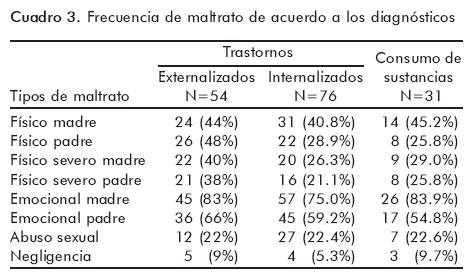
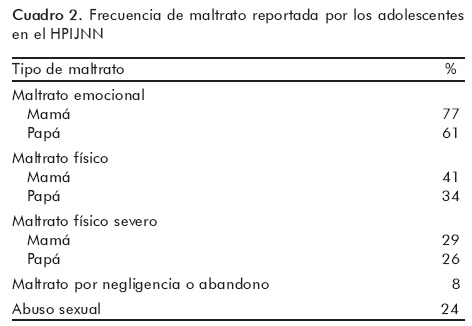
<body><![CDATA[<p align="center"><font face="verdana" size="2"><img src="/img/revistas/sm/v34n3/a5c1.jpg"></font></p>  	    <p align="justify"><font face="verdana" size="2"><i>Tipos de maltrato y percepci&oacute;n de los adolescentes acerca del mismo:</i> En el <a href="#c2">cuadro 2</a> se describe la frecuencia de los tipos de maltrato inflingidos por el padre y la madre respectivamente. El maltrato emocional fue el m&aacute;s frecuentemente reportado. De acuerdo a lo mencionado por los adolescentes, la madre ejerce el maltrato f&iacute;sico, f&iacute;sico grave y emocional con mayor frecuencia que el padre.</font></p>  	    <p align="center"><font face="verdana" size="2"><a name="c2"></a></font></p>  	    <p align="center"><font face="verdana" size="2"><img src="/img/revistas/sm/v34n3/a5c2.jpg"></font></p>  	    <p align="justify"><font face="verdana" size="2">Al evaluar la duraci&oacute;n del maltrato se encontr&oacute; que 19% de los pacientes comenzaron a ser golpeados antes de los cinco a&ntilde;os por la madre y 11% por el padre.</font></p>  	    <p align="justify"><font face="verdana" size="2">En cuanto a la opini&oacute;n de los pacientes respecto a ser golpeados, se encontr&oacute; que 22% de los pacientes consideraban que su padre los golpeaba por un motivo justo, 12% mencionaron que les golpeaba &lt;&lt;lo normal&gt;&gt; y s&oacute;lo 11% consideraban que les golpeaba demasiado. En cuanto a ser golpeados por su madre, el 33% consideraban que era por un motivo justo, 19% mencionaron que les golpeaba &lt;&lt;lo normal&gt;&gt; y s&oacute;lo 8% consideraban que les golpeaba demasiado.</font></p>  	    <p align="justify"><font face="verdana" size="2"><i>Tipos de maltrato y psicopatolog&iacute;a.</i> El <a href="#c3">cuadro 3</a> muestra las frecuencias reportadas de maltrato en pacientes con trastornos externalizados, internalizados y consumo de sustancias. Los pacientes con trastornos externalizados reportaron mayor frecuencia de maltrato f&iacute;sico grave que los otros dos grupos diagn&oacute;sticos. En el resto de los tipos de maltrato las frecuencias observadas fueron similares.</font></p>  	    <p align="center"><font face="verdana" size="2"><a name="c3"></a></font></p>  	    <p align="center"><font face="verdana" size="2"><img src="/img/revistas/sm/v34n3/a5c3.jpg"></font></p>  	    <p align="justify"><font face="verdana" size="2">La <a href="#f1">figura 1</a> muestra las razones m&aacute;s frecuentes por las que los adolescentes consideran que los padres golpean a sus hijos. La desobediencia y la falta de respeto fueron las razones m&aacute;s frecuentemente reportadas; el maltrato tambi&eacute;n se atribuy&oacute; a que los padres estuvieran nerviosos o hubieran consumido alcohol, siendo estas razones m&aacute;s frecuentemente expuestas por los adolescentes con diagn&oacute;stico de abuso de sustancias que por los otros dos grupos.</font></p>  	    ]]></body>
<body><![CDATA[<p align="center"><font face="verdana" size="2"><a name="f1"></a></font></p>  	    <p align="center"><font face="verdana" size="2"><img src="/img/revistas/sm/v34n3/a5f1.jpg"></font></p>  	    <p align="justify"><font face="verdana" size="2">&nbsp;</font></p>  	    <p align="justify"><font face="verdana" size="2"><b>DISCUSI&Oacute;N</b></font></p>  	    <p align="justify"><font face="verdana" size="2">Las caracter&iacute;sticas de la familia, escolaridad de los padres y la distribuci&oacute;n diagn&oacute;stica de los adolescentes entrevistados fueron similares a las reportadas en otros estudios que evaluaron a la poblaci&oacute;n que acude a consulta al Hospital Psiqui&aacute;trico Infantil.<sup>24&#45;26</sup></font></p>  	    <p align="justify"><font face="verdana" size="2">Los resultados muestran que dentro de los tipos de maltrato estudiados, el m&aacute;s com&uacute;n fue el maltrato emocional, en forma similar a lo reportado en la encuesta de maltrato infantil aplicada al mismo grupo de edad en poblaci&oacute;n general<sup>3</sup> y a reportes de estudios con adolescentes en poblaci&oacute;n abierta, en particular el realizado en Cuba por Fern&aacute;ndez,<sup>27</sup> donde el 75% present&oacute; maltrato psicol&oacute;gico. El abuso sexual fue reportado por la cuarta parte de los pacientes entrevistados. Dicha frecuencia es superior a la reportada en la encuesta nacional de maltrato infantil (0.9% a 9.1%)<sup>3</sup> y a la reportada en art&iacute;culos de revisi&oacute;n.<sup>28</sup></font></p>  	    <p align="justify"><font face="verdana" size="2">Se encontr&oacute; que la madre es quien m&aacute;s frecuentemente ejerc&iacute;a el maltrato emocional, el maltrato f&iacute;sico y el maltrato f&iacute;sico grave. Esto se hab&iacute;a reportado en otras muestras en poblaci&oacute;n abierta<sup>3</sup> y en adolescentes que acuden a los servicios de urgencias en hospitales pedi&aacute;tricos.<sup>29</sup> La violencia entre padres, el estr&eacute;s parental y la depresi&oacute;n se han se&ntilde;alado como factores de riesgo para el maltrato por parte de la madre.<sup>30,31</sup> Pittman y Buckley, en un estudio que compar&oacute; diversas caracter&iacute;sticas de madres y padres maltratadores, encontraron que las madres ten&iacute;an menos herramientas para lidiar con el estr&eacute;s generado fuera de sus familias mientras que los padres manten&iacute;an una actitud r&iacute;gida y distante, expresando expectativas exageradas del comportamiento de sus hijos.<sup>32</sup></font></p>  	    <p align="justify"><font face="verdana" size="2">En cuanto a las creencias y percepciones del maltrato presentes en los adolescentes de la muestra, encontramos que m&aacute;s del 20% de los pacientes consideraba que su padre o su madre los golpeaba por un motivo justo y 19% consider&oacute; que su madre les golpeaba &lt;&lt;lo normal&gt;&gt;. Tambi&eacute;n hay que destacar que la proporci&oacute;n de quienes consideraron que su padre &lt;&lt;les golpea demasiado&gt;&gt; es mayor a la de quienes consideraron lo mismo de su madre, lo que podr&iacute;a indicar que una parte de los adolescentes estudiados tienen la percepci&oacute;n de que el maltrato f&iacute;sico por la madre es m&aacute;s justo que el del padre y que son menos golpeados por ellas que por sus padres, a pesar de que la frecuencia de maltrato fue mayor por parte de la madre que por el padre. Lo anterior se vincula a la aceptaci&oacute;n cultural de que a la madre le corresponde ejercer la disciplina, sin importar el m&eacute;todo empleado.</font></p>  	    <p align="justify"><font face="verdana" size="2">La presente muestra cl&iacute;nica report&oacute; frecuencia de maltrato en mayor proporci&oacute;n que la reportada en poblaci&oacute;n abierta, lo que orienta a suponer una relaci&oacute;n directa entre la psicopatolog&iacute;a y el maltrato. Al examinar las frecuencias reportadas de maltrato de acuerdo al tipo de psicopatolog&iacute;a, se encontr&oacute; que los porcentajes mayores de maltrato f&iacute;sico se encontraban en pacientes con trastornos externalizados. Este hallazgo ha sido descrito en estudios nacionales como el de Sauceda, e internacionales como el de Ford en el 2000, que mencionaron a los trastornos externalizados como factores de riesgo para recibir maltrato.<sup>33,34</sup></font></p>  	    <p align="justify"><font face="verdana" size="2">Los trastornos externalizados fueron diagnosticados en m&aacute;s de la mitad de la muestra, y podr&iacute;an evaluarse como factor asociado a la mayor proporci&oacute;n de maltrato encontrado en estos sujetos con psicopatolog&iacute;a en futuros estudios.</font></p>  	    ]]></body>
<body><![CDATA[<p align="justify"><font face="verdana" size="2">Por otra parte, m&aacute;s de la mitad de los adolescentes estudiados reportaron abuso o dependencia a sustancias en ellos y sus familiares. De Sanctis et al. han subrayado la relaci&oacute;n entre el maltrato infantil y los trastornos por consumo de sustancias.<sup>35</sup></font></p>  	    <p align="justify"><font face="verdana" size="2">En cuanto a las razones por las que los adolescentes cre&iacute;an ser golpeados, es importante destacar el alto porcentaje de pacientes que consideraron que el consumo de sustancias es la raz&oacute;n m&aacute;s frecuente por la que los padres les pegan a sus hijos. Se ha reportado que la adicci&oacute;n en las madres se relaciona con el abuso en sus hijos, existiendo una relaci&oacute;n estrecha entre la frecuencia y gravedad de maltrato con la gravedad del consumo de sustancias en ellas.<sup>36</sup></font></p>  	    <p align="justify"><font face="verdana" size="2"><b>Limitaciones</b></font></p>  	    <p align="justify"><font face="verdana" size="2">Se contempla como posible limitaci&oacute;n del estudio la exclusi&oacute;n de los pacientes con discapacidades o psicopatolog&iacute;a que interfirieran en la autoaplicaci&oacute;n de la encuesta de maltrato infantil, ya que podr&iacute;an ser igualmente pacientes vulnerables a maltrato. Por otra parte, los datos provienen de una encuesta transversal y autoaplicada en la que se pide al individuo que informe voluntariamente sobre situaciones que ha vivido en el &uacute;ltimo a&ntilde;o y otras a lo largo de la vida. Por tanto, existe el riesgo de sesgo debido a lo que el individuo recuerda, en lo que percibe y lo que est&aacute; dispuesto a contestar de manera fidedigna.</font></p>  	    <p align="justify"><font face="verdana" size="2">&nbsp;</font></p>  	    <p align="justify"><font face="verdana" size="2"><b>CONCLUSIONES</b></font></p>  	    <p align="justify"><font face="verdana" size="2">La muestra estudiada de adolescentes report&oacute; frecuencias elevadas de maltrato y abuso sexual. Tambi&eacute;n presenta indicadores demogr&aacute;ficos desfavorables (familias desintegradas, violencia ente los padres y baja escolaridad de los mismos), que deben tomarse en cuenta como factores de riesgo para el maltrato, aunados a la psicopatolog&iacute;a.</font></p>  	    <p align="justify"><font face="verdana" size="2">&nbsp;</font></p>  	    <p align="justify"><font face="verdana" size="2"><b>REFERENCIAS</b></font></p>  	    <!-- ref --><p align="justify"><font face="verdana" size="2">1. Cort&eacute;s M, Cant&oacute;n J. Definici&oacute;n, incidencia y causas del maltrato infantil en el contexto familiar. En: Cant&oacute;n J, Cort&eacute;s M (eds). Malos tratos y abuso sexual infantil. Espa&ntilde;a: Editorial Siglo Veintiuno Editores; 1997; pp.1&#45;72.    &nbsp;&nbsp;&nbsp;&nbsp;&nbsp;&nbsp;&nbsp;&nbsp;[&#160;<a href="javascript:void(0);" onclick="javascript: window.open('/scielo.php?script=sci_nlinks&ref=9247308&pid=S0185-3325201100030000500001&lng=','','width=640,height=500,resizable=yes,scrollbars=1,menubar=yes,');">Links</a>&#160;]<!-- end-ref --></font></p>  	    <!-- ref --><p align="justify"><font face="verdana" size="2">2. Palacios J, Jim&eacute;nez J, Moreno M, Oliva A et al. Frecuencia de malos tratos en la infancia. En: G&oacute;mez de Terreros I (ed). Los profesionales de la salud ante el maltrato infantil. Granada: Editorial Comares; 1995; pp.97&#45;119.    &nbsp;&nbsp;&nbsp;&nbsp;&nbsp;&nbsp;&nbsp;&nbsp;[&#160;<a href="javascript:void(0);" onclick="javascript: window.open('/scielo.php?script=sci_nlinks&ref=9247310&pid=S0185-3325201100030000500002&lng=','','width=640,height=500,resizable=yes,scrollbars=1,menubar=yes,');">Links</a>&#160;]<!-- end-ref --></font></p>  	    <!-- ref --><p align="justify"><font face="verdana" size="2">3. Villatoro J, Quiroz N, Guti&eacute;rrez M, D&iacute;az M et al. &iquest;C&oacute;mo educamos a nuestros/as hijos/as? Encuesta de Maltrato Infantil y Factores Asociados. M&eacute;xico: Instituto Nacional de Mujeres (INMUJERES), Instituto Nacional de Psiquiatr&iacute;a Ram&oacute;n de la Fuente Mu&ntilde;iz; 2006.    &nbsp;&nbsp;&nbsp;&nbsp;&nbsp;&nbsp;&nbsp;&nbsp;[&#160;<a href="javascript:void(0);" onclick="javascript: window.open('/scielo.php?script=sci_nlinks&ref=9247312&pid=S0185-3325201100030000500003&lng=','','width=640,height=500,resizable=yes,scrollbars=1,menubar=yes,');">Links</a>&#160;]<!-- end-ref --></font></p>  	    <!-- ref --><p align="justify"><font face="verdana" size="2">4. Hussey J, Chang J, Kotch J. Child maltreatment in the United States: prevalence, risk factors, and adolescent health consequences. Pediatrics 2006;118:933&#45;942.    &nbsp;&nbsp;&nbsp;&nbsp;&nbsp;&nbsp;&nbsp;&nbsp;[&#160;<a href="javascript:void(0);" onclick="javascript: window.open('/scielo.php?script=sci_nlinks&ref=9247314&pid=S0185-3325201100030000500004&lng=','','width=640,height=500,resizable=yes,scrollbars=1,menubar=yes,');">Links</a>&#160;]<!-- end-ref --></font></p>  	    <!-- ref --><p align="justify"><font face="verdana" size="2">5. Sesar K, iveias&#45;Beasirevias I, Sesar D. Multi&#45;type maltreatment in childhood and psychological adjustment in adolescence: questionnaire study among adolescents in western herzegovina canton. Croat Med J 2008;49:243&#45;256.    &nbsp;&nbsp;&nbsp;&nbsp;&nbsp;&nbsp;&nbsp;&nbsp;[&#160;<a href="javascript:void(0);" onclick="javascript: window.open('/scielo.php?script=sci_nlinks&ref=9247316&pid=S0185-3325201100030000500005&lng=','','width=640,height=500,resizable=yes,scrollbars=1,menubar=yes,');">Links</a>&#160;]<!-- end-ref --></font></p>  	    <!-- ref --><p align="justify"><font face="verdana" size="2">6. Edgardh K, Ormstad K. Prevalence and characteristics of sexual abuse in a national sample of Swedish seventeen&#45;year&#45;old boys and girls. Acta Paediatr 2000;89:268&#45;271.    &nbsp;&nbsp;&nbsp;&nbsp;&nbsp;&nbsp;&nbsp;&nbsp;[&#160;<a href="javascript:void(0);" onclick="javascript: window.open('/scielo.php?script=sci_nlinks&ref=9247318&pid=S0185-3325201100030000500006&lng=','','width=640,height=500,resizable=yes,scrollbars=1,menubar=yes,');">Links</a>&#160;]<!-- end-ref --></font></p>  	    <!-- ref --><p align="justify"><font face="verdana" size="2">7. Edwards V, Holden G, Felitti V, Anda R. Relationship between multiple forms of childhood maltreatment and adult mental health in community respondents: results from the adverse childhood experiences study. Am J Psychiatry 2003;160:1453&#45;1460.    &nbsp;&nbsp;&nbsp;&nbsp;&nbsp;&nbsp;&nbsp;&nbsp;[&#160;<a href="javascript:void(0);" onclick="javascript: window.open('/scielo.php?script=sci_nlinks&ref=9247320&pid=S0185-3325201100030000500007&lng=','','width=640,height=500,resizable=yes,scrollbars=1,menubar=yes,');">Links</a>&#160;]<!-- end-ref --></font></p>  	    <!-- ref --><p align="justify"><font face="verdana" size="2">8. Aberle N, Ratkovioe&#45;Blazevioe V, Mitrovioe&#45;Dittrich D, Coha R et al. Emotional and physical abuse in family: survey among high school adolescents. Croat Med J 2007;48:240&#45;248.    &nbsp;&nbsp;&nbsp;&nbsp;&nbsp;&nbsp;&nbsp;&nbsp;[&#160;<a href="javascript:void(0);" onclick="javascript: window.open('/scielo.php?script=sci_nlinks&ref=9247322&pid=S0185-3325201100030000500008&lng=','','width=640,height=500,resizable=yes,scrollbars=1,menubar=yes,');">Links</a>&#160;]<!-- end-ref --></font></p>  	    <!-- ref --><p align="justify"><font face="verdana" size="2">9. Elliman D, Lynch M. The physical punishment of children. Arch Dis Child 2000;196:196&#45;198.    &nbsp;&nbsp;&nbsp;&nbsp;&nbsp;&nbsp;&nbsp;&nbsp;[&#160;<a href="javascript:void(0);" onclick="javascript: window.open('/scielo.php?script=sci_nlinks&ref=9247324&pid=S0185-3325201100030000500009&lng=','','width=640,height=500,resizable=yes,scrollbars=1,menubar=yes,');">Links</a>&#160;]<!-- end-ref --></font></p>  	    <!-- ref --><p align="justify"><font face="verdana" size="2">10. Perepletchikova F, Kaufman J. Emotional and behavioral sequelae of childhood maltreatment. Curr Opin Pediatr 2010;22:610&#45;615.    &nbsp;&nbsp;&nbsp;&nbsp;&nbsp;&nbsp;&nbsp;&nbsp;[&#160;<a href="javascript:void(0);" onclick="javascript: window.open('/scielo.php?script=sci_nlinks&ref=9247326&pid=S0185-3325201100030000500010&lng=','','width=640,height=500,resizable=yes,scrollbars=1,menubar=yes,');">Links</a>&#160;]<!-- end-ref --></font></p>  	    <!-- ref --><p align="justify"><font face="verdana" size="2">11. Ethier L, Lemelin J, Lacharit&eacute; C. A longitudinal study of the effects of chronic maltreatment on children's behavioral and emotional problems. Child Abuse Negl 2004;28:1265&#45;1278.    &nbsp;&nbsp;&nbsp;&nbsp;&nbsp;&nbsp;&nbsp;&nbsp;[&#160;<a href="javascript:void(0);" onclick="javascript: window.open('/scielo.php?script=sci_nlinks&ref=9247328&pid=S0185-3325201100030000500011&lng=','','width=640,height=500,resizable=yes,scrollbars=1,menubar=yes,');">Links</a>&#160;]<!-- end-ref --></font></p>  	    <!-- ref --><p align="justify"><font face="verdana" size="2">12. Yanos P, Czaja S, Widom C. A prospective examination of service use by abused and neglected children followed up into adulthood. Psychiatr Serv 2010;61:796&#45;802.    &nbsp;&nbsp;&nbsp;&nbsp;&nbsp;&nbsp;&nbsp;&nbsp;[&#160;<a href="javascript:void(0);" onclick="javascript: window.open('/scielo.php?script=sci_nlinks&ref=9247330&pid=S0185-3325201100030000500012&lng=','','width=640,height=500,resizable=yes,scrollbars=1,menubar=yes,');">Links</a>&#160;]<!-- end-ref --></font></p>  	    <!-- ref --><p align="justify"><font face="verdana" size="2">13. Ouyang L, Fang X, Mercy J, Perou R et al. Attention&#45;deficit/hyperactivity disorder symptoms and child maltreatment: a population&#45;based study. J Pediatr Nurs 2008;153:851&#45;856.    &nbsp;&nbsp;&nbsp;&nbsp;&nbsp;&nbsp;&nbsp;&nbsp;[&#160;<a href="javascript:void(0);" onclick="javascript: window.open('/scielo.php?script=sci_nlinks&ref=9247332&pid=S0185-3325201100030000500013&lng=','','width=640,height=500,resizable=yes,scrollbars=1,menubar=yes,');">Links</a>&#160;]<!-- end-ref --></font></p>  	    <!-- ref --><p align="justify"><font face="verdana" size="2">14. Jonson&#45;Reid M, Presnall N, Drake B, Fox L et al. Effects of child maltreatment and inherited liability on antisocial development: an official records study. J Am Acad Child Adolesc Psychiatry 2010;49:321&#45;332.    &nbsp;&nbsp;&nbsp;&nbsp;&nbsp;&nbsp;&nbsp;&nbsp;[&#160;<a href="javascript:void(0);" onclick="javascript: window.open('/scielo.php?script=sci_nlinks&ref=9247334&pid=S0185-3325201100030000500014&lng=','','width=640,height=500,resizable=yes,scrollbars=1,menubar=yes,');">Links</a>&#160;]<!-- end-ref --></font></p>  	    <!-- ref --><p align="justify"><font face="verdana" size="2">15. Webb M, Heisler D, Call S, Chickering S et al. Shame, guilt, symptoms of depression, and reported history of psychological maltreatment. Child Abuse Negl 2007;31:1143&#45;1153.    &nbsp;&nbsp;&nbsp;&nbsp;&nbsp;&nbsp;&nbsp;&nbsp;[&#160;<a href="javascript:void(0);" onclick="javascript: window.open('/scielo.php?script=sci_nlinks&ref=9247336&pid=S0185-3325201100030000500015&lng=','','width=640,height=500,resizable=yes,scrollbars=1,menubar=yes,');">Links</a>&#160;]<!-- end-ref --></font></p>  	    <!-- ref --><p align="justify"><font face="verdana" size="2">16. Cicchetti D, Rogosch F, Sturge&#45;Apple M. Interactions of child maltreatment and serotonin transporter and monoamine oxidase A polymorphisms: depressive symptomatology among adolescents from low socioeconomic status backgrounds. Dev Psychopathol 2007;19:1161&#45;1180.    &nbsp;&nbsp;&nbsp;&nbsp;&nbsp;&nbsp;&nbsp;&nbsp;[&#160;<a href="javascript:void(0);" onclick="javascript: window.open('/scielo.php?script=sci_nlinks&ref=9247338&pid=S0185-3325201100030000500016&lng=','','width=640,height=500,resizable=yes,scrollbars=1,menubar=yes,');">Links</a>&#160;]<!-- end-ref --></font></p>  	    <!-- ref --><p align="justify"><font face="verdana" size="2">17. Brown G, McBride L, Bauer M, Williford W. Impact of childhood abuse on the course of bipolar disorder: a replication study in U.S. veterans. J Affect Disord 2005;89:57&#45;67.    &nbsp;&nbsp;&nbsp;&nbsp;&nbsp;&nbsp;&nbsp;&nbsp;[&#160;<a href="javascript:void(0);" onclick="javascript: window.open('/scielo.php?script=sci_nlinks&ref=9247340&pid=S0185-3325201100030000500017&lng=','','width=640,height=500,resizable=yes,scrollbars=1,menubar=yes,');">Links</a>&#160;]<!-- end-ref --></font></p>  	    <!-- ref --><p align="justify"><font face="verdana" size="2">18. Romero S, Birmaher B, Axelson D, Goldstein T et al. Prevalence and correlates of physical and sexual abuse in children and adolescents with bipolar disorder. J Affect Disord 2009;112:144&#45;150.    &nbsp;&nbsp;&nbsp;&nbsp;&nbsp;&nbsp;&nbsp;&nbsp;[&#160;<a href="javascript:void(0);" onclick="javascript: window.open('/scielo.php?script=sci_nlinks&ref=9247342&pid=S0185-3325201100030000500018&lng=','','width=640,height=500,resizable=yes,scrollbars=1,menubar=yes,');">Links</a>&#160;]<!-- end-ref --></font></p>  	    <!-- ref --><p align="justify"><font face="verdana" size="2">19. McIntyre R, Soczynska J, Mancini D, Lam C et al. The relationship between childhood abuse and suicidality in adult bipolar disorder. Violence Vict 2008;23:361&#45;372.    &nbsp;&nbsp;&nbsp;&nbsp;&nbsp;&nbsp;&nbsp;&nbsp;[&#160;<a href="javascript:void(0);" onclick="javascript: window.open('/scielo.php?script=sci_nlinks&ref=9247344&pid=S0185-3325201100030000500019&lng=','','width=640,height=500,resizable=yes,scrollbars=1,menubar=yes,');">Links</a>&#160;]<!-- end-ref --></font></p>  	    <!-- ref --><p align="justify"><font face="verdana" size="2">20. Downs W, Harrison L. Childhood maltreatment and the risk of substance problems in later life. Health Soc Care Community 1998;6:35&#45;46.    &nbsp;&nbsp;&nbsp;&nbsp;&nbsp;&nbsp;&nbsp;&nbsp;[&#160;<a href="javascript:void(0);" onclick="javascript: window.open('/scielo.php?script=sci_nlinks&ref=9247346&pid=S0185-3325201100030000500020&lng=','','width=640,height=500,resizable=yes,scrollbars=1,menubar=yes,');">Links</a>&#160;]<!-- end-ref --></font></p>  	    <!-- ref --><p align="justify"><font face="verdana" size="2">21. Hamburger M, Leeb R, Swahn M. Childhood maltreatment and early alcohol use among high&#45;risk adolescents. J Stud Alcohol Drugs 2008;69:291&#45;295.    &nbsp;&nbsp;&nbsp;&nbsp;&nbsp;&nbsp;&nbsp;&nbsp;[&#160;<a href="javascript:void(0);" onclick="javascript: window.open('/scielo.php?script=sci_nlinks&ref=9247348&pid=S0185-3325201100030000500021&lng=','','width=640,height=500,resizable=yes,scrollbars=1,menubar=yes,');">Links</a>&#160;]<!-- end-ref --></font></p>  	    <!-- ref --><p align="justify"><font face="verdana" size="2">22. Shin S, Hong H, Hazen A. Childhood sexual abuse and adolescent substance use: a latent class analysis. Drug Alcohol Depend 2010;109:226&#45;235.    &nbsp;&nbsp;&nbsp;&nbsp;&nbsp;&nbsp;&nbsp;&nbsp;[&#160;<a href="javascript:void(0);" onclick="javascript: window.open('/scielo.php?script=sci_nlinks&ref=9247350&pid=S0185-3325201100030000500022&lng=','','width=640,height=500,resizable=yes,scrollbars=1,menubar=yes,');">Links</a>&#160;]<!-- end-ref --></font></p>  	    <!-- ref --><p align="justify"><font face="verdana" size="2">23. De la Pe&ntilde;a F, Pati&ntilde;o M, Mendiz&aacute;bal A, Cort&eacute;s J et al. La entrevista se&#45;miestructurada para adolescentes (ESA). Caracter&iacute;sticas del instrumento y estudio de confiabilidad interevaluador y temporal. Salud Mental 1998;21:11&#45;19.    &nbsp;&nbsp;&nbsp;&nbsp;&nbsp;&nbsp;&nbsp;&nbsp;[&#160;<a href="javascript:void(0);" onclick="javascript: window.open('/scielo.php?script=sci_nlinks&ref=9247352&pid=S0185-3325201100030000500023&lng=','','width=640,height=500,resizable=yes,scrollbars=1,menubar=yes,');">Links</a>&#160;]<!-- end-ref --></font></p>  	    <!-- ref --><p align="justify"><font face="verdana" size="2">24. Caballero Lozano I. Estudio comparativo de conductas asociadas a funciones ejecutivas en adolescentes con trastorno por d&eacute;ficit de atenci&oacute;n e hiperactividad y un grupo control. M&eacute;xico: Psicolog&iacute;a M&eacute;dica, Psiquiatr&iacute;a y Salud Mental, Universidad Nacional Aut&oacute;noma de M&eacute;xico; 2010.    &nbsp;&nbsp;&nbsp;&nbsp;&nbsp;&nbsp;&nbsp;&nbsp;[&#160;<a href="javascript:void(0);" onclick="javascript: window.open('/scielo.php?script=sci_nlinks&ref=9247354&pid=S0185-3325201100030000500024&lng=','','width=640,height=500,resizable=yes,scrollbars=1,menubar=yes,');">Links</a>&#160;]<!-- end-ref --></font></p>  	    <!-- ref --><p align="justify"><font face="verdana" size="2">25. P&eacute;rez&#45;Sandoval G. Calidad de vida en adolescentes con antecedentes de consumo de cocaina con y sin tratamiento en la actualidad. M&eacute;xico: Psicolog&iacute;a M&eacute;dica, Psiquiatr&iacute;a y Salud Mental, Universidad Nacional Aut&oacute;noma de M&eacute;xico; 2010.    &nbsp;&nbsp;&nbsp;&nbsp;&nbsp;&nbsp;&nbsp;&nbsp;[&#160;<a href="javascript:void(0);" onclick="javascript: window.open('/scielo.php?script=sci_nlinks&ref=9247356&pid=S0185-3325201100030000500025&lng=','','width=640,height=500,resizable=yes,scrollbars=1,menubar=yes,');">Links</a>&#160;]<!-- end-ref --></font></p>  	    <!-- ref --><p align="justify"><font face="verdana" size="2">26. Rivera&#45;Guti&eacute;rrez L. Depresi&oacute;n en adolescentes con epilepsia parcial estudio piloto. M&eacute;xico: Psicolog&iacute;a M&eacute;dica, Psiquiatr&iacute;a y Salud Mental, Universidad Nacional Aut&oacute;noma de M&eacute;xico; 2006.    &nbsp;&nbsp;&nbsp;&nbsp;&nbsp;&nbsp;&nbsp;&nbsp;[&#160;<a href="javascript:void(0);" onclick="javascript: window.open('/scielo.php?script=sci_nlinks&ref=9247358&pid=S0185-3325201100030000500026&lng=','','width=640,height=500,resizable=yes,scrollbars=1,menubar=yes,');">Links</a>&#160;]<!-- end-ref --></font></p>  	    <!-- ref --><p align="justify"><font face="verdana" size="2">27. Fern&aacute;ndez&#45;Couce G, Alonso&#45;Castillo A, Rodr&iacute;guez&#45;Iglesias Z. Maltrato oculto en adolescentes. Rev Cubana Salud P&uacute;blica (revista en Internet); sep. 2006;32. Disponible en: <a href="http://scielo.sld.cu/scielo.php?script=sci_arttext&pid-S0864-34662006000300003&alnh=es" target="_blank">http://scielo.sld.cu/scielo.php?script=sci_arttext&amp;pid&#150;S0864&#150;34662006000300003&amp;lnh=es</a>. Revisado el 3 de abril de 2010.    &nbsp;&nbsp;&nbsp;&nbsp;&nbsp;&nbsp;&nbsp;&nbsp;[&#160;<a href="javascript:void(0);" onclick="javascript: window.open('/scielo.php?script=sci_nlinks&ref=9247360&pid=S0185-3325201100030000500027&lng=','','width=640,height=500,resizable=yes,scrollbars=1,menubar=yes,');">Links</a>&#160;]<!-- end-ref --></font></p>  	    <!-- ref --><p align="justify"><font face="verdana" size="2">28. Putnam F. Ten&#45;year research update review: Child sexual abuse. J Am Acad Child Adolesc Psychiatry 2003;43:269&#45;278.    &nbsp;&nbsp;&nbsp;&nbsp;&nbsp;&nbsp;&nbsp;&nbsp;[&#160;<a href="javascript:void(0);" onclick="javascript: window.open('/scielo.php?script=sci_nlinks&ref=9247362&pid=S0185-3325201100030000500028&lng=','','width=640,height=500,resizable=yes,scrollbars=1,menubar=yes,');">Links</a>&#160;]<!-- end-ref --></font></p>  	    <!-- ref --><p align="justify"><font face="verdana" size="2">29. Saluja G, Marquez V, Cheng T, Trumble A et al. Adolescents as victims of familial violence: a hospital based surveillance. Int J Inj Contr Saf Promot 2007;14:19&#45;23.    &nbsp;&nbsp;&nbsp;&nbsp;&nbsp;&nbsp;&nbsp;&nbsp;[&#160;<a href="javascript:void(0);" onclick="javascript: window.open('/scielo.php?script=sci_nlinks&ref=9247364&pid=S0185-3325201100030000500029&lng=','','width=640,height=500,resizable=yes,scrollbars=1,menubar=yes,');">Links</a>&#160;]<!-- end-ref --></font></p>  	    <!-- ref --><p align="justify"><font face="verdana" size="2">30. Conron K, Beardslee W, Koenen K, Buka S et al. A longitudinal study of maternal depression and child maltreatment in a national sample of families investigated by child protective services. Arch Pediatr Adolesc Med 2009;163:922&#45;930.    &nbsp;&nbsp;&nbsp;&nbsp;&nbsp;&nbsp;&nbsp;&nbsp;[&#160;<a href="javascript:void(0);" onclick="javascript: window.open('/scielo.php?script=sci_nlinks&ref=9247366&pid=S0185-3325201100030000500030&lng=','','width=640,height=500,resizable=yes,scrollbars=1,menubar=yes,');">Links</a>&#160;]<!-- end-ref --></font></p>  	    <!-- ref --><p align="justify"><font face="verdana" size="2">31. Taylor C, Guterman N, Lee S, Rathouz P. Intimate partner violence, maternal stress, nativity, and risk for maternal maltreatment of young children. Am J Public Health 2009;99:175&#45;183.    &nbsp;&nbsp;&nbsp;&nbsp;&nbsp;&nbsp;&nbsp;&nbsp;[&#160;<a href="javascript:void(0);" onclick="javascript: window.open('/scielo.php?script=sci_nlinks&ref=9247368&pid=S0185-3325201100030000500031&lng=','','width=640,height=500,resizable=yes,scrollbars=1,menubar=yes,');">Links</a>&#160;]<!-- end-ref --></font></p>  	    <!-- ref --><p align="justify"><font face="verdana" size="2">32. Pittman J, Buckley R. Comparing maltreating fathers and mothers in terms of personal distress, interpersonal functioning, and perceptions of family climate. Child Abuse Negl 2006;30:481&#45;496.    &nbsp;&nbsp;&nbsp;&nbsp;&nbsp;&nbsp;&nbsp;&nbsp;[&#160;<a href="javascript:void(0);" onclick="javascript: window.open('/scielo.php?script=sci_nlinks&ref=9247370&pid=S0185-3325201100030000500032&lng=','','width=640,height=500,resizable=yes,scrollbars=1,menubar=yes,');">Links</a>&#160;]<!-- end-ref --></font></p>  	    <!-- ref --><p align="justify"><font face="verdana" size="2">33. Ford J, Racusin R, Ellis C, Daviss W et al. Child maltreatment, other trauma exposure, and posttraumatic symptomatology among children with oppositional defiant and attention deficit hyperactivity disorders. J Child Maltreat 2000;5:205&#45;217.    &nbsp;&nbsp;&nbsp;&nbsp;&nbsp;&nbsp;&nbsp;&nbsp;[&#160;<a href="javascript:void(0);" onclick="javascript: window.open('/scielo.php?script=sci_nlinks&ref=9247372&pid=S0185-3325201100030000500033&lng=','','width=640,height=500,resizable=yes,scrollbars=1,menubar=yes,');">Links</a>&#160;]<!-- end-ref --></font></p>  	    <!-- ref --><p align="justify"><font face="verdana" size="2">34. Sauceda&#45;Garc&iacute;a J, Olivo&#45;Guti&eacute;rrez N, Guti&eacute;rrez J, Maldonado&#45;Dur&aacute;n J. El castigo f&iacute;sico en la crianza de los hijos: un estudio comparativo. Bol Med Hosp Infant Mex 2006;63:382&#45;388.    &nbsp;&nbsp;&nbsp;&nbsp;&nbsp;&nbsp;&nbsp;&nbsp;[&#160;<a href="javascript:void(0);" onclick="javascript: window.open('/scielo.php?script=sci_nlinks&ref=9247374&pid=S0185-3325201100030000500034&lng=','','width=640,height=500,resizable=yes,scrollbars=1,menubar=yes,');">Links</a>&#160;]<!-- end-ref --></font></p>  	    <!-- ref --><p align="justify"><font face="verdana" size="2">35. De Sanctis V, Trampush J, Harty S, Marks D et al. Childhood maltreatment and conduct disorder: independent predictors of adolescent substance use disorders in youth with attention deficit/hyperactivity disorder. J Clin Child Adolesc Psychol 2008;37:785&#45;793.    &nbsp;&nbsp;&nbsp;&nbsp;&nbsp;&nbsp;&nbsp;&nbsp;[&#160;<a href="javascript:void(0);" onclick="javascript: window.open('/scielo.php?script=sci_nlinks&ref=9247376&pid=S0185-3325201100030000500035&lng=','','width=640,height=500,resizable=yes,scrollbars=1,menubar=yes,');">Links</a>&#160;]<!-- end-ref --></font></p>  	    <!-- ref --><p align="justify"><font face="verdana" size="2">36. Conners&#45;Burrow N, Johnson B, Whiteside&#45;Mansell L. Maternal substance abuse and children's exposure to violence. J Pediatr Nurs 2009;24:360&#45;368.    &nbsp;&nbsp;&nbsp;&nbsp;&nbsp;&nbsp;&nbsp;&nbsp;[&#160;<a href="javascript:void(0);" onclick="javascript: window.open('/scielo.php?script=sci_nlinks&ref=9247378&pid=S0185-3325201100030000500036&lng=','','width=640,height=500,resizable=yes,scrollbars=1,menubar=yes,');">Links</a>&#160;]<!-- end-ref --></font></p>      ]]></body>
<back>
<ref-list>
<ref id="B1">
<label>1</label><nlm-citation citation-type="book">
<person-group person-group-type="author">
<name>
<surname><![CDATA[Cortés]]></surname>
<given-names><![CDATA[M]]></given-names>
</name>
<name>
<surname><![CDATA[Cantón]]></surname>
<given-names><![CDATA[J]]></given-names>
</name>
</person-group>
<article-title xml:lang="es"><![CDATA[Definición, incidencia y causas del maltrato infantil en el contexto familiar]]></article-title>
<person-group person-group-type="editor">
<name>
<surname><![CDATA[Cantón]]></surname>
<given-names><![CDATA[J]]></given-names>
</name>
<name>
<surname><![CDATA[Cortés]]></surname>
<given-names><![CDATA[M]]></given-names>
</name>
</person-group>
<source><![CDATA[Malos tratos y abuso sexual infantil]]></source>
<year>1997</year>
<page-range>1-72</page-range><publisher-loc><![CDATA[España ]]></publisher-loc>
<publisher-name><![CDATA[Editorial Siglo Veintiuno Editores]]></publisher-name>
</nlm-citation>
</ref>
<ref id="B2">
<label>2</label><nlm-citation citation-type="book">
<person-group person-group-type="author">
<name>
<surname><![CDATA[Palacios]]></surname>
<given-names><![CDATA[J]]></given-names>
</name>
<name>
<surname><![CDATA[Jiménez]]></surname>
<given-names><![CDATA[J]]></given-names>
</name>
<name>
<surname><![CDATA[Moreno]]></surname>
<given-names><![CDATA[M]]></given-names>
</name>
<name>
<surname><![CDATA[Oliva]]></surname>
<given-names><![CDATA[A]]></given-names>
</name>
</person-group>
<article-title xml:lang="es"><![CDATA[Frecuencia de malos tratos en la infancia]]></article-title>
<person-group person-group-type="editor">
<name>
<surname><![CDATA[Gómez de Terreros]]></surname>
<given-names><![CDATA[I]]></given-names>
</name>
</person-group>
<source><![CDATA[Los profesionales de la salud ante el maltrato infantil]]></source>
<year>1995</year>
<page-range>97-119</page-range><publisher-loc><![CDATA[Granada ]]></publisher-loc>
<publisher-name><![CDATA[Editorial Comares]]></publisher-name>
</nlm-citation>
</ref>
<ref id="B3">
<label>3</label><nlm-citation citation-type="book">
<person-group person-group-type="author">
<name>
<surname><![CDATA[Villatoro]]></surname>
<given-names><![CDATA[J]]></given-names>
</name>
<name>
<surname><![CDATA[Quiroz]]></surname>
<given-names><![CDATA[N]]></given-names>
</name>
<name>
<surname><![CDATA[Gutiérrez]]></surname>
<given-names><![CDATA[M]]></given-names>
</name>
<name>
<surname><![CDATA[Díaz]]></surname>
<given-names><![CDATA[M]]></given-names>
</name>
</person-group>
<source><![CDATA[¿Cómo educamos a nuestros/as hijos/as? Encuesta de Maltrato Infantil y Factores Asociados]]></source>
<year>2006</year>
<publisher-loc><![CDATA[México ]]></publisher-loc>
<publisher-name><![CDATA[Instituto Nacional de Mujeres (INMUJERES)Instituto Nacional de Psiquiatría Ramón de la Fuente Muñiz]]></publisher-name>
</nlm-citation>
</ref>
<ref id="B4">
<label>4</label><nlm-citation citation-type="journal">
<person-group person-group-type="author">
<name>
<surname><![CDATA[Hussey]]></surname>
<given-names><![CDATA[J]]></given-names>
</name>
<name>
<surname><![CDATA[Chang]]></surname>
<given-names><![CDATA[J]]></given-names>
</name>
<name>
<surname><![CDATA[Kotch]]></surname>
<given-names><![CDATA[J]]></given-names>
</name>
</person-group>
<article-title xml:lang="en"><![CDATA[Child maltreatment in the United States: prevalence, risk factors, and adolescent health consequences]]></article-title>
<source><![CDATA[Pediatrics]]></source>
<year>2006</year>
<volume>118</volume>
<page-range>933-942</page-range></nlm-citation>
</ref>
<ref id="B5">
<label>5</label><nlm-citation citation-type="journal">
<person-group person-group-type="author">
<name>
<surname><![CDATA[Sesar]]></surname>
<given-names><![CDATA[K]]></given-names>
</name>
<name>
<surname><![CDATA[iveias-Beasirevias]]></surname>
<given-names><![CDATA[I]]></given-names>
</name>
<name>
<surname><![CDATA[Sesar]]></surname>
<given-names><![CDATA[D]]></given-names>
</name>
</person-group>
<article-title xml:lang="en"><![CDATA[Multi-type maltreatment in childhood and psychological adjustment in adolescence: questionnaire study among adolescents in western herzegovina canton]]></article-title>
<source><![CDATA[Croat Med J]]></source>
<year>2008</year>
<volume>49</volume>
<page-range>243-256</page-range></nlm-citation>
</ref>
<ref id="B6">
<label>6</label><nlm-citation citation-type="journal">
<person-group person-group-type="author">
<name>
<surname><![CDATA[Edgardh]]></surname>
<given-names><![CDATA[K]]></given-names>
</name>
<name>
<surname><![CDATA[Ormstad]]></surname>
<given-names><![CDATA[K]]></given-names>
</name>
</person-group>
<article-title xml:lang="en"><![CDATA[Prevalence and characteristics of sexual abuse in a national sample of Swedish seventeen-year-old boys and girls]]></article-title>
<source><![CDATA[Acta Paediatr]]></source>
<year>2000</year>
<volume>89</volume>
<page-range>268-271</page-range></nlm-citation>
</ref>
<ref id="B7">
<label>7</label><nlm-citation citation-type="journal">
<person-group person-group-type="author">
<name>
<surname><![CDATA[Edwards]]></surname>
<given-names><![CDATA[V]]></given-names>
</name>
<name>
<surname><![CDATA[Holden]]></surname>
<given-names><![CDATA[G]]></given-names>
</name>
<name>
<surname><![CDATA[Felitti]]></surname>
<given-names><![CDATA[V]]></given-names>
</name>
<name>
<surname><![CDATA[Anda]]></surname>
<given-names><![CDATA[R]]></given-names>
</name>
</person-group>
<article-title xml:lang="en"><![CDATA[Relationship between multiple forms of childhood maltreatment and adult mental health in community respondents: results from the adverse childhood experiences study]]></article-title>
<source><![CDATA[Am J Psychiatry]]></source>
<year>2003</year>
<volume>160</volume>
<page-range>1453-1460</page-range></nlm-citation>
</ref>
<ref id="B8">
<label>8</label><nlm-citation citation-type="journal">
<person-group person-group-type="author">
<name>
<surname><![CDATA[Aberle]]></surname>
<given-names><![CDATA[N]]></given-names>
</name>
<name>
<surname><![CDATA[Ratkovioe-Blazevioe]]></surname>
<given-names><![CDATA[V]]></given-names>
</name>
<name>
<surname><![CDATA[Mitrovioe-Dittrich]]></surname>
<given-names><![CDATA[D]]></given-names>
</name>
<name>
<surname><![CDATA[Coha]]></surname>
<given-names><![CDATA[R]]></given-names>
</name>
</person-group>
<article-title xml:lang="en"><![CDATA[Emotional and physical abuse in family: survey among high school adolescents]]></article-title>
<source><![CDATA[Croat Med J]]></source>
<year>2007</year>
<volume>48</volume>
<page-range>240-248</page-range></nlm-citation>
</ref>
<ref id="B9">
<label>9</label><nlm-citation citation-type="journal">
<person-group person-group-type="author">
<name>
<surname><![CDATA[Elliman]]></surname>
<given-names><![CDATA[D]]></given-names>
</name>
<name>
<surname><![CDATA[Lynch]]></surname>
<given-names><![CDATA[M]]></given-names>
</name>
</person-group>
<article-title xml:lang="en"><![CDATA[The physical punishment of children]]></article-title>
<source><![CDATA[Arch Dis Child]]></source>
<year>2000</year>
<volume>196</volume>
<page-range>196-198</page-range></nlm-citation>
</ref>
<ref id="B10">
<label>10</label><nlm-citation citation-type="journal">
<person-group person-group-type="author">
<name>
<surname><![CDATA[Perepletchikova]]></surname>
<given-names><![CDATA[F]]></given-names>
</name>
<name>
<surname><![CDATA[Kaufman]]></surname>
<given-names><![CDATA[J]]></given-names>
</name>
</person-group>
<article-title xml:lang="en"><![CDATA[Emotional and behavioral sequelae of childhood maltreatment]]></article-title>
<source><![CDATA[Curr Opin Pediatr]]></source>
<year>2010</year>
<volume>22</volume>
<page-range>610-615</page-range></nlm-citation>
</ref>
<ref id="B11">
<label>11</label><nlm-citation citation-type="journal">
<person-group person-group-type="author">
<name>
<surname><![CDATA[Ethier]]></surname>
<given-names><![CDATA[L]]></given-names>
</name>
<name>
<surname><![CDATA[Lemelin]]></surname>
<given-names><![CDATA[J]]></given-names>
</name>
<name>
<surname><![CDATA[Lacharité]]></surname>
<given-names><![CDATA[C]]></given-names>
</name>
</person-group>
<article-title xml:lang="en"><![CDATA[A longitudinal study of the effects of chronic maltreatment on children's behavioral and emotional problems]]></article-title>
<source><![CDATA[Child Abuse Negl]]></source>
<year>2004</year>
<volume>28</volume>
<page-range>1265-1278</page-range></nlm-citation>
</ref>
<ref id="B12">
<label>12</label><nlm-citation citation-type="journal">
<person-group person-group-type="author">
<name>
<surname><![CDATA[Yanos]]></surname>
<given-names><![CDATA[P]]></given-names>
</name>
<name>
<surname><![CDATA[Czaja]]></surname>
<given-names><![CDATA[S]]></given-names>
</name>
<name>
<surname><![CDATA[Widom]]></surname>
<given-names><![CDATA[C]]></given-names>
</name>
</person-group>
<article-title xml:lang="en"><![CDATA[A prospective examination of service use by abused and neglected children followed up into adulthood]]></article-title>
<source><![CDATA[Psychiatr Serv]]></source>
<year>2010</year>
<volume>61</volume>
<page-range>796-802</page-range></nlm-citation>
</ref>
<ref id="B13">
<label>13</label><nlm-citation citation-type="journal">
<person-group person-group-type="author">
<name>
<surname><![CDATA[Ouyang]]></surname>
<given-names><![CDATA[L]]></given-names>
</name>
<name>
<surname><![CDATA[Fang]]></surname>
<given-names><![CDATA[X]]></given-names>
</name>
<name>
<surname><![CDATA[Mercy]]></surname>
<given-names><![CDATA[J]]></given-names>
</name>
<name>
<surname><![CDATA[Perou]]></surname>
<given-names><![CDATA[R]]></given-names>
</name>
</person-group>
<article-title xml:lang="en"><![CDATA[Attention-deficit/hyperactivity disorder symptoms and child maltreatment: a population-based study]]></article-title>
<source><![CDATA[J Pediatr Nurs]]></source>
<year>2008</year>
<volume>153</volume>
<page-range>851-856</page-range></nlm-citation>
</ref>
<ref id="B14">
<label>14</label><nlm-citation citation-type="journal">
<person-group person-group-type="author">
<name>
<surname><![CDATA[Jonson-Reid]]></surname>
<given-names><![CDATA[M]]></given-names>
</name>
<name>
<surname><![CDATA[Presnall]]></surname>
<given-names><![CDATA[N]]></given-names>
</name>
<name>
<surname><![CDATA[Drake]]></surname>
<given-names><![CDATA[B]]></given-names>
</name>
<name>
<surname><![CDATA[Fox]]></surname>
<given-names><![CDATA[L]]></given-names>
</name>
</person-group>
<article-title xml:lang="en"><![CDATA[Effects of child maltreatment and inherited liability on antisocial development: an official records study]]></article-title>
<source><![CDATA[J Am Acad Child Adolesc Psychiatry]]></source>
<year>2010</year>
<volume>49</volume>
<page-range>321-332</page-range></nlm-citation>
</ref>
<ref id="B15">
<label>15</label><nlm-citation citation-type="journal">
<person-group person-group-type="author">
<name>
<surname><![CDATA[Webb]]></surname>
<given-names><![CDATA[M]]></given-names>
</name>
<name>
<surname><![CDATA[Heisler]]></surname>
<given-names><![CDATA[D]]></given-names>
</name>
<name>
<surname><![CDATA[Call]]></surname>
<given-names><![CDATA[S]]></given-names>
</name>
<name>
<surname><![CDATA[Chickering]]></surname>
<given-names><![CDATA[S]]></given-names>
</name>
</person-group>
<article-title xml:lang="en"><![CDATA[Shame, guilt, symptoms of depression, and reported history of psychological maltreatment]]></article-title>
<source><![CDATA[Child Abuse Negl]]></source>
<year>2007</year>
<volume>31</volume>
<page-range>1143-1153</page-range></nlm-citation>
</ref>
<ref id="B16">
<label>16</label><nlm-citation citation-type="journal">
<person-group person-group-type="author">
<name>
<surname><![CDATA[Cicchetti]]></surname>
<given-names><![CDATA[D]]></given-names>
</name>
<name>
<surname><![CDATA[Rogosch]]></surname>
<given-names><![CDATA[F]]></given-names>
</name>
<name>
<surname><![CDATA[Sturge-Apple]]></surname>
<given-names><![CDATA[M]]></given-names>
</name>
</person-group>
<article-title xml:lang="en"><![CDATA[Interactions of child maltreatment and serotonin transporter and monoamine oxidase A polymorphisms: depressive symptomatology among adolescents from low socioeconomic status backgrounds]]></article-title>
<source><![CDATA[Dev Psychopathol]]></source>
<year>2007</year>
<volume>19</volume>
<page-range>1161-1180</page-range></nlm-citation>
</ref>
<ref id="B17">
<label>17</label><nlm-citation citation-type="journal">
<person-group person-group-type="author">
<name>
<surname><![CDATA[Brown]]></surname>
<given-names><![CDATA[G]]></given-names>
</name>
<name>
<surname><![CDATA[McBride]]></surname>
<given-names><![CDATA[L]]></given-names>
</name>
<name>
<surname><![CDATA[Bauer]]></surname>
<given-names><![CDATA[M]]></given-names>
</name>
<name>
<surname><![CDATA[Williford]]></surname>
<given-names><![CDATA[W]]></given-names>
</name>
</person-group>
<article-title xml:lang="en"><![CDATA[Impact of childhood abuse on the course of bipolar disorder: a replication study in U.S. veterans.]]></article-title>
<source><![CDATA[J Affect Disord]]></source>
<year>2005</year>
<volume>89</volume>
<page-range>57-67</page-range></nlm-citation>
</ref>
<ref id="B18">
<label>18</label><nlm-citation citation-type="journal">
<person-group person-group-type="author">
<name>
<surname><![CDATA[Romero]]></surname>
<given-names><![CDATA[S]]></given-names>
</name>
<name>
<surname><![CDATA[Birmaher]]></surname>
<given-names><![CDATA[B]]></given-names>
</name>
<name>
<surname><![CDATA[Axelson]]></surname>
<given-names><![CDATA[D]]></given-names>
</name>
<name>
<surname><![CDATA[Goldstein]]></surname>
<given-names><![CDATA[T]]></given-names>
</name>
</person-group>
<article-title xml:lang="en"><![CDATA[Prevalence and correlates of physical and sexual abuse in children and adolescents with bipolar disorder]]></article-title>
<source><![CDATA[J Affect Disord]]></source>
<year>2009</year>
<volume>112</volume>
<page-range>144-150</page-range></nlm-citation>
</ref>
<ref id="B19">
<label>19</label><nlm-citation citation-type="journal">
<person-group person-group-type="author">
<name>
<surname><![CDATA[McIntyre]]></surname>
<given-names><![CDATA[R]]></given-names>
</name>
<name>
<surname><![CDATA[Soczynska]]></surname>
<given-names><![CDATA[J]]></given-names>
</name>
<name>
<surname><![CDATA[Mancini]]></surname>
<given-names><![CDATA[D]]></given-names>
</name>
<name>
<surname><![CDATA[Lam]]></surname>
<given-names><![CDATA[C]]></given-names>
</name>
</person-group>
<article-title xml:lang="en"><![CDATA[The relationship between childhood abuse and suicidality in adult bipolar disorder]]></article-title>
<source><![CDATA[Violence Vict]]></source>
<year>2008</year>
<volume>23</volume>
<page-range>361-372</page-range></nlm-citation>
</ref>
<ref id="B20">
<label>20</label><nlm-citation citation-type="journal">
<person-group person-group-type="author">
<name>
<surname><![CDATA[Downs]]></surname>
<given-names><![CDATA[W]]></given-names>
</name>
<name>
<surname><![CDATA[Harrison]]></surname>
<given-names><![CDATA[L]]></given-names>
</name>
</person-group>
<article-title xml:lang="en"><![CDATA[Childhood maltreatment and the risk of substance problems in later life]]></article-title>
<source><![CDATA[Health Soc Care Community]]></source>
<year>1998</year>
<volume>6</volume>
<page-range>35-46</page-range></nlm-citation>
</ref>
<ref id="B21">
<label>21</label><nlm-citation citation-type="journal">
<person-group person-group-type="author">
<name>
<surname><![CDATA[Hamburger]]></surname>
<given-names><![CDATA[M]]></given-names>
</name>
<name>
<surname><![CDATA[Leeb]]></surname>
<given-names><![CDATA[R]]></given-names>
</name>
<name>
<surname><![CDATA[Swahn]]></surname>
<given-names><![CDATA[M]]></given-names>
</name>
</person-group>
<article-title xml:lang="en"><![CDATA[Childhood maltreatment and early alcohol use among high-risk adolescents]]></article-title>
<source><![CDATA[J Stud Alcohol Drugs]]></source>
<year>2008</year>
<volume>69</volume>
<page-range>291-295</page-range></nlm-citation>
</ref>
<ref id="B22">
<label>22</label><nlm-citation citation-type="journal">
<person-group person-group-type="author">
<name>
<surname><![CDATA[Shin]]></surname>
<given-names><![CDATA[S]]></given-names>
</name>
<name>
<surname><![CDATA[Hong]]></surname>
<given-names><![CDATA[H]]></given-names>
</name>
<name>
<surname><![CDATA[Hazen]]></surname>
<given-names><![CDATA[A]]></given-names>
</name>
</person-group>
<article-title xml:lang="en"><![CDATA[Childhood sexual abuse and adolescent substance use: a latent class analysis]]></article-title>
<source><![CDATA[Drug Alcohol Depend]]></source>
<year>2010</year>
<volume>109</volume>
<page-range>226-235</page-range></nlm-citation>
</ref>
<ref id="B23">
<label>23</label><nlm-citation citation-type="journal">
<person-group person-group-type="author">
<name>
<surname><![CDATA[De la Peña]]></surname>
<given-names><![CDATA[F]]></given-names>
</name>
<name>
<surname><![CDATA[Patiño]]></surname>
<given-names><![CDATA[M]]></given-names>
</name>
<name>
<surname><![CDATA[Mendizábal]]></surname>
<given-names><![CDATA[A]]></given-names>
</name>
<name>
<surname><![CDATA[Cortés]]></surname>
<given-names><![CDATA[J]]></given-names>
</name>
</person-group>
<article-title xml:lang="es"><![CDATA[La entrevista se-miestructurada para adolescentes (ESA). Características del instrumento y estudio de confiabilidad interevaluador y temporal]]></article-title>
<source><![CDATA[Salud Mental]]></source>
<year>1998</year>
<volume>21</volume>
<page-range>11-19</page-range></nlm-citation>
</ref>
<ref id="B24">
<label>24</label><nlm-citation citation-type="book">
<person-group person-group-type="author">
<name>
<surname><![CDATA[Caballero Lozano]]></surname>
<given-names><![CDATA[I]]></given-names>
</name>
</person-group>
<source><![CDATA[Estudio comparativo de conductas asociadas a funciones ejecutivas en adolescentes con trastorno por déficit de atención e hiperactividad y un grupo control]]></source>
<year>2010</year>
<publisher-loc><![CDATA[México ]]></publisher-loc>
<publisher-name><![CDATA[Psicología Médica, Psiquiatría y Salud MentalUniversidad Nacional Autónoma de México]]></publisher-name>
</nlm-citation>
</ref>
<ref id="B25">
<label>25</label><nlm-citation citation-type="book">
<person-group person-group-type="author">
<name>
<surname><![CDATA[Pérez-Sandoval]]></surname>
<given-names><![CDATA[G]]></given-names>
</name>
</person-group>
<source><![CDATA[Calidad de vida en adolescentes con antecedentes de consumo de cocaina con y sin tratamiento en la actualidad]]></source>
<year>2010</year>
<publisher-loc><![CDATA[México ]]></publisher-loc>
<publisher-name><![CDATA[Psicología Médica, Psiquiatría y Salud MentalUniversidad Nacional Autónoma de México]]></publisher-name>
</nlm-citation>
</ref>
<ref id="B26">
<label>26</label><nlm-citation citation-type="book">
<person-group person-group-type="author">
<name>
<surname><![CDATA[Rivera-Gutiérrez]]></surname>
<given-names><![CDATA[L]]></given-names>
</name>
</person-group>
<source><![CDATA[Depresión en adolescentes con epilepsia parcial estudio piloto]]></source>
<year>2006</year>
<publisher-loc><![CDATA[México ]]></publisher-loc>
<publisher-name><![CDATA[Psicología Médica, Psiquiatría y Salud MentalUniversidad Nacional Autónoma de México]]></publisher-name>
</nlm-citation>
</ref>
<ref id="B27">
<label>27</label><nlm-citation citation-type="journal">
<person-group person-group-type="author">
<name>
<surname><![CDATA[Fernández-Couce]]></surname>
<given-names><![CDATA[G]]></given-names>
</name>
<name>
<surname><![CDATA[Alonso-Castillo]]></surname>
<given-names><![CDATA[A]]></given-names>
</name>
<name>
<surname><![CDATA[Rodríguez-Iglesias]]></surname>
<given-names><![CDATA[Z]]></given-names>
</name>
</person-group>
<article-title xml:lang="es"><![CDATA[Maltrato oculto en adolescentes]]></article-title>
<source><![CDATA[Rev Cubana Salud Pública]]></source>
<year>sep.</year>
<month> 2</month>
<day>00</day>
<volume>32</volume>
</nlm-citation>
</ref>
<ref id="B28">
<label>28</label><nlm-citation citation-type="journal">
<person-group person-group-type="author">
<name>
<surname><![CDATA[Putnam]]></surname>
<given-names><![CDATA[F]]></given-names>
</name>
</person-group>
<article-title xml:lang="en"><![CDATA[Ten-year research update review: Child sexual abuse]]></article-title>
<source><![CDATA[J Am Acad Child Adolesc Psychiatry]]></source>
<year>2003</year>
<volume>43</volume>
<page-range>269-278</page-range></nlm-citation>
</ref>
<ref id="B29">
<label>29</label><nlm-citation citation-type="journal">
<person-group person-group-type="author">
<name>
<surname><![CDATA[Saluja]]></surname>
<given-names><![CDATA[G]]></given-names>
</name>
<name>
<surname><![CDATA[Marquez]]></surname>
<given-names><![CDATA[V]]></given-names>
</name>
<name>
<surname><![CDATA[Cheng]]></surname>
<given-names><![CDATA[T]]></given-names>
</name>
<name>
<surname><![CDATA[Trumble]]></surname>
<given-names><![CDATA[A]]></given-names>
</name>
</person-group>
<article-title xml:lang="en"><![CDATA[Adolescents as victims of familial violence: a hospital based surveillance]]></article-title>
<source><![CDATA[Int J Inj Contr Saf Promot]]></source>
<year>2007</year>
<volume>14</volume>
<page-range>19-23</page-range></nlm-citation>
</ref>
<ref id="B30">
<label>30</label><nlm-citation citation-type="journal">
<person-group person-group-type="author">
<name>
<surname><![CDATA[Conron]]></surname>
<given-names><![CDATA[K]]></given-names>
</name>
<name>
<surname><![CDATA[Beardslee]]></surname>
<given-names><![CDATA[W]]></given-names>
</name>
<name>
<surname><![CDATA[Koenen]]></surname>
<given-names><![CDATA[K]]></given-names>
</name>
<name>
<surname><![CDATA[Buka]]></surname>
<given-names><![CDATA[S]]></given-names>
</name>
</person-group>
<article-title xml:lang="en"><![CDATA[A longitudinal study of maternal depression and child maltreatment in a national sample of families investigated by child protective services]]></article-title>
<source><![CDATA[Arch Pediatr Adolesc Med]]></source>
<year>2009</year>
<volume>163</volume>
<page-range>922-930</page-range></nlm-citation>
</ref>
<ref id="B31">
<label>31</label><nlm-citation citation-type="journal">
<person-group person-group-type="author">
<name>
<surname><![CDATA[Taylor]]></surname>
<given-names><![CDATA[C]]></given-names>
</name>
<name>
<surname><![CDATA[Guterman]]></surname>
<given-names><![CDATA[N]]></given-names>
</name>
<name>
<surname><![CDATA[Lee]]></surname>
<given-names><![CDATA[S]]></given-names>
</name>
<name>
<surname><![CDATA[Rathouz]]></surname>
<given-names><![CDATA[P]]></given-names>
</name>
</person-group>
<article-title xml:lang="en"><![CDATA[Intimate partner violence, maternal stress, nativity, and risk for maternal maltreatment of young children]]></article-title>
<source><![CDATA[Am J Public Health]]></source>
<year>2009</year>
<volume>99</volume>
<page-range>175-183</page-range></nlm-citation>
</ref>
<ref id="B32">
<label>32</label><nlm-citation citation-type="journal">
<person-group person-group-type="author">
<name>
<surname><![CDATA[Pittman]]></surname>
<given-names><![CDATA[J]]></given-names>
</name>
<name>
<surname><![CDATA[Buckley]]></surname>
<given-names><![CDATA[R]]></given-names>
</name>
</person-group>
<article-title xml:lang="en"><![CDATA[Comparing maltreating fathers and mothers in terms of personal distress, interpersonal functioning, and perceptions of family climate]]></article-title>
<source><![CDATA[Child Abuse Negl]]></source>
<year>2006</year>
<volume>30</volume>
<page-range>481-496</page-range></nlm-citation>
</ref>
<ref id="B33">
<label>33</label><nlm-citation citation-type="journal">
<person-group person-group-type="author">
<name>
<surname><![CDATA[Ford]]></surname>
<given-names><![CDATA[J]]></given-names>
</name>
<name>
<surname><![CDATA[Racusin]]></surname>
<given-names><![CDATA[R]]></given-names>
</name>
<name>
<surname><![CDATA[Ellis]]></surname>
<given-names><![CDATA[C]]></given-names>
</name>
<name>
<surname><![CDATA[Daviss]]></surname>
<given-names><![CDATA[W]]></given-names>
</name>
</person-group>
<article-title xml:lang="en"><![CDATA[Child maltreatment, other trauma exposure, and posttraumatic symptomatology among children with oppositional defiant and attention deficit hyperactivity disorders]]></article-title>
<source><![CDATA[J Child Maltreat]]></source>
<year>2000</year>
<volume>5</volume>
<page-range>205-217</page-range></nlm-citation>
</ref>
<ref id="B34">
<label>34</label><nlm-citation citation-type="journal">
<person-group person-group-type="author">
<name>
<surname><![CDATA[Sauceda-García]]></surname>
<given-names><![CDATA[J]]></given-names>
</name>
<name>
<surname><![CDATA[Olivo-Gutiérrez]]></surname>
<given-names><![CDATA[N]]></given-names>
</name>
<name>
<surname><![CDATA[Gutiérrez]]></surname>
<given-names><![CDATA[J]]></given-names>
</name>
<name>
<surname><![CDATA[Maldonado-Durán]]></surname>
<given-names><![CDATA[J]]></given-names>
</name>
</person-group>
<article-title xml:lang="es"><![CDATA[El castigo físico en la crianza de los hijos: un estudio comparativo]]></article-title>
<source><![CDATA[Bol Med Hosp Infant Mex]]></source>
<year>2006</year>
<volume>63</volume>
<page-range>382-388</page-range></nlm-citation>
</ref>
<ref id="B35">
<label>35</label><nlm-citation citation-type="journal">
<person-group person-group-type="author">
<name>
<surname><![CDATA[De Sanctis]]></surname>
<given-names><![CDATA[V]]></given-names>
</name>
<name>
<surname><![CDATA[Trampush]]></surname>
<given-names><![CDATA[J]]></given-names>
</name>
<name>
<surname><![CDATA[Harty]]></surname>
<given-names><![CDATA[S]]></given-names>
</name>
<name>
<surname><![CDATA[Marks]]></surname>
<given-names><![CDATA[D]]></given-names>
</name>
</person-group>
<article-title xml:lang="en"><![CDATA[Childhood maltreatment and conduct disorder: independent predictors of adolescent substance use disorders in youth with attention deficit/hyperactivity disorder]]></article-title>
<source><![CDATA[J Clin Child Adolesc Psychol]]></source>
<year>2008</year>
<volume>37</volume>
<page-range>785-793</page-range></nlm-citation>
</ref>
<ref id="B36">
<label>36</label><nlm-citation citation-type="journal">
<person-group person-group-type="author">
<name>
<surname><![CDATA[Conners-Burrow]]></surname>
<given-names><![CDATA[N]]></given-names>
</name>
<name>
<surname><![CDATA[Johnson]]></surname>
<given-names><![CDATA[B]]></given-names>
</name>
<name>
<surname><![CDATA[Whiteside-Mansell]]></surname>
<given-names><![CDATA[L]]></given-names>
</name>
</person-group>
<article-title xml:lang="en"><![CDATA[Maternal substance abuse and children's exposure to violence]]></article-title>
<source><![CDATA[J Pediatr Nurs]]></source>
<year>2009</year>
<volume>24</volume>
<page-range>360-368</page-range></nlm-citation>
</ref>
</ref-list>
</back>
</article>