<?xml version="1.0" encoding="ISO-8859-1"?><article xmlns:mml="http://www.w3.org/1998/Math/MathML" xmlns:xlink="http://www.w3.org/1999/xlink" xmlns:xsi="http://www.w3.org/2001/XMLSchema-instance">
<front>
<journal-meta>
<journal-id>0185-3325</journal-id>
<journal-title><![CDATA[Salud mental]]></journal-title>
<abbrev-journal-title><![CDATA[Salud Ment]]></abbrev-journal-title>
<issn>0185-3325</issn>
<publisher>
<publisher-name><![CDATA[Instituto Nacional de Psiquiatría Ramón de la Fuente Muñiz]]></publisher-name>
</publisher>
</journal-meta>
<article-meta>
<article-id>S0185-33252011000300003</article-id>
<title-group>
<article-title xml:lang="es"><![CDATA[Características familiares y trastornos de la conducta alimentaria en una muestra de mujeres adolescentes internadas en un hospital psiquiátrico]]></article-title>
<article-title xml:lang="en"><![CDATA[Family characteristics and eating disorders in a sample of female adolescent inpatients in a psychiatric hospital]]></article-title>
</title-group>
<contrib-group>
<contrib contrib-type="author">
<name>
<surname><![CDATA[Leija Esparza]]></surname>
<given-names><![CDATA[Mauricio]]></given-names>
</name>
<xref ref-type="aff" rid="A01"/>
</contrib>
<contrib contrib-type="author">
<name>
<surname><![CDATA[Sauceda García]]></surname>
<given-names><![CDATA[Juan Manuel]]></given-names>
</name>
<xref ref-type="aff" rid="A02"/>
</contrib>
<contrib contrib-type="author">
<name>
<surname><![CDATA[Ulloa Flores]]></surname>
<given-names><![CDATA[Rosa Elena]]></given-names>
</name>
<xref ref-type="aff" rid="A03"/>
</contrib>
</contrib-group>
<aff id="A01">
<institution><![CDATA[,Instituto Jalisciense de Salud Mental  ]]></institution>
<addr-line><![CDATA[ ]]></addr-line>
</aff>
<aff id="A02">
<institution><![CDATA[,Universidad Nacional Autónoma de México Facultad de Medicina Departamento de Psicología Médica, Psiquiatría y Salud]]></institution>
<addr-line><![CDATA[ ]]></addr-line>
</aff>
<aff id="A03">
<institution><![CDATA[,Hospital Psiquiátrico Infantil Dr. Juan N. Navarro Departamento de Psicofarmacología del Desarrollo ]]></institution>
<addr-line><![CDATA[ ]]></addr-line>
</aff>
<pub-date pub-type="pub">
<day>00</day>
<month>06</month>
<year>2011</year>
</pub-date>
<pub-date pub-type="epub">
<day>00</day>
<month>06</month>
<year>2011</year>
</pub-date>
<volume>34</volume>
<numero>3</numero>
<fpage>203</fpage>
<lpage>210</lpage>
<copyright-statement/>
<copyright-year/>
<self-uri xlink:href="http://www.scielo.org.mx/scielo.php?script=sci_arttext&amp;pid=S0185-33252011000300003&amp;lng=en&amp;nrm=iso"></self-uri><self-uri xlink:href="http://www.scielo.org.mx/scielo.php?script=sci_abstract&amp;pid=S0185-33252011000300003&amp;lng=en&amp;nrm=iso"></self-uri><self-uri xlink:href="http://www.scielo.org.mx/scielo.php?script=sci_pdf&amp;pid=S0185-33252011000300003&amp;lng=en&amp;nrm=iso"></self-uri><abstract abstract-type="short" xml:lang="en"><p><![CDATA[Background From the first descriptions of the eating disorders, researchers have found that the families of patients with anorexia nervosa or bulimia nervosa present high levels of family dysfunction. These families tend to differ from the control families, mainly because they present a greater frequency of conflicts and disorganization, less adaptability and cohesion, poor care of the parents towards their children, presence of overprotection, less orientation towards recreational activities and less emotional support. Several authors have suggested that a family adverse environment might represent an important etiologic factor for the development of an eating disorder. Nevertheless, the symptoms more related to degree of dysfunction or to quality of family environment in such patients have not been identified. Objective To describe the frequency of the eating disorders as well as eating disorder not otherwise specified in a sample of inpatient female adolescents; and to establish the relationship that functioning and quality of the family environment hold with the severity and/or characteristics of the eating psychopathology. Subjects and methods The study included a group of 36 female adolescents hospitalized due to any type of psychopathology in the Children's Psychiatric Hospital Dr. Juan N. Navarro. The study sample consisted of all the patients who wanted to be included and who fulfilled the inclusion criteria. A written informed consent was obtained from parents as approved by the Department of Research of the Children's Psychiatric Hospital Dr. Juan N. Navarro. Diagnostic categories in the sample, including eating disorders, were based on the Mini-International Neuropsychiatrie Interview -Kid (MINI-Kid). Those that presented an eating disorder not otherwise specified were diagnosed with a clinical interview based on DSM-IV criteria. In addition, the patients answered a series of self reports: the Eating Disorder Inventory, the General Functioning Subscale of the McMaster Family Assessment Device and the Child Figure Rating Scale. The body dissatisfaction was considered if the patient had negative scores (she wanted to be thinner) in the Child Figure Rating Scale. The score on the Global Family Environment Scale was obtained through a non-structured interview concerning the quality of the family environment (assessed in retrospect) and this information was complemented with that contained in each patient's medical chart. Results From the 36 patients included, 39% presented an eating disorder (17% a specific disorder and 22% an eating disorder not otherwise specified), 42% presented only body dissatisfaction and 19% of the sample was free of eating psychopathology. The average of the body mass index was within the normal range (23.2 kg/m²); nevertheless the average score of the Eating Disorder Inventory (58.22) was higher than what some authors have suggested as cut point score for anorexia nervosa. The average score of the General Functioning Subscale of the McMaster Family Assessment Device (2.16) was in the low normal limit and the Global Family Environment Scale showed an average (62.8) that would correspond to a moderately unsatisfactory family environment. The total sample was divided in two subgroups; the first included the patients who fulfilled the criteria for eating disorder (including an eating disorder not otherwise specified) and the second subgroup included the rest of the patients. There were not significant differences in the type or number of comorbid disorders. The mean scores of the Eating Disorder Inventory were higher in the subgroup with eating disorder with a statistically significant difference (p<0.01). In a similar way, the dissatisfaction with the weight and the current figure as well as the dissatisfaction to future showed statistically significant differences (p<0.01). The score in the scales of functioning and quality of the family environment did not show statistically significant differences. We also divided the whole sample in two subgroups, one with family dysfunction (as determined by the General Functioning Subscale of the McMaster Family Assessment Device &#8805;2.17), and the other without family dysfunction (scored <2.17). The group with family dysfunction presented a higher frequency of major depressive disorder and social phobia with a statistically significant difference (p<0.05). In a similar fashion, we divided the sample in two subgroups, one with high to moderate quality family environment (score in the Global Family Environment Scale &gt;70) and a second one with low quality family environment (score <70). Nevertheless, these subgroups did not show statistically significant differences concerning psychopathological disorders. We found a positive correlation (r=0.34) among the total score of the Eating Disorder Inventory and the score of the General Functioning Subscale of the McMaster Family Assessment Device (p<0.05). The subscale of the Eating Disorder Inventory that had higher correlation was bulimic symptomatology (r=0.51) followed by ineffectiveness (r=0.43), both statistically significant (p<0.01). On the other hand, the Global Family Environment Scale did not show significant correlations with the Eating Disorder Inventory. Conclusions Eating disorders represent an important cause of morbidity in adolescent female inpatients; likewise, the patients were more frequently diagnosed with an eating disorders not otherwise specified than with anorexia nervosa and bulimia nervosa (in the sample recruited for the present study, we found that the eating disorders not otherwise specified represented 56% of the total of eating disorders), making the early detection necessary for the beginning of treatments directed to avoid the evolution to severe forms. We need to pay attention to «atypical» conditions that do not fulfill the full diagnostic criteria for anorexia or bulimia, as they may be in fact associated with important levels of dysfunction and comorbidity. The dissatisfaction with the weight and figure was shown by the majority of the patients who were hospitalized in a psychiatric unit. Adolescence can be accompanied by great dissatisfaction with self appearance; nevertheless, to determine the relevance of this phenomenon as a risk factor for the development of an eating disorder, follow-up studies with bigger samples are needed. Family dysfunction is a variable that relates to the severity of the eating disorders, mainly the bulimic symptoms. From this perspective these findings seem to support the psychodynamic interpretation of bulimia nervosa, where bingeing symbolizes the marked dependence to significant figures, and vomiting the desire to expel an evil introjected object. Nevertheless, given the impossibility to do inferences beyond a simple association among variables, another explanation could be that the aforementioned symptoms were damaging the family functioning, creating in this way a vicious circle. This finding may be important to determine which group of symptoms could be expected to improve after a family intervention directed to treat an eating disorder. The lack of correlations between the Global Family Environment Scale and the Eating Disorder Inventory could be explained by the fact that the Global Family Environment Scale evaluates functioning during the worst year of the patients' life, which could be during their first five years, thus its effect&#8260;impact on current psychopathology could not be established.]]></p></abstract>
<abstract abstract-type="short" xml:lang="es"><p><![CDATA[Introducción Desde las primeras descripciones de los trastornos alimentarios, los investigadores han encontrado que las familias de las pacientes con anorexia nerviosa o bulimia nerviosa presentan un alto nivel de disfunción familiar. Sin embargo, aún no se ha establecido qué síntomas se encuentran más relacionados con el grado de disfunción o con la calidad del ambiente familiar en este tipo de pacientes. Objetivo Describir la frecuencia de los trastornos de la conducta alimentaria, incluyendo los trastornos de la conducta alimentaria no especificados, en una muestra de pacientes adolescentes hospitalizadas por diversos tipos de psicopatología; y establecer el tipo de relación existente entre el funcionamiento-calidad del ambiente familiar y la gravedad y características de la psicopatología alimentaria. Material y métodos El estudio incluyó a un grupo de 36 pacientes mujeres adolescentes hospitalizadas debido a cualquier tipo de psicopatología en el Hospital Psiquiátrico Infantil Dr. Juan N. Navarro. Se realizó la entrevista Mini-Kid para determinar las categorías diagnósticas presentes en la muestra (los trastornos de la conducta alimentaria no especificados fueron diagnosticados a través de una entrevista no estructurada basada en los criterios del DSM-IV). Además, se aplicó el Eating Disorder Inventory, la Subescala de Funcionamiento General de la Familia, la Escala del Ambiente Familiar Global y la Escala de Figuras de Niños. Resultados El 39% de la muestra presentó un trastorno alimentario (17% un trastorno específico y 22% un trastorno no especificado), el 42% presentaba únicamente insatisfacción corporal y sólo el 19% de la muestra se encontraba libre de psicopatología alimentaria. El grupo con disfunción familiar (puntuación en la Subescala de Funcionamiento General de la Familia &#8805;2.17) presentó una mayor tendencia a cursar con episodio depresivo mayor y fobia social en contraste con el grupo sin disfunción familiar, con una diferencia estadísticamente significativa (p<0.05). El grupo de pacientes con alta-moderada calidad del ambiente familiar (puntuación en la Escala del Ambiente Familiar Global &#8805;70) no mostró diferencias estadísticamente significativas con el grupo de baja calidad del ambiente familiar en cuanto a los trastornos de la conducta alimentaria y el resto de las categorías diagnósticas obtenidas por el Mini-Kid. Se encontró una correlación positiva (r=0.34) entre la puntuación total del Eating Disorder Inventory y la puntuación de la Subescala de Funcionamiento General de la Familia (p<0.05). La subescala del Eating Disorder Inventory que tuvo mayor correlación fue la de sintomatología bulímica (r=0.51), seguida por la de inefectividad y baja autoestima (r=0.43), ambas estadísticamente significativas (p<0.01). Conclusiones Los trastornos de la conducta alimentaria representan una importante causa de morbilidad en las poblaciones clínicas de mujeres adolescentes; asimismo, los trastornos de la conducta alimentaria no especificados superan en prevalencia a la anorexia nerviosa y la bulimia nerviosa. La disfunción familiar es una variable que se relaciona con la gravedad de los trastornos de la conducta alimentaria, principalmente los síntomas bulímicos y la baja autoestima. Este hallazgo resulta relevante ante el hecho de poder determinar qué grupo de síntomas podrían mejorar inicialmente con una intervención familiar encaminada a tratar un trastorno alimentario. Al parecer, la calidad del ambiente familiar medido de forma retrospectiva no tiene un impacto específico en la presencia de un trastorno alimentario, lo que puede quizá solamente propiciar la presencia de variables mediadoras que se relacionen con la generación de psicopatología.]]></p></abstract>
<kwd-group>
<kwd lng="en"><![CDATA[Family environment]]></kwd>
<kwd lng="en"><![CDATA[family functioning]]></kwd>
<kwd lng="en"><![CDATA[eating disorders]]></kwd>
<kwd lng="en"><![CDATA[body dissatisfaction]]></kwd>
<kwd lng="en"><![CDATA[adolescent inpatients]]></kwd>
<kwd lng="es"><![CDATA[Ambiente familiar]]></kwd>
<kwd lng="es"><![CDATA[funcionamiento familiar]]></kwd>
<kwd lng="es"><![CDATA[trastornos de la conducta alimentaria]]></kwd>
<kwd lng="es"><![CDATA[insatisfacción corporal]]></kwd>
<kwd lng="es"><![CDATA[adolescentes hospitalizados]]></kwd>
</kwd-group>
</article-meta>
</front><body><![CDATA[  	    <p align="justify"><font face="verdana" size="4">Art&iacute;culo original</font></p>  	    <p align="justify"><font face="verdana" size="2">&nbsp;</font></p>  	    <p align="center"><font face="verdana" size="4"><b>Caracter&iacute;sticas familiares y trastornos de la conducta alimentaria en una muestra de mujeres adolescentes internadas en un hospital psiqui&aacute;trico</b></font></p>  	    <p align="center"><font face="verdana" size="2">&nbsp;</font></p>  	    <p align="center"><font face="verdana" size="3"><b>Family characteristics and eating disorders in a sample of female adolescent inpatients in a psychiatric hospital</b></font></p>  	    <p align="center"><font face="verdana" size="2">&nbsp;</font></p>  	    <p align="center"><font face="verdana" size="2"><b>Mauricio Leija Esparza,<sup>1</sup> Juan Manuel Sauceda Garc&iacute;a,<sup>2</sup> Rosa Elena Ulloa Flores<sup>3</sup></b></font></p>  	    <p align="center"><font face="verdana" size="2">&nbsp;</font></p>  	    <p align="justify"><font face="verdana" size="2"><sup>1</sup> <i>Instituto Jalisciense de Salud Mental.</i></font></p>  	    ]]></body>
<body><![CDATA[<p align="justify"><font face="verdana" size="2"><sup>2</sup> <i>Departamento de Psicolog&iacute;a M&eacute;dica, Psiquiatr&iacute;a y Salud Mental de la Facultad de Medicina, UNAM. </i></font></p> 	    <p align="justify"><font face="verdana" size="2"><sup>3</sup> <i>Departamento de Psicofarmacolog&iacute;a del Desarrollo. Hospital Psiqui&aacute;trico Infantil Dr. Juan N. Navarro.</i></font></p> 	    <p align="justify">&nbsp;</p> 	    <p align="justify"><font face="verdana" size="2"><b>Correspondencia:</b>    <br> Dr. Mauricio Leija Esparza.     <br> Instituto Jalisciense de Salud Mental.    <br> Av. Zoquipan 1000&#150;A, col. Zoquipan, 45170, </font><font face="verdana" size="2">Zapopan,     <br> Jalisco, M&eacute;xico. Tel. (0133) 3633 9383 ext. 254.    <br> E&#150;mail: <a href="mailto:mauricio.leija@gmail.com">mauricio.leija@gmail.com</a></font></p>  	    <p align="justify"><font face="verdana" size="2">&nbsp;</font></p>  	    ]]></body>
<body><![CDATA[<p align="justify"><font face="verdana" size="2">Recibido primera versi&oacute;n: 19 de marzo de 2010.    <br> 	Segunda versi&oacute;n: 19 de noviembre de 2010.    <br> 	Aceptado: 2 de marzo de 2011.</font></p>     <p align="justify"><font face="verdana" size="2">&nbsp;</font></p>  	    <p align="justify"><font face="verdana" size="2"><b>ABSTRACT</b></font></p>      <p align="justify"><font face="verdana" size="2"><b>Background</b></font></p>  	    <p align="justify"><font face="verdana" size="2">From the first descriptions of the eating disorders, researchers have found that the families of patients with anorexia nervosa or bulimia nervosa present high levels of family dysfunction. These families tend to differ from the control families, mainly because they present a greater frequency of conflicts and disorganization, less adaptability and cohesion, poor care of the parents towards their children, presence of overprotection, less orientation towards recreational activities and less emotional support.</font></p>  	    <p align="justify"><font face="verdana" size="2">Several authors have suggested that a family adverse environment might represent an important etiologic factor for the development of an eating disorder. Nevertheless, the symptoms more related to degree of dysfunction or to quality of family environment in such patients have not been identified.</font></p>  	    <p align="justify"><font face="verdana" size="2"><b>Objective</b></font></p>  	    <p align="justify"><font face="verdana" size="2">To describe the frequency of the eating disorders as well as eating disorder not otherwise specified in a sample of inpatient female adolescents; and to establish the relationship that functioning and quality of the family environment hold with the severity and/or characteristics of the eating psychopathology.</font></p>  	    ]]></body>
<body><![CDATA[<p align="justify"><font face="verdana" size="2"><b>Subjects and methods</b></font></p>  	    <p align="justify"><font face="verdana" size="2">The study included a group of 36 female adolescents hospitalized due to any type of psychopathology in the Children's Psychiatric Hospital Dr. Juan N. Navarro. The study sample consisted of all the patients who wanted to be included and who fulfilled the inclusion criteria. A written informed consent was obtained from parents as approved by the Department of Research of the Children's Psychiatric Hospital Dr. Juan N. Navarro.</font></p>  	    <p align="justify"><font face="verdana" size="2">Diagnostic categories in the sample, including eating disorders, were based on the <i>Mini&#45;International Neuropsychiatrie Interview &#45;Kid (MINI&#45;Kid).</i> Those that presented an eating disorder not otherwise specified were diagnosed with a clinical interview based on DSM&#45;IV criteria.</font></p>  	    <p align="justify"><font face="verdana" size="2">In addition, the patients answered a series of self reports: the <i>Eating Disorder Inventory,</i> the <i>General Functioning Subscale of the McMaster Family Assessment Device</i> and the <i>Child Figure Rating Scale.</i></font></p>  	    <p align="justify"><font face="verdana" size="2">The body dissatisfaction was considered if the patient had negative scores (she wanted to be thinner) in the <i>Child Figure Rating Scale.</i></font></p>  	    <p align="justify"><font face="verdana" size="2">The score on the <i>Global Family Environment Scale</i> was obtained through a non&#45;structured interview concerning the quality of the family environment (assessed in retrospect) and this information was complemented with that contained in each patient's medical chart.</font></p>  	    <p align="justify"><font face="verdana" size="2"><b>Results</b></font></p>  	    <p align="justify"><font face="verdana" size="2">From the 36 patients included, 39% presented an eating disorder (17% a specific disorder and 22% an eating disorder not otherwise specified), 42% presented only body dissatisfaction and 19% of the sample was free of eating psychopathology.</font></p>  	    <p align="justify"><font face="verdana" size="2">The average of the body mass index was within the normal range (23.2 kg/m<sup>2</sup>); nevertheless the average score of the <i>Eating Disorder Inventory</i> (58.22) was higher than what some authors have suggested as cut point score for anorexia nervosa. The average score of the <i>General Functioning Subscale</i> of the <i>McMaster Family Assessment Device</i> (2.16) was in the low normal limit and the <i>Global Family Environment Scale</i> showed an average (62.8) that would correspond to a moderately unsatisfactory family environment.</font></p>  	    <p align="justify"><font face="verdana" size="2">The total sample was divided in two subgroups; the first included the patients who fulfilled the criteria for eating disorder (including an eating disorder not otherwise specified) and the second subgroup included the rest of the patients. There were not significant differences in the type or number of comorbid disorders. The mean scores of the <i>Eating Disorder Inventory</i> were higher in the subgroup with eating disorder with a statistically significant difference (p&lt;0.01). In a similar way, the dissatisfaction with the weight and the current figure as well as the dissatisfaction to future showed statistically significant differences (p&lt;0.01). The score in the scales of functioning and quality of the family environment did not show statistically significant differences.</font></p>  	    ]]></body>
<body><![CDATA[<p align="justify"><font face="verdana" size="2">We also divided the whole sample in two subgroups, one with family dysfunction (as determined by the <i>General Functioning Subscale</i> of the <i>McMaster Family Assessment Device</i> &#8805;2.17), and the other without family dysfunction (scored &lt;2.17). The group with family dysfunction presented a higher frequency of major depressive disorder and social phobia with a statistically significant difference <i>(p</i>&lt;0.05).</font></p>         <p align="justify"><font face="verdana" size="2">In a similar fashion, we divided the sample in two subgroups, one with high to moderate quality family environment (score in the         <i>Global Family Environment Scale</i> <u>&gt;</u>70) and a second one with low quality family environment (score &lt;70). Nevertheless, these subgroups did not show statistically significant differences concerning psychopathological disorders.</font></p>     <p align="justify"><font face="verdana" size="2">We found a positive correlation (r=0.34) among the total score of the <i>Eating Disorder Inventory</i> and the score of the <i>General Functioning Subscale of the McMaster Family Assessment Device</i> (p&lt;0.05). The subscale of the <i>Eating Disorder Inventory</i> that had higher correlation was <i>bulimic symptomatology</i> (r=0.51) followed by ineffectiveness (r=0.43), both statistically significant (p&lt;0.01). On the other hand, the <i>Global Family Environment Scale</i> did not show significant correlations with the <i>Eating Disorder Inventory</i>.</font></p>     <p align="justify"><font face="verdana" size="2"><b>Conclusions</b></font></p>     <p align="justify"><font face="verdana" size="2">Eating disorders represent an important cause of morbidity in adolescent female inpatients; likewise, the patients were more frequently diagnosed with an eating disorders not otherwise specified than with anorexia nervosa and bulimia nervosa (in the sample recruited for the present study, we found that the eating disorders not otherwise specified represented 56&#37; of the total of eating disorders), making the early detection necessary for the beginning of treatments directed to avoid the evolution to severe forms. We need to pay attention to atypical conditions that do not fulfill the full diagnostic criteria for anorexia or bulimia, as they may be in fact associated with important levels of dysfunction and comorbidity.</font></p>      <p align="justify"><font face="verdana" size="2">The dissatisfaction with the weight and figure was shown by the majority of the patients who were hospitalized in a psychiatric unit. Adolescence can be accompanied by great dissatisfaction with self appearance; nevertheless, to determine the relevance of this phenomenon as a risk factor for the development of an eating disorder, follow&#45;up studies with bigger samples are needed.</font></p>     <p align="justify"><font face="verdana" size="2">Family dysfunction is a variable that relates to the severity of the eating disorders, mainly the bulimic symptoms. From this perspective these findings seem to support the psychodynamic interpretation of bulimia nervosa, where bingeing symbolizes the marked dependence to significant figures, and vomiting the desire to expel an evil introjected object. Nevertheless, given the impossibility to do inferences beyond a simple association among variables, another explanation could be that the aforementioned symptoms were damaging the family functioning, creating in this way a vicious circle.</font></p>     <p align="justify"><font face="verdana" size="2">This finding may be important to determine which group of symptoms could be expected to improve after a family intervention directed to treat an eating disorder.</font></p>     <p align="justify"><font face="verdana" size="2">The lack of correlations between the <i>Global Family Environment Scale</i> and the <i>Eating Disorder Inventory</i> could be explained by the fact that the <i>Global Family Environment Scale</i> evaluates functioning during the worst year of the patients' life, which could be during their first five years, thus its effect&frasl;impact on current psychopathology could not be established.</font></p>      <p align="justify"><font face="verdana" size="2"><b>Key words:</b> Family environment, family functioning, eating disorders, body dissatisfaction, adolescent inpatients.</font></p>  	    ]]></body>
<body><![CDATA[<p align="justify"><font face="verdana" size="2">&nbsp;</font></p>  	    <p align="justify"><font face="verdana" size="2"><b>RESUMEN</b></font></p>  	    <p align="justify"><font face="verdana" size="2"><b>Introducci&oacute;n</b></font></p>  	    <p align="justify"><font face="verdana" size="2">Desde las primeras descripciones de los trastornos alimentarios, los investigadores han encontrado que las familias de las pacientes con anorexia nerviosa o bulimia nerviosa presentan un alto nivel de disfunci&oacute;n familiar. Sin embargo, a&uacute;n no se ha establecido qu&eacute; s&iacute;ntomas se encuentran m&aacute;s relacionados con el grado de disfunci&oacute;n o con la calidad del ambiente familiar en este tipo de pacientes.</font></p>  	    <p align="justify"><font face="verdana" size="2"><b>Objetivo</b></font></p>  	    <p align="justify"><font face="verdana" size="2">Describir la frecuencia de los trastornos de la conducta alimentaria, incluyendo los trastornos de la conducta alimentaria no especificados, en una muestra de pacientes adolescentes hospitalizadas por diversos tipos de psicopatolog&iacute;a; y establecer el tipo de relaci&oacute;n existente entre el funcionamiento&#45;calidad del ambiente familiar y la gravedad y caracter&iacute;sticas de la psicopatolog&iacute;a alimentaria.</font></p>  	    <p align="justify"><font face="verdana" size="2"><b>Material y m&eacute;todos</b></font></p>  	    <p align="justify"><font face="verdana" size="2">El estudio incluy&oacute; a un grupo de 36 pacientes mujeres adolescentes hospitalizadas debido a cualquier tipo de psicopatolog&iacute;a en el Hospital Psiqui&aacute;trico Infantil Dr. Juan N. Navarro.</font></p>  	    <p align="justify"><font face="verdana" size="2">Se realiz&oacute; la entrevista <i>Mini&#45;Kid</i> para determinar las categor&iacute;as diagn&oacute;sticas presentes en la muestra (los trastornos de la conducta alimentaria no especificados fueron diagnosticados a trav&eacute;s de una entrevista no estructurada basada en los criterios del DSM&#45;IV). Adem&aacute;s, se aplic&oacute; el <i>Eating Disorder Inventory,</i> la <i>Subescala de Funcionamiento General de la Familia,</i> la <i>Escala del Ambiente Familiar Global</i> y la <i>Escala de Figuras de Ni&ntilde;os.</i></font></p>  	    <p align="justify"><font face="verdana" size="2"><b>Resultados</b></font></p>  	    ]]></body>
<body><![CDATA[<p align="justify"><font face="verdana" size="2">El 39% de la muestra present&oacute; un trastorno alimentario (17% un trastorno espec&iacute;fico y 22% un trastorno no especificado), el 42% presentaba &uacute;nicamente insatisfacci&oacute;n corporal y s&oacute;lo el 19% de la muestra se encontraba libre de psicopatolog&iacute;a alimentaria.</font></p>  	    <p align="justify"><font face="verdana" size="2">El grupo con disfunci&oacute;n familiar (puntuaci&oacute;n en la <i>Subescala de Funcionamiento General de la Familia</i> &#8805;2.17) present&oacute; una mayor tendencia a cursar con episodio depresivo mayor y fobia social en contraste con el grupo sin disfunci&oacute;n familiar, con una diferencia estad&iacute;sticamente significativa (p&lt;0.05).</font></p>  	    <p align="justify"><font face="verdana" size="2">El grupo de pacientes con alta&#45;moderada calidad del ambiente familiar (puntuaci&oacute;n en la <i>Escala del Ambiente Familiar Global</i> &#8805;70) no mostr&oacute; diferencias estad&iacute;sticamente significativas con el grupo de baja calidad del ambiente familiar en cuanto a los trastornos de la conducta alimentaria y el resto de las categor&iacute;as diagn&oacute;sticas obtenidas por el <i>Mini&#45;Kid.</i></font></p>  	    <p align="justify"><font face="verdana" size="2">Se encontr&oacute; una correlaci&oacute;n positiva <i>(r</i>=0.34) entre la puntuaci&oacute;n total del <i>Eating Disorder Inventory</i> y la puntuaci&oacute;n de la <i>Subescala de Funcionamiento General de la Familia</i> (p&lt;0.05). La subescala del <i>Eating Disorder Inventory</i> que tuvo mayor correlaci&oacute;n fue la de <i>sintomatolog&iacute;a bul&iacute;mica (r</i>=0.51), seguida por la de <i>inefectividad y baja autoestima (r</i>=0.43), ambas estad&iacute;sticamente significativas (p&lt;0.01).</font></p>  	    <p align="justify"><font face="verdana" size="2"><b>Conclusiones</b></font></p>  	    <p align="justify"><font face="verdana" size="2">Los trastornos de la conducta alimentaria representan una importante causa de morbilidad en las poblaciones cl&iacute;nicas de mujeres adolescentes; asimismo, los trastornos de la conducta alimentaria no especificados superan en prevalencia a la anorexia nerviosa y la bulimia nerviosa.</font></p>         <p align="justify"><font face="verdana" size="2">La disfunci&oacute;n familiar es una variable que se relaciona con la gravedad de los trastornos de la conducta alimentaria, principalmente los s&iacute;ntomas bul&iacute;micos y la baja autoestima. Este hallazgo resulta relevante ante el hecho de poder determinar qu&eacute; grupo de s&iacute;ntomas podr&iacute;an mejorar inicialmente con una intervenci&oacute;n familiar encaminada a tratar un trastorno alimentario.</font></p>     <p align="justify"><font face="verdana" size="2">Al parecer, la calidad del ambiente familiar medido de forma retrospectiva no tiene un impacto espec&iacute;fico en la presencia de un trastorno alimentario, lo que puede quiz&aacute; solamente propiciar la presencia de variables mediadoras que se relacionen con la generaci&oacute;n de psicopatolog&iacute;a.</font></p>  	    <p align="justify"><font face="verdana" size="2"><b>Palabras clave:</b> Ambiente familiar, funcionamiento familiar, trastornos de la conducta alimentaria, insatisfacci&oacute;n corporal, adolescentes hospitalizados.</font></p>  	    <p align="justify"><font face="verdana" size="2">&nbsp;</font></p>  	    ]]></body>
<body><![CDATA[<p align="justify"><font face="verdana" size="2"><b>INTRODUCCI&Oacute;N</b></font></p>  	    <p align="justify"><font face="verdana" size="2">No cabe duda que los trastornos de la conducta alimentaria han venido a formar parte de una transici&oacute;n epidemiol&oacute;gica de la cual hemos sido testigos en los &uacute;ltimos a&ntilde;os.</font></p>  	    <p align="justify"><font face="verdana" size="2">Diversos autores<sup>1</sup> han encontrado que las familias de pacientes con trastornos de la conducta alimentaria tienden a diferenciarse de las familias controles principalmente por presentar mayores conflictos, mayor desorganizaci&oacute;n familiar, deficientes cuidados de los padres hacia los hijos, presencia de sobreprotecci&oacute;n de uno de los padres, menor orientaci&oacute;n hacia las actividades recreativas y menor apoyo emocional.</font></p>  	    <p align="justify"><font face="verdana" size="2">Minuchin<sup>2</sup> describi&oacute; la interacci&oacute;n t&iacute;pica de las familias de pacientes con anorexia en quienes encontr&oacute; la presencia de l&iacute;mites poco definidos entre sus miembros, tendencia a la negaci&oacute;n y a evitar la resoluci&oacute;n de conflictos. Denomin&oacute; a estas familias &laquo;psicosom&aacute;ticas&raquo; pues las consideraba un terreno f&eacute;rtil para la respuesta som&aacute;tica.</font></p>  	    <p align="justify"><font face="verdana" size="2">Kinzl et al.<sup>3</sup> estudiaron a 202 mujeres de la poblaci&oacute;n general a quienes se aplic&oacute; el <i>Eating Disorder Inventory</i> (EDI) y el <i>Biographie Inventory for Diagnosis of Behavioral Disturbances.</i> Tras analizar los resultados, los autores sugirieron que un ambiente familiar adverso podr&iacute;a representar un importante factor etiol&oacute;gico para el desarrollo de un trastorno de la conducta alimentaria.</font></p>  	    <p align="justify"><font face="verdana" size="2">Tras aplicar el <i>Family Adaptability and Cohesion Scales</i> y el <i>Parent&#45;Adolescent Communication Form,</i> Vidovic et al.<sup>4</sup> encontraron que las pacientes con trastornos alimentarios consideraban a sus familias con menor cohesi&oacute;n y menor adaptabilidad que la percepci&oacute;n que ten&iacute;an de sus familias un grupo de controles. Adem&aacute;s, las pacientes percibieron la comunicaci&oacute;n con sus madres como alterada. Las madres de las pacientes percibieron tambi&eacute;n menor cohesi&oacute;n y flexibilidad en su familia con respecto a las madres de los controles.</font></p>  	    <p align="justify"><font face="verdana" size="2">Es importante tomar en cuenta que los padres de adolescentes que sufren un trastorno de la conducta alimentaria generalmente presentan mayores dificultades en su relaci&oacute;n conyugal y un mayor grado de insatisfacci&oacute;n que los padres de adolescentes sin estos trastornos.<sup>5</sup></font></p>  	    <p align="justify"><font face="verdana" size="2">Dare et al.<sup>6</sup> han utilizado las puntuaciones del <i>EDI</i> para valorar los progresos en la terapia familiar para pacientes con anorexia nerviosa. Al dar seguimiento por un a&ntilde;o a un total de 40 pacientes anor&eacute;xicas y a sus familias, concluyeron que las subescalas del <i>EDI</i> son sensibles a los cambios que ocurren durante la terapia familiar de pacientes con anorexia nerviosa.</font></p>  	    <p align="justify"><font face="verdana" size="2">A pesar de estos hallazgos, a&uacute;n no se ha establecido qu&eacute; grupo de s&iacute;ntomas alimentarios se encuentra m&aacute;s relacionado con el grado de disfunci&oacute;n o con la calidad del ambiente familiar en este tipo de pacientes.</font></p>  	    <p align="justify"><font face="verdana" size="2">&nbsp;</font></p>  	    ]]></body>
<body><![CDATA[<p align="justify"><font face="verdana" size="2"><b>MATERIAL Y M&Eacute;TODOS</b></font></p>  	    <p align="justify"><font face="verdana" size="2">El estudio incluy&oacute; a un grupo de 36 pacientes adolescentes hospitalizadas debido a cualquier tipo de psicopatolog&iacute;a en la Unidad de Adolescentes Mujeres del Hospital Psiqui&aacute;trico Infantil Dr. Juan N. Navarro. La muestra estuvo constituida por todas las pacientes que quisieron participar en el estudio y que cumplieron los criterios de inclusi&oacute;n: ser paciente del sexo femenino, tener una edad comprendida entre 10 y 17 a&ntilde;os y desear participar en el estudio. Los criterios de exclusi&oacute;n fueron: tener alguna deficiencia cognitiva incapacitante, presentar s&iacute;ntomas psic&oacute;ticos al momento de realizar las evaluaciones y no saber leer o escribir.</font></p>  	    <p align="justify"><font face="verdana" size="2">Los padres o responsables legales de las pacientes firmaron una carta de consentimiento bajo informaci&oacute;n. El proyecto fue aprobado por la Divisi&oacute;n de Investigaci&oacute;n del Hospital Psiqui&aacute;trico Infantil Dr. Juan N. Navarro.</font></p>  	    <p align="justify"><font face="verdana" size="2">Se aplicaron los siguientes instrumentos a las pacientes participantes:</font></p>  	    <p align="justify"><font face="verdana" size="2"><i>Inventario de Trastornos Alimentarios (Eating Disorder Inventory).</i> Es un cuestionario autoaplicable dise&ntilde;ado para evaluar rasgos psicol&oacute;gicos y comportamentales comunes a la anorexia nerviosa y a la bulimia nerviosa.<sup>7</sup> Consta de 64 reactivos que se agrupan en ocho subescalas diferentes, a saber: impulso por la delgadez, sintomatolog&iacute;a bul&iacute;mica, insatisfacci&oacute;n corporal, inefectividad y baja autoestima, perfeccionismo, desconfianza interpersonal, conciencia interoceptiva y miedo a madurar. La puntuaci&oacute;n total de este cuestionario puede oscilar entre 0 y 192. El <i>EDI</i> ha sido adecuadamente validado en la poblaci&oacute;n mexicana.<sup>8,9</sup></font></p>  	    <p align="justify"><font face="verdana" size="2"><i>Escala del Ambiente Familiar Global (Global Family Environment Scale).</i> Es un instrumento que eval&uacute;a la calidad del ambiente familiar de forma retrospectiva, tomando en cuenta el peor ambiente familiar durante un periodo de al menos 12 meses.<sup>10</sup> La forma de calificar es con base en un continuo hipot&eacute;tico entre el uno y el 90, siendo las puntuaciones m&aacute;s altas (81&#45;90) la descripci&oacute;n de un ambiente familiar estable, seguro y enriquecedor, con una crianza consistente, as&iacute; como disciplina y expectativas razonables; mientras que las calificaciones m&aacute;s bajas (1&#45;10) reflejan un ambiente familiar muy perturbado. Se ha reportado la confiabilidad de su uso en la versi&oacute;n en espa&ntilde;ol.<sup>11</sup> Dicho instrumento se ha utilizado para estudiar poblaci&oacute;n mexicana.<sup>12</sup></font></p>  	    <p align="justify"><font face="verdana" size="2"><i>Subescala de Funcionamiento General de la Familia (General Functioning Subscale of the McMaster Family Assessment Device).</i> Este instrumento es una versi&oacute;n abreviada del <i>Family Asessment Device</i> y proporciona una medida del funcionamiento psicol&oacute;gico de la familia que eval&uacute;a las dimensiones relacionadas con la resoluci&oacute;n de problemas, comunicaci&oacute;n, roles, respuestas afectivas, compromiso emocional y control de conducta.<sup>13</sup> Consta de 12 reactivos, de los cuales seis reflejan un funcionamiento adecuado y los otros seis un funcionamiento patol&oacute;gico. La calificaci&oacute;n final va del 1.0 al 4.0, los puntajes m&aacute;s altos se relacionan con mayor patolog&iacute;a familiar. Una puntuaci&oacute;n por arriba del percentil 90 es la que corresponde a 2.17, arriba de la cual se considera que la familia es disfuncional. Esta escala ha sido ampliamente utilizada en poblaci&oacute;n mexicana.<sup>12,14,15</sup></font></p>  	    <p align="justify"><font face="verdana" size="2"><i>Escala de Figuras de Ni&ntilde;os (Child Figure Rating Scale).</i> Esta escala, dise&ntilde;ada por Collins et al.<sup>16</sup> consiste en varias series de dibujos que representan a ni&ntilde;os y ni&ntilde;as, as&iacute; como a mujeres y hombres adultos con diferente peso corporal. Se pide al ni&ntilde;o(a) que se&ntilde;ale cu&aacute;l de todas ellas representa mejor la percepci&oacute;n que tiene de su propio peso y figura; posteriormente se le pide que indique cu&aacute;l de las figuras representa su peso y cuerpo idealizado; finalmente se le pide que se&ntilde;ale cu&aacute;l de las figuras de adultos representa mejor su ideal de peso y figura para el futuro. Al restar la posici&oacute;n num&eacute;rica que ocupa cada figura idealizada de la figura escogida como el peso y figura real se obtiene un indicador que representa el grado de insatisfacci&oacute;n corporal. Se han publicado los datos relacionados a la confiabilidad y validez de este instrumento.<sup>16</sup></font></p>  	    <p align="justify"><font face="verdana" size="2"><i>Mini&#45;International Neuropsychiatric Interview para ni&ntilde;os y adolescentes (MINI&#45;Kid).</i> La <i>MINI</i> es una entrevista diagn&oacute;stica estructurada de duraci&oacute;n breve que explora, para detecci&oacute;n u orientaci&oacute;n diagn&oacute;stica, los principales trastornos psiqui&aacute;tricos del Eje I del DSM&#45;IV y la CIE&#45;10. Existen datos publicados sobre su confiabilidad<sup>17</sup> y su validez de acuerdo con el SCID.<sup>18</sup> La entrevista <i>MINI&#45;Kid</i> fue desarrollada por los mismos autores con la finalidad de contar con un instrumento que fuese m&aacute;s corto y f&aacute;cil de administrar en comparaci&oacute;n con otros aplicables a ni&ntilde;os y adolescentes. Utiliza un lenguaje m&aacute;s f&aacute;cil de entender para este grupo de edad conservando las caracter&iacute;sticas esenciales del MINI.<sup>19</sup></font></p>  	    <p align="justify"><font face="verdana" size="2">Se utilizaron los expedientes cl&iacute;nicos de las pacientes con el fin de obtener la informaci&oacute;n necesaria para evaluar de forma retrospectiva la calidad del ambiente familiar. Esta informaci&oacute;n se complement&oacute; con una entrevista no estructurada realizada a la paciente en la que se evalu&oacute; principalmente los aspectos sugeridos por Rey,<sup>20</sup> a saber: estabilidad de la residencia familiar, cambios en las figuras parentales a lo largo del tiempo, disarmon&iacute;a parental, consistencia y adecuaci&oacute;n de la disciplina y de la imposici&oacute;n de l&iacute;mites, consistencia de las expectativas, afecto y cuidados apropiados, pobreza y enfermedades o minusval&iacute;as en los padres o hermanos.</font></p>  	    ]]></body>
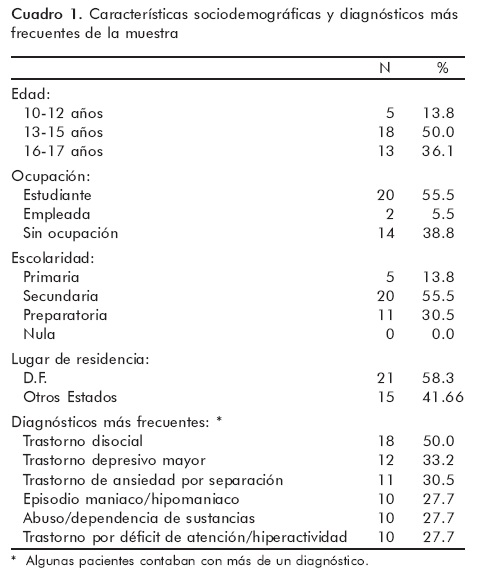
<body><![CDATA[<p align="justify"><font face="verdana" size="2">La muestra total se dividi&oacute; en diversos subgrupos (pacientes con trastornos de la conducta alimentaria <i>vs</i> pacientes sin trastornos de la conducta alimentaria; pacientes con disfunci&oacute;n familiar <i>vs</i> pacientes sin disfunci&oacute;n familiar; pacientes con alta&#45;moderada calidad del ambiente familiar <i>vs</i> pacientes con baja calidad del ambiente familiar) cuyas variables fueron comparadas a trav&eacute;s de las pruebas <i>t de Student</i> y <i>chi cuadrada.</i> Tambi&eacute;n se utiliz&oacute; el <i>coeficiente de correlaci&oacute;n de Pearson</i> para determinar la correlaci&oacute;n existente entre la calidad del ambiente&#45;nivel de funcionamiento familiar y el grado de psicopatolog&iacute;a alimentaria.</font></p>  	    <p align="justify"><font face="verdana" size="2">&nbsp;</font></p>  	    <p align="justify"><font face="verdana" size="2"><b>RESULTADOS</b></font></p>  	    <p align="justify"><font face="verdana" size="2">En el <a href="#c1">cuadro 1</a> se muestran las caracter&iacute;sticas socio&#45;demogr&aacute;ficas de las 36 pacientes reclutadas para la realizaci&oacute;n del presente estudio, as&iacute; como los diagn&oacute;sticos m&aacute;s frecuentes de acuerdo con las categor&iacute;as del <i>Mini&#45;Kid.</i></font></p>  	    <p align="center"><font face="verdana" size="2"><a name="c1"></a></font></p>  	    <p align="center"><font face="verdana" size="2"><img src="/img/revistas/sm/v34n3/a3c1.jpg"></font></p>  	    <p align="justify"><font face="verdana" size="2">La media del n&uacute;mero de diagn&oacute;sticos presentes en cada paciente fue de 4.91, con una desviaci&oacute;n est&aacute;ndar de 6.75.</font></p>  	    <p align="justify"><font face="verdana" size="2">En esta muestra de pacientes hospitalizadas se confirm&oacute; la presencia de trastornos de la conducta alimentaria en 39% de los casos: 17% de la muestra correspond&iacute;a a casos de bulimia nerviosa y 22% a trastornos de la conducta alimentaria no especificados (TANE). No hubo casos de anorexia nerviosa. De la muestra, 42% presentaba alg&uacute;n grado de insatisfacci&oacute;n corporal a pesar de no cumplir criterios para un trastorno alimentario, casi la mitad (46%) de este subgrupo hab&iacute;a presentado s&iacute;ntomas relacionados con la conducta alimentaria en el pasado. Solo 19% se encontraba libre de psicopatolog&iacute;a alimentaria.</font></p>  	    <p align="justify"><font face="verdana" size="2">En el <a href="#c2">cuadro 2</a> se muestran las medias y desviaciones est&aacute;ndar de la edad, el &iacute;ndice de masa corporal y las puntuaciones de las escalas aplicadas a la muestra. Como puede notarse, la media del &iacute;ndice de masa corporal se situ&oacute; en el rango normal; sin embargo, esto contrast&oacute; con la puntuaci&oacute;n del <i>EDI</i> cuya media se encontr&oacute; por arriba de lo que algunos autores han sugerido como punto de corte para anorexia nerviosa. La media de la puntuaci&oacute;n en la <i>Subescala de Funcionamiento General de la Familia</i> se encontr&oacute; en el l&iacute;mite inferior normal y la <i>Escala del Ambiente Familiar Global</i> mostr&oacute; una media que corresponder&iacute;a a un ambiente familiar situado entre la categor&iacute;a de malo y moderadamente insatisfactorio.</font></p>  	    <p align="center"><font face="verdana" size="2"><a name="c2"></a></font></p>  	    ]]></body>
<body><![CDATA[<p align="center"><font face="verdana" size="2"><img src="/img/revistas/sm/v34n3/a3c2.jpg"></font></p>  	    <p align="justify"><font face="verdana" size="2">Es de resaltar que un porcentaje elevado de pacientes expres&oacute; el deseo de tener un cuerpo m&aacute;s delgado (en promedio, una figura y media de discrepancia con la percepci&oacute;n del peso actual en la <i>Escala de Figura de Ni&ntilde;os),</i> y a&uacute;n m&aacute;s para la vida adulta (en promedio, casi dos figuras de discrepancia con la percepci&oacute;n del peso actual).</font></p>  	    <p align="justify"><font face="verdana" size="2">La muestra fue dividida en dos grupos: uno de ellos agrup&oacute; a las pacientes que cumpl&iacute;an los criterios para un trastorno de la conducta alimentaria (incluidos los TANE) y el otro grupo incluy&oacute; al resto de las pacientes. El <a href="/img/revistas/sm/v34n3/a3c3.jpg" target="_blank">cuadro 3</a> muestra los resultados de la prueba <i>t de Student</i> aplicada a estos grupos. Como puede notarse existen diferencias estad&iacute;sticamente significativas entre ambos grupos en la puntuaci&oacute;n total del <i>EDI</i> (p&lt;0.01), as&iacute; como algunas de sus escalas (p&#8804;0.01) y en la insatisfacci&oacute;n corporal tanto actual como a futuro (p&lt;0.01).</font></p>  	    <p align="justify"><font face="verdana" size="2">Tambi&eacute;n se realiz&oacute; la prueba de <i>chi cuadrada</i> para determinar si exist&iacute;an diferencias en las frecuencias de los diagn&oacute;sticos proporcionados por el <i>Mini&#45;Kid</i> en cada uno de estos subgrupos, pero el an&aacute;lisis no mostr&oacute; diferencias estad&iacute;sticamente significativas.</font></p>  	    <p align="justify"><font face="verdana" size="2">Para determinar si exist&iacute;an diferencias significativas en cuanto a la frecuencia de cada una de las categor&iacute;as diagn&oacute;sticas proporcionadas por el <i>Mini&#45;Kid</i> en relaci&oacute;n con el funcionamiento familiar, se decidi&oacute; dividir el total de la muestra en dos subgrupos, uno de ellos con disfunci&oacute;n familiar (puntuaci&oacute;n en <i>Subescala de funcionamiento General de la Familia</i> &#8805;2.17) y otro sin disfunci&oacute;n familiar (puntuaci&oacute;n &lt;2.17). Como se observa en el <a href="/img/revistas/sm/v34n3/a3c4.jpg" target="_blank">cuadro 4</a>, el grupo con disfunci&oacute;n familiar present&oacute; una mayor tendencia a cursar con episodio depresivo mayor y fobia social, con una diferencia estad&iacute;sticamente significativa (p&lt;0.05). El resto de los diagn&oacute;sticos no mostr&oacute; diferencias.</font></p>  	    <p align="justify"><font face="verdana" size="2">Para determinar si exist&iacute;an diferencias significativas en cuanto a la frecuencia de cada categor&iacute;a diagn&oacute;stica proporcionada por el <i>Mini&#45;Kid,</i> esta vez en relaci&oacute;n con la calidad del ambiente familiar medido de forma retrospectiva por la <i>Escala del Ambiente Familiar Global,</i> se decidi&oacute; dividir el total de la muestra en dos subgrupos, uno de ellos con alta&#45;moderada calidad del ambiente familiar (puntuaci&oacute;n &#8805;70) y otro con baja calidad del ambiente familiar (puntuaci&oacute;n &lt;70). El an&aacute;lisis no arroj&oacute; diferencias estad&iacute;sticamente significativas.</font></p>  	    <p align="justify"><font face="verdana" size="2">Finalmente se realiz&oacute; la prueba de <i>Correlaci&oacute;n de Pearson</i> para estimar el grado de asociaci&oacute;n entre la sintomatolog&iacute;a alimentaria medida por el <i>EDI</i> y las variables relacionadas con la familia (funcionamiento y calidad del ambiente). Como se observa en el <a href="#c5">cuadro 5</a>, existi&oacute; una correlaci&oacute;n positiva estad&iacute;sticamente significativa entre la puntuaci&oacute;n obtenida en la <i>Subescala de Funcionamiento General de la Familia</i> y la puntuaci&oacute;n del <i>EDI</i> (p=0.03). Las subescalas que mayor correlaci&oacute;n tuvieron fueron las de <i>sintomatolog&iacute;a bul&iacute;mica</i> (p=0.001) y la de <i>inefectividad y baja autoestima</i> (p=0.009).</font></p>  	    <p align="center"><font face="verdana" size="2"><a name="c5"></a></font></p>  	    <p align="center"><font face="verdana" size="2"><img src="/img/revistas/sm/v34n3/a3c5.jpg"></font></p>  	    <p align="justify"><font face="verdana" size="2">No se encontr&oacute; correlaci&oacute;n entre el <i>EDI</i> y la <i>Escala del Ambiente Familiar Global.</i></font></p>  	    ]]></body>
<body><![CDATA[<p align="justify"><font face="verdana" size="2">&nbsp;</font></p>  	    <p align="justify"><font face="verdana" size="2"><b>DISCUSI&Oacute;N</b></font></p>  	    <p align="justify"><font face="verdana" size="2">Los resultados obtenidos en la presente investigaci&oacute;n muestran la elevada prevalencia de trastornos de la conducta alimentaria en una poblaci&oacute;n cl&iacute;nica hospitalizada (39% de la muestra), en la cual los TANE superaban en frecuencia a las formas espec&iacute;ficas. Cabe se&ntilde;alar que menos de 20% de la muestra se encontraba libre de alg&uacute;n trastorno de la conducta alimentaria y estaba adem&aacute;s conforme con sus dimensiones corporales.</font></p>  	    <p align="justify"><font face="verdana" size="2">Los TANE han sido subestimados en la investigaci&oacute;n, pese a que se ha reportado que representan hasta tres cuartas partes del total de trastornos alimentarios en poblaciones no cl&iacute;nicas.<sup>21</sup> En la muestra reclutada para el presente estudio se encontr&oacute; que los TANE representan 56% del total de los trastornos alimentarios. Si bien los TANE pueden representar formas iniciales de trastornos espec&iacute;ficos, cuya pronta detecci&oacute;n podr&iacute;a influir en su futuro desarrollo, tambi&eacute;n pueden representar trastornos de gravedad considerable. Un hallazgo relevante que apoya esta postura se obtuvo al estudiar una muestra de mujeres mexicanas en el Instituto Nacional de Psiquiatr&iacute;a. Aquellas que presentaban un TANE tuvieron una puntuaci&oacute;n media en el <i>EDI</i> m&aacute;s alta que la que correspond&iacute;a a las pacientes con anorexia nerviosa restrictiva y muy similar a las pacientes con anorexia nerviosa compulsivo&#45;purgativa.<sup>9</sup></font></p>  	    <p align="justify"><font face="verdana" size="2">Se ha estimado que si se modifican los criterios de los trastornos espec&iacute;ficos, casi 40% de los casos de TANE se considerar&iacute;an anorexia o bulimia nerviosa. Estas observaciones pueden ser la base para la modificaci&oacute;n de criterios en posteriores clasificaciones.<sup>22</sup></font></p>  	    <p align="justify"><font face="verdana" size="2">La <i>Escala de Figuras de Ni&ntilde;os de Collins</i> evidenci&oacute; la alta prevalencia de insatisfacci&oacute;n corporal en la poblaci&oacute;n cl&iacute;nica adolescente. Pese a no cumplir con los criterios para anorexia nerviosa, bulimia nerviosa o un TANE, 42% de la muestra deseaba tener un cuerpo m&aacute;s delgado. Este mismo porcentaje fue encontrado por Collins<sup>16</sup> al evaluar la insatisfacci&oacute;n corporal en un grupo de ni&ntilde;as (media= 7.9 a&ntilde;os) que cursaban los primeros a&ntilde;os de educaci&oacute;n b&aacute;sica. Aqu&iacute; cabe se&ntilde;alar que el proceso mismo de la adolescencia puede acompa&ntilde;arse de una gran insatisfacci&oacute;n con la propia apariencia.<sup>23</sup></font></p>  	    <p align="justify"><font face="verdana" size="2">Otro hallazgo relevante fue la alta comorbilidad psiqui&aacute;trica presente en el grupo de pacientes con trastornos alimentarios (cada paciente cumpli&oacute; criterios para seis diagn&oacute;sticos psiqui&aacute;tricos en promedio), lo cual nos habla quiz&aacute; de un grupo espec&iacute;fico de pacientes cuyas caracter&iacute;sticas no ser&iacute;a posible extrapolar a una poblaci&oacute;n no cl&iacute;nica o a un servicio ambulatorio. La presencia de un trastorno disocial en 64% de las pacientes con trastornos alimentarios (representada principalmente por pacientes con bulimia nerviosa y sus formas at&iacute;picas) nos conduce a las afirmaciones de algunos investigadores, que han considerado dividir la bulimia nerviosa en dos subgrupos: uno en que s&oacute;lo existe la tendencia a presentar comorbilidad con depresi&oacute;n y otro que es altamente com&oacute;rbido, en que existe la tendencia a presentar, adem&aacute;s de depresi&oacute;n, trastorno antisocial de la personalidad, trastornos de ansiedad y consumo de sustancias.<sup>24</sup></font></p>  	    <p align="justify"><font face="verdana" size="2">Tambi&eacute;n se ha reportado que los TANE que se encuentran relacionados con la bulimia nerviosa cursan con mayor comorbilidad que los que se relacionan con la anorexia nerviosa.<sup>25</sup> Desde la d&eacute;cada de 1990, Lacey<sup>26</sup> acu&ntilde;&oacute; el t&eacute;rmino &laquo;bulimia multiimpulsiva&raquo; para designar a una variante de la bulimia nerviosa con alta tendencia a conductas impulsivas, principalmente dependencia a sustancias e intentos de suicidio. Cabe se&ntilde;alar que en la muestra reclutada para el presente estudio, 71% de las pacientes con un trastorno alimentario presentaba riesgo suicida de acuerdo con el <i>Mini&#45;Kid.</i></font></p>  	    <p align="justify"><font face="verdana" size="2">Resulta importante resaltar el hecho de que la disfunci&oacute;n familiar, estimada por la <i>Subescala de Funcionamiento General de la Familia,</i> marc&oacute; una diferencia en cuanto a la frecuencia con que se presentaban los diagn&oacute;sticos de trastorno depresivo mayor y fobia social. La alta frecuencia de este &uacute;ltimo diagn&oacute;stico (42% de las pacientes con disfunci&oacute;n familiar, en contraste con el 4.7% reportado en la poblaci&oacute;n general por Medina&#45;Mora)<sup>27</sup> nos muestra una caracter&iacute;stica esencial de este subgrupo, el temor a ser expuesto a la burla y la humillaci&oacute;n. Estos s&iacute;ntomas podr&iacute;an contribuir a la exacerbaci&oacute;n de un trastorno alimentario, pues es bien sabido que la insatisfacci&oacute;n con el propio peso se acompa&ntilde;a de la creencia de que otros se burlar&aacute;n. Es de resaltar el hecho de que una de las subescalas del <i>EDI</i> que mayor correlaci&oacute;n tuvo con la <i>Subescala de Funcionamiento General de la Familia</i> fue la de <i>inefectividad y baja autoestima.</i></font></p>  	    <p align="justify"><font face="verdana" size="2">De acuerdo con los resultados obtenidos, es posible afirmar que la hip&oacute;tesis que dio origen a este proyecto se confirm&oacute; de forma parcial. La gravedad de los s&iacute;ntomas de los trastornos de la conducta alimentaria, medidos por el <i>EDI,</i> tuvo una correlaci&oacute;n positiva con el nivel de funcionamiento familiar estimado por la <i>Subescala de Funcionamiento General de la Familia.</i> Sin embargo, no existi&oacute; una correlaci&oacute;n entre el <i>EDI</i> y la calidad del ambiente familiar medido de forma retrospectiva por la <i>Escala del Ambiente Familiar Global.</i> La explicaci&oacute;n a ello posiblemente consista en que los s&iacute;ntomas relacionados con los trastornos alimentarios son m&aacute;s reactivos a las caracter&iacute;sticas familiares actuales que a aquellas que se presentaron en el pasado. Tambi&eacute;n es posible suponer que el funcionamiento familiar actual se puede ver afectado por la presencia de sintomatolog&iacute;a relacionada con los trastornos de la alimentaci&oacute;n en uno de sus miembros. No hay que olvidar que al tratarse de una correlaci&oacute;n s&oacute;lo es posible afirmar que hay una asociaci&oacute;n entre las variables, sin que sea posible establecer si una variable se comporta como dependiente o independiente.</font></p>  	    ]]></body>
<body><![CDATA[<p align="justify"><font face="verdana" size="2">Un hallazgo relevante del presente estudio es que la subescala de <i>sintomatolog&iacute;a bul&iacute;mica</i> del <i>EDI</i> fue la que mayor correlaci&oacute;n tuvo con el funcionamiento familiar, resultando estad&iacute;sticamente significativa. Podr&iacute;a suponerse que cuanto m&aacute;s alto es el nivel de disfunci&oacute;n familiar mayor tendencia tendr&aacute; una adolescente a presentar atracones y v&oacute;mitos. Desde esta perspectiva podr&iacute;a parecer que los hallazgos de este estudio apoyan la interpretaci&oacute;n psicodin&aacute;mica de la bulimia nerviosa, donde los atracones simbolizan la marcada dependencia hacia figuras significativas y los v&oacute;mitos el deseo de expulsar un objeto malo introyectado.<sup>28</sup> Sin embargo, dada la imposibilidad de hacer inferencias m&aacute;s all&aacute; de una simple asociaci&oacute;n entre variables, cabr&iacute;a la posibilidad de que por algunos periodos el bajo funcionamiento familiar propiciara los s&iacute;ntomas bul&iacute;micos y que en otros periodos dichos s&iacute;ntomas impactaran el funcionamiento familiar creando as&iacute; un c&iacute;rculo vicioso. Espina et al.<sup>5</sup> consideraron la presencia de este proceso circular en la expresi&oacute;n de los trastornos de la conducta alimentaria. Sin embargo, es necesario enfatizar el hecho de que las conductas purgativas (v&oacute;mitos, uso de laxante o diur&eacute;ticos) ocurren fuera de la vista de la familia. Igualmente sucede con los atracones como lo expresa el reactivo 61 del <i>EDI</i> &laquo;como o bebo a escondidas&raquo;; tambi&eacute;n el DSM&#45;IV se refiere al s&iacute;ntoma de &laquo;comer a solas para esconder su voracidad&raquo;.<sup>29</sup></font></p>  	    <p align="justify"><font face="verdana" size="2">Una aplicaci&oacute;n posible de estos hallazgos puede consistir en evaluar con el <i>EDI</i> los progresos realizados en terapia familiar en las familias de pacientes con trastornos de la conducta alimentaria, considerando como mejores indicadores del nivel de funcionamiento la subescala de <i>s&iacute;ntomas bul&iacute;micos</i> y la de <i>inefectividad y baja autoestima.</i> La puntuaci&oacute;n total del <i>EDI</i> puede ser igualmente &uacute;til para este fin, recordemos que algunos reactivos de este instrumento eval&uacute;an directamente aspectos relacionados con el ambiente familiar. Por ejemplo, el reactivo 13 expresa: &laquo;Mi familia s&oacute;lo valora como buenos los logros o resultados que est&aacute;n por encima de lo habitual&raquo;, y el 43 expresa: &laquo;Mis padres han esperado cosas excelentes de m&iacute;&raquo;.</font></p>  	    <p align="justify"><font face="verdana" size="2">Dare et al.<sup>6</sup> han utilizado el <i>EDI</i> para evaluar los progresos en terapia familiar de las pacientes anor&eacute;xicas. Los resultados de la presente investigaci&oacute;n pueden hacer recomendable extender dicha aplicaci&oacute;n a la totalidad de los trastornos alimentarios, incluidos los TANE.</font></p>  	    <p align="justify"><font face="verdana" size="2">Posiblemente las puntuaciones obtenidas en la <i>Escala del Ambiente Familiar Global,</i> que considera el peor ambiente familiar vivido por el paciente por un tiempo mayor a un a&ntilde;o, influya solamente en la predisposici&oacute;n a la psicopatolog&iacute;a y no en la intensidad de los s&iacute;ntomas actuales (al menos en lo que respecta a los trastornos alimentarios). Cabe se&ntilde;alar que la media de edad de la muestra fue de 14.7 a&ntilde;os y que en la gran mayor&iacute;a de las pacientes el peor periodo de tiempo al que estuvieron expuestas en cuanto a calidad del ambiente familiar, hab&iacute;a estado presente en los primeros a&ntilde;os de su vida. Es posible que estos eventos pasados hayan ejercido su impacto en la psicopatolog&iacute;a de las adolescentes de la muestra; sin embargo, no fue posible medir este fen&oacute;meno con los instrumentos empleados en el presente estudio.</font></p>  	    <p align="justify"><font face="verdana" size="2">&nbsp;</font></p>  	    <p align="justify"><font face="verdana" size="2"><b>AGRADECIMIENTOS</b></font></p>  	    <p align="justify"><font face="verdana" size="2">Debemos un especial agradecimiento a la doctora Miriam del Valle Ortega, jefe de la Unidad de Adolescentes Mujeres del Hospital Psiqui&aacute;trico Infantil Dr. Juan N. Navarro, por el apoyo y las facilidades otorgadas para la realizaci&oacute;n de esta investigaci&oacute;n.</font></p>  	    <p align="justify"><font face="verdana" size="2">&nbsp;</font></p>  	    <p align="justify"><font face="verdana" size="2"><b>REFERENCIAS</b></font></p>  	    <!-- ref --><p align="justify"><font face="verdana" size="2">1. Kucharska&#45;Pietura K, Nikolaou V, Masiak M, Treasure J. The recognition of emotion in the faces and voice of anorexia nervosa. Int J Eat Disord 2004;35:42&#45;47.    &nbsp;&nbsp;&nbsp;&nbsp;&nbsp;&nbsp;&nbsp;&nbsp;[&#160;<a href="javascript:void(0);" onclick="javascript: window.open('/scielo.php?script=sci_nlinks&ref=9059241&pid=S0185-3325201100030000300001&lng=','','width=640,height=500,resizable=yes,scrollbars=1,menubar=yes,');">Links</a>&#160;]<!-- end-ref --></font></p>  	    <!-- ref --><p align="justify"><font face="verdana" size="2">2. Minuchin S, Rosman BL, Baker L. Psychosomatic families; anorexia nervosa in context. United States of North America: Harvard University Press; 1978.    &nbsp;&nbsp;&nbsp;&nbsp;&nbsp;&nbsp;&nbsp;&nbsp;[&#160;<a href="javascript:void(0);" onclick="javascript: window.open('/scielo.php?script=sci_nlinks&ref=9059243&pid=S0185-3325201100030000300002&lng=','','width=640,height=500,resizable=yes,scrollbars=1,menubar=yes,');">Links</a>&#160;]<!-- end-ref --></font></p>  	    <!-- ref --><p align="justify"><font face="verdana" size="2">3. Kinzl J, Traweger C, Guenther V, Biebl W. Family background and sexual abuse associated with eating disorders. Am J Psychiatry 1994;151:1127&#45;1131.    &nbsp;&nbsp;&nbsp;&nbsp;&nbsp;&nbsp;&nbsp;&nbsp;[&#160;<a href="javascript:void(0);" onclick="javascript: window.open('/scielo.php?script=sci_nlinks&ref=9059245&pid=S0185-3325201100030000300003&lng=','','width=640,height=500,resizable=yes,scrollbars=1,menubar=yes,');">Links</a>&#160;]<!-- end-ref --></font></p>  	    <!-- ref --><p align="justify"><font face="verdana" size="2">4. Vidovic V, Juresa V, Begovac I, Mahnik M et al. Perceived family cohesion, adaptability and communication in eating disorders. Eur Eat Disorders Rev 2005;13:19&#45;28.    &nbsp;&nbsp;&nbsp;&nbsp;&nbsp;&nbsp;&nbsp;&nbsp;[&#160;<a href="javascript:void(0);" onclick="javascript: window.open('/scielo.php?script=sci_nlinks&ref=9059247&pid=S0185-3325201100030000300004&lng=','','width=640,height=500,resizable=yes,scrollbars=1,menubar=yes,');">Links</a>&#160;]<!-- end-ref --></font></p>  	    <!-- ref --><p align="justify"><font face="verdana" size="2">5. Espina A, Ochoa I, Ortego A. Dyadic adjustment in parents of daughters with eating disorder: Eur Eat Disorders Rev 2003;11:349&#45;362.    &nbsp;&nbsp;&nbsp;&nbsp;&nbsp;&nbsp;&nbsp;&nbsp;[&#160;<a href="javascript:void(0);" onclick="javascript: window.open('/scielo.php?script=sci_nlinks&ref=9059249&pid=S0185-3325201100030000300005&lng=','','width=640,height=500,resizable=yes,scrollbars=1,menubar=yes,');">Links</a>&#160;]<!-- end-ref --></font></p>  	    <!-- ref --><p align="justify"><font face="verdana" size="2">6. Dare C, Chania E, Eisler I, Hodes M et al. The Eating Disorder Inventory as an instrument to explore change in adolescents in family therapy for anorexia nervosa. Eur Eat Disorders Rev 2000;8:369&#45;383.    &nbsp;&nbsp;&nbsp;&nbsp;&nbsp;&nbsp;&nbsp;&nbsp;[&#160;<a href="javascript:void(0);" onclick="javascript: window.open('/scielo.php?script=sci_nlinks&ref=9059251&pid=S0185-3325201100030000300006&lng=','','width=640,height=500,resizable=yes,scrollbars=1,menubar=yes,');">Links</a>&#160;]<!-- end-ref --></font></p>  	    <!-- ref --><p align="justify"><font face="verdana" size="2">7. Garner D, Olmsted M, Polivy J. Development and validation of a multidimensional Eating Disorder Inventory for anorexia nervosa and bulimia. Int J Eat Disord 1983;2:15&#45;34.    &nbsp;&nbsp;&nbsp;&nbsp;&nbsp;&nbsp;&nbsp;&nbsp;[&#160;<a href="javascript:void(0);" onclick="javascript: window.open('/scielo.php?script=sci_nlinks&ref=9059253&pid=S0185-3325201100030000300007&lng=','','width=640,height=500,resizable=yes,scrollbars=1,menubar=yes,');">Links</a>&#160;]<!-- end-ref --></font></p>  	    <!-- ref --><p align="justify"><font face="verdana" size="2">8. Garc&iacute;a E, V&aacute;zquez V, L&oacute;pez J, Arcila D. Validez interna y utilidad diagn&oacute;stica del Eating Disorder Inventory en mujeres mexicanas. Salud P&uacute;blica M&eacute;x 2003;45:206&#45;210.    &nbsp;&nbsp;&nbsp;&nbsp;&nbsp;&nbsp;&nbsp;&nbsp;[&#160;<a href="javascript:void(0);" onclick="javascript: window.open('/scielo.php?script=sci_nlinks&ref=9059255&pid=S0185-3325201100030000300008&lng=','','width=640,height=500,resizable=yes,scrollbars=1,menubar=yes,');">Links</a>&#160;]<!-- end-ref --></font></p>  	    <!-- ref --><p align="justify"><font face="verdana" size="2">9. Unikel C, Bojorquez I, Carre&ntilde;o S, Caballero A. Validaci&oacute;n del Eating Disorder Inventory en una muestra de mujeres mexicanas con trastorno de la conducta alimentaria. Salud Mental 2006,29:44&#45;51.    &nbsp;&nbsp;&nbsp;&nbsp;&nbsp;&nbsp;&nbsp;&nbsp;[&#160;<a href="javascript:void(0);" onclick="javascript: window.open('/scielo.php?script=sci_nlinks&ref=9059257&pid=S0185-3325201100030000300009&lng=','','width=640,height=500,resizable=yes,scrollbars=1,menubar=yes,');">Links</a>&#160;]<!-- end-ref --></font></p>  	    <!-- ref --><p align="justify"><font face="verdana" size="2">10. Rey JM, Singh M, Hung S, Dossetor DR et al. A global scale to measure the quality of the family environment. Arch Gen Psychiatry 1997;54:817&#45;822.    &nbsp;&nbsp;&nbsp;&nbsp;&nbsp;&nbsp;&nbsp;&nbsp;[&#160;<a href="javascript:void(0);" onclick="javascript: window.open('/scielo.php?script=sci_nlinks&ref=9059259&pid=S0185-3325201100030000300010&lng=','','width=640,height=500,resizable=yes,scrollbars=1,menubar=yes,');">Links</a>&#160;]<!-- end-ref --></font></p>  	    <!-- ref --><p align="justify"><font face="verdana" size="2">11. Rey JM, Peng R, Morales&#45;Blanuez C, Widyawati I et al. Rating the quality of the family environment in different cultures. J Am Acad Child Adolesc Psychiatry 2000;39(9):1168&#45;1174.    &nbsp;&nbsp;&nbsp;&nbsp;&nbsp;&nbsp;&nbsp;&nbsp;[&#160;<a href="javascript:void(0);" onclick="javascript: window.open('/scielo.php?script=sci_nlinks&ref=9059261&pid=S0185-3325201100030000300011&lng=','','width=640,height=500,resizable=yes,scrollbars=1,menubar=yes,');">Links</a>&#160;]<!-- end-ref --></font></p>  	    <!-- ref --><p align="justify"><font face="verdana" size="2">12. Chan&#45;D&iacute;az G. Ambiente y funcionamiento familiar en adolescentes con depresi&oacute;n. M&eacute;xico: Tesis. Universidad Nacional Aut&oacute;noma de M&eacute;xico; 2004.    &nbsp;&nbsp;&nbsp;&nbsp;&nbsp;&nbsp;&nbsp;&nbsp;[&#160;<a href="javascript:void(0);" onclick="javascript: window.open('/scielo.php?script=sci_nlinks&ref=9059263&pid=S0185-3325201100030000300012&lng=','','width=640,height=500,resizable=yes,scrollbars=1,menubar=yes,');">Links</a>&#160;]<!-- end-ref --></font></p>  	    <!-- ref --><p align="justify"><font face="verdana" size="2">13. Byles J, Byrne C, Boyle M, Offord D. Ontario Child Health Study: reliability and validity of the general functions Subscale of the McMaster Assessment Device. Fam Proc 1988;27:97&#45;104.    &nbsp;&nbsp;&nbsp;&nbsp;&nbsp;&nbsp;&nbsp;&nbsp;[&#160;<a href="javascript:void(0);" onclick="javascript: window.open('/scielo.php?script=sci_nlinks&ref=9059265&pid=S0185-3325201100030000300013&lng=','','width=640,height=500,resizable=yes,scrollbars=1,menubar=yes,');">Links</a>&#160;]<!-- end-ref --></font></p>  	    <!-- ref --><p align="justify"><font face="verdana" size="2">14. Sauceda&#45;Garcia JM, Ortiz&#45;De la Rosa LT, Fajardo&#45;Gutierrez A, C&aacute;rdenas&#45;Zetina JA. La adaptaci&oacute;n psicosocial en ni&ntilde;os y adolescentes con malformaciones craneofaciales. Gac M&eacute;d M&eacute;x 1997;133(3):203&#45;209.    &nbsp;&nbsp;&nbsp;&nbsp;&nbsp;&nbsp;&nbsp;&nbsp;[&#160;<a href="javascript:void(0);" onclick="javascript: window.open('/scielo.php?script=sci_nlinks&ref=9059267&pid=S0185-3325201100030000300014&lng=','','width=640,height=500,resizable=yes,scrollbars=1,menubar=yes,');">Links</a>&#160;]<!-- end-ref --></font></p>  	    <!-- ref --><p align="justify"><font face="verdana" size="2">15. L&oacute;pez&#45;Pe&ntilde;a MA, Sauceda&#45;Garc&iacute;a JM, Cuevas&#45;Uri&oacute;stegui ML. Funcionamiento familiar y su relaci&oacute;n con bajo rendimiento escolar, la adaptaci&oacute;n psicosocial y psicopatolog&iacute;a en adolescentes mayores. Psiquis 2006;15(1):13&#45;23.    &nbsp;&nbsp;&nbsp;&nbsp;&nbsp;&nbsp;&nbsp;&nbsp;[&#160;<a href="javascript:void(0);" onclick="javascript: window.open('/scielo.php?script=sci_nlinks&ref=9059269&pid=S0185-3325201100030000300015&lng=','','width=640,height=500,resizable=yes,scrollbars=1,menubar=yes,');">Links</a>&#160;]<!-- end-ref --></font></p>  	    <!-- ref --><p align="justify"><font face="verdana" size="2">16. Collins MA. Body Figure Perceptions and Preferences Among Preadolescent Children. Int J Eat Disord 1991;10:199&#45;208.    &nbsp;&nbsp;&nbsp;&nbsp;&nbsp;&nbsp;&nbsp;&nbsp;[&#160;<a href="javascript:void(0);" onclick="javascript: window.open('/scielo.php?script=sci_nlinks&ref=9059271&pid=S0185-3325201100030000300016&lng=','','width=640,height=500,resizable=yes,scrollbars=1,menubar=yes,');">Links</a>&#160;]<!-- end-ref --></font></p>  	    <!-- ref --><p align="justify"><font face="verdana" size="2">17. Sheehan D, Lecrubier Y, Harnett&#45;Sheehan K et al. The Mini&#45;International Neuropsychiatric Interview (M.I.N.I.): the development and validation of a structured diagnostic psychiatric interview for DSM&#45;IV and ICD&#45;10. J Clin Psychiatry 1998;59(supl 20):22&#45;33.    &nbsp;&nbsp;&nbsp;&nbsp;&nbsp;&nbsp;&nbsp;&nbsp;[&#160;<a href="javascript:void(0);" onclick="javascript: window.open('/scielo.php?script=sci_nlinks&ref=9059273&pid=S0185-3325201100030000300017&lng=','','width=640,height=500,resizable=yes,scrollbars=1,menubar=yes,');">Links</a>&#160;]<!-- end-ref --></font></p>  	    <!-- ref --><p align="justify"><font face="verdana" size="2">18. Sheehan D, Lecrubier Y, Harnett&#45;Sheehan K et al. Reliability and validity of the MINI International Neuropsychiatric Interview (MINI): According to the SCID&#45;P. European Psychiatry 1997;12:232&#45;241.    &nbsp;&nbsp;&nbsp;&nbsp;&nbsp;&nbsp;&nbsp;&nbsp;[&#160;<a href="javascript:void(0);" onclick="javascript: window.open('/scielo.php?script=sci_nlinks&ref=9059275&pid=S0185-3325201100030000300018&lng=','','width=640,height=500,resizable=yes,scrollbars=1,menubar=yes,');">Links</a>&#160;]<!-- end-ref --></font></p>  	    <!-- ref --><p align="justify"><font face="verdana" size="2">19. Lecrubier Y, Sheehan D, Weiller E. The Mini International Neuropsychiatric Interview (MINI). A short diagnostic structured interview: reliability and validity according to the CIDI. European Psychiatry 1997;12:224&#45;231.    &nbsp;&nbsp;&nbsp;&nbsp;&nbsp;&nbsp;&nbsp;&nbsp;[&#160;<a href="javascript:void(0);" onclick="javascript: window.open('/scielo.php?script=sci_nlinks&ref=9059277&pid=S0185-3325201100030000300019&lng=','','width=640,height=500,resizable=yes,scrollbars=1,menubar=yes,');">Links</a>&#160;]<!-- end-ref --></font></p>  	    <!-- ref --><p align="justify"><font face="verdana" size="2">20. Rey JM. Escala del Ambiente Familiar Global (EAFG). Descripci&oacute;n y manual de entrenamiento. Versi&oacute;n espa&ntilde;ola: Victor Peralta, Manuel J. Cuesta, Alfredo Mart&iacute;nez&#45;Larrea; 1997 (manual no publicado, obtenido de forma gratuita directamente con el autor, e&#45;mail: <a href="mailto:jrey@mail.usyd.edu.au">jrey@mail.usyd.edu.au</a>).    &nbsp;&nbsp;&nbsp;&nbsp;&nbsp;&nbsp;&nbsp;&nbsp;[&#160;<a href="javascript:void(0);" onclick="javascript: window.open('/scielo.php?script=sci_nlinks&ref=9059279&pid=S0185-3325201100030000300020&lng=','','width=640,height=500,resizable=yes,scrollbars=1,menubar=yes,');">Links</a>&#160;]<!-- end-ref --></font></p>  	    <!-- ref --><p align="justify"><font face="verdana" size="2">21. Machado P, Machado B, Goncalves S, Hoek H. The Prevalence of eating disorders not otherwise specified. Int J Eat Disord 2007;40:212&#45;217.    &nbsp;&nbsp;&nbsp;&nbsp;&nbsp;&nbsp;&nbsp;&nbsp;[&#160;<a href="javascript:void(0);" onclick="javascript: window.open('/scielo.php?script=sci_nlinks&ref=9059281&pid=S0185-3325201100030000300021&lng=','','width=640,height=500,resizable=yes,scrollbars=1,menubar=yes,');">Links</a>&#160;]<!-- end-ref --></font></p>  	    <!-- ref --><p align="justify"><font face="verdana" size="2">22. Wilfley D, Bishop M, Wilson G, Agras W. Classification of Eating Disorders: Toward DSM&#45;V. Int J Eat Disord 2007;40:S123&#45;S129.    &nbsp;&nbsp;&nbsp;&nbsp;&nbsp;&nbsp;&nbsp;&nbsp;[&#160;<a href="javascript:void(0);" onclick="javascript: window.open('/scielo.php?script=sci_nlinks&ref=9059283&pid=S0185-3325201100030000300022&lng=','','width=640,height=500,resizable=yes,scrollbars=1,menubar=yes,');">Links</a>&#160;]<!-- end-ref --></font></p>  	    <!-- ref --><p align="justify"><font face="verdana" size="2">23. L&oacute;pez&#45;G&oacute;mez MI. La encrucijada de la adolescencia; psicolog&iacute;a de la adolescencia normal. M&eacute;xico: Distribuciones Fontamara; 1988.    &nbsp;&nbsp;&nbsp;&nbsp;&nbsp;&nbsp;&nbsp;&nbsp;[&#160;<a href="javascript:void(0);" onclick="javascript: window.open('/scielo.php?script=sci_nlinks&ref=9059285&pid=S0185-3325201100030000300023&lng=','','width=640,height=500,resizable=yes,scrollbars=1,menubar=yes,');">Links</a>&#160;]<!-- end-ref --></font></p>  	    <!-- ref --><p align="justify"><font face="verdana" size="2">24. Duncan AE, Neuman RJ, Kramer J, Kuperman S et al. Are there subgroups of bulimia nervosa based on comorbid psychiatric disorders? Int J Eat Disord 2005;37:19&#45;25.    &nbsp;&nbsp;&nbsp;&nbsp;&nbsp;&nbsp;&nbsp;&nbsp;[&#160;<a href="javascript:void(0);" onclick="javascript: window.open('/scielo.php?script=sci_nlinks&ref=9059287&pid=S0185-3325201100030000300024&lng=','','width=640,height=500,resizable=yes,scrollbars=1,menubar=yes,');">Links</a>&#160;]<!-- end-ref --></font></p>  	    <!-- ref --><p align="justify"><font face="verdana" size="2">25. Eddy KT, Doyle AC, Hoste RR, Herzog DB et al Eating disorder not otherwise specified in adolescents. J Am Acad Child Adolesc Psychiatry 2008;47:156&#45;164.    &nbsp;&nbsp;&nbsp;&nbsp;&nbsp;&nbsp;&nbsp;&nbsp;[&#160;<a href="javascript:void(0);" onclick="javascript: window.open('/scielo.php?script=sci_nlinks&ref=9059289&pid=S0185-3325201100030000300025&lng=','','width=640,height=500,resizable=yes,scrollbars=1,menubar=yes,');">Links</a>&#160;]<!-- end-ref --></font></p>  	    <!-- ref --><p align="justify"><font face="verdana" size="2">26. Lacey JH. Self&#45;damaging and addictive behaviour in bulimia nerviosa. Br J Psychiatry 1993;163:190&#45;194.    &nbsp;&nbsp;&nbsp;&nbsp;&nbsp;&nbsp;&nbsp;&nbsp;[&#160;<a href="javascript:void(0);" onclick="javascript: window.open('/scielo.php?script=sci_nlinks&ref=9059291&pid=S0185-3325201100030000300026&lng=','','width=640,height=500,resizable=yes,scrollbars=1,menubar=yes,');">Links</a>&#160;]<!-- end-ref --></font></p>  	    <!-- ref --><p align="justify"><font face="verdana" size="2">27. Medina&#45;Mora ME, Borges G, Lara C, Benjet C et al. Prevalencia de trastornos mentales y uso de servicios: resultados de la encuesta nacional de epidemiolog&iacute;a psiqui&aacute;trica en M&eacute;xico. Salud Mental 2003;26:1&#45;16.    &nbsp;&nbsp;&nbsp;&nbsp;&nbsp;&nbsp;&nbsp;&nbsp;[&#160;<a href="javascript:void(0);" onclick="javascript: window.open('/scielo.php?script=sci_nlinks&ref=9059293&pid=S0185-3325201100030000300027&lng=','','width=640,height=500,resizable=yes,scrollbars=1,menubar=yes,');">Links</a>&#160;]<!-- end-ref --></font></p>  	    <!-- ref --><p align="justify"><font face="verdana" size="2">28. Gorj&oacute;n&#45;Cano S. Aspectos psicodin&aacute;micos y sist&eacute;micos de los trastornos de la alimentaci&oacute;n. Psiquiatr&iacute;a 2001;17(3):89&#45;93.    &nbsp;&nbsp;&nbsp;&nbsp;&nbsp;&nbsp;&nbsp;&nbsp;[&#160;<a href="javascript:void(0);" onclick="javascript: window.open('/scielo.php?script=sci_nlinks&ref=9059295&pid=S0185-3325201100030000300028&lng=','','width=640,height=500,resizable=yes,scrollbars=1,menubar=yes,');">Links</a>&#160;]<!-- end-ref --></font></p>  	    <!-- ref --><p align="justify"><font face="verdana" size="2">29. American Psychiatric Association. Diagnostic and Statistical Manual of Mental Disorders. Cuarta edici&oacute;n. Washington: Masson; 1994.    &nbsp;&nbsp;&nbsp;&nbsp;&nbsp;&nbsp;&nbsp;&nbsp;[&#160;<a href="javascript:void(0);" onclick="javascript: window.open('/scielo.php?script=sci_nlinks&ref=9059297&pid=S0185-3325201100030000300029&lng=','','width=640,height=500,resizable=yes,scrollbars=1,menubar=yes,');">Links</a>&#160;]<!-- end-ref --></font></p>      ]]></body><back>
<ref-list>
<ref id="B1">
<label>1</label><nlm-citation citation-type="journal">
<person-group person-group-type="author">
<name>
<surname><![CDATA[Kucharska-Pietura]]></surname>
<given-names><![CDATA[K]]></given-names>
</name>
<name>
<surname><![CDATA[Nikolaou]]></surname>
<given-names><![CDATA[V]]></given-names>
</name>
<name>
<surname><![CDATA[Masiak]]></surname>
<given-names><![CDATA[M]]></given-names>
</name>
<name>
<surname><![CDATA[Treasure]]></surname>
<given-names><![CDATA[J]]></given-names>
</name>
</person-group>
<article-title xml:lang="en"><![CDATA[The recognition of emotion in the faces and voice of anorexia nervosa]]></article-title>
<source><![CDATA[Int J Eat Disord]]></source>
<year>2004</year>
<volume>35</volume>
<page-range>42-47</page-range></nlm-citation>
</ref>
<ref id="B2">
<label>2</label><nlm-citation citation-type="book">
<person-group person-group-type="author">
<name>
<surname><![CDATA[Minuchin]]></surname>
<given-names><![CDATA[S]]></given-names>
</name>
<name>
<surname><![CDATA[Rosman]]></surname>
<given-names><![CDATA[BL]]></given-names>
</name>
<name>
<surname><![CDATA[Baker]]></surname>
<given-names><![CDATA[L]]></given-names>
</name>
</person-group>
<source><![CDATA[Psychosomatic families; anorexia nervosa in context]]></source>
<year>1978</year>
<publisher-name><![CDATA[Harvard University Press]]></publisher-name>
</nlm-citation>
</ref>
<ref id="B3">
<label>3</label><nlm-citation citation-type="journal">
<person-group person-group-type="author">
<name>
<surname><![CDATA[Kinzl]]></surname>
<given-names><![CDATA[J]]></given-names>
</name>
<name>
<surname><![CDATA[Traweger]]></surname>
<given-names><![CDATA[C]]></given-names>
</name>
<name>
<surname><![CDATA[Guenther]]></surname>
<given-names><![CDATA[V]]></given-names>
</name>
<name>
<surname><![CDATA[Biebl]]></surname>
<given-names><![CDATA[W]]></given-names>
</name>
</person-group>
<article-title xml:lang="en"><![CDATA[Family background and sexual abuse associated with eating disorders]]></article-title>
<source><![CDATA[Am J Psychiatry]]></source>
<year>1994</year>
<volume>151</volume>
<page-range>1127-1131</page-range></nlm-citation>
</ref>
<ref id="B4">
<label>4</label><nlm-citation citation-type="journal">
<person-group person-group-type="author">
<name>
<surname><![CDATA[Vidovic]]></surname>
<given-names><![CDATA[V]]></given-names>
</name>
<name>
<surname><![CDATA[Juresa]]></surname>
<given-names><![CDATA[V]]></given-names>
</name>
<name>
<surname><![CDATA[Begovac]]></surname>
<given-names><![CDATA[I]]></given-names>
</name>
<name>
<surname><![CDATA[Mahnik]]></surname>
<given-names><![CDATA[M]]></given-names>
</name>
</person-group>
<article-title xml:lang="en"><![CDATA[Perceived family cohesion, adaptability and communication in eating disorders]]></article-title>
<source><![CDATA[Eur Eat Disorders Rev]]></source>
<year>2005</year>
<volume>13</volume>
<page-range>19-28</page-range></nlm-citation>
</ref>
<ref id="B5">
<label>5</label><nlm-citation citation-type="journal">
<person-group person-group-type="author">
<name>
<surname><![CDATA[Espina]]></surname>
<given-names><![CDATA[A]]></given-names>
</name>
<name>
<surname><![CDATA[Ochoa]]></surname>
<given-names><![CDATA[I]]></given-names>
</name>
<name>
<surname><![CDATA[Ortego]]></surname>
<given-names><![CDATA[A]]></given-names>
</name>
</person-group>
<article-title xml:lang="en"><![CDATA[Dyadic adjustment in parents of daughters with eating disorder]]></article-title>
<source><![CDATA[Eur Eat Disorders Rev]]></source>
<year>2003</year>
<volume>11</volume>
<page-range>349-362</page-range></nlm-citation>
</ref>
<ref id="B6">
<label>6</label><nlm-citation citation-type="journal">
<person-group person-group-type="author">
<name>
<surname><![CDATA[Dare]]></surname>
<given-names><![CDATA[C]]></given-names>
</name>
<name>
<surname><![CDATA[Chania]]></surname>
<given-names><![CDATA[E]]></given-names>
</name>
<name>
<surname><![CDATA[Eisler]]></surname>
<given-names><![CDATA[I]]></given-names>
</name>
<name>
<surname><![CDATA[Hodes]]></surname>
<given-names><![CDATA[M]]></given-names>
</name>
</person-group>
<article-title xml:lang="en"><![CDATA[The Eating Disorder Inventory as an instrument to explore change in adolescents in family therapy for anorexia nervosa]]></article-title>
<source><![CDATA[Eur Eat Disorders Rev]]></source>
<year>2000</year>
<volume>8</volume>
<page-range>369-383</page-range></nlm-citation>
</ref>
<ref id="B7">
<label>7</label><nlm-citation citation-type="journal">
<person-group person-group-type="author">
<name>
<surname><![CDATA[Garner]]></surname>
<given-names><![CDATA[D]]></given-names>
</name>
<name>
<surname><![CDATA[Olmsted]]></surname>
<given-names><![CDATA[M]]></given-names>
</name>
<name>
<surname><![CDATA[Polivy]]></surname>
<given-names><![CDATA[J]]></given-names>
</name>
</person-group>
<article-title xml:lang="en"><![CDATA[Development and validation of a multidimensional Eating Disorder Inventory for anorexia nervosa and bulimia]]></article-title>
<source><![CDATA[Int J Eat Disord]]></source>
<year>1983</year>
<volume>2</volume>
<page-range>15-34</page-range></nlm-citation>
</ref>
<ref id="B8">
<label>8</label><nlm-citation citation-type="journal">
<person-group person-group-type="author">
<name>
<surname><![CDATA[García]]></surname>
<given-names><![CDATA[E]]></given-names>
</name>
<name>
<surname><![CDATA[Vázquez]]></surname>
<given-names><![CDATA[V]]></given-names>
</name>
<name>
<surname><![CDATA[López]]></surname>
<given-names><![CDATA[J]]></given-names>
</name>
<name>
<surname><![CDATA[Arcila]]></surname>
<given-names><![CDATA[D]]></given-names>
</name>
</person-group>
<article-title xml:lang="es"><![CDATA[Validez interna y utilidad diagnóstica del Eating Disorder Inventory en mujeres mexicanas]]></article-title>
<source><![CDATA[Salud Pública Méx]]></source>
<year>2003</year>
<volume>45</volume>
<page-range>206-210</page-range></nlm-citation>
</ref>
<ref id="B9">
<label>9</label><nlm-citation citation-type="journal">
<person-group person-group-type="author">
<name>
<surname><![CDATA[Unikel]]></surname>
<given-names><![CDATA[C]]></given-names>
</name>
<name>
<surname><![CDATA[Bojorquez]]></surname>
<given-names><![CDATA[I]]></given-names>
</name>
<name>
<surname><![CDATA[Carreño]]></surname>
<given-names><![CDATA[S]]></given-names>
</name>
<name>
<surname><![CDATA[Caballero]]></surname>
<given-names><![CDATA[A]]></given-names>
</name>
</person-group>
<article-title xml:lang="es"><![CDATA[Validación del Eating Disorder Inventory en una muestra de mujeres mexicanas con trastorno de la conducta alimentaria]]></article-title>
<source><![CDATA[Salud Mental]]></source>
<year>2006</year>
<volume>29</volume>
<page-range>44-51</page-range></nlm-citation>
</ref>
<ref id="B10">
<label>10</label><nlm-citation citation-type="journal">
<person-group person-group-type="author">
<name>
<surname><![CDATA[Rey]]></surname>
<given-names><![CDATA[JM]]></given-names>
</name>
<name>
<surname><![CDATA[Singh]]></surname>
<given-names><![CDATA[M]]></given-names>
</name>
<name>
<surname><![CDATA[Hung]]></surname>
<given-names><![CDATA[S]]></given-names>
</name>
<name>
<surname><![CDATA[Dossetor]]></surname>
<given-names><![CDATA[DR]]></given-names>
</name>
</person-group>
<article-title xml:lang="en"><![CDATA[A global scale to measure the quality of the family environment]]></article-title>
<source><![CDATA[Arch Gen Psychiatry]]></source>
<year>1997</year>
<volume>54</volume>
<page-range>817-822</page-range></nlm-citation>
</ref>
<ref id="B11">
<label>11</label><nlm-citation citation-type="journal">
<person-group person-group-type="author">
<name>
<surname><![CDATA[Rey]]></surname>
<given-names><![CDATA[JM]]></given-names>
</name>
<name>
<surname><![CDATA[Peng]]></surname>
<given-names><![CDATA[R]]></given-names>
</name>
<name>
<surname><![CDATA[Morales-Blanuez]]></surname>
<given-names><![CDATA[C]]></given-names>
</name>
<name>
<surname><![CDATA[Widyawati]]></surname>
<given-names><![CDATA[I]]></given-names>
</name>
</person-group>
<article-title xml:lang="es"><![CDATA[Rating the quality of the family environment in different cultures]]></article-title>
<source><![CDATA[J Am Acad Child Adolesc Psychiatry]]></source>
<year>2000</year>
<volume>39</volume>
<numero>9</numero>
<issue>9</issue>
<page-range>1168-1174</page-range></nlm-citation>
</ref>
<ref id="B12">
<label>12</label><nlm-citation citation-type="">
<person-group person-group-type="author">
<name>
<surname><![CDATA[Chan-Díaz]]></surname>
<given-names><![CDATA[G]]></given-names>
</name>
</person-group>
<source><![CDATA[Ambiente y funcionamiento familiar en adolescentes con depresión]]></source>
<year>2004</year>
</nlm-citation>
</ref>
<ref id="B13">
<label>13</label><nlm-citation citation-type="journal">
<person-group person-group-type="author">
<name>
<surname><![CDATA[Byles]]></surname>
<given-names><![CDATA[J]]></given-names>
</name>
<name>
<surname><![CDATA[Byrne]]></surname>
<given-names><![CDATA[C]]></given-names>
</name>
<name>
<surname><![CDATA[Boyle]]></surname>
<given-names><![CDATA[M]]></given-names>
</name>
<name>
<surname><![CDATA[Offord]]></surname>
<given-names><![CDATA[D]]></given-names>
</name>
</person-group>
<article-title xml:lang="en"><![CDATA[Ontario Child Health Study: reliability and validity of the general functions Subscale of the McMaster Assessment Device]]></article-title>
<source><![CDATA[Fam Proc]]></source>
<year>1988</year>
<volume>27</volume>
<page-range>97-104</page-range></nlm-citation>
</ref>
<ref id="B14">
<label>14</label><nlm-citation citation-type="journal">
<person-group person-group-type="author">
<name>
<surname><![CDATA[Sauceda-Garcia]]></surname>
<given-names><![CDATA[JM]]></given-names>
</name>
<name>
<surname><![CDATA[Ortiz-De la Rosa]]></surname>
<given-names><![CDATA[LT]]></given-names>
</name>
<name>
<surname><![CDATA[Fajardo-Gutierrez]]></surname>
<given-names><![CDATA[A]]></given-names>
</name>
<name>
<surname><![CDATA[Cárdenas-Zetina]]></surname>
<given-names><![CDATA[JA]]></given-names>
</name>
</person-group>
<article-title xml:lang="es"><![CDATA[La adaptación psicosocial en niños y adolescentes con malformaciones craneofaciales]]></article-title>
<source><![CDATA[Gac Méd Méx]]></source>
<year>1997</year>
<volume>133</volume>
<numero>3</numero>
<issue>3</issue>
<page-range>203-209</page-range></nlm-citation>
</ref>
<ref id="B15">
<label>15</label><nlm-citation citation-type="journal">
<person-group person-group-type="author">
<name>
<surname><![CDATA[López-Peña]]></surname>
<given-names><![CDATA[MA]]></given-names>
</name>
<name>
<surname><![CDATA[Sauceda-García]]></surname>
<given-names><![CDATA[JM]]></given-names>
</name>
<name>
<surname><![CDATA[Cuevas-Urióstegui]]></surname>
<given-names><![CDATA[ML]]></given-names>
</name>
</person-group>
<article-title xml:lang="es"><![CDATA[Funcionamiento familiar y su relación con bajo rendimiento escolar, la adaptación psicosocial y psicopatología en adolescentes mayores]]></article-title>
<source><![CDATA[Psiquis]]></source>
<year>2006</year>
<volume>15</volume>
<numero>1</numero>
<issue>1</issue>
<page-range>13-23</page-range></nlm-citation>
</ref>
<ref id="B16">
<label>16</label><nlm-citation citation-type="journal">
<person-group person-group-type="author">
<name>
<surname><![CDATA[Collins]]></surname>
<given-names><![CDATA[MA]]></given-names>
</name>
</person-group>
<article-title xml:lang="en"><![CDATA[Body Figure Perceptions and Preferences Among Preadolescent Children]]></article-title>
<source><![CDATA[Int J Eat Disord]]></source>
<year>1991</year>
<volume>10</volume>
<page-range>199-208</page-range></nlm-citation>
</ref>
<ref id="B17">
<label>17</label><nlm-citation citation-type="journal">
<person-group person-group-type="author">
<name>
<surname><![CDATA[Sheehan]]></surname>
<given-names><![CDATA[D]]></given-names>
</name>
<name>
<surname><![CDATA[Lecrubier]]></surname>
<given-names><![CDATA[Y]]></given-names>
</name>
<name>
<surname><![CDATA[Harnett-Sheehan]]></surname>
<given-names><![CDATA[K]]></given-names>
</name>
</person-group>
<article-title xml:lang="en"><![CDATA[The Mini-International Neuropsychiatric Interview (M.I.N.I.): the development and validation of a structured diagnostic psychiatric interview for DSM-IV and ICD-10]]></article-title>
<source><![CDATA[J Clin Psychiatry]]></source>
<year>1998</year>
<volume>59</volume>
<numero>^s20</numero>
<issue>^s20</issue>
<supplement>20</supplement>
<page-range>22-33</page-range></nlm-citation>
</ref>
<ref id="B18">
<label>18</label><nlm-citation citation-type="journal">
<person-group person-group-type="author">
<name>
<surname><![CDATA[Sheehan]]></surname>
<given-names><![CDATA[D]]></given-names>
</name>
<name>
<surname><![CDATA[Lecrubier]]></surname>
<given-names><![CDATA[Y]]></given-names>
</name>
<name>
<surname><![CDATA[Harnett-Sheehan]]></surname>
<given-names><![CDATA[K]]></given-names>
</name>
</person-group>
<article-title xml:lang="en"><![CDATA[Reliability and validity of the MINI International Neuropsychiatric Interview (MINI): According to the SCID-P]]></article-title>
<source><![CDATA[European Psychiatry]]></source>
<year>1997</year>
<volume>12</volume>
<page-range>232-241</page-range></nlm-citation>
</ref>
<ref id="B19">
<label>19</label><nlm-citation citation-type="journal">
<person-group person-group-type="author">
<name>
<surname><![CDATA[Lecrubier]]></surname>
<given-names><![CDATA[Y]]></given-names>
</name>
<name>
<surname><![CDATA[Sheehan]]></surname>
<given-names><![CDATA[D]]></given-names>
</name>
<name>
<surname><![CDATA[Weiller]]></surname>
<given-names><![CDATA[E]]></given-names>
</name>
</person-group>
<article-title xml:lang="en"><![CDATA[The Mini International Neuropsychiatric Interview (MINI. A short diagnostic structured interview: reliability and validity according to the CIDI)]]></article-title>
<source><![CDATA[European Psychiatry]]></source>
<year>1997</year>
<volume>12</volume>
<page-range>224-231</page-range></nlm-citation>
</ref>
<ref id="B20">
<label>20</label><nlm-citation citation-type="">
<person-group person-group-type="author">
<name>
<surname><![CDATA[Rey]]></surname>
<given-names><![CDATA[JM]]></given-names>
</name>
<name>
<surname><![CDATA[Peralta]]></surname>
<given-names><![CDATA[Victor]]></given-names>
</name>
<name>
<surname><![CDATA[J. Cuesta]]></surname>
<given-names><![CDATA[Manuel]]></given-names>
</name>
<name>
<surname><![CDATA[Martínez-Larrea]]></surname>
<given-names><![CDATA[Alfredo]]></given-names>
</name>
</person-group>
<source><![CDATA[Escala del Ambiente Familiar Global (EAFG). Descripción y manual de entrenamiento]]></source>
<year>1997</year>
</nlm-citation>
</ref>
<ref id="B21">
<label>21</label><nlm-citation citation-type="journal">
<person-group person-group-type="author">
<name>
<surname><![CDATA[Machado]]></surname>
<given-names><![CDATA[P]]></given-names>
</name>
<name>
<surname><![CDATA[Machado]]></surname>
<given-names><![CDATA[B]]></given-names>
</name>
<name>
<surname><![CDATA[Goncalves]]></surname>
<given-names><![CDATA[S]]></given-names>
</name>
<name>
<surname><![CDATA[Hoek]]></surname>
<given-names><![CDATA[H]]></given-names>
</name>
</person-group>
<article-title xml:lang="en"><![CDATA[The Prevalence of eating disorders not otherwise specified]]></article-title>
<source><![CDATA[Int J Eat Disord]]></source>
<year>2007</year>
<volume>40</volume>
<page-range>212-217</page-range></nlm-citation>
</ref>
<ref id="B22">
<label>22</label><nlm-citation citation-type="journal">
<person-group person-group-type="author">
<name>
<surname><![CDATA[Wilfley]]></surname>
<given-names><![CDATA[D]]></given-names>
</name>
<name>
<surname><![CDATA[Bishop]]></surname>
<given-names><![CDATA[M]]></given-names>
</name>
<name>
<surname><![CDATA[Wilson]]></surname>
<given-names><![CDATA[G]]></given-names>
</name>
<name>
<surname><![CDATA[Agras]]></surname>
<given-names><![CDATA[W]]></given-names>
</name>
</person-group>
<article-title xml:lang="en"><![CDATA[Classification of Eating Disorders: Toward DSM-V]]></article-title>
<source><![CDATA[Int J Eat Disord]]></source>
<year>2007</year>
<volume>40</volume>
<page-range>S123-S129</page-range></nlm-citation>
</ref>
<ref id="B23">
<label>23</label><nlm-citation citation-type="book">
<person-group person-group-type="author">
<name>
<surname><![CDATA[López-Gómez]]></surname>
<given-names><![CDATA[MI]]></given-names>
</name>
</person-group>
<source><![CDATA[La encrucijada de la adolescencia; psicología de la adolescencia normal]]></source>
<year>1988</year>
<publisher-loc><![CDATA[México ]]></publisher-loc>
<publisher-name><![CDATA[Distribuciones Fontamara]]></publisher-name>
</nlm-citation>
</ref>
<ref id="B24">
<label>24</label><nlm-citation citation-type="journal">
<person-group person-group-type="author">
<name>
<surname><![CDATA[Duncan]]></surname>
<given-names><![CDATA[AE]]></given-names>
</name>
<name>
<surname><![CDATA[Neuman]]></surname>
<given-names><![CDATA[RJ]]></given-names>
</name>
<name>
<surname><![CDATA[Kramer]]></surname>
<given-names><![CDATA[J]]></given-names>
</name>
<name>
<surname><![CDATA[Kuperman]]></surname>
<given-names><![CDATA[S]]></given-names>
</name>
</person-group>
<article-title xml:lang="en"><![CDATA[Are there subgroups of bulimia nervosa based on comorbid psychiatric disorders?]]></article-title>
<source><![CDATA[Int J Eat Disord]]></source>
<year>2005</year>
<volume>37</volume>
<page-range>19-25</page-range></nlm-citation>
</ref>
<ref id="B25">
<label>25</label><nlm-citation citation-type="journal">
<person-group person-group-type="author">
<name>
<surname><![CDATA[Eddy]]></surname>
<given-names><![CDATA[KT]]></given-names>
</name>
<name>
<surname><![CDATA[Doyle]]></surname>
<given-names><![CDATA[AC]]></given-names>
</name>
<name>
<surname><![CDATA[Hoste]]></surname>
<given-names><![CDATA[RR]]></given-names>
</name>
<name>
<surname><![CDATA[Herzog]]></surname>
<given-names><![CDATA[DB]]></given-names>
</name>
</person-group>
<article-title xml:lang="en"><![CDATA[Eating disorder not otherwise specified in adolescents]]></article-title>
<source><![CDATA[J Am Acad Child Adolesc Psychiatry]]></source>
<year>2008</year>
<volume>47</volume>
<page-range>156-164</page-range></nlm-citation>
</ref>
<ref id="B26">
<label>26</label><nlm-citation citation-type="journal">
<person-group person-group-type="author">
<name>
<surname><![CDATA[Lacey]]></surname>
<given-names><![CDATA[JH]]></given-names>
</name>
</person-group>
<article-title xml:lang="en"><![CDATA[Self-damaging and addictive behaviour in bulimia nerviosa]]></article-title>
<source><![CDATA[Br J Psychiatry]]></source>
<year>1993</year>
<volume>163</volume>
<page-range>190-194</page-range></nlm-citation>
</ref>
<ref id="B27">
<label>27</label><nlm-citation citation-type="journal">
<person-group person-group-type="author">
<name>
<surname><![CDATA[Medina-Mora]]></surname>
<given-names><![CDATA[ME]]></given-names>
</name>
<name>
<surname><![CDATA[Borges]]></surname>
<given-names><![CDATA[G]]></given-names>
</name>
<name>
<surname><![CDATA[Lara]]></surname>
<given-names><![CDATA[C]]></given-names>
</name>
<name>
<surname><![CDATA[Benjet]]></surname>
<given-names><![CDATA[C]]></given-names>
</name>
</person-group>
<article-title xml:lang="es"><![CDATA[Prevalencia de trastornos mentales y uso de servicios: resultados de la encuesta nacional de epidemiología psiquiátrica en México]]></article-title>
<source><![CDATA[Salud Mental]]></source>
<year>2003</year>
<volume>26</volume>
<page-range>1-16</page-range></nlm-citation>
</ref>
<ref id="B28">
<label>28</label><nlm-citation citation-type="journal">
<person-group person-group-type="author">
<name>
<surname><![CDATA[Gorjón-Cano]]></surname>
<given-names><![CDATA[S]]></given-names>
</name>
</person-group>
<article-title xml:lang="es"><![CDATA[Aspectos psicodinámicos y sistémicos de los trastornos de la alimentación]]></article-title>
<source><![CDATA[Psiquiatría]]></source>
<year>2001</year>
<volume>17</volume>
<numero>3</numero>
<issue>3</issue>
<page-range>89-93</page-range></nlm-citation>
</ref>
<ref id="B29">
<label>29</label><nlm-citation citation-type="book">
<collab>American Psychiatric Association</collab>
<source><![CDATA[Diagnostic and Statistical Manual of Mental Disorders]]></source>
<year>1994</year>
<edition>Cuarta</edition>
<publisher-loc><![CDATA[Washington ]]></publisher-loc>
<publisher-name><![CDATA[Masson]]></publisher-name>
</nlm-citation>
</ref>
</ref-list>
</back>
</article>
