<?xml version="1.0" encoding="ISO-8859-1"?><article xmlns:mml="http://www.w3.org/1998/Math/MathML" xmlns:xlink="http://www.w3.org/1999/xlink" xmlns:xsi="http://www.w3.org/2001/XMLSchema-instance">
<front>
<journal-meta>
<journal-id>0185-3325</journal-id>
<journal-title><![CDATA[Salud mental]]></journal-title>
<abbrev-journal-title><![CDATA[Salud Ment]]></abbrev-journal-title>
<issn>0185-3325</issn>
<publisher>
<publisher-name><![CDATA[Instituto Nacional de Psiquiatría Ramón de la Fuente Muñiz]]></publisher-name>
</publisher>
</journal-meta>
<article-meta>
<article-id>S0185-33252010000600007</article-id>
<title-group>
<article-title xml:lang="es"><![CDATA[Diferencias en el estilo atribucional y de la autoestima en una muestra de pacientes delirantes]]></article-title>
<article-title xml:lang="en"><![CDATA[Comparative analysis of attributional and self-esteem in a sample of patients with delusions and control subjets]]></article-title>
</title-group>
<contrib-group>
<contrib contrib-type="author">
<name>
<surname><![CDATA[Fernández Prieto]]></surname>
<given-names><![CDATA[Montserrat]]></given-names>
</name>
<xref ref-type="aff" rid="A01"/>
</contrib>
<contrib contrib-type="author">
<name>
<surname><![CDATA[Quevedo-Blasco]]></surname>
<given-names><![CDATA[Raúl]]></given-names>
</name>
<xref ref-type="aff" rid="A03"/>
</contrib>
<contrib contrib-type="author">
<name>
<surname><![CDATA[Buela-Casal]]></surname>
<given-names><![CDATA[Gualberto]]></given-names>
</name>
<xref ref-type="aff" rid="A02"/>
</contrib>
</contrib-group>
<aff id="A01">
<institution><![CDATA[,Complexo Hospitalario Universitario de Santiago Fundación Pública Galega de Medicina Xenómica ]]></institution>
<addr-line><![CDATA[Galicia ]]></addr-line>
<country>España</country>
</aff>
<aff id="A02">
<institution><![CDATA[,Universidad de Granada Facultad de Psicología ]]></institution>
<addr-line><![CDATA[Andalucía ]]></addr-line>
<country>España</country>
</aff>
<aff id="A03">
<institution><![CDATA[,Universidad de Granada Facultad de Psicología ]]></institution>
<addr-line><![CDATA[Granada ]]></addr-line>
<country>España</country>
</aff>
<pub-date pub-type="pub">
<day>00</day>
<month>12</month>
<year>2010</year>
</pub-date>
<pub-date pub-type="epub">
<day>00</day>
<month>12</month>
<year>2010</year>
</pub-date>
<volume>33</volume>
<numero>6</numero>
<fpage>527</fpage>
<lpage>534</lpage>
<copyright-statement/>
<copyright-year/>
<self-uri xlink:href="http://www.scielo.org.mx/scielo.php?script=sci_arttext&amp;pid=S0185-33252010000600007&amp;lng=en&amp;nrm=iso"></self-uri><self-uri xlink:href="http://www.scielo.org.mx/scielo.php?script=sci_abstract&amp;pid=S0185-33252010000600007&amp;lng=en&amp;nrm=iso"></self-uri><self-uri xlink:href="http://www.scielo.org.mx/scielo.php?script=sci_pdf&amp;pid=S0185-33252010000600007&amp;lng=en&amp;nrm=iso"></self-uri><abstract abstract-type="short" xml:lang="en"><p><![CDATA[Introduction The attributional along with the self-esteem (that plays a central role in the development and maintenance of the pathological state) is a very important mediating element in the delusion, so we find the necessity to realise basic studies of these processes. In the field of psychology, and mainly in the personality area, the atributional has a great relevance, when understanding the causal attributions like mechanisms of facing that guide the conduct of the subject. In this way, we see the importance that supposes the study of the dysfunctional attribution to be able to replace it on the other adaptive, mainly in the pathologies where delusions beliefs exist. In the present investigation the influence has been analyzed that carries out the variable attributional and the self-esteem in the delusional ideas (defined by the 4th edition of the Diagnostic and Statistical Manual of Mental Disorders [DSM-IV] as <<false belief based on the realization of incorrect inferences about external reality, beliefs that are held firmly believe despite of almost everyone else, and despite of constitutes an obvious proof or evidence otherwise indisputable&gt;&gt;) in a sample of delusional patients in comparison with a group control. Most of the research, focus on the dimension of <<Internal&gt;&gt; in this study (following previous research), is to examine attributional biases in the reasoning of delirious patients. Therefore, the departure hypotheses are the following: a) the delusional patients, more than the normal subjects, will realise in their social reasoning more external attributions for the negative events that stop the positives; b) the delusional patients, like the control group, tend to realise global and excessively stable attributions, as much for positive events as for negative events; and c) the delusional patients in comparison with the control group will indicate a high self-esteem. Patients and methods To carry out this research both self-esteem and attributional have been tested in a sample of 20 delusional in-patients (85% are men and 15% women of average age of 36.20 years) entered the unit of Rehabilitation of a Psychiatric Hospital of Santiago de Compostela (Spain) and have been compared to 40 normal control subject in age and sex with the experimental group that do not own psychiatric history, no upheaval that requires treatment. The criteria of inclusion have been the following: a) all of the patients were entered the unit of Rehabilitation, b) the patients had delusional ideas at the moment of the tests, c) their diagnosis fulfilled the criteria according to DSM-IV for paranoid schizophrenia (16 patients) and delusions upheaval (paranoid) (4 patients), d) the ages of the patients had to be included between 20 and 50 years, e) none of the patients had a history of drug use, f) patient did not show evidence of organic brain disorders, g) all of them had a score in items 1 (delusion), 5 (magnitude), and 6 (mistrust/damage) in the positive scale of PANSS (PANSS-P) of more than 3, and h) all the patients had more than 5 years of disease. One is comparative, observational, and cross-sectional and homodemic a study according to the propose classification by Feinstein and with a design of cases and controls. The instruments applied in the study were: a) Rosenberg Self-esteem Scale (EA), is an instrument for assessing the patient's global self-esteem; b) Attributional Questionnaire (ASQ), which is a self-administered questionnaire consisting of twelve situations, six positive (success) and six negative (failure), against which the subject must indicate the causes they attribute its occurrence; and c) Positive and Negative Syndrome Scale for Schizophrenia (PANSS), suitable for evaluation of positive and negative symptoms in schizophrenia. Of the thirty items included in the PANSS, seven are positive scale (PANSS-P), seven the negative scale (PANSS-N), and the sixteen remaining general psychopathology scale (PANSS-PG). All the instruments used for the study, count on their corresponding data of reliability and validity. In this investigation a descriptive analysis of the object of study has been carried out variable, which provided us the frequency allocation, percentage, averages, medians and standard deviations for each of them. Results The results of this investigation show that the delusional patients realised more external attributions for the negative events that the group normal control, and more internal for the positives. The delusional patients realised a causal attribution in stability and globality for the negative events similar to the one of the normal ones. Nevertheless, before positive events have been significant differences between both groups in relation to the stability, not thus for the globality. Also the delusional patients, like the group normal control, indicated a high self-esteem. In the statistic analysis has not been significant differences in self-esteem between the delusional group and the group control that the hypothesis supports that the delusional ones have a high self-esteem with respect to the normal ones. Conclusion The hypothesis raised by Bentall has not been able to state in this investigation, since when analyzing the variable self-esteem we observed that their scores are similar to the group control of normal. According to the atribucional , one concludes that the delusional subjects tend to blame their failures and errors to the other people or other circumstances. On the other hand, when they are successful in some situation, they consider that it must to them themselves, attributing the favourable events to internal level. The conclusions of the analysis of the globality dimension, which determines the temporary generalization of the expectation, do not fulfil the hypothesis in which it affirmed that the delusional subjects, like the normal ones, excessively realised global attributions as much for positive facts as for negative, but do not indicate an exaggerated slant towards the excessive globality. The hypothesis raised by Bentall that the delusion reflect a defensive atribucional , which protects the individual against feelings of low self-esteem, has not been possible to state in this investigation, since when analyzing the variable self-esteem we observed that significant differences in the delusional patients do not exist, since their scores are similar to the group control, showing a both high self-esteem. By all this, it is possible to be concluded that it enters the delusional patients and the group control only exists significant differences taking care of the atribucional of each group. However, such studies contribute along with other made in the understanding of these disorders and consequently to the development of effective psychological program with the aim of improving the symptoms of these patients and even in other pathologies.]]></p></abstract>
<abstract abstract-type="short" xml:lang="es"><p><![CDATA[Introducción El estilo atribucional y la autoestima (que cumple un papel central en el desarrollo y mantenimiento del estado patológico) son elementos mediadores muy importantes en el delirio. De ahí la necesidad de realizar estudios básicos de dichos procesos. En el campo de la psicología, y en concreto en el área de personalidad, el estilo atribucional es de gran relevancia al entender las atribuciones causales como mecanismos de afrontamiento que guían la conducta del sujeto. Por ello, la importancia que supone el estudio de la atribución disfuncional para poder sustituirla por otra adaptativa, sobre todo en las patologías donde existen creencias delirantes. En la presente investigación se ha analizado el papel que desempeñan la variable estilo atribucional y la autoestima en las ideas del irantes en una muestra de pacientes delirantes en comparación con un grupo control. Pacientes y métodos En esta investigación se ha examinado la autoestima y los sesgos atribucionales en una muestra de 20 pacientes delirantes (85% son hombres y 15% mujeres de edad media de 36.20 años) ingresados en la unidad de Rehabilitación de un Hospital Psiquiátrico de Santiago de Compostela (España) y se ha comparado con 40 sujetos control normales igualados en edad y sexo con el grupo experimental que no poseen historia psiquiátrica, ni ningún trastorno que requiera tratamiento. Se trata de un estudio comparativo, observacional, transversal y homodémico según la clasificación propuesta por Feinstein y con un diseño de casos y controles. Los instrumentos aplicados en el estudio fueron: a) la Escala de Autoestima de Rosenberg (Rosenberg Self-esteem Scale, EA), b) el Cuestionario de Estilo Atribucional (Attributional Questionnaire, ASQ) y c) la Escala de Síndrome Positivo y Negativo en la Esquizofrenia (Positive and Negative Syndrome Scale for Schizophrenia, PANSS). Todos los instrumentos empleados para el estudio cuentan con sus correspondientes datos de fiabilidad y validez. Resultados Los resultados de esta investigación muestran que los pacientes delirantes realizaron atribuciones más externas para los eventos negativos que el grupo control normal, y más internas para los positivos. Los pacientes delirantes realizaron una atribución causal en estabilidad y globalidad para los sucesos negativos similar a la de los normales. Sin embargo, ante eventos positivos se han encontrado diferencias significativas entre ambos grupos en relación con la estabilidad, no así para la globalidad. Asimismo, los pacientes delirantes, al igual que el grupo control normal, manifestaron una alta autoestima. Conclusión La hipótesis planteada por Bentall no se ha podido constatar en esta investigación, ya que al analizar la variable autoestima observamos que sus puntuaciones son similares al grupo control de sujetos normales. Según el estilo atribucional, se concluye que los sujetos delirantes tienden a culpar por sus fallos y errores a las demás personas o a otras circunstancias. Por el contrario, cuando ellos tienen éxito en alguna situación, consideran que se debe a ellos mismos, y atribuyen los eventos favorables a nivel interno. Las conclusiones del análisis de la dimensión globalidad, la cual determina la generalización temporal de la expectativa, no cumplen la hipótesis en la cual se afirmaba que los sujetos delirantes, al igual que los normales, realizaban atribuciones excesivamente globales tanto para hechos positivos como para negativos, pero no manifiestan un sesgo exagerado hacia la excesiva globalidad.]]></p></abstract>
<kwd-group>
<kwd lng="en"><![CDATA[Attributions]]></kwd>
<kwd lng="en"><![CDATA[cognitive bias]]></kwd>
<kwd lng="en"><![CDATA[delusions]]></kwd>
<kwd lng="en"><![CDATA[self-esteem]]></kwd>
<kwd lng="es"><![CDATA[Atribuciones]]></kwd>
<kwd lng="es"><![CDATA[autoestima]]></kwd>
<kwd lng="es"><![CDATA[delirios]]></kwd>
<kwd lng="es"><![CDATA[sesgos cognitivos]]></kwd>
</kwd-group>
</article-meta>
</front><body><![CDATA[ <p align="justify"><font face="verdana" size="4">Art&iacute;culo original</font></p>     <p align="justify"><font face="verdana" size="2">&nbsp;</font></p>     <p align="center"><font face="verdana" size="4"><b>Diferencias en el estilo atribucional y de la autoestima en una muestra de pacientes delirantes</b></font></p>     <p align="justify"><font face="verdana" size="2">&nbsp;</font></p>     <p align="center"><font face="verdana" size="3"><b>Comparative analysis of attributional  and self&#150;esteem in a sample of patients with delusions and control subjets</b></font></p>     <p align="justify"><font face="verdana" size="2">&nbsp; </font></p>     <p align="center"><font face="verdana" size="2"><b>Montserrat Fern&aacute;ndez Prieto,<sup>1</sup> Ra&uacute;l Quevedo&#150;Blasco,<sup>2</sup> Gualberto Buela&#150;Casal<sup>2</sup></b></font></p>     <p align="justify"><font face="verdana" size="2">&nbsp;</font></p>     <p align="justify"><font face="verdana" size="2"><i><sup>1 </sup>Fundaci&oacute;n P&uacute;blica Galega de Medicina Xen&oacute;mica. Complexo Hospitalario Universitario de Santiago, Galicia, Espa&ntilde;a.</i></font></p>     <p align="justify"><font face="verdana" size="2"><i><sup>2 </sup>Facultad de Psicolog&iacute;a. Universidad de Granada, Andaluc&iacute;a, Espa&ntilde;a.</i></font></p>     ]]></body>
<body><![CDATA[<p align="justify"><font face="verdana" size="2">&nbsp;</font></p>     <p align="justify"><font face="verdana" size="2"><b>Correspondencia: </b>    <br> Ra&uacute;l Quevedo&#150;Blasco.     <br> Universidad de Granada, Facultad de Psicolog&iacute;a.     <br> Campus Universitario de Cartuja s/n, 18071,     <br> Granada, Espa&ntilde;a.     <br> E&#150;mail: <a href="mailto:rquevedo@ugr.es">rquevedo@ugr.es</a></font></p>     <p align="justify"><font face="verdana" size="2">&nbsp;</font></p>     <p align="justify"><font face="verdana" size="2">Recibido primera versi&oacute;n: 18 de junio de 2009.     <br> Segunda versi&oacute;n: 2 de junio de 2010.     ]]></body>
<body><![CDATA[<br> Aceptado: 3 de agosto de 2010.</font></p>     <p align="justify"><font face="verdana" size="2">&nbsp;</font></p>     <p align="justify"><font face="verdana" size="2"><b>Abstract</b></font></p>     <p align="justify"><font face="verdana" size="2"><b>Introduction</b></font></p>     <p align="justify"><font face="verdana" size="2">The attributional  along with the self&#150;esteem (that plays a central role in the development and maintenance of the pathological state) is a very important mediating element in the delusion, so we find the necessity to realise basic studies of these processes.</font></p>     <p align="justify"><font face="verdana" size="2">In the field of psychology, and mainly in the personality area, the atributional  has a great relevance, when understanding the causal attributions like mechanisms of facing that guide the conduct of the subject. In this way, we see the importance that supposes the study of the dysfunctional attribution to be able to replace it on the other adaptive, mainly in the pathologies where delusions beliefs exist.</font></p>     <p align="justify"><font face="verdana" size="2">In the present investigation the influence has been analyzed that carries out the variable attributional  and the self&#150;esteem in the delusional ideas (defined by the 4th edition of the Diagnostic and Statistical Manual of Mental Disorders &#91;DSM&#150;IV&#93; as &lt;&lt;false belief based on the realization of incorrect inferences about external reality, beliefs that are held firmly believe despite of almost everyone else, and despite of constitutes an obvious proof or evidence otherwise indisputable<font face="verdana" size="2">&gt;&gt;</font>) in a sample of delusional patients in comparison with a group control.</font></p>     <p align="justify"><font face="verdana" size="2">Most of the research, focus on the dimension of &lt;&lt;Internal&gt;&gt; in this study (following previous research), is to examine attributional biases in the reasoning of delirious patients. Therefore, the departure hypotheses are the following: a) the delusional patients, more than the normal subjects, will realise in their social reasoning more external attributions for the negative events that stop the positives; b) the delusional patients, like the control group, tend to realise global and excessively stable attributions, as much for positive events as for negative events; and c) the delusional patients in comparison with the control group will indicate a high self&#150;esteem.</font></p>     <p align="justify"><font face="verdana" size="2"><b>Patients and  methods</b></font></p>     <p align="justify"><font face="verdana" size="2">To carry out this research both self&#150;esteem and attributional  have been tested in a sample of 20 delusional in&#150;patients (85% are men and 15% women of average age of 36.20 years) entered the unit of Rehabilitation of a Psychiatric Hospital of Santiago de Compostela (Spain) and have been compared to 40 normal control subject in age and sex with the experimental group that do not own psychiatric history, no upheaval that requires treatment.</font></p>     ]]></body>
<body><![CDATA[<p align="justify"><font face="verdana" size="2">The criteria of inclusion have been the following: a) all of the patients were entered the unit of Rehabilitation, b) the patients had delusional ideas at the moment of the tests, c) their diagnosis fulfilled the criteria according to DSM&#150;IV for paranoid schizophrenia (16 patients) and delusions upheaval (paranoid) (4 patients), d) the ages of the patients had to be included between 20 and 50 years, e) none of the patients had a history of drug use, f) patient did not show evidence of organic brain disorders, g) all of them had a score in items 1 (delusion), 5 (magnitude), and 6 (mistrust/damage) in the positive scale of PANSS (PANSS&#150;P) of more than 3, and h) all the patients had more than 5 years of disease.</font></p>     <p align="justify"><font face="verdana" size="2">One is comparative, observational, and cross&#150;sectional and homodemic a study according to the propose classification by Feinstein and with a design of cases and controls.</font></p>     <p align="justify"><font face="verdana" size="2">The instruments applied in the study were: a) Rosenberg Self&#150;esteem Scale (EA), is an instrument for assessing the patient's global self&#150;esteem; b) Attributional  Questionnaire (ASQ), which is a self&#150;administered questionnaire consisting of twelve situations, six positive (success) and six negative (failure), against which the subject must indicate the causes they attribute its occurrence; and c) Positive and Negative Syndrome Scale for Schizophrenia (PANSS), suitable for evaluation of positive and negative symptoms in schizophrenia. Of the thirty items included in the PANSS, seven are positive scale (PANSS&#150;P), seven the negative scale (PANSS&#150;N), and the sixteen remaining general psychopathology scale (PANSS&#150;PG).</font></p>     <p align="justify"><font face="verdana" size="2">All the instruments used for the study, count on their corresponding data of reliability and validity.</font></p>     <p align="justify"><font face="verdana" size="2">In this investigation a descriptive analysis of the object of study has been carried out variable, which provided us the frequency allocation, percentage, averages, medians and standard deviations for each of them.</font></p>     <p align="justify"><font face="verdana" size="2"><b>Results</b></font></p>     <p align="justify"><font face="verdana" size="2">The results of this investigation show that the delusional patients realised more external attributions for the negative events that the group normal control, and more internal for the positives.</font></p>     <p align="justify"><font face="verdana" size="2">The delusional patients realised a causal attribution in stability and globality for the negative events similar to the one of the normal ones. Nevertheless, before positive events have been significant differences between both groups in relation to the stability, not thus for the globality. Also the delusional patients, like the group normal control, indicated a high self&#150;esteem.</font></p>     <p align="justify"><font face="verdana" size="2">In the statistic analysis has not been significant differences in self&#150;esteem between the delusional group and the group control that the hypothesis supports that the delusional ones have a high self&#150;esteem with respect to the normal ones.</font></p>     <p align="justify"><font face="verdana" size="2"><b>Conclusion</b></font></p>     ]]></body>
<body><![CDATA[<p align="justify"><font face="verdana" size="2">The hypothesis raised by Bentall has not been able to state in this investigation, since when analyzing the variable self&#150;esteem we observed that their scores are similar to the group control of normal. According to the atribucional , one concludes that the delusional subjects tend to blame their failures and errors to the other people or other circumstances. On the other hand, when they are successful in some situation, they consider that it must to them themselves, attributing the favourable events to internal level. The conclusions of the analysis of the globality dimension, which determines the temporary generalization of the expectation, do not fulfil the hypothesis in which it affirmed that the delusional subjects, like the normal ones, excessively realised global attributions as much for positive facts as for negative, but do not indicate an exaggerated slant towards the excessive globality.</font></p>     <p align="justify"><font face="verdana" size="2">The hypothesis raised by Bentall that the delusion reflect a defensive atribucional , which protects the individual against feelings of low self&#150;esteem, has not been possible to state in this investigation, since when analyzing the variable self&#150;esteem we observed that significant differences in the delusional patients do not exist, since their scores are similar to the group control, showing a both high self&#150;esteem.</font></p>     <p align="justify"><font face="verdana" size="2">By all this, it is possible to be concluded that it enters the delusional patients and the group control only exists significant differences taking care of the atribucional  of each group.</font></p>     <p align="justify"><font face="verdana" size="2">However, such studies contribute along with other made in the understanding of these disorders and consequently to the development of effective psychological program with the aim of improving the symptoms of these patients and even in other pathologies.</font></p>     <p align="justify"><font face="verdana" size="2"><b>Key words: </b>Attributions, cognitive bias, delusions, self&#150;esteem.</font></p>     <p align="justify"><font face="verdana" size="2">&nbsp;</font></p>     <p align="justify"><font face="verdana" size="2"><b>Resumen</b></font></p>     <p align="justify"><font face="verdana" size="2"><b>Introducci&oacute;n</b></font></p>     <p align="justify"><font face="verdana" size="2">El estilo atribucional y la autoestima (que cumple un papel central en el desarrollo y mantenimiento del estado patol&oacute;gico) son elementos mediadores muy importantes en el delirio. De ah&iacute; la necesidad de realizar estudios b&aacute;sicos de dichos procesos.</font></p>     <p align="justify"><font face="verdana" size="2">En el campo de la psicolog&iacute;a, y en concreto en el &aacute;rea de personalidad, el estilo atribucional es de gran relevancia al entender las atribuciones causales como mecanismos de afrontamiento que gu&iacute;an la conducta del sujeto. Por ello, la importancia que supone el estudio de la atribuci&oacute;n disfuncional para poder sustituirla por otra adaptativa, sobre todo en las patolog&iacute;as donde existen creencias delirantes.</font></p>     ]]></body>
<body><![CDATA[<p align="justify"><font face="verdana" size="2">En la presente investigaci&oacute;n se ha analizado el papel que desempe&ntilde;an la variable estilo atribucional y la autoestima en las ideas del irantes en una muestra de pacientes delirantes en comparaci&oacute;n con un grupo control.</font></p>     <p align="justify"><font face="verdana" size="2"><b>Pacientes y m&eacute;todos</b></font></p>     <p align="justify"><font face="verdana" size="2">En esta investigaci&oacute;n se ha examinado la autoestima y los sesgos atribucionales en una muestra de 20 pacientes delirantes (85% son hombres y 15% mujeres de edad media de 36.20 a&ntilde;os) ingresados en la unidad de Rehabilitaci&oacute;n de un Hospital Psiqui&aacute;trico de Santiago de Compostela (Espa&ntilde;a) y se ha comparado con 40 sujetos control normales igualados en edad y sexo con el grupo experimental que no poseen historia psiqui&aacute;trica, ni ning&uacute;n trastorno que requiera tratamiento.</font></p>     <p align="justify"><font face="verdana" size="2">Se trata de un estudio comparativo, observacional, transversal y homod&eacute;mico seg&uacute;n la clasificaci&oacute;n propuesta por Feinstein y con un dise&ntilde;o de casos y controles.</font></p>     <p align="justify"><font face="verdana" size="2">Los instrumentos aplicados en el estudio fueron: a) la Escala de Autoestima de Rosenberg <i>(Rosenberg Self&#150;esteem Scale, EA), </i>b) el Cuestionario de Estilo Atribucional <i>(Attributional  Questionnaire, ASQ) y </i>c) la Escala de S&iacute;ndrome Positivo y Negativo en la Esquizofrenia <i>(Positive and Negative Syndrome Scale for Schizophrenia, PANSS). </i>Todos los instrumentos empleados para el estudio cuentan con sus correspondientes datos de fiabilidad y validez.</font></p>     <p align="justify"><font face="verdana" size="2"><b>Resultados</b></font></p>     <p align="justify"><font face="verdana" size="2">Los resultados de esta investigaci&oacute;n muestran que los pacientes delirantes realizaron atribuciones m&aacute;s externas para los eventos negativos que el grupo control normal, y m&aacute;s internas para los positivos. Los pacientes delirantes realizaron una atribuci&oacute;n causal en estabilidad y globalidad para los sucesos negativos similar a la de los normales. Sin embargo, ante eventos positivos se han encontrado diferencias significativas entre ambos grupos en relaci&oacute;n con la estabilidad, no as&iacute; para la globalidad.</font></p>     <p align="justify"><font face="verdana" size="2">Asimismo, los pacientes delirantes, al igual que el grupo control normal, manifestaron una alta autoestima.</font></p>     <p align="justify"><font face="verdana" size="2"><b>Conclusi&oacute;n</b></font></p>     <p align="justify"><font face="verdana" size="2">La hip&oacute;tesis planteada por Bentall no se ha podido constatar en esta investigaci&oacute;n, ya que al analizar la variable autoestima observamos que sus puntuaciones son similares al grupo control de sujetos normales. Seg&uacute;n el estilo atribucional, se concluye que los sujetos delirantes tienden a culpar por sus fallos y errores a las dem&aacute;s personas o a otras circunstancias. Por el contrario, cuando ellos tienen &eacute;xito en alguna situaci&oacute;n, consideran que se debe a ellos mismos, y atribuyen los eventos favorables a nivel interno. Las conclusiones del an&aacute;lisis de la dimensi&oacute;n globalidad, la cual determina la generalizaci&oacute;n temporal de la expectativa, no cumplen la hip&oacute;tesis en la cual se afirmaba que los sujetos delirantes, al igual que los normales, realizaban atribuciones excesivamente globales tanto para hechos positivos como para negativos, pero no manifiestan un sesgo exagerado hacia la excesiva globalidad.</font></p>     ]]></body>
<body><![CDATA[<p align="justify"><font face="verdana" size="2"><b>Palabras clave: </b>Atribuciones, autoestima, delirios, sesgos cognitivos.</font></p>     <p align="justify"><font face="verdana" size="2">&nbsp;</font></p>     <p align="justify"><font face="verdana" size="2"><b>INTRODUCCI&Oacute;N</b></font></p>     <p align="justify"><font face="verdana" size="2">En la actualidad, la etiolog&iacute;a de la esquizofrenia permanece desconocida. A&uacute;n no se ha encontrado una causa espec&iacute;fica y, por lo general, se acepta que tiene una etiolog&iacute;a multifactorial con una interacci&oacute;n compleja entre factores gen&eacute;tico y ex&oacute;genos.<sup>1&#150;4</sup>. Desde principios del siglo XX, autores como Jaspers ya consideraban al delirio como un error en el pensamiento o del juicio, concepci&oacute;n que diferentes corrientes de la psicopatolog&iacute;a mantienen actualmente. En la cuarta edici&oacute;n del <i>Manual Diagn&oacute;stico y Estad&iacute;stico de los Trastornos Mentales </i>(DSM&#150;IV),<sup>5</sup> las ideas delirantes se definen como: &lt;&lt;una creencia falsa basada en la realizaci&oacute;n de inferencias incorrectas sobre la realidad externa, creencias que se sostienen con firmeza a pesar de lo que creen casi todos los dem&aacute;s y a pesar de lo que constituye una prueba o evidencia obvia e indiscutible de lo contrario&gt;&gt;. Por todo ello, se puede afirmar y matizar que en las ideas delirantes existen alteraciones en el pensamiento, mientras que en el <i>delirium, </i>existe principalmente una alteraci&oacute;n de la atenci&oacute;n y el estado de alerta.</font></p>     <p align="justify"><font face="verdana" size="2">El abordaje de esta patolog&iacute;a se debe realizar desde un modelo integrador, sin ignorar los aspectos biol&oacute;gicos de la enfermedad y trabajando a nivel biopsicosocial.</font></p>     <p align="justify"><font face="verdana" size="2">El estilo atribucional y la autoestima son elementos mediadores muy importantes en el delirio. De ah&iacute; la necesidad de realizar estudios b&aacute;sicos de dichos procesos.<sup>6</sup> El modelo atribucional, cuyas principales aportaciones provienen de autores como Heider,<sup>7</sup> Jones y Davis<sup>8</sup> y Kelley,<sup>9</sup> intenta explicar las atribuciones o inferencias causales que generan las personas cuando tienen que dar cuenta de su propia conducta y sus experiencias o de la conducta y experiencias de otros.<sup>10</sup> Debido a ello, en los &uacute;ltimos a&ntilde;os diversos autores<sup>11,12 </sup>han utilizado la teor&iacute;a atribucional para explicar diferentes psicopatolog&iacute;as y en particular las ideas delirantes.</font></p>     <p align="justify"><font face="verdana" size="2">En la actualidad existe un inter&eacute;s en relacionar los delirios con variables de personalidad<sup>13</sup> y, por ello, analizar el estilo atribucional es de gran relevancia al entender las atribuciones causales como mecanismos de afrontamiento que gu&iacute;an la conducta del sujeto. De ah&iacute; la importancia que supone el estudio de la atribuci&oacute;n disfuncional para poder sustituirla por otra adaptativa,<sup>14</sup> sobre todo en patolog&iacute;as de la dimensi&oacute;n de las creencias delirantes. Por otra parte, existen numerosas evidencias de que la autoestima, entre otros aspectos, presenta una relaci&oacute;n muy estrecha con la salud mental, ya que cumple un papel central en el desarrollo y mantenimiento del estado patol&oacute;gico,<sup>15,16</sup> aunque dicha relaci&oacute;n no est&aacute; del todo clara.</font></p>     <p align="justify"><font face="verdana" size="2">En las &uacute;ltimas investigaciones se ha enfatizado el estudio del delirio desde el marco de la teor&iacute;a atribucional, centr&aacute;ndose la mayor&iacute;a de ellas en la dimensi&oacute;n de internalidad.<sup>17</sup> En este estudio, siguiendo anteriores trabajos de investigaci&oacute;n,<sup>18</sup> pretendemos estudiar los sesgos atribucionales en el razonamiento de los pacientes delirantes en comparaci&oacute;n con un grupo control. Dada la naturaleza social de muchas creencias anormales, la teor&iacute;a atribucional supone el marco id&oacute;neo para entender las explicaciones y la intencionalidad que los pacientes delirantes dan a su comportamiento.<sup>19&#150;25</sup> De acuerdo con estos autores, se pretende estudiar si los pacientes delirantes realizan atribuciones excesivamente externas, estables y globales para los eventos negativos y excesivamente internas, globales y estables para los eventos positivos. Adem&aacute;s, se busca comprobar si estas atribuciones o conclusiones las realizan de manera muy precipitada sin contrastarlas con hechos evidentes.<sup>26&#150;29</sup></font></p>     <p align="justify"><font face="verdana" size="2">Diversos estudios mantienen la existencia de un modelo que asume que los delirios paranoides tienen como funci&oacute;n autoproteger al individuo de una baja autoestima.<sup>10,30,31</sup> Por ello, este sesgo cognitivo les lleva a sopesar la evidencia de forma diferente a los sujetos normales en un intento de protecci&oacute;n<sup>32</sup> contra los sentimientos de baja autoestima. Podemos observar que la mayor&iacute;a de los delirios encontrados en la cl&iacute;nica tienen una fuerte direcci&oacute;n &lt;&lt;social&gt;&gt;.<sup>33&#150;35</sup> Debido a esto, desde la d&eacute;cada de 1990 la investigaci&oacute;n se ha ido enfocando cada vez m&aacute;s hacia la cognici&oacute;n social.<sup>36,37</sup> La inclusi&oacute;n de esta cognici&oacute;n social supuso el reconocimiento expl&iacute;cito de la importancia que &eacute;sta tiene entre el conjunto de aspectos problem&aacute;ticos que presentan los pacientes con esquizofrenia<sup>38</sup> e incluso antes de padecerla.<sup>39</sup> Por todo ello, ha cobrado gran relevancia la rehabilitaci&oacute;n del funcionamiento social<sup>40&#150;42</sup> y la aplicaci&oacute;n de intervenciones psicosociales con estos pacientes<sup>43</sup> y con las familias.<sup>44</sup> Algunos investigadores<sup>45</sup> han explorado el proceso atributivo en t&eacute;rminos del modelo de atribuci&oacute;n social de Kelley<sup>10</sup> ya que &eacute;ste ha propiciado un marco &uacute;til de trabajo para el estudio de los delirios.</font></p>     <p align="justify"><font face="verdana" size="2">En s&iacute;ntesis, el objetivo de la presente investigaci&oacute;n consiste en realizar un an&aacute;lisis del estilo atribucional y de la autoestima en una muestra de pacientes delirantes, compar&aacute;ndolos con un grupo control normal. Las hip&oacute;tesis de partida son las siguientes: a) los pacientes delirantes, en mayor medida que los sujetos normales, realizar&aacute;n en su razonamiento social atribuciones m&aacute;s externas para los eventos negativos que para los positivos; b) los pacientes delirantes, al igual que el grupo control, tienden a realizar atribuciones excesivamente globales y estables, tanto para eventos positivos como para eventos negativos; y c) los pacientes delirantes en comparaci&oacute;n con el grupo control manifestar&aacute;n una alta autoestima.</font></p>     ]]></body>
<body><![CDATA[<p align="justify"><font face="verdana" size="2">&nbsp;</font></p>     <p align="justify"><font face="verdana" size="2"><b>MATERIAL Y M&Eacute;TODO </b></font></p>     <p align="justify"><font face="verdana" size="2"><b>Muestra</b></font></p>     <p align="justify"><font face="verdana" size="2">El grupo experimental est&aacute; compuesto por 20 pacientes diagnosticados con &lt;&lt;esquizofrenia paranoide&gt;&gt; y &lt;&lt;trastorno delirante&gt;&gt; ingresados en la unidad de Rehabilitaci&oacute;n de un hospital psiqui&aacute;trico de Santiago de Compostela (Espa&ntilde;a). Dichos pacientes tienen realizada una evaluaci&oacute;n psiqui&aacute;trica que confirma el cumplimiento de los criterios del DSM&#150;IV para los diagn&oacute;sticos anteriormente mencionados. El grupo consta de 17 hombres (85%) y tres mujeres (15%), con una media de edad de 36.20 <i>(DT = </i>6.86). Los criterios de inclusi&oacute;n seguidos han sido los siguientes: a) todos ellos eran pacientes ingresados en la unidad de Rehabilitaci&oacute;n, b) los pacientes ten&iacute;an ideas delirantes en el momento que se pasaron las pruebas, c) su diagn&oacute;stico cumpl&iacute;a los criterios seg&uacute;n el DSM&#150;IV para esquizofrenia paranoide (16 pacientes) y trastorno delirante (paranoide) (cuatro pacientes), d) la edad de los pacientes deb&iacute;a estar comprendida entre los 20 y 50 a&ntilde;os, e) ninguno de ellos ten&ntilde;a historia de consumo de drogas, f) ninguno mostraba evidencia de trastornos org&aacute;nicos cerebrales, g) todos ellos ten&iacute;an una puntuaci&oacute;n en los reactivos 1 <i>(delirio), </i>5 <i>(grandiosidad) </i>y 6 <i>(suspicacia/perjuicio) </i>en la escala positiva del PANSS (PANSS&#150;P) de m&aacute;s de 3 y h) todos los sujetos ten&iacute;an m&aacute;s de cinco a&ntilde;os de enfermedad.</font></p>     <p align="justify"><font face="verdana" size="2">El grupo control est&aacute; compuesto por 40 sujetos igualados en edad y sexo con el grupo experimental con una media de edad de 35.80 <i>(DT = </i>6.50). La forma de descartar que este grupo no tuviera enfermedad psiqui&aacute;trica y, por lo tanto, ning&uacute;n trastorno que requiera tratamiento, fue por medio del historial m&eacute;dico de cada uno de ellos.</font></p>     <p align="justify"><font face="verdana" size="2"><b>Materiales</b></font></p>     <blockquote>       <p align="justify"><font face="verdana" size="2">&bull; Escala de Autoestima de Rosenberg <i>(Rosenberg Self&#150;esteem Scale, EA).<sup>46</sup> </i>Constituye un instrumento de evaluaci&oacute;n de la autoestima global del sujeto. Fue elaborada mediante la t&eacute;cnica de Guttman, con objeto de garantizar su unidimensionalidad, pero al mismo tiempo posee una estructura que se acomoda, en cuanto a alternativas de respuesta, al modelo de escalas de actitud tipo Likert, con cuatro categor&iacute;as de respuesta. Se utiliz&oacute; la versi&oacute;n adaptada al castellano, la cual posee una fiabilidad de 0.80 y una consistencia interna entre 0.76 y 0.87.<sup>47</sup></font></p>       <p align="justify"><font face="verdana" size="2">&bull; Cuestionario de Estilo Atribucional <i>(Attributional  Questionnaire, ASQ).<sup>48</sup> </i>Es un cuestionario autoaplicado que consta de doce situaciones, seis positivas (&eacute;xito) y seis negativas (fracaso), ante las que el sujeto debe indicar las causas a las que atribuir&iacute;a su ocurrencia. El sujeto punt&uacute;a de uno a siete la causa de estos acontecimientos en tres dimensiones: in terna&#150;externa (en funci&oacute;n de que la causa se encuentre dentro o fuera del propio individuo), estable&#150;inestable (en funci&oacute;n de que la causa se mantenga o no en el tiempo) y global&#150;espec&iacute;fica (teniendo en cuenta que la causa afecte a otras &aacute;reas de la vida de la persona o, por el contrario, se limite a actuar en la situaci&oacute;n concreta que se est&aacute; evaluando). Atendiendo a dichas dimensiones, el uno hace referencia a atribuciones externas, inestables y espec&iacute;ficas y el siete a atribuciones internas, estables y globales. Estudios sobre la fiabilidad del instrumento indican que es &uacute;til como medida de la autoestima en la poblaci&oacute;n espa&ntilde;ola. Posee un coeficiente alpha de Cronbach de 0.87.<sup>49</sup></font></p>       <p align="justify"><font face="verdana" size="2">&bull; Escala de S&iacute;ndrome Positivo y Negativo en la Esquizofrenia <i>(Positive and Negative Syndrome Scale for Schizophrenia, PANSS).<sup>50</sup> </i>Apropiada para la evaluaci&oacute;n de los s&iacute;ntomas positivos y negativos en esquizofrenia. De los treinta reactivos incluidos en la escala PANSS, siete constituyen la escala positiva (PANSS&#150;P), siete la escala negativa (PANSS&#150;N) y los diecis&eacute;is restantes la escala de psicopatolog&iacute;a general (PANSS&#150;PG). Sus propiedades psicom&eacute;tricas han sido ampliamente estudiadas,<sup>51&#150;56</sup> presentando buena validez interobservador y de constructo, elevada consistencia interna (alfa de Cronbach de 0.73 para la escala positiva, de 0.83 para la negativa y de 0.87 para la de psicopatolog&iacute;a general) y adecuada estabilidad <i>test&#150;retest. </i>El coeficiente de correlaci&oacute;n intraclase es de alrededor de 0.80 para las tres subescalas. En la validaci&oacute;n espa&ntilde;ola,<sup>57</sup> no obstante, se encontraron algunas peque&ntilde;as discrepancias: la PANSS&#150;P s&oacute;lo mostr&oacute; una modesta consistencia interna y el reactivo &lt;&lt;desorganizaci&oacute;n conceptual&gt;&gt; no se correlacion&oacute; con la puntuaci&oacute;n total de la escala (lo que sugiere que se trata de un dudoso s&iacute;ntoma positivo). La escala negativa posee mayor consistencia<sup>57</sup> que la positiva al ser m&aacute;s homog&eacute;nea y estar constituida por un &uacute;nico factor. La PANSS&#150;P no presenta una dimensi&oacute;n unitaria, sino que est&aacute; constituida por varios factores. En referencia a la validez, la comparaci&oacute;n con otras escalas como BPRS, la SAPS y la SANS arroja buenos &iacute;ndices de validez concurrente: entre la subescala positiva de la PANSS y la SAPS r=0.<i>77 </i>y entre la subescala negativa y la SANS r=0.77.</font></p> </blockquote>     ]]></body>
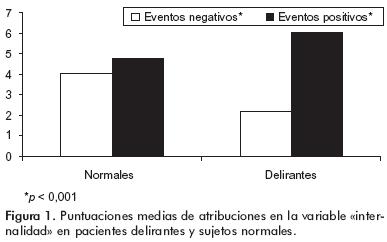
<body><![CDATA[<p align="justify"><font face="verdana" size="2"><b>Dise&ntilde;o y procedimiento</b></font></p>     <p align="justify"><font face="verdana" size="2">Se trata de un estudio comparativo, observacional, transversal y homod&eacute;mico seg&uacute;n la clasificaci&oacute;n propuesta por Feinstein<sup>58</sup> y con un dise&ntilde;o de casos y controles. Tambi&eacute;n se siguen las normas de Ramos&#150;&Aacute;lvarez, Moreno&#150;Fern&aacute;ndez, Vald&eacute;s&#150;Conroy y Catena.<sup>59</sup></font></p>     <p align="justify"><font face="verdana" size="2">Dentro de las consideraciones &eacute;ticas, el estudio cuenta con la aprobaci&oacute;n del Comit&eacute; de &Eacute;tica del Hospital. Los sujetos (tanto experimentales como controles) rellenaron un consentimiento informado y participaron de forma voluntaria e informada. La realizaci&oacute;n de las pruebas explicadas en la secci&oacute;n de Instrumentos al grupo experimental (grupo delirante) se realiz&oacute; en la Unidad de Rehabilitaci&oacute;n de un hospital psiqui&aacute;trico de Santiago de Compostela (Espa&ntilde;a). Los pacientes que cumpl&iacute;an todos los criterios de selecci&oacute;n, descritos anteriormente, fueron entrevistados por uno de los investigadores junto con el psic&oacute;logo especialista encargado de estos pacientes en el hospital (para lo cual no se aplic&oacute; ninguna maniobra psicoterap&eacute;utica). A continuaci&oacute;n, pasaron a contestar los instrumentos detallados anteriormente. Para el estudio de la autoestima, se utiliz&oacute; la Escala de Autoestima de Rosenberg (EA) y para el estudio de las atribuciones se utiliz&oacute; el Cuestionario de Estilo Atribucional (ASQ). A todos estos pacientes se les hab&iacute;a aplicado previamente la Escala de S&iacute;ndromes Positivos y Negativos (PANSS). En el momento que el psic&oacute;logo les aplicaba las pruebas, todos los sujetos estaban siendo controlados farmacol&oacute;gicamente. Al grupo control no se le ha administrado la Escala de S&iacute;ndromes Positivos y Negativos (PANSS) debido a que se parte de la base de que no deben poseer historial psiqui&aacute;trico que requiera tratamiento.</font></p>     <p align="justify"><font face="verdana" size="2"><i>An&aacute;lisis estad&iacute;stico de los resultados</i></font></p>     <p align="justify"><font face="verdana" size="2">En esta investigaci&oacute;n se ha llevado a cabo un an&aacute;lisis descriptivo de las variables objeto de estudio, lo cual nos ha proporcionado la distribuci&oacute;n de frecuencias, porcentajes, medias, medianas y desviaciones t&iacute;picas para cada una de ellas. Para el procesamiento de los datos, se utiliz&oacute; el paquete estad&iacute;stico SPSS 15.0.</font></p>     <p align="justify"><font face="verdana" size="2">&nbsp;</font></p>     <p align="justify"><font face="verdana" size="2"><b>RESULTADOS</b></font></p>     <p align="justify"><font face="verdana" size="2">En la <a href="#f1">figura 1</a> se pueden observar las puntuaciones medias de los grupos delirantes y normales en la subescala Internalidad para eventos positivos y negativos en una escala de uno <i>(ausente) </i>a siete <i>(extrema). </i>Estos datos indican que el paciente delirante realiza ante un evento negativo una atribuci&oacute;n externa con una puntuaci&oacute;n media de 2.18. </font></p>     <p align="center"><font face="verdana" size="2"><a name="f1"></a></font></p>     <p align="center"><font face="verdana" size="2"><img src="/img/revistas/sm/v33n6/a7f1.jpg"></font></p>     ]]></body>
<body><![CDATA[<p align="justify"><font face="verdana" size="2">En cuanto a la puntuaci&oacute;n media obtenida por este grupo en la subescala &lt;&lt;Internalidad&gt;&gt;, para los eventos positivos es de 6.02 <i>(DT = </i>0.65); es decir, ante eventos positivos realizan una atribuci&oacute;n interna, interiorizando la atribuci&oacute;n del evento positivo. Los sujetos delirantes obtienen una puntuaci&oacute;n media de 2.18 en la subescala de &lt;&lt;Internalidad&gt;&gt; para eventos negativos significativamente inferior (F<sub>(1</sub>,<sub>58)</sub>= 71.89; p&lt;0,01) a la obtenida por el grupo normal (M=4.03). Observamos tambi&eacute;n diferencias significativas (F<sub>(1</sub>,<sub>58)</sub>=36.60; p&lt;0.01) para los eventos positivos entre el grupo delirante (M=6.02) y el grupo normal (M=4.75).</font></p>     <p align="justify"><font face="verdana" size="2">En cuanto a la subescala &lt;&lt;Estabilidad&gt;&gt; no se presenta la marcada diferencia que exist&iacute;a para el componente Internalidad, ya que para los eventos negativos no hay diferencias significativas entre el grupo delirante y el grupo normal (F<sub>(1</sub>,<sub>58)</sub>=1.84; p=0.180). As&iacute; pues, entre el grupo delirante y el normal no se han encontrado diferencias significativas en la dimensi&oacute;n &lt;&lt;Estabilidad&gt;&gt; para los eventos negativos. Sin embargo, ante eventos positivos se han encontrado diferencias significativas entre el grupo delirante y el grupo control (F<sub>(158)</sub>=8.84; p=0.004). Como se puede observar en la <a href="#f2">figura 2</a>, el grupo de delirantes obtiene una media para los eventos positivos de 5.78 (DT=0.79) frente a una media del grupo control de 5.07 <i>(DT </i>=0.90).</font></p>     <p align="center"><font face="verdana" size="2"><a name="f2"></a></font></p>     <p align="center"><font face="verdana" size="2"><img src="/img/revistas/sm/v33n6/a7f2.jpg"></font></p>     <p align="justify"><font face="verdana" size="2">En la <a href="#f3">figura 3</a> se observa que el grupo delirante presenta una puntuaci&oacute;n media en la subescala de &lt;&lt;Globalidad&gt;&gt; para eventos negativos de 3.30 <i>(DT=1</i>.06) muy similar a la alcanzada por el grupo normal (M=3.62; DT=1.04). Por lo tanto, no se encontraron diferencias significativas (F<sub>(1</sub>,<sub>58)</sub>=1.24; <i>p=0.26) </i>entre los delirantes y los normales, en lo que concierne a la variable globalidad para los hechos negativos que acontecen en sus vidas. Tampoco se han encontrado diferencias significativas (F<sub>(158)</sub>=0.023; p=0.88) ante situaciones positivas del estilo &lt;&lt;consigues una subida en el sueldo&gt;&gt; en la variable globalidad, entre los delirantes (M=4.69; DT=1.16) y los normales (M=4.74; DT=1.11). Es decir, tanto los delirantes como los normales obtienen puntuaciones similares cuando se les pregunta si este hecho positivo afectar&aacute; de forma global en su vida.</font></p>     <p align="center"><font face="verdana" size="2"><a name="f3"></a></font></p>     <p align="center"><font face="verdana" size="2"><img src="/img/revistas/sm/v33n6/a7f3.jpg"></font></p>     <p align="justify"><font face="verdana" size="2">El an&aacute;lisis de los resultados de la variable autoestima en el grupo delirante y en el grupo normal (<a href="#f4">figura 4</a>) nos muestra que los pacientes delirantes alcanzan una puntuaci&oacute;n media de 27.90 (DT=2.61) similar a la media del grupo control (M=29.20; DT=2.71). Los pacientes delirantes han manifestado una autoestima semejante al grupo de normales. En el an&aacute;lisis estad&iacute;stico no se han encontrado diferencias significativas en autoestima entre el grupo delirante y el grupo control (F<sub>(158)</sub>=3.12; p=0.082) que corroboren la hip&oacute;tesis de que los delirantes tienen una alta autoestima con respecto a los normales.</font></p>     <p align="center"><font face="verdana" size="2"><a name="f4"></a></font></p>     <p align="center"><font face="verdana" size="2"><img src="/img/revistas/sm/v33n6/a7f4.jpg"></font></p>     ]]></body>
<body><![CDATA[<p align="justify"><font face="verdana" size="2">&nbsp;</font></p>     <p align="justify"><font face="verdana" size="2"><b>DISCUSI&Oacute;N Y CONCLUSIONES</b></font></p>     <p align="justify"><font face="verdana" size="2">La teor&iacute;a atribucional concede al delirio un poder de protecci&oacute;n, evitando la culpabilidad, autocensura o agresividad que conducir&iacute;a al paciente a una autoestima d&eacute;bil. Existe una tendencia en los pacientes delirantes a realizar atribuciones externas de los sucesos negativos<sup>60</sup> y adem&aacute;s suponemos, como han propuesto ciertas investigaciones,<sup>61,62 </sup>que los delirios persecutorios reflejar&iacute;an una exageraci&oacute;n de los sesgos cognitivos que tienen lugar en las personas normales, especialmente en respuesta a est&iacute;mulos aversivos o amenazantes.<sup>63</sup> Desde la teor&iacute;a atribucional, los delirios se entender&iacute;an como formas extremas de un sesgo normal de utilidad en sujetos normales, explicaci&oacute;n consistente con la sugerencia que representa la paranoia como una forma de &lt;&lt;depresi&oacute;n camuflada&gt;&gt;<sup>64,65</sup> y asimismo tiene cierta relaci&oacute;n con las teor&iacute;as psicodin&aacute;micas,<sup>66</sup> aunque tambi&eacute;n es cierto que dicha relaci&oacute;n tiene actualmente poco sustento biol&oacute;gico y cl&iacute;nico.</font></p>     <p align="justify"><font face="verdana" size="2">Si se analizan las hip&oacute;tesis de la presente investigaci&oacute;n, a lo largo de los distintos componentes de la dimensi&oacute;n atribucional, se concluye que los sujetos delirantes tienden a culpar de sus fallos y errores a las dem&aacute;s personas o a otras circunstancias. Por el contrario, cuando ellos tienen &eacute;xito en alguna situaci&oacute;n, consideran que se debe a ellos mismos, atribuyendo los eventos favorables internamente. Este sesgo en el procesamiento de la informaci&oacute;n ha sido estudiado en numerosas investigaciones desde la perspectiva de la teor&iacute;a de la atribuci&oacute;n. Entre esas investigaciones, algunas<sup>67,68</sup> concluyeron que es para prevenirlos contra sentimientos autorreferentes decepcionantes. En otros trabajos<sup>69,70</sup> tambi&eacute;n se ha reflejado un estilo atribucional caracter&iacute;stico para los pacientes delirantes e incluso patrones diferentes en cuestiones como la creatividad y el tipo de sus relatos en funci&oacute;n del tipo de delirio.<sup>71,72</sup></font></p>     <p align="justify"><font face="verdana" size="2">En los resultados obtenidos del estudio en el componente Internalidad podemos observar diferencias significativas entre los pacientes delirantes y los sujetos normales tanto para los eventos positivos como para los negativos. Estos datos ampl&iacute;an investigaciones<sup>64</sup> que han comprobado que los sujetos delirantes exhiben &lt;&lt;un marcado sesgo autosirviente&gt;&gt;.</font></p>     <p align="justify"><font face="verdana" size="2">Con respecto a la hip&oacute;tesis de partida de que los pacientes delirantes realizan atribuciones excesivamente estables tanto para hechos negativos como positivos, con respecto al grupo control, nuestros resultados corroboran dicha afirmaci&oacute;n para los eventos positivos, ya que, como se ha demostrado, los pacientes delirantes son m&aacute;s estables para tales eventos que los sujetos normales; sin embargo, no se ha podido constatar esta estabilidad para los eventos negativos. Tal resultado se entender&iacute;a como una funci&oacute;n defensiva y adaptativa<sup>73</sup> del paciente delirante. Es decir, en el supuesto de que se diera un evento negativo en su vida, el paciente concluir&iacute;a que ser&iacute;a algo fortuito, inestable y que no volver&iacute;a a ocurrir.</font></p>     <p align="justify"><font face="verdana" size="2">Las conclusiones del an&aacute;lisis de la dimensi&oacute;n globalidad, la cual determina la generalizaci&oacute;n temporal de la expectativa, no cumplen la hip&oacute;tesis en la cual se afirmaba que los sujetos delirantes, al igual que los normales, realizaban atribuciones excesivamente globales tanto para hechos positivos como para negativos,<sup>74</sup> pero no manifiestan un sesgo exagerado hacia la excesiva globalidad. Los resultados que se han obtenido en esta dimensi&oacute;n atribucional para los pacientes delirantes no confirman los hallados en otras investigaciones.<sup>19</sup> Sin embargo, consideramos que en la presente investigaci&oacute;n las diferencias atribucionales, tanto para los eventos negativos como para los positivos, se pueden constatar con absoluta fiabilidad, al haber realizado un dise&ntilde;o metodol&oacute;gico en que se ha comparado directamente a los sujetos delirantes del grupo experimental con los sujetos normales del grupo control. Por otra parte, las investigaciones que se han revisado en la mayor&iacute;a de los casos presentan deficiencias debido a que la muestra es excesivamente reducida, y en ocasiones no se igualan en g&eacute;nero y n&uacute;mero.</font></p>     <p align="justify"><font face="verdana" size="2">La hip&oacute;tesis planteada por Bentall de que los delirios reflejan un estilo atribucional defensivo, lo cual protege al individuo contra sentimientos de baja autoestima, no se ha podido constatar en esta investigaci&oacute;n, ya que al analizar la variable autoestima observamos que no existen diferencias significativas en los pacientes delirantes, ya que sus puntuaciones son similares al grupo control, mostrando ambos una elevada autoestima. Por todo ello, se puede concluir que entre los pacientes delirantes y el grupo control s&oacute;lo existen diferencias significativas atendiendo al estilo atribucional de cada grupo.</font></p>     <p align="justify"><font face="verdana" size="2">No obstante, este tipo de estudios contribuyen, junto con otros realizados,<sup>75</sup> a la comprensi&oacute;n de estos trastornos, y consecuentemente para el desarrollo de programas psicol&oacute;gicos eficaces<sup>76&#150;78</sup> con el objetivo de mejorar la sintomatolog&iacute;a de estos pacientes e incluso en otras patolog&iacute;as.<sup>79</sup></font></p>     <p align="justify"><font face="verdana" size="2">Por &uacute;ltimo, es necesario destacar que hubiera sido interesante haber aplicado el PANSS al grupo control, ya que de esta forma se hubieran obtenido datos sobre la posible presencia de ideas delirantes o alucinaciones en pacientes sanos, tal y como se ha verificado en algunos trabajos publicados.</font></p>     ]]></body>
<body><![CDATA[<p align="justify"><font face="verdana" size="2">&nbsp;</font></p>     <p align="justify"><font face="verdana" size="2"><b>REFERENCIAS</b></font></p>     <!-- ref --><p align="justify"><font face="verdana" size="2">1. Caparr&oacute;s B, Barrantes&#150;Vidal N, Vi&ntilde;as, F, Obiols J. Attention, memory and verbal learning and their relation to schizotypal traits in unaffected parents of schizophrenic patients. Int J Clin Health Psychol 2008;8:37&#150;52.    &nbsp;&nbsp;&nbsp;&nbsp;&nbsp;&nbsp;&nbsp;&nbsp;[&#160;<a href="javascript:void(0);" onclick="javascript: window.open('/scielo.php?script=sci_nlinks&ref=9053226&pid=S0185-3325201000060000700001&lng=','','width=640,height=500,resizable=yes,scrollbars=1,menubar=yes,');">Links</a>&#160;]<!-- end-ref --></font></p>     <!-- ref --><p align="justify"><font face="verdana" size="2">2. Fern&aacute;ndez W. Delirio. Rev Fac Med Univ Nac Colombia 2003;51:109&#150;113.    &nbsp;&nbsp;&nbsp;&nbsp;&nbsp;&nbsp;&nbsp;&nbsp;[&#160;<a href="javascript:void(0);" onclick="javascript: window.open('/scielo.php?script=sci_nlinks&ref=9053228&pid=S0185-3325201000060000700002&lng=','','width=640,height=500,resizable=yes,scrollbars=1,menubar=yes,');">Links</a>&#160;]<!-- end-ref --></font></p>     <!-- ref --><p align="justify"><font face="verdana" size="2">3. Brevis I, Cruz C. Incidencia y factores de riesgo asociados a delirio en pacientes cr&iacute;ticos sometidos a ventilaci&oacute;n mec&aacute;nica. Revista Chilena Medicina Interna 2008;23:18&#150;24.    &nbsp;&nbsp;&nbsp;&nbsp;&nbsp;&nbsp;&nbsp;&nbsp;[&#160;<a href="javascript:void(0);" onclick="javascript: window.open('/scielo.php?script=sci_nlinks&ref=9053230&pid=S0185-3325201000060000700003&lng=','','width=640,height=500,resizable=yes,scrollbars=1,menubar=yes,');">Links</a>&#160;]<!-- end-ref --></font></p>     <!-- ref --><p align="justify"><font face="verdana" size="2">4. V&iacute;rseda A, Ramos P. El delirio como met&aacute;fora psicopatol&oacute;gica. Actas Esp Psiquiatr 2005;33:221&#150;30.    &nbsp;&nbsp;&nbsp;&nbsp;&nbsp;&nbsp;&nbsp;&nbsp;[&#160;<a href="javascript:void(0);" onclick="javascript: window.open('/scielo.php?script=sci_nlinks&ref=9053232&pid=S0185-3325201000060000700004&lng=','','width=640,height=500,resizable=yes,scrollbars=1,menubar=yes,');">Links</a>&#160;]<!-- end-ref --></font></p>     ]]></body>
<body><![CDATA[<!-- ref --><p align="justify"><font face="verdana" size="2">5. American Psychiatric Association (APA). Manual Diagn&oacute;stico y Estad&iacute;stico de Trastornos Mentales. Cuarta edici&oacute;n, texto revisado. Barcelona: Masson; 2002.    &nbsp;&nbsp;&nbsp;&nbsp;&nbsp;&nbsp;&nbsp;&nbsp;[&#160;<a href="javascript:void(0);" onclick="javascript: window.open('/scielo.php?script=sci_nlinks&ref=9053234&pid=S0185-3325201000060000700005&lng=','','width=640,height=500,resizable=yes,scrollbars=1,menubar=yes,');">Links</a>&#160;]<!-- end-ref --></font></p>     <!-- ref --><p align="justify"><font face="verdana" size="2">6. L&oacute;pez&#150;Luengo B, V&aacute;zquez C. Effects of a neuropsychological rehabilitation program on schizophrenic patients' subjective perception of improvement. Neuropsychological Rehabilitation 2005;15:609&#150;618.    &nbsp;&nbsp;&nbsp;&nbsp;&nbsp;&nbsp;&nbsp;&nbsp;[&#160;<a href="javascript:void(0);" onclick="javascript: window.open('/scielo.php?script=sci_nlinks&ref=9053236&pid=S0185-3325201000060000700006&lng=','','width=640,height=500,resizable=yes,scrollbars=1,menubar=yes,');">Links</a>&#160;]<!-- end-ref --></font></p>     <!-- ref --><p align="justify"><font face="verdana" size="2">7. Heider F. The Psychology of Interpersonal Relations. Nueva York: John Wiley and Sons; 1958.    &nbsp;&nbsp;&nbsp;&nbsp;&nbsp;&nbsp;&nbsp;&nbsp;[&#160;<a href="javascript:void(0);" onclick="javascript: window.open('/scielo.php?script=sci_nlinks&ref=9053238&pid=S0185-3325201000060000700007&lng=','','width=640,height=500,resizable=yes,scrollbars=1,menubar=yes,');">Links</a>&#160;]<!-- end-ref --></font></p>     <!-- ref --><p align="justify"><font face="verdana" size="2">8. Jones EE, Davis VE. From acts to dispositions: The attribution process in person perception. En: Berkowitz L (ed). Advances in experimental social psychology. Nueva York: Academic Press; 1965.    &nbsp;&nbsp;&nbsp;&nbsp;&nbsp;&nbsp;&nbsp;&nbsp;[&#160;<a href="javascript:void(0);" onclick="javascript: window.open('/scielo.php?script=sci_nlinks&ref=9053240&pid=S0185-3325201000060000700008&lng=','','width=640,height=500,resizable=yes,scrollbars=1,menubar=yes,');">Links</a>&#160;]<!-- end-ref --></font></p>     <!-- ref --><p align="justify"><font face="verdana" size="2">9. Kelley HH. Attribution theory in social psychology. En: Levine D (ed). Nebraska Symposium on Motivation. Lincoln: University of Nebraska; 1967.    &nbsp;&nbsp;&nbsp;&nbsp;&nbsp;&nbsp;&nbsp;&nbsp;[&#160;<a href="javascript:void(0);" onclick="javascript: window.open('/scielo.php?script=sci_nlinks&ref=9053242&pid=S0185-3325201000060000700009&lng=','','width=640,height=500,resizable=yes,scrollbars=1,menubar=yes,');">Links</a>&#160;]<!-- end-ref --></font></p>     ]]></body>
<body><![CDATA[<!-- ref --><p align="justify"><font face="verdana" size="2">10. Bentall RP. Cognitive biases and abnormal beliefs: Towards a model of persecutory delusions. En: David AS, Cutting J (eds). The Neuropsychology of Schizophrenia. Londres: Erlbaum; 1994.    &nbsp;&nbsp;&nbsp;&nbsp;&nbsp;&nbsp;&nbsp;&nbsp;[&#160;<a href="javascript:void(0);" onclick="javascript: window.open('/scielo.php?script=sci_nlinks&ref=9053244&pid=S0185-3325201000060000700010&lng=','','width=640,height=500,resizable=yes,scrollbars=1,menubar=yes,');">Links</a>&#160;]<!-- end-ref --></font></p>     <!-- ref --><p align="justify"><font face="verdana" size="2">11.Estebaranz G. Estilo atribucional en el espectro Esquizofr&eacute;nico. Apunt Psicol 2004;22:137&#150;150.    &nbsp;&nbsp;&nbsp;&nbsp;&nbsp;&nbsp;&nbsp;&nbsp;[&#160;<a href="javascript:void(0);" onclick="javascript: window.open('/scielo.php?script=sci_nlinks&ref=9053246&pid=S0185-3325201000060000700011&lng=','','width=640,height=500,resizable=yes,scrollbars=1,menubar=yes,');">Links</a>&#160;]<!-- end-ref --></font></p>     <!-- ref --><p align="justify"><font face="verdana" size="2">12. Perona&#150;Garcel&aacute;n S. Estado actual de la investigaci&oacute;n psicol&oacute;gica en las alucinaciones auditivas. Apunt Psicol 2006;24:83&#150;110.    &nbsp;&nbsp;&nbsp;&nbsp;&nbsp;&nbsp;&nbsp;&nbsp;[&#160;<a href="javascript:void(0);" onclick="javascript: window.open('/scielo.php?script=sci_nlinks&ref=9053248&pid=S0185-3325201000060000700012&lng=','','width=640,height=500,resizable=yes,scrollbars=1,menubar=yes,');">Links</a>&#160;]<!-- end-ref --></font></p>     <!-- ref --><p align="justify"><font face="verdana" size="2">13. Ruiz MJC, Guti&eacute;rrez&#150;Zotes A, Oyarz&aacute;bal JV, P&agrave;mies MJ et al. Delusions and their relation with temperament and character in psychotic patients. Psicothema 2010;22:84&#150;91.    &nbsp;&nbsp;&nbsp;&nbsp;&nbsp;&nbsp;&nbsp;&nbsp;[&#160;<a href="javascript:void(0);" onclick="javascript: window.open('/scielo.php?script=sci_nlinks&ref=9053250&pid=S0185-3325201000060000700013&lng=','','width=640,height=500,resizable=yes,scrollbars=1,menubar=yes,');">Links</a>&#160;]<!-- end-ref --></font></p>     <!-- ref --><p align="justify"><font face="verdana" size="2">14. Vera&#150;Villarroel P, Buela&#150;Casal G. Relaciones entre ansiedad y estilo atributivo. Rev Mex Psicol 2000;17:137&#150;142.    &nbsp;&nbsp;&nbsp;&nbsp;&nbsp;&nbsp;&nbsp;&nbsp;[&#160;<a href="javascript:void(0);" onclick="javascript: window.open('/scielo.php?script=sci_nlinks&ref=9053252&pid=S0185-3325201000060000700014&lng=','','width=640,height=500,resizable=yes,scrollbars=1,menubar=yes,');">Links</a>&#160;]<!-- end-ref --></font></p>     ]]></body>
<body><![CDATA[<!-- ref --><p align="justify"><font face="verdana" size="2">15. Smith B, Fowler D, Freeman D, Bebbington P et al. Emotion and psychosis: links between depression, self&#150;esteem, negative schematic beliefs and delusions and hallucinations. Schiz Res 2006;86:181&#150;188.    &nbsp;&nbsp;&nbsp;&nbsp;&nbsp;&nbsp;&nbsp;&nbsp;[&#160;<a href="javascript:void(0);" onclick="javascript: window.open('/scielo.php?script=sci_nlinks&ref=9053254&pid=S0185-3325201000060000700015&lng=','','width=640,height=500,resizable=yes,scrollbars=1,menubar=yes,');">Links</a>&#160;]<!-- end-ref --></font></p>     <!-- ref --><p align="justify"><font face="verdana" size="2">16. Navarro Bayon D, Carrasco Ram&iacute;rez O. Relaci&oacute;n entre S&iacute;ntomas Psic&oacute;ticos, Estados Emocionales Negativos y A&ntilde;os de Evoluci&oacute;n en Personas con Esquizofrenia. Cl&iacute;nica Salud 2009;20:197&#150;204.    &nbsp;&nbsp;&nbsp;&nbsp;&nbsp;&nbsp;&nbsp;&nbsp;[&#160;<a href="javascript:void(0);" onclick="javascript: window.open('/scielo.php?script=sci_nlinks&ref=9053256&pid=S0185-3325201000060000700016&lng=','','width=640,height=500,resizable=yes,scrollbars=1,menubar=yes,');">Links</a>&#160;]<!-- end-ref --></font></p>     <!-- ref --><p align="justify"><font face="verdana" size="2">17. D&iacute;ez&#150;Alegr&iacute;a C, V&aacute;zquez&#150;Valverde C. Teor&iacute;as cognitivas de las creencias delirantes. Apunt Psicol 2006;24:51&#150;82.    &nbsp;&nbsp;&nbsp;&nbsp;&nbsp;&nbsp;&nbsp;&nbsp;[&#160;<a href="javascript:void(0);" onclick="javascript: window.open('/scielo.php?script=sci_nlinks&ref=9053258&pid=S0185-3325201000060000700017&lng=','','width=640,height=500,resizable=yes,scrollbars=1,menubar=yes,');">Links</a>&#160;]<!-- end-ref --></font></p>     <!-- ref --><p align="justify"><font face="verdana" size="2">18. Kaney S, Bentall RP. Persecutory delusions and the self&#150;serving bias: Evidence from a contingency judgement task. J Ner Ment Dis 1992;180:773&#150;780.    &nbsp;&nbsp;&nbsp;&nbsp;&nbsp;&nbsp;&nbsp;&nbsp;[&#160;<a href="javascript:void(0);" onclick="javascript: window.open('/scielo.php?script=sci_nlinks&ref=9053260&pid=S0185-3325201000060000700018&lng=','','width=640,height=500,resizable=yes,scrollbars=1,menubar=yes,');">Links</a>&#160;]<!-- end-ref --></font></p>     <!-- ref --><p align="justify"><font face="verdana" size="2">19. Candido CL, Romney DM. Attributional  in paranoid versus depressed patients. Br J Med Psychol 1990;63:355&#150;363.    &nbsp;&nbsp;&nbsp;&nbsp;&nbsp;&nbsp;&nbsp;&nbsp;[&#160;<a href="javascript:void(0);" onclick="javascript: window.open('/scielo.php?script=sci_nlinks&ref=9053262&pid=S0185-3325201000060000700019&lng=','','width=640,height=500,resizable=yes,scrollbars=1,menubar=yes,');">Links</a>&#160;]<!-- end-ref --></font></p>     ]]></body>
<body><![CDATA[<!-- ref --><p align="justify"><font face="verdana" size="2">20.  &nbsp;Fear CF, Sharpe M, Healy D. Cognitive processes in delusional disorders. Br J Psychiatry 1996;168:61&#150;67.    &nbsp;&nbsp;&nbsp;&nbsp;&nbsp;&nbsp;&nbsp;&nbsp;[&#160;<a href="javascript:void(0);" onclick="javascript: window.open('/scielo.php?script=sci_nlinks&ref=9053264&pid=S0185-3325201000060000700020&lng=','','width=640,height=500,resizable=yes,scrollbars=1,menubar=yes,');">Links</a>&#160;]<!-- end-ref --></font></p>     <!-- ref --><p align="justify"><font face="verdana" size="2">21. Kaney S, Wolfenden M, Dewey ME, Bentall RP. Persecutory delusions and the recall of threatening and nonthreatening proportions. Br J Clin Psychol 1992;31:85&#150;87.    &nbsp;&nbsp;&nbsp;&nbsp;&nbsp;&nbsp;&nbsp;&nbsp;[&#160;<a href="javascript:void(0);" onclick="javascript: window.open('/scielo.php?script=sci_nlinks&ref=9053266&pid=S0185-3325201000060000700021&lng=','','width=640,height=500,resizable=yes,scrollbars=1,menubar=yes,');">Links</a>&#160;]<!-- end-ref --></font></p>     <!-- ref --><p align="justify"><font face="verdana" size="2">22. Kinderman P. Attentional bias, persecutory delusions and the self&#150;concept. Br J Med Psychol 1994;67:53&#150;66.    &nbsp;&nbsp;&nbsp;&nbsp;&nbsp;&nbsp;&nbsp;&nbsp;[&#160;<a href="javascript:void(0);" onclick="javascript: window.open('/scielo.php?script=sci_nlinks&ref=9053268&pid=S0185-3325201000060000700022&lng=','','width=640,height=500,resizable=yes,scrollbars=1,menubar=yes,');">Links</a>&#160;]<!-- end-ref --></font></p>     <!-- ref --><p align="justify"><font face="verdana" size="2">23. Lyon HM, Startup M, Bentall RP. Social cognition and the manic defense: Attributions, selective attention, and self&#150;schema in bipolar affective disorder. J Abn Psychol 1999;108:273&#150;282.    &nbsp;&nbsp;&nbsp;&nbsp;&nbsp;&nbsp;&nbsp;&nbsp;[&#160;<a href="javascript:void(0);" onclick="javascript: window.open('/scielo.php?script=sci_nlinks&ref=9053270&pid=S0185-3325201000060000700023&lng=','','width=640,height=500,resizable=yes,scrollbars=1,menubar=yes,');">Links</a>&#160;]<!-- end-ref --></font></p>     <!-- ref --><p align="justify"><font face="verdana" size="2">24. Sharp HM, Fear CF, Healy D. Attributional  and delusions: an investigation based on delusional content. European Psychiatry 1997;12:1&#150;7.    &nbsp;&nbsp;&nbsp;&nbsp;&nbsp;&nbsp;&nbsp;&nbsp;[&#160;<a href="javascript:void(0);" onclick="javascript: window.open('/scielo.php?script=sci_nlinks&ref=9053272&pid=S0185-3325201000060000700024&lng=','','width=640,height=500,resizable=yes,scrollbars=1,menubar=yes,');">Links</a>&#160;]<!-- end-ref --></font></p>     ]]></body>
<body><![CDATA[<!-- ref --><p align="justify"><font face="verdana" size="2">25. Won HT, Lee HJ. The self&#150;concept and attributional  in a paranoid group. Kor J Clin Psychol 1997;16:173&#150;182.    &nbsp;&nbsp;&nbsp;&nbsp;&nbsp;&nbsp;&nbsp;&nbsp;[&#160;<a href="javascript:void(0);" onclick="javascript: window.open('/scielo.php?script=sci_nlinks&ref=9053274&pid=S0185-3325201000060000700025&lng=','','width=640,height=500,resizable=yes,scrollbars=1,menubar=yes,');">Links</a>&#160;]<!-- end-ref --></font></p>     <!-- ref --><p align="justify"><font face="verdana" size="2">26. Bentall RP. Social Cognition and Delusional Beliefs. En: Corrigan PW, Penn DL (eds). Social cognition and schizophrenia. Washington: APA; 2001.    &nbsp;&nbsp;&nbsp;&nbsp;&nbsp;&nbsp;&nbsp;&nbsp;[&#160;<a href="javascript:void(0);" onclick="javascript: window.open('/scielo.php?script=sci_nlinks&ref=9053276&pid=S0185-3325201000060000700026&lng=','','width=640,height=500,resizable=yes,scrollbars=1,menubar=yes,');">Links</a>&#160;]<!-- end-ref --></font></p>     <!-- ref --><p align="justify"><font face="verdana" size="2">27. Blackwood NJ, Howard RJ, Bentall RP, Murray RM. Cognitive Neurop&#150;sychiatric Models of Persecutory Delusions. Am J Psychiatry 2001;158:527&#150;539.    &nbsp;&nbsp;&nbsp;&nbsp;&nbsp;&nbsp;&nbsp;&nbsp;[&#160;<a href="javascript:void(0);" onclick="javascript: window.open('/scielo.php?script=sci_nlinks&ref=9053278&pid=S0185-3325201000060000700027&lng=','','width=640,height=500,resizable=yes,scrollbars=1,menubar=yes,');">Links</a>&#160;]<!-- end-ref --></font></p>     <!-- ref --><p align="justify"><font face="verdana" size="2">28. Garety PA, Hemsley DR. Delusions: Investigations into the psychology of delusional reasoning. Oxford: Oxford University Press; 1994.    &nbsp;&nbsp;&nbsp;&nbsp;&nbsp;&nbsp;&nbsp;&nbsp;[&#160;<a href="javascript:void(0);" onclick="javascript: window.open('/scielo.php?script=sci_nlinks&ref=9053280&pid=S0185-3325201000060000700028&lng=','','width=640,height=500,resizable=yes,scrollbars=1,menubar=yes,');">Links</a>&#160;]<!-- end-ref --></font></p>     <!-- ref --><p align="justify"><font face="verdana" size="2">29. Penn DL, Jones N, Munt ED. A pilot study of social cognition and interaction training (SCIT) for schizophrenia. Schiz Res 2005;80:357&#150;359.    &nbsp;&nbsp;&nbsp;&nbsp;&nbsp;&nbsp;&nbsp;&nbsp;[&#160;<a href="javascript:void(0);" onclick="javascript: window.open('/scielo.php?script=sci_nlinks&ref=9053282&pid=S0185-3325201000060000700029&lng=','','width=640,height=500,resizable=yes,scrollbars=1,menubar=yes,');">Links</a>&#160;]<!-- end-ref --></font></p>     ]]></body>
<body><![CDATA[<!-- ref --><p align="justify"><font face="verdana" size="2">30. Taylor SE. Adjustment to threatening events: A theory of cognitive adaptation. Am psychol 1983;38:1161&#150;1173.    &nbsp;&nbsp;&nbsp;&nbsp;&nbsp;&nbsp;&nbsp;&nbsp;[&#160;<a href="javascript:void(0);" onclick="javascript: window.open('/scielo.php?script=sci_nlinks&ref=9053284&pid=S0185-3325201000060000700030&lng=','','width=640,height=500,resizable=yes,scrollbars=1,menubar=yes,');">Links</a>&#160;]<!-- end-ref --></font></p>     <!-- ref --><p align="justify"><font face="verdana" size="2">31. Young HF, Bentall RP. Probabilistic reasoning in deluded, depressed and normal subjects: Effects of task difficulty and meaningful versus non&#150;meaningful material. Psychol Med 1997;27:455&#150;465.    &nbsp;&nbsp;&nbsp;&nbsp;&nbsp;&nbsp;&nbsp;&nbsp;[&#160;<a href="javascript:void(0);" onclick="javascript: window.open('/scielo.php?script=sci_nlinks&ref=9053286&pid=S0185-3325201000060000700031&lng=','','width=640,height=500,resizable=yes,scrollbars=1,menubar=yes,');">Links</a>&#160;]<!-- end-ref --></font></p>     <!-- ref --><p align="justify"><font face="verdana" size="2">32. Bentall RP. Madness explained: Psychosis and human nature. London: Penguin Books; 2003.    &nbsp;&nbsp;&nbsp;&nbsp;&nbsp;&nbsp;&nbsp;&nbsp;[&#160;<a href="javascript:void(0);" onclick="javascript: window.open('/scielo.php?script=sci_nlinks&ref=9053288&pid=S0185-3325201000060000700032&lng=','','width=640,height=500,resizable=yes,scrollbars=1,menubar=yes,');">Links</a>&#160;]<!-- end-ref --></font></p>     <!-- ref --><p align="justify"><font face="verdana" size="2">33. Bentall RP, Taylor JL. Psychological processes and paranoia: Implications for forensic behavioural science. Behav Sci Law 2006;24:277&#150;294.    &nbsp;&nbsp;&nbsp;&nbsp;&nbsp;&nbsp;&nbsp;&nbsp;[&#160;<a href="javascript:void(0);" onclick="javascript: window.open('/scielo.php?script=sci_nlinks&ref=9053290&pid=S0185-3325201000060000700033&lng=','','width=640,height=500,resizable=yes,scrollbars=1,menubar=yes,');">Links</a>&#160;]<!-- end-ref --></font></p>     <!-- ref --><p align="justify"><font face="verdana" size="2">34. Garc&iacute;a JM, P&eacute;rez M. Reivindicaci&oacute;n de la persona en la esquizofrenia. Int J Clin Health Psychol 2003;3:107&#150;122.    &nbsp;&nbsp;&nbsp;&nbsp;&nbsp;&nbsp;&nbsp;&nbsp;[&#160;<a href="javascript:void(0);" onclick="javascript: window.open('/scielo.php?script=sci_nlinks&ref=9053292&pid=S0185-3325201000060000700034&lng=','','width=640,height=500,resizable=yes,scrollbars=1,menubar=yes,');">Links</a>&#160;]<!-- end-ref --></font></p>     ]]></body>
<body><![CDATA[<!-- ref --><p align="justify"><font face="verdana" size="2">35. Grijalba FJY. Deliriums in the present Spanish public life, tests of social psychiatry. Sistema 2007;199:99&#150;111.    &nbsp;&nbsp;&nbsp;&nbsp;&nbsp;&nbsp;&nbsp;&nbsp;[&#160;<a href="javascript:void(0);" onclick="javascript: window.open('/scielo.php?script=sci_nlinks&ref=9053294&pid=S0185-3325201000060000700035&lng=','','width=640,height=500,resizable=yes,scrollbars=1,menubar=yes,');">Links</a>&#160;]<!-- end-ref --></font></p>     <!-- ref --><p align="justify"><font face="verdana" size="2">36. Br&uuml;ne M. Emotion recognition, 'theory of mind' and social behaviour in schizophrenia. Psychiat Res 2005;133:135&#150;147.    &nbsp;&nbsp;&nbsp;&nbsp;&nbsp;&nbsp;&nbsp;&nbsp;[&#160;<a href="javascript:void(0);" onclick="javascript: window.open('/scielo.php?script=sci_nlinks&ref=9053296&pid=S0185-3325201000060000700036&lng=','','width=640,height=500,resizable=yes,scrollbars=1,menubar=yes,');">Links</a>&#160;]<!-- end-ref --></font></p>     <!-- ref --><p align="justify"><font face="verdana" size="2">37. Lahera G. Cognici&oacute;n social y delirio. Rev Asoc Esp Neuropsiq 2008;28:197&#150;209.    &nbsp;&nbsp;&nbsp;&nbsp;&nbsp;&nbsp;&nbsp;&nbsp;[&#160;<a href="javascript:void(0);" onclick="javascript: window.open('/scielo.php?script=sci_nlinks&ref=9053298&pid=S0185-3325201000060000700037&lng=','','width=640,height=500,resizable=yes,scrollbars=1,menubar=yes,');">Links</a>&#160;]<!-- end-ref --></font></p>     <!-- ref --><p align="justify"><font face="verdana" size="2">38. Ruiz&#150;Ruiz JC, Garc&iacute;a&#150;Ferrer S, Fuentes&#150;Dur&aacute; I. La relevancia de la cognici&oacute;n social en la esquizofrenia. Apunt Psicol 2006;24:137&#150;155.    &nbsp;&nbsp;&nbsp;&nbsp;&nbsp;&nbsp;&nbsp;&nbsp;[&#160;<a href="javascript:void(0);" onclick="javascript: window.open('/scielo.php?script=sci_nlinks&ref=9053300&pid=S0185-3325201000060000700038&lng=','','width=640,height=500,resizable=yes,scrollbars=1,menubar=yes,');">Links</a>&#160;]<!-- end-ref --></font></p>     <!-- ref --><p align="justify"><font face="verdana" size="2">39. Berry K, Band R, Corcoran R, Barrowclough C et al. Attachment s, earlier interpersonal relationships and schizotypy in a non&#150;clinical sample. Psychol Psychother Theor Res Pract 2007;80:563&#150;576.    &nbsp;&nbsp;&nbsp;&nbsp;&nbsp;&nbsp;&nbsp;&nbsp;[&#160;<a href="javascript:void(0);" onclick="javascript: window.open('/scielo.php?script=sci_nlinks&ref=9053302&pid=S0185-3325201000060000700039&lng=','','width=640,height=500,resizable=yes,scrollbars=1,menubar=yes,');">Links</a>&#160;]<!-- end-ref --></font></p>     ]]></body>
<body><![CDATA[<!-- ref --><p align="justify"><font face="verdana" size="2">40. Cather C, Penn DL, Otto MW. A pilot study of functional cognitive behavioral therapy (fCBT) for schizophrenia. Schiz Res 2005;74:201&#150;209.    &nbsp;&nbsp;&nbsp;&nbsp;&nbsp;&nbsp;&nbsp;&nbsp;[&#160;<a href="javascript:void(0);" onclick="javascript: window.open('/scielo.php?script=sci_nlinks&ref=9053304&pid=S0185-3325201000060000700040&lng=','','width=640,height=500,resizable=yes,scrollbars=1,menubar=yes,');">Links</a>&#160;]<!-- end-ref --></font></p>     <!-- ref --><p align="justify"><font face="verdana" size="2">41. Cuevas&#150;Yust C. Terapia cognitivo conductual para los delirios y alucinaciones resistentes a la medicaci&oacute;n en pacientes psic&oacute;ticos ambulatorios. Apunt Psicol 2006;24:267&#150;292.    &nbsp;&nbsp;&nbsp;&nbsp;&nbsp;&nbsp;&nbsp;&nbsp;[&#160;<a href="javascript:void(0);" onclick="javascript: window.open('/scielo.php?script=sci_nlinks&ref=9053306&pid=S0185-3325201000060000700041&lng=','','width=640,height=500,resizable=yes,scrollbars=1,menubar=yes,');">Links</a>&#160;]<!-- end-ref --></font></p>     <!-- ref --><p align="justify"><font face="verdana" size="2">42. Granholm E, McQuai JR, McClure FS, Auslander LA et al. A randomized, controlled trial of cognitive behavioral social skills training for middle&#150;aged and older outpatients with chronic schizophrenia. Am J Psychiatry 2005;162:520&#150;529.    &nbsp;&nbsp;&nbsp;&nbsp;&nbsp;&nbsp;&nbsp;&nbsp;[&#160;<a href="javascript:void(0);" onclick="javascript: window.open('/scielo.php?script=sci_nlinks&ref=9053308&pid=S0185-3325201000060000700042&lng=','','width=640,height=500,resizable=yes,scrollbars=1,menubar=yes,');">Links</a>&#160;]<!-- end-ref --></font></p>     <!-- ref --><p align="justify"><font face="verdana" size="2">43. G&oacute;mez AM, Botella L. Efecto de una intervenci&oacute;n psicosocial sobre calidad de vida, estado sintom&aacute;tico y construcci&oacute;n del s&iacute; mismo en pacientes diagnosticados de esquizofrenia paranoide. Int J Clin Health Psychol 2007;7:349&#150;367.    &nbsp;&nbsp;&nbsp;&nbsp;&nbsp;&nbsp;&nbsp;&nbsp;[&#160;<a href="javascript:void(0);" onclick="javascript: window.open('/scielo.php?script=sci_nlinks&ref=9053310&pid=S0185-3325201000060000700043&lng=','','width=640,height=500,resizable=yes,scrollbars=1,menubar=yes,');">Links</a>&#160;]<!-- end-ref --></font></p>     <!-- ref --><p align="justify"><font face="verdana" size="2">44. Medina P, Masanet MJ, Bellver F, Montero I et al. Modificaci&oacute;n de la expresividad emocional familiar tras una intervenci&oacute;n psicosocial: estabilidad en el tiempo. Actas Esp Psiquiatr 2005;33:102&#150;109.    &nbsp;&nbsp;&nbsp;&nbsp;&nbsp;&nbsp;&nbsp;&nbsp;[&#160;<a href="javascript:void(0);" onclick="javascript: window.open('/scielo.php?script=sci_nlinks&ref=9053312&pid=S0185-3325201000060000700044&lng=','','width=640,height=500,resizable=yes,scrollbars=1,menubar=yes,');">Links</a>&#160;]<!-- end-ref --></font></p>     ]]></body>
<body><![CDATA[<!-- ref --><p align="justify"><font face="verdana" size="2">45. Bentall RP, Young HF. Sensible hypothesis testing in deluded, depressed and normal subjects. Br J Psychiatry 1996;168:372&#150;375.    &nbsp;&nbsp;&nbsp;&nbsp;&nbsp;&nbsp;&nbsp;&nbsp;[&#160;<a href="javascript:void(0);" onclick="javascript: window.open('/scielo.php?script=sci_nlinks&ref=9053314&pid=S0185-3325201000060000700045&lng=','','width=640,height=500,resizable=yes,scrollbars=1,menubar=yes,');">Links</a>&#160;]<!-- end-ref --></font></p>     <!-- ref --><p align="justify"><font face="verdana" size="2">46. Rosenberg M. Society and the adolescent self&#150;image. Princeton: University Press NJ; 1965.    &nbsp;&nbsp;&nbsp;&nbsp;&nbsp;&nbsp;&nbsp;&nbsp;[&#160;<a href="javascript:void(0);" onclick="javascript: window.open('/scielo.php?script=sci_nlinks&ref=9053316&pid=S0185-3325201000060000700046&lng=','','width=640,height=500,resizable=yes,scrollbars=1,menubar=yes,');">Links</a>&#160;]<!-- end-ref --></font></p>     <!-- ref --><p align="justify"><font face="verdana" size="2">47.  V&aacute;zquez Morej&oacute;n AJ, Jim&eacute;nez Garc&iacute;a&#150;B&oacute;veda R, V&aacute;zquez Morej&oacute;n Jim&eacute;nez R. Escala de autoestima de Rosenberg: fiabilidad y validez en poblaci&oacute;n cl&iacute;nica espa&ntilde;ola. Apunt Psicol 2004;22:247&#150;255.    &nbsp;&nbsp;&nbsp;&nbsp;&nbsp;&nbsp;&nbsp;&nbsp;[&#160;<a href="javascript:void(0);" onclick="javascript: window.open('/scielo.php?script=sci_nlinks&ref=9053318&pid=S0185-3325201000060000700047&lng=','','width=640,height=500,resizable=yes,scrollbars=1,menubar=yes,');">Links</a>&#160;]<!-- end-ref --></font></p>     <!-- ref --><p align="justify"><font face="verdana" size="2">48. Peterson C, Semmel A, Von Baeyer C, Abramson LY et al. The Attributional  Questionnaire. Cognit Ther Res 1982;6:287&#150;299.    &nbsp;&nbsp;&nbsp;&nbsp;&nbsp;&nbsp;&nbsp;&nbsp;[&#160;<a href="javascript:void(0);" onclick="javascript: window.open('/scielo.php?script=sci_nlinks&ref=9053320&pid=S0185-3325201000060000700048&lng=','','width=640,height=500,resizable=yes,scrollbars=1,menubar=yes,');">Links</a>&#160;]<!-- end-ref --></font></p>     <!-- ref --><p align="justify"><font face="verdana" size="2">49. Sanju&aacute;n P, Magallares A. Spanish adaptation of Attributional  Questionnaire: Psychometric properties. VIII European Conference of Psychological Assessment. Budapest, Hungr&iacute;a; 2005(agos&#150;sep)31&#150;4.    &nbsp;&nbsp;&nbsp;&nbsp;&nbsp;&nbsp;&nbsp;&nbsp;[&#160;<a href="javascript:void(0);" onclick="javascript: window.open('/scielo.php?script=sci_nlinks&ref=9053322&pid=S0185-3325201000060000700049&lng=','','width=640,height=500,resizable=yes,scrollbars=1,menubar=yes,');">Links</a>&#160;]<!-- end-ref --></font></p>     ]]></body>
<body><![CDATA[<!-- ref --><p align="justify"><font face="verdana" size="2">50. Kay SR, Fizbein A, Vital&#150;Herne M, Silva L. Positive and Negative Syndrome Scale&#150;Spanish adaptation. J Nerv Ment Dis 1990;178:510&#150;517.    &nbsp;&nbsp;&nbsp;&nbsp;&nbsp;&nbsp;&nbsp;&nbsp;[&#160;<a href="javascript:void(0);" onclick="javascript: window.open('/scielo.php?script=sci_nlinks&ref=9053324&pid=S0185-3325201000060000700050&lng=','','width=640,height=500,resizable=yes,scrollbars=1,menubar=yes,');">Links</a>&#160;]<!-- end-ref --></font></p>     <!-- ref --><p align="justify"><font face="verdana" size="2">51. Kay SR, Fiszbein A, Opler LA. The positive and negative syndrome scale (PANSS) for schizophrenia. Schizoph Bull 1987;13:261&#150;76.    &nbsp;&nbsp;&nbsp;&nbsp;&nbsp;&nbsp;&nbsp;&nbsp;[&#160;<a href="javascript:void(0);" onclick="javascript: window.open('/scielo.php?script=sci_nlinks&ref=9053326&pid=S0185-3325201000060000700051&lng=','','width=640,height=500,resizable=yes,scrollbars=1,menubar=yes,');">Links</a>&#160;]<!-- end-ref --></font></p>     <!-- ref --><p align="justify"><font face="verdana" size="2">52. Kay SR, Opler LA, Lindenmayer JP. Reliability and validity of the positive and negative syndrome scale for schizophrenics. Psychiatry Research 1988;23:99&#150;110.    &nbsp;&nbsp;&nbsp;&nbsp;&nbsp;&nbsp;&nbsp;&nbsp;[&#160;<a href="javascript:void(0);" onclick="javascript: window.open('/scielo.php?script=sci_nlinks&ref=9053328&pid=S0185-3325201000060000700052&lng=','','width=640,height=500,resizable=yes,scrollbars=1,menubar=yes,');">Links</a>&#160;]<!-- end-ref --></font></p>     <!-- ref --><p align="justify"><font face="verdana" size="2">53. Lindenmayer JP, Bernstein&#150;Hyman R, Grochowski S. Five&#150;factor model of schizophrenia. Initial validation. J Nerv Ment Dis 1994;182:631&#150;8.    &nbsp;&nbsp;&nbsp;&nbsp;&nbsp;&nbsp;&nbsp;&nbsp;[&#160;<a href="javascript:void(0);" onclick="javascript: window.open('/scielo.php?script=sci_nlinks&ref=9053330&pid=S0185-3325201000060000700053&lng=','','width=640,height=500,resizable=yes,scrollbars=1,menubar=yes,');">Links</a>&#160;]<!-- end-ref --></font></p>     <!-- ref --><p align="justify"><font face="verdana" size="2">54. Bell M, Milstein R, Beam&#150;Goulet J, Lysaker P et al. The positive and negative syndrome scale and the brief psychiatric rating scale. Reliability, comparability, and predictive validity. J Nerv Mental Dis 1992;180:723&#150;8.    &nbsp;&nbsp;&nbsp;&nbsp;&nbsp;&nbsp;&nbsp;&nbsp;[&#160;<a href="javascript:void(0);" onclick="javascript: window.open('/scielo.php?script=sci_nlinks&ref=9053332&pid=S0185-3325201000060000700054&lng=','','width=640,height=500,resizable=yes,scrollbars=1,menubar=yes,');">Links</a>&#160;]<!-- end-ref --></font></p>     ]]></body>
<body><![CDATA[<!-- ref --><p align="justify"><font face="verdana" size="2"><i>55. </i>Kay SR, Sevi SR. Pyramidal model of schizophrenia. Schizoph Bull 1990;16:537&#150;45.    &nbsp;&nbsp;&nbsp;&nbsp;&nbsp;&nbsp;&nbsp;&nbsp;[&#160;<a href="javascript:void(0);" onclick="javascript: window.open('/scielo.php?script=sci_nlinks&ref=9053334&pid=S0185-3325201000060000700055&lng=','','width=640,height=500,resizable=yes,scrollbars=1,menubar=yes,');">Links</a>&#160;]<!-- end-ref --></font></p>     <!-- ref --><p align="justify"><font face="verdana" size="2"><i>56. &nbsp;</i>Kay SR, Singh MM. The positive&#150;negative distinction in drug&#150;free schi&#150;zofrenic patients. Arch Gen Psychiatry 1989;46:711&#150;8.    &nbsp;&nbsp;&nbsp;&nbsp;&nbsp;&nbsp;&nbsp;&nbsp;[&#160;<a href="javascript:void(0);" onclick="javascript: window.open('/scielo.php?script=sci_nlinks&ref=9053336&pid=S0185-3325201000060000700056&lng=','','width=640,height=500,resizable=yes,scrollbars=1,menubar=yes,');">Links</a>&#160;]<!-- end-ref --></font></p>     <!-- ref --><p align="justify"><font face="verdana" size="2">57. Peralta V, Cuesta MJ. Validaci&oacute;n de la escala de los s&iacute;ndromes positivo y negativo (PANSS) en una muestra de esquizofr&eacute;nicos espa&ntilde;oles. Actas Luso&#150;Esp Neurol Psiquiatr 1994;22:171&#150;7.    &nbsp;&nbsp;&nbsp;&nbsp;&nbsp;&nbsp;&nbsp;&nbsp;[&#160;<a href="javascript:void(0);" onclick="javascript: window.open('/scielo.php?script=sci_nlinks&ref=9053338&pid=S0185-3325201000060000700057&lng=','','width=640,height=500,resizable=yes,scrollbars=1,menubar=yes,');">Links</a>&#160;]<!-- end-ref --></font></p>     <!-- ref --><p align="justify"><font face="verdana" size="2">58. Feinstein AR. Clinical epidemiology. The architecture of clinical research. Philadelphia: Saunders; 1985.    &nbsp;&nbsp;&nbsp;&nbsp;&nbsp;&nbsp;&nbsp;&nbsp;[&#160;<a href="javascript:void(0);" onclick="javascript: window.open('/scielo.php?script=sci_nlinks&ref=9053340&pid=S0185-3325201000060000700058&lng=','','width=640,height=500,resizable=yes,scrollbars=1,menubar=yes,');">Links</a>&#160;]<!-- end-ref --></font></p>     <!-- ref --><p align="justify"><font face="verdana" size="2">59. Ramos&#150;&Aacute;lvarez M, Moreno&#150;Fern&aacute;ndez MM, Vald&eacute;s&#150;Conroy B, Catena A. Criteria of the peer review process for publication of experimental and quasi&#150;experimental research in psychology: A guide for creating research papers. Int J Clin Health Psychol 2008;8:751&#150;764.    &nbsp;&nbsp;&nbsp;&nbsp;&nbsp;&nbsp;&nbsp;&nbsp;[&#160;<a href="javascript:void(0);" onclick="javascript: window.open('/scielo.php?script=sci_nlinks&ref=9053342&pid=S0185-3325201000060000700059&lng=','','width=640,height=500,resizable=yes,scrollbars=1,menubar=yes,');">Links</a>&#160;]<!-- end-ref --></font></p>     ]]></body>
<body><![CDATA[<!-- ref --><p align="justify"><font face="verdana" size="2">60. Birchwood M. Esquizofrenia. En: Caballo VE, Buela&#150;Casal G, Carrobles JA (dirs). Manual de psicopatolog&iacute;a y trastornos psiqui&aacute;tricos. Madrid: Siglo XXI; 1995.    &nbsp;&nbsp;&nbsp;&nbsp;&nbsp;&nbsp;&nbsp;&nbsp;[&#160;<a href="javascript:void(0);" onclick="javascript: window.open('/scielo.php?script=sci_nlinks&ref=9053344&pid=S0185-3325201000060000700060&lng=','','width=640,height=500,resizable=yes,scrollbars=1,menubar=yes,');">Links</a>&#160;]<!-- end-ref --></font></p>     <!-- ref --><p align="justify"><font face="verdana" size="2">61. Bentall RP, Kaney S, Dewey ME. Persecutory delusions: An attribution theory analysis. Br J Clin Psychol 1991;30:13&#150;23.    &nbsp;&nbsp;&nbsp;&nbsp;&nbsp;&nbsp;&nbsp;&nbsp;[&#160;<a href="javascript:void(0);" onclick="javascript: window.open('/scielo.php?script=sci_nlinks&ref=9053346&pid=S0185-3325201000060000700061&lng=','','width=640,height=500,resizable=yes,scrollbars=1,menubar=yes,');">Links</a>&#160;]<!-- end-ref --></font></p>     <!-- ref --><p align="justify"><font face="verdana" size="2">62. Kinderman P, Prince S, Waller G, Peters E. Self&#150;discrepances, attentio&#150;nal bias and persecutory delusions. Br J Clin Psychol 2003;42:1&#150;12.    &nbsp;&nbsp;&nbsp;&nbsp;&nbsp;&nbsp;&nbsp;&nbsp;[&#160;<a href="javascript:void(0);" onclick="javascript: window.open('/scielo.php?script=sci_nlinks&ref=9053348&pid=S0185-3325201000060000700062&lng=','','width=640,height=500,resizable=yes,scrollbars=1,menubar=yes,');">Links</a>&#160;]<!-- end-ref --></font></p>     <!-- ref --><p align="justify"><font face="verdana" size="2">63. Kaney S, Bentall RP. Persecutory delusions and attributional . Br J Clin Psychol 1989;62:191&#150;198.    &nbsp;&nbsp;&nbsp;&nbsp;&nbsp;&nbsp;&nbsp;&nbsp;[&#160;<a href="javascript:void(0);" onclick="javascript: window.open('/scielo.php?script=sci_nlinks&ref=9053350&pid=S0185-3325201000060000700063&lng=','','width=640,height=500,resizable=yes,scrollbars=1,menubar=yes,');">Links</a>&#160;]<!-- end-ref --></font></p>     <!-- ref --><p align="justify"><font face="verdana" size="2">64. V&aacute;zquez C, D&iacute;ez&#150;Alegr&iacute;a C, Nieto&#150;Moreno M, Valiente C Atribuciones causales expl&iacute;citas e impl&iacute;citas en el delirio: estudio de su especificidad en delirios paranoides y no paranoides. Rev Psicopatolog&iacute;a Psicol Cl&iacute;n 2006;11:21&#150;36.    &nbsp;&nbsp;&nbsp;&nbsp;&nbsp;&nbsp;&nbsp;&nbsp;[&#160;<a href="javascript:void(0);" onclick="javascript: window.open('/scielo.php?script=sci_nlinks&ref=9053352&pid=S0185-3325201000060000700064&lng=','','width=640,height=500,resizable=yes,scrollbars=1,menubar=yes,');">Links</a>&#160;]<!-- end-ref --></font></p>     ]]></body>
<body><![CDATA[<!-- ref --><p align="justify"><font face="verdana" size="2">65. Zigler E, Glick M. Is paranoid schizophrenia really camouflaged depression? Am Psychol 1988;43:284&#150;290.    &nbsp;&nbsp;&nbsp;&nbsp;&nbsp;&nbsp;&nbsp;&nbsp;[&#160;<a href="javascript:void(0);" onclick="javascript: window.open('/scielo.php?script=sci_nlinks&ref=9053354&pid=S0185-3325201000060000700065&lng=','','width=640,height=500,resizable=yes,scrollbars=1,menubar=yes,');">Links</a>&#160;]<!-- end-ref --></font></p>     <!-- ref --><p align="justify"><font face="verdana" size="2">66. Winters KC, Neale JM. Delusions and delusional thinking in psychotics: A review of the literature. Clin Psychol Rev 1983;3:227&#150;253.    &nbsp;&nbsp;&nbsp;&nbsp;&nbsp;&nbsp;&nbsp;&nbsp;[&#160;<a href="javascript:void(0);" onclick="javascript: window.open('/scielo.php?script=sci_nlinks&ref=9053356&pid=S0185-3325201000060000700066&lng=','','width=640,height=500,resizable=yes,scrollbars=1,menubar=yes,');">Links</a>&#160;]<!-- end-ref --></font></p>     <!-- ref --><p align="justify"><font face="verdana" size="2">67. Kinderman P, Bentall RP. Self&#150;discrepancies and persecutory delusions: Evidence for a defensive model of paranoid ideation. J Abnorm Psychol 1996;105:106&#150;114.    &nbsp;&nbsp;&nbsp;&nbsp;&nbsp;&nbsp;&nbsp;&nbsp;[&#160;<a href="javascript:void(0);" onclick="javascript: window.open('/scielo.php?script=sci_nlinks&ref=9053358&pid=S0185-3325201000060000700067&lng=','','width=640,height=500,resizable=yes,scrollbars=1,menubar=yes,');">Links</a>&#160;]<!-- end-ref --></font></p>     <!-- ref --><p align="justify"><font face="verdana" size="2">68. Kinderman P, Bentall RP. Self&#150; discrepancies and causal attributions: Studies of hypothesized relationships. Br J Clin Psychol 2000;39:255 273.    &nbsp;&nbsp;&nbsp;&nbsp;&nbsp;&nbsp;&nbsp;&nbsp;[&#160;<a href="javascript:void(0);" onclick="javascript: window.open('/scielo.php?script=sci_nlinks&ref=9053360&pid=S0185-3325201000060000700068&lng=','','width=640,height=500,resizable=yes,scrollbars=1,menubar=yes,');">Links</a>&#160;]<!-- end-ref --></font></p>     <!-- ref --><p align="justify"><font face="verdana" size="2">69. Freeman D, Garety PA, Kuipers E, Fowler D et al. A cognitive model of persecutory delusions. Br J Clin Psychol 2002;41:331&#150;347.    &nbsp;&nbsp;&nbsp;&nbsp;&nbsp;&nbsp;&nbsp;&nbsp;[&#160;<a href="javascript:void(0);" onclick="javascript: window.open('/scielo.php?script=sci_nlinks&ref=9053362&pid=S0185-3325201000060000700069&lng=','','width=640,height=500,resizable=yes,scrollbars=1,menubar=yes,');">Links</a>&#160;]<!-- end-ref --></font></p>     ]]></body>
<body><![CDATA[<!-- ref --><p align="justify"><font face="verdana" size="2">70. Lyon HM, Kaney S, Bentall RP. The defensive function of persecutory delusions: evidence from attribution tasks. Br J Psychiatry 1994;164:637&#150;646.    &nbsp;&nbsp;&nbsp;&nbsp;&nbsp;&nbsp;&nbsp;&nbsp;[&#160;<a href="javascript:void(0);" onclick="javascript: window.open('/scielo.php?script=sci_nlinks&ref=9053364&pid=S0185-3325201000060000700070&lng=','','width=640,height=500,resizable=yes,scrollbars=1,menubar=yes,');">Links</a>&#160;]<!-- end-ref --></font></p>     <!-- ref --><p align="justify"><font face="verdana" size="2">71. Loa N, Ch&aacute;vez, RA, Lara MC. La creatividad y el relato en los diferentes tipos de delirios cr&oacute;nicos: un estudio descriptivo. Salud Mental 2005;28:10&#150;17.    &nbsp;&nbsp;&nbsp;&nbsp;&nbsp;&nbsp;&nbsp;&nbsp;[&#160;<a href="javascript:void(0);" onclick="javascript: window.open('/scielo.php?script=sci_nlinks&ref=9053366&pid=S0185-3325201000060000700071&lng=','','width=640,height=500,resizable=yes,scrollbars=1,menubar=yes,');">Links</a>&#160;]<!-- end-ref --></font></p>     <!-- ref --><p align="justify"><font face="verdana" size="2">72. Loa N, Ch&aacute;vez RA, Lara MaDC. Creativity and its association with the narrative in different kinds of delusions: A descriptive study. Salud Mental 2005;28:10&#150;17.    &nbsp;&nbsp;&nbsp;&nbsp;&nbsp;&nbsp;&nbsp;&nbsp;[&#160;<a href="javascript:void(0);" onclick="javascript: window.open('/scielo.php?script=sci_nlinks&ref=9053368&pid=S0185-3325201000060000700072&lng=','','width=640,height=500,resizable=yes,scrollbars=1,menubar=yes,');">Links</a>&#160;]<!-- end-ref --></font></p>     <!-- ref --><p align="justify"><font face="verdana" size="2">73. Herrera A, Maldonado A. Depresi&oacute;n, cognici&oacute;n y fracaso acad&eacute;mico. Int J Clin Health Psychol 2002;2:25&#150;50.    &nbsp;&nbsp;&nbsp;&nbsp;&nbsp;&nbsp;&nbsp;&nbsp;[&#160;<a href="javascript:void(0);" onclick="javascript: window.open('/scielo.php?script=sci_nlinks&ref=9053370&pid=S0185-3325201000060000700073&lng=','','width=640,height=500,resizable=yes,scrollbars=1,menubar=yes,');">Links</a>&#160;]<!-- end-ref --></font></p>     <!-- ref --><p align="justify"><font face="verdana" size="2">74. Bentall RP, Jackson HF, Pilgrim, D. Abandoning the concept of &lt;&lt;schizophrenia&gt;&gt;: some implications of validity arguments for psychological research into psychotic phenomena. Br J Clin Psychol 1998;27:303&#150;324.    &nbsp;&nbsp;&nbsp;&nbsp;&nbsp;&nbsp;&nbsp;&nbsp;[&#160;<a href="javascript:void(0);" onclick="javascript: window.open('/scielo.php?script=sci_nlinks&ref=9053372&pid=S0185-3325201000060000700074&lng=','','width=640,height=500,resizable=yes,scrollbars=1,menubar=yes,');">Links</a>&#160;]<!-- end-ref --></font></p>     ]]></body>
<body><![CDATA[<!-- ref --><p align="justify"><font face="verdana" size="2"><i>75. </i>Ch&aacute;vez JP S&aacute;nchez&#150;Vel&aacute;zquez, LD. Delirio hiperactivo: Su impacto en la morbimortalidad de pacientes en la Unidad de Terapia Intensiva. Rev Asoc Mex Med Crit Ter Int 2009;23:64&#150;69.    &nbsp;&nbsp;&nbsp;&nbsp;&nbsp;&nbsp;&nbsp;&nbsp;[&#160;<a href="javascript:void(0);" onclick="javascript: window.open('/scielo.php?script=sci_nlinks&ref=9053374&pid=S0185-3325201000060000700075&lng=','','width=640,height=500,resizable=yes,scrollbars=1,menubar=yes,');">Links</a>&#160;]<!-- end-ref --></font></p>     <!-- ref --><p align="justify"><font face="verdana" size="2">76. Bados A, Garc&iacute;a E, Fust&eacute; A. Eficacia y utilidad cl&iacute;nica de la terapia psicol&oacute;gica. Int J Clin Health Psychol 2002;3:477&#150;502.    &nbsp;&nbsp;&nbsp;&nbsp;&nbsp;&nbsp;&nbsp;&nbsp;[&#160;<a href="javascript:void(0);" onclick="javascript: window.open('/scielo.php?script=sci_nlinks&ref=9053376&pid=S0185-3325201000060000700076&lng=','','width=640,height=500,resizable=yes,scrollbars=1,menubar=yes,');">Links</a>&#160;]<!-- end-ref --></font></p>     <!-- ref --><p align="justify"><font face="verdana" size="2"><i>77. </i>Echebur&uacute;a E, Corral P. Eficacia de las terapias psicol&oacute;gicas: de la investigaci&oacute;n a la pr&aacute;ctica cl&iacute;nica. Int J Clin Health Psychol 2001;1:181&#150;204.    &nbsp;&nbsp;&nbsp;&nbsp;&nbsp;&nbsp;&nbsp;&nbsp;[&#160;<a href="javascript:void(0);" onclick="javascript: window.open('/scielo.php?script=sci_nlinks&ref=9053378&pid=S0185-3325201000060000700077&lng=','','width=640,height=500,resizable=yes,scrollbars=1,menubar=yes,');">Links</a>&#160;]<!-- end-ref --></font></p>     <!-- ref --><p align="justify"><font face="verdana" size="2">78. Hamilton KE, Dobson KS. Empirically supported tratments in psychology: Implications for international promotion and dissemination. Int J Clin Health Psychol 2001;1:35&#150;51.    &nbsp;&nbsp;&nbsp;&nbsp;&nbsp;&nbsp;&nbsp;&nbsp;[&#160;<a href="javascript:void(0);" onclick="javascript: window.open('/scielo.php?script=sci_nlinks&ref=9053380&pid=S0185-3325201000060000700078&lng=','','width=640,height=500,resizable=yes,scrollbars=1,menubar=yes,');">Links</a>&#160;]<!-- end-ref --></font></p>     <!-- ref --><p align="justify"><font face="verdana" size="2">79. Vetere G, Portela A, Rodr&iacute;guez&#150;Biglieri R. Perfil de personalidad de pacientes con Trastorno de Ansiedad Generalizada. Rev Argent Clin Psicol 2007;16:129&#150;134.    &nbsp;&nbsp;&nbsp;&nbsp;&nbsp;&nbsp;&nbsp;&nbsp;[&#160;<a href="javascript:void(0);" onclick="javascript: window.open('/scielo.php?script=sci_nlinks&ref=9053382&pid=S0185-3325201000060000700079&lng=','','width=640,height=500,resizable=yes,scrollbars=1,menubar=yes,');">Links</a>&#160;]<!-- end-ref --></font></p>     ]]></body>
<body><![CDATA[ ]]></body><back>
<ref-list>
<ref id="B1">
<label>1</label><nlm-citation citation-type="journal">
<person-group person-group-type="author">
<name>
<surname><![CDATA[Caparrós]]></surname>
<given-names><![CDATA[B]]></given-names>
</name>
<name>
<surname><![CDATA[Barrantes-Vidal]]></surname>
<given-names><![CDATA[N]]></given-names>
</name>
<name>
<surname><![CDATA[Viñas]]></surname>
<given-names><![CDATA[F]]></given-names>
</name>
<name>
<surname><![CDATA[Obiols]]></surname>
<given-names><![CDATA[J]]></given-names>
</name>
</person-group>
<article-title xml:lang="en"><![CDATA[Attention, memory and verbal learning and their relation to schizotypal traits in unaffected parents of schizophrenic patients]]></article-title>
<source><![CDATA[Int J Clin Health Psychol]]></source>
<year>2008</year>
<volume>8</volume>
<page-range>37-52</page-range></nlm-citation>
</ref>
<ref id="B2">
<label>2</label><nlm-citation citation-type="journal">
<person-group person-group-type="author">
<name>
<surname><![CDATA[Fernández]]></surname>
<given-names><![CDATA[W]]></given-names>
</name>
</person-group>
<article-title xml:lang="es"><![CDATA[Delirio]]></article-title>
<source><![CDATA[Rev Fac Med Univ Nac Colombia]]></source>
<year>2003</year>
<volume>51</volume>
<page-range>109-113</page-range></nlm-citation>
</ref>
<ref id="B3">
<label>3</label><nlm-citation citation-type="journal">
<person-group person-group-type="author">
<name>
<surname><![CDATA[Brevis]]></surname>
<given-names><![CDATA[I]]></given-names>
</name>
<name>
<surname><![CDATA[Cruz]]></surname>
<given-names><![CDATA[C]]></given-names>
</name>
</person-group>
<article-title xml:lang="es"><![CDATA[Incidencia y factores de riesgo asociados a delirio en pacientes críticos sometidos a ventilación mecánica]]></article-title>
<source><![CDATA[Revista Chilena Medicina Interna]]></source>
<year>2008</year>
<volume>23</volume>
<page-range>18-24</page-range></nlm-citation>
</ref>
<ref id="B4">
<label>4</label><nlm-citation citation-type="journal">
<person-group person-group-type="author">
<name>
<surname><![CDATA[Vírseda]]></surname>
<given-names><![CDATA[A]]></given-names>
</name>
<name>
<surname><![CDATA[Ramos]]></surname>
<given-names><![CDATA[P]]></given-names>
</name>
</person-group>
<article-title xml:lang="es"><![CDATA[El delirio como metáfora psicopatológica]]></article-title>
<source><![CDATA[Actas Esp Psiquiatr]]></source>
<year>2005</year>
<volume>33</volume>
<page-range>221-30</page-range></nlm-citation>
</ref>
<ref id="B5">
<label>5</label><nlm-citation citation-type="book">
<collab>American Psychiatric Association</collab>
<source><![CDATA[Manual Diagnóstico y Estadístico de Trastornos Mentales]]></source>
<year>2002</year>
<edition>Cuarta</edition>
<publisher-loc><![CDATA[Barcelona ]]></publisher-loc>
<publisher-name><![CDATA[Masson]]></publisher-name>
</nlm-citation>
</ref>
<ref id="B6">
<label>6</label><nlm-citation citation-type="journal">
<person-group person-group-type="author">
<name>
<surname><![CDATA[López-Luengo]]></surname>
<given-names><![CDATA[B]]></given-names>
</name>
<name>
<surname><![CDATA[Vázquez]]></surname>
<given-names><![CDATA[C]]></given-names>
</name>
</person-group>
<article-title xml:lang="en"><![CDATA[Effects of a neuropsychological rehabilitation program on schizophrenic patients' subjective perception of improvement]]></article-title>
<source><![CDATA[Neuropsychological Rehabilitation]]></source>
<year>2005</year>
<volume>15</volume>
<page-range>609-618</page-range></nlm-citation>
</ref>
<ref id="B7">
<label>7</label><nlm-citation citation-type="book">
<person-group person-group-type="author">
<name>
<surname><![CDATA[Heider]]></surname>
<given-names><![CDATA[F]]></given-names>
</name>
</person-group>
<source><![CDATA[The Psychology of Interpersonal Relations]]></source>
<year>1958</year>
<publisher-loc><![CDATA[Nueva York ]]></publisher-loc>
<publisher-name><![CDATA[John Wiley and Sons]]></publisher-name>
</nlm-citation>
</ref>
<ref id="B8">
<label>8</label><nlm-citation citation-type="book">
<person-group person-group-type="author">
<name>
<surname><![CDATA[Jones]]></surname>
<given-names><![CDATA[EE]]></given-names>
</name>
<name>
<surname><![CDATA[Davis]]></surname>
<given-names><![CDATA[VE]]></given-names>
</name>
</person-group>
<article-title xml:lang="en"><![CDATA[From acts to dispositions: The attribution process in person perception]]></article-title>
<person-group person-group-type="editor">
<name>
<surname><![CDATA[Berkowitz]]></surname>
<given-names><![CDATA[L]]></given-names>
</name>
</person-group>
<source><![CDATA[Advances in experimental social psychology]]></source>
<year>1965</year>
<publisher-loc><![CDATA[Nueva York ]]></publisher-loc>
<publisher-name><![CDATA[Academic Press]]></publisher-name>
</nlm-citation>
</ref>
<ref id="B9">
<label>9</label><nlm-citation citation-type="book">
<person-group person-group-type="author">
<name>
<surname><![CDATA[Kelley]]></surname>
<given-names><![CDATA[HH]]></given-names>
</name>
</person-group>
<article-title xml:lang="en"><![CDATA[Attribution theory in social psychology]]></article-title>
<person-group person-group-type="editor">
<name>
<surname><![CDATA[Levine]]></surname>
<given-names><![CDATA[D]]></given-names>
</name>
</person-group>
<source><![CDATA[Nebraska Symposium on Motivation]]></source>
<year>1967</year>
<publisher-loc><![CDATA[Lincoln ]]></publisher-loc>
<publisher-name><![CDATA[University of Nebraska]]></publisher-name>
</nlm-citation>
</ref>
<ref id="B10">
<label>10</label><nlm-citation citation-type="book">
<person-group person-group-type="author">
<name>
<surname><![CDATA[Bentall]]></surname>
<given-names><![CDATA[RP]]></given-names>
</name>
</person-group>
<article-title xml:lang="en"><![CDATA[Cognitive biases and abnormal beliefs: Towards a model of persecutory delusions]]></article-title>
<person-group person-group-type="editor">
<name>
<surname><![CDATA[David]]></surname>
<given-names><![CDATA[AS]]></given-names>
</name>
<name>
<surname><![CDATA[Cutting]]></surname>
<given-names><![CDATA[J]]></given-names>
</name>
</person-group>
<source><![CDATA[The Neuropsychology of Schizophrenia]]></source>
<year>1994</year>
<publisher-loc><![CDATA[Londres ]]></publisher-loc>
<publisher-name><![CDATA[Erlbaum]]></publisher-name>
</nlm-citation>
</ref>
<ref id="B11">
<label>11</label><nlm-citation citation-type="journal">
<person-group person-group-type="author">
<name>
<surname><![CDATA[Estebaranz]]></surname>
<given-names><![CDATA[G]]></given-names>
</name>
</person-group>
<article-title xml:lang="es"><![CDATA[Estilo atribucional en el espectro Esquizofrénico]]></article-title>
<source><![CDATA[Apunt Psicol]]></source>
<year>2004</year>
<volume>22</volume>
<page-range>137-150</page-range></nlm-citation>
</ref>
<ref id="B12">
<label>12</label><nlm-citation citation-type="journal">
<person-group person-group-type="author">
<name>
<surname><![CDATA[Perona-Garcelán]]></surname>
<given-names><![CDATA[S]]></given-names>
</name>
</person-group>
<article-title xml:lang="es"><![CDATA[Estado actual de la investigación psicológica en las alucinaciones auditivas]]></article-title>
<source><![CDATA[Apunt Psicol]]></source>
<year>2006</year>
<volume>24</volume>
<page-range>83-110</page-range></nlm-citation>
</ref>
<ref id="B13">
<label>13</label><nlm-citation citation-type="journal">
<person-group person-group-type="author">
<name>
<surname><![CDATA[Ruiz]]></surname>
<given-names><![CDATA[MJC]]></given-names>
</name>
<name>
<surname><![CDATA[Gutiérrez-Zotes]]></surname>
<given-names><![CDATA[A]]></given-names>
</name>
<name>
<surname><![CDATA[Oyarzábal]]></surname>
<given-names><![CDATA[JV]]></given-names>
</name>
<name>
<surname><![CDATA[Pàmies]]></surname>
<given-names><![CDATA[MJ]]></given-names>
</name>
</person-group>
<article-title xml:lang="en"><![CDATA[Delusions and their relation with temperament and character in psychotic patients]]></article-title>
<source><![CDATA[Psicothema]]></source>
<year>2010</year>
<volume>22</volume>
<page-range>84-91</page-range></nlm-citation>
</ref>
<ref id="B14">
<label>14</label><nlm-citation citation-type="journal">
<person-group person-group-type="author">
<name>
<surname><![CDATA[Vera-Villarroel]]></surname>
<given-names><![CDATA[P]]></given-names>
</name>
<name>
<surname><![CDATA[Buela-Casal]]></surname>
<given-names><![CDATA[G]]></given-names>
</name>
</person-group>
<article-title xml:lang="es"><![CDATA[Relaciones entre ansiedad y estilo atributivo]]></article-title>
<source><![CDATA[Rev Mex Psicol]]></source>
<year>2000</year>
<volume>17</volume>
<page-range>137-142</page-range></nlm-citation>
</ref>
<ref id="B15">
<label>15</label><nlm-citation citation-type="journal">
<person-group person-group-type="author">
<name>
<surname><![CDATA[Smith]]></surname>
<given-names><![CDATA[B]]></given-names>
</name>
<name>
<surname><![CDATA[Fowler]]></surname>
<given-names><![CDATA[D]]></given-names>
</name>
<name>
<surname><![CDATA[Freeman]]></surname>
<given-names><![CDATA[D]]></given-names>
</name>
<name>
<surname><![CDATA[Bebbington]]></surname>
<given-names><![CDATA[P]]></given-names>
</name>
</person-group>
<article-title xml:lang="en"><![CDATA[Emotion and psychosis: links between depression, self-esteem, negative schematic beliefs and delusions and hallucinations]]></article-title>
<source><![CDATA[Schiz Res]]></source>
<year>2006</year>
<volume>86</volume>
<page-range>181-188</page-range></nlm-citation>
</ref>
<ref id="B16">
<label>16</label><nlm-citation citation-type="journal">
<person-group person-group-type="author">
<name>
<surname><![CDATA[Navarro Bayon]]></surname>
<given-names><![CDATA[D]]></given-names>
</name>
<name>
<surname><![CDATA[Carrasco Ramírez]]></surname>
<given-names><![CDATA[O]]></given-names>
</name>
</person-group>
<article-title xml:lang="es"><![CDATA[Relación entre Síntomas Psicóticos, Estados Emocionales Negativos y Años de Evolución en Personas con Esquizofrenia]]></article-title>
<source><![CDATA[Clínica Salud]]></source>
<year>2009</year>
<volume>20</volume>
<page-range>197-204</page-range></nlm-citation>
</ref>
<ref id="B17">
<label>17</label><nlm-citation citation-type="journal">
<person-group person-group-type="author">
<name>
<surname><![CDATA[Díez-Alegría]]></surname>
<given-names><![CDATA[C]]></given-names>
</name>
<name>
<surname><![CDATA[Vázquez-Valverde]]></surname>
<given-names><![CDATA[C]]></given-names>
</name>
</person-group>
<article-title xml:lang="es"><![CDATA[Teorías cognitivas de las creencias delirantes]]></article-title>
<source><![CDATA[Apunt Psicol]]></source>
<year>2006</year>
<volume>24</volume>
<page-range>51-82</page-range></nlm-citation>
</ref>
<ref id="B18">
<label>18</label><nlm-citation citation-type="journal">
<person-group person-group-type="author">
<name>
<surname><![CDATA[Kaney]]></surname>
<given-names><![CDATA[S]]></given-names>
</name>
<name>
<surname><![CDATA[Bentall]]></surname>
<given-names><![CDATA[RP]]></given-names>
</name>
</person-group>
<article-title xml:lang="en"><![CDATA[Persecutory delusions and the self-serving bias: Evidence from a contingency judgement task]]></article-title>
<source><![CDATA[J Ner Ment Dis]]></source>
<year>1992</year>
<volume>180</volume>
<page-range>773-780</page-range></nlm-citation>
</ref>
<ref id="B19">
<label>19</label><nlm-citation citation-type="journal">
<person-group person-group-type="author">
<name>
<surname><![CDATA[Candido]]></surname>
<given-names><![CDATA[CL]]></given-names>
</name>
<name>
<surname><![CDATA[Romney]]></surname>
<given-names><![CDATA[DM]]></given-names>
</name>
</person-group>
<article-title xml:lang="en"><![CDATA[Attributional in paranoid versus depressed patients]]></article-title>
<source><![CDATA[Br J Med Psychol]]></source>
<year>1990</year>
<volume>63</volume>
<page-range>355-363</page-range></nlm-citation>
</ref>
<ref id="B20">
<label>20</label><nlm-citation citation-type="journal">
<person-group person-group-type="author">
<name>
<surname><![CDATA[Fear]]></surname>
<given-names><![CDATA[CF]]></given-names>
</name>
<name>
<surname><![CDATA[Sharpe]]></surname>
<given-names><![CDATA[M]]></given-names>
</name>
<name>
<surname><![CDATA[Healy]]></surname>
<given-names><![CDATA[D]]></given-names>
</name>
</person-group>
<article-title xml:lang="en"><![CDATA[Cognitive processes in delusional disorders]]></article-title>
<source><![CDATA[Br J Psychiatry]]></source>
<year>1996</year>
<volume>168</volume>
<page-range>61-67</page-range></nlm-citation>
</ref>
<ref id="B21">
<label>21</label><nlm-citation citation-type="journal">
<person-group person-group-type="author">
<name>
<surname><![CDATA[Kaney]]></surname>
<given-names><![CDATA[S]]></given-names>
</name>
<name>
<surname><![CDATA[Wolfenden]]></surname>
<given-names><![CDATA[M]]></given-names>
</name>
<name>
<surname><![CDATA[Dewey]]></surname>
<given-names><![CDATA[ME]]></given-names>
</name>
<name>
<surname><![CDATA[Bentall]]></surname>
<given-names><![CDATA[RP]]></given-names>
</name>
</person-group>
<article-title xml:lang="en"><![CDATA[Persecutory delusions and the recall of threatening and nonthreatening proportions]]></article-title>
<source><![CDATA[Br J Clin Psychol]]></source>
<year>1992</year>
<volume>31</volume>
<page-range>85-87</page-range></nlm-citation>
</ref>
<ref id="B22">
<label>22</label><nlm-citation citation-type="journal">
<person-group person-group-type="author">
<name>
<surname><![CDATA[Kinderman]]></surname>
<given-names><![CDATA[P]]></given-names>
</name>
</person-group>
<article-title xml:lang="en"><![CDATA[Attentional bias, persecutory delusions and the self-concept]]></article-title>
<source><![CDATA[Br J Med Psychol]]></source>
<year>1994</year>
<volume>67</volume>
<page-range>53-66</page-range></nlm-citation>
</ref>
<ref id="B23">
<label>23</label><nlm-citation citation-type="journal">
<person-group person-group-type="author">
<name>
<surname><![CDATA[Lyon]]></surname>
<given-names><![CDATA[HM]]></given-names>
</name>
<name>
<surname><![CDATA[Startup]]></surname>
<given-names><![CDATA[M]]></given-names>
</name>
<name>
<surname><![CDATA[Bentall]]></surname>
<given-names><![CDATA[RP]]></given-names>
</name>
</person-group>
<article-title xml:lang="en"><![CDATA[Social cognition and the manic defense: Attributions, selective attention, and self-schema in bipolar affective disorder]]></article-title>
<source><![CDATA[J Abn Psychol]]></source>
<year>1999</year>
<volume>108</volume>
<page-range>273-282</page-range></nlm-citation>
</ref>
<ref id="B24">
<label>24</label><nlm-citation citation-type="journal">
<person-group person-group-type="author">
<name>
<surname><![CDATA[Sharp]]></surname>
<given-names><![CDATA[HM]]></given-names>
</name>
<name>
<surname><![CDATA[Fear]]></surname>
<given-names><![CDATA[CF]]></given-names>
</name>
<name>
<surname><![CDATA[Healy]]></surname>
<given-names><![CDATA[D]]></given-names>
</name>
</person-group>
<article-title xml:lang="en"><![CDATA[Attributional and delusions: an investigation based on delusional content]]></article-title>
<source><![CDATA[European Psychiatry]]></source>
<year>1997</year>
<volume>12</volume>
<page-range>1-7</page-range></nlm-citation>
</ref>
<ref id="B25">
<label>25</label><nlm-citation citation-type="journal">
<person-group person-group-type="author">
<name>
<surname><![CDATA[Won]]></surname>
<given-names><![CDATA[HT]]></given-names>
</name>
<name>
<surname><![CDATA[Lee]]></surname>
<given-names><![CDATA[HJ]]></given-names>
</name>
</person-group>
<article-title xml:lang="en"><![CDATA[The self-concept and attributional in a paranoid group]]></article-title>
<source><![CDATA[Kor J Clin Psychol]]></source>
<year>1997</year>
<volume>16</volume>
<page-range>173-182</page-range></nlm-citation>
</ref>
<ref id="B26">
<label>26</label><nlm-citation citation-type="book">
<person-group person-group-type="author">
<name>
<surname><![CDATA[Bentall]]></surname>
<given-names><![CDATA[RP]]></given-names>
</name>
</person-group>
<article-title xml:lang="en"><![CDATA[Social Cognition and Delusional Beliefs]]></article-title>
<person-group person-group-type="editor">
<name>
<surname><![CDATA[Corrigan]]></surname>
<given-names><![CDATA[PW]]></given-names>
</name>
<name>
<surname><![CDATA[Penn]]></surname>
<given-names><![CDATA[DL]]></given-names>
</name>
</person-group>
<source><![CDATA[Social cognition and schizophrenia]]></source>
<year>2001</year>
<publisher-loc><![CDATA[Washington ]]></publisher-loc>
<publisher-name><![CDATA[APA]]></publisher-name>
</nlm-citation>
</ref>
<ref id="B27">
<label>27</label><nlm-citation citation-type="journal">
<person-group person-group-type="author">
<name>
<surname><![CDATA[Blackwood]]></surname>
<given-names><![CDATA[NJ]]></given-names>
</name>
<name>
<surname><![CDATA[Howard]]></surname>
<given-names><![CDATA[RJ]]></given-names>
</name>
<name>
<surname><![CDATA[Bentall]]></surname>
<given-names><![CDATA[RP]]></given-names>
</name>
<name>
<surname><![CDATA[Murray]]></surname>
<given-names><![CDATA[RM]]></given-names>
</name>
</person-group>
<article-title xml:lang="en"><![CDATA[Cognitive Neurop-sychiatric Models of Persecutory Delusions]]></article-title>
<source><![CDATA[Am J Psychiatry]]></source>
<year>2001</year>
<volume>158</volume>
<page-range>527-539</page-range></nlm-citation>
</ref>
<ref id="B28">
<label>28</label><nlm-citation citation-type="book">
<person-group person-group-type="author">
<name>
<surname><![CDATA[Garety]]></surname>
<given-names><![CDATA[PA]]></given-names>
</name>
<name>
<surname><![CDATA[Hemsley]]></surname>
<given-names><![CDATA[DR]]></given-names>
</name>
</person-group>
<source><![CDATA[Delusions: Investigations into the psychology of delusional reasoning]]></source>
<year>1994</year>
<publisher-loc><![CDATA[Oxford ]]></publisher-loc>
<publisher-name><![CDATA[Oxford University Press]]></publisher-name>
</nlm-citation>
</ref>
<ref id="B29">
<label>29</label><nlm-citation citation-type="journal">
<person-group person-group-type="author">
<name>
<surname><![CDATA[Penn]]></surname>
<given-names><![CDATA[DL]]></given-names>
</name>
<name>
<surname><![CDATA[Jones]]></surname>
<given-names><![CDATA[N]]></given-names>
</name>
<name>
<surname><![CDATA[Munt]]></surname>
<given-names><![CDATA[ED]]></given-names>
</name>
</person-group>
<article-title xml:lang="en"><![CDATA[A pilot study of social cognition and interaction training (SCIT) for schizophrenia]]></article-title>
<source><![CDATA[Schiz Res]]></source>
<year>2005</year>
<volume>80</volume>
<page-range>357-359</page-range></nlm-citation>
</ref>
<ref id="B30">
<label>30</label><nlm-citation citation-type="journal">
<person-group person-group-type="author">
<name>
<surname><![CDATA[Taylor]]></surname>
<given-names><![CDATA[SE]]></given-names>
</name>
</person-group>
<article-title xml:lang="en"><![CDATA[Adjustment to threatening events: A theory of cognitive adaptation]]></article-title>
<source><![CDATA[Am psychol]]></source>
<year>1983</year>
<volume>38</volume>
<page-range>1161-1173</page-range></nlm-citation>
</ref>
<ref id="B31">
<label>31</label><nlm-citation citation-type="journal">
<person-group person-group-type="author">
<name>
<surname><![CDATA[Young]]></surname>
<given-names><![CDATA[HF]]></given-names>
</name>
<name>
<surname><![CDATA[Bentall]]></surname>
<given-names><![CDATA[RP]]></given-names>
</name>
</person-group>
<article-title xml:lang="en"><![CDATA[Probabilistic reasoning in deluded, depressed and normal subjects: Effects of task difficulty and meaningful versus non-meaningful material]]></article-title>
<source><![CDATA[Psychol Med]]></source>
<year>1997</year>
<volume>27</volume>
<page-range>455-465</page-range></nlm-citation>
</ref>
<ref id="B32">
<label>32</label><nlm-citation citation-type="book">
<person-group person-group-type="author">
<name>
<surname><![CDATA[Bentall]]></surname>
<given-names><![CDATA[RP]]></given-names>
</name>
</person-group>
<source><![CDATA[Madness explained: Psychosis and human nature]]></source>
<year>2003</year>
<publisher-loc><![CDATA[London ]]></publisher-loc>
<publisher-name><![CDATA[Penguin Books]]></publisher-name>
</nlm-citation>
</ref>
<ref id="B33">
<label>33</label><nlm-citation citation-type="journal">
<person-group person-group-type="author">
<name>
<surname><![CDATA[Bentall]]></surname>
<given-names><![CDATA[RP]]></given-names>
</name>
<name>
<surname><![CDATA[Taylor]]></surname>
<given-names><![CDATA[JL]]></given-names>
</name>
</person-group>
<article-title xml:lang="en"><![CDATA[Psychological processes and paranoia: Implications for forensic behavioural science]]></article-title>
<source><![CDATA[Behav Sci Law]]></source>
<year>2006</year>
<volume>24</volume>
<page-range>277-294</page-range></nlm-citation>
</ref>
<ref id="B34">
<label>34</label><nlm-citation citation-type="journal">
<person-group person-group-type="author">
<name>
<surname><![CDATA[García]]></surname>
<given-names><![CDATA[JM]]></given-names>
</name>
<name>
<surname><![CDATA[Pérez]]></surname>
<given-names><![CDATA[M]]></given-names>
</name>
</person-group>
<article-title xml:lang="es"><![CDATA[Reivindicación de la persona en la esquizofrenia]]></article-title>
<source><![CDATA[Int J Clin Health Psychol]]></source>
<year>2003</year>
<volume>3</volume>
<page-range>107-122</page-range></nlm-citation>
</ref>
<ref id="B35">
<label>35</label><nlm-citation citation-type="journal">
<person-group person-group-type="author">
<name>
<surname><![CDATA[Grijalba]]></surname>
<given-names><![CDATA[FJY]]></given-names>
</name>
</person-group>
<article-title xml:lang="en"><![CDATA[Deliriums in the present Spanish public life, tests of social psychiatry]]></article-title>
<source><![CDATA[Sistema]]></source>
<year>2007</year>
<volume>199</volume>
<page-range>99-111</page-range></nlm-citation>
</ref>
<ref id="B36">
<label>36</label><nlm-citation citation-type="journal">
<person-group person-group-type="author">
<name>
<surname><![CDATA[Brüne]]></surname>
<given-names><![CDATA[M]]></given-names>
</name>
</person-group>
<article-title xml:lang="en"><![CDATA[Emotion recognition, 'theory of mind' and social behaviour in schizophrenia]]></article-title>
<source><![CDATA[Psychiat Res]]></source>
<year>2005</year>
<volume>133</volume>
<page-range>135-147</page-range></nlm-citation>
</ref>
<ref id="B37">
<label>37</label><nlm-citation citation-type="journal">
<person-group person-group-type="author">
<name>
<surname><![CDATA[Lahera]]></surname>
<given-names><![CDATA[G]]></given-names>
</name>
</person-group>
<article-title xml:lang="es"><![CDATA[Cognición social y delirio]]></article-title>
<source><![CDATA[Rev Asoc Esp Neuropsiq]]></source>
<year>2008</year>
<volume>28</volume>
<page-range>197-209</page-range></nlm-citation>
</ref>
<ref id="B38">
<label>38</label><nlm-citation citation-type="journal">
<person-group person-group-type="author">
<name>
<surname><![CDATA[Ruiz-Ruiz]]></surname>
<given-names><![CDATA[JC]]></given-names>
</name>
<name>
<surname><![CDATA[García-Ferrer]]></surname>
<given-names><![CDATA[S]]></given-names>
</name>
<name>
<surname><![CDATA[Fuentes-Durá]]></surname>
<given-names><![CDATA[I]]></given-names>
</name>
</person-group>
<article-title xml:lang="es"><![CDATA[La relevancia de la cognición social en la esquizofrenia]]></article-title>
<source><![CDATA[Apunt Psicol]]></source>
<year>2006</year>
<volume>24</volume>
<page-range>137-155</page-range></nlm-citation>
</ref>
<ref id="B39">
<label>39</label><nlm-citation citation-type="journal">
<person-group person-group-type="author">
<name>
<surname><![CDATA[Berry]]></surname>
<given-names><![CDATA[K]]></given-names>
</name>
<name>
<surname><![CDATA[Band]]></surname>
<given-names><![CDATA[R]]></given-names>
</name>
<name>
<surname><![CDATA[Corcoran]]></surname>
<given-names><![CDATA[R]]></given-names>
</name>
<name>
<surname><![CDATA[Barrowclough]]></surname>
<given-names><![CDATA[C]]></given-names>
</name>
</person-group>
<article-title xml:lang="en"><![CDATA[Attachment s, earlier interpersonal relationships and schizotypy in a non-clinical sample]]></article-title>
<source><![CDATA[Psychol Psychother Theor Res Pract]]></source>
<year>2007</year>
<volume>80</volume>
<page-range>563-576</page-range></nlm-citation>
</ref>
<ref id="B40">
<label>40</label><nlm-citation citation-type="journal">
<person-group person-group-type="author">
<name>
<surname><![CDATA[Cather]]></surname>
<given-names><![CDATA[C]]></given-names>
</name>
<name>
<surname><![CDATA[Penn]]></surname>
<given-names><![CDATA[DL]]></given-names>
</name>
<name>
<surname><![CDATA[Otto]]></surname>
<given-names><![CDATA[MW]]></given-names>
</name>
</person-group>
<article-title xml:lang="en"><![CDATA[A pilot study of functional cognitive behavioral therapy (fCBT) for schizophrenia]]></article-title>
<source><![CDATA[Schiz Res]]></source>
<year>2005</year>
<volume>74</volume>
<page-range>201-209</page-range></nlm-citation>
</ref>
<ref id="B41">
<label>41</label><nlm-citation citation-type="journal">
<person-group person-group-type="author">
<name>
<surname><![CDATA[Cuevas-Yust]]></surname>
<given-names><![CDATA[C]]></given-names>
</name>
</person-group>
<article-title xml:lang="es"><![CDATA[Terapia cognitivo conductual para los delirios y alucinaciones resistentes a la medicación en pacientes psicóticos ambulatorios]]></article-title>
<source><![CDATA[Apunt Psicol]]></source>
<year>2006</year>
<volume>24</volume>
<page-range>267-292</page-range></nlm-citation>
</ref>
<ref id="B42">
<label>42</label><nlm-citation citation-type="journal">
<person-group person-group-type="author">
<name>
<surname><![CDATA[Granholm]]></surname>
<given-names><![CDATA[E]]></given-names>
</name>
<name>
<surname><![CDATA[McQuai]]></surname>
<given-names><![CDATA[JR]]></given-names>
</name>
<name>
<surname><![CDATA[McClure]]></surname>
<given-names><![CDATA[FS]]></given-names>
</name>
<name>
<surname><![CDATA[Auslander]]></surname>
<given-names><![CDATA[LA]]></given-names>
</name>
</person-group>
<article-title xml:lang="en"><![CDATA[A randomized, controlled trial of cognitive behavioral social skills training for middle-aged and older outpatients with chronic schizophrenia]]></article-title>
<source><![CDATA[Am J Psychiatry]]></source>
<year>2005</year>
<volume>162</volume>
<page-range>520-529</page-range></nlm-citation>
</ref>
<ref id="B43">
<label>43</label><nlm-citation citation-type="journal">
<person-group person-group-type="author">
<name>
<surname><![CDATA[Gómez]]></surname>
<given-names><![CDATA[AM]]></given-names>
</name>
<name>
<surname><![CDATA[Botella]]></surname>
<given-names><![CDATA[L]]></given-names>
</name>
</person-group>
<article-title xml:lang="es"><![CDATA[Efecto de una intervención psicosocial sobre calidad de vida, estado sintomático y construcción del sí mismo en pacientes diagnosticados de esquizofrenia paranoide]]></article-title>
<source><![CDATA[Int J Clin Health Psychol]]></source>
<year>2007</year>
<volume>7</volume>
<page-range>349-367</page-range></nlm-citation>
</ref>
<ref id="B44">
<label>44</label><nlm-citation citation-type="journal">
<person-group person-group-type="author">
<name>
<surname><![CDATA[Medina]]></surname>
<given-names><![CDATA[P]]></given-names>
</name>
<name>
<surname><![CDATA[Masanet]]></surname>
<given-names><![CDATA[MJ]]></given-names>
</name>
<name>
<surname><![CDATA[Bellver]]></surname>
<given-names><![CDATA[F]]></given-names>
</name>
<name>
<surname><![CDATA[Montero]]></surname>
<given-names><![CDATA[I]]></given-names>
</name>
</person-group>
<article-title xml:lang="es"><![CDATA[Modificación de la expresividad emocional familiar tras una intervención psicosocial: estabilidad en el tiempo]]></article-title>
<source><![CDATA[Actas Esp Psiquiatr]]></source>
<year>2005</year>
<volume>33</volume>
<page-range>102-109</page-range></nlm-citation>
</ref>
<ref id="B45">
<label>45</label><nlm-citation citation-type="journal">
<person-group person-group-type="author">
<name>
<surname><![CDATA[Bentall]]></surname>
<given-names><![CDATA[RP]]></given-names>
</name>
<name>
<surname><![CDATA[Young]]></surname>
<given-names><![CDATA[HF]]></given-names>
</name>
</person-group>
<article-title xml:lang="en"><![CDATA[Sensible hypothesis testing in deluded, depressed and normal subjects]]></article-title>
<source><![CDATA[Br J Psychiatry]]></source>
<year>1996</year>
<volume>168</volume>
<page-range>372-375</page-range></nlm-citation>
</ref>
<ref id="B46">
<label>46</label><nlm-citation citation-type="book">
<person-group person-group-type="author">
<name>
<surname><![CDATA[Rosenberg]]></surname>
<given-names><![CDATA[M]]></given-names>
</name>
</person-group>
<source><![CDATA[Society and the adolescent self-image]]></source>
<year>1965</year>
<publisher-loc><![CDATA[Princeton ]]></publisher-loc>
<publisher-name><![CDATA[University Press NJ]]></publisher-name>
</nlm-citation>
</ref>
<ref id="B47">
<label>47</label><nlm-citation citation-type="journal">
<person-group person-group-type="author">
<name>
<surname><![CDATA[Vázquez Morejón]]></surname>
<given-names><![CDATA[AJ]]></given-names>
</name>
<name>
<surname><![CDATA[Jiménez García-Bóveda]]></surname>
<given-names><![CDATA[R]]></given-names>
</name>
<name>
<surname><![CDATA[Vázquez Morejón Jiménez]]></surname>
<given-names><![CDATA[R]]></given-names>
</name>
</person-group>
<article-title xml:lang="es"><![CDATA[Escala de autoestima de Rosenberg: fiabilidad y validez en población clínica española]]></article-title>
<source><![CDATA[Apunt Psicol]]></source>
<year>2004</year>
<volume>22</volume>
<page-range>247-255</page-range></nlm-citation>
</ref>
<ref id="B48">
<label>48</label><nlm-citation citation-type="journal">
<person-group person-group-type="author">
<name>
<surname><![CDATA[Peterson]]></surname>
<given-names><![CDATA[C]]></given-names>
</name>
<name>
<surname><![CDATA[Semmel]]></surname>
<given-names><![CDATA[A]]></given-names>
</name>
<name>
<surname><![CDATA[Von Baeyer]]></surname>
<given-names><![CDATA[C]]></given-names>
</name>
<name>
<surname><![CDATA[Abramson]]></surname>
<given-names><![CDATA[LY]]></given-names>
</name>
</person-group>
<article-title xml:lang="en"><![CDATA[The Attributional Questionnaire]]></article-title>
<source><![CDATA[Cognit Ther Res]]></source>
<year>1982</year>
<volume>6</volume>
<page-range>287-299</page-range></nlm-citation>
</ref>
<ref id="B49">
<label>49</label><nlm-citation citation-type="book">
<person-group person-group-type="author">
<name>
<surname><![CDATA[Sanjuán]]></surname>
<given-names><![CDATA[P]]></given-names>
</name>
<name>
<surname><![CDATA[Magallares]]></surname>
<given-names><![CDATA[A]]></given-names>
</name>
</person-group>
<source><![CDATA[Spanish adaptation of Attributional Questionnaire: Psychometric properties. VIII European Conference of Psychological Assessment]]></source>
<year>2005</year>
<publisher-loc><![CDATA[Budapest ]]></publisher-loc>
<publisher-name><![CDATA[Hungría]]></publisher-name>
</nlm-citation>
</ref>
<ref id="B50">
<label>50</label><nlm-citation citation-type="journal">
<person-group person-group-type="author">
<name>
<surname><![CDATA[Kay]]></surname>
<given-names><![CDATA[SR]]></given-names>
</name>
<name>
<surname><![CDATA[Fizbein]]></surname>
<given-names><![CDATA[A]]></given-names>
</name>
<name>
<surname><![CDATA[Vital-Herne]]></surname>
<given-names><![CDATA[M]]></given-names>
</name>
<name>
<surname><![CDATA[Silva]]></surname>
<given-names><![CDATA[L]]></given-names>
</name>
</person-group>
<article-title xml:lang="en"><![CDATA[Positive and Negative Syndrome Scale-Spanish adaptation]]></article-title>
<source><![CDATA[J Nerv Ment Dis]]></source>
<year>1990</year>
<volume>178</volume>
<page-range>510-517</page-range></nlm-citation>
</ref>
<ref id="B51">
<label>51</label><nlm-citation citation-type="journal">
<person-group person-group-type="author">
<name>
<surname><![CDATA[Kay]]></surname>
<given-names><![CDATA[SR]]></given-names>
</name>
<name>
<surname><![CDATA[Fiszbein]]></surname>
<given-names><![CDATA[A]]></given-names>
</name>
<name>
<surname><![CDATA[Opler]]></surname>
<given-names><![CDATA[LA]]></given-names>
</name>
</person-group>
<article-title xml:lang="en"><![CDATA[The positive and negative syndrome scale (PANSS) for schizophrenia]]></article-title>
<source><![CDATA[Schizoph Bull]]></source>
<year>1987</year>
<volume>13</volume>
<page-range>261-76</page-range></nlm-citation>
</ref>
<ref id="B52">
<label>52</label><nlm-citation citation-type="journal">
<person-group person-group-type="author">
<name>
<surname><![CDATA[Kay]]></surname>
<given-names><![CDATA[SR]]></given-names>
</name>
<name>
<surname><![CDATA[Opler]]></surname>
<given-names><![CDATA[LA]]></given-names>
</name>
<name>
<surname><![CDATA[Lindenmayer]]></surname>
<given-names><![CDATA[JP]]></given-names>
</name>
</person-group>
<article-title xml:lang="en"><![CDATA[Reliability and validity of the positive and negative syndrome scale for schizophrenics]]></article-title>
<source><![CDATA[Psychiatry Research]]></source>
<year>1988</year>
<volume>23</volume>
<page-range>99-110</page-range></nlm-citation>
</ref>
<ref id="B53">
<label>53</label><nlm-citation citation-type="journal">
<person-group person-group-type="author">
<name>
<surname><![CDATA[Lindenmayer]]></surname>
<given-names><![CDATA[JP]]></given-names>
</name>
<name>
<surname><![CDATA[Bernstein-Hyman]]></surname>
<given-names><![CDATA[R]]></given-names>
</name>
<name>
<surname><![CDATA[Grochowski]]></surname>
<given-names><![CDATA[S]]></given-names>
</name>
</person-group>
<article-title xml:lang="en"><![CDATA[Five-factor model of schizophrenia: Initial validation]]></article-title>
<source><![CDATA[J Nerv Ment Dis]]></source>
<year>1994</year>
<volume>182</volume>
<page-range>631-8</page-range></nlm-citation>
</ref>
<ref id="B54">
<label>54</label><nlm-citation citation-type="journal">
<person-group person-group-type="author">
<name>
<surname><![CDATA[Bell]]></surname>
<given-names><![CDATA[M]]></given-names>
</name>
<name>
<surname><![CDATA[Milstein]]></surname>
<given-names><![CDATA[R]]></given-names>
</name>
<name>
<surname><![CDATA[Beam-Goulet]]></surname>
<given-names><![CDATA[J]]></given-names>
</name>
<name>
<surname><![CDATA[Lysaker]]></surname>
<given-names><![CDATA[P]]></given-names>
</name>
</person-group>
<article-title xml:lang="en"><![CDATA[The positive and negative syndrome scale and the brief psychiatric rating scale: Reliability, comparability, and predictive validity]]></article-title>
<source><![CDATA[J Nerv Mental Dis]]></source>
<year>1992</year>
<volume>180</volume>
<page-range>723-8</page-range></nlm-citation>
</ref>
<ref id="B55">
<label>55</label><nlm-citation citation-type="journal">
<person-group person-group-type="author">
<name>
<surname><![CDATA[Kay]]></surname>
<given-names><![CDATA[SR]]></given-names>
</name>
<name>
<surname><![CDATA[Sevi]]></surname>
<given-names><![CDATA[SR]]></given-names>
</name>
</person-group>
<article-title xml:lang="en"><![CDATA[Pyramidal model of schizophrenia]]></article-title>
<source><![CDATA[Schizoph Bull]]></source>
<year>1990</year>
<volume>16</volume>
<page-range>537-45</page-range></nlm-citation>
</ref>
<ref id="B56">
<label>56</label><nlm-citation citation-type="journal">
<person-group person-group-type="author">
<name>
<surname><![CDATA[Kay]]></surname>
<given-names><![CDATA[SR]]></given-names>
</name>
<name>
<surname><![CDATA[Singh]]></surname>
<given-names><![CDATA[MM]]></given-names>
</name>
</person-group>
<article-title xml:lang="en"><![CDATA[The positive-negative distinction in drug-free schi-zofrenic patients]]></article-title>
<source><![CDATA[Arch Gen Psychiatry]]></source>
<year>1989</year>
<volume>46</volume>
<page-range>711-8</page-range></nlm-citation>
</ref>
<ref id="B57">
<label>57</label><nlm-citation citation-type="journal">
<person-group person-group-type="author">
<name>
<surname><![CDATA[Peralta]]></surname>
<given-names><![CDATA[V]]></given-names>
</name>
<name>
<surname><![CDATA[Cuesta]]></surname>
<given-names><![CDATA[MJ]]></given-names>
</name>
</person-group>
<article-title xml:lang="es"><![CDATA[Validación de la escala de los síndromes positivo y negativo (PANSS) en una muestra de esquizofrénicos españoles]]></article-title>
<source><![CDATA[Actas Luso-Esp Neurol Psiquiatr]]></source>
<year>1994</year>
<volume>22</volume>
<page-range>171-7</page-range></nlm-citation>
</ref>
<ref id="B58">
<label>58</label><nlm-citation citation-type="book">
<person-group person-group-type="author">
<name>
<surname><![CDATA[Feinstein]]></surname>
<given-names><![CDATA[AR]]></given-names>
</name>
</person-group>
<source><![CDATA[Clinical epidemiology.The architecture of clinical research]]></source>
<year>1985</year>
<publisher-loc><![CDATA[Philadelphia ]]></publisher-loc>
<publisher-name><![CDATA[Saunders]]></publisher-name>
</nlm-citation>
</ref>
<ref id="B59">
<label>59</label><nlm-citation citation-type="journal">
<person-group person-group-type="author">
<name>
<surname><![CDATA[Ramos-Álvarez]]></surname>
<given-names><![CDATA[M]]></given-names>
</name>
<name>
<surname><![CDATA[Moreno-Fernández]]></surname>
<given-names><![CDATA[MM]]></given-names>
</name>
<name>
<surname><![CDATA[Valdés-Conroy]]></surname>
<given-names><![CDATA[B]]></given-names>
</name>
<name>
<surname><![CDATA[Catena]]></surname>
<given-names><![CDATA[A]]></given-names>
</name>
</person-group>
<article-title xml:lang="en"><![CDATA[Criteria of the peer review process for publication of experimental and quasi-experimental research in psychology: A guide for creating research papers]]></article-title>
<source><![CDATA[Int J Clin Health Psychol]]></source>
<year>2008</year>
<volume>8</volume>
<page-range>751-764</page-range></nlm-citation>
</ref>
<ref id="B60">
<label>60</label><nlm-citation citation-type="book">
<person-group person-group-type="author">
<name>
<surname><![CDATA[Birchwood]]></surname>
<given-names><![CDATA[M]]></given-names>
</name>
</person-group>
<article-title xml:lang="es"><![CDATA[Esquizofrenia]]></article-title>
<person-group person-group-type="editor">
<name>
<surname><![CDATA[Caballo]]></surname>
<given-names><![CDATA[VE]]></given-names>
</name>
<name>
<surname><![CDATA[Buela-Casal]]></surname>
<given-names><![CDATA[G]]></given-names>
</name>
<name>
<surname><![CDATA[Carrobles]]></surname>
<given-names><![CDATA[JA]]></given-names>
</name>
</person-group>
<source><![CDATA[Manual de psicopatología y trastornos psiquiátricos]]></source>
<year>1995</year>
<publisher-loc><![CDATA[Madrid ]]></publisher-loc>
<publisher-name><![CDATA[Siglo XXI]]></publisher-name>
</nlm-citation>
</ref>
<ref id="B61">
<label>61</label><nlm-citation citation-type="journal">
<person-group person-group-type="author">
<name>
<surname><![CDATA[Bentall]]></surname>
<given-names><![CDATA[RP]]></given-names>
</name>
<name>
<surname><![CDATA[Kaney]]></surname>
<given-names><![CDATA[S]]></given-names>
</name>
<name>
<surname><![CDATA[Dewey]]></surname>
<given-names><![CDATA[ME]]></given-names>
</name>
</person-group>
<article-title xml:lang="en"><![CDATA[Persecutory delusions: An attribution theory analysis]]></article-title>
<source><![CDATA[Br J Clin Psychol]]></source>
<year>1991</year>
<volume>30</volume>
<page-range>13-23</page-range></nlm-citation>
</ref>
<ref id="B62">
<label>62</label><nlm-citation citation-type="journal">
<person-group person-group-type="author">
<name>
<surname><![CDATA[Kinderman]]></surname>
<given-names><![CDATA[P]]></given-names>
</name>
<name>
<surname><![CDATA[Prince]]></surname>
<given-names><![CDATA[S]]></given-names>
</name>
<name>
<surname><![CDATA[Waller]]></surname>
<given-names><![CDATA[G]]></given-names>
</name>
<name>
<surname><![CDATA[Peters]]></surname>
<given-names><![CDATA[E]]></given-names>
</name>
</person-group>
<article-title xml:lang="en"><![CDATA[Self-discrepances, attentio-nal bias and persecutory delusions]]></article-title>
<source><![CDATA[Br J Clin Psychol]]></source>
<year>2003</year>
<volume>42</volume>
<page-range>1-12</page-range></nlm-citation>
</ref>
<ref id="B63">
<label>63</label><nlm-citation citation-type="journal">
<person-group person-group-type="author">
<name>
<surname><![CDATA[Kaney]]></surname>
<given-names><![CDATA[S]]></given-names>
</name>
<name>
<surname><![CDATA[Bentall]]></surname>
<given-names><![CDATA[RP]]></given-names>
</name>
</person-group>
<article-title xml:lang="en"><![CDATA[Persecutory delusions and attributional]]></article-title>
<source><![CDATA[Br J Clin Psychol]]></source>
<year>1989</year>
<volume>62</volume>
<page-range>191-198</page-range></nlm-citation>
</ref>
<ref id="B64">
<label>64</label><nlm-citation citation-type="journal">
<person-group person-group-type="author">
<name>
<surname><![CDATA[Vázquez]]></surname>
<given-names><![CDATA[C]]></given-names>
</name>
<name>
<surname><![CDATA[Díez-Alegría]]></surname>
<given-names><![CDATA[C]]></given-names>
</name>
<name>
<surname><![CDATA[Nieto-Moreno]]></surname>
<given-names><![CDATA[M]]></given-names>
</name>
<name>
<surname><![CDATA[Valiente]]></surname>
<given-names><![CDATA[C]]></given-names>
</name>
</person-group>
<article-title xml:lang="es"><![CDATA[Atribuciones causales explícitas e implícitas en el delirio: estudio de su especificidad en delirios paranoides y no paranoides]]></article-title>
<source><![CDATA[Rev Psicopatología Psicol Clín]]></source>
<year>2006</year>
<volume>11</volume>
<page-range>21-36</page-range></nlm-citation>
</ref>
<ref id="B65">
<label>65</label><nlm-citation citation-type="journal">
<person-group person-group-type="author">
<name>
<surname><![CDATA[Zigler]]></surname>
<given-names><![CDATA[E]]></given-names>
</name>
<name>
<surname><![CDATA[Glick]]></surname>
<given-names><![CDATA[M]]></given-names>
</name>
</person-group>
<article-title xml:lang="en"><![CDATA[Is paranoid schizophrenia really camouflaged depression]]></article-title>
<source><![CDATA[Am Psychol]]></source>
<year>1988</year>
<volume>43</volume>
<page-range>284-290</page-range></nlm-citation>
</ref>
<ref id="B66">
<label>66</label><nlm-citation citation-type="journal">
<person-group person-group-type="author">
<name>
<surname><![CDATA[Winters]]></surname>
<given-names><![CDATA[KC]]></given-names>
</name>
<name>
<surname><![CDATA[Neale]]></surname>
<given-names><![CDATA[JM]]></given-names>
</name>
</person-group>
<article-title xml:lang="en"><![CDATA[Delusions and delusional thinking in psychotics: A review of the literature]]></article-title>
<source><![CDATA[Clin Psychol Rev]]></source>
<year>1983</year>
<volume>3</volume>
<page-range>227-253</page-range></nlm-citation>
</ref>
<ref id="B67">
<label>67</label><nlm-citation citation-type="journal">
<person-group person-group-type="author">
<name>
<surname><![CDATA[Kinderman]]></surname>
<given-names><![CDATA[P]]></given-names>
</name>
<name>
<surname><![CDATA[Bentall]]></surname>
<given-names><![CDATA[RP]]></given-names>
</name>
</person-group>
<article-title xml:lang="en"><![CDATA[Self-discrepancies and persecutory delusions: Evidence for a defensive model of paranoid ideation]]></article-title>
<source><![CDATA[J Abnorm Psychol]]></source>
<year>1996</year>
<volume>105</volume>
<page-range>106-114</page-range></nlm-citation>
</ref>
<ref id="B68">
<label>68</label><nlm-citation citation-type="journal">
<person-group person-group-type="author">
<name>
<surname><![CDATA[Kinderman]]></surname>
<given-names><![CDATA[P]]></given-names>
</name>
<name>
<surname><![CDATA[Bentall]]></surname>
<given-names><![CDATA[RP]]></given-names>
</name>
</person-group>
<article-title xml:lang="en"><![CDATA[Self- discrepancies and causal attributions: Studies of hypothesized relationships]]></article-title>
<source><![CDATA[Br J Clin Psychol]]></source>
<year>2000</year>
<volume>39</volume>
<page-range>255 273</page-range></nlm-citation>
</ref>
<ref id="B69">
<label>69</label><nlm-citation citation-type="journal">
<person-group person-group-type="author">
<name>
<surname><![CDATA[Freeman]]></surname>
<given-names><![CDATA[D]]></given-names>
</name>
<name>
<surname><![CDATA[Garety]]></surname>
<given-names><![CDATA[PA]]></given-names>
</name>
<name>
<surname><![CDATA[Kuipers]]></surname>
<given-names><![CDATA[E]]></given-names>
</name>
<name>
<surname><![CDATA[Fowler]]></surname>
<given-names><![CDATA[D]]></given-names>
</name>
</person-group>
<article-title xml:lang="en"><![CDATA[A cognitive model of persecutory delusions]]></article-title>
<source><![CDATA[Br J Clin Psychol]]></source>
<year>2002</year>
<volume>41</volume>
<page-range>331-347</page-range></nlm-citation>
</ref>
<ref id="B70">
<label>70</label><nlm-citation citation-type="journal">
<person-group person-group-type="author">
<name>
<surname><![CDATA[Lyon]]></surname>
<given-names><![CDATA[HM]]></given-names>
</name>
<name>
<surname><![CDATA[Kaney]]></surname>
<given-names><![CDATA[S]]></given-names>
</name>
<name>
<surname><![CDATA[Bentall]]></surname>
<given-names><![CDATA[RP]]></given-names>
</name>
</person-group>
<article-title xml:lang="en"><![CDATA[The defensive function of persecutory delusions: evidence from attribution tasks]]></article-title>
<source><![CDATA[Br J Psychiatry]]></source>
<year>1994</year>
<volume>164</volume>
<page-range>637-646</page-range></nlm-citation>
</ref>
<ref id="B71">
<label>71</label><nlm-citation citation-type="journal">
<person-group person-group-type="author">
<name>
<surname><![CDATA[Loa]]></surname>
<given-names><![CDATA[N]]></given-names>
</name>
<name>
<surname><![CDATA[Chávez]]></surname>
</name>
<name>
<surname><![CDATA[RA]]></surname>
</name>
<name>
<surname><![CDATA[Lara]]></surname>
<given-names><![CDATA[MC]]></given-names>
</name>
</person-group>
<article-title xml:lang="es"><![CDATA[La creatividad y el relato en los diferentes tipos de delirios crónicos: un estudio descriptivo]]></article-title>
<source><![CDATA[Salud Mental]]></source>
<year>2005</year>
<volume>28</volume>
<page-range>10-17</page-range></nlm-citation>
</ref>
<ref id="B72">
<label>72</label><nlm-citation citation-type="journal">
<person-group person-group-type="author">
<name>
<surname><![CDATA[Loa]]></surname>
<given-names><![CDATA[N]]></given-names>
</name>
<name>
<surname><![CDATA[Chávez]]></surname>
<given-names><![CDATA[RA]]></given-names>
</name>
<name>
<surname><![CDATA[Lara MaDC]]></surname>
</name>
</person-group>
<article-title xml:lang="en"><![CDATA[Creativity and its association with the narrative in different kinds of delusions: A descriptive study]]></article-title>
<source><![CDATA[Salud Mental]]></source>
<year>2005</year>
<volume>28</volume>
<page-range>10-17</page-range></nlm-citation>
</ref>
<ref id="B73">
<label>73</label><nlm-citation citation-type="journal">
<person-group person-group-type="author">
<name>
<surname><![CDATA[Herrera]]></surname>
<given-names><![CDATA[A]]></given-names>
</name>
<name>
<surname><![CDATA[Maldonado]]></surname>
<given-names><![CDATA[A]]></given-names>
</name>
</person-group>
<article-title xml:lang="es"><![CDATA[Depresión, cognición y fracaso académico]]></article-title>
<source><![CDATA[Int J Clin Health Psychol]]></source>
<year>2002</year>
<volume>2</volume>
<page-range>25-50</page-range></nlm-citation>
</ref>
<ref id="B74">
<label>74</label><nlm-citation citation-type="journal">
<person-group person-group-type="author">
<name>
<surname><![CDATA[Bentall]]></surname>
<given-names><![CDATA[RP]]></given-names>
</name>
<name>
<surname><![CDATA[Jackson]]></surname>
<given-names><![CDATA[HF]]></given-names>
</name>
<name>
<surname><![CDATA[Pilgrim]]></surname>
<given-names><![CDATA[D]]></given-names>
</name>
</person-group>
<article-title xml:lang="en"><![CDATA[Abandoning the concept of {<schizophrenia}&gt;: some implications of validity arguments for psychological research into psychotic phenomena]]></article-title>
<source><![CDATA[Br J Clin Psychol]]></source>
<year>1998</year>
<volume>27</volume>
<page-range>303-324</page-range></nlm-citation>
</ref>
<ref id="B75">
<label>75</label><nlm-citation citation-type="journal">
<collab>Chávez JP Sánchez-Velázquez.LD</collab>
<article-title xml:lang="es"><![CDATA[Delirio hiperactivo: Su impacto en la morbimortalidad de pacientes en la Unidad de Terapia Intensiva]]></article-title>
<source><![CDATA[Rev Asoc Mex Med Crit Ter Int]]></source>
<year>2009</year>
<volume>23</volume>
<page-range>64-69</page-range></nlm-citation>
</ref>
<ref id="B76">
<label>76</label><nlm-citation citation-type="journal">
<person-group person-group-type="author">
<name>
<surname><![CDATA[Bados]]></surname>
<given-names><![CDATA[A]]></given-names>
</name>
<name>
<surname><![CDATA[García]]></surname>
<given-names><![CDATA[E]]></given-names>
</name>
<name>
<surname><![CDATA[Fusté]]></surname>
<given-names><![CDATA[A]]></given-names>
</name>
</person-group>
<article-title xml:lang="es"><![CDATA[Eficacia y utilidad clínica de la terapia psicológica]]></article-title>
<source><![CDATA[Int J Clin Health Psychol]]></source>
<year>2002</year>
<volume>3</volume>
<page-range>477-502</page-range></nlm-citation>
</ref>
<ref id="B77">
<label>77</label><nlm-citation citation-type="journal">
<person-group person-group-type="author">
<name>
<surname><![CDATA[Echeburúa]]></surname>
<given-names><![CDATA[E]]></given-names>
</name>
<name>
<surname><![CDATA[Corral]]></surname>
<given-names><![CDATA[P]]></given-names>
</name>
</person-group>
<article-title xml:lang="es"><![CDATA[Eficacia de las terapias psicológicas: de la investigación a la práctica clínica]]></article-title>
<source><![CDATA[Int J Clin Health Psychol]]></source>
<year>2001</year>
<volume>1</volume>
<page-range>181-204</page-range></nlm-citation>
</ref>
<ref id="B78">
<label>78</label><nlm-citation citation-type="journal">
<person-group person-group-type="author">
<name>
<surname><![CDATA[Hamilton]]></surname>
<given-names><![CDATA[KE]]></given-names>
</name>
<name>
<surname><![CDATA[Dobson]]></surname>
<given-names><![CDATA[KS]]></given-names>
</name>
</person-group>
<article-title xml:lang="en"><![CDATA[Empirically supported tratments in psychology: Implications for international promotion and dissemination]]></article-title>
<source><![CDATA[Int J Clin Health Psychol]]></source>
<year>2001</year>
<volume>1</volume>
<page-range>35-51</page-range></nlm-citation>
</ref>
<ref id="B79">
<label>79</label><nlm-citation citation-type="journal">
<person-group person-group-type="author">
<name>
<surname><![CDATA[Vetere]]></surname>
<given-names><![CDATA[G]]></given-names>
</name>
<name>
<surname><![CDATA[Portela]]></surname>
<given-names><![CDATA[A]]></given-names>
</name>
<name>
<surname><![CDATA[Rodríguez-Biglieri]]></surname>
<given-names><![CDATA[R]]></given-names>
</name>
</person-group>
<article-title xml:lang="es"><![CDATA[Perfil de personalidad de pacientes con Trastorno de Ansiedad Generalizada]]></article-title>
<source><![CDATA[Rev Argent Clin Psicol]]></source>
<year>2007</year>
<volume>16</volume>
<page-range>129-134</page-range></nlm-citation>
</ref>
</ref-list>
</back>
</article>
