<?xml version="1.0" encoding="ISO-8859-1"?><article xmlns:mml="http://www.w3.org/1998/Math/MathML" xmlns:xlink="http://www.w3.org/1999/xlink" xmlns:xsi="http://www.w3.org/2001/XMLSchema-instance">
<front>
<journal-meta>
<journal-id>0185-3325</journal-id>
<journal-title><![CDATA[Salud mental]]></journal-title>
<abbrev-journal-title><![CDATA[Salud Ment]]></abbrev-journal-title>
<issn>0185-3325</issn>
<publisher>
<publisher-name><![CDATA[Instituto Nacional de Psiquiatría Ramón de la Fuente Muñiz]]></publisher-name>
</publisher>
</journal-meta>
<article-meta>
<article-id>S0185-33252009000500007</article-id>
<title-group>
<article-title xml:lang="es"><![CDATA[Uso inapropiado de fármacos de prescripción: dependencia a benzodiazepinas en adultos mayores]]></article-title>
<article-title xml:lang="en"><![CDATA[Prescription drugs misuse: benzodiazepine dependence in the elderly]]></article-title>
</title-group>
<contrib-group>
<contrib contrib-type="author">
<name>
<surname><![CDATA[Minaya]]></surname>
<given-names><![CDATA[Omar]]></given-names>
</name>
<xref ref-type="aff" rid="A01"/>
</contrib>
<contrib contrib-type="author">
<name>
<surname><![CDATA[Ugalde]]></surname>
<given-names><![CDATA[Oscar]]></given-names>
</name>
<xref ref-type="aff" rid="A01"/>
</contrib>
<contrib contrib-type="author">
<name>
<surname><![CDATA[Fresán]]></surname>
<given-names><![CDATA[Ana]]></given-names>
</name>
<xref ref-type="aff" rid="A02"/>
</contrib>
</contrib-group>
<aff id="A01">
<institution><![CDATA[,Instituto Nacional de Psiquiatría Ramón de la Fuente Dirección de Servicios Clínicos Clínica de Psicogeriatría]]></institution>
<addr-line><![CDATA[ ]]></addr-line>
</aff>
<aff id="A02">
<institution><![CDATA[,Instituto Nacional de Psiquiatría Ramón de la Fuente Subdirección de Investigaciones Clínicas ]]></institution>
<addr-line><![CDATA[ ]]></addr-line>
</aff>
<pub-date pub-type="pub">
<day>00</day>
<month>10</month>
<year>2009</year>
</pub-date>
<pub-date pub-type="epub">
<day>00</day>
<month>10</month>
<year>2009</year>
</pub-date>
<volume>32</volume>
<numero>5</numero>
<fpage>405</fpage>
<lpage>411</lpage>
<copyright-statement/>
<copyright-year/>
<self-uri xlink:href="http://www.scielo.org.mx/scielo.php?script=sci_arttext&amp;pid=S0185-33252009000500007&amp;lng=en&amp;nrm=iso"></self-uri><self-uri xlink:href="http://www.scielo.org.mx/scielo.php?script=sci_abstract&amp;pid=S0185-33252009000500007&amp;lng=en&amp;nrm=iso"></self-uri><self-uri xlink:href="http://www.scielo.org.mx/scielo.php?script=sci_pdf&amp;pid=S0185-33252009000500007&amp;lng=en&amp;nrm=iso"></self-uri><abstract abstract-type="short" xml:lang="en"><p><![CDATA[Misuse and potential abuse of prescription drugs are growing problems in elderly people over 65 years old. Although the prevalence of this condition is difficult to estimate, drug misuse is most common in elderly women. A great proportion of the psychoactive prescriptions in old people include tranquilizers and hypnotics. There are several risk factors related to increased risk misuse, abuse, and dependence of prescription drugs. The following are among these risk factors: the female gender, social isolation, history of substance abuse or dependence, history of mental illness and medical exposure to prescription drugs with abuse potential. Also, BDZ consumption for a period longer than four weeks has also been associated to BDZ dependence, even at therapeutic doses. Until now, BDZ dependence in the elderly has been poorly studied, so the present study may increase our knowledge of this complex phenomenon. Objective The aim of the present study was to describe and compare sociodemographic and clinical features related to the prescription and benzodiazepines use in old people with and without dependence to these drugs in an outpatients psychogeriatric service. Method A total of 39 patients from the outpatients service at the psychogeriatric clinic of the National Institute of Psychiatry Ramón de la Fuente in Mexico City were recruited. All of the participants signed an informed consent to be included in the study. Several assessments were performed to determine the psycho-pathological status. Diagnosis of BDZ dependence was obtained with the SCID-I Interview, the severity of depression and anxiety symptoms were evaluated through the Montgomery & Asberg Scale (MADRS) and the Hamilton Anxiety Scale, respectively. For the evaluation of the functionality level, the Katz Index and GAF were used. Results No significant differences were found between patients with and without BDZ dependence in terms of social and demographic characteristics and medical comorbidity. The main Axis I diagnoses of the patients were depressive disorder or anxiety disorders. The first medical prescription of BDZ in patients with BDZ dependence was the presence of anxiety symptoms, while for patients without BDZ dependence the aim of BDZ prescription was the treatment of insomnia. The mean age of BDZ use onset and the time of consumption were 57.5 years and 675.2 weeks, respectively. The average dose of BDZ used by the patients was 14.4mg of diazepam equivalents. Significant differences were found between groups in terms of BDZ consumption features. Patients with BDZ dependence exhibited more drug seeking behavior, more abandonment of daily activities, and more tolerance and abstinence symptoms. Patients with BDZ dependence exhibited more prominent symptoms of anxiety and depression than patients without BDZ dependence. Also, these patients had a poorer cognitive performance and lower psychosocial functioning. Discussion BDZ dependence is a complex phenomenon related to the severity of depressive and anxiety symptoms. These symptoms were the main reason for the medical prescription of BDZ. Although BDZ use was indicated for the treatment of anxiety disorders, the use of BDZ in the elderly has been contraindicated for the treatment of depression with anxiety features. The potential risk to develop BDZ dependence in elderly patients can be related to pharmacological variations due to changes in the metabolism process of aging and the interactions with other drugs. Both factors could increase half life of BDZ and their pharmacological effect in the organism. There were statistical differences in the drug-taking pattern of BDZ consumption in the patients. Patients with BDZ dependence had an earlier onset of BDZ consumption and longer use. The chronic use of BDZ is one of the most important risk factors for dependence development. For the present study, BDZ dependence was clinically defined in terms of tolerance and abstinence symptoms. This definition is in accordance to what has been described in international scientific literature as BDZ physiologic dependence. In this way, tolerance and abstinence symptoms might be the main reason why patients with BDZ dependence needed higher BDZ dosages for the treatment of anxiety symptoms. Sociodemographic characteristics in this sample were not related to the presence of BDZ dependence; nevertheless, it has been reported that the female gender and the presence of chronic pain are risk factors for BDZ abuse and dependence. Future longitudinal studies with an increased number of patients should assess the effect of these variables in BDZ dependence development in the elderly. Differences found in terms of cognitive performance may be related to the psychomotor retardation conferred by the use of BDZ, which may in turn have a direct impact on the velocity of mental performance in the patients. Also, the presence and severity of depressive and anxiety symptoms may also have a negative impact on cognitive performance. Generalization of the findings of the present research is limited by sample size. Nevertheless, the relevance of the present results highlight the importance of the careful prescription and inherent risks related to potentially addictive medications. Increasing our knowledge in the prescription of these medications will improve our medical attention and our patients' quality of life.]]></p></abstract>
<abstract abstract-type="short" xml:lang="es"><p><![CDATA[El abuso potencial y el uso inapropiado de fármacos de prescripción en adultos mayores de 65 años o más está en aumento. Aunque la prevalencia de esta condición es difícil de estimar, se sabe que es más frecuente en mujeres. Una gran proporción de los tranquilizantes e hipnóticos son prescritos a adultos mayores. El género femenino, el aislamiento social y una historia de abuso de sustancias y de trastornos mentales son los principales factores de riesgo asociados al uso inapropiado de fármacos. Por otro lado, el uso prolongado de benzodiazepinas (BDZ) -mayor a cuatro semanas- también se ha asociado al desarrollo de dependencia, aun cuando las BDZ se utilicen a dosis terapéuticas Objetivo El objetivo del presente estudio es describir y comparar las características sociodemográficas y clínicas relacionadas con la prescripción y el uso de benzodiazepinas en adultos mayores con y sin dependencia a las mismas en un servicio especializado de psicogeriatría. Método Se reclutó un total de 39 pacientes de la Clínica de Psicogeriatría del Instituto Nacional de Psiquiatría Ramón de la Fuente en la Ciudad de México. Todos los participantes consintieron por escrito su participación en el estudio. El diagnóstico de dependencia a BDZ se realizó a partir del SCID-I; la gravedad de los síntomas de depresión se evaluó mediante la Escala de Montgomery y Asberg (MADRS); los síntomas de ansiedad, con la Escala de Ansiedad de Hamilton (HAM-A), y el nivel de funcionalidad, mediante el Índice de Katz y el GAF. Resultados No se encontraron diferencias significativas entre los grupos en las variables sociodemográficas y la comorbilidad médica. Los pacientes incluidos cursaron en su mayoría con un cuadro depresivo o algún trastorno de ansiedad como diagnóstico principal. La indicación médica inicial para el consumo de BDZ fue el tratamiento de la ansiedad para los pacientes con dependencia y del insomnio para los no dependientes. La edad de inicio del consumo de las BDZ y el tiempo de consumo fue de 57.5 años y 675.2 semanas en promedio, respectivamente. La dosis promedio utilizada por los pacientes fue de 1 4.4mg en equivalentes de diazepam. Los pacientes con dependencia a las BDZ mostraron una mayor gravedad de los síntomas de depresión y ansiedad, menor desempeño cognoscitivo y menor funcionamiento psicosocial, así como conductas de búsqueda y abandono de actividades relacionadas con el consumo y mayores síntomas de tolerancia y abstinencia a las BDZ. Discusión La dependencia a las BDZ se presentó como un fenómeno complejo relacionado con la intensidad de los síntomas de depresión y ansiedad, un consumo crónico y una mayor dosificación. La depresión con síntomas de ansiedad en el adulto mayor no debería tratarse con BDZ, ya que, además del riesgo de desarrollar dependencia, éstas pueden efectuar negativamente el desempeño cognoscitivo y el funcionamiento global de los pacientes. Al momento de prescribir una BDZ a la población geriátrica se deben tomar en consideración variables sociodemográficas y clínicas de los pacientes. De la misma forma, será necesario evaluar en futuros estudios la influencia de la personalidad y otras variables clínicas sobre el desarrollo de esta dependencia.]]></p></abstract>
<kwd-group>
<kwd lng="en"><![CDATA[Benzodiazepine dependence]]></kwd>
<kwd lng="en"><![CDATA[elderly]]></kwd>
<kwd lng="en"><![CDATA[misuse]]></kwd>
<kwd lng="en"><![CDATA[depression]]></kwd>
<kwd lng="en"><![CDATA[anxiety]]></kwd>
<kwd lng="es"><![CDATA[Dependencia a benzodiazepinas]]></kwd>
<kwd lng="es"><![CDATA[adulto mayor]]></kwd>
<kwd lng="es"><![CDATA[uso inapropiado]]></kwd>
<kwd lng="es"><![CDATA[depresión]]></kwd>
<kwd lng="es"><![CDATA[ansiedad]]></kwd>
</kwd-group>
</article-meta>
</front><body><![CDATA[ <p align="justify"><font face="verdana" size="4">Art&iacute;culo original</font></p>     <p align="center"><font face="verdana" size="2">&nbsp;</font></p>     <p align="center"><font face="verdana" size="4"><b>Uso inapropiado de f&aacute;rmacos de prescripci&oacute;n: dependencia a benzodiazepinas en adultos mayores</b></font></p>     <p align="center"><font face="verdana" size="2">&nbsp;</font></p>     <p align="center"><font face="verdana" size="3"><b>Prescription drugs misuse: benzodiazepine dependence in the elderly</b></font></p>     <p align="center"><font face="verdana" size="2">&nbsp;</font></p>     <p align="center"><font face="verdana" size="2"><b>Omar Minaya<sup>1</sup>, Oscar Ugalde<sup>1</sup>, Ana Fres&aacute;n<sup>2</sup></b></font></p>     <p align="justify"><font face="verdana" size="2">&nbsp;</font></p>     <p align="justify"><font face="verdana" size="2"><sup>1 </sup><i>Cl&iacute;nica de Psicogeriatr&iacute;a. Direcci&oacute;n de Servicios Cl&iacute;nicos. Instituto Nacional de Psiquiatr&iacute;a Ram&oacute;n de la Fuente.</i></font></p>     <p align="justify"><font face="verdana" size="2"><sup>2 </sup><i>Subdirecci&oacute;n de Investigaciones Cl&iacute;nicas. Instituto Nacional de Psiquiatr&iacute;a Ram&oacute;n de la Fuente.</i></font></p>     ]]></body>
<body><![CDATA[<p align="justify"><font face="verdana" size="2">&nbsp;</font></p>     <p align="justify"><font face="verdana" size="2"><b>Correspondencia:</b>    <br>   Dra. Ana Fres&aacute;n.    <br>   Subdirecci&oacute;n de Investigaciones Cl&iacute;nicas.    <br>   Instituto Nacional de Psiquiatr&iacute;a Ram&oacute;n de la Fuente.    <br>   Calz. M&eacute;xico&#150;Xochimilco 101,    <br>   San Lorenzo Huipulco, 14370,    <br>   M&eacute;xico DF.    <br>   E&#150;mail: <a href="mailto:fresan@imp.edu.mx">fresan@imp.edu.mx</a></font></p>     <p align="justify"><font face="verdana" size="2">&nbsp;</font></p>     ]]></body>
<body><![CDATA[<p align="justify"><font face="verdana" size="2">Recibido primera versi&oacute;n: 13 de enero de 2009.    <br>   Segunda versi&oacute;n: 19 de marzo de 2009.    <br>   Aceptado: 3 de abril de 2009.</font></p>     <p align="justify"><font face="verdana" size="2">&nbsp;</font></p>     <p align="justify"><font face="verdana" size="2"><b>Abstract</b></font></p>     <p align="justify"><font face="verdana" size="2">Misuse and potential abuse of prescription drugs are growing problems in elderly people over 65 years old. Although the prevalence of this condition is difficult to estimate, drug misuse is most common in elderly women.</font></p>     <p align="justify"><font face="verdana" size="2">A great proportion of the psychoactive prescriptions in old people include tranquilizers and hypnotics. There are several risk factors related to increased risk misuse, abuse, and dependence of prescription drugs. The following are among these risk factors: the female gender, social isolation, history of substance abuse or dependence, history of mental illness and medical exposure to prescription drugs with abuse potential.</font></p>     <p align="justify"><font face="verdana" size="2">Also, BDZ consumption for a period longer than four weeks has also been associated to BDZ dependence, even at therapeutic doses.</font></p>     <p align="justify"><font face="verdana" size="2">Until now, BDZ dependence in the elderly has been poorly studied, so the present study may increase our knowledge of this complex phenomenon.</font></p>     <p align="justify"><font face="verdana" size="2"><b>Objective</b></font></p>     ]]></body>
<body><![CDATA[<p align="justify"><font face="verdana" size="2">The aim of the present study was to describe and compare sociodemographic and clinical features related to the prescription and benzodiazepines use in old people with and without dependence to these drugs in an outpatients psychogeriatric service.</font></p>     <p align="justify"><font face="verdana" size="2"><b>Method</b></font></p>     <p align="justify"><font face="verdana" size="2">A total of 39 patients from the outpatients service at the psychogeriatric clinic of the National Institute of Psychiatry Ram&oacute;n de la Fuente in Mexico City were recruited. All of the participants signed an informed consent to be included in the study.</font></p>     <p align="justify"><font face="verdana" size="2">Several assessments were performed to determine the psycho&#150;pathological status. Diagnosis of BDZ dependence was obtained with the SCID&#150;I Interview, the severity of depression and anxiety symptoms were evaluated through the Montgomery &amp; Asberg Scale (MADRS) and the Hamilton Anxiety Scale, respectively. For the evaluation of the functionality level, the Katz Index and GAF were used.</font></p>     <p align="justify"><font face="verdana" size="2"><b>Results</b></font></p>     <p align="justify"><font face="verdana" size="2">No significant differences were found between patients with and without BDZ dependence in terms of social and demographic characteristics and medical comorbidity.</font></p>     <p align="justify"><font face="verdana" size="2">The main Axis I diagnoses of the patients were depressive disorder or anxiety disorders.</font></p>     <p align="justify"><font face="verdana" size="2">The first medical prescription of BDZ in patients with BDZ dependence was the presence of anxiety symptoms, while for patients without BDZ dependence the aim of BDZ prescription was the treatment of insomnia.</font></p>     <p align="justify"><font face="verdana" size="2">The mean age of BDZ use onset and the time of consumption were 57.5 years and 675.2 weeks, respectively. The average dose of BDZ used by the patients was 14.4mg of diazepam equivalents. Significant differences were found between groups in terms of BDZ consumption features. Patients with BDZ dependence exhibited more drug seeking behavior, more abandonment of daily activities, and more tolerance and abstinence symptoms.</font></p>     <p align="justify"><font face="verdana" size="2">Patients with BDZ dependence exhibited more prominent symptoms of anxiety and depression than patients without BDZ dependence. Also, these patients had a poorer cognitive performance and lower psychosocial functioning.</font></p>     ]]></body>
<body><![CDATA[<p align="justify"><font face="verdana" size="2"><b>Discussion</b></font></p>     <p align="justify"><font face="verdana" size="2">BDZ dependence is a complex phenomenon related to the severity of depressive and anxiety symptoms. These symptoms were the main reason for the medical prescription of BDZ.</font></p>     <p align="justify"><font face="verdana" size="2">Although BDZ use was indicated for the treatment of anxiety disorders, the use of BDZ in the elderly has been contraindicated for the treatment of depression with anxiety features.</font></p>     <p align="justify"><font face="verdana" size="2">The potential risk to develop BDZ dependence in elderly patients can be related to pharmacological variations due to changes in the metabolism process of aging and the interactions with other drugs. Both factors could increase half life of BDZ and their pharmacological effect in the organism.</font></p>     <p align="justify"><font face="verdana" size="2">There were statistical differences in the drug&#150;taking pattern of BDZ consumption in the patients. Patients with BDZ dependence had an earlier onset of BDZ consumption and longer use. The chronic use of BDZ is one of the most important risk factors for dependence development.</font></p>     <p align="justify"><font face="verdana" size="2">For the present study, BDZ dependence was clinically defined in terms of tolerance and abstinence symptoms. This definition is in accordance to what has been described in international scientific literature as BDZ physiologic dependence. In this way, tolerance and abstinence symptoms might be the main reason why patients with BDZ dependence needed higher BDZ dosages for the treatment of anxiety symptoms.</font></p>     <p align="justify"><font face="verdana" size="2">Sociodemographic characteristics in this sample were not related to the presence of BDZ dependence; nevertheless, it has been reported that the female gender and the presence of chronic pain are risk factors for BDZ abuse and dependence. Future longitudinal studies with an increased number of patients should assess the effect of these variables in BDZ dependence development in the elderly.</font></p>     <p align="justify"><font face="verdana" size="2">Differences found in terms of cognitive performance may be related to the psychomotor retardation conferred by the use of BDZ, which may in turn have a direct impact on the velocity of mental performance in the patients. Also, the presence and severity of depressive and anxiety symptoms may also have a negative impact on cognitive performance.</font></p>     <p align="justify"><font face="verdana" size="2">Generalization of the findings of the present research is limited by sample size. Nevertheless, the relevance of the present results highlight the importance of the careful prescription and inherent risks related to potentially addictive medications. Increasing our knowledge in the prescription of these medications will improve our medical attention and our patients' quality of life.</font></p>     <p align="justify"><font face="verdana" size="2"><b>Key words: </b>Benzodiazepine dependence, elderly, misuse, depression, anxiety.</font></p>     ]]></body>
<body><![CDATA[<p align="justify"><font face="verdana" size="2">&nbsp;</font></p>     <p align="justify"><font face="verdana" size="2"><b>Resumen</b></font></p>     <p align="justify"><font face="verdana" size="2">El abuso potencial y el uso inapropiado de f&aacute;rmacos de prescripci&oacute;n en adultos mayores de 65 a&ntilde;os o m&aacute;s est&aacute; en aumento. Aunque la prevalencia de esta condici&oacute;n es dif&iacute;cil de estimar, se sabe que es m&aacute;s frecuente en mujeres.</font></p>     <p align="justify"><font face="verdana" size="2">Una gran proporci&oacute;n de los tranquilizantes e hipn&oacute;ticos son prescritos a adultos mayores. El g&eacute;nero femenino, el aislamiento social y una historia de abuso de sustancias y de trastornos mentales son los principales factores de riesgo asociados al uso inapropiado de f&aacute;rmacos. Por otro lado, el uso prolongado de benzodiazepinas (BDZ) &#151;mayor a cuatro semanas&#150; tambi&eacute;n se ha asociado al desarrollo de dependencia, aun cuando las BDZ se utilicen a dosis terap&eacute;uticas</font></p>     <p align="justify"><font face="verdana" size="2"><b>Objetivo</b></font></p>     <p align="justify"><font face="verdana" size="2">El objetivo del presente estudio es describir y comparar las caracter&iacute;sticas sociodemogr&aacute;ficas y cl&iacute;nicas relacionadas con la prescripci&oacute;n y el uso de benzodiazepinas en adultos mayores con y sin dependencia a las mismas en un servicio especializado de psicogeriatr&iacute;a.</font></p>     <p align="justify"><font face="verdana" size="2"><b>M&eacute;todo</b></font></p>     <p align="justify"><font face="verdana" size="2">Se reclut&oacute; un total de 39 pacientes de la Cl&iacute;nica de Psicogeriatr&iacute;a del Instituto Nacional de Psiquiatr&iacute;a Ram&oacute;n de la Fuente en la Ciudad de M&eacute;xico. Todos los participantes consintieron por escrito su participaci&oacute;n en el estudio. El diagn&oacute;stico de dependencia a BDZ se realiz&oacute; a partir del SCID&#150;I; la gravedad de los s&iacute;ntomas de depresi&oacute;n se evalu&oacute; mediante la Escala de Montgomery y Asberg (MADRS); los s&iacute;ntomas de ansiedad, con la Escala de Ansiedad de Hamilton (HAM&#150;A), y el nivel de funcionalidad, mediante el &Iacute;ndice de Katz y el GAF.</font></p>     <p align="justify"><font face="verdana" size="2"><b>Resultados</b></font></p>     <p align="justify"><font face="verdana" size="2">No se encontraron diferencias significativas entre los grupos en las variables sociodemogr&aacute;ficas y la comorbilidad m&eacute;dica. Los pacientes incluidos cursaron en su mayor&iacute;a con un cuadro depresivo o alg&uacute;n trastorno de ansiedad como diagn&oacute;stico principal. La indicaci&oacute;n m&eacute;dica inicial para el consumo de BDZ fue el tratamiento de la ansiedad para los pacientes con dependencia y del insomnio para los no dependientes. La edad de inicio del consumo de las BDZ y el tiempo de consumo fue de 57.5 a&ntilde;os y 675.2 semanas en promedio, respectivamente. La dosis promedio utilizada por los pacientes fue de 1 4.4mg en equivalentes de diazepam.</font></p>     ]]></body>
<body><![CDATA[<p align="justify"><font face="verdana" size="2">Los pacientes con dependencia a las BDZ mostraron una mayor gravedad de los s&iacute;ntomas de depresi&oacute;n y ansiedad, menor desempe&ntilde;o cognoscitivo y menor funcionamiento psicosocial, as&iacute; como conductas de b&uacute;squeda y abandono de actividades relacionadas con el consumo y mayores s&iacute;ntomas de tolerancia y abstinencia a las BDZ.</font></p>     <p align="justify"><font face="verdana" size="2"><b>Discusi&oacute;n</b></font></p>     <p align="justify"><font face="verdana" size="2">La dependencia a las BDZ se present&oacute; como un fen&oacute;meno complejo relacionado con la intensidad de los s&iacute;ntomas de depresi&oacute;n y ansiedad, un consumo cr&oacute;nico y una mayor dosificaci&oacute;n. La depresi&oacute;n con s&iacute;ntomas de ansiedad en el adulto mayor no deber&iacute;a tratarse con BDZ, ya que, adem&aacute;s del riesgo de desarrollar dependencia, &eacute;stas pueden efectuar negativamente el desempe&ntilde;o cognoscitivo y el funcionamiento global de los pacientes.</font></p>     <p align="justify"><font face="verdana" size="2">Al momento de prescribir una BDZ a la poblaci&oacute;n geri&aacute;trica se deben tomar en consideraci&oacute;n variables sociodemogr&aacute;ficas y cl&iacute;nicas de los pacientes. De la misma forma, ser&aacute; necesario evaluar en futuros estudios la influencia de la personalidad y otras variables cl&iacute;nicas sobre el desarrollo de esta dependencia.</font></p>     <p align="justify"><font face="verdana" size="2"><b>Palabras clave: </b>Dependencia a benzodiazepinas, adulto mayor, uso inapropiado, depresi&oacute;n, ansiedad.</font></p>     <p align="justify"><font face="verdana" size="2">&nbsp;</font></p>     <p align="justify"><font face="verdana" size="2"><b>INTRODUCCI&Oacute;N</b></font></p>     <p align="justify"><font face="verdana" size="2">El abuso potencial y uso inapropiado de f&aacute;rmacos de prescripci&oacute;n es un problema creciente<sup>1</sup> relacionado con el potencial adictivo de algunos de ellos.<sup>2</sup> Aunque la prevalencia del abuso de f&aacute;rmacos de prescripci&oacute;n es dif&iacute;cil de determinar, se sabe que es m&aacute;s prevalente en adultos mayores de 65 a&ntilde;os, sobre todo mujeres, que en cualquier otro grupo etario de Estados Unidos.<sup>3,4</sup> En 1991, m&aacute;s de un cuarto de los tranquilizantes y un tercio de las benzodiazepinas (BDZ) vendidas para el control de problemas relacionados con dolor, insomnio y ansiedad se prescribieron para adultos mayores, y era m&aacute;s probable que &eacute;stos continuaran su uso por un tiempo m&aacute;s prolongado que los individuos m&aacute;s j&oacute;venes.<sup>5</sup></font></p>     <p align="justify"><font face="verdana" size="2">El abuso de f&aacute;rmacos de prescripci&oacute;n es un <i>continuum</i><sup>6 </sup>con rangos que van desde el uso apropiado con indicaci&oacute;n m&eacute;dica hasta el uso inapropiado, con un patr&oacute;n de abuso persistente y dependencia. En adultos mayores, el abuso y uso inapropiado de BDZ tiene un patr&oacute;n de consumo cualitativa y cuantitativamente diferente que en los adultos j&oacute;venes, ya que su consumo no va dirigido a experimentar emociones de euforia y generalmente no las obtienen de manera ilegal.<sup>7</sup></font></p>     <p align="justify"><font face="verdana" size="2">Las BDZ son un grupo de f&aacute;rmacos frecuentemente prescritos para el control de la ansiedad y el insomnio en adultos mayores, que se han relacionado con un alto riesgo para su uso inapropiado, abuso y dependencia.<sup>1,2,.8</sup> En el desarrollo de dependencia a las BDZ<sup>9</sup> se presenta uno o m&aacute;s signos de la llamada &lt;&lt;dependencia fisiol&oacute;gica&gt;&gt;, un s&iacute;ndrome residual que aparece cuando se suspende o disminuye su dosificaci&oacute;n y tolerancia a los efectos de la sustancia<sup>10</sup> cuando se prescriben por m&aacute;s de cuatro semanas,<sup>11 </sup>incluso a dosis terap&eacute;uticas.<sup>2</sup></font></p>     ]]></body>
<body><![CDATA[<p align="justify"><font face="verdana" size="2">La dependencia a las BDZ en adultos mayores se ha estudiado poco.<sup>8</sup> En su abordaje cl&iacute;nico es importante considerar la compulsi&oacute;n subjetiva a su uso, el deseo por dejar de consumirlas, el patr&oacute;n de uso, las evidencias de neuroadaptaci&oacute;n y el alivio y la evitaci&oacute;n a la abstinencia, as&iacute; como el significado que tienen para ellos.<sup>10</sup></font></p>     <p align="justify"><font face="verdana" size="2">Se han identificado diversos factores de riesgo asociados al uso inapropiado de BDZ en adultos mayores; entre los m&aacute;s reportados se encuentran: el g&eacute;nero femenino, el aislamiento social e historia de abuso de sustancias.<sup>4</sup> Los adultos mayores con antecedentes de alcoholismo, representan un subgrupo de alto riesgo para el abuso concomitante y dependencia a BDZ.<sup>12,13</sup></font></p>     <p align="justify"><font face="verdana" size="2">El objetivo del presente estudio es describir y comparar las caracter&iacute;sticas sociodemogr&aacute;ficas y cl&iacute;nicas relacionadas con la prescripci&oacute;n y uso de BDZ en adultos mayores, con y sin dependencia a las mismas en un servicio especializado de psicogeriatr&iacute;a.</font></p>     <p align="justify"><font face="verdana" size="2">&nbsp;</font></p>     <p align="justify"><font face="verdana" size="2"><b>M&Eacute;TODO</b></font></p>     <p align="justify"><font face="verdana" size="2"><b>Sujetos</b></font></p>     <p align="justify"><font face="verdana" size="2">Se reclut&oacute; un total de 39 pacientes que acudieron de forma consecutiva a la Cl&iacute;nica de Psicogeriatr&iacute;a del Instituto Nacional de Psiquiatr&iacute;a Ram&oacute;n de la Fuente en la Ciudad de M&eacute;xico, que tuvieran como diagn&oacute;stico primario un trastorno depresivo mayor o trastorno de ansiedad de acuerdo con criterios diagn&oacute;sticos del DSM&#150;IV. Todos los participantes dieron su consentimiento informado para participar en el estudio. El estudio fue aprobado por los Comit&eacute;s de &Eacute;tica y de Investigaci&oacute;n del mismo instituto.</font></p>     <p align="justify"><font face="verdana" size="2"><b>Instrumentos</b></font></p>     <p align="justify"><font face="verdana" size="2">El diagn&oacute;stico psiqui&aacute;trico de los pacientes y la dependencia a las BDZ se realiz&oacute; a partir del SCID&#150;I.<sup>14</sup> La gravedad de los s&iacute;ntomas de depresi&oacute;n se evalu&oacute; mediante la Escala de Depresi&oacute;n de Montgomery y Asberg (MADRS);<sup>15&#150;17</sup> los s&iacute;ntomas de ansiedad se evaluaron con la Escala de Ansiedad de Hamilton (HAM&#150;A)<sup>18&#150;20</sup> y la Escala de Ansiedad del Anciano (SAST) ;<sup>21,22</sup> el estado cognoscitivo actual se evalu&oacute; con el Mini Examen Mental (MMSE)<sup>23&#150;25</sup> y el nivel de funcionalidad se evalu&oacute; mediante el &Iacute;ndice de Katz.<sup>26,27</sup> El nivel de funcionamiento global de los pacientes se determin&oacute; mediante el GAF.<sup>6</sup></font></p>     <p align="justify"><font face="verdana" size="2"><b>An&aacute;lisis estad&iacute;stico</b></font></p>     ]]></body>
<body><![CDATA[<p align="justify"><font face="verdana" size="2">La descripci&oacute;n de las caracter&iacute;sticas demogr&aacute;ficas y cl&iacute;nicas se realiz&oacute; con frecuencias y porcentajes para las variables categ&oacute;ricas y con medias y desviaciones est&aacute;ndar (&plusmn;) para las variables continuas. Para examinar las diferencias en las caracter&iacute;sticas demogr&aacute;ficas, las caracter&iacute;sticas cl&iacute;nicas y entre pacientes con y sin dependencia a benzodiazepinas, se utiliz&oacute; la chi cuadrada ( &#967;<sup>2</sup>) para contrastes categ&oacute;ricos y la t de Student para muestras independientes para contrastes continuos. El nivel de significancia se fij&oacute; en p&lt;0.05.</font></p>     <p align="justify"><font face="verdana" size="2">&nbsp;</font></p>     <p align="justify"><font face="verdana" size="2"><b>RESULTADOS</b></font></p>     <p align="justify"><font face="verdana" size="2"><b>Caracter&iacute;sticas demogr&aacute;ficas y cl&iacute;nicas de la muestra</b></font></p>     <p align="justify"><font face="verdana" size="2">Del total de la muestra, 92.3% (n=36) de los pacientes fueron mujeres y 7.7% (n=3), hombres, con una edad promedio de 70.8&plusmn;5.8 a&ntilde;os (rango 62&#150;83 a&ntilde;os). El 51.3% (n=20) de los pacientes se encontraban casados al momento del estudio, seguidos por 33.3% (n=13) que eran viudos, 7.7% (n=3), divorciados y 7.7% (n=3), solteros. El nivel de escolaridad promedio fue de 7.1&plusmn;4.3 a&ntilde;os (rango 0&#150;16) y la principal ocupaci&oacute;n eran las actividades del hogar (n=32, 82.1%) seguidas del desempleo (n=4, 10.3%) y el empleo remunerado (n=3, 7.1%).</font></p>     <p align="justify"><font face="verdana" size="2">En cuanto a las caracter&iacute;sticas cl&iacute;nicas, 38 pacientes (97.5%) ten&iacute;an como diagn&oacute;stico principal un trastorno depresivo mayor. Hubo uno (2.6%) cuyo diagn&oacute;stico principal fue un trastorno de ansiedad. En relaci&oacute;n con la presencia de alg&uacute;n trastorno de ansiedad, 53.8% (n=21) cumplieron con los criterios diagn&oacute;sticos para un trastorno de ansiedad generalizada, seguidos por 15.4% (n=6) con trastorno de angustia. El 30.8% (n=12) de los pacientes no presentaron trastornos de ansiedad.</font></p>     <p align="justify"><font face="verdana" size="2">El 97.4% (n=38) de los pacientes reportaron comorbilidad m&eacute;dica. Los padecimientos cardiol&oacute;gicos (n=26, 66.7%) y m&uacute;sculo&#150;esquel&eacute;ticos (n=25, 64.1%) fueron los que se reportaron con mayor frecuencia, seguidos de las enfermedades endocrinas (n=17, 43.6%), las gastrointestinales (n=13, 33.3%) y las neurol&oacute;gicas (n=9, 23.1%).</font></p>     <p align="justify"><font face="verdana" size="2"><b>Caracter&iacute;sticas del uso de benzodiacepinas</b></font></p>     <p align="justify"><font face="verdana" size="2">La indicaci&oacute;n m&eacute;dica inicial para el uso de BDZ en el total de la muestra fue la presencia de ansiedad (n=23, 59.0%) e insomnio (n=16, 41.0%). La edad de inicio del consumo reportada por los pacientes fue a los 57.5&plusmn;13.4 a&ntilde;os (rango 16&#150;78 a&ntilde;os), con un tiempo promedio de consumo de 675.2&plusmn;630.6 semanas (rango 8&#150;2444 semanas).</font></p>     <p align="justify"><font face="verdana" size="2">Al momento del estudio, 56.4% (n=22) usaban clonazepam, seguidos por 25.6% (n=10) con lorazepam, 7.7% (n=3) con alprazolam y bromazepam, respectivamente, y un paciente con loflazepato de etilo (2.6%). La dosis promedio empleada fue de 14.4&plusmn;14.8mg de diazepam (rango 1.5&#150;80.0mg).</font></p>     ]]></body>
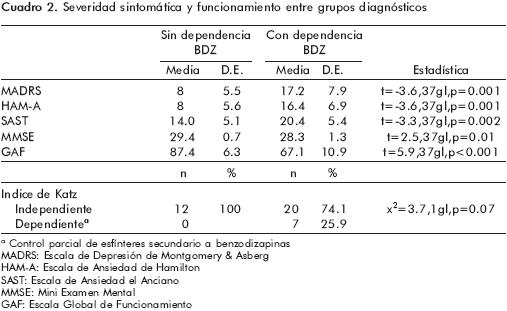
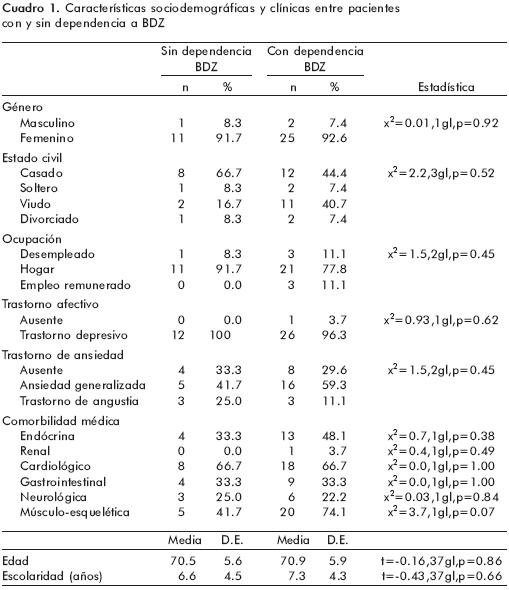
<body><![CDATA[<p align="justify"><font face="verdana" size="2">A partir de la entrevista cl&iacute;nica, 69.2% (n=27) de los pacientes incluidos en el estudio presentaron dependencia a las BDZ. De &eacute;stos, 33.3% (n=13) presentaron una dependencia leve, 33.3% (n=13), una dependencia moderada y 2.6% (n=1), una dependencia grave.</font></p>     <p align="justify"><font face="verdana" size="2"><b>Caracter&iacute;sticas demogr&aacute;ficas y cl&iacute;nicas entre pacientes con y sin dependencia a las BDZ</b></font></p>     <p align="justify"><font face="verdana" size="2">En el <a href="#c1">cuadro 1</a> se muestra la comparaci&oacute;n de las caracter&iacute;sticas demogr&aacute;ficas y cl&iacute;nicas entre grupos. No se observaron diferencias significativas entre ellos.</font></p>     <p align="center"><font face="verdana" size="2"><a name="c1"></a></font></p>     <p align="center"><font face="verdana" size="2"><img src="/img/revistas/sm/v32n5/a7c1.jpg"></font></p>     <p align="justify"><font face="verdana" size="2"><b>Gravedad de la depresi&oacute;n, ansiedad y funcionalidad entre grupos</b></font></p>     <p align="justify"><font face="verdana" size="2">Los pacientes con dependencia a las BDZ mostraron una mayor gravedad de los s&iacute;ntomas de depresi&oacute;n y los s&iacute;ntomas de ansiedad en contraste con los pacientes sin dependencia a las BDZ. Por otro lado, los pacientes con dependencia tuvieron un menor desempe&ntilde;o cognoscitivo y un menor funcionamiento psicosocial global (<a href="#c2">cuadro 2</a>).</font></p>     <p align="center"><font face="verdana" size="2"><a name="c2"></a></font></p>     <p align="center"><font face="verdana" size="2"><img src="/img/revistas/sm/v32n5/a7c2.jpg"></font></p>     <p align="justify"><font face="verdana" size="2"><b>Caracter&iacute;sticas del consumo de BDZ entre grupos diagn&oacute;sticos</b></font></p>     ]]></body>
<body><![CDATA[<p align="justify"><font face="verdana" size="2">De acuerdo con la entrevista SCID&#150;I, 92.6% (n=25) de los pacientes con dependencia a las BDZ reportaron haber tenido s&iacute;ntomas de abstinencia a ellas en contraste con 16.7% (n=2) de pacientes sin dependencia (p&lt;0.001). De la misma forma, 59.35% (n=16) de los pacientes dependientes reportaron tolerancia a las BDZ y s&oacute;lo un paciente (8.3%) sin dependencia report&oacute; tolerancia (p=0.003). Ninguno de los pacientes sin dependencia a las BDZ report&oacute; conductas de b&uacute;squeda o abandono de actividades cotidianas, mientras que 22.2% (n=6) y 3.7% (n=1) de los pacientes dependientes reportaron, respectivamente, estas acciones.</font></p>     <p align="justify"><font face="verdana" size="2">El 88.9% (n=24) de los pacientes dependientes a las BDZ reportaron haber presentado s&iacute;ntomas residuales tras la reducci&oacute;n o cese del consumo de BDZ en comparaci&oacute;n con 25.0% (n=3) de los pacientes sin dependencia. El principal s&iacute;ntoma residual reportado por los pacientes dependientes fue el insomnio (n=21, 77.8%), seguido de la hiperactividad auton&oacute;mica (n=11, 40.7%), agitaci&oacute;n psicomotriz (n=10, 37.0%), incremento en el temblor de manos y ansiedad (n=9, 33.3%, respectivamente) y n&aacute;usea (n=5, 18.5%). Un paciente report&oacute; la presencia de alucinaciones (3.7%).</font></p>     <p align="justify"><font face="verdana" size="2">La indicaci&oacute;n m&eacute;dica inicial de las BDZ para los pacientes sin dependencia fue el insomnio (n=8, 66.7%), mientras que, para los pacientes con dependencia, la indicaci&oacute;n m&eacute;dica inicial fue la ansiedad (n=19, 70.4%) (x<sup>2</sup>=4.7, 1 gl, p=0.03). Los pacientes con dependencia a las BDZ mostraron una edad de inicio de consumo m&aacute;s temprana (54.2&plusmn;14.1 a&ntilde;os vs 65.0&plusmn;7.6; t=2.4, 37 gl, p=0.01), un mayor tiempo de consumo (878.2&plusmn; 644.7 semanas vs 218.5 &plusmn; 250.4 semanas; t=&#150;4.5, 37 gl, 0&lt;0.001) y una mayor dosis de BDZ en equivalentes de diazepam (17.2&plusmn;16.5mg vs 7.5&plusmn;5.6 mg; t=&#150;2.6, 37 gl, p=0.01) en comparaci&oacute;n con los pacientes sin dependencia a las BDZ.</font></p>     <p align="justify"><font face="verdana" size="2">&nbsp;</font></p>     <p align="justify"><font face="verdana" size="2"><b>DISCUSI&Oacute;N</b></font></p>     <p align="justify"><font face="verdana" size="2">La dependencia a las BDZ se present&oacute; como parte de un complejo fen&oacute;meno relacionado con la gravedad cl&iacute;nica de los s&iacute;ntomas de depresi&oacute;n y ansiedad, lo cual influy&oacute; en la prescripci&oacute;n m&eacute;dica de BDZ. Aunque el uso de BDZ est&aacute; indicado en el tratamiento de los trastornos de ansiedad,<sup>28</sup> su uso como tratamiento principal o coadyuvante en el manejo de los s&iacute;ntomas de ansiedad asociados a un cuadro de depresi&oacute;n mayor se ha contraindicado en adultos mayores<sup>11</sup> por el riesgo de uso inapropiado, abuso potencial y dependencia.<sup>1,2</sup></font></p>     <p align="justify"><font face="verdana" size="2">El riesgo de desarrollar un cuadro de dependencia a las BDZ en los adultos mayores es multifactorial y guarda una estrecha relaci&oacute;n con las variaciones metab&oacute;licas de los f&aacute;rmacos en el envejecimiento, el uso concomitante de otros f&aacute;rmacos y con los cambios por neurosenescencia de los sistemas de neurotransmisi&oacute;n.<sup>2,930</sup> Estos factores pueden incrementar la vida media de las BDZ y condicionar una mayor permanencia de los metabolitos en el organismo, as&iacute; como una mayor susceptibilidad a los efectos de las BDZ, aun a dosis bajas.</font></p>     <p align="justify"><font face="verdana" size="2">Los pacientes con dependencia a las BDZ mostraron diferencias significativas en el patr&oacute;n de consumo de las mismas con respecto a los pacientes sin dependencia. Fundamentalmente presentaron un inicio del consumo de estos f&aacute;rmacos a una edad m&aacute;s temprana, lo cual condicion&oacute; un mayor tiempo de consumo. El uso cr&oacute;nico de BDZ se ha descrito como uno de los principales factores de riesgo para el desarrollo de dependencia.<sup>31</sup></font></p>     <p align="justify"><font face="verdana" size="2">En los pacientes estudiados, la dependencia a las BDZ se present&oacute; en t&eacute;rminos cl&iacute;nicos de s&iacute;ntomas de tolerancia a los efectos de la sustancia, por lo que tend&iacute;an a utilizar una mayor dosificaci&oacute;n para el control de los s&iacute;ntomas y un cuadro de abstinencia ante la disminuci&oacute;n de la dosificaci&oacute;n o suspensi&oacute;n del f&aacute;rmaco,<sup>32</sup> fen&oacute;menos ampliamente descritos en la bibliograf&iacute;a como parte de la dependencia fisiol&oacute;gica a las BDZ,<sup>33</sup> incluso a dosis terap&eacute;uticas<sup>2</sup> como en el presente estudio.</font></p>     <p align="justify"><font face="verdana" size="2">Aunque los factores sociodemogr&aacute;ficos y la carga de enfermedad m&eacute;dica no psiqui&aacute;trica no se presentaron como factores relacionados para la presencia de dependencia a las BDZ, se puede observar que una alta proporci&oacute;n de los pacientes estudiados fueron mujeres que cursaban con dolor cr&oacute;nico por la presencia de trastornos de origen m&uacute;sculo&#150;esquel&eacute;tico. Ambos factores se han descrito en el abuso y uso inapropiado de las BDZ en adultos mayores.<sup>1,4</sup></font></p>     ]]></body>
<body><![CDATA[<p align="justify"><font face="verdana" size="2">Los pacientes con dependencia a las BDZ mostraron tambi&eacute;n un funcionamiento psicosocial menor que los pacientes sin dependencia, adem&aacute;s de presentar un menor desempe&ntilde;o cognoscitivo al momento del estudio. Lo anterior puede relacionarse no s&oacute;lo con la gravedad de los s&iacute;ntomas de depresi&oacute;n y ansiedad,<sup>34</sup> sino tambi&eacute;n con los efectos adversos graves que pueden tener las BDZ sobre la cognici&oacute;n<sup>35</sup> y la calidad de vida de los pacientes.<sup>36</sup></font></p>     <p align="justify"><font face="verdana" size="2">La principal limitaci&oacute;n del presente estudio fue el tama&ntilde;o de la muestra. Estudios futuros deber&iacute;an incluir un mayor n&uacute;mero de sujetos adultos mayores y considerar otras variables, como los rasgos de personalidad, para profundizar en la comprensi&oacute;n de la dependencia a las BDZ en poblaci&oacute;n geri&aacute;trica.</font></p>     <p align="justify"><font face="verdana" size="2">La relevancia de la presente investigaci&oacute;n radica en resaltar la importancia del ejercicio m&eacute;dico en la prescripci&oacute;n de f&aacute;rmacos con un potencial adictivo y los riesgos inherentes a los mismos. Creemos que una mayor sensibilidad en este tema mejorar&aacute; la calidad de vida de nuestros pacientes y la calidad de la atenci&oacute;n que se les brinda.</font></p>     <p align="justify"><font face="verdana" size="2">&nbsp;</font></p>     <p align="justify"><font face="verdana" size="2"><b>CONCLUSIONES</b></font></p>     <p align="justify"><font face="verdana" size="2">El complejo fen&oacute;meno de la dependencia a las benzodiazepinas en los pacientes estudiados se presenta como una condici&oacute;n multifactorial y relacionada con la gravedad de la psicopatolog&iacute;a de los pacientes. Tanto la gravedad de los s&iacute;ntomas depresivos y ansiosos como el uso cr&oacute;nico de benzodiazepinas parecen deteriorar el desempe&ntilde;o cognoscitivo y el funcionamiento global de los pacientes. Factores sociodemogr&aacute;ficos y cl&iacute;nicos deber&iacute;an tomarse en consideraci&oacute;n en el momento de prescribir benzodiazepinas, las cuales parecen no ser f&aacute;rmacos de primera elecci&oacute;n ni coadyuvantes apropiados para el tratamiento de la depresi&oacute;n con s&iacute;ntomas de ansiedad en adultos mayores.</font></p>     <p align="justify"><font face="verdana" size="2">&nbsp;</font></p>     <p align="justify"><font face="verdana" size="2"><b>REFERENCIAS</b></font></p>     <!-- ref --><p align="justify"><font face="verdana" size="2">1. Culberson J, Ziska M. Prescription drug misuse/abuse in the elderly. Geriatrics 2008;63(9):22&#150;31.</font>&nbsp;&nbsp;&nbsp;&nbsp;&nbsp;&nbsp;&nbsp;&nbsp;[&#160;<a href="javascript:void(0);" onclick="javascript: window.open('/scielo.php?script=sci_nlinks&ref=9089641&pid=S0185-3325200900050000700001&lng=','','width=640,height=500,resizable=yes,scrollbars=1,menubar=yes,');">Links</a>&#160;]<!-- end-ref --><!-- ref --><p align="justify"><font face="verdana" size="2">2. Ashton H. The diagnosis and management of benzodiazepine dependence. Curr Opin Psychiatry 2005;18:249&#150;255.</font>&nbsp;&nbsp;&nbsp;&nbsp;&nbsp;&nbsp;&nbsp;&nbsp;[&#160;<a href="javascript:void(0);" onclick="javascript: window.open('/scielo.php?script=sci_nlinks&ref=9089642&pid=S0185-3325200900050000700002&lng=','','width=640,height=500,resizable=yes,scrollbars=1,menubar=yes,');">Links</a>&#160;]<!-- end-ref --><!-- ref --><p align="justify"><font face="verdana" size="2">3. Busto USE, Naranjo C, Cappell H, Sanchez&#150;Craig M, Sykora K. Withdrawal reaction after long&#150;term therapeutic use of benzodiazepines. New England J Medicine 1996;315:854&#150;859.</font>&nbsp;&nbsp;&nbsp;&nbsp;&nbsp;&nbsp;&nbsp;&nbsp;[&#160;<a href="javascript:void(0);" onclick="javascript: window.open('/scielo.php?script=sci_nlinks&ref=9089643&pid=S0185-3325200900050000700003&lng=','','width=640,height=500,resizable=yes,scrollbars=1,menubar=yes,');">Links</a>&#160;]<!-- end-ref --><!-- ref --><p align="justify"><font face="verdana" size="2">4. Simoni&#150;Wastia L, Yang H. Psychoactive drug abuse in older adults. American J Geriatric Pharmacotherapy 2006;4(4):380&#150;394.</font>&nbsp;&nbsp;&nbsp;&nbsp;&nbsp;&nbsp;&nbsp;&nbsp;[&#160;<a href="javascript:void(0);" onclick="javascript: window.open('/scielo.php?script=sci_nlinks&ref=9089644&pid=S0185-3325200900050000700004&lng=','','width=640,height=500,resizable=yes,scrollbars=1,menubar=yes,');">Links</a>&#160;]<!-- end-ref --><!-- ref --><p align="justify"><font face="verdana" size="2">5. Blow F. Substance abuse among older adults. Treatment Improvement Protocol (TIP) Series, #26. DHHS Publication No. (SMA) 98&#150;3179. Rockville, MD: SAMHSA; 1998.</font>&nbsp;&nbsp;&nbsp;&nbsp;&nbsp;&nbsp;&nbsp;&nbsp;[&#160;<a href="javascript:void(0);" onclick="javascript: window.open('/scielo.php?script=sci_nlinks&ref=9089645&pid=S0185-3325200900050000700005&lng=','','width=640,height=500,resizable=yes,scrollbars=1,menubar=yes,');">Links</a>&#160;]<!-- end-ref --><!-- ref --><p align="justify"><font face="verdana" size="2">6. American Psychiatric Association. Diagnostic and Statistical Manual of Mental Disorders. Cuarta edici&oacute;n. Washington, DC: 1994.</font>&nbsp;&nbsp;&nbsp;&nbsp;&nbsp;&nbsp;&nbsp;&nbsp;[&#160;<a href="javascript:void(0);" onclick="javascript: window.open('/scielo.php?script=sci_nlinks&ref=9089646&pid=S0185-3325200900050000700006&lng=','','width=640,height=500,resizable=yes,scrollbars=1,menubar=yes,');">Links</a>&#160;]<!-- end-ref --><!-- ref --><p align="justify"><font face="verdana" size="2">7. Bartels S, Blow F, Brockmann L, Van Citters A. Evidence&#150;based practices for preventing substance abuse and mental health problem in older adults. Older Americans Substance Abuse and Mental Health Technical Assistance Center. Washington DC: SAMHSA; 2006; p.4&#150;25.</font>&nbsp;&nbsp;&nbsp;&nbsp;&nbsp;&nbsp;&nbsp;&nbsp;[&#160;<a href="javascript:void(0);" onclick="javascript: window.open('/scielo.php?script=sci_nlinks&ref=9089647&pid=S0185-3325200900050000700007&lng=','','width=640,height=500,resizable=yes,scrollbars=1,menubar=yes,');">Links</a>&#160;]<!-- end-ref --><!-- ref --><p align="justify"><font face="verdana" size="2">8. Petrovik M, Vandierendonck A, Mariman A, Van Maele G, Afschrift M et al. Personality traits and socio&#150;epidemiological status of hospitalised elderly benzodiazepine users. International J Geriatric Psychiatry 2002;17:733&#150;738.</font>&nbsp;&nbsp;&nbsp;&nbsp;&nbsp;&nbsp;&nbsp;&nbsp;[&#160;<a href="javascript:void(0);" onclick="javascript: window.open('/scielo.php?script=sci_nlinks&ref=9089648&pid=S0185-3325200900050000700008&lng=','','width=640,height=500,resizable=yes,scrollbars=1,menubar=yes,');">Links</a>&#160;]<!-- end-ref --><!-- ref --><p align="justify"><font face="verdana" size="2">9. American Psychiatric Association. Diagnostic and Statistical Manual of Mental Disorders. Tercera edici&oacute;n revisada. Washington, DC: 1987.</font>&nbsp;&nbsp;&nbsp;&nbsp;&nbsp;&nbsp;&nbsp;&nbsp;[&#160;<a href="javascript:void(0);" onclick="javascript: window.open('/scielo.php?script=sci_nlinks&ref=9089649&pid=S0185-3325200900050000700009&lng=','','width=640,height=500,resizable=yes,scrollbars=1,menubar=yes,');">Links</a>&#160;]<!-- end-ref --><!-- ref --><p align="justify"><font face="verdana" size="2">10. Baillie A. Manual for the Benzodiazepine Dependence Questionnaire (BDEPQ). South Wales: University of New South Wales; 2001.</font>&nbsp;&nbsp;&nbsp;&nbsp;&nbsp;&nbsp;&nbsp;&nbsp;[&#160;<a href="javascript:void(0);" onclick="javascript: window.open('/scielo.php?script=sci_nlinks&ref=9089650&pid=S0185-3325200900050000700010&lng=','','width=640,height=500,resizable=yes,scrollbars=1,menubar=yes,');">Links</a>&#160;]<!-- end-ref --><!-- ref --><p align="justify"><font face="verdana" size="2">11. Harney M. Benzodiazepines: Good Practice Guidelines for Clinicians. En: Children DoHa, ed Roinn Sl&aacute;inte agus Leana&iacute;; 2002; p. 1&#150;28.</font>&nbsp;&nbsp;&nbsp;&nbsp;&nbsp;&nbsp;&nbsp;&nbsp;[&#160;<a href="javascript:void(0);" onclick="javascript: window.open('/scielo.php?script=sci_nlinks&ref=9089651&pid=S0185-3325200900050000700011&lng=','','width=640,height=500,resizable=yes,scrollbars=1,menubar=yes,');">Links</a>&#160;]<!-- end-ref --><!-- ref --><p align="justify"><font face="verdana" size="2">12. Edgell R, Kunik M, Molinari V, Hale D, Orengo C. Nonalcohol&#150;related use disorders in geropsychiatric patients. J Geriatric Psychiatry Neurology 2000;13(1):33&#150;37.</font>&nbsp;&nbsp;&nbsp;&nbsp;&nbsp;&nbsp;&nbsp;&nbsp;[&#160;<a href="javascript:void(0);" onclick="javascript: window.open('/scielo.php?script=sci_nlinks&ref=9089652&pid=S0185-3325200900050000700012&lng=','','width=640,height=500,resizable=yes,scrollbars=1,menubar=yes,');">Links</a>&#160;]<!-- end-ref --><!-- ref --><p align="justify"><font face="verdana" size="2">13. Ayuso J. &iquest;Est&aacute; justificado el tratamiento prolongado con benzodiacepinas? Salud Mental 2008;31 (6):429&#150;430.</font>&nbsp;&nbsp;&nbsp;&nbsp;&nbsp;&nbsp;&nbsp;&nbsp;[&#160;<a href="javascript:void(0);" onclick="javascript: window.open('/scielo.php?script=sci_nlinks&ref=9089653&pid=S0185-3325200900050000700013&lng=','','width=640,height=500,resizable=yes,scrollbars=1,menubar=yes,');">Links</a>&#160;]<!-- end-ref --><!-- ref --><p align="justify"><font face="verdana" size="2">14. First M, Spitzer R, Gibbon M, Williams J. Structured Clinical Interview for DSM&#150;IV Axis I Disorders (SCID&#150;I), Clinician Version. Washington, D.C.: American Psychiatric Press; 1996.</font>&nbsp;&nbsp;&nbsp;&nbsp;&nbsp;&nbsp;&nbsp;&nbsp;[&#160;<a href="javascript:void(0);" onclick="javascript: window.open('/scielo.php?script=sci_nlinks&ref=9089654&pid=S0185-3325200900050000700014&lng=','','width=640,height=500,resizable=yes,scrollbars=1,menubar=yes,');">Links</a>&#160;]<!-- end-ref --><!-- ref --><p align="justify"><font face="verdana" size="2">15. Montgomery S, Asberg M. A new depressive scale designed to be sensitive to change. British J Psychiatry 1979;134:382&#150;389.</font>&nbsp;&nbsp;&nbsp;&nbsp;&nbsp;&nbsp;&nbsp;&nbsp;[&#160;<a href="javascript:void(0);" onclick="javascript: window.open('/scielo.php?script=sci_nlinks&ref=9089655&pid=S0185-3325200900050000700015&lng=','','width=640,height=500,resizable=yes,scrollbars=1,menubar=yes,');">Links</a>&#160;]<!-- end-ref --><!-- ref --><p align="justify"><font face="verdana" size="2">16. Rosado A. Estudio de confiabilidad de la escala Montgomery&#150;Asberg para la evaluaci&oacute;n de la depresi&oacute;n. UNAM, M&eacute;xico 1993.</font>&nbsp;&nbsp;&nbsp;&nbsp;&nbsp;&nbsp;&nbsp;&nbsp;[&#160;<a href="javascript:void(0);" onclick="javascript: window.open('/scielo.php?script=sci_nlinks&ref=9089656&pid=S0185-3325200900050000700016&lng=','','width=640,height=500,resizable=yes,scrollbars=1,menubar=yes,');">Links</a>&#160;]<!-- end-ref --><!-- ref --><p align="justify"><font face="verdana" size="2">17. Susuki A, Aoshima T, Fukasawa T. A three&#150;factor model of the MADRS in major depressive disorder. Depression and Anxiety 2005;21:95&#150;97.</font>&nbsp;&nbsp;&nbsp;&nbsp;&nbsp;&nbsp;&nbsp;&nbsp;[&#160;<a href="javascript:void(0);" onclick="javascript: window.open('/scielo.php?script=sci_nlinks&ref=9089657&pid=S0185-3325200900050000700017&lng=','','width=640,height=500,resizable=yes,scrollbars=1,menubar=yes,');">Links</a>&#160;]<!-- end-ref --><!-- ref --><p align="justify"><font face="verdana" size="2">18. Berlanga C, Canetti A, Ch&aacute;vez E, De la Fuente J, Lara M, et al. Tratamiento farmacologico de las crisis de angustia. Reporte comparativo de la eficacia y seguridad del alprazolam y la imipramina en un estudio controlado. Salud Mental 1991;14:1&#150;5.</font>&nbsp;&nbsp;&nbsp;&nbsp;&nbsp;&nbsp;&nbsp;&nbsp;[&#160;<a href="javascript:void(0);" onclick="javascript: window.open('/scielo.php?script=sci_nlinks&ref=9089658&pid=S0185-3325200900050000700018&lng=','','width=640,height=500,resizable=yes,scrollbars=1,menubar=yes,');">Links</a>&#160;]<!-- end-ref --><!-- ref --><p align="justify"><font face="verdana" size="2">19. Hamilton M. The assessment of anxiety states by rating. British J Medical Psychology 1959;32:50&#150;55.</font>&nbsp;&nbsp;&nbsp;&nbsp;&nbsp;&nbsp;&nbsp;&nbsp;[&#160;<a href="javascript:void(0);" onclick="javascript: window.open('/scielo.php?script=sci_nlinks&ref=9089659&pid=S0185-3325200900050000700019&lng=','','width=640,height=500,resizable=yes,scrollbars=1,menubar=yes,');">Links</a>&#160;]<!-- end-ref --><!-- ref --><p align="justify"><font face="verdana" size="2">20. Nicolini H, Villareal G, Ortega&#150;Soto H, De la Fuente J. Alteraciones de la memoria de pacientes con crisis de angustia y efecto del tratamiento farmacol&oacute;gico con alprazolam e imipramina. Salud Mental 1988;11:11&#150;14.</font>&nbsp;&nbsp;&nbsp;&nbsp;&nbsp;&nbsp;&nbsp;&nbsp;[&#160;<a href="javascript:void(0);" onclick="javascript: window.open('/scielo.php?script=sci_nlinks&ref=9089660&pid=S0185-3325200900050000700020&lng=','','width=640,height=500,resizable=yes,scrollbars=1,menubar=yes,');">Links</a>&#160;]<!-- end-ref --><!-- ref --><p align="justify"><font face="verdana" size="2">21. Saucedo D. Determinaci&oacute;n de la confiabilidad y validez de la escala breve para la detecci&oacute;n de ansiedad en el anciano &#91;psicogeriatr&iacute;a cl&iacute;nica&#93;. Universidad Nacional Aut&oacute;noma de M&eacute;xico, 2005.</font>&nbsp;&nbsp;&nbsp;&nbsp;&nbsp;&nbsp;&nbsp;&nbsp;[&#160;<a href="javascript:void(0);" onclick="javascript: window.open('/scielo.php?script=sci_nlinks&ref=9089661&pid=S0185-3325200900050000700021&lng=','','width=640,height=500,resizable=yes,scrollbars=1,menubar=yes,');">Links</a>&#160;]<!-- end-ref --><!-- ref --><p align="justify"><font face="verdana" size="2">22. Sinoff G, Ore L, Zlotogorsky D, Tamir A. Short anxiety screening test&#150;a brief instrument for detecting anxiety in the elderly. International J Geriatric Psychiatry 1999;14:1062&#150;1071.</font>&nbsp;&nbsp;&nbsp;&nbsp;&nbsp;&nbsp;&nbsp;&nbsp;[&#160;<a href="javascript:void(0);" onclick="javascript: window.open('/scielo.php?script=sci_nlinks&ref=9089662&pid=S0185-3325200900050000700022&lng=','','width=640,height=500,resizable=yes,scrollbars=1,menubar=yes,');">Links</a>&#160;]<!-- end-ref --><!-- ref --><p align="justify"><font face="verdana" size="2">23. Becerra B, Ortega&#150;Soto H, Torner C. Validez y reproductibilidad del examen cognoscitivo breve (Mini&#150;mental State Examination) en una unidad de cuidados especiales de un hospital psiqui&aacute;trico. Salud Mental 1992;15:41&#150;45.</font>&nbsp;&nbsp;&nbsp;&nbsp;&nbsp;&nbsp;&nbsp;&nbsp;[&#160;<a href="javascript:void(0);" onclick="javascript: window.open('/scielo.php?script=sci_nlinks&ref=9089663&pid=S0185-3325200900050000700023&lng=','','width=640,height=500,resizable=yes,scrollbars=1,menubar=yes,');">Links</a>&#160;]<!-- end-ref --><!-- ref --><p align="justify"><font face="verdana" size="2">24. Anthony J, Reche L, Niaz V, Von&#150;Korff M, Folstein M. Limits of the Mini Mental State as screening test for dementia and delirium among hospital patients. Psychological Medicine 1982;12:397&#150;408.</font>&nbsp;&nbsp;&nbsp;&nbsp;&nbsp;&nbsp;&nbsp;&nbsp;[&#160;<a href="javascript:void(0);" onclick="javascript: window.open('/scielo.php?script=sci_nlinks&ref=9089664&pid=S0185-3325200900050000700024&lng=','','width=640,height=500,resizable=yes,scrollbars=1,menubar=yes,');">Links</a>&#160;]<!-- end-ref --><!-- ref --><p align="justify"><font face="verdana" size="2">25. Folstein M, Folstein S, McHugh P. Mini Mental State Examination. A practical method for grading the cognitive state of patients for the clinitian. J Psychiatric Research 1975;12:189&#150;198.</font>&nbsp;&nbsp;&nbsp;&nbsp;&nbsp;&nbsp;&nbsp;&nbsp;[&#160;<a href="javascript:void(0);" onclick="javascript: window.open('/scielo.php?script=sci_nlinks&ref=9089665&pid=S0185-3325200900050000700025&lng=','','width=640,height=500,resizable=yes,scrollbars=1,menubar=yes,');">Links</a>&#160;]<!-- end-ref --><!-- ref --><p align="justify"><font face="verdana" size="2">26. Alvarez&#150;Solar M, Alaiz&#150;Rojo A, Brun&#150;Gurpegui E, Cabaneros J, Calzon&#150;Frechoso M et al. Functional capacity of patients over 65 according to the Katz index. Reliability of the method. Atencion Primaria 1992;10:812&#150;816.</font>&nbsp;&nbsp;&nbsp;&nbsp;&nbsp;&nbsp;&nbsp;&nbsp;[&#160;<a href="javascript:void(0);" onclick="javascript: window.open('/scielo.php?script=sci_nlinks&ref=9089666&pid=S0185-3325200900050000700026&lng=','','width=640,height=500,resizable=yes,scrollbars=1,menubar=yes,');">Links</a>&#160;]<!-- end-ref --><!-- ref --><p align="justify"><font face="verdana" size="2">27. Katz S, Moskowitz R, Jackson B, Jaffe M. Studies of illness in the aged. The index of ADL: A standardized measure of biological and psycho&#150;social function. JAMA 1963;85:914&#150;919.</font>&nbsp;&nbsp;&nbsp;&nbsp;&nbsp;&nbsp;&nbsp;&nbsp;[&#160;<a href="javascript:void(0);" onclick="javascript: window.open('/scielo.php?script=sci_nlinks&ref=9089667&pid=S0185-3325200900050000700027&lng=','','width=640,height=500,resizable=yes,scrollbars=1,menubar=yes,');">Links</a>&#160;]<!-- end-ref --><!-- ref --><p align="justify"><font face="verdana" size="2">28. Nutt D. Overview of diagnosis and drug treatments of anxiety disorders. CNS spectrums 2005;10:49&#150;56.</font>&nbsp;&nbsp;&nbsp;&nbsp;&nbsp;&nbsp;&nbsp;&nbsp;[&#160;<a href="javascript:void(0);" onclick="javascript: window.open('/scielo.php?script=sci_nlinks&ref=9089668&pid=S0185-3325200900050000700028&lng=','','width=640,height=500,resizable=yes,scrollbars=1,menubar=yes,');">Links</a>&#160;]<!-- end-ref --><!-- ref --><p align="justify"><font face="verdana" size="2">29. Catterson M, Preskorn S, Martin R. Pharmacodynamic and pharmaco&#150;kinetic considerations in geriatric psychopharmacology. Psychiatric Clinics North America 1997;20(1):205&#150;218.</font>&nbsp;&nbsp;&nbsp;&nbsp;&nbsp;&nbsp;&nbsp;&nbsp;[&#160;<a href="javascript:void(0);" onclick="javascript: window.open('/scielo.php?script=sci_nlinks&ref=9089669&pid=S0185-3325200900050000700029&lng=','','width=640,height=500,resizable=yes,scrollbars=1,menubar=yes,');">Links</a>&#160;]<!-- end-ref --><!-- ref --><p align="justify"><font face="verdana" size="2">30. Dowling G, Wiess S, Condon T. Drugs of abuse and the aging brain. Neuropsychopharmacology 2008;33:209&#150;218.</font>&nbsp;&nbsp;&nbsp;&nbsp;&nbsp;&nbsp;&nbsp;&nbsp;[&#160;<a href="javascript:void(0);" onclick="javascript: window.open('/scielo.php?script=sci_nlinks&ref=9089670&pid=S0185-3325200900050000700030&lng=','','width=640,height=500,resizable=yes,scrollbars=1,menubar=yes,');">Links</a>&#160;]<!-- end-ref --><!-- ref --><p align="justify"><font face="verdana" size="2">31. Ator N, Griffiths R. Principles of drug abuse liability assessment in laboratory animals. Drug Alcohol Dependence 2003;70:S55&#150;S72.</font>&nbsp;&nbsp;&nbsp;&nbsp;&nbsp;&nbsp;&nbsp;&nbsp;[&#160;<a href="javascript:void(0);" onclick="javascript: window.open('/scielo.php?script=sci_nlinks&ref=9089671&pid=S0185-3325200900050000700031&lng=','','width=640,height=500,resizable=yes,scrollbars=1,menubar=yes,');">Links</a>&#160;]<!-- end-ref --><!-- ref --><p align="justify"><font face="verdana" size="2">32. American Psychiatric Association. Diagnostic and Statistical Manual of Mental Disorders. Cuarta edici&oacute;n revisada.Washington, DC: 2000.</font>&nbsp;&nbsp;&nbsp;&nbsp;&nbsp;&nbsp;&nbsp;&nbsp;[&#160;<a href="javascript:void(0);" onclick="javascript: window.open('/scielo.php?script=sci_nlinks&ref=9089672&pid=S0185-3325200900050000700032&lng=','','width=640,height=500,resizable=yes,scrollbars=1,menubar=yes,');">Links</a>&#160;]<!-- end-ref --><!-- ref --><p align="justify"><font face="verdana" size="2">33. Woods J, Katz J, Winger G. Benzodiazepines: Use, abuse and consequences. Pharmacological reviews 1992;44:151&#150;347.</font>&nbsp;&nbsp;&nbsp;&nbsp;&nbsp;&nbsp;&nbsp;&nbsp;[&#160;<a href="javascript:void(0);" onclick="javascript: window.open('/scielo.php?script=sci_nlinks&ref=9089673&pid=S0185-3325200900050000700033&lng=','','width=640,height=500,resizable=yes,scrollbars=1,menubar=yes,');">Links</a>&#160;]<!-- end-ref --><!-- ref --><p align="justify"><font face="verdana" size="2">34. Austin M, Mitchell P, Wilhelm K, Parker G, Hickie I et al. Cognitive function in depression: A distinct pattern of frontal impairment? Psychological Medicine 1999;29:73&#150;85.</font>&nbsp;&nbsp;&nbsp;&nbsp;&nbsp;&nbsp;&nbsp;&nbsp;[&#160;<a href="javascript:void(0);" onclick="javascript: window.open('/scielo.php?script=sci_nlinks&ref=9089674&pid=S0185-3325200900050000700034&lng=','','width=640,height=500,resizable=yes,scrollbars=1,menubar=yes,');">Links</a>&#160;]<!-- end-ref --><!-- ref --><p align="justify"><font face="verdana" size="2">35. Paterniti S, Dufouil C, Alperovitch A. Long&#150;term benzodiazepine use and cognitive decline in the elderly: the Epidemiology of Vascular Aging Study. J Clinical Psychopharmacology 2002;22(3):285&#150;293</font>&nbsp;&nbsp;&nbsp;&nbsp;&nbsp;&nbsp;&nbsp;&nbsp;[&#160;<a href="javascript:void(0);" onclick="javascript: window.open('/scielo.php?script=sci_nlinks&ref=9089675&pid=S0185-3325200900050000700035&lng=','','width=640,height=500,resizable=yes,scrollbars=1,menubar=yes,');">Links</a>&#160;]<!-- end-ref --><!-- ref --><p align="justify"><font face="verdana" size="2">36. Stein M, Barrett&#150;Connor E. Quality of life in older adults receiving medications for anxiety, depression, or insomnia: findings from a community&#150;based study. American J Geriatric Psychiatry 2002;10(5) :568&#150;574.</font>&nbsp;&nbsp;&nbsp;&nbsp;&nbsp;&nbsp;&nbsp;&nbsp;[&#160;<a href="javascript:void(0);" onclick="javascript: window.open('/scielo.php?script=sci_nlinks&ref=9089676&pid=S0185-3325200900050000700036&lng=','','width=640,height=500,resizable=yes,scrollbars=1,menubar=yes,');">Links</a>&#160;]<!-- end-ref --><p align="justify"><font face="verdana" size="2">&nbsp;</font></p>     <p align="justify"><font face="verdana" size="2"><b>NOTAS</b></font></p>     <p align="justify"><font face="verdana" size="2">* Art&iacute;culo sin conflicto de intereses</font></p>      ]]></body><back>
<ref-list>
<ref id="B1">
<label>1</label><nlm-citation citation-type="journal">
<person-group person-group-type="author">
<name>
<surname><![CDATA[Culberson]]></surname>
<given-names><![CDATA[J]]></given-names>
</name>
<name>
<surname><![CDATA[Ziska]]></surname>
<given-names><![CDATA[M.]]></given-names>
</name>
</person-group>
<article-title xml:lang="en"><![CDATA[Prescription drug misuse/abuse in the elderly]]></article-title>
<source><![CDATA[Geriatrics]]></source>
<year>2008</year>
<volume>63</volume>
<numero>9</numero>
<issue>9</issue>
<page-range>22-31</page-range></nlm-citation>
</ref>
<ref id="B2">
<label>2</label><nlm-citation citation-type="journal">
<person-group person-group-type="author">
<name>
<surname><![CDATA[Ashton]]></surname>
<given-names><![CDATA[H.]]></given-names>
</name>
</person-group>
<article-title xml:lang="en"><![CDATA[The diagnosis and management of benzodiazepine dependence]]></article-title>
<source><![CDATA[Curr Opin Psychiatry]]></source>
<year>2005</year>
<volume>18</volume>
<page-range>249-255</page-range></nlm-citation>
</ref>
<ref id="B3">
<label>3</label><nlm-citation citation-type="journal">
<person-group person-group-type="author">
<name>
<surname><![CDATA[Busto]]></surname>
<given-names><![CDATA[USE]]></given-names>
</name>
<name>
<surname><![CDATA[Naranjo]]></surname>
<given-names><![CDATA[C]]></given-names>
</name>
<name>
<surname><![CDATA[Cappell]]></surname>
<given-names><![CDATA[H]]></given-names>
</name>
<name>
<surname><![CDATA[Sanchez-Craig]]></surname>
<given-names><![CDATA[M]]></given-names>
</name>
<name>
<surname><![CDATA[Sykora]]></surname>
<given-names><![CDATA[K.]]></given-names>
</name>
</person-group>
<article-title xml:lang="en"><![CDATA[Withdrawal reaction after long-term therapeutic use of benzodiazepines]]></article-title>
<source><![CDATA[New England J Medicine]]></source>
<year>1996</year>
<volume>315</volume>
<page-range>854-859</page-range></nlm-citation>
</ref>
<ref id="B4">
<label>4</label><nlm-citation citation-type="journal">
<person-group person-group-type="author">
<name>
<surname><![CDATA[Simoni-Wastia]]></surname>
<given-names><![CDATA[L]]></given-names>
</name>
<name>
<surname><![CDATA[Yang]]></surname>
<given-names><![CDATA[H.]]></given-names>
</name>
</person-group>
<article-title xml:lang="en"><![CDATA[Psychoactive drug abuse in older adults]]></article-title>
<source><![CDATA[American J Geriatric Pharmacotherapy]]></source>
<year>2006</year>
<volume>4</volume>
<numero>4</numero>
<issue>4</issue>
<page-range>380-394</page-range></nlm-citation>
</ref>
<ref id="B5">
<label>5</label><nlm-citation citation-type="book">
<person-group person-group-type="author">
<name>
<surname><![CDATA[Blow]]></surname>
<given-names><![CDATA[F.]]></given-names>
</name>
</person-group>
<source><![CDATA[Substance abuse among older adults: Treatment Improvement Protocol (TIP) Series, #26.]]></source>
<year>1998</year>
<publisher-loc><![CDATA[Rockville^eMD MD]]></publisher-loc>
<publisher-name><![CDATA[SAMHSA]]></publisher-name>
</nlm-citation>
</ref>
<ref id="B6">
<label>6</label><nlm-citation citation-type="">
<collab>American Psychiatric Association</collab>
<source><![CDATA[Diagnostic and Statistical Manual of Mental Disorders]]></source>
<year>1994</year>
<edition>Cuarta</edition>
<publisher-loc><![CDATA[Washington^eDC DC]]></publisher-loc>
</nlm-citation>
</ref>
<ref id="B7">
<label>7</label><nlm-citation citation-type="book">
<person-group person-group-type="author">
<name>
<surname><![CDATA[Bartels]]></surname>
<given-names><![CDATA[S]]></given-names>
</name>
<name>
<surname><![CDATA[Blow]]></surname>
<given-names><![CDATA[F]]></given-names>
</name>
<name>
<surname><![CDATA[Brockmann]]></surname>
<given-names><![CDATA[L]]></given-names>
</name>
<name>
<surname><![CDATA[Van Citters]]></surname>
<given-names><![CDATA[A.]]></given-names>
</name>
</person-group>
<source><![CDATA[Evidence-based practices for preventing substance abuse and mental health problem in older adults: Older Americans Substance Abuse and Mental Health Technical Assistance Center]]></source>
<year>2006</year>
<page-range>4-25</page-range><publisher-loc><![CDATA[Washington^eDC DC]]></publisher-loc>
<publisher-name><![CDATA[SAMHSA]]></publisher-name>
</nlm-citation>
</ref>
<ref id="B8">
<label>8</label><nlm-citation citation-type="journal">
<person-group person-group-type="author">
<name>
<surname><![CDATA[Petrovik]]></surname>
<given-names><![CDATA[M]]></given-names>
</name>
<name>
<surname><![CDATA[Vandierendonck]]></surname>
<given-names><![CDATA[A]]></given-names>
</name>
<name>
<surname><![CDATA[Mariman]]></surname>
<given-names><![CDATA[A]]></given-names>
</name>
<name>
<surname><![CDATA[Van Maele]]></surname>
<given-names><![CDATA[G]]></given-names>
</name>
<name>
<surname><![CDATA[Afschrift]]></surname>
<given-names><![CDATA[M]]></given-names>
</name>
</person-group>
<article-title xml:lang="en"><![CDATA[Personality traits and socio-epidemiological status of hospitalised elderly benzodiazepine users]]></article-title>
<source><![CDATA[International J Geriatric Psychiatry]]></source>
<year>2002</year>
<volume>17</volume>
<page-range>733-738</page-range></nlm-citation>
</ref>
<ref id="B9">
<label>9</label><nlm-citation citation-type="">
<collab>American Psychiatric Association</collab>
<source><![CDATA[Diagnostic and Statistical Manual of Mental Disorders]]></source>
<year>1987</year>
<edition>Tercera</edition>
<publisher-loc><![CDATA[Washington^eDC DC]]></publisher-loc>
</nlm-citation>
</ref>
<ref id="B10">
<label>10</label><nlm-citation citation-type="book">
<person-group person-group-type="author">
<name>
<surname><![CDATA[Baillie]]></surname>
<given-names><![CDATA[A.]]></given-names>
</name>
</person-group>
<source><![CDATA[Manual for the Benzodiazepine Dependence Questionnaire (BDEPQ)]]></source>
<year>2001</year>
<publisher-loc><![CDATA[South Wales ]]></publisher-loc>
<publisher-name><![CDATA[University of New South Wales]]></publisher-name>
</nlm-citation>
</ref>
<ref id="B11">
<label>11</label><nlm-citation citation-type="book">
<person-group person-group-type="author">
<name>
<surname><![CDATA[Harney]]></surname>
<given-names><![CDATA[M.]]></given-names>
</name>
</person-group>
<article-title xml:lang="en"><![CDATA[Benzodiazepines: Good Practice Guidelines for Clinicians]]></article-title>
<source><![CDATA[Children DoHa]]></source>
<year>2002</year>
<page-range>1-28</page-range><publisher-name><![CDATA[Roinn Sláinte agus Leanaí]]></publisher-name>
</nlm-citation>
</ref>
<ref id="B12">
<label>12</label><nlm-citation citation-type="journal">
<person-group person-group-type="author">
<name>
<surname><![CDATA[Edgell]]></surname>
<given-names><![CDATA[R]]></given-names>
</name>
<name>
<surname><![CDATA[Kunik]]></surname>
<given-names><![CDATA[M]]></given-names>
</name>
<name>
<surname><![CDATA[Molinari]]></surname>
<given-names><![CDATA[V]]></given-names>
</name>
<name>
<surname><![CDATA[Hale]]></surname>
<given-names><![CDATA[D]]></given-names>
</name>
<name>
<surname><![CDATA[Orengo]]></surname>
<given-names><![CDATA[C.]]></given-names>
</name>
</person-group>
<article-title xml:lang="en"><![CDATA[Nonalcohol-related use disorders in geropsychiatric patients]]></article-title>
<source><![CDATA[J Geriatric Psychiatry Neurology]]></source>
<year>2000</year>
<volume>13</volume>
<numero>1</numero>
<issue>1</issue>
<page-range>33-37</page-range></nlm-citation>
</ref>
<ref id="B13">
<label>13</label><nlm-citation citation-type="journal">
<person-group person-group-type="author">
<name>
<surname><![CDATA[Ayuso]]></surname>
<given-names><![CDATA[J.]]></given-names>
</name>
</person-group>
<article-title xml:lang="es"><![CDATA[¿Está justificado el tratamiento prolongado con benzodiacepinas?]]></article-title>
<source><![CDATA[Salud Mental]]></source>
<year>2008</year>
<volume>31</volume>
<numero>6</numero>
<issue>6</issue>
<page-range>429-430</page-range></nlm-citation>
</ref>
<ref id="B14">
<label>14</label><nlm-citation citation-type="book">
<person-group person-group-type="author">
<name>
<surname><![CDATA[First]]></surname>
<given-names><![CDATA[M]]></given-names>
</name>
<name>
<surname><![CDATA[Spitzer]]></surname>
<given-names><![CDATA[R]]></given-names>
</name>
<name>
<surname><![CDATA[Gibbon]]></surname>
<given-names><![CDATA[M]]></given-names>
</name>
<name>
<surname><![CDATA[Williams]]></surname>
<given-names><![CDATA[J.]]></given-names>
</name>
</person-group>
<source><![CDATA[Structured Clinical Interview for DSM-IV Axis I Disorders (SCID-I), Clinician Version]]></source>
<year>1996</year>
<publisher-loc><![CDATA[Washington^eD.C. D.C.]]></publisher-loc>
<publisher-name><![CDATA[American Psychiatric Press]]></publisher-name>
</nlm-citation>
</ref>
<ref id="B15">
<label>15</label><nlm-citation citation-type="journal">
<person-group person-group-type="author">
<name>
<surname><![CDATA[Montgomery]]></surname>
<given-names><![CDATA[S]]></given-names>
</name>
<name>
<surname><![CDATA[Asberg]]></surname>
<given-names><![CDATA[M.]]></given-names>
</name>
</person-group>
<article-title xml:lang="en"><![CDATA[A new depressive scale designed to be sensitive to change]]></article-title>
<source><![CDATA[British J Psychiatry]]></source>
<year>1979</year>
<volume>134</volume>
<page-range>382-389</page-range></nlm-citation>
</ref>
<ref id="B16">
<label>16</label><nlm-citation citation-type="book">
<person-group person-group-type="author">
<name>
<surname><![CDATA[Rosado]]></surname>
<given-names><![CDATA[A.]]></given-names>
</name>
</person-group>
<source><![CDATA[Estudio de confiabilidad de la escala Montgomery-Asberg para la evaluación de la depresión]]></source>
<year>1993</year>
<publisher-name><![CDATA[UNAM]]></publisher-name>
</nlm-citation>
</ref>
<ref id="B17">
<label>17</label><nlm-citation citation-type="journal">
<person-group person-group-type="author">
<name>
<surname><![CDATA[Susuki]]></surname>
<given-names><![CDATA[A]]></given-names>
</name>
<name>
<surname><![CDATA[Aoshima]]></surname>
<given-names><![CDATA[T]]></given-names>
</name>
<name>
<surname><![CDATA[Fukasawa]]></surname>
<given-names><![CDATA[T.]]></given-names>
</name>
</person-group>
<article-title xml:lang="es"><![CDATA[A three-factor model of the MADRS in major depressive disorder]]></article-title>
<source><![CDATA[Depression and Anxiety]]></source>
<year>2005</year>
<volume>21</volume>
<page-range>95-97</page-range></nlm-citation>
</ref>
<ref id="B18">
<label>18</label><nlm-citation citation-type="journal">
<person-group person-group-type="author">
<name>
<surname><![CDATA[Berlanga]]></surname>
<given-names><![CDATA[C]]></given-names>
</name>
<name>
<surname><![CDATA[Canetti]]></surname>
<given-names><![CDATA[A]]></given-names>
</name>
<name>
<surname><![CDATA[Chávez]]></surname>
<given-names><![CDATA[E]]></given-names>
</name>
<name>
<surname><![CDATA[De la Fuente]]></surname>
<given-names><![CDATA[J]]></given-names>
</name>
<name>
<surname><![CDATA[Lara]]></surname>
<given-names><![CDATA[M]]></given-names>
</name>
</person-group>
<article-title xml:lang="es"><![CDATA[Tratamiento farmacologico de las crisis de angustia: Reporte comparativo de la eficacia y seguridad del alprazolam y la imipramina en un estudio controlado]]></article-title>
<source><![CDATA[Salud Mental]]></source>
<year>1991</year>
<volume>14</volume>
<page-range>1-5</page-range></nlm-citation>
</ref>
<ref id="B19">
<label>19</label><nlm-citation citation-type="journal">
<person-group person-group-type="author">
<name>
<surname><![CDATA[Hamilton]]></surname>
<given-names><![CDATA[M.]]></given-names>
</name>
</person-group>
<article-title xml:lang="en"><![CDATA[The assessment of anxiety states by rating]]></article-title>
<source><![CDATA[British J Medical Psychology]]></source>
<year>1959</year>
<volume>32</volume>
<page-range>50-55</page-range></nlm-citation>
</ref>
<ref id="B20">
<label>20</label><nlm-citation citation-type="journal">
<person-group person-group-type="author">
<name>
<surname><![CDATA[Nicolini]]></surname>
<given-names><![CDATA[H]]></given-names>
</name>
<name>
<surname><![CDATA[Villareal]]></surname>
<given-names><![CDATA[G]]></given-names>
</name>
<name>
<surname><![CDATA[Ortega-Soto]]></surname>
<given-names><![CDATA[H]]></given-names>
</name>
<name>
<surname><![CDATA[De la Fuente]]></surname>
<given-names><![CDATA[J.]]></given-names>
</name>
</person-group>
<article-title xml:lang="es"><![CDATA[Alteraciones de la memoria de pacientes con crisis de angustia y efecto del tratamiento farmacológico con alprazolam e imipramina]]></article-title>
<source><![CDATA[Salud Mental]]></source>
<year>1988</year>
<volume>11</volume>
<page-range>11-14</page-range></nlm-citation>
</ref>
<ref id="B21">
<label>21</label><nlm-citation citation-type="book">
<person-group person-group-type="author">
<name>
<surname><![CDATA[Saucedo]]></surname>
<given-names><![CDATA[D.]]></given-names>
</name>
</person-group>
<source><![CDATA[Determinación de la confiabilidad y validez de la escala breve para la detección de ansiedad en el anciano [psicogeriatría clínica]]]></source>
<year>2005</year>
<publisher-name><![CDATA[Universidad Nacional Autónoma de México]]></publisher-name>
</nlm-citation>
</ref>
<ref id="B22">
<label>22</label><nlm-citation citation-type="journal">
<person-group person-group-type="author">
<name>
<surname><![CDATA[Sinoff]]></surname>
<given-names><![CDATA[G]]></given-names>
</name>
<name>
<surname><![CDATA[Ore]]></surname>
<given-names><![CDATA[L]]></given-names>
</name>
<name>
<surname><![CDATA[Zlotogorsky]]></surname>
<given-names><![CDATA[D]]></given-names>
</name>
<name>
<surname><![CDATA[Tamir]]></surname>
<given-names><![CDATA[A]]></given-names>
</name>
</person-group>
<article-title xml:lang="en"><![CDATA[Short anxiety screening test-a brief instrument for detecting anxiety in the elderly]]></article-title>
<source><![CDATA[International J Geriatric Psychiatry]]></source>
<year>1999</year>
<volume>14</volume>
<page-range>1062-1071</page-range></nlm-citation>
</ref>
<ref id="B23">
<label>23</label><nlm-citation citation-type="journal">
<person-group person-group-type="author">
<name>
<surname><![CDATA[Becerra]]></surname>
<given-names><![CDATA[B]]></given-names>
</name>
<name>
<surname><![CDATA[Ortega-Soto]]></surname>
<given-names><![CDATA[H]]></given-names>
</name>
<name>
<surname><![CDATA[Torner]]></surname>
<given-names><![CDATA[C.]]></given-names>
</name>
</person-group>
<article-title xml:lang="es"><![CDATA[Validez y reproductibilidad del examen cognoscitivo breve (Mini-mental State Examination) en una unidad de cuidados especiales de un hospital psiquiátrico]]></article-title>
<source><![CDATA[Salud Mental]]></source>
<year>1992</year>
<volume>15</volume>
<page-range>41-45</page-range></nlm-citation>
</ref>
<ref id="B24">
<label>24</label><nlm-citation citation-type="journal">
<person-group person-group-type="author">
<name>
<surname><![CDATA[Anthony]]></surname>
<given-names><![CDATA[J]]></given-names>
</name>
<name>
<surname><![CDATA[Reche]]></surname>
<given-names><![CDATA[L]]></given-names>
</name>
<name>
<surname><![CDATA[Niaz]]></surname>
<given-names><![CDATA[V]]></given-names>
</name>
<name>
<surname><![CDATA[Von-Korff]]></surname>
<given-names><![CDATA[M]]></given-names>
</name>
<name>
<surname><![CDATA[Folstein]]></surname>
<given-names><![CDATA[M.]]></given-names>
</name>
</person-group>
<article-title xml:lang="en"><![CDATA[Limits of the Mini Mental State as screening test for dementia and delirium among hospital patients]]></article-title>
<source><![CDATA[Psychological Medicine]]></source>
<year>1982</year>
<volume>12</volume>
<page-range>397-408</page-range></nlm-citation>
</ref>
<ref id="B25">
<label>25</label><nlm-citation citation-type="journal">
<person-group person-group-type="author">
<name>
<surname><![CDATA[Folstein]]></surname>
<given-names><![CDATA[M]]></given-names>
</name>
<name>
<surname><![CDATA[Folstein]]></surname>
<given-names><![CDATA[S]]></given-names>
</name>
<name>
<surname><![CDATA[McHugh]]></surname>
<given-names><![CDATA[P.]]></given-names>
</name>
</person-group>
<article-title xml:lang="en"><![CDATA[Mini Mental State Examination: A practical method for grading the cognitive state of patients for the clinitian]]></article-title>
<source><![CDATA[J Psychiatric Research]]></source>
<year>1975</year>
<volume>12</volume>
<page-range>189-198</page-range></nlm-citation>
</ref>
<ref id="B26">
<label>26</label><nlm-citation citation-type="journal">
<person-group person-group-type="author">
<name>
<surname><![CDATA[Alvarez-Solar]]></surname>
<given-names><![CDATA[M]]></given-names>
</name>
<name>
<surname><![CDATA[Alaiz-Rojo]]></surname>
<given-names><![CDATA[A]]></given-names>
</name>
<name>
<surname><![CDATA[Brun-Gurpegui]]></surname>
<given-names><![CDATA[E]]></given-names>
</name>
<name>
<surname><![CDATA[Cabaneros]]></surname>
<given-names><![CDATA[J]]></given-names>
</name>
<name>
<surname><![CDATA[Calzon-Frechoso]]></surname>
<given-names><![CDATA[M]]></given-names>
</name>
</person-group>
<article-title xml:lang="en"><![CDATA[Functional capacity of patients over 65 according to the Katz index: Reliability of the method]]></article-title>
<source><![CDATA[Atencion Primaria]]></source>
<year>1992</year>
<volume>10</volume>
<page-range>812-816</page-range></nlm-citation>
</ref>
<ref id="B27">
<label>27</label><nlm-citation citation-type="journal">
<person-group person-group-type="author">
<name>
<surname><![CDATA[Katz]]></surname>
<given-names><![CDATA[S]]></given-names>
</name>
<name>
<surname><![CDATA[Moskowitz]]></surname>
<given-names><![CDATA[R]]></given-names>
</name>
<name>
<surname><![CDATA[Jackson]]></surname>
<given-names><![CDATA[B]]></given-names>
</name>
<name>
<surname><![CDATA[Jaffe]]></surname>
<given-names><![CDATA[M.]]></given-names>
</name>
</person-group>
<article-title xml:lang="en"><![CDATA[Studies of illness in the aged: The index of ADL: A standardized measure of biological and psycho-social function]]></article-title>
<source><![CDATA[JAMA]]></source>
<year>1963</year>
<volume>85</volume>
<page-range>914-919</page-range></nlm-citation>
</ref>
<ref id="B28">
<label>28</label><nlm-citation citation-type="journal">
<person-group person-group-type="author">
<name>
<surname><![CDATA[Nutt]]></surname>
<given-names><![CDATA[D.]]></given-names>
</name>
</person-group>
<article-title xml:lang="en"><![CDATA[Overview of diagnosis and drug treatments of anxiety disorders]]></article-title>
<source><![CDATA[CNS spectrums]]></source>
<year>2005</year>
<volume>10</volume>
<page-range>49-56</page-range></nlm-citation>
</ref>
<ref id="B29">
<label>29</label><nlm-citation citation-type="journal">
<person-group person-group-type="author">
<name>
<surname><![CDATA[Catterson]]></surname>
<given-names><![CDATA[M]]></given-names>
</name>
<name>
<surname><![CDATA[Preskorn]]></surname>
<given-names><![CDATA[S]]></given-names>
</name>
<name>
<surname><![CDATA[Martin]]></surname>
<given-names><![CDATA[R.]]></given-names>
</name>
</person-group>
<article-title xml:lang="en"><![CDATA[Pharmacodynamic and pharmaco-kinetic considerations in geriatric psychopharmacology]]></article-title>
<source><![CDATA[Psychiatric Clinics North America]]></source>
<year>1997</year>
<volume>20</volume>
<numero>1</numero>
<issue>1</issue>
<page-range>205-218</page-range></nlm-citation>
</ref>
<ref id="B30">
<label>30</label><nlm-citation citation-type="journal">
<person-group person-group-type="author">
<name>
<surname><![CDATA[Dowling]]></surname>
<given-names><![CDATA[G]]></given-names>
</name>
<name>
<surname><![CDATA[Wiess]]></surname>
<given-names><![CDATA[S]]></given-names>
</name>
<name>
<surname><![CDATA[Condon]]></surname>
<given-names><![CDATA[T.]]></given-names>
</name>
</person-group>
<article-title xml:lang="en"><![CDATA[Drugs of abuse and the aging brain]]></article-title>
<source><![CDATA[Neuropsychopharmacology]]></source>
<year>2008</year>
<volume>33</volume>
<page-range>209-218</page-range></nlm-citation>
</ref>
<ref id="B31">
<label>31</label><nlm-citation citation-type="journal">
<person-group person-group-type="author">
<name>
<surname><![CDATA[Ator]]></surname>
<given-names><![CDATA[N]]></given-names>
</name>
<name>
<surname><![CDATA[Griffiths]]></surname>
<given-names><![CDATA[R.]]></given-names>
</name>
</person-group>
<article-title xml:lang="en"><![CDATA[Principles of drug abuse liability assessment in laboratory animals]]></article-title>
<source><![CDATA[Drug Alcohol Dependence]]></source>
<year>2003</year>
<volume>70</volume>
<page-range>S55-S72</page-range></nlm-citation>
</ref>
<ref id="B32">
<label>32</label><nlm-citation citation-type="">
<collab>American Psychiatric Association</collab>
<source><![CDATA[Diagnostic and Statistical Manual of Mental Disorders]]></source>
<year>2000</year>
<edition>Cuarta</edition>
<publisher-loc><![CDATA[Washington^eDC DC]]></publisher-loc>
</nlm-citation>
</ref>
<ref id="B33">
<label>33</label><nlm-citation citation-type="journal">
<person-group person-group-type="author">
<name>
<surname><![CDATA[Woods]]></surname>
<given-names><![CDATA[J]]></given-names>
</name>
<name>
<surname><![CDATA[Katz]]></surname>
<given-names><![CDATA[J]]></given-names>
</name>
<name>
<surname><![CDATA[Winger]]></surname>
<given-names><![CDATA[G.]]></given-names>
</name>
</person-group>
<article-title xml:lang="en"><![CDATA[Benzodiazepines: Use, abuse and consequences]]></article-title>
<source><![CDATA[Pharmacological reviews]]></source>
<year>1992</year>
<volume>44</volume>
<page-range>151-347</page-range></nlm-citation>
</ref>
<ref id="B34">
<label>34</label><nlm-citation citation-type="journal">
<person-group person-group-type="author">
<name>
<surname><![CDATA[Austin]]></surname>
<given-names><![CDATA[M]]></given-names>
</name>
<name>
<surname><![CDATA[Mitchell]]></surname>
<given-names><![CDATA[P]]></given-names>
</name>
<name>
<surname><![CDATA[Wilhelm]]></surname>
<given-names><![CDATA[K]]></given-names>
</name>
<name>
<surname><![CDATA[Parker]]></surname>
<given-names><![CDATA[G]]></given-names>
</name>
<name>
<surname><![CDATA[Hickie]]></surname>
<given-names><![CDATA[I]]></given-names>
</name>
</person-group>
<article-title xml:lang="en"><![CDATA[Cognitive function in depression: A distinct pattern of frontal impairment?]]></article-title>
<source><![CDATA[Psychological Medicine]]></source>
<year>1999</year>
<volume>29</volume>
<page-range>73-85</page-range></nlm-citation>
</ref>
<ref id="B35">
<label>35</label><nlm-citation citation-type="journal">
<person-group person-group-type="author">
<name>
<surname><![CDATA[Paterniti]]></surname>
<given-names><![CDATA[S]]></given-names>
</name>
<name>
<surname><![CDATA[Dufouil]]></surname>
<given-names><![CDATA[C]]></given-names>
</name>
<name>
<surname><![CDATA[Alperovitch]]></surname>
<given-names><![CDATA[A.]]></given-names>
</name>
</person-group>
<article-title xml:lang="en"><![CDATA[Long-term benzodiazepine use and cognitive decline in the elderly: the Epidemiology of Vascular Aging Study]]></article-title>
<source><![CDATA[J Clinical Psychopharmacology]]></source>
<year>2002</year>
<volume>22</volume>
<numero>3</numero>
<issue>3</issue>
<page-range>285-293</page-range></nlm-citation>
</ref>
<ref id="B36">
<label>36</label><nlm-citation citation-type="journal">
<person-group person-group-type="author">
<name>
<surname><![CDATA[Stein]]></surname>
<given-names><![CDATA[M]]></given-names>
</name>
<name>
<surname><![CDATA[Barrett-Connor]]></surname>
<given-names><![CDATA[E.]]></given-names>
</name>
</person-group>
<article-title xml:lang="en"><![CDATA[Quality of life in older adults receiving medications for anxiety, depression, or insomnia: findings from a community-based study]]></article-title>
<source><![CDATA[American J Geriatric Psychiatry]]></source>
<year>2002</year>
<volume>10</volume>
<numero>5</numero>
<issue>5</issue>
<page-range>568-574</page-range></nlm-citation>
</ref>
</ref-list>
</back>
</article>