<?xml version="1.0" encoding="ISO-8859-1"?><article xmlns:mml="http://www.w3.org/1998/Math/MathML" xmlns:xlink="http://www.w3.org/1999/xlink" xmlns:xsi="http://www.w3.org/2001/XMLSchema-instance">
<front>
<journal-meta>
<journal-id>0185-3309</journal-id>
<journal-title><![CDATA[Revista mexicana de fitopatología]]></journal-title>
<abbrev-journal-title><![CDATA[Rev. mex. fitopatol]]></abbrev-journal-title>
<issn>0185-3309</issn>
<publisher>
<publisher-name><![CDATA[Sociedad Mexicana de Fitopatología A.C.]]></publisher-name>
</publisher>
</journal-meta>
<article-meta>
<article-id>S0185-33092008000100012</article-id>
<title-group>
<article-title xml:lang="en"><![CDATA[A Simple Method to Obtain Single Conidium Isolates Directly from Banana (Musa sp.) Leaves Infected with Mycosphaerella fijiensis Morelet]]></article-title>
<article-title xml:lang="es"><![CDATA[Método simple para obtener conidios individuales directamente de hojas de banana (Musa sp.) infectadas con Mycosphaerella fijiensis Morelet]]></article-title>
</title-group>
<contrib-group>
<contrib contrib-type="author">
<name>
<surname><![CDATA[Conde-Ferráez]]></surname>
<given-names><![CDATA[Laura]]></given-names>
</name>
<xref ref-type="aff" rid="A01"/>
</contrib>
<contrib contrib-type="author">
<name>
<surname><![CDATA[Grijalva-Arango]]></surname>
<given-names><![CDATA[Rosa]]></given-names>
</name>
<xref ref-type="aff" rid="A02"/>
</contrib>
<contrib contrib-type="author">
<name>
<surname><![CDATA[Raigoza-Flores]]></surname>
<given-names><![CDATA[Néstor Eduardo]]></given-names>
</name>
<xref ref-type="aff" rid="A02"/>
</contrib>
<contrib contrib-type="author">
<name>
<surname><![CDATA[James-Kay]]></surname>
<given-names><![CDATA[Andrew C.]]></given-names>
</name>
<xref ref-type="aff" rid="A02"/>
</contrib>
</contrib-group>
<aff id="A01">
<institution><![CDATA[,Centro de Investigación Científica de Yucatán Unidad de Biotecnología ]]></institution>
<addr-line><![CDATA[Mérida Yucatán]]></addr-line>
<country>México</country>
</aff>
<aff id="A02">
<institution><![CDATA[,Centro de Investigación Científica de Yucatán (CICY)  ]]></institution>
<addr-line><![CDATA[ ]]></addr-line>
</aff>
<pub-date pub-type="pub">
<day>00</day>
<month>00</month>
<year>2008</year>
</pub-date>
<pub-date pub-type="epub">
<day>00</day>
<month>00</month>
<year>2008</year>
</pub-date>
<volume>26</volume>
<numero>1</numero>
<fpage>76</fpage>
<lpage>78</lpage>
<copyright-statement/>
<copyright-year/>
<self-uri xlink:href="http://www.scielo.org.mx/scielo.php?script=sci_arttext&amp;pid=S0185-33092008000100012&amp;lng=en&amp;nrm=iso"></self-uri><self-uri xlink:href="http://www.scielo.org.mx/scielo.php?script=sci_abstract&amp;pid=S0185-33092008000100012&amp;lng=en&amp;nrm=iso"></self-uri><self-uri xlink:href="http://www.scielo.org.mx/scielo.php?script=sci_pdf&amp;pid=S0185-33092008000100012&amp;lng=en&amp;nrm=iso"></self-uri><abstract abstract-type="short" xml:lang="en"><p><![CDATA[A simple methodology to isolate conidia of Mycosphaerella fijiensis from infected banana leaves was implemented. A method reported previously was laborious and required skilled trained personnel. Here we describe a sampling method that consumes short periods of time and low costs and that can be carried out and reproduced by personnel with limited lab experience or expertise. It is practical and useful for extensive studies of foliar pathogen population and distribution.]]></p></abstract>
<abstract abstract-type="short" xml:lang="es"><p><![CDATA[Se desarrolló una metodología sencilla para aislar conidios de Mycosphaerella fijiensis a partir de hojas de banano infectadas. El método que había sido reportado previamente es laborioso y requiere ser llevado a cabo por personal capacitado y entrenado. Se describe un método de muestreo que consume poco tiempo y es de bajo costo, y que puede ser llevado a cabo y reproducido por personal con poca experiencia. Es práctico y útil para ser aplicado en estudios poblacionales extensos y de distribución de patógenos foliares.]]></p></abstract>
<kwd-group>
<kwd lng="en"><![CDATA[Black leaf streak]]></kwd>
<kwd lng="en"><![CDATA[black sigatoka]]></kwd>
<kwd lng="en"><![CDATA[conidia]]></kwd>
<kwd lng="en"><![CDATA[asexual reproduction]]></kwd>
<kwd lng="es"><![CDATA[Enfermedad de la roya negra]]></kwd>
<kwd lng="es"><![CDATA[sigatoka negra]]></kwd>
<kwd lng="es"><![CDATA[conidios]]></kwd>
<kwd lng="es"><![CDATA[reproducción asexual]]></kwd>
</kwd-group>
</article-meta>
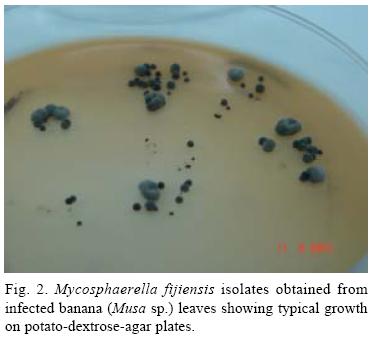
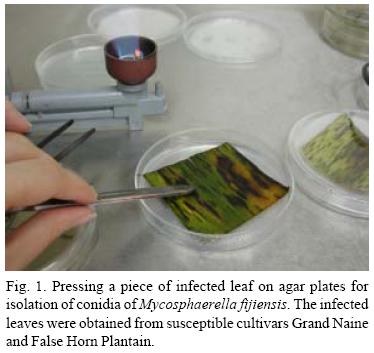
</front><body><![CDATA[ <p align="justify"><font face="verdana" size="4">Notas fitopatol&oacute;gicas </font></p>     <p align="justify"><font face="verdana" size="2">&nbsp;</font></p>     <p align="center"><font face="verdana" size="4"><b>A Simple Method to Obtain Single Conidium Isolates Directly from Banana (<i>Musa </i>sp.) Leaves Infected with <i>Mycosphaerella fijiensis </i>Morelet</b></font></p>     <p align="justify"><font face="verdana" size="2">&nbsp;</font></p>     <p align="center"><font face="verdana" size="3"><b>M&eacute;todo simple para obtener conidios individuales directamente de hojas de banana (<i>Musa sp.</i>) infectadas con <i>Mycosphaerella fijiensis </i>Morelet</b></font></p>     <p align="center"><font face="verdana" size="2">&nbsp;</font></p>     <p align="center"><font face="verdana" size="2"><b>Laura Conde&#150;Ferr&aacute;ez<sup>1</sup>, Rosa Grijalva&#150;Arango<sup>2</sup>, N&eacute;stor Eduardo Raigoza&#150;Flores<sup>2</sup>, y Andrew C. James&#150;Kay<sup>2</sup></b></font></p>     <p align="justify"><font face="verdana" size="2">&nbsp;</font></p>     <p align="justify"><font face="verdana" size="2"><sup>1 </sup><i>Centro de Investigaci&oacute;n Cient&iacute;fica de Yucat&aacute;n (CICY), Unidad de Biotecnolog&iacute;a, Calle 43 No. 130, Chuburn&aacute; de Hidalgo, M&eacute;rida, Yucat&aacute;n, M&eacute;xico CP 97200 (Current address: Universidad Aut&oacute;noma de Yucat&aacute;n (UADY), CIR&#150;Biom&eacute;dicas, Av. Itzaes No. 490 x 59&#150;A, M&eacute;rida, Yucat&aacute;n, M&eacute;xico CP 97000. </i>Correspondencia: <a href="mailto:laura.conde@uady.mx">laura.conde@uady.mx</a></font></p>     <p align="justify"><font face="verdana" size="2"><i><sup>2</sup> CICY. </i></font></p>     ]]></body>
<body><![CDATA[<p align="justify"><font face="verdana" size="2">&nbsp;</font></p>     <p align="justify"><font face="verdana" size="2">Received: October 3, 2007    <br>    Accepted: February 22, 2008</font></p>     <p align="justify"><font face="verdana" size="2">&nbsp;</font></p>     <p align="justify"><font face="verdana" size="2"><b>Abstract</b></font></p>     <p align="justify"><font face="verdana" size="2">A simple methodology to isolate conidia of <i>Mycosphaerella fijiensis </i>from infected banana leaves was implemented. A method reported previously was laborious and required skilled trained personnel. Here we describe a sampling method that consumes short periods of time and low costs and that can be carried out and reproduced by personnel with limited lab experience or expertise. It is practical and useful for extensive studies of foliar pathogen population and distribution.</font></p>     <p align="justify"><font face="verdana" size="2"><b>Key words:</b> Black leaf streak, black sigatoka, conidia, asexual reproduction.</font></p>     <p align="justify"><font face="verdana" size="2">&nbsp;</font></p>     <p align="justify"><font face="verdana" size="2"><b>Resumen</b></font></p>     <p align="justify"><font face="verdana" size="2">Se desarroll&oacute; una metodolog&iacute;a sencilla para aislar conidios de <i>Mycosphaerella fijiensis </i>a partir de hojas de banano infectadas. El m&eacute;todo que hab&iacute;a sido reportado previamente es laborioso y requiere ser llevado a cabo por personal capacitado y entrenado. Se describe un m&eacute;todo de muestreo que consume poco tiempo y es de bajo costo, y que puede ser llevado a cabo y reproducido por personal con poca experiencia. Es pr&aacute;ctico y &uacute;til para ser aplicado en estudios poblacionales extensos y de distribuci&oacute;n de pat&oacute;genos foliares.</font></p>     ]]></body>
<body><![CDATA[<p align="justify"><font face="verdana" size="2"><b>Palabras clave:</b> Enfermedad de la roya negra, sigatoka negra, conidios, reproducci&oacute;n asexual.</font></p>     <p align="justify"><font face="verdana" size="2">&nbsp;</font></p>     <p align="justify"><font face="verdana" size="2">Black leaf streak disease or black Sigatoka, caused by <i>Mycosphaerella fijiensis </i>Morelet (Mycosphaerellaceae, Ascomycetes), is considered the most devastating disease of banana and plantain <i>(Musa </i>spp. AAA, AAB, AA, and ABB groups). It is spread through ascospores (sexual) and conidia (asexual). Analyses of single ascospore&#150;derived isolates have been used to study the genetic structure and diversity of populations (Carlier <i>et al, </i>1994, 1996). Revised methods to trigger ascospore discharge have been reported by several authors (Gonz&aacute;lez, 1999; Johanson, 1997; Molina&#150;Tirado and Casta&ntilde;o&#150;Zapata, 2003; Stover, 1969, 1976). The only method to isolate conidia fromM. <i>fijiensis </i>directly from the infected leaves, has been reported by Fullerton and Tracey (1984). However, this method is laborious and time consuming, requiring the excision of the epidermis of the infected leaves. Recently, Aguirre <i>et al. </i>(2003) picked conidia from leaves, using an agar&#150;filled syringe containing a dye, to identify <i>Mycosphaerella </i>species. Therefore, an experiment was conducted using either surface&#150;sterilized or non&#150;sterile plant materials, and a collection of fungal isolates was successfully obtained from both methods. Infected banana and plantain leaves were collected from fungicide untreated fields, in Yucatan and Tabasco, Mexico. Portions of the leaves with symptoms from Four&eacute; stages 2&#150;5 (Four&eacute;, 1982) were selected and cut in 4 &times; 4 cm squares. For the first treatment, leaves were surface sterilized with 20% commercial sodium hypochlorite bleach plus Tween 20 (500 &#956;L/L) for 10 min, dried with sterile paper towels, placed on top of sterile filter paper soaked with sterile distilled water, and sealed inside a Petri dish with wet filter paper. Plates were incubated at 20&deg;C for up to 5 days as this temperature has been reported to induce conidiation (Jacome and Schuh, 1993). Every 24 h conidia were isolated from the leaves as described below. The second method consisted of using pieces of the leaves directly from the field, followed by isolation of conidia as follows: The abaxial surface of the infected leaves was pressed against a water&#150;agar (3%) plate, and observed under a stereoscopic microscope. Using the needle of a subdermal syringe, single conidia were picked, and incubated on potato&#150;dextrose&#150;agar (PDA) plates containing 200 mg/mL Amoxicillin. <i>M. fijiensis </i>single&#150;spore isolates were grown at 26&deg;C with continuous white light. After 2&#150;3 weeks, <i>M. fijiensis </i>colonies were identified by their morphology and growth rate, and re&#150;plated on PDA (<a href="#f1">Fig. 1</a>). With the first method, conidia were not observed until the 3rd and 4th days of incubation. On these days, single conidia were found distributed over the plate (<a href="#f2">Fig. 2</a>). Few spores from other fungi were observed. On the 5th day, most of the leaves were already senescent, and in general, conidia that were observed had germinated. With respect to the second method, using non&#150;sterilized plant material, conidia were found localized in packed groups, presumably each corresponding to a sporodochium, and numerous spores from other fungi were observed, but were avoided when <i>M. fijiensis </i>conidia were transferred to PDA. After subculture, a total of 134 isolates were obtained with the first treatment and 131 by the second one; thus, demonstrating the efficiency of both methods. A collection of 265 isolates was generated, and is being used for population studies. In these experiments, <i>M. fijiensis </i>produced conidia within 3 days after the disinfection process, but not on senescent leaves. The use of non&#150;sterile material from the field was simple and rapid, although some disadvantages such as the presence of different spores on the surface of the leaf should be considered. We would recommend using the infected material directly from the field the same day or the day following the sampling, and surface sterilization of leaves if many samples are required and it is not possible to process all the material at once. The main advantages of this method are i) conidia are more readily available than ascospores, ii) the method is much simpler than other methods reported, iii) the infected material can be processed on the same day of sampling or incubated for up to three more days, iv) no special equipment or potent microscopes are needed, and v) it may be used for preliminary diagnosis of other fungi.</font></p>     <p align="center"><font face="verdana" size="2"><a name="f1"></a></font></p>     <p align="center"><font face="verdana" size="2"><img src="/img/revistas/rmfi/v26n1/a12f1.jpg"></font></p>     <p align="center"><font face="verdana" size="2"><a name="f2"></a></font></p>     <p align="center"><font face="verdana" size="2"><img src="/img/revistas/rmfi/v26n1/a12f2.jpg"></font></p>     <p align="justify"><font face="verdana" size="2">&nbsp;</font></p>     <p align="justify"><font face="verdana" size="2"><b>ACKNOWLEDGMENTS</b></font></p>     <p align="justify"><font face="verdana" size="2">L. Conde&#150;Ferr&aacute;ez was sponsored by CONACYT scholarship (70133) during this work.</font></p>     ]]></body>
<body><![CDATA[<p align="justify"><font face="verdana" size="2">&nbsp;</font></p>     <p align="justify"><font face="verdana" size="2"><b>LITERATURE CITED</b></font></p>     <!-- ref --><p align="justify"><font face="verdana" size="2">Aguirre, M.C., Casta&ntilde;o&#150;Zapata, J. y Zuluaga, L.E. 2003. M&eacute;todo r&aacute;pido de diagn&oacute;stico de <i>Mycosphaerella musicola </i>Leach y M. <i>fijiensis </i>Morelet, agentes causantes de las sigatokas amarilla y negra. Revista de la Academia Colombiana de Ciencias XXVII:619&#150;623.    &nbsp;&nbsp;&nbsp;&nbsp;&nbsp;&nbsp;&nbsp;&nbsp;[&#160;<a href="javascript:void(0);" onclick="javascript: window.open('/scielo.php?script=sci_nlinks&ref=8469843&pid=S0185-3309200800010001200001&lng=','','width=640,height=500,resizable=yes,scrollbars=1,menubar=yes,');">Links</a>&#160;]<!-- end-ref --></font></p>     <!-- ref --><p align="justify"><font face="verdana" size="2">Carlier, J., Lebrun, M.H., Zapater, M., Dubois, C., and Mourichon, X. 1996. Genetic structure of the global population of banana black leaf streak fungus <i>Mycosphaerella fijiensis. </i>Molecular Ecology 5:499&#150;510.    &nbsp;&nbsp;&nbsp;&nbsp;&nbsp;&nbsp;&nbsp;&nbsp;[&#160;<a href="javascript:void(0);" onclick="javascript: window.open('/scielo.php?script=sci_nlinks&ref=8469845&pid=S0185-3309200800010001200002&lng=','','width=640,height=500,resizable=yes,scrollbars=1,menubar=yes,');">Links</a>&#160;]<!-- end-ref --></font></p>     <!-- ref --><p align="justify"><font face="verdana" size="2">Carlier, J., Mourichon, X., Gonz&aacute;lez de Le&oacute;n, D., Zapater, M., and Lebrun, M.H. 1994. DNA restriction fragment length polymorphisms in <i>Mycosphaerella </i>species that cause banana leaf spot diseases. Phytopathology 84:751&#150;756.    &nbsp;&nbsp;&nbsp;&nbsp;&nbsp;&nbsp;&nbsp;&nbsp;[&#160;<a href="javascript:void(0);" onclick="javascript: window.open('/scielo.php?script=sci_nlinks&ref=8469847&pid=S0185-3309200800010001200003&lng=','','width=640,height=500,resizable=yes,scrollbars=1,menubar=yes,');">Links</a>&#160;]<!-- end-ref --></font></p>     <!-- ref --><p align="justify"><font face="verdana" size="2">Four&eacute;, E. 1982. Les cercosporioses du bananier et leurs traitements. Comportement des vari&eacute;t&eacute;s.1: Incubation et &eacute;volution de la maladie. Fruits 37:749&#150;766.    &nbsp;&nbsp;&nbsp;&nbsp;&nbsp;&nbsp;&nbsp;&nbsp;[&#160;<a href="javascript:void(0);" onclick="javascript: window.open('/scielo.php?script=sci_nlinks&ref=8469849&pid=S0185-3309200800010001200004&lng=','','width=640,height=500,resizable=yes,scrollbars=1,menubar=yes,');">Links</a>&#160;]<!-- end-ref --></font></p>     ]]></body>
<body><![CDATA[<!-- ref --><p align="justify"><font face="verdana" size="2">Fullerton, R.A., and Tracey, G.M. 1984. Tolerance of <i>Myosphaerella fijiensis </i>to benomyl and carbendazim in the Pacific Islands. Tropical Agriculture (Trinidad) 61:134&#150;136.    &nbsp;&nbsp;&nbsp;&nbsp;&nbsp;&nbsp;&nbsp;&nbsp;[&#160;<a href="javascript:void(0);" onclick="javascript: window.open('/scielo.php?script=sci_nlinks&ref=8469851&pid=S0185-3309200800010001200005&lng=','','width=640,height=500,resizable=yes,scrollbars=1,menubar=yes,');">Links</a>&#160;]<!-- end-ref --></font></p>     <!-- ref --><p align="justify"><font face="verdana" size="2">Gonz&aacute;lez, M. 1999. Metodolog&iacute;a para la manipulaci&oacute;n y cultivo <i>in vitro </i>de <i>Mycosphaerella fijiensis. </i>Hoja T&eacute;cnica No. 30. Manejo Integrado de Plagas (Costa Rica) 53:i&#150;iv.    &nbsp;&nbsp;&nbsp;&nbsp;&nbsp;&nbsp;&nbsp;&nbsp;[&#160;<a href="javascript:void(0);" onclick="javascript: window.open('/scielo.php?script=sci_nlinks&ref=8469853&pid=S0185-3309200800010001200006&lng=','','width=640,height=500,resizable=yes,scrollbars=1,menubar=yes,');">Links</a>&#160;]<!-- end-ref --></font></p>     <!-- ref --><p align="justify"><font face="verdana" size="2">Jacome, L.H., and Schuh, W. 1993. Effect of temperature on growth and conidial production <i>in vitro, </i>and comparison of infection and aggressiveness <i>in vivo </i>among isolates of <i>Mycosphaerella fijiensis </i>var <i>difformis. </i>Tropical Agriculture (Trinidad) 70:51&#150;59.    &nbsp;&nbsp;&nbsp;&nbsp;&nbsp;&nbsp;&nbsp;&nbsp;[&#160;<a href="javascript:void(0);" onclick="javascript: window.open('/scielo.php?script=sci_nlinks&ref=8469855&pid=S0185-3309200800010001200007&lng=','','width=640,height=500,resizable=yes,scrollbars=1,menubar=yes,');">Links</a>&#160;]<!-- end-ref --></font></p>     <!-- ref --><p align="justify"><font face="verdana" size="2">Johanson, A. 1997. Detection of Sigatoka Leaf Spot Pathogens of Banana by the Polymerase Chain Reaction. Natural Resources Institute. Chatham, UK. 38 p.    &nbsp;&nbsp;&nbsp;&nbsp;&nbsp;&nbsp;&nbsp;&nbsp;[&#160;<a href="javascript:void(0);" onclick="javascript: window.open('/scielo.php?script=sci_nlinks&ref=8469857&pid=S0185-3309200800010001200008&lng=','','width=640,height=500,resizable=yes,scrollbars=1,menubar=yes,');">Links</a>&#160;]<!-- end-ref --></font></p>     <!-- ref --><p align="justify"><font face="verdana" size="2">Molina&#150;Tirado, O.V. y Casta&ntilde;o&#150;Zapata, J. 2003. An&aacute;lisis de algunos componentes de resistencia en los h&iacute;bridos de banano y pl&aacute;tano FHIA 01, FHIA 17 y FHIA 21 a las Sigatokas negra <i>(Mycosphaerella fijiensis </i>Morelet) y amarilla ( <i>M. musicola </i>Leach). Revista de la Academia Colombiana de Ciencias 27:181&#150;189.    &nbsp;&nbsp;&nbsp;&nbsp;&nbsp;&nbsp;&nbsp;&nbsp;[&#160;<a href="javascript:void(0);" onclick="javascript: window.open('/scielo.php?script=sci_nlinks&ref=8469859&pid=S0185-3309200800010001200009&lng=','','width=640,height=500,resizable=yes,scrollbars=1,menubar=yes,');">Links</a>&#160;]<!-- end-ref --> </font></p>     ]]></body>
<body><![CDATA[<!-- ref --><p align="justify"><font face="verdana" size="2">Stover, R.H. 1969. The <i>Mycosphaerella </i>sp. associated with banana leaf spots. Tropical Agriculture (Trinidad) 46:325&#150;332.    &nbsp;&nbsp;&nbsp;&nbsp;&nbsp;&nbsp;&nbsp;&nbsp;[&#160;<a href="javascript:void(0);" onclick="javascript: window.open('/scielo.php?script=sci_nlinks&ref=8469861&pid=S0185-3309200800010001200010&lng=','','width=640,height=500,resizable=yes,scrollbars=1,menubar=yes,');">Links</a>&#160;]<!-- end-ref --></font></p>     <!-- ref --><p align="justify"><font face="verdana" size="2">Stover, R.H. 1976. Distribution and cultural characteristics of the pathogens causing banana leaf spot. Tropical Agriculture (Trinidad) 53:111&#150;114.    &nbsp;&nbsp;&nbsp;&nbsp;&nbsp;&nbsp;&nbsp;&nbsp;[&#160;<a href="javascript:void(0);" onclick="javascript: window.open('/scielo.php?script=sci_nlinks&ref=8469863&pid=S0185-3309200800010001200011&lng=','','width=640,height=500,resizable=yes,scrollbars=1,menubar=yes,');">Links</a>&#160;]<!-- end-ref --></font></p>      ]]></body><back>
<ref-list>
<ref id="B1">
<nlm-citation citation-type="journal">
<person-group person-group-type="author">
<name>
<surname><![CDATA[Aguirre]]></surname>
<given-names><![CDATA[M.C]]></given-names>
</name>
<name>
<surname><![CDATA[Castaño-Zapata]]></surname>
<given-names><![CDATA[J]]></given-names>
</name>
<name>
<surname><![CDATA[Zuluaga]]></surname>
<given-names><![CDATA[L.E]]></given-names>
</name>
</person-group>
<article-title xml:lang="es"><![CDATA[Método rápido de diagnóstico de Mycosphaerella musicola Leach y M. fijiensis Morelet, agentes causantes de las sigatokas amarilla y negra]]></article-title>
<source><![CDATA[Revista de la Academia Colombiana de Ciencias]]></source>
<year>2003</year>
<volume>XXVII</volume>
<page-range>619-623</page-range></nlm-citation>
</ref>
<ref id="B2">
<nlm-citation citation-type="journal">
<person-group person-group-type="author">
<name>
<surname><![CDATA[Carlier]]></surname>
<given-names><![CDATA[J]]></given-names>
</name>
<name>
<surname><![CDATA[Lebrun]]></surname>
<given-names><![CDATA[M.H]]></given-names>
</name>
<name>
<surname><![CDATA[Zapater]]></surname>
<given-names><![CDATA[M]]></given-names>
</name>
<name>
<surname><![CDATA[Dubois]]></surname>
<given-names><![CDATA[C]]></given-names>
</name>
<name>
<surname><![CDATA[Mourichon]]></surname>
<given-names><![CDATA[X]]></given-names>
</name>
</person-group>
<article-title xml:lang="en"><![CDATA[Genetic structure of the global population of banana black leaf streak fungus Mycosphaerella fijiensis]]></article-title>
<source><![CDATA[Molecular Ecology]]></source>
<year>1996</year>
<volume>5</volume>
<page-range>499-510</page-range></nlm-citation>
</ref>
<ref id="B3">
<nlm-citation citation-type="journal">
<person-group person-group-type="author">
<name>
<surname><![CDATA[Carlier]]></surname>
<given-names><![CDATA[J]]></given-names>
</name>
<name>
<surname><![CDATA[Mourichon]]></surname>
<given-names><![CDATA[X]]></given-names>
</name>
<name>
<surname><![CDATA[González de León]]></surname>
<given-names><![CDATA[D]]></given-names>
</name>
<name>
<surname><![CDATA[Zapater]]></surname>
<given-names><![CDATA[M]]></given-names>
</name>
<name>
<surname><![CDATA[Lebrun]]></surname>
<given-names><![CDATA[M.H]]></given-names>
</name>
</person-group>
<article-title xml:lang="en"><![CDATA[DNA restriction fragment length polymorphisms in Mycosphaerella species that cause banana leaf spot diseases]]></article-title>
<source><![CDATA[Phytopathology]]></source>
<year>1994</year>
<volume>84</volume>
<page-range>751-756</page-range></nlm-citation>
</ref>
<ref id="B4">
<nlm-citation citation-type="journal">
<person-group person-group-type="author">
<name>
<surname><![CDATA[Fouré]]></surname>
<given-names><![CDATA[E]]></given-names>
</name>
</person-group>
<article-title xml:lang="fr"><![CDATA[Les cercosporioses du bananier et leurs traitements. Comportement des variétés.1: Incubation et évolution de la maladie]]></article-title>
<source><![CDATA[Fruits]]></source>
<year>1982</year>
<volume>37</volume>
<page-range>749-766</page-range></nlm-citation>
</ref>
<ref id="B5">
<nlm-citation citation-type="journal">
<person-group person-group-type="author">
<name>
<surname><![CDATA[Fullerton]]></surname>
<given-names><![CDATA[R.A]]></given-names>
</name>
<name>
<surname><![CDATA[Tracey]]></surname>
<given-names><![CDATA[G.M]]></given-names>
</name>
</person-group>
<article-title xml:lang="en"><![CDATA[Tolerance of Myosphaerella fijiensis to benomyl and carbendazim in the Pacific Islands]]></article-title>
<source><![CDATA[Tropical Agriculture]]></source>
<year>1984</year>
<volume>61</volume>
<page-range>134-136</page-range></nlm-citation>
</ref>
<ref id="B6">
<nlm-citation citation-type="">
<person-group person-group-type="author">
<name>
<surname><![CDATA[González]]></surname>
<given-names><![CDATA[M]]></given-names>
</name>
</person-group>
<source><![CDATA[Metodología para la manipulación y cultivo in vitro de Mycosphaerella fijiensis]]></source>
<year>1999</year>
<volume>30</volume>
</nlm-citation>
</ref>
<ref id="B7">
<nlm-citation citation-type="journal">
<person-group person-group-type="author">
<name>
<surname><![CDATA[Jacome]]></surname>
<given-names><![CDATA[L.H]]></given-names>
</name>
<name>
<surname><![CDATA[Schuh]]></surname>
<given-names><![CDATA[W]]></given-names>
</name>
</person-group>
<article-title xml:lang="en"><![CDATA[Effect of temperature on growth and conidial production in vitro, and comparison of infection and aggressiveness in vivo among isolates of Mycosphaerella fijiensis var difformis]]></article-title>
<source><![CDATA[Tropical Agriculture]]></source>
<year>1993</year>
<volume>70</volume>
<page-range>51-59</page-range></nlm-citation>
</ref>
<ref id="B8">
<nlm-citation citation-type="book">
<person-group person-group-type="author">
<name>
<surname><![CDATA[Johanson]]></surname>
<given-names><![CDATA[A]]></given-names>
</name>
</person-group>
<source><![CDATA[Detection of Sigatoka Leaf Spot Pathogens of Banana by the Polymerase Chain Reaction]]></source>
<year>1997</year>
<page-range>38</page-range><publisher-loc><![CDATA[Chatham^eUK UK]]></publisher-loc>
<publisher-name><![CDATA[Natural Resources Institute]]></publisher-name>
</nlm-citation>
</ref>
<ref id="B9">
<nlm-citation citation-type="journal">
<person-group person-group-type="author">
<name>
<surname><![CDATA[Molina-Tirado]]></surname>
<given-names><![CDATA[O.V]]></given-names>
</name>
<name>
<surname><![CDATA[Castaño-Zapata]]></surname>
<given-names><![CDATA[J]]></given-names>
</name>
</person-group>
<article-title xml:lang="es"><![CDATA[Análisis de algunos componentes de resistencia en los híbridos de banano y plátano FHIA 01, FHIA 17 y FHIA 21 a las Sigatokas negra (Mycosphaerella fijiensis Morelet) y amarilla ( M. musicola Leach)]]></article-title>
<source><![CDATA[Revista de la Academia Colombiana de Ciencias]]></source>
<year>2003</year>
<volume>27</volume>
<page-range>181-189</page-range></nlm-citation>
</ref>
<ref id="B10">
<nlm-citation citation-type="journal">
<person-group person-group-type="author">
<name>
<surname><![CDATA[Stover]]></surname>
<given-names><![CDATA[R.H]]></given-names>
</name>
</person-group>
<article-title xml:lang="en"><![CDATA[The Mycosphaerella sp. associated with banana leaf spots]]></article-title>
<source><![CDATA[Tropical Agriculture]]></source>
<year>1969</year>
<volume>46</volume>
<page-range>325-332</page-range></nlm-citation>
</ref>
<ref id="B11">
<nlm-citation citation-type="journal">
<person-group person-group-type="author">
<name>
<surname><![CDATA[Stover]]></surname>
<given-names><![CDATA[R.H]]></given-names>
</name>
</person-group>
<article-title xml:lang="en"><![CDATA[Distribution and cultural characteristics of the pathogens causing banana leaf spot]]></article-title>
<source><![CDATA[Tropical Agriculture]]></source>
<year>1976</year>
<volume>53</volume>
<page-range>111-114</page-range></nlm-citation>
</ref>
</ref-list>
</back>
</article>