<?xml version="1.0" encoding="ISO-8859-1"?><article xmlns:mml="http://www.w3.org/1998/Math/MathML" xmlns:xlink="http://www.w3.org/1999/xlink" xmlns:xsi="http://www.w3.org/2001/XMLSchema-instance">
<front>
<journal-meta>
<journal-id>0185-3309</journal-id>
<journal-title><![CDATA[Revista mexicana de fitopatología]]></journal-title>
<abbrev-journal-title><![CDATA[Rev. mex. fitopatol]]></abbrev-journal-title>
<issn>0185-3309</issn>
<publisher>
<publisher-name><![CDATA[Sociedad Mexicana de Fitopatología A.C.]]></publisher-name>
</publisher>
</journal-meta>
<article-meta>
<article-id>S0185-33092008000100001</article-id>
<title-group>
<article-title xml:lang="en"><![CDATA[Molecular and Biological Properties of a Putative Partitivirus from Jalapeño Pepper (Capsicum annuum L.)]]></article-title>
<article-title xml:lang="es"><![CDATA[Propiedades biológicas y moleculares de un posible partitivirus de chile jalapeño (Capsicum annuum L.)]]></article-title>
</title-group>
<contrib-group>
<contrib contrib-type="author">
<name>
<surname><![CDATA[Valverde]]></surname>
<given-names><![CDATA[Rodrigo A.]]></given-names>
</name>
<xref ref-type="aff" rid="A01"/>
</contrib>
<contrib contrib-type="author">
<name>
<surname><![CDATA[Gutierrez]]></surname>
<given-names><![CDATA[Dina L.]]></given-names>
</name>
<xref ref-type="aff" rid="A01"/>
</contrib>
</contrib-group>
<aff id="A01">
<institution><![CDATA[,Louisiana State University Agricultural Center Department of Plant Pathology]]></institution>
<addr-line><![CDATA[Baton Rouge LA]]></addr-line>
<country>USA</country>
</aff>
<pub-date pub-type="pub">
<day>00</day>
<month>00</month>
<year>2008</year>
</pub-date>
<pub-date pub-type="epub">
<day>00</day>
<month>00</month>
<year>2008</year>
</pub-date>
<volume>26</volume>
<numero>1</numero>
<fpage>1</fpage>
<lpage>6</lpage>
<copyright-statement/>
<copyright-year/>
<self-uri xlink:href="http://www.scielo.org.mx/scielo.php?script=sci_arttext&amp;pid=S0185-33092008000100001&amp;lng=en&amp;nrm=iso"></self-uri><self-uri xlink:href="http://www.scielo.org.mx/scielo.php?script=sci_abstract&amp;pid=S0185-33092008000100001&amp;lng=en&amp;nrm=iso"></self-uri><self-uri xlink:href="http://www.scielo.org.mx/scielo.php?script=sci_pdf&amp;pid=S0185-33092008000100001&amp;lng=en&amp;nrm=iso"></self-uri><abstract abstract-type="short" xml:lang="en"><p><![CDATA[Screening 50 greenhouse grown Jalapeño M (JM) (Capsicum annuum) pepper plants for the presence of pepper cryptic virus - 1 (PCV-1) by dsRNA extraction and analysis by electrophoresis, resulted in two JM lines. One was PCV-1 free and designated JM-N. The other one was PCV-1 positive and designated JM-P. Both lines were susceptible to natural infection by Cucumber mosaic virus and its satellite RNA. PCV-1 was not graft transmitted but it was transmitted both paternally (pollen) and maternally (ovule). Partial sequence of the RNA-dependent RNA polymerase gene was obtained from three overlapping cDNA clones derived from PCV-1 dsRNA. A search for aminoacid sequence similarity using the NCBI BLAST resulted in significant alignments with the RNA dependent RNA polymerase of Beet cryptic virus -3 and several putative members of the family Partitiviridae. Data presented indicate that PCV-1 is a distinct species of the family Partitiviridae.]]></p></abstract>
<abstract abstract-type="short" xml:lang="es"><p><![CDATA[Cincuenta plantas de chile Jalapeño M (JM) (Capsicum annuum) mantenidas en invernadero fueron evaluadas para la presencia del virus críptico: Pepper criptic virus-1 (PCV-1) a través del análisis del RNA viral de doble cadena, el cual dio como resultado dos líneas de JM. Una de ellas se designó JM-N debido a la ausencia del PCV-1 en esta línea. Mientras que la otra línea se designó JM-P, positiva a la presencia del PCV-1. Ambas líneas fueron susceptibles a la infección natural por el virus Cucumber mosaic virus y su RNA satelital. PCV-1 no se pudo transmitir por injerto, pero si por semilla, paternal (polen) y maternalmente (óvulo). La secuencia parcial del gen que codifica para la RNA polimerasa RNA-dependiente se obtuvo de tres clones superpuestos del cDNA proveniente del RNA viral de doble cadena del PCV-1. La similitud de la secuencia de aminoácidos se analizó a través del programa NCBI BLAST dando como resultado alineamientos significativos con la RNA polimerasa RNA-dependiente del virus Beet cryptic virus-3 y varios posibles miembros de la familia Partitiviridae. Los resultados de la presente investigación indican que PCV-1 es una especia distinta de la familia Partitiviridae.]]></p></abstract>
<kwd-group>
<kwd lng="en"><![CDATA[Cryptic virus]]></kwd>
<kwd lng="en"><![CDATA[Cucumber mosaic virus]]></kwd>
<kwd lng="en"><![CDATA[Beet cryptic virus-3]]></kwd>
<kwd lng="en"><![CDATA[pepper cryptic virus-1]]></kwd>
<kwd lng="en"><![CDATA[double-stranded RNA]]></kwd>
<kwd lng="es"><![CDATA[Virus críptico]]></kwd>
<kwd lng="es"><![CDATA[virus del mosaico del pepino]]></kwd>
<kwd lng="es"><![CDATA[virus críptico-3 de la remolacha]]></kwd>
<kwd lng="es"><![CDATA[virus críptico-1 del chile]]></kwd>
<kwd lng="es"><![CDATA[RNA de doble cadena]]></kwd>
</kwd-group>
</article-meta>
</front><body><![CDATA[ <p align="justify"><font face="verdana" size="4">Art&iacute;culos cient&iacute;ficos</font></p>     <p align="justify"><font face="verdana" size="2">&nbsp;</font></p>     <p align="center"><font face="verdana" size="4"><b>Molecular and Biological Properties of a Putative Partitivirus from Jalape&ntilde;o Pepper (<i>Capsicum annuum </i>L.)</b></font></p>     <p align="center"><font face="verdana" size="2">&nbsp;</font></p>     <p align="center"><font face="verdana" size="3"><b>Propiedades biol&oacute;gicas y moleculares de un posible partitivirus de chile jalape&ntilde;o (<i>Capsicum annuum </i>L.)</b></font></p>     <p align="center"><font face="verdana" size="2">&nbsp;</font></p>     <p align="center"><font face="verdana" size="2"><b>Rodrigo A. Valverde and Dina L. Gutierrez</b></font></p>     <p align="justify"><font face="verdana" size="2">&nbsp;</font></p>     <p align="justify"><font face="verdana" size="2"><i>Louisiana State University Agricultural Center, Department of Plant Pathology and Crop Physiology, Baton Rouge, LA 70803 USA. GenBank Accession numbers for nucleotide sequence: DQ361008. </i>Correspondence to: <a href="mailto:ravalve@lsu.edu">ravalve@lsu.edu</a></font></p>     <p align="justify"><font face="verdana" size="2">&nbsp;</font></p>     ]]></body>
<body><![CDATA[<p align="justify"><font face="verdana" size="2">Received: September 17, 2007    <br>  Accepted: February 14, 2008</font></p>     <p align="justify"><font face="verdana" size="2">&nbsp;</font></p>     <p align="justify"><font face="verdana" size="2"><b>Abstract</b></font></p>     <p align="justify"><font face="verdana" size="2">Screening 50 greenhouse grown Jalape&ntilde;o M (JM) <i>(Capsicum annuum) </i>pepper plants for the presence of pepper cryptic virus &#150; 1 (PCV&#150;1) by dsRNA extraction and analysis by electrophoresis, resulted in two JM lines. One was PCV&#150;1 free and designated JM&#150;N. The other one was PCV&#150;1 positive and designated JM&#150;P. Both lines were susceptible to natural infection by <i>Cucumber mosaic virus </i>and its satellite RNA. PCV&#150;1 was not graft transmitted but it was transmitted both paternally (pollen) and maternally (ovule). Partial sequence of the RNA&#150;dependent RNA polymerase gene was obtained from three overlapping cDNA clones derived from PCV&#150;1 dsRNA. A search for aminoacid sequence similarity using the NCBI BLAST resulted in significant alignments with the RNA dependent RNA polymerase of <i>Beet cryptic virus </i>&#150;3 and several putative members of the family <i>Partitiviridae. </i>Data presented indicate that PCV&#150;1 is a distinct species of the family <i>Partitiviridae.</i></font></p>     <p align="justify"><font face="verdana" size="2"><b>Key Words</b>: Cryptic virus, <i>Cucumber mosaic virus, Beet cryptic virus&#150;3, </i>pepper cryptic virus&#150;1, double&#150;stranded RNA.</font></p>     <p align="justify"><font face="verdana" size="2">&nbsp;</font></p>     <p align="justify"><font face="verdana" size="2"><b>Resumen</b></font></p>     <p align="justify"><font face="verdana" size="2">Cincuenta plantas de chile Jalape&ntilde;o M (JM) <i>(Capsicum annuum) </i>mantenidas en invernadero fueron evaluadas para la presencia del virus cr&iacute;ptico: Pepper criptic virus&#150;1 (PCV&#150;1) a trav&eacute;s del an&aacute;lisis del RNA viral de doble cadena, el cual dio como resultado dos l&iacute;neas de JM. Una de ellas se design&oacute; JM&#150;N debido a la ausencia del PCV&#150;1 en esta l&iacute;nea. Mientras que la otra l&iacute;nea se design&oacute; JM&#150;P, positiva a la presencia del PCV&#150;1. Ambas l&iacute;neas fueron susceptibles a la infecci&oacute;n natural por el virus <i>Cucumber mosaic virus </i>y su RNA satelital. PCV&#150;1 no se pudo transmitir por injerto, pero si por semilla, paternal (polen) y maternalmente (&oacute;vulo). La secuencia parcial del gen que codifica para la RNA polimerasa RNA&#150;dependiente se obtuvo de tres clones superpuestos del cDNA proveniente del RNA viral de doble cadena del PCV&#150;1. La similitud de la secuencia de amino&aacute;cidos se analiz&oacute; a trav&eacute;s del programa NCBI BLAST dando como resultado alineamientos significativos con la RNA polimerasa RNA&#150;dependiente del virus <i>Beet cryptic virus&#150;3 </i>y varios posibles miembros de la familia <i>Partitiviridae. </i>Los resultados de la presente investigaci&oacute;n indican que PCV&#150;1 es una especia distinta de la familia <i>Partitiviridae.</i></font></p>     <p align="justify"><font face="verdana" size="2"><b>Palabras Clave:</b> Virus cr&iacute;ptico, virus del mosaico del pepino, virus cr&iacute;ptico&#150;3 de la remolacha, virus cr&iacute;ptico&#150;1 del chile, RNA de doble cadena.</font></p>     ]]></body>
<body><![CDATA[<p align="justify"><font face="verdana" size="2">&nbsp;</font></p>     <p align="justify"><font face="verdana" size="2">Healthy plants do not normally contain double&#150;stranded RNA (dsRNA). In virus&#150;infected plants, dsRNAs are found in the form of genomic segments of dsRNA viruses and replicative forms of single&#150;stranded RNA viruses. DsRNAs have been used as diagnostic markers of viral infection in plants (Dodds <i>et al., </i>1984; Valverde <i>et al., </i>1990). The viral family <i>Partitiviridae </i>and the genus <i>Endornavirus </i>contain members that infect plants, have a dsRNA genome, are transmitted vertically through seed, but do not cause symptoms (Ghabrial <i>et al., </i>2005; Gibbs <i>et al., </i>2005). Endornaviruses have been reported in several plant species including rice <i>(Oryza sativa </i>L.), broad bean <i>(Vicia faba </i>L.), common bean <i>(Phaseolus vulgaris </i>L.), melon <i>(Cucumis melo </i>L.), and bell pepper <i>(Capsicum annuum </i>L.) (Fukuhara <i>et al., </i>2006; Gibbs <i>et al., </i>2005; Valverde and Gutierrez, 2007). The <i>Partitiviridae </i>is a family of isometric viruses with a segmented dsRNA genome (Ghabrial <i>et al., </i>2005). Two genera: <i>Alphacrytovirus </i>and <i>Betacryptovirus </i>contain members that occur in plants and are transmitted through seed at high levels but cannot be transmitted by grafting or mechanical inoculation. Several cryptic viruses have been reported in different crop plants, but do not cause visible symptoms (Boccardo <i>et al., </i>1987; Ghabrial <i>et al., </i>2005). Alphacrytoviruses include those with two dsRNA segments of about 1.7 &#150; 2.0 Kb and include: <i>Alfalfa cryptic virus </i>1, <i>White clover cryptic virus </i>1, and <i>Beet cryptic virus </i>3 (BCV&#150;3) (Boccardo <i>et al., </i>1987; Ghabrial <i>et al., </i>2005; Xie <i>et al., </i>1993). Betacryptoviruses include those with two dsRNA segments of about 2.1 &#150; 2.2 kbp with <i>White clover cryptic virus </i>2 being the type member (Ghabrial <i>et al., </i>2005). Some properties of a putative partitivirus found in Jalape&ntilde;o M pepper designated pepper cryptic virus 1 (PCV&#150;1) were reported previously (Arancibia and Valverde, 1995). The virus consists of spherical particles (30 nm), a coat protein of about 39 kDa, and two dsRNAs of 1.5 and 2.2 kbp (Arancibia and Valverde, 1995; Valverde and Gutierrez, 2007). In this paper we report partial sequence information, the relationship with some members of the <i>Partitiviridae </i>and some biological properties of PCV&#150;1.</font></p>     <p align="justify"><font face="verdana" size="2">&nbsp;</font></p>     <p align="justify"><font face="verdana" size="2"><b>MATERIALS AND METHODS</b></font></p>     <p align="justify"><font face="verdana" size="2">Jalape&ntilde;o M pepper (Petoseed, Woodland, CA, USA) (JM) plants, previously reported to contain a putative partitivirus (PCV&#150;1) (Arancibia and Valverde, 1995) were grown under standard greenhouse conditions and used as source of dsRNA for transmission and cloning experiments. After screening 50 greenhouse grown JM plants for the presence of PCV&#150;1 by dsRNA extraction and polyacrylamide gel electrophoresis (PAGE) analysis (Valverde <i>et al., </i>1990), two types of plants were obtained. One type (two plants) was dsRNA free and a selected plant designated JM&#150;N. The other type (48 plants) consisted of dsRNA&#150;positive plants and a selected plant designated JM&#150;P. Self pollination of the JM&#150;N plant resulted in a progeny free of PCV&#150;1 dsRNA (JM&#150;N line), while self pollination of the JM&#150;P plant yielded a progeny 100% with PCV&#150;1 dsRNA (JM&#150;P line). Simultaneous greenhouse evaluations of these two lines were conducted during different stages of plant growth (6, 8, 10, and 12 weeks after planting). Evaluations included plant growth habit, fruit color, shape, and fruit yield.</font></p>     <p align="justify"><font face="verdana" size="2"><b>Transmission experiments. </b>Graft transmission experiments to JM&#150;N scions were conducted using JM&#150;P rootstocks infected with Louisiana isolates (from pepper) of <i>Tobacco etch virus </i>(TEV) or <i>Cucumber mosaic virus </i>(CMV). TEV and CMV were used as transmission controls and to test their ability to assist the systemic spread of PCV&#150;1. Four JM&#150;P rootstocks infected with TEV and four infected with CMV were wedge&#150;grafted with JM&#150;N scions. Similarly, four other non&#150;inoculated JM&#150;P plants were grafted with JM&#150;N scions. One month after grafting, symptoms were evaluated and scions tested for the presence of PCV&#150;1 by electrophoretic analysis of dsRNA in polyacrylamide gels. Mexican Chili (MC) and Yolo Wonder (YW), two c. <i>annuum </i>cultivars that belong to two different horticultural types (ancho and bell, respectively) (Smith <i>et al., </i>1987), were used in pollen and ovule transmission experiments. In previous studies, it was shown that YW was infected with an <i>endornavirus </i>(Valverde and Gutierrez, 2007) while MC tested free of dsRNA viruses. Reciprocal crosses between JM&#150;P and YW, and JM&#150;P and MC were conducted. At least four selected flowers from individual plants (maternal parent) were pollinated and tagged. Twenty plants (five from each of four successful crosses) from the F1 progeny of each cross were tested for the presence of PCV&#150;1 by dsRNA extraction and PAGE analysis. </font></p>     <p align="justify"><font face="verdana" size="2"><b>Natural infection of JM&#150;N and JM&#150;P by CMV. </b>The susceptibility to CMV of field grown JM plants was evaluated. Seedlings from each JM line were grown in the greenhouse and tested for the presence or absence of PCV&#150;1 by dsRNA analysis. Sixty (tested) seedlings of each line were transplanted in four rows (15 plants per row) at the Louisiana State University Agricultural Center experimental farm in Baton Rouge. All eight rows were randomly placed in a plot next to experimental plots of pepper breeding lines with high incidence (50 %) of CMV as determined by the Enzyme&#150;linked immunosorbent assay (ELISA) using CMV antiserum. Two months later, foliar samples were collected from all the JM plants and tested for CMV infection using dsRNA analysis (Valverde <i>et al., </i>1990).</font></p>     <p align="justify"><font face="verdana" size="2"><b>DsRNA purification and cloning. </b>DsRNA was extracted from JM&#150;P plants, treated with RNAse A, DNAse I, and gel purified (from agarose gels) using the MinElute gel extraction kit (Qiagen, Valencia, CA, USA). DsRNA was denatured with dimethyl sulfoxide and used as template to generate a cDNA library using random hexadeoxynucleotide primers. cDNA was ligated into pGEM&#150;T Easy Vector (Promega, Madison, WI, USA) and used to transform JM 109 competent cells. Several cDNA clones were obtained and selected clones were sequenced. The nucleotide sequences were determined by automated sequence analysis at Research Technology Support Facility of Michigan State University, (East Lansing, MI, USA) using a Perkin Elmer/Applied Biosystems 3100 capillary sequencer (Perkin Elmer, Foster City, CA). Derived amino acid sequences of three overlapping clones were compared with sequences in databases using the Basic Local Alignment Search Tool (BLAST) (Altschul <i>et al., </i>1997). Multiple sequence alignment were conducted using the clustal series of programs available at the European Bioinformatics Institute Website (<a href="http://www.ebi.ac.uk" target="_blank">http://www.ebi.ac.uk</a>) (Chenna <i>et al., </i>2003).</font></p>     <p align="justify"><font face="verdana" size="2">&nbsp;</font></p>     <p align="justify"><font face="verdana" size="2"><b>RESULTS</b></font></p>     ]]></body>
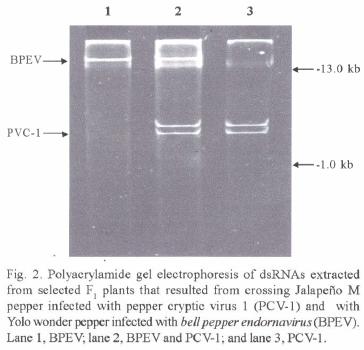
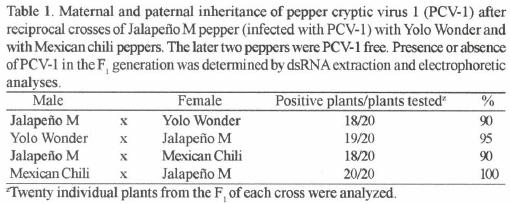
<body><![CDATA[<p align="justify"><font face="verdana" size="2">Partial results of the dsRNA PCV&#150;1 screening of 50 seedlings of JM are shown in <a href="#f1">Figure 1</a>. The phenotype of JM&#150;N was indistinguishable from JM&#150;P. Evaluations of plant growth habit and fruit shape<b>, </b>size, and color did not result in differences. Fruit yield (number and weight per plant) did not show significant differences in both lines. </font></p>     <p align="center"><font face="verdana" size="2"><a name="f1"></a></font></p>     <p align="center"><font face="verdana" size="2"><img src="/img/revistas/rmfi/v26n1/a1f1.jpg"></font></p>     <p align="justify"><font face="verdana" size="2"><b>Transmission experiments. </b>Graft transmission experiments were successful for CMV and TEV. Typical symptoms caused by these viruses on pepper were observed on all the JM&#150;N scions one month after grafting. However. dsRNA analyzes of these scions, did not yield PCV&#150;1 dsRNA. Electrophoretic analyses of dsRNAs clearly identified the presence or absence of PCV&#150;1 dsRNA or YW dsRNA in the F<sub>1</sub>, plants that resulted from pollen and ovule transmission experiments (<a href="#f2">Fig. 2</a>). Results of transmission experiments are shown in <a href="#t1">Table 1</a>. PC V&#150;1 dsRNA was transmitted both paternally and maternally. Slightly higher levels of transmission were obtained through the ovule than through pollen.</font></p>     <p align="center"><font face="verdana" size="2"><a name="f2"></a></font></p>     <p align="center"><font face="verdana" size="2"><img src="/img/revistas/rmfi/v26n1/a1f2.jpg"></font></p>     <p align="center"><font face="verdana" size="2"><a name="t1"></a></font></p>     <p align="center"><font face="verdana" size="2"><img src="/img/revistas/rmfi/v26n1/a1t1.jpg"></font></p>     <p align="justify"><font face="verdana" size="2"><b>Natural infection by CMV. </b>Natural infections by CMV and CMV satellite RNA were clearly and consistently detected by PAGE analyses of extracted dsRNA (<a href="#f3">Fig. 3</a>). After two months, approximately 80% of the plants of both lines were infected with CMV and CMV satellite RNA (<a href="#t2">Table 2</a>). Symptoms caused by CMV or CMV satellite RNA in both lines were undistinguishable. The symptoms consisted of mild foliar mosaic. Phenotypical differences between the tw o lines were not observed under field conditions. </font></p>     <p align="center"><font face="verdana" size="2"><a name="f3"></a></font></p>     ]]></body>
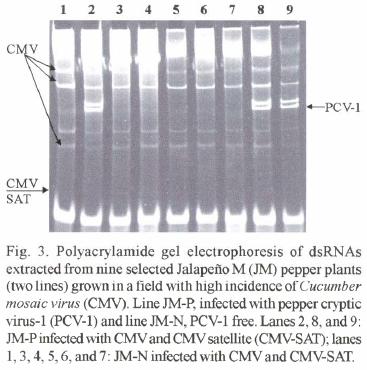
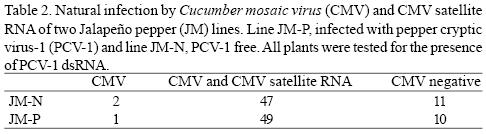
<body><![CDATA[<p align="center"><font face="verdana" size="2"><img src="/img/revistas/rmfi/v26n1/a1f3.jpg"></font></p>     <p align="center"><font face="verdana" size="2"><a name="t2"></a></font></p>     <p align="center"><font face="verdana" size="2"><img src="/img/revistas/rmfi/v26n1/a1t2.jpg"></font></p>     <p align="justify"><font face="verdana" size="2"><b>Clones and sequence analyses. </b>Three overlapping cDNA clones, J&#150;30 (481 bp), J&#150;64 (160 bp), and J&#150;84 (783 bp) were sequenced. The region included in these clones (1069 bp) (GenBank accession No. DQ361008) contained an open reading frame predicted to encode a protein of 311 amino acids. A BLASTP search of the Uniprot database using derived amino acid sequences from this sequence resulted in significant similarity with predicted RNA&#150;dependent RNA polymerase (RdRp) encoded by a plant virus member of the genus <i>Alphacryptavirus</i>and four putative plant partitiviruses. The highest scores were obtained with the RdRp encoded by a putative partitivirus from Japanese pear <i>(Pyrus pyrifolia virus) </i>(PPV, Q9ZWP7, 58% identity) (Osaki <i>et al., </i>1998) followed by the alphacryptovirus <i>Beet cryptic virus </i>3 (BC V&#150;3, Q86632,54% identity) (Xie <i>et al., </i>1993), and three putative partitiviruses: <i>Pinus sylvestris cryptic virus </i>(PSC V Q3ZDC6. 45% identity) (Veliceasa <i>et al., </i>2006), <i>Fragaria chiloensis cryptic virus </i>(FCCV, Q4FCM7, 38% identity) (Tzanetakis and Martin, 2005) and <i>Raphanus sativus cryptic virus </i>2 (RSCV&#150;2, Q38L14, 37% identity) (Chen <i>et al, </i>2006). Lower percentages were obtained with RdRp of fungal viruses (Fam. <i>Partitiviridae, </i>genus <i>Partitivirus) </i>including: <i>Penicillium stoloniferum virus F </i>(Q4G3H2, 26% identity), <i>Mycovirus FusoV </i>(Q83328, 26% identity), <i>Discula destructive virus </i>2 (Q91HI8, 26% identity) and <i>Gremmeniella abietina RNA virus MS2 </i>(Q6GYB9, 24% identity). A Phylogram derived from the multiple alignments is shown in <a href="#f4">Figure 4</a>. A 292 amino acid sequence of the putative RdRp region of PCV&#150;1 was aligned with corresponding sequences of BCV&#150;3 and three putative plant partitiviruses (<a href="/img/revistas/rmfi/v26n1/a1f5.jpg" target="_blank">Fig. 5</a>). Five conserved motifs were identified.</font></p>     <p align="center"><font face="verdana" size="2"><a name="f4"></a></font></p>     <p align="center"><font face="verdana" size="2"><img src="/img/revistas/rmfi/v26n1/a1f4.jpg"></font></p>     <p align="justify"><font face="verdana" size="2">&nbsp;</font></p>     <p align="justify"><font face="verdana" size="2"><b>DISCUSSION</b></font></p>     <p align="justify"><font face="verdana" size="2">Plant partitiviruses are transmitted only by seed (ovule and pollen). They are not graft transmissible because they are unable to move from cell to cell (Boccardo <i>et al., </i>1987; Ghabrial <i>et al., </i>2005). Biological and molecular properties of PCV&#150;1 revealed similarities with plant partitiviruses. Attempts have been made to transmit plant partitiviruses from infected cultivars, however, in most cases different cultivars were targeted for transmission. Past attempts to transmit plant partitiviruses by graft inoculations did not test the possibility of a "helper effect" using conventional plant viruses (Boccardo <i>et al., </i>1987). Results of graft inoculation experiments suggest that PCV&#150;1 is not graft transmissible to a virus free line of the same pepper cultivar and that CMV or TEV infections do not assist the transmission. Pollen and ovule transmission studies conducted here confirmed a preliminary report on the transmission of PCV&#150;1 (Arancibia and Valverde, 1995). Transmission rates were similar to those obtained with endornaviruses of rice and pepper (Horiuchi <i>et al, </i>2003; Valverde and Gutierrez, 2007) which like the partitiviruses, accumulate in the cytoplasm. Although, transmission rates of PCV&#150;1 through pollen (90%) were higher than the 30% rate reported by Arancibia and Valverde (1995). The reason for this discrepancy could be due to the fact that earlier transmission studies were conducted by crossing JM&#150;P plants with pepper plants belonging to horticultural pepper types different from the ones used in this investigation. Natural infections of JM pepper by CMV and CMV satellite RNA did not appear to be affected by the absence or presence of PCV&#150;1. Although not quantified, dsRNA levels of both, CMV and CMV satellite did not appear to be affected by the presence of PCV&#150;1. Similarly, the presence of CMV and CMV satellite did not seem to affect the dsRNA yields of PCV&#150;1. Differences in host reaction between the two lines were not observed with natural infections with CMV as in previous studies with mechanical inoculations with conventional viruses (Arancibia and Valverde, 1995). Multiple alignments of the conserved RdRp of PCV&#150;1 and four putative partitiviruses (PPV, FCCV, PSCV, and RSCV&#150;2), one alphacryptovirus (BCV&#150;3) and four fungal partitiviruses, resulted in a higher percentage of similarity to plant partitiviruses than to fungal partitiviruses. This is illustrated with the unrooted phylogram (<a href="#f4">Fig. 4</a>). However, it has been reported that two plant partitiviruses <i>(White clover cryptic virus </i>1 and RSCV&#150;2) have higher similarity to fungal viruses (Boccardo and Candresse, 2005; Chen <i>et al., </i>2006). This supports the suggestion that the taxonomic status of the plant partitiviruses needs to be reevaluated (Veliceasa <i>et al., </i>2006). The availability of more sequence information and biological properties of these viruses will help to clarify the taxonomic status of several putative partitiviruses. It has been shown that hypoviruses and endornaviruses can affect the physiology of the host (Gibbs <i>et al, </i>2005; Nuss <i>et al, </i>2005). Recently, Marquez <i>et al. </i>(2007) reported that a mutualistic interaction between a fungal endophyte <i>(Curvularia protuberata </i>Nelson and Hodges) and a tropical panic grass <i>&#91;Dichanhtelium lanuginosum </i>(Elliott) Gould&#93; allows both organisms to grow at high temperatures. <i>Curvularia </i>thermal tolerance virus, a putative <i>Partitivirus </i>infecting <i>C. protuberata </i>played a key role in conferring the heat tolerance to <i>D. lanuginosum. </i>Whether plant partitiviruses (alphacryptoviruses and betacryptoviruses) can provide beneficial adaptative traits such as pathogen tolerance or tolerance to extreme environments remains to be investigated. Comparative studies on the effect of plant partitiviruses in plants have not been possible due to the inability to infect plants with these viruses and the lack of plant lines of the same cultivar free of the virus. Although we obtained a virus&#150;free line of JM (JM&#150;N) and conducted limited experiments and preliminary observations, we have failed to demonstrate an effect. Further comparative and quantitative studies with these two lines need to be conducted.</font></p>     <p align="justify"><font face="verdana" size="2">&nbsp;</font></p>     ]]></body>
<body><![CDATA[<p align="justify"><font face="verdana" size="2"><b>ACKNOWLEDGMENTS</b></font></p>     <p align="justify"><font face="verdana" size="2">The authors wish to dedicate this article to the memory of Dr. Francis Can who conducted the field experiments.</font></p>     <p align="justify"><font face="verdana" size="2">&nbsp;</font></p>     <p align="justify"><font face="verdana" size="2"><b>LITERATURE CUED</b></font></p>     <!-- ref --><p align="justify"><font face="verdana" size="2">Altschul, S.F., Madden, T.L., Schaffer, A.A., Zhang, J., Zhang, Z., Miller, W., and Lipmann, D.J. 1997. Gapped BLAST and PSI&#150;BLAST: a new generation of protein database search programs. Nucleic Acids Research 25:3389&#150;3402.    &nbsp;&nbsp;&nbsp;&nbsp;&nbsp;&nbsp;&nbsp;&nbsp;[&#160;<a href="javascript:void(0);" onclick="javascript: window.open('/scielo.php?script=sci_nlinks&ref=8522393&pid=S0185-3309200800010000100001&lng=','','width=640,height=500,resizable=yes,scrollbars=1,menubar=yes,');">Links</a>&#160;]<!-- end-ref --></font></p>     <!-- ref --><p align="justify"><font face="verdana" size="2">Arancibia, R.A., and Valverde, R.A. 1995 A cryptic virus from pepper. Plant Pathology 44:164&#150;168.    &nbsp;&nbsp;&nbsp;&nbsp;&nbsp;&nbsp;&nbsp;&nbsp;[&#160;<a href="javascript:void(0);" onclick="javascript: window.open('/scielo.php?script=sci_nlinks&ref=8522395&pid=S0185-3309200800010000100002&lng=','','width=640,height=500,resizable=yes,scrollbars=1,menubar=yes,');">Links</a>&#160;]<!-- end-ref --></font></p>     <!-- ref --><p align="justify"><font face="verdana" size="2">Boccardo, G., and Candresse, T. 2005. Complete sequence of the RNA2 of an isolate of <i>White clover cryptic virus 1, </i>type species of the genus <i>Alphacryptovirus. </i>Archives of Virology 150:403&#150;405.    &nbsp;&nbsp;&nbsp;&nbsp;&nbsp;&nbsp;&nbsp;&nbsp;[&#160;<a href="javascript:void(0);" onclick="javascript: window.open('/scielo.php?script=sci_nlinks&ref=8522397&pid=S0185-3309200800010000100003&lng=','','width=640,height=500,resizable=yes,scrollbars=1,menubar=yes,');">Links</a>&#160;]<!-- end-ref --></font></p>     ]]></body>
<body><![CDATA[<!-- ref --><p align="justify"><font face="verdana" size="2">Boccardo, G, Lisa, V, Luisoni, E., and Milne, R.G. 1987. Cryptic plant viruses. Advances in Virus Research 32:171&#150;214.    &nbsp;&nbsp;&nbsp;&nbsp;&nbsp;&nbsp;&nbsp;&nbsp;[&#160;<a href="javascript:void(0);" onclick="javascript: window.open('/scielo.php?script=sci_nlinks&ref=8522399&pid=S0185-3309200800010000100004&lng=','','width=640,height=500,resizable=yes,scrollbars=1,menubar=yes,');">Links</a>&#160;]<!-- end-ref --></font></p>     <!-- ref --><p align="justify"><font face="verdana" size="2">Chen, L., Chen, J.S., Liu, L., Yu, X., Yu, S., Fu, T.Z., and Liu, W.H. 2006. Complete nucleotide sequences of three dsRNA segments from <i>Raphanus sativus&#150;root cv. </i>Yipinghong. Archives of Virology 151:2077&#150;2083.    &nbsp;&nbsp;&nbsp;&nbsp;&nbsp;&nbsp;&nbsp;&nbsp;[&#160;<a href="javascript:void(0);" onclick="javascript: window.open('/scielo.php?script=sci_nlinks&ref=8522401&pid=S0185-3309200800010000100005&lng=','','width=640,height=500,resizable=yes,scrollbars=1,menubar=yes,');">Links</a>&#160;]<!-- end-ref --></font></p>     <!-- ref --><p align="justify"><font face="verdana" size="2">Chenna, R., Sugawara, H., Koike, T., Lopez, R., Gibson, T.J., Higgins, D.G., and Thompson, J.D. 2003. Multiple sequence alignment with the Clustal series of programs. Nucleic Acids Research 31:3497&#150;3500.    &nbsp;&nbsp;&nbsp;&nbsp;&nbsp;&nbsp;&nbsp;&nbsp;[&#160;<a href="javascript:void(0);" onclick="javascript: window.open('/scielo.php?script=sci_nlinks&ref=8522403&pid=S0185-3309200800010000100006&lng=','','width=640,height=500,resizable=yes,scrollbars=1,menubar=yes,');">Links</a>&#160;]<!-- end-ref --></font></p>     <!-- ref --><p align="justify"><font face="verdana" size="2">Dodds, J.A., Morris, T.J., and Jordan, R.L. 1984. Plant viral double&#150;stranded RNA. Annual Review of Phytopathology 22:151&#150;168.    &nbsp;&nbsp;&nbsp;&nbsp;&nbsp;&nbsp;&nbsp;&nbsp;[&#160;<a href="javascript:void(0);" onclick="javascript: window.open('/scielo.php?script=sci_nlinks&ref=8522405&pid=S0185-3309200800010000100007&lng=','','width=640,height=500,resizable=yes,scrollbars=1,menubar=yes,');">Links</a>&#160;]<!-- end-ref --></font></p>     <!-- ref --><p align="justify"><font face="verdana" size="2">Fukuhara, T., Moga, R., Aoki, N., Yuki, C., Yamamoto, N., Oyama, N., Udagawa, T., Horiuchi, H., Miyazaki, S., Higashi, Y., Takeshita, M., Ikeda, K., Arakawa, M., Matsumoto, N., and Moriyama, H. 2006. The wide distribution of endornaviruses. Archives of Virology 151:995&#150;1002.    &nbsp;&nbsp;&nbsp;&nbsp;&nbsp;&nbsp;&nbsp;&nbsp;[&#160;<a href="javascript:void(0);" onclick="javascript: window.open('/scielo.php?script=sci_nlinks&ref=8522407&pid=S0185-3309200800010000100008&lng=','','width=640,height=500,resizable=yes,scrollbars=1,menubar=yes,');">Links</a>&#160;]<!-- end-ref --></font></p>     ]]></body>
<body><![CDATA[<!-- ref --><p align="justify"><font face="verdana" size="2">Ghabrial, S.A., Buck, K.W., Hillman, B.I., and Milne, R.G 2005. Family <i>Partitiviridae. </i>pp. 581&#150;590. In: C.M. Fauquet, M.A. Mayo, J. Maniloff, U. Desselberger, and L.A. Ball (eds.). Virus Taxonomy, VIIIth Report of the International Committee on Taxonomy of Viruses. Elsevier/Academic Press. London, UK. 1259 p.    &nbsp;&nbsp;&nbsp;&nbsp;&nbsp;&nbsp;&nbsp;&nbsp;[&#160;<a href="javascript:void(0);" onclick="javascript: window.open('/scielo.php?script=sci_nlinks&ref=8522409&pid=S0185-3309200800010000100009&lng=','','width=640,height=500,resizable=yes,scrollbars=1,menubar=yes,');">Links</a>&#160;]<!-- end-ref --></font></p>     <!-- ref --><p align="justify"><font face="verdana" size="2">Gibbs, M., Pfeiffer, P., and Fukuhara, T. 2005. Genus <i>Endornavirus. </i>pp. 603&#150;605. In: C.M. Fauquet, M.A. Mayo, J. Maniloff, U. Desselberger, and L.A. Ball (eds.). Virus Taxonomy, VIIIth Report of the International Committee on Taxonomy of Viruses. Elsevier/Academic Press. London, UK. 1259 p.    &nbsp;&nbsp;&nbsp;&nbsp;&nbsp;&nbsp;&nbsp;&nbsp;[&#160;<a href="javascript:void(0);" onclick="javascript: window.open('/scielo.php?script=sci_nlinks&ref=8522411&pid=S0185-3309200800010000100010&lng=','','width=640,height=500,resizable=yes,scrollbars=1,menubar=yes,');">Links</a>&#160;]<!-- end-ref --> </font></p>     <!-- ref --><p align="justify"><font face="verdana" size="2">Horiuchi, H., Moriyama, H., and Fukuhara, T. 2003. Inheritance of <i>Oryza sativa endornavirus </i>in F1 and F2 hybrids between <i>japonica </i>and <i>indica </i>rice. Genes and Genetic Systems 78:229&#150;234.    &nbsp;&nbsp;&nbsp;&nbsp;&nbsp;&nbsp;&nbsp;&nbsp;[&#160;<a href="javascript:void(0);" onclick="javascript: window.open('/scielo.php?script=sci_nlinks&ref=8522413&pid=S0185-3309200800010000100011&lng=','','width=640,height=500,resizable=yes,scrollbars=1,menubar=yes,');">Links</a>&#160;]<!-- end-ref --></font></p>     <!-- ref --><p align="justify"><font face="verdana" size="2">Marquez, L.M., Redman, R., Rodr&iacute;guez, R.J., and Roossinck, M.J. 2007. A virus in a fungus in a plant: three&#150;way symbiosis required for thermal tolerance. Science 315:513&#150;515.    &nbsp;&nbsp;&nbsp;&nbsp;&nbsp;&nbsp;&nbsp;&nbsp;[&#160;<a href="javascript:void(0);" onclick="javascript: window.open('/scielo.php?script=sci_nlinks&ref=8522415&pid=S0185-3309200800010000100012&lng=','','width=640,height=500,resizable=yes,scrollbars=1,menubar=yes,');">Links</a>&#160;]<!-- end-ref --></font></p>     <!-- ref --><p align="justify"><font face="verdana" size="2">Nuss, D.L., Hillman, B.I., Rigling, D., and Suzuki, N. 2005. Family <i>Hypoviridae. </i>pp. 597&#150;601. In: C.M. Fauquet, M.A. Mayo, J. Maniloff, U. Desselberger, and L.A. Ball (eds.). Virus Taxonomy, VIIIth Report of the International Committee on Taxonomy of Viruses. Elsevier/Academic Press. London, UK. 1259 p.    &nbsp;&nbsp;&nbsp;&nbsp;&nbsp;&nbsp;&nbsp;&nbsp;[&#160;<a href="javascript:void(0);" onclick="javascript: window.open('/scielo.php?script=sci_nlinks&ref=8522417&pid=S0185-3309200800010000100013&lng=','','width=640,height=500,resizable=yes,scrollbars=1,menubar=yes,');">Links</a>&#160;]<!-- end-ref --></font></p>     ]]></body>
<body><![CDATA[<!-- ref --><p align="justify"><font face="verdana" size="2">Osaki, H., Kudo, A., and Ohtsu, Y. 1998. Nucleotide sequence of seed&#150;and pollen&#150;transmitted double&#150;stranded RNA which encodes a putative RNA&#150;dependent RNA polymerase, detected from Japanese pear. Bioscience, Biotechnology and Biochemistry 62:2101&#150;2106.    &nbsp;&nbsp;&nbsp;&nbsp;&nbsp;&nbsp;&nbsp;&nbsp;[&#160;<a href="javascript:void(0);" onclick="javascript: window.open('/scielo.php?script=sci_nlinks&ref=8522419&pid=S0185-3309200800010000100014&lng=','','width=640,height=500,resizable=yes,scrollbars=1,menubar=yes,');">Links</a>&#160;]<!-- end-ref --></font></p>     <!-- ref --><p align="justify"><font face="verdana" size="2">Smith, P.G., Villalon, B., and Villa, P.L. 1987. Horticultural classification of peppers grown in the United States. HortScience 22:11&#150;13.    &nbsp;&nbsp;&nbsp;&nbsp;&nbsp;&nbsp;&nbsp;&nbsp;[&#160;<a href="javascript:void(0);" onclick="javascript: window.open('/scielo.php?script=sci_nlinks&ref=8522421&pid=S0185-3309200800010000100015&lng=','','width=640,height=500,resizable=yes,scrollbars=1,menubar=yes,');">Links</a>&#160;]<!-- end-ref --></font></p>     <!-- ref --><p align="justify"><font face="verdana" size="2">Tzanetakis, I.E., and Martin, R.R. 2005. <i>Fragaria chiloensis cryptic virus: </i>A new strawberry virus found in <i>Fragaria chiloensis </i>from Chile. Plant Disease 89:1241.    &nbsp;&nbsp;&nbsp;&nbsp;&nbsp;&nbsp;&nbsp;&nbsp;[&#160;<a href="javascript:void(0);" onclick="javascript: window.open('/scielo.php?script=sci_nlinks&ref=8522423&pid=S0185-3309200800010000100016&lng=','','width=640,height=500,resizable=yes,scrollbars=1,menubar=yes,');">Links</a>&#160;]<!-- end-ref --></font></p>     <!-- ref --><p align="justify"><font face="verdana" size="2">Valverde, R.A., and Gutierrez, D.L. 2007. Transmission of a dsRNA in bell pepper and evidence that it consists of the genome of an endornavirus. Virus Genes 35:399&#150;403.    &nbsp;&nbsp;&nbsp;&nbsp;&nbsp;&nbsp;&nbsp;&nbsp;[&#160;<a href="javascript:void(0);" onclick="javascript: window.open('/scielo.php?script=sci_nlinks&ref=8522425&pid=S0185-3309200800010000100017&lng=','','width=640,height=500,resizable=yes,scrollbars=1,menubar=yes,');">Links</a>&#160;]<!-- end-ref --></font></p>     <!-- ref --><p align="justify"><font face="verdana" size="2">Valverde, R.A., Nameth, S.T., and Jordan, R.L. 1990. Analysis of double&#150;stranded RNA for plant virus diagnosis. Plant Disease 74:255&#150;258.    &nbsp;&nbsp;&nbsp;&nbsp;&nbsp;&nbsp;&nbsp;&nbsp;[&#160;<a href="javascript:void(0);" onclick="javascript: window.open('/scielo.php?script=sci_nlinks&ref=8522427&pid=S0185-3309200800010000100018&lng=','','width=640,height=500,resizable=yes,scrollbars=1,menubar=yes,');">Links</a>&#160;]<!-- end-ref --></font></p>     ]]></body>
<body><![CDATA[<!-- ref --><p align="justify"><font face="verdana" size="2">Veliceasa, D., Enunlu, N., Kos, P.B., Koster, S., Beuther, E., Morgun, B., Deshmukh, S.D., and Lukacs, N. 2006. Searching for a new putative cryptic virus in <i>Pinus sylvestris </i>L. Virus Genes 32:177&#150;186.    &nbsp;&nbsp;&nbsp;&nbsp;&nbsp;&nbsp;&nbsp;&nbsp;[&#160;<a href="javascript:void(0);" onclick="javascript: window.open('/scielo.php?script=sci_nlinks&ref=8522429&pid=S0185-3309200800010000100019&lng=','','width=640,height=500,resizable=yes,scrollbars=1,menubar=yes,');">Links</a>&#160;]<!-- end-ref --></font></p>     <!-- ref --><p align="justify"><font face="verdana" size="2">Xie, W.S., Antoniw, J.F., and White, R.F. 1993. Nucleotide sequence of <i>beet cryptic virus </i>3 dsRNA2 which encodes a putative RNA&#150;dependent RNA polymerase. Journal of General Virology 74:1467&#150;1470.    &nbsp;&nbsp;&nbsp;&nbsp;&nbsp;&nbsp;&nbsp;&nbsp;[&#160;<a href="javascript:void(0);" onclick="javascript: window.open('/scielo.php?script=sci_nlinks&ref=8522431&pid=S0185-3309200800010000100020&lng=','','width=640,height=500,resizable=yes,scrollbars=1,menubar=yes,');">Links</a>&#160;]<!-- end-ref --></font></p>      ]]></body><back>
<ref-list>
<ref id="B1">
<nlm-citation citation-type="journal">
<person-group person-group-type="author">
<name>
<surname><![CDATA[Altschul]]></surname>
<given-names><![CDATA[S.F]]></given-names>
</name>
<name>
<surname><![CDATA[Madden]]></surname>
<given-names><![CDATA[T.L]]></given-names>
</name>
<name>
<surname><![CDATA[Schaffer]]></surname>
<given-names><![CDATA[A.A]]></given-names>
</name>
<name>
<surname><![CDATA[Zhang]]></surname>
<given-names><![CDATA[J]]></given-names>
</name>
<name>
<surname><![CDATA[Zhang]]></surname>
<given-names><![CDATA[Z]]></given-names>
</name>
<name>
<surname><![CDATA[Miller]]></surname>
<given-names><![CDATA[W]]></given-names>
</name>
<name>
<surname><![CDATA[Lipmann]]></surname>
<given-names><![CDATA[D.J]]></given-names>
</name>
</person-group>
<article-title xml:lang="en"><![CDATA[Gapped BLAST and PSI-BLAST: a new generation of protein database search programs]]></article-title>
<source><![CDATA[Nucleic Acids Research]]></source>
<year>1997</year>
<volume>25</volume>
<page-range>3389-3402</page-range></nlm-citation>
</ref>
<ref id="B2">
<nlm-citation citation-type="journal">
<person-group person-group-type="author">
<name>
<surname><![CDATA[Arancibia]]></surname>
<given-names><![CDATA[R.A]]></given-names>
</name>
<name>
<surname><![CDATA[Valverde]]></surname>
<given-names><![CDATA[R.A]]></given-names>
</name>
</person-group>
<article-title xml:lang="en"><![CDATA[A cryptic virus from pepper]]></article-title>
<source><![CDATA[Plant Pathology]]></source>
<year>1995</year>
<volume>44</volume>
<page-range>164-168</page-range></nlm-citation>
</ref>
<ref id="B3">
<nlm-citation citation-type="journal">
<person-group person-group-type="author">
<name>
<surname><![CDATA[Boccardo]]></surname>
<given-names><![CDATA[G]]></given-names>
</name>
<name>
<surname><![CDATA[Candresse]]></surname>
<given-names><![CDATA[T]]></given-names>
</name>
</person-group>
<article-title xml:lang="en"><![CDATA[Complete sequence of the RNA2 of an isolate of White clover cryptic virus 1, type species of the genus Alphacryptovirus]]></article-title>
<source><![CDATA[Archives of Virology]]></source>
<year>2005</year>
<volume>150</volume>
<page-range>403-405</page-range></nlm-citation>
</ref>
<ref id="B4">
<nlm-citation citation-type="journal">
<person-group person-group-type="author">
<name>
<surname><![CDATA[Boccardo]]></surname>
<given-names><![CDATA[G]]></given-names>
</name>
<name>
<surname><![CDATA[Lisa]]></surname>
<given-names><![CDATA[V]]></given-names>
</name>
<name>
<surname><![CDATA[Luisoni]]></surname>
<given-names><![CDATA[E]]></given-names>
</name>
<name>
<surname><![CDATA[Milne]]></surname>
<given-names><![CDATA[R.G]]></given-names>
</name>
</person-group>
<article-title xml:lang="en"><![CDATA[Cryptic plant viruses]]></article-title>
<source><![CDATA[Advances in Virus Research]]></source>
<year>1987</year>
<volume>32</volume>
<page-range>171-214</page-range></nlm-citation>
</ref>
<ref id="B5">
<nlm-citation citation-type="journal">
<person-group person-group-type="author">
<name>
<surname><![CDATA[Chen]]></surname>
<given-names><![CDATA[L]]></given-names>
</name>
<name>
<surname><![CDATA[Chen]]></surname>
<given-names><![CDATA[J.S]]></given-names>
</name>
<name>
<surname><![CDATA[Liu]]></surname>
<given-names><![CDATA[L]]></given-names>
</name>
<name>
<surname><![CDATA[Yu]]></surname>
<given-names><![CDATA[X]]></given-names>
</name>
<name>
<surname><![CDATA[Yu]]></surname>
<given-names><![CDATA[S]]></given-names>
</name>
<name>
<surname><![CDATA[Fu]]></surname>
<given-names><![CDATA[T.Z]]></given-names>
</name>
<name>
<surname><![CDATA[Liu]]></surname>
<given-names><![CDATA[W.H]]></given-names>
</name>
</person-group>
<article-title xml:lang="en"><![CDATA[Complete nucleotide sequences of three dsRNA segments from Raphanus sativus-root cv. Yipinghong]]></article-title>
<source><![CDATA[Archives of Virology]]></source>
<year>2006</year>
<volume>151</volume>
<page-range>2077-2083</page-range></nlm-citation>
</ref>
<ref id="B6">
<nlm-citation citation-type="journal">
<person-group person-group-type="author">
<name>
<surname><![CDATA[Chenna]]></surname>
<given-names><![CDATA[R]]></given-names>
</name>
<name>
<surname><![CDATA[Sugawara]]></surname>
<given-names><![CDATA[H]]></given-names>
</name>
<name>
<surname><![CDATA[Koike]]></surname>
<given-names><![CDATA[T]]></given-names>
</name>
<name>
<surname><![CDATA[Lopez]]></surname>
<given-names><![CDATA[R]]></given-names>
</name>
<name>
<surname><![CDATA[Gibson]]></surname>
<given-names><![CDATA[T.J]]></given-names>
</name>
<name>
<surname><![CDATA[Higgins]]></surname>
<given-names><![CDATA[D.G]]></given-names>
</name>
<name>
<surname><![CDATA[Thompson]]></surname>
<given-names><![CDATA[J.D]]></given-names>
</name>
</person-group>
<article-title xml:lang="en"><![CDATA[Multiple sequence alignment with the Clustal series of programs]]></article-title>
<source><![CDATA[Nucleic Acids Research]]></source>
<year>2003</year>
<volume>31</volume>
<page-range>3497-3500</page-range></nlm-citation>
</ref>
<ref id="B7">
<nlm-citation citation-type="journal">
<person-group person-group-type="author">
<name>
<surname><![CDATA[Dodds]]></surname>
<given-names><![CDATA[J.A]]></given-names>
</name>
<name>
<surname><![CDATA[Morris]]></surname>
<given-names><![CDATA[T.J]]></given-names>
</name>
<name>
<surname><![CDATA[Jordan]]></surname>
<given-names><![CDATA[R.L]]></given-names>
</name>
</person-group>
<article-title xml:lang="en"><![CDATA[Plant viral double-stranded RNA]]></article-title>
<source><![CDATA[Annual Review of Phytopathology]]></source>
<year>1984</year>
<volume>22</volume>
<page-range>151-168</page-range></nlm-citation>
</ref>
<ref id="B8">
<nlm-citation citation-type="journal">
<person-group person-group-type="author">
<name>
<surname><![CDATA[Fukuhara]]></surname>
<given-names><![CDATA[T]]></given-names>
</name>
<name>
<surname><![CDATA[Moga]]></surname>
<given-names><![CDATA[R]]></given-names>
</name>
<name>
<surname><![CDATA[Aoki]]></surname>
<given-names><![CDATA[N]]></given-names>
</name>
<name>
<surname><![CDATA[Yuki]]></surname>
<given-names><![CDATA[C]]></given-names>
</name>
<name>
<surname><![CDATA[Yamamoto]]></surname>
<given-names><![CDATA[N]]></given-names>
</name>
<name>
<surname><![CDATA[Oyama]]></surname>
<given-names><![CDATA[N]]></given-names>
</name>
<name>
<surname><![CDATA[Udagawa]]></surname>
<given-names><![CDATA[T]]></given-names>
</name>
<name>
<surname><![CDATA[Horiuchi]]></surname>
<given-names><![CDATA[H]]></given-names>
</name>
<name>
<surname><![CDATA[Miyazaki]]></surname>
<given-names><![CDATA[S]]></given-names>
</name>
<name>
<surname><![CDATA[Higashi]]></surname>
<given-names><![CDATA[Y]]></given-names>
</name>
<name>
<surname><![CDATA[Takeshita]]></surname>
<given-names><![CDATA[M]]></given-names>
</name>
<name>
<surname><![CDATA[Ikeda]]></surname>
<given-names><![CDATA[K]]></given-names>
</name>
<name>
<surname><![CDATA[Arakawa]]></surname>
<given-names><![CDATA[M]]></given-names>
</name>
<name>
<surname><![CDATA[Matsumoto]]></surname>
<given-names><![CDATA[N]]></given-names>
</name>
<name>
<surname><![CDATA[Moriyama]]></surname>
<given-names><![CDATA[H]]></given-names>
</name>
</person-group>
<article-title xml:lang="en"><![CDATA[The wide distribution of endornaviruses]]></article-title>
<source><![CDATA[Archives of Virology]]></source>
<year>2006</year>
<volume>151</volume>
<page-range>995-1002</page-range></nlm-citation>
</ref>
<ref id="B9">
<nlm-citation citation-type="book">
<person-group person-group-type="author">
<name>
<surname><![CDATA[Ghabrial]]></surname>
<given-names><![CDATA[S.A]]></given-names>
</name>
<name>
<surname><![CDATA[Buck]]></surname>
<given-names><![CDATA[K.W]]></given-names>
</name>
<name>
<surname><![CDATA[Hillman]]></surname>
<given-names><![CDATA[B.I]]></given-names>
</name>
<name>
<surname><![CDATA[Milne]]></surname>
<given-names><![CDATA[R.G]]></given-names>
</name>
</person-group>
<article-title xml:lang="en"><![CDATA[Family Partitiviridae]]></article-title>
<person-group person-group-type="editor">
<name>
<surname><![CDATA[Fauquet]]></surname>
<given-names><![CDATA[C.M]]></given-names>
</name>
<name>
<surname><![CDATA[Mayo]]></surname>
<given-names><![CDATA[M.A]]></given-names>
</name>
<name>
<surname><![CDATA[Maniloff]]></surname>
<given-names><![CDATA[J]]></given-names>
</name>
<name>
<surname><![CDATA[Desselberger]]></surname>
<given-names><![CDATA[U]]></given-names>
</name>
<name>
<surname><![CDATA[Ball]]></surname>
<given-names><![CDATA[L.A]]></given-names>
</name>
</person-group>
<source><![CDATA[Virus Taxonomy, VIIIth Report of the International Committee on Taxonomy of Viruses]]></source>
<year>2005</year>
<page-range>581-590</page-range><page-range>1259</page-range><publisher-loc><![CDATA[London ]]></publisher-loc>
<publisher-name><![CDATA[ElsevierAcademic Press]]></publisher-name>
</nlm-citation>
</ref>
<ref id="B10">
<nlm-citation citation-type="book">
<person-group person-group-type="author">
<name>
<surname><![CDATA[Gibbs]]></surname>
<given-names><![CDATA[M]]></given-names>
</name>
<name>
<surname><![CDATA[Pfeiffer]]></surname>
<given-names><![CDATA[P]]></given-names>
</name>
<name>
<surname><![CDATA[Fukuhara]]></surname>
<given-names><![CDATA[T]]></given-names>
</name>
</person-group>
<article-title xml:lang="en"><![CDATA[Genus Endornavirus]]></article-title>
<person-group person-group-type="editor">
<name>
<surname><![CDATA[Fauquet]]></surname>
<given-names><![CDATA[C.M]]></given-names>
</name>
<name>
<surname><![CDATA[Mayo]]></surname>
<given-names><![CDATA[M.A]]></given-names>
</name>
<name>
<surname><![CDATA[Maniloff]]></surname>
<given-names><![CDATA[J]]></given-names>
</name>
<name>
<surname><![CDATA[Desselberger]]></surname>
<given-names><![CDATA[U]]></given-names>
</name>
<name>
<surname><![CDATA[Ball]]></surname>
<given-names><![CDATA[L.A]]></given-names>
</name>
</person-group>
<source><![CDATA[Virus Taxonomy: VIIIth Report of the International Committee on Taxonomy of Viruses]]></source>
<year>2005</year>
<page-range>603-605</page-range><page-range>1259</page-range><publisher-loc><![CDATA[London ]]></publisher-loc>
<publisher-name><![CDATA[ElsevierAcademic Press]]></publisher-name>
</nlm-citation>
</ref>
<ref id="B11">
<nlm-citation citation-type="journal">
<person-group person-group-type="author">
<name>
<surname><![CDATA[Horiuchi]]></surname>
<given-names><![CDATA[H]]></given-names>
</name>
<name>
<surname><![CDATA[Moriyama]]></surname>
<given-names><![CDATA[H]]></given-names>
</name>
<name>
<surname><![CDATA[Fukuhara]]></surname>
<given-names><![CDATA[T]]></given-names>
</name>
</person-group>
<article-title xml:lang="en"><![CDATA[Inheritance of Oryza sativa endornavirus in F1 and F2 hybrids between japonica and indica rice]]></article-title>
<source><![CDATA[Genes and Genetic Systems]]></source>
<year>2003</year>
<volume>78</volume>
<page-range>229-234</page-range></nlm-citation>
</ref>
<ref id="B12">
<nlm-citation citation-type="journal">
<person-group person-group-type="author">
<name>
<surname><![CDATA[Marquez]]></surname>
<given-names><![CDATA[L.M]]></given-names>
</name>
<name>
<surname><![CDATA[Redman]]></surname>
<given-names><![CDATA[R]]></given-names>
</name>
<name>
<surname><![CDATA[Rodríguez]]></surname>
<given-names><![CDATA[R.J]]></given-names>
</name>
<name>
<surname><![CDATA[Roossinck]]></surname>
<given-names><![CDATA[M.J]]></given-names>
</name>
</person-group>
<article-title xml:lang="en"><![CDATA[A virus in a fungus in a plant: three-way symbiosis required for thermal tolerance]]></article-title>
<source><![CDATA[Science]]></source>
<year>2007</year>
<volume>315</volume>
<page-range>513-515</page-range></nlm-citation>
</ref>
<ref id="B13">
<nlm-citation citation-type="book">
<person-group person-group-type="author">
<name>
<surname><![CDATA[Nuss]]></surname>
<given-names><![CDATA[D.L]]></given-names>
</name>
<name>
<surname><![CDATA[Hillman]]></surname>
<given-names><![CDATA[B.I]]></given-names>
</name>
<name>
<surname><![CDATA[Rigling]]></surname>
<given-names><![CDATA[D]]></given-names>
</name>
<name>
<surname><![CDATA[Suzuki]]></surname>
<given-names><![CDATA[N]]></given-names>
</name>
</person-group>
<article-title xml:lang="en"><![CDATA[Family Hypoviridae]]></article-title>
<person-group person-group-type="editor">
<name>
<surname><![CDATA[Fauquet]]></surname>
<given-names><![CDATA[C.M]]></given-names>
</name>
<name>
<surname><![CDATA[Mayo]]></surname>
<given-names><![CDATA[M.A]]></given-names>
</name>
<name>
<surname><![CDATA[Maniloff]]></surname>
<given-names><![CDATA[J]]></given-names>
</name>
<name>
<surname><![CDATA[Desselberger]]></surname>
<given-names><![CDATA[U]]></given-names>
</name>
<name>
<surname><![CDATA[Ball]]></surname>
<given-names><![CDATA[L.A]]></given-names>
</name>
</person-group>
<source><![CDATA[Virus Taxonomy: VIIIth Report of the International Committee on Taxonomy of Viruses]]></source>
<year>2005</year>
<page-range>597-601</page-range><page-range>1259</page-range><publisher-loc><![CDATA[London ]]></publisher-loc>
<publisher-name><![CDATA[ElsevierAcademic Press]]></publisher-name>
</nlm-citation>
</ref>
<ref id="B14">
<nlm-citation citation-type="journal">
<person-group person-group-type="author">
<name>
<surname><![CDATA[Osaki]]></surname>
<given-names><![CDATA[H]]></given-names>
</name>
<name>
<surname><![CDATA[Kudo]]></surname>
<given-names><![CDATA[A]]></given-names>
</name>
<name>
<surname><![CDATA[Ohtsu]]></surname>
<given-names><![CDATA[Y]]></given-names>
</name>
</person-group>
<article-title xml:lang="en"><![CDATA[Nucleotide sequence of seed-and pollen-transmitted double-stranded RNA which encodes a putative RNA-dependent RNA polymerase, detected from Japanese pear]]></article-title>
<source><![CDATA[Bioscience, Biotechnology and Biochemistry]]></source>
<year>1998</year>
<volume>62</volume>
<page-range>2101-2106</page-range></nlm-citation>
</ref>
<ref id="B15">
<nlm-citation citation-type="journal">
<person-group person-group-type="author">
<name>
<surname><![CDATA[Smith]]></surname>
<given-names><![CDATA[P.G]]></given-names>
</name>
<name>
<surname><![CDATA[Villalon]]></surname>
<given-names><![CDATA[B]]></given-names>
</name>
<name>
<surname><![CDATA[Villa]]></surname>
<given-names><![CDATA[P.L]]></given-names>
</name>
</person-group>
<article-title xml:lang="en"><![CDATA[Horticultural classification of peppers grown in the United States]]></article-title>
<source><![CDATA[HortScience]]></source>
<year>1987</year>
<volume>22</volume>
<page-range>11-13</page-range></nlm-citation>
</ref>
<ref id="B16">
<nlm-citation citation-type="journal">
<person-group person-group-type="author">
<name>
<surname><![CDATA[Tzanetakis]]></surname>
<given-names><![CDATA[I.E]]></given-names>
</name>
<name>
<surname><![CDATA[Martin]]></surname>
<given-names><![CDATA[R.R]]></given-names>
</name>
</person-group>
<article-title xml:lang="en"><![CDATA[Fragaria chiloensis cryptic virus: A new strawberry virus found in Fragaria chiloensis from Chile]]></article-title>
<source><![CDATA[Plant Disease]]></source>
<year>2005</year>
<volume>89</volume>
<page-range>1241</page-range></nlm-citation>
</ref>
<ref id="B17">
<nlm-citation citation-type="journal">
<person-group person-group-type="author">
<name>
<surname><![CDATA[Valverde]]></surname>
<given-names><![CDATA[R.A]]></given-names>
</name>
<name>
<surname><![CDATA[Gutierrez]]></surname>
<given-names><![CDATA[D.L]]></given-names>
</name>
</person-group>
<article-title xml:lang="en"><![CDATA[Transmission of a dsRNA in bell pepper and evidence that it consists of the genome of an endornavirus]]></article-title>
<source><![CDATA[Virus Genes]]></source>
<year>2007</year>
<volume>35</volume>
<page-range>399-403</page-range></nlm-citation>
</ref>
<ref id="B18">
<nlm-citation citation-type="journal">
<person-group person-group-type="author">
<name>
<surname><![CDATA[Valverde]]></surname>
<given-names><![CDATA[R.A]]></given-names>
</name>
<name>
<surname><![CDATA[Nameth]]></surname>
<given-names><![CDATA[S.T]]></given-names>
</name>
<name>
<surname><![CDATA[Jordan]]></surname>
<given-names><![CDATA[R.L]]></given-names>
</name>
</person-group>
<article-title xml:lang="en"><![CDATA[Analysis of double-stranded RNA for plant virus diagnosis]]></article-title>
<source><![CDATA[Plant Disease]]></source>
<year>1990</year>
<volume>74</volume>
<page-range>255-258</page-range></nlm-citation>
</ref>
<ref id="B19">
<nlm-citation citation-type="journal">
<person-group person-group-type="author">
<name>
<surname><![CDATA[Veliceasa]]></surname>
<given-names><![CDATA[D]]></given-names>
</name>
<name>
<surname><![CDATA[Enunlu]]></surname>
<given-names><![CDATA[N]]></given-names>
</name>
<name>
<surname><![CDATA[Kos]]></surname>
<given-names><![CDATA[P.B]]></given-names>
</name>
<name>
<surname><![CDATA[Koster]]></surname>
<given-names><![CDATA[S]]></given-names>
</name>
<name>
<surname><![CDATA[Beuther]]></surname>
<given-names><![CDATA[E]]></given-names>
</name>
<name>
<surname><![CDATA[Morgun]]></surname>
<given-names><![CDATA[B]]></given-names>
</name>
<name>
<surname><![CDATA[Deshmukh]]></surname>
<given-names><![CDATA[S.D]]></given-names>
</name>
<name>
<surname><![CDATA[Lukacs]]></surname>
<given-names><![CDATA[N]]></given-names>
</name>
</person-group>
<article-title xml:lang="en"><![CDATA[Searching for a new putative cryptic virus in Pinus sylvestris L]]></article-title>
<source><![CDATA[Virus Genes]]></source>
<year>2006</year>
<volume>32</volume>
<page-range>177-186</page-range></nlm-citation>
</ref>
<ref id="B20">
<nlm-citation citation-type="journal">
<person-group person-group-type="author">
<name>
<surname><![CDATA[Xie]]></surname>
<given-names><![CDATA[W.S]]></given-names>
</name>
<name>
<surname><![CDATA[Antoniw]]></surname>
<given-names><![CDATA[J.F]]></given-names>
</name>
<name>
<surname><![CDATA[White]]></surname>
<given-names><![CDATA[R.F]]></given-names>
</name>
</person-group>
<article-title xml:lang="en"><![CDATA[Nucleotide sequence of beet cryptic virus 3 dsRNA2 which encodes a putative RNA-dependent RNA polymerase]]></article-title>
<source><![CDATA[Journal of General Virology]]></source>
<year>1993</year>
<volume>74</volume>
<page-range>1467-1470</page-range></nlm-citation>
</ref>
</ref-list>
</back>
</article>