<?xml version="1.0" encoding="ISO-8859-1"?><article xmlns:mml="http://www.w3.org/1998/Math/MathML" xmlns:xlink="http://www.w3.org/1999/xlink" xmlns:xsi="http://www.w3.org/2001/XMLSchema-instance">
<front>
<journal-meta>
<journal-id>0185-3309</journal-id>
<journal-title><![CDATA[Revista mexicana de fitopatología]]></journal-title>
<abbrev-journal-title><![CDATA[Rev. mex. fitopatol]]></abbrev-journal-title>
<issn>0185-3309</issn>
<publisher>
<publisher-name><![CDATA[Sociedad Mexicana de Fitopatología A.C.]]></publisher-name>
</publisher>
</journal-meta>
<article-meta>
<article-id>S0185-33092007000200013</article-id>
<title-group>
<article-title xml:lang="en"><![CDATA[Antifungal Potential of Crude Plant Extracts on Conidial Germination of Two Isolates of Colletotrichum gloeosporioides (Penz.) Penz. and Sacc.]]></article-title>
<article-title xml:lang="es"><![CDATA[Potencial antifúngico de extractos crudos de plantas sobre la germinación conidial de dos aislados de Colletotrichum gloeosporioides (Penz.) Penz. and Sacc.]]></article-title>
</title-group>
<contrib-group>
<contrib contrib-type="author">
<name>
<surname><![CDATA[Hernández-Albíter]]></surname>
<given-names><![CDATA[Rocío Citlali]]></given-names>
</name>
<xref ref-type="aff" rid="A01"/>
</contrib>
<contrib contrib-type="author">
<name>
<surname><![CDATA[Barrera-Necha]]></surname>
<given-names><![CDATA[Laura Leticia]]></given-names>
</name>
<xref ref-type="aff" rid="A01"/>
</contrib>
<contrib contrib-type="author">
<name>
<surname><![CDATA[Bautista-Baños]]></surname>
<given-names><![CDATA[Silvia]]></given-names>
</name>
<xref ref-type="aff" rid="A01"/>
</contrib>
<contrib contrib-type="author">
<name>
<surname><![CDATA[Bravo-Luna]]></surname>
<given-names><![CDATA[Leticia]]></given-names>
</name>
<xref ref-type="aff" rid="A01"/>
</contrib>
</contrib-group>
<aff id="A01">
<institution><![CDATA[,Instituto Politécnico Nacional Centro de Desarrollo de Productos Bióticos ]]></institution>
<addr-line><![CDATA[San Isidro Yautepec Morelos]]></addr-line>
<country>México</country>
</aff>
<pub-date pub-type="pub">
<day>00</day>
<month>00</month>
<year>2007</year>
</pub-date>
<pub-date pub-type="epub">
<day>00</day>
<month>00</month>
<year>2007</year>
</pub-date>
<volume>25</volume>
<numero>2</numero>
<fpage>180</fpage>
<lpage>185</lpage>
<copyright-statement/>
<copyright-year/>
<self-uri xlink:href="http://www.scielo.org.mx/scielo.php?script=sci_arttext&amp;pid=S0185-33092007000200013&amp;lng=en&amp;nrm=iso"></self-uri><self-uri xlink:href="http://www.scielo.org.mx/scielo.php?script=sci_abstract&amp;pid=S0185-33092007000200013&amp;lng=en&amp;nrm=iso"></self-uri><self-uri xlink:href="http://www.scielo.org.mx/scielo.php?script=sci_pdf&amp;pid=S0185-33092007000200013&amp;lng=en&amp;nrm=iso"></self-uri><abstract abstract-type="short" xml:lang="en"><p><![CDATA[Crude plant extracts of leaves and stems of 40 different plant species from the state of Morelos, Mexico, were used to compare conidia germination of two isolates of Colletotrichum gloeosporioides obtained from papaya fruit with anthracnose symptoms, collected from the states of Guerrero and Veracruz, Mexico. In general, better antifungal effect was observed with crude plant extract of night-blooming jessamine (Cestrum nocturnum) and cherimoya (Annona cherimola) for both isolates, after 14 or 18 h incubation, determined by optical microscopy method (OMM) and espectrophotometry method (EM). Conidia of both fungal isolates incubated in crude extracts of Origanum majorana, Carica papaya, Citrus aurantium, Citrus aurantifolia, Bougainvillea spectabilis, Justicia spicigera, Petroselinum sativum, Parthenium hysterophorus, Schinus molle, and Ricinus communis, showed less than 61% germination by OMM and less than 56% by EM. The remaining 28 crude extracts did not show antifungal effect. Conidial germination varied according to extract, isolate, time of incubation, and methodology evaluated.]]></p></abstract>
<abstract abstract-type="short" xml:lang="es"><p><![CDATA[Extractos crudos de hojas y tallos de 40 especies diferentes de plantas del estado de Morelos, México, se utilizaron para comparar la germinación conidial de dos aislamientos de Colletotrichum gloeosporioides, los cuales se obtuvieron de frutos de papaya con síntomas de antracnosis, provenientes del estado de Guerrero y Veracruz, México. En general, el mejor efecto antifúngico se observó con el extracto crudo de huele de noche (Cestrum nocturnum) y chirimoya (Annona cherimola) para ambos aislamientos después de 14 ó 18 h de incubación y determinado por el método de microscopía óptica (MMO) y el método de espectrofotometría (ME). Los conidios de ambos aislamientos incubados en los extractos crudos de Origanum majorana, Carica papaya, Citrus aurantium, Citrus aurantifolia, Bougainvillea spectabilis, Justicia spicigera, Petroselinum sativum, Parthenium hysterophorus, Schinus molle y Ricinus communis mostraron porcentajes de germinación menores de 61% por MMO y menores de 56% por ME. Los 28 extractos crudos restantes no mostraron algún efecto antifúngico. La germinación de conidios varió de acuerdo al extracto vegetal, aislamiento, tiempo de incubación y método de evaluación.]]></p></abstract>
<kwd-group>
<kwd lng="en"><![CDATA[Natural compounds]]></kwd>
<kwd lng="en"><![CDATA[spectrophotometry]]></kwd>
<kwd lng="en"><![CDATA[anthracnose]]></kwd>
<kwd lng="es"><![CDATA[Compuestos naturales]]></kwd>
<kwd lng="es"><![CDATA[espectrofotometría]]></kwd>
<kwd lng="es"><![CDATA[antracnosis]]></kwd>
</kwd-group>
</article-meta>
</front><body><![CDATA[ <p align="justify"><font face="verdana" size="4">Notas fitopatol&oacute;gicas</font></p>              <p align="justify"><font face="verdana" size="2">&nbsp;</font></p>              <p align="center"><font face="verdana" size="4"><b>Antifungal Potential of Crude Plant Extracts on Conidial Germination of Two Isolates of <i>Colletotrichum gloeosporioides</i> (Penz.) Penz. and Sacc.</b></font></p>              <p align="center"><font face="verdana" size="2">&nbsp;</font></p>              <p align="center"><font face="verdana" size="3"><b>Potencial antif&uacute;ngico de extractos crudos de plantas sobre la germinaci&oacute;n conidial de dos aislados de <i>Colletotrichum gloeosporioides</i> (Penz.) Penz. and Sacc.</b></font></p>              <p align="center"><font face="verdana" size="2">&nbsp;</font></p>              <p align="center"><font face="verdana" size="2"><b>Roc&iacute;o Citlali Hern&aacute;ndez&#45;Alb&iacute;ter, Laura Leticia Barrera&#45;Necha, Silvia Bautista&#45;Ba&ntilde;os, and Leticia Bravo&#45;Luna</b></font></p>              <p align="center"><font face="verdana" size="2">&nbsp;</font></p>              <p align="justify"><font face="verdana" size="2"> <i>Instituto Polit&eacute;cnico Nacional, Centro de Desarrollo de Productos Bi&oacute;ticos, Apdo. Postal 24, km 8.5 Carr. Yautepec&#45;Jojutla, San Isidro Yautepec, Morelos, M&eacute;xico CP 62731.</i> Correspondencia: <a href="mailto:lbarrera@ipn.mx">lbarrera@ipn.mx</a>.</font></p>              <p align="justify"><font face="verdana" size="2">&nbsp;</font></p>              ]]></body>
<body><![CDATA[<p align="justify"><font face="verdana" size="2">Recibido: Enero 31, 2006     <br>     </font><font face="verdana" size="2">Aceptado: Abril 18, 2006</font></p>              <p align="justify"><font face="verdana" size="2">&nbsp;</font></p>              <p align="justify"><font face="verdana" size="2"><b>Abstract</b> </font></p>              <p align="justify"><font face="verdana" size="2">Crude plant extracts of leaves and stems of 40 different plant species from the state of Morelos, Mexico, were used to compare conidia germination of two isolates of <i>Colletotrichum gloeosporioides</i> obtained from papaya fruit with anthracnose symptoms, collected from the states of Guerrero and Veracruz, Mexico. In general, better antifungal effect was observed with crude plant extract of night&#45;blooming jessamine <i>(Cestrum nocturnum)</i> and cherimoya <i>(Annona cherimola)</i> for both isolates, after 14 or 18 h incubation, determined by optical microscopy method (OMM) and espectrophotometry method (EM). Conidia of both fungal isolates incubated in crude extracts of <i>Origanum majorana, Carica papaya, Citrus aurantium, Citrus aurantifolia, Bougainvillea spectabilis, Justicia spicigera, Petroselinum sativum, Parthenium hysterophorus, Schinus molle,</i> and <i>Ricinus communis,</i> showed less than 61&#37; germination by OMM and less than 56&#37; by EM. The remaining 28 crude extracts did not show antifungal effect. Conidial germination varied according to extract, isolate, time of incubation, and methodology evaluated.</font></p>              <p align="justify"><font face="verdana" size="2"><b>Keywords:</b> Natural compounds, spectrophotometry, anthracnose.</font></p>              <p align="justify"><font face="verdana" size="2">&nbsp;</font></p>              <p align="justify"><font face="verdana" size="2"><b>Resumen</b> </font></p>              <p align="justify"><font face="verdana" size="2">Extractos crudos de hojas y tallos de 40 especies diferentes de plantas del estado de Morelos, M&eacute;xico, se utilizaron para comparar la germinaci&oacute;n conidial de dos aislamientos de <i>Colletotrichum gloeosporioides,</i> los cuales se obtuvieron de frutos de papaya con s&iacute;ntomas de antracnosis, provenientes del estado de Guerrero y Veracruz, M&eacute;xico. En general, el mejor efecto antif&uacute;ngico se observ&oacute; con el extracto crudo de huele de noche <i>(Cestrum nocturnum)</i> y chirimoya <i>(Annona cherimola)</i> para ambos aislamientos despu&eacute;s de 14 &oacute; 18 h de incubaci&oacute;n y determinado por el m&eacute;todo de microscop&iacute;a &oacute;ptica (MMO) y el m&eacute;todo de espectrofotometr&iacute;a (ME). Los conidios de ambos aislamientos incubados en los extractos crudos de <i>Origanum majorana, Carica papaya, Citrus aurantium, Citrus aurantifolia, Bougainvillea spectabilis, Justicia spicigera, Petroselinum sativum, Parthenium hysterophorus, Schinus molle</i> y <i>Ricinus communis</i> mostraron porcentajes de germinaci&oacute;n menores de 61&#37; por MMO y menores de 56&#37; por ME. Los 28 extractos crudos restantes no mostraron alg&uacute;n efecto antif&uacute;ngico. La germinaci&oacute;n de conidios vari&oacute; de acuerdo al extracto vegetal, aislamiento, tiempo de incubaci&oacute;n y m&eacute;todo de evaluaci&oacute;n.</font></p>              <p align="justify"><font face="verdana" size="2"><b>Palabras clave:</b> Compuestos naturales, espectrofotometr&iacute;a, antracnosis.</font></p>              ]]></body>
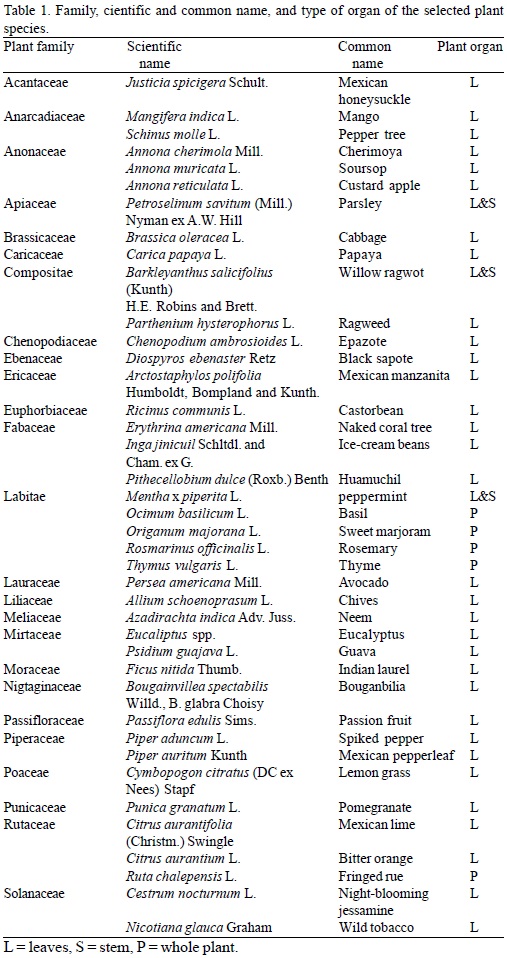
<body><![CDATA[<p align="justify"><font face="verdana" size="2">&nbsp;</font></p>              <p align="justify"><font face="verdana" size="2"><i>Colletotrichum gloeosporioides</i> (Penz.) Penz. y Sacc. is the casual agent of anthracnose, an important disease of papaya fruit (<i>Carica papaya</i> L.) (Alvarez and Nishijima, 1987; Snowdon, 1990). Bolkan <i>et al.</i> (1976) reported that rots originated by <i>C. gloeosporioides</i> isolated from immature and mature fruit accounted for 40 and 89&#37; of the infection, respectively. Chemical control which is used to reduce incidence of postharvest diseases in papaya is causing the development of fungal resistance to chemical products (Brent and Hollomon, 1998). Application of higher concentrations of chemicals in an attempt to overcome anthracnose disease, increases the risk of high levels of toxic residues, which is particularly serious since papaya fruit is consumed in a relatively short time after harvest. The exploitation of natural products such as plant extracts is believed to be safer to consumers and the environment. In the state of Morelos, Mexico, the antimicrobial properties of plant extracts from various species have been proven to control fungal development either <i>in vitro</i> or <i>in vivo.</i> In <i>vitro</i> studies carried out by Bautista&#45;Ba&ntilde;os <i>et al.</i> (2000a) reported that among 19 different botanical species tested, the aqueous extract of leaves of custard apple <i>(Annona reticulata</i> L.) and papaya among various others, inhibited spore formation and germination <i>of Rhizopus stolonifer</i> (Ehrenb.:Fr.) Vuill. Conidial inhibition was also observed when <i>C. gloeosporioides</i> was grown on these two extracts (Bautista&#45;Ba&ntilde;os <i>et al.,</i> 2002). </font></p>              <p align="justify"><font face="verdana" size="2">Current methods used to evaluate the efficiency of plant extracts for control of fungi include the use of high quantity of materials such as nutrient media and Petri plates, which in addition, are time consuming and expensive. Wilson <i>et al.</i> (1997) tested the microtiter method to evaluate the antifungal activity of crude plant extracts against <i>Botrytis cinerea</i> Pers.:Fr., highlighting the efficacy of this method. Then, spectrophotometry's method was compared at the same time with the microscopy's method to evaluate spore germination (counting under light microscopy). The objective of this research was to evaluate the effect 40 crude plant extracts on conidial germination of C. <i>gloeosporioides</i> by optical microscopy and espectrophotometry. </font></p>              <p align="justify"><font face="verdana" size="2"><b>Isolates.</b> <i>Colletotrichum gloeosporioides</i> was isolated from diseased papaya fruit showing anthracnose symptoms, harvested in the states of Veracruz and Guerrero, Mexico. Pure monosporic cultures were maintained on potato&#45;dextrose&#45;agar (PDA). To maintain pathogenicity of the fungus, periodic inoculations and reisolations from infected papaya were carried out. The parameters with significantly differences between Veracruz and Guerrero isolates were: mycelial growth, growth rate, and germination in different growing media. Experiments were carried out using 10&#45;15 days old cultures.</font></p>              <p align="justify"><font face="verdana" size="2"><b>Plant material.</b> Plant selection was according to the fungicidal or bactericidal background previously reported by Flores&#45;Moctezuma <i>et al.</i> (2002). Forty different plant species corresponding to various plant families including medicinal, forest, bush, fruit, and vegetable plants were field collected or bought at local markets from different regions of the state of Morelos (<a href="#t1">Table 1</a>). Plant species were collected throughout the year.</font></p>              <p align="center"><font face="verdana" size="2"><a name="t1"></a></font></p>              <p align="center"><font face="verdana" size="2"><img src="/img/revistas/rmfi/v25n2/a13t1.jpg"></font></p>              <p align="justify"><font face="verdana" size="2"><b>Plant material preparation.</b> 100 g of each of the collected plant material were disinfested in 2&#37; sodium hypochlorite for 15 min, rinsed twice in distilled water for 15 min and air&#45;dried at 26&deg;C for 3 to 4 h depending on the plant specie. Materials were then placed in polyethylene bags and frozen at &#45;20&deg;C for a minimum of12 h. Plant materials were thawed at ambient temperature for 1 h, wrapped in a fine cotton fabric and pressed to obtain the extracts (freezing and thawing fracture plant cells allowing the collection of fluids free of tissue); then, they were centrifuged (RC&#45;3B Refrigerated Centrifuge, Sorvall Instruments) at 4500 x g for 30&#45;60 min at 19&deg;C. Supernatants were filter sterilized (0.22 &#181;m Millipore, MA, USA) and used as test extracts. Extracts were kept in sterile amber bottles at 4&deg;C for a maximum of 60 h. </font></p>              <p align="justify"><font face="verdana" size="2"><b>Preparing the multi&#45;well plates according to the spectrophotometer and the optical microscopy method.</b> 30 &#181;l of a 10&#37; solution of the crude sterile extract and an inactive conidial suspension of 2 x 10<sup>5</sup> (270 &#181;l) in sterile water, were placed into each well of a row of a 96 multi&#45;well microtritation plate. The inactive conidial suspension was obtained by thermic shock (5 min at 100&deg;C and 15 min at 4&deg;C). Plant extracts with active conidial suspension were added to a second multi&#45;well plate. Controls consisted of a row containing sterile water with a conidial suspension from Veracruz or Guerrero which presented high percent spore germination in water. Five extracts with six replicates were able to be analysed for each isolate. After 14 and 18 h incubation of the plates at 28&deg;C (before 14 h incubation there was not significant differences in spore germination), the absorbancy of fungal growth in the wells was measured with a Labsystems Multiscan EX (Model 355) microplate reader at wavelength 492 nm which was used by Wilson <i>et al.</i> (1997). This method scans a first plate of plant extracted material with the inactive conidial suspension. The second plate reading contains the plant extract with the active conidial one. The percent spore germination by the espectrophotometry method (EM) was determined with the following equations: &#37; GIAC = (AIC) (100&#37; GIIC)/AAC and &#37; GAC = 100&#45;&#37; GIAC, where: &#37; GIAC = percent germination inhibition of active conidia, &#37; GIIC = percent germination inhibition of inactive conidia, &#37; GAC = percent germination of active conidia, AIC = absorbancy of inactive conidia, AAC = absorbancy of active conidia. A third multi&#45;well plate (plant extracts with an active conidia suspension) was prepared and 50 |il aliquot of this suspension was placed on a 20&#45;mm diameter agar disk and after 14 and 18 h at 28&deg;C stained with lactophenol acid fuchsin. The percent conidial germination was determined at 40X (optical microscopy method = OMM). Plant extracts were tested separately in lots of five and a control. The entire study consisted of eight experiments.</font></p>              <p align="justify"><font face="verdana" size="2"><b>Statistical analysis.</b> Percentage conidial germination for EM and OMM were analysed using the statistical program Sigma Stat 2.0 using test of Kruskal&#45;Wallis to obtain mean separation (p = 0.05). </font></p>              ]]></body>
<body><![CDATA[<p align="justify"><font face="verdana" size="2">In the isolate from Veracruz, germination measured by EM was significantly lower (p = 0.05), (13&#45;45&#37;) than control (18&#37;) after 14 and 18 h respectively (<a href="/img/revistas/rmfi/v25n2/a13t2.jpg" target="_blank">Table 2</a>, Lot 1). In general, the isolate of <i>C. gloeosporioides</i> from Guerrero and treated with extracts of<i>Bougainvillea spectabilis, Annona muricata. Citrus aurantifolia</i> and <i>C. aurantium</i> had percentage conidial germination equal to that of the control in a range of 11 to 18&#37;. In lot 2, in both isolates treated with plant extract of C. <i>nocturnum</i> was seen the best fungicidal effect (1&#45;5&#37; germination) (p = 0.05) after both incubation periods determined by OMM and EM. None of the isolates of <i>C. gloeosporioides</i> was controlled when treated with plant extracts of <i>Persea americana, Ficus nitida, Psidium guajava</i> and <i>Mangifera indica</i> at both incubation times. Percent germination at 14 and 18 h of incubation in both isolates treated with <i>Pithecellobium dulce, Mentha</i> x <i>piperita, Piper auritum</i> and <i>Passiflora edulis</i> were significantly different (p = 0.05) than germination of the untreated isolates by EM (Lot 3). However, <i>P. edulis</i> showed the best fungicidal effect against <i>C. gloeosporioides</i> in the isolate from Veracruz after both incubation periods by EM. In Lot 4, conidial germination of C. <i>gloeosporioides</i> from Veracruz was significantly lower (56&#45;64&#37;) (p = 0.05) than control treatment (81&#37;) after 14 h with extracts of <i>Ricinus communis</i>, <i>Parthenium hysterophorus</i> and <i>Schinus molle</i> by OMM. Except for extracts of <i>P. hysterophorus,</i> the remaining extracts promoted conidial germination in the isolate from Veracruz when evaluated by EM (Lot 4). Similar effect was observed in the isolate from Guerrero when treated with <i>Erythrina americana, R. communis,</i> and <i>S. molle.</i> A negative percent germination (7&#37;) was obtained in the non&#45;treated isolate from Guerrero and measured by EM after 14h. The extract of <i>Justicia spicigera</i> presented the best fungicidal effect (0&#37;) after the given incubation times in the isolate from Veracruz. Other extracts that showed a good fungicidal effect over the isolate from Guerrero were <i>Piper aduncum, Brassica oleraceae,</i> and <i>Chenopodium ambrosioides</i> by EM (Lot 5). In Lot 6, determinations by OMM and EM showed that the best antifungal effect was when the two isolates were treated with extract of <i>Annona reticulata</i> (0&#45;5&#37;) (p = 0.05) at 14, and 18h. Similarly, extracts of <i>Annona cherimola</i> and <i>Diospyros ebenaster</i> had a good fungicidal effect as seen in the lowest germination of 2 to 5&#37; (p = 0.05) in both isolates and determined by EM. In Lot 7, the lowest conidial germination determined by EM was obtained with extract of <i>Origanum majorana</i> in the isolate from Veracruz and Guerrero at 14 and 18 h. Negative conidial germination was shown in the isolate from Guerrero with extracts of <i>Ocimum basilicum, Rosmarinus officinalis,</i> and <i>Thymus vulgaris</i> by EM at both incubation periods. In Veracruz isolate treated with extracts of <i>Allium schoenoprasum, Eucaliptus</i> spp., <i>Punica granatum</i> and <i>Arctostaphylos polifolia</i> significantly (p = 0.05) lower germination than control treatment was observed by EM after 14 and 18 h, while in Guerrero isolate the best fungicidal extracts were <i>Eucaliptus</i> spp. and <i>A. polifolia.</i> Again negative values were observed with extracts of A. <i>schoenoprasum</i> and P. <i>granatum</i> (Lot 8). In our study, conidial germination varied according to type of isolate, extract applied, time of incubation and method evaluated. It is difficult to point out what of the above factors may have more effect on conidial survival however, in a previous study the same isolates of <i>C. gloeosporioides</i> showed differences in mycelial growth and germination associating these differences to the great genetic variability of this fungus (Hern&aacute;ndez&#45;Alb&iacute;ter <i>et al.</i> 2005). In general, the best antifungal effect was observed with plant extracts of <i>C. nocturnum</i> and <i>A. cherimola.</i> Extracts from various plant organs of <i>C. nocturnum</i> have shown to have high fungistatic activity over <i>Fusarium moniliforme</i> J. Sheld. (Bravo <i>et al.,</i> 2000) and <i>C. gloeosporioides</i> (Grainge and Ahmed, 1988). The leaves of <i>C</i>. <i>nocturnum</i> have pharmacological significance in Chinese folk medicine and have been used for the treatment of burns and swellings (Xiao, 1989). Various glycosides such as 25R&#45;spirost&#45;5&#45;ene2alfa, 3beta&#45;diol pentaglycosides (nocturnoside A) (Ahmad <i>et al.,</i> 1991), 25R&#45;spirost&#45;5en&#45;3beta&#45;ol tetraglycoside (nocturnoside B) (Ahmad <i>et al.,</i> 1995), and phenolic glucosides (cesternosides A and B) (Sahai <i>et al.,</i> 1994) were isolated from leaves of <i>C. nocturnum,</i> some of which showed cytotoxic activity against cultured tumor cells (Mimaki <i>et al.,</i> 2001; 2002). In general, plants belonging to the Annonaceae family present cytotoxic, antitumoral, pesticide, and antibacterial activities (Bories <i>et al.,</i> 1991; Rupprecht <i>et al.,</i> 1990). In other studies, leaf extracts of A. <i>cherimola</i> inhibited spore germination of <i>C. gloeosporioides,</i> sporulation of <i>Rhizopus stolonifer</i> (Ehrenb.:Fr.) Vuill. and rot development of <i>Spondias purpurea</i> L. (red mombin) (Bautista&#45;Ba&ntilde;os <i>et</i> al., 2000a; b). Leaf cloroformic extracts shown antibacterial and antifungal activity against <i>Staphylococcus aureus</i> Rosenbach, <i>Mycobacterium phlei</i> Lehmann and Neumann, and <i>Candida albicans</i> (C.P. Robin) Berkhout (M&aacute;rquez <i>et al.,</i> 1999). Various acetogenins and alkaloid were isolated from the stems of A. <i>cherimola</i> (Chen <i>et al.,</i> 1997a; b; 1998; 1999a; b; 2001).</font></p>              <p align="justify"><font face="verdana" size="2">&nbsp;</font></p>              <p align="justify"><font face="verdana" size="2"><b>CONCLUSIONS</b></font></p>              <p align="justify"><font face="verdana" size="2">Results of this investigation demonstrated the fungicidal potential of a range of crude plant extracts and present two main characters: a) their natural origin which means safer to people and the environment, and b) they can be considered as low risk for resistance development by pathogenic fungi. Natural plant&#45;derived fungicides should provide a wide variety of compounds as alternatives to synthetic fungicides. It was not possible to relate results from spectrophotometry's method and microscopy's method. Interference in the measurement of absorbance values due to pigments, plant tissue, and crystal of the crude extracts and differences in the size of the germinating tube of the conidia as well, caused a high heterogeneity of mixture.</font></p>              <p align="justify"><font face="verdana" size="2">&nbsp;</font></p>              <p align="justify"><font face="verdana" size="2"><b>ACKNOWLEDGEMENTS</b> </font></p>              <p align="justify"><font face="verdana" size="2">To the financial assistance obtained from National Polytechnic Institute and COFAA.</font></p>              <p align="justify"><font face="verdana" size="2">&nbsp;</font></p>              <p align="justify"><font face="verdana" size="2"><b>LITERATURE CITED</b></font></p>              <!-- ref --><p align="justify"><font face="verdana" size="2">Ahmad, V.U., Baqai, F.T., and Ahmad, R. 1995. A spirostanol. Naturforsch 50:1104&#45;1110.    &nbsp;&nbsp;&nbsp;&nbsp;&nbsp;&nbsp;&nbsp;&nbsp;[&#160;<a href="javascript:void(0);" onclick="javascript: window.open('/scielo.php?script=sci_nlinks&ref=8510882&pid=S0185-3309200700020001300001&lng=','','width=640,height=500,resizable=yes,scrollbars=1,menubar=yes,');">Links</a>&#160;]<!-- end-ref --> </font></p>              <!-- ref --><p align="justify"><font face="verdana" size="2">Ahmad, V.U., Baqai, F.T., Fatima, I., and Ahmad, R. 1991. A spirostanol glycoside from <i>Cestrum nocturnum.</i> Phytochemistry 30:3057&#45;3061.    &nbsp;&nbsp;&nbsp;&nbsp;&nbsp;&nbsp;&nbsp;&nbsp;[&#160;<a href="javascript:void(0);" onclick="javascript: window.open('/scielo.php?script=sci_nlinks&ref=8510884&pid=S0185-3309200700020001300002&lng=','','width=640,height=500,resizable=yes,scrollbars=1,menubar=yes,');">Links</a>&#160;]<!-- end-ref --> </font></p>              <!-- ref --><p align="justify"><font face="verdana" size="2">Alvarez, A.M., and Nishijima, W.T. 1987. Postharvest diseases of papaya. Plant Disease 71:681&#45;686.    &nbsp;&nbsp;&nbsp;&nbsp;&nbsp;&nbsp;&nbsp;&nbsp;[&#160;<a href="javascript:void(0);" onclick="javascript: window.open('/scielo.php?script=sci_nlinks&ref=8510886&pid=S0185-3309200700020001300003&lng=','','width=640,height=500,resizable=yes,scrollbars=1,menubar=yes,');">Links</a>&#160;]<!-- end-ref --> </font></p>              <!-- ref --><p align="justify"><font face="verdana" size="2">Bautista&#45;Ba&ntilde;os, S., Hern&aacute;ndez&#45;L&oacute;pez, M., and Barrera&#45;Necha, L.L. 2000a. Antifungal screening of plants of the state of Morelos, Mexico, against four postharvest pathogens of fruits and vegetables. Revista Mexicana de Fitopatolog&iacute;a 18:36&#45;41.    &nbsp;&nbsp;&nbsp;&nbsp;&nbsp;&nbsp;&nbsp;&nbsp;[&#160;<a href="javascript:void(0);" onclick="javascript: window.open('/scielo.php?script=sci_nlinks&ref=8510888&pid=S0185-3309200700020001300004&lng=','','width=640,height=500,resizable=yes,scrollbars=1,menubar=yes,');">Links</a>&#160;]<!-- end-ref --></font></p>              <!-- ref --><p align="justify"><font face="verdana" size="2">Bautista&#45;Ba&ntilde;os, S., Hern&aacute;ndez&#45;L&oacute;pez, M., D&iacute;az&#45;P&eacute;rez, J.C., and Cano&#45;Ochoa, C.F. 2000b. Evaluation of the fungicidal properties of plant extracts to reduce <i>Rhizopus stolonifer</i> of ciruela fruit <i>(Spondias purpurea</i> L.) during storage. Postharvest Biology and Technology 20:99&#45;106.    &nbsp;&nbsp;&nbsp;&nbsp;&nbsp;&nbsp;&nbsp;&nbsp;[&#160;<a href="javascript:void(0);" onclick="javascript: window.open('/scielo.php?script=sci_nlinks&ref=8510890&pid=S0185-3309200700020001300005&lng=','','width=640,height=500,resizable=yes,scrollbars=1,menubar=yes,');">Links</a>&#160;]<!-- end-ref --></font></p>              <!-- ref --><p align="justify"><font face="verdana" size="2">Bautista&#45;Ba&ntilde;os, S., Barrera&#45;Necha, L.L., Bravo&#45;Luna, L., and Berm&uacute;dez&#45;Torres, K. 2002. Antifungal activity of leaf and stem extracts from various plant species on the incidence of <i>Colletotrichum gloeosporioides</i> of papaya and mango fruit after storage. Revista Mexicana de Fitopatolog&iacute;a 20:812.    &nbsp;&nbsp;&nbsp;&nbsp;&nbsp;&nbsp;&nbsp;&nbsp;[&#160;<a href="javascript:void(0);" onclick="javascript: window.open('/scielo.php?script=sci_nlinks&ref=8510892&pid=S0185-3309200700020001300006&lng=','','width=640,height=500,resizable=yes,scrollbars=1,menubar=yes,');">Links</a>&#160;]<!-- end-ref --></font></p>              <!-- ref --><p align="justify"><font face="verdana" size="2">Bolkan, H.A., Cupertino, F.P., Dianese, J.C., and Takatsu, A. 1976. Fungi associated with pre and postharvest fruit rots of papaya and their control in central Brazil. Plant Disease Reporter 60:605&#45;609.    &nbsp;&nbsp;&nbsp;&nbsp;&nbsp;&nbsp;&nbsp;&nbsp;[&#160;<a href="javascript:void(0);" onclick="javascript: window.open('/scielo.php?script=sci_nlinks&ref=8510894&pid=S0185-3309200700020001300007&lng=','','width=640,height=500,resizable=yes,scrollbars=1,menubar=yes,');">Links</a>&#160;]<!-- end-ref --></font></p>              <!-- ref --><p align="justify"><font face="verdana" size="2">Bories, C., Loiseau, P., Cortes, D., Myint, S.H., Hocquemiller, R., and Gayeal, P. 1991. Antiparasitic activity of<i>Annona muricata</i> and <i>Annona cherimola</i> seeds. Revista Cubana de Plantas Medicinales 57:434.    &nbsp;&nbsp;&nbsp;&nbsp;&nbsp;&nbsp;&nbsp;&nbsp;[&#160;<a href="javascript:void(0);" onclick="javascript: window.open('/scielo.php?script=sci_nlinks&ref=8510896&pid=S0185-3309200700020001300008&lng=','','width=640,height=500,resizable=yes,scrollbars=1,menubar=yes,');">Links</a>&#160;]<!-- end-ref --></font></p>              <!-- ref --><p align="justify"><font face="verdana" size="2">Bravo, L.L., Berm&uacute;dez, T.K., and Montes, B.R. 2000. Inhibici&oacute;n de <i>Fusarium moniliforme</i> mediante polvos vegetales y algunos de sus componentes qu&iacute;micos. Manejo Integrado de Plagas 57:29&#45;34.    &nbsp;&nbsp;&nbsp;&nbsp;&nbsp;&nbsp;&nbsp;&nbsp;[&#160;<a href="javascript:void(0);" onclick="javascript: window.open('/scielo.php?script=sci_nlinks&ref=8510898&pid=S0185-3309200700020001300009&lng=','','width=640,height=500,resizable=yes,scrollbars=1,menubar=yes,');">Links</a>&#160;]<!-- end-ref --></font></p>              <!-- ref --><p align="justify"><font face="verdana" size="2">Brent, K.J., and Hollomon, D.W. 1998. Fungicide resistance: the assessment of risk. FRAC, Global Crop Protection Federation. Brussels, Belgium. pp 1&#45;48. Monograph No. 2. 198 p.    &nbsp;&nbsp;&nbsp;&nbsp;&nbsp;&nbsp;&nbsp;&nbsp;[&#160;<a href="javascript:void(0);" onclick="javascript: window.open('/scielo.php?script=sci_nlinks&ref=8510900&pid=S0185-3309200700020001300010&lng=','','width=640,height=500,resizable=yes,scrollbars=1,menubar=yes,');">Links</a>&#160;]<!-- end-ref --></font></p>              <!-- ref --><p align="justify"><font face="verdana" size="2">Chen, C.Y., Chang, F.R., Chium, H.F., Wu, M.J., and Wu, YC. 1999a. Anonain&#45;A, an annonaceous acetogenins from <i>Annona cherimola.</i> Phytochemistry 52:429&#45;433.    &nbsp;&nbsp;&nbsp;&nbsp;&nbsp;&nbsp;&nbsp;&nbsp;[&#160;<a href="javascript:void(0);" onclick="javascript: window.open('/scielo.php?script=sci_nlinks&ref=8510902&pid=S0185-3309200700020001300011&lng=','','width=640,height=500,resizable=yes,scrollbars=1,menubar=yes,');">Links</a>&#160;]<!-- end-ref --></font></p>              <!-- ref --><p align="justify"><font face="verdana" size="2">Chen, C.Y., Chang, F.R., and Wu, Y.C. 1997a. Cherimoline, a novel alkaloid from the stems of <i>Annona cherimola.</i> Tetrahedron Letters 38:6247&#45;6248.    &nbsp;&nbsp;&nbsp;&nbsp;&nbsp;&nbsp;&nbsp;&nbsp;[&#160;<a href="javascript:void(0);" onclick="javascript: window.open('/scielo.php?script=sci_nlinks&ref=8510904&pid=S0185-3309200700020001300012&lng=','','width=640,height=500,resizable=yes,scrollbars=1,menubar=yes,');">Links</a>&#160;]<!-- end-ref --></font></p>              <!-- ref --><p align="justify"><font face="verdana" size="2">Chen, C.Y., Chang, F.R., Pan, W.B., and Wu, Y.C. 2001. Four alkaloids from <i>Annona cherimola.</i> Phytochemistry 56:753&#45;757.    &nbsp;&nbsp;&nbsp;&nbsp;&nbsp;&nbsp;&nbsp;&nbsp;[&#160;<a href="javascript:void(0);" onclick="javascript: window.open('/scielo.php?script=sci_nlinks&ref=8510906&pid=S0185-3309200700020001300013&lng=','','width=640,height=500,resizable=yes,scrollbars=1,menubar=yes,');">Links</a>&#160;]<!-- end-ref --></font></p>          <!-- ref --><p align="justify"><font face="verdana" size="2">Chen, C.Y., Chang, F.R., Teng, C.M., and Wu, M.J. 1999b. Cheritamine, a new N&#45;fatty acyl tryptamine and other constituents from the stems of <i>Annona cherimola.</i> Journal of the Chinese Chemical Society 46:77&#45;86.    &nbsp;&nbsp;&nbsp;&nbsp;&nbsp;&nbsp;&nbsp;&nbsp;[&#160;<a href="javascript:void(0);" onclick="javascript: window.open('/scielo.php?script=sci_nlinks&ref=8510908&pid=S0185-3309200700020001300014&lng=','','width=640,height=500,resizable=yes,scrollbars=1,menubar=yes,');">Links</a>&#160;]<!-- end-ref --> </font></p>              <!-- ref --><p align="justify"><font face="verdana" size="2">Chen, C.Y., Chang, F.R., and Wu, Y.C. 1997b. The constituents from the stems of <i>Annona cherimola.</i> Journal of the Chinese Chemical Society 44:313&#45;319.    &nbsp;&nbsp;&nbsp;&nbsp;&nbsp;&nbsp;&nbsp;&nbsp;[&#160;<a href="javascript:void(0);" onclick="javascript: window.open('/scielo.php?script=sci_nlinks&ref=8510910&pid=S0185-3309200700020001300015&lng=','','width=640,height=500,resizable=yes,scrollbars=1,menubar=yes,');">Links</a>&#160;]<!-- end-ref --> </font></p>              <!-- ref --><p align="justify"><font face="verdana" size="2">Chen, C.Y., Chang, F.R., and Wu, Y.C. 1998. Cherinonaine, a novel dimeric amide from stems of <i>Annona cherimola.</i> Tetrahedron Letters 39:407&#45;410.    &nbsp;&nbsp;&nbsp;&nbsp;&nbsp;&nbsp;&nbsp;&nbsp;[&#160;<a href="javascript:void(0);" onclick="javascript: window.open('/scielo.php?script=sci_nlinks&ref=8510912&pid=S0185-3309200700020001300016&lng=','','width=640,height=500,resizable=yes,scrollbars=1,menubar=yes,');">Links</a>&#160;]<!-- end-ref --> </font></p>              <!-- ref --><p align="justify"><font face="verdana" size="2">Flores&#45;Moctezuma, H.E., Bautista&#45;Ba&ntilde;os, S., Barrera&#45;Necha, L.L., Bermudez&#45;Torres, K., and Bravo&#45;Luna, L. 2002. Mexican and introduced plants with fungicidal and mycocidal properties. XXIX Congreso Internacional de la Sociedad Mexicana de Fitopatolog&iacute;a. Monterrey, Nuevo Le&oacute;n, M&eacute;xico. Resumen F&#45;161.    &nbsp;&nbsp;&nbsp;&nbsp;&nbsp;&nbsp;&nbsp;&nbsp;[&#160;<a href="javascript:void(0);" onclick="javascript: window.open('/scielo.php?script=sci_nlinks&ref=8510914&pid=S0185-3309200700020001300017&lng=','','width=640,height=500,resizable=yes,scrollbars=1,menubar=yes,');">Links</a>&#160;]<!-- end-ref --> </font></p>              <!-- ref --><p align="justify"><font face="verdana" size="2">Grainge, M., and Ahmed, S. 1988. Handbook of Plants with Pest&#45;Control Properties. John Wiley and Sons. New York, USA. 310 p.    &nbsp;&nbsp;&nbsp;&nbsp;&nbsp;&nbsp;&nbsp;&nbsp;[&#160;<a href="javascript:void(0);" onclick="javascript: window.open('/scielo.php?script=sci_nlinks&ref=8510916&pid=S0185-3309200700020001300018&lng=','','width=640,height=500,resizable=yes,scrollbars=1,menubar=yes,');">Links</a>&#160;]<!-- end-ref --></font></p>              <!-- ref --><p align="justify"><font face="verdana" size="2">Hern&aacute;ndez&#45;Alb&iacute;ter, R.C., Bravo&#45;Luna, L., Corona&#45;Rangel, M.L., Villa&#45;Ayala, P., Bautista&#45;Ba&ntilde;os, S., and Barrera&#45;Necha, L.L. 2005. Caracterizaci&oacute;n morfocultural y sintomatol&oacute;gica de dos aislamientos de <i>Colletotrichum gloeosporioides</i> (Penz.) Penz. y Sacc. de papayo. Revista Mexicana de Fitopatolog&iacute;a 23:223&#45;231.    &nbsp;&nbsp;&nbsp;&nbsp;&nbsp;&nbsp;&nbsp;&nbsp;[&#160;<a href="javascript:void(0);" onclick="javascript: window.open('/scielo.php?script=sci_nlinks&ref=8510918&pid=S0185-3309200700020001300019&lng=','','width=640,height=500,resizable=yes,scrollbars=1,menubar=yes,');">Links</a>&#160;]<!-- end-ref --></font></p>              <!-- ref --><p align="justify"><font face="verdana" size="2">M&aacute;rquez, A.C., Lara, O.F., Esquivel, R.B. y Mata, E.R. 1999. Plantas Medicinales de M&eacute;xico II. Composici&oacute;n, Usos y Actividad Biol&oacute;gica. Universidad Nacional Aut&oacute;noma de M&eacute;xico. M&eacute;xico, D.F. 178 p.    &nbsp;&nbsp;&nbsp;&nbsp;&nbsp;&nbsp;&nbsp;&nbsp;[&#160;<a href="javascript:void(0);" onclick="javascript: window.open('/scielo.php?script=sci_nlinks&ref=8510920&pid=S0185-3309200700020001300020&lng=','','width=640,height=500,resizable=yes,scrollbars=1,menubar=yes,');">Links</a>&#160;]<!-- end-ref --></font></p>              <!-- ref --><p align="justify"><font face="verdana" size="2">Mimaki, Y., Watenabe, K., Ando, Y., Sakuma, C., Sashida, Y, Furuya, S., and Hiroshi, S. 2001. Flavonol glycosides and steroidal saponins from the leaves of <i>Cestrum nocturnum</i> and their cytotoxicity. Journal of Natural Products 64:1722.    &nbsp;&nbsp;&nbsp;&nbsp;&nbsp;&nbsp;&nbsp;&nbsp;[&#160;<a href="javascript:void(0);" onclick="javascript: window.open('/scielo.php?script=sci_nlinks&ref=8510922&pid=S0185-3309200700020001300021&lng=','','width=640,height=500,resizable=yes,scrollbars=1,menubar=yes,');">Links</a>&#160;]<!-- end-ref --></font></p>              <!-- ref --><p align="justify"><font face="verdana" size="2">Mimaki, Y., Watenabe, K., Sakagami, H., and Sashida, Y 2002. Steroidal glycosides from the leaves of <i>Cestrum nocturnum.</i> Journal of Natural Products 65:1863&#45;1868.    &nbsp;&nbsp;&nbsp;&nbsp;&nbsp;&nbsp;&nbsp;&nbsp;[&#160;<a href="javascript:void(0);" onclick="javascript: window.open('/scielo.php?script=sci_nlinks&ref=8510924&pid=S0185-3309200700020001300022&lng=','','width=640,height=500,resizable=yes,scrollbars=1,menubar=yes,');">Links</a>&#160;]<!-- end-ref --></font></p>              <!-- ref --><p align="justify"><font face="verdana" size="2">Rupprecht, J.K., Hui, Y.H., and McLaughlin, J.L. 1990. Annonaceous acetogenins. Journal of Natural Products 53:237&#45;278.    &nbsp;&nbsp;&nbsp;&nbsp;&nbsp;&nbsp;&nbsp;&nbsp;[&#160;<a href="javascript:void(0);" onclick="javascript: window.open('/scielo.php?script=sci_nlinks&ref=8510926&pid=S0185-3309200700020001300023&lng=','','width=640,height=500,resizable=yes,scrollbars=1,menubar=yes,');">Links</a>&#160;]<!-- end-ref --></font></p>              <!-- ref --><p align="justify"><font face="verdana" size="2">Sahai, M., Sungh, M., Singh, A.K., Hara, N., and Fujimoto, Y.J. 1994. Chemistry Research Synopsis 1:22&#45;23.    &nbsp;&nbsp;&nbsp;&nbsp;&nbsp;&nbsp;&nbsp;&nbsp;[&#160;<a href="javascript:void(0);" onclick="javascript: window.open('/scielo.php?script=sci_nlinks&ref=8510928&pid=S0185-3309200700020001300024&lng=','','width=640,height=500,resizable=yes,scrollbars=1,menubar=yes,');">Links</a>&#160;]<!-- end-ref --></font></p>              <!-- ref --><p align="justify"><font face="verdana" size="2">Snowdon, A.L. 1990. A Colour Atlas of Postharvest Diseases and Disorders of Fruit and Vegetables Vol. 2. Vegetables. General Introduction and Fruits. CRC Press. London, UK. 141 p.    &nbsp;&nbsp;&nbsp;&nbsp;&nbsp;&nbsp;&nbsp;&nbsp;[&#160;<a href="javascript:void(0);" onclick="javascript: window.open('/scielo.php?script=sci_nlinks&ref=8510930&pid=S0185-3309200700020001300025&lng=','','width=640,height=500,resizable=yes,scrollbars=1,menubar=yes,');">Links</a>&#160;]<!-- end-ref --></font></p>              <!-- ref --><p align="justify"><font face="verdana" size="2">Wilson, C.L., Solar, J.M., El Ghaouth, A., and Wisniewski, M.E. 1997. Rapid evaluation of plant extracts and essential oils for antifungal activity against <i>Botrytis cinerea.</i> Plant Disease 81:204&#45;210.    &nbsp;&nbsp;&nbsp;&nbsp;&nbsp;&nbsp;&nbsp;&nbsp;[&#160;<a href="javascript:void(0);" onclick="javascript: window.open('/scielo.php?script=sci_nlinks&ref=8510932&pid=S0185-3309200700020001300026&lng=','','width=640,height=500,resizable=yes,scrollbars=1,menubar=yes,');">Links</a>&#160;]<!-- end-ref --></font></p>  	    <!-- ref --><p align="justify"><font face="verdana" size="2">Xiao, P.G. 1989. In Illustrations of Chinese Materna Medica. Comercial Press. Vol. 5. Hong Kong. 151 p.    &nbsp;&nbsp;&nbsp;&nbsp;&nbsp;&nbsp;&nbsp;&nbsp;[&#160;<a href="javascript:void(0);" onclick="javascript: window.open('/scielo.php?script=sci_nlinks&ref=8510934&pid=S0185-3309200700020001300027&lng=','','width=640,height=500,resizable=yes,scrollbars=1,menubar=yes,');">Links</a>&#160;]<!-- end-ref --></font></p>      ]]></body><back>
<ref-list>
<ref id="B1">
<nlm-citation citation-type="journal">
<person-group person-group-type="author">
<name>
<surname><![CDATA[Ahmad]]></surname>
<given-names><![CDATA[V.U.]]></given-names>
</name>
<name>
<surname><![CDATA[Baqai]]></surname>
<given-names><![CDATA[F.T.]]></given-names>
</name>
<name>
<surname><![CDATA[Ahmad]]></surname>
<given-names><![CDATA[R.]]></given-names>
</name>
</person-group>
<article-title xml:lang="en"><![CDATA[A spirostanol]]></article-title>
<source><![CDATA[Naturforsch]]></source>
<year>1995</year>
<volume>50</volume>
<page-range>1104-1110</page-range></nlm-citation>
</ref>
<ref id="B2">
<nlm-citation citation-type="journal">
<person-group person-group-type="author">
<name>
<surname><![CDATA[Ahmad]]></surname>
<given-names><![CDATA[V.U.]]></given-names>
</name>
<name>
<surname><![CDATA[Baqai]]></surname>
<given-names><![CDATA[F.T.]]></given-names>
</name>
<name>
<surname><![CDATA[Fatima]]></surname>
<given-names><![CDATA[I.]]></given-names>
</name>
<name>
<surname><![CDATA[Ahmad]]></surname>
<given-names><![CDATA[R.]]></given-names>
</name>
</person-group>
<article-title xml:lang="en"><![CDATA[A spirostanol glycoside from Cestrum nocturnum]]></article-title>
<source><![CDATA[Phytochemistry]]></source>
<year>1991</year>
<volume>30</volume>
<page-range>3057-3061</page-range></nlm-citation>
</ref>
<ref id="B3">
<nlm-citation citation-type="journal">
<person-group person-group-type="author">
<name>
<surname><![CDATA[Alvarez]]></surname>
<given-names><![CDATA[A.M.]]></given-names>
</name>
<name>
<surname><![CDATA[Nishijima]]></surname>
<given-names><![CDATA[W.T.]]></given-names>
</name>
</person-group>
<article-title xml:lang="en"><![CDATA[Postharvest diseases of papaya]]></article-title>
<source><![CDATA[Plant Disease]]></source>
<year>1987</year>
<volume>71</volume>
<page-range>681-686</page-range></nlm-citation>
</ref>
<ref id="B4">
<nlm-citation citation-type="journal">
<person-group person-group-type="author">
<name>
<surname><![CDATA[Bautista-Baños]]></surname>
<given-names><![CDATA[S.]]></given-names>
</name>
<name>
<surname><![CDATA[Hernández-López]]></surname>
<given-names><![CDATA[M.]]></given-names>
</name>
<name>
<surname><![CDATA[Barrera-Necha]]></surname>
<given-names><![CDATA[L.L.]]></given-names>
</name>
</person-group>
<article-title xml:lang="en"><![CDATA[Antifungal screening of plants of the state of Morelos, Mexico, against four postharvest pathogens of fruits and vegetables]]></article-title>
<source><![CDATA[Revista Mexicana de Fitopatología]]></source>
<year>2000</year>
<volume>18</volume>
<page-range>36-41</page-range></nlm-citation>
</ref>
<ref id="B5">
<nlm-citation citation-type="journal">
<person-group person-group-type="author">
<name>
<surname><![CDATA[Bautista-Baños]]></surname>
<given-names><![CDATA[S.]]></given-names>
</name>
<name>
<surname><![CDATA[Hernández-López]]></surname>
<given-names><![CDATA[M.]]></given-names>
</name>
<name>
<surname><![CDATA[Díaz-Pérez]]></surname>
<given-names><![CDATA[J.C.]]></given-names>
</name>
<name>
<surname><![CDATA[Cano-Ochoa]]></surname>
<given-names><![CDATA[C.F.]]></given-names>
</name>
</person-group>
<article-title xml:lang="en"><![CDATA[Evaluation of the fungicidal properties of plant extracts to reduce Rhizopus stolonifer of ciruela fruit (Spondias purpurea L.) during storage]]></article-title>
<source><![CDATA[Postharvest Biology and Technology]]></source>
<year>2000</year>
<volume>20</volume>
<page-range>99-106</page-range></nlm-citation>
</ref>
<ref id="B6">
<nlm-citation citation-type="journal">
<person-group person-group-type="author">
<name>
<surname><![CDATA[Bautista-Baños]]></surname>
<given-names><![CDATA[S.]]></given-names>
</name>
<name>
<surname><![CDATA[Barrera-Necha]]></surname>
<given-names><![CDATA[L.L.]]></given-names>
</name>
<name>
<surname><![CDATA[Bravo-Luna]]></surname>
<given-names><![CDATA[L.]]></given-names>
</name>
<name>
<surname><![CDATA[Bermúdez-Torres]]></surname>
<given-names><![CDATA[K.]]></given-names>
</name>
</person-group>
<article-title xml:lang="en"><![CDATA[Antifungal activity of leaf and stem extracts from various plant species on the incidence of Colletotrichum gloeosporioides of papaya and mango fruit after storage]]></article-title>
<source><![CDATA[Revista Mexicana de Fitopatología]]></source>
<year>2002</year>
<volume>20</volume>
<page-range>812</page-range></nlm-citation>
</ref>
<ref id="B7">
<nlm-citation citation-type="journal">
<person-group person-group-type="author">
<name>
<surname><![CDATA[Bolkan]]></surname>
<given-names><![CDATA[H.A.]]></given-names>
</name>
<name>
<surname><![CDATA[Cupertino]]></surname>
<given-names><![CDATA[F.P.]]></given-names>
</name>
<name>
<surname><![CDATA[Dianese]]></surname>
<given-names><![CDATA[J.C.]]></given-names>
</name>
<name>
<surname><![CDATA[Takatsu]]></surname>
<given-names><![CDATA[A.]]></given-names>
</name>
</person-group>
<article-title xml:lang="en"><![CDATA[Fungi associated with pre and postharvest fruit rots of papaya and their control in central Brazil]]></article-title>
<source><![CDATA[Plant Disease Reporter]]></source>
<year>1976</year>
<volume>60</volume>
<page-range>605-609</page-range></nlm-citation>
</ref>
<ref id="B8">
<nlm-citation citation-type="journal">
<person-group person-group-type="author">
<name>
<surname><![CDATA[Bories]]></surname>
<given-names><![CDATA[C.]]></given-names>
</name>
<name>
<surname><![CDATA[Loiseau]]></surname>
<given-names><![CDATA[P.]]></given-names>
</name>
<name>
<surname><![CDATA[Cortes]]></surname>
<given-names><![CDATA[D.]]></given-names>
</name>
<name>
<surname><![CDATA[Myint]]></surname>
<given-names><![CDATA[S.H.]]></given-names>
</name>
<name>
<surname><![CDATA[Hocquemiller]]></surname>
<given-names><![CDATA[R.]]></given-names>
</name>
<name>
<surname><![CDATA[Gayeal]]></surname>
<given-names><![CDATA[P.]]></given-names>
</name>
</person-group>
<article-title xml:lang="en"><![CDATA[Antiparasitic activity ofAnnona muricata and Annona cherimola seeds]]></article-title>
<source><![CDATA[Revista Cubana de Plantas Medicinales]]></source>
<year>1991</year>
<volume>57</volume>
<page-range>434</page-range></nlm-citation>
</ref>
<ref id="B9">
<nlm-citation citation-type="journal">
<person-group person-group-type="author">
<name>
<surname><![CDATA[Bravo]]></surname>
<given-names><![CDATA[L.L.]]></given-names>
</name>
<name>
<surname><![CDATA[Bermúdez]]></surname>
<given-names><![CDATA[T.K.]]></given-names>
</name>
<name>
<surname><![CDATA[Montes]]></surname>
<given-names><![CDATA[B.R.]]></given-names>
</name>
</person-group>
<article-title xml:lang="en"><![CDATA[Inhibición de Fusarium moniliforme mediante polvos vegetales y algunos de sus componentes químicos]]></article-title>
<source><![CDATA[Manejo Integrado de Plagas]]></source>
<year>2000</year>
<volume>57</volume>
<page-range>29-34</page-range></nlm-citation>
</ref>
<ref id="B10">
<nlm-citation citation-type="book">
<person-group person-group-type="author">
<name>
<surname><![CDATA[Brent]]></surname>
<given-names><![CDATA[K.J.]]></given-names>
</name>
<name>
<surname><![CDATA[Hollomon]]></surname>
<given-names><![CDATA[D.W.]]></given-names>
</name>
</person-group>
<source><![CDATA[Fungicide resistance: the assessment of risk]]></source>
<year>1998</year>
<page-range>1-48</page-range><page-range>198</page-range><publisher-loc><![CDATA[Brussels ]]></publisher-loc>
<publisher-name><![CDATA[FRAC, Global Crop Protection Federation]]></publisher-name>
</nlm-citation>
</ref>
<ref id="B11">
<nlm-citation citation-type="journal">
<person-group person-group-type="author">
<name>
<surname><![CDATA[Chen]]></surname>
<given-names><![CDATA[C.Y.]]></given-names>
</name>
<name>
<surname><![CDATA[Chang]]></surname>
<given-names><![CDATA[F.R.]]></given-names>
</name>
<name>
<surname><![CDATA[Chium]]></surname>
<given-names><![CDATA[H.F.]]></given-names>
</name>
<name>
<surname><![CDATA[Wu]]></surname>
<given-names><![CDATA[M.J.]]></given-names>
</name>
<name>
<surname><![CDATA[Wu]]></surname>
<given-names><![CDATA[YC]]></given-names>
</name>
</person-group>
<article-title xml:lang="en"><![CDATA[Anonain-A, an annonaceous acetogenins from Annona cherimola]]></article-title>
<source><![CDATA[Phytochemistry]]></source>
<year>1999</year>
<volume>52</volume>
<page-range>429-433</page-range></nlm-citation>
</ref>
<ref id="B12">
<nlm-citation citation-type="journal">
<person-group person-group-type="author">
<name>
<surname><![CDATA[Chen]]></surname>
<given-names><![CDATA[C.Y.]]></given-names>
</name>
<name>
<surname><![CDATA[Chang]]></surname>
<given-names><![CDATA[F.R.]]></given-names>
</name>
<name>
<surname><![CDATA[Wu]]></surname>
<given-names><![CDATA[Y.C.]]></given-names>
</name>
</person-group>
<article-title xml:lang="en"><![CDATA[Cherimoline, a novel alkaloid from the stems of Annona cherimola]]></article-title>
<source><![CDATA[Tetrahedron Letters]]></source>
<year>1997</year>
<volume>38</volume>
<page-range>6247-6248</page-range></nlm-citation>
</ref>
<ref id="B13">
<nlm-citation citation-type="journal">
<person-group person-group-type="author">
<name>
<surname><![CDATA[Chen]]></surname>
<given-names><![CDATA[C.Y.]]></given-names>
</name>
<name>
<surname><![CDATA[Chang]]></surname>
<given-names><![CDATA[F.R.]]></given-names>
</name>
<name>
<surname><![CDATA[Pan]]></surname>
<given-names><![CDATA[W.B.]]></given-names>
</name>
<name>
<surname><![CDATA[Wu]]></surname>
<given-names><![CDATA[Y.C.]]></given-names>
</name>
</person-group>
<article-title xml:lang="en"><![CDATA[Four alkaloids from Annona cherimola]]></article-title>
<source><![CDATA[Phytochemistry]]></source>
<year>2001</year>
<volume>56</volume>
<page-range>753-757</page-range></nlm-citation>
</ref>
<ref id="B14">
<nlm-citation citation-type="journal">
<person-group person-group-type="author">
<name>
<surname><![CDATA[Chen]]></surname>
<given-names><![CDATA[C.Y.]]></given-names>
</name>
<name>
<surname><![CDATA[Chang]]></surname>
<given-names><![CDATA[F.R.]]></given-names>
</name>
<name>
<surname><![CDATA[Teng]]></surname>
<given-names><![CDATA[C.M.]]></given-names>
</name>
<name>
<surname><![CDATA[Wu]]></surname>
<given-names><![CDATA[M.J.]]></given-names>
</name>
</person-group>
<article-title xml:lang="en"><![CDATA[Cheritamine, a new N-fatty acyl tryptamine and other constituents from the stems of Annona cherimola]]></article-title>
<source><![CDATA[Journal of the Chinese Chemical Society]]></source>
<year>1999</year>
<volume>46</volume>
<page-range>77-86</page-range></nlm-citation>
</ref>
<ref id="B15">
<nlm-citation citation-type="journal">
<person-group person-group-type="author">
<name>
<surname><![CDATA[Chen]]></surname>
<given-names><![CDATA[C.Y.]]></given-names>
</name>
<name>
<surname><![CDATA[Chang]]></surname>
<given-names><![CDATA[F.R.]]></given-names>
</name>
<name>
<surname><![CDATA[Wu]]></surname>
<given-names><![CDATA[Y.C.]]></given-names>
</name>
</person-group>
<article-title xml:lang="en"><![CDATA[The constituents from the stems of Annona cherimola]]></article-title>
<source><![CDATA[Journal of the Chinese Chemical Society]]></source>
<year>1997</year>
<volume>44</volume>
<page-range>313-319</page-range></nlm-citation>
</ref>
<ref id="B16">
<nlm-citation citation-type="journal">
<person-group person-group-type="author">
<name>
<surname><![CDATA[Chen]]></surname>
<given-names><![CDATA[C.Y.]]></given-names>
</name>
<name>
<surname><![CDATA[Chang]]></surname>
<given-names><![CDATA[F.R.]]></given-names>
</name>
<name>
<surname><![CDATA[Wu]]></surname>
<given-names><![CDATA[Y.C.]]></given-names>
</name>
</person-group>
<article-title xml:lang="en"><![CDATA[Cherinonaine, a novel dimeric amide from stems of Annona cherimola]]></article-title>
<source><![CDATA[Tetrahedron Letters]]></source>
<year>1998</year>
<volume>39</volume>
<page-range>407-410</page-range></nlm-citation>
</ref>
<ref id="B17">
<nlm-citation citation-type="">
<person-group person-group-type="author">
<name>
<surname><![CDATA[Flores-Moctezuma]]></surname>
<given-names><![CDATA[H.E.]]></given-names>
</name>
<name>
<surname><![CDATA[Bautista-Baños]]></surname>
<given-names><![CDATA[S.]]></given-names>
</name>
<name>
<surname><![CDATA[Barrera-Necha]]></surname>
<given-names><![CDATA[L.L.]]></given-names>
</name>
<name>
<surname><![CDATA[Bermudez-Torres]]></surname>
<given-names><![CDATA[K.]]></given-names>
</name>
<name>
<surname><![CDATA[Bravo-Luna]]></surname>
<given-names><![CDATA[L.]]></given-names>
</name>
</person-group>
<article-title xml:lang="en"><![CDATA[Mexican and introduced plants with fungicidal and mycocidal properties]]></article-title>
<source><![CDATA[XXIX Congreso Internacional de la Sociedad Mexicana de Fitopatología]]></source>
<year>2002</year>
<publisher-loc><![CDATA[Monterrey^eNuevo León Nuevo León]]></publisher-loc>
</nlm-citation>
</ref>
<ref id="B18">
<nlm-citation citation-type="book">
<person-group person-group-type="author">
<name>
<surname><![CDATA[Grainge]]></surname>
<given-names><![CDATA[M.]]></given-names>
</name>
<name>
<surname><![CDATA[Ahmed]]></surname>
<given-names><![CDATA[S.]]></given-names>
</name>
</person-group>
<source><![CDATA[Handbook of Plants with Pest-Control Properties]]></source>
<year>1988</year>
<page-range>310</page-range><publisher-loc><![CDATA[New York ]]></publisher-loc>
<publisher-name><![CDATA[John Wiley and Sons]]></publisher-name>
</nlm-citation>
</ref>
<ref id="B19">
<nlm-citation citation-type="journal">
<person-group person-group-type="author">
<name>
<surname><![CDATA[Hernández-Albíter]]></surname>
<given-names><![CDATA[R.C.]]></given-names>
</name>
<name>
<surname><![CDATA[Bravo-Luna]]></surname>
<given-names><![CDATA[L.]]></given-names>
</name>
<name>
<surname><![CDATA[Corona-Rangel]]></surname>
<given-names><![CDATA[M.L.]]></given-names>
</name>
<name>
<surname><![CDATA[Villa-Ayala]]></surname>
<given-names><![CDATA[P.]]></given-names>
</name>
<name>
<surname><![CDATA[Bautista-Baños]]></surname>
<given-names><![CDATA[S.]]></given-names>
</name>
<name>
<surname><![CDATA[Barrera-Necha]]></surname>
<given-names><![CDATA[L.L.]]></given-names>
</name>
</person-group>
<article-title xml:lang="es"><![CDATA[Caracterización morfocultural y sintomatológica de dos aislamientos de Colletotrichum gloeosporioides (Penz.) Penz. y Sacc. de papayo]]></article-title>
<source><![CDATA[Revista Mexicana de Fitopatología]]></source>
<year>2005</year>
<volume>23</volume>
<page-range>223-231</page-range></nlm-citation>
</ref>
<ref id="B20">
<nlm-citation citation-type="book">
<person-group person-group-type="author">
<name>
<surname><![CDATA[Márquez]]></surname>
<given-names><![CDATA[A.C.]]></given-names>
</name>
<name>
<surname><![CDATA[Lara]]></surname>
<given-names><![CDATA[O.F.]]></given-names>
</name>
<name>
<surname><![CDATA[Esquivel]]></surname>
<given-names><![CDATA[R.B.]]></given-names>
</name>
<name>
<surname><![CDATA[Mata]]></surname>
<given-names><![CDATA[E.R.]]></given-names>
</name>
</person-group>
<source><![CDATA[Plantas Medicinales de México II. Composición, Usos y Actividad Biológica]]></source>
<year>1999</year>
<page-range>178</page-range><publisher-loc><![CDATA[México^eD.F. D.F.]]></publisher-loc>
<publisher-name><![CDATA[Universidad Nacional Autónoma de México]]></publisher-name>
</nlm-citation>
</ref>
<ref id="B21">
<nlm-citation citation-type="journal">
<person-group person-group-type="author">
<name>
<surname><![CDATA[Mimaki]]></surname>
<given-names><![CDATA[Y.]]></given-names>
</name>
<name>
<surname><![CDATA[Watenabe]]></surname>
<given-names><![CDATA[K.]]></given-names>
</name>
<name>
<surname><![CDATA[Ando]]></surname>
<given-names><![CDATA[Y.]]></given-names>
</name>
<name>
<surname><![CDATA[Sakuma]]></surname>
<given-names><![CDATA[C.]]></given-names>
</name>
<name>
<surname><![CDATA[Sashida]]></surname>
<given-names><![CDATA[Y]]></given-names>
</name>
<name>
<surname><![CDATA[Furuya]]></surname>
<given-names><![CDATA[S.]]></given-names>
</name>
<name>
<surname><![CDATA[Hiroshi]]></surname>
<given-names><![CDATA[S.]]></given-names>
</name>
</person-group>
<article-title xml:lang="en"><![CDATA[Flavonol glycosides and steroidal saponins from the leaves of Cestrum nocturnum and their cytotoxicity]]></article-title>
<source><![CDATA[Journal of Natural Products]]></source>
<year>2001</year>
<volume>64</volume>
<page-range>1722</page-range></nlm-citation>
</ref>
<ref id="B22">
<nlm-citation citation-type="journal">
<person-group person-group-type="author">
<name>
<surname><![CDATA[Mimaki]]></surname>
<given-names><![CDATA[Y.]]></given-names>
</name>
<name>
<surname><![CDATA[Watenabe]]></surname>
<given-names><![CDATA[K.]]></given-names>
</name>
<name>
<surname><![CDATA[Sakagami]]></surname>
<given-names><![CDATA[H.]]></given-names>
</name>
<name>
<surname><![CDATA[Sashida]]></surname>
<given-names><![CDATA[Y]]></given-names>
</name>
</person-group>
<article-title xml:lang="en"><![CDATA[Steroidal glycosides from the leaves of Cestrum nocturnum]]></article-title>
<source><![CDATA[Journal of Natural Products]]></source>
<year>2002</year>
<volume>65</volume>
<page-range>1863-1868</page-range></nlm-citation>
</ref>
<ref id="B23">
<nlm-citation citation-type="journal">
<person-group person-group-type="author">
<name>
<surname><![CDATA[Rupprecht]]></surname>
<given-names><![CDATA[J.K.]]></given-names>
</name>
<name>
<surname><![CDATA[Hui]]></surname>
<given-names><![CDATA[Y.H.]]></given-names>
</name>
<name>
<surname><![CDATA[McLaughlin]]></surname>
<given-names><![CDATA[J.L.]]></given-names>
</name>
</person-group>
<article-title xml:lang="en"><![CDATA[Annonaceous acetogenins]]></article-title>
<source><![CDATA[Journal of Natural Products]]></source>
<year>1990</year>
<volume>53</volume>
<page-range>237-278</page-range></nlm-citation>
</ref>
<ref id="B24">
<nlm-citation citation-type="journal">
<person-group person-group-type="author">
<name>
<surname><![CDATA[Sahai]]></surname>
<given-names><![CDATA[M.]]></given-names>
</name>
<name>
<surname><![CDATA[Sungh]]></surname>
<given-names><![CDATA[M.]]></given-names>
</name>
<name>
<surname><![CDATA[Singh]]></surname>
<given-names><![CDATA[A.K.]]></given-names>
</name>
<name>
<surname><![CDATA[Hara]]></surname>
<given-names><![CDATA[N.]]></given-names>
</name>
<name>
<surname><![CDATA[Fujimoto]]></surname>
<given-names><![CDATA[Y.J.]]></given-names>
</name>
</person-group>
<source><![CDATA[Chemistry Research Synopsis]]></source>
<year>1994</year>
<volume>1</volume>
<page-range>22-23</page-range></nlm-citation>
</ref>
<ref id="B25">
<nlm-citation citation-type="book">
<person-group person-group-type="author">
<name>
<surname><![CDATA[Snowdon]]></surname>
<given-names><![CDATA[A.L.]]></given-names>
</name>
</person-group>
<source><![CDATA[A Colour Atlas of Postharvest Diseases and Disorders of Fruit and Vegetables Vol. 2. Vegetables. General Introduction and Fruits]]></source>
<year>1990</year>
<page-range>141</page-range><publisher-loc><![CDATA[London ]]></publisher-loc>
<publisher-name><![CDATA[CRC Press]]></publisher-name>
</nlm-citation>
</ref>
<ref id="B26">
<nlm-citation citation-type="journal">
<person-group person-group-type="author">
<name>
<surname><![CDATA[Wilson]]></surname>
<given-names><![CDATA[C.L.]]></given-names>
</name>
<name>
<surname><![CDATA[Solar]]></surname>
<given-names><![CDATA[J.M.]]></given-names>
</name>
<name>
<surname><![CDATA[El Ghaouth]]></surname>
<given-names><![CDATA[A.]]></given-names>
</name>
<name>
<surname><![CDATA[Wisniewski]]></surname>
<given-names><![CDATA[M.E.]]></given-names>
</name>
</person-group>
<article-title xml:lang="en"><![CDATA[Rapid evaluation of plant extracts and essential oils for antifungal activity against Botrytis cinerea]]></article-title>
<source><![CDATA[Plant Disease]]></source>
<year>1997</year>
<volume>81</volume>
<page-range>204-210</page-range></nlm-citation>
</ref>
<ref id="B27">
<nlm-citation citation-type="book">
<person-group person-group-type="author">
<name>
<surname><![CDATA[Xiao]]></surname>
<given-names><![CDATA[P.G.]]></given-names>
</name>
</person-group>
<source><![CDATA[In Illustrations of Chinese Materna Medica]]></source>
<year>1989</year>
<volume>5</volume>
<page-range>151</page-range><publisher-name><![CDATA[Comercial Press]]></publisher-name>
</nlm-citation>
</ref>
</ref-list>
</back>
</article>
