<?xml version="1.0" encoding="ISO-8859-1"?><article xmlns:mml="http://www.w3.org/1998/Math/MathML" xmlns:xlink="http://www.w3.org/1999/xlink" xmlns:xsi="http://www.w3.org/2001/XMLSchema-instance">
<front>
<journal-meta>
<journal-id>0185-2574</journal-id>
<journal-title><![CDATA[Estudios de cultura maya]]></journal-title>
<abbrev-journal-title><![CDATA[Estud. cult. maya]]></abbrev-journal-title>
<issn>0185-2574</issn>
<publisher>
<publisher-name><![CDATA[Universidad Nacional Autónoma de México, Instituto de Investigaciones Filológicas]]></publisher-name>
</publisher>
</journal-meta>
<article-meta>
<article-id>S0185-25742011000200002</article-id>
<title-group>
<article-title xml:lang="en"><![CDATA[Politics in the Western Maya Region (I): Ajawil/Ajawlel and Ch'e'n]]></article-title>
</title-group>
<contrib-group>
<contrib contrib-type="author">
<name>
<surname><![CDATA[Bíró]]></surname>
<given-names><![CDATA[Péter]]></given-names>
</name>
<xref ref-type="aff" rid="A01"/>
</contrib>
</contrib-group>
<aff id="A01">
<institution><![CDATA[,Universitat Bonn Abteilung fiir Altamerikanistik ]]></institution>
<addr-line><![CDATA[ ]]></addr-line>
</aff>
<pub-date pub-type="pub">
<day>00</day>
<month>00</month>
<year>2011</year>
</pub-date>
<pub-date pub-type="epub">
<day>00</day>
<month>00</month>
<year>2011</year>
</pub-date>
<volume>38</volume>
<fpage>41</fpage>
<lpage>73</lpage>
<copyright-statement/>
<copyright-year/>
<self-uri xlink:href="http://www.scielo.org.mx/scielo.php?script=sci_arttext&amp;pid=S0185-25742011000200002&amp;lng=en&amp;nrm=iso"></self-uri><self-uri xlink:href="http://www.scielo.org.mx/scielo.php?script=sci_abstract&amp;pid=S0185-25742011000200002&amp;lng=en&amp;nrm=iso"></self-uri><self-uri xlink:href="http://www.scielo.org.mx/scielo.php?script=sci_pdf&amp;pid=S0185-25742011000200002&amp;lng=en&amp;nrm=iso"></self-uri><abstract abstract-type="short" xml:lang="es"><p><![CDATA[En una serie de artículos como éste investigo el uso de varias palabras en las inscripciones mayas de la época Clásica de la Región Occidental vinculadas con lo que nosotros llamamos "política". Estas palabras expresan conceptos que ayudan a entender los matices de las relaciones entre las entidades políticas de las Tierras Bajas Mayas y su organización interna. Términos como ajaw'ü I ajawlel, los difrasismos con base ch'e'n (cueva, pozo), los glifos emblemas y los títulos serán examinados tomando en cuenta la información que nos proporcionan sobre el funcionamiento de la organización política de la época Clásica en una región restringida.]]></p></abstract>
<abstract abstract-type="short" xml:lang="en"><p><![CDATA[In a series of articles I reflect on the use of various expressions which are connected to what we call the political in the inscriptions of the Classic Maya Western Region. These words express concepts which help to understand the intricate details of the interactions between the political entities and their internal organisations in the Classic Maya Lowlands. Words such as 7ajawil, 7ajawlel, the kennings built on the base of ch'e7n (cave, pond), the emblem glyphs and titles will be examined in light of what they tell us about the functioning of the political organisation of the Classic Period in a constrained region.]]></p></abstract>
<kwd-group>
<kwd lng="es"><![CDATA[Maya Clásico]]></kwd>
<kwd lng="es"><![CDATA[epigrafía]]></kwd>
<kwd lng="es"><![CDATA[vocabulario político]]></kwd>
<kwd lng="es"><![CDATA[títulos]]></kwd>
<kwd lng="en"><![CDATA[Classic Maya]]></kwd>
<kwd lng="en"><![CDATA[epigraphy]]></kwd>
<kwd lng="en"><![CDATA[political vocabulary]]></kwd>
<kwd lng="en"><![CDATA[titles]]></kwd>
</kwd-group>
</article-meta>
</front><body><![CDATA[  	    <p align="justify"><font face="verdana" size="4">Art&iacute;culos</font></p>  	    <p align="justify"><font face="verdana" size="2">&nbsp;</font></p>  	    <p align="center"><font face="verdana" size="4"><b>Politics in the Western Maya Region (I): <i>Ajawil/Ajawlel</i> and <i>Ch'e'n<a href="#notas">*</a></i></b></font></p>  	    <p align="justify"><font face="verdana" size="2">&nbsp;</font></p>  	    <p align="center"><font face="verdana" size="2"><b>P&eacute;ter B&iacute;r&oacute;</b></font></p>  	    <p align="justify"><font face="verdana" size="2">&nbsp;</font></p>  	    <p align="justify"><font face="verdana" size="2"><i>Abteilung fiir Altamerikanistik, Universitat Bonn.</i> <a href="mailto:bpetr30@gmail.com">bpetr30@gmail.com</a></font></p>  	    <p align="justify"><font face="verdana" size="2">&nbsp;</font></p>  	    <p align="justify"><font face="verdana" size="2">Recepci&oacute;n: 15 de septiembre del 2010.    ]]></body>
<body><![CDATA[<br> 	Aceptaci&oacute;n: 22 de febrero del 2011.</font></p>  	    <p align="justify"><font face="verdana" size="2">&nbsp;</font></p>  	    <p align="justify"><font face="verdana" size="2"><b>Resumen</b></font></p>  	    <p align="justify"><font face="verdana" size="2">En una serie de art&iacute;culos como &eacute;ste investigo el uso de varias palabras en las inscripciones mayas de la &eacute;poca Cl&aacute;sica de la Regi&oacute;n Occidental vinculadas con lo que nosotros llamamos "pol&iacute;tica". Estas palabras expresan conceptos que ayudan a entender los matices de las relaciones entre las entidades pol&iacute;ticas de las Tierras Bajas Mayas y su organizaci&oacute;n interna. T&eacute;rminos como <i>ajaw'&uuml; I ajawlel,</i> los difrasismos con base <i>ch'e'n</i> (cueva, pozo), los glifos emblemas y los t&iacute;tulos ser&aacute;n examinados tomando en cuenta la informaci&oacute;n que nos proporcionan sobre el funcionamiento de la organizaci&oacute;n pol&iacute;tica de la &eacute;poca Cl&aacute;sica en una regi&oacute;n restringida.</font></p>  	    <p align="justify"><font face="verdana" size="2"><b>Palabras clave:</b> Maya Cl&aacute;sico, epigraf&iacute;a, vocabulario pol&iacute;tico, t&iacute;tulos.</font></p>  	    <p align="justify"><font face="verdana" size="2">&nbsp;</font></p>  	    <p align="justify"><font face="verdana" size="2"><b>Abstract</b></font></p>  	    <p align="justify"><font face="verdana" size="2">In a series of articles I reflect on the use of various expressions which are connected to what we call the political in the inscriptions of the Classic Maya Western Region. These words express concepts which help to understand the intricate details of the interactions between the political entities and their internal organisations in the Classic Maya Lowlands. Words such as <i>7ajawil, 7ajawlel,</i> the kennings built on the base of <i>ch'e7n</i> (cave, pond), the emblem glyphs and titles will be examined in light of what they tell us about the functioning of the political organisation of the Classic Period in a constrained region.</font></p>  	    <p align="justify"><font face="verdana" size="2"><b>Key words:</b> Classic Maya, epigraphy, political vocabulary, titles.</font></p>  	    <p align="justify"><font face="verdana" size="2">&nbsp;</font></p>  	    ]]></body>
<body><![CDATA[<p align="justify"><font face="verdana" size="2">In this paper I investigate Classic Maya (AD 300&#45;900) politics using my own and others' investigations based on inscriptions mostly coming from the Western Maya Region.<sup><a href="#notas">1</a></sup> It is known that it was an elite group who commissioned these inscriptions, consisting of rulers and their close family, and also of a group of high status individuals bearing distinctive titles. As many scholars noted, the main task of this group was the political integration of Classic Maya society, therefore it is likely to expect that their own memories carved in rock have evidence about politics. Mayanists are also aware of the conspicuous presence of a single figure in Classic Period politics, the <i>k'uhul ajaw</i><a href="#notas"><sup>2</sup></a> or 'divine lord' that was the focal point of a court society regulating the affairs of the polity, itself forming an institution (Freidel and Schele, 1988; Houston and Stuart, 1996, 2001; Miller and Martin, 2004).</font></p>  	    <p align="justify"><font face="verdana" size="2">One way to understand this institution is to separate its many connections and components, and to analyse the words which were used to represent it in inscriptions. The emic conceptualisation<sup><a href="#notas">3</a></sup> of this institution may help for current researchers to understand better Classic Maya politics. In the followings I undertake an investigation of the political vocabulary of Classic Maya inscriptions in order to reconstruct such an emic conceptualisation of some aspects of Classic Maya politics.<sup><a href="#notas">4</a></sup></font></p>  	    <p align="justify"><font face="verdana" size="2">&nbsp;</font></p>  	    <p align="justify"><font face="verdana" size="2"><b>On Political Vocabulary</b></font></p>  	    <p align="justify"><font face="verdana" size="2">The investigation of political vocabularies is undertaken within several theoretical frameworks (Richter, 1986, 1987; Schmidt, 1999; Skinner, 2002; Koselleck, 2003). It is assumed that in human cultures there is a set of conceptualisations describing the relationship of social actors and the organisation of their respective actions. This set of concepts can be expressed by simple lexemes, however not all concepts equates a word and vice versa. As Quentin Skinner (2002: 159) eloquently noted that while for Milton to be a poet was certainly conceptualised to have <i>originality,</i> the latter word "did not enter the language after a century or more after his &#91;Milton's&#93; death".</font></p>  	    <p align="justify"><font face="verdana" size="2">Therefore, in the theory of Skinner, word and concept are two distinct phenomena which should be taken into account by epigraphers looking for ancient minds behind the Classic Maya narratives.<sup><a href="#notas">5</a></sup> This differentiation of concepts and words is crucial in the examination of Classic Maya elite political vocabulary which was in turn expressed by words. Also, words as such have criteria of use, reference and they are connected to underlying attitudes. The connection of political vocabulary and politics according to Skinner (2002: 174) is a mutual interdependence where political vocabulary is a constraint on political action, the classification of phenomenon is not inherent in nature but in the human mind, and once the classification happened, language can be a difficult tool to be changed as one wishes it.</font></p>  	    <p align="justify"><font face="verdana" size="2">Slightly different, but equally perceptive insights can be drawn from the German school of 'conceptual history' (see Koselleck 2003 for application). Just as in the history of ideas they make a distinction between words and concepts, and they maintain that every concept is represented by a word, but not every word carries a concept within itself (Koselleck, 2003: 134). Koselleck (2003: 134) noted that political concepts generalise and have multiple meanings. Therefore those words which express such concepts have multiple or overlapping meanings in the sense of reference involving layers of meanings. An example is cited by Koselleck (2003: 135) in the conceptualisation of the 'state' which absorbed other concepts such as "authority, sovereignty, territory, law, taxation, citizenship, army etc.". The changes of the 'state' concept can be investigated not only by the use of the word 'state' but also by the investigation of the changing alignments of the concepts absorbed into it or into its semantic field: a "relatively unified part of a language's vocabulary at a given time" (Richter, 1986: 625).<sup><a href="#notas">6</a></sup></font></p>  	    <p align="justify"><font face="verdana" size="2">Such an investigation about Classic Maya political vocabulary is difficult to undertake as at present there are problems to interpret words and their political reference, or to find a meaningful way to reach the conceptualisation of the Classic Period elite. An important obstacle is the lack of dictionaries and more personal reflections by the elite themselves which could have helped to disentangle multiple meanings and possible changes within semantic fields. Simply put, Maya epigraphers first have to deal with the enormous task to select of Classic Period political vocabulary, and examine the words' multiple references and find the best way to conceptualise them.</font></p>  	    <p align="justify"><font face="verdana" size="2">Both Skinner (2002: 175&#45;184) and Koselleck (2003: 121&#45;145) argued persuasively that actual words and their use&#151;or their correspondence to concepts and changes within conceptual usage&#151;reflect in various ways the social conditions in which the given language is embedded. Social and political conflicts can be examined by the use of words and concepts. As Koselleck (2003: 132&#45;133) has pointed out there are at least three different classes of 'political concepts': first those ones which are relatively stable and used without much change; second, those which changed drastically in content though they are referred to by similar words; and third, those ones which are totally new and use new words also (neologisms). These changes can reflect various social tranformations, especially in the case of neologisms, or when major terms are re&#45;analysed and put into use in very different contexts than before.</font></p>  	    <p align="justify"><font face="verdana" size="2">In the following I try to answer similar questions, or investigating the reference of various words which in turn formed part of the attested political vocabulary of the Classic Period elite. I hope to arrive at a better conceptualisation of these words. While I do not examine all of the political vocabulary, I suggest that some of the words and concepts changed during the 600 years of the Classic Period reflecting some social change.</font></p>  	    ]]></body>
<body><![CDATA[<p align="justify"><font face="verdana" size="2">The political vocabulary here chosen consists of the words <i>ajawil/ajawlel</i> and <i>ch'e'n</i> and its varieties in the inscriptions. My hope is that by the analysis of these words it is possible to gain a more nuanced understanding of Classic Maya politics in general (in one particular region), and political organisation in particular. In two following articles I intend to investigate the emblem glyphs and the titles of Classic Maya inscriptions as referrents to political practices.</font></p>  	    <p align="justify"><font face="verdana" size="2">&nbsp;</font></p>  	    <p align="justify"><font face="verdana" size="2"><b><i>ajawil/ajawlel</i></b></font></p>  	    <p align="justify"><font face="verdana" size="2">One of the most frequently mentioned words connected to politics are the derived nouns <i>ajawil</i> and <i>ajawlel.</i> However, their morphology, translation and reference are debated. In the following I list the different positions and ideas, and later I present my understanding of these terms. For lack of space I am not able to make a thorough analysis, rather I would like to point out some problems in previous interpretations and suggest an alternative solution.</font></p>  	    <p align="justify"><font face="verdana" size="2">Peter Mathews and John Justeson (1984) made the first thorough description and analysis of both words. Their analysis is sometimes neglected; but it has insights that will help to resolve many of the contentious issues surrounding the interpretation of <i>ajawil/ajawlel.</i> In their distributional analysis they arrived at the conclusion that all 'substitutions set B' was suffixed with <i>&#45;el,</i> save the then recently deciphered <i>cahal (sic)</i> title which invariably was suffixed by T24/&#45;&Iacute;1 (Mathews and Justeson, 1984: 224). Further on, in a very dense linguistic analysis they concluded that accessions were to the lordship (office) and not as lord (rank).<sup><a href="#notas">7</a></sup></font></p>  	    <p align="justify"><font face="verdana" size="2">Victoria Bricker (1986) demonstrated that the reading of the T168&#45;188&#45;188 collocation had to be <i>ajawlel,</i> which was confirmed by the analysis of the diacritical marks called 'syllabic sign&#45;doublers' in the same collocation by Marc Zender (1999: 107&#45;110).</font></p>  	    <p align="justify"><font face="verdana" size="2">Stephen Houston, John Robertson and David Stuart (2001: 22) noted the existence of two forms as <i>ajawil</i> and <i>ajawlel</i> and categorised them as unpossessed abstractive nouns. Their conclusion, however, was differed from that of Mathews and Justeson (1984) as they suggested a different semantic meaning for <i>ajawlel.</i></font></p>  	    <blockquote> 		    <p align="justify"><font face="verdana" size="2">When used with titles, they seem to communicate the meaning of "&#45;ness" in English, a concept abstracted from a concrete noun and generalized into a quality. In the main, the most frequent examples in the inscriptions refer to <i>king&#45;ness,</i> as in <b>AJAW&#45;IL</b>...or <b>AK'AB'&#45;IL</b>..."darkness"...<b>K'IN&#45;ni/chi&#45;IL</b>..."intensely sunlike (place)"... In our view, there is a semantic distinction between these forms and those using the "institutional" <i>&#45;el</i> attested in Ch'olti': by common understanding this form clusters toward the western half of the Maya Lowlands and seems also to be later. It can occur with or without the preceding <i>&#45;il.</i> In itself, <i>&#45;el</i> corresponds roughly to the English morpheme, "&#45;ship", as in "kingship". This is probably the best translation of the well&#45;known phrase <i>ajaw&#45;l&#45;el,</i> in which the first / is the abstractive and the second is the "institutional" marker. Interestingly, the two endings, <i>&#45;l&#45;el,</i> occur only on two status terms, <i>ajaw&#45;l&#45;el</i> and <i>bach'ok&#45;l&#45;el,</i> but never on <i>sajal</i> and other titles. To speculate, we might suggest that these statuses exhibit a further distinction: they are singular rather than multiple, particularly in the case of the "holy lord" and "first youth", of which there can be only one (Houston, Robertson and Stuart, 2001: 22&#45;23).</font></p> 	</blockquote>  	    <p align="justify"><font face="verdana" size="2">In turn, this pattern was taken up by Alfonso Lacadena and S&oslash;ren Wichmann (2002) who interpreted it as a reflection of Eastern and Western Ch'olan geographic markers, while they accepted the morphological analysis suggested by Houston, Robertson and Stuart (2001). They demonstrate that the distribution of <i>ajawlel</i> is wider than <i>ajawil,</i> but the latter is the earlier form. Also, they argued that <i>ajawlel</i> became a prestigious form to be used because of the wide&#45;ranging influence of Calakmul (Lacadena and Wichmann, 2002: 25). They also indicated that the addition of the suffix <i>&#45;el</i> to a proto&#45;Ch'olan <i>*ajaw&#45;il</i> was a Western Ch'olan innovation, but it is not possible to say whether the suffix changed the meaning or semantic field of the abstract noun. Indeed, they mentioned that their interest "is not the two suffixes as such, but the specific occurrence in the term for 'rulership'" (Lacadena and Wichmann, 2002: 16), implying to me that they do not suggest an actually different semantic field.</font></p>  	    ]]></body>
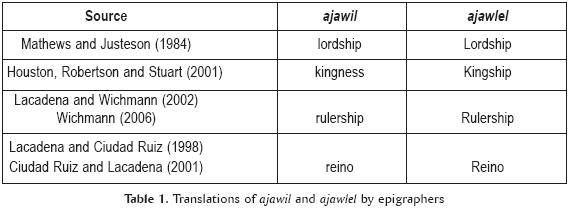
<body><![CDATA[<p align="justify"><font face="verdana" size="2">S&oslash;ren Wichmann (2006: 281, <a href="#t1">table 1</a>) confirmed this in his recent publication listing <i>ajawil</i> and <i>ajawlel</i> as contrastive pairs indicating "strong Eastern versus Western Ch'olan features" in the inscriptions. The translation given to both is 'rulership', or a similar semantic field, differing from the idea of Stephen Houston, John Robertson and David Stuart (2001).</font></p>  	    <p align="center"><font face="verdana" size="2"><a name="t1"></a></font></p>  	    <p align="center"><font face="verdana" size="2"><img src="/img/revistas/ecm/v38/a2t1.jpg"></font></p>  	    <p align="justify"><font face="verdana" size="2">Alfonso Lacadena and Andr&eacute;s Ciudad Ruiz (1998; Ciudad Ruiz and Lacadena, 2001), argued that <i>ajawil/ajawlel</i> referred to 'kingdom' and was the basic component of hegemonic rule both in the Classic and the Postclassic Periods.</font></p>  	    <blockquote> 		    <p align="justify"><font face="verdana" size="2">La entidad pol&iacute;tica gobernada por un <i>ajaw,</i> "rey, se&ntilde;or", es el <i>ajawlel</i> o <i>ajawil</i> en t&eacute;rminos cholanos o el <i>ajawlil</i> en yucateco, los cuales fueron utilizados desde el Cl&aacute;sico hasta finales del siglo xvii (Lacadena y Ciudad, 1998), indicando de nuevo la continuidad en la concepci&oacute;n y en la estructura interna y externa del gobierno en las Tierras Bajas mayas desde su fundaci&oacute;n hasta los diferentes procesos de colonizaci&oacute;n de la regi&oacute;n. El manuscrito chontal deja claro en varias ocasiones que la f&oacute;rmula de acceso a este territorio es <i>chumvanix ta ajawlel</i> "se asent&oacute; en el reino", "comenz&oacute; a gobernar", design&aacute;ndolo como toda la entidad pol&iacute;tica (Smailus, 1975: 32, <i>apud</i> Ciudad Ruiz and Lacadena, 2001: 27).</font></p> 	</blockquote>  	    <p align="justify"><font face="verdana" size="2">They perceive that <i>ajawil/ajawlel</i> refers to 'territory', and they translated the term in the accession sentence as 'kingdom'. According to this interpretation there is a single term for the political entity of the Classic Period: <i>ajawil/ajawlel</i> which depends on the particular linguistic area. They explicitly mention that there was continuity in the conceptualisation of political organisation from Classic to Post&#45;classic.</font></p>  	    <p align="justify"><font face="verdana" size="2">Contrary to this suggestion, Stephen Houston (2000: 173; Houston, <i>et ah,</i> 2003: 215) asserted that there was not a single term referring to kingdoms or polities in Classic Maya inscriptions.</font></p>  	    <blockquote> 		    <p align="justify"><font face="verdana" size="2">Terms for "kingdoms" or polities continue to be elusive...(Houston, 2000: 173)</font></p>  		    ]]></body>
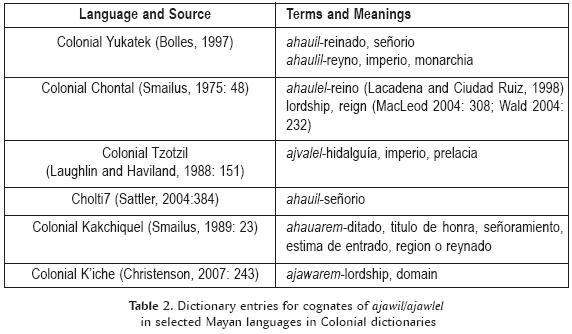
<body><![CDATA[<p align="justify"><font face="verdana" size="2">At present there is not a single, attested term in Maya hieroglyphic inscriptions for cities per se or for the polities that heavily concern Mayanists (Houston <i>et al.,</i> 2003:315).</font></p> 	</blockquote>  	    <p align="justify"><font face="verdana" size="2">It is important to point out the existence of linguistic evidence for the differentiation of the &#45;VI and &#45;el suffixes which leads me to the conclusion that the denotations of the two lexemes were originally different and they may not be synonymous. David Mora&#45;Mar&iacute;n (2005: 20) argued for the existence of&#45;Vl&#45;el suffix in Proto&#45;Ch'olan and Proto&#45;Ch'olan&#45;Tzeltalan:</font></p>  	    <blockquote> 		    <p align="justify"><font face="verdana" size="2">These entries show the root ik' 'air' (Proto&#45;Ch'olan *ik') and derived forms like ik'&#45;ar 'wind' and ik'&#45;ar&#45;er 'vertigo'...Innovated *&#45;(V)l&#45;el and ancestral *&#45;il (see above) were likely in coexistence given that modern Ch'olan languages exhibit such coexistence, as the following example of Ch'orti7 shows...(Wisdom, 1950: 702): chich 'soft bone, hard flesh, cartilage, muscle, gristle, tendon, vein or artery, grain (in wood), tough herb or stalk, though latex (rubber)', chichar 'muscle, mass of cartilage, chi&#45;charir 'pertaining to muscles' (David Mora&#45;Mar&iacute;n, 2005: 20).</font></p> 	</blockquote>  	    <p align="justify"><font face="verdana" size="2">The two examples from Ch'orti' cited by Mora&#45;Mar&iacute;n confirm the analysis of John Robertson (in Houston, Robertson, and Stuart, 2001) and support the claim that the two terms are not dialectal features but have subtle differences in their denotations: ajawil is *king&#45;ness and <i>ajawlel</i> is *kingship.</font></p>  	    <p align="justify"><font face="verdana" size="2">Colonial dictionaries concur that the primary meaning of the &#45;VI derived forms of ajaw is 'kingship, lordship' referring to the office of a titled individual; but there is a secondary semantic field which refers to the territory under the authority of the person connected to this particular office (<a href="#t2">table 2</a>). Those authors who argued <i>ajawlel</i> being a reference for territory based their translations on the use of linguistically cognate forms in Mayan languages in Colonial Sources recorded at least 600 years later than the Classic Period.</font></p>  	    <p align="center"><font face="verdana" size="2"><a name="t2"></a></font></p>  	    <p align="center"><font face="verdana" size="2"><img src="/img/revistas/ecm/v38/a2t2.jpg"></font></p>  	    <p align="justify"><font face="verdana" size="2">The basic question is, however, whether Late Postclassic and Colonial conceptualisations were similar to the conceptualisation of <i>ajawil</i> and <i>ajawlel</i> in the Classic Period. Or, whether there was a semantic shift which resulted in widened semantic fields of <i>ajawil</i> and <i>ajawlel</i> by incorporating the connotation of territory from the Classic to the Postclassic Periods.</font></p>  	    <p align="justify"><font face="verdana" size="2">To answer these questions it is indispensable to examine the linguistic contexts of these suffixes and lexemes in Classic Period inscriptions. Such an analysis may not give us a secure answer about all connotations of these words; however, it will give the pragmatic contexts of these lexemes and also their semantic environments. The investigations of these specific contexts may indicate some of the wider meanings of these terms.</font></p>  	    ]]></body>
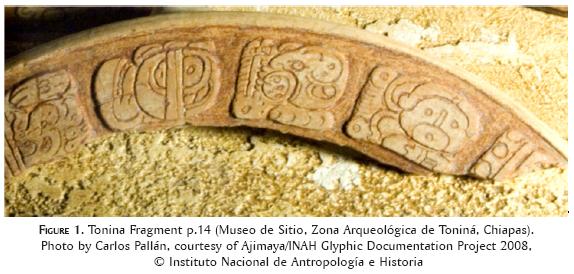
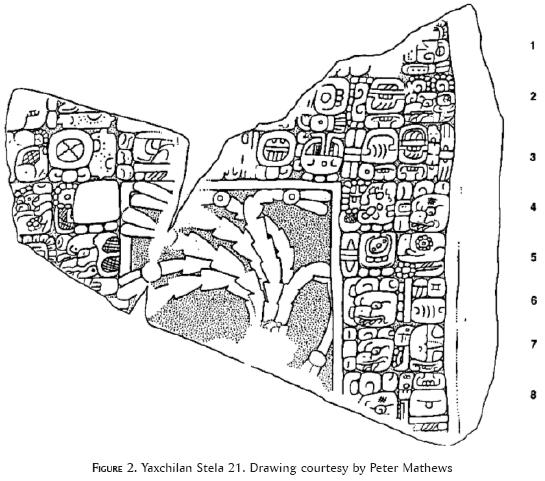
<body><![CDATA[<p align="justify"><font face="verdana" size="2">While Stephen Houston, John Robertson and David Stuart (2001: 22) found the <i>&#45;Vl&#45;el</i> suffix on the nouns of <i>ajawil</i> and <i>bah ch'okil</i> this is equally attested on <i>sajal</i> and <i>kalomte'</i> (<a href="#f1">figure 1</a>).<sup><a href="#notas">8</a></sup> Three more titles are attested with the suffix &#45; <i>il</i> in the inscriptions, all of them in accession statements: <i>aj k'uhun, ti'sak hun, yajaw k'a&#91;h&#93;k'</i> and <i>nun</i> (Zender, 2004: 157&#45;159).</font></p>  	    <p align="center"><font face="verdana" size="2"><a name="f1"></a></font></p>  	    <p align="center"><font face="verdana" size="2"><img src="/img/revistas/ecm/v38/a2f1.jpg"></font></p>  	    <p align="justify"><font face="verdana" size="2">Although this affixation pattern can be interpreted as a dialectal/vernacular difference, I think that the temporal data warrant another interpretation. While it is clear that the earliest forms are attested with &#45;li all over the Southern Maya Lowlands (from 8.18.10.0.0 with <i>ajaw</i> to 9.17.10.0.0 on Naranjo Stela 19, while with the sajal title the last record is 9.18.1.12.16 on the unprovenanced Dumbarton Oaks Panel); the &#45;le or &#45;le&#45;le forms appears not much later and then spread over the whole Lowlands (from 9.4.11.8.16 to the end of the Classic Period). It is too early to posit that the four titles suffixed only with &#45;li were never suffixed with &#45;le/&#45;le&#45;le because they occur only a couple of times in accession statements, all of them coming from three monuments dedicated between 615 and 660, when both forms were widely used.<sup><a href="#notas">9</a></sup></font></p>  	    <p align="justify"><font face="verdana" size="2">Further on, the contexts of the <i>ajawil/ajawlel</i> and <i>sajalil/sajalel</i> are similar, which in turn rules out a difference in their semantic fields. The three main contexts where these derived nouns occur are accession statements, numbered time&#45;period celebrations and a less well&#45;understood context where they occur following the numbers 9 and 3. In the case of the <i>ajawil/ajawlel</i> pair, both forms appear in all of the three contexts, which lend support to a non&#45;different semantic field hypothesis.</font></p>  	    <p align="justify"><font face="verdana" size="2">Independently from their similar or different semantic fields, there are no verbs of movement or other toponymic formulas that would indicate that <i>ajawil/ ajawlel</i> refers to territory. There is not a single phrase in the corpus of Classic Period inscriptions where they follow directly verbs such as <i>ochi, huli, tali, puluyi, jub'uyi, t'ab'ayi, e&#91;h&#93;meyi, u&#91;h&#93;ti</i> etc. or where they stand with attested toponyms or substitute with other nouns such as <i>ch'e'n</i> or <i>kab'.</i> Therefore, while both lexemes can be counted, they cannot be conquered or entered into, nobody arrives to <i>ajawil</i> or <i>ajawlel,</i> and most importantly toponyms do not precede or follow them. One inscription, however, may indicate that toponyms were indeed conceived as <i>ajawlel.</i> On the fragmentary inscription of Yaxchilan Stela 21 Itzamnaj B'ahlam IV has various "guardian of X" <i>(uchanul X)</i> titles. He is thus guardian of Tajal Mo' and interestingly <b>9&#45;AJAW&#45;le, a&#45;MAN&#45;na</b> and <b>a&#45;IK&#45;AJ,</b> the last two well&#45;known agency expressions referring to La Florida and Motul de San Jos&eacute; (<a href="#f2">figure 2</a>, pH:4&#45;pH:8). The expression <i>uchanul b'alun ajawlel</i> may be translated as "the guardian of many kingships or kingdom", nevertheless there is no outside indication to decide between the two alternatives.</font></p>  	    <p align="center"><font face="verdana" size="2"><a name="f2"></a></font></p>  	    <p align="center"><font face="verdana" size="2"><img src="/img/revistas/ecm/v38/a2f2.jpg"></font></p>  	    <p align="justify"><font face="verdana" size="2">All in all, internal evidence shows in the inscriptions that the primary semantic field of both terms is restricted to the actual office. While in the cases of <i>ajaw, sajal</i> and <i>kalomte'</i> this field can be secondarily widened to imply territorial connotations, it is difficult to imagine the same in the case of the office of ch'ok. Confusing the situation more, in case of the accession of Late Classic Tikal rulers from Jasaw Chan K'awil onward, the <i>kalomte'</i> is the explicit title referred to in accession formulas, while the emblem glyph is remaining connected to the <i>ajaw</i> title. At present, Classic Period inscriptions lack explicit pragmatic contexts where either of these lexemes refers to territory.</font></p>  	    <p align="justify"><font face="verdana" size="2">There are at least two options to interpret the evidence at hand. Either there was no territorial connotation involved during the Classic Period and this was acquired by semantic shift for the Late Postclassic Period, or territorial connotation was not indicated because of genre conventions in the Classic. Whatever is the answer to these two alternatives, the territorial connotation was underrepre&#45;sented in the inscriptions which may hint to differences in the conceptualisation of political organisation between the Classic and the Postclassic Periods. It is probable that the <i>&#45;lei</i> suffix was 'taking over' the grammatical sphere of &#45; <i>il</i> in the case of <i>offices</i> but not having territorial connotations. It is much more probable that <i>ajawlel</i> was an innovation with the institutionalisation of these offices, and the suggestion of Stephen Houston, John Robertson and David Stuart (2001) is more valid with their theory of the development from 'king&#45;ness' to 'kingship'. Indeed, it is possible that use of the <i>&#45;lei</i> suffix reflected a reconceptualisation of the titles and their holders. From Classic Period inscriptions, therefore, there is no evidence for the use of <i>ajawil/ajawlel</i> as a term for 'kingdom'.</font></p>  	    ]]></body>
<body><![CDATA[<p align="justify"><font face="verdana" size="2">&nbsp;</font></p>  	    <p align="justify"><font face="verdana" size="2"><b><i>Ch'e'n</i> and its Varieties</b></font></p>  	    <p align="justify"><font face="verdana" size="2">If <i>ajawil/ajawlel</i> refers to the states of'being king' and the 'institution', the question remains whether there is any other term which could have referred to the concept of 'polity' in a narrower sense, or 'territoriality'.</font></p>  	    <p align="justify"><font face="verdana" size="2">In their seminal work about Classic Period place names, David Stuart and Stephen Houston (1994: 12) first identified and detailed the occurrences and possible meaning of the variations of a logogram later deciphered by Stuart (published in Vogt and Stuart, 2005) as <b>CH'E'N</b> and represented by T571, T598, T599 and a distinctive bird head with a trilobed element in the eye. They suggested that <b>CH'E'N</b> alone has 'locational associations', and identified two variant combinations with <b>CHAN</b> and <b>KAB'</b>, respectively. The first, which they have called 'sky&#45;bone', was attested in their 'place name formula', in iconography, and in texts relating to the 819&#45;day count ritual; the second, according to their data, never occurred in the 'place name formula', but other contexts still indicated an association with locations (Stuart and Houston, 1994: 12). Therefore, the translation of the three expressions &#45;<b>CH'E'N</b>, <b>CHAN</b>&#45;<b>CH'E'N</b> and <b>KAB'</b>&#45;<b>CH'E'N</b>&#45; is 'place' in the current epigraphic literature, however, the exact semantic fields and the differential morphology and contexts have not yet been explained satisfactorily.</font></p>  	    <p align="justify"><font face="verdana" size="2">Interpretations abound, some of them are not any more valid as the new suggestion <b>CH'E'N</b> and other substitution patterns disqualified them. Linda Schele and Matthew Looper (2004) suggested that <b>CH'E'N</b> and its combinations refer to seats or platforms built from perishable materials where rituals of spirit conjuration occurred. They also suggested that the combination with <b>CHAN</b> refers to "the most sacred parts of cities, perhaps shrines where the gods were kept or where the king was enthroned...&#91;or&#93; to a raised platform", while the combination with <b>KAB'</b> "may indicate a low platform or plaza" (Schele and Looper, 2004: 354).</font></p>  	    <p align="justify"><font face="verdana" size="2">In contrast, James Brady and Pierre&#45;Robert Colas (2005) proposed that <b>CH'E'N</b> in some expressions connected to warfare may refer to sacred caves and groves, the bread&#45;basket of the <i>k'uhul ajaw.</i> Eric Velasquez (2004: 83&#45;85) also accepts <i><b>CH'E'N</b></i> as "cave, whole, rock".<sup><a href="#notas">10</a></sup></font></p>  	    <p align="justify"><font face="verdana" size="2">Alfonso Lacadena (2009: 7&#45;8) came to the conclusion that <i>kab' ch'e'n</i> refers to the concept of "territory? city?" and brings into the discussion the Nawatl <i>di&#45;frasismo altepetl</i> or <i>in atl in tepetl</i> which translates as 'village, city'. Simon Martin maintains that <i>ch'e'n</i> in cases of constructions with <i>ochi, ch'ak, puluyi</i> and the 'Star&#45;War' verb is an abbreviation of the difrasismos <i>kab' ch'e'n</i> and <i>chan ch'e'n</i> with the meaning of "unidades territoriales, sitios de asentamientos humanos pose&iacute;dos por un gobernante" (Mart&iacute;n, 2004: 105&#45;109).</font></p>  	    <p align="justify"><font face="verdana" size="2">In contrast to Lacadena (2009) and Martin (2004), David Stuart maintains that <i>chan ch'e'n</i> references the concept of 'world' while <i>kab' ch'e'n</i> is a concept referring to "territory or site" (cited in Velasquez Garcia, 2004: 84). The identification of the specific combinations as <i>difrasismos</i> are widely held by epigraphers, however, Erik Boot (2005: 228) does not accept this analysis, and translates <i>chan ch'e'n</i> as 'place of the well' and <i>kab' ch'e'n</i> as 'region of the well', but later rather confusingly he translates both terms as 'community'.</font></p>  	    <p align="justify"><font face="verdana" size="2">Stephen Houston (2000: 173) in turn suggested that <i>kab' ch'e'n</i> specifically refers to "land or even to the property of rulers" and he also brought into focus the concept's similarity to the Nawatl <i>altepetl.</i><sup><a href="#notas">11</a></sup></font></p>  	    <p align="justify"><font face="verdana" size="2">Kerry Hull (2003: 425&#45;438) made a detailed contextual analysis of the kab' <i>ch'e'n, chart ch'e'n</i> and <i>chan kab'</i> expressions, taking them all as <i>difiasismos.</i> He accepted the general meaning of <i>ch'e'n</i> as 'cave' and argued that <i>kab ch'e'n</i> "could be viewed as a reference to a physical location within a site" (Hull, 2003: 427). Conversely, he later cites the idea of David Stuart and concurs that <i>kab' ch'e'n</i> refers to 'territory' and <i>chan ch'e'n</i> is a wider concept with the meaning of 'region'.</font></p>  	    ]]></body>
<body><![CDATA[<p align="justify"><font face="verdana" size="2">Alexander Tokovinine (2008: 141&#45;158) made the most recent and thorough analysis based on a corpora of place names. For him, <i>ch'e'n</i> meant 'temples, holy grounds' and by extension 'city'. The term <i>kab' ch'e'n</i> is simply 'the land and the city' of a person, and he points out that this statement stands in claims of authority over the polity, and he believes that this refers to a notion of 'territory'. In turn <i>chan ch'e'n</i> is related to the notion of sacred landscape, the domain of supernatural entities, and inscriptions mention them where the emphasis is on interaction with such beings (Tokovinine, 2008: 160&#45;161).</font></p>  	    <p align="justify"><font face="verdana" size="2">The problems of interpretation, therefore, are several: there is no accepted meaning or translation as 'world, region, country, town, village, platform, and cave' have quite different semantic fields. The contextual argument&#151;namely that a given expression is translated differently in different contexts&#151;leads to an under&#45;conceptualisation of one of the most frequent <i>difiasismos</i> in Classic Period inscriptions. In the following I would like to point out some patterns in distribution and use of the <i>ch'e'n, kab' ch'e'n</i> and <i>chan ch'e'n</i> expressions to add some new insights to the debate.</font></p>  	    <p align="justify"><font face="verdana" size="2">First of all, <i>ch'e'n</i> as others pointed out, has a general meaning of 'cave, whole, pool' and semantically it can refer to any cavity on earth filled or not filled by water.<sup><a href="#notas">12</a></sup> As such it is part of the landscape described in Classic Period inscriptions. The other participants of the <i>difiasismos</i> are also well attested, <i>kab'</i> is 'land' but not soil, and <i>chan</i> is 'sky'. Epigraphers agree that <i>ch'e'n</i> is the widest used term in Classic Period inscriptions. Its context suggests that it refers to a built place either by humans or by divine beings (see Tokovinine, 2008: 141&#45;158 for an exhaustive list of these contexts). It is attested from the earliest inscriptions and in every region of the Maya lowlands. <i>Ch'e'n</i> is standing with verbs indicating movement and warfare, and with toponyms.</font></p>  	    <p align="justify"><font face="verdana" size="2"><i>Kab' ch'e'n</i> and <i>chart ch'e'n</i> behave not alike <i>difrasismos</i> in Colonial Mayan and Nawa language sources (Knowlton, 2002). Such expressions consist of two roots, and when possessed can take ergative pronouns on all of their constituents. Thus we have <i>ukab' uch'e'n</i> and <i>uchan uch'e'n.</i> Such a compound functions as an entire phrase and refers to a third lexeme. Angel Maria Garibay (1953&#45;1954) called this new term <i>difrasismo.</i> Translating these compounds literally (or as stative sentences "his land, his cave") or as periphrastic gentitives ("the land of his cave"), I believe it is erroneous.<sup><a href="#notas">13</a></sup> While sometimes such <i>difrasismos</i> are semantically transparent, in other cases epigraphers and linguists have problems to explain why certain terms are used in specific constructions.</font></p>  	    <p align="justify"><font face="verdana" size="2"><i>Ch'ahb'</i> and <i>ahk'ab'</i> are attested as two nouns independently as 'fast' and 'night'. They form a <i>difrasismo</i> which has, possibly, the connotation of 'person, self as it occurs in a father of child expression where the offspring is the image <i>(ub'ah)</i> of the <i>ch'ahb' ahk'ab'</i> of the father. In captive presentations, it is frequent to refer to the captive as <i>ub'ah ma' ch'ahb'al ma' ahk'b'al</i> which is best translated as 'the image of nobody', in the sense of the self of somebody who lost his personhood by being a captive. Neither a literal translation nor 'captive' explains both contexts, therefore my suggestion to go for a third therm. Taking into account such considerations, <i>kab' ch'e'n</i> and <i>chan ch'e'n</i> may transmit meanings which are not indicated properly by literal translations or using periphrastic interpretations.</font></p>  	    <p align="justify"><font face="verdana" size="2">The distribution of <i>kab' ch'e'n</i> is temporally wide (from the Early Classic to the Postclassic Periods), but spatially it has a preferential use in the Western Maya Region, with early examples in the inscriptions of Copan and Quirigua in the Southeast Maya Region. Except some cases, it is virtually not used in other regions. Its context is slightly different from that of chan ch'e'n. While the latter is the preferential <i>difrasismo</i> in formulas where it has to follow a toponym as "to&#45;ponym <i>&#45;chan ch'e'n", kab' ch'e'n</i> is extremely rare in this context (Hull, 2003: 428).</font></p>  	    <p align="justify"><font face="verdana" size="2">This alone lends support to suggestions which posit different semantic fields for these two expressions. <i>Kab' ch'e'n</i> is the preferential expression with verbs such as <i>ch'ak, puluyi</i> and <i>'Star&#45;War',</i> if a <i>difrasismo</i> occurs at all (Martin, 2004: 108). Also, as Peter Mathews (1996 &#91;1991&#93;: 25) demonstrated the 'Star&#45;War' verb can stand with a toponym, the <b>KAB'</b> and the <b>CH'E'N</b> logograms (these ones frequently possessed, mostly with the third person ergative pronoun; see Martin, 1996: 3, 16). In one particularly enlightening case, the 'Star&#45;War'&#45;yi verb precedes a possessed <i>ukab' ch'e'n</i> on Tonina Monument 83 (Martin, 2004: 108). As Simon Martin concluded at the same page, this specific late example perhaps indicate that <i>ch'e'n</i> is a shorthand form to indicate <i>kab' ch'e'n</i> in 'war expressions', however, it is equally possible that here they refer something different than <i>ch'e'n.</i></font></p>  	    <p align="justify"><font face="verdana" size="2">The next context where <i>kab' ch'e'n</i> occurs frequently is a possessed formula with other locative adverbs, mostly found in the inscriptions of the Western Maya Region, especially in Bonampak and Yaxchilan. In these cases it is connected to locations but the emphasis is on the possession and the 'within&#45;ness' of the actions conducted. The earliest example is on an unprovenanced jade from Costa Rica which may unravel some of its semantic meaning. The text is the following (<a href="#f3">figure 3</a>):</font></p>  	    <blockquote> 		    <p align="justify"><font face="verdana" size="2"><i>ub'ah 7 7 ix y atan muyal nun 7 tan lam 7 ajaw 7 ub'ah tu kab' tu ch'e'n</i></font></p>  		    ]]></body>
<body><![CDATA[<p align="justify"><font face="verdana" size="2">"it is her image, Ix ?, she is the wife of Muyal Nun ? Tan Lam ? ajaw ?, it is her image on &#91;his land, on his cave&#93;"</font></p>  		    <p align="center"><font face="verdana" size="2"><a name="f3"></a></font></p>  		    <p align="center"><font face="verdana" size="2"><img src="/img/revistas/ecm/v38/a2f3.jpg"></font></p> 	</blockquote>  	    <p align="justify"><font face="verdana" size="2">Here, the third person ergative pronouns refers once to the wife and then to the husband, and the little formula at the end emphasise that the wife is on the property of the husband (independently of the translation of <i>kab' ch'e'n).</i> The same formula is continued to be used in various inscriptions, for instance on Brussels Stela B1&#45;C2 (<a href="#f4">figure 4</a>):</font></p>  	    <blockquote> 		    <p align="justify"><font face="verdana" size="2"><i>ub'ah&#91;il&#93; an 7 7 k'i&#91;h&#93;nich a&#91;h&#93;ku&#91;I&#93; pat 7&#45;ha' ajawjun winikhab' jun hab' chanlajun winik lajchan k'in chumlaj i pas&#91;aj&#93; tu kab' tu ch'e'n</i></font></p>  		    <p align="justify"><font face="verdana" size="2">"it is his image of the ?, ?? &#91;a version of Gill&#93;, K'ihnich Ahkul Pat, ? Ha' ajaw, 1 winikhab', 1 hab' 14 winik, 1 k'in since he sat and then appeared &#91;as sun in the horizon&#93; in &#91;his land, in his cave&#93;"</font></p>  		    <p align="center"><font face="verdana" size="2"><a name="f4"></a></font></p>  		    <p align="center"><font face="verdana" size="2"><img src="/img/revistas/ecm/v38/a2f4.jpg"></font></p> 	</blockquote>  	    <p align="justify"><font face="verdana" size="2">In this context the reference is to an accession but here without the record of the office and the <i>kab' ch'e'n</i> is possessed but it is not certain whether by the king himself (K'ihnich Ahkul Pat) or by the deity impersonated by him. This formula is almost a substitution for the usual <i>chumlaj/wani ti/ta ajawil/ajawlel</i> construction, in which case <i>ajawil/ajawlel</i> is never possessed, a distinction, which probably shows that an office cannot be possessed in the sense as a <i>kab' ch'e'n.</i> It lends support to make a distinction between the abstraction of office and the concreteness of <i>kab' ch'e'n.</i></font></p>  	    ]]></body>
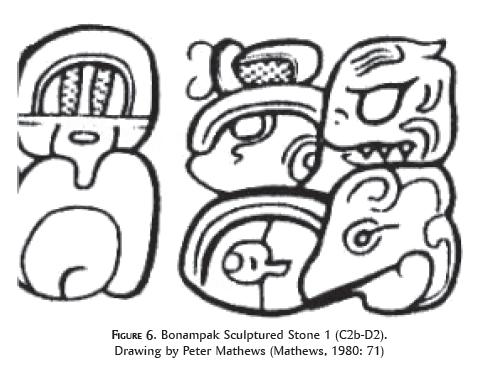
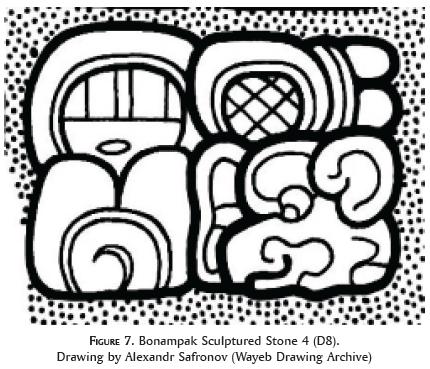
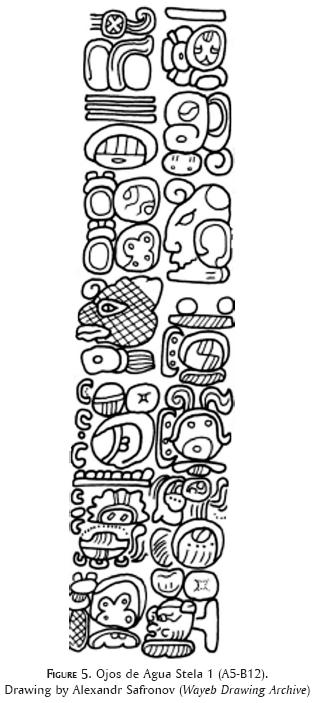
<body><![CDATA[<p align="justify"><font face="verdana" size="2"><i>Kab' ch'e'n</i> is possessed in another text replicating the formula of the Brussels Stela (Ojos de Agua Stela, 1, <a href="#f5">figure 5</a>):</font></p>  	    <blockquote> 		    <p align="justify"><font face="verdana" size="2"><i>ho' mih winik&#91;i&#93;j ho'Iajun hab' chumlajiy tu kab' tu ch'e'n e&#91;hjb' pat uhuk tz'ak&#91;b'ujl uya&#45;jawte' umijnil aj yax punim i pasaj tu kab' tu ch'e'n xukalnah ajaw</i></font></p>  		    <p align="justify"><font face="verdana" size="2">"5 winik 0 day since he sat in &#91;his land, his cave&#93;, Ehb' Pat, the seventh successor of the yajawte', the son of Aj Yax Punim, and he opened in &#91;his land, his cave&#93;, he is a Xukalnah Ajaw"</font></p>  		    <p align="center"><font face="verdana" size="2"><a name="f5"></a></font></p>  		    <p align="center"><font face="verdana" size="2"><img src="/img/revistas/ecm/v38/a2f5.jpg"></font></p> 	</blockquote>  	    <p align="justify"><font face="verdana" size="2">The accession sentence is exactly the same as on the Brussels stela which in turn is followed by similar information about the family of the ruler (on the Brussels stela the mother and father are mentioned), hereby followed by a verb which in turn is said to happen again in the land and cave of the ruler who is only recorded as a Xukalnah lord.</font></p>  	    <p align="justify"><font face="verdana" size="2">Another interesting context of the <i>kab' ch'e'n difrasismo</i> is its connection to the verb "HAB' "&#45;yi,<sup><a href="#notas">14</a></sup> which precedes toponyms. In this context, the usual term is <i>ch'e'n.</i> For instance, in Bonampak Sculptured Stone 1 (C2b&#45;D2, <a href="#f6">figure 6</a>) a future period ending is followed by "HAB'"&#45;Vy <i>tu kab' tu ch'e'n usij witznal. Usij witznal</i> is the name of Bonampak. On Bonampak Sculptured Stone 4 (D8, <a href="#f7">figure 7</a>) it is simply written "HAB'"&#45;Vy <i>tu ch'e'n.</i></font></p>  	    <p align="center"><font face="verdana" size="2"><i><a name="f6"></a></i></font></p>  	    <p align="center"><font face="verdana" size="2"><i><img src="/img/revistas/ecm/v38/a2f6.jpg"></i></font></p>  	    ]]></body>
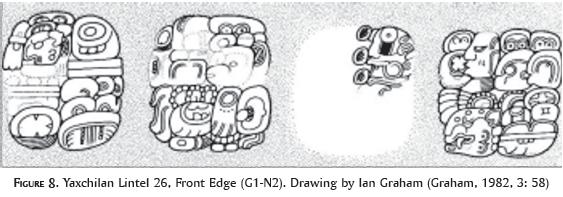
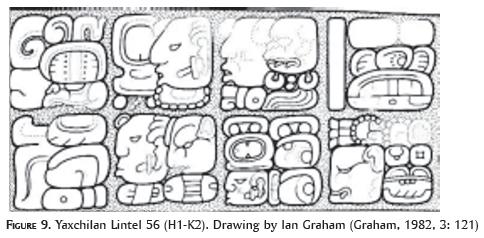
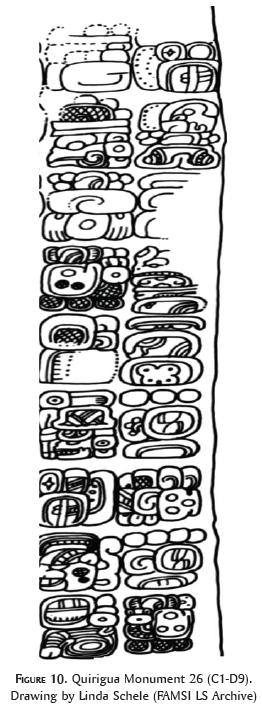
<body><![CDATA[<p align="justify"><font face="verdana" size="2">&nbsp;</font></p>  	    <p align="center"><font face="verdana" size="2"><i><a name="f7"></a></i></font></p>  	    <p align="center"><font face="verdana" size="2"><i><img src="/img/revistas/ecm/v38/a2f7.jpg"></i></font></p>  	    <p align="justify"><font face="verdana" size="2">Another context which is similar and not exactly toponymic is on the front edge of Yaxchilan Lintel 26 (Nl, <a href="#f8">figure 8</a>) where a house dedication is mentioned <i>(ochi k'a&#91;h&#93;k' ? uk'uh&#91;ul&#93; k'ab'a' yototj</i> by Ix K'ab'al Xok; as the first clause ends a second one begins with <i>ukab' uch'e'n</i> and continues with the name of the current Yaxchilan ruler. Although it was tempting to see this as a similar sequence to <i>ukab'jiy</i> transitive verb events (and it is easy to see here an etymologic connection between the two), it is arguable that the second clause only states that the house <i>(otot),</i> the physical building is the <i>kab' ch'e'n</i> of the Yaxchilan ruler, albeit it is the house of Ix K'ab'al Xok. A similar sentence is recorded on Yaxchilan Lintel 56 (<a href="#f9">figure 9</a>) where the house <i>(otot)</i> of Ix Sale B'iyan is in turn the <i>kab' ch'e'n</i> of Itzamnaj B'ahlam III.</font></p>  	    <p align="center"><font face="verdana" size="2"><a name="f8"></a></font></p>  	    <p align="center"><font face="verdana" size="2"><img src="/img/revistas/ecm/v38/a2f8.jpg"></font></p>  	    <p align="justify"><font face="verdana" size="2">&nbsp;</font></p>  	    <p align="center"><font face="verdana" size="2"><a name="f9"></a></font></p>  	    <p align="center"><font face="verdana" size="2"><img src="/img/revistas/ecm/v38/a2f9.jpg"></font></p>  	    <p align="justify"><font face="verdana" size="2">These two similar sentences can clear off some of the doubts about the semantic field of <i>kab' ch'e'n.</i> As in the Costa Rica jade, the <i>kab' ch'e'n</i> here is possessed not by the subject of the first clause but by another grammatical subject, in both cases rulers whose wives participate in various rituals. In the cases of the Yaxchilan Lintels, I cannot emphasise enough that these are the houses (otot) which are the <i>kab' ch'e'n</i> of the ruler. As there are only two examples, somebody can argue that a missing tu is not written in both cases, because a general translation of "in the community of" would be possible; however, I doubt that this was the case. Rather, the houses were the <i>properties</i> or better, objects owned by the Yaxchilan kings, while they also pertained to the women who lived in them. An early form of the use of <i>kab' ch'e'n</i> can be interpreted in a similar way, although the context is not well understood. Quirigua Monument 26 (<a href="#f10">figure 10</a>) lists probably three rulers in succession (the second, third and fourth one) in different rituals:</font></p>  	    ]]></body>
<body><![CDATA[<blockquote> 		    <p align="justify"><font face="verdana" size="2">? <i>k'uhul ajaw "HEADBAND&#45;BIRD" k'uhul</i> ? <i>t'o&#45;7 7u&#91;kab' ch'e'n?&#93; cha' ch'ajom ?&#45;Vp paswani ukab' ch'e'n ? ux tz'akb'ul ajaw&#91;a&#93;j ? ub'ah ? chan tz'akb'ul chan yopat jun ch'ajom k'uhul ?</i></font></p>  		    <p align="justify"><font face="verdana" size="2">"? the sacred lord, the "headband bird", the sacred ?, ?, his &#91;land&#45;cave&#93;, of the two (winikhab') ch'ajom (from) ?&#45;Vp, it was opened &#91;his land&#45;cave&#93;, of ?, the third successor, he became lord, ? it is his image, the fourth successor Chan Yopat, one (winikhab') ch'ajom, the sacred ?"</font></p>  		    <p align="center"><font face="verdana" size="2"><a name="f10"></a></font></p>  		    <p align="center"><font face="verdana" size="2"><img src="/img/revistas/ecm/v38/a2f10.jpg"></font></p> 	</blockquote>  	    <p align="justify"><font face="verdana" size="2">The text, although opaque, records that the <i>kab' ch'e'n,</i> possessed by a once lived individual, is opened. Even in a metaphorical way, it is difficult to imagine the opening of a community or region, however, some property, a physical entity such as a tomb can be easily reopened and rituals can be carried on as was attested in other inscriptions (Fitzsimmons, 1998).</font></p>  	    <p align="justify"><font face="verdana" size="2">In these particular cases a 'territory, city, community' or 'world' translation seems inappropriate. Almost always a <i>kab' ch'e'n</i> is possessed, therefore pertaining to a person, nevertheless by using the word 'property' and 'possession' I do not want to imply private property in the sense of industrialised capitalist societies. Rather, <i>kab' ch'e'n</i> is emphasising the land and the buildings, and probably the very physicality of these artificial creations. Dominion may be an appropriate term to translate <i>kab' ch'e'n.</i> Dominion or domain can refer to a singular building to a wider territory, but at the same time it emphasises some personal ownership. While <i>ch'e'n</i> referred to the built area of a city, <i>kab' ch'e'n</i> was all that was under the dominion of a person.</font></p>  	    <p align="justify"><font face="verdana" size="2">The context of the use of <i>chan ch'e'n</i> differs from that of <i>kab' ch'e'n</i> in various ways. <i>Chan ch'e'n</i> is the preferred expression after toponyms without any locative preposition. The possession of <i>chan ch'e'n</i> is rare (for example Copan Altar S, <a href="#f11">figure 11</a>), while <i>kab' ch'e'n</i> stands most of the cases modified by the third person or sometimes with the second person ergative pronouns. <i>Chan ch'e'n</i> never follows verbs such as <i>ch'ak, puluyi, huli, e&#91;h&#93;meyi, t'ab'ayi,</i> etc. <i>Chan ch'e'n</i> is the one which follows the various cardinal directions such as 'north, south, west, east' in the 819 day&#45;count formula. Outside of this context, as on an Altar for Copan Stela 13 (G1&#45;H1, <a href="/img/revistas/ecm/v38/a2f12.jpg" target="_blank">figure 12</a>), it also refers to cardinal direction:</font></p>  	    <blockquote> 		    <p align="justify"><font face="verdana" size="2"><i>alay patlaj u we' huk chapat tz'ikin k'inich ajaw elk'in chart ch'e'n</i></font></p>  		    ]]></body>
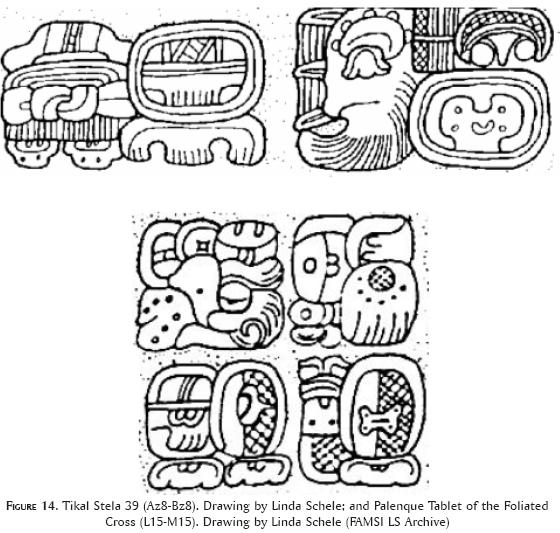
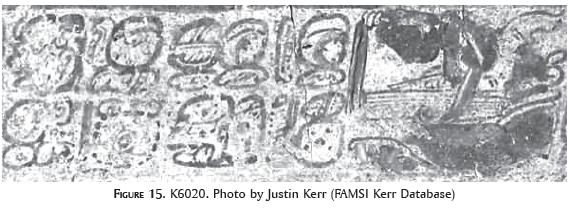
<body><![CDATA[<p align="justify"><font face="verdana" size="2">"here he formed the food for Huk Chapat Tz'ikin K'inich 7Ajaw &#91;at&#93; the East &#91;place&#93;"</font></p>  		    <p align="center"><font face="verdana" size="2"><a name="f11"></a></font></p>  		    <p align="center"><font face="verdana" size="2"><img src="/img/revistas/ecm/v38/a2f11.jpg"></font></p> 	</blockquote>  	    <p align="justify"><font face="verdana" size="2"><i>Chan ch'e'n</i> sometimes seems to be an abbreviation of ch'e'n (Hull, 2003: 429&#45;430). This is attested in two different contexts during the Early Classic Period.</font></p>  	    <p align="justify"><font face="verdana" size="2">On the Tikal Marcador (<a href="/img/revistas/ecm/v38/a2f13.jpg" target="_blank">figure 13</a>), the arrival of Sihjay K'ahk' is mentioned to be at Mutul <i>chan ch'e'n</i> (B9); in the same text (H5&#45;I5) another arrival is happened at Mutul <i>ch'e'n.</i> Another context where the substitution occurs is the formula, usually at the end of a sentence, "toponym <i>chan ch'e'n uch'e'n X"</i> (<a href="#f14">figure 14</a>) attested in the Early Classic Tikal Stela 39 (Az8&#45;Bz8). Or in the Late Classic Palenque Temple of the Foliated Cross Tablet (L15&#45;M15) where the text ends with <i>u&#91;h&#93;tiy lakam ha' chan ch'e'n tu ch'e'n</i> or "it happened at Lakam Ha' chan ch'e'n, in the ch'e'n of...". It is not clear whether the place name here is referred to as a <i>ch'e'n</i> of a given being (that is Lakam Ha' is referenced back by tu <i>ch'e'n)</i> or in this case a specific building is what is a <i>ch'e'n</i> within a wider Lakam Ha' <i>chan ch'e'n.</i> That <i>ch'e'n</i> can refer to buildings alone without any prior mention <i>of chan</i> or <i>kab' ch'e'n</i> is attested in various inscriptions, where the possessors are deities.</font></p>  	    <p align="center"><font face="verdana" size="2"><a name="f14"></a></font></p>  	    <p align="center"><font face="verdana" size="2"><img src="/img/revistas/ecm/v38/a2f14.jpg"></font></p>  	    <p align="justify"><font face="verdana" size="2">On K6020 (<a href="#f15">figure 15</a>), a similar clause occurs at the end of a larger narrative, which is unfortunately not well understood. The clause ends with <i>u&#91;h&#93;tiy ? nal chan ch'e'n uch'e'n b'i&#45;? tz'i&#91;h&#93;b'</i> or 'it happened at the ? sky cave, the cave of B'i&#45;?, the scribe'. This scribe is even represented as sitting in front of the written text reading a codex. Therefore, it is possible that he was reading out the story and <i>ch'e'n</i> actually refers to his 'place', or even to the codex, or better said just indicates that the scribe was from a mythological place attested in other inscriptions (Stuart and Houston, 1994: 74).</font></p>  	    <p align="center"><font face="verdana" size="2"><a name="f15"></a></font></p>  	    <p align="center"><font face="verdana" size="2"><img src="/img/revistas/ecm/v38/a2f15.jpg"></font></p>  	    ]]></body>
<body><![CDATA[<p align="justify"><font face="verdana" size="2">The distribution of <i>chart ch'e'n</i> is not connected to one kind of toponym as it follows emblem glyph main signs, other toponyms and especially mythological place names, and also cardinal directions. While <i>&#45;nal</i> is a frequent suffix on toponyms attested from the earliest inscriptions cuing generally 'place' and it forms part of actual toponyms, <i>chan ch'e'n</i> may indicate an added quality acquired by the presence of inhabitants, the only common and implied factor present in all the toponyms connected to <i>chan ch'e'n.</i></font></p>  	    <p align="justify"><font face="verdana" size="2">According to these selected contexts <i>ch'e'n</i> refers to the smallest unit of the landscape with the meaning of 'inhabited place, settlement'. <i>Kab' ch'e'n</i> refers to the 'dominion' of somebody and this sometimes encompasses a wider area than a single settlement. <i>Chan ch'e'n</i> has the meaning of'place' which can be real or imaginary, mostly the latter. Finally, <i>chan kab'</i> has the meaning of 'world, everywhere'.<sup><a href="#notas">15</a></sup></font></p>  	    <p align="justify"><font face="verdana" size="2">Using one single word <i>(ch'e'n)</i> to refer to a range of settlements, which archaeologists differentiate by size and complexity (hamlets, villages, town and city), is not unique to the Classic Maya. Ancient Sumerian terminology did not distinguish among settlements which were uniformly designated 'uru' in cuneiform texts (Glassner, 2000: 38; Westenholz, 2002: 28).</font></p>  	    <p align="justify"><font face="verdana" size="2">&nbsp;</font></p>  	    <p align="justify"><font face="verdana" size="2"><b>Conclusion</b></font></p>  	    <p align="justify"><font face="verdana" size="2">I have suggested that Classic Maya politics can be approached by the analysis of certain words pertaining to the arena of politics, together constituting a political vocabulary. There are many more words which can be examined, and I do not claim to have made a thorough analysis. From these reflections I propose the following observations for further investigation.</font></p>  	    <p align="justify"><font face="verdana" size="2">Classic Period polities may had been referred to as <i>ch'an ch'e'n</i> or simply <i>ch'e'n.</i> This word, however, cannot be equated one to one to 'polity' or 'state', rather it referred to places where humans and supernatural entities lived together. Therefore, I speculate that it could refer to a building, a group of buildings, a plaza group or many plaza groups together or what we call 'city' in general.</font></p>  	    <p align="justify"><font face="verdana" size="2">The Classic Period <i>ajawil/ajawlel</i> referred to a ruling line, the office of the <i>ajaw,</i> and presumably later incorporated a more specific territorial meaning also, though I do not see this borne out of Classic Maya inscriptions, rather it is an assumption coming from investigations of Postclassic Maya societies (whose data come from the Colonial Period). A polity was composed from inhabited places which were all designated as <i>ch'e'n</i> where kingship was institutionalised <i>(ajawlel).</i> This constellation was similar in many ways to the Postclassic Mexican Highland polity organisation with its <i>altepetl</i> and the institution of the <i>tlahtocayotl</i> which corresponded to the Classic Maya <i>ajawlel.</i></font></p>  	    <p align="justify"><font face="verdana" size="2">&nbsp;</font></p>  	    <p align="justify"><font face="verdana" size="2"><b>REFERENCES</b></font></p>  	    ]]></body>
<body><![CDATA[<!-- ref --><p align="justify"><font face="verdana" size="2">Akkeren, Ruud W, 2003 "Authors of the Popol Wuj", <i>Ancient Mesoamerica.</i> 14 (2): 237&#45;256. Cambridge: Cambridge University Press.    &nbsp;&nbsp;&nbsp;&nbsp;&nbsp;&nbsp;&nbsp;&nbsp;[&#160;<a href="javascript:void(0);" onclick="javascript: window.open('/scielo.php?script=sci_nlinks&ref=3410812&pid=S0185-2574201100020000200001&lng=','','width=640,height=500,resizable=yes,scrollbars=1,menubar=yes,');">Links</a>&#160;]<!-- end-ref --></font></p>  	    <!-- ref --><p align="justify"><font face="verdana" size="2">Beliaev, Dmitri, 2001 "T550 as a Verb for 'Return'". Unpublished manuscript.    &nbsp;&nbsp;&nbsp;&nbsp;&nbsp;&nbsp;&nbsp;&nbsp;[&#160;<a href="javascript:void(0);" onclick="javascript: window.open('/scielo.php?script=sci_nlinks&ref=3410814&pid=S0185-2574201100020000200002&lng=','','width=640,height=500,resizable=yes,scrollbars=1,menubar=yes,');">Links</a>&#160;]<!-- end-ref --></font></p>  	    <!-- ref --><p align="justify"><font face="verdana" size="2">Bolles, David, 1997 <i>Combined Dictionary Concordance of the Yucatecan Mayan Language</i> &lt;<a href="http://www.famsi.org/reports/96072/index.html" target="_blank">http://www.famsi.org/reports/96072/index.html</a>&gt;. &#91;Retrieved September 26, 2011.    &nbsp;&nbsp;&nbsp;&nbsp;&nbsp;&nbsp;&nbsp;&nbsp;[&#160;<a href="javascript:void(0);" onclick="javascript: window.open('/scielo.php?script=sci_nlinks&ref=3410816&pid=S0185-2574201100020000200003&lng=','','width=640,height=500,resizable=yes,scrollbars=1,menubar=yes,');">Links</a>&#160;]<!-- end-ref -->&#93;</font></p>  	    <!-- ref --><p align="justify"><font face="verdana" size="2">Boot, Erik, 2005 <i>Continuity and Change in Text and Image at Chichen Itza, Yucatan, Mexico: AStudy of the Inscriptions, Iconography, and Architecture at a Late Classic to EarlyPostclassic Maya Site.</i> Leiden &#91;Netherlands&#93;: Universiteit Leiden, Centre of Non&#45;Western Studies Publications.    &nbsp;&nbsp;&nbsp;&nbsp;&nbsp;&nbsp;&nbsp;&nbsp;[&#160;<a href="javascript:void(0);" onclick="javascript: window.open('/scielo.php?script=sci_nlinks&ref=3410818&pid=S0185-2574201100020000200004&lng=','','width=640,height=500,resizable=yes,scrollbars=1,menubar=yes,');">Links</a>&#160;]<!-- end-ref --></font></p>  	    <!-- ref --><p align="justify"><font face="verdana" size="2">Brady, James and Pierre&#45;Robert Colas, 2005 "Nikte Mo' Scattered Fire in the Cave of K'ab Chante': Epigraphic and Archaeological Evidence for Cave Desecration in Ancient Maya Warfare", <i>Houses and Earth lords: Maya Religion in the Cave Context,</i> Keith M. Prufer and James E. Brady (eds.). Boulder: University Press of Colorado, 149&#45;166.    &nbsp;&nbsp;&nbsp;&nbsp;&nbsp;&nbsp;&nbsp;&nbsp;[&#160;<a href="javascript:void(0);" onclick="javascript: window.open('/scielo.php?script=sci_nlinks&ref=3410820&pid=S0185-2574201100020000200005&lng=','','width=640,height=500,resizable=yes,scrollbars=1,menubar=yes,');">Links</a>&#160;]<!-- end-ref --></font></p>  	    ]]></body>
<body><![CDATA[<!-- ref --><p align="justify"><font face="verdana" size="2">Braswell, Geoffrey E. 2001 "Post&#45;Classic Maya Courts of the Guatemalan Highlands: Archaeological and Ethnohistorical Approaches", <i>Royal Courts of the Ancient Maya: 2. Data and Case Studies.</i> Takeshi Inomata and Stephen D. Houston (eds.). Boulder: Westview Press, 308&#45;334.    &nbsp;&nbsp;&nbsp;&nbsp;&nbsp;&nbsp;&nbsp;&nbsp;[&#160;<a href="javascript:void(0);" onclick="javascript: window.open('/scielo.php?script=sci_nlinks&ref=3410822&pid=S0185-2574201100020000200006&lng=','','width=640,height=500,resizable=yes,scrollbars=1,menubar=yes,');">Links</a>&#160;]<!-- end-ref --></font></p>  	    <!-- ref --><p align="justify"><font face="verdana" size="2">Bricker, Victoria R. 1986 <i>A Grammar of Maya Hieroglyphs.</i> New Orleans: Tulane University (Middle American Research Institute Publication, 56).    &nbsp;&nbsp;&nbsp;&nbsp;&nbsp;&nbsp;&nbsp;&nbsp;[&#160;<a href="javascript:void(0);" onclick="javascript: window.open('/scielo.php?script=sci_nlinks&ref=3410824&pid=S0185-2574201100020000200007&lng=','','width=640,height=500,resizable=yes,scrollbars=1,menubar=yes,');">Links</a>&#160;]<!-- end-ref --></font></p>  	    <!-- ref --><p align="justify"><font face="verdana" size="2">Carrasco, Michael, Kerry Hull and Robert Wald, n.d. "An Introduction to Epigraphic Mayan: A Notebook for the Workshop on Maya Hieroglyphic Writing for Summer Intensive Course in Yucatec Mayan". Unpublished manuscript.    &nbsp;&nbsp;&nbsp;&nbsp;&nbsp;&nbsp;&nbsp;&nbsp;[&#160;<a href="javascript:void(0);" onclick="javascript: window.open('/scielo.php?script=sci_nlinks&ref=3410826&pid=S0185-2574201100020000200008&lng=','','width=640,height=500,resizable=yes,scrollbars=1,menubar=yes,');">Links</a>&#160;]<!-- end-ref --></font></p>  	    <!-- ref --><p align="justify"><font face="verdana" size="2">Ciudad Ruiz, Andr&eacute;s and Alfonso Lacadena, 2001 "Tamact&uacute;n&#45;Acal&aacute;n: interpretaci&oacute;n de una hegemon&iacute;a pol&iacute;tica maya de los siglos XIV&#45;XVI", <i>Journal de la Soci&eacute;t&eacute; des Am&eacute;ricanistes,</i> 87: 9&#45;38. Par&iacute;s: Soci&eacute;t&eacute; des Am&eacute;ricanistes.    &nbsp;&nbsp;&nbsp;&nbsp;&nbsp;&nbsp;&nbsp;&nbsp;[&#160;<a href="javascript:void(0);" onclick="javascript: window.open('/scielo.php?script=sci_nlinks&ref=3410828&pid=S0185-2574201100020000200009&lng=','','width=640,height=500,resizable=yes,scrollbars=1,menubar=yes,');">Links</a>&#160;]<!-- end-ref --></font></p>  	    <!-- ref --><p align="justify"><font face="verdana" size="2">Christenson, Allen J. 2007 <i>Popol Vuh: The Sacred Book of the Quiche Maya</i> &lt;<a href="http://www.mesoweb.com/publications/Christenson/index.html" target="_blank">http://www.mesoweb.com/publications/Christenson/index.html</a>&gt;. &#91;Retrieved September 26, 2011.    &nbsp;&nbsp;&nbsp;&nbsp;&nbsp;&nbsp;&nbsp;&nbsp;[&#160;<a href="javascript:void(0);" onclick="javascript: window.open('/scielo.php?script=sci_nlinks&ref=3410830&pid=S0185-2574201100020000200010&lng=','','width=640,height=500,resizable=yes,scrollbars=1,menubar=yes,');">Links</a>&#160;]<!-- end-ref -->&#93;</font></p>  	    ]]></body>
<body><![CDATA[<!-- ref --><p align="justify"><font face="verdana" size="2"><i>Corpus of Maya Hieroglyphic Inscriptions 1977&#45;, Volumes 1&#45;9.</i> 1977 Ian Graham (general editor). Cambridge: Harvard University, Peabody Museum of Archaeology and Ethnology.    &nbsp;&nbsp;&nbsp;&nbsp;&nbsp;&nbsp;&nbsp;&nbsp;[&#160;<a href="javascript:void(0);" onclick="javascript: window.open('/scielo.php?script=sci_nlinks&ref=3410832&pid=S0185-2574201100020000200011&lng=','','width=640,height=500,resizable=yes,scrollbars=1,menubar=yes,');">Links</a>&#160;]<!-- end-ref --></font></p>  	    <!-- ref --><p align="justify"><font face="verdana" size="2">England, Nora, 1983 <i>A Grammar of Mam, a Mayan Language.</i> Austin: University of Texas Press.    &nbsp;&nbsp;&nbsp;&nbsp;&nbsp;&nbsp;&nbsp;&nbsp;[&#160;<a href="javascript:void(0);" onclick="javascript: window.open('/scielo.php?script=sci_nlinks&ref=3410834&pid=S0185-2574201100020000200012&lng=','','width=640,height=500,resizable=yes,scrollbars=1,menubar=yes,');">Links</a>&#160;]<!-- end-ref --></font></p>  	    <!-- ref --><p align="justify"><font face="verdana" size="2">Fitzsimmons, James, 1998 "Classic Maya Mortuary Anniversaries at Piedras Negras, Guatemala", <i>Ancient Mesoamerica,</i> 9: 271&#45;278. Cambridge: Cambridge University Press.    &nbsp;&nbsp;&nbsp;&nbsp;&nbsp;&nbsp;&nbsp;&nbsp;[&#160;<a href="javascript:void(0);" onclick="javascript: window.open('/scielo.php?script=sci_nlinks&ref=3410836&pid=S0185-2574201100020000200013&lng=','','width=640,height=500,resizable=yes,scrollbars=1,menubar=yes,');">Links</a>&#160;]<!-- end-ref --></font></p>  	    <!-- ref --><p align="justify"><font face="verdana" size="2">Fox, John W, 1987 <i>Maya Postclassical State Formation: Segmentary Lineage Migration in AdvancingFrontiers.</i> Cambridge: Cambridge University Press.    &nbsp;&nbsp;&nbsp;&nbsp;&nbsp;&nbsp;&nbsp;&nbsp;[&#160;<a href="javascript:void(0);" onclick="javascript: window.open('/scielo.php?script=sci_nlinks&ref=3410838&pid=S0185-2574201100020000200014&lng=','','width=640,height=500,resizable=yes,scrollbars=1,menubar=yes,');">Links</a>&#160;]<!-- end-ref --></font></p>  	    <!-- ref --><p align="justify"><font face="verdana" size="2">Fox, John W and Garrett W Cook, 1996 "Constructing Maya Communities: Ethnography for Archaeology", <i>CurrentAnthropology,</i> 37 (5): 811&#45;821. Chicago: University of Chicago Press.    &nbsp;&nbsp;&nbsp;&nbsp;&nbsp;&nbsp;&nbsp;&nbsp;[&#160;<a href="javascript:void(0);" onclick="javascript: window.open('/scielo.php?script=sci_nlinks&ref=3410840&pid=S0185-2574201100020000200015&lng=','','width=640,height=500,resizable=yes,scrollbars=1,menubar=yes,');">Links</a>&#160;]<!-- end-ref --></font></p>  	    ]]></body>
<body><![CDATA[<!-- ref --><p align="justify"><font face="verdana" size="2">Freidel, David and Linda Schele, 1988 "Kingship in the Late Preclassic Maya Lowlands: the Instruments and Places of Ritual Power", <i>American Anthropologist,</i> 90 (3): 547&#45;567. Arlington &#91;United States&#93;: American Anthropological Association.    &nbsp;&nbsp;&nbsp;&nbsp;&nbsp;&nbsp;&nbsp;&nbsp;[&#160;<a href="javascript:void(0);" onclick="javascript: window.open('/scielo.php?script=sci_nlinks&ref=3410842&pid=S0185-2574201100020000200016&lng=','','width=640,height=500,resizable=yes,scrollbars=1,menubar=yes,');">Links</a>&#160;]<!-- end-ref --></font></p>  	    <!-- ref --><p align="justify"><font face="verdana" size="2">Garibay, &Aacute;ngel Mar&iacute;a, 1953&#45; <i>Historia de la literatura n&aacute;huatl.</i> M&eacute;xico: Porr&uacute;a (Biblioteca Porr&uacute;a, 1). 1954</font>&nbsp;&nbsp;&nbsp;&nbsp;&nbsp;&nbsp;&nbsp;&nbsp;[&#160;<a href="javascript:void(0);" onclick="javascript: window.open('/scielo.php?script=sci_nlinks&ref=3410844&pid=S0185-2574201100020000200017&lng=','','width=640,height=500,resizable=yes,scrollbars=1,menubar=yes,');">Links</a>&#160;]<!-- end-ref --><!-- ref --><p align="justify"><font face="verdana" size="2">Glassner, Jean&#45;Jacques, 2000 "Les petit Etats m&eacute;sopotamiens: &aacute; la fin du 4e et au cours du 3e mill&eacute;nai&#45;re", <i>A Comparative Study of thirty City&#45;State Cultures,</i> Mogens Herman Hansen (ed.). Copenhagen: Reitzels Forlag/The Royal Danish Academy of Sciences and Letters, 35&#45;53.    &nbsp;&nbsp;&nbsp;&nbsp;&nbsp;&nbsp;&nbsp;&nbsp;[&#160;<a href="javascript:void(0);" onclick="javascript: window.open('/scielo.php?script=sci_nlinks&ref=3410845&pid=S0185-2574201100020000200018&lng=','','width=640,height=500,resizable=yes,scrollbars=1,menubar=yes,');">Links</a>&#160;]<!-- end-ref --></font></p>  	    <!-- ref --><p align="justify"><font face="verdana" size="2">Graham, Ian, 1982 <i>YaxchiIan&#45;3, Corpus of Maya Hieroglyphic Inscriptions.</i> Cambridge &#91;United States&#93;: Harvard University, Peabody Musem of Archaeology and Ethnology.    &nbsp;&nbsp;&nbsp;&nbsp;&nbsp;&nbsp;&nbsp;&nbsp;[&#160;<a href="javascript:void(0);" onclick="javascript: window.open('/scielo.php?script=sci_nlinks&ref=3410847&pid=S0185-2574201100020000200019&lng=','','width=640,height=500,resizable=yes,scrollbars=1,menubar=yes,');">Links</a>&#160;]<!-- end-ref --></font></p>  	    <!-- ref --><p align="justify"><font face="verdana" size="2">Grube, Nikolai and Simon Martin, 2001 <i>The Coming of Kings: Writing and Dynastic Kingship in the Maya Area Between the Late Preclassic and the Early Classic, Notebook for the XXX Maya Hieroglyphic Forum at Texas, 2001.</i> Austin: University of Texas at Austin, Department of Art History.    &nbsp;&nbsp;&nbsp;&nbsp;&nbsp;&nbsp;&nbsp;&nbsp;[&#160;<a href="javascript:void(0);" onclick="javascript: window.open('/scielo.php?script=sci_nlinks&ref=3410849&pid=S0185-2574201100020000200020&lng=','','width=640,height=500,resizable=yes,scrollbars=1,menubar=yes,');">Links</a>&#160;]<!-- end-ref --></font></p>  	    <!-- ref --><p align="justify"><font face="verdana" size="2">Houston, Stephen D. 2000 "Into the Minds of Ancients: Advances in Maya Glyph Studies", <i>journal of World Prehistory,</i> 14 (2): 121&#45;201. New York: Kluwer Academic Press.    &nbsp;&nbsp;&nbsp;&nbsp;&nbsp;&nbsp;&nbsp;&nbsp;[&#160;<a href="javascript:void(0);" onclick="javascript: window.open('/scielo.php?script=sci_nlinks&ref=3410851&pid=S0185-2574201100020000200021&lng=','','width=640,height=500,resizable=yes,scrollbars=1,menubar=yes,');">Links</a>&#160;]<!-- end-ref --></font></p>  	    <!-- ref --><p align="justify"><font face="verdana" size="2">Houston, Stephen D. and David Stuart, 1996 "Of Gods, Glyphs, and Kings: Divinity and Rulership among the Classic Maya", <i>Antiquity,</i> 70: 289&#45;312. York: University of York.    &nbsp;&nbsp;&nbsp;&nbsp;&nbsp;&nbsp;&nbsp;&nbsp;[&#160;<a href="javascript:void(0);" onclick="javascript: window.open('/scielo.php?script=sci_nlinks&ref=3410853&pid=S0185-2574201100020000200022&lng=','','width=640,height=500,resizable=yes,scrollbars=1,menubar=yes,');">Links</a>&#160;]<!-- end-ref --></font></p>  	    <!-- ref --><p align="justify"><font face="verdana" size="2">&#45;&#45;&#45;&#45;&#45;&#45;&#45;&#45;&#45;&#45;, 2001 "Peopling the Classic Maya Court", <i>Royal Courts of the Ancient Maya,</i> vol. 1, pp. 54&#45;83; Inomata, Takeshi and Stephen D. Houston (eds.). Boulder &#91;United States&#93;: Westview Press.    &nbsp;&nbsp;&nbsp;&nbsp;&nbsp;&nbsp;&nbsp;&nbsp;[&#160;<a href="javascript:void(0);" onclick="javascript: window.open('/scielo.php?script=sci_nlinks&ref=3410855&pid=S0185-2574201100020000200023&lng=','','width=640,height=500,resizable=yes,scrollbars=1,menubar=yes,');">Links</a>&#160;]<!-- end-ref --></font></p>  	    <!-- ref --><p align="justify"><font face="verdana" size="2">Houston, Stephen D.,John Robertson and David Stuart, 2000 "The Language of Classic Maya Inscriptions", <i>Current Anthropology,</i> 42 (3): 321&#45;356. Chicago: University of Chicago Press.    &nbsp;&nbsp;&nbsp;&nbsp;&nbsp;&nbsp;&nbsp;&nbsp;[&#160;<a href="javascript:void(0);" onclick="javascript: window.open('/scielo.php?script=sci_nlinks&ref=3410857&pid=S0185-2574201100020000200024&lng=','','width=640,height=500,resizable=yes,scrollbars=1,menubar=yes,');">Links</a>&#160;]<!-- end-ref --></font></p>  	    <!-- ref --><p align="justify"><font face="verdana" size="2">&#45;&#45;&#45;&#45;&#45;&#45;&#45;&#45;&#45;&#45;, 2001 <i>Quality and quantity in glyphic nouns and adjectives (Calidad y cantidad en sustantivos y adjetivos glificos).</i> Barnardsville &#91;United States&#93;: Center for Maya Research (Research Reports on Ancient Maya Writing, 47).    &nbsp;&nbsp;&nbsp;&nbsp;&nbsp;&nbsp;&nbsp;&nbsp;[&#160;<a href="javascript:void(0);" onclick="javascript: window.open('/scielo.php?script=sci_nlinks&ref=3410859&pid=S0185-2574201100020000200025&lng=','','width=640,height=500,resizable=yes,scrollbars=1,menubar=yes,');">Links</a>&#160;]<!-- end-ref --></font></p>  	    <!-- ref --><p align="justify"><font face="verdana" size="2">Houston, Stephen D. <i>et al.</i> 2003 "The Moral Community: Maya Settlement Transformation at Piedras Negras, Guatemala", <i>The Social Construction of Ancient Cities,</i> Monica Smith (ed.). Washington, D.C: Smithsonian Institution Press, 212&#45;253.    &nbsp;&nbsp;&nbsp;&nbsp;&nbsp;&nbsp;&nbsp;&nbsp;[&#160;<a href="javascript:void(0);" onclick="javascript: window.open('/scielo.php?script=sci_nlinks&ref=3410861&pid=S0185-2574201100020000200026&lng=','','width=640,height=500,resizable=yes,scrollbars=1,menubar=yes,');">Links</a>&#160;]<!-- end-ref --></font></p>  	    <!-- ref --><p align="justify"><font face="verdana" size="2">Hull, Kerry, 2003 <i>Verbal Art and Performance in Ch'orti' and Maya Hieroglyphic Writing,</i> PhD Thesis. Austin: University of Texas, Department of Art History.    &nbsp;&nbsp;&nbsp;&nbsp;&nbsp;&nbsp;&nbsp;&nbsp;[&#160;<a href="javascript:void(0);" onclick="javascript: window.open('/scielo.php?script=sci_nlinks&ref=3410863&pid=S0185-2574201100020000200027&lng=','','width=640,height=500,resizable=yes,scrollbars=1,menubar=yes,');">Links</a>&#160;]<!-- end-ref --></font></p>  	    <!-- ref --><p align="justify"><font face="verdana" size="2">Kaufman, Terrence and John Justerson, 2002 "A Preliminary Mayan Etymological Dictionary", <i>FAMSI Foundation for the Advancement ofMesoamerican Studies, Inc.</i> &lt;<a href="http://www.famsi.org/reports/01051/index.html" target="_blank">http://www.famsi.org/reports/01051/index.html</a>&gt;. &#91;Retrieved September 26, 2011.    &nbsp;&nbsp;&nbsp;&nbsp;&nbsp;&nbsp;&nbsp;&nbsp;[&#160;<a href="javascript:void(0);" onclick="javascript: window.open('/scielo.php?script=sci_nlinks&ref=3410865&pid=S0185-2574201100020000200028&lng=','','width=640,height=500,resizable=yes,scrollbars=1,menubar=yes,');">Links</a>&#160;]<!-- end-ref -->&#93;</font></p>  	    <!-- ref --><p align="justify"><font face="verdana" size="2">Kerr, Justin, "Classic Maya Vase Database", <i>FAMSI Foundation for the Advancement ofMesoamerican Studies, Inc.</i> &lt;<a href="http://research.mayavase.com/kerrmaya.html" target="_blank">http://research.mayavase.com/kerrmaya.html</a>&gt;. &#91;Retrieved September 26, 2011.    &nbsp;&nbsp;&nbsp;&nbsp;&nbsp;&nbsp;&nbsp;&nbsp;[&#160;<a href="javascript:void(0);" onclick="javascript: window.open('/scielo.php?script=sci_nlinks&ref=3410867&pid=S0185-2574201100020000200029&lng=','','width=640,height=500,resizable=yes,scrollbars=1,menubar=yes,');">Links</a>&#160;]<!-- end-ref -->&#93;</font></p>  	    <!-- ref --><p align="justify"><font face="verdana" size="2">Knowlton, Timothy, 2002 "Diphrastic Kennings in Mayan Hieroglyphic Literature", <i>Mexicon,</i> 24: 9&#45;14. Markt Schwaben: Verlag Anton Saurwein.    &nbsp;&nbsp;&nbsp;&nbsp;&nbsp;&nbsp;&nbsp;&nbsp;[&#160;<a href="javascript:void(0);" onclick="javascript: window.open('/scielo.php?script=sci_nlinks&ref=3410869&pid=S0185-2574201100020000200030&lng=','','width=640,height=500,resizable=yes,scrollbars=1,menubar=yes,');">Links</a>&#160;]<!-- end-ref --></font></p>  	    <!-- ref --><p align="justify"><font face="verdana" size="2">Koselleck, Reinhart, 2003 <i>Elm&uacute;lt j&oacute;vo: A t&oacute;rt&eacute;neti idoszak szemantik&aacute;ja.</i> Budapest: Atlantisz Kiad&oacute;    &nbsp;&nbsp;&nbsp;&nbsp;&nbsp;&nbsp;&nbsp;&nbsp;[&#160;<a href="javascript:void(0);" onclick="javascript: window.open('/scielo.php?script=sci_nlinks&ref=3410871&pid=S0185-2574201100020000200031&lng=','','width=640,height=500,resizable=yes,scrollbars=1,menubar=yes,');">Links</a>&#160;]<!-- end-ref -->.</font></p>  	    <!-- ref --><p align="justify"><font face="verdana" size="2">Lacadena, Alfonso, 2009 "Apuntes para un estudio sobre literatura maya antigua", <i>Text and Context:Yucatec Maya Literature in a Diachronic Perspective,</i> Tsubasha Okoshi Harada, Antje Gunsenheimer and John F. Chuchiak (eds.) Aachen &#91;Germany&#93;: Shaker Verlag (Bonner Amerikanistische Studien, 47), 31&#45;52.    &nbsp;&nbsp;&nbsp;&nbsp;&nbsp;&nbsp;&nbsp;&nbsp;[&#160;<a href="javascript:void(0);" onclick="javascript: window.open('/scielo.php?script=sci_nlinks&ref=3410873&pid=S0185-2574201100020000200032&lng=','','width=640,height=500,resizable=yes,scrollbars=1,menubar=yes,');">Links</a>&#160;]<!-- end-ref --></font></p>  	    <!-- ref --><p align="justify"><font face="verdana" size="2">Lacadena, Alfonso and Andr&eacute;s Ciudad Ruiz, 1998 "Reflexiones sobre estructura pol&iacute;tica maya cl&aacute;sica", <i>Anatom&iacute;a de una civilizaci&oacute;n. Aproximaciones interdisciplinarias a la cultura maya,</i> Andr&eacute;s Ciudad Ruiz <i>et al.</i> (eds.). Madrid: Sociedad Espa&ntilde;ola de Estudios Mayas, 31&#45;64.    &nbsp;&nbsp;&nbsp;&nbsp;&nbsp;&nbsp;&nbsp;&nbsp;[&#160;<a href="javascript:void(0);" onclick="javascript: window.open('/scielo.php?script=sci_nlinks&ref=3410875&pid=S0185-2574201100020000200033&lng=','','width=640,height=500,resizable=yes,scrollbars=1,menubar=yes,');">Links</a>&#160;]<!-- end-ref --></font></p>  	    <!-- ref --><p align="justify"><font face="verdana" size="2">Lacadena, Alfonso and Soren Wichmann, 2002 "The Distribution of Lowland Maya Languages in the Classic Period", <i>Laorganizaci&oacute;n social entre los Mayas prehisp&aacute;nicos, coloniales y modernos,</i> Vera Tiesler Blos <i>et al.</i> (eds.). Mexico: Instituto Nacional de Antropolog&iacute;a e Historia, 275&#45;320.    &nbsp;&nbsp;&nbsp;&nbsp;&nbsp;&nbsp;&nbsp;&nbsp;[&#160;<a href="javascript:void(0);" onclick="javascript: window.open('/scielo.php?script=sci_nlinks&ref=3410877&pid=S0185-2574201100020000200034&lng=','','width=640,height=500,resizable=yes,scrollbars=1,menubar=yes,');">Links</a>&#160;]<!-- end-ref --></font></p>  	    <!-- ref --><p align="justify"><font face="verdana" size="2">&#45;&#45;&#45;&#45;&#45;&#45;&#45;&#45;&#45;&#45;, 2004 "On the Representation of the Glottal Stop in Maya Writing", <i>The Linguistics of Maya Writing,</i> Soren Wichmann (ed.). Salt Lake City: University of Utah Press, 100&#45;164.    &nbsp;&nbsp;&nbsp;&nbsp;&nbsp;&nbsp;&nbsp;&nbsp;[&#160;<a href="javascript:void(0);" onclick="javascript: window.open('/scielo.php?script=sci_nlinks&ref=3410879&pid=S0185-2574201100020000200035&lng=','','width=640,height=500,resizable=yes,scrollbars=1,menubar=yes,');">Links</a>&#160;]<!-- end-ref --></font></p>  	    <!-- ref --><p align="justify"><font face="verdana" size="2">Laughlin, Robert M. and John Haviland, 1988 <i>The Great Tzotzil Dictionary of Santo Domingo Zinacantan: with GrammaticalAnalysis and Historical Commentary.</i> Washington D.C.: Smithsonian Institution Press (Smithsonian Contributions to Anthropology, 31).    &nbsp;&nbsp;&nbsp;&nbsp;&nbsp;&nbsp;&nbsp;&nbsp;[&#160;<a href="javascript:void(0);" onclick="javascript: window.open('/scielo.php?script=sci_nlinks&ref=3410881&pid=S0185-2574201100020000200036&lng=','','width=640,height=500,resizable=yes,scrollbars=1,menubar=yes,');">Links</a>&#160;]<!-- end-ref --></font></p>  	    <!-- ref --><p align="justify"><font face="verdana" size="2">Leftwich, Adrian, 2004 <i>What is Politics? The Activity and its Study.</i> Oxford: Polity.    &nbsp;&nbsp;&nbsp;&nbsp;&nbsp;&nbsp;&nbsp;&nbsp;[&#160;<a href="javascript:void(0);" onclick="javascript: window.open('/scielo.php?script=sci_nlinks&ref=3410883&pid=S0185-2574201100020000200037&lng=','','width=640,height=500,resizable=yes,scrollbars=1,menubar=yes,');">Links</a>&#160;]<!-- end-ref --></font></p>  	    <!-- ref --><p align="justify"><font face="verdana" size="2">MacLeod, Barbara, 2004 "A World in a Grain of Sand: Transitive Perfect Verbs in the Classic Maya Script", <i>The Linguistics of Maya Writing,</i> S0ren Wichmann (ed.). Salt Lake City: University of Utah Press, 291&#45;326.    &nbsp;&nbsp;&nbsp;&nbsp;&nbsp;&nbsp;&nbsp;&nbsp;[&#160;<a href="javascript:void(0);" onclick="javascript: window.open('/scielo.php?script=sci_nlinks&ref=3410885&pid=S0185-2574201100020000200038&lng=','','width=640,height=500,resizable=yes,scrollbars=1,menubar=yes,');">Links</a>&#160;]<!-- end-ref --></font></p>  	    <!-- ref --><p align="justify"><font face="verdana" size="2">Mart&iacute;n, Simon, 1996 "Tikal's Star Wars Against Naranjo", <i>Eighth Palenque Round Table, 1993,</i> Martha J. Macri and Jan McHargue (eds.). San Francisco: Pre&#45;Columbian Art Research Institute, 223&#45;236.    &nbsp;&nbsp;&nbsp;&nbsp;&nbsp;&nbsp;&nbsp;&nbsp;[&#160;<a href="javascript:void(0);" onclick="javascript: window.open('/scielo.php?script=sci_nlinks&ref=3410887&pid=S0185-2574201100020000200039&lng=','','width=640,height=500,resizable=yes,scrollbars=1,menubar=yes,');">Links</a>&#160;]<!-- end-ref --></font></p>  	    <!-- ref --><p align="justify"><font face="verdana" size="2">&#45;&#45;&#45;&#45;&#45;&#45;&#45;&#45;&#45;&#45;, 2004 "Preguntas epigr&aacute;ficas acerca de los escalones de Dzibanche", <i>Los Cautivos de Dzibanch&eacute;,</i> Enrique Nalda (ed.). Mexico: Consejo Nacional para la Cultura y las Artes/Instituto Nacional de Antropolog&iacute;a e Historia, 105&#45;115.    &nbsp;&nbsp;&nbsp;&nbsp;&nbsp;&nbsp;&nbsp;&nbsp;[&#160;<a href="javascript:void(0);" onclick="javascript: window.open('/scielo.php?script=sci_nlinks&ref=3410889&pid=S0185-2574201100020000200040&lng=','','width=640,height=500,resizable=yes,scrollbars=1,menubar=yes,');">Links</a>&#160;]<!-- end-ref --></font></p>  	    <!-- ref --><p align="justify"><font face="verdana" size="2">Mathews, Peter, 1980 "Notes on the Dynastic Sequence of Bonampak, Part 1", <i>Third PalenqueRound Table, Part 2,</i> Merle Greene Robertson (ed.). Austin: University of Texas Press, 60&#45;73.    &nbsp;&nbsp;&nbsp;&nbsp;&nbsp;&nbsp;&nbsp;&nbsp;[&#160;<a href="javascript:void(0);" onclick="javascript: window.open('/scielo.php?script=sci_nlinks&ref=3410891&pid=S0185-2574201100020000200041&lng=','','width=640,height=500,resizable=yes,scrollbars=1,menubar=yes,');">Links</a>&#160;]<!-- end-ref --></font></p>  	    <!-- ref --><p align="justify"><font face="verdana" size="2">&#45;&#45;&#45;&#45;&#45;&#45;&#45;&#45;&#45;&#45;, 1991 &#91;1996&#93; "Classic Maya Emblem Glyphs", <i>Classic Maya Political History: Epigraphic and Archaeological Evidence,</i> Patrick T. Culbert (ed.). Cambridge: Cambridge University Press, 19&#45;29.    &nbsp;&nbsp;&nbsp;&nbsp;&nbsp;&nbsp;&nbsp;&nbsp;[&#160;<a href="javascript:void(0);" onclick="javascript: window.open('/scielo.php?script=sci_nlinks&ref=3410893&pid=S0185-2574201100020000200042&lng=','','width=640,height=500,resizable=yes,scrollbars=1,menubar=yes,');">Links</a>&#160;]<!-- end-ref --></font></p>     <!-- ref --><p align="justify"><font face="verdana" size="2">Mathews, Peter and John Justeson, 1984 "Patterns of Sign Substitution in Mayan Hieroglyphic Writing: the Affix Cluster", <i>Phoneticism in Mayan Hieroglyphic Writing,</i> John S. Justetson and Lyle Campbell (eds.). Albany: State University of New York at Albany (Institute for Mesoamerican Studies Publication, 9), 185&#45;231.    &nbsp;&nbsp;&nbsp;&nbsp;&nbsp;&nbsp;&nbsp;&nbsp;[&#160;<a href="javascript:void(0);" onclick="javascript: window.open('/scielo.php?script=sci_nlinks&ref=3410895&pid=S0185-2574201100020000200043&lng=','','width=640,height=500,resizable=yes,scrollbars=1,menubar=yes,');">Links</a>&#160;]<!-- end-ref --></font></p>  	    <!-- ref --><p align="justify"><font face="verdana" size="2">Miller, Mary E. and Simon Martin (eds.), 2004 "Courtly Art of the Ancient Maya". New York: Thames and Hudson.    &nbsp;&nbsp;&nbsp;&nbsp;&nbsp;&nbsp;&nbsp;&nbsp;[&#160;<a href="javascript:void(0);" onclick="javascript: window.open('/scielo.php?script=sci_nlinks&ref=3410897&pid=S0185-2574201100020000200044&lng=','','width=640,height=500,resizable=yes,scrollbars=1,menubar=yes,');">Links</a>&#160;]<!-- end-ref --></font></p>  	    <!-- ref --><p align="justify"><font face="verdana" size="2">Mora&#45;Marin, David, 2005 "Proto&#45;Ch'olan as the Standard Language of Classic Lowland Mayan Texts". Unpublished manuscript.    &nbsp;&nbsp;&nbsp;&nbsp;&nbsp;&nbsp;&nbsp;&nbsp;[&#160;<a href="javascript:void(0);" onclick="javascript: window.open('/scielo.php?script=sci_nlinks&ref=3410899&pid=S0185-2574201100020000200045&lng=','','width=640,height=500,resizable=yes,scrollbars=1,menubar=yes,');">Links</a>&#160;]<!-- end-ref --></font></p>  	    <!-- ref --><p align="justify"><font face="verdana" size="2">Richter, Melvin, 1986 "Conceptual History <i>(Begriffsgeschichte)</i> and Political Theory", <i>Political Theory,</i> 14 (4): 604&#45;637. Evanston &#91;Illinois&#93;: Northwestern University, Department of Political Science.    &nbsp;&nbsp;&nbsp;&nbsp;&nbsp;&nbsp;&nbsp;&nbsp;[&#160;<a href="javascript:void(0);" onclick="javascript: window.open('/scielo.php?script=sci_nlinks&ref=3410901&pid=S0185-2574201100020000200046&lng=','','width=640,height=500,resizable=yes,scrollbars=1,menubar=yes,');">Links</a>&#160;]<!-- end-ref --></font></p>  	    <!-- ref --><p align="justify"><font face="verdana" size="2">&#45;&#45;&#45;&#45;&#45;&#45;&#45;&#45;&#45;&#45;, 1987 <i>"Begriffsgeschichte</i> and the History of Ideas", <i>Journal of the History of Ideas,</i> 48 (2): 274&#45;263. Philadelphia: University of Pennsylvania.    &nbsp;&nbsp;&nbsp;&nbsp;&nbsp;&nbsp;&nbsp;&nbsp;[&#160;<a href="javascript:void(0);" onclick="javascript: window.open('/scielo.php?script=sci_nlinks&ref=3410903&pid=S0185-2574201100020000200047&lng=','','width=640,height=500,resizable=yes,scrollbars=1,menubar=yes,');">Links</a>&#160;]<!-- end-ref --></font></p>  	    <!-- ref --><p align="justify"><font face="verdana" size="2">Sattler, Mareike, 2004 "Ch'olti": an Analysis of the/Irte <i>de la Lengua Ch'olti'</i> by Fray Francisco Moran", The Linguistics of Maya Writing. Soren Wichmann (ed.). Salt Lake City: University of Utah Press, 365&#45;407.    &nbsp;&nbsp;&nbsp;&nbsp;&nbsp;&nbsp;&nbsp;&nbsp;[&#160;<a href="javascript:void(0);" onclick="javascript: window.open('/scielo.php?script=sci_nlinks&ref=3410905&pid=S0185-2574201100020000200048&lng=','','width=640,height=500,resizable=yes,scrollbars=1,menubar=yes,');">Links</a>&#160;]<!-- end-ref --></font></p>  	    <!-- ref --><p align="justify"><font face="verdana" size="2">Schele, Linda, "The Linda Schele Drawing Collection", <i>FAMSI. Foundation for the Advancement of Mesoamerican Studies, Inc.</i> &lt;<a href="http://www.famsi.org/research/schele/index.html" target="_blank">http://www.famsi.org/research/schele/index.html</a>&gt;. &#91;Retrieved September 26, 2011.    &nbsp;&nbsp;&nbsp;&nbsp;&nbsp;&nbsp;&nbsp;&nbsp;[&#160;<a href="javascript:void(0);" onclick="javascript: window.open('/scielo.php?script=sci_nlinks&ref=3410907&pid=S0185-2574201100020000200049&lng=','','width=640,height=500,resizable=yes,scrollbars=1,menubar=yes,');">Links</a>&#160;]<!-- end-ref -->&#93;</font></p>  	    <!-- ref --><p align="justify"><font face="verdana" size="2">Schele, Linda and Matthew Looper, 2004 "Seats of Power at Copan", <i>Copan: The History of an Ancient Maya Kingdom,</i> E. Wyllys Andrews and William L. Fash (eds.). Santa Fe: School of American Research Press, 345&#45;372.    &nbsp;&nbsp;&nbsp;&nbsp;&nbsp;&nbsp;&nbsp;&nbsp;[&#160;<a href="javascript:void(0);" onclick="javascript: window.open('/scielo.php?script=sci_nlinks&ref=3410909&pid=S0185-2574201100020000200050&lng=','','width=640,height=500,resizable=yes,scrollbars=1,menubar=yes,');">Links</a>&#160;]<!-- end-ref --></font></p>  	    <!-- ref --><p align="justify"><font face="verdana" size="2">Schmidt, James, 1999 "How Historical is Begriffsgeschichte?", <i>History of European Ideas,</i> 25: 9&#45;14. Oxford: Pergamon Press.    &nbsp;&nbsp;&nbsp;&nbsp;&nbsp;&nbsp;&nbsp;&nbsp;[&#160;<a href="javascript:void(0);" onclick="javascript: window.open('/scielo.php?script=sci_nlinks&ref=3410911&pid=S0185-2574201100020000200051&lng=','','width=640,height=500,resizable=yes,scrollbars=1,menubar=yes,');">Links</a>&#160;]<!-- end-ref --></font></p>  	    <!-- ref --><p align="justify"><font face="verdana" size="2">Skinner, Quentin, 2002 <i>Visions of Politics, Volume I: Regarding Methods.</i> Cambridge: Cambridge University Press.    &nbsp;&nbsp;&nbsp;&nbsp;&nbsp;&nbsp;&nbsp;&nbsp;[&#160;<a href="javascript:void(0);" onclick="javascript: window.open('/scielo.php?script=sci_nlinks&ref=3410913&pid=S0185-2574201100020000200052&lng=','','width=640,height=500,resizable=yes,scrollbars=1,menubar=yes,');">Links</a>&#160;]<!-- end-ref --></font></p>  	    <!-- ref --><p align="justify"><font face="verdana" size="2">Smailus, Ortwin, 1975 <i>El maya&#45;chontal de Acal&aacute;n: an&aacute;lisis ling&uuml;&iacute;stico de un documento de los a&ntilde;os 1610&#45;12.</i> Mexico: Universidad Nacional Aut&oacute;noma de M&eacute;xico, Coordinaci&oacute;n de las Humanidades (Cuadernos del Centro de Estudios Mayas, 9).    &nbsp;&nbsp;&nbsp;&nbsp;&nbsp;&nbsp;&nbsp;&nbsp;[&#160;<a href="javascript:void(0);" onclick="javascript: window.open('/scielo.php?script=sci_nlinks&ref=3410915&pid=S0185-2574201100020000200053&lng=','','width=640,height=500,resizable=yes,scrollbars=1,menubar=yes,');">Links</a>&#160;]<!-- end-ref --></font></p>  	    <!-- ref --><p align="justify"><font face="verdana" size="2">&#45;&#45;&#45;&#45;&#45;&#45;&#45;&#45;&#45;&#45;, 1989 <i>Vocabulario en Lengua Castellana y Guatemalteca que se llama Cakchiquel Chi: An&aacute;lisis gramatical y lexicol&oacute;gico del Cakchiquel colonial seg&uacute;n un antiguo diccionario an&oacute;nimo.</i> Hamburg: Wayasbah Verlag (Wayasbah Publication, 14).    &nbsp;&nbsp;&nbsp;&nbsp;&nbsp;&nbsp;&nbsp;&nbsp;[&#160;<a href="javascript:void(0);" onclick="javascript: window.open('/scielo.php?script=sci_nlinks&ref=3410917&pid=S0185-2574201100020000200054&lng=','','width=640,height=500,resizable=yes,scrollbars=1,menubar=yes,');">Links</a>&#160;]<!-- end-ref --></font></p>  	    <!-- ref --><p align="justify"><font face="verdana" size="2">Stuart, David, 2003 "The Paw Stone: The Place Name of Piedras Negras, Guatemala", <i>PAR&Iacute; Journal,</i> 4 (3):l&#45;6. San Francisco: Pre&#45;Columbian Art Research Institute.    &nbsp;&nbsp;&nbsp;&nbsp;&nbsp;&nbsp;&nbsp;&nbsp;[&#160;<a href="javascript:void(0);" onclick="javascript: window.open('/scielo.php?script=sci_nlinks&ref=3410919&pid=S0185-2574201100020000200055&lng=','','width=640,height=500,resizable=yes,scrollbars=1,menubar=yes,');">Links</a>&#160;]<!-- end-ref --></font></p>  	    <!-- ref --><p align="justify"><font face="verdana" size="2">Stuart, David and Stephen D. Houston, 1994 <i>Classic Maya Place Names.</i> Washington D. C: Dumbarton Oaks (Studies in Precolumbian Art and Archaeology, 33).    &nbsp;&nbsp;&nbsp;&nbsp;&nbsp;&nbsp;&nbsp;&nbsp;[&#160;<a href="javascript:void(0);" onclick="javascript: window.open('/scielo.php?script=sci_nlinks&ref=3410921&pid=S0185-2574201100020000200056&lng=','','width=640,height=500,resizable=yes,scrollbars=1,menubar=yes,');">Links</a>&#160;]<!-- end-ref --></font></p>  	    <!-- ref --><p align="justify"><font face="verdana" size="2">Tokovinine, Alexander, 2008 "The Power of Place: political landscape and identity in Classic Maya inscriptions", PhD Thesis. Cambridge: Harvard University, Department of Anthropology.    &nbsp;&nbsp;&nbsp;&nbsp;&nbsp;&nbsp;&nbsp;&nbsp;[&#160;<a href="javascript:void(0);" onclick="javascript: window.open('/scielo.php?script=sci_nlinks&ref=3410923&pid=S0185-2574201100020000200057&lng=','','width=640,height=500,resizable=yes,scrollbars=1,menubar=yes,');">Links</a>&#160;]<!-- end-ref --></font></p>  	    <!-- ref --><p align="justify"><font face="verdana" size="2">Velasquez Garcia, Erik, 2004 "Los escalones jerogl&iacute;ficos de Dzibanch&eacute;", <i>Los Cautivos de Dzibanch&eacute;,</i> Enrique Nalda (ed.). Mexico: Consejo Nacional para la Cultura y las Artes/ Instituto Nacional de Antropolog&iacute;a e Historia, 73&#45;103.    &nbsp;&nbsp;&nbsp;&nbsp;&nbsp;&nbsp;&nbsp;&nbsp;[&#160;<a href="javascript:void(0);" onclick="javascript: window.open('/scielo.php?script=sci_nlinks&ref=3410925&pid=S0185-2574201100020000200058&lng=','','width=640,height=500,resizable=yes,scrollbars=1,menubar=yes,');">Links</a>&#160;]<!-- end-ref --></font></p>  	    <!-- ref --><p align="justify"><font face="verdana" size="2">Vogt, Evon Z. and David Stuart, 2005 "Some notes on ritual caves among the ancient and modern Maya", <i>In the Maw of the Earth Monster: Mesoamerican Ritual Cave Use,</i> James E. Brady and Keith M. Prufer (eds.). Austin: University of Texas Press, 155&#45;185.    &nbsp;&nbsp;&nbsp;&nbsp;&nbsp;&nbsp;&nbsp;&nbsp;[&#160;<a href="javascript:void(0);" onclick="javascript: window.open('/scielo.php?script=sci_nlinks&ref=3410927&pid=S0185-2574201100020000200059&lng=','','width=640,height=500,resizable=yes,scrollbars=1,menubar=yes,');">Links</a>&#160;]<!-- end-ref --></font></p>  	    <!-- ref --><p align="justify"><font face="verdana" size="2">Wald, Robert, 2004 "Telling Time in Classic&#45;Ch'olan and Acalan&#45;Chontal Narrative: The Linguistic Base of Some Temporal Discourse Patterns in Maya Hieroglyphic and Acalan&#45;Chontal Texts", <i>The Linguistics of Maya Writing,</i> Soren Wichmann (ed.). Salt Lake City: University of Utah Press, 211&#45;258.    &nbsp;&nbsp;&nbsp;&nbsp;&nbsp;&nbsp;&nbsp;&nbsp;[&#160;<a href="javascript:void(0);" onclick="javascript: window.open('/scielo.php?script=sci_nlinks&ref=3410929&pid=S0185-2574201100020000200060&lng=','','width=640,height=500,resizable=yes,scrollbars=1,menubar=yes,');">Links</a>&#160;]<!-- end-ref --></font></p>  	    <!-- ref --><p align="justify"><font face="verdana" size="2">Westenholz, Aage, 2002 "The Sumerian City&#45;State", <i>A Comparative Study of Six City State Cultures,</i> Mogens Herman Hansen (ed.). Copenhagen: Reitzels Forlag/The Royal Danish Academy of Sciences and Letters, 23&#45;42.    &nbsp;&nbsp;&nbsp;&nbsp;&nbsp;&nbsp;&nbsp;&nbsp;[&#160;<a href="javascript:void(0);" onclick="javascript: window.open('/scielo.php?script=sci_nlinks&ref=3410931&pid=S0185-2574201100020000200061&lng=','','width=640,height=500,resizable=yes,scrollbars=1,menubar=yes,');">Links</a>&#160;]<!-- end-ref --></font></p>  	    <!-- ref --><p align="justify"><font face="verdana" size="2">Wichmann, Soren, 2006 "Mayan Historical Linguistics and Epigraphy: A New Synthesis", <i>Annual Review of Anthropology,</i> 35: 279&#45;294. Palo Alto &#91;California&#93;    &nbsp;&nbsp;&nbsp;&nbsp;&nbsp;&nbsp;&nbsp;&nbsp;[&#160;<a href="javascript:void(0);" onclick="javascript: window.open('/scielo.php?script=sci_nlinks&ref=3410933&pid=S0185-2574201100020000200062&lng=','','width=640,height=500,resizable=yes,scrollbars=1,menubar=yes,');">Links</a>&#160;]<!-- end-ref -->.</font></p>  	    <!-- ref --><p align="justify"><font face="verdana" size="2">Wisdom, Charles, 1950 "Materials on the Chortf Languages", Microfilm collection of manuscripts on Middle American Cultural Anthropology, 28. University of Chicago, Joseph Regenstein Library, Chicago.    &nbsp;&nbsp;&nbsp;&nbsp;&nbsp;&nbsp;&nbsp;&nbsp;[&#160;<a href="javascript:void(0);" onclick="javascript: window.open('/scielo.php?script=sci_nlinks&ref=3410935&pid=S0185-2574201100020000200063&lng=','','width=640,height=500,resizable=yes,scrollbars=1,menubar=yes,');">Links</a>&#160;]<!-- end-ref --></font></p>  	    <!-- ref --><p align="justify"><font face="verdana" size="2">Zender, Marc, 1999 "Diacritical Marks and Underspelling in Classic Maya Script: Implications for Decipherment", MA Thesis. Calgary: University of Calgary, Department of Archaeology.    &nbsp;&nbsp;&nbsp;&nbsp;&nbsp;&nbsp;&nbsp;&nbsp;[&#160;<a href="javascript:void(0);" onclick="javascript: window.open('/scielo.php?script=sci_nlinks&ref=3410937&pid=S0185-2574201100020000200064&lng=','','width=640,height=500,resizable=yes,scrollbars=1,menubar=yes,');">Links</a>&#160;]<!-- end-ref --></font></p>  	    <!-- ref --><p align="justify"><font face="verdana" size="2">&#45;&#45;&#45;&#45;&#45;&#45;&#45;&#45;&#45;&#45;, 2004 "A Study of Classic Maya Priesthood", PhD Thesis. Calgary: University of Calgary, Department of Archaeology.    &nbsp;&nbsp;&nbsp;&nbsp;&nbsp;&nbsp;&nbsp;&nbsp;[&#160;<a href="javascript:void(0);" onclick="javascript: window.open('/scielo.php?script=sci_nlinks&ref=3410939&pid=S0185-2574201100020000200065&lng=','','width=640,height=500,resizable=yes,scrollbars=1,menubar=yes,');">Links</a>&#160;]<!-- end-ref --></font></p>  	    <p align="justify"><font face="verdana" size="2">&nbsp;</font></p>  	    ]]></body>
<body><![CDATA[<p align="justify"><font face="verdana" size="2"><a name="notas"></a><b>NOTAS</b></font></p>  	    <p align="justify"><font face="verdana" size="2">* I began to write this paper in 2009 at La Trobe University, Australia. I continue the article at the Institu&iacute; f&uuml;r Altamerikanistik at Bonn, Germany. In Australia I received funding from a La Trobe University Posgraduate Research Scholarship and also from an International Posgraduate Research Scholarship, while in Germany my stay is financed by the Humboldt Stiftung. I would like to thank to Peter Mathews his help during my stay in Melbourne. I cannot thank enough the kind offer of Nikolai Grube to work in Bonn. My research benefited from ideas of many colleagues such as Dmitri Beliaev, Alexander Safronov, Albert Davletshin, Christian Prager, Elisabeth Wagner, Guido Krempel and Barbara MacLeod. I thank Doorshysingh Jugessur for reading the manuscript and correcting it.</font></p>  	    <p align="justify"><font face="verdana" size="2"><sup>1</sup> The Western Maya Region is more a political than a geographic region. The rulers within this region had more interactions with each other than with other rulers outside of the region, at least according to the attestation of their inscriptions. This area is stretching from the Chiapas highlands to the San Pedro River encompassing the Usumacinta River valley. The most important sites were Comalcalco, Tortuguero, Tonina, Palenque, Pomona, Moral, Santa Elena, La Florida, Piedras Negras, Yaxchilan, Bonampak, Lakanha and the still elusive Sak Tz'i'.</font></p>  	    <p align="justify"><font face="verdana" size="2"><sup>2</sup> In my transliteration and transcription I do not indicate complex vowels and I indicate glottal stop and glottalised consonants (b', k', tz', etc.) with an apostrophe. Transcriptions are in bold (upper case logograms and lower case syllabograms), transliterations are in italics and translations are between double quote signs.</font></p>  	    <p align="justify"><font face="verdana" size="2"><sup>3</sup> Concepts are widely investigated and hotly debated, indeed 'concept' is one of those words that scholars use succesfully but not able to define consensually. I use 'concept' here as a sort of abstraction which subsumes various specific instances under one unit of meaning and helps to form more abstractions in turn.</font></p>  	    <p align="justify"><font face="verdana" size="2"><sup>4</sup> It is important to emphasise that those are not all available political terms used by the elite or other members of the society. These are words and terms which were selected and kept maintained for expressing something ideal, most probably in practice seldom achieved.</font></p>  	    <p align="justify"><font face="verdana" size="2"><sup>5</sup> The relationship between concepts and words are well phrased by Skinner:</font></p>  	    <blockquote> 		    <p align="justify"><font face="verdana" size="2">The surest sign that a group or society has entered into the self&#45;conscious possession of a new concept is that a corresponding vocabulary will be developed, a vocabulary which can then be used to pick out and discuss the concept in question with consistency &#91;...&#93; there is a systematic relationship between words and concepts. To possess a concept is at least standardly to understand the meaning of a corresponding term (and to be able in consequence to think about the concept when instances are absent and recognise it when instances are present (Skinner, 2002: 160).</font></p> 	</blockquote>  	    <p align="justify"><font face="verdana" size="2"><sup>6</sup> To illustrate with an example what semantic field means, I present here the conceptualisation of 'knowledge' in Middle High German by Richter (1986). Both in 1200 and in 1300 there were three different words which referred to certain aspect of a concept now designated with the word 'knowledge', that is there were two different synchronic states:</font></p>  	    ]]></body>
<body><![CDATA[<p align="justify"><font face="verdana" size="2">1200: <i>wisheit, kunst, list</i></font></p>  	    <p align="justify"><font face="verdana" size="2">1300: <i>wisheit, kunst, wizzen</i></font></p>  	    <blockquote> 		    <p align="justify"><font face="verdana" size="2">About 1200 <i>kunst</i> designated higher, courtly forms of knowledge; fot, lower, noncourtly, technical knowledge and skills; <i>wisheit</i> could serve as an alternative to either <i>kunst</i> or fot, or as their synthesis: "viewing man as a whole and merging intellectual, moral, courtly, aesthetic, and religious elements into social standing." By 1300 the linguistic field had been transformed. Knowledge was now designated by terms meaning very different things from the three terms used a century before. First, the meaning of each separate term has altered; second, the relationship among them had shifted. <i>Wisheit</i> had taken on an exclusively religious, indeed mystical sense. Thus it could no longer be used either as an alternative to the other two or as a synthetic term joining them. As for <i>kunst,</i> by 1300 it had lost the courtly and social senses it had carried a century before. <i>List,</i> because of pejorative senses connected about 1300 with magic and low cunning, dropped out of the sphere of intellectual terms. <i>Wizzen</i> now turned into a key term within a linguistic field that functioned within a society itself profoundly changed from that of 1200. A distinction was opening up between "knowledge" and "art." What is reflected in these changes is that neither feudal relationships nor the difference among courtly achievements were meaningful, as they had been in the previous century (In modern German <i>Kunst</i> means "art"; <i>Weishelt,</i> "wisdom"; <i>List,</i> "cunning," "craft"; <i>Wissen,</i> "knowledge," "learning.") (Richter 1986: 626).</font></p> 	</blockquote>  	    <p align="justify"><font face="verdana" size="2"><sup>7</sup> "One of the functions of &#45;VI suffixes is to derive abstract nouns from concrete ones, and class names from specific instances; in the case of words for titles or ranks, they derive names of offices. The use of &#45;VI suffixes in this context is thus consistent with the evidence above that the seatings and accessions referred to in Mayan hieroglyphic texts were 'to the lordship' (an office), and not 'as lord' (rank)." (Mathews and Justeson, 1984: 228).</font></p>  	    <p align="justify"><font face="verdana" size="2"><sup>8</sup> In a fragmentary Tonina inscriptions there is a short text written as <b>19&#45;su&#45;SUTZ' i&#45;JOY&#45;ja ta&#45;sa&#45;ja&#45;le u&#45;?&#45;ki</b> <i>9&#45;7/19 sutz' i joy &#91;aft ta sajalefl&#93; u&#45;?Vk 9&#45;1</i> In the case of <b>KAL&#45;ma&#45;TE'&#45;le</b> (attested in Tikal Temple I, Lintel 3: E10) there are two possible transliterations: <i>kalomte'l</i> and <i>kalomte'le&#91;lj.</i> As there is no evidence of a vowel concordant &#45;VI abstractive suffix, I believe that this example is similar to <i>ajawlel</i> and <i>sajalel.</i></font></p>  	    <p align="justify"><font face="verdana" size="2"><sup>9</sup> These data come from Alfonso Lacadena and S0ren Wichmann (2002).</font></p>  	    <p align="justify"><font face="verdana" size="2"><sup>10</sup> He additionally wrote that:</font></p>  	    <blockquote> 		    <p align="justify"><font face="verdana" size="2">En mi opini&oacute;n, la palabra ch'en, "cueva, pozo" o "roca", parece referirse a un sitio que se encuentra tanto en el centro del cielo <i>(chan ch'en)</i> como en el de la tierra <i>(kab ch'en),</i> mismo que est&aacute; representado en alg&uacute;n lugar f&iacute;sico considerado como el coraz&oacute;n del reino o ciudad (Vel&aacute;squez Garc&iacute;a, 2004: 85).</font></p> 	</blockquote>  	    ]]></body>
<body><![CDATA[<p align="justify"><font face="verdana" size="2"><sup>11</sup> In a later article (Houston <i>et al,</i> 2003: 241) he mentions that:</font></p>  	    <blockquote> 		    <p align="justify"><font face="verdana" size="2">The only general term for location, often in association with maximal or "holy" lords, reads KAB'&#45;CH'E:N, "earth&#45;cave" (David Stuart, personal communication, 1998). This locative expression is not, in our opinion, an abstract concept for "dominion", "city", or "kingdom", but a concrete reference to Maya places, which combine earth and rocky outcrops and caves&#151;the very image of a karstic landscape.</font></p> 	</blockquote>  	    <p align="justify"><font face="verdana" size="2"><sup>12</sup> The different cognates of the proto&#45;Mayan <i>"k'e'n/cave</i> are listed in Kaufman and Justeson, 2002: 432.</font></p>  	    <p align="justify"><font face="verdana" size="2"><sup>13</sup> In Mayan languages, just as in Classic Ch'olan, there are compound and complex nouns (England, 1983: 70; Carrasco, Hull, and Wald <i>n.d.</i>). Compounds contain two roots but they refer to a single lexeme. When it is possessed, the ergative precedes the compound and the enclitic follows it (examples in Classic Ch'olan are <i>u&#45;lakamtun&#45;il, u&#45;k'altun&#45;il, y&#45;etkab'a'&#45;il</i> etc.). Complex nouns contain two roots, where the first is possessed by the second, however this phrase refers to a single lexeme. When a complex noun is possessed it is only the second root which receives the possessive affixes. Such complex noun are rare in Classic Ch'olan. <i>Difrasismos</i> can be added to this system. They contain two roots which express one single lexeme but when they are possessed the ergative precedes both roots (<i>u&#45;b'akil u&#45;jolil, u&#45;ch'ahb'il y&#45;ahkb'a&#45;l</i> etc.).</font></p>  	    <p align="justify"><font face="verdana" size="2"><sup>14</sup> Unfortunately this verb is undeciphered, though Dmitri Beliaev (2001) suggested a reading of 'to return', while David Stuart (2003) argued for a general meaning of'to fund'.</font></p>  	    <p align="justify"><font face="verdana" size="2"><sup>15</sup> <i>Chan kab' ajawwas</i> a title used mainly in the inscriptions of Quirigua and Copan, from the Early Classic Period, and it never occurs with toponyms. This signals that its reference cannot be found within the imagined landscape of the Classic Period elite as it is a more encompassing term than one concrete inhabited place. Nevertheless, rulers and groups of deities sometimes were ascribed to this <i>difiasismo,</i> probably expressing a concept of authority (Hull, 2003: 431&#45;437).</font></p>  	    <p align="justify"><font face="verdana" size="2">&nbsp;</font></p>  	    <p align="justify"><font face="verdana" size="2"><b>Informaci&oacute;n sobre el autor</b></font></p>  	    <p align="justify"><font face="verdana" size="2"><b>P&eacute;ter B&iacute;r&oacute;.</b> H&uacute;ngaro. Historiador y epigrafista en el Abteilung f&uuml;r Altamerikanistik de la Universidad de Bonn, Alemania. Realiz&oacute; sus estudios de licenciatura en historia en la Universidad de Szeged, Hungr&iacute;a, y de maestr&iacute;a en estudios mesoamericanos en la Facultad de Filosof&iacute;a y Letras de la UNAM. El doctorado en arqueolog&iacute;a lo curs&oacute; en la Universidad de La Trobe en Australia. Entre sus trabajos publicados se encuentran los siguientes: "A new look on the inscription of Copan Altar K", "Piedras labradas 2. 4 y 5 de Bonampak y los reyes de Xukalnah en el siglo 7" y "Classic Maya Polity, Identity, Migration and Political Vocabulary. Reconceptualisation of Classic Period Maya Political Organisation".</font></p>     ]]></body>
<body><![CDATA[ ]]></body><back>
<ref-list>
<ref id="B1">
<nlm-citation citation-type="journal">
<person-group person-group-type="author">
<name>
<surname><![CDATA[Akkeren]]></surname>
<given-names><![CDATA[Ruud W]]></given-names>
</name>
</person-group>
<article-title xml:lang="en"><![CDATA[Authors of the Popol Wuj]]></article-title>
<source><![CDATA[Ancient Mesoamerica]]></source>
<year>2003</year>
<volume>14</volume>
<numero>2</numero>
<issue>2</issue>
<page-range>237-256</page-range><publisher-loc><![CDATA[Cambridge ]]></publisher-loc>
<publisher-name><![CDATA[Cambridge University Press]]></publisher-name>
</nlm-citation>
</ref>
<ref id="B2">
<nlm-citation citation-type="">
<person-group person-group-type="author">
<name>
<surname><![CDATA[Beliaev]]></surname>
<given-names><![CDATA[Dmitri]]></given-names>
</name>
</person-group>
<source><![CDATA[T550 as a Verb for 'Return']]></source>
<year>2001</year>
</nlm-citation>
</ref>
<ref id="B3">
<nlm-citation citation-type="">
<person-group person-group-type="author">
<name>
<surname><![CDATA[Bolles]]></surname>
<given-names><![CDATA[David]]></given-names>
</name>
</person-group>
<source><![CDATA[Combined Dictionary Concordance of the Yucatecan Mayan Language]]></source>
<year>1997</year>
</nlm-citation>
</ref>
<ref id="B4">
<nlm-citation citation-type="book">
<person-group person-group-type="author">
<name>
<surname><![CDATA[Boot]]></surname>
<given-names><![CDATA[Erik]]></given-names>
</name>
</person-group>
<source><![CDATA[Continuity and Change in Text and Image at Chichen Itza, Yucatan, Mexico: AStudy of the Inscriptions, Iconography, and Architecture at a Late Classic to EarlyPostclassic Maya Site]]></source>
<year>2005</year>
<publisher-loc><![CDATA[Leiden ]]></publisher-loc>
<publisher-name><![CDATA[Universiteit LeidenCentre of Non-Western Studies Publications]]></publisher-name>
</nlm-citation>
</ref>
<ref id="B5">
<nlm-citation citation-type="book">
<person-group person-group-type="author">
<name>
<surname><![CDATA[Brady]]></surname>
<given-names><![CDATA[James]]></given-names>
</name>
<name>
<surname><![CDATA[Colas]]></surname>
<given-names><![CDATA[Pierre-Robert]]></given-names>
</name>
</person-group>
<article-title xml:lang="en"><![CDATA[Nikte Mo' Scattered Fire in the Cave of K'ab Chante': Epigraphic and Archaeological Evidence for Cave Desecration in Ancient Maya Warfare]]></article-title>
<person-group person-group-type="editor">
<name>
<surname><![CDATA[Prufer]]></surname>
<given-names><![CDATA[Keith M.]]></given-names>
</name>
<name>
<surname><![CDATA[Brady]]></surname>
<given-names><![CDATA[James E.]]></given-names>
</name>
</person-group>
<source><![CDATA[Houses and Earth lords: Maya Religion in the Cave Context]]></source>
<year>2005</year>
<page-range>149-166</page-range><publisher-loc><![CDATA[Boulder ]]></publisher-loc>
<publisher-name><![CDATA[University Press of Colorado]]></publisher-name>
</nlm-citation>
</ref>
<ref id="B6">
<nlm-citation citation-type="book">
<person-group person-group-type="author">
<name>
<surname><![CDATA[Braswell]]></surname>
<given-names><![CDATA[Geoffrey E.]]></given-names>
</name>
</person-group>
<article-title xml:lang="en"><![CDATA[Post-Classic Maya Courts of the Guatemalan Highlands: Archaeological and Ethnohistorical Approaches]]></article-title>
<person-group person-group-type="editor">
<name>
<surname><![CDATA[Inomata]]></surname>
<given-names><![CDATA[Takeshi]]></given-names>
</name>
<name>
<surname><![CDATA[Houston]]></surname>
<given-names><![CDATA[Stephen D.]]></given-names>
</name>
</person-group>
<source><![CDATA[Royal Courts of the Ancient Maya: 2. Data and Case Studies]]></source>
<year>2001</year>
<page-range>308-334</page-range><publisher-loc><![CDATA[Boulder ]]></publisher-loc>
<publisher-name><![CDATA[Westview Press]]></publisher-name>
</nlm-citation>
</ref>
<ref id="B7">
<nlm-citation citation-type="book">
<person-group person-group-type="author">
<name>
<surname><![CDATA[Bricker]]></surname>
<given-names><![CDATA[Victoria R.]]></given-names>
</name>
</person-group>
<source><![CDATA[A Grammar of Maya Hieroglyphs]]></source>
<year>1986</year>
<volume>56</volume>
<publisher-loc><![CDATA[New Orleans ]]></publisher-loc>
<publisher-name><![CDATA[Tulane University]]></publisher-name>
</nlm-citation>
</ref>
<ref id="B8">
<nlm-citation citation-type="">
<person-group person-group-type="author">
<name>
<surname><![CDATA[Carrasco]]></surname>
<given-names><![CDATA[Michael]]></given-names>
</name>
<name>
<surname><![CDATA[Hull]]></surname>
<given-names><![CDATA[Kerry]]></given-names>
</name>
<name>
<surname><![CDATA[Wald]]></surname>
<given-names><![CDATA[Robert]]></given-names>
</name>
</person-group>
<source><![CDATA[An Introduction to Epigraphic Mayan: A Notebook for the Workshop on Maya Hieroglyphic Writing for Summer Intensive Course in Yucatec Mayan]]></source>
<year></year>
</nlm-citation>
</ref>
<ref id="B9">
<nlm-citation citation-type="journal">
<person-group person-group-type="author">
<name>
<surname><![CDATA[Ciudad Ruiz]]></surname>
<given-names><![CDATA[Andrés]]></given-names>
</name>
<name>
<surname><![CDATA[Lacadena]]></surname>
<given-names><![CDATA[Alfonso]]></given-names>
</name>
</person-group>
<article-title xml:lang="es"><![CDATA[Tamactún-Acalán: interpretación de una hegemonía política maya de los siglos XIV-XVI]]></article-title>
<source><![CDATA[Journal de la Société des Américanistes]]></source>
<year>2001</year>
<volume>87</volume>
<page-range>9-38</page-range><publisher-loc><![CDATA[París ]]></publisher-loc>
<publisher-name><![CDATA[Société des Américanistes]]></publisher-name>
</nlm-citation>
</ref>
<ref id="B10">
<nlm-citation citation-type="">
<person-group person-group-type="author">
<name>
<surname><![CDATA[Christenson]]></surname>
<given-names><![CDATA[Allen J.]]></given-names>
</name>
</person-group>
<source><![CDATA[Popol Vuh: The Sacred Book of the Quiche Maya]]></source>
<year>2007</year>
</nlm-citation>
</ref>
<ref id="B11">
<nlm-citation citation-type="book">
<person-group person-group-type="author">
<name>
<surname><![CDATA[Graham]]></surname>
<given-names><![CDATA[Ian]]></given-names>
</name>
</person-group>
<source><![CDATA[Corpus of Maya Hieroglyphic Inscriptions 1977-, Volumes 1-9]]></source>
<year>1977</year>
<publisher-loc><![CDATA[Cambridge ]]></publisher-loc>
<publisher-name><![CDATA[Harvard UniversityPeabody Museum of Archaeology and Ethnology]]></publisher-name>
</nlm-citation>
</ref>
<ref id="B12">
<nlm-citation citation-type="book">
<person-group person-group-type="author">
<name>
<surname><![CDATA[England]]></surname>
<given-names><![CDATA[Nora]]></given-names>
</name>
</person-group>
<source><![CDATA[A Grammar of Mam, a Mayan Language]]></source>
<year>1983</year>
<publisher-loc><![CDATA[Austin ]]></publisher-loc>
<publisher-name><![CDATA[University of Texas Press]]></publisher-name>
</nlm-citation>
</ref>
<ref id="B13">
<nlm-citation citation-type="journal">
<person-group person-group-type="author">
<name>
<surname><![CDATA[Fitzsimmons]]></surname>
<given-names><![CDATA[James]]></given-names>
</name>
</person-group>
<article-title xml:lang="en"><![CDATA[Classic Maya Mortuary Anniversaries at Piedras Negras, Guatemala]]></article-title>
<source><![CDATA[Ancient Mesoamerica]]></source>
<year>1998</year>
<volume>9</volume>
<page-range>271-278</page-range><publisher-loc><![CDATA[Cambridge ]]></publisher-loc>
<publisher-name><![CDATA[Cambridge University Press]]></publisher-name>
</nlm-citation>
</ref>
<ref id="B14">
<nlm-citation citation-type="book">
<person-group person-group-type="author">
<name>
<surname><![CDATA[Fox]]></surname>
<given-names><![CDATA[John W]]></given-names>
</name>
</person-group>
<source><![CDATA[Maya Postclassical State Formation: Segmentary Lineage Migration in AdvancingFrontiers]]></source>
<year>1987</year>
<publisher-loc><![CDATA[Cambridge ]]></publisher-loc>
<publisher-name><![CDATA[Cambridge University Press]]></publisher-name>
</nlm-citation>
</ref>
<ref id="B15">
<nlm-citation citation-type="journal">
<person-group person-group-type="author">
<name>
<surname><![CDATA[Fox]]></surname>
<given-names><![CDATA[John W]]></given-names>
</name>
<name>
<surname><![CDATA[Cook]]></surname>
<given-names><![CDATA[Garrett W]]></given-names>
</name>
</person-group>
<article-title xml:lang="en"><![CDATA[Constructing Maya Communities: Ethnography for Archaeology]]></article-title>
<source><![CDATA[CurrentAnthropology]]></source>
<year>1996</year>
<volume>37</volume>
<numero>5</numero>
<issue>5</issue>
<page-range>811-821</page-range><publisher-loc><![CDATA[Chicago ]]></publisher-loc>
<publisher-name><![CDATA[University of Chicago Press]]></publisher-name>
</nlm-citation>
</ref>
<ref id="B16">
<nlm-citation citation-type="journal">
<person-group person-group-type="author">
<name>
<surname><![CDATA[Freidel]]></surname>
<given-names><![CDATA[David]]></given-names>
</name>
<name>
<surname><![CDATA[Schele]]></surname>
<given-names><![CDATA[Linda]]></given-names>
</name>
</person-group>
<article-title xml:lang="en"><![CDATA[Kingship in the Late Preclassic Maya Lowlands: the Instruments and Places of Ritual Power]]></article-title>
<source><![CDATA[American Anthropologist]]></source>
<year>1988</year>
<volume>90</volume>
<numero>3</numero>
<issue>3</issue>
<page-range>547-567</page-range><publisher-loc><![CDATA[Arlington ]]></publisher-loc>
<publisher-name><![CDATA[American Anthropological Association]]></publisher-name>
</nlm-citation>
</ref>
<ref id="B17">
<nlm-citation citation-type="book">
<person-group person-group-type="author">
<name>
<surname><![CDATA[Garibay]]></surname>
<given-names><![CDATA[Ángel María]]></given-names>
</name>
</person-group>
<source><![CDATA[Historia de la literatura náhuatl]]></source>
<year>1953</year>
<volume>1</volume>
<publisher-name><![CDATA[Porrúa]]></publisher-name>
</nlm-citation>
</ref>
<ref id="B18">
<nlm-citation citation-type="book">
<person-group person-group-type="author">
<name>
<surname><![CDATA[Glassner]]></surname>
<given-names><![CDATA[Jean-Jacques]]></given-names>
</name>
</person-group>
<article-title xml:lang="fr"><![CDATA[Les petit Etats mésopotamiens: á la fin du 4e et au cours du 3e millénai-re]]></article-title>
<person-group person-group-type="editor">
<name>
<surname><![CDATA[Hansen]]></surname>
<given-names><![CDATA[Mogens Herman]]></given-names>
</name>
</person-group>
<source><![CDATA[A Comparative Study of thirty City-State Cultures]]></source>
<year>2000</year>
<page-range>35-53</page-range><publisher-loc><![CDATA[Copenhagen ]]></publisher-loc>
<publisher-name><![CDATA[Reitzels ForlagThe Royal Danish Academy of Sciences and Letters]]></publisher-name>
</nlm-citation>
</ref>
<ref id="B19">
<nlm-citation citation-type="book">
<person-group person-group-type="author">
<name>
<surname><![CDATA[Graham]]></surname>
<given-names><![CDATA[Ian]]></given-names>
</name>
</person-group>
<source><![CDATA[YaxchiIan-3, Corpus of Maya Hieroglyphic Inscriptions]]></source>
<year>1982</year>
<publisher-loc><![CDATA[Cambridge ]]></publisher-loc>
<publisher-name><![CDATA[Harvard University, Peabody Musem of Archaeology and Ethnology]]></publisher-name>
</nlm-citation>
</ref>
<ref id="B20">
<nlm-citation citation-type="confpro">
<person-group person-group-type="author">
<name>
<surname><![CDATA[Grube]]></surname>
<given-names><![CDATA[Nikolai]]></given-names>
</name>
<name>
<surname><![CDATA[Martin]]></surname>
<given-names><![CDATA[Simon]]></given-names>
</name>
</person-group>
<source><![CDATA[The Coming of Kings: Writing and Dynastic Kingship in the Maya Area Between the Late Preclassic and the Early Classic]]></source>
<year>2001</year>
<conf-name><![CDATA[XXX Maya Hieroglyphic Forum at Texas]]></conf-name>
<conf-date>2001</conf-date>
<conf-loc> </conf-loc>
<publisher-loc><![CDATA[Austin ]]></publisher-loc>
<publisher-name><![CDATA[University of Texas at Austin, Department of Art History]]></publisher-name>
</nlm-citation>
</ref>
<ref id="B21">
<nlm-citation citation-type="journal">
<person-group person-group-type="author">
<name>
<surname><![CDATA[Houston]]></surname>
<given-names><![CDATA[Stephen D.]]></given-names>
</name>
</person-group>
<article-title xml:lang="en"><![CDATA[Into the Minds of Ancients: Advances in Maya Glyph Studies]]></article-title>
<source><![CDATA[journal of World Prehistory]]></source>
<year>2000</year>
<volume>14</volume>
<numero>2</numero>
<issue>2</issue>
<page-range>121-201</page-range><publisher-loc><![CDATA[New York ]]></publisher-loc>
<publisher-name><![CDATA[Kluwer Academic Press]]></publisher-name>
</nlm-citation>
</ref>
<ref id="B22">
<nlm-citation citation-type="journal">
<person-group person-group-type="author">
<name>
<surname><![CDATA[Houston]]></surname>
<given-names><![CDATA[Stephen D.]]></given-names>
</name>
<name>
<surname><![CDATA[Stuart]]></surname>
<given-names><![CDATA[David]]></given-names>
</name>
</person-group>
<article-title xml:lang="en"><![CDATA[Of Gods, Glyphs, and Kings: Divinity and Rulership among the Classic Maya]]></article-title>
<source><![CDATA[Antiquity]]></source>
<year>1996</year>
<volume>70</volume>
<page-range>289-312</page-range><publisher-loc><![CDATA[York ]]></publisher-loc>
<publisher-name><![CDATA[University of York]]></publisher-name>
</nlm-citation>
</ref>
<ref id="B23">
<nlm-citation citation-type="book">
<person-group person-group-type="author">
<name>
<surname><![CDATA[Houston]]></surname>
<given-names><![CDATA[Stephen D.]]></given-names>
</name>
</person-group>
<article-title xml:lang="en"><![CDATA[Peopling the Classic Maya Court]]></article-title>
<person-group person-group-type="editor">
<name>
<surname><![CDATA[Inomata]]></surname>
<given-names><![CDATA[Takeshi]]></given-names>
</name>
<name>
<surname><![CDATA[Houston]]></surname>
<given-names><![CDATA[Stephen D.]]></given-names>
</name>
</person-group>
<source><![CDATA[Royal Courts of the Ancient Maya]]></source>
<year>2001</year>
<volume>1</volume>
<page-range>54-83</page-range><publisher-loc><![CDATA[Boulder ]]></publisher-loc>
<publisher-name><![CDATA[Westview Press]]></publisher-name>
</nlm-citation>
</ref>
<ref id="B24">
<nlm-citation citation-type="journal">
<person-group person-group-type="author">
<name>
<surname><![CDATA[Houston]]></surname>
<given-names><![CDATA[Stephen D.]]></given-names>
</name>
<name>
<surname><![CDATA[Robertson]]></surname>
<given-names><![CDATA[John]]></given-names>
</name>
<name>
<surname><![CDATA[Stuart]]></surname>
<given-names><![CDATA[David]]></given-names>
</name>
</person-group>
<article-title xml:lang="en"><![CDATA[The Language of Classic Maya Inscriptions]]></article-title>
<source><![CDATA[Current Anthropology]]></source>
<year>2000</year>
<volume>42</volume>
<numero>3</numero>
<issue>3</issue>
<page-range>321-356</page-range><publisher-loc><![CDATA[Chicago ]]></publisher-loc>
<publisher-name><![CDATA[University of Chicago Press]]></publisher-name>
</nlm-citation>
</ref>
<ref id="B25">
<nlm-citation citation-type="book">
<person-group person-group-type="author">
<name>
<surname><![CDATA[Houston]]></surname>
<given-names><![CDATA[Stephen D.]]></given-names>
</name>
</person-group>
<person-group person-group-type="editor">
<name>
</name>
</person-group>
<source><![CDATA[Quality and quantity in glyphic nouns and adjectives]]></source>
<year>2001</year>
<volume>47</volume>
<publisher-loc><![CDATA[Barnardsville ]]></publisher-loc>
<publisher-name><![CDATA[Center for Maya Research]]></publisher-name>
</nlm-citation>
</ref>
<ref id="B26">
<nlm-citation citation-type="book">
<person-group person-group-type="author">
<name>
<surname><![CDATA[Houston]]></surname>
<given-names><![CDATA[Stephen D.]]></given-names>
</name>
</person-group>
<article-title xml:lang="en"><![CDATA[The Moral Community: Maya Settlement Transformation at Piedras Negras, Guatemala]]></article-title>
<person-group person-group-type="editor">
<name>
<surname><![CDATA[Smith]]></surname>
<given-names><![CDATA[Monica]]></given-names>
</name>
</person-group>
<source><![CDATA[The Social Construction of Ancient Cities]]></source>
<year>2003</year>
<page-range>212-253</page-range><publisher-loc><![CDATA[Washington^eD.C D.C]]></publisher-loc>
<publisher-name><![CDATA[Smithsonian Institution Press]]></publisher-name>
</nlm-citation>
</ref>
<ref id="B27">
<nlm-citation citation-type="">
<person-group person-group-type="author">
<name>
<surname><![CDATA[Hull]]></surname>
<given-names><![CDATA[Kerry]]></given-names>
</name>
</person-group>
<source><![CDATA[Verbal Art and Performance in Ch'orti' and Maya Hieroglyphic Writing]]></source>
<year>2003</year>
</nlm-citation>
</ref>
<ref id="B28">
<nlm-citation citation-type="">
<person-group person-group-type="author">
<name>
<surname><![CDATA[Kaufman]]></surname>
<given-names><![CDATA[Terrence]]></given-names>
</name>
<name>
<surname><![CDATA[Justerson]]></surname>
<given-names><![CDATA[John]]></given-names>
</name>
</person-group>
<article-title xml:lang="en"><![CDATA[A Preliminary Mayan Etymological Dictionary]]></article-title>
<collab>FAMSI Foundation for the Advancement ofMesoamerican Studies, Inc</collab>
<source><![CDATA[]]></source>
<year>2002</year>
</nlm-citation>
</ref>
<ref id="B29">
<nlm-citation citation-type="">
<person-group person-group-type="author">
<name>
<surname><![CDATA[Kerr]]></surname>
<given-names><![CDATA[Justin]]></given-names>
</name>
</person-group>
<article-title xml:lang="en"><![CDATA[Classic Maya Vase Database]]></article-title>
<collab>FAMSI Foundation for the Advancement ofMesoamerican Studies, Inc</collab>
<source><![CDATA[]]></source>
<year></year>
</nlm-citation>
</ref>
<ref id="B30">
<nlm-citation citation-type="journal">
<person-group person-group-type="author">
<name>
<surname><![CDATA[Knowlton]]></surname>
<given-names><![CDATA[Timothy]]></given-names>
</name>
</person-group>
<article-title xml:lang="en"><![CDATA[Diphrastic Kennings in Mayan Hieroglyphic Literature]]></article-title>
<source><![CDATA[Mexicon]]></source>
<year>2002</year>
<volume>24</volume>
<page-range>9-14</page-range><publisher-loc><![CDATA[Markt Schwaben ]]></publisher-loc>
<publisher-name><![CDATA[Verlag Anton Saurwein]]></publisher-name>
</nlm-citation>
</ref>
<ref id="B31">
<nlm-citation citation-type="book">
<person-group person-group-type="author">
<name>
<surname><![CDATA[Koselleck]]></surname>
<given-names><![CDATA[Reinhart]]></given-names>
</name>
</person-group>
<source><![CDATA[Elmúlt jóvo: A tórténeti idoszak szemantikája]]></source>
<year>2003</year>
<publisher-loc><![CDATA[Budapest ]]></publisher-loc>
<publisher-name><![CDATA[Atlantisz Kiadó]]></publisher-name>
</nlm-citation>
</ref>
<ref id="B32">
<nlm-citation citation-type="book">
<person-group person-group-type="author">
<name>
<surname><![CDATA[Lacadena]]></surname>
<given-names><![CDATA[Alfonso]]></given-names>
</name>
</person-group>
<article-title xml:lang="es"><![CDATA[Apuntes para un estudio sobre literatura maya antigua]]></article-title>
<person-group person-group-type="editor">
<name>
<surname><![CDATA[Okoshi Harada]]></surname>
<given-names><![CDATA[Tsubasha]]></given-names>
</name>
<name>
<surname><![CDATA[Gunsenheimer]]></surname>
<given-names><![CDATA[Antje]]></given-names>
</name>
<name>
<surname><![CDATA[Chuchiak]]></surname>
<given-names><![CDATA[John F.]]></given-names>
</name>
</person-group>
<source><![CDATA[Text and Context:Yucatec Maya Literature in a Diachronic Perspective]]></source>
<year>2009</year>
<volume>47</volume>
<page-range>31-52</page-range><publisher-loc><![CDATA[Aachen ]]></publisher-loc>
<publisher-name><![CDATA[Shaker Verlag]]></publisher-name>
</nlm-citation>
</ref>
<ref id="B33">
<nlm-citation citation-type="book">
<person-group person-group-type="author">
<name>
<surname><![CDATA[Lacadena]]></surname>
<given-names><![CDATA[Alfonso]]></given-names>
</name>
<name>
<surname><![CDATA[Ciudad Ruiz]]></surname>
<given-names><![CDATA[Andrés]]></given-names>
</name>
</person-group>
<article-title xml:lang="es"><![CDATA[Reflexiones sobre estructura política maya clásica]]></article-title>
<person-group person-group-type="editor">
<name>
<surname><![CDATA[Ciudad Ruiz]]></surname>
<given-names><![CDATA[Andrés]]></given-names>
</name>
</person-group>
<source><![CDATA[Anatomía de una civilización. Aproximaciones interdisciplinarias a la cultura maya]]></source>
<year>1998</year>
<page-range>31-64</page-range><publisher-loc><![CDATA[Madrid ]]></publisher-loc>
<publisher-name><![CDATA[Sociedad Española de Estudios Mayas]]></publisher-name>
</nlm-citation>
</ref>
<ref id="B34">
<nlm-citation citation-type="book">
<person-group person-group-type="author">
<name>
<surname><![CDATA[Lacadena]]></surname>
<given-names><![CDATA[Alfonso]]></given-names>
</name>
<name>
<surname><![CDATA[Wichmann]]></surname>
<given-names><![CDATA[Soren]]></given-names>
</name>
</person-group>
<article-title xml:lang="en"><![CDATA[The Distribution of Lowland Maya Languages in the Classic Period]]></article-title>
<person-group person-group-type="editor">
<name>
<surname><![CDATA[Tiesler Blos]]></surname>
<given-names><![CDATA[Vera]]></given-names>
</name>
</person-group>
<source><![CDATA[Laorganización social entre los Mayas prehispánicos, coloniales y modernos]]></source>
<year>2002</year>
<page-range>275-320</page-range><publisher-name><![CDATA[Instituto Nacional de Antropología e Historia]]></publisher-name>
</nlm-citation>
</ref>
<ref id="B35">
<nlm-citation citation-type="book">
<person-group person-group-type="author">
<name>
<surname><![CDATA[Lacadena]]></surname>
<given-names><![CDATA[Alfonso]]></given-names>
</name>
</person-group>
<article-title xml:lang="en"><![CDATA[On the Representation of the Glottal Stop in Maya Writing]]></article-title>
<person-group person-group-type="editor">
<name>
<surname><![CDATA[Wichmann]]></surname>
<given-names><![CDATA[Soren]]></given-names>
</name>
</person-group>
<source><![CDATA[The Linguistics of Maya Writing]]></source>
<year>2004</year>
<page-range>100-164</page-range><publisher-loc><![CDATA[Salt Lake City ]]></publisher-loc>
<publisher-name><![CDATA[University of Utah Press]]></publisher-name>
</nlm-citation>
</ref>
<ref id="B36">
<nlm-citation citation-type="book">
<person-group person-group-type="author">
<name>
<surname><![CDATA[Laughlin]]></surname>
<given-names><![CDATA[Robert M.]]></given-names>
</name>
<name>
<surname><![CDATA[Haviland]]></surname>
<given-names><![CDATA[John]]></given-names>
</name>
</person-group>
<source><![CDATA[The Great Tzotzil Dictionary of Santo Domingo Zinacantan: with GrammaticalAnalysis and Historical Commentary]]></source>
<year>1988</year>
<volume>31</volume>
<publisher-loc><![CDATA[Washington^eD.C. D.C.]]></publisher-loc>
<publisher-name><![CDATA[Smithsonian Institution Press]]></publisher-name>
</nlm-citation>
</ref>
<ref id="B37">
<nlm-citation citation-type="book">
<person-group person-group-type="author">
<name>
<surname><![CDATA[Leftwich]]></surname>
<given-names><![CDATA[Adrian]]></given-names>
</name>
</person-group>
<source><![CDATA[What is Politics? The Activity and its Study]]></source>
<year>2004</year>
<publisher-loc><![CDATA[Oxford ]]></publisher-loc>
<publisher-name><![CDATA[Polity]]></publisher-name>
</nlm-citation>
</ref>
<ref id="B38">
<nlm-citation citation-type="book">
<person-group person-group-type="author">
<name>
<surname><![CDATA[MacLeod]]></surname>
<given-names><![CDATA[Barbara]]></given-names>
</name>
</person-group>
<article-title xml:lang="en"><![CDATA[A World in a Grain of Sand: Transitive Perfect Verbs in the Classic Maya Script]]></article-title>
<person-group person-group-type="editor">
<name>
<surname><![CDATA[Wichmann]]></surname>
<given-names><![CDATA[S0ren]]></given-names>
</name>
</person-group>
<source><![CDATA[The Linguistics of Maya Writing]]></source>
<year>2004</year>
<page-range>291-326</page-range><publisher-loc><![CDATA[Salt Lake City ]]></publisher-loc>
<publisher-name><![CDATA[University of Utah Press]]></publisher-name>
</nlm-citation>
</ref>
<ref id="B39">
<nlm-citation citation-type="book">
<person-group person-group-type="author">
<name>
<surname><![CDATA[Martín]]></surname>
<given-names><![CDATA[Simon]]></given-names>
</name>
</person-group>
<article-title xml:lang="en"><![CDATA[Tikal's Star Wars Against Naranjo]]></article-title>
<person-group person-group-type="editor">
<name>
<surname><![CDATA[Macri]]></surname>
<given-names><![CDATA[Martha J.]]></given-names>
</name>
<name>
<surname><![CDATA[McHargue]]></surname>
<given-names><![CDATA[Jan]]></given-names>
</name>
</person-group>
<source><![CDATA[Eighth Palenque Round Table]]></source>
<year>1996</year>
<month>19</month>
<day>93</day>
<page-range>223-236</page-range><publisher-loc><![CDATA[San Francisco ]]></publisher-loc>
<publisher-name><![CDATA[Pre-Columbian Art Research Institute]]></publisher-name>
</nlm-citation>
</ref>
<ref id="B40">
<nlm-citation citation-type="book">
<person-group person-group-type="author">
<name>
<surname><![CDATA[Martín]]></surname>
<given-names><![CDATA[Simon]]></given-names>
</name>
</person-group>
<article-title xml:lang="es"><![CDATA[Preguntas epigráficas acerca de los escalones de Dzibanche]]></article-title>
<person-group person-group-type="editor">
<name>
<surname><![CDATA[Nalda]]></surname>
<given-names><![CDATA[Enrique]]></given-names>
</name>
</person-group>
<source><![CDATA[Los Cautivos de Dzibanché]]></source>
<year>2004</year>
<page-range>105-115</page-range><publisher-loc><![CDATA[Mexico ]]></publisher-loc>
<publisher-name><![CDATA[Consejo Nacional para la Cultura y las ArtesInstituto Nacional de Antropología e Historia]]></publisher-name>
</nlm-citation>
</ref>
<ref id="B41">
<nlm-citation citation-type="book">
<person-group person-group-type="author">
<name>
<surname><![CDATA[Mathews]]></surname>
<given-names><![CDATA[Peter]]></given-names>
</name>
</person-group>
<article-title xml:lang="en"><![CDATA[Notes on the Dynastic Sequence of Bonampak, Part 1]]></article-title>
<person-group person-group-type="editor">
<name>
<surname><![CDATA[Greene Robertson]]></surname>
<given-names><![CDATA[Merle]]></given-names>
</name>
</person-group>
<source><![CDATA[Third PalenqueRound Table, Part 2]]></source>
<year>1980</year>
<page-range>60-73</page-range><publisher-loc><![CDATA[Austin ]]></publisher-loc>
<publisher-name><![CDATA[University of Texas Press]]></publisher-name>
</nlm-citation>
</ref>
<ref id="B42">
<nlm-citation citation-type="book">
<person-group person-group-type="author">
<name>
<surname><![CDATA[Mathews]]></surname>
<given-names><![CDATA[Peter]]></given-names>
</name>
</person-group>
<article-title xml:lang="en"><![CDATA[Classic Maya Emblem Glyphs]]></article-title>
<person-group person-group-type="editor">
<name>
<surname><![CDATA[Culbert]]></surname>
<given-names><![CDATA[Patrick T.]]></given-names>
</name>
</person-group>
<source><![CDATA[Classic Maya Political History: Epigraphic and Archaeological Evidence]]></source>
<year>1991</year>
<page-range>19-29</page-range><publisher-loc><![CDATA[Cambridge ]]></publisher-loc>
<publisher-name><![CDATA[Cambridge University Press]]></publisher-name>
</nlm-citation>
</ref>
<ref id="B43">
<nlm-citation citation-type="book">
<person-group person-group-type="author">
<name>
<surname><![CDATA[Mathews]]></surname>
<given-names><![CDATA[Peter]]></given-names>
</name>
<name>
<surname><![CDATA[Justeson]]></surname>
<given-names><![CDATA[John]]></given-names>
</name>
</person-group>
<article-title xml:lang="en"><![CDATA[Patterns of Sign Substitution in Mayan Hieroglyphic Writing: the Affix Cluster]]></article-title>
<person-group person-group-type="editor">
<name>
<surname><![CDATA[Justetson]]></surname>
<given-names><![CDATA[John S.]]></given-names>
</name>
<name>
<surname><![CDATA[Campbell]]></surname>
<given-names><![CDATA[Lyle]]></given-names>
</name>
</person-group>
<source><![CDATA[Phoneticism in Mayan Hieroglyphic Writing]]></source>
<year>1984</year>
<volume>9</volume>
<page-range>185-231</page-range><publisher-loc><![CDATA[Albany ]]></publisher-loc>
<publisher-name><![CDATA[State University of New York at Albany]]></publisher-name>
</nlm-citation>
</ref>
<ref id="B44">
<nlm-citation citation-type="book">
<person-group person-group-type="author">
<name>
<surname><![CDATA[Miller]]></surname>
<given-names><![CDATA[Mary E.]]></given-names>
</name>
<name>
<surname><![CDATA[Martin]]></surname>
<given-names><![CDATA[Simon]]></given-names>
</name>
</person-group>
<source><![CDATA[Courtly Art of the Ancient Maya]]></source>
<year>2004</year>
<publisher-loc><![CDATA[New York ]]></publisher-loc>
<publisher-name><![CDATA[Thames and Hudson]]></publisher-name>
</nlm-citation>
</ref>
<ref id="B45">
<nlm-citation citation-type="">
<person-group person-group-type="author">
<name>
<surname><![CDATA[Mora-Marin]]></surname>
<given-names><![CDATA[David]]></given-names>
</name>
</person-group>
<source><![CDATA[Proto-Ch'olan as the Standard Language of Classic Lowland Mayan Texts]]></source>
<year>2005</year>
</nlm-citation>
</ref>
<ref id="B46">
<nlm-citation citation-type="journal">
<person-group person-group-type="author">
<name>
<surname><![CDATA[Richter]]></surname>
<given-names><![CDATA[Melvin]]></given-names>
</name>
</person-group>
<article-title xml:lang="en"><![CDATA[Conceptual History (Begriffsgeschichte) and Political Theory]]></article-title>
<source><![CDATA[Political Theory]]></source>
<year>1986</year>
<volume>14</volume>
<numero>4</numero>
<issue>4</issue>
<page-range>604-637</page-range><publisher-loc><![CDATA[Evanston ]]></publisher-loc>
<publisher-name><![CDATA[Northwestern University, Department of Political Science]]></publisher-name>
</nlm-citation>
</ref>
<ref id="B47">
<nlm-citation citation-type="journal">
<person-group person-group-type="author">
<name>
<surname><![CDATA[Richter]]></surname>
<given-names><![CDATA[Melvin]]></given-names>
</name>
</person-group>
<article-title xml:lang="en"><![CDATA[Begriffsgeschichte and the History of Ideas]]></article-title>
<source><![CDATA[Journal of the History of Ideas]]></source>
<year>1987</year>
<volume>48</volume>
<numero>2</numero>
<issue>2</issue>
<page-range>274-263</page-range><publisher-loc><![CDATA[Philadelphia ]]></publisher-loc>
<publisher-name><![CDATA[University of Pennsylvania]]></publisher-name>
</nlm-citation>
</ref>
<ref id="B48">
<nlm-citation citation-type="book">
<person-group person-group-type="author">
<name>
<surname><![CDATA[Sattler]]></surname>
<given-names><![CDATA[Mareike]]></given-names>
</name>
</person-group>
<article-title xml:lang="en"><![CDATA[Ch'olti": an Analysis of the/Irte de la Lengua Ch'olti' by Fray Francisco Moran]]></article-title>
<person-group person-group-type="editor">
<name>
<surname><![CDATA[Wichmann]]></surname>
<given-names><![CDATA[Soren]]></given-names>
</name>
</person-group>
<source><![CDATA[The Linguistics of Maya Writing]]></source>
<year>2004</year>
<page-range>365-407</page-range><publisher-loc><![CDATA[Salt Lake City ]]></publisher-loc>
<publisher-name><![CDATA[University of Utah Press]]></publisher-name>
</nlm-citation>
</ref>
<ref id="B49">
<nlm-citation citation-type="">
<person-group person-group-type="author">
<name>
<surname><![CDATA[Schele]]></surname>
<given-names><![CDATA[Linda]]></given-names>
</name>
</person-group>
<article-title xml:lang="en"><![CDATA[The Linda Schele Drawing Collection]]></article-title>
<collab>FAMSI. Foundation for the Advancement of Mesoamerican Studies, Inc</collab>
<source><![CDATA[]]></source>
<year></year>
</nlm-citation>
</ref>
<ref id="B50">
<nlm-citation citation-type="book">
<person-group person-group-type="author">
<name>
<surname><![CDATA[Schele]]></surname>
<given-names><![CDATA[Linda]]></given-names>
</name>
<name>
<surname><![CDATA[Looper]]></surname>
<given-names><![CDATA[Matthew]]></given-names>
</name>
</person-group>
<article-title xml:lang="en"><![CDATA[Seats of Power at Copan]]></article-title>
<person-group person-group-type="editor">
<name>
<surname><![CDATA[Andrews]]></surname>
<given-names><![CDATA[E. Wyllys]]></given-names>
</name>
<name>
<surname><![CDATA[Fash]]></surname>
<given-names><![CDATA[William L.]]></given-names>
</name>
</person-group>
<source><![CDATA[Copan: The History of an Ancient Maya Kingdom]]></source>
<year>2004</year>
<page-range>345-372</page-range><publisher-loc><![CDATA[Santa Fe ]]></publisher-loc>
<publisher-name><![CDATA[School of American Research Press]]></publisher-name>
</nlm-citation>
</ref>
<ref id="B51">
<nlm-citation citation-type="journal">
<person-group person-group-type="author">
<name>
<surname><![CDATA[Schmidt]]></surname>
<given-names><![CDATA[James]]></given-names>
</name>
</person-group>
<article-title xml:lang="en"><![CDATA[How Historical is Begriffsgeschichte?]]></article-title>
<source><![CDATA[History of European Ideas]]></source>
<year>1999</year>
<volume>25</volume>
<page-range>9-14</page-range><publisher-loc><![CDATA[Oxford ]]></publisher-loc>
<publisher-name><![CDATA[Pergamon Press]]></publisher-name>
</nlm-citation>
</ref>
<ref id="B52">
<nlm-citation citation-type="book">
<person-group person-group-type="author">
<name>
<surname><![CDATA[Skinner]]></surname>
<given-names><![CDATA[Quentin]]></given-names>
</name>
</person-group>
<source><![CDATA[Visions of Politics]]></source>
<year>2002</year>
<volume>I</volume>
<publisher-loc><![CDATA[Cambridge ]]></publisher-loc>
<publisher-name><![CDATA[Cambridge University Press]]></publisher-name>
</nlm-citation>
</ref>
<ref id="B53">
<nlm-citation citation-type="book">
<person-group person-group-type="author">
<name>
<surname><![CDATA[Smailus]]></surname>
<given-names><![CDATA[Ortwin]]></given-names>
</name>
</person-group>
<source><![CDATA[El maya-chontal de Acalán: análisis lingüístico de un documento de los años 1610-12]]></source>
<year>1975</year>
<volume>9</volume>
<publisher-loc><![CDATA[Mexico ]]></publisher-loc>
<publisher-name><![CDATA[Universidad Nacional Autónoma de México, Coordinación de las Humanidades]]></publisher-name>
</nlm-citation>
</ref>
<ref id="B54">
<nlm-citation citation-type="book">
<person-group person-group-type="author">
<name>
<surname><![CDATA[Smailus]]></surname>
<given-names><![CDATA[Ortwin]]></given-names>
</name>
</person-group>
<person-group person-group-type="editor">
<name>
</name>
</person-group>
<source><![CDATA[Vocabulario en Lengua Castellana y Guatemalteca que se llama Cakchiquel Chi: Análisis gramatical y lexicológico del Cakchiquel colonial según un antiguo diccionario anónimo]]></source>
<year>1989</year>
<volume>14</volume>
<publisher-loc><![CDATA[Hamburg ]]></publisher-loc>
<publisher-name><![CDATA[Wayasbah Verlag]]></publisher-name>
</nlm-citation>
</ref>
<ref id="B55">
<nlm-citation citation-type="journal">
<person-group person-group-type="author">
<name>
<surname><![CDATA[Stuart]]></surname>
<given-names><![CDATA[David]]></given-names>
</name>
</person-group>
<article-title xml:lang="en"><![CDATA[The Paw Stone: The Place Name of Piedras Negras, Guatemala]]></article-title>
<source><![CDATA[PARÍ Journal]]></source>
<year>2003</year>
<volume>4</volume>
<numero>3</numero>
<issue>3</issue>
<page-range>l-6</page-range><publisher-loc><![CDATA[San Francisco ]]></publisher-loc>
<publisher-name><![CDATA[Pre-Columbian Art Research Institute]]></publisher-name>
</nlm-citation>
</ref>
<ref id="B56">
<nlm-citation citation-type="book">
<person-group person-group-type="author">
<name>
<surname><![CDATA[Stuart]]></surname>
<given-names><![CDATA[David]]></given-names>
</name>
<name>
<surname><![CDATA[Houston]]></surname>
<given-names><![CDATA[Stephen D.]]></given-names>
</name>
</person-group>
<source><![CDATA[Classic Maya Place Names]]></source>
<year>1994</year>
<volume>33</volume>
<publisher-loc><![CDATA[Washington^eD. C D. C]]></publisher-loc>
<publisher-name><![CDATA[Dumbarton Oaks]]></publisher-name>
</nlm-citation>
</ref>
<ref id="B57">
<nlm-citation citation-type="">
<person-group person-group-type="author">
<name>
<surname><![CDATA[Tokovinine]]></surname>
<given-names><![CDATA[Alexander]]></given-names>
</name>
</person-group>
<source><![CDATA[The Power of Place: political landscape and identity in Classic Maya inscriptions]]></source>
<year>2008</year>
</nlm-citation>
</ref>
<ref id="B58">
<nlm-citation citation-type="book">
<person-group person-group-type="author">
<name>
<surname><![CDATA[Velasquez Garcia]]></surname>
<given-names><![CDATA[Erik]]></given-names>
</name>
</person-group>
<article-title xml:lang="es"><![CDATA[Los escalones jeroglíficos de Dzibanché]]></article-title>
<person-group person-group-type="editor">
<name>
<surname><![CDATA[Nalda]]></surname>
<given-names><![CDATA[Enrique]]></given-names>
</name>
</person-group>
<source><![CDATA[Los Cautivos de Dzibanché]]></source>
<year>2004</year>
<page-range>73-103</page-range><publisher-loc><![CDATA[Mexico ]]></publisher-loc>
<publisher-name><![CDATA[Consejo Nacional para la Cultura y las ArtesInstituto Nacional de Antropología e Historia]]></publisher-name>
</nlm-citation>
</ref>
<ref id="B59">
<nlm-citation citation-type="book">
<person-group person-group-type="author">
<name>
<surname><![CDATA[Vogt]]></surname>
<given-names><![CDATA[Evon Z.]]></given-names>
</name>
<name>
<surname><![CDATA[Stuart]]></surname>
<given-names><![CDATA[David]]></given-names>
</name>
</person-group>
<article-title xml:lang="en"><![CDATA[Some notes on ritual caves among the ancient and modern Maya]]></article-title>
<person-group person-group-type="editor">
<name>
<surname><![CDATA[Brady]]></surname>
<given-names><![CDATA[James E.]]></given-names>
</name>
<name>
<surname><![CDATA[Prufer]]></surname>
<given-names><![CDATA[Keith M.]]></given-names>
</name>
</person-group>
<source><![CDATA[In the Maw of the Earth Monster: Mesoamerican Ritual Cave Use]]></source>
<year>2005</year>
<page-range>155-185</page-range><publisher-loc><![CDATA[Austin ]]></publisher-loc>
<publisher-name><![CDATA[University of Texas Press]]></publisher-name>
</nlm-citation>
</ref>
<ref id="B60">
<nlm-citation citation-type="book">
<person-group person-group-type="author">
<name>
<surname><![CDATA[Wald]]></surname>
<given-names><![CDATA[Robert]]></given-names>
</name>
</person-group>
<article-title xml:lang="en"><![CDATA[Telling Time in Classic-Ch'olan and Acalan-Chontal Narrative: The Linguistic Base of Some Temporal Discourse Patterns in Maya Hieroglyphic and Acalan-Chontal Texts]]></article-title>
<person-group person-group-type="editor">
<name>
<surname><![CDATA[Wichmann]]></surname>
<given-names><![CDATA[Soren]]></given-names>
</name>
</person-group>
<source><![CDATA[The Linguistics of Maya Writing]]></source>
<year>2004</year>
<page-range>211-258</page-range><publisher-loc><![CDATA[Salt Lake City ]]></publisher-loc>
<publisher-name><![CDATA[University of Utah Press]]></publisher-name>
</nlm-citation>
</ref>
<ref id="B61">
<nlm-citation citation-type="book">
<person-group person-group-type="author">
<name>
<surname><![CDATA[Westenholz]]></surname>
<given-names><![CDATA[Aage]]></given-names>
</name>
</person-group>
<article-title xml:lang="en"><![CDATA[The Sumerian City-State]]></article-title>
<person-group person-group-type="editor">
<name>
<surname><![CDATA[Hansen]]></surname>
<given-names><![CDATA[Mogens Herman]]></given-names>
</name>
</person-group>
<source><![CDATA[A Comparative Study of Six City State Cultures]]></source>
<year>2002</year>
<page-range>23-42</page-range><publisher-loc><![CDATA[Copenhagen ]]></publisher-loc>
<publisher-name><![CDATA[Reitzels ForlagThe Royal Danish Academy of Sciences and Letters]]></publisher-name>
</nlm-citation>
</ref>
<ref id="B62">
<nlm-citation citation-type="journal">
<person-group person-group-type="author">
<name>
<surname><![CDATA[Wichmann]]></surname>
<given-names><![CDATA[Soren]]></given-names>
</name>
</person-group>
<article-title xml:lang="en"><![CDATA[Mayan Historical Linguistics and Epigraphy: A New Synthesis]]></article-title>
<source><![CDATA[Annual Review of Anthropology]]></source>
<year>2006</year>
<volume>35</volume>
<page-range>279-294</page-range><publisher-loc><![CDATA[Palo Alto ]]></publisher-loc>
</nlm-citation>
</ref>
<ref id="B63">
<nlm-citation citation-type="book">
<person-group person-group-type="author">
<name>
<surname><![CDATA[Wisdom]]></surname>
<given-names><![CDATA[Charles]]></given-names>
</name>
</person-group>
<article-title xml:lang="en"><![CDATA[Materials on the Chortf Languages]]></article-title>
<source><![CDATA[]]></source>
<year>1950</year>
<volume>28</volume>
<publisher-loc><![CDATA[Chicago ]]></publisher-loc>
<publisher-name><![CDATA[University of Chicago, Joseph Regenstein Library]]></publisher-name>
</nlm-citation>
</ref>
<ref id="B64">
<nlm-citation citation-type="">
<person-group person-group-type="author">
<name>
<surname><![CDATA[Zender]]></surname>
<given-names><![CDATA[Marc]]></given-names>
</name>
</person-group>
<source><![CDATA[Diacritical Marks and Underspelling in Classic Maya Script: Implications for Decipherment]]></source>
<year>1999</year>
</nlm-citation>
</ref>
<ref id="B65">
<nlm-citation citation-type="">
<person-group person-group-type="author">
<name>
<surname><![CDATA[Zender]]></surname>
<given-names><![CDATA[Marc]]></given-names>
</name>
</person-group>
<person-group person-group-type="editor">
<name>
</name>
</person-group>
<source><![CDATA[A Study of Classic Maya Priesthood]]></source>
<year>2004</year>
</nlm-citation>
</ref>
</ref-list>
</back>
</article>