<?xml version="1.0" encoding="ISO-8859-1"?><article xmlns:mml="http://www.w3.org/1998/Math/MathML" xmlns:xlink="http://www.w3.org/1999/xlink" xmlns:xsi="http://www.w3.org/2001/XMLSchema-instance">
<front>
<journal-meta>
<journal-id>0185-1667</journal-id>
<journal-title><![CDATA[Investigación económica]]></journal-title>
<abbrev-journal-title><![CDATA[Inv. Econ]]></abbrev-journal-title>
<issn>0185-1667</issn>
<publisher>
<publisher-name><![CDATA[Universidad Nacional Autónoma de México, Facultad de Economía]]></publisher-name>
</publisher>
</journal-meta>
<article-meta>
<article-id>S0185-16672012000100006</article-id>
<title-group>
<article-title xml:lang="en"><![CDATA[Real business cycles in emerging economies: the role of international growth and interest rate]]></article-title>
<article-title xml:lang="es"><![CDATA[Ciclos económicos reales en economías emergentes: el papel del crecimiento y la tasa de interés internacional]]></article-title>
</title-group>
<contrib-group>
<contrib contrib-type="author">
<name>
<surname><![CDATA[Venegas-Martínez]]></surname>
<given-names><![CDATA[Francisco]]></given-names>
</name>
<xref ref-type="aff" rid="A01"/>
</contrib>
<contrib contrib-type="author">
<name>
<surname><![CDATA[Fernández]]></surname>
<given-names><![CDATA[Raúl O.]]></given-names>
</name>
<xref ref-type="aff" rid="A02"/>
</contrib>
<contrib contrib-type="author">
<name>
<surname><![CDATA[Vera-Valdés]]></surname>
<given-names><![CDATA[J. Eduardo]]></given-names>
</name>
</contrib>
</contrib-group>
<aff id="A01">
<institution><![CDATA[,Instituto Politécnico Nacional Escuela Superior de Economía ]]></institution>
<addr-line><![CDATA[ ]]></addr-line>
</aff>
<aff id="A02">
<institution><![CDATA[,Banco de México  ]]></institution>
<addr-line><![CDATA[ ]]></addr-line>
</aff>
<pub-date pub-type="pub">
<day>00</day>
<month>03</month>
<year>2012</year>
</pub-date>
<pub-date pub-type="epub">
<day>00</day>
<month>03</month>
<year>2012</year>
</pub-date>
<volume>71</volume>
<numero>279</numero>
<fpage>125</fpage>
<lpage>148</lpage>
<copyright-statement/>
<copyright-year/>
<self-uri xlink:href="http://www.scielo.org.mx/scielo.php?script=sci_arttext&amp;pid=S0185-16672012000100006&amp;lng=en&amp;nrm=iso"></self-uri><self-uri xlink:href="http://www.scielo.org.mx/scielo.php?script=sci_abstract&amp;pid=S0185-16672012000100006&amp;lng=en&amp;nrm=iso"></self-uri><self-uri xlink:href="http://www.scielo.org.mx/scielo.php?script=sci_pdf&amp;pid=S0185-16672012000100006&amp;lng=en&amp;nrm=iso"></self-uri><abstract abstract-type="short" xml:lang="en"><p><![CDATA[This paper is aimed at developing a business-cycle model for a small open emerging economy (SOEE). The model is parameterized, calibrated, and simulated to rationalize two important stylized facts in a SOEE. The first one is that when the international interest rate increases, the growth rate of a SOEE is reduced. Secondly, when industrialized countries are in recession, a SOEE suffers an even larger reduction in their growth rate. The obtained results show that if exports respond negatively to the international interest rate or exports are reduced due to an international recession, the aggregated consumption of the domestic economy is substantially more volatile than an economy where exports do not react. Moreover, this paper provides a possible explanation to the puzzle that developing countries suffer a recession not only when industrialized countries are in recession, but also when they are growing too fast.]]></p></abstract>
<abstract abstract-type="short" xml:lang="es"><p><![CDATA[Este trabajo desarrolla un modelo de ciclo económico para una economía pequeña, abierta y emergente (EPAE). El modelo es parametrizado, calibrado y simulado para explicar dos hechos estilizados importantes en las EPAEs. El primero es que cuando la tasa de interés internacional se incrementa, la tasa de crecimiento de las EPAEs se reduce. El segundo es que cuando los países industrializados están en recesión, las EPAEs sufren una reducción en sus tasas de crecimiento aún mayor que los países industrializados. El principal resultado es que si las exportaciones responden negativamente a la tasa de interés internacional o se reducen como consecuencia de una recesión internacional, la EPAE tendrá una mayor volatilidad en su consumo agregado que una economía donde las exportaciones no reaccionan de esa forma. Además, este trabajo proporciona una posible explicación al aparente enigma de que los países en desarrollo sufren una recesión no sólo cuando los países industrializados tienen una recesión, sino también cuando crecen demasiado rápido.]]></p></abstract>
<kwd-group>
<kwd lng="en"><![CDATA[real business cycles]]></kwd>
<kwd lng="en"><![CDATA[emerging economies]]></kwd>
<kwd lng="en"><![CDATA[international growth]]></kwd>
<kwd lng="en"><![CDATA[international interest rates]]></kwd>
<kwd lng="es"><![CDATA[ciclos económicos reales]]></kwd>
<kwd lng="es"><![CDATA[economías emergentes]]></kwd>
<kwd lng="es"><![CDATA[crecimiento internacional]]></kwd>
<kwd lng="es"><![CDATA[tasa de interés internacional]]></kwd>
</kwd-group>
</article-meta>
</front><body><![CDATA[  	    <p align="center"><font face="verdana" size="4"><b>Real business cycles in emerging economies: the role of international growth and interest rate</b></font></p>  	    <p align="justify"><font face="verdana" size="2">&nbsp;</font></p>  	    <p align="center"><font face="verdana" size="3"><b>Ciclos econ&oacute;micos reales en econom&iacute;as emergentes: el papel del crecimiento y la tasa de inter&eacute;s internacional</b></font></p>  	    <p align="justify"><font face="verdana" size="2">&nbsp;</font></p>  	    <p align="center"><font face="verdana" size="2"><b>Francisco Venegas&#45;Mart&iacute;nez*, Ra&uacute;l O. Fern&aacute;ndez** and J. Eduardo Vera&#45;Vald&eacute;s***</b></font></p>  	    <p align="justify"><font face="verdana" size="2">&nbsp;</font></p>  	    <p align="justify"><font face="verdana" size="2"><i>* Escuela Superior de Econom&iacute;a del Instituto Polit&eacute;cnico Nacional (ES&#45;IPN).</i> Correo electr&oacute;nico: &lt;<a href="mailto:fvenegas1111@yahoo.com.mx">fvenegas1111@yahoo.com.mx</a>&gt;.</font></p>  	    <p align="justify"><font face="verdana" size="2"><i>** Banco de M&eacute;xico (Banxico).</i> Correo electr&oacute;nico: &lt;<a href="mailto:rfernandez@banxico.org.mx">rfernandez@banxico.org.mx</a>&gt;.</font></p>  	    <p align="justify"><font face="verdana" size="2"><i>*** Correo electr&oacute;nico:</i> &lt;<a href="mailto:eduardo@cimat.mx">eduardo@cimat.mx</a>&gt;.</font></p>  	    ]]></body>
<body><![CDATA[<p align="justify"><font face="verdana" size="2">&nbsp;</font></p>  	    <p align="justify"><font face="verdana" size="2">Received August 2010.    <br> 	Accepted November 2011.</font></p>  	    <p align="justify"><font face="verdana" size="2">&nbsp;</font></p>  	    <p align="justify"><font face="verdana" size="2"><b>Abstract</b></font></p>  	    <p align="justify"><font face="verdana" size="2">This paper is aimed at developing a business&#45;cycle model for a small open emerging economy (SOEE). The model is parameterized, calibrated, and simulated to rationalize two important stylized facts in a SOEE. The first one is that when the international interest rate increases, the growth rate of a SOEE is reduced. Secondly, when industrialized countries are in recession, a SOEE suffers an even larger reduction in their growth rate. The obtained results show that if exports respond negatively to the international interest rate or exports are reduced due to an international recession, the aggregated consumption of the domestic economy is substantially more volatile than an economy where exports do not react. Moreover, this paper provides a possible explanation to the puzzle that developing countries suffer a recession not only when industrialized countries are in recession, but also when they are growing too fast.</font></p>  	    <p align="justify"><font face="verdana" size="2"><b>Key words:</b> real business cycles, emerging economies, international growth, international interest rates.</font></p>  	    <p align="justify"><font face="verdana" size="2"><b>JEL Classification:</b><a href="#notas">*</a> F43, E32, E44.</font></p>  	    <p align="justify"><font face="verdana" size="2">&nbsp;</font></p>  	    <p align="justify"><font face="verdana" size="2"><b>Resumen</b></font></p>  	    ]]></body>
<body><![CDATA[<p align="justify"><font face="verdana" size="2">Este trabajo desarrolla un modelo de ciclo econ&oacute;mico para una econom&iacute;a peque&ntilde;a, abierta y emergente (EPAE). El modelo es parametrizado, calibrado y simulado para explicar dos hechos estilizados importantes en las EPAEs. El primero es que cuando la tasa de inter&eacute;s internacional se incrementa, la tasa de crecimiento de las EPAEs se reduce. El segundo es que cuando los pa&iacute;ses industrializados est&aacute;n en recesi&oacute;n, las EPAEs sufren una reducci&oacute;n en sus tasas de crecimiento a&uacute;n mayor que los pa&iacute;ses industrializados. El principal resultado es que si las exportaciones responden negativamente a la tasa de inter&eacute;s internacional o se reducen como consecuencia de una recesi&oacute;n internacional, la EPAE tendr&aacute; una mayor volatilidad en su consumo agregado que una econom&iacute;a donde las exportaciones no reaccionan de esa forma. Adem&aacute;s, este trabajo proporciona una posible explicaci&oacute;n al aparente enigma de que los pa&iacute;ses en desarrollo sufren una recesi&oacute;n no s&oacute;lo cuando los pa&iacute;ses industrializados tienen una recesi&oacute;n, sino tambi&eacute;n cuando crecen demasiado r&aacute;pido.</font></p>  	    <p align="justify"><font face="verdana" size="2"><b>Palabras clave:</b> ciclos econ&oacute;micos reales, econom&iacute;as emergentes, crecimiento internacional, tasa de inter&eacute;s internacional.</font></p>  	    <p align="justify"><font face="verdana" size="2">&nbsp;</font></p>  	    <p align="justify"><font face="verdana" size="2"><b>INTRODUCTION</b></font></p>  	    <p align="justify"><font face="verdana" size="2">There are two important stylized facts that business cycles in small open emerging economies (SOEEs) have experienced in the last decades. The first one is a negative correlation between output and the cost of borrowing that these countries face in international financial markets. Secondly, there is a positive correlation between output and moderate international growth rate. Periods of low international interest rate and moderate growth rate in the international economy are often associated with economic expansions in emerging economies and periods of high international interest rate or negative growth rate in the international economy are associated with economic recessions in SOEEs.</font></p>  	    <p align="justify"><font face="verdana" size="2">For example, in the 90's, when the Federal Reserve increased its Federal Fund Rate, while United States was having a moderate stable growth rate, SOEEs experienced a slowdown in their growth rates. More recently, even though the Federal Reserve has reduced its Federal Fund Rate since the beginning of the global financial crisis that started in United States in 2007, SOEEs have seen a larger reduction in their growth rates compared with industrialized countries.</font></p>  	    <p align="justify"><font face="verdana" size="2">Uribe and Yue (2006) investigated the relation between international interest rates, country spreads, and output fluctuations in a sample of seven emerging economies (Argentina, Brazil, Mexico, Peru, Philippines and South Africa). They found a strong negative correlation between real interest rates and economic activity. Moreover, they found that in response to an increase in United States interest rates, country spreads first fell and then displayed a large, delayed overshooting. This affects domestic variables mostly through their effects on country spreads, following then a feedback from emerging&#45;market fundamentals to country spreads, significantly exacerbating business&#45;cycle fluctuations.</font></p>  	    <p align="justify"><font face="verdana" size="2">In another work, Neumeyer and Perri (2005) perform a statistical analysis of business cycles in a set of SOEEs (Argentina, Brazil, Mexico, Korea, and Philippines) and in a set of small open developed economies (Australia, Canada, Netherlands, New Zealand, and Sweden). They find that many features of business cycles are similar between the two sets of economies, but that there are also some notable differences. Particularly, in emerging economies real interest rates are countercyclical and lead the business cycle. In contrast, real rates in developed economies are acyclical and lag the cycle.<sup><a href="#notas">1</a></sup> These authors lay out a model that is helpful in understanding and quantifying the nature of such a relationship. In their model they assume that country spreads are exogenous to domestic conditions in emerging countries. Specifically, they assumed that the country spread and the United States interest rate follow a bivariate first&#45;order autoregressive process. They estimate such a process and use it as a driving force of a theoretical model calibrated to Argentine data. In this way, Neumeyer and Perri assess the mechanism by which interest rates exacerbate aggregate consumption volatility in developing countries.</font></p>  	    <p align="justify"><font face="verdana" size="2">In contrast, many authors, like Edwards (1984), and Cline and Barnes (1997) have documented that country spreads respond systematically and counter&#45;cyclically to business conditions in SOEE's. They find that domestic variables such as Gross Domestic Product (GDP) level, GDP growth and exports growth have a significant impact on the country risk in developing economies. Cantor and Packer (1996) and Eichengreen and Mody (2000) have documented that higher credit ratings, which, in turn, have been found to respond strongly to domestic macroeconomic conditions, translate into lower country spreads.</font></p>  	    <p align="justify"><font face="verdana" size="2">Following Neumeyer and Perri (2005), we develop a dynamic stochastic general equilibrium model (DSGE) for a SOEE where the interest rate is decomposed into an international rate and a country risk component. It is important to point out that we introduce a couple of modifications as in Neumeyer and Perri's (2005) model, in a standard neoclassical framework, to build a business cycle model that is consistent with the main empirical regularities of emerging economies. The first modification is that firms have to pay for part of the factor of production before it takes place, creating a need for working capital. The second one, which is common in the small open economy literature, is that we consider preferences which generate a labor supply that is independent of consumption. These two modifications generate the transmission mechanism by which real interest rate affect the level of economic activity. In addition to Neumeyer and Perri's (2005) model, ours introduces an exogenous export demand that depends on the international real interest rate and on an international recession rate.</font></p>  	    ]]></body>
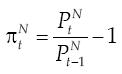
<body><![CDATA[<p align="justify"><font face="verdana" size="2">One of the main findings from this research is that if exports respond negatively to the international interest rate or to an international recession, the aggregated consumption of the domestic economy is substantially more volatile than an economy where exports do not react. In other words, this paper finds a coherent explanation to the riddle when either industrialized countries are growing too fast or face a recession, developing countries suffer.</font></p>  	    <p align="justify"><font face="verdana" size="2">The paper is organized as follows. Section 2 presents the model with the inclusion of an equation for exports to the economy. Section3 discusses some impulse responses to the model among a simulated economy based on our model. Finally, section 4 concludes with an emphasis on the Mexican and Argentine cases.</font></p>  	    <p align="justify"><font face="verdana" size="2">&nbsp;</font></p>  	    <p align="justify"><font face="verdana" size="2"><b>THE SETTING OF THE ECONOMY</b></font></p>  	    <p align="justify"><font face="verdana" size="2">Assume a small open economy populated by identical households. Also, assume that this economy has two sectors, one of which includes firms producing tradable goods and the other producing non tradable goods. Each sector has a continuum of monopolistic competitive firms indexed by <i>t </i>&isin; &#91;0,&#8734;). Finally, it is assumed that there is a monetary authority.<sup><a href="#notas">2</a></sup></font></p>  	    <p align="justify"><font face="verdana" size="2">In this model, the law of one price holds for internationally tradable goods. That is, <i>P<sub>t</sub><sup>T</sup> = &#949;<sub>t</sub> P<sub>t</sub><sup>T*</sup></i> for all <i>t </i>&isin; &#91;0,&#8734;) periods where <i>P<sub>t</sub><sup>T</sup></i> and <i>P<sub>t</sub><sup>T*</sup></i> denote the nominal price of the tradable goods in the domestic and foreign economies, respectively, and &#949;<i><sub>t</sub></i> is the nominal exchange rate (in domestic currency per unit of foreign currency). Moreover, normalizing the foreign price of tradable goods to one, the law of one price implies <i>P<sub>t</sub><sup>T*</sup></i><i>=</i> &#949;<i><sub>t</sub></i><i>.</i> The nominal price index of non tradable goods is <i>P<sub>t</sub><sup>N</sup></i>, and <img src="/img/revistas/ineco/v71n279/a6i5.jpg"> is the gross inflation rate of non tradable goods. We define the real exchange rate <i>e<sub>t</sub></i> as the relative price of tradable goods in terms of non tradable goods, that is, <i>e<sub>t</sub>= &#949;<sub>t</sub> </i>/<i>P<sub>t</sub><sup>N</sup></i>.</font></p>      <p align="justify"><font face="verdana" size="2">The idea behind this assumption is that identical goods sold in different countries must sell for the same price when their prices are expressed in terms of the same currency. If not, then an arbitrageur will purchase the good in the cheaper market and sell it where prices are higher. Nonetheless, it is important to note that this law applies only in competitive markets free of transport costs and barriers to trade.<sup><a href="#notas">3</a></sup></font></p>  	    <p align="justify"><font face="verdana" size="2">So far we have assumed that the economy has two sectors producing tradable<sup><a href="#notas">4</a></sup> and non tradable goods, respectively. A firm, in the former sector, can borrow from the rest of the world at the international real interest rate plus the country&#45;risk premium, <i>Q</i>(&#183;),<sup><a href="#notas">5</a></sup> but a firm, in the latter sector, can only borrow from local households at the domestic interest rate which is equal to the international interest rate plus the country risk premium <i>Q</i>(&#183;) plus the expected depreciation of the exchange rate. Following Neumeyer and Perri (2005), we assume that the premium is inversely (negatively) related to the technology shocks (specified below) but we add exports as a new argument, thus the domestic nominal interest rate satisfies:<sup><a href="#notas">6</a></sup></font></p>      <p align="center"><font face="verdana" size="2"><img src="/img/revistas/ineco/v71n279/a6i7.jpg"></font></p>  	    <p align="justify"><font face="verdana" size="2">that is, the domestic nominal interest rate (1 + <i>i<sub>t</sub></i>) equals the exogenous real international interest rate (1 + <i>r<sub>t</sub></i>) adjusted by the expected country&#45;risk premium <img src="/img/revistas/ineco/v71n279/a6i8.jpg"> and adjusted by the expected depreciation rate.</font></p>      ]]></body>
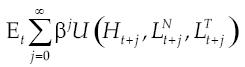
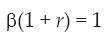
<body><![CDATA[<p align="justify"><font face="verdana" size="2">We suppose that the country risk premium has the following functional form:</font></p>  	    <p align="center"><font face="verdana" size="2"><img src="/img/revistas/ineco/v71n279/a6i9.jpg"></font></p>  	    <p align="justify"><font face="verdana" size="2">with <i>&#963;</i>, &#962;, &#964; <u>&gt;</u> 0 and where <i>A<sub>t</sub><sup>j</sup> {j = T, N}</i> is a technology shock specified below. That is, the country risk premium is a function of the technology shock in the tradable and non tradable firms and in exports. Note that when <i>&#963;</i> = &#962; = &#964; = 0, the country&#45;risk premium is eliminated and the condition above boils down to the standard uncovered interest rate parity condition.</font></p>      <p align="justify"><font face="verdana" size="2">The international real interest rate is exogenous to the SOEE, as the deinition of small economy implies, and it will be assumed that it follows the following autoregressive process:</font></p>  	    <p align="center"><font face="verdana" size="2"><img src="/img/revistas/ineco/v71n279/a6i11.jpg"></font></p>  	    <p align="justify"><font face="verdana" size="2">where &#934;<sub>r</sub>&isin; (0,1) and ln(&#958;<sub>rt</sub>)&#126;<i>WN</i>(0,1), that is ln(&#958;<sub>rt</sub>) is a white noise process with zero mean and unitary variance. The term (1/&#946;)<sup>1&#934;r</sup> appears in the above equation since, following Schmitt&#45;Groh&eacute; and Uribe (2003), we assume that in the steady state &#946;(1 + <i>r</i>) = 1. Here &#946; is the subjective discount factor of the (representative) individual. Note that this assumption was made to eliminate any trend in real variables.</font></p>      <p align="justify"><font face="verdana" size="2"><b>Consumers</b></font></p>  	    <p align="justify"><font face="verdana" size="2">The representative household derives utility from leisure and consumption of a basket of goods containing a homogeneous tradable good <i>C<sub>t</sub><sup>T</sup></i> and a variety of heterogeneous non tradable goods <i>C<sub>t</sub><sup>N</sup></i> (z), where z &isin;&#91;0,1&#93; corresponds to the index of the producing firm. As in Uribe (2002), the model allows for the formation of habit in consumption.</font></p>      <p align="justify"><font face="verdana" size="2">We consider the household's utility function, first proposed by Greenwood Hervicotz and Huffman (1988), given by:</font></p>  	    <p align="center"><font face="verdana" size="2"><img src="/img/revistas/ineco/v71n279/a6i14.jpg"></font></p>  	    ]]></body>
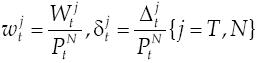
<body><![CDATA[<p align="justify"><font face="verdana" size="2">where: <i>H<sub>t</sub>= C<sub>t</sub></i> &#45; &#961;C<sub><i>t</i>&#45;1</sub>.</font></p>  	    <p align="justify"><font face="verdana" size="2">Here &#961;&isin;&#91;0,1) is the habit parameter, <i>L<sub>t</sub><sup>J</sup> {j = T, N}</i> is time allocated to labor with the total endowment of time per period normalized to one, and V<sub><i>N</i></sub> and V<sub><i>T</i></sub> are preference parameters. Moreover, <i>C<sub>t</sub></i> is a composite basket of tradable and non tradable goods defined by:</font></p>      <p align="center"><font face="verdana" size="2"><img src="/img/revistas/ineco/v71n279/a6i16.jpg"></font></p>  	    <p align="justify"><font face="verdana" size="2">Households hold nationally traded bonds denominated in units of nontradable goods <i>b<sub>t</sub>,</i> which yield a real domestic interest rate <i>i<sub>t</sub>.</i> Sources of funds in period <i>t</i> include: the principal and the return of bonds purchased at time <i>t</i> &#45; 1, b<sub><i>t</i>&#45;1</sub>(1 + i<sub><i>t</i>&#45;1</sub>), remunerations from labor at nominal wages rate <i>W<sub>t</sub><sup>j</sup></i> {<i>j = T</i>, N}, and lump&#45;sum transfers equal to the aggregate firm' nominal profits, denoted by <i>&#916;</i><i><sub>t</sub><sup>j</sup></i> {<i>j</i> = <i>T,</i> N}.</font></p>  	    <p align="justify"><font face="verdana" size="2">The use of funds consist of consumption of the homogeneous tradable good <i>C<sub>t</sub><sup>T</sup></i>, consumption of non tradable goods <i>C<sub>t</sub><sup>N</sup></i> (z) with nominal price <i>p</i><sub><i>t</i></sub><i><sup>N</sup></i> (z) for z &isin; &#91;0,1&#93; and new issued bonds b<sub><i>t</i></sub>. The agent's budget constraint in terms of non tradable goods is</font></p>      <p align="center"><font face="verdana" size="2"><img src="/img/revistas/ineco/v71n279/a6i17.jpg"></font></p>  	    <p align="justify"><font face="verdana" size="2">where</font></p>  	    <p align="center"><font face="verdana" size="2"><img src="/img/revistas/ineco/v71n279/a6i19.jpg"></font></p>  	    <p align="justify"><font face="verdana" size="2">At each time t, the household chooses <img src="/img/revistas/ineco/v71n279/a6i18.jpg"> and <i>b<sub>t</sub></i> to maximize</font></p>  	    <p align="center"><font face="verdana" size="2"><img src="/img/revistas/ineco/v71n279/a6i20.jpg"></font></p>  	    ]]></body>
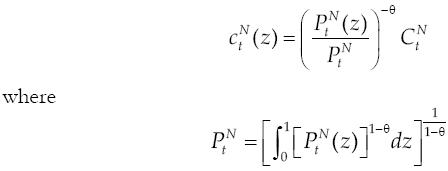
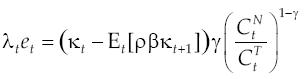
<body><![CDATA[<p align="justify"><font face="verdana" size="2">subject to the budget constraint and the aggregators. Cost minimization implies the demand for the variety z:</font></p>  	    <p align="center"><font face="verdana" size="2"><img src="/img/revistas/ineco/v71n279/a6i21.jpg"></font></p>  	    <p align="justify"><font face="verdana" size="2">is the utility&#45;based price index. Let &#955;<sub><i>t</i></sub> denote the Lagrange multiplier, the first order conditions for an interior solution implies:</font></p>  	    <p align="center"><font face="verdana" size="2"><img src="/img/revistas/ineco/v71n279/a6i22.jpg"></font></p>  	    <p align="justify"><font face="verdana" size="2">The above expression says that, at the optimum, the marginal rate of substitution between non tradable and tradable goods must be equal to relative prices, that is, the real exchange rate. Notice also that</font></p>  	    <p align="center"><font face="verdana" size="2"><img src="/img/revistas/ineco/v71n279/a6i23.jpg"></font></p>  	    <p align="justify"><font face="verdana" size="2">where</font></p>  	    <p align="center"><font face="verdana" size="2"><img src="/img/revistas/ineco/v71n279/a6i24.jpg"></font></p>  	    <p align="justify"><font face="verdana" size="2">The first order condition with respect to <i>H<sub>t</sub></i> is given by: <i>H<sub>t</sub></i> = <i>C<sub>t</sub></i> &#45; &#961;C<sub><i>t</i>&#45;1</sub>, which simply states aggregate consumption with habit.</font></p>  	    <p align="center"><font face="verdana" size="2"><img src="/img/revistas/ineco/v71n279/a6i25.jpg"></font></p>  	    ]]></body>
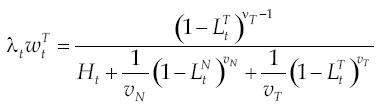
<body><![CDATA[<p align="justify"><font face="verdana" size="2">The above equation stands for the aggregate consumption of both tradable and non tradable goods. We also have:</font></p>  	    <p align="center"><font face="verdana" size="2"><img src="/img/revistas/ineco/v71n279/a6i26.jpg"></font></p>  	    <p align="justify"><font face="verdana" size="2">This expression is the standard Euler equation. Moreover, a relationship between the multiplier &#955;<sub>t</sub> and <i>w<sub>t</sub><sup>N</sup></i> can be stated as:</font></p>      <p align="center"><font face="verdana" size="2"><img src="/img/revistas/ineco/v71n279/a6i28.jpg"></font></p>  	    <p align="justify"><font face="verdana" size="2">This equation is the labor supply curve for the non tradable firms. It says that, at the optimum, the consumer equals the marginal utility of a unit of leisure with the marginal utility of consumption that his salary allows him to purchase. In the same way,</font></p>  	    <p align="center"><font face="verdana" size="2"><img src="/img/revistas/ineco/v71n279/a6i29.jpg"></font></p>  	    <p align="justify"><font face="verdana" size="2">This equation is the labor supply curve for tradable firms. Finally, by collapsing the above results, we obtain:</font></p>  	    <p align="center"><font face="verdana" size="2"><img src="/img/revistas/ineco/v71n279/a6i30.jpg"></font></p>  	    <p align="justify"><font face="verdana" size="2">This equation rewrites the consumer's budget constraint.</font></p>  	    <p align="justify"><font face="verdana" size="2"><b>The non tradable firm</b></font></p>  	    ]]></body>
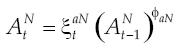
<body><![CDATA[<p align="justify"><font face="verdana" size="2">Following Calvo's (1983) pricing, the model assumes that there is a continuum of firms that change prices in a staggered fashion. They do this only when they receive an idiosyncratic random signal that arrives with probability 1 &#45; &#945;; such probability is supposed to be constant in every period of time, independent of the state of the economy. The producer <i>z</i> has access to the technology</font></p>  	    <p align="center"><font face="verdana" size="2"><img src="/img/revistas/ineco/v71n279/a6i31.jpg"></font></p>  	    <p align="justify"><font face="verdana" size="2">Where <i>A<sub>t</sub><sup>N</sup></i>  is a technology shock of the non tradable sector, which follows the process:</font></p>      <p align="center"><font face="verdana" size="2"><img src="/img/revistas/ineco/v71n279/a6i33.jpg"></font></p>  	    <p align="justify"><font face="verdana" size="2">with ln <img src="/img/revistas/ineco/v71n279/a6i34.jpg"> (0,1) and &#934;<sub><i>aN</i></sub> &isin;(0,1).</font></p>  	    <p align="justify"><font face="verdana" size="2">Since the technology is the same for all producers we can drop the index z. As in Neumeyer and Perri (2005), the firm is subject to a working capital constraint for which it has to borrow the fraction &#956;<sup><i>N</i></sup>&isin;&#91;0,1&#93; of its nominal marginal cost &#936;<sub>t</sub>.</font></p>  	    <p align="justify"><font face="verdana" size="2">The firm pays the interest <i>i<sub>t</sub></i> for the loans. Thus the effective nominal marginal cost is &#936;<i><sub>t</sub></i>(1 + &#956;<sup><i>N</i></sup><i>i<sub>t</sub></i>) and the effective real marginal cost becomes <img src="/img/revistas/ineco/v71n279/a6i35.jpg"> where &#936;<i><sub>t</sub></i> is the real marginal cost.</font></p>  	    <p align="justify"><font face="verdana" size="2">The producer profit in terms of the non tradable goods satisfies:</font></p>  	    <p align="center"><font face="verdana" size="2"><img src="/img/revistas/ineco/v71n279/a6i36.jpg"></font></p>  	    <p align="justify"><font face="verdana" size="2">where c<i><sub>t</sub></i>(z) is given by the demand and the real marginal cost in terms of non tradable goods, and &#936;<i><sub>t</sub></i> is given by the production technology. Note that when &#956; = 0, the model boils down to the standard model without working capital.</font></p>  	    ]]></body>
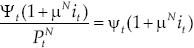
<body><![CDATA[<p align="justify"><font face="verdana" size="2">The producer chooses<i> P<sub>t</sub><sup>N</sup></i> (z) to maximize:</font></p>      <p align="center"><font face="verdana" size="2"><img src="/img/revistas/ineco/v71n279/a6i37.jpg"></font></p>  	    <p align="justify"><font face="verdana" size="2">where &#946;j&#937;<sub>t,t+j</sub> is the relevant stochastic discount factor between <i>t</i> and <i>t</i> + 1.</font></p>  	    <p align="justify"><font face="verdana" size="2"><i>Optimal price</i></font></p>      <p align="justify"><font face="verdana" size="2">By solving the producer's decision problem, the firms' optimal price is given by:</font></p>  	    <p align="center"><font face="verdana" size="2"><img src="/img/revistas/ineco/v71n279/a6i38.jpg"></font></p>  	    <p align="justify"><font face="verdana" size="2">Notice that this price depends on the real marginal costs in terms of non tradable goods, the elasticity of non tradable goods, the discount factor, and the signal probability.</font></p>  	    <p align="justify"><font face="verdana" size="2"><i>Price index ofnon tradable goods</i></font></p>      <p align="justify"><font face="verdana" size="2">By using Calvo's (1983) structure, we can aggregate prices by using a simple recursive equation:</font></p>  	    <p align="center"><font face="verdana" size="2"><img src="/img/revistas/ineco/v71n279/a6i39.jpg"></font></p>  	    ]]></body>
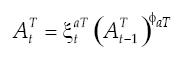
<body><![CDATA[<p align="justify"><font face="verdana" size="2">This says that the current price, in the non tradable sector, is a weighted average between the past price and the optimal current price.</font></p>  	    <p align="justify"><font face="verdana" size="2"><b>The tradable firm</b></font></p>  	    <p align="justify"><font face="verdana" size="2">We assume that the firm producing the tradable good has access to a technology of the form:</font></p>  	    <p align="center"><font face="verdana" size="2"><img src="/img/revistas/ineco/v71n279/a6i40.jpg"></font></p>  	    <p align="justify"><font face="verdana" size="2">where <i>A<sub>t</sub><sup>T</sup></i> is a technology shock of the tradable sector, which is driven by the following process:</font></p>      <p align="center"><font face="verdana" size="2"><img src="/img/revistas/ineco/v71n279/a6i42.jpg"></font></p>  	    <p align="justify"><font face="verdana" size="2">with In<img src="/img/revistas/ineco/v71n279/a6i43.jpg">~ <i>WN</i>(0,1) and &#934;<sub><i>aT</i></sub> &isin;(0,1).</font></p>  	    <p align="justify"><font face="verdana" size="2">The firm maximizes its dividends in non tradable goods, that is:</font></p>  	    <p align="center"><font face="verdana" size="2"><img src="/img/revistas/ineco/v71n279/a6i44.jpg"></font></p>  	    <p align="justify"><font face="verdana" size="2">subject to its technology. The domestic demand for tradable goods and the demand of exports satisfy:</font></p>  	    ]]></body>
<body><![CDATA[<p align="center"><font face="verdana" size="2"><img src="/img/revistas/ineco/v71n279/a6i45.jpg"></font></p>  	    <p align="justify"><font face="verdana" size="2">We are assuming that the tradable firm faces the international interest rate plus the risk premium. The underlying idea is that even though it has access to the international financial market, it is still exposed to the risk associated to its country. In this case, the first order condition is given by:</font></p>  	    <p align="center"><font face="verdana" size="2"><img src="/img/revistas/ineco/v71n279/a6i46.jpg"></font></p>  	    <p align="justify"><font face="verdana" size="2">Note that we distinguish between technology shocks for tradable and non tradable firms. We also allow the possibility for different working capital restrictions for each sector.</font></p>  	    <p align="justify"><font face="verdana" size="2"><b>Country risk premium and exports</b></font></p>  	    <p align="justify"><font face="verdana" size="2">As before, we are assuming that the country risk premium is inversely related to both the expected demand of export and the expected technology shocks affecting both sectors. This assumption seeks to model the well&#45;documented fact that the fundamentals, captured here by exports, impact on the country risk premium. In this case, we may provide a plausible interpretation of a negative export shock as a negative growth rate in the global economy. At the same time, we are assuming that the international interest rate affects negatively the demand for exports of the emerging economy. Therefore, the demand for exports satisfies:</font></p>  	    <p align="center"><font face="verdana" size="2"><img src="/img/revistas/ineco/v71n279/a6i47.jpg"></font></p>  	    <p align="justify"><font face="verdana" size="2">with ln<img src="/img/revistas/ineco/v71n279/a6i48.jpg">~ <i>WN</i>(0,1) and &#934;<sub><i>xr</i></sub> &isin;(0,1). Note that different values for &#934;<sub><i>xr</i></sub> would dampen or amplify the reaction of the main variables of this economy.</font></p>  	    <p align="justify"><font face="verdana" size="2"><b>Monetary authority</b></font></p>  	    <p align="justify"><font face="verdana" size="2">The Central Bank maneuvers the interest rate following a rule that responds to deviation of inflation in non tradable goods from its steady state equilibrium much in line with the one proposed by Taylor (1993). Central Bank authorities are also concerned with smoothing the interest rate (see Clarida, Gali and Gertler, 2000). In this case, the monetary authority acts by using a generalized Taylor's rule:</font></p>  	    ]]></body>
<body><![CDATA[<p align="center"><font face="verdana" size="2"><img src="/img/revistas/ineco/v71n279/a6i49.jpg"></font></p>  	    <p align="justify"><font face="verdana" size="2">where</font></p>  	    <p align="center"><font face="verdana" size="2"><img src="/img/revistas/ineco/v71n279/a6i50.jpg"></font></p>  	    <p align="justify"><font face="verdana" size="2">is the inflation rate in the non tradable sector. We assume that in steady&#45;state &#960; = 0, which implies</font></p>  	    <p align="center"><font face="verdana" size="2"><img src="/img/revistas/ineco/v71n279/a6i51.jpg"></font></p>  	    <p align="justify"><font face="verdana" size="2">The shock to the monetary rule follows the process: <i>I<sub>t</sub></i> = &#958;<i><sub>It</sub></i>(<i>I<sub>t</sub>_<sub>1</sub></i>)<sup>&#934;I</sup><i>,</i> where ln(&#958;<i><sub>It</sub></i>)~WN(0,1) and &#934;<sub><i>I</i></sub>&isin;(0,1).</font></p>      <p align="justify"><font face="verdana" size="2">&nbsp;</font></p>  	    <p align="justify"><font face="verdana" size="2"><b>STEADY STATE AND IMPULSE RESPONSES</b></font></p>  	    <p align="justify"><font face="verdana" size="2">In this section, as in Kydland and Prescott (1982), we examine the behavior of the proposed economy. To do this, we analyze different shocks and different values for the concerned parameters. In particular, both exports demand and interest rate shocks will be considered.</font></p>  	    <p align="justify"><font face="verdana" size="2"><b>Steady state</b></font></p>  	    ]]></body>
<body><![CDATA[<p align="justify"><font face="verdana" size="2">The steady state stands for the equilibrium towards which, in absence of shocks, the economy converges. In this economy, as we have previously assumed</font></p>  	    <p align="center"><font face="verdana" size="2"><img src="/img/revistas/ineco/v71n279/a6i52.jpg"></font></p>  	    <p align="justify"><font face="verdana" size="2">so that the real variables do not have a trend. Consequently, in steady state</font></p>  	    <p align="center"><font face="verdana" size="2"><img src="/img/revistas/ineco/v71n279/a6i53.jpg"></font></p>  	    <p align="justify"><font face="verdana" size="2">for all <i>t</i>, and so on, where the symbol "<i>o</i>" denotes the steady state values of relevant variables. Notice that there is not an ongoing structural change (shifts across sectors) at the steady state.</font></p>  	    <p align="justify"><font face="verdana" size="2"><b>Deviations from the steady state</b></font></p>  	    <p align="justify"><font face="verdana" size="2">The impulse responses are calculated as deviations from the steady state, and are calculated by using the parameter values summarized in <a href="#t1">table 1</a>. We have chosen &#945; = 0.75 so that, on average, firms reset prices every quarter. The parameter value &#947; = 0.5 indicates that the consumption bundle is comprised of half tradable goods and half non tradable goods. The reaction coefficients of the Taylor rule are <i>&#963;<sub>i</sub></i> = 0.5 and <i>&#963;<sub>&#960;</sub></i> = 0.6 so that the rule satisfies the conditions so that there is a unique equilibrium. Finally, &#956;<i><sub>T</sub></i> and &#956;<i><sub>N</sub></i> are chosen so that firms must pay in advance 75% of their marginal cost.</font></p>  	    <p align="center"><font face="verdana" size="2"><a name="t1"></a></font></p>  	    <p align="center"><font face="verdana" size="2"><img src="/img/revistas/ineco/v71n279/a6t1.jpg"></font></p>  	    <p align="justify"><font face="verdana" size="2"><b>Exports shock</b></font></p>  	    ]]></body>
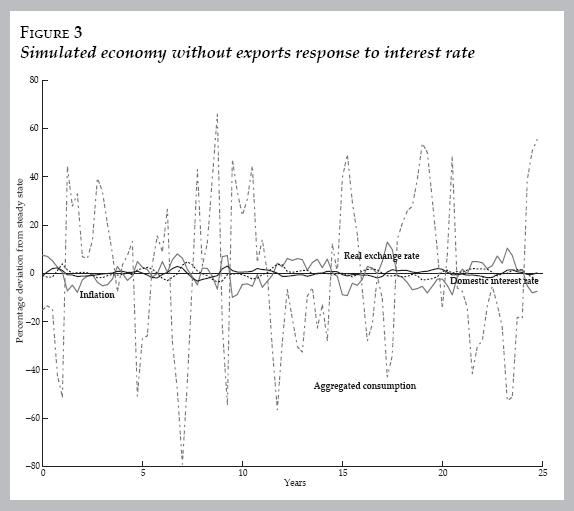
<body><![CDATA[<p align="justify"><font face="verdana" size="2">In what follows, we analyze the response to exports demand shocks. <a href="/img/revistas/ineco/v71n279/a6f1.jpg" target="_blank">Figure 1</a> shows the impulse response given a negative shock to the demand of exports.<sup><a href="#notas">8</a></sup> This shock increases the country risk premium, which tends to raise the domestic interest rate but, at the same time, lowers the inflation rate. As our central bank follows the generalized Taylor rule, the consequence of this movement in the inflation rate is that the domestic interest rate actually goes down over&#45;killing the initial stimulus to go up. In turn, the lower level of exports causes a lower demand for labor in the tradable sector. As we are allowing perfect substitution between tradable and non tradable labor, it follows that more workers are hired in the non tradable sector. As a result, the consumption in the non tradable sector goes up and it goes down in the tradable sector. The fall of consumption in the tradable sector is bigger, in absolute value, than the fall in exports demand. Finally, the figure shows that the aggregated consumption has fallen as empirical evidence suggests.</font></p>  	    <p align="justify"><font face="verdana" size="2"><b>International interest rate shock</b></font></p>  	    <p align="justify"><font face="verdana" size="2">Next, we study the effects on our economy of shocks in the international interest rate. <a href="/img/revistas/ineco/v71n279/a6f2.jpg" target="_blank">Figure 2</a> shows the impulse response, given a shock to the international interest for different values of the elasticity of exports to the international interest rate. As we have assumed, the increase in the international interest rate leads to a downward in the exports demand. This is the case because we have assumed that exports are negatively related to the international interest rate. An increase in the international interest rate ceteris paribus tends to increase the domestic interest rate not just as a result of the shock by itself, but also as a result of the increase in the country risk premium, as we have explained before. Once the shock hits the exports demand the dynamics of the economy is qualitative similar to the dynamic presented in the previous shock.</font></p>  	    <p align="justify"><font face="verdana" size="2">As <a href="/img/revistas/ineco/v71n279/a6f2.jpg" target="_blank">figure 2</a> suggests, a key parameter in this economy is the elasticity of exports demand to the international interest rate. Different values of this parameter will amplify or dampen the dynamics of this economy.</font></p>  	    <p align="justify"><font face="verdana" size="2"><a href="#f3">Figure 3</a> shows a simulated economy for which the exports demand do not depend of the international interest rate. <a href="#f4">Figure 4</a> shows basically the same economy but with an elasticity of exports demand to the international interest rate equal to 2.5.</font></p>  	    <p align="center"><font face="verdana" size="2"><a name="f3"></a></font></p>  	    <p align="center"><font face="verdana" size="2"><img src="/img/revistas/ineco/v71n279/a6f3.jpg"></font></p>  	    <p align="center"><font face="verdana" size="2"><a name="f4"></a></font></p>  	    <p align="center"><font face="verdana" size="2"><img src="/img/revistas/ineco/v71n279/a6f4.jpg"></font></p>  	    <p align="justify"><font face="verdana" size="2">As we have pointed out before, this parameter plays a key role in the aggregated consumption volatility of the economy. Observe that with &#934;<sub><i>xr</i></sub> = 2.5 the aggregated consumption volatility is almost twice as in the zero elasticity case.</font></p>  	    ]]></body>
<body><![CDATA[<p align="justify"><font face="verdana" size="2">&nbsp;</font></p>  	    <p align="justify"><font face="verdana" size="2"><b>CONCLUSIONS</b></font></p>  	    <p align="justify"><font face="verdana" size="2">In this paper we have studied the international interest rate and the global growth rate channel to fluctuations through the exports demand. To reach this goal we introduced the role of exports demand in a SOEE in a simple fashion. The model shows that the elasticity of exports demand to the international interest rate could explain a higher aggregated consumption volatility in SOEEs. We find two important results. First, if the international growth rate is negative, the SOEE will experiment an even bigger decrease in its activity. Secondly, a small increase in the international interest rate could produce a substantially higher volatility in aggregated consumption in the SOEE, provided exports elasticity becomes bigger.</font></p>  	    <p align="justify"><font face="verdana" size="2">At the same time, our proposed model could provide an explanation of the events observed in the last two decades. In particular, in the 90's, when the Federal Reserve Board increased the Federal Funds Rate, Mexico and Argentina experienced worse conditions in their financial markets, joint with a reduction in their growth rates.</font></p>  	    <p align="justify"><font face="verdana" size="2">This model also helps explain the events observed in the last financial crisis. Even though the Federal Reserve Board reduced the Federal Funds Rate after the recession in the United States economy, the reduction in exports implied an even bigger reduction in the growth rate in Mexico and Argentina.</font></p>  	    <p align="justify"><font face="verdana" size="2">Two important policy implications are in order. The first one is that it is very important to diversify exports, by including more countries and goods, so that the risk of a big adverse shock in the export is reduced. The second one is a SOEE should develop their own domestic market in order to mitigate their exposition to external shocks.</font></p>  	    <p align="justify"><font face="verdana" size="2">As usual, some caveats apply. In the first place, we have not considered the imports demand sector that could cause some feedbacks between the economies. On the second place, it would be desirable to include some rigidities to the substitution of labor among the tradable and non tradable sectors.</font></p>  	    <p align="justify"><font face="verdana" size="2">&nbsp;</font></p>  	    <p align="justify"><font face="verdana" size="2"><b><a href="/img/revistas/ineco/v71n279/html/a6apendice1.htm" target="_blank">Appendix</a></b></font></p>  	    <p align="justify"><font face="verdana" size="2">&nbsp;</font></p>  	    ]]></body>
<body><![CDATA[<p align="justify"><font face="verdana" size="2"><b>REFERENCES</b></font></p>  	    <!-- ref --><p align="justify"><font face="verdana" size="2">Blanchard, O. and Miles&#45;Ferreti, G.M., 2010. Global imbalances: in midstream? In: O. Blanchard and I. SaKong, eds. <i>Reconstucting the World Economy.</i> Washington: International Monetary Fund (IMF).    &nbsp;&nbsp;&nbsp;&nbsp;&nbsp;&nbsp;&nbsp;&nbsp;[&#160;<a href="javascript:void(0);" onclick="javascript: window.open('/scielo.php?script=sci_nlinks&ref=4550989&pid=S0185-1667201200010000600001&lng=','','width=640,height=500,resizable=yes,scrollbars=1,menubar=yes,');">Links</a>&#160;]<!-- end-ref --></font></p>  	    <!-- ref --><p align="justify"><font face="verdana" size="2">Burstein, A., Neves, J.C. and Rebelo S.T., 2003. Distribution costs and real exchange rate dynamics during exchange&#45;rate&#45;based stabilizations. <i>Journal of</i> <i>Monetary</i> <i>Economics,</i> 50(6), pp. 1189&#45;214.    &nbsp;&nbsp;&nbsp;&nbsp;&nbsp;&nbsp;&nbsp;&nbsp;[&#160;<a href="javascript:void(0);" onclick="javascript: window.open('/scielo.php?script=sci_nlinks&ref=4550991&pid=S0185-1667201200010000600002&lng=','','width=640,height=500,resizable=yes,scrollbars=1,menubar=yes,');">Links</a>&#160;]<!-- end-ref --></font></p>  	    <!-- ref --><p align="justify"><font face="verdana" size="2">Cantor, R. and Packer, F., 1996. Determinants and impact of sovereign credit ratings. <i>Economic Policy Review,</i> 2(2), pp. 37&#45;53.    &nbsp;&nbsp;&nbsp;&nbsp;&nbsp;&nbsp;&nbsp;&nbsp;[&#160;<a href="javascript:void(0);" onclick="javascript: window.open('/scielo.php?script=sci_nlinks&ref=4550993&pid=S0185-1667201200010000600003&lng=','','width=640,height=500,resizable=yes,scrollbars=1,menubar=yes,');">Links</a>&#160;]<!-- end-ref --></font></p>  	    <!-- ref --><p align="justify"><font face="verdana" size="2">Calvo, G.A., 1998. Capital flows and capital&#45;market crises: the simple economics of sudden stops. <i>Journal of Applied Economics,</i> 1(1), pp. 35&#45;54.    &nbsp;&nbsp;&nbsp;&nbsp;&nbsp;&nbsp;&nbsp;&nbsp;[&#160;<a href="javascript:void(0);" onclick="javascript: window.open('/scielo.php?script=sci_nlinks&ref=4550995&pid=S0185-1667201200010000600004&lng=','','width=640,height=500,resizable=yes,scrollbars=1,menubar=yes,');">Links</a>&#160;]<!-- end-ref --></font></p>  	    <!-- ref --><p align="justify"><font face="verdana" size="2">Calvo, G.A., 1983. Staggered prices in a utility&#45;maximizing framework. <i>Journal of</i> <i>Monetary Economics,</i> 12(3), pp. 383&#45;98.    &nbsp;&nbsp;&nbsp;&nbsp;&nbsp;&nbsp;&nbsp;&nbsp;[&#160;<a href="javascript:void(0);" onclick="javascript: window.open('/scielo.php?script=sci_nlinks&ref=4550997&pid=S0185-1667201200010000600005&lng=','','width=640,height=500,resizable=yes,scrollbars=1,menubar=yes,');">Links</a>&#160;]<!-- end-ref --></font></p>  	    <!-- ref --><p align="justify"><font face="verdana" size="2">Clarida, R., Gal&iacute;, J. and Gertler, M., 2000. Monetary policy rules and macroeconomic stability: evidence and some theory. <i>Quarterly Journal of Economics,</i> 115(1), pp. 147&#45;80.    &nbsp;&nbsp;&nbsp;&nbsp;&nbsp;&nbsp;&nbsp;&nbsp;[&#160;<a href="javascript:void(0);" onclick="javascript: window.open('/scielo.php?script=sci_nlinks&ref=4550999&pid=S0185-1667201200010000600006&lng=','','width=640,height=500,resizable=yes,scrollbars=1,menubar=yes,');">Links</a>&#160;]<!-- end-ref --></font></p>  	    <!-- ref --><p align="justify"><font face="verdana" size="2">Cline, WR. and Barnes, K.S., 1997. <i>Spreads and risk in emerging market lending.</i> Institute of International Finance (IIF) Research Paper no. 97&#45;1. Washington, DC: IIF.    &nbsp;&nbsp;&nbsp;&nbsp;&nbsp;&nbsp;&nbsp;&nbsp;[&#160;<a href="javascript:void(0);" onclick="javascript: window.open('/scielo.php?script=sci_nlinks&ref=4551001&pid=S0185-1667201200010000600007&lng=','','width=640,height=500,resizable=yes,scrollbars=1,menubar=yes,');">Links</a>&#160;]<!-- end-ref --></font></p>  	    <!-- ref --><p align="justify"><font face="verdana" size="2">Dornbusch, R., 1987. Exchange rates and prices. <i>American Economic Review,</i> 1(77), pp. 93&#45;106.    &nbsp;&nbsp;&nbsp;&nbsp;&nbsp;&nbsp;&nbsp;&nbsp;[&#160;<a href="javascript:void(0);" onclick="javascript: window.open('/scielo.php?script=sci_nlinks&ref=4551003&pid=S0185-1667201200010000600008&lng=','','width=640,height=500,resizable=yes,scrollbars=1,menubar=yes,');">Links</a>&#160;]<!-- end-ref --></font></p>  	    <!-- ref --><p align="justify"><font face="verdana" size="2">Edwards, S., 1984. LDC foreign borrowing and default risk: an empirical investigation. <i>American Economic Review,</i> 74(4), pp. 726&#45;34.    &nbsp;&nbsp;&nbsp;&nbsp;&nbsp;&nbsp;&nbsp;&nbsp;[&#160;<a href="javascript:void(0);" onclick="javascript: window.open('/scielo.php?script=sci_nlinks&ref=4551005&pid=S0185-1667201200010000600009&lng=','','width=640,height=500,resizable=yes,scrollbars=1,menubar=yes,');">Links</a>&#160;]<!-- end-ref --></font></p>      <!-- ref --><p align="justify"><font face="verdana" size="2">Eichengreen, B. and Mody A., 2000. What explains changing spreads on emerging&#45;market debt: fundamentals or market sentiment? In: S. Edwards, ed. <i>The Economics of International Capital Flows.</i> Chicago: Chicago University Press.    &nbsp;&nbsp;&nbsp;&nbsp;&nbsp;&nbsp;&nbsp;&nbsp;[&#160;<a href="javascript:void(0);" onclick="javascript: window.open('/scielo.php?script=sci_nlinks&ref=4551007&pid=S0185-1667201200010000600010&lng=','','width=640,height=500,resizable=yes,scrollbars=1,menubar=yes,');">Links</a>&#160;]<!-- end-ref --></font></p>  	    <!-- ref --><p align="justify"><font face="verdana" size="2">Greenwood, J., Hervicotz, Z. and Huffman, G.W, 1988. Investment, capacity utilization, and the real business cycle. <i>American Economic Review,</i> 78(3), pp. 402&#45;17.    &nbsp;&nbsp;&nbsp;&nbsp;&nbsp;&nbsp;&nbsp;&nbsp;[&#160;<a href="javascript:void(0);" onclick="javascript: window.open('/scielo.php?script=sci_nlinks&ref=4551009&pid=S0185-1667201200010000600011&lng=','','width=640,height=500,resizable=yes,scrollbars=1,menubar=yes,');">Links</a>&#160;]<!-- end-ref --></font></p>  	    <!-- ref --><p align="justify"><font face="verdana" size="2">Kydland, F. and Prescott, E., 1982. Time to build and aggregate fluctuations. <i>Econometrica,</i> 50(6), pp. 1345&#45;71.    &nbsp;&nbsp;&nbsp;&nbsp;&nbsp;&nbsp;&nbsp;&nbsp;[&#160;<a href="javascript:void(0);" onclick="javascript: window.open('/scielo.php?script=sci_nlinks&ref=4551011&pid=S0185-1667201200010000600012&lng=','','width=640,height=500,resizable=yes,scrollbars=1,menubar=yes,');">Links</a>&#160;]<!-- end-ref --></font></p>  	    <!-- ref --><p align="justify"><font face="verdana" size="2">Krugman, P., 1987. Pricing to market when the exchange rate changes. In: S.W Arndt and J. Richardson, eds. <i>Real Financial Linkages Among Open Economies.</i> Cambridge, MA: MIT Press.    &nbsp;&nbsp;&nbsp;&nbsp;&nbsp;&nbsp;&nbsp;&nbsp;[&#160;<a href="javascript:void(0);" onclick="javascript: window.open('/scielo.php?script=sci_nlinks&ref=4551013&pid=S0185-1667201200010000600013&lng=','','width=640,height=500,resizable=yes,scrollbars=1,menubar=yes,');">Links</a>&#160;]<!-- end-ref --></font></p>  	    <!-- ref --><p align="justify"><font face="verdana" size="2">Neumeyer, P.A. and Perri, F., 2005. Business cycles in emerging markets: the role of interest rates. <i>Journal of Monetary Economics,</i> 52(2), pp. 345&#45;80.    &nbsp;&nbsp;&nbsp;&nbsp;&nbsp;&nbsp;&nbsp;&nbsp;[&#160;<a href="javascript:void(0);" onclick="javascript: window.open('/scielo.php?script=sci_nlinks&ref=4551015&pid=S0185-1667201200010000600014&lng=','','width=640,height=500,resizable=yes,scrollbars=1,menubar=yes,');">Links</a>&#160;]<!-- end-ref --></font></p>  	    <!-- ref --><p align="justify"><font face="verdana" size="2">Schmitt&#45;Groh&eacute;, S. and Uribe, M., 2003. Closing small open economy models. <i>Journal of international Economics,</i> 6(1), pp. 163&#45;85.    &nbsp;&nbsp;&nbsp;&nbsp;&nbsp;&nbsp;&nbsp;&nbsp;[&#160;<a href="javascript:void(0);" onclick="javascript: window.open('/scielo.php?script=sci_nlinks&ref=4551017&pid=S0185-1667201200010000600015&lng=','','width=640,height=500,resizable=yes,scrollbars=1,menubar=yes,');">Links</a>&#160;]<!-- end-ref --></font></p>  	    <!-- ref --><p align="justify"><font face="verdana" size="2">Taylor, J.B., 1993. Discretion versus policy rules in practice, <i>Carnegie&#45;Rochester</i> <i>Conference Series On Public Policy,</i> 39, pp. 195&#45;214.    &nbsp;&nbsp;&nbsp;&nbsp;&nbsp;&nbsp;&nbsp;&nbsp;[&#160;<a href="javascript:void(0);" onclick="javascript: window.open('/scielo.php?script=sci_nlinks&ref=4551019&pid=S0185-1667201200010000600016&lng=','','width=640,height=500,resizable=yes,scrollbars=1,menubar=yes,');">Links</a>&#160;]<!-- end-ref --></font></p>  	    <!-- ref --><p align="justify"><font face="verdana" size="2">Uhlig, H., 1995. <i>A toolkit for analyzing nonlinear dynamic stochastic models easily.</i> Institute for Empirical Macroeconomics Discussion Paper no. 101. Minneapolis: Federal Reserve Bank of Minneapolis.    &nbsp;&nbsp;&nbsp;&nbsp;&nbsp;&nbsp;&nbsp;&nbsp;[&#160;<a href="javascript:void(0);" onclick="javascript: window.open('/scielo.php?script=sci_nlinks&ref=4551021&pid=S0185-1667201200010000600017&lng=','','width=640,height=500,resizable=yes,scrollbars=1,menubar=yes,');">Links</a>&#160;]<!-- end-ref --></font></p>  	    <!-- ref --><p align="justify"><font face="verdana" size="2">Uribe, M., 2002. The price&#45;consumption puzzle of currency pegs. <i>Journal of Monetary</i> <i>Economics,</i> 49(3), pp. 533&#45;69.    &nbsp;&nbsp;&nbsp;&nbsp;&nbsp;&nbsp;&nbsp;&nbsp;[&#160;<a href="javascript:void(0);" onclick="javascript: window.open('/scielo.php?script=sci_nlinks&ref=4551023&pid=S0185-1667201200010000600018&lng=','','width=640,height=500,resizable=yes,scrollbars=1,menubar=yes,');">Links</a>&#160;]<!-- end-ref --></font></p>  	    <!-- ref --><p align="justify"><font face="verdana" size="2">Uribe, M. and Yue, V.Z., 2006. Country spreads and emerging countries: who drives whom? <i>Journal of International Economics,</i> 69(1), pp. 6&#45;36.    &nbsp;&nbsp;&nbsp;&nbsp;&nbsp;&nbsp;&nbsp;&nbsp;[&#160;<a href="javascript:void(0);" onclick="javascript: window.open('/scielo.php?script=sci_nlinks&ref=4551025&pid=S0185-1667201200010000600019&lng=','','width=640,height=500,resizable=yes,scrollbars=1,menubar=yes,');">Links</a>&#160;]<!-- end-ref --></font></p>  	    <p align="justify"><font face="verdana" size="2">&nbsp;</font></p>  	    ]]></body>
<body><![CDATA[<p align="justify"><font face="verdana" size="2"><a name="notas"></a><b>NOTAS</b></font></p>  	    <p align="justify"><font face="verdana" size="2">* JEL: Journal of Economic Literature&#45;Econlit.</font></p>  	    <p align="justify"><font face="verdana" size="2">The opinions expressed in this paper are exclusively those of the authors and do not necessarily reflect the view of Banco de M&eacute;xico. The authors thank the comments and suggestions made by anonymous referees which improved this work. As usual any remaining errors are the solely responsibility of the authors.</font></p>  	    <p align="justify"><font face="verdana" size="2"><sup>1</sup> They also find that emerging economies display high output volatility, relative to developed economies. Moreover, the volatility of consumption relative to income is on average greater than one, and higher than that in the developed economies. Finally, net exports appear much more strongly countercyclical in emerging economies than in developed ones.</font></p>  	    <p align="justify"><font face="verdana" size="2"><sup>2</sup> Note that we are simplifying as much as possible in order to focus in the role of international growth and interest rate in the business cycles in a SOEE. We are aware that some of the assumptions do not correspond exactly with real economies, even though these assumptions are widely used in the literature as benchmarks and will prove to be useful in this work.</font></p>  	    <p align="justify"><font face="verdana" size="2"><sup>3</sup> Furthermore, the law of one price may not hold for various reasons including demand elasticity as it has been emphasized in numerous studies on pricing including the early contributions by Dornbusch (1987) and Krugman (1987). Another standard approach to account for deviations from the law of one price in the literature is based on location specific costs. All tradable consumer goods that are highly tradable embody non&#45;tradable costs of distribution, such as labor costs at retail stores and rental costs of operating space. In this respect, Burstein, Neves, and Rebelo (2003) have reported that the distribution margin represents more than 40% of the final good price.</font></p>  	    <p align="justify"><font face="verdana" size="2"><sup>4</sup> In the case of the Mexican economy, we may think of a commodity sector including Petr&oacute;leos Mexicanos (PEMEX), while in the Argentine economy we may think of the agricultural sector.</font></p>      <p align="justify"><font face="verdana" size="2"><sup>5</sup> This assumption follows from the fact that a firm that produces the tradable good is a domestic one, so even though its sales are made in foreign currency, it cannot escape from paying the country&#45;risk premium</font></p>  	    <p align="justify"><font face="verdana" size="2"><sup>6</sup> Recall that we are concerned with net borrower economies &#151;Argentina and Mexico&#151; and riskier than the big economies &#151;England, United States, Germany and Japan&#151;. It is natural to assume that the domestic interest rate is positively correlated with the international interest rate because an imbalance of the domestic interest rate from the international interest rate would imply destabilizing flows of capital like sudden stops in international credit flows (see Calvo, 1998), or unsustainable imbalances (see Blanchard and Miles&#45;Ferreti, 2010).</font></p>  	    <p align="justify"><font face="verdana" size="2"><sup>7</sup> The values of the parameters are not chosen to model any particular economy but a synthetic one as a means to evaluate the implications of our model.</font></p>  	    ]]></body>
<body><![CDATA[<p align="justify"><font face="verdana" size="2"><sup>8</sup> This shock may be interpreted as a change in the demand of a small open economy exports due to a change in the preferences abroad, or more interesting it could be a cause of a recession in the big economy. Either way, it reduces exports of the small open economy, this, in turn, worsens the fundamentals, augmenting the country&#45;risk premium.</font></p>      ]]></body><back>
<ref-list>
<ref id="B1">
<nlm-citation citation-type="book">
<person-group person-group-type="author">
<name>
<surname><![CDATA[Blanchard]]></surname>
<given-names><![CDATA[O.]]></given-names>
</name>
<name>
<surname><![CDATA[Miles-Ferreti]]></surname>
<given-names><![CDATA[G.M.]]></given-names>
</name>
</person-group>
<article-title xml:lang="en"><![CDATA[Global imbalances: in midstream?]]></article-title>
<person-group person-group-type="editor">
<name>
<surname><![CDATA[Blanchard]]></surname>
<given-names><![CDATA[O.]]></given-names>
</name>
<name>
<surname><![CDATA[SaKong]]></surname>
<given-names><![CDATA[I.]]></given-names>
</name>
</person-group>
<source><![CDATA[Reconstucting the World Economy]]></source>
<year>2010</year>
<publisher-loc><![CDATA[Washington ]]></publisher-loc>
<publisher-name><![CDATA[International Monetary Fund (IMF)]]></publisher-name>
</nlm-citation>
</ref>
<ref id="B2">
<nlm-citation citation-type="journal">
<person-group person-group-type="author">
<name>
<surname><![CDATA[Burstein]]></surname>
<given-names><![CDATA[A.]]></given-names>
</name>
<name>
<surname><![CDATA[Neves]]></surname>
<given-names><![CDATA[J.C.]]></given-names>
</name>
<name>
<surname><![CDATA[Rebelo]]></surname>
<given-names><![CDATA[S.T.]]></given-names>
</name>
</person-group>
<article-title xml:lang="en"><![CDATA[Distribution costs and real exchange rate dynamics during exchange-rate-based stabilizations]]></article-title>
<source><![CDATA[Journal of Monetary Economics]]></source>
<year>2003</year>
<volume>50</volume>
<numero>6</numero>
<issue>6</issue>
<page-range>1189-214</page-range></nlm-citation>
</ref>
<ref id="B3">
<nlm-citation citation-type="journal">
<person-group person-group-type="author">
<name>
<surname><![CDATA[Cantor]]></surname>
<given-names><![CDATA[R.]]></given-names>
</name>
<name>
<surname><![CDATA[Packer]]></surname>
<given-names><![CDATA[F.]]></given-names>
</name>
</person-group>
<article-title xml:lang="en"><![CDATA[Determinants and impact of sovereign credit ratings]]></article-title>
<source><![CDATA[Economic Policy Review]]></source>
<year>1996</year>
<volume>2</volume>
<numero>2</numero>
<issue>2</issue>
<page-range>37-53</page-range></nlm-citation>
</ref>
<ref id="B4">
<nlm-citation citation-type="journal">
<person-group person-group-type="author">
<name>
<surname><![CDATA[Calvo]]></surname>
<given-names><![CDATA[G.A.]]></given-names>
</name>
</person-group>
<article-title xml:lang="en"><![CDATA[Capital flows and capital-market crises: the simple economics of sudden stops]]></article-title>
<source><![CDATA[Journal of Applied Economics]]></source>
<year>1998</year>
<volume>1</volume>
<numero>1</numero>
<issue>1</issue>
<page-range>35-54</page-range></nlm-citation>
</ref>
<ref id="B5">
<nlm-citation citation-type="journal">
<person-group person-group-type="author">
<name>
<surname><![CDATA[Calvo]]></surname>
<given-names><![CDATA[G.A.]]></given-names>
</name>
</person-group>
<article-title xml:lang="en"><![CDATA[Staggered prices in a utility-maximizing framework]]></article-title>
<source><![CDATA[Journal of Monetary Economics]]></source>
<year>1983</year>
<volume>12</volume>
<numero>3</numero>
<issue>3</issue>
<page-range>383-98</page-range></nlm-citation>
</ref>
<ref id="B6">
<nlm-citation citation-type="journal">
<person-group person-group-type="author">
<name>
<surname><![CDATA[Clarida]]></surname>
<given-names><![CDATA[R.]]></given-names>
</name>
<name>
<surname><![CDATA[Galí]]></surname>
<given-names><![CDATA[J.]]></given-names>
</name>
<name>
<surname><![CDATA[Gertler]]></surname>
<given-names><![CDATA[M.]]></given-names>
</name>
</person-group>
<article-title xml:lang="en"><![CDATA[Monetary policy rules and macroeconomic stability: evidence and some theory]]></article-title>
<source><![CDATA[Quarterly Journal of Economics]]></source>
<year>2000</year>
<volume>115</volume>
<numero>1</numero>
<issue>1</issue>
<page-range>147-80</page-range></nlm-citation>
</ref>
<ref id="B7">
<nlm-citation citation-type="book">
<person-group person-group-type="author">
<name>
<surname><![CDATA[Cline]]></surname>
<given-names><![CDATA[WR.]]></given-names>
</name>
<name>
<surname><![CDATA[Barnes]]></surname>
<given-names><![CDATA[K.S.]]></given-names>
</name>
</person-group>
<source><![CDATA[Spreads and risk in emerging market lending]]></source>
<year>1997</year>
<publisher-loc><![CDATA[Washington^eDC DC]]></publisher-loc>
<publisher-name><![CDATA[IIF]]></publisher-name>
</nlm-citation>
</ref>
<ref id="B8">
<nlm-citation citation-type="journal">
<person-group person-group-type="author">
<name>
<surname><![CDATA[Dornbusch]]></surname>
<given-names><![CDATA[R.]]></given-names>
</name>
</person-group>
<article-title xml:lang="en"><![CDATA[Exchange rates and prices]]></article-title>
<source><![CDATA[American Economic Review]]></source>
<year>1987</year>
<volume>1</volume>
<numero>77</numero>
<issue>77</issue>
<page-range>93-106</page-range></nlm-citation>
</ref>
<ref id="B9">
<nlm-citation citation-type="journal">
<person-group person-group-type="author">
<name>
<surname><![CDATA[Edwards]]></surname>
<given-names><![CDATA[S.]]></given-names>
</name>
</person-group>
<article-title xml:lang="en"><![CDATA[LDC foreign borrowing and default risk: an empirical investigation]]></article-title>
<source><![CDATA[American Economic Review]]></source>
<year>1984</year>
<volume>74</volume>
<numero>4</numero>
<issue>4</issue>
<page-range>726-34</page-range></nlm-citation>
</ref>
<ref id="B10">
<nlm-citation citation-type="book">
<person-group person-group-type="author">
<name>
<surname><![CDATA[Eichengreen]]></surname>
<given-names><![CDATA[B.]]></given-names>
</name>
<name>
<surname><![CDATA[Mody]]></surname>
<given-names><![CDATA[A.]]></given-names>
</name>
</person-group>
<article-title xml:lang="en"><![CDATA[What explains changing spreads on emerging-market debt: fundamentals or market sentiment?]]></article-title>
<person-group person-group-type="editor">
<name>
<surname><![CDATA[Edwards]]></surname>
<given-names><![CDATA[S.]]></given-names>
</name>
</person-group>
<source><![CDATA[The Economics of International Capital Flows]]></source>
<year>2000</year>
<publisher-loc><![CDATA[Chicago ]]></publisher-loc>
<publisher-name><![CDATA[Chicago University Press]]></publisher-name>
</nlm-citation>
</ref>
<ref id="B11">
<nlm-citation citation-type="journal">
<person-group person-group-type="author">
<name>
<surname><![CDATA[Greenwood]]></surname>
<given-names><![CDATA[J.]]></given-names>
</name>
<name>
<surname><![CDATA[Hervicotz]]></surname>
<given-names><![CDATA[Z.]]></given-names>
</name>
<name>
<surname><![CDATA[Huffman]]></surname>
<given-names><![CDATA[G.W]]></given-names>
</name>
</person-group>
<article-title xml:lang="en"><![CDATA[Investment, capacity utilization, and the real business cycle]]></article-title>
<source><![CDATA[American Economic Review]]></source>
<year>1988</year>
<volume>78</volume>
<numero>3</numero>
<issue>3</issue>
<page-range>402-17</page-range></nlm-citation>
</ref>
<ref id="B12">
<nlm-citation citation-type="journal">
<person-group person-group-type="author">
<name>
<surname><![CDATA[Kydland]]></surname>
<given-names><![CDATA[F.]]></given-names>
</name>
<name>
<surname><![CDATA[Prescott]]></surname>
<given-names><![CDATA[E.]]></given-names>
</name>
</person-group>
<article-title xml:lang="en"><![CDATA[Time to build and aggregate fluctuations]]></article-title>
<source><![CDATA[Econometrica]]></source>
<year>1982</year>
<volume>50</volume>
<numero>6</numero>
<issue>6</issue>
<page-range>1345-71</page-range></nlm-citation>
</ref>
<ref id="B13">
<nlm-citation citation-type="book">
<person-group person-group-type="author">
<name>
<surname><![CDATA[Krugman]]></surname>
<given-names><![CDATA[P.]]></given-names>
</name>
</person-group>
<article-title xml:lang="en"><![CDATA[Pricing to market when the exchange rate changes]]></article-title>
<person-group person-group-type="editor">
<name>
<surname><![CDATA[Arndt]]></surname>
<given-names><![CDATA[S.W]]></given-names>
</name>
<name>
<surname><![CDATA[Richardson]]></surname>
<given-names><![CDATA[J.]]></given-names>
</name>
</person-group>
<source><![CDATA[Real Financial Linkages Among Open Economies]]></source>
<year>1987</year>
<publisher-loc><![CDATA[Cambridge^eMA MA]]></publisher-loc>
<publisher-name><![CDATA[MIT Press]]></publisher-name>
</nlm-citation>
</ref>
<ref id="B14">
<nlm-citation citation-type="journal">
<person-group person-group-type="author">
<name>
<surname><![CDATA[Neumeyer]]></surname>
<given-names><![CDATA[P.A.]]></given-names>
</name>
<name>
<surname><![CDATA[Perri]]></surname>
<given-names><![CDATA[F.]]></given-names>
</name>
</person-group>
<article-title xml:lang="en"><![CDATA[Business cycles in emerging markets: the role of interest rates]]></article-title>
<source><![CDATA[Journal of Monetary Economics]]></source>
<year>2005</year>
<volume>52</volume>
<numero>2</numero>
<issue>2</issue>
<page-range>345-80</page-range></nlm-citation>
</ref>
<ref id="B15">
<nlm-citation citation-type="journal">
<person-group person-group-type="author">
<name>
<surname><![CDATA[Schmitt-Grohé]]></surname>
<given-names><![CDATA[S.]]></given-names>
</name>
<name>
<surname><![CDATA[Uribe]]></surname>
<given-names><![CDATA[M.]]></given-names>
</name>
</person-group>
<article-title xml:lang="en"><![CDATA[Closing small open economy models]]></article-title>
<source><![CDATA[Journal of international Economics]]></source>
<year>2003</year>
<volume>6</volume>
<numero>1</numero>
<issue>1</issue>
<page-range>163-85</page-range></nlm-citation>
</ref>
<ref id="B16">
<nlm-citation citation-type="journal">
<person-group person-group-type="author">
<name>
<surname><![CDATA[Taylor]]></surname>
<given-names><![CDATA[J.B.]]></given-names>
</name>
</person-group>
<article-title xml:lang="en"><![CDATA[Discretion versus policy rules in practice]]></article-title>
<source><![CDATA[Carnegie-Rochester Conference Series On Public Policy]]></source>
<year>1993</year>
<volume>39</volume>
<page-range>195-214</page-range></nlm-citation>
</ref>
<ref id="B17">
<nlm-citation citation-type="book">
<person-group person-group-type="author">
<name>
<surname><![CDATA[Uhlig]]></surname>
<given-names><![CDATA[H.]]></given-names>
</name>
</person-group>
<source><![CDATA[A toolkit for analyzing nonlinear dynamic stochastic models easily]]></source>
<year>1995</year>
<publisher-loc><![CDATA[Minneapolis ]]></publisher-loc>
<publisher-name><![CDATA[Federal Reserve Bank of Minneapolis]]></publisher-name>
</nlm-citation>
</ref>
<ref id="B18">
<nlm-citation citation-type="journal">
<person-group person-group-type="author">
<name>
<surname><![CDATA[Uribe]]></surname>
<given-names><![CDATA[M.]]></given-names>
</name>
</person-group>
<article-title xml:lang="en"><![CDATA[The price-consumption puzzle of currency pegs]]></article-title>
<source><![CDATA[Journal of Monetary Economics]]></source>
<year>2002</year>
<volume>49</volume>
<numero>3</numero>
<issue>3</issue>
<page-range>533-69</page-range></nlm-citation>
</ref>
<ref id="B19">
<nlm-citation citation-type="journal">
<person-group person-group-type="author">
<name>
<surname><![CDATA[Uribe]]></surname>
<given-names><![CDATA[M.]]></given-names>
</name>
<name>
<surname><![CDATA[Yue]]></surname>
<given-names><![CDATA[V.Z.]]></given-names>
</name>
</person-group>
<article-title xml:lang="en"><![CDATA[Country spreads and emerging countries: who drives whom?]]></article-title>
<source><![CDATA[Journal of International Economics]]></source>
<year>2006</year>
<volume>69</volume>
<numero>1</numero>
<issue>1</issue>
<page-range>6-36</page-range></nlm-citation>
</ref>
</ref-list>
</back>
</article>