<?xml version="1.0" encoding="ISO-8859-1"?><article xmlns:mml="http://www.w3.org/1998/Math/MathML" xmlns:xlink="http://www.w3.org/1999/xlink" xmlns:xsi="http://www.w3.org/2001/XMLSchema-instance">
<front>
<journal-meta>
<journal-id>0185-1667</journal-id>
<journal-title><![CDATA[Investigación económica]]></journal-title>
<abbrev-journal-title><![CDATA[Inv. Econ]]></abbrev-journal-title>
<issn>0185-1667</issn>
<publisher>
<publisher-name><![CDATA[Universidad Nacional Autónoma de México, Facultad de Economía]]></publisher-name>
</publisher>
</journal-meta>
<article-meta>
<article-id>S0185-16672009000100003</article-id>
<title-group>
<article-title xml:lang="en"><![CDATA[The concept of exploitation in a general linear model with heterogeneous labour]]></article-title>
<article-title xml:lang="es"><![CDATA[El concepto de explotación en un modelo lineal general con trabajo heterogéneo]]></article-title>
</title-group>
<contrib-group>
<contrib contrib-type="author">
<name>
<surname><![CDATA[Fujimoto]]></surname>
<given-names><![CDATA[Takao]]></given-names>
</name>
<xref ref-type="aff" rid="A01"/>
</contrib>
</contrib-group>
<aff id="A01">
<institution><![CDATA[,Fukuoka University  ]]></institution>
<addr-line><![CDATA[ ]]></addr-line>
</aff>
<pub-date pub-type="pub">
<day>00</day>
<month>03</month>
<year>2009</year>
</pub-date>
<pub-date pub-type="epub">
<day>00</day>
<month>03</month>
<year>2009</year>
</pub-date>
<volume>68</volume>
<numero>267</numero>
<fpage>51</fpage>
<lpage>82</lpage>
<copyright-statement/>
<copyright-year/>
<self-uri xlink:href="http://www.scielo.org.mx/scielo.php?script=sci_arttext&amp;pid=S0185-16672009000100003&amp;lng=en&amp;nrm=iso"></self-uri><self-uri xlink:href="http://www.scielo.org.mx/scielo.php?script=sci_abstract&amp;pid=S0185-16672009000100003&amp;lng=en&amp;nrm=iso"></self-uri><self-uri xlink:href="http://www.scielo.org.mx/scielo.php?script=sci_pdf&amp;pid=S0185-16672009000100003&amp;lng=en&amp;nrm=iso"></self-uri><abstract abstract-type="short" xml:lang="es"><p><![CDATA[En este trabajo consideramos el concepto de explotación y el llamado teorema fundamental marxiano en un modelo lineal general en el que se toman en cuenta la producción conjunta, el trabajo heterogéneo y el consumo de bienes durables. Una de las características de nuestro enfoque es que nos ocupamos de los bienes y de diferentes tipos de trabajo de una manera totalmente simétrica en lo que concierne a los datos tecnológicos. En un comienzo no hay capitalistas, sino un espectro de trabajadores que ofrecen diferentes tipos de trabajo así como otros servicios. Algunos trabajadores pueden ahorrar o tener propiedades que rindan ingresos diferentes de los salarios. Cuando los precios y los salarios están dados, podemos determinar qué tipos de trabajo son explotados y cuáles explotan a otros. Todas las proposiciones principales son validas independientemente de si nuestro modelo de economía está en una suerte de equilibrio.]]></p></abstract>
<abstract abstract-type="short" xml:lang="en"><p><![CDATA[In this paper we consider the concept of exploitation and the so-called Fundamental Marxian Theorem in a general linear model in which proper joint production, heterogeneous labour, and durable consumption goods are all allowed for. One of the features of our approach is that we deal with goods and various types of labour in a completely symmetrical way so long as technological data are concerned. There are no capitalists in the beginning, but a spectrum of workers who supply various types of labour as well as other services. Some workers may make savings, or have properties which yield incomes other than wages. When prices and wage rates are given, we can determine which types of labour are exploited and which types exploit others. All the main propositions are valid irrespective of whether or not our model economy is in a sort of equilibrium.]]></p></abstract>
<kwd-group>
<kwd lng="es"><![CDATA[explotación]]></kwd>
<kwd lng="es"><![CDATA[teorema fundamental marxiano]]></kwd>
<kwd lng="es"><![CDATA[trabajo heterogéneo]]></kwd>
<kwd lng="es"><![CDATA[modelo de von Neumann-Morishima]]></kwd>
<kwd lng="en"><![CDATA[exploitation]]></kwd>
<kwd lng="en"><![CDATA[fundamental Marxian theorem]]></kwd>
<kwd lng="en"><![CDATA[heterogeneous labour]]></kwd>
<kwd lng="en"><![CDATA[von Neumann-Morishima model]]></kwd>
</kwd-group>
</article-meta>
</front><body><![CDATA[ <p align="center"><font face="verdana" size="4"><b>The concept of exploitation in a general linear model with heterogeneous labour</b></font></p>     <p align="center"><font face="verdana" size="2">&nbsp;</font></p>     <p align="center"><font face="verdana" size="3"><b>El concepto de explotaci&oacute;n en un modelo lineal general con trabajo heterog&eacute;neo</b></font></p>     <p align="center"><font face="verdana" size="2">&nbsp;</font></p>     <p align="center"><font face="verdana" size="2"><b>Takao Fujimoto<a href="#notas">*</a></b></font></p>     <p align="center"><font face="verdana" size="2">&nbsp;</font></p>     <p align="justify"><font face="verdana" size="2"><i>Fukuoka University</i> &lt;<a href="mailto:takao@econ.fukuoka-u.ac.jp">takao@econ.fukuoka&#150;u.ac.jp</a>&gt;</font></p>     <p align="justify"><font face="verdana" size="2">&nbsp;</font></p>     <p align="justify"><font face="verdana" size="2">Received October 2007    <br> Accepted August 2008</font></p>     ]]></body>
<body><![CDATA[<p align="justify"><font face="verdana" size="2">&nbsp;</font></p>     <p align="justify"><font face="verdana" size="2"><b>Resumen</b></font></p>     <p align="justify"><font face="verdana" size="2">En este trabajo consideramos el concepto de explotaci&oacute;n y el llamado teorema fundamental marxiano en un modelo lineal general en el que se toman en cuenta la producci&oacute;n conjunta, el trabajo heterog&eacute;neo y el consumo de bienes durables. Una de las caracter&iacute;sticas de nuestro enfoque es que nos ocupamos de los bienes y de diferentes tipos de trabajo de una manera totalmente sim&eacute;trica en lo que concierne a los datos tecnol&oacute;gicos. En un comienzo no hay capitalistas, sino un espectro de trabajadores que ofrecen diferentes tipos de trabajo as&iacute; como otros servicios. Algunos trabajadores pueden ahorrar o tener propiedades que rindan ingresos diferentes de los salarios. Cuando los precios y los salarios est&aacute;n dados, podemos determinar qu&eacute; tipos de trabajo son explotados y cu&aacute;les explotan a otros. Todas las proposiciones principales son validas independientemente de si nuestro modelo de econom&iacute;a est&aacute; en una suerte de equilibrio.</font></p>     <p align="justify"><font face="verdana" size="2"><b>Palabras clave: </b>explotaci&oacute;n, teorema fundamental marxiano, trabajo heterog&eacute;neo, modelo de von Neumann&#150;Morishima.</font></p>     <p align="justify"><font face="verdana" size="2"><b>Clasificaci&oacute;n JEL:</b> B24, B51, D46</font></p>     <p align="justify"><font face="verdana" size="2">&nbsp;</font></p>     <p align="justify"><font face="verdana" size="2"><b>Abstract</b></font></p>     <p align="justify"><font face="verdana" size="2">In this paper we consider the concept of exploitation and the so&#150;called Fundamental Marxian Theorem in a general linear model in which proper joint production, heterogeneous labour, and durable consumption goods are all allowed for. One of the features of our approach is that we deal with goods and various types of labour in a completely symmetrical way so long as technological data are concerned. There are no capitalists in the beginning, but a spectrum of workers who supply various types of labour as well as other services. Some workers may make savings, or have properties which yield incomes other than wages. When prices and wage rates are given, we can determine which types of labour are exploited and which types exploit others. All the main propositions are valid irrespective of whether or not our model economy is in a sort of equilibrium.</font></p>     <p align="justify"><font face="verdana" size="2"><b>Key words: </b>exploitation, fundamental Marxian theorem, heterogeneous labour, von Neumann&#150;Morishima model.</font></p>     <p align="justify"><font face="verdana" size="2">&nbsp;</font></p>     ]]></body>
<body><![CDATA[<p align="justify"><font face="verdana" size="2"><b>INTRODUCTION</b></font></p>     <p align="justify"><font face="verdana" size="2">The Fundamental Marxian Theorem (FMT), as formulated by Okishio (1963), asserts that in a capitalist economy exploitation is necessary to realize profits. After the original contribution by Okishio, there have appeared many contributions which generalize or criticize his result, notably by Morishima (1973, 1974) and Roemer (1981, 1982). In these it is assumed the economy is in equilibrium, or that labour is homogeneous. Some have claimed that the economy should be in a sort of equilibrium in order to reproduce the present system, <i>i.e.</i>, production and class relationships. If, however, the FMT is valid only in equilibrium, its scope is so limited that the proposition becomes uninteresting. It has been also argued that Walrasian general equilibrium or micro foundation for the FMT is desirable. Again if the FMT is valid only when all the people maximize their utility function under some constraints, it is not applicable to the real world. We had better construct the robust concept of exploitation and consider the validity of the claim made by FMT in a general disequilibrium state for a snap&#150;shot period, say this year.</font></p>     <p align="justify"><font face="verdana" size="2">Our framework is similar to that of Morishima (1974). It is, however, considered independently of equilibrium conditions, and we allow for the existence of heterogeneous labour, and workers may save and have properties, which will bring them extra incomes. Besides proper joint production, thus durable capital goods, as well as durable consumption goods are admitted. The essence of our method is that various types of labour and normal goods are treated in a symmetric way, as expounded in Fujimoto and Opocher (2007).<sup><a href="#notas">1</a></sup> As in Morishima model, capitalists are not explicit, or simply they do not need to exist as those who are eager to exploit others. In our model there are only various types of workers, who render their services such as lathing, educational or managerial ones. When prices and wage rates are specified, it is possible to tell which types of labour are exploited, and some workers may well feel themselves as non&#150;workers, or even as celebrated capitalists. Our model does not specify how a particular type of labour is created from other types. Various types are just given at the beginning of a production period, and at the end of this period they may change to other types through on&#150;job&#150;training or educational processes, all in the background. We simply need processes which reproduce each type of labour by consuming certain sets of commodities and services. These processes are called household activities in this paper, and we allow for the existence of alternative household activities to reproduce each type of labour. Our definition of values needs no price, and the propositions make clear some basic properties of the values defined. Our definition of exploitation, on the other hand, surely needs prices including wage rates. We argue that exploitation, or more precisely the exploiters and the exploited can in general exist among workers themselves, in models with heterogeneous labour even without typical capitalists.</font></p>     <p align="justify"><font face="verdana" size="2">The structure of this paper is as follows. Second section tells the reader a short history of the FMT and the merits of our model. In third section, in order to make this note easier to understand, we explain our definition of labour values and our approach, using a simple Leontief model, and then fourth section describes our model and defines the values of goods (and services) and various types of labour in terms of a particular type of labour. Fifth section defines the concept of exploitation. The main definitions and propositions are presented in fourth and fifth sections. Sixth section gives three numerical examples in order to show how our definitions work in a concrete way, though in abstract models. Finally concluding remarks, especially those concerning the links between the real world capitalist system and the new definitions as well as a new analytical method discussed in this paper, are stated in seventh section.</font></p>     <p align="justify"><font face="verdana" size="2">&nbsp;</font></p>     <p align="justify"><font face="verdana" size="2"><b>A SHORT HISTORY OF THE FUNDAMENTAL MARXIAN THEOREM</b></font></p>     <p align="justify"><font face="verdana" size="2">Okishio (1963) first established the FMT in a Leontief model of circulating capital and homogeneous labour. What he showed is that the existence of positive profits is equivalent to the existence of exploitation. Exploitation in Okishio (1963) means that the labour value of the consumption basket for one unit of labour force is less than unity. After the first contribution, Okishio (1977) continued to generalize his FMT to linear models with durable capital goods together with his students.</font></p>     <p align="justify"><font face="verdana" size="2">Morishima (1973, 1974), on the other hand, extended the FMT to a von Neumann model of joint production, thus incorporating durable capital goods. In these Morishima's contributions, exploitation exists when the minimum amount of labour force required to produce what has been consumed by the working class in a given production period is less than the actual amount of labour force used in the period. There appeared some papers claiming the finding of counter&#150;examples: Steedman (1975) and Petri (1980). The former counter&#150;example is related to whether one adopts the equality system or the inequality system in a model of joint production, while the latter is concerned with a model with so low a level of technology that no positive growth is possible.</font></p>     <p align="justify"><font face="verdana" size="2">Fujimoto (1978) established the FMT in disequilibrium employing a von Neumann model, and using the social average profit rate as well as the social average growth rate. Until this paper, the FMT had been dealt with in equilibrium only. Fujimori (1982) tried to generalize the FMT to models with heterogeneous labour by reducing various types of labour to a particular class of labour, <i>e.g.</i>, unskilled one. Krause (1981) gave a method of reduction from various types of labour to a particular type. Heterogeneous labour has also been dealt with, <i>e.g.</i>, in Bowles and Gintis (1977), Okishio (1977), and Steedman (1977). In their models, either single production is assumed or reduction to a particular type of labour is pursued. Moreover, workers' consumption basket is fixed depending on their type.</font></p>     <p align="justify"><font face="verdana" size="2">Then appeared a seemingly fundamental criticism against the FMT, <i>i.e.</i>, the commodity exploitation theorem. This commodity exploitation theorem by Bowles and Gintis (1981) and Roemer (1982, 1986) attacks the FMT by insisting that only labour is given a special role in determining values. When commodities and labour are dealt with in a symmetrical way, any commodity would be exploited alike. The cause of this confusion comes from the misunderstanding that the existence of exploitation can be determined within the value world without introducing prices and wages. Even in the paper by Okishio (1963), it is implicitly assumed that prices are such that one unit of labour can obtain the designated basket of consumption goods by spending his/her wages. We cannot discuss on the existence of exploitation without knowing how much workers can buy using their wages. This is the point made explicit in Fujimoto and Fujita (2008).</font></p>     ]]></body>
<body><![CDATA[<p align="justify"><font face="verdana" size="2">In a recent paper, Matsuo (2008) has introduced utility functions for workers, in order to avoid the counter&#150;example by Petri (1980) and to renounce the commodity exploitation theorem. It is desirable, however, to establish the FMT without borrowing the concept of individual optimization from the neoclassical world. Exploitation should be defined and grasped irrespective of the existence of utility functions, and, if at all, irrespective of whether workers maximize their utility or not.</font></p>     <p align="justify"><font face="verdana" size="2">Intuitively, in a model with homogeneous labour, if we choose that homogeneous labour as the standard of value, the value of the total net output of a period is the amount of labour rendered by the working class in the period. Then, it is natural to define the existence of exploitation to be the case where not all the total net products come into the workers' hands. Therefore, when there are positive profits, all or some portions of which escape from workers and are used to purchase some of net products, we can declare exploitation is going on. This natural way is in the background in fifth section (more precisely subsection 5.1) of this paper so long as a model with homogeneous labour is concerned.</font></p>     <p align="justify"><font face="verdana" size="2">In addition to the above intuitive approach to the phenomenon of exploitation, our model below has other merits. In the literature so far published on the FMT, none allow for durable consumption goods, nor for the existence of alternative household activities to reproduce labour. None treated values in a model with heterogeneous labour without reducing various types to simple labour, except for Bowles and Gintis (1977). Our model in section 4 can include these elements in a natural way, with no worry about the reduction problem. Besides, workers can save and have properties which bring them incomes other than wages. In a sense, some workers may be 'have&#150;a little's or simply 'haves': this fact has been neglected in the literature on the topic.</font></p>     <p align="justify"><font face="verdana" size="2">&nbsp;</font></p>     <p align="justify"><font face="verdana" size="2"><b>LABOUR VALUES FOR A LEONTIEF MODEL <sup><a href="#notas">2</a></sup></b></font></p>     <p align="justify"><font face="verdana" size="2">We first explain our definition of values and our method by employing a Leontief model of circulating capital. Let us assume there are <i><b>n</b> </i>kinds of commodities &#91;goods and services (other than direct labour)&#93; and one type of homogeneous labour. Let <i><b>A</b> </i>be the <i><b>n</b></i><b>x<i>n</i></b><i> </i>material (and service) input coefficient matrix, <i><b>I</b> </i>the <i><b>n</b></i><b>x<i>n</i></b><i> </i>or (<i><b>n</b> + </i><b>1</b>)<b>x</b>(<i><b>n</b> </i>+ <b>1</b>) identity matrix depending on the context. The symbol, <img src="/img/revistas/ineco/v68n267/a3e1.jpg">, means the row <i><b>n</b></i>&#150;vector of labour input coefficients, and <i>c </i>the column <i><b>n</b></i>&#150;vector of workers' consumption basket which enables a household activity to reproduce one unit of labour in a production period. The row <i><b>n</b></i>&#150;vector of labour values are written as <b>&lambda;</b><i>. </i>The symbol <i><b>R</b><sub>+</sub><sup>n </sup></i>means the nonnegative orthant of the <i><b>n</b></i>&#150;dimensional Euclidean space, <i><b>R</b><sup>n</sup>. </i>A prime to a vector indicates its transposition. A subscript attached to a vector, as in <i><b>x</b><sub>i </sub></i>or <i>(<b>Ax</b>)<sub>i</sub> </i>, means the <i><b>i</b></i>&#150;th element of the vector. Following Okishio (1963), the labour values of normal commodities are determined by</font></p>     <p align="center"><font face="verdana" size="2"><img src="/img/revistas/ineco/v68n267/a3e2.jpg"></font></p>     <p align="justify"><font face="verdana" size="2">while the labour value of one unit of labour (force), <b><img src="/img/revistas/ineco/v68n267/a3e3.jpg"></b><i>, </i>is calculated as the inner product</font></p>     <p align="center"><font face="verdana" size="2"><img src="/img/revistas/ineco/v68n267/a3e4.jpg"></font></p>     <p align="justify"><font face="verdana" size="2">Now we define an (<i><b>n</b> </i>+ <b>1</b>)<b>x</b>(<i><b>n</b> </i>+ <b>1</b>) matrix <i><b>A</b> </i>as</font></p>     ]]></body>
<body><![CDATA[<p align="center"><font face="verdana" size="2"><img src="/img/revistas/ineco/v68n267/a3e5.jpg"></font></p>     <p align="justify"><font face="verdana" size="2">which is termed the 'complete matrix' in Br&oacute;dy (1970, p. 23). The last <i>n</i>&#150;th column of <i><b>A</b> </i>may be called the input of the household activity to reproduce one unit of labour force. The above two equations &#91;1&#93; and &#91;2&#93; can be combined to lead to</font></p>     <p align="center"><font face="verdana" size="2"><img src="/img/revistas/ineco/v68n267/a3e6.jpg"></font></p>     <p align="justify"><font face="verdana" size="2">It is important to note here that in the above equation, the direct input of labour is given unity as its value on the RHS, while the value of one unit of labour is calculated as <b><img src="/img/revistas/ineco/v68n267/a3e3.jpg" ></b> on the LHS. Then equation &#91;3&#93; is rewritten as</font></p>     <p align="center"><font face="verdana" size="2"><img src="/img/revistas/ineco/v68n267/a3e7.jpg"></font></p>     <p align="justify"><font face="verdana" size="2">where <b>0</b><sub>n </sub>is the row <i><b>n</b></i>&#150;vector whose elements are all zero. This leads to</font></p>     <p align="center"><font face="verdana" size="2"><img src="/img/revistas/ineco/v68n267/a3e8.jpg"></font></p>     <p align="justify"><font face="verdana" size="2">where <i><b>v</b> </i>is a positive scalar. Supposing (<b>1</b> &#150;<img src="/img/revistas/ineco/v68n267/a3e3.jpg">)<i> &gt; </i><b>0</b>, we normalize <i><b>v</b> </i>so that <i><b>v</b></i>(<b>1</b>&#150; <b><img src="/img/revistas/ineco/v68n267/a3e3.jpg"></b><i>) = </i><b>1</b>. By putting <i><b>q</b> <img src="/img/revistas/ineco/v68n267/a3e13.jpg"> (<b>v&lambda;</b>, <b>v</b>), </i>we finally obtain the equation</font></p>     <p align="center"><font face="verdana" size="2"><img src="/img/revistas/ineco/v68n267/a3e9.jpg"></font></p>     <p align="justify"><font face="verdana" size="2">We make the following assumption.</font></p>     ]]></body>
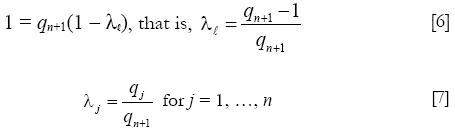
<body><![CDATA[<p align="justify"><font face="verdana" size="2"><i>Assumption A1 </i>(productiveness assumption). There exists a nonnegative column <i>(<b>n</b> + </i>1)&#150;vector <i><b>x</b> </i>such that <i><b>x</b> &gt; <b>Ax</b>. </i>Thus, (<i><b>I</b> </i>&#150; <i><b>A</b>)<sup>&#150;1</sup> <b>&ge; </b></i><b>0</b>.<sup><a href="#notas">3</a> </sup></font></p>     <p align="justify"><font face="verdana" size="2">Now equation &#91;4&#93; is solved for <i><b>q</b> </i>as</font></p>     <p align="center"><font face="verdana" size="2"><img src="/img/revistas/ineco/v68n267/a3e10.jpg"></font></p>     <p align="justify"><font face="verdana" size="2">On the other hand, from equation &#91;3'&#93;</font></p>     <p align="center"><font face="verdana" size="2"><i><img src="/img/revistas/ineco/v68n267/a3e11.jpg"></i></font></p>     <p align="justify"><font face="verdana" size="2">It is clear from equation &#91;5&#93; that <i>q </i>is the last row of the inverse <i>(<b>I</b> &#150; <b>A</b>)<sup>&#150;1</sup>, </i>thus the above equation gives</font></p>     <p align="center"><font face="verdana" size="2"><img src="/img/revistas/ineco/v68n267/a3e12.jpg"></font></p>     <p align="justify"><font face="verdana" size="2">It naturally follows that <b>0</b> <b>&le; <img src="/img/revistas/ineco/v68n267/a3e3.jpg"></b><i>&lt; </i><b>1</b> and <i><b>&lambda;</b><sub>j</sub></i><b><i> &ge; </i>0</b> for <i><b>j</b></i> = <b>1</b>, <b>...</b>, <b>n</b>, <i>i.e.</i>, the labour value of one unit of labour is less than one. When labour is indispensable to produce a basket <i>c, </i>we have <b>0</b> &lt; <b><img src="/img/revistas/ineco/v68n267/a3e3.jpg"></b>. (See Fujimoto and Fujita, 2008). Therefore, when the productiveness assumption A1 is given, all we have to do is to solve equation &#91;5&#93; first, and then calculate labour values using equations &#91;6&#93; and &#91;7&#93;.</font></p>     <p align="justify"><font face="verdana" size="2">Now even in a Leontief model we are using here, there exists a set of inefficient processes hidden, typically those which waste more or less resources. With these inefficient processes included, the input coefficient matrix <i><b>A</b> </i>is enlarged to have more columns than rows: let us suppose <i>A </i>is now <i>(<b>n</b> + <b>1</b>)<b>x</b>(<b>m</b> + </i><b>1</b>) with <i><b>n</b> &le; <b>m</b>. </i>We still assume there is only one homogeneous labour, and the household activity is on the last <i>(<b>m</b> + </i><b>1</b>)&#150;th column <i>of <b>A</b>. </i>Equation &#91;3&#93; becomes</font></p>     <p align="center"><font face="verdana" size="2"><img src="/img/revistas/ineco/v68n267/a3e14.jpg"></font></p>     ]]></body>
<body><![CDATA[<p align="justify"><font face="verdana" size="2">So, equation &#91;4&#93; is now to be modified to an inequality system</font></p>     <p align="center"><font face="verdana" size="2"><img src="/img/revistas/ineco/v68n267/a3e15.jpg"></font></p>     <p align="justify"><font face="verdana" size="2">The problem is how to define the labour values and also how to compute them. The answer has already been supplied by the well&#150;known nonsubstitution theorem.<sup><a href="#notas">4</a></sup> We first solve the following linear programming problem:</font></p>     <p align="center"><font face="verdana" size="2"><img src="/img/revistas/ineco/v68n267/a3e16.jpg"></font></p>     <p align="justify"><font face="verdana" size="2">where <i><b><img src="/img/revistas/ineco/v68n267/a3e17.jpg"></b></i>, <i>i.e., </i>the <i>(<b>n</b> + </i><b>1</b>)&#150;column vector whose <i>(<b>n</b> + </i><b>1</b>)&#150;th entry is unity with all the remaining elements being zero. Then, the labour values are obtained by applying equations &#91;6&#93; and &#91;7&#93;. Thus, our definition of labour values can be stated as:</font></p>     <p align="justify"><font face="verdana" size="2"><i>Definition of values for a Leontief model: </i>labour values in a Leontief model with alternative processes are nonnegative magnitudes assigned to commodities such that the labour value of labour itself be maximized under the condition that the total value of the output of each possible process should not exceed that of the input. When calculating the total value of the input of a process, unity is assigned to the direct input of the labour.<sup><a href="#notas">5</a> </sup></font></p>     <p align="justify"><font face="verdana" size="2">And our assumption above is to be modified as:</font></p>     <p align="justify"><font face="verdana" size="2"><i>Assumption A2. </i>There exists a nonnegative column <i>(<b>m</b> + </i><b>1</b>)&#150;vector <i><b>x</b> </i>such that <i><b>x</b> &gt; <b>Ax</b>.</i></font></p>     <p align="justify"><font face="verdana" size="2">The nonsubstitution theorem has made it clear that a sort of efficiency on the output side is involved because of the duality in linear programming. That is,</font></p>     <p align="center"><font face="verdana" size="2"><img src="/img/revistas/ineco/v68n267/a3e18.jpg"></font></p>     ]]></body>

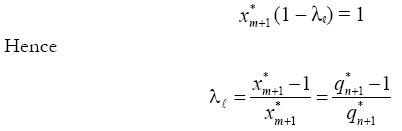
<body><![CDATA[<p align="justify"><font face="verdana" size="2">This programming problem dictates that while producing one unit of labour force as net product, we should minimize the gross production of labour force.<sup><a href="#notas">6</a> </sup>Because of our assumption A2 just stated, the problem (<b>PL</b>) has an optimal solution, and so does the problem (<b>DL</b>). We can now present:</font></p>     <p align="justify"><font face="verdana" size="2"><i>Proposition 1. </i>Given the assumption A2, the labour value of (homogeneous) labour is less than unity.</font></p>     <p align="justify"><font face="verdana" size="2"><i>Proof. </i>By the duality theorem, we know that the optimal values satisfy <i><b>q</b><sup>*</sup><sub>n+1</sub> = <b>x</b><sup>*</sup><sub>m+l</sub></i>. On the other hand, it is clear from the constraint in (<b>PL</b>) that <i><b>x</b><sup>*</sup><sub>m+1</sub> &ge; 1. </i>Therefore we get <i><b>q</b><sup>*</sup><sub>n+1</sub> <b>&ge; </b></i>1, which gives <b>0</b> <b>&le; <img src="/img/revistas/ineco/v68n267/a3e3.jpg"></b><i>&lt; </i><b>1</b> because of equation &#91;6&#93;. QED.</font></p>     <p align="justify"><font face="verdana" size="2">It may be interesting to apply the principle of algebra in interpreting an optimal solution <i><b>x</b><sup>*</sup><sub>m+1</sub> </i>to the problem (<b>PL</b>). Suppose we knew the labour amount which has entered directly and indirectly into one unit of labour, and write this amount as <b><img src="/img/revistas/ineco/v68n267/a3e3.jpg"></b><i>, </i>then the magnitude <i><b>x</b><sup>*</sup><sub>m+1</sub></i> (<b>1</b> &#150; <img src="/img/revistas/ineco/v68n267/a3e3.jpg"><i>) </i>shows the net residual which is not consumed in reproducing <i><b>x</b><sup>*</sup><sub>m+1</sub> </i>units of gross production of labour force. Since in the problem (<b>PL</b>), the system produces one unit of net labour force, we should have</font></p>     <p align="center"><font face="verdana" size="2"><img src="/img/revistas/ineco/v68n267/a3e19.jpg"></font></p>     <p align="justify"><font face="verdana" size="2">which corresponds to equation &#91;6&#93;.</font></p>     <p align="justify"><font face="verdana" size="2">&nbsp;</font></p>     <p align="justify"><font face="verdana" size="2"><b>LABOUR VALUES IN A GENERAL MODEL </b></font></p>     <p align="justify"><font face="verdana" size="2">Our model is a variant of Morishima model (Morishima, 1964) slightly generalized. That is, different from the original model in von Neumann (1945&#150;1946), we explicitly deal with labour input coefficients, and moreover we allow for the existence of heterogeneous labour as well as proper joint production. Then, naturally we can deal with durable capital goods. Various types of labour are treated exactly like normal commodities, and so we use the symbol <i><b>B</b> </i>and <i><b>A</b> </i>as the output and input coefficient matrices, both of which now have <i><b>n</b> </i>rows and <i><b>m</b> </i>columns. There are altogether <i><b>n</b> </i>kinds of goods, services, and various types of labour.<sup><a href="#notas">7</a></sup> On the other hand, there exist <i><b>m</b> </i>production processes or household activities. This way of formulation enables us to take into consideration durable consumption commodities in household activities: a durable consumption commodity in a column of household activity <i>of A </i>will appear in the corresponding column of <i><b>B</b> </i>as one period, say one year, older commodity. For each type of labour, there can be more than one household activities to reproduce that labour. Workers may save a part of their incomes, and may have properties. These complicating elements from the real world do not disturb our study while we deal with values and exploitation: this should be true in any model including Leontief models.</font></p>     <p align="justify"><font face="verdana" size="2">Now it is possible to select any commodity or a type of labour as the standard of value because goods and labour are treated in a completely symmetric way. Here, however, we choose a type of labour as the standard and let it be the <i><b>i</b></i>&#150;th labour commodity. We give our definition of labour values as follows:</font></p>     ]]></body>
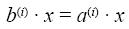
<body><![CDATA[<p align="justify"><font face="verdana" size="2"><i>Definition of values for our general model: </i>values in a general input&#150;output model are nonnegative magnitudes assigned to commodities (including services and various types of labour) such that the value of the standard commodity be maximized under the condition that the total value of the output of each possible process should not exceed that of the input. When calculating the total value of the input of a process, unity is assigned to the direct input of the standard commodity.<sup><a href="#notas">8</a> </sup>Our productiveness assumption here is:</font></p>     <p align="justify"><font face="verdana" size="2"><i>Assumption A3. </i>There exists an <i>x </i><img src="/img/revistas/ineco/v68n267/a3e20.jpg"> <i><b>R</b><sub>+</sub><sup>m</sup></i> such that</font></p>     <p align="center"><font face="verdana" size="2"><img src="/img/revistas/ineco/v68n267/a3e21.jpg"></font></p>     <p align="justify"><font face="verdana" size="2">where <i>e<sub>&#91;i&#93;</sub> </i>is the <b>n</b>&#150;column vector whose <b><i>i</i></b>&#150;th entry is unity with all the remaining elements being zero.<sup><a href="#notas">9</a></sup></font></p>     <p align="justify"><font face="verdana" size="2">Having defined values as above, we can now explain how to compute values in a way similar to the problem (<b>DL</b>) in section 3. Let us first define the following vectors:</font></p>     <p align="center"><font face="verdana" size="2"><img src="/img/revistas/ineco/v68n267/a3e22.jpg"></font></p>     <p align="justify"><font face="verdana" size="2">The vector <b>&Lambda;</b><sup>&#91;i&#93;</sup> is the vector of values with <i><b>i</b></i>&#150;th labour being the standard of value, and the element <b>&lambda;</b><sub>j</sub><sup>&#91;i&#93;</sup> stands for the value of commodity <i><b>j</b> </i>with <i><b>i</b></i>&#150;commodity as the standard of value. Our definition above is rewritten like this:</font></p>     <p align="center"><font face="verdana" size="2"><img src="/img/revistas/ineco/v68n267/a3e23.jpg"></font></p>     <p align="justify"><font face="verdana" size="2">We can proceed as we have done for a Leontief model in third section. That is, the constraint in this problem can be transformed first through adding (<b>1</b> &#150; <i><b>&lambda;</b><sub> i</sub><sup>&#91; i&#93;</sup></i>) &middot; <b>b</b><sup>(i)</sup> to both sides, then multiplying both sides by nonzero nonnegative <i>v</i>, yielding</font></p>     <p align="center"><font face="verdana" size="2"><img src="/img/revistas/ineco/v68n267/a3e24.jpg"></font></p>     ]]></body>
<body><![CDATA[<p align="justify"><font face="verdana" size="2">where <b>b</b><sup>(i)</sup> is the <i><b>i</b></i>&#150;th row of <i>B. </i>Then, we set</font></p>     <p align="center"><font face="verdana" size="2"><img src="/img/revistas/ineco/v68n267/a3e25.jpg"></font></p>     <p align="justify"><font face="verdana" size="2">This normalization yields as our constraint</font></p>     <p align="center"><font face="verdana" size="2"><img src="/img/revistas/ineco/v68n267/a3e26.jpg"></font></p>     <p align="justify"><font face="verdana" size="2">Since we have <i><b>&lambda;</b><sub> i</sub><sup>&#91; i&#93;</sup></i> = <b>1</b> &#150; <b>1</b>/<i><b>v</b> </i>from our normalization, maximizing <i><b>v</b> </i>is equivalent to maximizing <i><b>&lambda;</b><sub>i</sub><sup>&#91; i&#93;</sup>. </i>Writing <i><b>v</b> </i>&middot; <i><img src="/img/revistas/ineco/v68n267/a3s1.jpg"></i> simply as a variable vector <b>q</b>, thus <i><b>q</b><sub>i</sub></i> <img src="/img/revistas/ineco/v68n267/a3e13.jpg"><i> <b>v</b></i>, we have the linear programming problem (<b>DG</b>):</font></p>     <p align="center"><font face="verdana" size="2"><img src="/img/revistas/ineco/v68n267/a3e27.jpg"></font></p>     <p align="justify"><font face="verdana" size="2">Finally, the values can be calculated exactly as in equations &#91;6&#93; and &#91;7&#93;, <i>i.e.,</i></font></p>     <p align="center"><font face="verdana" size="2"><img src="/img/revistas/ineco/v68n267/a3e28.jpg"></font></p>     <p align="justify"><font face="verdana" size="2">It is not difficult to establish:</font></p>     <p align="justify"><font face="verdana" size="2"><i>Proposition 2. </i>Given the productiveness assumption (A3), the <i><b>i</b></i>&#150;th labour value of i&#150;th labour is less than unity.</font></p>     ]]></body>
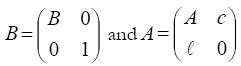
<body><![CDATA[<p align="justify"><font face="verdana" size="2"><i>Proof. </i>Consider the linear programming problem</font></p>     <p align="center"><font face="verdana" size="2"><img src="/img/revistas/ineco/v68n267/a3e29.jpg"></font></p>     <p align="justify"><font face="verdana" size="2">By the duality theorem, we know that the optimal values satisfy <i><b>q</b><sub>i<sup>*</sup></sub> = <b>b</b><sup>(i)</sup><b>x</b><sup>*</sup></i>. On the other hand, it is clear from the constraint in (<b>PG</b>) that <i><i><b>b</b><sup>(i)</sup><b>x</b><sup>*</sup></i> &ge; </i><b>1</b>. Therefore we get <i><b>q</b><sub>i<sup>*</sup></sub> &ge; </i><b>1</b>, which gives <b>0</b> &le; <i><b>&lambda;</b><sub>i</sub><sup>&#91; i&#93;</sup> &lt; </i><b>1</b> because of equation &#91;9&#93;. QED. Since various types of labour and commodities are treated in a symmetric way, we can define the <i>j</i>&#150;th commodity values of goods and labour exactly as in the definition above, and establish:</font></p>     <p align="justify"><font face="verdana" size="2"><i>Proposition 3. </i>Given the assumption (A3) with <i>e<sub>&#91;i&#93;</sub> </i>replaced by <i>e<sub>&#91;j&#93;</sub>, </i>they <b><i>j</i></b>&#150;th commodity value of <b><i>j</i></b>&#150;th commodity is less than unity.<sup><a href="#notas">10</a></sup></font></p>     <p align="justify"><font face="verdana" size="2">At the end of this section, let us briefly discuss a model in Morishima (1964) and that in Bowles and Gintis (1977). In Morishima's model, there is only one type of homogeneous labour, and a single household activity to reproduce this homogeneous labour, with no durable consumption goods involved. Thus, <i><b>B</b> </i>and <i><b>A</b> </i>are of the following special form:</font></p>     <p align="center"><font face="verdana" size="2"><img src="/img/revistas/ineco/v68n267/a3e30.jpg"></font></p>     <p align="justify"><font face="verdana" size="2">where <i><b>B</b> </i>and <b>A</b> are, respectively, the <i>(<b>n</b> &#150; <b>1</b>)<b>x</b>(m &#150; </i><b>1</b>) output and input coefficient matrices of normal production processes. In this case, the problems (DG) designating labour as the numeraire coincides with Morishima's problem (DM) in Morishima (1974):</font></p>     <p align="center"><font face="verdana" size="2"><img src="/img/revistas/ineco/v68n267/a3e31.jpg"></font></p>     <p align="justify"><font face="verdana" size="2">Therefore our model and definition of values include Morishima's as a special case.</font></p>     <p align="justify"><font face="verdana" size="2">When <i><b>B</b> </i>is the identity matrix, the definition of values by Bowles and Gintis (1977) is again a special case of ours. They, however, regard propositions 2 and 3 above as the existence of exploitation. Each of them is merely an alternative expression of productiveness (A3) as is explained in Fujimoto and Fujita (2008). It is not difficult to recognize that the commodity values defined by Manresa <i>et al. </i>(1998) also form a special case of ours.</font></p>     ]]></body>
<body><![CDATA[<p align="justify"><font face="verdana" size="2">&nbsp;</font></p>     <p align="justify"><font face="verdana" size="2"><b>EXPLOITATION</b></font></p>     <p align="justify"><font face="verdana" size="2">Our definition of values and our method of calculating them are useful to generalize the Fundamental Marxian Theorem as presented in Morishima (1974). Our model is surely more general than von Neumann&#150;Morishima model used by him, allowing for heterogeneous labour, a plural number of household activities to reproduce labour power of each type, and durable consumption goods, to say nothing of proper joint production in ordinary production processes. We do not need such concepts as "warranted rate of profit" or "capacity growth rate" defined in Morishima (1974). Moreover we need to define the concept of exploitation in a careful way because in our model there are various types of workers and they may have properties which increase their total income.</font></p>     <p align="justify"><font face="verdana" size="2">We now suppose the <i><b>n</b></i>&#150;th commodity is a type of labour, <i><b>n</b></i>&#150;th labour for short, and make the assumption (A3) in the preceding section for the vector <i>e</i>&#91;<i>n</i>&#93;. Let us suppose the household activity vectors to reproduce the <i><b>n</b></i>&#150;th labour are normalized so that they appear like this.</font></p>     <p align="center"><font face="verdana" size="2"><img src="/img/revistas/ineco/v68n267/a3e32.jpg"></font></p>     <p align="justify"><font face="verdana" size="2">That is, each household activity produces one unit of <b>n</b>&#150;th labour by use of &alpha; unit of its own <b>n</b>&#150;th labour and a commodity (including other types of labour) basket <i>c. </i>We consider only those activities whose <b>&alpha;</b> satisfies <b>0</b> <b>&le; &alpha;</b> &lt; <b>1</b>. Since some commodity in the basket <i>c </i>can be durable, we have on the output side a vector <i><b>d</b>, </i>which may not be the zero vector. Both <i>c </i>and and <b><i>d</i></b> are a column <i>(<b>n</b> </i>&#150; <b>1</b>)&#150;vector. One more assumption we make is:</font></p>     <p align="justify"><font face="verdana" size="2"><i>Assumption A4. </i>Any optimal vector <i><b>x</b></i><sup>*</sup> for the problem (<b>PG</b>) uses at least one of the activities that reproduce the <i><b>n</b></i>&#150;th labour. We can prove:</font></p>     <p align="justify"><font face="verdana" size="2"><i>Proposition 4. </i>Let commodity <i><b>i</b> </i>such that <i>i &ne; <b>n</b>, <b>c</b><sub>i </sub>&gt; </i><b>0</b>, be arbitrarily chosen. Given the assumptions A3 and A4, the <b><i>i</i></b>&#150;th commodity value of <i><b>n</b></i>&#150;th labour is always greater than the <i><b>i</b></i>&#150;th commodity value of the net consumption basket (<i><b>c</b> </i>&#150; <i><b>d</b>) </i>for any household activity used in an optimal vector of the programming problem (<b>PG</b>).</font></p>     <p align="justify"><font face="verdana" size="2"><i>Proof</i>. Take an optimal vector <i><b>q</b><sup>*</sup> </i>for the problem (<b>DG</b>). By the assumption (A4), we can find at least one pair of vectors, which is actually used, of the type (10) among the household activities which reproduce the <b><i>n</i></b>&#150;th labour. For these vectors, we have a strict equality in the constraint in (<b>DG</b>) because they are used. Thus, we get</font></p>     <p align="center"><font face="verdana" size="2"><img src="/img/revistas/ineco/v68n267/a3e33.jpg"></font></p>     ]]></body>
<body><![CDATA[<p align="justify"><font face="verdana" size="2">Divide both sides of this equality by <i><b>q</b><sub>i</sub></i><sup>*</sup> , and we obtain, because of equation &#91;9&#93;</font></p>     <p align="center"><font face="verdana" size="2"><img src="/img/revistas/ineco/v68n267/a3e34.jpg"></font></p>     <p align="justify"><font face="verdana" size="2">This equality yields</font></p>     <p align="center"><font face="verdana" size="2"><img src="/img/revistas/ineco/v68n267/a3e35.jpg"></font></p>     <p align="justify"><font face="verdana" size="2">because <i><b>c</b></i><sub>i </sub>&gt; <b>0</b> and <i><b>&lambda;</b><sub> i</sub><sup>&#91; i&#93;</sup></i> <i>&lt; </i><b>1</b> by proposition 3. In sum,</font></p>     <p align="center"><font face="verdana" size="2"><img src="/img/revistas/ineco/v68n267/a3e36.jpg"></font></p>     <p align="justify"><font face="verdana" size="2">This ends the proof. QED.</font></p>     <p align="justify"><font face="verdana" size="2">This proposition tells us that if workers of type <i><b>n</b> </i>exchange one unit of their labour force for the basket <i><b>c</b> </i>and leaves <i><b>d</b> </i>after one period, they make a loss in terms of any commodity as the standard. Equation &#91;11&#93;, when commodity <i><b>i</b> </i>is in fact the <i><b>n</b></i>&#150;th labour, <i>i.e.</i>, <i><b>i</b> </i>= <i><b>n</b></i>, becomes</font></p>     <p align="center"><font face="verdana" size="2"><img src="/img/revistas/ineco/v68n267/a3e37.jpg"></font></p>     <p align="justify"><font face="verdana" size="2">Thus, because of proposition 2, we get</font></p>     ]]></body>
<body><![CDATA[<p align="center"><font face="verdana" size="2"><img src="/img/revistas/ineco/v68n267/a3e38.jpg"></font></p>     <p align="justify"><font face="verdana" size="2">From this we get:</font></p>     <p align="justify"><font face="verdana" size="2"><i>Proposition 5. </i>The <i><b>n</b></i> &#150;th labour value of the net consumption basket <i>(<b>c</b> &#150; <b>d</b>) </i>for any household activity used in an optimal vector of the programming problem (<b>PG</b>) is less than unity.</font></p>     <p align="justify"><font face="verdana" size="2"><b>Homogeneous labour</b></font></p>     <p align="justify"><font face="verdana" size="2">First, we define exploitation for the case where there exits single homogeneous labour. Let us denote by <b>p</b> <i><img src="/img/revistas/ineco/v68n267/a3e13.jpg"> (<b>p</b><sub>1</sub>, <b>p</b><sub>2</sub>, ... , <b>p</b><sub>n</sub>) </i>the row <b><i>n</i></b>&#150;vector of prices and wage rate. Specifically we write <i><b>w</b><sub>n</sub> </i>for the wage rate <i><b>p</b><sub>n</sub>, </i>supposing the <i><b>n</b></i>&#150;th commodity is the homogeneous labour. These prices and the wage rate are what we observe for a period under consideration, and are not necessarily some magnitudes which equilibrate certain markets. Let us denote by <i>y<sub>n</sub></i> the total income of a typical worker for this particular period: <i><b>y</b><sub>n</sub> <img src="/img/revistas/ineco/v68n267/a3e13.jpg"> <b>w</b><sub>n</sub>&middot;<b>L</b> + <b>u</b><sub>n</sub>, </i>where <i><b>L</b> </i>is the amount of labour supplied and <i><b>u</b><sub>n</sub> </i>is the other incomes accruing to his/her properties or businesses as profits, both for a given period. Denote by <b>&omega;</b><sub>n</sub> = <i><b>y</b><sub>n</sub>/<b>L</b>, </i>the income per unit of labour supplied. Clearly when <i><b>u</b><sub>n</sub>= </i><b>0</b>, <b>&omega;</b><sub>n</sub> = <i><b>w</b><sub>n</sub>. </i>In this subsection, the net consumption basket (<i><b>c</b> </i>&#150; <i><b>d</b>) </i>is the one actually used.</font></p>     <p align="justify"><font face="verdana" size="2"><i>Definition of exploitation: </i>a worker is exploited when his <b>&omega;</b><sub>n</sub> satisfies</font></p>     <p align="center"><font face="verdana" size="2"><img src="/img/revistas/ineco/v68n267/a3e39.jpg"></font></p>     <p align="justify"><font face="verdana" size="2">The meaning of this definition is like this. When the above inequality were an equality, we have</font></p>     <p align="center"><font face="verdana" size="2"><img src="/img/revistas/ineco/v68n267/a3e40.jpg"></font></p>     <p align="justify"><font face="verdana" size="2">The left term on the LHS shows how many baskets (<i><b>c</b> </i>&#150; <i><b>d</b></i>) could be bought by spending the total income <i><b>y</b><sub>n</sub></i>. Hence the LHS as a whole means the amount of labour value which could be obtained in exchange for the total income <i><b>y</b><sub>n</sub></i>, which is the reward for participating the production system and supplying labour force, <i><b>L</b></i>. Thus the above equality can be regarded as guaranteeing an equal exchange. Our definition requires that the income per unit of labour supplied be less than this level.</font></p>     ]]></body>
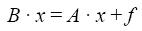
<body><![CDATA[<p align="justify"><font face="verdana" size="2">In the literature, the FMT is often discussed for models where there is single homogeneous labour, workers have no property to earn extra income, <i>i.e.</i>, <i><b>u</b><sub>n</sub> </i>= <b>0</b>, and the wage rate is just enough to buy the consumption basket <i><b>c</b> </i>with <i><b>d</b> </i>= <b>0</b> due to the absence of durable consumption goods. Given these assumptions, <i>i.e.</i>, <b>&#969;</b><i><sub>n</sub> </i>= <i><b>w</b><sub>n</sub> </i>= <i><b>pc</b> </i>and <i><b>d</b> </i>= <b>0</b>, workers are exploited based upon our definition above, simply because</font></p>     <p align="center"><font face="verdana" size="2"><img src="/img/revistas/ineco/v68n267/a3e41.jpg"></font></p>     <p align="justify"><font face="verdana" size="2">as is clear in the expression &#91;13&#93;. In other cases, together with the assumption <i><b>u<sub>n</sub> </b>= </i><b>0</b>, a kind of equilibrium is stipulated in a Leontief model, <i>e.g., </i>a uniform positive rate of profit is prevailing among industries, whence follow the inequalities <i><b>p</b><sub>j</sub>/<b>w</b><sub>n</sub> &gt; <b>&lambda;</b><sub>j</sub><sup>&#91;n&#93; </sup></i>for all <b><i>j</i></b> &ne; <i><b>n</b>, i.e., </i>each wage&#150;unit price is larger than its corresponding labour value, which is enough to prove the existence of exploitation in our sense, provided the vector (<i><b>c</b> </i>&#150; <i><b>d</b>) </i>is nonnegative and nonzero. Profits are appropriated by the capitalists who are latent in our economic system.</font></p>     <p align="justify"><font face="verdana" size="2">The phenomenon of exploitation can be looked at from a different viewpoint. Let us consider the output, and assume that in a given period the economy's performance is described by</font></p>     <p align="center"><font face="verdana" size="2"><img src="/img/revistas/ineco/v68n267/a3e42.jpg"></font></p>     <p align="justify"><font face="verdana" size="2">where <i><b>x</b> </i>is an <b>m</b>&#150;column activity level vector, and <i><b>f</b></i> an <b><i>n</i></b>&#150;column <i>net </i>output vector.<sup><a href="#notas">11</a></sup> Both <i><b>x</b> </i>and <i><b>f</b></i> are supposed to be nonnegative nonzero vectors, and in particular labour is not involved in <i><b>f</b></i>, <i>i.e., f<b><sub>n</sub> </b>= </i>0. Pre&#150;multiplying by <i><b>q</b> </i>the both sides of the output equation above, yields</font></p>     <p align="center"><font face="verdana" size="2"><img src="/img/revistas/ineco/v68n267/a3e43.jpg"></font></p>     <p align="justify"><font face="verdana" size="2">On the other hand, post&#150;multiplying by <i>x </i>both sides of the constraint in the programming problem (<b>DG</b>) with <i><b>i</b> = <b>n</b>, </i>gives</font></p>     <p align="center"><font face="verdana" size="2"><img src="/img/revistas/ineco/v68n267/a3e44.jpg"></font></p>     <p align="justify"><font face="verdana" size="2">Divide this inequality by <i><b>q</b><sub>n</sub>, </i>and we get</font></p>     ]]></body>
<body><![CDATA[<p align="center"><font face="verdana" size="2"><img src="/img/revistas/ineco/v68n267/a3e45.jpg"></font></p>     <p align="justify"><font face="verdana" size="2">where <i><b>&alpha;</b></i><sup>(i) </sup>is the <i><b>i</b></i>&#150;th row <i>of <b>A</b>. </i>This inequality means the following almost tautological statement.</font></p>     <p align="justify"><font face="verdana" size="2"><i>Proposition 6. </i>The total labour value of net output plus the labour value of reproduced labour cannot exceed the total labour utilized.</font></p>     <p align="justify"><font face="verdana" size="2">This proposition is valid even in the case of heterogeneous labour provided that no type of labour is involved in the net output vector <i>f</i> and that values are measured by a particular type of labour. This proposition 6 combined with our definition of exploitation implies</font></p>     <p align="justify"><font face="verdana" size="2"><i>Proposition 7</i>. Workers as a whole are exploited unless they have the income which would enable them to buy out the whole net output. And thus</font></p>     <p align="justify"><font face="verdana" size="2"><i>Proposition 8 </i>(A Fundamental Marxian Theorem). In an economy of homogeneous labour, the working class is exploited when there exist profits not all of which accrue to the working class, and some or all profits are used to buy a portion of the total product.</font></p>     <p align="justify"><font face="verdana" size="2">This is the most general FMT among those presented so far in models of homogeneous labour. Our economy may be in disequilibrium, and workers may have properties which give them extra income.</font></p>     <p align="justify"><font face="verdana" size="2"><b>Heterogeneous labour and exploitation among workers themselves</b></font></p>     <p align="justify"><font face="verdana" size="2">Let us return to the case of heterogeneous labour. If we employ the definition of exploitation for the case of homogeneous labour, propositions 6 and 7 dictate that each type of workers should have the exclusive right over the whole net output; otherwise, that type is exploited. Thus each type is exploited when they share the net output without monopolizing the entire net output. Therefore, in the first instance, we have a proposition similar to proposition 8.</font></p>     <p align="justify"><font face="verdana" size="2"><i>Proposition 9 </i>(A Generalized Fundamental Marxian Theorem). In an economy of heterogeneous labour, the working classes as a whole are exploited when there exist profits not all of which accrue to them.</font></p>     ]]></body>
<body><![CDATA[<p align="justify"><font face="verdana" size="2">In the case of heterogeneous labour, however, the net output is a joint product by various types of labour. So, while it is natural that all the net output goes to the workers as a whole as expressed in proposition 9, it is selfish for workers of some type to claim the whole net output, insisting that its labour value is less or equal to their contribution to its production. Thus, there can be exploitation among workers themselves. To define such a concept, we need to devise out some fair division of the output.</font></p>     <p align="justify"><font face="verdana" size="2">Let us suppose there are <i><b>k</b> </i>types of labour, <b>1</b> &lt; <i><b>k</b> &lt; <b>m</b>. </i>We continue to consider the output equation</font></p>     <p align="center"><font face="verdana" size="2"><img src="/img/revistas/ineco/v68n267/a3e46.jpg"></font></p>     <p align="justify"><font face="verdana" size="2">where <i><b>x</b> </i>and <i><b>f</b></i> are supposed to be nonnegative nonzero vectors. As in section 5.1, we assume no type of labour is appearing in the net output vector <i><b>f</b></i> <sup><a href="#notas">12</a></sup> Here we adopt a simple concept of "fairness" in the division of the net output among workers. The total labour force rendered by <i><b>i</b></i>&#150;th labour in the production expressed by equation &#91;15&#93; is</font></p>     <p align="center"><font face="verdana" size="2"><img src="/img/revistas/ineco/v68n267/a3e47.jpg"></font></p>     <p align="justify"><font face="verdana" size="2">It is important to note that the labour force which has contributed to the production of net output is at the maximum<sup><a href="#notas">13</a></sup></font></p>     <p align="center"><font face="verdana" size="2"><img src="/img/revistas/ineco/v68n267/a3e48.jpg"></font></p>     <p align="justify"><font face="verdana" size="2">And so, the contribution ratio of <i><b>i</b></i>&#150;th type to the total labour force is</font></p>     <p align="center"><font face="verdana" size="2"><img src="/img/revistas/ineco/v68n267/a3e49.jpg"></font></p>     <p align="justify"><font face="verdana" size="2">where <i><b>T</b> </i>is the set of indices for all the types of labour, its cardinality being <i><b>k</b>. </i>On the other hand, the ratio of what the <i><b>i</b></i>&#150;type workers could buy to the total money value of the net output is</font></p>     ]]></body>
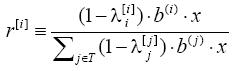
<body><![CDATA[<p align="center"><font face="verdana" size="2"><img src="/img/revistas/ineco/v68n267/a3e50.jpg"></font></p>     <p align="justify"><font face="verdana" size="2">where <i><b>w</b><sub>i</sub> </i>is the wage rate for the <i><b>i</b></i>&#150;type workers and <i><b>u</b><sub>i</sub> </i>the other incomes accruing to individual properties of <i><b>i</b></i>&#150;type workers. The net consumption basket <i>(<b>c</b><sub>i</sub> </i>&#150; <i><b>d</b><sub>i</sub>) </i>is the one actually used for the type <i><b>i</b></i>. The numerator shows what we may call the net purchasing power of <i><b>i</b></i>&#150;type workers for the net output, after deducting the necessary expenses to sustain their life.</font></p>     <p align="justify"><font face="verdana" size="2">It should be remembered that if our economy is decomposable, we consider each decomposed part separately, and if that decomposed part of the economy involves only one type of labour, we merely apply the definition of exploitation for the homogeneous case.</font></p>     <p align="justify"><font face="verdana" size="2"><i>Definition of exploitation among workers: </i>when our economy is indecomposable, workers of type <i><b>i</b> </i>are said to be exploited when his/her wage rate <i><b>w</b>, </i>and the other income <i><b>u</b>, </i>are such that</font></p>     <p align="center"><font face="verdana" size="2"><i>S<sup>&#91;i&#93;</sup> &lt; r<sup>&#91;i&#93;</sup></i></font></p>     <p align="justify"><font face="verdana" size="2">In the above definition, the reader may think that we have given an equal weight to each type of labour. This is not so. Various types are differentiated by their wage rates as well as consumption baskets. In other words, an equal weight is used only for calculating the shares <i>S<sup>&#91;i&#93;</sup></i>and <i>r<sup>&#91;i&#93;</sup></i>. Rich workers may lead a lavish life with little hesitation, and they may not want to be called "workers": they prefer "managers" or "entrepreneurs".</font></p>     <p align="justify"><font face="verdana" size="2">&nbsp;</font></p>     <p align="justify"><font face="verdana" size="2"><b>NUMERICAL EXAMPLES </b></font></p>     <p align="justify"><font face="verdana" size="2">In this section we give three numerical examples in which there are two types of labour with no joint production. These examples are meant to tell the reader how to apply our definitions in a concrete manner, though the examples are highly abstract.</font></p>     <p align="justify"><font face="verdana" size="2"><b>Example 1</b></font></p>     ]]></body>
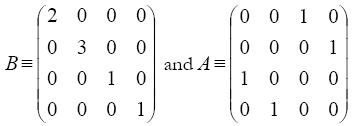
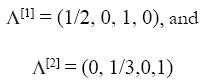
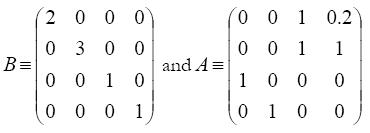
<body><![CDATA[<p align="justify"><font face="verdana" size="2">The first economy consists of hunters and fishermen, and the technological data are</font></p>     <p align="center"><font face="verdana" size="2"><img src="/img/revistas/ineco/v68n267/a3e51.jpg"></font></p>     <p align="justify"><font face="verdana" size="2">The first row stands for beavers, the second for fish, the third for hunters' labour, and the fourth fishermen's labour. The first column means the process operated by hunters, the second by fishermen, while the third is the household activity of hunters and the fourth is that of fishermen. Assumption A3 is satisfied, <i>e.g.</i>, by <i>x </i>= (1, 1, 1.1, 1.1)', to say nothing of assumption 4. When the standard of value is hunters' labour, the values are calculated as</font></p>     <p align="center"><font face="verdana" size="2"><img src="/img/revistas/ineco/v68n267/a3e52.jpg"></font></p>     <p align="justify"><font face="verdana" size="2">Similarly when the standard is fishermen's labour, the values become</font></p>     <p align="center"><font face="verdana" size="2"><img src="/img/revistas/ineco/v68n267/a3e53.jpg"></font></p>     <p align="justify"><font face="verdana" size="2">Since <b>&#955;</b><sup>&#91;</sup><sub>3</sub><sup>3&#93;</sup> = <b>1</b>/<b>2</b> and <b>&#955;</b><sup>&#91;</sup><sub>4</sub><sup>4&#93;</sup> = <b>1</b>/<b>3</b>, propositions 2 and 5 are verified.</font></p>     <p align="justify"><font face="verdana" size="2">If we choose beaver and fish as the standard of value, we get, respectively,</font></p>     <p align="center"><font face="verdana" size="2"><img src="/img/revistas/ineco/v68n267/a3e54.jpg"></font></p>     <p align="justify"><font face="verdana" size="2">These values shows proposition 4 is valid in this example.</font></p>     ]]></body>
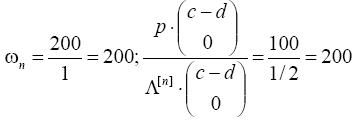
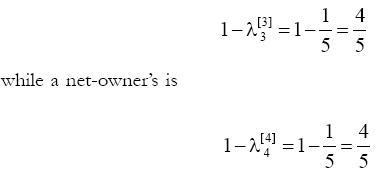
<body><![CDATA[<p align="justify"><font face="verdana" size="2">Now suppose <i><b>x</b> = </i>(1, 1, 1, 1)' and the quantity equation of the period is</font></p>     <p align="center"><font face="verdana" size="2"><img src="/img/revistas/ineco/v68n267/a3e55.jpg"></font></p>     <p align="justify"><font face="verdana" size="2">where <i>f</i> = (<b>1</b>, <b>2</b>, <b>0</b>, <b>0</b>)'. Proposition 6 can be verified using above values. Since the economy here is (completely) decomposable, we apply the definition of exploitation for the homogeneous case. Suppose the price vector for the normal commodities <i><b>p</b> = </i>($100, $100). For a hunter operating the first process, the income is $200. This hunter needs $100 to reproduce one unit of hunter's labour. Spending the remaining $100, he/she can buy out the net output of one beaver. Hence no exploitation is observed. In fact we have</font></p>     <p align="center"><font face="verdana" size="2"><img src="/img/revistas/ineco/v68n267/a3e56.jpg"></font></p>     <p align="justify"><font face="verdana" size="2"><b>Example 2</b></font></p>     <p align="justify"><font face="verdana" size="2">The second example economy is indecomposable, though it consists of the same commodities and the same types of labour as in the first one. The complete input&#150;output matrices are:</font></p>     <p align="center"><font face="verdana" size="2"><img src="/img/revistas/ineco/v68n267/a3e57.jpg"></font></p>     <p align="justify"><font face="verdana" size="2">which satisfy assumptions 3 and 4. The labour values are computed respectively as</font></p>     <p align="center"><font face="verdana" size="2"><img src="/img/revistas/ineco/v68n267/a3e58.jpg"></font></p>     <p align="justify"><font face="verdana" size="2">Suppose again <i><b>p</b> = </i>($100, $100), <i><b>x</b> </i>= (1, 1, 1, 1)' and the quantity equation of the period is</font></p>     ]]></body>
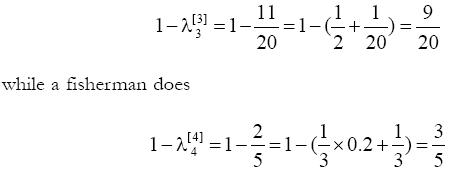
<body><![CDATA[<p align="center"><font face="verdana" size="2"><img src="/img/revistas/ineco/v68n267/a3e59.jpg"></font></p>     <p align="justify"><font face="verdana" size="2">where <i><b>f</b> </i>= (0.8, 1, 0, 0)'. All the related propositions can be verified under these values. And so, we examine who exploits who. A hunter who runs the first process contributes to the net output as much as</font></p>     <p align="center"><font face="verdana" size="2"><img src="/img/revistas/ineco/v68n267/a3e60.jpg"></font></p>     <p align="justify"><font face="verdana" size="2">Then let us examine how much workers can spend on the net output. A hunter gets $200 by operating the first process, uses $200 in his/her household activity to reproduce one unit of labour, and no money is left to buy a portion of the net output. On the other hand, a fisherman can secure the surplus money $180, which can exactly buy the whole net output. Thus we can judge, based on our definition, fishermen exploit hunters under these prices in spite of the fact a hunter requires more to survive than a fisherman. When the price vector <i>p </i>= ($100, $46), exploitation does not exist between two types of workers. This magnitude $46 can be obtained by solving the following equation <i>for <b>p</b><sub>2</sub>:</i></font></p>     <p align="center"><font face="verdana" size="2"><img src="/img/revistas/ineco/v68n267/a3e61.jpg"></font></p>     <p align="justify"><font face="verdana" size="2"><b>Example 3</b></font></p>     <p align="justify"><font face="verdana" size="2">In the third example, there are fishermen and owners of fishing&#150;nets. Two objects are fish and services given by fishing&#150;nets. Fishermen do not have nets, and they have to borrow nets. We assume fishing nets last for ever. The complete input&#150;output matrices are:</font></p>     <p align="center"><font face="verdana" size="2"><img src="/img/revistas/ineco/v68n267/a3e62.jpg"></font></p>     <p align="justify"><font face="verdana" size="2">The first row stands for fish, the second for the service from fishing&#150;net, the third for fishermen's labour, and the fourth is net&#150;owners' labour. The first column means the process ran by fishermen, the second ran by net&#150;owners, the third is the household activity of fishermen, and the fourth is that of net&#150;owners. The values with the fishermen labour as the standard, and those with net&#150;owners are respectively:</font></p>     <p align="center"><font face="verdana" size="2"><img src="/img/revistas/ineco/v68n267/a3e63.jpg"></font></p>     ]]></body>
<body><![CDATA[<p align="justify"><font face="verdana" size="2">Suppose again <i><b>p</b> = </i>($100, $100), <i><b>x</b> </i>= (1, 1, 1, 1)' and the quantity equation of the period is</font></p>     <p align="center"><font face="verdana" size="2"><img src="/img/revistas/ineco/v68n267/a3e64.jpg"></font></p>     <p align="justify"><font face="verdana" size="2">where <i><b>f </b></i>= (3, 1, 0, 0)'. A fisherman who operates the first process contributes to the net output as much as</font></p>     <p align="center"><font face="verdana" size="2"><img src="/img/revistas/ineco/v68n267/a3e65.jpg"></font></p>     <p align="justify"><font face="verdana" size="2">A fisherman gets $500 after subtracting the rental of nets by operating the first process, uses $100 in his/her household activity to reproduce one unit of labour, and so $400 is left to buy all the net output. On the other hand, a net&#150;owner has no surplus money Hence, fishermen exploit net&#150;owners under these prices. When the price vector <i>p </i>= ($100, $(2800/12) <img src="/img/revistas/ineco/v68n267/a3e66.jpg"> ($100, $233), exploitation does not exist between two types of workers. The balancing price, <i><b>p</b><sub>2</sub>, </i>can be found by the equation:</font></p>     <p align="center"><font face="verdana" size="2"><img src="/img/revistas/ineco/v68n267/a3e67.jpg"></font></p>     <p align="justify"><font face="verdana" size="2">When the coefficient <i><b>&alpha;</b><sub>42</sub> </i>= <b>1</b> reduces to <b>0</b>.<b>1</b>, <i>i.e., </i>net&#150;owners can render their service with less work, and at the same time the coefficient <i><b>b</b></i><sub>44 </sub> = 1 also decreases to 0.1 so that its net output remains zero at <i><b>x</b> </i>= (1, 1, 1, 1)', then the values become</font></p>     <p align="center"><font face="verdana" size="2"><img src="/img/revistas/ineco/v68n267/a3e68.jpg"></font></p>     <p align="justify"><font face="verdana" size="2">Workers' contributions to the net output change approximately to</font></p>     <p align="center"><font face="verdana" size="2"><img src="/img/revistas/ineco/v68n267/a3e69.jpg"></font></p>     ]]></body>
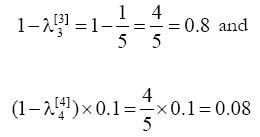
<body><![CDATA[<p align="justify"><font face="verdana" size="2">When the price vector <i><b>p</b> </i><img src="/img/revistas/ineco/v68n267/a3e66.jpg"> ($100, $(2500/21) <img src="/img/revistas/ineco/v68n267/a3e66.jpg"> ($100, $119), no exploitation exists, and when the price of the service of fishing&#150;net gets higher than $119, the net&#150;owners exploit the fishermen. It is noted that still the smaller is the coefficient <i><b>&alpha;</b></i><sub>42</sub> as well as <i><b>b</b></i><sub>44</sub>, the smaller is the balancing price of the service from fishing&#150;nets (nearer to the lower limit $100), and the net&#150;owners are likely to be exploiters.</font></p>     <p align="justify"><font face="verdana" size="2">&nbsp;</font></p>     <p align="justify"><font face="verdana" size="2"><b>CONCLUDING REMARKS </b></font></p>     <p align="justify"><font face="verdana" size="2">In modern developed economies, it seems difficult for workers to carry out a revolution to put an end to the capitalist system. Marx and Engels might think, in the 19th century, the days of proletarian dictatorship would soon be realized. While the working class has expanded since then, it has been polarized with a greater inequality of incomes among its members. As capital is accumulated more, a still higher degree of division of labour emerges, bringing about a possible cause of conflict among workers. When division of labour was in a primitive stage, <i>e.g.</i>, as in Smith (1776), Marx could devise out abstract labour to commensurate labour contents of commodities in order to help the whole working classes to unite themselves. Workers have, however, been divided and conquered, at least so far, by the capitalist system. Division of labour was an impetus for capitalist systems, and now it seems to be a support for them. Children are today taught to compete with others, to work harder to get richer, money&#150;fetishism, and suggested that fellow workers are after all rivals, not friends. This article has tried to explain a possible conflict within the working classes using a linear model of heterogeneous labour, and to show an economic reason why workers will find it difficult to unite themselves to change their economic system. Certainly the degree of exploitation among workers matters here. Our definitions of values and exploitation are still tentative, and many variants and extensions can be made. A weak point of our method is that it is totally ahistorical, capturing a snapshot of one particular period. For example, in reality, workers migrate among various types, not simply reproducing themselves. We believe, however, this paper can be a useful starting line for further developments, just as d'Alembert's principle in mechanics is important to understand dynamics through static snapshots. Here in this concluding section, we make some remarks on our method.</font></p>     <p align="justify"><font face="verdana" size="2">In ex&#150;socialist countries, various services were excluded from the national account. What we have done in this article is an extreme opposite of this practice. We have subsumed every service available as rendered by workers or property&#150;owners. Therefore there needs not be an explicit profit rate as expressed by (<b>1</b> + <i><b>r</b></i>) in mark&#150;up ratios. There arises, however, a problem of how to determine the inputs required for those services, especially household activities to reproduce labour force. Since we allow for alternative methods, we may include every activity observed.</font></p>     <p align="justify"><font face="verdana" size="2">When we discuss labour values of commodities, it is not important whether a given economy is in equilibrium or not. In the real world, all the economies are out of equilibrium, with many sufferings from a long stagnant depression. We should be able to discuss values and surplus values also in such a disequilibrium state. Labour values depends solely on technological data. Prices as well as wage rates do play a part when we consider exploitation, unequal exchanges of labour services for what they could buy in markets. There is no need to presuppose the existence of exploiters or capitalists. This may not be accepted by Marx (1867) who supposed the grand two classes in a capitalist system, relegating landowners. A capitalist system without capitalists might be the highest stage of capitalism: capital only matters. Based on what they receive as wages, salaries or remunerations, they may be exploited by the economic system or can actively exploit the system.<sup><a href="#notas">14</a></sup> For our results to be applicable to the real world, we have to take into consideration unequal exchanges among nations. Some suggestions are made in Fujimoto and Opocher (2007) on how to define values when countries are engaged in international trade.</font></p>     <p align="justify"><font face="verdana" size="2">The reader may have been embarrassed by the net consumption vector (<i><b>c</b> </i>&#150; <i><b>d</b></i>) in the definition of exploitation. When we discuss whether the exchanges of labour for a consumption basket with a given economic system is equal or unequal, we should subtract the vector <i><b>d</b> </i>because this is not consumed after all and remain in the system, though this <i>d </i>is belonging to a certain worker, and this property right is protected by the system. In this respect, our treatment is again ahistorical.</font></p>     <p align="justify"><font face="verdana" size="2">The reader may also have an idea that a normal commodity can be exploited because normal commodities and various types of labour are dealt with in a symmetric way. This symmetry is only in the sphere of technological relations. Workers can refuse to participate in production when they regard the economic system as intolerably "unfair", while normal commodities do join the production as input obediently when workers thus operate.</font></p>     <p align="justify"><font face="verdana" size="2">It may also be desirable to define "unskilled labour" or "simple labour" using only value analysis. In Fujimoto and Opocher (2007), a method is presented. Besides, a method to distinguish necessities from luxuries is also mentioned.</font></p>     <p align="justify"><font face="verdana" size="2">Finally it is necessary to introduce the government to judge whether its functions are aggravating the degree of exploitation among the workers through fiscal policies. This could be a new addition to the cursed roles of the state described by Engels (1884).</font></p>     ]]></body>
<body><![CDATA[<p align="justify"><font face="verdana" size="2">&nbsp;</font></p>     <p align="justify"><font face="verdana" size="2"><b>REFERENCES</b></font></p>     <!-- ref --><p align="justify"><font face="verdana" size="2">Bowles, S. and H. Gintis, "The Marxian theory of value and heterogeneous labour: a critique and reformulation", <i>Cambridge Journal of Economics</i>, no.2, 1977, pp. 173&#150;192.    &nbsp;&nbsp;&nbsp;&nbsp;&nbsp;&nbsp;&nbsp;&nbsp;[&#160;<a href="javascript:void(0);" onclick="javascript: window.open('/scielo.php?script=sci_nlinks&ref=4546132&pid=S0185-1667200900010000300001&lng=','','width=640,height=500,resizable=yes,scrollbars=1,menubar=yes,');">Links</a>&#160;]<!-- end-ref --> </font></p>     <!-- ref --><p align="justify"><font face="verdana" size="2">&#150;&#150;&#150;&#150;&#150;&#150;&#150;&#150;&#150;&#150;,"Structure and practice in the labor theory of value", <i>Review of Radical Political Economy</i>, no. 12, 1981, pp. 1&#150;26.    &nbsp;&nbsp;&nbsp;&nbsp;&nbsp;&nbsp;&nbsp;&nbsp;[&#160;<a href="javascript:void(0);" onclick="javascript: window.open('/scielo.php?script=sci_nlinks&ref=4546134&pid=S0185-1667200900010000300002&lng=','','width=640,height=500,resizable=yes,scrollbars=1,menubar=yes,');">Links</a>&#160;]<!-- end-ref --> </font></p>     <!-- ref --><p align="justify"><font face="verdana" size="2">Br&oacute;dy, A., <i>Proportions, Prices and Planning: A Mathematical Restatement of the Labor Theory of Value</i>, Budapest, Akad&eacute;miai Kiad&oacute;, 1970.    &nbsp;&nbsp;&nbsp;&nbsp;&nbsp;&nbsp;&nbsp;&nbsp;[&#160;<a href="javascript:void(0);" onclick="javascript: window.open('/scielo.php?script=sci_nlinks&ref=4546136&pid=S0185-1667200900010000300003&lng=','','width=640,height=500,resizable=yes,scrollbars=1,menubar=yes,');">Links</a>&#160;]<!-- end-ref --></font></p>     <!-- ref --><p align="justify"><font face="verdana" size="2">Engels, F. , <i>The Origin of the Family, Private Property, and the State</i>, &lt;<a href="http://www.marxists.org/archive/marx/index.htm" target="_blank">www.marxists.org/archive/marx/index.htm</a>&gt;, 1993. (The original German edition in Hottingen&#150;Zuerich, 1884.    &nbsp;&nbsp;&nbsp;&nbsp;&nbsp;&nbsp;&nbsp;&nbsp;[&#160;<a href="javascript:void(0);" onclick="javascript: window.open('/scielo.php?script=sci_nlinks&ref=4546138&pid=S0185-1667200900010000300004&lng=','','width=640,height=500,resizable=yes,scrollbars=1,menubar=yes,');">Links</a>&#160;]<!-- end-ref -->) </font></p>     ]]></body>
<body><![CDATA[<!-- ref --><p align="justify"><font face="verdana" size="2">Fujimori, Y., <i>Modern Analysis of Value Theory</i>, Berlin, Springer&#150;Verlag, 1982.    &nbsp;&nbsp;&nbsp;&nbsp;&nbsp;&nbsp;&nbsp;&nbsp;[&#160;<a href="javascript:void(0);" onclick="javascript: window.open('/scielo.php?script=sci_nlinks&ref=4546140&pid=S0185-1667200900010000300005&lng=','','width=640,height=500,resizable=yes,scrollbars=1,menubar=yes,');">Links</a>&#160;]<!-- end-ref --> </font></p>     <!-- ref --><p align="justify"><font face="verdana" size="2">Fujimoto, T., "Exploitation, profits, and growth: a disequilibrium analysis", <i>Economic Studies Quarterly</i>, no. 29, 1978, pp. 268&#150;275.    &nbsp;&nbsp;&nbsp;&nbsp;&nbsp;&nbsp;&nbsp;&nbsp;[&#160;<a href="javascript:void(0);" onclick="javascript: window.open('/scielo.php?script=sci_nlinks&ref=4546142&pid=S0185-1667200900010000300006&lng=','','width=640,height=500,resizable=yes,scrollbars=1,menubar=yes,');">Links</a>&#160;]<!-- end-ref --> </font></p>     <!-- ref --><p align="justify"><font face="verdana" size="2">Fujimoto, T. and Y. Fujita, "A refutation of commodity exploitation theorem", <i>Metroeconomica</i>, no. 59, 2008, pp. 530&#150;540.    &nbsp;&nbsp;&nbsp;&nbsp;&nbsp;&nbsp;&nbsp;&nbsp;[&#160;<a href="javascript:void(0);" onclick="javascript: window.open('/scielo.php?script=sci_nlinks&ref=4546144&pid=S0185-1667200900010000300007&lng=','','width=640,height=500,resizable=yes,scrollbars=1,menubar=yes,');">Links</a>&#160;]<!-- end-ref --> </font></p>     <!-- ref --><p align="justify"><font face="verdana" size="2">Fujimoto, T., C. Herrero, R.R. Ranade, J.A. Silva and A. Villar, "A complete characterization of economies with the nonsubstitution Property", <i>Economic Issues</i>, no. 8, 2003, pp. 63&#150;70.    &nbsp;&nbsp;&nbsp;&nbsp;&nbsp;&nbsp;&nbsp;&nbsp;[&#160;<a href="javascript:void(0);" onclick="javascript: window.open('/scielo.php?script=sci_nlinks&ref=4546146&pid=S0185-1667200900010000300008&lng=','','width=640,height=500,resizable=yes,scrollbars=1,menubar=yes,');">Links</a>&#160;]<!-- end-ref --> </font></p>     <!-- ref --><p align="justify"><font face="verdana" size="2">Fujimoto, T. and A. Opocher, "Values and prices in a general input&#150;output model", University of Padova, mimeo, 2007.    &nbsp;&nbsp;&nbsp;&nbsp;&nbsp;&nbsp;&nbsp;&nbsp;[&#160;<a href="javascript:void(0);" onclick="javascript: window.open('/scielo.php?script=sci_nlinks&ref=4546148&pid=S0185-1667200900010000300009&lng=','','width=640,height=500,resizable=yes,scrollbars=1,menubar=yes,');">Links</a>&#160;]<!-- end-ref --> </font></p>     ]]></body>
<body><![CDATA[<!-- ref --><p align="justify"><font face="verdana" size="2">Hawkins, D. and H.A. Simon, "Note: some conditions of macroeconomic stability", <i>Econometrica</i>, no. 17, 1949, pp. 245&#150;248.    &nbsp;&nbsp;&nbsp;&nbsp;&nbsp;&nbsp;&nbsp;&nbsp;[&#160;<a href="javascript:void(0);" onclick="javascript: window.open('/scielo.php?script=sci_nlinks&ref=4546150&pid=S0185-1667200900010000300010&lng=','','width=640,height=500,resizable=yes,scrollbars=1,menubar=yes,');">Links</a>&#160;]<!-- end-ref --> </font></p>     <!-- ref --><p align="justify"><font face="verdana" size="2">Krause, U., "Heterogeneous labour and the Fundamental Marxian Theorem", <i>Review of Economic Studies</i>, no. 48, 1981, pp. 173&#150;178.    &nbsp;&nbsp;&nbsp;&nbsp;&nbsp;&nbsp;&nbsp;&nbsp;[&#160;<a href="javascript:void(0);" onclick="javascript: window.open('/scielo.php?script=sci_nlinks&ref=4546152&pid=S0185-1667200900010000300011&lng=','','width=640,height=500,resizable=yes,scrollbars=1,menubar=yes,');">Links</a>&#160;]<!-- end-ref --> </font></p>     <!-- ref --><p align="justify"><font face="verdana" size="2">Manresa, A., F. Sancho and J.M. Vegara, "Measuring commodities' commodity content", <i>Economic Systems Research</i>, no. 10, 1998, pp. 357&#150;365.    &nbsp;&nbsp;&nbsp;&nbsp;&nbsp;&nbsp;&nbsp;&nbsp;[&#160;<a href="javascript:void(0);" onclick="javascript: window.open('/scielo.php?script=sci_nlinks&ref=4546154&pid=S0185-1667200900010000300012&lng=','','width=640,height=500,resizable=yes,scrollbars=1,menubar=yes,');">Links</a>&#160;]<!-- end-ref --> </font></p>     <!-- ref --><p align="justify"><font face="verdana" size="2">Marx, K., <i>Capital I</i>, &lt;<a href="http://www.marxists.org/archive/marx/works/download/capital.zip" target="_blank">www.marxists.org/archive/marx/works/download/capital.zip</a>&gt;. (The original German edition in 1867.    &nbsp;&nbsp;&nbsp;&nbsp;&nbsp;&nbsp;&nbsp;&nbsp;[&#160;<a href="javascript:void(0);" onclick="javascript: window.open('/scielo.php?script=sci_nlinks&ref=4546156&pid=S0185-1667200900010000300013&lng=','','width=640,height=500,resizable=yes,scrollbars=1,menubar=yes,');">Links</a>&#160;]<!-- end-ref -->) </font></p>     <!-- ref --><p align="justify"><font face="verdana" size="2">Matsuo, T., "Profit, surplus product, exploitation and less than maximized utility: a new equivalence proposition on the Fundamental Marxian Theorem", <i>Metroeconomica</i>, no. 59, 2008, pp. 249&#150;265.    &nbsp;&nbsp;&nbsp;&nbsp;&nbsp;&nbsp;&nbsp;&nbsp;[&#160;<a href="javascript:void(0);" onclick="javascript: window.open('/scielo.php?script=sci_nlinks&ref=4546158&pid=S0185-1667200900010000300014&lng=','','width=640,height=500,resizable=yes,scrollbars=1,menubar=yes,');">Links</a>&#160;]<!-- end-ref --> </font></p>     ]]></body>
<body><![CDATA[<!-- ref --><p align="justify"><font face="verdana" size="2">Morishima, M., <i>Equilibrium, Stability and Growth: A Multi&#150;Sectoral Analysis</i>, London, Oxford University Press, 1964.    &nbsp;&nbsp;&nbsp;&nbsp;&nbsp;&nbsp;&nbsp;&nbsp;[&#160;<a href="javascript:void(0);" onclick="javascript: window.open('/scielo.php?script=sci_nlinks&ref=4546160&pid=S0185-1667200900010000300015&lng=','','width=640,height=500,resizable=yes,scrollbars=1,menubar=yes,');">Links</a>&#160;]<!-- end-ref --> </font></p>     <!-- ref --><p align="justify"><font face="verdana" size="2">&#150;&#150;&#150;&#150;&#150;&#150;&#150;&#150;&#150;&#150;, <i>Marx's Economics: A Dual Theory of  Value and Growth</i>, Cambridge, Cambridge University Press, 1973.    &nbsp;&nbsp;&nbsp;&nbsp;&nbsp;&nbsp;&nbsp;&nbsp;[&#160;<a href="javascript:void(0);" onclick="javascript: window.open('/scielo.php?script=sci_nlinks&ref=4546162&pid=S0185-1667200900010000300016&lng=','','width=640,height=500,resizable=yes,scrollbars=1,menubar=yes,');">Links</a>&#160;]<!-- end-ref --> </font></p>     <!-- ref --><p align="justify"><font face="verdana" size="2">&#150;&#150;&#150;&#150;&#150;&#150;&#150;&#150;&#150;&#150;, "Marx in the light of modern economics", <i>Econometrica, </i>no. 42, 1974, pp. 611&#150;632.    &nbsp;&nbsp;&nbsp;&nbsp;&nbsp;&nbsp;&nbsp;&nbsp;[&#160;<a href="javascript:void(0);" onclick="javascript: window.open('/scielo.php?script=sci_nlinks&ref=4546164&pid=S0185-1667200900010000300017&lng=','','width=640,height=500,resizable=yes,scrollbars=1,menubar=yes,');">Links</a>&#160;]<!-- end-ref --> </font></p>     <!-- ref --><p align="justify"><font face="verdana" size="2">Okishio, N., "Mathematical note on marxian theorems", <i>Weltwirtschaftlisches Archiv</i>, no. 91, 1963, pp. 287&#150;299.    &nbsp;&nbsp;&nbsp;&nbsp;&nbsp;&nbsp;&nbsp;&nbsp;[&#160;<a href="javascript:void(0);" onclick="javascript: window.open('/scielo.php?script=sci_nlinks&ref=4546166&pid=S0185-1667200900010000300018&lng=','','width=640,height=500,resizable=yes,scrollbars=1,menubar=yes,');">Links</a>&#160;]<!-- end-ref --> </font></p>     <!-- ref --><p align="justify"><font face="verdana" size="2">&#150;&#150;&#150;&#150;&#150;&#150;&#150;&#150;&#150;&#150;, <i>Marx's Economics: Values and Prices</i>, Tokyo, Chikuma&#150;Shobou, 1977 (in Japanese).    &nbsp;&nbsp;&nbsp;&nbsp;&nbsp;&nbsp;&nbsp;&nbsp;[&#160;<a href="javascript:void(0);" onclick="javascript: window.open('/scielo.php?script=sci_nlinks&ref=4546168&pid=S0185-1667200900010000300019&lng=','','width=640,height=500,resizable=yes,scrollbars=1,menubar=yes,');">Links</a>&#160;]<!-- end-ref --> </font></p>     ]]></body>
<body><![CDATA[<!-- ref --><p align="justify"><font face="verdana" size="2">Petri, F., "Positive profits without exploitation: a note on the Generalized Fundamental Marxian Theorem", <i>Econometrica</i>, no. 48, 1980, pp. 531&#150;533.    &nbsp;&nbsp;&nbsp;&nbsp;&nbsp;&nbsp;&nbsp;&nbsp;[&#160;<a href="javascript:void(0);" onclick="javascript: window.open('/scielo.php?script=sci_nlinks&ref=4546170&pid=S0185-1667200900010000300020&lng=','','width=640,height=500,resizable=yes,scrollbars=1,menubar=yes,');">Links</a>&#160;]<!-- end-ref --></font></p>     <!-- ref --><p align="justify"><font face="verdana" size="2">Roemer, J.E., <i>Analytical Foundations of Marxian Economic Theory</i>, Cambridge, Harvard University Press, 1981.    &nbsp;&nbsp;&nbsp;&nbsp;&nbsp;&nbsp;&nbsp;&nbsp;[&#160;<a href="javascript:void(0);" onclick="javascript: window.open('/scielo.php?script=sci_nlinks&ref=4546172&pid=S0185-1667200900010000300021&lng=','','width=640,height=500,resizable=yes,scrollbars=1,menubar=yes,');">Links</a>&#160;]<!-- end-ref --> </font></p>     <!-- ref --><p align="justify"><font face="verdana" size="2">&#150;&#150;&#150;&#150;&#150;&#150;&#150;&#150;&#150;&#150;, <i>A General Theory of Exploitation and Class</i>, Cambridge, Harvard University Press, 1982.    &nbsp;&nbsp;&nbsp;&nbsp;&nbsp;&nbsp;&nbsp;&nbsp;[&#160;<a href="javascript:void(0);" onclick="javascript: window.open('/scielo.php?script=sci_nlinks&ref=4546174&pid=S0185-1667200900010000300022&lng=','','width=640,height=500,resizable=yes,scrollbars=1,menubar=yes,');">Links</a>&#160;]<!-- end-ref --> </font></p>     <!-- ref --><p align="justify"><font face="verdana" size="2">&#150;&#150;&#150;&#150;&#150;&#150;&#150;&#150;&#150;&#150;, "Should Marxists be interested in exploitation?", in J.E. Roemer (ed.), <i>Analytical Marxism</i>, Cambridge, Cambridge University Press, 1986, pp. 260&#150;282.    &nbsp;&nbsp;&nbsp;&nbsp;&nbsp;&nbsp;&nbsp;&nbsp;[&#160;<a href="javascript:void(0);" onclick="javascript: window.open('/scielo.php?script=sci_nlinks&ref=4546176&pid=S0185-1667200900010000300023&lng=','','width=640,height=500,resizable=yes,scrollbars=1,menubar=yes,');">Links</a>&#160;]<!-- end-ref --> </font></p>     <!-- ref --><p align="justify"><font face="verdana" size="2">Smith, A., <i>An Inquiry into the Nature and Cause of  the Wealth of  Nations</i>, &lt;<a href="http://www.gutenberg.net" target="_blank">www.gutenberg.net</a>&gt;, 1776.    &nbsp;&nbsp;&nbsp;&nbsp;&nbsp;&nbsp;&nbsp;&nbsp;[&#160;<a href="javascript:void(0);" onclick="javascript: window.open('/scielo.php?script=sci_nlinks&ref=4546178&pid=S0185-1667200900010000300024&lng=','','width=640,height=500,resizable=yes,scrollbars=1,menubar=yes,');">Links</a>&#160;]<!-- end-ref --> </font></p>     ]]></body>
<body><![CDATA[<!-- ref --><p align="justify"><font face="verdana" size="2">Steedman, I., "Positive profits with negative surplus value", <i>Economic Journal</i>, no. 85, 1975, pp. 114&#150;123.    &nbsp;&nbsp;&nbsp;&nbsp;&nbsp;&nbsp;&nbsp;&nbsp;[&#160;<a href="javascript:void(0);" onclick="javascript: window.open('/scielo.php?script=sci_nlinks&ref=4546180&pid=S0185-1667200900010000300025&lng=','','width=640,height=500,resizable=yes,scrollbars=1,menubar=yes,');">Links</a>&#160;]<!-- end-ref --> </font></p>     <!-- ref --><p align="justify"><font face="verdana" size="2">Steedman, I., <i>Marx after Sraffa</i>, London, New Left Books, 1977.    &nbsp;&nbsp;&nbsp;&nbsp;&nbsp;&nbsp;&nbsp;&nbsp;[&#160;<a href="javascript:void(0);" onclick="javascript: window.open('/scielo.php?script=sci_nlinks&ref=4546182&pid=S0185-1667200900010000300026&lng=','','width=640,height=500,resizable=yes,scrollbars=1,menubar=yes,');">Links</a>&#160;]<!-- end-ref --><!-- ref --> von Neumann, J., "A model of economic equilibrium", <i>Review of Economic Studies</i>, no. 13, 1945&#150;1946, pp. 1&#150;9.    &nbsp;&nbsp;&nbsp;&nbsp;&nbsp;&nbsp;&nbsp;&nbsp;[&#160;<a href="javascript:void(0);" onclick="javascript: window.open('/scielo.php?script=sci_nlinks&ref=4546183&pid=S0185-1667200900010000300027&lng=','','width=640,height=500,resizable=yes,scrollbars=1,menubar=yes,');">Links</a>&#160;]<!-- end-ref --></font></p>     <p align="justify"><font face="verdana" size="2">&nbsp;</font></p>     <p align="justify"><font face="verdana" size="2"><b><a name="notas"></a>NOTES</b></font></p>     <p align="justify"><font face="verdana" size="2">* This paper was written while the author was a visiting professor at Department of Economic Sciences, University of Padova. He is grateful to the Department for its hospitality, especially to Professor Arrigo Opocher for his help. Thanks are also due to professor Michael Rauck, who provided a cozy place where early versions of this paper were written; to the two anonymous referees for their suggestions, which are useful to make this paper more readable; and to professor Alejandro Valle Baeza, who introduced this journal to the author.</font></p>     <p align="justify"><font face="verdana" size="2"><sup>1 </sup>For simplicity each type of labour is assumed to be abundantly available, though heterogeneous labour can be dealt with in the same manner as various vintages of capital goods.</font></p>     <p align="justify"><font face="verdana" size="2"><sup>2 </sup>This section is a simpler version of what was presented in Fujimoto and Opocher (2007).</font></p>     ]]></body>
<body><![CDATA[<p align="justify"><font face="verdana" size="2"><sup>3 </sup>See Hawkins and Simon (1949) for their conditions concerning <i>A</i>.</font></p>     <p align="justify"><font face="verdana" size="2"><sup>4</sup> See, for example, Fujimoto <i>et al. </i>(2003).</font></p>     <p align="justify"><font face="verdana" size="2"><sup>5</sup><b> </b>Maximizing <i>qn</i>+1 is equivalent to maximizing &#955;R, which is obvious from equation &#91;6&#93;.</font></p>     <p align="justify"><font face="verdana" size="2"><sup>6</sup> The nonsubstitution theorem also asserts that the vector <i>c </i>can be any nonzero nonnegative vector, with no influence on the optimality of one and the same solution <i>q</i>. It is also easy to notice that the objective function can also be the total input of labour.</font></p>     <p align="justify"><font face="verdana" size="2"><sup>7 </sup>"Bads" are also allowed, though they are implicit. See Fujimoto and Opocher (2007).</font></p>     <p align="justify"><font face="verdana" size="2"><sup>8 </sup>Among a plural number of solutions, we adopt those which realize the maximum number of equalities in the constraints. And yet, a solution may not be unique.</font></p>     <p align="justify"><font face="verdana" size="2"><sup>9 </sup>We can further weaken the assumption to the existence of an activity level vector which realizes a simple reproduction. See Fujimoto and Opocher (2007).</font></p>     <p align="justify"><font face="verdana" size="2"><sup>10 </sup>This proposition, when labour is homogeneous, is called "commodity exploitation theorem". See Bowles and Gintis (1981), Roemer (1982, 1986), and Fujimoto and Fujita (2008).</font></p>     <p align="justify"><font face="verdana" size="2"><sup>11 </sup>The concept of net here is for the system of complete or extended matrices.</font></p>     <p align="justify"><font face="verdana" size="2"><sup>12</sup> Positive elements in/are not excess supply, but are bought by some people and put to extra consumption or investment, or may be exported abroad.</font></p>     ]]></body>
<body><![CDATA[<p align="justify"><font face="verdana" size="2"><sup>13</sup> More precisely, it is &Lambda;<sup>&#91;i&#93;</sup>&middot;<i>f</i>. See equation &#91;14&#93; with <i>n</i> replaced by <i>i.</i></font></p>     <p align="justify"><font face="verdana" size="2"><sup>14 </sup>In practice, remunerations are seemingly from surplus. They can, however, be regarded as payments to services rendered, thus as costs.</font></p>      ]]></body><back>
<ref-list>
<ref id="B1">
<nlm-citation citation-type="journal">
<person-group person-group-type="author">
<name>
<surname><![CDATA[Bowles]]></surname>
<given-names><![CDATA[S.]]></given-names>
</name>
<name>
<surname><![CDATA[Gintis]]></surname>
<given-names><![CDATA[H.]]></given-names>
</name>
</person-group>
<article-title xml:lang="en"><![CDATA[The Marxian theory of value and heterogeneous labour: a critique and reformulation]]></article-title>
<source><![CDATA[Cambridge Journal of Economics]]></source>
<year>1977</year>
<volume>2</volume>
<page-range>173-192</page-range></nlm-citation>
</ref>
<ref id="B2">
<nlm-citation citation-type="journal">
<person-group person-group-type="author">
<name>
<surname><![CDATA[Bowles]]></surname>
<given-names><![CDATA[S.]]></given-names>
</name>
</person-group>
<article-title xml:lang="en"><![CDATA[Structure and practice in the labor theory of value]]></article-title>
<source><![CDATA[Review of Radical Political Economy]]></source>
<year>1981</year>
<volume>12</volume>
<page-range>1-26</page-range></nlm-citation>
</ref>
<ref id="B3">
<nlm-citation citation-type="book">
<person-group person-group-type="author">
<name>
<surname><![CDATA[Bródy]]></surname>
<given-names><![CDATA[A.]]></given-names>
</name>
</person-group>
<source><![CDATA[Proportions, Prices and Planning: A Mathematical Restatement of the Labor Theory of Value]]></source>
<year>1970</year>
<publisher-loc><![CDATA[Budapest ]]></publisher-loc>
<publisher-name><![CDATA[Akadémiai Kiadó]]></publisher-name>
</nlm-citation>
</ref>
<ref id="B4">
<nlm-citation citation-type="">
<person-group person-group-type="author">
<name>
<surname><![CDATA[Engels]]></surname>
<given-names><![CDATA[F.]]></given-names>
</name>
</person-group>
<source><![CDATA[The Origin of the Family, Private Property, and the State]]></source>
<year>1993</year>
</nlm-citation>
</ref>
<ref id="B5">
<nlm-citation citation-type="book">
<person-group person-group-type="author">
<name>
<surname><![CDATA[Fujimori]]></surname>
<given-names><![CDATA[Y.]]></given-names>
</name>
</person-group>
<source><![CDATA[Modern Analysis of Value Theory]]></source>
<year>1982</year>
<publisher-loc><![CDATA[Berlin ]]></publisher-loc>
<publisher-name><![CDATA[Springer-Verlag]]></publisher-name>
</nlm-citation>
</ref>
<ref id="B6">
<nlm-citation citation-type="journal">
<person-group person-group-type="author">
<name>
<surname><![CDATA[Fujimoto]]></surname>
<given-names><![CDATA[T.]]></given-names>
</name>
</person-group>
<article-title xml:lang="en"><![CDATA[Exploitation, profits, and growth: a disequilibrium analysis]]></article-title>
<source><![CDATA[Economic Studies Quarterly]]></source>
<year>1978</year>
<volume>29</volume>
<page-range>268-275</page-range></nlm-citation>
</ref>
<ref id="B7">
<nlm-citation citation-type="journal">
<person-group person-group-type="author">
<name>
<surname><![CDATA[Fujimoto]]></surname>
<given-names><![CDATA[T.]]></given-names>
</name>
<name>
<surname><![CDATA[Fujita]]></surname>
<given-names><![CDATA[Y.]]></given-names>
</name>
</person-group>
<article-title xml:lang="en"><![CDATA[A refutation of commodity exploitation theorem]]></article-title>
<source><![CDATA[Metroeconomica]]></source>
<year>2008</year>
<volume>59</volume>
<page-range>530-540</page-range></nlm-citation>
</ref>
<ref id="B8">
<nlm-citation citation-type="journal">
<person-group person-group-type="author">
<name>
<surname><![CDATA[Fujimoto]]></surname>
<given-names><![CDATA[T.]]></given-names>
</name>
<name>
<surname><![CDATA[Herrero]]></surname>
<given-names><![CDATA[C.]]></given-names>
</name>
<name>
<surname><![CDATA[Ranade]]></surname>
<given-names><![CDATA[R.R.]]></given-names>
</name>
<name>
<surname><![CDATA[Silva]]></surname>
<given-names><![CDATA[J.A.]]></given-names>
</name>
<name>
<surname><![CDATA[Villar]]></surname>
<given-names><![CDATA[A.]]></given-names>
</name>
</person-group>
<article-title xml:lang="en"><![CDATA[A complete characterization of economies with the nonsubstitution Property]]></article-title>
<source><![CDATA[Economic Issues]]></source>
<year>2003</year>
<volume>8</volume>
<page-range>63-70</page-range></nlm-citation>
</ref>
<ref id="B9">
<nlm-citation citation-type="book">
<person-group person-group-type="author">
<name>
<surname><![CDATA[Fujimoto]]></surname>
<given-names><![CDATA[T.]]></given-names>
</name>
<name>
<surname><![CDATA[Opocher]]></surname>
<given-names><![CDATA[A.]]></given-names>
</name>
</person-group>
<source><![CDATA[Values and prices in a general input-output model]]></source>
<year>2007</year>
<publisher-name><![CDATA[University of Padova]]></publisher-name>
</nlm-citation>
</ref>
<ref id="B10">
<nlm-citation citation-type="journal">
<person-group person-group-type="author">
<name>
<surname><![CDATA[Hawkins]]></surname>
<given-names><![CDATA[D.]]></given-names>
</name>
<name>
<surname><![CDATA[Simon]]></surname>
<given-names><![CDATA[H.A.]]></given-names>
</name>
</person-group>
<article-title xml:lang="en"><![CDATA[Note: some conditions of macroeconomic stability]]></article-title>
<source><![CDATA[Econometrica]]></source>
<year>1949</year>
<volume>17</volume>
<page-range>245-248</page-range></nlm-citation>
</ref>
<ref id="B11">
<nlm-citation citation-type="journal">
<person-group person-group-type="author">
<name>
<surname><![CDATA[Krause]]></surname>
<given-names><![CDATA[U.]]></given-names>
</name>
</person-group>
<article-title xml:lang="en"><![CDATA[Heterogeneous labour and the Fundamental Marxian Theorem]]></article-title>
<source><![CDATA[Review of Economic Studies]]></source>
<year>1981</year>
<volume>48</volume>
<page-range>173-178</page-range></nlm-citation>
</ref>
<ref id="B12">
<nlm-citation citation-type="journal">
<person-group person-group-type="author">
<name>
<surname><![CDATA[Manresa]]></surname>
<given-names><![CDATA[A.]]></given-names>
</name>
<name>
<surname><![CDATA[Sancho]]></surname>
<given-names><![CDATA[F.]]></given-names>
</name>
<name>
<surname><![CDATA[Vegara]]></surname>
<given-names><![CDATA[J.M.]]></given-names>
</name>
</person-group>
<article-title xml:lang="en"><![CDATA[Measuring commodities' commodity content]]></article-title>
<source><![CDATA[Economic Systems Research]]></source>
<year>1998</year>
<volume>10</volume>
<page-range>357-365</page-range></nlm-citation>
</ref>
<ref id="B13">
<nlm-citation citation-type="">
<person-group person-group-type="author">
<name>
<surname><![CDATA[Marx]]></surname>
<given-names><![CDATA[K.]]></given-names>
</name>
</person-group>
<source><![CDATA[Capital I]]></source>
<year></year>
</nlm-citation>
</ref>
<ref id="B14">
<nlm-citation citation-type="journal">
<person-group person-group-type="author">
<name>
<surname><![CDATA[Matsuo]]></surname>
<given-names><![CDATA[T.]]></given-names>
</name>
</person-group>
<article-title xml:lang="en"><![CDATA[Profit, surplus product, exploitation and less than maximized utility: a new equivalence proposition on the Fundamental Marxian Theorem]]></article-title>
<source><![CDATA[Metroeconomica]]></source>
<year>2008</year>
<volume>59</volume>
<page-range>249-265</page-range></nlm-citation>
</ref>
<ref id="B15">
<nlm-citation citation-type="book">
<person-group person-group-type="author">
<name>
<surname><![CDATA[Morishima]]></surname>
<given-names><![CDATA[M.]]></given-names>
</name>
</person-group>
<source><![CDATA[Equilibrium, Stability and Growth: A Multi-Sectoral Analysis]]></source>
<year>1964</year>
<publisher-loc><![CDATA[London ]]></publisher-loc>
<publisher-name><![CDATA[Oxford University Press]]></publisher-name>
</nlm-citation>
</ref>
<ref id="B16">
<nlm-citation citation-type="book">
<person-group person-group-type="author">
<name>
<surname><![CDATA[Morishima]]></surname>
<given-names><![CDATA[M.]]></given-names>
</name>
</person-group>
<person-group person-group-type="editor">
<name>
</name>
</person-group>
<source><![CDATA[Marx's Economics: A Dual Theory of Value and Growth]]></source>
<year>1973</year>
<publisher-loc><![CDATA[Cambridge ]]></publisher-loc>
<publisher-name><![CDATA[Cambridge University Press]]></publisher-name>
</nlm-citation>
</ref>
<ref id="B17">
<nlm-citation citation-type="journal">
<person-group person-group-type="author">
<name>
<surname><![CDATA[Morishima]]></surname>
<given-names><![CDATA[M.]]></given-names>
</name>
</person-group>
<article-title xml:lang="en"><![CDATA[Marx in the light of modern economics]]></article-title>
<source><![CDATA[Econometrica]]></source>
<year>1974</year>
<volume>42</volume>
<page-range>611-632</page-range></nlm-citation>
</ref>
<ref id="B18">
<nlm-citation citation-type="journal">
<person-group person-group-type="author">
<name>
<surname><![CDATA[Okishio]]></surname>
<given-names><![CDATA[N.]]></given-names>
</name>
</person-group>
<article-title xml:lang="en"><![CDATA[Mathematical note on marxian theorems]]></article-title>
<source><![CDATA[Weltwirtschaftlisches Archiv]]></source>
<year>1963</year>
<volume>91</volume>
<page-range>287-299</page-range></nlm-citation>
</ref>
<ref id="B19">
<nlm-citation citation-type="book">
<person-group person-group-type="author">
<name>
<surname><![CDATA[Okishio]]></surname>
<given-names><![CDATA[N.]]></given-names>
</name>
</person-group>
<person-group person-group-type="editor">
<name>
</name>
</person-group>
<source><![CDATA[Marx's Economics: Values and Prices]]></source>
<year>1977</year>
<publisher-loc><![CDATA[Tokyo ]]></publisher-loc>
<publisher-name><![CDATA[Chikuma-Shobou]]></publisher-name>
</nlm-citation>
</ref>
<ref id="B20">
<nlm-citation citation-type="journal">
<person-group person-group-type="author">
<name>
<surname><![CDATA[Petri]]></surname>
<given-names><![CDATA[F.]]></given-names>
</name>
</person-group>
<article-title xml:lang="en"><![CDATA[Positive profits without exploitation: a note on the Generalized Fundamental Marxian Theorem]]></article-title>
<source><![CDATA[Econometrica]]></source>
<year>1980</year>
<volume>48</volume>
<page-range>531-533</page-range></nlm-citation>
</ref>
<ref id="B21">
<nlm-citation citation-type="book">
<person-group person-group-type="author">
<name>
<surname><![CDATA[Roemer]]></surname>
<given-names><![CDATA[J.E.]]></given-names>
</name>
</person-group>
<source><![CDATA[Analytical Foundations of Marxian Economic Theory]]></source>
<year>1981</year>
<publisher-loc><![CDATA[Cambridge ]]></publisher-loc>
<publisher-name><![CDATA[Harvard University Press]]></publisher-name>
</nlm-citation>
</ref>
<ref id="B22">
<nlm-citation citation-type="book">
<person-group person-group-type="author">
<name>
<surname><![CDATA[Roemer]]></surname>
<given-names><![CDATA[J.E.]]></given-names>
</name>
</person-group>
<person-group person-group-type="editor">
<name>
</name>
</person-group>
<source><![CDATA[A General Theory of Exploitation and Class]]></source>
<year>1982</year>
<publisher-loc><![CDATA[Cambridge ]]></publisher-loc>
<publisher-name><![CDATA[Harvard University Press]]></publisher-name>
</nlm-citation>
</ref>
<ref id="B23">
<nlm-citation citation-type="book">
<person-group person-group-type="author">
<name>
<surname><![CDATA[Roemer]]></surname>
<given-names><![CDATA[J.E.]]></given-names>
</name>
</person-group>
<article-title xml:lang="en"><![CDATA[Should Marxists be interested in exploitation?]]></article-title>
<person-group person-group-type="editor">
<name>
<surname><![CDATA[Roemer]]></surname>
<given-names><![CDATA[J.E.]]></given-names>
</name>
</person-group>
<source><![CDATA[Analytical Marxism]]></source>
<year>1986</year>
<page-range>260-282</page-range><publisher-loc><![CDATA[Cambridge ]]></publisher-loc>
<publisher-name><![CDATA[Cambridge University Press]]></publisher-name>
</nlm-citation>
</ref>
<ref id="B24">
<nlm-citation citation-type="">
<person-group person-group-type="author">
<name>
<surname><![CDATA[Smith]]></surname>
<given-names><![CDATA[A.]]></given-names>
</name>
</person-group>
<source><![CDATA[An Inquiry into the Nature and Cause of the Wealth of Nations]]></source>
<year></year>
<page-range>1776</page-range></nlm-citation>
</ref>
<ref id="B25">
<nlm-citation citation-type="journal">
<person-group person-group-type="author">
<name>
<surname><![CDATA[Steedman]]></surname>
<given-names><![CDATA[I.]]></given-names>
</name>
</person-group>
<article-title xml:lang="en"><![CDATA[Positive profits with negative surplus value]]></article-title>
<source><![CDATA[Economic Journal]]></source>
<year>1975</year>
<volume>85</volume>
<page-range>114-123</page-range></nlm-citation>
</ref>
<ref id="B26">
<nlm-citation citation-type="book">
<person-group person-group-type="author">
<name>
<surname><![CDATA[Steedman]]></surname>
<given-names><![CDATA[I.]]></given-names>
</name>
</person-group>
<source><![CDATA[Marx after Sraffa]]></source>
<year>1977</year>
<publisher-loc><![CDATA[London ]]></publisher-loc>
<publisher-name><![CDATA[New Left Books]]></publisher-name>
</nlm-citation>
</ref>
<ref id="B27">
<nlm-citation citation-type="journal">
<person-group person-group-type="author">
<name>
<surname><![CDATA[von Neumann]]></surname>
<given-names><![CDATA[J.]]></given-names>
</name>
</person-group>
<article-title xml:lang="en"><![CDATA[A model of economic equilibrium]]></article-title>
<source><![CDATA[Review of Economic Studies]]></source>
<year>1946</year>
<volume>13</volume>
<page-range>1-9</page-range></nlm-citation>
</ref>
</ref-list>
</back>
</article>