<?xml version="1.0" encoding="ISO-8859-1"?><article xmlns:mml="http://www.w3.org/1998/Math/MathML" xmlns:xlink="http://www.w3.org/1999/xlink" xmlns:xsi="http://www.w3.org/2001/XMLSchema-instance">
<front>
<journal-meta>
<journal-id>0185-1276</journal-id>
<journal-title><![CDATA[Anales del Instituto de Investigaciones Estéticas]]></journal-title>
<abbrev-journal-title><![CDATA[An. Inst. Investig. Estét]]></abbrev-journal-title>
<issn>0185-1276</issn>
<publisher>
<publisher-name><![CDATA[Universidad Nacional Autónoma de México, Instituto de Investigaciones Estéticas]]></publisher-name>
</publisher>
</journal-meta>
<article-meta>
<article-id>S0185-12762012000200006</article-id>
<title-group>
<article-title xml:lang="en"><![CDATA[José Luis Cuevas and the "New" Latin American Artist]]></article-title>
<article-title xml:lang="es"><![CDATA[José Luis Cuevas y el "nuevo" artista latinoamericano]]></article-title>
</title-group>
<contrib-group>
<contrib contrib-type="author">
<name>
<surname><![CDATA[Fulton]]></surname>
<given-names><![CDATA[Christopher]]></given-names>
</name>
<xref ref-type="aff" rid="A01"/>
</contrib>
</contrib-group>
<aff id="A01">
<institution><![CDATA[,University of Louisville  ]]></institution>
<addr-line><![CDATA[ ]]></addr-line>
</aff>
<pub-date pub-type="pub">
<day>00</day>
<month>11</month>
<year>2012</year>
</pub-date>
<pub-date pub-type="epub">
<day>00</day>
<month>11</month>
<year>2012</year>
</pub-date>
<volume>34</volume>
<numero>101</numero>
<fpage>139</fpage>
<lpage>179</lpage>
<copyright-statement/>
<copyright-year/>
<self-uri xlink:href="http://www.scielo.org.mx/scielo.php?script=sci_arttext&amp;pid=S0185-12762012000200006&amp;lng=en&amp;nrm=iso"></self-uri><self-uri xlink:href="http://www.scielo.org.mx/scielo.php?script=sci_abstract&amp;pid=S0185-12762012000200006&amp;lng=en&amp;nrm=iso"></self-uri><self-uri xlink:href="http://www.scielo.org.mx/scielo.php?script=sci_pdf&amp;pid=S0185-12762012000200006&amp;lng=en&amp;nrm=iso"></self-uri><abstract abstract-type="short" xml:lang="en"><p><![CDATA[José Luis Cuevas emerged in the mid-1950s as an independent artist who refused to subordinate his art to imposed standards and expectations. In his conflict with the artistic establishment he was defended by prominent critics and other artists of like mind and received crucial support from foreign sources, including the critic Marta Traba and curator José Gómez Sicre. He was heralded as an exemplar of the liberal spirit in Latin American art, and his frequent travels and personal associations placed him on an international stage. The present study of Cuevas's activities from the midfifties through the early sixties considers him as a paradigmatic case of the "new" Latin American artist and as an agent in the process of dissolving barriers between the national artistic cultures of the region]]></p></abstract>
<abstract abstract-type="short" xml:lang="es"><p><![CDATA[José Luis Cuevas surgió a mediados de los años cincuenta como un artista independiente que se negó a subordinar su arte a los estándares y expectativas de la época. En su conflicto con el establishment artístico fue defendido por críticos y otros artistas afines y recibió el apoyo crucial de personalidades del extranjero, incluyendo a la crítica Marta Traba y al curador José Gómez Sicre. Asimismo, fue proclamado como ejemplo del espíritu liberal en el arte latinoamericano, y sus frecuentes viajes y vínculos personales lo situaron en el escenario internacional. El presente estudio de las actividades de Cuevas de mediados de los años cincuenta hasta los tempranos años sesenta lo considera como un caso paradigmático del "nuevo" artista latinoamericano y como agente en el proceso de disolución de las barreras entre las culturas artísticas nacionalistas de la región.]]></p></abstract>
<kwd-group>
<kwd lng="en"><![CDATA[José Luis Cuevas]]></kwd>
<kwd lng="en"><![CDATA[José Gómez Sicre]]></kwd>
<kwd lng="en"><![CDATA[Mexican art]]></kwd>
<kwd lng="en"><![CDATA[Ruptura]]></kwd>
<kwd lng="en"><![CDATA[modernism]]></kwd>
<kwd lng="es"><![CDATA[José Luis Cuevas]]></kwd>
<kwd lng="es"><![CDATA[José Gómez Sicre]]></kwd>
<kwd lng="es"><![CDATA[arte mexicano]]></kwd>
<kwd lng="es"><![CDATA[Ruptura]]></kwd>
<kwd lng="es"><![CDATA[modernismo]]></kwd>
</kwd-group>
</article-meta>
</front><body><![CDATA[  	    <p align="justify"><font face="verdana" size="4">Art&iacute;culos</font></p>  	    <p align="justify"><font face="verdana" size="2">&nbsp;</font></p>  	    <p align="center"><font face="verdana" size="4"><b>Jos&eacute; Luis Cuevas and the "New" Latin American Artist</b></font></p>  	    <p align="center"><font face="verdana" size="2">&nbsp;</font></p>  	    <p align="center"><font face="verdana" size="3"><b>Jos&eacute; Luis Cuevas y el "nuevo" artista latinoamericano</b></font></p>  	    <p align="center"><font face="verdana" size="2">&nbsp;</font></p>  	    <p align="center"><font face="verdana" size="2"><b>Christopher Fulton</b></font></p>  	    <p align="center"><font face="verdana" size="2">&nbsp;</font></p>  	    <p align="justify"><font face="verdana" size="2"><i>University of Louisville.</i></font></p>  	    ]]></body>
<body><![CDATA[<p align="justify"><font face="verdana" size="2">&nbsp;</font></p>  	    <p align="justify"><font face="verdana" size="2">Recibido el 30 de agosto de 2011.    <br> 	Aceptado el 24 de agosto de 2012.</font></p>  	    <p align="justify"><font face="verdana" size="2">&nbsp;</font></p>  	    <p align="justify"><font face="verdana" size="2"><b>Abstract</b></font></p>  	    <p align="justify"><font face="verdana" size="2">Jos&eacute; Luis Cuevas emerged in the mid&#45;1950s as an independent artist who refused to subordinate his art to imposed standards and expectations. In his conflict with the artistic establishment he was defended by prominent critics and other artists of like mind and received crucial support from foreign sources, including the critic Marta Traba and curator Jos&eacute; G&oacute;mez Sicre. He was heralded as an exemplar of the liberal spirit in Latin American art, and his frequent travels and personal associations placed him on an international stage. The present study of Cuevas's activities from the midfifties through the early sixties considers him as a paradigmatic case of the "new" Latin American artist and as an agent in the process of dissolving barriers between the national artistic cultures of the region.</font></p>  	    <p align="justify"><font face="verdana" size="2"><b>Keywords:</b> Jos&eacute; Luis Cuevas; Jos&eacute; G&oacute;mez Sicre; Mexican art; Ruptura; modernism.</font></p>  	    <p align="justify"><font face="verdana" size="2">&nbsp;</font></p>  	    <p align="justify"><font face="verdana" size="2"><b>Resumen</b></font></p>  	    <p align="justify"><font face="verdana" size="2">Jos&eacute; Luis Cuevas surgi&oacute; a mediados de los a&ntilde;os cincuenta como un artista independiente que se neg&oacute; a subordinar su arte a los est&aacute;ndares y expectativas de la &eacute;poca. En su conflicto con el <i>establishment</i> art&iacute;stico fue defendido por cr&iacute;ticos y otros artistas afines y recibi&oacute; el apoyo crucial de personalidades del extranjero, incluyendo a la cr&iacute;tica Marta Traba y al curador Jos&eacute; G&oacute;mez Sicre. Asimismo, fue proclamado como ejemplo del esp&iacute;ritu liberal en el arte latinoamericano, y sus frecuentes viajes y v&iacute;nculos personales lo situaron en el escenario internacional. El presente estudio de las actividades de Cuevas de mediados de los a&ntilde;os cincuenta hasta los tempranos a&ntilde;os sesenta lo considera como un caso paradigm&aacute;tico del "nuevo" artista latinoamericano y como agente en el proceso de disoluci&oacute;n de las barreras entre las culturas art&iacute;sticas nacionalistas de la regi&oacute;n.</font></p>  	    ]]></body>
<body><![CDATA[<p align="justify"><font face="verdana" size="2"><b>Palabras clave:</b> Jos&eacute; Luis Cuevas; Jos&eacute; G&oacute;mez Sicre; arte mexicano; Ruptura; modernismo.</font></p>  	    <p align="justify"><font face="verdana" size="2">&nbsp;</font></p>  	    <p align="justify"><font face="verdana" size="2">Jos&eacute; Luis Cuevas&#151;a Mexican graphic artist, born in 1933&#151;burst on the international scene in the mid&#45;1950s with his drawings of depraved and forlorn subjects. An intense, private young man (<a href="#f1">fig. 1</a>), he found himself suddenly thrust into the middle of a heated controversy between the defenders of politically oriented art and advocates of openness and freedom of expression, and within a short period he overcame his natural shyness to develop into an effective polemicist and model for progressively minded artists. In his own work he escaped the confines of Mexican national art by addressing universal themes about the human condition, and became an important personality in the wider Latin American region by traveling and exhibiting in other countries and cultivating relations with foreign artists and critics. This essay examines Cuevas's activities of the years 1954 to 1964, in an effort to gain a better purchase on the conflicts of the era and on the multiple forces that were then converging to produce a continental artistic culture, as well as to illuminate his own role in this process.</font></p>  	    <p align="center"><font face="verdana" size="2"><a name="f1"></a></font></p>  	    <p align="center"><font face="verdana" size="2"><img src="/img/revistas/aiie/v34n101/a6f1.jpg"></font></p>  	    <p align="justify"><font face="verdana" size="2">&nbsp;</font></p>  	    <p align="justify"><b><font face="verdana" size="2"><i>Jos&eacute; G&oacute;mez Sicre and the launching of a young artist</i></font></b></p>  	    <p align="justify"><font face="verdana" size="2">A formative influence on the young Cuevas was exerted by a number of exiles from the Spanish Civil War, who introduced him to the wider world of European ideas and gave encouragement to his independent spirit.<sup><a href="#nota">1</a></sup> He became acquainted with the &eacute;migr&eacute; artists Arturo Souto, Enrique Climent and Jos&eacute; Bartol&iacute;, attended lectures by the philosophers Jos&eacute; Gaos and Ram&oacute;n Xirau, and was introduced to the poets Luis Cernuda, Luis Rius and Le&oacute;n Felipe. However, more than any other individual, it was the author and critic Margarita Nelken who nurtured in him a life&#45;long interest in the broad spectrum of European thought.<sup><a href="#nota">2</a></sup> She was thirty years his senior, and shared generously from her rich stores of knowledge and experience, especially of Spanish artistic and literary traditions. It was also Nelken who first gave critical attention to Cuevas's drawings, and in later years she continued to write approvingly about his art.<sup><a href="#nota">3</a></sup></font></p>  	    <p align="justify"><font face="verdana" size="2">An Iberian strain of melancholy and decay and a picaresque interest in low&#45;life characters typify Cuevas's early work. While the prevailing fashion among Mexican artists of the post&#45;war years was to venture into the countryside in search of pictorial subjects, he explored the capital's grim alleyways and seedy boulevards, and there discovered the secret, exotic life of its abject inhabitants&#151;beggars, prostitutes, cripples, vagabonds, drunkards, knaves and ruffians of assorted kinds. Intrigued and captivated by such marginalized subjects, he also visited the psychiatric hospital La Casta&ntilde;eda to study its deranged inmates (<a href="#f2">fig. 2</a>) and made a series of tormented ink drawings that contradicted in strident and disturbing tones the popular image of abundant, cheerful Mexico, of Mexico as a continual <i>fiesta.</i><sup><a href="#nota">4</a></sup> The notes of cruelty, terror and isolation that chime in these images echo the tortured language of exiled poets Le&oacute;n Felipe and Luis Cernuda, while the hard and intransigent line that describes the weary figures brings to mind the drawings of Bartol&iacute;, which Cuevas knew quite well.<sup><a href="#nota">5</a></sup></font></p>  	    <p align="center"><font face="verdana" size="2"><a name="f2"></a></font></p>  	    ]]></body>
<body><![CDATA[<p align="center"><font face="verdana" size="2"><img src="/img/revistas/aiie/v34n101/a6f2.jpg"></font></p>  	    <p align="justify"><font face="verdana" size="2">Yet before he stepped foot into La Casta&ntilde;eda and even before holding his first solo gallery exhibition, Cuevas caught the eye of a visiting official from Washington, D.C., named Jos&eacute; G&oacute;mez Sicre (<a href="#f3">fig. 3</a>), who had come to Mexico in the early months of 1953 to identify emerging artists with a progressive outlook like his own. Cuban by birth, G&oacute;mez Sicre served as director of the Visual Arts Section of the Pan American Union (PAU), which was the main operational unit of the Organization of American States (OAS), an alliance constituted in 1948 to foster inter&#45;American relations and prevent the spread of communism in the Western hemisphere. As exhibition organizer and director of the PAU Art Gallery, he worked tirelessly to promote Latin American art and was regarded as one of the most knowledgeable critics in the Americas. During his stay in Mexico, he was introduced by his Cuban compatriot Felipe Orlando to a circle of artists associated with the recently formed Galer&iacute;a Prisse: young men who had become disillusioned with social realism and wished to open new lines of artistic discovery. He immediately took the group under his wing by offering several of them solo shows at the PAU Art Gallery, and chose Cuevas as the first of the young Mexicans to represent the new wave.<sup><a href="#nota">6</a></sup> The Cuevas exhibition of July&#45;August 1954 was an unqualified success. G&oacute;mez Sicre wrote the short catalogue essay and arranged for extensive press coverage&#151;<i>Time</i> magazine and <i>The Washington Post</i> were among the publications that printed significant reviews.<sup><a href="#nota">7</a></sup> What is more, all 39 of the featured drawings and watercolors were sold to important American collectors or to diplomats from Latin American countries, and G&oacute;mez Sicre himself selected two drawings for acquisition by the Museum of Modern Art of New York.</font></p>  	    <p align="center"><font face="verdana" size="2"><a name="f3"></a></font></p>  	    <p align="center"><font face="verdana" size="2"><img src="/img/revistas/aiie/v34n101/a6f3.jpg"></font></p>  	    <p align="justify"><font face="verdana" size="2">The show brilliantly launched Cuevas's career, signaling him as an ascendant figure in contemporary art, and from that point forward the artist tied his star to G&oacute;mez Sicre, who effectively managed his career for a half&#45;dozen years, arranging shows in the U.S., Europe and Latin America, putting him in contact with gallery owners and dealers, writing on his art and encouraging others to do the same, while sending him on trips abroad, to Cuba, France, South America, Italy and Spain, where the attractive and well spoken, if still somewhat aloof, prodigy pleaded the cause of artistic freedom.<sup><a href="#nota">8</a></sup> Under G&oacute;mez Sicre's care, Cuevas's rise from obscurity to international fame was astonishingly fast. After the close of the PAU show, he stayed in Washington for about a month and then went to New York, where he remained till year's end. There he was introduced to the gallerist Phillip Bruno and to Alfred H. Barr, Jr., the illustrious director of the Museum of Modern Art. The following spring, he showed at the gallery of Edouard Loeb in Paris, at which time the first monograph on his work appeared&#151;bearing the title <i>La personalit&eacute; de Cuevas,</i> it was edited by Michel Brient and included texts by the Dadaist poet Philippe Soupault, the director of the Mus&eacute;e d'Art Moderne Jean Cassou, and the critics Horacio Flores S&aacute;nchez and Margarita Nelken.</font></p>  	    <p align="justify"><font face="verdana" size="2">The positive reception of Cuevas's art occurred at a juncture in the history of Mexican art when the hegemony of social realism was beginning to be seriously tested. In 1952 Rufino Tamayo resettled in the country after nearly twenty years living abroad, and in the same year Juan Soriano and Pedro Coronel returned from sojourns in Europe, enthusing local artists with their international perspectives and non&#45;naturalistic styles. Also in 1952, the German &eacute;migr&eacute; Mathias Goeritz moved to Mexico City from the outpost of Guadalajara and began the construction of the experimental gallery El Eco. Other sites for progressive tendencies were the Galer&iacute;a Prisse (1952&#45;1954), where Cuevas began showing in 1953, and its successor Galer&iacute;a Proteo (1954&#45;1961).<sup><a href="#nota">9</a></sup> Indeed Cuevas appeared on the scene precisely as tensions between non&#45;conformists and the old guard were coming to a head in a dispute over the Salon of Mexican Visual Art (Sal&oacute;n de la Pl&aacute;stica Mexicana) of 1954&#45;1955. At this show the organizers gave preference to Mexican School Painters and awarded prizes to social realists, prompting a rival exhibition which opened in March 1955 at Galer&iacute;a Proteo. Named International Confrontation of Experimental Art (Confrontaci&oacute;n Internacional de Arte Experimental), and later called the First Salon of Free Art (Primer Sal&oacute;n de Arte Libre) or simply the Independent Salon (Sal&oacute;n Independiente), it was curated by Goeritz and featured eighteen native and foreign&#45;born artists, including Cuevas, who had recently returned from New York and who became a leading voice in the critical test of wills elicited by the show.<sup><a href="#nota">10</a></sup></font></p>  	    <p align="justify"><font face="verdana" size="2">G&oacute;mez Sicre's backing of avant&#45;garde artists in Mexico was calculated to take advantage of these initial cracks in the edifice of social realism. The year prior to his trip he had organized shows at PAU of Jos&eacute; Clemente Orozco and Rufino Tamayo, and the previous year of Carlos M&eacute;rida: three mature artists who had strayed from the Mexican School and represented an early "counter&#45;current" (Jorge Alberto Manrique's term) to realism. In the years immediately following his trip to Mexico, from 1954 to 1960, he fitted into the gallery schedule the aforementioned series of shows of younger artists, most of whom were associated with Galer&iacute;a Prisse and are identified today with the Ruptura movement.<sup><a href="#nota">11</a></sup> Cuevas was chosen to be the first artist represented in the series because G&oacute;mez Sicre considered him the arch&#45;example of a new, individualistic and cosmopolitan spirit, and the subsequent management and promotion of his career was designed to encourage others of like tendency in Mexico and throughout the hemisphere.</font></p>  	    <p align="justify"><font face="verdana" size="2">G&oacute;mez Sicre also intervened in Cuevas's practice, by redirecting his attention away from life studies of street persons and the insane to great works of literary fiction. The first book he put into the artist's hands was a copy of Kafka, and in 1957, he arranged a six&#45;month residency for Cuevas at the Philadelphia Museum School of Art, where he made a suite of drawings which would later be published in the volume <i>The Worlds of Kafka and Cuevas,</i> issued by the Philadelphia&#45;based publisher Eugene Feldman.<sup><a href="#nota">12</a></sup> This is not to say, however, that Cuevas's literary interests stemmed entirely from his North American handler. Well before they met, the artist had shown an enthusiasm for European literature, which was fostered by Nelken and other exiles.<sup><a href="#nota">13</a></sup> But it was G&oacute;mez Sicre who saw the commercial opportunity of art tied to great books and anticipated the fructifying effect that works of literature would have on Cuevas's art. Additionally, G&oacute;mez Sicre, and Cuevas too, perceived a larger significance in the project, for it demonstrated that a Latin artist could contend with the masters of European fiction on the same plane, as a co&#45;participant in world culture, and not from a timid and subordinate position; hence the publication was titled <i>The Worlds of Kafka and Cuevas,</i> implying equality of status between the two creators.<sup><a href="#nota">14</a></sup></font></p>  	    <p align="justify"><font face="verdana" size="2">We may pause for a moment to consider the style of the images that correspond to literary works. Beginning with the Kafka series, Cuevas's graphic technique and treatment of pictorial scenes evolved in stages until reaching a fully resolved manner around 1969, with the lithographs published in the suite <i>Homage to Quevedo</i> (<a href="#f4">fig. 4</a>). When held against the earlier sketches from life, these "mature" works are seen to be constructed from graphic marks that are less fragile and attenuated; the figures are more intricately modeled and assume substantial form; the compositions are not so scattered as before but almost "classical" in balance and spacing (Cuevas referred to the lessons he drew from Fra Filippo Lippi and other Renaissance masters); and rather than scrawled onto the flat whiteness of the paper the subjects are set within dimmed cavities of notional space. The images are pictorially complete, formally composed, and visualize a fictive world that appears whole and self&#45;sufficient.</font></p>  	    <p align="center"><font face="verdana" size="2"><a name="f4"></a></font></p>  	    ]]></body>
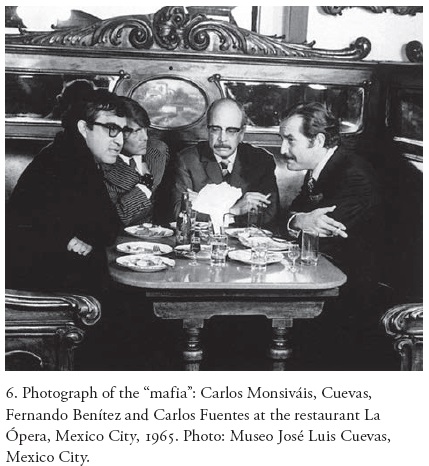
<body><![CDATA[<p align="center"><font face="verdana" size="2"><img src="/img/revistas/aiie/v34n101/a6f4.jpg"></font></p>  	    <p align="justify"><font face="verdana" size="2">Cuevas has always been attracted to cinema and theater, particularly to films with a surreal or oneiric quality and to the theater of the absurd, and the lurid environments of his later drawings resemble at times film or stage sets.<sup><a href="#nota">15</a></sup> They represent defined but unspecified locales, usually interiors, in which a figurative grouping may be invented and arranged freely, imaginatively, without the pressure of describing an actual place or illustrating a set narrative. Most of the environments are in fact so stripped down and cleansed of domestic bric&#45;a&#45;brac that they begin to resemble the antiseptic wards of a hospital or mental asylum, places that have continually haunted Cuevas, who is a self&#45;confessed hypochondriac and frequent convalescent, and in this aspect they provide suitable contexts for his medico&#45;artistic investigation of inner life.<sup><a href="#nota">16</a></sup> Or, in their darkness and vacuity they may suggest caves, a word rendered in Spanish as <i>cuevas,</i> reflecting the artist's patronymic, and thus designating spaces of his own domain&#151;the sealed chambers of his personal fantasies; and they additionally bring to mind the numinous hollows where the high priests of ancient Mexico communed with their hoary gods and spirits. As postulated by one commentator, they situate Cuevas's pictorial imaginings within mankind's primeval abode: "the cavern, the prehistoric belly, the locale of origins and the reserve of phantasms, hell and paradise lost in an irreducible ambivalence."<sup><a href="#nota">17</a></sup></font></p>  	    <p align="justify"><font face="verdana" size="2">&nbsp;</font></p>  	    <p align="justify"><b><font face="verdana" size="2"><i>Confronting the Cactus Curtain</i></font></b></p>  	    <p align="justify"><font face="verdana" size="2">To his contemporaries Cuevas's art appeared as an open rebellion against the main current of Mexican art. The austere, direful images, drawn in black ink on white paper, controverted the idyllic charm and lush colorism of the Mexican School of Painting, which was then in full flower, and their introspective character ran against the social mission of art as defined by the muralists.<sup><a href="#nota">18</a></sup> The intimacy of the drawings, the individuality of their gestural marks, the idiosyncratic treatment of their hermetic subjects, whose purport is accountable only to the artist's private satisfaction and to no collective interest, the apparent lawlessness of the washes and vermiculated hatch marks, all of this appeared to abjure the oath of social responsibility which was not only the central tenet of the mural movement but an article of faith expected of all citizens in a country striving to affirm its sovereignty and achieve the communitarian goals of the Revolution. Cuevas's quirky, cryptic, "apolitical" drawings, accompanied by the insults he threw at the muralists and his declarations of artistic freedom, were taken quite seriously. His open heresy against social art and the revolutionary ideology presented a tangible threat to the artistic establishment and bestirred the ire of its supporters.</font></p>  	    <p align="justify"><font face="verdana" size="2">Cuevas began his famous polemic with muralist David Alfaro Siqueiros in an interview of August 1954 for <i>Time</i> magazine, in which he showed the youthful temerity to mock the mural painters, and the subsequent war of words between Cuevas and his friends and Siqueiros and his clique continued deep into the 1960s, and even spilled into the following decade.<sup><a href="#nota">19</a></sup> Siqueiros stood as champion of social art against modernist abstraction and "art for art's sake," which he believed was a bourgeois invention dependent on the capitalist market, as well as an instrument of imperialism exported to the far corners of the earth to impress a uniform way of life on all peoples while suppressing any competing nationalism or social philosophy.<sup><a href="#nota">20</a></sup> As evidence of this he pointed to the crucial support for modernism by non&#45;nationals living in Mexico, including the community of Spanish exiles, and the still more egregious interference of U.S. officials, like G&oacute;mez Sicre, in the cultural affairs of the country. To rebuff this capitalist&#45;imperialist conspiracy, he helped organize the National Front of Visual Arts (Frente Nacional de Artes Pl&aacute;sticas) in 1952, and later, in 1959, his allies Juan O'Gorman, Carlos Orozco Romero and Ra&uacute;l Anguiano founded the Union of Painters, Sculptors and Printmakers of Mexico (Uni&oacute;n de Pintores, Escultores y Grabadores de M&eacute;xico) to preserve "art at the service of the people" <i>(arte al servicio del pueblo).</i><a href="#nota"><sup>21</sup></a></font></p>  	    <p align="justify"><font face="verdana" size="2">Cuevas, with lance lowered on the tilting yard, upheld the banner of artistic freedom, charging that the quality and variety of expression had been artificially constrained by a narrow and overbearing political agenda, as plainly indicated by the title of Siqueiros's 1945 publication <i>No hay m&aacute;s ruta que la nuestra</i> ("There is no other route than ours"). In a caricature of Siqueiros from 1958 (<a href="#f5">fig. 5</a>)&#151;drawn in Washington, D.C., and attached to a letter addressed to G&oacute;mez Sicre which mentions the dissemination of some polemical writings by Cuevas to Latin American publishers&#151;the newcomer portrayed his rival as the last&#45;standing monster of muralism, still chanting the old refrain, "There is no other route than ours." As Siqueiros propounded a political or socialist humanism (which I have elsewhere described as his "revolutionary humanism"), based on a structure of shared values and a program of collective action, Cuevas represented the outlook of neo&#45;humanism, associated with European existentialism and grounded in the dignity of the individual and his right to free thought and expression.<sup><a href="#nota">22</a></sup></font></p>  	    <p align="center"><font face="verdana" size="2"><a name="f5"></a></font></p>  	    <p align="center"><font face="verdana" size="2"><img src="/img/revistas/aiie/v34n101/a6f5.jpg"></font></p>  	    <p align="justify"><font face="verdana" size="2">The controversy with Siqueiros soon made Cuevas a pivotal figure in the cultural politics of the 1950s and forced him to become an articulate polemicist, writer, lecturer, interviewee, who ever since has been constantly in the public eye, and under public scrutiny. Through the novelist Carlos Fuentes, he was introduced to Fernando Ben&iacute;tez, publisher of <i>M&eacute;xico en la Cultura</i>, the cultural supplement of the newspaper <i>Novedades,</i> to which he began submitting essays of various sort, some polemical in nature and others of broad cultural interest, and later he wrote regular columns for the dailies <i>Exc&eacute;lsior</i> and <i>El Universal.</i><sup><a href="#nota">23</a></sup> In this way he developed into a talented writer and entered into Mexico's literary community, which was then beginning a new era of cosmopolitanism, as seen in the pages of the <i>Revista Mexicana de Literatura</i> (1955&#45;1965), which Fuentes directed in its early period.<sup><a href="#nota">24</a></sup> Similarly, Cuevas consorted with authors from outside Mexico, among them Gabriel Garc&iacute;a M&aacute;rquez, Mario Vargas Llosa, and Julio Cort&aacute;zar, and as they rose to international fame with the Latin American literary "boom" of the 1960s, so his aura grew ever brighter.<sup><a href="#nota">25</a></sup> He shared with them a broad view of international culture and an experimental turn of mind, and could depend on them to join his campaign against official art and defend him from hostile criticism, as did Fuentes, Xirau, Ben&iacute;tez, Juan Garc&iacute;a Ponce, Jos&eacute; Emilio Pacheco and Octavio Paz on innumerable occasions. In response, Cuevas's foes extended their reproach to the entire consortium of Mexican artists and authors to whom he was attached, baptizing them "the mafia" and attributing to them a collusive scheme to diminish the national culture (<a href="#f6">fig. 6</a>).</font></p>  	    ]]></body>
<body><![CDATA[<p align="center"><font face="verdana" size="2"><a name="f6"></a></font></p>  	    <p align="center"><font face="verdana" size="2"><img src="/img/revistas/aiie/v34n101/a6f6.jpg"></font></p>  	    <p align="justify"><font face="verdana" size="2">Cuevas's most widely read critique of the art establishment was the fictionalized, but largely autobiographical, tale of 1958, slyly titled "The Cactus Curtain" <i>(La cortina de nopal)</i> to equate the cultural regime in Mexico with the Soviet tyranny that had descended across Europe.<sup><a href="#nota">26</a></sup> The story centers on the character of Juan, a young artist whose creative spark is doused by a regulative system of art patronage and an oppressive social ethic which award mediocrity and depreciate originality and true talent. In this and other writings, Cuevas exposed the parochialism, exacerbated nationalism and sterile group&#45;think plaguing Mexican art&#151;as he saw the conditions prevailing at the time&#151;while espousing a wider, more tolerant, international perspective, with which artists might reach out to foreign sources, as he had done. "What I want in my country's art are broad highways leading out to the rest of the world, rather than narrow trails connecting one adobe village with another," he said.<sup><a href="#nota">27</a></sup></font></p>  	    <p align="justify"><font face="verdana" size="2">Cuevas undertook his first visit to South America in 1958, shortly after the publication of the "Cactus Curtain" article. With financial support from PAU, he made a circuit of five countries (Colombia, Peru, Chile, Uruguay and Argentina) and exhibited his art in Caracas and Lima.<sup><a href="#nota">28</a></sup> However, hardly had he disembarked in Venezuela than he met a salvo of criticism from the social realists of that country, who were faithful admirers of Mexican muralism. In an interview with the newspaper <i>El Nacional</i> (Caracas) he pronounced against the muralists and South American painters of indigenous subjects, such as the adored Oswaldo Guayasam&iacute;n, thereby inciting further fury and causing a rabble of artists and critics to block the doors of the gallery showing his art.<sup><a href="#nota">29</a></sup> The controversy followed him to Lima, where he responded with an inflammatory lecture in defense of free art.</font></p>  	    <p align="justify"><font face="verdana" size="2">Similar heat awaited him the following year when he traveled to Brazil and Argentina. This journey took him to S&atilde;o Paulo in the company of Jos&eacute; G&oacute;mez Sicre and artists Armando Morales (from Nicaragua), Alejandro Otero (from Venezuela) and Modesto Cuixart (from Spain), who, along with Cuevas, were presenting work at the Fifth Biennial of Modern Art. By then the essay on the Cactus Curtain had become well known, and&#151;as a consequence of its notoriety and of the recognition he received by winning first prize for drawing at the Biennial&#151;Cuevas found himself widely acclaimed, and condemned, as one of Latin America's prime exponents of progressive art, even though he had only recently turned 26 years of age. A residence of three months in Buenos Aires was especially rewarding. There he befriended the authors Ram&oacute;n G&oacute;mez de la Serna, Guillermo de Torre, Rafael Alberti, Manuel Mujica L&aacute;inez, and Jorge Romero Brest, all of whom praised his art in print. He exhibited at Galer&iacute;a Bonino&#151;the city's main venue for modern art&#151;and delivered several lectures, including one for the Asociaci&oacute;n Ver y Estimar, founded by the eminent critic Romero Brest. As before, his defiant words attracted vehement protest in the popular press.<sup><a href="#nota">30</a></sup></font></p>  	    <p align="justify"><font face="verdana" size="2">The body of drawings and watercolors that Cuevas showed at S&atilde;o Paulo and Buenos Aires included a selection from the series <i>Funeral of a Dictator (Funerales de un dictador),</i> which he had begun in New York, and elements of which had earlier been presented in Caracas and Lima and in the United States.<sup><a href="#nota">31</a></sup> The series was inspired by a photograph of the 1875 funeral of Ecuadorian tyrant Gabriel Garc&iacute;a Moreno (<a href="/img/revistas/aiie/v34n101/a6f7.jpg" target="_blank">fig. 7</a>), which apparently G&oacute;mez Sicre had lent to Cuevas, and which represented the ruler's embalmed body sitting stiffly on the presidential throne in Quito Cathedral and flanked by a lugubrious guard of grenadiers. The bulky and swollen figures in this and other drawings from the series were based on the cubic shapes of Pre&#45;Columbian art, which enhanced the universality of the theme of dreadful and petrified tyranny (<a href="#f8">fig. 8</a>).<sup><a href="#nota">32</a></sup> The images were not specifically political in any partisan sense and referenced no particular governor or regime. They rather evoked the sloth, cruelty and wretchedness of despots or of oppressive systems of rule wherever they may be found, though most acutely with Latin American dictatorship in mind. As Cuevas explained with reference to the seminal source photograph: "I saw &#91;the display of Garc&iacute;a Moreno's body&#93; as something monstrous, an act, indeed, of 'Black Spain' in America. I began to work on the theme, and the sketch in gouache that appeared in <i>Am&eacute;ricas</i> &#91;the monthly publication of PAU&#93; represents the most objective aspect of the series <i>Funeral of a Dictator (Funerales de un dictador: verdugos y torturados).</i> Afterward I tried to include all possible aspects of that idea: torture, sham, informers, subordinates, cringers, mourners, and so on. With that abominable funeral I wished to condemn all dictatorships of all times as the most intolerable indignity human beings can stoop to."<sup><a href="#nota">33</a></sup></font></p>  	    <p align="center"><font face="verdana" size="2"><a name="f8"></a></font></p>  	    <p align="center"><font face="verdana" size="2"><img src="/img/revistas/aiie/v34n101/a6f8.jpg"></font></p>  	    <p align="center"><font face="verdana" size="2">&nbsp;</font></p>  	    <p align="justify"><font face="verdana" size="2">It may be recalled that when these drawings were first presented in Caracas, Venezuela, that country had just rid itself of the military government of Marco P&eacute;rez Jim&eacute;nez, and the images, sent south at the suggestion of R&oacute;mulo Betancourt, the newly elected President who had communicated his wishes to Cuevas at a reception in New York, must have struck viewers as a pointed critique of the defunct regime.<sup><a href="#nota">34</a></sup> However, as indicated in the quotation above, Cuevas hoped to render through the series a compendiated portrait of tyranny in its most generic form. In a later interview he said that the dictator might even be associated with Richard Nixon, for example&#151;a thought which had perhaps crossed his mind already in 1958, the year of Vice&#45;President Nixon's disastrous tour of Latin America, during which unruly demonstrators in Lima and Caracas, angered by US intervention in Latin America and its coddling of autocrats, pelted Nixon with insults and stones.<sup><a href="#nota">35</a></sup></font></p>  	    ]]></body>
<body><![CDATA[<p align="justify"><font face="verdana" size="2">It was around 1959 that critics began to notice the influence of Cuevas's drawing style and penetrating study of the human condition on other Latin artists, or if not a clearly direct influence, then at least a shared propensity in artistic practice.<sup><a href="#nota">36</a></sup> Cuevas himself observed that his exhibition and lecture in Buenos Aires had a palpable effect on Argentine artists, particularly Alberto Greco, and indeed one finds correspondences between Cuevas's expressive draftsmanship and the gesturalism of members of the Otra Figuraci&oacute;n group, who first exhibited together in 1961 at the Peuser Gallery of Buenos Aires.<sup><a href="#nota">37</a></sup> These artists sipped from various international sources&#151; De Kooning, Spanish Informalism, CoBrA&#151;and also, it seems, from Cuevas, whose graphic style was admired by several in the group (namely, Luis Felipe No&eacute;, R&oacute;mulo Macci&oacute;, Ernesto Deira and Jorge de la Vega). Indeed Cuevas's art came to be admired all around South America&#151;by such likes as the Brazilian Marcelo Grassman, the Venezuelan Jacobo Borges, the Peruvian Fernando de Szyszlo, and the Colombians Leonel G&oacute;ngora, Alejandro Obreg&oacute;n, Enrique Grau and Fernando Botero&#151;leading some critics of the early sixties to speak of a wave of "cuevismo" spreading over the continent.<sup><a href="#nota">38</a></sup></font></p> 	    <p align="justify"><font face="verdana" size="2">Cuevas exerted a still stronger influence on the Mexican movement Nueva Presencia (1961&#45;1963), also known as Interiorismo, and was identified in the brochure for the group's inaugural show of 1961 as its chief member and inspiring force.<sup><a href="#nota">39</a></sup> In fact, though, he exhibited rarely with Nueva Presencia and remained more impressed by his South American disciples; he later distanced himself from the artists of the circle and wrote derisively about the quality of their work.<sup><a href="#nota">40</a></sup></font></p>      <p align="justify"><font face="verdana" size="2">These artistic movements in Argentina and Mexico were local expressions of an enthusiasm for the human subject that was felt globally in the late 1950s and early 1960s, and Cuevas may be viewed within this large panorama. Commonalities may be found between his work and Art Brut, for example, or even more prominently between his work and that of the Spanish Informalists, though in this instance the precise line of influence is hard to establish. Certainly Cuevas was aware of the experimental practice of Spaniards in the El Paso and Dau al Set crowds. He got to know Modesto Cuixart in 1959, and would later befriend Antonio Saura and Manolo Millares. Indeed, one may fairly imagine that the phrases in the manifesto of the El Paso artists, calling for the salvation of the individual and radical liberty, might have been uttered by Cuevas himself, and the discussion of artistic gesture in Saura's book <i>Espacio y gesto</i> could well have been illustrated by Cuevas's loose and agitated drawings.<sup><a href="#nota">41</a></sup> Parallels may also be established with artists in the United States, such as Leonard Baskin and Ben Shahn, and it seems that ideas originally proposed by Cuevas were picked up by North American critics and reappear, among other places, in Seldon Rodman's influential publication of 1960, <i>The Insiders</i> (from which the Mexican Interioristas derived their name).<sup><a href="#nota">42</a></sup></font></p>  	    <p align="justify"><font face="verdana" size="2">On entering the wider arena of international art and culture, Cuevas turned his back on the parochialism of the Mexican scene, with its essentializing notion of Mexicanness <i>(mexicanidad)</i> and restrictive demand for social responsibility. At home he continued to be defended by writers like Nelken, Fuentes and Paz, while in South America he found a forceful and energetic ally in the critic Marta Traba (<a href="#f9">fig. 9</a>). She seems to have had the pulse of his artistic temperament, and in one place he described her as "my dearest friend and critic of my work."<sup><a href="#nota">43</a></sup> Born and raised in Buenos Aires, Traba spent the crucial years 1958&#45;1969 in Bogot&aacute;, Colombia, as professor of art history and director of the Museo de Arte Moderno, and in that period she developed into the most vociferous proponent of independent art in Latin America.<sup><a href="#nota">44</a></sup> Like Cuevas, she traveled constantly around the hemisphere, and also like him she received support from OAS (G&oacute;mez Sicre was a close friend and frequent collaborator) and from United States corporations and their Latin American subsidiaries, despite her avowed leftism.<sup><a href="#nota">45</a></sup> Traba spoke about a "culture of resistance" which opposed the anonymity and heartless rationalism of industrial society and the sterility of authoritarian systems, and she stood up for figuration against geometrical abstraction, which she saw as another symptom of modern dehumanization. In several books and articles she proclaimed Cuevas as a brilliant exemplar of figurative art, and described with much sensitivity and philosophical circumspection his unique insight into the human condition.<sup><a href="#nota">46</a></sup> Her most important publications sought to define the artistic tendencies that were then extending across Latin America, and in this critical project&#151;one of the first sustained narratives of contemporary Latin art&#151;Cuevas was given a central place as instigator of what Traba called "the leap into the void" (el <i>salto al vac&iacute;o)</i> by the most advanced and daring artists.</font></p>  	    <p align="center"><font face="verdana" size="2"><a name="f9"></a></font></p>  	    <p align="center"><font face="verdana" size="2"><img src="/img/revistas/aiie/v34n101/a6f9.jpg"></font></p>  	    <p align="justify"><font face="verdana" size="2">&nbsp;</font></p>  	    <p align="justify"><b><font face="verdana" size="2"><i>Cuevas and the Inter&#45;American System</i></font></b></p>  	    <p align="justify"><font face="verdana" size="2">Cuevas was no friend of Francoist Spain. In 1961 he presented in the Roman gallery Il Obelisco the series <i>The Spain of Franco (La Espa&ntilde;a de Franco)</i> (<a href="#f10">fig. 10</a>), which satirized the moribund dictatorship (Cuevas wrote, "these drawings represented a beast who dies after suffering successive mutilations"), and one image in particular, a triptych titled <i>The Fall of Francisco Franco,</i> portraying the assassination of a tyrant, so offended the Spanish embassy in Rome that Cuevas's visa to Spain was revoked.<sup><a href="#nota">47</a></sup> Nevertheless, two years later he achieved admission into the country&#151;from the United States&#151;where he prepared the series <i>From the Diaries of Spain (De los diarios de Espa&ntilde;a).</i> But when invited to participate in the Hispano&#45;American Biennial "Art of America and Spain" (Bienal Hispanoamericana "Arte de Am&eacute;rica y Espa&ntilde;a"), organized by Luis Gonz&aacute;lez Robles for the Instituto de Cultura Hisp&aacute;nica under the aegis of the Ministry of Foreign Affairs, and supposedly assured by the organizers that he would win the prize for drawing, he declined to enter his art in protest against Franco's hold on power, and afterwards laid out his position in an interview with the Madrid&#45;based publication ABC.<sup><a href="#nota">48</a></sup></font></p>  	    <p align="center"><font face="verdana" size="2"><a name="f10"></a></font></p>  	    ]]></body>
<body><![CDATA[<p align="center"><font face="verdana" size="2"><img src="/img/revistas/aiie/v34n101/a6f10.jpg"></font></p>  	    <p align="justify"><font face="verdana" size="2">It was not Spain herself that Cuevas rejected. On the contrary, he was then and is today deeply enamored of the country and its literature, customs and artistic traditions; over the years he has periodically returned there for extended sojourns, and has dedicated nine separate series of prints and drawings to Iberian themes.<sup><a href="#nota">49</a></sup> Yet Spain's tinseled glory has no particular allure. He is drawn rather to the image of "dark Spain," of the ravenous, hierarchical, credulous, brutish Spain, the malformed entity described in the literature of Unamuno and Valle Incl&aacute;n. He once stated: "The Spain that conquered me is, of course, that of somber hues, the black Spain of &#91;the painter&#93; Guti&eacute;rrez Solana, that of the Rastro and of the Calle Echegaray &#91;areas infested with prostitutes&#93;, grotesque and Goyesque Spain."<sup><a href="#nota">50</a></sup> Cuevas shows no more appreciation for an artificially exalted image of peninsular civilization than for the reductive <i>mexicanidad</i> propagated by the officialdom at home.<sup><a href="#nota">51</a></sup> Indeed he finds congruence between the rigidities of Spanish society and the stultifying hierarchies of his own country, and accepts Black Spain as part of his own inheritance, such that his critical images of Spain may be seen as reflections on Mexico and on his own self as a bastard son of the metropolis.</font></p>  	    <p align="justify"><font face="verdana" size="2">It is perhaps a sign of shifting allegiances that once Cuevas had formally rebuffed Gonz&aacute;lez Robles and publicly declared his anti&#45;Francoist views, he returned not to Mexico but to the United States, and exhibited his recent work in a second solo show at the Pan American Union. Does this physical movement of the artist from Madrid to Washington indicate a redirection of sympathies from Spain to the United States? Does it reflect a transition in Cuevas and the artists and intellectuals of his generation from a loose adherence to transatlantic Hispanism&#151;mainly understood in the liberal, humanistic sense as pronounced by Nelken and other exiles&#151;to the acceptance of a new cosmopolitanism led by the US? And is there a political dimension to this realignment? Does the choice bear witness to a reordering of cultural influence in the Americas, paralleling the political concession that Franco's government made to the United States, in which North American supremacy in the Western hemisphere was accepted in exchange for diplomatic recognition and the integration of Spain into the Western alliance, as described by the historian Jos&eacute; Luis Rubio Card&oacute;n?<sup><a href="#nota">52</a></sup></font></p>  	    <p align="justify"><font face="verdana" size="2">Certainly there had existed for some time a concerted effort by the US government and associated institutions (OAS, Museum of Modern Art, Rockefeller Foundation, Fulbright Program, etc.) to curry favor with the intelligentsia of Latin America and bring it into alignment with North American political interests and values.<sup><a href="#nota">53</a></sup> This began with the Good Neighbor Policy of the Roosevelt administration and the creation of a network of multilateral organizations in what is known as the Inter&#45;American System (IAS). The ultimate justification for the system&#151;which extended over all areas of social, economic, political and cultural life&#151;was collective hemispheric defense, first against Fascism and later against Communism, though underlying the arrangement was the older goal of unifying the entire hemisphere under North American leadership, in what is known as Pan Americanism.<sup><a href="#nota">54</a></sup></font></p>  	    <p align="justify"><font face="verdana" size="2">The Organization of American States, founded in 1948 and operating from 1951, was the linchpin for the Inter&#45;American System. The mandate of G&oacute;mez Sicre, director of the Visual Arts Section of PAU, was to use the resources at his disposal to foster amity and understanding among the nations and peoples of the hemisphere by encouraging frequent interchanges of artists and critics, by issuing publications on the arts, by lending support to the most promising and original creators of the region, by sponsoring exhibitions in the United States and abroad, and by advocating in miscellaneous ways for freedom of expression.<sup><a href="#nota">55</a></sup> With the financial resources and network of contacts of OAS behind him and by dint of his personal drive and intelligence, in the 1950s and early 60s he reigned as the most important North American critic and curator of Latin American Art.</font></p>  	    <p align="justify"><font face="verdana" size="2">G&oacute;mez Sicre is occasionally dismissed as a mere agent of US diplomacy, and the art he promoted as an instrument of Cold War politics, or even of North American imperialism.<sup><a href="#nota">56</a></sup> However this portrayal is quite unjustified. Although an opponent of Communism, he was an individual of refined sensibilities, respectful of artistic and critical independence, and one who had no wish to impose North American artistic styles on the diversified cultures of Latin America or to force the artists of the region into a condition of dependency on North American patronage and critical taste; although he did recognize the United States' role as "natural center" within an emergent hemispherical culture.<sup><a href="#nota">57</a></sup> He thought broadly about the region and its art, and hoped to encourage a lively and fertile dialogue among the artists and critics of the Latin countries. Marta Traba called him "the prime defender of a continental art and the first one capable of conceiving it panoramically, as a conjunction of sentiment..."<sup><a href="#nota">58</a></sup></font></p>  	    <p align="justify"><font face="verdana" size="2">Admittedly there exists an element of truth in the argument that G&oacute;mez Sicre, even if not a chest&#45;thumping imperialist, served through his actions to place Latin artists under US cultural hegemony and weaken national art movements.<sup><a href="#nota">59</a></sup> Despite his broad mindedness he made no bones about his anti&#45;Communism and openly wished to break social realism's hold on Latin American art, not only because he thought it restrained creativity but also for the reason that it tended to support leftist political movements. It may further be observed that G&oacute;mez Sicre held an important post at PAU and subscribed to the fundamental goals, which included the spread of political rights, freedom of expression and other tenets of democracy, and the development of an international civic society in the Americas. But the idea that anti&#45;Communism, democracy and interdependence are simply code words for imperialism, as some have argued, or that OAS functioned merely as a tool of US foreign policy, are highly debatable positions, as is the inference that G&oacute;mez Sicre and Cuevas were obliging stooges of the North Americans in their grab for power.</font></p>  	    <p align="justify"><font face="verdana" size="2">One may rather set Cuevas within a web of institutions that took shape in the 1950s and promoted a hemispheric artistic culture, at the center of which sat G&oacute;mez Sicre, with tentacles on the many strings. For PAU was only one piece, albeit a crucial piece, within a consortium of institutions that contributed to the cultural unification of Latin America. Brought into the fold were numerous art galleries and museums spread around the hemisphere, beginning with the PAU Art Gallery, and extending to such institutions as the New York Museum of Modern Art, the Museum of Fine Art at Houston, Philadelphia Museum of Art, Walker Art Center of Minneapolis, Museo de Arte Moderno of Bogot&aacute;, Instituto de Arte Contempor&aacute;neo of Lima, Taller Libre de Arte of Caracas, and in Buenos Aires the Galer&iacute;a Bonino, Instituto Torcuato Di Tella and Museo de Arte Moderno. In Mexico there were the private galleries Prisse and Proteo, plus those of Antonio Souza (est. 1956) and Juan Mart&iacute;n (est. 1961), the briefly lived El Eco, directed by Cuevas's close friend Mathias Goeritz, the Casa del Lago, and the Museo de Arte Moderno.<sup><a href="#nota">60</a></sup></font></p>  	    <p align="justify"><font face="verdana" size="2">Many of these institutions were wholly or partly independent of government, and beholden to private industry for financial support&#151;IBM, General Electric, W. R. Grace &amp; Co., Acero del Pac&iacute;fico, Alcoa Steamship Company, and particularly the oil conglomerates, most of all Esso corporation (today's ExxonMobil) and its Latin American affiliates, were strong supporters of the modern art movement.<sup><a href="#nota">61</a></sup> The Rockefeller family, which controlled Esso and stood behind MoMA, was enormously influential. Nelson Rockefeller, in addition to being a patron and collector of Latin American art, was one of the key architects of the Inter&#45;American System; and in 1965 David Rockefeller founded the Center for Inter&#45;American Relations, New York, now operating as the Americas Society, which ran an important exhibition space.<sup><a href="#nota">62</a></sup> Philanthropic organizations (e.g. Guggenheim Foundation, American Council of Education) as well as universities and colleges in the United States and Latin America distributed grants to progressive artists, exhibited their work, and gave them employment&#151;for example, Cuevas held solo shows at the Universidad de Costa Rica (1967), Museo Universitario of Mexico City (1970), and Museo de Arte Moderno attached to the Universidad de Bogot&aacute; (1973), taught for brief periods at the Philadelphia School of Art, San Jose State College (now University) and Fullerton College, was supported by the Ford Foundation in 1965, and received private grants for residencies in San Francisco, Los Angeles, Washington and New York.</font></p>  	    <p align="justify"><font face="verdana" size="2">G&oacute;mez Sicre, as one of the presiding figures in this hemispherical art system, together with Traba and Romero Brest, was often asked to organize exhibitions or sponsor meetings and exchanges, and gave special attention to a select number of artists from different countries whom he considered most representative of the new progressive spirit (besides Cuevas, others within this privileged circle were Fernando de Szyszlo of Peru, Alejandro Obreg&oacute;n of Colombia and Armando Morales of Nicaragua). Exhibitions curated or facilitated by him were circulated in the US and Latin America and often funded by private corporations.<sup><a href="#nota">63</a></sup> Among the larger shows of this type were the international competition sponsored by the Alcoa Steamship Company, with a series of local exhibitions in cities where the sponsor maintained port facilities, and culminating in an exhibition at the National Academy of Design, New York, in September 1955; the Gulf&#45;Caribbean Art Exhibition, financed by the engineering firm of Brown &amp; Root, Inc., which opened at the Museum of Fine Art, Houston, April&#45;May 1956, and then traveled to several venues in the United States; the three American Biennials of Art (Bienales Americanas de Arte), 1962&#45;66, underwritten by Industrias Kaiser Argentina and held in C&oacute;rdoba, Argentina, the home base of the corporation, before being taken to the PAU Art Gallery in Washington, and from there to other U.S. sites;<sup><a href="#nota">64</a></sup> and the 1962 exhibition titled Three Thousand Years of Colombian Art (Tres Mil A&ntilde;os de Arte Colombiano), funded by the International Petroleum Company, and shown in Bogot&aacute;, Miami and Washington. However the most ambitious of these enterprises was the Salon of Young Artists (Sal&oacute;n de Artistas J&oacute;venes), 1964&#45;1965, sponsored by the Esso companies of Latin America. This exhibition of artists under forty years of age from eighteen countries marked the 75th anniversary of the Inter&#45;American System. The process of selection took place in two stages: the first involved local exhibitions and the awarding of national prizes, and the second a show of national prize&#45;winners at PAU, in April&#45;May 1965, and the bestowal of international awards. Over 300 artists participated in this "Inter&#45;American event," as G&oacute;mez Sicre described it, and in the catalogue he affirmed the private stimulus behind the project: "Of singular significance was the fact that it was private industry&#151;the capitalist initiative of a free world&#151;that was thus seeking to foster the things of the spirit by an undertaking with broad cultural repercussions."<sup><a href="#nota">65</a></sup></font></p>  	    ]]></body>
<body><![CDATA[<p align="justify"><font face="verdana" size="2">Mexico's preliminary show was held at the Museo de Arte Moderno in early 1965, as Competition of Young Artists of Mexico (Concurso de Artistas J&oacute;venes de M&eacute;xico), but more popularly called Salon Esso. Today most historians identify this show as marking the full arrival of avant&#45;garde art in the country. However, at the time the event stirred up blistering controversy. To begin with, there was the charge of favoritism in the awarding of first prize to Fernando Garc&iacute;a Ponce, brother of one of the judges. But in fact no group appeared very satisfied with the exhibition. Leftists such as Raquel Tibol and Luis Arenal denounced the attention it gave to non&#45;political artists, while conservatives such as Federico Cant&uacute; and Francisco Moreno Capdevila, along with Francisco Icaza of the Nueva Presencia group, bemoaned the display of non&#45;representational art and the honoring of Garc&iacute;a Ponce, who was an abstractionist. Amid the almost palpable tension at the award ceremony, Cuevas impulsively yelled out that Garc&iacute;a Ponce was greater than Orozco, provoking a hostile group to surround him. "Go back to Washington, traitor!" <i>(&iexcl;L&aacute;rgate a Washington, traidor!),</i> "Sold to the OAS!" ( <i>&iexcl;Vendido a la OEA!</i>), they screamed in his ear, as he and Icaza got into a pushing match. Soon after the incident, the journal <i>Pol&iacute;tico</i> issued an editorial portraying Cuevas and G&oacute;mez Sicre as unwitting agents of imperialism.<sup><a href="#nota">66</a></sup> This was not the first time that this charge had been leveled. Cuevas felt the sting of the same insult in earlier exchanges with Siqueiros and during visits to South America; and G&oacute;mez Sicre had been similarly condemned in 1959 by Celestino Gorostiza, head of the National Institute of Fine Arts (inba), who asked the government to investigate his activities "en contra de la pintura mexicana."<sup><a href="#nota">67</a></sup></font></p>  	    <p align="justify"><font face="verdana" size="2">At stake was an autonomous national art dedicated to the interests of the Mexican people, which for many of Cuevas's critics included the socialist program of the Revolution, itself under threat from a succession of pro&#45;capitalist governments and conservative leaders. Thus the rebuke leveled at Cuevas and G&oacute;mez Sicre represented an attempt to hold onto a political ideal. But the tide of events was inexorably driving this ideal out to sea, as the revolutionary outlook and the social art it commanded became increasingly untenable under the pressures of modernization and internationalization. Although this process was clearly abetted by North American institutions operating under the requirements of Cold War politics, it is unlikely that Mexican isolationism in politics and the arts could have been sustained deeply into the late twentieth century even had there been no such direct and coordinated intervention.</font></p>  	    <p align="justify"><font face="verdana" size="2">&nbsp;</font></p>  	    <p align="justify"><b><font face="verdana" size="2"><i>Internationalism, independence and art of resistance</i></font></b></p>  	    <p align="justify"><font face="verdana" size="2">Access to modern means of transportation&#151;particularly travel by air&#151;helped artists transcend national boundaries (<a href="#f11">fig. 11</a>). G&oacute;mez Sicre drew attention to the importance of travel, arguing that it put artists in contact with one another and opened new markets to them, so they could begin to pry themselves loose from governmental patronage. He further pointed to the complementary growth of public and private art institutions that fostered diversity, openness and cross&#45;fertilization.<sup><a href="#nota">68</a></sup> Cuevas was exemplary in taking advantage of these opportunities. As we have seen, he traveled widely in Europe and the Americas and exhibited at a variety of sites. However he was by no means the only Latin artist to venture from his home base. Many members of the avant&#45;garde, such as Botero, Ram&iacute;rez Villamizar, Del Villar, Negret, Grau and Obreg&oacute;n, made frequent trips abroad. In the decade of the 1950s, Latin artists routinely traveled to the European art centers of Paris and Madrid, and to New York and other points in the United States.<sup><a href="#nota">69</a></sup> Just as significant was their circulation within their own region, which allowed them to share artistic and critical ideas peculiar to Latin America, and to form a Latin consciousness and a more positive self&#45;estimation.<sup><a href="#nota">70</a></sup></font></p>  	    <p align="center"><font face="verdana" size="2"><a name="f11"></a></font></p>  	    <p align="center"><font face="verdana" size="2"><img src="/img/revistas/aiie/v34n101/a6f11.jpg"></font></p>  	    <p align="justify"><font face="verdana" size="2">Cuevas was well served by the art market and able to make a living by selling his art through commercial galleries, which freed him from reliance on governmental support. This gave him the liberty to say what he wanted, to criticize official institutions without putting his livelihood at risk, and to be the self&#45;governed creator that the character Juan in the parable of the Cactus Curtain had set out to become.<sup><a href="#nota">71</a></sup></font></p>  	    <p align="justify"><font face="verdana" size="2">Ever the subject of controversy, he attracted criticism for this very independence and freedom of movement, and found himself unfairly accused of being an essentially foreign artist who had gained wealth and fame from external sources of patronage and had become demexicanized in character and art. While it is true that he prospered abroad as much as at home (for instance, his illustrated books from 1959 to 1972 were all published outside Mexico), he strenuously insisted on his Mexican roots and emphasized the local origins of his art, declaring in one interview: "While I paint, I am an eminently Mexican painter, and in my work there appears in an obsessive manner the personal mythology created as a result of my Mexican experiences."<sup><a href="#nota">72</a></sup></font></p>  	    <p align="justify"><font face="verdana" size="2">Fully Mexican in his style of life and personal investment in the local culture, Cuevas nonetheless felt a troubling ambivalence about his native land. Continuing in the same interview quoted above, he announced, "However, in addition, for me Mexico is a world of terror and of horror, and to give it life in this world I need the perspective of distance. Before the monster, I cry, I become agitated, but I don't work. Instead, from afar, I have the tranquility necessary to create."<sup><a href="#nota">73</a></sup> Mexico exercised an oppressive effect. There he felt under pressure, under scrutiny, assailed by hostile critics and required to live on the defensive&#151;"Kafkahuamilpa" was his original epithet for the country's inquisitorial climate. As noted by Ala&iacute;de Foppa, in conversations with her he frequently alluded to Mexico as a source of frustration and torment: "Mexico suffocates me" <i>(M&eacute;xico me asfixia),</i> "I can't tolerate this country" <i>(Ya no tolero este pa&iacute;s),</i> "I feel closed in like on an island" <i>(Me siento encerrado como en una</i> <i>isla</i>), "I think I'll never return" <i>(Pienso no volver)</i><sup><a href="#nota">74</a></sup> Further complicating this relationship were his physical maladies, for in Mexico City he suffered from the smog, altitude and changeable climate, making daily life a misery and prodding him to flee to a more salubrious locale. Yet Mexico was his inescapable home and point of origin, and the constant wellspring for his work. Though his art was one of fusion and appropriation and his imaginative worlds filled with characters from world literature and diverse streams of popular culture&#151; Kafka and Rembrandt, the Marquis de Sade and Fatty Arbuckle cohabit in the vacant spaces of his drawings (<a href="/img/revistas/aiie/v34n101/a6f12.jpg" target="_blank">fig. 12</a>)&#151;at root was a deep feeling for Mexican society and vivid memories of early experiences in the country; these were ever present no matter which subject he chose to illustrate.<sup><a href="#nota">75</a></sup></font></p>  	    ]]></body>
<body><![CDATA[<p align="justify"><font face="verdana" size="2">Much as Cuevas benefited from patrons and sponsors in the United States, he refused to assimilate to North American culture or conform to its artistictrends. Quite the opposite, he resisted actively and with characteristic pugnacity the totalizing and dominating discourse issued from the North. In 1959 he began a campaign against abstractionist tendencies imported into Mexico and Latin America, and urged artists of the South to develop a figurative art that would best represent their independent culture.<sup><a href="#nota">76</a></sup> In this desire to strengthen the Latin American voice, he allied himself with Traba's notion of a "culture of resistance," which opposed equally the parochialism of local taste and the homogenizing effect of global discourses.<sup><a href="#nota">77</a></sup> Traba argued for the development of authentic regional languages of art criticism, which can evade the reigning meta&#45;language that originates in and is addressed to a non&#45;Latin social context. And she asked artists to invent modes of representation that were original to the continent and suitable to the culture and experiences of the region. With these positions Cuevas was in full accord.<sup><a href="#nota">78</a></sup></font></p>  	    <p align="justify"><font face="verdana" size="2">The oddest thing about Cuevas's art is that it is extremely personal and introspective yet constantly touched by outer stimuli. The images are projections of private thoughts and by the same account reflections on a large range of sources, chiefly literary. The nodal point is located in the living consciousness of the artist, of course, which blends his own rich memories and moods with the thoughts, images and even the personalities of authors he reads; hence the fixation on his own biography and mental and physical processes, as evidenced in his immense archive of personal documents, in the photographs he has compulsively taken of himself on every day of his mature life, and in countless other eccentricities.<sup><a href="#nota">79</a></sup> Cuevas is frequently accused of narcissism. But this is a mistaken view which takes in only one side of his art, the self&#45;reflective part, when in fact the work involves both a projection outward and a reception inward, in such a way that the imagery is suspended between selfhood and otherness, identity and non&#45;identity, being and non&#45;being.<sup><a href="#nota">80</a></sup></font></p>  	    <p align="justify"><font face="verdana" size="2">There are points of correspondence between Sartrean existentialism and Cuevas's aesthetic and political position, and in fact it sometimes seems he may have consciously modeled his actions on existentialist principles. For the French philosopher, consciousness has no fixed or absolute definition but arises from our individual encounter with the world about us. We become ourselves through what we do and what we apprehend, and the wider our field of experience the larger and deeper the dimension of our conscious being. And so we choose to be who we are, and our selfhood is necessarily constituted in the realm of freedom. To deny or avoid this freedom is to resign ourselves falsely to another will or principle and to pretend that our selfhood is not of our own making; it is, in Sartrean terms, an act of "bad faith." In agreement with these philosophical postulates, Cuevas maintained that it is the artist's duty to strive for authenticity, to repudiate "bad faith," and to enrich himself and his expression by exploring the world openly and profoundly.</font></p>  	    <p align="justify"><font face="verdana" size="2">Cuevas represented a neo&#45;humanism that did not aspire to save humanity as did the social art of Siqueiros. He refused to work within the confines of any organized movement or interest group, and rarely entered into political discussions. Yet he interrogated the grand premises and collective thinking of ruling institutions in an incisive and comprehensive way. By exposing the fragility, weakness, and instability of human subjects, he put in doubt the ideals of personal virtue and social progress which stood behind the myth of Mexican greatness (La <i>grandeza de M&eacute;xico)</i> and the national revolutionary project.<sup><a href="#nota">81</a></sup> Of course, he was not the only artist to contest the reigning systems of art patronage and the parochial values they clung to. In the same period, fellow Mexicans&#151;Gironella, Corzas, Vlady&#151;and artists from lands to the south&#151; De Szyszlo, Grau, Negret&#151;similarly took new directions. But he was one of the most forceful polemicists of his generation, one of the most fiercely independent creators, and one who moved adeptly through the institutions that supported alternative modes of expression; and for these reasons he became exemplary of a "new" type of artist and identified with a new cosmopolitanism in Latin art.</font></p>  	    <p align="justify"><font face="verdana" size="2">On one occasion Cuevas declared: "I am the one Mexican who fights for the affirmation of the 'I' in the present, not in the future. The Mexican doesn't like to speak in the first person, nor to look straight ahead. I live in the first person."<sup><a href="#nota">8</a>2</sup> This statement was both a declaration of independence and a positioning of the artist in relation to social conventions. Cuevas recognized only the sovereignty of the individual, and maintained the artist's prerogative to forge his own path, without surrendering to any ideology or social program, and without postponing or otherwise bracketing the search for authenticity in the name of the collective interest. In this respect his art is aligned with the "weak subject" proposed by the Italian philosophers Gianni Vattimo and Pier Aldo Rovatti, a subject who retreats from the "strong thought" of reason and ideology and throws off their transcendental signifiers, and instead applies himself to local and heterogeneous histories and adopts new, individual strategies to apprehend the world from a position of non&#45;subordination.<sup><a href="#nota">83</a></sup></font></p>  	    <p align="justify"><font face="verdana" size="2">Cuevas was one of the principal authors of a de&#45;centered Latin American artistic culture, which grew from the independent choices of creators who passed beyond the tissue of common knowledge and consensual politics (without however utterly erasing all forms of interpersonal, social and national affiliation).<sup><a href="#nota">84</a></sup> This culture rested on the principle of untrammeled freedom of expression, which extended even to the concept of hemispherical identity; as Cuevas said, the trail blazers of modern art "learned to escape Latin Americanism" and acceded to a realm of liberty in which each could act and create on his or her own terms, and, unbounded, explore, interrogate, and drink copiously from local and global sources.<sup><a href="#nota">85</a></sup></font></p>  	    <p align="justify"><font face="verdana" size="2">&nbsp;</font></p>  	    <p align="justify"><font face="verdana" size="2"><a name="nota" id="nota"></a><b>Notas</b></font></p>  	    <!-- ref --><p align="justify"><font face="verdana" size="2">1. For relations between Spanish exiles and Mexican artists of Cuevas's generation, see Christopher Fulton, "En una tierra m&aacute;s all&aacute;: refugiados de la Guerra Civil y la est&eacute;tica del exilio," in Wilfredo Rinc&oacute;n Garc&iacute;a <i>et al.</i> (coords.), in <i>Arte en tiempos de guerra,</i> Madrid, Consejo Superior de Investigaciones Cient&iacute;ficas, 2009, pp. 343&#45;353,    &nbsp;&nbsp;&nbsp;&nbsp;&nbsp;&nbsp;&nbsp;&nbsp;[&#160;<a href="javascript:void(0);" onclick="javascript: window.open('/scielo.php?script=sci_nlinks&ref=796365&pid=S0185-1276201200020000600001&lng=','','width=640,height=500,resizable=yes,scrollbars=1,menubar=yes,');">Links</a>&#160;]<!-- end-ref --><!-- ref --> and the same author's "El &eacute;xodo espa&ntilde;ol y el arte moderno en M&eacute;xico: la migraci&oacute;n de un ideal humanista," <i>Goya,</i> no. 321, November&#45;December 2007, pp. 365&#45;382.    &nbsp;&nbsp;&nbsp;&nbsp;&nbsp;&nbsp;&nbsp;&nbsp;[&#160;<a href="javascript:void(0);" onclick="javascript: window.open('/scielo.php?script=sci_nlinks&ref=796366&pid=S0185-1276201200020000600002&lng=','','width=640,height=500,resizable=yes,scrollbars=1,menubar=yes,');">Links</a>&#160;]<!-- end-ref --></font></p>     <!-- ref --><p align="justify"><font face="verdana" size="2">2. Cuevas frequently spoke of his relations with Spanish refugees; for example, in an interview with Javier Arnaldo, "Una conversaci&oacute;n con Jos&eacute; Luis Cuevas en Madrid," <i>Cuadernos Hispanoamericanos,</i> no. 575, May 1998, pp. 19&#45;28,    &nbsp;&nbsp;&nbsp;&nbsp;&nbsp;&nbsp;&nbsp;&nbsp;[&#160;<a href="javascript:void(0);" onclick="javascript: window.open('/scielo.php?script=sci_nlinks&ref=796368&pid=S0185-1276201200020000600003&lng=','','width=640,height=500,resizable=yes,scrollbars=1,menubar=yes,');">Links</a>&#160;]<!-- end-ref --><!-- ref --> and in an interview with Silvia Cherem, <i>Entre la historia y la memoria,</i> Mexico City, Consejo Nacional para la Cultura y las Artes, 2000, p. 213.    &nbsp;&nbsp;&nbsp;&nbsp;&nbsp;&nbsp;&nbsp;&nbsp;[&#160;<a href="javascript:void(0);" onclick="javascript: window.open('/scielo.php?script=sci_nlinks&ref=796369&pid=S0185-1276201200020000600004&lng=','','width=640,height=500,resizable=yes,scrollbars=1,menubar=yes,');">Links</a>&#160;]<!-- end-ref --></font></p>  	    <!-- ref --><p align="justify"><font face="verdana" size="2">3.&nbsp;His friendship with Nelken is described in Arnaldo, "Una conversaci&oacute;n." Nelken reviewed Cuevas's inaugural show at Galer&iacute;a Prisse in <i>Revista Hoy</i> (Mexico City), June 23, 1953;    &nbsp;&nbsp;&nbsp;&nbsp;&nbsp;&nbsp;&nbsp;&nbsp;[&#160;<a href="javascript:void(0);" onclick="javascript: window.open('/scielo.php?script=sci_nlinks&ref=796371&pid=S0185-1276201200020000600005&lng=','','width=640,height=500,resizable=yes,scrollbars=1,menubar=yes,');">Links</a>&#160;]<!-- end-ref --><!-- ref --> and his second show at Prisse in <i>Exc&eacute;lsior</i> (Mexico City), June 1954,    &nbsp;&nbsp;&nbsp;&nbsp;&nbsp;&nbsp;&nbsp;&nbsp;[&#160;<a href="javascript:void(0);" onclick="javascript: window.open('/scielo.php?script=sci_nlinks&ref=796372&pid=S0185-1276201200020000600006&lng=','','width=640,height=500,resizable=yes,scrollbars=1,menubar=yes,');">Links</a>&#160;]<!-- end-ref --><!-- ref --> reprinted in Jos&eacute; Luis Cuevas, <i>Jos&eacute; Luis Cuevas: el ojo perdido de Dios,</i> Mexico City, Universidad Aut&oacute;noma del Estado de M&eacute;xico, 1997, pp. 96&#45;97, n. 10.    &nbsp;&nbsp;&nbsp;&nbsp;&nbsp;&nbsp;&nbsp;&nbsp;[&#160;<a href="javascript:void(0);" onclick="javascript: window.open('/scielo.php?script=sci_nlinks&ref=796373&pid=S0185-1276201200020000600007&lng=','','width=640,height=500,resizable=yes,scrollbars=1,menubar=yes,');">Links</a>&#160;]<!-- end-ref --><!-- ref --> Other Spaniards who wrote on this exhibition were Rafael Hern&aacute;ndez and Matilde Mantec&oacute;n, and a short note of praise was written by Jorge Juan Crespo de la Serna. Nelken also reviewed Cuevas's show at Galerie Edouard Loeb, Paris, in <i>Diorama de la Cultura,</i> supplement to the newspaper <i>Exc&eacute;lsior</i> (Mexico City), April 30, 1955,    &nbsp;&nbsp;&nbsp;&nbsp;&nbsp;&nbsp;&nbsp;&nbsp;[&#160;<a href="javascript:void(0);" onclick="javascript: window.open('/scielo.php?script=sci_nlinks&ref=796374&pid=S0185-1276201200020000600008&lng=','','width=640,height=500,resizable=yes,scrollbars=1,menubar=yes,');">Links</a>&#160;]<!-- end-ref --><!-- ref --> and the exhibition of his work at the S&atilde;o Paulo Biennial, in "Un Primer Premio Internacional para M&eacute;xico," <i>Exc&eacute;lsior</i> (Mexico City), October 4, 1959.    &nbsp;&nbsp;&nbsp;&nbsp;&nbsp;&nbsp;&nbsp;&nbsp;[&#160;<a href="javascript:void(0);" onclick="javascript: window.open('/scielo.php?script=sci_nlinks&ref=796375&pid=S0185-1276201200020000600009&lng=','','width=640,height=500,resizable=yes,scrollbars=1,menubar=yes,');">Links</a>&#160;]<!-- end-ref --><!-- ref --> Clippings of these and other reviews by Nelken may be found in the Hemerograf&iacute;a, Centro de Documentaci&oacute;n e Investigaci&oacute;n Especializado Octavio Paz, Museo Jos&eacute; Luis Cuevas, Mexico City (henceforth Cuevas Archive). For Nelken, see Miguel Caba&ntilde;as Bravo, "Margarita Nelken, una mujer ante el arte," in <i>La mujer en el arte espa&ntilde;ol,</i> Madrid, Consejo Superior de Investigaciones Cient&iacute;ficas, 1997, pp. 463&#45;484.    &nbsp;&nbsp;&nbsp;&nbsp;&nbsp;&nbsp;&nbsp;&nbsp;[&#160;<a href="javascript:void(0);" onclick="javascript: window.open('/scielo.php?script=sci_nlinks&ref=796376&pid=S0185-1276201200020000600010&lng=','','width=640,height=500,resizable=yes,scrollbars=1,menubar=yes,');">Links</a>&#160;]<!-- end-ref --></font></p>  	    <!-- ref --><p align="justify"><font face="verdana" size="2">4.&nbsp;This observation is made by Rita Eder, <i>Gironella,</i> Mexico City, Universidad Nacional Aut&oacute;noma de M&eacute;xico&#45;Instituto de Investigaciones Est&eacute;ticas, 1981, p. 23.    &nbsp;&nbsp;&nbsp;&nbsp;&nbsp;&nbsp;&nbsp;&nbsp;[&#160;<a href="javascript:void(0);" onclick="javascript: window.open('/scielo.php?script=sci_nlinks&ref=796378&pid=S0185-1276201200020000600011&lng=','','width=640,height=500,resizable=yes,scrollbars=1,menubar=yes,');">Links</a>&#160;]<!-- end-ref --></font></p>  	    <!-- ref --><p align="justify"><font face="verdana" size="2">5.&nbsp;In 1954, soon before his departure for Washington, D.C., Cuevas was presented by the Catalan author Narc&iacute;s Molins i F&agrave;brega with a book on the concentration camps in France, written by Molins and illustrated by Bartol&iacute;, as recounted in Jos&eacute; Luis Cuevas, <i>Gato macho,</i> Mexico City, Fondo de Cultura Econ&oacute;mica, 1994, p. 77.    &nbsp;&nbsp;&nbsp;&nbsp;&nbsp;&nbsp;&nbsp;&nbsp;[&#160;<a href="javascript:void(0);" onclick="javascript: window.open('/scielo.php?script=sci_nlinks&ref=796380&pid=S0185-1276201200020000600012&lng=','','width=640,height=500,resizable=yes,scrollbars=1,menubar=yes,');">Links</a>&#160;]<!-- end-ref --><!-- ref --> The book is considered a classic work on the experience of the Spanish exiles; Jos&eacute; Bartol&iacute; and Narc&iacute;s Molins i F&aacute;brega, <i>Campos de concentraci&oacute;n,</i> <i>1939&#45;194..</i>., Mexico City, Iberia, 1944.    &nbsp;&nbsp;&nbsp;&nbsp;&nbsp;&nbsp;&nbsp;&nbsp;[&#160;<a href="javascript:void(0);" onclick="javascript: window.open('/scielo.php?script=sci_nlinks&ref=796381&pid=S0185-1276201200020000600013&lng=','','width=640,height=500,resizable=yes,scrollbars=1,menubar=yes,');">Links</a>&#160;]<!-- end-ref --></font></p>  	    <!-- ref --><p align="justify"><font face="verdana" size="2">6.&nbsp;The encounter is described in Jos&eacute; Luis Cuevas, "La breve historia de una generaci&oacute;n arrinconada," <i>M&eacute;xico en la Cultura,</i> supplement of <i>Novedades</i> (Mexico City), October 30, 1960,    &nbsp;&nbsp;&nbsp;&nbsp;&nbsp;&nbsp;&nbsp;&nbsp;[&#160;<a href="javascript:void(0);" onclick="javascript: window.open('/scielo.php?script=sci_nlinks&ref=796383&pid=S0185-1276201200020000600014&lng=','','width=640,height=500,resizable=yes,scrollbars=1,menubar=yes,');">Links</a>&#160;]<!-- end-ref --> clipping in Cuevas Archive.</font></p>  	    <!-- ref --><p align="justify"><font face="verdana" size="2">7.&nbsp;The reviews included Leslie Judd Portner, "Mexican's Work Sold Out," <i>The Washington Post and Herald Tribune,</i> August I, 1954 (<a href="http://www.washingtonpost.com" target="_blank">www.washingtonpost.com</a>);    &nbsp;&nbsp;&nbsp;&nbsp;&nbsp;&nbsp;&nbsp;&nbsp;[&#160;<a href="javascript:void(0);" onclick="javascript: window.open('/scielo.php?script=sci_nlinks&ref=796385&pid=S0185-1276201200020000600015&lng=','','width=640,height=500,resizable=yes,scrollbars=1,menubar=yes,');">Links</a>&#160;]<!-- end-ref --><!-- ref --> James Truitt (unsigned), "A Word with Jos&eacute; Luis Cuevas," <i>Am&eacute;ricas</i> (Washington, D.C., organ of PAU), vol. 6, no. II, November 1954, p. 15;    &nbsp;&nbsp;&nbsp;&nbsp;&nbsp;&nbsp;&nbsp;&nbsp;[&#160;<a href="javascript:void(0);" onclick="javascript: window.open('/scielo.php?script=sci_nlinks&ref=796386&pid=S0185-1276201200020000600016&lng=','','width=640,height=500,resizable=yes,scrollbars=1,menubar=yes,');">Links</a>&#160;]<!-- end-ref --><!-- ref --> by the same author (unsigned), "Art: A Vision of Life," <i>Time,</i> August 16, 1954 (<a href="http://www.time.com" target="_blank">www.time.com</a>);    &nbsp;&nbsp;&nbsp;&nbsp;&nbsp;&nbsp;&nbsp;&nbsp;[&#160;<a href="javascript:void(0);" onclick="javascript: window.open('/scielo.php?script=sci_nlinks&ref=796387&pid=S0185-1276201200020000600017&lng=','','width=640,height=500,resizable=yes,scrollbars=1,menubar=yes,');">Links</a>&#160;]<!-- end-ref --><!-- ref --> Florence S. Berryman, "National Gets Two Stuarts; Mexican Artist," <i>The Sunday Star</i> (Washington, D.C.), July 24, 1954,    &nbsp;&nbsp;&nbsp;&nbsp;&nbsp;&nbsp;&nbsp;&nbsp;[&#160;<a href="javascript:void(0);" onclick="javascript: window.open('/scielo.php?script=sci_nlinks&ref=796388&pid=S0185-1276201200020000600018&lng=','','width=640,height=500,resizable=yes,scrollbars=1,menubar=yes,');">Links</a>&#160;]<!-- end-ref --><!-- ref --> clipping in Cuevas Archive; and unsigned review, "Exposici&oacute;n Cuevas," <i>Bolet&iacute;n de M&uacute;sica y Artes Visuales</i> (Washington, D.C., organ of PAU), no. 54, August 1954, pp. 33&#45;34 (which mentions another review in the New York journal <i>Visi&oacute;    &nbsp;&nbsp;&nbsp;&nbsp;&nbsp;&nbsp;&nbsp;&nbsp;[&#160;<a href="javascript:void(0);" onclick="javascript: window.open('/scielo.php?script=sci_nlinks&ref=796389&pid=S0185-1276201200020000600019&lng=','','width=640,height=500,resizable=yes,scrollbars=1,menubar=yes,');">Links</a>&#160;]<!-- end-ref --><!-- ref -->n).</i> It is sometimes said that <i>Life</i> magazine printed a review, but this is not true. G&oacute;mez Sicre further ensured that the show would be covered in South American publications; for example, Anonymous, "Nunca visto en Washington: un pintor latino de 21 a&ntilde;os vendi&oacute; todos sus cuadros," <i>El Nacional</i> (Caracas, Venezuela), August 22, 1954,    &nbsp;&nbsp;&nbsp;&nbsp;&nbsp;&nbsp;&nbsp;&nbsp;[&#160;<a href="javascript:void(0);" onclick="javascript: window.open('/scielo.php?script=sci_nlinks&ref=796390&pid=S0185-1276201200020000600020&lng=','','width=640,height=500,resizable=yes,scrollbars=1,menubar=yes,');">Links</a>&#160;]<!-- end-ref --> clipping in Cuevas Archive. For the show, see Cuevas, <i>Gato macho,</i> pp. 78&#45;82.</font></p>  	    <!-- ref --><p align="justify"><font face="verdana" size="2">8. Cuevas's advocacy of artistic freedom is emphasized in Jos&eacute; G&oacute;mez Sicre, introduction to Jos&eacute; Luis Cuevas, <i>Self&#45;Portrait with Model,</i> New York, Rizzoli, 1983, pp. 7&#45;18.    &nbsp;&nbsp;&nbsp;&nbsp;&nbsp;&nbsp;&nbsp;&nbsp;[&#160;<a href="javascript:void(0);" onclick="javascript: window.open('/scielo.php?script=sci_nlinks&ref=796392&pid=S0185-1276201200020000600021&lng=','','width=640,height=500,resizable=yes,scrollbars=1,menubar=yes,');">Links</a>&#160;]<!-- end-ref --> Cuevas was given a second solo show at PAU, held July 16&#45;August 22, 1963; a retrospective of his prints and drawings was shown there on June 5&#45;July 30, 1978, with lengthy catalogue essay by G&oacute;mez Sicre; and new work exhibited on April 2&#45;17, 1982, in acknowledgment of his reception of the Premio Nacional de Bellas Artes de M&eacute;xico.</font></p>  	    <!-- ref --><p align="justify"><font face="verdana" size="2">9.&nbsp;The Galer&iacute;a Prisse welcomed foreign artists, including Vlady, Bartol&iacute; and Orlando, as well as Spanish writers and critics, such as Nelken and Hern&aacute;ndez. The organizers of the gallery, Vlady, H&eacute;ctor Xavier and Bartol&iacute;, were among the first to consider a new direction for Mexican art, according to Rita Eder, "La joven escuela de pintura mexicana: eclecticismo y modernidad," in <i>Ruptura,</i> <i>1952&#45;1965,</i> Mexico City, Museo de Arte Carrillo Gil, 1988, pp. 44&#45;78.    &nbsp;&nbsp;&nbsp;&nbsp;&nbsp;&nbsp;&nbsp;&nbsp;[&#160;<a href="javascript:void(0);" onclick="javascript: window.open('/scielo.php?script=sci_nlinks&ref=796394&pid=S0185-1276201200020000600022&lng=','','width=640,height=500,resizable=yes,scrollbars=1,menubar=yes,');">Links</a>&#160;]<!-- end-ref --></font></p>  	    <!-- ref --><p align="justify"><font face="verdana" size="2">10.&nbsp;For Cuevas's participation in the Salon and his role in the disputes of that year, see his <i>Gato macho,</i> pp. 87&#45;89. He criticized the Salon and the Instituto Nacional de Bellas Artes in several places, including an interview with Luisa Mendoza, in <i>Z&oacute;calo</i> (Mexico City), December 13, 1954,    &nbsp;&nbsp;&nbsp;&nbsp;&nbsp;&nbsp;&nbsp;&nbsp;[&#160;<a href="javascript:void(0);" onclick="javascript: window.open('/scielo.php?script=sci_nlinks&ref=796396&pid=S0185-1276201200020000600023&lng=','','width=640,height=500,resizable=yes,scrollbars=1,menubar=yes,');">Links</a>&#160;]<!-- end-ref --> clipping in Cuevas Archive.</font></p>  	    <!-- ref --><p align="justify"><font face="verdana" size="2">11.&nbsp;The Mexican artists represented in this series of shows were Cuevas, July 14&#45;August 16, 1954; Enrique Echeverr&iacute;a, July 6&#45;August 6, 1955; Nacho L&oacute;pez, August 28&#45;October 4, 1956; Gilberto Aceves Navarro, September 19&#45;October 13, 1958; Alberto Gironella, March 18&#45;April 13, 1959; Lilia Carrillo and Manuel Felgu&eacute;rez, March 2&#45;20, 1960, as recorded in Annick Sanjurjo (ed.), <i>Contemporary Latin American Artists: Exhibitions at the Organization of American States,</i> 2 vols., Lanham, Md., The Scarecrow Press, 1993 and 1997.    &nbsp;&nbsp;&nbsp;&nbsp;&nbsp;&nbsp;&nbsp;&nbsp;[&#160;<a href="javascript:void(0);" onclick="javascript: window.open('/scielo.php?script=sci_nlinks&ref=796398&pid=S0185-1276201200020000600024&lng=','','width=640,height=500,resizable=yes,scrollbars=1,menubar=yes,');">Links</a>&#160;]<!-- end-ref --><!-- ref --> For the Ruptura movement, see Rita Eder, "La joven escuela," and her "Las artes visuales en M&eacute;xico de 1910 a 1985," in <i>M&eacute;xico, setenta y cinco a&ntilde;os de Revoluci&oacute;n,</i> Mexico City, Fondo de Cultura Econ&oacute;mica, 1988, pp. 335&#45;358;    &nbsp;&nbsp;&nbsp;&nbsp;&nbsp;&nbsp;&nbsp;&nbsp;[&#160;<a href="javascript:void(0);" onclick="javascript: window.open('/scielo.php?script=sci_nlinks&ref=796399&pid=S0185-1276201200020000600025&lng=','','width=640,height=500,resizable=yes,scrollbars=1,menubar=yes,');">Links</a>&#160;]<!-- end-ref --><!-- ref --> Teresa del Conde, "La aparici&oacute;n de la ruptura," in <i>Un siglo de arte mexicano,</i> <i>1900&#45;2000,</i> Mexico City, Consejo Nacional para la Cultura y las Artes/Instituto Nacional de Bellas Artes, 1999, pp. 187&#45;212;    &nbsp;&nbsp;&nbsp;&nbsp;&nbsp;&nbsp;&nbsp;&nbsp;[&#160;<a href="javascript:void(0);" onclick="javascript: window.open('/scielo.php?script=sci_nlinks&ref=796400&pid=S0185-1276201200020000600026&lng=','','width=640,height=500,resizable=yes,scrollbars=1,menubar=yes,');">Links</a>&#160;]<!-- end-ref --><!-- ref --> Romero Keith Delmari, <i>Tiempos de Ruptura: Juan Mart&iacute;n y sus pintores,</i> Mexico City, Landucci, 2000.    &nbsp;&nbsp;&nbsp;&nbsp;&nbsp;&nbsp;&nbsp;&nbsp;[&#160;<a href="javascript:void(0);" onclick="javascript: window.open('/scielo.php?script=sci_nlinks&ref=796401&pid=S0185-1276201200020000600027&lng=','','width=640,height=500,resizable=yes,scrollbars=1,menubar=yes,');">Links</a>&#160;]<!-- end-ref --><!-- ref --> The term "Ruptura" as a designation for the group did not come into common use until the 1980s, although as early as 1961 it was employed to denote the modernists' break with social art by Luis Cardoza y Arag&oacute;n, "Pintura activa" (1961), in <i>Ruptura,</i> <i>1952&#45;1965,</i> Mexico City, Museo de Arte Carrillo Gil, 1988, pp. 1523.    &nbsp;&nbsp;&nbsp;&nbsp;&nbsp;&nbsp;&nbsp;&nbsp;[&#160;<a href="javascript:void(0);" onclick="javascript: window.open('/scielo.php?script=sci_nlinks&ref=796402&pid=S0185-1276201200020000600028&lng=','','width=640,height=500,resizable=yes,scrollbars=1,menubar=yes,');">Links</a>&#160;]<!-- end-ref --><!-- ref --> The existential interests and tendencies of the group are explored in Juan Garc&iacute;a Ponce, <i>Nueve pintores mexicanos,</i> Mexico City, Era, 1968.    &nbsp;&nbsp;&nbsp;&nbsp;&nbsp;&nbsp;&nbsp;&nbsp;[&#160;<a href="javascript:void(0);" onclick="javascript: window.open('/scielo.php?script=sci_nlinks&ref=796403&pid=S0185-1276201200020000600029&lng=','','width=640,height=500,resizable=yes,scrollbars=1,menubar=yes,');">Links</a>&#160;]<!-- end-ref --></font></p>  	    <!-- ref --><p align="justify"><font face="verdana" size="2">12.&nbsp;<i>The Worlds of Kafka and Cuevas,</i> ed. and designed by Louis R. Glessmann and Eugene Feldman, texts by Franz Kafka, Max Brod and Rollo May, introduction by Jos&eacute; G&oacute;mez Sicre, Philadelphia, Falcon Press, 1959.    &nbsp;&nbsp;&nbsp;&nbsp;&nbsp;&nbsp;&nbsp;&nbsp;[&#160;<a href="javascript:void(0);" onclick="javascript: window.open('/scielo.php?script=sci_nlinks&ref=796405&pid=S0185-1276201200020000600030&lng=','','width=640,height=500,resizable=yes,scrollbars=1,menubar=yes,');">Links</a>&#160;]<!-- end-ref --></font></p>  	    ]]></body>
<body><![CDATA[<p align="justify"><font face="verdana" size="2">13.&nbsp;Kafka, Dostoyevsky, Beckett, Sartre, Ionesco, Unamuno, Quevedo, Rulfo, Borges and Paz are some of the authors that captured Cuevas's interest. Several of these, particularly Kafka, Dostoyevsky and Unamuno, were popular among Mexican intellectuals from the circle of Jos&eacute; Gaos, including Cuevas's close friend Ram&oacute;n Xirau.</font></p>  	    <!-- ref --><p align="justify"><font face="verdana" size="2">14.&nbsp;Cuevas, quoted in H&eacute;ctor Ayala, "Jos&eacute; Luis Cuevas a los 50 a&ntilde;os: tiempo de recordar/I," <i>El Semanario,</i> cultural supplement of <i>Novedades</i> (Mexico City), vol. 2, no. 97, February 26, 1984, p. 4: "Nunca fui extranjerista,    &nbsp;&nbsp;&nbsp;&nbsp;&nbsp;&nbsp;&nbsp;&nbsp;[&#160;<a href="javascript:void(0);" onclick="javascript: window.open('/scielo.php?script=sci_nlinks&ref=796408&pid=S0185-1276201200020000600031&lng=','','width=640,height=500,resizable=yes,scrollbars=1,menubar=yes,');">Links</a>&#160;]<!-- end-ref --><!-- ref --> en ning&uacute;n momento sufr&iacute; la tentaci&oacute;n de querer ser cosmopolita por mi obra, ni entregarme a las modas impuestas por otros pintores o del centro de consumo... Creo que este libro <i>&#91;The Worlds of Kafka and Cuevas&#93;</i> es otro manifesto, pues muestra que un mexicano tambi&eacute;n puede observar la obra de un artista universal y aproximarse a &eacute;l sin complejos provincianos." The significance of the pairing is also noted by Fernando de Szyszlo, "Im&aacute;genes para Kafka," <i>El Comercio</i> (Lima), February 1960, republished in Cuevas, <i>Jos&eacute; Luis Cuevas,</i> pp. 97&#45;99,    &nbsp;&nbsp;&nbsp;&nbsp;&nbsp;&nbsp;&nbsp;&nbsp;[&#160;<a href="javascript:void(0);" onclick="javascript: window.open('/scielo.php?script=sci_nlinks&ref=796409&pid=S0185-1276201200020000600032&lng=','','width=640,height=500,resizable=yes,scrollbars=1,menubar=yes,');">Links</a>&#160;]<!-- end-ref --><!-- ref --> and by Marta Traba, "Los mundos de Kafka y Cuevas," <i>Semana</i> (Bogot&aacute;), June 30, 1960, republished in Cuevas, <i>Jos&eacute; Luis Cuevas,</i> pp. 103&#45;105.    &nbsp;&nbsp;&nbsp;&nbsp;&nbsp;&nbsp;&nbsp;&nbsp;[&#160;<a href="javascript:void(0);" onclick="javascript: window.open('/scielo.php?script=sci_nlinks&ref=796410&pid=S0185-1276201200020000600033&lng=','','width=640,height=500,resizable=yes,scrollbars=1,menubar=yes,');">Links</a>&#160;]<!-- end-ref --></font></p>  	    <!-- ref --><p align="justify"><font face="verdana" size="2">15.&nbsp;As described by Cuevas in an interview with C&eacute;sar Ben&iacute;tez and Elizabeth Salgado, "Soledad, eroticismo y libertad en la obra de Jos&eacute; Luis Cuevas: un mexicano universal," <i>Imprenta</i> (Mexico City), vol. 4, no. 14, March&#45;April 2000, pp. 3&#45;7.    &nbsp;&nbsp;&nbsp;&nbsp;&nbsp;&nbsp;&nbsp;&nbsp;[&#160;<a href="javascript:void(0);" onclick="javascript: window.open('/scielo.php?script=sci_nlinks&ref=796412&pid=S0185-1276201200020000600034&lng=','','width=640,height=500,resizable=yes,scrollbars=1,menubar=yes,');">Links</a>&#160;]<!-- end-ref --></font></p>  	    <p align="justify"><font face="verdana" size="2">16. In 1961 Cuevas visited the insane asylum of the H&ocirc;pital de la Charit&eacute; de Charenton, France, and did a series of drawings and prints that imaginatively placed the Marquis de Sade in that space, for he recalled that Sade had been sent to an asylum and had organized theatrical performances with the patients as actors; he also set there Ambroise Tardieu, the nineteenth&#45;century illustrator of the insane, as surrogate for himself.</font></p>  	    <!-- ref --><p align="justify"><font face="verdana" size="2">17.&nbsp;Jean&#45;Clarence Lambert, "Les maladies secr&egrave;tes de Jos&eacute; Luis Cuevas," <i>Col&oacute;quio Artes,</i> no. 71, December 1981, p. 45.    &nbsp;&nbsp;&nbsp;&nbsp;&nbsp;&nbsp;&nbsp;&nbsp;[&#160;<a href="javascript:void(0);" onclick="javascript: window.open('/scielo.php?script=sci_nlinks&ref=796415&pid=S0185-1276201200020000600035&lng=','','width=640,height=500,resizable=yes,scrollbars=1,menubar=yes,');">Links</a>&#160;]<!-- end-ref --> Several others have noted this reflection of the artist's patronymic.</font></p>  	    ]]></body>
<body><![CDATA[<!-- ref --><p align="justify"><font face="verdana" size="2">18.&nbsp;Cuevas, quoted in Ala&iacute;de Foppa, <i>Confesiones de Jos&eacute; Luis Cuevas,</i> Mexico City, Fondo de Cultura Econ&oacute;mica, 1975, p. 212: "Y todav&iacute;    &nbsp;&nbsp;&nbsp;&nbsp;&nbsp;&nbsp;&nbsp;&nbsp;[&#160;<a href="javascript:void(0);" onclick="javascript: window.open('/scielo.php?script=sci_nlinks&ref=796417&pid=S0185-1276201200020000600036&lng=','','width=640,height=500,resizable=yes,scrollbars=1,menubar=yes,');">Links</a>&#160;]<!-- end-ref -->a hay insensatos que me censuran por dibujar y pintar en blanco y negro, y me exigen que pinte con colores enga&ntilde;osos, con los colores de la mentira que tantos han usado para describir a M&eacute;xico como pa&iacute;s folkl&oacute;rico y alegre, mientras yo s&oacute;lo veo drama y podredumbre."</font></p>  	    <!-- ref --><p align="justify"><font face="verdana" size="2">19.&nbsp;Cuevas, quoted in anonymous, "Art: A Vision of Life," said that Rivera and Siqueiros "died several years ago and what is left are the politics and the public relations." In a later, unsigned article, "Art: New Directions in Mexico," <i>Time,</i> March 29, 1963 (<a href="http://www.time.com" target="_blank">www.time.com</a>),    &nbsp;&nbsp;&nbsp;&nbsp;&nbsp;&nbsp;&nbsp;&nbsp;[&#160;<a href="javascript:void(0);" onclick="javascript: window.open('/scielo.php?script=sci_nlinks&ref=796419&pid=S0185-1276201200020000600037&lng=','','width=640,height=500,resizable=yes,scrollbars=1,menubar=yes,');">Links</a>&#160;]<!-- end-ref --><!-- ref --> he again attacked the muralists, calling Siqueiros "a comic dictator"; and he insulted Siqueiros's political program and artistic work in an interview with Jacobo Zabludovsky, "Cuevas habla de Orozco, de Diego, de Siqueiros, y por supuesto, de Cuevas &#91;...&#93; y dice: &iexcl;El muralismo est&aacute; en decadencia absoluta!," <i>Siempre!</i> (Mexico City), September 15, 1965,    &nbsp;&nbsp;&nbsp;&nbsp;&nbsp;&nbsp;&nbsp;&nbsp;[&#160;<a href="javascript:void(0);" onclick="javascript: window.open('/scielo.php?script=sci_nlinks&ref=796420&pid=S0185-1276201200020000600038&lng=','','width=640,height=500,resizable=yes,scrollbars=1,menubar=yes,');">Links</a>&#160;]<!-- end-ref --><!-- ref --> clipping in Cuevas Archive. Cuevas extended his criticism to the National Institute of Fine Arts (INBA) and other governmental institutions in December 1954, when interviewed by Luisa Mendoza for <i>Z&oacute;calo</i> (Mexico City), December 13, 1954,    &nbsp;&nbsp;&nbsp;&nbsp;&nbsp;&nbsp;&nbsp;&nbsp;[&#160;<a href="javascript:void(0);" onclick="javascript: window.open('/scielo.php?script=sci_nlinks&ref=796421&pid=S0185-1276201200020000600039&lng=','','width=640,height=500,resizable=yes,scrollbars=1,menubar=yes,');">Links</a>&#160;]<!-- end-ref --> clipping in Cuevas Archive.</font></p>  	    <p align="justify"><font face="verdana" size="2">20.&nbsp;Most members of this group were non&#45;partisan, though Bartol&iacute; and Vlady (son of Victor Serge, a prominent Russian Anarchist) possessed solid leftist credentials. However even they shied from Stalinism, which Siqueiros adhered to, and showed a preference for Trotsky, whom the muralist reviled.</font></p>  	    <!-- ref --><p align="justify"><font face="verdana" size="2">21.&nbsp;Siqueiros, Jos&eacute; Ch&aacute;vez Morado, Juan O'Gorman, Raquel Tibol, and Antonio Rodr&iacute;guez identified modernism and abstract art as imperialist tools and faulted Cuevas for having become an agent of colonialism. A selection of arguments from this group was collected from a round&#45;table discussion in 1958 and published as "Discusiones en el Frente Nacional de Artes Pl&aacute;sticas," in Raquel Tibol (ed.), <i>Documentaci&oacute;n sobre el arte mexicano,</i> vol. 2, Mexico City, Fondo de Cultura Econ&oacute;mica, 1974, pp. 103&#45;135.    &nbsp;&nbsp;&nbsp;&nbsp;&nbsp;&nbsp;&nbsp;&nbsp;[&#160;<a href="javascript:void(0);" onclick="javascript: window.open('/scielo.php?script=sci_nlinks&ref=796424&pid=S0185-1276201200020000600040&lng=','','width=640,height=500,resizable=yes,scrollbars=1,menubar=yes,');">Links</a>&#160;]<!-- end-ref --></font></p>  	    <!-- ref --><p align="justify"><font face="verdana" size="2">22. In the early 1950s Emilio Uranga described the conflict between the social humanism of the Mexican Revolution and the bourgeois humanism that rejected the Revolution and its ideological program. For commentary on Cuevas's humanism, see Luis Rius Caso, "Entre lo monstruoso y lo humano: en torno a la fortuna cr&iacute;tica de Jos&eacute; Luis Cuevas," in <i>Jos&eacute; Luis Cuevas,</i> Mexico City, Instituto Nacional de Bellas Artes, 2008, pp. 121&#45;175,    &nbsp;&nbsp;&nbsp;&nbsp;&nbsp;&nbsp;&nbsp;&nbsp;[&#160;<a href="javascript:void(0);" onclick="javascript: window.open('/scielo.php?script=sci_nlinks&ref=796426&pid=S0185-1276201200020000600041&lng=','','width=640,height=500,resizable=yes,scrollbars=1,menubar=yes,');">Links</a>&#160;]<!-- end-ref --> in which we read: "Su deformidad corresponde con la del nuevo hombre que hurga en su conciencia en busca de se&ntilde;ales que le indiquen su verdadera identidad &#151;su fondo y su forma&#151; distinta y a la vez parecida a la del Hombre del que hereda tantas cat&aacute;strofes &iacute;ntimas e hist&oacute;ricas, pero comprometida con la del hombre, su coet&aacute;neo, que se sacude el horror al encarnarlo y denunciarlo."</font></p>  	    <!-- ref --><p align="justify"><font face="verdana" size="2">23.&nbsp;A selection of these pieces were republished in Jos&eacute; Luis Cuevas, <i>Cuevario,</i> Mexico City, Editorial Grijalbo, 1973.    &nbsp;&nbsp;&nbsp;&nbsp;&nbsp;&nbsp;&nbsp;&nbsp;[&#160;<a href="javascript:void(0);" onclick="javascript: window.open('/scielo.php?script=sci_nlinks&ref=796428&pid=S0185-1276201200020000600042&lng=','','width=640,height=500,resizable=yes,scrollbars=1,menubar=yes,');">Links</a>&#160;]<!-- end-ref --> Among the intellectuals who gathered around <i>M&eacute;xico en la Cultura</i> were Luis Cardoza y Arag&oacute;n, Jaime and Celia Garc&iacute;a Terr&eacute;s, Juan Rulfo, B&aacute;rbara Jacobs, Augusto Monterroso, Iv&aacute;n Restrepo, Carlos Monsiv&aacute;is, Zarina and Ricardo Mart&iacute;nez, Catalina Sierra, Manuel Buend&iacute;a, Jos&eacute; Emilio Pacheco, Paul Westheim, Jomi Garc&iacute;a Ascot, Juan Garc&iacute;a Ponce, Carlos Fuentes and Jos&eacute; de la Colina.</font></p>  	    <p align="justify"><font face="verdana" size="2">24.&nbsp;Fuentes ran the journal with Emmanuel Carballo, and it was later headed by Tom&aacute;s Segovia and Juan Garc&iacute;a Ponce.</font></p>  	    <!-- ref --><p align="justify"><font face="verdana" size="2">25.&nbsp;Luis Rius Caso, "Entre lo monstruoso." Friendly commentaries by these writers are collected in Eduardo Cabrera (intro.), <i>Jos&eacute; Luis Cuevas visto por los escritores,</i> 2 vols., Mexico City, Ediciones El Tuc&aacute;n de Virginia, 2000.    &nbsp;&nbsp;&nbsp;&nbsp;&nbsp;&nbsp;&nbsp;&nbsp;[&#160;<a href="javascript:void(0);" onclick="javascript: window.open('/scielo.php?script=sci_nlinks&ref=796431&pid=S0185-1276201200020000600043&lng=','','width=640,height=500,resizable=yes,scrollbars=1,menubar=yes,');">Links</a>&#160;]<!-- end-ref --><!-- ref --> For the contribution of these authors to the formation of a new Latin American culture, see Diana Sorensen, <i>A Turbulent Decade Remembered: Scenes from the Latin American Sixties,</i> Palo Alto, Stanford University Press, 2007.    &nbsp;&nbsp;&nbsp;&nbsp;&nbsp;&nbsp;&nbsp;&nbsp;[&#160;<a href="javascript:void(0);" onclick="javascript: window.open('/scielo.php?script=sci_nlinks&ref=796432&pid=S0185-1276201200020000600044&lng=','','width=640,height=500,resizable=yes,scrollbars=1,menubar=yes,');">Links</a>&#160;]<!-- end-ref --></font></p>  	    <!-- ref --><p align="justify"><font face="verdana" size="2">26. The article was written as a letter sent from New York to Fernando Ben&iacute;tez, with the proposal that it should be published. It first appeared in <i>M&eacute;xico en la Cultura</i>, cultural supplement of <i>Novedades</i> (Mexico City), April 8, 1958,    &nbsp;&nbsp;&nbsp;&nbsp;&nbsp;&nbsp;&nbsp;&nbsp;[&#160;<a href="javascript:void(0);" onclick="javascript: window.open('/scielo.php?script=sci_nlinks&ref=796434&pid=S0185-1276201200020000600045&lng=','','width=640,height=500,resizable=yes,scrollbars=1,menubar=yes,');">Links</a>&#160;]<!-- end-ref --><!-- ref --> and was reprinted in English with added foreword and afterword as "The Cactus Curtain: An Open Letter on Conformity in Mexican Art," <i>Evergreen Review,</i> vol. 2, no. 7, Winter 1959, pp. 111&#45;120.    &nbsp;&nbsp;&nbsp;&nbsp;&nbsp;&nbsp;&nbsp;&nbsp;[&#160;<a href="javascript:void(0);" onclick="javascript: window.open('/scielo.php?script=sci_nlinks&ref=796435&pid=S0185-1276201200020000600046&lng=','','width=640,height=500,resizable=yes,scrollbars=1,menubar=yes,');">Links</a>&#160;]<!-- end-ref --></font></p>  	    ]]></body>
<body><![CDATA[<p align="justify"><font face="verdana" size="2">27.&nbsp;Cuevas, "The Cactus Curtain," p. 120.</font></p>  	    <!-- ref --><p align="justify"><font face="verdana" size="2">28.&nbsp;The shows were organized by PAU and consisted of drawings from the series <i>Funeral of a Dictator.</i> They were held at the Galer&iacute;a de Arte Contempor&aacute;neo, Caracas, Venezuela, and Instituto de Arte Contempor&aacute;neo, Lima, Peru, October 20&#45;31, 1958. The catalogue for the Lima exhibition was written by Fernando de Szyszlo. A summary of the trip is found in Jos&eacute; Luis Cuevas, <i>Cuevas por Cuevas,</i> 2nd ed., Mexico City, Era, 1966, pp. 53&#45;60.    &nbsp;&nbsp;&nbsp;&nbsp;&nbsp;&nbsp;&nbsp;&nbsp;[&#160;<a href="javascript:void(0);" onclick="javascript: window.open('/scielo.php?script=sci_nlinks&ref=796438&pid=S0185-1276201200020000600047&lng=','','width=640,height=500,resizable=yes,scrollbars=1,menubar=yes,');">Links</a>&#160;]<!-- end-ref --></font></p>  	    <p align="justify"><font face="verdana" size="2">29.&nbsp;Cuevas, quoted in Foppa, <i>Confesiones,</i> p. 144.</font></p>  	    <p align="justify"><font face="verdana" size="2">30.&nbsp;<i>Ibidem,</i> p. 148: "El c&aacute;ncer del realismo socialista no hab&iacute;a hecho grandes estragos en Argentina. Aun artistas pol&iacute;ticamente comprometidos como Juan Carlos Castagnino y Berni, hac&iacute;an un realismo bastante diferenciado del que practicaban, por ejemplo, G&oacute;mez Jaramillo, Acu&ntilde;a, Sabogal, Guayasam&iacute;n y otros hijastros de la Escuela Mexicana. Por eso en Buenos Aires, mi batalla en favor de un arte neo&#45;figurativo fue muy apasionada." His exhibition at Galer&iacute;a Bonino, Buenos Aires, 1959, was reviewed in <i>La Naci&oacute;n</i> by Ram&oacute;n G&oacute;mez de la Serna and Manuel Mujica L&aacute;inez.</font></p>  	    <p align="justify"><font face="verdana" size="2">31.&nbsp;Drawings from the series were shown in Caracas, Lima, Buenos Aires, Pittsburgh (one large sheet, titled <i>The Farse,</i> at the Carnegie Institute's International Exhibition of Contemporary Painting), St. Louis, and Washington, before being presented in S&atilde;o Paulo. Some pieces were later exhibited at venues in Latin America, the United States and Europe.</font></p>  	    <!-- ref --><p align="justify"><font face="verdana" size="2">32.&nbsp;Cuevas, quoted in Francisco Estrada Correa, "Jos&eacute; Luis Cuevas," <i>Posdata,</i> vol. I, no. 1, November 1993, p. 18.    &nbsp;&nbsp;&nbsp;&nbsp;&nbsp;&nbsp;&nbsp;&nbsp;[&#160;<a href="javascript:void(0);" onclick="javascript: window.open('/scielo.php?script=sci_nlinks&ref=796443&pid=S0185-1276201200020000600048&lng=','','width=640,height=500,resizable=yes,scrollbars=1,menubar=yes,');">Links</a>&#160;]<!-- end-ref --></font></p>  	    <!-- ref --><p align="justify"><font face="verdana" size="2">33.&nbsp;Cuevas, Letter to the editor, <i>Am&eacute;ricas</i> (Washington, D.C.), vol. II, no. 10, October 1959, p. 43.    &nbsp;&nbsp;&nbsp;&nbsp;&nbsp;&nbsp;&nbsp;&nbsp;[&#160;<a href="javascript:void(0);" onclick="javascript: window.open('/scielo.php?script=sci_nlinks&ref=796445&pid=S0185-1276201200020000600049&lng=','','width=640,height=500,resizable=yes,scrollbars=1,menubar=yes,');">Links</a>&#160;]<!-- end-ref --> In this passage he states that an Ecuadorian friend shared the photograph with him from an issue of <i>Vistazo;</i> though in Cuevas, <i>Cuevario,</i> p. 34, he says G&oacute;mez Sicre gave him the image.</font></p>  	    ]]></body>
<body><![CDATA[<p align="justify"><font face="verdana" size="2">34.&nbsp;The 1950's saw the fall of dictators: Juan Per&oacute;n in Argentina (1955), Gustavo Rojas Pinilla in Colombia (1954), Marcos P&eacute;rez Jim&eacute;nez in Venezuela (1958), Rafael Trujillo in the Dominican Republic (assassinated 1961), and Fulgencio Batista in Cuba (1959, replaced by the Communist strongman Fidel Castro).</font></p>  	    <!-- ref --><p align="justify"><font face="verdana" size="2">35.&nbsp;Cuevas, quoted by anonymous interviewer, "Habla Jos&eacute; Luis Cuevas," <i>Pol&iacute;tica,</i> May 15, 1960, pp. 50&#45;52,    &nbsp;&nbsp;&nbsp;&nbsp;&nbsp;&nbsp;&nbsp;&nbsp;[&#160;<a href="javascript:void(0);" onclick="javascript: window.open('/scielo.php?script=sci_nlinks&ref=796448&pid=S0185-1276201200020000600050&lng=','','width=640,height=500,resizable=yes,scrollbars=1,menubar=yes,');">Links</a>&#160;]<!-- end-ref --> clipping in Cuevas Archive.</font></p>  	    <!-- ref --><p align="justify"><font face="verdana" size="2">36.&nbsp;Jos&eacute; G&oacute;mez Sicre, "Para la pintura, el ma&ntilde;ana es hoy," <i>Visi&oacute;n</i> (New York), vol. 24, no. II, March 22, 1963, p. 21: "Junto con Tamayo,    &nbsp;&nbsp;&nbsp;&nbsp;&nbsp;&nbsp;&nbsp;&nbsp;[&#160;<a href="javascript:void(0);" onclick="javascript: window.open('/scielo.php?script=sci_nlinks&ref=796450&pid=S0185-1276201200020000600051&lng=','','width=640,height=500,resizable=yes,scrollbars=1,menubar=yes,');">Links</a>&#160;]<!-- end-ref --> Cuevas es de las figuras latinoamericanas que mayor influencia han ejercido, no s&oacute;lo en el arte del pa&iacute;s y de Am&eacute;rica, sino en el de otros creadores extracontinentales."</font></p>  	    <!-- ref --><p align="justify"><font face="verdana" size="2">37.&nbsp;Cuevas, <i>Cuevario,</i> pp. 134&#45;135. For Otra Figuraci&oacute;n, see <i>Deira, Macci&oacute;, No&eacute;, de la Vega:</i> <i>1961</i> <i>Nueva Figuraci&oacute;n</i> <i>1991,</i> Buenos Aires, Centro Cultural Recoleta, 1991.    &nbsp;&nbsp;&nbsp;&nbsp;&nbsp;&nbsp;&nbsp;&nbsp;[&#160;<a href="javascript:void(0);" onclick="javascript: window.open('/scielo.php?script=sci_nlinks&ref=796452&pid=S0185-1276201200020000600052&lng=','','width=640,height=500,resizable=yes,scrollbars=1,menubar=yes,');">Links</a>&#160;]<!-- end-ref --><!-- ref --> Otra Figuraci&oacute;n (the name was inspired by the French <i>art autre,</i> coined in 1952 by critic and artist Michel Tapi&eacute;) thrived 1961&#45;1965, and was represented in a special exhibition at the Pan American Union in 1962, which assigned to the group the English title New Figuration. This nomenclature has been adopted by many Latin critics, who often refer to the movement as "Nueva Figuraci&oacute;n." For the relationship between Otra Figuraci&oacute;n and Cuevas, see Jacqueline Barnitz, "New Figuration, Pop, and Assemblage in the 1960s and 1970s," in Waldo Rasmussen (ed.), <i>Latin American Artists of the Twentieth Century,</i> New York, Museum of Modern Art, 1993, pp. 122&#45;135.    &nbsp;&nbsp;&nbsp;&nbsp;&nbsp;&nbsp;&nbsp;&nbsp;[&#160;<a href="javascript:void(0);" onclick="javascript: window.open('/scielo.php?script=sci_nlinks&ref=796453&pid=S0185-1276201200020000600053&lng=','','width=640,height=500,resizable=yes,scrollbars=1,menubar=yes,');">Links</a>&#160;]<!-- end-ref --></font></p>  	    <!-- ref --><p align="justify"><font face="verdana" size="2">38.&nbsp;On the spread of Cuevas's influence in Latin America, see Luis Lastra, "Jos&eacute; Luis Cuevas y el cuevismo," <i>Exc&eacute;lsior</i> (Mexico City), April 7, 1963,    &nbsp;&nbsp;&nbsp;&nbsp;&nbsp;&nbsp;&nbsp;&nbsp;[&#160;<a href="javascript:void(0);" onclick="javascript: window.open('/scielo.php?script=sci_nlinks&ref=796455&pid=S0185-1276201200020000600054&lng=','','width=640,height=500,resizable=yes,scrollbars=1,menubar=yes,');">Links</a>&#160;]<!-- end-ref --><!-- ref --> clipping in Cuevas Archive. At the Museo de Arte Moderno, Bogot&aacute;, 1964, Cuevas addressed his imitators in a lecture titled "El Cuevismo visto por Cuevas," and in a statement contained in Cuevas, <i>Jos&eacute; Luis Cuevas: el ojo perdido de Dios,</i> pp. 161&#45;162, he claimed that Botero began drawing fat people after having seen his work. Marta Traba, <i>Dos d&eacute;cadas vulnerables en las artes latinoamericanas,</i> <i>1950&#45;1970,</i> Mexico City, Siglo XXI, 1973, p. 76,    &nbsp;&nbsp;&nbsp;&nbsp;&nbsp;&nbsp;&nbsp;&nbsp;[&#160;<a href="javascript:void(0);" onclick="javascript: window.open('/scielo.php?script=sci_nlinks&ref=796456&pid=S0185-1276201200020000600055&lng=','','width=640,height=500,resizable=yes,scrollbars=1,menubar=yes,');">Links</a>&#160;]<!-- end-ref --> says that Cuevas's influence produced a bloc of young artists who, around 1970, "har&aacute;n del dibujo una bandera y consigna de rescate de la personalidad perdida."</font></p>  	    <!-- ref --><p align="justify"><font face="verdana" size="2">39.&nbsp;Malkah Rabell, <i>Los interioristas,</i> Mexico City, Centro Deportivo Israelita, 1961;    &nbsp;&nbsp;&nbsp;&nbsp;&nbsp;&nbsp;&nbsp;&nbsp;[&#160;<a href="javascript:void(0);" onclick="javascript: window.open('/scielo.php?script=sci_nlinks&ref=796458&pid=S0185-1276201200020000600056&lng=','','width=640,height=500,resizable=yes,scrollbars=1,menubar=yes,');">Links</a>&#160;]<!-- end-ref --><!-- ref --> a copy of the brochure is kept in the Cuevas Archive. The organizers of Nueva Presencia were Arnold Belkin and Francisco Icaza, and the group included Mexicans and foreigners, including the Spaniards Rodr&iacute;guez Luna, Messeguer and Moreno Capdevila. For the movement, see Shifra M. Goldman, <i>Contemporary Mexican Painting in a Time of Change,</i> Austin, University of Texas Press, 1981,    &nbsp;&nbsp;&nbsp;&nbsp;&nbsp;&nbsp;&nbsp;&nbsp;[&#160;<a href="javascript:void(0);" onclick="javascript: window.open('/scielo.php?script=sci_nlinks&ref=796459&pid=S0185-1276201200020000600057&lng=','','width=640,height=500,resizable=yes,scrollbars=1,menubar=yes,');">Links</a>&#160;]<!-- end-ref --><!-- ref --> and Antonio Rodr&iacute;guez, <i>Nueva Presencia: Los Interioristas,</i> Mexico City, Club de Periodistas de M&eacute;xico, 1962.    &nbsp;&nbsp;&nbsp;&nbsp;&nbsp;&nbsp;&nbsp;&nbsp;[&#160;<a href="javascript:void(0);" onclick="javascript: window.open('/scielo.php?script=sci_nlinks&ref=796460&pid=S0185-1276201200020000600058&lng=','','width=640,height=500,resizable=yes,scrollbars=1,menubar=yes,');">Links</a>&#160;]<!-- end-ref --></font></p>  	    <!-- ref --><p align="justify"><font face="verdana" size="2">40.&nbsp;Cuevas separated himself from the Interioristas in an article titled, "Jos&eacute; Luis Cuevas contra los interioristas," <i>Exc&eacute;lsior</i> (Mexico City), January 20, 1963,    &nbsp;&nbsp;&nbsp;&nbsp;&nbsp;&nbsp;&nbsp;&nbsp;[&#160;<a href="javascript:void(0);" onclick="javascript: window.open('/scielo.php?script=sci_nlinks&ref=796462&pid=S0185-1276201200020000600059&lng=','','width=640,height=500,resizable=yes,scrollbars=1,menubar=yes,');">Links</a>&#160;]<!-- end-ref --> clipping in Cuevas Archive.</font></p>  	    <!-- ref --><p align="justify"><font face="verdana" size="2">41.&nbsp;For the emergence of the Spanish avant&#45;garde, see Juli&aacute;n D&iacute;az S&aacute;nchez, <i>El triunfo del Informalismo: la consideraci&oacute;n de la pintura abstracta en la &eacute;poca de Franco,</i> Madrid, Met&aacute;foras del Movimiento Moderno, 2000;    &nbsp;&nbsp;&nbsp;&nbsp;&nbsp;&nbsp;&nbsp;&nbsp;[&#160;<a href="javascript:void(0);" onclick="javascript: window.open('/scielo.php?script=sci_nlinks&ref=796464&pid=S0185-1276201200020000600060&lng=','','width=640,height=500,resizable=yes,scrollbars=1,menubar=yes,');">Links</a>&#160;]<!-- end-ref --><!-- ref --> Valeriano Bozal, "La imagen de la posguerra," in <i>Espa&ntilde;a: vanguardia art&iacute;stica y realidad social,</i> <i>1936&#45;1976,</i> Barcelona, Gustavo Gili, 1976, pp. 83&#45;110;    &nbsp;&nbsp;&nbsp;&nbsp;&nbsp;&nbsp;&nbsp;&nbsp;[&#160;<a href="javascript:void(0);" onclick="javascript: window.open('/scielo.php?script=sci_nlinks&ref=796465&pid=S0185-1276201200020000600061&lng=','','width=640,height=500,resizable=yes,scrollbars=1,menubar=yes,');">Links</a>&#160;]<!-- end-ref --><!-- ref --> and Genoveva Tusell Garc&iacute;a, "La internacionalizaci&oacute;n del arte abstracto espa&ntilde;ol: exposiciones oficiales en el exterior (1955&#45;1965)," in Miguel Caba&ntilde;as Bravo (ed.), <i>El arte espa&ntilde;ol fuera de Espa&ntilde;a,</i> Madrid, Consejo Superior de Investigaciones Cient&iacute;ficas, 2003, pp. 121&#45;130.    &nbsp;&nbsp;&nbsp;&nbsp;&nbsp;&nbsp;&nbsp;&nbsp;[&#160;<a href="javascript:void(0);" onclick="javascript: window.open('/scielo.php?script=sci_nlinks&ref=796466&pid=S0185-1276201200020000600062&lng=','','width=640,height=500,resizable=yes,scrollbars=1,menubar=yes,');">Links</a>&#160;]<!-- end-ref --><!-- ref --> The influence of the Spanish avant&#45;garde was strongly felt in Mexico in the early 1960s, as recollected by the artist Manuel Felgu&eacute;rez, quoted in Rita Eder, <i>Gironella,</i> Mexico City, Universidad Nacional Aut&oacute;noma de M&eacute;xico, 1981, pp. 43&#45;44;    &nbsp;&nbsp;&nbsp;&nbsp;&nbsp;&nbsp;&nbsp;&nbsp;[&#160;<a href="javascript:void(0);" onclick="javascript: window.open('/scielo.php?script=sci_nlinks&ref=796467&pid=S0185-1276201200020000600063&lng=','','width=640,height=500,resizable=yes,scrollbars=1,menubar=yes,');">Links</a>&#160;]<!-- end-ref --><!-- ref --> cf. <i>El Informalismo en M&eacute;xico: arte abstracto no geom&eacute;trico,</i> Mexico City, Universidad Nacional Aut&oacute;noma de M&eacute;xico, 1980.    &nbsp;&nbsp;&nbsp;&nbsp;&nbsp;&nbsp;&nbsp;&nbsp;[&#160;<a href="javascript:void(0);" onclick="javascript: window.open('/scielo.php?script=sci_nlinks&ref=796468&pid=S0185-1276201200020000600064&lng=','','width=640,height=500,resizable=yes,scrollbars=1,menubar=yes,');">Links</a>&#160;]<!-- end-ref --></font></p>  	    <!-- ref --><p align="justify"><font face="verdana" size="2">42.&nbsp;Selden Rodman, <i>The Insiders: Rejection and Rediscovery of Man in the Arts of Our Time,</i> Baton Rouge, Louisiana State University Press, 1960.    &nbsp;&nbsp;&nbsp;&nbsp;&nbsp;&nbsp;&nbsp;&nbsp;[&#160;<a href="javascript:void(0);" onclick="javascript: window.open('/scielo.php?script=sci_nlinks&ref=796470&pid=S0185-1276201200020000600065&lng=','','width=640,height=500,resizable=yes,scrollbars=1,menubar=yes,');">Links</a>&#160;]<!-- end-ref --> Although this book does not mention Cuevas by name (it does make reference to Orozco and Siqueiros), its title seems to derive from a series of drawings that he exhibited in the David Herbert Gallery of New York, and it appears to be indebted to an earlier publication by Alton Parker Balder with some sentences taken word for word from what Cuevas had told him; cf. Cuevas, <i>Cuevario,</i> pp. 136&#45;137. Luis Rius Caso, "Entre lo monstruoso," pp. 162&#45;163, suggests that some of Rodman's ideas may have been taken from Nelken, including the crucial thesis about expressionism which Nelken developed with reference to Cuevas's art.</font></p>  	    <!-- ref --><p align="justify"><font face="verdana" size="2">43.&nbsp;Cuevas, <i>Gato macho,</i> p. 532: "mi m&aacute;s querida amiga y cr&iacute;tica de mi obra." A touching eulogy to Traba is offered by Cuevas in <i>Uno m&aacute;s uno</i> (Mexico City), November 30, 1983,    &nbsp;&nbsp;&nbsp;&nbsp;&nbsp;&nbsp;&nbsp;&nbsp;[&#160;<a href="javascript:void(0);" onclick="javascript: window.open('/scielo.php?script=sci_nlinks&ref=796472&pid=S0185-1276201200020000600066&lng=','','width=640,height=500,resizable=yes,scrollbars=1,menubar=yes,');">Links</a>&#160;]<!-- end-ref --><!-- ref --> republished in <i>Marta Traba,</i> Bogot&aacute;, Museo de Arte Moderno de Bogot&aacute;, 1984, p. 397.    &nbsp;&nbsp;&nbsp;&nbsp;&nbsp;&nbsp;&nbsp;&nbsp;[&#160;<a href="javascript:void(0);" onclick="javascript: window.open('/scielo.php?script=sci_nlinks&ref=796473&pid=S0185-1276201200020000600067&lng=','','width=640,height=500,resizable=yes,scrollbars=1,menubar=yes,');">Links</a>&#160;]<!-- end-ref --></font></p>  	    <!-- ref --><p align="justify"><font face="verdana" size="2">44.&nbsp;She was the prot&eacute;g&eacute; of Jorge Romero Brest, arguably the most influential South American critic of the forties and fifties; for their legacy, see Dami&aacute;n Bay&oacute;n, <i>Aventura pl&aacute;stica de hispanoam&eacute;rica: pintura, cinetismo, artes de la acci&oacute;n</i> <i>(1940&#45;1972),</i> Mexico City, Fondo de Cultura Econ&oacute;mica, 1974, esp. p. 100.    &nbsp;&nbsp;&nbsp;&nbsp;&nbsp;&nbsp;&nbsp;&nbsp;[&#160;<a href="javascript:void(0);" onclick="javascript: window.open('/scielo.php?script=sci_nlinks&ref=796475&pid=S0185-1276201200020000600068&lng=','','width=640,height=500,resizable=yes,scrollbars=1,menubar=yes,');">Links</a>&#160;]<!-- end-ref --><!-- ref --> On Traba, see Ana Pizarro (ed.), <i>Las grietas del proceso civilizatorio: Marta Traba en los sesenta,</i> Santiago, Chile, LOM, 2002 (especially the essay,    &nbsp;&nbsp;&nbsp;&nbsp;&nbsp;&nbsp;&nbsp;&nbsp;[&#160;<a href="javascript:void(0);" onclick="javascript: window.open('/scielo.php?script=sci_nlinks&ref=796476&pid=S0185-1276201200020000600069&lng=','','width=640,height=500,resizable=yes,scrollbars=1,menubar=yes,');">Links</a>&#160;]<!-- end-ref --><!-- ref --> "La crisis de la modernidad en Am&eacute;rica Latina y la situaci&oacute;n de la cr&iacute;tica de arte" by Agust&iacute;n Mart&iacute;nez). For her role in Otra Figuraci&oacute;n, see Aracy Amaral, "Modernidade e Identidade: as duas Am&eacute;ricas Latinas ou tr&ecirc;s, fora do tempo," in Ana Maria de Moraes Belluzzo (ed.), <i>Modernidade: vanguardas art&iacute;sticas na Am&eacute;rica Latina,</i> S&atilde;o Paulo, Funda&ccedil;&atilde;o Memorial de Am&eacute;rica Latina, 1990, pp. 171&#45;185.    &nbsp;&nbsp;&nbsp;&nbsp;&nbsp;&nbsp;&nbsp;&nbsp;[&#160;<a href="javascript:void(0);" onclick="javascript: window.open('/scielo.php?script=sci_nlinks&ref=796477&pid=S0185-1276201200020000600070&lng=','','width=640,height=500,resizable=yes,scrollbars=1,menubar=yes,');">Links</a>&#160;]<!-- end-ref --></font></p>  	    <!-- ref --><p align="justify"><font face="verdana" size="2">45.&nbsp;Traba defines her socialist sympathies in an interview with Magdalena Garc&iacute;a Pinto, "Entrevista," <i>Hispam&eacute;rica,</i> vol. 13, no. 38, August 1984, pp. 37&#45;46;    &nbsp;&nbsp;&nbsp;&nbsp;&nbsp;&nbsp;&nbsp;&nbsp;[&#160;<a href="javascript:void(0);" onclick="javascript: window.open('/scielo.php?script=sci_nlinks&ref=796479&pid=S0185-1276201200020000600071&lng=','','width=640,height=500,resizable=yes,scrollbars=1,menubar=yes,');">Links</a>&#160;]<!-- end-ref --><!-- ref --> and a leftist point of view intrudes in many of her writings, for example in <i>Arte latinoamericano actual,</i> Caracas, Ediciones de la Biblioteca Universidad Central de Venezuela, 1972. Nevertheless, the Museo de Arte Moderno of Bogot&aacute;, founded by Traba, was patronized by Esso through its affiliate Intercol, and Traba's book <i>Art in Colombia,</i> was published by OAS in 1959.    &nbsp;&nbsp;&nbsp;&nbsp;&nbsp;&nbsp;&nbsp;&nbsp;[&#160;<a href="javascript:void(0);" onclick="javascript: window.open('/scielo.php?script=sci_nlinks&ref=796480&pid=S0185-1276201200020000600072&lng=','','width=640,height=500,resizable=yes,scrollbars=1,menubar=yes,');">Links</a>&#160;]<!-- end-ref --></font></p>  	    <!-- ref --><p align="justify"><font face="verdana" size="2">46. Traba's <i>Los cuatro monstruos cardinales,</i> Mexico City, Ediciones Era, 1965, esp. pp. 61&#45;87,    &nbsp;&nbsp;&nbsp;&nbsp;&nbsp;&nbsp;&nbsp;&nbsp;[&#160;<a href="javascript:void(0);" onclick="javascript: window.open('/scielo.php?script=sci_nlinks&ref=796482&pid=S0185-1276201200020000600073&lng=','','width=640,height=500,resizable=yes,scrollbars=1,menubar=yes,');">Links</a>&#160;]<!-- end-ref --><!-- ref --> places Cuevas in an international context and identifies him as one of four cardinal points of neo&#45;figuration, along with Bacon, Dubuffet and De Kooning. She again assigned him an important role in her <i>Los signos de vida,</i> Mexico City, Fondo de Cultura Econ&oacute;mica, 1976.    &nbsp;&nbsp;&nbsp;&nbsp;&nbsp;&nbsp;&nbsp;&nbsp;[&#160;<a href="javascript:void(0);" onclick="javascript: window.open('/scielo.php?script=sci_nlinks&ref=796483&pid=S0185-1276201200020000600074&lng=','','width=640,height=500,resizable=yes,scrollbars=1,menubar=yes,');">Links</a>&#160;]<!-- end-ref --><!-- ref --> Traba accommodated Cuevas into her pessimistic view of the modern world and of the tormented life of its human subjects. For example, she wrote in <i>Cuevas: estatura, peso y color,</i> Mexico City, Universidad Nacional Aut&oacute;noma de M&eacute;xico&#45;Museo Universitario de Ciencias y Arte, 1970,    &nbsp;&nbsp;&nbsp;&nbsp;&nbsp;&nbsp;&nbsp;&nbsp;[&#160;<a href="javascript:void(0);" onclick="javascript: window.open('/scielo.php?script=sci_nlinks&ref=796484&pid=S0185-1276201200020000600075&lng=','','width=640,height=500,resizable=yes,scrollbars=1,menubar=yes,');">Links</a>&#160;]<!-- end-ref --> unpaginated: "La obra de Cuevas es un hecho revelador y pat&eacute;tico. Revelador, porque descubre lo que es la condici&oacute;n humana, la moral, lo profundo. Pero esa condici&oacute;n humana as&iacute; descubierta, es un abismo desgarrador que nos sacude con su violento patetismo."</font></p>  	    <!-- ref --><p align="justify"><font face="verdana" size="2">47.&nbsp;Cuevas, quoted in Jos&eacute; Bernardo Ponce, <i>Jos&eacute; Luis Cuevas: &iquest;genio o farsante? (charlas con el pol&eacute;mico pintor),</i> Mexico City, Editorial Signos, 1983, pp. 23&#45;24.    &nbsp;&nbsp;&nbsp;&nbsp;&nbsp;&nbsp;&nbsp;&nbsp;[&#160;<a href="javascript:void(0);" onclick="javascript: window.open('/scielo.php?script=sci_nlinks&ref=796486&pid=S0185-1276201200020000600076&lng=','','width=640,height=500,resizable=yes,scrollbars=1,menubar=yes,');">Links</a>&#160;]<!-- end-ref --> Cuevas went to Italy in February 1961, and stayed for ten months. He exhibited the series at the Galleria Il Obelisco, Rome, in a show that opened on April 21, 1961.</font></p>  	    <!-- ref --><p align="justify"><font face="verdana" size="2">48.&nbsp;The trip to Spain is described in Jos&eacute; Luis Cuevas, <i>Historias del viajero,</i> Mexico City, Premi&aacute; Editora, 1987.    &nbsp;&nbsp;&nbsp;&nbsp;&nbsp;&nbsp;&nbsp;&nbsp;[&#160;<a href="javascript:void(0);" onclick="javascript: window.open('/scielo.php?script=sci_nlinks&ref=796488&pid=S0185-1276201200020000600077&lng=','','width=640,height=500,resizable=yes,scrollbars=1,menubar=yes,');">Links</a>&#160;]<!-- end-ref --><!-- ref --> For the Hispano&#45;American Biennial and the Institute of Hispanic Culture, see Miguel Caba&ntilde;as Bravo, <i>La pol&iacute;tica art&iacute;stica del franquismo: el hito de la Bienal Hispano&#45;Americana de Arte,</i> Madrid, Consejo Superior de Investigaciones Cien&iacute;ficas, 1996 (esp.    &nbsp;&nbsp;&nbsp;&nbsp;&nbsp;&nbsp;&nbsp;&nbsp;[&#160;<a href="javascript:void(0);" onclick="javascript: window.open('/scielo.php?script=sci_nlinks&ref=796489&pid=S0185-1276201200020000600078&lng=','','width=640,height=500,resizable=yes,scrollbars=1,menubar=yes,');">Links</a>&#160;]<!-- end-ref --><!-- ref --> pp. 383&#45;399, for the Mexican response); and the same author's <i>Artistas contra Franco: la oposici&oacute;n de los artistas mexicanos y espa&ntilde;oles exiliados a las Bienales Hispanoamericanas de Arte,</i> Mexico City, Universidad Nacional Aut&oacute;noma de M&eacute;xico&#45;Instituto de Investigaciones Est&eacute;ticas, 1996;    &nbsp;&nbsp;&nbsp;&nbsp;&nbsp;&nbsp;&nbsp;&nbsp;[&#160;<a href="javascript:void(0);" onclick="javascript: window.open('/scielo.php?script=sci_nlinks&ref=796490&pid=S0185-1276201200020000600079&lng=','','width=640,height=500,resizable=yes,scrollbars=1,menubar=yes,');">Links</a>&#160;]<!-- end-ref --><!-- ref --> Jos&eacute; Luis Rubio Cord&oacute;n, "El oficialismo institucional: el Instituto de Cultura Hisp&aacute;nica," in Jos&eacute; Luis Abell&aacute;n and Antonio Moncl&uacute;s (eds.), <i>El pensamiento espa&ntilde;ol contempor&aacute;neo y la idea de Am&eacute;rica,</i> vol. 1: <i>El pensamiento en Espa&ntilde;a desde</i> <i>1939,</i> Barcelona, Anthropos, 1989, pp. 117&#45;205.    &nbsp;&nbsp;&nbsp;&nbsp;&nbsp;&nbsp;&nbsp;&nbsp;[&#160;<a href="javascript:void(0);" onclick="javascript: window.open('/scielo.php?script=sci_nlinks&ref=796491&pid=S0185-1276201200020000600080&lng=','','width=640,height=500,resizable=yes,scrollbars=1,menubar=yes,');">Links</a>&#160;]<!-- end-ref --> Cuevas, quoted in Foppa, <i>Confesiones,</i> p. 134, describes the appointment he made with Gonz&aacute;lez Robles to announce his withdrawal from the biennial and implies that it was Gonz&aacute;lez Robles who then arranged the interview with <i>ABC.</i> The boycotting of art exhibitions on political or aesthetic grounds was a common feature of the Mexican artistic scene. For example, in 1960 Cuevas battled with INBA over the Second Inter&#45;American Biennial (Segunda Bienal Interamericana de Pintura y Grabado) and published with other artists a formal letter of protest against the government's unwarranted imprisonment of Siqueiros.</font></p>  	    <p align="justify"><font face="verdana" size="2">Prefiguring his individual stand against the Hispano&#45;American Biennial of 1963 was the collective protest of 1952 against the first of these exhibitions, in which Mexican and &eacute;migr&eacute; artists mounted a "Contra&#45;Bienal" (formally titled Exposici&oacute;n Conjunta de Artistas Mexicanos y Espa&ntilde;oles Residentes en M&eacute;xico) at the Pabell&oacute;n de "La Flor" in Chapultepec Park.</font></p>  	    <p align="justify"><font face="verdana" size="2">49. Cuevas, quoted in Foppa, <i>Confesiones,</i> p. 133: "Espa&ntilde;a es el pa&iacute;s que m&aacute;s profundamente me ha tocado."</font></p>  	    <p align="justify"><font face="verdana" size="2">50.&nbsp;Cuevas, quoted in Foppa, <i>Confesiones,</i> p. 136: "La Espa&ntilde;a que me conquist&oacute; es, por supuesto, la de tintes sombr&iacute;os, la Espa&ntilde;a negra de Guti&eacute;rrez Solana, la del Rastro y de la Calle Echegaray, la Espa&ntilde;a grotesca y goyesca."</font></p>  	    <!-- ref --><p align="justify"><font face="verdana" size="2">51.&nbsp;He opposed the "pol&iacute;tica de hispanidad" (Caba&ntilde;as Bravo's useful concept) of the Falangist regime and its Mexican variant in a conservative ideal of transatlantic Hispanism; for which, see Ricardo P&eacute;rez Monfort, "Indigenismo, hispanismo y panamericanismo en la cultura popular mexicana de 1920 a 1940," in Roberto Blancarte (ed.), <i>Cultura e identidad nacional,</i> Mexico City, Conaculta/Fondo de Cultura Econ&oacute;mica, 1994, pp. 343&#45;383,    &nbsp;&nbsp;&nbsp;&nbsp;&nbsp;&nbsp;&nbsp;&nbsp;[&#160;<a href="javascript:void(0);" onclick="javascript: window.open('/scielo.php?script=sci_nlinks&ref=796496&pid=S0185-1276201200020000600081&lng=','','width=640,height=500,resizable=yes,scrollbars=1,menubar=yes,');">Links</a>&#160;]<!-- end-ref --><!-- ref --> and by the same author, "El Hispanismo, bandera ideol&oacute;gica de la derecha mexicana," in <i>IX Jornadas de Occidente, Revoluci&oacute;n y Contrarrevoluci&oacute;n en M&eacute;xico,</i> Mexico City, CERMLC, 1986, pp. 161&#45;181;    &nbsp;&nbsp;&nbsp;&nbsp;&nbsp;&nbsp;&nbsp;&nbsp;[&#160;<a href="javascript:void(0);" onclick="javascript: window.open('/scielo.php?script=sci_nlinks&ref=796497&pid=S0185-1276201200020000600082&lng=','','width=640,height=500,resizable=yes,scrollbars=1,menubar=yes,');">Links</a>&#160;]<!-- end-ref --><!-- ref --> as well as Frederick Pike, <i>Hispanismo,</i> <i>1989&#45;1936:</i> <i>Spanish Conservatives and Liberals and their Relation with Spanish America,</i> University of Notre Dame Press, 1971.    &nbsp;&nbsp;&nbsp;&nbsp;&nbsp;&nbsp;&nbsp;&nbsp;[&#160;<a href="javascript:void(0);" onclick="javascript: window.open('/scielo.php?script=sci_nlinks&ref=796498&pid=S0185-1276201200020000600083&lng=','','width=640,height=500,resizable=yes,scrollbars=1,menubar=yes,');">Links</a>&#160;]<!-- end-ref --></font></p>  	    <!-- ref --><p align="justify"><font face="verdana" size="2">52.&nbsp;Rubio Card&oacute;n, "El oficialismo institucional." Spain entered into a series of military and diplomatic agreements with the United States beginning in September 1953, and was admitted into the United Nations in 1955 (only Mexico and Belgium abstained). As if to crown her integration into the Western alliance, the Museum of Modern Art of New York, in collaboration with the Ministerio de Cultura Hispana, organized in 1955 the exhibition "El arte moderno en los Estados Unidos," held in Barcelona coincident with the III Bienal Hispanoamericana; the catalogue indicated that the show resulted from a significant collaboration between Alfredo S&aacute;nchez Bella, President of the Instituto de Cultura Hisp&aacute;nica, and Alfred H. Barr, Jr., Director of MoMA. Shortly thereafter, in 1960, the exhibition "New Spanish Painting and Sculpture" was brought to New York. For the effect of this political and cultural <i>rapprochement,</i> see Mar&iacute;a Isabel Cabrera Garc&iacute;a, <i>Tradici&oacute;n y vanguardia en el pensamiento art&iacute;stico espa&ntilde;ol</i> <i>(1939&#45;1959),</i> Universidad de Granada, 1998.    &nbsp;&nbsp;&nbsp;&nbsp;&nbsp;&nbsp;&nbsp;&nbsp;[&#160;<a href="javascript:void(0);" onclick="javascript: window.open('/scielo.php?script=sci_nlinks&ref=796500&pid=S0185-1276201200020000600084&lng=','','width=640,height=500,resizable=yes,scrollbars=1,menubar=yes,');">Links</a>&#160;]<!-- end-ref --></font></p>  	    <!-- ref --><p align="justify"><font face="verdana" size="2">53.&nbsp;For the pacification of Latin American intellectuals by North American and Western European institutions, see James Petras, "The Metamorphosis of Latin America's Intellectuals," <i>Latin American Perspectives,</i> vol. 17, no. 2, 1990, pp. 102&#45;112;    &nbsp;&nbsp;&nbsp;&nbsp;&nbsp;&nbsp;&nbsp;&nbsp;[&#160;<a href="javascript:void(0);" onclick="javascript: window.open('/scielo.php?script=sci_nlinks&ref=796502&pid=S0185-1276201200020000600085&lng=','','width=640,height=500,resizable=yes,scrollbars=1,menubar=yes,');">Links</a>&#160;]<!-- end-ref --><!-- ref --> and James Petras and Morris Morley, <i>Latin America in the Time of Cholera: Electoral Politics, Market Economics, and Permanent Crisis,</i> New York, Routledge, 1992, pp. 145&#45;176.    &nbsp;&nbsp;&nbsp;&nbsp;&nbsp;&nbsp;&nbsp;&nbsp;[&#160;<a href="javascript:void(0);" onclick="javascript: window.open('/scielo.php?script=sci_nlinks&ref=796503&pid=S0185-1276201200020000600086&lng=','','width=640,height=500,resizable=yes,scrollbars=1,menubar=yes,');">Links</a>&#160;]<!-- end-ref --><!-- ref --> For Inter&#45;American cultural diplomacy during the 1960s, see Andrea Giunta, <i>Vanguardia, internacionalismo y pol&iacute;tica: arte argentino en los a&ntilde;os sesenta,</i> 2nd ed., Buenos Aires, Paid&oacute;s, 2008 (while treating specifically the internationalization of Argentine art,    &nbsp;&nbsp;&nbsp;&nbsp;&nbsp;&nbsp;&nbsp;&nbsp;[&#160;<a href="javascript:void(0);" onclick="javascript: window.open('/scielo.php?script=sci_nlinks&ref=796504&pid=S0185-1276201200020000600087&lng=','','width=640,height=500,resizable=yes,scrollbars=1,menubar=yes,');">Links</a>&#160;]<!-- end-ref --> this book ranges more widely over conditions in the Latin art community).</font></p>  	    <!-- ref --><p align="justify"><font face="verdana" size="2">54.&nbsp;Gordon Connell&#45;Smith, <i>The United States and Latin America: An Historical Analysis of Inter&#45;American Relations,</i> London, Heinemann Educational Books, 1974,    &nbsp;&nbsp;&nbsp;&nbsp;&nbsp;&nbsp;&nbsp;&nbsp;[&#160;<a href="javascript:void(0);" onclick="javascript: window.open('/scielo.php?script=sci_nlinks&ref=796506&pid=S0185-1276201200020000600088&lng=','','width=640,height=500,resizable=yes,scrollbars=1,menubar=yes,');">Links</a>&#160;]<!-- end-ref --><!-- ref --> stresses the contradictions between the mythology of a Pan Americanism of equals and the reality of United States dominance within OAS, and is led to define the reality of Pan Americanism as "no more than a cloak for &#91;...&#93; 'Yankee imperialism.'" For US relations with Latin America, see Mark T. Berger, <i>Under Northern Eyes: Latin American Studies and U.S. Hegemony in the Americas,</i> <i>1898&#45;1990,</i> Bloomington, Indiana University Press, 1995;    &nbsp;&nbsp;&nbsp;&nbsp;&nbsp;&nbsp;&nbsp;&nbsp;[&#160;<a href="javascript:void(0);" onclick="javascript: window.open('/scielo.php?script=sci_nlinks&ref=796507&pid=S0185-1276201200020000600089&lng=','','width=640,height=500,resizable=yes,scrollbars=1,menubar=yes,');">Links</a>&#160;]<!-- end-ref --><!-- ref --> and Stephen G. Rabe, <i>Eisenhower and Latin America: The Foreign Policy of Anticommunism,</i> Chapel Hill, University of North Carolina Press, 1988.    &nbsp;&nbsp;&nbsp;&nbsp;&nbsp;&nbsp;&nbsp;&nbsp;[&#160;<a href="javascript:void(0);" onclick="javascript: window.open('/scielo.php?script=sci_nlinks&ref=796508&pid=S0185-1276201200020000600090&lng=','','width=640,height=500,resizable=yes,scrollbars=1,menubar=yes,');">Links</a>&#160;]<!-- end-ref --><!-- ref --> The history of Pan Americanism is reviewed in John Edwin Fagg, <i>Pan Americanism,</i> Malabar, Florida, Robert E. Krieger, 1982;    &nbsp;&nbsp;&nbsp;&nbsp;&nbsp;&nbsp;&nbsp;&nbsp;[&#160;<a href="javascript:void(0);" onclick="javascript: window.open('/scielo.php?script=sci_nlinks&ref=796509&pid=S0185-1276201200020000600091&lng=','','width=640,height=500,resizable=yes,scrollbars=1,menubar=yes,');">Links</a>&#160;]<!-- end-ref --><!-- ref --> Jos&eacute; Joaqu&iacute;n Caicedo Castilla, <i>El</i> <i>Panamericanismo,</i> Buenos Aires, Roque Depalma, 1961;    &nbsp;&nbsp;&nbsp;&nbsp;&nbsp;&nbsp;&nbsp;&nbsp;[&#160;<a href="javascript:void(0);" onclick="javascript: window.open('/scielo.php?script=sci_nlinks&ref=796510&pid=S0185-1276201200020000600092&lng=','','width=640,height=500,resizable=yes,scrollbars=1,menubar=yes,');">Links</a>&#160;]<!-- end-ref --><!-- ref --> Gordon Connell&#45;Smith, <i>The Inter&#45;American System,</i> London, Oxford University Press, 1966.    &nbsp;&nbsp;&nbsp;&nbsp;&nbsp;&nbsp;&nbsp;&nbsp;[&#160;<a href="javascript:void(0);" onclick="javascript: window.open('/scielo.php?script=sci_nlinks&ref=796511&pid=S0185-1276201200020000600093&lng=','','width=640,height=500,resizable=yes,scrollbars=1,menubar=yes,');">Links</a>&#160;]<!-- end-ref --><!-- ref --> For the movement in its earlier period, see Ricardo P&eacute;rez Montfort, "Indigenismo, hispanismo y panamericanismo en la cultura popular mexicana de 1920 a 1940," in Roberto Blancarte (ed.), <i>Cultura e identidad nacional,</i> pp. 343&#45;383;    &nbsp;&nbsp;&nbsp;&nbsp;&nbsp;&nbsp;&nbsp;&nbsp;[&#160;<a href="javascript:void(0);" onclick="javascript: window.open('/scielo.php?script=sci_nlinks&ref=796512&pid=S0185-1276201200020000600094&lng=','','width=640,height=500,resizable=yes,scrollbars=1,menubar=yes,');">Links</a>&#160;]<!-- end-ref --><!-- ref --> and Sebastiaan Faber, "'La hora ha llegado': Hispanism, Pan&#45;Americanism, and the Hope of Spanish/American Glory (1938&#45;1948)," in Mabel Mora&ntilde;a (ed.), <i>Ideologies of Hispanism,</i> Nashville, Vanderbilt University Press, 2005, pp. 62&#45;104.    &nbsp;&nbsp;&nbsp;&nbsp;&nbsp;&nbsp;&nbsp;&nbsp;[&#160;<a href="javascript:void(0);" onclick="javascript: window.open('/scielo.php?script=sci_nlinks&ref=796513&pid=S0185-1276201200020000600095&lng=','','width=640,height=500,resizable=yes,scrollbars=1,menubar=yes,');">Links</a>&#160;]<!-- end-ref --></font></p>  	    <p align="justify"><font face="verdana" size="2">55.&nbsp;The Department of Cultural Affairs of PAU contained two sections: Visual Arts and Music, and two divisions: Philosophy, Letters and Sciences, and Education, each with their own subsections.</font></p>  	    <!-- ref --><p align="justify"><font face="verdana" size="2">56.&nbsp;For example, in Alejandro Anreus, "G&oacute;mez Sicre and the 'Idea' of Latin American Art," <i>Art Journal,</i> vol. 64, no. 4, Winter 2005, pp. 83&#45;84.    &nbsp;&nbsp;&nbsp;&nbsp;&nbsp;&nbsp;&nbsp;&nbsp;[&#160;<a href="javascript:void(0);" onclick="javascript: window.open('/scielo.php?script=sci_nlinks&ref=796516&pid=S0185-1276201200020000600096&lng=','','width=640,height=500,resizable=yes,scrollbars=1,menubar=yes,');">Links</a>&#160;]<!-- end-ref --><!-- ref --> The internationalization of Abstract Expressionism in the interest of Cold War politics is argued by Serge Guilbaut, <i>How New York Stole the Idea of Modern Art,</i> University of Chicago Press, 1983,    &nbsp;&nbsp;&nbsp;&nbsp;&nbsp;&nbsp;&nbsp;&nbsp;[&#160;<a href="javascript:void(0);" onclick="javascript: window.open('/scielo.php?script=sci_nlinks&ref=796517&pid=S0185-1276201200020000600097&lng=','','width=640,height=500,resizable=yes,scrollbars=1,menubar=yes,');">Links</a>&#160;]<!-- end-ref --><!-- ref --> and Eva Cockcroft, "Abstract Expressionism: Weapon of the Cold War," <i>Artforum,</i> vol. 12, no. 10, June 1974, pp. 39&#45;41;    &nbsp;&nbsp;&nbsp;&nbsp;&nbsp;&nbsp;&nbsp;&nbsp;[&#160;<a href="javascript:void(0);" onclick="javascript: window.open('/scielo.php?script=sci_nlinks&ref=796518&pid=S0185-1276201200020000600098&lng=','','width=640,height=500,resizable=yes,scrollbars=1,menubar=yes,');">Links</a>&#160;]<!-- end-ref --><!-- ref --> cf. David Craven, "Abstract Expressionism and Third World Art: A Post&#45;Colonial Approach to 'American' Art," <i>Oxford Art Journal,</i> vol. 14, no. I, 1991, pp. 44&#45;63,    &nbsp;&nbsp;&nbsp;&nbsp;&nbsp;&nbsp;&nbsp;&nbsp;[&#160;<a href="javascript:void(0);" onclick="javascript: window.open('/scielo.php?script=sci_nlinks&ref=796519&pid=S0185-1276201200020000600099&lng=','','width=640,height=500,resizable=yes,scrollbars=1,menubar=yes,');">Links</a>&#160;]<!-- end-ref --><!-- ref --> and his <i>Abstract Expressionism as Cultural Critique,</i> Cambridge University Press, 1999.    &nbsp;&nbsp;&nbsp;&nbsp;&nbsp;&nbsp;&nbsp;&nbsp;[&#160;<a href="javascript:void(0);" onclick="javascript: window.open('/scielo.php?script=sci_nlinks&ref=796520&pid=S0185-1276201200020000600100&lng=','','width=640,height=500,resizable=yes,scrollbars=1,menubar=yes,');">Links</a>&#160;]<!-- end-ref --></font></p>  	    <!-- ref --><p align="justify"><font face="verdana" size="2">57.&nbsp;Jos&eacute; G&oacute;mez Sicre, "Trends&#151;Latin America," <i>Art in America,</i> vol. 47, no. 3, 1959, p. 23: "Whether figurative or non&#45;    &nbsp;&nbsp;&nbsp;&nbsp;&nbsp;&nbsp;&nbsp;&nbsp;[&#160;<a href="javascript:void(0);" onclick="javascript: window.open('/scielo.php?script=sci_nlinks&ref=796522&pid=S0185-1276201200020000600101&lng=','','width=640,height=500,resizable=yes,scrollbars=1,menubar=yes,');">Links</a>&#160;]<!-- end-ref --><!-- ref -->objective, the new Latin American painters are in search of a style that can be shared by the entire hemisphere. The United States, as the richest and most developed country, must be a major source of leadership and the natural center in the culture that will benefit all nations of the continent." The Peruvian artist Fernando de Szyszlo claimed that among the crucial factors in the development of a new Latin American artist was the support of progressive critics, and identified G&oacute;mez Sicre as the most prescient guide along this route; De Szyszlo, cited in Dami&aacute;n Bay&oacute;n (ed.), <i>El artista latinoamericano y su identidad,</i> Caracas, Monte &Aacute;vila Editores, 1977, p. 37.    &nbsp;&nbsp;&nbsp;&nbsp;&nbsp;&nbsp;&nbsp;&nbsp;[&#160;<a href="javascript:void(0);" onclick="javascript: window.open('/scielo.php?script=sci_nlinks&ref=796523&pid=S0185-1276201200020000600102&lng=','','width=640,height=500,resizable=yes,scrollbars=1,menubar=yes,');">Links</a>&#160;]<!-- end-ref --> For Cuevas's defense of G&oacute;mez Sicre, see Cuevas, <i>Cuevario,</i> pp. 112ff., and his <i>Cuevas por Cuevas,</i> pp. 112&#45;114.</font></p>  	    <!-- ref --><p align="justify"><font face="verdana" size="2">58.&nbsp;Marta Traba, "Nueva versi&oacute;n del lobo y Caperucita" (1975), in <i>Marta Traba,</i> p. 334: "No puedo dejar de mencionar en calidad de motor de impulso de la d&eacute;cada, el trabajo prolijo de G&oacute;mez Sicre en la Uni&oacute;n Panamericana, quien fue el primer defensor de un arte continental y el primero capaz de concebirlo panor&aacute;micamente, como un conjunto de sentido." Traba connects the decline of G&oacute;mez Sicre's influence in the 1960s to the more general erosion of the authority of OAS in the hemisphere. Traba's own cosmopolitan perspective is studied in Florencia Bazzano&#45;Nelson, "Marta Traba: Internationalism or Regional Resistance?", <i>Art Journal,</i> vol. 64, no. 4, Winter 2005, pp. 87&#45;89.    &nbsp;&nbsp;&nbsp;&nbsp;&nbsp;&nbsp;&nbsp;&nbsp;[&#160;<a href="javascript:void(0);" onclick="javascript: window.open('/scielo.php?script=sci_nlinks&ref=796525&pid=S0185-1276201200020000600103&lng=','','width=640,height=500,resizable=yes,scrollbars=1,menubar=yes,');">Links</a>&#160;]<!-- end-ref --></font></p>  	    ]]></body>
<body><![CDATA[<!-- ref --><p align="justify"><font face="verdana" size="2">59.&nbsp;Eva Cockcroft, "Los Estados Unidos y el arte latinoamericano de compromiso social," in <i>El esp&iacute;ritu latinoamericano: arte y artistas en los Estados Unidos,</i> <i>1920&#45;1970,</i> New York, Museo de Artes del Bronx, 1989, pp. 184&#45;221.    &nbsp;&nbsp;&nbsp;&nbsp;&nbsp;&nbsp;&nbsp;&nbsp;[&#160;<a href="javascript:void(0);" onclick="javascript: window.open('/scielo.php?script=sci_nlinks&ref=796527&pid=S0185-1276201200020000600104&lng=','','width=640,height=500,resizable=yes,scrollbars=1,menubar=yes,');">Links</a>&#160;]<!-- end-ref --> She highlights the importance of OAS in introducing Latin American art to the United States and places it within Cold War politics as a mechanism for the construction of North American hegemony.</font></p>  	    <!-- ref --><p align="justify"><font face="verdana" size="2">60.&nbsp;During the Second World War, Lincoln Kirstein toured Latin America as representative of the Museum of Modern Art, New York, and Department of State, laying the groundwork for future collaborations. Exhibitions from MoMA's collection were occasionally sent on tour to the South; see Max Kozloff, "American Painting During the Cold War," <i>Artforum,</i> vol. 9, no. 9, May 1973, pp. 43&#45;54,    &nbsp;&nbsp;&nbsp;&nbsp;&nbsp;&nbsp;&nbsp;&nbsp;[&#160;<a href="javascript:void(0);" onclick="javascript: window.open('/scielo.php?script=sci_nlinks&ref=796529&pid=S0185-1276201200020000600105&lng=','','width=640,height=500,resizable=yes,scrollbars=1,menubar=yes,');">Links</a>&#160;]<!-- end-ref --><!-- ref --> and Shifra Goldman, "La pintura mexicana en el decenio de la confrontaci&oacute;n: 1955&#45;1965," <i>Plural</i> (Mexico City), no. 85, October 1978, pp. 34&#45;44.    &nbsp;&nbsp;&nbsp;&nbsp;&nbsp;&nbsp;&nbsp;&nbsp;[&#160;<a href="javascript:void(0);" onclick="javascript: window.open('/scielo.php?script=sci_nlinks&ref=796530&pid=S0185-1276201200020000600106&lng=','','width=640,height=500,resizable=yes,scrollbars=1,menubar=yes,');">Links</a>&#160;]<!-- end-ref --></font></p>  	    <p align="justify"><font face="verdana" size="2">61.&nbsp;IBM Corporation assembled a significant collection of Latin American art and presented at PAU in April&#45;May 1955. Other corporations formed collections, among them Braniff Airlines, with whom Cuevas's father had been employed as a pilot.</font></p>  	    <!-- ref --><p align="justify"><font face="verdana" size="2">62.&nbsp;Abby Aldrich Rockefeller and Nelson Rockefeller each amassed collections of Latin American art and underwrote the Museum of Modern Art's Rockefeller Fund and Inter&#45;American Purchase Fund. In August 1940 Roosevelt created the Office for the Coordination of Commercial and Cultural Relations between the American Republics, soon renamed the Office of the Coordinator of Inter&#45;American Affairs (ciaa), headed by Nelson Rockefeller. This office closely cooperated with the State Department's Division of Cultural Relations. Rodman Rockefeller's Inter&#45;American Foundation for the Arts, established in 1963, co&#45;sponsored and exhibited "Magnet: New York" at the Bonino Gallery, featuring Latin American artists living in New York. For David Rockefeller's Americas Society, see Beverly Adams, "Latin American Art at the Americas Society: A Principality of Its Own," in Jos&eacute; Luis Falconi and Gabriela Rangel (eds.), <i>A Principality of Its Own:</i> <i>40</i> <i>Years of Visual Arts at the Americas Society,</i> New York, Americas Society, 2006, pp. 24&#45;41.    &nbsp;&nbsp;&nbsp;&nbsp;&nbsp;&nbsp;&nbsp;&nbsp;[&#160;<a href="javascript:void(0);" onclick="javascript: window.open('/scielo.php?script=sci_nlinks&ref=796533&pid=S0185-1276201200020000600107&lng=','','width=640,height=500,resizable=yes,scrollbars=1,menubar=yes,');">Links</a>&#160;]<!-- end-ref --></font></p>  	    <!-- ref --><p align="justify"><font face="verdana" size="2">63.&nbsp;Federico Morais, "Ideolog&iacute;a de las bienales e imperialismo art&iacute;stico," in <i>Arte latinoamericano (etapa republicana): selecci&oacute;n de lecturas,</i> Havana, Editorial Pueblo y Educaci&oacute;n, 1987, pp. 221&#45;243,    &nbsp;&nbsp;&nbsp;&nbsp;&nbsp;&nbsp;&nbsp;&nbsp;[&#160;<a href="javascript:void(0);" onclick="javascript: window.open('/scielo.php?script=sci_nlinks&ref=796535&pid=S0185-1276201200020000600108&lng=','','width=640,height=500,resizable=yes,scrollbars=1,menubar=yes,');">Links</a>&#160;]<!-- end-ref --> argues that international exhibitions overwhelmingly favored the artists and critical standards of imperialist nations, such as the United States, and served to perpetuate their cultural supremacy.</font></p>  	    ]]></body>
<body><![CDATA[<!-- ref --><p align="justify"><font face="verdana" size="2">64.&nbsp;Andrea Giunta, "Bienales Americanas de Arte: una alianza entre arte e industria," in Gustavo Curiel (ed.), <i>Patrocinio, colecci&oacute;n y circulaci&oacute;n de las artes,</i> Mexico City, Universidad Nacional Aut&oacute;noma de M&eacute;xico&#45;Instituto de Investigaciones Est&eacute;ticas, 1997, pp. 725&#45;756.    &nbsp;&nbsp;&nbsp;&nbsp;&nbsp;&nbsp;&nbsp;&nbsp;[&#160;<a href="javascript:void(0);" onclick="javascript: window.open('/scielo.php?script=sci_nlinks&ref=796537&pid=S0185-1276201200020000600109&lng=','','width=640,height=500,resizable=yes,scrollbars=1,menubar=yes,');">Links</a>&#160;]<!-- end-ref --></font></p>  	    <!-- ref --><p align="justify"><font face="verdana" size="2">65.&nbsp;Jos&eacute; G&oacute;mez Sicre, "Introduction," in <i>Sal&oacute;n Esso de Artistas J&oacute;venes,</i> Washington, D.C., Pan American Union, 1965,    &nbsp;&nbsp;&nbsp;&nbsp;&nbsp;&nbsp;&nbsp;&nbsp;[&#160;<a href="javascript:void(0);" onclick="javascript: window.open('/scielo.php?script=sci_nlinks&ref=796539&pid=S0185-1276201200020000600110&lng=','','width=640,height=500,resizable=yes,scrollbars=1,menubar=yes,');">Links</a>&#160;]<!-- end-ref --><!-- ref --> quoted in Anreus, "G&oacute;mez Sicre and the 'Idea' of Latin American Art," pp. 83&#45;84. The catalogue also contained a prefatory letter by Mrs. Lady Bird Johnson, wife of the U.S. President, which expressed the same sentiments. The jury consisted of Alfred H. Barr, Jr. (Museum of Modern Art), Thomas M. Messer (Guggenheim Museum), and Gustave von Groschwitz (Carnegie Institute). Among the conferences organized by G&oacute;mez Sicre was the Second Symposium of the Inter&#45;American Committee of 1963. It convened in Barranquitas, Puerto Rico, and brought together creative individuals from many countries of the hemisphere, among them the painters Motherwell and De Szyszlo and the graphic artist Cuevas. Some of the participants, Cuevas being one, were later flown to New York and Washington, where they met with Senator Hubert Humphrey and President Kennedy; see Juan Garc&iacute;a Ponce, "De nuevas y viejas fronteras (cr&oacute;nica de viaje)," <i>Revista de la Universidad de M&eacute;xico,</i> vol. 18, January 1964, pp. 6&#45;12.    &nbsp;&nbsp;&nbsp;&nbsp;&nbsp;&nbsp;&nbsp;&nbsp;[&#160;<a href="javascript:void(0);" onclick="javascript: window.open('/scielo.php?script=sci_nlinks&ref=796540&pid=S0185-1276201200020000600111&lng=','','width=640,height=500,resizable=yes,scrollbars=1,menubar=yes,');">Links</a>&#160;]<!-- end-ref --></font></p>  	    <!-- ref --><p align="justify"><font face="verdana" size="2">66.&nbsp;Anonymous, "Una pintura para la 'Standard Oil,'" <i>Pol&iacute;tica,</i> February 15, 1965,    &nbsp;&nbsp;&nbsp;&nbsp;&nbsp;&nbsp;&nbsp;&nbsp;[&#160;<a href="javascript:void(0);" onclick="javascript: window.open('/scielo.php?script=sci_nlinks&ref=796542&pid=S0185-1276201200020000600112&lng=','','width=640,height=500,resizable=yes,scrollbars=1,menubar=yes,');">Links</a>&#160;]<!-- end-ref --> clipping in Cuevas Archive.</font></p>  	    <!-- ref --><p align="justify"><font face="verdana" size="2">67.&nbsp;Cuevas, <i>Gato macho,</i> p. 145. Leading the attack against Cuevas were Leopoldo M&eacute;ndez, Jos&eacute; Ch&aacute;vez Morado, Ra&uacute;l Anguiano and S&aacute;nchez Arriola, who noted his close connection with the United States and Pan American Union. Siqueiros repeatedly charged G&oacute;mez Sicre with plotting to undermine the mural movement; for example, in a lecture titled "The Yankee Imperialist Conspiracy Against the Mexican Pictorial Movement," given at the Universidad Obrera de M&eacute;xico, Mexico City, October 16, 1953, typescript in the Archive of the Sala de Arte P&uacute;blico Siqueiros, Mexico City, published in his <i>La historia de una insidia, &iquest;quienes son los traidores de la patria?: mi respuesta,</i> 2nd ed., Mexico City, Ediciones de "Arte P&uacute;blico," 1985 (originally published 1960).    &nbsp;&nbsp;&nbsp;&nbsp;&nbsp;&nbsp;&nbsp;&nbsp;[&#160;<a href="javascript:void(0);" onclick="javascript: window.open('/scielo.php?script=sci_nlinks&ref=796544&pid=S0185-1276201200020000600113&lng=','','width=640,height=500,resizable=yes,scrollbars=1,menubar=yes,');">Links</a>&#160;]<!-- end-ref --></font></p>  	    <!-- ref --><p align="justify"><font face="verdana" size="2">68.&nbsp;Jos&eacute; G&oacute;mez Sicre, "Nota editorial," <i>Bolet&iacute;n de Artes Visuales,</i> vol. 5, May&#45;December 1959, pp. 1&#45;3.    &nbsp;&nbsp;&nbsp;&nbsp;&nbsp;&nbsp;&nbsp;&nbsp;[&#160;<a href="javascript:void(0);" onclick="javascript: window.open('/scielo.php?script=sci_nlinks&ref=796546&pid=S0185-1276201200020000600114&lng=','','width=640,height=500,resizable=yes,scrollbars=1,menubar=yes,');">Links</a>&#160;]<!-- end-ref --></font></p>  	    <!-- ref --><p align="justify"><font face="verdana" size="2">69.&nbsp;For Latin American artists in the United States, see <i>El esp&iacute;ritu latinoamericano: arte y artistas en los Estados Unidos,</i> <i>1920&#45;1970,</i> New York, Museo de Artes del Bronx, 1989.    &nbsp;&nbsp;&nbsp;&nbsp;&nbsp;&nbsp;&nbsp;&nbsp;[&#160;<a href="javascript:void(0);" onclick="javascript: window.open('/scielo.php?script=sci_nlinks&ref=796548&pid=S0185-1276201200020000600115&lng=','','width=640,height=500,resizable=yes,scrollbars=1,menubar=yes,');">Links</a>&#160;]<!-- end-ref --></font></p>  	    <p align="justify"><font face="verdana" size="2">70. Notwithstanding the new possibilities for cross&#45;border travel and exchanges, Traba, in 1965, would still complain of a widespread parochialism in Latin American art: "La revisi&oacute;n de la cultura debe convertirse, hoy d&iacute;a, en una actitud general americana. Todos nuestros pa&iacute;ses han seguido el mismo proceso de cierre de fronteras culturales, en parte, alegando con raz&oacute;n que en Latinoam&eacute;rica los pa&iacute;ses son geogr&aacute;ficamente incomunicables, lo cual levanta vallas definitivas entre cultura y cultura, pero en parte tambi&eacute;n por otro motivo menos claro y confesable, tal vez hasta involuntario: por el temor de que las confrontaciones pusieran al descubierto fallas provinciales, debilidades flagrantes que dentro de los inciensados &aacute;mbitos locales no eran ni siquiera perceptibles"; Marta Traba, "Proposici&oacute;n cr&iacute;tica sobre el arte colombiano" (1965), in <i>Marta Traba,</i> p. 139.</font></p>  	    <p align="justify"><font face="verdana" size="2">71.&nbsp;This point is stressed in Jos&eacute; G&oacute;mez Sicre, "Para la pintura," and by Cuevas himself in an interview with Sonia Iniesta, "Jos&eacute; Cuevas: el pintor rebelde, apasionado," unidentified periodical, March 20, 1963, clipping in Cuevas Archive.</font></p>  	    <!-- ref --><p align="justify"><font face="verdana" size="2">72.&nbsp;Cuevas, interview with Malkah Rabell, "Cuevas siendo la 'vendetta'," <i>Exc&eacute;lsior</i> (Mexico City), December 16, 1962, clipping in Cuevas Archive: "Mientras pinto, soy un pintor eminentemente mexicano y en mi obra aparece de manera obsesiva la mitolog&iacute;a personal creada como resultado de mis experiencias mexicanas." Similar affirmations were made in a letter to Raquel Tibol of May 15, 1964, published in his <i>Cuevas por Cuevas,</i> pp. 98&#45;102, and in Jos&eacute; Luis Cuevas, "Ataque con virulencia el arte folkl&oacute;rico, superficial y rampl&oacute;n," in <i>Ruptura,</i> <i>1952&#45;1962,</i> Mexico City, Museo de Arte Carrillo Gil, 1988, p. 83.    &nbsp;&nbsp;&nbsp;&nbsp;&nbsp;&nbsp;&nbsp;&nbsp;[&#160;<a href="javascript:void(0);" onclick="javascript: window.open('/scielo.php?script=sci_nlinks&ref=796552&pid=S0185-1276201200020000600116&lng=','','width=640,height=500,resizable=yes,scrollbars=1,menubar=yes,');">Links</a>&#160;]<!-- end-ref --></font></p>  	    <p align="justify"><font face="verdana" size="2">73.&nbsp;<i>Exc&eacute;lsior,</i> ibidem, "Pero, por lo dem&aacute;s, para m&iacute;, M&eacute;xico es un mundo de terror y de horror y para darle vida a ese mundo, necesito la perspectiva de la distancia. Frente al monstruo, grito, me altero, pero no trabajo. En cambio, de lejos, tengo el sosiego necesario para crear."</font></p>  	    <p align="justify"><font face="verdana" size="2">74.&nbsp;Foppa, <i>Confesiones,</i> p. 115.</font></p>  	    <!-- ref --><p align="justify"><font face="verdana" size="2">75.&nbsp;Cuevas's interest in local traditions is studied in Jos&eacute; G&oacute;mez Sicre, "Cuevas y la tradici&oacute;n mexicana," <i>El Imparcial</i> (Guatemala), June 1, 1957,    &nbsp;&nbsp;&nbsp;&nbsp;&nbsp;&nbsp;&nbsp;&nbsp;[&#160;<a href="javascript:void(0);" onclick="javascript: window.open('/scielo.php?script=sci_nlinks&ref=796556&pid=S0185-1276201200020000600117&lng=','','width=640,height=500,resizable=yes,scrollbars=1,menubar=yes,');">Links</a>&#160;]<!-- end-ref --> clipping in Cuevas Archive.</font></p>  	    <!-- ref --><p align="justify"><font face="verdana" size="2">76.&nbsp;Cuevas spoke out against abstraction in a lecture at the Escuela de Historia del Arte of the Universidad Iberoamericana, May 1960. Dr. Alvar Carrillo Gil defended the abstract artists against this challenge in the pages of <i>M&eacute;xico en la Cultura,</i> and a polemical exchange between the two ensued; see Alvar Carrillo Gil, "Carta abierta a Jos&eacute; Luis Cuevas," <i>M&eacute;xico en la Cultura,</i> supplement to <i>Novedades</i> (Mexico City), July 10, 1960;    &nbsp;&nbsp;&nbsp;&nbsp;&nbsp;&nbsp;&nbsp;&nbsp;[&#160;<a href="javascript:void(0);" onclick="javascript: window.open('/scielo.php?script=sci_nlinks&ref=796558&pid=S0185-1276201200020000600118&lng=','','width=640,height=500,resizable=yes,scrollbars=1,menubar=yes,');">Links</a>&#160;]<!-- end-ref --><!-- ref --> Jos&eacute; Luis Cuevas, "Respuesta de Cuevas al Doctor Carrillo Gil," <i>M&eacute;xico en la Cultura,</i> July 17, 1960;    &nbsp;&nbsp;&nbsp;&nbsp;&nbsp;&nbsp;&nbsp;&nbsp;[&#160;<a href="javascript:void(0);" onclick="javascript: window.open('/scielo.php?script=sci_nlinks&ref=796559&pid=S0185-1276201200020000600119&lng=','','width=640,height=500,resizable=yes,scrollbars=1,menubar=yes,');">Links</a>&#160;]<!-- end-ref --><!-- ref --> Carrillo Gil, "Vigencia y porvenir del arte abstracto," <i>M&eacute;xico en la Cultura,</i> July 24, 1960;    &nbsp;&nbsp;&nbsp;&nbsp;&nbsp;&nbsp;&nbsp;&nbsp;[&#160;<a href="javascript:void(0);" onclick="javascript: window.open('/scielo.php?script=sci_nlinks&ref=796560&pid=S0185-1276201200020000600120&lng=','','width=640,height=500,resizable=yes,scrollbars=1,menubar=yes,');">Links</a>&#160;]<!-- end-ref --><!-- ref --> Carrillo Gil, "Vigencia y porvenir del arte abstracto, respuesta del Dr. Carrillo Gil a Jos&eacute; Luis Cuevas. II y &uacute;ltimo," <i>M&eacute;xico en la Cultura,</i> August 7, 1960;    &nbsp;&nbsp;&nbsp;&nbsp;&nbsp;&nbsp;&nbsp;&nbsp;[&#160;<a href="javascript:void(0);" onclick="javascript: window.open('/scielo.php?script=sci_nlinks&ref=796561&pid=S0185-1276201200020000600121&lng=','','width=640,height=500,resizable=yes,scrollbars=1,menubar=yes,');">Links</a>&#160;]<!-- end-ref --><!-- ref --> and (by an anonymous writer) "Pintura, realismo y abstraccionismo," <i>Pol&iacute;tica,</i> August I, 1960, pp. 50&#45;51;    &nbsp;&nbsp;&nbsp;&nbsp;&nbsp;&nbsp;&nbsp;&nbsp;[&#160;<a href="javascript:void(0);" onclick="javascript: window.open('/scielo.php?script=sci_nlinks&ref=796562&pid=S0185-1276201200020000600122&lng=','','width=640,height=500,resizable=yes,scrollbars=1,menubar=yes,');">Links</a>&#160;]<!-- end-ref --> clippings of these articles may be found in the Cuevas Archive. Dr. Carrillo Gil had been an early patron of Cuevas, but after this disagreement he sold all the artist's drawings that he had collected.</font></p>  	    <p align="justify"><font face="verdana" size="2">77.&nbsp;Traba, <i>Dos d&eacute;cadas vulnerables,</i> offers a sustained critique&#151;informed by the Marxist theory of Marcuse and Adorno&#151;of North American cultural imperialism, and an argument for the recuperation of Latin American values. She writes: "Teniendo en cuenta que el proceso del arte moderno y actual ha sido fraguado en dos metr&oacute;polis, primero Par&iacute;s y luego Nueva York, y ha servido incondicionalmente a un proyecto imperialista destinado a descalificar las provincias culturales y a unificar los productos art&iacute;sticos en un conjunto enga&ntilde;osamente homog&eacute;neo que tiende a fundar una cultura planetaria, nuestra existencia art&iacute;stica ni siquiera se plantea como una probabilidad"; Traba, <i>Dos d&eacute;cadas,</i> quoted in <i>Marta Traba,</i> p. 12. Cuevas himself commented: "Marta Traba y yo, en cambio, defendimos un arte de 'resistencia,' o sea, un arte que resiste las influencias de las modas pict&oacute;ricas que imponen Nueva York o Europa"; Cuevas, quoted in Bernardo Ponce, <i>Jos&eacute; Luis Cuevas,</i> p. 27. Largely critical of Traba's thesis is Dami&aacute;n Bay&oacute;n: for example, in various passages in <i>El artista latinoamericano,</i> and in his "El espl&eacute;ndido no&#45;conformismo de Marta Traba," in <i>Marta Traba,</i> p. 13.</font></p>  	    <p align="justify"><font face="verdana" size="2">78.&nbsp;David Craven, "Abstract Expressionism and Third World Art," writes: "Progressive artists from Nicaragua, Cuba, and elsewhere in Latin America understood Abstract Expressionism in much more sophisticated terms than that of any monolithic 'cultural imperialism'. For these artists, many of whom are unquestionably revolutionaries, Abstract Expressionism signifies an <i>art of the Americas</i> grounded in the cultural practices of Native Americans, Afro&#45;Americans, and Hispanics, as well as in those of the European avant&#45;garde." Yet the fact that many abstract painters in the U.S. and Latin America were politically liberal or even leftist, did not prevent others from perceiving abstraction, particularly Abstract Expressionism, as a pernicious form of cultural imperialism.</font></p>  	    <p align="justify"><font face="verdana" size="2">79.&nbsp;Traba, <i>Los signos de vida,</i> p. 28, writes: "Parecer&iacute;a, en una apreciaci&oacute;n superficial, que la obra se aleja de la vida, pero no es as&iacute;. Los escritores existen por la mediaci&oacute;n de la gente de carne y hueso que son sus amigos entra&ntilde;ables. Kafka es G&oacute;mez Sicre en la misma forma que Quevedo es Xirau, indivisibles. La personificaci&oacute;n del mundo, para Cuevas, llega a tales extremos, que tambi&eacute;n las ciudades se convierten en gente concreta. En su geograf&iacute;a biogr&aacute;fica, para poner s&oacute;lo un ejemplo, Caracas ser&iacute;a la cr&iacute;tica Clara Sujo y los pintores Alejandro Otero y Oswaldo Vigas. Las cosas quedan incrustadas a la gente, y la gente es la vida; porque no hay m&aacute;s vida que la humana."</font></p>  	    ]]></body>
<body><![CDATA[<!-- ref --><p align="justify"><font face="verdana" size="2">80.&nbsp;These themes are discussed by the poet Manuel Ulacia, "Los di&aacute;logos de Jos&eacute; Luis Cuevas," <i>Galer&iacute;a</i> (Madrid), vol. 3, March 1989, pp. 22&#45;29.    &nbsp;&nbsp;&nbsp;&nbsp;&nbsp;&nbsp;&nbsp;&nbsp;[&#160;<a href="javascript:void(0);" onclick="javascript: window.open('/scielo.php?script=sci_nlinks&ref=796567&pid=S0185-1276201200020000600123&lng=','','width=640,height=500,resizable=yes,scrollbars=1,menubar=yes,');">Links</a>&#160;]<!-- end-ref --></font></p>  	    <p align="justify"><font face="verdana" size="2">81.&nbsp;Cuevas, quoted in Traba, <i>Los signos de vida,</i> p. 21: "Todos los sentimientos (la soledad la angustia, el horror) y ninguno: pero como sentimiento afincado en m&iacute;, desgarrante y continuo, que anima mi obra, no hay ninguno que supere el asco. Siento asco por una humanidad limitada peque&ntilde;a y miserable que pulula alrededor de uno y nos amenaza como gusanos de muerte. Es repulsivo &iquest;no? Pues bien, no puedo dejar de sentir as&iacute; frente a nosotros, a tantos y tantos hechos de la vida cotidiana, de la vida diaria de nuestro pa&iacute;s principalmente."</font></p>  	    <p align="justify"><font face="verdana" size="2">82.&nbsp;Cuevas, quoted in Foppa, <i>Confesiones,</i> p. 46: "Soy el &uacute;nico mexicano que lucha por la afirmaci&oacute;n del yo en el presente, no en el futuro. Al mexicano no le gusta hablar en primera persona, ni mirar de frente. Yo vivo en primera persona."</font></p>  	    <!-- ref --><p align="justify"><font face="verdana" size="2">83.&nbsp;Gianni Vattimo and Pier Aldo Rovatti (eds.), <i>Il pensiero debole,</i> Milan, Feltrinelli Editore, 1983.    &nbsp;&nbsp;&nbsp;&nbsp;&nbsp;&nbsp;&nbsp;&nbsp;[&#160;<a href="javascript:void(0);" onclick="javascript: window.open('/scielo.php?script=sci_nlinks&ref=796571&pid=S0185-1276201200020000600124&lng=','','width=640,height=500,resizable=yes,scrollbars=1,menubar=yes,');">Links</a>&#160;]<!-- end-ref --></font></p>  	    <!-- ref --><p align="justify"><font face="verdana" size="2">84.&nbsp;Carlos Fuentes, <i>El mundo de Jos&eacute; Luis Cuevas,</i> Mexico City, Galer&iacute;a de Arte Misrachi, 1969, esp. p. 41;    &nbsp;&nbsp;&nbsp;&nbsp;&nbsp;&nbsp;&nbsp;&nbsp;[&#160;<a href="javascript:void(0);" onclick="javascript: window.open('/scielo.php?script=sci_nlinks&ref=796573&pid=S0185-1276201200020000600125&lng=','','width=640,height=500,resizable=yes,scrollbars=1,menubar=yes,');">Links</a>&#160;]<!-- end-ref --><!-- ref --> Traba, <i>Los signos de vida,</i> esp. p. 44; Carlos Monsiv&aacute;is, "Pr&oacute;logo," in Jos&eacute; Luis Cuevas, <i>Cuevas por Cuevas,</i> esp. p. 19.    &nbsp;&nbsp;&nbsp;&nbsp;&nbsp;&nbsp;&nbsp;&nbsp;[&#160;<a href="javascript:void(0);" onclick="javascript: window.open('/scielo.php?script=sci_nlinks&ref=796574&pid=S0185-1276201200020000600126&lng=','','width=640,height=500,resizable=yes,scrollbars=1,menubar=yes,');">Links</a>&#160;]<!-- end-ref --></font></p>  	    <!-- ref --><p align="justify"><font face="verdana" size="2">85.&nbsp;Cuevas, lecture in Bogot&aacute;, 1964, quoted in Gloria Valencia Dingo, "Cuevas y su mundo visto por Jos&eacute; Luis Cuevas," <i>El Tiempo</i> (Bogot&aacute;), March 22, 1964,    &nbsp;&nbsp;&nbsp;&nbsp;&nbsp;&nbsp;&nbsp;&nbsp;[&#160;<a href="javascript:void(0);" onclick="javascript: window.open('/scielo.php?script=sci_nlinks&ref=796576&pid=S0185-1276201200020000600127&lng=','','width=640,height=500,resizable=yes,scrollbars=1,menubar=yes,');">Links</a>&#160;]<!-- end-ref --> clipping in Cuevas Archive: "No creo que haya en el momento un arte con caracter&iacute;sticas latinoamericanas &#91;...&#93;. Creo que ellos &#91;distinguished Latin Americans like Otero, De Szyszlo and Lam&#93; han sabido escapar del latinoamericanismo..."</font></p> 	    <p align="justify"><font face="verdana" size="2">N.B. The author wishes to thank Beatriz del Carmen Cuevas, Director of the Museo Jos&eacute; Luis Cuevas, Mexico City, for granting access to that institution's archive of photographic and literary material.</font></p>      ]]></body><back>
<ref-list>
<ref id="B1">
<nlm-citation citation-type="book">
<person-group person-group-type="author">
<name>
<surname><![CDATA[Fulton]]></surname>
<given-names><![CDATA[Christopher]]></given-names>
</name>
</person-group>
<article-title xml:lang="es"><![CDATA[En una tierra más allá: refugiados de la Guerra Civil y la estética del exilio]]></article-title>
<person-group person-group-type="editor">
<name>
<surname><![CDATA[Rincón García]]></surname>
<given-names><![CDATA[Wilfredo]]></given-names>
</name>
</person-group>
<source><![CDATA[Arte en tiempos de guerra]]></source>
<year>2009</year>
<page-range>343-353</page-range><publisher-loc><![CDATA[Madrid ]]></publisher-loc>
<publisher-name><![CDATA[Consejo Superior de Investigaciones Científicas]]></publisher-name>
</nlm-citation>
</ref>
<ref id="B2">
<nlm-citation citation-type="journal">
<article-title xml:lang="es"><![CDATA["El éxodo español y el arte moderno en México: la migración de un ideal humanista]]></article-title>
<source><![CDATA[Goya]]></source>
<year>2007</year>
<numero>321</numero>
<issue>321</issue>
<page-range>365-382</page-range></nlm-citation>
</ref>
<ref id="B3">
<nlm-citation citation-type="journal">
<person-group person-group-type="author">
<name>
<surname><![CDATA[Arnaldo]]></surname>
<given-names><![CDATA[Javier]]></given-names>
</name>
</person-group>
<article-title xml:lang="es"><![CDATA[Una conversación con José Luis Cuevas en Madrid]]></article-title>
<source><![CDATA[Cuadernos Hispanoamericanos]]></source>
<year>May </year>
<month>19</month>
<day>98</day>
<numero>575</numero>
<issue>575</issue>
<page-range>19-28</page-range></nlm-citation>
</ref>
<ref id="B4">
<nlm-citation citation-type="book">
<person-group person-group-type="author">
<name>
<surname><![CDATA[Cherem]]></surname>
<given-names><![CDATA[Silvia]]></given-names>
</name>
</person-group>
<source><![CDATA[Entre la historia y la memoria]]></source>
<year>2000</year>
<page-range>213</page-range><publisher-loc><![CDATA[Mexico City ]]></publisher-loc>
<publisher-name><![CDATA[Consejo Nacional para la Cultura y las Artes]]></publisher-name>
</nlm-citation>
</ref>
<ref id="B5">
<nlm-citation citation-type="journal">
<person-group person-group-type="author">
<name>
<surname><![CDATA[Arnaldo]]></surname>
</name>
</person-group>
<article-title xml:lang="es"><![CDATA[Una conversación]]></article-title>
<source><![CDATA[Revista Hoy]]></source>
<year>June</year>
<month> 2</month>
<day>3,</day>
<publisher-loc><![CDATA[Mexico City ]]></publisher-loc>
</nlm-citation>
</ref>
<ref id="B6">
<nlm-citation citation-type="journal">
<source><![CDATA[Excélsior]]></source>
<year>June</year>
<month> 1</month>
<day>95</day>
<publisher-loc><![CDATA[Mexico City ]]></publisher-loc>
</nlm-citation>
</ref>
<ref id="B7">
<nlm-citation citation-type="book">
<person-group person-group-type="author">
<name>
<surname><![CDATA[Cuevas]]></surname>
<given-names><![CDATA[José Luis]]></given-names>
</name>
</person-group>
<source><![CDATA[José Luis Cuevas: el ojo perdido de Dios]]></source>
<year>1997</year>
<volume>10</volume>
<page-range>96-97</page-range><publisher-loc><![CDATA[Mexico City ]]></publisher-loc>
<publisher-name><![CDATA[Universidad Autónoma del Estado de México]]></publisher-name>
</nlm-citation>
</ref>
<ref id="B8">
<nlm-citation citation-type="journal">
<source><![CDATA[Excélsior]]></source>
<year>Apri</year>
<month>l </month>
<day>30</day>
<publisher-loc><![CDATA[Mexico City ]]></publisher-loc>
</nlm-citation>
</ref>
<ref id="B9">
<nlm-citation citation-type="journal">
<collab>São Paulo Biennial</collab>
<article-title xml:lang="es"><![CDATA[Un Primer Premio Internacional para México]]></article-title>
<source><![CDATA[Excélsior]]></source>
<year>Octo</year>
<month>be</month>
<day>r </day>
<publisher-loc><![CDATA[Mexico City ]]></publisher-loc>
</nlm-citation>
</ref>
<ref id="B10">
<nlm-citation citation-type="book">
<person-group person-group-type="author">
<name>
<surname><![CDATA[Cabañas Bravo]]></surname>
<given-names><![CDATA[Miguel]]></given-names>
</name>
</person-group>
<article-title xml:lang="es"><![CDATA[Margarita Nelken, una mujer ante el arte]]></article-title>
<source><![CDATA[La mujer en el arte español]]></source>
<year>1997</year>
<page-range>463-484</page-range><publisher-loc><![CDATA[Madrid ]]></publisher-loc>
<publisher-name><![CDATA[Consejo Superior de Investigaciones Científicas]]></publisher-name>
</nlm-citation>
</ref>
<ref id="B11">
<nlm-citation citation-type="book">
<person-group person-group-type="author">
<name>
<surname><![CDATA[Eder]]></surname>
<given-names><![CDATA[Rita]]></given-names>
</name>
</person-group>
<source><![CDATA[Gironella]]></source>
<year>1981</year>
<page-range>23</page-range><publisher-loc><![CDATA[Mexico City ]]></publisher-loc>
<publisher-name><![CDATA[Universidad Nacional Autónoma de México-Instituto de Investigaciones Estéticas]]></publisher-name>
</nlm-citation>
</ref>
<ref id="B12">
<nlm-citation citation-type="book">
<person-group person-group-type="author">
<name>
<surname><![CDATA[Cuevas]]></surname>
<given-names><![CDATA[José Luis]]></given-names>
</name>
</person-group>
<source><![CDATA[Gato macho]]></source>
<year>1994</year>
<page-range>77</page-range><publisher-loc><![CDATA[Mexico City ]]></publisher-loc>
<publisher-name><![CDATA[Fondo de Cultura Económica]]></publisher-name>
</nlm-citation>
</ref>
<ref id="B13">
<nlm-citation citation-type="book">
<person-group person-group-type="author">
<name>
<surname><![CDATA[Bartolí]]></surname>
<given-names><![CDATA[José]]></given-names>
</name>
<name>
<surname><![CDATA[Molins i Fábrega]]></surname>
<given-names><![CDATA[Narcís]]></given-names>
</name>
</person-group>
<source><![CDATA[Campos de concentración, 1939-194...]]></source>
<year>1944</year>
<publisher-loc><![CDATA[Mexico City ]]></publisher-loc>
<publisher-name><![CDATA[Iberia]]></publisher-name>
</nlm-citation>
</ref>
<ref id="B14">
<nlm-citation citation-type="journal">
<person-group person-group-type="author">
<name>
<surname><![CDATA[Cuevas]]></surname>
<given-names><![CDATA[José Luis]]></given-names>
</name>
</person-group>
<article-title xml:lang="es"><![CDATA[La breve historia de una generación arrinconada]]></article-title>
<source><![CDATA[Novedades]]></source>
<year>Octo</year>
<month>be</month>
<day>r </day>
<publisher-loc><![CDATA[Mexico City ]]></publisher-loc>
</nlm-citation>
</ref>
<ref id="B15">
<nlm-citation citation-type="journal">
<person-group person-group-type="author">
<name>
<surname><![CDATA[Judd Portner]]></surname>
<given-names><![CDATA[Leslie]]></given-names>
</name>
</person-group>
<article-title xml:lang="en"><![CDATA[Mexican's Work Sold Out]]></article-title>
<source><![CDATA[The Washington Post and Herald Tribune]]></source>
<year>Augu</year>
<month>st</month>
<day> I</day>
</nlm-citation>
</ref>
<ref id="B16">
<nlm-citation citation-type="">
<person-group person-group-type="author">
<name>
<surname><![CDATA[Truitt]]></surname>
<given-names><![CDATA[James]]></given-names>
</name>
</person-group>
<article-title xml:lang="en"><![CDATA[A Word with José Luis Cuevas]]></article-title>
<source><![CDATA[]]></source>
<year></year>
</nlm-citation>
</ref>
<ref id="B17">
<nlm-citation citation-type="journal">
<article-title xml:lang="en"><![CDATA[Art: A Vision of Life]]></article-title>
<source><![CDATA[Time]]></source>
<year>Augu</year>
<month>st</month>
<day> 1</day>
</nlm-citation>
</ref>
<ref id="B18">
<nlm-citation citation-type="journal">
<person-group person-group-type="author">
<name>
<surname><![CDATA[Berryman]]></surname>
<given-names><![CDATA[Florence S.]]></given-names>
</name>
</person-group>
<article-title xml:lang="en"><![CDATA[National Gets Two Stuarts; Mexican Artist]]></article-title>
<source><![CDATA[The Sunday Star]]></source>
<year>July</year>
<month> 2</month>
<day>4,</day>
<publisher-loc><![CDATA[Washington ]]></publisher-loc>
</nlm-citation>
</ref>
<ref id="B19">
<nlm-citation citation-type="journal">
<article-title xml:lang="es"><![CDATA[Exposición Cuevas]]></article-title>
<source><![CDATA[Boletín de Música y Artes Visuales]]></source>
<year>Augu</year>
<month>st</month>
<day> 1</day>
<numero>54</numero>
<issue>54</issue>
<page-range>33-34</page-range><publisher-loc><![CDATA[Washington ]]></publisher-loc>
</nlm-citation>
</ref>
<ref id="B20">
<nlm-citation citation-type="journal">
<person-group person-group-type="author">
<name>
</name>
<name>
</name>
</person-group>
<article-title xml:lang="es"><![CDATA[Nunca visto en Washington: un pintor latino de 21 años vendió todos sus cuadros]]></article-title>
<source><![CDATA[El Nacional]]></source>
<year>Augu</year>
<month>st</month>
<day> 2</day>
<publisher-loc><![CDATA[Caracas ]]></publisher-loc>
</nlm-citation>
</ref>
<ref id="B21">
<nlm-citation citation-type="book">
<person-group person-group-type="author">
<name>
<surname><![CDATA[Cuevas]]></surname>
<given-names><![CDATA[José Luis]]></given-names>
</name>
</person-group>
<source><![CDATA[Self-Portrait with Model]]></source>
<year>1983</year>
<page-range>7-18</page-range><publisher-loc><![CDATA[New York ]]></publisher-loc>
<publisher-name><![CDATA[Rizzoli]]></publisher-name>
</nlm-citation>
</ref>
<ref id="B22">
<nlm-citation citation-type="book">
<person-group person-group-type="author">
<name>
<surname><![CDATA[Eder]]></surname>
<given-names><![CDATA[Rita]]></given-names>
</name>
</person-group>
<article-title xml:lang="es"><![CDATA[La joven escuela de pintura mexicana: eclecticismo y modernidad]]></article-title>
<source><![CDATA[Ruptura, 1952-1965]]></source>
<year>1988</year>
<page-range>44-78</page-range><publisher-loc><![CDATA[Mexico City ]]></publisher-loc>
<publisher-name><![CDATA[Museo de Arte Carrillo Gil]]></publisher-name>
</nlm-citation>
</ref>
<ref id="B23">
<nlm-citation citation-type="journal">
<source><![CDATA[Zócalo]]></source>
<year>Dece</year>
<month>mb</month>
<day>er</day>
<publisher-loc><![CDATA[Mexico City ]]></publisher-loc>
</nlm-citation>
</ref>
<ref id="B24">
<nlm-citation citation-type="book">
<person-group person-group-type="author">
<name>
<surname><![CDATA[Sanjurjo]]></surname>
<given-names><![CDATA[Annick]]></given-names>
</name>
</person-group>
<source><![CDATA[Contemporary Latin American Artists: Exhibitions at the Organization of American States]]></source>
<year></year>
<publisher-loc><![CDATA[Lanham^eMd. Md.]]></publisher-loc>
<publisher-name><![CDATA[The Scarecrow Press]]></publisher-name>
</nlm-citation>
</ref>
<ref id="B25">
<nlm-citation citation-type="book">
<person-group person-group-type="author">
<name>
<surname><![CDATA[Eder]]></surname>
<given-names><![CDATA[Rita]]></given-names>
</name>
</person-group>
<article-title xml:lang="en"><![CDATA[La joven escuela," and her "Las artes visuales en México de 1910 a 1985]]></article-title>
<source><![CDATA[México, setenta y cinco años de Revolución]]></source>
<year>1988</year>
<page-range>335-358</page-range><publisher-loc><![CDATA[Mexico City ]]></publisher-loc>
<publisher-name><![CDATA[Fondo de Cultura Económica]]></publisher-name>
</nlm-citation>
</ref>
<ref id="B26">
<nlm-citation citation-type="book">
<person-group person-group-type="author">
<name>
<surname><![CDATA[del Conde]]></surname>
<given-names><![CDATA[Teresa]]></given-names>
</name>
</person-group>
<article-title xml:lang="es"><![CDATA[La aparición de la ruptura]]></article-title>
<source><![CDATA[Un siglo de arte mexicano, 1900-2000]]></source>
<year>1999</year>
<page-range>187-212</page-range><publisher-loc><![CDATA[Mexico City ]]></publisher-loc>
<publisher-name><![CDATA[Consejo Nacional para la Cultura y las ArtesInstituto Nacional de Bellas Artes]]></publisher-name>
</nlm-citation>
</ref>
<ref id="B27">
<nlm-citation citation-type="book">
<person-group person-group-type="author">
<name>
<surname><![CDATA[Romero Keith]]></surname>
<given-names><![CDATA[Delmari]]></given-names>
</name>
</person-group>
<source><![CDATA[Tiempos de Ruptura: Juan Martín y sus pintores]]></source>
<year>2000</year>
<publisher-loc><![CDATA[Mexico City ]]></publisher-loc>
<publisher-name><![CDATA[Landucci]]></publisher-name>
</nlm-citation>
</ref>
<ref id="B28">
<nlm-citation citation-type="book">
<person-group person-group-type="author">
<name>
<surname><![CDATA[Cardoza y Aragón]]></surname>
<given-names><![CDATA[Luis]]></given-names>
</name>
</person-group>
<article-title xml:lang="es"><![CDATA[Pintura activa]]></article-title>
<source><![CDATA[Ruptura, 1952-1965]]></source>
<year>1961</year>
<month>19</month>
<day>88</day>
<page-range>1523</page-range><publisher-loc><![CDATA[Mexico City ]]></publisher-loc>
<publisher-name><![CDATA[Museo de Arte Carrillo Gil]]></publisher-name>
</nlm-citation>
</ref>
<ref id="B29">
<nlm-citation citation-type="book">
<person-group person-group-type="author">
<name>
<surname><![CDATA[García Ponce]]></surname>
<given-names><![CDATA[Juan]]></given-names>
</name>
</person-group>
<source><![CDATA[Nueve pintores mexicanos]]></source>
<year>1968</year>
<publisher-loc><![CDATA[Mexico City ]]></publisher-loc>
<publisher-name><![CDATA[Era]]></publisher-name>
</nlm-citation>
</ref>
<ref id="B30">
<nlm-citation citation-type="book">
<person-group person-group-type="author">
<name>
<surname><![CDATA[Glessmann]]></surname>
<given-names><![CDATA[Louis R.]]></given-names>
</name>
<name>
<surname><![CDATA[Feldman]]></surname>
<given-names><![CDATA[Eugene]]></given-names>
</name>
</person-group>
<source><![CDATA[The Worlds of Kafka and Cuevas]]></source>
<year>1959</year>
<publisher-loc><![CDATA[Philadelphia ]]></publisher-loc>
<publisher-name><![CDATA[Falcon Press]]></publisher-name>
</nlm-citation>
</ref>
<ref id="B31">
<nlm-citation citation-type="journal">
<person-group person-group-type="author">
<name>
<surname><![CDATA[Ayala]]></surname>
<given-names><![CDATA[Héctor]]></given-names>
</name>
</person-group>
<article-title xml:lang="es"><![CDATA[José Luis Cuevas a los 50 años: tiempo de recordar/I]]></article-title>
<source><![CDATA[Novedades]]></source>
<year>Febr</year>
<month>ua</month>
<day>ry</day>
<volume>2</volume>
<numero>97</numero>
<issue>97</issue>
<page-range>4</page-range><publisher-loc><![CDATA[Mexico City ]]></publisher-loc>
</nlm-citation>
</ref>
<ref id="B32">
<nlm-citation citation-type="journal">
<person-group person-group-type="author">
<name>
<surname><![CDATA[de Szyszlo]]></surname>
<given-names><![CDATA[Fernando]]></given-names>
</name>
</person-group>
<article-title xml:lang="es"><![CDATA[Imágenes para Kafka]]></article-title>
<source><![CDATA[El Comercio]]></source>
<year>Febr</year>
<month>ua</month>
<day>ry</day>
<publisher-loc><![CDATA[Lima ]]></publisher-loc>
</nlm-citation>
</ref>
<ref id="B33">
<nlm-citation citation-type="journal">
<person-group person-group-type="author">
<name>
<surname><![CDATA[Traba]]></surname>
<given-names><![CDATA[Marta]]></given-names>
</name>
</person-group>
<article-title xml:lang="es"><![CDATA[Los mundos de Kafka y Cuevas]]></article-title>
<source><![CDATA[Semana]]></source>
<year>June</year>
<month> 3</month>
<day>0,</day>
<publisher-loc><![CDATA[Bogotá ]]></publisher-loc>
</nlm-citation>
</ref>
<ref id="B34">
<nlm-citation citation-type="journal">
<person-group person-group-type="author">
<name>
<surname><![CDATA[Benítez]]></surname>
<given-names><![CDATA[César]]></given-names>
</name>
<name>
<surname><![CDATA[Salgado]]></surname>
<given-names><![CDATA[Elizabeth]]></given-names>
</name>
</person-group>
<article-title xml:lang="es"><![CDATA[Soledad, eroticismo y libertad en la obra de José Luis Cuevas: un mexicano universal]]></article-title>
<source><![CDATA[Imprenta]]></source>
<year>2000</year>
<volume>4</volume>
<numero>14</numero>
<issue>14</issue>
<page-range>3-7</page-range><publisher-loc><![CDATA[Mexico City ]]></publisher-loc>
</nlm-citation>
</ref>
<ref id="B35">
<nlm-citation citation-type="journal">
<person-group person-group-type="author">
<name>
<surname><![CDATA[Lambert]]></surname>
<given-names><![CDATA[Jean-Clarence]]></given-names>
</name>
</person-group>
<article-title xml:lang="fr"><![CDATA[Les maladies secrètes de José Luis Cuevas]]></article-title>
<source><![CDATA[Colóquio Artes]]></source>
<year>1981</year>
<numero>71</numero>
<issue>71</issue>
<page-range>45</page-range></nlm-citation>
</ref>
<ref id="B36">
<nlm-citation citation-type="book">
<person-group person-group-type="author">
<name>
<surname><![CDATA[Foppa]]></surname>
<given-names><![CDATA[Alaíde]]></given-names>
</name>
</person-group>
<source><![CDATA[Confesiones de José Luis Cuevas]]></source>
<year>1975</year>
<page-range>212</page-range><publisher-loc><![CDATA[Mexico City ]]></publisher-loc>
<publisher-name><![CDATA[Fondo de Cultura Económica]]></publisher-name>
</nlm-citation>
</ref>
<ref id="B37">
<nlm-citation citation-type="journal">
<article-title xml:lang="en"><![CDATA[Art: New Directions in Mexico]]></article-title>
<source><![CDATA[Time]]></source>
<year>Marc</year>
<month>h </month>
<day>29</day>
</nlm-citation>
</ref>
<ref id="B38">
<nlm-citation citation-type="journal">
<source><![CDATA[Siempre!]]></source>
<year>Sept</year>
<month>em</month>
<day>be</day>
<publisher-loc><![CDATA[Mexico City ]]></publisher-loc>
</nlm-citation>
</ref>
<ref id="B39">
<nlm-citation citation-type="journal">
<source><![CDATA[Zócalo]]></source>
<year>Dece</year>
<month>mb</month>
<day>er</day>
<publisher-loc><![CDATA[Mexico City ]]></publisher-loc>
</nlm-citation>
</ref>
<ref id="B40">
<nlm-citation citation-type="book">
<article-title xml:lang="es"><![CDATA[Discusiones en el Frente Nacional de Artes Plásticas]]></article-title>
<person-group person-group-type="author">
<name>
<surname><![CDATA[Tibol]]></surname>
<given-names><![CDATA[Raquel]]></given-names>
</name>
</person-group>
<source><![CDATA[Documentación sobre el arte mexicano]]></source>
<year>1958</year>
<month>19</month>
<day>74</day>
<volume>2</volume>
<page-range>103-135</page-range><publisher-loc><![CDATA[Mexico City ]]></publisher-loc>
<publisher-name><![CDATA[Fondo de Cultura Económica]]></publisher-name>
</nlm-citation>
</ref>
<ref id="B41">
<nlm-citation citation-type="book">
<person-group person-group-type="author">
<name>
<surname><![CDATA[Rius Caso]]></surname>
<given-names><![CDATA[Luis]]></given-names>
</name>
</person-group>
<article-title xml:lang="es"><![CDATA[Entre lo monstruoso y lo humano: en torno a la fortuna crítica de José Luis Cuevas]]></article-title>
<source><![CDATA[José Luis Cuevas]]></source>
<year>2008</year>
<page-range>121-175</page-range><publisher-loc><![CDATA[Mexico City ]]></publisher-loc>
<publisher-name><![CDATA[Instituto Nacional de Bellas Artes]]></publisher-name>
</nlm-citation>
</ref>
<ref id="B42">
<nlm-citation citation-type="book">
<person-group person-group-type="author">
<name>
<surname><![CDATA[Cuevas]]></surname>
<given-names><![CDATA[José Luis]]></given-names>
</name>
</person-group>
<source><![CDATA[Cuevario]]></source>
<year>1973</year>
<publisher-loc><![CDATA[Mexico City ]]></publisher-loc>
<publisher-name><![CDATA[Editorial Grijalbo]]></publisher-name>
</nlm-citation>
</ref>
<ref id="B43">
<nlm-citation citation-type="book">
<person-group person-group-type="author">
<name>
<surname><![CDATA[Rius Caso]]></surname>
<given-names><![CDATA[Luis]]></given-names>
</name>
</person-group>
<article-title xml:lang="es"><![CDATA[Entre lo monstruoso]]></article-title>
<source><![CDATA[José Luis Cuevas visto por los escritores]]></source>
<year>2000</year>
<publisher-loc><![CDATA[Mexico City ]]></publisher-loc>
<publisher-name><![CDATA[Ediciones El Tucán de Virginia]]></publisher-name>
</nlm-citation>
</ref>
<ref id="B44">
<nlm-citation citation-type="book">
<person-group person-group-type="author">
<name>
<surname><![CDATA[Sorensen]]></surname>
<given-names><![CDATA[Diana]]></given-names>
</name>
</person-group>
<source><![CDATA[A Turbulent Decade Remembered: Scenes from the Latin American Sixties]]></source>
<year>2007</year>
<publisher-loc><![CDATA[Palo Alto ]]></publisher-loc>
<publisher-name><![CDATA[Stanford University Press]]></publisher-name>
</nlm-citation>
</ref>
<ref id="B45">
<nlm-citation citation-type="journal">
<source><![CDATA[Novedades]]></source>
<year>Apri</year>
<month>l </month>
<day>8,</day>
<publisher-loc><![CDATA[Mexico City ]]></publisher-loc>
</nlm-citation>
</ref>
<ref id="B46">
<nlm-citation citation-type="journal">
<article-title xml:lang="en"><![CDATA[The Cactus Curtain: An Open Letter on Conformity in Mexican Art]]></article-title>
<source><![CDATA[Evergreen Review]]></source>
<year>1959</year>
<volume>2</volume>
<numero>7</numero>
<issue>7</issue>
<page-range>111-120</page-range></nlm-citation>
</ref>
<ref id="B47">
<nlm-citation citation-type="book">
<person-group person-group-type="author">
<name>
<surname><![CDATA[Cuevas]]></surname>
<given-names><![CDATA[José Luis]]></given-names>
</name>
</person-group>
<source><![CDATA[Cuevas por Cuevas]]></source>
<year>1966</year>
<edition>2nd</edition>
<page-range>53-60</page-range><publisher-loc><![CDATA[Mexico City ]]></publisher-loc>
<publisher-name><![CDATA[Era]]></publisher-name>
</nlm-citation>
</ref>
<ref id="B48">
<nlm-citation citation-type="journal">
<person-group person-group-type="author">
<name>
<surname><![CDATA[Estrada Correa]]></surname>
<given-names><![CDATA[Francisco]]></given-names>
</name>
</person-group>
<article-title xml:lang="es"><![CDATA[José Luis Cuevas]]></article-title>
<source><![CDATA[Posdata]]></source>
<year>Nove</year>
<month>mb</month>
<day>er</day>
<volume>I</volume>
<numero>1</numero>
<issue>1</issue>
<page-range>18</page-range></nlm-citation>
</ref>
<ref id="B49">
<nlm-citation citation-type="journal">
<person-group person-group-type="author">
<name>
<surname><![CDATA[Cuevas]]></surname>
</name>
</person-group>
<article-title xml:lang="es"><![CDATA[Letter to the editor]]></article-title>
<source><![CDATA[Américas]]></source>
<year>Octo</year>
<month>be</month>
<day>r </day>
<volume>II</volume>
<numero>10</numero>
<issue>10</issue>
<page-range>43</page-range><publisher-loc><![CDATA[Washington ]]></publisher-loc>
</nlm-citation>
</ref>
<ref id="B50">
<nlm-citation citation-type="journal">
<person-group person-group-type="author">
<name>
</name>
<name>
</name>
</person-group>
<article-title xml:lang="es"><![CDATA[Habla José Luis Cuevas]]></article-title>
<source><![CDATA[Política]]></source>
<year>May </year>
<month>15</month>
<day>, </day>
<page-range>50-52</page-range></nlm-citation>
</ref>
<ref id="B51">
<nlm-citation citation-type="journal">
<person-group person-group-type="author">
<name>
<surname><![CDATA[Gómez Sicre]]></surname>
<given-names><![CDATA[José]]></given-names>
</name>
</person-group>
<article-title xml:lang="es"><![CDATA[Para la pintura, el mañana es hoy]]></article-title>
<source><![CDATA[Visión]]></source>
<year>Marc</year>
<month>h </month>
<day>22</day>
<volume>24</volume>
<numero>II</numero>
<issue>II</issue>
<page-range>21</page-range><publisher-loc><![CDATA[New York ]]></publisher-loc>
</nlm-citation>
</ref>
<ref id="B52">
<nlm-citation citation-type="book">
<source><![CDATA[Deira, Macció, Noé, de la Vega: 1961 Nueva Figuración 1991]]></source>
<year>1991</year>
<publisher-loc><![CDATA[Buenos Aires ]]></publisher-loc>
<publisher-name><![CDATA[Centro Cultural Recoleta]]></publisher-name>
</nlm-citation>
</ref>
<ref id="B53">
<nlm-citation citation-type="book">
<person-group person-group-type="author">
<name>
<surname><![CDATA[Barnitz]]></surname>
<given-names><![CDATA[Jacqueline]]></given-names>
</name>
</person-group>
<article-title xml:lang="en"><![CDATA[New Figuration, Pop, and Assemblage in the 1960s and 1970s]]></article-title>
<person-group person-group-type="editor">
<name>
<surname><![CDATA[Rasmussen]]></surname>
<given-names><![CDATA[Waldo]]></given-names>
</name>
</person-group>
<source><![CDATA[Latin American Artists of the Twentieth Century]]></source>
<year>1993</year>
<page-range>122-135</page-range><publisher-loc><![CDATA[New York ]]></publisher-loc>
<publisher-name><![CDATA[Museum of Modern Art]]></publisher-name>
</nlm-citation>
</ref>
<ref id="B54">
<nlm-citation citation-type="journal">
<person-group person-group-type="author">
<name>
<surname><![CDATA[Lastra]]></surname>
<given-names><![CDATA[Luis]]></given-names>
</name>
</person-group>
<article-title xml:lang="es"><![CDATA[José Luis Cuevas y el cuevismo]]></article-title>
<source><![CDATA[Excélsior]]></source>
<year>Apri</year>
<month>l </month>
<day>7,</day>
<publisher-loc><![CDATA[Mexico City ]]></publisher-loc>
</nlm-citation>
</ref>
<ref id="B55">
<nlm-citation citation-type="book">
<person-group person-group-type="author">
<name>
<surname><![CDATA[Traba]]></surname>
<given-names><![CDATA[Marta]]></given-names>
</name>
</person-group>
<source><![CDATA[Dos décadas vulnerables en las artes latinoamericanas, 1950-1970]]></source>
<year>1973</year>
<page-range>76</page-range><publisher-loc><![CDATA[Mexico City ]]></publisher-loc>
<publisher-name><![CDATA[Siglo XXI]]></publisher-name>
</nlm-citation>
</ref>
<ref id="B56">
<nlm-citation citation-type="book">
<person-group person-group-type="author">
<name>
<surname><![CDATA[Rabell]]></surname>
<given-names><![CDATA[Malkah]]></given-names>
</name>
</person-group>
<source><![CDATA[Los interioristas]]></source>
<year>1961</year>
<publisher-loc><![CDATA[Mexico City ]]></publisher-loc>
<publisher-name><![CDATA[Centro Deportivo Israelita]]></publisher-name>
</nlm-citation>
</ref>
<ref id="B57">
<nlm-citation citation-type="book">
<person-group person-group-type="author">
<name>
<surname><![CDATA[Goldman]]></surname>
<given-names><![CDATA[Shifra M.]]></given-names>
</name>
</person-group>
<source><![CDATA[Contemporary Mexican Painting in a Time of Change]]></source>
<year>1981</year>
<publisher-loc><![CDATA[Austin ]]></publisher-loc>
<publisher-name><![CDATA[University of Texas Press]]></publisher-name>
</nlm-citation>
</ref>
<ref id="B58">
<nlm-citation citation-type="book">
<person-group person-group-type="author">
<name>
<surname><![CDATA[Rodríguez]]></surname>
<given-names><![CDATA[Antonio]]></given-names>
</name>
</person-group>
<source><![CDATA[Nueva Presencia: Los Interioristas]]></source>
<year>1962</year>
<publisher-loc><![CDATA[Mexico City ]]></publisher-loc>
<publisher-name><![CDATA[Club de Periodistas de México]]></publisher-name>
</nlm-citation>
</ref>
<ref id="B59">
<nlm-citation citation-type="journal">
<person-group person-group-type="author">
<name>
<surname><![CDATA[Cuevas]]></surname>
</name>
</person-group>
<article-title xml:lang="es"><![CDATA[José Luis Cuevas contra los interioristas]]></article-title>
<source><![CDATA[Excélsior]]></source>
<year>Janu</year>
<month>ar</month>
<day>y </day>
<publisher-loc><![CDATA[Mexico City ]]></publisher-loc>
</nlm-citation>
</ref>
<ref id="B60">
<nlm-citation citation-type="book">
<person-group person-group-type="author">
<name>
<surname><![CDATA[Díaz Sánchez]]></surname>
<given-names><![CDATA[Julián]]></given-names>
</name>
</person-group>
<source><![CDATA[El triunfo del Informalismo: la consideración de la pintura abstracta en la época de Franco]]></source>
<year>2000</year>
<publisher-loc><![CDATA[Madrid ]]></publisher-loc>
<publisher-name><![CDATA[Metáforas del Movimiento Moderno]]></publisher-name>
</nlm-citation>
</ref>
<ref id="B61">
<nlm-citation citation-type="book">
<person-group person-group-type="author">
<name>
<surname><![CDATA[Bozal]]></surname>
<given-names><![CDATA[Valeriano]]></given-names>
</name>
</person-group>
<article-title xml:lang="es"><![CDATA[La imagen de la posguerra]]></article-title>
<source><![CDATA[España: vanguardia artística y realidad social, 1936-1976]]></source>
<year>1976</year>
<page-range>83-110</page-range><publisher-loc><![CDATA[Barcelona ]]></publisher-loc>
<publisher-name><![CDATA[Gustavo Gili]]></publisher-name>
</nlm-citation>
</ref>
<ref id="B62">
<nlm-citation citation-type="book">
<person-group person-group-type="author">
<name>
<surname><![CDATA[Tusell García]]></surname>
<given-names><![CDATA[Genoveva]]></given-names>
</name>
</person-group>
<article-title xml:lang="es"><![CDATA[La internacionalización del arte abstracto español: exposiciones oficiales en el exterior (1955-1965)]]></article-title>
<person-group person-group-type="editor">
<name>
<surname><![CDATA[Cabañas Bravo]]></surname>
<given-names><![CDATA[Miguel]]></given-names>
</name>
</person-group>
<source><![CDATA[El arte español fuera de España]]></source>
<year>2003</year>
<page-range>121-130</page-range><publisher-loc><![CDATA[Madrid ]]></publisher-loc>
<publisher-name><![CDATA[Consejo Superior de Investigaciones Científicas]]></publisher-name>
</nlm-citation>
</ref>
<ref id="B63">
<nlm-citation citation-type="book">
<person-group person-group-type="author">
<name>
<surname><![CDATA[Eder]]></surname>
<given-names><![CDATA[Rita]]></given-names>
</name>
</person-group>
<source><![CDATA[Gironella]]></source>
<year>1981</year>
<page-range>43-44</page-range><publisher-loc><![CDATA[Mexico City ]]></publisher-loc>
<publisher-name><![CDATA[Universidad Nacional Autónoma de México]]></publisher-name>
</nlm-citation>
</ref>
<ref id="B64">
<nlm-citation citation-type="book">
<source><![CDATA[El Informalismo en México: arte abstracto no geométrico]]></source>
<year>1980</year>
<publisher-loc><![CDATA[Mexico City ]]></publisher-loc>
<publisher-name><![CDATA[Universidad Nacional Autónoma de México]]></publisher-name>
</nlm-citation>
</ref>
<ref id="B65">
<nlm-citation citation-type="book">
<person-group person-group-type="author">
<name>
<surname><![CDATA[Rodman]]></surname>
<given-names><![CDATA[Selden]]></given-names>
</name>
</person-group>
<source><![CDATA[The Insiders: Rejection and Rediscovery of Man in the Arts of Our Time]]></source>
<year>1960</year>
<publisher-loc><![CDATA[Baton Rouge ]]></publisher-loc>
<publisher-name><![CDATA[Louisiana State University Press]]></publisher-name>
</nlm-citation>
</ref>
<ref id="B66">
<nlm-citation citation-type="journal">
<source><![CDATA[Uno más uno]]></source>
<year>Nove</year>
<month>mb</month>
<day>er</day>
<publisher-loc><![CDATA[Mexico City ]]></publisher-loc>
</nlm-citation>
</ref>
<ref id="B67">
<nlm-citation citation-type="book">
<source><![CDATA[Marta Traba]]></source>
<year>1984</year>
<page-range>397</page-range><publisher-loc><![CDATA[Bogotá ]]></publisher-loc>
<publisher-name><![CDATA[Museo de Arte Moderno de Bogotá]]></publisher-name>
</nlm-citation>
</ref>
<ref id="B68">
<nlm-citation citation-type="book">
<person-group person-group-type="author">
<name>
<surname><![CDATA[Bayón]]></surname>
<given-names><![CDATA[Damián]]></given-names>
</name>
</person-group>
<source><![CDATA[Aventura plástica de hispanoamérica: pintura, cinetismo, artes de la acción (1940-1972)]]></source>
<year>1974</year>
<page-range>100</page-range><publisher-loc><![CDATA[Mexico City ]]></publisher-loc>
<publisher-name><![CDATA[Fondo de Cultura Económica]]></publisher-name>
</nlm-citation>
</ref>
<ref id="B69">
<nlm-citation citation-type="book">
<person-group person-group-type="author">
<name>
<surname><![CDATA[Pizarro]]></surname>
<given-names><![CDATA[Ana]]></given-names>
</name>
</person-group>
<source><![CDATA[Las grietas del proceso civilizatorio: Marta Traba en los sesenta]]></source>
<year>2002</year>
<publisher-loc><![CDATA[Santiago ]]></publisher-loc>
<publisher-name><![CDATA[LOM]]></publisher-name>
</nlm-citation>
</ref>
<ref id="B70">
<nlm-citation citation-type="book">
<person-group person-group-type="author">
<name>
<surname><![CDATA[Amaral]]></surname>
<given-names><![CDATA[Aracy]]></given-names>
</name>
</person-group>
<article-title xml:lang="pt"><![CDATA[Modernidade e Identidade: as duas Américas Latinas ou três, fora do tempo]]></article-title>
<person-group person-group-type="editor">
<name>
<surname><![CDATA[de Moraes Belluzzo]]></surname>
<given-names><![CDATA[Ana Maria]]></given-names>
</name>
</person-group>
<source><![CDATA[Modernidade: vanguardas artísticas na América Latina]]></source>
<year>1990</year>
<page-range>171-185</page-range><publisher-loc><![CDATA[São Paulo ]]></publisher-loc>
<publisher-name><![CDATA[Fundação Memorial de América Latina]]></publisher-name>
</nlm-citation>
</ref>
<ref id="B71">
<nlm-citation citation-type="journal">
<person-group person-group-type="author">
<name>
<surname><![CDATA[García Pinto]]></surname>
<given-names><![CDATA[Magdalena]]></given-names>
</name>
</person-group>
<article-title xml:lang="es"><![CDATA[Entrevista]]></article-title>
<source><![CDATA[Hispamérica]]></source>
<year>Augu</year>
<month>st</month>
<day> 1</day>
<volume>13</volume>
<numero>38</numero>
<issue>38</issue>
<page-range>37-46</page-range></nlm-citation>
</ref>
<ref id="B72">
<nlm-citation citation-type="book">
<person-group person-group-type="author">
<name>
<surname><![CDATA[Traba]]></surname>
</name>
</person-group>
<source><![CDATA[Art in Colombia]]></source>
<year>1959</year>
<publisher-name><![CDATA[OAS]]></publisher-name>
</nlm-citation>
</ref>
<ref id="B73">
<nlm-citation citation-type="book">
<person-group person-group-type="author">
<name>
<surname><![CDATA[Traba]]></surname>
</name>
</person-group>
<source><![CDATA[Los cuatro monstruos cardinales]]></source>
<year>1965</year>
<page-range>61-87</page-range><publisher-loc><![CDATA[Mexico City ]]></publisher-loc>
<publisher-name><![CDATA[Ediciones Era]]></publisher-name>
</nlm-citation>
</ref>
<ref id="B74">
<nlm-citation citation-type="book">
<source><![CDATA[Los signos de vida]]></source>
<year>1976</year>
<publisher-loc><![CDATA[Mexico City ]]></publisher-loc>
<publisher-name><![CDATA[Fondo de Cultura Económica]]></publisher-name>
</nlm-citation>
</ref>
<ref id="B75">
<nlm-citation citation-type="book">
<person-group person-group-type="author">
<name>
<surname><![CDATA[Traba]]></surname>
</name>
</person-group>
<source><![CDATA[Cuevas: estatura, peso y color]]></source>
<year>1970</year>
<publisher-loc><![CDATA[Mexico City ]]></publisher-loc>
<publisher-name><![CDATA[Universidad Nacional Autónoma de México-Museo Universitario de Ciencias y Arte]]></publisher-name>
</nlm-citation>
</ref>
<ref id="B76">
<nlm-citation citation-type="book">
<person-group person-group-type="author">
<name>
<surname><![CDATA[Ponce]]></surname>
<given-names><![CDATA[José Bernardo]]></given-names>
</name>
</person-group>
<source><![CDATA[José Luis Cuevas: ¿genio o farsante? (charlas con el polémico pintor)]]></source>
<year>1983</year>
<page-range>23-24</page-range><publisher-loc><![CDATA[Mexico City ]]></publisher-loc>
<publisher-name><![CDATA[Editorial Signos]]></publisher-name>
</nlm-citation>
</ref>
<ref id="B77">
<nlm-citation citation-type="book">
<person-group person-group-type="author">
<name>
<surname><![CDATA[Cuevas]]></surname>
<given-names><![CDATA[José Luis]]></given-names>
</name>
</person-group>
<source><![CDATA[Historias del viajero]]></source>
<year>1987</year>
<publisher-loc><![CDATA[Mexico City ]]></publisher-loc>
<publisher-name><![CDATA[Premiá Editora]]></publisher-name>
</nlm-citation>
</ref>
<ref id="B78">
<nlm-citation citation-type="book">
<person-group person-group-type="author">
<name>
<surname><![CDATA[Cabañas Bravo]]></surname>
<given-names><![CDATA[Miguel]]></given-names>
</name>
</person-group>
<source><![CDATA[La política artística del franquismo: el hito de la Bienal Hispano-Americana de Arte]]></source>
<year>1996</year>
<publisher-loc><![CDATA[Madrid ]]></publisher-loc>
<publisher-name><![CDATA[Consejo Superior de Investigaciones Cieníficas]]></publisher-name>
</nlm-citation>
</ref>
<ref id="B79">
<nlm-citation citation-type="book">
<source><![CDATA[Artistas contra Franco: la oposición de los artistas mexicanos y españoles exiliados a las Bienales Hispanoamericanas de Arte]]></source>
<year>1996</year>
<publisher-loc><![CDATA[Mexico City ]]></publisher-loc>
<publisher-name><![CDATA[Universidad Nacional Autónoma de México-Instituto de Investigaciones Estéticas]]></publisher-name>
</nlm-citation>
</ref>
<ref id="B80">
<nlm-citation citation-type="book">
<person-group person-group-type="author">
<name>
<surname><![CDATA[Rubio Cordón]]></surname>
<given-names><![CDATA[José Luis]]></given-names>
</name>
</person-group>
<article-title xml:lang="es"><![CDATA[El oficialismo institucional: el Instituto de Cultura Hispánica]]></article-title>
<person-group person-group-type="editor">
<name>
<surname><![CDATA[Abellán]]></surname>
<given-names><![CDATA[José Luis]]></given-names>
</name>
<name>
<surname><![CDATA[Monclús]]></surname>
<given-names><![CDATA[Antonio]]></given-names>
</name>
</person-group>
<source><![CDATA[El pensamiento español contemporáneo y la idea de América]]></source>
<year>1989</year>
<volume>1</volume>
<page-range>117-205</page-range><publisher-loc><![CDATA[^eBarcelona Barcelona]]></publisher-loc>
<publisher-name><![CDATA[Anthropos]]></publisher-name>
</nlm-citation>
</ref>
<ref id="B81">
<nlm-citation citation-type="book">
<person-group person-group-type="author">
<name>
<surname><![CDATA[Pérez Monfort]]></surname>
<given-names><![CDATA[Ricardo]]></given-names>
</name>
</person-group>
<article-title xml:lang="es"><![CDATA[Indigenismo, hispanismo y panamericanismo en la cultura popular mexicana de 1920 a 1940]]></article-title>
<person-group person-group-type="editor">
<name>
<surname><![CDATA[Blancarte]]></surname>
<given-names><![CDATA[Roberto]]></given-names>
</name>
</person-group>
<source><![CDATA[Cultura e identidad nacional]]></source>
<year>1994</year>
<page-range>343-383</page-range><publisher-loc><![CDATA[Mexico City ]]></publisher-loc>
<publisher-name><![CDATA[ConacultaFondo de Cultura Económica]]></publisher-name>
</nlm-citation>
</ref>
<ref id="B82">
<nlm-citation citation-type="book">
<article-title xml:lang="es"><![CDATA[El Hispanismo, bandera ideológica de la derecha mexicana]]></article-title>
<source><![CDATA[IX Jornadas de Occidente, Revolución y Contrarrevolución en México]]></source>
<year>1986</year>
<page-range>161-181</page-range><publisher-loc><![CDATA[Mexico City ]]></publisher-loc>
<publisher-name><![CDATA[CERMLC]]></publisher-name>
</nlm-citation>
</ref>
<ref id="B83">
<nlm-citation citation-type="book">
<person-group person-group-type="author">
<name>
<surname><![CDATA[Pike]]></surname>
<given-names><![CDATA[Frederick]]></given-names>
</name>
</person-group>
<source><![CDATA[Hispanismo, 1989-1936: Spanish Conservatives and Liberals and their Relation with Spanish America]]></source>
<year>1971</year>
<publisher-name><![CDATA[University of Notre Dame Press]]></publisher-name>
</nlm-citation>
</ref>
<ref id="B84">
<nlm-citation citation-type="book">
<person-group person-group-type="author">
<name>
<surname><![CDATA[Cabrera García]]></surname>
<given-names><![CDATA[María Isabel]]></given-names>
</name>
</person-group>
<source><![CDATA[Tradición y vanguardia en el pensamiento artístico español (1939-1959)]]></source>
<year>1998</year>
<publisher-name><![CDATA[Universidad de Granada]]></publisher-name>
</nlm-citation>
</ref>
<ref id="B85">
<nlm-citation citation-type="journal">
<person-group person-group-type="author">
<name>
<surname><![CDATA[Petras]]></surname>
<given-names><![CDATA[James]]></given-names>
</name>
</person-group>
<article-title xml:lang="en"><![CDATA[The Metamorphosis of Latin America's Intellectuals]]></article-title>
<source><![CDATA[Latin American Perspectives]]></source>
<year>1990</year>
<volume>17</volume>
<numero>2</numero>
<issue>2</issue>
<page-range>102-112</page-range></nlm-citation>
</ref>
<ref id="B86">
<nlm-citation citation-type="book">
<person-group person-group-type="author">
<name>
<surname><![CDATA[Petras]]></surname>
<given-names><![CDATA[James]]></given-names>
</name>
<name>
<surname><![CDATA[Morley]]></surname>
<given-names><![CDATA[Morris]]></given-names>
</name>
</person-group>
<source><![CDATA[Latin America in the Time of Cholera: Electoral Politics, Market Economics, and Permanent Crisis]]></source>
<year>1992</year>
<page-range>145-176</page-range><publisher-loc><![CDATA[New York ]]></publisher-loc>
<publisher-name><![CDATA[Routledge]]></publisher-name>
</nlm-citation>
</ref>
<ref id="B87">
<nlm-citation citation-type="book">
<person-group person-group-type="author">
<name>
<surname><![CDATA[Giunta]]></surname>
<given-names><![CDATA[Andrea]]></given-names>
</name>
</person-group>
<source><![CDATA[Vanguardia, internacionalismo y política: arte argentino en los años sesenta]]></source>
<year>2008</year>
<edition>2nd</edition>
<publisher-loc><![CDATA[Buenos Aires ]]></publisher-loc>
<publisher-name><![CDATA[Paidós]]></publisher-name>
</nlm-citation>
</ref>
<ref id="B88">
<nlm-citation citation-type="book">
<person-group person-group-type="author">
<name>
<surname><![CDATA[Connell-Smith]]></surname>
<given-names><![CDATA[Gordon]]></given-names>
</name>
</person-group>
<source><![CDATA[The United States and Latin America: An Historical Analysis of Inter-American Relations]]></source>
<year>1974</year>
<publisher-loc><![CDATA[London ]]></publisher-loc>
<publisher-name><![CDATA[Heinemann Educational Books]]></publisher-name>
</nlm-citation>
</ref>
<ref id="B89">
<nlm-citation citation-type="book">
<person-group person-group-type="author">
<name>
<surname><![CDATA[Berger]]></surname>
<given-names><![CDATA[Mark T.]]></given-names>
</name>
</person-group>
<source><![CDATA[Under Northern Eyes: Latin American Studies and U.S. Hegemony in the Americas, 1898-1990]]></source>
<year>1995</year>
<publisher-loc><![CDATA[Bloomington ]]></publisher-loc>
<publisher-name><![CDATA[Indiana University Press]]></publisher-name>
</nlm-citation>
</ref>
<ref id="B90">
<nlm-citation citation-type="book">
<person-group person-group-type="author">
<name>
<surname><![CDATA[Rabe]]></surname>
<given-names><![CDATA[Stephen G.]]></given-names>
</name>
</person-group>
<source><![CDATA[Eisenhower and Latin America: The Foreign Policy of Anticommunism]]></source>
<year>1988</year>
<publisher-loc><![CDATA[Chapel Hill ]]></publisher-loc>
<publisher-name><![CDATA[University of North Carolina Press]]></publisher-name>
</nlm-citation>
</ref>
<ref id="B91">
<nlm-citation citation-type="book">
<person-group person-group-type="author">
<name>
<surname><![CDATA[Fagg]]></surname>
<given-names><![CDATA[John Edwin]]></given-names>
</name>
</person-group>
<source><![CDATA[Pan Americanism]]></source>
<year>1982</year>
<publisher-loc><![CDATA[Malabar^eFlorida Florida]]></publisher-loc>
<publisher-name><![CDATA[Robert E. Krieger]]></publisher-name>
</nlm-citation>
</ref>
<ref id="B92">
<nlm-citation citation-type="book">
<person-group person-group-type="author">
<name>
<surname><![CDATA[Caicedo Castilla]]></surname>
<given-names><![CDATA[José Joaquín]]></given-names>
</name>
</person-group>
<source><![CDATA[El Panamericanismo]]></source>
<year>1961</year>
<publisher-loc><![CDATA[Buenos Aires ]]></publisher-loc>
<publisher-name><![CDATA[Roque Depalma]]></publisher-name>
</nlm-citation>
</ref>
<ref id="B93">
<nlm-citation citation-type="book">
<person-group person-group-type="author">
<name>
<surname><![CDATA[Connell-Smith]]></surname>
<given-names><![CDATA[Gordon]]></given-names>
</name>
</person-group>
<source><![CDATA[The Inter-American System]]></source>
<year>1966</year>
<publisher-loc><![CDATA[London ]]></publisher-loc>
<publisher-name><![CDATA[Oxford University Press]]></publisher-name>
</nlm-citation>
</ref>
<ref id="B94">
<nlm-citation citation-type="">
<person-group person-group-type="author">
<name>
<surname><![CDATA[Pérez Montfort]]></surname>
<given-names><![CDATA[Ricardo]]></given-names>
</name>
</person-group>
<article-title xml:lang="es"><![CDATA[Indigenismo, hispanismo y panamericanismo en la cultura popular mexicana de 1920 a 1940]]></article-title>
<person-group person-group-type="editor">
<name>
<surname><![CDATA[Blancarte]]></surname>
<given-names><![CDATA[Roberto]]></given-names>
</name>
</person-group>
<source><![CDATA[Cultura e identidad nacional]]></source>
<year></year>
<page-range>343-383</page-range></nlm-citation>
</ref>
<ref id="B95">
<nlm-citation citation-type="book">
<person-group person-group-type="author">
<name>
<surname><![CDATA[Faber]]></surname>
<given-names><![CDATA[Sebastiaan]]></given-names>
</name>
</person-group>
<article-title xml:lang="es"><![CDATA['La hora ha llegado': Hispanism, Pan-Americanism, and the Hope of Spanish/American Glory (1938-1948)]]></article-title>
<person-group person-group-type="editor">
<name>
<surname><![CDATA[Moraña]]></surname>
<given-names><![CDATA[Mabel]]></given-names>
</name>
</person-group>
<source><![CDATA[Ideologies of Hispanism]]></source>
<year>2005</year>
<page-range>62-104</page-range><publisher-loc><![CDATA[Nashville ]]></publisher-loc>
<publisher-name><![CDATA[Vanderbilt University Press]]></publisher-name>
</nlm-citation>
</ref>
<ref id="B96">
<nlm-citation citation-type="journal">
<person-group person-group-type="author">
<name>
<surname><![CDATA[Anreus]]></surname>
<given-names><![CDATA[Alejandro]]></given-names>
</name>
</person-group>
<article-title xml:lang="en"><![CDATA[Gómez Sicre and the 'Idea' of Latin American Art]]></article-title>
<source><![CDATA[Art Journal]]></source>
<year>2005</year>
<volume>64</volume>
<numero>4</numero>
<issue>4</issue>
<page-range>83-84</page-range></nlm-citation>
</ref>
<ref id="B97">
<nlm-citation citation-type="book">
<person-group person-group-type="author">
<name>
<surname><![CDATA[Guilbaut]]></surname>
<given-names><![CDATA[Serge]]></given-names>
</name>
</person-group>
<source><![CDATA[How New York Stole the Idea of Modern Art]]></source>
<year>1983</year>
<publisher-name><![CDATA[University of Chicago Press]]></publisher-name>
</nlm-citation>
</ref>
<ref id="B98">
<nlm-citation citation-type="journal">
<person-group person-group-type="author">
<name>
<surname><![CDATA[Cockcroft]]></surname>
<given-names><![CDATA[Eva]]></given-names>
</name>
</person-group>
<article-title xml:lang="en"><![CDATA[Abstract Expressionism: Weapon of the Cold War]]></article-title>
<source><![CDATA[Artforum]]></source>
<year>June</year>
<month> 1</month>
<day>97</day>
<volume>12</volume>
<numero>10</numero>
<issue>10</issue>
<page-range>39-41</page-range></nlm-citation>
</ref>
<ref id="B99">
<nlm-citation citation-type="journal">
<person-group person-group-type="author">
<name>
<surname><![CDATA[Craven]]></surname>
<given-names><![CDATA[David]]></given-names>
</name>
</person-group>
<article-title xml:lang="en"><![CDATA[Abstract Expressionism and Third World Art: A Post-Colonial Approach to 'American' Art]]></article-title>
<source><![CDATA[Oxford Art Journal]]></source>
<year>1991</year>
<volume>14</volume>
<numero>I</numero>
<issue>I</issue>
<page-range>44-63</page-range></nlm-citation>
</ref>
<ref id="B100">
<nlm-citation citation-type="book">
<source><![CDATA[Abstract Expressionism as Cultural Critique]]></source>
<year>1999</year>
<publisher-name><![CDATA[Cambridge University Press]]></publisher-name>
</nlm-citation>
</ref>
<ref id="B101">
<nlm-citation citation-type="journal">
<person-group person-group-type="author">
<name>
<surname><![CDATA[Gómez Sicre]]></surname>
<given-names><![CDATA[José]]></given-names>
</name>
</person-group>
<article-title xml:lang="en"><![CDATA[Trends-Latin America]]></article-title>
<source><![CDATA[Art in America]]></source>
<year>1959</year>
<volume>47</volume>
<numero>3</numero>
<issue>3</issue>
<page-range>23</page-range></nlm-citation>
</ref>
<ref id="B102">
<nlm-citation citation-type="book">
<person-group person-group-type="author">
<name>
<surname><![CDATA[Bayón]]></surname>
<given-names><![CDATA[Damián]]></given-names>
</name>
</person-group>
<source><![CDATA[El artista latinoamericano y su identidad]]></source>
<year>1977</year>
<page-range>37</page-range><publisher-loc><![CDATA[Caracas ]]></publisher-loc>
<publisher-name><![CDATA[Monte Ávila Editores]]></publisher-name>
</nlm-citation>
</ref>
<ref id="B103">
<nlm-citation citation-type="journal">
<person-group person-group-type="author">
<name>
<surname><![CDATA[Bazzano-Nelson]]></surname>
<given-names><![CDATA[Florencia]]></given-names>
</name>
</person-group>
<article-title xml:lang="en"><![CDATA[Marta Traba: Internationalism or Regional Resistance?]]></article-title>
<source><![CDATA[Art Journal]]></source>
<year>2005</year>
<volume>64</volume>
<numero>4</numero>
<issue>4</issue>
<page-range>87-89</page-range></nlm-citation>
</ref>
<ref id="B104">
<nlm-citation citation-type="book">
<person-group person-group-type="author">
<name>
<surname><![CDATA[Cockcroft]]></surname>
<given-names><![CDATA[Eva]]></given-names>
</name>
</person-group>
<article-title xml:lang="es"><![CDATA[Los Estados Unidos y el arte latinoamericano de compromiso social]]></article-title>
<source><![CDATA[El espíritu latinoamericano: arte y artistas en los Estados Unidos, 1920-1970]]></source>
<year>1989</year>
<page-range>184-221</page-range><publisher-loc><![CDATA[New York ]]></publisher-loc>
<publisher-name><![CDATA[Museo de Artes del Bronx]]></publisher-name>
</nlm-citation>
</ref>
<ref id="B105">
<nlm-citation citation-type="journal">
<person-group person-group-type="author">
<name>
<surname><![CDATA[Kozloff]]></surname>
<given-names><![CDATA[Max]]></given-names>
</name>
</person-group>
<article-title xml:lang="en"><![CDATA[American Painting During the Cold War]]></article-title>
<source><![CDATA[Artforum]]></source>
<year>May </year>
<month>19</month>
<day>73</day>
<volume>9</volume>
<numero>9</numero>
<issue>9</issue>
<page-range>43-54</page-range></nlm-citation>
</ref>
<ref id="B106">
<nlm-citation citation-type="journal">
<person-group person-group-type="author">
<name>
<surname><![CDATA[Goldman]]></surname>
<given-names><![CDATA[Shifra]]></given-names>
</name>
</person-group>
<article-title xml:lang="es"><![CDATA[La pintura mexicana en el decenio de la confrontación: 1955-1965]]></article-title>
<source><![CDATA[Plural]]></source>
<year>Octo</year>
<month>be</month>
<day>r </day>
<numero>85</numero>
<issue>85</issue>
<page-range>34-44</page-range><publisher-loc><![CDATA[Mexico City ]]></publisher-loc>
</nlm-citation>
</ref>
<ref id="B107">
<nlm-citation citation-type="book">
<person-group person-group-type="author">
<name>
<surname><![CDATA[Adams]]></surname>
<given-names><![CDATA[Beverly]]></given-names>
</name>
</person-group>
<article-title xml:lang="en"><![CDATA[Latin American Art at the Americas Society: A Principality of Its Own]]></article-title>
<person-group person-group-type="editor">
<name>
<surname><![CDATA[Falconi]]></surname>
<given-names><![CDATA[José Luis]]></given-names>
</name>
<name>
<surname><![CDATA[Rangel]]></surname>
<given-names><![CDATA[Gabriela]]></given-names>
</name>
</person-group>
<source><![CDATA[A Principality of Its Own: 40 Years of Visual Arts at the Americas Society]]></source>
<year>2006</year>
<page-range>24-41</page-range><publisher-loc><![CDATA[New York ]]></publisher-loc>
<publisher-name><![CDATA[Americas Society]]></publisher-name>
</nlm-citation>
</ref>
<ref id="B108">
<nlm-citation citation-type="book">
<person-group person-group-type="author">
<name>
<surname><![CDATA[Morais]]></surname>
<given-names><![CDATA[Federico]]></given-names>
</name>
</person-group>
<article-title xml:lang="es"><![CDATA[Ideología de las bienales e imperialismo artístico]]></article-title>
<source><![CDATA[Arte latinoamericano (etapa republicana): selección de lecturas]]></source>
<year>1987</year>
<page-range>221-243</page-range><publisher-loc><![CDATA[Havana ]]></publisher-loc>
<publisher-name><![CDATA[Editorial Pueblo y Educación]]></publisher-name>
</nlm-citation>
</ref>
<ref id="B109">
<nlm-citation citation-type="book">
<person-group person-group-type="author">
<name>
<surname><![CDATA[Giunta]]></surname>
<given-names><![CDATA[Andrea]]></given-names>
</name>
</person-group>
<article-title xml:lang="es"><![CDATA[Bienales Americanas de Arte: una alianza entre arte e industria]]></article-title>
<person-group person-group-type="editor">
<name>
<surname><![CDATA[Curiel]]></surname>
<given-names><![CDATA[Gustavo]]></given-names>
</name>
</person-group>
<source><![CDATA[Patrocinio, colección y circulación de las artes]]></source>
<year>1997</year>
<page-range>725-756</page-range><publisher-loc><![CDATA[Mexico City ]]></publisher-loc>
<publisher-name><![CDATA[Universidad Nacional Autónoma de México-Instituto de Investigaciones Estéticas]]></publisher-name>
</nlm-citation>
</ref>
<ref id="B110">
<nlm-citation citation-type="book">
<person-group person-group-type="author">
<name>
<surname><![CDATA[Gómez Sicre]]></surname>
<given-names><![CDATA[José]]></given-names>
</name>
</person-group>
<article-title xml:lang="en"><![CDATA[Introduction]]></article-title>
<source><![CDATA[Salón Esso de Artistas Jóvenes]]></source>
<year>1965</year>
<publisher-loc><![CDATA[Washington^eD.C. D.C.]]></publisher-loc>
<publisher-name><![CDATA[Pan American Union]]></publisher-name>
</nlm-citation>
</ref>
<ref id="B111">
<nlm-citation citation-type="journal">
<person-group person-group-type="author">
<name>
<surname><![CDATA[García Ponce]]></surname>
<given-names><![CDATA[Juan]]></given-names>
</name>
</person-group>
<article-title xml:lang="es"><![CDATA[De nuevas y viejas fronteras (crónica de viaje)]]></article-title>
<source><![CDATA[Revista de la Universidad de México]]></source>
<year>Janu</year>
<month>ar</month>
<day>y </day>
<volume>18</volume>
<page-range>6-12</page-range></nlm-citation>
</ref>
<ref id="B112">
<nlm-citation citation-type="journal">
<person-group person-group-type="author">
<name>
</name>
<name>
</name>
</person-group>
<article-title xml:lang="en"><![CDATA[Una pintura para la 'Standard Oil]]></article-title>
<source><![CDATA[Política]]></source>
<year>Febr</year>
<month>ua</month>
<day>ry</day>
</nlm-citation>
</ref>
<ref id="B113">
<nlm-citation citation-type="book">
<source><![CDATA[La historia de una insidia, ¿quienes son los traidores de la patria?: mi respuesta]]></source>
<year>1985</year>
<edition>2nd</edition>
<publisher-loc><![CDATA[Mexico City ]]></publisher-loc>
<publisher-name><![CDATA[Ediciones de "Arte Público,"]]></publisher-name>
</nlm-citation>
</ref>
<ref id="B114">
<nlm-citation citation-type="journal">
<person-group person-group-type="author">
<name>
<surname><![CDATA[Gómez Sicre]]></surname>
<given-names><![CDATA[José]]></given-names>
</name>
</person-group>
<article-title xml:lang="es"><![CDATA[Nota editorial]]></article-title>
<source><![CDATA[Boletín de Artes Visuales]]></source>
<year>1959</year>
<volume>5</volume>
<page-range>1-3</page-range></nlm-citation>
</ref>
<ref id="B115">
<nlm-citation citation-type="book">
<source><![CDATA[El espíritu latinoamericano: arte y artistas en los Estados Unidos, 1920-1970]]></source>
<year>1989</year>
<publisher-loc><![CDATA[New York ]]></publisher-loc>
<publisher-name><![CDATA[Museo de Artes del Bronx]]></publisher-name>
</nlm-citation>
</ref>
<ref id="B116">
<nlm-citation citation-type="book">
<person-group person-group-type="author">
<name>
<surname><![CDATA[Cuevas]]></surname>
<given-names><![CDATA[José Luis]]></given-names>
</name>
</person-group>
<article-title xml:lang="es"><![CDATA[Ataque con virulencia el arte folklórico, superficial y ramplón]]></article-title>
<source><![CDATA[Ruptura, 1952-1962]]></source>
<year>1988</year>
<page-range>83</page-range><publisher-loc><![CDATA[Mexico City ]]></publisher-loc>
<publisher-name><![CDATA[Museo de Arte Carrillo Gil]]></publisher-name>
</nlm-citation>
</ref>
<ref id="B117">
<nlm-citation citation-type="journal">
<person-group person-group-type="author">
<name>
<surname><![CDATA[Gómez Sicre]]></surname>
<given-names><![CDATA[José]]></given-names>
</name>
</person-group>
<article-title xml:lang="es"><![CDATA[Cuevas y la tradición mexicana]]></article-title>
<source><![CDATA[El Imparcial]]></source>
<year>June</year>
<month> 1</month>
<day>, </day>
</nlm-citation>
</ref>
<ref id="B118">
<nlm-citation citation-type="journal">
<person-group person-group-type="author">
<name>
<surname><![CDATA[Carrillo Gil]]></surname>
<given-names><![CDATA[Alvar]]></given-names>
</name>
</person-group>
<article-title xml:lang="es"><![CDATA[Carta abierta a José Luis Cuevas]]></article-title>
<source><![CDATA[Novedades]]></source>
<year>July</year>
<month> 1</month>
<day>0,</day>
<publisher-loc><![CDATA[Mexico City ]]></publisher-loc>
</nlm-citation>
</ref>
<ref id="B119">
<nlm-citation citation-type="">
<person-group person-group-type="author">
<name>
<surname><![CDATA[Cuevas]]></surname>
<given-names><![CDATA[José Luis]]></given-names>
</name>
</person-group>
<article-title xml:lang="es"><![CDATA[Respuesta de Cuevas al Doctor Carrillo Gil]]></article-title>
<source><![CDATA[]]></source>
<year>July</year>
<month> 1</month>
<day>7,</day>
<numero>^sMéxico en la Cultura</numero>
<issue>^sMéxico en la Cultura</issue>
<supplement>México en la Cultura</supplement>
</nlm-citation>
</ref>
<ref id="B120">
<nlm-citation citation-type="">
<person-group person-group-type="author">
<name>
<surname><![CDATA[Carrillo Gil]]></surname>
</name>
</person-group>
<article-title xml:lang="es"><![CDATA[Vigencia y porvenir del arte abstracto]]></article-title>
<source><![CDATA[]]></source>
<year>July</year>
<month> 2</month>
<day>4,</day>
<numero>^sMéxico en la Cultura</numero>
<issue>^sMéxico en la Cultura</issue>
<supplement>México en la Cultura</supplement>
</nlm-citation>
</ref>
<ref id="B121">
<nlm-citation citation-type="">
<person-group person-group-type="author">
<name>
<surname><![CDATA[Carrillo Gil]]></surname>
</name>
</person-group>
<article-title xml:lang="es"><![CDATA[Vigencia y porvenir del arte abstracto, respuesta del Dr. Carrillo Gil a José Luis Cuevas. II y último]]></article-title>
<source><![CDATA[]]></source>
<year>Augu</year>
<month>st</month>
<day> 7</day>
<numero>^sMéxico en la Cultura</numero>
<issue>^sMéxico en la Cultura</issue>
<supplement>México en la Cultura</supplement>
</nlm-citation>
</ref>
<ref id="B122">
<nlm-citation citation-type="journal">
<person-group person-group-type="author">
<name>
</name>
<name>
</name>
</person-group>
<article-title xml:lang="es"><![CDATA[Pintura, realismo y abstraccionismo]]></article-title>
<source><![CDATA[Política]]></source>
<year>Augu</year>
<month>st</month>
<day> I</day>
<page-range>50-51</page-range></nlm-citation>
</ref>
<ref id="B123">
<nlm-citation citation-type="journal">
<person-group person-group-type="author">
<name>
<surname><![CDATA[Ulacia]]></surname>
<given-names><![CDATA[Manuel]]></given-names>
</name>
</person-group>
<article-title xml:lang="es"><![CDATA[Los diálogos de José Luis Cuevas]]></article-title>
<source><![CDATA[Galería]]></source>
<year>Marc</year>
<month>h </month>
<day>19</day>
<volume>3</volume>
<page-range>22-29</page-range><publisher-loc><![CDATA[Madrid ]]></publisher-loc>
</nlm-citation>
</ref>
<ref id="B124">
<nlm-citation citation-type="book">
<person-group person-group-type="author">
<name>
<surname><![CDATA[Vattimo]]></surname>
<given-names><![CDATA[Gianni]]></given-names>
</name>
<name>
<surname><![CDATA[Rovatti]]></surname>
<given-names><![CDATA[Pier Aldo]]></given-names>
</name>
</person-group>
<source><![CDATA[Il pensiero debole]]></source>
<year>1983</year>
<publisher-loc><![CDATA[Milan ]]></publisher-loc>
<publisher-name><![CDATA[Feltrinelli Editore]]></publisher-name>
</nlm-citation>
</ref>
<ref id="B125">
<nlm-citation citation-type="book">
<person-group person-group-type="author">
<name>
<surname><![CDATA[Fuentes]]></surname>
<given-names><![CDATA[Carlos]]></given-names>
</name>
</person-group>
<source><![CDATA[El mundo de José Luis Cuevas]]></source>
<year>1969</year>
<page-range>41</page-range><publisher-loc><![CDATA[Mexico City ]]></publisher-loc>
<publisher-name><![CDATA[Galería de Arte Misrachi]]></publisher-name>
</nlm-citation>
</ref>
<ref id="B126">
<nlm-citation citation-type="">
<person-group person-group-type="author">
<name>
<surname><![CDATA[Monsiváis]]></surname>
<given-names><![CDATA[Carlos]]></given-names>
</name>
</person-group>
<article-title xml:lang="es"><![CDATA[Prólogo]]></article-title>
<person-group person-group-type="editor">
<name>
<surname><![CDATA[Cuevas]]></surname>
<given-names><![CDATA[José Luis]]></given-names>
</name>
</person-group>
<source><![CDATA[Cuevas por Cuevas]]></source>
<year></year>
<page-range>19</page-range></nlm-citation>
</ref>
<ref id="B127">
<nlm-citation citation-type="journal">
<person-group person-group-type="author">
<name>
<surname><![CDATA[Valencia Dingo]]></surname>
<given-names><![CDATA[Gloria]]></given-names>
</name>
</person-group>
<article-title xml:lang="es"><![CDATA[Cuevas y su mundo visto por José Luis Cuevas]]></article-title>
<source><![CDATA[El Tiempo]]></source>
<year>Marc</year>
<month>h </month>
<day>22</day>
<publisher-loc><![CDATA[Bogotá ]]></publisher-loc>
</nlm-citation>
</ref>
</ref-list>
</back>
</article>