A curious Commonality among some Eastern Basin of Mexico and Eastern Mexican Pictorial Manuscripts
Jerome A. Offner*
* Estadounidense. Doctor en Antropología por la Universidad de Yale. Entre sus publicaciones se cuentan Law and Politics in Aztec Texcoco; "A Reassessment of the Structuring and extent of the Empire of Techotlalatzin, Fourteenth Century Ruler of Texcoco" (Ethnohistory, 1979), y "Aztec political numerology and human sacrifice: The ideological ramifications of the number six" (Journal of Latin American Lore, 1980). Actualmente trabaja en un proyecto sobre el Códice de Xicotepec y otros códices del este de México. Sus investigaciones también incluyen la historia e historiografía nahuas con énfasis en el Códice Xolotl.
The Codex Xolotl
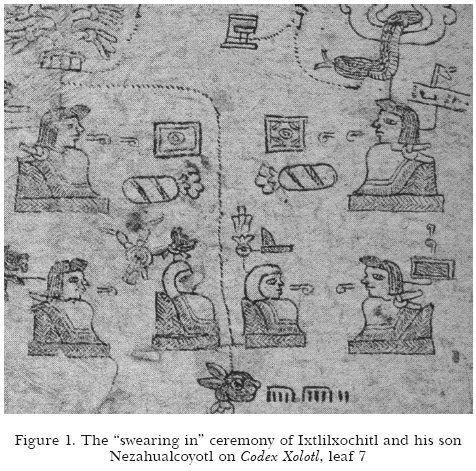
]]> The puzzle begins with a feather work device found on leaf 7 of the Codex Xolotl (X.070.C.43), although is best seen on the last leaf (X.101. H.22) (Figures 1 and 2).1 The Codex Xolotl,2 a pictorial document of immense complexity produced in the Texcocan area by the mid-sixteenth century, is the most important surviving historiographic document of the Nahua. In combination with its derivative written sources,3 it provides our best opportunity to understand the nature and methods of any school of Nahua historiography. It is also the indispensable basis for comparison with and interpretation of other Texcocan documents, pictorial or written.
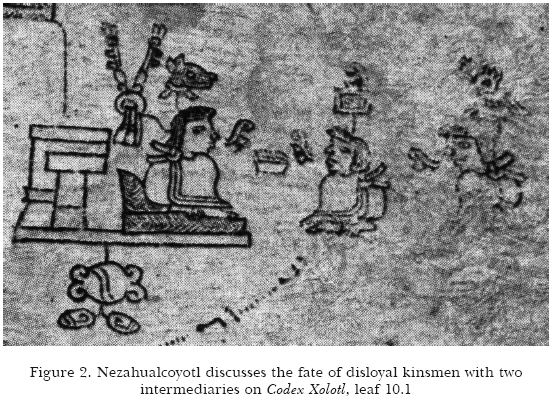
In the second instance (X.101.H.22), Nezahualcoyotl (1431-1472), triumphant but not yet ruler of Texcoco, discusses the fate of two of his disloyal kinsmen and their families in apparently favorable terms with two intermediaries over octli.4 In the first occurrence, Ixtlilxochitl (1409-1418) and his son Nezahualcoyotl, deep into their initially unsuccessful struggle against the great city of Azcapotzalco, wear distinctive head cloths while engaged in a ceremony with two figures under depictions of the rulers of Huexotla and Coatlinchan in the year 12 Tochtli.5 The two rulers discuss a labor demand that Tezozomoc,6 ruler of Azcapotzalco, had placed on them requiring the weaving of cotton into mantas.
Fortunately, to aid us in understanding these scenes, we have the descriptions of Alva de Ixtlilxochitl ("Ixtlilxochitl," born c. 1568-1580, died c. 1648-1650), a descendant of these two rulers and the most reliable interpreter of the content of the Codex Xolotl 7 Ixtlilxochitl prepared five surviving histories of Texcoco, the second city of the Aztec empire and Triple Alliance. Although the Codex Xolotl and its dependent sources should have served as an important cross-check on other Nahua historical narratives, past and recent writers have often pointed out obvious local bias and inconsistencies among the versions in facile attempts to diminish the value of Ixtlilxochitl's work in support of a modern if seriously flawed and similarly biased Tenochcan historiographic hegemony. They have also tended to regard Torquemada's work as more authoritative in spite of its demonstrable errors.8 At the same time, they have largely ignored the underlying pictorial content of the Codex Xolotl, its indigenous historiographic methodology, and Ixtlilxochitl's and Torquemada's dynamic relationship to them. Taken together, the pictorial content and the differences among the five versions of Ixtlilxochitl, along with Torquemada, illuminate the full accomplishment of Ixtlilxochitl as an expert bilingual ethnographer struggling to reconstruct a cultural context shattered several generations before. They also highlight shortcomings from Ixtlilxochitl's through current times in our understanding of the content of the underlying Codex Xolotl.
Of the scene in Figure 2, Ixtlilxochitl and Torquemada tell us nothing directly concerning the feather work device. We learn however from them as well as many other sources that Nezahualcoyotl was the person with rights to the rulership of Texcoco who did become the ruler of Texcoco passing on his rulership to his son Nezahualpilli (1472-1515). Nezahualcoyotl is depicted seated on an icpalli but continues to be designated by the feather work device, indicating he is still successor and not yet ruler. Dibble 9 reports that this scene took place in 1429, eleven years after the date of death of two other figures depicted nearby.
With regard to the scene in Figure 1, Torquemada10 tells us only: "fue jurado [...] Jxtlilxuchitl, por Emperador: la cual Jura se hiço en la Ciudad de Huexotla, donde le juraron los Reies de alli, llamado Millato, y el de Cohuatlychan, llamado Omicxipan, y Totomintzin, Rei; y otros dos Principes, llamados, Quexilpicatzin; y el otro, Tuçan: [...]"
In contrast, Ixtlilxochitl provides us with three separate reports and interpretations. From the Sumaria relación de la cosas de la Nueva España,11 we learn:
]]>en el año siguiente de ce tochtli que fue a la nuestra 1370, viendo los señores vasallos de Ixtlilxúchitl que era ya tiempo de jurarlo por señor monarca de la tierra, que tan de derecho le venía, aunque casi toda la tierra estaba rebelada y tiránicamente alzada, acordaron de jurarlo, y así se hizo en Huexutla la solemnidad del juramento, hallándose personalmente no más de dos señores sus vasallos y otros dos sacerdotes para este efecto, de sus falsos dioses, para los ritos y ceremonias, que se requerían, que fue Paintzin de Cohuatlychan, Tlalnahuacatzin, gran sacerdote de este mismo lugar, y Tlacotzin de Huexutla, y Tazatzin, asimismo gran sacerdote. Juraron por monarca a Ixtlilxúchitl de toda la tierra, y a su hijo Nezahualcóyotl por príncipe heredero. Los ritos y ceremonias de la jura adelante se dirá donde fuere su lugar, porque este señor fue el primero que se hizo jurar conforme al orden de los tultecas y aculhuas mexicanos.
The Compendio histórico del reino de Texcoco12 tells us:
En el año de matlactli omome toxtli, conejo, número doce [...] fue cuando se mandó jurar el rey Ixtlilxóchitl por chichimécatl tecuhtli, y a su hijo, que era entonces muy niño, por príncipe y, legítimo sucesor del imperio, en Huexutla. Halláronse en esta jura hasta cuatro señores, que fueron Tlacotzin señor del propio Huexutla, uno de los grandes del reino y el más principal, y Paintzin de Cohuatlychan, y Tozantzin que tenían un hijo llamado Zihuacnahuacatzin, hombre muy valeroso, que le hizo el rey Ixtlilxóchitl general de todo el ejército de los aculhuas [...]
Ixtlilxochitl's last known work, the Historia de la nacion chichimeca13 describes the scene in this way:
El año siguiente de 1414 [...] que llaman matlactliomey tochtli, hizo cortes y junta Ixtlilxóchitl de los señores y capitanes que eran de su parcialidad, para tratar en ellas del orden que se había de tener en sujetar al rey de Azcaputzalco y a todos sus aliados que pretendían alzarse con el imperio; los cuales salieron de acuerdo que ante todas cosas convenía jurar a Nezahualcoyotzin por príncipe heredero del imperio [...] y Nezahualcoyotzin fue jurado de edad de doce años.
Dibble, demonstrating his initial deep as well as developing knowledge of the Codex Xolotl draws out three important threads from these two scenes: (1) the relationship of the scenes to the Chichimec ancestry of Nezahualcoyotl;14 (2) the involvement of priests and ritual in the "swearing" ceremony;15 and (3) the relationship of the feather work device with the concept of "legitimate successor."16
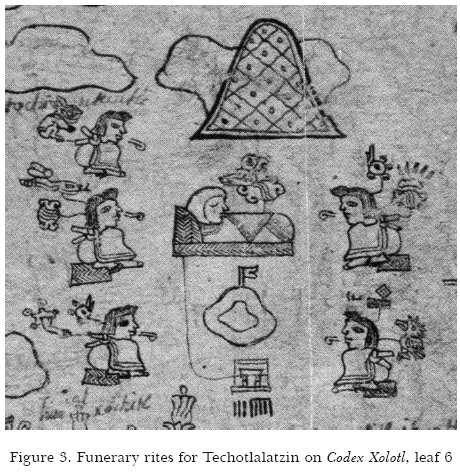
Dibble 17 makes two other important observations. First, he points out that two of the five people shown attending the funeral of Techotlalatzin (c. 1357-1409), father of Ixtlilxochitl on leaf 6 of the Codex Xolotl (X.060.B) (Figure 3) reappear in Codex Xolotl X.101. F (Figure 4). On leaf 6, a figure with a tetl-like glyph is shown as the holder of the title tziuhcoatl 18 and reappears related to a cuicacalli tepan (X.101.F.11) as a body prepared for funerary rites (a tlaquimilolli, or death bundle) on leaf 10 (Figure 4). On leaf 6, a Huitzilihuitzin appears with the toponym or ethnic glyph for a place called Tetlanexco (X.101.F.14). He also reappears on leaf 10 associated with a tlacochcalco. Second, Dibble does not fail to notice that on leaf 10.1 the dead tziuhcoatl title holder, his successor Coxcoxtzin and Huitzilitzin, all wear a head cloth similar to the one worn by Ixtlilxochitl and his son Nezahualcoyotl during the "swearing in" on leaf 7. It is also noteworthy that the head cloth is quite similar to that of many tlaquimilolli throughout the Codex Xolotl. One association of the head cloth therefore is with people undergoing a change of status, whether from life to death or upon the assumption of an office.19
]]>
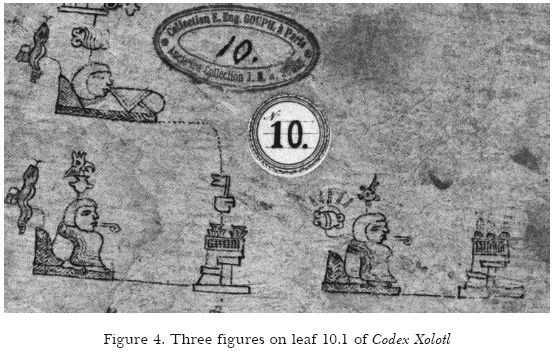
Codex Xolotl leaf 10.1 seems to be telling us that upon the death of the tziuhcoatl who held an important position related to the cuicacalli tepan and who attended Techotlalatzin's funeral, Coxcoxtzin succeeded him, probably with the authorization of the legitimate successor, Nezahualcoyotl. At the same time in the same way, Huitzilihuitzin was also given an important position related to the tlacochcalli. Indeed, Ixtlilxochitl20 refers to him in an imprecise intepretation as "asistente del consejo de guerra."
The Map of Metlatoyuca
The Map of Metlatoyuca, another mid-sixteenth century indigenous production that depicts an area near modern Metlatoyuca, Puebla21 produces the next piece in the puzzle. An unknown ruler is shown in a discussion with an important figure from a town with a glyph resembling a tlachco (ballcourt) (Figure 5). The figure wears a head cloth similar to those of Ixtlilxochitl and his son in leaf 7 of the Codex Xolotl that is unique in this document; in addition, his face is darkened. The figure's son (or at least the next person on his tlacamecayotl)22 has the feather work device found in the Codex Xolotl for his name glyph. It is not found elsewhere in the Map although there are several other name glyphs that seem to be markers of political status to which sons succeed fathers. The figure's son also has a distinctive hairstyle unique in the document to go along with an ear ornament worn by the next six people on the tlacamecayotl. The ruler later goes to talk to the leaders of two small groups to the right. The first member of each tlacamecayotl has the same distinctive ear ornament; it does not otherwise appear in the document.
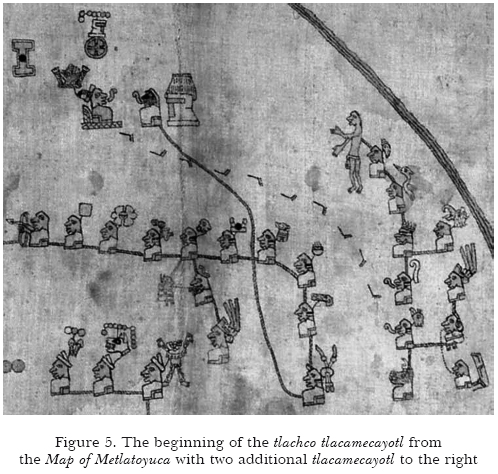
Two of Dibble's observations can be brought into play in comparing this scene with the scene on page 7 of the Codex Xolotl (Figure 1). First, the feather work device serving as the name glyph of the second person on the tlacamecayotl very likely marks that person as the legitmate successor of the first figure. Second, the similar head cloths of Ixtlilxochitl, Nezahualcoyotl and the first figure on the tlacamecayotl are noteworthy. As mentioned, this head cloth is found in the Codex Xolotl on the bodies of dead rulers and people undergoing status changes. Recently, Guilhem Olivier23 has analyzed the coronation rituals of the Nahua and found that the rulers-to-be went through a death-like state as they changed ritual status from not-ruler to ruler. On leaf 7 of the Codex Xolotl, Ixtlilxochitl and his son are depicted at one stage of such a liminal state as they are "sworn in" as ruler and legitimate successor to, probably, the tlatocayotl or rulership of Texcoco. Patrick Lesbre24 has commented recently on the scant appearance of indigenous religious references in the Texcocan pictorial manuscripts; here we can see two more examples peeking out.25 The black face of the figure in the Metlatoyuca is more problematic. It is suggestive of priestly status but could also or instead be a marker of ritual transitional status.
]]> This joint investiture of father and son is not elsewhere mentioned among the Nahua. The succession practice of the Texcocans for rulers was strongly father to son; this contrasts with the mixed fraternal/son succession evident at Tenochtitlan.26 Yet, we seem to see a joint investiture of a father and his son by a local ruler in the Map of Metlatoyuca. Muñoz Camargo27 mentions relationships of certain groups of people in the eastern Basin of Mexico and in eastern Mexico, especially the Chichimeca forced from Poyauhtlan near Coatlinchan. A similarity in investiture rights in the Codex Xolotl and the Mapa de Metlatoyuca should not then be unexpected, although it is remarkable that it has survived in this way.Over the years, I have learned to recognize the Codex Xolotl as the foundation of the analysis of its dependent written sources: the five iterations of Ixtlilxochitl, the less reliable work of Torquemada and the error-prone (insofar as it relates to the Codex Xolotl) Anónimo mexicano . In the same obvious manner as the locallybiased Tenochan sources, Ixtlilxochitl and often Torquemada exhibit Texcocan bias in reporting the details of Texocan history shown more dispassionately in the Codex Xolotl. The "swearing in" scene on page 7 of the Codex Xolotl (Figure 1) does not definitively show whether Ixtlilxochitl and his son are being sworn as rulers of Texcoco and leaders of a Triple Alliance of merely
Coatlinchan, Huexotla and Texcoco, as well as other towns, or whether they are being installed as rulers of Texcoco as a city of equal or lesser status than Coatlinchan and Huexotla. There are also the hints discussed in footnote 20 that the head cloth could be associated with a supplicant role. It is not entirely clear that the rulers of Huexotla and Coatlinchan are involved in the ritual at all; they are shown discussing the labor demand for mantas from cotton and no speech scrolls point directly from the rulers to Ixtlilxochitl and his son; Ixtlilxochitl is shown only in conversation with two figures who do not have the head cloth in this instance. These four figures are in turn bracketed by four others. To the right are the rulers of Coatepec and Iztapalocan while to the right are two figures, including Ixtlilxochitl depicted again, with another figure from Texcoco. It is clear the four figures are discussing war and the cotton service demand. A small icpalli is in front of the ritually attired Ixtlilxochitl as a topic of conversation but we cannot determine definitively whether the rights to the tlatocayotl of Texcoco are intended by the scribe or if it refers to the title of chichimeca tecuhtli or emperor of the entire land as discussed in Ixtlilxochitl and Torquemada.28 Perhaps the fact that Ixtlilxochitl is seated on an icpalli in both instances in this scene argues for the higher rank, but all the figures are also seated on icpalli, including those called priests by Ixtlilxochitl. And so it typically goes whenever one tries to decontextualize bits of the very complicated Codex Xolotl.
These sorts of determinations will require a thorough historiographic analysis of the Codex Xolotl and its dependent sources, the execution of which, although begun a few years ago, may well exceed my lifetime. These matters do not require facile distortions and empty condemnations by Tenochcan-centric partisans who are not adequately informed regarding the Texcocan sources, particularly the Codex Xolotl.
We therefore cannot be certain that the investiture ceremony in the Codex Xolotl is, with regard to Ixtlilxochitl the ruler, for the tlatocayotl of Texcoco and/or the title of chichimeca tecuhtli, nor do we know the exact content of the bundle of rights and duties that went with such installations or with the status of legitimate successor. Did the rite confer rights in the tlatocamilli and/or also in tecpillali and pillalli and yaotlalli, etc.? Did it instead or additionally confer rights to tequitl or labor service? And, certainly, were such legal and political concepts and associated rights and duties even comparable in Texcoco and in the Metlatoyuca area?29
The Codex of Xicotepec
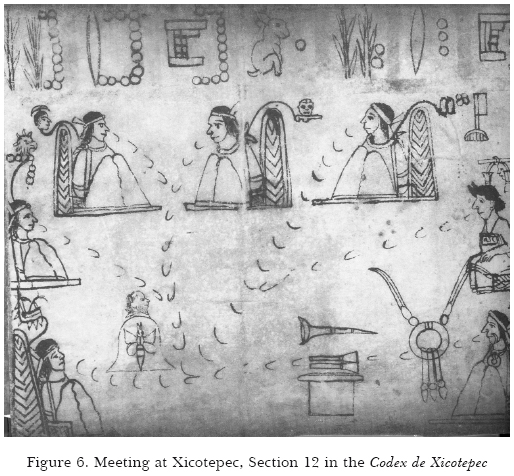
These findings regarding the the feather work device in the Codex Xolotl and the Map of Metlatoyuca illuminate an additional occurrence of the device in the Códice de Xicotepec, another mid-sixteenth century indigenous pictorial from nearby Xicotepec (and Cuauhchinanco). In turn, the Xicotepec appearance throws some complementary light on the occurrences in the other two pictorial documents. The feather work device appears in Section 12 of the Códice de Xicotepec as an article of discussion among a group of seven people (Figure 6). Five are seated on icpalli. One of these, on the lower left with the cipactli glyph, is the ruler of Xicotepec.
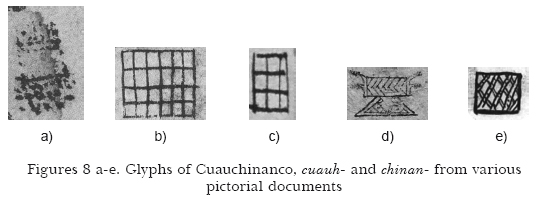
In Section 10, the important position of first captive-taker of the enemy Huastec leader does not go to the Xicotepec founder or his son, but instead to 7 Tecpatl, followed by his older and younger sons. The founder of Xicotepec and his son occupy the fourth and fifth positions while an anonymous warrior fills out the required sixth position.34 This very curious fact spurred research into the identity of 7 Tecpatl and his descendants and the place they represent which is alway painted higher on the page than Xicotepec. It is not until Sections 17, 19, 21 and 23 that a set of similar glyphs appear that facilitate the identification. The earlier glpyhs look like a bundle or sheet of bound sticks (Figure 8a) while the later glyphs more resemble a monochrome checkerboard (Figure 8b). In the same meeting in Marseille in 2008 mentioned above, I offered that I had found a single catalogued glyph that resembled these glyphs (Matricula de Huexotzinco: Almoyahuacan 387_713v_23) with a reading of cuauh- (Figure 8c) and proposed that the glyphs indicated cuauhchinanco, the great guardian city of the steep terrain between Tollantzinco and Xicotepec. I pointed out the second glyph of cuauhchinanco (X.050.A.12) in the Codex Xolotl in support of this hypothesis (Figure 8d). while not disagreeing with the idea, Thouvenot and de Pury instead pursued a stronger similarity to chinamitl (e.g. 387_503r_22, Figure 8e) so that the hypothesis that the second town, 7 Tecpatl's town, was in fact Cuauhchinanco grew stronger (Thouvenot had actually already included chinan as an value in the reading of the Cuauhchinanco glyph mentioned above). And Stresser-Pean35 had proposed Cuauhchinanco as the enclosure shown in Section 13.
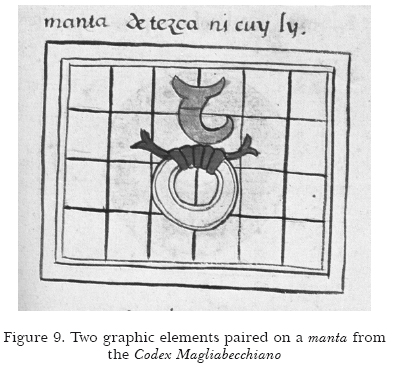
If we now return to Section 12 (Figure 6), the feather work device appears in front of a man and a woman seated on small reed boxes indicating a lower rank. The woman's actions in this section and in Sections14 and 15 indicate she is of high status, probably in the role of a wife in a marriage alliance from a local ruler to the seated man.36 To the left of the feather work device are what appear to be an agave spine, two small objects and a container. The latter three items may be for serving octli or cacao as part of a ritual, although Olko and Olivier have in personal communications respectively suggested for all four objects autosacrifical equipment or a flute and drum with two drum sticks as possible interpretations. The man wears a tezacanecuilli lip plug characteristic of the Huexotzinco area (see another example in Codex Xolotl X.101.L.03) and the circular shell ornament or anahuatl, not to be confused with the feather work device (see the Codex Magliabecchiano, page 6r [Figure 9] for the pairing of these two graphic elements). Four similar figures are shown in the next section (Section 13) having tribute or more likely tequitl-type (domestic support and service) obligations imposed upon them by a calpixque at a location proposed as Zautla, Puebla (Tzauctlan) by Frances Berdan, while what are very likely the rulers of Cuauhchinanco and Xicotepec converse at Cuauhchinanco.37 Zautla was of strategic and trade interest because of an adhesive from a local terrestrial orchid.38
The man of inferior rank in Section 12 is later depicted in Section 14 giving tequitl items to the ruler of Xicotepec, while there are indications that Zautla has come under attack and the local rulers are on a war footing. In Section 15, the ruler of Xicotepec honors his obligations to them by providing them with weapons. The meaning of the feather work device in this context seems to be that the ruler of Xicotepec is entitled, with the permission of the ruler of Cuauhchinanco, to tequitl service by people who are given some dominion over Zautla and are expected to defend it. In turn, Xicotepec is to supply them with weapons. As to the methods and proportions of the entry of the adhesive into the market and tribute systems and the proportionate return to the various levels of political and commercial organization, beyond a few scant facts expertly gathered by Berdan, we can only wonder.39
]]> The Codex of Xicotepec is in many ways therefore the "Codex of Cuauhchinanco and Xicotepec." What becomes apparent in the later sections of the Códice de Xicotepec is that the ruler of Cuauhchinanco is shown in the upper part of many pages with the ruler of Xicotepec in an inferior position below. Nezahualcoyotl establishes or perhaps re-establishes a martial alliance with the ruler of Cuauhchinanco, but the ruler apparently dies by Section 17 and the ruler of Tenochtitlan, Ahuitzotl (1486-1502) instead establishes a marital alliance. The ruler of Texcoco maintains a marital alliance with Xicotepec from Section 16 or 18 forward.Section 12 of the the Códice de Xicotepec then echoes the Map of Metlatoyuca, Codex Xolotl and the hint that Ixtlilxochitl and Nezahualcoyotl are "sworn in" as rulers of lesser or perhaps only equal rank. In addition, it suggests that the ruler in the Map of Metatloyuca goes to speak with the two minor tlacamecayotl to the right of the person with the glyph of the feather work device to assign them tequitl or other tribute obligations to the person with the feather work device glyph and perhaps all of his successors.
Additional Occurrences
What might have been the name of the featherwork device? Our puzzle concludes with the appearance of very similar devices depicted in Sahagún's Primeros memoriales from the town of Tepeapulco in the Texcocan realm (and later in the Florentine Codex) along with the Códice de Tepetlaoztoc (Figure 10).40 The Primeros memoriales, in which it is connected to the side of the head of the first three rulers of Tenochtitlan and the first eight rulers of Huexotla, glosses it as "ycoçoyaualol" (with small variants) which Sullivan et al.41 translate as "his circular fan device of yellow parrot feathers." The first four rulers of Texcoco also wear the device on the side of their head, concluding with a modified form for Nezahualcoyotl who also wears a xihuitzolli; in his case, the xihuitzolli is glossed (as ixiuhtzon) but not the cozoyahualolli.
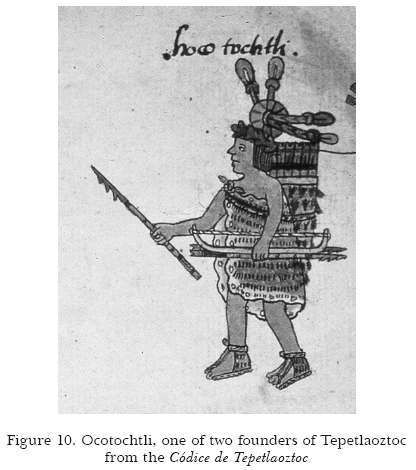
In the Códice de Tepetlaoztoc, the device is also worn on the side of the head by five individuals, including two town founders (f.3 lám. B)(Figure 10 shows one town founder, Ocotochtli). The device is associated with a ruler rather than a successor and there is no hint of the meaning of "legitimate successor" in any of these contexts; instead it seems to indicate Chichimec status. In the Primeros memoriales, the device is replaced by the xihuitzolli but not in the Códice de Tepetlaoztoc where the ruler is evidently of lower rank.
It is especially noteworthy that in the core Texcocan pictorial sources the xihuitzolli is virtually absent from depictions of Texcocan rulers while the icpalli itself often serves instead as a sort of shorthand for tlatoani status. Other than as part of the name glyph for Moteuczoma Xocoyotl, the xihuitzolli is absent from the Códice de Xicotepec, even for the Tenochcan rulers depicted in the codex. In contrast, it is present in several forms in the Map of Metlatoyuca but only as an office marker for sons of the principal ruler and some lower-ranking officals.
]]> Conclusion
We can at best perceive Nahua society only through the narrow apertures allowed us by the chance survival of a very limited number of documents produced in different contexts for different reasons by a rapidly changing colonial society of unequals. In this iconographic study, rather than piling on all known associations, I have tried to pare down each perception to its strongest features by pointing out what we do not know about entire areas of Nahua culture and life. The various apertures that permit viewing the feather work device neither align nor conjoin but perhaps provide a broader combined picture before its boundaries become too indistinct.
The remembrance of political rights to office, labor, tributes and property is both commonplace and vital in colonial situations with rapidly changing political, economic and social systems. The inevitable ongoing mismatch between cultures adjusting to one another produces documents that provide more content than specific situations, including litigation, require. Important concerns of one culture, of little relevance to another, are thus often inadvertently exposed. That the cozoyahualolli should be so well recalled among the people of the Texocan realm has proven fortunate.
The reasons for the composition of the central documents discussed here —the Codex Xolotl, the Map of Metlatoyuca and the Codice de Xicotepec remain obscure. Although we know that the last was very likely reviewed by a Spanish official,42 none of the documents seems to have been generated for specific legal or administrative needs. Instead, they seem part of a long-standing Nahua interest in recording local history in such detail that simplistic modern notions of local bias do not suffice for their comprehension. The Codex Xolotl, for example, contains information that argues both for and against Texcocan legitimacy, no matter how it was later interepreted in the written sources. In other words, the fault in interpretation may more often lie in the later authors' inadequacies than in the indigenous scribes' historiographical skills and intent. In the same way, the Códice de Xicotepec contains clues that allow us to discover Xicotepec's position subordinate to Cuauhchinanco which then becomes in retrospect obvious. The longstanding, continued and repeated creation of these documents seems to have been a response to a political process among individual political units and alliances of constantly shifting power.
Through them, claims and rights within a changing political landscape could be recorded, resurrected, reinterpreted or renegotiated. Authoritative painted histories were undoubtedly important tools in the political process and survival of political units, large and small. This pre-Conquest practice continued to prove its utility as the latest series of masters arrived in the sixteenth century with their simple, linear text writing with its own historiographic advantages and limitations.
Certainly, the themes in these documents represent the preoccupations of the political elite that produced them—genealogies, titles, wars, alliances, political and economic geography, histories of claims to rights to tribute, labor and property, along with narratives of migration and founding, but these standard concerns bring along with them additional and sometimes unique cultural and historical information. As a result, along the way to studying and understanding aspects of the meaning of the feather work device, we uncovered the ritual and political implications of a certain head cloth among these people, although we can reconstruct only some fraction of its significance. We were for the most part reassured about the importance of father-son succession among certain Texcocan area groups and we worked out additional bits of the meaning of a scene on leaf 10.1 of the Codex Xolotl regarding the succession of two figures to office. The primacy of the pictorial Codex Xolotl over its dependent written sources became more obvious. Finally, we gathered enough evidence to set in motion elements of an obscure narrative within the Map of Metlatoyuca and we improved our understanding of several parts of the difficult Códice de Xicotepec.
As we develop a greater appreciation of the fragmentary nature of the surviving documents and the limits they set on our understanding, the over-reaching intrusiveness and explanatory failure of so many theories applied to the Nahua and their civilization in the recent past become apparent. Elaborate recruitment of indigenous data and their recategorization into Western ideological schemes continues to be little more than reckless and feckless. Substantive work, especially as pursued by the Stresser-Péans, Thouvenot, de Pury, Lesbre, Olivier and Valle is the better method for understanding this culture and in its own terms. As for this essay, it is as if we have removed a small tree or bush that was blocking a distant view of some fragments of architecture and weathered sculpture. It is not much, but it is something.
BIBLIOGRAPHY
Anónimo mexicano, edited and translated by Richley Crapo and Bonnie Glass, Coffin, Logan, Utah, Utah State University Press, 2005. [ Links ]
BERDAN, Frances. "Reconstructing Ancient Aztec Super Glue", n. d. [ Links ]
BERGER, Uta, "The 'Map of Metlatoyuca'. A Mexican Manuscript in the Collection of the British Museum", The Cartographic Journal 33(1) (June, 1996), p. 39-49. [ Links ]
BROTHERSTON, Gordon, Painted Books from Mexico, London, British Museum Press, 1995. [ Links ]
DIBBLE, Charles, Códice Xolotl, Mexico, Universidad Nacional Autónoma de Mexico/University of Utah, 1951. [ Links ]
----------, "Apuntes sobre la Plancha X del Códice Xolotl", Estudios de Cultura Náhuatl, 5 (1965), p. 103-106. [ Links ]
Floretine Codex: General History of the Things of New Spain, edited by fray Bernardino de Sahagún, later edited and translated by Charles E. Dibble and Arthur J. O. Anderson, Santa Fe, NM and Salt Lake City, School of American Research and the University of Utah Press, 1950-1982. [ Links ]
IXTLILXÓCHITL, Fernando de Alva, Obras históricas, edited by Edmundo O'Gorman, Mexico, Universidad Nacional Autónoma de Mexico, Instituto de Investigaciones Históricas, 1975. [ Links ]
LESBRE, Patrick, Review of El Códice de Xicotepec. LHomme, 37(144) (1997), p. 202-204. [ Links ]
----------, "Los fuegos del palacio real de Tezcoco", Estudios de Cultura Náhuatl, 38 (2005), p.101-127. [ Links ]
MUÑOZ CAMARGO, Diego, Descripción de la ciudad y provincia de Tlaxcala de las indias y del mar oceano para el buen gobierno y ennoblecimiento dellas. Mexico, Universidad Nacional Autonoma de México, 1981. [ Links ]
----------, Historia de Tlaxcala (Ms. 210 de la Biblioteca Nacional de París), edited by Luis Reyes García and Javier Lira Toledo, Gobierno del Estado Tlaxcala/Centro de Investigaciones y Estudios Superiores en Antropología Social/Universidad Autónoma de Tlaxcala, 1998. [ Links ]
OFFNER, Jerome A., "A Reassessment of the Structuring and Extent of the Empire of Techotlalatzin, Fourteenth Century Ruler of Texcoco", Ethnohistory, 26(3) (1979), p. 231-241. [ Links ]
-----------, "Aztec Political Numerology and Human Sacrifice: the Ideological Ramifications of the Number Six", Journal of Latin American Lore, 6 (2) (1980), p. 205- 215. [ Links ]
----------, Law and Politics in Aztec Texcoco, London and New York, Cambridge University Press, 1983. [ Links ]
OLIVIER, Guilhem, "The Sacred Bundles and the Coronation of the Aztec King", in Sacred Bundles: Ritual Acts of Wrapping and Binding in Mesoamerica, edited by Julia Guernsey and F. Kent Reilly III, 199-225, Barnardsville, North Carolina, Boundary End Archaeology Research Center, 2006. [ Links ]
Primeros memorials, edited by fray Bernardino de Sahagún, paleography of Nahuatl text and English translation by Thelma D. Sullivan, completed and revised with additions by H. B. Nicholson et al., Norman, University of Oklahoma Press, 1996. [ Links ]
SMITH, Michael E. and Frances F. Berdan, editors. The Postclassic Mesoamerican World, Salt Lake City, University of Utah Press, 2003. [ Links ]
STRESSER-PÉAN, Guy, El Códice de Xicotepec. Estudio e interpretación, México, Gobierno del Estado de Puebla/Centro Francés de Estudios Mexicanos y Centroamericanos/Fondo de Cultura Económica, 1995. [ Links ]
----------, Los Lienzos de Acaxochitlán (Hidalgo) y su importancia en la historia del poblamiento de la Sierra Norte de Puebla y zonas vecinas, Mexico, Gobierno del Estado de Hidalgo, Instituto Hidalguense de Educación Media Superior y Superior/Consejo Estatal para la Cultura y las Artes de Hidalgo/Centre Français d'Études Mexicaines et Centraméricaines, 1998. [ Links ]
THOUVENOT, Marc et al., Pohua/Tlachia, Temoa, Chachalaca, G.D.N. CEN, five executable programs available for free download at http://www.sup-infor.com [ Links ]
TORQUEMADA, fray Juan de, Monarquía indiana, Mexico, Porrúa, 1969 [facsimile of 1723 ed., Madrid] [ Links ].
VALLE P., Perla, Códice de Tepetlaóztoc (Códice Kingsborough) Estado de Mexico, Toluca, El Colegio Mexiquense (2 v.), 1994. [ Links ]
1 The indispensable modern reference system of Marc Thouvenot is used here. The work of his team of researchers can be consulted at www.sup-infor.com/navigation.htm where the most useful program for iconographic investigation has proven to be GEN, which incorporates and integrates Chachalaca, G.D.N., Temoa and Pohua/Tlachia. The continued failure by many in the field to master this work and use it for reference and description impedes progress. The current reference is to Codex Xolotl, leaf 10, subpart 1 (the part to the right of the leaf separated by a double line), zone H, object 22.
2 Dibble, Códice Xolotl.
3 Torquemada, Monarquía indiana; Ixtlilxóchitl, Obras históricas; Anónimo mexicano.
4 Dibble, "Apuntes sobre la Plancha X del Códice Xolotl".
]]> 5 Dibble, Códice Xolotl, 92 points out that the year 13 Tochtli (meaning 1414) must have been intended by the scribe.6 Died 13 Acatl or 1427 according to leaf 8 of the Codex Xolotl (X.080.E.07)
7 Offner, "A Reassessment of the Structuring and Extent of the Empire of Techotlalatzin, Fourteenth Century Ruler of Texcoco."
8 Offner, "A Reassessment of the Structuring and Extent of the Empire of Techotlalatzin, Fourteenth Century Ruler of Texcoco."
9 Dibble, "Apuntes sobre la Plancha X del Códice Xolotl."
10 Torquemada, Monarquía indiana, I, 109.
11 Ixtlilxochitl, Obras Históricas I, 332. There is no evidence in the Codex Xolotl or in any other source that Tazatzin had priestly status.
12 Ixtlilxóchitl, Obras históricas, I, 435-436.
13 Ixtlilxóchitl, Obras históricas, II, 41.
14 Dibble, "Apuntes sobre la Plancha X del Códice Xolotl," 105.
]]> 15 Dibble, Códice Xolotl, 92; "Apuntes sobre la Plancha X del Códice Xolotl," 104.16 Dibble, Códice Xolotl, 92.
17 Dibble, "Apuntes sobre la Plancha X del Códice Xolotl," 104.
18 Not to be confused with the title of cihuacoatl; this is the preferred reading of Thouvenot instead of Dibble's xiuh-. See the Thouvenot's text relating to Theme 05.06.42, Element ornement_04 in Tlachia for Codex Xolotl.
19 There are three other occurrences of the head cloth in the Codex Xolotl. Two seem to involve the priestly status of the figure depicted: "el gran sacerdote de Cholula llamado Iztamantzin" (X.040.H.22) with a tear on his face seeking aid according to Ixtlilxochitl (Obras históricas, I, 314); and a tziuhcoatl title holder drawn under Coatlinchan with the name Tlalnahuacatzin mentioned above in Ixtlilxochitl (Obras históricas, I, 332) as involved in the swearing in ceremony (X.050.G.13). The third is the most interesting because the head cloth is worn by the Tenochcan ruler Chimalpopoca (X.080.J.04) as he is being arrested and jailed prior to being executed on the order of Maxtla, the son and successor of Tezozomoc of Azcapotzalco (according to the Texcocan version of these uncertain events). The written sources do not speak of a priestly status in this context but the Codex Xolotl shows Chimalpopoca dressed as Huitzilopochtli to the right (X.080.J.06) apparently engaged in an arrow sacrifice of an Acamapichtli. We cannot therefore be certain whether Chimalpopoca was still in a ritual status and dress after this ceremony, making the Tepanec seizure even more inappropriate, or if the head cloth means that he is already condemned and is therefore as if dead. All similarly attired individuals in the Codex Xolotl are seeking help, or involved in changing status, either to office or from life to death with the exception of Tlalnahuacatzin (X.050. G.13). He may also be in a supplicant role or perhaps newly installed in the priestly office of tziuhcoatl but this is not apparent from the pictorial content and the written sources provide no further information on his appearance.
20 Obras históricas, I, 371.
21 Berger, "The 'Map of Metlatoyuca'—A Mexican Manuscript in the Collection of the British Museum"; Brotherston, Painted Books from Mexico, 19-20, 91-96, 181.
22 The tlacamecayotl ("human cordage") indigenous genealogical concept is discussed in Offner, Law and Politics in Aztec Texcoco, 197-201. It resembles more an ego-centered personal kindred than a lineage or descent group, but its use in many post-Conquest pictorial documents emphasizes its simple lineal aspect due to contextual needs. The indigenous description of the tlacamecayotl in Book X of the Florentine Codex shows it to be ego-centered, bi-lateral and inclusive of both lineal and collateral kin; it very likely also included affinals and stepkin. It was, in short, an idiom and device to find and recruit resources and support using one's kinship ties. As an indigenous concept, there is no reason that it should fit neatly into one or another social anthropological analytical category.
23 Olivier, "The Sacred Bundles and the Coronation of the Aztec King", 212-213.
24 Lesbre, "Los fuegos del palacio real de Tezcoco", 122.
]]> 25 Nevertheless, the secular historical nature of the surviving pictorial manuscripts remains one of their most distinctive characteristics for reasons that have yet to be elucidated. Was fear of inquisitorial process or selection by the historically oriented writer Ixtlilxochitl involved? Perhaps written histories were of greater importance to less powerful political units in pre-Conquest times, as a means to record, defend, negotiate and resurrect rights to various resources and properties. The Nahua were certainly aware that hegemonic powers came and went frequently.26 Offner, Law and Politics in Aztec Texcoco, 201-213.
27 Historia de Tlaxcala (Ms. 210 de la Biblioteca Nacional de París), 83, para 47; 86-87, para 54-55; 123, para 133; Cf. Descripción de la ciudad y provincia de Tlaxcala de las Indias y del Mar Oceano para el buen gobierno y ennoblecimiento dellas, 73r-73v.
28 Monarquía indiana, I, 112.
29 See Offner, Law and Politics in Aztec Texcoco, 124-39. Understanding of the Nahua legal rules of land tenure reported in the sources —the pre-Conquest case law seemingly forever lost— remains seriously deficient; we know only a small portion of the actual land law as it operated day to day on the ground in various areas. Nevertheless, various great and small ideologies of the past century or two have pretended that this scant knowledge supports their particular interpretations of history and social evolution and process. The recent boom in colonial archival studies has only enriched the Nahua land tenure lexicon and highlighted its regional diversity, further vitiating any attempts to recruit Nahua land tenure in support of ideologically driven formulations of ancient societies.
30 I traveled to Mexico City in February 2005 to discuss some preliminary findings of this nature with Guy and Claude Stresser-Péan. Their first objective is to further research into the document whether or not it supports any of their published findings and conclusions and my comments are offered in this same spirit. They wished to emphasize that the Codex de Xicotepec is an historical pictorial document—which it certainly is—and they wished to point out that their sudden and brief encounter with the Codex, late in life, presented them with a welcome but severe disruption of their publication schedule and with interpretation problems outside of their areas of specialization. In spite of these difficulties, their publication of the codex is of the highest quality and extremely well designed for encouraging further research into it.
31 "Review of El Códice de Xicotepec", 204.
32 El Códice de Xicotepec: estudio e interpretación, 32.
33 See Stresser-Péan, Los Lienzos de Acaxochitlán (Hidalgo) y su importancia en la historia del poblamiento de la sierra norte de Puebla y zonas vecinas, 59-68 for a productive treatment of some of these reports for Eastern Mexico. The earlier pages of the Codex de Xicotepec record a standard mythical exit of seven leaders from Chicomoztoc or (perhaps a more historical exit from Tlapallan)(Section 1), along with an assembly of twenty and ten groups (Sections 2 and 3) that then carry out a migration that is commemorated by priests later in a sacred pilgrimage landscape in the ensuing sections (2 through 8) up until the town founding in Section 10. See Ixtlilxóchitl, Obras históricas, I, 265-268 and Torquemada, Monarquía indiana, 1969, I, 278-281 for similarities. I hope to publish a study of these findings as time allows.
34 See Offner, "Aztec Political Numerology and Human Sacrifice: the Ideological Ramifications of the Number Six", for the necessity of six captors.
]]> 35 El Códice de Xicotepec: estudio e interpretación, 107-08.36 The Texcocan wives of the Xicotepec rulers shown in Sections 19, 21, 23 are also articulate and assertive with similar emphatic hand gestures.
37 Stresser-Péan, El Códice de Xicotepec: estudio e interpretación, 107-08.
38 Berdan, "Reconstructing Ancient Aztec Super Glue."
39 Smith's and Berdan's (2003) commendable interest in world systems analysis, with its greater demands for data than the old-fashioned social evolutionary ideologies, serves to point out the scant and inadequate nature of the surviving data on the pre-Conquest Nahua.
40 Valle P., Códice de Tepetlaoztoc (Códice Kingsborough) Estado de Mexico.
41 Primeros memoriales, 192-196.
42 Stresser-Péan, El Códice de Xicotepec: estudio e interpretación, 155.
]]>