<?xml version="1.0" encoding="ISO-8859-1"?><article xmlns:mml="http://www.w3.org/1998/Math/MathML" xmlns:xlink="http://www.w3.org/1999/xlink" xmlns:xsi="http://www.w3.org/2001/XMLSchema-instance">
<front>
<journal-meta>
<journal-id>0065-1737</journal-id>
<journal-title><![CDATA[Acta zoológica mexicana]]></journal-title>
<abbrev-journal-title><![CDATA[Acta Zool. Mex]]></abbrev-journal-title>
<issn>0065-1737</issn>
<publisher>
<publisher-name><![CDATA[Instituto de Ecología A.C.]]></publisher-name>
</publisher>
</journal-meta>
<article-meta>
<article-id>S0065-17372015000100026</article-id>
<title-group>
<article-title xml:lang="en"><![CDATA[First record of Sathropterus pumilus (Holmgren) (Hymenoptera: Ichneumonidae: Tersilochinae) from Mexico]]></article-title>
<article-title xml:lang="es"><![CDATA[Primer registro de Sathropterus pumilus (Holmgren) (Hymenoptera: Ichneumonidae: Tersilochinae) para México]]></article-title>
</title-group>
<contrib-group>
<contrib contrib-type="author">
<name>
<surname><![CDATA[Khalaim]]></surname>
<given-names><![CDATA[Andrey I.]]></given-names>
</name>
<xref ref-type="aff" rid="A02"/>
</contrib>
<contrib contrib-type="author">
<name>
<surname><![CDATA[Ruiz-Cancino]]></surname>
<given-names><![CDATA[Enrique]]></given-names>
</name>
<xref ref-type="aff" rid="A01"/>
</contrib>
<contrib contrib-type="author">
<name>
<surname><![CDATA[Coronado-Blanco]]></surname>
<given-names><![CDATA[Juana María]]></given-names>
</name>
<xref ref-type="aff" rid="A01"/>
</contrib>
</contrib-group>
<aff id="A01">
<institution><![CDATA[,Universidad Autónoma de Tamaulipas Facultad de Ingeniería y Ciencias ]]></institution>
<addr-line><![CDATA[Ciudad Victoria Tamaulipas]]></addr-line>
<country>México</country>
</aff>
<aff id="A02">
<institution><![CDATA[,Russian Academy of Sciences Zoological Institute ]]></institution>
<addr-line><![CDATA[Moscú ]]></addr-line>
<country>Rusia</country>
</aff>
<pub-date pub-type="pub">
<day>00</day>
<month>00</month>
<year>2015</year>
</pub-date>
<pub-date pub-type="epub">
<day>00</day>
<month>00</month>
<year>2015</year>
</pub-date>
<volume>31</volume>
<numero>1</numero>
<fpage>141</fpage>
<lpage>142</lpage>
<copyright-statement/>
<copyright-year/>
<self-uri xlink:href="http://www.scielo.org.mx/scielo.php?script=sci_arttext&amp;pid=S0065-17372015000100026&amp;lng=en&amp;nrm=iso"></self-uri><self-uri xlink:href="http://www.scielo.org.mx/scielo.php?script=sci_abstract&amp;pid=S0065-17372015000100026&amp;lng=en&amp;nrm=iso"></self-uri><self-uri xlink:href="http://www.scielo.org.mx/scielo.php?script=sci_pdf&amp;pid=S0065-17372015000100026&amp;lng=en&amp;nrm=iso"></self-uri><abstract abstract-type="short" xml:lang="es"><p><![CDATA[Los tersilochinos son avispas parasitoides poco communes en las colecciones mexicanas de la familia Ichneumonidae. Solo tres géneros y ocho especies han sido encontradas previamente en México. Se registra por primera vez a Sathropterus pumilus (Holmgren) en México de los estados de Nuevo León, San Luis Potosí y Morelos.]]></p></abstract>
</article-meta>
</front><body><![CDATA[  	    <p align="justify"><font face="verdana" size="4">Nota cient&iacute;fica</font></p>  	    <p align="justify"><font face="verdana" size="2">&nbsp;</font></p>  	    <p align="center"><font face="verdana" size="4"><b>First record of <i>Sathropterus pumilus</i> (Holmgren) (Hymenoptera: Ichneumonidae: Tersilochinae) from Mexico</b></font></p>  	    <p align="justify"><font face="verdana" size="2">&nbsp;</font></p>  	    <p align="center"><font face="verdana" size="3"><b>Primer registro de <i>Sathropterus pumilus</i> (Holmgren) (Hymenoptera: Ichneumonidae: Tersilochinae) para M&eacute;xico</b></font></p>  	    <p align="justify"><font face="verdana" size="2">&nbsp;</font></p>  	    <p align="center"><font face="verdana" size="2"><b>Andrey I. Khalaim<sup>1,</sup><sup>2</sup>, Enrique Ruiz&#45;Cancino<sup>1</sup>* &amp; Juana Mar&iacute;a Coronado&#45;Blanco<sup>1</sup></b></font></p>  	    <p align="justify"><font face="verdana" size="2">&nbsp;</font></p>  	    <p align="justify"><font face="verdana" size="2"><sup><i>1</i></sup> <i>Facultad de Ingenier&iacute;a y Ciencias, Universidad Aut&oacute;noma de Tamaulipas, Cd. Victoria 87149, M&eacute;xico.</i></font></p>  	    ]]></body>
<body><![CDATA[<p align="justify"><font face="verdana" size="2"><sup><i>2</i></sup> <i>Zoological Institute, Russian Academy of Sciences, Universitetskaya nab. 1, St. Petersburg 199034, Russia.</i> *&lt;<a href="mailto:eruiz@uat.edu.mx">eruiz@uat.edu.mx</a>&gt;</font></p>  	    <p align="justify"><font face="verdana" size="2">&nbsp;</font></p>  	    <p align="justify"><font face="verdana" size="2">Recibido: 02/06/2014;    <br> 	Aceptado: 25/09/2014.</font></p>  	    <p align="justify"><font face="verdana" size="2">&nbsp;</font></p>  	    <p align="justify"><font face="verdana" size="2"><b>RESUMEN</b></font></p>  	    <p align="justify"><font face="verdana" size="2">Los tersilochinos son avispas parasitoides poco communes en las colecciones mexicanas de la familia Ichneumonidae. Solo tres g&eacute;neros y ocho especies han sido encontradas previamente en M&eacute;xico. Se registra por primera vez a <i>Sathropterus pumilus</i> (Holmgren) en M&eacute;xico de los estados de Nuevo Le&oacute;n, San Luis Potos&iacute; y Morelos.</font></p>  	    <p align="justify"><font face="verdana" size="2">&nbsp;</font></p>  	    <p align="justify"><font face="verdana" size="2">The subfamily Tersilochinae is worldwide and comprises about 450 species distributed in 24 genera. In Mexico only three genera have been registered hitherto: <i>Allophrys</i> F&ouml;rster with one species, <i>A. divaricata</i> Horstmann (Horstmann 2010, Gonz&aacute;lez&#45;Moreno &amp; Bordera 2012); <i>Barycnemis</i> F&ouml;rster with two species, <i>B. tamaulipeca</i> Khalaim and <i>B. tlaxcala</i> Khalaim (Khalaim 2002), and <i>Stethantyx</i> Townes with five species, <i>S. alajuela</i> Khalaim &amp; Broad, <i>S. heredia</i> Khalaim &amp; Broad, <i>S. mexicana</i> Khalaim &amp; Ruiz&#45;Cancino, <i>S. osa</i> Khalaim &amp; Broad, and <i>S. sanjosea</i> Khalaim &amp; Broad (Khalaim &amp; Ruiz&#45;Cancino 2013). <i>Allophrys divaricata</i> is the only tersilochine species that was relatively frequently collected in Mexican forests, while members of other tersilochine genera are rather rarely collected in Mexico. In this paper, we report <i>Sathropterus pumilus</i> (Holmgren) from the Mexican states of Nuevo Leon, San Luis Potosi and Morelos in Northeastern and Central Mexico. This is the first record of the genus and species from Mexico.</font></p>  	    <p align="justify"><font face="verdana" size="2">Two females of <i>S. pumilus</i> have been found in the collection of the Universidad Aut&oacute;noma de Tamaulipas, Cd. Victoria, Mexico (UAT), and two females from the Essig Museum of Entomology, University of California, Berkeley, U.S.A. (EMEC). The examined specimens have the following label data: M&eacute;xico: Nuevo Le&oacute;n, 14 mi. N of San Juanito, 7200 ft., 22.ix.1976, coll. J.A. Chemsak, J. Powell &amp; M. Michelbacher, 1 female (EMEC); Morelos, Cuautla, Trinchera, 30.viii.1992, coll. J. Flores, 1 female (UAT); Morelos, Tepalcingo, El Lim&oacute;n, 1250 m, 7.xi.1991, coll. G. Pe&ntilde;a, 1 female (UAT); San Luis Potos&iacute;, 40&#45;50 mi. NW of Ciudad del Ma&iacute;z, 20.xi.1948, coll. H.B. Leach, 1 female (EMEC).</font></p>  	    ]]></body>
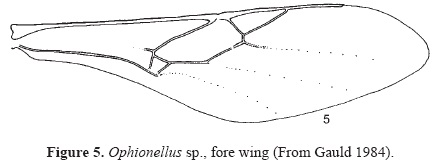
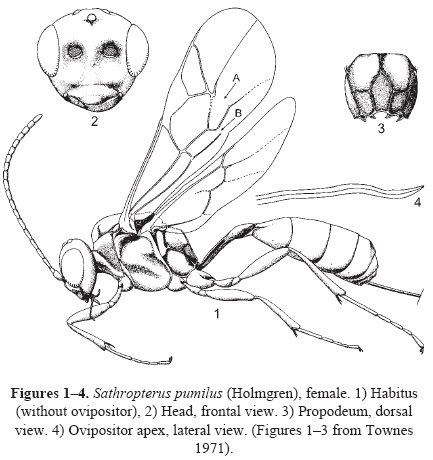
<body><![CDATA[<p align="justify"><font face="verdana" size="2">The genus <i>Sathropterus</i> comprises two species: the widely distributed through the world <i>S. pumilus,</i> and the recently described from Vietnam <i>S. secundus</i> Khalaim (Khalaim 2011). The former species is known from Europe, Caucasus, Middle Asia, Russian Siberia and Far East, Mongolia, Nepal, India, South Africa, U.S.A. (Arizona, North Carolina, and Texas), Mexico, Brazil and Australia (Horstmann 2010, Khalaim 2011). According to Gauld (1984), <i>S. pumilus</i> probably was transported around the world by man and hosts for this species are unknown.</font></p>  	    <p align="justify"><font face="verdana" size="2"><i>Sathropterus pumilus</i> may easily be recognized in Mexican ichneumonid fauna by its small body size (length without ovipositor about 3.0 mm), fore wing with second recurrent vein completely absent (<a href="#f1">Fig. 1A</a>) and distal corner of brachial cell widely open (<a href="#f1">Fig. 1B</a>), and long and slender ovipositor with a strongly sinuate apex (<a href="#f1">Fig. 4</a>). It is also characterized because female antenna flagellum has 18&#45;19 segments (male flagellum with about 24 segments), propodeum mediodorsally with basal keel (<a href="#f1">Fig. 3</a>), and first metasomal segment with small isolated glymma. The head is showed in <a href="#f1">Fig. 2</a>.</font></p>  	    <p align="center"><font face="verdana" size="2"><a name="f1"></a></font></p>  	    <p align="center"><font face="verdana" size="2"><img src="/img/revistas/azm/v31n1/a26f1&#45;4.jpg"></font></p>  	    <p align="justify"><font face="verdana" size="2">Fore wing venation of <i>S. pumilus</i> is very unusual for the Ichneumonidae, because virtually all members of this family possesses fore wing with distinct second recurrent vein, while in <i>S. pumilus</i> this vein is completely absent. Venation of <i>S. pumilus</i> resembles that of the family Braconidae in which the second recurrent vein always is absent, for this reason occasionally <i>S. pumilus</i> may be confused with species of Braconidae. Besides the <i>Sathropterus,</i> in the family Ichneumonidae the "braconid" type of fore wing venation is also present in the small Holarctic and Neotropical subfamily Neorhacodinae, small Holarctic subfamily Hybrizontinae (= Paxylommatinae), some genera of the Cryptinae (e.g. Holarctic genus <i>Polyaulon</i> F&ouml;rster), and the small Palaearctic genus <i>Gnypetomorpha</i> F&ouml;rster (= <i>Victorovia</i> Tobias) (Tobias 1963). The genus <i>Ophionellus</i> Westwood, in the subfamily Anomaloninae, occurs in the Nearctic and Neotropical regions including Mexico, and also has wing venation strongly reduced, with second recurrent vein and some other distal veins lacking or vestigial (<a href="#f5">Fig. 5</a>).</font></p>  	    <p align="center"><font face="verdana" size="2"><a name="f5"></a></font></p>  	    <p align="center"><font face="verdana" size="2"><img src="/img/revistas/azm/v31n1/a26f5.jpg"></font></p>  	    <p align="justify"><font face="verdana" size="2">&nbsp;</font></p>  	    <p align="justify"><font face="verdana" size="2"><b>ACKNOWLEDGEMENTS</b></font></p>  	    <p align="justify"><font face="verdana" size="2">To Essig Museum of the University of California&#45;Berkeley for the loan of material, and to Universidad Autonoma de Tamaulipas and PROMEP for their support.</font></p>  	    ]]></body>
<body><![CDATA[<p align="justify"><font face="verdana" size="2">&nbsp;</font></p>  	    <p align="justify"><font face="verdana" size="2"><b>LITERATURE CITED</b></font></p>  	    <!-- ref --><p align="justify"><font face="verdana" size="2"><b>Gauld, I. D.</b> 1984. An introduction to the Ichneumonidae of Australia. <i>Bulletin of the British Museum (Natural History) (Entomology),</i> 895: 1&#45;413.    &nbsp;&nbsp;&nbsp;&nbsp;&nbsp;&nbsp;&nbsp;&nbsp;[&#160;<a href="javascript:void(0);" onclick="javascript: window.open('/scielo.php?script=sci_nlinks&ref=417953&pid=S0065-1737201500010002600001&lng=','','width=640,height=500,resizable=yes,scrollbars=1,menubar=yes,');">Links</a>&#160;]<!-- end-ref --></font></p>  	    <!-- ref --><p align="justify"><font face="verdana" size="2"><b>Gonz&aacute;lez&#45;Moreno, A. &amp; Bordera, S.</b> 2012. The Ichneumonidae (Hymenoptera: Ichneumonoidea) of R&iacute;a Lagartos Biosphere Reserve, Yucat&aacute;n, Mexico. <i>Zootaxa,</i> 3230: 1&#45;51.    &nbsp;&nbsp;&nbsp;&nbsp;&nbsp;&nbsp;&nbsp;&nbsp;[&#160;<a href="javascript:void(0);" onclick="javascript: window.open('/scielo.php?script=sci_nlinks&ref=417955&pid=S0065-1737201500010002600002&lng=','','width=640,height=500,resizable=yes,scrollbars=1,menubar=yes,');">Links</a>&#160;]<!-- end-ref --></font></p>  	    <!-- ref --><p align="justify"><font face="verdana" size="2"><b>Horstmann, K.</b> 2010. Revision of Nearctic Tersilochinae II. Genera <i>Allophrys</i> F&ouml;rster, <i>Barycnemis</i> F&ouml;rster, <i>Ctenophion</i> gen. nov., <i>Sathropterus</i> F&ouml;rster, <i>Spinolochus</i> Horstmann and <i>Stethantyx</i> Townes (Hymenoptera, Ichneumonidae). <i>Spixiana,</i> 33: 73&#45;109.    &nbsp;&nbsp;&nbsp;&nbsp;&nbsp;&nbsp;&nbsp;&nbsp;[&#160;<a href="javascript:void(0);" onclick="javascript: window.open('/scielo.php?script=sci_nlinks&ref=417957&pid=S0065-1737201500010002600003&lng=','','width=640,height=500,resizable=yes,scrollbars=1,menubar=yes,');">Links</a>&#160;]<!-- end-ref --></font></p>  	    <!-- ref --><p align="justify"><font face="verdana" size="2"><b>Khalaim, A. I.</b> 2002. Two new species of the genus <i>Barycnemis</i> F&ouml;rster from Mexico (Hymenoptera: Ichneumonidae, Tersilochinae). <i>Zoosystematica Rossica,</i> 11: 167&#45;169.    &nbsp;&nbsp;&nbsp;&nbsp;&nbsp;&nbsp;&nbsp;&nbsp;[&#160;<a href="javascript:void(0);" onclick="javascript: window.open('/scielo.php?script=sci_nlinks&ref=417959&pid=S0065-1737201500010002600004&lng=','','width=640,height=500,resizable=yes,scrollbars=1,menubar=yes,');">Links</a>&#160;]<!-- end-ref --></font></p>  	    ]]></body>
<body><![CDATA[<!-- ref --><p align="justify"><font face="verdana" size="2"><b>Khalaim, A. I.</b> 2011. Tersilochinae of South, Southeast and East Asia, excluding Mongolia and Japan (Hymenoptera: Ichneumonidae). <i>Zoosystematica Rossica,</i> 20: 96&#45;148.    &nbsp;&nbsp;&nbsp;&nbsp;&nbsp;&nbsp;&nbsp;&nbsp;[&#160;<a href="javascript:void(0);" onclick="javascript: window.open('/scielo.php?script=sci_nlinks&ref=417961&pid=S0065-1737201500010002600005&lng=','','width=640,height=500,resizable=yes,scrollbars=1,menubar=yes,');">Links</a>&#160;]<!-- end-ref --></font></p>  	    <!-- ref --><p align="justify"><font face="verdana" size="2"><b>Khalaim, A. I. &amp; Ruiz&#45;Cancino, E.</b> 2013. Mexican species of the genus <i>Stethantyx</i> Townes (Hymenoptera, Ichneumonidae, Tersilochinae). <i>Zookeys,</i> 360: 83&#45;94. doi: 10.3897/zookeys.360.6362.    &nbsp;&nbsp;&nbsp;&nbsp;&nbsp;&nbsp;&nbsp;&nbsp;[&#160;<a href="javascript:void(0);" onclick="javascript: window.open('/scielo.php?script=sci_nlinks&ref=417963&pid=S0065-1737201500010002600006&lng=','','width=640,height=500,resizable=yes,scrollbars=1,menubar=yes,');">Links</a>&#160;]<!-- end-ref --></font></p>  	    <!-- ref --><p align="justify"><font face="verdana" size="2"><b>Ruiz&#45;Cancino, E., Kasparyan, D. R. &amp; Coronado&#45;Blanco, J. M.</b> 2002. Ichneumonidae. pp. 631&#45;646. <i>In:</i> J. Llorente Bousquets &amp; J. J. Morrone (Eds). <i>Biodiversidad, Taxonom&iacute;a y Biogeograf&iacute;a de Artr&oacute;podos de M&eacute;xico: Hacia una s&iacute;ntesis de su conocimiento.</i> Conabio&#45;Ecosur&#45;Bayer, M&eacute;xico.    &nbsp;&nbsp;&nbsp;&nbsp;&nbsp;&nbsp;&nbsp;&nbsp;[&#160;<a href="javascript:void(0);" onclick="javascript: window.open('/scielo.php?script=sci_nlinks&ref=417965&pid=S0065-1737201500010002600007&lng=','','width=640,height=500,resizable=yes,scrollbars=1,menubar=yes,');">Links</a>&#160;]<!-- end-ref --></font></p>  	    <!-- ref --><p align="justify"><font face="verdana" size="2"><b>Tobias, V. I.</b> 1963. Ichneumonidae (Hymenoptera) with a venation type in the fore wings which resembles that in Braconidae. <i>Zoologicheskiy zhurnal,</i> 42: 1513&#45;1522.    &nbsp;&nbsp;&nbsp;&nbsp;&nbsp;&nbsp;&nbsp;&nbsp;[&#160;<a href="javascript:void(0);" onclick="javascript: window.open('/scielo.php?script=sci_nlinks&ref=417967&pid=S0065-1737201500010002600008&lng=','','width=640,height=500,resizable=yes,scrollbars=1,menubar=yes,');">Links</a>&#160;]<!-- end-ref --></font></p>  	    <!-- ref --><p align="justify"><font face="verdana" size="2"><b>Townes, H. K.</b> 1971. The genera of Ichneumonidae, Part 4. <i>Memoirs of the American Entomological Institute,</i> 17: 1&#45;372.    &nbsp;&nbsp;&nbsp;&nbsp;&nbsp;&nbsp;&nbsp;&nbsp;[&#160;<a href="javascript:void(0);" onclick="javascript: window.open('/scielo.php?script=sci_nlinks&ref=417969&pid=S0065-1737201500010002600009&lng=','','width=640,height=500,resizable=yes,scrollbars=1,menubar=yes,');">Links</a>&#160;]<!-- end-ref --></font></p>     ]]></body>
<body><![CDATA[ ]]></body><back>
<ref-list>
<ref id="B1">
<nlm-citation citation-type="journal">
<person-group person-group-type="author">
<name>
<surname><![CDATA[Gauld]]></surname>
<given-names><![CDATA[I. D]]></given-names>
</name>
</person-group>
<article-title xml:lang="en"><![CDATA[An introduction to the Ichneumonidae of Australia]]></article-title>
<source><![CDATA[Bulletin of the British Museum (Natural History) (Entomology)]]></source>
<year>1984</year>
<volume>895</volume>
<page-range>1-413</page-range></nlm-citation>
</ref>
<ref id="B2">
<nlm-citation citation-type="journal">
<person-group person-group-type="author">
<name>
<surname><![CDATA[González-Moreno]]></surname>
<given-names><![CDATA[A.]]></given-names>
</name>
<name>
<surname><![CDATA[Bordera]]></surname>
<given-names><![CDATA[S]]></given-names>
</name>
</person-group>
<article-title xml:lang="en"><![CDATA[The Ichneumonidae (Hymenoptera: Ichneumonoidea) of Ría Lagartos Biosphere Reserve, Yucatán, Mexico]]></article-title>
<source><![CDATA[Zootaxa]]></source>
<year>2012</year>
<volume>3230</volume>
<page-range>1-51</page-range></nlm-citation>
</ref>
<ref id="B3">
<nlm-citation citation-type="journal">
<person-group person-group-type="author">
<name>
<surname><![CDATA[Horstmann]]></surname>
<given-names><![CDATA[K]]></given-names>
</name>
</person-group>
<article-title xml:lang="en"><![CDATA[Revision of Nearctic Tersilochinae II. Genera Allophrys Förster, Barycnemis Förster, Ctenophion gen. nov., Sathropterus Förster, Spinolochus Horstmann and Stethantyx Townes (Hymenoptera, Ichneumonidae)]]></article-title>
<source><![CDATA[Spixiana]]></source>
<year>2010</year>
<volume>33</volume>
<page-range>73-109</page-range></nlm-citation>
</ref>
<ref id="B4">
<nlm-citation citation-type="journal">
<person-group person-group-type="author">
<name>
<surname><![CDATA[Khalaim]]></surname>
<given-names><![CDATA[A. I]]></given-names>
</name>
</person-group>
<article-title xml:lang="en"><![CDATA[Two new species of the genus Barycnemis Förster from Mexico (Hymenoptera: Ichneumonidae, Tersilochinae)]]></article-title>
<source><![CDATA[Zoosystematica Rossica]]></source>
<year>2002</year>
<volume>11</volume>
<page-range>167-169</page-range></nlm-citation>
</ref>
<ref id="B5">
<nlm-citation citation-type="journal">
<person-group person-group-type="author">
<name>
<surname><![CDATA[Khalaim]]></surname>
<given-names><![CDATA[A. I]]></given-names>
</name>
</person-group>
<article-title xml:lang="en"><![CDATA[Tersilochinae of South, Southeast and East Asia, excluding Mongolia and Japan (Hymenoptera: Ichneumonidae)]]></article-title>
<source><![CDATA[Zoosystematica Rossica]]></source>
<year>2011</year>
<volume>20</volume>
<page-range>96-148</page-range></nlm-citation>
</ref>
<ref id="B6">
<nlm-citation citation-type="journal">
<person-group person-group-type="author">
<name>
<surname><![CDATA[Khalaim]]></surname>
<given-names><![CDATA[A. I.]]></given-names>
</name>
<name>
<surname><![CDATA[Ruiz-Cancino]]></surname>
<given-names><![CDATA[E]]></given-names>
</name>
</person-group>
<article-title xml:lang="en"><![CDATA[Mexican species of the genus Stethantyx Townes (Hymenoptera, Ichneumonidae, Tersilochinae)]]></article-title>
<source><![CDATA[Zookeys]]></source>
<year>2013</year>
<volume>360</volume>
<page-range>83-94</page-range></nlm-citation>
</ref>
<ref id="B7">
<nlm-citation citation-type="book">
<person-group person-group-type="author">
<name>
<surname><![CDATA[Ruiz-Cancino]]></surname>
<given-names><![CDATA[E.]]></given-names>
</name>
<name>
<surname><![CDATA[Kasparyan]]></surname>
<given-names><![CDATA[D. R.]]></given-names>
</name>
<name>
<surname><![CDATA[Coronado-Blanco]]></surname>
<given-names><![CDATA[J. M]]></given-names>
</name>
</person-group>
<article-title xml:lang="es"><![CDATA[Ichneumonidae]]></article-title>
<person-group person-group-type="editor">
<name>
<surname><![CDATA[Llorente Bousquets]]></surname>
<given-names><![CDATA[J.]]></given-names>
</name>
<name>
<surname><![CDATA[Morrone]]></surname>
<given-names><![CDATA[J. J.]]></given-names>
</name>
</person-group>
<source><![CDATA[Biodiversidad, Taxonomía y Biogeografía de Artrópodos de México: Hacia una síntesis de su conocimiento]]></source>
<year>2002</year>
<page-range>631-646</page-range><publisher-name><![CDATA[ConabioEcosurBayer]]></publisher-name>
</nlm-citation>
</ref>
<ref id="B8">
<nlm-citation citation-type="journal">
<person-group person-group-type="author">
<name>
<surname><![CDATA[Tobias]]></surname>
<given-names><![CDATA[V. I]]></given-names>
</name>
</person-group>
<article-title xml:lang="en"><![CDATA[Ichneumonidae (Hymenoptera) with a venation type in the fore wings which resembles that in Braconidae]]></article-title>
<source><![CDATA[Zoologicheskiy zhurnal]]></source>
<year>1963</year>
<volume>42</volume>
<page-range>1513-1522</page-range></nlm-citation>
</ref>
<ref id="B9">
<nlm-citation citation-type="journal">
<person-group person-group-type="author">
<name>
<surname><![CDATA[Townes]]></surname>
<given-names><![CDATA[H. K]]></given-names>
</name>
</person-group>
<article-title xml:lang="en"><![CDATA[The genera of Ichneumonidae, Part 4]]></article-title>
<source><![CDATA[Memoirs of the American Entomological Institute]]></source>
<year>1971</year>
<volume>17</volume>
<page-range>1-372</page-range></nlm-citation>
</ref>
</ref-list>
</back>
</article>