<?xml version="1.0" encoding="ISO-8859-1"?><article xmlns:mml="http://www.w3.org/1998/Math/MathML" xmlns:xlink="http://www.w3.org/1999/xlink" xmlns:xsi="http://www.w3.org/2001/XMLSchema-instance">
<front>
<journal-meta>
<journal-id>0065-1737</journal-id>
<journal-title><![CDATA[Acta zoológica mexicana]]></journal-title>
<abbrev-journal-title><![CDATA[Acta Zool. Mex]]></abbrev-journal-title>
<issn>0065-1737</issn>
<publisher>
<publisher-name><![CDATA[Instituto de Ecología A.C.]]></publisher-name>
</publisher>
</journal-meta>
<article-meta>
<article-id>S0065-17372015000100010</article-id>
<title-group>
<article-title xml:lang="en"><![CDATA[Genetic diversity of two stingless bees, Trigona nigerrima (Cresson 1878) and Trigona corvina (Cockerell 1913), in coffee dominated landscapes in Southern Mexico]]></article-title>
<article-title xml:lang="es"><![CDATA[Diversidad genética de dos especies de abejas sin aguijón, Trigona nigerrima (Cresson) y Trigona corvina (Cockerell) en paisajes cafetaleros del Sureste de México]]></article-title>
</title-group>
<contrib-group>
<contrib contrib-type="author">
<name>
<surname><![CDATA[Solórzano-Gordillo]]></surname>
<given-names><![CDATA[E. de J.]]></given-names>
</name>
<xref ref-type="aff" rid="A01"/>
</contrib>
<contrib contrib-type="author">
<name>
<surname><![CDATA[Cabrera-Marín]]></surname>
<given-names><![CDATA[N. V.]]></given-names>
</name>
<xref ref-type="aff" rid="A01"/>
</contrib>
<contrib contrib-type="author">
<name>
<surname><![CDATA[Mérida]]></surname>
<given-names><![CDATA[J.]]></given-names>
</name>
<xref ref-type="aff" rid="A01"/>
</contrib>
<contrib contrib-type="author">
<name>
<surname><![CDATA[Vandame]]></surname>
<given-names><![CDATA[R.]]></given-names>
</name>
<xref ref-type="aff" rid="A01"/>
</contrib>
<contrib contrib-type="author">
<name>
<surname><![CDATA[Sánchez]]></surname>
<given-names><![CDATA[D.]]></given-names>
</name>
<xref ref-type="aff" rid="A01"/>
</contrib>
</contrib-group>
<aff id="A01">
<institution><![CDATA[,El Colegio de la Frontera Sur  ]]></institution>
<addr-line><![CDATA[San Cristóbal de las Casas Chiapas]]></addr-line>
<country>México</country>
</aff>
<pub-date pub-type="pub">
<day>00</day>
<month>00</month>
<year>2015</year>
</pub-date>
<pub-date pub-type="epub">
<day>00</day>
<month>00</month>
<year>2015</year>
</pub-date>
<volume>31</volume>
<numero>1</numero>
<fpage>74</fpage>
<lpage>79</lpage>
<copyright-statement/>
<copyright-year/>
<self-uri xlink:href="http://www.scielo.org.mx/scielo.php?script=sci_arttext&amp;pid=S0065-17372015000100010&amp;lng=en&amp;nrm=iso"></self-uri><self-uri xlink:href="http://www.scielo.org.mx/scielo.php?script=sci_abstract&amp;pid=S0065-17372015000100010&amp;lng=en&amp;nrm=iso"></self-uri><self-uri xlink:href="http://www.scielo.org.mx/scielo.php?script=sci_pdf&amp;pid=S0065-17372015000100010&amp;lng=en&amp;nrm=iso"></self-uri><abstract abstract-type="short" xml:lang="en"><p><![CDATA[Stingless bees (Apidae, Meliponini) are key pollinators in natural and agricultural Pantropical environments. Current human activities, however, threaten their populations, making it urgent to assess their abundance and genetic status. By a population genetics approach, we calculated the genetic diversity and estimated the number of wild colonies of two stingless bee species, Trigona nigerrima (Cresson) and T. corvina (Cockerell) in southern Mexico. Allele richness ranged from 10 to 19 (mean ± SD = 14 ± 3.5) for both species. Expected heterozygosity ranged 0.88-0.93 for T. corvina and 0.82-0.92 for T. nigerrima. The estimated number of colonies estimated was 25 on average for T. corvina and 21 for T. nigerrima. According to our results populations of both species seem not to be in danger. We also show that genetic tools can be extremely useful for colony density estimation for stingless bees as it is for bumble bees and honey bees.]]></p></abstract>
<abstract abstract-type="short" xml:lang="es"><p><![CDATA[Las abejas sin aguijón (Apidae, Meliponini) son especies polinizadoras clave en ambientes pantropicales, tanto naturales como agrícolas. Las actividades humanas, sin embargo, ponen en riesgo sus poblaciones silvestres, lo que hace necesario que se conozcan cuanto antes su abundancia y su diversidad genética con fines de conservación. Mediante un enfoque de genética de poblaciones se calculó la diversidad genética y el número de colonias silvestres de dos especies de abejas sin aguijón, Trigona nigerrima y T. corvina, en el sur de México. Se encontró una riqueza alélica que varió de 10 a 19 (media ± DE = 14 ± 3.5). La heterocigosidad esperada fue de 0.88-0.93 para T. corvina y de 0.82-0.92 para T. nigerrima El número de colonias estimadas para T. corvina fue de 25 en promedio, y para T. nigerrima de 21. De acuerdo con nuestros resultados las poblaciones de ambas especies parecen no estar amenazadas. También se demuestra que las herramientas de genética de poblaciones son extremadamente útiles para la estimación de colonias en abejas sin aguijón, al igual que en otros himenópteros como los abejorros y la abeja melífera.]]></p></abstract>
<kwd-group>
<kwd lng="en"><![CDATA[Stingless bee]]></kwd>
<kwd lng="en"><![CDATA[microsatellites]]></kwd>
<kwd lng="en"><![CDATA[DNA]]></kwd>
<kwd lng="en"><![CDATA[population genetics]]></kwd>
<kwd lng="en"><![CDATA[meliponine]]></kwd>
<kwd lng="en"><![CDATA[Trigona]]></kwd>
<kwd lng="es"><![CDATA[Abejas sin aguijón]]></kwd>
<kwd lng="es"><![CDATA[microsatélites]]></kwd>
<kwd lng="es"><![CDATA[ADN]]></kwd>
<kwd lng="es"><![CDATA[genética de poblaciones]]></kwd>
<kwd lng="es"><![CDATA[meliponinos]]></kwd>
<kwd lng="es"><![CDATA[Trigona]]></kwd>
</kwd-group>
</article-meta>
</front><body><![CDATA[  	    <p align="justify"><font face="verdana" size="4">Art&iacute;culos originales</font></p>  	    <p align="justify"><font face="verdana" size="2">&nbsp;</font></p>  	    <p align="center"><font face="verdana" size="4"><b>Genetic diversity of two stingless bees, <i>Trigona nigerrima</i> (Cresson 1878) and <i>Trigona corvina</i> (Cockerell 1913), in coffee dominated landscapes in Southern Mexico</b></font></p>  	    <p align="justify"><font face="verdana" size="2">&nbsp;</font></p>  	    <p align="center"><font face="verdana" size="3"><b>Diversidad gen&eacute;tica de dos especies de abejas sin aguij&oacute;n, <i>Trigona nigerrima</i> (Cresson) y <i>Trigona corvina</i> (Cockerell) en paisajes cafetaleros del Sureste de M&eacute;xico</b></font></p>  	    <p align="justify"><font face="verdana" size="2">&nbsp;</font></p>  	    <p align="center"><font face="verdana" size="2"><b>E. de J. Sol&oacute;rzano&#45;Gordillo, N. V. Cabrera&#45;Mar&iacute;n, J. M&eacute;rida, R. Vandame &amp; D. S&aacute;nchez*</b></font></p>  	    <p align="justify"><font face="verdana" size="2">&nbsp;</font></p>  	    <p align="justify"><font face="verdana" size="2"><i>El Colegio de la Frontera Sur, Carretera Antiguo Aeropuerto Km 2.5. Tapachula, Chiapas, Mexico, CP 30700.</i> * &lt;<a href="mailto:dsanchez@ecosur.mx">dsanchez@ecosur.mx</a>&gt;</font></p>  	    ]]></body>
<body><![CDATA[<p align="justify"><font face="verdana" size="2">&nbsp;</font></p>  	    <p align="justify"><font face="verdana" size="2">Recibido: 19/06/2014;    <br> 	Aceptado: 12/09/2014.</font></p>  	    <p align="justify"><font face="verdana" size="2">&nbsp;</font></p>  	    <p align="justify"><font face="verdana" size="2"><b>ABSTRACT</b></font></p>  	    <p align="justify"><font face="verdana" size="2">Stingless bees (Apidae, Meliponini) are key pollinators in natural and agricultural Pantropical environments. Current human activities, however, threaten their populations, making it urgent to assess their abundance and genetic status. By a population genetics approach, we calculated the genetic diversity and estimated the number of wild colonies of two stingless bee species, <i>Trigona nigerrima</i> (Cresson) and <i>T. corvina</i> (Cockerell) in southern Mexico. Allele richness ranged from 10 to 19 (mean &plusmn; SD = 14 &plusmn; 3.5) for both species. Expected heterozygosity ranged 0.88&#45;0.93 for <i>T. corvina</i> and 0.82&#45;0.92 for <i>T. nigerrima.</i> The estimated number of colonies estimated was 25 on average for <i>T. corvina</i> and 21 for <i>T. nigerrima.</i> According to our results populations of both species seem not to be in danger. We also show that genetic tools can be extremely useful for colony density estimation for stingless bees as it is for bumble bees and honey bees.</font></p>  	    <p align="justify"><font face="verdana" size="2"><b>Key words:</b> Stingless bee, microsatellites, DNA, population genetics, meliponine, <i>Trigona.</i></font></p>  	    <p align="justify"><font face="verdana" size="2">&nbsp;</font></p>  	    <p align="justify"><font face="verdana" size="2"><b>RESUMEN.</b></font></p>  	    <p align="justify"><font face="verdana" size="2">Las abejas sin aguij&oacute;n (Apidae, Meliponini) son especies polinizadoras clave en ambientes pantropicales, tanto naturales como agr&iacute;colas. Las actividades humanas, sin embargo, ponen en riesgo sus poblaciones silvestres, lo que hace necesario que se conozcan cuanto antes su abundancia y su diversidad gen&eacute;tica con fines de conservaci&oacute;n. Mediante un enfoque de gen&eacute;tica de poblaciones se calcul&oacute; la diversidad gen&eacute;tica y el n&uacute;mero de colonias silvestres de dos especies de abejas sin aguij&oacute;n, <i>Trigona nigerrima</i> y <i>T. corvina,</i> en el sur de M&eacute;xico. Se encontr&oacute; una riqueza al&eacute;lica que vari&oacute; de 10 a 19 (media &plusmn; DE = 14 &plusmn; 3.5). La heterocigosidad esperada fue de 0.88&#45;0.93 para <i>T. corvina</i> y de 0.82&#45;0.92 para <i>T. nigerrima</i> El n&uacute;mero de colonias estimadas para <i>T. corvina</i> fue de 25 en promedio, y para <i>T. nigerrima</i> de 21. De acuerdo con nuestros resultados las poblaciones de ambas especies parecen no estar amenazadas. Tambi&eacute;n se demuestra que las herramientas de gen&eacute;tica de poblaciones son extremadamente &uacute;tiles para la estimaci&oacute;n de colonias en abejas sin aguij&oacute;n, al igual que en otros himen&oacute;pteros como los abejorros y la abeja mel&iacute;fera.</font></p>  	    ]]></body>
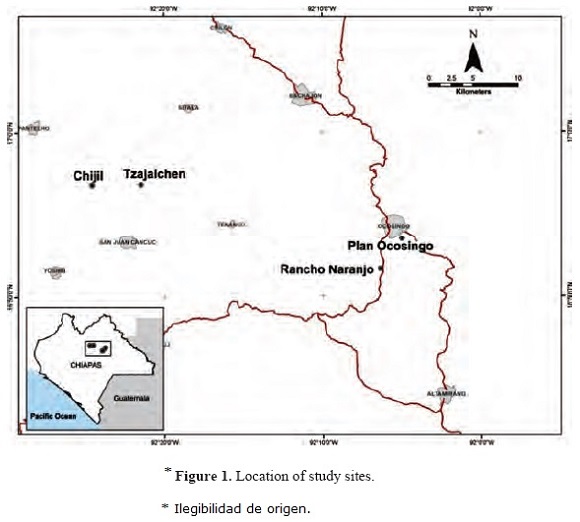
<body><![CDATA[<p align="justify"><font face="verdana" size="2"><b>Palabras clave:</b> Abejas sin aguij&oacute;n, microsat&eacute;lites, ADN, gen&eacute;tica de poblaciones, meliponinos, <i>Trigona.</i></font></p>  	    <p align="justify"><font face="verdana" size="2">&nbsp;</font></p>  	    <p align="justify"><font face="verdana" size="2"><b>INTRODUCTION</b></font></p>  	    <p align="justify"><font face="verdana" size="2">Human population, and the amount of resources necessary to sustain it, is globally increasing. Food and housing are basic elements that demand space; therefore natural areas are incorporated into production chains to satisfy these and other necessities. As a consequence, populations of native organisms are locally reduced or might become extinct. Studies have revealed a decline in the diversity and abundance of insect pollinators in Europe (Biesmeijer <i>et al.</i> 2006) and America (Goulson <i>et al.</i> 2008, Cameron <i>et al.</i> 2011), partially driven by intensive agricultural practices (Freitas <i>et al.</i> 2009, Potts <i>et al.</i> 2010). Large extensions of land devoted to only a few crops seem to leave few resources to native insect pollinators to survive, since such management frequently results in habitat loss and pollution of the environment (Richards 2001, Carvell <i>et al.</i> 2006). A reduction in the populations of these species could actually have serious impacts on the world's economy (Kevan &amp; Phillips 2001, Klein <i>et al.</i> 2007), and more importantly, on world's food security (Gallai <i>et al.</i> 2009). Among insect pollinators, eusocial bees (Hymenoptera, Apidae) like honey bees (Aizen &amp; Harder 2009) and bumble bees (Hayo &amp; Adriaan 2006) are key in crop pollination. In addition, a growing body of information reveals the importance of stingless bees (Apidae, Meliponini) as pollinators in natural and agricultural environments (Heard 1999, Cauich <i>et al.</i> 2004, Del Sarto <i>et al.</i> 2005, Palma <i>et al.</i> 2008). Current human activities, however, threaten their populations, and though some species seem to be abundant, others do not, and more importantly, the genetic status for many of them remains unknown. In fact, a genetic approach would reveal critical information, not attainable by conventional ecological methods, about the viability status of populations, not mentioning genetic diversity. For example, several studies have evaluated the effect of beekeeping upon both genetic variability (Carvalho&#45;Zilse <i>et al.</i> 2009) and maintenance of populations (Alves <i>et al.</i> 2010), while others have evaluated genetic variability and population structure of stingless bees (Costa <i>et al.</i> 2005, Francisco <i>et al.</i> 2006, Garcia Tavares <i>et al.</i> 2007, Hurtado&#45;Burillo <i>et al.</i> 2013). Additionally, population genetics is a powerful tool to estimate colony density for the study of population dynamics (Cameron <i>et al.</i> 2004, Moritz <i>et al.</i> 2007, Kraus <i>et al.</i> 2008), a better alternative to find and count colonies in the field (Zayed 2009). Thus in this paper we investigated the genetic diversity and colony density of two stingless bee species, <i>Trigona nigerrima</i> (Cresson 1878) and <i>T. corvina</i> (Cockerell 1913) in rural areas in Chiapas, Mexico, by genotyping free foraging individuals. We chose these species because they are the dominant native social species in the study sites and are frequently found foraging in several species of plants, both cultivated and wild.</font></p>  	    <p align="justify"><font face="verdana" size="2">&nbsp;</font></p>  	    <p align="justify"><font face="verdana" size="2"><b>METHODS AND MATERIALS</b></font></p>  	    <p align="justify"><font face="verdana" size="2"><b>Study site.</b> Foragers were collected between February and April 2011 in four localities in Chiapas, Mexico (<a href="#f1">Fig. 1</a>). Shade coffee is the main crop in the region, though other plants like corn and timber are also cultivated. The majority of the farmers possess small pieces of land (&lt;3 ha), thus a highly patchy landscape is formed. Local agriculture practices are mostly human&#45;labor based, with low input of agrochemicals. All these conditions seemingly support habitat diversity and provide a variety of resources to animal populations.</font></p>  	    <p align="center"><font face="verdana" size="2"><a name="f1"></a></font></p>  	    <p align="center"><font face="verdana" size="2"><img src="/img/revistas/azm/v31n1/a10f1.jpg"></font></p>  	    <p align="justify"><font face="verdana" size="2"><b>Sampling scheme.</b> Specimens were collected between 9:00&#45;13:00 hours using standard entomological nets. Species were collected in sufficient number to perform comparative genetic analyses only in some sites: <i>T. corvina</i> in Tzajalchen and Chijil, and <i>T. nigerrima</i> in Plan Ocosingo and Rancho Naranjo. <i>Trigona</i> species are known to recruit nest mates to profitable resources (Lindauer &amp; Kerr 1960, Nieh 2004, S&aacute;nchez <i>et al.</i> 2004), which could lead to an underestimation of allelic richness if foragers are analyzed. To avoid this, specimens were collected such that: 1) two to four foragers were collected where they were found in groups of more than ten individuals and, 2) they were collected in patches separated from each other by at least 500 m. Foragers were sacrificed with ethyl acetate; one hind leg was removed from each collected specimen and placed in absolute ethanol for further storing at &#45;20&deg;C and DNA extraction. The rest of the insect was kept in an entomological collection in ECOSUR, San Cristobal de las Casas, Chiapas.</font></p>  	    ]]></body>
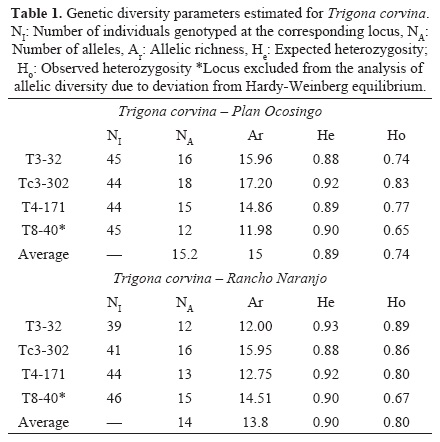
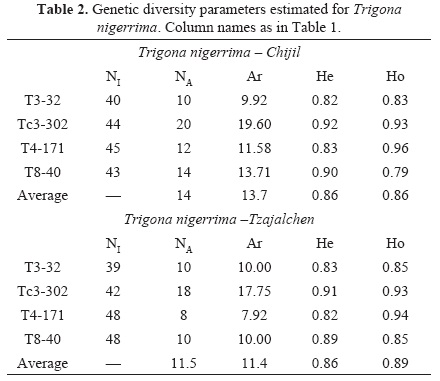
<body><![CDATA[<p align="justify"><font face="verdana" size="2"><b>Microsatellite analysis.</b> DNA was extracted following the HotSHOT method (Truett <i>et al.</i> 2000). All foragers were genotyped at four microsatellite loci (T3&#45;32, Tc3&#45;302, T4&#45;171 and T8&#45;40) following single locus routine PCR protocols (Kraus <i>et al.</i> 2008) to a final reaction volume of 5&#956;L. Microsatellite fragments were separated using a semiautomated LI&#45;COR 4200 slab&#45;gel sequencer (6% denaturing polyacrylamide gels); fragment size was determined using the software SAGA MX (LI&#45;COR Inc., US). Forward oligos were tagged with an M13(&#45;29) sequence, which served as a priming site to a M13(&#45;29) primer tagged with IRDYE800 (Schuelke 2000). In order to estimate amplification errors or allele miss&#45;callings 10% of foragers were subjected to reamplification at all loci. All reamplifications gave identical results.</font></p>     <p align="justify"><font face="verdana" size="2"><b>Analysis of genetic data.</b> Screening of data for large allele dropout, null alleles and scoring errors was carried out using MicroChecker (Van Oosterhout <i>et al.</i> 2004). Departures from Hardy&#45;Weinberg proportions of each loci, pairwise genotypic linkage disequilibrium, expected and observed heterozygosities, and tests for population differentiation were performed using GENEPOP v4.0 (Rousset 2008). Allelic richness was calculated with FSTAT v2.9.3.2 software (Goudet 2001), which was used to compare the genetic diversity between sites with a paired T&#45;Students' test using S&#45;Plus v6. Number of colonies in each site was estimated with COLONY v1.2 software (Wang 2004).</font></p>  	    <p align="justify"><font face="verdana" size="2">&nbsp;</font></p>  	    <p align="justify"><font face="verdana" size="2"><b>RESULTS</b></font></p>  	    <p align="justify"><font face="verdana" size="2">A total of 194 female individuals from the four sites were genotyped: ninety&#45;eight <i>T. nigerrima</i> and ninety&#45;six <i>T. corvina</i> individuals. Scoring errors, allele dropout and null alleles were not detected in any loci in any species; however the T8&#45;40 locus in <i>T. corvina</i> from the two sites departed significantly from Hardy&#45;Weinberg equilibrium, perhaps because primers were developed for other species (Hurtado&#45;Burillo <i>et al.</i> 2013), thus it was removed from allelic richness comparisons. All loci in both species were not in significant linkage (P &gt; 0.05). <a href="#t1">Tables 1</a> and <a href="#t2">2</a> show the expected and observed heterozygosity and the allelic richness per locus, population and species. Allelic richness was not significantly different between sites for both species (<i>T. corvina:</i> t = 3.05, df = 2, P = 0.09; <i>T. nigerrima:</i> t = 2.54, df = 3, P = 0.09) though genotypic differentiation between each pair of sites was highly significant in both species <i>(T. corvina:</i> G = 46.48, df = 8, P &lt; 0.001; <i>T. nigerrima:</i> G = 143, df = 8, P &lt; 0.001). Number of colonies estimated for <i>T. corvina</i> was 26 and 24 for Rancho Naranjo and Plan Ocosingo sites, respectively. For <i>T. nigerrima</i> the numbers were lower, 20 and 22 for the Tzajalchen and the Chijil sites, respectively.</font></p>  	    <p align="center"><font face="verdana" size="2"><a name="t1"></a></font></p>  	    <p align="center"><font face="verdana" size="2"><img src="/img/revistas/azm/v31n1/a10t1.jpg"></font></p>  	    <p align="center"><font face="verdana" size="2"><a name="t2"></a></font></p>  	    <p align="center"><font face="verdana" size="2"><img src="/img/revistas/azm/v31n1/a10t2.jpg"></font></p>  	    <p align="justify"><font face="verdana" size="2">&nbsp;</font></p>  	    ]]></body>
<body><![CDATA[<p align="justify"><font face="verdana" size="2"><b>DISCUSSION</b></font></p>  	    <p align="justify"><font face="verdana" size="2">In spite that some of the sampling sites seemed to be more disturbed due to the presence of grasslands, we did not find any significant difference in the allelic richness in any of the <i>Trigona</i> species, thus at a regional level both species seem to be in similar conditions. Moreover, observed heterozygocity was high in all sites. We think that it is the low input of agrochemicals, and the presence of a mosaic of crops and trees that is formed due to rural activities, what helps maintaining populations with such high heterozygosity and allelic diversity, though future research should confirm this. Studies with other stingless bees show diverse results. For example, while Francisco <i>et al.</i> (2013) found heterozygosity values from 0.551 to 0.749 in <i>Plebeia remota</i> (Holmberg 1903) and Francini <i>et al.</i> (2009) from zero to 0.75 in <i>Melipona interrupta manaosensis</i> (Schwarz 1932); other authors as Borges <i>et al.</i> (2010) and Tavares <i>et al.</i> (2013) describe very low levels of observed heterozygosity in their study with <i>Partamona helleri</i> (Friese 1900) and <i>M. quadrifasciata</i> (Lepeletier 1836). In the study by May&#45;Itz&aacute; <i>et al.</i> (2010) with <i>M. yucatanica</i> in Mexico and Guatemala very low levels of heterozygosity were also found. In these studies the low value of the observed heterozygosity can be explained by the swarming behavior of stingless bees, since the daughter colony is commonly founded near the original one, favoring endogamy. A weakness in all these studies is the sampling scheme: they collected directly from colonies and many samples were obtained from neighboring colonies. Studies by Cameron <i>et al.</i> (2004) and Kraus <i>et al.</i> (2008) involved sampling drones, massively grouped in congregations. They found far higher genetic diversity values, since drones were determined to come from as many as 40 colonies for <i>Scaptotrigona mexicana</i> (Gu&eacute;rin 1844) and 137 for <i>T. collina</i> (Smith 1857). This indicates that a number of colonies might not be sampled if colony surveying is the main sampling scheme, instead of genotyping free flying foragers or drones. It is important to emphasize how important to our approach of surveying free flying foragers is the fact that stingless bees are mainly single mated (Palmer <i>et al.</i> 2002, Paxton <i>et al.</i> 2003, Toth <i>et al.</i> 2004), since estimation of colonies using microsatellites is greatly far more accurate than for multiple mating species, like <i>Apis</i> spp. (Fuchs &amp; Moritz 1999), in which a large number of workers is necessary to estimate a queen's genotype with some accuracy, and thus colony density.</font></p>  	    <p align="justify"><font face="verdana" size="2">According to our data populations were genotypically different. We think that the short flight range of <i>Trigona,</i> in addition to forest fragments surrounded by a matrix of crops and villages and the presence of orographic discontinuities, contribute to explain the genotypic differences between sites; this has to be proven yet. We also were able to estimate colony density with our data, something that had not been done before with free flying workers of stingless bees. Though we did not survey exhaustively our sampling sites, we could estimate colony density as 0.2 to 0.26 nests/ha, since our sites corresponded to approximately 100 ha. Such density is similar to that described for other stingless bees in non disturbed sites (Slaa 2006). These densities also reflect that populations of these species seem not to be compromised. Therefore it is highly likely that the degree of patchiness and the actual quality of the patches in the study sites are not affecting bee populations at detectable levels. Hurtado&#45;Burillo <i>et al.</i> (2014) compared the genetic richness of two <i>Melipona</i> species occurring in Mexico, <i>M. colimana</i> and <i>M. beecheii,</i> and found no significant differences in expected heterozygosity; moreover, these authors found no significant differences between the populations from deforested and conserved areas, with results similar to ours. However, as mentioned lines above, many lines of research arise to develop a more detailed view of the situation of stingless bees populations in this part of Mexico, but our results give the baseline for these studies.</font></p>  	    <p align="justify"><font face="verdana" size="2">&nbsp;</font></p>  	    <p align="justify"><font face="verdana" size="2"><b>ACKNOWLEDGEMENTS</b></font></p>  	    <p align="justify"><font face="verdana" size="2">We appreciate the help given by Agust&iacute;n M&eacute;ndez, Miguel Cigarroa and Miguel Guzm&aacute;n during sampling. We also appreciate the kind comments made by the three anonymous reviewers that helped us to significantly improve this manuscript. This study was possible thanks to the support of SEP&#45;CONACYT grant no. 128702 "Evoluci&oacute;n de la Cleptobiosis en <i>Leitrimelitta</i> (Apidae, Meliponini)" and SEP&#45;CONACYT grant no. 106043 "Land use effect on the conservation of bees' biodiversity".</font></p>  	    <p align="justify"><font face="verdana" size="2">&nbsp;</font></p>  	    <p align="justify"><font face="verdana" size="2"><b>REFERENCES</b></font></p>  	    <!-- ref --><p align="justify"><font face="verdana" size="2"><b>Aizen, M. A. &amp; Harder, L. D.</b> 2009. The Global Stock of Domesticated Honey Bees Is Growing Slower Than Agricultural Demand for Pollination. <i>Current Biology,</i> 19: 915&#45;918.    &nbsp;&nbsp;&nbsp;&nbsp;&nbsp;&nbsp;&nbsp;&nbsp;[&#160;<a href="javascript:void(0);" onclick="javascript: window.open('/scielo.php?script=sci_nlinks&ref=415911&pid=S0065-1737201500010001000001&lng=','','width=640,height=500,resizable=yes,scrollbars=1,menubar=yes,');">Links</a>&#160;]<!-- end-ref --></font></p>  	    ]]></body>
<body><![CDATA[<!-- ref --><p align="justify"><font face="verdana" size="2"><b>Alves, D. A., Imperatriz&#45;Fonseca, V. L., Francoy, T. M., San tos&#45;Filho, P. S., Billen, J. &amp; Wenseleers, T.</b> 2010. Successful maintenance of a stingless bee population despite a severe genetic bottleneck. <i>Conservation Genetics,</i> 12: 647&#45;658.    &nbsp;&nbsp;&nbsp;&nbsp;&nbsp;&nbsp;&nbsp;&nbsp;[&#160;<a href="javascript:void(0);" onclick="javascript: window.open('/scielo.php?script=sci_nlinks&ref=415913&pid=S0065-1737201500010001000002&lng=','','width=640,height=500,resizable=yes,scrollbars=1,menubar=yes,');">Links</a>&#160;]<!-- end-ref --></font></p>  	    <!-- ref --><p align="justify"><font face="verdana" size="2"><b>Biesmeijer, J. C., Roberts, S., Reemer, M., Ohlemuller, R., Edwards, M., Peeters, T., Schaffers, A., Potts, S., Kleukers, R., Thomas, C., Settele, J. &amp; Kunin W.</b> 2006. Parallel declines in pollinators and insect&#45;pollinated plants in Britain and the Netherlands. <i>Science,</i> 313: 351&#45;354.    &nbsp;&nbsp;&nbsp;&nbsp;&nbsp;&nbsp;&nbsp;&nbsp;[&#160;<a href="javascript:void(0);" onclick="javascript: window.open('/scielo.php?script=sci_nlinks&ref=415915&pid=S0065-1737201500010001000003&lng=','','width=640,height=500,resizable=yes,scrollbars=1,menubar=yes,');">Links</a>&#160;]<!-- end-ref --></font></p>  	    <!-- ref --><p align="justify"><font face="verdana" size="2"><b>Borges, A. A., de Oliveira Campos, L. A., Salomao, T. M. &amp; Tavares, M. G.</b> 2010. Genetic variability in five populations of <i>Partamona helleri</i> (Hymenoptera, Apidae) from Minas Gerais State, Brazil. <i>Genetics and Molecular Biology,</i> 33: 781&#45;784.    &nbsp;&nbsp;&nbsp;&nbsp;&nbsp;&nbsp;&nbsp;&nbsp;[&#160;<a href="javascript:void(0);" onclick="javascript: window.open('/scielo.php?script=sci_nlinks&ref=415917&pid=S0065-1737201500010001000004&lng=','','width=640,height=500,resizable=yes,scrollbars=1,menubar=yes,');">Links</a>&#160;]<!-- end-ref --></font></p>  	    <!-- ref --><p align="justify"><font face="verdana" size="2"><b>Cameron, E. C., Franck, P. &amp; Oldroyd, B. P.</b> 2004. Genetic structure of nest aggregations and drone congregations of the southeast Asian stingless bee <i>Trigona collina. Molecular Ecology,</i> 13: 2357&#45;2364.    &nbsp;&nbsp;&nbsp;&nbsp;&nbsp;&nbsp;&nbsp;&nbsp;[&#160;<a href="javascript:void(0);" onclick="javascript: window.open('/scielo.php?script=sci_nlinks&ref=415919&pid=S0065-1737201500010001000005&lng=','','width=640,height=500,resizable=yes,scrollbars=1,menubar=yes,');">Links</a>&#160;]<!-- end-ref --></font></p>  	    <!-- ref --><p align="justify"><font face="verdana" size="2"><b>Cameron, S. A., Lozier, J. D., Strange, J. P., Koch, J. B., Cordes, N., Solter, L. F. &amp; Griswold, T. L.</b> 2011. Patterns of widespread decline in North American bumble bees. <i>Proceedings of the National Academy of Sciences,</i> 108: 662&#45;667.    &nbsp;&nbsp;&nbsp;&nbsp;&nbsp;&nbsp;&nbsp;&nbsp;[&#160;<a href="javascript:void(0);" onclick="javascript: window.open('/scielo.php?script=sci_nlinks&ref=415921&pid=S0065-1737201500010001000006&lng=','','width=640,height=500,resizable=yes,scrollbars=1,menubar=yes,');">Links</a>&#160;]<!-- end-ref --></font></p>  	    ]]></body>
<body><![CDATA[<!-- ref --><p align="justify"><font face="verdana" size="2"><b>Carvalho&#45;Zilse, G. A., Costa&#45;Pinto, M. F., Nunes&#45;Silva, C. G. &amp; Kerr, W. E.</b> 2009. Does beekeeping reduce genetic variability in <i>Melipona scutellaris</i> (Apidae, Meliponini)? <i>Genetics and Molecular Research,</i> 8: 758&#45;765.    &nbsp;&nbsp;&nbsp;&nbsp;&nbsp;&nbsp;&nbsp;&nbsp;[&#160;<a href="javascript:void(0);" onclick="javascript: window.open('/scielo.php?script=sci_nlinks&ref=415923&pid=S0065-1737201500010001000007&lng=','','width=640,height=500,resizable=yes,scrollbars=1,menubar=yes,');">Links</a>&#160;]<!-- end-ref --></font></p>  	    <!-- ref --><p align="justify"><font face="verdana" size="2"><b>Carvell, C., Roy, D. B., Smart, S. M., Pywell, R. F., Preston, C. D. &amp; Goulson, D.</b> 2006. Declines in forage availability for bumblebees at a national scale. <i>Biological Conservation,</i> 132: 481&#45;489.    &nbsp;&nbsp;&nbsp;&nbsp;&nbsp;&nbsp;&nbsp;&nbsp;[&#160;<a href="javascript:void(0);" onclick="javascript: window.open('/scielo.php?script=sci_nlinks&ref=415925&pid=S0065-1737201500010001000008&lng=','','width=640,height=500,resizable=yes,scrollbars=1,menubar=yes,');">Links</a>&#160;]<!-- end-ref --></font></p>  	    <!-- ref --><p align="justify"><font face="verdana" size="2"><b>Cauich, O., Quezada&#45;Eu&aacute;n, J. J. G., Macias&#45;Macias, J. O., Reyes&#45; Oregel, V., Medina&#45;Peralta, S. &amp; Parra&#45;Tabla, V.</b> 2004. Behavior and pollination efficiency of <i>Nannotrigona perilampoides</i> (Hymenoptera: Meliponini) on greenhouse tomatoes <i>(Lycopersicon esculentum)</i> in subtropical Mexico. <i>Journal of Economic Entomology,</i> 97: 475&#45;481.    &nbsp;&nbsp;&nbsp;&nbsp;&nbsp;&nbsp;&nbsp;&nbsp;[&#160;<a href="javascript:void(0);" onclick="javascript: window.open('/scielo.php?script=sci_nlinks&ref=415927&pid=S0065-1737201500010001000009&lng=','','width=640,height=500,resizable=yes,scrollbars=1,menubar=yes,');">Links</a>&#160;]<!-- end-ref --></font></p>  	    <!-- ref --><p align="justify"><font face="verdana" size="2"><b>Costa, R. G., Tavares, M. G., Dias, L. A. &amp; Campos, L. A.</b> 2005. Isoenzyme variation in <i>Melipona rufiventris</i> (Hymenoptera: Apidae, Meliponina) in Minas Gerais State, Brazil. <i>Biochemical Genetics,</i> 43: 49&#45;58.    &nbsp;&nbsp;&nbsp;&nbsp;&nbsp;&nbsp;&nbsp;&nbsp;[&#160;<a href="javascript:void(0);" onclick="javascript: window.open('/scielo.php?script=sci_nlinks&ref=415929&pid=S0065-1737201500010001000010&lng=','','width=640,height=500,resizable=yes,scrollbars=1,menubar=yes,');">Links</a>&#160;]<!-- end-ref --></font></p>  	    <!-- ref --><p align="justify"><font face="verdana" size="2"><b>Del Sarto, M. C., Peruquetti, R. C. &amp; Campos, L. A.</b> 2005. Evaluation of the neotropical stingless bee <i>Melipona quadrifasciata</i> (Hymenoptera: Apidae) as pollinator of greenhouse tomatoes. <i>Journal of Economic Entomology,</i> 98: 260&#45;266.    &nbsp;&nbsp;&nbsp;&nbsp;&nbsp;&nbsp;&nbsp;&nbsp;[&#160;<a href="javascript:void(0);" onclick="javascript: window.open('/scielo.php?script=sci_nlinks&ref=415931&pid=S0065-1737201500010001000011&lng=','','width=640,height=500,resizable=yes,scrollbars=1,menubar=yes,');">Links</a>&#160;]<!-- end-ref --></font></p>  	    ]]></body>
<body><![CDATA[<!-- ref --><p align="justify"><font face="verdana" size="2"><b>Francini, I. B., Sousa, A. C. B., Sfor&ccedil;a, D. A., Costa&#45;Pinto, M. F. F. , Campos, T., Nunes&#45;Silva, C. G., Zucchi, M. I., Souza, A. P. &amp; Carvalho&#45;Zilse, G. A.</b> 2009. Isolation and characterization of microsatellite loci in the stingless bee <i>Melipona interrupta manaosensis</i> (Apidae: Meliponini). <i>Conservation Genetics Resources,</i> 2: 27&#45;30.    &nbsp;&nbsp;&nbsp;&nbsp;&nbsp;&nbsp;&nbsp;&nbsp;[&#160;<a href="javascript:void(0);" onclick="javascript: window.open('/scielo.php?script=sci_nlinks&ref=415933&pid=S0065-1737201500010001000012&lng=','','width=640,height=500,resizable=yes,scrollbars=1,menubar=yes,');">Links</a>&#160;]<!-- end-ref --></font></p>  	    <!-- ref --><p align="justify"><font face="verdana" size="2"><b>Francisco, F. D. O., Brito, R. M. &amp; Arias, M. C.</b> 2006. Alelle number and heterozigosity for microsatellite loci in different stingless bee species (Hymenoptera: Apidae, Meliponini). <i>Neotropical Entomology,</i> 35: 638&#45;643.    &nbsp;&nbsp;&nbsp;&nbsp;&nbsp;&nbsp;&nbsp;&nbsp;[&#160;<a href="javascript:void(0);" onclick="javascript: window.open('/scielo.php?script=sci_nlinks&ref=415935&pid=S0065-1737201500010001000013&lng=','','width=640,height=500,resizable=yes,scrollbars=1,menubar=yes,');">Links</a>&#160;]<!-- end-ref --></font></p>  	    <!-- ref --><p align="justify"><font face="verdana" size="2"><b>Francisco, F. D. O., Santiago, L. R. &amp; Arias, M. C.</b> 2013. Molecular genetic diversity in populations of the stingless bee <i>Plebeia remo</i>ta: A case study. <i>Genetics and Molecular Biology,</i> 36: 118&#45;123.    &nbsp;&nbsp;&nbsp;&nbsp;&nbsp;&nbsp;&nbsp;&nbsp;[&#160;<a href="javascript:void(0);" onclick="javascript: window.open('/scielo.php?script=sci_nlinks&ref=415937&pid=S0065-1737201500010001000014&lng=','','width=640,height=500,resizable=yes,scrollbars=1,menubar=yes,');">Links</a>&#160;]<!-- end-ref --></font></p>  	    <!-- ref --><p align="justify"><font face="verdana" size="2"><b>Freitas, B. M., Imperatriz&#45;Fonseca, V. L., Medina, L. M., Kleinert, A. d. M. P., Galetto, L., Nates&#45;Parra, G.&amp; Quezada&#45;Eu&aacute;n, J. J. G. </b>2009. Diversity, threats and conservation of native bees in the Neotropics. <i>Apidologie,</i> 40: 332&#45;346.    &nbsp;&nbsp;&nbsp;&nbsp;&nbsp;&nbsp;&nbsp;&nbsp;[&#160;<a href="javascript:void(0);" onclick="javascript: window.open('/scielo.php?script=sci_nlinks&ref=415939&pid=S0065-1737201500010001000015&lng=','','width=640,height=500,resizable=yes,scrollbars=1,menubar=yes,');">Links</a>&#160;]<!-- end-ref --></font></p>  	    <!-- ref --><p align="justify"><font face="verdana" size="2"><b>Fuchs, S. &amp; Moritz, R. F. A.</b> 1999. Evolution of extreme polyandry in the honeybee <i>Apis mellifera</i> L. <i>Behavioral Ecology and Sociobiology,</i> 45: 269&#45;275.    &nbsp;&nbsp;&nbsp;&nbsp;&nbsp;&nbsp;&nbsp;&nbsp;[&#160;<a href="javascript:void(0);" onclick="javascript: window.open('/scielo.php?script=sci_nlinks&ref=415941&pid=S0065-1737201500010001000016&lng=','','width=640,height=500,resizable=yes,scrollbars=1,menubar=yes,');">Links</a>&#160;]<!-- end-ref --></font></p>  	    ]]></body>
<body><![CDATA[<!-- ref --><p align="justify"><font face="verdana" size="2"><b>Gallai, N., Salles, J.&#45;M., Settele, J. &amp; Vaissi&egrave;re, B. E.</b> 2009. Economic valuation of the vulnerability of world agriculture confronted with pollinator decline. <i>Ecological Economici,</i> 68: 810&#45;821.    &nbsp;&nbsp;&nbsp;&nbsp;&nbsp;&nbsp;&nbsp;&nbsp;[&#160;<a href="javascript:void(0);" onclick="javascript: window.open('/scielo.php?script=sci_nlinks&ref=415943&pid=S0065-1737201500010001000017&lng=','','width=640,height=500,resizable=yes,scrollbars=1,menubar=yes,');">Links</a>&#160;]<!-- end-ref --></font></p>  	    <!-- ref --><p align="justify"><font face="verdana" size="2"><b>Garcia Tavares, M., dos Santos Dias, L. A., Arantes Borges, A. I., Meneses Lopes, D., Pereira Busse, A. L. H., Guimar&atilde;es Costa, R., Fernandes Salomao, T. M. &amp; Oliveira Campos, L. A. d.</b> 2007. Genetic divergence between populations of the stingless bee urucDu amarela <i>(Melipona rufiventris</i> group, Hymenoptera, Meliponini): Is there a new <i>Melipona</i> species in the Brazilian state of Minas Gerais? <i>Genetics and Molecular Biology,</i> 30: 667&#45;675.    &nbsp;&nbsp;&nbsp;&nbsp;&nbsp;&nbsp;&nbsp;&nbsp;[&#160;<a href="javascript:void(0);" onclick="javascript: window.open('/scielo.php?script=sci_nlinks&ref=415945&pid=S0065-1737201500010001000018&lng=','','width=640,height=500,resizable=yes,scrollbars=1,menubar=yes,');">Links</a>&#160;]<!-- end-ref --></font></p>  	    <!-- ref --><p align="justify"><font face="verdana" size="2"><b>Goudet, J.</b> 2001. FSTAT, a program to estimate and test gene diversities and fixation indices (version 2.9.3.2). Available from <a href="http://www2.unil.ch/popgen/softwares/fstat.htm" target="_blank">http://www2.unil.ch/popgen/softwares/fstat.htm</a>.    &nbsp;&nbsp;&nbsp;&nbsp;&nbsp;&nbsp;&nbsp;&nbsp;[&#160;<a href="javascript:void(0);" onclick="javascript: window.open('/scielo.php?script=sci_nlinks&ref=415947&pid=S0065-1737201500010001000019&lng=','','width=640,height=500,resizable=yes,scrollbars=1,menubar=yes,');">Links</a>&#160;]<!-- end-ref --></font></p>  	    <!-- ref --><p align="justify"><font face="verdana" size="2"><b>Goulson, D., Lye, G.&amp; Darvill, B.</b> 2008. Decline and conservation of bumble bees. <i>Annual Review of Entomology,</i> 53: 191&#45;208.    &nbsp;&nbsp;&nbsp;&nbsp;&nbsp;&nbsp;&nbsp;&nbsp;[&#160;<a href="javascript:void(0);" onclick="javascript: window.open('/scielo.php?script=sci_nlinks&ref=415949&pid=S0065-1737201500010001000020&lng=','','width=640,height=500,resizable=yes,scrollbars=1,menubar=yes,');">Links</a>&#160;]<!-- end-ref --></font></p>  	    <!-- ref --><p align="justify"><font face="verdana" size="2"><b>Hayo, H. W. V., &amp; Adriaan, v. D.</b> 2006. A century of advances in bumblebee domestication and the economic and environmental aspects of its commercialization for pollination. <i>Apidologie,</i> 37: 421&#45;451.    &nbsp;&nbsp;&nbsp;&nbsp;&nbsp;&nbsp;&nbsp;&nbsp;[&#160;<a href="javascript:void(0);" onclick="javascript: window.open('/scielo.php?script=sci_nlinks&ref=415951&pid=S0065-1737201500010001000021&lng=','','width=640,height=500,resizable=yes,scrollbars=1,menubar=yes,');">Links</a>&#160;]<!-- end-ref --></font></p>  	    ]]></body>
<body><![CDATA[<!-- ref --><p align="justify"><font face="verdana" size="2"><b>Heard, T. A.</b> 1999. The role of stingless bees in crop pollination. <i>Annual Review of Entomology,</i> 44: 183&#45;206.    &nbsp;&nbsp;&nbsp;&nbsp;&nbsp;&nbsp;&nbsp;&nbsp;[&#160;<a href="javascript:void(0);" onclick="javascript: window.open('/scielo.php?script=sci_nlinks&ref=415953&pid=S0065-1737201500010001000022&lng=','','width=640,height=500,resizable=yes,scrollbars=1,menubar=yes,');">Links</a>&#160;]<!-- end-ref --></font></p>  	    <!-- ref --><p align="justify"><font face="verdana" size="2"><b>Hurtado&#45;Burillo, M., Mart&iacute;nez, J., May&#45;Itza, W. d. J., Quezada&#45;Eu&aacute;n, J. J. G. &amp; De la R&uacute;a, P.</b> 2014. Estudio de microsat&eacute;lites en las abejas sin aguij&oacute;n <i>Melipona colimana</i> y <i>M. beecheii</i> de Mesoam&eacute;rica. <i>Archivos de Zootecnia,</i> 63: 145&#45;151.    &nbsp;&nbsp;&nbsp;&nbsp;&nbsp;&nbsp;&nbsp;&nbsp;[&#160;<a href="javascript:void(0);" onclick="javascript: window.open('/scielo.php?script=sci_nlinks&ref=415955&pid=S0065-1737201500010001000023&lng=','','width=640,height=500,resizable=yes,scrollbars=1,menubar=yes,');">Links</a>&#160;]<!-- end-ref --></font></p>  	    <!-- ref --><p align="justify"><font face="verdana" size="2"><b>Hurtado&#45;Burillo, M., Ruiz, C., de Jes&uacute;s May&#45;Itz&aacute;, W., Quezada&#45;E&uacute;an, J. J. G. &amp; De la R&uacute;a, P.</b> 2013. Barcoding stingless bees: genetic diversity of the economically important genus <i>Scaptotrigona</i> in Mesoamerica. <i>Apidologie,</i> 44: 1&#45;10.    &nbsp;&nbsp;&nbsp;&nbsp;&nbsp;&nbsp;&nbsp;&nbsp;[&#160;<a href="javascript:void(0);" onclick="javascript: window.open('/scielo.php?script=sci_nlinks&ref=415957&pid=S0065-1737201500010001000024&lng=','','width=640,height=500,resizable=yes,scrollbars=1,menubar=yes,');">Links</a>&#160;]<!-- end-ref --></font></p>  	    <!-- ref --><p align="justify"><font face="verdana" size="2"><b>Kevan, P. G. &amp; Phillips, T. P.</b> 2001. The economic impacts of pollinator declines: An approach to assessing the consequences. <i>Conservation Ecology,</i> 5: 211&#45;230.    &nbsp;&nbsp;&nbsp;&nbsp;&nbsp;&nbsp;&nbsp;&nbsp;[&#160;<a href="javascript:void(0);" onclick="javascript: window.open('/scielo.php?script=sci_nlinks&ref=415959&pid=S0065-1737201500010001000025&lng=','','width=640,height=500,resizable=yes,scrollbars=1,menubar=yes,');">Links</a>&#160;]<!-- end-ref --></font></p>  	    <!-- ref --><p align="justify"><font face="verdana" size="2"><b>Klein, A. M., Vaissiere, B. E., Cane, J. H., Steffan&#45;Dewenter, I., Cunningham, S. A., Kremen, C. &amp; Tscharntke, T.</b> 2007. Importance of pollinators in changing landscapes for world crops. <i>Proceedings of the Royal Society B: Biological Sciences,</i> 274: 303&#45;313.    &nbsp;&nbsp;&nbsp;&nbsp;&nbsp;&nbsp;&nbsp;&nbsp;[&#160;<a href="javascript:void(0);" onclick="javascript: window.open('/scielo.php?script=sci_nlinks&ref=415961&pid=S0065-1737201500010001000026&lng=','','width=640,height=500,resizable=yes,scrollbars=1,menubar=yes,');">Links</a>&#160;]<!-- end-ref --></font></p>  	    ]]></body>
<body><![CDATA[<!-- ref --><p align="justify"><font face="verdana" size="2"><b>Kraus, F., Weinhold, S. &amp; Moritz, R.</b> 2008. Genetic structure of drone congregations of the stingless bee <i>Scaptotrigona mexicana. Insectes Sociaux,</i> 55: 22&#45;27.    &nbsp;&nbsp;&nbsp;&nbsp;&nbsp;&nbsp;&nbsp;&nbsp;[&#160;<a href="javascript:void(0);" onclick="javascript: window.open('/scielo.php?script=sci_nlinks&ref=415963&pid=S0065-1737201500010001000027&lng=','','width=640,height=500,resizable=yes,scrollbars=1,menubar=yes,');">Links</a>&#160;]<!-- end-ref --></font></p>  	    <!-- ref --><p align="justify"><font face="verdana" size="2"><b>Lindauer, M. &amp; Kerr, W. E.</b> 1960. Communication between the workers of stingless bees. <i>Bee World,</i> 41: 29&#45;41, 65&#45;71.    &nbsp;&nbsp;&nbsp;&nbsp;&nbsp;&nbsp;&nbsp;&nbsp;[&#160;<a href="javascript:void(0);" onclick="javascript: window.open('/scielo.php?script=sci_nlinks&ref=415965&pid=S0065-1737201500010001000028&lng=','','width=640,height=500,resizable=yes,scrollbars=1,menubar=yes,');">Links</a>&#160;]<!-- end-ref --></font></p>  	    <!-- ref --><p align="justify"><font face="verdana" size="2"><b>May&#45;Itz&aacute;, W. d. J., Quezada&#45;Eu&aacute;n, J. J. G., Medina Medina, L. A., Enr&iacute;quez, E. &amp; De la R&uacute;a, P.</b> 2010. Morphometric and genetic differentiation in isolated populations of the endangered Mesoamerican stingless bee <i>Melipona yucatanica</i> (Hymenoptera: Apoidea) suggest the existence of a two species complex. <i>Conservation Genetics,</i> 11: 2079&#45;2084.    &nbsp;&nbsp;&nbsp;&nbsp;&nbsp;&nbsp;&nbsp;&nbsp;[&#160;<a href="javascript:void(0);" onclick="javascript: window.open('/scielo.php?script=sci_nlinks&ref=415967&pid=S0065-1737201500010001000029&lng=','','width=640,height=500,resizable=yes,scrollbars=1,menubar=yes,');">Links</a>&#160;]<!-- end-ref --></font></p>  	    <!-- ref --><p align="justify"><font face="verdana" size="2"><b>Moritz, R. F. A., Dietemann, V. &amp; Crewe, R.</b> 2007. Determining colony densities in wild honeybee populations <i>(Apis mellifera)</i> with linked microsatellite DNA markers. <i>Journal of Iniect Conservation,</i> 12: 455&#45;459.    &nbsp;&nbsp;&nbsp;&nbsp;&nbsp;&nbsp;&nbsp;&nbsp;[&#160;<a href="javascript:void(0);" onclick="javascript: window.open('/scielo.php?script=sci_nlinks&ref=415969&pid=S0065-1737201500010001000030&lng=','','width=640,height=500,resizable=yes,scrollbars=1,menubar=yes,');">Links</a>&#160;]<!-- end-ref --></font></p>  	    <!-- ref --><p align="justify"><font face="verdana" size="2"><b>Nieh, J. C.</b> 2004. Recruitment communication in stingless bees (Hymenoptera, Apidae, Meliponini). <i>Apidologie,</i> 35: 159&#45;182.    &nbsp;&nbsp;&nbsp;&nbsp;&nbsp;&nbsp;&nbsp;&nbsp;[&#160;<a href="javascript:void(0);" onclick="javascript: window.open('/scielo.php?script=sci_nlinks&ref=415971&pid=S0065-1737201500010001000031&lng=','','width=640,height=500,resizable=yes,scrollbars=1,menubar=yes,');">Links</a>&#160;]<!-- end-ref --></font></p>  	    ]]></body>
<body><![CDATA[<!-- ref --><p align="justify"><font face="verdana" size="2"><b>Palma, G., Quezada&#45;Eu&aacute;n, J. J. G., Reyes&#45;Oregel, V., Mel&eacute;ndez, V. &amp; Moo&#45;Valle, H.</b> 2008. Production of greenhouse tomatoes (Lycopersicon esculentum) using Nannotrigona perilampoides, Bombus impatiens and mechanical vibration (Hym.: Apoidea). <i>Journal of Applied Entomology,</i> 132: 79&#45;85.    &nbsp;&nbsp;&nbsp;&nbsp;&nbsp;&nbsp;&nbsp;&nbsp;[&#160;<a href="javascript:void(0);" onclick="javascript: window.open('/scielo.php?script=sci_nlinks&ref=415973&pid=S0065-1737201500010001000032&lng=','','width=640,height=500,resizable=yes,scrollbars=1,menubar=yes,');">Links</a>&#160;]<!-- end-ref --></font></p>  	    <!-- ref --><p align="justify"><font face="verdana" size="2"><b>Palmer, K. A., Oldroyd, B. P., Quezada&#45;Eu&aacute;n, J. J. G., Paxton, R. J. &amp; May&#45;Itza W de, J.</b> 2002. Paternity frequency and maternity of males in some stingless bee species. <i>Molecular Ecology,</i> 11: 2107&#45;2113.    &nbsp;&nbsp;&nbsp;&nbsp;&nbsp;&nbsp;&nbsp;&nbsp;[&#160;<a href="javascript:void(0);" onclick="javascript: window.open('/scielo.php?script=sci_nlinks&ref=415975&pid=S0065-1737201500010001000033&lng=','','width=640,height=500,resizable=yes,scrollbars=1,menubar=yes,');">Links</a>&#160;]<!-- end-ref --></font></p>  	    <!-- ref --><p align="justify"><font face="verdana" size="2"><b>Paxton, R. J., Bego, L. R., Shah, M. M. &amp; Mateus, S.</b> 2003. Low mating frequency of queens in the stingless bee <i>Scaptotrigona poitica</i> and worker maternity of males. <i>Behavioral Ecology and Sociobiology,</i> 53: 174&#45;181.    &nbsp;&nbsp;&nbsp;&nbsp;&nbsp;&nbsp;&nbsp;&nbsp;[&#160;<a href="javascript:void(0);" onclick="javascript: window.open('/scielo.php?script=sci_nlinks&ref=415977&pid=S0065-1737201500010001000034&lng=','','width=640,height=500,resizable=yes,scrollbars=1,menubar=yes,');">Links</a>&#160;]<!-- end-ref --></font></p>  	    <!-- ref --><p align="justify"><font face="verdana" size="2"><b>Potts, S., Biesmeijer, J., Kremen, C., Neumann, P., Schweiger, O. &amp; Kunin, W.</b> 2010. Global pollinator declines: trends, impacts and drivers. <i>Trendi in Ecology &amp; Evolution,</i> 25: 345&#45;353.    &nbsp;&nbsp;&nbsp;&nbsp;&nbsp;&nbsp;&nbsp;&nbsp;[&#160;<a href="javascript:void(0);" onclick="javascript: window.open('/scielo.php?script=sci_nlinks&ref=415979&pid=S0065-1737201500010001000035&lng=','','width=640,height=500,resizable=yes,scrollbars=1,menubar=yes,');">Links</a>&#160;]<!-- end-ref --></font></p>  	    <!-- ref --><p align="justify"><font face="verdana" size="2"><b>Richards, A. J.</b> 2001. Does low biodiversity resulting from modern agricultural practice affect crop pollination and yield? <i>Annali of Botany,</i> 88: 165&#45;172.    &nbsp;&nbsp;&nbsp;&nbsp;&nbsp;&nbsp;&nbsp;&nbsp;[&#160;<a href="javascript:void(0);" onclick="javascript: window.open('/scielo.php?script=sci_nlinks&ref=415981&pid=S0065-1737201500010001000036&lng=','','width=640,height=500,resizable=yes,scrollbars=1,menubar=yes,');">Links</a>&#160;]<!-- end-ref --></font></p>  	    ]]></body>
<body><![CDATA[<!-- ref --><p align="justify"><font face="verdana" size="2"><b>Rousset, F.</b> 2008. Genepop'007: a complete reimplementation of the Genepop software for Windows and Linux. <i>Molecular Ecology Resources,</i> 8: 103&#45;106.    &nbsp;&nbsp;&nbsp;&nbsp;&nbsp;&nbsp;&nbsp;&nbsp;[&#160;<a href="javascript:void(0);" onclick="javascript: window.open('/scielo.php?script=sci_nlinks&ref=415983&pid=S0065-1737201500010001000037&lng=','','width=640,height=500,resizable=yes,scrollbars=1,menubar=yes,');">Links</a>&#160;]<!-- end-ref --></font></p>  	    <!-- ref --><p align="justify"><font face="verdana" size="2"><b>S&aacute;nchez, D., Nieh, J. C., H&eacute;naut, Y., Cruz, L. &amp; Vandame, R.</b> 2004. High precision during food recruitment of experienced (reactivated) foragers in the stingless bee <i>Scaptotrigona mexicana</i> (Apidae, Meliponini). <i>Naturwissenschaften,</i> 91: 346&#45;349.    &nbsp;&nbsp;&nbsp;&nbsp;&nbsp;&nbsp;&nbsp;&nbsp;[&#160;<a href="javascript:void(0);" onclick="javascript: window.open('/scielo.php?script=sci_nlinks&ref=415985&pid=S0065-1737201500010001000038&lng=','','width=640,height=500,resizable=yes,scrollbars=1,menubar=yes,');">Links</a>&#160;]<!-- end-ref --></font></p>  	    <!-- ref --><p align="justify"><font face="verdana" size="2"><b>Schuelke, M.</b> 2000. An economic method for the fluorescent labeling of PCR fragments. <i>Nature Biotechnology,</i> 18: 233&#45;234.    &nbsp;&nbsp;&nbsp;&nbsp;&nbsp;&nbsp;&nbsp;&nbsp;[&#160;<a href="javascript:void(0);" onclick="javascript: window.open('/scielo.php?script=sci_nlinks&ref=415987&pid=S0065-1737201500010001000039&lng=','','width=640,height=500,resizable=yes,scrollbars=1,menubar=yes,');">Links</a>&#160;]<!-- end-ref --></font></p>  	    <!-- ref --><p align="justify"><font face="verdana" size="2"><b>Slaa, E. J.</b> 2006. Population dynamics of a stingless bee community in the seasonal dry lowlands of Costa Rica. <i>Insectes Sociaux,</i> 53: 70&#45;79.    &nbsp;&nbsp;&nbsp;&nbsp;&nbsp;&nbsp;&nbsp;&nbsp;[&#160;<a href="javascript:void(0);" onclick="javascript: window.open('/scielo.php?script=sci_nlinks&ref=415989&pid=S0065-1737201500010001000040&lng=','','width=640,height=500,resizable=yes,scrollbars=1,menubar=yes,');">Links</a>&#160;]<!-- end-ref --></font></p>  	    <!-- ref --><p align="justify"><font face="verdana" size="2"><b>Tavares, M. G., Pietrani, N. T., de Castro Durvale, M., Resende, H. C. &amp; de Oliveira Campos, L. A.</b> 2013. Genetic divergence between <i>Melipona quadrifasciata</i> Lepeletier (Hymenoptera, Apidae) populations. <i>Genetics and Molecular Biology,</i> 36: 111&#45;117.    &nbsp;&nbsp;&nbsp;&nbsp;&nbsp;&nbsp;&nbsp;&nbsp;[&#160;<a href="javascript:void(0);" onclick="javascript: window.open('/scielo.php?script=sci_nlinks&ref=415991&pid=S0065-1737201500010001000041&lng=','','width=640,height=500,resizable=yes,scrollbars=1,menubar=yes,');">Links</a>&#160;]<!-- end-ref --></font></p>  	    ]]></body>
<body><![CDATA[<!-- ref --><p align="justify"><font face="verdana" size="2"><b>Toth, E., Queller, D. C., Dollin, A. &amp; Strassmann, J. E.</b> 2004. Conflict over male parentage in stingless bees. <i>Insectes Sociaux,</i> 51: 1&#45;11.    &nbsp;&nbsp;&nbsp;&nbsp;&nbsp;&nbsp;&nbsp;&nbsp;[&#160;<a href="javascript:void(0);" onclick="javascript: window.open('/scielo.php?script=sci_nlinks&ref=415993&pid=S0065-1737201500010001000042&lng=','','width=640,height=500,resizable=yes,scrollbars=1,menubar=yes,');">Links</a>&#160;]<!-- end-ref --></font></p>  	    <!-- ref --><p align="justify"><font face="verdana" size="2"><b>Truett, G., Heeger, P., Mynatt, R., Truett, A., Walker, J. &amp; Warman, M.</b> 2000. Preparation of PCR&#45;quality mouse genomic DNA with hot sodium hydroxide and tris (HotSHOT). <i>Biotechniques,</i> 29: 52&#45;54. <i>Acta Zool. Mex. (n.i.) 31(1) (2015)</i></font>&nbsp;&nbsp;&nbsp;&nbsp;&nbsp;&nbsp;&nbsp;&nbsp;[&#160;<a href="javascript:void(0);" onclick="javascript: window.open('/scielo.php?script=sci_nlinks&ref=415995&pid=S0065-1737201500010001000043&lng=','','width=640,height=500,resizable=yes,scrollbars=1,menubar=yes,');">Links</a>&#160;]<!-- end-ref --><!-- ref --><p align="justify"><font face="verdana" size="2"><b>Van Oosterhout, C., Hutchinson, W. F., Wills, D. P. M. &amp; Shipley, P.</b> 2004. MICRO&#45;CHECKER: software for identifying and correcting genotyping errors in microsatellite data. <i>Molecular Ecology Notes,</i> 4: 535&#45;538</font>&nbsp;&nbsp;&nbsp;&nbsp;&nbsp;&nbsp;&nbsp;&nbsp;[&#160;<a href="javascript:void(0);" onclick="javascript: window.open('/scielo.php?script=sci_nlinks&ref=415996&pid=S0065-1737201500010001000044&lng=','','width=640,height=500,resizable=yes,scrollbars=1,menubar=yes,');">Links</a>&#160;]<!-- end-ref --><!-- ref --><p align="justify"><font face="verdana" size="2"><b>Wang, J.</b> 2004. Sibship reconstruction from genetic data with typing errors. <i>Genetics,</i> 166: 1963&#45;1979.    &nbsp;&nbsp;&nbsp;&nbsp;&nbsp;&nbsp;&nbsp;&nbsp;[&#160;<a href="javascript:void(0);" onclick="javascript: window.open('/scielo.php?script=sci_nlinks&ref=415997&pid=S0065-1737201500010001000045&lng=','','width=640,height=500,resizable=yes,scrollbars=1,menubar=yes,');">Links</a>&#160;]<!-- end-ref --></font></p>  	    <!-- ref --><p align="justify"><font face="verdana" size="2"><b>Zayed, A.</b> 2009. Bee genetics and conservation. <i>Apidologie,</i> 40: 237&#45;262.    &nbsp;&nbsp;&nbsp;&nbsp;&nbsp;&nbsp;&nbsp;&nbsp;[&#160;<a href="javascript:void(0);" onclick="javascript: window.open('/scielo.php?script=sci_nlinks&ref=415999&pid=S0065-1737201500010001000046&lng=','','width=640,height=500,resizable=yes,scrollbars=1,menubar=yes,');">Links</a>&#160;]<!-- end-ref --></font></p>      ]]></body><back>
<ref-list>
<ref id="B1">
<nlm-citation citation-type="journal">
<person-group person-group-type="author">
<name>
<surname><![CDATA[Aizen]]></surname>
<given-names><![CDATA[M. A.]]></given-names>
</name>
<name>
<surname><![CDATA[Harder]]></surname>
<given-names><![CDATA[L. D]]></given-names>
</name>
</person-group>
<article-title xml:lang="en"><![CDATA[The Global Stock of Domesticated Honey Bees Is Growing Slower Than Agricultural Demand for Pollination]]></article-title>
<source><![CDATA[Current Biology]]></source>
<year>2009</year>
<volume>19</volume>
<page-range>915-918</page-range></nlm-citation>
</ref>
<ref id="B2">
<nlm-citation citation-type="journal">
<person-group person-group-type="author">
<name>
<surname><![CDATA[Alves]]></surname>
<given-names><![CDATA[D. A.]]></given-names>
</name>
<name>
<surname><![CDATA[Imperatriz-Fonseca]]></surname>
<given-names><![CDATA[V. L.]]></given-names>
</name>
<name>
<surname><![CDATA[Francoy]]></surname>
<given-names><![CDATA[T. M.]]></given-names>
</name>
<name>
<surname><![CDATA[San tos-Filho]]></surname>
<given-names><![CDATA[P. S.]]></given-names>
</name>
<name>
<surname><![CDATA[Billen]]></surname>
<given-names><![CDATA[J.]]></given-names>
</name>
<name>
<surname><![CDATA[Wenseleers]]></surname>
<given-names><![CDATA[T]]></given-names>
</name>
</person-group>
<article-title xml:lang="en"><![CDATA[Successful maintenance of a stingless bee population despite a severe genetic bottleneck]]></article-title>
<source><![CDATA[Conservation Genetics]]></source>
<year>2010</year>
<volume>12</volume>
<page-range>647-658</page-range></nlm-citation>
</ref>
<ref id="B3">
<nlm-citation citation-type="journal">
<person-group person-group-type="author">
<name>
<surname><![CDATA[Biesmeijer]]></surname>
<given-names><![CDATA[J. C.]]></given-names>
</name>
<name>
<surname><![CDATA[Roberts]]></surname>
<given-names><![CDATA[S.]]></given-names>
</name>
<name>
<surname><![CDATA[Reemer]]></surname>
<given-names><![CDATA[M.]]></given-names>
</name>
<name>
<surname><![CDATA[Ohlemuller]]></surname>
<given-names><![CDATA[R.]]></given-names>
</name>
<name>
<surname><![CDATA[Edwards]]></surname>
<given-names><![CDATA[M.]]></given-names>
</name>
<name>
<surname><![CDATA[Peeters]]></surname>
<given-names><![CDATA[T.]]></given-names>
</name>
<name>
<surname><![CDATA[Schaffers]]></surname>
<given-names><![CDATA[A.]]></given-names>
</name>
<name>
<surname><![CDATA[Potts]]></surname>
<given-names><![CDATA[S.]]></given-names>
</name>
<name>
<surname><![CDATA[Kleukers]]></surname>
<given-names><![CDATA[R.]]></given-names>
</name>
<name>
<surname><![CDATA[Thomas]]></surname>
<given-names><![CDATA[C.]]></given-names>
</name>
<name>
<surname><![CDATA[Settele]]></surname>
<given-names><![CDATA[J.]]></given-names>
</name>
<name>
<surname><![CDATA[Kunin]]></surname>
<given-names><![CDATA[W]]></given-names>
</name>
</person-group>
<article-title xml:lang="en"><![CDATA[Parallel declines in pollinators and insect-pollinated plants in Britain and the Netherlands]]></article-title>
<source><![CDATA[Science]]></source>
<year>2006</year>
<volume>313</volume>
<page-range>351-354</page-range></nlm-citation>
</ref>
<ref id="B4">
<nlm-citation citation-type="journal">
<person-group person-group-type="author">
<name>
<surname><![CDATA[Borges]]></surname>
<given-names><![CDATA[A. A.]]></given-names>
</name>
<name>
<surname><![CDATA[de Oliveira Campos]]></surname>
<given-names><![CDATA[L. A.]]></given-names>
</name>
<name>
<surname><![CDATA[Salomao]]></surname>
<given-names><![CDATA[T. M.]]></given-names>
</name>
<name>
<surname><![CDATA[Tavares]]></surname>
<given-names><![CDATA[M. G]]></given-names>
</name>
</person-group>
<article-title xml:lang="en"><![CDATA[Genetic variability in five populations of Partamona helleri (Hymenoptera, Apidae) from Minas Gerais State, Brazil]]></article-title>
<source><![CDATA[Genetics and Molecular Biology]]></source>
<year>2010</year>
<volume>33</volume>
<page-range>781-784</page-range></nlm-citation>
</ref>
<ref id="B5">
<nlm-citation citation-type="journal">
<person-group person-group-type="author">
<name>
<surname><![CDATA[Cameron]]></surname>
<given-names><![CDATA[E. C.]]></given-names>
</name>
<name>
<surname><![CDATA[Franck]]></surname>
<given-names><![CDATA[P.]]></given-names>
</name>
<name>
<surname><![CDATA[Oldroyd]]></surname>
<given-names><![CDATA[B. P]]></given-names>
</name>
</person-group>
<article-title xml:lang="en"><![CDATA[Genetic structure of nest aggregations and drone congregations of the southeast Asian stingless bee Trigona collina]]></article-title>
<source><![CDATA[Molecular Ecology]]></source>
<year>2004</year>
<volume>13</volume>
<page-range>2357-2364</page-range></nlm-citation>
</ref>
<ref id="B6">
<nlm-citation citation-type="journal">
<person-group person-group-type="author">
<name>
<surname><![CDATA[Cameron]]></surname>
<given-names><![CDATA[S. A.]]></given-names>
</name>
<name>
<surname><![CDATA[Lozier]]></surname>
<given-names><![CDATA[J. D.]]></given-names>
</name>
<name>
<surname><![CDATA[Strange]]></surname>
<given-names><![CDATA[J. P.]]></given-names>
</name>
<name>
<surname><![CDATA[Koch]]></surname>
<given-names><![CDATA[J. B.]]></given-names>
</name>
<name>
<surname><![CDATA[Cordes]]></surname>
<given-names><![CDATA[N.]]></given-names>
</name>
<name>
<surname><![CDATA[Solter]]></surname>
<given-names><![CDATA[L. F.]]></given-names>
</name>
<name>
<surname><![CDATA[Griswold]]></surname>
<given-names><![CDATA[T. L]]></given-names>
</name>
</person-group>
<article-title xml:lang="en"><![CDATA[Patterns of widespread decline in North American bumble bees]]></article-title>
<source><![CDATA[Proceedings of the National Academy of Sciences]]></source>
<year>2011</year>
<volume>108</volume>
<page-range>662-667</page-range></nlm-citation>
</ref>
<ref id="B7">
<nlm-citation citation-type="journal">
<person-group person-group-type="author">
<name>
<surname><![CDATA[Carvalho-Zilse]]></surname>
<given-names><![CDATA[G. A.]]></given-names>
</name>
<name>
<surname><![CDATA[Costa-Pinto]]></surname>
<given-names><![CDATA[M. F.]]></given-names>
</name>
<name>
<surname><![CDATA[Nunes-Silva]]></surname>
<given-names><![CDATA[C. G.]]></given-names>
</name>
<name>
<surname><![CDATA[Kerr]]></surname>
<given-names><![CDATA[W. E.]]></given-names>
</name>
</person-group>
<article-title xml:lang="en"><![CDATA[Does beekeeping reduce genetic variability in Melipona scutellaris (Apidae, Meliponini)?]]></article-title>
<source><![CDATA[Genetics and Molecular Research]]></source>
<year>2009</year>
<volume>8</volume>
<page-range>758-765</page-range></nlm-citation>
</ref>
<ref id="B8">
<nlm-citation citation-type="journal">
<person-group person-group-type="author">
<name>
<surname><![CDATA[Carvell]]></surname>
<given-names><![CDATA[C.]]></given-names>
</name>
<name>
<surname><![CDATA[Roy]]></surname>
<given-names><![CDATA[D. B.]]></given-names>
</name>
<name>
<surname><![CDATA[Smart]]></surname>
<given-names><![CDATA[S. M.]]></given-names>
</name>
<name>
<surname><![CDATA[Pywell]]></surname>
<given-names><![CDATA[R. F.]]></given-names>
</name>
<name>
<surname><![CDATA[Preston]]></surname>
<given-names><![CDATA[C. D.]]></given-names>
</name>
<name>
<surname><![CDATA[Goulson]]></surname>
<given-names><![CDATA[D]]></given-names>
</name>
</person-group>
<article-title xml:lang="en"><![CDATA[Declines in forage availability for bumblebees at a national scale]]></article-title>
<source><![CDATA[Biological Conservation]]></source>
<year>2006</year>
<volume>132</volume>
<page-range>481-489</page-range></nlm-citation>
</ref>
<ref id="B9">
<nlm-citation citation-type="journal">
<person-group person-group-type="author">
<name>
<surname><![CDATA[Cauich]]></surname>
<given-names><![CDATA[O.]]></given-names>
</name>
<name>
<surname><![CDATA[Quezada-Euán]]></surname>
<given-names><![CDATA[J. J. G.]]></given-names>
</name>
<name>
<surname><![CDATA[Macias-Macias]]></surname>
<given-names><![CDATA[J. O.]]></given-names>
</name>
<name>
<surname><![CDATA[Reyes- Oregel]]></surname>
<given-names><![CDATA[V.]]></given-names>
</name>
<name>
<surname><![CDATA[Medina-Peralta]]></surname>
<given-names><![CDATA[S.]]></given-names>
</name>
<name>
<surname><![CDATA[Parra-Tabla]]></surname>
<given-names><![CDATA[V]]></given-names>
</name>
</person-group>
<article-title xml:lang="en"><![CDATA[Behavior and pollination efficiency of Nannotrigona perilampoides (Hymenoptera: Meliponini) on greenhouse tomatoes (Lycopersicon esculentum) in subtropical Mexico]]></article-title>
<source><![CDATA[Journal of Economic Entomology]]></source>
<year>2004</year>
<volume>97</volume>
<page-range>475-481</page-range></nlm-citation>
</ref>
<ref id="B10">
<nlm-citation citation-type="journal">
<person-group person-group-type="author">
<name>
<surname><![CDATA[Costa]]></surname>
<given-names><![CDATA[R. G.]]></given-names>
</name>
<name>
<surname><![CDATA[Tavares]]></surname>
<given-names><![CDATA[M. G.]]></given-names>
</name>
<name>
<surname><![CDATA[Dias]]></surname>
<given-names><![CDATA[L. A.]]></given-names>
</name>
<name>
<surname><![CDATA[Campos]]></surname>
<given-names><![CDATA[L. A]]></given-names>
</name>
</person-group>
<article-title xml:lang="en"><![CDATA[Isoenzyme variation in Melipona rufiventris (Hymenoptera: Apidae, Meliponina) in Minas Gerais State, Brazil]]></article-title>
<source><![CDATA[Biochemical Genetics]]></source>
<year>2005</year>
<volume>43</volume>
<page-range>49-58</page-range></nlm-citation>
</ref>
<ref id="B11">
<nlm-citation citation-type="journal">
<person-group person-group-type="author">
<name>
<surname><![CDATA[Del Sarto]]></surname>
<given-names><![CDATA[M. C.]]></given-names>
</name>
<name>
<surname><![CDATA[Peruquetti]]></surname>
<given-names><![CDATA[R. C.]]></given-names>
</name>
<name>
<surname><![CDATA[Campos]]></surname>
<given-names><![CDATA[L. A]]></given-names>
</name>
</person-group>
<article-title xml:lang="en"><![CDATA[Evaluation of the neotropical stingless bee Melipona quadrifasciata (Hymenoptera: Apidae) as pollinator of greenhouse tomatoes]]></article-title>
<source><![CDATA[Journal of Economic Entomology]]></source>
<year>2005</year>
<volume>98</volume>
<page-range>260-266</page-range></nlm-citation>
</ref>
<ref id="B12">
<nlm-citation citation-type="journal">
<person-group person-group-type="author">
<name>
<surname><![CDATA[Francini]]></surname>
<given-names><![CDATA[I. B.]]></given-names>
</name>
<name>
<surname><![CDATA[Sousa]]></surname>
<given-names><![CDATA[A. C. B.]]></given-names>
</name>
<name>
<surname><![CDATA[Sforça]]></surname>
<given-names><![CDATA[D. A.]]></given-names>
</name>
<name>
<surname><![CDATA[Costa-Pinto]]></surname>
<given-names><![CDATA[M. F. F.]]></given-names>
</name>
<name>
<surname><![CDATA[Campos]]></surname>
<given-names><![CDATA[T.]]></given-names>
</name>
<name>
<surname><![CDATA[Nunes-Silva]]></surname>
<given-names><![CDATA[C. G.]]></given-names>
</name>
<name>
<surname><![CDATA[Zucchi]]></surname>
<given-names><![CDATA[M. I.]]></given-names>
</name>
<name>
<surname><![CDATA[Souza]]></surname>
<given-names><![CDATA[A. P.]]></given-names>
</name>
<name>
<surname><![CDATA[Carvalho-Zilse]]></surname>
<given-names><![CDATA[G. A]]></given-names>
</name>
</person-group>
<article-title xml:lang="en"><![CDATA[Isolation and characterization of microsatellite loci in the stingless bee Melipona interrupta manaosensis (Apidae: Meliponini)]]></article-title>
<source><![CDATA[Conservation Genetics Resources]]></source>
<year>2009</year>
<volume>2</volume>
<page-range>27-30</page-range></nlm-citation>
</ref>
<ref id="B13">
<nlm-citation citation-type="journal">
<person-group person-group-type="author">
<name>
<surname><![CDATA[Francisco]]></surname>
<given-names><![CDATA[F. D. O.]]></given-names>
</name>
<name>
<surname><![CDATA[Brito]]></surname>
<given-names><![CDATA[R. M.]]></given-names>
</name>
<name>
<surname><![CDATA[Arias]]></surname>
<given-names><![CDATA[M. C]]></given-names>
</name>
</person-group>
<article-title xml:lang="en"><![CDATA[Alelle number and heterozigosity for microsatellite loci in different stingless bee species (Hymenoptera: Apidae, Meliponini)]]></article-title>
<source><![CDATA[Neotropical Entomology]]></source>
<year>2006</year>
<volume>35</volume>
<page-range>638-643</page-range></nlm-citation>
</ref>
<ref id="B14">
<nlm-citation citation-type="journal">
<person-group person-group-type="author">
<name>
<surname><![CDATA[Francisco]]></surname>
<given-names><![CDATA[F. D. O.]]></given-names>
</name>
<name>
<surname><![CDATA[Santiago]]></surname>
<given-names><![CDATA[L. R.]]></given-names>
</name>
<name>
<surname><![CDATA[Arias]]></surname>
<given-names><![CDATA[M. C]]></given-names>
</name>
</person-group>
<article-title xml:lang="en"><![CDATA[Molecular genetic diversity in populations of the stingless bee Plebeia remota: A case study]]></article-title>
<source><![CDATA[Genetics and Molecular Biology]]></source>
<year>2013</year>
<volume>36</volume>
<page-range>118-123</page-range></nlm-citation>
</ref>
<ref id="B15">
<nlm-citation citation-type="journal">
<person-group person-group-type="author">
<name>
<surname><![CDATA[Freitas]]></surname>
<given-names><![CDATA[B. M.]]></given-names>
</name>
<name>
<surname><![CDATA[Imperatriz-Fonseca]]></surname>
<given-names><![CDATA[V. L.]]></given-names>
</name>
<name>
<surname><![CDATA[Medina]]></surname>
<given-names><![CDATA[L. M.]]></given-names>
</name>
<name>
<surname><![CDATA[Kleinert]]></surname>
<given-names><![CDATA[A. D. M. P.]]></given-names>
</name>
<name>
<surname><![CDATA[Galetto]]></surname>
<given-names><![CDATA[L.]]></given-names>
</name>
<name>
<surname><![CDATA[Nates-Parra]]></surname>
<given-names><![CDATA[G.]]></given-names>
</name>
<name>
<surname><![CDATA[Quezada-Euán]]></surname>
<given-names><![CDATA[J. J. G.]]></given-names>
</name>
</person-group>
<article-title xml:lang="en"><![CDATA[Diversity, threats and conservation of native bees in the Neotropics]]></article-title>
<source><![CDATA[Apidologie]]></source>
<year>2009</year>
<volume>40</volume>
<page-range>332-346</page-range></nlm-citation>
</ref>
<ref id="B16">
<nlm-citation citation-type="journal">
<person-group person-group-type="author">
<name>
<surname><![CDATA[Fuchs]]></surname>
<given-names><![CDATA[S.]]></given-names>
</name>
<name>
<surname><![CDATA[Moritz]]></surname>
<given-names><![CDATA[R. F. A]]></given-names>
</name>
</person-group>
<article-title xml:lang="en"><![CDATA[Evolution of extreme polyandry in the honeybee Apis mellifera L]]></article-title>
<source><![CDATA[Behavioral Ecology and Sociobiology]]></source>
<year>1999</year>
<volume>45</volume>
<page-range>269-275</page-range></nlm-citation>
</ref>
<ref id="B17">
<nlm-citation citation-type="journal">
<person-group person-group-type="author">
<name>
<surname><![CDATA[Gallai]]></surname>
<given-names><![CDATA[N]]></given-names>
</name>
<name>
<surname><![CDATA[Salles]]></surname>
<given-names><![CDATA[J.-M.]]></given-names>
</name>
<name>
<surname><![CDATA[Settele]]></surname>
<given-names><![CDATA[J]]></given-names>
</name>
<name>
<surname><![CDATA[Vaissière]]></surname>
<given-names><![CDATA[B. E.]]></given-names>
</name>
</person-group>
<article-title xml:lang="en"><![CDATA[Economic valuation of the vulnerability of world agriculture confronted with pollinator decline]]></article-title>
<source><![CDATA[Ecological Economici]]></source>
<year>2009</year>
<volume>68</volume>
<page-range>810-821</page-range></nlm-citation>
</ref>
<ref id="B18">
<nlm-citation citation-type="journal">
<person-group person-group-type="author">
<name>
<surname><![CDATA[Garcia Tavares]]></surname>
<given-names><![CDATA[M]]></given-names>
</name>
<name>
<surname><![CDATA[dos Santos Dias]]></surname>
<given-names><![CDATA[L. A.]]></given-names>
</name>
<name>
<surname><![CDATA[Arantes Borges]]></surname>
<given-names><![CDATA[A. I.]]></given-names>
</name>
<name>
<surname><![CDATA[Meneses Lopes]]></surname>
<given-names><![CDATA[D.]]></given-names>
</name>
<name>
<surname><![CDATA[Pereira Busse]]></surname>
<given-names><![CDATA[A. L. H.]]></given-names>
</name>
<name>
<surname><![CDATA[Guimarães Costa]]></surname>
<given-names><![CDATA[R.]]></given-names>
</name>
<name>
<surname><![CDATA[Fernandes Salomao]]></surname>
<given-names><![CDATA[T. M.]]></given-names>
</name>
<name>
<surname><![CDATA[Oliveira Campos]]></surname>
<given-names><![CDATA[L. A. D.]]></given-names>
</name>
</person-group>
<article-title xml:lang="en"><![CDATA[Genetic divergence between populations of the stingless bee urucDu amarela (Melipona rufiventris group, Hymenoptera, Meliponini): Is there a new Melipona species in the Brazilian state of Minas Gerais?]]></article-title>
<source><![CDATA[Genetics and Molecular Biology]]></source>
<year>2007</year>
<volume>30</volume>
<page-range>667-675</page-range></nlm-citation>
</ref>
<ref id="B19">
<nlm-citation citation-type="">
<person-group person-group-type="author">
<name>
<surname><![CDATA[Goudet]]></surname>
<given-names><![CDATA[J.]]></given-names>
</name>
</person-group>
<source><![CDATA[FSTAT, a program to estimate and test gene diversities and fixation indices (version 2.9.3.2)]]></source>
<year>2001</year>
</nlm-citation>
</ref>
<ref id="B20">
<nlm-citation citation-type="journal">
<person-group person-group-type="author">
<name>
<surname><![CDATA[Goulson]]></surname>
<given-names><![CDATA[D]]></given-names>
</name>
<name>
<surname><![CDATA[Lye]]></surname>
<given-names><![CDATA[G]]></given-names>
</name>
<name>
<surname><![CDATA[Darvill]]></surname>
<given-names><![CDATA[B]]></given-names>
</name>
</person-group>
<article-title xml:lang="en"><![CDATA[Decline and conservation of bumble bees]]></article-title>
<source><![CDATA[Annual Review of Entomology]]></source>
<year>2008</year>
<volume>53</volume>
<page-range>191-208</page-range></nlm-citation>
</ref>
<ref id="B21">
<nlm-citation citation-type="journal">
<person-group person-group-type="author">
<name>
<surname><![CDATA[Hayo]]></surname>
<given-names><![CDATA[H. W. V.]]></given-names>
</name>
<name>
<surname><![CDATA[Adriaan]]></surname>
<given-names><![CDATA[V. D.]]></given-names>
</name>
</person-group>
<article-title xml:lang="en"><![CDATA[A century of advances in bumblebee domestication and the economic and environmental aspects of its commercialization for pollination]]></article-title>
<source><![CDATA[Apidologie]]></source>
<year>2006</year>
<volume>37</volume>
<page-range>421-451</page-range></nlm-citation>
</ref>
<ref id="B22">
<nlm-citation citation-type="journal">
<person-group person-group-type="author">
<name>
<surname><![CDATA[Heard]]></surname>
<given-names><![CDATA[T. A]]></given-names>
</name>
</person-group>
<article-title xml:lang="en"><![CDATA[The role of stingless bees in crop pollination]]></article-title>
<source><![CDATA[Annual Review of Entomology]]></source>
<year>1999</year>
<volume>44</volume>
<page-range>183-206</page-range></nlm-citation>
</ref>
<ref id="B23">
<nlm-citation citation-type="journal">
<person-group person-group-type="author">
<name>
<surname><![CDATA[Hurtado-Burillo]]></surname>
<given-names><![CDATA[M]]></given-names>
</name>
<name>
<surname><![CDATA[Martínez]]></surname>
<given-names><![CDATA[J]]></given-names>
</name>
<name>
<surname><![CDATA[May-Itza]]></surname>
<given-names><![CDATA[W. D. J.]]></given-names>
</name>
<name>
<surname><![CDATA[Quezada-Euán]]></surname>
<given-names><![CDATA[J. J. G.]]></given-names>
</name>
<name>
<surname><![CDATA[De la Rúa]]></surname>
<given-names><![CDATA[P]]></given-names>
</name>
</person-group>
<article-title xml:lang="es"><![CDATA[Estudio de microsatélites en las abejas sin aguijón Melipona colimana y M. beecheii de Mesoamérica]]></article-title>
<source><![CDATA[Archivos de Zootecnia]]></source>
<year>2014</year>
<volume>63</volume>
<page-range>145-151</page-range></nlm-citation>
</ref>
<ref id="B24">
<nlm-citation citation-type="journal">
<person-group person-group-type="author">
<name>
<surname><![CDATA[Hurtado-Burillo]]></surname>
<given-names><![CDATA[M.]]></given-names>
</name>
<name>
<surname><![CDATA[Ruiz]]></surname>
<given-names><![CDATA[C.]]></given-names>
</name>
<name>
<surname><![CDATA[de Jesús May-Itzá]]></surname>
<given-names><![CDATA[W.]]></given-names>
</name>
<name>
<surname><![CDATA[Quezada-Eúan]]></surname>
<given-names><![CDATA[J. J. G.]]></given-names>
</name>
<name>
<surname><![CDATA[De la Rúa]]></surname>
<given-names><![CDATA[P]]></given-names>
</name>
</person-group>
<article-title xml:lang="en"><![CDATA[Barcoding stingless bees: genetic diversity of the economically important genus Scaptotrigona in Mesoamerica]]></article-title>
<source><![CDATA[Apidologie]]></source>
<year>2013</year>
<volume>44</volume>
<page-range>1-10</page-range></nlm-citation>
</ref>
<ref id="B25">
<nlm-citation citation-type="journal">
<person-group person-group-type="author">
<name>
<surname><![CDATA[Kevan]]></surname>
<given-names><![CDATA[P. G.]]></given-names>
</name>
<name>
<surname><![CDATA[Phillips]]></surname>
<given-names><![CDATA[T. P]]></given-names>
</name>
</person-group>
<article-title xml:lang="en"><![CDATA[The economic impacts of pollinator declines: An approach to assessing the consequences]]></article-title>
<source><![CDATA[Conservation Ecology]]></source>
<year>2001</year>
<volume>5</volume>
<page-range>211-230</page-range></nlm-citation>
</ref>
<ref id="B26">
<nlm-citation citation-type="journal">
<person-group person-group-type="author">
<name>
<surname><![CDATA[Klein]]></surname>
<given-names><![CDATA[A. M.]]></given-names>
</name>
<name>
<surname><![CDATA[Vaissiere]]></surname>
<given-names><![CDATA[B. E.]]></given-names>
</name>
<name>
<surname><![CDATA[Cane]]></surname>
<given-names><![CDATA[J. H.]]></given-names>
</name>
<name>
<surname><![CDATA[Steffan-Dewenter]]></surname>
<given-names><![CDATA[I.]]></given-names>
</name>
<name>
<surname><![CDATA[Cunningham]]></surname>
<given-names><![CDATA[S. A.]]></given-names>
</name>
<name>
<surname><![CDATA[Kremen]]></surname>
<given-names><![CDATA[C.]]></given-names>
</name>
<name>
<surname><![CDATA[Tscharntke]]></surname>
<given-names><![CDATA[T]]></given-names>
</name>
</person-group>
<article-title xml:lang="en"><![CDATA[Importance of pollinators in changing landscapes for world crops]]></article-title>
<source><![CDATA[Proceedings of the Royal Society B: Biological Sciences]]></source>
<year>2007</year>
<volume>274</volume>
<page-range>303-313</page-range></nlm-citation>
</ref>
<ref id="B27">
<nlm-citation citation-type="journal">
<person-group person-group-type="author">
<name>
<surname><![CDATA[Kraus]]></surname>
<given-names><![CDATA[F.]]></given-names>
</name>
<name>
<surname><![CDATA[Weinhold]]></surname>
<given-names><![CDATA[S.]]></given-names>
</name>
<name>
<surname><![CDATA[Moritz]]></surname>
<given-names><![CDATA[R]]></given-names>
</name>
</person-group>
<article-title xml:lang="en"><![CDATA[Genetic structure of drone congregations of the stingless bee Scaptotrigona mexicana]]></article-title>
<source><![CDATA[Insectes Sociaux]]></source>
<year>2008</year>
<volume>55</volume>
<page-range>22-27</page-range></nlm-citation>
</ref>
<ref id="B28">
<nlm-citation citation-type="journal">
<person-group person-group-type="author">
<name>
<surname><![CDATA[Lindauer]]></surname>
<given-names><![CDATA[M.]]></given-names>
</name>
<name>
<surname><![CDATA[Kerr]]></surname>
<given-names><![CDATA[W. E]]></given-names>
</name>
</person-group>
<article-title xml:lang="en"><![CDATA[Communication between the workers of stingless bees]]></article-title>
<source><![CDATA[Bee World]]></source>
<year>1960</year>
<volume>41</volume>
<page-range>29-41, 65-71</page-range></nlm-citation>
</ref>
<ref id="B29">
<nlm-citation citation-type="journal">
<person-group person-group-type="author">
<name>
<surname><![CDATA[May-Itzá]]></surname>
<given-names><![CDATA[W. D. J.]]></given-names>
</name>
<name>
<surname><![CDATA[Quezada-Euán]]></surname>
<given-names><![CDATA[J. J. G.]]></given-names>
</name>
<name>
<surname><![CDATA[Medina Medina]]></surname>
<given-names><![CDATA[L. A.]]></given-names>
</name>
<name>
<surname><![CDATA[Enríquez]]></surname>
<given-names><![CDATA[E]]></given-names>
</name>
<name>
<surname><![CDATA[De la Rúa]]></surname>
<given-names><![CDATA[P]]></given-names>
</name>
</person-group>
<article-title xml:lang="en"><![CDATA[Morphometric and genetic differentiation in isolated populations of the endangered Mesoamerican stingless bee Melipona yucatanica (Hymenoptera: Apoidea) suggest the existence of a two species complex]]></article-title>
<source><![CDATA[Conservation Genetics]]></source>
<year>2010</year>
<volume>11</volume>
<page-range>2079-2084</page-range></nlm-citation>
</ref>
<ref id="B30">
<nlm-citation citation-type="journal">
<person-group person-group-type="author">
<name>
<surname><![CDATA[Moritz]]></surname>
<given-names><![CDATA[R. F. A.]]></given-names>
</name>
<name>
<surname><![CDATA[Dietemann]]></surname>
<given-names><![CDATA[V.]]></given-names>
</name>
<name>
<surname><![CDATA[Crewe]]></surname>
<given-names><![CDATA[R]]></given-names>
</name>
</person-group>
<article-title xml:lang="en"><![CDATA[Determining colony densities in wild honeybee populations (Apis mellifera) with linked microsatellite DNA markers]]></article-title>
<source><![CDATA[Journal of Iniect Conservation]]></source>
<year>2007</year>
<volume>12</volume>
<page-range>455-459</page-range></nlm-citation>
</ref>
<ref id="B31">
<nlm-citation citation-type="journal">
<person-group person-group-type="author">
<name>
<surname><![CDATA[Nieh]]></surname>
<given-names><![CDATA[J. C]]></given-names>
</name>
</person-group>
<article-title xml:lang="en"><![CDATA[Recruitment communication in stingless bees (Hymenoptera, Apidae, Meliponini)]]></article-title>
<source><![CDATA[Apidologie]]></source>
<year>2004</year>
<volume>35</volume>
<page-range>159-182</page-range></nlm-citation>
</ref>
<ref id="B32">
<nlm-citation citation-type="journal">
<person-group person-group-type="author">
<name>
<surname><![CDATA[Palma]]></surname>
<given-names><![CDATA[G.]]></given-names>
</name>
<name>
<surname><![CDATA[Quezada-Euán]]></surname>
<given-names><![CDATA[J. J. G.]]></given-names>
</name>
<name>
<surname><![CDATA[Reyes-Oregel]]></surname>
<given-names><![CDATA[V.]]></given-names>
</name>
<name>
<surname><![CDATA[Meléndez]]></surname>
<given-names><![CDATA[V.]]></given-names>
</name>
<name>
<surname><![CDATA[Moo-Valle]]></surname>
<given-names><![CDATA[H]]></given-names>
</name>
</person-group>
<article-title xml:lang="en"><![CDATA[Production of greenhouse tomatoes (Lycopersicon esculentum) using Nannotrigona perilampoides, Bombus impatiens and mechanical vibration (Hym.: Apoidea)]]></article-title>
<source><![CDATA[Journal of Applied Entomology]]></source>
<year>2008</year>
<volume>132</volume>
<page-range>79-85</page-range></nlm-citation>
</ref>
<ref id="B33">
<nlm-citation citation-type="journal">
<person-group person-group-type="author">
<name>
<surname><![CDATA[Palmer]]></surname>
<given-names><![CDATA[K. A.]]></given-names>
</name>
<name>
<surname><![CDATA[Oldroyd]]></surname>
<given-names><![CDATA[B. P.]]></given-names>
</name>
<name>
<surname><![CDATA[Quezada-Euán]]></surname>
<given-names><![CDATA[J. J. G.]]></given-names>
</name>
<name>
<surname><![CDATA[Paxton]]></surname>
<given-names><![CDATA[R. J.]]></given-names>
</name>
<name>
<surname><![CDATA[May-Itza W de]]></surname>
<given-names><![CDATA[J]]></given-names>
</name>
</person-group>
<article-title xml:lang="en"><![CDATA[Paternity frequency and maternity of males in some stingless bee species]]></article-title>
<source><![CDATA[Molecular Ecology]]></source>
<year>2002</year>
<volume>11</volume>
<page-range>2107-2113</page-range></nlm-citation>
</ref>
<ref id="B34">
<nlm-citation citation-type="journal">
<person-group person-group-type="author">
<name>
<surname><![CDATA[Paxton]]></surname>
<given-names><![CDATA[R. J.]]></given-names>
</name>
<name>
<surname><![CDATA[Bego]]></surname>
<given-names><![CDATA[L. R.]]></given-names>
</name>
<name>
<surname><![CDATA[Shah]]></surname>
<given-names><![CDATA[M. M.]]></given-names>
</name>
<name>
<surname><![CDATA[Mateus]]></surname>
<given-names><![CDATA[S]]></given-names>
</name>
</person-group>
<article-title xml:lang="en"><![CDATA[Low mating frequency of queens in the stingless bee Scaptotrigona poitica and worker maternity of males]]></article-title>
<source><![CDATA[Behavioral Ecology and Sociobiology]]></source>
<year>2003</year>
<volume>53</volume>
<page-range>174-181</page-range></nlm-citation>
</ref>
<ref id="B35">
<nlm-citation citation-type="journal">
<person-group person-group-type="author">
<name>
<surname><![CDATA[Potts]]></surname>
<given-names><![CDATA[S.]]></given-names>
</name>
<name>
<surname><![CDATA[Biesmeijer]]></surname>
<given-names><![CDATA[J.]]></given-names>
</name>
<name>
<surname><![CDATA[Kremen]]></surname>
<given-names><![CDATA[C.]]></given-names>
</name>
<name>
<surname><![CDATA[Neumann]]></surname>
<given-names><![CDATA[P.]]></given-names>
</name>
<name>
<surname><![CDATA[Schweiger]]></surname>
<given-names><![CDATA[O.]]></given-names>
</name>
<name>
<surname><![CDATA[Kunin]]></surname>
<given-names><![CDATA[W]]></given-names>
</name>
</person-group>
<article-title xml:lang="en"><![CDATA[Global pollinator declines: trends, impacts and drivers]]></article-title>
<source><![CDATA[Trendi in Ecology & Evolution]]></source>
<year>2010</year>
<volume>25</volume>
<page-range>345-353</page-range></nlm-citation>
</ref>
<ref id="B36">
<nlm-citation citation-type="journal">
<person-group person-group-type="author">
<name>
<surname><![CDATA[Richards]]></surname>
<given-names><![CDATA[A. J.]]></given-names>
</name>
</person-group>
<article-title xml:lang="en"><![CDATA[Does low biodiversity resulting from modern agricultural practice affect crop pollination and yield?]]></article-title>
<source><![CDATA[Annali of Botany]]></source>
<year>2001</year>
<volume>88</volume>
<page-range>165-172</page-range></nlm-citation>
</ref>
<ref id="B37">
<nlm-citation citation-type="journal">
<person-group person-group-type="author">
<name>
<surname><![CDATA[Rousset]]></surname>
<given-names><![CDATA[F]]></given-names>
</name>
</person-group>
<article-title xml:lang="en"><![CDATA[Genepop'007: a complete reimplementation of the Genepop software for Windows and Linux]]></article-title>
<source><![CDATA[Molecular Ecology Resources]]></source>
<year>2008</year>
<volume>8</volume>
<page-range>103-106</page-range></nlm-citation>
</ref>
<ref id="B38">
<nlm-citation citation-type="journal">
<person-group person-group-type="author">
<name>
<surname><![CDATA[Sánchez]]></surname>
<given-names><![CDATA[D.]]></given-names>
</name>
<name>
<surname><![CDATA[Nieh]]></surname>
<given-names><![CDATA[J. C.]]></given-names>
</name>
<name>
<surname><![CDATA[Hénaut]]></surname>
<given-names><![CDATA[Y.]]></given-names>
</name>
<name>
<surname><![CDATA[Cruz]]></surname>
<given-names><![CDATA[L.]]></given-names>
</name>
<name>
<surname><![CDATA[Vandame]]></surname>
<given-names><![CDATA[R]]></given-names>
</name>
</person-group>
<article-title xml:lang="en"><![CDATA[High precision during food recruitment of experienced (reactivated) foragers in the stingless bee Scaptotrigona mexicana (Apidae, Meliponini)]]></article-title>
<source><![CDATA[Naturwissenschaften]]></source>
<year>2004</year>
<volume>91</volume>
<page-range>346-349</page-range></nlm-citation>
</ref>
<ref id="B39">
<nlm-citation citation-type="journal">
<person-group person-group-type="author">
<name>
<surname><![CDATA[Schuelke]]></surname>
<given-names><![CDATA[M]]></given-names>
</name>
</person-group>
<article-title xml:lang="en"><![CDATA[An economic method for the fluorescent labeling of PCR fragments]]></article-title>
<source><![CDATA[Nature Biotechnology]]></source>
<year>2000</year>
<volume>18</volume>
<page-range>233-234</page-range></nlm-citation>
</ref>
<ref id="B40">
<nlm-citation citation-type="journal">
<person-group person-group-type="author">
<name>
<surname><![CDATA[Slaa]]></surname>
<given-names><![CDATA[E. J]]></given-names>
</name>
</person-group>
<article-title xml:lang="en"><![CDATA[Population dynamics of a stingless bee community in the seasonal dry lowlands of Costa Rica]]></article-title>
<source><![CDATA[Insectes Sociaux]]></source>
<year>2006</year>
<volume>53</volume>
<page-range>70-79</page-range></nlm-citation>
</ref>
<ref id="B41">
<nlm-citation citation-type="journal">
<person-group person-group-type="author">
<name>
<surname><![CDATA[Tavares]]></surname>
<given-names><![CDATA[M. G.]]></given-names>
</name>
<name>
<surname><![CDATA[Pietrani]]></surname>
<given-names><![CDATA[N. T.]]></given-names>
</name>
<name>
<surname><![CDATA[de Castro Durvale]]></surname>
<given-names><![CDATA[M.]]></given-names>
</name>
<name>
<surname><![CDATA[Resende]]></surname>
<given-names><![CDATA[H. C.]]></given-names>
</name>
<name>
<surname><![CDATA[de Oliveira Campos]]></surname>
<given-names><![CDATA[L. A]]></given-names>
</name>
</person-group>
<article-title xml:lang="en"><![CDATA[Genetic divergence between Melipona quadrifasciata Lepeletier (Hymenoptera, Apidae) populations]]></article-title>
<source><![CDATA[Genetics and Molecular Biology]]></source>
<year>2013</year>
<volume>36</volume>
<page-range>111-117</page-range></nlm-citation>
</ref>
<ref id="B42">
<nlm-citation citation-type="journal">
<person-group person-group-type="author">
<name>
<surname><![CDATA[Toth]]></surname>
<given-names><![CDATA[E.]]></given-names>
</name>
<name>
<surname><![CDATA[Queller]]></surname>
<given-names><![CDATA[D. C.]]></given-names>
</name>
<name>
<surname><![CDATA[Dollin]]></surname>
<given-names><![CDATA[A.]]></given-names>
</name>
<name>
<surname><![CDATA[Strassmann]]></surname>
<given-names><![CDATA[J. E]]></given-names>
</name>
</person-group>
<article-title xml:lang="en"><![CDATA[Conflict over male parentage in stingless bees]]></article-title>
<source><![CDATA[Insectes Sociaux]]></source>
<year>2004</year>
<volume>51</volume>
<page-range>1-11</page-range></nlm-citation>
</ref>
<ref id="B43">
<nlm-citation citation-type="journal">
<person-group person-group-type="author">
<name>
<surname><![CDATA[Truett]]></surname>
<given-names><![CDATA[G.]]></given-names>
</name>
<name>
<surname><![CDATA[Heeger]]></surname>
<given-names><![CDATA[P.]]></given-names>
</name>
<name>
<surname><![CDATA[Mynatt]]></surname>
<given-names><![CDATA[R.]]></given-names>
</name>
<name>
<surname><![CDATA[Truett]]></surname>
<given-names><![CDATA[A.]]></given-names>
</name>
<name>
<surname><![CDATA[Walker]]></surname>
<given-names><![CDATA[J.]]></given-names>
</name>
<name>
<surname><![CDATA[Warman]]></surname>
<given-names><![CDATA[M]]></given-names>
</name>
</person-group>
<article-title xml:lang="en"><![CDATA[Preparation of PCR-quality mouse genomic DNA with hot sodium hydroxide and tris (HotSHOT)]]></article-title>
<source><![CDATA[Biotechniques]]></source>
<year>2000</year>
<volume>29</volume>
<page-range>52-54</page-range></nlm-citation>
</ref>
<ref id="B44">
<nlm-citation citation-type="journal">
<person-group person-group-type="author">
<name>
<surname><![CDATA[Van Oosterhout]]></surname>
<given-names><![CDATA[C.]]></given-names>
</name>
<name>
<surname><![CDATA[Hutchinson]]></surname>
<given-names><![CDATA[W. F.]]></given-names>
</name>
<name>
<surname><![CDATA[Wills]]></surname>
<given-names><![CDATA[D. P. M.]]></given-names>
</name>
<name>
<surname><![CDATA[Shipley]]></surname>
<given-names><![CDATA[P]]></given-names>
</name>
</person-group>
<article-title xml:lang="en"><![CDATA[MICRO-CHECKER: software for identifying and correcting genotyping errors in microsatellite data]]></article-title>
<source><![CDATA[Molecular Ecology Notes]]></source>
<year>2004</year>
<volume>4</volume>
<page-range>535-538</page-range></nlm-citation>
</ref>
<ref id="B45">
<nlm-citation citation-type="journal">
<person-group person-group-type="author">
<name>
<surname><![CDATA[Wang]]></surname>
<given-names><![CDATA[J]]></given-names>
</name>
</person-group>
<article-title xml:lang="en"><![CDATA[Sibship reconstruction from genetic data with typing errors]]></article-title>
<source><![CDATA[Genetics]]></source>
<year>2004</year>
<volume>166</volume>
<page-range>1963-1979</page-range></nlm-citation>
</ref>
<ref id="B46">
<nlm-citation citation-type="journal">
<person-group person-group-type="author">
<name>
<surname><![CDATA[Zayed]]></surname>
<given-names><![CDATA[A]]></given-names>
</name>
</person-group>
<article-title xml:lang="en"><![CDATA[Bee genetics and conservation]]></article-title>
<source><![CDATA[Apidologie]]></source>
<year>2009</year>
<volume>40</volume>
<page-range>237-262</page-range></nlm-citation>
</ref>
</ref-list>
</back>
</article>