<?xml version="1.0" encoding="ISO-8859-1"?><article xmlns:mml="http://www.w3.org/1998/Math/MathML" xmlns:xlink="http://www.w3.org/1999/xlink" xmlns:xsi="http://www.w3.org/2001/XMLSchema-instance">
<front>
<journal-meta>
<journal-id>0065-1737</journal-id>
<journal-title><![CDATA[Acta zoológica mexicana]]></journal-title>
<abbrev-journal-title><![CDATA[Acta Zool. Mex]]></abbrev-journal-title>
<issn>0065-1737</issn>
<publisher>
<publisher-name><![CDATA[Instituto de Ecología A.C.]]></publisher-name>
</publisher>
</journal-meta>
<article-meta>
<article-id>S0065-17372014000300009</article-id>
<title-group>
<article-title xml:lang="en"><![CDATA[Acarofauna associated to papaya orchards in Veracruz, Mexico]]></article-title>
<article-title xml:lang="es"><![CDATA[Acarofauna asociada a huertas de papayo en Veracruz, México]]></article-title>
</title-group>
<contrib-group>
<contrib contrib-type="author">
<name>
<surname><![CDATA[Abato-Zárate]]></surname>
<given-names><![CDATA[Marycruz]]></given-names>
</name>
<xref ref-type="aff" rid="A01"/>
</contrib>
<contrib contrib-type="author">
<name>
<surname><![CDATA[Villanueva-Jiménez]]></surname>
<given-names><![CDATA[Juan A.]]></given-names>
</name>
<xref ref-type="aff" rid="A02"/>
</contrib>
<contrib contrib-type="author">
<name>
<surname><![CDATA[Otero-Colina]]></surname>
<given-names><![CDATA[Gabriel]]></given-names>
</name>
<xref ref-type="aff" rid="A03"/>
</contrib>
<contrib contrib-type="author">
<name>
<surname><![CDATA[Ávila-Reséndiz]]></surname>
<given-names><![CDATA[Catarino]]></given-names>
</name>
<xref ref-type="aff" rid="A02"/>
</contrib>
<contrib contrib-type="author">
<name>
<surname><![CDATA[Hernández-Castro]]></surname>
<given-names><![CDATA[Elías]]></given-names>
</name>
<xref ref-type="aff" rid="A04"/>
</contrib>
<contrib contrib-type="author">
<name>
<surname><![CDATA[Reyes-Pérez]]></surname>
<given-names><![CDATA[Noel]]></given-names>
</name>
<xref ref-type="aff" rid="A01"/>
</contrib>
</contrib-group>
<aff id="A01">
<institution><![CDATA[,Universidad Veracruzana Facultad de Ciencias Agrícolas ]]></institution>
<addr-line><![CDATA[Jalapa Veracruz]]></addr-line>
<country>México</country>
</aff>
<aff id="A02">
<institution><![CDATA[,Colegio de Postgraduados  ]]></institution>
<addr-line><![CDATA[Veracruz ]]></addr-line>
<country>México</country>
</aff>
<aff id="A03">
<institution><![CDATA[,Colegio de Postgraduados  ]]></institution>
<addr-line><![CDATA[Montecillo Estado de México]]></addr-line>
<country>México</country>
</aff>
<aff id="A04">
<institution><![CDATA[,Universidad Autónoma de Guerrero  ]]></institution>
<addr-line><![CDATA[Chilpancingo Guerrero]]></addr-line>
<country>México</country>
</aff>
<pub-date pub-type="pub">
<day>00</day>
<month>00</month>
<year>2014</year>
</pub-date>
<pub-date pub-type="epub">
<day>00</day>
<month>00</month>
<year>2014</year>
</pub-date>
<volume>30</volume>
<numero>3</numero>
<fpage>595</fpage>
<lpage>609</lpage>
<copyright-statement/>
<copyright-year/>
<self-uri xlink:href="http://www.scielo.org.mx/scielo.php?script=sci_arttext&amp;pid=S0065-17372014000300009&amp;lng=en&amp;nrm=iso"></self-uri><self-uri xlink:href="http://www.scielo.org.mx/scielo.php?script=sci_abstract&amp;pid=S0065-17372014000300009&amp;lng=en&amp;nrm=iso"></self-uri><self-uri xlink:href="http://www.scielo.org.mx/scielo.php?script=sci_pdf&amp;pid=S0065-17372014000300009&amp;lng=en&amp;nrm=iso"></self-uri><abstract abstract-type="short" xml:lang="en"><p><![CDATA[Mexican agriculturists have recently noticed strong increases of mite infestations in papaya (Carica papaya L. 1753) orchards. A list of mite species associated with papaya leaves was constructed to determine the species responsible for high infestations and to identify predaceous mites as potential biological control agents. Mites were collected from three foliage strata (high, middle and low), in seven municipalities of central Veracruz State. Leaves were processed by washing and sieving. Identified species included four tetranychids: Eotetranychus lewisi (McGregor 1943), Eutetranychus banksi (McGregor 1914), Tetranychus merganser Boudreaux 1954, and Tetranychus urticae Koch 1836; as well as three phytoseiids: Euseius hibisci (Chant 1959), Galendromus helveolus (Chant 1959) and Phytoseiulus macropilis (Banks 1905), with the first two species being the most abundant. The vagrant eriophyid Calacarus citrifolii Keifer 1955 was collected in three municipalities, in the low stratum. Neither the broad mite, Polyphagotarsonemus latus (Banks 1904), nor the carmine spider mite, Tetranychus cinnabarinus (Boisduval 1867), were collected, although these species were previously recorded from this area. None of the Phytoseiid species found can be considered a recently established species; their potential as biological control agents is discussed.]]></p></abstract>
<abstract abstract-type="short" xml:lang="es"><p><![CDATA[Productores agrícolas en México recientemente notaron un fuerte incremento en las infestaciones de ácaros en las huertas de papayo (Carica papaya L. 1753). Se elaboró una lista de las especies de ácaros asociados con hojas de papayo para determinar las especies responsables de las altas infestaciones y para identificar a los ácaros depredadores. Los ácaros fueron colectados de tres estratos (alto, medio y bajo) en siete muncipios del centro del estado de Veracruz. Las hojas fueron procesadas por lavado y tamizado. Las especies identificadas incluyeron cuatro tetraníquidos: Eotetranychus lewisi (McGregor 1943), Eutetranychus banksi (McGregor 1914), Tetranychus merganser Boudreaux 1954 y Tetranychus urticae Koch 1836; tres fitoseidos: Euseius hibisci (Chant 1959), Galendromus helveolus (Chant 1959) y Phytoseiulus macropilis (Banks 1904), donde las dos primeras especies fueron las más abundantes. El ácaro eriófido errante Calacarus citrifolii Keifer 1955 fue colectado en tres municipios, en el estrato bajo. El ácaro blanco, Polyphagotarsonemus latus (Banks 1904), y el ácaro carmín, Tetranychus cinnabarinus (Boisduval 1867), no fueron colectados, aunque estas dos especies fueron registradas previamente en esta área. Ninguno de los fitoseidos encontrados puede ser considerado de reciente establecimiento en el área; se discute su potencial como agentes de control biológico.]]></p></abstract>
<kwd-group>
<kwd lng="en"><![CDATA[Carica papaya]]></kwd>
<kwd lng="en"><![CDATA[Phytoseiidae]]></kwd>
<kwd lng="en"><![CDATA[Tetranychidae]]></kwd>
<kwd lng="en"><![CDATA[Eriophyidae]]></kwd>
<kwd lng="es"><![CDATA[Carica papaya]]></kwd>
<kwd lng="es"><![CDATA[Phytoseiidae]]></kwd>
<kwd lng="es"><![CDATA[Tetranychidae]]></kwd>
<kwd lng="es"><![CDATA[Eriophyidae]]></kwd>
</kwd-group>
</article-meta>
</front><body><![CDATA[  	    <p align="justify"><font face="verdana" size="4">Art&iacute;culos originales</font></p>  	    <p align="justify"><font face="verdana" size="2">&nbsp;</font></p>  	    <p align="center"><font face="verdana" size="4"><b>Acarofauna associated to papaya orchards in Veracruz, Mexico</b></font></p>  	    <p align="center"><font face="verdana" size="2">&nbsp;</font></p>  	    <p align="center"><font face="verdana" size="3"><b>Acarofauna asociada a huertas de papayo en Veracruz, M&eacute;xico</b></font></p>  	    <p align="center"><font face="verdana" size="2">&nbsp;</font></p>  	    <p align="center"><font face="verdana" size="2"><b>Marycruz Abato&#45;Z&aacute;rate,<sup>1</sup> Juan A. Villanueva&#45;Jim&eacute;nez,<sup>2</sup> Gabriel Otero&#45;Colina,<sup>3,5</sup> Catarino &Aacute;vila&#45;Res&eacute;ndiz,<sup>2</sup> El&iacute;as Hern&aacute;ndez&#45;Castro,<sup>4</sup> &amp; Noel Reyes&#45;P&eacute;rez<sup>1</sup></b></font></p>  	    <p align="justify"><font face="verdana" size="2">&nbsp;</font></p>  	    <p align="justify"><font face="verdana" size="2"><sup><i>1</i></sup><i>Universidad Veracruzana, Facultad de Ciencias Agr&iacute;colas, Campus Xalapa. Circuito Gonzalo Aguirre Beltr&aacute;n s/n Zona Universitaria C.P. 91090 Xalapa, Veracruz, MEXICO.</i> &lt;<a href="mailto:mabato@uv.mx">mabato@uv.mx</a>&gt;,&lt;<a href="mailto:noreyes@uv.mx">noreyes@uv.mx</a>&gt;</font></p>  	    ]]></body>
<body><![CDATA[<p align="justify"><font face="verdana" size="2"><sup><i>2</i></sup><i>Colegio de Postgraduados, Campus Veracruz. Km. 88.5 carretera Xalapa &#45; Veracruz, C.P. 91690, Veracruz, Ver., MEXICO.</i> &lt;<a href="mailto:javj@colpos.mx">javj@colpos.mx</a>&gt;, &lt;<a href="mailto:cavire@colpos.mx">cavire@colpos.mx</a>&gt;</font></p>  	    <p align="justify"><font face="verdana" size="2"><sup><i>3</i></sup><i>Colegio de Postgraduados, Campus Montecillo. Km 36.5 Carr. M&eacute;xico&#45;Texcoco, C.P. 56230.</i> <i>Montecillo, Texcoco, M&eacute;x. MEXICO.</i></font></p>  	    <p align="justify"><font face="verdana" size="2"><i><sup>4</sup>Universidad Aut&oacute;noma de Guerrero. Maestr&iacute;a en Ciencias Agropecuarias y Gesti&oacute;n Local de la Universidad Aut&oacute;noma de Guerrero. Km 2.5 Carr. Iguala&#45;Tuxpan, Iguala, Guerrero. C.P. 40101. MEXICO.</i> &lt;<a href="mailto:ehernandezcastro@yahoo.com.mx">ehernandezcastro@yahoo.com.mx</a>&gt;</font></p>  	    <p align="justify"><font face="verdana" size="2"><sup>5</sup>Corresponding author: &lt;<a href="mailto:gotero@colpos.mx">gotero@colpos.mx</a>&gt;</font></p>  	    <p align="justify"><font face="verdana" size="2">&nbsp;</font></p>  	    <p align="justify"><font face="verdana" size="2">Recibido: 07/01/2014;    <br> 	aceptado: 06/05/2014.</font></p>  	    <p align="justify"><font face="verdana" size="2">&nbsp;</font></p>  	    <p align="justify"><font face="verdana" size="2"><b>ABSTRACT</b></font></p>  	    <p align="justify"><font face="verdana" size="2">Mexican agriculturists have recently noticed strong increases of mite infestations in papaya <i>(Carica papaya</i> L. 1753) orchards. A list of mite species associated with papaya leaves was constructed to determine the species responsible for high infestations and to identify predaceous mites as potential biological control agents. Mites were collected from three foliage strata (high, middle and low), in seven municipalities of central Veracruz State. Leaves were processed by washing and sieving. Identified species included four tetranychids: <i>Eotetranychus lewisi</i> (McGregor 1943), <i>Eutetranychus banksi</i> (McGregor 1914), <i>Tetranychus merganser</i> Boudreaux 1954, and <i>Tetranychus urticae</i> Koch 1836; as well as three phytoseiids: <i>Euseius hibisci</i> (Chant 1959), <i>Galendromus helveolus</i> (Chant 1959) and <i>Phytoseiulus macropilis</i> (Banks 1905), with the first two species being the most abundant. The vagrant eriophyid <i>Calacarus citrifolii</i> Keifer 1955 was collected in three municipalities, in the low stratum. Neither the broad mite, <i>Polyphagotarsonemus latus</i> (Banks 1904), nor the carmine spider mite, <i>Tetranychus cinnabarinus</i> (Boisduval 1867), were collected, although these species were previously recorded from this area. None of the Phytoseiid species found can be considered a recently established species; their potential as biological control agents is discussed.</font></p>  	    ]]></body>
<body><![CDATA[<p align="justify"><font face="verdana" size="2"><b>Key words:</b> <i>Carica papaya,</i> Phytoseiidae, Tetranychidae, Eriophyidae.</font></p>  	    <p align="justify"><font face="verdana" size="2">&nbsp;</font></p>  	    <p align="justify"><font face="verdana" size="2"><b>RESUMEN</b></font></p>  	    <p align="justify"><font face="verdana" size="2">Productores agr&iacute;colas en M&eacute;xico recientemente notaron un fuerte incremento en las infestaciones de &aacute;caros en las huertas de papayo <i>(Carica papaya</i> L. 1753). Se elabor&oacute; una lista de las especies de &aacute;caros asociados con hojas de papayo para determinar las especies responsables de las altas infestaciones y para identificar a los &aacute;caros depredadores. Los &aacute;caros fueron colectados de tres estratos (alto, medio y bajo) en siete muncipios del centro del estado de Veracruz. Las hojas fueron procesadas por lavado y tamizado. Las especies identificadas incluyeron cuatro tetran&iacute;quidos: <i>Eotetranychus lewisi</i> (McGregor 1943), <i>Eutetranychus banksi</i> (McGregor 1914), <i>Tetranychus merganser</i> Boudreaux 1954 y <i>Tetranychus urticae</i> Koch 1836; tres fitoseidos: <i>Euseius hibisci</i> (Chant 1959), <i>Galendromus helveolus</i> (Chant 1959) y <i>Phytoseiulus macropilis</i> (Banks 1904), donde las dos primeras especies fueron las m&aacute;s abundantes. El &aacute;caro eri&oacute;fido errante <i>Calacarus citrifolii</i> Keifer 1955 fue colectado en tres municipios, en el estrato bajo. El &aacute;caro blanco, <i>Polyphagotarsonemus latus</i> (Banks 1904), y el &aacute;caro carm&iacute;n, <i>Tetranychus cinnabarinus</i> (Boisduval 1867), no fueron colectados, aunque estas dos especies fueron registradas previamente en esta &aacute;rea. Ninguno de los fitoseidos encontrados puede ser considerado de reciente establecimiento en el &aacute;rea; se discute su potencial como agentes de control biol&oacute;gico.</font></p>  	    <p align="justify"><font face="verdana" size="2"><b>Palabras clave:</b> <i>Carica papaya,</i> Phytoseiidae, Tetranychidae, Eriophyidae.</font></p>  	    <p align="justify"><font face="verdana" size="2">&nbsp;</font></p>  	    <p align="justify"><font face="verdana" size="2"><b>INTRODUCTION</b></font></p>  	    <p align="justify"><font face="verdana" size="2">Papaya <i>(Carica papaya</i> L. 1753) has a diverse fauna of associated phytopahgous mites. According to Bolland <i>et al.</i> (1998), 30 species of the family Tetranychidae have been cited in association with this crop around the world. <i>Oligonychus yothersi</i> (McGregor 1914), <i>Panonychus citri</i> (McGregor 1916), <i>Tetranychus desertorum</i> Banks 1900, <i>Tetranychus gloveri</i> Banks 1900, <i>Tetranychus kanzawai</i> Kishida 1927, <i>Tetranychus ludeni</i> Zacher 1913, <i>Tetranychus marianae</i> McGregor 1950, and <i>Tetranychus mexicanus</i> (McGregor 1950) have been cited in Mexico on other crops (Baker &amp; Pritchard 1962, Est&eacute;banes&#45;Gonz&aacute;lez &amp; Baker 1966, Tuttle <i>et al.</i> 1976), whereas <i>Eotetranychus lewisi</i> (McGregor, 1943), <i>Eutetranychus banksi</i> (McGregor 1914), <i>Tetranychus cinnabarinus</i> (Boisduval 1867), <i>Tetranychus merganser</i> Boudreaux 1954, and <i>Tetranychus urticae</i> Koch 1836, are known in Mexico as papaya pests (Rodr&iacute;guez&#45;Navarro &amp; Est&eacute;banes&#45;Gonz&aacute;lez 1998, Rodr&iacute;guez&#45;Navarro 1999, de los Santos <i>et al.</i> 2000, Res&eacute;ndiz &amp; Fausto&#45;Moya 2010).</font></p>  	    <p align="justify"><font face="verdana" size="2">Phytophagous mites of other families have been collected on papaya around the world. Mesa <i>et al.</i> (2009) list <i>Brevipalpus bicolpus</i> Pritchard &amp; Baker 1958, <i>Brevipalpus cromroyi</i> Evans 1993, <i>Brevipalpus papayensis</i> Baker 1949, and <i>Tenuipalpus muguanicus</i> Ma &amp; Yuan 1980, from the family Tenuipalpidae. <i>Aculops caricae</i> Keifer 1977 (Amrine &amp; Stansy 1994), <i>Calacarus brionesae</i> Keifer 1963, <i>Calacarus citrifolii</i> Keifer 1955 (Jeppson <i>et al.</i> 1975), and <i>Calacarus flagelliseta</i> Flechtmann, De Moraes &amp; Barbosa 2001 (Gonz&aacute;lez <i>et al.</i> 2007), have been cited from the family Eriophyidae. From the family Tarsonemidae, <i>Polyphagotarsonemus latus</i> (Banks 1904) is known as a pest of papaya (Aubert <i>et al.</i> 1981). This species has been collected in Mexico and is supposed to reduce the foliar area of papaya (Alc&aacute;ntara <i>et al.</i> 2011), but the same symptoms have been attributed to papaya ringspot virus (T&eacute;liz&#45;Ortiz <i>et al.</i> 1991).</font></p>  	    <p align="justify"><font face="verdana" size="2">Among phytoseiid mites, Moraes <i>et al.</i> (2004) report that <i>Euseius papayana</i> (van der Merwe 1965), <i>Euseius rotundus</i> (Blommers 1973), <i>Iphiseius martigellus</i> El&#45;Badry 1968, <i>Neoseiulus teke</i> (Pritchard &amp; Baker 1962) and <i>Phytoseius purseglovei</i> de Leon 1965 have been collected on papaya. <i>Neoseiulus teke</i> (Pritchard &amp; Baker 1962) (cited as <i>Amblyseius bibens</i> Blommers 1973) has been tested to determine its potential as a biological control agent of <i>T. cinnabarinus</i> (Lababidi &amp; Sengonca 1988). Otero&#45;Colina (1986) mentions <i>Lasioseius meridionalis</i> Chant 1963, <i>Lasioseius</i> spp. (Ascidae), <i>Neoseiulus anonymus</i> (Chant &amp; Baker 1965) and <i>Typhlodromus transvaalensis</i> (Nesbitt 1951) (Phytoseiidae), as well as unidentified immature mites of the family Cheyletidae, as predaceous mites present on papaya plants in the State of Tabasco, Mexico. On the other hand, <i>Amblyseius</i> sp., <i>Chelaseius</i> sp. and <i>Galendromus helveolus</i> (Chant 1959) (Phytoseiidae) were collected by Valencia&#45;Dom&iacute;nguez <i>et al.</i> (2011) on papaya in the State of Yucatan, Mexico.</font></p>      ]]></body>
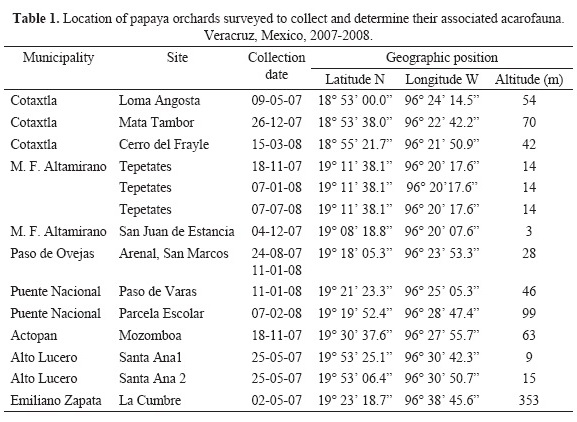
<body><![CDATA[<p align="justify"><font face="verdana" size="2">Papaya growers over wide areas in Mexico have noticed a sudden increase in the importance of injuries caused by mites to this crop, a fact leading the Mexican government to consider the study of mites in this crop as a national priority (CONACyT 2006). Such an increase in the intensity of injuries could be due to the establishment of an exotic species, or alternatively an irrational use of pesticides that may have decimated populations of natural enemies, causing the sudden increase of phytophagous mites as induced pests (Huffaker <i>et al.</i> 1969).</font></p>  	    <p align="justify"><font face="verdana" size="2">Given the above facts, this study was aimed to identify the acarofauna associated with papaya crops in the State of Veracruz, where injuries caused by mites are noticeable (de los Santos <i>et al.</i> 2000).</font></p>  	    <p align="justify"><font face="verdana" size="2">&nbsp;</font></p>  	    <p align="justify"><font face="verdana" size="2"><b>MATERIAL AND METHODS</b></font></p>  	    <p align="justify"><font face="verdana" size="2">Mites were collected in orchards of the papaya cultivar Maradol (the most important cultivar in the study area) from May to October 2008, at locations indicated in <a href="#t1">Table 1</a>. In each orchard, 20 plants were selected, evenly distributed along a diagonal transect. The crown of each plant was divided into three strata (high, middle and low) and one leaf was taken from each stratum. Each orchard was visited once, except those in El Arenal, San Marcos and Tepetates, which were visited two or three times (see <a href="#t1">Table 1</a>).</font></p>  	    <p align="center"><font face="verdana" size="2"><a name="t1"></a></font></p>  	    <p align="center"><font face="verdana" size="2"><img src="/img/revistas/azm/v30n3/a9t1.jpg"></font></p>  	    <p align="justify"><font face="verdana" size="2">Mites present on leaves were collected by placing batches of leaves on a column of two sieves (1000 and 32 um woven wire aperture), then washing them with a strong water stream. Mites were recovered from the finer sieve and transfered to bottles with 70% ethanol. Representative morpho&#45;species were cleared in 85% lactic acid and then mounted on microscopic slides using Hoyer's medium (Walter &amp; Krantz 2009). The identification of mite species was made by the corresponding author (Gabriel Otero&#45;Colina) using a phase contrast microscope (Carl Zeiss, Axiostar). Populations of each species and crown stratum were estimated for each collection site and date. Within a given guild (phytophagous or predatory), cases of species coexistence were recorded to determine possible associations or exclusion. Faunistic data were compared with previous records.</font></p>  	    <p align="justify"><font face="verdana" size="2">&nbsp;</font></p>  	    <p align="justify"><font face="verdana" size="2"><b>RESULTS</b></font></p>  	    ]]></body>
<body><![CDATA[<p align="justify"><font face="verdana" size="2">Three mite species of the family Tetranychidae, one of the family Eriophyidae (both phytophagous) and three of the family Phytoseiidae (tentatively predaceous) were collected. The mean number of specimens from each site and stratum appear in <a href="/img/revistas/azm/v30n3/a9t2.jpg" target="_blank">Table 2</a>. <i>Tetranychus cinnabarinus</i> and <i>P. latus,</i> cited by de los Santos <i>et al.</i> (2000) as among the most important phytosanitary problems in the State of Veracruz, were never found.</font></p>  	    <p align="justify"><font face="verdana" size="2">The most widely disseminated phytophagous mite species was <i>E. banksi,</i> found in all sites except Santa Ana 2. It was followed by <i>E. lewisi,</i> found in all sites except Santa Ana 1 and 2. This second species reached the highest population levels, up to 66 specimens per leaf. The remaining phytophagous mites were collected in few places each (<a href="/img/revistas/azm/v30n3/a9t2.jpg" target="_blank">Table 2</a>).</font></p>  	    <p align="justify"><font face="verdana" size="2">The phytoseiids <i>Euseius hibisci</i> (Chant 1959) and <i>G. helveolus</i> were widespread, the first one with higher populations. In Cerro del Frayle and Santa Ana, <i>E. hibisci</i> attained 21 specimens per leaf in the middle and low strata. A single specimen of <i>Phytoseiulus macropilis</i> (Banks 1905) was found in Tepetates. As a general trend, mites congregated mainly in the middle and low strata, although there was variation among species. <a href="/img/revistas/azm/v30n3/a9f1.jpg" target="_blank">Figure 1</a> presents the mean number of specimens for each species per stratum.</font></p>  	    <p align="justify"><font face="verdana" size="2">&nbsp;</font></p>  	    <p align="justify"><font face="verdana" size="2"><b>DISCUSSION</b></font></p>  	    <p align="justify"><font face="verdana" size="2"><b>Notes on the phytophagous mites</b></font></p>  	    <p align="justify"><font face="verdana" size="2"><i>Eotetranychus lewisi.</i> This mite species is polyphagous and is locally known as "ara&ntilde;a cristalina" (crystalline mite) or "&aacute;caro blanco" (white mite). Bolland <i>et al.</i> (1998) present a list of 64 plant hosts for this mite. It has a wide distribution in the Americas, mainly in tropical and subtropical areas. It is known also from countries such as Libya, the Madeira Islands, South Africa, Philippines and Taiwan, where it has been dispersed most likely by trading contaminated poinsettia <i>Euphorbia pulcherrima</i> Willd. ex Klotzsch 1834 (Corpus&#45;Raros 2001, Ho &amp; Shih 2004). It has been found on papaya trees in Mexico, Costa Rica, El Salvador, Honduras and Nicaragua (Salas 1978, EPPO 2006).</font></p>  	    <p align="justify"><font face="verdana" size="2">Colonies produce profuse webbing (Jeppson <i>et al.</i> 1975) along the primary and secondary abaxial veins, eventually covering the lower side of the leaf (Res&eacute;ndiz &amp; Fausto&#45;Moya 2010, corroborated by the authors). Of all species found during our surveys, <i>E. lewisi</i> attained the highest population levels in the middle (mature leaves) and high strata (younger leaves) (<a href="/img/revistas/azm/v30n3/a9f1.jpg" target="_blank">Fig. 1</a>). Besides two exceptions (Loma Angosta and San Juan de la Estancia, see <a href="/img/revistas/azm/v30n3/a9t2.jpg" target="_blank">Table 2</a>), in the sites where <i>E. lewisi</i> was present, neither <i>T. merganser</i> nor <i>T. urticae</i> were found, suggesting a competitive displacement among those species. Ochoa <i>et al.</i> (1991) indicate that <i>E. lewisi</i> causes severe malformations and reductions of leaf area to the extent that only the veins remain. Similar malformations have been attributed to another mite, <i>P. latus</i> (Aubert <i>et al.</i> 1981, Acu&ntilde;a &amp; Agostini 2004), and also to papaya ring spot virus (PRSV&#45;p) (T&eacute;liz&#45;Ortiz <i>et al.</i> 1991). This mite species and the PRSV&#45;p were present in the study area (GIP 1995), making it almost impossible to link a specific symptom to each source in the field, except for the aqueous marking on the stem by the virus, and the presence of the webbing left by mites.</font></p>  	    <p align="justify"><font face="verdana" size="2"><i>Eutetranychus banksi.</i> This species is known as "ara&ntilde;a texana de los c&iacute;tricos" (Texas citrus mite), and was first described in Orlando, Florida, USA (McGregor 1914). It also was described with different names in the USA, Mexico, Argentina, Peru, Italy, Israel, Egypt, South Africa and India, but Pritchard &amp; Baker (1955) placed those names under the synonymy of <i>E. banksi,</i> and postulated that trading of citrus and ornamental plants disseminated the mite throughout the world. However, Bolland <i>et al.</i> (1998) indicated that most of the distribution data for this species might be related to <i>Eutetranychus orientalis</i> (Klein 1936), a species often confused with <i>E. banksi.</i> The last species is distributed in the Americas on 84 host plant species.</font></p>  	    <p align="justify"><font face="verdana" size="2">In contrast with other mite species, this mite prefers to settle on the adaxial (upper) surface of leaves where it produces little webbing. It has been collected simultaneously with other tetranychid mites, which tend to thrive on the abaxial surface. It causes yellowing, leaf drop, reduction of vigor and yield, and is considered a very harmful fruit tree pest in Mexico (Landeros <i>et al.</i> 2004). Leaf drop reduces photo&#45;synthetic activity in papaya and fruits are exposed to sunlight when leaves of middle to low strata fall, resulting in fruit&#45;burn and a subsequent reduction in quality (de los Santos <i>et al.</i> 2000). Overall, populations were rather low, with only the population found in Loma Angosta considered to be above an economic or operational threshold of concern, with a mean of 52 mites per leaf.</font></p>  	    ]]></body>
<body><![CDATA[<p align="justify"><font face="verdana" size="2"><i>Tetranychus merganser.</i> This species was originally described in privet <i>(Ligustrum vulgare</i> L. 1753) in Baton Rouge, Louisiana, USA (Boudreaux 1954). It has been poorly studied and was not considered an important pest; however, it has expanded recently its distribution and host range, becoming an important invasive pest. This mite was collected on <i>Thalictrum</i> sp. in China (Wang &amp; Ma 1993) and recently has been detected in Japan on pumpkin imported from Mexico and the USA (Ullah <i>et al.</i> 2011). Based on demografic parameters, Ullah <i>et al.</i> (2011) demonstrated that this mite succesfully thrives under temperatures ranging from 15 to 35 &deg;C, showing a preference for warm weather.</font></p>  	    <p align="justify"><font face="verdana" size="2">In Mexico, <i>T. merganser</i> has been cited on <i>C. papaya, Solanum nigrum</i> L. 1753, <i>Solanum rostratum</i> Dunal 1813 (Turtle <i>et al.</i> 1976), <i>Arachis hypogaea</i> L. 1753, <i>Capsicum frutescens</i> L. 1753, <i>Tagetes erecta</i> L. 1753, <i>Ficus</i> sp., <i>Hydrangea macrophylla</i> (Thunb. 1784) and <i>Xanthosoma robustum</i> Schott 1853 (Rodr&iacute;guez&#45;Navarro &amp; Est&eacute;banes&#45;Gonz&aacute;lez 1998, Rodr&iacute;guez&#45;Navarro 1999), while Lomel&iacute;&#45;Flores <i>et al.</i> (2008) recorded it attacking pricky pear <i>(Opuntia ficus&#45;indica</i> &#91;L. 1753&#93;), a new record for this host.</font></p>  	    <p align="justify"><font face="verdana" size="2">On the other hand, Valencia&#45;Dom&iacute;nguez <i>et al.</i> (2011) qualify <i>T. merganser</i> as the most harmful mite of papaya in the State of Yucatan. In recent years in Mexico, papaya (Abato&#45;Z&aacute;rate <i>et al.</i> 2011, FAO 2012) and prickly pear (Flores <i>et al.</i> 1995) have changed from subsistence crops to high income exportation products, intensively cultivated and submitted to frequent applications of pesticides. We suggest that <i>T. merganser</i> has become an important pest as a result of cultural changes with excesive use of pesticides, reproducing the outbreaks of mites as induced pests described by Huffaker <i>et al.</i> (1969).</font></p>  	    <p align="justify"><font face="verdana" size="2"><i>Tetranychus urticae.</i> This species is polyphagous, recorded from 933 hosts word&#45;wide (Bolland <i>et al.</i> 1998). In Mexico it has been found on <i>Acacia greggii</i> (A. Gray 1852), <i>C. papaya, Chrysantemum indicum</i> L. 1753, <i>Citrus x limon</i> (L. 1768), <i>Cucumis sativus</i> L. 1753, <i>Cynara scolymus</i> L. 1753, <i>Dhalia</i> sp., <i>Fragaria mexicana</i> Schltdl. 1839, <i>Gossypium hirsutum</i> L. 1763, <i>Helianthus annuus</i> L. 1753, <i>Impatiens sultanii</i> Hook 1882, <i>Manihot esculenta</i> Crantz 1766, <i>Nicotiana tabacum</i> L. 1753, <i>Phaseolus</i> <i>vulgaris</i> L. 1753, <i>Physalis ixocarpa</i> Brot. 1819, <i>Polianthes tuberosa</i> L. 1753, <i>Rhododendron indicum</i> (L.) Sweet 1832, <i>Rosa</i> sp., <i>Solanum melongena</i> L. 1753, <i>Thevetia peruviana</i> (Pers.) Schum. 1895, <i>Ulmus</i> sp., <i>Vitis vinifera</i> L. 1753, and <i>Zea mays</i> L. 1753 (compiled from: Tuttle <i>et al.</i> 1976, Garc&iacute;a 1981, Otero&#45;Colina 1986, Est&eacute;banes&#45;Gonz&aacute;lez &amp; Rodr&iacute;guez&#45;Navarro 1991, Rodr&iacute;guez&#45;Navarro &amp; Est&eacute;banes&#45;Gonz&aacute;lez 1998). Mite colonies settle mainly on the abaxial surface of leaves, and injury appears as yellow spots and profuse webbing.</font></p>  	    <p align="justify"><font face="verdana" size="2">Given the wide host range of <i>T. urticae,</i> including papaya in Mexico (Garc&iacute;a 1981, Rodr&iacute;guez&#45;Navarro 1999), it is surprising that it was collected only in two orchards during the present study, where it showed low population levels (<a href="/img/revistas/azm/v30n3/a9t2.jpg" target="_blank">Table 2</a>, <a href="/img/revistas/azm/v30n3/a9f1.jpg" target="_blank">Fig. 1</a>). Res&eacute;ndiz &amp; Fausto&#45;Moya (2010) identified both <i>T. urticae</i> and <i>T. cinnabarinus</i> on papaya in Colima State, Mexico, discriminating them by their color and the shape of microtubercles. A discussion persists whether <i>T. cinnabarinus</i> and <i>T. urticae</i> form a single species or can be separated in two different species (Zhang &amp; Jacobson 2000). During our surveys we did not find specimens similar to <i>T. cinnabarinus,</i> suggesting that the specimens cited in Veracruz as <i>T. cinnabarinus</i> by de los Santos <i>et al.</i> (2000) could have been misidentified, and actually corresponded to <i>T. merganser,</i> whose females are also red.</font></p>  	    <p align="justify"><font face="verdana" size="2"><i>Calacarus citrifolii.</i> This species was originally collected in South Africa (Keifer 1955). It is special among eriophyids because it has a wide host range (attacking <i>Brunfelsia</i> sp., <i>C. papaya, Dianthus</i> sp., <i>E. pulcherrima, Lippia</i> sp.,<i>Mimusops</i> sp., <i>Pappea</i> sp., <i>Passiflora quadrangularis</i> L. 1759, <i>Prunus persica</i> (L.) Batsch. 1801, <i>Rhamnus</i> sp., <i>Rhus</i> sp. and <i>Zanthedeschia aethiopica</i> &#91;L.&#93; Spreng. 1826), plants belonging to 11 families (Oldfield 1996, Smith&#45;Meyer 1996). In South Africa it is associated with (or transmits) "concentric ring blotch" citrus disease (Kotz&eacute; <i>et al.</i> 1987). Pantoja <i>et al.</i> (2002) found this mite in the East Antilles, as did de la Torre (2005) in Cuba; in both cases they were collected on papaya trees. These authors did not observe injuries in papaya associated with the infestation of this mite, similar to the present surveys. Besides not been detected in Mexico yet, the disease has a greater potential risk by having its vector in place; in addition, several types of citrus that serve as potential hosts are present in the area. Our data is the first finding of <i>C. citrifolii</i> in the study area. Given its wide host range, it is difficult to postulate how it has moved from Africa to the Antilles and then to Mexico, and it can only be suggested that it moved with contaminated material, such as citrus or poinsettias.</font></p>  	    <p align="justify"><font face="verdana" size="2"><i>Calacarus citrifolii</i> might be a species recently established in papaya agroeco&#45;systems in Veracruz. Since it was already cited in the State of Yucatan by Valencia&#45;Dom&iacute;nguez <i>et al.</i> (2011), we suggest it is widespread in Mexico, although it has been overlooked because it does not cause obvious injuries. Thus, it is postulated that this species is not associated with the sudden increase of mite populations and their damage, which has been noticed by growers in Mexico in recent years.</font></p>  	    <p align="justify"><font face="verdana" size="2">&nbsp;</font></p>  	    <p align="justify"><font face="verdana" size="2"><b>The complex of phytophagous mites on papaya</b></font></p>  	    <p align="justify"><font face="verdana" size="2">The phytophagous mites living on papaya trees included: <i>C. citrifolii, E. lewisi, E. banksi, T. merganser</i> and <i>T. urticae.</i> They constitute a complex; more than one species can be present in a single plant or orchard (<a href="/img/revistas/azm/v30n3/a9t2.jpg" target="_blank">Table 2</a>). <i>Eutetranychus banksi</i> and <i>C. citrifolii</i> were able to coexist with all other species, but in most cases <i>E. lewisi, T. merganser</i> and <i>T. urticae</i> were not found together, suggesting mutual exclusion. The coexistence of <i>E. banksi</i> with other tetranychids can be explained because this species inhabits the adaxial surface of leaves, reducing competition with the abaxial&#45;living tetranychids. In contrast, <i>E. lewisi, T. merganser</i> and <i>T. urticae</i> live on the abaxial surface and the three produce abundant webbing, preventing individuals of different species from settling (Gerson 1985). Similarly, Karban &amp; English&#45;Loeb (1990) demonstrated that colonies of <i>Eotetranychus willamettei</i> (McGregor 1917) established on grape interfere with the settling of <i>Tetranychus pacificus</i> McGregor 1919, phenomenon termed "vaccination" by the authors.</font></p>  	    ]]></body>
<body><![CDATA[<p align="justify"><font face="verdana" size="2"><i>Polyphagotarsonemus latus</i> was never found infesting papaya in our surveys in the central region of Veracruz. Valencia&#45;Dom&iacute;nguez <i>et al.</i> (2011) also did not find this mite in the State of Yucatan. This species has been reported in Mexico to attack several crops, mostly pepper <i>(Capsicum annuum</i> L. 1753) (Alc&aacute;ntara <i>et al.</i> 2011). Experimentally, these authors inoculated this mite onto papaya, where it caused reductions in leaf area; however, they also noticed that colonies of <i>P. latus</i> persisted on the plant for a short period of time, abandoning the plant or dying later; it might explain why we did not find this species during the surveys, even though we have been able to find <i>P. latus</i> on pepper in this area (additional observations of the authors). Leaf malformations and leaf area reductions were found during the study. The frequent presence of <i>E. lewisi</i> on young leaves suggests that such malformations could be caused by this species, not by <i>P. latus;</i> although PRSV&#45;p, another suspected etiological agent, was also present in the study area (T&eacute;liz&#45;Ortiz <i>et al.</i> 1991).</font></p>  	    <p align="justify"><font face="verdana" size="2">Papaya is commercially exploited in a productive cycle that lasts about 1.5 years before being cut down, resulting in death of the infesting mites. In a new orchard, acarofauna must start <i>de novo</i> from mites present on neighboring plants, whether in the nursery or in the field. Any of the above species are able to establish on papaya leaves, but the first one settling down prevents colonization by the others, especially in the case of <i>E. lewisi, T. merganser</i> and <i>T. urticae.</i></font></p>  	    <p align="justify"><font face="verdana" size="2"><i>Calacarus citrifolii</i> is the only species recently established in Mexico and it does not cause obvious injuries (Valencia&#45;Dom&iacute;nguez <i>et al.</i> 2011, our observations). All remaining phytophagous mites were already present in Mexico, however these findings clarifies much of the literature already in use about the identity of papaya mites in Veracruz, Mexico. Individually or combined, mites can reach high population levels on papaya leaves. On this basis, recent papaya mite outbreaks in Mexico cannot be associated with a single species, but to tetranychids as a complex; additional species could be added to the list. Appropriate identification might help to apply the most appropriate pest management strategies.</font></p>  	    <p align="justify"><font face="verdana" size="2">&nbsp;</font></p>  	    <p align="justify"><font face="verdana" size="2"><b>Notes on the predaceous mites collected</b></font></p>  	    <p align="justify"><font face="verdana" size="2">Three species of the family Phytoseiidae were found, <i>G. helveolus, E. hibisci</i> and <i>P. macropilis.</i> These predatory mites are widely distributed in the Americas, including the Antilles, but <i>E. hibisci</i> has been found in Angola, India and Madeira Island (Moraes <i>et al.</i> 2004), and <i>P. macropilis</i> is present in many sites around the world, as a result of its massive propagation and use as a biological control agent (Ferla <i>et al.</i> 2011). The distribution of all three species includes localities North and South of the study area, so they are considered part of the native fauna or at least have been present there for a long time. There are no data on the introductions of any of these species into the study area for biological control purposes, so it is postulated that they could have immigrated and established by themselves on papaya.</font></p>  	    <p align="justify"><font face="verdana" size="2"><i>Galendromus helveolus</i> and <i>E. hibisci</i> were found in almost all collection sites where they probably fed on phytophagous mites. In 25 out of 45 samples, both species were present (<a href="/img/revistas/azm/v30n3/a9t2.jpg" target="_blank">Table 2</a>), suggesting that there is no interference between them. In contrast, only one specimen of <i>P. macropilis</i> was found in Tepetates.</font></p>  	    <p align="justify"><font face="verdana" size="2">The species composition of phytoseiid mites collected in Veracruz contrasts with the species composition identified by Otero&#45;Colina (1986) on papaya in the neighboring State of Tabasco in a more humid environment, with not a single species present in both environments. Although in both cases the phytoseiids found were widespread in the Americas (Moraes <i>et al.</i> 2004), the fauna found by Otero&#45;Colina included members of the families Ascidae and Cheyletidae, more common in tropical and subtropical crops (Christian &amp; Karg 2006, Laing &amp; Knop 1982). Data from Otero&#45;Colina were taken before papaya changed from a subsistence crop with local marketing to an export commodity receiving frequent pesticide applications. Thus, the fauna found in the present study characterized this highly altered agroecosystems, with a fauna composed of non&#45;native predators, opposite to what was reported for Tabasco.</font></p>  	    <p align="justify"><font face="verdana" size="2">Following the characterization of phytoseiid life&#45;styles developed by McMurtry &amp; Croft (1997), <i>G. helveolus</i> is placed in type II, predators selective for tetranychids producing profuse webbing. <i>Euseius hibisci</i> belongs to type IV, pollen feeders and generalist predators. Type I and II predatory mites are morphologically and physiologically adapted to prey on mite species forming dense colonies and producing abundant webbing; they are voraceous and highly fecund when feeding on mites. That is why they are favored for use as biological control agents. For example, <i>G. helveolus</i> has been tested as a biocontrol agent for <i>Oligonychus perseae</i> Tuttle, Baker &amp; Abbatiello 1976 (Takano&#45;Lee &amp; Hoodle 2002), <i>Oligonychus punicae</i> (Hirst 1926) (Tanigoshi &amp; McMurtry 1977), <i>Eotetranychus sexmaculatus</i> (Riley 1890) (Muma 1970), <i>E. banksi, Brevipalpus californicus</i> (Banks 1904) (Chen <i>et al.</i> 2006), <i>P. citri</i> and <i>Phyllocoptruta oleivora</i> (Ashmead 1879) (C&aacute;ceres &amp; Childers 1991).</font></p>  	    <p align="justify"><font face="verdana" size="2">Type IV phytoseiid mites feed mainly on pollen, but they are facultative predators. They could play a role in the natural regulation of phytophagous mites, but they are not capable of controlling tetranychid mite outbreaks, discouraging their massive propagation and use for augmentative control. However, <i>E. hibisci</i> has shown potential to control <i>P. citri</i> (McMurtry 1985), and even <i>T. urticae,</i> which produces abundant webbing (Hern&aacute;ndez&#45;Ortiz <i>et al.</i> 1994).</font></p>  	    ]]></body>
<body><![CDATA[<p align="justify"><font face="verdana" size="2">The collection method used did not allow us to observe the activity of predaceous mites. However, life styles described by McMurtry &amp; Croft (1997) lead us to suggest that <i>E. hibisci</i> preys on <i>E. banksi,</i> which produces little webbing, while <i>G. helveolus</i> preys on <i>E. lewisi, T. merganser and T. urticae,</i> producers of abundant webbing. A combination of both predators could increase efficiency in the natural control of the papaya pest mite complex. <i>Euseius hibisci</i> is an indicator of less disturbed agro&#45;ecosystems, whereas <i>G. helveolus</i> indicates perturbed agroecosystems (McMurtry &amp; Croft 1997). Thus, we consider that papaya agroecosystems in Veracruz are in an intermediate state of perturbation.</font></p>  	    <p align="justify"><font face="verdana" size="2">&nbsp;</font></p>  	    <p align="justify"><font face="verdana" size="2"><b>ACKNOWLEDGEMENTS</b></font></p> 	    <p align="justify"><font face="verdana" size="2">This research was supported by the Consejo Nacional de Ciencia y Tecnolog&iacute;a, Mexico; project CB&#45;2008&#45;01, 000000000106183. We thank Bruce Campbell and Eliseo Garc&iacute;a P&eacute;rez for their helpful review of the manuscript.</font></p>      <p align="justify"><font face="verdana" size="2">&nbsp;</font></p>  	    <p align="justify"><font face="verdana" size="2"><b>LITERATURE CITED</b></font></p>  	    <!-- ref --><p align="justify"><font face="verdana" size="2"><b>Abato&#45;Z&aacute;rate, M., Villanueva&#45;Jim&eacute;nez, J. A., Reta&#45;Mendiola, J., Avila&#45;Res&eacute;ndiz, C., Otero&#45;Colina, G. &amp; Hern&aacute;ndez&#45;Castro, E.</b> 2011. Simultaneous productive growth groups (SPGG): innovation on papaya mite management. <i>Tropical and Subtropical Agroecosystems,</i> 13: 397&#45;407.    &nbsp;&nbsp;&nbsp;&nbsp;&nbsp;&nbsp;&nbsp;&nbsp;[&#160;<a href="javascript:void(0);" onclick="javascript: window.open('/scielo.php?script=sci_nlinks&ref=417666&pid=S0065-1737201400030000900001&lng=','','width=640,height=500,resizable=yes,scrollbars=1,menubar=yes,');">Links</a>&#160;]<!-- end-ref --></font></p>  	    <!-- ref --><p align="justify"><font face="verdana" size="2"><b>Acu&ntilde;a, L. E. &amp; Agostini, J. P.</b> 2004. B&uacute;squeda del agente causal de los s&iacute;ntomas del mosaico del mam&oacute;n <i>Carica papaya</i> L. <i>Citrusmisiones,</i> 29:17&#45;20.    &nbsp;&nbsp;&nbsp;&nbsp;&nbsp;&nbsp;&nbsp;&nbsp;[&#160;<a href="javascript:void(0);" onclick="javascript: window.open('/scielo.php?script=sci_nlinks&ref=417668&pid=S0065-1737201400030000900002&lng=','','width=640,height=500,resizable=yes,scrollbars=1,menubar=yes,');">Links</a>&#160;]<!-- end-ref --></font></p>  	    ]]></body>
<body><![CDATA[<!-- ref --><p align="justify"><font face="verdana" size="2"><b>Alc&aacute;ntara, J. J. A., Santill&aacute;n&#45;Galicia, M. T., Otero&#45;Colina, G., Mora A., A., Guti&eacute;rrez E., M. A. &amp; Hern&aacute;ndez C., E.</b> 2011. Relaci&oacute;n entre <i>Polyphagotarsonemus latus</i> (Acari: Tarsonemidae) y el virus de la mancha anular del papayo (PRSV&#45;p). <i>Revista Colombiana de Entomolog&iacute;a,</i> 37: 228&#45;233.    &nbsp;&nbsp;&nbsp;&nbsp;&nbsp;&nbsp;&nbsp;&nbsp;[&#160;<a href="javascript:void(0);" onclick="javascript: window.open('/scielo.php?script=sci_nlinks&ref=417670&pid=S0065-1737201400030000900003&lng=','','width=640,height=500,resizable=yes,scrollbars=1,menubar=yes,');">Links</a>&#160;]<!-- end-ref --></font></p>  	    <!-- ref --><p align="justify"><font face="verdana" size="2"><b>Amrine, J. W. &amp; Stansy, T. A.</b> 1994. <i>Catalogue of the Eriophyoidea (Acari: Prostigmata) of the World.</i> Indira Publishing House, West Bloomfield, USA, 1186 pp.    &nbsp;&nbsp;&nbsp;&nbsp;&nbsp;&nbsp;&nbsp;&nbsp;[&#160;<a href="javascript:void(0);" onclick="javascript: window.open('/scielo.php?script=sci_nlinks&ref=417672&pid=S0065-1737201400030000900004&lng=','','width=640,height=500,resizable=yes,scrollbars=1,menubar=yes,');">Links</a>&#160;]<!-- end-ref --></font></p>  	    <!-- ref --><p align="justify"><font face="verdana" size="2"><b>Baker, E.W. &amp; Pritchard, A. E.</b> 1962. Ara&ntilde;as rojas de Am&eacute;rica Central. <i>Revista de la Sociedad Mexicana de Historia Natural,</i> 23: 309&#45;340.    &nbsp;&nbsp;&nbsp;&nbsp;&nbsp;&nbsp;&nbsp;&nbsp;[&#160;<a href="javascript:void(0);" onclick="javascript: window.open('/scielo.php?script=sci_nlinks&ref=417674&pid=S0065-1737201400030000900005&lng=','','width=640,height=500,resizable=yes,scrollbars=1,menubar=yes,');">Links</a>&#160;]<!-- end-ref --></font></p>  	    <!-- ref --><p align="justify"><font face="verdana" size="2"><b>Bolland, H. R., Gutierrez, J. &amp; Flechtmann, C. H. W.</b> 1998. <i>World catalogue of the spider mite family (Acari: Tetranychidae)</i>. Leiden, Boston K&oacute;ln, Brill, 392 pp.    &nbsp;&nbsp;&nbsp;&nbsp;&nbsp;&nbsp;&nbsp;&nbsp;[&#160;<a href="javascript:void(0);" onclick="javascript: window.open('/scielo.php?script=sci_nlinks&ref=417676&pid=S0065-1737201400030000900006&lng=','','width=640,height=500,resizable=yes,scrollbars=1,menubar=yes,');">Links</a>&#160;]<!-- end-ref --></font></p>  	    <!-- ref --><p align="justify"><font face="verdana" size="2"><b>Boudreaux, H. B.</b> 1954. New species of tetranychid mites. <i>Pan&#45;Pacific Entomologist,</i> 30: 181&#45;183.    &nbsp;&nbsp;&nbsp;&nbsp;&nbsp;&nbsp;&nbsp;&nbsp;[&#160;<a href="javascript:void(0);" onclick="javascript: window.open('/scielo.php?script=sci_nlinks&ref=417678&pid=S0065-1737201400030000900007&lng=','','width=640,height=500,resizable=yes,scrollbars=1,menubar=yes,');">Links</a>&#160;]<!-- end-ref --></font></p>  	    ]]></body>
<body><![CDATA[<!-- ref --><p align="justify"><font face="verdana" size="2"><b>C&aacute;ceres, S. &amp; Childers, C. C.</b> 1991. Biology and life tables of <i>Galendromus helveolus</i> (Acari: Phyto&#45;seiidae) on Florida citrus. <i>Environmental Entomology,</i> 20: 224&#45;229.    &nbsp;&nbsp;&nbsp;&nbsp;&nbsp;&nbsp;&nbsp;&nbsp;[&#160;<a href="javascript:void(0);" onclick="javascript: window.open('/scielo.php?script=sci_nlinks&ref=417680&pid=S0065-1737201400030000900008&lng=','','width=640,height=500,resizable=yes,scrollbars=1,menubar=yes,');">Links</a>&#160;]<!-- end-ref --></font></p>  	    <!-- ref --><p align="justify"><font face="verdana" size="2"><b>Chen, T. Y., French, J. V., Liu, T. X. &amp; Da Graca, J. V.</b> 2006. Predation of <i>Galendromus helveolus</i> (Acari: Phytoseiidae) on <i>Brevipalpus californicus</i> (Acari: Tenuipalpidae). <i>Biocontrol Science and Technology,</i> 16: 753&#45;759.    &nbsp;&nbsp;&nbsp;&nbsp;&nbsp;&nbsp;&nbsp;&nbsp;[&#160;<a href="javascript:void(0);" onclick="javascript: window.open('/scielo.php?script=sci_nlinks&ref=417682&pid=S0065-1737201400030000900009&lng=','','width=640,height=500,resizable=yes,scrollbars=1,menubar=yes,');">Links</a>&#160;]<!-- end-ref --></font></p>  	    <!-- ref --><p align="justify"><font face="verdana" size="2"><b>Christian, A. &amp; Karg, W.</b> 2006. The predatory mite genus <i>Lasioseius</i> Berlese, 1916. <i>Abhandlungen und Berichte des Naturkundemuseums, Forschungsstelle, G&ouml;rlitz,</i> 77: 99&#45;250.    &nbsp;&nbsp;&nbsp;&nbsp;&nbsp;&nbsp;&nbsp;&nbsp;[&#160;<a href="javascript:void(0);" onclick="javascript: window.open('/scielo.php?script=sci_nlinks&ref=417684&pid=S0065-1737201400030000900010&lng=','','width=640,height=500,resizable=yes,scrollbars=1,menubar=yes,');">Links</a>&#160;]<!-- end-ref --></font></p>  	    <!-- ref --><p align="justify"><font face="verdana" size="2"><b>CONACyT</b> (Consejo Nacional de Ciencia y Tecnolog&iacute;a) (2006) T&eacute;rminos de referencia Convocatoria de Investigaci&oacute;n Cient&iacute;fica B&aacute;sica 2008. Available from: <a href="http://www.conacyt.gob.mx/fondos/FondosSectoriales/SEP/Convocatoria%20200801/Terminos-de-referencia-CB-2008.pdf" target="_blank">http://www.conacyt.gob.mx/fondos/FondosSectoriales/SEP/Convocatoria%20200801/Terminos-de-referencia-CB-2008.pdf</a>. (Accessed 20 March 2013).    &nbsp;&nbsp;&nbsp;&nbsp;&nbsp;&nbsp;&nbsp;&nbsp;[&#160;<a href="javascript:void(0);" onclick="javascript: window.open('/scielo.php?script=sci_nlinks&ref=417686&pid=S0065-1737201400030000900011&lng=','','width=640,height=500,resizable=yes,scrollbars=1,menubar=yes,');">Links</a>&#160;]<!-- end-ref --></font></p>      <!-- ref --><p align="justify"><font face="verdana" size="2"><b>Corpus&#45;Raros, L. A.</b> 2001. New mite pests and new host records of phytophagous mites (Acari) from the Philippines. <i>Philippine Agricultural Science,</i> 84: 341&#45;351.    &nbsp;&nbsp;&nbsp;&nbsp;&nbsp;&nbsp;&nbsp;&nbsp;[&#160;<a href="javascript:void(0);" onclick="javascript: window.open('/scielo.php?script=sci_nlinks&ref=417688&pid=S0065-1737201400030000900012&lng=','','width=640,height=500,resizable=yes,scrollbars=1,menubar=yes,');">Links</a>&#160;]<!-- end-ref --></font></p>  	    ]]></body>
<body><![CDATA[<!-- ref --><p align="justify"><font face="verdana" size="2"><b>de la Torre, P. E.</b> 2005. Colectas acarol&oacute;gicas de ciudad de la Habana registradas por la sanidad vegetal. <i>Fitosanidad,</i> 9: 3&#45;8.    &nbsp;&nbsp;&nbsp;&nbsp;&nbsp;&nbsp;&nbsp;&nbsp;[&#160;<a href="javascript:void(0);" onclick="javascript: window.open('/scielo.php?script=sci_nlinks&ref=417690&pid=S0065-1737201400030000900013&lng=','','width=640,height=500,resizable=yes,scrollbars=1,menubar=yes,');">Links</a>&#160;]<!-- end-ref --></font></p>  	    <!-- ref --><p align="justify"><font face="verdana" size="2"><b>de los Santos, R. F., Becerra L., E. N., Mosqueda, V., V&aacute;squez, H. A. &amp; Vargas, G. A. B.</b> 2000. <i>Manual de producci&oacute;n de papaya en el estado de Veracruz.</i> INIFAP&#45;SAGAR&#45;Fundaci&oacute;n Produce Veracruz. Centro de Investigaciones Agr&iacute;colas del Golfo Centro. Campo Experimental Cotaxtla. Folleto T&eacute;cnico N&uacute;m. 17. M&eacute;xico, 87 pp.    &nbsp;&nbsp;&nbsp;&nbsp;&nbsp;&nbsp;&nbsp;&nbsp;[&#160;<a href="javascript:void(0);" onclick="javascript: window.open('/scielo.php?script=sci_nlinks&ref=417692&pid=S0065-1737201400030000900014&lng=','','width=640,height=500,resizable=yes,scrollbars=1,menubar=yes,');">Links</a>&#160;]<!-- end-ref --></font></p>  	    <!-- ref --><p align="justify"><font face="verdana" size="2"><b>Est&eacute;banes&#45;Gonzalez, M L. &amp; Baker, E. W.</b> 1966. Las ara&ntilde;as rojas de M&eacute;xico (Acarina: Tetranychidae). <i>Anales de la Escuela Nacional de Ciencias Biol&oacute;gicas,</i> M&eacute;xico, 15: 61&#45;133.    &nbsp;&nbsp;&nbsp;&nbsp;&nbsp;&nbsp;&nbsp;&nbsp;[&#160;<a href="javascript:void(0);" onclick="javascript: window.open('/scielo.php?script=sci_nlinks&ref=417694&pid=S0065-1737201400030000900015&lng=','','width=640,height=500,resizable=yes,scrollbars=1,menubar=yes,');">Links</a>&#160;]<!-- end-ref --></font></p>  	    <!-- ref --><p align="justify"><font face="verdana" size="2"><b>Est&eacute;banes&#45;Gonz&aacute;lez, M. L. &amp; Rodr&iacute;guez&#45;Navarro, S.</b> 1991. Observaciones sobre algunos &aacute;caros de las familias Tetranychidae, Eriophyidae, Acaridae y Tarsonemidae (Acari), en hortalizas de M&eacute;xico. <i>Folia Entomol&oacute;gica Mexicana,</i> 83: 199&#45;212.    &nbsp;&nbsp;&nbsp;&nbsp;&nbsp;&nbsp;&nbsp;&nbsp;[&#160;<a href="javascript:void(0);" onclick="javascript: window.open('/scielo.php?script=sci_nlinks&ref=417696&pid=S0065-1737201400030000900016&lng=','','width=640,height=500,resizable=yes,scrollbars=1,menubar=yes,');">Links</a>&#160;]<!-- end-ref --></font></p>  	    <!-- ref --><p align="justify"><font face="verdana" size="2"><b>EPPO</b> (European and Mediterranean Plant Protection Organization) (2006) <i>Eotetranychus lewisi.</i> Bulletin OEPP/EPPO. 36: 161&#45;163. Available from: <a href="http://onlinelibrary.wiley.com/doi/10.1111/j.1365&#45;2338.2006.00929.x/pdf" target="_blank">http://onlinelibrary.wiley.com/doi/10.1111/j.1365&#45;2338.2006.00929.x/pdf</a> (Accessed 07 April 2013).    &nbsp;&nbsp;&nbsp;&nbsp;&nbsp;&nbsp;&nbsp;&nbsp;[&#160;<a href="javascript:void(0);" onclick="javascript: window.open('/scielo.php?script=sci_nlinks&ref=417698&pid=S0065-1737201400030000900017&lng=','','width=640,height=500,resizable=yes,scrollbars=1,menubar=yes,');">Links</a>&#160;]<!-- end-ref --></font></p>  	    ]]></body>
<body><![CDATA[<p align="justify"><font face="verdana" size="2"><b>FAO.</b> 2012. FAOSTAT. Available from: <a href="http://faostat3.fao.org/home/index.html" target="_blank">http://faostat3.fao.org/home/index.html</a> (Accessed 20 March 2013).</font></p>  	    <!-- ref --><p align="justify"><font face="verdana" size="2"><b>Ferla, N. J., Marchetti, M., Johann, L. &amp; Haetinger, C.</b> 2011. Functional response of <i>Phytoseiulus macropilis</i> under different <i>Tetranychus urticae</i> (Acari: Phytoseiidae, Tetranychidae) population density in laboratory. <i>Zoologia,</i> 28: 17&#45;22.    &nbsp;&nbsp;&nbsp;&nbsp;&nbsp;&nbsp;&nbsp;&nbsp;[&#160;<a href="javascript:void(0);" onclick="javascript: window.open('/scielo.php?script=sci_nlinks&ref=417701&pid=S0065-1737201400030000900018&lng=','','width=640,height=500,resizable=yes,scrollbars=1,menubar=yes,');">Links</a>&#160;]<!-- end-ref --></font></p>  	    <!-- ref --><p align="justify"><font face="verdana" size="2"><b>Flores, V. C. A., Luna, E. J. M.&amp; Ram&iacute;rez, M. P.</b> 1995. <i>Mercado mundial del nopalito.</i> ASERCA&#45;UACH&#45;CIESTAAM Chapingo, M&eacute;xico. 115 + 53 pp.    &nbsp;&nbsp;&nbsp;&nbsp;&nbsp;&nbsp;&nbsp;&nbsp;[&#160;<a href="javascript:void(0);" onclick="javascript: window.open('/scielo.php?script=sci_nlinks&ref=417703&pid=S0065-1737201400030000900019&lng=','','width=640,height=500,resizable=yes,scrollbars=1,menubar=yes,');">Links</a>&#160;]<!-- end-ref --></font></p>  	    <!-- ref --><p align="justify"><font face="verdana" size="2"><b>Garc&iacute;a, M. C.</b> 1981. Lista de insectos y &aacute;caros perjudiciales a los cultivos en M&eacute;xico. <i>Fit&oacute;filo,</i> 86: 1196.    &nbsp;&nbsp;&nbsp;&nbsp;&nbsp;&nbsp;&nbsp;&nbsp;[&#160;<a href="javascript:void(0);" onclick="javascript: window.open('/scielo.php?script=sci_nlinks&ref=417705&pid=S0065-1737201400030000900020&lng=','','width=640,height=500,resizable=yes,scrollbars=1,menubar=yes,');">Links</a>&#160;]<!-- end-ref --></font></p>  	    <!-- ref --><p align="justify"><font face="verdana" size="2"><b>Gerson, U.</b> 1985. Webbing, pp. 223&#45;232. <i>In:</i> W. Helle and M. W. Sabelis (Eds.) <i>Spider mites, their biology, natural enemies and control.</i> World Crop Pests Series Vol. 1A. Elsevier, Wageningen.    &nbsp;&nbsp;&nbsp;&nbsp;&nbsp;&nbsp;&nbsp;&nbsp;[&#160;<a href="javascript:void(0);" onclick="javascript: window.open('/scielo.php?script=sci_nlinks&ref=417707&pid=S0065-1737201400030000900021&lng=','','width=640,height=500,resizable=yes,scrollbars=1,menubar=yes,');">Links</a>&#160;]<!-- end-ref --></font></p>  	    <!-- ref --><p align="justify"><font face="verdana" size="2"><b>GIP</b> (Grupo Interdisciplinario del Papayo): Flores&#45;Revilla, C.; Garc&iacute;a, E., Nieto&#45;&Aacute;ngel, D., T&eacute;liz&#45;Ortiz, D. &amp; Villanueva&#45;Jim&eacute;nez, J. A. 1995. Integrated management of papaya in Mexico. <i>Acta Horticulturae,</i> 370: 151&#45;158.    &nbsp;&nbsp;&nbsp;&nbsp;&nbsp;&nbsp;&nbsp;&nbsp;[&#160;<a href="javascript:void(0);" onclick="javascript: window.open('/scielo.php?script=sci_nlinks&ref=417709&pid=S0065-1737201400030000900022&lng=','','width=640,height=500,resizable=yes,scrollbars=1,menubar=yes,');">Links</a>&#160;]<!-- end-ref --></font></p>  	    <!-- ref --><p align="justify"><font face="verdana" size="2"><b>Gonz&aacute;lez, G. N., Rodr&iacute;guez, M. A., de la Torre S., P. E., Lastres, G. N., Garc&iacute;a, M. X. &amp; Ramos, G.</b> <b>N.</b> 2007. Primera cita del &aacute;caro <i>Calacarus flagellista</i> Flechtmann, de Moraes y Barbosa 2001 sobre el cultivo de papaya "Maradol Roja" en Cuba. <i>Bolet&iacute;n de Sanidad Vegetal Plagas,</i> 33: 45&#45;51.    &nbsp;&nbsp;&nbsp;&nbsp;&nbsp;&nbsp;&nbsp;&nbsp;[&#160;<a href="javascript:void(0);" onclick="javascript: window.open('/scielo.php?script=sci_nlinks&ref=417711&pid=S0065-1737201400030000900023&lng=','','width=640,height=500,resizable=yes,scrollbars=1,menubar=yes,');">Links</a>&#160;]<!-- end-ref --></font></p>  	    <!-- ref --><p align="justify"><font face="verdana" size="2"><b>Hern&aacute;ndez&#45;Ortiz, E., Otero&#45;Colina, G., Badii, M. H., L&oacute;pez&#45;Collado, J. &amp; Flores, A. E.</b> 1994. Ciclo y tablas de vida de <i>Euseius hibisci</i> alimentado con <i>Tetranychus urticae</i> (Acari: Phytoseiidae, Tet&#45;ranychidae) y con polen. <i>Agrociencia serie Protecci&oacute;n Vegetal,</i> 5: 7&#45;23.    &nbsp;&nbsp;&nbsp;&nbsp;&nbsp;&nbsp;&nbsp;&nbsp;[&#160;<a href="javascript:void(0);" onclick="javascript: window.open('/scielo.php?script=sci_nlinks&ref=417713&pid=S0065-1737201400030000900024&lng=','','width=640,height=500,resizable=yes,scrollbars=1,menubar=yes,');">Links</a>&#160;]<!-- end-ref --></font></p>  	    <!-- ref --><p align="justify"><font face="verdana" size="2"><b>Ho, C. C. &amp; Shih, S. P.</b> 2004. <i>Eotetranychus lewisi,</i> a new pest of poinsettia from Taiwan. <i>Plant Protection Bulletin (Taipei),</i> 46: 173&#45;176.    &nbsp;&nbsp;&nbsp;&nbsp;&nbsp;&nbsp;&nbsp;&nbsp;[&#160;<a href="javascript:void(0);" onclick="javascript: window.open('/scielo.php?script=sci_nlinks&ref=417715&pid=S0065-1737201400030000900025&lng=','','width=640,height=500,resizable=yes,scrollbars=1,menubar=yes,');">Links</a>&#160;]<!-- end-ref --></font></p>  	    <!-- ref --><p align="justify"><font face="verdana" size="2"><b>Huffaker, C. B., van de Vrie, M. &amp; McMurtry, J. A.</b> 1969. The ecology of tetranychid mites and their natural control. <i>Annual Review of Entomology,</i> 14: 125&#45;74.    &nbsp;&nbsp;&nbsp;&nbsp;&nbsp;&nbsp;&nbsp;&nbsp;[&#160;<a href="javascript:void(0);" onclick="javascript: window.open('/scielo.php?script=sci_nlinks&ref=417717&pid=S0065-1737201400030000900026&lng=','','width=640,height=500,resizable=yes,scrollbars=1,menubar=yes,');">Links</a>&#160;]<!-- end-ref --></font></p>  	    <!-- ref --><p align="justify"><font face="verdana" size="2"><b>Jeppson, L. R., Keifer, H H &amp; Baker, E. W.</b> 1975. <i>Mites injurious to economic plants.</i> Berkeley, Los Angeles, London, University of California Press. U. S. A. 614 pp.    &nbsp;&nbsp;&nbsp;&nbsp;&nbsp;&nbsp;&nbsp;&nbsp;[&#160;<a href="javascript:void(0);" onclick="javascript: window.open('/scielo.php?script=sci_nlinks&ref=417719&pid=S0065-1737201400030000900027&lng=','','width=640,height=500,resizable=yes,scrollbars=1,menubar=yes,');">Links</a>&#160;]<!-- end-ref --></font></p>  	    <!-- ref --><p align="justify"><font face="verdana" size="2"><b>Karban, R. &amp; English&#45;Loeb, G. M.</b> 1990. A "vaccination" of Willamette spider mites (Acari: Tetranychidae) to prevent large populations of Pacific spider mites on grapevines. <i>Journal of Economic</i> <i>Entomology,</i> 83: 2252&#45;2257.    &nbsp;&nbsp;&nbsp;&nbsp;&nbsp;&nbsp;&nbsp;&nbsp;[&#160;<a href="javascript:void(0);" onclick="javascript: window.open('/scielo.php?script=sci_nlinks&ref=417721&pid=S0065-1737201400030000900028&lng=','','width=640,height=500,resizable=yes,scrollbars=1,menubar=yes,');">Links</a>&#160;]<!-- end-ref --></font></p>  	    <!-- ref --><p align="justify"><font face="verdana" size="2"><b>Keifer, H. H.</b> 1955. Eriophyid studies XXIII. <i>California Department of Agriculture Bulletin,</i> 44: 126&#45;130.    &nbsp;&nbsp;&nbsp;&nbsp;&nbsp;&nbsp;&nbsp;&nbsp;[&#160;<a href="javascript:void(0);" onclick="javascript: window.open('/scielo.php?script=sci_nlinks&ref=417723&pid=S0065-1737201400030000900029&lng=','','width=640,height=500,resizable=yes,scrollbars=1,menubar=yes,');">Links</a>&#160;]<!-- end-ref --></font></p>      <!-- ref --><p align="justify"><font face="verdana" size="2"><b>Kotz&eacute;, J. M., Putterill, J. F., Labuschagne, N. &amp; Wehner, F. C.</b> 1987. Occurrence of a spiroplasma&#45;like organism in lesions of concentric ring blotch on citrus. <i>Phytophylactica,</i> 19: 363&#45;364.    &nbsp;&nbsp;&nbsp;&nbsp;&nbsp;&nbsp;&nbsp;&nbsp;[&#160;<a href="javascript:void(0);" onclick="javascript: window.open('/scielo.php?script=sci_nlinks&ref=417725&pid=S0065-1737201400030000900030&lng=','','width=640,height=500,resizable=yes,scrollbars=1,menubar=yes,');">Links</a>&#160;]<!-- end-ref --></font></p>  	    <!-- ref --><p align="justify"><font face="verdana" size="2"><b>Lababidi, M S. &amp; Sengonca, C.</b> 1988. Die Wirksamkeit der verschiedenen Raubmilbenarten gegen&uuml;ber der Baumwollspinnmilbe, <i>Tetranychus cinnabarinus</i> Boisd. (Acari: Tetranychidae). <i>Mitteilungen der Deutschen Gesellschaft f&uuml;r Allgemeine und Angewandte Entomologie,</i> 6: 272&#45;277.    &nbsp;&nbsp;&nbsp;&nbsp;&nbsp;&nbsp;&nbsp;&nbsp;[&#160;<a href="javascript:void(0);" onclick="javascript: window.open('/scielo.php?script=sci_nlinks&ref=417727&pid=S0065-1737201400030000900031&lng=','','width=640,height=500,resizable=yes,scrollbars=1,menubar=yes,');">Links</a>&#160;]<!-- end-ref --></font></p>  	    <!-- ref --><p align="justify"><font face="verdana" size="2"><b>Laing, J. E. &amp; Knop, N. F.</b> 1982. Potential use of predaceous mites other than Phytoseiidae for biological control of orchard pests, pp. 28&#45;35. In: M.A. Hoy, G. L. Cunningham and L. Knutson (Eds.) <i>Biological control of pests by mites. Proceedings.</i> April 5&#45;7, 1982. University of California, Berkeley CA. Special publication / Division of Agriculture and Natural Resources, University of California, USA.    &nbsp;&nbsp;&nbsp;&nbsp;&nbsp;&nbsp;&nbsp;&nbsp;[&#160;<a href="javascript:void(0);" onclick="javascript: window.open('/scielo.php?script=sci_nlinks&ref=417729&pid=S0065-1737201400030000900032&lng=','','width=640,height=500,resizable=yes,scrollbars=1,menubar=yes,');">Links</a>&#160;]<!-- end-ref --></font></p>  	    <!-- ref --><p align="justify"><font face="verdana" size="2"><b>Landeros, L., Cerna, E., Badii, M. H., Varela, S. &amp; Flores, A. E.</b> 2004. Patr&oacute;n de distribuci&oacute;n espacial y fluctuaci&oacute;n poblacional de <i>Eutetranychus banksi</i> (McGregor) y su depredador <i>Euseius mesembrinus</i> (Dean) (Acari: Tetranychidae, Phytoseiidae) en una huerta de naranjos. <i>Acta Zool&oacute;gica Mexicana,</i> 20: 147&#45;155.    &nbsp;&nbsp;&nbsp;&nbsp;&nbsp;&nbsp;&nbsp;&nbsp;[&#160;<a href="javascript:void(0);" onclick="javascript: window.open('/scielo.php?script=sci_nlinks&ref=417731&pid=S0065-1737201400030000900033&lng=','','width=640,height=500,resizable=yes,scrollbars=1,menubar=yes,');">Links</a>&#160;]<!-- end-ref --></font></p>  	    <!-- ref --><p align="justify"><font face="verdana" size="2"><b>Lomel&iacute;&#45;Flores, J. R., Rodr&iacute;guez&#45;Leyva, E., Otero&#45;Colina, G., Mora&#45;Aguilera, G. &amp; Esquivel&#45;Ch&aacute;vez, F.</b> 2008. Primer reporte de <i>Tetranychus merganser</i> (Acari: Tetranychidae) sobre <i>Opuntia ficus&#45;indica</i> L. en Tlalnepantla, Morelos. <i>Entomolog&iacute;a Mexicana,</i> 7: 21&#45;25.    &nbsp;&nbsp;&nbsp;&nbsp;&nbsp;&nbsp;&nbsp;&nbsp;[&#160;<a href="javascript:void(0);" onclick="javascript: window.open('/scielo.php?script=sci_nlinks&ref=417733&pid=S0065-1737201400030000900034&lng=','','width=640,height=500,resizable=yes,scrollbars=1,menubar=yes,');">Links</a>&#160;]<!-- end-ref --></font></p>  	    <!-- ref --><p align="justify"><font face="verdana" size="2"><b>McGregor, E. A.</b> 1914. Four new tetranychids. <i>Annals of the Entomolical Society of America,</i> 7: 354&#45;364.    &nbsp;&nbsp;&nbsp;&nbsp;&nbsp;&nbsp;&nbsp;&nbsp;[&#160;<a href="javascript:void(0);" onclick="javascript: window.open('/scielo.php?script=sci_nlinks&ref=417735&pid=S0065-1737201400030000900035&lng=','','width=640,height=500,resizable=yes,scrollbars=1,menubar=yes,');">Links</a>&#160;]<!-- end-ref --></font></p>      <!-- ref --><p align="justify"><font face="verdana" size="2"><b>McMurtry, J. A.</b> 1985. Citrus, pp. 339&#45;347. In: W. Helle and M. W. Sabelis (Eds.) <i>Spider mites, their biology, natural enemies and control.</i> Vol&#45;1B. Elsevier, Wageningen, Netherland.    &nbsp;&nbsp;&nbsp;&nbsp;&nbsp;&nbsp;&nbsp;&nbsp;[&#160;<a href="javascript:void(0);" onclick="javascript: window.open('/scielo.php?script=sci_nlinks&ref=417737&pid=S0065-1737201400030000900036&lng=','','width=640,height=500,resizable=yes,scrollbars=1,menubar=yes,');">Links</a>&#160;]<!-- end-ref --></font></p>  	    <!-- ref --><p align="justify"><font face="verdana" size="2"><b>McMurtry, J. A. &amp; Croft, B. A.</b> 1997. Life&#45;styles of phytoseiid mites and their roles in biological control. <i>Annual Review of Entomology,</i> 42: 291&#45;321.    &nbsp;&nbsp;&nbsp;&nbsp;&nbsp;&nbsp;&nbsp;&nbsp;[&#160;<a href="javascript:void(0);" onclick="javascript: window.open('/scielo.php?script=sci_nlinks&ref=417739&pid=S0065-1737201400030000900037&lng=','','width=640,height=500,resizable=yes,scrollbars=1,menubar=yes,');">Links</a>&#160;]<!-- end-ref --></font></p>  	    <!-- ref --><p align="justify"><font face="verdana" size="2"><b>Mesa, N. C., Ochoa, R., Welbourn, W. C., Evans, G. A. &amp; de Moraes, G. J.</b> 2009. A catalog of the Tenuipalpidae (Acari) of the world with a key to genera. <i>Zootaxa,</i> 2098: 1&#45;185.    &nbsp;&nbsp;&nbsp;&nbsp;&nbsp;&nbsp;&nbsp;&nbsp;[&#160;<a href="javascript:void(0);" onclick="javascript: window.open('/scielo.php?script=sci_nlinks&ref=417741&pid=S0065-1737201400030000900038&lng=','','width=640,height=500,resizable=yes,scrollbars=1,menubar=yes,');">Links</a>&#160;]<!-- end-ref --></font></p>  	    <!-- ref --><p align="justify"><font face="verdana" size="2"><b>Moraes, G. J., McMurtry, J. A., Denmark, H. A. &amp; Campos, C. B.</b> 2004. A revised catalog of the mite family Phytoseiidae. <i>Zootaxa,</i> 434: 1&#45;494.    &nbsp;&nbsp;&nbsp;&nbsp;&nbsp;&nbsp;&nbsp;&nbsp;[&#160;<a href="javascript:void(0);" onclick="javascript: window.open('/scielo.php?script=sci_nlinks&ref=417743&pid=S0065-1737201400030000900039&lng=','','width=640,height=500,resizable=yes,scrollbars=1,menubar=yes,');">Links</a>&#160;]<!-- end-ref --></font></p>  	    <!-- ref --><p align="justify"><font face="verdana" size="2"><b>Muma, M. H.</b> 1970. Natural control potential of <i>Galendromus floridanus</i> (Acarina: Phytoseiidae) on Tetranychidae on Florida citrus trees. <i>Florida Entomologist,</i> 53: 79&#45;88.    &nbsp;&nbsp;&nbsp;&nbsp;&nbsp;&nbsp;&nbsp;&nbsp;[&#160;<a href="javascript:void(0);" onclick="javascript: window.open('/scielo.php?script=sci_nlinks&ref=417745&pid=S0065-1737201400030000900040&lng=','','width=640,height=500,resizable=yes,scrollbars=1,menubar=yes,');">Links</a>&#160;]<!-- end-ref --></font></p>  	    <!-- ref --><p align="justify"><font face="verdana" size="2"><b>Ochoa, R., Aguilar, H. &amp; Vargas, C.</b> 1991. <i>Acaros fit&oacute;fagos de Am&eacute;rica Central: Gu&iacute;a ilustrada.</i> CATIE, Turrialba, Costa Rica, 252 pp.    &nbsp;&nbsp;&nbsp;&nbsp;&nbsp;&nbsp;&nbsp;&nbsp;[&#160;<a href="javascript:void(0);" onclick="javascript: window.open('/scielo.php?script=sci_nlinks&ref=417747&pid=S0065-1737201400030000900041&lng=','','width=640,height=500,resizable=yes,scrollbars=1,menubar=yes,');">Links</a>&#160;]<!-- end-ref --></font></p>  	    <!-- ref --><p align="justify"><font face="verdana" size="2"><b>Oldfield, G. N.</b> 1996. Diversity and host plant specificity, pp.199&#45;216. <i>In:</i> E. E. Lindquist, M. W. Sabelis and J. Bruin. (Eds.). <i>Eriophyid mites, their biology, natural enemies and control.</i> Elsevier, Wageningen, Netherland.    &nbsp;&nbsp;&nbsp;&nbsp;&nbsp;&nbsp;&nbsp;&nbsp;[&#160;<a href="javascript:void(0);" onclick="javascript: window.open('/scielo.php?script=sci_nlinks&ref=417749&pid=S0065-1737201400030000900042&lng=','','width=640,height=500,resizable=yes,scrollbars=1,menubar=yes,');">Links</a>&#160;]<!-- end-ref --></font></p>  	    <!-- ref --><p align="justify"><font face="verdana" size="2"><b>Otero&#45;Colina, G.</b> 1986. &Aacute;caros colectados en el estado de Tabasco, M&eacute;xico y su importancia. <i>Folia</i> <i>Entomol&oacute;gica Mexicana,</i> 69: 127&#45;147.    &nbsp;&nbsp;&nbsp;&nbsp;&nbsp;&nbsp;&nbsp;&nbsp;[&#160;<a href="javascript:void(0);" onclick="javascript: window.open('/scielo.php?script=sci_nlinks&ref=417751&pid=S0065-1737201400030000900043&lng=','','width=640,height=500,resizable=yes,scrollbars=1,menubar=yes,');">Links</a>&#160;]<!-- end-ref --></font></p>  	    <!-- ref --><p align="justify"><font face="verdana" size="2"><b>Pantoja, A., Follett, P. A. &amp; Villanueva&#45;Jim&eacute;nez, J. A.</b> 2002. Pests of papaya, pp. 131&#45;156. In: J. E. Pe&ntilde;a, J. L. Sharp and M. Wysoki. (Eds.). <i>Tropical fruit pest and pollinators. Biology, economic</i> <i>importance, natural enemies and control.</i> CABI Publishing, Wallingford.    &nbsp;&nbsp;&nbsp;&nbsp;&nbsp;&nbsp;&nbsp;&nbsp;[&#160;<a href="javascript:void(0);" onclick="javascript: window.open('/scielo.php?script=sci_nlinks&ref=417753&pid=S0065-1737201400030000900044&lng=','','width=640,height=500,resizable=yes,scrollbars=1,menubar=yes,');">Links</a>&#160;]<!-- end-ref --></font></p>  	    <!-- ref --><p align="justify"><font face="verdana" size="2"><b>Pritchard, A. E. &amp; Baker, E. W.</b> 1955. A Revision of the spider mite family Tetranychidae. <i>Pacific</i> <i>Coast Entomological Society Memories.</i> Series 2, 472 p.    &nbsp;&nbsp;&nbsp;&nbsp;&nbsp;&nbsp;&nbsp;&nbsp;[&#160;<a href="javascript:void(0);" onclick="javascript: window.open('/scielo.php?script=sci_nlinks&ref=417755&pid=S0065-1737201400030000900045&lng=','','width=640,height=500,resizable=yes,scrollbars=1,menubar=yes,');">Links</a>&#160;]<!-- end-ref --></font></p>  	    <!-- ref --><p align="justify"><font face="verdana" size="2"><b>Res&eacute;ndiz, G. B. &amp; Fausto&#45;Moya, T. J.</b> 2010. Identificaci&oacute;n de los &aacute;caros asociados al papayo <i>(Carica papaya</i> L.). pp. 25&#45;31. <i>In:</i> M. C. S&aacute;nchez G., J. S. Sandoval I. and E. G. Estrada V. (Eds). <i>Memorias del Primer Simposio Internacional de Acarolog&iacute;a.</i> Universidad Aut&oacute;noma Chapingo, M&eacute;xico.    &nbsp;&nbsp;&nbsp;&nbsp;&nbsp;&nbsp;&nbsp;&nbsp;[&#160;<a href="javascript:void(0);" onclick="javascript: window.open('/scielo.php?script=sci_nlinks&ref=417757&pid=S0065-1737201400030000900046&lng=','','width=640,height=500,resizable=yes,scrollbars=1,menubar=yes,');">Links</a>&#160;]<!-- end-ref --></font></p>  	    <!-- ref --><p align="justify"><font face="verdana" size="2"><b>Rodr&iacute;guez&#45;Navarro, S.</b> 1999. &Aacute;caros, 136&#45;138 pp. In: A. C. Deloya&#45;L&oacute;pez and J. E. Valenzuela&#45;Gonz&aacute;lez (Eds.). <i>Cat&aacute;logo de insectos y &aacute;caros de los cultivos agr&iacute;colas de M&eacute;xico.</i> Sociedad Mexicana de Entomolog&iacute;a, M&eacute;xico.    &nbsp;&nbsp;&nbsp;&nbsp;&nbsp;&nbsp;&nbsp;&nbsp;[&#160;<a href="javascript:void(0);" onclick="javascript: window.open('/scielo.php?script=sci_nlinks&ref=417759&pid=S0065-1737201400030000900047&lng=','','width=640,height=500,resizable=yes,scrollbars=1,menubar=yes,');">Links</a>&#160;]<!-- end-ref --></font></p>  	    <!-- ref --><p align="justify"><font face="verdana" size="2"><b>Rodr&iacute;guez&#45;Navarro, S. &amp; Est&eacute;banes&#45;Gonz&aacute;lez, M. L.</b> 1998. <i>Acarofauna asociada a vegetales de importancia agr&iacute;cola y econ&oacute;mica en M&eacute;xico.</i> Universidad Aut&oacute;noma Metropolitana&#45;Xochimilco, M&eacute;xico, 103 pp.    &nbsp;&nbsp;&nbsp;&nbsp;&nbsp;&nbsp;&nbsp;&nbsp;[&#160;<a href="javascript:void(0);" onclick="javascript: window.open('/scielo.php?script=sci_nlinks&ref=417761&pid=S0065-1737201400030000900048&lng=','','width=640,height=500,resizable=yes,scrollbars=1,menubar=yes,');">Links</a>&#160;]<!-- end-ref --></font></p>  	    <!-- ref --><p align="justify"><font face="verdana" size="2"><b>Salas, L. A.</b> 1978. Algunas notas sobre las ara&ntilde;itas rojas (Tetranychidae: Acari) halladas en Costa Rica. <i>Agronom&iacute;a Costarricense,</i> 2: 47&#45;59.    &nbsp;&nbsp;&nbsp;&nbsp;&nbsp;&nbsp;&nbsp;&nbsp;[&#160;<a href="javascript:void(0);" onclick="javascript: window.open('/scielo.php?script=sci_nlinks&ref=417763&pid=S0065-1737201400030000900049&lng=','','width=640,height=500,resizable=yes,scrollbars=1,menubar=yes,');">Links</a>&#160;]<!-- end-ref --></font></p>  	    <!-- ref --><p align="justify"><font face="verdana" size="2"><b>Smith&#45;Meyer, M. K. P.</b> 1996. Ornamental flowering plants, pp. 641&#45;650. In: E. E. Lindquist, M. W. Sabelis and J. Bruin (Eds.). <i>Eriophyid mites, their biology, natural enemies and control.</i> Elsevier, Wageningen, Netherland.    &nbsp;&nbsp;&nbsp;&nbsp;&nbsp;&nbsp;&nbsp;&nbsp;[&#160;<a href="javascript:void(0);" onclick="javascript: window.open('/scielo.php?script=sci_nlinks&ref=417765&pid=S0065-1737201400030000900050&lng=','','width=640,height=500,resizable=yes,scrollbars=1,menubar=yes,');">Links</a>&#160;]<!-- end-ref --></font></p>  	    <!-- ref --><p align="justify"><font face="verdana" size="2"><b>Takano&#45;Lee, M. &amp; Hoddle, M.</b> 2002. Predatory behaviors of <i>Neoseiulus californicus</i> and <i>Galendromus helveolus</i> (Acari: Phytoseiidae) attacking <i>Oligonychus perseae</i> (Acari: Tetranychidae). <i>Experimental and Applied Acarology,</i> 26: 13&#45;26.    &nbsp;&nbsp;&nbsp;&nbsp;&nbsp;&nbsp;&nbsp;&nbsp;[&#160;<a href="javascript:void(0);" onclick="javascript: window.open('/scielo.php?script=sci_nlinks&ref=417767&pid=S0065-1737201400030000900051&lng=','','width=640,height=500,resizable=yes,scrollbars=1,menubar=yes,');">Links</a>&#160;]<!-- end-ref --></font></p>  	    <!-- ref --><p align="justify"><font face="verdana" size="2"><b>Tanigoshi, L. K. &amp; McMurtry, J. A.</b> 1977. The dynamics of predation of <i>Stethorus picipes</i> (Coleoptera. Coccinellidae) and <i>Typholodromus floridanus</i> on the prey <i>Oligonychus punicae</i> (Acarina: Phytoseiidae, Tetranychidae). <i>Hilgardia,</i> 45: 237&#45;288.    &nbsp;&nbsp;&nbsp;&nbsp;&nbsp;&nbsp;&nbsp;&nbsp;[&#160;<a href="javascript:void(0);" onclick="javascript: window.open('/scielo.php?script=sci_nlinks&ref=417769&pid=S0065-1737201400030000900052&lng=','','width=640,height=500,resizable=yes,scrollbars=1,menubar=yes,');">Links</a>&#160;]<!-- end-ref --></font></p>  	    <!-- ref --><p align="justify"><font face="verdana" size="2"><b>T&eacute;liz&#45;Ortiz, D., Mora&#45;Aguilera, A., Nieto&#45;Angel, D., Gonsalves, D., Garc&iacute;a&#45;P&eacute;rez, E., Matheis, L. &amp; &Aacute;vila&#45;Resendiz, C.</b> 1991. Mancha anular del papayo en M&eacute;xico. <i>Revista Mexicana de Fitopatolog&iacute;a,</i> 9: 64&#45;68.    &nbsp;&nbsp;&nbsp;&nbsp;&nbsp;&nbsp;&nbsp;&nbsp;[&#160;<a href="javascript:void(0);" onclick="javascript: window.open('/scielo.php?script=sci_nlinks&ref=417771&pid=S0065-1737201400030000900053&lng=','','width=640,height=500,resizable=yes,scrollbars=1,menubar=yes,');">Links</a>&#160;]<!-- end-ref --></font></p>  	    <!-- ref --><p align="justify"><font face="verdana" size="2"><b>Tuttle, D. M., Baker, E. W. &amp; Abbatiello, M. J.</b> 1976. Spider mites of Mexico (Acari: Tetranychidae). <i>International Journal of Acarology,</i> 2: 1&#45;102.    &nbsp;&nbsp;&nbsp;&nbsp;&nbsp;&nbsp;&nbsp;&nbsp;[&#160;<a href="javascript:void(0);" onclick="javascript: window.open('/scielo.php?script=sci_nlinks&ref=417773&pid=S0065-1737201400030000900054&lng=','','width=640,height=500,resizable=yes,scrollbars=1,menubar=yes,');">Links</a>&#160;]<!-- end-ref --></font></p>  	    <!-- ref --><p align="justify"><font face="verdana" size="2"><b>Ullah, M. S., Moriya, D., Badii, M. H., Nachman, G. &amp; Gotoh, T.</b> 2011. A comparative study of development and demographic parameters of <i>Tetranychus merganser</i> and <i>Tetranychus kanzawai</i> (Acari: Tetranychidae) at different temperatures. <i>Experimental and Applied Acarology,</i> 54: 1&#45;19.    &nbsp;&nbsp;&nbsp;&nbsp;&nbsp;&nbsp;&nbsp;&nbsp;[&#160;<a href="javascript:void(0);" onclick="javascript: window.open('/scielo.php?script=sci_nlinks&ref=417775&pid=S0065-1737201400030000900055&lng=','','width=640,height=500,resizable=yes,scrollbars=1,menubar=yes,');">Links</a>&#160;]<!-- end-ref --></font></p>  	    <!-- ref --><p align="justify"><font face="verdana" size="2"><b>Valencia&#45;Dom&iacute;nguez, H. M., Otero&#45;Colina, G., Santill&aacute;n&#45;Galicia, M. T. &amp; Hern&aacute;ndez&#45;Castro, E.</b> 2011. Acarofauna en papaya var. Maradol <i>(Carica papaya</i> L.) en el estado de Yucat&aacute;n, M&eacute;xico. <i>Entomotropica,</i> 26: 27&#45;40.    &nbsp;&nbsp;&nbsp;&nbsp;&nbsp;&nbsp;&nbsp;&nbsp;[&#160;<a href="javascript:void(0);" onclick="javascript: window.open('/scielo.php?script=sci_nlinks&ref=417777&pid=S0065-1737201400030000900056&lng=','','width=640,height=500,resizable=yes,scrollbars=1,menubar=yes,');">Links</a>&#160;]<!-- end-ref --></font></p>  	    <!-- ref --><p align="justify"><font face="verdana" size="2"><b>Walter, D. E. &amp; Krantz, G. W.</b> 2009. Collection, rearing and preparing specimens. pp. 83&#45;96. In: G. W. Krantz and D. E. Walter. <i>A manual of Acarology.</i> Third Edition. Tech University Press, Lubbock, Texas, U. S. A.    &nbsp;&nbsp;&nbsp;&nbsp;&nbsp;&nbsp;&nbsp;&nbsp;[&#160;<a href="javascript:void(0);" onclick="javascript: window.open('/scielo.php?script=sci_nlinks&ref=417779&pid=S0065-1737201400030000900057&lng=','','width=640,height=500,resizable=yes,scrollbars=1,menubar=yes,');">Links</a>&#160;]<!-- end-ref --></font></p>  	    <!-- ref --><p align="justify"><font face="verdana" size="2"><b>Wang, D. S. &amp; Ma, E. P.</b> 1993. New species and records of tetranychid mites from Eastern China. <i>Acta Entomologica Sinica,</i> 36: 379&#45;381.    &nbsp;&nbsp;&nbsp;&nbsp;&nbsp;&nbsp;&nbsp;&nbsp;[&#160;<a href="javascript:void(0);" onclick="javascript: window.open('/scielo.php?script=sci_nlinks&ref=417781&pid=S0065-1737201400030000900058&lng=','','width=640,height=500,resizable=yes,scrollbars=1,menubar=yes,');">Links</a>&#160;]<!-- end-ref --></font></p>  	    <!-- ref --><p align="justify"><font face="verdana" size="2"><b>Zhang, Z. Q. &amp; Jacobson, R. J.</b> 2000. Using adult female morphological characters for differentiating <i>Tetranychus urticae</i> complex (Acari: Tetranychidae) from greenhouse tomato crops in UK. <i>Systematic and Applied Acarology,</i> 5: 69&#45;76.    &nbsp;&nbsp;&nbsp;&nbsp;&nbsp;&nbsp;&nbsp;&nbsp;[&#160;<a href="javascript:void(0);" onclick="javascript: window.open('/scielo.php?script=sci_nlinks&ref=417783&pid=S0065-1737201400030000900059&lng=','','width=640,height=500,resizable=yes,scrollbars=1,menubar=yes,');">Links</a>&#160;]<!-- end-ref --></font></p>      ]]></body><back>
<ref-list>
<ref id="B1">
<nlm-citation citation-type="journal">
<person-group person-group-type="author">
<name>
<surname><![CDATA[Abato-Zárate]]></surname>
<given-names><![CDATA[M.]]></given-names>
</name>
<name>
<surname><![CDATA[Villanueva-Jiménez]]></surname>
<given-names><![CDATA[J. A.]]></given-names>
</name>
<name>
<surname><![CDATA[Reta-Mendiola]]></surname>
<given-names><![CDATA[J.]]></given-names>
</name>
<name>
<surname><![CDATA[Avila-Reséndiz]]></surname>
<given-names><![CDATA[C.]]></given-names>
</name>
<name>
<surname><![CDATA[Otero-Colina]]></surname>
<given-names><![CDATA[G.]]></given-names>
</name>
<name>
<surname><![CDATA[Hernández-Castro]]></surname>
<given-names><![CDATA[E.]]></given-names>
</name>
</person-group>
<article-title xml:lang="en"><![CDATA[Simultaneous productive growth groups (SPGG): innovation on papaya mite management]]></article-title>
<source><![CDATA[Tropical and Subtropical Agroecosystems]]></source>
<year>2011</year>
<volume>13</volume>
<page-range>397-407</page-range></nlm-citation>
</ref>
<ref id="B2">
<nlm-citation citation-type="journal">
<person-group person-group-type="author">
<name>
<surname><![CDATA[Acuña]]></surname>
<given-names><![CDATA[L. E.]]></given-names>
</name>
<name>
<surname><![CDATA[Agostini]]></surname>
<given-names><![CDATA[J. P.]]></given-names>
</name>
</person-group>
<article-title xml:lang="es"><![CDATA[Búsqueda del agente causal de los síntomas del mosaico del mamón Carica papaya L.]]></article-title>
<source><![CDATA[Citrusmisiones]]></source>
<year>2004</year>
<volume>29</volume>
<page-range>17-20</page-range></nlm-citation>
</ref>
<ref id="B3">
<nlm-citation citation-type="journal">
<person-group person-group-type="author">
<name>
<surname><![CDATA[Alcántara]]></surname>
<given-names><![CDATA[J. J. A.]]></given-names>
</name>
<name>
<surname><![CDATA[Santillán-Galicia]]></surname>
<given-names><![CDATA[M. T.]]></given-names>
</name>
<name>
<surname><![CDATA[Otero-Colina]]></surname>
<given-names><![CDATA[G.]]></given-names>
</name>
<name>
<surname><![CDATA[Mora A.]]></surname>
<given-names><![CDATA[A.]]></given-names>
</name>
<name>
<surname><![CDATA[Gutiérrez E.]]></surname>
<given-names><![CDATA[M. A.]]></given-names>
</name>
<name>
<surname><![CDATA[Hernández C.]]></surname>
<given-names><![CDATA[E.]]></given-names>
</name>
</person-group>
<article-title xml:lang="es"><![CDATA[Relación entre Polyphagotarsonemus latus (Acari: Tarsonemidae) y el virus de la mancha anular del papayo (PRSV-p)]]></article-title>
<source><![CDATA[Revista Colombiana de Entomología]]></source>
<year>2011</year>
<volume>37</volume>
<page-range>228-233</page-range></nlm-citation>
</ref>
<ref id="B4">
<nlm-citation citation-type="book">
<person-group person-group-type="author">
<name>
<surname><![CDATA[Amrine]]></surname>
<given-names><![CDATA[J. W.]]></given-names>
</name>
<name>
<surname><![CDATA[Stansy]]></surname>
<given-names><![CDATA[T. A.]]></given-names>
</name>
</person-group>
<source><![CDATA[Catalogue of the Eriophyoidea (Acari: Prostigmata) of the World]]></source>
<year>1994</year>
<page-range>1186</page-range><publisher-loc><![CDATA[West Bloomfield ]]></publisher-loc>
<publisher-name><![CDATA[Indira Publishing House]]></publisher-name>
</nlm-citation>
</ref>
<ref id="B5">
<nlm-citation citation-type="journal">
<person-group person-group-type="author">
<name>
<surname><![CDATA[Baker]]></surname>
<given-names><![CDATA[E.W.]]></given-names>
</name>
<name>
<surname><![CDATA[Pritchard]]></surname>
<given-names><![CDATA[A. E.]]></given-names>
</name>
</person-group>
<article-title xml:lang="es"><![CDATA[Arañas rojas de América Central]]></article-title>
<source><![CDATA[Revista de la Sociedad Mexicana de Historia Natural]]></source>
<year>1962</year>
<volume>23</volume>
<page-range>309-340</page-range></nlm-citation>
</ref>
<ref id="B6">
<nlm-citation citation-type="book">
<person-group person-group-type="author">
<name>
<surname><![CDATA[Bolland]]></surname>
<given-names><![CDATA[H. R.]]></given-names>
</name>
<name>
<surname><![CDATA[Gutierrez]]></surname>
<given-names><![CDATA[J.]]></given-names>
</name>
<name>
<surname><![CDATA[Flechtmann]]></surname>
<given-names><![CDATA[C. H. W.]]></given-names>
</name>
</person-group>
<source><![CDATA[World catalogue of the spider mite family (Acari: Tetranychidae)]]></source>
<year>1998</year>
<page-range>392</page-range><publisher-loc><![CDATA[Leiden ]]></publisher-loc>
<publisher-name><![CDATA[Boston Kóln, Brill]]></publisher-name>
</nlm-citation>
</ref>
<ref id="B7">
<nlm-citation citation-type="journal">
<person-group person-group-type="author">
<name>
<surname><![CDATA[Boudreaux]]></surname>
<given-names><![CDATA[H. B.]]></given-names>
</name>
</person-group>
<article-title xml:lang="en"><![CDATA[New species of tetranychid mites]]></article-title>
<source><![CDATA[Pan-Pacific Entomologist]]></source>
<year>1954</year>
<volume>30</volume>
<page-range>181-183</page-range></nlm-citation>
</ref>
<ref id="B8">
<nlm-citation citation-type="journal">
<person-group person-group-type="author">
<name>
<surname><![CDATA[Cáceres]]></surname>
<given-names><![CDATA[S.]]></given-names>
</name>
<name>
<surname><![CDATA[Childers]]></surname>
<given-names><![CDATA[C. C.]]></given-names>
</name>
</person-group>
<article-title xml:lang="en"><![CDATA[Biology and life tables of Galendromus helveolus (Acari: Phyto-seiidae) on Florida citrus]]></article-title>
<source><![CDATA[Environmental Entomology]]></source>
<year>1991</year>
<volume>20</volume>
<page-range>224-229</page-range></nlm-citation>
</ref>
<ref id="B9">
<nlm-citation citation-type="journal">
<person-group person-group-type="author">
<name>
<surname><![CDATA[Chen]]></surname>
<given-names><![CDATA[T. Y.]]></given-names>
</name>
<name>
<surname><![CDATA[French]]></surname>
<given-names><![CDATA[J. V.]]></given-names>
</name>
<name>
<surname><![CDATA[Liu]]></surname>
<given-names><![CDATA[T. X.]]></given-names>
</name>
<name>
<surname><![CDATA[Da Graca]]></surname>
<given-names><![CDATA[J. V.]]></given-names>
</name>
</person-group>
<article-title xml:lang="en"><![CDATA[Predation of Galendromus helveolus (Acari: Phytoseiidae) on Brevipalpus californicus (Acari: Tenuipalpidae)]]></article-title>
<source><![CDATA[Biocontrol Science and Technology]]></source>
<year>2006</year>
<volume>16</volume>
<page-range>753-759</page-range></nlm-citation>
</ref>
<ref id="B10">
<nlm-citation citation-type="journal">
<person-group person-group-type="author">
<name>
<surname><![CDATA[Christian]]></surname>
<given-names><![CDATA[A.]]></given-names>
</name>
<name>
<surname><![CDATA[Karg]]></surname>
<given-names><![CDATA[W.]]></given-names>
</name>
</person-group>
<article-title xml:lang="en"><![CDATA[The predatory mite genus Lasioseius Berlese, 1916]]></article-title>
<source><![CDATA[Abhandlungen und Berichte des Naturkundemuseums, Forschungsstelle, Görlitz]]></source>
<year>2006</year>
<volume>77</volume>
<page-range>99-250</page-range></nlm-citation>
</ref>
<ref id="B11">
<nlm-citation citation-type="">
<collab>Consejo Nacional de Ciencia y Tecnología</collab>
<source><![CDATA[Términos de referencia Convocatoria de Investigación Científica Básica 2008]]></source>
<year>2006</year>
</nlm-citation>
</ref>
<ref id="B12">
<nlm-citation citation-type="journal">
<person-group person-group-type="author">
<name>
<surname><![CDATA[Corpus-Raros]]></surname>
<given-names><![CDATA[L. A.]]></given-names>
</name>
</person-group>
<article-title xml:lang="en"><![CDATA[New mite pests and new host records of phytophagous mites (Acari) from the Philippines]]></article-title>
<source><![CDATA[Philippine Agricultural Science]]></source>
<year>2001</year>
<volume>84</volume>
<page-range>341-351</page-range></nlm-citation>
</ref>
<ref id="B13">
<nlm-citation citation-type="journal">
<person-group person-group-type="author">
<name>
<surname><![CDATA[de la Torre]]></surname>
<given-names><![CDATA[P. E.]]></given-names>
</name>
</person-group>
<article-title xml:lang="es"><![CDATA[Colectas acarológicas de ciudad de la Habana registradas por la sanidad vegetal]]></article-title>
<source><![CDATA[Fitosanidad]]></source>
<year>2005</year>
<volume>9</volume>
<page-range>3-8</page-range></nlm-citation>
</ref>
<ref id="B14">
<nlm-citation citation-type="book">
<person-group person-group-type="author">
<name>
<surname><![CDATA[de los Santos]]></surname>
<given-names><![CDATA[R. F.]]></given-names>
</name>
<name>
<surname><![CDATA[Becerra L.]]></surname>
<given-names><![CDATA[E. N.]]></given-names>
</name>
<name>
<surname><![CDATA[Mosqueda]]></surname>
<given-names><![CDATA[V.]]></given-names>
</name>
<name>
<surname><![CDATA[Vásquez]]></surname>
<given-names><![CDATA[H. A.]]></given-names>
</name>
<name>
<surname><![CDATA[Vargas]]></surname>
<given-names><![CDATA[G. A. B.]]></given-names>
</name>
</person-group>
<source><![CDATA[Manual de producción de papaya en el estado de Veracruz]]></source>
<year>2000</year>
<page-range>87</page-range><publisher-loc><![CDATA[México ]]></publisher-loc>
<publisher-name><![CDATA[INIFAPSAGARFundación Produce Veracruz]]></publisher-name>
</nlm-citation>
</ref>
<ref id="B15">
<nlm-citation citation-type="journal">
<person-group person-group-type="author">
<name>
<surname><![CDATA[Estébanes-Gonzalez]]></surname>
<given-names><![CDATA[M L.]]></given-names>
</name>
<name>
<surname><![CDATA[Baker]]></surname>
<given-names><![CDATA[E. W.]]></given-names>
</name>
</person-group>
<article-title xml:lang="es"><![CDATA[Las arañas rojas de México (Acarina: Tetranychidae)]]></article-title>
<source><![CDATA[Anales de la Escuela Nacional de Ciencias Biológicas]]></source>
<year>1966</year>
<volume>15</volume>
<page-range>61-133</page-range></nlm-citation>
</ref>
<ref id="B16">
<nlm-citation citation-type="journal">
<person-group person-group-type="author">
<name>
<surname><![CDATA[Estébanes-González]]></surname>
<given-names><![CDATA[M. L.]]></given-names>
</name>
<name>
<surname><![CDATA[Rodríguez-Navarro]]></surname>
<given-names><![CDATA[S.]]></given-names>
</name>
</person-group>
<article-title xml:lang="es"><![CDATA[Observaciones sobre algunos ácaros de las familias Tetranychidae, Eriophyidae, Acaridae y Tarsonemidae (Acari), en hortalizas de México]]></article-title>
<source><![CDATA[Folia Entomológica Mexicana]]></source>
<year>1991</year>
<volume>83</volume>
<page-range>199-212</page-range></nlm-citation>
</ref>
<ref id="B17">
<nlm-citation citation-type="journal">
<collab>European and Mediterranean Plant Protection Organization</collab>
<article-title xml:lang="en"><![CDATA[Eotetranychus lewisi]]></article-title>
<source><![CDATA[Bulletin OEPP/EPPO]]></source>
<year>2006</year>
<volume>36</volume>
<page-range>161-163</page-range></nlm-citation>
</ref>
<ref id="B18">
<nlm-citation citation-type="journal">
<person-group person-group-type="author">
<name>
<surname><![CDATA[Ferla]]></surname>
<given-names><![CDATA[N. J.]]></given-names>
</name>
<name>
<surname><![CDATA[Marchetti]]></surname>
<given-names><![CDATA[M.]]></given-names>
</name>
<name>
<surname><![CDATA[Johann]]></surname>
<given-names><![CDATA[L.]]></given-names>
</name>
<name>
<surname><![CDATA[Haetinger]]></surname>
<given-names><![CDATA[C.]]></given-names>
</name>
</person-group>
<article-title xml:lang="en"><![CDATA[Functional response of Phytoseiulus macropilis under different Tetranychus urticae (Acari: Phytoseiidae, Tetranychidae) population density in laboratory]]></article-title>
<source><![CDATA[Zoologia]]></source>
<year>2011</year>
<volume>28</volume>
<page-range>17-22</page-range></nlm-citation>
</ref>
<ref id="B19">
<nlm-citation citation-type="book">
<person-group person-group-type="author">
<name>
<surname><![CDATA[Flores]]></surname>
<given-names><![CDATA[V. C. A.]]></given-names>
</name>
<name>
<surname><![CDATA[Luna]]></surname>
<given-names><![CDATA[E. J. M.]]></given-names>
</name>
<name>
<surname><![CDATA[Ramírez]]></surname>
<given-names><![CDATA[M. P.]]></given-names>
</name>
</person-group>
<source><![CDATA[Mercado mundial del nopalito]]></source>
<year>1995</year>
<page-range>53</page-range><publisher-loc><![CDATA[ChapingoMéxico ]]></publisher-loc>
<publisher-name><![CDATA[ASERCAUACHCIESTAAM]]></publisher-name>
</nlm-citation>
</ref>
<ref id="B20">
<nlm-citation citation-type="journal">
<person-group person-group-type="author">
<name>
<surname><![CDATA[García]]></surname>
<given-names><![CDATA[M. C.]]></given-names>
</name>
</person-group>
<article-title xml:lang="es"><![CDATA[Lista de insectos y ácaros perjudiciales a los cultivos en México]]></article-title>
<source><![CDATA[Fitófilo]]></source>
<year>1981</year>
<volume>86</volume>
<page-range>1196</page-range></nlm-citation>
</ref>
<ref id="B21">
<nlm-citation citation-type="book">
<person-group person-group-type="author">
<name>
<surname><![CDATA[Gerson]]></surname>
<given-names><![CDATA[U.]]></given-names>
</name>
</person-group>
<article-title xml:lang="en"><![CDATA[Webbing]]></article-title>
<person-group person-group-type="editor">
<name>
<surname><![CDATA[Helle]]></surname>
<given-names><![CDATA[W.]]></given-names>
</name>
<name>
<surname><![CDATA[Sabelis]]></surname>
<given-names><![CDATA[M. W.]]></given-names>
</name>
</person-group>
<source><![CDATA[Spider mites, their biology, natural enemies and control]]></source>
<year>1985</year>
<page-range>223-232</page-range><publisher-loc><![CDATA[Wageningen ]]></publisher-loc>
<publisher-name><![CDATA[Elsevier]]></publisher-name>
</nlm-citation>
</ref>
<ref id="B22">
<nlm-citation citation-type="journal">
<person-group person-group-type="author">
<name>
<surname><![CDATA[Flores-Revilla]]></surname>
<given-names><![CDATA[C.]]></given-names>
</name>
<name>
<surname><![CDATA[García]]></surname>
<given-names><![CDATA[E.]]></given-names>
</name>
<name>
<surname><![CDATA[Nieto-Ángel]]></surname>
<given-names><![CDATA[D.]]></given-names>
</name>
<name>
<surname><![CDATA[Téliz-Ortiz]]></surname>
<given-names><![CDATA[D.]]></given-names>
</name>
<name>
<surname><![CDATA[Villanueva-Jiménez]]></surname>
<given-names><![CDATA[J. A.]]></given-names>
</name>
</person-group>
<collab>Grupo Interdisciplinario del Papayo</collab>
<article-title xml:lang="en"><![CDATA[Integrated management of papaya in Mexico]]></article-title>
<source><![CDATA[Acta Horticulturae]]></source>
<year>1995</year>
<volume>370</volume>
<page-range>151-158</page-range></nlm-citation>
</ref>
<ref id="B23">
<nlm-citation citation-type="journal">
<person-group person-group-type="author">
<name>
<surname><![CDATA[González]]></surname>
<given-names><![CDATA[G. N.]]></given-names>
</name>
<name>
<surname><![CDATA[Rodríguez]]></surname>
<given-names><![CDATA[M. A.]]></given-names>
</name>
<name>
<surname><![CDATA[de la Torre S.]]></surname>
<given-names><![CDATA[P. E.]]></given-names>
</name>
<name>
<surname><![CDATA[Lastres]]></surname>
<given-names><![CDATA[G. N.]]></given-names>
</name>
<name>
<surname><![CDATA[García]]></surname>
<given-names><![CDATA[M. X.]]></given-names>
</name>
<name>
<surname><![CDATA[Ramos]]></surname>
<given-names><![CDATA[G. N.]]></given-names>
</name>
</person-group>
<article-title xml:lang="es"><![CDATA[Primera cita del ácaro Calacarus flagellista Flechtmann, de Moraes y Barbosa 2001 sobre el cultivo de papaya "Maradol Roja" en Cuba]]></article-title>
<source><![CDATA[Boletín de Sanidad Vegetal Plagas]]></source>
<year>2007</year>
<volume>33</volume>
<page-range>45-51</page-range></nlm-citation>
</ref>
<ref id="B24">
<nlm-citation citation-type="journal">
<person-group person-group-type="author">
<name>
<surname><![CDATA[Hernández-Ortiz]]></surname>
<given-names><![CDATA[E.]]></given-names>
</name>
<name>
<surname><![CDATA[Otero-Colina]]></surname>
<given-names><![CDATA[G.]]></given-names>
</name>
<name>
<surname><![CDATA[Badii]]></surname>
<given-names><![CDATA[M. H.]]></given-names>
</name>
<name>
<surname><![CDATA[López-Collado]]></surname>
<given-names><![CDATA[J.]]></given-names>
</name>
<name>
<surname><![CDATA[Flores]]></surname>
<given-names><![CDATA[A. E.]]></given-names>
</name>
</person-group>
<article-title xml:lang="es"><![CDATA[Ciclo y tablas de vida de Euseius hibisci alimentado con Tetranychus urticae (Acari: Phytoseiidae, Tet-ranychidae) y con polen]]></article-title>
<source><![CDATA[Agrociencia serie Protección Vegetal]]></source>
<year>1994</year>
<volume>5</volume>
<page-range>7-23</page-range></nlm-citation>
</ref>
<ref id="B25">
<nlm-citation citation-type="journal">
<person-group person-group-type="author">
<name>
<surname><![CDATA[Ho]]></surname>
<given-names><![CDATA[C. C.]]></given-names>
</name>
<name>
<surname><![CDATA[Shih]]></surname>
<given-names><![CDATA[S. P.]]></given-names>
</name>
</person-group>
<article-title xml:lang="en"><![CDATA[Eotetranychus lewisi, a new pest of poinsettia from Taiwan]]></article-title>
<source><![CDATA[Plant Protection Bulletin]]></source>
<year>2004</year>
<volume>46</volume>
<page-range>173-176</page-range><publisher-loc><![CDATA[Taipei ]]></publisher-loc>
</nlm-citation>
</ref>
<ref id="B26">
<nlm-citation citation-type="journal">
<person-group person-group-type="author">
<name>
<surname><![CDATA[Huffaker]]></surname>
<given-names><![CDATA[C. B.]]></given-names>
</name>
<name>
<surname><![CDATA[van de Vrie]]></surname>
<given-names><![CDATA[M.]]></given-names>
</name>
<name>
<surname><![CDATA[McMurtry]]></surname>
<given-names><![CDATA[J. A.]]></given-names>
</name>
</person-group>
<article-title xml:lang="en"><![CDATA[The ecology of tetranychid mites and their natural control]]></article-title>
<source><![CDATA[Annual Review of Entomology]]></source>
<year>1969</year>
<volume>14</volume>
<page-range>125-74</page-range></nlm-citation>
</ref>
<ref id="B27">
<nlm-citation citation-type="book">
<person-group person-group-type="author">
<name>
<surname><![CDATA[Jeppson]]></surname>
<given-names><![CDATA[L. R.]]></given-names>
</name>
<name>
<surname><![CDATA[Keifer]]></surname>
<given-names><![CDATA[H H]]></given-names>
</name>
<name>
<surname><![CDATA[Baker]]></surname>
<given-names><![CDATA[E. W.]]></given-names>
</name>
</person-group>
<source><![CDATA[Mites injurious to economic plants]]></source>
<year>1975</year>
<page-range>614</page-range><publisher-loc><![CDATA[BerkeleyLos AngelesLondon ]]></publisher-loc>
<publisher-name><![CDATA[University of California Press]]></publisher-name>
</nlm-citation>
</ref>
<ref id="B28">
<nlm-citation citation-type="journal">
<person-group person-group-type="author">
<name>
<surname><![CDATA[Karban]]></surname>
<given-names><![CDATA[R.]]></given-names>
</name>
<name>
<surname><![CDATA[English-Loeb]]></surname>
<given-names><![CDATA[G. M.]]></given-names>
</name>
</person-group>
<article-title xml:lang="en"><![CDATA[A "vaccination" of Willamette spider mites (Acari: Tetranychidae) to prevent large populations of Pacific spider mites on grapevines]]></article-title>
<source><![CDATA[Journal of Economic Entomology]]></source>
<year>1990</year>
<volume>83</volume>
<page-range>2252-2257</page-range></nlm-citation>
</ref>
<ref id="B29">
<nlm-citation citation-type="journal">
<person-group person-group-type="author">
<name>
<surname><![CDATA[Keifer]]></surname>
<given-names><![CDATA[H. H.]]></given-names>
</name>
</person-group>
<article-title xml:lang="en"><![CDATA[Eriophyid studies XXIII]]></article-title>
<source><![CDATA[California Department of Agriculture Bulletin]]></source>
<year>1955</year>
<volume>44</volume>
<page-range>126-130</page-range></nlm-citation>
</ref>
<ref id="B30">
<nlm-citation citation-type="journal">
<person-group person-group-type="author">
<name>
<surname><![CDATA[Kotzé]]></surname>
<given-names><![CDATA[J. M.]]></given-names>
</name>
<name>
<surname><![CDATA[Putterill]]></surname>
<given-names><![CDATA[J. F.]]></given-names>
</name>
<name>
<surname><![CDATA[Labuschagne]]></surname>
<given-names><![CDATA[N.]]></given-names>
</name>
<name>
<surname><![CDATA[Wehner]]></surname>
<given-names><![CDATA[F. C.]]></given-names>
</name>
</person-group>
<article-title xml:lang="en"><![CDATA[Occurrence of a spiroplasma-like organism in lesions of concentric ring blotch on citrus]]></article-title>
<source><![CDATA[Phytophylactica]]></source>
<year>1987</year>
<volume>19</volume>
<page-range>363-364</page-range></nlm-citation>
</ref>
<ref id="B31">
<nlm-citation citation-type="journal">
<person-group person-group-type="author">
<name>
<surname><![CDATA[Lababidi]]></surname>
<given-names><![CDATA[M S.]]></given-names>
</name>
<name>
<surname><![CDATA[Sengonca]]></surname>
<given-names><![CDATA[C.]]></given-names>
</name>
</person-group>
<article-title xml:lang="de"><![CDATA[Die Wirksamkeit der verschiedenen Raubmilbenarten gegenüber der Baumwollspinnmilbe, Tetranychus cinnabarinus Boisd. (Acari: Tetranychidae)]]></article-title>
<source><![CDATA[Mitteilungen der Deutschen Gesellschaft für Allgemeine und Angewandte Entomologie]]></source>
<year>1988</year>
<volume>6</volume>
<page-range>272-277</page-range></nlm-citation>
</ref>
<ref id="B32">
<nlm-citation citation-type="book">
<person-group person-group-type="author">
<name>
<surname><![CDATA[Laing]]></surname>
<given-names><![CDATA[J. E.]]></given-names>
</name>
<name>
<surname><![CDATA[Knop]]></surname>
<given-names><![CDATA[N. F.]]></given-names>
</name>
</person-group>
<article-title xml:lang="en"><![CDATA[Potential use of predaceous mites other than Phytoseiidae for biological control of orchard pests]]></article-title>
<person-group person-group-type="editor">
<name>
<surname><![CDATA[Hoy]]></surname>
<given-names><![CDATA[M.A.]]></given-names>
</name>
<name>
<surname><![CDATA[Cunningham]]></surname>
<given-names><![CDATA[G. L.]]></given-names>
</name>
<name>
<surname><![CDATA[Knutson]]></surname>
<given-names><![CDATA[L.]]></given-names>
</name>
</person-group>
<source><![CDATA[Biological control of pests by mites. Proceedings]]></source>
<year>1982</year>
<month>Ap</month>
<day>ri</day>
<page-range>28-35</page-range><publisher-loc><![CDATA[Berkeley^eCA CA]]></publisher-loc>
<publisher-name><![CDATA[University of California]]></publisher-name>
</nlm-citation>
</ref>
<ref id="B33">
<nlm-citation citation-type="journal">
<person-group person-group-type="author">
<name>
<surname><![CDATA[Landeros]]></surname>
<given-names><![CDATA[L.]]></given-names>
</name>
<name>
<surname><![CDATA[Cerna]]></surname>
<given-names><![CDATA[E.]]></given-names>
</name>
<name>
<surname><![CDATA[Badii]]></surname>
<given-names><![CDATA[M. H.]]></given-names>
</name>
<name>
<surname><![CDATA[Varela]]></surname>
<given-names><![CDATA[S.]]></given-names>
</name>
<name>
<surname><![CDATA[Flores]]></surname>
<given-names><![CDATA[A. E.]]></given-names>
</name>
</person-group>
<article-title xml:lang="es"><![CDATA[Patrón de distribución espacial y fluctuación poblacional de Eutetranychus banksi (McGregor) y su depredador Euseius mesembrinus (Dean) (Acari: Tetranychidae, Phytoseiidae) en una huerta de naranjos]]></article-title>
<source><![CDATA[Acta Zoológica Mexicana]]></source>
<year>2004</year>
<volume>20</volume>
<page-range>147-155</page-range></nlm-citation>
</ref>
<ref id="B34">
<nlm-citation citation-type="journal">
<person-group person-group-type="author">
<name>
<surname><![CDATA[Lomelí-Flores]]></surname>
<given-names><![CDATA[J. R.]]></given-names>
</name>
<name>
<surname><![CDATA[Rodríguez-Leyva]]></surname>
<given-names><![CDATA[E.]]></given-names>
</name>
<name>
<surname><![CDATA[Otero-Colina]]></surname>
<given-names><![CDATA[G.]]></given-names>
</name>
<name>
<surname><![CDATA[Mora-Aguilera]]></surname>
<given-names><![CDATA[G.]]></given-names>
</name>
<name>
<surname><![CDATA[Esquivel-Chávez]]></surname>
<given-names><![CDATA[F.]]></given-names>
</name>
</person-group>
<article-title xml:lang="es"><![CDATA[Primer reporte de Tetranychus merganser (Acari: Tetranychidae) sobre Opuntia ficus-indica L. en Tlalnepantla, Morelos]]></article-title>
<source><![CDATA[Entomología Mexicana]]></source>
<year>2008</year>
<volume>7</volume>
<page-range>21-25</page-range></nlm-citation>
</ref>
<ref id="B35">
<nlm-citation citation-type="journal">
<person-group person-group-type="author">
<name>
<surname><![CDATA[McGregor]]></surname>
<given-names><![CDATA[E. A.]]></given-names>
</name>
</person-group>
<article-title xml:lang="en"><![CDATA[Four new tetranychids]]></article-title>
<source><![CDATA[Annals of the Entomolical Society of America]]></source>
<year>1914</year>
<volume>7</volume>
<page-range>354-364</page-range></nlm-citation>
</ref>
<ref id="B36">
<nlm-citation citation-type="book">
<person-group person-group-type="author">
<name>
<surname><![CDATA[McMurtry]]></surname>
<given-names><![CDATA[J. A.]]></given-names>
</name>
</person-group>
<article-title xml:lang="en"><![CDATA[Citrus]]></article-title>
<person-group person-group-type="editor">
<name>
<surname><![CDATA[Helle]]></surname>
<given-names><![CDATA[W.]]></given-names>
</name>
<name>
<surname><![CDATA[Sabelis]]></surname>
<given-names><![CDATA[M. W.]]></given-names>
</name>
</person-group>
<source><![CDATA[Spider mites, their biology, natural enemies and control]]></source>
<year>1985</year>
<volume>1B</volume>
<page-range>339-347</page-range><publisher-loc><![CDATA[Wageningen ]]></publisher-loc>
<publisher-name><![CDATA[Elsevier]]></publisher-name>
</nlm-citation>
</ref>
<ref id="B37">
<nlm-citation citation-type="journal">
<person-group person-group-type="author">
<name>
<surname><![CDATA[McMurtry]]></surname>
<given-names><![CDATA[J. A.]]></given-names>
</name>
<name>
<surname><![CDATA[Croft]]></surname>
<given-names><![CDATA[B. A.]]></given-names>
</name>
</person-group>
<article-title xml:lang="en"><![CDATA[Life-styles of phytoseiid mites and their roles in biological control]]></article-title>
<source><![CDATA[Annual Review of Entomology]]></source>
<year>1997</year>
<volume>42</volume>
<page-range>291-321</page-range></nlm-citation>
</ref>
<ref id="B38">
<nlm-citation citation-type="journal">
<person-group person-group-type="author">
<name>
<surname><![CDATA[Mesa]]></surname>
<given-names><![CDATA[N. C.]]></given-names>
</name>
<name>
<surname><![CDATA[Ochoa]]></surname>
<given-names><![CDATA[R.]]></given-names>
</name>
<name>
<surname><![CDATA[Welbourn]]></surname>
<given-names><![CDATA[W. C.]]></given-names>
</name>
<name>
<surname><![CDATA[Evans]]></surname>
<given-names><![CDATA[G. A.]]></given-names>
</name>
<name>
<surname><![CDATA[de Moraes]]></surname>
<given-names><![CDATA[G. J.]]></given-names>
</name>
</person-group>
<article-title xml:lang="en"><![CDATA[A catalog of the Tenuipalpidae (Acari) of the world with a key to genera]]></article-title>
<source><![CDATA[Zootaxa]]></source>
<year>2009</year>
<numero>2098</numero>
<issue>2098</issue>
<page-range>1-185</page-range></nlm-citation>
</ref>
<ref id="B39">
<nlm-citation citation-type="journal">
<person-group person-group-type="author">
<name>
<surname><![CDATA[Moraes]]></surname>
<given-names><![CDATA[G. J.]]></given-names>
</name>
<name>
<surname><![CDATA[McMurtry]]></surname>
<given-names><![CDATA[J. A.]]></given-names>
</name>
<name>
<surname><![CDATA[Denmark]]></surname>
<given-names><![CDATA[H. A.]]></given-names>
</name>
<name>
<surname><![CDATA[Campos]]></surname>
<given-names><![CDATA[C. B.]]></given-names>
</name>
</person-group>
<article-title xml:lang="en"><![CDATA[A revised catalog of the mite family Phytoseiidae]]></article-title>
<source><![CDATA[Zootaxa]]></source>
<year>2004</year>
<numero>434</numero>
<issue>434</issue>
<page-range>1-494</page-range></nlm-citation>
</ref>
<ref id="B40">
<nlm-citation citation-type="journal">
<person-group person-group-type="author">
<name>
<surname><![CDATA[Muma]]></surname>
<given-names><![CDATA[M. H.]]></given-names>
</name>
</person-group>
<article-title xml:lang="en"><![CDATA[Natural control potential of Galendromus floridanus (Acarina: Phytoseiidae) on Tetranychidae on Florida citrus trees]]></article-title>
<source><![CDATA[Florida Entomologist]]></source>
<year>1970</year>
<volume>53</volume>
<page-range>79-88</page-range></nlm-citation>
</ref>
<ref id="B41">
<nlm-citation citation-type="book">
<person-group person-group-type="author">
<name>
<surname><![CDATA[Ochoa]]></surname>
<given-names><![CDATA[R.]]></given-names>
</name>
<name>
<surname><![CDATA[Aguilar]]></surname>
<given-names><![CDATA[H.]]></given-names>
</name>
<name>
<surname><![CDATA[Vargas]]></surname>
<given-names><![CDATA[C.]]></given-names>
</name>
</person-group>
<source><![CDATA[Acaros fitófagos de América Central: Guía ilustrada]]></source>
<year>1991</year>
<page-range>252</page-range><publisher-loc><![CDATA[Turrialba ]]></publisher-loc>
<publisher-name><![CDATA[CATIE]]></publisher-name>
</nlm-citation>
</ref>
<ref id="B42">
<nlm-citation citation-type="book">
<person-group person-group-type="author">
<name>
<surname><![CDATA[Oldfield]]></surname>
<given-names><![CDATA[G. N.]]></given-names>
</name>
</person-group>
<article-title xml:lang="en"><![CDATA[Diversity and host plant specificity]]></article-title>
<person-group person-group-type="editor">
<name>
<surname><![CDATA[Lindquist]]></surname>
<given-names><![CDATA[E. E.]]></given-names>
</name>
<name>
<surname><![CDATA[Sabelis]]></surname>
<given-names><![CDATA[M. W.]]></given-names>
</name>
<name>
<surname><![CDATA[Bruin]]></surname>
<given-names><![CDATA[J.]]></given-names>
</name>
</person-group>
<source><![CDATA[Eriophyid mites, their biology, natural enemies and control]]></source>
<year>1996</year>
<page-range>199-216</page-range><publisher-loc><![CDATA[Wageningen ]]></publisher-loc>
<publisher-name><![CDATA[Elsevier]]></publisher-name>
</nlm-citation>
</ref>
<ref id="B43">
<nlm-citation citation-type="journal">
<person-group person-group-type="author">
<name>
<surname><![CDATA[Otero-Colina]]></surname>
<given-names><![CDATA[G.]]></given-names>
</name>
</person-group>
<article-title xml:lang="es"><![CDATA[Ácaros colectados en el estado de Tabasco, México y su importancia]]></article-title>
<source><![CDATA[Folia Entomológica Mexicana]]></source>
<year>1986</year>
<volume>69</volume>
<page-range>127-147</page-range></nlm-citation>
</ref>
<ref id="B44">
<nlm-citation citation-type="book">
<person-group person-group-type="author">
<name>
<surname><![CDATA[Pantoja]]></surname>
<given-names><![CDATA[A.]]></given-names>
</name>
<name>
<surname><![CDATA[Follett]]></surname>
<given-names><![CDATA[P. A.]]></given-names>
</name>
<name>
<surname><![CDATA[Villanueva-Jiménez]]></surname>
<given-names><![CDATA[J. A.]]></given-names>
</name>
</person-group>
<article-title xml:lang="en"><![CDATA[Pests of papaya]]></article-title>
<person-group person-group-type="editor">
<name>
<surname><![CDATA[Peña]]></surname>
<given-names><![CDATA[J. E.]]></given-names>
</name>
<name>
<surname><![CDATA[Sharp]]></surname>
<given-names><![CDATA[J. L.]]></given-names>
</name>
<name>
<surname><![CDATA[Wysoki]]></surname>
<given-names><![CDATA[M.]]></given-names>
</name>
</person-group>
<source><![CDATA[Tropical fruit pest and pollinators. Biology, economic importance, natural enemies and control]]></source>
<year>2002</year>
<page-range>131-156</page-range><publisher-loc><![CDATA[Wallingford ]]></publisher-loc>
<publisher-name><![CDATA[CABI Publishing]]></publisher-name>
</nlm-citation>
</ref>
<ref id="B45">
<nlm-citation citation-type="">
<person-group person-group-type="author">
<name>
<surname><![CDATA[Pritchard]]></surname>
<given-names><![CDATA[A. E.]]></given-names>
</name>
<name>
<surname><![CDATA[Baker]]></surname>
<given-names><![CDATA[E. W.]]></given-names>
</name>
</person-group>
<source><![CDATA[A Revision of the spider mite family Tetranychidae. Pacific Coast Entomological Society Memories]]></source>
<year>1955</year>
<page-range>472</page-range></nlm-citation>
</ref>
<ref id="B46">
<nlm-citation citation-type="book">
<person-group person-group-type="author">
<name>
<surname><![CDATA[Reséndiz]]></surname>
<given-names><![CDATA[G. B.]]></given-names>
</name>
<name>
<surname><![CDATA[Fausto-Moya]]></surname>
<given-names><![CDATA[T. J.]]></given-names>
</name>
</person-group>
<article-title xml:lang="es"><![CDATA[Identificación de los ácaros asociados al papayo (Carica papaya L.)]]></article-title>
<person-group person-group-type="editor">
<name>
<surname><![CDATA[Sánchez G.]]></surname>
<given-names><![CDATA[M. C.]]></given-names>
</name>
<name>
<surname><![CDATA[Sandoval I.]]></surname>
<given-names><![CDATA[J. S.]]></given-names>
</name>
<name>
<surname><![CDATA[Estrada V.]]></surname>
<given-names><![CDATA[E. G.]]></given-names>
</name>
</person-group>
<source><![CDATA[Memorias del Primer Simposio Internacional de Acarología]]></source>
<year>2010</year>
<page-range>25-31</page-range><publisher-loc><![CDATA[México ]]></publisher-loc>
<publisher-name><![CDATA[Universidad Autónoma Chapingo]]></publisher-name>
</nlm-citation>
</ref>
<ref id="B47">
<nlm-citation citation-type="book">
<person-group person-group-type="author">
<name>
<surname><![CDATA[Rodríguez-Navarro]]></surname>
<given-names><![CDATA[S.]]></given-names>
</name>
</person-group>
<article-title xml:lang="es"><![CDATA[Ácaros]]></article-title>
<person-group person-group-type="editor">
<name>
<surname><![CDATA[Deloya-López]]></surname>
<given-names><![CDATA[A. C.]]></given-names>
</name>
<name>
<surname><![CDATA[Valenzuela-González]]></surname>
<given-names><![CDATA[J. E.]]></given-names>
</name>
</person-group>
<source><![CDATA[Catálogo de insectos y ácaros de los cultivos agrícolas de México]]></source>
<year>1999</year>
<page-range>136-138</page-range><publisher-loc><![CDATA[México ]]></publisher-loc>
<publisher-name><![CDATA[Sociedad Mexicana de Entomología]]></publisher-name>
</nlm-citation>
</ref>
<ref id="B48">
<nlm-citation citation-type="book">
<person-group person-group-type="author">
<name>
<surname><![CDATA[Rodríguez-Navarro]]></surname>
<given-names><![CDATA[S.]]></given-names>
</name>
<name>
<surname><![CDATA[Estébanes-González]]></surname>
<given-names><![CDATA[M. L.]]></given-names>
</name>
</person-group>
<source><![CDATA[Acarofauna asociada a vegetales de importancia agrícola y económica en México]]></source>
<year>1998</year>
<page-range>103</page-range><publisher-loc><![CDATA[México ]]></publisher-loc>
<publisher-name><![CDATA[Universidad Autónoma Metropolitana-Xochimilco]]></publisher-name>
</nlm-citation>
</ref>
<ref id="B49">
<nlm-citation citation-type="journal">
<person-group person-group-type="author">
<name>
<surname><![CDATA[Salas]]></surname>
<given-names><![CDATA[L. A.]]></given-names>
</name>
</person-group>
<article-title xml:lang="es"><![CDATA[Algunas notas sobre las arañitas rojas (Tetranychidae: Acari) halladas en Costa Rica]]></article-title>
<source><![CDATA[Agronomía Costarricense]]></source>
<year>1978</year>
<volume>2</volume>
<page-range>47-59</page-range></nlm-citation>
</ref>
<ref id="B50">
<nlm-citation citation-type="book">
<person-group person-group-type="author">
<name>
<surname><![CDATA[Smith-Meyer]]></surname>
<given-names><![CDATA[M. K. P.]]></given-names>
</name>
</person-group>
<article-title xml:lang="en"><![CDATA[Ornamental flowering plants]]></article-title>
<person-group person-group-type="editor">
<name>
<surname><![CDATA[Lindquist]]></surname>
<given-names><![CDATA[E. E.]]></given-names>
</name>
<name>
<surname><![CDATA[Sabelis]]></surname>
<given-names><![CDATA[M. W.]]></given-names>
</name>
<name>
<surname><![CDATA[Bruin]]></surname>
<given-names><![CDATA[J.]]></given-names>
</name>
</person-group>
<source><![CDATA[Eriophyid mites, their biology, natural enemies and control]]></source>
<year>1996</year>
<page-range>641-650</page-range><publisher-loc><![CDATA[Wageningen ]]></publisher-loc>
<publisher-name><![CDATA[Elsevier]]></publisher-name>
</nlm-citation>
</ref>
<ref id="B51">
<nlm-citation citation-type="journal">
<person-group person-group-type="author">
<name>
<surname><![CDATA[Takano-Lee]]></surname>
<given-names><![CDATA[M.]]></given-names>
</name>
<name>
<surname><![CDATA[Hoddle]]></surname>
<given-names><![CDATA[M.]]></given-names>
</name>
</person-group>
<article-title xml:lang="en"><![CDATA[Predatory behaviors of Neoseiulus californicus and Galendromus helveolus (Acari: Phytoseiidae) attacking Oligonychus perseae (Acari: Tetranychidae)]]></article-title>
<source><![CDATA[Experimental and Applied Acarology]]></source>
<year>2002</year>
<volume>26</volume>
<page-range>13-26</page-range></nlm-citation>
</ref>
<ref id="B52">
<nlm-citation citation-type="journal">
<person-group person-group-type="author">
<name>
<surname><![CDATA[Tanigoshi]]></surname>
<given-names><![CDATA[L. K.]]></given-names>
</name>
<name>
<surname><![CDATA[McMurtry]]></surname>
<given-names><![CDATA[J. A.]]></given-names>
</name>
</person-group>
<article-title xml:lang="en"><![CDATA[The dynamics of predation of Stethorus picipes (Coleoptera. Coccinellidae) and Typholodromus floridanus on the prey Oligonychus punicae (Acarina: Phytoseiidae, Tetranychidae)]]></article-title>
<source><![CDATA[Hilgardia]]></source>
<year>1977</year>
<volume>45</volume>
<page-range>237-288</page-range></nlm-citation>
</ref>
<ref id="B53">
<nlm-citation citation-type="journal">
<person-group person-group-type="author">
<name>
<surname><![CDATA[Téliz-Ortiz]]></surname>
<given-names><![CDATA[D.]]></given-names>
</name>
<name>
<surname><![CDATA[Mora-Aguilera]]></surname>
<given-names><![CDATA[A.]]></given-names>
</name>
<name>
<surname><![CDATA[Nieto-Angel]]></surname>
<given-names><![CDATA[D.]]></given-names>
</name>
<name>
<surname><![CDATA[Gonsalves]]></surname>
<given-names><![CDATA[D.]]></given-names>
</name>
<name>
<surname><![CDATA[García-Pérez]]></surname>
<given-names><![CDATA[E.]]></given-names>
</name>
<name>
<surname><![CDATA[Matheis]]></surname>
<given-names><![CDATA[L.]]></given-names>
</name>
<name>
<surname><![CDATA[Ávila-Resendiz]]></surname>
<given-names><![CDATA[C.]]></given-names>
</name>
</person-group>
<article-title xml:lang="es"><![CDATA[Mancha anular del papayo en México]]></article-title>
<source><![CDATA[Revista Mexicana de Fitopatología]]></source>
<year>1991</year>
<volume>9</volume>
<page-range>64-68</page-range></nlm-citation>
</ref>
<ref id="B54">
<nlm-citation citation-type="journal">
<person-group person-group-type="author">
<name>
<surname><![CDATA[Tuttle]]></surname>
<given-names><![CDATA[D. M.]]></given-names>
</name>
<name>
<surname><![CDATA[Baker]]></surname>
<given-names><![CDATA[E. W.]]></given-names>
</name>
<name>
<surname><![CDATA[Abbatiello]]></surname>
<given-names><![CDATA[M. J.]]></given-names>
</name>
</person-group>
<article-title xml:lang="en"><![CDATA[Spider mites of Mexico (Acari: Tetranychidae)]]></article-title>
<source><![CDATA[International Journal of Acarology]]></source>
<year>1976</year>
<volume>2</volume>
<page-range>1-102</page-range></nlm-citation>
</ref>
<ref id="B55">
<nlm-citation citation-type="journal">
<person-group person-group-type="author">
<name>
<surname><![CDATA[Ullah]]></surname>
<given-names><![CDATA[M. S.]]></given-names>
</name>
<name>
<surname><![CDATA[Moriya]]></surname>
<given-names><![CDATA[D.]]></given-names>
</name>
<name>
<surname><![CDATA[Badii]]></surname>
<given-names><![CDATA[M. H.]]></given-names>
</name>
<name>
<surname><![CDATA[Nachman]]></surname>
<given-names><![CDATA[G.]]></given-names>
</name>
<name>
<surname><![CDATA[Gotoh]]></surname>
<given-names><![CDATA[T.]]></given-names>
</name>
</person-group>
<article-title xml:lang="en"><![CDATA[A comparative study of development and demographic parameters of Tetranychus merganser and Tetranychus kanzawai (Acari: Tetranychidae) at different temperatures]]></article-title>
<source><![CDATA[Experimental and Applied Acarology]]></source>
<year>2011</year>
<volume>54</volume>
<page-range>1-19</page-range></nlm-citation>
</ref>
<ref id="B56">
<nlm-citation citation-type="journal">
<person-group person-group-type="author">
<name>
<surname><![CDATA[Valencia-Domínguez]]></surname>
<given-names><![CDATA[H. M.]]></given-names>
</name>
<name>
<surname><![CDATA[Otero-Colina]]></surname>
<given-names><![CDATA[G.]]></given-names>
</name>
<name>
<surname><![CDATA[Santillán-Galicia]]></surname>
<given-names><![CDATA[M. T.]]></given-names>
</name>
<name>
<surname><![CDATA[Hernández-Castro]]></surname>
<given-names><![CDATA[E.]]></given-names>
</name>
</person-group>
<article-title xml:lang="es"><![CDATA[Acarofauna en papaya var. Maradol (Carica papaya L.) en el estado de Yucatán, México]]></article-title>
<source><![CDATA[Entomotropica]]></source>
<year>2011</year>
<volume>26</volume>
<page-range>27-40</page-range></nlm-citation>
</ref>
<ref id="B57">
<nlm-citation citation-type="book">
<person-group person-group-type="author">
<name>
<surname><![CDATA[Walter]]></surname>
<given-names><![CDATA[D. E.]]></given-names>
</name>
<name>
<surname><![CDATA[Krantz]]></surname>
<given-names><![CDATA[G. W.]]></given-names>
</name>
</person-group>
<article-title xml:lang="en"><![CDATA[Collection, rearing and preparing specimens]]></article-title>
<person-group person-group-type="editor">
<name>
<surname><![CDATA[Krantz]]></surname>
<given-names><![CDATA[G. W.]]></given-names>
</name>
<name>
<surname><![CDATA[Walter]]></surname>
<given-names><![CDATA[D. E.]]></given-names>
</name>
</person-group>
<source><![CDATA[A manual of Acarology]]></source>
<year>2009</year>
<edition>Third</edition>
<page-range>83-96</page-range><publisher-loc><![CDATA[Lubbock^eTexas Texas]]></publisher-loc>
<publisher-name><![CDATA[Tech University Press]]></publisher-name>
</nlm-citation>
</ref>
<ref id="B58">
<nlm-citation citation-type="journal">
<person-group person-group-type="author">
<name>
<surname><![CDATA[Wang]]></surname>
<given-names><![CDATA[D. S.]]></given-names>
</name>
<name>
<surname><![CDATA[Ma]]></surname>
<given-names><![CDATA[E. P.]]></given-names>
</name>
</person-group>
<article-title xml:lang="en"><![CDATA[New species and records of tetranychid mites from Eastern China]]></article-title>
<source><![CDATA[Acta Entomologica Sinica]]></source>
<year>1993</year>
<volume>36</volume>
<page-range>379-381</page-range></nlm-citation>
</ref>
<ref id="B59">
<nlm-citation citation-type="journal">
<person-group person-group-type="author">
<name>
<surname><![CDATA[Zhang]]></surname>
<given-names><![CDATA[Z. Q.]]></given-names>
</name>
<name>
<surname><![CDATA[Jacobson]]></surname>
<given-names><![CDATA[R. J.]]></given-names>
</name>
</person-group>
<article-title xml:lang="en"><![CDATA[Using adult female morphological characters for differentiating Tetranychus urticae complex (Acari: Tetranychidae) from greenhouse tomato crops in UK]]></article-title>
<source><![CDATA[Systematic and Applied Acarology]]></source>
<year>2000</year>
<volume>5</volume>
<page-range>69-76</page-range></nlm-citation>
</ref>
</ref-list>
</back>
</article>
