<?xml version="1.0" encoding="ISO-8859-1"?><article xmlns:mml="http://www.w3.org/1998/Math/MathML" xmlns:xlink="http://www.w3.org/1999/xlink" xmlns:xsi="http://www.w3.org/2001/XMLSchema-instance">
<front>
<journal-meta>
<journal-id>0065-1737</journal-id>
<journal-title><![CDATA[Acta zoológica mexicana]]></journal-title>
<abbrev-journal-title><![CDATA[Acta Zool. Mex]]></abbrev-journal-title>
<issn>0065-1737</issn>
<publisher>
<publisher-name><![CDATA[Instituto de Ecología A.C.]]></publisher-name>
</publisher>
</journal-meta>
<article-meta>
<article-id>S0065-17372013000300008</article-id>
<title-group>
<article-title xml:lang="en"><![CDATA[Suppression of Drosophila ananassae flies owing to interspecific competition with D. melanogaster under artificial conditions]]></article-title>
<article-title xml:lang="es"><![CDATA[Supresión de las moscas Drosophila ananassae debido a la competencia interespecífica con D. melanogaster bajo condiciones artificiales]]></article-title>
</title-group>
<contrib-group>
<contrib contrib-type="author">
<name>
<surname><![CDATA[SINGH]]></surname>
<given-names><![CDATA[Arvind K.]]></given-names>
</name>
<xref ref-type="aff" rid="A01"/>
</contrib>
<contrib contrib-type="author">
<name>
<surname><![CDATA[KUMAR]]></surname>
<given-names><![CDATA[Sanjay]]></given-names>
</name>
<xref ref-type="aff" rid="A01"/>
</contrib>
</contrib-group>
<aff id="A01">
<institution><![CDATA[,Banaras Hindu University Department of Zoology Genetics Laboratory]]></institution>
<addr-line><![CDATA[Varanasi ]]></addr-line>
<country>INDIA</country>
</aff>
<pub-date pub-type="pub">
<day>00</day>
<month>12</month>
<year>2013</year>
</pub-date>
<pub-date pub-type="epub">
<day>00</day>
<month>12</month>
<year>2013</year>
</pub-date>
<volume>29</volume>
<numero>3</numero>
<fpage>563</fpage>
<lpage>573</lpage>
<copyright-statement/>
<copyright-year/>
<self-uri xlink:href="http://www.scielo.org.mx/scielo.php?script=sci_arttext&amp;pid=S0065-17372013000300008&amp;lng=en&amp;nrm=iso"></self-uri><self-uri xlink:href="http://www.scielo.org.mx/scielo.php?script=sci_abstract&amp;pid=S0065-17372013000300008&amp;lng=en&amp;nrm=iso"></self-uri><self-uri xlink:href="http://www.scielo.org.mx/scielo.php?script=sci_pdf&amp;pid=S0065-17372013000300008&amp;lng=en&amp;nrm=iso"></self-uri><abstract abstract-type="short" xml:lang="en"><p><![CDATA[Interspecific competition between two species of Drosophila: D. ananassae and D. melanogaster was studied at the larval and adult stages. It was found that when D. ananassae and D. melanogaster adult flies were co-cultured, very few D. ananassae offspring could be recovered in the first generation. To investigate the reasons of D. ananassae apparent inhibition, mating behavior of D. ananassae in the presence of D. melanogaster was observed and it was found that the number of matings deviated significantly from those recorded when it was kept alone. To determine larval development of D. ananassae after being initially exposed to D. melanogaster, the females of the two species were separated in different food bottles after 3 days of being kept together. Good D. ananassae cultures could be recovered indicating that initial exposure of D. ananassae to D. melanogaster did not hamper its egg laying capacity or eclosion. However, if they remained together, no D. ananassae could be recovered from larval diet, suggesting that either D. melanogaster adults interfered with fertilization or egg-laying, or their larvae eliminated competitors. To see whether there is larval competition, polytene chromosomes of 54 third instar larvae were analyzed out of which only 5.56 percent were found to be D. ananassae. Thus, if a few eggs are laid by D. ananassae and they develop, all the while facing competition from D. melanogaster and till the third instar larval stage is reached, there is almost complete elimination of D. ananassae. Thus, interspecific competition exists at all stages of life cycle and few if any D. ananassae flies emerge.]]></p></abstract>
<abstract abstract-type="short" xml:lang="es"><p><![CDATA[Se estudió la competencia interespecífica entre dos especies de Drosophila: D. ananassae y D. melanogaster en estado larvario y adulto. Se encontró que al criar simultáneamente adultos de D. ananassae y D. melanogaster, muy poca progenie de primera generación de D. ananassae podia recuperarse. Para investigar las causas de la aparente inhibición de D. ananassae, se observó el comportamiento de apareamiento de D. ananassae en presencia de D. melanogaster y se observó que el número de apareamientos se desvió significatívamente de aquel registrado cuando esta especie se mantuvo sola. Para observar el desarrollo larvario de D. ananassae después de la exposición a D. melanogaster, hembras de ambas especies fueron separadas en botes de alimento después de tres días de confinamiento conjunto. Se obtuvieron buenas crías de D. ananassae, indicando que la exposición de D. ananassae a D. melanogaster no afectó su capacidad de oviposición ni su fertilidad. Sin embargo, cuando ambas especies permanecieron juntas, no se recuperó D. ananassae de la dieta larvaria lo que sugiere que los adultos de D.melanogaster interfirieron con la fertilización u oviposición, o bien sus larvas eliminaron la competencia. Para establecer la existencia de competencia larvaria se examinaron los cromosomas polténicos de 54 larvas de tercer estadio entre las cuáles solo el 5.56 por ciento resultaron ser de D. ananassae. Por lo tanto, si algunos huevos son depositados por D. ananassae y se desarrollan, éstos enfrentan la competencia de D. melanogaster durante todo el desarrollo y hasta el tercer estadio, llegando a la casi total eliminación de D. ananassae. Existe competencia interespecifica en todas las etapas del ciclo de vida resultando en una casi nula emergencia de D. ananassae.]]></p></abstract>
<kwd-group>
<kwd lng="en"><![CDATA[Interspecific competition]]></kwd>
<kwd lng="en"><![CDATA[mating propensity]]></kwd>
<kwd lng="en"><![CDATA[co-culture]]></kwd>
<kwd lng="en"><![CDATA[fecundity]]></kwd>
<kwd lng="en"><![CDATA[larval competition]]></kwd>
<kwd lng="en"><![CDATA[D. ananassae]]></kwd>
<kwd lng="es"><![CDATA[Competencia interespecífica]]></kwd>
<kwd lng="es"><![CDATA[co-cultivo]]></kwd>
<kwd lng="es"><![CDATA[fecundidad]]></kwd>
<kwd lng="es"><![CDATA[competencia larval]]></kwd>
<kwd lng="es"><![CDATA[D. ananassae]]></kwd>
</kwd-group>
</article-meta>
</front><body><![CDATA[  	    <p align="justify"><font face="verdana" size="4">Art&iacute;culos originales</font></p>  	    <p align="center"><font face="verdana" size="2">&nbsp;</font></p>  	    <p align="center"><font face="verdana" size="4"><b>Suppression of <i>Drosophila ananassae</i> flies owing to interspecific competition with <i>D. melanogaster</i> under artificial conditions</b></font></p>  	    <p align="center"><font face="verdana" size="2">&nbsp;</font></p>  	    <p align="center"><font face="verdana" size="3"><b>Supresi&oacute;n de las moscas <i>Drosophila ananassae</i> debido a la competencia interespec&iacute;fica con <i>D. melanogaster</i> bajo condiciones</b> <b>artificiales</b></font></p>  	    <p align="center"><font face="verdana" size="2">&nbsp;</font></p>  	    <p align="center"><font face="verdana" size="2"><b>Arvind K. SINGH<sup>1</sup> &amp; Sanjay KUMAR</b></font></p>  	    <p align="justify"><font face="verdana" size="2">&nbsp;</font></p>  	    <p align="justify"><font face="verdana" size="2"><sup><i>1 </i></sup><i>Genetics Laboratory, Department of Zoology, Banaras Hindu University, Varanasi&#45;221005 INDIA.</i> &lt;<a href="mailto:aksbhu23@rediffmail.com">aksbhu23@rediffmail.com</a>&gt;</font></p>  	    ]]></body>
<body><![CDATA[<p align="justify"><font face="verdana" size="2">&nbsp;</font></p>  	    <p align="justify"><font face="verdana" size="2">Recibido: 18/09/2012;    <br> 	aceptado: 22/05/2013.</font></p>  	    <p align="justify"><font face="verdana" size="2">&nbsp;</font></p>  	    <p align="justify"><font face="verdana" size="2"><b>ABSTRACT</b></font></p>  	    <p align="justify"><font face="verdana" size="2">Interspecific competition between two species of <i>Drosophila: D. ananassae</i> and <i>D. melanogaster</i> was studied at the larval and adult stages. It was found that when <i>D. ananassae</i> and <i>D. melanogaster</i> adult flies were co&#45;cultured, very few <i>D. ananassae</i> offspring could be recovered in the first generation. To investigate the reasons of <i>D. ananassae</i> apparent inhibition, mating behavior of <i>D. ananassae</i> in the presence of <i>D. melanogaster</i> was observed and it was found that the number of matings deviated significantly from those recorded when it was kept alone. To determine larval development of <i>D.</i> <i>ananassae</i> after being initially exposed to <i>D. melanogaster</i>, the females of the two species were separated in different food bottles after 3 days of being kept together. Good <i>D. ananassae</i> cultures could be recovered indicating that initial exposure of <i>D. ananassae</i> to <i>D. melanogaster</i> did not hamper its egg laying capacity or eclosion. However, if they remained together, no <i>D. ananassae</i> could be recovered from larval diet, suggesting that either <i>D. melanogaster</i> adults interfered with fertilization or egg&#45;laying, or their larvae eliminated competitors. To see whether there is larval competition, polytene chromosomes of 54 third instar larvae were analyzed out of which only 5.56 percent were found to be <i>D. ananassae.</i> Thus, if a few eggs are laid by <i>D. ananassae</i> and they develop, all the while facing competition from <i>D. melanogaster</i> and till the third instar larval stage is reached, there is almost complete elimination of <i>D. ananassae</i>. Thus, interspecific competition exists at all stages of life cycle and few if any <i>D. ananassae</i> flies emerge.</font></p>  	    <p align="justify"><font face="verdana" size="2"><b>Key words:</b> Interspecific competition, mating propensity, co&#45;culture, fecundity, larval competition, <i>D. ananassae</i>.</font></p>  	    <p align="justify"><font face="verdana" size="2">&nbsp;</font></p>  	    <p align="justify"><font face="verdana" size="2"><b>RESUMEN</b></font></p>  	    <p align="justify"><font face="verdana" size="2">Se estudi&oacute; la competencia interespec&iacute;fica entre dos especies de <i>Drosophila</i>: <i>D. ananassae</i> y <i>D. melanogaster</i> en estado larvario y adulto. Se encontr&oacute; que al criar simult&aacute;neamente adultos de <i>D.</i> <i>ananassae</i> y <i>D. melanogaster</i>, muy poca progenie de primera generaci&oacute;n de <i>D. ananassae</i> podia recuperarse. Para investigar las causas de la aparente inhibici&oacute;n de <i>D. ananassae</i>, se observ&oacute; el comportamiento de apareamiento de <i>D. ananassae</i> en presencia de <i>D. melanogaster</i> y se observ&oacute; que el n&uacute;mero de apareamientos se desvi&oacute; significat&iacute;vamente de aquel registrado cuando esta especie se mantuvo sola. Para observar el desarrollo larvario de <i>D. ananassae</i> despu&eacute;s de la exposici&oacute;n a <i>D. melanogaster</i>, hembras de ambas especies fueron separadas en botes de alimento despu&eacute;s de tres d&iacute;as de confinamiento conjunto. Se obtuvieron buenas cr&iacute;as de <i>D. ananassae</i>, indicando que la exposici&oacute;n de <i>D. ananassae</i> a <i>D. melanogaster</i> no afect&oacute; su capacidad de oviposici&oacute;n ni su fertilidad. Sin embargo, cuando ambas especies permanecieron juntas, no se recuper&oacute; <i>D. ananassae</i> de la dieta larvaria lo que sugiere que los adultos de <i>D.melanogaster</i> interfirieron con la fertilizaci&oacute;n u oviposici&oacute;n, o bien sus larvas eliminaron la competencia. Para establecer la existencia de competencia larvaria se examinaron los cromosomas polt&eacute;nicos de 54 larvas de tercer estadio entre las cu&aacute;les solo el 5.56 por ciento resultaron ser de <i>D. ananassae</i>. Por lo tanto, si algunos huevos son depositados por <i>D. ananassae</i> y se desarrollan, &eacute;stos enfrentan la competencia de <i>D. melanogaster</i> durante todo el desarrollo y hasta el tercer estadio, llegando a la casi total eliminaci&oacute;n de <i>D. ananassae</i>. Existe competencia interespecifica en todas las etapas del ciclo de vida resultando en una casi nula emergencia de <i>D. ananassae</i>.</font></p>  	    ]]></body>
<body><![CDATA[<p align="justify"><font face="verdana" size="2"><b>Palabras clave:</b> Competencia interespec&iacute;fica, co&#45;cultivo, fecundidad, competencia larval, <i>D. ananassae</i>.</font></p>  	    <p align="justify"><font face="verdana" size="2">&nbsp;</font></p>  	    <p align="justify"><font face="verdana" size="2"><b>INTRODUCTION</b></font></p>  	    <p align="justify"><font face="verdana" size="2">Natural selection often operates through competition, allowing various forms to survive and establish under certain environmental conditions. It tends to eliminate, gradually or rapidly, forms exploiting identical niches. Charles Darwin (1859) in his book "Origin of species" stated that Intraspecific and interspecific competition among organisms are a part of natural selection. This competition can be the result of high reproductive potential of some species when compared to the environmental carrying capacity. The most severe form of interspecific competition exists when organisms of two species have the same requirements. On the basis of theoretical equations, Lotka (1925) and Volterra (1926) independently predicted that two species with identical needs and habits cannot survive in the same place if they compete for limited resources. If both types are found together in nature, they must differ in their ecology, or else there are fluctuations in the environment, favoring first one and then the other. Experiments on interspecific competition between similar species have also demonstrated the validity of this theory (Connell 1981; Crombie 1947; Denno <i>et al.</i> 1995; Gause 1934; Hochkirch &amp; Groening 2012; Luan <i>et al.</i> 2012; Zhang <i>et al</i>. 2011; Zimmering 1948). Careful analysis of the instances in which both species survive has shown that they occupy slightly different niches (Gause 1934; Crombie 1947). According to Kohn and Orians (1962) competition between species reveals ecological differences permitting coexistence of stable populations of closely related species of various kinds of animals.</font></p>  	    <p align="justify"><font face="verdana" size="2"><i>Drosophila</i> turns out to be the apt model system for studying interspecific competition, because in the genus <i>Drosophila</i> one finds a large number of species, some showing high degrees of morphological and ecological similarities and also close genetical relationships (Tantawy 1964). No wonder, exhaustive studies have been done, especially involving sibling species of this genus to study interspecific competition (Nunney 1990). A practical way of studying interspecific competition in the laboratory is by co&#45; culturing two species together in large population cages or in culture bottles. One may simply study the effect of co&#45;culturing on the fecundity of the species involved or one can also check the effect of altering various ecological conditions such as larval density, temperature etc. on the fecundity of co&#45;cultured populations of two species. Merrell (1951) cultured <i>D. melanogaster</i> and <i>D. funebris</i> together in food bottles and found that the proportion of <i>D. funebris</i> eggs reaching pupation decreased significantly in mixed larval populations. Interspecific competition between <i>D. melanogaster</i> and <i>D. simulans</i>, was studied in much detail by Barker &amp; Podger (1970). They examined the effects of larval density and short&#45;term adult starvation on fecundity, egg hatchability and adult viability. It was found that significant effect of larval density on fecundity was probably mediated through effects on adult body weight. <i>D. melanogaster</i> females raised in mixed species cultures were less fecund than those from pure cultures, while <i>D. simulans</i> showed the reverse effect. Increasing the larval density of the two species at 15 &deg;C and 25 &deg;C temperatures, causes a progressive reduction in per cent hatching (Tantawy &amp; Soli&#45;man 1967; Miller 1964; Chiang &amp; Hodson 1950; Birch 1955). Boggild &amp; Keiding (1958) in their studies on house fly larvae found that harmful effects of crowding on adult emergence result from an increased incidence of collisions between larvae. This causes the metabolic rate to be increased and thus reduces the fraction of ingested food available for tissue formation. Tantawy &amp; Soliman (1967) found that there was a gradual elimination of <i>D. simulans</i> by <i>D. melanogaster</i> in the two cages, irrespective of their initial percentage at 25 &deg;C. These results also supported the results of Moore (1952) and Barker (1963). The results from cages kept at 15 &deg;C indicate that the outcome of competition at 15 &deg;C is completely different from that at 25 &deg;C. At 15 &deg;C there is an increase in <i>D. simulans</i> at the expense of <i>D. melanogaster</i>. A similar experiment was done by Montchamp&#45;Moreau (1983) involving the same species. The optimum temperature for <i>D. simulans</i> was found to be 20 &deg;C and for <i>D. melanogaster</i> it was 25 &deg;C as while at 25 &deg;C <i>D. melanogaster</i> eliminated <i>D.simulans</i> and at 20 &deg;C the reverse occurred in mix culture cage populations. <i>D. pseudoobscura</i> and <i>D. subobscura</i>, two species sympatric in the west coast of North America exhibited competition in the laboratory to such an extent that <i>D. subobscura</i> was completely eliminated in just a few generations of their being co&#45;cultured. The outcome was no different when they were reared at different temperatures (Pascual <i>et al</i>. 1998).</font></p>  	    <p align="justify"><font face="verdana" size="2">In nature two competing species do not face a straight battle and there may be other species too which have their own impact on the competition. For example it was found that competition between two closely related species <i>D. melanogaster</i> and <i>D. hydei</i> was affected by a third distant species of an entirely different kingdom <i>Aspergilus niger</i> ( Hodge <i>et al</i>. 1999). Not only other species but components of interspcific competition are also known to be affected under different environmental conditions, creating a geographic mosaic of outcomes (Joshi 2004; Joshi &amp; Thompson 1995). Price <i>et al.</i> (2012) found that presence of mating rivals cause males of <i>D. pseudoobscura</i> to modulate sperm transfer through an increase in sperm transfer, alteration in ejaculate composition etc. In <i>D. melanogaster</i> Bretman <i>et al.</i> (2009) reported that males kept with rivals prior to mating, mated for a longer duration.</font></p>  	    <p align="justify"><font face="verdana" size="2">The present study aimed at comparing the viability of two species of <i>Drosophila,</i><i>i.e</i>. <i>D. ananassae</i> Doleschall and <i>D. melanogaster</i> Meigen when they are cultured together in food bottles. Taxonomically both species belong to the <i>melanogaster</i> species group of the subgenus <i>Sophophora</i>. <i>Drosophila ananassae</i> falls in the <i>ananassae</i> subgroup and the <i>ananassae</i> complex and <i>D. melanogaster</i> belongs to the <i>melanogaster</i> subgroup (Bock &amp; Wheeler 1972). Distribution wise both species are cosmopolitan. <i>D. melanogaster</i> being semi&#45;domestic, occurring in orchards and gardens and <i>D.</i> <i>ananassae</i>, a domestic species is found at a closer proximity to human habitation, such as fruit markets, kitchens etc. It occupies a unique status among the <i>Drosophila</i> species because of certain unusual genetical features (Singh 2010). The morphological features of the two species enable easy distinction of the two species and their sexes as males of <i>D. melanogaster</i> possess black abdominal tip and a characteristic pattern of sex comb. The females of <i>D. melanogaster</i> are larger in size with more swollen abdomen and black thin stripes at abdominal segment junctions. <i>Drosophila ananassae</i> males do not possess black coloration at the abdominal tip and they have a number of thick hairs on the first and second tarsal segments forming a diffused sex comb pattern. The females of <i>D. ananassae</i> are light in color as they lack black abdominal stripes. Earlier experiments on interspecific competition involving <i>D. melanogaster</i> have been done with its sibling species. However, <i>D. ananassae</i> and <i>D. melanogaster</i> are quite distinct. Therefore, it would be interesting to see the degree of competition that exists between the two, and whether they are able to thrive in presence of each other. Experiments were conducted to determine at which stage(s) of the life cycle interspecific competition occurs between the two species.</font></p>  	    <p align="justify"><font face="verdana" size="2">&nbsp;</font></p>  	    <p align="justify"><font face="verdana" size="2"><b>MATERIAL AND METHODS</b></font></p>  	    <p align="justify"><font face="verdana" size="2">This study was done by taking two wild type species of <i>Drosophila</i>, <i>D. ananassae</i> and <i>D. melanogaster</i>. These two stocks have been reared in our laboratory for the last three years. <i>D. ananassae</i> was originally collected from Ranchi (Jharkhand state) and <i>D.</i> <i>melanogaster</i> <i>was collected from Varanasi (Uttar Pradesh), as adult forms by net sweeping. The stocks of both species were maintained in the laboratory on simple</i> yeast&#45;agar culture medium at 24<sup>o</sup>C with a 12 hours cycle of light and darkness.</font></p>  	    ]]></body>
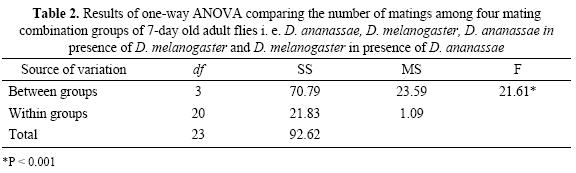
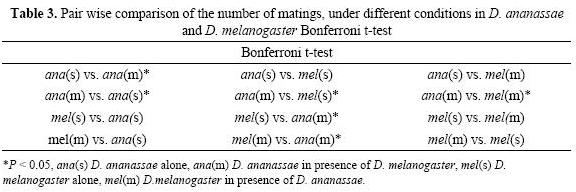
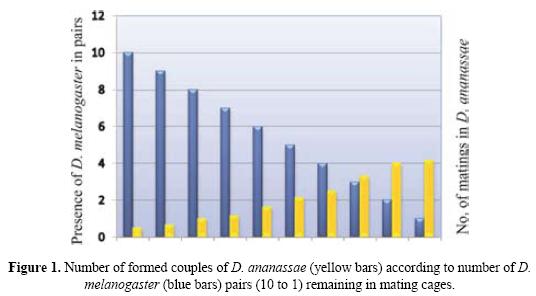
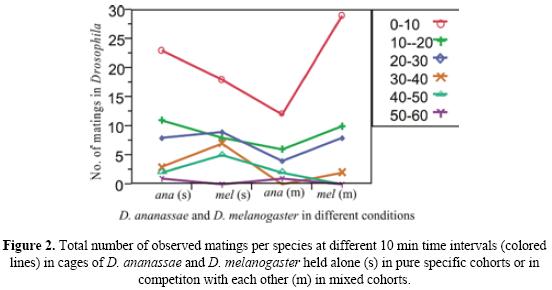
<body><![CDATA[<p align="justify"><font face="verdana" size="2">Virgin male and female flies from both species were collected and aged. Twenty pairs (ten pairs from each species) of seven day&#45;old flies were then kept together in 250 ml cylindrical culture bottles (height 15 cm, base diameter 5 cm, mouth diameter 2.5 cm) containing 50 ml of food. After three days, all flies were discarded. Flies emerging from the bottles were separated according to species and sex and counted. Pure cultures were established to serve as controls. The number of progeny emerging from such control cultures were also counted. The experiment was repeated five times.</font></p>  	    <p align="justify"><font face="verdana" size="2">Mating behavior of <i>D. ananassae</i> and <i>D. melanogaster</i> flies was observed in the presence of each other. Ten pairs of seven day&#45;old virgin male and female flies of both species were kept in an Elen&#45;Wattiaux mating chamber and observed for one hour. When a pair commenced mating it was aspirated out. As a control, 10 pairs of <i>D.</i> <i>ananassae</i> and 10 pairs of <i>D. melanogaster</i> were observed separately in the mating chamber. The total number of matings (formed couples) and the time interval in minutes from release to pair formation was recorded. Six replicates of each mating combination were carried out. All mating experiments were done between 6:00 am to 11:00 am, as <i>Drosophila</i> exhibits peak mating activity during the morning hours. One way ANOVA was done to test whether there was any difference in the mean number of matings among the four groups, (<i>D. ananassae</i> alone, <i>D. ananassae</i> in presence of <i>D.</i> <i>melanogaster</i>, <i>D. melanogaster</i> alone and <i>D. melanogaster</i> in presence of <i>D. ananassae</i>). Bonferroni t&#45; test were used for pair wise comparison between the groups.</font></p>  	    <p align="justify"><font face="verdana" size="2">Ten pairs of seven day&#45;old virgin male and female flies of both the species were kept together in culture bottles (as described above). After three days males were discarded and females of each species were kept separately in fresh culture bottles, and allowed to lay eggs. They were not exposed to males of their own species so that the progeny produced was only the outcome of matings that occurred when both the species were housed together. Also the effect of initial exposure of the two species to each other, on their progeny recovery could be determined.</font></p>  	    <p align="justify"><font face="verdana" size="2">The two species were also co&#45;cultured in the food bottles to study larval competition. Ten pairs of seven day&#45;old virgin male and female flies of both species were kept in fresh food bottles for three days, after which the flies were discarded. Polytene chromosome preparations of the third instar larvae were made by lacto&#45;aceto&#45;orcein method, to identify whether the larvae were <i>D. ananassae</i> or <i>D. melanogaster</i>.</font></p>  	    <p align="justify"><font face="verdana" size="2">&nbsp;</font></p>  	    <p align="justify"><font face="verdana" size="2"><b>RESULTS</b></font></p>  	    <p align="justify"><font face="verdana" size="2"><i>Drosophila ananassae</i> flies were almost eliminated in number during the first generation itself, when reared in culture bottles along with <i>D. melanogaster</i> adults as very few <i>D. ananassae</i>, males could be recovered. The numbers of <i>D. melanogaster</i> (both males and females) counted in the bottles are given in <b><a href="#t1">Table 1</a></b>. Also, the numbers of flies counted in the control sets are shown.</font></p>  	    <p align="center"><font face="verdana" size="2"><a name="t1"></a></font></p>  	    <p align="center"><font face="verdana" size="2"><img src="/img/revistas/azm/v29n3/a8t1.jpg"></font></p>  	    <p align="justify"><font face="verdana" size="2">In the second set of experiments, where males and females of both the species were observed in Elen&#45;Wattiaux mating chamber, it was found that males of both species largely courted females of their own species. However, occasionally, <i>D. melanogaster</i> males would unsuccessfully court a <i>D. ananassae</i> female. It was also observed that <i>D. melanogaster</i> males would interfere with the courtship rituals of <i>D. ananassae</i> males and chased away a courting <i>D. ananassae</i> male. The results of one way ANOVA (<b><a href="#t2">Table 2</a>.</b>) show that there is a significant difference between the mean number of matings in <i>D. ananassae</i> and <i>D. melanogaster</i> when they are confined alone in the mating chamber and when they are kept in presence of each other. Bonferonni t&#45;tests (<b><a href="#t3">Table 3</a>.</b>) proved that there are significant reductions in the number of <i>D. ananassae</i> matings, when it is kept with <i>D. melanogaster</i>. Therefore the presence of <i>D.</i> <i>melanogaster</i> affects the mating propensity of <i>D. ananassae</i>. <b><a href="#f1">Figure 1</a></b> shows that as the number of <i>D. melanogaster</i> pairs decreases in the mating chamber after being aspirated out when a pair commenced mating, the number of matings of <i>D. ananassae</i> increases. The average data of the six sets of mating experiments with ten pairs of <i>D. ananassae</i> in the presence of 10 pairs of <i>D. melanogaster</i> was used. <b><a href="#f2">Figure 2</a></b> shows the effect of time on mating success in <i>D. ananassae</i> and <i>D. melanogaster</i> in different conditions. The graph was constructed with the pooled data of the six sets of mating experiments. It depicts that the number of matings in <i>D. ananassae</i> in first 10 minutes is very high, when they are alone in the mating chamber, compared to when they are confined with <i>D. melanogaster</i>. In the next 50 minutes, however, the number of matings remains almost the same under the two conditions. For <i>D. melanogaster,</i> the number of matings was found to be less when alone than when in the presence of <i>D.</i> <i>ananassae</i>.</font></p>  	    ]]></body>
<body><![CDATA[<p align="center"><font face="verdana" size="2"><a name="t2"></a></font></p>  	    <p align="center"><font face="verdana" size="2"><img src="/img/revistas/azm/v29n3/a8t2.jpg"></font></p>  	    <p align="center"><font face="verdana" size="2"><a name="t3"></a></font></p>  	    <p align="center"><font face="verdana" size="2"><img src="/img/revistas/azm/v29n3/a8t3.jpg"></font></p>  	    <p align="center"><font face="verdana" size="2"><a name="f1"></a></font></p>  	    <p align="center"><font face="verdana" size="2"><img src="/img/revistas/azm/v29n3/a8f1.jpg"></font></p>  	    <p align="center"><font face="verdana" size="2"><a name="f2"></a></font></p>  	    <p align="center"><font face="verdana" size="2"><img src="/img/revistas/azm/v29n3/a8f2.jpg"></font></p>  	    <p align="justify"><font face="verdana" size="2">Initial exposure of the two species to each other does not affect fecundity or larval development, as good <i>D. ananassae</i> and <i>D. melanogaster</i> cultures could be recovered from culturing females which had been exposed to males of the other species earlier.</font></p>  	    <p align="justify"><font face="verdana" size="2">From the mixed culture of the two species, larvae were also analyzed to identify which species they belonged to by observing their salivary gland chromosomes.</font></p>  	    ]]></body>
<body><![CDATA[<p align="justify"><font face="verdana" size="2">Out of fifty four larvae examined only three were found to be <i>D. ananassae</i> and the remaining larvae were all identified as <i>D. melanogaster</i>. Thus, bulk mortality of <i>D. ananassae</i> occurs in or before the third instar larval stage, with only a handful remaining alive to reach the pupal stage and even less if any emerging as adults.</font></p>  	    <p align="justify"><font face="verdana" size="2">&nbsp;</font></p>  	    <p align="justify"><font face="verdana" size="2"><b>DISCUSSION</b></font></p>  	    <p align="justify"><font face="verdana" size="2">Our experiments demonstrate that <i>D. ananassae</i> flies cannot thrive when confined in the small space of a food bottle with <i>D. melanogaster</i>. A finding consistent with observation of their habits in their natural habitat (Bock &amp; Wheeler 1972), where in the presence of one, the other prefers another niche. It has also been observed by the authors that in nature when there is abundance of <i>D. melanogaster</i> in a certain place, <i>D.</i> <i>ananassae</i> is found fewer in number.</font></p>  	    <p align="justify"><font face="verdana" size="2">To go deeper into understanding the nature of interspecific competition that exists between the two species, we planned different experiments and found that competition starts right at the level of courtship rituals and matings and lasts until the late larval stages and perhaps beyond until <i>D. ananassae</i> is eliminated completely or its development severely hindered. Though, it is not sure what the outcome would have been if the two species were co&#45;cultured in larger enclosures, one thing is certain, if <i>D. ananassae</i> is almost eliminated in the first generation in food bottles, in larger enclosures too it would not take a number of generations for it to disappear.</font></p>  	    <p align="justify"><font face="verdana" size="2">Fitness of <i>D. ananassae</i> is reduced in presence of <i>D. melanogaster</i> as <i>D. melanogaster</i> males interfere with the courtship rituals of <i>D. ananassae</i> males and prevent fertilization. Therefore in the presence of <i>D. melanogaster</i>, <i>D. ananassae</i> mates more infrequently than normal.</font></p>  	    <p align="justify"><font face="verdana" size="2"><i>D.</i> <i>ananassae</i> females which have succeeded in mating, may face competition from <i>D. melanogaster</i> females for egg laying sites. Given that when they were exposed initially to <i>D. melanogaster</i> and separated from them latter, their egg laying was normal and resulted in good larval recovery. Therefore, fitness of <i>D. ananassae</i> is affected only as long as <i>D. melanogaster</i> is present.</font></p>  	    <p align="justify"><font face="verdana" size="2">It was not possible for us to utilize the first and second instar larval stages for species identification, as they are small, present deep inside the food and their polytene chromosome preparations are not very good. However, the fact that a few <i>D. ananassae</i> third instar larvae could be identified through polytene chromosomes, indicates that some <i>D.ananassae</i> larvae are able to fight and withhold the battle until the third larval stage, facing a tough competition from <i>D. melanogaster</i>.</font></p>  	    <p align="justify"><font face="verdana" size="2">We observed that out of few progeny of <i>D. ananassae</i> reaching the third instar larval stage owing to larval competition, fewer pupate and lesser hatch as flies. Similar result was found by Merrel (1951) on <i>D. funebris</i> and <i>D. melanogaster</i>. This may indicate that individuals surviving to stage display lower survival probabilities than those stemming from pure cultures.</font></p>  	    <p align="justify"><font face="verdana" size="2">A very interesting observation was that while in <i>D. ananassae</i> the number of mating is reduced in presence of <i>D. melanogaster</i>, with <i>D. melanogaster</i> just the opposite occurs, that is <i>D. melanogaster</i> mates more rapidly in the presence of <i>D. ananassae</i> than when held alone at similar densities.</font></p>  	    ]]></body>
<body><![CDATA[<p align="justify"><font face="verdana" size="2">Both these behaviors are the outcomes of competition, a proof that both the species compete with each other. In the face of competition while <i>D. ananassae</i> may be conserving the energy required in courtship and matings (an important cost of reproduction) and invest it in survival waiting for less restrictive conditions, <i>D. melanogaster</i> increases its mating rate, perhaps to serve the purpose of ousting the competitor with the weapon of numbers. Under our experimental conditions the strategy displayed by <i>D. melanogaster</i> is perhaps better, as clearly it wins the battle. Yet <i>D. ananassae</i> might be more successful under different environmental conditions.</font></p>  	    <p align="justify"><font face="verdana" size="2">&nbsp;</font></p>  	    <p align="justify"><font face="verdana" size="2"><b>ACKNOWLEDGEMENT</b></font></p>  	    <p align="justify"><font face="verdana" size="2">We are highly grateful to Ms. Parul Banerjee for her help in the preparation of this manuscript. We are thankful to University Grants Commission, New Delhi for giving financial assistance to S K in the form of Project fellow. We thank anonymous reviewers for their very appropriate corrections and suggestions in the manuscript.</font></p>  	    <p align="justify"><font face="verdana" size="2">&nbsp;</font></p>  	    <p align="justify"><font face="verdana" size="2"><b>LITERATURE CITED</b></font></p>  	    <!-- ref --><p align="justify"><font face="verdana" size="2">Barker, J. S. F. &amp; Podger, R. N. 1970. Interspecific competition between <i>Drosophila melanogaster</i> and <i>Drosophila simulans</i>. Effects of larval density and short&#45;term adult starvation on fecundity, egg hatchability and adult viability. <i>Ecology</i>, 51: 855&#45;864.    &nbsp;&nbsp;&nbsp;&nbsp;&nbsp;&nbsp;&nbsp;&nbsp;[&#160;<a href="javascript:void(0);" onclick="javascript: window.open('/scielo.php?script=sci_nlinks&ref=404398&pid=S0065-1737201300030000800001&lng=','','width=640,height=500,resizable=yes,scrollbars=1,menubar=yes,');">Links</a>&#160;]<!-- end-ref --></font></p>  	    <!-- ref --><p align="justify"><font face="verdana" size="2">Barker, J. S. F. 1963. The estimation of relative fitness of <i>Drosophila</i> populations. II. Experimental evaluation of factors affecting fitness. <i>Evolution</i>, 17: 56&#45;71.    &nbsp;&nbsp;&nbsp;&nbsp;&nbsp;&nbsp;&nbsp;&nbsp;[&#160;<a href="javascript:void(0);" onclick="javascript: window.open('/scielo.php?script=sci_nlinks&ref=404400&pid=S0065-1737201300030000800002&lng=','','width=640,height=500,resizable=yes,scrollbars=1,menubar=yes,');">Links</a>&#160;]<!-- end-ref --></font></p>  	    ]]></body>
<body><![CDATA[<!-- ref --><p align="justify"><font face="verdana" size="2">Birch, L. C. 1955. Selection in <i>Drosophila pseudoobscura</i> in relation to crowding. <i>Evolution</i>, 9: 389&#45;399.    &nbsp;&nbsp;&nbsp;&nbsp;&nbsp;&nbsp;&nbsp;&nbsp;[&#160;<a href="javascript:void(0);" onclick="javascript: window.open('/scielo.php?script=sci_nlinks&ref=404402&pid=S0065-1737201300030000800003&lng=','','width=640,height=500,resizable=yes,scrollbars=1,menubar=yes,');">Links</a>&#160;]<!-- end-ref --></font></p>  	    <!-- ref --><p align="justify"><font face="verdana" size="2">Bock, I. R. &amp; Wheeler, M. R. 1972. The <i>Drosophila melanogaster</i> species subgroup. <i>University of Texas Publications,</i> 7213: 1&#45;102.    &nbsp;&nbsp;&nbsp;&nbsp;&nbsp;&nbsp;&nbsp;&nbsp;[&#160;<a href="javascript:void(0);" onclick="javascript: window.open('/scielo.php?script=sci_nlinks&ref=404404&pid=S0065-1737201300030000800004&lng=','','width=640,height=500,resizable=yes,scrollbars=1,menubar=yes,');">Links</a>&#160;]<!-- end-ref --></font></p>  	    <!-- ref --><p align="justify"><font face="verdana" size="2">Boggild, O. &amp; Keiding, J. 1958. Competition in house fly larvae. Experiments involving a DDT&#45;resistance and susceptible strains. <i>Oikos</i>, 9: 1&#45;25.    &nbsp;&nbsp;&nbsp;&nbsp;&nbsp;&nbsp;&nbsp;&nbsp;[&#160;<a href="javascript:void(0);" onclick="javascript: window.open('/scielo.php?script=sci_nlinks&ref=404406&pid=S0065-1737201300030000800005&lng=','','width=640,height=500,resizable=yes,scrollbars=1,menubar=yes,');">Links</a>&#160;]<!-- end-ref --></font></p>  	    <!-- ref --><p align="justify"><font face="verdana" size="2">Bretman, A., Fricke, C. &amp; Chapman, T. 2009. Plastic response of male <i>Drosophila melanogaster</i> to the level of sperm competition increase male reproductive fitness. <i>Proceedings of the Royal Society of London, Biological Sciences,</i> 276: 1705&#45;1711.    &nbsp;&nbsp;&nbsp;&nbsp;&nbsp;&nbsp;&nbsp;&nbsp;[&#160;<a href="javascript:void(0);" onclick="javascript: window.open('/scielo.php?script=sci_nlinks&ref=404408&pid=S0065-1737201300030000800006&lng=','','width=640,height=500,resizable=yes,scrollbars=1,menubar=yes,');">Links</a>&#160;]<!-- end-ref --></font></p>  	    <!-- ref --><p align="justify"><font face="verdana" size="2">Chiang, H. C. &amp; Hodson, A. C. 1950. An analytical study of population growth in <i>Drosophila melanogaster</i>. <i>Ecological Monographs,</i> 20: 173&#45;206.    &nbsp;&nbsp;&nbsp;&nbsp;&nbsp;&nbsp;&nbsp;&nbsp;[&#160;<a href="javascript:void(0);" onclick="javascript: window.open('/scielo.php?script=sci_nlinks&ref=404410&pid=S0065-1737201300030000800007&lng=','','width=640,height=500,resizable=yes,scrollbars=1,menubar=yes,');">Links</a>&#160;]<!-- end-ref --></font></p>  	    ]]></body>
<body><![CDATA[<!-- ref --><p align="justify"><font face="verdana" size="2">Connell, A. D. 1981. The taxonomy and distribution of some calanoid Copepods in South African east coast estuaries. <i>Annals Natal Museum,</i> 24: 489&#45;500.    &nbsp;&nbsp;&nbsp;&nbsp;&nbsp;&nbsp;&nbsp;&nbsp;[&#160;<a href="javascript:void(0);" onclick="javascript: window.open('/scielo.php?script=sci_nlinks&ref=404412&pid=S0065-1737201300030000800008&lng=','','width=640,height=500,resizable=yes,scrollbars=1,menubar=yes,');">Links</a>&#160;]<!-- end-ref --> </font></p> 	    <!-- ref --><p align="justify"><font face="verdana" size="2">Crombie, A. C. 1947. Interspecific competition. <i>Journal of Animal Ecology,</i> 16: 44&#45;73.    &nbsp;&nbsp;&nbsp;&nbsp;&nbsp;&nbsp;&nbsp;&nbsp;[&#160;<a href="javascript:void(0);" onclick="javascript: window.open('/scielo.php?script=sci_nlinks&ref=404414&pid=S0065-1737201300030000800009&lng=','','width=640,height=500,resizable=yes,scrollbars=1,menubar=yes,');">Links</a>&#160;]<!-- end-ref --></font></p>      <!-- ref --><p align="justify"><font face="verdana" size="2">Darwin, C. 1859. <i>The origin of species</i>. Random House, New York.    &nbsp;&nbsp;&nbsp;&nbsp;&nbsp;&nbsp;&nbsp;&nbsp;[&#160;<a href="javascript:void(0);" onclick="javascript: window.open('/scielo.php?script=sci_nlinks&ref=404416&pid=S0065-1737201300030000800010&lng=','','width=640,height=500,resizable=yes,scrollbars=1,menubar=yes,');">Links</a>&#160;]<!-- end-ref --></font></p>  	    <!-- ref --><p align="justify"><font face="verdana" size="2">Denno, R. F., McClure, M. S. &amp; Ott, J. R. 1995. Interspecific interactions in phytophagous insects: competition reexamined and resurrected. <i>Annual Review of Entomology</i>, 40: 297&#150;331.    &nbsp;&nbsp;&nbsp;&nbsp;&nbsp;&nbsp;&nbsp;&nbsp;[&#160;<a href="javascript:void(0);" onclick="javascript: window.open('/scielo.php?script=sci_nlinks&ref=404418&pid=S0065-1737201300030000800011&lng=','','width=640,height=500,resizable=yes,scrollbars=1,menubar=yes,');">Links</a>&#160;]<!-- end-ref --></font></p>  	    <!-- ref --><p align="justify"><font face="verdana" size="2">Gause, G. F. 1934. <i>The struggle for existence</i>. Williams and Wilkins, Baltimore.    &nbsp;&nbsp;&nbsp;&nbsp;&nbsp;&nbsp;&nbsp;&nbsp;[&#160;<a href="javascript:void(0);" onclick="javascript: window.open('/scielo.php?script=sci_nlinks&ref=404420&pid=S0065-1737201300030000800012&lng=','','width=640,height=500,resizable=yes,scrollbars=1,menubar=yes,');">Links</a>&#160;]<!-- end-ref --></font></p>  	    ]]></body>
<body><![CDATA[<!-- ref --><p align="justify"><font face="verdana" size="2">Hochkirch, A. &amp; Groening, J. 2012. Niche overlap in allotopic and syntopic populations of sexually interacting ground&#45;hopper species. <i>Insect Science,</i> 19: 391&#45;402.    &nbsp;&nbsp;&nbsp;&nbsp;&nbsp;&nbsp;&nbsp;&nbsp;[&#160;<a href="javascript:void(0);" onclick="javascript: window.open('/scielo.php?script=sci_nlinks&ref=404422&pid=S0065-1737201300030000800013&lng=','','width=640,height=500,resizable=yes,scrollbars=1,menubar=yes,');">Links</a>&#160;]<!-- end-ref --></font></p>  	    <!-- ref --><p align="justify"><font face="verdana" size="2">Hodge, S., Mitchell, P. &amp; Arthur, W. 1999. Factors affecting the occurrence of facilitative effects in interspecific interactions: an experiment using two species of <i>Drosophila</i> and <i>Aspergillus niger</i>. <i>Oikos</i>, 87: 166&#45;174.    &nbsp;&nbsp;&nbsp;&nbsp;&nbsp;&nbsp;&nbsp;&nbsp;[&#160;<a href="javascript:void(0);" onclick="javascript: window.open('/scielo.php?script=sci_nlinks&ref=404424&pid=S0065-1737201300030000800014&lng=','','width=640,height=500,resizable=yes,scrollbars=1,menubar=yes,');">Links</a>&#160;]<!-- end-ref --></font></p>  	    <!-- ref --><p align="justify"><font face="verdana" size="2">Joshi, A. &amp; Thompson, J. N. 1995. Alternative routes to the evolution of competitive ability in two competing species of <i>Drosophila</i>. <i>Evolution</i>, 49: 616&#45;625.    &nbsp;&nbsp;&nbsp;&nbsp;&nbsp;&nbsp;&nbsp;&nbsp;[&#160;<a href="javascript:void(0);" onclick="javascript: window.open('/scielo.php?script=sci_nlinks&ref=404426&pid=S0065-1737201300030000800015&lng=','','width=640,height=500,resizable=yes,scrollbars=1,menubar=yes,');">Links</a>&#160;]<!-- end-ref --></font></p>  	    <!-- ref --><p align="justify"><font face="verdana" size="2">Joshi, A. 2004. Variation in the relative magnitude of intraspecific and interspecific competitive effects in novel versus familiar environments in two <i>Drosophila</i> species. <i>Journal of Genetics,</i> 83: 179&#150;188.    &nbsp;&nbsp;&nbsp;&nbsp;&nbsp;&nbsp;&nbsp;&nbsp;[&#160;<a href="javascript:void(0);" onclick="javascript: window.open('/scielo.php?script=sci_nlinks&ref=404428&pid=S0065-1737201300030000800016&lng=','','width=640,height=500,resizable=yes,scrollbars=1,menubar=yes,');">Links</a>&#160;]<!-- end-ref --></font></p>  	    <!-- ref --><p align="justify"><font face="verdana" size="2">Kohn, A. J. &amp; Orians, G. H. 1962. Ecological data in the classification of closely related species. <i>Sys</i><i>tematic Zoology</i>, 11: 119&#45;127.    &nbsp;&nbsp;&nbsp;&nbsp;&nbsp;&nbsp;&nbsp;&nbsp;[&#160;<a href="javascript:void(0);" onclick="javascript: window.open('/scielo.php?script=sci_nlinks&ref=404430&pid=S0065-1737201300030000800017&lng=','','width=640,height=500,resizable=yes,scrollbars=1,menubar=yes,');">Links</a>&#160;]<!-- end-ref --></font></p>  	    ]]></body>
<body><![CDATA[<!-- ref --><p align="justify"><font face="verdana" size="2">Lotka, A. J. 1925. <i>Elements of physical biology</i>. Williams and Wilkins, Baltimore.    &nbsp;&nbsp;&nbsp;&nbsp;&nbsp;&nbsp;&nbsp;&nbsp;[&#160;<a href="javascript:void(0);" onclick="javascript: window.open('/scielo.php?script=sci_nlinks&ref=404432&pid=S0065-1737201300030000800018&lng=','','width=640,height=500,resizable=yes,scrollbars=1,menubar=yes,');">Links</a>&#160;]<!-- end-ref --></font></p>  	    <!-- ref --><p align="justify"><font face="verdana" size="2">Luan, J., Xu, J., Lin, K. K., Myron, P. Z. &amp; Liu, S. S. 2012. Species Exclusion Between an Invasive and an Indigenous Whitefly on Host Plants with Differential Levels of Suitability. <i>Journal of Integrative Agriculture</i>, 11: 215&#45;224.    &nbsp;&nbsp;&nbsp;&nbsp;&nbsp;&nbsp;&nbsp;&nbsp;[&#160;<a href="javascript:void(0);" onclick="javascript: window.open('/scielo.php?script=sci_nlinks&ref=404434&pid=S0065-1737201300030000800019&lng=','','width=640,height=500,resizable=yes,scrollbars=1,menubar=yes,');">Links</a>&#160;]<!-- end-ref --></font></p>  	    <!-- ref --><p align="justify"><font face="verdana" size="2">Merrell, D. J. 1951. Interspecific Competition between <i>Drosophila funebris</i> and <i>Drosophila melanogaster</i>. <i>The American Naturalist,</i> 85: 159&#45;169.    &nbsp;&nbsp;&nbsp;&nbsp;&nbsp;&nbsp;&nbsp;&nbsp;[&#160;<a href="javascript:void(0);" onclick="javascript: window.open('/scielo.php?script=sci_nlinks&ref=404436&pid=S0065-1737201300030000800020&lng=','','width=640,height=500,resizable=yes,scrollbars=1,menubar=yes,');">Links</a>&#160;]<!-- end-ref --></font></p>  	    <!-- ref --><p align="justify"><font face="verdana" size="2">Miller, R. C. 1964. Larval competition in <i>Drosophila melanogaster</i> and <i>D. simulans</i>. <i>Ecology</i>, 45: 132&#45;148.    &nbsp;&nbsp;&nbsp;&nbsp;&nbsp;&nbsp;&nbsp;&nbsp;[&#160;<a href="javascript:void(0);" onclick="javascript: window.open('/scielo.php?script=sci_nlinks&ref=404438&pid=S0065-1737201300030000800021&lng=','','width=640,height=500,resizable=yes,scrollbars=1,menubar=yes,');">Links</a>&#160;]<!-- end-ref --></font></p>  	    <!-- ref --><p align="justify"><font face="verdana" size="2">Monnchamp&#45;Moreau, C. 1983. Interspecific competition between <i>Drosophila melanogaster</i> and <i>D. simulans</i>: Temperature effect on competitive ability and fitness component. <i>Genetics Selection Evolution</i>, 15: 367&#45;378.    &nbsp;&nbsp;&nbsp;&nbsp;&nbsp;&nbsp;&nbsp;&nbsp;[&#160;<a href="javascript:void(0);" onclick="javascript: window.open('/scielo.php?script=sci_nlinks&ref=404440&pid=S0065-1737201300030000800022&lng=','','width=640,height=500,resizable=yes,scrollbars=1,menubar=yes,');">Links</a>&#160;]<!-- end-ref --></font></p>  	    ]]></body>
<body><![CDATA[<!-- ref --><p align="justify"><font face="verdana" size="2">Moore, J. A. 1952. Competition between <i>Drosophila melanogaster</i> and <i>D. simulans</i>. <i>Evolution</i>, 6: 407<i>&#150;</i></font><font face="verdana" size="2">420.    &nbsp;&nbsp;&nbsp;&nbsp;&nbsp;&nbsp;&nbsp;&nbsp;[&#160;<a href="javascript:void(0);" onclick="javascript: window.open('/scielo.php?script=sci_nlinks&ref=404442&pid=S0065-1737201300030000800023&lng=','','width=640,height=500,resizable=yes,scrollbars=1,menubar=yes,');">Links</a>&#160;]<!-- end-ref --> </font></p> 	    <!-- ref --><p align="justify"><font face="verdana" size="2">Nunney, L. 1990<i>. Drosophila</i> on oranges: colonization, competition, and coexistence<i>. Ecology,</i> 71<i>:</i> 1904<i>&#150;</i>1915<i>.    &nbsp;&nbsp;&nbsp;&nbsp;&nbsp;&nbsp;&nbsp;&nbsp;[&#160;<a href="javascript:void(0);" onclick="javascript: window.open('/scielo.php?script=sci_nlinks&ref=404444&pid=S0065-1737201300030000800024&lng=','','width=640,height=500,resizable=yes,scrollbars=1,menubar=yes,');">Links</a>&#160;]<!-- end-ref --></i></font></p>     <!-- ref --><p align="justify"><font face="verdana" size="2">Pascual, M., Serra, L. &amp; Ayala, F. J. 1998. Interspecific laboratory competition of the recently sympatric species <i>Drosophila subobscura</i> and <i>Drosophila pseudoobscura</i>. <i>Evolution</i>, 52: 269&#45;274.    &nbsp;&nbsp;&nbsp;&nbsp;&nbsp;&nbsp;&nbsp;&nbsp;[&#160;<a href="javascript:void(0);" onclick="javascript: window.open('/scielo.php?script=sci_nlinks&ref=404446&pid=S0065-1737201300030000800025&lng=','','width=640,height=500,resizable=yes,scrollbars=1,menubar=yes,');">Links</a>&#160;]<!-- end-ref --></font></p>  	    <!-- ref --><p align="justify"><font face="verdana" size="2">Price, T. A. R., Lize, A., Marcello, M. &amp; Bretman, A. 2012. Experience of mating rivals causes males to modulate sperm transfer in the fly <i>Drosophila pseudoobscura</i>. <i>Journal of Insect Physiology,</i> 58: 1669&#45;1675.    &nbsp;&nbsp;&nbsp;&nbsp;&nbsp;&nbsp;&nbsp;&nbsp;[&#160;<a href="javascript:void(0);" onclick="javascript: window.open('/scielo.php?script=sci_nlinks&ref=404448&pid=S0065-1737201300030000800026&lng=','','width=640,height=500,resizable=yes,scrollbars=1,menubar=yes,');">Links</a>&#160;]<!-- end-ref --></font></p>  	    <!-- ref --><p align="justify"><font face="verdana" size="2">Singh, B. N. 2010. <i>Drosophila ananassae</i>: A good model species for genetical, behavioural and evolutionary studies. <i>Indian Journal of Experimental Biology,</i> 48: 333&#45;345.    &nbsp;&nbsp;&nbsp;&nbsp;&nbsp;&nbsp;&nbsp;&nbsp;[&#160;<a href="javascript:void(0);" onclick="javascript: window.open('/scielo.php?script=sci_nlinks&ref=404450&pid=S0065-1737201300030000800027&lng=','','width=640,height=500,resizable=yes,scrollbars=1,menubar=yes,');">Links</a>&#160;]<!-- end-ref --></font></p>  	    ]]></body>
<body><![CDATA[<!-- ref --><p align="justify"><font face="verdana" size="2">Tantawy, A. O. &amp; Soliman, M. H. 1967. Studies on natural populations of Drosophila VI. competition between <i>Drosophila melanogaster</i> and <i>Drosophila simulans</i>. <i>Evolution</i>, 21: 34&#45;40.    &nbsp;&nbsp;&nbsp;&nbsp;&nbsp;&nbsp;&nbsp;&nbsp;[&#160;<a href="javascript:void(0);" onclick="javascript: window.open('/scielo.php?script=sci_nlinks&ref=404452&pid=S0065-1737201300030000800028&lng=','','width=640,height=500,resizable=yes,scrollbars=1,menubar=yes,');">Links</a>&#160;]<!-- end-ref --></font></p>  	    <!-- ref --><p align="justify"><font face="verdana" size="2">Tantawy, A. O. 1964. Studies on natural populations of <i>Drosophila</i>. III. Morphological and genetical differences in wing length of <i>Drosophila melanogaster</i> and <i>D. simulans</i> in relation to seasonal fluctuations. <i>Evolution,</i> 18: 560&#45;570.    &nbsp;&nbsp;&nbsp;&nbsp;&nbsp;&nbsp;&nbsp;&nbsp;[&#160;<a href="javascript:void(0);" onclick="javascript: window.open('/scielo.php?script=sci_nlinks&ref=404454&pid=S0065-1737201300030000800029&lng=','','width=640,height=500,resizable=yes,scrollbars=1,menubar=yes,');">Links</a>&#160;]<!-- end-ref --></font></p>  	    <!-- ref --><p align="justify"><font face="verdana" size="2">Volterra, V. 1926. Variazioni e fluttuazioni del numero d'individui in specie animali conviventi. Mem. R. Accad. Nap. dei Lincei. Ser. VI, vol. 2 (Trans. in appendix of Chapman, R. N., 1931, Animal ecology. McGraw Hill, New York.    &nbsp;&nbsp;&nbsp;&nbsp;&nbsp;&nbsp;&nbsp;&nbsp;[&#160;<a href="javascript:void(0);" onclick="javascript: window.open('/scielo.php?script=sci_nlinks&ref=404456&pid=S0065-1737201300030000800030&lng=','','width=640,height=500,resizable=yes,scrollbars=1,menubar=yes,');">Links</a>&#160;]<!-- end-ref --></font></p>  	    <!-- ref --><p align="justify"><font face="verdana" size="2">Zhang, G. F., Li, D. C., Liu, T. X., Wan, F. H. &amp; Wang, J. J. 2011. Interspecific Interactions Between <i>Bemisia tabaci</i> Biotype B and <i>Trialeurodes vaporariorum</i> (Hemiptera: Aleyrodidae). <i>Environmental Entomology.</i> 40: 140&#45;150.    &nbsp;&nbsp;&nbsp;&nbsp;&nbsp;&nbsp;&nbsp;&nbsp;[&#160;<a href="javascript:void(0);" onclick="javascript: window.open('/scielo.php?script=sci_nlinks&ref=404458&pid=S0065-1737201300030000800031&lng=','','width=640,height=500,resizable=yes,scrollbars=1,menubar=yes,');">Links</a>&#160;]<!-- end-ref --></font></p>  	    <!-- ref --><p align="justify"><font face="verdana" size="2">Zimmering, S. 1948. Competition between <i>Drosophila pseudoobscura</i> and <i>Drosophila smelanogaster</i> in population cages. <i>The American Naturalist,</i> 82: 326&#45;330.    &nbsp;&nbsp;&nbsp;&nbsp;&nbsp;&nbsp;&nbsp;&nbsp;[&#160;<a href="javascript:void(0);" onclick="javascript: window.open('/scielo.php?script=sci_nlinks&ref=404460&pid=S0065-1737201300030000800032&lng=','','width=640,height=500,resizable=yes,scrollbars=1,menubar=yes,');">Links</a>&#160;]<!-- end-ref --></font></p>     ]]></body>
<body><![CDATA[ ]]></body><back>
<ref-list>
<ref id="B1">
<nlm-citation citation-type="journal">
<person-group person-group-type="author">
<name>
<surname><![CDATA[Barker]]></surname>
<given-names><![CDATA[J. S. F.]]></given-names>
</name>
<name>
<surname><![CDATA[Podger]]></surname>
<given-names><![CDATA[R. N]]></given-names>
</name>
</person-group>
<article-title xml:lang="en"><![CDATA[Interspecific competition between Drosophila melanogaster and Drosophila simulans. Effects of larval density and short-term adult starvation on fecundity, egg hatchability and adult viability]]></article-title>
<source><![CDATA[Ecology]]></source>
<year>1970</year>
<volume>51</volume>
<page-range>855-864</page-range></nlm-citation>
</ref>
<ref id="B2">
<nlm-citation citation-type="journal">
<person-group person-group-type="author">
<name>
<surname><![CDATA[Barker]]></surname>
<given-names><![CDATA[J. S. F]]></given-names>
</name>
</person-group>
<article-title xml:lang="en"><![CDATA[The estimation of relative fitness of Drosophila populations. II. Experimental evaluation of factors affecting fitness]]></article-title>
<source><![CDATA[Evolution]]></source>
<year>1963</year>
<volume>17</volume>
<page-range>56-71</page-range></nlm-citation>
</ref>
<ref id="B3">
<nlm-citation citation-type="journal">
<person-group person-group-type="author">
<name>
<surname><![CDATA[Birch]]></surname>
<given-names><![CDATA[L. C]]></given-names>
</name>
</person-group>
<article-title xml:lang="en"><![CDATA[Selection in Drosophila pseudoobscura in relation to crowding]]></article-title>
<source><![CDATA[Evolution]]></source>
<year>1955</year>
<volume>9</volume>
<page-range>389-399</page-range></nlm-citation>
</ref>
<ref id="B4">
<nlm-citation citation-type="journal">
<person-group person-group-type="author">
<name>
<surname><![CDATA[Bock]]></surname>
<given-names><![CDATA[I. R.]]></given-names>
</name>
<name>
<surname><![CDATA[Wheeler]]></surname>
<given-names><![CDATA[M. R]]></given-names>
</name>
</person-group>
<article-title xml:lang="en"><![CDATA[The Drosophila melanogaster species subgroup]]></article-title>
<source><![CDATA[University of Texas Publications]]></source>
<year>1972</year>
<volume>7213</volume>
<page-range>1-102</page-range></nlm-citation>
</ref>
<ref id="B5">
<nlm-citation citation-type="journal">
<person-group person-group-type="author">
<name>
<surname><![CDATA[Boggild]]></surname>
<given-names><![CDATA[O.]]></given-names>
</name>
<name>
<surname><![CDATA[Keiding]]></surname>
<given-names><![CDATA[J]]></given-names>
</name>
</person-group>
<article-title xml:lang="en"><![CDATA[Competition in house fly larvae. Experiments involving a DDT-resistance and susceptible strains]]></article-title>
<source><![CDATA[Oikos]]></source>
<year>1958</year>
<volume>9</volume>
<page-range>1-25</page-range></nlm-citation>
</ref>
<ref id="B6">
<nlm-citation citation-type="journal">
<person-group person-group-type="author">
<name>
<surname><![CDATA[Bretman]]></surname>
<given-names><![CDATA[A.]]></given-names>
</name>
<name>
<surname><![CDATA[Fricke]]></surname>
<given-names><![CDATA[C.]]></given-names>
</name>
<name>
<surname><![CDATA[Chapman]]></surname>
<given-names><![CDATA[T]]></given-names>
</name>
</person-group>
<article-title xml:lang="en"><![CDATA[Plastic response of male Drosophila melanogaster to the level of sperm competition increase male reproductive fitness]]></article-title>
<source><![CDATA[Proceedings of the Royal Society of London, Biological Sciences]]></source>
<year>2009</year>
<volume>276</volume>
<page-range>1705-1711</page-range></nlm-citation>
</ref>
<ref id="B7">
<nlm-citation citation-type="journal">
<person-group person-group-type="author">
<name>
<surname><![CDATA[Chiang]]></surname>
<given-names><![CDATA[H. C.]]></given-names>
</name>
<name>
<surname><![CDATA[Hodson]]></surname>
<given-names><![CDATA[A. C]]></given-names>
</name>
</person-group>
<article-title xml:lang="en"><![CDATA[An analytical study of population growth in Drosophila melanogaster]]></article-title>
<source><![CDATA[Ecological Monographs]]></source>
<year>1950</year>
<volume>20</volume>
<page-range>173-206</page-range></nlm-citation>
</ref>
<ref id="B8">
<nlm-citation citation-type="journal">
<person-group person-group-type="author">
<name>
<surname><![CDATA[Connell]]></surname>
<given-names><![CDATA[A. D]]></given-names>
</name>
</person-group>
<article-title xml:lang="en"><![CDATA[The taxonomy and distribution of some calanoid Copepods in South African east coast estuaries]]></article-title>
<source><![CDATA[Annals Natal Museum]]></source>
<year>1981</year>
<volume>24</volume>
<page-range>489-500</page-range></nlm-citation>
</ref>
<ref id="B9">
<nlm-citation citation-type="journal">
<person-group person-group-type="author">
<name>
<surname><![CDATA[Crombie]]></surname>
<given-names><![CDATA[A. C]]></given-names>
</name>
</person-group>
<article-title xml:lang="en"><![CDATA[Interspecific competition]]></article-title>
<source><![CDATA[Journal of Animal Ecology]]></source>
<year>1947</year>
<volume>16</volume>
<page-range>44-73</page-range></nlm-citation>
</ref>
<ref id="B10">
<nlm-citation citation-type="book">
<person-group person-group-type="author">
<name>
<surname><![CDATA[Darwin]]></surname>
<given-names><![CDATA[C]]></given-names>
</name>
</person-group>
<source><![CDATA[The origin of species]]></source>
<year>1859</year>
<publisher-loc><![CDATA[New York ]]></publisher-loc>
<publisher-name><![CDATA[Random House]]></publisher-name>
</nlm-citation>
</ref>
<ref id="B11">
<nlm-citation citation-type="journal">
<person-group person-group-type="author">
<name>
<surname><![CDATA[Denno]]></surname>
<given-names><![CDATA[R. F.]]></given-names>
</name>
<name>
<surname><![CDATA[McClure]]></surname>
<given-names><![CDATA[M. S.]]></given-names>
</name>
<name>
<surname><![CDATA[Ott]]></surname>
<given-names><![CDATA[J. R]]></given-names>
</name>
</person-group>
<article-title xml:lang="en"><![CDATA[Interspecific interactions in phytophagous insects: competition reexamined and resurrected]]></article-title>
<source><![CDATA[Annual Review of Entomology]]></source>
<year>1995</year>
<volume>40</volume>
<page-range>297-331</page-range></nlm-citation>
</ref>
<ref id="B12">
<nlm-citation citation-type="book">
<person-group person-group-type="author">
<name>
<surname><![CDATA[Gause]]></surname>
<given-names><![CDATA[G. F]]></given-names>
</name>
</person-group>
<source><![CDATA[The struggle for existence]]></source>
<year>1934</year>
<publisher-loc><![CDATA[Baltimore ]]></publisher-loc>
<publisher-name><![CDATA[Williams and Wilkins]]></publisher-name>
</nlm-citation>
</ref>
<ref id="B13">
<nlm-citation citation-type="journal">
<person-group person-group-type="author">
<name>
<surname><![CDATA[Hochkirch]]></surname>
<given-names><![CDATA[A.]]></given-names>
</name>
<name>
<surname><![CDATA[Groening]]></surname>
<given-names><![CDATA[J]]></given-names>
</name>
</person-group>
<article-title xml:lang="en"><![CDATA[Niche overlap in allotopic and syntopic populations of sexually interacting ground-hopper species]]></article-title>
<source><![CDATA[Insect Science]]></source>
<year>2012</year>
<volume>19</volume>
<page-range>391-402</page-range></nlm-citation>
</ref>
<ref id="B14">
<nlm-citation citation-type="journal">
<person-group person-group-type="author">
<name>
<surname><![CDATA[Hodge]]></surname>
<given-names><![CDATA[S.]]></given-names>
</name>
<name>
<surname><![CDATA[Mitchell]]></surname>
<given-names><![CDATA[P.]]></given-names>
</name>
<name>
<surname><![CDATA[Arthur]]></surname>
<given-names><![CDATA[W]]></given-names>
</name>
</person-group>
<article-title xml:lang="en"><![CDATA[Factors affecting the occurrence of facilitative effects in interspecific interactions: an experiment using two species of Drosophila and Aspergillus niger]]></article-title>
<source><![CDATA[Oikos]]></source>
<year>1999</year>
<volume>87</volume>
<page-range>166-174</page-range></nlm-citation>
</ref>
<ref id="B15">
<nlm-citation citation-type="journal">
<person-group person-group-type="author">
<name>
<surname><![CDATA[Joshi]]></surname>
<given-names><![CDATA[A.]]></given-names>
</name>
<name>
<surname><![CDATA[Thompson]]></surname>
<given-names><![CDATA[J. N]]></given-names>
</name>
</person-group>
<article-title xml:lang="en"><![CDATA[Alternative routes to the evolution of competitive ability in two competing species of Drosophila]]></article-title>
<source><![CDATA[Evolution]]></source>
<year>1995</year>
<volume>49</volume>
<page-range>616-625</page-range></nlm-citation>
</ref>
<ref id="B16">
<nlm-citation citation-type="journal">
<person-group person-group-type="author">
<name>
<surname><![CDATA[Joshi]]></surname>
<given-names><![CDATA[A]]></given-names>
</name>
</person-group>
<article-title xml:lang="en"><![CDATA[Variation in the relative magnitude of intraspecific and interspecific competitive effects in novel versus familiar environments in two Drosophila species]]></article-title>
<source><![CDATA[Journal of Genetics]]></source>
<year>2004</year>
<volume>83</volume>
<page-range>179-188</page-range></nlm-citation>
</ref>
<ref id="B17">
<nlm-citation citation-type="journal">
<person-group person-group-type="author">
<name>
<surname><![CDATA[Kohn]]></surname>
<given-names><![CDATA[A. J.]]></given-names>
</name>
<name>
<surname><![CDATA[Orians]]></surname>
<given-names><![CDATA[G. H]]></given-names>
</name>
</person-group>
<article-title xml:lang="en"><![CDATA[Ecological data in the classification of closely related species]]></article-title>
<source><![CDATA[Systematic Zoology]]></source>
<year>1962</year>
<volume>11</volume>
<page-range>119-127</page-range></nlm-citation>
</ref>
<ref id="B18">
<nlm-citation citation-type="book">
<person-group person-group-type="author">
<name>
<surname><![CDATA[Lotka]]></surname>
<given-names><![CDATA[A. J]]></given-names>
</name>
</person-group>
<source><![CDATA[Elements of physical biology]]></source>
<year>1925</year>
<publisher-loc><![CDATA[Baltimore ]]></publisher-loc>
<publisher-name><![CDATA[Williams and Wilkins]]></publisher-name>
</nlm-citation>
</ref>
<ref id="B19">
<nlm-citation citation-type="journal">
<person-group person-group-type="author">
<name>
<surname><![CDATA[Luan]]></surname>
<given-names><![CDATA[J.]]></given-names>
</name>
<name>
<surname><![CDATA[Xu]]></surname>
<given-names><![CDATA[J.]]></given-names>
</name>
<name>
<surname><![CDATA[Lin]]></surname>
<given-names><![CDATA[K. K.]]></given-names>
</name>
<name>
<surname><![CDATA[Myron]]></surname>
<given-names><![CDATA[P. Z.]]></given-names>
</name>
<name>
<surname><![CDATA[Liu]]></surname>
<given-names><![CDATA[S. S]]></given-names>
</name>
</person-group>
<article-title xml:lang="en"><![CDATA[Species Exclusion Between an Invasive and an Indigenous Whitefly on Host Plants with Differential Levels of Suitability]]></article-title>
<source><![CDATA[Journal of Integrative Agriculture]]></source>
<year>2012</year>
<volume>11</volume>
<page-range>215-224</page-range></nlm-citation>
</ref>
<ref id="B20">
<nlm-citation citation-type="journal">
<person-group person-group-type="author">
<name>
<surname><![CDATA[Merrell]]></surname>
<given-names><![CDATA[D. J]]></given-names>
</name>
</person-group>
<article-title xml:lang="en"><![CDATA[Interspecific Competition between Drosophila funebris and Drosophila melanogaster]]></article-title>
<source><![CDATA[The American Naturalist]]></source>
<year>1951</year>
<volume>85</volume>
<page-range>159-169</page-range></nlm-citation>
</ref>
<ref id="B21">
<nlm-citation citation-type="journal">
<person-group person-group-type="author">
<name>
<surname><![CDATA[Miller]]></surname>
<given-names><![CDATA[R. C]]></given-names>
</name>
</person-group>
<article-title xml:lang="en"><![CDATA[Larval competition in Drosophila melanogaster and D. simulans]]></article-title>
<source><![CDATA[Ecology]]></source>
<year>1964</year>
<volume>45</volume>
<page-range>132-148</page-range></nlm-citation>
</ref>
<ref id="B22">
<nlm-citation citation-type="journal">
<person-group person-group-type="author">
<name>
<surname><![CDATA[Monnchamp-Moreau]]></surname>
<given-names><![CDATA[C]]></given-names>
</name>
</person-group>
<article-title xml:lang="en"><![CDATA[Interspecific competition between Drosophila melanogaster and D. simulans: Temperature effect on competitive ability and fitness component]]></article-title>
<source><![CDATA[Genetics Selection Evolution]]></source>
<year>1983</year>
<volume>15</volume>
<page-range>367-378</page-range></nlm-citation>
</ref>
<ref id="B23">
<nlm-citation citation-type="journal">
<person-group person-group-type="author">
<name>
<surname><![CDATA[Moore]]></surname>
<given-names><![CDATA[J. A]]></given-names>
</name>
</person-group>
<article-title xml:lang="en"><![CDATA[Competition between Drosophila melanogaster and D. simulans]]></article-title>
<source><![CDATA[Evolution]]></source>
<year>1952</year>
<volume>6</volume>
<page-range>407-420</page-range></nlm-citation>
</ref>
<ref id="B24">
<nlm-citation citation-type="journal">
<person-group person-group-type="author">
<name>
<surname><![CDATA[Nunney]]></surname>
<given-names><![CDATA[L]]></given-names>
</name>
</person-group>
<article-title xml:lang="en"><![CDATA[Drosophila on oranges: colonization, competition, and coexistence]]></article-title>
<source><![CDATA[Ecology]]></source>
<year>1990</year>
<volume>71</volume>
<page-range>1904-1915</page-range></nlm-citation>
</ref>
<ref id="B25">
<nlm-citation citation-type="journal">
<person-group person-group-type="author">
<name>
<surname><![CDATA[Pascual]]></surname>
<given-names><![CDATA[M.]]></given-names>
</name>
<name>
<surname><![CDATA[Serra]]></surname>
<given-names><![CDATA[L.]]></given-names>
</name>
<name>
<surname><![CDATA[Ayala]]></surname>
<given-names><![CDATA[F. J]]></given-names>
</name>
</person-group>
<article-title xml:lang="en"><![CDATA[Interspecific laboratory competition of the recently sympatric species Drosophila subobscura and Drosophila pseudoobscura]]></article-title>
<source><![CDATA[Evolution]]></source>
<year>1998</year>
<volume>52</volume>
<page-range>269-274</page-range></nlm-citation>
</ref>
<ref id="B26">
<nlm-citation citation-type="journal">
<person-group person-group-type="author">
<name>
<surname><![CDATA[Price]]></surname>
<given-names><![CDATA[T. A. R.]]></given-names>
</name>
<name>
<surname><![CDATA[Lize]]></surname>
<given-names><![CDATA[A.]]></given-names>
</name>
<name>
<surname><![CDATA[Marcello]]></surname>
<given-names><![CDATA[M.]]></given-names>
</name>
<name>
<surname><![CDATA[Bretman]]></surname>
<given-names><![CDATA[A]]></given-names>
</name>
</person-group>
<article-title xml:lang="en"><![CDATA[Experience of mating rivals causes males to modulate sperm transfer in the fly Drosophila pseudoobscura]]></article-title>
<source><![CDATA[Journal of Insect Physiology]]></source>
<year>2012</year>
<volume>58</volume>
<page-range>1669-1675</page-range></nlm-citation>
</ref>
<ref id="B27">
<nlm-citation citation-type="journal">
<person-group person-group-type="author">
<name>
<surname><![CDATA[Singh]]></surname>
<given-names><![CDATA[B. N]]></given-names>
</name>
</person-group>
<article-title xml:lang="en"><![CDATA[Drosophila ananassae: A good model species for genetical, behavioural and evolutionary studies]]></article-title>
<source><![CDATA[Indian Journal of Experimental Biology]]></source>
<year>2010</year>
<volume>48</volume>
<page-range>333-345</page-range></nlm-citation>
</ref>
<ref id="B28">
<nlm-citation citation-type="journal">
<person-group person-group-type="author">
<name>
<surname><![CDATA[Tantawy]]></surname>
<given-names><![CDATA[A. O.]]></given-names>
</name>
<name>
<surname><![CDATA[Soliman]]></surname>
<given-names><![CDATA[M. H]]></given-names>
</name>
</person-group>
<article-title xml:lang="en"><![CDATA[Studies on natural populations of Drosophila VI. competition between Drosophila melanogaster and Drosophila simulans]]></article-title>
<source><![CDATA[Evolution]]></source>
<year>1967</year>
<volume>21</volume>
<page-range>34-40</page-range></nlm-citation>
</ref>
<ref id="B29">
<nlm-citation citation-type="journal">
<person-group person-group-type="author">
<name>
<surname><![CDATA[Tantawy]]></surname>
<given-names><![CDATA[A. O]]></given-names>
</name>
</person-group>
<article-title xml:lang="en"><![CDATA[Studies on natural populations of Drosophila. III. Morphological and genetical differences in wing length of Drosophila melanogaster and D. simulans in relation to seasonal fluctuations]]></article-title>
<source><![CDATA[Evolution]]></source>
<year>1964</year>
<volume>18</volume>
<page-range>560-570</page-range></nlm-citation>
</ref>
<ref id="B30">
<nlm-citation citation-type="book">
<person-group person-group-type="author">
<name>
<surname><![CDATA[Volterra]]></surname>
<given-names><![CDATA[V]]></given-names>
</name>
</person-group>
<source><![CDATA[Variazioni e fluttuazioni del numero d'individui in specie animali conviventi]]></source>
<year>1926</year>
<volume>2</volume>
<publisher-loc><![CDATA[New York ]]></publisher-loc>
<publisher-name><![CDATA[McGraw Hill]]></publisher-name>
</nlm-citation>
</ref>
<ref id="B31">
<nlm-citation citation-type="journal">
<person-group person-group-type="author">
<name>
<surname><![CDATA[Zhang]]></surname>
<given-names><![CDATA[G. F.]]></given-names>
</name>
<name>
<surname><![CDATA[Li]]></surname>
<given-names><![CDATA[D. C.]]></given-names>
</name>
<name>
<surname><![CDATA[Liu]]></surname>
<given-names><![CDATA[T. X.]]></given-names>
</name>
<name>
<surname><![CDATA[Wan]]></surname>
<given-names><![CDATA[F. H.]]></given-names>
</name>
<name>
<surname><![CDATA[Wang]]></surname>
<given-names><![CDATA[J. J]]></given-names>
</name>
</person-group>
<article-title xml:lang="en"><![CDATA[Interspecific Interactions Between Bemisia tabaci Biotype B and Trialeurodes vaporariorum (Hemiptera: Aleyrodidae)]]></article-title>
<source><![CDATA[Environmental Entomology.]]></source>
<year>2011</year>
<volume>40</volume>
<page-range>140-150</page-range></nlm-citation>
</ref>
<ref id="B32">
<nlm-citation citation-type="journal">
<person-group person-group-type="author">
<name>
<surname><![CDATA[Zimmering]]></surname>
<given-names><![CDATA[S]]></given-names>
</name>
</person-group>
<article-title xml:lang="en"><![CDATA[Competition between Drosophila pseudoobscura and Drosophila smelanogaster in population cages]]></article-title>
<source><![CDATA[The American Naturalist]]></source>
<year>1948</year>
<volume>82</volume>
<page-range>326-330</page-range></nlm-citation>
</ref>
</ref-list>
</back>
</article>