<?xml version="1.0" encoding="ISO-8859-1"?><article xmlns:mml="http://www.w3.org/1998/Math/MathML" xmlns:xlink="http://www.w3.org/1999/xlink" xmlns:xsi="http://www.w3.org/2001/XMLSchema-instance">
<front>
<journal-meta>
<journal-id>0065-1737</journal-id>
<journal-title><![CDATA[Acta zoológica mexicana]]></journal-title>
<abbrev-journal-title><![CDATA[Acta Zool. Mex]]></abbrev-journal-title>
<issn>0065-1737</issn>
<publisher>
<publisher-name><![CDATA[Instituto de Ecología A.C.]]></publisher-name>
</publisher>
</journal-meta>
<article-meta>
<article-id>S0065-17372013000100011</article-id>
<title-group>
<article-title xml:lang="en"><![CDATA[The first dung beetle retrieved from Coprinisphaeridae ichnofossils: Phanaeus violetae n. sp. (Coleoptera: Scarabaeinae) from Ecuadorian cangahua balls]]></article-title>
<article-title xml:lang="es"><![CDATA[Primer hallazgo de un escarabajo en un ichnofósil Coprinisphaeridae: Phanaeus violetae n. sp. (Coleoptera: Scarabaeinae) de una bola de cangahua del Ecuador]]></article-title>
</title-group>
<contrib-group>
<contrib contrib-type="author">
<name>
<surname><![CDATA[ZUNINO]]></surname>
<given-names><![CDATA[Mario]]></given-names>
</name>
<xref ref-type="aff" rid="A01"/>
</contrib>
</contrib-group>
<aff id="A01">
<institution><![CDATA[,University of Urbino Carlo Bo  ]]></institution>
<addr-line><![CDATA[ ]]></addr-line>
<country>Italy</country>
</aff>
<pub-date pub-type="pub">
<day>00</day>
<month>04</month>
<year>2013</year>
</pub-date>
<pub-date pub-type="epub">
<day>00</day>
<month>04</month>
<year>2013</year>
</pub-date>
<volume>29</volume>
<numero>1</numero>
<fpage>219</fpage>
<lpage>226</lpage>
<copyright-statement/>
<copyright-year/>
<self-uri xlink:href="http://www.scielo.org.mx/scielo.php?script=sci_arttext&amp;pid=S0065-17372013000100011&amp;lng=en&amp;nrm=iso"></self-uri><self-uri xlink:href="http://www.scielo.org.mx/scielo.php?script=sci_abstract&amp;pid=S0065-17372013000100011&amp;lng=en&amp;nrm=iso"></self-uri><self-uri xlink:href="http://www.scielo.org.mx/scielo.php?script=sci_pdf&amp;pid=S0065-17372013000100011&amp;lng=en&amp;nrm=iso"></self-uri><abstract abstract-type="short" xml:lang="en"><p><![CDATA[A previously unknown species of dung beetle is described, related to a Coprinisphaeridae ichnofossils. Its discovery demonstrates that such structures really are fossil nests of Scarabaeinae beetles. The taxonomic and phylogenetic relationships of the new species are discussed, as well as some hypotheses about the biogeographical history of the Phanaeus chalcomelas species group to which the fossil species is assigned. A preliminary version of both the group's track and Steiner's areal tree is represented and compared to the phylogenetic and biographic hypotheses of recent literature.]]></p></abstract>
<abstract abstract-type="short" xml:lang="es"><p><![CDATA[Se describe, como especie inédita, el primer hallazgo de un escarabajo asociado con un ichnofósil de la familia Coprinisphaeridae. Este descubrimiento comprueba la naturaleza de nidos fósiles de Scarabaeinae de tales estructuras. Se discute la posición taxonómica de la nueva especie y sus posibles relaciones filogenéticas, así como algunas hipótesis sobre la historia biogeográfica del grupo Phanaeus chalcomelas, al que se reconduce la especie fósil. Se presentan el trazo y el árbol de Steiner de las distribuciones del grupo, ambos preliminares, comparándolos con las hipótesis filogenéticas y biogeográficas de la literatura reciente.]]></p></abstract>
<kwd-group>
<kwd lng="en"><![CDATA[Coprinisphaeridae]]></kwd>
<kwd lng="en"><![CDATA[Cangahua balls]]></kwd>
<kwd lng="en"><![CDATA[first finding]]></kwd>
<kwd lng="en"><![CDATA[associated fossil Phanaeus]]></kwd>
<kwd lng="en"><![CDATA[Ecuador]]></kwd>
<kwd lng="es"><![CDATA[Coprinisphaeridae]]></kwd>
<kwd lng="es"><![CDATA[bolas de cangahua]]></kwd>
<kwd lng="es"><![CDATA[primer hallazgo]]></kwd>
<kwd lng="es"><![CDATA[Phanaeus fósil asociado]]></kwd>
<kwd lng="es"><![CDATA[Ecuador]]></kwd>
</kwd-group>
</article-meta>
</front><body><![CDATA[  	    <p align="justify"><font face="verdana" size="4">Art&iacute;culos originales</font></p>  	    <p align="justify"><font face="verdana" size="2">&nbsp;</font></p>  	    <p align="center"><font face="verdana" size="4"><b>The first dung beetle retrieved from Coprinisphaeridae ichnofossils: <i>Phanaeus violetae</i> n. sp. (Coleoptera: Scarabaeinae) from Ecuadorian cangahua balls</b></font></p>  	    <p align="center"><font face="verdana" size="2">&nbsp;</font></p>  	    <p align="center"><font face="verdana" size="3"><b>Primer hallazgo de un escarabajo en un ichnof&oacute;sil Coprinisphaeridae: <i>Phanaeus violetae</i> n. sp. (Coleoptera: Scarabaeinae) de una bola de cangahua del Ecuador</b></font></p>  	    <p align="center"><font face="verdana" size="2">&nbsp;</font></p>  	    <p align="center"><font face="verdana" size="2"><b>Mario ZUNINO</b></font></p>  	    <p align="justify"><font face="verdana" size="2">&nbsp;</font></p>  	    <p align="justify"><font face="verdana" size="2"><i>University of Urbino Carlo Bo, Campus Scientifico Enrico Mattei. Via Ca' Le Suore 2/4 61033 Urbino (PU), Italy.</i> &lt;<a href="mailto:mario.zunino@uniurb.it">mario.zunino@uniurb.it</a>&gt;</font></p>  	    ]]></body>
<body><![CDATA[<p align="justify"><font face="verdana" size="2">&nbsp;</font></p>  	    <p align="justify"><font face="verdana" size="2">Recibido: 24/01/2013;    <br> 	aceptado: 07/02/2013.</font></p>  	    <p align="justify"><font face="verdana" size="2">&nbsp;</font></p>  	    <p align="justify"><font face="verdana" size="2"><b>ABSTRACT</b></font></p>  	    <p align="justify"><font face="verdana" size="2">A previously unknown species of dung beetle is described, related to a Coprinisphaeridae ichnofossils. Its discovery demonstrates that such structures really are fossil nests of Scarabaeinae beetles. The taxonomic and phylogenetic relationships of the new species are discussed, as well as some hypotheses about the biogeographical history of the <i>Phanaeus chalcomelas</i> species group to which the fossil species is assigned. A preliminary version of both the group's track and Steiner's areal tree is represented and compared to the phylogenetic and biographic hypotheses of recent literature.</font></p>  	    <p align="justify"><font face="verdana" size="2"><b>Key words:</b> Coprinisphaeridae, Cangahua balls, first finding, associated fossil <i>Phanaeus,</i> Ecuador.</font></p>  	    <p align="justify"><font face="verdana" size="2">&nbsp;</font></p>  	    <p align="justify"><font face="verdana" size="2"><b>RESUMEN</b></font></p>  	    <p align="justify"><font face="verdana" size="2">Se describe, como especie in&eacute;dita, el primer hallazgo de un escarabajo asociado con un ichnof&oacute;sil de la familia Coprinisphaeridae. Este descubrimiento comprueba la naturaleza de nidos f&oacute;siles de Scarabaeinae de tales estructuras. Se discute la posici&oacute;n taxon&oacute;mica de la nueva especie y sus posibles relaciones filogen&eacute;ticas, as&iacute; como algunas hip&oacute;tesis sobre la historia biogeogr&aacute;fica del grupo <i>Phanaeus chalcomelas,</i> al que se reconduce la especie f&oacute;sil. Se presentan el trazo y el &aacute;rbol de Steiner de las distribuciones del grupo, ambos preliminares, compar&aacute;ndolos con las hip&oacute;tesis filogen&eacute;ticas y biogeogr&aacute;ficas de la literatura reciente.</font></p>  	    ]]></body>
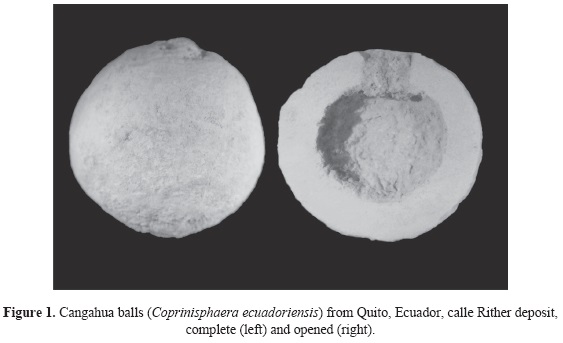
<body><![CDATA[<p align="justify"><font face="verdana" size="2"><b>Palabras clave:</b> Coprinisphaeridae, bolas de cangahua, primer hallazgo, <i>Phanaeus</i> f&oacute;sil asociado, Ecuador.</font></p>  	    <p align="justify"><font face="verdana" size="2">&nbsp;</font></p>  	    <p align="justify"><font face="verdana" size="2"><b>INTRODUCTION</b></font></p>  	    <p align="justify"><font face="verdana" size="2">"Cangahua" balls, whose name comes from the Andean Quechua word meaning "hard soil" (Sauer, 1955; Nimloss <i>et al.,</i> 1995) are sub&#45;spherical structures until now only supposedly interpreted as dung beetle fossil brood balls coated by a clay or soil shell (<a href="#f1">Fig. 1</a>). Sauer (1955) described such formations as <i>Coprinisphaera ecuadoriensis,</i> relating them to brood nests of an unknown scarab beetle (Sauer 1955, 1956; see also Estrada, 1941). Halffter (1959) firstly revised the paleontological data about dung beetles at world&#45;wide scale. Concerning the southern American reports he wrote "el hecho de que unicamente se conozcan los nidos hace dificil la determination generica, pero sin duda se trata de Scarabaeinae con formas de nidificacion muy semejante a las que presentan en la actualidad los generos a los que Frenguelli <i>&#91;Megathopa, Phanaeus, Canthon:</i> Frenguelli, 1938a, 1938b, 1939 (MZ)&#93; atribuye los fosiles". Halffter &amp; Matthews (1966) reported that "... it seems most probable that species of <i>Phanaeus</i> or <i>Dichotomius,</i> or both, are involved in all cases". Laza (2006) wrote: "C. <i>ecuadoriensis</i> resembles brood balls constructed by Dichotomiina (tunnelers), and Canthonina (rollers)". In spite of a great amount of research, that has been recently synthesized and updated (Genise <i>et al.,</i> 2000; Genise, 2004; Laza 2006; Krell, 2006; Krell &amp; Schawaller, 2011; Genise, 2012, personal communication), it has never been possible to relate any sample of Cangahua balls &#45;nor of any similar structure belonging to the ichnofamily Coprinisphaeridae established by Genise (2004)&#45; to a definite taxonomic group, in the absence of the related beetle. The discovery of a fossil scarab beetle associated to a specimen of <i>Coprinisphaera ecuadoriensis</i> finally reveals the true maker of at least one representative of this ichnofamily, extensively distributed (Laza, 2006) in Southern America, Africa, Europe (NW Italy) and Asia (Pakistan).</font></p>  	    <p align="center"><font face="verdana" size="2"><a name="f1"></a></font></p>  	    <p align="center"><font face="verdana" size="2"><img src="/img/revistas/azm/v29n1/a11f1.jpg"></font></p>  	    <p align="justify"><font face="verdana" size="2"><b>MATERIAL AND METHODS</b></font></p>  	    <p align="justify"><font face="verdana" size="2">In 1986 I personally collected several samples of Cangahua balls that had been exposed by an excavation bordering Rither street in Quito, Ecuador, very near the type locality: Sauer (1955) had originally described the Ecuadorian ichnospecies <i>Coprini&#45;sphaera ecuadoriensis</i> from specimens collected in the city of Quito, in Vargas street. Both deposits have been destroyed in order to built new houses.</font></p>  	    <p align="justify"><font face="verdana" size="2">In 1987 some of the cangahua balls I had collected the previous year were examined using X rays, which revealed no significant inclusions. Later, some specimens were opened by meridian oriented cuts, and one of them showed the presence of the anterior part of a beetle. Due to personal reasons the research was suspended, and all the material was shelved until summer 2012, when the specimen was re&#45;examined and the beetle parts removed from the inner sediment of the ball. The remains showed to clearly belong to an unknown species of the genus <i>Phanaeus</i> MacLeay (Coleop&#45;tera: Scarabaeinae) as defined by Edmonds (1972, 1994; Edmonds &amp; Zidek, 2012), herein described.</font></p>  	    <p align="justify"><font face="verdana" size="2">&nbsp;</font></p>  	    ]]></body>
<body><![CDATA[<p align="justify"><font face="verdana" size="2"><b>RESULTS</b></font></p>  	    <p align="justify"><font face="verdana" size="2"><b><i>Phanaeus violetae,</i> n. sp.</b> (<a href="#f1">Figure 1</a>)</font></p>  	    <p align="justify"><font face="verdana" size="2"><b>Holotype,</b> &#9792;: a near complete head from a <i>Coprinisphaera ecuadoriensis</i> specimen. Careful examination of it's the interior sediments has not revealed any other body fragments.</font></p>  	    <p align="justify"><font face="verdana" size="2"><b>Type locality:</b> Ecuadorian intermountain valley "Callejon Andino", 2900 m, Quito, Rither street, M. Zunino coll., October 1986. Artificially exposed Cangahua formation (Upper Pleistocene according to Laza, 2006).</font></p>  	    <p align="justify"><font face="verdana" size="2"><b>Type repository:</b> the type specimen and the relative ichnofossil will be deposited in the Museo de Historia Natural "Gustavo Orces V.", Escuela Politecnica Nacional, Quito, Ecuador.</font></p>  	    <p align="justify"><font face="verdana" size="2">This new species is dedicated to the loving memory of our late Mexican colleague and friend Violeta Halffter (1934&#45;2012), who dedicated all her scientific life to Scarab beetles, and named after her.</font></p>  	    <p align="justify"><font face="verdana" size="2">Description (terminology based on Edmonds, 1972, 1994; Philips <i>et al.,</i> 2004; Edmonds &amp; Zidek, 2012)</font></p>  	    <p align="justify"><font face="verdana" size="2">Maximum width 7.7 mm (<a href="/img/revistas/azm/v29n1/a11f2.jpg" target="_blank">Fig. 2</a>); dorsal surface brownish black, posterior &#190; of the surface of paraocular area of parietals coppery red, as well as the semi lunar areas close to the lateral, well marked branches of the occipital ring, and a small spot near to the inner margin of the eye; anterior margin of the clypeus very weakly bidentate; clypeal process rounded, narrow, its surface showing a short row of strong punctures. Lateral clypeal carinae very evident. Paraocular ridge well distinct. Cephalic carina robust, barely but evidently tridentate, each tooth flattened at the apex. Antennal club as characteristic of the genus.</font></p>  	    <p align="justify"><font face="verdana" size="2"><b>Systematic position:</b> according to Edmonds (1994 and personal communication, 2012; Edmonds &amp; Zidek, 2012) and taking into account the shape of cephalic carina, clypeal process, and paraocular ridge, <i>Phanaeus violetae</i> appears to be very near the extant <i>Phanaeus achilles</i> Boheman; both are members of a monophyletic unit, the <i>chalcomelas</i> species group, which also includes <i>P. chalcomelas</i> (Perty), <i>P. cambeforti</i> Arnaud, <i>P. lecourti</i> Arnaud and <i>P. meleagris</i> Blanchard. (Edmonds 1994; Edmonds &amp; Zidek 2012; Price 2007). The <i>chalcomelas</i> species group was included by Edmonds (1994) in the newly described subgenus <i>Notiophanaeus;</i> Edmonds &amp; Zidek (2012) follow the same systematic arrangement. On the ground of extensive phylogenetic analyses, Price (2007) firstly reconsidered the taxonomic structure of the subgenus, later (2009) elevated such taxon to generic level, drastically restricted its specific composition, and included the <i>chalcomelas</i> species group in the newly defined genus <i>Phanaeus.</i> Independently of their different macrotaxonomic arrangement, it is noteworthy that all mentioned authors consider the group as a taxonomically and phylogenetically coherent unit &#45;even if the Price's 2009 survey omitted <i>P. cambeforti&#45;.</i></font></p>  	    <p align="justify"><font face="verdana" size="2">&nbsp;</font></p>  	    ]]></body>
<body><![CDATA[<p align="justify"><font face="verdana" size="2"><b>DISCUSSION</b></font></p>  	    <p align="justify"><font face="verdana" size="2">As regards the geographical and ecological distribution of the group, <i>P. achilles</i> is limited to "desert scrub regions of southwestern Ecuador and northern Peru" (Edmonds &amp; Zidek, 2012); <i>P. chalcomelas</i> is found in the "Amazon Basin from Guaiana to Bolivia" <i>(ibid.); P. meleagris</i> from "Eastern slopes (Yungas) of Andes from Peru to Venezuela" <i>(ibid.); P. lecourti</i> is reported in the "Yungas of Bolivia and Peru" <i>(ibid.); P. cambeforti</i> from the "Amazon Basin from Guiana to Colombia and Peru" <i>(ibid.).</i> The wide geographic distribution of such relatively small species group must be underlined, as well as its ecological range extending from arid scrub to pluvial forest. The finding of <i>P. violetae</i> in the Callejon Andino and its possible age apparently do not refute the biogeographical scenario proposed by Price (2009), who did not consider (<a href="/img/revistas/azm/v29n1/a11f3.jpg" target="_blank">Fig. 3.</a>), who maintains that "the ancestral distribution for the <i>hermes</i> group is the Andes, and this group is recovered as sister to the <i>chalcomelas</i> group, also an Andean species group", based on a DIVA analysis. In the frame of Price's interpretation &#45;different for several aspects from "Edmonds' ecogeographic hypotheses"&#45;, the extinction of <i>P. violetae,</i> as well as the subsequent dispersion/speciation within the group, could be imputed to the effect of glaciations. As Smith <i>et al.</i> (2008) stressed, the timing of the local Last Glacial Maximum in different sectors of the tropical Andes remain controversial. However, it seems clear that at least in Ecuador and Peru multiple glaciations occurred before the Last Glacial Maximum.</font></p>  	    <p align="justify"><font face="verdana" size="2">Nevertheless, in my opinion biogeographic processes involving the <i>chalcomelas</i> species group shall be deeply investigated when a greater amount of accurate distributional data will be available. In fact, only in this case the true barycentres of extant areals and detailed tracks and distribution areas trees can be drawn and compared to phylogenetic hypotheses. This opinion is supported by both the track and the distribution areas' Steiner tree that have been drawn, even if in a very preliminary way, starting from the areals' geometric centres. The group's track (<a href="/img/revistas/azm/v29n1/a11f4.jpg" target="_blank">Fig. 4</a>, top) corroborates Price's hypothesis only if the track is oriented by its baseline (which roughly corresponds to the lowest and less transversally extended point of the Andes, the Huancabamba depression, or by the cladogram's root, two criteria that have been strongly criticized by Zunino (from a discussion see: Zunino &amp; Zullini 1995 and 2003, Zunino 2000). The distribution areas' Steiner tree (<a href="/img/revistas/azm/v29n1/a11f4.jpg" target="_blank">Fig. 4</a>, bottom), also very preliminary, showed a West Amazonian root, even taking into account the distribution of the <i>Phanaeus hermes</i> species group, sister of <i>chalcomelas</i> according to Price (2009). The Steiner tree implies an Amazonian primary ancestral area for the whole group, followed by a westward dispersion and colonization of the actual Andean piedmont (the extant Yungas) and finally of the high Andean elevations. Glaciations and ancient Amazonian area fragmentation events (see Lynch, 1988; for a further discussion and extensive bibliography see Morrone, 2009) could be interpreted as causal factors of the extinction of <i>P. violetae,</i> the present distribution of <i>P. achilles,</i> and the speciation resulting in the extant species distributed along the Yungas <i>(P. meleagris</i> and <i>P. cambeforti),</i> and in the Amazonian basin/Guyana (P. <i>chalcomelas</i> and <i>P. lecourti).</i></font></p>  	    <p align="justify"><font face="verdana" size="2">&nbsp;</font></p>  	    <p align="justify"><font face="verdana" size="2"><b>ACKNOWLEDGEMENTS</b></font></p>  	    <p align="justify"><font face="verdana" size="2">I am deeply indebted to Giovanni Onore (Otonga Foundation, Quito) for his many years of friendship and support; to the palaeontologist Carla Bucci (University of Urbino) for her precious help during the final handling process of the material, and to the staff of the scientific library (University of Urbino) for finding important bibliographical items; to M. Victoria Sanchez and Jorge F. Genise (Museo Argentino de Ciencias Naturales, Buenos Aires) who generously provided valuable literature and information. W. David Edmonds (Marfa, Texas) and Frank T. Krell (Denver Museum of Nature and Science, Denver, Colorado) revised an earlier draft of the manuscript, improving both its content and style.</font></p>  	    <p align="justify"><font face="verdana" size="2">&nbsp;</font></p>  	    <p align="justify"><font face="verdana" size="2"><b>REFERENCES</b></font></p>  	    <!-- ref --><p align="justify"><font face="verdana" size="2"><b>Edmonds, W. D.</b> 1972. Comparative skeletal morphology, systematics and evolution of the Phanaeine dung beetles (Coleoptera: Scarabaeidae). <i>The University of Kansas Bulletin,</i> 49: 731&#45;874.    &nbsp;&nbsp;&nbsp;&nbsp;&nbsp;&nbsp;&nbsp;&nbsp;[&#160;<a href="javascript:void(0);" onclick="javascript: window.open('/scielo.php?script=sci_nlinks&ref=396871&pid=S0065-1737201300010001100001&lng=','','width=640,height=500,resizable=yes,scrollbars=1,menubar=yes,');">Links</a>&#160;]<!-- end-ref --></font></p>  	    ]]></body>
<body><![CDATA[<!-- ref --><p align="justify"><font face="verdana" size="2"><b>Edmonds, W. D.</b> 1994. Revision of <i>Phanaeus</i> MacLeay, a New World Genus of Scarabaeinae Dung Beetles (Coleoptera: Scarabaeidae, Scarabaeinae). <i>Contributions in Science, Natural History Museum of Los Angeles County,</i> 443: 1&#45;105.    &nbsp;&nbsp;&nbsp;&nbsp;&nbsp;&nbsp;&nbsp;&nbsp;[&#160;<a href="javascript:void(0);" onclick="javascript: window.open('/scielo.php?script=sci_nlinks&ref=396873&pid=S0065-1737201300010001100002&lng=','','width=640,height=500,resizable=yes,scrollbars=1,menubar=yes,');">Links</a>&#160;]<!-- end-ref --></font></p>  	    <!-- ref --><p align="justify"><font face="verdana" size="2"><b>Edmonds, W. D. &amp; Z&iacute;dek. J.</b> 2012. Taxonomy of <i>Phanaeus</i> revisited: revised keys to and comment on species of the New Word dung beetle genus <i>Phanaeus</i> MacLeay, 1819 (Coleoptera: Scarabaeidae: Scarabaeinae: Phanaeini). <i>InsectaMundi,</i> 0274: 1&#45;108.    &nbsp;&nbsp;&nbsp;&nbsp;&nbsp;&nbsp;&nbsp;&nbsp;[&#160;<a href="javascript:void(0);" onclick="javascript: window.open('/scielo.php?script=sci_nlinks&ref=396875&pid=S0065-1737201300010001100003&lng=','','width=640,height=500,resizable=yes,scrollbars=1,menubar=yes,');">Links</a>&#160;]<!-- end-ref --></font></p>  	    <!-- ref --><p align="justify"><font face="verdana" size="2"><b>Estrada, A.</b> 1941. Contribuci&oacute;n geol&oacute;gica para el conocimiento de la "cangagua" de la regi&oacute;n interandina y del cuaternario en general del Ecuador. <i>Anales de la Universidad Central de Quito,</i> 66: 405&#45;488.    &nbsp;&nbsp;&nbsp;&nbsp;&nbsp;&nbsp;&nbsp;&nbsp;[&#160;<a href="javascript:void(0);" onclick="javascript: window.open('/scielo.php?script=sci_nlinks&ref=396877&pid=S0065-1737201300010001100004&lng=','','width=640,height=500,resizable=yes,scrollbars=1,menubar=yes,');">Links</a>&#160;]<!-- end-ref --></font></p>  	    <!-- ref --><p align="justify"><font face="verdana" size="2"><b>Frenguelli, J.</b> 1938a. Bolas de escarabaeodes y nidos de v&eacute;spidos f&oacute;siles. <i>Physis,</i> 12: 348&#45;352.    &nbsp;&nbsp;&nbsp;&nbsp;&nbsp;&nbsp;&nbsp;&nbsp;[&#160;<a href="javascript:void(0);" onclick="javascript: window.open('/scielo.php?script=sci_nlinks&ref=396879&pid=S0065-1737201300010001100005&lng=','','width=640,height=500,resizable=yes,scrollbars=1,menubar=yes,');">Links</a>&#160;]<!-- end-ref --></font></p>  	    <!-- ref --><p align="justify"><font face="verdana" size="2"><b>Frenguelli, G.</b> 1938b. Nidi fossili di scarabeidi e vespidi. <i>Bollettino della Societa Geologica Italiana,</i> 57: 77&#45; 95.    &nbsp;&nbsp;&nbsp;&nbsp;&nbsp;&nbsp;&nbsp;&nbsp;[&#160;<a href="javascript:void(0);" onclick="javascript: window.open('/scielo.php?script=sci_nlinks&ref=396881&pid=S0065-1737201300010001100006&lng=','','width=640,height=500,resizable=yes,scrollbars=1,menubar=yes,');">Links</a>&#160;]<!-- end-ref --></font></p>  	    ]]></body>
<body><![CDATA[<!-- ref --><p align="justify"><font face="verdana" size="2"><b>Frenguelli, J.</b> 1939. Nidos f&oacute;siles de insectos en el Terciario de Neuqu&eacute;n y R&iacute;o Negro. <i>Notas Museo La Plata, Paleontolog&iacute;a,</i> 18: 379&#45;402.    &nbsp;&nbsp;&nbsp;&nbsp;&nbsp;&nbsp;&nbsp;&nbsp;[&#160;<a href="javascript:void(0);" onclick="javascript: window.open('/scielo.php?script=sci_nlinks&ref=396883&pid=S0065-1737201300010001100007&lng=','','width=640,height=500,resizable=yes,scrollbars=1,menubar=yes,');">Links</a>&#160;]<!-- end-ref --></font></p>  	    <!-- ref --><p align="justify"><font face="verdana" size="2"><b>Genise, J. F.</b> 2004. Ichnotaxonomy and ichnostratigraphy of chambered trace fossils attributed to coleopterans, ants and termites. <i>In:</i> McIlroy, D. (Ed.). <i>The application of ichnology topaleoenvironmental and stratigraphic analysis.</i> Geological Society, London, Special Publications, 228: 419&#45;453.    &nbsp;&nbsp;&nbsp;&nbsp;&nbsp;&nbsp;&nbsp;&nbsp;[&#160;<a href="javascript:void(0);" onclick="javascript: window.open('/scielo.php?script=sci_nlinks&ref=396885&pid=S0065-1737201300010001100008&lng=','','width=640,height=500,resizable=yes,scrollbars=1,menubar=yes,');">Links</a>&#160;]<!-- end-ref --></font></p>  	    <!-- ref --><p align="justify"><font face="verdana" size="2"><b>Genise, J. F. M&aacute;ngano, M. G., Buatois, L. A., Laza, J. H. &amp; Verde, M.</b> 2000. Insect Trace Fossil Associations in Paleosols: The <i>Coprinisphaera</i> Ichnofacies. <i>Palaios,</i> 15: 49&#45;64</font>&nbsp;&nbsp;&nbsp;&nbsp;&nbsp;&nbsp;&nbsp;&nbsp;[&#160;<a href="javascript:void(0);" onclick="javascript: window.open('/scielo.php?script=sci_nlinks&ref=396887&pid=S0065-1737201300010001100009&lng=','','width=640,height=500,resizable=yes,scrollbars=1,menubar=yes,');">Links</a>&#160;]<!-- end-ref --><!-- ref --><p align="justify"><font face="verdana" size="2"><b>Halffter, G.</b> 1959. Etolog&iacute;a y paleontolog&iacute;a de Scarabaeinae. <i>Ciencia</i> (Mex.), 19: 165&#45;178.    &nbsp;&nbsp;&nbsp;&nbsp;&nbsp;&nbsp;&nbsp;&nbsp;[&#160;<a href="javascript:void(0);" onclick="javascript: window.open('/scielo.php?script=sci_nlinks&ref=396888&pid=S0065-1737201300010001100010&lng=','','width=640,height=500,resizable=yes,scrollbars=1,menubar=yes,');">Links</a>&#160;]<!-- end-ref --></font></p>  	    <!-- ref --><p align="justify"><font face="verdana" size="2"><b>Halffter, G. &amp; Matthews, E. G.</b> 1966. The Natural History of dung beetles of the subfamily Scarabaeinae. <i>Folia Entomologica Mexicana,</i> (12&#45;14): 1&#45;312. &#91;Republished: Zunino M. (Ed.), 1999, same title. Medical Books, Palermo, Italy&#93;    &nbsp;&nbsp;&nbsp;&nbsp;&nbsp;&nbsp;&nbsp;&nbsp;[&#160;<a href="javascript:void(0);" onclick="javascript: window.open('/scielo.php?script=sci_nlinks&ref=396890&pid=S0065-1737201300010001100011&lng=','','width=640,height=500,resizable=yes,scrollbars=1,menubar=yes,');">Links</a>&#160;]<!-- end-ref -->.</font></p>  	    <!-- ref --><p align="justify"><font face="verdana" size="2"><b>Krell, F. T.</b> 2006. Fossil Record and Evolution of Scarabaeoidea (Coleoptera: Polyphaga). <i>Coleopterists Society Monographs,</i> 5: 120&#45;143.    &nbsp;&nbsp;&nbsp;&nbsp;&nbsp;&nbsp;&nbsp;&nbsp;[&#160;<a href="javascript:void(0);" onclick="javascript: window.open('/scielo.php?script=sci_nlinks&ref=396892&pid=S0065-1737201300010001100012&lng=','','width=640,height=500,resizable=yes,scrollbars=1,menubar=yes,');">Links</a>&#160;]<!-- end-ref --></font></p>  	    <!-- ref --><p align="justify"><font face="verdana" size="2"><b>Krell, F. T. &amp; Schawaller, W.</b> 2011. Beetles (Insecta, Coleoptera), pp. 235&#45;548. In: T. Harrison (Ed.). <i>Palaeontology and Geology of Laetoli: human evolution in context.</i> Volume 2: Fossil hominines and the associated fauna. Springer, Dordrecht.    &nbsp;&nbsp;&nbsp;&nbsp;&nbsp;&nbsp;&nbsp;&nbsp;[&#160;<a href="javascript:void(0);" onclick="javascript: window.open('/scielo.php?script=sci_nlinks&ref=396894&pid=S0065-1737201300010001100013&lng=','','width=640,height=500,resizable=yes,scrollbars=1,menubar=yes,');">Links</a>&#160;]<!-- end-ref --></font></p>  	    <!-- ref --><p align="justify"><font face="verdana" size="2"><b>Laza, J. H.</b> 2006. Dung&#45;Beetle Fossil Brood Balls: the Ichnogenera <i>Coprinisphaera</i> Sauer and <i>Quirogaichnus</i> (Coprinisphaeridae). <i>Ichnos: An International Journal for Plant and Animal Traces,</i> 13: 217&#45;235.    &nbsp;&nbsp;&nbsp;&nbsp;&nbsp;&nbsp;&nbsp;&nbsp;[&#160;<a href="javascript:void(0);" onclick="javascript: window.open('/scielo.php?script=sci_nlinks&ref=396896&pid=S0065-1737201300010001100014&lng=','','width=640,height=500,resizable=yes,scrollbars=1,menubar=yes,');">Links</a>&#160;]<!-- end-ref --></font></p>  	    <!-- ref --><p align="justify"><font face="verdana" size="2"><b>Lynch, J. D.</b> 1988. Refugia, pp. 311&#45;343. In: Myers A. A. &amp; Giller, P. S. (Eds.). <i>Analytical Biogeography.</i> Chapman and Hall, London.    &nbsp;&nbsp;&nbsp;&nbsp;&nbsp;&nbsp;&nbsp;&nbsp;[&#160;<a href="javascript:void(0);" onclick="javascript: window.open('/scielo.php?script=sci_nlinks&ref=396898&pid=S0065-1737201300010001100015&lng=','','width=640,height=500,resizable=yes,scrollbars=1,menubar=yes,');">Links</a>&#160;]<!-- end-ref --></font></p>  	    <!-- ref --><p align="justify"><font face="verdana" size="2"><b>Morrone, J. J.</b> 2009. <i>Evolutionary Biogeography.</i> Columbia University Press, New York.    &nbsp;&nbsp;&nbsp;&nbsp;&nbsp;&nbsp;&nbsp;&nbsp;[&#160;<a href="javascript:void(0);" onclick="javascript: window.open('/scielo.php?script=sci_nlinks&ref=396900&pid=S0065-1737201300010001100016&lng=','','width=640,height=500,resizable=yes,scrollbars=1,menubar=yes,');">Links</a>&#160;]<!-- end-ref --></font></p>  	    <!-- ref --><p align="justify"><font face="verdana" size="2"><b>Nimloss, T. J., Ringleb R. V., Del Posso, G., Gonzales, A., &amp; Vera, R.</b> 1995. A.I.D. project # 10.288 Final Report: 1&#45;20. Digital edition: <a href="http://pdf.usaid.gov/pdf_docs/PNABW122.pdf" target="_blank">http://pdf.usaid.gov/pdf_docs/PNABW122.pdf</a></font>&nbsp;&nbsp;&nbsp;&nbsp;&nbsp;&nbsp;&nbsp;&nbsp;[&#160;<a href="javascript:void(0);" onclick="javascript: window.open('/scielo.php?script=sci_nlinks&ref=396902&pid=S0065-1737201300010001100017&lng=','','width=640,height=500,resizable=yes,scrollbars=1,menubar=yes,');">Links</a>&#160;]<!-- end-ref --><!-- ref --><p align="justify"><font face="verdana" size="2"><b>Philips, T. K., Edmonds, W. D., Scholtz, C. H.</b> 2004. A phylogenetic analysis of the New World tribe Phanaeini (Coleoptera: Scarabaeidae: Scarabaeinae): Hypotheses on relationships and origins. <i>Insect Systematics &amp; Evolution,</i> 35: 44&#45;61.    &nbsp;&nbsp;&nbsp;&nbsp;&nbsp;&nbsp;&nbsp;&nbsp;[&#160;<a href="javascript:void(0);" onclick="javascript: window.open('/scielo.php?script=sci_nlinks&ref=396903&pid=S0065-1737201300010001100018&lng=','','width=640,height=500,resizable=yes,scrollbars=1,menubar=yes,');">Links</a>&#160;]<!-- end-ref --></font></p>  	    <!-- ref --><p align="justify"><font face="verdana" size="2"><b>Price, D. L.</b> 2007. A phylogenetic analysis of the dung beetle genus <i>Phanaeus</i> (Coleoptera: Scarabaeidae) based on morphological data. <i>Insect Systematics &amp; Evolution,</i> 38: 1&#45;18.    &nbsp;&nbsp;&nbsp;&nbsp;&nbsp;&nbsp;&nbsp;&nbsp;[&#160;<a href="javascript:void(0);" onclick="javascript: window.open('/scielo.php?script=sci_nlinks&ref=396905&pid=S0065-1737201300010001100019&lng=','','width=640,height=500,resizable=yes,scrollbars=1,menubar=yes,');">Links</a>&#160;]<!-- end-ref --></font></p>  	    <!-- ref --><p align="justify"><font face="verdana" size="2"><b>Price, D. L.</b> 2009. Phylogeny and biogeography of the dung beetle genus <i>Phanaeus</i> (Coleoptera: Scarabaeidae). <i>Systematic Entomology,</i> 34: 137&#45;150.    &nbsp;&nbsp;&nbsp;&nbsp;&nbsp;&nbsp;&nbsp;&nbsp;[&#160;<a href="javascript:void(0);" onclick="javascript: window.open('/scielo.php?script=sci_nlinks&ref=396907&pid=S0065-1737201300010001100020&lng=','','width=640,height=500,resizable=yes,scrollbars=1,menubar=yes,');">Links</a>&#160;]<!-- end-ref --></font></p>  	    <!-- ref --><p align="justify"><font face="verdana" size="2"><b>Sauer, W.</b> 1955. <i>Coprinisphaera ecuadoriensis.</i> Un f&oacute;sil singular del Pleistoceno. <i>Bolet&iacute;n del Instituto de Ciencias Naturales, Universidad Central del Ecuador,</i> 1: 123&#45;129.    &nbsp;&nbsp;&nbsp;&nbsp;&nbsp;&nbsp;&nbsp;&nbsp;[&#160;<a href="javascript:void(0);" onclick="javascript: window.open('/scielo.php?script=sci_nlinks&ref=396909&pid=S0065-1737201300010001100021&lng=','','width=640,height=500,resizable=yes,scrollbars=1,menubar=yes,');">Links</a>&#160;]<!-- end-ref --></font></p>  	    <!-- ref --><p align="justify"><font face="verdana" size="2"><b>Sauer, W.</b> 1956. <i>Coprinisphaera ecuadoriensis</i> (bola de Cangahua) y las esferas elaboradas actualmente por escarabajos de la familia Scarabaeidae. <i>Bolet&iacute;n de Informaciones Cient&iacute;ficas Nacionales Quito,</i> 8: 550&#45;555.    &nbsp;&nbsp;&nbsp;&nbsp;&nbsp;&nbsp;&nbsp;&nbsp;[&#160;<a href="javascript:void(0);" onclick="javascript: window.open('/scielo.php?script=sci_nlinks&ref=396911&pid=S0065-1737201300010001100022&lng=','','width=640,height=500,resizable=yes,scrollbars=1,menubar=yes,');">Links</a>&#160;]<!-- end-ref --></font></p>  	    ]]></body>
<body><![CDATA[<!-- ref --><p align="justify"><font face="verdana" size="2"><b>Smith, J. A., Mark, B. G. &amp; Rodbell, D. T.</b> 2008. The timing and magnitude of mountain glaciation in the tropical Andes. <i>Journal</i> of <i>Quaternary Science,</i> 23: 609&#45;634.    &nbsp;&nbsp;&nbsp;&nbsp;&nbsp;&nbsp;&nbsp;&nbsp;[&#160;<a href="javascript:void(0);" onclick="javascript: window.open('/scielo.php?script=sci_nlinks&ref=396913&pid=S0065-1737201300010001100023&lng=','','width=640,height=500,resizable=yes,scrollbars=1,menubar=yes,');">Links</a>&#160;]<!-- end-ref --></font></p>  	    <!-- ref --><p align="justify"><font face="verdana" size="2"><b>Zunino, M.</b> 2000. El concepto de area de distribucion: algunas reflexiones teoricas, pp. 79&#45;85. <i>In:</i> Mart&iacute;n Piera F., Morrone, J. J. &amp; Melic, A. (Eds.). Hacia un Proyecto CYTED para el Inventarioy Estimaci&oacute;n de la Diversidad Entomol&oacute;gica en Iberoam&eacute;rica: PrIBES&#45;2000. <i>m3m: Monograf&iacute;as Tercer Milenio,</i> 1. SEA, Zaragoza.    &nbsp;&nbsp;&nbsp;&nbsp;&nbsp;&nbsp;&nbsp;&nbsp;[&#160;<a href="javascript:void(0);" onclick="javascript: window.open('/scielo.php?script=sci_nlinks&ref=396915&pid=S0065-1737201300010001100024&lng=','','width=640,height=500,resizable=yes,scrollbars=1,menubar=yes,');">Links</a>&#160;]<!-- end-ref --></font></p>  	    <!-- ref --><p align="justify"><font face="verdana" size="2"><b>Zunino, M. &amp; Zullini, A.</b> 1995. <i>Biogeograf&iacute;a. La dimensione spaziale dell'evoluzione.</i> CEA, Milan.    &nbsp;&nbsp;&nbsp;&nbsp;&nbsp;&nbsp;&nbsp;&nbsp;[&#160;<a href="javascript:void(0);" onclick="javascript: window.open('/scielo.php?script=sci_nlinks&ref=396917&pid=S0065-1737201300010001100025&lng=','','width=640,height=500,resizable=yes,scrollbars=1,menubar=yes,');">Links</a>&#160;]<!-- end-ref --></font></p>  	    <!-- ref --><p align="justify"><font face="verdana" size="2"><b>Zunino, M. &amp; Zullini, A.</b> 2003. <i>Biogeograf&iacute;a. La dimensi&oacute;n espacial de la evoluci&oacute;n.</i> Fondo de Cultura Econ&oacute;mica, M&eacute;xico, D. F.    &nbsp;&nbsp;&nbsp;&nbsp;&nbsp;&nbsp;&nbsp;&nbsp;[&#160;<a href="javascript:void(0);" onclick="javascript: window.open('/scielo.php?script=sci_nlinks&ref=396919&pid=S0065-1737201300010001100026&lng=','','width=640,height=500,resizable=yes,scrollbars=1,menubar=yes,');">Links</a>&#160;]<!-- end-ref --></font></p>      ]]></body><back>
<ref-list>
<ref id="B1">
<nlm-citation citation-type="journal">
<person-group person-group-type="author">
<name>
<surname><![CDATA[Edmonds]]></surname>
<given-names><![CDATA[W. D.]]></given-names>
</name>
</person-group>
<article-title xml:lang="en"><![CDATA[Comparative skeletal morphology, systematics and evolution of the Phanaeine dung beetles (Coleoptera: Scarabaeidae)]]></article-title>
<source><![CDATA[The University of Kansas Bulletin]]></source>
<year>1972</year>
<volume>49</volume>
<page-range>731-874</page-range></nlm-citation>
</ref>
<ref id="B2">
<nlm-citation citation-type="journal">
<person-group person-group-type="author">
<name>
<surname><![CDATA[Edmonds]]></surname>
<given-names><![CDATA[W. D.]]></given-names>
</name>
</person-group>
<article-title xml:lang="en"><![CDATA[Revision of Phanaeus MacLeay, a New World Genus of Scarabaeinae Dung Beetles (Coleoptera: Scarabaeidae, Scarabaeinae)]]></article-title>
<source><![CDATA[Contributions in Science, Natural History Museum of Los Angeles County]]></source>
<year>1994</year>
<volume>443</volume>
<page-range>1-105</page-range></nlm-citation>
</ref>
<ref id="B3">
<nlm-citation citation-type="journal">
<person-group person-group-type="author">
<name>
<surname><![CDATA[Edmonds]]></surname>
<given-names><![CDATA[W. D.]]></given-names>
</name>
<name>
<surname><![CDATA[Zídek]]></surname>
<given-names><![CDATA[J.]]></given-names>
</name>
</person-group>
<article-title xml:lang="en"><![CDATA[Taxonomy of Phanaeus revisited: revised keys to and comment on species of the New Word dung beetle genus Phanaeus MacLeay, 1819 (Coleoptera: Scarabaeidae: Scarabaeinae: Phanaeini)]]></article-title>
<source><![CDATA[InsectaMundi]]></source>
<year>2012</year>
<volume>0274</volume>
<page-range>1-108</page-range></nlm-citation>
</ref>
<ref id="B4">
<nlm-citation citation-type="journal">
<person-group person-group-type="author">
<name>
<surname><![CDATA[Estrada]]></surname>
<given-names><![CDATA[A.]]></given-names>
</name>
</person-group>
<article-title xml:lang="es"><![CDATA[Contribución geológica para el conocimiento de la "cangagua" de la región interandina y del cuaternario en general del Ecuador]]></article-title>
<source><![CDATA[Anales de la Universidad Central de Quito]]></source>
<year>1941</year>
<volume>66</volume>
<page-range>405-488</page-range></nlm-citation>
</ref>
<ref id="B5">
<nlm-citation citation-type="journal">
<person-group person-group-type="author">
<name>
<surname><![CDATA[Frenguelli]]></surname>
<given-names><![CDATA[J.]]></given-names>
</name>
</person-group>
<article-title xml:lang="en"><![CDATA[Bolas de escarabaeodes y nidos de véspidos fósiles]]></article-title>
<source><![CDATA[Physis]]></source>
<year>1938</year>
<volume>12</volume>
<page-range>348-352</page-range></nlm-citation>
</ref>
<ref id="B6">
<nlm-citation citation-type="journal">
<person-group person-group-type="author">
<name>
<surname><![CDATA[Frenguelli]]></surname>
<given-names><![CDATA[G.]]></given-names>
</name>
</person-group>
<article-title xml:lang="en"><![CDATA[Nidi fossili di scarabeidi e vespidi]]></article-title>
<source><![CDATA[Bollettino della Societa Geologica Italiana]]></source>
<year>1938</year>
<volume>57</volume>
<page-range>77- 95</page-range></nlm-citation>
</ref>
<ref id="B7">
<nlm-citation citation-type="journal">
<person-group person-group-type="author">
<name>
<surname><![CDATA[Frenguelli]]></surname>
<given-names><![CDATA[J.]]></given-names>
</name>
</person-group>
<article-title xml:lang="es"><![CDATA[Nidos fósiles de insectos en el Terciario de Neuquén y Río Negro]]></article-title>
<source><![CDATA[Notas Museo La Plata, Paleontología]]></source>
<year>1939</year>
<volume>18</volume>
<page-range>379-402</page-range></nlm-citation>
</ref>
<ref id="B8">
<nlm-citation citation-type="book">
<person-group person-group-type="author">
<name>
<surname><![CDATA[Genise]]></surname>
<given-names><![CDATA[J. F.]]></given-names>
</name>
</person-group>
<article-title xml:lang="en"><![CDATA[Ichnotaxonomy and ichnostratigraphy of chambered trace fossils attributed to coleopterans, ants and termites]]></article-title>
<person-group person-group-type="editor">
<name>
<surname><![CDATA[McIlroy]]></surname>
<given-names><![CDATA[D.]]></given-names>
</name>
</person-group>
<source><![CDATA[The application of ichnology topaleoenvironmental and stratigraphic analysis]]></source>
<year>2004</year>
<volume>228</volume>
<page-range>419-453</page-range><publisher-loc><![CDATA[London ]]></publisher-loc>
<publisher-name><![CDATA[Geological Society]]></publisher-name>
</nlm-citation>
</ref>
<ref id="B9">
<nlm-citation citation-type="journal">
<person-group person-group-type="author">
<name>
<surname><![CDATA[Genise]]></surname>
<given-names><![CDATA[J. F.]]></given-names>
</name>
<name>
<surname><![CDATA[Mángano]]></surname>
<given-names><![CDATA[M. G.]]></given-names>
</name>
<name>
<surname><![CDATA[Buatois]]></surname>
<given-names><![CDATA[L. A.]]></given-names>
</name>
<name>
<surname><![CDATA[Laza]]></surname>
<given-names><![CDATA[J. H.]]></given-names>
</name>
<name>
<surname><![CDATA[Verde]]></surname>
<given-names><![CDATA[M.]]></given-names>
</name>
</person-group>
<article-title xml:lang="en"><![CDATA[Insect Trace Fossil Associations in Paleosols: The Coprinisphaera Ichnofacies]]></article-title>
<source><![CDATA[Palaios]]></source>
<year>2000</year>
<volume>15</volume>
<page-range>49-64</page-range></nlm-citation>
</ref>
<ref id="B10">
<nlm-citation citation-type="journal">
<person-group person-group-type="author">
<name>
<surname><![CDATA[Halffter]]></surname>
<given-names><![CDATA[G.]]></given-names>
</name>
</person-group>
<article-title xml:lang="es"><![CDATA[Etología y paleontología de Scarabaeinae]]></article-title>
<source><![CDATA[Ciencia]]></source>
<year>1959</year>
<volume>19</volume>
<page-range>165-178</page-range><publisher-loc><![CDATA[Mex ]]></publisher-loc>
</nlm-citation>
</ref>
<ref id="B11">
<nlm-citation citation-type="journal">
<person-group person-group-type="author">
<name>
<surname><![CDATA[Halffter]]></surname>
<given-names><![CDATA[G.]]></given-names>
</name>
<name>
<surname><![CDATA[Matthews]]></surname>
<given-names><![CDATA[E. G.]]></given-names>
</name>
</person-group>
<article-title xml:lang="en"><![CDATA[The Natural History of dung beetles of the subfamily Scarabaeinae]]></article-title>
<source><![CDATA[Folia Entomologica Mexicana]]></source>
<year>1966</year>
<month>19</month>
<day>99</day>
<volume>12</volume><volume>14</volume>
<page-range>1-312</page-range><publisher-loc><![CDATA[Palermo ]]></publisher-loc>
<publisher-name><![CDATA[Medical Books]]></publisher-name>
</nlm-citation>
</ref>
<ref id="B12">
<nlm-citation citation-type="journal">
<person-group person-group-type="author">
<name>
<surname><![CDATA[Krell]]></surname>
<given-names><![CDATA[F. T.]]></given-names>
</name>
</person-group>
<article-title xml:lang="en"><![CDATA[Fossil Record and Evolution of Scarabaeoidea (Coleoptera: Polyphaga)]]></article-title>
<source><![CDATA[Coleopterists Society Monographs]]></source>
<year>2006</year>
<volume>5</volume>
<page-range>120-143</page-range></nlm-citation>
</ref>
<ref id="B13">
<nlm-citation citation-type="book">
<person-group person-group-type="author">
<name>
<surname><![CDATA[Krell]]></surname>
<given-names><![CDATA[F. T.]]></given-names>
</name>
<name>
<surname><![CDATA[Schawaller]]></surname>
<given-names><![CDATA[W.]]></given-names>
</name>
</person-group>
<article-title xml:lang="es"><![CDATA[Beetles (Insecta, Coleoptera)]]></article-title>
<person-group person-group-type="editor">
<name>
<surname><![CDATA[Harrison]]></surname>
<given-names><![CDATA[T.]]></given-names>
</name>
</person-group>
<source><![CDATA[Palaeontology and Geology of Laetoli: human evolution in context. Volume 2: Fossil hominines and the associated fauna]]></source>
<year>2011</year>
<page-range>235-548</page-range><publisher-loc><![CDATA[Dordrecht ]]></publisher-loc>
<publisher-name><![CDATA[Springer]]></publisher-name>
</nlm-citation>
</ref>
<ref id="B14">
<nlm-citation citation-type="journal">
<person-group person-group-type="author">
<name>
<surname><![CDATA[Laza]]></surname>
<given-names><![CDATA[J. H.]]></given-names>
</name>
</person-group>
<article-title xml:lang="en"><![CDATA[Dung-Beetle Fossil Brood Balls: the Ichnogenera Coprinisphaera Sauer and Quirogaichnus (Coprinisphaeridae)]]></article-title>
<source><![CDATA[Ichnos: An International Journal for Plant and Animal Traces]]></source>
<year>2006</year>
<volume>13</volume>
<page-range>217-235</page-range></nlm-citation>
</ref>
<ref id="B15">
<nlm-citation citation-type="book">
<person-group person-group-type="author">
<name>
<surname><![CDATA[Lynch]]></surname>
<given-names><![CDATA[J. D.]]></given-names>
</name>
</person-group>
<article-title xml:lang="en"><![CDATA[Refugia]]></article-title>
<person-group person-group-type="editor">
<name>
<surname><![CDATA[Myers]]></surname>
<given-names><![CDATA[A. A.]]></given-names>
</name>
<name>
<surname><![CDATA[Giller]]></surname>
<given-names><![CDATA[P. S.]]></given-names>
</name>
</person-group>
<source><![CDATA[Analytical Biogeography]]></source>
<year>1988</year>
<page-range>311-343</page-range><publisher-loc><![CDATA[London ]]></publisher-loc>
<publisher-name><![CDATA[Chapman and Hall]]></publisher-name>
</nlm-citation>
</ref>
<ref id="B16">
<nlm-citation citation-type="book">
<person-group person-group-type="author">
<name>
<surname><![CDATA[Morrone]]></surname>
<given-names><![CDATA[J. J.]]></given-names>
</name>
</person-group>
<source><![CDATA[Evolutionary Biogeography]]></source>
<year>2009</year>
<publisher-loc><![CDATA[New York ]]></publisher-loc>
<publisher-name><![CDATA[Columbia University Press]]></publisher-name>
</nlm-citation>
</ref>
<ref id="B17">
<nlm-citation citation-type="">
<person-group person-group-type="author">
<name>
<surname><![CDATA[Nimloss]]></surname>
<given-names><![CDATA[T. J.]]></given-names>
</name>
<name>
<surname><![CDATA[Ringleb]]></surname>
<given-names><![CDATA[R. V.]]></given-names>
</name>
<name>
<surname><![CDATA[Del Posso]]></surname>
<given-names><![CDATA[G.]]></given-names>
</name>
<name>
<surname><![CDATA[Gonzales]]></surname>
<given-names><![CDATA[A.]]></given-names>
</name>
<name>
<surname><![CDATA[Vera]]></surname>
<given-names><![CDATA[R.]]></given-names>
</name>
</person-group>
<source><![CDATA[A.I.D]]></source>
<year>1995</year>
</nlm-citation>
</ref>
<ref id="B18">
<nlm-citation citation-type="journal">
<person-group person-group-type="author">
<name>
<surname><![CDATA[Philips]]></surname>
<given-names><![CDATA[T. K.]]></given-names>
</name>
<name>
<surname><![CDATA[Edmonds]]></surname>
<given-names><![CDATA[W. D.]]></given-names>
</name>
<name>
<surname><![CDATA[Scholtz]]></surname>
<given-names><![CDATA[C. H.]]></given-names>
</name>
</person-group>
<article-title xml:lang="en"><![CDATA[A phylogenetic analysis of the New World tribe Phanaeini (Coleoptera: Scarabaeidae: Scarabaeinae): Hypotheses on relationships and origins]]></article-title>
<source><![CDATA[Insect Systematics & Evolution]]></source>
<year>2004</year>
<volume>35</volume>
<page-range>44-61</page-range></nlm-citation>
</ref>
<ref id="B19">
<nlm-citation citation-type="journal">
<person-group person-group-type="author">
<name>
<surname><![CDATA[Price]]></surname>
<given-names><![CDATA[D. L.]]></given-names>
</name>
</person-group>
<article-title xml:lang="en"><![CDATA[A phylogenetic analysis of the dung beetle genus Phanaeus (Coleoptera: Scarabaeidae) based on morphological data]]></article-title>
<source><![CDATA[Insect Systematics & Evolution]]></source>
<year>2007</year>
<volume>38</volume>
<page-range>1-18</page-range></nlm-citation>
</ref>
<ref id="B20">
<nlm-citation citation-type="journal">
<person-group person-group-type="author">
<name>
<surname><![CDATA[Price]]></surname>
<given-names><![CDATA[D. L.]]></given-names>
</name>
</person-group>
<article-title xml:lang="en"><![CDATA[Phylogeny and biogeography of the dung beetle genus Phanaeus (Coleoptera: Scarabaeidae)]]></article-title>
<source><![CDATA[Systematic Entomology]]></source>
<year>2009</year>
<volume>34</volume>
<page-range>137-150</page-range></nlm-citation>
</ref>
<ref id="B21">
<nlm-citation citation-type="book">
<person-group person-group-type="author">
<name>
<surname><![CDATA[Sauer]]></surname>
<given-names><![CDATA[W.]]></given-names>
</name>
</person-group>
<article-title xml:lang="en"><![CDATA[Coprinisphaera ecuadoriensis Un fósil singular del Pleistoceno]]></article-title>
<source><![CDATA[Boletín del Instituto de Ciencias Naturales]]></source>
<year>1955</year>
<volume>1</volume>
<page-range>123-129</page-range><publisher-name><![CDATA[Universidad Central del Ecuador]]></publisher-name>
</nlm-citation>
</ref>
<ref id="B22">
<nlm-citation citation-type="journal">
<person-group person-group-type="author">
<name>
<surname><![CDATA[Sauer]]></surname>
<given-names><![CDATA[W.]]></given-names>
</name>
</person-group>
<article-title xml:lang="es"><![CDATA[Coprinisphaera ecuadoriensis (bola de Cangahua) y las esferas elaboradas actualmente por escarabajos de la familia Scarabaeidae]]></article-title>
<source><![CDATA[Boletín de Informaciones Científicas Nacionales Quito]]></source>
<year>1956</year>
<volume>8</volume>
<page-range>550-555</page-range></nlm-citation>
</ref>
<ref id="B23">
<nlm-citation citation-type="journal">
<person-group person-group-type="author">
<name>
<surname><![CDATA[Smith]]></surname>
<given-names><![CDATA[J. A.]]></given-names>
</name>
<name>
<surname><![CDATA[Mark]]></surname>
<given-names><![CDATA[B. G.]]></given-names>
</name>
<name>
<surname><![CDATA[Rodbell]]></surname>
<given-names><![CDATA[D. T.]]></given-names>
</name>
</person-group>
<article-title xml:lang="en"><![CDATA[The timing and magnitude of mountain glaciation in the tropical Andes]]></article-title>
<source><![CDATA[Journal of Quaternary Science]]></source>
<year>2008</year>
<volume>23</volume>
<page-range>609-634</page-range></nlm-citation>
</ref>
<ref id="B24">
<nlm-citation citation-type="book">
<person-group person-group-type="author">
<name>
<surname><![CDATA[Zunino]]></surname>
<given-names><![CDATA[M.]]></given-names>
</name>
</person-group>
<article-title xml:lang="es"><![CDATA[El concepto de area de distribucion: algunas reflexiones teoricas]]></article-title>
<person-group person-group-type="editor">
<name>
<surname><![CDATA[Martín Piera]]></surname>
<given-names><![CDATA[F.]]></given-names>
</name>
<name>
<surname><![CDATA[Morrone]]></surname>
<given-names><![CDATA[J. J.]]></given-names>
</name>
<name>
<surname><![CDATA[Melic]]></surname>
<given-names><![CDATA[A.]]></given-names>
</name>
</person-group>
<source><![CDATA[Hacia un Proyecto CYTED para el Inventarioy Estimación de la Diversidad Entomológica en Iberoamérica: PrIBES-2000]]></source>
<year>2000</year>
<volume>1</volume>
<page-range>79-85</page-range><publisher-loc><![CDATA[Zaragoza ]]></publisher-loc>
<publisher-name><![CDATA[Monografías Tercer MilenioSEA]]></publisher-name>
</nlm-citation>
</ref>
<ref id="B25">
<nlm-citation citation-type="book">
<person-group person-group-type="author">
<name>
<surname><![CDATA[Zunino]]></surname>
<given-names><![CDATA[M.]]></given-names>
</name>
<name>
<surname><![CDATA[Zullini]]></surname>
<given-names><![CDATA[A.]]></given-names>
</name>
</person-group>
<source><![CDATA[Biogeografía. La dimensione spaziale dell'evoluzione]]></source>
<year>1995</year>
<publisher-loc><![CDATA[Milan ]]></publisher-loc>
<publisher-name><![CDATA[CEA]]></publisher-name>
</nlm-citation>
</ref>
<ref id="B26">
<nlm-citation citation-type="book">
<person-group person-group-type="author">
<name>
<surname><![CDATA[Zunino]]></surname>
<given-names><![CDATA[M.]]></given-names>
</name>
<name>
<surname><![CDATA[Zullini]]></surname>
<given-names><![CDATA[A.]]></given-names>
</name>
</person-group>
<source><![CDATA[Biogeografía. La dimensión espacial de la evolución]]></source>
<year>2003</year>
<publisher-loc><![CDATA[México^eD. F. D. F.]]></publisher-loc>
<publisher-name><![CDATA[Fondo de Cultura Económica]]></publisher-name>
</nlm-citation>
</ref>
</ref-list>
</back>
</article>
