<?xml version="1.0" encoding="ISO-8859-1"?><article xmlns:mml="http://www.w3.org/1998/Math/MathML" xmlns:xlink="http://www.w3.org/1999/xlink" xmlns:xsi="http://www.w3.org/2001/XMLSchema-instance">
<front>
<journal-meta>
<journal-id>0065-1737</journal-id>
<journal-title><![CDATA[Acta zoológica mexicana]]></journal-title>
<abbrev-journal-title><![CDATA[Acta Zool. Mex]]></abbrev-journal-title>
<issn>0065-1737</issn>
<publisher>
<publisher-name><![CDATA[Instituto de Ecología A.C.]]></publisher-name>
</publisher>
</journal-meta>
<article-meta>
<article-id>S0065-17372012000300003</article-id>
<title-group>
<article-title xml:lang="en"><![CDATA[Is there a difference between testosterone contents in two populations of the Black Eared Mouse, living under similar conditions but with differences in population patterns?]]></article-title>
<article-title xml:lang="es"><![CDATA[¿Existe diferencia entre el contenido de testosterona en dos poblaciones del ratón de orejas negras que viven bajo condiciones similares pero con diferencias en sus patrones poblacionales?]]></article-title>
</title-group>
<contrib-group>
<contrib contrib-type="author">
<name>
<surname><![CDATA[Castro-Campillo]]></surname>
<given-names><![CDATA[Alondra]]></given-names>
</name>
<xref ref-type="aff" rid="A01"/>
</contrib>
<contrib contrib-type="author">
<name>
<surname><![CDATA[León-Altamirano]]></surname>
<given-names><![CDATA[Liliana]]></given-names>
</name>
<xref ref-type="aff" rid="A02"/>
</contrib>
<contrib contrib-type="author">
<name>
<surname><![CDATA[Herrera-Muñoz]]></surname>
<given-names><![CDATA[Joaquín]]></given-names>
</name>
<xref ref-type="aff" rid="A03"/>
</contrib>
<contrib contrib-type="author">
<name>
<surname><![CDATA[Salgado-Ugarte]]></surname>
<given-names><![CDATA[Isaías]]></given-names>
</name>
<xref ref-type="aff" rid="A01"/>
<xref ref-type="aff" rid="A04"/>
</contrib>
<contrib contrib-type="author">
<name>
<surname><![CDATA[Mendieta-Márquez]]></surname>
<given-names><![CDATA[Enrique]]></given-names>
</name>
<xref ref-type="aff" rid="A03"/>
</contrib>
<contrib contrib-type="author">
<name>
<surname><![CDATA[Contreras-Montiel]]></surname>
<given-names><![CDATA[J. L.]]></given-names>
</name>
<xref ref-type="aff" rid="A02"/>
</contrib>
<contrib contrib-type="author">
<name>
<surname><![CDATA[Serrano]]></surname>
<given-names><![CDATA[Héctor F.]]></given-names>
</name>
<xref ref-type="aff" rid="A03"/>
</contrib>
<contrib contrib-type="author">
<name>
<surname><![CDATA[Ramírez-Pulido]]></surname>
<given-names><![CDATA[José]]></given-names>
</name>
<xref ref-type="aff" rid="A01"/>
</contrib>
<contrib contrib-type="author">
<name>
<surname><![CDATA[Salame-Méndez]]></surname>
<given-names><![CDATA[Arturo]]></given-names>
</name>
<xref ref-type="aff" rid="A02"/>
</contrib>
</contrib-group>
<aff id="A01">
<institution><![CDATA[,Departamento de Biología  ]]></institution>
<addr-line><![CDATA[ ]]></addr-line>
</aff>
<aff id="A02">
<institution><![CDATA[,Departamento de Biología de la Reproducción  ]]></institution>
<addr-line><![CDATA[ ]]></addr-line>
</aff>
<aff id="A03">
<institution><![CDATA[,Universidad Autónoma Metropolitana Departamento de Ciencias de la Salud División de Ciencias Biológicas y de la Salud]]></institution>
<addr-line><![CDATA[México D.F.]]></addr-line>
<country>México</country>
</aff>
<aff id="A04">
<institution><![CDATA[,Universidad Nacional Autónoma de México Facultad de Estudios Superiores Zaragoza Departamento de Biología]]></institution>
<addr-line><![CDATA[México D.F.]]></addr-line>
<country>México</country>
</aff>
<pub-date pub-type="pub">
<day>00</day>
<month>12</month>
<year>2012</year>
</pub-date>
<pub-date pub-type="epub">
<day>00</day>
<month>12</month>
<year>2012</year>
</pub-date>
<volume>28</volume>
<numero>3</numero>
<fpage>525</fpage>
<lpage>539</lpage>
<copyright-statement/>
<copyright-year/>
<self-uri xlink:href="http://www.scielo.org.mx/scielo.php?script=sci_arttext&amp;pid=S0065-17372012000300003&amp;lng=en&amp;nrm=iso"></self-uri><self-uri xlink:href="http://www.scielo.org.mx/scielo.php?script=sci_abstract&amp;pid=S0065-17372012000300003&amp;lng=en&amp;nrm=iso"></self-uri><self-uri xlink:href="http://www.scielo.org.mx/scielo.php?script=sci_pdf&amp;pid=S0065-17372012000300003&amp;lng=en&amp;nrm=iso"></self-uri><abstract abstract-type="short" xml:lang="en"><p><![CDATA[In order to answer this question, we compare intragonadal contents of testosterone (T) in males of two neighboring populations of Peromyscus melanotis J. A. Allen and Chapman, 1897, that differ in their population density and in its seasonal fluctuations, even though they inhabit in quite similar habitat conditions. Although an affirmative answer to this question would corroborate the idea that this androgen has a density-dependent effect, since it has been proposed that T increases at low densities and vice versa, our results did not confirm this thesis: T showed no differences between the two populations, since both had the same seasonal pattern for the androgen, throughout four years of study, with a maximum in the summer, as would be expected in this temperate species whose reproductive optimum occurs at that time of the year. Therefore, density differences between both populations must be rather due to subtle microhabitat differences.]]></p></abstract>
<abstract abstract-type="short" xml:lang="es"><p><![CDATA[Para abordar esta pregunta, se compara el contenido intragonadal de testosterona (T) en machos de dos poblaciones aledañas de Peromyscus melanotis J. A. Allen y Chapman, 1897, que difieren en su densidad poblacional y en sus fluctuaciones estacionales, no obstante que habitan en condiciones de hábitat muy similares. Si bien una respuesta afirmativa a la pregunta confirmaría que este andrógeno influye sobre la densidad poblacional, ya que se ha propuesto que aumenta cuando la densidad disminuye y viceversa, nuestros resultados no apoyan esta tesis: la T no mostró diferencias entre las dos poblaciones, pues ambas tuvieron el mismo patrón de contenido estacional del andrógeno con un máximo en el verano, a lo largo de cuatro años; tal como se esperaría en una especie de zonas templadas cuyo óptimo reproductivo ocurre en esa época del año. En consecuencia, las diferencias de densidad entre las poblaciones estudiadas deben estar más bien relacionadas con sutiles diferencias de microhábitat.]]></p></abstract>
<kwd-group>
<kwd lng="en"><![CDATA[Denso-dependency]]></kwd>
<kwd lng="en"><![CDATA[testosterone]]></kwd>
<kwd lng="en"><![CDATA[Peromyscus melanotis]]></kwd>
<kwd lng="en"><![CDATA[testes]]></kwd>
<kwd lng="en"><![CDATA[reproduction]]></kwd>
<kwd lng="en"><![CDATA[rodents]]></kwd>
<kwd lng="es"><![CDATA[Denso-dependencia]]></kwd>
<kwd lng="es"><![CDATA[testosterona]]></kwd>
<kwd lng="es"><![CDATA[Peromyscus melanotis]]></kwd>
<kwd lng="es"><![CDATA[testículos]]></kwd>
<kwd lng="es"><![CDATA[reproducción]]></kwd>
<kwd lng="es"><![CDATA[roedores]]></kwd>
</kwd-group>
</article-meta>
</front><body><![CDATA[  	    <p align="justify"><font face="verdana" size="4">Art&iacute;culos originales</font></p>  	    <p align="justify"><font face="verdana" size="2">&nbsp;</font></p>  	    <p align="center"><font face="verdana" size="4"><b>Is there a difference between testosterone contents in two populations of the Black Eared Mouse, living under similar conditions but with differences in population patterns?</b></font></p>  	    <p align="justify"><font face="verdana" size="2">&nbsp;</font></p>  	    <p align="center"><font face="verdana" size="3"><b>&iquest;Existe diferencia entre el contenido de testosterona en dos poblaciones del rat&oacute;n de orejas negras que viven bajo condiciones similares pero con diferencias en sus patrones poblacionales?</b></font></p>  	    <p align="justify"><font face="verdana" size="2">&nbsp;</font></p>  	    <p align="center"><font face="verdana" size="2"><b>Alondra Castro&#45;Campillo,<sup>1</sup>* Liliana Le&oacute;n&#45;Altamirano,<sup>2</sup> Joaqu&iacute;n Herrera&#45;Mu&ntilde;oz,<sup>3</sup> Isa&iacute;as Salgado&#45;Ugarte,<sup>1,4</sup> Enrique Mendieta&#45;M&aacute;rquez,<sup>3</sup> J. L. Contreras&#45;Montiel,<sup>2</sup> H&eacute;ctor F. Serrano,<sup>3</sup> Jos&eacute; Ram&iacute;rez&#45;Pulido<sup>1</sup> and Arturo Salame&#45;M&eacute;ndez<sup><sup>2</sup></sup></b></font></p>  	    <p align="justify"><font face="verdana" size="2">&nbsp;</font></p>  	    <p align="justify"><font face="verdana" size="2"><sup><i>1</i></sup> <i>Departamento de Biolog&iacute;a</i> &lt;<a href="mailto:acc@xanum.uam.mx">acc@xanum.uam.mx</a>&gt;</font></p>  	    ]]></body>
<body><![CDATA[<p align="justify"><font face="verdana" size="2"><i><sup>2</sup> Departamento de Biolog&iacute;a de la Reproducci&oacute;n</i></font>.</p>  	    <p align="justify"><font face="verdana" size="2"><i><sup>3</sup> Departamento de Ciencias de la Salud. Divisi&oacute;n de Ciencias Biol&oacute;gicas y de la Salud. Universidad Aut&oacute;noma Metropolitana, Unidad Iztapalapa. Apdo. Postal 55&#45;535. Av. San Rafael Atlixco # 186. Col. Vicentina. Iztapalapa, CP 09340. M&eacute;xico, D.F., M&eacute;xico.</i></font></p>  	    <p align="justify"><font face="verdana" size="2"><i><sup>4</sup> Departamento de Biolog&iacute;a. Facultad de Estudios Superiores Zaragoza, Universidad Nacional Aut&oacute;noma de M&eacute;xico, Batalla 5 de mayo S/N esq. Fuerte de Loreto, Col. Ej&eacute;rcito de Oriente, Iztapalapa, 09230 M&eacute;xico, D.F., M&eacute;xico.</i></font></p>  	    <p align="justify"><font face="verdana" size="2">&nbsp;</font></p>  	    <p align="justify"><font face="verdana" size="2">Recibido: 18/10/2011.    <br> 	Aceptado: 13/06/2012.</font></p>  	    <p align="justify"><font face="verdana" size="2">&nbsp;</font></p>  	    <p align="justify"><font face="verdana" size="2"><b>ABSTRACT</b></font></p>  	    <p align="justify"><font face="verdana" size="2">In order to answer this question, we compare intragonadal contents of testosterone (T) in males of two neighboring populations of <i>Peromyscus melanotis</i> J. A. Allen and Chapman, 1897, that differ in their population density and in its seasonal fluctuations, even though they inhabit in quite similar habitat conditions. Although an affirmative answer to this question would corroborate the idea that this androgen has a density&#45;dependent effect, since it has been proposed that T increases at low densities and vice versa, our results did not confirm this thesis: T showed no differences between the two populations, since both had the same seasonal pattern for the androgen, throughout four years of study, with a maximum in the summer, as would be expected in this temperate species whose reproductive optimum occurs at that time of the year. Therefore, density differences between both populations must be rather due to subtle microhabitat differences.</font></p>  	    <p align="justify"><font face="verdana" size="2"><b>Key words:</b> Denso&#45;dependency, testosterone, <i>Peromyscus melanotis</i>, testes, reproduction, rodents.</font></p>  	    ]]></body>
<body><![CDATA[<p align="justify"><font face="verdana" size="2">&nbsp;</font></p>  	    <p align="justify"><font face="verdana" size="2"><b>RESUMEN</b></font></p>  	    <p align="justify"><font face="verdana" size="2">Para abordar esta pregunta, se compara el contenido intragonadal de testosterona (T) en machos de dos poblaciones aleda&ntilde;as de <i>Peromyscus melanotis</i> J. A. Allen y Chapman, 1897, que difieren en su densidad poblacional y en sus fluctuaciones estacionales, no obstante que habitan en condiciones de h&aacute;bitat muy similares. Si bien una respuesta afirmativa a la pregunta confirmar&iacute;a que este andr&oacute;geno influye sobre la densidad poblacional, ya que se ha propuesto que aumenta cuando la densidad disminuye y viceversa, nuestros resultados no apoyan esta tesis: la T no mostr&oacute; diferencias entre las dos poblaciones, pues ambas tuvieron el mismo patr&oacute;n de contenido estacional del andr&oacute;geno con un m&aacute;ximo en el verano, a lo largo de cuatro a&ntilde;os; tal como se esperar&iacute;a en una especie de zonas templadas cuyo &oacute;ptimo reproductivo ocurre en esa &eacute;poca del a&ntilde;o. En consecuencia, las diferencias de densidad entre las poblaciones estudiadas deben estar m&aacute;s bien relacionadas con sutiles diferencias de microh&aacute;bitat.</font></p>  	    <p align="justify"><font face="verdana" size="2"><b>Palabras clave:</b> Denso&#45;dependencia, testosterona, <i>Peromyscus melanotis</i>, test&iacute;culos, reproducci&oacute;n, roedores.</font></p>  	    <p align="justify"><font face="verdana" size="2">&nbsp;</font></p>  	    <p align="justify"><font face="verdana" size="2"><b>INTRODUCTION</b></font></p>  	    <p align="justify"><font face="verdana" size="2">During our studies of two populations of the Black Eared Mouse, <i>Peromyscus melanotis</i> J. A. Allen &amp; Chapman, 1897, in the Parques Nacionales "Cumbres del Ajusco" (PNAC) and "Desierto de los Leones" (PNDL), we found that the males showed a peak in their production of testosterone (T), and other sexual steroid hormones, during the summer (Salame <i>et al.</i> 2004, 2005), when we have noticed that the photoperiod becomes larger, temperatures are warmer and the most abundant rains occur, triggering the greening, flowering, and fructification of plants in both sites. However, against to what was expected, population densities and their fluctuations turned out to be different between the sites (Castro&#45;Campillo <i>et al.</i> 2008): <i>i. e.</i>, while <i>P. melanotis</i> was less abundant in the PNDL and its population peaks collapsed during winter (<i>v. gr.</i>, the species might not be captured at all), it turned out to be the dominant and always present, resident micro&#45;mammal in the PNCA (<i>v. gr</i>., it showed population peaks during the winter and especially in the summer).</font></p>  	    <p align="justify"><font face="verdana" size="2">Such density differences puzzled us, since in a broader sense, they would be normally expected between conspecific populations inhabiting distinct vegetation types (<i>v.</i> <i>gr.</i>, according to clear differences of latitude or altitude <i>sensu</i> Sadleir 1969, Merritt <i>et al</i>. 2003), or between those conspecific populations coming from the same vegetation type but with a clear discontinuity in its degree of environmental conservation (<i>v. gr</i>., pristine <i>vs.</i> disturbed sites <i>sensu</i> Vazquez <i>et al.</i> 1999, Garc&iacute;a&#45;Estrada <i>et al.</i> 2002, 2004, Hernandez&#45;Betancourt <i>et al.</i> 2008). Opposed to that, our two locations share many habitat similarities, since both bear coniferous and coniferous&#45;oak temperate forests, with subtle differences in the abundance composition of understory plant species; their degree of disturbance is similar, even if the causes differ in intensity; they are very close to each other (&le; 20 km) and, thus, their altitude intervals overlap; and both belong to the same climatic type (<i>i. e.,</i> temperate sub&#45;humid with rains in the summer, Garcia 1981).</font></p>  	    <p align="justify"><font face="verdana" size="2">The clear population density differences between the sites (Castro&#45;Campillo <i>et al.</i> 2008) led us to ask ourselves, from a physiological point of view, if there were differences in the intra&#45;gonadal contents of T between the males of these two conspecific populations, even though they live in similar environmental conditions and both of them show a reproductive optimum during the summer (Salame&#45;M&eacute;ndez <i>et al</i>. 2004, 2005). The answer to this question is a necessary antecedent for exploring the possible role of T as a regulatory factor of population density, as has been proposed by Christian (1961, 1971) and followers (Morris 1994, Spritzer <i>et al.</i> 2005), based on the relationship of the androgen to recrudescence of both seminal vesicles and testes; <i>v.</i> <i>gr</i>., it is assumed that high&#45;density populations must have low T contents, since their sex organs appear smaller than in low&#45;density populations, which in turn, should show high T contents related to bulkier sex organs. Indeed, recrudescence of both sex organs has been directly associated to T contents (Kenagy &amp; Trombulak 1986, Fukazawa &amp; Iguchi 1999, Desai &amp; Kondaiah 2000, Holstein <i>et al.</i> 2003) but there are no previous studies in which gonadal contents of T had been actually compared, using conspecific populations with different density patterns.</font></p>  	    <p align="justify"><font face="verdana" size="2">The answer to such question is analyzed here in the light to what would be expected <i>sensu</i> Christian (1961, 1971) and others (Morris, 1994, Spritzer <i>et al.</i> 2005), according to the possible relationship of T contents with the differences of density fluctuations in two populations of <i>P. melanotis</i> that inhabit similar ecological conditions (Castro&#45;Campillo <i>et al.</i> 2008): <i>i. e</i>., it would be expected that the most abundant population of <i>P. melanotis</i> in the PNCA would show lower intratesticular contents of T than the less abundant population at PNDL. To test these patterns, we examine intragonadal T contents among four years, as well as among seasonal periods.</font></p>  	    ]]></body>
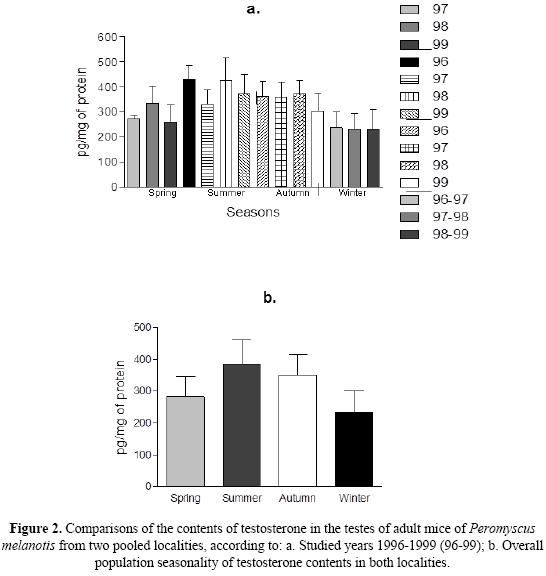
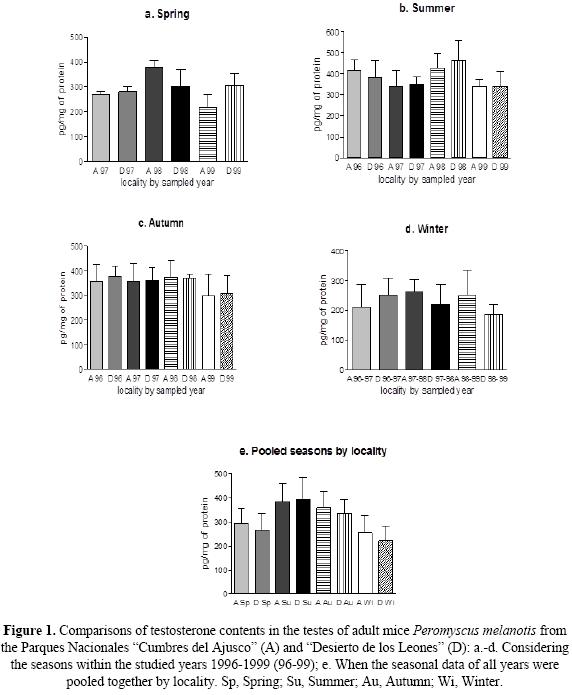
<body><![CDATA[<p align="justify"><font face="verdana" size="2">&nbsp;</font></p>  	    <p align="justify"><font face="verdana" size="2"><b>MATERIALS AND METHODS</b></font></p>  	    <p align="justify"><font face="verdana" size="2"><b>Study Areas.</b> The Parque Nacional Cumbres del Ajusco (PNCA) is located to the SW of the Valley of Mexico, within the Sierra del Ajusco, and it is continued with the Sierra de Chichinautzin. The climate in the PNCA (Garcia 1981) belongs to the mesic temperate subhumids with summer rains (C(w<sub>1</sub>)(w)(b')i'); higher temperatures run from April to September (mean = 15 &plusmn; 2 &deg;C) and lower ones run from November to February (mean &plusmn; SDM, 11 &plusmn; 1 &deg;C); the raining season goes from May to October with a mean precipitation of 152 &plusmn; 22 mm, while the raining shortage is from November to April, with a mean precipitation of 16 &plusmn; 11 mm. The studied population was located at 19&deg; 13' 49'' N, 99&deg; 15' 19'' W, between kilometers 19 and 25 of the panoramic highway to Sierra del Ajusco, and between the 2800 and 3500 m. The vegetation corresponds to temperate forest with seasonal plants and bunchy grasses. The trees include pines (<i>Pinus</i> sp.) and firs (<i>Abies religiosa</i>), as well as pine&#45;oak (<i>Pinus</i> &#45;<i>Quercus</i>) mixed forest. The understory consists of zacatonal (bunchy, hard, tall grasses <i>Muhlenbergia</i> sp., <i>Festuca</i> sp.), as well as abundant shrubs, especially of <i>Senecio</i> sp. and <i>Salix</i> sp., together with seasonal herbal plants, including mainly Compositae, Rosaceae, and Solanaceae, among others. The ground&#45;storey is dominated by a diversity of mosses, lichens, and fungi.</font></p>  	    <p align="justify"><font face="verdana" size="2">As for The Parque Nacional Desierto de los Leones (PNDL), it is located within the Sierra de las Cruces, at the E of the Valle de Mexico, being this mountain range a continuation of the Sierra del Ajusco. The weather (Garc&iacute;a 1981) is temperate subhumid but its long summer rains turn it into the most humid of the subtypes (C(w<sub>2</sub>)(w')(b')ig); the higher temperatures are recorded from April to July (12.6 &plusmn; 6 &deg;C) and the lower temperatures from December to February (mean = 8.1 &plusmn; 2 &deg;C). The rainy season runs from May to August (235 &plusmn; 30 mm) and the dry season is from December to February (12 &plusmn; 4 mm). The studied population was sampled at 19&deg; 18' 17'' N, 99&deg; 19' 14'' W, from the entrance of the park, along the old highway in the Delegaci&oacute;n Alvaro Obreg&oacute;n, until the kilometer 19, between 2180 and 3200 m. The vegetation corresponds to temperate forest whose tree&#45;storey is made up by a mixed forest of conifers (<i>Abies</i> &#45;<i>Pinus</i>) and by mixed conifers&#45;oak forest (<i>Abies</i> &#45;<i>Pinus</i> &#45;<i>Quercus</i>); the understory includes both shrubs, dominated by <i>Senecio</i> sp. and <i>Salix</i> sp., and herbal plants, dominated by Compositae, Rosaceae, and Solanaceae, but with no abundance of zacatonal; the ground&#45;storey is mainly constituted by mosses and lichens, as well as fungi, together with a thick layer of fallen leaves.</font></p>  	    <p align="justify"><font face="verdana" size="2"><b>Capture and preparation of mice.</b> Monthly sampling was conducted to trap only adult males of <i>Peromyscus melanotis</i> (<i>i. e.</i>, exhibiting adult pelage <i>sensu</i> Allen &amp; Chapman 1897, Hall 1981, Alvarez&#45;Casta&ntilde;eda 2005, Castro&#45;Campillo <i>et al.</i> 2005) in both study areas, from June 1996 to December 1999, using Sherman traps (8 x 9 x 23 cm), baited with oat flakes, along band transects (Castro&#45;Campillo <i>et al.</i> 2008). Captured specimens were taken to the laboratory and killed by cervical dislocation, the same day. We recorded the conventional body measurements of these individuals and cleaned their skeletons; some of them were also prepared as skin&#45;skeleton, voucher specimens to be housed at the Mammal Collection of the Universidad Aut&oacute;noma Metropolitana (acronym UAMI) <i>sensu</i> Ram&iacute;rez&#45;Pulido <i>et al.</i> (1989). Once it was cleaned, the skull was used to locate each specimen into an age category, according to the wear of the occlusal surface of cheek&#45;teeth, defining three levels: young adults (III), middle aged adults (IV), and old adults (V) <i>sensu</i> Hoffmeister (1951).</font></p>  	    <p align="justify"><font face="verdana" size="2"><b>Gonadal dissection and storing.</b> Both testes were surgically separated from the body and their maximum length and width were recorded. The tunica albuginea was discarded from the right testis, which in turn was stored at &#45;70&deg;C within an Eppendorf tube, containing an isotonic Ringer solution.</font></p>  	    <p align="justify"><font face="verdana" size="2"><b>Quantification of testosterone.</b> In order to determine the contents of 17&#946;&#45;Hydroxyandrost&#45;4&#45;en&#45;3&#45;one (testosterone, T), we used radioimmunoassay (RIA); the extraction processes, separation of total steroids and of T, as well as the RIA were conducted as in Salame&#45;M&eacute;ndez <i>et al.</i> (2003). Briefly, the right testis was thawed out and homogenized by ultrasound to take two aliquots: one was used to determine protein contents by the method of Groves <i>et al.</i> (1968) and the second one to make the extraction and quantification of the androgen. First, the extraction of total steroids (ETS) in the latter aliquot was made through diethyl ether, being the efficiency of 98.6 &plusmn; 0.6% for the procedure. The following separation of the T from the ETS was undertaken trough thin layer chromatography, using three systems of organic solvents (eleutropic phases). Once the androgen was separated, it was quantified by RIA, and this method was validated by means of a standard curve. The coefficient of variation inter&#45;assay was &lt; 4%, correcting the result of each determination from the percentage of recuperation. The quality control of each RIA was accomplished according to international specifications of accuracy, precision, and sensitivity (Rodbard 1974, Cekan 1976).</font></p>  	    <p align="justify"><font face="verdana" size="2"><b>Statistical analyses.</b> A total of 114 male adults of <i>Peromyscus melanotis</i>, captured between 1996 and 1999 (<a href="/img/revistas/azm/v28n3/a3t1.jpg" target="_blank">Table 1</a>), were arranged according to season and locality; the seasons of the year were considered every three months (spring = March&#45;May, summer = June &#45; August, autumn = September &#45; November, winter = December &#45; February). Descriptive statistics (mean; standard deviation, SD; coefficient of variation, CV) of seasonal T contents were computed by year within each locality, by pooling all years within each locality, and by pooling data from both localities and all years in order to run further analyses (<a href="/img/revistas/azm/v28n3/a3t1.jpg" target="_blank">Table 1</a>). Significant differences (P &lt; 0.05) in the contents of intra&#45;gonadal T were examined by one&#45;way analysis of variance (ANOVA), followed by Tukey Multiple Comparisons test in three series. In one series of ANOVAs, we tested the null hypothesis of no differences of T contents within the same population by comparing the same season among the years in the same locality. In a second series of ANOVAs, we tested the null hypothesis of no inter&#45;population seasonal differences (<a href="#f1">Fig. 1</a>) when the same season and the same year were compared between both localities (<a href="#f1">Figs. 1a&#45;d</a>) and when data from the same season and locality were pooled together, independently of the year (<a href="#f1">Fig. 1e</a>), to be compared between populations. Finally, in a third series of ANOVAs we pooled data together from both populations as follows: a) by seasons and years (<a href="#f2">Fig. 2a</a>) in order to test the null hypothesis of no seasonal differences among years; b) by seasons independently of the year, in order to compare the overall pattern of seasonal T contents in both populations of <i>P. melanotis</i> (<a href="#f2">Fig. 2b</a>). ANOVAs results are depicted in bar charts (<a href="#f1">Figs. 1</a> and <a href="#f2">2</a>), where the bar depicts mean intragodanal T contents, while the whiskers are one standard deviation of the mean. Calculations and graphics were computed with the statistical package GraphPad Prisma (ver. 5.0, Motulsky 1999).</font></p>  	    <p align="center"><font face="verdana" size="2"><a name="f1"></a></font></p>  	    <p align="center"><font face="verdana" size="2"><img src="/img/revistas/azm/v28n3/a3f1.jpg"></font></p>  	    ]]></body>
<body><![CDATA[<p align="center"><font face="verdana" size="2"><a name="f2"></a></font></p>  	    <p align="center"><font face="verdana" size="2"><img src="/img/revistas/azm/v28n3/a3f2.jpg"></font></p>  	    <p align="justify"><font face="verdana" size="2">&nbsp;</font></p>  	    <p align="justify"><font face="verdana" size="2"><b>RESULTS</b></font></p>  	    <p align="justify"><font face="verdana" size="2"><a href="/img/revistas/azm/v28n3/a3t1.jpg" target="_blank">Table 1</a> shows the descriptive statistics of our data, where coefficients of variation (CV) of intragonadal T contents averaged a moderate general variation (<i>i. e</i>., mean CV &plusmn; SD, 18.41 &plusmn; 9.46, minimum = 2; maximum = 41), independently of sample size (2 &gt; n &gt; 39). ANOVA outcomes for these data proved no patterns of overall variation by showing no consistent differences in T contents within the same population or between populations, according to the year or the season. Indeed, the first series of single ANOVA revealed no consistent differences in the intragonadal contents of T, when the same season was compared within the same locality, with only two exceptions among the males from PNCA, including the significantly higher levels of the androgen in spring&#45;1998, as compared to those in 1997 and 1999 (F = 52.3, df = 6, P = 0.0014), respectively, as well as in the summer of the same year, against that of 1997 (F = 3.09, df = 18, P = 0.0591), although there were no differences between summer1998 and those of 1996. When the androgen was compared between localities (<a href="#f1">Fig.</a> <a href="#f1">1</a>), its contents showed no significant differences among the same seasons along the studied years (<i>i. e.,</i> springs, 1997&#45;99, <a href="#f1">Fig. 1a</a>; summers and autumns 1996&#45;99, <a href="#f1">Figs. 1b</a> and <a href="#f1">1c</a>, respectively; winters, 1996&#45;97, 1997&#45;98 y 1998&#45;99, <a href="#f1">Fig. 1d</a>). There was a certain tendency to differentiate in the spring of PNCA and in the summer of PNDL of 1998, since contents of T were higher; however, the pattern was still no consistent among years, seasons nor localities. Absence of significant differences was reiterated when data from different years were pooled in seasonal comparisons between localities (<a href="#f1">Fig. 1e</a>); indeed, the analyses showed that the increasing&#45;decreasing intra&#45;population profile of seasonal T contents was shared by both localities. When data from both localities were pooled together by season, to compare values among years, no significant differences were either found among the same seasons (<a href="#f2">Fig. 2a</a>). If pooled data from both localities and years were examined by season, T contents was significantly higher in the summer, compared to all the other seasons (P &lt; 0.0001, <a href="#f2">Fig. 2b</a>); similarly, the androgen contents was significantly higher (P &lt; 0.001) when autumn was compared to winter, although it was similar between the latter and the spring.</font></p>  	    <p align="justify"><font face="verdana" size="2">&nbsp;</font></p>  	    <p align="justify"><font face="verdana" size="2"><b>DISCUSSION</b></font></p>  	    <p align="justify"><font face="verdana" size="2">Besides to the release of sexual behavior (<i>i. e</i>., quest of mates, courtship displays, physiological processes) and mating (Clemens &amp; Pomenrantz 1982, vom Saal 1983, Ligon <i>et al.</i> 1990, Gouchie &amp; Kimura 1991, Zielinski &amp; Vandenbergh 1993, Ferkin <i>et al.</i> 1994, Rhen &amp; Crews 2002, Hirschenhauser &amp; Oliveira 2006, Spritzer <i>et al.</i> 2005, Waterman 2007), elevation of T contents also induces recrudescence of seminal vesicles and testes, as well as spermatogenesis in males (Kenagy &amp; Trombulak 1986, Zirkin 1998, Fukazawa &amp; Iguchi 1999, Desai &amp; Kondaiah 2000, Holstein <i>et al.</i> 2003, Nelson 2005). In fact, T has also been related to capabilities that might involve better probabilities for males to survive, enhance their self&#45;defense and gathering of territory and mates, as well as their reproductive success, such as vagility, spatial ability, dominance rank, and aggressiveness (Christian 1971, vom Saal 1987, Gipps 1982, Perrot&#45;Sinal <i>et al.</i> 1998, Spritzer <i>et al.</i> 2005). Based only on the size of some reproductive organs and accessory glands, Christian (1961, 1971) proposed that T could have different density&#45;dependent effects. This author proposed that "a series of feed&#45;back mechanisms, particularly involving the pituitary&#45;adrenocortical and pituitary&#45;gonadal systems, which in turn can be activated by socio&#45;psychological factors (intraspecific competition) within the population, could be responsible for changes in population size". He continues on stating that "interacting behavioral and endocrine mechanisms comprise at least an important part of a system responding to changes in the number of animals in such a way that population growth is self&#45;limiting and self&#45;regulating".</font></p>  	    <p align="justify"><font face="verdana" size="2">However, before our study, the contents of the androgen had not been actually measured for that purpose in wild populations; <i>v. gr</i>., in two populations of the same species with different patterns of density fluctuations (Castro&#45;Campillo <i>et al.</i> 2008). The more proximate studies have been the measurement of T levels with respect to depletion of immune response, which in turn derives in a higher susceptibility to parasites; in fact, results of this research line have proved increasing of morbility as a density&#45;dependent event, which in turn has been associated to reduction of population size in disturbed environments (Cook &amp; Beer 1955, Alexander &amp; Stimson 1988, Olsen &amp; Kovacs 1996, Barnard <i>et al</i>. 1998, 2002, 2003, Burthe <i>et al.</i> 2006, Ostfeld <i>et al.</i> 2006, Radwan <i>et al.</i> 2009, Luis <i>et al.</i> 2010). Nevertheless, we found no differences in the intragonadal contents of T, between the males of the two populations studied: independently of how many more males can be found in PNCA all year round, as compared to those from PNDL (Castro&#45;Campillo <i>et al.</i> 2008), their gonads produce as many as much T as the latter (<a href="#f1">Figs. 1</a>&#45;<a href="#f2">2</a>). In addition, when we reviewed data of intragonadal T contents, against population density fluctuations in each locality (see <a href="#f1">Fig. 1</a> and Appendix in Castro&#45;Campillo <i>et al</i>. 2008), we neither found a consistent foundation for the idea that a decreasing of population density, triggers an increasing of T, or vice versa.</font></p>  	    <p align="justify"><font face="verdana" size="2">Therefore, independently of population size and its fluctuations (Castro&#45;Campillo <i>et al</i>. 2008), the endocrine function in adult males of <i>P. melanotis</i> is seasonally related in both localities: it is more active from spring to summer, and less active from autumn to winter (see Salame&#45;M&eacute;ndez <i>et al.</i> 2004 and <a href="#f2">Fig. 2b</a> here). Moreover, in spite of the relative harshness of environmental conditions during winter, it is also true that neither spermatogenesis nor T contents are ceased, a fact that supports reproduction of <i>P. melanotis</i> in both localities all year round (Salame&#45;M&eacute;ndez <i>et al.</i> 2004, 2005). Since abundance differences between both populations did not show a connection with an endocrine variation of intragonadal contents of T, it might be that differences in fluctuations between the two localities are rather a by&#45;product of subtle changes in the abiotic and biotic factors of their respective habitats, in spite of its geographic nearness and its first&#45;glance environmental similitude. In fact, the seasonal behavior of intragonadal T contents in <i>P. melanotis</i> shows an ecophysiological pattern of summer optima in these two populations, living in temperate forests at the studied latitude, between 2100 &#45; 3500 m. Such pattern, as we have observed, is clearly more related to seasonality of rainfalls and to the subtle changes in temperature (T&deg;), during the summer, which in both localities provide the foundations for the greening, flowering, and fruiting of plants. The consequent availability and diversification of food resources, generates a peak for intragonadal T contents, which in turns triggers the reproductive activities of the Black Eared mouse in both localities. Then, as the rains decline, from summer to autumn, and the T&deg; drops (Garc&iacute;a 1981), vegetation also dries out during the winter and levels of T become lowest. Therefore, the ecophysiological pattern of intragonadal T contents in <i>P. melanotis</i> concurs with the idea that environmental factors are determinant to the dynamics of the reproductive biology of mice (Sadleir 1969, Merrit <i>et al.</i> 2003, Galindo&#45;Leal &amp; Krebs 1998; Hernandez&#45;Betancourt <i>et al.</i> 2008), rather to the idea that T could be acting as a regulator of population density.</font></p>  	    ]]></body>
<body><![CDATA[<p align="justify"><font face="verdana" size="2">Indeed, the effect of annual changes in environmental conditions of habitat over wild mice populations, has been well documented in terms of density fluctuations, as well as through the onset and seasonality of its reproductive activity; moreover it is accepted that characteristics and variation of environmental conditions regulate both aspects in their life histories (Lackey 1978, Millar 1984, Knapp 1989, Millar <i>et al.</i> 1990, Heideman &amp; Bronson 1992, 1993, Galindo&#45;Leal &amp; Krebs 1997, 1998, Lima <i>et al.</i> 2001, 2002, Merritt <i>et al.</i> 2003, Luis <i>et al.</i> 2010). Accordingly, a general pattern for species inhabiting temperate regions, such as <i>P. melanotis</i>, is that the optimal season for reproduction is fixed during the spring or the summer with respect to the annual cycle, especially as a function of variations in the light period, temperature, precipitation, and access to food resources that can imply either an insurance or a risk for the reproductive investment (Sadleir 1969, Merritt <i>et al.</i> 2003). In addition, the onset of reproductive activity is linked to the rising of steroid sexual hormones (SSH) &#151;particularly of testosterone (T) in adult males, which are therefore the ones in charge of reproducing the population (Anderson 1989, Kunz <i>et al.</i> 1996). Rising of SSH in <i>P. melanotis</i> seems to be also synchronized to the changes in the environment (Salame&#45;M&eacute;ndez <i>et al.</i> 2004, 2005), in order to secure optimal conditions for its reproduction (Bronson &amp; Heideman 1994; Bartness &amp; Albers 2000).</font></p>  	    <p align="justify"><font face="verdana" size="2">&nbsp;</font></p>  	    <p align="justify"><font face="verdana" size="2"><b>DEDICATION</b></font></p>  	    <p align="justify"><font face="verdana" size="2">We honor the memory of our dear friend, Juan Pati&ntilde;o&#45;Rodr&iacute;guez (1953&#45;2011). Johnny, as we friendly called him, was the collecting and taxidermist technician of the Mammal Collection of the Autonomous Metropolitan University, at Iztapalapa (UAMI) since 1978. His loyal support in both the field and laboratory work was always committed, responsible and professional, becoming a crucial part of our studies. More importantly, his deep taste for life and his joyful spirit always facilitated our work in difficult as well as in every&#45;day moments.</font></p>  	    <p align="justify"><font face="verdana" size="2">&nbsp;</font></p>  	    <p align="justify"><font face="verdana" size="2"><b>ACKNOWLEDGEMENTS</b></font></p>  	    <p align="justify"><font face="verdana" size="2">We thank Rosa M. G&oacute;mez&#45;Ugalde as well as many of our undergraduate and graduate students, now our colleagues, for their collaboration in field work. Jorge Cumate guided us in the recognition of vegetation strata and its dominant taxa. Olga Moreno&#45;Ramos, Daniel D&iacute;az&#45;Porras and Heriberto Ram&iacute;rez&#45;Ruiz participated in data organization and data capturing. This study was partially funded by the Division of Biological and Health Sciences at UAMI, through research projects (ASM, ACC), CONACyT (JRP), and PROMEP, SEP (CA&#45;27 CABMS, ASAM, ACC, and JRP).</font></p>  	    <p align="justify"><font face="verdana" size="2">&nbsp;</font></p>  	    <p align="justify"><font face="verdana" size="2"><b>LITERATURE CITED</b></font></p>  	    <!-- ref --><p align="justify"><font face="verdana" size="2"><b>Alexander, J. &amp; Stimson, W. H.</b> 1988. Sex hormones and the course of parasitic infection. <i>Parasitology Today</i>, 4: 89&#45;193.    &nbsp;&nbsp;&nbsp;&nbsp;&nbsp;&nbsp;&nbsp;&nbsp;[&#160;<a href="javascript:void(0);" onclick="javascript: window.open('/scielo.php?script=sci_nlinks&ref=395788&pid=S0065-1737201200030000300001&lng=','','width=640,height=500,resizable=yes,scrollbars=1,menubar=yes,');">Links</a>&#160;]<!-- end-ref --></font></p>  	    <!-- ref --><p align="justify"><font face="verdana" size="2"><b>Allen, J. A. &amp; Chapman, F. M.</b> 1897. On a collection of mammals from Jalapa and Las Vigas, State of Vera Cruz, Mexico. <i>American Museum of Natural History</i>, 9: 197&#45;268.    &nbsp;&nbsp;&nbsp;&nbsp;&nbsp;&nbsp;&nbsp;&nbsp;[&#160;<a href="javascript:void(0);" onclick="javascript: window.open('/scielo.php?script=sci_nlinks&ref=395790&pid=S0065-1737201200030000300002&lng=','','width=640,height=500,resizable=yes,scrollbars=1,menubar=yes,');">Links</a>&#160;]<!-- end-ref --></font></p>  	    <!-- ref --><p align="justify"><font face="verdana" size="2"><b>Alvarez&#45;Casta&ntilde;eda, S. T.</b> 2005. <i>Peromyscus melanotis</i>. <i>Mammalian Species</i>, No. 764: 1&#45;4.    &nbsp;&nbsp;&nbsp;&nbsp;&nbsp;&nbsp;&nbsp;&nbsp;[&#160;<a href="javascript:void(0);" onclick="javascript: window.open('/scielo.php?script=sci_nlinks&ref=395792&pid=S0065-1737201200030000300003&lng=','','width=640,height=500,resizable=yes,scrollbars=1,menubar=yes,');">Links</a>&#160;]<!-- end-ref --></font></p>  	    <!-- ref --><p align="justify"><font face="verdana" size="2"><b>Anderson, P. K.</b> 1989. <i>Dispersal in</i> <i>rodents: A resident fitness hypothesis</i>. Special publication<i>s</i> No. 9. American Society of Mammalogists, Provo, UT, 141 pp.    &nbsp;&nbsp;&nbsp;&nbsp;&nbsp;&nbsp;&nbsp;&nbsp;[&#160;<a href="javascript:void(0);" onclick="javascript: window.open('/scielo.php?script=sci_nlinks&ref=395794&pid=S0065-1737201200030000300004&lng=','','width=640,height=500,resizable=yes,scrollbars=1,menubar=yes,');">Links</a>&#160;]<!-- end-ref --></font></p>  	    <!-- ref --><p align="justify"><font face="verdana" size="2"><b>Barnard, C. J., Behnke, J. M., Bajer, A., Bray, D., Race, T., Frake, K., Osmond, J., Dinmore, J. &amp; Sinski, E.</b> 2002. Local variation in endoparasite intensities of bank voles (<i>Clethrionomys glareolus</i>) from ecologically similar sites: morphometric and endocrine correlates. <i>Journal of Helminthology</i>, 76: 103&#45;112.    &nbsp;&nbsp;&nbsp;&nbsp;&nbsp;&nbsp;&nbsp;&nbsp;[&#160;<a href="javascript:void(0);" onclick="javascript: window.open('/scielo.php?script=sci_nlinks&ref=395796&pid=S0065-1737201200030000300005&lng=','','width=640,height=500,resizable=yes,scrollbars=1,menubar=yes,');">Links</a>&#160;]<!-- end-ref --></font></p>  	    <!-- ref --><p align="justify"><font face="verdana" size="2"><b>Barnard, C. J., Behnke, J. M., Gage, A. R., Brown, H. &amp; Smithurst, P. R.</b> 1998. The role of parasite&#45;induced immunodepression, rank and social environment in the modulation of behaviour and hormone concentration in male laboratory mice (<i>Mus musculus</i>). <i>Proceedings of the Royal Society of London</i> B, 265: 693&#45;701.    &nbsp;&nbsp;&nbsp;&nbsp;&nbsp;&nbsp;&nbsp;&nbsp;[&#160;<a href="javascript:void(0);" onclick="javascript: window.open('/scielo.php?script=sci_nlinks&ref=395798&pid=S0065-1737201200030000300006&lng=','','width=640,height=500,resizable=yes,scrollbars=1,menubar=yes,');">Links</a>&#160;]<!-- end-ref --></font></p>  	    <!-- ref --><p align="justify"><font face="verdana" size="2"><b>Barnard, C. J., Kulis, K., Behnke, J. M., Bajer, A., Gromadzka&#45;Ostrowska, J., Stachon, M. &amp; Sinski, E.</b> 2003. Local variation in helminth burdens of bank voles (<i>Clethrionomys glareolus</i>) from ecologically similar sites: temporal stability and relationships with hormone concentrations and social behaviour. <i>Journal of Helminthology,</i> 77: 185&#45;195.    &nbsp;&nbsp;&nbsp;&nbsp;&nbsp;&nbsp;&nbsp;&nbsp;[&#160;<a href="javascript:void(0);" onclick="javascript: window.open('/scielo.php?script=sci_nlinks&ref=395800&pid=S0065-1737201200030000300007&lng=','','width=640,height=500,resizable=yes,scrollbars=1,menubar=yes,');">Links</a>&#160;]<!-- end-ref --></font></p>  	    <!-- ref --><p align="justify"><font face="verdana" size="2"><b>Bartness, T. J. &amp; Albers, H. E.</b> 2000. Activity patterns and biological clock in mammals, pp. 23&#45;47. <i>In</i>: S. Halle &amp; N. C. Stenseth (Eds.). <i>Activity patterns in small mammals: an ecological approach</i>. Ecological Studies 141, Springer&#45;Verlag, Berlin Heidelberg, 320 pp.    &nbsp;&nbsp;&nbsp;&nbsp;&nbsp;&nbsp;&nbsp;&nbsp;[&#160;<a href="javascript:void(0);" onclick="javascript: window.open('/scielo.php?script=sci_nlinks&ref=395802&pid=S0065-1737201200030000300008&lng=','','width=640,height=500,resizable=yes,scrollbars=1,menubar=yes,');">Links</a>&#160;]<!-- end-ref --></font></p>  	    <!-- ref --><p align="justify"><font face="verdana" size="2"><b>Bronson, F. H. &amp; Heideman, P. D.</b> 1994. Seasonal regulation of reproduction in mammals, pp. 541&#45;584. <i>In</i>: E. Knobil &amp; J. D. Neill (Eds.). <i>The physiology</i> <i>of reproduction</i>. 2<sup>nd</sup> ed., Raven Press, Ltd., N. Y., Vol. 2, 1372 pp.    &nbsp;&nbsp;&nbsp;&nbsp;&nbsp;&nbsp;&nbsp;&nbsp;[&#160;<a href="javascript:void(0);" onclick="javascript: window.open('/scielo.php?script=sci_nlinks&ref=395804&pid=S0065-1737201200030000300009&lng=','','width=640,height=500,resizable=yes,scrollbars=1,menubar=yes,');">Links</a>&#160;]<!-- end-ref --></font></p>  	    <!-- ref --><p align="justify"><font face="verdana" size="2"><b>Burthe, S., Telfer, S., Lambin, X., Bennett, M., Carslake, D., Smith, A. &amp; Begon, M.</b> 2006. Cowpox virus infection in natural field vole <i>Microtus agrestis</i> populations: delayed density dependence and individual risk. <i>Journal of Animal Ecology</i>, 75: 1416&#45;1425.    &nbsp;&nbsp;&nbsp;&nbsp;&nbsp;&nbsp;&nbsp;&nbsp;[&#160;<a href="javascript:void(0);" onclick="javascript: window.open('/scielo.php?script=sci_nlinks&ref=395806&pid=S0065-1737201200030000300010&lng=','','width=640,height=500,resizable=yes,scrollbars=1,menubar=yes,');">Links</a>&#160;]<!-- end-ref --></font></p>  	    <!-- ref --><p align="justify"><font face="verdana" size="2"><b>Castro&#45;Campillo, A., Mart&iacute;nez&#45;Coronel, M., Aguilera, U. &amp; Ram&iacute;rez&#45;Pulido, J.</b> 2005. <i>Peromyscus melanotis</i> (J. A. Allen &amp; Chapman, 1897), pp. 754&#45;755. <i>In</i>: G. Ceballos &amp; G. Oliva (Coords.). <i>Los mam&iacute;feros de M&eacute;xico</i>. Fondo de Cultura Econ&oacute;mica, Comisi&oacute;n para el Conocimiento y Uso de la Biodiversidad, M&eacute;xico, 986 pp.    &nbsp;&nbsp;&nbsp;&nbsp;&nbsp;&nbsp;&nbsp;&nbsp;[&#160;<a href="javascript:void(0);" onclick="javascript: window.open('/scielo.php?script=sci_nlinks&ref=395808&pid=S0065-1737201200030000300011&lng=','','width=640,height=500,resizable=yes,scrollbars=1,menubar=yes,');">Links</a>&#160;]<!-- end-ref --></font></p>  	    <!-- ref --><p align="justify"><font face="verdana" size="2"><b>Castro&#45;Campillo, A., Salame&#45;M&eacute;ndez, A., Vergara&#45;Huerta, J., Castillo, A. &amp; Ram&iacute;rez&#45;Pulido, J.</b> 2008. Fluctuaciones de micromam&iacute;feros terrestres en bosques templados aleda&ntilde;os a la ciudad de M&eacute;xico, Distrito Federal, pp. 391&#45;410. <i>In</i>: C. Lorenzo, E. Espinosa &amp; J. Ortega (Eds.). <i>Avances en el estudio de los mam&iacute;feros de M&eacute;xico</i>. Publicaciones especiales, Vol. II, Asociaci&oacute;n Mexicana de Mastozoolog&iacute;a, A. C., M&eacute;xico, D. F., 691 pp.    &nbsp;&nbsp;&nbsp;&nbsp;&nbsp;&nbsp;&nbsp;&nbsp;[&#160;<a href="javascript:void(0);" onclick="javascript: window.open('/scielo.php?script=sci_nlinks&ref=395810&pid=S0065-1737201200030000300012&lng=','','width=640,height=500,resizable=yes,scrollbars=1,menubar=yes,');">Links</a>&#160;]<!-- end-ref --></font></p>  	    <!-- ref --><p align="justify"><font face="verdana" size="2"><b>Cekan, S. Z.</b> 1976. Reliability of steroid radioinmunoassays. <i>Acta Universitas Upsaliensis</i>. (Swedish Medical Council of Reproductive Endocrinology. Research Unit. Stockholm, Uppsala, Sweden), No. 14: 1&#45;48.    &nbsp;&nbsp;&nbsp;&nbsp;&nbsp;&nbsp;&nbsp;&nbsp;[&#160;<a href="javascript:void(0);" onclick="javascript: window.open('/scielo.php?script=sci_nlinks&ref=395812&pid=S0065-1737201200030000300013&lng=','','width=640,height=500,resizable=yes,scrollbars=1,menubar=yes,');">Links</a>&#160;]<!-- end-ref --></font></p>  	    <!-- ref --><p align="justify"><font face="verdana" size="2"><b>Christian, J. J.</b> 1961. Phenomena associated with population density. <i>Anthropology</i>, 47: 428&#45;449.    &nbsp;&nbsp;&nbsp;&nbsp;&nbsp;&nbsp;&nbsp;&nbsp;[&#160;<a href="javascript:void(0);" onclick="javascript: window.open('/scielo.php?script=sci_nlinks&ref=395814&pid=S0065-1737201200030000300014&lng=','','width=640,height=500,resizable=yes,scrollbars=1,menubar=yes,');">Links</a>&#160;]<!-- end-ref --></font></p>  	    <!-- ref --><p align="justify"><font face="verdana" size="2"><b>Christian, J. J.</b> 1971. Fighting, maturity, and population density in <i>Microtus pennsylvanicus</i>. <i>Journal of Mammalogy</i>, 52: 556&#45;567.    &nbsp;&nbsp;&nbsp;&nbsp;&nbsp;&nbsp;&nbsp;&nbsp;[&#160;<a href="javascript:void(0);" onclick="javascript: window.open('/scielo.php?script=sci_nlinks&ref=395816&pid=S0065-1737201200030000300015&lng=','','width=640,height=500,resizable=yes,scrollbars=1,menubar=yes,');">Links</a>&#160;]<!-- end-ref --></font></p>  	    <!-- ref --><p align="justify"><font face="verdana" size="2"><b>Clemens, L. &amp; Pomerantz, S.</b> 1982. Testosterone acts as a prohormone to stimulate male copulatory behavior in male Deer Mice (<i>Peromyscus maniculatus bairdii</i>). <i>Journal of Comparative Physiology and Psychology</i>, B4a, 96: 114&#45;112.    &nbsp;&nbsp;&nbsp;&nbsp;&nbsp;&nbsp;&nbsp;&nbsp;[&#160;<a href="javascript:void(0);" onclick="javascript: window.open('/scielo.php?script=sci_nlinks&ref=395818&pid=S0065-1737201200030000300016&lng=','','width=640,height=500,resizable=yes,scrollbars=1,menubar=yes,');">Links</a>&#160;]<!-- end-ref --></font></p>  	    <!-- ref --><p align="justify"><font face="verdana" size="2"><b>Cook, E. F. &amp; Beer, J. R.</b> 1955. The louse populations of some cricetid rodents. <i>Parasitology</i>, 45: 409&#45;420.    &nbsp;&nbsp;&nbsp;&nbsp;&nbsp;&nbsp;&nbsp;&nbsp;[&#160;<a href="javascript:void(0);" onclick="javascript: window.open('/scielo.php?script=sci_nlinks&ref=395820&pid=S0065-1737201200030000300017&lng=','','width=640,height=500,resizable=yes,scrollbars=1,menubar=yes,');">Links</a>&#160;]<!-- end-ref --></font></p>  	    <!-- ref --><p align="justify"><font face="verdana" size="2"><b>Desai, K. V. &amp; Kondaiah, P.</b> 2000. Androgen ablation results in differential regulation of transforming growth factor beta isoforms in rat male accessory sex organs and epididymis. <i>Journal of Molecular Endocrinology</i>, 24: 253&#45;260.    &nbsp;&nbsp;&nbsp;&nbsp;&nbsp;&nbsp;&nbsp;&nbsp;[&#160;<a href="javascript:void(0);" onclick="javascript: window.open('/scielo.php?script=sci_nlinks&ref=395822&pid=S0065-1737201200030000300018&lng=','','width=640,height=500,resizable=yes,scrollbars=1,menubar=yes,');">Links</a>&#160;]<!-- end-ref --></font></p>  	    <!-- ref --><p align="justify"><font face="verdana" size="2"><b>Ferkin, M. H., Sorokin, E. S., Renfroe, M. W. &amp; Johnston, R. E.</b> 1994. Attractiveness of male odors to females varies directly with plasma testosterone concentration in meadow voles. <i>Physiology &amp; Behavior</i>, 55: 347&#45;353.    &nbsp;&nbsp;&nbsp;&nbsp;&nbsp;&nbsp;&nbsp;&nbsp;[&#160;<a href="javascript:void(0);" onclick="javascript: window.open('/scielo.php?script=sci_nlinks&ref=395824&pid=S0065-1737201200030000300019&lng=','','width=640,height=500,resizable=yes,scrollbars=1,menubar=yes,');">Links</a>&#160;]<!-- end-ref --></font></p>  	    <!-- ref --><p align="justify"><font face="verdana" size="2"><b>Fukazawa, Y. &amp; Iguchi, T.</b> 1999. Effects of hormones and growth factors on the development of the male mouse reproductive tract <i>in vitro</i>. <i>Zoological Science</i>, 16: 153&#45;160.    &nbsp;&nbsp;&nbsp;&nbsp;&nbsp;&nbsp;&nbsp;&nbsp;[&#160;<a href="javascript:void(0);" onclick="javascript: window.open('/scielo.php?script=sci_nlinks&ref=395826&pid=S0065-1737201200030000300020&lng=','','width=640,height=500,resizable=yes,scrollbars=1,menubar=yes,');">Links</a>&#160;]<!-- end-ref --></font></p>  	    <!-- ref --><p align="justify"><font face="verdana" size="2"><b>Galindo&#45;Leal, C. &amp; Krebs, C. J.</b> 1997. Habitat structure and demographic variability of habitat specialist: the Rock Mouse (<i>Peromyscus difficilis</i>). <i>Revista Mexicana de Mastozoolog&iacute;a</i>, 2: 72&#45;89.    &nbsp;&nbsp;&nbsp;&nbsp;&nbsp;&nbsp;&nbsp;&nbsp;[&#160;<a href="javascript:void(0);" onclick="javascript: window.open('/scielo.php?script=sci_nlinks&ref=395828&pid=S0065-1737201200030000300021&lng=','','width=640,height=500,resizable=yes,scrollbars=1,menubar=yes,');">Links</a>&#160;]<!-- end-ref --></font></p>  	    <!-- ref --><p align="justify"><font face="verdana" size="2"><b>Galindo&#45;Leal, C. &amp; Krebs, C. J.</b> 1998. Effects of food abundance on individuals and populations of the Rock Mouse (<i>Peromyscus difficilis</i>). <i>Journal of Mammalogy</i>, 79: 1131&#45;1142.    &nbsp;&nbsp;&nbsp;&nbsp;&nbsp;&nbsp;&nbsp;&nbsp;[&#160;<a href="javascript:void(0);" onclick="javascript: window.open('/scielo.php?script=sci_nlinks&ref=395830&pid=S0065-1737201200030000300022&lng=','','width=640,height=500,resizable=yes,scrollbars=1,menubar=yes,');">Links</a>&#160;]<!-- end-ref --></font></p>  	    <!-- ref --><p align="justify"><font face="verdana" size="2"><b>Garc&iacute;a, E.</b> 1981. <i>Modificaciones al Sistema de Clasificaci&oacute;n Clim&aacute;tica de K&ouml;ppen (para adaptarlo a las condiciones de la Rep&uacute;blica Mexicana)</i>. Instituto de Geograf&iacute;a, Universidad Nacional Aut&oacute;noma de M&eacute;xico, 3&ordf; ed., M&eacute;xico, D. F., 252 pp.    &nbsp;&nbsp;&nbsp;&nbsp;&nbsp;&nbsp;&nbsp;&nbsp;[&#160;<a href="javascript:void(0);" onclick="javascript: window.open('/scielo.php?script=sci_nlinks&ref=395832&pid=S0065-1737201200030000300023&lng=','','width=640,height=500,resizable=yes,scrollbars=1,menubar=yes,');">Links</a>&#160;]<!-- end-ref --></font></p>  	    <!-- ref --><p align="justify"><font face="verdana" size="2"><b>Garc&iacute;a&#45;Estrada, C., Romero&#45;Almaraz, M. L. &amp; S&aacute;nchez&#45;Hern&aacute;ndez, C.</b> 2002. Comparison of rodent communities in sites with different degrees of disturbance in deciduous forest of southeastern Morelos, Mexico. <i>Acta Zool&oacute;gica Mexicana (n. s.),</i> 85: 153&#45;168.    &nbsp;&nbsp;&nbsp;&nbsp;&nbsp;&nbsp;&nbsp;&nbsp;[&#160;<a href="javascript:void(0);" onclick="javascript: window.open('/scielo.php?script=sci_nlinks&ref=395834&pid=S0065-1737201200030000300024&lng=','','width=640,height=500,resizable=yes,scrollbars=1,menubar=yes,');">Links</a>&#160;]<!-- end-ref --></font></p>  	    <!-- ref --><p align="justify"><font face="verdana" size="2"><b>Garc&iacute;a&#45;Estrada C., Romero&#45;Almaraz, M. L. &amp; S&aacute;nchez&#45;Hern&aacute;ndez, C.</b> 2004. Diferencias en la actividad reproductiva de dos comunidades de roedores en el sureste del estado de Morelos, M&eacute;xico, pp. 161&#45;170. <i>In:</i> A. Castro&#45;Campillo &amp; J. Ortega. (Eds.). <i>Homenaje a la trayectoria mastozool&oacute;gica de Jos&eacute; Ram&iacute;rez Pulido</i>. Universidad Aut&oacute;noma Metropolitana, Unidad Iztapalapa, M&eacute;xico, 234 pp.    &nbsp;&nbsp;&nbsp;&nbsp;&nbsp;&nbsp;&nbsp;&nbsp;[&#160;<a href="javascript:void(0);" onclick="javascript: window.open('/scielo.php?script=sci_nlinks&ref=395836&pid=S0065-1737201200030000300025&lng=','','width=640,height=500,resizable=yes,scrollbars=1,menubar=yes,');">Links</a>&#160;]<!-- end-ref --></font></p>  	    <!-- ref --><p align="justify"><font face="verdana" size="2"><b>Gipps, J. H. W.</b> 1982. The effects of testosterone and scopolamine HBr on aggressive behaviour of male voles, <i>Microtus townsendii</i>. <i>Canadian Journal of Zoology</i>, 60: 946&#45;950.    &nbsp;&nbsp;&nbsp;&nbsp;&nbsp;&nbsp;&nbsp;&nbsp;[&#160;<a href="javascript:void(0);" onclick="javascript: window.open('/scielo.php?script=sci_nlinks&ref=395838&pid=S0065-1737201200030000300026&lng=','','width=640,height=500,resizable=yes,scrollbars=1,menubar=yes,');">Links</a>&#160;]<!-- end-ref --></font></p>  	    <!-- ref --><p align="justify"><font face="verdana" size="2"><b>Gouchie, C. &amp; Kimura, D.</b> 1991. The relationship between testosterone levels and cognitive ability patterns. <i>Psychoneuroendocrinology</i>, 16: 323&#45;334.    &nbsp;&nbsp;&nbsp;&nbsp;&nbsp;&nbsp;&nbsp;&nbsp;[&#160;<a href="javascript:void(0);" onclick="javascript: window.open('/scielo.php?script=sci_nlinks&ref=395840&pid=S0065-1737201200030000300027&lng=','','width=640,height=500,resizable=yes,scrollbars=1,menubar=yes,');">Links</a>&#160;]<!-- end-ref --></font></p>  	    <!-- ref --><p align="justify"><font face="verdana" size="2"><b>Groves, W. E., Davis, Jr., F. C. &amp; Sells, B. H.</b> 1968. Spectropothometric determination of microgram quantities of protein without nucleic acid interference. <i>Analytical Biochemistry</i>, 22: 195&#45;210.    &nbsp;&nbsp;&nbsp;&nbsp;&nbsp;&nbsp;&nbsp;&nbsp;[&#160;<a href="javascript:void(0);" onclick="javascript: window.open('/scielo.php?script=sci_nlinks&ref=395842&pid=S0065-1737201200030000300028&lng=','','width=640,height=500,resizable=yes,scrollbars=1,menubar=yes,');">Links</a>&#160;]<!-- end-ref --></font></p>  	    <!-- ref --><p align="justify"><font face="verdana" size="2"><b>Hall, E. R.</b> 1981. <i>The Mammals of North America</i>. John Wiley &amp; Sons, Vol. 2, N. Y., vi+ 601+ 1181+ 190 pp.    &nbsp;&nbsp;&nbsp;&nbsp;&nbsp;&nbsp;&nbsp;&nbsp;[&#160;<a href="javascript:void(0);" onclick="javascript: window.open('/scielo.php?script=sci_nlinks&ref=395844&pid=S0065-1737201200030000300029&lng=','','width=640,height=500,resizable=yes,scrollbars=1,menubar=yes,');">Links</a>&#160;]<!-- end-ref --></font></p>  	    <!-- ref --><p align="justify"><font face="verdana" size="2"><b>Heideman, P. D. &amp; Bronson, F. H.</b> 1992. A pseudoseasonal reproductive strategy in a tropical rodent, <i>Peromyscus nudipes</i>. <i>Journal of Reproduction and Fertility</i>, 95: 57&#45;67.    &nbsp;&nbsp;&nbsp;&nbsp;&nbsp;&nbsp;&nbsp;&nbsp;[&#160;<a href="javascript:void(0);" onclick="javascript: window.open('/scielo.php?script=sci_nlinks&ref=395846&pid=S0065-1737201200030000300030&lng=','','width=640,height=500,resizable=yes,scrollbars=1,menubar=yes,');">Links</a>&#160;]<!-- end-ref --></font></p>  	    <!-- ref --><p align="justify"><font face="verdana" size="2"><b>Heideman, P. D. &amp; Bronson, F. H.</b> 1993. Potential and realized reproduction in a tropical population of <i>Peromyscus</i>. (Rodentia). <i>Journal of Mammalogy</i>, 74: 261&#45;269.    &nbsp;&nbsp;&nbsp;&nbsp;&nbsp;&nbsp;&nbsp;&nbsp;[&#160;<a href="javascript:void(0);" onclick="javascript: window.open('/scielo.php?script=sci_nlinks&ref=395848&pid=S0065-1737201200030000300031&lng=','','width=640,height=500,resizable=yes,scrollbars=1,menubar=yes,');">Links</a>&#160;]<!-- end-ref --></font></p>  	    <!-- ref --><p align="justify"><font face="verdana" size="2"><b>Hern&aacute;ndez&#45;Betancourt, S. F., Cim&eacute;&#45;Pool, J. A. &amp; Medina&#45;Peralta, S.</b> 2008. Ecolog&iacute;a poblacional de <i>Heteromys gaumeri</i> en la selva del sur de Yucat&aacute;n, M&eacute;xico, pp. 427&#45;448. <i>In</i>: C. Lorenzo, E. Espinosa &amp; J. Ortega (Eds.). <i>Avances en el estudio de los mam&iacute;feros de M&eacute;xico</i>. Publicaciones especiales, Vol. II, Asociaci&oacute;n Mexicana de Mastozoolog&iacute;a, A. C., M&eacute;xico, D. F., 691 pp.    &nbsp;&nbsp;&nbsp;&nbsp;&nbsp;&nbsp;&nbsp;&nbsp;[&#160;<a href="javascript:void(0);" onclick="javascript: window.open('/scielo.php?script=sci_nlinks&ref=395850&pid=S0065-1737201200030000300032&lng=','','width=640,height=500,resizable=yes,scrollbars=1,menubar=yes,');">Links</a>&#160;]<!-- end-ref --></font></p>  	    <!-- ref --><p align="justify"><font face="verdana" size="2"><b>Hirschenhauser, K. &amp; Oliveira, R. F.</b> 2006. Social modulation of androgens in male vertebrates: metaanalyses of the challenge hypothesis. <i>Animal Behaviour</i>, 71: 265&#45;277.    &nbsp;&nbsp;&nbsp;&nbsp;&nbsp;&nbsp;&nbsp;&nbsp;[&#160;<a href="javascript:void(0);" onclick="javascript: window.open('/scielo.php?script=sci_nlinks&ref=395852&pid=S0065-1737201200030000300033&lng=','','width=640,height=500,resizable=yes,scrollbars=1,menubar=yes,');">Links</a>&#160;]<!-- end-ref --></font></p>  	    <!-- ref --><p align="justify"><font face="verdana" size="2"><b>Hoffmeister, D. F.</b> 1951. A taxonomic and evolutionary study of the Pinon Mouse, <i>Peromyscus truei</i>. <i>Illinois Biology Monographs,</i> 21: IX+1&#45;104.    &nbsp;&nbsp;&nbsp;&nbsp;&nbsp;&nbsp;&nbsp;&nbsp;[&#160;<a href="javascript:void(0);" onclick="javascript: window.open('/scielo.php?script=sci_nlinks&ref=395854&pid=S0065-1737201200030000300034&lng=','','width=640,height=500,resizable=yes,scrollbars=1,menubar=yes,');">Links</a>&#160;]<!-- end-ref --></font></p>  	    <!-- ref --><p align="justify"><font face="verdana" size="2"><b>Holstein, A. F., Schulze, W. &amp; Davidoff, M.</b> 2003. Understanding spermatogenesis is a prerequisite for treatment. <i>Reproduction Biology and Endocrinology</i>, 1: 107&#45;123.    &nbsp;&nbsp;&nbsp;&nbsp;&nbsp;&nbsp;&nbsp;&nbsp;[&#160;<a href="javascript:void(0);" onclick="javascript: window.open('/scielo.php?script=sci_nlinks&ref=395856&pid=S0065-1737201200030000300035&lng=','','width=640,height=500,resizable=yes,scrollbars=1,menubar=yes,');">Links</a>&#160;]<!-- end-ref --></font></p>  	    <!-- ref --><p align="justify"><font face="verdana" size="2"><b>Kenagy, G. J. &amp; Trombulak, S. C.</b> 1986. Size and function of mammalian testes in relation to body size. <i>Journal of Mammalogy</i>, 67: 1&#45;22.    &nbsp;&nbsp;&nbsp;&nbsp;&nbsp;&nbsp;&nbsp;&nbsp;[&#160;<a href="javascript:void(0);" onclick="javascript: window.open('/scielo.php?script=sci_nlinks&ref=395858&pid=S0065-1737201200030000300036&lng=','','width=640,height=500,resizable=yes,scrollbars=1,menubar=yes,');">Links</a>&#160;]<!-- end-ref --></font></p>  	    <!-- ref --><p align="justify"><font face="verdana" size="2"><b>Knapp, R.</b> 1989. The effect of red light on reproduction in <i>Peromyscus maniculatus</i>. <i>Journal of Mammalogy</i>, 70: 341&#45;346.    &nbsp;&nbsp;&nbsp;&nbsp;&nbsp;&nbsp;&nbsp;&nbsp;[&#160;<a href="javascript:void(0);" onclick="javascript: window.open('/scielo.php?script=sci_nlinks&ref=395860&pid=S0065-1737201200030000300037&lng=','','width=640,height=500,resizable=yes,scrollbars=1,menubar=yes,');">Links</a>&#160;]<!-- end-ref --></font></p>  	    <!-- ref --><p align="justify"><font face="verdana" size="2"><b>Kunz, T. H., Wemmer, C. &amp; Hayssen, V.</b> 1996. Sex, age, and reproduction, pp. 279&#45;290. <i>In:</i> D. E. Wilson, F. R. Cole, J. D. Nichols, R. Pudran &amp; M. S. Foster (Eds.). <i>Measuring and monitoring biological diversity: standard methods for mammals</i>. Smithsonian Institution Press, Washington, D. C., 440 pp.    &nbsp;&nbsp;&nbsp;&nbsp;&nbsp;&nbsp;&nbsp;&nbsp;[&#160;<a href="javascript:void(0);" onclick="javascript: window.open('/scielo.php?script=sci_nlinks&ref=395862&pid=S0065-1737201200030000300038&lng=','','width=640,height=500,resizable=yes,scrollbars=1,menubar=yes,');">Links</a>&#160;]<!-- end-ref --></font></p>  	    <!-- ref --><p align="justify"><font face="verdana" size="2"><b>Lackey, J. A.</b> 1978. Reproduction, growth and development in high&#45;latitude and low&#45;latitude populations of <i>Peromyscus leucopus</i> (Rodentia). <i>Journal of Mammalogy</i>, 59: 69&#45;83.    &nbsp;&nbsp;&nbsp;&nbsp;&nbsp;&nbsp;&nbsp;&nbsp;[&#160;<a href="javascript:void(0);" onclick="javascript: window.open('/scielo.php?script=sci_nlinks&ref=395864&pid=S0065-1737201200030000300039&lng=','','width=640,height=500,resizable=yes,scrollbars=1,menubar=yes,');">Links</a>&#160;]<!-- end-ref --></font></p>  	    <!-- ref --><p align="justify"><font face="verdana" size="2"><b>Ligon, J. D., Thornhill, R., Zuk, M. &amp; Johnson, K.</b> 1990. Male&#45;male competition, ornamentation and the role of testosterone in sexual selection in red jungle fowl. <i>Animal Behaviour</i>, 40: 367&#45;373.    &nbsp;&nbsp;&nbsp;&nbsp;&nbsp;&nbsp;&nbsp;&nbsp;[&#160;<a href="javascript:void(0);" onclick="javascript: window.open('/scielo.php?script=sci_nlinks&ref=395866&pid=S0065-1737201200030000300040&lng=','','width=640,height=500,resizable=yes,scrollbars=1,menubar=yes,');">Links</a>&#160;]<!-- end-ref --></font></p>  	    <!-- ref --><p align="justify"><font face="verdana" size="2"><b>Lima, M., Julliard, R., Stenseth, N. C. &amp; Jaksic, F. M.</b> 2001. Demographic dynamics of a Neotropical small rodent (<i>Phyllotis darwini</i>): feedback structure, predation and climatic factors. <i>Ecology</i>, 70: 761&#45;775.    &nbsp;&nbsp;&nbsp;&nbsp;&nbsp;&nbsp;&nbsp;&nbsp;[&#160;<a href="javascript:void(0);" onclick="javascript: window.open('/scielo.php?script=sci_nlinks&ref=395868&pid=S0065-1737201200030000300041&lng=','','width=640,height=500,resizable=yes,scrollbars=1,menubar=yes,');">Links</a>&#160;]<!-- end-ref --></font></p>  	    <!-- ref --><p align="justify"><font face="verdana" size="2"><b>Lima, M., Stenseth, N. C. &amp; Jaksic, F. M.</b> 2002. Population dynamics of a South American rodent: seasonal structure interacting with climate, density dependence and predator effects. <i>Proceedings of the Royal Society of London,</i> B 269: 2579&#45;2586.    &nbsp;&nbsp;&nbsp;&nbsp;&nbsp;&nbsp;&nbsp;&nbsp;[&#160;<a href="javascript:void(0);" onclick="javascript: window.open('/scielo.php?script=sci_nlinks&ref=395870&pid=S0065-1737201200030000300042&lng=','','width=640,height=500,resizable=yes,scrollbars=1,menubar=yes,');">Links</a>&#160;]<!-- end-ref --></font></p>  	    <!-- ref --><p align="justify"><font face="verdana" size="2"><b>Luis, A. D., Douglass, R. J., Mills, J. N. &amp; Bj&oslash;rnstad, O. N.</b> 2010. The effect of seasonality, density and climate on the population dynamics of Montana deer mice, important reservoir hosts for Sin Nombre hantavirus. <i>Journal of Animal Ecology</i>, 79: 462&#45;470.    &nbsp;&nbsp;&nbsp;&nbsp;&nbsp;&nbsp;&nbsp;&nbsp;[&#160;<a href="javascript:void(0);" onclick="javascript: window.open('/scielo.php?script=sci_nlinks&ref=395872&pid=S0065-1737201200030000300043&lng=','','width=640,height=500,resizable=yes,scrollbars=1,menubar=yes,');">Links</a>&#160;]<!-- end-ref --></font></p>  	    <!-- ref --><p align="justify"><font face="verdana" size="2"><b>Merritt, J. F., Lima, M. &amp; Bosinovic, F.</b> 2003. Seasonal regulation in fluctuating small mammal populations: feedback structure and climate. <i>Oikos</i>, 94: 505&#45;514.    &nbsp;&nbsp;&nbsp;&nbsp;&nbsp;&nbsp;&nbsp;&nbsp;[&#160;<a href="javascript:void(0);" onclick="javascript: window.open('/scielo.php?script=sci_nlinks&ref=395874&pid=S0065-1737201200030000300044&lng=','','width=640,height=500,resizable=yes,scrollbars=1,menubar=yes,');">Links</a>&#160;]<!-- end-ref --></font></p>  	    <!-- ref --><p align="justify"><font face="verdana" size="2"><b>Millar, J. S.</b> 1984. Reproduction and survival of <i>Peromyscus</i> in seasonal environments. <i>Special Publications of the Carnegie Museum of Natural History</i>, 10: 253&#45;266.    &nbsp;&nbsp;&nbsp;&nbsp;&nbsp;&nbsp;&nbsp;&nbsp;[&#160;<a href="javascript:void(0);" onclick="javascript: window.open('/scielo.php?script=sci_nlinks&ref=395876&pid=S0065-1737201200030000300045&lng=','','width=640,height=500,resizable=yes,scrollbars=1,menubar=yes,');">Links</a>&#160;]<!-- end-ref --></font></p>  	    <!-- ref --><p align="justify"><font face="verdana" size="2"><b>Millar, J. S., Xia, X. &amp; Norrie, M. B.</b> 1990. Relationships among reproductive status, nutritional status, and food characteristics in a natural population of <i>Peromyscus maniculatus</i>. <i>Canadian Journal of Zoology</i>, 69: 555&#45;559.    &nbsp;&nbsp;&nbsp;&nbsp;&nbsp;&nbsp;&nbsp;&nbsp;[&#160;<a href="javascript:void(0);" onclick="javascript: window.open('/scielo.php?script=sci_nlinks&ref=395878&pid=S0065-1737201200030000300046&lng=','','width=640,height=500,resizable=yes,scrollbars=1,menubar=yes,');">Links</a>&#160;]<!-- end-ref --></font></p>  	    <!-- ref --><p align="justify"><font face="verdana" size="2"><b>Morris, D. W.</b> 1994. Habitat matching: alternatives and implications to populations and communities. <i>Evolutionary Ecology</i>, 8: 387&#45;406.    &nbsp;&nbsp;&nbsp;&nbsp;&nbsp;&nbsp;&nbsp;&nbsp;[&#160;<a href="javascript:void(0);" onclick="javascript: window.open('/scielo.php?script=sci_nlinks&ref=395880&pid=S0065-1737201200030000300047&lng=','','width=640,height=500,resizable=yes,scrollbars=1,menubar=yes,');">Links</a>&#160;]<!-- end-ref --></font></p>  	    <!-- ref --><p align="justify"><font face="verdana" size="2"><b>Motulsky, H. J.</b> 1999. <i>Analizing data with GraphPad Prism</i>. <i>A companion to GraphPad Prism version</i> <i>3</i>. GraphPad Software Inc., San Diego, CA, 193 pp.    &nbsp;&nbsp;&nbsp;&nbsp;&nbsp;&nbsp;&nbsp;&nbsp;[&#160;<a href="javascript:void(0);" onclick="javascript: window.open('/scielo.php?script=sci_nlinks&ref=395882&pid=S0065-1737201200030000300048&lng=','','width=640,height=500,resizable=yes,scrollbars=1,menubar=yes,');">Links</a>&#160;]<!-- end-ref --></font></p>  	    <!-- ref --><p align="justify"><font face="verdana" size="2"><b>Nelson, R. J.</b> 2005. <i>An introduction to behavioral endocrinology</i>. 3&ordf; ed., Sinauer Associates, Sunderland, MA, 933 pp.    &nbsp;&nbsp;&nbsp;&nbsp;&nbsp;&nbsp;&nbsp;&nbsp;[&#160;<a href="javascript:void(0);" onclick="javascript: window.open('/scielo.php?script=sci_nlinks&ref=395884&pid=S0065-1737201200030000300049&lng=','','width=640,height=500,resizable=yes,scrollbars=1,menubar=yes,');">Links</a>&#160;]<!-- end-ref --></font></p>  	    <!-- ref --><p align="justify"><font face="verdana" size="2"><b>Olsen, N. J. &amp; Kovacs, W. J.</b> 1996. Gonadal steroids and immunity. <i>Endocrine Reviews</i>, 17: 369&#45;384.    &nbsp;&nbsp;&nbsp;&nbsp;&nbsp;&nbsp;&nbsp;&nbsp;[&#160;<a href="javascript:void(0);" onclick="javascript: window.open('/scielo.php?script=sci_nlinks&ref=395886&pid=S0065-1737201200030000300050&lng=','','width=640,height=500,resizable=yes,scrollbars=1,menubar=yes,');">Links</a>&#160;]<!-- end-ref --></font></p>  	    <!-- ref --><p align="justify"><font face="verdana" size="2"><b>Ostfeld, R. S., Canham, C. D., oggenfuss, K., Winchcombe, R. J. &amp; Keesing, F.</b> 2006. Climate, deer, rodents, and acorns as determinants of variation in Lyme&#45;disease risk. <i>PLoS Biol</i>, 4: e145.    &nbsp;&nbsp;&nbsp;&nbsp;&nbsp;&nbsp;&nbsp;&nbsp;[&#160;<a href="javascript:void(0);" onclick="javascript: window.open('/scielo.php?script=sci_nlinks&ref=395888&pid=S0065-1737201200030000300051&lng=','','width=640,height=500,resizable=yes,scrollbars=1,menubar=yes,');">Links</a>&#160;]<!-- end-ref --></font></p>  	    <!-- ref --><p align="justify"><font face="verdana" size="2"><b>Perrot&#45;Sinal, T. S., Innes, D., Kavaliers, M. &amp; ossen, K. P.</b> 1998. Plasma testosterone levels are related to various aspects of locomotor activity in wild&#45;caught male Meadow Voles (<i>Microtus pennsylvanicus</i>). <i>Physiology &amp; Behavior</i>, 64: 31&#45;6.    &nbsp;&nbsp;&nbsp;&nbsp;&nbsp;&nbsp;&nbsp;&nbsp;[&#160;<a href="javascript:void(0);" onclick="javascript: window.open('/scielo.php?script=sci_nlinks&ref=395890&pid=S0065-1737201200030000300052&lng=','','width=640,height=500,resizable=yes,scrollbars=1,menubar=yes,');">Links</a>&#160;]<!-- end-ref --></font></p>  	    <!-- ref --><p align="justify"><font face="verdana" size="2"><b>Radwan, J., Biedrzycka, A. &amp; Babik, W.</b> 2009. Does reduced MHC diversity decrease viability of vertebrate populations? <i>Biology of Conservation,</i> 143: 537&#45;544.    &nbsp;&nbsp;&nbsp;&nbsp;&nbsp;&nbsp;&nbsp;&nbsp;[&#160;<a href="javascript:void(0);" onclick="javascript: window.open('/scielo.php?script=sci_nlinks&ref=395892&pid=S0065-1737201200030000300053&lng=','','width=640,height=500,resizable=yes,scrollbars=1,menubar=yes,');">Links</a>&#160;]<!-- end-ref --></font></p>  	    <!-- ref --><p align="justify"><font face="verdana" size="2"><b>Ram&iacute;rez&#45;Pulido, J., Lira, I., Gaona, S., M&uuml;despacher, C. &amp; Castro, A.</b> 1989. <i>Manejo y mantenimiento de colecciones mastozool&oacute;gicas</i>. Universidad Aut&oacute;noma Metropolitana, Unidad Iztapalapa, M&eacute;xico, D. F., 127 pp.    &nbsp;&nbsp;&nbsp;&nbsp;&nbsp;&nbsp;&nbsp;&nbsp;[&#160;<a href="javascript:void(0);" onclick="javascript: window.open('/scielo.php?script=sci_nlinks&ref=395894&pid=S0065-1737201200030000300054&lng=','','width=640,height=500,resizable=yes,scrollbars=1,menubar=yes,');">Links</a>&#160;]<!-- end-ref --></font></p>  	    <!-- ref --><p align="justify"><font face="verdana" size="2"><b>Rhen, T. &amp; Crews, D.</b> 2002. Variation in reproductive behavior within a sex: neural systems and endocrine activation. <i>Journal of Neuroendocrinology</i>, 14: 517&#45;531.    &nbsp;&nbsp;&nbsp;&nbsp;&nbsp;&nbsp;&nbsp;&nbsp;[&#160;<a href="javascript:void(0);" onclick="javascript: window.open('/scielo.php?script=sci_nlinks&ref=395896&pid=S0065-1737201200030000300055&lng=','','width=640,height=500,resizable=yes,scrollbars=1,menubar=yes,');">Links</a>&#160;]<!-- end-ref --></font></p>  	    <!-- ref --><p align="justify"><font face="verdana" size="2"><b>Rodbard, D.</b> 1974. Statistical quality control and routine data processing for radioimmunoassay and immunoradiometric assays. <i>Clinical Chemistry</i>, 20: 1255&#45;1270.    &nbsp;&nbsp;&nbsp;&nbsp;&nbsp;&nbsp;&nbsp;&nbsp;[&#160;<a href="javascript:void(0);" onclick="javascript: window.open('/scielo.php?script=sci_nlinks&ref=395898&pid=S0065-1737201200030000300056&lng=','','width=640,height=500,resizable=yes,scrollbars=1,menubar=yes,');">Links</a>&#160;]<!-- end-ref --></font></p>  	    <!-- ref --><p align="justify"><font face="verdana" size="2"><b>Sadleir, R. M. F. S.</b> 1969. <i>The ecology of reproduction in wild and domestic mammals</i>. Methuen and Co. Ltd., London, 321 pp.    &nbsp;&nbsp;&nbsp;&nbsp;&nbsp;&nbsp;&nbsp;&nbsp;[&#160;<a href="javascript:void(0);" onclick="javascript: window.open('/scielo.php?script=sci_nlinks&ref=395900&pid=S0065-1737201200030000300057&lng=','','width=640,height=500,resizable=yes,scrollbars=1,menubar=yes,');">Links</a>&#160;]<!-- end-ref --></font></p>  	    <!-- ref --><p align="justify"><font face="verdana" size="2"><b>Salame&#45;M&eacute;ndez, A., Castro&#45;Campillo, A., Mendieta&#45;M&aacute;rquez, E., Salgado&#45;Ugarte, I. H., Herrera&#45;Mu&ntilde;oz, J. &amp; Ram&iacute;rez&#45;Pulido, J.</b> 2004. Evaluaci&oacute;n estacional de la producci&oacute;n de esteroides sexuales en test&iacute;culos del rat&oacute;n de orejas oscuras (<i>Peromyscus melanotis</i> Allen &amp; Chapman, 1897) de diferentes clases de edad. <i>Acta Zool&oacute;gica Mexicana (n. s.)</i>, 20: 103&#45;114.    &nbsp;&nbsp;&nbsp;&nbsp;&nbsp;&nbsp;&nbsp;&nbsp;[&#160;<a href="javascript:void(0);" onclick="javascript: window.open('/scielo.php?script=sci_nlinks&ref=395902&pid=S0065-1737201200030000300058&lng=','','width=640,height=500,resizable=yes,scrollbars=1,menubar=yes,');">Links</a>&#160;]<!-- end-ref --></font></p>  	    <!-- ref --><p align="justify"><font face="verdana" size="2"><b>Salame&#45;M&eacute;ndez, A., Vigueras&#45;Villase&ntilde;or, R. M., Castro&#45;Campillo, A., Herrera&#45;Mu&ntilde;oz, J., Mendieta&#45;M&aacute;rquez, E. &amp; Ram&iacute;rez&#45;Pulido, J.</b> 2005. Descripci&oacute;n del perfil ontogen&eacute;tico de hormonas esteroides sexuales e intermediarios en test&iacute;culos del rat&oacute;n de orejas negras (<i>Peromyscus melanotis</i> Allen y Chapman, 1897). <i>Revista de la Sociedad Mexicana de Historia Natural, 3&ordf; &Eacute;poca,</i> volumen dedicado en Homenaje al Dr. Eucario L&oacute;pez&#45;Ochoterena, vol. II: 193&#45;199.    &nbsp;&nbsp;&nbsp;&nbsp;&nbsp;&nbsp;&nbsp;&nbsp;[&#160;<a href="javascript:void(0);" onclick="javascript: window.open('/scielo.php?script=sci_nlinks&ref=395904&pid=S0065-1737201200030000300059&lng=','','width=640,height=500,resizable=yes,scrollbars=1,menubar=yes,');">Links</a>&#160;]<!-- end-ref --></font></p>  	    <!-- ref --><p align="justify"><font face="verdana" size="2"><b>Salame&#45;M&eacute;ndez, A., Vigueras&#45;Villase&ntilde;or, R. M., Herrera&#45;Mu&ntilde;oz, J., Mendieta&#45;M&aacute;rquez, E., Salgado&#45;Ugarte, I. H., Castro&#45;Campillo, A. &amp; Ram&iacute;rez&#45;Pulido, J.</b> 2003. Inmunolocalizaci&oacute;n y contenido de esteroides sexuales en ovarios de hembras de <i>Peromyscus melanotis</i> Allen y Chapman, 1897 (Rodentia: Muridae) durante la primera mitad de la pre&ntilde;ez. <i>Acta Zool&oacute;gica Mexicana (n. s.)</i>, 88: 43&#45;57.    &nbsp;&nbsp;&nbsp;&nbsp;&nbsp;&nbsp;&nbsp;&nbsp;[&#160;<a href="javascript:void(0);" onclick="javascript: window.open('/scielo.php?script=sci_nlinks&ref=395906&pid=S0065-1737201200030000300060&lng=','','width=640,height=500,resizable=yes,scrollbars=1,menubar=yes,');">Links</a>&#160;]<!-- end-ref --></font></p>  	    <!-- ref --><p align="justify"><font face="verdana" size="2"><b>Spritzer, M. D., Meikle, D. B. &amp; Solomon, N. G.</b> 2005. Female choice based on male spatial hability and aggressiveness among meadow voles. <i>Animal Behaviour</i>, 69: 1121&#45;1130.    &nbsp;&nbsp;&nbsp;&nbsp;&nbsp;&nbsp;&nbsp;&nbsp;[&#160;<a href="javascript:void(0);" onclick="javascript: window.open('/scielo.php?script=sci_nlinks&ref=395908&pid=S0065-1737201200030000300061&lng=','','width=640,height=500,resizable=yes,scrollbars=1,menubar=yes,');">Links</a>&#160;]<!-- end-ref --></font></p>  	    <!-- ref --><p align="justify"><font face="verdana" size="2"><b>V&aacute;zquez, L. B., Cameron, G. N. &amp; Medell&iacute;n, R. A.</b> 1999. H&aacute;bitos alimentarios y biolog&iacute;a poblacional de dos especies de roedores en el Occidente de M&eacute;xico. <i>Revista Mexicana de Mastozoolog&iacute;a</i>, 4: 5&#45;21.    &nbsp;&nbsp;&nbsp;&nbsp;&nbsp;&nbsp;&nbsp;&nbsp;[&#160;<a href="javascript:void(0);" onclick="javascript: window.open('/scielo.php?script=sci_nlinks&ref=395910&pid=S0065-1737201200030000300062&lng=','','width=640,height=500,resizable=yes,scrollbars=1,menubar=yes,');">Links</a>&#160;]<!-- end-ref --></font></p>  	    <!-- ref --><p align="justify"><font face="verdana" size="2"><b>vom Saal, F. S.</b> 1983. Introduction. The interaction of circulating oestrogens and androgens in regulating mammalian sex differentiation, pp. 159&#45;177. <i>In</i>: J. Balthazart, E. Pr&ouml;ve &amp; R. Gilles (Eds.). <i>Hormones and behaviour in higher vertebrates</i>. Springer&#45;Verlag, Berlin, Heidelberg, 489 pp.    &nbsp;&nbsp;&nbsp;&nbsp;&nbsp;&nbsp;&nbsp;&nbsp;[&#160;<a href="javascript:void(0);" onclick="javascript: window.open('/scielo.php?script=sci_nlinks&ref=395912&pid=S0065-1737201200030000300063&lng=','','width=640,height=500,resizable=yes,scrollbars=1,menubar=yes,');">Links</a>&#160;]<!-- end-ref --></font></p>  	    <!-- ref --><p align="justify"><font face="verdana" size="2"><b>vom Saal, F. S.</b> 1987. Perinatal testosterone exposure has opposite effects on adult intermale aggression and infanticide in mice, pp. 179&#45;204. <i>In</i>: P. F. Brain, D. Mainardi &amp; S. Parmigiani (Eds.). <i>House mouse aggression: a model for understanding the evolution of social behaviour.</i> Ettore Majorana International Life Science Series. Hardwood Academic Publishers, N.Y., 339 pp.    &nbsp;&nbsp;&nbsp;&nbsp;&nbsp;&nbsp;&nbsp;&nbsp;[&#160;<a href="javascript:void(0);" onclick="javascript: window.open('/scielo.php?script=sci_nlinks&ref=395914&pid=S0065-1737201200030000300064&lng=','','width=640,height=500,resizable=yes,scrollbars=1,menubar=yes,');">Links</a>&#160;]<!-- end-ref --></font></p>  	    <!-- ref --><p align="justify"><font face="verdana" size="2"><b>Waterman, J.</b> 2007. Male mating strategies in rodents. pp 27&#45;41. In: J. O. Wolff &amp; P. W. Sherman (Eds.). <i>Rodent societies: an ecological and evolutionary perspective</i>. The University of Chicago Press, Chicago, IL, 610 pp.    &nbsp;&nbsp;&nbsp;&nbsp;&nbsp;&nbsp;&nbsp;&nbsp;[&#160;<a href="javascript:void(0);" onclick="javascript: window.open('/scielo.php?script=sci_nlinks&ref=395916&pid=S0065-1737201200030000300065&lng=','','width=640,height=500,resizable=yes,scrollbars=1,menubar=yes,');">Links</a>&#160;]<!-- end-ref --></font></p>  	    <!-- ref --><p align="justify"><font face="verdana" size="2"><b>Zielinski, W. J. &amp; Vandenbergh, J. G.</b> 1993. Testosterone and competitive ability in male house mice, <i>Mus musculus</i>: laboratory and field studies. <i>Animal Behaviour</i>, 45: 873&#45;891.    &nbsp;&nbsp;&nbsp;&nbsp;&nbsp;&nbsp;&nbsp;&nbsp;[&#160;<a href="javascript:void(0);" onclick="javascript: window.open('/scielo.php?script=sci_nlinks&ref=395918&pid=S0065-1737201200030000300066&lng=','','width=640,height=500,resizable=yes,scrollbars=1,menubar=yes,');">Links</a>&#160;]<!-- end-ref --></font></p>  	    <!-- ref --><p align="justify"><font face="verdana" size="2"><b>Zirkin, B. R.</b> 1998. Spermatogenesis: its regulation by testosterone and FSH. <i>Seminars in Cell and Developmental Biology</i>, 9: 417&#45;421.    &nbsp;&nbsp;&nbsp;&nbsp;&nbsp;&nbsp;&nbsp;&nbsp;[&#160;<a href="javascript:void(0);" onclick="javascript: window.open('/scielo.php?script=sci_nlinks&ref=395920&pid=S0065-1737201200030000300067&lng=','','width=640,height=500,resizable=yes,scrollbars=1,menubar=yes,');">Links</a>&#160;]<!-- end-ref --></font></p>      ]]></body><back>
<ref-list>
<ref id="B1">
<nlm-citation citation-type="journal">
<person-group person-group-type="author">
<name>
<surname><![CDATA[Alexander]]></surname>
<given-names><![CDATA[J.]]></given-names>
</name>
<name>
<surname><![CDATA[Stimson]]></surname>
<given-names><![CDATA[W. H.]]></given-names>
</name>
</person-group>
<article-title xml:lang="en"><![CDATA[Sex hormones and the course of parasitic infection]]></article-title>
<source><![CDATA[Parasitology Today]]></source>
<year>1988</year>
<volume>4</volume>
<page-range>89-193</page-range></nlm-citation>
</ref>
<ref id="B2">
<nlm-citation citation-type="journal">
<person-group person-group-type="author">
<name>
<surname><![CDATA[Allen]]></surname>
<given-names><![CDATA[J. A.]]></given-names>
</name>
<name>
<surname><![CDATA[Chapman]]></surname>
<given-names><![CDATA[F. M.]]></given-names>
</name>
</person-group>
<article-title xml:lang="en"><![CDATA[On a collection of mammals from Jalapa and Las Vigas, State of Vera Cruz, Mexico]]></article-title>
<source><![CDATA[American Museum of Natural History]]></source>
<year>1897</year>
<volume>9</volume>
<page-range>197-268</page-range></nlm-citation>
</ref>
<ref id="B3">
<nlm-citation citation-type="journal">
<person-group person-group-type="author">
<name>
<surname><![CDATA[Alvarez-Castañeda]]></surname>
<given-names><![CDATA[S. T.]]></given-names>
</name>
</person-group>
<article-title xml:lang="en"><![CDATA[Peromyscus melanotis]]></article-title>
<source><![CDATA[Mammalian Species]]></source>
<year>2005</year>
<numero>764</numero>
<issue>764</issue>
<page-range>1-4</page-range></nlm-citation>
</ref>
<ref id="B4">
<nlm-citation citation-type="book">
<person-group person-group-type="author">
<name>
<surname><![CDATA[Anderson]]></surname>
<given-names><![CDATA[P. K.]]></given-names>
</name>
</person-group>
<source><![CDATA[Dispersal in rodents: A resident fitness hypothesis]]></source>
<year>1989</year>
<page-range>141</page-range><publisher-loc><![CDATA[Provo^eUT UT]]></publisher-loc>
<publisher-name><![CDATA[American Society of Mammalogists]]></publisher-name>
</nlm-citation>
</ref>
<ref id="B5">
<nlm-citation citation-type="journal">
<person-group person-group-type="author">
<name>
<surname><![CDATA[Barnard]]></surname>
<given-names><![CDATA[C. J.]]></given-names>
</name>
<name>
<surname><![CDATA[Behnke]]></surname>
<given-names><![CDATA[J. M.]]></given-names>
</name>
<name>
<surname><![CDATA[Bajer]]></surname>
<given-names><![CDATA[A.]]></given-names>
</name>
<name>
<surname><![CDATA[Bray]]></surname>
<given-names><![CDATA[D.]]></given-names>
</name>
<name>
<surname><![CDATA[Race]]></surname>
<given-names><![CDATA[T.]]></given-names>
</name>
<name>
<surname><![CDATA[Frake]]></surname>
<given-names><![CDATA[K.]]></given-names>
</name>
<name>
<surname><![CDATA[Osmond]]></surname>
<given-names><![CDATA[J.]]></given-names>
</name>
<name>
<surname><![CDATA[Dinmore]]></surname>
<given-names><![CDATA[J.]]></given-names>
</name>
<name>
<surname><![CDATA[Sinski]]></surname>
<given-names><![CDATA[E.]]></given-names>
</name>
</person-group>
<article-title xml:lang="en"><![CDATA[Local variation in endoparasite intensities of bank voles (Clethrionomys glareolus) from ecologically similar sites: morphometric and endocrine correlates]]></article-title>
<source><![CDATA[Journal of Helminthology]]></source>
<year>2002</year>
<volume>76</volume>
<page-range>103-112</page-range></nlm-citation>
</ref>
<ref id="B6">
<nlm-citation citation-type="journal">
<person-group person-group-type="author">
<name>
<surname><![CDATA[Barnard]]></surname>
<given-names><![CDATA[C. J.]]></given-names>
</name>
<name>
<surname><![CDATA[Behnke]]></surname>
<given-names><![CDATA[J. M.]]></given-names>
</name>
<name>
<surname><![CDATA[Gage]]></surname>
<given-names><![CDATA[A. R.]]></given-names>
</name>
<name>
<surname><![CDATA[Brown]]></surname>
<given-names><![CDATA[H.]]></given-names>
</name>
<name>
<surname><![CDATA[Smithurst]]></surname>
<given-names><![CDATA[P. R.]]></given-names>
</name>
</person-group>
<article-title xml:lang="en"><![CDATA[The role of parasite-induced immunodepression, rank and social environment in the modulation of behaviour and hormone concentration in male laboratory mice (Mus musculus)]]></article-title>
<source><![CDATA[Proceedings of the Royal Society of London B]]></source>
<year>1998</year>
<volume>265</volume>
<page-range>693-701</page-range></nlm-citation>
</ref>
<ref id="B7">
<nlm-citation citation-type="journal">
<person-group person-group-type="author">
<name>
<surname><![CDATA[Barnard]]></surname>
<given-names><![CDATA[C. J.]]></given-names>
</name>
<name>
<surname><![CDATA[Kulis]]></surname>
<given-names><![CDATA[K.]]></given-names>
</name>
<name>
<surname><![CDATA[Behnke]]></surname>
<given-names><![CDATA[J. M.]]></given-names>
</name>
<name>
<surname><![CDATA[Bajer]]></surname>
<given-names><![CDATA[A.]]></given-names>
</name>
<name>
<surname><![CDATA[Gromadzka-Ostrowska]]></surname>
<given-names><![CDATA[J.]]></given-names>
</name>
<name>
<surname><![CDATA[Stachon]]></surname>
<given-names><![CDATA[M.]]></given-names>
</name>
<name>
<surname><![CDATA[Sinski]]></surname>
<given-names><![CDATA[E.]]></given-names>
</name>
</person-group>
<article-title xml:lang="en"><![CDATA[Local variation in helminth burdens of bank voles (Clethrionomys glareolus) from ecologically similar sites: temporal stability and relationships with hormone concentrations and social behaviour]]></article-title>
<source><![CDATA[Journal of Helminthology]]></source>
<year>2003</year>
<volume>77</volume>
<page-range>185-195</page-range></nlm-citation>
</ref>
<ref id="B8">
<nlm-citation citation-type="book">
<person-group person-group-type="author">
<name>
<surname><![CDATA[Bartness]]></surname>
<given-names><![CDATA[T. J.]]></given-names>
</name>
<name>
<surname><![CDATA[Albers]]></surname>
<given-names><![CDATA[H. E.]]></given-names>
</name>
</person-group>
<article-title xml:lang="en"><![CDATA[Activity patterns and biological clock in mammals]]></article-title>
<person-group person-group-type="editor">
<name>
<surname><![CDATA[Halle]]></surname>
<given-names><![CDATA[S.]]></given-names>
</name>
<name>
<surname><![CDATA[Stenseth]]></surname>
<given-names><![CDATA[N. C.]]></given-names>
</name>
</person-group>
<source><![CDATA[Activity patterns in small mammals: an ecological approach]]></source>
<year>2000</year>
<page-range>23-47</page-range><page-range>320</page-range><publisher-loc><![CDATA[BerlinHeidelberg ]]></publisher-loc>
<publisher-name><![CDATA[Springer-Verlag]]></publisher-name>
</nlm-citation>
</ref>
<ref id="B9">
<nlm-citation citation-type="book">
<person-group person-group-type="author">
<name>
<surname><![CDATA[Bronson]]></surname>
<given-names><![CDATA[F. H.]]></given-names>
</name>
<name>
<surname><![CDATA[Heideman]]></surname>
<given-names><![CDATA[P. D.]]></given-names>
</name>
</person-group>
<article-title xml:lang="en"><![CDATA[Seasonal regulation of reproduction in mammals]]></article-title>
<person-group person-group-type="editor">
<name>
<surname><![CDATA[Knobil]]></surname>
<given-names><![CDATA[E.]]></given-names>
</name>
<name>
<surname><![CDATA[Neill]]></surname>
<given-names><![CDATA[J. D.]]></given-names>
</name>
</person-group>
<source><![CDATA[The physiology of reproduction]]></source>
<year>1994</year>
<volume>2</volume>
<edition>2nd</edition>
<page-range>541-584</page-range><page-range>1372</page-range><publisher-loc><![CDATA[N. Y. ]]></publisher-loc>
<publisher-name><![CDATA[Raven Press Ltd.]]></publisher-name>
</nlm-citation>
</ref>
<ref id="B10">
<nlm-citation citation-type="journal">
<person-group person-group-type="author">
<name>
<surname><![CDATA[Burthe]]></surname>
<given-names><![CDATA[S.]]></given-names>
</name>
<name>
<surname><![CDATA[Telfer]]></surname>
<given-names><![CDATA[S.]]></given-names>
</name>
<name>
<surname><![CDATA[Lambin]]></surname>
<given-names><![CDATA[X.]]></given-names>
</name>
<name>
<surname><![CDATA[Bennett]]></surname>
<given-names><![CDATA[M.]]></given-names>
</name>
<name>
<surname><![CDATA[Carslake]]></surname>
<given-names><![CDATA[D.]]></given-names>
</name>
<name>
<surname><![CDATA[Smith]]></surname>
<given-names><![CDATA[A.]]></given-names>
</name>
<name>
<surname><![CDATA[Begon]]></surname>
<given-names><![CDATA[M.]]></given-names>
</name>
</person-group>
<article-title xml:lang="en"><![CDATA[Cowpox virus infection in natural field vole Microtus agrestis populations: delayed density dependence and individual risk]]></article-title>
<source><![CDATA[Journal of Animal Ecology]]></source>
<year>2006</year>
<volume>75</volume>
<page-range>1416-1425</page-range></nlm-citation>
</ref>
<ref id="B11">
<nlm-citation citation-type="book">
<person-group person-group-type="author">
<name>
<surname><![CDATA[Castro-Campillo]]></surname>
<given-names><![CDATA[A.]]></given-names>
</name>
<name>
<surname><![CDATA[Martínez-Coronel]]></surname>
<given-names><![CDATA[M.]]></given-names>
</name>
<name>
<surname><![CDATA[Aguilera]]></surname>
<given-names><![CDATA[U.]]></given-names>
</name>
<name>
<surname><![CDATA[Ramírez-Pulido]]></surname>
<given-names><![CDATA[J.]]></given-names>
</name>
</person-group>
<article-title xml:lang="en"><![CDATA[Peromyscus melanotis (J. A. Allen & Chapman, 1897)]]></article-title>
<person-group person-group-type="editor">
<name>
<surname><![CDATA[Ceballos]]></surname>
<given-names><![CDATA[G.]]></given-names>
</name>
<name>
<surname><![CDATA[Oliva]]></surname>
<given-names><![CDATA[G.]]></given-names>
</name>
</person-group>
<source><![CDATA[Los mamíferos de México]]></source>
<year>2005</year>
<page-range>754-755</page-range><page-range>986</page-range><publisher-loc><![CDATA[México ]]></publisher-loc>
<publisher-name><![CDATA[Fondo de Cultura EconómicaComisión para el Conocimiento y Uso de la Biodiversidad]]></publisher-name>
</nlm-citation>
</ref>
<ref id="B12">
<nlm-citation citation-type="book">
<person-group person-group-type="author">
<name>
<surname><![CDATA[Castro-Campillo]]></surname>
<given-names><![CDATA[A.]]></given-names>
</name>
<name>
<surname><![CDATA[Salame-Méndez]]></surname>
<given-names><![CDATA[A.]]></given-names>
</name>
<name>
<surname><![CDATA[Vergara-Huerta]]></surname>
<given-names><![CDATA[J.]]></given-names>
</name>
<name>
<surname><![CDATA[Castillo]]></surname>
<given-names><![CDATA[A.]]></given-names>
</name>
<name>
<surname><![CDATA[Ramírez-Pulido]]></surname>
<given-names><![CDATA[J.]]></given-names>
</name>
</person-group>
<article-title xml:lang="es"><![CDATA[Fluctuaciones de micromamíferos terrestres en bosques templados aledaños a la ciudad de México, Distrito Federal]]></article-title>
<person-group person-group-type="editor">
<name>
<surname><![CDATA[Lorenzo]]></surname>
<given-names><![CDATA[C.]]></given-names>
</name>
<name>
<surname><![CDATA[Espinosa]]></surname>
<given-names><![CDATA[E.]]></given-names>
</name>
<name>
<surname><![CDATA[Ortega]]></surname>
<given-names><![CDATA[J.]]></given-names>
</name>
</person-group>
<source><![CDATA[Avances en el estudio de los mamíferos de México]]></source>
<year>2008</year>
<page-range>391-410</page-range><page-range>691</page-range><publisher-loc><![CDATA[México^eD. F. D. F.]]></publisher-loc>
<publisher-name><![CDATA[Asociación Mexicana de Mastozoología, A. C.]]></publisher-name>
</nlm-citation>
</ref>
<ref id="B13">
<nlm-citation citation-type="journal">
<person-group person-group-type="author">
<name>
<surname><![CDATA[Cekan]]></surname>
<given-names><![CDATA[S. Z.]]></given-names>
</name>
</person-group>
<article-title xml:lang="en"><![CDATA[Reliability of steroid radioinmunoassays]]></article-title>
<source><![CDATA[Acta Universitas Upsaliensis. (Swedish Medical Council of Reproductive Endocrinology. Research Unit. Stockholm, Uppsala, Sweden)]]></source>
<year>1976</year>
<volume>14</volume>
<page-range>1-48</page-range></nlm-citation>
</ref>
<ref id="B14">
<nlm-citation citation-type="journal">
<person-group person-group-type="author">
<name>
<surname><![CDATA[Christian]]></surname>
<given-names><![CDATA[J. J.]]></given-names>
</name>
</person-group>
<article-title xml:lang="en"><![CDATA[Phenomena associated with population density]]></article-title>
<source><![CDATA[Anthropology]]></source>
<year>1961</year>
<volume>47</volume>
<page-range>428-449</page-range></nlm-citation>
</ref>
<ref id="B15">
<nlm-citation citation-type="journal">
<person-group person-group-type="author">
<name>
<surname><![CDATA[Christian]]></surname>
<given-names><![CDATA[J. J.]]></given-names>
</name>
</person-group>
<article-title xml:lang="en"><![CDATA[Fighting, maturity, and population density in Microtus pennsylvanicus]]></article-title>
<source><![CDATA[Journal of Mammalogy]]></source>
<year>1971</year>
<volume>52</volume>
<page-range>556-567</page-range></nlm-citation>
</ref>
<ref id="B16">
<nlm-citation citation-type="journal">
<person-group person-group-type="author">
<name>
<surname><![CDATA[Clemens]]></surname>
<given-names><![CDATA[L.]]></given-names>
</name>
<name>
<surname><![CDATA[Pomerantz]]></surname>
<given-names><![CDATA[S.]]></given-names>
</name>
</person-group>
<article-title xml:lang="en"><![CDATA[Testosterone acts as a prohormone to stimulate male copulatory behavior in male Deer Mice (Peromyscus maniculatus bairdii)]]></article-title>
<source><![CDATA[Journal of Comparative Physiology and Psychology]]></source>
<year>1982</year>
<volume>B4a</volume>
<numero>96</numero>
<issue>96</issue>
<page-range>114-112</page-range></nlm-citation>
</ref>
<ref id="B17">
<nlm-citation citation-type="journal">
<person-group person-group-type="author">
<name>
<surname><![CDATA[Cook]]></surname>
<given-names><![CDATA[E. F.]]></given-names>
</name>
<name>
<surname><![CDATA[Beer]]></surname>
<given-names><![CDATA[J. R.]]></given-names>
</name>
</person-group>
<article-title xml:lang="en"><![CDATA[The louse populations of some cricetid rodents]]></article-title>
<source><![CDATA[Parasitology]]></source>
<year>1955</year>
<volume>45</volume>
<page-range>409-420</page-range></nlm-citation>
</ref>
<ref id="B18">
<nlm-citation citation-type="journal">
<person-group person-group-type="author">
<name>
<surname><![CDATA[Desai]]></surname>
<given-names><![CDATA[K. V.]]></given-names>
</name>
<name>
<surname><![CDATA[Kondaiah]]></surname>
<given-names><![CDATA[P.]]></given-names>
</name>
</person-group>
<article-title xml:lang="en"><![CDATA[Androgen ablation results in differential regulation of transforming growth factor beta isoforms in rat male accessory sex organs and epididymis]]></article-title>
<source><![CDATA[Journal of Molecular Endocrinology]]></source>
<year>2000</year>
<volume>24</volume>
<page-range>253-260</page-range></nlm-citation>
</ref>
<ref id="B19">
<nlm-citation citation-type="journal">
<person-group person-group-type="author">
<name>
<surname><![CDATA[Ferkin]]></surname>
<given-names><![CDATA[M. H.]]></given-names>
</name>
<name>
<surname><![CDATA[Sorokin]]></surname>
<given-names><![CDATA[E. S.]]></given-names>
</name>
<name>
<surname><![CDATA[Renfroe]]></surname>
<given-names><![CDATA[M. W.]]></given-names>
</name>
<name>
<surname><![CDATA[Johnston]]></surname>
<given-names><![CDATA[R. E.]]></given-names>
</name>
</person-group>
<article-title xml:lang="en"><![CDATA[Attractiveness of male odors to females varies directly with plasma testosterone concentration in meadow voles]]></article-title>
<source><![CDATA[Physiology & Behavior]]></source>
<year>1994</year>
<volume>55</volume>
<page-range>347-353</page-range></nlm-citation>
</ref>
<ref id="B20">
<nlm-citation citation-type="journal">
<person-group person-group-type="author">
<name>
<surname><![CDATA[Fukazawa]]></surname>
<given-names><![CDATA[Y.]]></given-names>
</name>
<name>
<surname><![CDATA[Iguchi]]></surname>
<given-names><![CDATA[T.]]></given-names>
</name>
</person-group>
<article-title xml:lang="en"><![CDATA[Effects of hormones and growth factors on the development of the male mouse reproductive tract in vitro]]></article-title>
<source><![CDATA[Zoological Science]]></source>
<year>1999</year>
<volume>16</volume>
<page-range>153-160</page-range></nlm-citation>
</ref>
<ref id="B21">
<nlm-citation citation-type="journal">
<person-group person-group-type="author">
<name>
<surname><![CDATA[Galindo-Leal]]></surname>
<given-names><![CDATA[C.]]></given-names>
</name>
<name>
<surname><![CDATA[Krebs]]></surname>
<given-names><![CDATA[C. J.]]></given-names>
</name>
</person-group>
<article-title xml:lang="en"><![CDATA[Habitat structure and demographic variability of habitat specialist: the Rock Mouse (Peromyscus difficilis)]]></article-title>
<source><![CDATA[Revista Mexicana de Mastozoología]]></source>
<year>1997</year>
<volume>2</volume>
<page-range>72-89</page-range></nlm-citation>
</ref>
<ref id="B22">
<nlm-citation citation-type="journal">
<person-group person-group-type="author">
<name>
<surname><![CDATA[Galindo-Leal]]></surname>
<given-names><![CDATA[C.]]></given-names>
</name>
<name>
<surname><![CDATA[Krebs]]></surname>
<given-names><![CDATA[C. J.]]></given-names>
</name>
</person-group>
<article-title xml:lang="en"><![CDATA[Effects of food abundance on individuals and populations of the Rock Mouse (Peromyscus difficilis)]]></article-title>
<source><![CDATA[Journal of Mammalogy]]></source>
<year>1998</year>
<volume>79</volume>
<page-range>1131-1142</page-range></nlm-citation>
</ref>
<ref id="B23">
<nlm-citation citation-type="book">
<person-group person-group-type="author">
<name>
<surname><![CDATA[García]]></surname>
<given-names><![CDATA[E.]]></given-names>
</name>
</person-group>
<source><![CDATA[Modificaciones al Sistema de Clasificación Climática de Köppen (para adaptarlo a las condiciones de la República Mexicana)]]></source>
<year>1981</year>
<edition>3ª</edition>
<page-range>252</page-range><publisher-loc><![CDATA[México^eD. F. D. F.]]></publisher-loc>
<publisher-name><![CDATA[Instituto de Geografía, Universidad Nacional Autónoma de México]]></publisher-name>
</nlm-citation>
</ref>
<ref id="B24">
<nlm-citation citation-type="journal">
<person-group person-group-type="author">
<name>
<surname><![CDATA[García-Estrada]]></surname>
<given-names><![CDATA[C.]]></given-names>
</name>
<name>
<surname><![CDATA[Romero-Almaraz]]></surname>
<given-names><![CDATA[M. L.]]></given-names>
</name>
<name>
<surname><![CDATA[Sánchez-Hernández]]></surname>
<given-names><![CDATA[C.]]></given-names>
</name>
</person-group>
<article-title xml:lang="en"><![CDATA[Comparison of rodent communities in sites with different degrees of disturbance in deciduous forest of southeastern Morelos, Mexico]]></article-title>
<source><![CDATA[Acta Zoológica Mexicana]]></source>
<year>2002</year>
<volume>85</volume>
<page-range>153-168</page-range></nlm-citation>
</ref>
<ref id="B25">
<nlm-citation citation-type="book">
<person-group person-group-type="author">
<name>
<surname><![CDATA[García-Estrada]]></surname>
<given-names><![CDATA[C.]]></given-names>
</name>
<name>
<surname><![CDATA[Romero-Almaraz]]></surname>
<given-names><![CDATA[M. L.]]></given-names>
</name>
<name>
<surname><![CDATA[Sánchez-Hernández]]></surname>
<given-names><![CDATA[C.]]></given-names>
</name>
</person-group>
<article-title xml:lang="es"><![CDATA[Diferencias en la actividad reproductiva de dos comunidades de roedores en el sureste del estado de Morelos, México]]></article-title>
<person-group person-group-type="editor">
<name>
<surname><![CDATA[Castro-Campillo]]></surname>
<given-names><![CDATA[A.]]></given-names>
</name>
<name>
<surname><![CDATA[Ortega]]></surname>
<given-names><![CDATA[J.]]></given-names>
</name>
</person-group>
<source><![CDATA[Homenaje a la trayectoria mastozoológica de José Ramírez Pulido]]></source>
<year>2004</year>
<page-range>161-170</page-range><page-range>234</page-range><publisher-loc><![CDATA[México ]]></publisher-loc>
<publisher-name><![CDATA[Universidad Autónoma Metropolitana]]></publisher-name>
</nlm-citation>
</ref>
<ref id="B26">
<nlm-citation citation-type="journal">
<person-group person-group-type="author">
<name>
<surname><![CDATA[Gipps]]></surname>
<given-names><![CDATA[J. H. W.]]></given-names>
</name>
</person-group>
<article-title xml:lang="en"><![CDATA[The effects of testosterone and scopolamine HBr on aggressive behaviour of male voles, Microtus townsendii]]></article-title>
<source><![CDATA[Canadian Journal of Zoology]]></source>
<year>1982</year>
<volume>60</volume>
<page-range>946-950</page-range></nlm-citation>
</ref>
<ref id="B27">
<nlm-citation citation-type="journal">
<person-group person-group-type="author">
<name>
<surname><![CDATA[Gouchie]]></surname>
<given-names><![CDATA[C.]]></given-names>
</name>
<name>
<surname><![CDATA[Kimura]]></surname>
<given-names><![CDATA[D.]]></given-names>
</name>
</person-group>
<article-title xml:lang="en"><![CDATA[The relationship between testosterone levels and cognitive ability patterns]]></article-title>
<source><![CDATA[Psychoneuroendocrinology]]></source>
<year>1991</year>
<volume>16</volume>
<page-range>323-334</page-range></nlm-citation>
</ref>
<ref id="B28">
<nlm-citation citation-type="journal">
<person-group person-group-type="author">
<name>
<surname><![CDATA[Groves]]></surname>
<given-names><![CDATA[W. E.]]></given-names>
</name>
<name>
<surname><![CDATA[Davis, Jr.]]></surname>
<given-names><![CDATA[F. C.]]></given-names>
</name>
<name>
<surname><![CDATA[Sells]]></surname>
<given-names><![CDATA[B. H.]]></given-names>
</name>
</person-group>
<article-title xml:lang="en"><![CDATA[Spectropothometric determination of microgram quantities of protein without nucleic acid interference]]></article-title>
<source><![CDATA[Analytical Biochemistry]]></source>
<year>1968</year>
<volume>22</volume>
<page-range>195-210</page-range></nlm-citation>
</ref>
<ref id="B29">
<nlm-citation citation-type="book">
<person-group person-group-type="author">
<name>
<surname><![CDATA[Hall]]></surname>
<given-names><![CDATA[E. R.]]></given-names>
</name>
</person-group>
<source><![CDATA[The Mammals of North America]]></source>
<year>1981</year>
<volume>2</volume>
<page-range>190</page-range><publisher-loc><![CDATA[N. Y. ]]></publisher-loc>
<publisher-name><![CDATA[John Wiley & Sons]]></publisher-name>
</nlm-citation>
</ref>
<ref id="B30">
<nlm-citation citation-type="journal">
<person-group person-group-type="author">
<name>
<surname><![CDATA[Heideman]]></surname>
<given-names><![CDATA[P. D.]]></given-names>
</name>
<name>
<surname><![CDATA[Bronson]]></surname>
<given-names><![CDATA[F. H.]]></given-names>
</name>
</person-group>
<article-title xml:lang="en"><![CDATA[A pseudoseasonal reproductive strategy in a tropical rodent, Peromyscus nudipes]]></article-title>
<source><![CDATA[Journal of Reproduction and Fertility]]></source>
<year>1992</year>
<volume>95</volume>
<page-range>57-67</page-range></nlm-citation>
</ref>
<ref id="B31">
<nlm-citation citation-type="journal">
<person-group person-group-type="author">
<name>
<surname><![CDATA[Heideman]]></surname>
<given-names><![CDATA[P. D.]]></given-names>
</name>
<name>
<surname><![CDATA[Bronson]]></surname>
<given-names><![CDATA[F. H.]]></given-names>
</name>
</person-group>
<article-title xml:lang="en"><![CDATA[Potential and realized reproduction in a tropical population of Peromyscus. (Rodentia)]]></article-title>
<source><![CDATA[Journal of Mammalogy]]></source>
<year>1993</year>
<volume>74</volume>
<page-range>261-269</page-range></nlm-citation>
</ref>
<ref id="B32">
<nlm-citation citation-type="book">
<person-group person-group-type="author">
<name>
<surname><![CDATA[Hernández-Betancourt]]></surname>
<given-names><![CDATA[S. F.]]></given-names>
</name>
<name>
<surname><![CDATA[Cimé-Pool]]></surname>
<given-names><![CDATA[J. A.]]></given-names>
</name>
<name>
<surname><![CDATA[Medina-Peralta]]></surname>
<given-names><![CDATA[S.]]></given-names>
</name>
</person-group>
<article-title xml:lang="es"><![CDATA[Ecología poblacional de Heteromys gaumeri en la selva del sur de Yucatán, México]]></article-title>
<person-group person-group-type="editor">
<name>
<surname><![CDATA[Lorenzo]]></surname>
<given-names><![CDATA[C.]]></given-names>
</name>
<name>
<surname><![CDATA[Espinosa]]></surname>
<given-names><![CDATA[E.]]></given-names>
</name>
<name>
<surname><![CDATA[Ortega]]></surname>
<given-names><![CDATA[J.]]></given-names>
</name>
</person-group>
<source><![CDATA[Avances en el estudio de los mamíferos de México]]></source>
<year>2008</year>
<volume>II</volume>
<page-range>427-448</page-range><page-range>691</page-range><publisher-loc><![CDATA[México^eD. F. D. F.]]></publisher-loc>
<publisher-name><![CDATA[Asociación Mexicana de Mastozoología, A. C.]]></publisher-name>
</nlm-citation>
</ref>
<ref id="B33">
<nlm-citation citation-type="journal">
<person-group person-group-type="author">
<name>
<surname><![CDATA[Hirschenhauser]]></surname>
<given-names><![CDATA[K.]]></given-names>
</name>
<name>
<surname><![CDATA[Oliveira]]></surname>
<given-names><![CDATA[R. F.]]></given-names>
</name>
</person-group>
<article-title xml:lang="en"><![CDATA[Social modulation of androgens in male vertebrates: metaanalyses of the challenge hypothesis]]></article-title>
<source><![CDATA[Animal Behaviour]]></source>
<year>2006</year>
<volume>71</volume>
<page-range>265-277</page-range></nlm-citation>
</ref>
<ref id="B34">
<nlm-citation citation-type="journal">
<person-group person-group-type="author">
<name>
<surname><![CDATA[Hoffmeister]]></surname>
<given-names><![CDATA[D. F.]]></given-names>
</name>
</person-group>
<article-title xml:lang="en"><![CDATA[A taxonomic and evolutionary study of the Pinon Mouse, Peromyscus truei]]></article-title>
<source><![CDATA[Illinois Biology Monographs]]></source>
<year>1951</year>
<volume>21</volume>
<page-range>IX+1-104</page-range></nlm-citation>
</ref>
<ref id="B35">
<nlm-citation citation-type="journal">
<person-group person-group-type="author">
<name>
<surname><![CDATA[Holstein]]></surname>
<given-names><![CDATA[A. F.]]></given-names>
</name>
<name>
<surname><![CDATA[Schulze]]></surname>
<given-names><![CDATA[W.]]></given-names>
</name>
<name>
<surname><![CDATA[Davidoff]]></surname>
<given-names><![CDATA[M.]]></given-names>
</name>
</person-group>
<article-title xml:lang="en"><![CDATA[Understanding spermatogenesis is a prerequisite for treatment]]></article-title>
<source><![CDATA[Reproduction Biology and Endocrinology]]></source>
<year>2003</year>
<volume>1</volume>
<page-range>107-123</page-range></nlm-citation>
</ref>
<ref id="B36">
<nlm-citation citation-type="journal">
<person-group person-group-type="author">
<name>
<surname><![CDATA[Kenagy]]></surname>
<given-names><![CDATA[G. J.]]></given-names>
</name>
<name>
<surname><![CDATA[Trombulak]]></surname>
<given-names><![CDATA[S. C.]]></given-names>
</name>
</person-group>
<article-title xml:lang="en"><![CDATA[Size and function of mammalian testes in relation to body size]]></article-title>
<source><![CDATA[Journal of Mammalogy]]></source>
<year>1986</year>
<volume>67</volume>
<page-range>1-22</page-range></nlm-citation>
</ref>
<ref id="B37">
<nlm-citation citation-type="journal">
<person-group person-group-type="author">
<name>
<surname><![CDATA[Knapp]]></surname>
<given-names><![CDATA[R.]]></given-names>
</name>
</person-group>
<article-title xml:lang="en"><![CDATA[The effect of red light on reproduction in Peromyscus maniculatus]]></article-title>
<source><![CDATA[Journal of Mammalogy]]></source>
<year>1989</year>
<volume>70</volume>
<page-range>341-346</page-range></nlm-citation>
</ref>
<ref id="B38">
<nlm-citation citation-type="book">
<person-group person-group-type="author">
<name>
<surname><![CDATA[Kunz]]></surname>
<given-names><![CDATA[T. H.]]></given-names>
</name>
<name>
<surname><![CDATA[Wemmer]]></surname>
<given-names><![CDATA[C.]]></given-names>
</name>
<name>
<surname><![CDATA[Hayssen]]></surname>
<given-names><![CDATA[V.]]></given-names>
</name>
</person-group>
<article-title xml:lang="en"><![CDATA[Sex, age, and reproduction]]></article-title>
<person-group person-group-type="editor">
<name>
<surname><![CDATA[Wilson]]></surname>
<given-names><![CDATA[D. E.]]></given-names>
</name>
<name>
<surname><![CDATA[Cole]]></surname>
<given-names><![CDATA[F. R.]]></given-names>
</name>
<name>
<surname><![CDATA[Nichols]]></surname>
<given-names><![CDATA[J. D.]]></given-names>
</name>
<name>
<surname><![CDATA[Pudran]]></surname>
<given-names><![CDATA[R.]]></given-names>
</name>
<name>
<surname><![CDATA[Foster]]></surname>
<given-names><![CDATA[M. S.]]></given-names>
</name>
</person-group>
<source><![CDATA[Measuring and monitoring biological diversity: standard methods for mammals]]></source>
<year>1996</year>
<page-range>279-290</page-range><page-range>440</page-range><publisher-loc><![CDATA[Washington^eD. C. D. C.]]></publisher-loc>
<publisher-name><![CDATA[Smithsonian Institution Press]]></publisher-name>
</nlm-citation>
</ref>
<ref id="B39">
<nlm-citation citation-type="journal">
<person-group person-group-type="author">
<name>
<surname><![CDATA[Lackey]]></surname>
<given-names><![CDATA[J. A.]]></given-names>
</name>
</person-group>
<article-title xml:lang="en"><![CDATA[Reproduction, growth and development in high-latitude and low-latitude populations of Peromyscus leucopus (Rodentia)]]></article-title>
<source><![CDATA[Journal of Mammalogy]]></source>
<year>1978</year>
<volume>59</volume>
<page-range>69-83</page-range></nlm-citation>
</ref>
<ref id="B40">
<nlm-citation citation-type="journal">
<person-group person-group-type="author">
<name>
<surname><![CDATA[Ligon]]></surname>
<given-names><![CDATA[J. D.]]></given-names>
</name>
<name>
<surname><![CDATA[Thornhill]]></surname>
<given-names><![CDATA[R.]]></given-names>
</name>
<name>
<surname><![CDATA[Zuk]]></surname>
<given-names><![CDATA[M.]]></given-names>
</name>
<name>
<surname><![CDATA[Johnson]]></surname>
<given-names><![CDATA[K.]]></given-names>
</name>
</person-group>
<article-title xml:lang="en"><![CDATA[Male-male competition, ornamentation and the role of testosterone in sexual selection in red jungle fowl]]></article-title>
<source><![CDATA[Animal Behaviour]]></source>
<year>1990</year>
<volume>40</volume>
<page-range>367-373</page-range></nlm-citation>
</ref>
<ref id="B41">
<nlm-citation citation-type="journal">
<person-group person-group-type="author">
<name>
<surname><![CDATA[Lima]]></surname>
<given-names><![CDATA[M.]]></given-names>
</name>
<name>
<surname><![CDATA[Julliard]]></surname>
<given-names><![CDATA[R.]]></given-names>
</name>
<name>
<surname><![CDATA[Stenseth]]></surname>
<given-names><![CDATA[N. C.]]></given-names>
</name>
<name>
<surname><![CDATA[Jaksic]]></surname>
<given-names><![CDATA[F. M.]]></given-names>
</name>
</person-group>
<article-title xml:lang="en"><![CDATA[Demographic dynamics of a Neotropical small rodent (Phyllotis darwini): feedback structure, predation and climatic factors]]></article-title>
<source><![CDATA[Ecology]]></source>
<year>2001</year>
<volume>70</volume>
<page-range>761-775</page-range></nlm-citation>
</ref>
<ref id="B42">
<nlm-citation citation-type="journal">
<person-group person-group-type="author">
<name>
<surname><![CDATA[Lima]]></surname>
<given-names><![CDATA[M.]]></given-names>
</name>
<name>
<surname><![CDATA[Stenseth]]></surname>
<given-names><![CDATA[N. C.]]></given-names>
</name>
<name>
<surname><![CDATA[Jaksic]]></surname>
<given-names><![CDATA[F. M.]]></given-names>
</name>
</person-group>
<article-title xml:lang="en"><![CDATA[Population dynamics of a South American rodent: seasonal structure interacting with climate, density dependence and predator effects]]></article-title>
<source><![CDATA[Proceedings of the Royal Society of London,]]></source>
<year>2002</year>
<volume>B 269</volume>
<page-range>2579-2586</page-range></nlm-citation>
</ref>
<ref id="B43">
<nlm-citation citation-type="journal">
<person-group person-group-type="author">
<name>
<surname><![CDATA[Luis]]></surname>
<given-names><![CDATA[A. D.]]></given-names>
</name>
<name>
<surname><![CDATA[Douglass]]></surname>
<given-names><![CDATA[R. J.]]></given-names>
</name>
<name>
<surname><![CDATA[Mills]]></surname>
<given-names><![CDATA[J. N.]]></given-names>
</name>
<name>
<surname><![CDATA[Bjørnstad]]></surname>
<given-names><![CDATA[O. N.]]></given-names>
</name>
</person-group>
<article-title xml:lang="en"><![CDATA[The effect of seasonality, density and climate on the population dynamics of Montana deer mice, important reservoir hosts for Sin Nombre hantavirus]]></article-title>
<source><![CDATA[Journal of Animal Ecology]]></source>
<year>2010</year>
<volume>79</volume>
<page-range>462-470</page-range></nlm-citation>
</ref>
<ref id="B44">
<nlm-citation citation-type="journal">
<person-group person-group-type="author">
<name>
<surname><![CDATA[Merritt]]></surname>
<given-names><![CDATA[J. F.]]></given-names>
</name>
<name>
<surname><![CDATA[Lima]]></surname>
<given-names><![CDATA[M.]]></given-names>
</name>
<name>
<surname><![CDATA[Bosinovic]]></surname>
<given-names><![CDATA[F.]]></given-names>
</name>
</person-group>
<article-title xml:lang="en"><![CDATA[Seasonal regulation in fluctuating small mammal populations: feedback structure and climate]]></article-title>
<source><![CDATA[Oikos]]></source>
<year>2003</year>
<volume>94</volume>
<page-range>505-514</page-range></nlm-citation>
</ref>
<ref id="B45">
<nlm-citation citation-type="journal">
<person-group person-group-type="author">
<name>
<surname><![CDATA[Millar]]></surname>
<given-names><![CDATA[J. S.]]></given-names>
</name>
</person-group>
<article-title xml:lang="en"><![CDATA[Reproduction and survival of Peromyscus in seasonal environments]]></article-title>
<source><![CDATA[Special Publications of the Carnegie Museum of Natural History]]></source>
<year>1984</year>
<volume>10</volume>
<page-range>253-266</page-range></nlm-citation>
</ref>
<ref id="B46">
<nlm-citation citation-type="journal">
<person-group person-group-type="author">
<name>
<surname><![CDATA[Millar]]></surname>
<given-names><![CDATA[J. S.]]></given-names>
</name>
<name>
<surname><![CDATA[Xia]]></surname>
<given-names><![CDATA[X.]]></given-names>
</name>
<name>
<surname><![CDATA[Norrie]]></surname>
<given-names><![CDATA[M. B.]]></given-names>
</name>
</person-group>
<article-title xml:lang="en"><![CDATA[Relationships among reproductive status, nutritional status, and food characteristics in a natural population of Peromyscus maniculatus]]></article-title>
<source><![CDATA[Canadian Journal of Zoology]]></source>
<year>1990</year>
<volume>69</volume>
<page-range>555-559</page-range></nlm-citation>
</ref>
<ref id="B47">
<nlm-citation citation-type="journal">
<person-group person-group-type="author">
<name>
<surname><![CDATA[Morris]]></surname>
<given-names><![CDATA[D. W.]]></given-names>
</name>
</person-group>
<article-title xml:lang="en"><![CDATA[Habitat matching: alternatives and implications to populations and communities]]></article-title>
<source><![CDATA[Evolutionary Ecology]]></source>
<year>1994</year>
<volume>8</volume>
<page-range>387-406</page-range></nlm-citation>
</ref>
<ref id="B48">
<nlm-citation citation-type="book">
<person-group person-group-type="author">
<name>
<surname><![CDATA[Motulsky]]></surname>
<given-names><![CDATA[H. J.]]></given-names>
</name>
</person-group>
<source><![CDATA[Analizing data with GraphPad Prism. A companion to GraphPad Prism version 3]]></source>
<year>1999</year>
<page-range>193</page-range><publisher-loc><![CDATA[San Diego^eCA CA]]></publisher-loc>
<publisher-name><![CDATA[GraphPad Software Inc.]]></publisher-name>
</nlm-citation>
</ref>
<ref id="B49">
<nlm-citation citation-type="book">
<person-group person-group-type="author">
<name>
<surname><![CDATA[Nelson]]></surname>
<given-names><![CDATA[R. J.]]></given-names>
</name>
</person-group>
<source><![CDATA[An introduction to behavioral endocrinology]]></source>
<year>2005</year>
<edition>3ª</edition>
<page-range>933</page-range><publisher-loc><![CDATA[Sunderland^eMA MA]]></publisher-loc>
<publisher-name><![CDATA[Sinauer Associates]]></publisher-name>
</nlm-citation>
</ref>
<ref id="B50">
<nlm-citation citation-type="journal">
<person-group person-group-type="author">
<name>
<surname><![CDATA[Olsen]]></surname>
<given-names><![CDATA[N. J.]]></given-names>
</name>
<name>
<surname><![CDATA[Kovacs]]></surname>
<given-names><![CDATA[W. J.]]></given-names>
</name>
</person-group>
<article-title xml:lang="en"><![CDATA[Gonadal steroids and immunity]]></article-title>
<source><![CDATA[Endocrine Reviews]]></source>
<year>1996</year>
<volume>17</volume>
<page-range>369-384</page-range></nlm-citation>
</ref>
<ref id="B51">
<nlm-citation citation-type="journal">
<person-group person-group-type="author">
<name>
<surname><![CDATA[Ostfeld]]></surname>
<given-names><![CDATA[R. S.]]></given-names>
</name>
<name>
<surname><![CDATA[Canham]]></surname>
<given-names><![CDATA[C. D.]]></given-names>
</name>
<name>
<surname><![CDATA[oggenfuss]]></surname>
<given-names><![CDATA[K.]]></given-names>
</name>
<name>
<surname><![CDATA[Winchcombe]]></surname>
<given-names><![CDATA[R. J.]]></given-names>
</name>
<name>
<surname><![CDATA[Keesing]]></surname>
<given-names><![CDATA[F.]]></given-names>
</name>
</person-group>
<article-title xml:lang="en"><![CDATA[Climate, deer, rodents, and acorns as determinants of variation in Lyme-disease risk]]></article-title>
<source><![CDATA[PLoS Biol]]></source>
<year>2006</year>
<volume>4</volume>
<page-range>e145</page-range></nlm-citation>
</ref>
<ref id="B52">
<nlm-citation citation-type="journal">
<person-group person-group-type="author">
<name>
<surname><![CDATA[Perrot-Sinal]]></surname>
<given-names><![CDATA[T. S.]]></given-names>
</name>
<name>
<surname><![CDATA[Innes]]></surname>
<given-names><![CDATA[D.]]></given-names>
</name>
<name>
<surname><![CDATA[Kavaliers]]></surname>
<given-names><![CDATA[M.]]></given-names>
</name>
<name>
<surname><![CDATA[ossen]]></surname>
<given-names><![CDATA[K. P.]]></given-names>
</name>
</person-group>
<article-title xml:lang="en"><![CDATA[Plasma testosterone levels are related to various aspects of locomotor activity in wild-caught male Meadow Voles (Microtus pennsylvanicus)]]></article-title>
<source><![CDATA[Physiology & Behavior]]></source>
<year>1998</year>
<volume>64</volume>
<page-range>31-6</page-range></nlm-citation>
</ref>
<ref id="B53">
<nlm-citation citation-type="journal">
<person-group person-group-type="author">
<name>
<surname><![CDATA[Radwan]]></surname>
<given-names><![CDATA[J.]]></given-names>
</name>
<name>
<surname><![CDATA[Biedrzycka]]></surname>
<given-names><![CDATA[A.]]></given-names>
</name>
<name>
<surname><![CDATA[Babik]]></surname>
<given-names><![CDATA[W.]]></given-names>
</name>
</person-group>
<article-title xml:lang="en"><![CDATA[Does reduced MHC diversity decrease viability of vertebrate populations?]]></article-title>
<source><![CDATA[Biology of Conservation]]></source>
<year>2009</year>
<volume>143</volume>
<page-range>537-544</page-range></nlm-citation>
</ref>
<ref id="B54">
<nlm-citation citation-type="book">
<person-group person-group-type="author">
<name>
<surname><![CDATA[Ramírez-Pulido]]></surname>
<given-names><![CDATA[J.]]></given-names>
</name>
<name>
<surname><![CDATA[Lira]]></surname>
<given-names><![CDATA[I.]]></given-names>
</name>
<name>
<surname><![CDATA[Gaona]]></surname>
<given-names><![CDATA[S.]]></given-names>
</name>
<name>
<surname><![CDATA[Müdespacher]]></surname>
<given-names><![CDATA[C.]]></given-names>
</name>
<name>
<surname><![CDATA[Castro]]></surname>
<given-names><![CDATA[A.]]></given-names>
</name>
</person-group>
<source><![CDATA[Manejo y mantenimiento de colecciones mastozoológicas]]></source>
<year>1989</year>
<page-range>127</page-range><publisher-loc><![CDATA[México^eD. F. D. F.]]></publisher-loc>
<publisher-name><![CDATA[Universidad Autónoma Metropolitana, Unidad Iztapalapa]]></publisher-name>
</nlm-citation>
</ref>
<ref id="B55">
<nlm-citation citation-type="journal">
<person-group person-group-type="author">
<name>
<surname><![CDATA[Rhen]]></surname>
<given-names><![CDATA[T.]]></given-names>
</name>
<name>
<surname><![CDATA[Crews]]></surname>
<given-names><![CDATA[D.]]></given-names>
</name>
</person-group>
<article-title xml:lang="en"><![CDATA[Variation in reproductive behavior within a sex: neural systems and endocrine activation]]></article-title>
<source><![CDATA[Journal of Neuroendocrinology]]></source>
<year>2002</year>
<volume>14</volume>
<page-range>517-531</page-range></nlm-citation>
</ref>
<ref id="B56">
<nlm-citation citation-type="journal">
<person-group person-group-type="author">
<name>
<surname><![CDATA[Rodbard]]></surname>
<given-names><![CDATA[D.]]></given-names>
</name>
</person-group>
<article-title xml:lang="en"><![CDATA[Statistical quality control and routine data processing for radioimmunoassay and immunoradiometric assays]]></article-title>
<source><![CDATA[Clinical Chemistry]]></source>
<year>1974</year>
<volume>20</volume>
<page-range>1255-1270</page-range></nlm-citation>
</ref>
<ref id="B57">
<nlm-citation citation-type="book">
<person-group person-group-type="author">
<name>
<surname><![CDATA[Sadleir]]></surname>
<given-names><![CDATA[R. M. F. S.]]></given-names>
</name>
</person-group>
<source><![CDATA[The ecology of reproduction in wild and domestic mammals]]></source>
<year>1969</year>
<page-range>321</page-range><publisher-loc><![CDATA[London ]]></publisher-loc>
<publisher-name><![CDATA[Methuen and Co. Ltd.]]></publisher-name>
</nlm-citation>
</ref>
<ref id="B58">
<nlm-citation citation-type="journal">
<person-group person-group-type="author">
<name>
<surname><![CDATA[Salame-Méndez]]></surname>
<given-names><![CDATA[A.]]></given-names>
</name>
<name>
<surname><![CDATA[Castro-Campillo]]></surname>
<given-names><![CDATA[A.]]></given-names>
</name>
<name>
<surname><![CDATA[Mendieta-Márquez]]></surname>
<given-names><![CDATA[E.]]></given-names>
</name>
<name>
<surname><![CDATA[Salgado-Ugarte]]></surname>
<given-names><![CDATA[I. H.]]></given-names>
</name>
<name>
<surname><![CDATA[Herrera-Muñoz]]></surname>
<given-names><![CDATA[J.]]></given-names>
</name>
<name>
<surname><![CDATA[Ramírez-Pulido]]></surname>
<given-names><![CDATA[J.]]></given-names>
</name>
</person-group>
<article-title xml:lang="es"><![CDATA[Evaluación estacional de la producción de esteroides sexuales en testículos del ratón de orejas oscuras (Peromyscus melanotis Allen & Chapman, 1897) de diferentes clases de edad]]></article-title>
<source><![CDATA[Acta Zoológica Mexicana]]></source>
<year>2004</year>
<volume>20</volume>
<page-range>103-114</page-range></nlm-citation>
</ref>
<ref id="B59">
<nlm-citation citation-type="journal">
<person-group person-group-type="author">
<name>
<surname><![CDATA[Salame-Méndez]]></surname>
<given-names><![CDATA[A.]]></given-names>
</name>
<name>
<surname><![CDATA[Vigueras-Villaseñor]]></surname>
<given-names><![CDATA[R. M.]]></given-names>
</name>
<name>
<surname><![CDATA[Castro-Campillo]]></surname>
<given-names><![CDATA[A.]]></given-names>
</name>
<name>
<surname><![CDATA[Herrera-Muñoz]]></surname>
<given-names><![CDATA[J.]]></given-names>
</name>
<name>
<surname><![CDATA[Mendieta-Márquez]]></surname>
<given-names><![CDATA[E.]]></given-names>
</name>
<name>
<surname><![CDATA[Ramírez-Pulido]]></surname>
<given-names><![CDATA[J.]]></given-names>
</name>
</person-group>
<article-title xml:lang="es"><![CDATA[Descripción del perfil ontogenético de hormonas esteroides sexuales e intermediarios en testículos del ratón de orejas negras (Peromyscus melanotis Allen y Chapman, 1897)]]></article-title>
<source><![CDATA[Revista de la Sociedad Mexicana de Historia Natural]]></source>
<year>2005</year>
<volume>II</volume>
<page-range>193-199</page-range></nlm-citation>
</ref>
<ref id="B60">
<nlm-citation citation-type="journal">
<person-group person-group-type="author">
<name>
<surname><![CDATA[Salame-Méndez]]></surname>
<given-names><![CDATA[A.]]></given-names>
</name>
<name>
<surname><![CDATA[Vigueras-Villaseñor]]></surname>
<given-names><![CDATA[R. M.]]></given-names>
</name>
<name>
<surname><![CDATA[Herrera-Muñoz]]></surname>
<given-names><![CDATA[J.]]></given-names>
</name>
<name>
<surname><![CDATA[Mendieta-Márquez]]></surname>
<given-names><![CDATA[E.]]></given-names>
</name>
<name>
<surname><![CDATA[Salgado-Ugarte]]></surname>
<given-names><![CDATA[I. H.]]></given-names>
</name>
<name>
<surname><![CDATA[Castro-Campillo]]></surname>
<given-names><![CDATA[A.]]></given-names>
</name>
<name>
<surname><![CDATA[Ramírez-Pulido]]></surname>
<given-names><![CDATA[J.]]></given-names>
</name>
</person-group>
<article-title xml:lang="es"><![CDATA[Inmunolocalización y contenido de esteroides sexuales en ovarios de hembras de Peromyscus melanotis Allen y Chapman, 1897 (Rodentia: Muridae) durante la primera mitad de la preñez]]></article-title>
<source><![CDATA[Acta Zoológica Mexicana]]></source>
<year>2003</year>
<volume>88</volume>
<page-range>43-57</page-range></nlm-citation>
</ref>
<ref id="B61">
<nlm-citation citation-type="journal">
<person-group person-group-type="author">
<name>
<surname><![CDATA[Spritzer]]></surname>
<given-names><![CDATA[M. D.]]></given-names>
</name>
<name>
<surname><![CDATA[Meikle]]></surname>
<given-names><![CDATA[D. B.]]></given-names>
</name>
<name>
<surname><![CDATA[Solomon]]></surname>
<given-names><![CDATA[N. G.]]></given-names>
</name>
</person-group>
<article-title xml:lang="en"><![CDATA[Female choice based on male spatial hability and aggressiveness among meadow voles]]></article-title>
<source><![CDATA[Animal Behaviour]]></source>
<year>2005</year>
<volume>69</volume>
<page-range>1121-1130</page-range></nlm-citation>
</ref>
<ref id="B62">
<nlm-citation citation-type="journal">
<person-group person-group-type="author">
<name>
<surname><![CDATA[Vázquez]]></surname>
<given-names><![CDATA[L. B.]]></given-names>
</name>
<name>
<surname><![CDATA[Cameron]]></surname>
<given-names><![CDATA[G. N.]]></given-names>
</name>
<name>
<surname><![CDATA[Medellín]]></surname>
<given-names><![CDATA[R. A.]]></given-names>
</name>
</person-group>
<article-title xml:lang="es"><![CDATA[Hábitos alimentarios y biología poblacional de dos especies de roedores en el Occidente de México]]></article-title>
<source><![CDATA[Revista Mexicana de Mastozoología]]></source>
<year>1999</year>
<volume>4</volume>
<page-range>5-21</page-range></nlm-citation>
</ref>
<ref id="B63">
<nlm-citation citation-type="book">
<person-group person-group-type="author">
<name>
<surname><![CDATA[vom Saal]]></surname>
<given-names><![CDATA[F. S.]]></given-names>
</name>
</person-group>
<article-title xml:lang="en"><![CDATA[Introduction. The interaction of circulating oestrogens and androgens in regulating mammalian sex differentiation]]></article-title>
<person-group person-group-type="editor">
<name>
<surname><![CDATA[Balthazart]]></surname>
<given-names><![CDATA[J.]]></given-names>
</name>
<name>
<surname><![CDATA[Pröve]]></surname>
<given-names><![CDATA[E.]]></given-names>
</name>
<name>
<surname><![CDATA[Gilles]]></surname>
<given-names><![CDATA[R.]]></given-names>
</name>
</person-group>
<source><![CDATA[Hormones and behaviour in higher vertebrates]]></source>
<year>1983</year>
<page-range>159-177</page-range><page-range>489</page-range><publisher-loc><![CDATA[BerlinHeidelberg ]]></publisher-loc>
<publisher-name><![CDATA[Springer-Verlag]]></publisher-name>
</nlm-citation>
</ref>
<ref id="B64">
<nlm-citation citation-type="book">
<person-group person-group-type="author">
<name>
<surname><![CDATA[vom Saal]]></surname>
<given-names><![CDATA[F. S.]]></given-names>
</name>
</person-group>
<article-title xml:lang="en"><![CDATA[Perinatal testosterone exposure has opposite effects on adult intermale aggression and infanticide in mice]]></article-title>
<person-group person-group-type="editor">
<name>
<surname><![CDATA[Brain]]></surname>
<given-names><![CDATA[P. F.]]></given-names>
</name>
<name>
<surname><![CDATA[Mainardi]]></surname>
<given-names><![CDATA[D.]]></given-names>
</name>
<name>
<surname><![CDATA[Parmigiani]]></surname>
<given-names><![CDATA[S.]]></given-names>
</name>
</person-group>
<source><![CDATA[House mouse aggression: a model for understanding the evolution of social behaviour]]></source>
<year>1987</year>
<page-range>179-204</page-range><page-range>339</page-range><publisher-loc><![CDATA[N.Y. ]]></publisher-loc>
<publisher-name><![CDATA[Hardwood Academic Publishers]]></publisher-name>
</nlm-citation>
</ref>
<ref id="B65">
<nlm-citation citation-type="book">
<person-group person-group-type="author">
<name>
<surname><![CDATA[Waterman]]></surname>
<given-names><![CDATA[J.]]></given-names>
</name>
</person-group>
<article-title xml:lang="en"><![CDATA[Male mating strategies in rodents]]></article-title>
<person-group person-group-type="editor">
<name>
<surname><![CDATA[Wolff]]></surname>
<given-names><![CDATA[J. O.]]></given-names>
</name>
<name>
<surname><![CDATA[Sherman]]></surname>
<given-names><![CDATA[P. W.]]></given-names>
</name>
</person-group>
<source><![CDATA[Rodent societies: an ecological and evolutionary perspective]]></source>
<year>2007</year>
<page-range>27-41</page-range><page-range>610</page-range><publisher-loc><![CDATA[Chicago^eIL IL]]></publisher-loc>
<publisher-name><![CDATA[The University of Chicago Press]]></publisher-name>
</nlm-citation>
</ref>
<ref id="B66">
<nlm-citation citation-type="journal">
<person-group person-group-type="author">
<name>
<surname><![CDATA[Zielinski]]></surname>
<given-names><![CDATA[W. J.]]></given-names>
</name>
<name>
<surname><![CDATA[Vandenbergh]]></surname>
<given-names><![CDATA[J. G.]]></given-names>
</name>
</person-group>
<article-title xml:lang="en"><![CDATA[Testosterone and competitive ability in male house mice, Mus musculus: laboratory and field studies]]></article-title>
<source><![CDATA[Animal Behaviour]]></source>
<year>1993</year>
<volume>45</volume>
<page-range>873-891</page-range></nlm-citation>
</ref>
<ref id="B67">
<nlm-citation citation-type="journal">
<person-group person-group-type="author">
<name>
<surname><![CDATA[Zirkin]]></surname>
<given-names><![CDATA[B. R.]]></given-names>
</name>
</person-group>
<article-title xml:lang="en"><![CDATA[Spermatogenesis: its regulation by testosterone and FSH]]></article-title>
<source><![CDATA[Seminars in Cell and Developmental Biology]]></source>
<year>1998</year>
<volume>9</volume>
<page-range>417-421</page-range></nlm-citation>
</ref>
</ref-list>
</back>
</article>