<?xml version="1.0" encoding="ISO-8859-1"?><article xmlns:mml="http://www.w3.org/1998/Math/MathML" xmlns:xlink="http://www.w3.org/1999/xlink" xmlns:xsi="http://www.w3.org/2001/XMLSchema-instance">
<front>
<journal-meta>
<journal-id>0065-1737</journal-id>
<journal-title><![CDATA[Acta zoológica mexicana]]></journal-title>
<abbrev-journal-title><![CDATA[Acta Zool. Mex]]></abbrev-journal-title>
<issn>0065-1737</issn>
<publisher>
<publisher-name><![CDATA[Instituto de Ecología A.C.]]></publisher-name>
</publisher>
</journal-meta>
<article-meta>
<article-id>S0065-17372011000300019</article-id>
<title-group>
<article-title xml:lang="en"><![CDATA[First report of Cactophagus spinloae (Gyllenhal) (Coleoptera: Curculionidae) on three species of Hylocereus (Cactaceae) in Morelos, México]]></article-title>
<article-title xml:lang="es"><![CDATA[Primer informe de Cactophagus spinolae (Gyllenhal) (Coleoptera: Curculionidae) en tres especies de Hylocereus (Cactaceae) en Morelos, México]]></article-title>
</title-group>
<contrib-group>
<contrib contrib-type="author">
<name>
<surname><![CDATA[Ramírez-Delgadillo]]></surname>
<given-names><![CDATA[J. J.]]></given-names>
</name>
<xref ref-type="aff" rid="A01"/>
</contrib>
<contrib contrib-type="author">
<name>
<surname><![CDATA[Rodríguez-Leyva]]></surname>
<given-names><![CDATA[E.]]></given-names>
</name>
<xref ref-type="aff" rid="A01"/>
</contrib>
<contrib contrib-type="author">
<name>
<surname><![CDATA[Livera-Muñoz]]></surname>
<given-names><![CDATA[M.]]></given-names>
</name>
<xref ref-type="aff" rid="A01"/>
</contrib>
<contrib contrib-type="author">
<name>
<surname><![CDATA[Pedroza-Sandoval]]></surname>
<given-names><![CDATA[A.]]></given-names>
</name>
<xref ref-type="aff" rid="A02"/>
</contrib>
<contrib contrib-type="author">
<name>
<surname><![CDATA[Bautista-Martínez]]></surname>
<given-names><![CDATA[N.]]></given-names>
</name>
<xref ref-type="aff" rid="A01"/>
</contrib>
<contrib contrib-type="author">
<name>
<surname><![CDATA[Nava-Díaz]]></surname>
<given-names><![CDATA[C.]]></given-names>
</name>
<xref ref-type="aff" rid="A01"/>
</contrib>
</contrib-group>
<aff id="A01">
<institution><![CDATA[,Colegio de Postgraduados, Campus Montecillo  ]]></institution>
<addr-line><![CDATA[Texcoco Edo. de México]]></addr-line>
<country>México</country>
</aff>
<aff id="A02">
<institution><![CDATA[,Universidad Autónoma Chapingo Unidad Regional Universitaria de Zonas Áridas (URUZA) ]]></institution>
<addr-line><![CDATA[Bermejillo Durango]]></addr-line>
<country>México</country>
</aff>
<pub-date pub-type="pub">
<day>00</day>
<month>12</month>
<year>2011</year>
</pub-date>
<pub-date pub-type="epub">
<day>00</day>
<month>12</month>
<year>2011</year>
</pub-date>
<volume>27</volume>
<numero>3</numero>
<fpage>863</fpage>
<lpage>866</lpage>
<copyright-statement/>
<copyright-year/>
<self-uri xlink:href="http://www.scielo.org.mx/scielo.php?script=sci_arttext&amp;pid=S0065-17372011000300019&amp;lng=en&amp;nrm=iso"></self-uri><self-uri xlink:href="http://www.scielo.org.mx/scielo.php?script=sci_abstract&amp;pid=S0065-17372011000300019&amp;lng=en&amp;nrm=iso"></self-uri><self-uri xlink:href="http://www.scielo.org.mx/scielo.php?script=sci_pdf&amp;pid=S0065-17372011000300019&amp;lng=en&amp;nrm=iso"></self-uri><abstract abstract-type="short" xml:lang="es"><p><![CDATA[Se observó daño de un insecto en tallos y botones florales de tres especies y una subespecie de Hylocereus en Morelos, México durante 2006 y 2007. El objetivo de este trabajo fue la identificación específica de la plaga y la descripción del daño. Mensualmente se recolectaron pupas y adultos en campo en ambos años, y se identificó a Cactophagus spinolae (Gyllenhal). Las larvas se alimentaron de tallos maduros (incidencia del 50%) y afectan el cilindro vascular, lo que puede matar a la planta. Los adultos se alimentaron de tallos inmaduros (5% de incidencia) y de brácteas y sépalos de botones florales (1% de incidencia).]]></p></abstract>
</article-meta>
</front><body><![CDATA[  	    <p align="justify"><font face="verdana" size="4">Nota Cient&iacute;fica</font></p>  	    <p align="justify"><font face="verdana" size="2">&nbsp;</font></p>  	    <p align="center"><font face="verdana" size="4"><b>First report of <i>Cactophagus spinlae</i> (Gyllenhal) (Coleoptera: Curculionidae) on three species of <i>Hylocereus</i> (Cactaceae) in Morelos, M&eacute;xico</b></font></p>  	    <p align="center"><font face="verdana" size="2">&nbsp;</font></p>  	    <p align="center"><font face="verdana" size="3"><b>Primer informe de <i>Cactophagus spinolae</i> (Gyllenhal) (Coleoptera: Curculionidae) en tres especies de <i>Hylocereus</i> (Cactaceae) en Morelos, M&eacute;xico</b></font></p>  	    <p align="center"><font face="verdana" size="2">&nbsp;</font></p>  	    <p align="center"><strong><font face="verdana" size="2">Ram&iacute;rez&#45;Delgadillo, J. J.<sup>1</sup>, E. Rodr&iacute;guez&#45;Leyva<sup>1</sup>, M. Livera&#45;Mu&ntilde;oz<sup>1</sup>, A. Pedroza&#45;Sandoval<sup>2</sup>, N. Bautista&#45;Mart&iacute;nez<sup>1</sup> &amp; C. Nava&#45;D&iacute;az<sup>1</sup></font></strong></p>  	    <p align="justify"><font face="verdana" size="2">&nbsp;</font></p>  	    <p align="justify"><font face="verdana" size="2"><sup><i>1</i></sup> <i>Colegio de Postgraduados, Campus Montecillo, Km 36.5 Carr. M&eacute;xico&#45;Texcoco, Montecillo, 56230 Texcoco, Edo. de M&eacute;xico. M&eacute;xico</i>. &lt;<a href="mailto:jjrd@colpos.mx">jjrd@colpos.mx</a>&gt;</font></p>  	    ]]></body>
<body><![CDATA[<p align="justify"><font face="verdana" size="2"><sup><i>2</i></sup> <i>Universidad Aut&oacute;noma Chapingo, Unidad Regional Universitaria de Zonas &Aacute;ridas (URUZA), Km. 40 Carr. G&oacute;mez Palacio, Durango &#45; Chihuahua. 35230 Bermejillo, Durango. M&eacute;xico.</i></font></p>  	    <p align="justify"><font face="verdana" size="2">&nbsp;</font></p>  	    <p align="justify"><font face="verdana" size="2">Recibido: 11/10/2010    <br> 	Aceptado: 28/06/2011</font></p>  	    <p align="justify"><font face="verdana" size="2">&nbsp;</font></p>  	    <p align="justify"><font face="verdana" size="2"><b>RESUMEN</b></font></p>  	    <p align="justify"><font face="verdana" size="2">Se observ&oacute; da&ntilde;o de un insecto en tallos y botones florales de tres especies y una subespecie de <i>Hylocereus</i> en Morelos, M&eacute;xico durante 2006 y 2007. El objetivo de este trabajo fue la identificaci&oacute;n espec&iacute;fica de la plaga y la descripci&oacute;n del da&ntilde;o. Mensualmente se recolectaron pupas y adultos en campo en ambos a&ntilde;os, y se identific&oacute; a <i>Cactophagus spinolae</i> (Gyllenhal). Las larvas se alimentaron de tallos maduros (incidencia del 50%) y afectan el cilindro vascular, lo que puede matar a la planta. Los adultos se alimentaron de tallos inmaduros (5% de incidencia) y de br&aacute;cteas y s&eacute;palos de botones florales (1% de incidencia).</font></p>  	    <p align="justify"><font face="verdana" size="2">&nbsp;</font></p>  	    <p align="justify"><font face="verdana" size="2">The pitahaya, <i>Hylocereus</i> spp. (Cactaceae), is a fruit that has been used in Mexico since prehispanic times, and commercial orchards have been established in the last 20 years (Ortiz 1999) mainly in Peninsula de Yucatan. Three species and one subspecies of <i>Hylocereus</i>, <i>H. undatus</i> (Haworth) Britton &amp; Rose, <i>H. purpussi</i> (Weing) Britton &amp; Rose, <i>H. ocamponis</i> (Salm&#45;Dyck) Britton &amp; Rose and <i>H. undatus</i> subsp<i>. luteocarpus</i> are native of Mexico and they are considered high value crops (Bravo 1978, An&oacute;nimo 1999, Ortiz 2000, C&aacute;lix de Dios 2005, Le Bellec <i>et al</i>. 2006, Guzm&aacute;n <i>et al.</i> 2007). Recently, commercial orchards were reduced from 1,100 to 350 ha because of low production combined with pest and diseases incidence (Rodr&iacute;guez 2002, Castillo <i>et al</i>. 2003). Several pests of <i>Hylocereus</i> have been reported to genus level in Mexico (Ortiz &amp; Livera&#45;Mu&ntilde;oz 2000) and worldwide (An&oacute;nimo 1999, Rodr&iacute;guez 2002, Le Bellec <i>et al</i>. 2006, Pohlan <i>et al</i>. 2007). For example, Trucios (2005) found <i>Metamasius</i> sp., probably <i>Cactophagus</i> sp. (Coleoptera: Curculionidae) affecting stems and fruits of <i>H. undatus.</i></font></p>  	    <p align="justify"><font face="verdana" size="2">During our surveys in 2006, insect damage was observed on stems and floral buds on 17 clones of <i>H. undatus,</i> two clones of <i>H. undatus</i> subsp<i>. luteocarpus</i>, one of <i>H. purpussi</i> and one of <i>H. ocamponis</i> in a experimental orchard that belongs to "Progra&#45;ma de Recursos Gen&eacute;ticos de <i>Hylocereus</i> del Colegio de Postgraduados" located at Tepoztlan, Morelos, Mexico &#91;1,541 masl, climate (A)Ca(w2)(w)(i')g&#93;. The principal objective of this research was to identify the insect, describe the damage and quantify it. From October 2006 to April 2007, surveys were carried out at 30&#45;day interval in order to collect larvae, pupae and adults of the pest on damaged plants. Larvae and pupae were placed in plastic containers and were fed with <i>Hylocereus</i> stems at 25&plusmn;1.5 &ordm;C, 55% of RH, and 14:10 h (L: D) until life cycle was completed.</font></p>  	    ]]></body>
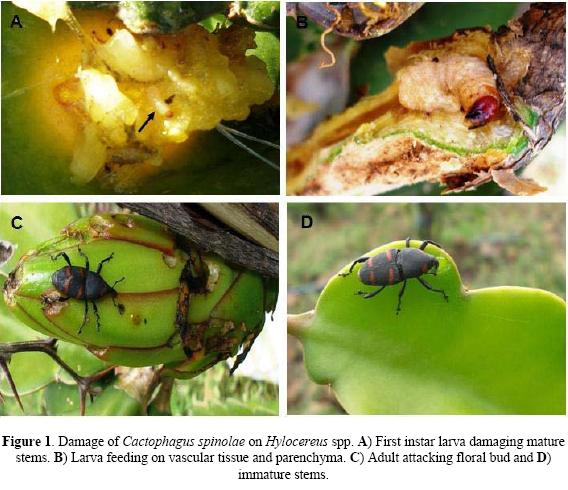
<body><![CDATA[<p align="justify"><font face="verdana" size="2">Emerged adults were conserved in 70% alcohol then labeled, mounted and identified (M.Sc. Raul Mu&ntilde;iz Velez<sup>&dagger;</sup>, Instituto Polit&eacute;cnico Nacional). The specimens were identified as <i>Cactophagus spinolae</i> (Gyllenhal 1838) (<a href="#f1">Fig. 1</a>); voucher specimens are held at the "Colecci&oacute;n de insectos del Colegio de Postgraduados" in Texcoco, Mexico. <i>C</i>. <i>spinolae</i> is a well known pest of prickly pear cactus (<i>Opuntia</i> spp. and <i>Nopalea</i> spp.) that has been reported from North America to Central America (Mann 1969, Zimmermann &amp; Granata 2002). This insect is frequently found as a pest on prickly pear that is grown in highlands at Central Mexico (Mann 1969, M&eacute;ndez 1994). Vaurie (1967) mentions this species as pest of the family Cactaceae in the genera <i>Cereus</i>, <i>Ferocactus</i>, and <i>Opuntia</i>; and Zimmermann &amp; Granata (2002) points out that there is no specific information about pests of cultivated <i>Hylocereus</i> and <i>Stenocereus</i>. There are at least other 20 insect pest of natural occurrence on <i>Opuntia</i> species in Mexico, and some biology information does exist.</font></p>  	    <p align="center"><font face="verdana" size="2"><a name="f1"></a></font></p>  	    <p align="center"><font face="verdana" size="2"><img src="/img/revistas/azm/v27n3/a19f1.jpg"></font></p>  	    <p align="justify"><font face="verdana" size="2">Adults of <i>C</i>. <i>spinolae</i> fed on <i>Hylocereus</i> immature stems and observed on 5% of sampled plants, and 1% of the bracts and floral buds (N = 478). The principal damage was caused by larvae which affected 50% of the surveyed plants (N = 478). Larvae that fed on mature stems induced secretion of sap, destroyed parenchyma and vascular tissue, and killed branches and even whole plants (<a href="#f1">Fig. 1 A, B, C, D</a>). In Nicaragua has been reported that closely related species <i>C. fahrei striatoforatus</i> (Gyllenhal) attacks stems, floral buds and flowers (inducing floral drop) and causing deformations and fruit rotting (An&oacute;nimo 1999 &amp; 2000, Pohlan <i>et al</i>. 2007). To the best of our knowledge, this is the first report of <i>C</i>. <i>spinolae</i> attacking <i>H. undatus, H. undatus</i> subsp<i>. luteocarpus H. purpussi</i> and <i>H. ocamponis</i>. Because of the high incidence and fatal consequences of larvae attack, this insect represents a potential pest for commercial pitahaya orchards in Mexico. It is important to study the life cycle and to better understand its relationship with the host in order to develop management strategies.</font></p>  	    <p align="justify"><font face="verdana" size="2">&nbsp;</font></p>  	    <p align="justify"><font face="verdana" size="2"><b>ACKNOWLEDGEMENTS</b></font></p>  	    <p align="justify"><font face="verdana" size="2">To the Consejo Nacional de Ciencia y Tecnolog&iacute;a (CONACYT), Mexico, for the scholarship granted to the first author to pursue a doctorate and providing some economical support to develop this research. We also thank to M.Sc. Ra&uacute;l Mu&ntilde;iz V&eacute;lez<sup>&dagger;</sup> (IPN) for the support to identify the insect collected on <i>Hylocereus</i>.</font></p>  	    <p align="justify"><font face="verdana" size="2">&nbsp;</font></p>  	    <p align="justify"><font face="verdana" size="2"><b>LITERATURE CITED</b></font></p>  	    <!-- ref --><p align="justify"><font face="verdana" size="2"><b>An&oacute;nimo</b>. 1999. <i>Manual t&eacute;cnico: Fitosanidad en pitahaya</i>. Ed. APENN, MAG&#45;FOR y OIRSA. On line: <a href="http//www.apenn.org.ni/html/pitahaya.ing.html" target="_blank">http//www.apenn.org.ni/html/pitahaya.ing.html</a> (Consulted: January 15, 2007).    &nbsp;&nbsp;&nbsp;&nbsp;&nbsp;&nbsp;&nbsp;&nbsp;[&#160;<a href="javascript:void(0);" onclick="javascript: window.open('/scielo.php?script=sci_nlinks&ref=384130&pid=S0065-1737201100030001900001&lng=','','width=640,height=500,resizable=yes,scrollbars=1,menubar=yes,');">Links</a>&#160;]<!-- end-ref --></font></p>  	    <!-- ref --><p align="justify"><font face="verdana" size="2"><b>An&oacute;nimo</b>. 2000. <i>Manual t&eacute;cnico: Buenas pr&aacute;cticas de cultivo en pitahaya</i>. Ed. OIRSA. On line: <a href="http://www.oirsa.org/aplicaciones/subidoarchivos/BibliotecaVirtual/MANUALPITHAYA.pdf" target="_blank">http://www.oirsa.org/aplicaciones/subidoarchivos/BibliotecaVirtual/MANUALPITHAYA.pdf</a> (Consulted: January 10, 2010).    &nbsp;&nbsp;&nbsp;&nbsp;&nbsp;&nbsp;&nbsp;&nbsp;[&#160;<a href="javascript:void(0);" onclick="javascript: window.open('/scielo.php?script=sci_nlinks&ref=384132&pid=S0065-1737201100030001900002&lng=','','width=640,height=500,resizable=yes,scrollbars=1,menubar=yes,');">Links</a>&#160;]<!-- end-ref --></font></p>  	    <!-- ref --><p align="justify"><font face="verdana" size="2"><b>Bravo, H.</b> 1978. <i>Las cact&aacute;ceas de M&eacute;xico</i>. Vol I. Ed. UNAM. M&eacute;xico, D. F.    &nbsp;&nbsp;&nbsp;&nbsp;&nbsp;&nbsp;&nbsp;&nbsp;[&#160;<a href="javascript:void(0);" onclick="javascript: window.open('/scielo.php?script=sci_nlinks&ref=384134&pid=S0065-1737201100030001900003&lng=','','width=640,height=500,resizable=yes,scrollbars=1,menubar=yes,');">Links</a>&#160;]<!-- end-ref --></font></p>  	    <!-- ref --><p align="justify"><font face="verdana" size="2"><b>C&aacute;lix de Dios, H.</b> 2005. A new subspecies of <i>Hylocereus undatus</i> (Cactaceae) from southeastern Mexico. <i>Haseltonia,</i> 11: 11&#45;17.    &nbsp;&nbsp;&nbsp;&nbsp;&nbsp;&nbsp;&nbsp;&nbsp;[&#160;<a href="javascript:void(0);" onclick="javascript: window.open('/scielo.php?script=sci_nlinks&ref=384136&pid=S0065-1737201100030001900004&lng=','','width=640,height=500,resizable=yes,scrollbars=1,menubar=yes,');">Links</a>&#160;]<!-- end-ref --></font></p>  	    <!-- ref --><p align="justify"><font face="verdana" size="2"><b>Castillo, M. R., M. Livera&#45;Mu&ntilde;oz, A. E. Brech&uacute; F &amp; J. M&aacute;rquez&#45;Guzm&aacute;n.</b> 2003. Compatibilidad sexual entre dos tipos de <i>Hylocereus</i> (Cactaceae). <i>Revista Biolog&iacute;a Tropical,</i> 51: 699&#45;706.    &nbsp;&nbsp;&nbsp;&nbsp;&nbsp;&nbsp;&nbsp;&nbsp;[&#160;<a href="javascript:void(0);" onclick="javascript: window.open('/scielo.php?script=sci_nlinks&ref=384138&pid=S0065-1737201100030001900005&lng=','','width=640,height=500,resizable=yes,scrollbars=1,menubar=yes,');">Links</a>&#160;]<!-- end-ref --></font></p>  	    <!-- ref --><p align="justify"><font face="verdana" size="2"><b>Guzm&aacute;n, U., S. Arias &amp; P. D&aacute;vila.</b> 2007. <i>Cat&aacute;logo de Cact&aacute;ceas Mexicanas</i>. Ed. UNAM&#45;CONABIO. M&eacute;xico, D. F.    &nbsp;&nbsp;&nbsp;&nbsp;&nbsp;&nbsp;&nbsp;&nbsp;[&#160;<a href="javascript:void(0);" onclick="javascript: window.open('/scielo.php?script=sci_nlinks&ref=384140&pid=S0065-1737201100030001900006&lng=','','width=640,height=500,resizable=yes,scrollbars=1,menubar=yes,');">Links</a>&#160;]<!-- end-ref --></font></p>  	    <!-- ref --><p align="justify"><font face="verdana" size="2"><b>Le Bellec F., F. Vaillant &amp; E. Imbert.</b> 2006. Pitahaya (<i>Hylocereus</i> spp.): a new fruit crop, a market with a future. <i>Fruits,</i> 61: 237&#45;250.    &nbsp;&nbsp;&nbsp;&nbsp;&nbsp;&nbsp;&nbsp;&nbsp;[&#160;<a href="javascript:void(0);" onclick="javascript: window.open('/scielo.php?script=sci_nlinks&ref=384142&pid=S0065-1737201100030001900007&lng=','','width=640,height=500,resizable=yes,scrollbars=1,menubar=yes,');">Links</a>&#160;]<!-- end-ref --></font></p>  	    <!-- ref --><p align="justify"><font face="verdana" size="2"><b>Mann, J.</b> 1969. <i>Cactus&#45;feeding insects and mites</i>. Museum of natural history. Bulletin 256. Ed. Smithsonian Institution. Washington, D.C.    &nbsp;&nbsp;&nbsp;&nbsp;&nbsp;&nbsp;&nbsp;&nbsp;[&#160;<a href="javascript:void(0);" onclick="javascript: window.open('/scielo.php?script=sci_nlinks&ref=384144&pid=S0065-1737201100030001900008&lng=','','width=640,height=500,resizable=yes,scrollbars=1,menubar=yes,');">Links</a>&#160;]<!-- end-ref --></font></p>  	    <!-- ref --><p align="justify"><font face="verdana" size="2"><b>M&eacute;ndez, G. S. de J.</b> 1994. Principales plagas del nopal, pp: 49&#45;57. <i>In</i>: G. Esparza &amp; S. de J. M&eacute;ndez (Eds). <i>Memorias: Aportaciones T&eacute;cnicas y Experiencias de la Producci&oacute;n de Tuna en Zacatecas</i>. Ed. CECCAM, CP, UACH, UAZ, SARH. Morelos, Zacatecas.    &nbsp;&nbsp;&nbsp;&nbsp;&nbsp;&nbsp;&nbsp;&nbsp;[&#160;<a href="javascript:void(0);" onclick="javascript: window.open('/scielo.php?script=sci_nlinks&ref=384146&pid=S0065-1737201100030001900009&lng=','','width=640,height=500,resizable=yes,scrollbars=1,menubar=yes,');">Links</a>&#160;]<!-- end-ref --></font></p>  	    <!-- ref --><p align="justify"><font face="verdana" size="2"><b>Ortiz, H. Y. D.</b> 1999. <i>Pitahaya: un nuevo cultivo para M&eacute;xico</i>. Ed. Limusa&#45;Grupo Noriega. M&eacute;xico, D. F.    &nbsp;&nbsp;&nbsp;&nbsp;&nbsp;&nbsp;&nbsp;&nbsp;[&#160;<a href="javascript:void(0);" onclick="javascript: window.open('/scielo.php?script=sci_nlinks&ref=384148&pid=S0065-1737201100030001900010&lng=','','width=640,height=500,resizable=yes,scrollbars=1,menubar=yes,');">Links</a>&#160;]<!-- end-ref --></font></p>  	    <!-- ref --><p align="justify"><font face="verdana" size="2"><b>Ortiz, H. Y. D.</b> 2000. <i>Hacia el conocimiento y conservaci&oacute;n de la pitahaya (Hylocereus spp.)</i>. Ed. IPN, SIBEJ, CONACYT y FMCN. Oaxaca, M&eacute;xico.    &nbsp;&nbsp;&nbsp;&nbsp;&nbsp;&nbsp;&nbsp;&nbsp;[&#160;<a href="javascript:void(0);" onclick="javascript: window.open('/scielo.php?script=sci_nlinks&ref=384150&pid=S0065-1737201100030001900011&lng=','','width=640,height=500,resizable=yes,scrollbars=1,menubar=yes,');">Links</a>&#160;]<!-- end-ref --></font></p>  	    <!-- ref --><p align="justify"><font face="verdana" size="2"><b>Ortiz, H. Y. D. &amp; M. Livera&#45;Mu&ntilde;oz.</b> 2000. <i>Manual para la propagaci&oacute;n de la Pitahaya (Hylocereus spp.)</i>. Ed. CIIDIR&#45; Oaxaca, IPN. Oaxaca, M&eacute;xico.    &nbsp;&nbsp;&nbsp;&nbsp;&nbsp;&nbsp;&nbsp;&nbsp;[&#160;<a href="javascript:void(0);" onclick="javascript: window.open('/scielo.php?script=sci_nlinks&ref=384152&pid=S0065-1737201100030001900012&lng=','','width=640,height=500,resizable=yes,scrollbars=1,menubar=yes,');">Links</a>&#160;]<!-- end-ref --></font></p>  	    <!-- ref --><p align="justify"><font face="verdana" size="2"><b>Pohlan, H. A. J., w. G. Gamboa M., D. J. Salazar C., F. Marroqu&iacute;n A., M. J. J. Janssens, A. Leyva G., E. Guzm&aacute;n, E. Toledo T. &amp; R. G&oacute;mez A.</b> 2007. Fruticultura org&aacute;nica en el tr&oacute;pico: Situaci&oacute;n y ejemplos en Mesoam&eacute;rica. <i>Journal of Agriculture and rural development in the tropics and subtropics,</i> 108: 123&#45;148.    &nbsp;&nbsp;&nbsp;&nbsp;&nbsp;&nbsp;&nbsp;&nbsp;[&#160;<a href="javascript:void(0);" onclick="javascript: window.open('/scielo.php?script=sci_nlinks&ref=384154&pid=S0065-1737201100030001900013&lng=','','width=640,height=500,resizable=yes,scrollbars=1,menubar=yes,');">Links</a>&#160;]<!-- end-ref --></font></p>  	    <!-- ref --><p align="justify"><font face="verdana" size="2"><b>Rodr&iacute;guez, C. A.</b> 2002. Pitahaya (<i>Hylocereus undatus</i> y <i>Selenicereus megalanthus</i>). Producci&oacute;n y comercializaci&oacute;n en el mundo y en M&eacute;xico, pp: 63&#45;95. <i>In</i>: Flores, V. C. (Ed.). <i>Pitayas y Pitahayas, producci&oacute;n, poscosecha, industrializaci&oacute;n y comercializaci&oacute;n</i>. Ed. CIESTAAM&#45;UACH. Chapingo, Edo. de M&eacute;xico.    &nbsp;&nbsp;&nbsp;&nbsp;&nbsp;&nbsp;&nbsp;&nbsp;[&#160;<a href="javascript:void(0);" onclick="javascript: window.open('/scielo.php?script=sci_nlinks&ref=384156&pid=S0065-1737201100030001900014&lng=','','width=640,height=500,resizable=yes,scrollbars=1,menubar=yes,');">Links</a>&#160;]<!-- end-ref --></font></p>  	    <!-- ref --><p align="justify"><font face="verdana" size="2"><b>Trucios, C. H.</b> 2005. Identificaci&oacute;n de plagas de la pitahaya <i>Hylocereus undatus</i> Howarth en el valle de Tehuac&aacute;n, Puebla. Tesis de Licenciatura. Parasitolog&iacute;a Agr&iacute;cola. Universidad Aut&oacute;noma Chapingo. Chapingo, Edo. de M&eacute;xico.    &nbsp;&nbsp;&nbsp;&nbsp;&nbsp;&nbsp;&nbsp;&nbsp;[&#160;<a href="javascript:void(0);" onclick="javascript: window.open('/scielo.php?script=sci_nlinks&ref=384158&pid=S0065-1737201100030001900015&lng=','','width=640,height=500,resizable=yes,scrollbars=1,menubar=yes,');">Links</a>&#160;]<!-- end-ref --></font></p>  	    <!-- ref --><p align="justify"><font face="verdana" size="2"><b>Vaurie, P.</b> 1967. A revision of the Neotropical genus <i>Metamasius</i> (Coleoptera: Curculionidae: Rhynchophorinae). <i>Bulletin of the American Museum of Natural History,</i> 136: 177&#45;268.    &nbsp;&nbsp;&nbsp;&nbsp;&nbsp;&nbsp;&nbsp;&nbsp;[&#160;<a href="javascript:void(0);" onclick="javascript: window.open('/scielo.php?script=sci_nlinks&ref=384160&pid=S0065-1737201100030001900016&lng=','','width=640,height=500,resizable=yes,scrollbars=1,menubar=yes,');">Links</a>&#160;]<!-- end-ref --></font></p>  	    <!-- ref --><p align="justify"><font face="verdana" size="2"><b>Zimmermann, H. G. &amp; G. Granata.</b> 2002. Insects pests and diseases, pp: 235&#45;254. <i>In</i>: P. S. Nobel (Ed.). <i>Cacti: Biology and Uses</i>. Ed. University California Press. California, USA.    &nbsp;&nbsp;&nbsp;&nbsp;&nbsp;&nbsp;&nbsp;&nbsp;[&#160;<a href="javascript:void(0);" onclick="javascript: window.open('/scielo.php?script=sci_nlinks&ref=384162&pid=S0065-1737201100030001900017&lng=','','width=640,height=500,resizable=yes,scrollbars=1,menubar=yes,');">Links</a>&#160;]<!-- end-ref --></font></p>      ]]></body><back>
<ref-list>
<ref id="B1">
<nlm-citation citation-type="book">
<person-group person-group-type="author">
<name>
</name>
<name>
</name>
</person-group>
<source><![CDATA[Manual técnico: Fitosanidad en pitahaya]]></source>
<year>1999</year>
<publisher-name><![CDATA[APENNMAG-FOROIRSA]]></publisher-name>
</nlm-citation>
</ref>
<ref id="B2">
<nlm-citation citation-type="book">
<person-group person-group-type="author">
<name>
</name>
<name>
</name>
</person-group>
<source><![CDATA[Manual técnico: Buenas prácticas de cultivo en pitahaya]]></source>
<year>2000</year>
<publisher-name><![CDATA[OIRSA]]></publisher-name>
</nlm-citation>
</ref>
<ref id="B3">
<nlm-citation citation-type="book">
<person-group person-group-type="author">
<name>
<surname><![CDATA[Bravo]]></surname>
<given-names><![CDATA[H]]></given-names>
</name>
</person-group>
<source><![CDATA[Las cactáceas de México]]></source>
<year>1978</year>
<volume>I</volume>
<publisher-loc><![CDATA[México^eD. F. D. F.]]></publisher-loc>
<publisher-name><![CDATA[UNAM]]></publisher-name>
</nlm-citation>
</ref>
<ref id="B4">
<nlm-citation citation-type="journal">
<person-group person-group-type="author">
<name>
<surname><![CDATA[Cálix de Dios]]></surname>
<given-names><![CDATA[H]]></given-names>
</name>
</person-group>
<article-title xml:lang="en"><![CDATA[A new subspecies of Hylocereus undatus (Cactaceae) from southeastern Mexico]]></article-title>
<source><![CDATA[Haseltonia]]></source>
<year>2005</year>
<volume>11</volume>
<page-range>11-17</page-range></nlm-citation>
</ref>
<ref id="B5">
<nlm-citation citation-type="journal">
<person-group person-group-type="author">
<name>
<surname><![CDATA[Castillo]]></surname>
<given-names><![CDATA[M. R.]]></given-names>
</name>
<name>
<surname><![CDATA[Livera-Muñoz]]></surname>
<given-names><![CDATA[M.]]></given-names>
</name>
<name>
<surname><![CDATA[Brechú F]]></surname>
<given-names><![CDATA[A. E.]]></given-names>
</name>
<name>
<surname><![CDATA[Márquez-Guzmán]]></surname>
<given-names><![CDATA[J.]]></given-names>
</name>
</person-group>
<article-title xml:lang="es"><![CDATA[Compatibilidad sexual entre dos tipos de Hylocereus (Cactaceae)]]></article-title>
<source><![CDATA[Revista Biología Tropical]]></source>
<year>2003</year>
<volume>51</volume>
<page-range>699-706</page-range></nlm-citation>
</ref>
<ref id="B6">
<nlm-citation citation-type="book">
<person-group person-group-type="author">
<name>
<surname><![CDATA[Guzmán]]></surname>
<given-names><![CDATA[U.]]></given-names>
</name>
<name>
<surname><![CDATA[Arias]]></surname>
<given-names><![CDATA[S.]]></given-names>
</name>
<name>
<surname><![CDATA[Dávila]]></surname>
<given-names><![CDATA[P.]]></given-names>
</name>
</person-group>
<source><![CDATA[Catálogo de Cactáceas Mexicanas]]></source>
<year>2007</year>
<publisher-loc><![CDATA[México^eD. F. D. F.]]></publisher-loc>
<publisher-name><![CDATA[UNAMCONABIO]]></publisher-name>
</nlm-citation>
</ref>
<ref id="B7">
<nlm-citation citation-type="journal">
<person-group person-group-type="author">
<name>
<surname><![CDATA[Le Bellec]]></surname>
<given-names><![CDATA[F.]]></given-names>
</name>
<name>
<surname><![CDATA[Vaillant]]></surname>
<given-names><![CDATA[F.]]></given-names>
</name>
<name>
<surname><![CDATA[Imbert]]></surname>
<given-names><![CDATA[E.]]></given-names>
</name>
</person-group>
<article-title xml:lang="en"><![CDATA[Pitahaya (Hylocereus spp.): a new fruit crop, a market with a future]]></article-title>
<source><![CDATA[Fruits]]></source>
<year>2006</year>
<volume>61</volume>
<page-range>237-250</page-range></nlm-citation>
</ref>
<ref id="B8">
<nlm-citation citation-type="book">
<person-group person-group-type="author">
<name>
<surname><![CDATA[Mann]]></surname>
<given-names><![CDATA[J]]></given-names>
</name>
</person-group>
<source><![CDATA[Cactus-feeding insects and mites]]></source>
<year>1969</year>
<publisher-loc><![CDATA[Washington^eD.C. D.C.]]></publisher-loc>
<publisher-name><![CDATA[Ed. Smithsonian Institution]]></publisher-name>
</nlm-citation>
</ref>
<ref id="B9">
<nlm-citation citation-type="book">
<person-group person-group-type="author">
<name>
<surname><![CDATA[Méndez]]></surname>
<given-names><![CDATA[G. S. de J]]></given-names>
</name>
</person-group>
<article-title xml:lang="es"><![CDATA[Principales plagas del nopal]]></article-title>
<person-group person-group-type="editor">
<name>
<surname><![CDATA[Esparza]]></surname>
<given-names><![CDATA[G.]]></given-names>
</name>
<name>
<surname><![CDATA[Méndez]]></surname>
<given-names><![CDATA[S. de J.]]></given-names>
</name>
</person-group>
<source><![CDATA[Memorias: Aportaciones Técnicas y Experiencias de la Producción de Tuna en Zacatecas]]></source>
<year>1994</year>
<page-range>49-57</page-range><publisher-loc><![CDATA[Morelos^eZacatecas Zacatecas]]></publisher-loc>
<publisher-name><![CDATA[CECCAMCPUACHUAZSARH]]></publisher-name>
</nlm-citation>
</ref>
<ref id="B10">
<nlm-citation citation-type="book">
<person-group person-group-type="author">
<name>
<surname><![CDATA[Ortiz]]></surname>
<given-names><![CDATA[H. Y. D]]></given-names>
</name>
</person-group>
<source><![CDATA[Pitahaya: un nuevo cultivo para México]]></source>
<year>1999</year>
<publisher-loc><![CDATA[México^eD. F. D. F.]]></publisher-loc>
<publisher-name><![CDATA[Ed. LimusaGrupo Noriega]]></publisher-name>
</nlm-citation>
</ref>
<ref id="B11">
<nlm-citation citation-type="book">
<person-group person-group-type="author">
<name>
<surname><![CDATA[Ortiz]]></surname>
<given-names><![CDATA[H. Y. D]]></given-names>
</name>
</person-group>
<source><![CDATA[Hacia el conocimiento y conservación de la pitahaya (Hylocereus spp.)]]></source>
<year>2000</year>
<publisher-loc><![CDATA[^eOaxaca Oaxaca]]></publisher-loc>
<publisher-name><![CDATA[IPNSIBEJCONACYTFMCN]]></publisher-name>
</nlm-citation>
</ref>
<ref id="B12">
<nlm-citation citation-type="book">
<person-group person-group-type="author">
<name>
<surname><![CDATA[Ortiz]]></surname>
<given-names><![CDATA[H. Y. D.]]></given-names>
</name>
<name>
<surname><![CDATA[Livera-Muñoz]]></surname>
<given-names><![CDATA[M.]]></given-names>
</name>
</person-group>
<source><![CDATA[Manual para la propagación de la Pitahaya (Hylocereus spp.)]]></source>
<year>2000</year>
<publisher-loc><![CDATA[^eOaxaca Oaxaca]]></publisher-loc>
<publisher-name><![CDATA[CIIDIR- Oaxaca, IPN]]></publisher-name>
</nlm-citation>
</ref>
<ref id="B13">
<nlm-citation citation-type="journal">
<person-group person-group-type="author">
<name>
<surname><![CDATA[Pohlan]]></surname>
<given-names><![CDATA[H. A. J.]]></given-names>
</name>
<name>
<surname><![CDATA[Gamboa M.]]></surname>
<given-names><![CDATA[w. G.]]></given-names>
</name>
<name>
<surname><![CDATA[Salazar C.]]></surname>
<given-names><![CDATA[D. J.]]></given-names>
</name>
<name>
<surname><![CDATA[Marroquín A.]]></surname>
<given-names><![CDATA[F.]]></given-names>
</name>
<name>
<surname><![CDATA[Janssens]]></surname>
<given-names><![CDATA[M. J. J.]]></given-names>
</name>
<name>
<surname><![CDATA[Leyva G.]]></surname>
<given-names><![CDATA[A.]]></given-names>
</name>
<name>
<surname><![CDATA[Guzmán]]></surname>
<given-names><![CDATA[E.]]></given-names>
</name>
<name>
<surname><![CDATA[Toledo T.]]></surname>
<given-names><![CDATA[E.]]></given-names>
</name>
<name>
<surname><![CDATA[Gómez A]]></surname>
<given-names><![CDATA[R.]]></given-names>
</name>
</person-group>
<article-title xml:lang="es"><![CDATA[Fruticultura orgánica en el trópico: Situación y ejemplos en Mesoamérica]]></article-title>
<source><![CDATA[Journal of Agriculture and rural development in the tropics and subtropics]]></source>
<year>2007</year>
<volume>108</volume>
<page-range>123-148</page-range></nlm-citation>
</ref>
<ref id="B14">
<nlm-citation citation-type="book">
<person-group person-group-type="author">
<name>
<surname><![CDATA[Rodríguez]]></surname>
<given-names><![CDATA[C. A]]></given-names>
</name>
</person-group>
<article-title xml:lang="es"><![CDATA[Pitahaya (Hylocereus undatus y Selenicereus megalanthus). Producción y comercialización en el mundo y en México]]></article-title>
<person-group person-group-type="editor">
<name>
<surname><![CDATA[Flores]]></surname>
<given-names><![CDATA[V. C.]]></given-names>
</name>
</person-group>
<source><![CDATA[Pitayas y Pitahayas, producción, poscosecha, industrialización y comercialización]]></source>
<year>2002</year>
<page-range>63-95</page-range><publisher-loc><![CDATA[Chapingo^eEdo. de México Edo. de México]]></publisher-loc>
<publisher-name><![CDATA[CIESTAAMUACH]]></publisher-name>
</nlm-citation>
</ref>
<ref id="B15">
<nlm-citation citation-type="">
<person-group person-group-type="author">
<name>
<surname><![CDATA[Trucios]]></surname>
<given-names><![CDATA[C. H]]></given-names>
</name>
</person-group>
<source><![CDATA[Identificación de plagas de la pitahaya Hylocereus undatus Howarth en el valle de Tehuacán, Puebla]]></source>
<year>2005</year>
</nlm-citation>
</ref>
<ref id="B16">
<nlm-citation citation-type="journal">
<person-group person-group-type="author">
<name>
<surname><![CDATA[Vaurie]]></surname>
<given-names><![CDATA[P]]></given-names>
</name>
</person-group>
<article-title xml:lang="en"><![CDATA[A revision of the Neotropical genus Metamasius (Coleoptera: Curculionidae: Rhynchophorinae)]]></article-title>
<source><![CDATA[Bulletin of the American Museum of Natural History]]></source>
<year>1967</year>
<volume>136</volume>
<page-range>177-268</page-range></nlm-citation>
</ref>
<ref id="B17">
<nlm-citation citation-type="book">
<person-group person-group-type="author">
<name>
<surname><![CDATA[Zimmermann]]></surname>
<given-names><![CDATA[H. G.]]></given-names>
</name>
<name>
<surname><![CDATA[Granata]]></surname>
<given-names><![CDATA[G.]]></given-names>
</name>
</person-group>
<article-title xml:lang="en"><![CDATA[Insects pests and diseases]]></article-title>
<person-group person-group-type="editor">
<name>
<surname><![CDATA[Nobel]]></surname>
<given-names><![CDATA[P. S.]]></given-names>
</name>
</person-group>
<source><![CDATA[Cacti: Biology and Uses]]></source>
<year>2002</year>
<page-range>235-254</page-range><publisher-loc><![CDATA[^eCalifornia California]]></publisher-loc>
<publisher-name><![CDATA[University California Press]]></publisher-name>
</nlm-citation>
</ref>
</ref-list>
</back>
</article>
