<?xml version="1.0" encoding="ISO-8859-1"?><article xmlns:mml="http://www.w3.org/1998/Math/MathML" xmlns:xlink="http://www.w3.org/1999/xlink" xmlns:xsi="http://www.w3.org/2001/XMLSchema-instance">
<front>
<journal-meta>
<journal-id>0065-1737</journal-id>
<journal-title><![CDATA[Acta zoológica mexicana]]></journal-title>
<abbrev-journal-title><![CDATA[Acta Zool. Mex]]></abbrev-journal-title>
<issn>0065-1737</issn>
<publisher>
<publisher-name><![CDATA[Instituto de Ecología A.C.]]></publisher-name>
</publisher>
</journal-meta>
<article-meta>
<article-id>S0065-17372011000100010</article-id>
<title-group>
<article-title xml:lang="en"><![CDATA[A new species of Waoraniella (Psocodea: 'Psocoptera': Lachesillidae: Eolachesillinae) from the Reserva Florestal Ducke, Amazonas, Brazil]]></article-title>
<article-title xml:lang="es"><![CDATA[Una nueva especie de Waoraniella (Psocodea: 'Psocoptera': Lachesillidae: Eolachesillinae) de la Reserva Forestal Ducke, Amazonas, Brasil]]></article-title>
</title-group>
<contrib-group>
<contrib contrib-type="author">
<name>
<surname><![CDATA[GARCÍA ALDRETE]]></surname>
<given-names><![CDATA[Alfonso N.]]></given-names>
</name>
<xref ref-type="aff" rid="A01"/>
</contrib>
<contrib contrib-type="author">
<name>
<surname><![CDATA[MOCKFORD]]></surname>
<given-names><![CDATA[Edward L.]]></given-names>
</name>
<xref ref-type="aff" rid="A02"/>
</contrib>
</contrib-group>
<aff id="A01">
<institution><![CDATA[,Universidad Nacional Autónoma de México Instituto de Biología Departamento de Zoología]]></institution>
<addr-line><![CDATA[México D. F.]]></addr-line>
<country>MÉXICO</country>
</aff>
<aff id="A02">
<institution><![CDATA[,Illinois State University Department of Biological Sciences ]]></institution>
<addr-line><![CDATA[Normal Illinois]]></addr-line>
<country>USA</country>
</aff>
<pub-date pub-type="pub">
<day>00</day>
<month>04</month>
<year>2011</year>
</pub-date>
<pub-date pub-type="epub">
<day>00</day>
<month>04</month>
<year>2011</year>
</pub-date>
<volume>27</volume>
<numero>1</numero>
<fpage>123</fpage>
<lpage>127</lpage>
<copyright-statement/>
<copyright-year/>
<self-uri xlink:href="http://www.scielo.org.mx/scielo.php?script=sci_arttext&amp;pid=S0065-17372011000100010&amp;lng=en&amp;nrm=iso"></self-uri><self-uri xlink:href="http://www.scielo.org.mx/scielo.php?script=sci_abstract&amp;pid=S0065-17372011000100010&amp;lng=en&amp;nrm=iso"></self-uri><self-uri xlink:href="http://www.scielo.org.mx/scielo.php?script=sci_pdf&amp;pid=S0065-17372011000100010&amp;lng=en&amp;nrm=iso"></self-uri><abstract abstract-type="short" xml:lang="en"><p><![CDATA[Waoraniella vidali n. sp., the second species in the genus, is described and illustrated on the basis of a male from Amazonas, Brazil. The hypandrium and clunium are autapomorphic for the family. The phallosome is similar to that of Eolachesilla, and the character state "Forewing Rs-M joined by a crossvein" is found to appear in three genera of the subfamily Lachesillinae. Thus Waoraniella and Eolachesilla are close, and the genera of Graphocaeciliini stand apart in the subfamily.]]></p></abstract>
<abstract abstract-type="short" xml:lang="es"><p><![CDATA[Se describe aquí Waoraniella vidali n. sp., la segunda especie en el género, con base en un macho colectado en Amazonas, Brasil. El hipandrio y el clunio son autapomórficos para la familia, mientras que el falosoma es similar al de Eolachesilla; el estado de carácter "Venas Rs-M del ala anterior unidas por una vena transversal", se encuentra en tres géneros de la subfamilia Lachesillinae. Waoraniella y Eolachesilla son cercanas, y los géneros de la tribu Graphocaeciliini constituyen un grupo aparte en la subfamilia.]]></p></abstract>
<kwd-group>
<kwd lng="en"><![CDATA[Taxonomy]]></kwd>
<kwd lng="en"><![CDATA[Amazonia]]></kwd>
<kwd lng="en"><![CDATA[neotropics]]></kwd>
<kwd lng="en"><![CDATA[Waoraniellini]]></kwd>
<kwd lng="es"><![CDATA[Taxonomía]]></kwd>
<kwd lng="es"><![CDATA[Amazonia]]></kwd>
<kwd lng="es"><![CDATA[neotrópico]]></kwd>
<kwd lng="es"><![CDATA[Waoraniellini]]></kwd>
</kwd-group>
</article-meta>
</front><body><![CDATA[ <p align="justify"><font face="verdana" size="4">Art&iacute;culos originales</font></p>     <p align="justify"><font face="verdana" size="2">&nbsp; </font></p>     <p align="center"><font face="verdana" size="4"><b>A new species of <i>Waoraniella </i>(Psocodea: 'Psocoptera': Lachesillidae: Eolachesillinae) from the Reserva Florestal Ducke, Amazonas, Brazil</b></font></p>     <p align="center"><font face="verdana" size="2">&nbsp;</font></p>     <p align="center"><font face="verdana" size="3"><b>Una nueva especie de <i>Waoraniella </i>(Psocodea: 'Psocoptera': Lachesillidae: Eolachesillinae) de la Reserva Forestal Ducke, Amazonas, Brasil</b></font></p>     <p align="center"><font face="verdana" size="2">&nbsp;</font></p>     <p align="center"><font face="verdana" size="2"><b>Alfonso N. GARC&Iacute;A ALDRETE<sup>1</sup> y Edward L. MOCKFORD<sup>2</sup></b></font></p>     <p align="center"><font face="verdana" size="2">&nbsp;</font></p>     <p align="justify"><font face="verdana" size="2"><i><sup>1 </sup>Departamento de Zoolog&iacute;a, Instituto de Biolog&iacute;a, Universidad Nacional Aut&oacute;noma de M&eacute;xico, Apartado Postal 70&#150;153,04510 M&eacute;xico, D. F., M&Eacute;XICO</i> E&#150;mail: <a href="mailto:anga@ibiologia.unam.mx">anga@ibiologia.unam.mx</a></font></p>     <p align="justify"><font face="verdana" size="2"><i><sup>2 </sup>Department of Biological Sciences, Illinois State University, Campus Box 4120, Normal, Illinois, 61790&#150;4120, USA.</i> E&#150;mail: <a href="mailto:elmockf@ilstu.edu">elmockf@ilstu.edu</a></font></p>     ]]></body>
<body><![CDATA[<p align="justify"><font face="verdana" size="2">&nbsp;</font></p>     <p align="justify"><font face="verdana" size="2">Recibido: 15/06/2010    <br> Aceptado: 22/09/2010</font></p>     <p align="justify"><font face="verdana" size="2">&nbsp;</font></p>     <p align="justify"><font face="verdana" size="2"><b>ABSTRACT</b></font></p>     <p align="justify"><font face="verdana" size="2"><i>Waoraniella vidali </i>n. sp., the second species in the genus, is described and illustrated on the basis of a male from Amazonas, Brazil. The hypandrium and clunium are autapomorphic for the family. The phallosome is similar to that <i>of Eolachesilla, </i>and the character state "Forewing Rs&#150;M joined by a crossvein" is found to appear in three genera of the subfamily Lachesillinae. Thus <i>Waoraniella </i>and <i>Eolachesilla </i>are close, and the genera of Graphocaeciliini stand apart in the subfamily.</font></p>     <p align="justify"><font face="verdana" size="2"><b>Key words: </b>Taxonomy, Amazonia, neotropics, Waoraniellini.</font></p>     <p align="justify"><font face="verdana" size="2">&nbsp;</font></p>     <p align="justify"><font face="verdana" size="2"><b>RESUMEN</b></font></p>     <p align="justify"><font face="verdana" size="2">Se describe aqu&iacute; <i>Waoraniella vidali </i>n. sp., la segunda especie en el g&eacute;nero, con base en un macho colectado en Amazonas, Brasil. El hipandrio y el clunio son autapom&oacute;rficos para la familia, mientras que el falosoma es similar al <i>de Eolachesilla; </i>el estado de car&aacute;cter "Venas Rs&#150;M del ala anterior unidas por una vena transversal", se encuentra en tres g&eacute;neros de la subfamilia Lachesillinae. <i>Waoraniella y Eolachesilla </i>son cercanas, y los g&eacute;neros de la tribu Graphocaeciliini constituyen un grupo aparte en la subfamilia.</font></p>     ]]></body>
<body><![CDATA[<p align="justify"><font face="verdana" size="2"><b>Palabras clave. </b>Taxonom&iacute;a, Amazonia, neotr&oacute;pico, Waoraniellini.</font></p>     <p align="justify"><font face="verdana" size="2">&nbsp;</font></p>     <p align="justify"><font face="verdana" size="2"><b>INTRODUCTION</b></font></p>     <p align="justify"><font face="verdana" size="2">The genus <i>Waoraniella </i>Garc&iacute;a Aldrete, is known from two females collected in the Waorani Ethnic Reserve, in Napo, Ecuador (0&deg;30' 10''S: 76&deg;26'00''W); they constitute the type series of <i>W. erwini </i>(Lachesillidae: Eolachesillinae: Waoraniellini) (Garc&iacute;a Aldrete 2006).</font></p>     <p align="justify"><font face="verdana" size="2">One single male, belonging in the subfamily Eolachesillinae (cf. Key to subfamilies of Lachesillidae, in Garc&iacute;a Aldrete 2006), was found in the Collection of Invertebrates of the Instituto Nacional de Pesquisas da Amaz&ocirc;nia, in Manaus, Amazonas, Brazil, made available for study by Dr. Jos&eacute; Albertino Rafael, researcher of that institution. This specimen was assigned to <i>Waoraniella </i>Garc&iacute;a Aldrete because it falls within the diagnoses of the tribe Waoraniellini and of the genus <i>(e. g., </i>with ocelli; epistomal sulcus developed only laterally, not present dorsally; lacinia bicuspid, with outer cusp bidentate; tarsi two segmented; Rs stem in forewing flexuous; Rs&#150;M in forewing joined by a crossvein; fore&#150; and hindwing membranes with abundant microtrichia; veins in basal half of forewing &#91;except Cu2&#93; with two rows of setae; areola postica small; pterostigma much broader posteriorly).</font></p>     <p align="justify"><font face="verdana" size="2">The character state "Forewing Rs&#150;M joined by a crossvein" has appeared three other times in the family, in the Lachesillinae genera <i>Hemicaecilius, Lachesilla </i>and <i>Nadleria. </i>The specimen here dealt with can not, for obvious reasons, be assigned to any of those genera. This specimen is of considerable interest, as it provides information on the male sex of the genus, and because it was collected some 1900 km E of the type locality of <i>W. erwini.</i></font></p>     <p align="justify"><font face="verdana" size="2">The specimen above is here described and illustrated as a new species, at the risk of creating a synonym with <i>W. erwini, </i>minimized, we believe, by the distance between the two collecting localities, and because the areola postica in the Brazilian specimen is distinctly higher and narrower than in the Ecuadorian specimens.</font></p>     <p align="justify"><font face="verdana" size="2">&nbsp;</font></p>     <p align="justify"><font face="verdana" size="2"><b>MATERIAL AND METHODS</b></font></p>     <p align="justify"><font face="verdana" size="2">One male specimen was available for study; color was recorded by placing it in 80% ethyl alcohol, under a dissecting microscope, illuminated with white cold light at 80X. The specimen was dissected in 80% ethyl alcohol and its parts (head, right legs and wings, and genitalia) were mounted on a slide in Canada Balsam. Illustrations were made with a drawing tube, and measurements were taken with a filar micrometer and are stated in &micro;m<i>. </i>Abbreviations of body parts measured are as follows: FW and HW: lengths of right fore&#150; and hind&#150; wings, F, T, t1, and t2: lengths of femur, tibia, and tarsomeres 1 and 2 of right hind leg, ctt1: number of ctenidia on t1 of right hind leg, fl...fh: lengths of flagellomeres l...n of right antenna, IO, D and d: minimum distance between compound eyes, antero&#150;posterior diameter, and transverse diameter of right compound eye respectively, in front view of head, PO: d/D. The male holotype will be deposited in the Collection of Invertebrates, Instituto Nacional de Pesquisas da Am&acirc;zonia, Manaus, Amazonas, Brazil.</font></p>     ]]></body>
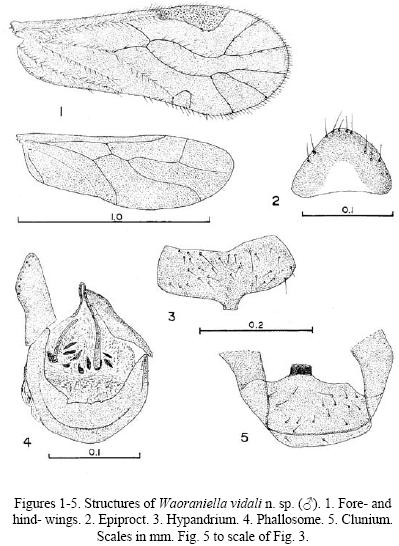
<body><![CDATA[<p align="center"><font face="verdana" size="2">Family Lachesillidae</font></p>     <p align="center"><font face="verdana" size="2">Subfamily Eolachesillinae</font></p>     <p align="center"><font face="verdana" size="2">Tribe Waoraniellini</font></p>     <p align="center"><font face="verdana" size="2"><i><b>Waoraniella vidali n. sp.</b>(<img src="/img/revistas/azm/v27n1/a10e1.jpg">).</i></font></p>     <p align="center"><font face="verdana" size="2">(<a href="#f1">Figs. 1&#150;5</a>)</font></p>     <p align="justify"><font face="verdana" size="2"><b>Color. </b>Ground color orange brown. Compound eyes black, ocelli hyaline, with ochre centripetal crescents. Wings with a dark orange hue. Abdomen with brown, transverse subcuticular rings, less pigmented ventrally.</font></p>     <p align="center"><font face="verdana" size="2"><a name="f1"></a></font></p>     <p align="center"><font face="verdana" size="2"><img src="/img/revistas/azm/v27n1/a10f1.jpg"></font></p>     <p align="justify"><font face="verdana" size="2"><b>Morphology. </b>As in generic diagnosis (Garc&iacute;a Aldrete, 2006), plus the following: Five distal labral sensilla, in line, a central placoid, flanked by two trichoids. Pretarsal claw with a small preapical denticle, pulvillus broad. Wings (<a href="#f1">Fig. 1</a>) as in generic diagnosis (cf. Introduction above and Garc&iacute;a Aldrete 2006). Hypandrium (<a href="#f1">Fig. 3</a>) broad, setose, with a posterior truncate projection in the middle. Clunium (<a href="#f1">Fig. 5</a>) projected posteriorly over the area of the epiproct to form a strongly sclerotized, almost rectangular extension, with the posterior edge straight, with small indentations. Phallosome (<a href="#f1">Fig. 4</a>) closed anteriorly, with border rounded; aedeagal arch narrowing posteriorly; external parameres broad, blunt ended, with a row of pores on outer edge posteriorly; endophallus with nine small, elongate, spindle shaped sclerites. Epiproct (<a href="#f1">Fig. 2</a>) broad, rounded posteriorly, with pigmented area deeply concave anteriorly, setae as illustrated. Paraprocts lost in preparation.</font></p>     <p align="justify"><font face="verdana" size="2"><b>Measurements. </b>FW: 1477, HW: 1129, F: 362, T: 614, t1: 212, t2: 88, ctt1: 13, f1: 193, f2: 159, IO: 289, D: 170, d: 78, IO/d: 3.7, PO: 0.45.</font></p>     ]]></body>
<body><![CDATA[<p align="justify"><font face="verdana" size="2"><b>Type locality. </b>Brazil. Amazonas. Reserva Florestal Adolpho Ducke (03&deg;08'S: 60&deg;02'W), 26 km NE Manaus, Rodovia AM 010. IX.2004. Malaise trap, Mata. Joao F. Vidal. Holotype <img src="/img/revistas/azm/v27n1/a10e1.jpg">.</font></p>     <p align="justify"><font face="verdana" size="2"><b>Etymology. </b>This species is dedicated to Joao F. Vidal, for many years technician of the Collection of Invertebrates of the Instituto Nacional de Pesquisas da Amaz&ocirc;nia (INPA), in recognition to his expertise and enthusiasm as insect collector of that Institution.</font></p>     <p align="justify"><font face="verdana" size="2">&nbsp;</font></p>     <p align="justify"><font face="verdana" size="2"><b>DISCUSSION</b></font></p>     <p align="justify"><font face="verdana" size="2">The description of <i>W. vidali </i>broadens the diagnosis of the genus (Garc&iacute;a Aldrete 2006) with the following male characters: Hypandrium with a truncate posterior projection in the middle. Clunium with a posterior rectangular projection over the area of the epiproct, the posterior edge of which presents small indentations. Phallosome closed anteriorly, external parameres broad, endophallus with small, spindle shaped sclerites.</font></p>     <p align="justify"><font face="verdana" size="2">The hypandrium and clunium of <i>Waoraniella </i>are autapomorphic, and the phallosome bears more resemblance to the phallosome of <i>Eolachesilla </i>(Eolachesillini), than to the phallosomes in the genera of Graphocaeciliini. In <i>Waoraniella </i>and <i>Eolachesilla </i>the phallosome is closed anteriorly, rounded; the external parameres are broad, distally blunt, and the endophallic sclerites are small, whereas in the genera of Graphocaeciliini, the phallosome is also closed anteriorly, but it is straight or extended anteriorly in the middle, the external parameres are often distally pointed, and the endophallus is compact, radula&#150;like, or with large sclerites.</font></p>     <p align="justify"><font face="verdana" size="2">Considering the above, <i>Waoraniella </i>and <i>Eolachesilla </i>are close, and the genera of Graphocaeciliini <i>(Graphocaecilius, Anomopsocus, Antilachesilla, Prolachesilla, Nanolachesilla, Tricholachesilla, Mesolachesilla, </i>and <i>Notolachesilla) </i>stand apart in the subfamily. Presence of the character state "Forewing Rs&#150;M joined by a crossvein" in the Lachesillinae genera <i>Hemicaecilius, Lachesilla </i>and <i>Nadleria </i>constitutes an independent event.</font></p>     <p align="justify"><font face="verdana" size="2">One of us (ELM), has found a female <i>Waoraniella, </i>that represents a species different from <i>W. erwini, </i>from Indiana, Peru, down river from Iquitos, in the area where the Napo and the Amazon rivers come together; this maintains <i>Waoraniella </i>as an endemic Amazonian genus.</font></p>     <p align="justify"><font face="verdana" size="2">&nbsp;</font></p>     <p align="justify"><font face="verdana" size="2"><b>ACKNOWLEDGMENTS</b></font></p>     ]]></body>
<body><![CDATA[<p align="justify"><font face="verdana" size="2">We are grateful to Jos&eacute; Albertino Rafael (INPA, Manaus), for the loan of specimens of Psocoptera in the Collection of Invertebrates. We also thank Felipe Villegas (Instituto de Biolog&iacute;a, UNAM), for his help with the plate of illustrations here included. ANGA thanks Instituto de Biolog&iacute;a, UNAM., for supporting his research throughout the years.</font></p>     <p align="justify"><font face="verdana" size="2">&nbsp;</font></p>     <p align="justify"><font face="verdana" size="2"><b>LITERATURE CITED</b></font></p>     <!-- ref --><p align="justify"><font face="verdana" size="2"><b>Garc&iacute;a Aldrete, A. N. </b>2006. New genera of Psocoptera (Insecta), from Mexico, Belize and Ecuador (Psoquillidae, Ptiloneuridae, Lachesillidae). <i>Zootaxa, </i>1319: 1&#150;14.    &nbsp;&nbsp;&nbsp;&nbsp;&nbsp;&nbsp;&nbsp;&nbsp;[&#160;<a href="javascript:void(0);" onclick="javascript: window.open('/scielo.php?script=sci_nlinks&ref=376684&pid=S0065-1737201100010001000001&lng=','','width=640,height=500,resizable=yes,scrollbars=1,menubar=yes,');">Links</a>&#160;]<!-- end-ref --></font></p>     <!-- ref --><p align="justify"><font face="verdana" size="2"><b>Mockford, E. L. &amp; D. M. Sullivan. </b>1986. Systematics of the Graphocaeciliine psocids with a proposed higher classification of the family Lachesillidae (Psocoptera). <i>Transactions of the American Entomological Society, </i>112: 1&#150;80.    &nbsp;&nbsp;&nbsp;&nbsp;&nbsp;&nbsp;&nbsp;&nbsp;[&#160;<a href="javascript:void(0);" onclick="javascript: window.open('/scielo.php?script=sci_nlinks&ref=376686&pid=S0065-1737201100010001000002&lng=','','width=640,height=500,resizable=yes,scrollbars=1,menubar=yes,');">Links</a>&#160;]<!-- end-ref --></font></p>      ]]></body><back>
<ref-list>
<ref id="B1">
<nlm-citation citation-type="journal">
<person-group person-group-type="author">
<name>
<surname><![CDATA[García Aldrete]]></surname>
<given-names><![CDATA[A. N.]]></given-names>
</name>
</person-group>
<article-title xml:lang="en"><![CDATA[New genera of Psocoptera (Insecta), from Mexico, Belize and Ecuador (Psoquillidae, Ptiloneuridae, Lachesillidae)]]></article-title>
<source><![CDATA[Zootaxa]]></source>
<year>2006</year>
<volume>1319</volume>
<page-range>1-14</page-range></nlm-citation>
</ref>
<ref id="B2">
<nlm-citation citation-type="journal">
<person-group person-group-type="author">
<name>
<surname><![CDATA[Mockford]]></surname>
<given-names><![CDATA[E. L.]]></given-names>
</name>
<name>
<surname><![CDATA[Sullivan]]></surname>
<given-names><![CDATA[D. M.]]></given-names>
</name>
</person-group>
<article-title xml:lang="en"><![CDATA[Systematics of the Graphocaeciliine psocids with a proposed higher classification of the family Lachesillidae (Psocoptera)]]></article-title>
<source><![CDATA[Transactions of the American Entomological Society]]></source>
<year>1986</year>
<volume>112</volume>
<page-range>1-80</page-range></nlm-citation>
</ref>
</ref-list>
</back>
</article>