<?xml version="1.0" encoding="ISO-8859-1"?><article xmlns:mml="http://www.w3.org/1998/Math/MathML" xmlns:xlink="http://www.w3.org/1999/xlink" xmlns:xsi="http://www.w3.org/2001/XMLSchema-instance">
<front>
<journal-meta>
<journal-id>0065-1737</journal-id>
<journal-title><![CDATA[Acta zoológica mexicana]]></journal-title>
<abbrev-journal-title><![CDATA[Acta Zool. Mex]]></abbrev-journal-title>
<issn>0065-1737</issn>
<publisher>
<publisher-name><![CDATA[Instituto de Ecología A.C.]]></publisher-name>
</publisher>
</journal-meta>
<article-meta>
<article-id>S0065-17372010000300009</article-id>
<title-group>
<article-title xml:lang="en"><![CDATA[Movements and capture-recapture data analysis of the vesper rat (Nyctomys sumichrasti: Rodentia, Muridae) in a tropical forest in northeastern Oaxaca, Mexico]]></article-title>
<article-title xml:lang="es"><![CDATA[Análisis de datos de movimiento y de captura-recaptura de la rata arborícola (Nyctomys sumichrasti: Rodentia, Muridae) en una selva tropical del noreste de Oaxaca, México]]></article-title>
</title-group>
<contrib-group>
<contrib contrib-type="author">
<name>
<surname><![CDATA[PÉREZ-LUSTRE]]></surname>
<given-names><![CDATA[Martín]]></given-names>
</name>
<xref ref-type="aff" rid="A01"/>
</contrib>
<contrib contrib-type="author">
<name>
<surname><![CDATA[SANTOS-MORENO]]></surname>
<given-names><![CDATA[Antonio]]></given-names>
</name>
<xref ref-type="aff" rid="A01"/>
</contrib>
</contrib-group>
<aff id="A01">
<institution><![CDATA[,Instituto Politécnico Nacional Centro Interdisciplinario de Investigación para el Desarrollo Integral Regional, Unidad Oaxaca Laboratorio de Ecología Animal]]></institution>
<addr-line><![CDATA[Santa Cruz Xoxocotlán Oaxaca]]></addr-line>
<country>MÉXICO</country>
</aff>
<pub-date pub-type="pub">
<day>00</day>
<month>12</month>
<year>2010</year>
</pub-date>
<pub-date pub-type="epub">
<day>00</day>
<month>12</month>
<year>2010</year>
</pub-date>
<volume>26</volume>
<numero>3</numero>
<fpage>627</fpage>
<lpage>638</lpage>
<copyright-statement/>
<copyright-year/>
<self-uri xlink:href="http://www.scielo.org.mx/scielo.php?script=sci_arttext&amp;pid=S0065-17372010000300009&amp;lng=en&amp;nrm=iso"></self-uri><self-uri xlink:href="http://www.scielo.org.mx/scielo.php?script=sci_abstract&amp;pid=S0065-17372010000300009&amp;lng=en&amp;nrm=iso"></self-uri><self-uri xlink:href="http://www.scielo.org.mx/scielo.php?script=sci_pdf&amp;pid=S0065-17372010000300009&amp;lng=en&amp;nrm=iso"></self-uri><abstract abstract-type="short" xml:lang="en"><p><![CDATA[In order to explain the population demography of the Vesper Rat (Nyctomys sumichrasti) and with regarding to an estimate of population size and survival rates, as well as possible differences in the movements distances between males and females, we analyzed capture-recapture data of this species from a trapping effort of 455 trap-nights and a total of 157 captures of 36 individuals which were livetraped at 3 trap heights: 3-9 m above ground (low canopy), 9-15 m (medium canopy) and the highest part of the canopy, 15-21.5 m. Due to differences between age categories in sample size, the analysis of capture-recapture histories was restricted to adult individuals. The sample of 29 adult individuals included 12 females (8 singletons and 4 captured in the complete study) and 17 males (5 singletons and 12 captured in the complete study); which represents a sex-ratio of 1:1.41, which did not differ statistically from 1:1. The capture-recapture histories were analyzed using the Cormack-Jolly-Seber model, where the best model maintains the survival constant and equal between sexes, and capture probability is constant through time, but differs between sexes. The survival probability was 0.8287, while the capture probability was 0.874 for males and 0.5733 for females. Estimated population size included 19 males and 21 females. The average distance travelled by females was 34.86 m (standard deviation 5.92) with extreme values of 20.1 to 60.32, whereas for males was 35.42 m (standard deviation 18.27), with extreme values of 10.3 to 75.1 m.]]></p></abstract>
<abstract abstract-type="short" xml:lang="es"><p><![CDATA[Con la finalidad de conocer algunos parámetros demográficos como el tamaño de población y las tasas de supervivencia de la rata arborícola Nyctomys sumichrasti, así como la estimación de distancias recorridas y sus diferencias entre machos y hembras, se analizaron los datos de captura-recaptura de esta especie obtenidos con un esfuerzo de captura de 455 trampas-noches y un total de 157 capturas de 36 ejemplares. Las capturas se realizaron a tres niveles de altitud sobre los árboles: 3-9 m sobre el suelo (dosel bajo), 9-15 m (dosel medio) y la parte más alta del dosel, 15-21.5 m. Debido a las diferencias entre las categorías de edad en el tamaño de la muestra, el análisis de las historias de captura-recaptura se restringió a los individuos adultos. La muestra de 29 individuos adultos, incluyó 12 hembras (8 registradas solo en una ocasión y 4 capturadas en todos los muestreos) y 17 machos (5 registrados en un solo muestreo y 12 capturados en todos los muestreos), lo que representa una relación de sexos de 1:1.41, que no difiere estadísticamente de 1:1. Las historias de captura-recaptura se analizaron mediante el modelo probabilístico de Cormack-Jolly-Seber, donde el mejor modelo fue aquel en que la probabilidad de supervivencia aparente es igual entre sexos y constante a través del tiempo (0.8287) y la probabilidad de captura es constante a través del tiempo, pero difiere entre los sexos: 0.874 para los machos y 0.5733 para las hembras. El tamaño de la población se estimó en 19 machos y 21hembras. La distancia media recorrida por las hembras fue de 34.86 m (desviación estándar 5.92) con valores extremos de 20.1 a 60.32, mientras que para los machos fue de 35.42 m (desviación estándar 18.27), con valores extremos de 10.3 a 75.1 m.]]></p></abstract>
<kwd-group>
<kwd lng="en"><![CDATA[canopy]]></kwd>
<kwd lng="en"><![CDATA[population size]]></kwd>
<kwd lng="en"><![CDATA[small rodents]]></kwd>
<kwd lng="en"><![CDATA[traveled distances]]></kwd>
<kwd lng="en"><![CDATA[tropical forest]]></kwd>
<kwd lng="es"><![CDATA[Dosel]]></kwd>
<kwd lng="es"><![CDATA[tamaño poblacional]]></kwd>
<kwd lng="es"><![CDATA[pequeños roedores]]></kwd>
<kwd lng="es"><![CDATA[distancias recorridas]]></kwd>
<kwd lng="es"><![CDATA[bosque tropical]]></kwd>
</kwd-group>
</article-meta>
</front><body><![CDATA[ <p align="justify"><font face="verdana" size="4">Art&iacute;culos originales </font></p>     <p align="justify"><font face="verdana" size="2">&nbsp;</font></p>     <p align="center"><font face="verdana" size="4"><b>Movements and capture&#150;recapture data analysis of the vesper rat <i>(Nyctomys sumichrasti: </i>Rodentia, Muridae) in a tropical forest in northeastern Oaxaca, Mexico</b></font></p>     <p align="center"><font face="verdana" size="2">&nbsp;</font></p>     <p align="center"><font face="verdana" size="3"><b>An&aacute;lisis de datos de movimiento y de captura&#150;recaptura de la rata arbor&iacute;cola <i>(Nyctomys sumichrasti: </i>Rodentia, Muridae) en una selva tropical del noreste de Oaxaca, M&eacute;xico</b></font></p>     <p align="justify"><font face="verdana" size="2">&nbsp;</font></p>     <p align="center"><font face="verdana" size="2"><b>Mart&iacute;n P&Eacute;REZ&#150;LUSTRE and Antonio SANTOS&#150;MORENO</b></font></p>     <p align="justify"><font face="verdana" size="2">&nbsp;</font></p>     <p align="justify"><font face="verdana" size="2"><i>Laboratorio de Ecolog&iacute;a Animal. Centro Interdisciplinario de Investigaci&oacute;n para el Desarrollo Integral Regional, Unidad Oaxaca, Instituto Polit&eacute;cnico Nacional. Hornos 1003, Santa Cruz Xoxocotl&aacute;n, Oaxaca. Codigo Postal 71230, M&Eacute;XICO.</i></font></p>     <p align="justify"><font face="verdana" size="2">&nbsp;</font></p>     ]]></body>
<body><![CDATA[<p align="justify"><font face="verdana" size="2"><b>Correspondent author:</b>    <br>   <i>Antonio Santos&#150;Moreno</i>    <br>    E&#150;mail: <a href="mailto:asantosm90@hotmail.com">asantosm90@hotmail.com</a></font></p>     <p align="justify"><font face="verdana" size="2">&nbsp;</font></p>     <p align="justify"><font face="verdana" size="2">Recibido: 27/01/2010    <br> Aceptado: 11/06/2010</font></p>     <p align="justify"><font face="verdana" size="2">&nbsp;</font></p>     <p align="justify"><font face="verdana" size="2"><b>ABSTRACT</b></font></p>     <p align="justify"><font face="verdana" size="2">In order to explain the population demography of the Vesper Rat <i>(Nyctomys sumichrasti) </i>and with regarding to an estimate of population size and survival rates, as well as possible differences in the movements distances between males and females, we analyzed capture&#150;recapture data of this species from a trapping effort of 455 trap&#150;nights and a total of 157 captures of 36 individuals which were livetraped at 3 trap heights: 3&#150;9 m above ground (low canopy), 9&#150;15 m (medium canopy) and the highest part of the canopy, 15&#150;21.5 m. Due to differences between age categories in sample size, the analysis of capture&#150;recapture histories was restricted to adult individuals. The sample of 29 adult individuals included 12 females (8 singletons and 4 captured in the complete study) and 17 males (5 singletons and 12 captured in the complete study); which represents a sex&#150;ratio of 1:1.41, which did not differ statistically from 1:1. The capture&#150;recapture histories were analyzed using the Cormack&#150;Jolly&#150;Seber model, where the best model maintains the survival constant and equal between sexes, and capture probability is constant through time, but differs between sexes. The survival probability was 0.8287, while the capture probability was 0.874 for males and 0.5733 for females. Estimated population size included 19 males and 21 females. The average distance travelled by females was 34.86 m (standard deviation 5.92) with extreme values of 20.1 to 60.32, whereas for males was 35.42 m (standard deviation 18.27), with extreme values of 10.3 to 75.1 m.</font></p>     <p align="justify"><font face="verdana" size="2"><b>Key words:</b> canopy; population size; small rodents; traveled distances; tropical forest.</font></p>     ]]></body>
<body><![CDATA[<p align="justify"><font face="verdana" size="2">&nbsp;</font></p>     <p align="justify"><font face="verdana" size="2"><b>RESUMEN</b></font></p>     <p align="justify"><font face="verdana" size="2">Con la finalidad de conocer algunos par&aacute;metros demogr&aacute;ficos como el tama&ntilde;o de poblaci&oacute;n y las tasas de supervivencia de la rata arbor&iacute;cola <i>Nyctomys sumichrasti, </i>as&iacute; como la estimaci&oacute;n de distancias recorridas y sus diferencias entre machos y hembras, se analizaron los datos de captura&#150;recaptura de esta especie obtenidos con un esfuerzo de captura de 455 trampas&#150;noches y un total de 157 capturas de 36 ejemplares. Las capturas se realizaron a tres niveles de altitud sobre los &aacute;rboles: 3&#150;9 m sobre el suelo (dosel bajo), 9&#150;15 m (dosel medio) y la parte m&aacute;s alta del dosel, 15&#150;21.5 m. Debido a las diferencias entre las categor&iacute;as de edad en el tama&ntilde;o de la muestra, el an&aacute;lisis de las historias de captura&#150;recaptura se restringi&oacute; a los individuos adultos. La muestra de 29 individuos adultos, incluy&oacute; 12 hembras (8 registradas solo en una ocasi&oacute;n y 4 capturadas en todos los muestreos) y 17 machos (5 registrados en un solo muestreo y 12 capturados en todos los muestreos), lo que representa una relaci&oacute;n de sexos de 1:1.41, que no difiere estad&iacute;sticamente de 1:1. Las historias de captura&#150;recaptura se analizaron mediante el modelo probabil&iacute;stico de Cormack&#150;Jolly&#150;Seber, donde el mejor modelo fue aquel en que la probabilidad de supervivencia aparente es igual entre sexos y constante a trav&eacute;s del tiempo (0.8287) y la probabilidad de captura es constante a trav&eacute;s del tiempo, pero difiere entre los sexos: 0.874 para los machos y 0.5733 para las hembras. El tama&ntilde;o de la poblaci&oacute;n se estim&oacute; en 19 machos y 21hembras. La distancia media recorrida por las hembras fue de 34.86 m (desviaci&oacute;n est&aacute;ndar 5.92) con valores extremos de 20.1 a 60.32, mientras que para los machos fue de 35.42 m (desviaci&oacute;n est&aacute;ndar 18.27), con valores extremos de 10.3 a 75.1 m.</font></p>     <p align="justify"><font face="verdana" size="2"><b>Palabras clave: </b>Dosel; tama&ntilde;o poblacional; peque&ntilde;os roedores; distancias recorridas; bosque tropical.</font></p>     <p align="justify"><font face="verdana" size="2">&nbsp;</font></p>     <p align="justify"><font face="verdana" size="2"><b>INTRODUCTION</b></font></p>     <p align="justify"><font face="verdana" size="2">Canopy mammals include not only a few of the most charismatic and visible mammals of the world, as the most of the members of the order primates, but also some of the less known animals on planet, as many of small mammals belonging to tropics, this generally due to their nocturnal and secretive habits (Malcolm 2004). Furthermore there is a scarcity of safety techniques to sample habitats such as the canopy. Thus, tree&#150;dwelling and semi&#150;tree&#150;dwelling small mammals have been poorly studied, and research has been usually limited to inventories (Woodman <i>et al. </i>1995).</font></p>     <p align="justify"><font face="verdana" size="2">In Mexico, studies on tree&#150;dwelling and semi&#150;tree&#150;dwelling small mammals are scarce, being practically exclusives of a deciduous forest at Chamela Biological Station (Estaci&oacute;n Biol&oacute;gica de Chamela) in the state of Jalisco. Furthermore these studies show a lack of information about the species, for example a study in this station is limited to affirm that five of the seven species comprising the community are either tree&#150;dwelling or semi&#150;tree&#150;dwelling (Ceballos 1990). Another study showed that from the six native rodent species documented in the area, two were captured exclusively in trees (Collet <i>et al. </i>1975).</font></p>     <p align="justify"><font face="verdana" size="2">One of the tree&#150;dwelling species of rat commonly found in the tropical and subtropical forests of the Americas is the Vesper Rat <i>Nyctomys sumichrasti </i>(Saussure 1860); which is endemic to Central America and is found from the southern part of the Mexican states of Jalisco and Veracruz, through central Panama, excluding the Yucatan Peninsula (Musser &amp; Carleton 2005). Its genus is monotypic and nine sub&#150;species have been recognized (Hall 1981). Of these, four are present in Mexico, two of which have been recorded in the state of Oaxaca: <i>N. s. pallidulus, </i>which inhabits the southern mountainside forests of Isthmus of Tehuantepec, and N. <i>s. sumichrasti, </i>which inhabits humid environments in the northern portion of the state (Goodwin 1969). This species is strictly nocturnal (Pe&ntilde;a <i>et al. </i>2005), and uses intermediate and upper levels of forest and jungle; thus, it is usually found above 3 m and only rarely descend to the ground (Disney 1968, Emmons 1999). These habits probably explain the scarcity of samples of this species in scientific collections, even in zoologically well known regions (Anthony 1932). Hence, biological data have been derived from incidental observations (Goodwin 1934, S&aacute;nchez&#150;Hern&aacute;ndez <i>et al. </i>1999, Timm &amp; Vriesendorp 2003), and the knowledge of its reproductive patterns has been derived from relevant observations in captivity (Birkenholtz &amp; Wirtz 1965). Thus, in this study we present some demographic parameters and patterns of movement of <i>Nyctomys sumichrasti </i>in a tropical forest in the region known as the Sierra Norte of Oaxaca in the southeastern of Mexico.</font></p>     <p align="justify"><font face="verdana" size="2">&nbsp;</font></p>     ]]></body>
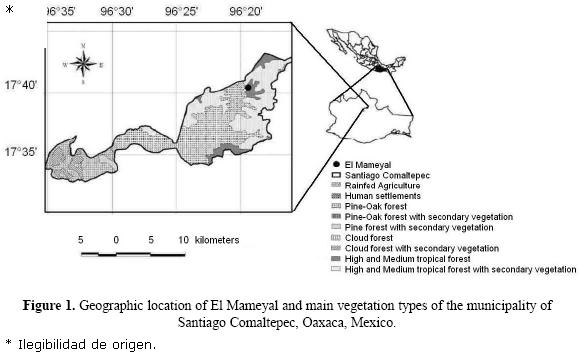
<body><![CDATA[<p align="justify"><font face="verdana" size="2"><b>MATERIAL AND METHODS</b></font></p>     <p align="justify"><font face="verdana" size="2"><b>Study area. </b>The study was carried out at the site known as El Mameyal (17&deg;40'31.4"N, 96&deg; 19'25.1"W, mean altitude 1042 m a.s.l., <a href="#f1">Figure 1</a>) in the municipality of Santiago Comaltepec, district of Ixtl&aacute;n de Ju&aacute;rez, in the region known as the Sierra Norte, in the northern portion of the southeastern Mexican state of Oaxaca. The predominant vegetation is tropical and sub&#150;tropical forest with shrubbery being the secondary vegetation (SEMARNAT, INEGI &amp; UNAM 2000), predominantly from the following families: Araceae, Asteraceae, Cecropiaceae, Fabaceae, Lauraceae, Piperaceae, and Moraceae (Boyle 1996). The dry season is from December to May, with an average precipitation of 225.53 mm (SD = 56.34) and an average temperature of 16.66&deg;C (SD = 1.90). The rainy season is from June to November, with an average month precipitation of 670.87 mm (SD = 110.14) and an average temperature of 17.07&deg;C (SD = 0.82) (Garc&iacute;a Garc&iacute;a 2007).</font></p>     <p align="center"><font face="verdana" size="2"><a name="f1"></a></font></p>     <p align="center"><font face="verdana" size="2"><img src="/img/revistas/azm/v26n3/a9f1.jpg"></font></p>     <p align="justify"><font face="verdana" size="2"><b>Field data. </b>Sampling was carried out five nights per month from January to July 2007. Thirteen Sherman folding traps (3 x 3.5 x 9") baited with a mixture of oat flakes and vanilla were set in thirteen trees of a 300 meters long lineal transect, where the separation for eleven trees was 18 meters approximately between them, and 50 meters for the last two due to the conditions resulting of logging. Throughout the study one trap was set in each tree, and depending of tree characteristics these were placed at different heights: 3&#150;9 m above ground (low canopy), 9&#150;15 m (medium canopy) and the highest part of the canopy, 15&#150;21.5 m. Trees were selected that had branches connected to other trees, thus allowing the assumption of greater animal traffic due to the higher number of available routes; additionally, selected trees had certain characteristics that would allow the climbing such as branches that were sufficiently free of lianas and leaves. In order to climb the trees the single&#150;rope technique was employed.</font></p>     <p align="justify"><font face="verdana" size="2">The following information was recorded for each specimen captured for the first time: the trap and its location (i.e., transect position and height within the tree); sex; reproductive status (The male were considered active if they possessed descended testicles. The female were considered active if they were either pregnant or lactating, or if they had no hair in the periphery of their nipples), age (juveniles being small with thick, short hair, dark in color, with no evidence of reproductive activity, and adults being large with a vibrant dorsal color, long hair, or evidence of reproductive activity). Each specimen was ear&#150;tagged with a numbered tag type 1005&#150;1 (National Band &amp; Tag Co., USA), and immediately released at the capture site.</font></p>     <p align="justify"><font face="verdana" size="2">Data analysis. The capture&#150;recapture histories were analyzed using the probabilistic Cormack&#150;Jolly&#150;Seber (CJS) model (Cormack 1964, Jolly 1965, Seber 1965, 1982, 1986) which includes two parameters: probability of survival <img src="/img/revistas/azm/v26n3/a9f2.jpg"> and probability of capture (p), each of which may remain constant or vary either through time (measured as sample periods), or by sex; thus, considering all these possibilities, sixteen models can be constructed (<a href="/img/revistas/azm/v26n3/a9t1.jpg" target="_blank">Table 1</a>). The construction of the models and the estimations of parameter values were carried out using MARK 4.0 (Cooch &amp; White 2002) with the nomenclature proposed by Lebreton <i>et al. </i>(1992). The selection of the best model was based on a Quasi&#150;likelihood Akaike Information Criterion (QAICc) (Burnham &amp; Anderson 2002). The capture&#150;recapture histories may be affected by other factors besides the probability of survival and capture (extra&#150;binomial variation); thus, the parameters of all the models were adjusted dividing the deviance of each model (degree of discrepancy between the model and the data) by the average deviance of a simulation with 1000 replications. These replications are carried out so that the only sources of variance are those included in the model (parametric bootstrap, Manly 1997).</font></p>     <p align="justify"><font face="verdana" size="2">The CJS model assumes that the presence of transitory specimens (i.e., those passing through, probably during the process of dispersion and loan) does not affect significantly the survival of the resident population, and that the capture and tagging method does not affect the subsequent probabilities of recapture significantly. Both two assumptions were evaluated using the U&#150;Care program (Choquet <i>et al. </i>2003) which, in contrast to other commonly used programs such as RELEASE (Burham <i>et al. </i>1987), employs algorithms designed to situations with moderate quantities of data, as this study. The population size was calculated as the ratio between the number of individuals captured and the probability of capture, as estimated using the CJS model (Lindenmayer <i>et al. </i>1998). The proportion of males and females was expressed as the number of males for each female. The deviation of this proportion vis&#150;&agrave;&#150;vis a 1:1 ratio was analyzed using binomial coefficients test (Zar 1999). The average length of stay, defined as the number of months of observed or inferred presence, was compared between males and females using the Mann&#150;Whitney U&#150;test.</font></p>     <p align="justify"><font face="verdana" size="2">The linear distance was calculated between successive capture sites for each individual, and the monthly averages were compared between males and females using the non&#150;parametric Wilcoxon test. As an additional measurement of movement, recapture frequencies in the same trees where specimens were captured were compared with the number of recaptures in different trees for both males and females using a 2 x 2 contingency table.</font></p>     <p align="justify"><font face="verdana" size="2">&nbsp;</font></p>     ]]></body>
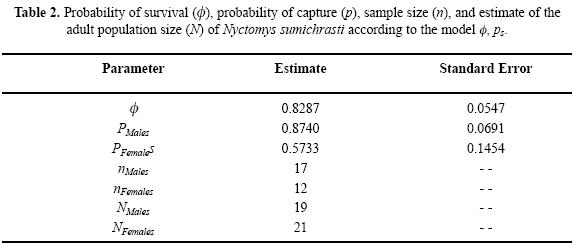
<body><![CDATA[<p align="justify"><font face="verdana" size="2"><b>RESULTS</b></font></p>     <p align="justify"><font face="verdana" size="2">From January to June of 2007 a sample effort was undertaken involving 455 trap&#150;nights, allowing 159 captures and recaptures, a collection success rate of 18.92%. A total of 36 individuals were captured, of which half of them were captured in low canopy and seven were juveniles. Due to the small sample size of this population stratum, the analysis of population and movement&#150;based characteristics was carried out in relation to the adult specimens only. The sampling was comprised of 12 females and 17 males, with a total of 132 captures and recaptures which represents a collection success rate of 15.71%. Whereas the males remained in the study area for an average of 3.58 months (SD = 2.31), the females did so for an average of 2.5 (SD = 2.39), though these differences were not statistically significant (Mann&#150;Whitney U&#150;test = 65, P = 0.101). The maximum length of stay was seven months; this was observed or inferred in relation to two males and two females. Additionally, eight females and five males were captured on just one occasion.</font></p>     <p align="justify"><font face="verdana" size="2">Non statistically significant effect was observed in transitory individuals (males = 1.4646, P = 0.14303; females = 1.0588; P = 0.28969); nor was a statistically significant effect observed in the collection or tagging methods (males = &#150;0.86312, P = 0.38807; females = 0, P = 1). The best candidate model was the one in which the probability of survival remained constant through time, and was the same for both sexes; likewise, it was the one whose probability of capture was also constant through time, though differed between the sexes (<img src="/img/revistas/azm/v26n3/a9f2.jpg">, <i>p<sub>s</sub>) </i>(<a href="/img/revistas/azm/v26n3/a9t1.jpg" target="_blank">Table 1</a>). The model's observed deviance was 73.113 with eight freedom degrees and an overdispersion of 9.139. Of the 1,000 replications, 95 showed more deviances than those observed in the model; thus, it could be concluded that the extrabinomial variation in the capture&#150;recapture histories is not statistically significant (P = 0.098). On the other hand, the average overdispersion of the simulation replications was 6.640, reason for which the parameters of all the models were adjusted to 1.3764, which is the relationship between the observed overdispersion and the simulation average. Once the parameters were adjusted, the (<img src="/img/revistas/azm/v26n3/a9f2.jpg">, <i>p<sub>s</sub>) </i>model continued being the best as it explains better the variations in the capture&#150;recapture histories, outperforming the second best model (<img src="/img/revistas/azm/v26n3/a9f2.jpg">, <i>p) </i>by 207.7%. The probability of survival of adult <i>N. sumichrasti </i>throughout the seven&#150;month study in El Mameyal was 0.8287 and the probability of male capture was 30% higher than the probability of female capture (<a href="#t2">Table 2</a>). The estimated adult population size was 40 individuals: 19 males and 21 females, which does not differ significantly from the ratio of 1:1 (Z = 0.1583, P = 0.8742).</font></p>     <p align="justify"><font face="verdana" size="2">Whereas the adult female average distance travelled was 34.86 m (SD = 5.92, extremes 20.1&#150;60.32 m), the adult male average distance was 35.42 m (SD = 18.27 m, extremes 10.3&#150;75.1 m), though the differences were not statistically significant (Wilcoxon, corrected for ties, Z = &#150;0.0848, P = 0.9324) the average value for the entire population was 35.21 m (SD = 16.91). In contrast, the females were recaptured with significantly greater frequency in the same tree in which they had been captured (85.71%) than were the males (63.15%) (Chi&#150;square = 5.081, P = 0.0241).</font></p>     <p align="justify"><font face="verdana" size="2">&nbsp;</font></p>     <p align="justify"><font face="verdana" size="2"><b>DISCUSSION</b></font></p>     <p align="justify"><font face="verdana" size="2">The difference in the probability of capture between the males and females can be explained because although the average distances traveled do not differ significantly, when movement is measured as the number of recaptures in trees different from those of capture, the males show significantly higher values. This greater mobility among males has been documented in other rodent species and may be attributed to the active search for females (Santos&#150;Moreno <i>et al. </i>2007).</font></p>     <p align="justify"><font face="verdana" size="2">Fleming (1970) estimated the population size of N. <i>sumichrasti </i>in the area of the Panama Canal as being comprised of two (in June) and fifteen (in January). In comparison, the estimations obtained in El Mameyal seem high (<a href="#t2">Table 2</a>); this may be due to at least in part the fact that, although Fleming (1970) also utilized capture&#150;recapture methods, the estimate of the population size was obtained with an enumeration method similar to the Minimum Number Known Alive (Krebs 1966), which, unlike probabilistic models, underestimates this parameter (Nichols &amp; Pollock 1983, Menkens &amp; Anderson 1988, Santos&#150;Moreno <i>et al. </i>2007).</font></p>     <p align="center"><font face="verdana" size="2"><a name="t2"></a></font></p>     <p align="center"><font face="verdana" size="2"><img src="/img/revistas/azm/v26n3/a9t2.jpg"></font></p>     ]]></body>
<body><![CDATA[<p align="justify"><font face="verdana" size="2">As for the age structure, and in contrast to the observed difference in El Mameyal, where juvenile specimens were not very abundant, in Nicaragua the five recognized age categories were represented in equal proportions in the population (Genoways &amp; Jones 1972). These authors proposed that this pattern of a high proportion of juveniles and sub&#150;adults is probably due to the high survival rates because the dense vegetation of the area minimizes the probability of depredation. In the population of El Mameyal, juveniles and sub&#150;adults represented only 19.4% of the captured individuals and although the sample size does not allow us to estimate the survival rate of the age stratum, its low presence in the sampling probably reflects precise ly this (i.e., a low survival rate). The study area's vegetation shows evidence of having experienced considerable impact mainly due to logging; thus, the canopy is not very dense. These results appear to confirm the hypothesis that the vegetation cover is a factor that influences the depredation rate of <i>N. sumichrasti, </i>particularly towards juveniles, as their ability to detect and avoid predators is lower than that of adults (Webster &amp; Webster 1971, Dickman <i>et al. </i>1991); moreover, adults generally occupy safer spaces with dense vegetation, where the risk of falling prey to raptors is lower than in open areas (Koivunen <i>et al. </i>1996). The male&#150;female ratio of 1:1 observed in El Mameyal was observed in Nicaragua as well (Genoways &amp; Jones 1972).</font></p>     <p align="justify"><font face="verdana" size="2">Pattern of movements match with previous observations of <i>N. sumichrasti </i>in Mexico, indicating that this species is strictly tree&#150;dwelling, though samples in northeastern Nicaragua were collected on the ground at the base of trees (Genoways &amp; Jones 1972). Whereas other studies documented captures at heights between 0.7 and 3 m (Lawlor 1969, Collett <i>et al. </i>1975, Ceballos 1990, S&aacute;nchez&#150;Hern&aacute;ndez <i>et al. </i>1999), more than 46% of the captures in El Mameyal were between 9 and 21 m. There are at least two factors that may be able to explain these differences: the fact that in this study the traps were set by climbing the trees with ropes which allowed access to much higher locations than those accessible by ladder, the most common method employed in other studies. On the other hand, it is likely that vertical stratification depends on the number of species of which the community is comprised. For example, in Nicaragua, <i>N. sumichrasti </i>was observed co&#150;existing with at least thirteen other species of small mammals and, as proposed, this may be due to the use of the third dimension (arboreal); that is, the movement of N. <i>sumichrasti </i>appears to be restricted, specifically, to lower strata vegetation usually heights of 10 to 20 feet (Genoways &amp; Jones 1972). In contrast, in another part of Nicaragua where <i>N. sumichrasti </i>is found in the same habitat only with <i>Ototylomys phyllotis </i>(its closest ecological counterpart), <i>N. sumichrasti </i>is restricted to the higher tree levels, at heights usually greater than 10 feet, while <i>O. phyllotis </i>usually forages on lianas and branches below the area of activity of <i>N. sumichrasti </i>(Lawlor 1969). In El Mameyal, <i>N. sumichrasti </i>was captured in trees along with <i>Reithrodontomys sumichrasti, Peromyscus aztecus, Marmosa mexicana, </i>and <i>Tylomys nudicaudus, </i>but only the first one of these species was abundant; in fact, it proved to be the most abundant of species throughout the study. Demonstrating a competitive interaction between <i>N. sumichrasti </i>and <i>R. sumichrasti, </i>as well as demonstrating the effects of vertical stratification, would require further studies.</font></p>     <p align="justify"><font face="verdana" size="2">Some studies undertaken in communities with temperate climates indicate that vertical stratification as a mechanism that facilitates the co&#150;existence of various species is not exclusive of tropical regions. For example, in syntopic areas of the <i>Peromyscus maniculatus </i>and <i>P. leucopus </i>inter&#150;specific competition is reduced, allowing the coexistence of both species (Smith &amp; Speller 1970, Meserve 1977, Barry et al. 1984).</font></p>     <p align="justify"><font face="verdana" size="2">Whereas Fleming (1970) in Panama observed that an adult male <i>N. sumichrasti </i>traveled an average distance 1.5 times greater than that of two females (68.5 m and 45.2 m, respectively), in El Mameyal the distances traveled by both males and females were statistically equal, these differences could be attributed to the small sample size from which Fleming (1970) obtained his estimates. The value of 35.21 m as an average distance traveled by adult <i>N. sumichrasti </i>is probably an underestimate, as estimations obtained from trapping are usually smaller than those obtained with more precise techniques, such as radio&#150;telemetry (S&aacute;enz 1999, Ribble <i>et al. </i>2002). Although the movements of very few species with tree&#150;dwelling or semi&#150;tree&#150;dwelling habits have been studied, the observed values of adult <i>N. sumichrasti </i>are similar to those observed in other rodent species of similar size and habits in tropical and subtropical environments, such as <i>Xenomys nelsoni, </i>though in relation to this last species, the males have been shown to travel double the distance of females (Ceballos 1989), and <i>Peromyscus perfulvus, </i>whose males and females were shown to travel a maximum distance of 67 m and 36 m, respectively (Schnell <i>et al. </i>2008).</font></p>     <p align="justify"><font face="verdana" size="2">&nbsp;</font></p>     <p align="justify"><font face="verdana" size="2"><b>ACKNOWLEDGMENTS</b></font></p>     <p align="justify"><font face="verdana" size="2">This project was financial supporting by Instituto Polit&eacute;cnico Nacional of Mexico (grants SIP&#150;20070826 and SIP&#150;20080431 to A. Santos&#150;M.). The authors would also like to thank the local (municipal) authorities of Santiago Comaltepec for the available facilities. A. Alfaro E. revised preliminary versions of this document, and J. L. Garc&iacute;a&#150;Garc&iacute;a and A. E. Hern&aacute;ndez Cruz provided invaluable field support. Silvia Hern&aacute;ndez B. and an anonymous reviewer provided valuable suggestions and comments.</font></p>     <p align="justify"><font face="verdana" size="2">&nbsp;</font></p>     <p align="justify"><font face="verdana" size="2"><b>LITERATURE CITED</b></font></p>     <!-- ref --><p align="justify"><font face="verdana" size="2"><b>Anthony, H.E. </b>1932. A new genus of rodents from Yucatan. <i>American Museum Novitates, </i>586:1&#150;3.    &nbsp;&nbsp;&nbsp;&nbsp;&nbsp;&nbsp;&nbsp;&nbsp;[&#160;<a href="javascript:void(0);" onclick="javascript: window.open('/scielo.php?script=sci_nlinks&ref=370365&pid=S0065-1737201000030000900001&lng=','','width=640,height=500,resizable=yes,scrollbars=1,menubar=yes,');">Links</a>&#160;]<!-- end-ref --></font></p>     <!-- ref --><p align="justify"><font face="verdana" size="2"><b>Barry, R.E., Jr., M.A: Botje &amp; L.B. Grantham. </b>1984. Vertical Stratification of <i>Peromyscus leucopus </i>and <i>P. maniculatus </i>in Southwestern Virginia. <i>Journal of Mammalogy, </i>65:145&#150;148.    &nbsp;&nbsp;&nbsp;&nbsp;&nbsp;&nbsp;&nbsp;&nbsp;[&#160;<a href="javascript:void(0);" onclick="javascript: window.open('/scielo.php?script=sci_nlinks&ref=370367&pid=S0065-1737201000030000900002&lng=','','width=640,height=500,resizable=yes,scrollbars=1,menubar=yes,');">Links</a>&#160;]<!-- end-ref --></font></p>     <!-- ref --><p align="justify"><font face="verdana" size="2"><b>Birkenholtz, D.E. &amp; W.O. Wirtz. </b>1965. Laboratory observations on the vesper rat. <i>Journal of Mammalogy, </i>46:181&#150;189.    &nbsp;&nbsp;&nbsp;&nbsp;&nbsp;&nbsp;&nbsp;&nbsp;[&#160;<a href="javascript:void(0);" onclick="javascript: window.open('/scielo.php?script=sci_nlinks&ref=370369&pid=S0065-1737201000030000900003&lng=','','width=640,height=500,resizable=yes,scrollbars=1,menubar=yes,');">Links</a>&#160;]<!-- end-ref --></font></p>     <!-- ref --><p align="justify"><font face="verdana" size="2"><b>Boyle, B.L. </b>1996. <i>Changes on altitudinal and latitudinal gradients in Neotropical montane forest. </i>Ph. D. Thesis. Washington University. USA.    &nbsp;&nbsp;&nbsp;&nbsp;&nbsp;&nbsp;&nbsp;&nbsp;[&#160;<a href="javascript:void(0);" onclick="javascript: window.open('/scielo.php?script=sci_nlinks&ref=370371&pid=S0065-1737201000030000900004&lng=','','width=640,height=500,resizable=yes,scrollbars=1,menubar=yes,');">Links</a>&#160;]<!-- end-ref --></font></p>     <!-- ref --><p align="justify"><font face="verdana" size="2"><b>Burnham, K.P., D.R. Anderson, G.C. White, C. Brownie &amp; K.H. Pollock. </b>1987. Design and analysis methods for fish survival experiments based on release&#150;recapture. <i>American Fisheries Society Monographs, </i>5:1&#150;436.    &nbsp;&nbsp;&nbsp;&nbsp;&nbsp;&nbsp;&nbsp;&nbsp;[&#160;<a href="javascript:void(0);" onclick="javascript: window.open('/scielo.php?script=sci_nlinks&ref=370373&pid=S0065-1737201000030000900005&lng=','','width=640,height=500,resizable=yes,scrollbars=1,menubar=yes,');">Links</a>&#160;]<!-- end-ref --></font></p>     <!-- ref --><p align="justify"><font face="verdana" size="2"><b>Burnham, K.P. &amp; D.R. Anderson. </b>2002. <i>Model selection and inference &#150;A practical information&#150; theoretic approach. </i>Springer&#150;Verlag, New York.    &nbsp;&nbsp;&nbsp;&nbsp;&nbsp;&nbsp;&nbsp;&nbsp;[&#160;<a href="javascript:void(0);" onclick="javascript: window.open('/scielo.php?script=sci_nlinks&ref=370375&pid=S0065-1737201000030000900006&lng=','','width=640,height=500,resizable=yes,scrollbars=1,menubar=yes,');">Links</a>&#160;]<!-- end-ref --> </font></p>     <!-- ref --><p align="justify"><font face="verdana" size="2"><b>Ceballos, G. </b>1989. <i>Population and community ecology of small mammals in a tropical deciduous forest in western Mexico. </i>Ph. D. Thesis, University of Arizona, Tucson, USA.    &nbsp;&nbsp;&nbsp;&nbsp;&nbsp;&nbsp;&nbsp;&nbsp;[&#160;<a href="javascript:void(0);" onclick="javascript: window.open('/scielo.php?script=sci_nlinks&ref=370377&pid=S0065-1737201000030000900007&lng=','','width=640,height=500,resizable=yes,scrollbars=1,menubar=yes,');">Links</a>&#160;]<!-- end-ref --></font></p>     <!-- ref --><p align="justify"><font face="verdana" size="2"><b>Ceballos, G. </b>1990. Comparative natural history of small mammals from tropical forests in western Mexico. <i>Journal of Mammalogy, </i>71 263&#150;266.    &nbsp;&nbsp;&nbsp;&nbsp;&nbsp;&nbsp;&nbsp;&nbsp;[&#160;<a href="javascript:void(0);" onclick="javascript: window.open('/scielo.php?script=sci_nlinks&ref=370379&pid=S0065-1737201000030000900008&lng=','','width=640,height=500,resizable=yes,scrollbars=1,menubar=yes,');">Links</a>&#160;]<!-- end-ref --></font></p>     <!-- ref --><p align="justify"><font face="verdana" size="2"><b>Choquet, R., A.M. Reboulet, R. Pradel, O. Gimenez &amp; J.D. Lebreton. </b>2003. <i>User's manual for U&#150; Care, Utilities&#150;CApture&#150;REcapture, </i>V2.02, CEFE/CNRS, Montpellier (<a href="ftp://ftp.cefe.cnrs.fr/biom/U&#150;CARE" target="_blank">ftp://ftp.cefe.cnrs.fr/biom/U&#150;CARE</a>).    &nbsp;&nbsp;&nbsp;&nbsp;&nbsp;&nbsp;&nbsp;&nbsp;[&#160;<a href="javascript:void(0);" onclick="javascript: window.open('/scielo.php?script=sci_nlinks&ref=370381&pid=S0065-1737201000030000900009&lng=','','width=640,height=500,resizable=yes,scrollbars=1,menubar=yes,');">Links</a>&#160;]<!-- end-ref --></font></p>     <!-- ref --><p align="justify"><font face="verdana" size="2"><b>Collett, S.F., C. Sanchez, K.A. Shum, Jr., W.R. Teska &amp; R.H. Baker. </b>1975. Algunas caracter&iacute;sticas poblacionales demogr&aacute;ficas de peque&ntilde;os mam&iacute;feros en dos h&aacute;bitats mexicanos. <i>Anales del Instituto de Biolog&iacute;a, Universidad Nacional Aut&oacute;noma de M&eacute;xico, Serie Zoolog&iacute;a, </i>1:101&#150;124.    &nbsp;&nbsp;&nbsp;&nbsp;&nbsp;&nbsp;&nbsp;&nbsp;[&#160;<a href="javascript:void(0);" onclick="javascript: window.open('/scielo.php?script=sci_nlinks&ref=370383&pid=S0065-1737201000030000900010&lng=','','width=640,height=500,resizable=yes,scrollbars=1,menubar=yes,');">Links</a>&#160;]<!-- end-ref --></font></p>     <!-- ref --><p align="justify"><font face="verdana" size="2"><b>Cooch, E. &amp; G. White. </b>2002. <i>Program MARK. Analysis of data from marked individuals. A gentle introduction. </i>2d. ed. Ithaca, New York.    &nbsp;&nbsp;&nbsp;&nbsp;&nbsp;&nbsp;&nbsp;&nbsp;[&#160;<a href="javascript:void(0);" onclick="javascript: window.open('/scielo.php?script=sci_nlinks&ref=370385&pid=S0065-1737201000030000900011&lng=','','width=640,height=500,resizable=yes,scrollbars=1,menubar=yes,');">Links</a>&#160;]<!-- end-ref --></font></p>     <!-- ref --><p align="justify"><font face="verdana" size="2"><b>Cormack, R.M. </b>1964. Estimates of survival from the sighting of marked animals. <i>Biometrika, </i>51:429&#150; 438.    &nbsp;&nbsp;&nbsp;&nbsp;&nbsp;&nbsp;&nbsp;&nbsp;[&#160;<a href="javascript:void(0);" onclick="javascript: window.open('/scielo.php?script=sci_nlinks&ref=370387&pid=S0065-1737201000030000900012&lng=','','width=640,height=500,resizable=yes,scrollbars=1,menubar=yes,');">Links</a>&#160;]<!-- end-ref --></font></p>     <!-- ref --><p align="justify"><font face="verdana" size="2"><b>Dickman, C.R., M. Predavec &amp; A. J. Lynam. </b>1991. Differential predation of size and sex classes of mice by the barn owl, <i>Tyto alba. Oikos, </i>62:67&#150;76.    &nbsp;&nbsp;&nbsp;&nbsp;&nbsp;&nbsp;&nbsp;&nbsp;[&#160;<a href="javascript:void(0);" onclick="javascript: window.open('/scielo.php?script=sci_nlinks&ref=370389&pid=S0065-1737201000030000900013&lng=','','width=640,height=500,resizable=yes,scrollbars=1,menubar=yes,');">Links</a>&#160;]<!-- end-ref --> </font></p>     <!-- ref --><p align="justify"><font face="verdana" size="2"><b>Disney, R.H.L. </b>1968. Observations on a zoonosis: leishmaniasis in British Honduras. <i>The Journal of Applied Ecology, </i>5:1&#150;59.    &nbsp;&nbsp;&nbsp;&nbsp;&nbsp;&nbsp;&nbsp;&nbsp;[&#160;<a href="javascript:void(0);" onclick="javascript: window.open('/scielo.php?script=sci_nlinks&ref=370391&pid=S0065-1737201000030000900014&lng=','','width=640,height=500,resizable=yes,scrollbars=1,menubar=yes,');">Links</a>&#160;]<!-- end-ref --></font></p>     <!-- ref --><p align="justify"><font face="verdana" size="2"><b>Emmons, L.E. </b>1999. <i>Neotropical rainforest mammals. </i>2d. ed. The University of Chicago Press, Chicago.    &nbsp;&nbsp;&nbsp;&nbsp;&nbsp;&nbsp;&nbsp;&nbsp;[&#160;<a href="javascript:void(0);" onclick="javascript: window.open('/scielo.php?script=sci_nlinks&ref=370393&pid=S0065-1737201000030000900015&lng=','','width=640,height=500,resizable=yes,scrollbars=1,menubar=yes,');">Links</a>&#160;]<!-- end-ref --></font></p>     <!-- ref --><p align="justify"><font face="verdana" size="2"><b>Fleming, T.H. </b>1970. Notes on the rodent faunas of two Panamanian forests. <i>Journal of Mammalogy, </i>51:473&#150;490.    &nbsp;&nbsp;&nbsp;&nbsp;&nbsp;&nbsp;&nbsp;&nbsp;[&#160;<a href="javascript:void(0);" onclick="javascript: window.open('/scielo.php?script=sci_nlinks&ref=370395&pid=S0065-1737201000030000900016&lng=','','width=640,height=500,resizable=yes,scrollbars=1,menubar=yes,');">Links</a>&#160;]<!-- end-ref --></font></p>     <!-- ref --><p align="justify"><font face="verdana" size="2"><b>Garc&iacute;a Garc&iacute;a, J.L. </b>2007. <i>Estructura poblacional del murci&eacute;lago </i>Dermanura tolteca <i>(Saussure, 1860) en el Municipio de Santiago Comaltepec, Oaxaca. </i>M. Sc. Thesis, Instituto Polit&eacute;cnico Nacional de M&eacute;xico, Oaxaca, M&eacute;xico.    &nbsp;&nbsp;&nbsp;&nbsp;&nbsp;&nbsp;&nbsp;&nbsp;[&#160;<a href="javascript:void(0);" onclick="javascript: window.open('/scielo.php?script=sci_nlinks&ref=370397&pid=S0065-1737201000030000900017&lng=','','width=640,height=500,resizable=yes,scrollbars=1,menubar=yes,');">Links</a>&#160;]<!-- end-ref --></font></p>     <!-- ref --><p align="justify"><font face="verdana" size="2"><b>Genoways, H. &amp; J.K. Jones, Jr. </b>1972. Variation and ecology in a local population of the vesper mouse <i>(Nyctomys sumichrasti). Occasional Papers of the Museum, Texas Tech University, </i>9:1&#150;22.    &nbsp;&nbsp;&nbsp;&nbsp;&nbsp;&nbsp;&nbsp;&nbsp;[&#160;<a href="javascript:void(0);" onclick="javascript: window.open('/scielo.php?script=sci_nlinks&ref=370399&pid=S0065-1737201000030000900018&lng=','','width=640,height=500,resizable=yes,scrollbars=1,menubar=yes,');">Links</a>&#160;]<!-- end-ref --></font></p>     <!-- ref --><p align="justify"><font face="verdana" size="2"><b>Goodwin, G.G. </b>1934. Mammals collected by A.W. Anthony in Guatemala, 1924&#150;1928. <i>Bulletin of the American Museum of Natural History, </i>68:1&#150;60.    &nbsp;&nbsp;&nbsp;&nbsp;&nbsp;&nbsp;&nbsp;&nbsp;[&#160;<a href="javascript:void(0);" onclick="javascript: window.open('/scielo.php?script=sci_nlinks&ref=370401&pid=S0065-1737201000030000900019&lng=','','width=640,height=500,resizable=yes,scrollbars=1,menubar=yes,');">Links</a>&#160;]<!-- end-ref --> </font></p>     <!-- ref --><p align="justify"><font face="verdana" size="2"><b>Goodwin, G. G. </b>1969. Mammals from the state of Oaxaca, Mexico, in the American Museum of Natural History. <i>Bulletin of the American Museum of Natural History, </i>141:1&#150;269.    &nbsp;&nbsp;&nbsp;&nbsp;&nbsp;&nbsp;&nbsp;&nbsp;[&#160;<a href="javascript:void(0);" onclick="javascript: window.open('/scielo.php?script=sci_nlinks&ref=370403&pid=S0065-1737201000030000900020&lng=','','width=640,height=500,resizable=yes,scrollbars=1,menubar=yes,');">Links</a>&#160;]<!-- end-ref --></font></p>     <!-- ref --><p align="justify"><font face="verdana" size="2"><b>Hall, E.R. </b>1981. <i>The mammals of North America. </i>Vol. 1 and II. John Wiley and Sons, New York</font>&nbsp;&nbsp;&nbsp;&nbsp;&nbsp;&nbsp;&nbsp;&nbsp;[&#160;<a href="javascript:void(0);" onclick="javascript: window.open('/scielo.php?script=sci_nlinks&ref=370405&pid=S0065-1737201000030000900021&lng=','','width=640,height=500,resizable=yes,scrollbars=1,menubar=yes,');">Links</a>&#160;]<!-- end-ref --><!-- ref --><p align="justify"><font face="verdana" size="2"><b>Jolly, G.M. </b>1965. Explicit estimates from capture&#150;recapture data with both death and immigration&#150; stochastic model. <i>Biometrika, </i>52:225&#150;247.    &nbsp;&nbsp;&nbsp;&nbsp;&nbsp;&nbsp;&nbsp;&nbsp;[&#160;<a href="javascript:void(0);" onclick="javascript: window.open('/scielo.php?script=sci_nlinks&ref=370406&pid=S0065-1737201000030000900022&lng=','','width=640,height=500,resizable=yes,scrollbars=1,menubar=yes,');">Links</a>&#160;]<!-- end-ref --></font></p>     <!-- ref --><p align="justify"><font face="verdana" size="2"><b>Koivunen, V., E. Korpimaki &amp; H. Hakkarainen. </b>1996. Differential avian predation on sex and size classes of small mammals: doomed surplus or dominant individuals?. <i>Annales Zoologici Fennici, </i>33:293&#150;301.    &nbsp;&nbsp;&nbsp;&nbsp;&nbsp;&nbsp;&nbsp;&nbsp;[&#160;<a href="javascript:void(0);" onclick="javascript: window.open('/scielo.php?script=sci_nlinks&ref=370408&pid=S0065-1737201000030000900023&lng=','','width=640,height=500,resizable=yes,scrollbars=1,menubar=yes,');">Links</a>&#160;]<!-- end-ref --></font></p>     <!-- ref --><p align="justify"><font face="verdana" size="2"><b>Krebs, C.J. </b>1966. Demographic changes in fluctuating populations of <i>Microtus californicus. Ecological Monographs, </i>36:239&#150;73.    &nbsp;&nbsp;&nbsp;&nbsp;&nbsp;&nbsp;&nbsp;&nbsp;[&#160;<a href="javascript:void(0);" onclick="javascript: window.open('/scielo.php?script=sci_nlinks&ref=370410&pid=S0065-1737201000030000900024&lng=','','width=640,height=500,resizable=yes,scrollbars=1,menubar=yes,');">Links</a>&#160;]<!-- end-ref --></font></p>     <!-- ref --><p align="justify"><font face="verdana" size="2"><b>Lawlor, T.E. </b>1969. A systematic study of the rodent genus <i>Ototylomys. Journal of Mammalogy, </i>50:28&#150;42.    &nbsp;&nbsp;&nbsp;&nbsp;&nbsp;&nbsp;&nbsp;&nbsp;[&#160;<a href="javascript:void(0);" onclick="javascript: window.open('/scielo.php?script=sci_nlinks&ref=370412&pid=S0065-1737201000030000900025&lng=','','width=640,height=500,resizable=yes,scrollbars=1,menubar=yes,');">Links</a>&#160;]<!-- end-ref --></font></p>     <!-- ref --><p align="justify"><font face="verdana" size="2"><b>Lebreton, J.&#150;D., K.P. Burnham, J. Clobert &amp; D.R. Anderson. </b>1992. Modeling survival and testing biological hypotheses using marked animals: a unified approach with case studies. <i>Ecological Monographs, </i>62:67&#150;118.    &nbsp;&nbsp;&nbsp;&nbsp;&nbsp;&nbsp;&nbsp;&nbsp;[&#160;<a href="javascript:void(0);" onclick="javascript: window.open('/scielo.php?script=sci_nlinks&ref=370414&pid=S0065-1737201000030000900026&lng=','','width=640,height=500,resizable=yes,scrollbars=1,menubar=yes,');">Links</a>&#160;]<!-- end-ref --></font></p>     ]]></body>
<body><![CDATA[<!-- ref --><p align="justify"><font face="verdana" size="2"><b>Lindenmayer, D.B., R.C. Lacy &amp; K.L. Viggers. </b>1998. Modeling survival and capture probabilities of the mountain brushtail possum <i>(Trichosurus caninus) </i>in the forests of southeastern Australia using trap&#150;recapture data. <i>Journal of Zoology, </i>245:1&#150;13.    &nbsp;&nbsp;&nbsp;&nbsp;&nbsp;&nbsp;&nbsp;&nbsp;[&#160;<a href="javascript:void(0);" onclick="javascript: window.open('/scielo.php?script=sci_nlinks&ref=370416&pid=S0065-1737201000030000900027&lng=','','width=640,height=500,resizable=yes,scrollbars=1,menubar=yes,');">Links</a>&#160;]<!-- end-ref --></font></p>     <!-- ref --><p align="justify"><font face="verdana" size="2"><b>Malcolm, J.R. </b>2004. Ecology and conservation of canopy mammals. Pp. 297&#150;331. <i>In: </i>M.D. Lowman, N.M. Nadkarni and H.B. Rinker (Eds.). <i>Forest canopies. </i>2<sup>nd</sup>. ed. Academic Press, New York.    &nbsp;&nbsp;&nbsp;&nbsp;&nbsp;&nbsp;&nbsp;&nbsp;[&#160;<a href="javascript:void(0);" onclick="javascript: window.open('/scielo.php?script=sci_nlinks&ref=370418&pid=S0065-1737201000030000900028&lng=','','width=640,height=500,resizable=yes,scrollbars=1,menubar=yes,');">Links</a>&#160;]<!-- end-ref --></font></p>     <!-- ref --><p align="justify"><font face="verdana" size="2"><b>Manly, B.F.J. </b>1997. <i>Randomization, bootstrap and Monte Carlo methods in biology. </i>2d. ed. Chapman &amp; Hall/CRC, New York.    &nbsp;&nbsp;&nbsp;&nbsp;&nbsp;&nbsp;&nbsp;&nbsp;[&#160;<a href="javascript:void(0);" onclick="javascript: window.open('/scielo.php?script=sci_nlinks&ref=370420&pid=S0065-1737201000030000900029&lng=','','width=640,height=500,resizable=yes,scrollbars=1,menubar=yes,');">Links</a>&#160;]<!-- end-ref --></font></p>     <!-- ref --><p align="justify"><font face="verdana" size="2"><b>Menkens, G.E., Jr. &amp; S.H. Anderson. </b>1988. Estimation of small mammal population size. <i>Ecology, </i>69:1952&#150;1959.    &nbsp;&nbsp;&nbsp;&nbsp;&nbsp;&nbsp;&nbsp;&nbsp;[&#160;<a href="javascript:void(0);" onclick="javascript: window.open('/scielo.php?script=sci_nlinks&ref=370422&pid=S0065-1737201000030000900030&lng=','','width=640,height=500,resizable=yes,scrollbars=1,menubar=yes,');">Links</a>&#160;]<!-- end-ref --></font></p>     <!-- ref --><p align="justify"><font face="verdana" size="2"><b>Meserve, P.L. </b>1977. Three&#150;dimensional home ranges of cricetid rodents. <i>Journal of Mammalogy. </i>58:549&#150;558.    &nbsp;&nbsp;&nbsp;&nbsp;&nbsp;&nbsp;&nbsp;&nbsp;[&#160;<a href="javascript:void(0);" onclick="javascript: window.open('/scielo.php?script=sci_nlinks&ref=370424&pid=S0065-1737201000030000900031&lng=','','width=640,height=500,resizable=yes,scrollbars=1,menubar=yes,');">Links</a>&#160;]<!-- end-ref --></font></p>     ]]></body>
<body><![CDATA[<!-- ref --><p align="justify"><font face="verdana" size="2"><b>Musser, G.G. &amp; M.D. Carleton. </b>2005. Super family Muroidea. Pp. 894&#150;1531. <i>In: </i>D.E. Wilson.and D.M. Reeder (Eds.). <i>Mammal Species of the World. </i>Johns Hopkins University Press, Baltimore.    &nbsp;&nbsp;&nbsp;&nbsp;&nbsp;&nbsp;&nbsp;&nbsp;[&#160;<a href="javascript:void(0);" onclick="javascript: window.open('/scielo.php?script=sci_nlinks&ref=370426&pid=S0065-1737201000030000900032&lng=','','width=640,height=500,resizable=yes,scrollbars=1,menubar=yes,');">Links</a>&#160;]<!-- end-ref --></font></p>     <!-- ref --><p align="justify"><font face="verdana" size="2"><b>Nichols, J.D. &amp; K.H. Pollock. </b>1983. Estimation methodology in contemporary small mammal capture&#150;recapture studies. <i>Journal of Mammalogy, </i>64:256&#150;261.    &nbsp;&nbsp;&nbsp;&nbsp;&nbsp;&nbsp;&nbsp;&nbsp;[&#160;<a href="javascript:void(0);" onclick="javascript: window.open('/scielo.php?script=sci_nlinks&ref=370428&pid=S0065-1737201000030000900033&lng=','','width=640,height=500,resizable=yes,scrollbars=1,menubar=yes,');">Links</a>&#160;]<!-- end-ref --></font></p>     <!-- ref --><p align="justify"><font face="verdana" size="2"><b>Pe&ntilde;a, L.A., Y. Dom&iacute;nguez &amp; B. Hern&aacute;ndez. </b>2005. <i>Nyctomys sumichrasti </i>(Saussure, 1860). Pp. 701&#150; 702. <i>In: </i>G. Ceballos and G. Oliva (Eds.). <i>Los mam&iacute;feros silvestres de M&eacute;xico. </i>Fondo de Cultura Econ&oacute;mica and Comisi&oacute;n Nacional para el Conocimiento y Uso de la Biodiversidad. M&eacute;xico, D. F.    &nbsp;&nbsp;&nbsp;&nbsp;&nbsp;&nbsp;&nbsp;&nbsp;[&#160;<a href="javascript:void(0);" onclick="javascript: window.open('/scielo.php?script=sci_nlinks&ref=370430&pid=S0065-1737201000030000900034&lng=','','width=640,height=500,resizable=yes,scrollbars=1,menubar=yes,');">Links</a>&#160;]<!-- end-ref --></font></p>     <!-- ref --><p align="justify"><font face="verdana" size="2"><b>Ribble, D.O., A.E. Wurtz, E.K. Mcconnell, J.J. Buegge &amp; K.C. Welch, Jr. </b>2002. A comparison of home ranges of two species of <i>Peromyscus </i>using trapping and radiotelemetry data. <i>Journal of Mammalogy, </i>83:260&#150;266.    &nbsp;&nbsp;&nbsp;&nbsp;&nbsp;&nbsp;&nbsp;&nbsp;[&#160;<a href="javascript:void(0);" onclick="javascript: window.open('/scielo.php?script=sci_nlinks&ref=370432&pid=S0065-1737201000030000900035&lng=','','width=640,height=500,resizable=yes,scrollbars=1,menubar=yes,');">Links</a>&#160;]<!-- end-ref --></font></p>     <!-- ref --><p align="justify"><font face="verdana" size="2"><b>S&aacute;enz, J.C. </b>1999. Movimientos y selecci&oacute;n de microhabitat de una rata arbor&iacute;cola <i>Ototylomys phyllotis </i>(Rodentia: Muridae) en un bosque seco tropical. <i>Brenesia, </i>52:61&#150;64.    &nbsp;&nbsp;&nbsp;&nbsp;&nbsp;&nbsp;&nbsp;&nbsp;[&#160;<a href="javascript:void(0);" onclick="javascript: window.open('/scielo.php?script=sci_nlinks&ref=370434&pid=S0065-1737201000030000900036&lng=','','width=640,height=500,resizable=yes,scrollbars=1,menubar=yes,');">Links</a>&#160;]<!-- end-ref --></font></p>     ]]></body>
<body><![CDATA[<!-- ref --><p align="justify"><font face="verdana" size="2"><b>S&aacute;nchez&#150;Hern&aacute;ndez, C., M.L. Rom&eacute;ro&#150;Almaraz, R.D. Owen, A. N&uacute;&ntilde;ez&#150;Gardu&ntilde;o &amp; R. L&oacute;pez&#150;Wilchis. </b>1999. Noteworthy records of mammals from Michoac&aacute;n, Mexico. <i>The Southwestern Naturalist, </i>44:231&#150;235.    &nbsp;&nbsp;&nbsp;&nbsp;&nbsp;&nbsp;&nbsp;&nbsp;[&#160;<a href="javascript:void(0);" onclick="javascript: window.open('/scielo.php?script=sci_nlinks&ref=370436&pid=S0065-1737201000030000900037&lng=','','width=640,height=500,resizable=yes,scrollbars=1,menubar=yes,');">Links</a>&#160;]<!-- end-ref --></font></p>     <!-- ref --><p align="justify"><font face="verdana" size="2"><b>Santos&#150;Moreno, A., M.A. Briones&#150;Salas &amp; R. L&oacute;pez&#150;Wilchis. </b>2007. Diferencias en algunos par&aacute;metros demogr&aacute;ficos de <i>Oryzomys chapmani </i>(Rodentia: Muridae) asociadas a tres estados sucesionales de bosque mes&oacute;filo de monta&ntilde;a en Oaxaca, M&eacute;xico. <i>Acta Zool&oacute;gica Mexicana (nueva serie), </i>23:123&#150;137.    &nbsp;&nbsp;&nbsp;&nbsp;&nbsp;&nbsp;&nbsp;&nbsp;[&#160;<a href="javascript:void(0);" onclick="javascript: window.open('/scielo.php?script=sci_nlinks&ref=370438&pid=S0065-1737201000030000900038&lng=','','width=640,height=500,resizable=yes,scrollbars=1,menubar=yes,');">Links</a>&#160;]<!-- end-ref --></font></p>     <!-- ref --><p align="justify"><font face="verdana" size="2"><b>Schnell, G.D., M.L. Kennedy, C. S&aacute;nchez&#150;Hern&aacute;ndez, M.L. Romero&#150;Almaraz, B.D.N. Estevez, J.A. Guerrero, T.L. Best, M.C. Wooten &amp; R.D. Owen. </b>2008. Habitat preference of the endemic tawny deermouse <i>(Peromyscus perfulvus), </i>a species of conservation concern. <i>The Southwestern Naturalist, </i>53:9&#150;20.    &nbsp;&nbsp;&nbsp;&nbsp;&nbsp;&nbsp;&nbsp;&nbsp;[&#160;<a href="javascript:void(0);" onclick="javascript: window.open('/scielo.php?script=sci_nlinks&ref=370440&pid=S0065-1737201000030000900039&lng=','','width=640,height=500,resizable=yes,scrollbars=1,menubar=yes,');">Links</a>&#160;]<!-- end-ref --></font></p>     <!-- ref --><p align="justify"><font face="verdana" size="2"><b>Seber, G.A.F.</b> 1965. A note in multiple recapture census. <i>Biometrika, </i>52:249&#150;259.    &nbsp;&nbsp;&nbsp;&nbsp;&nbsp;&nbsp;&nbsp;&nbsp;[&#160;<a href="javascript:void(0);" onclick="javascript: window.open('/scielo.php?script=sci_nlinks&ref=370442&pid=S0065-1737201000030000900040&lng=','','width=640,height=500,resizable=yes,scrollbars=1,menubar=yes,');">Links</a>&#160;]<!-- end-ref --></font></p>     <!-- ref --><p align="justify"><font face="verdana" size="2"><b>Seber, G.A.F.</b> 1982. <i>The estimation of animal abundance and related parameters. </i>Charles Griffin &amp; Co., London.    &nbsp;&nbsp;&nbsp;&nbsp;&nbsp;&nbsp;&nbsp;&nbsp;[&#160;<a href="javascript:void(0);" onclick="javascript: window.open('/scielo.php?script=sci_nlinks&ref=370444&pid=S0065-1737201000030000900041&lng=','','width=640,height=500,resizable=yes,scrollbars=1,menubar=yes,');">Links</a>&#160;]<!-- end-ref --></font></p>     ]]></body>
<body><![CDATA[<!-- ref --><p align="justify"><font face="verdana" size="2"><b>Seber, G.A.F.</b> 1986. A review of estimating animal abundance. <i>Biometrics, </i>42:267&#150;292.    &nbsp;&nbsp;&nbsp;&nbsp;&nbsp;&nbsp;&nbsp;&nbsp;[&#160;<a href="javascript:void(0);" onclick="javascript: window.open('/scielo.php?script=sci_nlinks&ref=370446&pid=S0065-1737201000030000900042&lng=','','width=640,height=500,resizable=yes,scrollbars=1,menubar=yes,');">Links</a>&#160;]<!-- end-ref --></font></p>     <!-- ref --><p align="justify"><font face="verdana" size="2"><b>Secretar&iacute;a de Medio Ambiente Recursos Naturales y Pesca (SEMARNAP), Instituto Nacional de Estad&iacute;stica, Geograf&iacute;a e Inform&aacute;tica (INEGI) &amp; Instituto de Geograf&iacute;a, Universidad Nacional Aut&oacute;noma de M&eacute;xico (UNAM). </b>2000. <i>Inventario Forestal Nacional 2000&#150;2001. Escala 1:250000. </i>Instituto de Geograf&iacute;a, UNAM, M&eacute;xico.    &nbsp;&nbsp;&nbsp;&nbsp;&nbsp;&nbsp;&nbsp;&nbsp;[&#160;<a href="javascript:void(0);" onclick="javascript: window.open('/scielo.php?script=sci_nlinks&ref=370448&pid=S0065-1737201000030000900043&lng=','','width=640,height=500,resizable=yes,scrollbars=1,menubar=yes,');">Links</a>&#160;]<!-- end-ref --></font></p>     <!-- ref --><p align="justify"><font face="verdana" size="2"><b>Smith, D.A. &amp; S.W. Speller. </b>1970. The distribution and behaviour <i>of Peromyscus maniculatus gracilis and Peromyscus leucopus noveboracensis </i>(Rodentia: Cricetidae) in a southeastern Ontario woodlot. <i>Canadian Journal of Zoology, </i>48:1187&#150;1199.    &nbsp;&nbsp;&nbsp;&nbsp;&nbsp;&nbsp;&nbsp;&nbsp;[&#160;<a href="javascript:void(0);" onclick="javascript: window.open('/scielo.php?script=sci_nlinks&ref=370450&pid=S0065-1737201000030000900044&lng=','','width=640,height=500,resizable=yes,scrollbars=1,menubar=yes,');">Links</a>&#160;]<!-- end-ref --></font></p>     <!-- ref --><p align="justify"><font face="verdana" size="2"><b>Timm, R.M. &amp; C. Vriesendorp. </b>2003. Observations on feeding behavior in the vesper mouse, <i>Nyctomys sumichrasti. Mammalian Biology, </i>68:126&#150;128.    &nbsp;&nbsp;&nbsp;&nbsp;&nbsp;&nbsp;&nbsp;&nbsp;[&#160;<a href="javascript:void(0);" onclick="javascript: window.open('/scielo.php?script=sci_nlinks&ref=370452&pid=S0065-1737201000030000900045&lng=','','width=640,height=500,resizable=yes,scrollbars=1,menubar=yes,');">Links</a>&#160;]<!-- end-ref --> </font></p>     <!-- ref --><p align="justify"><font face="verdana" size="2"><b>Webster, D.B. &amp; M. Webster. </b>1971. Adaptive value of hearing and vision in kangaroo rat predator avoidance. <i>Brain, Behavior and Evolution, </i>4:310&#150;22.    &nbsp;&nbsp;&nbsp;&nbsp;&nbsp;&nbsp;&nbsp;&nbsp;[&#160;<a href="javascript:void(0);" onclick="javascript: window.open('/scielo.php?script=sci_nlinks&ref=370454&pid=S0065-1737201000030000900046&lng=','','width=640,height=500,resizable=yes,scrollbars=1,menubar=yes,');">Links</a>&#160;]<!-- end-ref --> </font></p>     ]]></body>
<body><![CDATA[<!-- ref --><p align="justify"><font face="verdana" size="2"><b>Woodman, N., N.A. Slade, R.M. Timm &amp; C.A. Schmidt. </b>1995. Mammalian community structure in lowland, tropical Peru, as determined by remo val trapping. <i>Zoological Journal of the Linnean Society, </i>113:1&#150;20.    &nbsp;&nbsp;&nbsp;&nbsp;&nbsp;&nbsp;&nbsp;&nbsp;[&#160;<a href="javascript:void(0);" onclick="javascript: window.open('/scielo.php?script=sci_nlinks&ref=370456&pid=S0065-1737201000030000900047&lng=','','width=640,height=500,resizable=yes,scrollbars=1,menubar=yes,');">Links</a>&#160;]<!-- end-ref --></font></p>     <!-- ref --><p align="justify"><font face="verdana" size="2"><b>Zar, H.H. 1999.</b> <i>Biostatistical analysis. </i>4&#170;. ed. Prentice Hall, Upper Saddle River, New Jersey.    &nbsp;&nbsp;&nbsp;&nbsp;&nbsp;&nbsp;&nbsp;&nbsp;[&#160;<a href="javascript:void(0);" onclick="javascript: window.open('/scielo.php?script=sci_nlinks&ref=370458&pid=S0065-1737201000030000900048&lng=','','width=640,height=500,resizable=yes,scrollbars=1,menubar=yes,');">Links</a>&#160;]<!-- end-ref --></font></p>      ]]></body><back>
<ref-list>
<ref id="B1">
<nlm-citation citation-type="journal">
<person-group person-group-type="author">
<name>
<surname><![CDATA[Anthony]]></surname>
<given-names><![CDATA[H.E.]]></given-names>
</name>
</person-group>
<article-title xml:lang="en"><![CDATA[A new genus of rodents from Yucatan]]></article-title>
<source><![CDATA[American Museum Novitates]]></source>
<year>1932</year>
<volume>586</volume>
<page-range>1-3</page-range></nlm-citation>
</ref>
<ref id="B2">
<nlm-citation citation-type="journal">
<person-group person-group-type="author">
<name>
<surname><![CDATA[Barry]]></surname>
<given-names><![CDATA[R.E.]]></given-names>
</name>
<name>
<surname><![CDATA[Botje]]></surname>
<given-names><![CDATA[M.A]]></given-names>
</name>
<name>
<surname><![CDATA[Grantham]]></surname>
<given-names><![CDATA[L.B.]]></given-names>
</name>
</person-group>
<article-title xml:lang="en"><![CDATA[Vertical Stratification of Peromyscus leucopus and P. maniculatus in Southwestern Virginia]]></article-title>
<source><![CDATA[Journal of Mammalogy]]></source>
<year>1984</year>
<volume>65</volume>
<page-range>145-148</page-range></nlm-citation>
</ref>
<ref id="B3">
<nlm-citation citation-type="journal">
<person-group person-group-type="author">
<name>
<surname><![CDATA[Birkenholtz]]></surname>
<given-names><![CDATA[D.E.]]></given-names>
</name>
<name>
<surname><![CDATA[Wirtz]]></surname>
<given-names><![CDATA[W.O.]]></given-names>
</name>
</person-group>
<article-title xml:lang="en"><![CDATA[Laboratory observations on the vesper rat]]></article-title>
<source><![CDATA[Journal of Mammalogy]]></source>
<year>1965</year>
<volume>46</volume>
<page-range>181-189</page-range></nlm-citation>
</ref>
<ref id="B4">
<nlm-citation citation-type="">
<person-group person-group-type="author">
<name>
<surname><![CDATA[Boyle]]></surname>
<given-names><![CDATA[B.L.]]></given-names>
</name>
</person-group>
<source><![CDATA[Changes on altitudinal and latitudinal gradients in Neotropical montane forest]]></source>
<year>1996</year>
</nlm-citation>
</ref>
<ref id="B5">
<nlm-citation citation-type="journal">
<person-group person-group-type="author">
<name>
<surname><![CDATA[Burnham]]></surname>
<given-names><![CDATA[K.P.]]></given-names>
</name>
<name>
<surname><![CDATA[Anderson]]></surname>
<given-names><![CDATA[D.R.]]></given-names>
</name>
<name>
<surname><![CDATA[White]]></surname>
<given-names><![CDATA[G.C.]]></given-names>
</name>
<name>
<surname><![CDATA[Brownie]]></surname>
<given-names><![CDATA[C]]></given-names>
</name>
<name>
<surname><![CDATA[Pollock]]></surname>
<given-names><![CDATA[K.H.]]></given-names>
</name>
</person-group>
<article-title xml:lang="en"><![CDATA[Design and analysis methods for fish survival experiments based on release-recapture]]></article-title>
<source><![CDATA[American Fisheries Society Monographs]]></source>
<year>1987</year>
<volume>5</volume>
<page-range>1-436</page-range></nlm-citation>
</ref>
<ref id="B6">
<nlm-citation citation-type="book">
<person-group person-group-type="author">
<name>
<surname><![CDATA[Burnham]]></surname>
<given-names><![CDATA[K.P.]]></given-names>
</name>
<name>
<surname><![CDATA[Anderson]]></surname>
<given-names><![CDATA[D.R.]]></given-names>
</name>
</person-group>
<source><![CDATA[Model selection and inference -A practical information- theoretic approach]]></source>
<year>2002</year>
<publisher-loc><![CDATA[New York ]]></publisher-loc>
<publisher-name><![CDATA[Springer-Verlag]]></publisher-name>
</nlm-citation>
</ref>
<ref id="B7">
<nlm-citation citation-type="">
<person-group person-group-type="author">
<name>
<surname><![CDATA[Ceballos]]></surname>
<given-names><![CDATA[G]]></given-names>
</name>
</person-group>
<source><![CDATA[Population and community ecology of small mammals in a tropical deciduous forest in western Mexico]]></source>
<year>1989</year>
</nlm-citation>
</ref>
<ref id="B8">
<nlm-citation citation-type="journal">
<person-group person-group-type="author">
<name>
<surname><![CDATA[Ceballos]]></surname>
<given-names><![CDATA[G]]></given-names>
</name>
</person-group>
<article-title xml:lang="en"><![CDATA[Comparative natural history of small mammals from tropical forests in western Mexico]]></article-title>
<source><![CDATA[Journal of Mammalogy]]></source>
<year>1990</year>
<volume>71</volume>
<page-range>263-266</page-range></nlm-citation>
</ref>
<ref id="B9">
<nlm-citation citation-type="book">
<person-group person-group-type="author">
<name>
<surname><![CDATA[Choquet]]></surname>
<given-names><![CDATA[R]]></given-names>
</name>
<name>
<surname><![CDATA[Reboulet]]></surname>
<given-names><![CDATA[A.M]]></given-names>
</name>
<name>
<surname><![CDATA[Pradel]]></surname>
<given-names><![CDATA[R]]></given-names>
</name>
<name>
<surname><![CDATA[Gimenez]]></surname>
<given-names><![CDATA[O]]></given-names>
</name>
<name>
<surname><![CDATA[Lebreton]]></surname>
<given-names><![CDATA[J.D]]></given-names>
</name>
</person-group>
<source><![CDATA[User's manual for U- Care, Utilities-CApture-REcapture, V2.02]]></source>
<year>2003</year>
<publisher-loc><![CDATA[Montpellier ]]></publisher-loc>
<publisher-name><![CDATA[CEFE/CNRS]]></publisher-name>
</nlm-citation>
</ref>
<ref id="B10">
<nlm-citation citation-type="journal">
<person-group person-group-type="author">
<name>
<surname><![CDATA[Collett]]></surname>
<given-names><![CDATA[S.F.]]></given-names>
</name>
<name>
<surname><![CDATA[Sanchez]]></surname>
<given-names><![CDATA[C]]></given-names>
</name>
<name>
<surname><![CDATA[Shum]]></surname>
<given-names><![CDATA[K.A.]]></given-names>
</name>
<name>
<surname><![CDATA[Teska]]></surname>
<given-names><![CDATA[W.R.]]></given-names>
</name>
<name>
<surname><![CDATA[Baker]]></surname>
<given-names><![CDATA[R.H.]]></given-names>
</name>
</person-group>
<article-title xml:lang="es"><![CDATA[Algunas características poblacionales demográficas de pequeños mamíferos en dos hábitats mexicanos]]></article-title>
<source><![CDATA[Anales del Instituto de Biología, Universidad Nacional Autónoma de México, Serie Zoología]]></source>
<year>1975</year>
<volume>1</volume>
<page-range>101-124</page-range></nlm-citation>
</ref>
<ref id="B11">
<nlm-citation citation-type="">
<person-group person-group-type="author">
<name>
<surname><![CDATA[Cooch]]></surname>
<given-names><![CDATA[E]]></given-names>
</name>
<name>
<surname><![CDATA[White]]></surname>
<given-names><![CDATA[G]]></given-names>
</name>
</person-group>
<source><![CDATA[Program MARK. Analysis of data from marked individuals. A gentle introduction]]></source>
<year>2002</year>
<edition>2d. ed</edition>
<publisher-loc><![CDATA[Ithaca^eNew York New York]]></publisher-loc>
</nlm-citation>
</ref>
<ref id="B12">
<nlm-citation citation-type="journal">
<person-group person-group-type="author">
<name>
<surname><![CDATA[Cormack]]></surname>
<given-names><![CDATA[R.M.]]></given-names>
</name>
</person-group>
<article-title xml:lang="en"><![CDATA[Estimates of survival from the sighting of marked animals]]></article-title>
<source><![CDATA[Biometrika]]></source>
<year>1964</year>
<volume>51</volume>
<page-range>429- 438</page-range></nlm-citation>
</ref>
<ref id="B13">
<nlm-citation citation-type="journal">
<person-group person-group-type="author">
<name>
<surname><![CDATA[Dickman]]></surname>
<given-names><![CDATA[C.R.]]></given-names>
</name>
<name>
<surname><![CDATA[Predavec]]></surname>
<given-names><![CDATA[M]]></given-names>
</name>
<name>
<surname><![CDATA[Lynam]]></surname>
<given-names><![CDATA[A. J.]]></given-names>
</name>
</person-group>
<article-title xml:lang="en"><![CDATA[Differential predation of size and sex classes of mice by the barn owl, Tyto alba]]></article-title>
<source><![CDATA[Oikos]]></source>
<year>1991</year>
<volume>62</volume>
<page-range>67-76</page-range></nlm-citation>
</ref>
<ref id="B14">
<nlm-citation citation-type="journal">
<person-group person-group-type="author">
<name>
<surname><![CDATA[Disney]]></surname>
<given-names><![CDATA[R.H.L.]]></given-names>
</name>
</person-group>
<article-title xml:lang="en"><![CDATA[Observations on a zoonosis: leishmaniasis in British Honduras]]></article-title>
<source><![CDATA[The Journal of Applied Ecology]]></source>
<year>1968</year>
<volume>5</volume>
<page-range>1-59</page-range></nlm-citation>
</ref>
<ref id="B15">
<nlm-citation citation-type="book">
<person-group person-group-type="author">
<name>
<surname><![CDATA[Emmons]]></surname>
<given-names><![CDATA[L.E.]]></given-names>
</name>
</person-group>
<source><![CDATA[Neotropical rainforest mammals]]></source>
<year>1999</year>
<edition>2d. ed</edition>
<publisher-loc><![CDATA[Chicago ]]></publisher-loc>
<publisher-name><![CDATA[The University of Chicago Press]]></publisher-name>
</nlm-citation>
</ref>
<ref id="B16">
<nlm-citation citation-type="journal">
<person-group person-group-type="author">
<name>
<surname><![CDATA[Fleming]]></surname>
<given-names><![CDATA[T.H.]]></given-names>
</name>
</person-group>
<article-title xml:lang="en"><![CDATA[Notes on the rodent faunas of two Panamanian forests]]></article-title>
<source><![CDATA[Journal of Mammalogy]]></source>
<year>1970</year>
<volume>51</volume>
<page-range>473-490</page-range></nlm-citation>
</ref>
<ref id="B17">
<nlm-citation citation-type="">
<person-group person-group-type="author">
<name>
<surname><![CDATA[García García]]></surname>
<given-names><![CDATA[J.L.]]></given-names>
</name>
</person-group>
<source><![CDATA[Estructura poblacional del murciélago Dermanura tolteca (Saussure, 1860) en el Municipio de Santiago Comaltepec, Oaxaca]]></source>
<year>2007</year>
</nlm-citation>
</ref>
<ref id="B18">
<nlm-citation citation-type="journal">
<person-group person-group-type="author">
<name>
<surname><![CDATA[Genoways]]></surname>
<given-names><![CDATA[H]]></given-names>
</name>
<name>
<surname><![CDATA[Jones]]></surname>
<given-names><![CDATA[J.K.]]></given-names>
</name>
</person-group>
<article-title xml:lang="en"><![CDATA[Variation and ecology in a local population of the vesper mouse (Nyctomys sumichrasti)]]></article-title>
<source><![CDATA[Occasional Papers of the Museum]]></source>
<year>1972</year>
<volume>9</volume>
<page-range>1-22</page-range><publisher-name><![CDATA[Texas Tech University]]></publisher-name>
</nlm-citation>
</ref>
<ref id="B19">
<nlm-citation citation-type="journal">
<person-group person-group-type="author">
<name>
<surname><![CDATA[Goodwin]]></surname>
<given-names><![CDATA[G.G.]]></given-names>
</name>
</person-group>
<article-title xml:lang="en"><![CDATA[Mammals collected by A.W. Anthony in Guatemala, 1924-1928]]></article-title>
<source><![CDATA[Bulletin of the American Museum of Natural History]]></source>
<year>1934</year>
<volume>68</volume>
<page-range>1-60</page-range></nlm-citation>
</ref>
<ref id="B20">
<nlm-citation citation-type="journal">
<person-group person-group-type="author">
<name>
<surname><![CDATA[Goodwin]]></surname>
<given-names><![CDATA[G. G.]]></given-names>
</name>
</person-group>
<article-title xml:lang="en"><![CDATA[Mammals from the state of Oaxaca, Mexico, in the American Museum of Natural History]]></article-title>
<source><![CDATA[Bulletin of the American Museum of Natural History]]></source>
<year>1969</year>
<volume>141</volume>
<page-range>1-269</page-range></nlm-citation>
</ref>
<ref id="B21">
<nlm-citation citation-type="book">
<person-group person-group-type="author">
<name>
<surname><![CDATA[Hall]]></surname>
<given-names><![CDATA[E.R.]]></given-names>
</name>
</person-group>
<source><![CDATA[The mammals of North America]]></source>
<year>1981</year>
<volume>Vol. 1 and II</volume>
<publisher-loc><![CDATA[New York ]]></publisher-loc>
<publisher-name><![CDATA[John Wiley and Sons]]></publisher-name>
</nlm-citation>
</ref>
<ref id="B22">
<nlm-citation citation-type="journal">
<person-group person-group-type="author">
<name>
<surname><![CDATA[Jolly]]></surname>
<given-names><![CDATA[G.M.]]></given-names>
</name>
</person-group>
<article-title xml:lang="en"><![CDATA[Explicit estimates from capture-recapture data with both death and immigration- stochastic model]]></article-title>
<source><![CDATA[Biometrika]]></source>
<year>1965</year>
<volume>52</volume>
<page-range>225-247</page-range></nlm-citation>
</ref>
<ref id="B23">
<nlm-citation citation-type="journal">
<person-group person-group-type="author">
<name>
<surname><![CDATA[Koivunen]]></surname>
<given-names><![CDATA[V]]></given-names>
</name>
<name>
<surname><![CDATA[Korpimaki]]></surname>
<given-names><![CDATA[E]]></given-names>
</name>
<name>
<surname><![CDATA[Hakkarainen]]></surname>
<given-names><![CDATA[H]]></given-names>
</name>
</person-group>
<article-title xml:lang="en"><![CDATA[Differential avian predation on sex and size classes of small mammals: doomed surplus or dominant individuals?]]></article-title>
<source><![CDATA[Annales Zoologici Fennici]]></source>
<year>1996</year>
<volume>33</volume>
<page-range>293-301</page-range></nlm-citation>
</ref>
<ref id="B24">
<nlm-citation citation-type="journal">
<person-group person-group-type="author">
<name>
<surname><![CDATA[Krebs]]></surname>
<given-names><![CDATA[C.J.]]></given-names>
</name>
</person-group>
<article-title xml:lang="en"><![CDATA[Demographic changes in fluctuating populations of Microtus californicus]]></article-title>
<source><![CDATA[Ecological Monographs]]></source>
<year>1966</year>
<volume>36</volume>
<page-range>239-73</page-range></nlm-citation>
</ref>
<ref id="B25">
<nlm-citation citation-type="journal">
<person-group person-group-type="author">
<name>
<surname><![CDATA[Lawlor]]></surname>
<given-names><![CDATA[T.E.]]></given-names>
</name>
</person-group>
<article-title xml:lang="en"><![CDATA[A systematic study of the rodent genus Ototylomys]]></article-title>
<source><![CDATA[Journal of Mammalogy]]></source>
<year>1969</year>
<volume>50</volume>
<page-range>28-42</page-range></nlm-citation>
</ref>
<ref id="B26">
<nlm-citation citation-type="journal">
<person-group person-group-type="author">
<name>
<surname><![CDATA[Lebreton]]></surname>
<given-names><![CDATA[J.-D.]]></given-names>
</name>
<name>
<surname><![CDATA[Burnham]]></surname>
<given-names><![CDATA[K.P.]]></given-names>
</name>
<name>
<surname><![CDATA[Clobert]]></surname>
<given-names><![CDATA[J]]></given-names>
</name>
<name>
<surname><![CDATA[Anderson]]></surname>
<given-names><![CDATA[D.R.]]></given-names>
</name>
</person-group>
<article-title xml:lang="en"><![CDATA[Modeling survival and testing biological hypotheses using marked animals: a unified approach with case studies]]></article-title>
<source><![CDATA[Ecological Monographs]]></source>
<year>1992</year>
<volume>62</volume>
<page-range>67-118</page-range></nlm-citation>
</ref>
<ref id="B27">
<nlm-citation citation-type="journal">
<person-group person-group-type="author">
<name>
<surname><![CDATA[Lindenmayer]]></surname>
<given-names><![CDATA[D.B.]]></given-names>
</name>
<name>
<surname><![CDATA[Lacy]]></surname>
<given-names><![CDATA[R.C.]]></given-names>
</name>
<name>
<surname><![CDATA[Viggers]]></surname>
<given-names><![CDATA[K.L.]]></given-names>
</name>
</person-group>
<article-title xml:lang="en"><![CDATA[Modeling survival and capture probabilities of the mountain brushtail possum (Trichosurus caninus) in the forests of southeastern Australia using trap-recapture data]]></article-title>
<source><![CDATA[Journal of Zoology]]></source>
<year>1998</year>
<volume>245</volume>
<page-range>1-13</page-range></nlm-citation>
</ref>
<ref id="B28">
<nlm-citation citation-type="book">
<person-group person-group-type="author">
<name>
<surname><![CDATA[Malcolm]]></surname>
<given-names><![CDATA[J.R.]]></given-names>
</name>
</person-group>
<article-title xml:lang="en"><![CDATA[Ecology and conservation of canopy mammals]]></article-title>
<person-group person-group-type="editor">
<name>
<surname><![CDATA[Lowman]]></surname>
<given-names><![CDATA[M.D.]]></given-names>
</name>
<name>
<surname><![CDATA[Nadkarni]]></surname>
<given-names><![CDATA[N.M.]]></given-names>
</name>
<name>
<surname><![CDATA[Rinker]]></surname>
<given-names><![CDATA[H.B.]]></given-names>
</name>
</person-group>
<source><![CDATA[Forest canopies]]></source>
<year>2004</year>
<edition>2nd. ed</edition>
<page-range>297-331</page-range><publisher-loc><![CDATA[New York ]]></publisher-loc>
<publisher-name><![CDATA[Academic Press]]></publisher-name>
</nlm-citation>
</ref>
<ref id="B29">
<nlm-citation citation-type="book">
<person-group person-group-type="author">
<name>
<surname><![CDATA[Manly]]></surname>
<given-names><![CDATA[B.F.J.]]></given-names>
</name>
</person-group>
<source><![CDATA[Randomization, bootstrap and Monte Carlo methods in biology]]></source>
<year>1997</year>
<edition>2d. ed</edition>
<publisher-loc><![CDATA[New York ]]></publisher-loc>
<publisher-name><![CDATA[Chapman & Hall/CRC]]></publisher-name>
</nlm-citation>
</ref>
<ref id="B30">
<nlm-citation citation-type="journal">
<person-group person-group-type="author">
<name>
<surname><![CDATA[Menkens]]></surname>
<given-names><![CDATA[G.E.]]></given-names>
</name>
<name>
<surname><![CDATA[Anderson]]></surname>
<given-names><![CDATA[S.H.]]></given-names>
</name>
</person-group>
<source><![CDATA[Ecology]]></source>
<year>1988</year>
<volume>69</volume>
<page-range>1952-1959</page-range></nlm-citation>
</ref>
<ref id="B31">
<nlm-citation citation-type="journal">
<person-group person-group-type="author">
<name>
<surname><![CDATA[Meserve]]></surname>
<given-names><![CDATA[P.L.]]></given-names>
</name>
</person-group>
<article-title xml:lang="en"><![CDATA[Three-dimensional home ranges of cricetid rodents]]></article-title>
<source><![CDATA[Journal of Mammalogy]]></source>
<year>1977</year>
<volume>58</volume>
<page-range>549-558</page-range></nlm-citation>
</ref>
<ref id="B32">
<nlm-citation citation-type="book">
<person-group person-group-type="author">
<name>
<surname><![CDATA[Musser]]></surname>
<given-names><![CDATA[G.G.]]></given-names>
</name>
<name>
<surname><![CDATA[Carleton]]></surname>
<given-names><![CDATA[M.D.]]></given-names>
</name>
</person-group>
<article-title xml:lang="en"><![CDATA[Super family Muroidea]]></article-title>
<person-group person-group-type="editor">
<name>
<surname><![CDATA[Wilson]]></surname>
<given-names><![CDATA[D.E.]]></given-names>
</name>
<name>
<surname><![CDATA[Reeder]]></surname>
<given-names><![CDATA[D.M.]]></given-names>
</name>
</person-group>
<source><![CDATA[Mammal Species of the World]]></source>
<year>2005</year>
<page-range>894-1531</page-range><publisher-loc><![CDATA[Baltimore ]]></publisher-loc>
<publisher-name><![CDATA[Johns Hopkins University Press]]></publisher-name>
</nlm-citation>
</ref>
<ref id="B33">
<nlm-citation citation-type="journal">
<person-group person-group-type="author">
<name>
<surname><![CDATA[Nichols]]></surname>
<given-names><![CDATA[J.D.]]></given-names>
</name>
<name>
<surname><![CDATA[Pollock]]></surname>
<given-names><![CDATA[K.H.]]></given-names>
</name>
</person-group>
<article-title xml:lang="en"><![CDATA[Estimation methodology in contemporary small mammal capture-recapture studies]]></article-title>
<source><![CDATA[Journal of Mammalogy]]></source>
<year>1983</year>
<volume>64</volume>
<page-range>256-261</page-range></nlm-citation>
</ref>
<ref id="B34">
<nlm-citation citation-type="book">
<person-group person-group-type="author">
<name>
<surname><![CDATA[Peña]]></surname>
<given-names><![CDATA[L.A.]]></given-names>
</name>
<name>
<surname><![CDATA[Domínguez]]></surname>
<given-names><![CDATA[Y]]></given-names>
</name>
<name>
<surname><![CDATA[Hernández]]></surname>
<given-names><![CDATA[B]]></given-names>
</name>
</person-group>
<article-title xml:lang="en"><![CDATA[Nyctomys sumichrasti (Saussure, 1860)]]></article-title>
<person-group person-group-type="editor">
<name>
<surname><![CDATA[Ceballos]]></surname>
<given-names><![CDATA[G]]></given-names>
</name>
<name>
<surname><![CDATA[Oliva]]></surname>
<given-names><![CDATA[G]]></given-names>
</name>
</person-group>
<source><![CDATA[Los mamíferos silvestres de México]]></source>
<year>2005</year>
<page-range>701- 702</page-range><publisher-loc><![CDATA[México^eD. F. D. F.]]></publisher-loc>
<publisher-name><![CDATA[Fondo de Cultura EconómicaComisión Nacional para el Conocimiento y Uso de la Biodiversidad]]></publisher-name>
</nlm-citation>
</ref>
<ref id="B35">
<nlm-citation citation-type="journal">
<person-group person-group-type="author">
<name>
<surname><![CDATA[Ribble]]></surname>
<given-names><![CDATA[D.O.]]></given-names>
</name>
<name>
<surname><![CDATA[Wurtz]]></surname>
<given-names><![CDATA[A.E.]]></given-names>
</name>
<name>
<surname><![CDATA[Mcconnell]]></surname>
<given-names><![CDATA[E.K.]]></given-names>
</name>
<name>
<surname><![CDATA[Buegge]]></surname>
<given-names><![CDATA[J.J.]]></given-names>
</name>
<name>
<surname><![CDATA[Welch]]></surname>
<given-names><![CDATA[K.C.]]></given-names>
</name>
</person-group>
<article-title xml:lang="en"><![CDATA[A comparison of home ranges of two species of Peromyscus using trapping and radiotelemetry data]]></article-title>
<source><![CDATA[Journal of Mammalogy]]></source>
<year>2002</year>
<volume>83</volume>
<page-range>260-266</page-range></nlm-citation>
</ref>
<ref id="B36">
<nlm-citation citation-type="journal">
<person-group person-group-type="author">
<name>
<surname><![CDATA[Sáenz]]></surname>
<given-names><![CDATA[J.C.]]></given-names>
</name>
</person-group>
<article-title xml:lang="es"><![CDATA[Movimientos y selección de microhabitat de una rata arborícola Ototylomys phyllotis (Rodentia: Muridae) en un bosque seco tropical]]></article-title>
<source><![CDATA[Brenesia]]></source>
<year>1999</year>
<volume>52</volume>
<page-range>61-64</page-range></nlm-citation>
</ref>
<ref id="B37">
<nlm-citation citation-type="journal">
<person-group person-group-type="author">
<name>
<surname><![CDATA[Sánchez-Hernández]]></surname>
<given-names><![CDATA[C]]></given-names>
</name>
<name>
<surname><![CDATA[Roméro-Almaraz]]></surname>
<given-names><![CDATA[M.L.]]></given-names>
</name>
<name>
<surname><![CDATA[Owen]]></surname>
<given-names><![CDATA[R.D.]]></given-names>
</name>
<name>
<surname><![CDATA[Núñez-Garduño]]></surname>
<given-names><![CDATA[A]]></given-names>
</name>
<name>
<surname><![CDATA[López-Wilchis]]></surname>
<given-names><![CDATA[R]]></given-names>
</name>
</person-group>
<article-title xml:lang="en"><![CDATA[Noteworthy records of mammals from Michoacán, Mexico]]></article-title>
<source><![CDATA[The Southwestern Naturalist]]></source>
<year>1999</year>
<volume>44</volume>
<page-range>231-235</page-range></nlm-citation>
</ref>
<ref id="B38">
<nlm-citation citation-type="journal">
<person-group person-group-type="author">
<name>
<surname><![CDATA[Santos-Moreno]]></surname>
<given-names><![CDATA[A]]></given-names>
</name>
<name>
<surname><![CDATA[Briones-Salas]]></surname>
<given-names><![CDATA[M.A.]]></given-names>
</name>
<name>
<surname><![CDATA[López-Wilchis]]></surname>
<given-names><![CDATA[R]]></given-names>
</name>
</person-group>
<article-title xml:lang="es"><![CDATA[Diferencias en algunos parámetros demográficos de Oryzomys chapmani (Rodentia: Muridae) asociadas a tres estados sucesionales de bosque mesófilo de montaña en Oaxaca, México]]></article-title>
<source><![CDATA[Acta Zoológica Mexicana (nueva serie)]]></source>
<year>2007</year>
<volume>23</volume>
<page-range>123-137</page-range></nlm-citation>
</ref>
<ref id="B39">
<nlm-citation citation-type="journal">
<person-group person-group-type="author">
<name>
<surname><![CDATA[Schnell]]></surname>
<given-names><![CDATA[G.D.]]></given-names>
</name>
<name>
<surname><![CDATA[Kennedy]]></surname>
<given-names><![CDATA[M.L.]]></given-names>
</name>
<name>
<surname><![CDATA[Sánchez-Hernández]]></surname>
<given-names><![CDATA[C]]></given-names>
</name>
<name>
<surname><![CDATA[Romero-Almaraz]]></surname>
<given-names><![CDATA[M.L.]]></given-names>
</name>
<name>
<surname><![CDATA[Estevez]]></surname>
<given-names><![CDATA[B.D.N.]]></given-names>
</name>
<name>
<surname><![CDATA[Guerrero]]></surname>
<given-names><![CDATA[J.A.]]></given-names>
</name>
<name>
<surname><![CDATA[Best]]></surname>
<given-names><![CDATA[T.L.]]></given-names>
</name>
<name>
<surname><![CDATA[Wooten]]></surname>
<given-names><![CDATA[M.C.]]></given-names>
</name>
<name>
<surname><![CDATA[Owen]]></surname>
<given-names><![CDATA[R.D.]]></given-names>
</name>
</person-group>
<article-title xml:lang="en"><![CDATA[Habitat preference of the endemic tawny deermouse (Peromyscus perfulvus), a species of conservation concern]]></article-title>
<source><![CDATA[The Southwestern Naturalist]]></source>
<year>2008</year>
<volume>53</volume>
<page-range>9-20</page-range></nlm-citation>
</ref>
<ref id="B40">
<nlm-citation citation-type="journal">
<person-group person-group-type="author">
<name>
<surname><![CDATA[Seber]]></surname>
<given-names><![CDATA[G.A.F.]]></given-names>
</name>
</person-group>
<article-title xml:lang="en"><![CDATA[A note in multiple recapture census]]></article-title>
<source><![CDATA[Biometrika]]></source>
<year>1965</year>
<volume>52</volume>
<page-range>249-259</page-range></nlm-citation>
</ref>
<ref id="B41">
<nlm-citation citation-type="book">
<person-group person-group-type="author">
<name>
<surname><![CDATA[Seber]]></surname>
<given-names><![CDATA[G.A.F.]]></given-names>
</name>
</person-group>
<source><![CDATA[The estimation of animal abundance and related parameters]]></source>
<year>1982</year>
<publisher-loc><![CDATA[London ]]></publisher-loc>
<publisher-name><![CDATA[Charles Griffin & Co.]]></publisher-name>
</nlm-citation>
</ref>
<ref id="B42">
<nlm-citation citation-type="journal">
<person-group person-group-type="author">
<name>
<surname><![CDATA[Seber]]></surname>
<given-names><![CDATA[G.A.F.]]></given-names>
</name>
</person-group>
<article-title xml:lang="en"><![CDATA[A review of estimating animal abundance]]></article-title>
<source><![CDATA[Biometrics]]></source>
<year>1986</year>
<volume>42</volume>
<page-range>267-292</page-range></nlm-citation>
</ref>
<ref id="B43">
<nlm-citation citation-type="book">
<collab>Secretaría de Medio Ambiente Recursos Naturales y Pesca (SEMARNAP),</collab>
<collab>Instituto Nacional de Estadística, Geografía e Informática (INEGI)</collab>
<collab>Instituto de Geografía, Universidad Nacional Autónoma de México (UNAM)</collab>
<source><![CDATA[Inventario Forestal Nacional 2000-2001. Escala 1:250000]]></source>
<year>2000</year>
<publisher-name><![CDATA[Instituto de Geografía, UNAM]]></publisher-name>
</nlm-citation>
</ref>
<ref id="B44">
<nlm-citation citation-type="journal">
<person-group person-group-type="author">
<name>
<surname><![CDATA[Smith]]></surname>
<given-names><![CDATA[D.A.]]></given-names>
</name>
<name>
<surname><![CDATA[Speller]]></surname>
<given-names><![CDATA[S.W.]]></given-names>
</name>
</person-group>
<article-title xml:lang="en"><![CDATA[The distribution and behaviour of Peromyscus maniculatus gracilis and Peromyscus leucopus noveboracensis (Rodentia: Cricetidae) in a southeastern Ontario woodlot]]></article-title>
<source><![CDATA[Canadian Journal of Zoology]]></source>
<year>1970</year>
<volume>48</volume>
<page-range>1187-1199</page-range></nlm-citation>
</ref>
<ref id="B45">
<nlm-citation citation-type="journal">
<person-group person-group-type="author">
<name>
<surname><![CDATA[Timm]]></surname>
<given-names><![CDATA[R.M.]]></given-names>
</name>
<name>
<surname><![CDATA[Vriesendorp]]></surname>
<given-names><![CDATA[C]]></given-names>
</name>
</person-group>
<article-title xml:lang="en"><![CDATA[Observations on feeding behavior in the vesper mouse]]></article-title>
<source><![CDATA[Mammalian Biology]]></source>
<year>2003</year>
<volume>68</volume>
<page-range>126-128</page-range></nlm-citation>
</ref>
<ref id="B46">
<nlm-citation citation-type="journal">
<person-group person-group-type="author">
<name>
<surname><![CDATA[Webster]]></surname>
<given-names><![CDATA[D.B.]]></given-names>
</name>
<name>
<surname><![CDATA[Webster]]></surname>
<given-names><![CDATA[M]]></given-names>
</name>
</person-group>
<article-title xml:lang="en"><![CDATA[Adaptive value of hearing and vision in kangaroo rat predator avoidance]]></article-title>
<source><![CDATA[Brain, Behavior and Evolution]]></source>
<year>1971</year>
<volume>4</volume>
<page-range>310-22</page-range></nlm-citation>
</ref>
<ref id="B47">
<nlm-citation citation-type="journal">
<person-group person-group-type="author">
<name>
<surname><![CDATA[Woodman]]></surname>
<given-names><![CDATA[N.]]></given-names>
</name>
<name>
<surname><![CDATA[Slade]]></surname>
<given-names><![CDATA[N.A.]]></given-names>
</name>
<name>
<surname><![CDATA[Timm]]></surname>
<given-names><![CDATA[R.M.]]></given-names>
</name>
<name>
<surname><![CDATA[Schmidt]]></surname>
<given-names><![CDATA[C.A.]]></given-names>
</name>
</person-group>
<article-title xml:lang="en"><![CDATA[Mammalian community structure in lowland, tropical Peru, as determined by remo val trapping]]></article-title>
<source><![CDATA[Zoological Journal of the Linnean Society]]></source>
<year>1995</year>
<volume>113</volume>
<page-range>1-20</page-range></nlm-citation>
</ref>
<ref id="B48">
<nlm-citation citation-type="book">
<person-group person-group-type="author">
<name>
<surname><![CDATA[Zar]]></surname>
<given-names><![CDATA[H.H.]]></given-names>
</name>
</person-group>
<source><![CDATA[Biostatistical analysis]]></source>
<year>1999</year>
<edition>4ª. ed.</edition>
<publisher-loc><![CDATA[Upper Saddle River^eNew Jersey New Jersey]]></publisher-loc>
<publisher-name><![CDATA[Prentice Hall]]></publisher-name>
</nlm-citation>
</ref>
</ref-list>
</back>
</article>