<?xml version="1.0" encoding="ISO-8859-1"?><article xmlns:mml="http://www.w3.org/1998/Math/MathML" xmlns:xlink="http://www.w3.org/1999/xlink" xmlns:xsi="http://www.w3.org/2001/XMLSchema-instance">
<front>
<journal-meta>
<journal-id>0065-1737</journal-id>
<journal-title><![CDATA[Acta zoológica mexicana]]></journal-title>
<abbrev-journal-title><![CDATA[Acta Zool. Mex]]></abbrev-journal-title>
<issn>0065-1737</issn>
<publisher>
<publisher-name><![CDATA[Instituto de Ecología A.C.]]></publisher-name>
</publisher>
</journal-meta>
<article-meta>
<article-id>S0065-17372010000200012</article-id>
<title-group>
<article-title xml:lang="en"><![CDATA[First record of Euagrus pristinus O. P.-Cambridge, 1899 (Araneae: Dipluridae) for Chiapas, Mexico]]></article-title>
<article-title xml:lang="es"><![CDATA[Primer registro de Euagrus pristinus O. P.-Cambridge, 1899 (Araneae: Dipluridae) para Chiapas, México]]></article-title>
</title-group>
<contrib-group>
<contrib contrib-type="author">
<name>
<surname><![CDATA[ZÁRATE-GÁLVEZ]]></surname>
<given-names><![CDATA[Kaleb]]></given-names>
</name>
<xref ref-type="aff" rid="A01"/>
</contrib>
<contrib contrib-type="author">
<name>
<surname><![CDATA[GARCÍA-VILLAFUERTE]]></surname>
<given-names><![CDATA[Miguel Ángel]]></given-names>
</name>
<xref ref-type="aff" rid="A01"/>
</contrib>
<contrib contrib-type="author">
<name>
<surname><![CDATA[PÉREZ BONIFAZ]]></surname>
<given-names><![CDATA[César Andrés]]></given-names>
</name>
<xref ref-type="aff" rid="A01"/>
</contrib>
</contrib-group>
<aff id="A01">
<institution><![CDATA[,Universidad de Ciencias y Artes de Chiapas Facultad de Ciencias Biológicas Colección de Arácnidos]]></institution>
<addr-line><![CDATA[Tuxtla Gutiérrez Chiapas]]></addr-line>
<country>MÉXICO</country>
</aff>
<pub-date pub-type="pub">
<day>00</day>
<month>08</month>
<year>2010</year>
</pub-date>
<pub-date pub-type="epub">
<day>00</day>
<month>08</month>
<year>2010</year>
</pub-date>
<volume>26</volume>
<numero>2</numero>
<fpage>469</fpage>
<lpage>472</lpage>
<copyright-statement/>
<copyright-year/>
<self-uri xlink:href="http://www.scielo.org.mx/scielo.php?script=sci_arttext&amp;pid=S0065-17372010000200012&amp;lng=en&amp;nrm=iso"></self-uri><self-uri xlink:href="http://www.scielo.org.mx/scielo.php?script=sci_abstract&amp;pid=S0065-17372010000200012&amp;lng=en&amp;nrm=iso"></self-uri><self-uri xlink:href="http://www.scielo.org.mx/scielo.php?script=sci_pdf&amp;pid=S0065-17372010000200012&amp;lng=en&amp;nrm=iso"></self-uri><abstract abstract-type="short" xml:lang="es"><p><![CDATA[Se registra por primera vez para el estado de Chiapas, México a Euagrus pristinus O. P.Cambridge, 1899, anteriormente solo registrada para los estados de Hidalgo, Nuevo León, Oaxaca, Puebla y San Luis Potosí.]]></p></abstract>
</article-meta>
</front><body><![CDATA[ <p align="justify"><font face="verdana" size="4">Notas Cient&iacute;ficas</font></p>     <p align="center"><font face="verdana" size="2">&nbsp;</font></p>     <p align="center"><font face="verdana" size="4"><b>First record of <i>Euagrus pristinus </i> O. P.&#150;Cambridge, 1899 (Araneae: Dipluridae) for Chiapas, Mexico</b></font></p>     <p align="center"><font face="verdana" size="2">&nbsp;</font></p>     <p align="center"><font face="verdana" size="3"><b>Primer registro de <i>Euagrus pristinus </i> O. P.&#150;Cambridge, 1899 (Araneae: Dipluridae) para Chiapas, M&eacute;xico</b></font></p>     <p align="center"><font face="verdana" size="2">&nbsp;</font></p>     <p align="center"><font face="verdana" size="2"><b>Kaleb Z&Aacute;RATE&#150;G&Aacute;LVEZ<sup>*</sup>, Miguel &Aacute;ngel GARC&Iacute;A&#150;VILLAFUERTE<sup>**</sup> and C&eacute;sar Andr&eacute;s P&Eacute;REZ BONIFAZ<sup>***</sup></b></font></p>     <p align="justify"><font face="verdana" size="2">&nbsp;</font></p>     <p align="justify"><font face="verdana" size="2"><i>Colecci&oacute;n de Ar&aacute;cnidos, Facultad de Ciencias Biol&oacute;gicas, Universidad de Ciencias y Artes de Chiapas. Libramiento Norte Poniente 1150, Colonia Lajas Maciel, C.P. 29039. Tuxtla Guti&eacute;rrez, Chiapas, M&Eacute;XICO. </i><sup>*</sup><a href="mailto:kalebzg7@gmail.com">kalebzg7@gmail.com</a>, <sup>**</sup><a href="mailto:mgarciavillafuerte@yahoo.com">mgarciavillafuerte@yahoo.com</a>, <sup>***</sup><a href="mailto:cesarandres2x1@yahoo.com.mx">cesarandres2x1@yahoo.com.mx</a></font></p>     <p align="justify"><font face="verdana" size="2">&nbsp;</font></p>     ]]></body>
<body><![CDATA[<p align="justify"><font face="verdana" size="2">Recibido: 16/06/2009    <br>   Aceptado: 18/02/2010</font></p>     <p align="justify"><font face="verdana" size="2">&nbsp;</font></p>     <p align="justify"><font face="verdana" size="2"><b>RESUMEN</b></font></p>     <p align="justify"><font face="verdana" size="2">Se registra por primera vez para el estado de Chiapas, M&eacute;xico a <i>Euagrus pristinus </i>O. P.Cambridge, 1899, anteriormente solo registrada para los estados de Hidalgo, Nuevo Le&oacute;n, Oaxaca, Puebla y San Luis Potos&iacute;.</font></p>     <p align="justify"><font face="verdana" size="2">&nbsp;</font></p>     <p align="justify"><font face="verdana" size="2">The funnel&#150;web mygalomorph spiders of genus <i>Euagrus </i>Ausserer, 1875 are found from the Southern U.S.Ato Costa Rica. It is represented by 22 species, 17 of which are found in Mexico (Platnick 2009). They live in a great variety of habitats, from deserts to alpine forest and caves. <i>Euagrus </i>species build irregular webs with a sometimes branching tubular retreat hidden under rocks, in the soil or in other sheltered microhabitat, and an exposed entrapment web composed of a mixture of funnels and sheets, extending out from the aperture of the retreat (Coyle 1988).</font></p>     <p align="justify"><font face="verdana" size="2"><i>Euagrus lynceus </i>Brignoli, 1974 was the first species of this genus described for Comit&aacute;n, Chiapas as type locality. Subsequently, Coyle (1988) cited this species from other localities in Chiapas, Oaxaca, Tabasco and Veracruz, and described <i>E. carlos </i>Coyle, 1988 from Cueva del T&iacute;o Ticho, Comit&aacute;n, Chiapas. In his work, Coyle (1988) also recorded <i>E. pristinus </i>O. P.&#150;Cambridge, 1899 for Hidalgo, Nuevo Le&oacute;n, Puebla and San Luis Potos&iacute;, with the most southern and numerous records in Oaxaca. Until now, no additional species had been reported of this genus for Chiapas. In the present work we inform the presence of <i>E. pristinus </i>for the first time in Chiapas, Mexico.</font></p>     <p align="justify"><font face="verdana" size="2">Abbreviations used in this work: BD (palpus bulb diameter in ventral view), CL (carapace length), ITS (total number of spines on the ventral and prolateral surfaces of male tibia I), PL (palpus length in retrolateral view), CA&#150;UNICACH (Colecci&oacute;n de Ar&aacute;cnidos, at the Facultad de Ciencias Biol&oacute;gicas, Universidad de Ciencias y Artes de Chiapas, Tuxtla Guti&eacute;rrez, Chiapas, M&eacute;xico). Measurements were made with an ocular micrometer at 10X on a Carl Zeiss Stemi DV4 stereomicroscope, photographs taken on the same microscope with a Samsung Digimax A50 camera.</font></p>     <p align="justify"><font face="verdana" size="2">One specimen was collected at Cerro Tres Picos, Biosphere Reserve "La Sepultura", Villaflores, Chiapas, M&eacute;xico. Cerro Tres Picos is characterized by abrupt slopes. The Biosphere Reserve "La Sepultura" is the most western reserve of the Sierra Madre del Sur, South&#150;western of Chiapas, M&eacute;xico. Climate in the site is C(m)(w) in Koppen's classification, modified by E. Garc&iacute;a (Cardoso 1979), humid temperate with abundant summer rains, winter rains less than 5% of the total annual precipitation (2,000 to 3,500 mm), temperature fluctuations 15&#150;18 &deg;C, are characteristic to highlands and slopes (INE/SEMARNAP 1999).</font></p>     ]]></body>
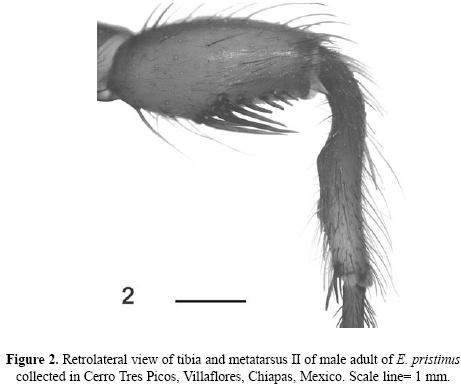
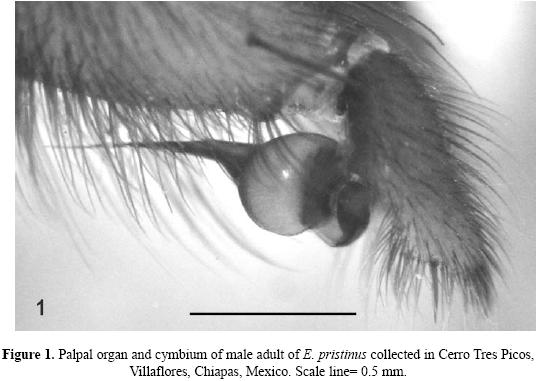
<body><![CDATA[<p align="justify"><font face="verdana" size="2"><b>Material examined: </b>MEXICO: Chiapas: one male adult from Cerro Tres Picos (16&deg; 11' 57.6" N, 93&deg; 36' 05.7" W, elevation 1900m), Municipio de Villaflores, Chiapas, evergreen cloud forest, collected with pitfall trap laid from 16/02/2008 to 14/03/2008, (Colls. K. Z&aacute;rate G&aacute;lvez, C. A. P&eacute;rez Bonifaz, G. Salinas P&eacute;rez and M. A. Lorena Acu&ntilde;a, CA&#150;UNICACH). Measurements: CL = 4.9 mm; ITS = 23; BD = 0.51 mm; PL = 1.28 mm; BD(100)/PL = 40.</font></p>     <p align="justify"><font face="verdana" size="2"><b>Genus diagnosis: </b><i>Euagrus </i>can be easily distinguished from other genera of Dipluridae by absence of maxillary cuspules, the males have the presence of spines on the tip on the cymbium (<a href="#f1">Fig. 1</a>), a prominent ventral median apophysis occupying the proximal half to two&#150;thirds of tibia II (<a href="#f2">Fig. 2</a>), two or three ventral keels on metatarsus II and patches of prominent curved spinules on opposing lateral surface of femora I and II (Coyle 1988).</font></p>     <p align="center"><font face="verdana" size="2"><a name="f1"></a></font></p>     <p align="center"><font face="verdana" size="2"><img src="/img/revistas/azm/v26n2/a12f1.jpg"></font></p>     <p align="center"><font face="verdana" size="2">&nbsp;</font></p>     <p align="center"><font face="verdana" size="2"><a name="f2"></a></font></p>     <p align="center"><font face="verdana" size="2"><img src="/img/revistas/azm/v26n2/a12f2.jpg"></font></p>     <p align="justify"><font face="verdana" size="2"><b>Species diagnosis: </b>male of <i>E. pristinus </i>can be distinguished from other <i>Euagrus </i>species by abdominal dorsum without prominent transverse light markings, no retrolateral preening comb on metatarsus II, palpal organ (<a href="#f1">Fig. 1</a>) rather elongated &#91;BD= 0.24&#150;0.54 mm, PL = 0.67&#150;1.30 mm, BD(100)/PL= 35&#150;43&#93;, usually have more ITS (16&#150;47) and body size usually larger (CL= 2.5&#150;5.8 mm). Ventral face of tibia II with two very long strong spines on apex of apophysis, and one or two shorter but moderately large spines just retrolateral and distal of these, occasionally one or two long slender spines on proximal slope of apophysis; distally after the apophysis, there are smaller spines regularly distributed (hardly ever with an area devoid of spines) along the ventral surface and these decrease gradually in length (<a href="#f2">Fig. 2</a>) (Coyle 1988).</font></p>     <p align="justify"><font face="verdana" size="2">&nbsp;</font></p>     <p align="justify"><font face="verdana" size="2"><b>ACKNOWLEDGEMENTS</b></font></p>     ]]></body>
<body><![CDATA[<p align="justify"><font face="verdana" size="2">We thank F. A. Coyle who kindly sent us his papers, to A. Valdez&#150;Mondrag&oacute;n, C. R. Lucio&#150;Palacio and two anonymous reviewers for their comments and revision of this work. Field work assistance was provided by G. Salinas&#150;P&eacute;rez and M. A. Lorena&#150;Acu&ntilde;a, as well as people from Nueva Independencia, Villaflores. To J. Murg&iacute;a&#150;Gonz&aacute;lez, I. Landero&#150;Torres and C. M. Gal&aacute;n&#150;P&aacute;ez (Facultad de Ciencias Biol&oacute;gicas y Agropecuarias, Regi&oacute;n Orizaba&#150;C&oacute;rdoba, Veracruz) for the access to the laboratory. This study was granted by FOMIX&#150;Chiapas (Fondo Mixto CONACYT &#150;Gobierno del Estado de Chiapas) through the project CHIS&#150;2006&#150;C06&#150;45752.</font></p>     <p align="justify"><font face="verdana" size="2">&nbsp;</font></p>     <p align="justify"><font face="verdana" size="2"><b>LITERATURE CITED</b></font></p>     <!-- ref --><p align="justify"><font face="verdana" size="2"><b>Cardoso C, M.D. </b>1979. <i>El clima de Chiapas y Tabasco. </i>Instituto de Geograf&iacute;a. UNAM. M&eacute;xico.    &nbsp;&nbsp;&nbsp;&nbsp;&nbsp;&nbsp;&nbsp;&nbsp;[&#160;<a href="javascript:void(0);" onclick="javascript: window.open('/scielo.php?script=sci_nlinks&ref=366925&pid=S0065-1737201000020001200001&lng=','','width=640,height=500,resizable=yes,scrollbars=1,menubar=yes,');">Links</a>&#160;]<!-- end-ref --></font></p>     <!-- ref --><p align="justify"><font face="verdana" size="2"><b>Coyle, F.A. </b>1988. A revision of the American funnel&#150;web mygalomorph spider genus <i>Euagrus </i>(Araneae, Dipluridae). <i>Bulletin of the American Museum of Natural History, </i>187(3):203&#150;292.    &nbsp;&nbsp;&nbsp;&nbsp;&nbsp;&nbsp;&nbsp;&nbsp;[&#160;<a href="javascript:void(0);" onclick="javascript: window.open('/scielo.php?script=sci_nlinks&ref=366927&pid=S0065-1737201000020001200002&lng=','','width=640,height=500,resizable=yes,scrollbars=1,menubar=yes,');">Links</a>&#160;]<!-- end-ref --></font></p>     <!-- ref --><p align="justify"><font face="verdana" size="2"><b>INE/SEMARNAP. </b>1999. <i>Programa de manejo de la Reserva de La Biosfera La Sepultura. </i>INE/SEMARNAP. M&eacute;xico, D. F.    &nbsp;&nbsp;&nbsp;&nbsp;&nbsp;&nbsp;&nbsp;&nbsp;[&#160;<a href="javascript:void(0);" onclick="javascript: window.open('/scielo.php?script=sci_nlinks&ref=366929&pid=S0065-1737201000020001200003&lng=','','width=640,height=500,resizable=yes,scrollbars=1,menubar=yes,');">Links</a>&#160;]<!-- end-ref --></font></p>     <!-- ref --><p align="justify"><font face="verdana" size="2"><b>Platnick, N.I </b>2009. <i>The world spider catalog, </i>version 9.5. American Museum of Natural History, online at <a href="http://research.amnh.org/iz/spiders/catalog/index.html" target="_blank">http://research.amnh.org/entomology/spiders/catalog/index.html</a></font>&nbsp;&nbsp;&nbsp;&nbsp;&nbsp;&nbsp;&nbsp;&nbsp;[&#160;<a href="javascript:void(0);" onclick="javascript: window.open('/scielo.php?script=sci_nlinks&ref=366931&pid=S0065-1737201000020001200004&lng=','','width=640,height=500,resizable=yes,scrollbars=1,menubar=yes,');">Links</a>&#160;]<!-- end-ref --> ]]></body><back>
<ref-list>
<ref id="B1">
<nlm-citation citation-type="book">
<person-group person-group-type="author">
<name>
<surname><![CDATA[Cardoso]]></surname>
<given-names><![CDATA[C, M.D.]]></given-names>
</name>
</person-group>
<source><![CDATA[El clima de Chiapas y Tabasco]]></source>
<year>1979</year>
<publisher-name><![CDATA[Instituto de Geografía. UNAM]]></publisher-name>
</nlm-citation>
</ref>
<ref id="B2">
<nlm-citation citation-type="journal">
<person-group person-group-type="author">
<name>
<surname><![CDATA[Coyle]]></surname>
<given-names><![CDATA[F.A.]]></given-names>
</name>
</person-group>
<article-title xml:lang="en"><![CDATA[A revision of the American funnel-web mygalomorph spider genus Euagrus (Araneae, Dipluridae)]]></article-title>
<source><![CDATA[Bulletin of the American Museum of Natural History]]></source>
<year>1988</year>
<volume>187</volume>
<numero>3</numero>
<issue>3</issue>
<page-range>203-292</page-range></nlm-citation>
</ref>
<ref id="B3">
<nlm-citation citation-type="book">
<collab>INE/SEMARNAP</collab>
<source><![CDATA[Programa de manejo de la Reserva de La Biosfera La Sepultura]]></source>
<year>1999</year>
<publisher-loc><![CDATA[México^eD. F. D. F.]]></publisher-loc>
<publisher-name><![CDATA[INE/SEMARNAP]]></publisher-name>
</nlm-citation>
</ref>
<ref id="B4">
<nlm-citation citation-type="book">
<person-group person-group-type="author">
<name>
<surname><![CDATA[Platnick]]></surname>
<given-names><![CDATA[N.I]]></given-names>
</name>
</person-group>
<source><![CDATA[The world spider catalog]]></source>
<year>2009</year>
<publisher-name><![CDATA[American Museum of Natural History]]></publisher-name>
</nlm-citation>
</ref>
</ref-list>
</back>
</article>