<?xml version="1.0" encoding="ISO-8859-1"?><article xmlns:mml="http://www.w3.org/1998/Math/MathML" xmlns:xlink="http://www.w3.org/1999/xlink" xmlns:xsi="http://www.w3.org/2001/XMLSchema-instance">
<front>
<journal-meta>
<journal-id>0065-1737</journal-id>
<journal-title><![CDATA[Acta zoológica mexicana]]></journal-title>
<abbrev-journal-title><![CDATA[Acta Zool. Mex]]></abbrev-journal-title>
<issn>0065-1737</issn>
<publisher>
<publisher-name><![CDATA[Instituto de Ecología A.C.]]></publisher-name>
</publisher>
</journal-meta>
<article-meta>
<article-id>S0065-17372010000100015</article-id>
<title-group>
<article-title xml:lang="en"><![CDATA[Taxonomic notes on the tribe Acridini Latreille (Acridinae: Acrididae: Orthoptera) of Kashmir, India]]></article-title>
</title-group>
<contrib-group>
<contrib contrib-type="author">
<name>
<surname><![CDATA[NAYYAR AZIM]]></surname>
<given-names><![CDATA[M.]]></given-names>
</name>
<xref ref-type="aff" rid="A01"/>
</contrib>
<contrib contrib-type="author">
<name>
<surname><![CDATA[RESHI]]></surname>
<given-names><![CDATA[Shabir A.]]></given-names>
</name>
<xref ref-type="aff" rid="A01"/>
</contrib>
</contrib-group>
<aff id="A01">
<institution><![CDATA[,Department of Zoology, University of Kashmir Section of Entomology ]]></institution>
<addr-line><![CDATA[Srinagar ]]></addr-line>
<country>INDIA</country>
</aff>
<pub-date pub-type="pub">
<day>00</day>
<month>04</month>
<year>2010</year>
</pub-date>
<pub-date pub-type="epub">
<day>00</day>
<month>04</month>
<year>2010</year>
</pub-date>
<volume>26</volume>
<numero>1</numero>
<fpage>219</fpage>
<lpage>222</lpage>
<copyright-statement/>
<copyright-year/>
<self-uri xlink:href="http://www.scielo.org.mx/scielo.php?script=sci_arttext&amp;pid=S0065-17372010000100015&amp;lng=en&amp;nrm=iso"></self-uri><self-uri xlink:href="http://www.scielo.org.mx/scielo.php?script=sci_abstract&amp;pid=S0065-17372010000100015&amp;lng=en&amp;nrm=iso"></self-uri><self-uri xlink:href="http://www.scielo.org.mx/scielo.php?script=sci_pdf&amp;pid=S0065-17372010000100015&amp;lng=en&amp;nrm=iso"></self-uri></article-meta>
</front><body><![CDATA[ <p align="justify"><font face="verdana" size="4">Notas cient&iacute;ficas</font></p>     <p align="center"><font face="verdana" size="2">&nbsp;</font></p>     <p align="center"><font face="verdana" size="4"><b>Taxonomic notes on the tribe Acridini Latreille (Acridinae: Acrididae: Orthoptera) of Kashmir, India</b></font></p>     <p align="center"><font face="verdana" size="2">&nbsp;</font></p>     <p align="center"><font face="verdana" size="2"><b>M. NAYYAR AZIM and Shabir A. RESHI</b></font></p>     <p align="justify"><font face="verdana" size="2">&nbsp;</font></p>     <p align="justify"><font face="verdana" size="2"><i>Section of Entomology, P.G. Department of Zoology, University of Kashmir, Srinagar&#150;190006 (J &amp; K), INDIA. E&#150;mail:</i> <a href="mailto:mnayyarazim@yahoo.com">mnayyarazim@yahoo.com</a></font></p>     <p align="justify"><font face="verdana" size="2">&nbsp;</font></p>     <p align="justify"><font face="verdana" size="2">Recibido: 11/05/2009    <br> Aceptado: 18/09/2009</font></p>     ]]></body>
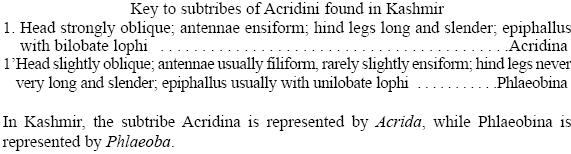
<body><![CDATA[<p align="justify"><font face="verdana" size="2">&nbsp;</font></p>     <p align="justify"><font face="verdana" size="2"><b>ABSTRACT</b></font></p>     <p align="justify"><font face="verdana" size="2">The tribe Acridini Latreille is redefined. Keys to subtribes and species where necessary are given. The genera and species are redefined along with the list of synonymies.</font></p>     <p align="justify"><font face="verdana" size="2">&nbsp;</font></p>     <p align="justify"><font face="verdana" size="2"><b>Tribe Acridini Latreille</b></font></p>     <p align="justify"><font face="verdana" size="2"><b>Diagnosis</b>: Body usually slender; pronotum usually with median and lateral carinae; tegmina and wings fully developed; spurious median vein of tegmina usually absent; prosternal process usually absent; femoro&#150;tegminal stridulatory mechanism absent; hind femur without row of modified peg like structures at lower edge of inner surface; male with epiphallus bridge shaped having ancorae and lophi, aedeagus with basal apical valves connected by flexure. Members falling under two subtribes of Acridini are found in Kashmir.</font></p>     <p align="center"><font face="verdana" size="2"><img src="/img/revistas/azm/v26n1/a15c1.jpg"></font></p>     <p align="justify"><font face="verdana" size="2">Genus <i>Acrida </i>Linnaeus.    <br>   <i>Gryllus </i>(<i>Acrida</i>) Linnaeus, 1758. <i>Syst. Nat</i>. (10<sup>th</sup> ed.), 1: 427.    <br> Type&#150;species: <i>Gryllus (Acrida) turritus </i>Linnaeus</font></p>     ]]></body>
<body><![CDATA[<p align="justify"><font face="verdana" size="2">The genus can be distinguished on the basis of the following characters: Large sized insects; body elongated, almost stick&#150;like; head elongated,conical antennae ensiform, gradually tapering to the apex; fastigium of vetex projecting strongly in front of eyes; fastigial foveolae absent; frontal ridge narrow, shallowly sulcate; pronotum elongate, dorsum crossed by posterior transverse sulcus only, median and lateral carinae low, but distinct; tegmina and wings fully developed with acute or obtuse apex; lobes of hind knee with acute to obtuse apices, upper inner lobe slightly longer than external; arolium moderately large, shorter than claw; male with supra&#150;anal plate triangular, cercus short, conical, subgenital plate conical, epiphallus with ancorae large, lophi bilobate; female with subgenital plate obtuse angular, weakly trilobite or almost truncate, ovipositor short, robust with robust and slightly curved valves.</font></p>     <p align="justify"><font face="verdana" size="2">The genus can easily be distinguished in having elongated stick&#150;like body and conical head.</font></p>     <p align="justify"><font face="verdana" size="2">The genus is represented by three species in Kashmir.</font></p>     <p align="center"><font face="verdana" size="2"><img src="/img/revistas/azm/v26n1/a15c2.jpg"></font></p>     <p align="justify"><font face="verdana" size="2"><i>Acrida gigantea </i>(Herbst)    <br>   <i>Truxalis giganteus </i>Herbst, 1794. <i>Fuessfy Archiv., </i>173.    <br>   <i>Acrida gigantea </i>Kirby, 1910. <i>Syn. Cat. Orth. </i>3(2):93.</font></p>     <p align="justify"><font face="verdana" size="2">The characters of the species are same as described by Kirby (1914) except color which is brownish.</font></p>     <p align="justify"><font face="verdana" size="2"><b>Material examined</b>: 3<img src="/img/revistas/azm/v26n1/a8s2.jpg">, 5<img src="/img/revistas/azm/v26n1/a8s1.jpg">, Kashmir, Baramulla, Uri, Chandanwari on Maize, 9.ix.2006 (Shabir A. Reshi).</font></p>     <p align="justify"><font face="verdana" size="2"><i>Acrida exaltata </i>(Walker)    ]]></body>
<body><![CDATA[<br>   <i>Truxalis exaltata </i>Walker, 1859. <i>Ann. mag. nat. Hist., </i>4(3):222.    <br>   <i>Truxalis brevicollis </i>Bolivar, 1893. <i>Feuille Jeunes nat., </i>27(8): 162.    <br>   <i>Acrida lugubris </i>Burr.,1902. <i>Trans. R. ent. Soc. Lond., </i>2:170.    <br>   <i>Acrida curta </i>Uvarov, 1936. <i>Linn. Journ. Zool., </i>39:536.</font></p>     <p align="justify"><font face="verdana" size="2">The characters are same as described by Kirby (1914). The genitalic characters are as follows: Male subgenital plate long and pointed; female subgenital plate with posterior margin setose, dorsal valve of ovipositor shorter than lateral apodeme, spermatheca with apical diverticulum well developed, pre&#150;apical diverticulum sac like.</font></p>     <p align="justify"><font face="verdana" size="2"><b>Material examined</b>: 4<img src="/img/revistas/azm/v26n1/a8s2.jpg">, 7<img src="/img/revistas/azm/v26n1/a8s1.jpg">, Kashmir, Kupwara, Karnah, Gundi Gujran on grass, 6.ix.2005 (Shabir A. Reshi); 11<img src="/img/revistas/azm/v26n1/a8s2.jpg">, 7<img src="/img/revistas/azm/v26n1/a8s1.jpg">, Srinagar, Dachigam National Park on grass, 21.ix.2005 (Shabir A. Reshi); 11<img src="/img/revistas/azm/v26n1/a8s2.jpg">, 9<img src="/img/revistas/azm/v26n1/a8s1.jpg">, Baramulla, Uri, Chandanwari on maize, 9.ix. 2006 (Shabir A. Reshi).</font></p>     <p align="justify"><font face="verdana" size="2"><i>Acrida lugubris </i>Burr. (Junior synonymy of <i>Acrida exaltata </i>(Walker, 1859)    <br>   <i>Acrida ligubris </i>Burr., 1902. <i>Trans. ent. soc. Lond., </i>157, 170.</font></p>     <p align="justify"><font face="verdana" size="2">It is a junior synonymy of <i>Acrida exaltata </i>Walker. However Kirby (1914) and Sharma &amp; Gupta (1997) did not treat this as a synonymy of <i>A. exaltata.</i></font></p>     <p align="justify"><font face="verdana" size="2">The species was recorded from Kashmir by Kirby (1914) and Sharma and Gupta (1997) recently recorded it from Jammu region of the state. However, the present authors could not collect any specimen of the species.</font></p>     ]]></body>
<body><![CDATA[<p align="justify"><font face="verdana" size="2">Genus <i>Phlaeoba </i>Stal    <br>   <i>Phlaeoba </i>Stal, 1860. <i>Eugenie's Res. Orth, </i>360.    <br>   <i>Kirbyella </i>Bolivar, 1909. <i>Bol.soc.Esp.hist.nat.,</i> 9:289.<i>    <br>   </i>Type&#150;species: <i>Gomphocerus rusticus </i>Stal.</font></p>     <p align="justify"><font face="verdana" size="2">The genus can be distinguished on the basis of the following characters: Smaller insects; head short; antennae shorter as long as or longer than the combined length of head and pronotum together, basal half widened and flattened; fastigium of vertex short, slightly projecting forward, widely angular, wider than long with distinct median carinula; fastigial foveolae absent; frontal ridge shallowly sulcate from base of antennae; pronotum with posterior margin rounded, median and lateral carinae distinct, lateral carinae parallel, median carina intersected by posterior transverse sulcus only, metazona shorter than prozona; tegmina and wings fully developed, as long as or longer than abdomen or lobiform; hind femur as long as or slightly exceeding tip of abdomen; arolium large; male with supra&#150;anal plate angular, cerci short, conical, subgenital plate short, subconical with obtuse apex, epiphallus bridge shaped, ancorae short, lophi bilobate; female with ovipositor valves long and slightly curved.</font></p>     <p align="justify"><font face="verdana" size="2">The genus is represented by a single species in Kashmir.</font></p>     <p align="justify"><font face="verdana" size="2"><i>Phlaeoba tenebrosa </i>(Walker)    <br>   <i>Opomala tenebrosa </i>Walker, 1871. <i>Cat. Derm. Salt. Brit. Mus. Lond.,</i>5:53.<i>    <br> Phlaeoba tenebrosa </i>(Walker), Uvarov, 1924. <i>J. Asiatic Soc. Bengal, </i>20:318.</font></p>     <p align="justify"><font face="verdana" size="2">The species was recorded from Kashmir by Bei&#150;Bienko and Mishchenko (1951). The present authors could not collect any specimen of the species from the region.</font></p>     ]]></body>
<body><![CDATA[<p align="justify"><font face="verdana" size="2">&nbsp;</font></p>     <p align="justify"><font face="verdana" size="2"><b>ACKNOWLEDGEMENTS</b></font></p>     <p align="justify"><font face="verdana" size="2">The authors are greatly indebted to Prof. Ghulam Mustafa Shah, Head, P. G. Department of Zoology, University of Kashmir, Srinagar, for providing research facilities. One of us SAR is thankful to the state government authorities for granting permission to visit the disturbed and restricted areas of the state for the collection of grasshoppers.</font></p>     <p align="justify"><font face="verdana" size="2">&nbsp;</font></p>     <p align="justify"><font face="verdana" size="2"><b>LITERATURE CITED</b></font></p>     <!-- ref --><p align="justify"><font face="verdana" size="2"><b>Bei&#150;Bienko, G. Y. &amp; Mishchenko, L. L. </b>1951. <i>Locusts and grasshoppers of USSR and adjacent countries. </i>Vols.1&#150;2. Israel Program for scientific translations. Jerusalem. 691pp.</font>&nbsp;&nbsp;&nbsp;&nbsp;&nbsp;&nbsp;&nbsp;&nbsp;[&#160;<a href="javascript:void(0);" onclick="javascript: window.open('/scielo.php?script=sci_nlinks&ref=362688&pid=S0065-1737201000010001500001&lng=','','width=640,height=500,resizable=yes,scrollbars=1,menubar=yes,');">Links</a>&#160;]<!-- end-ref --><!-- ref --><p align="justify"><font face="verdana" size="2"><b>Kirby, W. F. </b>1914. <i>The fauna of British India including Ceylon and Burma Orthoptera (Acrididae). </i>Today &amp; Tomorrow's Printers &amp; Publishers, New Delhi. 276pp.</font>&nbsp;&nbsp;&nbsp;&nbsp;&nbsp;&nbsp;&nbsp;&nbsp;[&#160;<a href="javascript:void(0);" onclick="javascript: window.open('/scielo.php?script=sci_nlinks&ref=362689&pid=S0065-1737201000010001500002&lng=','','width=640,height=500,resizable=yes,scrollbars=1,menubar=yes,');">Links</a>&#160;]<!-- end-ref --><!-- ref --><p align="justify"><font face="verdana" size="2"><b>Sharma, B. &amp; Gupta, N. </b>1997. Identification key to the short horned grasshoppers (Othoptera:Acrididae) from sub&#150;Shivalik plains of Jammu. <i>Journal of Insect Science, </i>10(1):5&#150;7.</font>&nbsp;&nbsp;&nbsp;&nbsp;&nbsp;&nbsp;&nbsp;&nbsp;[&#160;<a href="javascript:void(0);" onclick="javascript: window.open('/scielo.php?script=sci_nlinks&ref=362690&pid=S0065-1737201000010001500003&lng=','','width=640,height=500,resizable=yes,scrollbars=1,menubar=yes,');">Links</a>&#160;]<!-- end-ref --> ]]></body><back>
<ref-list>
<ref id="B1">
<nlm-citation citation-type="book">
<person-group person-group-type="author">
<name>
<surname><![CDATA[Bei-Bienko]]></surname>
<given-names><![CDATA[G. Y.]]></given-names>
</name>
<name>
<surname><![CDATA[Mishchenko]]></surname>
<given-names><![CDATA[L. L.]]></given-names>
</name>
</person-group>
<source><![CDATA[Locusts and grasshoppers of USSR and adjacent countries: Vols.1-2]]></source>
<year>1951</year>
<page-range>691</page-range><publisher-loc><![CDATA[Jerusalem ]]></publisher-loc>
<publisher-name><![CDATA[Israel Program for scientific translations]]></publisher-name>
</nlm-citation>
</ref>
<ref id="B2">
<nlm-citation citation-type="book">
<person-group person-group-type="author">
<name>
<surname><![CDATA[Kirby]]></surname>
<given-names><![CDATA[W. F.]]></given-names>
</name>
</person-group>
<source><![CDATA[The fauna of British India including Ceylon and Burma Orthoptera (Acrididae)]]></source>
<year>1914</year>
<page-range>276</page-range><publisher-loc><![CDATA[New Delhi ]]></publisher-loc>
<publisher-name><![CDATA[Today & Tomorrow's Printers & Publishers]]></publisher-name>
</nlm-citation>
</ref>
<ref id="B3">
<nlm-citation citation-type="journal">
<person-group person-group-type="author">
<name>
<surname><![CDATA[Sharma]]></surname>
<given-names><![CDATA[B.]]></given-names>
</name>
<name>
<surname><![CDATA[Gupta]]></surname>
<given-names><![CDATA[N.]]></given-names>
</name>
</person-group>
<article-title xml:lang="en"><![CDATA[Identification key to the short horned grasshoppers (Othoptera:Acrididae) from sub-Shivalik plains of Jammu]]></article-title>
<source><![CDATA[Journal of Insect Science]]></source>
<year>1997</year>
<volume>10</volume>
<numero>1</numero>
<issue>1</issue>
<page-range>5-7</page-range></nlm-citation>
</ref>
</ref-list>
</back>
</article>
