<?xml version="1.0" encoding="ISO-8859-1"?><article xmlns:mml="http://www.w3.org/1998/Math/MathML" xmlns:xlink="http://www.w3.org/1999/xlink" xmlns:xsi="http://www.w3.org/2001/XMLSchema-instance">
<front>
<journal-meta>
<journal-id>0065-1737</journal-id>
<journal-title><![CDATA[Acta zoológica mexicana]]></journal-title>
<abbrev-journal-title><![CDATA[Acta Zool. Mex]]></abbrev-journal-title>
<issn>0065-1737</issn>
<publisher>
<publisher-name><![CDATA[Instituto de Ecología A.C.]]></publisher-name>
</publisher>
</journal-meta>
<article-meta>
<article-id>S0065-17372009000300005</article-id>
<title-group>
<article-title xml:lang="es"><![CDATA[Almacenamiento de espermatozoides en la vagina de la lagartija vivípara Sceloporus torquatus (Sauria: Prhynosomatidae)]]></article-title>
<article-title xml:lang="en"><![CDATA[Sperm storage in the vagina of the viviparous lizard Sceloporus torquatus (Sauria: Prhynosomatidae)]]></article-title>
</title-group>
<contrib-group>
<contrib contrib-type="author">
<name>
<surname><![CDATA[MARTÍNEZ-TORRES]]></surname>
<given-names><![CDATA[Martín]]></given-names>
</name>
<xref ref-type="aff" rid="A01"/>
</contrib>
</contrib-group>
<aff id="A01">
<institution><![CDATA[,Universidad Nacional Autónoma de México Facultad de Estudios Superiores Iztacala Laboratorio de Biología de la Reproducción-UMF]]></institution>
<addr-line><![CDATA[Tlalnepantla Estado de México]]></addr-line>
<country>MÉXICO</country>
</aff>
<pub-date pub-type="pub">
<day>00</day>
<month>12</month>
<year>2009</year>
</pub-date>
<pub-date pub-type="epub">
<day>00</day>
<month>12</month>
<year>2009</year>
</pub-date>
<volume>25</volume>
<numero>3</numero>
<fpage>497</fpage>
<lpage>506</lpage>
<copyright-statement/>
<copyright-year/>
<self-uri xlink:href="http://www.scielo.org.mx/scielo.php?script=sci_arttext&amp;pid=S0065-17372009000300005&amp;lng=en&amp;nrm=iso"></self-uri><self-uri xlink:href="http://www.scielo.org.mx/scielo.php?script=sci_abstract&amp;pid=S0065-17372009000300005&amp;lng=en&amp;nrm=iso"></self-uri><self-uri xlink:href="http://www.scielo.org.mx/scielo.php?script=sci_pdf&amp;pid=S0065-17372009000300005&amp;lng=en&amp;nrm=iso"></self-uri><abstract abstract-type="short" xml:lang="es"><p><![CDATA[Las hembras de muchas especies de lagartijas tienen la capacidad de almacenar espermatozoides en un sistema de túbulos especiales presentes en la vagina. Sin embargo, en otras especies los espermatozoides se almacenan en el infundíbulo. Se utilizó una técnica sencilla y rápida para determinar sí la vagina de Sceloporus torquatus tiene la capacidad de almacenar espermatozoides. En las hembras de esta especie, los espermatozoides son retenidos al menos 167 días en un sistema de túbulos especiales localizados en la vagina. La cantidad de espermatozoides presentes en los lavados vaginales disminuyó gradualmente a partir de diciembre y su desaparición ocurrió en la preñez tardía. Los espermatozoides ascienden al útero e infundíbulo antes de que ocurra la ovulación, sin embargo, en estos órganos no existen estructuras especiales para almacenar espermatozoides.]]></p></abstract>
<abstract abstract-type="short" xml:lang="en"><p><![CDATA[Females of many lizard species are able to store sperm in a special system of tubules present in the vagina. However, in other species sperm storage occurs in the infundibulum. A quick and simple technique to determine if the vagina of Sceloporus torquatus has the capacity to store sperm was used. In this species the spermatozoa are retained at least during 167 days after mating in a special system of tubules located in the vagina. The amount of spermatozoa observed through vaginal flushing was reduced gradually from December on and the spermatozoa disappeared in late pregnancy. The spermatozoa reached the uterus and infundibulum before ovulation started; however, in these organs there are no special structures for sperm storage.]]></p></abstract>
<kwd-group>
<kwd lng="es"><![CDATA[Retención de espermatozoides]]></kwd>
<kwd lng="es"><![CDATA[reptiles]]></kwd>
<kwd lng="es"><![CDATA[aparato reproductor]]></kwd>
<kwd lng="en"><![CDATA[Sperm retention]]></kwd>
<kwd lng="en"><![CDATA[reptiles]]></kwd>
<kwd lng="en"><![CDATA[reproductive tract]]></kwd>
</kwd-group>
</article-meta>
</front><body><![CDATA[ <p align="justify"><font face="verdana" size="4">Art&iacute;culos originales</font></p>     <p align="center"><font face="verdana" size="2">&nbsp;</font></p>     <p align="center"><font face="verdana" size="4"><b>Almacenamiento de espermatozoides en la vagina de la lagartija viv&iacute;para <i>Sceloporus torquatus</i> (Sauria: Prhynosomatidae)</b></font></p>     <p align="center"><font face="verdana" size="2">&nbsp;</font></p>     <p align="center"><font face="verdana" size="3"><b>Sperm storage in the vagina of the viviparous lizard <i>Sceloporus torquatus</i> (Sauria: Prhynosomatidae)</b></font></p>     <p align="center"><font face="verdana" size="2">&nbsp;</font></p>     <p align="center"><font face="verdana" size="2"><b>Mart&iacute;n MART&Iacute;NEZ&#150;TORRES</b></font></p>     <p align="justify"><font face="verdana" size="2">&nbsp;</font></p>     <p align="justify"><font face="verdana" size="2"><i>Laboratorio de Biolog&iacute;a de la Reproducci&oacute;n&#150;UMF, Facultad de Estudios Superiores Iztacala, Universidad Nacional Aut&oacute;noma de M&eacute;xico. Av. de los Barrios #1, Los Reyes Iztacala C. P. 54090, Tlalnepantla A. P. 314, Estado de M&eacute;xico, M&Eacute;XICO.</i> <a href="mailto:martor@servidor.unam.mx">martor@servidor.unam.mx</a></font></p>     <p align="justify"><font face="verdana" size="2">&nbsp;</font></p>     ]]></body>
<body><![CDATA[<p align="justify"><font face="verdana" size="2">Recibido: 26/06/2008    <br>   Aceptado: 12/08/2009</font></p>     <p align="justify"><font face="verdana" size="2">&nbsp;</font></p>     <p align="justify"><font face="verdana" size="2"><b>RESUMEN</b></font></p>     <p align="justify"><font face="verdana" size="2">Las hembras de muchas especies de lagartijas tienen la capacidad de almacenar espermatozoides en un sistema de t&uacute;bulos especiales presentes en la vagina. Sin embargo, en otras especies los espermatozoides se almacenan en el infund&iacute;bulo. Se utiliz&oacute; una t&eacute;cnica sencilla y r&aacute;pida para determinar s&iacute; la vagina de <i>Sceloporus torquatus </i>tiene la capacidad de almacenar espermatozoides. En las hembras de esta especie, los espermatozoides son retenidos al menos 167 d&iacute;as en un sistema de t&uacute;bulos especiales localizados en la vagina. La cantidad de espermatozoides presentes en los lavados vaginales disminuy&oacute; gradualmente a partir de diciembre y su desaparici&oacute;n ocurri&oacute; en la pre&ntilde;ez tard&iacute;a. Los espermatozoides ascienden al &uacute;tero e infund&iacute;bulo antes de que ocurra la ovulaci&oacute;n, sin embargo, en estos &oacute;rganos no existen estructuras especiales para almacenar espermatozoides. </font></p>     <p align="justify"><font face="verdana" size="2"><b>Palabras clave: </b>Retenci&oacute;n de espermatozoides, reptiles, aparato reproductor.</font></p>     <p align="justify"><font face="verdana" size="2">&nbsp;</font></p>     <p align="justify"><font face="verdana" size="2"><b>ABSTRACT. </b>Females of many lizard species are able to store sperm in a special system of tubules present in the vagina. However, in other species sperm storage occurs in the infundibulum. A quick and simple technique to determine if the vagina of<i> Sceloporus torquatus </i>has the capacity to store sperm was used. In this species the spermatozoa are retained at least during 167 days after mating in a special system of tubules located in the vagina. The amount of spermatozoa observed through vaginal flushing was reduced gradually from December on and the spermatozoa disappeared in late pregnancy. The spermatozoa reached the uterus and infundibulum before ovulation started; however, in these organs there are no special structures for sperm storage. </font></p>     <p align="justify"><font face="verdana" size="2"><b>Key words:</b> Sperm retention, reptiles, reproductive tract.</font></p>     <p align="justify"><font face="verdana" size="2">&nbsp;</font></p>     ]]></body>
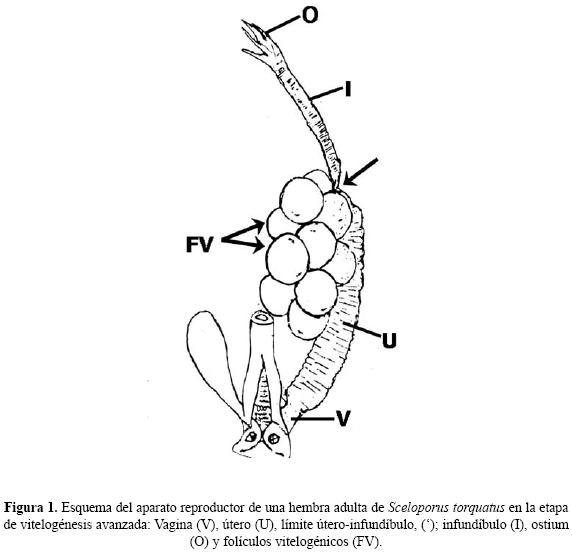
<body><![CDATA[<p align="justify"><font face="verdana" size="2"><b>INTRODUCCI&Oacute;N</b></font></p>     <p align="justify"><font face="verdana" size="2">Las hembras de muchas especies de reptiles tienen la capacidad de almacenar espermatozoides en alguna regi&oacute;n del aparato reproductor (Sever &amp; Hamlett 2002). Particularmente se ha observado que entre los pliegues de la vagina de diversos saurios se presenta un sistema de t&uacute;bulos especiales para almacenar espermatozoides (STEAE) (Saint&#150;Girons 1962, Fox 1963, Cuellar 1966a). Sin embargo, en algunas especies de lagartijas <i>(Phyllodactylus homolepidurus, Coleonyx variegatus, </i>Cuellar 1966a) y serpientes <i>(Thamnophis sirtalis </i>Hoffman &amp; Winsatt 1972, <i>Agkistrodon piscivorus, </i>Siegel &amp; Sever 2008) se ha observado que en el infund&iacute;bulo tambi&eacute;n existe este STEAE. En cambio, en las tortugas los espermatozoides se almacenan en t&uacute;bulos ubicados en la regi&oacute;n secretora del albumen y en el &uacute;tero <i>(Gopherus polyphemus, </i>Palmer &amp; Guillette 1988, <i>Sternotherus odoratus, Chrysemys picta, Trachemys scripta, </i>Gist &amp; Congdon 1998) mientras que en el caim&aacute;n <i>(Alligator mississipiensis) </i>la hembra almacena espermatozoides en la uni&oacute;n del &uacute;tero y la vagina as&iacute; como en el l&iacute;mite de la regi&oacute;n del istmo (Gist <i>et al. </i>2008). En los saurios, el tiempo de almacenamiento de espermatozoides puede variar desde cuatro semanas, como en <i>Eumeces egregios </i>(Shaefer &amp; Roeding 1973) hasta nueve meses, como en <i>Chamaeleo hoehnelii </i>(Jun&#150;Yi 1982).</font></p>     <p align="justify"><font face="verdana" size="2">Los m&eacute;todos utilizados por diversos investigadores para determinar la capacidad de las hembras de reptiles para retener espermatozoides son fundamentalmente dos y consisten en: (1) mantenerlas aisladas de machos y observar el n&uacute;mero de puestas o camadas f&eacute;rtiles (Cuellar 1966b, Jun&#150;Yi 1982, Villaverde &amp; Zucker 1998) y (2) sacrificarlas a diferentes tiempos durante la gestaci&oacute;n y realizar cortes histol&oacute;gicos de la vagina y/o del infund&iacute;bulo y determinar la presencia de espermatozoides (Cuellar 1966a, Shaefer &amp; Roeding 1973, King 1977, Adams &amp; Cooper Jr. 1988).</font></p>     <p align="justify"><font face="verdana" size="2">En este estudio se utiliz&oacute; una t&eacute;cnica r&aacute;pida y sencilla para detectar la presencia de espermatozoides en la vagina de las hembras de <i>Sceloporus torquatus. </i>Adem&aacute;s, se describe la estructura histol&oacute;gica del sistema de t&uacute;bulos especiales para el almacenamiento de espermatozoides en la vagina de esta especie.</font></p>     <p align="justify"><font face="verdana" size="2">&nbsp;</font></p>     <p align="justify"><font face="verdana" size="2"><b>MATERIAL Y M&Eacute;TODOS</b></font></p>     <p align="justify"><font face="verdana" size="2"><b>Trabajo de campo. </b>Se capturaron 16 hembras adultas de <i>S. torquatus </i>(longitud hocico&#150;cloaca (mm): 8.5 &plusmn; 13 D.E.; peso corporal (g): 25.17&plusmn; 3.6 D.E.) en Cerro Gordo, San Juan Teotihuac&aacute;n (19&deg; 45' 3" N; 98&deg;, 49' 7" W) durante la tercera semana de septiembre (n = 4), octubre (n = 5) noviembre (n = 4) y diciembre (n = 3) de 2003. Una vez colectadas, las hembras fueron marcadas por el m&eacute;todo de ectomizaci&oacute;n de falanges e inmediatamente despu&eacute;s se procedi&oacute; a lavar la vagina de los organismos (<a href="#f1">Fig. 1</a>) usando una pipeta Pasteur con aproximadamente 200&micro;l de soluci&oacute;n salina fisiol&oacute;gica para reptil (cloruro de sodio al 0.7 %, Guillette 1982). La punta de la pipeta Pasteur se introdujo por la cloaca y se dirigi&oacute; hacia la vagina; una vez ubicada en este lugar se bombe&oacute; 3 a 4 veces la soluci&oacute;n e inmediatamente despu&eacute;s se recuper&oacute; una al&iacute;cuota y se deposit&oacute; en un portaobjetos. Se agreg&oacute; una gota de yodo&#150;lugol a la muestra y se procedi&oacute; a observarla a 10X y 40X para determinar la presencia de espermatozoides. En aquellas hembras en las cuales se observaron espermatozoides se revis&oacute; una segunda al&iacute;cuota sin yodo&#150;lugol para determinar si presentaban movilidad. Solamente una lagartija por mes, de las que presentaron espermatozoides, fue llevada al laboratorio para continuar con la revisi&oacute;n de manera peri&oacute;dica. El resto de los organismos fueron liberados una vez efectuados los lavados.</font></p>     <p align="center"><font face="verdana" size="2"><a name="f1"></a></font></p>     <p align="center"><font face="verdana" size="2"><img src="/img/revistas/azm/v25n3/a5f1.jpg"></font></p>     <p align="justify"><font face="verdana" size="2"><b>Trabajo de laboratorio. </b>Un total de cuatro hembras fueron mantenidas en cautiverio en terrarios de 136 x 89 x 54 cm, con temperatura y fotoperiodo natural y con acceso libre a alimento (larvas de <i>Tenebrio, </i>palomillas, grillos dom&eacute;sticos y chapulines) y agua. Estas lagartijas se sometieron a lavados vaginales cada dos semanas para determinar el tiempo de retenci&oacute;n de espermatozoides y una de estas hembras se sacrific&oacute; (25 de noviembre) para determinar la presencia de espermatozoides en el &uacute;tero y en el infund&iacute;bulo mediante el lavado de estas estructuras, as&iacute; como para establecer las caracter&iacute;sticas histol&oacute;gicas del sitio de almacenamiento de espermatozoides.</font></p>     ]]></body>
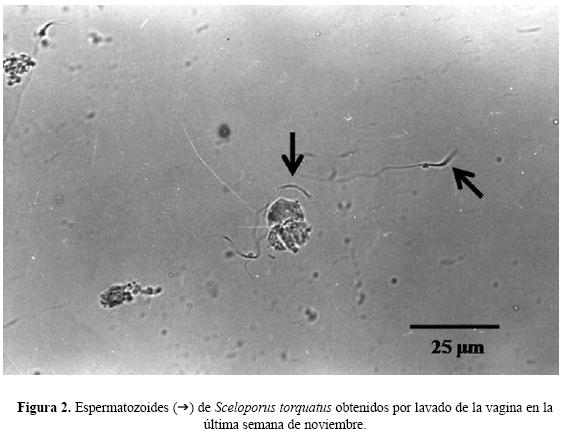
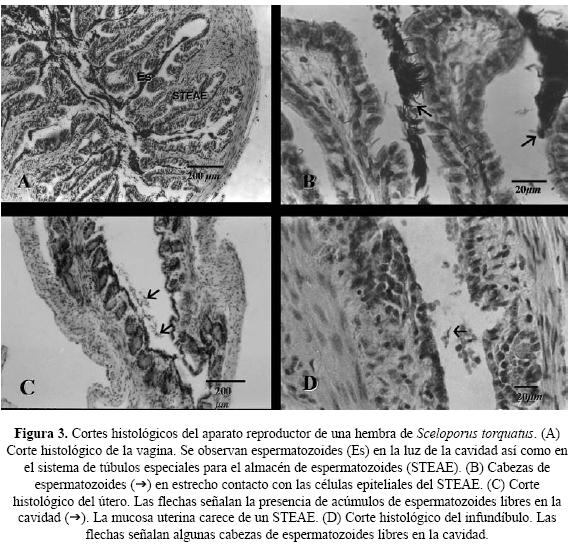
<body><![CDATA[<p align="justify"><font face="verdana" size="2">La hembra se sacrific&oacute; con una sobredosis de pentobarbital s&oacute;dico v&iacute;a intracardiaca y, previo a la fijaci&oacute;n de la vagina, el &uacute;tero y el infund&iacute;bulo derecho en el l&iacute;mite &uacute;tero&#150;vagina y &uacute;tero&#150;infund&iacute;bulo se ligaron con hilo nylon de 5 ceros (<a href="#f1">Fig. 1</a>) e inmediatamente despu&eacute;s fueron disecados y colocados en soluci&oacute;n fisiol&oacute;gica fr&iacute;a (4 &deg;C) para reptil. Se tom&oacute; el segmento uterino y se introdujo (por el lado de la ligadura) en la cavidad de este &oacute;rgano la punta de la aguja de una jeringa insul&iacute;nica que conten&iacute;a 500&micro;l<i> </i>de soluci&oacute;n fisiol&oacute;gica para reptil. En seguida se perfundi&oacute; el l&iacute;quido dentro de la cavidad y se recuper&oacute; el fluido por el lado opuesto de donde se insert&oacute; la aguja. El mismo procedimiento se aplic&oacute; al infund&iacute;bulo. Los lavados (del &uacute;tero e infund&iacute;bulo) fueron colocadas en un portaobjeto y se agreg&oacute; una gota de yodo&#150;lugol e inmediatamente despu&eacute;s fueron observadas al microscopio para determinar la presencia de espermatozoides.</font></p>     <p align="justify"><font face="verdana" size="2"><b>Histolog&iacute;a. </b>Inmediatamente despu&eacute;s que fueron removidos el &uacute;tero y el infund&iacute;bulo derecho, se procedi&oacute; a disecar la vagina (de ambos lados), as&iacute; como un segmento de la parte media del &uacute;tero y otro del infund&iacute;bulo izquierdo (de alrededor de 5 mm de longitud cada uno) y se fijaron en formol al 10 % amortiguado durante 24 horas. Despu&eacute;s de la fijaci&oacute;n los tejidos se deshidrataron con alcoholes graduales hasta etanol absoluto, se aclararon en xilol y se incluyeron en Paraplast. Se obtuvieron cortes de 7&micro;m de grosor, se desparafinaron y se ti&ntilde;eron con hematoxilina y eosina (Luna 1968). Finalmente se montaron con resina sint&eacute;tica, se observaron al microscopio para determinar la presencia del STEAE en la vagina, &uacute;tero o infund&iacute;bulo y/o de espermatozoides.</font></p>     <p align="justify"><font face="verdana" size="2">&nbsp;</font></p>     <p align="justify"><font face="verdana" size="2"><b>RESULTADOS</b></font></p>     <p align="justify"><font face="verdana" size="2">Espermatozoides en los lavados vaginales. En las hembras colectadas en septiembre no se observaron espermatozoides en los lavados vaginales, en cambio s&iacute; se detectaron en todas las hembras capturadas a partir del 20 de octubre. Los espermatozoides contenidos en los lavados vaginales de octubre y noviembre mostraron movilidad y se presentaron dispersos en la soluci&oacute;n fisiol&oacute;gica (<a href="#f2">Fig. 2</a>). A partir de diciembre se observaron espermatozoides inm&oacute;viles en los lavados vaginales. Tambi&eacute;n se detect&oacute; una disminuci&oacute;n gradual de estas c&eacute;lulas en los lavados a partir de diciembre hasta abril 4. A partir de esta fecha ya no se observaron espermatozoides en ninguno de los lavados vaginales, por lo que el tiempo de almacenamiento de espermatozoides en esta especie es de al menos 167 d&iacute;as.</font></p>     <p align="center"><font face="verdana" size="2"><a name="f2"></a></font></p>     <p align="center"><font face="verdana" size="2"><img src="/img/revistas/azm/v25n3/a5f2.jpg"></font></p>     <p align="justify"><font face="verdana" size="2">Espermatozoides en lo lavados de &uacute;tero e infund&iacute;bulo. En los lavados de &uacute;tero e infund&iacute;bulo tambi&eacute;n se detectaron espermatozoides, sin embargo, no se contaron.</font></p>     <p align="justify"><font face="verdana" size="2">Los espermatozoides se observaron &iacute;ntegros, pero no se pudo determinar su movilidad ya que se agreg&oacute; yodo&#150;lugol para observarlos y esta soluci&oacute;n los mata.</font></p>     <p align="justify"><font face="verdana" size="2">Histolog&iacute;a. En los cortes histol&oacute;gicos de la vagina se observ&oacute; la presencia de recept&aacute;culos seminales conteniendo espermatozoides. Estas estructuras se caracterizan por tener una mucosa con pliegues ramificados y limitados por epitelio cil&iacute;ndrico simple ciliado. Los espermatozoides fueron observados tanto en la luz de la vagina como en los pliegues (<a href="#f3">Fig. 3A</a>). Adem&aacute;s, en algunos lugares de estos recept&aacute;culos, se observ&oacute; que las cabezas de los espermatozoides estaban en contacto con las c&eacute;lulas epiteliales (<a href="#f3">Fig. 3B</a>).</font></p>     ]]></body>
<body><![CDATA[<p align="center"><font face="verdana" size="2"><a name="f3"></a></font></p>     <p align="center"><font face="verdana" size="2"><img src="/img/revistas/azm/v25n3/a5f3.jpg"></font></p>     <p align="justify"><font face="verdana" size="2">No se observaron recept&aacute;culos seminales en los cortes histol&oacute;gicos del &uacute;tero (<a href="#f3">Fig. 3C</a>) ni del infund&iacute;bulo (<a href="#f3">Fig. 3D</a>). Sin embargo, se detectaron abundantes espermatozoides libres en la luz del &uacute;tero, cerca del epitelio. Un conteo al microscopio demostr&oacute; m&aacute;s de cien espermatozoides en la cavidad uterina, muy cerca uno de otro (<a href="#f3">Fig. 3C</a>). En cambio en el infund&iacute;bulo fueron escasos, ya que se observaron s&oacute;lo cuatro cabezas de espermatozoides en los cortes histol&oacute;gicos de este &oacute;rgano (<a href="#f3">Fig. 3D</a>).</font></p>     <p align="justify"><font face="verdana" size="2">&nbsp;</font></p>     <p align="justify"><font face="verdana" size="2"><b>DISCUSI&Oacute;N</b></font></p>     <p align="justify"><font face="verdana" size="2">En este estudio se encontr&oacute; que las hembras de <i>S. torquatus </i>retienen espermatozoides en recept&aacute;culos seminales presentes en la vagina desde el momento del apareamiento hasta el &uacute;ltimo tercio de la gestaci&oacute;n. Los recept&aacute;culos donde estas lagartijas almacenan a los espermatozoides presentan caracter&iacute;sticas histol&oacute;gicas similares al STEAE de <i>Anolis carolinensis </i>descrito por Fox (1963). De esta manera, los recept&aacute;culos seminales donde las hembras de <i>S. torquatus </i>almacenan espermatozoides constituyen un verdadero STEAE.</font></p>     <p align="justify"><font face="verdana" size="2">El almacenaje de espermatozoides es una estrategia reproductora que permite el encuentro de los gametos (espermatozoides y ovocitos) en aquellas especies que: a) presentan ciclo reproductor asincr&oacute;nico entre los sexos (Cuellar 1966b, Smyth &amp; Smith 1968, Birkhead &amp; Moller 1993); b) los machos presentan baja movilidad o h&aacute;bitos solitarios (Bustard 1965); c) las hembras presentan una estaci&oacute;n reproductora prolongada o m&uacute;ltiples puestas (Conner &amp; Crews, 1980) y d) presentan desigualdad en la proporci&oacute;n de sexos (menos machos que hembras) (Jun&#150;Yi, 1982). <i>S. torquatus </i>es una lagartija viv&iacute;para que presenta un ciclo reproductor estacional anual asincr&oacute;nico entre hembras y machos, por lo que en esta especie el almacenaje de espermatozoides es una estrategia obligada para que pueda ocurrir la fecundaci&oacute;n. Feria&#150;Ortiz <i>et al. </i>(2001) observaron un intento de apareamiento en octubre en una poblaci&oacute;n del Pedregal de San &Aacute;ngel de la Ciudad de M&eacute;xico de <i>S. torquatus </i>y en este estudio se detectaron espermatozoides a partir de la &uacute;ltima semana de ese mes. Estas observaciones confirman que en esta lagartija el apareamiento ocurre en octubre y que las hembras almacenan espermatozoides m&aacute;s all&aacute; del momento de la fecundaci&oacute;n, ya que estos gametos fueron observados en lavados vaginales en la pre&ntilde;ez tard&iacute;a (4 de abril). En esta especie los nacimientos ocurren a finales de abril (Guillette &amp; M&eacute;ndez&#150;De la Cruz 1993).</font></p>     <p align="justify"><font face="verdana" size="2">Despu&eacute;s de la c&oacute;pula los espermatozoides entran en un ambiente donde las condiciones est&aacute;n determinadas por las secreciones del tracto genital de la hembra. En diversas especies de lagartijas (<i>Acanthodactylus scutellatus, </i>Bou&#150;Resli <i>et al. </i>1981; <i>Anolis sagrei, </i>Sever &amp; Hamlett 2002), serpientes (<i>Thamnophis sirtalis, </i>Hoffman &amp; Wimsatt 1972, <i>Seminatrix pygaea </i>Sever &amp; Ryan 1999) tortugas (Sarkar <i>et al. </i>2003) y cocodrilos (Gist <i>et al. </i>2008) existen c&eacute;lulas secretoras en los STEAE. Saint&#150;Girons (1975) sugiri&oacute; que en los reptiles estas secreciones son utilizadas como nutrientes por los espermatozoides y, adem&aacute;s, que su retenci&oacute;n en la vagina es necesaria para que los espermatozoides maduren. En el STEAE de <i>S. torquatus </i>no se observaron c&eacute;lulas secretoras, &uacute;nicamente se observaron c&eacute;lulas ciliadas, sin embargo, se desconoce si estas c&eacute;lulas liberan az&uacute;cares o alguna otra sustancia que permita la sobrevivencia de los espermatozoides por m&aacute;s de 5 meses. Por otro lado, en los cortes histol&oacute;gicos de la vagina de <i>S. torquatus </i>se observ&oacute; que los espermatozoides est&aacute;n en estrecho contacto con las c&eacute;lulas del epitelio vaginal. Esta condici&oacute;n sugiere que puede existir una interacci&oacute;n (por ejemplo, captaci&oacute;n de nutrientes del glucocalix de las c&eacute;lulas epiteliales) que permita que la viabilidad de los espermatozoides se mantenga por tiempos largos. En el h&aacute;mster (Smith &amp; Yanagimachi 1990, 1991) se ha observado que los espermatozoides que permanecen unidos a las c&eacute;lulas epiteliales tienen mayores tasas de sobrevivencia que aquellos que est&aacute;n libres en la cavidad. Aunque una situaci&oacute;n similar a la que aqu&iacute; se describe en <i>S. torquatus </i>ha sido observada en otras lagartijas (<i>Eumeces egregius, </i>Shaefer &amp; Roeding 1973; <i>Acanthodactylus scutellatus, </i>Bou&#150;Resli <i>et al. </i>1981; <i>Holbroquia propinqua, </i>Adams &amp; Cooper 1988) se desconoce s&iacute; en los reptiles existe una situaci&oacute;n similar a la que ocurre en los mam&iacute;feros.</font></p>     <p align="justify"><font face="verdana" size="2">Los mecanismos que regulan la liberaci&oacute;n de espermatozoides del STEAE y la migraci&oacute;n a las regiones superiores del oviducto han sido poco estudiadas en los reptiles. Halpert <i>et al. </i>(1982) sugirieron que en <i>Tamnophis sirtalis </i>las secreciones del epitelio vaginal facilitan el transporte de los espermatozoides al infund&iacute;bulo y en <i>S. torquatus </i>podr&iacute;a ocurrir una situaci&oacute;n similar. En los mam&iacute;feros (rat&oacute;n, rata, toro, conejo) es ampliamente conocido que las secreciones del &uacute;tero y del oviducto estimulan el metabolismo del espermatozoide (hiperactivaci&oacute;n, capacitaci&oacute;n etc.) (Chang 1951, Hogart 1978, Suarez 2008). Estos aspectos tampoco han sido estudiados en los reptiles y adem&aacute;s se desconoce la cantidad de espermatozoides que transitan por la cavidad uterina, si viajan de manera individual o en ac&uacute;mulos. Tambi&eacute;n se desconoce el n&uacute;mero de espermatozoides que llegan al infund&iacute;bulo. Los resultados del an&aacute;lisis histol&oacute;gico de este estudio con <i>S. torquatus </i>sugieren que algunos cientos de espermatozoides alcanzan el &uacute;tero. Es muy posible que transiten a trav&eacute;s del &uacute;tero formando ac&uacute;mulos, pues en los cortes histol&oacute;gicos se observ&oacute; que los espermatozoides estaban muy cerca unos de otros. En cambio, en los cortes histol&oacute;gicos del infund&iacute;bulo la presencia de espermatozoides fue m&iacute;nima, sugiriendo que solamente decenas alcanzan esta regi&oacute;n del oviducto.</font></p>     <p align="justify"><font face="verdana" size="2">&nbsp;</font></p>     ]]></body>
<body><![CDATA[<p align="justify"><font face="verdana" size="2"><b>AGRADECIMIENTOS</b></font></p>     <p align="justify"><font face="verdana" size="2">A Gloria S&aacute;nchez por su apoyo en la colecta de los organismos y mi mayor agradecimiento a los revisores an&oacute;nimos por el gran esfuerzo y entusiasmo al revisar este manuscrito.</font></p>     <p align="justify"><font face="verdana" size="2">&nbsp;</font></p>     <p align="justify"><font face="verdana" size="2"><b>LITERATURA CITADA</b></font></p>     <!-- ref --><p align="justify"><font face="verdana" size="2"><b>Adams, C. S. &amp; W. E. Cooper Jr. </b>1988. Oviductal morphology and sperm storage in the keelep earless lizard, <i>Holbrookia propinqua. Herpetologica, </i>44: 190&#150;197. </font>&nbsp;&nbsp;&nbsp;&nbsp;&nbsp;&nbsp;&nbsp;&nbsp;[&#160;<a href="javascript:void(0);" onclick="javascript: window.open('/scielo.php?script=sci_nlinks&ref=361087&pid=S0065-1737200900030000500001&lng=','','width=640,height=500,resizable=yes,scrollbars=1,menubar=yes,');">Links</a>&#160;]<!-- end-ref --><!-- ref --><p align="justify"><font face="verdana" size="2"><b>Birkhead, T. R. &amp; A. P. Moller. </b>1993. Sexual selection and the temporal separation of reproductive events: sperm storage data from reptiles, birds and mammals. <i>Biological Journal of the Linnean </i><i>Society, </i>50: 295&#150;311.</font>&nbsp;&nbsp;&nbsp;&nbsp;&nbsp;&nbsp;&nbsp;&nbsp;[&#160;<a href="javascript:void(0);" onclick="javascript: window.open('/scielo.php?script=sci_nlinks&ref=361088&pid=S0065-1737200900030000500002&lng=','','width=640,height=500,resizable=yes,scrollbars=1,menubar=yes,');">Links</a>&#160;]<!-- end-ref --><!-- ref --><p align="justify"><font face="verdana" size="2"><b>Bou&#150;Resli, M. N., N. L. F. Bishay &amp; N. S. Al&#150;Zaid. </b>1981. Observations on the fine structure of the sperm storage crypts in the lizard <i>Acnthodactylus scutellatus hardyi. Archives du Biologie (Bruxe</i><i>lles), </i>92: 287&#150;298. </font>&nbsp;&nbsp;&nbsp;&nbsp;&nbsp;&nbsp;&nbsp;&nbsp;[&#160;<a href="javascript:void(0);" onclick="javascript: window.open('/scielo.php?script=sci_nlinks&ref=361089&pid=S0065-1737200900030000500003&lng=','','width=640,height=500,resizable=yes,scrollbars=1,menubar=yes,');">Links</a>&#160;]<!-- end-ref --><!-- ref --><p align="justify"><font face="verdana" size="2"><b>Bustard, H. R. </b>1965. Observations of the life history and behavior of <i>Chamaleo hohnelli </i>(Steindachner). <i>Copeia, </i>1965: 401&#150;410. </font>&nbsp;&nbsp;&nbsp;&nbsp;&nbsp;&nbsp;&nbsp;&nbsp;[&#160;<a href="javascript:void(0);" onclick="javascript: window.open('/scielo.php?script=sci_nlinks&ref=361090&pid=S0065-1737200900030000500004&lng=','','width=640,height=500,resizable=yes,scrollbars=1,menubar=yes,');">Links</a>&#160;]<!-- end-ref --><!-- ref --><p align="justify"><font face="verdana" size="2"><b>Chang, M. C. </b>1951. Fertilizing capacity of spermatozoa deposited into the fallopian tubes. <i>Nature, </i>168: 697&#150;698. </font>&nbsp;&nbsp;&nbsp;&nbsp;&nbsp;&nbsp;&nbsp;&nbsp;[&#160;<a href="javascript:void(0);" onclick="javascript: window.open('/scielo.php?script=sci_nlinks&ref=361091&pid=S0065-1737200900030000500005&lng=','','width=640,height=500,resizable=yes,scrollbars=1,menubar=yes,');">Links</a>&#160;]<!-- end-ref --><!-- ref --><p align="justify"><font face="verdana" size="2"><b>Conner, J. &amp; D. Crews. </b>1980 Sperm transfer and storage in the lizard, <i>Anolis carolinensis. Journal of </i><i>Morphology, </i>163: 331&#150;348. </font>&nbsp;&nbsp;&nbsp;&nbsp;&nbsp;&nbsp;&nbsp;&nbsp;[&#160;<a href="javascript:void(0);" onclick="javascript: window.open('/scielo.php?script=sci_nlinks&ref=361092&pid=S0065-1737200900030000500006&lng=','','width=640,height=500,resizable=yes,scrollbars=1,menubar=yes,');">Links</a>&#160;]<!-- end-ref --><!-- ref --><p align="justify"><font face="verdana" size="2"><b>Cuellar, O. </b>1966a. Oviductal anatomy and sperm storage structures in lizards. <i>Journal of Morphology, </i>119:7&#150;20.</font>&nbsp;&nbsp;&nbsp;&nbsp;&nbsp;&nbsp;&nbsp;&nbsp;[&#160;<a href="javascript:void(0);" onclick="javascript: window.open('/scielo.php?script=sci_nlinks&ref=361093&pid=S0065-1737200900030000500007&lng=','','width=640,height=500,resizable=yes,scrollbars=1,menubar=yes,');">Links</a>&#160;]<!-- end-ref --><!-- ref --><p align="justify"><font face="verdana" size="2"><b>Cuellar, O. </b>1966b. Delayed fertilization in the lizard <i>Uta stansburiana. Copeia </i>1966:549&#150;552. </font>&nbsp;&nbsp;&nbsp;&nbsp;&nbsp;&nbsp;&nbsp;&nbsp;[&#160;<a href="javascript:void(0);" onclick="javascript: window.open('/scielo.php?script=sci_nlinks&ref=361094&pid=S0065-1737200900030000500008&lng=','','width=640,height=500,resizable=yes,scrollbars=1,menubar=yes,');">Links</a>&#160;]<!-- end-ref --><!-- ref --><p align="justify"><font face="verdana" size="2"><b>Feria&#150;Ortiz, M., A. Nieto&#150;Montes de Oca &amp; I. H. Salgado&#150;Ugarte. </b>2001. Diet and reproductive biology of the viviparous lizard <i>Sceloporus torquatus torquatus </i>(Squamata: Phrynosomatidae). <i>Journal of Herpetology, </i>31: 104&#150;112. </font>&nbsp;&nbsp;&nbsp;&nbsp;&nbsp;&nbsp;&nbsp;&nbsp;[&#160;<a href="javascript:void(0);" onclick="javascript: window.open('/scielo.php?script=sci_nlinks&ref=361095&pid=S0065-1737200900030000500009&lng=','','width=640,height=500,resizable=yes,scrollbars=1,menubar=yes,');">Links</a>&#160;]<!-- end-ref --><!-- ref --><p align="justify"><font face="verdana" size="2"><b>Fox, W.</b> 1963. Special tubules for sperm storage in female lizards. <i>Nature, </i>196: 500&#150;501.</font>&nbsp;&nbsp;&nbsp;&nbsp;&nbsp;&nbsp;&nbsp;&nbsp;[&#160;<a href="javascript:void(0);" onclick="javascript: window.open('/scielo.php?script=sci_nlinks&ref=361096&pid=S0065-1737200900030000500010&lng=','','width=640,height=500,resizable=yes,scrollbars=1,menubar=yes,');">Links</a>&#160;]<!-- end-ref --><!-- ref --><p align="justify"><font face="verdana" size="2"><b>Gist, D. H. &amp; J. D. Congdon. </b>1998. Oviductal sperm storage as a reproductive tactic of the turtles. <i>Journal of Experimental Zoology, </i>282: 526&#150;534. </font>&nbsp;&nbsp;&nbsp;&nbsp;&nbsp;&nbsp;&nbsp;&nbsp;[&#160;<a href="javascript:void(0);" onclick="javascript: window.open('/scielo.php?script=sci_nlinks&ref=361097&pid=S0065-1737200900030000500011&lng=','','width=640,height=500,resizable=yes,scrollbars=1,menubar=yes,');">Links</a>&#160;]<!-- end-ref --><!-- ref --><p align="justify"><font face="verdana" size="2"><b>Gist, D. H., A. Bagwill, V. Lance, D. M. Sever &amp; R. M. Elsey. </b>2008. Sperm storage in the oviduct of the American alligator. <i>Journal of Experimental Zoology Part A, Ecology Genetics and Physiology,</i> 309: 581&#150;587. </font>&nbsp;&nbsp;&nbsp;&nbsp;&nbsp;&nbsp;&nbsp;&nbsp;[&#160;<a href="javascript:void(0);" onclick="javascript: window.open('/scielo.php?script=sci_nlinks&ref=361098&pid=S0065-1737200900030000500012&lng=','','width=640,height=500,resizable=yes,scrollbars=1,menubar=yes,');">Links</a>&#160;]<!-- end-ref --><!-- ref --><p align="justify"><font face="verdana" size="2"><b>Guillette, L. J. Jr. </b>1982. A physiological (Ringer's) solution for anoline lizard. <i>Herpetological Review, </i>13: 37&#150;38. </font>&nbsp;&nbsp;&nbsp;&nbsp;&nbsp;&nbsp;&nbsp;&nbsp;[&#160;<a href="javascript:void(0);" onclick="javascript: window.open('/scielo.php?script=sci_nlinks&ref=361099&pid=S0065-1737200900030000500013&lng=','','width=640,height=500,resizable=yes,scrollbars=1,menubar=yes,');">Links</a>&#160;]<!-- end-ref --><!-- ref --><p align="justify"><font face="verdana" size="2"><b>Guillette, L. J. Jr. &amp; F. R. M&eacute;ndez&#150;De la Cruz. </b>1993. The reproductive cycle of the viviparous Mexican lizard <i>Sceloporus torquatus. Journal of Herpetology, </i>27: 168&#150;174. </font>&nbsp;&nbsp;&nbsp;&nbsp;&nbsp;&nbsp;&nbsp;&nbsp;[&#160;<a href="javascript:void(0);" onclick="javascript: window.open('/scielo.php?script=sci_nlinks&ref=361100&pid=S0065-1737200900030000500014&lng=','','width=640,height=500,resizable=yes,scrollbars=1,menubar=yes,');">Links</a>&#160;]<!-- end-ref --><!-- ref --><p align="justify"><font face="verdana" size="2"><b>Halpert, A. P., W. R. Garstka &amp; D. Crews. </b>1982. Sperm transport and storage and its relation to the annual sexual cycle of the female red sided garter snake, <i>Thamnophis sirtalis parietalis. Journal of </i><i>Morphology, </i>174: 149&#150;159. </font>&nbsp;&nbsp;&nbsp;&nbsp;&nbsp;&nbsp;&nbsp;&nbsp;[&#160;<a href="javascript:void(0);" onclick="javascript: window.open('/scielo.php?script=sci_nlinks&ref=361101&pid=S0065-1737200900030000500015&lng=','','width=640,height=500,resizable=yes,scrollbars=1,menubar=yes,');">Links</a>&#160;]<!-- end-ref --><!-- ref --><p align="justify"><font face="verdana" size="2"><b>Hoffman, L. H. &amp; W. A. Wimsatt. </b>1972. Histochemical and electron microscopy observations on the sperm receptacles in the garter snake oviduct. <i>American Journal of Anatomy, </i>134: 71&#150;96. </font>&nbsp;&nbsp;&nbsp;&nbsp;&nbsp;&nbsp;&nbsp;&nbsp;[&#160;<a href="javascript:void(0);" onclick="javascript: window.open('/scielo.php?script=sci_nlinks&ref=361102&pid=S0065-1737200900030000500016&lng=','','width=640,height=500,resizable=yes,scrollbars=1,menubar=yes,');">Links</a>&#160;]<!-- end-ref --><!-- ref --><p align="justify"><font face="verdana" size="2"><b>Hogarth, P. J. </b>1978. Sperm in the female tract. Pp. 36&#150;48. <i>In: </i>Robert Mac Lehose (Ed). <i>Biology of </i><i>Reproduction. </i>Halsted Press, John Wiley and Sons. New York. Robert MacLehose. </font>&nbsp;&nbsp;&nbsp;&nbsp;&nbsp;&nbsp;&nbsp;&nbsp;[&#160;<a href="javascript:void(0);" onclick="javascript: window.open('/scielo.php?script=sci_nlinks&ref=361103&pid=S0065-1737200900030000500017&lng=','','width=640,height=500,resizable=yes,scrollbars=1,menubar=yes,');">Links</a>&#160;]<!-- end-ref --><!-- ref --><p align="justify"><font face="verdana" size="2"><b>Jun&#150;Yi, L. </b>1982. Sperm retention in the lizard <i>Chamaeleo hoehnellii. Copeia </i>1982: 488&#150;489. </font>&nbsp;&nbsp;&nbsp;&nbsp;&nbsp;&nbsp;&nbsp;&nbsp;[&#160;<a href="javascript:void(0);" onclick="javascript: window.open('/scielo.php?script=sci_nlinks&ref=361104&pid=S0065-1737200900030000500018&lng=','','width=640,height=500,resizable=yes,scrollbars=1,menubar=yes,');">Links</a>&#160;]<!-- end-ref --><!-- ref --><p align="justify"><font face="verdana" size="2"><b>King, M. </b>1977. Reproduction in the australian gekko <i>Phyllodactylus marmoratus </i>(Gray). <i>Herpetolo</i><i>gica, </i>33: 7&#150;13.</font>&nbsp;&nbsp;&nbsp;&nbsp;&nbsp;&nbsp;&nbsp;&nbsp;[&#160;<a href="javascript:void(0);" onclick="javascript: window.open('/scielo.php?script=sci_nlinks&ref=361105&pid=S0065-1737200900030000500019&lng=','','width=640,height=500,resizable=yes,scrollbars=1,menubar=yes,');">Links</a>&#160;]<!-- end-ref --><!-- ref --><p align="justify"><font face="verdana" size="2"><b>Luna, G. L. </b>1968. <i>Manual of Histological Staining Methods of the Armed Forces Institute of Pathology. </i>Mc Graw&#150;Hill Book Co., New York.</font>&nbsp;&nbsp;&nbsp;&nbsp;&nbsp;&nbsp;&nbsp;&nbsp;[&#160;<a href="javascript:void(0);" onclick="javascript: window.open('/scielo.php?script=sci_nlinks&ref=361106&pid=S0065-1737200900030000500020&lng=','','width=640,height=500,resizable=yes,scrollbars=1,menubar=yes,');">Links</a>&#160;]<!-- end-ref --><!-- ref --><p align="justify"><font face="verdana" size="2"><b>Palmer, B. D. &amp; J. L. Guillette Jr. </b>1988. Histology and functional morphology of the female reproductive tract of the tortoise <i>Gopherus polyphemus. American Journal of Anatomy, </i>183: 200&#150;211.</font>&nbsp;&nbsp;&nbsp;&nbsp;&nbsp;&nbsp;&nbsp;&nbsp;[&#160;<a href="javascript:void(0);" onclick="javascript: window.open('/scielo.php?script=sci_nlinks&ref=361107&pid=S0065-1737200900030000500021&lng=','','width=640,height=500,resizable=yes,scrollbars=1,menubar=yes,');">Links</a>&#160;]<!-- end-ref --><!-- ref --><p align="justify"><font face="verdana" size="2"><b>Saint&#150;Girons, H. </b>1962. Presence of receptacles seminaux chez les camaeons. <i>Beaufortia, </i>9: 165&#150;172. </font>&nbsp;&nbsp;&nbsp;&nbsp;&nbsp;&nbsp;&nbsp;&nbsp;[&#160;<a href="javascript:void(0);" onclick="javascript: window.open('/scielo.php?script=sci_nlinks&ref=361108&pid=S0065-1737200900030000500022&lng=','','width=640,height=500,resizable=yes,scrollbars=1,menubar=yes,');">Links</a>&#160;]<!-- end-ref --><!-- ref --><p align="justify"><font face="verdana" size="2"><b>Saint&#150;Girons, H. </b>1975. Sperm survival and transport in the female genital tract of reptiles. Pp. 105&#150;113. <i>In: </i>E. S. E. Hafez and C. G. Thibault (Eds.). <i>Biology of spermatozoa. </i>S. Kar      A. G. Basel, Switzerland. </font>&nbsp;&nbsp;&nbsp;&nbsp;&nbsp;&nbsp;&nbsp;&nbsp;[&#160;<a href="javascript:void(0);" onclick="javascript: window.open('/scielo.php?script=sci_nlinks&ref=361109&pid=S0065-1737200900030000500023&lng=','','width=640,height=500,resizable=yes,scrollbars=1,menubar=yes,');">Links</a>&#160;]<!-- end-ref --><!-- ref --><p align="justify"><font face="verdana" size="2"><b>Sarkar, S., N. K. Sarkar &amp; B. R. Maiti. </b>2003. Oviductal sperm storage structure and their changes during the seasonal (dissociated) reproductive cycle in the soft&#150;shelled turtle <i>Lissemys punctata. </i><i>Journal of Experimental Zoology A, Comparative Experimental Biology, </i>295: 83&#150;91. </font>&nbsp;&nbsp;&nbsp;&nbsp;&nbsp;&nbsp;&nbsp;&nbsp;[&#160;<a href="javascript:void(0);" onclick="javascript: window.open('/scielo.php?script=sci_nlinks&ref=361110&pid=S0065-1737200900030000500024&lng=','','width=640,height=500,resizable=yes,scrollbars=1,menubar=yes,');">Links</a>&#160;]<!-- end-ref --><!-- ref --><p align="justify"><font face="verdana" size="2"><b>Sever, D. M. &amp; T. J. Ryan. </b>1999. Ultrastructure of the reproductive system of the black swam snake <i>(Seminatrix pygaea). </i>Part I. Evidence for oviductal sperm storage. <i>Journal of Morphology, </i>241:1&#150;18. </font>&nbsp;&nbsp;&nbsp;&nbsp;&nbsp;&nbsp;&nbsp;&nbsp;[&#160;<a href="javascript:void(0);" onclick="javascript: window.open('/scielo.php?script=sci_nlinks&ref=361111&pid=S0065-1737200900030000500025&lng=','','width=640,height=500,resizable=yes,scrollbars=1,menubar=yes,');">Links</a>&#160;]<!-- end-ref --><!-- ref --><p align="justify"><font face="verdana" size="2"><b>Sever, D. M. &amp; W. C. Hamlett. </b>2002. Female sperm storage in reptiles. <i>Journal Experimental Zoology </i><i>Part A: Comparative Experimental Biology, </i>292: 187&#150;199. </font>&nbsp;&nbsp;&nbsp;&nbsp;&nbsp;&nbsp;&nbsp;&nbsp;[&#160;<a href="javascript:void(0);" onclick="javascript: window.open('/scielo.php?script=sci_nlinks&ref=361112&pid=S0065-1737200900030000500026&lng=','','width=640,height=500,resizable=yes,scrollbars=1,menubar=yes,');">Links</a>&#160;]<!-- end-ref --><!-- ref --><p align="justify"><font face="verdana" size="2"><b>Shaefer, G.C. &amp; C.E. Roeding. </b>1973. Evidence for vaginal storage in the mole skink, <i>Eumeces egre</i><i>gius. Copeia, </i>1973: 346&#150;347. </font>&nbsp;&nbsp;&nbsp;&nbsp;&nbsp;&nbsp;&nbsp;&nbsp;[&#160;<a href="javascript:void(0);" onclick="javascript: window.open('/scielo.php?script=sci_nlinks&ref=361113&pid=S0065-1737200900030000500027&lng=','','width=640,height=500,resizable=yes,scrollbars=1,menubar=yes,');">Links</a>&#160;]<!-- end-ref --><!-- ref --><p align="justify"><font face="verdana" size="2"><b>Siegel, D. S. &amp; Sever D. M. </b>2008. Seasonal variation in the oviduct female <i>Agkistrodon piscivorus </i>(Reptilia: Squamata): an ultrastructural investigation. <i>Journal of Morphology, </i>269: 980&#150;997. </font>&nbsp;&nbsp;&nbsp;&nbsp;&nbsp;&nbsp;&nbsp;&nbsp;[&#160;<a href="javascript:void(0);" onclick="javascript: window.open('/scielo.php?script=sci_nlinks&ref=361114&pid=S0065-1737200900030000500028&lng=','','width=640,height=500,resizable=yes,scrollbars=1,menubar=yes,');">Links</a>&#160;]<!-- end-ref --><!-- ref --><p align="justify"><font face="verdana" size="2"><b>Smyth, M. &amp; M. J. Smith </b>1968. Obligatory sperm storage in the skink <i>Hemigergis peronii. Science, </i>161: 575&#150;575 </font>&nbsp;&nbsp;&nbsp;&nbsp;&nbsp;&nbsp;&nbsp;&nbsp;[&#160;<a href="javascript:void(0);" onclick="javascript: window.open('/scielo.php?script=sci_nlinks&ref=361115&pid=S0065-1737200900030000500029&lng=','','width=640,height=500,resizable=yes,scrollbars=1,menubar=yes,');">Links</a>&#160;]<!-- end-ref --><!-- ref --><p align="justify"><font face="verdana" size="2"><b>Smith, T. T. &amp; R. Yanagimachi. </b>1990. The viability of hamster spermatozoa stored in the isthmus oviduct: the importance of sperm&#150;epithelial contact for sperm survival. <i>Biology of Reproduction, </i>42:450&#150;457. </font>&nbsp;&nbsp;&nbsp;&nbsp;&nbsp;&nbsp;&nbsp;&nbsp;[&#160;<a href="javascript:void(0);" onclick="javascript: window.open('/scielo.php?script=sci_nlinks&ref=361116&pid=S0065-1737200900030000500030&lng=','','width=640,height=500,resizable=yes,scrollbars=1,menubar=yes,');">Links</a>&#160;]<!-- end-ref --><!-- ref --><p align="justify"><font face="verdana" size="2"><b>Smith, T. T. &amp; R. Yanagimachi. </b>1991. Attachment and release of spermatozoa from the caudal itsmo of hamster oviduct. <i>Journal Reproduction and Fertility, </i>91:567&#150;573.</font>&nbsp;&nbsp;&nbsp;&nbsp;&nbsp;&nbsp;&nbsp;&nbsp;[&#160;<a href="javascript:void(0);" onclick="javascript: window.open('/scielo.php?script=sci_nlinks&ref=361117&pid=S0065-1737200900030000500031&lng=','','width=640,height=500,resizable=yes,scrollbars=1,menubar=yes,');">Links</a>&#160;]<!-- end-ref --><!-- ref --><p align="justify"><font face="verdana" size="2"><b>Suarez, S. S. </b>2008. Regulation of sperm storage and movement in the mammalian oviduct. <i>Interna</i><i>tional Journal of Developmental Biology, </i>52: 455&#150;462. </font>&nbsp;&nbsp;&nbsp;&nbsp;&nbsp;&nbsp;&nbsp;&nbsp;[&#160;<a href="javascript:void(0);" onclick="javascript: window.open('/scielo.php?script=sci_nlinks&ref=361118&pid=S0065-1737200900030000500032&lng=','','width=640,height=500,resizable=yes,scrollbars=1,menubar=yes,');">Links</a>&#160;]<!-- end-ref --><!-- ref --><p align="justify"><font face="verdana" size="2"><b>Villaverde, G. A. &amp; N. Zucker. </b>1998. Sperm storage resulting in viable offspring in the tree lizard <i>Urosaurus ornatus </i>(Sauria: Phrynosomatidae). <i>Southwestern Naturalist, </i>43: 92&#150;95.</font>&nbsp;&nbsp;&nbsp;&nbsp;&nbsp;&nbsp;&nbsp;&nbsp;[&#160;<a href="javascript:void(0);" onclick="javascript: window.open('/scielo.php?script=sci_nlinks&ref=361119&pid=S0065-1737200900030000500033&lng=','','width=640,height=500,resizable=yes,scrollbars=1,menubar=yes,');">Links</a>&#160;]<!-- end-ref --> ]]></body><back>
<ref-list>
<ref id="B1">
<nlm-citation citation-type="journal">
<person-group person-group-type="author">
<name>
<surname><![CDATA[Adams]]></surname>
<given-names><![CDATA[C. S.]]></given-names>
</name>
<name>
<surname><![CDATA[Cooper]]></surname>
<given-names><![CDATA[W. E.]]></given-names>
</name>
</person-group>
<article-title xml:lang="en"><![CDATA[Oviductal morphology and sperm storage in the keelep earless lizard, Holbrookia propinqua]]></article-title>
<source><![CDATA[Herpetologica]]></source>
<year>1988</year>
<volume>44</volume>
<page-range>190-197</page-range></nlm-citation>
</ref>
<ref id="B2">
<nlm-citation citation-type="journal">
<person-group person-group-type="author">
<name>
<surname><![CDATA[Birkhead]]></surname>
<given-names><![CDATA[T. R.]]></given-names>
</name>
<name>
<surname><![CDATA[Moller]]></surname>
<given-names><![CDATA[A. P.]]></given-names>
</name>
</person-group>
<article-title xml:lang="en"><![CDATA[Sexual selection and the temporal separation of reproductive events: sperm storage data from reptiles, birds and mammals]]></article-title>
<source><![CDATA[Biological Journal of the Linnean Society]]></source>
<year>1993</year>
<volume>50</volume>
<page-range>295-311</page-range></nlm-citation>
</ref>
<ref id="B3">
<nlm-citation citation-type="journal">
<person-group person-group-type="author">
<name>
<surname><![CDATA[Bou-Resli]]></surname>
<given-names><![CDATA[M. N.]]></given-names>
</name>
<name>
<surname><![CDATA[Bishay]]></surname>
<given-names><![CDATA[N. L. F.]]></given-names>
</name>
<name>
<surname><![CDATA[Al-Zaid]]></surname>
<given-names><![CDATA[N. S.]]></given-names>
</name>
</person-group>
<article-title xml:lang="en"><![CDATA[Observations on the fine structure of the sperm storage crypts in the lizard Acnthodactylus scutellatus hardyi]]></article-title>
<source><![CDATA[Archives du Biologie (Bruxelles)]]></source>
<year>1981</year>
<volume>92</volume>
<page-range>287-298</page-range></nlm-citation>
</ref>
<ref id="B4">
<nlm-citation citation-type="journal">
<person-group person-group-type="author">
<name>
<surname><![CDATA[Bustard]]></surname>
<given-names><![CDATA[H. R.]]></given-names>
</name>
</person-group>
<article-title xml:lang="en"><![CDATA[Observations of the life history and behavior of Chamaleo hohnelli (Steindachner)]]></article-title>
<source><![CDATA[Copeia]]></source>
<year>1965</year>
<volume>1965</volume>
<page-range>401-410</page-range></nlm-citation>
</ref>
<ref id="B5">
<nlm-citation citation-type="journal">
<person-group person-group-type="author">
<name>
<surname><![CDATA[Chang]]></surname>
<given-names><![CDATA[M. C.]]></given-names>
</name>
</person-group>
<article-title xml:lang="en"><![CDATA[Fertilizing capacity of spermatozoa deposited into the fallopian tubes]]></article-title>
<source><![CDATA[Nature]]></source>
<year>1951</year>
<volume>168</volume>
<page-range>697-698</page-range></nlm-citation>
</ref>
<ref id="B6">
<nlm-citation citation-type="journal">
<person-group person-group-type="author">
<name>
<surname><![CDATA[Conner]]></surname>
<given-names><![CDATA[J.]]></given-names>
</name>
<name>
<surname><![CDATA[Crews]]></surname>
<given-names><![CDATA[D.]]></given-names>
</name>
</person-group>
<article-title xml:lang="en"><![CDATA[Sperm transfer and storage in the lizard, Anolis carolinensis]]></article-title>
<source><![CDATA[Journal of Morphology]]></source>
<year>1980</year>
<volume>163</volume>
<page-range>331-348</page-range></nlm-citation>
</ref>
<ref id="B7">
<nlm-citation citation-type="journal">
<person-group person-group-type="author">
<name>
<surname><![CDATA[Cuellar]]></surname>
<given-names><![CDATA[O.]]></given-names>
</name>
</person-group>
<article-title xml:lang="en"><![CDATA[Oviductal anatomy and sperm storage structures in lizards]]></article-title>
<source><![CDATA[Journal of Morphology]]></source>
<year>1966</year>
<volume>119</volume>
<page-range>7-20</page-range></nlm-citation>
</ref>
<ref id="B8">
<nlm-citation citation-type="journal">
<person-group person-group-type="author">
<name>
<surname><![CDATA[Cuellar]]></surname>
<given-names><![CDATA[O.]]></given-names>
</name>
</person-group>
<article-title xml:lang="en"><![CDATA[Delayed fertilization in the lizard Uta stansburiana]]></article-title>
<source><![CDATA[Copeia]]></source>
<year>1966</year>
<volume>1966</volume>
<page-range>549-552</page-range></nlm-citation>
</ref>
<ref id="B9">
<nlm-citation citation-type="journal">
<person-group person-group-type="author">
<name>
<surname><![CDATA[Feria-Ortiz]]></surname>
<given-names><![CDATA[M.]]></given-names>
</name>
<name>
<surname><![CDATA[Nieto-Montes de Oca]]></surname>
<given-names><![CDATA[A.]]></given-names>
</name>
<name>
<surname><![CDATA[Salgado-Ugarte]]></surname>
<given-names><![CDATA[I. H.]]></given-names>
</name>
</person-group>
<article-title xml:lang="en"><![CDATA[Diet and reproductive biology of the viviparous lizard Sceloporus torquatus torquatus (Squamata: Phrynosomatidae)]]></article-title>
<source><![CDATA[Journal of Herpetology]]></source>
<year>2001</year>
<volume>31</volume>
<page-range>104-112</page-range></nlm-citation>
</ref>
<ref id="B10">
<nlm-citation citation-type="journal">
<person-group person-group-type="author">
<name>
<surname><![CDATA[Fox]]></surname>
<given-names><![CDATA[W.]]></given-names>
</name>
</person-group>
<article-title xml:lang="en"><![CDATA[Special tubules for sperm storage in female lizards]]></article-title>
<source><![CDATA[Nature]]></source>
<year>1963</year>
<volume>196</volume>
<page-range>500-501</page-range></nlm-citation>
</ref>
<ref id="B11">
<nlm-citation citation-type="journal">
<person-group person-group-type="author">
<name>
<surname><![CDATA[Gist]]></surname>
<given-names><![CDATA[D. H.]]></given-names>
</name>
<name>
<surname><![CDATA[Congdon]]></surname>
<given-names><![CDATA[J. D.]]></given-names>
</name>
</person-group>
<article-title xml:lang="en"><![CDATA[Oviductal sperm storage as a reproductive tactic of the turtles]]></article-title>
<source><![CDATA[Journal of Experimental Zoology]]></source>
<year>1998</year>
<volume>282</volume>
<page-range>526-534</page-range></nlm-citation>
</ref>
<ref id="B12">
<nlm-citation citation-type="journal">
<person-group person-group-type="author">
<name>
<surname><![CDATA[Gist]]></surname>
<given-names><![CDATA[D. H.]]></given-names>
</name>
<name>
<surname><![CDATA[Bagwill]]></surname>
<given-names><![CDATA[A.]]></given-names>
</name>
<name>
<surname><![CDATA[Lance]]></surname>
<given-names><![CDATA[V.]]></given-names>
</name>
<name>
<surname><![CDATA[Sever]]></surname>
<given-names><![CDATA[D. M.]]></given-names>
</name>
<name>
<surname><![CDATA[Elsey]]></surname>
<given-names><![CDATA[R. M.]]></given-names>
</name>
</person-group>
<article-title xml:lang="en"><![CDATA[Sperm storage in the oviduct of the American alligator]]></article-title>
<source><![CDATA[Journal of Experimental Zoology Part A, Ecology Genetics and Physiology]]></source>
<year>2008</year>
<volume>309</volume>
<page-range>581-587</page-range></nlm-citation>
</ref>
<ref id="B13">
<nlm-citation citation-type="journal">
<person-group person-group-type="author">
<name>
<surname><![CDATA[Guillette]]></surname>
<given-names><![CDATA[L. J.]]></given-names>
</name>
</person-group>
<article-title xml:lang="en"><![CDATA[A physiological (Ringer's) solution for anoline lizard]]></article-title>
<source><![CDATA[Herpetological Review]]></source>
<year>1982</year>
<volume>13</volume>
<page-range>37-38</page-range></nlm-citation>
</ref>
<ref id="B14">
<nlm-citation citation-type="journal">
<person-group person-group-type="author">
<name>
<surname><![CDATA[Guillette]]></surname>
<given-names><![CDATA[L. J.]]></given-names>
</name>
<name>
<surname><![CDATA[Méndez-De la Cruz]]></surname>
<given-names><![CDATA[F. R.]]></given-names>
</name>
</person-group>
<article-title xml:lang="en"><![CDATA[The reproductive cycle of the viviparous Mexican lizard Sceloporus torquatus]]></article-title>
<source><![CDATA[Journal of Herpetology]]></source>
<year>1993</year>
<volume>27</volume>
<page-range>168-174</page-range></nlm-citation>
</ref>
<ref id="B15">
<nlm-citation citation-type="journal">
<person-group person-group-type="author">
<name>
<surname><![CDATA[Halpert]]></surname>
<given-names><![CDATA[A. P.]]></given-names>
</name>
<name>
<surname><![CDATA[Garstka]]></surname>
<given-names><![CDATA[W. R.]]></given-names>
</name>
<name>
<surname><![CDATA[Crews]]></surname>
<given-names><![CDATA[D.]]></given-names>
</name>
</person-group>
<article-title xml:lang="en"><![CDATA[Sperm transport and storage and its relation to the annual sexual cycle of the female red sided garter snake, Thamnophis sirtalis parietalis]]></article-title>
<source><![CDATA[Journal of Morphology]]></source>
<year>1982</year>
<volume>174</volume>
<page-range>149-159</page-range></nlm-citation>
</ref>
<ref id="B16">
<nlm-citation citation-type="journal">
<person-group person-group-type="author">
<name>
<surname><![CDATA[Hoffman]]></surname>
<given-names><![CDATA[L. H.]]></given-names>
</name>
<name>
<surname><![CDATA[Wimsatt]]></surname>
<given-names><![CDATA[W. A.]]></given-names>
</name>
</person-group>
<article-title xml:lang="en"><![CDATA[Histochemical and electron microscopy observations on the sperm receptacles in the garter snake oviduct]]></article-title>
<source><![CDATA[American Journal of Anatomy]]></source>
<year>1972</year>
<volume>134</volume>
<page-range>71-96</page-range></nlm-citation>
</ref>
<ref id="B17">
<nlm-citation citation-type="book">
<person-group person-group-type="author">
<name>
<surname><![CDATA[Hogarth]]></surname>
<given-names><![CDATA[P. J.]]></given-names>
</name>
</person-group>
<article-title xml:lang="en"><![CDATA[Sperm in the female tract]]></article-title>
<person-group person-group-type="editor">
<name>
<surname><![CDATA[Mac Lehose]]></surname>
<given-names><![CDATA[Robert]]></given-names>
</name>
</person-group>
<source><![CDATA[Biology of Reproduction]]></source>
<year>1978</year>
<page-range>36-48</page-range><publisher-loc><![CDATA[New York ]]></publisher-loc>
<publisher-name><![CDATA[Halsted PressJohn Wiley and Sons]]></publisher-name>
</nlm-citation>
</ref>
<ref id="B18">
<nlm-citation citation-type="journal">
<person-group person-group-type="author">
<name>
<surname><![CDATA[Jun-Yi]]></surname>
<given-names><![CDATA[L.]]></given-names>
</name>
</person-group>
<article-title xml:lang="en"><![CDATA[Sperm retention in the lizard Chamaeleo hoehnellii]]></article-title>
<source><![CDATA[Copeia]]></source>
<year>1982</year>
<volume>1982</volume>
<page-range>488-489</page-range></nlm-citation>
</ref>
<ref id="B19">
<nlm-citation citation-type="journal">
<person-group person-group-type="author">
<name>
<surname><![CDATA[King]]></surname>
<given-names><![CDATA[M.]]></given-names>
</name>
</person-group>
<article-title xml:lang="en"><![CDATA[Reproduction in the australian gekko Phyllodactylus marmoratus (Gray)]]></article-title>
<source><![CDATA[Herpetologica]]></source>
<year>1977</year>
<volume>33</volume>
<page-range>7-13</page-range></nlm-citation>
</ref>
<ref id="B20">
<nlm-citation citation-type="book">
<person-group person-group-type="author">
<name>
<surname><![CDATA[Luna]]></surname>
<given-names><![CDATA[G. L.]]></given-names>
</name>
</person-group>
<source><![CDATA[Manual of Histological Staining Methods of the Armed Forces Institute of Pathology]]></source>
<year>1968</year>
<publisher-loc><![CDATA[New York ]]></publisher-loc>
<publisher-name><![CDATA[Mc Graw-Hill Book Co.]]></publisher-name>
</nlm-citation>
</ref>
<ref id="B21">
<nlm-citation citation-type="journal">
<person-group person-group-type="author">
<name>
<surname><![CDATA[Palmer]]></surname>
<given-names><![CDATA[B. D.]]></given-names>
</name>
<name>
<surname><![CDATA[Guillette]]></surname>
<given-names><![CDATA[J. L.]]></given-names>
</name>
</person-group>
<article-title xml:lang="en"><![CDATA[Histology and functional morphology of the female reproductive tract of the tortoise Gopherus polyphemus]]></article-title>
<source><![CDATA[American Journal of Anatomy]]></source>
<year>1988</year>
<volume>183</volume>
<page-range>200-211</page-range></nlm-citation>
</ref>
<ref id="B22">
<nlm-citation citation-type="journal">
<person-group person-group-type="author">
<name>
<surname><![CDATA[Saint-Girons]]></surname>
<given-names><![CDATA[H.]]></given-names>
</name>
</person-group>
<article-title xml:lang="en"><![CDATA[Presence of receptacles seminaux chez les camaeons]]></article-title>
<source><![CDATA[Beaufortia]]></source>
<year>1962</year>
<volume>9</volume>
<page-range>165-172</page-range></nlm-citation>
</ref>
<ref id="B23">
<nlm-citation citation-type="">
<person-group person-group-type="author">
<name>
<surname><![CDATA[Saint-Girons]]></surname>
<given-names><![CDATA[H.]]></given-names>
</name>
</person-group>
<article-title xml:lang="en"><![CDATA[Sperm survival and transport in the female genital tract of reptiles]]></article-title>
<person-group person-group-type="editor">
<name>
<surname><![CDATA[Hafez]]></surname>
<given-names><![CDATA[E. S. E.]]></given-names>
</name>
<name>
<surname><![CDATA[Thibault]]></surname>
<given-names><![CDATA[C. G.]]></given-names>
</name>
</person-group>
<source><![CDATA[Biology of spermatozoa]]></source>
<year>1975</year>
<page-range>105-113</page-range></nlm-citation>
</ref>
<ref id="B24">
<nlm-citation citation-type="journal">
<person-group person-group-type="author">
<name>
<surname><![CDATA[Sarkar]]></surname>
<given-names><![CDATA[S.]]></given-names>
</name>
<name>
<surname><![CDATA[Sarkar]]></surname>
<given-names><![CDATA[N. K.]]></given-names>
</name>
<name>
<surname><![CDATA[Maiti]]></surname>
<given-names><![CDATA[B. R.]]></given-names>
</name>
</person-group>
<article-title xml:lang="en"><![CDATA[Oviductal sperm storage structure and their changes during the seasonal (dissociated) reproductive cycle in the soft-shelled turtle Lissemys punctata]]></article-title>
<source><![CDATA[Journal of Experimental Zoology A, Comparative Experimental Biology]]></source>
<year>2003</year>
<volume>295</volume>
<page-range>83-91</page-range></nlm-citation>
</ref>
<ref id="B25">
<nlm-citation citation-type="journal">
<person-group person-group-type="author">
<name>
<surname><![CDATA[Sever]]></surname>
<given-names><![CDATA[D. M.]]></given-names>
</name>
<name>
<surname><![CDATA[Ryan]]></surname>
<given-names><![CDATA[T. J.]]></given-names>
</name>
</person-group>
<article-title xml:lang="en"><![CDATA[Ultrastructure of the reproductive system of the black swam snake (Seminatrix pygaea). Part I: Evidence for oviductal sperm storage]]></article-title>
<source><![CDATA[Journal of Morphology]]></source>
<year>1999</year>
<volume>241</volume>
<page-range>1-18</page-range></nlm-citation>
</ref>
<ref id="B26">
<nlm-citation citation-type="journal">
<person-group person-group-type="author">
<name>
<surname><![CDATA[Sever]]></surname>
<given-names><![CDATA[D. M.]]></given-names>
</name>
<name>
<surname><![CDATA[Hamlett]]></surname>
<given-names><![CDATA[W. C.]]></given-names>
</name>
</person-group>
<article-title xml:lang="en"><![CDATA[Female sperm storage in reptiles]]></article-title>
<source><![CDATA[Journal Experimental Zoology Part A: Comparative Experimental Biology]]></source>
<year>2002</year>
<volume>292</volume>
<page-range>187-199</page-range></nlm-citation>
</ref>
<ref id="B27">
<nlm-citation citation-type="journal">
<person-group person-group-type="author">
<name>
<surname><![CDATA[Shaefer]]></surname>
<given-names><![CDATA[G.C.]]></given-names>
</name>
<name>
<surname><![CDATA[Roeding]]></surname>
<given-names><![CDATA[C.E.]]></given-names>
</name>
</person-group>
<article-title xml:lang="en"><![CDATA[Evidence for vaginal storage in the mole skink, Eumeces egregius]]></article-title>
<source><![CDATA[Copeia]]></source>
<year>1973</year>
<volume>1973</volume>
<page-range>346-347</page-range></nlm-citation>
</ref>
<ref id="B28">
<nlm-citation citation-type="journal">
<person-group person-group-type="author">
<name>
<surname><![CDATA[Siegel]]></surname>
<given-names><![CDATA[D. S.]]></given-names>
</name>
<name>
<surname><![CDATA[Sever]]></surname>
<given-names><![CDATA[D. M.]]></given-names>
</name>
</person-group>
<article-title xml:lang="en"><![CDATA[Seasonal variation in the oviduct female Agkistrodon piscivorus (Reptilia: Squamata): an ultrastructural investigation]]></article-title>
<source><![CDATA[Journal of Morphology]]></source>
<year>2008</year>
<volume>269</volume>
<page-range>980-997</page-range></nlm-citation>
</ref>
<ref id="B29">
<nlm-citation citation-type="journal">
<person-group person-group-type="author">
<name>
<surname><![CDATA[Smyth]]></surname>
<given-names><![CDATA[M.]]></given-names>
</name>
<name>
<surname><![CDATA[Smith]]></surname>
<given-names><![CDATA[M. J.]]></given-names>
</name>
</person-group>
<article-title xml:lang="en"><![CDATA[Obligatory sperm storage in the skink Hemigergis peronii]]></article-title>
<source><![CDATA[Science]]></source>
<year>1968</year>
<volume>161</volume>
<page-range>575-575</page-range></nlm-citation>
</ref>
<ref id="B30">
<nlm-citation citation-type="journal">
<person-group person-group-type="author">
<name>
<surname><![CDATA[Smith]]></surname>
<given-names><![CDATA[T. T.]]></given-names>
</name>
<name>
<surname><![CDATA[Yanagimachi]]></surname>
<given-names><![CDATA[R.]]></given-names>
</name>
</person-group>
<article-title xml:lang="en"><![CDATA[The viability of hamster spermatozoa stored in the isthmus oviduct: the importance of sperm-epithelial contact for sperm survival]]></article-title>
<source><![CDATA[Biology of Reproduction]]></source>
<year>1990</year>
<volume>42</volume>
<page-range>450-457</page-range></nlm-citation>
</ref>
<ref id="B31">
<nlm-citation citation-type="journal">
<person-group person-group-type="author">
<name>
<surname><![CDATA[Smith]]></surname>
<given-names><![CDATA[T. T.]]></given-names>
</name>
<name>
<surname><![CDATA[Yanagimachi]]></surname>
<given-names><![CDATA[R.]]></given-names>
</name>
</person-group>
<article-title xml:lang="en"><![CDATA[Attachment and release of spermatozoa from the caudal itsmo of hamster oviduct]]></article-title>
<source><![CDATA[Journal Reproduction and Fertility]]></source>
<year>1991</year>
<volume>91</volume>
<page-range>567-573</page-range></nlm-citation>
</ref>
<ref id="B32">
<nlm-citation citation-type="journal">
<person-group person-group-type="author">
<name>
<surname><![CDATA[Suarez]]></surname>
<given-names><![CDATA[S. S.]]></given-names>
</name>
</person-group>
<article-title xml:lang="en"><![CDATA[Regulation of sperm storage and movement in the mammalian oviduct]]></article-title>
<source><![CDATA[International Journal of Developmental Biology]]></source>
<year>2008</year>
<volume>52</volume>
<page-range>455-462</page-range></nlm-citation>
</ref>
<ref id="B33">
<nlm-citation citation-type="journal">
<person-group person-group-type="author">
<name>
<surname><![CDATA[Villaverde]]></surname>
<given-names><![CDATA[G. A.]]></given-names>
</name>
<name>
<surname><![CDATA[Zucker]]></surname>
<given-names><![CDATA[N.]]></given-names>
</name>
</person-group>
<article-title xml:lang="en"><![CDATA[Sperm storage resulting in viable offspring in the tree lizard Urosaurus ornatus (Sauria: Phrynosomatidae)]]></article-title>
<source><![CDATA[Southwestern Naturalist]]></source>
<year>1998</year>
<volume>43</volume>
<page-range>92-95</page-range></nlm-citation>
</ref>
</ref-list>
</back>
</article>