<?xml version="1.0" encoding="ISO-8859-1"?><article xmlns:mml="http://www.w3.org/1998/Math/MathML" xmlns:xlink="http://www.w3.org/1999/xlink" xmlns:xsi="http://www.w3.org/2001/XMLSchema-instance">
<front>
<journal-meta>
<journal-id>0065-1737</journal-id>
<journal-title><![CDATA[Acta zoológica mexicana]]></journal-title>
<abbrev-journal-title><![CDATA[Acta Zool. Mex]]></abbrev-journal-title>
<issn>0065-1737</issn>
<publisher>
<publisher-name><![CDATA[Instituto de Ecología A.C.]]></publisher-name>
</publisher>
</journal-meta>
<article-meta>
<article-id>S0065-17372009000100018</article-id>
<title-group>
<article-title xml:lang="en"><![CDATA[First report of the exotic bruchid Specularius impressithorax (Pic) on seeds of Erythrina coralloides DC. in Mexico (Coleoptera: Bruchidae)]]></article-title>
<article-title xml:lang="es"><![CDATA[Primer reporte del brúquido exótico Specularius impressithorax (Pic) encontrado en semillas de Erythrina coralloides DC. en México (Coleoptera: Bruchidae)]]></article-title>
</title-group>
<contrib-group>
<contrib contrib-type="author">
<name>
<surname><![CDATA[ROMERO NÁPOLES]]></surname>
<given-names><![CDATA[Jesús]]></given-names>
</name>
<xref ref-type="aff" rid="A01"/>
</contrib>
<contrib contrib-type="author">
<name>
<surname><![CDATA[KINGSOLVER]]></surname>
<given-names><![CDATA[J. M.]]></given-names>
</name>
<xref ref-type="aff" rid="A02"/>
</contrib>
<contrib contrib-type="author">
<name>
<surname><![CDATA[RODRÍGUEZ-HERNÁNDEZ]]></surname>
<given-names><![CDATA[Cesáreo]]></given-names>
</name>
<xref ref-type="aff" rid="A01"/>
</contrib>
</contrib-group>
<aff id="A01">
<institution><![CDATA[,Colegio de Postgraduados Instituto de Fitosanidad ]]></institution>
<addr-line><![CDATA[ ]]></addr-line>
<country>México</country>
</aff>
<aff id="A02">
<institution><![CDATA[,Florida Department of Agriculture & Consumer Services Florida State Collection of Arthropods ]]></institution>
<addr-line><![CDATA[Gainesville Florida]]></addr-line>
<country>USA</country>
</aff>
<pub-date pub-type="pub">
<day>00</day>
<month>04</month>
<year>2009</year>
</pub-date>
<pub-date pub-type="epub">
<day>00</day>
<month>04</month>
<year>2009</year>
</pub-date>
<volume>25</volume>
<numero>1</numero>
<fpage>195</fpage>
<lpage>198</lpage>
<copyright-statement/>
<copyright-year/>
<self-uri xlink:href="http://www.scielo.org.mx/scielo.php?script=sci_arttext&amp;pid=S0065-17372009000100018&amp;lng=en&amp;nrm=iso"></self-uri><self-uri xlink:href="http://www.scielo.org.mx/scielo.php?script=sci_abstract&amp;pid=S0065-17372009000100018&amp;lng=en&amp;nrm=iso"></self-uri><self-uri xlink:href="http://www.scielo.org.mx/scielo.php?script=sci_pdf&amp;pid=S0065-17372009000100018&amp;lng=en&amp;nrm=iso"></self-uri><abstract abstract-type="short" xml:lang="es"><p><![CDATA[Se reporta por primera vez en México la presencia del brúquido exótico Specularius impressithorax (Pic), al cual se le encontró alimentándose de un nuevo hospedero, Erythrina coralloides DC. Se proporciona información sobre el grado de daño que provoca este insecto a las semillas de esta leguminosa.]]></p></abstract>
</article-meta>
</front><body><![CDATA[ <p align="justify"><font face="verdana" size="4">Nota cient&iacute;fica</font></p>     <p align="justify"><font face="verdana" size="2">&nbsp;</font></p>     <p align="center"><font face="verdana" size="4"><b>First report of the exotic bruchid <i>Specularius impressithorax</i> (Pic) on seeds of <i>Erythrina coralloides</i> DC. in Mexico (Coleoptera: Bruchidae)</b></font></p>     <p align="center"><font face="verdana" size="2">&nbsp;</font></p>     <p align="center"><font face="verdana" size="3"><b>Primer reporte del br&uacute;quido ex&oacute;tico <i>Specularius impressithorax</i> (Pic) encontrado en semillas de <i>Erythrina coralloides</i> DC. en M&eacute;xico (Coleoptera: Bruchidae)</b></font></p>       <p align="center"><font face="verdana" size="2">&nbsp;</font></p>     <p align="center"><font face="verdana" size="2"><b>Jes&uacute;s ROMERO N&Aacute;POLES<sup>1</sup>, J. M. KINGSOLVER<sup>2</sup> &amp; Ces&aacute;reo RODR&Iacute;GUEZ&#150;HERN&Aacute;NDEZ<sup>1</sup></b></font></p>     <p align="center"><font face="verdana" size="2">&nbsp;</font></p>     <p align="justify"><font face="verdana" size="2"><sup>1 </sup><i>Instituto de Fitosanidad, Colegio de Postgraduados, M&eacute;xico.</i> <a href="mailto:jnapoles@colpos.mx">jnapoles@colpos.mx</a></font></p>     <p align="justify"><font face="verdana" size="2"><sup>2</sup> <i>Florida State Collection of Arthropods, Florida Department of Agriculture &amp; Consumer Services, Gainesville, Florida. USA</i></font></p>     ]]></body>
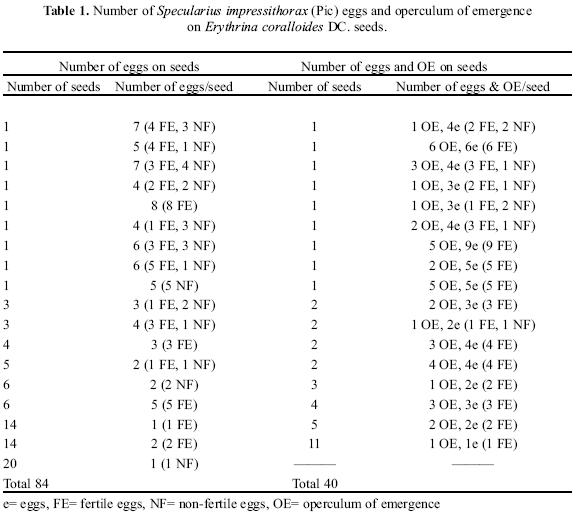
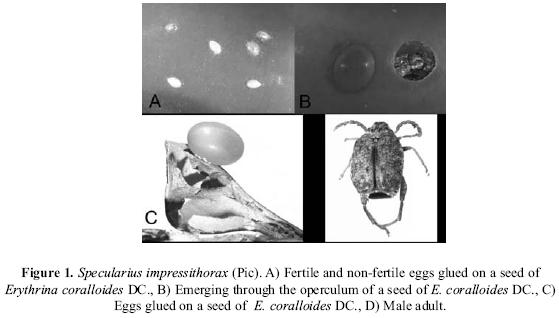
<body><![CDATA[<p align="justify"><font face="verdana" size="2">&nbsp;</font></p>     <p align="justify"><font face="verdana" size="2"><b>RESUMEN</b></font></p>     <p align="justify"><font face="verdana" size="2">Se reporta por primera vez en M&eacute;xico la presencia del br&uacute;quido ex&oacute;tico <i>Specularius impressithorax </i>(Pic), al cual se le encontr&oacute; aliment&aacute;ndose de un nuevo hospedero, <i>Erythrina coralloides </i>DC. Se proporciona informaci&oacute;n sobre el grado de da&ntilde;o que provoca este insecto a las semillas de esta leguminosa.</font></p>     <p align="justify"><font face="verdana" size="2"><i>Specularius </i>is an Old World genus, according to Kingsolver &amp; Decelle (1979) including nine species and two subspecies; however, the genus need to be reviewed in the future. The most important species in the genus is <i>Specularius impressithorax </i>(Pic) because of its wide distribution and that it feeds on various species of<i> Erythrina. </i>The other species of <i>Specularius </i>feed on other legumes, except <i>Specularius ghesquierei </i>Decelle that feeds on unidentified species of <i>Erythrina.</i></font></p>     <p align="justify"><font face="verdana" size="2">The genus <i>Erythrina </i>is a flowering plant that is pantropic in distribution. In 1974, Krukoff &amp; Barnaby revised the genus and recognized 105 species; latter in 1977, Gunn &amp; Barnes described the seeds of 101 species. Neil (1988) studied the biosystematic relationships of the species and recognized 112 species. Barrera <i>et al. </i>(2002) mentioned that the <i>Erythrina </i>includes 117 species. Most of the them are used as ornamentals; however some species are used in South America as food, such as <i>Erythrina edulis </i>because its flowers are prepared in salads and sweets and its infusion taken for anxiety and urinary problems. In agroalimentary programs seeds are transformed into flour with high protein content.</font></p>     <p align="justify"><font face="verdana" size="2">In January 6, 2007 the third author collected seeds of <i>E. coralloides </i>DC. on the campus of Colegio de Postgraduados, Montecillo, Estado de Mexico. The coordinates of the site are 19&deg;27'45.73"N and 98&deg;54'13.03"W at 2256 m above sea level. After some days bruchids emerged from the seeds. For identification we followed the Kingsolver (1986) and Romero &amp; Johnson (1999) technique for genitalia study. The genitalia were compared with specimens of <i>S. impressithorax </i>deposited in the Entomological Collection of Fitosanity Institute at Postgraduate College (CEAM). All material was pinned and labelled and stored at CEAM.</font></p>     <p align="justify"><font face="verdana" size="2">The bruchid species was identified as <i>Specularius impressithorax </i>(Pic), and constitutes the first report for this exotic species in Mexico. The analysis of 293 seeds showed that 169 (57.68%) were healthy, and 84 (28.67%) had seeds with eggs on them but without an operculum of emergence (OE). However, some of these were fertile (FE). This was easy to corroborate because after removing the egg the entrance hole that the larva made could be seen and dust could be seen inside of the egg, however none of these reached the adult stage. Translucent eggs were not fertile (NF), sometimes it was possible to see the small dead larva inside the egg (<a href="#f1">Fig. 1 A</a>). The remaining 40 seeds (13.65%), showed one to nine glued eggs plus one to six OE (<a href="#f1">Fig. 1B</a>) per seed (<a href="#t1">Table 1</a>).</font></p>     <p align="center"><font face="verdana" size="2"><a name="f1"></a></font></p>     <p align="center"><font face="verdana" size="2"><img src="/img/revistas/azm/v25n1/a18f1.jpg"></font></p>     <p align="center"><font face="verdana" size="2">&nbsp;</font></p>     ]]></body>
<body><![CDATA[<p align="center"><font face="verdana" size="2"><a name="t1"></a></font></p>     <p align="center"><font face="verdana" size="2"><img src="/img/revistas/azm/v25n1/a18t1.jpg"></font></p>     <p align="justify"><font face="verdana" size="2">Johnson &amp; Siemens (1995) and Johnson &amp; Romero (2004) state that there are three guilds of bruchid oviposition on seeds: (Guild A) species that oviposit on fruits while on the plant; (Guild B) species that only oviposit on seeds exposed in fruits while still on the plant; and (Guild C) bruchids that only oviposit on seeds once they are exposed on the substrate. According to this guild classification system, <i>S. impressithorax </i>belongs to Guild B (<a href="#f1">Figs. 1C &amp; D</a>).</font></p>     <p align="justify"><font face="verdana" size="2">According to Romero &amp; Johnson (2002) the only species of <i>Specularius </i>that feed on <i>Erythrina </i>are <i>Specularius ghesquierei </i>on <i>Erythrina </i>sp. (Democratic Republic of Congo) and the following host for the latter are: <i>S. impressithorax. Erythrina abyssinica </i>DC. (Sudafrica &amp; Zimbabwe), <i>E. abyssinica </i>DC. subsp. <i>abyssinica </i>DC. (Tanzania), <i>E. caffra </i>Thunb., <i>E. cristagalli </i>L., <i>E. humeana </i>Sprengel (Rhodesia), <i>E. latissima </i>E. Mey., <i>E. lysistemon </i>Hutch., <i>E. mildbraedii </i>Harms (Nigeria), <i>E. orophila </i>Ghesq., <i>E. pallida </i>Britton, <i>E. sandwicensis </i>Degener (Hawaii), <i>E. senegalensis </i>DC. (Angola, Ghana, Nigeria), <i>E. variegata </i>L. (India). Therefore, <i>Erythrina coralloides </i>DC. is a new host record for this species.</font></p>     <p align="justify"><font face="verdana" size="2">At this moment, we do not know how widely <i>S. impressithorax </i>is distributed in Mexico. The only place where specimens have been collected is that mentioned above. It is possible that the introduction of the exotic bruchid was through infested seeds, perhaps in one of the <i>Erythrina </i>species from the Old World. Once relocated, this bruchid started feeding on <i>E. coralloides </i>that is a very abundant plant in many places of Mexico, USA and Central America.</font></p>     <p align="justify"><font face="verdana" size="2">&nbsp;</font></p>     <p align="justify"><font face="verdana" size="2"><b>ACKNOWLEDGEMENTS</b></font></p>     <p align="justify"><font face="verdana" size="2">We thank Dr. Stephen Koch from the Programa de Botanica, Colegio de Postgraduadaos, for the plant identification, and M.C. Jorge Vald&eacute;z Carrasco from Programa de Entomolog&iacute;a y Acarolog&iacute;a, Instituto de Fitosanidad, Colegio de Postgraduados for taking the photographs.</font></p>     <p align="justify"><font face="verdana" size="2">&nbsp;</font></p>     <p align="justify"><font face="verdana" size="2"><b>LITERATURE CITED</b></font></p>     ]]></body>
<body><![CDATA[<!-- ref --><p align="justify"><font face="verdana" size="2"><b>Barrera Mar&iacute;n, N., L.E. Acero, &amp; M. Mej&iacute;a L. </b>2002. <i>Erythrina edulis </i>Triana ex Micheli. <i>In: </i>J.A. Vozzo (ed.). Tropical Tree: Seed Manual.  <i>USDA Forest Service, </i>USA. Pp. 455&#150;457. </font>&nbsp;&nbsp;&nbsp;&nbsp;&nbsp;&nbsp;&nbsp;&nbsp;[&#160;<a href="javascript:void(0);" onclick="javascript: window.open('/scielo.php?script=sci_nlinks&ref=357219&pid=S0065-1737200900010001800001&lng=','','width=640,height=500,resizable=yes,scrollbars=1,menubar=yes,');">Links</a>&#160;]<!-- end-ref --><!-- ref --><p align="justify"><font face="verdana" size="2"><b>Gunn, C.R. &amp; D.E. Barnes. </b>1977. Seed morphology of <i>Erythrina </i>(Fabaceae). <i>Lloydia </i>40:454&#150;470. </font>&nbsp;&nbsp;&nbsp;&nbsp;&nbsp;&nbsp;&nbsp;&nbsp;[&#160;<a href="javascript:void(0);" onclick="javascript: window.open('/scielo.php?script=sci_nlinks&ref=357220&pid=S0065-1737200900010001800002&lng=','','width=640,height=500,resizable=yes,scrollbars=1,menubar=yes,');">Links</a>&#160;]<!-- end-ref --><!-- ref --><p align="justify"><font face="verdana" size="2"><b>Johnson, C. D. &amp; D. H. Siemens. </b>1995. Bruchid guilds, host preferences, and new host records from Latin America and Texas for the genus <i>Stator </i>(Coleoptera: Bruchidae). <i>The Coleopterists Bulletin, </i>49(2): 133&#150;142.</font>&nbsp;&nbsp;&nbsp;&nbsp;&nbsp;&nbsp;&nbsp;&nbsp;[&#160;<a href="javascript:void(0);" onclick="javascript: window.open('/scielo.php?script=sci_nlinks&ref=357221&pid=S0065-1737200900010001800003&lng=','','width=640,height=500,resizable=yes,scrollbars=1,menubar=yes,');">Links</a>&#160;]<!-- end-ref --><!-- ref --><p align="justify"><font face="verdana" size="2"><b>Johnson, C.D. &amp; J. Romero N. </b>2004. A review of evolution of oviposition in the Bruchidae (Coleoptera). <i>Revista Brasileira de Entomologia, </i>48(3): 401&#150;408. </font>&nbsp;&nbsp;&nbsp;&nbsp;&nbsp;&nbsp;&nbsp;&nbsp;[&#160;<a href="javascript:void(0);" onclick="javascript: window.open('/scielo.php?script=sci_nlinks&ref=357222&pid=S0065-1737200900010001800004&lng=','','width=640,height=500,resizable=yes,scrollbars=1,menubar=yes,');">Links</a>&#160;]<!-- end-ref --><!-- ref --><p align="justify"><font face="verdana" size="2"><b>Kingsolver, J.M. </b>1986. Ataxonomic study of the genus <i>Algarobius </i>(Coleoptera: Bruchidae). <i>Entomo</i><i>graphy, </i>4: 109&#150;136. </font>&nbsp;&nbsp;&nbsp;&nbsp;&nbsp;&nbsp;&nbsp;&nbsp;[&#160;<a href="javascript:void(0);" onclick="javascript: window.open('/scielo.php?script=sci_nlinks&ref=357223&pid=S0065-1737200900010001800005&lng=','','width=640,height=500,resizable=yes,scrollbars=1,menubar=yes,');">Links</a>&#160;]<!-- end-ref --><!-- ref --><p align="justify"><font face="verdana" size="2"><b>Kingsolver, J.M. &amp; J.E. Decelle. </b>1979. Host associations of <i>Specularius impressithorax </i>(Pic) (Insecta: Coleoptera: Bruchidae) with species of <i>Erythrina </i>(Fabales: Fabaceae). <i>Ann. Missouri Bot. Gard., </i>66:528&#150;532. </font>&nbsp;&nbsp;&nbsp;&nbsp;&nbsp;&nbsp;&nbsp;&nbsp;[&#160;<a href="javascript:void(0);" onclick="javascript: window.open('/scielo.php?script=sci_nlinks&ref=357224&pid=S0065-1737200900010001800006&lng=','','width=640,height=500,resizable=yes,scrollbars=1,menubar=yes,');">Links</a>&#160;]<!-- end-ref --><!-- ref --><p align="justify"><font face="verdana" size="2"><b>Krukoff, B.A. &amp; R.C. Barnaby. </b>1974. Conspectus of species of the genus <i>Erythrina. Lloydia, </i>37(3):332&#150;458.</font>&nbsp;&nbsp;&nbsp;&nbsp;&nbsp;&nbsp;&nbsp;&nbsp;[&#160;<a href="javascript:void(0);" onclick="javascript: window.open('/scielo.php?script=sci_nlinks&ref=357225&pid=S0065-1737200900010001800007&lng=','','width=640,height=500,resizable=yes,scrollbars=1,menubar=yes,');">Links</a>&#160;]<!-- end-ref --><!-- ref --><p align="justify"><font face="verdana" size="2"><b>Neil, D.A. </b>1988. Experimental studies on species relationship in <i>Erythrina </i>(Laguminosae: Papilionoideae).<i> Ann. Missouri Bot. Gard., </i>75(3):886&#150;969. </font>&nbsp;&nbsp;&nbsp;&nbsp;&nbsp;&nbsp;&nbsp;&nbsp;[&#160;<a href="javascript:void(0);" onclick="javascript: window.open('/scielo.php?script=sci_nlinks&ref=357226&pid=S0065-1737200900010001800008&lng=','','width=640,height=500,resizable=yes,scrollbars=1,menubar=yes,');">Links</a>&#160;]<!-- end-ref --><!-- ref --><p align="justify"><font face="verdana" size="2"><b>Romero N., J. &amp; C. D. Johnson. </b>2002. Date Base BRUCOL. Programa de Entomolog&iacute;a, Instituto de Fitosanidad, Colegio de Postgraduados, M&eacute;xico. </font>&nbsp;&nbsp;&nbsp;&nbsp;&nbsp;&nbsp;&nbsp;&nbsp;[&#160;<a href="javascript:void(0);" onclick="javascript: window.open('/scielo.php?script=sci_nlinks&ref=357227&pid=S0065-1737200900010001800009&lng=','','width=640,height=500,resizable=yes,scrollbars=1,menubar=yes,');">Links</a>&#160;]<!-- end-ref --><!-- ref --><p align="justify"><font face="verdana" size="2"><b>Romero, J. &amp; C.D. Johnson. </b>1999. <i>Zabrotes sylvestris, </i>a new species from the United States and Mexico related to <i>Z. subfasciatus </i>(Boheman) (Coleoptera: Bruchidae: Amblycerinae). <i>The Coleop</i><i>terists Bulletin, </i>53(1):87&#150;98.</font>&nbsp;&nbsp;&nbsp;&nbsp;&nbsp;&nbsp;&nbsp;&nbsp;[&#160;<a href="javascript:void(0);" onclick="javascript: window.open('/scielo.php?script=sci_nlinks&ref=357228&pid=S0065-1737200900010001800010&lng=','','width=640,height=500,resizable=yes,scrollbars=1,menubar=yes,');">Links</a>&#160;]<!-- end-ref --> ]]></body><back>
<ref-list>
<ref id="B1">
<nlm-citation citation-type="book">
<person-group person-group-type="author">
<name>
<surname><![CDATA[Barrera Marín]]></surname>
<given-names><![CDATA[N]]></given-names>
</name>
<name>
<surname><![CDATA[Acero]]></surname>
<given-names><![CDATA[L.E.]]></given-names>
</name>
<name>
<surname><![CDATA[Mejía L.]]></surname>
<given-names><![CDATA[M]]></given-names>
</name>
</person-group>
<article-title xml:lang="en"><![CDATA[Erythrina edulis Triana ex Micheli]]></article-title>
<person-group person-group-type="editor">
<name>
<surname><![CDATA[Vozzo]]></surname>
<given-names><![CDATA[J.A.]]></given-names>
</name>
</person-group>
<source><![CDATA[Tropical Tree: Seed Manual]]></source>
<year>2002</year>
<page-range>455-457</page-range><publisher-name><![CDATA[USDA Forest Service]]></publisher-name>
</nlm-citation>
</ref>
<ref id="B2">
<nlm-citation citation-type="journal">
<person-group person-group-type="author">
<name>
<surname><![CDATA[Gunn]]></surname>
<given-names><![CDATA[C.R.]]></given-names>
</name>
<name>
<surname><![CDATA[Barnes]]></surname>
<given-names><![CDATA[D.E.]]></given-names>
</name>
</person-group>
<article-title xml:lang="en"><![CDATA[Seed morphology of Erythrina (Fabaceae)]]></article-title>
<source><![CDATA[Lloydia]]></source>
<year>1977</year>
<volume>40</volume>
<page-range>454-470</page-range></nlm-citation>
</ref>
<ref id="B3">
<nlm-citation citation-type="journal">
<person-group person-group-type="author">
<name>
<surname><![CDATA[Johnson]]></surname>
<given-names><![CDATA[C. D.]]></given-names>
</name>
<name>
<surname><![CDATA[Siemens]]></surname>
<given-names><![CDATA[D. H.]]></given-names>
</name>
</person-group>
<article-title xml:lang="en"><![CDATA[Bruchid guilds, host preferences, and new host records from Latin America and Texas for the genus Stator (Coleoptera: Bruchidae)]]></article-title>
<source><![CDATA[The Coleopterists Bulletin]]></source>
<year>1995</year>
<volume>49</volume>
<numero>2</numero>
<issue>2</issue>
<page-range>133-142</page-range></nlm-citation>
</ref>
<ref id="B4">
<nlm-citation citation-type="journal">
<person-group person-group-type="author">
<name>
<surname><![CDATA[Johnson]]></surname>
<given-names><![CDATA[C.D.]]></given-names>
</name>
<name>
<surname><![CDATA[Romero N.]]></surname>
<given-names><![CDATA[J]]></given-names>
</name>
</person-group>
<article-title xml:lang="en"><![CDATA[A review of evolution of oviposition in the Bruchidae (Coleoptera)]]></article-title>
<source><![CDATA[Revista Brasileira de Entomologia]]></source>
<year>2004</year>
<volume>48</volume>
<numero>3</numero>
<issue>3</issue>
<page-range>401-408</page-range></nlm-citation>
</ref>
<ref id="B5">
<nlm-citation citation-type="journal">
<person-group person-group-type="author">
<name>
<surname><![CDATA[Kingsolver]]></surname>
<given-names><![CDATA[J.M.]]></given-names>
</name>
</person-group>
<article-title xml:lang="en"><![CDATA[Ataxonomic study of the genus Algarobius (Coleoptera: Bruchidae)]]></article-title>
<source><![CDATA[Entomography]]></source>
<year>1986</year>
<volume>4</volume>
<page-range>109-136</page-range></nlm-citation>
</ref>
<ref id="B6">
<nlm-citation citation-type="journal">
<person-group person-group-type="author">
<name>
<surname><![CDATA[Kingsolver]]></surname>
<given-names><![CDATA[J.M.]]></given-names>
</name>
<name>
<surname><![CDATA[Decelle]]></surname>
<given-names><![CDATA[J.E.]]></given-names>
</name>
</person-group>
<article-title xml:lang="en"><![CDATA[Host associations of Specularius impressithorax (Pic) (Insecta: Coleoptera: Bruchidae) with species of Erythrina (Fabales: Fabaceae)]]></article-title>
<source><![CDATA[Ann. Missouri Bot. Gard.]]></source>
<year>1979</year>
<volume>66</volume>
<page-range>528-532</page-range></nlm-citation>
</ref>
<ref id="B7">
<nlm-citation citation-type="journal">
<person-group person-group-type="author">
<name>
<surname><![CDATA[Krukoff]]></surname>
<given-names><![CDATA[B.A.]]></given-names>
</name>
<name>
<surname><![CDATA[Barnaby]]></surname>
<given-names><![CDATA[R.C.]]></given-names>
</name>
</person-group>
<article-title xml:lang="en"><![CDATA[Conspectus of species of the genus Erythrina]]></article-title>
<source><![CDATA[Lloydia]]></source>
<year>1974</year>
<volume>37</volume>
<numero>3</numero>
<issue>3</issue>
<page-range>332-458</page-range></nlm-citation>
</ref>
<ref id="B8">
<nlm-citation citation-type="journal">
<person-group person-group-type="author">
<name>
<surname><![CDATA[Neil]]></surname>
<given-names><![CDATA[D.A.]]></given-names>
</name>
</person-group>
<article-title xml:lang="en"><![CDATA[Experimental studies on species relationship in Erythrina (Laguminosae: Papilionoideae)]]></article-title>
<source><![CDATA[Ann. Missouri Bot. Gard.]]></source>
<year>1988</year>
<volume>75</volume>
<numero>3</numero>
<issue>3</issue>
<page-range>886-969</page-range></nlm-citation>
</ref>
<ref id="B9">
<nlm-citation citation-type="book">
<person-group person-group-type="author">
<name>
<surname><![CDATA[Romero]]></surname>
<given-names><![CDATA[N., J.]]></given-names>
</name>
<name>
<surname><![CDATA[Johnson]]></surname>
<given-names><![CDATA[C. D.]]></given-names>
</name>
</person-group>
<source><![CDATA[Date Base BRUCOL]]></source>
<year>2002</year>
<publisher-name><![CDATA[Programa de EntomologíaInstituto de FitosanidadColegio de Postgraduados]]></publisher-name>
</nlm-citation>
</ref>
<ref id="B10">
<nlm-citation citation-type="journal">
<person-group person-group-type="author">
<name>
<surname><![CDATA[Romero]]></surname>
<given-names><![CDATA[J]]></given-names>
</name>
<name>
<surname><![CDATA[Johnson]]></surname>
<given-names><![CDATA[C.D.]]></given-names>
</name>
</person-group>
<article-title xml:lang="en"><![CDATA[Zabrotes sylvestris, a new species from the United States and Mexico related to Z. subfasciatus (Boheman) (Coleoptera: Bruchidae: Amblycerinae)]]></article-title>
<source><![CDATA[The Coleopterists Bulletin]]></source>
<year>1999</year>
<volume>53</volume>
<numero>1</numero>
<issue>1</issue>
<page-range>87-98</page-range></nlm-citation>
</ref>
</ref-list>
</back>
</article>