First report on the distribution of Digitonthophagus gazella (Fabricius, 1787) (Coleoptera: Scarabaeidae) in Bolivia
Tito VIDAURRE1,2, Jorge Ari NORIEGA2,3 & M. Julieta LEDEZMA1
1 Departamento de Entomologia, Museo de Historia Natural Noel Kempff Mercado, Santa Cruz, Bolivia. titobio@hotmail.com , jledezma@museonoelkempff.org.
2 Scarabaeinae Research Network Members-ScarabNet.
3 Laboratorio de Zoologia y Ecologia Acuatica, Departamento de Ciencias Biologicas, Universidad de Los Andes. Bogota, Colombia. jnorieg@hotmail.com.
]]>RESUMEN: Se reporta por primera vez la presencia de Digitonthophagus gazella en Bolivia, enlistando las localidades donde se han colectado especímenes de esta especie. Se discuten algunas hipótesis de su posible llegada a este territorio y sobre el posible patrón de dispersión.
Digitonthophagus gazella (Fabricius, 1787) (Scarabaeidae: Onthophagini) is a dung beetle of Indoafrican origin that was intentionally introduced in continental America in the state of Texas (USA) in 1970 (Blume & Aga 1978 Folia Entomológica Mexicana 39-40: 190-191; Fincher, Stewart & Hunter 1983 The Coleopterists Bulletin 37: 159-163) to help the local coprophagic beetle fauna in the removal of bovine excrement.
It has been also officially introduced in Brasil by the early 80's (Nascimento, Blanchin & Honer 1990 EMBRAPA Comunicado Técnico No. 33), in continental Chile and Easter Island (Ripa, Rojas & Velasco 1995 Entomophaga 40(3/4):427-440) and unofficial introduction in Venezuela (Gamez, Mora & Ascencao 1997 Resumen Congreso Venezolano de Entomologia Trujillo p. 51). Besides from these official introductions, during the following years, the species has increased its distribution range due to either unofficial introductions or range expansion, colonizing countries in Meso, Central and South America and is now reported in Mexico, Guatemala, Nicaragua, Cuba, Dominican Republic, the French Antilles, Colombia and Paraguay (Miranda, do Nacimiento & Bianchin 1990 EMBRAPA-Gado de Corte, Pes. And. 42:1-5; Rivera-Cervantes & García-R 1991 The Coleopterists Bulletin 45(4):370; Barbero & Lopez-Guerrero 1992 Tropical Zoology 5:115-120; Huchet 1992 L'Entomologiste 48(6):297-303; Kohlmann 1994 Acta Zoológica Mexicana 61:35-42; Lobo & Montes de Oca 1997 Acta Zoológica Mexicana 71:17-32; Maes, Ratcliffe & Jameson 1997 Revista Nicaragüense Entomológica 39:41-45; Bianchin, Alves & Koller 1998 An. Soc. Entomol. Brasil 27:275-279; Montes De Oca & Halffter 1998 Studies on Neotropical Fauna and Environment 33(1):37-45; Ruiz 2000 Tese de Mestrado em Entomologia 80 pp; Noriega 2002 Caldasia 24(1):213-215; Noriega, Solís, Quintero, Pérez, García & Ospino 2006 Caldasia 28(2):379-381).
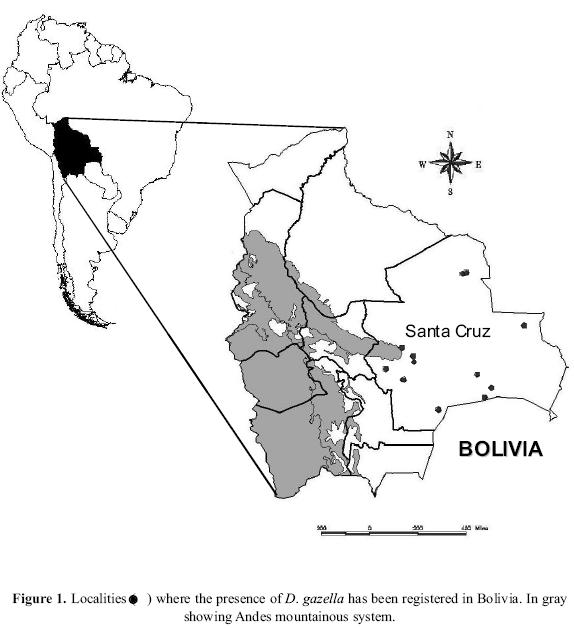
The first collecting event of D. gazella known to us in Bolivia occurred in the department of Santa Cruz, within the urban perimeter of Santa Cruz de la Sierra city, on July of 1990, at 445 m. Later biological studies using different types of bait have collected additional specimens in other Bolivian provinces, which have been deposited in the Entomological Collection of the Noel Kempff Mercado Museum (MNKM), Santa Cruz, Bolivia (Fig. 1).
Examined specimens: Bolivia. SANTA CRUZ. Andrés Ibáñez: 1 ♀ , Urban perimeter Santa Cruz (17°47'01"S - 63°10'00"W), 450 m, jul 1990, (MNKM). 1♀ and 2♂ , Vallecito (17°41'32"S - 63°08'39"W), 460 m, mar 2002, (MNKM). 1♀, Vallecito (17°41'32"S - 63°08'39"W), jun 2002, L. Céspedes, leg, (MNKM). Ángel Sandoval: 3♀, San Femando (17°15'36"S - 58°38'17"W), may 1997, C. Jordan, leg, (MNKM). Chiquitos: 1♀ and 2♂, Santa Adriana (19°03'07"S - 60°17'57"W), april 2001, J. Aramayo, leg, (MNKM). 1♀ and 3♂, Santa Elena (16°41'13"S - 59°00'59"W), apr 1999, J. Aramayo, leg, (MNKM). Cordillera: 1♀ y 4♂, Misiones (19°54'06"S - 62°12'01"W), aug 2000, J. Ledezma, leg, (MNKM). 1♀ and 1♂, Parabanó (18°25'25"S - 63°30'12"W), 1100m, nov 2004, J. Aramayo, leg, (MNKM). 2♀, Parabanó (18°25'00"S - 63°29'10"W), may 2004, T. Vidaurre, leg, (MNKM). 5♀ and 9♂, Palmar de las Islas (19°25'00"S - 60°32'10"W), feb 2007, T. Vidaurre, leg, (MNKM). Florida: 1♀, Pampagrande (18°05'32"S - 63° 06'19"W), 1300 m, aug 1994, A. Langer, leg, (MNKM). Ichilo: 3♀, Zurutu (17°32'00"S - 63°40'00"W), 400 m, feb 1991, J. Aramayo, leg, (MNKM). Velasco: 2♀ and 5♂ , 1♀ and 1♂, San Rafael (14°50'13"S - 61°58'47"W), nov 2000, T. Gutierrez, leg, (MNKM). 3♀ and 5♂, Caparu (14°48'00"S - 61°10'00"W), 180 m, apr 2007, A. Alcoba, leg, (MNKM). 9♀ and 16♂, Caparu (14°47'00"S - 61°10'00"W), 180 m, dec 2005, C. Hamel, leg, (MNKM).
This work is the first one to report D. gazella in Bolivia. We also confirm the presence of this species in the Paraguayan territory (Ruiz 2000 Tese de Mestrado em Entomologia 80 pp.), since the first author collected 14 individuals in a cattle ranching area (Palmar de las Islas) limiting with Paraguay (Fig. 1). It also possible that D. gazella is could be present in northern regions of Argentina.
]]> Apparently this species is colonizing cattle-disturbed habitats and open savannas with scattered forest remnants. Up to the present, these samples had came from sites below 1500 m, and it is possible that the altitudinal amplitude (above 2000 m) could be a limiting factor for this species in Bolivia, presenting biogeographical barriers such as the high altiplanos cordillera. The remaining ecoregions will probably be gradually colonized if not already, despite the existence of some biogeographical barriers like the dry inter-Andean valleys and pre-puna.How D. gazella appeared in Bolivian territory is still uncertain and two possible hypotheses are presented: 1) their arrival could have been accidentally caused by the exchange of livestock between Brazil and Paraguay to Bolivia, specially by the presence of dung inside cattle trucks; and 2) its arrival could be another example of their high power of dispersion from cattle ranching areas adjacent to Bolivia, especially from Paraguay and Brazil. It is difficult to believe that these populations might had arrive from continental Chile, since D. gazella does not prosper in this country (Ripa, Rojas & Velasco 1995 Entomophaga 40(3/4):427-440).
The presence of this species in the Bolivian territory could affect some native species, due to interspecific competition for habitats and resources, occasioned by their easy adaptation to open fields. A further ecological study related to the possible effects on some native species is recommended. Regarding its distribution and ongoing colonization of new geographic area, a review is proposed to elucidate these and other issues in the Neotropical region.
Acknowledgements. We wish to thank all collectors who contributed with their records on this species, the Noel Kempff Mercado Museum and the institutions that made sampling possible (WCS, FKI, and RAMSAR). To F. Vaz-de-Mello, W.D. Edmonds and Carolina Vizcaino whose comments contributed to improve the manuscript and to two anonymous referees that help improve the quality of the document. To ScarabNet that contributed in the development of better mechanisms of communication and aid among investigators.
]]>