<?xml version="1.0" encoding="ISO-8859-1"?><article xmlns:mml="http://www.w3.org/1998/Math/MathML" xmlns:xlink="http://www.w3.org/1999/xlink" xmlns:xsi="http://www.w3.org/2001/XMLSchema-instance">
<front>
<journal-meta>
<journal-id>0065-1737</journal-id>
<journal-title><![CDATA[Acta zoológica mexicana]]></journal-title>
<abbrev-journal-title><![CDATA[Acta Zool. Mex]]></abbrev-journal-title>
<issn>0065-1737</issn>
<publisher>
<publisher-name><![CDATA[Instituto de Ecología A.C.]]></publisher-name>
</publisher>
</journal-meta>
<article-meta>
<article-id>S0065-17372008000300008</article-id>
<title-group>
<article-title xml:lang="en"><![CDATA[Feeding habits of the American crocodile, Crocodylus acutus (Cuvier, 1807) (Reptilia: Crocodylidae) in the southern coast of Quintana Roo, Mexico]]></article-title>
</title-group>
<contrib-group>
<contrib contrib-type="author">
<name>
<surname><![CDATA[VILLEGAS]]></surname>
<given-names><![CDATA[Alejandro]]></given-names>
</name>
<xref ref-type="aff" rid="A01"/>
</contrib>
<contrib contrib-type="author">
<name>
<surname><![CDATA[SCHMITTER-SOTO]]></surname>
<given-names><![CDATA[Juan Jacobo]]></given-names>
</name>
<xref ref-type="aff" rid="A02"/>
</contrib>
</contrib-group>
<aff id="A01">
<institution><![CDATA[,Universidad Autónoma Metropolitana  ]]></institution>
<addr-line><![CDATA[Xochimilco Distrito Federal]]></addr-line>
<country>México</country>
</aff>
<aff id="A02">
<institution><![CDATA[,El Colegio de la Frontera Sur  ]]></institution>
<addr-line><![CDATA[Chetumal Quintana Roo]]></addr-line>
<country>México</country>
</aff>
<pub-date pub-type="pub">
<day>00</day>
<month>00</month>
<year>2008</year>
</pub-date>
<pub-date pub-type="epub">
<day>00</day>
<month>00</month>
<year>2008</year>
</pub-date>
<volume>24</volume>
<numero>3</numero>
<fpage>117</fpage>
<lpage>124</lpage>
<copyright-statement/>
<copyright-year/>
<self-uri xlink:href="http://www.scielo.org.mx/scielo.php?script=sci_arttext&amp;pid=S0065-17372008000300008&amp;lng=en&amp;nrm=iso"></self-uri><self-uri xlink:href="http://www.scielo.org.mx/scielo.php?script=sci_abstract&amp;pid=S0065-17372008000300008&amp;lng=en&amp;nrm=iso"></self-uri><self-uri xlink:href="http://www.scielo.org.mx/scielo.php?script=sci_pdf&amp;pid=S0065-17372008000300008&amp;lng=en&amp;nrm=iso"></self-uri><abstract abstract-type="short" xml:lang="en"><p><![CDATA[Between January and September 2006, 21 crocodiles (Crocodylus acutus) were captured and six were recaptured in four lagoons located in the southern coast of Quintana Roo. Stomach contents were obtained in order to identify prey items, which were analyzed by the frequency and volume method. In decreasing order of importance, prey items were fish, crustaceans, birds, mammals and insects. Diet of crocodiles changed considerably according to their body size. Adult crocodiles added larger preys (birds and mammals) to their diet; fish and crustaceans were present in the diet at all sizes, thus showing the importance of these prey in the diet of American crocodiles.]]></p></abstract>
<abstract abstract-type="short" xml:lang="es"><p><![CDATA[Entre enero y septiembre de 2006 se capturaron 21 cocodrilos (Crocodylus acutus) y se recapturaron seis en cuatro sistemas lagunares de la costa sur de Quintana Roo para analizar los contenidos estomacales. Las presas encontradas en el contenido estomacal se dividieron en cinco grupos y se realizaron análisis basados en la frecuencia y en el volumen. Las presas encontradas en orden de importancia fueron peces, crustáceos, aves, mamíferos e insectos. La dieta de los cocodrilos cambió considerablemente de acuerdo con el tamaño corporal de los individuos. Los cocodrilos adultos agregaron a su dieta presas de mayor talla como aves y mamíferos. Peces y crustáceos estuvieron representados en la dieta de individuos de todas las clases de tamaño, demostrando la importancia que estas presas tienen en la dieta de C. acutus.]]></p></abstract>
<kwd-group>
<kwd lng="en"><![CDATA[Crocodylus acutus]]></kwd>
<kwd lng="en"><![CDATA[Quintana Roo]]></kwd>
<kwd lng="en"><![CDATA[stomach contents]]></kwd>
<kwd lng="en"><![CDATA[feeding habits]]></kwd>
<kwd lng="es"><![CDATA[Crocodylus acutus]]></kwd>
<kwd lng="es"><![CDATA[Quintana Roo]]></kwd>
<kwd lng="es"><![CDATA[contenido estomacal]]></kwd>
<kwd lng="es"><![CDATA[hábitos alimentarios]]></kwd>
</kwd-group>
</article-meta>
</front><body><![CDATA[  	     <p align="left"><font face="verdana" size="4">Art&iacute;culos originales</font></p>     <p align="center">&nbsp;</p>     <p align="center"><font face="verdana" size="4"><b>Feeding habits of the American    crocodile, <i>Crocodylus acutus</i> (Cuvier, 1807) (Reptilia: Crocodylidae)    in the southern coast of Quintana Roo, Mexico</b></font></p>  	    <p>&nbsp;</p>  	    <p align="center"><font face="verdana" size="2"><b>Alejandro</b> <b>VILLEGAS<sup>1</sup> y Juan Jacobo</b> <b>SCHMITTER&#45;SOTO<sup>2</sup></b></font></p>  	    <p>&nbsp;</p>  	    <p align="justify"><font face="verdana" size="2"><sup><i>1</i></sup> <i>Present address: Universidad Aut&oacute;noma Metropolitana, Unidad Xochimilco. Calzada del Hueso 1100, Col. Villa Quietud, Delegaci&oacute;n Coyoac&aacute;n, C.P. 04960, M&Eacute;XICO, D.F.</i> <a href="mailto:avillegas@universo.com">avillegas@universo.com</a></font></p> 	    <p align="justify"><font face="verdana" size="2"><i><sup>2</sup> El Colegio de la Frontera Sur, Av. Centenario km 5.5, 77900, Chetumal, Quintana Roo, M&Eacute;XICO</i></font></p>     <p>&nbsp;</p>  	    ]]></body>
<body><![CDATA[<p align="justify"><font face="verdana" size="2">Recibido: 23 de noviembre de 2007    <br> 	Aceptado: 20 de mayo de 2008</font></p>  	    <p>&nbsp;</p>  	    <p align="justify"><font face="verdana" size="2"><b>ABSTRACT</b></font></p>  	    <p align="justify"><font face="verdana" size="2">Between January and September 2006, 21 crocodiles <i>(Crocodylus acutus)</i> were captured and six were recaptured in four lagoons located in the southern coast of Quintana Roo. Stomach contents were obtained in order to identify prey items, which were analyzed by the frequency and volume method. In decreasing order of importance, prey items were fish, crustaceans, birds, mammals and insects. Diet of crocodiles changed considerably according to their body size. Adult crocodiles added larger preys (birds and mammals) to their diet; fish and crustaceans were present in the diet at all sizes, thus showing the importance of these prey in the diet of American crocodiles.</font></p>  	    <p align="justify"><font face="verdana" size="2"><b>Key words:</b> <i>Crocodylus acutus,</i> Quintana Roo, stomach contents, feeding habits.</font></p>  	    <p>&nbsp;</p>  	    <p align="justify"><font face="verdana" size="2"><b>RESUMEN</b></font></p>  	    <p align="justify"><font face="verdana" size="2">Entre enero y septiembre de 2006 se capturaron 21 cocodrilos <i>(Crocodylus acutus)</i> y se recapturaron seis en cuatro sistemas lagunares de la costa sur de Quintana Roo para analizar los contenidos estomacales. Las presas encontradas en el contenido estomacal se dividieron en cinco grupos y se realizaron an&aacute;lisis basados en la frecuencia y en el volumen. Las presas encontradas en orden de importancia fueron peces, crust&aacute;ceos, aves, mam&iacute;feros e insectos. La dieta de los cocodrilos cambi&oacute; considerablemente de acuerdo con el tama&ntilde;o corporal de los individuos. Los cocodrilos adultos agregaron a su dieta presas de mayor talla como aves y mam&iacute;feros. Peces y crust&aacute;ceos estuvieron representados en la dieta de individuos de todas las clases de tama&ntilde;o, demostrando la importancia que estas presas tienen en la dieta de <i>C. acutus.</i></font></p>  	    <p align="justify"><font face="verdana" size="2"><b>Palabras clave:</b> <i>Crocodylus acutus,</i> Quintana Roo, contenido estomacal, h&aacute;bitos alimentarios.</font></p>  	    ]]></body>
<body><![CDATA[<p>&nbsp;</p>  	    <p align="justify"><font face="verdana" size="2"><b>INTRODUCTION</b></font></p>  	    <p align="justify"><font face="verdana" size="2">The American crocodile <i>(Crocodylus acutus)</i> is distributed along the Atlantic and Pacific coasts, from Mexico to South America, the Caribbean Islands (Cuba, Jamaica, and Hispaniola), and southeastern Florida in the United States (Thorbjarnarson 1989). Diet represents an important ecological feature of every organism since it affects the body condition, behavior, growth, and reproduction (Rice 2004). Crocodiles ingest a wide variety of prey as a result of large ontogenetic change in their body size (Barr 1997). In order to understand the ecology and behavior of crocodiles in their natural habitat, it is important to have information on the feeding habits and how these might vary with season, body size, sex and habitat. This paper documents the feeding habits of American crocodiles in several small coastal lagoons in the southern Caribbean coast of Mexico. The study focuses on diet changes according to location, season, ontogeny, and sex.</font></p>  	    <p>&nbsp;</p>  	    <p align="justify"><font face="verdana" size="2"><b>MATERIALS AND METHODS</b></font></p>  	    <p align="justify"><font face="verdana" size="2">Crocodiles were captured from four lagoons in southern Quintana Roo (Mexican Caribbean, <a href="#f1">Fig, 1</a>), during the first five days of each month (January&#45;September 2006), either directly by hand or by means of a pole with nose wire, depending on size. Once on board (a 3.6 m aluminum boat with a 15 HP outboard engine), sex and total length (TL) of crocodiles were determined. Crocodiles were classified into four size classes: hatchlings (TL&lt;30 cm), juveniles (TL=30&#45;90 cm), subadults (TL=90&#45;180 cm), and adults (TL&gt;180 cm) (Platt &amp; Thorbjarnarson 2000). Animals were marked by clipping tail scutes in a coded pattern (Platt &amp; Thorbjarnarson 1997). The hose and Heimlich maneuver technique described by Fitzgerald (1989) was used to extract all the stomach contents, PVC tubes were used to keep the jaws open and a hose of appropriate size (five to 15 mm diameter) coated with vegetable oil was inserted into the stomach; then water was introduced until stomach was completely full. A light massage in the abdominal region (Heimlich maneuver) resulted in the expulsion of the stomach content. Stomach contents were preserved in 10% formalin to stop digestion and later stored in 70% ethanol.</font></p>  	    <p align="center"><font face="verdana" size="2"><a name="f1"></a></font></p>  	    <p align="center"><font face="verdana" size="2"><img src="/img/revistas/azm/v24n3/a8f1.jpg"></font></p>  	    <p align="justify"><font face="verdana" size="2">Fishes were identified according to Castro&#45;Aguirre <i>et al.</i> (1999) and Schmitter&#45;Soto (1998), while identification of other groups followed Howell and Webb (1995) for birds, Villalobos (1998) and Williams (1984) for crustaceans, and Dom&iacute;nguez (1990) and Mor&oacute;n <i>et al.</i> (1997) for insects. In addition, the help of experts was sought and the biological collection of ECOSUR was consulted for reference.</font></p>  	    <p align="justify"><font face="verdana" size="2">Prey found in the stomach content were categorized as fresh (recently ingested) or old (not recently ingested), because the chitinous exoskeleton of insects and crustaceans can remain in the stomach of crocodiles for several months (Delany &amp; Abercrombie 1986, Thorbjarnarson 1993, Barr 1997).</font></p>  	    ]]></body>
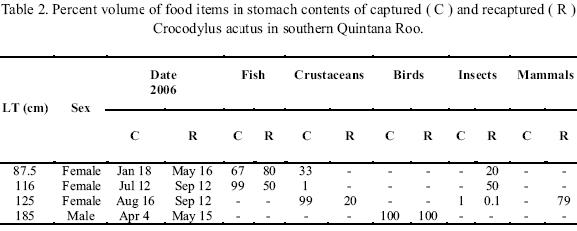
<body><![CDATA[<p align="justify"><font face="verdana" size="2">Dietary niche breadth was measured by sex and size class using the equation of Levins (1968, cited by Krebs 1999). Kruskal&#45;Wallis and x<sup>2</sup> tests were used to look for significant differences (P &lt; 0.05) in the relative volume of prey items by size class, sex, and location. The c<sup>2</sup> was used to test the null hypothesis of uniform distribution of data.</font></p>  	    <p>&nbsp;</p>  	    <p align="justify"><font face="verdana" size="2"><b>RESULTS</b></font></p>  	    <p align="justify"><font face="verdana" size="2">A total of 21 crocodiles (12 females, nine males) were captured comprising subadults (76%, n=16), adults (14%, n=3) and juveniles (9%, n=2). Six individuals were recaptured once, and the minimum time to recapture was one month in only two individuals. Night surveys were conducted starting 20&#45;30 min after sunset to ensure sufficient darkness to detect eye shine (Messel <i>et al.</i> 1981), and finishing at dawn. With the exception of one individual captured in a small sandy beach, most crocodiles were captured next or under the roots of mangroves <i>(Rhizophora mangle)</i> along the shores of lagoons. One female (154 cm TL) had an empty stomach. The survey in Laguna Xcalak was complete, as well as in Laguna Cementerio. In R&iacute;o Huach a survey of the whole lagoon system was not feasible because in some sites access was too difficult. In Bacalar Chico the only survey conducted was in some channels.</font></p>  	    <p align="justify"><font face="verdana" size="2"><b>Stomach contents.</b> Five prey groups were found in the stomach contents. Females prefer fish and crustaceans, in that order. Males have a more diversified diet, composed of fish, mammals, birds, crustaceans and insects (<a href="#t1">Tables 1</a>, <a href="#t2">2</a>). Kruskal&#45;Wallis test showed no significant differences <i>(H</i> = 5.78, P = 0.016), excepting the relationship between birds consumed by each sex; only males preyed upon birds.</font></p>  	    <p align="center"><font face="verdana" size="2"><a name="t1"></a></font></p>  	    <p align="center"><font face="verdana" size="2"><img src="/img/revistas/azm/v24n3/a8t1.jpg"></font></p>  	    <p align="center"><font face="verdana" size="2"><a name="t2"></a></font></p>  	    <p align="center"><font face="verdana" size="2"><img src="/img/revistas/azm/v24n3/a8t2.jpg"></font></p>  	    <p align="justify"><font face="verdana" size="2">Four fish taxa were identified based on remains of scales <i>(Gerres cinereus, Cyprinodon artifrons, Gambusia yucatana,</i> and <i>Eucinostomus</i> sp.). Crustacean remains were mainly appendages, and species identification was very difficult, because it is usually necessary to have at least part of the carapace. Three crustacean species <i>(Panoplax depressa, Palaemonetes intermedius</i> and <i>Callinectes</i> sp.) were identified. As for mammals, only hair masses with connective tissue were found and species identification was not possible. Remains of a beetle of the family Hydroptilidae and five individuals of the genus <i>Heterosternus</i> were found. Also, remains of one individual of the order Hemiptera and one of the family Stratiomyidae were found. There were bird remains belonging to three species <i>(Phalacrocorax brasilianus, P. auritus</i> and <i>Anas discors)</i> in four different individuals of <i>C. acutus.</i></font></p>  	    ]]></body>
<body><![CDATA[<p align="justify"><font face="verdana" size="2">Eleven food items were obtained in the dry season and 14 in the rainy season. During the rainy season food consumption was higher (60.15% total volume) than during the dry season (39.85%), but the main prey item in both seasons was fish.</font></p>  	    <p align="justify"><font face="verdana" size="2">Juvenile and subadult crocodiles consumed mostly fish, followed by crustaceans and insects although the latter also included mammals in their diet. Adult crocodiles consumed mainly mammals and birds as well as some crustaceans, fish and insects.</font></p>  	    <p align="justify"><font face="verdana" size="2">Dietary niche breadth was significantly greater (x<sup>2</sup> = 11.55; <i>df</i> = 2; <i>P</i> &lt; 0.001) in subadult crocodiles (BA= 0.085) than in juveniles (BA= 0.027) or adults (BA= 0.032).</font></p>  	    <p align="justify"><font face="verdana" size="2">Crocodiles from Laguna Cementerio had greater food volume in their stomachs (H = 11.17, P = 0.010) compared to individuals from the remaining sites. The x<sup>2</sup> goodness&#45;of&#45;fit test indicated that food relative volume was not uniform among prey types (x<sup>2</sup> = 13.66; <i>df</i> = 5; <i>P&lt;</i> 0.001).</font></p>  	    <p>&nbsp;</p>  	    <p align="justify"><font face="verdana" size="2"><b>DISCUSSION</b></font></p>  	    <p align="justify"><font face="verdana" size="2">Stomach contents composition of <i>C. acutus</i> was very similar to that previously reported by G&oacute;mez (2004) in Sian Ka'an Biosphere Reserve, north of our study area. However, variation in stomach contents is more apparent in its biomass, attributable to differences in fresh and old prey proportions in our samples. A high proportion of fresh prey in the samples indicates that the crocodiles are feeding frequently (Rice 2004). Analysis of stomach contents in this study suggested that fresh fish were usually consumed by crocodiles, as fish remains together with scales were found in the majority of stomachs. G&oacute;mez (2004) reported only fish scales in <i>C. acutus</i> stomach contents, and although these represented an old food item, it was however the most important item in the crocodiles' diet.</font></p>  	    <p align="justify"><font face="verdana" size="2">Alvarez del Toro (1974) and Thorbjarnarson (1989) stated that this crocodile shows piscivorous habits. In contrast, Casas&#45;Andreu &amp; Barrios (2003) found that the main prey of <i>C. acutus</i> in the Pacific coast of Mexico were mammals, birds and fish. Other authors have also reported fish as the main component of the diet for crocodilians (Delany &amp; Abercrombie 1986, Thorbjarnarson 1993, Tucker <i>et al.</i> 1996). Differences on diet might depend on the type of habitat (Delany &amp; Abercrombie 1986, Magnusson <i>et al.</i> 1987), but we suspect that findings of Casas&#45;Andreu &amp; Barrios (2003) are biased by the method used (feces analysis instead of stomach contents).</font></p>  	    <p align="justify"><font face="verdana" size="2">Fish diversity is relatively high in the wetland systems located within the study area, despite their limited size (Avil&eacute;s&#45;Torres <i>et al.</i> 2001). Crocodiles seem to be eating the most likely available small fish species. Large fish (lutjanids, haemulids or albulids) were absent from the stomach contents, even though they are very abundant in these lagoons. These wetlands are a functional unit that includes different biotopes (coral reefs, mangroves, seagrasses and coastal lagoons), which are utilized by a huge diversity of species in different life stages (larvae, juveniles, adults) for breeding, feeding, or reproduction (Claro 1994).</font></p>  	    <p align="justify"><font face="verdana" size="2">In this study, fishes were the main prey for juvenile and subadult crocodiles; whereas mammals and birds were for adults. These differences might be a consequence of skull (jaw) development, thus providing an increase in the possibility of diet diversification, since it gives the capacity of consuming larger prey (Tucker <i>et al.</i> 1996). Concerning the ingestion of birds, males consume them more than females, which may be related to the fact that males were larger (TL) than females. Similarly, ontogenetic changes on diet reflect the ability of larger individuals to catch larger preys (Magnuson <i>et al.</i> 1987, Fitzgerald 1989).</font></p>  	    ]]></body>
<body><![CDATA[<p align="justify"><font face="verdana" size="2">G&oacute;mez (2004) did not find insects in the stomach contents of <i>C. acutus.</i> This prey item was found to be minimally ingested by adults in our study area, although probably insects are accidental or secondarily ingested. Delany &amp; Abercrombie (1986), Barr (1997) and Rice (2004) pointed out that ingestion of invertebrates increases with the size of crocodiles. Occurrence of large prey on diet of crocodiles enormously contributes to biomass, since they prefer them to maximize nutritional efficiency when different preys have the same availability (Wolfe <i>et al.</i> 1987). Crustaceans were an abundant prey for subadult crocodiles in our study area, especially mangrove crabs and crabs of genus <i>Brachyura,</i> similar to the findings of G&oacute;mez (2004). Blue crab <i>(Callinectes sapidus)</i> is very common in the lagoons, so this prey item seems to be consumed opportunistically by <i>C. acutus.</i> Subadults had a broader niche as they consumed five prey types.</font></p>  	    <p align="justify"><font face="verdana" size="2">Less than a half (44%) of the analyzed stomach contents contained vegetation, mainly marine grass and small pieces of wood. Several authors have also found plant remains in the stomachs of crocodilians considering these to be accidentally ingested (Valentine <i>et al.</i> 1972, Delany &amp; Abercrombie 1986, Thorbjarnarson 1989, 1993, Mohd &amp; Stuebing 1996, Casas&#45;Andreu &amp; Barrios 2003).</font></p>  	    <p>&nbsp;</p>  	    <p align="justify"><font face="verdana" size="2"><b>Acknowledgments.</b> We thank CONACYT and ECOSUR for their support to this project. To John Thorbjarnarson and David Gonz&aacute;lez for comments to the manuscript, and Rogelio Cede&ntilde;o and Roberto Herrera for providing logistic support throughout the study. Field work was ably assisted by Ren&eacute; Calder&oacute;n, Erika P&eacute;rez, Roberto Rojo, Rodolfo Cisneros, Brenda Ameneyro, Ariane Dor, Arturo Olascoaga, Axa Molina, Ferenc Worum, Mart&iacute;n Marrufo, Ana Lilia D&iacute;az and Mitzi Olvera. Secretar&iacute;a de Medio Ambiente y Recursos Naturales (SEMARNAT) granted permit. We thank two reviewers who provided helpful comments on the manuscript.</font></p>  	    <p>&nbsp;</p>  	    <p align="justify"><font face="verdana" size="2"><b>LITERATURE CITED</b></font></p>  	    <!-- ref --><p align="justify"><font face="verdana" size="2"><b>Allstead, J., &amp; C. Vaughan.</b> 1994. Food habits of <i>Caiman crocodilus</i> in Ca&ntilde;o Negro, Costa Rica. <i>Vida</i> <i>Silestre Neotropical</i> 3:24&#45;29.    &nbsp;&nbsp;&nbsp;&nbsp;&nbsp;&nbsp;&nbsp;&nbsp;[&#160;<a href="javascript:void(0);" onclick="javascript: window.open('/scielo.php?script=sci_nlinks&ref=355993&pid=S0065-1737200800030000800001&lng=','','width=640,height=500,resizable=yes,scrollbars=1,menubar=yes,');">Links</a>&#160;]<!-- end-ref --></font></p>  	    <!-- ref --><p align="justify"><font face="verdana" size="2"><b>Alvarez del Toro, M.</b> 1974. <i>Los Crocodylia de M&eacute;xico (Estudio Comparativo).</i> Instituto Mexicano de Recursos Naturales Renovables, M&eacute;xico.    &nbsp;&nbsp;&nbsp;&nbsp;&nbsp;&nbsp;&nbsp;&nbsp;[&#160;<a href="javascript:void(0);" onclick="javascript: window.open('/scielo.php?script=sci_nlinks&ref=355995&pid=S0065-1737200800030000800002&lng=','','width=640,height=500,resizable=yes,scrollbars=1,menubar=yes,');">Links</a>&#160;]<!-- end-ref --></font></p>  	    ]]></body>
<body><![CDATA[<!-- ref --><p align="justify"><font face="verdana" size="2"><b>Avil&eacute;s&#45;Torres, S., J. J. Schmitter&#45;Soto &amp; R. Barrientos M.</b> 2001. Patrones espaciales de la riqueza de peces en lagunas costeras del sur de Quintana Roo, M&eacute;xico. <i>Revista de Hidrobiolog&iacute;a.</i> 11:141&#45;148.    &nbsp;&nbsp;&nbsp;&nbsp;&nbsp;&nbsp;&nbsp;&nbsp;[&#160;<a href="javascript:void(0);" onclick="javascript: window.open('/scielo.php?script=sci_nlinks&ref=355997&pid=S0065-1737200800030000800003&lng=','','width=640,height=500,resizable=yes,scrollbars=1,menubar=yes,');">Links</a>&#160;]<!-- end-ref --></font></p>  	    <!-- ref --><p align="justify"><font face="verdana" size="2"><b>Barr, B. R.</b> 1997. Food habits of the American Alligator, <i>Alligator mississippiensis,</i> in southern Everglades. Ph.D. Dissertation, Universidad of Florida, Gainesville. Unpublished.    &nbsp;&nbsp;&nbsp;&nbsp;&nbsp;&nbsp;&nbsp;&nbsp;[&#160;<a href="javascript:void(0);" onclick="javascript: window.open('/scielo.php?script=sci_nlinks&ref=355999&pid=S0065-1737200800030000800004&lng=','','width=640,height=500,resizable=yes,scrollbars=1,menubar=yes,');">Links</a>&#160;]<!-- end-ref --></font></p>  	    <!-- ref --><p align="justify"><font face="verdana" size="2"><b>Casas&#45;Andreu, G. &amp; Q. G. Barrios.</b> 2003. H&aacute;bitos alimenticios de <i>Crocodylus acutus</i> (Reptilia: Crocodylidae) determinados por el an&aacute;lisis de sus excretas en la costa de Jalisco, M&eacute;xico. <i>Anales Instituto de Biolog&iacute;a, UNAM, Serie Zoolog&iacute;a</i> 74: 35&#45;42.    &nbsp;&nbsp;&nbsp;&nbsp;&nbsp;&nbsp;&nbsp;&nbsp;[&#160;<a href="javascript:void(0);" onclick="javascript: window.open('/scielo.php?script=sci_nlinks&ref=356001&pid=S0065-1737200800030000800005&lng=','','width=640,height=500,resizable=yes,scrollbars=1,menubar=yes,');">Links</a>&#160;]<!-- end-ref --></font></p>  	    <!-- ref --><p align="justify"><font face="verdana" size="2"><b>Castro&#45;Aguirre, J. L., H. Espinosa &amp; J. J. Schmitter&#45;Soto.</b> 1989. <i>Ictiofauna estuarino&#45;lagunar y</i> <i>vicaria de M&eacute;xico.</i> Noriega&#45;Limusa e Instituto Polit&eacute;cnico Nacional, M&eacute;xico.    &nbsp;&nbsp;&nbsp;&nbsp;&nbsp;&nbsp;&nbsp;&nbsp;[&#160;<a href="javascript:void(0);" onclick="javascript: window.open('/scielo.php?script=sci_nlinks&ref=356003&pid=S0065-1737200800030000800006&lng=','','width=640,height=500,resizable=yes,scrollbars=1,menubar=yes,');">Links</a>&#160;]<!-- end-ref --></font></p>  	    <!-- ref --><p align="justify"><font face="verdana" size="2"><b>Claro, R. (ed.).</b> 1994. <i>Ecolog&iacute;a de los peces marinos de Cuba.</i> Centro de Investigaciones de Quintana Roo, Chetumal, M&eacute;xico.    &nbsp;&nbsp;&nbsp;&nbsp;&nbsp;&nbsp;&nbsp;&nbsp;[&#160;<a href="javascript:void(0);" onclick="javascript: window.open('/scielo.php?script=sci_nlinks&ref=356005&pid=S0065-1737200800030000800007&lng=','','width=640,height=500,resizable=yes,scrollbars=1,menubar=yes,');">Links</a>&#160;]<!-- end-ref --></font></p>  	    ]]></body>
<body><![CDATA[<!-- ref --><p align="justify"><font face="verdana" size="2"><b>Delany, F. M. &amp; C. L. Abercrombie.</b> 1986. American alligator food habits in northcentral Florida. <i>Journal of Wildlife Management</i> 50:348&#45;353.    &nbsp;&nbsp;&nbsp;&nbsp;&nbsp;&nbsp;&nbsp;&nbsp;[&#160;<a href="javascript:void(0);" onclick="javascript: window.open('/scielo.php?script=sci_nlinks&ref=356007&pid=S0065-1737200800030000800008&lng=','','width=640,height=500,resizable=yes,scrollbars=1,menubar=yes,');">Links</a>&#160;]<!-- end-ref --></font></p>  	    <!-- ref --><p align="justify"><font face="verdana" size="2"><b>Dom&iacute;nguez, R. R.</b> 1990. <i>Taxonom&iacute;a: Strepsiptera a Hymenoptera, claves y diagnosis.</i> Universidad Aut&oacute;noma Chapingo, M&eacute;xico.    &nbsp;&nbsp;&nbsp;&nbsp;&nbsp;&nbsp;&nbsp;&nbsp;[&#160;<a href="javascript:void(0);" onclick="javascript: window.open('/scielo.php?script=sci_nlinks&ref=356009&pid=S0065-1737200800030000800009&lng=','','width=640,height=500,resizable=yes,scrollbars=1,menubar=yes,');">Links</a>&#160;]<!-- end-ref --></font></p>  	    <!-- ref --><p align="justify"><font face="verdana" size="2"><b>Fitzgerald, L. A.,</b> 1989. An evaluation of stomach flushing techniques for crocodilians. <i>Journal of Herpetology</i> 23:170&#45;172.    &nbsp;&nbsp;&nbsp;&nbsp;&nbsp;&nbsp;&nbsp;&nbsp;[&#160;<a href="javascript:void(0);" onclick="javascript: window.open('/scielo.php?script=sci_nlinks&ref=356011&pid=S0065-1737200800030000800010&lng=','','width=640,height=500,resizable=yes,scrollbars=1,menubar=yes,');">Links</a>&#160;]<!-- end-ref --></font></p>  	    <!-- ref --><p align="justify"><font face="verdana" size="2"><b>G&oacute;mez, Y. H.</b> 2004. H&aacute;bitos alimentarios en el cocodrilo de r&iacute;o <i>(Crocodylus acutus)</i> y en el cocodrilo de pantano <i>(Crocodylus moreletii)</i> en la Reserva de la Biosfera de Sian Ka'an, Q. Roo, M&eacute;xico. Informe Final de Servicio Social, Universidad Aut&oacute;noma Metropolitana, Unidad Xochimilco, M&eacute;xico. Unpublished.    &nbsp;&nbsp;&nbsp;&nbsp;&nbsp;&nbsp;&nbsp;&nbsp;[&#160;<a href="javascript:void(0);" onclick="javascript: window.open('/scielo.php?script=sci_nlinks&ref=356013&pid=S0065-1737200800030000800011&lng=','','width=640,height=500,resizable=yes,scrollbars=1,menubar=yes,');">Links</a>&#160;]<!-- end-ref --></font></p>  	    <!-- ref --><p align="justify"><font face="verdana" size="2"><b>Howell, S. N. &amp; S. Webb.</b> 1995. <i>A Guide to the Birds of Mexico and Northern Central America.</i> Oxford University Press, New York.    &nbsp;&nbsp;&nbsp;&nbsp;&nbsp;&nbsp;&nbsp;&nbsp;[&#160;<a href="javascript:void(0);" onclick="javascript: window.open('/scielo.php?script=sci_nlinks&ref=356015&pid=S0065-1737200800030000800012&lng=','','width=640,height=500,resizable=yes,scrollbars=1,menubar=yes,');">Links</a>&#160;]<!-- end-ref --></font></p>  	    ]]></body>
<body><![CDATA[<!-- ref --><p align="justify"><font face="verdana" size="2"><b>Krebs, C. J.</b> 1999. <i>Ecological Methodology.</i> Addison&#45;Wesley, Menlo Park.    &nbsp;&nbsp;&nbsp;&nbsp;&nbsp;&nbsp;&nbsp;&nbsp;[&#160;<a href="javascript:void(0);" onclick="javascript: window.open('/scielo.php?script=sci_nlinks&ref=356017&pid=S0065-1737200800030000800013&lng=','','width=640,height=500,resizable=yes,scrollbars=1,menubar=yes,');">Links</a>&#160;]<!-- end-ref --></font></p>  	    <!-- ref --><p align="justify"><font face="verdana" size="2"><b>Kushlan, J. A. &amp; F. J. Mazzotti.</b> 1989. Population biology of the American Crocodile. <i>Journal of Herpetology</i> 23:7&#45;21.    &nbsp;&nbsp;&nbsp;&nbsp;&nbsp;&nbsp;&nbsp;&nbsp;[&#160;<a href="javascript:void(0);" onclick="javascript: window.open('/scielo.php?script=sci_nlinks&ref=356019&pid=S0065-1737200800030000800014&lng=','','width=640,height=500,resizable=yes,scrollbars=1,menubar=yes,');">Links</a>&#160;]<!-- end-ref --></font></p>  	    <!-- ref --><p align="justify"><font face="verdana" size="2"><b>Magnusson, W. E., E. Vieira Da Silva &amp; A. L. Lima.</b> 1987. Diets of Amazonian crocodilians. <i>Journal of Herpetology</i> 21:85&#45;95.    &nbsp;&nbsp;&nbsp;&nbsp;&nbsp;&nbsp;&nbsp;&nbsp;[&#160;<a href="javascript:void(0);" onclick="javascript: window.open('/scielo.php?script=sci_nlinks&ref=356021&pid=S0065-1737200800030000800015&lng=','','width=640,height=500,resizable=yes,scrollbars=1,menubar=yes,');">Links</a>&#160;]<!-- end-ref --></font></p>  	    <!-- ref --><p align="justify"><font face="verdana" size="2"><b>Messel, H., G. C. Vorlicek, A. G. Wells &amp; W.J. Green.</b> 1981. <i>Surveys of Tidal River Systems in the</i> <i>Northern Territory of Australia and their Crocodile Populations.</i> Pergamon Press, Sydney, Australia.    &nbsp;&nbsp;&nbsp;&nbsp;&nbsp;&nbsp;&nbsp;&nbsp;[&#160;<a href="javascript:void(0);" onclick="javascript: window.open('/scielo.php?script=sci_nlinks&ref=356023&pid=S0065-1737200800030000800016&lng=','','width=640,height=500,resizable=yes,scrollbars=1,menubar=yes,');">Links</a>&#160;]<!-- end-ref --></font></p>  	    <!-- ref --><p align="justify"><font face="verdana" size="2"><b>Mohd, S. A. S. &amp; R. B. Stuebing.</b> 1996. Diet, growth and movements of juvenile crocodiles <i>Crocodylus porosus</i> Schneider in the Klias River, Sabah, Malaysia. <i>Journal of Tropical. Ecology</i> 12:651&#45;662.    &nbsp;&nbsp;&nbsp;&nbsp;&nbsp;&nbsp;&nbsp;&nbsp;[&#160;<a href="javascript:void(0);" onclick="javascript: window.open('/scielo.php?script=sci_nlinks&ref=356025&pid=S0065-1737200800030000800017&lng=','','width=640,height=500,resizable=yes,scrollbars=1,menubar=yes,');">Links</a>&#160;]<!-- end-ref --></font></p>  	    ]]></body>
<body><![CDATA[<!-- ref --><p align="justify"><font face="verdana" size="2"><b>Mor&oacute;n, M. A., B. C. Ratcliffe &amp; C. Deloya.</b> 1997. <i>Atlas de los escarabajos de M&eacute;xico. Coleoptera: Lammellicornia. Vol I. Familia Melolonthidae. Subfamilias Rutelinae, Dynastinae, Cetoniinae, Trichinae, Vaginae y Melolonthidae.</i> Sociedad Mexicana de Entomolog&iacute;a A. C. y la Comisi&oacute;n Nacional para el Conocimiento y uso de la Biodiversidad (CONABIO), M&eacute;xico.    &nbsp;&nbsp;&nbsp;&nbsp;&nbsp;&nbsp;&nbsp;&nbsp;[&#160;<a href="javascript:void(0);" onclick="javascript: window.open('/scielo.php?script=sci_nlinks&ref=356027&pid=S0065-1737200800030000800018&lng=','','width=640,height=500,resizable=yes,scrollbars=1,menubar=yes,');">Links</a>&#160;]<!-- end-ref --></font></p>  	    <!-- ref --><p align="justify"><font face="verdana" size="2"><b>Platt, S. G. &amp; J. B. Thorbjarnarson.</b> 1997. Status and life history of the American crocodile in Belize. Belize Coastal Zone Management Project BZE/92/G31. Report to the United Nations (Unpubl). Development Program, Global Environment Facility, Belmopan, Belize.    &nbsp;&nbsp;&nbsp;&nbsp;&nbsp;&nbsp;&nbsp;&nbsp;[&#160;<a href="javascript:void(0);" onclick="javascript: window.open('/scielo.php?script=sci_nlinks&ref=356029&pid=S0065-1737200800030000800019&lng=','','width=640,height=500,resizable=yes,scrollbars=1,menubar=yes,');">Links</a>&#160;]<!-- end-ref --></font></p>  	    <!-- ref --><p align="justify"><font face="verdana" size="2">&#45;&#45;&#45;&#45;&#45;&#45;&#45;&#45;&#45;&#45;. 2000. Status and conservation of the American Crocodile, <i>Crocodylus acutus,</i> in Belize. <i>Biological Conservation.</i> 96:13&#45;20.    &nbsp;&nbsp;&nbsp;&nbsp;&nbsp;&nbsp;&nbsp;&nbsp;[&#160;<a href="javascript:void(0);" onclick="javascript: window.open('/scielo.php?script=sci_nlinks&ref=356031&pid=S0065-1737200800030000800020&lng=','','width=640,height=500,resizable=yes,scrollbars=1,menubar=yes,');">Links</a>&#160;]<!-- end-ref --></font></p>  	    <!-- ref --><p align="justify"><font face="verdana" size="2"><b>Rice. A. N.</b> 2004. Diet and condition of American alligators <i>(Alliggator mississippiensis)</i> in three central Florida lakes. Master's Thesis, Universidad of Florida, Gainesville. Unpublished.    &nbsp;&nbsp;&nbsp;&nbsp;&nbsp;&nbsp;&nbsp;&nbsp;[&#160;<a href="javascript:void(0);" onclick="javascript: window.open('/scielo.php?script=sci_nlinks&ref=356033&pid=S0065-1737200800030000800021&lng=','','width=640,height=500,resizable=yes,scrollbars=1,menubar=yes,');">Links</a>&#160;]<!-- end-ref --></font></p>  	    <!-- ref --><p align="justify"><font face="verdana" size="2"><b>Ross, J. P. (ed.).</b> 1998. <i>Crocodiles. Status Survey and Conservation Action Plan.</i> 2a ed. IUCN/SSC Crocodiles Specialist Group, Switzerland.    &nbsp;&nbsp;&nbsp;&nbsp;&nbsp;&nbsp;&nbsp;&nbsp;[&#160;<a href="javascript:void(0);" onclick="javascript: window.open('/scielo.php?script=sci_nlinks&ref=356035&pid=S0065-1737200800030000800022&lng=','','width=640,height=500,resizable=yes,scrollbars=1,menubar=yes,');">Links</a>&#160;]<!-- end-ref --></font></p>  	    ]]></body>
<body><![CDATA[<!-- ref --><p align="justify"><font face="verdana" size="2"><b>Schmitter&#45;Soto, J. J.</b> 1998. <i>Cat&aacute;logo de los peces continentales de Quintana Roo.</i> ECOSUR, San Crist&oacute;bal de las Casas, M&eacute;xico.    &nbsp;&nbsp;&nbsp;&nbsp;&nbsp;&nbsp;&nbsp;&nbsp;[&#160;<a href="javascript:void(0);" onclick="javascript: window.open('/scielo.php?script=sci_nlinks&ref=356037&pid=S0065-1737200800030000800023&lng=','','width=640,height=500,resizable=yes,scrollbars=1,menubar=yes,');">Links</a>&#160;]<!-- end-ref --></font></p>  	    <!-- ref --><p align="justify"><font face="verdana" size="2"><b>Thorbjarnarson, J. B.</b> 1989. Ecology of the American crocodile, <i>Crocodylus acutus.</i> In: Crocodiles. Their ecology, management and conservation. Pp. 228&#45;259. <i>In: IUCN Publication New Series, Switzerland.    &nbsp;&nbsp;&nbsp;&nbsp;&nbsp;&nbsp;&nbsp;&nbsp;[&#160;<a href="javascript:void(0);" onclick="javascript: window.open('/scielo.php?script=sci_nlinks&ref=356039&pid=S0065-1737200800030000800024&lng=','','width=640,height=500,resizable=yes,scrollbars=1,menubar=yes,');">Links</a>&#160;]<!-- end-ref --></i></font></p>  	    <!-- ref --><p align="justify"><font face="verdana" size="2">&#45;&#45;&#45;&#45;&#45;&#45;&#45;&#45;&#45;&#45;. 1993. Diet of the spectacled caiman <i>(Caiman crocodilus)</i> in the central Venezuelan llanos. <i>Herpetologica</i> 49:108&#45;107.    &nbsp;&nbsp;&nbsp;&nbsp;&nbsp;&nbsp;&nbsp;&nbsp;[&#160;<a href="javascript:void(0);" onclick="javascript: window.open('/scielo.php?script=sci_nlinks&ref=356041&pid=S0065-1737200800030000800025&lng=','','width=640,height=500,resizable=yes,scrollbars=1,menubar=yes,');">Links</a>&#160;]<!-- end-ref --></font></p>  	    <!-- ref --><p align="justify"><font face="verdana" size="2"><b>Tucker, A. D., C. J. Limpus, H. I. McCallum &amp; K. R. McDonald.</b> 1996. Ontogenetic dietary partitioning by <i>Crocodylus johnstoni</i> during the dry season. <i>Copeia</i> 1996:978&#45;988.    &nbsp;&nbsp;&nbsp;&nbsp;&nbsp;&nbsp;&nbsp;&nbsp;[&#160;<a href="javascript:void(0);" onclick="javascript: window.open('/scielo.php?script=sci_nlinks&ref=356043&pid=S0065-1737200800030000800026&lng=','','width=640,height=500,resizable=yes,scrollbars=1,menubar=yes,');">Links</a>&#160;]<!-- end-ref --></font></p>  	    <!-- ref --><p align="justify"><font face="verdana" size="2"><b>Valentine, J. M., J. R. Walther, K. M. McCartney &amp; L. M. Ivy.</b> 1972. Alligator diets on the Sabine National Wildlife Refuge, Louisiana. <i>Journal o. Wildlife Management.</i> 3:809&#45;815.    &nbsp;&nbsp;&nbsp;&nbsp;&nbsp;&nbsp;&nbsp;&nbsp;[&#160;<a href="javascript:void(0);" onclick="javascript: window.open('/scielo.php?script=sci_nlinks&ref=356045&pid=S0065-1737200800030000800027&lng=','','width=640,height=500,resizable=yes,scrollbars=1,menubar=yes,');">Links</a>&#160;]<!-- end-ref --></font></p>  	    ]]></body>
<body><![CDATA[<!-- ref --><p align="justify"><font face="verdana" size="2"><b>Villalobos, J. J. H.</b> 1998. <i>Taxonom&iacute;a de los crust&aacute;ceos con &eacute;nfasis en el orden Decapoda.</i> Consejo Nacional de Ciencia y Tecnolog&iacute;a (CONACYT) y El Colegio de la Frontera Sur (ECOSUR), M&eacute;xico.    &nbsp;&nbsp;&nbsp;&nbsp;&nbsp;&nbsp;&nbsp;&nbsp;[&#160;<a href="javascript:void(0);" onclick="javascript: window.open('/scielo.php?script=sci_nlinks&ref=356047&pid=S0065-1737200800030000800028&lng=','','width=640,height=500,resizable=yes,scrollbars=1,menubar=yes,');">Links</a>&#160;]<!-- end-ref --></font></p>  	    <!-- ref --><p align="justify"><font face="verdana" size="2"><b>Williams, A. B.</b> 1984. <i>Shrimps, lobsters, and crabs of the Atlantic coast of the Eastern United Status,</i> <i>Maine to Florida.</i> Smithsonian Institution, Washington, D. C.    &nbsp;&nbsp;&nbsp;&nbsp;&nbsp;&nbsp;&nbsp;&nbsp;[&#160;<a href="javascript:void(0);" onclick="javascript: window.open('/scielo.php?script=sci_nlinks&ref=356049&pid=S0065-1737200800030000800029&lng=','','width=640,height=500,resizable=yes,scrollbars=1,menubar=yes,');">Links</a>&#160;]<!-- end-ref --></font></p>  	    <!-- ref --><p align="justify"><font face="verdana" size="2"><b>Wolfe, J. L., D. K. Bradshaw &amp; R. H. Chabrek.</b> 1987. Alligator feeding habits: new data, a review. <i>Northeast Gulf Science</i> 9:1&#45;8.    &nbsp;&nbsp;&nbsp;&nbsp;&nbsp;&nbsp;&nbsp;&nbsp;[&#160;<a href="javascript:void(0);" onclick="javascript: window.open('/scielo.php?script=sci_nlinks&ref=356051&pid=S0065-1737200800030000800030&lng=','','width=640,height=500,resizable=yes,scrollbars=1,menubar=yes,');">Links</a>&#160;]<!-- end-ref --></font></p>      ]]></body><back>
<ref-list>
<ref id="B1">
<nlm-citation citation-type="journal">
<person-group person-group-type="author">
<name>
<surname><![CDATA[Allstead]]></surname>
<given-names><![CDATA[J.]]></given-names>
</name>
<name>
<surname><![CDATA[Vaughan]]></surname>
<given-names><![CDATA[C.]]></given-names>
</name>
</person-group>
<article-title xml:lang="en"><![CDATA[Food habits of Caiman crocodilus in Caño Negro, Costa Rica]]></article-title>
<source><![CDATA[Vida Silestre Neotropical]]></source>
<year>1994</year>
<volume>3</volume>
<page-range>24-29</page-range></nlm-citation>
</ref>
<ref id="B2">
<nlm-citation citation-type="book">
<person-group person-group-type="author">
<name>
<surname><![CDATA[Alvarez del Toro]]></surname>
<given-names><![CDATA[M.]]></given-names>
</name>
</person-group>
<source><![CDATA[Los Crocodylia de México (Estudio Comparativo)]]></source>
<year>1974</year>
<publisher-loc><![CDATA[México ]]></publisher-loc>
<publisher-name><![CDATA[Instituto Mexicano de Recursos Naturales Renovables]]></publisher-name>
</nlm-citation>
</ref>
<ref id="B3">
<nlm-citation citation-type="journal">
<person-group person-group-type="author">
<name>
<surname><![CDATA[Avilés-Torres]]></surname>
<given-names><![CDATA[S.]]></given-names>
</name>
<name>
<surname><![CDATA[Schmitter-Soto]]></surname>
<given-names><![CDATA[J. J.]]></given-names>
</name>
<name>
<surname><![CDATA[Barrientos M.]]></surname>
<given-names><![CDATA[R.]]></given-names>
</name>
</person-group>
<article-title xml:lang="es"><![CDATA[Patrones espaciales de la riqueza de peces en lagunas costeras del sur de Quintana Roo, México]]></article-title>
<source><![CDATA[Revista de Hidrobiología]]></source>
<year>2001</year>
<volume>11</volume>
<page-range>141-148</page-range></nlm-citation>
</ref>
<ref id="B4">
<nlm-citation citation-type="">
<person-group person-group-type="author">
<name>
<surname><![CDATA[Barr]]></surname>
<given-names><![CDATA[B. R.]]></given-names>
</name>
</person-group>
<source><![CDATA[Food habits of the American Alligator, Alligator mississippiensis, in southern Everglades]]></source>
<year>1997</year>
</nlm-citation>
</ref>
<ref id="B5">
<nlm-citation citation-type="journal">
<person-group person-group-type="author">
<name>
<surname><![CDATA[Casas-Andreu]]></surname>
<given-names><![CDATA[G.]]></given-names>
</name>
<name>
<surname><![CDATA[Barrios]]></surname>
<given-names><![CDATA[Q. G.]]></given-names>
</name>
</person-group>
<article-title xml:lang="es"><![CDATA[Hábitos alimenticios de Crocodylus acutus (Reptilia: Crocodylidae) determinados por el análisis de sus excretas en la costa de Jalisco, México]]></article-title>
<source><![CDATA[Anales Instituto de Biología]]></source>
<year>2003</year>
<volume>74</volume>
<page-range>35-42</page-range><publisher-name><![CDATA[UNAM]]></publisher-name>
</nlm-citation>
</ref>
<ref id="B6">
<nlm-citation citation-type="book">
<person-group person-group-type="author">
<name>
<surname><![CDATA[Castro-Aguirre]]></surname>
<given-names><![CDATA[J. L.]]></given-names>
</name>
<name>
<surname><![CDATA[Espinosa]]></surname>
<given-names><![CDATA[H.]]></given-names>
</name>
<name>
<surname><![CDATA[Schmitter-Soto]]></surname>
<given-names><![CDATA[J. J.]]></given-names>
</name>
</person-group>
<source><![CDATA[Ictiofauna estuarino-lagunar y vicaria de México]]></source>
<year>1989</year>
<publisher-loc><![CDATA[México ]]></publisher-loc>
<publisher-name><![CDATA[NoriegaLimusaInstituto Politécnico Nacional]]></publisher-name>
</nlm-citation>
</ref>
<ref id="B7">
<nlm-citation citation-type="book">
<person-group person-group-type="author">
<name>
<surname><![CDATA[Claro]]></surname>
<given-names><![CDATA[R.]]></given-names>
</name>
</person-group>
<source><![CDATA[Ecología de los peces marinos de Cuba]]></source>
<year>1994</year>
<publisher-loc><![CDATA[Chetumal ]]></publisher-loc>
<publisher-name><![CDATA[Centro de Investigaciones de Quintana Roo]]></publisher-name>
</nlm-citation>
</ref>
<ref id="B8">
<nlm-citation citation-type="journal">
<person-group person-group-type="author">
<name>
<surname><![CDATA[Delany]]></surname>
<given-names><![CDATA[F. M.]]></given-names>
</name>
<name>
<surname><![CDATA[Abercrombie]]></surname>
<given-names><![CDATA[C. L.]]></given-names>
</name>
</person-group>
<article-title xml:lang="en"><![CDATA[American alligator food habits in northcentral Florida]]></article-title>
<source><![CDATA[Journal of Wildlife Management]]></source>
<year>1986</year>
<volume>50</volume>
<page-range>348-353</page-range></nlm-citation>
</ref>
<ref id="B9">
<nlm-citation citation-type="book">
<person-group person-group-type="author">
<name>
<surname><![CDATA[Domínguez]]></surname>
<given-names><![CDATA[R. R.]]></given-names>
</name>
</person-group>
<source><![CDATA[Taxonomía: Strepsiptera a Hymenoptera, claves y diagnosis]]></source>
<year>1990</year>
<publisher-loc><![CDATA[México ]]></publisher-loc>
<publisher-name><![CDATA[Universidad Autónoma Chapingo]]></publisher-name>
</nlm-citation>
</ref>
<ref id="B10">
<nlm-citation citation-type="journal">
<person-group person-group-type="author">
<name>
<surname><![CDATA[Fitzgerald]]></surname>
<given-names><![CDATA[L. A.]]></given-names>
</name>
</person-group>
<article-title xml:lang="en"><![CDATA[An evaluation of stomach flushing techniques for crocodilians]]></article-title>
<source><![CDATA[Journal of Herpetology]]></source>
<year>1989</year>
<volume>23</volume>
<page-range>170-172</page-range></nlm-citation>
</ref>
<ref id="B11">
<nlm-citation citation-type="book">
<person-group person-group-type="author">
<name>
<surname><![CDATA[Gómez]]></surname>
<given-names><![CDATA[Y. H.]]></given-names>
</name>
</person-group>
<source><![CDATA[Hábitos alimentarios en el cocodrilo de río (Crocodylus acutus) y en el cocodrilo de pantano (Crocodylus moreletii) en la Reserva de la Biosfera de Sian Ka'an, Q. Roo, México. Informe Final de Servicio Social]]></source>
<year>2004</year>
<publisher-loc><![CDATA[México ]]></publisher-loc>
<publisher-name><![CDATA[Universidad Autónoma Metropolitana, Unidad Xochimilco]]></publisher-name>
</nlm-citation>
</ref>
<ref id="B12">
<nlm-citation citation-type="book">
<person-group person-group-type="author">
<name>
<surname><![CDATA[Howell]]></surname>
<given-names><![CDATA[S. N.]]></given-names>
</name>
<name>
<surname><![CDATA[Webb]]></surname>
<given-names><![CDATA[S.]]></given-names>
</name>
</person-group>
<source><![CDATA[A Guide to the Birds of Mexico and Northern Central America]]></source>
<year>1995</year>
<publisher-loc><![CDATA[New York ]]></publisher-loc>
<publisher-name><![CDATA[Oxford University Press]]></publisher-name>
</nlm-citation>
</ref>
<ref id="B13">
<nlm-citation citation-type="book">
<person-group person-group-type="author">
<name>
<surname><![CDATA[Krebs]]></surname>
<given-names><![CDATA[C. J.]]></given-names>
</name>
</person-group>
<source><![CDATA[Ecological Methodology]]></source>
<year>1999</year>
<publisher-loc><![CDATA[Menlo Park ]]></publisher-loc>
<publisher-name><![CDATA[Addison-Wesley]]></publisher-name>
</nlm-citation>
</ref>
<ref id="B14">
<nlm-citation citation-type="journal">
<person-group person-group-type="author">
<name>
<surname><![CDATA[Kushlan]]></surname>
<given-names><![CDATA[J. A.]]></given-names>
</name>
<name>
<surname><![CDATA[Mazzotti]]></surname>
<given-names><![CDATA[F. J.]]></given-names>
</name>
</person-group>
<article-title xml:lang="en"><![CDATA[Population biology of the American Crocodile]]></article-title>
<source><![CDATA[Journal of Herpetology]]></source>
<year>1989</year>
<volume>23</volume>
<page-range>7-21</page-range></nlm-citation>
</ref>
<ref id="B15">
<nlm-citation citation-type="journal">
<person-group person-group-type="author">
<name>
<surname><![CDATA[Magnusson]]></surname>
<given-names><![CDATA[W. E.]]></given-names>
</name>
<name>
<surname><![CDATA[Vieira Da Silva]]></surname>
<given-names><![CDATA[E.]]></given-names>
</name>
<name>
<surname><![CDATA[Lima]]></surname>
<given-names><![CDATA[A. L.]]></given-names>
</name>
</person-group>
<article-title xml:lang="en"><![CDATA[Diets of Amazonian crocodilians]]></article-title>
<source><![CDATA[Journal of Herpetology]]></source>
<year>1987</year>
<volume>21</volume>
<page-range>85-95</page-range></nlm-citation>
</ref>
<ref id="B16">
<nlm-citation citation-type="book">
<person-group person-group-type="author">
<name>
<surname><![CDATA[Messel]]></surname>
<given-names><![CDATA[H.]]></given-names>
</name>
<name>
<surname><![CDATA[Vorlicek]]></surname>
<given-names><![CDATA[G. C.]]></given-names>
</name>
<name>
<surname><![CDATA[Wells]]></surname>
<given-names><![CDATA[A. G.]]></given-names>
</name>
<name>
<surname><![CDATA[Green]]></surname>
<given-names><![CDATA[W.J.]]></given-names>
</name>
</person-group>
<source><![CDATA[Surveys of Tidal River Systems in the Northern Territory of Australia and their Crocodile Populations]]></source>
<year>1981</year>
<publisher-loc><![CDATA[Sydney ]]></publisher-loc>
<publisher-name><![CDATA[Pergamon Press]]></publisher-name>
</nlm-citation>
</ref>
<ref id="B17">
<nlm-citation citation-type="journal">
<person-group person-group-type="author">
<name>
<surname><![CDATA[Mohd]]></surname>
<given-names><![CDATA[S. A. S.]]></given-names>
</name>
<name>
<surname><![CDATA[Stuebing]]></surname>
<given-names><![CDATA[R. B.]]></given-names>
</name>
</person-group>
<article-title xml:lang="en"><![CDATA[Diet, growth and movements of juvenile crocodiles Crocodylus porosus Schneider in the Klias River, Sabah, Malaysia]]></article-title>
<source><![CDATA[Journal of Tropical. Ecology]]></source>
<year>1996</year>
<volume>12</volume>
<page-range>651-662</page-range></nlm-citation>
</ref>
<ref id="B18">
<nlm-citation citation-type="book">
<person-group person-group-type="author">
<name>
<surname><![CDATA[Morón]]></surname>
<given-names><![CDATA[M. A.]]></given-names>
</name>
<name>
<surname><![CDATA[Ratcliffe]]></surname>
<given-names><![CDATA[B. C.]]></given-names>
</name>
<name>
<surname><![CDATA[Deloya]]></surname>
<given-names><![CDATA[C.]]></given-names>
</name>
</person-group>
<source><![CDATA[Atlas de los escarabajos de México. Coleoptera: Lammellicornia. Vol I. Familia Melolonthidae. Subfamilias Rutelinae, Dynastinae, Cetoniinae, Trichinae, Vaginae y Melolonthidae]]></source>
<year>1997</year>
<publisher-name><![CDATA[Sociedad Mexicana de Entomología A. C.Comisión Nacional para el Conocimiento y uso de la Biodiversidad (CONABIO)]]></publisher-name>
</nlm-citation>
</ref>
<ref id="B19">
<nlm-citation citation-type="book">
<person-group person-group-type="author">
<name>
<surname><![CDATA[Platt]]></surname>
<given-names><![CDATA[S. G.]]></given-names>
</name>
<name>
<surname><![CDATA[Thorbjarnarson]]></surname>
<given-names><![CDATA[J. B.]]></given-names>
</name>
</person-group>
<source><![CDATA[Status and life history of the American crocodile in Belize. Belize Coastal Zone Management Project BZE/92/G31. Report to the United Nations (Unpubl)]]></source>
<year>1997</year>
<publisher-loc><![CDATA[Belmopan ]]></publisher-loc>
<publisher-name><![CDATA[Development Program, Global Environment Facility]]></publisher-name>
</nlm-citation>
</ref>
<ref id="B20">
<nlm-citation citation-type="journal">
<person-group person-group-type="author">
<name>
<surname><![CDATA[Platt]]></surname>
<given-names><![CDATA[S. G.]]></given-names>
</name>
</person-group>
<article-title xml:lang="en"><![CDATA[Status and conservation of the American Crocodile, Crocodylus acutus, in Belize]]></article-title>
<source><![CDATA[Biological Conservation]]></source>
<year>2000</year>
<volume>96</volume>
<page-range>13-20</page-range></nlm-citation>
</ref>
<ref id="B21">
<nlm-citation citation-type="">
<person-group person-group-type="author">
<name>
<surname><![CDATA[Rice]]></surname>
<given-names><![CDATA[A. N.]]></given-names>
</name>
</person-group>
<source><![CDATA[Diet and condition of American alligators (Alliggator mississippiensis) in three central Florida lakes]]></source>
<year>2004</year>
</nlm-citation>
</ref>
<ref id="B22">
<nlm-citation citation-type="book">
<person-group person-group-type="author">
<name>
<surname><![CDATA[Ross]]></surname>
<given-names><![CDATA[J. P.]]></given-names>
</name>
</person-group>
<source><![CDATA[Crocodiles. Status Survey and Conservation Action Plan]]></source>
<year>1998</year>
<edition>2a</edition>
<publisher-name><![CDATA[IUCN/SSC Crocodiles Specialist Group]]></publisher-name>
</nlm-citation>
</ref>
<ref id="B23">
<nlm-citation citation-type="book">
<person-group person-group-type="author">
<name>
<surname><![CDATA[Schmitter-Soto]]></surname>
<given-names><![CDATA[J. J.]]></given-names>
</name>
</person-group>
<source><![CDATA[Catálogo de los peces continentales de Quintana Roo]]></source>
<year>1998</year>
<publisher-loc><![CDATA[San Cristóbal de las Casas ]]></publisher-loc>
<publisher-name><![CDATA[ECOSUR]]></publisher-name>
</nlm-citation>
</ref>
<ref id="B24">
<nlm-citation citation-type="book">
<person-group person-group-type="author">
<name>
<surname><![CDATA[Thorbjarnarson]]></surname>
<given-names><![CDATA[J. B.]]></given-names>
</name>
</person-group>
<article-title xml:lang="en"><![CDATA[Ecology of the American crocodile, Crocodylus acutus]]></article-title>
<source><![CDATA[Crocodiles. Their ecology, management and conservation]]></source>
<year>1989</year>
<page-range>228-259</page-range><publisher-name><![CDATA[IUCN Publication]]></publisher-name>
</nlm-citation>
</ref>
<ref id="B25">
<nlm-citation citation-type="journal">
<person-group person-group-type="author">
<name>
<surname><![CDATA[Thorbjarnarson]]></surname>
<given-names><![CDATA[J. B.]]></given-names>
</name>
</person-group>
<article-title xml:lang="en"><![CDATA[Diet of the spectacled caiman (Caiman crocodilus) in the central Venezuelan llanos]]></article-title>
<source><![CDATA[Herpetologica]]></source>
<year>1993</year>
<volume>49</volume>
<page-range>108-107</page-range></nlm-citation>
</ref>
<ref id="B26">
<nlm-citation citation-type="journal">
<person-group person-group-type="author">
<name>
<surname><![CDATA[Tucker]]></surname>
<given-names><![CDATA[A. D.]]></given-names>
</name>
<name>
<surname><![CDATA[Limpus]]></surname>
<given-names><![CDATA[C. J.]]></given-names>
</name>
<name>
<surname><![CDATA[McCallum]]></surname>
<given-names><![CDATA[H. I.]]></given-names>
</name>
<name>
<surname><![CDATA[McDonald]]></surname>
<given-names><![CDATA[K. R.]]></given-names>
</name>
</person-group>
<article-title xml:lang="en"><![CDATA[Ontogenetic dietary partitioning by Crocodylus johnstoni during the dry season]]></article-title>
<source><![CDATA[Copeia]]></source>
<year>1996</year>
<numero>1996</numero>
<issue>1996</issue>
<page-range>978-988</page-range></nlm-citation>
</ref>
<ref id="B27">
<nlm-citation citation-type="journal">
<person-group person-group-type="author">
<name>
<surname><![CDATA[Valentine]]></surname>
<given-names><![CDATA[J. M.]]></given-names>
</name>
<name>
<surname><![CDATA[Walther]]></surname>
<given-names><![CDATA[J. R.]]></given-names>
</name>
<name>
<surname><![CDATA[McCartney]]></surname>
<given-names><![CDATA[K. M.]]></given-names>
</name>
<name>
<surname><![CDATA[Ivy]]></surname>
<given-names><![CDATA[L. M.]]></given-names>
</name>
</person-group>
<article-title xml:lang="en"><![CDATA[Alligator diets on the Sabine National Wildlife Refuge, Louisiana]]></article-title>
<source><![CDATA[Journal o. Wildlife Management]]></source>
<year>1972</year>
<volume>3</volume>
<page-range>809-815</page-range></nlm-citation>
</ref>
<ref id="B28">
<nlm-citation citation-type="book">
<person-group person-group-type="author">
<name>
<surname><![CDATA[Villalobos]]></surname>
<given-names><![CDATA[J. J. H.]]></given-names>
</name>
</person-group>
<source><![CDATA[Taxonomía de los crustáceos con énfasis en el orden Decapoda]]></source>
<year>1998</year>
<publisher-name><![CDATA[Consejo Nacional de Ciencia y Tecnología (CONACYT)El Colegio de la Frontera Sur (ECOSUR)]]></publisher-name>
</nlm-citation>
</ref>
<ref id="B29">
<nlm-citation citation-type="book">
<person-group person-group-type="author">
<name>
<surname><![CDATA[Williams]]></surname>
<given-names><![CDATA[A. B.]]></given-names>
</name>
</person-group>
<source><![CDATA[Shrimps, lobsters, and crabs of the Atlantic coast of the Eastern United Status, Maine to Florida]]></source>
<year>1984</year>
<publisher-loc><![CDATA[Washington^eD. C. D. C.]]></publisher-loc>
<publisher-name><![CDATA[Smithsonian Institution]]></publisher-name>
</nlm-citation>
</ref>
<ref id="B30">
<nlm-citation citation-type="journal">
<person-group person-group-type="author">
<name>
<surname><![CDATA[Wolfe]]></surname>
<given-names><![CDATA[J. L.]]></given-names>
</name>
<name>
<surname><![CDATA[Bradshaw]]></surname>
<given-names><![CDATA[D. K.]]></given-names>
</name>
<name>
<surname><![CDATA[Chabrek]]></surname>
<given-names><![CDATA[R. H.]]></given-names>
</name>
</person-group>
<article-title xml:lang="en"><![CDATA[Alligator feeding habits: new data, a review]]></article-title>
<source><![CDATA[Northeast Gulf Science]]></source>
<year>1987</year>
<volume>9</volume>
<page-range>1-8</page-range></nlm-citation>
</ref>
</ref-list>
</back>
</article>