<?xml version="1.0" encoding="ISO-8859-1"?><article xmlns:mml="http://www.w3.org/1998/Math/MathML" xmlns:xlink="http://www.w3.org/1999/xlink" xmlns:xsi="http://www.w3.org/2001/XMLSchema-instance">
<front>
<journal-meta>
<journal-id>0065-1737</journal-id>
<journal-title><![CDATA[Acta zoológica mexicana]]></journal-title>
<abbrev-journal-title><![CDATA[Acta Zool. Mex]]></abbrev-journal-title>
<issn>0065-1737</issn>
<publisher>
<publisher-name><![CDATA[Instituto de Ecología A.C.]]></publisher-name>
</publisher>
</journal-meta>
<article-meta>
<article-id>S0065-17372008000100007</article-id>
<title-group>
<article-title xml:lang="en"><![CDATA[Bionomics of a novel species of Argyrotaenia (Lepidoptera: Tortricidae) presents in Mexican avocado orchards]]></article-title>
</title-group>
<contrib-group>
<contrib contrib-type="author">
<name>
<surname><![CDATA[ROSAS-GARCÍA]]></surname>
<given-names><![CDATA[Ninfa M.]]></given-names>
</name>
<xref ref-type="aff" rid="A01"/>
</contrib>
<contrib contrib-type="author">
<name>
<surname><![CDATA[VILLEGAS-MENDOZA]]></surname>
<given-names><![CDATA[Jesús M.]]></given-names>
</name>
<xref ref-type="aff" rid="A01"/>
</contrib>
</contrib-group>
<aff id="A01">
<institution><![CDATA[,Instituto Politécnico Nacional Centro de Biotecnología Genómica Laboratorio de Biotecnología Ambiental]]></institution>
<addr-line><![CDATA[Reynosa Tamaulipas]]></addr-line>
<country>México</country>
</aff>
<pub-date pub-type="pub">
<day>00</day>
<month>00</month>
<year>2008</year>
</pub-date>
<pub-date pub-type="epub">
<day>00</day>
<month>00</month>
<year>2008</year>
</pub-date>
<volume>24</volume>
<numero>1</numero>
<fpage>129</fpage>
<lpage>137</lpage>
<copyright-statement/>
<copyright-year/>
<self-uri xlink:href="http://www.scielo.org.mx/scielo.php?script=sci_arttext&amp;pid=S0065-17372008000100007&amp;lng=en&amp;nrm=iso"></self-uri><self-uri xlink:href="http://www.scielo.org.mx/scielo.php?script=sci_abstract&amp;pid=S0065-17372008000100007&amp;lng=en&amp;nrm=iso"></self-uri><self-uri xlink:href="http://www.scielo.org.mx/scielo.php?script=sci_pdf&amp;pid=S0065-17372008000100007&amp;lng=en&amp;nrm=iso"></self-uri><abstract abstract-type="short" xml:lang="en"><p><![CDATA[A novel species of Argyrotaenia (Lepidoptera: Tortricidae) Stephens, was found in some avocado orchards in the Pacific coast from the Mexican states of Nayarit and Michoacan. Individuals obtained from the field were reared under laboratory conditions to determine their life cycle and biology. An artificial diet designed for lepidopterans, as well as a temperature of 26 ± 1ºC and a relative humidity of 65 ± 5% allowed the development of one generation per month and successful insect development. Female pupae showed an increase in weight and size through five generations, while weight and size in male pupae remained stable. The complete life cycle of this insect is around 32-36 days under laboratory conditions, and developmental stages using this diet under laboratory conditions mentioned above are as follows: egg, 5-6 days, larva, 18-20 days, pupa, 6-7 days, and adult, 15-20 days. Argyrotaenia has five larval instars in the laboratory. This study has clarified confusion surrounding this novel species of Argyrotaenia with some members of the genus Amorbia (Lepidoptera: Tortricidae), due to similarity in morphology and habits in both insects.]]></p></abstract>
<abstract abstract-type="short" xml:lang="es"><p><![CDATA[Una nueva especie, no descrita de Argyrotaenia (Lepidoptera: Tortricidae) Stephens, fue encontrada en algunos huertos de aguacate, ubicados en la costa del Pacífico en los estados de Nayarit y Michoacán, México. Algunos individuos de este insecto se recolectaron en campo y se criaron bajo condiciones de laboratorio para determinar su ciclo biológico y su biología. Para este propósito se utilizó una dieta artificial especialmente diseñada para insectos lepidópteros, así mismo se utilizó una temperatura de 26 ± 1ºC y una humedad relativa del 65 ± 5%. Estas condiciones permitieron obtener una generación por mes y un desarrollo adecuado del insecto. Las pupas hembra mostraron un incremento en peso a través de 5 generaciones, mientras que el peso y el tamaño de las pupas macho permanecieron constantes. El ciclo de vida completo de este insecto bajo condiciones de laboratorio es de aproximadamente 32-36 días, la duración de las etapas de desarrollo son las siguientes: huevecillo, de 5 a 6 días, larva, de 18 a 20 días, pupa de 6 a 7 días y el adulto de 15 a 20 días y la larva sufre 5 ínstares larvarios. Este estudio aclara la confusión existente entre esta nueva especie y algunos miembros del género Amorbia (Lepidoptera: Tortricidae) debido a que la morfología y los hábitos son similares en ambos insectos.]]></p></abstract>
<kwd-group>
<kwd lng="en"><![CDATA[Life cycle]]></kwd>
<kwd lng="en"><![CDATA[artificial diet]]></kwd>
<kwd lng="en"><![CDATA[developmental stages]]></kwd>
<kwd lng="en"><![CDATA[larval instars]]></kwd>
<kwd lng="en"><![CDATA[head-capsules]]></kwd>
<kwd lng="en"><![CDATA[avocado orchards]]></kwd>
<kwd lng="es"><![CDATA[Ciclo de vida]]></kwd>
<kwd lng="es"><![CDATA[dieta artificial]]></kwd>
<kwd lng="es"><![CDATA[etapas de desarrollo]]></kwd>
<kwd lng="es"><![CDATA[ínstares larvarios]]></kwd>
<kwd lng="es"><![CDATA[cápsulas cefálicas]]></kwd>
<kwd lng="es"><![CDATA[aguacate]]></kwd>
</kwd-group>
</article-meta>
</front><body><![CDATA[ <p align="justify"><font face="verdana" size="4">Art&iacute;culos originales</font></p>     <p align="center">&nbsp;</p>     <p align="center"><font face="verdana" size="4"><b>Bionomics of a novel species    of <em>Argyrotaenia</em> (Lepidoptera: Tortricidae) presents in Mexican avocado    orchards</b></font></p>     <p align="center">&nbsp;</p>     <p align="center"><font face="verdana" size="2"><b>Ninfa M. ROSAS&#45;GARC&Iacute;A    &amp; Jes&uacute;s M. VILLEGAS&#45;MENDOZA</b></font></p>     <p align="justify">&nbsp;</p>     <p align="justify"><font face="verdana" size="2"><em>Laboratorio de Biotecnolog&iacute;a    Ambiental, Centro de Biotecnolog&iacute;a Gen&oacute;mica&#45;Instituto Polit&eacute;cnico    Nacional. Blvd. del Maestro s/n, Col. Narciso Mendoza, Reynosa, Tamp. CP.88710. M&Eacute;XICO.</em>    <a href="mailto:nrosas@ipn.mx">nrosas@ipn.mx</a></font></p>     <p align="justify">&nbsp;</p>     <p align="justify"><font face="verdana" size="2">Recibido: 8 de enero de 2007    <br>   Aceptado: 20 de septiembre de 2007</font></p>     ]]></body>
<body><![CDATA[<p align="justify">&nbsp;</p>     <p align="justify"><font face="verdana" size="2"><b>ABSTRACT</b></font></p>     <p align="justify"><font face="verdana" size="2">A novel species of <i>Argyrotaenia</i>    (Lepidoptera: Tortricidae) Stephens, was found in some avocado orchards in the    Pacific coast from the Mexican states of Nayarit and Michoacan. Individuals    obtained from the field were reared under laboratory conditions to determine    their life cycle and biology. An artificial diet designed for lepidopterans,    as well as a temperature of 26 &plusmn; 1&ordm;C and a relative humidity of    65 &plusmn; 5% allowed the development of one generation per month and successful    insect development. Female pupae showed an increase in weight and size through    five generations, while weight and size in male pupae remained stable. The complete    life cycle of this insect is around 32&#45;36 days under laboratory conditions,    and developmental stages using this diet under laboratory conditions mentioned    above are as follows: egg, 5&#45;6 days, larva, 18&#150;20 days, pupa, 6&#45;7    days, and adult, 15&#45;20 days. <i>Argyrotaenia</i> has five larval instars    in the laboratory. This study has clarified confusion surrounding this novel    species of <i>Argyrotaenia</i> with some members of the genus <i>Amorbia</i>    (Lepidoptera: Tortricidae), due to similarity in morphology and habits in both    insects. </font></p>     <p align="justify"><font face="verdana" size="2"><b>Key words:</b> Life cycle,    artificial diet, developmental stages, larval instars, head&#45;capsules, avocado    orchards.</font></p>     <p align="justify">&nbsp;</p>     <p align="justify"><font face="verdana" size="2"><b>RESUMEN</b></font></p>     <p align="justify"><font face="verdana" size="2">Una nueva especie, no descrita    de <i>Argyrotaenia</i> (Lepidoptera: Tortricidae) Stephens, fue encontrada en    algunos huertos de aguacate, ubicados en la costa del Pac&iacute;fico en los    estados de Nayarit y Michoac&aacute;n, M&eacute;xico. Algunos individuos de    este insecto se recolectaron en campo y se criaron bajo condiciones de laboratorio    para determinar su ciclo biol&oacute;gico y su biolog&iacute;a. Para este prop&oacute;sito    se utiliz&oacute; una dieta artificial especialmente dise&ntilde;ada para insectos    lepid&oacute;pteros, as&iacute; mismo se utiliz&oacute; una temperatura de 26    &plusmn; 1&ordm;C y una humedad relativa del 65 &plusmn; 5%. Estas condiciones    permitieron obtener una generaci&oacute;n por mes y un desarrollo adecuado del    insecto. Las pupas hembra mostraron un incremento en peso a trav&eacute;s de    5 generaciones, mientras que el peso y el tama&ntilde;o de las pupas macho permanecieron    constantes. El ciclo de vida completo de este insecto bajo condiciones de laboratorio    es de aproximadamente 32&#45;36 d&iacute;as, la duraci&oacute;n de las etapas    de desarrollo son las siguientes: huevecillo, de 5 a 6 d&iacute;as, larva, de    18 a 20 d&iacute;as, pupa de 6 a 7 d&iacute;as y el adulto de 15 a 20 d&iacute;as    y la larva sufre 5 &iacute;nstares larvarios. Este estudio aclara la confusi&oacute;n    existente entre esta nueva especie y algunos miembros del g&eacute;nero <i>Amorbia</i>    (Lepidoptera: Tortricidae) debido a que la morfolog&iacute;a y los h&aacute;bitos    son similares en ambos insectos. </font></p>     <p align="justify"><font face="verdana" size="2"><b>Palabras clave:</b> Ciclo    de vida, dieta artificial, etapas de desarrollo, &iacute;nstares larvarios,    c&aacute;psulas cef&aacute;licas, aguacate.</font></p>     <p align="justify">&nbsp;</p>     <p align="justify"><font face="verdana" size="2"><b>INTRODUCTION</b></font></p>     ]]></body>
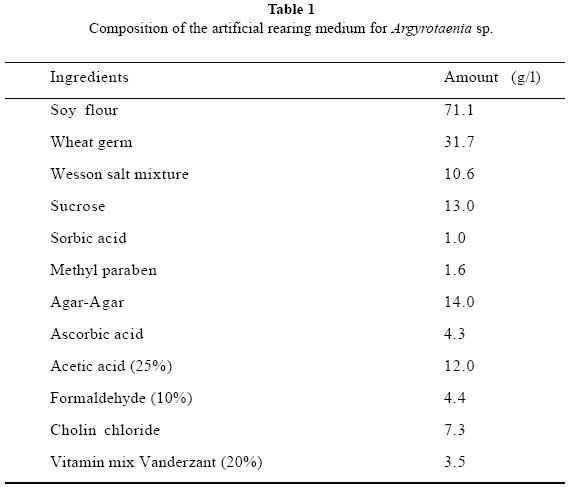
<body><![CDATA[<p align="justify"><font face="verdana" size="2">The genus <i>Argyrotaenia</i>    Stephens 1852 encompasses approximately 88 species distributed in the Western    Hemisphere from Canada to Argentina (Brown &amp; Cramer 1999), and many species    of <i>Argyrotaenia</i> are pests on a variety of economically important crops.</font></p>     <p align="justify"><font face="verdana" size="2">The most important and representative    species of this genus, <i>A. velutinana</i> Walker (redbanded leafroller), and    <i>A. citrana</i> Fernald (orange tortrix), are found in North America. Other    important species such as <i>A. ljungiana</i> Thunberg and <i>A. sphaleropa</i>    Meyrick are found in Europe and in South America respectively (Trematerra &amp;    Brown 2004).</font></p>  	    <p align="justify"><font face="verdana" size="2">According to Brown &amp; Cramer (1999), field studies have revealed a surprisingly large number of undescribed species in the New World. A good example of this are the several new species of this genus that have been reported in Mexico restricted to the higher elevation states of Mexico, Morelos, Puebla and, Veracruz where <i>A. spinacallis, A. unda, A. octavana, A. coconinana</i>, and <i>A. bialbistriata</i> have been found (Brown &amp; Cramer 1999). Further in Argentina, two new species have been reported, <i>A. pomililiana</i>, and <i>A. tucumana</i>, (Trematerra &amp; Brown 2004).</font></p>  	    <p align="justify"><font face="verdana" size="2">The members of this genus are polyphagous, however, they have preferred host plants such as apple or orange trees. Nevertheless, avocado crops, among others, have been attacked by this insect. Since 1949 <i>A. citrana</i> (orange tortrix) was found damaging to avocados in California as a minor pest, the larvae feed on the bark of green twigs, on terminal buds, and foliage, after webbing the leaves together, and the fruit resulted damaged if a fruit and a leaf came together (Ebeling &amp; Pence 1957).</font></p>  	     <p align="justify"><font face="verdana" size="2">With the exception of <i>A. velutinana</i>    and <i>A. citrana</i>, very little information has been published on the biology    and life cycle of other species of <i>Argyrotaenia</i>. This could be due to    that the study of this insect is particularly difficult because larvae spend    their life hidden in the leaves and covered by webs, moreover, the similar morphology    and feeding habits of this insect to other avocado pest, <i>Amorbia</i>, has    caused confusion among growers and wrong taxonomic identification of this quarantine    pest.</font></p>  	     <p align="justify"><font face="verdana" size="2">Other <i>Argyrotaenia</i> species    have been reared under laboratory conditions (Glass &amp; Hervey 1962, Roelofs,    1967) in order to obtain a large insect supply for various studies (Vanderzant    1974). As no information is available for this new species of <i>Argyrotaenia</i>    the aim of this work was to determine its life cycle and biology under laboratory    conditions using an artificial diet designed for lepidopterans.</font></p>     <p align="justify">&nbsp;</p>     <p align="justify"><font face="verdana" size="2"><b>MATERIAL AND METHODS</b></font></p>     <p align="justify"><font face="verdana" size="2">Larvae of <i>Argyrotaenia</i>    sp. were collected from Hass avocado tree branches with visible infestation    such as rolled leaves and webs, and from damaged fruits. Avocado orchards were    located at the Pacific coast from the Mexican states of Nayarit and Michoacan,    and collections were done from early August to late October 2004 and 2005. The    larvae were carefully withdrawn from the leaves with a camel's hair brush and    were allowed to complete their larval development in plastic jars (4 L capacity)    fed with fresh avocado foliage. Mature leaves were washed before presentation    to larvae to remove any contaminant. To corroborate taxonomic identification    14 adult moths were sent to Systematic Entomology Laboratory, USDA, and these    specimens were kept for the U.S. National Collection.</font></p>  	     <p align="justify"><font face="verdana" size="2">The artificial diet was prepared    using the ingredients shown in <a href="#t1">Table 1</a>, agar was dissolved    in boiling water, after this, all solid materials were added, and the mixture    was blended in a Hamilton Beach blender for 10 min, after that, all liquid ingredients    were added and blended for 5 more min. Five ml of the diet was poured into 30    mlplastic cups immediately, and allowed to dry for 2 h (Rosas&#45;Garc&iacute;a    2002). The diet should be prepared and use immediately; however unused cups    can be refrigerated for several days.</font></p>     ]]></body>
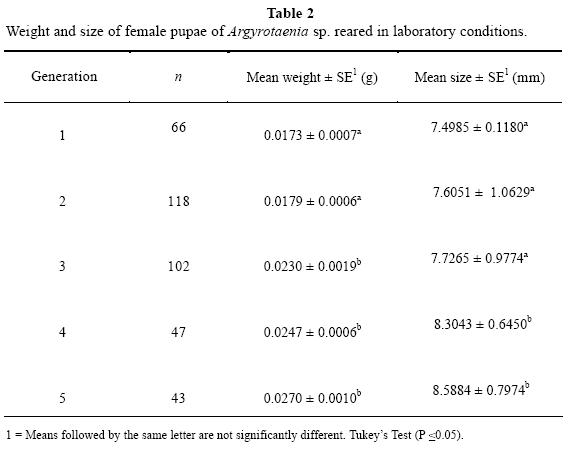
<body><![CDATA[<p align="center"><a name="t1"></a></p>     <p align="center"><img src="/img/revistas/azm/v24n1/a7t1.jpg"></p>     <p align="justify"><font size="2" face="verdana">The first generation of hatched    larvae in laboratory, which was obtained after females oviposited on the leaves    surface from an avocado branch placed inside a wooden cage (30 cm x 30 cm x    30 cm), was treated as follows: a group of 10 larvae was placed in a 50 ml&#45;plastic    cup containing 30ml of artificial diet, each cup was closed with a cardboard    lid and placed under controlled conditions, temperature 26 &plusmn; 1&ordm;C,    65 &plusmn; 5% relative humidity and a photoperiod of 14:10 h (light: dark).    Fifteen days later, larvae were transferred to fresh diet to allow completion    of development to pupae.</font></p>  	    <p align="justify"><font face="verdana" size="2">Pupae were placed in adult mating chambers consisting of plastic jars (4 L capacity) covered with a piece of cheese cloth (30 cm x 30 cm) held in place with a rubber band. Adults laid eggs on a high density polyethylene lining the inner cylindrical surface of the jar. Two 30 ml&#45;plastic cups, each plugged with a small cotton ball, were filled with a 15% sucrose solution for feeding adults. Egg collection was made daily by cutting out the area where the eggs were laid, sometimes if possible, eggs were lifted from polyethylene with a scalpel. Egg masses were placed into a hatching chamber consisting of a rounded plastic base (3.0 cm diameter x 0.7cm deep) placed on the surface of artificial diet contained in a 50 ml&#45;plastic cup. The chambers were closed with a plastic lid for 5 days, after that time the plastic lid was removed and replaced with a cardboard lid until egg hatch occurred. (Rosas&#45;Garc&iacute;a 2002). Ten couples (male and female) were chosen and placed individually in adult mating chambers in order to determine egg number per mated female.</font></p>  	     <p align="justify"><font face="verdana" size="2">Insect development in the laboratory    was determined by investigating the following parameters: duration of eggs,    larvae, pupae and adults. Pupae were sexed based on examination of the 8<sup>th</sup>    and 9<sup>th</sup> sterno&#45;abdominal segments (Trudel <i>et al.</i> 1995)    by using a stereoscopic microscope (40X) (Zeiss Stemi DV4). Weight was determined    for each individual using an analytical balance and size was measured using    a dial caliper. These parameters were measured through five generations. Obtained    data were analyzed with ANOVA and mean separation was done with Tukey's Test    (P &le; 0.05), (SPSS, version 10.0).</font></p>  	    <p align="justify"><font face="verdana" size="2">Larval instars were determined by analyzing head&#45;capsule widths of 50 larvae during each larval stage. Under microscopic observation (10X) head&#45;capsules were placed on a glass slide in a drop of transparent nail enamel. The facial area of the head&#45;capsules was placed parallel to the surface of the slide to make sure that width and length planes were perpendicular to the vision axis of the microscope. Headcapsules were observed with a phase contrast microscope (Olympus BX51) and photographed with a digital camera (Hitachi KP&#45;D50) using the program Image Pro&#45;Express 4.0. To measure length and width of each head&#45;capsule, images were analyzed using the program UTHSCSA Image Tool version 3.0 (Wilcox <i>et al.</i> 2002). The program was calibrated using a line of known length in micrometers.</font></p>  	     <p align="justify"><font face="verdana" size="2">Obtained data were analyzed with    ANOVA and mean separation tests were made using Duncan Test (P &le; 0.05), (SPSS,    version 10.0).</font></p>     <p align="justify">&nbsp;</p>     <p align="justify"><font face="verdana" size="2"><b>RESULTS</b></font></p>     <p align="justify"><font face="verdana" size="2">The duration of developmental    stages using artificial diet under laboratory conditions were: egg, 5&#45;6    days, larva, 18&#45;20 days, pupa, 6&#45;7 days, and adult, 15&#45;20 days.    The complete cycle is around 32&#45;36 days. Female adults begin fertile ovipositions    the third day after emergence; however, the number of eggs per female could    not be determined as females in isolated couples did not lay eggs. The weight    of female pupae showed a high significant difference (F = 8.536, d,f. = 4, P    &lt; 0.001), across generations, because a weight increment was observed from    the third to the fifth generation (<a href="#t2">Table 2</a>). However, in the    third generation weight increased but size remained the same as in the previous    two generations. The last two generations exhibited an increase in recorded    measurements with respect to the first two generations. Female pupae exhibited    an average weight of 0.0211 &plusmn; 0.0006 g, with a lower limit of 0.0158    g, and an upper limit of 0.0223 g. Pupal size also showed a highly significant    difference (F = 13.765, d.f. = 4, P &lt; 0.001) across generations. The average    size was 7.8191 &plusmn; 0.0521 mm, and size increased from the fourth generation.    The lower size limit was 7.2628 mm, and the upper was 9.9217 mm.</font></p>     ]]></body>
<body><![CDATA[<p align="center"><a name="t2"></a></p>     <p align="center"><img src="/img/revistas/azm/v24n1/a7t2.jpg"></p>     <p align="justify"><font size="2" face="verdana">There was no statistical difference    in the weight and size of male pupae among first, third, fourth, and fifth generations;    however the weight and size of the second generation showed a significant difference    (F=10.776, d.f. = 4, P &lt; 0.001) (<a href="#t3">Table 3</a>). Weight of male    pupae averaged 0.0188 &plusmn; 0.0003 g, with a lower limit of 0.0161 g and    an upper limit of 0.0195 g. Second generation male pupae size also showed a    significant difference (F = 10.606, d.f. = 4, P &lt; 0.001) compared to the    others. The size was around of 6.919 &plusmn; 0.0419 mm, with a lower limit    of 7.2342 mm and an upper limit of 7.7744 mm.</font></p>     <p align="center"><a name="t3"></a></p>     <p align="center"><img src="/img/revistas/azm/v24n1/a7t3.jpg"></p>     <p align="justify"><font size="2" face="verdana">Widths of the larval head&#45;capsules    during larval development showed a significant difference (F = 337.531, d.f.    = 4, P &lt; 0.001), in the same way the length of the head&#45;capsules showed    a high significant difference (F = 357.179, d.f. = 4, P &lt; 0.001). Each instar    could be defined according to the head&#45;capsule measurements (<a href="#t4">Table    4</a>) indicating that larvae underwent five instars in the laboratory on artificial    diet.</font></p>     <p align="center"><a name="t4"></a></p>     <p align="center"><img src="/img/revistas/azm/v24n1/a7t4.jpg"></p>     <p align="justify">&nbsp;</p>     <p align="justify"><font face="verdana" size="2"><b>DISCUSSION</b></font></p>     ]]></body>
<body><![CDATA[<p align="justify"><font face="verdana" size="2">Pest rearing under laboratory    conditions is required when insects must be studied to determine their life    cycle and biology in addition to obtaining several specimens for identification    and deposition in museum collections. An artificial diet intended for lepidopterans    was successfully utilized only after the first generation because the newly    hatched larvae had not previously been in contact with any natural food source    and artificial diet was readily accepted. No attempt was made to determine the    nutritional requirements of this insect via manipulations of diet ingredients    as the diet used successfully produced large healthy adult moths.</font></p>     <p align="justify"><font face="verdana" size="2">In general terms, the results of this study suggest that the nutritional requirements of this insect are similar to those of other lepidopterans and are capable of adapting to established environmental conditions in laboratory. However, eggs per female could no be counted because adult couples did not lay eggs while isolated; such behavior should be further studied.</font></p>  	    <p align="justify"><font face="verdana" size="2">The pupal weight was determined as a life cycle parameter, and it is considered as an indicator of the efficiency of the rearing conditions, this parameter is frequently taken as a surrogate of adult body weight, and is also an accurate expression of the total weight gain achieved by the larvae (Garc&iacute;a&#45;Barros 2006).</font></p>  	    <p align="justify"><font face="verdana" size="2">In this study we observed an increment of weight and size of female pupae, which were the best adapted to laboratory conditions, although male pupae did not show an increment in weight or size; these measurements were constant from the first to the fifth generation with the exception of the second generation where individuals were bigger than the others. This could be possible because of adaptive changes, or probably male larvae require some other ingredient which was not included in the diet, decreasing the insect development potential.</font></p>  	    <p align="justify"><font face="verdana" size="2">Larval head capsule width or length is a reliable tool for identifying instars in this lepidopteran. As no overlapping was observed, larval instars could be easily determined. This insect undergoes 5 larval instars, which is similar to the number of instars reported for <i>Argyrotaenia velutinana</i> (Glass 1963).</font></p>  	     <p align="justify"><font face="verdana" size="2">The behavior of this insect,    the damage caused to the plant and the resemblance in larval morphology make    this pest confused by growers with species of <i>Amorbia.</i> This means that    <i>Argyrotaenia</i> has been present in avocado orchards as a minor pest, and    has been confused with other species such as <i>Amorbia emigratella</i>. The    mistaken identification of this insect is a fact that could impact avocado exports,    since <i>Amorbia</i> is a quarantine pest. Moreover, the type of control applied    against this pest is not the most suitable, and it runs the risk of being unintentionally    spread to other areas with exported avocados. This paper contributes to the    knowledge of this new pest not previously reported in avocado crops in Mexico,    and to elucidate the confusion among avocado growers related to this insect    pest identification.</font></p>     <p align="justify">&nbsp;</p>     <p align="justify"><font face="verdana" size="2"><b>ACKNOWLEDGEMENTS</b></font></p>     <p align="justify"><font face="verdana" size="2">This research received financial    support from National Council for Science and Technology and Nayarit State Government,    Project No. 9452. Authors wish to thank Dr. J. Brown from Systematic Entomology    Laboratory, Agriculture Research Service, U. S. Department of Agriculture for    insect identification, and Dr. Jos&eacute; Luis Hernandez for his technical    advice.</font></p>     <p align="justify">&nbsp;</p>     ]]></body>
<body><![CDATA[<p align="justify"><font face="verdana" size="2"><b>REFERENCES</b></font></p>     <!-- ref --><p align="justify"><font face="verdana" size="2"><b>Brown, J.W. &amp; A. Cramer,</b>    1999. Five new species of <i>Argyrotaenia</i> (Tortricidae: Archipini) from    Mexico and the Southwestern United States. <i>J. Lepidopterists' Soc..</i>    53:114&#45;125.    &nbsp;&nbsp;&nbsp;&nbsp;&nbsp;&nbsp;&nbsp;&nbsp;[&#160;<a href="javascript:void(0);" onclick="javascript: window.open('/scielo.php?script=sci_nlinks&ref=347943&pid=S0065-1737200800010000700001&lng=','','width=640,height=500,resizable=yes,scrollbars=1,menubar=yes,');">Links</a>&#160;]<!-- end-ref --></font></p>  	    <!-- ref --><p align="justify"><font face="verdana" size="2"><b>Ebeling. W. &amp; R.J. Pence.</b> 1957. Orange Tortrix on Avocados. Pest becoming of increasing economic importance on certain varieties of avocado in some orchards in the coastal areas. <i>Calif. Agric.</i> 11:13&#45;14.    &nbsp;&nbsp;&nbsp;&nbsp;&nbsp;&nbsp;&nbsp;&nbsp;[&#160;<a href="javascript:void(0);" onclick="javascript: window.open('/scielo.php?script=sci_nlinks&ref=347945&pid=S0065-1737200800010000700002&lng=','','width=640,height=500,resizable=yes,scrollbars=1,menubar=yes,');">Links</a>&#160;]<!-- end-ref --></font></p>  	     <!-- ref --><p align="justify"><font face="verdana" size="2"><b>Garc&iacute;a&#45;Barros,    E.</b> 2006. Number of larval instars and sex&#45;specific plasticity in the    development of the small heath butterfly, <i>Coenonympha pamphilus</i> (Lepidoptera:    Nymphalidae). <i>Eur. J. Entomol.</i> 103:47&#45;53.    &nbsp;&nbsp;&nbsp;&nbsp;&nbsp;&nbsp;&nbsp;&nbsp;[&#160;<a href="javascript:void(0);" onclick="javascript: window.open('/scielo.php?script=sci_nlinks&ref=347947&pid=S0065-1737200800010000700003&lng=','','width=640,height=500,resizable=yes,scrollbars=1,menubar=yes,');">Links</a>&#160;]<!-- end-ref --></font></p>  	    <!-- ref --><p align="justify"><font face="verdana" size="2"><b>Glass, E.H.</b> 1963. A pre&#45;diapause arrested development period in the red&#45;banded leaf roller, <i>Argyrotaenia velutinana</i>. <i>J. Econ. Entomol.</i> 56(5):634&#45;635.    &nbsp;&nbsp;&nbsp;&nbsp;&nbsp;&nbsp;&nbsp;&nbsp;[&#160;<a href="javascript:void(0);" onclick="javascript: window.open('/scielo.php?script=sci_nlinks&ref=347949&pid=S0065-1737200800010000700004&lng=','','width=640,height=500,resizable=yes,scrollbars=1,menubar=yes,');">Links</a>&#160;]<!-- end-ref --></font></p>  	    <!-- ref --><p align="justify"><font face="verdana" size="2"><b>Glass, E.H. &amp; G.E.R. Hervey.</b> 1962. Continuous rearing of the red&#45;banded leaf roller, <i>Argyrotaenia velutinana</i>. <i>J. Econ. Entomol.</i> 55(3):336&#45;340.    &nbsp;&nbsp;&nbsp;&nbsp;&nbsp;&nbsp;&nbsp;&nbsp;[&#160;<a href="javascript:void(0);" onclick="javascript: window.open('/scielo.php?script=sci_nlinks&ref=347951&pid=S0065-1737200800010000700005&lng=','','width=640,height=500,resizable=yes,scrollbars=1,menubar=yes,');">Links</a>&#160;]<!-- end-ref --></font></p>  	    <!-- ref --><p align="justify"><font face="verdana" size="2"><b>Roelofs, W.L.</b> 1967. Agarless medium for mass rearing the red&#45;banded leaf roller. <i>J. Econ. Entomol</i>. 60(5):1477&#45;1478.    &nbsp;&nbsp;&nbsp;&nbsp;&nbsp;&nbsp;&nbsp;&nbsp;[&#160;<a href="javascript:void(0);" onclick="javascript: window.open('/scielo.php?script=sci_nlinks&ref=347953&pid=S0065-1737200800010000700006&lng=','','width=640,height=500,resizable=yes,scrollbars=1,menubar=yes,');">Links</a>&#160;]<!-- end-ref --></font></p>  	    <!-- ref --><p align="justify"><font face="verdana" size="2"><b>Rosas&#45;Garc&iacute;a, N.M.</b> 2002. Elaboraci&oacute;n de formulados de <i>Bacillus thuringiensis</i> var. <i>kurstaki</i> y determinaci&oacute;n de la actividad t&oacute;xica contra larvas de <i>Diatraea saccharalis</i> (Fabricius) (Lepidoptera: Pyralidae) en laboratorio y campo. Tesis de Doctorado en Ciencias con especialidad en Biotecnolog&iacute;a. F.C.B. Divisi&oacute;n de Estudios de Postgrado. U.A.N.L. Monterrey, N.L. M&eacute;xico.    &nbsp;&nbsp;&nbsp;&nbsp;&nbsp;&nbsp;&nbsp;&nbsp;[&#160;<a href="javascript:void(0);" onclick="javascript: window.open('/scielo.php?script=sci_nlinks&ref=347955&pid=S0065-1737200800010000700007&lng=','','width=640,height=500,resizable=yes,scrollbars=1,menubar=yes,');">Links</a>&#160;]<!-- end-ref --></font></p>  	    <!-- ref --><p align="justify"><font face="verdana" size="2"><b>Trematerra, P. &amp; J.W. Brown</b>. 2004. Argentine <i>Argyrotaenia</i> (Lepidoptera: Tortricidae): Synopsis and descriptions of two new species. <i>Zootaxa</i> 574:1&#45;12.    &nbsp;&nbsp;&nbsp;&nbsp;&nbsp;&nbsp;&nbsp;&nbsp;[&#160;<a href="javascript:void(0);" onclick="javascript: window.open('/scielo.php?script=sci_nlinks&ref=347957&pid=S0065-1737200800010000700008&lng=','','width=640,height=500,resizable=yes,scrollbars=1,menubar=yes,');">Links</a>&#160;]<!-- end-ref --></font></p>  	    <!-- ref --><p align="justify"><font face="verdana" size="2"><b>Trudel, R., E. Bauce, J. Cabana &amp; C. Guertin.</b> 1995. Rearing technique for <i>Dioryctria abietivorella</i> (Lepidoptera: Pyralidae). <i>J. Econ. Entomol</i>. 88(3):640&#45;643.    &nbsp;&nbsp;&nbsp;&nbsp;&nbsp;&nbsp;&nbsp;&nbsp;[&#160;<a href="javascript:void(0);" onclick="javascript: window.open('/scielo.php?script=sci_nlinks&ref=347959&pid=S0065-1737200800010000700009&lng=','','width=640,height=500,resizable=yes,scrollbars=1,menubar=yes,');">Links</a>&#160;]<!-- end-ref --></font></p>  	    <!-- ref --><p align="justify"><font face="verdana" size="2"><b>Vanderzant, E.S.</b> 1974. Development, significance, and application of artificial diets for insects. <i>Annu. Rev. Entomol.</i> 19:139&#45;160.    &nbsp;&nbsp;&nbsp;&nbsp;&nbsp;&nbsp;&nbsp;&nbsp;[&#160;<a href="javascript:void(0);" onclick="javascript: window.open('/scielo.php?script=sci_nlinks&ref=347961&pid=S0065-1737200800010000700010&lng=','','width=640,height=500,resizable=yes,scrollbars=1,menubar=yes,');">Links</a>&#160;]<!-- end-ref --></font></p>  	     <!-- ref --><p align="justify"><font face="verdana" size="2"><b>Wilcox, C.D., S. Brent, W.    Dove, D. McDavid &amp; D. B. Greer.</b> 2002. Image Tool version 3.0. University    of Texas Health Science Center, San Antonio, Texas.    &nbsp;&nbsp;&nbsp;&nbsp;&nbsp;&nbsp;&nbsp;&nbsp;[&#160;<a href="javascript:void(0);" onclick="javascript: window.open('/scielo.php?script=sci_nlinks&ref=347963&pid=S0065-1737200800010000700011&lng=','','width=640,height=500,resizable=yes,scrollbars=1,menubar=yes,');">Links</a>&#160;]<!-- end-ref --></font></p>	      ]]></body><back>
<ref-list>
<ref id="B1">
<nlm-citation citation-type="journal">
<person-group person-group-type="author">
<name>
<surname><![CDATA[Brown]]></surname>
<given-names><![CDATA[J.W.]]></given-names>
</name>
<name>
<surname><![CDATA[Cramer]]></surname>
<given-names><![CDATA[A.]]></given-names>
</name>
</person-group>
<article-title xml:lang="en"><![CDATA[Five new species of Argyrotaenia (Tortricidae: Archipini) from Mexico and the Southwestern United States]]></article-title>
<source><![CDATA[J. Lepidopterists' Soc.]]></source>
<year>1999</year>
<volume>53</volume>
<page-range>114-125</page-range></nlm-citation>
</ref>
<ref id="B2">
<nlm-citation citation-type="journal">
<person-group person-group-type="author">
<name>
<surname><![CDATA[Ebeling]]></surname>
<given-names><![CDATA[W.]]></given-names>
</name>
<name>
<surname><![CDATA[Pence]]></surname>
<given-names><![CDATA[R.J.]]></given-names>
</name>
</person-group>
<article-title xml:lang="en"><![CDATA[Orange Tortrix on Avocados. Pest becoming of increasing economic importance on certain varieties of avocado in some orchards in the coastal areas]]></article-title>
<source><![CDATA[Calif. Agric.]]></source>
<year>1957</year>
<volume>11</volume>
<page-range>13-14</page-range></nlm-citation>
</ref>
<ref id="B3">
<nlm-citation citation-type="journal">
<person-group person-group-type="author">
<name>
<surname><![CDATA[García-Barros]]></surname>
<given-names><![CDATA[E.]]></given-names>
</name>
</person-group>
<article-title xml:lang="en"><![CDATA[Number of larval instars and sex-specific plasticity in the development of the small heath butterfly, Coenonympha pamphilus (Lepidoptera: Nymphalidae)]]></article-title>
<source><![CDATA[Eur. J. Entomol.]]></source>
<year>2006</year>
<volume>103</volume>
<page-range>47-53</page-range></nlm-citation>
</ref>
<ref id="B4">
<nlm-citation citation-type="journal">
<person-group person-group-type="author">
<name>
<surname><![CDATA[Glass]]></surname>
<given-names><![CDATA[E.H.]]></given-names>
</name>
</person-group>
<article-title xml:lang="en"><![CDATA[A pre-diapause arrested development period in the red-banded leaf roller, Argyrotaenia velutinana]]></article-title>
<source><![CDATA[J. Econ. Entomol.]]></source>
<year>1963</year>
<volume>56</volume>
<numero>5</numero>
<issue>5</issue>
<page-range>634-635</page-range></nlm-citation>
</ref>
<ref id="B5">
<nlm-citation citation-type="journal">
<person-group person-group-type="author">
<name>
<surname><![CDATA[Glass]]></surname>
<given-names><![CDATA[E.H.]]></given-names>
</name>
<name>
<surname><![CDATA[Hervey]]></surname>
<given-names><![CDATA[G.E.R.]]></given-names>
</name>
</person-group>
<article-title xml:lang="en"><![CDATA[Continuous rearing of the red-banded leaf roller, Argyrotaenia velutinana]]></article-title>
<source><![CDATA[J. Econ. Entomol.]]></source>
<year>1962</year>
<volume>55</volume>
<numero>3</numero>
<issue>3</issue>
<page-range>336-340</page-range></nlm-citation>
</ref>
<ref id="B6">
<nlm-citation citation-type="journal">
<person-group person-group-type="author">
<name>
<surname><![CDATA[Roelofs]]></surname>
<given-names><![CDATA[W.L.]]></given-names>
</name>
</person-group>
<article-title xml:lang="en"><![CDATA[Agarless medium for mass rearing the red-banded leaf roller]]></article-title>
<source><![CDATA[J. Econ. Entomol.]]></source>
<year>1967</year>
<volume>60</volume>
<numero>5</numero>
<issue>5</issue>
<page-range>1477-1478</page-range></nlm-citation>
</ref>
<ref id="B7">
<nlm-citation citation-type="">
<person-group person-group-type="author">
<name>
<surname><![CDATA[Rosas-García]]></surname>
<given-names><![CDATA[N.M.]]></given-names>
</name>
</person-group>
<source><![CDATA[Elaboración de formulados de Bacillus thuringiensis var. kurstaki y determinación de la actividad tóxica contra larvas de Diatraea saccharalis (Fabricius) (Lepidoptera: Pyralidae) en laboratorio y campo]]></source>
<year>2002</year>
</nlm-citation>
</ref>
<ref id="B8">
<nlm-citation citation-type="journal">
<person-group person-group-type="author">
<name>
<surname><![CDATA[Trematerra]]></surname>
<given-names><![CDATA[P.]]></given-names>
</name>
<name>
<surname><![CDATA[Brown]]></surname>
<given-names><![CDATA[J.W.]]></given-names>
</name>
</person-group>
<article-title xml:lang="en"><![CDATA[Argentine Argyrotaenia (Lepidoptera: Tortricidae): Synopsis and descriptions of two new species]]></article-title>
<source><![CDATA[Zootaxa]]></source>
<year>2004</year>
<volume>574</volume>
<page-range>1-12</page-range></nlm-citation>
</ref>
<ref id="B9">
<nlm-citation citation-type="journal">
<person-group person-group-type="author">
<name>
<surname><![CDATA[Trudel]]></surname>
<given-names><![CDATA[R.]]></given-names>
</name>
<name>
<surname><![CDATA[Bauce]]></surname>
<given-names><![CDATA[E.]]></given-names>
</name>
<name>
<surname><![CDATA[Cabana]]></surname>
<given-names><![CDATA[J.]]></given-names>
</name>
<name>
<surname><![CDATA[Guertin]]></surname>
<given-names><![CDATA[C.]]></given-names>
</name>
</person-group>
<article-title xml:lang="en"><![CDATA[Rearing technique for Dioryctria abietivorella (Lepidoptera: Pyralidae)]]></article-title>
<source><![CDATA[J. Econ. Entomol.]]></source>
<year>1995</year>
<volume>88</volume>
<numero>3</numero>
<issue>3</issue>
<page-range>640-643</page-range></nlm-citation>
</ref>
<ref id="B10">
<nlm-citation citation-type="journal">
<person-group person-group-type="author">
<name>
<surname><![CDATA[Vanderzant]]></surname>
<given-names><![CDATA[E.S.]]></given-names>
</name>
</person-group>
<article-title xml:lang="en"><![CDATA[Development, significance, and application of artificial diets for insects]]></article-title>
<source><![CDATA[Annu. Rev. Entomol.]]></source>
<year>1974</year>
<volume>19</volume>
<page-range>139-160</page-range></nlm-citation>
</ref>
<ref id="B11">
<nlm-citation citation-type="book">
<person-group person-group-type="author">
<name>
<surname><![CDATA[Wilcox]]></surname>
<given-names><![CDATA[C.D.]]></given-names>
</name>
<name>
<surname><![CDATA[Brent]]></surname>
<given-names><![CDATA[S.]]></given-names>
</name>
<name>
<surname><![CDATA[Dove]]></surname>
<given-names><![CDATA[W.]]></given-names>
</name>
<name>
<surname><![CDATA[McDavid]]></surname>
<given-names><![CDATA[D.]]></given-names>
</name>
<name>
<surname><![CDATA[Greer]]></surname>
<given-names><![CDATA[D. B.]]></given-names>
</name>
</person-group>
<source><![CDATA[Image Tool version 3.0]]></source>
<year>2002</year>
<publisher-loc><![CDATA[San Antonio^eTexas Texas]]></publisher-loc>
<publisher-name><![CDATA[University of Texas Health Science Center]]></publisher-name>
</nlm-citation>
</ref>
</ref-list>
</back>
</article>