<?xml version="1.0" encoding="ISO-8859-1"?><article xmlns:mml="http://www.w3.org/1998/Math/MathML" xmlns:xlink="http://www.w3.org/1999/xlink" xmlns:xsi="http://www.w3.org/2001/XMLSchema-instance">
<front>
<journal-meta>
<journal-id>0065-1737</journal-id>
<journal-title><![CDATA[Acta zoológica mexicana]]></journal-title>
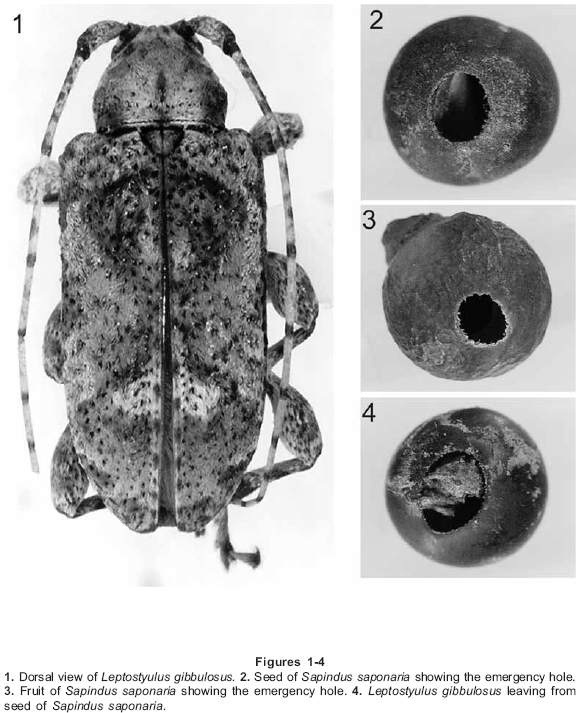
<abbrev-journal-title><![CDATA[Acta Zool. Mex]]></abbrev-journal-title>
<issn>0065-1737</issn>
<publisher>
<publisher-name><![CDATA[Instituto de Ecología A.C.]]></publisher-name>
</publisher>
</journal-meta>
<article-meta>
<article-id>S0065-17372007000100012</article-id>
<title-group>
<article-title xml:lang="en"><![CDATA[Some notes on natural history and distribution of Leptostylus gibbulosus Bates, 1874 (Coleoptera: Cerambycidae)]]></article-title>
</title-group>
<contrib-group>
<contrib contrib-type="author">
<name>
<surname><![CDATA[Romero Nápoles]]></surname>
<given-names><![CDATA[Jesus]]></given-names>
</name>
<xref ref-type="aff" rid="A01"/>
</contrib>
<contrib contrib-type="author">
<name>
<surname><![CDATA[Chemsak]]></surname>
<given-names><![CDATA[John A.]]></given-names>
</name>
<xref ref-type="aff" rid="A02"/>
</contrib>
<contrib contrib-type="author">
<name>
<surname><![CDATA[Rodríguez Hernández]]></surname>
<given-names><![CDATA[Cesáreo]]></given-names>
</name>
<xref ref-type="aff" rid="A01"/>
</contrib>
</contrib-group>
<aff id="A01">
<institution><![CDATA[,Colegio de Postgraduados Instituto de Fitosanidad ]]></institution>
<addr-line><![CDATA[Montecillo Estado de México]]></addr-line>
<country>México</country>
</aff>
<aff id="A02">
<institution><![CDATA[,University of California Essig Museum of Entomology ]]></institution>
<addr-line><![CDATA[Berkeley California]]></addr-line>
<country>Estados Unidos de América</country>
</aff>
<pub-date pub-type="pub">
<day>00</day>
<month>00</month>
<year>2007</year>
</pub-date>
<pub-date pub-type="epub">
<day>00</day>
<month>00</month>
<year>2007</year>
</pub-date>
<volume>23</volume>
<numero>1</numero>
<fpage>171</fpage>
<lpage>173</lpage>
<copyright-statement/>
<copyright-year/>
<self-uri xlink:href="http://www.scielo.org.mx/scielo.php?script=sci_arttext&amp;pid=S0065-17372007000100012&amp;lng=en&amp;nrm=iso"></self-uri><self-uri xlink:href="http://www.scielo.org.mx/scielo.php?script=sci_abstract&amp;pid=S0065-17372007000100012&amp;lng=en&amp;nrm=iso"></self-uri><self-uri xlink:href="http://www.scielo.org.mx/scielo.php?script=sci_pdf&amp;pid=S0065-17372007000100012&amp;lng=en&amp;nrm=iso"></self-uri></article-meta>
</front><body><![CDATA[  	    <p align="justify"><font face="verdana" size="4">Nota cient&iacute;fica</font></p>      <p align="justify"><font face="verdana" size="2">&nbsp;</font></p>  	    <p align="center"><font face="verdana" size="3"><b>Some notes on natural history and distribution of&nbsp;<i>Leptostylus gibbulosus</i>&nbsp;Bates, 1874 (Coleoptera: Cerambycidae)</b></font></p>      <p align="center"><font face="verdana" size="2">&nbsp;</font></p>  	    <p align="center"><font face="verdana" size="2"><b>Jesus Romero N&aacute;poles<sup>1</sup>, John A. Chemsak<sup>2</sup>, &#38; Ces&aacute;reo Rodr&iacute;guez Hern&aacute;ndez<sup>1</sup></b></font></p>  	    <p align="justify"><font face="verdana" size="2">&nbsp;</font></p>  	    <p align="justify"><font face="verdana" size="2"><sup><i>1</i></sup> <i>Instituto de Fitosanidad, Colegio de Postgraduados, M&Eacute;XICO.</i></font></p>  	    <p align="justify"><font face="verdana" size="2"><i><sup>2</sup> Essig Museum of Entomology, University of California, Berkeley 94720. USA.</i></font></p>  	    <p align="justify"><font face="verdana" size="2">&nbsp;</font></p>  	    ]]></body>
<body><![CDATA[<p align="justify"><font face="verdana" size="2"><b>Resumen</b></font></p>  	    <p align="justify"><font face="verdana" size="2">Se registra a <i>Sapindus saponaria</i> como un nuevo hospedero de <i>Leptostylus gibbulosus;</i> aunque la distribuci&oacute;n de &eacute;ste se cita desde Texas a Venezuela, su presencia no se hab&iacute;a registrado para el Estado de Oaxaca. Se describe brevemente su biolog&iacute;a y se contrasta &eacute;sta con la de Bruchidae.</font></p>  	    <p align="justify"><font face="verdana" size="2">&nbsp;</font></p>  	    <p align="justify"><font face="verdana" size="2">In the superfamily Chrysomeloidea, the only true seed feeders are found in the family Bruchidae. However, since 1917 some species of Cerambycidae have been found feeding on various plant seeds. There are, at this time, five genera and nine spermophagous species that feed on seeds of five plant families (<a href="/img/revistas/azm/v23n1/a12t1.jpg" target="_blank">Table 1</a>).</font></p>  	    <p align="justify"><font face="verdana" size="2">On April 19, 2003, the third author addressed a talk in Oaxaca as part of the course on using alternative products for insect control. He mentioned some plants used to produce soap, such as <i>Sapindus saponaria</i> L. to control insects. Some seeds of S. <i>saponaria</i> were obtained in Oaxaca and brought them back to Texcoco, Mexico. About three months later he observed some beetles flying around his home which were determined had emerged from a bag containing the <i>S. saponaria</i> seeds.</font></p>  	    <p align="justify"><font face="verdana" size="2">In 2004 and 2005 more seeds were collected in the vicinity of the city of Oaxaca but no beetles were found in these samples. Then, the following observations come from the original seed collection.</font></p>  	    <p align="justify"><font face="verdana" size="2">A set of 199 seeds showed 30.1&#37; of damage signs of beetle infestation; there were 139 healthy and 60 with emergence hole. The site of egg deposition and larval entrance was not determined.</font></p>  	    <p align="justify"><font face="verdana" size="2">Adult emergence (<a href="#f1">Fig. 1</a>) is apparently accomplished by making a hole with the mandibles in the endocarp (<a href="#f1">Fig. 2</a>) and the fused mesocarp and exocarp (<a href="#f1">Fig. 3</a>). The emergence site is more or less a circular hole (<a href="#f1">Fig. 4</a>) but in some cases the emergence hole is not so regular.</font>	</p>     <p align="center"><font face="verdana" size="2"><a name="f1"></a><img src="/img/revistas/azm/v23n1/a12f1.jpg"></font></p>      <p align="justify"><font face="verdana" size="2">This emergence behavior differs from that of the Bruchidae in that bruchid larvae make a perfect circular emergence hole for the adult to emerge. Adults push off the lid and emerge, leaving a round hole (Romero 2002. <i>Biodiversidad, taxonom&iacute;a y biogeograf&iacute;a de artr&oacute;podos de M&eacute;xico,</i> 3:513&#45;534). Another difference is that bruchids glue the eggs onto the fruits or pods. In those bruchids which do not glue the eggs, the entrance hole of the larvae can be observed.</font></p>  	    ]]></body>
<body><![CDATA[<p align="justify"><font face="verdana" size="2">An early record of Sapindaceae as a host plant for Cerambycidae was given by Vogt (1949. <i>Pan&#45;Pac. Entornol.,</i> 25: 175&#45;184) who stated that <i>L. gibbulosus</i> feeds in <i>Sapindus</i> sp. seeds. From this note S. <i>saponaria</i> constitutes a specific host species record for <i>L. gibbulosus. L. gibbulosus</i> is cited as occurring from Texas to Venezuela (Linsley &#38; Chemsak 1995. <i>Pubs. Entomol.,</i> 114: 1&#45;292), being Oaxaca as a pinpoint record for presence of this species in Mexico.</font></p>      ]]></body>
</article>
