<?xml version="1.0" encoding="ISO-8859-1"?><article xmlns:mml="http://www.w3.org/1998/Math/MathML" xmlns:xlink="http://www.w3.org/1999/xlink" xmlns:xsi="http://www.w3.org/2001/XMLSchema-instance">
<front>
<journal-meta>
<journal-id>0065-1737</journal-id>
<journal-title><![CDATA[Acta zoológica mexicana]]></journal-title>
<abbrev-journal-title><![CDATA[Acta Zool. Mex]]></abbrev-journal-title>
<issn>0065-1737</issn>
<publisher>
<publisher-name><![CDATA[Instituto de Ecología A.C.]]></publisher-name>
</publisher>
</journal-meta>
<article-meta>
<article-id>S0065-17372007000100008</article-id>
<title-group>
<article-title xml:lang="en"><![CDATA[Biogeography of the areas and Canthonini (Coleoptera: Scarabaeidae) of dry tropical forest in Mesoamerica and Colombia]]></article-title>
</title-group>
<contrib-group>
<contrib contrib-type="author">
<name>
<surname><![CDATA[Padilla-Gil]]></surname>
<given-names><![CDATA[Dora Nancy]]></given-names>
</name>
<xref ref-type="aff" rid="A01"/>
</contrib>
<contrib contrib-type="author">
<name>
<surname><![CDATA[Halffter]]></surname>
<given-names><![CDATA[Gonzalo]]></given-names>
</name>
<xref ref-type="aff" rid="A01"/>
</contrib>
</contrib-group>
<aff id="A01">
<institution><![CDATA[,Instituto de Ecología A.C.  ]]></institution>
<addr-line><![CDATA[Jalapa Veracruz]]></addr-line>
<country>México</country>
</aff>
<pub-date pub-type="pub">
<day>00</day>
<month>00</month>
<year>2007</year>
</pub-date>
<pub-date pub-type="epub">
<day>00</day>
<month>00</month>
<year>2007</year>
</pub-date>
<volume>23</volume>
<numero>1</numero>
<fpage>73</fpage>
<lpage>108</lpage>
<copyright-statement/>
<copyright-year/>
<self-uri xlink:href="http://www.scielo.org.mx/scielo.php?script=sci_arttext&amp;pid=S0065-17372007000100008&amp;lng=en&amp;nrm=iso"></self-uri><self-uri xlink:href="http://www.scielo.org.mx/scielo.php?script=sci_abstract&amp;pid=S0065-17372007000100008&amp;lng=en&amp;nrm=iso"></self-uri><self-uri xlink:href="http://www.scielo.org.mx/scielo.php?script=sci_pdf&amp;pid=S0065-17372007000100008&amp;lng=en&amp;nrm=iso"></self-uri><abstract abstract-type="short" xml:lang="en"><p><![CDATA[This biogeographical analysis examines the historical, geological, climatic and ecological processes that have influenced the formation of the dry tropical forests (DTF) of Mesoamerica and Colombia, areas that are the setting for multiple biogeographical stories that in this case are illustrated by the patterns and evolutionary processes of Canthonini. In this study we test the hypothesis that the Canthonini fauna of dry tropical forests has a South American affinity. To this end, we compare extant species from a tract of dry tropical forest in Mexico, a second enclave in Costa Rica, four from the Caribbean region of Colombia and finally one from the north of Tolima in the Upper Magdalena River Valley, Colombia. The geomorphological characteristics of the enclaves of DTF are also compared, as are the geographical distribution and taxonomic affinities of each of the species found in these dry tropical forests. The biogeographical, historical and geological aspects of the enclaves were evaluated using a Parsimony Analysis of Endemicity (PAE), with two tropical rain forests as the outgroup: Leticia (Amazonas, Colombia) and Los Tuxtlas (Veracruz, Mexico). This study reveals the origin and distribution of Neotropical dry forests in the Pleistocene, and the establishment of its dry conditions during the Holocene. It also reveals apparent similarities among the Canthonini of the dry tropical forests of Mexico, Costa Rica and Colombia, with three geographical distribution patterns that correspond to different degrees of expansion towards the north and the diversification of evolutionary lines, and even species of South American origin. The comparison of the cladogram generated for species of Canthonini with that of the geological events that have occurred in the study regions indicates that the distribution of Canthonini in dry tropical forests began during the Pliocene with the re-establishment of the Panamanian connection, with no evidence of previous geomorphological events having any influence. On the other hand, there are few species shared with the tropical rain forests used as the outgroup for the cladograms.]]></p></abstract>
<abstract abstract-type="short" xml:lang="es"><p><![CDATA[Este análisis biogeográfico examina los procesos históricos, geológicos, climáticos y ecológicos que han influido en la formación de los bosques tropicales secos (DTF) de Mesoamérica y Colombia, bosques que son sitios de múltiples historias biogeográficas como la que ilustran los Canthonini. Sometemos a prueba la hipótesis de que la fauna de Canthonini de los bosques tropicales secos tiene una afinidad sudamericana. Para este propósito comparamos las especies que se encuentran en un enclave de bosque tropical seco en México, en un segundo enclave en Costa Rica, en cuatro de la región Caribe de Colombia y finalmente uno más en el norte de Tolima en el valle superior del río Magdalena, Colombia. Las características geomorfológicas de los enclaves son también comparadas, así como la distribución geográfica y las afinidades taxonómicas de cada una de las especies de Canthonini que se encuentran en estos bosques tropicales secos. Los aspectos de historia biogeográfica, geológica y ecológica de los enclaves son evaluados usando un Análisis de Parsimonia de Endemicidad (PAE), utilizando como grupo externo dos lugares de selva siempre verde: Leticia (Amazonas, Colombia) y Los Tuxtlas (Veracruz, México). Este estudio pone de manifiesto que el origen y distribución de los bosques tropicales secos de la región ocurre durante el Pleistoceno, con una acentuación de las características de sequía durante el Holoceno. También revela similitudes entre los Canthonini de los bosques tropicales secos de México, Costa Rica y Colombia, con tres patrones de distribución que corresponden a diferentes grados de expansión hacia el norte y a la diversificación de líneas evolutivas, incluso a la presencia de especies sudamericanas. La comparación entre el cladograma generado por las especies de Canthonini y el de eventos geológicos, indica que la distribución de los primeros en los bosques tropicales secos comienza en el Plioceno con el restablecimiento de la conexión panameña, sin evidencias de que eventos geomorfológicos previos hayan ejercido influencias. Por otra parte, hay muy pocas especies compartidas con las selvas siempre verdes usadas como grupo externo en los cladogramas.]]></p></abstract>
<kwd-group>
<kwd lng="en"><![CDATA[Scarabaeinae]]></kwd>
<kwd lng="en"><![CDATA[Canthonini]]></kwd>
<kwd lng="en"><![CDATA[dry tropical forest]]></kwd>
<kwd lng="en"><![CDATA[Mexico]]></kwd>
<kwd lng="en"><![CDATA[Costa Rica]]></kwd>
<kwd lng="en"><![CDATA[Colombia]]></kwd>
<kwd lng="en"><![CDATA[biogeographical patterns]]></kwd>
<kwd lng="es"><![CDATA[Scarabaeinae]]></kwd>
<kwd lng="es"><![CDATA[Canthonini]]></kwd>
<kwd lng="es"><![CDATA[bosque tropical seco]]></kwd>
<kwd lng="es"><![CDATA[México]]></kwd>
<kwd lng="es"><![CDATA[Costa Rica]]></kwd>
<kwd lng="es"><![CDATA[Colombia]]></kwd>
<kwd lng="es"><![CDATA[patrones biogeográficos]]></kwd>
</kwd-group>
</article-meta>
</front><body><![CDATA[  	    <p align="center"><font face="verdana" size="4"><b>Biogeography of the areas and Canthonini (Coleoptera: Scarabaeidae) of dry tropical forest in Mesoamerica and Colombia</b></font></p>      <p align="center"><font face="verdana" size="2">&nbsp;</font></p>  	    <p align="center"><font face="verdana" size="2"><b>Dora Nancy Padilla&#45;Gil and Gonzalo Halffter</b></font></p>  	    <p align="justify"><font face="verdana" size="2">&nbsp;</font></p>  	    <p align="justify"><font face="verdana" size="2"><i>Instituto de Ecolog&iacute;a, A.C., Apdo. Postal 63, 91000 Xalapa, Veracruz, MEXICO</i>. <a href="mailto:dnpadilla@hotmail.com">dnpadilla@hotmail.com</a>, <a href="mailto:gonzalo.halffter@inecol.edu.mx">gonzalo.halffter@inecol.edu.mx</a></font></p>  	    <p align="justify"><font face="verdana" size="2">&nbsp;</font></p>  	    <p align="justify"><font face="verdana" size="2">Recibido: 23 de marzo 2006    <br> 	Aceptado: 29 de septiembre 2006</font></p>  	    <p align="justify"><font face="verdana" size="2">&nbsp;</font></p>  	    ]]></body>
<body><![CDATA[<p align="justify"><font face="verdana" size="2"><b>ABSTRACT</b></font></p>  	    <p align="justify"><font face="verdana" size="2">This biogeographical analysis examines the historical, geological, climatic and ecological processes that have influenced the formation of the dry tropical forests (DTF) of Mesoamerica and Colombia, areas that are the setting for multiple biogeographical stories that in this case are illustrated by the patterns and evolutionary processes of Canthonini. In this study we test the hypothesis that the Canthonini fauna of dry tropical forests has a South American affinity. To this end, we compare extant species from a tract of dry tropical forest in Mexico, a second enclave in Costa Rica, four from the Caribbean region of Colombia and finally one from the north of Tolima in the Upper Magdalena River Valley, Colombia. The geomorphological characteristics of the enclaves of DTF are also compared, as are the geographical distribution and taxonomic affinities of each of the species found in these dry tropical forests. The biogeographical, historical and geological aspects of the enclaves were evaluated using a Parsimony Analysis of Endemicity (PAE), with two tropical rain forests as the outgroup: Leticia (Amazonas, Colombia) and Los Tuxtlas (Veracruz, Mexico).</font></p>  	    <p align="justify"><font face="verdana" size="2">This study reveals the origin and distribution of Neotropical dry forests in the Pleistocene, and the establishment of its dry conditions during the Holocene. It also reveals apparent similarities among the Canthonini of the dry tropical forests of Mexico, Costa Rica and Colombia, with three geographical distribution patterns that correspond to different degrees of expansion towards the north and the diversification of evolutionary lines, and even species of South American origin.</font></p>  	    <p align="justify"><font face="verdana" size="2">The comparison of the cladogram generated for species of Canthonini with that of the geological events that have occurred in the study regions indicates that the distribution of Canthonini in dry tropical forests began during the Pliocene with the re&#45;establishment of the Panamanian connection, with no evidence of previous geomorphological events having any influence. On the other hand, there are few species shared with the tropical rain forests used as the outgroup for the cladograms.</font></p>  	    <p align="justify"><font face="verdana" size="2"><b>Key Words:</b> Scarabaeinae, Canthonini, dry tropical forest, Mexico, Costa Rica, Colombia, biogeographical patterns.</font></p>  	    <p align="justify"><font face="verdana" size="2">&nbsp;</font></p>  	    <p align="justify"><font face="verdana" size="2"><b>RESUMEN</b></font></p>  	    <p align="justify"><font face="verdana" size="2">Este an&aacute;lisis biogeogr&aacute;fico examina los procesos hist&oacute;ricos, geol&oacute;gicos, clim&aacute;ticos y ecol&oacute;gicos que han influido en la formaci&oacute;n de los bosques tropicales secos (DTF) de Mesoam&eacute;rica y Colombia, bosques que son sitios de m&uacute;ltiples historias biogeogr&aacute;ficas como la que ilustran los Canthonini. Sometemos a prueba la hip&oacute;tesis de que la fauna de Canthonini de los bosques tropicales secos tiene una afinidad sudamericana. Para este prop&oacute;sito comparamos las especies que se encuentran en un enclave de bosque tropical seco en M&eacute;xico, en un segundo enclave en Costa Rica, en cuatro de la regi&oacute;n Caribe de Colombia y finalmente uno m&aacute;s en el norte de Tolima en el valle superior del r&iacute;o Magdalena, Colombia. Las caracter&iacute;sticas geomorfol&oacute;gicas de los enclaves son tambi&eacute;n comparadas, as&iacute; como la distribuci&oacute;n geogr&aacute;fica y las afinidades taxon&oacute;micas de cada una de las especies de Canthonini que se encuentran en estos bosques tropicales secos. Los aspectos de historia biogeogr&aacute;fica, geol&oacute;gica y ecol&oacute;gica de los enclaves son evaluados usando un An&aacute;lisis de Parsimonia de Endemicidad (PAE), utilizando como grupo externo dos lugares de selva siempre verde: Leticia (Amazonas, Colombia) y Los Tuxtlas (Veracruz, M&eacute;xico). Este estudio pone de manifiesto que el origen y distribuci&oacute;n de los bosques tropicales secos de la regi&oacute;n ocurre durante el Pleistoceno, con una acentuaci&oacute;n de las caracter&iacute;sticas de sequ&iacute;a durante el Holoceno. Tambi&eacute;n revela similitudes entre los Canthonini de los bosques tropicales secos de M&eacute;xico, Costa Rica y Colombia, con tres patrones de distribuci&oacute;n que corresponden a diferentes grados de expansi&oacute;n hacia el norte y a la diversificaci&oacute;n de l&iacute;neas evolutivas, incluso a la presencia de especies sudamericanas.</font></p>  	    <p align="justify"><font face="verdana" size="2">La comparaci&oacute;n entre el cladograma generado por las especies de Canthonini y el de eventos geol&oacute;gicos, indica que la distribuci&oacute;n de los primeros en los bosques tropicales secos comienza en el Plioceno con el restablecimiento de la conexi&oacute;n paname&ntilde;a, sin evidencias de que eventos geomorfol&oacute;gicos previos hayan ejercido influencias. Por otra parte, hay muy pocas especies compartidas con las selvas siempre verdes usadas como grupo externo en los cladogramas.</font></p>  	    <p align="justify"><font face="verdana" size="2"><b>Palabras Clave:</b> Scarabaeinae, Canthonini, bosque tropical seco, M&eacute;xico, Costa Rica, Colombia, patrones biogeogr&aacute;ficos.</font></p>  	    ]]></body>
<body><![CDATA[<p align="justify"><font face="verdana" size="2">&nbsp;</font></p>  	    <p align="justify"><font face="verdana" size="2"><b>INTRODUCTION</b></font></p>  	    <p align="justify"><font face="verdana" size="2">It has been suggested that tribe Canthonini (Scarabaeidae: Scarabaeinae) has an ancient Gondwanian distribution with high species richness in South America (Halffter 1974). In the Americas, the genus with the most species is <i>Canthon,</i> with 174 according to Halffter &#38; Mart&iacute;nez (1977) that are distributed from Argentina to Canada. The origin of <i>Canthon</i> and close genera appears to be northern South America where it reaches its greatest richness in phyletic lines and species, with an expansion of lines toward the periphery of Chile where it is barely represented (Halffter 1974, Rivera&#45;Cervantes &#38; Halffter 1999). From South America, Central and North America were populated by elements of this tribe during two probable great expansion events (Halffter 1964, 1974, 1976, Kohlmann &#38; Halffter 1990). The first could have occurred before or during the Miocene and the second when the connection with South and Central America was re&#45;established from the Pliocene to the Recent. In the phyletic lines that participated in the first expansion, although it is possible to identify the South American affinities at the level of genus, there was notable speciation in Mexico and the United States of America, followed in some cases by secondary expansion. For those phyletic lines that participated in the second expansion event, the affinities with northern South America are much more marked, although there was also <i>in situ</i> speciation.</font></p>  	    <p align="justify"><font face="verdana" size="2">The objective of this study is to test this biogeographical hypothesis. To that end, we chose to use the species of Canthonini that inhabit dry tropical forest (DTF). These were selected because they are the least studied Scarabaeinae fauna compared to their tropical rain forest (TRF) counterparts and also because their distribution, now discontinuous, has been much less interrupted in the recent past.</font></p>  	    <p align="justify"><font face="verdana" size="2">This hypothesis regarding the biogeographical history of the Canthonini (common for other groups of Scarabaeinae and, in general, for insects) has been tested in various ways. First, by establishing the similarity of the Canthonini present in a series of enclaves found in DTF in Mexico, Costa Rica and Colombia &#45; places for which we have reliable lists of the fauna. Second, we have analyzed the historical and geological relationships of the regions where these enclaves are located in order to relate the history of the areas with both the phylogeny and the geographical distribution of Canthonini. Finally, the two previous points are integrated in order to recreate the setting of the DTF where the processes of speciation and dispersion of some Canthonini probably took place, and also to explain their geographic distribution. As proposed by Zunino (2005) we intend to compare the distribution and phylogenetic history of the taxa with the geography and geomorphological history of the areas to arrive at a comprehensive interpretation of the entire set of elements.</font></p>  	    <p align="justify"><font face="verdana" size="2">DTF, also known as tropical deciduous forest is defined as that formation of vegetation with a continuous woody cover distributed from sea level to 1000 m, with mean temperatures above 24 &#176;C and precipitation ranging from 700 to 2000 mm per year (Espinal 1985; IAvH 1997a). This vegetation has woody species that lose their leaves during the dry season over a variable period of time that lasts around six months (Rzedowski 1978).</font></p>  	    <p align="justify"><font face="verdana" size="2">According to Rzedowski (1978) DTF is particularly characteristic of the Pacific Slope of Mexico, where it covers extensive areas almost uninterrupted from the south of Sonora and southwest of Chihuahua to Chiapas, continuing southwards in Central America. It penetrates deep into the Balsas and the Santiago River basins, as well as those of the tributaries of these rivers. In the Isthmus of Tehuantepec, DTF passes the watershed and occupies a good part of the Central Depression of Chiapas. On the Atlantic Slope there are at least three large patches of DTF and it is also found on the Yucatan Peninsula (see Trejo 2005).</font></p>  	    <p align="justify"><font face="verdana" size="2">In Mexico, DTF once covered 6 to 14&#37; (270 000 km<sup>2</sup> ) of the area in the country that lies between sea level and 1500 m. DTF has been reduced to 27&#37; of its original cover (Trejo &#38; Dirzo 2000). In Costa Rica almost all of the Nicoya Peninsula and Chira Island in the northeast of the country, were covered by this type of forest 100 years ago (Kohlmann <i>et al.</i> 2002). In Central America, DTF once covered 7&#37; (33 600 km<sup>2</sup>) of the total area between 0 and 1000 m. The remaining tropical dry forest in Central America probably represents less than 2&#37; of the original (Sabogal &#38; Valerio 1998). Colombia has three large regions with DTF and the two largest are the Caribbean Plain, including southern Guajira and the Magdalena River Valley in the Departments of Tolima, Cundinamarca and Huila (IAvH 1997b). In Colombia the status of DTF is critical. It is estimated that only 1&#37; of the original 80 000 km<sup>2</sup> of dry to subhumid forests remains (Etter 1993). <a href="#f1">Figure 1</a> summarizes the distribution of DTF in the study area.</font></p> 	    <p align="center"><font face="verdana" size="2"><a name="f1"></a><img src="/img/revistas/azm/v23n1/a8f1.jpg" alt=""></font></p>      <p align="justify"><font face="verdana" size="2">The biogeography of the areas of dry tropical forest is undertaken with cladistic analysis, keeping in mind the past and present geological and geomorphological characteristics of the area. In order to understand the biogeographical relationships between the enclaves of DTF and the species of Canthonini, we used a Parsimony Analysis of Endemicity (PAE) that produces a hierarchical set of the species represented in the different areas, and associates it with the geological or ecological factors, or a combination thereof. PAE can provide the grounds for explaining: 1) the effects of geological events on evolution; 2) the effects of ecological factors on evolution; 3) the influence of geological events on ecological conditions and the evolutionary consequences of these; 4) distribution patterns, i.e. which sets of species can appear in different areas owing solely to events in geological history or the association of the latter with ecological conditions (Rosen 1988).</font></p>  	    ]]></body>
<body><![CDATA[<p align="justify"><font face="verdana" size="2">This study has two purposes, the first is to analyze the biogeographical history of the areas of dry tropical forest in Mesoamerica and Colombia based on their geomorphological characteristics and their geological origin; the second is to establish the relationships between these forests using the Canthonini as an indicator group, comparing their distribution with the geomorphological history of those areas and explaining the presence of Canthonini in dry forest.</font></p>  	    <p align="justify"><font face="verdana" size="2">First we carry out the biogeographical analysis of the neotropiocal dry forests that are the object of this study, and then the biogeographical analysis of the Canthonini. Some aspects of Canthonini in dry forest are discussed in light of other floristic, faunal, ecological and biogeographical elements that are particularly related to the Canthonini and the geographical limits of some species.</font></p>  	    <p align="justify"><font face="verdana" size="2">&nbsp;</font></p>  	    <p align="justify"><font face="verdana" size="2"><b>MATERIALS AND METHODS</b></font></p>  	    <p align="justify"><font face="verdana" size="2"><b>Study sites:</b></font></p>  	    <p align="justify"><font face="verdana" size="2">The DTF sites we selected in Mesoamerica and Colombia are enclaves representative of the current distribution of this type of vegetation (<a href="#f1">Fig. 1</a>). Chamela (Jalisco, Mexico) and Palo Verde (Guanacaste, Costa Rica) are located on the Pacific coast. In the Caribbean region of Colombia we selected four areas: Neguanje, Tierra Bomba, Los Colorados and Zambrano. In the Magdalena River Valley, we selected the DTF located in the north of the Department of Tolima. Two of the sites selected in the Caribbean region, Los Colorados and Neguanje, have the highest floristic richness, basal area and canopy height of the DTF found in the Caribbean and Tolima region (Mendoza 1999). Another factor which led to the selection of these sites was the availability of information on the Scarabaeinae fauna. There are publications for each of the sites, and there are also databases for Costa Rica (INBio) and Mexico (SNIB&#45;CONABIO). The sites are described below together with the most relevant features associated to geological and geomorphologic characters (see <a href="#t1">Tables 1</a> and <a href="#t2">2</a>).</font></p>     <p align="center"><font face="verdana" size="2"><a name="t1"></a><img src="/img/revistas/azm/v23n1/a8t1.jpg"></font></p>     <p align="center"><font face="verdana" size="2"><a name="t2"></a><img src="/img/revistas/azm/v23n1/a8t2.jpg"></font></p>      <p align="justify"><font face="verdana" size="2"><b>Chamela, Jalisco, Mexico.</b> The Chamela&#45;Cuixmala Biosphere Reserve is located on the Pacific coast (19&#176; 30' N, 105&#176; 03' W). The study site is between the San Nicolas River in the north and the Cuixmala River in the south, centred in the surroundings of the Chamela Biological Station (<a href="#f1">Fig. 1</a>). With altitudes lower than 200 m, the climate has no marked seasonality with respect to temperature. Mean monthly maxima range from 28.8 to 32.2 &#176;C, and the minima from 15.9 to 22.6 &#176;C. Mean annual precipitation is 707 mm. The rainy season lasts four months on average, starting at the beginning of July and ending at the beginning of November (Bullock 1988).</font></p>  	    <p align="justify"><font face="verdana" size="2">Chamela belongs to the Jalisco Block (JB), which constitutes a tectono&#45;stratigraphic assemblage from the Late Cretaceous to Early Tertiary (Paleocene), with volcanic and volcaniclastic deposits and marine sedimentary sequences intruded by granitoid plutons. The plutonic and volcanic rocks of the JB are part of the magmatic arc, which is found southeastward along the terrain of the state of Guerrero. On the other hand, Chamela is aseismic and is located on the North American tectonic plate. It is characterized by an undulating landscape, the presence of mineral, soil with low permeability and organic matter.</font></p>  	    ]]></body>
<body><![CDATA[<p align="justify"><font face="verdana" size="2"><b>Palo Verde, Guanacaste, Costa Rica.</b> The Palo Verde Biological Station (<a href="#f1">Fig. 1</a>) is located in the Palo Verde National Park (10&#176; 20' N, 85&#176; 18' W) on the Pacific slope, in the Province of Guanacaste and halfway up the basin of the Tempisque River at an altitude of 10 to 50 m. Mean annual temperature ranges from 24.0 to 27.8 &#176;C and mean annual precipitation is 1750 mm (Quigley &#38; Platt 2003), with a 6.5 month long dry season each year (SIEPAC 2003).</font></p>  	    <p align="justify"><font face="verdana" size="2">It is characterized by an undulating landscape, with slightly developed soils, and the most abundant minerals are olivine&#45;pyroxene. The local fault is responsible for the seismicity. The Palo Verde region dates from the Paleocene to Early Eocene. This site is characterized by high magnetism, and is located on the Caribbean tectonic plate. </font></p> 	    <p align="justify"><font face="verdana" size="2"><b>Colombia, Caribbean Region.</b> The sites selected (<a href="#f1">Fig. 1</a>) have been described by Mendoza (1999). Located between 50 and 300 m, their mean temperatures are greater than 24 &#176;C and they receive 700 to 2000 mm of precipitation per year. There are two marked dry seasons per year (IAvH 2000). This region is represented by four sites:</font></p>      <p align="justify"><font face="verdana" size="2"><b>a)&nbsp;Zambrano: Forest Reserve, Monterrey.</b> Located in the Departament of Bolivar, Zambrano Municipality (9&#176; 37' 48" N, 74&#176; 54' 44" W) at 155 m. Mean annual precipitation is 1048 mm.</font></p>  	    <p align="justify"><font face="verdana" size="2"><b>b)&nbsp;Los Colorados.</b> Located in the Departament of Bolivar, San Juan de Nepomuceno Municipality (9&#176; 51' 33" N, 75&#176; 06' 38"W), at 300 m. Mean annual precipitation is 1189 mm. This remnant of DTF belongs to the Los Colorados Flora and Fauna Sanctuary Conservation Unit.</font></p>  	    <p align="justify"><font face="verdana" size="2"><b>c)&nbsp;Tierra Bomba Island.</b> Located in the Department of Bolivar, Cartagena Municipality (10&#176; 21' 36" N, 75&#176; 34' 11" W), at 50 m. Mean annual precipitation is 789 mm.</font></p>  	    <p align="justify"><font face="verdana" size="2"><b>d)&nbsp;Neguanje.</b> Located in the Department of Magdalena, in the Santa Marta Municipality (11&#176; 18'05" N, 74&#176; 06' 11" W) at 300 m. Mean annual precipitation is 1420 mm. Neguanje belongs to the Tayrona National Park.</font></p>  	    <p align="justify"><font face="verdana" size="2">The Caribbean Region is located between the Perij&aacute; to the east and the Sierra Nevada. On the surface, fluvial and lacustrine sediments from the Quaternary predominate. It is characterized by a sequence of sandy, slime and clay, and feldspar is the most abundant mineral in the sandy fraction of the soil. It is aseismic and located on the Caribbean tectonic plate. In geological terms, Neguanje belongs to the geotectonic province of Santa Marta (land originating in the Mesozoic: Middle Jurassic to Late Cretaceous) and the other three sites belong to the province of the Caribbean Plain. Zambrano belongs to the San Jorge&#45;Plato geostructure (the land dates from the Quaternary), Los Colorados to the San Jacinto Belt (the land dates from the Tertiary: Late Eocene) and Cartagena to the Sin&uacute; Belt (Tierra Bomba is from the Quaternary). The Sierra Nevada is associated with the Santa Marta fault and the Caribbean Plain is associated with the Romeral system fault in the west.</font></p>  	    <p align="justify"><font face="verdana" size="2"><b>North Tolima.</b> We selected the study area described by Escobar (1997). It is located on the east side bank of the Magdalena River (<a href="#f1">Fig. 1</a>), 130 km from the city of Ibagu&eacute; in the jurisdiction of the municipalities of Honda, Armero&#45;Guayabal and Piedras, at (4&#176; 15' &#45; 5&#176; 10' N, 74&#176; 45' &#45; 74&#176; 50' W) at 250 m. Mean annual precipitation is 1387 mm and the mean annual temperature is 28 &#176;C, with two well defined dry periods, one from December to March and the other from June to August.</font></p>  	    <p align="justify"><font face="verdana" size="2">North Tolima forms part of the Upper Magdalena River Valley, an inter&#45;Andina valley on the eastern slope of the Cordillera Central. It belongs to the Honda formation dating from the Tertiary: Miocene. There are faults nearby and it is associated with the Plioquaternary volcanic activity of the Cordillera Central, as reflected in its notable seismicity. </font></p> 	    ]]></body>
<body><![CDATA[<p align="justify"><font face="verdana" size="2"><b>Los Tuxtlas, Veracruz, Mexico.</b> The Los Tuxtlas Biological Station is located in the foothills of the San Martin Volcano, 19 km north of the city of Catemaco in the state of Veracruz (<a href="#f1">Fig. 1</a>; 18&#176; 34' &#45; 18&#176; 36' N, 95&#176; 04'&#45; 95&#176; 09'W) at 150 to 530 m. Mean annual precipitation is 4560 mm and the mean annual temperature is 23.7 &#176;C (Mor&oacute;n 1979).</font></p>      <p align="justify"><font face="verdana" size="2">Los Tuxtlas Reserve belongs to the formation La Laja, which dated Oligocene and is located on the North American tectonic plate. It is characterized by an undulating landscape, igneous rocks of continental origin, nearby mountains, soils with high permeability and organic material, and high seismicity.</font></p>  	    <p align="justify"><font face="verdana" size="2"><b>Leticia, Amazonas, Colombia.</b> The Colombian Amazon has a humid tropical climate. The site is located at 4&#176; 8' S, 70&#176; 1' W, and 96 m (<a href="#f1">Fig. 1</a>). Mean annual precipitation is 3500 mm, with the majority of the rain falling between April and June. Mean annual temperature is 26 &#176;C, with maximum temperatures in October and November 35 &#176;C. It is cooler in July with minima from 20 to 25 &#176;C (Galvis <i>et al.</i> 1979).</font></p>  	    <p align="justify"><font face="verdana" size="2">It is characterized by an undulating landscape, with highly evolved soils, a limited presence of minerals and low levels of natural fertility. Quartz dominated more than 90&#37; of the sandy fraction and potassium was scarce. This geomorph developed over sedimentary rocks with a thick grain. The Quaternary deposits are comprised of sand, possibly of eolic origin, with recent terraces and alluvial deposits. This is an aseismic region located on the South American plate.</font></p>  	    <p align="justify"><font face="verdana" size="2">&nbsp;</font></p>  	    <p align="justify"><font face="verdana" size="2"><b>Ingroup and Outgroup</b></font></p>  	    <p align="justify"><font face="verdana" size="2">Our decision to use a real outgroup is based on the fact that the rain forest provides ecological characteristics that contrast with those of dry forest and take into account the previous hypotheses about its probable origin in neotropical forest. Also, rain forest is supposed to be older than dry forest (see Sarmiento 1975, Platt <i>et al.</i> 1981, Gentry 1982, Hooghiemstra &#38; Van der Hammen 2001, Richardson <i>et al.</i> 2001, Hooghiemstra <i>et al.</i> 2002, Graham 2003). The use of an outgroup provides both a geographical context and vegetation formations that contrast with the characteristics of the areas where the Scarabaeinae we are studying are currently found.</font></p>  	    <p align="justify"><font face="verdana" size="2">&nbsp;</font></p>  	    <p align="justify"><font face="verdana" size="2"><b>Geomorphological cladogram</b></font></p>  	    <p align="justify"><font face="verdana" size="2">Historical and geomorphological relationships were analyzed following Craw (1988). The seven dry forests make up the ingroup, however our analysis differs because for the outgroup we have used real sites of tropical rain forest, instead of coding for the outgroup with zeros. The rain forests selected carrying out the analysis using this outgroup allows the cladogram to be polarized and hence produces the more parsimonious solution than one that uses zeros.</font></p>  	    ]]></body>
<body><![CDATA[<p align="justify"><font face="verdana" size="2">In order to select characters and assign character states for each of the sites, more than fifty references were consulted. The list of the main studies consulted is presented by country in <a href="#t1">Table 1</a>.</font></p>  	    <p align="justify"><font face="verdana" size="2">The geologic&#45;geomorphological characters provide evidence from different sources of characters: geomorphostructural, geophysical and edaphic. The geomorphostructural characteristics of the terrain are defined by its geological and morphostructural history (origin and evolution) and by the lithological composition of the materials. Geophysical characters include the geotectonic, magnetic and gravimetric anomalies of the physiographical regions. On the other hand, the origin of the soil is influenced by the relative material, relief, climate and the organisms that are present.</font></p>  	    <p align="justify"><font face="verdana" size="2">Eighteen characters and their states were selected (<a href="#t2">Tables 2</a>, <a href="#t3">3</a>). Ambiguous characters were discarded as were those for which there is insufficient information for more than two sites. All the characters were given equal weight, with three ordered characters: 8, 9 and 16. These characters were taken as unordered because they are related to chronological sequences of events associated to the scale of geological time.</font>	</p>     <p align="center"><font face="verdana" size="2"><a name="t3"></a><img src="/img/revistas/azm/v23n1/a8t3.jpg"></font></p>     <p align="center">&nbsp;</p>      <p align="justify"><font face="verdana" size="2"><b>Cladogram of the areas of affinity for the Canthonini</b></font></p>  	    <p align="justify"><font face="verdana" size="2">The relationships of DTF were analyzed using Parsimony Analysis of Endemicity (PAE), where the taxa are analogous to the sites and the characters to the species. In contrast to the methodology proposed by Rosen (1988) where the cladogram is rooted in a hypothetical ancestral area coded in zeros, here we use an external group, the outgroup, of real sites. The ingroup and outgroup are the same as mentioned for the previous analysis.</font></p>  	    <p align="justify"><font face="verdana" size="2">We chose PAE because it allows for the use of an outgroup in the analysis, the polarization of the cladogram, the addition of taxonomic hierarchies and it has a small data matrix.</font></p>  	    <p align="justify"><font face="verdana" size="2">A cladogram of the areas was generated using lists of the species (<a href="#t4">Table 4</a>) present in each forest, indicating presence (1) or absence (0) according to the matrix (<a href="#t5">Table 5</a>). Given that 24 of the 28 species belong to the genus <i>Canthon,</i> the subgenera of this taxon were included. The PAUP 4.0b10 (Swofford 2002) program with Acctran optimization and exhaustive search was used. The results were analyzed based on the majority consensus tree as it offered the greatest resolution.</font>	</p>     <p align="center"><font face="verdana" size="2"><a name="t4"></a><img src="/img/revistas/azm/v23n1/a8t4.jpg"></font></p>     ]]></body>
<body><![CDATA[<p align="center"><font face="verdana" size="2"><a name="t5"></a><img src="/img/revistas/azm/v23n1/a8t5.jpg"></font></p>      <p align="left"><font face="verdana" size="2">&nbsp;</font></p>  	    <p align="justify"><font face="verdana" size="2"><b>Canthonini Species</b></font></p>  	    <p align="justify"><font face="verdana" size="2">All the genera of Canthonini present in the forests studied are included in the analysis, with the exception of <i>Deltochilum</i> for which there is insufficient taxonomic and biogeographical information.</font></p>  	    <p align="justify"><font face="verdana" size="2">In order to compile the lists for Palo Verde and the Mexican site, in addition to a review of the publications mentioned below, the following data bases were used: INBio (Costa Rica) and SNIB&#45;CONABIO (Mexico). The following publications were consulted: Chamela &#45; Mor&oacute;n <i>et al.</i> (1988), Andresen (2005); Palo Verde &#45; Kohlmann &#38; Wilkinson (2003); North Tolima &#45;Escobar (1997), Bustos&#45;G&oacute;mez &#38; Lopera&#45;Toro (2003); Caribbean Region of Colombia &#45; Escobar (1998, 2000a); species lists for these Colombian sites were also provided by F. Escobar; Leticia &#45; list compiled by Bruce Gill, 12, I, 1997 with material collected by Howden &#38; Nealis (1975), Escobar (2000a), Medina <i>et al.</i> (2001); Los Tuxtlas &#45; Mor&oacute;n (1979), Halffter <i>et al.</i> (1992), Favila &#38; D&iacute;az (1997), Deloya &#38; Mor&oacute;n (1998), D&iacute;az (1998, 2003).</font></p>  	    <p align="justify"><font face="verdana" size="2"><i>Canthon deyrollei</i> was described by Harold in 1868, with the type locality unknown. It has been included for Colombia, without any other data in numerous publications (Vulcano &#38; Pereira 1964, Howden &#38; Young 1981, Solis &#38; Kohlmann 2002). In the publications that we consulted for Colombia this species is either not recorded or is not assigned a locality. Hence, the record for Colombia was not included.</font></p>  	    <p align="justify"><font face="verdana" size="2"><i>Canthon cyanellus</i> and <i>C. indigaceus</i> are included in the analysis with their respective subspecies according to Halffter (1961).</font></p>  	    <p align="justify"><font face="verdana" size="2">&nbsp;</font></p>  	    <p align="justify"><font face="verdana" size="2"><b>Geographical distribution of Canthonini</b></font></p>  	    <p align="justify"><font face="verdana" size="2">There are many studies that include the geographical distribution of Canthonini in Mexico. Some of those that we consulted for this study are: Halffter 1961, 1964, 1976; Mart&iacute;nez <i>et</i> al.1964; Halffter &#38; Matthews 1966; Barrera 1969; Mart&iacute;nez &#38; Halffter 1972; Mor&oacute;n &#38; Terr&oacute;n 1984; Mor&oacute;n <i>et al.</i> 1985, 1986; Deloya <i>et al.</i> 1987; Delgado 1989; Kohlmann &#38; Halffter 1990; Palacios&#45;R&iacute;os <i>et al.</i> 1990; Arellano 1992, 2002; Deloya 1992; Capistr&aacute;n 1992; Estrada <i>et al.</i> 1993; Deloya &#38; Mor&oacute;n 1994; Garc&iacute;a&#45;Real 1995; Halffter <i>et al.</i> 1995. The most recent and relevant publications on <i>Canthon</i> in Mexico are Rivera&#45;Cervantes &#38; Halffter (1999) and Halffter (1961, 2003). Solis &#38; Kohlmann (2002) review <i>Canthon</i> for Costa Rica, as do Howden &#38; Young (1981) for Panama. In Colombia there are several local revisions (Am&eacute;zquita <i>et</i> al.1999, Escobar 2000b, Escobar &#38; Chac&oacute;n de Ulloa 2000, Neita <i>et al.</i> 2003, Pulido <i>et al.</i> 2003). The catalogue prepared by Medina <i>et al.</i> (2001) list the species for Colombia. Information about the geographic distribution of Canthonini in America is given in Bates (1886&#45;1890), Blackwelder (1944), Vulcano &#38; Pereira (1964), Halffter &#38; Mart&iacute;nez (1966, 1977), as well as in the previously cited articles.</font></p>  	    ]]></body>
<body><![CDATA[<p align="justify"><font face="verdana" size="2">&nbsp;</font></p>  	    <p align="justify"><font face="verdana" size="2"><b>RESULTS</b></font></p>  	    <p align="justify"><font face="verdana" size="2"><b>Geomorphological cladogram</b></font></p>  	    <p align="justify"><font face="verdana" size="2">The 50&#37; majority consensus tree of four equally parsimonious trees is shown in <a href="/img/revistas/azm/v23n1/a8f2.jpg" target="_blank">Figure 2</a>. The cladogram has 43 steps, a consistency index (CI) of 0.60 and a retention index of 0.56. The Colombia and Palo Verde (Costa Rica) sites are sister groups and these two, in turn are sister group to Chamela (Mexico). Los Tuxtlas (Mexico) represents the first clade branching out, being the sister group to the other sites included in the analysis.</font></p>  	    <p align="justify"><font face="verdana" size="2">There are two well supported clades, the first includes Leticia, Tierra Bomba and Zambrano which have both the era and geological period in common: Quaternary: Pleistocene, Holocene. They are also free of tectonic faults. The second well supported clade grouped all the DTF of Colombia and Leticia. All of the sites in Colombia (except Neguanje) have sedimentary rock, though it originates from different processes. In Leticia, the rock results from dendritic accumulations, terraces and alluvial deposits from the margins of the Amazon River. At Tierra Bomba, it originates in marine deposits. In Zambrano, it results from the fluvial&#45;deltaic action of the Magdalena River, at Los Colorados it comes from rocks corresponding to carbonate facies and in the Upper Magdalena River Valley, it is comprised of carbonacious and clay sediments that are both sandy and conglomerate. The soils of the sites are highly developed and have low concentrations of organic material.</font></p>  	    <p align="justify"><font face="verdana" size="2">Palo Verde and the majority of the sites in Colombia (except Leticia) are characterized by high magnetism and are located on the Caribbean tectonic plate (except Leticia and N. Tolima). Chamela is a sister group to Palo Verde and Colombia, where the soils have optimum concentrations of potassium (except Leticia).</font></p>  	    <p align="justify"><font face="verdana" size="2">On the other hand the forests studied in the Caribbean Region (except Neguanje) and Leticia (the Amazon) are on sites of very recent geological origin (Quaternary) compared to the DTF of North Tolima, Costa Rica (Palo Verde) and Mexico (Los Tuxtlas and Chamela) which are of Tertiary origin.</font></p>  	    <p align="justify"><font face="verdana" size="2">&nbsp;</font></p>  	    <p align="justify"><font face="verdana" size="2"><b>The assemblage of the Caribbean Region, Colombia</b></font></p>  	    <p align="justify"><font face="verdana" size="2">The areas where Los Colorados and Neguanje are found, are part of a mosaic of blocks that later came together to form the Caribbean Region. Los Colorados belongs to the San Jacinto Fold Belt which is the result of the interaction between the oceanic crust of the southwestern Caribbean and the continental crust of northern South America. Forces of tension and compression alternated along the platform's margin, especially during the pre&#45;Andina period of orogeny (Middle Eocene) which lifted, folded and shaped this belt. The geomorphological features of the Santa Marta Massif (from which the Neguanje is derived) are the result of its location during the Mesozoic&#45;Tertiary at the intersection of faults on the northeastern corner of South America (Gonz&aacute;lez <i>et al.</i> 1988). According to Ujueta (2003) this Massif should be considered a northern extension of the Cordillera Central and its relief is a result of mostly vertical tectonic movement accompanied by moderate horizontal movement.</font></p>  	    ]]></body>
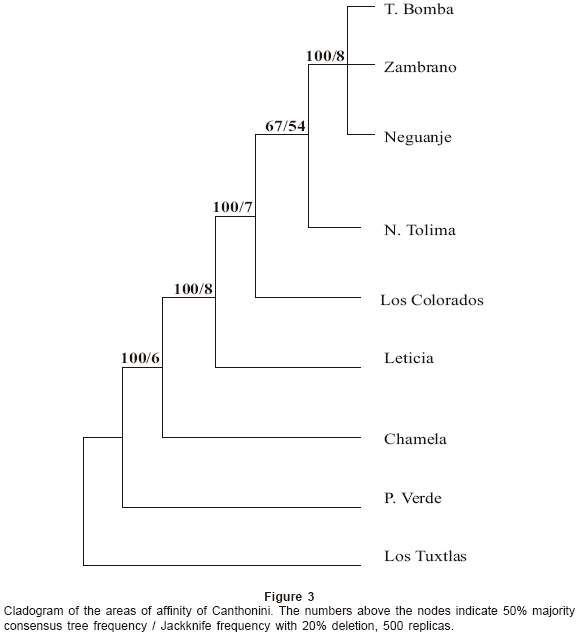
<body><![CDATA[<p align="justify"><font face="verdana" size="2">The tectonic history of San Jacinto, the location of the Sierra Nevada of Santa Marta and the sedimentation of the Plato and San Jorge basins, is correlated in space and time from the Late Miocene to the Pliocene (Caro &#38; Spratt 2003). The assemblage and the sedimentation of the Caribbean Region of Colombia ended in the Quaternary. It is likely that the climatic and ecological changes were shared by all the sites of the Caribbean Coast of Colombia and so reflect in one way or another the affinities of the biota present in the DTF. The Caribbean Region, together with the north of Venezuela makes up the phytogeographic region of Northern South America (Gentry 1995).</font></p>  	    <p align="justify"><font face="verdana" size="2">Geomorphological relationships of the study sites and their relationship to the origin of DTF </font></p> 	    <p align="justify"><font face="verdana" size="2">Three events have exerted a great effect on the evolution of Neotropical flora: the rise of the Andes, the exchange of biota with North America after the formation of the Central American Isthmus and the climatic fluctuations of the Pleistocene (Guariguata &#38; Katan 2002). This, in addition to the culmination of the majority of orogenic processes that occurred on the continental land of Mexico toward the end of the Pliocene (see Challenger 1998) and the sedimentation of some parts of the mid&#45; and lower Balsas River basin in the Pleistocene. The convergence of the DTF studied can be attributed to the climatic and ecological events of recent geological time, probably since the Pleistocene. This confirms the observations of Gentry (1982) who suggests that the high number of species in the dry tropical area of Mexico is probably the result of an active evolutionary diversification in response to the increase in dry climate regimes during the Pliocene and the Pleistocene. This is in accordance with the higher rate of speciation of the genus <i>Bursera</i> (toward the Pliocene) and its concentration in areas of intermediate and low altitudes of the Pacific Slope of Mexico, and in particular the Balsas River Basin (see Becerra 2005, Rzedowski <i>et al.</i> 2005).</font></p>      <p align="justify"><font face="verdana" size="2">One can think about a general process of south&#45;north expansion since, as Rzedowski (1978) has said, the dry tropical forests of Mexico are characterized by a strong predominance of neotropical elements, and the scarcity or absence of holarctic elements. Although dry forests have their origin in the Pleistocene, it is likely that their current, dry conditions were set during the Middle Holocene in the Caribbean Region of Colombia, as well as on the Pacific coast of Mexico and Costa Rica. During the Middle Holocene, about 5000 to 7000 years B.P. (Steig 1999), the dominant climate system was ITCZ (Intertropical Convergence Zone), given that the ENSO (El Ni&ntilde;o&#45;Southern Oscillation) was absent or weak (Fontugne <i>et al.</i> 1999, Cole 2001, Tudhope <i>et al.</i> 2001, Riedinger <i>et al.</i> 2002). Haugh <i>et al.</i> (2001) propose that the driest climatic phase of the Holocene results from the change in the ITCZ to its current position.</font></p>  	    <p align="justify"><font face="verdana" size="2">&nbsp;</font></p>  	    <p align="justify"><font face="verdana" size="2"><b>Cladogram of the areas of affinity of Canthonini</b></font></p>  	    <p align="justify"><font face="verdana" size="2">The cladogram of the areas of affinity of the Canthonini, with 28 taxa and three subgenera of <i>Canthon</i> (<a href="#f3">Fig. 3</a>) is the result of the majority consensus of three trees, with 40 steps, and CI of 0.77 and an RI of 0.64. The cladogram groups the Colombian DTF as follows: the first group is comprised of the forests of Tierra Bomba, Zambrano and Neguanje (Caribbean Region); the second is North Tolima alone, and the third group is comprised of Los Colorados, also of the Caribbean Region. In the first group the subgenus <i>Glaphyrocanthon</i> is not represented by a single species; in the other two groups this subgenus is represented by <i>Canthon (Gl.) subhyalinus.</i></font>	</p>     <p align="center"><font face="verdana" size="2"><a name="f3"></a><img src="/img/revistas/azm/v23n1/a8f3.jpg"></font></p>      <p align="justify"><font face="verdana" size="2">The Canthonini of the dry tropical forest of Chamela are more closely related to those of the forests of Colombia. Those of Palo Verde show an affinity to both those of Chamela and those of Colombia. The canthonines of the two tropical rain forests are totally different from each other and do not share any species.</font></p>  	    <p align="justify"><font face="verdana" size="2">There are three species that characterize the relationships between the dry forests of Colombia: <i>Canthon juvencus, C. cyanellus sallei</i> and <i>C. lituratus</i> (except in Los Colorados). The Amazon (Leticia) only shares <i>C. aequinoctialis</i> with the dry forests of North Tolima and Los Colorados Caribbean Region, Colombia).</font></p>  	    ]]></body>
<body><![CDATA[<p align="justify"><font face="verdana" size="2">Chamela has the most exclusive species <i>(Canthon corporali, C. humectus</i> and <i>C. pacificus),</i> and is followed by Palo Verde (Costa Rica): <i>Canthon deyrollei</i> and <i>C. meridionalis,</i> and North Tolima (Colombia) with <i>C. acutus.</i></font></p>  	    <p align="justify"><font face="verdana" size="2">Eighty&#45;six percent of the species included in the analysis belong to the genus <i>Canthon.</i> To explain these results and explore why such species are found in the forests studied, their distribution patterns are analyzed below (see <a href="#t4">Table 4</a> and <a href="/img/revistas/azm/v23n1/html/a8apendice.html" target="_blank">Appendix 1</a>).</font></p>  	    <p align="justify"><font face="verdana" size="2">&nbsp;</font></p>  	    <p align="justify"><font face="verdana" size="2"><b>Analysis of the distribution of Canthonini in the dry forests studied</b></font></p>  	    <p align="justify"><font face="verdana" size="2">The cladogram of the species of <i>Canthon</i> for North America (including Mexico) proposed by Kohlmann &#38; Halffter (1990) shows the spread of this genus from South America in two big expansion events: the first towards the Miocene and the second towards the Plio&#45;Pleistocene and continuing to the Recent (see also Halffter 1964, 1976). The phyletic lines that correspond to the first expansion were not influenced by the events that affected the integration and distribution of the dry forests which came afterwards. Their presence in these forests (Chamela) is a result of later colonization. In contrast, the species of the second expansion exhibit a correspondence to the historical and biogeographical conditions that influenced the distribution of DTF: orography that was broadly similar to the current situation, the reestablishment of the connection and exchange of biota between South and North America, and an expansion of the dry conditions in the Holocene.</font></p>  	    <p align="justify"><font face="verdana" size="2">In order to explain the presence of Canthonini species in the enclaves of DTF we have studied both the distribution patterns proposed by Halffter (see Halffter 1964, 1976; Kohlmann &#38; Halffter 1990) and the phyletic lines proposed for taxa of the genus <i>Canthon</i> according to the taxonomic affinities recognized by Halffter &#38; Mart&iacute;nez (1977), and propose a pattern of speciation <i>in situ.</i></font></p>  	    <p align="justify"><font face="verdana" size="2">&nbsp;</font></p>  	    <p align="justify"><font face="verdana" size="2"><b>Pattern 1</b></font></p>  	    <p align="justify"><font face="verdana" size="2">This pattern is observed for species belonging to the phyletic lines that expanded through Mexico, most likely before the Miocene (the High Plains Distribution Pattern of Halffter). These were the earliest species of Neotropical affinity to penetrate the Mexican Transition Zone (MTZ) (Halffter 1976, 1978). <i>Canthon (C.) humectus</i> belongs to this pattern, and represents a phyletically isolated line within the subgenus <i>Canthon</i> according to Halffter &#38; Mart&iacute;nez (1977). Of the eight subspecies (Halffter &#38; Halffter 2003) distributed throughout the High Plains of Mexico, Oaxaca, Chiapas and Guatemala, only <i>C. humectus riverai</i> Halffter y Halffter is found in Chamela, a new record not indicated by Andresen (2005); perhaps because it is outside of the area she studied. This species occurs at the lowest altitude for both the species and Canthonini found on the High Plains. It was previously collected in the lower part of the Manantl&aacute;n Mountain Range (Jalisco) in DTF at altitudes from 700 to 1000 m. Its presence in Chamela can be considered a result of secondary expansion. In a study of the entire Scarabaeoidea superfamily in Chamela, Mor&oacute;n <i>et al.</i> (1988) found some species with the ancient MTZ dispersal patterns, though the majority have the Neotropical Pattern that developed from the Pliocene onwards (see below).</font></p>  	    <p align="justify"><font face="verdana" size="2">&nbsp;</font></p>  	    ]]></body>
<body><![CDATA[<p align="justify"><font face="verdana" size="2"><b>Pattern 2</b></font></p>  	    <p align="justify"><font face="verdana" size="2">These species participated in the expansion that probably began in the Pliocene with the reestablishment of the Panamanian connection, and have different degrees of northwards expansion in North and Central America, to the United States of America (and thus together result in the Typical Neotropical Distribution Pattern of Halffter). The affinities of these species with the South American fauna are much better defined than is the case for Pattern 1 (see affinities under each species). The penetration of these species into the MTZ (Pliocene onwards) could have occurred in distinct stages, depending on the species' antiquity. The most ancient species have undergone processes of subspeciation in the MTZ. We will examine the distribution of these species, from the oldest (and with the widest distribution) to the most recent.</font></p>  	    <p align="justify"><font face="verdana" size="2">&nbsp;</font></p>  	    <p align="justify"><font face="verdana" size="2"><b>a)</b> Species with a wide distribution that reaches the United States of America.</font></p>  	    <p align="justify"><font face="verdana" size="2"><b><i>Canthon (Canthon) indigaceus</i></b> LeConte ranges from Panama to Texas and Arizona in the United States. In Mexico it is found in tropical landscapes on the Gulf slope, the Pacific slope and the Yucatan Peninsula. It is comprised of three subspecies that are found under different ecological conditions: <i>Canthon i. chiapas</i> in TRF; <i>C. i. chevrolati</i> in places with greater insolation, with less or no woody vegetation; and <i>C. i. indigaceus</i> in DTF or more xerophyllous vegetation. In Chamela we found <i>C. i. indigaceus;</i> in Guanacaste, <i>C. i. chevrolati;</i> and in the TRF of Los Tuxtlas, <i>C. i. chiapas.</i> Overall, <i>C. i. indigaceus</i> is a good example of a species exhibiting the Typical Neotropical Pattern with a wide distribution in the MTZ. As in the previous case <i>(Canthon humectus),</i> this species constitutes a phyletic line within the subgenus <i>Canthon</i> (Halffter &#38; Mart&iacute;nez 1977) that has only one species.</font></p>  	    <p align="justify"><font face="verdana" size="2"><b><i>Canthon (C.) cyanellus</i></b> LeConte has a similar geographic history and distribution, although the latter is broader. It is found from Peru and Brazil to the southern United States and under a wide variety of ecological conditions though it is usually associated with tropical forests or treed sites along an altitudinal range from sea level to 2600 m. This species is found at all the DTF sites we studied and in Los Tuxtlas, but not in Leticia.</font></p>  	    <p align="justify"><font face="verdana" size="2">In Mexico it is found all along the Pacific coast, from Chiapas to Jalisco and on the Atlantic slope it is found on the Yucatan Peninsula and along the Gulf Coast of Mexico up to Tamaulipas and Nuevo Le&oacute;n. In the interior of Mexico it is found in the states of Puebla, Morelos, Hidalgo and San Luis Potos&iacute;. In Central America, it is found on both the Pacific and the Atlantic slopes; in northern Panama it is found near the Caribbean Sea (Bocas del Toro) and to the south on the border with Colombia in the Darien region on the Pacific coast. In Colombia, according to our findings this species is found throughout the Caribbean Region and the high valley of the Magdalena River, as well as in the Department of Meta (Am&eacute;zquita <i>et al.</i> 1999, Medina <i>et al.</i> 2001). In Venezuela this species occurs in T&aacute;riba, San Crist&oacute;bal, as well as in Arima, Trinidad and in Uaup&eacute;s, Brazil (the Amazon) according to the records of Sol&iacute;s &#38; Kohlmann (2002). <i>Canthon cyanellus</i> belongs to a phyletic line (the bispinus line) with many species in South America (Halffter &#38; Mart&iacute;nez 1977).</font></p>  	    <p align="justify"><font face="verdana" size="2"><b><i>Malagoniella (Malagoniella) astyanax</i></b> (Harold). The genus <i>Malagoniella</i> is distributed throughout the Neotropical region, except in Chile and the Antilles. It is richest in species in Argentina, Uruguay, Paraguay and southern Brasil (Halffter &#38; Mart&iacute;nez 1966). The subgenus <i>Malagoniella</i> has a similar distribution. It includes the only taxon found in the north, <i>M. (M.) astyanax yucateca</i> (Harold), that is found in Central America, Neotropical areas of Mexico and at a point on the border of the United States of America. The other subspecies that make up <i>M. astyanax</i> are South American. Citations for Colombia possibly refer to <i>M. (M.) astyanax columbica</i> (Harold), a subspecies for which the distribution is limited to Colombia (Halffter &#38; Mart&iacute;nez 1966), where it is found in the DTF of Zambrano and North Tolima, as well as in the Departments of Choc&oacute; and Magdalena (Medina <i>et al.</i> 2001). This species appears to have a preference for DTF and has not been recorded in Leticia (the Amazon).</font></p>  	    <p align="justify"><font face="verdana" size="2"><b><i>Malagoniella (M.) astyanax yucateca</i></b> (Harold) has a very wide distribution in Mexico and Central America, but has been found at isolated points that are often separated by great distances. In this case, it is difficult to attribute this to capture inefficiency (at least for many of the places where it has not been found), given that this is a large and very striking species. It has been collected in Brownsville, Texas, on the border with Mexico, and also at Tamazunchale (San Luis Potos&iacute;), Quintana Roo, Esc&aacute;rcega (Campeche), Puerto &Aacute;ngel (Oaxaca), Cacahoatan, Tapachula and Rosario Izapa (Chiapas), Yucatan (Bates 1886&#45;1890; Halffter &#38; Mart&iacute;nez 1966; SNIB&#45;CONABIO database), Guatemala, in the west of Nicaragua and Costa Rica. The Chiapas and Central American sites are on the Pacific slope. In Costa Rica it is restricted to the Guanacaste region, to the northwest of the Pacific coast, over an altitudinal range of 10 to 400 m. In the present study, it is recorded for Palo Verde. Except for the capture in Brownsville (Texas), the rest were captured in tropical forest. <i>M. astyanax yucateca</i> appears to be most often associated with seasonal forests (i.e. those that have a dry season). It has not been found in TRF (Los Tuxtlas, Veracruz or Selva Lacandona, Chiapas) within its distribution perimeter.</font></p>  	    <p align="justify"><font face="verdana" size="2">The distribution of <i>M. astyanax</i> appears to reflect an ancient expansion from South America, one that is currently quite fragmented.</font></p>  	    ]]></body>
<body><![CDATA[<p align="justify"><font face="verdana" size="2"><b><i>Pseudocanthon perplexus</i></b> (LeConte). The genus <i>Pseudocanthon</i> Bates is comprised of eight species, and two of these are found in Mexico. Of the Mexican species, one is found in the Antilles where there are also five endemic species. The other species is South American. <i>Pseudocanthon perplexus</i> is found in Mexico in both TRF and DTF. It is captured sporadically in sites that are distant from each other. Its distribution extends from the United States of America down to South America. It was found in Chamela and Palo Verde of the DTF we studied.</font></p>  	    <p align="justify"><font face="verdana" size="2">In Mexico it is distributed along the coast of the Gulf of Mexico up to the eastern United States, and on the Pacific coast to Sonora. In Costa Rica, it has been recorded in Guanacaste Province and in Alajuela on the Cordillera Central, over an altitudinal range of 10 to 540 m (INBio database). In Panama, it has been found in Balboa in the Canal Zone (Pacific coast).</font></p>  	    <p align="justify"><font face="verdana" size="2">&nbsp;</font></p>  	    <p align="justify"><font face="verdana" size="2"><b>b)</b> Species with limited penetration into Mexico.</font></p>  	    <p align="justify"><font face="verdana" size="2"><b><i>Canthon (C.) morsei</i></b> Howden is distributed from Ecuador to the warm areas of Mexico, where it extends along the Pacific slope from Chiapas (Halffter <i>et al.</i> 1992) to Jalisco (Garc&iacute;a&#45;Real 1995). Along the Atlantic slope it ranges northwards up to Tamaulipas. In Costa Rica it is found in the north on the Pacific coast (Solis &#38; Kohlmann 2002). In Colombia, it is found in the Upper Magdalena River Valley (Tolima). This species is associated with DTF and TRF. In the DTF studied, it was recorded in Palo Verde and in Colombia only in North Tolima. In Mexico, it was not found in the DTF of Chamela, although it is has been recorded in deciduous and semideciduous tropical forests in the state of Jalisco relatively close to Chamela.</font></p>  	    <p align="justify"><font face="verdana" size="2">According to Halffter &#38; Mart&iacute;nez (1977) <i>C. morsei</i> belongs to a phyletic line of the subgenus <i>Canthon</i> that includes other South American species.</font></p>  	    <p align="justify"><font face="verdana" size="2"><b><i>Canthon (Glaphyrocanthon) subhyalinus</i></b> Harold is distributed from Bolivia to Mexico and is associated with TRF, especially those sites with monkeys (Halffter 1991, Estrada <i>et al,</i> 1993, Rivera&#45;Cervantes &#38; Halffter, 1999). This species was not found in the DTF of Chamela or Costa Rica. In Colombia it is associated with DTF in Tolima and in Los Colorados (Bol&iacute;var); other records for Colombia include the Departments of Antioquia and Cundinamarca (Medina <i>et al.</i> 2001). In Panama, Howden &#38; Young (1981) have recorded it for Darien, Santa Fe, and on the Pacific coast and in the Caribbean on Barro Colorado and in the Canal Zone. In Costa Rica it is found in the foothills of premontane wet forest. In Mexico it is only found in the south in the states of Chiapas, Quintana Roo and Veracruz. <i>Canthon subhyalinus</i> is a beetle associated with TRF (Rivera&#45;Cervantes &#38; Halffter 1999), and so it is probable that the neighbouring vegetation between TRF and DTF facilitates the dispersal of this species toward DTF. This explains the presence of <i>C. subhyalinus</i> in Los Colorados, where the DTF includes a patch of TRF, a lone remnant in the Caribbean Region of Colombia (Gentry 1995). It is also found in the DTF of North Tolima, which is between two mountain ranges and in the foothills of the mountain where wet montane forest predominates.</font></p>  	    <p align="justify"><font face="verdana" size="2">The northern distribution limit for <i>C. subhyalinus</i> coincides with that of the howler monkey, <i>Alouatta palliata.</i> It is probable that the dispersal of these species coincide from South America up to Los Tuxtlas. This is supported by field observations of the arboreal behavior of these beetles and their attraction to the dung of these monkeys (Howden &#38; Young 1981, Halffter 1991, Estrada <i>et al.</i> 1993, Rivera&#45;Cervantes &#38; Halffter 1999). There is additional support in the origin of these monkeys, Late Miocene to the Pliocene, and their dispersal during the Pleistocene (Cort&eacute;s&#45;Ortiz <i>et al.</i> 2003), as well as the biogeographic pattern proposed in this study for <i>C. subhyalinus.</i></font></p>  	    <p align="justify"><font face="verdana" size="2"><b><i>Canthon (Gl.) euryscelis</i></b> Bates belongs to the same group of species of the subgenus <i>Glaphyrocanthon</i> as C. (Gl.) <i>subhyalinus</i> (see Rivera&#45;Cervantes &#38; Halffter 1999). It is distributed in TRF from Mexico to Panama. In the DTF we studied, it was collected at Palo Verde (Guanacaste). Solis &#38; Kohlmann (2002) indicate that it has a broad tolerance of climate, and is found from sites with marked seasonality (altitude &#60; 800 m in the Province of Guanacaste) to very humid ones. In Mexico it has been recorded in the TRF of Los Tuxtlas.</font></p>  	    <p align="justify"><font face="verdana" size="2"><b><i>Agamopus lampros</i></b> Bates belongs to a genus (currently under revision by Fernando Vaz de Mello) with four South American species, of which <i>A. lampros</i> extends to Central America and the tropical areas of Mexico. We recorded this species in the DTF of Chamela, Palo Verde (Guanacaste) and Los Colorados (Colombia).</font></p>  	    ]]></body>
<body><![CDATA[<p align="justify"><font face="verdana" size="2">&nbsp;</font></p>  	    <p align="justify"><font face="verdana" size="2"><b>c)</b> The species mentioned below belong to South American phyletic lines whose northern geographic distribution only extends to Central America.</font></p>  	    <p align="justify"><font face="verdana" size="2"><b><i>Canthon (Canthon) mutabilis</i></b> Harold, within the subgenus <i>Canthon,</i> belongs to the bispinus line that, as mentioned in the section on <i>C. cyanellus,</i> is comprised of many South American species. Its distribution extends from Argentina to Costa Rica. It was found in Palo Verde (Guanacaste) and in North Tolima (Colombia). Solis &#38; Kohlmann (2002) indicate that in Costa Rica it is found from sites that are very humid to those with marked seasonality and a dry season as long as six months. In Colombia, Medina <i>et al.</i> (2001) have recorded it for the Departments of Bol&iacute;var and Meta, associated with dry conditions. <i>Canthon juvencus, C. mutabilis</i> and <i>C. meridionalis</i> are abundant in the driest forests of some of the smallest islands in Lake Gatun and Gamboa (Caribbean region) near the continent (Gill 1991).</font></p>  	    <p align="justify"><font face="verdana" size="2"><b><i>Canthon (C.) lituratus</i></b> (Germar) is also widely dispersed from Argentina to Costa Rica. It belongs to a phyletic line within the subgenus <i>Canthon</i> that includes another South American species (Halffter &#38; Mart&iacute;nez 1977). In Colombia it is found in Tolima and in the Caribbean Region in all the DTF studied, except for Los Colorados. In Colombia, Medina <i>et al.</i> (2001) have recorded it for the Departament of Valle. In Costa Rica it is only found to the southwest of the Pacific coast, in the savannahs bordering the T&eacute;rraba River (Solis &#38; Kohlmann 2002). Its distribution extends southwards from the Pacific, and it has also been recorded for the provinces of Chiriqui and Cocle in Panama at altitudes above 800 m (Howden &#38; Young 1981).</font></p>  	    <p align="justify"><font face="verdana" size="2"><b><i>Canthon (C.) juvencus</i></b> Harold is found from Brazil to Costa Rica. In Colombia it is found in the DTF of the Caribbean Region and in the Upper Magdalena River Valley (Tolima) as well as in other Departments in Colombia: Guainia, Guaviare, and Meta (Am&eacute;zquita <i>et al.</i> 1999, Medina <i>et al.</i> 2001, Escobar 2000b). In Costa Rica it is restricted to the southern Pacific in TRF located below 500 m (Solis &#38; Kohlmann 2002). It is found in Panama in the pronvinces of Panama, Colon and the Canal Zone (Howden &#38; Young 1981).</font></p>  	    <p align="justify"><font face="verdana" size="2"><b><i>Canthon septemmaculatus</i></b> (Latreille) has a broad distribution range from Argentina to Costa Rica. In the DTF studied, it was only recorded in Zambrano Caribbean Region, Colombia. Medina <i>et al.</i> (2001) have recorded it for the Colombian Departments of Bol&iacute;var, Choc&oacute;, Meta, Caquet&aacute; and Nari&ntilde;o. In Panama it has been recorded in the provinces of Los Santos, Cocl&eacute;, Panam&aacute; and the Canal Zone. In Costa Rica it is only found to the southwest of the Pacific coast, in the savannas surrounding the T&eacute;rraba River (Solis &#38; Kohlmann 2002).</font></p>  	    <p align="justify"><font face="verdana" size="2"><b><i>Canthon (C.) aequinoctialis</i></b> Harold occurs from Brazil to Belize. According to Halffter &#38; Mart&iacute;nez (1977) it belongs to a South American phyletic line of the genus <i>Canthon.</i> In Colombia it is found in both the DTF of the Upper Magdalena River Valley (Tolima), in Los Colorados (Caribbean Region) and in the TRF of Leticia (the Amazon). It has also been found in the Departments of Antioquia, Caquet&aacute;, Choco, Guainia, Guaviare, Meta, Nari&ntilde;o, Valle, and Cauca (Escobar 2000 a, Medina <i>et al.</i> 2001, Neita <i>et al.</i> 2003, Pulido <i>et al.</i> 2003). In Panama it is found to the north, on the Pacific coast and in the Canal Zone on the Caribbean. In Costa Rica it is spread out along the Caribbean and to the north of the country, but it was not recorded in Palo Verde (Guanacaste). On the Pacific coast, it has been cited for two sectors: to the south on the Osa Peninsula and in the basin of the River T&aacute;rcoles, with a marked preference for TRF (Solis &#38; Kohlmann 2002).</font></p>  	    <p align="justify"><font face="verdana" size="2">&nbsp;</font></p>  	    <p align="justify"><font face="verdana" size="2"><b>Pattern 3</b></font></p>  	    <p align="justify"><font face="verdana" size="2">These taxa likely reflect the processes of speciation <i>in situ</i> in the DTF of Mexico, Costa Rica and Colombia.</font></p>  	    ]]></body>
<body><![CDATA[<p align="justify"><font face="verdana" size="2"><i>Glaphyrocanthon,</i> a subgenus of <i>Canthon</i> with many South American species, has two phyletic lines in Mexico with a clear origin in the north of South America. We have already referred to one of these lines, that of <i>C. (Gl.) subhyalinus.</i> The second line is comprised of an isolated species with South American affinities. In addition there is the viridis group with strong speciation in Mexico and which clearly belongs to the subgenus <i>Glaphyrocanthon</i> although it has no evident relationship to South American species.</font></p>  	    <p align="justify"><font face="verdana" size="2">The viridis group is comprised of 15 species, of which only <i>C. (Gl.) meridionalis</i> Mart&iacute;nez, Halffter y Halffter has a distribution that expands towards Central America, opposite to the dominant direction for the distribution of the Canthonini studied. Several of the species of this group are associated with TRF, many others are found in DTF.</font></p>  	    <p align="justify"><font face="verdana" size="2"><i>Canthon (Glaphyrocanthon) pacificus</i> Rivera y Halffter and <i>C. (Gl.) corporali</i> Balthasar belong to this group and both form part of a set of species that are distributed in Mexico along the Pacific slope, from the state of Nayarit to the state of Oaxaca. <i>Canthon (Gl.) corporali</i> is widely distributed in association with DTF, including the Balsas River Basin and the coast of the Pacific on both sides of its outlet. <i>Canthon (Gl.) pacificus</i> is found in dry deciduous and semideciduous forests of the Pacific coast, from the state of Jalisco to the state of Oaxaca.</font></p>  	    <p align="justify"><font face="verdana" size="2">From the same viridis group in Guanacaste the lone species <i>C. (Gl.) meridionalis</i> Mart&iacute;nez, Halffter y Halffter is found and extends to Central America: Guatemala, El Salvador, Nicaragua, and Costa Rica (Solis &#38; Kohlmann 2002). In Costa Rica it has a wide distribution, on both the Pacific and the Atlantic sides (Solis &#38; Kohlmann 2002).</font></p>  	    <p align="justify"><font face="verdana" size="2"><b><i>Canthon (C.) deyrollei</i></b> Harold has a geographic distribution from Guatemala to Costa Rica. It is the only species in its phyletic line (Halffter &#38; Mart&iacute;nez 1977). In Costa Rica it is restricted to the area with the greatest climatic seasonality, i.e. land below 600 m in the province of Guanacaste, in the northwest of Costa Rica (Solis &#38; Kohlmann 2002).</font></p>  	    <p align="justify"><font face="verdana" size="2"><b><i>Canthon (Gl.) acutus</i></b> Harold was collected in North Tolima. It has also been found in other Departments in Colombia: Bol&iacute;var, Guainia and Meta at elevations of 300 m (Medina <i>et al.</i> 2001).</font></p>  	    <p align="justify"><font face="verdana" size="2">&nbsp;</font></p>  	    <p align="justify"><font face="verdana" size="2"><b>DISCUSSION</b></font></p>  	    <p align="justify"><font face="verdana" size="2"><b>1)</b> The geological (<a href="/img/revistas/azm/v23n1/a8f2.jpg" target="_blank">Fig. 2</a>) and Canthonini species composition (<a href="#f3">Fig. 3</a>) cladograms only coincide in their general features. The dry tropical forests from Mexico to Colombia arose during a relatively recent geological stage. Hence, historical geological events prior to the Pliocene do not appear to have affected the distribution of this vegetation type. Its distribution is determined by a combination of temperature and rainfall conditions, particularly by a prolonged and marked dry season (see Rzedowski 1978).</font></p>  	    <p align="justify"><font face="verdana" size="2"><b>2)&nbsp;</b>The flora of dry tropical forests is almost exclusively comprised of species with Neotropical affinities (Rzedowski 1978). The Canthonini fauna has the same affinities. As shown by Trejo (2005), there is a high degree of plant species exchange between different dry tropical forest sites. It is not surprising that the same phenomenon occurs in the Canthonini.</font></p>  	    ]]></body>
<body><![CDATA[<p align="justify"><font face="verdana" size="2">The cladograms of the dry tropical forests and the Canthonini exhibit the same affinities found by Gentry (1995) for flora; i.e. a strong similarity between the dry forests of northern Colombia and Venezuela with that of Chamela, with 15 shared genera, while Chamela and Guanacaste (Costa Rica) only share six genera.</font></p>  	    <p align="justify"><font face="verdana" size="2"><b>3)&nbsp;</b>The Canthonini species found in the dry tropical forests studied show a clear gradient of affinity associated with the different degrees of expansion of the Canthonini from South America. In spite of the great distance and the ecological barriers that exist between Colombia and Chamela, the affinities are marked and appear to indicate a certain degree of continuity among the dry forests studied.</font></p>  	    <p align="justify"><font face="verdana" size="2">There is little doubt that the expansion of the distribution area of South American Canthonini, and that of many other Scarabaeinae with the same biogeographical history was greatly facilitated by the presence of mammalian megafauna that has since disappeared (see Janzen &#38; Martin 1982). Nevertheless, there are differences among the enclaves of dry tropical forest. In Chamela, the only pre&#45;Pliocene expansion species was collected <i>(Canthon humectus),</i> along with several species of ancient expansion within the Neotropical Pattern, and several species whose distribution in Mexico is more recent, including two belonging to a group <i>(Canthon (Glaphyrocanthon)</i> viridis group) which speciated in Mexico. Palo Verde has a mix of Plio&#45;Pleistocene and recent expansion species. In Colombia, species with a South American distribution dominate, although it shares species with Palo Verde and Chamela.</font></p>  	    <p align="justify"><font face="verdana" size="2">The biogeographical hypothesis proposed in the Introduction about the origin of Canthonini and their northwards expansion at different times and with different degrees of penetration is supported. The relationships between distinct phyletic lines and even species, with South American fauna clearly demonstrate these biogeographical phenomena.</font></p>  	    <p align="justify"><font face="verdana" size="2"><b>4)&nbsp;</b>Several of the species found in Colombia, but not in Palo Verde or Chamela, have the northern limit of their distribution in the T&eacute;rraba River basin in the extreme south of Costa Rica on the Pacific coast. This is the case for <i>C. lituratus, C. juvencus,</i> and <i>C. septemmaculatus</i> (see Solis &#38; Kohlmann 2002). As these species do not reach Palo Verde the differences of this site with those of Colombia are accentuated. This northern limit in the distribution of South American species to the extreme south of Costa Rica is interesting. The lowlands of Nicaragua to the north of Lake Nicaragua were proposed by Halffter (1976) as the southern limit of the Mexican Transition Zone. The present study shows the South American affinity of the Canthonini of Costa Rica for dry tropical forest (they share 40&#37; of the species with the DTF of North Tolima), and this seems to apply in general to those species found in other types of vegetation (see Solis &#38; Kohlmann 2002).</font></p>  	    <p align="justify"><font face="verdana" size="2"><b>5)&nbsp;</b>A good number of the species found in the sites we studied are characteristic of dry tropical forest, and even exclusive to this vegetation type. However, some species are shared with tropical rain forest. The proportion of shared species is much lower in Chamela, moderate in Palo Verde and greatest in the sites of Colombia. The latter is also reflected in the greater affinity of the Canthonini of Colombian DTF with those of Leticia (TRF), than with those of the DTF of Chamela (<a href="#f3">Fig. 3</a>). Palo Verde shares 30&#37; of its species with Los Tuxtlas, a forest where the DTF and the TRF species of Mesoamerica meet.</font></p>  	    <p align="justify"><font face="verdana" size="2"><b>6)&nbsp;</b>As regards <i>in situ</i> speciation, the most notable example is that of the viridis group, which has no direct relationship with the South American fauna of <i>Canthon (Glaphyrocanthon).</i> This group underwent much diversification in Mexico that appears to be recent and influenced by the process of drying out during the Holocene (many of its species are adapted to dry forest).</font></p>  	    <p align="justify"><font face="verdana" size="2"><b>7)&nbsp;</b>The enclaves of dry tropical forest in Colombia, in both the Caribbean Region and the Upper Magdalena Valley, are close to tropical rain forest. In the first case, Neguanje is part of the Province of the Sierra Nevada of Santa Marta where the vegetation change with increasing altitude and in Los Colorados there is still a remanent of rain forest. The Upper Magdalena River Valley is surrounded by rain forest on the skirts of the Cordillera Central and the Cordillera Oriental, and to the north by the Middle Magdalena Valley. This allows them to share species with adjacent ecosystems.</font></p>  	    <p align="justify"><font face="verdana" size="2"><b>8)&nbsp;</b>The Canthonini fauna of the tropical rain forests (Los Tuxtlas and Leticia) that were used as the outgroup, is very different between these two rain forests and also different from the fauna of the dry tropical forests. Considering all Scarabaeoidea, the similarity in species between Chamela and Los Tuxtlas is only 13 (S&#248;rensen's QS index), while between Chamela and other dry tropical forest in Mexico the value is 41 (Mor&oacute;n <i>et al.</i> 1988).</font></p>  	    <p align="justify"><font face="verdana" size="2"><b>9)&nbsp;</b>The quality of the species list is the main limitation of the biogeographical analysis presented here. We have gathered all of the published information as well as that recorded in the databases of CONABIO and INBIO. Even so, these collections cannot be considered exhaustive, especially for Colombia.</font></p>  	    ]]></body>
<body><![CDATA[<p align="justify"><font face="verdana" size="2"><b>10)&nbsp;</b>The predominance of roller species (Canthonini) in dry tropical forest is well defined. On average 33.45&#37; of the Scarabaeinae species found are Canthonini, a value that rises to 35.45&#37; if we exclude Neguanje as the least representative site. In contrast, in the tropical rain forests studied, on average only 28&#37; are rollers. The affinity of the rollers for sunny conditions is even greater in sites that are drier and have very open vegetation.</font></p>  	    <p align="justify"><font face="verdana" size="2"><b>11)&nbsp;</b>There have been several studies of the changes in the abundance of Scarabaeinae species from the dry season to the rainy season in dry tropical forest: Chamela (Andresen 2005), North Tolima (Escobar 1997), Guanacaste, Costa Rica (Janzen 1983) have produced similar results and emphasize the severity of the dry season. Soil humidity and ambient temperature control the activity and life cycle of Scarabaeinae (Halffter 1991, Mart&iacute;nez &#38; Montes de Oca 1994, Bustos&#45;G&oacute;mez &#38; Lopera&#45;Toro 2003, Andresen 2005). On the other hand, the Scarabaeinae of dry tropical forests show a marked tendency for a generalist diet (copro&#45;necrophagous). In Chamela 70&#37; of Scarabaeinae (Andresen 2005) and in the north of Tolima 71&#37; (Bustos&#45;G&oacute;mez &#38; Lopera&#45;Toro 2003) have this type of diet.</font></p>  	    <p align="justify"><font face="verdana" size="2">&nbsp;</font></p>  	    <p align="justify"><font face="verdana" size="2"><b>Closing Remarks</b></font></p>  	    <p align="justify"><font face="verdana" size="2">The biogeographical analysis of areas of dry tropical forest in Mesoamerica and Colombia has provided and integrated geological, geomorphological, climatic and ecological elements that have brought us closer to understanding the origin and relationships of Neotropical dry forests.</font></p>  	    <p align="justify"><font face="verdana" size="2">The use of an outgroup polarized the cladograms, adding a new dimension to the study by establishing an axis for comparison that stood out in all analyses. The analises carried out, along with previous knowledge of the group allowed for an explanation of the spatio&#45;temporal dynamics exhibited by the Canthonini in dry tropical forests.</font></p>  	    <p align="justify"><font face="verdana" size="2">Dry tropical forest represents a setting where the processes of vicariance and dispersal occur. This study reveals Canthonini's routes of dispersal via the dry forests while the speciation processes of some <i>Canthon,</i> appearing to be synchronous with the establishment of the dry forests of Mesoamerica and Colombia, also indicate the affinities of Canthonini to dry tropical forest, very similar to that of the flora of said ecosystem.</font></p>  	    <p align="justify"><font face="verdana" size="2">Biogeographical and ecological elements were brought together and these allowed us to explain both their presence in and the preference of some Canthonini for dry forest, and/or their exclusive distribution in some dry forests of Colombia and their absence from those of Mesoamerica, as was the case for <i>C. (Gl.) subhyalinus,</i> so clearly demonstrated by the PAE.</font></p>  	    <p align="justify"><font face="verdana" size="2">&nbsp;</font></p>  	    <p align="justify"><font face="verdana" size="2"><b>ACKNOWLEDGEMENTS</b></font></p>  	    ]]></body>
<body><![CDATA[<p align="justify"><font face="verdana" size="2">The first author is grateful to A. Espinosa de los Monteros and J. J. Morrone for their comments on the manuscript; to F. Escobar, M. Zunino, A. Sol&iacute;s, F. Vaz de Mello and A. D&iacute;az, for providing bibliographic material; to C. &Aacute;lvarez for providing access to the SNIB&#45;CONABIO data base projects E7, K5, P134, G19, H125 in Mexico City and the data base of the National Biodiversity Institute in Costa Rica, Atta: Information System on Costa Rican Biodiversity (<a href="http://www.inbio.ac.cr/atta/index.htm" target="_blank">http://www.inbio.ac.cr/atta/index.htm</a>). Thanks also to the Universidad de Nari&ntilde;o, Pasto (Colombia: Nari&ntilde;o) for the award of a Commission to Study.</font></p>  	    <p align="justify"><font face="verdana" size="2">We thank two anonymous reviewers for their very useful comments. We are also are grateful to B. Delfosse for translating the manuscript into English. This study represents part of the project "Analysis of the relationships between alpha, beta and gamma diversity on different spatial scales: the historical and ecological processes involved", Stage V (CONABIO&#45;Mexico).</font></p>  	    <p align="justify"><font face="verdana" size="2">&nbsp;</font></p>  	    <p align="justify"><font face="verdana" size="2"><b>LITERATURE CITED</b></font></p>  	    <!-- ref --><p align="justify"><font face="verdana" size="2"><b>Alfaro, E. A., A. Alvarado, &#38; A. Chavarri.</b> 2001. Cambios ed&aacute;ficos asociados a tres etapas sucesionales de bosque tropical seco en Guanacaste, Costa Rica. <i>Agronom&iacute;a Costarricense,</i> 21 (1):7&#45;20.    &nbsp;&nbsp;&nbsp;&nbsp;&nbsp;&nbsp;&nbsp;&nbsp;[&#160;<a href="javascript:void(0);" onclick="javascript: window.open('/scielo.php?script=sci_nlinks&ref=341755&pid=S0065-1737200700010000800001&lng=','','width=640,height=500,resizable=yes,scrollbars=1,menubar=yes,');">Links</a>&#160;]<!-- end-ref --></font></p>  	    <!-- ref --><p align="justify"><font face="verdana" size="2"><b>Alvarado, G., R. Barquero, I. Boschini, S. Chiesa, &#38; M. Carr.</b> 1986. Relaci&oacute;n entre geotect&oacute;nica y vulcanismo en Costa Rica. <i>Revista CIAF,</i> 11 (1&#45;3):246&#45;264.    &nbsp;&nbsp;&nbsp;&nbsp;&nbsp;&nbsp;&nbsp;&nbsp;[&#160;<a href="javascript:void(0);" onclick="javascript: window.open('/scielo.php?script=sci_nlinks&ref=341757&pid=S0065-1737200700010000800002&lng=','','width=640,height=500,resizable=yes,scrollbars=1,menubar=yes,');">Links</a>&#160;]<!-- end-ref --></font></p>  	    <!-- ref --><p align="justify"><font face="verdana" size="2"><b>Andresen, E.</b> 2005. Effects of season and vegetation type on community organization of dung beetles in a tropical dry forest. <i>Biotropica,</i> 37 (2):291&#45;300.    &nbsp;&nbsp;&nbsp;&nbsp;&nbsp;&nbsp;&nbsp;&nbsp;[&#160;<a href="javascript:void(0);" onclick="javascript: window.open('/scielo.php?script=sci_nlinks&ref=341759&pid=S0065-1737200700010000800003&lng=','','width=640,height=500,resizable=yes,scrollbars=1,menubar=yes,');">Links</a>&#160;]<!-- end-ref --></font></p>  	    ]]></body>
<body><![CDATA[<!-- ref --><p align="justify"><font face="verdana" size="2"><b>Am&eacute;zquita, S J., A. Forsyth, A. Lopera, &#38; A. Camacho.</b> 1999. Comparaci&oacute;n de la composici&oacute;n y riqueza de especies de escarabajos copr&oacute;fagos (Coleoptera: Scarabaeidae) en remanentes de bosque de la Orinoquia Colombiana. <i>Acta Zool. Mex. (n. s.),</i> 76:113&#45;126.    &nbsp;&nbsp;&nbsp;&nbsp;&nbsp;&nbsp;&nbsp;&nbsp;[&#160;<a href="javascript:void(0);" onclick="javascript: window.open('/scielo.php?script=sci_nlinks&ref=341761&pid=S0065-1737200700010000800004&lng=','','width=640,height=500,resizable=yes,scrollbars=1,menubar=yes,');">Links</a>&#160;]<!-- end-ref --></font></p>  	    <!-- ref --><p align="justify"><font face="verdana" size="2"><b>Arellano, L.</b> 1992. Distribuci&oacute;n y abundancia de Scarabaeidae y Silphidae (Insecta: Coleoptera) en un transecto altitudinal en el estado de Veracruz. <i>Bachelor of Science Thesis.</i> Facultad de Ciencias, Universidad Nacional Aut&oacute;noma de M&eacute;xico.    &nbsp;&nbsp;&nbsp;&nbsp;&nbsp;&nbsp;&nbsp;&nbsp;[&#160;<a href="javascript:void(0);" onclick="javascript: window.open('/scielo.php?script=sci_nlinks&ref=341763&pid=S0065-1737200700010000800005&lng=','','width=640,height=500,resizable=yes,scrollbars=1,menubar=yes,');">Links</a>&#160;]<!-- end-ref --></font></p>  	    <!-- ref --><p align="justify"><font face="verdana" size="2">&#45;&#45;&#45;&#45;&#45;&#45;&#45;&#45;&#45;&#45;. 2002. Evaluaci&oacute;n de la diversidad alfa, beta y gamma de Scarabaeoidea y Silphidae (Insecta: Coleoptera) en la regi&oacute;n Cofre de Perote, Veracruz, M&eacute;xico. <i>Master of Science</i> <i>Thesis.</i> Facultad de Ciencias, Universidad Nacional Aut&oacute;noma de M&eacute;xico.    &nbsp;&nbsp;&nbsp;&nbsp;&nbsp;&nbsp;&nbsp;&nbsp;[&#160;<a href="javascript:void(0);" onclick="javascript: window.open('/scielo.php?script=sci_nlinks&ref=341765&pid=S0065-1737200700010000800006&lng=','','width=640,height=500,resizable=yes,scrollbars=1,menubar=yes,');">Links</a>&#160;]<!-- end-ref --></font></p>  	    <!-- ref --><p align="justify"><font face="verdana" size="2"><b>Aucott, J. W.</b> 1983. The application of moving average analysis to seismic data and its interpretation related to the structure of Ecuador and Colombia. <i>Memorias 10a Conferencia</i> <i>Geol&oacute;gica del Caribe. Cartagena de Indias.</i> INGEOMINAS. Bogot&aacute;, Colombia.    &nbsp;&nbsp;&nbsp;&nbsp;&nbsp;&nbsp;&nbsp;&nbsp;[&#160;<a href="javascript:void(0);" onclick="javascript: window.open('/scielo.php?script=sci_nlinks&ref=341767&pid=S0065-1737200700010000800007&lng=','','width=640,height=500,resizable=yes,scrollbars=1,menubar=yes,');">Links</a>&#160;]<!-- end-ref --></font></p>  	    <!-- ref --><p align="justify"><font face="verdana" size="2"><b>Bandy, W., V. Kostoglodov, A. Hurtado&#45;D&iacute;az, &#38; M. Mena.</b> 1999. Structure of the southern Jalisco subduction zone, Mexico, as inferred from gravity and seismicity. <i>Geof&iacute;sica</i> <i>Internacional,</i> 38 (3):127&#45;136.    &nbsp;&nbsp;&nbsp;&nbsp;&nbsp;&nbsp;&nbsp;&nbsp;[&#160;<a href="javascript:void(0);" onclick="javascript: window.open('/scielo.php?script=sci_nlinks&ref=341769&pid=S0065-1737200700010000800008&lng=','','width=640,height=500,resizable=yes,scrollbars=1,menubar=yes,');">Links</a>&#160;]<!-- end-ref --></font></p>  	    ]]></body>
<body><![CDATA[<!-- ref --><p align="justify"><font face="verdana" size="2"><b>Barrera, A.</b> 1969. Coleoptera en la Colecci&oacute;n Nacional. <i>Acta Zool. Mex.,</i> 9 (6):1&#45;90.    &nbsp;&nbsp;&nbsp;&nbsp;&nbsp;&nbsp;&nbsp;&nbsp;[&#160;<a href="javascript:void(0);" onclick="javascript: window.open('/scielo.php?script=sci_nlinks&ref=341771&pid=S0065-1737200700010000800009&lng=','','width=640,height=500,resizable=yes,scrollbars=1,menubar=yes,');">Links</a>&#160;]<!-- end-ref --></font></p>  	    <!-- ref --><p align="justify"><font face="verdana" size="2"><b>Bates, H. W.</b> 1886&#45;1890. Pectinicornia and Lamellicornia. <i>Biol. Cent. Amer., Zool. Insecta.</i> <i>Coleoptera.</i> Vol. 2. Part. 2. Taylor and Francis, London.    &nbsp;&nbsp;&nbsp;&nbsp;&nbsp;&nbsp;&nbsp;&nbsp;[&#160;<a href="javascript:void(0);" onclick="javascript: window.open('/scielo.php?script=sci_nlinks&ref=341773&pid=S0065-1737200700010000800010&lng=','','width=640,height=500,resizable=yes,scrollbars=1,menubar=yes,');">Links</a>&#160;]<!-- end-ref --></font></p>  	    <!-- ref --><p align="justify"><font face="verdana" size="2"><b>Becerra, J. X.</b> 2005. Timing the origin and expansion of the Mexican tropical dry forest. <i>PNAS,</i> 102 (31):10919&#45;10923.    &nbsp;&nbsp;&nbsp;&nbsp;&nbsp;&nbsp;&nbsp;&nbsp;[&#160;<a href="javascript:void(0);" onclick="javascript: window.open('/scielo.php?script=sci_nlinks&ref=341775&pid=S0065-1737200700010000800011&lng=','','width=640,height=500,resizable=yes,scrollbars=1,menubar=yes,');">Links</a>&#160;]<!-- end-ref --></font></p>  	    <!-- ref --><p align="justify"><font face="verdana" size="2"><b>Blackwelder, R.</b> 1944. Checklist of the Coleopterous insects of Mexico, Central America, the West Indies and South America. <i>U. S. Natl. Mus. Bull.,</i> 185:196&#45;220.    &nbsp;&nbsp;&nbsp;&nbsp;&nbsp;&nbsp;&nbsp;&nbsp;[&#160;<a href="javascript:void(0);" onclick="javascript: window.open('/scielo.php?script=sci_nlinks&ref=341777&pid=S0065-1737200700010000800012&lng=','','width=640,height=500,resizable=yes,scrollbars=1,menubar=yes,');">Links</a>&#160;]<!-- end-ref --></font></p>  	    <!-- ref --><p align="justify"><font face="verdana" size="2"><b>Bullock S. H.</b> 1988. Rasgos del ambiente f&iacute;sico y biol&oacute;gico de Chamela, Jalisco, M&eacute;xico. <i>Folia</i> <i>Entomol. Mex.,</i> 77:5&#45;17.    &nbsp;&nbsp;&nbsp;&nbsp;&nbsp;&nbsp;&nbsp;&nbsp;[&#160;<a href="javascript:void(0);" onclick="javascript: window.open('/scielo.php?script=sci_nlinks&ref=341779&pid=S0065-1737200700010000800013&lng=','','width=640,height=500,resizable=yes,scrollbars=1,menubar=yes,');">Links</a>&#160;]<!-- end-ref --></font></p>  	    ]]></body>
<body><![CDATA[<!-- ref --><p align="justify"><font face="verdana" size="2"><b>Bustos&#45;G&oacute;mez L. F., &#38; A. Lopera&#45;Toro.</b> 2003. Preferencia por cebo de los escarabajos copr&oacute;fagos (Coleoptera: Scarabaeidae: Scarabaeinae) de un remanente de bosque seco tropical al norte del Tolima (Colombia). Pp. 59&#45;65. <i>In:</i> G. Onore, P. Reyes&#45;Castillo, &#38; M. Zunino (eds.), <i>Escarabeidos de Latinoam&eacute;rica: Estado del conocimiento.</i> Monograf&iacute;as Tercer Milenio, SEA, Vol. 3, Zaragoza, Spain.    &nbsp;&nbsp;&nbsp;&nbsp;&nbsp;&nbsp;&nbsp;&nbsp;[&#160;<a href="javascript:void(0);" onclick="javascript: window.open('/scielo.php?script=sci_nlinks&ref=341781&pid=S0065-1737200700010000800014&lng=','','width=640,height=500,resizable=yes,scrollbars=1,menubar=yes,');">Links</a>&#160;]<!-- end-ref --></font></p>  	    <!-- ref --><p align="justify"><font face="verdana" size="2"><b>Campo&#45;Alves, J.</b> 2003. Disponibilidad y flujos de nutrimentos en una toposecuencia con bosque tropical seco en M&eacute;xico. <i>Agrociencia,</i> 37:211&#45;219.    &nbsp;&nbsp;&nbsp;&nbsp;&nbsp;&nbsp;&nbsp;&nbsp;[&#160;<a href="javascript:void(0);" onclick="javascript: window.open('/scielo.php?script=sci_nlinks&ref=341783&pid=S0065-1737200700010000800015&lng=','','width=640,height=500,resizable=yes,scrollbars=1,menubar=yes,');">Links</a>&#160;]<!-- end-ref --></font></p>  	    <!-- ref --><p align="justify"><font face="verdana" size="2"><b>Capistr&aacute;n, H. F.</b> 1992. Los Coleopteros del Parque de Flora y Fauna Silvestre Tropical Pipiapan, Catemaco, Veracruz, M&eacute;xico. <i>Bachelor of Science Thesis.</i> Facultad de Biolog&iacute;a, Universidad Veracruzana, Xalapa, Veracruz.    &nbsp;&nbsp;&nbsp;&nbsp;&nbsp;&nbsp;&nbsp;&nbsp;[&#160;<a href="javascript:void(0);" onclick="javascript: window.open('/scielo.php?script=sci_nlinks&ref=341785&pid=S0065-1737200700010000800016&lng=','','width=640,height=500,resizable=yes,scrollbars=1,menubar=yes,');">Links</a>&#160;]<!-- end-ref --></font></p>  	    <p align="justify"><font face="verdana" size="2"><b>Caro, M., &#38; D. Spratt.</b> 2003. Tectonic Evolution of the San Jacinto Fold Belt, NW Colombia. <i>CSEG Recorder</i> 36&#45;43.</font></p>  	    <!-- ref --><p align="justify"><font face="verdana" size="2"><b>Challenger, A.</b> (1998) <i>Utilizaci&oacute;n y conservaci&oacute;n de los ecosistemas terrestres de M&eacute;xico,</i> <i>pasado, presente y futuro.</i> CONABIO. M&eacute;xico.    &nbsp;&nbsp;&nbsp;&nbsp;&nbsp;&nbsp;&nbsp;&nbsp;[&#160;<a href="javascript:void(0);" onclick="javascript: window.open('/scielo.php?script=sci_nlinks&ref=341788&pid=S0065-1737200700010000800017&lng=','','width=640,height=500,resizable=yes,scrollbars=1,menubar=yes,');">Links</a>&#160;]<!-- end-ref --></font></p>  	    <!-- ref --><p align="justify"><font face="verdana" size="2"><b>Chiesa, S., G E. Alvarado, M. Pecchio, M. Corella, &#38; A. Zanchi.</b> 1994. Contribution to petrological and stratigraphical understanding of the Cordillera de Guanacaste lava flows, Costa Rica. <i>Rev. Geol. Am&eacute;rica Central,</i> 17:19&#45;43.    &nbsp;&nbsp;&nbsp;&nbsp;&nbsp;&nbsp;&nbsp;&nbsp;[&#160;<a href="javascript:void(0);" onclick="javascript: window.open('/scielo.php?script=sci_nlinks&ref=341790&pid=S0065-1737200700010000800018&lng=','','width=640,height=500,resizable=yes,scrollbars=1,menubar=yes,');">Links</a>&#160;]<!-- end-ref --></font></p>  	    <!-- ref --><p align="justify"><font face="verdana" size="2"><b>Cole, J.</b> 2001. A slow dance for El Ni&ntilde;o. <i>Science,</i> 291:1496&#45;1497.    &nbsp;&nbsp;&nbsp;&nbsp;&nbsp;&nbsp;&nbsp;&nbsp;[&#160;<a href="javascript:void(0);" onclick="javascript: window.open('/scielo.php?script=sci_nlinks&ref=341792&pid=S0065-1737200700010000800019&lng=','','width=640,height=500,resizable=yes,scrollbars=1,menubar=yes,');">Links</a>&#160;]<!-- end-ref --></font></p>  	    <!-- ref --><p align="justify"><font face="verdana" size="2"><b>CONABIO.</b> 1990. Vegetaci&oacute;n potencial de Rzedowski. Escala 1: 400 000. M&eacute;xico.    &nbsp;&nbsp;&nbsp;&nbsp;&nbsp;&nbsp;&nbsp;&nbsp;[&#160;<a href="javascript:void(0);" onclick="javascript: window.open('/scielo.php?script=sci_nlinks&ref=341794&pid=S0065-1737200700010000800020&lng=','','width=640,height=500,resizable=yes,scrollbars=1,menubar=yes,');">Links</a>&#160;]<!-- end-ref --></font></p>  	    <!-- ref --><p align="justify"><font face="verdana" size="2"><b>Cort&eacute;s&#45;Ortiz, L., E. Birmingham, C. Rico, E. Rodr&iacute;guez&#45;Luna, I. Sampaio, &#38; M. Ruiz&#45;Garc&iacute;a.</b> 2003. Molecular systematics and biogeography of the Neotropical monkey genus, <i>Alouatta. Mol. Phylogenet. Evol.,</i> 26:64&#45;81.    &nbsp;&nbsp;&nbsp;&nbsp;&nbsp;&nbsp;&nbsp;&nbsp;[&#160;<a href="javascript:void(0);" onclick="javascript: window.open('/scielo.php?script=sci_nlinks&ref=341796&pid=S0065-1737200700010000800021&lng=','','width=640,height=500,resizable=yes,scrollbars=1,menubar=yes,');">Links</a>&#160;]<!-- end-ref --></font></p>  	    <!-- ref --><p align="justify"><font face="verdana" size="2"><b>Craw, R.</b> 1988. Continuing the synthesis between panbiogeography, phylogenetic systematic and geology as illustrated by empirical studies on the biogeography of New Zeland and the Chatham Islands. <i>Syst. Zool.,</i> 37 (3):291&#45;310.    &nbsp;&nbsp;&nbsp;&nbsp;&nbsp;&nbsp;&nbsp;&nbsp;[&#160;<a href="javascript:void(0);" onclick="javascript: window.open('/scielo.php?script=sci_nlinks&ref=341798&pid=S0065-1737200700010000800022&lng=','','width=640,height=500,resizable=yes,scrollbars=1,menubar=yes,');">Links</a>&#160;]<!-- end-ref --></font></p>  	    <!-- ref --><p align="justify"><font face="verdana" size="2"><b>Cuevas, O. J. L., L. L. A. D&iacute;az, &#38; G B. Polo.</b> 2003. Mapas generalizados de las anomal&iacute;as del Caribe Occidental y Am&eacute;rica Central. V Cuban Geological Congress. <i>Memorias Geomin.</i> La Habana. Cuba.    &nbsp;&nbsp;&nbsp;&nbsp;&nbsp;&nbsp;&nbsp;&nbsp;[&#160;<a href="javascript:void(0);" onclick="javascript: window.open('/scielo.php?script=sci_nlinks&ref=341800&pid=S0065-1737200700010000800023&lng=','','width=640,height=500,resizable=yes,scrollbars=1,menubar=yes,');">Links</a>&#160;]<!-- end-ref --></font></p>  	    <!-- ref --><p align="justify"><font face="verdana" size="2"><b>Delgado, L. L.</b> 1989. Fauna de Cole&oacute;pteros Lamellicornios de Acahuizotla, Guerrero, M&eacute;xico. <i>Bachelor of Science Thesis.</i> Facultad de Ciencias, Universidad Nacional Aut&oacute;noma de M&eacute;xico.    &nbsp;&nbsp;&nbsp;&nbsp;&nbsp;&nbsp;&nbsp;&nbsp;[&#160;<a href="javascript:void(0);" onclick="javascript: window.open('/scielo.php?script=sci_nlinks&ref=341802&pid=S0065-1737200700010000800024&lng=','','width=640,height=500,resizable=yes,scrollbars=1,menubar=yes,');">Links</a>&#160;]<!-- end-ref --></font></p>  	    <!-- ref --><p align="justify"><font face="verdana" size="2"><b>Deloya, C.</b> 1992. Necrophilous Scarabaeidae and Trogidae Beetles of Tropical Deciduous Forest in Tepexco, Puebla, M&eacute;xico. <i>Acta Zool. Mex. (n.s.),</i> 52:1&#45;13.    &nbsp;&nbsp;&nbsp;&nbsp;&nbsp;&nbsp;&nbsp;&nbsp;[&#160;<a href="javascript:void(0);" onclick="javascript: window.open('/scielo.php?script=sci_nlinks&ref=341804&pid=S0065-1737200700010000800025&lng=','','width=640,height=500,resizable=yes,scrollbars=1,menubar=yes,');">Links</a>&#160;]<!-- end-ref --></font></p>  	    <!-- ref --><p align="justify"><font face="verdana" size="2"><b>Deloya, C., &#38; M. A. Mor&oacute;n.</b> 1994. Cole&oacute;pteros Lamellicornios del Distrito de Jojutla, Morelos, M&eacute;xico (Melolonthidae, Scarabaeidae, Trogidae y Passalidae). <i>Listados Faun&iacute;sticos de</i> <i>M&eacute;xico V.</i> Universidad Nacional Aut&oacute;noma de M&eacute;xico.    &nbsp;&nbsp;&nbsp;&nbsp;&nbsp;&nbsp;&nbsp;&nbsp;[&#160;<a href="javascript:void(0);" onclick="javascript: window.open('/scielo.php?script=sci_nlinks&ref=341806&pid=S0065-1737200700010000800026&lng=','','width=640,height=500,resizable=yes,scrollbars=1,menubar=yes,');">Links</a>&#160;]<!-- end-ref --></font></p>  	    <!-- ref --><p align="justify"><font face="verdana" size="2">&#45;&#45;&#45;&#45;&#45;&#45;&#45;&#45;&#45;&#45;. 1998. Scarabaeoidea (Insecta: Coleoptera) necr&oacute;fagos de Los Tuxtlas, Veracruz y Puerto Angel, Oaxaca, M&eacute;xico. <i>Dugesiana,</i> 5 (2):17&#45;28.    &nbsp;&nbsp;&nbsp;&nbsp;&nbsp;&nbsp;&nbsp;&nbsp;[&#160;<a href="javascript:void(0);" onclick="javascript: window.open('/scielo.php?script=sci_nlinks&ref=341808&pid=S0065-1737200700010000800027&lng=','','width=640,height=500,resizable=yes,scrollbars=1,menubar=yes,');">Links</a>&#160;]<!-- end-ref --></font></p>  	    <!-- ref --><p align="justify"><font face="verdana" size="2"><b>Deloya, C., G Ru&iacute;z&#45;Liz&aacute;rraga, &#38; M. A. Mor&oacute;n.</b> 1987. An&aacute;lisis de la entomofauna necr&oacute;fila en la regi&oacute;n de Jojutla, Morelos, M&eacute;xico. <i>Folia Entomol. Mex.,</i> 73:157&#45;171.    &nbsp;&nbsp;&nbsp;&nbsp;&nbsp;&nbsp;&nbsp;&nbsp;[&#160;<a href="javascript:void(0);" onclick="javascript: window.open('/scielo.php?script=sci_nlinks&ref=341810&pid=S0065-1737200700010000800028&lng=','','width=640,height=500,resizable=yes,scrollbars=1,menubar=yes,');">Links</a>&#160;]<!-- end-ref --></font></p>  	    <!-- ref --><p align="justify"><font face="verdana" size="2"><b>D&iacute;az, R. A.</b> 1998. Ecolog&iacute;a y comportamiento de escarabajos rodadores del esti&eacute;rcol (Scarabaeidae: Scarabaeinae) de selvas y pastizales en Los Tuxtlas, Veracruz. <i>Master</i> <i>of Science Thesis.</i> Ecolog&iacute;a y Ciencias Ambientales. Facultad de Ciencias, Universidad Nacional Aut&oacute;noma de M&eacute;xico.    &nbsp;&nbsp;&nbsp;&nbsp;&nbsp;&nbsp;&nbsp;&nbsp;[&#160;<a href="javascript:void(0);" onclick="javascript: window.open('/scielo.php?script=sci_nlinks&ref=341812&pid=S0065-1737200700010000800029&lng=','','width=640,height=500,resizable=yes,scrollbars=1,menubar=yes,');">Links</a>&#160;]<!-- end-ref --></font></p>  	    <!-- ref --><p align="justify"><font face="verdana" size="2">&#45;&#45;&#45;&#45;&#45;&#45;&#45;&#45;&#45;&#45;. 2003. Efecto de la fragmentaci&oacute;n de selvas en poblaciones de Scarabaeidae y Silphidae (Coleoptera) de Los Tuxtlas, M&eacute;xico. <i>Doctoral Thesis.</i> Facultad de Ciencias, Universidad de Alicante. Spain.    &nbsp;&nbsp;&nbsp;&nbsp;&nbsp;&nbsp;&nbsp;&nbsp;[&#160;<a href="javascript:void(0);" onclick="javascript: window.open('/scielo.php?script=sci_nlinks&ref=341814&pid=S0065-1737200700010000800030&lng=','','width=640,height=500,resizable=yes,scrollbars=1,menubar=yes,');">Links</a>&#160;]<!-- end-ref --></font></p>  	    <!-- ref --><p align="justify"><font face="verdana" size="2"><b>Escobar, F.</b> 1997. Estudio de la comunidad de cole&oacute;pteros copr&oacute;fagos (Scarabaeidae) en un remanente de bosque seco al norte del Tolima, Colombia. <i>Caldasia,</i> 19 (3):419&#45;430.    &nbsp;&nbsp;&nbsp;&nbsp;&nbsp;&nbsp;&nbsp;&nbsp;[&#160;<a href="javascript:void(0);" onclick="javascript: window.open('/scielo.php?script=sci_nlinks&ref=341816&pid=S0065-1737200700010000800031&lng=','','width=640,height=500,resizable=yes,scrollbars=1,menubar=yes,');">Links</a>&#160;]<!-- end-ref --></font></p>  	    <!-- ref --><p align="justify"><font face="verdana" size="2">&#45;&#45;&#45;&#45;&#45;&#45;&#45;&#45;&#45;&#45;. 1998. An&aacute;lisis regional de la comunidad de escarabajos copr&oacute;fagos (Coleoptera: Scarabaeidae: Scarabaeinae) de los bosques secos de la regi&oacute;n Caribe de Colombia. pp. 72&#45;75 <i>In:</i> M. E. Chaves, &#38; N. Arango (eds.), <i>Informe Nacional sobre el Estado de la Biodiversidad&#45;Colombia.</i> Instituto Alexander von Humboldt, PNUMA, Ministerio del Medio Ambiente. Bogot&aacute;, Colombia.    &nbsp;&nbsp;&nbsp;&nbsp;&nbsp;&nbsp;&nbsp;&nbsp;[&#160;<a href="javascript:void(0);" onclick="javascript: window.open('/scielo.php?script=sci_nlinks&ref=341818&pid=S0065-1737200700010000800032&lng=','','width=640,height=500,resizable=yes,scrollbars=1,menubar=yes,');">Links</a>&#160;]<!-- end-ref --></font></p>  	    <!-- ref --><p align="justify"><font face="verdana" size="2">&#45;&#45;&#45;&#45;&#45;&#45;&#45;&#45;&#45;&#45;. 2000a. Diversidad y distribuci&oacute;n de los escarabajos del esti&eacute;rcol (Coleoptera: Scarabaeidae: Scarabaeinae) de Colombia. Pp. 197&#45;210 <i>In:</i> F. Mart&iacute;n&#45;Piera, J. J. Morrone, &#38; A. Melic (eds.), <i>Hacia un proyecto CYTED para el inventario y estimaci&oacute;n de la diversidad entomol&oacute;gica en Iberoam&eacute;rica: PrIBES&#45;2000.</i> Monograf&iacute;as Tercer Milenio, SEA, Vol. 1, Zaragoza, Spain.    &nbsp;&nbsp;&nbsp;&nbsp;&nbsp;&nbsp;&nbsp;&nbsp;[&#160;<a href="javascript:void(0);" onclick="javascript: window.open('/scielo.php?script=sci_nlinks&ref=341820&pid=S0065-1737200700010000800033&lng=','','width=640,height=500,resizable=yes,scrollbars=1,menubar=yes,');">Links</a>&#160;]<!-- end-ref --></font></p>  	    <!-- ref --><p align="justify"><font face="verdana" size="2">&#45;&#45;&#45;&#45;&#45;&#45;&#45;&#45;&#45;&#45;. 2000b. Diversidad de cole&oacute;pteros copr&oacute;fagos (Scarabaeidae: Scarabaeinae) en un mosaico de habitats en la Reserva Natural Nukak, Guaviare, Colombia. <i>Acta Zool. Mex. (n.s.),</i> 79:103&#45;121.    &nbsp;&nbsp;&nbsp;&nbsp;&nbsp;&nbsp;&nbsp;&nbsp;[&#160;<a href="javascript:void(0);" onclick="javascript: window.open('/scielo.php?script=sci_nlinks&ref=341822&pid=S0065-1737200700010000800034&lng=','','width=640,height=500,resizable=yes,scrollbars=1,menubar=yes,');">Links</a>&#160;]<!-- end-ref --></font></p>  	    <!-- ref --><p align="justify"><font face="verdana" size="2"><b>Escobar, F., &#38; P. Chac&oacute;n de Ulloa.</b> 2000. Distribuci&oacute;n espacial y temporal en un gradiente de sucesi&oacute;n de la fauna de cole&oacute;pteros copr&oacute;fagos (Scarabaeinae, Aphodiinae) en un bosque tropical montano, Nari&ntilde;o, Colombia. <i>Rev. Biol. Trop.,</i> 48 (4):961&#45;975.    &nbsp;&nbsp;&nbsp;&nbsp;&nbsp;&nbsp;&nbsp;&nbsp;[&#160;<a href="javascript:void(0);" onclick="javascript: window.open('/scielo.php?script=sci_nlinks&ref=341824&pid=S0065-1737200700010000800035&lng=','','width=640,height=500,resizable=yes,scrollbars=1,menubar=yes,');">Links</a>&#160;]<!-- end-ref --></font></p>  	    <!-- ref --><p align="justify"><font face="verdana" size="2"><b>Espinal, L. S.</b> 1985. Geograf&iacute;a ecol&oacute;gica del departamento de Antioquia. <i>Rev. Fac. Nac. Agr.</i> Medell&iacute;n, Colombia, 38 (1):24&#45;39.    &nbsp;&nbsp;&nbsp;&nbsp;&nbsp;&nbsp;&nbsp;&nbsp;[&#160;<a href="javascript:void(0);" onclick="javascript: window.open('/scielo.php?script=sci_nlinks&ref=341826&pid=S0065-1737200700010000800036&lng=','','width=640,height=500,resizable=yes,scrollbars=1,menubar=yes,');">Links</a>&#160;]<!-- end-ref --></font></p>  	    <!-- ref --><p align="justify"><font face="verdana" size="2"><b>Estrada, A., G Halffter, R. Coates&#45;Estrada, &#38; D. A. Meritt Jr.</b> 1993. Dung beetles attracted to mammalian herbivore <i>(Alouatta palliata)</i> and omnivore <i>(Nasua narica)</i> dung in the tropical rain forest of Los Tuxtlas, M&eacute;xico. <i>J. Trop. Ecol.,</i> 9 (1):45&#45;54.    &nbsp;&nbsp;&nbsp;&nbsp;&nbsp;&nbsp;&nbsp;&nbsp;[&#160;<a href="javascript:void(0);" onclick="javascript: window.open('/scielo.php?script=sci_nlinks&ref=341828&pid=S0065-1737200700010000800037&lng=','','width=640,height=500,resizable=yes,scrollbars=1,menubar=yes,');">Links</a>&#160;]<!-- end-ref --></font></p>  	    <!-- ref --><p align="justify"><font face="verdana" size="2"><b>Etter, A.</b> 1993. Diversidad ecosist&eacute;mica en Colombia hoy. Pp. 43&#45;61 <i>In:</i> S. C&aacute;rdenas, &#38; H. D. Correa (eds.), <i>Nuestra diversidad biol&oacute;gica.</i> Fundaci&oacute;n Alejandro Escobar, Colecci&oacute;n Mar&iacute;a Restrepo de Angel, CEREC. Santaf&eacute; de Bogot&aacute;    &nbsp;&nbsp;&nbsp;&nbsp;&nbsp;&nbsp;&nbsp;&nbsp;[&#160;<a href="javascript:void(0);" onclick="javascript: window.open('/scielo.php?script=sci_nlinks&ref=341830&pid=S0065-1737200700010000800038&lng=','','width=640,height=500,resizable=yes,scrollbars=1,menubar=yes,');">Links</a>&#160;]<!-- end-ref -->.</font></p>  	    <!-- ref --><p align="justify"><font face="verdana" size="2"><b>Favila, M. E., &#38; A. D&iacute;az.</b> 1997. Escarabajos copr&oacute;fagos y necr&oacute;fagos. Pp. 383&#45;387 <i>In:</i> E. Gonz&aacute;lez&#45;Soriano, R. Dirzo, &#38; R. Vogt (eds.), <i>Historia Natural de los Tuxtlas.</i> Universidad Nacional Aut&oacute;noma de M&eacute;xico.    &nbsp;&nbsp;&nbsp;&nbsp;&nbsp;&nbsp;&nbsp;&nbsp;[&#160;<a href="javascript:void(0);" onclick="javascript: window.open('/scielo.php?script=sci_nlinks&ref=341832&pid=S0065-1737200700010000800039&lng=','','width=640,height=500,resizable=yes,scrollbars=1,menubar=yes,');">Links</a>&#160;]<!-- end-ref --></font></p>  	    <!-- ref --><p align="justify"><font face="verdana" size="2"><b>Ferrari, L., &#38; J. Rosas&#45;Elguera.</b> 1999. Late Miocene to Quaternary extension at the northern boundary of the Jalisco block, western Mexico: The Tepic&#45;Zocalo rift revised. Pp. 1&#45;23 <i>In:</i> H. Delgado&#45;Granados, G. Aguirre&#45;D&iacute;az, &#38; J. M. Stock (eds.), <i>Cenozoic Tectonics and</i> <i>Volcanism of Mexico. Geol. Soc. Amer. Special Paper</i> 334.    &nbsp;&nbsp;&nbsp;&nbsp;&nbsp;&nbsp;&nbsp;&nbsp;[&#160;<a href="javascript:void(0);" onclick="javascript: window.open('/scielo.php?script=sci_nlinks&ref=341834&pid=S0065-1737200700010000800040&lng=','','width=640,height=500,resizable=yes,scrollbars=1,menubar=yes,');">Links</a>&#160;]<!-- end-ref --></font></p>  	    <!-- ref --><p align="justify"><font face="verdana" size="2"><b>Ferrari, L., G Pasquar&egrave;, S. Venegas&#45;Salgado, &#38; F. Romero&#45;R&iacute;os.</b> 1999. Geology of the Western Mexican Volcanic Belt and adjacent Sierra Madre Occidental and Jalisco block. Pp. 65&#45;83 <i>In:</i> H. Delgado&#45;Granados, G. Aguirre&#45;D&iacute;az, &#38; J. M. Stock (eds.), <i>Cenozoic Tectonics and</i> <i>Volcanism of Mexico. Geol. Soc. Amer. Special Paper</i> 334.    &nbsp;&nbsp;&nbsp;&nbsp;&nbsp;&nbsp;&nbsp;&nbsp;[&#160;<a href="javascript:void(0);" onclick="javascript: window.open('/scielo.php?script=sci_nlinks&ref=341836&pid=S0065-1737200700010000800041&lng=','','width=640,height=500,resizable=yes,scrollbars=1,menubar=yes,');">Links</a>&#160;]<!-- end-ref --></font></p>  	    <!-- ref --><p align="justify"><font face="verdana" size="2"><b>Fontugne, M., P. Usselmann, M. Lavall&eacute;e, M. Julien, &#38; C. Hatt&eacute;.</b> 1999. El Ni&ntilde;o variability in the coastal desert of southern Peru during the mid Holocene. <i>Quat. Res.,</i> 52:171&#45;179.    &nbsp;&nbsp;&nbsp;&nbsp;&nbsp;&nbsp;&nbsp;&nbsp;[&#160;<a href="javascript:void(0);" onclick="javascript: window.open('/scielo.php?script=sci_nlinks&ref=341838&pid=S0065-1737200700010000800042&lng=','','width=640,height=500,resizable=yes,scrollbars=1,menubar=yes,');">Links</a>&#160;]<!-- end-ref --></font></p>  	    <!-- ref --><p align="justify"><font face="verdana" size="2"><b>Galvis, J., G. A. Huguett, &#38; T. P. Ruge.</b> 1979. Geolog&iacute;a de la Amazon&iacute;a Colombiana. <i>Bolet&iacute;n</i> <i>Geol&oacute;gico.</i> INGEOMINAS, Bogot&aacute;, Colombia, 22 (3):1&#45;153.    &nbsp;&nbsp;&nbsp;&nbsp;&nbsp;&nbsp;&nbsp;&nbsp;[&#160;<a href="javascript:void(0);" onclick="javascript: window.open('/scielo.php?script=sci_nlinks&ref=341840&pid=S0065-1737200700010000800043&lng=','','width=640,height=500,resizable=yes,scrollbars=1,menubar=yes,');">Links</a>&#160;]<!-- end-ref --></font></p>  	    <!-- ref --><p align="justify"><font face="verdana" size="2"><b>Garc&iacute;a&#45;Real, E.</b> 1995. Abundancia, distribuci&oacute;n y estructura de la comunidad de escarabajos copr&oacute;fagos y necr&oacute;fagos (Coleoptera: Scarabaeidae) en un gradiente altitudinal de la Sierra de Manantl&aacute;n, Jalisco&#45;Colima, M&eacute;xico. <i>Master of Science Thesis.</i> Colegio de Postgraduados, Montecillo, M&eacute;xico.    &nbsp;&nbsp;&nbsp;&nbsp;&nbsp;&nbsp;&nbsp;&nbsp;[&#160;<a href="javascript:void(0);" onclick="javascript: window.open('/scielo.php?script=sci_nlinks&ref=341842&pid=S0065-1737200700010000800044&lng=','','width=640,height=500,resizable=yes,scrollbars=1,menubar=yes,');">Links</a>&#160;]<!-- end-ref --></font></p>  	    <!-- ref --><p align="justify"><font face="verdana" size="2"><b>Gentry, A. H.</b> 1982. Neotropical floristic diversity: phytogeographical connections between Central and South America, Pleistocene climatic fluctuations, or an accident of the Andean orogeny&#63; <i>Ann. Missouri Bot. Gard.,</i> 69:557&#45;593.    &nbsp;&nbsp;&nbsp;&nbsp;&nbsp;&nbsp;&nbsp;&nbsp;[&#160;<a href="javascript:void(0);" onclick="javascript: window.open('/scielo.php?script=sci_nlinks&ref=341844&pid=S0065-1737200700010000800045&lng=','','width=640,height=500,resizable=yes,scrollbars=1,menubar=yes,');">Links</a>&#160;]<!-- end-ref --></font></p>  	    <!-- ref --><p align="justify"><font face="verdana" size="2">&#45;&#45;&#45;&#45;&#45;&#45;&#45;&#45;&#45;&#45;. 1995. Diversity and floristic composition of neotropical dry forest. Pp. 146&#45;195 <i>In:</i> S. H. Bullock, H. A. Mooney &#38; E. Medina (eds.), <i>Seasonally dry tropical forests.</i> Cambridg University Press, Cambridge.    &nbsp;&nbsp;&nbsp;&nbsp;&nbsp;&nbsp;&nbsp;&nbsp;[&#160;<a href="javascript:void(0);" onclick="javascript: window.open('/scielo.php?script=sci_nlinks&ref=341846&pid=S0065-1737200700010000800046&lng=','','width=640,height=500,resizable=yes,scrollbars=1,menubar=yes,');">Links</a>&#160;]<!-- end-ref --></font></p>  	    <!-- ref --><p align="justify"><font face="verdana" size="2"><b>Gill, B. D.</b> 1991. Dung beetles in tropical American forests. Pp. 211&#45;229 <i>In:</i> I. Hanski, &#38; Y. Cambefort (eds.), <i>Dung beetle ecology.</i> Princeton University Press. Princeton, NJ.    &nbsp;&nbsp;&nbsp;&nbsp;&nbsp;&nbsp;&nbsp;&nbsp;[&#160;<a href="javascript:void(0);" onclick="javascript: window.open('/scielo.php?script=sci_nlinks&ref=341848&pid=S0065-1737200700010000800047&lng=','','width=640,height=500,resizable=yes,scrollbars=1,menubar=yes,');">Links</a>&#160;]<!-- end-ref --></font></p>  	    <!-- ref --><p align="justify"><font face="verdana" size="2"><b>Giunta, G., E. Navarro, L. Beccaluva, S. Bellia, P. Comin&#45;Chiaramonti, G. Dengo, W. Montero, F. Urbani, &#38; S. Carnemolla.</b> 1996. Geolog&iacute;a de las m&aacute;rgenes de la placa del Caribe: generalidades en Guatemala, Costa Rica, La Espa&ntilde;ola y resultados preliminares del an&aacute;lisis de una transversa en la cordillera de la Costa de Venezuela. <i>Rev. Geol. Am&eacute;rica</i> <i>Central,</i> 19 (20):7&#45;28.    &nbsp;&nbsp;&nbsp;&nbsp;&nbsp;&nbsp;&nbsp;&nbsp;[&#160;<a href="javascript:void(0);" onclick="javascript: window.open('/scielo.php?script=sci_nlinks&ref=341850&pid=S0065-1737200700010000800048&lng=','','width=640,height=500,resizable=yes,scrollbars=1,menubar=yes,');">Links</a>&#160;]<!-- end-ref --></font></p>  	    <!-- ref --><p align="justify"><font face="verdana" size="2"><b>G&oacute;mez, L. D.</b> 1982. The origin of the Pteridophyte flora of Central America. <i>Ann. Missouri Bot.</i> <i>Gard.,</i> 69:548&#45;556.    &nbsp;&nbsp;&nbsp;&nbsp;&nbsp;&nbsp;&nbsp;&nbsp;[&#160;<a href="javascript:void(0);" onclick="javascript: window.open('/scielo.php?script=sci_nlinks&ref=341852&pid=S0065-1737200700010000800049&lng=','','width=640,height=500,resizable=yes,scrollbars=1,menubar=yes,');">Links</a>&#160;]<!-- end-ref --></font></p>  	    <!-- ref --><p align="justify"><font face="verdana" size="2"><b>Gonz&aacute;lez, H., A. Nu&ntilde;ez, &#38; G. Par&iacute;s.</b> 1988. <i>Mapa geol&oacute;gico de Colombia.</i> Escala: 1:1.500.000. INGOMINAS. Bogot&aacute;, Colombia.    &nbsp;&nbsp;&nbsp;&nbsp;&nbsp;&nbsp;&nbsp;&nbsp;[&#160;<a href="javascript:void(0);" onclick="javascript: window.open('/scielo.php?script=sci_nlinks&ref=341854&pid=S0065-1737200700010000800050&lng=','','width=640,height=500,resizable=yes,scrollbars=1,menubar=yes,');">Links</a>&#160;]<!-- end-ref --></font></p>  	    <!-- ref --><p align="justify"><font face="verdana" size="2"><b>Graham, A.</b> 2003. In the Beginning: Early Events in the Development of Mesoamerica and the Lowland Maya Area. Pp. 31&#45;44 <i>In:</i> A. G&oacute;mez&#45;Pompa, M. F. Allen, S. L. Fedick, J.J. Jim&eacute;nez&#45;Osorio (eds.), <i>The Lowland Maya Area three millennia at the human&#45;wildland human&#45;wildland interface.</i> Food Products Press an Imprint of the Haworth Press, Inc. New York.    &nbsp;&nbsp;&nbsp;&nbsp;&nbsp;&nbsp;&nbsp;&nbsp;[&#160;<a href="javascript:void(0);" onclick="javascript: window.open('/scielo.php?script=sci_nlinks&ref=341856&pid=S0065-1737200700010000800051&lng=','','width=640,height=500,resizable=yes,scrollbars=1,menubar=yes,');">Links</a>&#160;]<!-- end-ref --></font></p>  	    <!-- ref --><p align="justify"><font face="verdana" size="2"><b>Guariguata, M. R., &#38; G H. Katan.</b> 2002. <i>El bosque neotropical: pasado y presente (Secci&oacute;n I). Ecolog&iacute;a y conservaci&oacute;n de bosques neotropicales.</i> Libro Universitario Regional. Cartago, Costa Rica.    &nbsp;&nbsp;&nbsp;&nbsp;&nbsp;&nbsp;&nbsp;&nbsp;[&#160;<a href="javascript:void(0);" onclick="javascript: window.open('/scielo.php?script=sci_nlinks&ref=341858&pid=S0065-1737200700010000800052&lng=','','width=640,height=500,resizable=yes,scrollbars=1,menubar=yes,');">Links</a>&#160;]<!-- end-ref --></font></p>  	    <!-- ref --><p align="justify"><font face="verdana" size="2"><b>Halffter, G.</b> 1961. Monograf&iacute;a de las especies norteamericanas del g&eacute;nero <i>Canthon</i> Hoffsg. (Coleoptera, Scarabaeidae) <i>Ciencia, Mex.,</i> 20 (9&#45;12):225&#45;320.    &nbsp;&nbsp;&nbsp;&nbsp;&nbsp;&nbsp;&nbsp;&nbsp;[&#160;<a href="javascript:void(0);" onclick="javascript: window.open('/scielo.php?script=sci_nlinks&ref=341860&pid=S0065-1737200700010000800053&lng=','','width=640,height=500,resizable=yes,scrollbars=1,menubar=yes,');">Links</a>&#160;]<!-- end-ref --></font></p>  	    <!-- ref --><p align="justify"><font face="verdana" size="2">&#45;&#45;&#45;&#45;&#45;&#45;&#45;&#45;&#45;&#45;. 1964. La entomofauna mexicana, ideas acerca de su origen y distribuci&oacute;n. <i>Folia</i> <i>Entomol. Mex.,</i> 6:1&#45;108.    &nbsp;&nbsp;&nbsp;&nbsp;&nbsp;&nbsp;&nbsp;&nbsp;[&#160;<a href="javascript:void(0);" onclick="javascript: window.open('/scielo.php?script=sci_nlinks&ref=341862&pid=S0065-1737200700010000800054&lng=','','width=640,height=500,resizable=yes,scrollbars=1,menubar=yes,');">Links</a>&#160;]<!-- end-ref --></font></p>  	    <!-- ref --><p align="justify"><font face="verdana" size="2">&#45;&#45;&#45;&#45;&#45;&#45;&#45;&#45;&#45;&#45;. 1974. El&eacute;ments anciens de l'Entomofaune N&eacute;otropicale: Ses implications biogeographiques. <i>Quaest. Entomol.,</i> 10:223&#45;262.    &nbsp;&nbsp;&nbsp;&nbsp;&nbsp;&nbsp;&nbsp;&nbsp;[&#160;<a href="javascript:void(0);" onclick="javascript: window.open('/scielo.php?script=sci_nlinks&ref=341864&pid=S0065-1737200700010000800055&lng=','','width=640,height=500,resizable=yes,scrollbars=1,menubar=yes,');">Links</a>&#160;]<!-- end-ref --></font></p>  	    <!-- ref --><p align="justify"><font face="verdana" size="2">&#45;&#45;&#45;&#45;&#45;&#45;&#45;&#45;&#45;&#45;. 1976. Distribuci&oacute;n de los insectos en la Zona de Transici&oacute;n Mexicana. <i>Folia</i> <i>Entomol. Mex.,</i> 35:1&#45;64.    &nbsp;&nbsp;&nbsp;&nbsp;&nbsp;&nbsp;&nbsp;&nbsp;[&#160;<a href="javascript:void(0);" onclick="javascript: window.open('/scielo.php?script=sci_nlinks&ref=341866&pid=S0065-1737200700010000800056&lng=','','width=640,height=500,resizable=yes,scrollbars=1,menubar=yes,');">Links</a>&#160;]<!-- end-ref --></font></p>  	    <!-- ref --><p align="justify"><font face="verdana" size="2">&#45;&#45;&#45;&#45;&#45;&#45;&#45;&#45;&#45;&#45;. 1978. Un nuevo patr&oacute;n de dispersi&oacute;n de la Zona de Transici&oacute;n Mexicana: El Mesoamericano de Monta&ntilde;a. <i>Folia Ent. Mex.,</i> 39&#45;40:219&#45;222.    &nbsp;&nbsp;&nbsp;&nbsp;&nbsp;&nbsp;&nbsp;&nbsp;[&#160;<a href="javascript:void(0);" onclick="javascript: window.open('/scielo.php?script=sci_nlinks&ref=341868&pid=S0065-1737200700010000800057&lng=','','width=640,height=500,resizable=yes,scrollbars=1,menubar=yes,');">Links</a>&#160;]<!-- end-ref --></font></p>  	    <!-- ref --><p align="justify"><font face="verdana" size="2">&#45;&#45;&#45;&#45;&#45;&#45;&#45;&#45;&#45;&#45;. 1991. Historical and ecological factors determining the geographical distribution of beetles (Coleoptera: Scarabaeidae: Scarabaeinae). <i>Folia Entomol. Mex.,</i> 82:195&#45;238.    &nbsp;&nbsp;&nbsp;&nbsp;&nbsp;&nbsp;&nbsp;&nbsp;[&#160;<a href="javascript:void(0);" onclick="javascript: window.open('/scielo.php?script=sci_nlinks&ref=341870&pid=S0065-1737200700010000800058&lng=','','width=640,height=500,resizable=yes,scrollbars=1,menubar=yes,');">Links</a>&#160;]<!-- end-ref --></font></p>  	    <!-- ref --><p align="justify"><font face="verdana" size="2">&#45;&#45;&#45;&#45;&#45;&#45;&#45;&#45;&#45;&#45;. 2003. Tribu Scarabaeini. Pp. 211&#45;229 <i>In:</i> M. A. Mor&oacute;n (ed.), <i>Atlas de los escarabajos</i> <i>de M&eacute;xico Coleoptera: Lamellicornia,</i> vol 2: <i>Scarabaeidae, Trogidae, Passalidae y</i> <i>Lucanidae.</i> Argania Editio. Barcelona, Spain.    &nbsp;&nbsp;&nbsp;&nbsp;&nbsp;&nbsp;&nbsp;&nbsp;[&#160;<a href="javascript:void(0);" onclick="javascript: window.open('/scielo.php?script=sci_nlinks&ref=341872&pid=S0065-1737200700010000800059&lng=','','width=640,height=500,resizable=yes,scrollbars=1,menubar=yes,');">Links</a>&#160;]<!-- end-ref --></font></p>  	    <!-- ref --><p align="justify"><font face="verdana" size="2"><b>Halffter G, M. E. Favila, &#38; L. Arellano.</b> 1995. Spatial distribution of three groups of Coleoptera along an altitudinal transect in the Mexican Transition Zone and its biogeographical implications. <i>Elytron,</i> 9:151&#45;185.    &nbsp;&nbsp;&nbsp;&nbsp;&nbsp;&nbsp;&nbsp;&nbsp;[&#160;<a href="javascript:void(0);" onclick="javascript: window.open('/scielo.php?script=sci_nlinks&ref=341874&pid=S0065-1737200700010000800060&lng=','','width=640,height=500,resizable=yes,scrollbars=1,menubar=yes,');">Links</a>&#160;]<!-- end-ref --></font></p>  	    <!-- ref --><p align="justify"><font face="verdana" size="2"><b>Halffter, G., M. E. Favila, &#38; V. Halffter.</b> 1992. A comparative study of the structure of the scarab guild in Mexican tropical rain forests and derived ecosystems. <i>Folia Entomol.</i> <i>Mex.,</i> 84:131&#45;156.    &nbsp;&nbsp;&nbsp;&nbsp;&nbsp;&nbsp;&nbsp;&nbsp;[&#160;<a href="javascript:void(0);" onclick="javascript: window.open('/scielo.php?script=sci_nlinks&ref=341876&pid=S0065-1737200700010000800061&lng=','','width=640,height=500,resizable=yes,scrollbars=1,menubar=yes,');">Links</a>&#160;]<!-- end-ref --></font></p>  	    <!-- ref --><p align="justify"><font face="verdana" size="2"><b>Halffter, G., &#38; A. Mart&iacute;nez.</b> 1966. Revisi&oacute;n monogr&aacute;fica de los Canthonina americanos (Coleoptera, Scarabaeidae) Ia Parte. <i>Rev. Soc. Mex. Hist. Nat.,</i> 27:89&#45;177.    &nbsp;&nbsp;&nbsp;&nbsp;&nbsp;&nbsp;&nbsp;&nbsp;[&#160;<a href="javascript:void(0);" onclick="javascript: window.open('/scielo.php?script=sci_nlinks&ref=341878&pid=S0065-1737200700010000800062&lng=','','width=640,height=500,resizable=yes,scrollbars=1,menubar=yes,');">Links</a>&#160;]<!-- end-ref --></font></p>  	    <!-- ref --><p align="justify"><font face="verdana" size="2">&#45;&#45;&#45;&#45;&#45;&#45;&#45;&#45;&#45;&#45;. 1977. Revisi&oacute;n monogr&aacute;fica de los Canthonina americanos. Parte IV. Clave para g&eacute;neros y subg&eacute;neros. <i>Folia Entomol. Mex.,</i> 38:29&#45;107.    &nbsp;&nbsp;&nbsp;&nbsp;&nbsp;&nbsp;&nbsp;&nbsp;[&#160;<a href="javascript:void(0);" onclick="javascript: window.open('/scielo.php?script=sci_nlinks&ref=341880&pid=S0065-1737200700010000800063&lng=','','width=640,height=500,resizable=yes,scrollbars=1,menubar=yes,');">Links</a>&#160;]<!-- end-ref --></font></p>  	    <!-- ref --><p align="justify"><font face="verdana" size="2"><b>Halffter, G., &#38; E. G. Matthews.</b> 1966. The natural history of dung beetles of the subfamily Scarabaeinae (Coleoptera: Scarabaeidae). <i>Folia Entomol. Mex.,</i> 12&#45;14:1&#45;312.    &nbsp;&nbsp;&nbsp;&nbsp;&nbsp;&nbsp;&nbsp;&nbsp;[&#160;<a href="javascript:void(0);" onclick="javascript: window.open('/scielo.php?script=sci_nlinks&ref=341882&pid=S0065-1737200700010000800064&lng=','','width=640,height=500,resizable=yes,scrollbars=1,menubar=yes,');">Links</a>&#160;]<!-- end-ref --></font></p>  	    <!-- ref --><p align="justify"><font face="verdana" size="2"><b>Halffter, V., &#38; G. Halffter.</b> 2003. Nuevas subespecies de <i>Canthon humectus</i> (Say) (Coleoptera: Scarabaeidae: Scarabaeinae). <i>Folia Entomol. Mex.,</i> 42 (3):329&#45;340.    &nbsp;&nbsp;&nbsp;&nbsp;&nbsp;&nbsp;&nbsp;&nbsp;[&#160;<a href="javascript:void(0);" onclick="javascript: window.open('/scielo.php?script=sci_nlinks&ref=341884&pid=S0065-1737200700010000800065&lng=','','width=640,height=500,resizable=yes,scrollbars=1,menubar=yes,');">Links</a>&#160;]<!-- end-ref --></font></p>  	    <!-- ref --><p align="justify"><font face="verdana" size="2"><b>Haugh, G., K. Hughen, D. Sigman, L. Peterson, &#38; U. R&ouml;hl.</b> 2001. Southward migration of the Intertropical Convergence Zone through the Holocene. <i>Science,</i> 293:1304&#45;1307.    &nbsp;&nbsp;&nbsp;&nbsp;&nbsp;&nbsp;&nbsp;&nbsp;[&#160;<a href="javascript:void(0);" onclick="javascript: window.open('/scielo.php?script=sci_nlinks&ref=341886&pid=S0065-1737200700010000800066&lng=','','width=640,height=500,resizable=yes,scrollbars=1,menubar=yes,');">Links</a>&#160;]<!-- end-ref --></font></p>  	    <!-- ref --><p align="justify"><font face="verdana" size="2"><b>Henr&iacute;quez, C., E. Bornemisza, &#38; F. Bertsch.</b> 1994. Fijaci&oacute;n de potasio en vertisoles, inceptisoles, andisoles y ultisoles de Costa Rica. <i>Agronom&iacute;a Costarricense,</i> 18 (2):133&#45;140.    &nbsp;&nbsp;&nbsp;&nbsp;&nbsp;&nbsp;&nbsp;&nbsp;[&#160;<a href="javascript:void(0);" onclick="javascript: window.open('/scielo.php?script=sci_nlinks&ref=341888&pid=S0065-1737200700010000800067&lng=','','width=640,height=500,resizable=yes,scrollbars=1,menubar=yes,');">Links</a>&#160;]<!-- end-ref --></font></p>  	    <!-- ref --><p align="justify"><font face="verdana" size="2"><b>Hern&aacute;ndez&#45;Quintero, J. E.</b> 2003. Magnetic satellite anomalies over Mexico. <i>The Geological Society of America, Cordilleran Section, 99th Annual Meeting</i> (April 1&#45;3 2003). Puerto Vallarta. Jalisco.    &nbsp;&nbsp;&nbsp;&nbsp;&nbsp;&nbsp;&nbsp;&nbsp;[&#160;<a href="javascript:void(0);" onclick="javascript: window.open('/scielo.php?script=sci_nlinks&ref=341890&pid=S0065-1737200700010000800068&lng=','','width=640,height=500,resizable=yes,scrollbars=1,menubar=yes,');">Links</a>&#160;]<!-- end-ref --></font></p>  	    <!-- ref --><p align="justify"><font face="verdana" size="2"><b>Herrera, L. F., G Sarmiento, F. Romero, P. J. Botero, &#38; J. Berrio.</b> 2001. Evaluaci&oacute;n ambiental de la Depresi&oacute;n Momposina (Colombia) desde el Pleistoceno Tard&iacute;o a los paisajes actuales. <i>Geolog&iacute;a Colombiana,</i> 26:95&#45;121.    &nbsp;&nbsp;&nbsp;&nbsp;&nbsp;&nbsp;&nbsp;&nbsp;[&#160;<a href="javascript:void(0);" onclick="javascript: window.open('/scielo.php?script=sci_nlinks&ref=341892&pid=S0065-1737200700010000800069&lng=','','width=640,height=500,resizable=yes,scrollbars=1,menubar=yes,');">Links</a>&#160;]<!-- end-ref --></font></p>  	    <!-- ref --><p align="justify"><font face="verdana" size="2"><b>Hooghiemstra, H &#38; T. van der Hammen.</b> 2001. Desarrollo del bosque h&uacute;medo neotropical en el Ne&oacute;geno y Cuaternario: la hip&oacute;tesis de los refugios. Pp. 129&#45;136 <i>In:</i> J. Llorente&#45;Bousquets, &#38; J.J. Morrone (eds.), <i>Introducci&oacute;n a la biogeograf&iacute;a en Latinoam&eacute;rica. Teor&iacute;as, conceptos, m&eacute;todos y aplicaciones.</i> Facultad de Ciencias. UNAM.    &nbsp;&nbsp;&nbsp;&nbsp;&nbsp;&nbsp;&nbsp;&nbsp;[&#160;<a href="javascript:void(0);" onclick="javascript: window.open('/scielo.php?script=sci_nlinks&ref=341894&pid=S0065-1737200700010000800070&lng=','','width=640,height=500,resizable=yes,scrollbars=1,menubar=yes,');">Links</a>&#160;]<!-- end-ref --></font></p>  	    <!-- ref --><p align="justify"><font face="verdana" size="2"><b>Hooghiemstra, H., T. van der Hammen, &#38; A. Cleef.</b> 2002. Paleoecolog&iacute;a de la flora boscosa. Pp. 43&#45;58 <i>In:</i> M. R. Guariguata, &#38; G. H. Katan (eds.), <i>El bosque neotropical pasado y</i> <i>presente (Secci&oacute;n I) Ecolog&iacute;a y conservaci&oacute;n de bosques neotropicales.</i> Costa Rica.    &nbsp;&nbsp;&nbsp;&nbsp;&nbsp;&nbsp;&nbsp;&nbsp;[&#160;<a href="javascript:void(0);" onclick="javascript: window.open('/scielo.php?script=sci_nlinks&ref=341896&pid=S0065-1737200700010000800071&lng=','','width=640,height=500,resizable=yes,scrollbars=1,menubar=yes,');">Links</a>&#160;]<!-- end-ref --></font></p>  	    <!-- ref --><p align="justify"><font face="verdana" size="2"><b>Howden, H. F., &#38; V. Nealis.</b> 1975. Effects of clearing in a tropical rain forest on the composition of the coprophagous scarab beetle fauna (Coleoptera). <i>Biotropica,</i> 7:77&#45;85.    &nbsp;&nbsp;&nbsp;&nbsp;&nbsp;&nbsp;&nbsp;&nbsp;[&#160;<a href="javascript:void(0);" onclick="javascript: window.open('/scielo.php?script=sci_nlinks&ref=341898&pid=S0065-1737200700010000800072&lng=','','width=640,height=500,resizable=yes,scrollbars=1,menubar=yes,');">Links</a>&#160;]<!-- end-ref --></font></p>  	    <!-- ref --><p align="justify"><font face="verdana" size="2"><b>Howden, H. F., &#38; O. P. Young.</b> 1981. Panamanian Scarabaeinae: taxonomy, distribution and habits (Coleoptera Scarabaeidae). <i>Contrib. Amer. Ent. Inst.,</i> 18 (1):1&#45;104.    &nbsp;&nbsp;&nbsp;&nbsp;&nbsp;&nbsp;&nbsp;&nbsp;[&#160;<a href="javascript:void(0);" onclick="javascript: window.open('/scielo.php?script=sci_nlinks&ref=341900&pid=S0065-1737200700010000800073&lng=','','width=640,height=500,resizable=yes,scrollbars=1,menubar=yes,');">Links</a>&#160;]<!-- end-ref --></font></p>  	    <!-- ref --><p align="justify"><font face="verdana" size="2"><b>(IAvH) Instituto Alexander von Humboldt.</b> 1997a. <i>Caracterizaci&oacute;n ecol&oacute;gica de cuatro remanentes de bosque seco tropical de la regi&oacute;n Caribe colombiana.</i> Grupo de Exploraciones Ecol&oacute;gicas R&aacute;pidas, IAvH. Villa de Leyva. Colombia.    &nbsp;&nbsp;&nbsp;&nbsp;&nbsp;&nbsp;&nbsp;&nbsp;[&#160;<a href="javascript:void(0);" onclick="javascript: window.open('/scielo.php?script=sci_nlinks&ref=341902&pid=S0065-1737200700010000800074&lng=','','width=640,height=500,resizable=yes,scrollbars=1,menubar=yes,');">Links</a>&#160;]<!-- end-ref --></font></p>  	    <!-- ref --><p align="justify"><font face="verdana" size="2">&#45;&#45;&#45;&#45;&#45;&#45;&#45;&#45;&#45;&#45;. 1997b. <i>Diversidad Biol&oacute;gica. Informe nacional sobre el estado de la biodiversidad</i> <i>Colombia.</i> IAvH, Ministerio del Medio Ambiente, PNUMA. Santaf&eacute; de Bogot&aacute;, Colombia.    &nbsp;&nbsp;&nbsp;&nbsp;&nbsp;&nbsp;&nbsp;&nbsp;[&#160;<a href="javascript:void(0);" onclick="javascript: window.open('/scielo.php?script=sci_nlinks&ref=341904&pid=S0065-1737200700010000800075&lng=','','width=640,height=500,resizable=yes,scrollbars=1,menubar=yes,');">Links</a>&#160;]<!-- end-ref --></font></p>  	    <!-- ref --><p align="justify"><font face="verdana" size="2">&#45;&#45;&#45;&#45;&#45;&#45;&#45;&#45;&#45;&#45;. 2000. <i>Colombia Megadiversa: cinco a&ntilde;os explorando la riqueza de un pa&iacute;s</i> <i>biodiverso.</i> Santaf&eacute; de Bogot&aacute;, Colombia.    &nbsp;&nbsp;&nbsp;&nbsp;&nbsp;&nbsp;&nbsp;&nbsp;[&#160;<a href="javascript:void(0);" onclick="javascript: window.open('/scielo.php?script=sci_nlinks&ref=341906&pid=S0065-1737200700010000800076&lng=','','width=640,height=500,resizable=yes,scrollbars=1,menubar=yes,');">Links</a>&#160;]<!-- end-ref --></font></p>  	    <!-- ref --><p align="justify"><font face="verdana" size="2"><b>Jaccard, S., M. M&uuml;nster, P. O. Baumgartner, C. Baumgartner&#45;Mora, &#38; P. Denyer.</b> 2001. Barra Honda (Upper Paleocene&#45;lower Eocene) and El Viejo (Campanian&#45;Maastrichtian) carbonate platforms in the tempisque area (Guanacaste, Costa Rica). <i>Rev. Geol. Am&eacute;rica</i> <i>Central,</i> 24:9&#45;28.    &nbsp;&nbsp;&nbsp;&nbsp;&nbsp;&nbsp;&nbsp;&nbsp;[&#160;<a href="javascript:void(0);" onclick="javascript: window.open('/scielo.php?script=sci_nlinks&ref=341908&pid=S0065-1737200700010000800077&lng=','','width=640,height=500,resizable=yes,scrollbars=1,menubar=yes,');">Links</a>&#160;]<!-- end-ref --></font></p>  	    <!-- ref --><p align="justify"><font face="verdana" size="2"><b>Janzen, D. H.</b> 1983. Seasonal change in abundance of large nocturnal dung beetles (Scarabaeidae) in a Costa Rican deciduous forest and adjacent horse pasture. <i>Oikos,</i> 41:274&#45;283.    &nbsp;&nbsp;&nbsp;&nbsp;&nbsp;&nbsp;&nbsp;&nbsp;[&#160;<a href="javascript:void(0);" onclick="javascript: window.open('/scielo.php?script=sci_nlinks&ref=341910&pid=S0065-1737200700010000800078&lng=','','width=640,height=500,resizable=yes,scrollbars=1,menubar=yes,');">Links</a>&#160;]<!-- end-ref --></font></p>  	    <!-- ref --><p align="justify"><font face="verdana" size="2"><b>Janzen, D. H., &#38; P. S. Martin.</b> 1982. Neotropical anachronisms: the fruits the Gomphotheres ate. <i>Science,</i> 215:19&#45;27.    &nbsp;&nbsp;&nbsp;&nbsp;&nbsp;&nbsp;&nbsp;&nbsp;[&#160;<a href="javascript:void(0);" onclick="javascript: window.open('/scielo.php?script=sci_nlinks&ref=341912&pid=S0065-1737200700010000800079&lng=','','width=640,height=500,resizable=yes,scrollbars=1,menubar=yes,');">Links</a>&#160;]<!-- end-ref --></font></p>  	    <!-- ref --><p align="justify"><font face="verdana" size="2"><b>Kohlmann, B., &#38; G. Halffter.</b> 1990. Reconstruction of a specific example of insect invasion waves: the cladistic analysis of <i>Canthon</i> (Coleoptera: Scarabaeidae) and related genera in North America. <i>Quaest. Entomol.,</i> 26 (1):1&#45;28.    &nbsp;&nbsp;&nbsp;&nbsp;&nbsp;&nbsp;&nbsp;&nbsp;[&#160;<a href="javascript:void(0);" onclick="javascript: window.open('/scielo.php?script=sci_nlinks&ref=341914&pid=S0065-1737200700010000800080&lng=','','width=640,height=500,resizable=yes,scrollbars=1,menubar=yes,');">Links</a>&#160;]<!-- end-ref --></font></p>  	    <!-- ref --><p align="justify"><font face="verdana" size="2"><b>Kohlmann, B., &#38; J. Wilkinson.</b> 2003. Fronteras Biogeogr&aacute;ficas: Coincidencia entre factores clim&aacute;ticos, topogr&aacute;ficos, geol&oacute;gicos e hist&oacute;ricos. Pp. 221&#45;226 <i>In:</i> J. J. Morrone, &#38; J. Llorente&#45;Bousquets (eds.), <i>Una Perspectiva Latinoamericana de la Biogeograf&iacute;a.</i> Las Prensa de Ciencias, Facultad de Ciencias, UNAM. M&eacute;xico.    &nbsp;&nbsp;&nbsp;&nbsp;&nbsp;&nbsp;&nbsp;&nbsp;[&#160;<a href="javascript:void(0);" onclick="javascript: window.open('/scielo.php?script=sci_nlinks&ref=341916&pid=S0065-1737200700010000800081&lng=','','width=640,height=500,resizable=yes,scrollbars=1,menubar=yes,');">Links</a>&#160;]<!-- end-ref --></font></p>  	    <!-- ref --><p align="justify"><font face="verdana" size="2"><b>Kohlmann, B., J. Wilkinson, &#38; K. Lulla.</b> 2002. <i>Costa Rica desde el espacio.</i> Universidad EARTH. San Jos&eacute;, Costa Rica.    &nbsp;&nbsp;&nbsp;&nbsp;&nbsp;&nbsp;&nbsp;&nbsp;[&#160;<a href="javascript:void(0);" onclick="javascript: window.open('/scielo.php?script=sci_nlinks&ref=341918&pid=S0065-1737200700010000800082&lng=','','width=640,height=500,resizable=yes,scrollbars=1,menubar=yes,');">Links</a>&#160;]<!-- end-ref --></font></p>  	    <!-- ref --><p align="justify"><font face="verdana" size="2"><b>L&oacute;pez&#45;Ramos, E.</b> 1980. <i>Geolog&iacute;a General y de M&eacute;xico.</i> V. 1&#45;3. Publicaciones Secretar&iacute;a de Educaci&oacute;n P&uacute;blica. M&eacute;xico.    &nbsp;&nbsp;&nbsp;&nbsp;&nbsp;&nbsp;&nbsp;&nbsp;[&#160;<a href="javascript:void(0);" onclick="javascript: window.open('/scielo.php?script=sci_nlinks&ref=341920&pid=S0065-1737200700010000800083&lng=','','width=640,height=500,resizable=yes,scrollbars=1,menubar=yes,');">Links</a>&#160;]<!-- end-ref --></font></p>  	    <!-- ref --><p align="justify"><font face="verdana" size="2"><b>Malag&oacute;n, D.</b> (ed.) 1988. <i>Suelos y bosques de Colombia.</i> Instituto Geogr&aacute;fico Agust&iacute;n Codazzi. Subdirecci&oacute;n Agroecol&oacute;gica. Bogot&aacute;, Colombia.    &nbsp;&nbsp;&nbsp;&nbsp;&nbsp;&nbsp;&nbsp;&nbsp;[&#160;<a href="javascript:void(0);" onclick="javascript: window.open('/scielo.php?script=sci_nlinks&ref=341922&pid=S0065-1737200700010000800084&lng=','','width=640,height=500,resizable=yes,scrollbars=1,menubar=yes,');">Links</a>&#160;]<!-- end-ref --></font></p>  	    <!-- ref --><p align="justify"><font face="verdana" size="2"><b>Mart&iacute;nez, A., &#38; G. Halffter.</b> 1972. New taxa of American Canthonina (Coleoptera, Scarabaeinae). <i>Ent. Arb. Mus. Frey,</i> 20 (1):33&#45;66.    &nbsp;&nbsp;&nbsp;&nbsp;&nbsp;&nbsp;&nbsp;&nbsp;[&#160;<a href="javascript:void(0);" onclick="javascript: window.open('/scielo.php?script=sci_nlinks&ref=341924&pid=S0065-1737200700010000800085&lng=','','width=640,height=500,resizable=yes,scrollbars=1,menubar=yes,');">Links</a>&#160;]<!-- end-ref --></font></p>  	    <!-- ref --><p align="justify"><font face="verdana" size="2"><b>Mart&iacute;nez, A., G. Halffter, &#38; V. Halffter.</b> 1964. Notas sobre el g&eacute;nero <i>Glaphyrocanthon</i> (Coleoptera: Scarabaeinae: Canthonina). <i>Acta Zool. Mex. (n.s.),</i> 7 (3):1&#45;42.    &nbsp;&nbsp;&nbsp;&nbsp;&nbsp;&nbsp;&nbsp;&nbsp;[&#160;<a href="javascript:void(0);" onclick="javascript: window.open('/scielo.php?script=sci_nlinks&ref=341926&pid=S0065-1737200700010000800086&lng=','','width=640,height=500,resizable=yes,scrollbars=1,menubar=yes,');">Links</a>&#160;]<!-- end-ref --></font></p>  	    <!-- ref --><p align="justify"><font face="verdana" size="2"><b>Mart&iacute;nez I., &#38; E. Montes de Oca.</b> 1994. Observaciones sobre algunos factores microambientales y el ciclo biol&oacute;gico de dos especies de escarabajos rodadores (Coleoptera: Scarabaeidae: <i>Canthon</i>)<i>. Folia Entomol. Mex.,</i> 91:47&#45;59.    &nbsp;&nbsp;&nbsp;&nbsp;&nbsp;&nbsp;&nbsp;&nbsp;[&#160;<a href="javascript:void(0);" onclick="javascript: window.open('/scielo.php?script=sci_nlinks&ref=341928&pid=S0065-1737200700010000800087&lng=','','width=640,height=500,resizable=yes,scrollbars=1,menubar=yes,');">Links</a>&#160;]<!-- end-ref --></font></p>  	    <!-- ref --><p align="justify"><font face="verdana" size="2"><b>Medina, C., A. Lopera&#45;Toro, A. V&iacute;tolo, &#38; B. Gill.</b> 2001. Escarabajos copr&oacute;fagos (Coleoptera: Scarabaeidae: Scarabaeinae) de Colombia. <i>Biota Colombiana,</i> 2 (2):131&#45;144.    &nbsp;&nbsp;&nbsp;&nbsp;&nbsp;&nbsp;&nbsp;&nbsp;[&#160;<a href="javascript:void(0);" onclick="javascript: window.open('/scielo.php?script=sci_nlinks&ref=341930&pid=S0065-1737200700010000800088&lng=','','width=640,height=500,resizable=yes,scrollbars=1,menubar=yes,');">Links</a>&#160;]<!-- end-ref --></font></p>  	    <!-- ref --><p align="justify"><font face="verdana" size="2"><b>Mendoza, C. H.</b> 1999 Estructura y riqueza flor&iacute;stica del bosque seco tropical en la regi&oacute;n Caribe y el Valle del R&iacute;o Magdalena, Colombia. <i>Caldasia,</i> 21 (1):70&#45;94.    &nbsp;&nbsp;&nbsp;&nbsp;&nbsp;&nbsp;&nbsp;&nbsp;[&#160;<a href="javascript:void(0);" onclick="javascript: window.open('/scielo.php?script=sci_nlinks&ref=341932&pid=S0065-1737200700010000800089&lng=','','width=640,height=500,resizable=yes,scrollbars=1,menubar=yes,');">Links</a>&#160;]<!-- end-ref --></font></p>  	    <!-- ref --><p align="justify"><font face="verdana" size="2"><b>Meschede, M., U. Barckhausen, &#38; H. U. Worm.</b> 2000. Desarrollo del centro de dispersi&oacute;n entre las placas de Cocos y Nazca y los trazos de los puntos calientes. <i>Rev. Geol.</i> <i>Am&eacute;rica Central,</i> 23:5&#45;16.    &nbsp;&nbsp;&nbsp;&nbsp;&nbsp;&nbsp;&nbsp;&nbsp;[&#160;<a href="javascript:void(0);" onclick="javascript: window.open('/scielo.php?script=sci_nlinks&ref=341934&pid=S0065-1737200700010000800090&lng=','','width=640,height=500,resizable=yes,scrollbars=1,menubar=yes,');">Links</a>&#160;]<!-- end-ref --></font></p>  	    <!-- ref --><p align="justify"><font face="verdana" size="2"><b>Molina, L. E.</b> (ed.). 1996. <i>Geomorfolog&iacute;a y Aspectos Erosivos del Litoral Caribe Colombiano.</i> INGEOMINAS. Cartagena, Colombia.    &nbsp;&nbsp;&nbsp;&nbsp;&nbsp;&nbsp;&nbsp;&nbsp;[&#160;<a href="javascript:void(0);" onclick="javascript: window.open('/scielo.php?script=sci_nlinks&ref=341936&pid=S0065-1737200700010000800091&lng=','','width=640,height=500,resizable=yes,scrollbars=1,menubar=yes,');">Links</a>&#160;]<!-- end-ref --></font></p>  	    <!-- ref --><p align="justify"><font face="verdana" size="2"><b>Montero, W.</b> 2001. Neotect&oacute;nica de la regi&oacute;n central de Costa Rica: frontera oeste de la microplaca de Panam&aacute;. <i>Rev. Geol. Am&eacute;rica Central.</i> 24:29&#45;56.    &nbsp;&nbsp;&nbsp;&nbsp;&nbsp;&nbsp;&nbsp;&nbsp;[&#160;<a href="javascript:void(0);" onclick="javascript: window.open('/scielo.php?script=sci_nlinks&ref=341938&pid=S0065-1737200700010000800092&lng=','','width=640,height=500,resizable=yes,scrollbars=1,menubar=yes,');">Links</a>&#160;]<!-- end-ref --></font></p>  	    <!-- ref --><p align="justify"><font face="verdana" size="2"><b>Mor&oacute;n, M. A.</b> 1979. Fauna de Cole&oacute;pteros Lamellicornios de la Estaci&oacute;n Biol&oacute;gica Tropical Los Tuxtlas, Veracruz. <i>An. Inst. Biol. UNAM., ser. Zoolog&iacute;a,</i> 1:375&#45;454.    &nbsp;&nbsp;&nbsp;&nbsp;&nbsp;&nbsp;&nbsp;&nbsp;[&#160;<a href="javascript:void(0);" onclick="javascript: window.open('/scielo.php?script=sci_nlinks&ref=341940&pid=S0065-1737200700010000800093&lng=','','width=640,height=500,resizable=yes,scrollbars=1,menubar=yes,');">Links</a>&#160;]<!-- end-ref --></font></p>  	    <!-- ref --><p align="justify"><font face="verdana" size="2"><b>Mor&oacute;n, M. A, J. F. Camal, &#38; O. Canul.</b> 1986. An&aacute;lisis de la entomofauna necr&oacute;fila del &aacute;rea norte de la Reserva de la Biosfera Sian Ka'an, Quintana Roo, M&eacute;xico. <i>Folia Entomol. Mex.,</i> 69:83&#45;98.    &nbsp;&nbsp;&nbsp;&nbsp;&nbsp;&nbsp;&nbsp;&nbsp;[&#160;<a href="javascript:void(0);" onclick="javascript: window.open('/scielo.php?script=sci_nlinks&ref=341942&pid=S0065-1737200700010000800094&lng=','','width=640,height=500,resizable=yes,scrollbars=1,menubar=yes,');">Links</a>&#160;]<!-- end-ref --></font></p>  	    <!-- ref --><p align="justify"><font face="verdana" size="2"><b>Mor&oacute;n, M. A., C. Deloya, &#38; L. Delgado&#45;Castillo.</b> 1988. Fauna de cole&oacute;pteros Melolonthidae, Scarabaeidae y Trogidae de la regi&oacute;n de Chamela, Jalisco, M&eacute;xico. <i>Folia Entomol. Mex.,</i> 77:313&#45;378.    &nbsp;&nbsp;&nbsp;&nbsp;&nbsp;&nbsp;&nbsp;&nbsp;[&#160;<a href="javascript:void(0);" onclick="javascript: window.open('/scielo.php?script=sci_nlinks&ref=341944&pid=S0065-1737200700010000800095&lng=','','width=640,height=500,resizable=yes,scrollbars=1,menubar=yes,');">Links</a>&#160;]<!-- end-ref --></font></p>  	    <!-- ref --><p align="justify"><font face="verdana" size="2"><b>Mor&oacute;n, M., &#38; R. Terr&oacute;n.</b> 1984. Distribuci&oacute;n altitudinal de los insectos necr&oacute;filos en la sierra norte de Hidalgo, M&eacute;xico. <i>Acta Zool. Mex. (n.s.),</i> 3:1&#45;47.    &nbsp;&nbsp;&nbsp;&nbsp;&nbsp;&nbsp;&nbsp;&nbsp;[&#160;<a href="javascript:void(0);" onclick="javascript: window.open('/scielo.php?script=sci_nlinks&ref=341946&pid=S0065-1737200700010000800096&lng=','','width=640,height=500,resizable=yes,scrollbars=1,menubar=yes,');">Links</a>&#160;]<!-- end-ref --></font></p>  	    <!-- ref --><p align="justify"><font face="verdana" size="2"><b>Mor&oacute;n, M. A., F. J. Villalobos, &#38; C. Deloya.</b> 1985. Fauna de Cole&oacute;pteros Lamellicornios de Boca de Chajul, Chiapas, M&eacute;xico. <i>Folia Entomol. Mex.,</i> 66:57&#45;118.    &nbsp;&nbsp;&nbsp;&nbsp;&nbsp;&nbsp;&nbsp;&nbsp;[&#160;<a href="javascript:void(0);" onclick="javascript: window.open('/scielo.php?script=sci_nlinks&ref=341948&pid=S0065-1737200700010000800097&lng=','','width=640,height=500,resizable=yes,scrollbars=1,menubar=yes,');">Links</a>&#160;]<!-- end-ref --></font></p>  	    <!-- ref --><p align="justify"><font face="verdana" size="2"><b>Neita, M. J., L. L. Pardo, M. D. Quinto, &#38; D. N. Cuesta.</b> 2003. Los escarabajos copronecr&oacute;filos Coleoptera: Scarabaeidae en la parcela permanente de investigaci&oacute;n en biodiversidad (PPIB) en Salero, Choc&oacute;. Pp. 79&#45;90 <i>In:</i> F. G. Cossio, &#38; A. Ramos (eds.), <i>Diversidad Biol&oacute;gica de un Bosque Pluvial Tropical.</i> Universidad Tecnol&oacute;gica del Choc&oacute;. Instituto de Investigaciones Ambientales del Pac&iacute;fico. Comunidad de Salero, Uni&oacute;n Panamericana, Choc&oacute;    &nbsp;&nbsp;&nbsp;&nbsp;&nbsp;&nbsp;&nbsp;&nbsp;[&#160;<a href="javascript:void(0);" onclick="javascript: window.open('/scielo.php?script=sci_nlinks&ref=341950&pid=S0065-1737200700010000800098&lng=','','width=640,height=500,resizable=yes,scrollbars=1,menubar=yes,');">Links</a>&#160;]<!-- end-ref -->.</font></p>  	    <!-- ref --><p align="justify"><font face="verdana" size="2"><b>Nelson, C. E., &#38; F. Nietzen.</b> 2000. Metalogenia de oro y cobre en Am&eacute;rica Central. <i>Rev. Geol.</i> <i>Am&eacute;rica Central,</i> 23:25&#45;41.    &nbsp;&nbsp;&nbsp;&nbsp;&nbsp;&nbsp;&nbsp;&nbsp;[&#160;<a href="javascript:void(0);" onclick="javascript: window.open('/scielo.php?script=sci_nlinks&ref=341952&pid=S0065-1737200700010000800099&lng=','','width=640,height=500,resizable=yes,scrollbars=1,menubar=yes,');">Links</a>&#160;]<!-- end-ref --></font></p>  	    <!-- ref --><p align="justify"><font face="verdana" size="2"><b>Palacios&#45;R&iacute;os, M., V. Rico&#45;Gray, &#38; E. Fuentes.</b> 1990. Inventario preliminar de los Coleoptera Lamellicornia de la zona de Yaxchil&aacute;n, Chiapas, M&eacute;xico. <i>Folia Entomol. Mex.,</i> 78:49&#45;60.    &nbsp;&nbsp;&nbsp;&nbsp;&nbsp;&nbsp;&nbsp;&nbsp;[&#160;<a href="javascript:void(0);" onclick="javascript: window.open('/scielo.php?script=sci_nlinks&ref=341954&pid=S0065-1737200700010000800100&lng=','','width=640,height=500,resizable=yes,scrollbars=1,menubar=yes,');">Links</a>&#160;]<!-- end-ref --></font></p>  	    <!-- ref --><p align="justify"><font face="verdana" size="2"><b>Par&iacute;s, G., &#38; J. A. Romero.</b> 1994. Fallas activas en Colombia. <i>Bolet&iacute;n geol&oacute;gico.</i> INGEOMINAS, Bogot&aacute;, Colombia, 34 (2&#45;3):1&#45;53.    &nbsp;&nbsp;&nbsp;&nbsp;&nbsp;&nbsp;&nbsp;&nbsp;[&#160;<a href="javascript:void(0);" onclick="javascript: window.open('/scielo.php?script=sci_nlinks&ref=341956&pid=S0065-1737200700010000800101&lng=','','width=640,height=500,resizable=yes,scrollbars=1,menubar=yes,');">Links</a>&#160;]<!-- end-ref --></font></p>  	    <!-- ref --><p align="justify"><font face="verdana" size="2"><b>Platt J., B. Leyden, M. Salgado&#45;Labouriau, W. M. Lewis, Jr., C. Schubert, M. W. Binford, D. G Frey, D. R. Whitehead, &#38; F. H. Weibezahn.</b> 1981. Late Quaternary Environmental History of Lake Valencia, Venezuela. <i>Science,</i> 214: 1299&#45;1305.    &nbsp;&nbsp;&nbsp;&nbsp;&nbsp;&nbsp;&nbsp;&nbsp;[&#160;<a href="javascript:void(0);" onclick="javascript: window.open('/scielo.php?script=sci_nlinks&ref=341958&pid=S0065-1737200700010000800102&lng=','','width=640,height=500,resizable=yes,scrollbars=1,menubar=yes,');">Links</a>&#160;]<!-- end-ref --></font></p>  	    <!-- ref --><p align="justify"><font face="verdana" size="2"><b>Pulido, H. L. A., C. R. A. Riveros, H. F. Gast, &#38; P. von Hildebrand.</b> 2003. Escarabajos copr&oacute;fagos (Coleoptera: Scarabaeidae: Scarabaeinae) del Parque Nacional Natural Serran&iacute;a de Chiribiquete, Caquet&aacute;, Colombia, Parte I. Pp. 51&#45;58 <i>In:</i> G. Onore, P. Reyes&#45;Castillo, &#38; M. Zunino (eds.), <i>Escarabeidos de Latinoam&eacute;rica: Estado del Conocimiento.</i> Monograf&iacute;as Tercer Milenio, vol. 3, SEA, Zaragoza, Spain.    &nbsp;&nbsp;&nbsp;&nbsp;&nbsp;&nbsp;&nbsp;&nbsp;[&#160;<a href="javascript:void(0);" onclick="javascript: window.open('/scielo.php?script=sci_nlinks&ref=341960&pid=S0065-1737200700010000800103&lng=','','width=640,height=500,resizable=yes,scrollbars=1,menubar=yes,');">Links</a>&#160;]<!-- end-ref --></font></p>  	    <!-- ref --><p align="justify"><font face="verdana" size="2"><b>Quigley, M. F., &#38; W. J. Platt.</b> 2003. Composition and structure of seasonally deciduous forest in the Americas. <i>Ecol. Monogr.,</i> 73 (1):87&#45;106.    &nbsp;&nbsp;&nbsp;&nbsp;&nbsp;&nbsp;&nbsp;&nbsp;[&#160;<a href="javascript:void(0);" onclick="javascript: window.open('/scielo.php?script=sci_nlinks&ref=341962&pid=S0065-1737200700010000800104&lng=','','width=640,height=500,resizable=yes,scrollbars=1,menubar=yes,');">Links</a>&#160;]<!-- end-ref --></font></p>  	    <!-- ref --><p align="justify"><font face="verdana" size="2"><b>Ram&oacute;n, J. C., G Vidal, A. Rosero, P. G&oacute;mez, &#38; H. Borja.</b> 2001. Reevaluaci&oacute;n del modelo geol&oacute;gico del Campo Tello (Valle Superior del Magdalena) y sus implicaciones en el programa de desarrollo. <i>Geolog&iacute;a Colombiana,</i> 26:59&#45;77.    &nbsp;&nbsp;&nbsp;&nbsp;&nbsp;&nbsp;&nbsp;&nbsp;[&#160;<a href="javascript:void(0);" onclick="javascript: window.open('/scielo.php?script=sci_nlinks&ref=341964&pid=S0065-1737200700010000800105&lng=','','width=640,height=500,resizable=yes,scrollbars=1,menubar=yes,');">Links</a>&#160;]<!-- end-ref --></font></p>  	    <!-- ref --><p align="justify"><font face="verdana" size="2"><b>Rich, P. V., &#38; T. H. Rich.</b> 1983. The Central American dispersal route: biotic history and paleography. Pp. 12&#45;34 <i>In</i> D. H. Janzen (ed.) <i>Costa Rican Natural History.</i> The University of Chicago Press, USA.    &nbsp;&nbsp;&nbsp;&nbsp;&nbsp;&nbsp;&nbsp;&nbsp;[&#160;<a href="javascript:void(0);" onclick="javascript: window.open('/scielo.php?script=sci_nlinks&ref=341966&pid=S0065-1737200700010000800106&lng=','','width=640,height=500,resizable=yes,scrollbars=1,menubar=yes,');">Links</a>&#160;]<!-- end-ref --></font></p>  	    <!-- ref --><p align="justify"><font face="verdana" size="2"><b>Richardson, J. E., R. T. Pennington, T. D, Pennington, &#38; P. M. Hollingsworth.</b> 2001. Rapid diversification of a species&#45;rich genus of neotropical rain forest trees. <i>Science,</i> 293: 2242&#45;2245.    &nbsp;&nbsp;&nbsp;&nbsp;&nbsp;&nbsp;&nbsp;&nbsp;[&#160;<a href="javascript:void(0);" onclick="javascript: window.open('/scielo.php?script=sci_nlinks&ref=341968&pid=S0065-1737200700010000800107&lng=','','width=640,height=500,resizable=yes,scrollbars=1,menubar=yes,');">Links</a>&#160;]<!-- end-ref --></font></p>  	    <!-- ref --><p align="justify"><font face="verdana" size="2"><b>Riedinger, M. A., M. Steinitz&#45;Kannan, W. M. Last, &#38; M. Brenner.</b> 2002. A &#126; <sup>14</sup>Cyr record of El Ni&ntilde;o activity from the Galapagos Islands. <i>Journal of Paleolimnology,</i> 27:1&#45;7.    &nbsp;&nbsp;&nbsp;&nbsp;&nbsp;&nbsp;&nbsp;&nbsp;[&#160;<a href="javascript:void(0);" onclick="javascript: window.open('/scielo.php?script=sci_nlinks&ref=341970&pid=S0065-1737200700010000800108&lng=','','width=640,height=500,resizable=yes,scrollbars=1,menubar=yes,');">Links</a>&#160;]<!-- end-ref --></font></p>  	    <!-- ref --><p align="justify"><font face="verdana" size="2"><b>Rivera&#45;Cervantes, L. E., &#38; G Halffter.</b> 1999. Monograf&iacute;a de las especies mexicanas de <i>Canthon</i> del subg&eacute;nero <i>Glaphyrocanthon</i> (Coleoptera: Scarabaeidae: Scarabaeinae) <i>Acta Zool. Mex. (n.s.),</i> 77:23&#45;150.    &nbsp;&nbsp;&nbsp;&nbsp;&nbsp;&nbsp;&nbsp;&nbsp;[&#160;<a href="javascript:void(0);" onclick="javascript: window.open('/scielo.php?script=sci_nlinks&ref=341972&pid=S0065-1737200700010000800109&lng=','','width=640,height=500,resizable=yes,scrollbars=1,menubar=yes,');">Links</a>&#160;]<!-- end-ref --></font></p>  	    <!-- ref --><p align="justify"><font face="verdana" size="2"><b>Rosen, B. R.</b> 1988. From fossil to earth history: applied historical biogeography. Pp. 437&#45;481 <i>In:</i> A. A. Myers, &#38; P. S. Giller (eds.), <i>Analytical Biogeography.</i> Chapman, &#38; Hall. London, UK.    &nbsp;&nbsp;&nbsp;&nbsp;&nbsp;&nbsp;&nbsp;&nbsp;[&#160;<a href="javascript:void(0);" onclick="javascript: window.open('/scielo.php?script=sci_nlinks&ref=341974&pid=S0065-1737200700010000800110&lng=','','width=640,height=500,resizable=yes,scrollbars=1,menubar=yes,');">Links</a>&#160;]<!-- end-ref --></font></p>  	    <!-- ref --><p align="justify"><font face="verdana" size="2"><b>Rubio, L. C., M. F. Mosquera, &#38; B. H. Aguilera.</b> (eds.) 1977. <i>Mapahidrogeol&oacute;gico de Colombia.</i> Escala: 1:3000 000. INGEOMINAS.    &nbsp;&nbsp;&nbsp;&nbsp;&nbsp;&nbsp;&nbsp;&nbsp;[&#160;<a href="javascript:void(0);" onclick="javascript: window.open('/scielo.php?script=sci_nlinks&ref=341976&pid=S0065-1737200700010000800111&lng=','','width=640,height=500,resizable=yes,scrollbars=1,menubar=yes,');">Links</a>&#160;]<!-- end-ref --></font></p>  	    <!-- ref --><p align="justify"><font face="verdana" size="2"><b>Rutz, L. M.</b> 2002. Microsismicidad del noroeste del Bloque Jalisco (M&eacute;xico). Aplicaci&oacute;n a la sismotect&oacute;nica y peligrosidad s&iacute;smica de la zona. <i>Bachelor of Science Thesis.</i> Universidad de Granada. Facultad de Ciencias. Spain.    &nbsp;&nbsp;&nbsp;&nbsp;&nbsp;&nbsp;&nbsp;&nbsp;[&#160;<a href="javascript:void(0);" onclick="javascript: window.open('/scielo.php?script=sci_nlinks&ref=341978&pid=S0065-1737200700010000800112&lng=','','width=640,height=500,resizable=yes,scrollbars=1,menubar=yes,');">Links</a>&#160;]<!-- end-ref --></font></p>  	    <!-- ref --><p align="justify"><font face="verdana" size="2"><b>Rzedowski, J.</b> 1978. <i>Vegetaci&oacute;n de M&eacute;xico.</i> Editorial Limusa, M&eacute;xico.    &nbsp;&nbsp;&nbsp;&nbsp;&nbsp;&nbsp;&nbsp;&nbsp;[&#160;<a href="javascript:void(0);" onclick="javascript: window.open('/scielo.php?script=sci_nlinks&ref=341980&pid=S0065-1737200700010000800113&lng=','','width=640,height=500,resizable=yes,scrollbars=1,menubar=yes,');">Links</a>&#160;]<!-- end-ref --></font></p>  	    <!-- ref --><p align="justify"><font face="verdana" size="2"><b>Rzedowski, J., R. Medina Lemos, &#38; G. Calder&oacute;n de Rzedowski.</b> 2005. Inventario del conocimiento taxon&oacute;mico, as&iacute; como de la diversidad y del endemismo regionales de las especies mexicanas de <i>Bursera</i> (Burseraceae). <i>Acta Bot&aacute;nica Mexicana,</i> 70:85&#45;111.    &nbsp;&nbsp;&nbsp;&nbsp;&nbsp;&nbsp;&nbsp;&nbsp;[&#160;<a href="javascript:void(0);" onclick="javascript: window.open('/scielo.php?script=sci_nlinks&ref=341982&pid=S0065-1737200700010000800114&lng=','','width=640,height=500,resizable=yes,scrollbars=1,menubar=yes,');">Links</a>&#160;]<!-- end-ref --></font></p>  	    <!-- ref --><p align="justify"><font face="verdana" size="2"><b>Sabogal, C., &#38; L. Valerio.</b> 1998. Forest composition, structure, and regeneration in a dry forest of the Nicaragua Pacific Coast. Pp. 187&#45;212 <i>In:</i> F. Dallmeier, &#38; J. A. Comiskey (eds.), <i>Forest Biodiversity in North, Central and South America, and the Caribbean: Research and Monitoring.</i> UNESCO, Par&iacute;s, &#38; Parthenon Publishing Group.    &nbsp;&nbsp;&nbsp;&nbsp;&nbsp;&nbsp;&nbsp;&nbsp;[&#160;<a href="javascript:void(0);" onclick="javascript: window.open('/scielo.php?script=sci_nlinks&ref=341984&pid=S0065-1737200700010000800115&lng=','','width=640,height=500,resizable=yes,scrollbars=1,menubar=yes,');">Links</a>&#160;]<!-- end-ref --></font></p>  	    <!-- ref --><p align="justify"><font face="verdana" size="2"><b>S&aacute;nchez, L., W. Mart&iacute;nez, &#38; J. Fl&oacute;rez.</b> 1998. <i>Mapa gravim&eacute;trico de Colombia. Anomalia total</i> <i>de Bouguer.</i> Escala: 1: 2.000 000. Instituto Geogr&aacute;fico Agust&iacute;n Codazzi (IGAC) Bogot&aacute;, Colombia.    &nbsp;&nbsp;&nbsp;&nbsp;&nbsp;&nbsp;&nbsp;&nbsp;[&#160;<a href="javascript:void(0);" onclick="javascript: window.open('/scielo.php?script=sci_nlinks&ref=341986&pid=S0065-1737200700010000800116&lng=','','width=640,height=500,resizable=yes,scrollbars=1,menubar=yes,');">Links</a>&#160;]<!-- end-ref --></font></p>  	    <!-- ref --><p align="justify"><font face="verdana" size="2"><b>S&aacute;nchez&#45;Valbuena, H. A.</b> (ed.) 1992. <i>Atlas de Colombia.</i> Instituto Geogr&aacute;fico Agust&iacute;n Codazzi. Subdirecci&oacute;n Geogr&aacute;fica. Santaf&eacute; de Bogot&aacute;, Colombia.    &nbsp;&nbsp;&nbsp;&nbsp;&nbsp;&nbsp;&nbsp;&nbsp;[&#160;<a href="javascript:void(0);" onclick="javascript: window.open('/scielo.php?script=sci_nlinks&ref=341988&pid=S0065-1737200700010000800117&lng=','','width=640,height=500,resizable=yes,scrollbars=1,menubar=yes,');">Links</a>&#160;]<!-- end-ref --></font></p>  	    <!-- ref --><p align="justify"><font face="verdana" size="2"><b>Sarmiento, G</b> 1975. The dry plant formations of South America and their floristic conections. <i>J. Biogeography,</i> 2: 233&#45;251.    &nbsp;&nbsp;&nbsp;&nbsp;&nbsp;&nbsp;&nbsp;&nbsp;[&#160;<a href="javascript:void(0);" onclick="javascript: window.open('/scielo.php?script=sci_nlinks&ref=341990&pid=S0065-1737200700010000800118&lng=','','width=640,height=500,resizable=yes,scrollbars=1,menubar=yes,');">Links</a>&#160;]<!-- end-ref --></font></p>  	    <!-- ref --><p align="justify"><font face="verdana" size="2"><b>Schmidt&#45;Effing, R.</b> 1980. El origen del istmo centroamericano como v&iacute;nculo de dos continentes. Pp. 21&#45;32 <i>In:</i> W. Zeil (ed.), <i>Nuevos Resultados de la Investigaci&oacute;n Geocient&iacute;fica Alemana en Latinoam&eacute;rica.</i> Deutsche Forschungsgemein&#45;schaft (DFG). Bonn, Germany.    &nbsp;&nbsp;&nbsp;&nbsp;&nbsp;&nbsp;&nbsp;&nbsp;[&#160;<a href="javascript:void(0);" onclick="javascript: window.open('/scielo.php?script=sci_nlinks&ref=341992&pid=S0065-1737200700010000800119&lng=','','width=640,height=500,resizable=yes,scrollbars=1,menubar=yes,');">Links</a>&#160;]<!-- end-ref --></font></p>  	    <!-- ref --><p align="justify"><font face="verdana" size="2"><b>SIEPAC.</b> 2003. T&eacute;rminos de referencia sobre impactos transfronterizos y regionales del proyecto SIEPAC l&iacute;nea de transmisi&oacute;n en Am&eacute;rica Central. Comisi&oacute;n Holandesa de Desarrollo Ambiental. <i>(</i><a href="http://www.iadb.org/regions/re2/siepac/cap6.pdf" target="_blank"><i>www.iadb.org/regions/re2/siepac/cap6.pdf</i></a><i>)</i></font>&nbsp;&nbsp;&nbsp;&nbsp;&nbsp;&nbsp;&nbsp;&nbsp;[&#160;<a href="javascript:void(0);" onclick="javascript: window.open('/scielo.php?script=sci_nlinks&ref=341994&pid=S0065-1737200700010000800120&lng=','','width=640,height=500,resizable=yes,scrollbars=1,menubar=yes,');">Links</a>&#160;]<!-- end-ref --><!-- ref --><p align="justify"><font face="verdana" size="2"><b>Sol&iacute;s, A., &#38; B. Kohlmann.</b> 2002. El g&eacute;nero <i>Canthon</i> (Coleoptera: Scarabaeidae) en Costa Rica. <i>G. it. Ent.,</i> 10 (50):1&#45;68.    &nbsp;&nbsp;&nbsp;&nbsp;&nbsp;&nbsp;&nbsp;&nbsp;[&#160;<a href="javascript:void(0);" onclick="javascript: window.open('/scielo.php?script=sci_nlinks&ref=341995&pid=S0065-1737200700010000800121&lng=','','width=640,height=500,resizable=yes,scrollbars=1,menubar=yes,');">Links</a>&#160;]<!-- end-ref --></font></p>  	    <!-- ref --><p align="justify"><font face="verdana" size="2"><b>Sommer&#45;Cervantes, I., L. Flores&#45;Delgadillo, &#38; M. Guti&eacute;rrez&#45;Ruiz.</b> 2003. Caracterizaci&oacute;n de los suelos de la Estaci&oacute;n de Biolog&iacute;a Tropical Los Tuxtlas. Pp. 17&#45;67 <i>In:</i> J. Alvarez&#45;S&aacute;nchez, &#38; E. Naranjo&#45;Garc&iacute;a (eds.), <i>Ecolog&iacute;a del Suelo en la Selva Tropical H&uacute;meda de M&eacute;xico.</i> Instituto de Ecolog&iacute;a, A.C. y Universidad Nacional Aut&oacute;noma de M&eacute;xico.    &nbsp;&nbsp;&nbsp;&nbsp;&nbsp;&nbsp;&nbsp;&nbsp;[&#160;<a href="javascript:void(0);" onclick="javascript: window.open('/scielo.php?script=sci_nlinks&ref=341997&pid=S0065-1737200700010000800122&lng=','','width=640,height=500,resizable=yes,scrollbars=1,menubar=yes,');">Links</a>&#160;]<!-- end-ref --></font></p>  	    <!-- ref --><p align="justify"><font face="verdana" size="2"><b>Steig, E. J.</b> 1999. Mid&#45;Holocene climate change. <i>Science,</i> 286:1485&#45;1487.    &nbsp;&nbsp;&nbsp;&nbsp;&nbsp;&nbsp;&nbsp;&nbsp;[&#160;<a href="javascript:void(0);" onclick="javascript: window.open('/scielo.php?script=sci_nlinks&ref=341999&pid=S0065-1737200700010000800123&lng=','','width=640,height=500,resizable=yes,scrollbars=1,menubar=yes,');">Links</a>&#160;]<!-- end-ref --></font></p>  	    ]]></body>
<body><![CDATA[<!-- ref --><p align="justify"><font face="verdana" size="2"><b>Swofford, D. L.</b> 2002. <i>PAUP. Phylogenetic Analysis Using Parsimony,</i> Version 4. Sinauer Associates, Sunderland, Massachusetts.    &nbsp;&nbsp;&nbsp;&nbsp;&nbsp;&nbsp;&nbsp;&nbsp;[&#160;<a href="javascript:void(0);" onclick="javascript: window.open('/scielo.php?script=sci_nlinks&ref=342001&pid=S0065-1737200700010000800124&lng=','','width=640,height=500,resizable=yes,scrollbars=1,menubar=yes,');">Links</a>&#160;]<!-- end-ref --></font></p>  	    <!-- ref --><p align="justify"><font face="verdana" size="2"><b>Taborda, A. B.</b> 1950. <i>Contribuci&oacute;n al conocimiento de la geolog&iacute;a del Tolima.</i> INGEOMINAS. Laboratorio Nacional de Fomento Minero Ibagu&eacute;, Tolima, Colombia.    &nbsp;&nbsp;&nbsp;&nbsp;&nbsp;&nbsp;&nbsp;&nbsp;[&#160;<a href="javascript:void(0);" onclick="javascript: window.open('/scielo.php?script=sci_nlinks&ref=342003&pid=S0065-1737200700010000800125&lng=','','width=640,height=500,resizable=yes,scrollbars=1,menubar=yes,');">Links</a>&#160;]<!-- end-ref --></font></p>  	    <!-- ref --><p align="justify"><font face="verdana" size="2"><b>Trejo, I.</b> 2005. An&aacute;lisis de la diversidad de la selva baja caducifolia en M&eacute;xico. Pp. 111&#45;122 <i>In:</i> G. Halffter, J. Sober&oacute;n, P. Koleff, &#38; A. Melic (eds.), <i>Sobre Diversidad Biol&oacute;gica: El Significado de las Diversidades Alfa, Beta y Gama.</i> Monograf&iacute;as Tercer Milenio, SEA, Vol. 4, Zaragoza, Spain.    &nbsp;&nbsp;&nbsp;&nbsp;&nbsp;&nbsp;&nbsp;&nbsp;[&#160;<a href="javascript:void(0);" onclick="javascript: window.open('/scielo.php?script=sci_nlinks&ref=342005&pid=S0065-1737200700010000800126&lng=','','width=640,height=500,resizable=yes,scrollbars=1,menubar=yes,');">Links</a>&#160;]<!-- end-ref --></font></p>  	    <!-- ref --><p align="justify"><font face="verdana" size="2"><b>Trejo, I., &#38; R. Dirzo.</b> 2000. Deforestation of seasonally dry tropical forest: a national and local analysis in Mexico. <i>Biol. Conserv.,</i> 94:133&#45;142.    &nbsp;&nbsp;&nbsp;&nbsp;&nbsp;&nbsp;&nbsp;&nbsp;[&#160;<a href="javascript:void(0);" onclick="javascript: window.open('/scielo.php?script=sci_nlinks&ref=342007&pid=S0065-1737200700010000800127&lng=','','width=640,height=500,resizable=yes,scrollbars=1,menubar=yes,');">Links</a>&#160;]<!-- end-ref --></font></p>  	    <!-- ref --><p align="justify"><font face="verdana" size="2">&#45;&#45;&#45;&#45;&#45;&#45;&#45;&#45;&#45;&#45;. 2002. Floristic diversity of Mexican seasonally dry tropical forest. <i>Biodiversity</i> <i>and Conservation,</i> 11:2063&#45;2048.    &nbsp;&nbsp;&nbsp;&nbsp;&nbsp;&nbsp;&nbsp;&nbsp;[&#160;<a href="javascript:void(0);" onclick="javascript: window.open('/scielo.php?script=sci_nlinks&ref=342009&pid=S0065-1737200700010000800128&lng=','','width=640,height=500,resizable=yes,scrollbars=1,menubar=yes,');">Links</a>&#160;]<!-- end-ref --></font></p>  	    ]]></body>
<body><![CDATA[<!-- ref --><p align="justify"><font face="verdana" size="2"><b>Tudhope, A. W., C. P. Chilcott, M. T. McCulloch, E. R. Cook, J. Chappell, R. M. Ellam, D. W. Lea, J. M. Lough, &#38; G. B. Shimmieeld.</b> 2001. Variability in the El Ni&ntilde;o&#45; Southern Oscillation through a Glacial&#45;Interglacial Cycle. <i>Science,</i> 291:1511&#45;1517.    &nbsp;&nbsp;&nbsp;&nbsp;&nbsp;&nbsp;&nbsp;&nbsp;[&#160;<a href="javascript:void(0);" onclick="javascript: window.open('/scielo.php?script=sci_nlinks&ref=342011&pid=S0065-1737200700010000800129&lng=','','width=640,height=500,resizable=yes,scrollbars=1,menubar=yes,');">Links</a>&#160;]<!-- end-ref --></font></p>  	    <!-- ref --><p align="justify"><font face="verdana" size="2"><b>Ujueta, G.</b> 2003. La falla de Santa Marta&#45;Bucaramanga no es una sola falla; son dos fallas diferentes: la falla de Santa Marta y la Falla de Bucaramanga. <i>Geolog&iacute;a Colombiana,</i> 28:133&#45;153.    &nbsp;&nbsp;&nbsp;&nbsp;&nbsp;&nbsp;&nbsp;&nbsp;[&#160;<a href="javascript:void(0);" onclick="javascript: window.open('/scielo.php?script=sci_nlinks&ref=342013&pid=S0065-1737200700010000800130&lng=','','width=640,height=500,resizable=yes,scrollbars=1,menubar=yes,');">Links</a>&#160;]<!-- end-ref --></font></p>  	    <!-- ref --><p align="justify"><font face="verdana" size="2"><b>V&aacute;squez, M. A.</b> 1983. Soils. Pp. 63&#45;65. <i>In:</i> D. H. Janzen (ed.), <i>Costa Rican Natural History,</i> The University of Chicago Press. U.S.A.    &nbsp;&nbsp;&nbsp;&nbsp;&nbsp;&nbsp;&nbsp;&nbsp;[&#160;<a href="javascript:void(0);" onclick="javascript: window.open('/scielo.php?script=sci_nlinks&ref=342015&pid=S0065-1737200700010000800131&lng=','','width=640,height=500,resizable=yes,scrollbars=1,menubar=yes,');">Links</a>&#160;]<!-- end-ref --></font></p>  	    <!-- ref --><p align="justify"><font face="verdana" size="2"><b>Vulcano, M. A., &#38; F. S. Pereira.</b> 1964. Catalogue of Canthonini (Col. Scarab.) inhabiting the western hemisphere. <i>Ent. Arb. Mus. Frey.,</i> 15:570&#45;685.    &nbsp;&nbsp;&nbsp;&nbsp;&nbsp;&nbsp;&nbsp;&nbsp;[&#160;<a href="javascript:void(0);" onclick="javascript: window.open('/scielo.php?script=sci_nlinks&ref=342017&pid=S0065-1737200700010000800132&lng=','','width=640,height=500,resizable=yes,scrollbars=1,menubar=yes,');">Links</a>&#160;]<!-- end-ref --></font></p>  	    <!-- ref --><p align="justify"><font face="verdana" size="2"><b>Zunino, M.</b> 2005. Filogenia de &aacute;reas de distribuci&oacute;n: algunas reflexiones te&oacute;ricas. <i>Acta Zool.</i> <i>Mex. (n. s.),</i> 21 (1):115&#45;118.    &nbsp;&nbsp;&nbsp;&nbsp;&nbsp;&nbsp;&nbsp;&nbsp;[&#160;<a href="javascript:void(0);" onclick="javascript: window.open('/scielo.php?script=sci_nlinks&ref=342019&pid=S0065-1737200700010000800133&lng=','','width=640,height=500,resizable=yes,scrollbars=1,menubar=yes,');">Links</a>&#160;]<!-- end-ref --></font></p>     ]]></body>
<body><![CDATA[ ]]></body><back>
<ref-list>
<ref id="B1">
<nlm-citation citation-type="journal">
<person-group person-group-type="author">
<name>
<surname><![CDATA[Alfaro]]></surname>
<given-names><![CDATA[E. A.]]></given-names>
</name>
<name>
<surname><![CDATA[Alvarado]]></surname>
<given-names><![CDATA[A.]]></given-names>
</name>
<name>
<surname><![CDATA[Chavarri]]></surname>
<given-names><![CDATA[A.]]></given-names>
</name>
</person-group>
<article-title xml:lang="es"><![CDATA[Cambios edáficos asociados a tres etapas sucesionales de bosque tropical seco en Guanacaste, Costa Rica]]></article-title>
<source><![CDATA[Agronomía Costarricense]]></source>
<year>2001</year>
<volume>21</volume>
<numero>1</numero>
<issue>1</issue>
<page-range>7-20</page-range></nlm-citation>
</ref>
<ref id="B2">
<nlm-citation citation-type="journal">
<person-group person-group-type="author">
<name>
<surname><![CDATA[Alvarado]]></surname>
<given-names><![CDATA[G.]]></given-names>
</name>
<name>
<surname><![CDATA[Barquero]]></surname>
<given-names><![CDATA[R.]]></given-names>
</name>
<name>
<surname><![CDATA[Boschini]]></surname>
<given-names><![CDATA[I.]]></given-names>
</name>
<name>
<surname><![CDATA[Chiesa]]></surname>
<given-names><![CDATA[S.]]></given-names>
</name>
<name>
<surname><![CDATA[Carr]]></surname>
<given-names><![CDATA[M.]]></given-names>
</name>
</person-group>
<article-title xml:lang="es"><![CDATA[Relación entre geotectónica y vulcanismo en Costa Rica]]></article-title>
<source><![CDATA[Revista CIAF]]></source>
<year>1986</year>
<volume>11</volume>
<numero>1-3</numero>
<issue>1-3</issue>
<page-range>246-264</page-range></nlm-citation>
</ref>
<ref id="B3">
<nlm-citation citation-type="journal">
<person-group person-group-type="author">
<name>
<surname><![CDATA[Andresen]]></surname>
<given-names><![CDATA[E.]]></given-names>
</name>
</person-group>
<article-title xml:lang="en"><![CDATA[Effects of season and vegetation type on community organization of dung beetles in a tropical dry forest]]></article-title>
<source><![CDATA[Biotropica]]></source>
<year>2005</year>
<volume>37</volume>
<numero>2</numero>
<issue>2</issue>
<page-range>291-300</page-range></nlm-citation>
</ref>
<ref id="B4">
<nlm-citation citation-type="journal">
<person-group person-group-type="author">
<name>
<surname><![CDATA[Amézquita]]></surname>
<given-names><![CDATA[S J.]]></given-names>
</name>
<name>
<surname><![CDATA[Forsyth]]></surname>
<given-names><![CDATA[A.]]></given-names>
</name>
<name>
<surname><![CDATA[Lopera]]></surname>
<given-names><![CDATA[A.]]></given-names>
</name>
<name>
<surname><![CDATA[Camacho]]></surname>
<given-names><![CDATA[A.]]></given-names>
</name>
</person-group>
<article-title xml:lang="es"><![CDATA[Comparación de la composición y riqueza de especies de escarabajos coprófagos (Coleoptera: Scarabaeidae) en remanentes de bosque de la Orinoquia Colombiana]]></article-title>
<source><![CDATA[Acta Zool. Mex.]]></source>
<year>1999</year>
<volume>76</volume>
<page-range>113-126</page-range></nlm-citation>
</ref>
<ref id="B5">
<nlm-citation citation-type="">
<person-group person-group-type="author">
<name>
<surname><![CDATA[Arellano]]></surname>
<given-names><![CDATA[L.]]></given-names>
</name>
</person-group>
<source><![CDATA[Distribución y abundancia de Scarabaeidae y Silphidae (Insecta: Coleoptera) en un transecto altitudinal en el estado de Veracruz]]></source>
<year>1992</year>
</nlm-citation>
</ref>
<ref id="B6">
<nlm-citation citation-type="">
<person-group person-group-type="author">
<name>
<surname><![CDATA[Arellano]]></surname>
<given-names><![CDATA[L.]]></given-names>
</name>
</person-group>
<person-group person-group-type="editor">
<name>
</name>
</person-group>
<source><![CDATA[Evaluación de la diversidad alfa, beta y gamma de Scarabaeoidea y Silphidae (Insecta: Coleoptera) en la región Cofre de Perote, Veracruz, México]]></source>
<year>2002</year>
</nlm-citation>
</ref>
<ref id="B7">
<nlm-citation citation-type="book">
<person-group person-group-type="author">
<name>
<surname><![CDATA[Aucott]]></surname>
<given-names><![CDATA[J. W.]]></given-names>
</name>
</person-group>
<article-title xml:lang="en"><![CDATA[The application of moving average analysis to seismic data and its interpretation related to the structure of Ecuador and Colombia]]></article-title>
<source><![CDATA[Memorias 10a Conferencia Geológica del Caribe. Cartagena de Indias]]></source>
<year>1983</year>
<publisher-loc><![CDATA[Bogotá ]]></publisher-loc>
<publisher-name><![CDATA[INGEOMINAS]]></publisher-name>
</nlm-citation>
</ref>
<ref id="B8">
<nlm-citation citation-type="journal">
<person-group person-group-type="author">
<name>
<surname><![CDATA[Bandy]]></surname>
<given-names><![CDATA[W.]]></given-names>
</name>
<name>
<surname><![CDATA[Kostoglodov]]></surname>
<given-names><![CDATA[V.]]></given-names>
</name>
<name>
<surname><![CDATA[Hurtado-Díaz]]></surname>
<given-names><![CDATA[A.]]></given-names>
</name>
<name>
<surname><![CDATA[Mena]]></surname>
<given-names><![CDATA[M.]]></given-names>
</name>
</person-group>
<article-title xml:lang="en"><![CDATA[Structure of the southern Jalisco subduction zone, Mexico, as inferred from gravity and seismicity]]></article-title>
<source><![CDATA[Geofísica Internacional]]></source>
<year>1999</year>
<volume>38</volume>
<numero>3</numero>
<issue>3</issue>
<page-range>127-136</page-range></nlm-citation>
</ref>
<ref id="B9">
<nlm-citation citation-type="journal">
<person-group person-group-type="author">
<name>
<surname><![CDATA[Barrera]]></surname>
<given-names><![CDATA[A.]]></given-names>
</name>
</person-group>
<article-title xml:lang="es"><![CDATA[Coleoptera en la Colección Nacional]]></article-title>
<source><![CDATA[Acta Zool. Mex.]]></source>
<year>1969</year>
<volume>9</volume>
<numero>6</numero>
<issue>6</issue>
<page-range>1-90</page-range></nlm-citation>
</ref>
<ref id="B10">
<nlm-citation citation-type="journal">
<person-group person-group-type="author">
<name>
<surname><![CDATA[Bates]]></surname>
<given-names><![CDATA[H. W.]]></given-names>
</name>
</person-group>
<article-title xml:lang="en"><![CDATA[Pectinicornia and Lamellicornia]]></article-title>
<source><![CDATA[Biol. Cent. Amer., Zool. Insecta. Coleoptera.]]></source>
<year>1886</year>
<month>-1</month>
<day>89</day>
<volume>2</volume>
<publisher-loc><![CDATA[London ]]></publisher-loc>
<publisher-name><![CDATA[Taylor and Francis]]></publisher-name>
</nlm-citation>
</ref>
<ref id="B11">
<nlm-citation citation-type="journal">
<person-group person-group-type="author">
<name>
<surname><![CDATA[Becerra]]></surname>
<given-names><![CDATA[J. X.]]></given-names>
</name>
</person-group>
<article-title xml:lang="en"><![CDATA[Timing the origin and expansion of the Mexican tropical dry forest]]></article-title>
<source><![CDATA[PNAS]]></source>
<year>2005</year>
<volume>102</volume>
<numero>31</numero>
<issue>31</issue>
<page-range>10919-10923</page-range></nlm-citation>
</ref>
<ref id="B12">
<nlm-citation citation-type="journal">
<person-group person-group-type="author">
<name>
<surname><![CDATA[Blackwelder]]></surname>
<given-names><![CDATA[R.]]></given-names>
</name>
</person-group>
<article-title xml:lang="en"><![CDATA[Checklist of the Coleopterous insects of Mexico, Central America, the West Indies and South America]]></article-title>
<source><![CDATA[U. S. Natl. Mus. Bull.]]></source>
<year>1944</year>
<numero>185</numero>
<issue>185</issue>
<page-range>196-220</page-range></nlm-citation>
</ref>
<ref id="B13">
<nlm-citation citation-type="journal">
<person-group person-group-type="author">
<name>
<surname><![CDATA[Bullock]]></surname>
<given-names><![CDATA[S. H.]]></given-names>
</name>
</person-group>
<article-title xml:lang="es"><![CDATA[Rasgos del ambiente físico y biológico de Chamela, Jalisco, México]]></article-title>
<source><![CDATA[Folia Entomol. Mex.]]></source>
<year>1988</year>
<numero>77</numero>
<issue>77</issue>
<page-range>5-17</page-range></nlm-citation>
</ref>
<ref id="B14">
<nlm-citation citation-type="book">
<person-group person-group-type="author">
<name>
<surname><![CDATA[Bustos-Gómez]]></surname>
<given-names><![CDATA[L. F.]]></given-names>
</name>
<name>
<surname><![CDATA[Lopera-Toro]]></surname>
<given-names><![CDATA[A.]]></given-names>
</name>
</person-group>
<article-title xml:lang="es"><![CDATA[Preferencia por cebo de los escarabajos coprófagos (Coleoptera: Scarabaeidae: Scarabaeinae) de un remanente de bosque seco tropical al norte del Tolima (Colombia)]]></article-title>
<person-group person-group-type="editor">
<name>
<surname><![CDATA[Onore]]></surname>
<given-names><![CDATA[G.]]></given-names>
</name>
<name>
<surname><![CDATA[Reyes-Castillo]]></surname>
<given-names><![CDATA[P.]]></given-names>
</name>
<name>
<surname><![CDATA[Zunino]]></surname>
<given-names><![CDATA[M.]]></given-names>
</name>
</person-group>
<source><![CDATA[Escarabeidos de Latinoamérica: Estado del conocimiento]]></source>
<year>2003</year>
<volume>3</volume>
<page-range>59-65</page-range><publisher-loc><![CDATA[Zaragoza ]]></publisher-loc>
<publisher-name><![CDATA[SEA]]></publisher-name>
</nlm-citation>
</ref>
<ref id="B15">
<nlm-citation citation-type="journal">
<person-group person-group-type="author">
<name>
<surname><![CDATA[Campo-Alves]]></surname>
<given-names><![CDATA[J.]]></given-names>
</name>
</person-group>
<article-title xml:lang="es"><![CDATA[Disponibilidad y flujos de nutrimentos en una toposecuencia con bosque tropical seco en México]]></article-title>
<source><![CDATA[Agrociencia]]></source>
<year>2003</year>
<volume>37</volume>
<page-range>211-219</page-range></nlm-citation>
</ref>
<ref id="B16">
<nlm-citation citation-type="">
<person-group person-group-type="author">
<name>
<surname><![CDATA[Capistrán]]></surname>
<given-names><![CDATA[H. F.]]></given-names>
</name>
</person-group>
<source><![CDATA[Los Coleopteros del Parque de Flora y Fauna Silvestre Tropical Pipiapan, Catemaco, Veracruz, México]]></source>
<year>1992</year>
</nlm-citation>
</ref>
<ref id="B17">
<nlm-citation citation-type="book">
<person-group person-group-type="author">
<name>
<surname><![CDATA[Challenger]]></surname>
<given-names><![CDATA[A.]]></given-names>
</name>
</person-group>
<source><![CDATA[Utilización y conservación de los ecosistemas terrestres de México, pasado, presente y futuro]]></source>
<year>1998</year>
<publisher-name><![CDATA[CONABIO]]></publisher-name>
</nlm-citation>
</ref>
<ref id="B18">
<nlm-citation citation-type="journal">
<person-group person-group-type="author">
<name>
<surname><![CDATA[Chiesa]]></surname>
<given-names><![CDATA[S.]]></given-names>
</name>
<name>
<surname><![CDATA[Alvarado]]></surname>
<given-names><![CDATA[G E.]]></given-names>
</name>
<name>
<surname><![CDATA[Pecchio]]></surname>
<given-names><![CDATA[M.]]></given-names>
</name>
<name>
<surname><![CDATA[Corella]]></surname>
<given-names><![CDATA[M.]]></given-names>
</name>
<name>
<surname><![CDATA[Zanchi]]></surname>
<given-names><![CDATA[A.]]></given-names>
</name>
</person-group>
<article-title xml:lang="en"><![CDATA[Contribution to petrological and stratigraphical understanding of the Cordillera de Guanacaste lava flows, Costa Rica]]></article-title>
<source><![CDATA[Rev. Geol. América Central]]></source>
<year>1994</year>
<volume>17</volume>
<page-range>19-43</page-range></nlm-citation>
</ref>
<ref id="B19">
<nlm-citation citation-type="journal">
<person-group person-group-type="author">
<name>
<surname><![CDATA[Cole]]></surname>
<given-names><![CDATA[J.]]></given-names>
</name>
</person-group>
<article-title xml:lang="en"><![CDATA[A slow dance for El Niño]]></article-title>
<source><![CDATA[Science]]></source>
<year>2001</year>
<volume>291</volume>
<page-range>1496-1497</page-range></nlm-citation>
</ref>
<ref id="B20">
<nlm-citation citation-type="">
<collab>CONABIO</collab>
<source><![CDATA[Vegetación potencial de Rzedowski. Escala 1: 400 000]]></source>
<year>1990</year>
</nlm-citation>
</ref>
<ref id="B21">
<nlm-citation citation-type="journal">
<person-group person-group-type="author">
<name>
<surname><![CDATA[Cortés-Ortiz]]></surname>
<given-names><![CDATA[L.]]></given-names>
</name>
<name>
<surname><![CDATA[Birmingham]]></surname>
<given-names><![CDATA[E.]]></given-names>
</name>
<name>
<surname><![CDATA[Rico]]></surname>
<given-names><![CDATA[C.]]></given-names>
</name>
<name>
<surname><![CDATA[Rodríguez-Luna]]></surname>
<given-names><![CDATA[E.]]></given-names>
</name>
<name>
<surname><![CDATA[Sampaio]]></surname>
<given-names><![CDATA[I.]]></given-names>
</name>
<name>
<surname><![CDATA[Ruiz-García]]></surname>
<given-names><![CDATA[M.]]></given-names>
</name>
</person-group>
<article-title xml:lang="en"><![CDATA[Molecular systematics and biogeography of the Neotropical monkey genus, Alouatta]]></article-title>
<source><![CDATA[Mol. Phylogenet. Evol.]]></source>
<year>2003</year>
<volume>26</volume>
<page-range>64-81</page-range></nlm-citation>
</ref>
<ref id="B22">
<nlm-citation citation-type="journal">
<person-group person-group-type="author">
<name>
<surname><![CDATA[Craw]]></surname>
<given-names><![CDATA[R.]]></given-names>
</name>
</person-group>
<article-title xml:lang="en"><![CDATA[Continuing the synthesis between panbiogeography, phylogenetic systematic and geology as illustrated by empirical studies on the biogeography of New Zeland and the Chatham Islands]]></article-title>
<source><![CDATA[Syst. Zool.]]></source>
<year>1988</year>
<volume>37</volume>
<numero>3</numero>
<issue>3</issue>
<page-range>291-310</page-range></nlm-citation>
</ref>
<ref id="B23">
<nlm-citation citation-type="">
<person-group person-group-type="author">
<name>
<surname><![CDATA[Cuevas]]></surname>
<given-names><![CDATA[O. J. L.]]></given-names>
</name>
<name>
<surname><![CDATA[Díaz]]></surname>
<given-names><![CDATA[L. L. A.]]></given-names>
</name>
<name>
<surname><![CDATA[Polo]]></surname>
<given-names><![CDATA[G B.]]></given-names>
</name>
</person-group>
<source><![CDATA[Mapas generalizados de las anomalías del Caribe Occidental y América Central. V Cuban Geological Congress]]></source>
<year>2003</year>
<publisher-loc><![CDATA[La Habana ]]></publisher-loc>
</nlm-citation>
</ref>
<ref id="B24">
<nlm-citation citation-type="">
<person-group person-group-type="author">
<name>
<surname><![CDATA[Delgado]]></surname>
<given-names><![CDATA[L. L.]]></given-names>
</name>
</person-group>
<source><![CDATA[Fauna de Coleópteros Lamellicornios de Acahuizotla, Guerrero, México]]></source>
<year>1989</year>
</nlm-citation>
</ref>
<ref id="B25">
<nlm-citation citation-type="journal">
<person-group person-group-type="author">
<name>
<surname><![CDATA[Deloya]]></surname>
<given-names><![CDATA[C.]]></given-names>
</name>
</person-group>
<article-title xml:lang="en"><![CDATA[Necrophilous Scarabaeidae and Trogidae Beetles of Tropical Deciduous Forest in Tepexco, Puebla, México]]></article-title>
<source><![CDATA[Acta Zool. Mex.]]></source>
<year>1992</year>
<volume>52</volume>
<page-range>1-13</page-range></nlm-citation>
</ref>
<ref id="B26">
<nlm-citation citation-type="book">
<person-group person-group-type="author">
<name>
<surname><![CDATA[Deloya]]></surname>
<given-names><![CDATA[C.]]></given-names>
</name>
<name>
<surname><![CDATA[Morón]]></surname>
<given-names><![CDATA[M. A.]]></given-names>
</name>
</person-group>
<source><![CDATA[Coleópteros Lamellicornios del Distrito de Jojutla, Morelos, México (Melolonthidae, Scarabaeidae, Trogidae y Passalidae).]]></source>
<year>1994</year>
<publisher-name><![CDATA[Universidad Nacional Autónoma de México]]></publisher-name>
</nlm-citation>
</ref>
<ref id="B27">
<nlm-citation citation-type="journal">
<person-group person-group-type="author">
<name>
<surname><![CDATA[Deloya]]></surname>
<given-names><![CDATA[C.]]></given-names>
</name>
</person-group>
<article-title xml:lang="es"><![CDATA[Scarabaeoidea (Insecta: Coleoptera) necrófagos de Los Tuxtlas, Veracruz y Puerto Angel, Oaxaca, México]]></article-title>
<source><![CDATA[Dugesiana]]></source>
<year>1998</year>
<volume>5</volume>
<numero>2</numero>
<issue>2</issue>
<page-range>17-28</page-range></nlm-citation>
</ref>
<ref id="B28">
<nlm-citation citation-type="journal">
<person-group person-group-type="author">
<name>
<surname><![CDATA[Deloya]]></surname>
<given-names><![CDATA[C.]]></given-names>
</name>
<name>
<surname><![CDATA[Ruíz-Lizárraga]]></surname>
<given-names><![CDATA[G]]></given-names>
</name>
<name>
<surname><![CDATA[Morón]]></surname>
<given-names><![CDATA[M. A.]]></given-names>
</name>
</person-group>
<article-title xml:lang="es"><![CDATA[Análisis de la entomofauna necrófila en la región de Jojutla, Morelos, México]]></article-title>
<source><![CDATA[Folia Entomol. Mex.]]></source>
<year>1987</year>
<volume>73</volume>
<page-range>157-171</page-range></nlm-citation>
</ref>
<ref id="B29">
<nlm-citation citation-type="">
<person-group person-group-type="author">
<name>
<surname><![CDATA[Díaz]]></surname>
<given-names><![CDATA[R. A.]]></given-names>
</name>
</person-group>
<source><![CDATA[Ecología y comportamiento de escarabajos rodadores del estiércol (Scarabaeidae: Scarabaeinae) de selvas y pastizales en Los Tuxtlas, Veracruz]]></source>
<year>1998</year>
</nlm-citation>
</ref>
<ref id="B30">
<nlm-citation citation-type="">
<person-group person-group-type="author">
<name>
<surname><![CDATA[Díaz]]></surname>
<given-names><![CDATA[R. A.]]></given-names>
</name>
</person-group>
<person-group person-group-type="editor">
<name>
</name>
</person-group>
<source><![CDATA[Efecto de la fragmentación de selvas en poblaciones de Scarabaeidae y Silphidae (Coleoptera) de Los Tuxtlas, México]]></source>
<year>2003</year>
</nlm-citation>
</ref>
<ref id="B31">
<nlm-citation citation-type="journal">
<person-group person-group-type="author">
<name>
<surname><![CDATA[Escobar]]></surname>
<given-names><![CDATA[F.]]></given-names>
</name>
</person-group>
<article-title xml:lang="es"><![CDATA[Estudio de la comunidad de coleópteros coprófagos (Scarabaeidae) en un remanente de bosque seco al norte del Tolima, Colombia]]></article-title>
<source><![CDATA[Caldasia]]></source>
<year>1997</year>
<volume>19</volume>
<numero>3</numero>
<issue>3</issue>
<page-range>419-430</page-range></nlm-citation>
</ref>
<ref id="B32">
<nlm-citation citation-type="book">
<person-group person-group-type="author">
<name>
<surname><![CDATA[Escobar]]></surname>
<given-names><![CDATA[F.]]></given-names>
</name>
</person-group>
<article-title xml:lang="es"><![CDATA[Análisis regional de la comunidad de escarabajos coprófagos (Coleoptera: Scarabaeidae: Scarabaeinae) de los bosques secos de la región Caribe de Colombia]]></article-title>
<person-group person-group-type="editor">
<name>
<surname><![CDATA[Chaves]]></surname>
<given-names><![CDATA[M. E.]]></given-names>
</name>
<name>
<surname><![CDATA[Arango]]></surname>
<given-names><![CDATA[N.]]></given-names>
</name>
</person-group>
<source><![CDATA[Informe Nacional sobre el Estado de la Biodiversidad-Colombia]]></source>
<year>1998</year>
<page-range>72-75</page-range><publisher-loc><![CDATA[Bogotá ]]></publisher-loc>
<publisher-name><![CDATA[Instituto Alexander von HumboldtPNUMAMinisterio del Medio Ambiente]]></publisher-name>
</nlm-citation>
</ref>
<ref id="B33">
<nlm-citation citation-type="book">
<person-group person-group-type="author">
<name>
<surname><![CDATA[Escobar]]></surname>
<given-names><![CDATA[F.]]></given-names>
</name>
</person-group>
<article-title xml:lang="es"><![CDATA[Diversidad y distribución de los escarabajos del estiércol (Coleoptera: Scarabaeidae: Scarabaeinae) de Colombia]]></article-title>
<person-group person-group-type="editor">
<name>
<surname><![CDATA[Martín-Piera]]></surname>
<given-names><![CDATA[F.]]></given-names>
</name>
<name>
<surname><![CDATA[Morrone]]></surname>
<given-names><![CDATA[J. J.]]></given-names>
</name>
<name>
<surname><![CDATA[Melic]]></surname>
<given-names><![CDATA[A.]]></given-names>
</name>
</person-group>
<source><![CDATA[Hacia un proyecto CYTED para el inventario y estimación de la diversidad entomológica en Iberoamérica: PrIBES-2000]]></source>
<year>2000</year>
<volume>1</volume>
<page-range>197-210</page-range><publisher-loc><![CDATA[Zaragoza ]]></publisher-loc>
<publisher-name><![CDATA[SEA]]></publisher-name>
</nlm-citation>
</ref>
<ref id="B34">
<nlm-citation citation-type="journal">
<person-group person-group-type="author">
<name>
<surname><![CDATA[Escobar]]></surname>
<given-names><![CDATA[F.]]></given-names>
</name>
</person-group>
<article-title xml:lang="es"><![CDATA[Diversidad de coleópteros coprófagos (Scarabaeidae: Scarabaeinae) en un mosaico de habitats en la Reserva Natural Nukak, Guaviare, Colombia]]></article-title>
<source><![CDATA[Acta Zool. Mex.]]></source>
<year>2000</year>
<volume>79</volume>
<page-range>103-121</page-range></nlm-citation>
</ref>
<ref id="B35">
<nlm-citation citation-type="journal">
<person-group person-group-type="author">
<name>
<surname><![CDATA[Escobar]]></surname>
<given-names><![CDATA[F.]]></given-names>
</name>
<name>
<surname><![CDATA[Chacón de Ulloa]]></surname>
<given-names><![CDATA[P.]]></given-names>
</name>
</person-group>
<article-title xml:lang="es"><![CDATA[Distribución espacial y temporal en un gradiente de sucesión de la fauna de coleópteros coprófagos (Scarabaeinae, Aphodiinae) en un bosque tropical montano, Nariño, Colombia]]></article-title>
<source><![CDATA[Rev. Biol. Trop.]]></source>
<year>2000</year>
<volume>48</volume>
<numero>4</numero>
<issue>4</issue>
<page-range>961-975</page-range></nlm-citation>
</ref>
<ref id="B36">
<nlm-citation citation-type="journal">
<person-group person-group-type="author">
<name>
<surname><![CDATA[Espinal]]></surname>
<given-names><![CDATA[L. S.]]></given-names>
</name>
</person-group>
<article-title xml:lang="es"><![CDATA[Geografía ecológica del departamento de Antioquia]]></article-title>
<source><![CDATA[Rev. Fac. Nac. Agr.]]></source>
<year>1985</year>
<volume>38</volume>
<numero>1</numero>
<issue>1</issue>
<page-range>24-39</page-range><publisher-loc><![CDATA[Medellín ]]></publisher-loc>
</nlm-citation>
</ref>
<ref id="B37">
<nlm-citation citation-type="journal">
<person-group person-group-type="author">
<name>
<surname><![CDATA[Estrada]]></surname>
<given-names><![CDATA[A.]]></given-names>
</name>
<name>
<surname><![CDATA[Halffter]]></surname>
<given-names><![CDATA[G]]></given-names>
</name>
<name>
<surname><![CDATA[Coates-Estrada]]></surname>
<given-names><![CDATA[R.]]></given-names>
</name>
<name>
<surname><![CDATA[Meritt Jr.]]></surname>
<given-names><![CDATA[D. A.]]></given-names>
</name>
</person-group>
<article-title xml:lang="en"><![CDATA[Dung beetles attracted to mammalian herbivore (Alouatta palliata) and omnivore (Nasua narica) dung in the tropical rain forest of Los Tuxtlas, México]]></article-title>
<source><![CDATA[J. Trop. Ecol.]]></source>
<year>1993</year>
<volume>9</volume><volume>1</volume>
<page-range>45-54</page-range></nlm-citation>
</ref>
<ref id="B38">
<nlm-citation citation-type="book">
<person-group person-group-type="author">
<name>
<surname><![CDATA[Etter]]></surname>
<given-names><![CDATA[A.]]></given-names>
</name>
</person-group>
<article-title xml:lang="es"><![CDATA[Diversidad ecosistémica en Colombia hoy]]></article-title>
<person-group person-group-type="editor">
<name>
<surname><![CDATA[Cárdenas]]></surname>
<given-names><![CDATA[S.]]></given-names>
</name>
<name>
<surname><![CDATA[Correa]]></surname>
<given-names><![CDATA[H. D.]]></given-names>
</name>
</person-group>
<source><![CDATA[Nuestra diversidad biológica]]></source>
<year>1993</year>
<page-range>43-61</page-range><publisher-loc><![CDATA[Santafé de Bogotá ]]></publisher-loc>
<publisher-name><![CDATA[Fundación Alejandro EscobarColección María Restrepo de AngelCEREC]]></publisher-name>
</nlm-citation>
</ref>
<ref id="B39">
<nlm-citation citation-type="book">
<person-group person-group-type="author">
<name>
<surname><![CDATA[Favila]]></surname>
<given-names><![CDATA[M. E.]]></given-names>
</name>
<name>
<surname><![CDATA[Díaz]]></surname>
<given-names><![CDATA[A.]]></given-names>
</name>
</person-group>
<article-title xml:lang="es"><![CDATA[Escarabajos coprófagos y necrófagos]]></article-title>
<person-group person-group-type="editor">
<name>
<surname><![CDATA[González-Soriano]]></surname>
<given-names><![CDATA[E.]]></given-names>
</name>
<name>
<surname><![CDATA[Dirzo]]></surname>
<given-names><![CDATA[R.]]></given-names>
</name>
<name>
<surname><![CDATA[Vogt]]></surname>
<given-names><![CDATA[R.]]></given-names>
</name>
</person-group>
<source><![CDATA[Historia Natural de los Tuxtlas]]></source>
<year>1997</year>
<page-range>383-387</page-range><publisher-name><![CDATA[Universidad Nacional Autónoma de México]]></publisher-name>
</nlm-citation>
</ref>
<ref id="B40">
<nlm-citation citation-type="">
<person-group person-group-type="author">
<name>
<surname><![CDATA[Ferrari]]></surname>
<given-names><![CDATA[L.]]></given-names>
</name>
<name>
<surname><![CDATA[Rosas-Elguera]]></surname>
<given-names><![CDATA[J.]]></given-names>
</name>
</person-group>
<article-title xml:lang="en"><![CDATA[Late Miocene to Quaternary extension at the northern boundary of the Jalisco block, western Mexico: The Tepic-Zocalo rift revised]]></article-title>
<person-group person-group-type="editor">
<name>
<surname><![CDATA[Delgado-Granados]]></surname>
<given-names><![CDATA[H.]]></given-names>
</name>
<name>
<surname><![CDATA[Aguirre-Díaz]]></surname>
<given-names><![CDATA[G.]]></given-names>
</name>
<name>
<surname><![CDATA[Stock]]></surname>
<given-names><![CDATA[J. M.]]></given-names>
</name>
</person-group>
<source><![CDATA[Cenozoic Tectonics and Volcanism of Mexico]]></source>
<year>1999</year>
<page-range>1-23</page-range></nlm-citation>
</ref>
<ref id="B41">
<nlm-citation citation-type="">
<person-group person-group-type="author">
<name>
<surname><![CDATA[Ferrari]]></surname>
<given-names><![CDATA[L.]]></given-names>
</name>
<name>
<surname><![CDATA[Pasquarè]]></surname>
<given-names><![CDATA[G]]></given-names>
</name>
<name>
<surname><![CDATA[Venegas-Salgado]]></surname>
<given-names><![CDATA[S.]]></given-names>
</name>
<name>
<surname><![CDATA[Romero-Ríos]]></surname>
<given-names><![CDATA[F.]]></given-names>
</name>
</person-group>
<article-title xml:lang="en"><![CDATA[Geology of the Western Mexican Volcanic Belt and adjacent Sierra Madre Occidental and Jalisco block]]></article-title>
<person-group person-group-type="editor">
<name>
<surname><![CDATA[Delgado-Granados]]></surname>
<given-names><![CDATA[H.]]></given-names>
</name>
<name>
<surname><![CDATA[Aguirre-Díaz]]></surname>
<given-names><![CDATA[G.]]></given-names>
</name>
<name>
<surname><![CDATA[Stock]]></surname>
<given-names><![CDATA[J. M.]]></given-names>
</name>
</person-group>
<source><![CDATA[Cenozoic Tectonics and Volcanism of Mexico]]></source>
<year>1999</year>
<page-range>65-83</page-range></nlm-citation>
</ref>
<ref id="B42">
<nlm-citation citation-type="journal">
<person-group person-group-type="author">
<name>
<surname><![CDATA[Fontugne]]></surname>
<given-names><![CDATA[M.]]></given-names>
</name>
<name>
<surname><![CDATA[Usselmann]]></surname>
<given-names><![CDATA[P.]]></given-names>
</name>
<name>
<surname><![CDATA[Lavallée]]></surname>
<given-names><![CDATA[M.]]></given-names>
</name>
<name>
<surname><![CDATA[Julien]]></surname>
<given-names><![CDATA[M.]]></given-names>
</name>
<name>
<surname><![CDATA[Hatté]]></surname>
<given-names><![CDATA[C.]]></given-names>
</name>
</person-group>
<article-title xml:lang="en"><![CDATA[El Niño variability in the coastal desert of southern Peru during the mid Holocene]]></article-title>
<source><![CDATA[Quat. Res.]]></source>
<year>1999</year>
<volume>52</volume>
<page-range>171-179</page-range></nlm-citation>
</ref>
<ref id="B43">
<nlm-citation citation-type="journal">
<person-group person-group-type="author">
<name>
<surname><![CDATA[Galvis]]></surname>
<given-names><![CDATA[J.]]></given-names>
</name>
<name>
<surname><![CDATA[Huguett]]></surname>
<given-names><![CDATA[G. A.]]></given-names>
</name>
<name>
<surname><![CDATA[Ruge]]></surname>
<given-names><![CDATA[T. P.]]></given-names>
</name>
</person-group>
<article-title xml:lang="es"><![CDATA[Geología de la Amazonía Colombiana]]></article-title>
<source><![CDATA[Boletín Geológico]]></source>
<year>1979</year>
<volume>22</volume>
<numero>3</numero>
<issue>3</issue>
<page-range>1-153</page-range><publisher-loc><![CDATA[Bogotá ]]></publisher-loc>
<publisher-name><![CDATA[INGEOMINAS]]></publisher-name>
</nlm-citation>
</ref>
<ref id="B44">
<nlm-citation citation-type="">
<person-group person-group-type="author">
<name>
<surname><![CDATA[García-Real]]></surname>
<given-names><![CDATA[E.]]></given-names>
</name>
</person-group>
<source><![CDATA[Abundancia, distribución y estructura de la comunidad de escarabajos coprófagos y necrófagos (Coleoptera: Scarabaeidae) en un gradiente altitudinal de la Sierra de Manantlán, Jalisco-Colima, México.]]></source>
<year>1995</year>
</nlm-citation>
</ref>
<ref id="B45">
<nlm-citation citation-type="journal">
<person-group person-group-type="author">
<name>
<surname><![CDATA[Gentry]]></surname>
<given-names><![CDATA[A. H.]]></given-names>
</name>
</person-group>
<article-title xml:lang="en"><![CDATA[Neotropical floristic diversity: phytogeographical connections between Central and South America, Pleistocene climatic fluctuations, or an accident of the Andean orogeny?]]></article-title>
<source><![CDATA[Ann. Missouri Bot. Gard.]]></source>
<year>1982</year>
<volume>69</volume>
<page-range>557-593</page-range></nlm-citation>
</ref>
<ref id="B46">
<nlm-citation citation-type="book">
<person-group person-group-type="author">
<name>
<surname><![CDATA[Gentry]]></surname>
<given-names><![CDATA[A. H.]]></given-names>
</name>
</person-group>
<article-title xml:lang="en"><![CDATA[Diversity and floristic composition of neotropical dry forest]]></article-title>
<person-group person-group-type="editor">
<name>
<surname><![CDATA[Bullock]]></surname>
<given-names><![CDATA[S. H.]]></given-names>
</name>
<name>
<surname><![CDATA[Mooney]]></surname>
<given-names><![CDATA[H. A.]]></given-names>
</name>
<name>
<surname><![CDATA[Medina]]></surname>
<given-names><![CDATA[E.]]></given-names>
</name>
</person-group>
<source><![CDATA[Seasonally dry tropical forests]]></source>
<year>1995</year>
<page-range>146-195</page-range><publisher-loc><![CDATA[Cambridge ]]></publisher-loc>
<publisher-name><![CDATA[Cambridg University Press]]></publisher-name>
</nlm-citation>
</ref>
<ref id="B47">
<nlm-citation citation-type="book">
<person-group person-group-type="author">
<name>
<surname><![CDATA[Gill]]></surname>
<given-names><![CDATA[B. D.]]></given-names>
</name>
</person-group>
<article-title xml:lang="en"><![CDATA[Dung beetles in tropical American forests]]></article-title>
<person-group person-group-type="editor">
<name>
<surname><![CDATA[Hanski]]></surname>
<given-names><![CDATA[I.]]></given-names>
</name>
<name>
<surname><![CDATA[Cambefort]]></surname>
<given-names><![CDATA[Y.]]></given-names>
</name>
</person-group>
<source><![CDATA[Dung beetle ecology]]></source>
<year>1991</year>
<page-range>211-229</page-range><publisher-loc><![CDATA[Princeton^eNJ NJ]]></publisher-loc>
<publisher-name><![CDATA[Princeton University Press]]></publisher-name>
</nlm-citation>
</ref>
<ref id="B48">
<nlm-citation citation-type="journal">
<person-group person-group-type="author">
<name>
<surname><![CDATA[Giunta]]></surname>
<given-names><![CDATA[G.]]></given-names>
</name>
<name>
<surname><![CDATA[Navarro]]></surname>
<given-names><![CDATA[E.]]></given-names>
</name>
<name>
<surname><![CDATA[Beccaluva]]></surname>
<given-names><![CDATA[L.]]></given-names>
</name>
<name>
<surname><![CDATA[Bellia]]></surname>
<given-names><![CDATA[S.]]></given-names>
</name>
<name>
<surname><![CDATA[Comin-Chiaramonti]]></surname>
<given-names><![CDATA[P.]]></given-names>
</name>
<name>
<surname><![CDATA[Dengo]]></surname>
<given-names><![CDATA[G.]]></given-names>
</name>
<name>
<surname><![CDATA[Montero]]></surname>
<given-names><![CDATA[W.]]></given-names>
</name>
<name>
<surname><![CDATA[Urbani]]></surname>
<given-names><![CDATA[F.]]></given-names>
</name>
<name>
<surname><![CDATA[Carnemolla]]></surname>
<given-names><![CDATA[S.]]></given-names>
</name>
</person-group>
<article-title xml:lang="es"><![CDATA[Geología de las márgenes de la placa del Caribe: generalidades en Guatemala, Costa Rica, La Española y resultados preliminares del análisis de una transversa en la cordillera de la Costa de Venezuela]]></article-title>
<source><![CDATA[Rev. Geol. América Central]]></source>
<year>1996</year>
<volume>19</volume>
<numero>20</numero>
<issue>20</issue>
<page-range>7-28</page-range></nlm-citation>
</ref>
<ref id="B49">
<nlm-citation citation-type="journal">
<person-group person-group-type="author">
<name>
<surname><![CDATA[Gómez]]></surname>
<given-names><![CDATA[L. D.]]></given-names>
</name>
</person-group>
<article-title xml:lang="en"><![CDATA[The origin of the Pteridophyte flora of Central America]]></article-title>
<source><![CDATA[Ann. Missouri Bot. Gard.]]></source>
<year>1982</year>
<volume>69</volume>
<page-range>548-556</page-range></nlm-citation>
</ref>
<ref id="B50">
<nlm-citation citation-type="book">
<person-group person-group-type="author">
<name>
<surname><![CDATA[González]]></surname>
<given-names><![CDATA[H.]]></given-names>
</name>
<name>
<surname><![CDATA[Nuñez]]></surname>
<given-names><![CDATA[A.]]></given-names>
</name>
<name>
<surname><![CDATA[París]]></surname>
<given-names><![CDATA[G.]]></given-names>
</name>
</person-group>
<source><![CDATA[Mapa geológico de Colombia]]></source>
<year>1988</year>
<publisher-loc><![CDATA[Bogotá ]]></publisher-loc>
<publisher-name><![CDATA[INGOMINAS]]></publisher-name>
</nlm-citation>
</ref>
<ref id="B51">
<nlm-citation citation-type="book">
<person-group person-group-type="author">
<name>
<surname><![CDATA[Graham]]></surname>
<given-names><![CDATA[A.]]></given-names>
</name>
</person-group>
<article-title xml:lang="en"><![CDATA[In the Beginning: Early Events in the Development of Mesoamerica and the Lowland Maya Area]]></article-title>
<person-group person-group-type="editor">
<name>
<surname><![CDATA[Gómez-Pompa]]></surname>
<given-names><![CDATA[A.]]></given-names>
</name>
<name>
<surname><![CDATA[Allen]]></surname>
<given-names><![CDATA[M. F.]]></given-names>
</name>
<name>
<surname><![CDATA[Fedick]]></surname>
<given-names><![CDATA[S. L.]]></given-names>
</name>
<name>
<surname><![CDATA[Jiménez-Osorio]]></surname>
<given-names><![CDATA[J.J.]]></given-names>
</name>
</person-group>
<source><![CDATA[The Lowland Maya Area three millennia at the human-wildland human-wildland interface]]></source>
<year>2003</year>
<page-range>31-44</page-range><publisher-loc><![CDATA[New York ]]></publisher-loc>
<publisher-name><![CDATA[Food Products Press an Imprint of the Haworth Press, Inc.]]></publisher-name>
</nlm-citation>
</ref>
<ref id="B52">
<nlm-citation citation-type="book">
<person-group person-group-type="author">
<name>
<surname><![CDATA[Guariguata]]></surname>
<given-names><![CDATA[M. R.]]></given-names>
</name>
<name>
<surname><![CDATA[Katan]]></surname>
<given-names><![CDATA[G H]]></given-names>
</name>
</person-group>
<source><![CDATA[El bosque neotropical: pasado y presente (Sección I). Ecología y conservación de bosques neotropicales]]></source>
<year>2002</year>
<publisher-loc><![CDATA[Cartago ]]></publisher-loc>
<publisher-name><![CDATA[Libro Universitario Regional]]></publisher-name>
</nlm-citation>
</ref>
<ref id="B53">
<nlm-citation citation-type="journal">
<person-group person-group-type="author">
<name>
<surname><![CDATA[Halffter]]></surname>
<given-names><![CDATA[G.]]></given-names>
</name>
</person-group>
<article-title xml:lang="es"><![CDATA[Monografía de las especies norteamericanas del género Canthon Hoffsg. (Coleoptera, Scarabaeidae)]]></article-title>
<source><![CDATA[Ciencia, Mex.]]></source>
<year>1961</year>
<volume>20</volume>
<numero>9-12</numero>
<issue>9-12</issue>
<page-range>225-320</page-range></nlm-citation>
</ref>
<ref id="B54">
<nlm-citation citation-type="journal">
<person-group person-group-type="author">
<name>
<surname><![CDATA[Halffter]]></surname>
<given-names><![CDATA[G.]]></given-names>
</name>
</person-group>
<article-title xml:lang="es"><![CDATA[La entomofauna mexicana, ideas acerca de su origen y distribución]]></article-title>
<source><![CDATA[Folia Entomol. Mex.]]></source>
<year>1964</year>
<volume>6</volume>
<page-range>1-108</page-range></nlm-citation>
</ref>
<ref id="B55">
<nlm-citation citation-type="journal">
<person-group person-group-type="author">
<name>
<surname><![CDATA[Halffter]]></surname>
<given-names><![CDATA[G.]]></given-names>
</name>
</person-group>
<article-title xml:lang="fr"><![CDATA[Eléments anciens de l'Entomofaune Néotropicale: Ses implications biogeographiques]]></article-title>
<source><![CDATA[Quaest. Entomol.]]></source>
<year>1974</year>
<volume>10</volume>
<page-range>223-262</page-range></nlm-citation>
</ref>
<ref id="B56">
<nlm-citation citation-type="journal">
<person-group person-group-type="author">
<name>
<surname><![CDATA[Halffter]]></surname>
<given-names><![CDATA[G.]]></given-names>
</name>
</person-group>
<article-title xml:lang="es"><![CDATA[Distribución de los insectos en la Zona de Transición Mexicana]]></article-title>
<source><![CDATA[Folia Entomol. Mex.]]></source>
<year>1976</year>
<volume>35</volume>
<page-range>1-64</page-range></nlm-citation>
</ref>
<ref id="B57">
<nlm-citation citation-type="journal">
<person-group person-group-type="author">
<name>
<surname><![CDATA[Halffter]]></surname>
<given-names><![CDATA[G.]]></given-names>
</name>
</person-group>
<article-title xml:lang="es"><![CDATA[Un nuevo patrón de dispersión de la Zona de Transición Mexicana: El Mesoamericano de Montaña]]></article-title>
<source><![CDATA[Folia Ent. Mex.]]></source>
<year>1978</year>
<volume>39-40</volume>
<page-range>219-222</page-range></nlm-citation>
</ref>
<ref id="B58">
<nlm-citation citation-type="journal">
<person-group person-group-type="author">
<name>
<surname><![CDATA[Halffter]]></surname>
<given-names><![CDATA[G.]]></given-names>
</name>
</person-group>
<article-title xml:lang="en"><![CDATA[Historical and ecological factors determining the geographical distribution of beetles (Coleoptera: Scarabaeidae: Scarabaeinae)]]></article-title>
<source><![CDATA[Folia Entomol. Mex.]]></source>
<year>1991</year>
<volume>82</volume>
<page-range>195-238</page-range></nlm-citation>
</ref>
<ref id="B59">
<nlm-citation citation-type="book">
<person-group person-group-type="author">
<name>
<surname><![CDATA[Halffter]]></surname>
<given-names><![CDATA[G.]]></given-names>
</name>
</person-group>
<article-title xml:lang="es"><![CDATA[Tribu Scarabaeini]]></article-title>
<person-group person-group-type="editor">
<name>
<surname><![CDATA[Morón]]></surname>
<given-names><![CDATA[M. A.]]></given-names>
</name>
</person-group>
<source><![CDATA[Atlas de los escarabajos de México Coleoptera: Lamellicornia, vol 2: Scarabaeidae, Trogidae, Passalidae y Lucanidae]]></source>
<year>2003</year>
<page-range>211-229</page-range><publisher-loc><![CDATA[Barcelona ]]></publisher-loc>
<publisher-name><![CDATA[Argania Editio]]></publisher-name>
</nlm-citation>
</ref>
<ref id="B60">
<nlm-citation citation-type="journal">
<person-group person-group-type="author">
<name>
<surname><![CDATA[Halffter]]></surname>
<given-names><![CDATA[G]]></given-names>
</name>
<name>
<surname><![CDATA[Favila]]></surname>
<given-names><![CDATA[M. E.]]></given-names>
</name>
<name>
<surname><![CDATA[Arellano]]></surname>
<given-names><![CDATA[L.]]></given-names>
</name>
</person-group>
<article-title xml:lang="en"><![CDATA[Spatial distribution of three groups of Coleoptera along an altitudinal transect in the Mexican Transition Zone and its biogeographical implications]]></article-title>
<source><![CDATA[Elytron]]></source>
<year>1995</year>
<volume>9</volume>
<page-range>151-185</page-range></nlm-citation>
</ref>
<ref id="B61">
<nlm-citation citation-type="journal">
<person-group person-group-type="author">
<name>
<surname><![CDATA[Halffter]]></surname>
<given-names><![CDATA[G.]]></given-names>
</name>
<name>
<surname><![CDATA[Favila]]></surname>
<given-names><![CDATA[M. E.]]></given-names>
</name>
<name>
<surname><![CDATA[Halffter]]></surname>
<given-names><![CDATA[V.]]></given-names>
</name>
</person-group>
<article-title xml:lang="en"><![CDATA[A comparative study of the structure of the scarab guild in Mexican tropical rain forests and derived ecosystems]]></article-title>
<source><![CDATA[Folia Entomol. Mex.]]></source>
<year>1992</year>
<volume>84</volume>
<page-range>131-156</page-range></nlm-citation>
</ref>
<ref id="B62">
<nlm-citation citation-type="journal">
<person-group person-group-type="author">
<name>
<surname><![CDATA[Halffter]]></surname>
<given-names><![CDATA[G.]]></given-names>
</name>
<name>
<surname><![CDATA[Martínez]]></surname>
<given-names><![CDATA[A.]]></given-names>
</name>
</person-group>
<article-title xml:lang="es"><![CDATA[Revisión monográfica de los Canthonina americanos (Coleoptera, Scarabaeidae) Ia Parte]]></article-title>
<source><![CDATA[Rev. Soc. Mex. Hist. Nat.]]></source>
<year>1966</year>
<volume>27</volume>
<page-range>89-177</page-range></nlm-citation>
</ref>
<ref id="B63">
<nlm-citation citation-type="journal">
<person-group person-group-type="author">
<name>
<surname><![CDATA[Halffter]]></surname>
<given-names><![CDATA[G.]]></given-names>
</name>
</person-group>
<article-title xml:lang="es"><![CDATA[Revisión monográfica de los Canthonina americanos. Parte IV. Clave para géneros y subgéneros]]></article-title>
<source><![CDATA[Folia Entomol. Mex.]]></source>
<year>1977</year>
<volume>38</volume>
<page-range>29-107</page-range></nlm-citation>
</ref>
<ref id="B64">
<nlm-citation citation-type="journal">
<person-group person-group-type="author">
<name>
<surname><![CDATA[Halffter]]></surname>
<given-names><![CDATA[G.]]></given-names>
</name>
<name>
<surname><![CDATA[Matthews]]></surname>
<given-names><![CDATA[E. G.]]></given-names>
</name>
</person-group>
<article-title xml:lang="en"><![CDATA[The natural history of dung beetles of the subfamily Scarabaeinae (Coleoptera: Scarabaeidae)]]></article-title>
<source><![CDATA[Folia Entomol. Mex.]]></source>
<year>1966</year>
<volume>12-14</volume>
<page-range>1-312</page-range></nlm-citation>
</ref>
<ref id="B65">
<nlm-citation citation-type="journal">
<person-group person-group-type="author">
<name>
<surname><![CDATA[Halffter]]></surname>
<given-names><![CDATA[V.]]></given-names>
</name>
<name>
<surname><![CDATA[Halffter]]></surname>
<given-names><![CDATA[G.]]></given-names>
</name>
</person-group>
<article-title xml:lang="es"><![CDATA[Nuevas subespecies de Canthon humectus (Say) (Coleoptera: Scarabaeidae: Scarabaeinae)]]></article-title>
<source><![CDATA[Folia Entomol. Mex.]]></source>
<year>2003</year>
<volume>42</volume>
<numero>3</numero>
<issue>3</issue>
<page-range>329-340</page-range></nlm-citation>
</ref>
<ref id="B66">
<nlm-citation citation-type="journal">
<person-group person-group-type="author">
<name>
<surname><![CDATA[Haugh]]></surname>
<given-names><![CDATA[G.]]></given-names>
</name>
<name>
<surname><![CDATA[Hughen]]></surname>
<given-names><![CDATA[K.]]></given-names>
</name>
<name>
<surname><![CDATA[Sigman]]></surname>
<given-names><![CDATA[D.]]></given-names>
</name>
<name>
<surname><![CDATA[Peterson]]></surname>
<given-names><![CDATA[L.]]></given-names>
</name>
<name>
<surname><![CDATA[Röhl]]></surname>
<given-names><![CDATA[U.]]></given-names>
</name>
</person-group>
<article-title xml:lang="en"><![CDATA[Southward migration of the Intertropical Convergence Zone through the Holocene]]></article-title>
<source><![CDATA[Science]]></source>
<year>2001</year>
<volume>293</volume>
<page-range>1304-1307</page-range></nlm-citation>
</ref>
<ref id="B67">
<nlm-citation citation-type="journal">
<person-group person-group-type="author">
<name>
<surname><![CDATA[Henríquez]]></surname>
<given-names><![CDATA[C.]]></given-names>
</name>
<name>
<surname><![CDATA[Bornemisza]]></surname>
<given-names><![CDATA[E.]]></given-names>
</name>
<name>
<surname><![CDATA[Bertsch]]></surname>
<given-names><![CDATA[F.]]></given-names>
</name>
</person-group>
<article-title xml:lang="es"><![CDATA[Fijación de potasio en vertisoles, inceptisoles, andisoles y ultisoles de Costa Rica]]></article-title>
<source><![CDATA[Agronomía Costarricense]]></source>
<year>1994</year>
<volume>18</volume>
<numero>2</numero>
<issue>2</issue>
<page-range>133-140</page-range></nlm-citation>
</ref>
<ref id="B68">
<nlm-citation citation-type="journal">
<person-group person-group-type="author">
<name>
<surname><![CDATA[Hernández-Quintero]]></surname>
<given-names><![CDATA[J. E.]]></given-names>
</name>
</person-group>
<article-title xml:lang="en"><![CDATA[Magnetic satellite anomalies over Mexico]]></article-title>
<source><![CDATA[The Geological Society of America, Cordilleran Section, 99th Annual Meeting]]></source>
<year>2003</year>
<month>Ap</month>
<day>ri</day>
<publisher-loc><![CDATA[Puerto Vallarta ]]></publisher-loc>
</nlm-citation>
</ref>
<ref id="B69">
<nlm-citation citation-type="journal">
<person-group person-group-type="author">
<name>
<surname><![CDATA[Herrera]]></surname>
<given-names><![CDATA[L. F.]]></given-names>
</name>
<name>
<surname><![CDATA[Sarmiento]]></surname>
<given-names><![CDATA[G]]></given-names>
</name>
<name>
<surname><![CDATA[Romero]]></surname>
<given-names><![CDATA[F.]]></given-names>
</name>
<name>
<surname><![CDATA[Botero]]></surname>
<given-names><![CDATA[P. J.]]></given-names>
</name>
<name>
<surname><![CDATA[Berrio]]></surname>
<given-names><![CDATA[J.]]></given-names>
</name>
</person-group>
<article-title xml:lang="es"><![CDATA[Evaluación ambiental de la Depresión Momposina (Colombia) desde el Pleistoceno Tardío a los paisajes actuales]]></article-title>
<source><![CDATA[Geología Colombiana]]></source>
<year>2001</year>
<volume>26</volume>
<page-range>95-121</page-range></nlm-citation>
</ref>
<ref id="B70">
<nlm-citation citation-type="book">
<person-group person-group-type="author">
<name>
<surname><![CDATA[Hooghiemstra]]></surname>
<given-names><![CDATA[H]]></given-names>
</name>
<name>
<surname><![CDATA[van der Hammen]]></surname>
<given-names><![CDATA[T.]]></given-names>
</name>
</person-group>
<article-title xml:lang="es"><![CDATA[Desarrollo del bosque húmedo neotropical en el Neógeno y Cuaternario: la hipótesis de los refugios]]></article-title>
<person-group person-group-type="editor">
<name>
<surname><![CDATA[Llorente-Bousquets]]></surname>
<given-names><![CDATA[J.]]></given-names>
</name>
<name>
<surname><![CDATA[Morrone]]></surname>
<given-names><![CDATA[J.J.]]></given-names>
</name>
</person-group>
<source><![CDATA[Introducción a la biogeografía en Latinoamérica. Teorías, conceptos, métodos y aplicaciones]]></source>
<year>2001</year>
<page-range>129-136</page-range><publisher-name><![CDATA[Facultad de Ciencias. UNAM]]></publisher-name>
</nlm-citation>
</ref>
<ref id="B71">
<nlm-citation citation-type="">
<person-group person-group-type="author">
<name>
<surname><![CDATA[Hooghiemstra]]></surname>
<given-names><![CDATA[H.]]></given-names>
</name>
<name>
<surname><![CDATA[van der Hammen]]></surname>
<given-names><![CDATA[T.]]></given-names>
</name>
<name>
<surname><![CDATA[Cleef]]></surname>
<given-names><![CDATA[A.]]></given-names>
</name>
</person-group>
<article-title xml:lang="es"><![CDATA[Paleoecología de la flora boscosa]]></article-title>
<person-group person-group-type="editor">
<name>
<surname><![CDATA[Guariguata]]></surname>
<given-names><![CDATA[M. R.]]></given-names>
</name>
<name>
<surname><![CDATA[Katan]]></surname>
<given-names><![CDATA[G. H.]]></given-names>
</name>
</person-group>
<source><![CDATA[El bosque neotropical pasado y presente (Sección I) Ecología y conservación de bosques neotropicales]]></source>
<year>2002</year>
<page-range>43-58</page-range></nlm-citation>
</ref>
<ref id="B72">
<nlm-citation citation-type="journal">
<person-group person-group-type="author">
<name>
<surname><![CDATA[Howden]]></surname>
<given-names><![CDATA[H. F.]]></given-names>
</name>
<name>
<surname><![CDATA[Nealis]]></surname>
<given-names><![CDATA[V.]]></given-names>
</name>
</person-group>
<article-title xml:lang="en"><![CDATA[Effects of clearing in a tropical rain forest on the composition of the coprophagous scarab beetle fauna (Coleoptera)]]></article-title>
<source><![CDATA[Biotropica]]></source>
<year>1975</year>
<volume>7</volume>
<page-range>77-85</page-range></nlm-citation>
</ref>
<ref id="B73">
<nlm-citation citation-type="journal">
<person-group person-group-type="author">
<name>
<surname><![CDATA[Howden]]></surname>
<given-names><![CDATA[H. F.]]></given-names>
</name>
<name>
<surname><![CDATA[Young]]></surname>
<given-names><![CDATA[O. P.]]></given-names>
</name>
</person-group>
<article-title xml:lang="en"><![CDATA[Panamanian Scarabaeinae: taxonomy, distribution and habits (Coleoptera Scarabaeidae)]]></article-title>
<source><![CDATA[Contrib. Amer. Ent. Inst.]]></source>
<year>1981</year>
<volume>18</volume>
<numero>1</numero>
<issue>1</issue>
<page-range>1-104</page-range></nlm-citation>
</ref>
<ref id="B74">
<nlm-citation citation-type="book">
<collab>Instituto Alexander von Humboldt</collab>
<source><![CDATA[Caracterización ecológica de cuatro remanentes de bosque seco tropical de la región Caribe colombiana]]></source>
<year>1997</year>
<publisher-loc><![CDATA[Villa de Leyva ]]></publisher-loc>
<publisher-name><![CDATA[Grupo de Exploraciones Ecológicas Rápidas, IAvH]]></publisher-name>
</nlm-citation>
</ref>
<ref id="B75">
<nlm-citation citation-type="book">
<collab>Instituto Alexander von Humboldt</collab>
<source><![CDATA[Diversidad Biológica. Informe nacional sobre el estado de la biodiversidad Colombia]]></source>
<year>1997</year>
<publisher-loc><![CDATA[Santafé de Bogotá ]]></publisher-loc>
<publisher-name><![CDATA[IAvHMinisterio del Medio AmbientePNUMA]]></publisher-name>
</nlm-citation>
</ref>
<ref id="B76">
<nlm-citation citation-type="">
<collab>Instituto Alexander von Humboldt</collab>
<source><![CDATA[Colombia Megadiversa: cinco años explorando la riqueza de un país biodiverso]]></source>
<year>2000</year>
<publisher-loc><![CDATA[Santafé de Bogotá ]]></publisher-loc>
</nlm-citation>
</ref>
<ref id="B77">
<nlm-citation citation-type="journal">
<person-group person-group-type="author">
<name>
<surname><![CDATA[Jaccard]]></surname>
<given-names><![CDATA[S.]]></given-names>
</name>
<name>
<surname><![CDATA[Münster]]></surname>
<given-names><![CDATA[M.]]></given-names>
</name>
<name>
<surname><![CDATA[Baumgartner]]></surname>
<given-names><![CDATA[P. O.]]></given-names>
</name>
<name>
<surname><![CDATA[Baumgartner-Mora]]></surname>
<given-names><![CDATA[C.]]></given-names>
</name>
<name>
<surname><![CDATA[Denyer]]></surname>
<given-names><![CDATA[P.]]></given-names>
</name>
</person-group>
<article-title xml:lang="en"><![CDATA[Barra Honda (Upper Paleocene-lower Eocene) and El Viejo (Campanian-Maastrichtian) carbonate platforms in the tempisque area (Guanacaste, Costa Rica)]]></article-title>
<source><![CDATA[Rev. Geol. América Central]]></source>
<year>2001</year>
<volume>24</volume>
<page-range>9-28</page-range></nlm-citation>
</ref>
<ref id="B78">
<nlm-citation citation-type="journal">
<person-group person-group-type="author">
<name>
<surname><![CDATA[Janzen]]></surname>
<given-names><![CDATA[D. H.]]></given-names>
</name>
</person-group>
<article-title xml:lang="en"><![CDATA[Seasonal change in abundance of large nocturnal dung beetles (Scarabaeidae) in a Costa Rican deciduous forest and adjacent horse pasture]]></article-title>
<source><![CDATA[Oikos]]></source>
<year>1983</year>
<volume>41</volume>
<page-range>274-283</page-range></nlm-citation>
</ref>
<ref id="B79">
<nlm-citation citation-type="journal">
<person-group person-group-type="author">
<name>
<surname><![CDATA[Janzen]]></surname>
<given-names><![CDATA[D. H.]]></given-names>
</name>
<name>
<surname><![CDATA[Martin]]></surname>
<given-names><![CDATA[P. S.]]></given-names>
</name>
</person-group>
<article-title xml:lang="en"><![CDATA[Neotropical anachronisms: the fruits the Gomphotheres ate]]></article-title>
<source><![CDATA[Science]]></source>
<year>1982</year>
<volume>215</volume>
<page-range>19-27</page-range></nlm-citation>
</ref>
<ref id="B80">
<nlm-citation citation-type="journal">
<person-group person-group-type="author">
<name>
<surname><![CDATA[Kohlmann]]></surname>
<given-names><![CDATA[B.]]></given-names>
</name>
<name>
<surname><![CDATA[Halffter]]></surname>
<given-names><![CDATA[G.]]></given-names>
</name>
</person-group>
<article-title xml:lang="en"><![CDATA[Reconstruction of a specific example of insect invasion waves: the cladistic analysis of Canthon (Coleoptera: Scarabaeidae) and related genera in North America]]></article-title>
<source><![CDATA[Quaest. Entomol.]]></source>
<year>1990</year>
<volume>26</volume>
<numero>1</numero>
<issue>1</issue>
<page-range>1-28</page-range></nlm-citation>
</ref>
<ref id="B81">
<nlm-citation citation-type="book">
<person-group person-group-type="author">
<name>
<surname><![CDATA[Kohlmann]]></surname>
<given-names><![CDATA[B.]]></given-names>
</name>
<name>
<surname><![CDATA[Wilkinson]]></surname>
<given-names><![CDATA[J.]]></given-names>
</name>
</person-group>
<article-title xml:lang="es"><![CDATA[Fronteras Biogeográficas: Coincidencia entre factores climáticos, topográficos, geológicos e históricos]]></article-title>
<person-group person-group-type="editor">
<name>
<surname><![CDATA[Morrone]]></surname>
<given-names><![CDATA[J. J.]]></given-names>
</name>
<name>
<surname><![CDATA[Llorente-Bousquets]]></surname>
<given-names><![CDATA[J.]]></given-names>
</name>
</person-group>
<source><![CDATA[Una Perspectiva Latinoamericana de la Biogeografía]]></source>
<year>2003</year>
<page-range>221-226</page-range><publisher-name><![CDATA[Las Prensa de Ciencias, Facultad de Ciencias, UNAM]]></publisher-name>
</nlm-citation>
</ref>
<ref id="B82">
<nlm-citation citation-type="book">
<person-group person-group-type="author">
<name>
<surname><![CDATA[Kohlmann]]></surname>
<given-names><![CDATA[B.]]></given-names>
</name>
<name>
<surname><![CDATA[Wilkinson]]></surname>
<given-names><![CDATA[J.]]></given-names>
</name>
<name>
<surname><![CDATA[Lulla]]></surname>
<given-names><![CDATA[K.]]></given-names>
</name>
</person-group>
<source><![CDATA[Costa Rica desde el espacio]]></source>
<year>2002</year>
<publisher-loc><![CDATA[San José ]]></publisher-loc>
<publisher-name><![CDATA[Universidad EARTH]]></publisher-name>
</nlm-citation>
</ref>
<ref id="B83">
<nlm-citation citation-type="book">
<person-group person-group-type="author">
<name>
<surname><![CDATA[López-Ramos]]></surname>
<given-names><![CDATA[E.]]></given-names>
</name>
</person-group>
<source><![CDATA[Geología General y de México]]></source>
<year>1980</year>
<volume>1-3</volume>
<publisher-name><![CDATA[Publicaciones Secretaría de Educación Pública]]></publisher-name>
</nlm-citation>
</ref>
<ref id="B84">
<nlm-citation citation-type="book">
<person-group person-group-type="author">
<name>
<surname><![CDATA[Malagón]]></surname>
<given-names><![CDATA[D.]]></given-names>
</name>
</person-group>
<source><![CDATA[Suelos y bosques de Colombia]]></source>
<year>1988</year>
<publisher-loc><![CDATA[Bogotá ]]></publisher-loc>
<publisher-name><![CDATA[Instituto Geográfico Agustín Codazzi. Subdirección Agroecológica]]></publisher-name>
</nlm-citation>
</ref>
<ref id="B85">
<nlm-citation citation-type="journal">
<person-group person-group-type="author">
<name>
<surname><![CDATA[Martínez]]></surname>
<given-names><![CDATA[A.]]></given-names>
</name>
<name>
<surname><![CDATA[Halffter]]></surname>
<given-names><![CDATA[G.]]></given-names>
</name>
</person-group>
<article-title xml:lang="en"><![CDATA[New taxa of American Canthonina (Coleoptera, Scarabaeinae)]]></article-title>
<source><![CDATA[Ent. Arb. Mus. Frey]]></source>
<year>1972</year>
<volume>20</volume>
<numero>1</numero>
<issue>1</issue>
<page-range>33-66</page-range></nlm-citation>
</ref>
<ref id="B86">
<nlm-citation citation-type="journal">
<person-group person-group-type="author">
<name>
<surname><![CDATA[Martínez]]></surname>
<given-names><![CDATA[A.]]></given-names>
</name>
<name>
<surname><![CDATA[Halffter]]></surname>
<given-names><![CDATA[G.]]></given-names>
</name>
<name>
<surname><![CDATA[Halffter]]></surname>
<given-names><![CDATA[V.]]></given-names>
</name>
</person-group>
<article-title xml:lang="es"><![CDATA[Notas sobre el género Glaphyrocanthon (Coleoptera: Scarabaeinae: Canthonina)]]></article-title>
<source><![CDATA[Acta Zool. Mex.]]></source>
<year>1964</year>
<volume>7</volume>
<numero>3</numero>
<issue>3</issue>
<page-range>1-42</page-range></nlm-citation>
</ref>
<ref id="B87">
<nlm-citation citation-type="journal">
<person-group person-group-type="author">
<name>
<surname><![CDATA[Martínez]]></surname>
<given-names><![CDATA[I.]]></given-names>
</name>
<name>
<surname><![CDATA[Montes de Oca]]></surname>
<given-names><![CDATA[E.]]></given-names>
</name>
</person-group>
<article-title xml:lang="es"><![CDATA[Observaciones sobre algunos factores microambientales y el ciclo biológico de dos especies de escarabajos rodadores (Coleoptera: Scarabaeidae: Canthon)]]></article-title>
<source><![CDATA[Folia Entomol. Mex.]]></source>
<year>1994</year>
<volume>91</volume>
<numero>47-59</numero>
<issue>47-59</issue>
</nlm-citation>
</ref>
<ref id="B88">
<nlm-citation citation-type="journal">
<person-group person-group-type="author">
<name>
<surname><![CDATA[Medina]]></surname>
<given-names><![CDATA[C.]]></given-names>
</name>
<name>
<surname><![CDATA[Lopera-Toro]]></surname>
<given-names><![CDATA[A.]]></given-names>
</name>
<name>
<surname><![CDATA[Vítolo]]></surname>
<given-names><![CDATA[A.]]></given-names>
</name>
<name>
<surname><![CDATA[Gill]]></surname>
<given-names><![CDATA[B.]]></given-names>
</name>
</person-group>
<article-title xml:lang="es"><![CDATA[Escarabajos coprófagos (Coleoptera: Scarabaeidae: Scarabaeinae) de Colombia]]></article-title>
<source><![CDATA[Biota Colombiana]]></source>
<year>2001</year>
<volume>2</volume>
<numero>2</numero>
<issue>2</issue>
<page-range>131-144</page-range></nlm-citation>
</ref>
<ref id="B89">
<nlm-citation citation-type="journal">
<person-group person-group-type="author">
<name>
<surname><![CDATA[Mendoza]]></surname>
<given-names><![CDATA[C. H.]]></given-names>
</name>
</person-group>
<article-title xml:lang="es"><![CDATA[Estructura y riqueza florística del bosque seco tropical en la región Caribe y el Valle del Río Magdalena, Colombia]]></article-title>
<source><![CDATA[Caldasia]]></source>
<year>1999</year>
<volume>21</volume>
<numero>1</numero>
<issue>1</issue>
<page-range>70-94</page-range></nlm-citation>
</ref>
<ref id="B90">
<nlm-citation citation-type="journal">
<person-group person-group-type="author">
<name>
<surname><![CDATA[Meschede]]></surname>
<given-names><![CDATA[M.]]></given-names>
</name>
<name>
<surname><![CDATA[Barckhausen]]></surname>
<given-names><![CDATA[U.]]></given-names>
</name>
<name>
<surname><![CDATA[Worm]]></surname>
<given-names><![CDATA[H. U.]]></given-names>
</name>
</person-group>
<article-title xml:lang="es"><![CDATA[Desarrollo del centro de dispersión entre las placas de Cocos y Nazca y los trazos de los puntos calientes]]></article-title>
<source><![CDATA[Rev. Geol. América Central]]></source>
<year>2000</year>
<volume>23</volume>
<page-range>5-16</page-range></nlm-citation>
</ref>
<ref id="B91">
<nlm-citation citation-type="book">
<person-group person-group-type="author">
<name>
<surname><![CDATA[Molina]]></surname>
<given-names><![CDATA[L. E.]]></given-names>
</name>
</person-group>
<source><![CDATA[Geomorfología y Aspectos Erosivos del Litoral Caribe Colombiano]]></source>
<year>1996</year>
<publisher-loc><![CDATA[Cartagena ]]></publisher-loc>
<publisher-name><![CDATA[INGEOMINAS]]></publisher-name>
</nlm-citation>
</ref>
<ref id="B92">
<nlm-citation citation-type="journal">
<person-group person-group-type="author">
<name>
<surname><![CDATA[Montero]]></surname>
<given-names><![CDATA[W.]]></given-names>
</name>
</person-group>
<article-title xml:lang="es"><![CDATA[Neotectónica de la región central de Costa Rica: frontera oeste de la microplaca de Panamá]]></article-title>
<source><![CDATA[Rev. Geol. América Central.]]></source>
<year>2001</year>
<volume>24</volume>
<page-range>29-56</page-range></nlm-citation>
</ref>
<ref id="B93">
<nlm-citation citation-type="journal">
<person-group person-group-type="author">
<name>
<surname><![CDATA[Morón]]></surname>
<given-names><![CDATA[M. A.]]></given-names>
</name>
</person-group>
<article-title xml:lang="es"><![CDATA[Fauna de Coleópteros Lamellicornios de la Estación Biológica Tropical Los Tuxtlas, Veracruz]]></article-title>
<source><![CDATA[An. Inst. Biol. UNAM.]]></source>
<year>1979</year>
<volume>1</volume>
<page-range>375-454</page-range></nlm-citation>
</ref>
<ref id="B94">
<nlm-citation citation-type="journal">
<person-group person-group-type="author">
<name>
<surname><![CDATA[Morón]]></surname>
<given-names><![CDATA[M. A]]></given-names>
</name>
<name>
<surname><![CDATA[Camal]]></surname>
<given-names><![CDATA[J. F.]]></given-names>
</name>
<name>
<surname><![CDATA[Canul]]></surname>
<given-names><![CDATA[O.]]></given-names>
</name>
</person-group>
<article-title xml:lang="es"><![CDATA[Análisis de la entomofauna necrófila del área norte de la Reserva de la Biosfera Sian Ka'an, Quintana Roo, México]]></article-title>
<source><![CDATA[Folia Entomol. Mex.]]></source>
<year>1986</year>
<volume>69</volume>
<page-range>83-98</page-range></nlm-citation>
</ref>
<ref id="B95">
<nlm-citation citation-type="journal">
<person-group person-group-type="author">
<name>
<surname><![CDATA[Morón]]></surname>
<given-names><![CDATA[M. A.]]></given-names>
</name>
<name>
<surname><![CDATA[Deloya]]></surname>
<given-names><![CDATA[C.]]></given-names>
</name>
<name>
<surname><![CDATA[Delgado-Castillo]]></surname>
<given-names><![CDATA[L.]]></given-names>
</name>
</person-group>
<article-title xml:lang="es"><![CDATA[Fauna de coleópteros Melolonthidae, Scarabaeidae y Trogidae de la región de Chamela, Jalisco, México]]></article-title>
<source><![CDATA[Folia Entomol. Mex.]]></source>
<year>1988</year>
<volume>77</volume>
<page-range>313-378</page-range></nlm-citation>
</ref>
<ref id="B96">
<nlm-citation citation-type="journal">
<person-group person-group-type="author">
<name>
<surname><![CDATA[Morón]]></surname>
<given-names><![CDATA[M.]]></given-names>
</name>
<name>
<surname><![CDATA[Terrón]]></surname>
<given-names><![CDATA[R.]]></given-names>
</name>
</person-group>
<article-title xml:lang="es"><![CDATA[Distribución altitudinal de los insectos necrófilos en la sierra norte de Hidalgo, México]]></article-title>
<source><![CDATA[Acta Zool. Mex.]]></source>
<year>1984</year>
<volume>3</volume>
<page-range>1-47</page-range></nlm-citation>
</ref>
<ref id="B97">
<nlm-citation citation-type="journal">
<person-group person-group-type="author">
<name>
<surname><![CDATA[Morón]]></surname>
<given-names><![CDATA[M. A.]]></given-names>
</name>
<name>
<surname><![CDATA[Villalobos]]></surname>
<given-names><![CDATA[F. J.]]></given-names>
</name>
<name>
<surname><![CDATA[Deloya]]></surname>
<given-names><![CDATA[C.]]></given-names>
</name>
</person-group>
<article-title xml:lang="es"><![CDATA[Fauna de Coleópteros Lamellicornios de Boca de Chajul, Chiapas, México]]></article-title>
<source><![CDATA[Folia Entomol. Mex.]]></source>
<year>1985</year>
<volume>66</volume>
<page-range>57-118</page-range></nlm-citation>
</ref>
<ref id="B98">
<nlm-citation citation-type="book">
<person-group person-group-type="author">
<name>
<surname><![CDATA[Neita]]></surname>
<given-names><![CDATA[M. J.]]></given-names>
</name>
<name>
<surname><![CDATA[Pardo]]></surname>
<given-names><![CDATA[L. L.]]></given-names>
</name>
<name>
<surname><![CDATA[Quinto]]></surname>
<given-names><![CDATA[M. D.]]></given-names>
</name>
<name>
<surname><![CDATA[Cuesta]]></surname>
<given-names><![CDATA[D. N.]]></given-names>
</name>
</person-group>
<article-title xml:lang="es"><![CDATA[Los escarabajos copronecrófilos Coleoptera: Scarabaeidae en la parcela permanente de investigación en biodiversidad (PPIB) en Salero, Chocó]]></article-title>
<person-group person-group-type="editor">
<name>
<surname><![CDATA[Cossio]]></surname>
<given-names><![CDATA[F. G.]]></given-names>
</name>
<name>
<surname><![CDATA[Ramos]]></surname>
<given-names><![CDATA[A.]]></given-names>
</name>
</person-group>
<source><![CDATA[Diversidad Biológica de un Bosque Pluvial Tropical]]></source>
<year>2003</year>
<page-range>79-90</page-range><publisher-loc><![CDATA[Chocó ]]></publisher-loc>
<publisher-name><![CDATA[Universidad Tecnológica del ChocóInstituto de Investigaciones Ambientales del PacíficoComunidad de SaleroUnión Panamericana]]></publisher-name>
</nlm-citation>
</ref>
<ref id="B99">
<nlm-citation citation-type="journal">
<person-group person-group-type="author">
<name>
<surname><![CDATA[Nelson]]></surname>
<given-names><![CDATA[C. E.]]></given-names>
</name>
<name>
<surname><![CDATA[Nietzen]]></surname>
<given-names><![CDATA[F.]]></given-names>
</name>
</person-group>
<article-title xml:lang="es"><![CDATA[Metalogenia de oro y cobre en América Central]]></article-title>
<source><![CDATA[Rev. Geol. América Central]]></source>
<year>2000</year>
<volume>23</volume>
<page-range>25-41</page-range></nlm-citation>
</ref>
<ref id="B100">
<nlm-citation citation-type="journal">
<person-group person-group-type="author">
<name>
<surname><![CDATA[Palacios-Ríos]]></surname>
<given-names><![CDATA[M.]]></given-names>
</name>
<name>
<surname><![CDATA[Rico-Gray]]></surname>
<given-names><![CDATA[V.]]></given-names>
</name>
<name>
<surname><![CDATA[Fuentes]]></surname>
<given-names><![CDATA[E.]]></given-names>
</name>
</person-group>
<article-title xml:lang="es"><![CDATA[Inventario preliminar de los Coleoptera Lamellicornia de la zona de Yaxchilán, Chiapas, México]]></article-title>
<source><![CDATA[Folia Entomol. Mex.]]></source>
<year>1990</year>
<volume>78</volume>
<page-range>49-60</page-range></nlm-citation>
</ref>
<ref id="B101">
<nlm-citation citation-type="journal">
<person-group person-group-type="author">
<name>
<surname><![CDATA[París]]></surname>
<given-names><![CDATA[G.]]></given-names>
</name>
<name>
<surname><![CDATA[Romero]]></surname>
<given-names><![CDATA[J. A.]]></given-names>
</name>
</person-group>
<article-title xml:lang="es"><![CDATA[Fallas activas en Colombia]]></article-title>
<source><![CDATA[Boletín geológico]]></source>
<year>1994</year>
<volume>34</volume>
<numero>2-3</numero>
<issue>2-3</issue>
<page-range>1-53</page-range><publisher-loc><![CDATA[Bogotá ]]></publisher-loc>
<publisher-name><![CDATA[INGEOMINAS]]></publisher-name>
</nlm-citation>
</ref>
<ref id="B102">
<nlm-citation citation-type="journal">
<person-group person-group-type="author">
<name>
<surname><![CDATA[Platt]]></surname>
<given-names><![CDATA[J.]]></given-names>
</name>
<name>
<surname><![CDATA[Leyden]]></surname>
<given-names><![CDATA[B.]]></given-names>
</name>
<name>
<surname><![CDATA[Salgado-Labouriau]]></surname>
<given-names><![CDATA[M.]]></given-names>
</name>
<name>
<surname><![CDATA[Lewis, Jr.]]></surname>
<given-names><![CDATA[W. M.]]></given-names>
</name>
<name>
<surname><![CDATA[Schubert]]></surname>
<given-names><![CDATA[C.]]></given-names>
</name>
<name>
<surname><![CDATA[Binford]]></surname>
<given-names><![CDATA[M. W.]]></given-names>
</name>
<name>
<surname><![CDATA[Frey]]></surname>
<given-names><![CDATA[D. G]]></given-names>
</name>
<name>
<surname><![CDATA[Whitehead]]></surname>
<given-names><![CDATA[D. R.]]></given-names>
</name>
<name>
<surname><![CDATA[Weibezahn]]></surname>
<given-names><![CDATA[F. H.]]></given-names>
</name>
</person-group>
<article-title xml:lang="en"><![CDATA[Late Quaternary Environmental History of Lake Valencia, Venezuela]]></article-title>
<source><![CDATA[Science]]></source>
<year>1981</year>
<volume>214</volume>
<page-range>1299-1305</page-range></nlm-citation>
</ref>
<ref id="B103">
<nlm-citation citation-type="book">
<person-group person-group-type="author">
<name>
<surname><![CDATA[Pulido]]></surname>
<given-names><![CDATA[H. L. A.]]></given-names>
</name>
<name>
<surname><![CDATA[Riveros]]></surname>
<given-names><![CDATA[C. R. A.]]></given-names>
</name>
<name>
<surname><![CDATA[Gast]]></surname>
<given-names><![CDATA[H. F.]]></given-names>
</name>
<name>
<surname><![CDATA[von Hildebrand]]></surname>
<given-names><![CDATA[P.]]></given-names>
</name>
</person-group>
<article-title xml:lang="es"><![CDATA[Escarabajos coprófagos (Coleoptera: Scarabaeidae: Scarabaeinae) del Parque Nacional Natural Serranía de Chiribiquete, Caquetá, Colombia, Parte I]]></article-title>
<person-group person-group-type="editor">
<name>
<surname><![CDATA[Onore]]></surname>
<given-names><![CDATA[G.]]></given-names>
</name>
<name>
<surname><![CDATA[Reyes-Castillo]]></surname>
<given-names><![CDATA[P.]]></given-names>
</name>
<name>
<surname><![CDATA[Zunino]]></surname>
<given-names><![CDATA[M.]]></given-names>
</name>
</person-group>
<source><![CDATA[Escarabeidos de Latinoamérica: Estado del Conocimiento]]></source>
<year>2003</year>
<volume>3</volume>
<page-range>51-58</page-range><publisher-loc><![CDATA[Zaragoza ]]></publisher-loc>
<publisher-name><![CDATA[SEA]]></publisher-name>
</nlm-citation>
</ref>
<ref id="B104">
<nlm-citation citation-type="journal">
<person-group person-group-type="author">
<name>
<surname><![CDATA[Quigley]]></surname>
<given-names><![CDATA[M. F.]]></given-names>
</name>
<name>
<surname><![CDATA[Platt]]></surname>
<given-names><![CDATA[W. J.]]></given-names>
</name>
</person-group>
<article-title xml:lang="en"><![CDATA[Composition and structure of seasonally deciduous forest in the Americas]]></article-title>
<source><![CDATA[Ecol. Monogr.]]></source>
<year>2003</year>
<volume>73</volume>
<numero>1</numero>
<issue>1</issue>
<page-range>87-106</page-range></nlm-citation>
</ref>
<ref id="B105">
<nlm-citation citation-type="journal">
<person-group person-group-type="author">
<name>
<surname><![CDATA[Ramón]]></surname>
<given-names><![CDATA[J. C.]]></given-names>
</name>
<name>
<surname><![CDATA[Vidal]]></surname>
<given-names><![CDATA[G]]></given-names>
</name>
<name>
<surname><![CDATA[Rosero]]></surname>
<given-names><![CDATA[A.]]></given-names>
</name>
<name>
<surname><![CDATA[Gómez]]></surname>
<given-names><![CDATA[P.]]></given-names>
</name>
<name>
<surname><![CDATA[Borja]]></surname>
<given-names><![CDATA[H.]]></given-names>
</name>
</person-group>
<article-title xml:lang="es"><![CDATA[Reevaluación del modelo geológico del Campo Tello (Valle Superior del Magdalena) y sus implicaciones en el programa de desarrollo]]></article-title>
<source><![CDATA[Geología Colombiana]]></source>
<year>2001</year>
<volume>26</volume>
<page-range>59-77</page-range></nlm-citation>
</ref>
<ref id="B106">
<nlm-citation citation-type="book">
<person-group person-group-type="author">
<name>
<surname><![CDATA[Rich]]></surname>
<given-names><![CDATA[P. V.]]></given-names>
</name>
<name>
<surname><![CDATA[Rich]]></surname>
<given-names><![CDATA[T. H.]]></given-names>
</name>
</person-group>
<article-title xml:lang="en"><![CDATA[The Central American dispersal route: biotic history and paleography]]></article-title>
<person-group person-group-type="editor">
<name>
<surname><![CDATA[Janzen]]></surname>
<given-names><![CDATA[D. H.]]></given-names>
</name>
</person-group>
<source><![CDATA[Costa Rican Natural History]]></source>
<year>1983</year>
<page-range>12-34</page-range><publisher-name><![CDATA[The University of Chicago Press]]></publisher-name>
</nlm-citation>
</ref>
<ref id="B107">
<nlm-citation citation-type="journal">
<person-group person-group-type="author">
<name>
<surname><![CDATA[Richardson]]></surname>
<given-names><![CDATA[J. E.]]></given-names>
</name>
<name>
<surname><![CDATA[Pennington]]></surname>
<given-names><![CDATA[R. T.]]></given-names>
</name>
<name>
<surname><![CDATA[Pennington]]></surname>
<given-names><![CDATA[T. D]]></given-names>
</name>
<name>
<surname><![CDATA[Hollingsworth]]></surname>
<given-names><![CDATA[P. M.]]></given-names>
</name>
</person-group>
<article-title xml:lang="en"><![CDATA[Rapid diversification of a species-rich genus of neotropical rain forest trees]]></article-title>
<source><![CDATA[Science]]></source>
<year>2001</year>
<volume>293</volume>
<page-range>2242-2245</page-range></nlm-citation>
</ref>
<ref id="B108">
<nlm-citation citation-type="journal">
<person-group person-group-type="author">
<name>
<surname><![CDATA[Riedinger]]></surname>
<given-names><![CDATA[M. A.]]></given-names>
</name>
<name>
<surname><![CDATA[Steinitz-Kannan]]></surname>
<given-names><![CDATA[M.]]></given-names>
</name>
<name>
<surname><![CDATA[Last]]></surname>
<given-names><![CDATA[W. M.]]></given-names>
</name>
<name>
<surname><![CDATA[Brenner]]></surname>
<given-names><![CDATA[M.]]></given-names>
</name>
</person-group>
<article-title xml:lang="en"><![CDATA[A ~ 14Cyr record of El Niño activity from the Galapagos Islands]]></article-title>
<source><![CDATA[Journal of Paleolimnology]]></source>
<year>2002</year>
<volume>27</volume>
<page-range>1-7</page-range></nlm-citation>
</ref>
<ref id="B109">
<nlm-citation citation-type="journal">
<person-group person-group-type="author">
<name>
<surname><![CDATA[Rivera-Cervantes]]></surname>
<given-names><![CDATA[L. E.]]></given-names>
</name>
<name>
<surname><![CDATA[Halffter]]></surname>
<given-names><![CDATA[G]]></given-names>
</name>
</person-group>
<article-title xml:lang="es"><![CDATA[Monografía de las especies mexicanas de Canthon del subgénero Glaphyrocanthon (Coleoptera: Scarabaeidae: Scarabaeinae)]]></article-title>
<source><![CDATA[Acta Zool. Mex.]]></source>
<year>1999</year>
<volume>77</volume>
<page-range>23-150</page-range></nlm-citation>
</ref>
<ref id="B110">
<nlm-citation citation-type="book">
<person-group person-group-type="author">
<name>
<surname><![CDATA[Rosen]]></surname>
<given-names><![CDATA[B. R.]]></given-names>
</name>
</person-group>
<article-title xml:lang="en"><![CDATA[From fossil to earth history: applied historical biogeography]]></article-title>
<person-group person-group-type="editor">
<name>
<surname><![CDATA[Myers]]></surname>
<given-names><![CDATA[A. A.]]></given-names>
</name>
<name>
<surname><![CDATA[Giller]]></surname>
<given-names><![CDATA[P. S.]]></given-names>
</name>
</person-group>
<source><![CDATA[Analytical Biogeography]]></source>
<year>1988</year>
<page-range>437-481</page-range><publisher-loc><![CDATA[London ]]></publisher-loc>
<publisher-name><![CDATA[Chapman, & Hall]]></publisher-name>
</nlm-citation>
</ref>
<ref id="B111">
<nlm-citation citation-type="book">
<person-group person-group-type="author">
<name>
<surname><![CDATA[Rubio]]></surname>
<given-names><![CDATA[L. C.]]></given-names>
</name>
<name>
<surname><![CDATA[Mosquera]]></surname>
<given-names><![CDATA[M. F.]]></given-names>
</name>
<name>
<surname><![CDATA[Aguilera]]></surname>
<given-names><![CDATA[B. H.]]></given-names>
</name>
</person-group>
<source><![CDATA[Mapahidrogeológico de Colombia]]></source>
<year>1977</year>
<publisher-name><![CDATA[INGEOMINAS]]></publisher-name>
</nlm-citation>
</ref>
<ref id="B112">
<nlm-citation citation-type="">
<person-group person-group-type="author">
<name>
<surname><![CDATA[Rutz]]></surname>
<given-names><![CDATA[L. M.]]></given-names>
</name>
</person-group>
<source><![CDATA[Microsismicidad del noroeste del Bloque Jalisco (México). Aplicación a la sismotectónica y peligrosidad sísmica de la zona]]></source>
<year>2002</year>
</nlm-citation>
</ref>
<ref id="B113">
<nlm-citation citation-type="book">
<person-group person-group-type="author">
<name>
<surname><![CDATA[Rzedowski]]></surname>
<given-names><![CDATA[J.]]></given-names>
</name>
</person-group>
<source><![CDATA[Vegetación de México]]></source>
<year>1978</year>
<publisher-name><![CDATA[Editorial Limusa]]></publisher-name>
</nlm-citation>
</ref>
<ref id="B114">
<nlm-citation citation-type="journal">
<person-group person-group-type="author">
<name>
<surname><![CDATA[Rzedowski]]></surname>
<given-names><![CDATA[J.]]></given-names>
</name>
<name>
<surname><![CDATA[Medina Lemos]]></surname>
<given-names><![CDATA[R.]]></given-names>
</name>
<name>
<surname><![CDATA[Calderón de Rzedowski]]></surname>
<given-names><![CDATA[G.]]></given-names>
</name>
</person-group>
<article-title xml:lang="es"><![CDATA[Inventario del conocimiento taxonómico, así como de la diversidad y del endemismo regionales de las especies mexicanas de Bursera (Burseraceae)]]></article-title>
<source><![CDATA[Acta Botánica Mexicana]]></source>
<year>2005</year>
<volume>70</volume>
<page-range>85-111</page-range></nlm-citation>
</ref>
<ref id="B115">
<nlm-citation citation-type="book">
<person-group person-group-type="author">
<name>
<surname><![CDATA[Sabogal]]></surname>
<given-names><![CDATA[C.]]></given-names>
</name>
<name>
<surname><![CDATA[Valerio]]></surname>
<given-names><![CDATA[L.]]></given-names>
</name>
</person-group>
<article-title xml:lang="en"><![CDATA[Forest composition, structure, and regeneration in a dry forest of the Nicaragua Pacific Coast]]></article-title>
<person-group person-group-type="editor">
<name>
<surname><![CDATA[Dallmeier]]></surname>
<given-names><![CDATA[F.]]></given-names>
</name>
<name>
<surname><![CDATA[Comiskey]]></surname>
<given-names><![CDATA[J. A.]]></given-names>
</name>
</person-group>
<source><![CDATA[Forest Biodiversity in North, Central and South America, and the Caribbean: Research and Monitoring]]></source>
<year>1998</year>
<page-range>187-212</page-range><publisher-loc><![CDATA[París ]]></publisher-loc>
<publisher-name><![CDATA[UNESCOParthenon Publishing Group]]></publisher-name>
</nlm-citation>
</ref>
<ref id="B116">
<nlm-citation citation-type="book">
<person-group person-group-type="author">
<name>
<surname><![CDATA[Sánchez]]></surname>
<given-names><![CDATA[L.]]></given-names>
</name>
<name>
<surname><![CDATA[Martínez]]></surname>
<given-names><![CDATA[W.]]></given-names>
</name>
<name>
<surname><![CDATA[Flórez]]></surname>
<given-names><![CDATA[J.]]></given-names>
</name>
</person-group>
<source><![CDATA[Mapa gravimétrico de Colombia. Anomalia total de Bouguer]]></source>
<year>1998</year>
<publisher-loc><![CDATA[Bogotá ]]></publisher-loc>
<publisher-name><![CDATA[Instituto Geográfico Agustín Codazzi (IGAC)]]></publisher-name>
</nlm-citation>
</ref>
<ref id="B117">
<nlm-citation citation-type="book">
<person-group person-group-type="author">
<name>
<surname><![CDATA[Sánchez-Valbuena]]></surname>
<given-names><![CDATA[H. A.]]></given-names>
</name>
</person-group>
<source><![CDATA[Atlas de Colombia]]></source>
<year>1992</year>
<publisher-loc><![CDATA[Santafé de Bogotá ]]></publisher-loc>
<publisher-name><![CDATA[Instituto Geográfico Agustín Codazzi. Subdirección Geográfica]]></publisher-name>
</nlm-citation>
</ref>
<ref id="B118">
<nlm-citation citation-type="journal">
<person-group person-group-type="author">
<name>
<surname><![CDATA[Sarmiento]]></surname>
<given-names><![CDATA[G]]></given-names>
</name>
</person-group>
<article-title xml:lang="en"><![CDATA[The dry plant formations of South America and their floristic conections]]></article-title>
<source><![CDATA[J. Biogeography]]></source>
<year>1975</year>
<volume>2</volume>
<page-range>233-251</page-range></nlm-citation>
</ref>
<ref id="B119">
<nlm-citation citation-type="book">
<person-group person-group-type="author">
<name>
<surname><![CDATA[Schmidt-Effing]]></surname>
<given-names><![CDATA[R.]]></given-names>
</name>
</person-group>
<article-title xml:lang="es"><![CDATA[El origen del istmo centroamericano como vínculo de dos continentes]]></article-title>
<person-group person-group-type="editor">
<name>
<surname><![CDATA[Zeil]]></surname>
<given-names><![CDATA[W.]]></given-names>
</name>
</person-group>
<source><![CDATA[Nuevos Resultados de la Investigación Geocientífica Alemana en Latinoamérica]]></source>
<year>1980</year>
<page-range>21-32</page-range><publisher-loc><![CDATA[Bonn ]]></publisher-loc>
<publisher-name><![CDATA[Deutsche Forschungsgemein-schaft (DFG)]]></publisher-name>
</nlm-citation>
</ref>
<ref id="B120">
<nlm-citation citation-type="book">
<collab>SIEPAC</collab>
<source><![CDATA[Términos de referencia sobre impactos transfronterizos y regionales del proyecto SIEPAC línea de transmisión en América Central]]></source>
<year>2003</year>
<publisher-name><![CDATA[Comisión Holandesa de Desarrollo Ambiental]]></publisher-name>
</nlm-citation>
</ref>
<ref id="B121">
<nlm-citation citation-type="journal">
<person-group person-group-type="author">
<name>
<surname><![CDATA[Solís]]></surname>
<given-names><![CDATA[A.]]></given-names>
</name>
<name>
<surname><![CDATA[Kohlmann]]></surname>
<given-names><![CDATA[B.]]></given-names>
</name>
</person-group>
<article-title xml:lang="es"><![CDATA[El género Canthon (Coleoptera: Scarabaeidae) en Costa Rica]]></article-title>
<source><![CDATA[G. it. Ent.]]></source>
<year>2002</year>
<volume>10</volume>
<numero>50</numero>
<issue>50</issue>
<page-range>1-68</page-range></nlm-citation>
</ref>
<ref id="B122">
<nlm-citation citation-type="book">
<person-group person-group-type="author">
<name>
<surname><![CDATA[Sommer-Cervantes]]></surname>
<given-names><![CDATA[I.]]></given-names>
</name>
<name>
<surname><![CDATA[Flores-Delgadillo]]></surname>
<given-names><![CDATA[L.]]></given-names>
</name>
<name>
<surname><![CDATA[Gutiérrez-Ruiz]]></surname>
<given-names><![CDATA[M.]]></given-names>
</name>
</person-group>
<article-title xml:lang="es"><![CDATA[Caracterización de los suelos de la Estación de Biología Tropical Los Tuxtlas]]></article-title>
<person-group person-group-type="editor">
<name>
<surname><![CDATA[Alvarez-Sánchez]]></surname>
<given-names><![CDATA[J.]]></given-names>
</name>
<name>
<surname><![CDATA[Naranjo-García]]></surname>
<given-names><![CDATA[E.]]></given-names>
</name>
</person-group>
<source><![CDATA[Ecología del Suelo en la Selva Tropical Húmeda de México]]></source>
<year>2003</year>
<page-range>17-67</page-range><publisher-name><![CDATA[Instituto de Ecología, A.C.Universidad Nacional Autónoma de México]]></publisher-name>
</nlm-citation>
</ref>
<ref id="B123">
<nlm-citation citation-type="journal">
<person-group person-group-type="author">
<name>
<surname><![CDATA[Steig]]></surname>
<given-names><![CDATA[E. J.]]></given-names>
</name>
</person-group>
<article-title xml:lang="en"><![CDATA[Mid-Holocene climate change]]></article-title>
<source><![CDATA[Science]]></source>
<year>1999</year>
<volume>286</volume>
<page-range>1485-1487</page-range></nlm-citation>
</ref>
<ref id="B124">
<nlm-citation citation-type="book">
<person-group person-group-type="author">
<name>
<surname><![CDATA[Swofford]]></surname>
<given-names><![CDATA[D. L.]]></given-names>
</name>
</person-group>
<source><![CDATA[PAUP. Phylogenetic Analysis Using Parsimony, Version 4]]></source>
<year>2002</year>
<publisher-loc><![CDATA[Sunderland^eMassachusetts Massachusetts]]></publisher-loc>
<publisher-name><![CDATA[Sinauer Associates]]></publisher-name>
</nlm-citation>
</ref>
<ref id="B125">
<nlm-citation citation-type="book">
<person-group person-group-type="author">
<name>
<surname><![CDATA[Taborda]]></surname>
<given-names><![CDATA[A. B.]]></given-names>
</name>
</person-group>
<source><![CDATA[Contribución al conocimiento de la geología del Tolima]]></source>
<year>1950</year>
<publisher-loc><![CDATA[Tolima ]]></publisher-loc>
<publisher-name><![CDATA[INGEOMINASLaboratorio Nacional de Fomento Minero Ibagué]]></publisher-name>
</nlm-citation>
</ref>
<ref id="B126">
<nlm-citation citation-type="book">
<person-group person-group-type="author">
<name>
<surname><![CDATA[Trejo]]></surname>
<given-names><![CDATA[I.]]></given-names>
</name>
</person-group>
<article-title xml:lang="es"><![CDATA[Análisis de la diversidad de la selva baja caducifolia en México]]></article-title>
<person-group person-group-type="editor">
<name>
<surname><![CDATA[Halffter]]></surname>
<given-names><![CDATA[G.]]></given-names>
</name>
<name>
<surname><![CDATA[Soberón]]></surname>
<given-names><![CDATA[J.]]></given-names>
</name>
<name>
<surname><![CDATA[Koleff]]></surname>
<given-names><![CDATA[P.]]></given-names>
</name>
<name>
<surname><![CDATA[Melic]]></surname>
<given-names><![CDATA[A.]]></given-names>
</name>
</person-group>
<source><![CDATA[Sobre Diversidad Biológica: El Significado de las Diversidades Alfa, Beta y Gama]]></source>
<year>2005</year>
<volume>4</volume>
<page-range>111-122</page-range><publisher-loc><![CDATA[Zaragoza ]]></publisher-loc>
<publisher-name><![CDATA[SEA]]></publisher-name>
</nlm-citation>
</ref>
<ref id="B127">
<nlm-citation citation-type="journal">
<person-group person-group-type="author">
<name>
<surname><![CDATA[Trejo]]></surname>
<given-names><![CDATA[I.]]></given-names>
</name>
<name>
<surname><![CDATA[Dirzo]]></surname>
<given-names><![CDATA[R.]]></given-names>
</name>
</person-group>
<article-title xml:lang="en"><![CDATA[Deforestation of seasonally dry tropical forest: a national and local analysis in Mexico]]></article-title>
<source><![CDATA[Biol. Conserv.]]></source>
<year>2000</year>
<volume>94</volume>
<page-range>133-142</page-range></nlm-citation>
</ref>
<ref id="B128">
<nlm-citation citation-type="journal">
<person-group person-group-type="author">
<name>
<surname><![CDATA[Trejo]]></surname>
<given-names><![CDATA[I.]]></given-names>
</name>
</person-group>
<article-title xml:lang="en"><![CDATA[Floristic diversity of Mexican seasonally dry tropical forest]]></article-title>
<source><![CDATA[Biodiversity and Conservation]]></source>
<year>2002</year>
<volume>11</volume>
<page-range>2063-2048</page-range></nlm-citation>
</ref>
<ref id="B129">
<nlm-citation citation-type="journal">
<person-group person-group-type="author">
<name>
<surname><![CDATA[Tudhope]]></surname>
<given-names><![CDATA[A. W.]]></given-names>
</name>
<name>
<surname><![CDATA[Chilcott]]></surname>
<given-names><![CDATA[C. P.]]></given-names>
</name>
<name>
<surname><![CDATA[McCulloch]]></surname>
<given-names><![CDATA[M. T.]]></given-names>
</name>
<name>
<surname><![CDATA[Cook]]></surname>
<given-names><![CDATA[E. R.]]></given-names>
</name>
<name>
<surname><![CDATA[Chappell]]></surname>
<given-names><![CDATA[J.]]></given-names>
</name>
<name>
<surname><![CDATA[Ellam]]></surname>
<given-names><![CDATA[R. M.]]></given-names>
</name>
<name>
<surname><![CDATA[Lea]]></surname>
<given-names><![CDATA[D. W.]]></given-names>
</name>
<name>
<surname><![CDATA[Lough]]></surname>
<given-names><![CDATA[J. M.]]></given-names>
</name>
<name>
<surname><![CDATA[Shimmieeld]]></surname>
<given-names><![CDATA[G. B.]]></given-names>
</name>
</person-group>
<article-title xml:lang="en"><![CDATA[Variability in the El Niño- Southern Oscillation through a Glacial-Interglacial Cycle]]></article-title>
<source><![CDATA[Science]]></source>
<year>2001</year>
<volume>291</volume>
<page-range>1511-1517</page-range></nlm-citation>
</ref>
<ref id="B130">
<nlm-citation citation-type="journal">
<person-group person-group-type="author">
<name>
<surname><![CDATA[Ujueta]]></surname>
<given-names><![CDATA[G.]]></given-names>
</name>
</person-group>
<article-title xml:lang="es"><![CDATA[La falla de Santa Marta-Bucaramanga no es una sola falla; son dos fallas diferentes: la falla de Santa Marta y la Falla de Bucaramanga]]></article-title>
<source><![CDATA[Geología Colombiana]]></source>
<year>2003</year>
<volume>28</volume>
<page-range>133-153</page-range></nlm-citation>
</ref>
<ref id="B131">
<nlm-citation citation-type="book">
<person-group person-group-type="author">
<name>
<surname><![CDATA[Vásquez]]></surname>
<given-names><![CDATA[M. A.]]></given-names>
</name>
</person-group>
<article-title xml:lang="en"><![CDATA[Soils]]></article-title>
<person-group person-group-type="editor">
<name>
<surname><![CDATA[Janzen]]></surname>
<given-names><![CDATA[D. H.]]></given-names>
</name>
</person-group>
<source><![CDATA[Costa Rican Natural History]]></source>
<year>1983</year>
<page-range>63-65</page-range><publisher-name><![CDATA[The University of Chicago Press]]></publisher-name>
</nlm-citation>
</ref>
<ref id="B132">
<nlm-citation citation-type="journal">
<person-group person-group-type="author">
<name>
<surname><![CDATA[Vulcano]]></surname>
<given-names><![CDATA[M. A.]]></given-names>
</name>
<name>
<surname><![CDATA[Pereira]]></surname>
<given-names><![CDATA[F. S.]]></given-names>
</name>
</person-group>
<article-title xml:lang="en"><![CDATA[Catalogue of Canthonini (Col. Scarab.) inhabiting the western hemisphere]]></article-title>
<source><![CDATA[Ent. Arb. Mus. Frey.]]></source>
<year>1964</year>
<volume>15</volume>
<page-range>570-685</page-range></nlm-citation>
</ref>
<ref id="B133">
<nlm-citation citation-type="journal">
<person-group person-group-type="author">
<name>
<surname><![CDATA[Zunino]]></surname>
<given-names><![CDATA[M.]]></given-names>
</name>
</person-group>
<article-title xml:lang="es"><![CDATA[Filogenia de áreas de distribución: algunas reflexiones teóricas]]></article-title>
<source><![CDATA[Acta Zool. Mex.]]></source>
<year>2005</year>
<volume>21</volume>
<numero>1</numero>
<issue>1</issue>
<page-range>115-118</page-range></nlm-citation>
</ref>
</ref-list>
</back>
</article>