<?xml version="1.0" encoding="ISO-8859-1"?><article xmlns:mml="http://www.w3.org/1998/Math/MathML" xmlns:xlink="http://www.w3.org/1999/xlink" xmlns:xsi="http://www.w3.org/2001/XMLSchema-instance">
<front>
<journal-meta>
<journal-id>0065-1737</journal-id>
<journal-title><![CDATA[Acta zoológica mexicana]]></journal-title>
<abbrev-journal-title><![CDATA[Acta Zool. Mex]]></abbrev-journal-title>
<issn>0065-1737</issn>
<publisher>
<publisher-name><![CDATA[Instituto de Ecología A.C.]]></publisher-name>
</publisher>
</journal-meta>
<article-meta>
<article-id>S0065-17372006000200006</article-id>
<title-group>
<article-title xml:lang="es"><![CDATA[Ecología térmica de una población de la lagartija Sceloporus grammicus (Iguanidae: Phrynosomatinae) que ocurre en la zona Centro-Oriente de la Ciudad de México]]></article-title>
</title-group>
<contrib-group>
<contrib contrib-type="author">
<name>
<surname><![CDATA[Woolrich-Piña]]></surname>
<given-names><![CDATA[G. A.]]></given-names>
</name>
<xref ref-type="aff" rid="A01"/>
</contrib>
<contrib contrib-type="author">
<name>
<surname><![CDATA[Lemos-Espinal]]></surname>
<given-names><![CDATA[J. A.]]></given-names>
</name>
<xref ref-type="aff" rid="A01"/>
</contrib>
<contrib contrib-type="author">
<name>
<surname><![CDATA[Oliver-López]]></surname>
<given-names><![CDATA[L.]]></given-names>
</name>
<xref ref-type="aff" rid="A01"/>
</contrib>
<contrib contrib-type="author">
<name>
<surname><![CDATA[Calderón Méndez]]></surname>
<given-names><![CDATA[M. E.]]></given-names>
</name>
<xref ref-type="aff" rid="A01"/>
</contrib>
<contrib contrib-type="author">
<name>
<surname><![CDATA[González-Espinoza]]></surname>
<given-names><![CDATA[J. E.]]></given-names>
</name>
<xref ref-type="aff" rid="A01"/>
</contrib>
<contrib contrib-type="author">
<name>
<surname><![CDATA[Correa-Sánchez]]></surname>
<given-names><![CDATA[F.]]></given-names>
</name>
<xref ref-type="aff" rid="A01"/>
</contrib>
<contrib contrib-type="author">
<name>
<surname><![CDATA[Montoya Ayala]]></surname>
<given-names><![CDATA[R.]]></given-names>
</name>
<xref ref-type="aff" rid="A02"/>
</contrib>
</contrib-group>
<aff id="A01">
<institution><![CDATA[,Universidad Nacional Autónoma de México Facultad de Estudios Superiores Iztacala Unidad de Biología, Tecnología y Prototipos]]></institution>
<addr-line><![CDATA[Los Reyes Iztacala Estado de México]]></addr-line>
<country>México</country>
</aff>
<aff id="A02">
<institution><![CDATA[,Universidad Nacional Autónoma de México Facultad de Estudios Superiores Iztacala]]></institution>
<addr-line><![CDATA[Los Reyes Iztacala Estado de México]]></addr-line>
<country>México</country>
</aff>
<pub-date pub-type="pub">
<day>00</day>
<month>00</month>
<year>2006</year>
</pub-date>
<pub-date pub-type="epub">
<day>00</day>
<month>00</month>
<year>2006</year>
</pub-date>
<volume>22</volume>
<numero>2</numero>
<fpage>137</fpage>
<lpage>150</lpage>
<copyright-statement/>
<copyright-year/>
<self-uri xlink:href="http://www.scielo.org.mx/scielo.php?script=sci_arttext&amp;pid=S0065-17372006000200006&amp;lng=en&amp;nrm=iso"></self-uri><self-uri xlink:href="http://www.scielo.org.mx/scielo.php?script=sci_abstract&amp;pid=S0065-17372006000200006&amp;lng=en&amp;nrm=iso"></self-uri><self-uri xlink:href="http://www.scielo.org.mx/scielo.php?script=sci_pdf&amp;pid=S0065-17372006000200006&amp;lng=en&amp;nrm=iso"></self-uri><abstract abstract-type="short" xml:lang="es"><p><![CDATA[Estudiamos la ecología térmica de la lagartija Sceloporus grammicus que habita en la región central de la Ciudad de México. La temperatura corporal (Tc) promedio para estos organismos fue de 31.43 ± 0.1 °C. La Tc de Sceloporus grammicus estuvo positiva y significativamente correlacionada con la temperatura del aire [Ta] (n = 147, r = 0.451, P < 0.001; Tc 27.529 + 0.195 Ta) y con la temperatura del sustrato [Ts] (n = 147, r = 0.482, P < 0.001; Tc = 27.315 + 0.199 Ts) donde se encontraban. Observamos diferencias significativas entre la temperatura corporal de machos y hembras (ANCOVA con la Ts como covariable F1,146 = 8.71, P = 0.003), así como en la temperatura corporal presentada entre hembras preñadas y no preñadas (ANCOVA con la Ts como covariable F1,91 = 18.81 P < 0.001). Estos resultados sugieren que S. grammicus presenta una tendencia hacia la termorregulación activa y que el estadio reproductivo de las hembras puede influir su estrategia termorreguladora.]]></p></abstract>
<abstract abstract-type="short" xml:lang="en"><p><![CDATA[The thermal ecology of the lizard, Sceloporus grammicus in Mexico City was studied. Mean body temperature (Tb) was 31.43 ± 0.1 °C. Body temperature was significantly and positively related to air temperature (Ta: n = 147, r = 0.451, P < 0.001; Tb = 27.529 + 0.195 Ta) and substrate temperature (Ts: n = 147, r = 0.482, P < 0.001; Tb = 27.315 + 0.199 Ts) occupied by the lizards. The body temperature was different between males and females (ANCOVA with Ts as the covariate F1,146 = 8.71, P = 0.003) and between pregnant females and unpregnant females as well (ANCOVA with Ts as the covariate F1,91 = 18.81 P < 0.001). These results suggested that S. grammicus is a lizard with active thermoregulation and that reproductive status can influence the thermoregulatory strategy of females.]]></p></abstract>
<kwd-group>
<kwd lng="es"><![CDATA[Sceloporus grammicus]]></kwd>
<kwd lng="es"><![CDATA[Ecología térmica]]></kwd>
<kwd lng="es"><![CDATA[Termorregulación]]></kwd>
<kwd lng="es"><![CDATA[Temperatura corporal]]></kwd>
<kwd lng="es"><![CDATA[Estadio reproductivo]]></kwd>
<kwd lng="es"><![CDATA[Ciudad de México]]></kwd>
<kwd lng="en"><![CDATA[Sceloporus grammicus]]></kwd>
<kwd lng="en"><![CDATA[thermal ecology]]></kwd>
<kwd lng="en"><![CDATA[thermoregulation]]></kwd>
<kwd lng="en"><![CDATA[body temperature]]></kwd>
<kwd lng="en"><![CDATA[reproductive status]]></kwd>
<kwd lng="en"><![CDATA[Mexico City]]></kwd>
</kwd-group>
</article-meta>
</front><body><![CDATA[  	    <p align="justify"><font face="verdana" size="4">Art&iacute;culos originales</font></p>  	    <p align="justify"><font face="verdana" size="2">&nbsp;</font></p>  	    <p align="center"><font face="verdana" size="4"><b>Ecolog&iacute;a t&eacute;rmica de una poblaci&oacute;n de la lagartija <i>Sceloporus grammicus</i> (Iguanidae: Phrynosomatinae) que ocurre en la zona Centro&#45;Oriente de la Ciudad de M&eacute;xico</b></font></p>  	    <p align="center"><font face="verdana" size="2">&nbsp;</font></p>  	    <p align="center"><font face="verdana" size="2"><b>Woolrich&#45;Pi&ntilde;a G. A<sup>1</sup>., J. A. Lemos&#45;Espinal<sup>1</sup>, L. Oliver&#45;L&oacute;pez<sup>1</sup>, M. E. Calder&oacute;n M&eacute;ndez<sup>1</sup>, J. E. Gonz&aacute;lez&#45;Espinoza<sup>1</sup>, F. Correa&#45;S&aacute;nchez<sup>1</sup> y R. Montoya Ayala<sup>2</sup></b></font></p>  	    <p align="justify"><font face="verdana" size="2">&nbsp;</font></p>  	    <p align="justify"><font face="verdana" size="2"><sup><i>1</i></sup> <i>Laboratorio de Ecolog&iacute;a. Unidad de Biolog&iacute;a, Tecnolog&iacute;a y Prototipos (UBIPRO). FES&#45;Iztacala UNAM. Av. De los Barrios s/n Col. Los Reyes Iztacala, 54090, Tlalnepantla Estado de M&eacute;xico, M&eacute;xico</i>. <a href="mailto:woolrichg@correo.unam.mx" target="_blank">woolrichg@correo.unam.mx</a>.</font></p>  	    <p align="justify"><font face="verdana" size="2"><i><sup>2</sup> Laboratorio de C&oacute;mputo. Unidad de Biolog&iacute;a, Tecnolog&iacute;a y Prototipos (UBIPRO). FES&#45;Iztacala UNAM. Av. De los Barrios s/n Col. Los Reyes Iztacala, 54090, Tlalnepantla Estado de M&eacute;xico, M&eacute;xico</i>.</font></p>  	    <p align="justify"><font face="verdana" size="2">&nbsp;</font></p>  	    ]]></body>
<body><![CDATA[<p align="justify"><font face="verdana" size="2">Recibido: 3 de agosto 2004    <br> 	Aceptado: 4 de abril 2006</font></p>  	    <p align="justify"><font face="verdana" size="2">&nbsp;</font></p>  	    <p align="justify"><font face="verdana" size="2"><b>RESUMEN</b></font></p>  	    <p align="justify"><font face="verdana" size="2">Estudiamos la ecolog&iacute;a t&eacute;rmica de la lagartija <i>Sceloporus grammicus</i> que habita en la regi&oacute;n central de la Ciudad de M&eacute;xico. La temperatura corporal (T<sub>c</sub>) promedio para estos organismos fue de 31.43 &plusmn; 0.1 &deg;C. La T<sub>c</sub> de <i>Sceloporus grammicus</i> estuvo positiva y significativamente correlacionada con la temperatura del aire &#91;T<sub>a</sub>&#93; (n = 147, r = 0.451, <i>P</i> &lt;&nbsp;0.001; T<sub>c</sub> 27.529 + 0.195 T<sub>a</sub>) y con la temperatura del sustrato &#91;T<sub>s</sub>&#93; (n = 147, r = 0.482, P &lt;&nbsp;0.001; T<sub>c</sub> = 27.315 + 0.199 T<sub>s</sub>) donde se encontraban. Observamos diferencias significativas entre la temperatura corporal de machos y hembras (ANCOVA con la T<sub>s</sub> como covariable F<sup>1,146</sup> = 8.71, P = 0.003), as&iacute; como en la temperatura corporal presentada entre hembras pre&ntilde;adas y no pre&ntilde;adas (ANCOVA con la T<sub>s</sub> como covariable F<sup>1,91</sup> = 18.81 <i>P</i> &lt;&nbsp;0.001). Estos resultados sugieren que <i>S. grammicus</i> presenta una tendencia hacia la termorregulaci&oacute;n activa y que el estadio reproductivo de las hembras puede influir su estrategia termorreguladora.</font></p>  	    <p align="justify"><font face="verdana" size="2"><b>Palabras clave:</b> <i>Sceloporus grammicus</i>, Ecolog&iacute;a t&eacute;rmica, Termorregulaci&oacute;n, Temperatura corporal, Estadio reproductivo, Ciudad de M&eacute;xico.</font></p>  	    <p align="justify"><font face="verdana" size="2">&nbsp;</font></p>  	    <p align="justify"><font face="verdana" size="2"><b>ABSTRACT</b></font></p>  	    <p align="justify"><font face="verdana" size="2">The thermal ecology of the lizard, <i>Sceloporus grammicus</i> in Mexico City was studied. Mean body temperature (T<sub>b</sub>) was 31.43 &plusmn; 0.1 &deg;C. Body temperature was significantly and positively related to air temperature (T<sub>a</sub>: n = 147, r = 0.451, P &lt;&nbsp;0.001; T<sub>b</sub> = 27.529 + 0.195 T<sub>a</sub>) and substrate temperature (T<sub>s</sub>: n = 147, r = 0.482, P &lt;&nbsp;0.001; T<sub>b</sub> = 27.315 + 0.199 T<sub>s</sub>) occupied by the lizards. The body temperature was different between males and females (ANCOVA with Ts as the covariate F<sub>1,146</sub> = 8.71, P = 0.003) and between pregnant females and unpregnant females as well (ANCOVA with T<sub>s</sub> as the covariate F<sub>1,91</sub> = 18.81 P &lt;&nbsp;0.001). These results suggested that <i>S. grammicus</i> is a lizard with active thermoregulation and that reproductive status can influence the thermoregulatory strategy of females.</font></p>  	    <p align="justify"><font face="verdana" size="2"><b>Key word:</b> <i>Sceloporus grammicus</i>, thermal ecology, thermoregulation, body temperature, reproductive status, Mexico City.</font></p>  	    ]]></body>
<body><![CDATA[<p align="justify"><font face="verdana" size="2">&nbsp;</font></p>  	    <p align="justify"><font face="verdana" size="2"><b>INTRODUCCI&Oacute;N</b></font></p>  	    <p align="justify"><font face="verdana" size="2">La temperatura es un factor ambiental que influye de manera directa sobre la temperatura corporal de los lacertilios (Zug <i>et al</i>., 2001). Esta temperatura corporal puede ser regulada por mecanismos conductuales y fisiol&oacute;gicos que permiten a las lagartijas mantener intervalos de temperaturas corporales m&aacute;ximos y m&iacute;nimos (Ballinger <i>et al</i>., 1970; Huey y Pianka, 1977; Hertz, 1981; Stevenson 1985a; Huey y Bennett, 1987; Brown 1996; Lemos&#45;Espinal <i>et al</i>., 1997a; y Anguilletta <i>et al</i>., 1999), debido a las variaciones diarias, estacionales y geogr&aacute;ficas en la temperatura ambiental (Huey y Slatkin, 1976; Hertz y Huey, 1981; Stevenson 1985b; Bauwens <i>et al</i>., 1996 y Belliure <i>et al</i>., 1996). Estos organismos pueden ganar calor por radiaci&oacute;n directa del sol (organismos heliotermos) o por estar en contacto con alg&uacute;n sustrato caliente (animales tigmotermos, Zug <i>et al</i>., 2001). Dichos mecanismos de obtenci&oacute;n de calor, generalmente repercuten en la estrategia de la regulaci&oacute;n t&eacute;rmica por parte de un lacertlilio, ya que puede darse por dos v&iacute;as: mediante una termorregulaci&oacute;n activa, en la cual, un organismo puede mantener su temperatura corporal por encima de la temperatura ambiental, y por medio de una regulaci&oacute;n pasiva (termoconformismo) en la cual, un animal va incrementando su temperatura conforme aumenta la temperatura ambiental (Huey y Slatkin, 1976; Pough <i>et al</i>., 2001).</font></p>  	    <p align="justify"><font face="verdana" size="2">Los trabajos realizados por Cowles y Bogert (1944) y Bogert (1949a y b) han sido la base de la mayor&iacute;a de los estudios sobre la termorregulaci&oacute;n en lagartijas. Desde entonces se han realizado una serie de trabajos sobre termorregulaci&oacute;n en lacertilios entre los que podemos destacar los estudios que relacionan la termorregulaci&oacute;n con la fisiolog&iacute;a, por ejemplo, locomoci&oacute;n, crecimiento, frecuencia cardiaca, flujo de sangre, glucosa en sangre, y transferencia de calor, entre otras (Dunham <i>et al</i>., 1989; Sinervo y Adolph, 1989, 1994; Sinervo, 1990; Benabib y Congdon 1992; O'Connor, 1999; Grenot <i>et al</i>., 2000; Dzialowski y O'Connor, 2001), as&iacute; como estudios ecol&oacute;gicos y evolutivos que tratan de explicar la temperatura corporal que presentan las lagartijas actualmente (Ballinger <i>et al</i>., 1970; Waldschmidt y Tracy, 1983; Huey y Bennett, 1987; Grant y Dunham, 1988, 1990; Smith et al., 1993 y Smith y Ballinger, 1994a; Lemos&#45;Espinal y Ballinger, 1995; Lemos&#45;Espinal <i>et al</i>., 1997a y b). En la actualidad se considera que la termorregulaci&oacute;n es un factor que puede explicar algunas caracter&iacute;sticas de historias de vida como son la madurez sexual, tama&ntilde;o de la camada o de la puesta, tasas de crecimiento de las cr&iacute;as y supervivencia, entre otras (Stearns, 1976, 1992; Beuchat y Ellner, 1987; Sinervo y Adolph, 1989; Sinervo, 1990; Adolph y Porter, 1993; Anguilletta <i>et al</i>., 2000).</font></p>  	    <p align="justify"><font face="verdana" size="2">La ecolog&iacute;a t&eacute;rmica de lagartijas puede relacionarse con diferencias en el microh&aacute;bitat utilizado por ambos sexos (Beuchat, 1986; Gillis, 1991; Smith <i>et al</i>., 1993), as&iacute; como a la condici&oacute;n reproductiva de las hembras, tanto en especies ov&iacute;paras como viv&iacute;paras (Vrcibradic y Rocha, 2004). Esta &uacute;ltima relaci&oacute;n puede establecerse debido a que la temperatura apropiada para optimizar el desarrollo embrionario tal vez difiera de la temperatura corporal alcanzada por las hembras (Beuchat, 1988; Andrews <i>et al</i>., 1997). Para algunas especies viv&iacute;paras, se han reportado tres tendencias mediante las cuales las hembras pre&ntilde;adas regulan su temperatura corporal. Por un lado, se ha observado que termorregulan a temperaturas corporales m&aacute;s bajas con respecto a las hembras no pre&ntilde;adas (Garrick, 1974; Beuchat, 1986; Tosini y Avery, 1996). Por otra parte, se ha encontrado que la regulaci&oacute;n t&eacute;rmica de las hembras pre&ntilde;adas se lleva a cabo a una temperatura corporal mayor en relaci&oacute;n a las hembras no pre&ntilde;adas (Stewart, 1984; Daut y Andrews, 1993; Rock <i>et al</i>., 2000). La &uacute;ltima tendencia indica una termorregulaci&oacute;n a temperaturas corporales similares entre hembras pre&ntilde;adas y no pre&ntilde;adas (Schwarzkopf y Shine, 1991; Lemos&#45;Espinal y Ballinger, 1995).</font></p>  	    <p align="justify"><font face="verdana" size="2">El presente trabajo contribuye a incrementar el conocimiento sobre la ecolog&iacute;a t&eacute;rmica de <i>Sceloporus grammicus</i>, raz&oacute;n por la cu&aacute;l nos hemos planteado las siguientes preguntas:</font></p>  	    <p align="justify"><font face="verdana" size="2">1) &iquest;Cu&aacute;l es la temperatura corporal promedio de <i>S. grammicus</i>? 2) &iquest;Existe una relaci&oacute;n entre la temperatura corporal de estas lagartijas y la temperatura del microclima (sustrato y aire) ocupado por los organismos? 3) &iquest;Se presentan diferencias en la temperatura corporal de los lacertilios ocupando diferentes condiciones de microh&aacute;bitat con respecto a la radiaci&oacute;n solar (sol, sombra, nublado)? 4) &iquest;Son organismos heliot&eacute;rmicos o tigmot&eacute;rmicos? 5) &iquest;Esta poblaci&oacute;n de <i>Sceloporus grammicus</i> muestra tendencias hacia la termorregulaci&oacute;n o hacia el termoconformismo? 6) &iquest;Existen diferencias significativas entre la temperatura corporal de machos y hembras, as&iacute; como entre la de hembras pre&ntilde;adas y no pre&ntilde;adas?</font></p>  	    <p align="justify"><font face="verdana" size="2">&nbsp;</font></p>  	    <p align="justify"><font face="verdana" size="2"><b>MATERIAL Y M&Eacute;TODO</b></font></p>  	    <p align="justify"><font face="verdana" size="2"><b>Descripci&oacute;n del &aacute;rea de estudio</b></font></p>  	    ]]></body>
<body><![CDATA[<p align="justify"><font face="verdana" size="2">El &aacute;rea de estudio se localiza en las cercan&iacute;as del Aeropuerto Internacional de la Ciudad de M&eacute;xico (en la zona centro&#45;oriente), a una altitud de 2240 msnm. El tipo de vegetaci&oacute;n corresponde a manchones dispersos de <i>Eucaliptus</i> sp, colorines (<i>Erythrina coralloides</i>) y pirules (<i>Schinus molle</i>) principalmente (Rzedowski 1988). Estos manchones est&aacute;n separados por avenidas y calles. <i>Sceloporus grammicus</i> es abundante a lo largo de estas &#171;islas verdes&#187;. Cuando la actividad humana disminuye (poco tr&aacute;nsito vehicular y afluencia de personas m&iacute;nima), entre las 900 y las 1330, y entre las 1630 y 1830, se les puede observar perchando sobre los troncos de los &aacute;rboles antes mencionados, a una altura no mayor de 1.8 m, y a nivel del suelo dentro de jardineras ocupando estos sitios para asolearse.</font></p>  	    <p align="justify"><font face="verdana" size="2"><b>Ecolog&iacute;a t&eacute;rmica</b></font></p>  	    <p align="justify"><font face="verdana" size="2">El estudio se realiz&oacute; de enero del 2001 a diciembre del mismo a&ntilde;o. Se procedi&oacute; a capturar el mayor n&uacute;mero posible de lagartijas de la especie <i>S. grammicus</i>. Una vez capturado, a cada organismo se le registr&oacute; sexo, hora de captura, temperatura corporal (T<sub>c</sub>) (temperatura cloacal), as&iacute; como la temperatura del aire (T<sub>a</sub>) (bulbo a la sombra 3.0 cm por encima del sustrato ocupado por la lagartija) y la temperatura del sustrato (T<sub>s</sub>) (bulbo a la sombra sobre el sustrato ocupado por la lagartija) utilizando un term&oacute;metro de lectura r&aacute;pida (intervalo 0&#45;50&deg;C). Asimismo, se registr&oacute; la posici&oacute;n del organismo con respecto a los rayos solares (a lo que posteriormente denominaremos condici&oacute;n: completamente expuesto al sol, expuesto a la sombra o d&iacute;a nublado). Todas las lagartijas que requirieron un esfuerzo mayor de captura (&gt; 2 min.) fueron excluidas de los registros de temperatura. Solo se utiliz&oacute; un dato de T<sub>c</sub>, T<sub>a</sub> y T<sub>s</sub> por cada lagartija para tener una independencia estad&iacute;stica de los datos.</font></p>  	    <p align="justify"><font face="verdana" size="2"><b>Estad&iacute;sticos</b></font></p>  	    <p align="justify"><font face="verdana" size="2">Para determinar si se presentaron diferencias significativas entre la temperatura corporal de machos <i>vs.</i> hembras, hembras pre&ntilde;adas <i>vs.</i> hembras no pre&ntilde;adas y entre organismos utilizando diferente condici&oacute;n, se aplic&oacute; un an&aacute;lisis de covarianza (ANCOVA) tomando como covariable a la variable m&aacute;s correlacionada con la T<sub>c</sub> , en este caso, la T<sub>s</sub>. Para determinar si existi&oacute; una correlaci&oacute;n entre T<sub>s</sub> y T<sub>a</sub> con la T<sub>c</sub> se aplic&oacute; un an&aacute;lisis de correlaci&oacute;n de Pearson.</font></p>  	    <p align="justify"><font face="verdana" size="2"><b>Tendencias termorreguladoras</b></font></p>  	    <p align="justify"><font face="verdana" size="2">Para comprobar las tendencias termorreguladoras o termoconformistas se aplic&oacute; el criterio de Huey y Slatkin (1976) quienes mencionan que una especie es termorreguladora cuando el valor de la pendiente de la regresi&oacute;n lineal de la T<sub>c</sub> sobre la temperatura ambiental (T<sub>a</sub> &oacute; T<sub>s</sub>) es cero o cercano a &eacute;ste; cuando una especie es termoconformista el valor de la pendiente es uno o cercano a &eacute;l. Con respecto a la forma de obtenci&oacute;n de calor por parte de los animales, si la correlaci&oacute;n entre T<sub>c</sub> vs. T<sub>a</sub> es mayor comparada a la correlaci&oacute;n T<sub>c</sub> vs. T<sub>s</sub>, se asume que hay una tendencia de los organismos a ser heliotermos, si ocurre lo contrario en la correlaci&oacute;n, la tendencia es a presentar una tigmotermia.</font></p>  	    <p align="justify"><font face="verdana" size="2"><b>Condici&oacute;n reproductiva</b></font></p>  	    <p align="justify"><font face="verdana" size="2">Por &uacute;ltimo, para determinar la condici&oacute;n reproductiva de las hembras, en el laboratorio se realiz&oacute; la disecci&oacute;n de las mismas, considerando a las hembras no pre&ntilde;adas aquellas que presentaron fol&iacute;culos no vitelog&eacute;nicos y las hembras pre&ntilde;adas aquellas que presentaron fol&iacute;culos vitelog&eacute;nicos y embriones en el oviducto.</font></p>  	    <p align="justify"><font face="verdana" size="2">&nbsp;</font></p>  	    ]]></body>
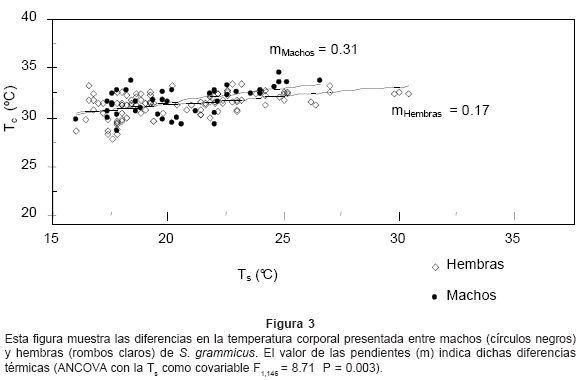
<body><![CDATA[<p align="justify"><font face="verdana" size="2"><b>RESULTADOS</b></font></p>  	    <p align="justify"><font face="verdana" size="2">La T<sub>c</sub> de estas lagartijas promedi&oacute; 31.43 &plusmn; 0.1&deg;C (intervalo 28.6&#45;33.2&deg;C). La T<sub>a</sub> y T<sub>s</sub> en la zona de estudio promediaron 20.02 &plusmn; 0.24&deg;C (intervalo 14.6&#45;24.8&deg;C) y 20.67 &plusmn; 0.25&deg;C (intervalo 15.6&#45;28.2&deg;C) respectivamente.</font></p>  	    <p align="justify"><font face="verdana" size="2">La T<sub>c</sub> present&oacute; una relaci&oacute;n positiva y significativa con la T<sub>a</sub> (<a href="#f1">Fig. 1</a>, r = 0.451, <i>P</i> &lt;&nbsp;0.001; T<sub>c</sub>= 27.529 + 0.195 T<sub>a</sub>) y con la T<sub>s</sub> (<a href="#f2">Fig. 2</a>, r = 0.482, P &lt;&nbsp;0.001; T<sub>c</sub> = 27.315 + 0.199 T<sub>s</sub>) del microh&aacute;bitat ocupado por cada lagartija. Por otro lado, la temperatura corporal para machos y hembras promedi&oacute; 31.93 &plusmn; 0.17&deg;C (rango 28.8 &#45; 34.6), n = 55 y 31.26 &plusmn; 0.12&deg;C (rango 28.6 &#45; 33.4), n = 92, respectivamente, observ&aacute;ndose una diferencia significativa en la temperatura corporal presentada por ambos sexos (<a href="#f3">Fig. 3</a>, ANCOVA con la T<sub>s</sub> como covariable F1,146 = 8.71, <i>P</i> = 0.003), siendo los machos los que dependieron en mayor medida de la temperatura del microh&aacute;bitat (r = 0.53, <i>P</i> &lt;&nbsp;0.001; T<sub>c</sub> = 25.185 + 0.31 T<sub>s</sub>) con respecto a las hembras (r = 0.48, P &lt;&nbsp;0.001; T<sub>c</sub> = 27.690 + 0.17 T<sub>s</sub>). Por otra parte, la temperatura promedio para hembras pre&ntilde;adas y no pre&ntilde;adas fue de 30.42 &plusmn; 0.17&deg;C (intervalo 28.6 &#45; 32.6), n = 35 y 31.68 &plusmn; 0.14&deg;C (intervalo 28.2 &#45; 33.4), n = 57, respectivamente, encontr&aacute;ndose una diferencia estad&iacute;sticamente significativa entre las hembras con ambas condiciones reproductivas (<a href="#f4">Fig. 4</a>, ANCOVA con la T<sub>s</sub> como covariable F1,91 = 18.81, <i>P</i> &lt;&nbsp;0.001). Asimismo se observ&oacute; que las hembras pre&ntilde;adas dependieron en mayor grado de la temperatura del microclima (n = 57, r = 0.56, P &lt;&nbsp;0.001; T<sub>c</sub> = 26.656 + 0.225 T<sub>s</sub>) que las hembras no pre&ntilde;adas (n = 35, r = 0.3, <i>P</i> = 0.08; T<sub>c</sub> = 27.845 + 0.083 T<sub>s</sub>).</font></p>  	    <p align="center"><font face="verdana" size="2"><a name="f1"></a></font></p>  	    <p align="center"><font face="verdana" size="2"><img src="/img/revistas/azm/v22n2/a6f1.jpg"></font></p> 	    <p align="center"><a name="f2"></a></p> 	    <p align="center"><img src="/img/revistas/azm/v22n2/a6f2.jpg"></p>      <p align="center"><font face="verdana" size="2"><a name="f3"></a></font></p>  	    <p align="center"><font face="verdana" size="2"><img src="/img/revistas/azm/v22n2/a6f3.jpg"></font></p>  	    <p align="center"><font face="verdana" size="2"><a name="f4"></a></font></p>  	    ]]></body>
<body><![CDATA[<p align="center"><font face="verdana" size="2"><img src="/img/revistas/azm/v22n2/a6f4.jpg"></font></p>  	    <p align="justify"><font face="verdana" size="2">La temperatura de las lagartijas que ocupaban diferente condici&oacute;n (sol, sombra y nublado), promedi&oacute; 31.7 &plusmn; 0.09&deg;C (intervalo 29.2 &#45; 33.8), n = 84; 31.8 &plusmn; 0.26&deg;C (intervalo 29.2 &#45;34.6), n = 37 y 29.6 &plusmn; 0.27&deg;C (27.8 &#45; 31.8), n = 26, respectivamente; observ&aacute;ndose una diferencia significativa entre lagartijas que ocupaban sol y sombra con respecto a las que se encontraron en d&iacute;as nublados (ANCOVA con la T<sub>s</sub> como covariable F2,145 = 34.64, <i>P</i> &lt;&nbsp;0.001, ver <a href="#f5">Fig. 5</a>). Durante los d&iacute;as nublados la dependencia de los lacertilios hacia la temperatura del microh&aacute;bitat fue mayor (r = 0.69, <i>P</i> &lt;&nbsp;0.001; T<sub>c</sub> = 21.7497 + 0.4161 T<sub>s</sub>), en comparaci&oacute;n a los d&iacute;as soleados (r = 0.4, <i>P</i> &lt;&nbsp;0.001; T<sub>c</sub> = 28.9 + 0.1340 T<sub>s</sub>) &oacute; cuando se encontraban en la sombra (r = 0.47, <i>P</i> &lt;&nbsp;0.001; T<sub>c</sub> = 28.1173 + 0.1732 T<sub>s</sub>).</font></p>  	    <p align="center"><font face="verdana" size="2"><a name="f5"></a></font></p>  	    <p align="center"><font face="verdana" size="2"><img src="/img/revistas/azm/v22n2/a6f5.jpg"></font></p>  	    <p align="justify"><font face="verdana" size="2">&nbsp;</font></p>  	    <p align="justify"><font face="verdana" size="2"><b>DISCUSI&Oacute;N</b></font></p>  	    <p align="justify"><font face="verdana" size="2"><b>Temperatura corporal</b></font></p>  	    <p align="justify"><font face="verdana" size="2">El promedio de la temperatura corporal de <i>S. grammicus</i> fue de 31.43&deg;C &plusmn; 0.1&deg;C, similar a la presentada en otras poblaciones pertenecientes al complejo <i>grammicus</i> (Lemos&#45;Espinal y Ballinger 1995). Tal vez esta similitud en el promedio de la temperatura corporal se deba a una caracter&iacute;stica ancestral del grupo (Huey y Bennett, 1987; Garland <i>et al</i>., 1991; Harvey y Pagel, 1991) ya que los h&aacute;bitats, las condiciones clim&aacute;ticas y la altitud en las zonas donde ocurren estos organismos difieren entre s&iacute; (ver <a href="/img/revistas/azm/v22n2/a6c1.jpg" target="_blank">cuadro 1</a>). Otra posible explicaci&oacute;n es que quiz&aacute;s se deba a que la temperatura corporal presentada por estos organismos es la &oacute;ptima en la que los procesos fisiol&oacute;gicos se llevan a cabo adecuadamente (Van Damme et al., 1987), pues se ha observado en otra lagartija viv&iacute;para (<i>Lacerta vivipara</i>) un adecuado funcionamiento locomotor y digestivo cuando presenta temperaturas corporales cercanas a 32 &deg;C (Patterson y Davies, 1978).</font></p>  	    <p align="justify"><font face="verdana" size="2"><b>Tendencias termorreguladoras</b></font></p>  	    <p align="justify"><font face="verdana" size="2">La mayor parte de estos lacertilios se encontraron completamente expuestos al sol. Sin embargo, tambi&eacute;n estuvieron activos en la sombra y durante d&iacute;as nublados. Lo anterior sugiere que tanto la temperatura del aire como la del sustrato son ocupadas por los organismos para regular su temperatura corporal. Existen dos evidencias que pueden indicar una termorregulaci&oacute;n activa. La primera es que el valor de ambas pendientes de las regresiones T<sub>c</sub> <i>vs.</i> T<sub>a</sub> y T<sub>c</sub> <i>vs.</i> T<sub>s</sub>, son de 0.19. Con base al criterio propuesto por Huey y Slatkin (1976), <i>S. grammicus</i> al igual que otras especies pertenecientes al g&eacute;nero, presenta tendencias hacia dicha estrategia termorreguladora (Lemos&#45;Espinal y Ballinger, 1995; Lemos&#45;Espinal <i>et al</i>., 1993, 1997a y b; Smith y Ballinger, 1994a, y b, 1995; Smith <i>et al</i>., 1993; Andrews <i>et al</i>. 1997). El que una lagartija sea termorreguladora tiene ciertas implicaciones. Por un lado, al presentar su cuerpo altas temperaturas, habr&aacute; una mayor tendencia a la p&eacute;rdida de agua por evaporaci&oacute;n (Hertz, 1992). Por otra parte, generalmente buscar&aacute; fuentes de radiaci&oacute;n directa al sol, haci&eacute;ndose conspicua a potenciales depredadores (Ballinger <i>et al</i>., 1970; Huey, 1974; Huey y Slatkin, 1976), entre otros posibles costos. Por otro lado, el acceso a una temperatura ambiental que permita a los organismos elevar su temperatura corporal a un rango &oacute;ptimo, trae como posible ventaja que el animal asigne la cantidad de energ&iacute;a necesaria al crecimiento, reproducci&oacute;n y mantenimiento (Beuchat y Ellner, 1987; Sinervo y Adolph, 1989; Sinervo, 1990; Daut y Andrews, 1993), entre otros. La segunda evidencia que puede indicar una termorregulaci&oacute;n activa es que tanto la tigmotermia como la heliotermia parecen desempe&ntilde;ar un papel importante en los esquemas termorreguladores de <i>S. grammicus</i>, debido a una correlaci&oacute;n relativamente alta y significativa entre la T<sub>c</sub> con la temperatura del microclima (T<sub>a</sub> y T<sub>s</sub>, ver resultados). Las observaciones realizadas en campo y lo mencionado anteriormente, pueden sugerir que estos organismos realizan movimientos de sol a sombra para mantener su temperatura corporal constante en las horas de luz solar, ganando calor por radiaci&oacute;n directa del sol, y cuando su temperatura aumenta, buscan refugio a la sombra, en sustratos con temperaturas confortables que les permita mantener una temperatura corporal constante. Este esquema de obtenci&oacute;n de calor utilizando ambas v&iacute;as (tigmotermia y heliotermia) contrasta con los patrones presentados por otros lacertilios cuyas tendencias se cargan m&aacute;s hacia la tigmotermia (Lemos&#45;Espinal <i>et al</i>., 1997b y c, 1998; Woolrich&#45;Pi&ntilde;a <i>et al</i>., 1999, 2003), o heliotermia (Carrascal y D&iacute;az, 1989; Marquet <i>et al</i>., 1989).</font></p>  	    ]]></body>
<body><![CDATA[<p align="justify"><font face="verdana" size="2">La diferencia en la temperatura corporal presentada por las lagartijas ocupando diferente condici&oacute;n (sol, sombra y nublado) puede ser otra evidencia m&aacute;s de que estos lacertilios termorregulen activamente, ya que las T<sub>c</sub>'s fueron mayores en d&iacute;as soleados que en d&iacute;as nublados y, por otra parte, quiz&aacute;s empleen el mecanismo de cambiar de postura con respecto a los rayos del sol para regular su temperatura (Dreisig, 1984; Bauwens <i>et al</i>., 1996).</font></p>  	    <p align="justify"><font face="verdana" size="2"><b>Diferencias t&eacute;rmicas inter e intrasexuales</b></font></p>  	    <p align="justify"><font face="verdana" size="2">La diferencia en la temperatura corporal presentada por ambos sexos de <i>S. grammicus</i> tal vez se deba al grado de territorialidad o a diferencias en el uso de microh&aacute;bitats (Dias y Rocha, 2004; Kerr y Bull, 2004). Este mismo patr&oacute;n ha sido observado en otros lacertilios (Smith <i>et al</i>., 1993), donde los machos pueden acceder a microh&aacute;bitats con mayor disponibilidad de fuentes de calor. Sin embargo, en otras especies, las hembras presentan una temperatura corporal mayor a los machos (Daut y Andrews, 1993 y Gillis, 1991). Quiz&aacute;s lo anterior se deba a que las hembras requieren de microh&aacute;bitats adecuados que suministren el calor necesario para incrementar la temperatura corporal con fines reproductivos (Schwarzkopf y Shine, 1991).</font></p>  	    <p align="justify"><font face="verdana" size="2">Una capacidad termorreguladora disminuida y una tendencia tigmot&eacute;rmica por parte de las hembras pre&ntilde;adas en comparaci&oacute;n a las no pre&ntilde;adas (pendientes 0.225 <i>vs.</i> 0.083, r = 0.56 <i>vs.</i> r = 0.3, respectivamente), tal vez aumente su probabilidad de supervivencia (Stewart, 1984), ya que al ocupar diferentes microh&aacute;bitats o conductas termorreguladoras, posiblemente eviten el riesgo de ser depredadas y por esta raz&oacute;n presenten una temperatura corporal menor en comparaci&oacute;n de las hembras no pre&ntilde;adas (Shine, 1980; Bauwens and Thoen, 1981; Bra&ntilde;a, 1993). Esta tendencia hacia una termorregulaci&oacute;n pasiva por parte de las hembras pre&ntilde;adas, tal vez pueda explicarse desde una perspectiva ecol&oacute;gica y otra fisiol&oacute;gica. Desde un punto de vista ecol&oacute;gico, las hembras pre&ntilde;adas son m&aacute;s vulnerables a la depredaci&oacute;n debido a que su mayor masa corporal les impide escapar r&aacute;pidamente en comparaci&oacute;n con los machos (Huey, 1982). Por otro lado, desde el punto de vista fisiol&oacute;gico, la baja temperatura corporal de las hembras pre&ntilde;adas puede evitar una afecci&oacute;n al desarrollo embrionario (Beuchat y Ellner, 1987; Smith y Ballinger, 1994b; Andrews <i>et al</i>., 1997). Sin embargo, una disminuci&oacute;n en la temperatura corporal por parte de las hembras pre&ntilde;adas, puede afectar su crecimiento, reproducci&oacute;n y supervivencia a futuro (Beuchat y Ellner, 1987).</font></p>  	    <p align="justify"><font face="verdana" size="2">&nbsp;</font></p>  	    <p align="justify"><font face="verdana" size="2"><b>AGRADECIMIENTOS</b></font></p>  	    <p align="justify"><font face="verdana" size="2">Deseamos agradecer a los Drs. Vinicio Sosa Fern&aacute;ndez y Gerardo C. Leynaud, as&iacute; como a otro revisor an&oacute;nimo los comentarios y sugerencias realizadas a la primera versi&oacute;n de este trabajo. La Direcci&oacute;n General de Vida Silvestre de la SEMARNAT nos concedi&oacute; los permisos necesarios para la recolecci&oacute;n de ejemplares dentro de la Delegaci&oacute;n Venustiano Carranza. Un agradecimiento especial a los Drs. Patricia D&aacute;vila Aranda y Rafael Lira Saade de la FES Iztacala UNAM, quienes a trav&eacute;s de la Unidad de Biolog&iacute;a, Tecnolog&iacute;a y Prototipos (UBIPRO), nos han apoyado y alentado para realizar &eacute;ste y otros estudios.</font></p>  	    <p align="justify"><font face="verdana" size="2">&nbsp;</font></p>  	    <p align="justify"><font face="verdana" size="2"><b>LITERATURA CITADA</b></font></p>  	    <!-- ref --><p align="justify"><font face="verdana" size="2"><b>Adolph S. C. &amp;&nbsp;W. P. Porter.</b> 1993. Temperature, activity and lizard life&#45;history. <i>American Naturalist</i> 142: 273&#45;295.    &nbsp;&nbsp;&nbsp;&nbsp;&nbsp;&nbsp;&nbsp;&nbsp;[&#160;<a href="javascript:void(0);" onclick="javascript: window.open('/scielo.php?script=sci_nlinks&ref=334615&pid=S0065-1737200600020000600001&lng=','','width=640,height=500,resizable=yes,scrollbars=1,menubar=yes,');">Links</a>&#160;]<!-- end-ref --></font></p>  	    <!-- ref --><p align="justify"><font face="verdana" size="2"><b>Andrews R. M., F. R. M&eacute;ndez de la Cruz, &amp;&nbsp;M. Villagr&aacute;n&#45;Santa Cruz.</b> 1997. Body temperatures of female <i>Sceloporus grammicus</i>: Thermal stress or impaired mobility? <i>Copeia</i> 1997: 108&#45;115.    &nbsp;&nbsp;&nbsp;&nbsp;&nbsp;&nbsp;&nbsp;&nbsp;[&#160;<a href="javascript:void(0);" onclick="javascript: window.open('/scielo.php?script=sci_nlinks&ref=334617&pid=S0065-1737200600020000600002&lng=','','width=640,height=500,resizable=yes,scrollbars=1,menubar=yes,');">Links</a>&#160;]<!-- end-ref --></font></p>  	    <!-- ref --><p align="justify"><font face="verdana" size="2"><b>Anguilletta M. J. Jr., L. G. Montgomery &amp;&nbsp;Y. L. Werner.</b> 1999. Temperature preference in geckos: diel variation in juveniles and adults. <i>Herpetologica</i> 55: 212&#45;222.    &nbsp;&nbsp;&nbsp;&nbsp;&nbsp;&nbsp;&nbsp;&nbsp;[&#160;<a href="javascript:void(0);" onclick="javascript: window.open('/scielo.php?script=sci_nlinks&ref=334619&pid=S0065-1737200600020000600003&lng=','','width=640,height=500,resizable=yes,scrollbars=1,menubar=yes,');">Links</a>&#160;]<!-- end-ref --></font></p>  	    <!-- ref --><p align="justify"><font face="verdana" size="2"><b>Anguilletta M. J. Jr., R. Scott Winters &amp;&nbsp;A. E. Dunham.</b> 2000. Thermal effects on the energetics of lizards embryos: Implications for hatchling phenotypes. <i>Ecology</i> 81: 2957&#45;2968.    &nbsp;&nbsp;&nbsp;&nbsp;&nbsp;&nbsp;&nbsp;&nbsp;[&#160;<a href="javascript:void(0);" onclick="javascript: window.open('/scielo.php?script=sci_nlinks&ref=334621&pid=S0065-1737200600020000600004&lng=','','width=640,height=500,resizable=yes,scrollbars=1,menubar=yes,');">Links</a>&#160;]<!-- end-ref --></font></p>  	    <!-- ref --><p align="justify"><font face="verdana" size="2"><b>Ballinger R. E., K. R. Marion &amp;&nbsp;O. J. Sexton.</b> 1970. Thermal ecology of the lizard, <i>Anolis limifrons</i>, with comparative notes on three additional panamanian Anoles. <i>Ecology</i> 51: 246&#45;254.    &nbsp;&nbsp;&nbsp;&nbsp;&nbsp;&nbsp;&nbsp;&nbsp;[&#160;<a href="javascript:void(0);" onclick="javascript: window.open('/scielo.php?script=sci_nlinks&ref=334623&pid=S0065-1737200600020000600005&lng=','','width=640,height=500,resizable=yes,scrollbars=1,menubar=yes,');">Links</a>&#160;]<!-- end-ref --></font></p>  	    <!-- ref --><p align="justify"><font face="verdana" size="2"><b>Bauwens D., P. E. Hertz &amp;&nbsp;A. M. Castilla.</b> 1996. Thermoregulation in a lacertid lizard: The relative contributions of distinct behavioral mechanisms. <i>Ecology</i> 77: 1818&#45;1830.    &nbsp;&nbsp;&nbsp;&nbsp;&nbsp;&nbsp;&nbsp;&nbsp;[&#160;<a href="javascript:void(0);" onclick="javascript: window.open('/scielo.php?script=sci_nlinks&ref=334625&pid=S0065-1737200600020000600006&lng=','','width=640,height=500,resizable=yes,scrollbars=1,menubar=yes,');">Links</a>&#160;]<!-- end-ref --></font></p>  	    <!-- ref --><p align="justify"><font face="verdana" size="2"><b>Bauwens D. &amp;&nbsp;C. Thoen.</b> 1981. Escape tactics and vulnerability to predation associated with reproduction in the lizard <i>Lacerta vivipara. Journal of Animal Ecology</i> 50: 733&#45;744.    &nbsp;&nbsp;&nbsp;&nbsp;&nbsp;&nbsp;&nbsp;&nbsp;[&#160;<a href="javascript:void(0);" onclick="javascript: window.open('/scielo.php?script=sci_nlinks&ref=334627&pid=S0065-1737200600020000600007&lng=','','width=640,height=500,resizable=yes,scrollbars=1,menubar=yes,');">Links</a>&#160;]<!-- end-ref --></font></p>  	    <!-- ref --><p align="justify"><font face="verdana" size="2"><b>Belliure J., L. M. Carrascal &amp;&nbsp;J. A. D&iacute;az.</b> 1996. Covariation of thermal biology and foraging mode in two mediterranean lacertid lizard. <i>Ecology</i> 74: 1163&#45;1173.    &nbsp;&nbsp;&nbsp;&nbsp;&nbsp;&nbsp;&nbsp;&nbsp;[&#160;<a href="javascript:void(0);" onclick="javascript: window.open('/scielo.php?script=sci_nlinks&ref=334629&pid=S0065-1737200600020000600008&lng=','','width=640,height=500,resizable=yes,scrollbars=1,menubar=yes,');">Links</a>&#160;]<!-- end-ref --></font></p>  	    <!-- ref --><p align="justify"><font face="verdana" size="2"><b>Benabib M. &amp;&nbsp;J. D. Congdon.</b> 1992. Metabolic and water&#45;flux rates of free&#45;ranging tropical lizards <i>Sceloporus variabilis. Physiological Zoology</i> 65: 788&#45;802.    &nbsp;&nbsp;&nbsp;&nbsp;&nbsp;&nbsp;&nbsp;&nbsp;[&#160;<a href="javascript:void(0);" onclick="javascript: window.open('/scielo.php?script=sci_nlinks&ref=334631&pid=S0065-1737200600020000600009&lng=','','width=640,height=500,resizable=yes,scrollbars=1,menubar=yes,');">Links</a>&#160;]<!-- end-ref --></font></p>  	    <!-- ref --><p align="justify"><font face="verdana" size="2"><b>Beuchat C. A.</b> 1986. Reproductive influences on thermoregulatory behavior of a live&#45;bearing lizard. <i>Copeia</i> 1986: 971&#45;979.    &nbsp;&nbsp;&nbsp;&nbsp;&nbsp;&nbsp;&nbsp;&nbsp;[&#160;<a href="javascript:void(0);" onclick="javascript: window.open('/scielo.php?script=sci_nlinks&ref=334633&pid=S0065-1737200600020000600010&lng=','','width=640,height=500,resizable=yes,scrollbars=1,menubar=yes,');">Links</a>&#160;]<!-- end-ref --></font></p>  	    <!-- ref --><p align="justify"><font face="verdana" size="2"><b>&#45;&#45;&#45;&#45;&#45;&#45;&#45;&#45;&#45;&#45;</b> 1988.Temperature effects during gestation in a viviparous lizard. <i>Journal of Thermal Biology</i> 13: 135&#45;142.    &nbsp;&nbsp;&nbsp;&nbsp;&nbsp;&nbsp;&nbsp;&nbsp;[&#160;<a href="javascript:void(0);" onclick="javascript: window.open('/scielo.php?script=sci_nlinks&ref=334635&pid=S0065-1737200600020000600011&lng=','','width=640,height=500,resizable=yes,scrollbars=1,menubar=yes,');">Links</a>&#160;]<!-- end-ref --></font></p>  	    <!-- ref --><p align="justify"><font face="verdana" size="2"><b>Beuchat C. A. &amp;&nbsp;S. Ellner.</b> 1987. A quantitative test of life history theory: Thermoregulation by a viviparous lizard. <i>Ecological Monographs</i> 51: 45&#45;68.    &nbsp;&nbsp;&nbsp;&nbsp;&nbsp;&nbsp;&nbsp;&nbsp;[&#160;<a href="javascript:void(0);" onclick="javascript: window.open('/scielo.php?script=sci_nlinks&ref=334637&pid=S0065-1737200600020000600012&lng=','','width=640,height=500,resizable=yes,scrollbars=1,menubar=yes,');">Links</a>&#160;]<!-- end-ref --></font></p>  	    <!-- ref --><p align="justify"><font face="verdana" size="2"><b>Bogert C. M.</b> 1949a. Thermoregulation and critic body temperatures in Mexican lizards of the genus <i>Sceloporus</i>. <i>Anales del Instituto de Biolog&iacute;a UNAM</i> 20: 415&#45;426.    &nbsp;&nbsp;&nbsp;&nbsp;&nbsp;&nbsp;&nbsp;&nbsp;[&#160;<a href="javascript:void(0);" onclick="javascript: window.open('/scielo.php?script=sci_nlinks&ref=334639&pid=S0065-1737200600020000600013&lng=','','width=640,height=500,resizable=yes,scrollbars=1,menubar=yes,');">Links</a>&#160;]<!-- end-ref --></font></p>  	    <!-- ref --><p align="justify"><font face="verdana" size="2"><b>&#45;&#45;&#45;&#45;&#45;&#45;&#45;&#45;&#45;&#45;</b> 1949b. Thermoregulation in reptiles, a factor in evolution. <i>Evolution</i> 3: 195&#45;211.    &nbsp;&nbsp;&nbsp;&nbsp;&nbsp;&nbsp;&nbsp;&nbsp;[&#160;<a href="javascript:void(0);" onclick="javascript: window.open('/scielo.php?script=sci_nlinks&ref=334641&pid=S0065-1737200600020000600014&lng=','','width=640,height=500,resizable=yes,scrollbars=1,menubar=yes,');">Links</a>&#160;]<!-- end-ref --></font></p>  	    <!-- ref --><p align="justify"><font face="verdana" size="2"><b>Bra&ntilde;a F.</b> 1993. Shift in body temperatures and escape behavior of female <i>Podarcis muralis</i> during pregnancy. <i>Oikos</i> 66: 216&#45;222.    &nbsp;&nbsp;&nbsp;&nbsp;&nbsp;&nbsp;&nbsp;&nbsp;[&#160;<a href="javascript:void(0);" onclick="javascript: window.open('/scielo.php?script=sci_nlinks&ref=334643&pid=S0065-1737200600020000600015&lng=','','width=640,height=500,resizable=yes,scrollbars=1,menubar=yes,');">Links</a>&#160;]<!-- end-ref --></font></p>  	    <!-- ref --><p align="justify"><font face="verdana" size="2"><b>Brown R. P.</b> 1996. Thermal biology of the gecko <i>Tarentola boettgeri</i>: comparisons among populations from different elevations within Gran Canaria. <i>Herpetologica</i> 52: 396-405.    &nbsp;&nbsp;&nbsp;&nbsp;&nbsp;&nbsp;&nbsp;&nbsp;[&#160;<a href="javascript:void(0);" onclick="javascript: window.open('/scielo.php?script=sci_nlinks&ref=334645&pid=S0065-1737200600020000600016&lng=','','width=640,height=500,resizable=yes,scrollbars=1,menubar=yes,');">Links</a>&#160;]<!-- end-ref --></font></p>  	    <!-- ref --><p align="justify"><font face="verdana" size="2"><b>Carrascal L. M. &amp;&nbsp;J. A. D&iacute;az.</b> 1989. Thermal ecology and spatio&#45;temporal distribution of the Mediterranean lizard <i>Psammodromus algirus. Holarctic Ecology</i> 12: 137&#45;143.    &nbsp;&nbsp;&nbsp;&nbsp;&nbsp;&nbsp;&nbsp;&nbsp;[&#160;<a href="javascript:void(0);" onclick="javascript: window.open('/scielo.php?script=sci_nlinks&ref=334647&pid=S0065-1737200600020000600017&lng=','','width=640,height=500,resizable=yes,scrollbars=1,menubar=yes,');">Links</a>&#160;]<!-- end-ref --></font></p>  	    <!-- ref --><p align="justify"><font face="verdana" size="2"><b>Cowles R. B. &amp;&nbsp;C. M. Bogert.</b> 1944. A preliminary study of termal requirements of desert reptiles. <i>Bulletin of the American Museum of Natural History</i> 83: 261&#45;296.    &nbsp;&nbsp;&nbsp;&nbsp;&nbsp;&nbsp;&nbsp;&nbsp;[&#160;<a href="javascript:void(0);" onclick="javascript: window.open('/scielo.php?script=sci_nlinks&ref=334649&pid=S0065-1737200600020000600018&lng=','','width=640,height=500,resizable=yes,scrollbars=1,menubar=yes,');">Links</a>&#160;]<!-- end-ref --></font></p>  	    <!-- ref --><p align="justify"><font face="verdana" size="2"><b>Daut E. F. &amp;&nbsp;R. M. Andrews.</b> 1993. The effect of pregnancy on thermoregulatory behavior of the viviparous lizard <i>Chalcides ocellatus. Journal of Herpetology</i> 27: 6&#45;13.    &nbsp;&nbsp;&nbsp;&nbsp;&nbsp;&nbsp;&nbsp;&nbsp;[&#160;<a href="javascript:void(0);" onclick="javascript: window.open('/scielo.php?script=sci_nlinks&ref=334651&pid=S0065-1737200600020000600019&lng=','','width=640,height=500,resizable=yes,scrollbars=1,menubar=yes,');">Links</a>&#160;]<!-- end-ref --></font></p>  	    <!-- ref --><p align="justify"><font face="verdana" size="2"><b>Dias E. J. R. &amp;&nbsp;C. F. D. Rocha.</b> 2004. Thermal ecology, activity patterns, and microhabitat use by two sympatric whiptail lizards (<i>Cnemidophorus abaetensis</i> and <i>Cnemidophorus ocellifer</i>) from northeastern Brazil. <i>Journal of Herpetology</i> 38: 586&#45;588.    &nbsp;&nbsp;&nbsp;&nbsp;&nbsp;&nbsp;&nbsp;&nbsp;[&#160;<a href="javascript:void(0);" onclick="javascript: window.open('/scielo.php?script=sci_nlinks&ref=334653&pid=S0065-1737200600020000600020&lng=','','width=640,height=500,resizable=yes,scrollbars=1,menubar=yes,');">Links</a>&#160;]<!-- end-ref --></font></p>  	    <!-- ref --><p align="justify"><font face="verdana" size="2"><b>Dreisig H.</b> 1984. Control of body temperature in shuttling ectotherms. <i>Journal of Thermal Biology</i> 9: 229&#45;233.    &nbsp;&nbsp;&nbsp;&nbsp;&nbsp;&nbsp;&nbsp;&nbsp;[&#160;<a href="javascript:void(0);" onclick="javascript: window.open('/scielo.php?script=sci_nlinks&ref=334655&pid=S0065-1737200600020000600021&lng=','','width=640,height=500,resizable=yes,scrollbars=1,menubar=yes,');">Links</a>&#160;]<!-- end-ref --></font></p>  	    <!-- ref --><p align="justify"><font face="verdana" size="2"><b>Dunham A. E., B. W. Grant &amp;&nbsp;K. L. Overall.</b> 1989. Interfaces between biophysical and physiological ecology and the population ecology of terrestrial vertebrate ecthoterms. <i>Physiological Zoology</i> 62: 335&#45;355.    &nbsp;&nbsp;&nbsp;&nbsp;&nbsp;&nbsp;&nbsp;&nbsp;[&#160;<a href="javascript:void(0);" onclick="javascript: window.open('/scielo.php?script=sci_nlinks&ref=334657&pid=S0065-1737200600020000600022&lng=','','width=640,height=500,resizable=yes,scrollbars=1,menubar=yes,');">Links</a>&#160;]<!-- end-ref --></font></p>  	    <!-- ref --><p align="justify"><font face="verdana" size="2"><b>Dzialowski E. &amp;&nbsp;M. P. O'Connor.</b> 2001. Thermal time constant estimation in warming and cooling ectotherms <i>Journal of Thermal Biology</i> 26: 231&#45;245.    &nbsp;&nbsp;&nbsp;&nbsp;&nbsp;&nbsp;&nbsp;&nbsp;[&#160;<a href="javascript:void(0);" onclick="javascript: window.open('/scielo.php?script=sci_nlinks&ref=334659&pid=S0065-1737200600020000600023&lng=','','width=640,height=500,resizable=yes,scrollbars=1,menubar=yes,');">Links</a>&#160;]<!-- end-ref --></font></p>  	    <!-- ref --><p align="justify"><font face="verdana" size="2"><b>Garland T. Jr., R. B. Huey &amp;&nbsp;A. F. Bennett.</b> 1991. Phylogeny and coadaptation of thermal physiology in lizards: A reanalysis. <i>Evolution</i> 45: 1969&#45;1975.    &nbsp;&nbsp;&nbsp;&nbsp;&nbsp;&nbsp;&nbsp;&nbsp;[&#160;<a href="javascript:void(0);" onclick="javascript: window.open('/scielo.php?script=sci_nlinks&ref=334661&pid=S0065-1737200600020000600024&lng=','','width=640,height=500,resizable=yes,scrollbars=1,menubar=yes,');">Links</a>&#160;]<!-- end-ref --></font></p>  	    <!-- ref --><p align="justify"><font face="verdana" size="2"><b>Garrick L. D.</b> 1974. Reproductive influences on behavioral thermoregulation in the lizard, <i>Sceloporus cyanogenys. Physiological Behavioral</i> 12: 85&#45;91.    &nbsp;&nbsp;&nbsp;&nbsp;&nbsp;&nbsp;&nbsp;&nbsp;[&#160;<a href="javascript:void(0);" onclick="javascript: window.open('/scielo.php?script=sci_nlinks&ref=334663&pid=S0065-1737200600020000600025&lng=','','width=640,height=500,resizable=yes,scrollbars=1,menubar=yes,');">Links</a>&#160;]<!-- end-ref --></font></p>  	    <!-- ref --><p align="justify"><font face="verdana" size="2"><b>Gillis R.</b> 1991. Thermal biology of two populations of red&#45;chinned lizards (<i>Sceloporus undulatus erytrocheilus</i>) living in different habitats in southcentral Colorado. <i>Journal of Herpetology</i> 25: 18&#45;23.    &nbsp;&nbsp;&nbsp;&nbsp;&nbsp;&nbsp;&nbsp;&nbsp;[&#160;<a href="javascript:void(0);" onclick="javascript: window.open('/scielo.php?script=sci_nlinks&ref=334665&pid=S0065-1737200600020000600026&lng=','','width=640,height=500,resizable=yes,scrollbars=1,menubar=yes,');">Links</a>&#160;]<!-- end-ref --></font></p>  	    <!-- ref --><p align="justify"><font face="verdana" size="2"><b>Grant B. W. &amp;&nbsp;A. E. Dunham.</b> 1988. Thermally imposed time constraints on the activity of the desert lizard <i>Sceloporus merriami.</i> <i>Ecology</i> 69: 167&#45;176.    &nbsp;&nbsp;&nbsp;&nbsp;&nbsp;&nbsp;&nbsp;&nbsp;[&#160;<a href="javascript:void(0);" onclick="javascript: window.open('/scielo.php?script=sci_nlinks&ref=334667&pid=S0065-1737200600020000600027&lng=','','width=640,height=500,resizable=yes,scrollbars=1,menubar=yes,');">Links</a>&#160;]<!-- end-ref --></font></p>  	    <!-- ref --><p align="justify"><font face="verdana" size="2"><b>&#45;&#45;&#45;&#45;&#45;&#45;&#45;&#45;&#45;&#45;</b> 1990. Elevational covariation in environmental constraints and life histories of the desert lizard <i>Sceloporus merriami.</i> <i>Ecology</i> 71: 1765&#45;1776.    &nbsp;&nbsp;&nbsp;&nbsp;&nbsp;&nbsp;&nbsp;&nbsp;[&#160;<a href="javascript:void(0);" onclick="javascript: window.open('/scielo.php?script=sci_nlinks&ref=334669&pid=S0065-1737200600020000600028&lng=','','width=640,height=500,resizable=yes,scrollbars=1,menubar=yes,');">Links</a>&#160;]<!-- end-ref --></font></p>  	    <!-- ref --><p align="justify"><font face="verdana" size="2"><b>Grenot C. J., L. Garcin, J. Dao, J. P. H&eacute;rold, B. Fahys &amp;&nbsp;T. Pages.</b> 2000. How does the European common lizard, <i>Lacerta vivipara</i>, survive the cold of winter? <i>Comparative Biochemistry and Physiology</i> Part A 127: 71&#45;80.    &nbsp;&nbsp;&nbsp;&nbsp;&nbsp;&nbsp;&nbsp;&nbsp;[&#160;<a href="javascript:void(0);" onclick="javascript: window.open('/scielo.php?script=sci_nlinks&ref=334671&pid=S0065-1737200600020000600029&lng=','','width=640,height=500,resizable=yes,scrollbars=1,menubar=yes,');">Links</a>&#160;]<!-- end-ref --></font></p>  	    <!-- ref --><p align="justify"><font face="verdana" size="2"><b>Harvey P. H. &amp;&nbsp;M. D. Pagel.</b> 1991. <i>The comparative method in evolutionary biology.</i> Oxford University Press, New York, E.E.U.U.    &nbsp;&nbsp;&nbsp;&nbsp;&nbsp;&nbsp;&nbsp;&nbsp;[&#160;<a href="javascript:void(0);" onclick="javascript: window.open('/scielo.php?script=sci_nlinks&ref=334673&pid=S0065-1737200600020000600030&lng=','','width=640,height=500,resizable=yes,scrollbars=1,menubar=yes,');">Links</a>&#160;]<!-- end-ref --></font></p>  	    <!-- ref --><p align="justify"><font face="verdana" size="2"><b>Hertz P. E.</b> 1981. Adaptation to altitude in two West Island anoles (Reptilia : Igunidae): Field thermal biology and physiological ecology. <i>Journal of Zoology</i> 195: 25&#45;37.    &nbsp;&nbsp;&nbsp;&nbsp;&nbsp;&nbsp;&nbsp;&nbsp;[&#160;<a href="javascript:void(0);" onclick="javascript: window.open('/scielo.php?script=sci_nlinks&ref=334675&pid=S0065-1737200600020000600031&lng=','','width=640,height=500,resizable=yes,scrollbars=1,menubar=yes,');">Links</a>&#160;]<!-- end-ref --></font></p>  	    <!-- ref --><p align="justify"><font face="verdana" size="2"><b>&#45;&#45;&#45;&#45;&#45;&#45;&#45;&#45;&#45;&#45;</b> 1992. Evaluating thermal resource partitioning by sympatric lizards <i>Anolis cooki</i> and <i>A. cristatellus</i>: A field test using null hypoteses. <i>Oecolog&iacute;a</i> 90 : 127&#45;136.    &nbsp;&nbsp;&nbsp;&nbsp;&nbsp;&nbsp;&nbsp;&nbsp;[&#160;<a href="javascript:void(0);" onclick="javascript: window.open('/scielo.php?script=sci_nlinks&ref=334677&pid=S0065-1737200600020000600032&lng=','','width=640,height=500,resizable=yes,scrollbars=1,menubar=yes,');">Links</a>&#160;]<!-- end-ref --></font></p>  	    <!-- ref --><p align="justify"><font face="verdana" size="2"><b>Hertz P. E. &amp;&nbsp;R. B. Huey.</b> 1981. Compensation for altitudinal changes in the thermal environment by some <i>Anolis</i> lizard on Hispaniola. <i>Ecology</i> 62: 515&#45;521.    &nbsp;&nbsp;&nbsp;&nbsp;&nbsp;&nbsp;&nbsp;&nbsp;[&#160;<a href="javascript:void(0);" onclick="javascript: window.open('/scielo.php?script=sci_nlinks&ref=334679&pid=S0065-1737200600020000600033&lng=','','width=640,height=500,resizable=yes,scrollbars=1,menubar=yes,');">Links</a>&#160;]<!-- end-ref --></font></p>  	    <!-- ref --><p align="justify"><font face="verdana" size="2"><b>Huey R. B.</b> 1974. Behavioral thermoregulation in lizards: Importance of associated costs. <i>Science</i> 184: 1001&#45;1003.    &nbsp;&nbsp;&nbsp;&nbsp;&nbsp;&nbsp;&nbsp;&nbsp;[&#160;<a href="javascript:void(0);" onclick="javascript: window.open('/scielo.php?script=sci_nlinks&ref=334681&pid=S0065-1737200600020000600034&lng=','','width=640,height=500,resizable=yes,scrollbars=1,menubar=yes,');">Links</a>&#160;]<!-- end-ref --></font></p>  	    <!-- ref --><p align="justify"><font face="verdana" size="2"><b>&#45;&#45;&#45;&#45;&#45;&#45;&#45;&#45;&#45;&#45;</b> 1982. Temperature, physiology, and the ecology of reptiles. Pp. 25&#45;91. <i>In</i> C. Gans and F. H. Pough (Eds). <i>Biology of reptilia</i>. Vol. 12. Academic Press, London, UK.    &nbsp;&nbsp;&nbsp;&nbsp;&nbsp;&nbsp;&nbsp;&nbsp;[&#160;<a href="javascript:void(0);" onclick="javascript: window.open('/scielo.php?script=sci_nlinks&ref=334683&pid=S0065-1737200600020000600035&lng=','','width=640,height=500,resizable=yes,scrollbars=1,menubar=yes,');">Links</a>&#160;]<!-- end-ref --></font></p>  	    <!-- ref --><p align="justify"><font face="verdana" size="2"><b>Huey R. B. &amp;&nbsp;A. F. Bennett.</b> 1987. Phylogenetic studies of coadaptation: Preferred temperatures versus optimal performance temperatures of lizards. <i>Evolution</i> 41: 1098-1115.    &nbsp;&nbsp;&nbsp;&nbsp;&nbsp;&nbsp;&nbsp;&nbsp;[&#160;<a href="javascript:void(0);" onclick="javascript: window.open('/scielo.php?script=sci_nlinks&ref=334685&pid=S0065-1737200600020000600036&lng=','','width=640,height=500,resizable=yes,scrollbars=1,menubar=yes,');">Links</a>&#160;]<!-- end-ref --></font></p>  	    <!-- ref --><p align="justify"><font face="verdana" size="2"><b>Huey R. B. &amp;&nbsp;E. R. Pianka.</b> 1977. Seasonal variation in thermoregulatory behavior and body temperature of diurnal Kalahari lizards. <i>Ecology</i> 58: 1066&#45;1075.    &nbsp;&nbsp;&nbsp;&nbsp;&nbsp;&nbsp;&nbsp;&nbsp;[&#160;<a href="javascript:void(0);" onclick="javascript: window.open('/scielo.php?script=sci_nlinks&ref=334687&pid=S0065-1737200600020000600037&lng=','','width=640,height=500,resizable=yes,scrollbars=1,menubar=yes,');">Links</a>&#160;]<!-- end-ref --></font></p>  	    <!-- ref --><p align="justify"><font face="verdana" size="2"><b>Huey R. B. &amp;&nbsp;M. Slatkin.</b> 1976. Costs and benefits of lizard thermoregulation. <i>Quarterly Review of Biology</i> 51: 363&#45;384.    &nbsp;&nbsp;&nbsp;&nbsp;&nbsp;&nbsp;&nbsp;&nbsp;[&#160;<a href="javascript:void(0);" onclick="javascript: window.open('/scielo.php?script=sci_nlinks&ref=334689&pid=S0065-1737200600020000600038&lng=','','width=640,height=500,resizable=yes,scrollbars=1,menubar=yes,');">Links</a>&#160;]<!-- end-ref --></font></p>  	    <!-- ref --><p align="justify"><font face="verdana" size="2"><b>Kerr G. D. &amp;&nbsp;C. M. Bull.</b> 2004. Microhabitat use by the scincid lizard <i>Tiliqua rugosa</i>: Exploiting natural temperature gradients beneath plant canopies. <i>Journal of Herpetology</i> 38: 536&#45;545.    &nbsp;&nbsp;&nbsp;&nbsp;&nbsp;&nbsp;&nbsp;&nbsp;[&#160;<a href="javascript:void(0);" onclick="javascript: window.open('/scielo.php?script=sci_nlinks&ref=334691&pid=S0065-1737200600020000600039&lng=','','width=640,height=500,resizable=yes,scrollbars=1,menubar=yes,');">Links</a>&#160;]<!-- end-ref --></font></p>  	    <!-- ref --><p align="justify"><font face="verdana" size="2"><b>Lemos&#45;Espinal J. A. &amp;&nbsp;R. E. Ballinger.</b> 1995. Comparative thermal ecology of the high altitude lizard <i>Sceloporus grammicus</i> on the eastern slope of the Iztaccihuatl Volcano, Puebla, Mexico. <i>Canadian Journal of Zoology</i> 73: 2184&#45;2191.    &nbsp;&nbsp;&nbsp;&nbsp;&nbsp;&nbsp;&nbsp;&nbsp;[&#160;<a href="javascript:void(0);" onclick="javascript: window.open('/scielo.php?script=sci_nlinks&ref=334693&pid=S0065-1737200600020000600040&lng=','','width=640,height=500,resizable=yes,scrollbars=1,menubar=yes,');">Links</a>&#160;]<!-- end-ref --></font></p>  	    <!-- ref --><p align="justify"><font face="verdana" size="2"><b>Lemos&#45;Espinal J. A., R. E. Ballinger &amp;&nbsp;J. M. Javelly&#45;Gurr&iacute;a.</b> 1993. Observations on the sensitivity to high temperatures in two lizard species (Ameiva undulata and <i>Sceloporus horridus</i>) from Zacatepec, Morelos, Mexico. <i>Bulletin of the Maryland Herpetological Society</i> 29: 24-29.    &nbsp;&nbsp;&nbsp;&nbsp;&nbsp;&nbsp;&nbsp;&nbsp;[&#160;<a href="javascript:void(0);" onclick="javascript: window.open('/scielo.php?script=sci_nlinks&ref=334695&pid=S0065-1737200600020000600041&lng=','','width=640,height=500,resizable=yes,scrollbars=1,menubar=yes,');">Links</a>&#160;]<!-- end-ref --></font></p>  	    <!-- ref --><p align="justify"><font face="verdana" size="2"><b>Lemos&#45;Espinal J. A., R. E. Ballinger., S. Sanoja&#45;Sarabia &amp;&nbsp;Gl R. Smith.</b> 1997a. Thermal ecology of the lizard <i>Sceloporus mucronatus mucronatus</i> in Sierra del Ajusco, Mexico. <i>Southwestern Naturalist</i> 42: 344&#45;347.    &nbsp;&nbsp;&nbsp;&nbsp;&nbsp;&nbsp;&nbsp;&nbsp;[&#160;<a href="javascript:void(0);" onclick="javascript: window.open('/scielo.php?script=sci_nlinks&ref=334697&pid=S0065-1737200600020000600042&lng=','','width=640,height=500,resizable=yes,scrollbars=1,menubar=yes,');">Links</a>&#160;]<!-- end-ref --></font></p>  	    <!-- ref --><p align="justify"><font face="verdana" size="2"><b>Lemos&#45;Espinal J. A., G. R. Smith &amp;&nbsp;R. E. Ballinger.</b> 1997b. Thermal ecology of the lizard, <i>Sceloporus gadoviae</i>, in an arid tropical scrub forest. <i>Journal of Arid Environments</i> 35: 311&#45;319.    &nbsp;&nbsp;&nbsp;&nbsp;&nbsp;&nbsp;&nbsp;&nbsp;[&#160;<a href="javascript:void(0);" onclick="javascript: window.open('/scielo.php?script=sci_nlinks&ref=334699&pid=S0065-1737200600020000600043&lng=','','width=640,height=500,resizable=yes,scrollbars=1,menubar=yes,');">Links</a>&#160;]<!-- end-ref --></font></p>  	    <!-- ref --><p align="justify"><font face="verdana" size="2"><b>&#45;&#45;&#45;&#45;&#45;&#45;&#45;&#45;&#45;&#45;</b> 1997c. Temperature relationship of the lizard, <i>Barisia imbricata</i>, from Mexico. <i>Amphibia&#45;Reptilia</i> 19: 95&#45;99.    &nbsp;&nbsp;&nbsp;&nbsp;&nbsp;&nbsp;&nbsp;&nbsp;[&#160;<a href="javascript:void(0);" onclick="javascript: window.open('/scielo.php?script=sci_nlinks&ref=334701&pid=S0065-1737200600020000600044&lng=','','width=640,height=500,resizable=yes,scrollbars=1,menubar=yes,');">Links</a>&#160;]<!-- end-ref --></font></p>  	    <!-- ref --><p align="justify"><font face="verdana" size="2"><b>&#45;&#45;&#45;&#45;&#45;&#45;&#45;&#45;&#45;&#45;</b> 1998. Thermal ecology of the crevice&#45;dwelling lizard, <i>Xenosaurus newmanorum</i>. <i>Journal of Herpetology</i> 32: 141&#45;144.    &nbsp;&nbsp;&nbsp;&nbsp;&nbsp;&nbsp;&nbsp;&nbsp;[&#160;<a href="javascript:void(0);" onclick="javascript: window.open('/scielo.php?script=sci_nlinks&ref=334703&pid=S0065-1737200600020000600045&lng=','','width=640,height=500,resizable=yes,scrollbars=1,menubar=yes,');">Links</a>&#160;]<!-- end-ref --></font></p>  	    <!-- ref --><p align="justify"><font face="verdana" size="2"><b>Marquet P. A., J. C. Ortiz, F. Bosinovi&aelig; &amp;&nbsp;F. M. Jasi&aelig;.</b> 1989. Ecological aspects of thermoregulation at high altitudes: the case of Andean <i>Liolaemus</i> lizards in northern Chile. <i>Oecologia</i> 81: 16&#45;20.    &nbsp;&nbsp;&nbsp;&nbsp;&nbsp;&nbsp;&nbsp;&nbsp;[&#160;<a href="javascript:void(0);" onclick="javascript: window.open('/scielo.php?script=sci_nlinks&ref=334705&pid=S0065-1737200600020000600046&lng=','','width=640,height=500,resizable=yes,scrollbars=1,menubar=yes,');">Links</a>&#160;]<!-- end-ref --></font></p>  	    <!-- ref --><p align="justify"><font face="verdana" size="2"><b>O'Connor M. P.</b> 1999. Physiological and ecological implications of a simple model of heating and cooling in reptiles. <i>Journal of Thermal Biology</i> 24: 113&#45;136.    &nbsp;&nbsp;&nbsp;&nbsp;&nbsp;&nbsp;&nbsp;&nbsp;[&#160;<a href="javascript:void(0);" onclick="javascript: window.open('/scielo.php?script=sci_nlinks&ref=334707&pid=S0065-1737200600020000600047&lng=','','width=640,height=500,resizable=yes,scrollbars=1,menubar=yes,');">Links</a>&#160;]<!-- end-ref --></font></p>  	    <!-- ref --><p align="justify"><font face="verdana" size="2"><b>Ortega&#45;Rubio A., R. Rodr&iacute;guez, L. Hern&aacute;ndez &amp;&nbsp;R. Barbault.</b> 1984. Cycles journaliers d'Activit&eacute; chez deux esp&egrave;ces sympatriques de <i>Sceloporus</i> (Iguanidae) <i>S. grammicus</i> et <i>S. scalaris</i>. <i>Amphibia&#45;Reptilia</i> 5: 347&#45;354.    &nbsp;&nbsp;&nbsp;&nbsp;&nbsp;&nbsp;&nbsp;&nbsp;[&#160;<a href="javascript:void(0);" onclick="javascript: window.open('/scielo.php?script=sci_nlinks&ref=334709&pid=S0065-1737200600020000600048&lng=','','width=640,height=500,resizable=yes,scrollbars=1,menubar=yes,');">Links</a>&#160;]<!-- end-ref --></font></p>  	    <!-- ref --><p align="justify"><font face="verdana" size="2"><b>Patterson J. W. &amp;&nbsp;P. M. C. Davies.</b> 1978. Preferred body temperatures: seasonal and sexual differences in the lizard <i>Lacerta vivipara.</i> <i>Journal of Thermal Biology</i> 3: 39&#45;41.    &nbsp;&nbsp;&nbsp;&nbsp;&nbsp;&nbsp;&nbsp;&nbsp;[&#160;<a href="javascript:void(0);" onclick="javascript: window.open('/scielo.php?script=sci_nlinks&ref=334711&pid=S0065-1737200600020000600049&lng=','','width=640,height=500,resizable=yes,scrollbars=1,menubar=yes,');">Links</a>&#160;]<!-- end-ref --></font></p>  	    <!-- ref --><p align="justify"><font face="verdana" size="2"><b>Pough F. H., R. M. Andrews, J. E. Cadle, M. L. Crump, A. H. Savitzky &amp;&nbsp;K. D. Wells.</b> 2001. <i>Herpetology</i>. Segunda edici&oacute;n. Prentice Hall, New Jersey, E.E.U.U.    &nbsp;&nbsp;&nbsp;&nbsp;&nbsp;&nbsp;&nbsp;&nbsp;[&#160;<a href="javascript:void(0);" onclick="javascript: window.open('/scielo.php?script=sci_nlinks&ref=334713&pid=S0065-1737200600020000600050&lng=','','width=640,height=500,resizable=yes,scrollbars=1,menubar=yes,');">Links</a>&#160;]<!-- end-ref --></font></p>  	    <!-- ref --><p align="justify"><font face="verdana" size="2"><b>Rock J., R. M. Andrews &amp;&nbsp;A. Cree.</b> 2000. Effects of reproductive condition, season, and site on selected temperatures of a viviparous gecko. <i>Physiological and Biochemical Zoology</i> 73: 344&#45;355.    &nbsp;&nbsp;&nbsp;&nbsp;&nbsp;&nbsp;&nbsp;&nbsp;[&#160;<a href="javascript:void(0);" onclick="javascript: window.open('/scielo.php?script=sci_nlinks&ref=334715&pid=S0065-1737200600020000600051&lng=','','width=640,height=500,resizable=yes,scrollbars=1,menubar=yes,');">Links</a>&#160;]<!-- end-ref --></font></p>  	    <!-- ref --><p align="justify"><font face="verdana" size="2"><b>Rzedowski J.</b> 1988. <i>Vegetaci&oacute;n de M&eacute;xico.</i> Ed. Limusa. M&eacute;xico D.F., M&eacute;xico.    &nbsp;&nbsp;&nbsp;&nbsp;&nbsp;&nbsp;&nbsp;&nbsp;[&#160;<a href="javascript:void(0);" onclick="javascript: window.open('/scielo.php?script=sci_nlinks&ref=334717&pid=S0065-1737200600020000600052&lng=','','width=640,height=500,resizable=yes,scrollbars=1,menubar=yes,');">Links</a>&#160;]<!-- end-ref --></font></p>  	    <!-- ref --><p align="justify"><font face="verdana" size="2"><b>Schwarzkopf L. &amp;&nbsp;R. Shine.</b> 1991. Thermal biology of reproduction in viviparous skinks, <i>Eulamprus tympanum</i>: why do gravid females bask more? <i>Oecologia</i> 88: 562&#45;569.    &nbsp;&nbsp;&nbsp;&nbsp;&nbsp;&nbsp;&nbsp;&nbsp;[&#160;<a href="javascript:void(0);" onclick="javascript: window.open('/scielo.php?script=sci_nlinks&ref=334719&pid=S0065-1737200600020000600053&lng=','','width=640,height=500,resizable=yes,scrollbars=1,menubar=yes,');">Links</a>&#160;]<!-- end-ref --></font></p>  	    <!-- ref --><p align="justify"><font face="verdana" size="2"><b>Shine R.</b> 1980. &#171;Costs&#187; of reproduction in reptiles. <i>Oecologia</i> 46: 92&#45;100.    &nbsp;&nbsp;&nbsp;&nbsp;&nbsp;&nbsp;&nbsp;&nbsp;[&#160;<a href="javascript:void(0);" onclick="javascript: window.open('/scielo.php?script=sci_nlinks&ref=334721&pid=S0065-1737200600020000600054&lng=','','width=640,height=500,resizable=yes,scrollbars=1,menubar=yes,');">Links</a>&#160;]<!-- end-ref --></font></p>  	    <!-- ref --><p align="justify"><font face="verdana" size="2"><b>Sinervo B.</b> 1990. <i>Evolution</i> of thermal physiology and growth rate between populations of the western fence lizard (<i>Sceloporus occidentalis</i>). <i>Oecologia</i> 83: 228&#45;237</font>.    &nbsp;&nbsp;&nbsp;&nbsp;&nbsp;&nbsp;&nbsp;&nbsp;[&#160;<a href="javascript:void(0);" onclick="javascript: window.open('/scielo.php?script=sci_nlinks&ref=334723&pid=S0065-1737200600020000600055&lng=','','width=640,height=500,resizable=yes,scrollbars=1,menubar=yes,');">Links</a>&#160;]<!-- end-ref --></p>  	    <!-- ref --><p align="justify"><font face="verdana" size="2"><b>Sinervo B. &amp;&nbsp;S. C. Adolph.</b> 1989. Thermal sensitivity of growth rate in hatchling <i>Sceloporus</i> lizards: environmental, behavioral and genetic aspect. <i>Oecologia</i> 78: 411&#45;419.    &nbsp;&nbsp;&nbsp;&nbsp;&nbsp;&nbsp;&nbsp;&nbsp;[&#160;<a href="javascript:void(0);" onclick="javascript: window.open('/scielo.php?script=sci_nlinks&ref=334725&pid=S0065-1737200600020000600056&lng=','','width=640,height=500,resizable=yes,scrollbars=1,menubar=yes,');">Links</a>&#160;]<!-- end-ref --></font></p>  	    <!-- ref --><p align="justify"><font face="verdana" size="2"><b>&#45;&#45;&#45;&#45;&#45;&#45;&#45;&#45;&#45;&#45;</b> 1994. Growth plasticity and thermal opportunity in <i>Sceloporus</i> lizard. <i>Ecology</i> 75: 776&#45;790.    &nbsp;&nbsp;&nbsp;&nbsp;&nbsp;&nbsp;&nbsp;&nbsp;[&#160;<a href="javascript:void(0);" onclick="javascript: window.open('/scielo.php?script=sci_nlinks&ref=334727&pid=S0065-1737200600020000600057&lng=','','width=640,height=500,resizable=yes,scrollbars=1,menubar=yes,');">Links</a>&#160;]<!-- end-ref --></font></p>  	    <!-- ref --><p align="justify"><font face="verdana" size="2"><b>Smith G. R. &amp;&nbsp;R. E. Ballinger.</b> 1994a. Temperature relationships in the high&#45;altitude viviparous lizard, <i>Sceloporus jarrovi. American Midland Naturalist</i> 131: 181&#45;189.    &nbsp;&nbsp;&nbsp;&nbsp;&nbsp;&nbsp;&nbsp;&nbsp;[&#160;<a href="javascript:void(0);" onclick="javascript: window.open('/scielo.php?script=sci_nlinks&ref=334729&pid=S0065-1737200600020000600058&lng=','','width=640,height=500,resizable=yes,scrollbars=1,menubar=yes,');">Links</a>&#160;]<!-- end-ref --></font></p>  	    <!-- ref --><p align="justify"><font face="verdana" size="2"><b>&#45;&#45;&#45;&#45;&#45;&#45;&#45;&#45;&#45;&#45;</b> 1994b. Thermal ecology of Sceloporus virgatus from southeastern Arizona, with comparison to <i>Urosaurus ornatus</i>. <i>Journal of Herpetology</i> 28: 65&#45;69.    &nbsp;&nbsp;&nbsp;&nbsp;&nbsp;&nbsp;&nbsp;&nbsp;[&#160;<a href="javascript:void(0);" onclick="javascript: window.open('/scielo.php?script=sci_nlinks&ref=334731&pid=S0065-1737200600020000600059&lng=','','width=640,height=500,resizable=yes,scrollbars=1,menubar=yes,');">Links</a>&#160;]<!-- end-ref --></font></p>  	    <!-- ref --><p align="justify"><font face="verdana" size="2"><b>&#45;&#45;&#45;&#45;&#45;&#45;&#45;&#45;&#45;&#45;</b> 1995. Temperature relationships of the tree lizard, <i>Urosaurus ornatus</i>, from desert and low elevation montane population in the southwestern USA. <i>Journal of Herpetology</i> 29: 126&#45;129.    &nbsp;&nbsp;&nbsp;&nbsp;&nbsp;&nbsp;&nbsp;&nbsp;[&#160;<a href="javascript:void(0);" onclick="javascript: window.open('/scielo.php?script=sci_nlinks&ref=334733&pid=S0065-1737200600020000600060&lng=','','width=640,height=500,resizable=yes,scrollbars=1,menubar=yes,');">Links</a>&#160;]<!-- end-ref --></font></p>  	    <!-- ref --><p align="justify"><font face="verdana" size="2"><b>Smith G. R., R. E. Ballinger &amp;&nbsp;J. D. Congdon.</b> 1993. Thermal ecology of the high&#45;altitude bunch grass lizard, <i>Sceloporus scalaris</i>. <i>Candian Journal of Zoology</i> 71: 2152&#45;2155.    &nbsp;&nbsp;&nbsp;&nbsp;&nbsp;&nbsp;&nbsp;&nbsp;[&#160;<a href="javascript:void(0);" onclick="javascript: window.open('/scielo.php?script=sci_nlinks&ref=334735&pid=S0065-1737200600020000600061&lng=','','width=640,height=500,resizable=yes,scrollbars=1,menubar=yes,');">Links</a>&#160;]<!-- end-ref --></font></p>  	    <!-- ref --><p align="justify"><font face="verdana" size="2"><b>Stearns S. C.</b> 1976. Life history tactics: A review of the ideas. <i>Quarterly Review of Biology</i> 51: 3&#45;47</font>.    &nbsp;&nbsp;&nbsp;&nbsp;&nbsp;&nbsp;&nbsp;&nbsp;[&#160;<a href="javascript:void(0);" onclick="javascript: window.open('/scielo.php?script=sci_nlinks&ref=334737&pid=S0065-1737200600020000600062&lng=','','width=640,height=500,resizable=yes,scrollbars=1,menubar=yes,');">Links</a>&#160;]<!-- end-ref --></p>  	    <!-- ref --><p align="justify"><font face="verdana" size="2"><b>&#45;&#45;&#45;&#45;&#45;&#45;&#45;&#45;&#45;&#45;</b> 1992. <i>The evolution of life histories.</i> Oxford University Press, New York, E.E.U.U.    &nbsp;&nbsp;&nbsp;&nbsp;&nbsp;&nbsp;&nbsp;&nbsp;[&#160;<a href="javascript:void(0);" onclick="javascript: window.open('/scielo.php?script=sci_nlinks&ref=334739&pid=S0065-1737200600020000600063&lng=','','width=640,height=500,resizable=yes,scrollbars=1,menubar=yes,');">Links</a>&#160;]<!-- end-ref --></font></p>  	    <!-- ref --><p align="justify"><font face="verdana" size="2"><b>Stevenson R. D.</b> 1985a. The relative importance of behavioral and physiological adjustments controlling for body temperature in terrestrial ectotherms. <i>American Naturalist</i> 126: 362&#45;386.    &nbsp;&nbsp;&nbsp;&nbsp;&nbsp;&nbsp;&nbsp;&nbsp;[&#160;<a href="javascript:void(0);" onclick="javascript: window.open('/scielo.php?script=sci_nlinks&ref=334741&pid=S0065-1737200600020000600064&lng=','','width=640,height=500,resizable=yes,scrollbars=1,menubar=yes,');">Links</a>&#160;]<!-- end-ref --></font></p>  	    <!-- ref --><p align="justify"><font face="verdana" size="2"><b>&#45;&#45;&#45;&#45;&#45;&#45;&#45;&#45;&#45;&#45;</b> 1985b. Body size and limits to the daily range of body temperature in terrestrial ectotherms. <i>American Naturalist</i> 125: 102&#45;117.    &nbsp;&nbsp;&nbsp;&nbsp;&nbsp;&nbsp;&nbsp;&nbsp;[&#160;<a href="javascript:void(0);" onclick="javascript: window.open('/scielo.php?script=sci_nlinks&ref=334743&pid=S0065-1737200600020000600065&lng=','','width=640,height=500,resizable=yes,scrollbars=1,menubar=yes,');">Links</a>&#160;]<!-- end-ref --></font></p>  	    <!-- ref --><p align="justify"><font face="verdana" size="2"><b>Stewart J. R.</b> 1984. Thermal biology of the live bearing lizard <i>Gerrhonotus coerulus. Herpetologica</i> 40: 349&#45;355.    &nbsp;&nbsp;&nbsp;&nbsp;&nbsp;&nbsp;&nbsp;&nbsp;[&#160;<a href="javascript:void(0);" onclick="javascript: window.open('/scielo.php?script=sci_nlinks&ref=334745&pid=S0065-1737200600020000600066&lng=','','width=640,height=500,resizable=yes,scrollbars=1,menubar=yes,');">Links</a>&#160;]<!-- end-ref --></font></p>  	    <!-- ref --><p align="justify"><font face="verdana" size="2"><b>Tosini G. &amp;&nbsp;R. Avery.</b> 1996. Pregnancy decreases set point temperatures for behavioral thermoregulation in the wall lizard <i>Podarcis muralis. Herpetological Journal</i> 6: 94&#45;96.    &nbsp;&nbsp;&nbsp;&nbsp;&nbsp;&nbsp;&nbsp;&nbsp;[&#160;<a href="javascript:void(0);" onclick="javascript: window.open('/scielo.php?script=sci_nlinks&ref=334747&pid=S0065-1737200600020000600067&lng=','','width=640,height=500,resizable=yes,scrollbars=1,menubar=yes,');">Links</a>&#160;]<!-- end-ref --></font></p>  	    <!-- ref --><p align="justify"><font face="verdana" size="2"><b>Van Damme R., D. Baywens &amp;&nbsp;R.F. Verheyen.</b> 1987. Thermoregulatory responses to environmental seasonality by the lizard <i>Lacerta vivipara. Herpetologica</i> 43: 405&#45;415.    &nbsp;&nbsp;&nbsp;&nbsp;&nbsp;&nbsp;&nbsp;&nbsp;[&#160;<a href="javascript:void(0);" onclick="javascript: window.open('/scielo.php?script=sci_nlinks&ref=334749&pid=S0065-1737200600020000600068&lng=','','width=640,height=500,resizable=yes,scrollbars=1,menubar=yes,');">Links</a>&#160;]<!-- end-ref --></font></p>  	    <!-- ref --><p align="justify"><font face="verdana" size="2"><b>Vrcibradic D. &amp;&nbsp;C. F. D. Rocha.</b> 2004. Field body temperatures of pregnant and nonpregnant females of three species of viviparous skinks (Mabuya) from southeastern Brazil. <i>Journal of Herpetology</i> 38: 447&#45;451.    &nbsp;&nbsp;&nbsp;&nbsp;&nbsp;&nbsp;&nbsp;&nbsp;[&#160;<a href="javascript:void(0);" onclick="javascript: window.open('/scielo.php?script=sci_nlinks&ref=334751&pid=S0065-1737200600020000600069&lng=','','width=640,height=500,resizable=yes,scrollbars=1,menubar=yes,');">Links</a>&#160;]<!-- end-ref --></font></p>  	    <!-- ref --><p align="justify"><font face="verdana" size="2"><b>Waldschmidt S. &amp;&nbsp;C. R. Tracy.</b> 1983. Interactions between a lizard and its thermal environment: implications for sprint performance and space utilization in the lizard <i>Uta stansburiana.</i> <i>Ecology</i> 64: 476&#45;484.    &nbsp;&nbsp;&nbsp;&nbsp;&nbsp;&nbsp;&nbsp;&nbsp;[&#160;<a href="javascript:void(0);" onclick="javascript: window.open('/scielo.php?script=sci_nlinks&ref=334753&pid=S0065-1737200600020000600070&lng=','','width=640,height=500,resizable=yes,scrollbars=1,menubar=yes,');">Links</a>&#160;]<!-- end-ref --></font></p>  	    <!-- ref --><p align="justify"><font face="verdana" size="2"><b>Woolrich&#45;Pi&ntilde;a G. A., J. E. Gonz&aacute;lez&#45;Espinoza, J. A. Lemos&#45;Espinal &amp;&nbsp;A. Ram&iacute;rez&#45;Bautista.</b> 1999. <i>Ecolog&iacute;a t&eacute;rmica de una poblaci&oacute;n de la lagartija Sceloporus gadoviae (Lacertilia:Phrynosomatidae) que habita en Zapotitl&aacute;n de las Salinas, Puebla, M&eacute;xico</i>. Pp. 121. <i>In:</i> Memorias del XV Congreso Nacional de Zoolog&iacute;a, realizado en Tepic, Nayarit.    &nbsp;&nbsp;&nbsp;&nbsp;&nbsp;&nbsp;&nbsp;&nbsp;[&#160;<a href="javascript:void(0);" onclick="javascript: window.open('/scielo.php?script=sci_nlinks&ref=334755&pid=S0065-1737200600020000600071&lng=','','width=640,height=500,resizable=yes,scrollbars=1,menubar=yes,');">Links</a>&#160;]<!-- end-ref --></font></p>  	    <!-- ref --><p align="justify"><font face="verdana" size="2"><b>Woolrich&#45;Pi&ntilde;a G. A., J. A. Lemos&#45;Espinal, L. Oliver L&oacute;pez, J. E. Gonz&aacute;lez&#45;Espinoza &amp;&nbsp;F. Correa S&aacute;nchez.</b> 2003. <i>Diferencias y similitudes en la termorregulaci&oacute;n de dos lagartijas de pared, Sceloporus gadoviae (Phrynosomatidae) y Phyllodactylus bordai (Gekkonidae) que habitan en el Valle de Zapotitl&aacute;n Salinas, Puebla, M&eacute;xico.</i> Pp. 8. <i>In:</i> Memorias del XVII Congreso Nacional de Zoolog&iacute;a, realizado en Puebla, Puebla.    &nbsp;&nbsp;&nbsp;&nbsp;&nbsp;&nbsp;&nbsp;&nbsp;[&#160;<a href="javascript:void(0);" onclick="javascript: window.open('/scielo.php?script=sci_nlinks&ref=334757&pid=S0065-1737200600020000600072&lng=','','width=640,height=500,resizable=yes,scrollbars=1,menubar=yes,');">Links</a>&#160;]<!-- end-ref --></font></p>  	    <!-- ref --><p align="justify"><font face="verdana" size="2"><b>Zug Gl R., L. J. Vitt &amp;&nbsp;J. P. Caldwell.</b> 2001. <i>Herpetology: An introductory biology on amphibians and reptiles.</i> Segunda edici&oacute;n. Academic Press, San Diego, California, E.E.U.U.    &nbsp;&nbsp;&nbsp;&nbsp;&nbsp;&nbsp;&nbsp;&nbsp;[&#160;<a href="javascript:void(0);" onclick="javascript: window.open('/scielo.php?script=sci_nlinks&ref=334759&pid=S0065-1737200600020000600073&lng=','','width=640,height=500,resizable=yes,scrollbars=1,menubar=yes,');">Links</a>&#160;]<!-- end-ref --></font></p>      ]]></body><back>
<ref-list>
<ref id="B1">
<nlm-citation citation-type="journal">
<person-group person-group-type="author">
<name>
<surname><![CDATA[Adolph]]></surname>
<given-names><![CDATA[S. C.]]></given-names>
</name>
<name>
<surname><![CDATA[Porter]]></surname>
<given-names><![CDATA[W. P.]]></given-names>
</name>
</person-group>
<article-title xml:lang="en"><![CDATA[Temperature, activity and lizard life-history]]></article-title>
<source><![CDATA[American Naturalist]]></source>
<year>1993</year>
<volume>142</volume>
<page-range>273-295</page-range></nlm-citation>
</ref>
<ref id="B2">
<nlm-citation citation-type="journal">
<person-group person-group-type="author">
<name>
<surname><![CDATA[Andrews]]></surname>
<given-names><![CDATA[R. M.]]></given-names>
</name>
<name>
<surname><![CDATA[Méndez de la Cruz]]></surname>
<given-names><![CDATA[F. R.]]></given-names>
</name>
<name>
<surname><![CDATA[Villagrán-Santa Cruz]]></surname>
<given-names><![CDATA[M.]]></given-names>
</name>
</person-group>
<article-title xml:lang="en"><![CDATA[Body temperatures of female Sceloporus grammicus: Thermal stress or impaired mobility?]]></article-title>
<source><![CDATA[Copeia]]></source>
<year>1997</year>
<volume>1997</volume>
<page-range>108-115</page-range></nlm-citation>
</ref>
<ref id="B3">
<nlm-citation citation-type="journal">
<person-group person-group-type="author">
<name>
<surname><![CDATA[M. J. Jr.]]></surname>
<given-names><![CDATA[Anguilletta]]></given-names>
</name>
<name>
<surname><![CDATA[Montgomery]]></surname>
<given-names><![CDATA[L. G.]]></given-names>
</name>
<name>
<surname><![CDATA[Werner]]></surname>
<given-names><![CDATA[Y. L.]]></given-names>
</name>
</person-group>
<article-title xml:lang="en"><![CDATA[Temperature preference in geckos: diel variation in juveniles and adults]]></article-title>
<source><![CDATA[Herpetologica]]></source>
<year>1999</year>
<volume>55</volume>
<page-range>212-222</page-range></nlm-citation>
</ref>
<ref id="B4">
<nlm-citation citation-type="journal">
<person-group person-group-type="author">
<name>
<surname><![CDATA[M. J. Jr.]]></surname>
<given-names><![CDATA[Anguilletta]]></given-names>
</name>
<name>
<surname><![CDATA[Scott Winters]]></surname>
<given-names><![CDATA[R.]]></given-names>
</name>
<name>
<surname><![CDATA[Dunham]]></surname>
<given-names><![CDATA[A. E.]]></given-names>
</name>
</person-group>
<article-title xml:lang="en"><![CDATA[Thermal effects on the energetics of lizards embryos: Implications for hatchling phenotypes]]></article-title>
<source><![CDATA[Ecology]]></source>
<year>2000</year>
<volume>81</volume>
<page-range>2957-2968</page-range></nlm-citation>
</ref>
<ref id="B5">
<nlm-citation citation-type="journal">
<person-group person-group-type="author">
<name>
<surname><![CDATA[Ballinger]]></surname>
<given-names><![CDATA[R. E.]]></given-names>
</name>
<name>
<surname><![CDATA[Marion]]></surname>
<given-names><![CDATA[K. R.]]></given-names>
</name>
<name>
<surname><![CDATA[Sexton]]></surname>
<given-names><![CDATA[O. J.]]></given-names>
</name>
</person-group>
<article-title xml:lang="en"><![CDATA[Thermal ecology of the lizard, Anolis limifrons, with comparative notes on three additional panamanian Anoles]]></article-title>
<source><![CDATA[Ecology]]></source>
<year>1970</year>
<volume>51</volume>
<page-range>246-254</page-range></nlm-citation>
</ref>
<ref id="B6">
<nlm-citation citation-type="journal">
<person-group person-group-type="author">
<name>
<surname><![CDATA[Bauwens]]></surname>
<given-names><![CDATA[D.]]></given-names>
</name>
<name>
<surname><![CDATA[Hertz]]></surname>
<given-names><![CDATA[P. E.]]></given-names>
</name>
<name>
<surname><![CDATA[Castilla]]></surname>
<given-names><![CDATA[A. M.]]></given-names>
</name>
</person-group>
<article-title xml:lang="en"><![CDATA[Thermoregulation in a lacertid lizard: The relative contributions of distinct behavioral mechanisms]]></article-title>
<source><![CDATA[Ecology]]></source>
<year>1996</year>
<volume>77</volume>
<page-range>1818-1830</page-range></nlm-citation>
</ref>
<ref id="B7">
<nlm-citation citation-type="journal">
<person-group person-group-type="author">
<name>
<surname><![CDATA[Bauwens]]></surname>
<given-names><![CDATA[D.]]></given-names>
</name>
<name>
<surname><![CDATA[Thoen]]></surname>
<given-names><![CDATA[C.]]></given-names>
</name>
</person-group>
<article-title xml:lang="en"><![CDATA[Escape tactics and vulnerability to predation associated with reproduction in the lizard Lacerta vivipara]]></article-title>
<source><![CDATA[Journal of Animal Ecology]]></source>
<year>1981</year>
<volume>50</volume>
<page-range>733-744</page-range></nlm-citation>
</ref>
<ref id="B8">
<nlm-citation citation-type="journal">
<person-group person-group-type="author">
<name>
<surname><![CDATA[Belliure]]></surname>
<given-names><![CDATA[J.]]></given-names>
</name>
<name>
<surname><![CDATA[Carrascal]]></surname>
<given-names><![CDATA[L. M.]]></given-names>
</name>
<name>
<surname><![CDATA[Díaz]]></surname>
<given-names><![CDATA[J. A.]]></given-names>
</name>
</person-group>
<article-title xml:lang="en"><![CDATA[Covariation of thermal biology and foraging mode in two mediterranean lacertid lizard]]></article-title>
<source><![CDATA[Ecology]]></source>
<year>1996</year>
<volume>74</volume>
<page-range>1163-1173</page-range></nlm-citation>
</ref>
<ref id="B9">
<nlm-citation citation-type="journal">
<person-group person-group-type="author">
<name>
<surname><![CDATA[Benabib]]></surname>
<given-names><![CDATA[M.]]></given-names>
</name>
<name>
<surname><![CDATA[Congdon]]></surname>
<given-names><![CDATA[J. D.]]></given-names>
</name>
</person-group>
<article-title xml:lang="en"><![CDATA[Metabolic and water-flux rates of free-ranging tropical lizards Sceloporus variabilis]]></article-title>
<source><![CDATA[Physiological Zoology]]></source>
<year>1992</year>
<volume>65</volume>
<page-range>788-802</page-range></nlm-citation>
</ref>
<ref id="B10">
<nlm-citation citation-type="journal">
<person-group person-group-type="author">
<name>
<surname><![CDATA[Beuchat]]></surname>
<given-names><![CDATA[C. A]]></given-names>
</name>
</person-group>
<article-title xml:lang="en"><![CDATA[Reproductive influences on thermoregulatory behavior of a live-bearing lizard]]></article-title>
<source><![CDATA[Copeia]]></source>
<year>1986</year>
<volume>1986</volume>
<page-range>971-979</page-range></nlm-citation>
</ref>
<ref id="B11">
<nlm-citation citation-type="journal">
<person-group person-group-type="author">
<name>
<surname><![CDATA[Beuchat]]></surname>
<given-names><![CDATA[C. A]]></given-names>
</name>
</person-group>
<article-title xml:lang="en"><![CDATA[Temperature effects during gestation in a viviparous lizard]]></article-title>
<source><![CDATA[Journal of Thermal Biology]]></source>
<year>1988</year>
<volume>13</volume>
<page-range>135-142</page-range></nlm-citation>
</ref>
<ref id="B12">
<nlm-citation citation-type="journal">
<person-group person-group-type="author">
<name>
<surname><![CDATA[Beuchat]]></surname>
<given-names><![CDATA[C. A.]]></given-names>
</name>
<name>
<surname><![CDATA[Ellner]]></surname>
<given-names><![CDATA[S.]]></given-names>
</name>
</person-group>
<article-title xml:lang="en"><![CDATA[A quantitative test of life history theory: Thermoregulation by a viviparous lizard]]></article-title>
<source><![CDATA[Ecological Monographs]]></source>
<year>1987</year>
<volume>51</volume>
<page-range>45-68</page-range></nlm-citation>
</ref>
<ref id="B13">
<nlm-citation citation-type="journal">
<person-group person-group-type="author">
<name>
<surname><![CDATA[Bogert]]></surname>
<given-names><![CDATA[C. M]]></given-names>
</name>
</person-group>
<article-title xml:lang="en"><![CDATA[Thermoregulation and critic body temperatures in Mexican lizards of the genus Sceloporus]]></article-title>
<source><![CDATA[Anales del Instituto de Biología UNAM]]></source>
<year>1949</year>
<volume>20</volume>
<page-range>415-426</page-range></nlm-citation>
</ref>
<ref id="B14">
<nlm-citation citation-type="journal">
<person-group person-group-type="author">
<name>
<surname><![CDATA[Bogert]]></surname>
<given-names><![CDATA[C. M]]></given-names>
</name>
</person-group>
<article-title xml:lang="en"><![CDATA[Thermoregulation in reptiles, a factor in evolution]]></article-title>
<source><![CDATA[Evolution]]></source>
<year>1949</year>
<volume>3</volume>
<page-range>195-211</page-range></nlm-citation>
</ref>
<ref id="B15">
<nlm-citation citation-type="journal">
<person-group person-group-type="author">
<name>
<surname><![CDATA[Braña]]></surname>
<given-names><![CDATA[F]]></given-names>
</name>
</person-group>
<article-title xml:lang="en"><![CDATA[Shift in body temperatures and escape behavior of female Podarcis muralis during pregnancy]]></article-title>
<source><![CDATA[Oikos]]></source>
<year>1993</year>
<volume>66</volume>
<page-range>216-222</page-range></nlm-citation>
</ref>
<ref id="B16">
<nlm-citation citation-type="journal">
<person-group person-group-type="author">
<name>
<surname><![CDATA[Brown]]></surname>
<given-names><![CDATA[R. P]]></given-names>
</name>
</person-group>
<article-title xml:lang="en"><![CDATA[Thermal biology of the gecko Tarentola boettgeri: comparisons among populations from different elevations within Gran Canaria]]></article-title>
<source><![CDATA[Herpetologica]]></source>
<year>1996</year>
<volume>52</volume>
<page-range>396-405</page-range></nlm-citation>
</ref>
<ref id="B17">
<nlm-citation citation-type="journal">
<person-group person-group-type="author">
<name>
<surname><![CDATA[Carrascal]]></surname>
<given-names><![CDATA[L. M.]]></given-names>
</name>
<name>
<surname><![CDATA[Díaz]]></surname>
<given-names><![CDATA[J. A.]]></given-names>
</name>
</person-group>
<article-title xml:lang="en"><![CDATA[Thermal ecology and spatio-temporal distribution of the Mediterranean lizard Psammodromus algirus]]></article-title>
<source><![CDATA[Holarctic Ecology]]></source>
<year>1989</year>
<volume>12</volume>
<page-range>137-143</page-range></nlm-citation>
</ref>
<ref id="B18">
<nlm-citation citation-type="journal">
<person-group person-group-type="author">
<name>
<surname><![CDATA[Cowles]]></surname>
<given-names><![CDATA[R. B.]]></given-names>
</name>
<name>
<surname><![CDATA[Bogert]]></surname>
<given-names><![CDATA[C. M.]]></given-names>
</name>
</person-group>
<article-title xml:lang="en"><![CDATA[A preliminary study of termal requirements of desert reptiles]]></article-title>
<source><![CDATA[Bulletin of the American Museum of Natural History]]></source>
<year>1944</year>
<volume>83</volume>
<page-range>261-296</page-range></nlm-citation>
</ref>
<ref id="B19">
<nlm-citation citation-type="journal">
<person-group person-group-type="author">
<name>
<surname><![CDATA[Daut]]></surname>
<given-names><![CDATA[E. F.]]></given-names>
</name>
<name>
<surname><![CDATA[Andrews]]></surname>
<given-names><![CDATA[R. M.]]></given-names>
</name>
</person-group>
<article-title xml:lang="en"><![CDATA[The effect of pregnancy on thermoregulatory behavior of the viviparous lizard Chalcides ocellatus]]></article-title>
<source><![CDATA[Journal of Herpetology]]></source>
<year>1993</year>
<volume>27</volume>
<page-range>6-13</page-range></nlm-citation>
</ref>
<ref id="B20">
<nlm-citation citation-type="journal">
<person-group person-group-type="author">
<name>
<surname><![CDATA[Dias]]></surname>
<given-names><![CDATA[E. J. R.]]></given-names>
</name>
<name>
<surname><![CDATA[Rocha]]></surname>
<given-names><![CDATA[C. F. D.]]></given-names>
</name>
</person-group>
<article-title xml:lang="en"><![CDATA[Thermal ecology, activity patterns, and microhabitat use by two sympatric whiptail lizards (Cnemidophorus abaetensis and Cnemidophorus ocellifer) from northeastern Brazil]]></article-title>
<source><![CDATA[Journal of Herpetology]]></source>
<year>2004</year>
<volume>38</volume>
<page-range>586-588</page-range></nlm-citation>
</ref>
<ref id="B21">
<nlm-citation citation-type="journal">
<person-group person-group-type="author">
<name>
<surname><![CDATA[Dreisig]]></surname>
<given-names><![CDATA[H]]></given-names>
</name>
</person-group>
<article-title xml:lang="en"><![CDATA[Control of body temperature in shuttling ectotherms]]></article-title>
<source><![CDATA[Journal of Thermal Biology]]></source>
<year>1984</year>
<volume>9</volume>
<page-range>229-233</page-range></nlm-citation>
</ref>
<ref id="B22">
<nlm-citation citation-type="journal">
<person-group person-group-type="author">
<name>
<surname><![CDATA[Dunham]]></surname>
<given-names><![CDATA[A. E.]]></given-names>
</name>
<name>
<surname><![CDATA[Grant]]></surname>
<given-names><![CDATA[B. W.]]></given-names>
</name>
<name>
<surname><![CDATA[Overall]]></surname>
<given-names><![CDATA[K. L.]]></given-names>
</name>
</person-group>
<article-title xml:lang="en"><![CDATA[Interfaces between biophysical and physiological ecology and the population ecology of terrestrial vertebrate ecthoterms]]></article-title>
<source><![CDATA[Physiological Zoology]]></source>
<year>1989</year>
<volume>62</volume>
<page-range>335-355</page-range></nlm-citation>
</ref>
<ref id="B23">
<nlm-citation citation-type="journal">
<person-group person-group-type="author">
<name>
<surname><![CDATA[Dzialowski]]></surname>
<given-names><![CDATA[E.]]></given-names>
</name>
<name>
<surname><![CDATA[O'Connor]]></surname>
<given-names><![CDATA[M. P.]]></given-names>
</name>
</person-group>
<article-title xml:lang="en"><![CDATA[Thermal time constant estimation in warming and cooling ectotherms]]></article-title>
<source><![CDATA[Journal of Thermal Biology]]></source>
<year>2001</year>
<volume>26</volume>
<page-range>231-245</page-range></nlm-citation>
</ref>
<ref id="B24">
<nlm-citation citation-type="journal">
<person-group person-group-type="author">
<name>
<surname><![CDATA[T. Jr.]]></surname>
<given-names><![CDATA[Garland]]></given-names>
</name>
<name>
<surname><![CDATA[Huey]]></surname>
<given-names><![CDATA[R. B.]]></given-names>
</name>
<name>
<surname><![CDATA[Bennett]]></surname>
<given-names><![CDATA[A. F.]]></given-names>
</name>
</person-group>
<article-title xml:lang="en"><![CDATA[Phylogeny and coadaptation of thermal physiology in lizards: A reanalysis]]></article-title>
<source><![CDATA[Evolution]]></source>
<year>1991</year>
<volume>45</volume>
<page-range>1969-1975</page-range></nlm-citation>
</ref>
<ref id="B25">
<nlm-citation citation-type="journal">
<person-group person-group-type="author">
<name>
<surname><![CDATA[Garrick]]></surname>
<given-names><![CDATA[L. D]]></given-names>
</name>
</person-group>
<article-title xml:lang="en"><![CDATA[Reproductive influences on behavioral thermoregulation in the lizard, Sceloporus cyanogenys]]></article-title>
<source><![CDATA[Physiological Behavioral]]></source>
<year>1974</year>
<volume>12</volume>
<page-range>85-91</page-range></nlm-citation>
</ref>
<ref id="B26">
<nlm-citation citation-type="journal">
<person-group person-group-type="author">
<name>
<surname><![CDATA[Gillis]]></surname>
<given-names><![CDATA[R]]></given-names>
</name>
</person-group>
<article-title xml:lang="en"><![CDATA[Thermal biology of two populations of red-chinned lizards (Sceloporus undulatus erytrocheilus) living in different habitats in southcentral Colorado]]></article-title>
<source><![CDATA[Journal of Herpetology]]></source>
<year>1991</year>
<volume>25</volume>
<page-range>18-23</page-range></nlm-citation>
</ref>
<ref id="B27">
<nlm-citation citation-type="journal">
<person-group person-group-type="author">
<name>
<surname><![CDATA[Grant]]></surname>
<given-names><![CDATA[B. W.]]></given-names>
</name>
<name>
<surname><![CDATA[Dunham]]></surname>
<given-names><![CDATA[A. E.]]></given-names>
</name>
</person-group>
<article-title xml:lang="en"><![CDATA[Thermally imposed time constraints on the activity of the desert lizard Sceloporus merriami]]></article-title>
<source><![CDATA[Ecology]]></source>
<year>1988</year>
<volume>69</volume>
<page-range>167-176</page-range></nlm-citation>
</ref>
<ref id="B28">
<nlm-citation citation-type="journal">
<person-group person-group-type="author">
<name>
<surname><![CDATA[Grant]]></surname>
<given-names><![CDATA[B. W.]]></given-names>
</name>
</person-group>
<article-title xml:lang="en"><![CDATA[Elevational covariation in environmental constraints and life histories of the desert lizard Sceloporus merriami]]></article-title>
<source><![CDATA[Ecology]]></source>
<year>1990</year>
<volume>71</volume>
<page-range>1765-1776</page-range></nlm-citation>
</ref>
<ref id="B29">
<nlm-citation citation-type="journal">
<person-group person-group-type="author">
<name>
<surname><![CDATA[Grenot]]></surname>
<given-names><![CDATA[C. J.]]></given-names>
</name>
<name>
<surname><![CDATA[Garcin]]></surname>
<given-names><![CDATA[L.]]></given-names>
</name>
<name>
<surname><![CDATA[Dao]]></surname>
<given-names><![CDATA[J.]]></given-names>
</name>
<name>
<surname><![CDATA[Hérold]]></surname>
<given-names><![CDATA[J. P.]]></given-names>
</name>
<name>
<surname><![CDATA[Fahys]]></surname>
<given-names><![CDATA[B.]]></given-names>
</name>
<name>
<surname><![CDATA[Pages]]></surname>
<given-names><![CDATA[T.]]></given-names>
</name>
</person-group>
<article-title xml:lang="en"><![CDATA[How does the European common lizard, Lacerta vivipara, survive the cold of winter?]]></article-title>
<source><![CDATA[Comparative Biochemistry and Physiology Part A]]></source>
<year>2000</year>
<volume>127</volume>
<page-range>71-80</page-range></nlm-citation>
</ref>
<ref id="B30">
<nlm-citation citation-type="book">
<person-group person-group-type="author">
<name>
<surname><![CDATA[Harvey]]></surname>
<given-names><![CDATA[P. H.]]></given-names>
</name>
<name>
<surname><![CDATA[Pagel]]></surname>
<given-names><![CDATA[M. D.]]></given-names>
</name>
</person-group>
<source><![CDATA[The comparative method in evolutionary biology]]></source>
<year>1991</year>
<publisher-loc><![CDATA[New York ]]></publisher-loc>
<publisher-name><![CDATA[Oxford University Press]]></publisher-name>
</nlm-citation>
</ref>
<ref id="B31">
<nlm-citation citation-type="journal">
<person-group person-group-type="author">
<name>
<surname><![CDATA[Hertz]]></surname>
<given-names><![CDATA[P. E]]></given-names>
</name>
</person-group>
<article-title xml:lang="en"><![CDATA[Adaptation to altitude in two West Island anoles (Reptilia : Igunidae): Field thermal biology and physiological ecology]]></article-title>
<source><![CDATA[Journal of Zoology]]></source>
<year>1981</year>
<volume>195</volume>
<page-range>25-37</page-range></nlm-citation>
</ref>
<ref id="B32">
<nlm-citation citation-type="journal">
<person-group person-group-type="author">
<name>
<surname><![CDATA[Hertz]]></surname>
<given-names><![CDATA[P. E]]></given-names>
</name>
</person-group>
<article-title xml:lang="en"><![CDATA[Evaluating thermal resource partitioning by sympatric lizards Anolis cooki and A. cristatellus: A field test using null hypoteses]]></article-title>
<source><![CDATA[Oecología]]></source>
<year>1992</year>
<volume>90</volume>
<page-range>127-136</page-range></nlm-citation>
</ref>
<ref id="B33">
<nlm-citation citation-type="journal">
<person-group person-group-type="author">
<name>
<surname><![CDATA[Hertz]]></surname>
<given-names><![CDATA[P. E.]]></given-names>
</name>
<name>
<surname><![CDATA[Huey]]></surname>
<given-names><![CDATA[R. B.]]></given-names>
</name>
</person-group>
<article-title xml:lang="en"><![CDATA[Compensation for altitudinal changes in the thermal environment by some Anolis lizard on Hispaniola]]></article-title>
<source><![CDATA[Ecology]]></source>
<year>1981</year>
<volume>62</volume>
<page-range>515-521</page-range></nlm-citation>
</ref>
<ref id="B34">
<nlm-citation citation-type="journal">
<person-group person-group-type="author">
<name>
<surname><![CDATA[Huey]]></surname>
<given-names><![CDATA[R. B]]></given-names>
</name>
</person-group>
<article-title xml:lang="en"><![CDATA[Behavioral thermoregulation in lizards: Importance of associated costs]]></article-title>
<source><![CDATA[Science]]></source>
<year>1974</year>
<volume>184</volume>
<page-range>1001-1003</page-range></nlm-citation>
</ref>
<ref id="B35">
<nlm-citation citation-type="book">
<person-group person-group-type="author">
<name>
<surname><![CDATA[Huey]]></surname>
<given-names><![CDATA[R. B]]></given-names>
</name>
</person-group>
<article-title xml:lang="en"><![CDATA[Temperature, physiology, and the ecology of reptiles]]></article-title>
<person-group person-group-type="editor">
<name>
<surname><![CDATA[Gans]]></surname>
<given-names><![CDATA[C.]]></given-names>
</name>
<name>
<surname><![CDATA[Pough]]></surname>
<given-names><![CDATA[F. H.]]></given-names>
</name>
</person-group>
<source><![CDATA[Biology of reptilia]]></source>
<year>1982</year>
<volume>12</volume>
<page-range>25-91</page-range><publisher-loc><![CDATA[London ]]></publisher-loc>
<publisher-name><![CDATA[Academic Press]]></publisher-name>
</nlm-citation>
</ref>
<ref id="B36">
<nlm-citation citation-type="journal">
<person-group person-group-type="author">
<name>
<surname><![CDATA[Huey]]></surname>
<given-names><![CDATA[R. B.]]></given-names>
</name>
<name>
<surname><![CDATA[Bennett]]></surname>
<given-names><![CDATA[A. F.]]></given-names>
</name>
</person-group>
<article-title xml:lang="en"><![CDATA[Phylogenetic studies of coadaptation: Preferred temperatures versus optimal performance temperatures of lizards]]></article-title>
<source><![CDATA[Evolution]]></source>
<year>1987</year>
<volume>41</volume>
<page-range>1098-1115</page-range></nlm-citation>
</ref>
<ref id="B37">
<nlm-citation citation-type="journal">
<person-group person-group-type="author">
<name>
<surname><![CDATA[Huey]]></surname>
<given-names><![CDATA[R. B.]]></given-names>
</name>
<name>
<surname><![CDATA[Pianka]]></surname>
<given-names><![CDATA[E. R.]]></given-names>
</name>
</person-group>
<article-title xml:lang="en"><![CDATA[Seasonal variation in thermoregulatory behavior and body temperature of diurnal Kalahari lizards]]></article-title>
<source><![CDATA[Ecology]]></source>
<year>1977</year>
<volume>58</volume>
<page-range>1066-1075</page-range></nlm-citation>
</ref>
<ref id="B38">
<nlm-citation citation-type="journal">
<person-group person-group-type="author">
<name>
<surname><![CDATA[Huey]]></surname>
<given-names><![CDATA[R. B.]]></given-names>
</name>
<name>
<surname><![CDATA[Slatkin]]></surname>
<given-names><![CDATA[M.]]></given-names>
</name>
</person-group>
<article-title xml:lang="en"><![CDATA[Costs and benefits of lizard thermoregulation]]></article-title>
<source><![CDATA[Quarterly Review of Biology]]></source>
<year>1976</year>
<volume>51</volume>
<page-range>363-384</page-range></nlm-citation>
</ref>
<ref id="B39">
<nlm-citation citation-type="journal">
<person-group person-group-type="author">
<name>
<surname><![CDATA[Kerr]]></surname>
<given-names><![CDATA[G. D.]]></given-names>
</name>
<name>
<surname><![CDATA[Bull]]></surname>
<given-names><![CDATA[C. M.]]></given-names>
</name>
</person-group>
<article-title xml:lang="en"><![CDATA[Microhabitat use by the scincid lizard Tiliqua rugosa: Exploiting natural temperature gradients beneath plant canopies]]></article-title>
<source><![CDATA[Journal of Herpetology]]></source>
<year>2004</year>
<volume>38</volume>
<page-range>536-545</page-range></nlm-citation>
</ref>
<ref id="B40">
<nlm-citation citation-type="journal">
<person-group person-group-type="author">
<name>
<surname><![CDATA[Lemos-Espinal]]></surname>
<given-names><![CDATA[J. A.]]></given-names>
</name>
<name>
<surname><![CDATA[Ballinger]]></surname>
<given-names><![CDATA[R. E.]]></given-names>
</name>
</person-group>
<article-title xml:lang="en"><![CDATA[Comparative thermal ecology of the high altitude lizard Sceloporus grammicus on the eastern slope of the Iztaccihuatl Volcano, Puebla, Mexico]]></article-title>
<source><![CDATA[Canadian Journal of Zoology]]></source>
<year>1995</year>
<volume>73</volume>
<page-range>2184-2191</page-range></nlm-citation>
</ref>
<ref id="B41">
<nlm-citation citation-type="journal">
<person-group person-group-type="author">
<name>
<surname><![CDATA[Lemos-Espinal]]></surname>
<given-names><![CDATA[J. A.]]></given-names>
</name>
<name>
<surname><![CDATA[Ballinger]]></surname>
<given-names><![CDATA[R. E.]]></given-names>
</name>
<name>
<surname><![CDATA[Javelly-Gurría]]></surname>
<given-names><![CDATA[J. M.]]></given-names>
</name>
</person-group>
<article-title xml:lang="en"><![CDATA[Observations on the sensitivity to high temperatures in two lizard species (Ameiva undulata and Sceloporus horridus) from Zacatepec, Morelos, Mexico]]></article-title>
<source><![CDATA[Bulletin of the Maryland Herpetological Society]]></source>
<year>1993</year>
<volume>29</volume>
<page-range>24-29</page-range></nlm-citation>
</ref>
<ref id="B42">
<nlm-citation citation-type="journal">
<person-group person-group-type="author">
<name>
<surname><![CDATA[Lemos-Espinal]]></surname>
<given-names><![CDATA[J. A.]]></given-names>
</name>
<name>
<surname><![CDATA[Ballinger.]]></surname>
<given-names><![CDATA[R. E.]]></given-names>
</name>
<name>
<surname><![CDATA[Sanoja-Sarabia]]></surname>
<given-names><![CDATA[S.]]></given-names>
</name>
<name>
<surname><![CDATA[R. Smith]]></surname>
<given-names><![CDATA[Gl]]></given-names>
</name>
</person-group>
<article-title xml:lang="en"><![CDATA[Thermal ecology of the lizard Sceloporus mucronatus mucronatus in Sierra del Ajusco, Mexico]]></article-title>
<source><![CDATA[Southwestern Naturalist]]></source>
<year>1997</year>
<volume>42</volume>
<page-range>344-347</page-range></nlm-citation>
</ref>
<ref id="B43">
<nlm-citation citation-type="journal">
<person-group person-group-type="author">
<name>
<surname><![CDATA[Lemos-Espinal]]></surname>
<given-names><![CDATA[J. A.]]></given-names>
</name>
<name>
<surname><![CDATA[Smith]]></surname>
<given-names><![CDATA[G. R.]]></given-names>
</name>
<name>
<surname><![CDATA[Ballinger]]></surname>
<given-names><![CDATA[R. E.]]></given-names>
</name>
</person-group>
<article-title xml:lang="en"><![CDATA[Thermal ecology of the lizard, Sceloporus gadoviae, in an arid tropical scrub forest]]></article-title>
<source><![CDATA[Journal of Arid Environments]]></source>
<year>1997</year>
<volume>35</volume>
<page-range>311-319</page-range></nlm-citation>
</ref>
<ref id="B44">
<nlm-citation citation-type="journal">
<person-group person-group-type="author">
<name>
<surname><![CDATA[Lemos-Espinal]]></surname>
<given-names><![CDATA[J. A.]]></given-names>
</name>
</person-group>
<article-title xml:lang="en"><![CDATA[Temperature relationship of the lizard, Barisia imbricata, from Mexico]]></article-title>
<source><![CDATA[Amphibia-Reptilia]]></source>
<year>1997</year>
<volume>19</volume>
<page-range>95-99</page-range></nlm-citation>
</ref>
<ref id="B45">
<nlm-citation citation-type="journal">
<person-group person-group-type="author">
<name>
<surname><![CDATA[Lemos-Espinal]]></surname>
<given-names><![CDATA[J. A.]]></given-names>
</name>
</person-group>
<article-title xml:lang="en"><![CDATA[Thermal ecology of the crevice-dwelling lizard, Xenosaurus newmanorum]]></article-title>
<source><![CDATA[Journal of Herpetology]]></source>
<year>1998</year>
<volume>32</volume>
<page-range>141-144</page-range></nlm-citation>
</ref>
<ref id="B46">
<nlm-citation citation-type="journal">
<person-group person-group-type="author">
<name>
<surname><![CDATA[Marquet]]></surname>
<given-names><![CDATA[P. A.]]></given-names>
</name>
<name>
<surname><![CDATA[Ortiz]]></surname>
<given-names><![CDATA[J. C.]]></given-names>
</name>
<name>
<surname><![CDATA[Bosinoviæ]]></surname>
<given-names><![CDATA[F.]]></given-names>
</name>
<name>
<surname><![CDATA[Jasiæ]]></surname>
<given-names><![CDATA[F. M.]]></given-names>
</name>
</person-group>
<article-title xml:lang="en"><![CDATA[Ecological aspects of thermoregulation at high altitudes: the case of Andean Liolaemus lizards in northern Chile]]></article-title>
<source><![CDATA[Oecologia]]></source>
<year>1989</year>
<volume>81</volume>
<page-range>16-20</page-range></nlm-citation>
</ref>
<ref id="B47">
<nlm-citation citation-type="journal">
<person-group person-group-type="author">
<name>
<surname><![CDATA[O'Connor]]></surname>
<given-names><![CDATA[M. P]]></given-names>
</name>
</person-group>
<article-title xml:lang="en"><![CDATA[Physiological and ecological implications of a simple model of heating and cooling in reptiles]]></article-title>
<source><![CDATA[Journal of Thermal Biology]]></source>
<year>1999</year>
<volume>24</volume>
<page-range>113-136</page-range></nlm-citation>
</ref>
<ref id="B48">
<nlm-citation citation-type="journal">
<person-group person-group-type="author">
<name>
<surname><![CDATA[Ortega-Rubio]]></surname>
<given-names><![CDATA[A.]]></given-names>
</name>
<name>
<surname><![CDATA[Rodríguez]]></surname>
<given-names><![CDATA[R.]]></given-names>
</name>
<name>
<surname><![CDATA[Hernández]]></surname>
<given-names><![CDATA[L.]]></given-names>
</name>
<name>
<surname><![CDATA[Barbault]]></surname>
<given-names><![CDATA[R.]]></given-names>
</name>
</person-group>
<article-title xml:lang="fr"><![CDATA[Cycles journaliers d'Activité chez deux espèces sympatriques de Sceloporus (Iguanidae) S. grammicus et S. scalaris]]></article-title>
<source><![CDATA[Amphibia-Reptilia]]></source>
<year>1984</year>
<volume>5</volume>
<page-range>347-354</page-range></nlm-citation>
</ref>
<ref id="B49">
<nlm-citation citation-type="journal">
<person-group person-group-type="author">
<name>
<surname><![CDATA[Patterson]]></surname>
<given-names><![CDATA[J. W.]]></given-names>
</name>
<name>
<surname><![CDATA[Davies]]></surname>
<given-names><![CDATA[P. M. C.]]></given-names>
</name>
</person-group>
<article-title xml:lang="en"><![CDATA[Preferred body temperatures: seasonal and sexual differences in the lizard Lacerta vivipara]]></article-title>
<source><![CDATA[Journal of Thermal Biology]]></source>
<year>1978</year>
<volume>3</volume>
<page-range>39-41</page-range></nlm-citation>
</ref>
<ref id="B50">
<nlm-citation citation-type="book">
<person-group person-group-type="author">
<name>
<surname><![CDATA[Pough]]></surname>
<given-names><![CDATA[F. H.]]></given-names>
</name>
<name>
<surname><![CDATA[Andrews]]></surname>
<given-names><![CDATA[R. M.]]></given-names>
</name>
<name>
<surname><![CDATA[Cadle]]></surname>
<given-names><![CDATA[J. E.]]></given-names>
</name>
<name>
<surname><![CDATA[Crump]]></surname>
<given-names><![CDATA[M. L.]]></given-names>
</name>
<name>
<surname><![CDATA[Savitzky]]></surname>
<given-names><![CDATA[A. H.]]></given-names>
</name>
<name>
<surname><![CDATA[Wells]]></surname>
<given-names><![CDATA[K. D.]]></given-names>
</name>
</person-group>
<source><![CDATA[Herpetology]]></source>
<year>2001</year>
<edition>Segunda</edition>
<publisher-loc><![CDATA[New Jersey ]]></publisher-loc>
<publisher-name><![CDATA[Prentice Hall]]></publisher-name>
</nlm-citation>
</ref>
<ref id="B51">
<nlm-citation citation-type="journal">
<person-group person-group-type="author">
<name>
<surname><![CDATA[Rock]]></surname>
<given-names><![CDATA[J.]]></given-names>
</name>
<name>
<surname><![CDATA[Andrews]]></surname>
<given-names><![CDATA[R. M.]]></given-names>
</name>
<name>
<surname><![CDATA[Cree]]></surname>
<given-names><![CDATA[A.]]></given-names>
</name>
</person-group>
<article-title xml:lang="en"><![CDATA[Effects of reproductive condition, season, and site on selected temperatures of a viviparous gecko]]></article-title>
<source><![CDATA[Physiological and Biochemical Zoology]]></source>
<year>2000</year>
<volume>73</volume>
<page-range>344-355</page-range></nlm-citation>
</ref>
<ref id="B52">
<nlm-citation citation-type="book">
<person-group person-group-type="author">
<name>
<surname><![CDATA[Rzedowski]]></surname>
<given-names><![CDATA[J]]></given-names>
</name>
</person-group>
<source><![CDATA[Vegetación de México]]></source>
<year>1988</year>
<publisher-loc><![CDATA[México^eD.F. D.F.]]></publisher-loc>
<publisher-name><![CDATA[Ed. Limusa]]></publisher-name>
</nlm-citation>
</ref>
<ref id="B53">
<nlm-citation citation-type="journal">
<person-group person-group-type="author">
<name>
<surname><![CDATA[Schwarzkopf]]></surname>
<given-names><![CDATA[L.]]></given-names>
</name>
<name>
<surname><![CDATA[Shine]]></surname>
<given-names><![CDATA[R.]]></given-names>
</name>
</person-group>
<article-title xml:lang="en"><![CDATA[Thermal biology of reproduction in viviparous skinks, Eulamprus tympanum: why do gravid females bask more?]]></article-title>
<source><![CDATA[Oecologia]]></source>
<year>1991</year>
<volume>88</volume>
<page-range>562-569</page-range></nlm-citation>
</ref>
<ref id="B54">
<nlm-citation citation-type="journal">
<person-group person-group-type="author">
<name>
<surname><![CDATA[Shine]]></surname>
<given-names><![CDATA[R]]></given-names>
</name>
</person-group>
<article-title xml:lang="en"><![CDATA[«Costs» of reproduction in reptiles]]></article-title>
<source><![CDATA[Oecologia]]></source>
<year>1980</year>
<volume>46</volume>
<page-range>92-100</page-range></nlm-citation>
</ref>
<ref id="B55">
<nlm-citation citation-type="journal">
<person-group person-group-type="author">
<name>
<surname><![CDATA[Sinervo]]></surname>
<given-names><![CDATA[B]]></given-names>
</name>
</person-group>
<article-title xml:lang="en"><![CDATA[Evolution of thermal physiology and growth rate between populations of the western fence lizard (Sceloporus occidentalis)]]></article-title>
<source><![CDATA[Oecologia]]></source>
<year>1990</year>
<volume>83</volume>
<page-range>228-237</page-range></nlm-citation>
</ref>
<ref id="B56">
<nlm-citation citation-type="journal">
<person-group person-group-type="author">
<name>
<surname><![CDATA[Sinervo]]></surname>
<given-names><![CDATA[B.]]></given-names>
</name>
<name>
<surname><![CDATA[Adolph]]></surname>
<given-names><![CDATA[S. C.]]></given-names>
</name>
</person-group>
<article-title xml:lang="en"><![CDATA[Thermal sensitivity of growth rate in hatchling Sceloporus lizards: environmental, behavioral and genetic aspect]]></article-title>
<source><![CDATA[Oecologia]]></source>
<year>1989</year>
<volume>78</volume>
<page-range>411-419</page-range></nlm-citation>
</ref>
<ref id="B57">
<nlm-citation citation-type="journal">
<person-group person-group-type="author">
<name>
<surname><![CDATA[Sinervo]]></surname>
<given-names><![CDATA[B.]]></given-names>
</name>
</person-group>
<article-title xml:lang="en"><![CDATA[Growth plasticity and thermal opportunity in Sceloporus lizard]]></article-title>
<source><![CDATA[Ecology]]></source>
<year>1994</year>
<volume>75</volume>
<page-range>776-790</page-range></nlm-citation>
</ref>
<ref id="B58">
<nlm-citation citation-type="journal">
<person-group person-group-type="author">
<name>
<surname><![CDATA[Smith]]></surname>
<given-names><![CDATA[G. R.]]></given-names>
</name>
<name>
<surname><![CDATA[Ballinger]]></surname>
<given-names><![CDATA[R. E.]]></given-names>
</name>
</person-group>
<article-title xml:lang="en"><![CDATA[Temperature relationships in the high-altitude viviparous lizard, Sceloporus jarrovi]]></article-title>
<source><![CDATA[American Midland Naturalist]]></source>
<year>1994</year>
<volume>131</volume>
<page-range>181-189</page-range></nlm-citation>
</ref>
<ref id="B59">
<nlm-citation citation-type="journal">
<person-group person-group-type="author">
<name>
<surname><![CDATA[Smith]]></surname>
<given-names><![CDATA[G. R.]]></given-names>
</name>
</person-group>
<article-title xml:lang="en"><![CDATA[Thermal ecology of Sceloporus virgatus from southeastern Arizona, with comparison to Urosaurus ornatus]]></article-title>
<source><![CDATA[Journal of Herpetology]]></source>
<year>1994</year>
<volume>28</volume>
<page-range>65-69</page-range></nlm-citation>
</ref>
<ref id="B60">
<nlm-citation citation-type="journal">
<person-group person-group-type="author">
<name>
<surname><![CDATA[Smith]]></surname>
<given-names><![CDATA[G. R.]]></given-names>
</name>
</person-group>
<article-title xml:lang="en"><![CDATA[Temperature relationships of the tree lizard, Urosaurus ornatus, from desert and low elevation montane population in the southwestern USA]]></article-title>
<source><![CDATA[Journal of Herpetology]]></source>
<year>1995</year>
<volume>29</volume>
<page-range>126-129</page-range></nlm-citation>
</ref>
<ref id="B61">
<nlm-citation citation-type="journal">
<person-group person-group-type="author">
<name>
<surname><![CDATA[Smith]]></surname>
<given-names><![CDATA[G. R.]]></given-names>
</name>
<name>
<surname><![CDATA[Ballinger]]></surname>
<given-names><![CDATA[R. E.]]></given-names>
</name>
<name>
<surname><![CDATA[Congdon]]></surname>
<given-names><![CDATA[J. D.]]></given-names>
</name>
</person-group>
<article-title xml:lang="en"><![CDATA[Thermal ecology of the high-altitude bunch grass lizard, Sceloporus scalaris]]></article-title>
<source><![CDATA[Candian Journal of Zoology]]></source>
<year>1993</year>
<volume>71</volume>
<page-range>2152-2155</page-range></nlm-citation>
</ref>
<ref id="B62">
<nlm-citation citation-type="journal">
<person-group person-group-type="author">
<name>
<surname><![CDATA[Stearns]]></surname>
<given-names><![CDATA[S. C]]></given-names>
</name>
</person-group>
<article-title xml:lang="en"><![CDATA[Life history tactics: A review of the ideas]]></article-title>
<source><![CDATA[Quarterly Review of Biology]]></source>
<year>1976</year>
<volume>51</volume>
<page-range>3-47</page-range></nlm-citation>
</ref>
<ref id="B63">
<nlm-citation citation-type="book">
<person-group person-group-type="author">
<name>
<surname><![CDATA[Stearns]]></surname>
<given-names><![CDATA[S. C]]></given-names>
</name>
</person-group>
<person-group person-group-type="editor">
<name>
</name>
</person-group>
<source><![CDATA[The evolution of life histories]]></source>
<year>1992</year>
<publisher-loc><![CDATA[New York ]]></publisher-loc>
<publisher-name><![CDATA[Oxford University Press]]></publisher-name>
</nlm-citation>
</ref>
<ref id="B64">
<nlm-citation citation-type="journal">
<person-group person-group-type="author">
<name>
<surname><![CDATA[Stevenson]]></surname>
<given-names><![CDATA[R. D]]></given-names>
</name>
</person-group>
<article-title xml:lang="en"><![CDATA[The relative importance of behavioral and physiological adjustments controlling for body temperature in terrestrial ectotherms]]></article-title>
<source><![CDATA[American Naturalist]]></source>
<year>1985</year>
<volume>126</volume>
<page-range>362-386</page-range></nlm-citation>
</ref>
<ref id="B65">
<nlm-citation citation-type="journal">
<person-group person-group-type="author">
<name>
<surname><![CDATA[Stevenson]]></surname>
<given-names><![CDATA[R. D]]></given-names>
</name>
</person-group>
<article-title xml:lang="en"><![CDATA[Body size and limits to the daily range of body temperature in terrestrial ectotherms]]></article-title>
<source><![CDATA[American Naturalist]]></source>
<year>1985</year>
<volume>125</volume>
<page-range>102-117</page-range></nlm-citation>
</ref>
<ref id="B66">
<nlm-citation citation-type="journal">
<person-group person-group-type="author">
<name>
<surname><![CDATA[Stewart]]></surname>
<given-names><![CDATA[J. R]]></given-names>
</name>
</person-group>
<article-title xml:lang="en"><![CDATA[Thermal biology of the live bearing lizard Gerrhonotus coerulus]]></article-title>
<source><![CDATA[Herpetologica]]></source>
<year>1984</year>
<volume>40</volume>
<page-range>349-355</page-range></nlm-citation>
</ref>
<ref id="B67">
<nlm-citation citation-type="journal">
<person-group person-group-type="author">
<name>
<surname><![CDATA[Tosini]]></surname>
<given-names><![CDATA[G.]]></given-names>
</name>
<name>
<surname><![CDATA[Avery]]></surname>
<given-names><![CDATA[R.]]></given-names>
</name>
</person-group>
<article-title xml:lang="en"><![CDATA[Pregnancy decreases set point temperatures for behavioral thermoregulation in the wall lizard Podarcis muralis]]></article-title>
<source><![CDATA[Herpetological Journal]]></source>
<year>1996</year>
<volume>6</volume>
<page-range>94-96</page-range></nlm-citation>
</ref>
<ref id="B68">
<nlm-citation citation-type="journal">
<person-group person-group-type="author">
<name>
<surname><![CDATA[Van Damme]]></surname>
<given-names><![CDATA[R.]]></given-names>
</name>
<name>
<surname><![CDATA[Baywens]]></surname>
<given-names><![CDATA[D.]]></given-names>
</name>
<name>
<surname><![CDATA[Verheyen]]></surname>
<given-names><![CDATA[R.F.]]></given-names>
</name>
</person-group>
<article-title xml:lang="en"><![CDATA[Thermoregulatory responses to environmental seasonality by the lizard Lacerta vivipara]]></article-title>
<source><![CDATA[Herpetologica]]></source>
<year>1987</year>
<volume>43</volume>
<page-range>405-415</page-range></nlm-citation>
</ref>
<ref id="B69">
<nlm-citation citation-type="journal">
<person-group person-group-type="author">
<name>
<surname><![CDATA[Vrcibradic]]></surname>
<given-names><![CDATA[D.]]></given-names>
</name>
<name>
<surname><![CDATA[Rocha]]></surname>
<given-names><![CDATA[C. F. D.]]></given-names>
</name>
</person-group>
<article-title xml:lang="en"><![CDATA[Field body temperatures of pregnant and nonpregnant females of three species of viviparous skinks (Mabuya) from southeastern Brazil]]></article-title>
<source><![CDATA[Journal of Herpetology]]></source>
<year>2004</year>
<volume>38</volume>
<page-range>447-451</page-range></nlm-citation>
</ref>
<ref id="B70">
<nlm-citation citation-type="journal">
<person-group person-group-type="author">
<name>
<surname><![CDATA[Waldschmidt]]></surname>
<given-names><![CDATA[S.]]></given-names>
</name>
<name>
<surname><![CDATA[Tracy]]></surname>
<given-names><![CDATA[C. R.]]></given-names>
</name>
</person-group>
<article-title xml:lang="en"><![CDATA[Interactions between a lizard and its thermal environment: implications for sprint performance and space utilization in the lizard Uta stansburiana]]></article-title>
<source><![CDATA[Ecology]]></source>
<year>1983</year>
<volume>64</volume>
<page-range>476-484</page-range></nlm-citation>
</ref>
<ref id="B71">
<nlm-citation citation-type="">
<person-group person-group-type="author">
<name>
<surname><![CDATA[Woolrich-Piña]]></surname>
<given-names><![CDATA[G. A.]]></given-names>
</name>
<name>
<surname><![CDATA[González-Espinoza]]></surname>
<given-names><![CDATA[J. E.]]></given-names>
</name>
<name>
<surname><![CDATA[Lemos-Espinal]]></surname>
<given-names><![CDATA[J. A.]]></given-names>
</name>
<name>
<surname><![CDATA[Ramírez-Bautista]]></surname>
<given-names><![CDATA[A.]]></given-names>
</name>
</person-group>
<article-title xml:lang="es"><![CDATA[Ecología térmica de una población de la lagartija Sceloporus gadoviae (Lacertilia:Phrynosomatidae) que habita en Zapotitlán de las Salinas, Puebla, México]]></article-title>
<source><![CDATA[Memorias del XV Congreso Nacional de Zoología]]></source>
<year>1999</year>
<page-range>121</page-range><publisher-loc><![CDATA[Tepic^eNayarit Nayarit]]></publisher-loc>
</nlm-citation>
</ref>
<ref id="B72">
<nlm-citation citation-type="">
<person-group person-group-type="author">
<name>
<surname><![CDATA[Woolrich-Piña]]></surname>
<given-names><![CDATA[G. A.]]></given-names>
</name>
<name>
<surname><![CDATA[Lemos-Espinal]]></surname>
<given-names><![CDATA[J. A.]]></given-names>
</name>
<name>
<surname><![CDATA[Oliver López]]></surname>
<given-names><![CDATA[L.]]></given-names>
</name>
<name>
<surname><![CDATA[González-Espinoza]]></surname>
<given-names><![CDATA[J. E.]]></given-names>
</name>
<name>
<surname><![CDATA[Correa Sánchez]]></surname>
<given-names><![CDATA[F.]]></given-names>
</name>
</person-group>
<article-title xml:lang="es"><![CDATA[Diferencias y similitudes en la termorregulación de dos lagartijas de pared, Sceloporus gadoviae (Phrynosomatidae) y Phyllodactylus bordai (Gekkonidae) que habitan en el Valle de Zapotitlán Salinas, Puebla, México]]></article-title>
<source><![CDATA[Memorias del XVII Congreso Nacional de Zoología]]></source>
<year>2003</year>
<page-range>8</page-range><publisher-loc><![CDATA[Puebla^ePuebla Puebla]]></publisher-loc>
</nlm-citation>
</ref>
<ref id="B73">
<nlm-citation citation-type="book">
<person-group person-group-type="author">
<name>
<surname><![CDATA[Zug Gl]]></surname>
<given-names><![CDATA[R.]]></given-names>
</name>
<name>
<surname><![CDATA[Vitt]]></surname>
<given-names><![CDATA[L. J.]]></given-names>
</name>
<name>
<surname><![CDATA[Caldwell]]></surname>
<given-names><![CDATA[J. P.]]></given-names>
</name>
</person-group>
<source><![CDATA[Herpetology: An introductory biology on amphibians and reptiles]]></source>
<year>2001</year>
<edition>Segunda</edition>
<publisher-loc><![CDATA[San Diego^eCalifornia California]]></publisher-loc>
<publisher-name><![CDATA[Academic Press]]></publisher-name>
</nlm-citation>
</ref>
</ref-list>
</back>
</article>