<?xml version="1.0" encoding="ISO-8859-1"?><article xmlns:mml="http://www.w3.org/1998/Math/MathML" xmlns:xlink="http://www.w3.org/1999/xlink" xmlns:xsi="http://www.w3.org/2001/XMLSchema-instance">
<front>
<journal-meta>
<journal-id>0065-1737</journal-id>
<journal-title><![CDATA[Acta zoológica mexicana]]></journal-title>
<abbrev-journal-title><![CDATA[Acta Zool. Mex]]></abbrev-journal-title>
<issn>0065-1737</issn>
<publisher>
<publisher-name><![CDATA[Instituto de Ecología A.C.]]></publisher-name>
</publisher>
</journal-meta>
<article-meta>
<article-id>S0065-17372004000100009</article-id>
<title-group>
<article-title xml:lang="en"><![CDATA[Distributional patterns of the Neotropical and Andean species of the genus Bombus (Hymenoptera: Apidae)]]></article-title>
</title-group>
<contrib-group>
<contrib contrib-type="author">
<name>
<surname><![CDATA[Abrahamovich]]></surname>
<given-names><![CDATA[Alberto H.]]></given-names>
</name>
<xref ref-type="aff" rid="A01"/>
</contrib>
<contrib contrib-type="author">
<name>
<surname><![CDATA[Díaz]]></surname>
<given-names><![CDATA[Norma B.]]></given-names>
</name>
<xref ref-type="aff" rid="A01"/>
</contrib>
<contrib contrib-type="author">
<name>
<surname><![CDATA[Morrone]]></surname>
<given-names><![CDATA[Juan J.]]></given-names>
</name>
<xref ref-type="aff" rid="A02"/>
</contrib>
</contrib-group>
<aff id="A01">
<institution><![CDATA[,Museo de La Plata División Entomología ]]></institution>
<addr-line><![CDATA[La Plata Buenos Aires]]></addr-line>
<country>Argentina</country>
</aff>
<aff id="A02">
<institution><![CDATA[,Universidad Nacional Autónoma de México, Facultad de Ciencias Departamento de Biología Evolutiva]]></institution>
<addr-line><![CDATA[México Distrito Federal]]></addr-line>
<country>México</country>
</aff>
<pub-date pub-type="pub">
<day>00</day>
<month>00</month>
<year>2004</year>
</pub-date>
<pub-date pub-type="epub">
<day>00</day>
<month>00</month>
<year>2004</year>
</pub-date>
<volume>20</volume>
<numero>1</numero>
<fpage>99</fpage>
<lpage>117</lpage>
<copyright-statement/>
<copyright-year/>
<self-uri xlink:href="http://www.scielo.org.mx/scielo.php?script=sci_arttext&amp;pid=S0065-17372004000100009&amp;lng=en&amp;nrm=iso"></self-uri><self-uri xlink:href="http://www.scielo.org.mx/scielo.php?script=sci_abstract&amp;pid=S0065-17372004000100009&amp;lng=en&amp;nrm=iso"></self-uri><self-uri xlink:href="http://www.scielo.org.mx/scielo.php?script=sci_pdf&amp;pid=S0065-17372004000100009&amp;lng=en&amp;nrm=iso"></self-uri><abstract abstract-type="short" xml:lang="en"><p><![CDATA[Distributional patterns of the Neotropical and Andean species of the genus Bombus Latreille were analyzed, by comparing individual tracks of 36 species. Eight generalized tracks were found: (1) Mexican Mountain (B. [Fv.] fervidus [Fabricius], B. [Br.] haueri Handlirsch, B. [Pr.] hunti Greene, and B. [Cu.] rufocinctus Cresson); (2) Northern Mesoamerican (B. [Br.] brachycephalus Handlirsch, B. [Fv.] diligens Smith, B. [Ds.] macgregori Labougle & Ayala, and B. [Fv.] steindachneri Handlirsch); (3) Southern Mesoamerican (B. [Fv.] digressus [Milliron] and B. [Ps.] variabilis [Cresson]); (4) Widespread Mesoamerican (B. [Pr.] ephippiatus Say, B. [Fv.] medius Cresson, B. [Fv.] mexicanus Cresson, B. [Fv.] pennsylvanicus [DeGeer], and B. [Fv.] weisi Friese); (5) Northern Andean (B. [Cc.] coccineus Friese, B. [Rb.] ecuadorius Meunier, B. [Fv.] excellens Smith, B. [Fr.] funebris Smith, B. [Ds.] handlirschi Friese, B. [Rb.] hortulanus Friese, B. [Rb.] melaleucus Handlirsch, B. [Fv.] pullatus Franklin, B. [Rb.] robustus Friese, B. [Fr.] rohweri Frison, and B. [Rc.] rubicundus Smith); (6) Yungas (B. [Cc.] baeri Vachal and B. [Rb.] tucumanus Vachal); (7) Southern Brazilian (B. [Fv.] bellicosus Smith and B. [Fv.] brasiliensis Lepeletier) and (8) Widespread South American (B. [Fv.] atratus Franklin, B. [Fv.] morio [Swederus], B. [Fv.] opifex Smith, and B. [Fv.] transversalis [Olivier]). Three panbiogeographic nodes were determined: (A) Isthmus of Tehuantepec, in the intersection of the Northern and Southern Mesoamerican generalized tracks; (B) Panama, in the intersection of the Southern Mesoamerican and Northern Andean generalized tracks, and (C) Puna, in the intersection of the Northern Andean and Yungas generalized tracks. These patterns reflect the complex biogeographic history of the Neotropical and Andean regions.]]></p></abstract>
<abstract abstract-type="short" xml:lang="es"><p><![CDATA[Se analizaron los patrones de distribución de especies neotropicales y andinas del género Bombus Latreille, comparando los trazos individuales de 36 especies. Se hallaron ocho trazos generalizados: (1) Mexicano de Montaña (B. [Fv.] fervidus [Fabricius], B. [Br.] haueri Handlirsch, B. [Pr.] hunti Greene y B. [Cu.] rufocinctus Cresson); (2) Mesoamericano Septentrional (B. [Br.] brachycephalus Handlirsch, B. [Fv.] diligens Smith, B. [Ds.] macgregori Labougle & Ayala y B. [Fv.] steindachneri Handlirsch); (3) Mesoamericano Meridional (B. [Fv.] digressus [Milliron] y B. [Ps.] variabilis [Cresson]); (4) Mesoamericano Amplio (B. [Pr.] ephippiatus Say, B. [Fv.] medius Cresson, B. [Fv.] mexicanus Cresson, B. [Fv.] pennsylvanicus [DeGeer] y B. [Fv.] weisi Friese); (5) Andino Septentrional (B. [Cc.] coccineus Friese, B. [Rb.] ecuadorius Meunier, B. [Fv.] excellens Smith, B. [Fr.] funebris Smith, B. [Ds.] handlirschi Friese, B. [Rb.] hortulanus Friese, B. [Rb.] melaleucus Handlirsch, B. [Fv.] pullatus Franklin, B. [Rb.] robustus Friese, B. [Fr.] rohweri Frison y B. [Rc.] rubicundus Smith); (6) Yungas (B. [Cc.] baeri Vachal y B. [Rb.] tucumanus Vachal); (7) Brasileño Austral (B. [Fv.] bellicosus Smith y B. [Fv.] brasiliensis Lepeletier); y (8) Sudamericano Amplio (B. [Fv.] atratus Franklin, B. [Fv.] morio [Swederus], B. [Fv.] opifex Smith y B. [Fv.] transversalis [Olivier]). Se determinaron tres nodos panbiogeográficos: (A) Istmo de Tehuantepec, en la intersección de los trazos generalizados Mesoamericano Septentrional y Mesoamericano Meridional; (B) Panamá, en la intersección de los trazos generalizados Mesoamericano Austral y Andino Septentrional, y (C) Puna, en la intersección de los trazos generalizados Andino Septentrional y Yungas. Estos patrones refelejan la compleja historia biogeográfica de las regiones Neotropical y Andina.]]></p></abstract>
<kwd-group>
<kwd lng="en"><![CDATA[Apidae]]></kwd>
<kwd lng="en"><![CDATA[Neotropical region]]></kwd>
<kwd lng="en"><![CDATA[Andean region]]></kwd>
<kwd lng="en"><![CDATA[panbiogeography]]></kwd>
<kwd lng="es"><![CDATA[Apidae]]></kwd>
<kwd lng="es"><![CDATA[región Neotropical]]></kwd>
<kwd lng="es"><![CDATA[región Andina]]></kwd>
<kwd lng="es"><![CDATA[panbiogeografía]]></kwd>
</kwd-group>
</article-meta>
</front><body><![CDATA[  	    <p align="center"><font face="verdana" size="4"><b>Distributional patterns of the Neotropical and Andean species of the genus <i>Bombus</i> (Hymenoptera: Apidae)</b></font></p>  	    <p>&nbsp;</p>  	    <p align="center"><font face="verdana" size="2"><b>Alberto H. Abrahamovich<sup>1</sup>, Norma B. D&iacute;az<sup>1</sup> and Juan J. Morrone<sup>2</sup></b></font></p>  	    <p>&nbsp;</p>  	    <p align="justify"><font face="verdana" size="2"><sup><i>1</i></sup> <i>Divisi&oacute;n Entomolog&iacute;a, Museo de La Plata, Paseo del Bosque, 1900 La Plata, ARGENTINA.</i></font></p>  	    <p align="justify"><font face="verdana" size="2"><i><sup>2</sup> Museo de Zoolog&iacute;a, Departamento de Biolog&iacute;a Evolutiva, Facultad de Ciencias, Universidad Nacional Aut&oacute;noma de M&eacute;xico (UNAM), Apdo. Postal 70&#45;399, 04510 Mexico D.F., MEXICO.</i></font></p>  	    <p>&nbsp;</p>  	    <p align="justify"><font face="verdana" size="2">Recibido: 11 de diciembre 2002    <br> 	Aceptado: 20 de julio 2003</font></p> 	    ]]></body>
<body><![CDATA[<p align="justify">&nbsp;</p> 	    <p align="justify"><font face="verdana" size="2"><b>ABSTRACT</b></font></p> 	    <p align="justify"><font face="verdana" size="2">Distributional patterns of the Neotropical and Andean species of the genus <i>Bombus</i> Latreille were analyzed, by comparing individual tracks of 36 species. Eight generalized tracks were found: (1) Mexican Mountain (<i>B. &#91;Fv.&#93; fervidus</i> &#91;Fabricius&#93;, <i>B. &#91;Br.&#93; haueri</i> Handlirsch, <i>B. &#91;Pr.&#93; hunti</i> Greene, and <i>B. &#91;Cu.&#93; rufocinctus</i> Cresson); (2) Northern Mesoamerican (<i>B. &#91;Br.&#93; brachycephalus</i> Handlirsch, <i>B. &#91;Fv.&#93; diligens</i> Smith, <i>B. &#91;Ds.&#93; macgregori</i> Labougle &amp; Ayala, and <i>B. &#91;Fv.&#93; steindachneri</i> Handlirsch); (3) Southern Mesoamerican (<i>B. &#91;Fv.&#93; digressus</i> &#91;Milliron&#93; and <i>B. &#91;Ps.&#93; variabilis</i> &#91;Cresson&#93;); (4) Widespread Mesoamerican (<i>B. &#91;Pr.&#93; ephippiatus</i> Say, <i>B. &#91;Fv.&#93; medius</i> Cresson, <i>B. &#91;Fv.&#93; mexicanus</i> Cresson, <i>B. &#91;Fv.&#93; pennsylvanicus</i> &#91;DeGeer&#93;, and <i>B. &#91;Fv.&#93; weisi</i> Friese); (5) Northern Andean (<i>B. &#91;Cc.&#93; coccineus</i> Friese, <i>B. &#91;Rb.&#93; ecuadorius</i> Meunier, <i>B. &#91;Fv.&#93; excellens</i> Smith, <i>B. &#91;Fr.&#93; funebris</i> Smith, <i>B. &#91;Ds.&#93; handlirschi</i> Friese, <i>B. &#91;Rb.&#93; hortulanus</i> Friese, <i>B. &#91;Rb.&#93; melaleucu</i>s Handlirsch, <i>B. &#91;Fv.&#93; pullatus</i> Franklin, <i>B. &#91;Rb.&#93; robustus</i> Friese, <i>B. &#91;Fr.&#93; rohweri</i> Frison, and <i>B. &#91;Rc.&#93; rubicundus</i> Smith); (6) Yungas (<i>B. &#91;Cc.&#93; baeri</i> Vachal and <i>B. &#91;Rb.&#93; tucumanus</i> Vachal); (7) Southern Brazilian (<i>B. &#91;Fv.&#93; bellicosus</i> Smith and <i>B. &#91;Fv.&#93; brasiliensis</i> Lepeletier) and (8) Widespread South American (<i>B. &#91;Fv.&#93; atratus</i> Franklin, <i>B. &#91;Fv.&#93; morio</i> &#91;Swederus&#93;, <i>B. &#91;Fv.&#93; opifex</i> Smith, and <i>B. &#91;Fv.&#93; transversalis</i> &#91;Olivier&#93;). Three panbiogeographic nodes were determined: (A) Isthmus of Tehuantepec, in the intersection of the Northern and Southern Mesoamerican generalized tracks; (B) Panama, in the intersection of the Southern Mesoamerican and Northern Andean generalized tracks, and (C) Puna, in the intersection of the Northern Andean and Yungas generalized tracks. These patterns reflect the complex biogeographic history of the Neotropical and Andean regions.</font></p> 	    <p align="justify"><font face="verdana" size="2"><b>Key words:</b> Apidae, Neotropical region, Andean region, panbiogeography.</font></p> 	    <p>&nbsp;</p>  	    <p align="justify"><font face="verdana" size="2"><b>RESUMEN</b></font></p>  	    <p align="justify"><font face="verdana" size="2">Se analizaron los patrones de distribuci&oacute;n de especies neotropicales y andinas del g&eacute;nero <i>Bombus</i> Latreille, comparando los trazos individuales de 36 especies. Se hallaron ocho trazos generalizados: (1) Mexicano de Monta&ntilde;a (B. <i>&#91;Fv.&#93; fervidus</i> &#91;Fabricius&#93;, <i>B. &#91;Br.&#93; haueri</i> Handlirsch, <i>B. &#91;Pr.&#93; hunti</i> Greene y <i>B. &#91;Cu.&#93; rufocinctus</i> Cresson); (2) Mesoamericano Septentrional (<i>B. &#91;Br.&#93; brachycephalus</i> Handlirsch, <i>B. &#91;Fv.&#93; diligens</i> Smith, <i>B. &#91;Ds.&#93; macgregori</i> Labougle &amp; Ayala y <i>B. &#91;Fv.&#93; steindachneri</i> Handlirsch); (3) Mesoamericano Meridional (<i>B. &#91;Fv.&#93; digressus</i> &#91;Milliron&#93; y <i>B. &#91;Ps.&#93; variabilis</i> &#91;Cresson&#93;); (4) Mesoamericano Amplio (<i>B. &#91;Pr.&#93; ephippiatus</i> Say, <i>B. &#91;Fv.&#93; medius</i> Cresson, <i>B. &#91;Fv.&#93; mexicanus</i> Cresson, <i>B. &#91;Fv.&#93; pennsylvanicus</i> &#91;DeGeer&#93; y <i>B. &#91;Fv.&#93; weisi</i> Friese); (5) Andino Septentrional (<i>B. &#91;Cc.&#93; coccineus</i> Friese, <i>B. &#91;Rb.&#93; ecuadorius</i> Meunier, <i>B. &#91;Fv.&#93; excellens</i> Smith, <i>B. &#91;Fr.&#93; funebris</i> Smith, <i>B. &#91;Ds.&#93; handlirschi</i> Friese, <i>B. &#91;Rb.&#93; hortulanus</i> Friese, <i>B. &#91;Rb.&#93; melaleucus</i> Handlirsch, <i>B. &#91;Fv.&#93; pullatus</i> Franklin, <i>B. &#91;Rb.&#93; robustus</i> Friese, <i>B. &#91;Fr.&#93; rohweri</i> Frison y <i>B. &#91;Rc.&#93; rubicundus</i> Smith); (6) Yungas (<i>B. &#91;Cc.&#93; baeri</i> Vachal y <i>B. &#91;Rb.&#93; tucumanus</i> Vachal); (7) Brasile&ntilde;o Austral (<i>B. &#91;Fv.&#93; bellicosus</i> Smith y <i>B. &#91;Fv.&#93; brasiliensis</i> Lepeletier); y (8) Sudamericano Amplio (<i>B. &#91;Fv.&#93; atratus</i> Franklin, <i>B. &#91;Fv.&#93; morio</i> &#91;Swederus&#93;, <i>B. &#91;Fv.&#93; opifex</i> Smith y <i>B. &#91;Fv.&#93; transversalis</i> &#91;Olivier&#93;). Se determinaron tres nodos panbiogeogr&aacute;ficos: (A) Istmo de Tehuantepec, en la intersecci&oacute;n de los trazos generalizados Mesoamericano Septentrional y Mesoamericano Meridional; (B) Panam&aacute;, en la intersecci&oacute;n de los trazos generalizados Mesoamericano Austral y Andino Septentrional, y (C) Puna, en la intersecci&oacute;n de los trazos generalizados Andino Septentrional y Yungas. Estos patrones refelejan la compleja historia biogeogr&aacute;fica de las regiones Neotropical y Andina.</font></p>  	    <p align="justify"><font face="verdana" size="2"><b>Palabras clave:</b> Apidae, regi&oacute;n Neotropical, regi&oacute;n Andina, panbiogeograf&iacute;a.</font></p> 	    <p align="justify">&nbsp;</p> 	    <p align="justify"><font size="2" face="verdana"><b>INTRODUCTION</b></font></p> 	    ]]></body>
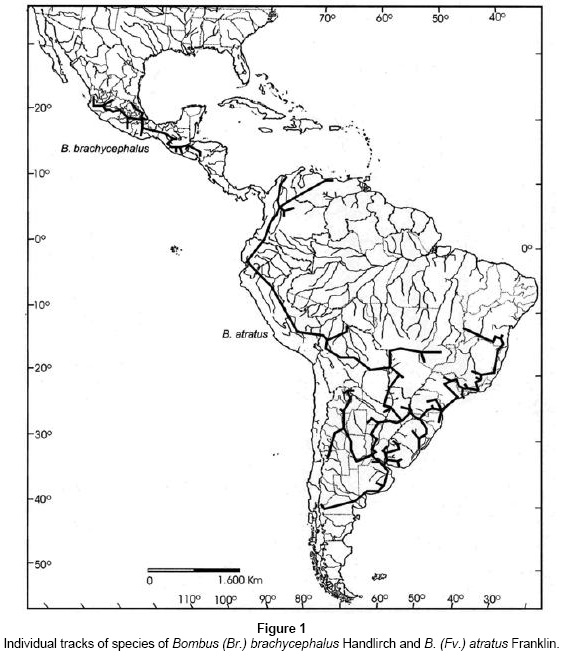
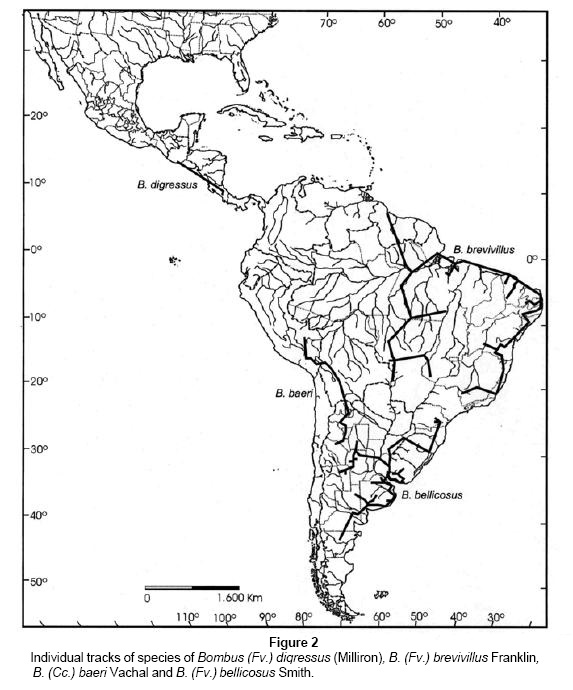
<body><![CDATA[<p align="justify"><font face="verdana" size="2">The genus <i>Bombus</i> Latreille belongs to the monotypic tribe Bombini (Hymenoptera: Apidae), comprising 239 known species (Williams 1985, 1998). The majority of these species are distributed in the temperate areas of North America and Eurasia (Lievano <i>et al.</i> 1991). In the Neotropical and Andean regions, 42 species have been recorded in a great variety of habitats, from sea level up to about 4400 m in the Andes. In spite of broad interest in the group, their large&#45;scale distribution has received little attention, but promise to contribute with some interesting patterns.</font></p>  	    <p align="justify"><font face="verdana" size="2">In order to elucidate the biogeographic history of the genus <i>Bombus</i> in the Neotropical and Andean regions, we analyze herein the geographical distribution of the species assigned to it, applying a track analysis.</font></p>  	    <p>&nbsp;</p>  	    <p align="justify"><font face="verdana" size="2"><b>MATERIAL AND METHODS</b></font></p>  	    <p align="justify"><font face="verdana" size="2">Distributional data for this study were obtained from the literature (Franklin 1913, Frison 1925, Moure &amp; Sakagami 1962, Milliron 1971, 1973a,b, Labougle 1990, Lievano <i>et al.</i> 1991, Williams 1998, Michener 2000, Abrahamovich &amp; D&iacute;az 2001, Silveira <i>et al.</i> 2002) and from the labels of specimens from the collections of the Museo Argentino de Ciencias Naturales, Buenos Aires; Museo de La Plata, La Plata; and Instituto y Fundaci&oacute;n Miguel Lillo, San Miguel de Tucum&aacute;n. Imprecise localities were not considered. We excluded from the analysis six species known from a single locality (<i>B. &#91;Cr.&#93; crotchii</i> Cresson, <i>B. &#91;Fr.&#93; fraternus</i> &#91;Smith&#93;, <i>B. &#91;Bi.&#93; nevadensis</i> Cresson and <i>B. &#91;Fv.&#93; rubriventris</i> Lepeletier), from few close localities (<i>B. &#91;Fv.&#93; trinominatus</i> Dalla Torre) or introduced (<i>B. &#91;Mg.&#93; ruderatus</i> &#91;Fabricius&#93;). Classification and subgenus acronyms follow Williams (1998). The area basically corresponds to the Neotropical and Andean regions (Morrone 2001a).</font></p>  	    <p align="justify"><font face="verdana" size="2">The panbiogeographic approach basically consists of plotting distributions of different taxa on maps, connecting their localities together with lines called individual tracks. When individual tracks for different taxa coincide, the resulting summary lines are considered generalized tracks, which indicate the preexistence of ancestral biotas that become fragmented by tectonic and/or climatic changes. If two or more generalized tracks intersect, they determine a node, which indicates that different ancestral biotic and geological fragments interrelate in space/time, constituting a composite area. For details of the track methodology see Morrone &amp; Crisci (1995) and Craw <i>et al.</i> (1999).</font></p>  	    <p>&nbsp;</p>  	    <p align="justify"><font face="verdana" size="2"><b>RESULTS</b></font></p>  	    <p align="justify"><font face="verdana" size="2"><b>Individual tracks.</b> Individual tracks corresponding to the species of <i>Bombus</i> are represented in the maps of figures <a href="#f1">1</a>&#45;<a href="#f13">13</a>.</font></p>  	    <p align="center"><font face="verdana" size="2"><a name="f1"></a></font></p>  	    ]]></body>
<body><![CDATA[<p align="center"><font face="verdana" size="2"><img src="/img/revistas/azm/v20n1/a9f1.jpg"></font></p>  	    <p align="center"><font face="verdana" size="2"><a name="f2"></a></font></p>  	    <p align="center"><font face="verdana" size="2"><img src="/img/revistas/azm/v20n1/a9f2.jpg"></font></p>  	    <p align="center"><font face="verdana" size="2"><a name="f3"></a></font></p>  	    <p align="center"><font face="verdana" size="2"><img src="/img/revistas/azm/v20n1/a9f3.jpg"></font></p>  	    <p align="center"><font face="verdana" size="2"><a name="f4"></a></font></p>  	    <p align="center"><font face="verdana" size="2"><img src="/img/revistas/azm/v20n1/a9f4.jpg"></font></p>  	    <p align="center"><font face="verdana" size="2"><a name="f5"></a></font></p>  	    <p align="center"><font face="verdana" size="2"><img src="/img/revistas/azm/v20n1/a9f5.jpg"></font></p>  	    <p align="center"><font face="verdana" size="2"><a name="f6"></a></font></p>  	    ]]></body>
<body><![CDATA[<p align="center"><font face="verdana" size="2"><img src="/img/revistas/azm/v20n1/a9f6.jpg"></font></p>  	    <p align="center"><font face="verdana" size="2"><a name="f7"></a></font></p>  	    <p align="center"><font face="verdana" size="2"><img src="/img/revistas/azm/v20n1/a9f7.jpg"></font></p>  	    <p align="center"><font face="verdana" size="2"><a name="f8"></a></font></p>  	    <p align="center"><font face="verdana" size="2"><img src="/img/revistas/azm/v20n1/a9f8.jpg"></font></p>  	    <p align="center"><font face="verdana" size="2"><a name="f9"></a></font></p>  	    <p align="center"><font face="verdana" size="2"><img src="/img/revistas/azm/v20n1/a9f9.jpg"></font></p>  	    <p align="center"><font face="verdana" size="2"><a name="f10"></a></font></p>  	    <p align="center"><font face="verdana" size="2"><img src="/img/revistas/azm/v20n1/a9f10.jpg"></font></p>  	    <p align="center"><font face="verdana" size="2"><a name="f11"></a></font></p>  	    ]]></body>
<body><![CDATA[<p align="center"><font face="verdana" size="2"><img src="/img/revistas/azm/v20n1/a9f11.jpg"></font></p>  	    <p align="center"><font face="verdana" size="2"><a name="f12"></a></font></p>  	    <p align="center"><font face="verdana" size="2"><img src="/img/revistas/azm/v20n1/a9f12.jpg"></font></p>  	    <p align="center"><font face="verdana" size="2"><a name="f13"></a></font></p>  	    <p align="center"><font face="verdana" size="2"><img src="/img/revistas/azm/v20n1/a9f13.jpg"></font></p>  	    <p align="justify"><font face="verdana" size="2"><b><i>Bombus (Br.) brachycephalus</i></b> Handlirsch (<a href="#f1">Fig. 1</a>) is distributed from central Mexico to northern Central America (Mexico: Chiapas, Guerrero, Jalisco, Michoac&aacute;n, Morelos, Nayarit, Oaxaca, Puebla, San Luis Potos&iacute;, and Veracruz; Guatemala: Chimaltenango, Guatemala, San Marcos, and Zacapa; Honduras: Tegucigalpa; El Salvador: Chalatenango).</font></p>  	    <p align="justify"><font face="verdana" size="2"><b><i>Bombus (Fv.) atratus</i></b> Franklin (<a href="#f1">Fig. 1</a>) is distributed from northwestern South America to southeastern Brazil, Uruguay, and central Argentina (Colombia: Antioquia, Bol&iacute;var, Boyac&aacute;, Cundinamarca, Distrito Capital, Magdalena, Nari&ntilde;o, Quind&iacute;o, Santander, and Valle del Cauca; Venezuela: Carabobo, Distrito Capital, and M&eacute;rida; Ecuador: Azuay and Guayas; Peru: Cuzco and San Mart&iacute;n; Bolivia: Beni, Cochabamba, La Paz, and Santa Cruz; Paraguay: Alto Paran&aacute;, Caaguaz&uacute;, Caazap&aacute;, Central, Concepci&oacute;n, Cordillera, Guair&aacute;, Itap&uacute;a, San Pedro, and Villa Hayes; Brazil: Bah&iacute;a, Espirito Santo, Goi&aacute;s, Mato Grosso, Mato Grosso do Sul, Minas Gerais, Paran&aacute;, Rio de Janeiro, Rio Grande do Sul, Rond&ocirc;nia, and Santa Catarina; Uruguay: Artigas, Canelones, Colonia, Durazno, Florida, Maldonado, Montevideo, Paysand&uacute;, Rivera, San Jos&eacute;, and Tacuaremb&oacute;; Argentina: Buenos Aires, Catamarca, Chaco, C&oacute;rdoba, Corrientes, Entre R&iacute;os, Formosa, Jujuy, La Rioja, Neuqu&eacute;n, Mendoza, Misiones, R&iacute;o Negro, Salta, Santa Fe, Santiago del Estero, and Tucum&aacute;n).</font></p>  	    <p align="justify"><font face="verdana" size="2"><b><i>Bombus (Fv.) digressus</i></b> (Milliron) (<a href="#f2">Fig. 2</a>) is distributed in Central America: Guatemala (Escuintla) and Costa Rica (Puerto Lim&oacute;n and Cartago).</font></p>  	    <p align="justify"><font face="verdana" size="2"><b><i>Bombus (Fv.) brevivillus</i></b> Franklin (<a href="#f2">Fig. 2</a>) is distributed from northern Guyana to northeastern and central Brazil (Alagoas, Amap&aacute;, Bah&iacute;a, Cear&aacute;, Esp&iacute;rito Santo, Goi&aacute;s, Mato Grosso, Matto Grosso do Sul, Minas Gerais, Par&aacute;, Para&iacute;ba, Pernambuco, Rio de Janeiro, and Rio Grande do Norte).</font></p>  	    <p align="justify"><font face="verdana" size="2"><b><i>Bombus (Cc.) baeri</i></b> Vachal (<a href="#f2">Fig. 2</a>) is distributed from southern Peru to northwestern Argentina (Peru: Arequipa, Cuzco, and Puno; Bolivia: La Paz and Potos&iacute;; Argentina: Catarmarca, Jujuy, La Rioja, Salta, and Tucum&aacute;n).</font></p>  	    ]]></body>
<body><![CDATA[<p align="justify"><font face="verdana" size="2"><b><i>Bombus (Fv.) bellicosus</i></b> Smith (<a href="#f2">Fig. 2</a>) is distributed from southern Brazil to central Patagonia, Argentina (Brazil: Paran&aacute; and Rio Grande do Sul; Uruguay: Artigas, Colonia, Durazno, Flores, Florida, Lavalleja, Maldonado, Montevideo, Paysand&uacute;, San Jos&eacute;, and Soriano; Argentina: Buenos Aires, C&oacute;rdoba, Corrientes, Chubut, Entre R&iacute;os, La Pampa, Misiones, R&iacute;o Negro, San Luis, Santa Fe, and Santiago del Estero).</font></p>  	    <p align="justify"><font face="verdana" size="2"><b><i>Bombus (Fv.) diligens</i></b> Smith (<a href="#f3">Fig. 3</a>) is distributed from northwestern Mexico (Distrito Federal, Mexico, Guerrero, Hidalgo, Jalisco, Michoac&aacute;n, Morelos, Nayarit, Oaxaca, Puebla, San Lu&iacute;s Potos&iacute;, Sinaloa, and Veracruz) to southwestern Guatemala (Guatemala and Solol&aacute;).</font></p>  	    <p align="justify"><font face="verdana" size="2"><b><i>Bombus (Rc.) rubicundus</i></b> Smith (<a href="#f3">Fig. 3</a>) is distributed from northern Venezuela to western Bolivia (Venezuela: Amazonas and Trujillo; Colombia: Bolivar, Boyac&aacute;, Cundinamarca, and Nari&ntilde;o; Ecuador: Azuay, Pichincha, and Tungurahua; Peru: Ancash and La Libertad; Bolivia: Cochabamba).</font></p>  	    <p align="justify"><font face="verdana" size="2"><b><i>Bombus (Fv.) brasiliensis</i></b> Lepeletier (<a href="#f3">Fig. 3</a>) is distributed from central and southern Brazil to southern Uruguay (Brazil: Espirito Santo, Goi&aacute;s, Mato Grosso, Mato Grosso do Sul, Minas Gerais, Paran&aacute;, Rio de Janeiro, Santa Catarina, and S&atilde;o Paulo; Paraguay: Alto Paran&aacute;, Caaguaz&uacute;, Central, Cordillera, Guair&aacute;, Itap&uacute;a, Paraguari, and San Pedro; Argentina: Misiones; Uruguay: Maldonado).</font></p>  	    <p align="justify"><font face="verdana" size="2"><b><i>Bombus (Fv.) dahlbomii</i></b> Gu&eacute;rin (<a href="#f3">Fig. 3</a>) is distributed from central Chile and Argentina to the south of both countries (Chile: Regi&oacute;n Metropolitana, Maule, B&iacute;o&#45;B&iacute;o, Valpara&iacute;so, Magallanes, Los Lagos, Araucan&iacute;a, and Ais&eacute;n; Argentina: Buenos Aires, Chubut, Mendoza, Neuqu&eacute;n, R&iacute;o Negro, and Santa Cruz).</font></p>  	    <p align="justify"><font face="verdana" size="2"><b><i>Bombus (Pr.) ephippiatus</i></b> Say (<a href="#f4">Fig. 4</a>) is distributed from northern Mexico to northwestern South America (Mexico: Chiapas, Chihuahua, Distrito Federal, Durango, Guanajuato, Guerrero, Hidalgo, Jalisco, Mexico, Michoac&aacute;n, Morelos, Nayarit, Nuevo Le&oacute;n, Oaxaca, Puebla, Quer&eacute;taro, San Luis Potos&iacute;, Sinaloa, Tabasco, Veracruz, and Zacatecas; Guatemala: Alta Verapaz, Chimaltenango, Chiqu&eacute;, Escuitla, Guatemala, Huehuetenango, Quetzaltenango, Quich&eacute;, Sacatep&eacute;quez, San Marcos, and Solol&aacute;; El Salvador: Ahuachap&aacute;n, La Libertad, and Moraz&aacute;n; Honduras; Costa Rica: Alajuela, Cartago, Guanacaste, Heredia, Iraz&uacute;, Puerto Lim&oacute;n, Puntarenas, and San Jos&eacute;; Panama: Chiriqu&iacute;).</font></p>  	    <p align="justify"><font face="verdana" size="2"><b><i>Bombus (Rb.) ecuadorius</i></b> Meunier (<a href="#f4">Fig. 4</a>) is distributed from northern Ecuador to central Bolivia (Ecuador: Bol&iacute;var, Chimborazo, and Pichincha; Peru: Arequipa, Ayacucho, Cuzco, and Piura; Bolivia: Cochabamba and La Paz).</font></p>  	    <p align="justify"><font face="verdana" size="2"><b><i>Bombus (Fv.) fervidus</i></b> (Fabricius) (<a href="#f5">Fig. 5</a>) is only found in northern and central Mexico (Chihuahua, Distrito Federal, Durango, Guanajuato, Mexico, Morelos, and Puebla).</font></p>  	    <p align="justify"><font face="verdana" size="2"><b><i>Bombus (Ds.) macgregori</i></b> Labougle &amp; Ayala (<a href="#f5">Fig. 5</a>) is distributed from Jalisco and Guerrero in Mexico to Quetzaltenango in Guatemala.</font></p>  	    <p align="justify"><font face="verdana" size="2"><b><i>Bombus (Fv.) excellens</i></b> Smith (<a href="#f5">Fig. 5</a>) is distributed from northern Colombia and Venezuela to central Bolivia (Venezuela: M&eacute;rida, Distrito Capital, and Falc&oacute;n; Colombia: Cauca and Magdalena; Peru: Piura, Jun&iacute;n, and Hu&aacute;nuco; Bolivia: Cochabamba and La Paz).</font></p>  	    ]]></body>
<body><![CDATA[<p align="justify"><font face="verdana" size="2"><b><i>Bombus (Br.) haueri</i></b> Handlirsch (<a href="#f6">Fig. 6</a>) is distributed in northern and central Mexico (Coahuila, Chihuahua, Distrito Federal, Durango, Mexico, Guanajuato, Jalisco, Michoac&aacute;n, Morelos, and Nuevo Le&oacute;n).</font></p>  	    <p align="justify"><font face="verdana" size="2"><b><i>Bombus (Fn.) rohweri</i></b> Frison (<a href="#f6">Fig. 6</a>) is distributed from northwestern Venezuela to central Peru (Venezuela: M&eacute;rida and Trujillo; Colombia: Distrito Capital; Peru: Ancash).</font></p>  	    <p align="justify"><font face="verdana" size="2"><b><i>Bombus (Fn.) funebris</i></b> Smith (<a href="#f6">Fig. 6</a>) is distributed from western Colombia to western Bolivia (Colombia: Cundinamarca and Nari&ntilde;o; Ecuador: Azuay, Guayas, Loja, Los R&iacute;os, Pastaza, Pichincha, and Tungurahua; Peru: Ancash, Arequipa, Ayacucho, Cajamarca, Cuzco, Jun&iacute;n, Lima, Piura, and Puno; Bolivia: Cochabamba and La Paz).</font></p>  	    <p align="justify"><font face="verdana" size="2"><b><i>Bombus (Pr.) huntii</i></b> Greene (<a href="#f7">Fig. 7</a>) is distributed in northern and central Mexico (Coahuila, Chihuahua, Mexico, Jalisco, Michoac&aacute;n, Nuevo Le&oacute;n, and Veracruz).</font></p>  	    <p align="justify"><font face="verdana" size="2"><b><i>Bombus (Rb.) hortulanus</i></b> Friese (<a href="#f7">Fig. 7</a>) is distributed from northern Colombia to west of Ecuador (Colombia: Bol&iacute;var, Cundinamarca, and Magdalena; Venezuela: M&eacute;rida; Ecuador: Guayas and Tungurahua).</font></p>  	    <p align="justify"><font face="verdana" size="2"><b><i>Bombus (Ds.) handlirschi</i></b> Friese (<a href="#f7">Fig. 7</a>) is distributed in southern Venezuela, Ecuador, Peru and western Bolivia (Venezuela: Amazonas; Ecuador; Peru: Ayacucho, Cuzco, Jun&iacute;n, Piura, and Puno; Bolivia: La Paz).</font></p>  	    <p align="justify"><font face="verdana" size="2"><b><i>Bombus (Fv.) medius</i></b> Cresson (<a href="#f8">Fig. 8</a>) is distributed from central Mexico to southern Central America (Mexico: Campeche, Chiapas, Durango, Mexico, Hidalgo, Oaxaca, Puebla, Quintana Roo, San Luis Potos&iacute;, Tabasco, Tamaulipas, Veracruz, and Yucat&aacute;n; Guatemala: Guatemala and San Marcos; El Salvador: San Salvador; Honduras: Comayagua, Cort&eacute;s, El Para&iacute;so, Moraz&aacute;n, and Yoro; Nicaragua: Nueva Segovia; Panama: Chiriqu&iacute;).</font></p>  	    <p align="justify"><font face="verdana" size="2"><b><i>Bombus (Fv.) morio</i></b> (Swederus) (<a href="#f8">Fig. 8</a>) is distributed from northwestern South America to southeastern Brazil, Uruguay and northern Argentina (Venezuela: Carabobo; Colombia: Santander; Ecuador: Pichincha and Tungurahua; Peru: Cuzco, Lima, and San Mart&iacute;n; Bolivia: Beni, Cochabamba, La Paz, Potos&iacute;, Santa Cruz, and Tarija; Paraguay: Alto Paran&aacute;, Caaguaz&uacute;, Caazap&aacute;, Central, Cordillera, Guair&aacute;, Itap&uacute;a, and Paraguari; Brazil: Bah&iacute;a, Goi&aacute;s, Mato Grosso, Mato Grosso do Sul, Minas Gerais, Paran&aacute;, Rio de Janeiro, Rio Grande do Sul, Santa Catarina, S&atilde;o Paulo, and Spirito Santo, Uruguay: Montevideo; Argentina: Catamarca, Chaco, Corrientes, Formosa, Jujuy, Misiones, Salta, Santa Fe, Santiago del Estero, and Tucum&aacute;n).</font></p>  	    <p align="justify"><font face="verdana" size="2"><b><i>Bombus (Fv.) pennsylvanicus</i></b> (DeGeer) (<a href="#f9">Fig. 9</a>) is distributed from northern Mexico to northern Central America (Mexico: Aguascalientes, Baja California, Baja California Sur, Chiapas, Chihuahua, Coahuila, Distrito Federal, Durango, Guanajuato, Hidalgo, Jalisco, Mexico, Michoac&aacute;n, Morelos, Nayarit, Nuevo Le&oacute;n, Oaxaca, Puebla, Quer&eacute;taro, San Luis Potos&iacute;, Sonora, Tamaulipas, Veracruz, and Zacatecas; Guatemala: Izabal).</font></p>  	    <p align="justify"><font face="verdana" size="2"><b><i>Bombus (Rb.) melaleucus</i></b> Handlirsch (<a href="#f9">Fig. 9</a>) is distributed from southern Central America (Costa Rica: Alajuela, Cartago, Puntarenas, and San Jos&eacute;; Panama: Chiriqu&iacute;) to northwestern South America (Colombia: Cauca, Magdalena, and Meta; Venezuela: Amazonas; Ecuador: Esmeraldas and Tungurahua; Peru: Ancash, Ayacucho, Cuzco, Huanuco, Ica, Lima, and Piura; Bolivia: Cochabamba and La Paz).</font></p>  	    ]]></body>
<body><![CDATA[<p align="justify"><font face="verdana" size="2"><b><i>Bombus (Fv.) mexicanus</i></b> Cresson (<a href="#f10">Fig. 10</a>) is distributed from central Mexico to Colombia and Ecuador in South America (Mexico: Chiapas, Jalisco, Michoac&aacute;n, Oaxaca, Puebla, San Luis Potos&iacute;, and Veracruz; Guatemala: Chimaltenango, Escuintla, Guatemala, Quetzaltenango, Retalhuleu, San Marcos, Solol&aacute;, and Suchitep&eacute;quez; El Salvador: La Libertad, La Paz, and Moraz&aacute;n, San Salvador; Honduras: Choluteca and Francisco Moraz&aacute;n; Nicaragua: Carazo, Jinotega, Managua, and Rivas; Costa Rica: Cartago, Guanacaste, Heredia, Puerto Lim&oacute;n, Puntarenas, and San Jos&eacute;; Panama: Chiriqu&iacute;; Colombia; Ecuador).</font></p>  	    <p align="justify"><font face="verdana" size="2"><b><i>Bombus (Fv.) opifex</i></b> Smith (<a href="#f10">Fig. 10</a>) is distributed from central Ecuador to central Argentina (Ecuador: Tungurahua; Peru: Arequipa and Puno; Bolivia: Cochabamba and La Paz; Paraguay: Cordillera and Guair&aacute;; Argentina: Catamarca, C&oacute;rdoba, Jujuy, La Rioja, Mendoza, Misiones, Salta, San Juan, San Luis, Santiago del Estero, Tucum&aacute;n, and Formosa).</font></p>  	    <p align="justify"><font face="verdana" size="2"><b><i>Bombus (Cu.) rufocinctus</i></b> Cresson (<a href="#f11">Fig. 11</a>) is distributed in northern and central Mexico (Distrito Federal, Hidalgo, Mexico, Michoac&aacute;n, Morelos, and Sonora).</font></p>  	    <p align="justify"><font face="verdana" size="2"><b><i>Bombus (Ps.) variabilis</i></b> (Cresson) (<a href="#f11">Fig. 11</a>) is distributed from central Mexico (Puebla, Oaxaca) to Guatemala (Solol&aacute;, Guatemala) and Honduras.</font></p>  	    <p align="justify"><font face="verdana" size="2"><b><i>Bombus (Fv.) pullatus</i></b> Franklin (<a href="#f11">Fig. 11</a>) is distributed from northern Central America to northwestern South America (Honduras: Atl&aacute;ntida, Cort&eacute;s, and Santa B&aacute;rbara; Nicaragua: Atl&aacute;ntico Norte and Atl&aacute;ntico Sur; Costa Rica: Alajuela, Cartago, Guanacaste, Heredia, Puerto Lim&oacute;n, Puntarenas, and San Jos&eacute;; Panama: Bocas del Toro, Chiriqu&iacute;, Cocl&eacute;, and Panama; Colombia: Boyac&aacute;, Caldas, Choc&oacute;, Cundinamarca, Distrito Capital, Huila, Magdalena, Meta, Santander, Tolima, and Valle del Cauca; Venezuela: Aragua, Carabobo, Miranda, Sucre, M&eacute;rida, and Zulia; Ecuador: Guaya).</font></p>  	    <p align="justify"><font face="verdana" size="2"><b><i>Bombus (Cc.) coccineus</i></b> Friese (<a href="#f11">Fig. 11</a>) is distributed in central and southern Peru (Ancash, Apurimac, Cuzco, Junin, Lima, and Pasco).</font></p>  	    <p align="justify"><font face="verdana" size="2"><b><i>Bombus (Rb.) tucumanus</i></b> Vachal (<a href="#f11">Fig. 11</a>) is distributed from western Bolivia (Cochabamba and La Paz) to northwestern Argentina (Catamarca, Jujuy, Salta, and Tucum&aacute;n).</font></p>  	    <p align="justify"><font face="verdana" size="2"><b><i>Bombus (Fv.) steindachneri</i></b> Handlirsch (<a href="#f12">Fig. 12</a>) is distributed in northwestern and central Mexico (Colima, Chihuahua, Distrito Federal, Durango, Mexico, Guerrero, Jalisco, Michoac&aacute;n, Morelos, Nayarit, Oaxaca, Puebla, Sinaloa, Sonora, and Veracruz).</font></p>  	    <p align="justify"><font face="verdana" size="2"><b><i>Bombus (Rb.) robustus</i></b> Friese (<a href="#f12">Fig. 12</a>) is distributed from northern Colombia and Venezuela to central Ecuador (Colombia: Distrito Capital, Magdalena, Meta, Nari&ntilde;o, and Putumayo; Venezuela: M&eacute;rida; Ecuador: Azuay, Manab&iacute;, Pichincha, and Tungurahua).</font></p>  	    <p align="justify"><font face="verdana" size="2"><b><i>Bombus (Fv.) weisi</i></b> Friese (<a href="#f13">Fig. 13</a>) is distributed from northern Mexico to Costa Rica in Central America (Mexico: Chiapas, Chihuahua, Distrito Federal, Durango, Guerrero, Hidalgo, Jalisco, Mexico, Michoac&aacute;n, Morelos, Oaxaca, Puebla, San Luis Potos&iacute;, Sinaloa, and Tlaxcala; Guatemala: Chimaltenalgo, Escuntla, Huchuetenango, Jutiapa, Quezaltenango, Quich&eacute;, and San Marcos; Costa Rica: Cartago and San Jos&eacute;).</font></p>  	    ]]></body>
<body><![CDATA[<p align="justify"><font face="verdana" size="2"><b><i>Bombus (Fv.) transversalis</i></b> (Olivier) (<a href="#f13">Fig. 13</a>) is distributed from northern South America to central Bolivia (Colombia: Amazonas and Distrito Capital; Venezuela: Bol&iacute;var; Guyana; Surinam: Marowijne; French Guiana: Saint&#45;Laurent&#45;du&#45;Maroni; Brazil: Acre, Amap&aacute;, Amazonas, Mato Grosso, Par&aacute;, and Rond&ocirc;nia; Peru: Hu&aacute;nuco, Jun&iacute;n, Loreto, Madre de Dios, Pasco, and Ucayali; Bolivia: Beni, Cochabamba, La Paz, and Santa Cruz).</font></p>  	    <p align="justify"><font face="verdana" size="2">Some common features of these individual tracks can be summarized as follows:</font></p>  	    <p align="justify"><font face="verdana" size="2"><b>1.</b> The geographical distribution of the majority of the species of <i>Bombus</i> is relatively restricted, with the exception of the widespread species <i>B. ephippiatus</i> (<a href="#f4">Fig. 4</a>), <i>B. medius</i> (<a href="#f8">Fig. 8</a>), <i>B. pennssylvanicus</i> (<a href="#f9">Fig. 9</a>), <i>B. mexicanus</i> (<a href="#f10">Fig. 10</a>), and <i>B. weisi</i> (<a href="#f13">Fig. 13</a>) in Mesoamerica; and <i>B. (Fv.) atratus</i> (<a href="#f1">Fig. 1</a>) and <i>B. (Fv.) morio</i> (<a href="#f8">Fig. 8</a>) in South America.</font></p>  	    <p align="justify"><font face="verdana" size="2"><b>2.</b> Sixteen species are distributed in Mesoamerica (Neotropical region, Caribbean subregion), the remaining species being exclusively South American (Neotropical and Andean regions). Among the former, only <i>B. (Pr.) ephippiatus</i> (<a href="#f4">Fig. 4</a>), <i>B. (Fv.) mexicanus</i> (<a href="#f10">Fig. 10</a>), and <i>B. (Fv.) pullatus</i> (<a href="#f11">Fig. 11</a>) reach northwestern South America.</font></p>  	    <p align="justify"><font face="verdana" size="2"><b>3.</b> Within the South American species, 10 (Figs. <a href="#f1">1</a>&#45;<a href="#f3">3</a>, <a href="#f5">5</a>, <a href="#f7">7</a>, <a href="#f8">8</a>, <a href="#f10">10</a>, <a href="#f11">11</a>, <a href="#f13">13</a>) (<a href="#f2">2</a>) are distributed in the Amazonian, Chacoan and Parana subregions of the Neotropical region, and 11 (<a href="#f2">2</a>&#45;<a href="#f4">4</a>, <a href="#f6">6</a>, <a href="#f7">7</a>, <a href="#f9">9</a>, <a href="#f11">11</a>, <a href="#f12">12</a>) (<a href="#f3">3</a>) in the Andean region.</font></p>  	    <p align="justify"><font face="verdana" size="2"><b>Generalized tracks and nodes.</b> Comparison among the individual tracks revealed the existence of eight generalized tracks (<a href="#f14">Fig. 14</a>):</font></p>  	    <p align="center"><font face="verdana" size="2"><a name="f14"></a></font></p>  	    <p align="center"><font face="verdana" size="2"><img src="/img/revistas/azm/v20n1/a9f14.jpg"></font></p>  	    <p align="justify"><font face="verdana" size="2"><b>Mexican mountain:</b> determined by <i>B. (Fv.) fervidus, B. (Br.) haueri, B. (Pr.) hunti</i> and <i>B. (Cu.) rufocinctus.</i></font></p>  	    <p align="justify"><font face="verdana" size="2"><b>Northern Mesoamerican:</b> determined by <i>B. (Br.) brachycephalus, B. (Fv.) diligens, B. (Ds.) macgregori</i>, and <i>B. (Fv.) steindachneri.</i></font></p>  	    ]]></body>
<body><![CDATA[<p align="justify"><font face="verdana" size="2"><b>Southern Mesoamerican:</b> determined by <i>B. (Fv.) digressus</i> and <i>B. (Ps.) variabilis</i>.</font></p>  	    <p align="justify"><font face="verdana" size="2"><b>Widespread Mesoamerican</b> (1 + 2 + 3): determined by <i>B. (Pr.) ephippiatus, B. (Fv.) medius, B. (Fv.) mexicanus, B. (Fv.) pennsylvanicus</i>, and <i>B. (Fv.) weisi.</i></font></p>  	    <p align="justify"><font face="verdana" size="2"><b>Northern Andean:</b> determined by <i>B. (Cc.) coccineus, B. (Rb.) ecuadorius, B. (Fv.) excellens, B. (Fv.) funebris, B. (Ds.) handlrischi, B. (Rb.) hortulanus, B. (Rb.) melaleucus, B. (Fv.) pullatus, B. (Rb.) robustus, B. (Fr) rohweri</i>, and <i>B. (Rc.) rubicundus</i>.</font></p>  	    <p align="justify"><font face="verdana" size="2"><b>Yungas:</b> determined by <i>B. (Cc.) baeri</i> and <i>B. (Rb.) tucumanus.</i></font></p>  	    <p align="justify"><font face="verdana" size="2"><b>Southern Brazilian:</b> determined by <i>B. (Fv.) bellicosus</i> and <i>B. (Fv.) brasiliensis</i>.</font></p>  	    <p align="justify"><font face="verdana" size="2"><b>Widespread South American (5 + 6 + 7):</b> determined by <i>B. (Fv.) atratus, B. (Fv.) morio, B. (Fv.) opifex</i>, and <i>B. (Fv.) transversalis.</i></font></p>  	    <p align="justify"><font face="verdana" size="2">Species <i>B. (Fv.) brevivillus</i> (<a href="#f2">Fig. 2</a>) and <i>B. (Fv.) dahlbomii</i> (<a href="#f3">Fig. 3</a>) are not assigned to any of the generalized tracks, because they do not show substantial overlap with other species.</font></p>  	    <p align="justify"><font face="verdana" size="2">Three panbiogeographic nodes were determined (<a href="#f14">Fig. 14</a>):</font></p>  	    <p align="justify"><font face="verdana" size="2"><b>(A) Isthmus of Tehuantepec:</b> intersection of the Northern and Southern Mesoamerican generalized tracks.</font></p>  	    <p align="justify"><font face="verdana" size="2"><b>(B) Panama:</b> intersection of the Southern Mesoamerican and Northern Andean generalized tracks.</font></p>  	    ]]></body>
<body><![CDATA[<p align="justify"><font face="verdana" size="2"><b>(C) Puna:</b> intersection of the Northern Andean and Yungas generalized tracks.</font></p>  	    <p>&nbsp;</p>  	    <p align="justify"><font face="verdana" size="2"><b>DISCUSSION</b></font></p>  	    <p align="justify"><font face="verdana" size="2">Results of our analysis coincide with other studies, that have previously addressed the complex historical biogeography of the Neotropical and Andean regions. TheMexican mountain generalized track is similar to the Northern generalized track from Morrone &amp; M&aacute;rquez (2001) and to the Transmexican Volcanic Belt and Sierra MadreOriental generalized tracks from M&aacute;rquez &amp; Morrone (2003), based on beetle taxa (Coleoptera). The Southern Mesoamerican generalized track was also identified byM&aacute;rquez &amp; Morrone (2003). The Northern Andean generalized track was also recognized by Posadas <i>et al.</i> (1997) and M&aacute;rquez &amp; Morrone (2003), based on vascular plant and beetle taxa, respectively. Two of the nodes were also identified previously, theIsthmus of Tehuantepec node by M&aacute;rquez &amp; Morrone (2003) and the Puna node by Katinas <i>et al.</i> (1999).</font></p>  	    <p align="justify"><font face="verdana" size="2">On the other hand, some of the generalized tracks found in this study are coincidentwith subregions or provinces delimited in other studies. The Widespread Mesoamerican generalized track is coincident with the Mexican&#45;Central American portion of the Caribbean subregion (Morrone 2001a, b). The Northern Andean generalized track is coincident with the Paramo Punan subregion of the Andean region, particularly with theNorthern Andean Paramo and Puna provinces (Morrone 2001a, c). The Southern Brazilian generalized track is coincident with the Parana subregion of the Neotropicalregion (Morrone 2001a, 2002).</font></p>  	    <p>&nbsp;</p>  	    <p align="justify"><font face="verdana" size="2"><b>ACKNOWLEDGMENTS</b></font></p>  	    <p align="justify"><font face="verdana" size="2">Economic support to JJM by CONACyT grant 36488 is gratefully acknowledged.</font></p>  	    <p>&nbsp;</p>  	    <p align="justify"><font face="verdana" size="2"><b>LITERATURE CITED</b></font></p>  	    ]]></body>
<body><![CDATA[<!-- ref --><p align="justify"><font face="verdana" size="2">Abrahamovich, A. H. &amp; N. B. D&iacute;az. 2001. Distribuci&oacute;n geogr&aacute;fica de las especies del g&eacute;nero <i>Bombus</i> Latreille (Hymenoptera, Apidae) en Argentina. <i>Revta. Bras. Entomol</i>., 45: 23&#45;36.    &nbsp;&nbsp;&nbsp;&nbsp;&nbsp;&nbsp;&nbsp;&nbsp;[&#160;<a href="javascript:void(0);" onclick="javascript: window.open('/scielo.php?script=sci_nlinks&ref=319850&pid=S0065-1737200400010000900001&lng=','','width=640,height=500,resizable=yes,scrollbars=1,menubar=yes,');">Links</a>&#160;]<!-- end-ref --></font></p>  	    <!-- ref --><p align="justify"><font face="verdana" size="2">Craw, R. C., J. R. Grehan &amp; M. J. Heads, M. J. 1999. <i>Panbiogeography: Tracking the history of life.</i> Oxford Biogeography Series 11, Oxford University Press, New York.    &nbsp;&nbsp;&nbsp;&nbsp;&nbsp;&nbsp;&nbsp;&nbsp;[&#160;<a href="javascript:void(0);" onclick="javascript: window.open('/scielo.php?script=sci_nlinks&ref=319852&pid=S0065-1737200400010000900002&lng=','','width=640,height=500,resizable=yes,scrollbars=1,menubar=yes,');">Links</a>&#160;]<!-- end-ref --></font></p>  	    <!-- ref --><p align="justify"><font face="verdana" size="2">Franklin, H. J. 1913. The Bombidae of the New World. <i>Trans. Amer. Entomol. Soc.</i> 38: 177&#45;486.    &nbsp;&nbsp;&nbsp;&nbsp;&nbsp;&nbsp;&nbsp;&nbsp;[&#160;<a href="javascript:void(0);" onclick="javascript: window.open('/scielo.php?script=sci_nlinks&ref=319854&pid=S0065-1737200400010000900003&lng=','','width=640,height=500,resizable=yes,scrollbars=1,menubar=yes,');">Links</a>&#160;]<!-- end-ref --></font></p>  	    <!-- ref --><p align="justify"><font face="verdana" size="2">Frison, T. H. 1925. Contribution to the classification of the Bremidae (bumble&#45;bees) of Central and South America. <i>Trans. Amer. Entomol. Soc.</i> 51: 137&#45;165.    &nbsp;&nbsp;&nbsp;&nbsp;&nbsp;&nbsp;&nbsp;&nbsp;[&#160;<a href="javascript:void(0);" onclick="javascript: window.open('/scielo.php?script=sci_nlinks&ref=319856&pid=S0065-1737200400010000900004&lng=','','width=640,height=500,resizable=yes,scrollbars=1,menubar=yes,');">Links</a>&#160;]<!-- end-ref --></font></p>  	    <!-- ref --><p align="justify"><font face="verdana" size="2">Katinas, L., J.J. Morrone &amp; J. V. Crisci. 1999. Track analysis reveals the composite nature of the Andean biota. <i>Austr. Syst. Bot.</i> 47: 111&#45;130.    &nbsp;&nbsp;&nbsp;&nbsp;&nbsp;&nbsp;&nbsp;&nbsp;[&#160;<a href="javascript:void(0);" onclick="javascript: window.open('/scielo.php?script=sci_nlinks&ref=319858&pid=S0065-1737200400010000900005&lng=','','width=640,height=500,resizable=yes,scrollbars=1,menubar=yes,');">Links</a>&#160;]<!-- end-ref --></font></p>  	    ]]></body>
<body><![CDATA[<!-- ref --><p align="justify"><font face="verdana" size="2">Labougle, J. M. 1990. <i>Bombus</i> of Mexico and Central America (Hymenoptera, Apidae). <i>Kansas Univ. Sci. Bull.</i> 54: 35&#45;73.    &nbsp;&nbsp;&nbsp;&nbsp;&nbsp;&nbsp;&nbsp;&nbsp;[&#160;<a href="javascript:void(0);" onclick="javascript: window.open('/scielo.php?script=sci_nlinks&ref=319860&pid=S0065-1737200400010000900006&lng=','','width=640,height=500,resizable=yes,scrollbars=1,menubar=yes,');">Links</a>&#160;]<!-- end-ref --></font></p>  	    <!-- ref --><p align="justify"><font face="verdana" size="2">Lievano A., R. Ospina &amp; G. Nates. 1991. Distribuci&oacute;n altitudinal del g&eacute;nero <i>Bombus</i> en Colombia. <i>Trianea</i> 4: 541&#45;550.    &nbsp;&nbsp;&nbsp;&nbsp;&nbsp;&nbsp;&nbsp;&nbsp;[&#160;<a href="javascript:void(0);" onclick="javascript: window.open('/scielo.php?script=sci_nlinks&ref=319862&pid=S0065-1737200400010000900007&lng=','','width=640,height=500,resizable=yes,scrollbars=1,menubar=yes,');">Links</a>&#160;]<!-- end-ref --></font></p>  	    <!-- ref --><p align="justify"><font face="verdana" size="2">M&aacute;rquez, J. &amp; J. J. Morrone. 2003. An&aacute;lisis panbiogeogr&aacute;fico de las especies de <i>Homalolinus</i> y <i>Heterolinus</i> (Coleoptera: Staphylinidae: Xantholinini). <i>Acta Zool. Mex. (n.s.)</i> 90: 15&#45;25.    &nbsp;&nbsp;&nbsp;&nbsp;&nbsp;&nbsp;&nbsp;&nbsp;[&#160;<a href="javascript:void(0);" onclick="javascript: window.open('/scielo.php?script=sci_nlinks&ref=319864&pid=S0065-1737200400010000900008&lng=','','width=640,height=500,resizable=yes,scrollbars=1,menubar=yes,');">Links</a>&#160;]<!-- end-ref --></font></p>  	    <!-- ref --><p align="justify"><font face="verdana" size="2">Michener, C. D. 2000. <i>The bees of the world.</i> The John Hopkins University Press, Baltimore and London.    &nbsp;&nbsp;&nbsp;&nbsp;&nbsp;&nbsp;&nbsp;&nbsp;[&#160;<a href="javascript:void(0);" onclick="javascript: window.open('/scielo.php?script=sci_nlinks&ref=319866&pid=S0065-1737200400010000900009&lng=','','width=640,height=500,resizable=yes,scrollbars=1,menubar=yes,');">Links</a>&#160;]<!-- end-ref --></font></p>  	    <!-- ref --><p align="justify"><font face="verdana" size="2">Milliron, H. E. 1971. A monograph of the western hemisphere bumblebees (Hymenoptera: Apidae: Bombinae) I. The genera <i>Bombus</i> and <i>Megabombus</i> subgenus <i>Bombias. Mem. Entomol. Soc. Canada</i> 82: 1&#45;80.    &nbsp;&nbsp;&nbsp;&nbsp;&nbsp;&nbsp;&nbsp;&nbsp;[&#160;<a href="javascript:void(0);" onclick="javascript: window.open('/scielo.php?script=sci_nlinks&ref=319868&pid=S0065-1737200400010000900010&lng=','','width=640,height=500,resizable=yes,scrollbars=1,menubar=yes,');">Links</a>&#160;]<!-- end-ref --></font></p>  	    ]]></body>
<body><![CDATA[<!-- ref --><p align="justify"><font face="verdana" size="2">&#45;&#45;&#45;&#45;&#45;&#45;&#45;&#45;&#45;&#45;. 1973a. A monograph of the western hemisphere bumblebees (Hymenoptera: Apidae: Bombinae) II. The genus <i>Megabombus</i> subgenus <i>Megabombus. Mem. Entomol. Soc. Canada</i> 89: 81&#45;237.    &nbsp;&nbsp;&nbsp;&nbsp;&nbsp;&nbsp;&nbsp;&nbsp;[&#160;<a href="javascript:void(0);" onclick="javascript: window.open('/scielo.php?script=sci_nlinks&ref=319870&pid=S0065-1737200400010000900011&lng=','','width=640,height=500,resizable=yes,scrollbars=1,menubar=yes,');">Links</a>&#160;]<!-- end-ref --></font></p>  	    <!-- ref --><p align="justify"><font face="verdana" size="2">&#45;&#45;&#45;&#45;&#45;&#45;&#45;&#45;&#45;&#45;. 1973b. A monograph of the western hemisphere bumblebees (Hymenoptera: Apidae: Bombinae) III. The genus <i>Pyrobombus</i> subgenus <i>Cullumanobombus. Mem. Entomol. Soc. Canada</i> 91: 238&#45;333.    &nbsp;&nbsp;&nbsp;&nbsp;&nbsp;&nbsp;&nbsp;&nbsp;[&#160;<a href="javascript:void(0);" onclick="javascript: window.open('/scielo.php?script=sci_nlinks&ref=319872&pid=S0065-1737200400010000900012&lng=','','width=640,height=500,resizable=yes,scrollbars=1,menubar=yes,');">Links</a>&#160;]<!-- end-ref --></font></p>  	    <!-- ref --><p align="justify"><font face="verdana" size="2">Moure, J. S. &amp; S. F. Sakagami. 1962. As mamangabas sociais do Brasil (<i>Bombus</i> Latreille) (Hymenoptera, Apoidea). <i>Studia Entomol</i>. 5: 65&#45;194.    &nbsp;&nbsp;&nbsp;&nbsp;&nbsp;&nbsp;&nbsp;&nbsp;[&#160;<a href="javascript:void(0);" onclick="javascript: window.open('/scielo.php?script=sci_nlinks&ref=319874&pid=S0065-1737200400010000900013&lng=','','width=640,height=500,resizable=yes,scrollbars=1,menubar=yes,');">Links</a>&#160;]<!-- end-ref --></font></p> 	    <!-- ref --><p align="justify"><font face="verdana" size="2">Morrone, J. J. 2001a. <i>Biogeograf&iacute;a de Am&eacute;rica Latina y el Caribe.</i> Manuales y Tesis SEA, nro. 3. 148. Zaragoza.    &nbsp;&nbsp;&nbsp;&nbsp;&nbsp;&nbsp;&nbsp;&nbsp;[&#160;<a href="javascript:void(0);" onclick="javascript: window.open('/scielo.php?script=sci_nlinks&ref=319876&pid=S0065-1737200400010000900014&lng=','','width=640,height=500,resizable=yes,scrollbars=1,menubar=yes,');">Links</a>&#160;]<!-- end-ref --></font></p>      <!-- ref --><p align="justify"><font face="verdana" size="2">&#45;&#45;&#45;&#45;&#45;&#45;&#45;&#45;&#45;&#45;. 2001b. Toward a cladistic model for the Caribbean subregion: Delimitation of areas of endemism. <i>Caldasia</i> 23: 43&#45;76.    &nbsp;&nbsp;&nbsp;&nbsp;&nbsp;&nbsp;&nbsp;&nbsp;[&#160;<a href="javascript:void(0);" onclick="javascript: window.open('/scielo.php?script=sci_nlinks&ref=319878&pid=S0065-1737200400010000900015&lng=','','width=640,height=500,resizable=yes,scrollbars=1,menubar=yes,');">Links</a>&#160;]<!-- end-ref --></font></p>  	    ]]></body>
<body><![CDATA[<!-- ref --><p align="justify"><font face="verdana" size="2">&#45;&#45;&#45;&#45;&#45;&#45;&#45;&#45;&#45;&#45;. 2001c. A formal definition of the Paramo&#45;Punan biogeographic subregion and its provinces, based mainly on animal taxa. <i>Rev. Mus. Argent. Cienc. Nats., n. s.</i> 3:1&#45;12.    &nbsp;&nbsp;&nbsp;&nbsp;&nbsp;&nbsp;&nbsp;&nbsp;[&#160;<a href="javascript:void(0);" onclick="javascript: window.open('/scielo.php?script=sci_nlinks&ref=319880&pid=S0065-1737200400010000900016&lng=','','width=640,height=500,resizable=yes,scrollbars=1,menubar=yes,');">Links</a>&#160;]<!-- end-ref --></font></p>  	    <!-- ref --><p align="justify"><font face="verdana" size="2">&#45;&#45;&#45;&#45;&#45;&#45;&#45;&#45;&#45;&#45;. 2001. The Parana subregion and its provinces. <i>Physis</i>, 58 :1&#45;7.    &nbsp;&nbsp;&nbsp;&nbsp;&nbsp;&nbsp;&nbsp;&nbsp;[&#160;<a href="javascript:void(0);" onclick="javascript: window.open('/scielo.php?script=sci_nlinks&ref=319882&pid=S0065-1737200400010000900017&lng=','','width=640,height=500,resizable=yes,scrollbars=1,menubar=yes,');">Links</a>&#160;]<!-- end-ref --></font></p>  	    <!-- ref --><p align="justify"><font face="verdana" size="2">Morrone, J. J. &amp; J. V. Crisci. 1995. Historical biogeography: Introduction to methods. <i>Annu. Rev. Ecol. Syst.</i> 26: 373&#45;401.    &nbsp;&nbsp;&nbsp;&nbsp;&nbsp;&nbsp;&nbsp;&nbsp;[&#160;<a href="javascript:void(0);" onclick="javascript: window.open('/scielo.php?script=sci_nlinks&ref=319884&pid=S0065-1737200400010000900018&lng=','','width=640,height=500,resizable=yes,scrollbars=1,menubar=yes,');">Links</a>&#160;]<!-- end-ref --></font></p>  	    <!-- ref --><p align="justify"><font face="verdana" size="2">Morrone, J. J. &amp; J. M&aacute;rquez. 2001. Halffter's Mexican Transition Zone, beetle generalised tracks, and geographical homology. <i>J. Biogeogr.</i> 28: 635&#45;650.    &nbsp;&nbsp;&nbsp;&nbsp;&nbsp;&nbsp;&nbsp;&nbsp;[&#160;<a href="javascript:void(0);" onclick="javascript: window.open('/scielo.php?script=sci_nlinks&ref=319886&pid=S0065-1737200400010000900019&lng=','','width=640,height=500,resizable=yes,scrollbars=1,menubar=yes,');">Links</a>&#160;]<!-- end-ref --></font></p>  	    <!-- ref --><p align="justify"><font face="verdana" size="2">Posadas, P. E., J. M. Est&eacute;vez &amp; J. J. Morrone. 1997. Distributional patterns and endemism areas of vascular plants in the Andean subregion. <i>Fontqueria</i> 48: 1&#45;10.    &nbsp;&nbsp;&nbsp;&nbsp;&nbsp;&nbsp;&nbsp;&nbsp;[&#160;<a href="javascript:void(0);" onclick="javascript: window.open('/scielo.php?script=sci_nlinks&ref=319888&pid=S0065-1737200400010000900020&lng=','','width=640,height=500,resizable=yes,scrollbars=1,menubar=yes,');">Links</a>&#160;]<!-- end-ref --></font></p>  	    ]]></body>
<body><![CDATA[<!-- ref --><p align="justify"><font face="verdana" size="2">Silveira F. A., G. A. R. Melo &amp; E. A. B. Almeida. 2002. <i>Abelhas brasileiras: Sistem&aacute;tica e identifica&ccedil;ao.</i> Fernando A. Silveira, Belo Horizonte.    &nbsp;&nbsp;&nbsp;&nbsp;&nbsp;&nbsp;&nbsp;&nbsp;[&#160;<a href="javascript:void(0);" onclick="javascript: window.open('/scielo.php?script=sci_nlinks&ref=319890&pid=S0065-1737200400010000900021&lng=','','width=640,height=500,resizable=yes,scrollbars=1,menubar=yes,');">Links</a>&#160;]<!-- end-ref --></font></p>  	    <!-- ref --><p align="justify"><font face="verdana" size="2">Williams, P. H. 1985. A preliminary cladistic investigation of relationships among the bumble bees (Hymenoptera, Apidae). <i>Syst. Ent.</i> 10: 239&#45;255.    &nbsp;&nbsp;&nbsp;&nbsp;&nbsp;&nbsp;&nbsp;&nbsp;[&#160;<a href="javascript:void(0);" onclick="javascript: window.open('/scielo.php?script=sci_nlinks&ref=319892&pid=S0065-1737200400010000900022&lng=','','width=640,height=500,resizable=yes,scrollbars=1,menubar=yes,');">Links</a>&#160;]<!-- end-ref --></font></p>  	    <!-- ref --><p align="justify"><font face="verdana" size="2">&#45;&#45;&#45;&#45;&#45;&#45;&#45;&#45;&#45;&#45;. 1998. An annotated checklist of bumblebees with an analysis of patterns of description. <i>Bull. Nat. Hist. Mus., London (Entomol.)</i> 67: 79&#45;152.    &nbsp;&nbsp;&nbsp;&nbsp;&nbsp;&nbsp;&nbsp;&nbsp;[&#160;<a href="javascript:void(0);" onclick="javascript: window.open('/scielo.php?script=sci_nlinks&ref=319894&pid=S0065-1737200400010000900023&lng=','','width=640,height=500,resizable=yes,scrollbars=1,menubar=yes,');">Links</a>&#160;]<!-- end-ref --></font></p>      ]]></body><back>
<ref-list>
<ref id="B1">
<nlm-citation citation-type="journal">
<person-group person-group-type="author">
<name>
<surname><![CDATA[Abrahamovich]]></surname>
<given-names><![CDATA[A. H.]]></given-names>
</name>
<name>
<surname><![CDATA[Díaz]]></surname>
<given-names><![CDATA[N. B.]]></given-names>
</name>
</person-group>
<article-title xml:lang="es"><![CDATA[Distribución geográfica de las especies del género Bombus Latreille (Hymenoptera, Apidae) en Argentina]]></article-title>
<source><![CDATA[Revta. Bras. Entomol.]]></source>
<year>2001</year>
<volume>45</volume>
<page-range>23-36</page-range></nlm-citation>
</ref>
<ref id="B2">
<nlm-citation citation-type="book">
<person-group person-group-type="author">
<name>
<surname><![CDATA[Craw]]></surname>
<given-names><![CDATA[R. C.]]></given-names>
</name>
<name>
<surname><![CDATA[Grehan]]></surname>
<given-names><![CDATA[J. R.]]></given-names>
</name>
<name>
<surname><![CDATA[Heads]]></surname>
<given-names><![CDATA[M. J.]]></given-names>
</name>
</person-group>
<source><![CDATA[Panbiogeography: Tracking the history of life]]></source>
<year>1999</year>
<publisher-loc><![CDATA[New York ]]></publisher-loc>
<publisher-name><![CDATA[Oxford University Press]]></publisher-name>
</nlm-citation>
</ref>
<ref id="B3">
<nlm-citation citation-type="journal">
<person-group person-group-type="author">
<name>
<surname><![CDATA[Franklin]]></surname>
<given-names><![CDATA[H. J]]></given-names>
</name>
</person-group>
<article-title xml:lang="en"><![CDATA[The Bombidae of the New World]]></article-title>
<source><![CDATA[Trans. Amer. Entomol. Soc.]]></source>
<year>1913</year>
<volume>38</volume>
<page-range>177-486</page-range></nlm-citation>
</ref>
<ref id="B4">
<nlm-citation citation-type="journal">
<person-group person-group-type="author">
<name>
<surname><![CDATA[Frison]]></surname>
<given-names><![CDATA[T. H.]]></given-names>
</name>
</person-group>
<article-title xml:lang="en"><![CDATA[Contribution to the classification of the Bremidae (bumble-bees) of Central and South America]]></article-title>
<source><![CDATA[Trans. Amer. Entomol. Soc.]]></source>
<year>1925</year>
<volume>51</volume>
<page-range>137-165</page-range></nlm-citation>
</ref>
<ref id="B5">
<nlm-citation citation-type="journal">
<person-group person-group-type="author">
<name>
<surname><![CDATA[Katinas]]></surname>
<given-names><![CDATA[L.]]></given-names>
</name>
<name>
<surname><![CDATA[Morrone]]></surname>
<given-names><![CDATA[J.J.]]></given-names>
</name>
<name>
<surname><![CDATA[Crisci]]></surname>
<given-names><![CDATA[J. V.]]></given-names>
</name>
</person-group>
<article-title xml:lang="en"><![CDATA[Track analysis reveals the composite nature of the Andean biota]]></article-title>
<source><![CDATA[Austr. Syst. Bot.]]></source>
<year>1999</year>
<volume>47</volume>
<page-range>111-130</page-range></nlm-citation>
</ref>
<ref id="B6">
<nlm-citation citation-type="journal">
<person-group person-group-type="author">
<name>
<surname><![CDATA[Labougle]]></surname>
<given-names><![CDATA[J. M.]]></given-names>
</name>
</person-group>
<article-title xml:lang="en"><![CDATA[Bombus of Mexico and Central America (Hymenoptera, Apidae)]]></article-title>
<source><![CDATA[Kansas Univ. Sci. Bull.]]></source>
<year>1990</year>
<volume>54</volume>
<page-range>35-73</page-range></nlm-citation>
</ref>
<ref id="B7">
<nlm-citation citation-type="journal">
<person-group person-group-type="author">
<name>
<surname><![CDATA[Lievano]]></surname>
<given-names><![CDATA[A.]]></given-names>
</name>
<name>
<surname><![CDATA[Ospina]]></surname>
<given-names><![CDATA[R.]]></given-names>
</name>
<name>
<surname><![CDATA[Nates]]></surname>
<given-names><![CDATA[G.]]></given-names>
</name>
</person-group>
<article-title xml:lang="es"><![CDATA[Distribución altitudinal del género Bombus en Colombia]]></article-title>
<source><![CDATA[Trianea]]></source>
<year>1991</year>
<volume>4</volume>
<page-range>541-550</page-range></nlm-citation>
</ref>
<ref id="B8">
<nlm-citation citation-type="journal">
<person-group person-group-type="author">
<name>
<surname><![CDATA[Márquez]]></surname>
<given-names><![CDATA[J.]]></given-names>
</name>
<name>
<surname><![CDATA[Morrone]]></surname>
<given-names><![CDATA[J. J.]]></given-names>
</name>
</person-group>
<article-title xml:lang="es"><![CDATA[Análisis panbiogeográfico de las especies de Homalolinus y Heterolinus (Coleoptera: Staphylinidae: Xantholinini)]]></article-title>
<source><![CDATA[Acta Zool. Mex. (n.s.)]]></source>
<year>2003</year>
<volume>90</volume>
<page-range>15-25</page-range></nlm-citation>
</ref>
<ref id="B9">
<nlm-citation citation-type="book">
<person-group person-group-type="author">
<name>
<surname><![CDATA[Michener]]></surname>
<given-names><![CDATA[C. D.]]></given-names>
</name>
</person-group>
<source><![CDATA[The bees of the world]]></source>
<year>2000</year>
<publisher-loc><![CDATA[BaltimoreLondon ]]></publisher-loc>
<publisher-name><![CDATA[The John Hopkins University Press]]></publisher-name>
</nlm-citation>
</ref>
<ref id="B10">
<nlm-citation citation-type="journal">
<person-group person-group-type="author">
<name>
<surname><![CDATA[Milliron]]></surname>
<given-names><![CDATA[H. E.]]></given-names>
</name>
</person-group>
<article-title xml:lang="en"><![CDATA[A monograph of the western hemisphere bumblebees (Hymenoptera: Apidae: Bombinae) I. The genera Bombus and Megabombus subgenus Bombias]]></article-title>
<source><![CDATA[Mem. Entomol. Soc. Canada]]></source>
<year>1971</year>
<volume>82</volume>
<page-range>1-80</page-range></nlm-citation>
</ref>
<ref id="B11">
<nlm-citation citation-type="journal">
<person-group person-group-type="author">
<name>
<surname><![CDATA[Milliron]]></surname>
<given-names><![CDATA[H. E.]]></given-names>
</name>
</person-group>
<article-title xml:lang="en"><![CDATA[A monograph of the western hemisphere bumblebees (Hymenoptera: Apidae: Bombinae) II. The genus Megabombus subgenus Megabombus]]></article-title>
<source><![CDATA[Mem. Entomol. Soc. Canada]]></source>
<year>1973</year>
<volume>89</volume>
<page-range>81-237</page-range></nlm-citation>
</ref>
<ref id="B12">
<nlm-citation citation-type="journal">
<person-group person-group-type="author">
<name>
<surname><![CDATA[Milliron]]></surname>
<given-names><![CDATA[H. E.]]></given-names>
</name>
</person-group>
<article-title xml:lang="en"><![CDATA[A monograph of the western hemisphere bumblebees (Hymenoptera: Apidae: Bombinae) III. The genus Pyrobombus subgenus Cullumanobombus]]></article-title>
<source><![CDATA[Mem. Entomol. Soc. Canada]]></source>
<year>1973</year>
<volume>91</volume>
<page-range>238-333</page-range></nlm-citation>
</ref>
<ref id="B13">
<nlm-citation citation-type="journal">
<person-group person-group-type="author">
<name>
<surname><![CDATA[Moure]]></surname>
<given-names><![CDATA[J. S.]]></given-names>
</name>
<name>
<surname><![CDATA[Sakagami]]></surname>
<given-names><![CDATA[S. F.]]></given-names>
</name>
</person-group>
<article-title xml:lang="en"><![CDATA[As mamangabas sociais do Brasil (Bombus Latreille) (Hymenoptera, Apoidea)]]></article-title>
<source><![CDATA[Studia Entomol.]]></source>
<year>1962</year>
<volume>5</volume>
<page-range>65-194</page-range></nlm-citation>
</ref>
<ref id="B14">
<nlm-citation citation-type="">
<person-group person-group-type="author">
<name>
<surname><![CDATA[Morrone]]></surname>
<given-names><![CDATA[J. J]]></given-names>
</name>
</person-group>
<source><![CDATA[Biogeografía de América Latina y el Caribe]]></source>
<year>2001</year>
</nlm-citation>
</ref>
<ref id="B15">
<nlm-citation citation-type="journal">
<person-group person-group-type="author">
<name>
<surname><![CDATA[Morrone]]></surname>
<given-names><![CDATA[J. J]]></given-names>
</name>
</person-group>
<article-title xml:lang="en"><![CDATA[Toward a cladistic model for the Caribbean subregion: Delimitation of areas of endemism]]></article-title>
<source><![CDATA[Caldasia]]></source>
<year>2001</year>
<volume>23</volume>
<page-range>43-76</page-range></nlm-citation>
</ref>
<ref id="B16">
<nlm-citation citation-type="journal">
<person-group person-group-type="author">
<name>
<surname><![CDATA[Morrone]]></surname>
<given-names><![CDATA[J. J]]></given-names>
</name>
</person-group>
<article-title xml:lang="en"><![CDATA[A formal definition of the Paramo-Punan biogeographic subregion and its provinces, based mainly on animal taxa]]></article-title>
<source><![CDATA[Rev. Mus. Argent. Cienc. Nats.]]></source>
<year>2001</year>
<volume>3</volume>
<page-range>1-12</page-range></nlm-citation>
</ref>
<ref id="B17">
<nlm-citation citation-type="journal">
<person-group person-group-type="author">
<name>
<surname><![CDATA[Morrone]]></surname>
<given-names><![CDATA[J. J]]></given-names>
</name>
</person-group>
<article-title xml:lang="en"><![CDATA[The Parana subregion and its provinces]]></article-title>
<source><![CDATA[Physis]]></source>
<year>2001</year>
<volume>58</volume>
<page-range>1-7</page-range></nlm-citation>
</ref>
<ref id="B18">
<nlm-citation citation-type="journal">
<person-group person-group-type="author">
<name>
<surname><![CDATA[Morrone]]></surname>
<given-names><![CDATA[J. J.]]></given-names>
</name>
<name>
<surname><![CDATA[Crisci]]></surname>
<given-names><![CDATA[J. V.]]></given-names>
</name>
</person-group>
<article-title xml:lang="en"><![CDATA[Historical biogeography: Introduction to methods]]></article-title>
<source><![CDATA[Annu. Rev. Ecol. Syst.]]></source>
<year>1995</year>
<volume>26</volume>
<page-range>373-401</page-range></nlm-citation>
</ref>
<ref id="B19">
<nlm-citation citation-type="journal">
<person-group person-group-type="author">
<name>
<surname><![CDATA[Morrone]]></surname>
<given-names><![CDATA[J. J.]]></given-names>
</name>
<name>
<surname><![CDATA[Márquez]]></surname>
<given-names><![CDATA[J.]]></given-names>
</name>
</person-group>
<article-title xml:lang="en"><![CDATA[Halffter's Mexican Transition Zone, beetle generalised tracks, and geographical homology]]></article-title>
<source><![CDATA[J. Biogeogr.]]></source>
<year>2001</year>
<volume>28</volume>
<page-range>635-650</page-range></nlm-citation>
</ref>
<ref id="B20">
<nlm-citation citation-type="journal">
<person-group person-group-type="author">
<name>
<surname><![CDATA[Posadas]]></surname>
<given-names><![CDATA[P. E.]]></given-names>
</name>
<name>
<surname><![CDATA[Estévez]]></surname>
<given-names><![CDATA[J. M.]]></given-names>
</name>
<name>
<surname><![CDATA[Morrone]]></surname>
<given-names><![CDATA[J. J.]]></given-names>
</name>
</person-group>
<article-title xml:lang="en"><![CDATA[Distributional patterns and endemism areas of vascular plants in the Andean subregion]]></article-title>
<source><![CDATA[Fontqueria]]></source>
<year>1997</year>
<volume>48</volume>
<page-range>1-10</page-range></nlm-citation>
</ref>
<ref id="B21">
<nlm-citation citation-type="">
<person-group person-group-type="author">
<name>
<surname><![CDATA[Silveira]]></surname>
<given-names><![CDATA[F. A.]]></given-names>
</name>
<name>
<surname><![CDATA[Melo]]></surname>
<given-names><![CDATA[G. A. R.]]></given-names>
</name>
<name>
<surname><![CDATA[Almeida]]></surname>
<given-names><![CDATA[E. A. B.]]></given-names>
</name>
</person-group>
<source><![CDATA[Abelhas brasileiras: Sistemática e identificaçao]]></source>
<year>2002</year>
<publisher-loc><![CDATA[Belo Horizonte ]]></publisher-loc>
</nlm-citation>
</ref>
<ref id="B22">
<nlm-citation citation-type="journal">
<person-group person-group-type="author">
<name>
<surname><![CDATA[Williams]]></surname>
<given-names><![CDATA[P. H.]]></given-names>
</name>
</person-group>
<article-title xml:lang="en"><![CDATA[A preliminary cladistic investigation of relationships among the bumble bees (Hymenoptera, Apidae)]]></article-title>
<source><![CDATA[Syst. Ent.]]></source>
<year>1985</year>
<volume>10</volume>
<page-range>239-255</page-range></nlm-citation>
</ref>
<ref id="B23">
<nlm-citation citation-type="journal">
<person-group person-group-type="author">
<name>
<surname><![CDATA[Williams]]></surname>
<given-names><![CDATA[P. H.]]></given-names>
</name>
</person-group>
<article-title xml:lang="en"><![CDATA[An annotated checklist of bumblebees with an analysis of patterns of description]]></article-title>
<source><![CDATA[Bull. Nat. Hist. Mus.]]></source>
<year>1998</year>
<volume>67</volume>
<page-range>79-152</page-range><publisher-loc><![CDATA[London ]]></publisher-loc>
</nlm-citation>
</ref>
</ref-list>
</back>
</article>