<?xml version="1.0" encoding="ISO-8859-1"?><article xmlns:mml="http://www.w3.org/1998/Math/MathML" xmlns:xlink="http://www.w3.org/1999/xlink" xmlns:xsi="http://www.w3.org/2001/XMLSchema-instance">
<front>
<journal-meta>
<journal-id>0065-1737</journal-id>
<journal-title><![CDATA[Acta zoológica mexicana]]></journal-title>
<abbrev-journal-title><![CDATA[Acta Zool. Mex]]></abbrev-journal-title>
<issn>0065-1737</issn>
<publisher>
<publisher-name><![CDATA[Instituto de Ecología A.C.]]></publisher-name>
</publisher>
</journal-meta>
<article-meta>
<article-id>S0065-17372002000200001</article-id>
<title-group>
<article-title xml:lang="en"><![CDATA[Cladistics, bruchids and host plants: evolutionary interactions in Amblycerus (Coleoptera: Bruchidae)]]></article-title>
</title-group>
<contrib-group>
<contrib contrib-type="author">
<name>
<surname><![CDATA[Romero Nápoles]]></surname>
<given-names><![CDATA[Jesús]]></given-names>
</name>
<xref ref-type="aff" rid="A01"/>
</contrib>
<contrib contrib-type="author">
<name>
<surname><![CDATA[Ayers]]></surname>
<given-names><![CDATA[Tina J.]]></given-names>
</name>
<xref ref-type="aff" rid="A02"/>
</contrib>
<contrib contrib-type="author">
<name>
<surname><![CDATA[Dan Johnson]]></surname>
<given-names><![CDATA[Clarence]]></given-names>
</name>
<xref ref-type="aff" rid="A02"/>
</contrib>
</contrib-group>
<aff id="A01">
<institution><![CDATA[,Colegio de Postgraduados Centro de Entomología y Acarología ]]></institution>
<addr-line><![CDATA[Montecillo Estado de México]]></addr-line>
<country>México</country>
</aff>
<aff id="A02">
<institution><![CDATA[,Northern Arizona University Department of Biological Sciences ]]></institution>
<addr-line><![CDATA[Flagstaff Arizona]]></addr-line>
<country>Estados Unidos de América</country>
</aff>
<pub-date pub-type="pub">
<day>00</day>
<month>00</month>
<year>2002</year>
</pub-date>
<pub-date pub-type="epub">
<day>00</day>
<month>00</month>
<year>2002</year>
</pub-date>
<numero>86</numero>
<fpage>01</fpage>
<lpage>16</lpage>
<copyright-statement/>
<copyright-year/>
<self-uri xlink:href="http://www.scielo.org.mx/scielo.php?script=sci_arttext&amp;pid=S0065-17372002000200001&amp;lng=en&amp;nrm=iso"></self-uri><self-uri xlink:href="http://www.scielo.org.mx/scielo.php?script=sci_abstract&amp;pid=S0065-17372002000200001&amp;lng=en&amp;nrm=iso"></self-uri><self-uri xlink:href="http://www.scielo.org.mx/scielo.php?script=sci_pdf&amp;pid=S0065-17372002000200001&amp;lng=en&amp;nrm=iso"></self-uri><abstract abstract-type="short" xml:lang="es"><p><![CDATA[Se presenta una análisis cladístico preliminar para 40 especies de Amblycerus Thunberg basado en 29 caracteres morfológicos. Se generaron cuatro árboles igualmente parsimoniosos de 60 pasos de longitud, con una consistencia de 0.63 y un índice de retención de 0.88. Remplazando en el cladograma cada una de las especies de Amblycerus por la familia de la planta huésped, fue posible formular una aproximación de la macroevolución en los taxones de los huéspedes. Al parecer estos brúquidos se han movido de la familia de plantas Fabaceae a 12 familias de otras plantas, principalmente Sterculiaceae y Boraginaceae. Varios factores, incluyendo el comportamiento de oviposición, se han citado para explicar algunos de los cambios de huésped. La bioquímica de la planta es especialmente importante, aunque solamente contamos con datos correlativos para soportar estas conclusiones. Para nosotros, la explicación más parsimoniosa sobre los cambios de huésped que observamos es por macroevolución durante ciertos periodos en la diversificación de los brúquidos en la época reciente.]]></p></abstract>
<abstract abstract-type="short" xml:lang="en"><p><![CDATA[A preliminary cladistic analysis of forty species of Amblycerus Thunberg is presented based on 29 morphological characters. The analysis generated four equally parsimonious trees of 60 steps in length with a consistency index of 0.63 and a retention index of 0.88. By replacing host families by each species of Amblycerus on the cladogram, an approximation of macroevolution into host taxa was formulated. These bruchids appear to have moved from the plant family Fabaceae into 12 other plant families, with many species into the families Sterculiaceae and Boraginaceae. Various factors including oviposition behavior are cited for some host shifts. Plant chemistry is especially important but we only have correlative data to support these conclusions. To us, it appears that the most parsimonious explanation for the host shifts that we observed was by macroevolution during enhanced rates of bruchid diversification in the Recent epoch.]]></p></abstract>
<kwd-group>
<kwd lng="es"><![CDATA[Amblycerus]]></kwd>
<kwd lng="es"><![CDATA[cladística]]></kwd>
<kwd lng="es"><![CDATA[macroevolución]]></kwd>
<kwd lng="en"><![CDATA[Amblycerus]]></kwd>
<kwd lng="en"><![CDATA[cladistics]]></kwd>
<kwd lng="en"><![CDATA[macroevolution]]></kwd>
</kwd-group>
</article-meta>
</front><body><![CDATA[ <p align="justify"><font face="Verdana" size="4">Article</font></p>     <p align="justify"><font face="Verdana" size="2">&nbsp;</font></p>     <p align="center"><font face="verdana" size="4"><b>Cladistics, bruchids and host plants: evolutionary interactions in <i>Amblycerus</i> (Coleoptera: Bruchidae)</b></font></p>     <p align="justify"><font face="Verdana" size="2">&nbsp;</font></p>     <p align="center"><font face="verdana" size="2"><b>Jes&uacute;s Romero N&aacute;poles<sup>1</sup>, Tina J. Ayers<sup>2</sup>, and Clarence Dan Johnson<sup>2</sup></b></font></p>     <p align="justify"><font face="Verdana" size="2">&nbsp;</font></p>     <p align="justify"><font face="verdana" size="2"><i><sup>1</sup>Centro de Entomolog&iacute;a y Acarolog&iacute;a, Colegio de Postgraduados, Montecillo, M&eacute;xico. C. P. 56230. MEXICO.</i></font></p>     <p align="justify"><font face="verdana" size="2"><i><sup>2</sup>Department of Biological Sciences Northern Arizona University Flagstaff, Arizona 86011&#45;5640, U.S.A.</i></font></p>     <p align="justify"><font face="Verdana" size="2">&nbsp;</font></p>     <p align="justify"><font face="verdana" size="2">Recibido: 2 de mayo 2001    ]]></body>
<body><![CDATA[<br>Aceptado: 6 de noviembre 2001</font></p>     <p align="justify"><font face="Verdana" size="2">&nbsp;</font></p>     <p align="justify"><font face="verdana" size="2"><b>Resumen</b></font></p>     <p align="justify"><font face="verdana" size="2">Se presenta una an&aacute;lisis clad&iacute;stico preliminar para 40 especies de <i>Amblycerus</i> Thunberg basado en 29 caracteres morfol&oacute;gicos. Se generaron cuatro &aacute;rboles igualmente parsimoniosos de 60 pasos de longitud, con una consistencia de 0.63 y un &iacute;ndice de retenci&oacute;n de 0.88. Remplazando en el cladograma cada una de las especies de <i>Amblycerus</i> por la familia de la planta hu&eacute;sped, fue posible formular una aproximaci&oacute;n de la macroevoluci&oacute;n en los taxones de los hu&eacute;spedes. Al parecer estos br&uacute;quidos se han movido de la familia de plantas Fabaceae a 12 familias de otras plantas, principalmente Sterculiaceae y Boraginaceae. Varios factores, incluyendo el comportamiento de oviposici&oacute;n, se han citado para explicar algunos de los cambios de hu&eacute;sped. La bioqu&iacute;mica de la planta es especialmente importante, aunque solamente contamos con datos correlativos para soportar estas conclusiones. Para nosotros, la explicaci&oacute;n m&aacute;s parsimoniosa sobre los cambios de hu&eacute;sped que observamos es por macroevoluci&oacute;n durante ciertos periodos en la diversificaci&oacute;n de los br&uacute;quidos en la &eacute;poca reciente.</font></p>     <p align="justify"><font face="verdana" size="2"><b>Palabras clave</b>: <i>Amblycerus</i>, clad&iacute;stica, macroevoluci&oacute;n.</font></p>     <p align="justify"><font face="Verdana" size="2">&nbsp;</font></p>     <p align="justify"><font face="verdana" size="2"><b>Abstract</b></font></p>     <p align="justify"><font face="verdana" size="2">A preliminary cladistic analysis of forty species of <i>Amblycerus</i> Thunberg is presented based on 29 morphological characters. The analysis generated four equally parsimonious trees of 60 steps in length with a consistency index of 0.63 and a retention index of 0.88. By replacing host families by each species of <i>Amblycerus</i> on the cladogram, an approximation of macroevolution into host taxa was formulated. These bruchids appear to have moved from the plant family Fabaceae into 12 other plant families, with many species into the families Sterculiaceae and Boraginaceae. Various factors including oviposition behavior are cited for some host shifts. Plant chemistry is especially important but we only have correlative data to support these conclusions. To us, it appears that the most parsimonious explanation for the host shifts that we observed was by macroevolution during enhanced rates of bruchid diversification in the Recent epoch.</font></p>     <p align="justify"><font face="verdana" size="2"><b>Key Words</b>: <i>Amblycerus</i>, cladistics, macroevolution.</font></p>     <p align="justify"><font face="Verdana" size="2">&nbsp;</font></p>     ]]></body>
<body><![CDATA[<p align="justify"><font face="verdana" size="2"><b>Introduction</b></font></p>     <p align="justify"><font face="verdana" size="2">All known beetles in the family Bruchidae feed in seeds of about 34 families of plants but about 80% feed in seeds of the Fabaceae (Johnson 1981b, 1989, Johnson <i>et al</i>. 2001). The reasons for host specificity to any family and especially to the Fabaceae are unknown.</font></p>     <p align="justify"><font face="verdana" size="2">Because of the close relationship between bruchids and their hosts, evolution may be occurring between them. Authors have suggested that coevolution (Janzen 1969, Center &amp; Johnson, 1974) has been taken place between bruchids and their hosts. The term coevolution is confusing because there are several interpretations of the mechanisms of insect&#45;plant interactions (Miller 1987). Phytophagous species that evolve in parallel with host plants demonstrate coevolution (causally reciprocal evolutionary change between interacting populations of hosts and associates).</font></p>     <p align="justify"><font face="verdana" size="2">Descriptive coevolution between bruchids and their hosts has been discussed by several authors, but Janzen (1969) and Center &amp; Johnson (1974) will best serve as examples for bruchids. Janzen (1969) interpreted results of a study in the lowland tropics of Costa Rica that large seeds were toxic and presumably protected from feeding by bruchid larvae, whereas smaller seeds were less toxic and were fed upon by larvae of bruchid beetles. Janzen termed escape from predation by producing many small seeds predator satiation. Center and Johnson (1974) listed and interpreted examples that presumably demonstrated that bruchids had overcome the defense of predator satiation with countermeasures such as evolving the ability to feed in smaller seeds by improving a smaller body size or feeding in more than one seed during their ontogenetic development. Janzen also listed 31 "traits that may be functional in eliminating or lowering bruchid destruction of seeds". Center and Johnson discovered apparent countermechanisms to 11 of the traits evolved by the Fabaceae. Several papers by Rosenthal and coauthors (<i>e.g</i>., Rosenthal and Bell, 1979) have shown that bruchids can detoxify toxic compounds in seeds. Johnson (1990a) cautioned against excessive use of the term coevolution and suggested "plant&#45;bruchid interactions" be used as a more appropriate term. We agree.</font></p>     <p align="justify"><font face="verdana" size="2">Jermy (1976, 1984) is the primary advocate of sequential evolution. The theory of sequential evolution is that plants evolve and speciate without response to their herbivores, in spite of the fact that herbivores may be present or not, because insects do not apply a significant selective pressure on the plants. Jermy argues that association between related taxa of plants with related taxa of insects could therefore be explained without coevolution, because only the insect associates would be evolving in response to the plants, and not vice versa. Sequential evolution as defined by Jermy, seems to be evolution without coevolution.</font></p>     <p align="justify"><font face="verdana" size="2">Apparently, Jermy added "sequential" to evolution to contrast evolution with coevolution.</font></p>     <p align="justify"><font face="verdana" size="2">Macroevolution has been a contentious theory for many years (Mayr 1970). Farrell (1998) summarized data to show that there was an explosive series of adaptive radiations of angiosperm&#45;feeding beetles with the rise of angiosperms in the Tertiary period and especially the Recent epoch. These data tend to demonstrate that macroevolution may account for enhanced rates of beetle diversification. Modern evolutionary biologists who study plant&#45;insect interactions often use macroevolution to explain some host shifts of some herbivorous insects. For example, Becerra and Venable (1999) summarized two scenarios for macroevolutionary patterns for host use. The first scenario is that an insect could be physiologically preadapted to a new host whose toxic compounds are similar to those of the old host. The second scenario is that host shifts by phytophagous insects could sometimes be mediated by plant chemical similarity (this explains the patterns of evolution of host use in terms of parallel cladogenesis).</font></p>     <p align="justify"><font face="verdana" size="2">In order to understand relationships (<i>i.e.</i>, evolution) between insects and plants, cladograms are required for both taxa. Only correlative examples of evolution in bruchids and their host plants exist (Johnson 1990a). Ideally, cladistic schemes are necessary to derive valid explanations of evolutionary relationships between plants and animals. Because few cladograms of Fabaceae and families of other bruchid hosts are available and there are none published for the Bruchidae, these relationships are difficult to explain. If there are no existing cladograms of needed taxa, non&#45;cladistic phylogenetic schemes are often used (<i>e.g</i>., Miller 1987, Farrell &amp; Mitter 1990). In this research, however, we have reconstructed a valid cladogram of <i>Amblycerus</i> that can be compared to a general cladogram of plant families (Chase <i>et al</i>. 1993).</font></p>     <p align="justify"><font face="verdana" size="2">Because there is a recent revision of <i>Amblycerus</i> Thunberg (Romero <i>et al</i>. 1996), we were interested in phylogenetic relationships between the 40 species treated by them and if their phylogeny corresponded to the phylogeny of their host plants. We then asked these questions when we formulated this research: 1) what are the phylogenetic relationships between 40 species of <i>Amblycerus</i> using cladistic analysis, 2) and how did they evolve with their hosts? We compared the phylogenetic results we obtained (cladograms) with previous research on phylogenetic relationships within <i>Amblycerus</i> and to the phylogenetic relationships of their host plants. Our results and preliminary hypotheses are presented below.</font></p>     <p align="justify"><font face="verdana" size="2"><b>Phylogeny of</b> <i><b>Amblycerus</b></i>. There is little information concerning the evolutionary history of the Bruchidae. Only two very preliminary studies using cladistic approach have been published, one on species of the genus <i>Meibomeus</i> Bridwell (Kingsolver &amp; Whitehead 1976) and the study of the genera of bruchids by Borowiec (1987). Borowiec's "analysis of apomorphic and plesiomorphic characters" is based upon a systematist's intuition of those characters that are apomorphic and those that are plesiomorphic. It seems clear that no data set was subjected to a rigorous parsimony analysis because there is no mention of them in either paper. Kingsolver &amp; Whitehead reconstructed the phylogeny of species of <i>Meibomeus</i> of North and Central America. Borowiec produced phylogenetic trees of Bruchidae, Pachymerinae and Amblycerinae. Because both studies were flawed by the analyses used, their data need to be reanalyzed and their current results questioned.</font></p>     ]]></body>
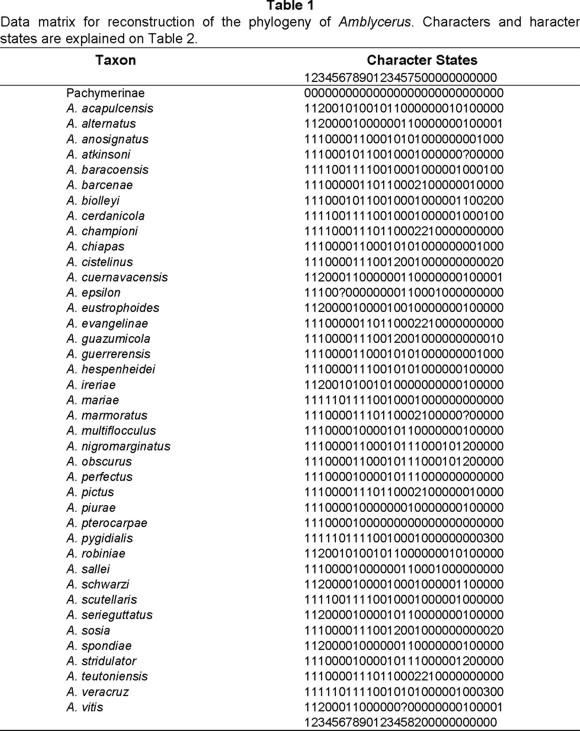
<body><![CDATA[<p align="justify"><font face="verdana" size="2">It is important, however, to make some general assumptions in order to have a basis on which to begin phylogenetic studies in <i>Amblycerus</i> and other genera of bruchids. The only fossil bruchids described are in the subfamily Pachymerinae (Kingsolver 1965) and several authors have stated, after analysis of their data, that early Bruchidae were similar to the subfamily Pachymerinae (<i>e.g</i>., Nilsson &amp; Johnson 1993, Kingsolver 1965). Vats (1980) concluded that larvae of Pachymerinae were distinct from the Amblycerinae and Bruchinae anatomically, morphologically, and behaviorally. Pachymerinae are the largest in size of any bruchid, they have many spines and carinae, robust appendages, and the Old World species feed mostly in legumes. Thus, we hypothesize that the subfamilies of the Bruchidae originated from a Pachymerinae&#45;like ancestor.</font></p>     <p align="justify"><font face="verdana" size="2">There seems to be a misconception among New World entomologists that all species of Pachymerinae feed in seeds of palms simply because all native New World Pachymerinae feed in these plants. There are about 75 species of Old World Pachymerinae that feed in the seeds of about 100 species of Fabaceae, about nine species of Combretaceae, and one species of Apiaceae (unpublished data). There are about 20 New World species of Pachymerinae that feed in about 73 species of palms (Johnson <i>et al</i>. 1995). Of the 69 known hosts of all species of Amblycerus, 41 species of hosts are in the Fabaceae.</font></p>     <p align="justify"><font face="verdana" size="2">The subfamily Amblycerinae is composed of three genera in the tribes Amblycerini (genus <i>Amblycerus</i>) and Spermophagini (genera <i>Spermophagus</i> and <i>Zabrotes</i>). Of the larger subfamilies of the Bruchidae, Amblycerinae are the most distinct morphologically from other subfamilies. There are about 100 species in the genus <i>Amblycerus</i> in the New World. Of these, only 40 species have been reported in the literature from the United States and Mexico (Romero <i>et al</i>. 1996). These 40 species and the entire subfamily comprise a hypothesized monophyletic group based upon many characters including an entire hind femur and metatibia armed with two large calcaria that separate them from other bruchids. Thus, this is an appropriate group for the first species level cladistic analysis in the Bruchidae.</font></p>     <p align="justify"><font face="Verdana" size="2">&nbsp;</font></p>     <p align="justify"><font face="verdana" size="2"><b>Materials and methods</b></font></p>     <p align="justify"><font face="verdana" size="2">The data matrix (<a href="#c1">Table 1</a>) was compiled using characters gleaned from the external and internal morphology of the male genitalia. In all, 29 characters were used, 19 from internal morphology, and 10 from external morphology (<a href="#c2">Table 2</a>). Features 2, 13, 16, 17, 23, and 26 were coded as multistate characters and all were analyzed unordered.</font></p>     <p align="center"><font face="verdana" size="2"><a name="c1"></a></font></p>     <p align="center"><font face="verdana" size="2"><img src="/img/revistas/azm/n86/a1c1.jpg"></font></p>     <p align="center"><font face="verdana" size="2"><a name="c2"></a></font></p>     <p align="center"><font face="verdana" size="2"><img src="/img/revistas/azm/n86/a1c2.jpg"></font></p>     ]]></body>
<body><![CDATA[<p align="justify"><font face="verdana" size="2">In this study we use Pachymerinae as outgroups to root the unrooted network of taxa created by the parsimony analysis.</font></p>     <p align="justify"><font face="verdana" size="2">The program Hennig86 (Farris 1988) was used to construct the cladograms. Clados (Nixon 1995) was used to map the characters on the trees and to prepare the figures. In order to try to understand taxonomic relationships between <i>Amblycerus</i> species and their host plants, the bruchid species names were replaced by their host plant families. All host plant records and sources are listed in Romero <i>et al</i>. (1996). We compare our cladogram with the phylogenetic analyses of Chase <i>et al</i>. (1993), who used the nucleotide sequences from the plastid gene rbcL, in our discussions of adaptive radiation. The cladogram of Chase <i>et al</i>. includes all the families used by <i>Amblycerus</i> analyzed in this study.</font></p>     <p align="justify"><font face="verdana" size="2"><b>Results and discussion</b></font></p>     <p align="justify"><font face="verdana" size="2"><b>Cladistic Analysis of</b> <i><b>Amblycerus</b></i><b></b>. Four trees were generated using Wagner parsimony (mhennig*). Branch&#45;swapping (bb) of those eight topologies produced no additional equally parsimonious trees. From these four topologies, we obtained a Nelson consensus tree (<a href="/img/revistas/azm/n86/a1f1.jpg" target="_blank">Fig. 1</a>), which is presented as the best estimate of the relationships within the ingroup based on such a limited data set. All cladograms had tree lengths of 60 steps, a consistency index of 0.63, and a retention index of 0.88.</font></p>     <p align="justify"><font face="verdana" size="2">Character 16 (vestiture of body) shows a linear transformation from vestiture not mottled to vestiture weakly to strongly mottled. Character 17 (integument color) changes from legs and body brown to legs brown with some structures of body black to legs and some structures of body black. Character 26 (sclerite in the internal sac) changes from basal ovoid sclerite to sclerite with two arms to sclerite with four arms. In total, the cladogram is formed by 30 synapomorphies, 18 parallelisms, and 12 reversals. Below we discuss the clades defined by synapomorphies.</font></p>     <p align="justify"><font face="verdana" size="2">The monophyletic group, <i>Amblycerus</i>, is delineated by the following synapomorphies: hind femur entire (0); metatibia armed with two large calcaria (1); pronotum with foveolae only in lateral areas, foveolae throughout (2&#45;1 or 2&#45;2), and a reduced mesal tibial calcarium (7). <i>Amblycerus pterocarpae</i> Kingsolver is located basally and represents the least derived species in the genus. Most of the remaining North American species are related by the presence of a multicolored vestiture (12) and a pygidium with a median stripe (15). Due to homoplasy and the small data set, deep node cladistic relationships of the remaining species are uncertain. There are a few well&#45;delimited clades, and these are discussed using the specific epithet of the earliest member of the clade.</font></p>     <p align="justify"><font face="verdana" size="2">The "epsilon" clade, comprised of <i>A. epsilon</i> Kingsolver and <i>A. sallei</i> (Jekel), is supported by the presence of boat&#45;shaped sclerites in the internal sac (19).</font></p>     <p align="justify"><font face="verdana" size="2">The "alternatus" clade, composed of <i>A. alternatus</i> (Pic), <i>A. cuernavacensis</i> Romero, Johnson &amp; Kingsolver and <i>A. vitis</i> (Schaeffer), is supported by the presence of a pair of medial, short, subelliptic, serrate sclerites in the internal sac of the male genitalia (28).</font></p>     <p align="justify"><font face="verdana" size="2">The "ireriae" clade (<a href="/img/revistas/azm/n86/a1f1.jpg" target="_blank">Fig. 1</a>), containing <i>Amblycerus ireriae</i> Romero, Johnson &amp; Kingsolver, <i>A. acapulcensis</i> Kingsolver, and <i>A. robiniae</i> (F.) is well supported by the presence of a foveolate femur (5) and a bi&#45; or trilobed pygidium (10). The latter two taxa are additionally related by the presence of foveolate black spots on the integument (13) and horseshoe&#45;like sclerites and a pair of V&#45;shaped sclerites in the internal sac of the male genitalia (21).</font></p>     <p align="justify"><font face="verdana" size="2">The "stridulator" clade, containing <i>A. stridulator</i> Kingsolver, Romero &amp; Johnson, <i>A. nigromarginatus</i> (Motschulsky), and <i>A. obscurus</i> (Sharp), is supported by the character of two&#45;thirds of the internal sac of the male genitalia lined by spinules (23). The latter two taxa are related by the presence of a pair of long S&#45;shaped sclerites in the internal sac (20).</font></p>     ]]></body>
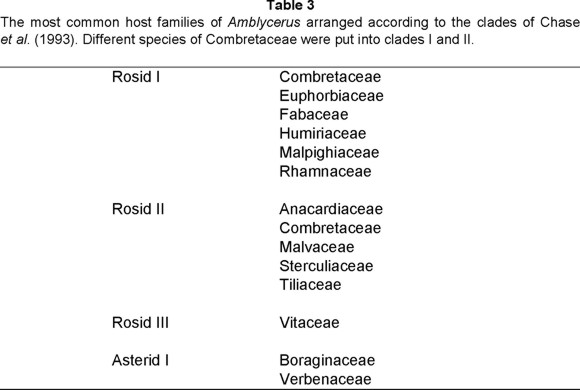
<body><![CDATA[<p align="justify"><font face="verdana" size="2">The "anosignatus" clade, composed of <i>A. anosignatus</i> (Chevrolat), <i>A. chiapas</i> Romero, Johnson &amp; Kingsolver, and <i>A. guerrerensis</i> Romero, Johnson &amp; Kingsolver, is supported by two plates with small tubercles on their dorsal surfaces in the internal sac (25).</font></p>     <p align="justify"><font face="verdana" size="2">The "marmoratus" clade, with <i>A. marmoratus</i> (Sharp), <i>A. barcenae</i> (Dug&egrave;s), <i>A. pictus</i> (Sharp), <i>A. championi</i> (Pic), <i>A. evangelinae</i> Romero, Johnson &amp; Kingsolver, and <i>A. teutoniensis</i> Ribeiro&#45;Costa &amp; Kingsolver, is supported by antennae with one or more black segments (11), the vestiture of the body is strongly mottled (16), and the legs are brown with some structures of the body black (17). Of the two subgroups of "marmoratus", the "barcenae" subgroup is supported by two long, serrate blades in the internal sac (24). The "championi" subgroup is supported by the legs and some structures of the body black (17) and the eye is cleft to 0.3&#45;4.5 its length by the ocular sinus (18).</font></p>     <p align="justify"><font face="verdana" size="2">The "cistelinus" clade, composed of <i>A. cistelinus</i> (Gyllenhal), <i>A. guazumicola</i> Kingsolver &amp; Johnson, and <i>A. sosia</i> Ribeiro&#45;Costa &amp; Kingsolver, is supported by the integument of the body with smooth, black spots (13) and a pair of long sclerites without spines occupying two&#45;thirds of the internal sac of the male genitalia (27).</font></p>     <p align="justify"><font face="verdana" size="2">The "mariae" clade, composed of <i>A. mariae</i> Romero, Johnson &amp; Kingsolver, <i>A. pygidialis</i> (Suffrian), and <i>A. veracruz</i> Romero, Johnson &amp; Kingsolver, is supported by a smooth cervix (4). <i>A. pygidialis</i> and <i>A. veracruz</i> form a subgroup supported by male genitalia with a basal ovoid sclerite with four arms (26).</font></p>     <p align="justify"><font face="verdana" size="2">The "baracoensis" clade, comprised of <i>A. baracoensis</i> Kingsolver, <i>A. biolleyi</i> (Pic), <i>A. cerdanicola</i> Kingsolver, and <i>A. scutellaris</i> (Sharp), is supported by the internal sac of the male genitalia with a basal ovoid sclerite without arms (26).</font></p>     <p align="justify"><font face="verdana" size="2">The clades produced by this analysis are very similar to the species groups of Romero <i>et al</i>. (1996) that were derived by non&#45;cladistic methods. Intuitive comments on species groups in <i>Amblycerus</i> by Kingsolver (1970, 1980), Ribeiro&#45;Costa &amp; Marinoni (1992), and Ribeiro&#45;Costa (1995) mostly agreed with our results but they placed <i>A. alternatus</i>, <i>A. schwarzi</i> Kingsolver, and <i>A. spondiae</i> Kingsolver in the same species group. Ribeiro&#45;Costa considered <i>A. championi</i> to be in a separate, undescribed genus. These results are very different from ours.</font></p>     <p align="justify"><font face="verdana" size="2">Ribeiro&#45;Costa (1995) analyzed the Brazilian species of <i>Amblycerus</i> using phenetic methods that included eight of the species considered here. Her results were similar to ours except that her results indicated that <i>A. perfectus</i> (Sharp) and <i>A. anosignatus</i> should be in the same species group, and <i>A. teutoniensis</i> belongs in the separate, undescribed genus. These latter results are very different from ours.</font></p>     <p align="justify"><font face="verdana" size="2">Thus, different techniques have resulted with moderately similar conclusions. This indicates to us that more extensive, intensive, and refined phylogenetic studies are needed to better ascertain the relationships within this genus.</font></p>     <p align="justify"><font face="verdana" size="2"><b>Radiation Into Hosts</b>. By replacing each species of <i>Amblycerus</i> with the appropriate host families (<a href="/img/revistas/azm/n86/a1f2.jpg" target="_blank">Fig. 2</a>), an approximation of adaptive radiation into host taxa can be formulated. The cladogram presented in <a href="/img/revistas/azm/n86/a1f2.jpg" target="_blank">Fig. 2</a> may be easily divided into three main clades. Clade 1 of <i>Amblycerus</i> is comprised of species that principally feed on seeds of plants in the plant clade Rosid I, especially the Fabaceae. Species of Clade 2 of <i>Amblycerus</i> feed principally in seeds of plants in clade Rosid II. Most species of Clade 3 of <i>Amblycerus</i> feed in Clade Asterid I, specifically the genus <i>Cordia</i> L. (Boraginaceae). Species of <i>Amblycerus</i> in Clade 1 feed in all four plant clades. <i>Amblycerus vitis</i>, a member of <i>Amblycerus</i> Clade 1, is the only species of bruchid to feed in Clade Rosid III. Although there is no clear perceptible pattern of host shifts along taxonomic lines, the host shifts follow a discernible pattern from multiple hosts in the Fabaceae (predominantly Clade Rosid I) and/or related families in the more basal clades of <i>Amblycerus</i>, to one or a few hosts in some more presumably recently evolved lineages, often a single species of <i>Cordia</i> (Boraginaceae). Taxonomic affinity in bruchids and their hosts simply do not explain all host preferences.</font></p>     <p align="justify"><font face="verdana" size="2">Most species of Bruchidae feed in seeds of the Fabaceae (Johnson 1981b, 1989). Although species of <i>Amblycerus</i> feed in seeds of 13 families of plants (<a href="#c3">Table 3</a>), the Fabaceae predominate. Of the 69 known hosts of all species of <i>Amblycerus</i>, 41 species of hosts are in the Fabaceae (see, for example, Romero, <i>et al</i>. 1996, Udayagiri and Wadhi, 1989 and references therein). The very large (400+ species) New World genus <i>Acanthoscelides</i> Schilsky feeds in ten plant families but mostly Fabaceae (Johnson 1990b, Johnson &amp; Siemens 1991), a pattern similar to <i>Amblycerus</i>. Therefore, we hypothesize that the Fabaceae are probably the ancestral hosts of species of <i>Amblycerus</i> and <i>Acanthoscelides</i>.</font></p>     ]]></body>
<body><![CDATA[<p align="center"><font face="verdana" size="2"><a name="c3"></a></font></p>     <p align="center"><font face="verdana" size="2"><img src="/img/revistas/azm/n86/a1c3.jpg"></font></p>     <p align="justify"><font face="verdana" size="2">Our problem here is to hypothesize an evolutionary scenario by which <i>Amblycerus</i>, a small genus when compared to <i>Acanthoscelides</i>, has evolved the ability to find and utilize seeds of 13 families of host plants, more host families than any other genus of bruchids and into almost one&#45;half of the known host families of the Bruchidae.</font></p>     <p align="justify"><font face="verdana" size="2">When bruchids shift into another host plant or family this involves not only the ability of the larvae to enter the fruit and/or seed, perhaps overcome toxins, and then utilize the seed contents for nourishment, etc., but an entire complex of genetic or behavioral traits must be modified in order for the host shift to occur. The adults must be able to find the new host, identify the fruits and seeds and then the female must oviposit onto the fruit or seed.</font></p>     <p align="justify"><font face="verdana" size="2">Although chemical cues for host finding seem to be common in insects, there is little hard evidence for this to date exhibiting this in bruchids. Johnson &amp; Siemens (1991) used correlative data to explain perhaps chemical cues of natural hosts that induced gravid females of <i>Stator vachelliae</i> Bottimer to oviposit upon seeds of a non&#45;host. Johnson &amp; Siemens found that presumably the females were attracted to their natural hosts by chemical and/or visual cues and then oviposited upon naturally intermixed, smooth seeds of both hosts and non&#45;hosts. In subsequent experiments in the field, they found that the cue that released oviposition was the smooth seed. Smooth surfaces of seeds and other objects, including inanimate objects, are often oviposited upon in nature and in the lab (Johnson &amp; Siemens 1991).</font></p>     <p align="justify"><font face="verdana" size="2">Each species of bruchid seems to have its unique cue to release oviposition behavior. Forister &amp; Johnson (1971) observed that <i>Acanthoscelides prosopoides</i> (Schaeffer) oviposited in holes in fruits whenever possible, and, in the lab, they preferred to oviposit in plastic with many holes in rather than fruits of its natural host. Johnson (1981a) observed that some species of bruchids are known to oviposit only on the external surface of fruits, some will only oviposit on smooth seeds in partially dehiscent pods, and others will only oviposit on smooth, exposed seeds on the ground. Thus, bruchids that oviposit in fabaceous fruits with a soft surface (<i>e.g</i>., two species of <i>Neltumius</i> in <i>Prosopis</i>) may oviposit into a fruit of another plant with a soft surface when under duress or when the plant is in close proximity (<i>e.g.</i>, one species of <i>Neltumius</i> in <i>Condalia</i>) (Johnson 1978). It then follows that host shifts may be partially due to preadapted ovipositional behavior and then perhaps ovipositional "mistakes" on non&#45;host plants in close proximity that have seed or fruit types similar to the ancestral hosts.</font></p>     <p align="justify"><font face="verdana" size="2">Johnson <i>et al</i>. (2001) compared life history traits such as egg structure and oviposition, larval feeding behavior, pupation behavior, and seed mortality of plants fed upon by several species of <i>Amblycerus</i>. These traits may eventually be of value when evaluating host preferences of bruchid beetles.</font></p>     <p align="justify"><font face="verdana" size="2">We suggest that to explain host shifts in <i>Amblycerus</i>, intensive research must be done on host plant chemistry, host and <i>Amblycerus</i> biogeography, life history studies, and molecular phylogenetics must be conducted. These suggestions are presented with the hope that they will stimulate further study of the many aspects of adaptive radiation of bruchids into flowering plants and as a tool to predict host plants of bruchids in species where they are unknown.</font></p>     <p align="justify"><font face="verdana" size="2"><b>Authorship</b></font></p>     <p align="justify"><font face="verdana" size="2">Romero did the basic taxonomic research, preliminary cladistic analysis and ideas on plant&#45;insect interactions, Ayers did the cladistic analysis and contributed ideas on plant&#45;insect interactions from a botanist's point of view, and Johnson contributed ideas on the taxonomy of bruchids and plant&#45;insect interactions.</font></p>     ]]></body>
<body><![CDATA[<p align="justify"><font face="Verdana" size="2">&nbsp;</font></p>     <p align="justify"><font face="verdana" size="2"><b>Acknowledgments</b></font></p>     <p align="justify"><font face="verdana" size="2">We thank C. Slobodchikoff, M. Wagner, G. Morse and two anonymous reviewers for reviews of early drafts of the manuscript. All did not necessarily agree with the conclusions. We also gratefully recognize funding from the Consejo Nacional de Ciencia y Tecnolog&iacute;a (CONACYT) and Colegio de Postgraduados, Montecillo, Mexico, to JR, and the support of NSF Grant BSR88&#45;05861 to CDJ.</font></p>     <p align="justify"><font face="Verdana" size="2">&nbsp;</font></p>     <p align="justify"><font face="verdana" size="2"><b>Literature cited</b></font></p>     <!-- ref --><p align="justify"><font face="verdana" size="2"><b>Becerra, J. X. &amp; D. L. Venable</b>. 1999. Macroevolution of insect&#45;plant associations: the relevance of host biogeography to host affiliation. <i>Proc. Nal. Acad. Sc. U.S.A</i>. 96(22): 12626&#45;12631.    &nbsp;&nbsp;&nbsp;&nbsp;&nbsp;&nbsp;&nbsp;&nbsp;[&#160;<a href="javascript:void(0);" onclick="javascript: window.open('/scielo.php?script=sci_nlinks&ref=298749&pid=S0065-1737200200020000100001&lng=','','width=640,height=500,resizable=yes,scrollbars=1,menubar=yes,');">Links</a>&#160;]<!-- end-ref --></font></p>     <!-- ref --><p align="justify"><font face="verdana" size="2"><b>Borowiec, L</b>. 1987. The genera of seed&#45;beetles. <i>Polskie Pismo Entomol</i>. 57: 3&#45;207.    &nbsp;&nbsp;&nbsp;&nbsp;&nbsp;&nbsp;&nbsp;&nbsp;[&#160;<a href="javascript:void(0);" onclick="javascript: window.open('/scielo.php?script=sci_nlinks&ref=298751&pid=S0065-1737200200020000100002&lng=','','width=640,height=500,resizable=yes,scrollbars=1,menubar=yes,');">Links</a>&#160;]<!-- end-ref --></font></p>     <!-- ref --><p align="justify"><font face="verdana" size="2"><b>Center, T. D. &amp; C. D. Johnson</b>. 1974. Coevolution of some seed beetles (Coleoptera: Bruchidae) and their hosts. <i>Ecology</i> 55: 1096&#45;1103.    &nbsp;&nbsp;&nbsp;&nbsp;&nbsp;&nbsp;&nbsp;&nbsp;[&#160;<a href="javascript:void(0);" onclick="javascript: window.open('/scielo.php?script=sci_nlinks&ref=298753&pid=S0065-1737200200020000100003&lng=','','width=640,height=500,resizable=yes,scrollbars=1,menubar=yes,');">Links</a>&#160;]<!-- end-ref --></font></p>     <!-- ref --><p align="justify"><font face="verdana" size="2"><b>Chase, M. W., D. E. Soltis &amp; R. G. Olmstead</b>. 1993. Phylogenetics of seed plants: an analysis of nucleotide sequences from the plastid gene rbcL. <i>Ann. Missouri Bot. Gard.</i> 80(3): 528&#45;580.    &nbsp;&nbsp;&nbsp;&nbsp;&nbsp;&nbsp;&nbsp;&nbsp;[&#160;<a href="javascript:void(0);" onclick="javascript: window.open('/scielo.php?script=sci_nlinks&ref=298755&pid=S0065-1737200200020000100004&lng=','','width=640,height=500,resizable=yes,scrollbars=1,menubar=yes,');">Links</a>&#160;]<!-- end-ref --></font></p>     <!-- ref --><p align="justify"><font face="verdana" size="2"><b>Farrell, B. D</b>. 1998. "Inordinate fondness" explained: why are there so many beetles? <i>Science</i> 281: 555&#45;559.    &nbsp;&nbsp;&nbsp;&nbsp;&nbsp;&nbsp;&nbsp;&nbsp;[&#160;<a href="javascript:void(0);" onclick="javascript: window.open('/scielo.php?script=sci_nlinks&ref=298757&pid=S0065-1737200200020000100005&lng=','','width=640,height=500,resizable=yes,scrollbars=1,menubar=yes,');">Links</a>&#160;]<!-- end-ref --></font></p>     <!-- ref --><p align="justify"><font face="verdana" size="2"><b>Farrell, B. &amp; C. Mitter</b>. 1990. Phylogenesis of insect/plant interactions: have <i>Phyllobrotica</i> leaf beetles (Chrysomelidae) and the Lamiales diversified in parallel? <i>Evolution</i> 44(6): 1389&#45;1403.    &nbsp;&nbsp;&nbsp;&nbsp;&nbsp;&nbsp;&nbsp;&nbsp;[&#160;<a href="javascript:void(0);" onclick="javascript: window.open('/scielo.php?script=sci_nlinks&ref=298759&pid=S0065-1737200200020000100006&lng=','','width=640,height=500,resizable=yes,scrollbars=1,menubar=yes,');">Links</a>&#160;]<!-- end-ref --></font></p>     <!-- ref --><p align="justify"><font face="verdana" size="2"><b>Farris, J. S</b>. 1988. Hennig86 reference. Version 1.5. Documentation.    &nbsp;&nbsp;&nbsp;&nbsp;&nbsp;&nbsp;&nbsp;&nbsp;[&#160;<a href="javascript:void(0);" onclick="javascript: window.open('/scielo.php?script=sci_nlinks&ref=298761&pid=S0065-1737200200020000100007&lng=','','width=640,height=500,resizable=yes,scrollbars=1,menubar=yes,');">Links</a>&#160;]<!-- end-ref --></font></p>     <!-- ref --><p align="justify"><font face="verdana" size="2"><b>Forister, G. W., &amp; C. D. Johnson</b>. 1971. Behavior and ecology of <i>Acanthoscelides prosopoides</i> (Coleoptera: Bruchidae). <i>Pan&#45;Pacif. Entomol.</i> 47(3): 224&#45;234.    &nbsp;&nbsp;&nbsp;&nbsp;&nbsp;&nbsp;&nbsp;&nbsp;[&#160;<a href="javascript:void(0);" onclick="javascript: window.open('/scielo.php?script=sci_nlinks&ref=298763&pid=S0065-1737200200020000100008&lng=','','width=640,height=500,resizable=yes,scrollbars=1,menubar=yes,');">Links</a>&#160;]<!-- end-ref --></font></p>     <!-- ref --><p align="justify"><font face="verdana" size="2"><b>Janzen, D. H</b>. 1969. Seed&#45;eaters versus seed size, number, toxicity, and dispersal. <i>Evolution</i> 23: 1&#45;27.    &nbsp;&nbsp;&nbsp;&nbsp;&nbsp;&nbsp;&nbsp;&nbsp;[&#160;<a href="javascript:void(0);" onclick="javascript: window.open('/scielo.php?script=sci_nlinks&ref=298765&pid=S0065-1737200200020000100009&lng=','','width=640,height=500,resizable=yes,scrollbars=1,menubar=yes,');">Links</a>&#160;]<!-- end-ref --></font></p>     <!-- ref --><p align="justify"><font face="verdana" size="2"><b>Jermy, T</b>. 1976. Insect&#45;host&#45;plant relationships&#45;coevolution or sequential evolution? <i>Symp. Biol. Hung.</i> 16:109&#45;113.    &nbsp;&nbsp;&nbsp;&nbsp;&nbsp;&nbsp;&nbsp;&nbsp;[&#160;<a href="javascript:void(0);" onclick="javascript: window.open('/scielo.php?script=sci_nlinks&ref=298767&pid=S0065-1737200200020000100010&lng=','','width=640,height=500,resizable=yes,scrollbars=1,menubar=yes,');">Links</a>&#160;]<!-- end-ref --></font></p>     <!-- ref --><p align="justify"><font face="verdana" size="2"><b>Jermy, T</b>. 1984. Evolution of insect/host plant relationships. <i>Amer. Nat.</i> 124:609&#45;630.    &nbsp;&nbsp;&nbsp;&nbsp;&nbsp;&nbsp;&nbsp;&nbsp;[&#160;<a href="javascript:void(0);" onclick="javascript: window.open('/scielo.php?script=sci_nlinks&ref=298769&pid=S0065-1737200200020000100011&lng=','','width=640,height=500,resizable=yes,scrollbars=1,menubar=yes,');">Links</a>&#160;]<!-- end-ref --></font></p>     <!-- ref --><p align="justify"><font face="verdana" size="2"><b>Johnson, C. D</b>. 1978. Ecology of <i>Neltumius texanus</i> (Coleoptera: Bruchidae) in seeds of <i>Condalia</i> (Rhamnaceae). <i>J. Kans. Entomol. Soc.</i> 51(3): 432&#45;440.    &nbsp;&nbsp;&nbsp;&nbsp;&nbsp;&nbsp;&nbsp;&nbsp;[&#160;<a href="javascript:void(0);" onclick="javascript: window.open('/scielo.php?script=sci_nlinks&ref=298771&pid=S0065-1737200200020000100012&lng=','','width=640,height=500,resizable=yes,scrollbars=1,menubar=yes,');">Links</a>&#160;]<!-- end-ref --></font></p>     <!-- ref --><p align="justify"><font face="verdana" size="2"><b>&#150;&#150;&#150;&#150;&#150;&#150;&#150;&#150;&#150;&#150;</b>. 1981a. Interactions between bruchid (Coleoptera) feeding guilds and behavioral patterns of pods of the Leguminosae. <i>Environ. Entomol.</i> 10: 249&#45;253.    &nbsp;&nbsp;&nbsp;&nbsp;&nbsp;&nbsp;&nbsp;&nbsp;[&#160;<a href="javascript:void(0);" onclick="javascript: window.open('/scielo.php?script=sci_nlinks&ref=298773&pid=S0065-1737200200020000100013&lng=','','width=640,height=500,resizable=yes,scrollbars=1,menubar=yes,');">Links</a>&#160;]<!-- end-ref --></font></p>     <!-- ref --><p align="justify"><font face="verdana" size="2"><b>&#150;&#150;&#150;&#150;&#150;&#150;&#150;&#150;&#150;&#150;</b>. 1981b. Seed Beetle Host Specificity and the Systematics of the Leguminosae. Pp. 995&#45;1027. <i>In</i> R. M. Polhill and P. H. Raven (eds). <i>Advances in Legume Systematics</i>. Royal Botanic Gardens, Kew.    &nbsp;&nbsp;&nbsp;&nbsp;&nbsp;&nbsp;&nbsp;&nbsp;[&#160;<a href="javascript:void(0);" onclick="javascript: window.open('/scielo.php?script=sci_nlinks&ref=298775&pid=S0065-1737200200020000100014&lng=','','width=640,height=500,resizable=yes,scrollbars=1,menubar=yes,');">Links</a>&#160;]<!-- end-ref --></font></p>     <!-- ref --><p align="justify"><font face="verdana" size="2"><b>&#150;&#150;&#150;&#150;&#150;&#150;&#150;&#150;&#150;&#150;</b>. 1989. Adaptive Radiation of <i>Acanthoscelides</i> in Seeds: Examples of Legume&#45;Bruchid Interactions. Pp. 747&#45;779. <i>In</i> C. H. Stirton and J. L. Zarucchi (eds). <i>Advances in Legume Biology</i>. Monogr. Syst. Botany Missouri Bot. Gard.    &nbsp;&nbsp;&nbsp;&nbsp;&nbsp;&nbsp;&nbsp;&nbsp;[&#160;<a href="javascript:void(0);" onclick="javascript: window.open('/scielo.php?script=sci_nlinks&ref=298777&pid=S0065-1737200200020000100015&lng=','','width=640,height=500,resizable=yes,scrollbars=1,menubar=yes,');">Links</a>&#160;]<!-- end-ref --></font></p>     <!-- ref --><p align="justify"><font face="verdana" size="2"><b>&#150;&#150;&#150;&#150;&#150;&#150;&#150;&#150;&#150;&#150;</b>. 1990a. Coevolution of Bruchidae and their hosts; evidence, conjecture, and conclusions. Pp. 181&#45;188. <i>In</i> Fujii, K., A. M. R. Gatehouse, C. D. Johnson, R. Mitchell, and T. Yoshida (eds). <i>Bruchids and Legumes: Economics, Ecology and Coevolution. Proceedings of the Second International Symposium on Bruchids and Legumes (ISBL&#45;2) held at Okayama (Japan), September 6&#45;9, 1989</i>. Kluwer Academic Publishers, Dordrecht, Boston, London.    &nbsp;&nbsp;&nbsp;&nbsp;&nbsp;&nbsp;&nbsp;&nbsp;[&#160;<a href="javascript:void(0);" onclick="javascript: window.open('/scielo.php?script=sci_nlinks&ref=298779&pid=S0065-1737200200020000100016&lng=','','width=640,height=500,resizable=yes,scrollbars=1,menubar=yes,');">Links</a>&#160;]<!-- end-ref --></font></p>     <!-- ref --><p align="justify"><font face="verdana" size="2"><b>&#150;&#150;&#150;&#150;&#150;&#150;&#150;&#150;&#150;&#150;</b>. 1990b. Systematics of the Seed Beetle Genus <i>Acanthoscelides</i> (Bruchidae) of Northern South America. <i>Trans. Amer. Entomol. Soc.</i> 116(2): 297&#45;618.    &nbsp;&nbsp;&nbsp;&nbsp;&nbsp;&nbsp;&nbsp;&nbsp;[&#160;<a href="javascript:void(0);" onclick="javascript: window.open('/scielo.php?script=sci_nlinks&ref=298781&pid=S0065-1737200200020000100017&lng=','','width=640,height=500,resizable=yes,scrollbars=1,menubar=yes,');">Links</a>&#160;]<!-- end-ref --></font></p>     <!-- ref --><p align="justify"><font face="verdana" size="2"><b>Johnson, C. D. &amp; D. H. Siemens</b>. 1991. Interactions between a new species of <i>Acanthoscelides</i> and a species of Verbenaceae, a new host family for Bruchidae (Coleoptera). <i>Ann. Entomol. Soc. Amer.</i> 84(2): 165&#45;169.    &nbsp;&nbsp;&nbsp;&nbsp;&nbsp;&nbsp;&nbsp;&nbsp;[&#160;<a href="javascript:void(0);" onclick="javascript: window.open('/scielo.php?script=sci_nlinks&ref=298783&pid=S0065-1737200200020000100018&lng=','','width=640,height=500,resizable=yes,scrollbars=1,menubar=yes,');">Links</a>&#160;]<!-- end-ref --></font></p>     <!-- ref --><p align="justify"><font face="verdana" size="2"><b>Johnson, C. D., S. Zona &amp; J. A. Nilsson</b>. 1995. Bruchid beetles and palm seeds: recorded relationships. <i>Principes</i> 39(1): 25&#45;35.    &nbsp;&nbsp;&nbsp;&nbsp;&nbsp;&nbsp;&nbsp;&nbsp;[&#160;<a href="javascript:void(0);" onclick="javascript: window.open('/scielo.php?script=sci_nlinks&ref=298785&pid=S0065-1737200200020000100019&lng=','','width=640,height=500,resizable=yes,scrollbars=1,menubar=yes,');">Links</a>&#160;]<!-- end-ref --></font></p>     <!-- ref --><p align="justify"><font face="verdana" size="2"><b>Johnson, C. D., J. Romero &amp; E. Raim&uacute;ndez&#45;Urrutia</b>. 2001. Ecology of <i>Amblycerus crassipunctatus</i> Ribeiro&#45;Costa (Coleoptera: Bruchidae) in seeds of Humiriaceae, a new host family for bruchids, with an ecological comparison to other species of <i>Amblycerus</i>. <i>Coleopts. Bull.</i> 55(1): 37&#45;48.    &nbsp;&nbsp;&nbsp;&nbsp;&nbsp;&nbsp;&nbsp;&nbsp;[&#160;<a href="javascript:void(0);" onclick="javascript: window.open('/scielo.php?script=sci_nlinks&ref=298787&pid=S0065-1737200200020000100020&lng=','','width=640,height=500,resizable=yes,scrollbars=1,menubar=yes,');">Links</a>&#160;]<!-- end-ref --></font></p>     <!-- ref --><p align="justify"><font face="verdana" size="2"><b>Kingsolver, J. M</b>. 1965. A new fossil bruchid genus and its relationships to modern genera (Coleoptera: Bruchidae: Pachymerinae). <i>Coleopts. Bull.</i> 19(1): 25&#45;30.    &nbsp;&nbsp;&nbsp;&nbsp;&nbsp;&nbsp;&nbsp;&nbsp;[&#160;<a href="javascript:void(0);" onclick="javascript: window.open('/scielo.php?script=sci_nlinks&ref=298789&pid=S0065-1737200200020000100021&lng=','','width=640,height=500,resizable=yes,scrollbars=1,menubar=yes,');">Links</a>&#160;]<!-- end-ref --></font></p>     <!-- ref --><p align="justify"><font face="verdana" size="2"><b>&#150;&#150;&#150;&#150;&#150;&#150;&#150;&#150;&#150;&#150;</b>. 1970. A synopsis of the subfamily Amblycerinae Bridwell in the West Indies, with descriptions of new species (Coleoptera: Bruchidae). <i>Trans. Amer. Entomol.</i> Soc. 96: 469&#45;497.    &nbsp;&nbsp;&nbsp;&nbsp;&nbsp;&nbsp;&nbsp;&nbsp;[&#160;<a href="javascript:void(0);" onclick="javascript: window.open('/scielo.php?script=sci_nlinks&ref=298791&pid=S0065-1737200200020000100022&lng=','','width=640,height=500,resizable=yes,scrollbars=1,menubar=yes,');">Links</a>&#160;]<!-- end-ref --></font></p>     <!-- ref --><p align="justify"><font face="verdana" size="2"><b>&#150;&#150;&#150;&#150;&#150;&#150;&#150;&#150;&#150;&#150;</b>. 1980. Eighteen new species of Bruchidae, principally from Costa Rica, with host records and distributional notes (Insecta: Coleoptera). <i>Proc. Biol. Soc. Wash.</i> 93(1): 229&#45;283.    &nbsp;&nbsp;&nbsp;&nbsp;&nbsp;&nbsp;&nbsp;&nbsp;[&#160;<a href="javascript:void(0);" onclick="javascript: window.open('/scielo.php?script=sci_nlinks&ref=298793&pid=S0065-1737200200020000100023&lng=','','width=640,height=500,resizable=yes,scrollbars=1,menubar=yes,');">Links</a>&#160;]<!-- end-ref --></font></p>     <!-- ref --><p align="justify"><font face="verdana" size="2"><b>Kingsolver, J. M. &amp; D. R. Whitehead</b>. 1976. The North and Central American species of <i>Meibomeus</i> (Coleoptera: Bruchidae: Bruchinae). <i>U.S. Dept. Agric. Tech. Bull.</i> 1523. 54 pp.    &nbsp;&nbsp;&nbsp;&nbsp;&nbsp;&nbsp;&nbsp;&nbsp;[&#160;<a href="javascript:void(0);" onclick="javascript: window.open('/scielo.php?script=sci_nlinks&ref=298795&pid=S0065-1737200200020000100024&lng=','','width=640,height=500,resizable=yes,scrollbars=1,menubar=yes,');">Links</a>&#160;]<!-- end-ref --></font></p>     <!-- ref --><p align="justify"><font face="verdana" size="2"><b>Mayr, E</b>. 1970. Populations, Species and Evolution. <i>Belnap Press of Harvard University</i>, <i>Cambridge, Massachusetts</i>. 451 p.    &nbsp;&nbsp;&nbsp;&nbsp;&nbsp;&nbsp;&nbsp;&nbsp;[&#160;<a href="javascript:void(0);" onclick="javascript: window.open('/scielo.php?script=sci_nlinks&ref=298797&pid=S0065-1737200200020000100025&lng=','','width=640,height=500,resizable=yes,scrollbars=1,menubar=yes,');">Links</a>&#160;]<!-- end-ref --></font></p>     <!-- ref --><p align="justify"><font face="verdana" size="2"><b>Miller, J. S</b>. 1987. Host&#45;plant relationships in the Papilionidae (Lepidoptera): Parallel cladogenesis or colonization? <i>Cladistics</i> 3(2): 105&#45;120.    &nbsp;&nbsp;&nbsp;&nbsp;&nbsp;&nbsp;&nbsp;&nbsp;[&#160;<a href="javascript:void(0);" onclick="javascript: window.open('/scielo.php?script=sci_nlinks&ref=298799&pid=S0065-1737200200020000100026&lng=','','width=640,height=500,resizable=yes,scrollbars=1,menubar=yes,');">Links</a>&#160;]<!-- end-ref --></font></p>     <!-- ref --><p align="justify"><font face="verdana" size="2"><b>Nilsson, J. A. &amp; C. D. Johnson</b>. 1993. A Taxonomic Revision of the Palm Bruchids (Pachymerini) and a Description of the World Genera of Pachymerinae (Coleoptera: Bruchidae: Pachymerinae). <i>Mem. Amer. Ent. Soc.</i> 41. 104 pp.    &nbsp;&nbsp;&nbsp;&nbsp;&nbsp;&nbsp;&nbsp;&nbsp;[&#160;<a href="javascript:void(0);" onclick="javascript: window.open('/scielo.php?script=sci_nlinks&ref=298801&pid=S0065-1737200200020000100027&lng=','','width=640,height=500,resizable=yes,scrollbars=1,menubar=yes,');">Links</a>&#160;]<!-- end-ref --></font></p>     <!-- ref --><p align="justify"><font face="verdana" size="2"><b>Nixon, K. C</b>. 1995. Clados, version 1.5. Cornell University.    &nbsp;&nbsp;&nbsp;&nbsp;&nbsp;&nbsp;&nbsp;&nbsp;[&#160;<a href="javascript:void(0);" onclick="javascript: window.open('/scielo.php?script=sci_nlinks&ref=298803&pid=S0065-1737200200020000100028&lng=','','width=640,height=500,resizable=yes,scrollbars=1,menubar=yes,');">Links</a>&#160;]<!-- end-ref --></font></p>     <!-- ref --><p align="justify"><font face="verdana" size="2"><b>Ribeiro&#45;Costa, C. S</b>. 1995. An&aacute;lise fen&eacute;tica das esp&eacute;cies brasileiras de <i>Amblycerus</i> Thunberg, 1815 (Coleoptera: Bruchidae) com descri&ccedil;&atilde;o de um novo g&ecirc;nero. Tese (Ph.D. dissertation). Universidade Federal do Paran&aacute;, Curitiba, Brasil.    &nbsp;&nbsp;&nbsp;&nbsp;&nbsp;&nbsp;&nbsp;&nbsp;[&#160;<a href="javascript:void(0);" onclick="javascript: window.open('/scielo.php?script=sci_nlinks&ref=298805&pid=S0065-1737200200020000100029&lng=','','width=640,height=500,resizable=yes,scrollbars=1,menubar=yes,');">Links</a>&#160;]<!-- end-ref --></font></p>     <!-- ref --><p align="justify"><font face="verdana" size="2"><b>Ribeiro&#45;Costa, C. S. &amp; R. C. Marinoni</b>. 1992. G&ecirc;nero <i>Amblycerus</i> Thunberg, 1815 (Coleoptera, Bruchidae). Grupo hoffmanseggi: I. Taxonomia num&eacute;rica. <i>Revta Bras. Ent.</i> 36(1): 129&#45;147.    &nbsp;&nbsp;&nbsp;&nbsp;&nbsp;&nbsp;&nbsp;&nbsp;[&#160;<a href="javascript:void(0);" onclick="javascript: window.open('/scielo.php?script=sci_nlinks&ref=298807&pid=S0065-1737200200020000100030&lng=','','width=640,height=500,resizable=yes,scrollbars=1,menubar=yes,');">Links</a>&#160;]<!-- end-ref --></font></p>     <!-- ref --><p align="justify"><font face="verdana" size="2"><b>Romero, J., C. D. Johnson &amp; J. M. Kingsolver</b>. 1996. Revision of the genus <i>Amblycerus</i> of the United States and Mexico (Coleoptera: Bruchidae: Amblycerinae). <i>U.S. Department of Agriculture Technical Bulletin.</i> 1845. 166 pp.    &nbsp;&nbsp;&nbsp;&nbsp;&nbsp;&nbsp;&nbsp;&nbsp;[&#160;<a href="javascript:void(0);" onclick="javascript: window.open('/scielo.php?script=sci_nlinks&ref=298809&pid=S0065-1737200200020000100031&lng=','','width=640,height=500,resizable=yes,scrollbars=1,menubar=yes,');">Links</a>&#160;]<!-- end-ref --></font></p>     <!-- ref --><p align="justify"><font face="verdana" size="2"><b>Rosenthal, G. A. &amp; Bell, E. A</b>. 1979. Naturally occurring, toxic nonprotein amino acids. Pp. 353&#45;385. <i>In</i> G. A. Rosenthal and D. H. Janzen (eds.), Herbivores Their Interaction with Secondary Plant Metabolites, Academic Press, London and New York,    &nbsp;&nbsp;&nbsp;&nbsp;&nbsp;&nbsp;&nbsp;&nbsp;[&#160;<a href="javascript:void(0);" onclick="javascript: window.open('/scielo.php?script=sci_nlinks&ref=298811&pid=S0065-1737200200020000100032&lng=','','width=640,height=500,resizable=yes,scrollbars=1,menubar=yes,');">Links</a>&#160;]<!-- end-ref --></font></p>     <!-- ref --><p align="justify"><font face="verdana" size="2"><b>Udayagiri, S. &amp; S. R. Wadhi</b>. 1989. Catalog of Bruchidae. <i>Mem. Amer. Ent. Ins.. Num. 45.</i> 301 p.    &nbsp;&nbsp;&nbsp;&nbsp;&nbsp;&nbsp;&nbsp;&nbsp;[&#160;<a href="javascript:void(0);" onclick="javascript: window.open('/scielo.php?script=sci_nlinks&ref=298813&pid=S0065-1737200200020000100033&lng=','','width=640,height=500,resizable=yes,scrollbars=1,menubar=yes,');">Links</a>&#160;]<!-- end-ref --></font></p>     <!-- ref --><p align="justify"><font face="verdana" size="2"><b>Vats, L. K</b>. 1980. Note on the subfamilies of Bruchidae (Coleoptera). <i>Entomol. Mont. Mag</i> 115:255&#45;256.    &nbsp;&nbsp;&nbsp;&nbsp;&nbsp;&nbsp;&nbsp;&nbsp;[&#160;<a href="javascript:void(0);" onclick="javascript: window.open('/scielo.php?script=sci_nlinks&ref=298815&pid=S0065-1737200200020000100034&lng=','','width=640,height=500,resizable=yes,scrollbars=1,menubar=yes,');">Links</a>&#160;]<!-- end-ref --></font></p>      ]]></body><back>
<ref-list>
<ref id="B1">
<nlm-citation citation-type="journal">
<person-group person-group-type="author">
<name>
<surname><![CDATA[Becerra]]></surname>
<given-names><![CDATA[J. X.]]></given-names>
</name>
<name>
<surname><![CDATA[Venable]]></surname>
<given-names><![CDATA[D. L.]]></given-names>
</name>
</person-group>
<article-title xml:lang="en"><![CDATA[Macroevolution of insect-plant associations: the relevance of host biogeography to host affiliation]]></article-title>
<source><![CDATA[Proc. Nal. Acad. Sc. U.S.A.]]></source>
<year>1999</year>
<volume>96</volume>
<numero>22</numero>
<issue>22</issue>
<page-range>12626-12631</page-range></nlm-citation>
</ref>
<ref id="B2">
<nlm-citation citation-type="journal">
<person-group person-group-type="author">
<name>
<surname><![CDATA[Borowiec]]></surname>
<given-names><![CDATA[L.]]></given-names>
</name>
</person-group>
<article-title xml:lang="en"><![CDATA[The genera of seed-beetles]]></article-title>
<source><![CDATA[Polskie Pismo Entomol.]]></source>
<year>1987</year>
<volume>57</volume>
<page-range>3-207</page-range></nlm-citation>
</ref>
<ref id="B3">
<nlm-citation citation-type="journal">
<person-group person-group-type="author">
<name>
<surname><![CDATA[Center]]></surname>
<given-names><![CDATA[T. D.]]></given-names>
</name>
<name>
<surname><![CDATA[Johnson]]></surname>
<given-names><![CDATA[C. D.]]></given-names>
</name>
</person-group>
<article-title xml:lang="en"><![CDATA[Coevolution of some seed beetles (Coleoptera: Bruchidae) and their hosts]]></article-title>
<source><![CDATA[Ecology]]></source>
<year>1974</year>
<volume>55</volume>
<page-range>1096-1103</page-range></nlm-citation>
</ref>
<ref id="B4">
<nlm-citation citation-type="journal">
<person-group person-group-type="author">
<name>
<surname><![CDATA[Chase]]></surname>
<given-names><![CDATA[M. W.]]></given-names>
</name>
<name>
<surname><![CDATA[Soltis]]></surname>
<given-names><![CDATA[D. E.]]></given-names>
</name>
<name>
<surname><![CDATA[Olmstead]]></surname>
<given-names><![CDATA[R. G.]]></given-names>
</name>
</person-group>
<article-title xml:lang="en"><![CDATA[Phylogenetics of seed plants: an analysis of nucleotide sequences from the plastid gene rbcL]]></article-title>
<source><![CDATA[Ann. Missouri Bot. Gard.]]></source>
<year>1993</year>
<volume>80</volume>
<numero>3</numero>
<issue>3</issue>
<page-range>528-580</page-range></nlm-citation>
</ref>
<ref id="B5">
<nlm-citation citation-type="journal">
<person-group person-group-type="author">
<name>
<surname><![CDATA[Farrell]]></surname>
<given-names><![CDATA[B. D.]]></given-names>
</name>
</person-group>
<article-title xml:lang="en"><![CDATA["Inordinate fondness" explained: why are there so many beetles?]]></article-title>
<source><![CDATA[Science]]></source>
<year>1998</year>
<volume>281</volume>
<page-range>555-559</page-range></nlm-citation>
</ref>
<ref id="B6">
<nlm-citation citation-type="journal">
<person-group person-group-type="author">
<name>
<surname><![CDATA[Farrell]]></surname>
<given-names><![CDATA[B.]]></given-names>
</name>
<name>
<surname><![CDATA[Mitter]]></surname>
<given-names><![CDATA[C.]]></given-names>
</name>
</person-group>
<article-title xml:lang="en"><![CDATA[Phylogenesis of insect/plant interactions: have Phyllobrotica leaf beetles (Chrysomelidae) and the Lamiales diversified in parallel?]]></article-title>
<source><![CDATA[Evolution]]></source>
<year>1990</year>
<volume>44</volume>
<numero>6</numero>
<issue>6</issue>
<page-range>1389-1403</page-range></nlm-citation>
</ref>
<ref id="B7">
<nlm-citation citation-type="">
<person-group person-group-type="author">
<name>
<surname><![CDATA[Farris]]></surname>
<given-names><![CDATA[J. S.]]></given-names>
</name>
</person-group>
<source><![CDATA[Hennig86 reference. Version 1.5]]></source>
<year>1988</year>
</nlm-citation>
</ref>
<ref id="B8">
<nlm-citation citation-type="journal">
<person-group person-group-type="author">
<name>
<surname><![CDATA[Forister]]></surname>
<given-names><![CDATA[G. W.]]></given-names>
</name>
<name>
<surname><![CDATA[Johnson]]></surname>
<given-names><![CDATA[C. D.]]></given-names>
</name>
</person-group>
<article-title xml:lang="en"><![CDATA[Behavior and ecology of Acanthoscelides prosopoides (Coleoptera: Bruchidae)]]></article-title>
<source><![CDATA[Pan-Pacif. Entomol.]]></source>
<year>1971</year>
<volume>47</volume>
<numero>3</numero>
<issue>3</issue>
<page-range>224-234</page-range></nlm-citation>
</ref>
<ref id="B9">
<nlm-citation citation-type="journal">
<person-group person-group-type="author">
<name>
<surname><![CDATA[Janzen]]></surname>
<given-names><![CDATA[D. H.]]></given-names>
</name>
</person-group>
<article-title xml:lang="en"><![CDATA[Seed-eaters versus seed size, number, toxicity, and dispersal]]></article-title>
<source><![CDATA[Evolution]]></source>
<year>1969</year>
<volume>23</volume>
<page-range>1-27</page-range></nlm-citation>
</ref>
<ref id="B10">
<nlm-citation citation-type="journal">
<person-group person-group-type="author">
<name>
<surname><![CDATA[Jermy]]></surname>
<given-names><![CDATA[T.]]></given-names>
</name>
</person-group>
<article-title xml:lang="en"><![CDATA[Insect-host-plant relationships-coevolution or sequential evolution?]]></article-title>
<source><![CDATA[Symp. Biol. Hung.]]></source>
<year>1976</year>
<volume>16</volume>
<page-range>109-113</page-range></nlm-citation>
</ref>
<ref id="B11">
<nlm-citation citation-type="journal">
<person-group person-group-type="author">
<name>
<surname><![CDATA[Jermy]]></surname>
<given-names><![CDATA[T.]]></given-names>
</name>
</person-group>
<article-title xml:lang="en"><![CDATA[Evolution of insect/host plant relationships]]></article-title>
<source><![CDATA[Amer. Nat.]]></source>
<year>1984</year>
<volume>124</volume>
<page-range>609-630</page-range></nlm-citation>
</ref>
<ref id="B12">
<nlm-citation citation-type="journal">
<person-group person-group-type="author">
<name>
<surname><![CDATA[Johnson]]></surname>
<given-names><![CDATA[C. D.]]></given-names>
</name>
</person-group>
<article-title xml:lang="en"><![CDATA[Ecology of Neltumius texanus (Coleoptera: Bruchidae) in seeds of Condalia (Rhamnaceae)]]></article-title>
<source><![CDATA[J. Kans. Entomol. Soc.]]></source>
<year>1978</year>
<volume>51</volume>
<numero>3</numero>
<issue>3</issue>
<page-range>432-440</page-range></nlm-citation>
</ref>
<ref id="B13">
<nlm-citation citation-type="journal">
<person-group person-group-type="author">
<name>
<surname><![CDATA[Johnson]]></surname>
<given-names><![CDATA[C. D.]]></given-names>
</name>
</person-group>
<article-title xml:lang="en"><![CDATA[Interactions between bruchid (Coleoptera) feeding guilds and behavioral patterns of pods of the Leguminosae]]></article-title>
<source><![CDATA[Environ. Entomol.]]></source>
<year>1981</year>
<volume>10</volume>
<page-range>249-253</page-range></nlm-citation>
</ref>
<ref id="B14">
<nlm-citation citation-type="book">
<person-group person-group-type="author">
<name>
<surname><![CDATA[Johnson]]></surname>
<given-names><![CDATA[C. D.]]></given-names>
</name>
</person-group>
<article-title xml:lang="en"><![CDATA[Seed Beetle Host Specificity and the Systematics of the Leguminosae.]]></article-title>
<person-group person-group-type="editor">
<name>
<surname><![CDATA[Polhill]]></surname>
<given-names><![CDATA[R. M.]]></given-names>
</name>
<name>
<surname><![CDATA[Raven]]></surname>
<given-names><![CDATA[P. H.]]></given-names>
</name>
</person-group>
<source><![CDATA[Advances in Legume Systematics]]></source>
<year>1981</year>
<page-range>995-1027</page-range><publisher-loc><![CDATA[Kew ]]></publisher-loc>
<publisher-name><![CDATA[Royal Botanic Gardens]]></publisher-name>
</nlm-citation>
</ref>
<ref id="B15">
<nlm-citation citation-type="book">
<person-group person-group-type="author">
<name>
<surname><![CDATA[Johnson]]></surname>
<given-names><![CDATA[C. D.]]></given-names>
</name>
</person-group>
<article-title xml:lang="en"><![CDATA[Adaptive Radiation of Acanthoscelides in Seeds: Examples of Legume-Bruchid Interactions]]></article-title>
<person-group person-group-type="editor">
<name>
<surname><![CDATA[Stirton]]></surname>
<given-names><![CDATA[C. H.]]></given-names>
</name>
<name>
<surname><![CDATA[Zarucchi]]></surname>
<given-names><![CDATA[J. L.]]></given-names>
</name>
</person-group>
<source><![CDATA[Advances in Legume Biology]]></source>
<year>1989</year>
<page-range>747-779</page-range><publisher-name><![CDATA[Monogr. Syst. Botany Missouri Bot. Gard]]></publisher-name>
</nlm-citation>
</ref>
<ref id="B16">
<nlm-citation citation-type="book">
<person-group person-group-type="author">
<name>
<surname><![CDATA[Johnson]]></surname>
<given-names><![CDATA[C. D.]]></given-names>
</name>
</person-group>
<article-title xml:lang="en"><![CDATA[Coevolution of Bruchidae and their hosts; evidence, conjecture, and conclusions]]></article-title>
<person-group person-group-type="editor">
<name>
<surname><![CDATA[Fujii]]></surname>
<given-names><![CDATA[K.]]></given-names>
</name>
<name>
<surname><![CDATA[Gatehouse]]></surname>
<given-names><![CDATA[A. M. R.]]></given-names>
</name>
<name>
<surname><![CDATA[Johnson]]></surname>
<given-names><![CDATA[C. D.]]></given-names>
</name>
<name>
<surname><![CDATA[Mitchell]]></surname>
<given-names><![CDATA[R.]]></given-names>
</name>
<name>
<surname><![CDATA[Yoshida]]></surname>
<given-names><![CDATA[T.]]></given-names>
</name>
</person-group>
<source><![CDATA[Bruchids and Legumes: Economics, Ecology and Coevolution. Proceedings of the Second International Symposium on Bruchids and Legumes (ISBL-2) held at Okayama (Japan), September 6-9, 1989]]></source>
<year>1990</year>
<page-range>181-188</page-range><publisher-loc><![CDATA[DordrechtBostonLondon ]]></publisher-loc>
<publisher-name><![CDATA[Kluwer Academic Publishers]]></publisher-name>
</nlm-citation>
</ref>
<ref id="B17">
<nlm-citation citation-type="journal">
<person-group person-group-type="author">
<name>
<surname><![CDATA[Johnson]]></surname>
<given-names><![CDATA[C. D.]]></given-names>
</name>
</person-group>
<article-title xml:lang="en"><![CDATA[Systematics of the Seed Beetle Genus Acanthoscelides (Bruchidae) of Northern South America]]></article-title>
<source><![CDATA[Trans. Amer. Entomol. Soc.]]></source>
<year>1990</year>
<volume>116</volume>
<numero>2</numero>
<issue>2</issue>
<page-range>297-618</page-range></nlm-citation>
</ref>
<ref id="B18">
<nlm-citation citation-type="journal">
<person-group person-group-type="author">
<name>
<surname><![CDATA[Johnson]]></surname>
<given-names><![CDATA[C. D.]]></given-names>
</name>
<name>
<surname><![CDATA[Siemens]]></surname>
<given-names><![CDATA[D. H.]]></given-names>
</name>
</person-group>
<article-title xml:lang="en"><![CDATA[Interactions between a new species of Acanthoscelides and a species of Verbenaceae, a new host family for Bruchidae (Coleoptera)]]></article-title>
<source><![CDATA[Ann. Entomol. Soc. Amer.]]></source>
<year>1991</year>
<volume>84</volume>
<numero>2</numero>
<issue>2</issue>
<page-range>165-169</page-range></nlm-citation>
</ref>
<ref id="B19">
<nlm-citation citation-type="journal">
<person-group person-group-type="author">
<name>
<surname><![CDATA[Johnson]]></surname>
<given-names><![CDATA[C. D.]]></given-names>
</name>
<name>
<surname><![CDATA[Zona]]></surname>
<given-names><![CDATA[S.]]></given-names>
</name>
<name>
<surname><![CDATA[Nilsson]]></surname>
<given-names><![CDATA[J. A.]]></given-names>
</name>
</person-group>
<article-title xml:lang="en"><![CDATA[Bruchid beetles and palm seeds: recorded relationships]]></article-title>
<source><![CDATA[Principes]]></source>
<year>1995</year>
<volume>39</volume>
<numero>1</numero>
<issue>1</issue>
<page-range>25-35</page-range></nlm-citation>
</ref>
<ref id="B20">
<nlm-citation citation-type="journal">
<person-group person-group-type="author">
<name>
<surname><![CDATA[Johnson]]></surname>
<given-names><![CDATA[C. D.]]></given-names>
</name>
<name>
<surname><![CDATA[Romero]]></surname>
<given-names><![CDATA[J.]]></given-names>
</name>
<name>
<surname><![CDATA[Raimúndez-Urrutia]]></surname>
<given-names><![CDATA[E.]]></given-names>
</name>
</person-group>
<article-title xml:lang="en"><![CDATA[Ecology of Amblycerus crassipunctatus Ribeiro-Costa (Coleoptera: Bruchidae) in seeds of Humiriaceae, a new host family for bruchids, with an ecological comparison to other species of Amblycerus]]></article-title>
<source><![CDATA[Coleopts. Bull.]]></source>
<year>2001</year>
<volume>55</volume>
<numero>1</numero>
<issue>1</issue>
<page-range>37-48</page-range></nlm-citation>
</ref>
<ref id="B21">
<nlm-citation citation-type="journal">
<person-group person-group-type="author">
<name>
<surname><![CDATA[Kingsolver]]></surname>
<given-names><![CDATA[J. M.]]></given-names>
</name>
</person-group>
<article-title xml:lang="en"><![CDATA[A new fossil bruchid genus and its relationships to modern genera (Coleoptera: Bruchidae: Pachymerinae)]]></article-title>
<source><![CDATA[Coleopts. Bull.]]></source>
<year>1965</year>
<volume>19</volume>
<numero>1</numero>
<issue>1</issue>
<page-range>25-30</page-range></nlm-citation>
</ref>
<ref id="B22">
<nlm-citation citation-type="journal">
<person-group person-group-type="author">
<name>
<surname><![CDATA[Kingsolver]]></surname>
<given-names><![CDATA[J. M.]]></given-names>
</name>
</person-group>
<article-title xml:lang="en"><![CDATA[A synopsis of the subfamily Amblycerinae Bridwell in the West Indies, with descriptions of new species (Coleoptera: Bruchidae)]]></article-title>
<source><![CDATA[Trans. Amer. Entomol. Soc.]]></source>
<year>1970</year>
<volume>96</volume>
<page-range>469-497</page-range></nlm-citation>
</ref>
<ref id="B23">
<nlm-citation citation-type="journal">
<person-group person-group-type="author">
<name>
<surname><![CDATA[Kingsolver]]></surname>
<given-names><![CDATA[J. M.]]></given-names>
</name>
</person-group>
<article-title xml:lang="en"><![CDATA[Eighteen new species of Bruchidae, principally from Costa Rica, with host records and distributional notes (Insecta: Coleoptera)]]></article-title>
<source><![CDATA[Proc. Biol. Soc. Wash.]]></source>
<year>1980</year>
<volume>93</volume>
<numero>1</numero>
<issue>1</issue>
<page-range>229-283</page-range></nlm-citation>
</ref>
<ref id="B24">
<nlm-citation citation-type="journal">
<person-group person-group-type="author">
<name>
<surname><![CDATA[Kingsolver]]></surname>
<given-names><![CDATA[J. M.]]></given-names>
</name>
<name>
<surname><![CDATA[Whitehead]]></surname>
<given-names><![CDATA[D. R.]]></given-names>
</name>
</person-group>
<article-title xml:lang="en"><![CDATA[The North and Central American species of Meibomeus (Coleoptera: Bruchidae: Bruchinae)]]></article-title>
<source><![CDATA[U.S. Dept. Agric. Tech. Bull.]]></source>
<year>1976</year>
<numero>1523</numero>
<issue>1523</issue>
<page-range>54</page-range></nlm-citation>
</ref>
<ref id="B25">
<nlm-citation citation-type="book">
<person-group person-group-type="author">
<name>
<surname><![CDATA[Mayr]]></surname>
<given-names><![CDATA[E.]]></given-names>
</name>
</person-group>
<source><![CDATA[Populations, Species and Evolution]]></source>
<year>1970</year>
<page-range>451</page-range><publisher-loc><![CDATA[Cambridge^eMassachusetts Massachusetts]]></publisher-loc>
<publisher-name><![CDATA[Belnap Press of Harvard University]]></publisher-name>
</nlm-citation>
</ref>
<ref id="B26">
<nlm-citation citation-type="journal">
<person-group person-group-type="author">
<name>
<surname><![CDATA[Miller]]></surname>
<given-names><![CDATA[J. S.]]></given-names>
</name>
</person-group>
<article-title xml:lang="en"><![CDATA[Host-plant relationships in the Papilionidae (Lepidoptera): Parallel cladogenesis or colonization?]]></article-title>
<source><![CDATA[Cladistics]]></source>
<year>1987</year>
<volume>3</volume>
<numero>2</numero>
<issue>2</issue>
<page-range>105-120</page-range></nlm-citation>
</ref>
<ref id="B27">
<nlm-citation citation-type="journal">
<person-group person-group-type="author">
<name>
<surname><![CDATA[Nilsson]]></surname>
<given-names><![CDATA[J. A.]]></given-names>
</name>
<name>
<surname><![CDATA[Johnson]]></surname>
<given-names><![CDATA[C. D.]]></given-names>
</name>
</person-group>
<article-title xml:lang="en"><![CDATA[A Taxonomic Revision of the Palm Bruchids (Pachymerini) and a Description of the World Genera of Pachymerinae (Coleoptera: Bruchidae: Pachymerinae)]]></article-title>
<source><![CDATA[Mem. Amer. Ent. Soc.]]></source>
<year>1993</year>
<volume>41</volume>
<page-range>104</page-range></nlm-citation>
</ref>
<ref id="B28">
<nlm-citation citation-type="book">
<person-group person-group-type="author">
<name>
<surname><![CDATA[Nixon]]></surname>
<given-names><![CDATA[K. C.]]></given-names>
</name>
</person-group>
<source><![CDATA[Clados, version 1.5]]></source>
<year>1995</year>
<publisher-name><![CDATA[Cornell University]]></publisher-name>
</nlm-citation>
</ref>
<ref id="B29">
<nlm-citation citation-type="">
<person-group person-group-type="author">
<name>
<surname><![CDATA[Ribeiro-Costa]]></surname>
<given-names><![CDATA[C. S.]]></given-names>
</name>
</person-group>
<source><![CDATA[Análise fenética das espécies brasileiras de Amblycerus Thunberg, 1815 (Coleoptera: Bruchidae) com descrição de um novo gênero]]></source>
<year>1995</year>
</nlm-citation>
</ref>
<ref id="B30">
<nlm-citation citation-type="journal">
<person-group person-group-type="author">
<name>
<surname><![CDATA[Ribeiro-Costa]]></surname>
<given-names><![CDATA[C. S.]]></given-names>
</name>
<name>
<surname><![CDATA[Marinoni]]></surname>
<given-names><![CDATA[R. C.]]></given-names>
</name>
</person-group>
<article-title xml:lang="pt"><![CDATA[Gênero Amblycerus Thunberg, 1815 (Coleoptera, Bruchidae). Grupo hoffmanseggi: I. Taxonomia numérica]]></article-title>
<source><![CDATA[Revta Bras. Ent.]]></source>
<year>1992</year>
<volume>36</volume>
<numero>1</numero>
<issue>1</issue>
<page-range>129-147</page-range></nlm-citation>
</ref>
<ref id="B31">
<nlm-citation citation-type="journal">
<person-group person-group-type="author">
<name>
<surname><![CDATA[Romero]]></surname>
<given-names><![CDATA[J.]]></given-names>
</name>
<name>
<surname><![CDATA[Johnson]]></surname>
<given-names><![CDATA[C. D.]]></given-names>
</name>
<name>
<surname><![CDATA[Kingsolver]]></surname>
<given-names><![CDATA[J. M.]]></given-names>
</name>
</person-group>
<article-title xml:lang="en"><![CDATA[Revision of the genus Amblycerus of the United States and Mexico (Coleoptera: Bruchidae: Amblycerinae)]]></article-title>
<source><![CDATA[U.S. Department of Agriculture Technical Bulletin]]></source>
<year>1996</year>
<numero>1845</numero>
<issue>1845</issue>
<page-range>166</page-range></nlm-citation>
</ref>
<ref id="B32">
<nlm-citation citation-type="book">
<person-group person-group-type="author">
<name>
<surname><![CDATA[Rosenthal]]></surname>
<given-names><![CDATA[G. A.]]></given-names>
</name>
<name>
<surname><![CDATA[Bell]]></surname>
<given-names><![CDATA[E. A.]]></given-names>
</name>
</person-group>
<article-title xml:lang="en"><![CDATA[Naturally occurring, toxic nonprotein amino acids]]></article-title>
<person-group person-group-type="editor">
<name>
<surname><![CDATA[Rosenthal]]></surname>
<given-names><![CDATA[G. A.]]></given-names>
</name>
<name>
<surname><![CDATA[Janzen]]></surname>
<given-names><![CDATA[D. H.]]></given-names>
</name>
</person-group>
<source><![CDATA[Herbivores Their Interaction with Secondary Plant Metabolites]]></source>
<year>1979</year>
<page-range>353-385</page-range><publisher-loc><![CDATA[LondonNew York ]]></publisher-loc>
<publisher-name><![CDATA[Academic Press]]></publisher-name>
</nlm-citation>
</ref>
<ref id="B33">
<nlm-citation citation-type="journal">
<person-group person-group-type="author">
<name>
<surname><![CDATA[Udayagiri]]></surname>
<given-names><![CDATA[S.]]></given-names>
</name>
<name>
<surname><![CDATA[Wadhi]]></surname>
<given-names><![CDATA[S. R.]]></given-names>
</name>
</person-group>
<article-title xml:lang="en"><![CDATA[Catalog of Bruchidae]]></article-title>
<source><![CDATA[Mem. Amer. Ent. Ins.. Num.]]></source>
<year>1989</year>
<volume>45</volume>
<page-range>301</page-range></nlm-citation>
</ref>
<ref id="B34">
<nlm-citation citation-type="journal">
<person-group person-group-type="author">
<name>
<surname><![CDATA[Vats]]></surname>
<given-names><![CDATA[L. K.]]></given-names>
</name>
</person-group>
<article-title xml:lang="en"><![CDATA[Note on the subfamilies of Bruchidae (Coleoptera)]]></article-title>
<source><![CDATA[Entomol. Mont. Mag]]></source>
<year>1980</year>
<volume>115</volume>
<page-range>255-256</page-range></nlm-citation>
</ref>
</ref-list>
</back>
</article>