<?xml version="1.0" encoding="ISO-8859-1"?><article xmlns:mml="http://www.w3.org/1998/Math/MathML" xmlns:xlink="http://www.w3.org/1999/xlink" xmlns:xsi="http://www.w3.org/2001/XMLSchema-instance">
<front>
<journal-meta>
<journal-id>0065-1737</journal-id>
<journal-title><![CDATA[Acta zoológica mexicana]]></journal-title>
<abbrev-journal-title><![CDATA[Acta Zool. Mex]]></abbrev-journal-title>
<issn>0065-1737</issn>
<publisher>
<publisher-name><![CDATA[Instituto de Ecología A.C.]]></publisher-name>
</publisher>
</journal-meta>
<article-meta>
<article-id>S0065-17372000000300002</article-id>
<title-group>
<article-title xml:lang="en"><![CDATA[Effect of nectar-foraging ants and wasps on the reproductive fitness of Turnera ulmifolia (Turneraceae) in a coastal sand dune in Mexico]]></article-title>
</title-group>
<contrib-group>
<contrib contrib-type="author">
<name>
<surname><![CDATA[Torres-Hernández]]></surname>
<given-names><![CDATA[Leonel]]></given-names>
</name>
<xref ref-type="aff" rid="A01"/>
</contrib>
<contrib contrib-type="author">
<name>
<surname><![CDATA[Rico-Gray]]></surname>
<given-names><![CDATA[Victor]]></given-names>
</name>
<xref ref-type="aff" rid="A02"/>
</contrib>
<contrib contrib-type="author">
<name>
<surname><![CDATA[Castillo-Guevara]]></surname>
<given-names><![CDATA[Citlalli]]></given-names>
</name>
<xref ref-type="aff" rid="A02"/>
</contrib>
<contrib contrib-type="author">
<name>
<surname><![CDATA[Vergara]]></surname>
<given-names><![CDATA[Judith A.]]></given-names>
</name>
<xref ref-type="aff" rid="A02"/>
</contrib>
</contrib-group>
<aff id="A01">
<institution><![CDATA[,Universidad Veracruzana Instituto de Investigaciones Biológicas ]]></institution>
<addr-line><![CDATA[Jalapa Veracruz]]></addr-line>
<country>México</country>
</aff>
<aff id="A02">
<institution><![CDATA[,Instituto de Ecología, A.C Departamento de Ecología Vegetal ]]></institution>
<addr-line><![CDATA[Jalapa Veracruz]]></addr-line>
<country>México</country>
</aff>
<pub-date pub-type="pub">
<day>00</day>
<month>00</month>
<year>2000</year>
</pub-date>
<pub-date pub-type="epub">
<day>00</day>
<month>00</month>
<year>2000</year>
</pub-date>
<numero>81</numero>
<fpage>13</fpage>
<lpage>21</lpage>
<copyright-statement/>
<copyright-year/>
<self-uri xlink:href="http://www.scielo.org.mx/scielo.php?script=sci_arttext&amp;pid=S0065-17372000000300002&amp;lng=en&amp;nrm=iso"></self-uri><self-uri xlink:href="http://www.scielo.org.mx/scielo.php?script=sci_abstract&amp;pid=S0065-17372000000300002&amp;lng=en&amp;nrm=iso"></self-uri><self-uri xlink:href="http://www.scielo.org.mx/scielo.php?script=sci_pdf&amp;pid=S0065-17372000000300002&amp;lng=en&amp;nrm=iso"></self-uri><abstract abstract-type="short" xml:lang="es"><p><![CDATA[Evaluamos durante dos años el efecto de diferentes especies de hormigas sobre el éxito reproductivo (estimado como número total de frutos por temporada) de Turnera ulmifolia. El estudio se llevó a cabo en el matorral de duna costera en la costa central del estado de Veracruz, México. Los resultados muestran que (i) plantas asociadas con la especie de hormiga más grande (Camponotus abdominalis) produjeron más frutos que plantas asociadas con las especies de hormiga más pequeñas, y (ii) plantas asociadas con las hormigas sufrieron niveles de herbivoría menores, que plantas sin hormigas. Consequentemente, la presencia de hormigas no es sinónimo de protección para una planta, y el nivel de protección por hormigas dependerá del tamaño de las hormigas obreras en un gremio de hormigas visitantes. Más aún, cuando se excluyeron a las hormigas, aumentaron las visitas de avispas y abejas, las que efectuaron un nivel de protección mayor que aquel ofrecido por las especies pequeñas de hormigas. Sin embargo, el efecto diferencial de las avispas requiere atención futura.]]></p></abstract>
<abstract abstract-type="short" xml:lang="en"><p><![CDATA[We evaluated over two years the effect of different ant species on the reproductive fitness (estimated as end-of-season fruit set per treatment) of Turnera ulmifolia. Research was done on a sand dune matorral located on the coast of Veracruz, México. The results show that (i) plants associated with the larger ant species (Camponotus abdominalis) produced more fruits than plants associated with the smaller ant species, and (ii) plants associated with ants were subject to lower levels of herbivory, than plants without ants. Consequently, ant presence is not synonymous of plant protection, and the level of protection by ants will depend on the size of the worker ants in a guild of ant visitors. Moreover, when ants were excluded, wasps and bees increased their visits, exerting a higher level of protection than that offered by the smaller ant species. However, the differential effect of wasps needs further attention.]]></p></abstract>
<kwd-group>
<kwd lng="es"><![CDATA[Interacciones hormiga-planta]]></kwd>
<kwd lng="es"><![CDATA[Mutualismo]]></kwd>
<kwd lng="es"><![CDATA[Turnera]]></kwd>
<kwd lng="en"><![CDATA[Ant-plant interactions]]></kwd>
<kwd lng="en"><![CDATA[Mutualism]]></kwd>
<kwd lng="en"><![CDATA[Turnera]]></kwd>
</kwd-group>
</article-meta>
</front><body><![CDATA[ <p align="justify"><font face="Verdana" size="4">Article</font></p>     <p align="justify"><font face="Verdana" size="2">&nbsp;</font></p>     <p align="center"><font face="verdana" size="4"><b>Effect of nectar&#45;foraging ants and wasps on the reproductive fitness of <i>Turnera ulmifolia</i> (Turneraceae) in a coastal sand dune in Mexico</b></font></p>     <p align="justify"><font face="Verdana" size="2">&nbsp;</font></p>     <p align="center"><font face="verdana" size="2"><b>Leonel Torres&#45;Hern&aacute;ndez<sup>1</sup>, Victor Rico&#45;Gray<sup>2</sup>, Citlalli Castillo&#45;Guevara<sup>2</sup> and Judith A. Vergara<sup>2</sup></b></font></p>     <p align="justify"><font face="Verdana" size="2">&nbsp;</font></p>     <p align="justify"><font face="verdana" size="2"><sup>1</sup>Instituto de Investigaciones Biol&oacute;gicas, Universidad Veracruzana, Apartado Postal 294, Xalapa, Veracruz 91000, MEXICO.</font></p>     <p align="justify"><font face="verdana" size="2"><sup>2</sup>Departamento de Ecolog&iacute;a Vegetal, Instituto de Ecolog&iacute;a, A.C. Apartado Postal 63, Xalapa, Veracruz 91000, MEXICO.</font></p>     <p align="justify"><font face="Verdana" size="2">&nbsp;</font></p>     <p align="justify"><font face="verdana" size="2">Recibido: 5 de marzo 1999    ]]></body>
<body><![CDATA[<br>Aceptado: 28 de junio 2000</font></p>     <p align="justify"><font face="Verdana" size="2">&nbsp;</font></p>     <p align="justify"><font face="verdana" size="2"><b>Resumen</b></font></p>     <p align="justify"><font face="verdana" size="2">Evaluamos durante dos a&ntilde;os el efecto de diferentes especies de hormigas sobre el &eacute;xito reproductivo (estimado como n&uacute;mero total de frutos por temporada) de <i>Turnera ulmifolia</i>. El estudio se llev&oacute; a cabo en el matorral de duna costera en la costa central del estado de Veracruz, M&eacute;xico. Los resultados muestran que (i) plantas asociadas con la especie de hormiga m&aacute;s grande (<i>Camponotus abdominalis</i>) produjeron m&aacute;s frutos que plantas asociadas con las especies de hormiga m&aacute;s peque&ntilde;as, y (ii) plantas asociadas con las hormigas sufrieron niveles de herbivor&iacute;a menores, que plantas sin hormigas. Consequentemente, la presencia de hormigas no es sin&oacute;nimo de protecci&oacute;n para una planta, y el nivel de protecci&oacute;n por hormigas depender&aacute; del tama&ntilde;o de las hormigas obreras en un gremio de hormigas visitantes. M&aacute;s a&uacute;n, cuando se excluyeron a las hormigas, aumentaron las visitas de avispas y abejas, las que efectuaron un nivel de protecci&oacute;n mayor que aquel ofrecido por las especies peque&ntilde;as de hormigas. Sin embargo, el efecto diferencial de las avispas requiere atenci&oacute;n futura.</font></p>     <p align="justify"><font face="verdana" size="2"><b>Palabras clave</b>: Interacciones hormiga&#45;planta. Mutualismo. <i>Turnera</i>.</font></p>     <p align="justify"><font face="Verdana" size="2">&nbsp;</font></p>     <p align="justify"><font face="verdana" size="2"><b>Abstract</b></font></p>     <p align="justify"><font face="verdana" size="2">We evaluated over two years the effect of different ant species on the reproductive fitness (estimated as end&#45;of&#45;season fruit set per treatment) of <i>Turnera ulmifolia</i>. Research was done on a sand dune matorral located on the coast of Veracruz, M&eacute;xico. The results show that (i) plants associated with the larger ant species (<i>Camponotus abdominalis</i>) produced more fruits than plants associated with the smaller ant species, and (ii) plants associated with ants were subject to lower levels of herbivory, than plants without ants. Consequently, ant presence is not synonymous of plant protection, and the level of protection by ants will depend on the size of the worker ants in a guild of ant visitors. Moreover, when ants were excluded, wasps and bees increased their visits, exerting a higher level of protection than that offered by the smaller ant species. However, the differential effect of wasps needs further attention.</font></p>     <p align="justify"><font face="verdana" size="2"><b>Key words:</b> Ant&#45;plant interactions. Mutualism. <i>Turnera.</i></font></p>     <p align="justify"><font face="Verdana" size="2">&nbsp;</font></p>     ]]></body>
<body><![CDATA[<p align="justify"><font face="verdana" size="2"><b>Introduction</b></font></p>     <p align="justify"><font face="verdana" size="2">A number of plants bearing extrafloral nectaries have been shown to be protected by nectar foraging ants (<i>e.g</i>. Koptur, 1984, Rico&#45;Gray &amp; Thien 1989a, Costa <i>et al</i>. 1992, Koptur <i>et al</i>. 1998, Oliveira <i>et al</i>. 1999); however, protection by ants is not universal (<i>e.g</i>. Rico&#45;Gray &amp; Thien 1989b). The effect of ants on the outcome of an interaction with plants, or the number of ant&#45;plant interactiones can vary among sites (Bentley 1976, Barton 1986, Rico&#45;Gray <i>et al</i>. 1998), between seasons (Rico&#45;Gray &amp; Sternberg 1991, Rico&#45;Gray 1993), or will depend on weather conditions (Rico&#45;Gray &amp; Castro 1996, Rico&#45;Gray <i>et al</i>. 1998). Thus, in order to assess the effects of ants on plant defense, and eventually on fruit and seed production, the above factors should be considered (Koptur 1992, Whitman 1994). <i>Turnera ulmifolia</i> L. (Turneraceae) is a polymorphic polyploid complex of herbaceous, perennial weeds, bearing extrafloral nectaries, and native throughout much of the neotropics (Gama <i>et al</i>. 1985, Barrett &amp; Shore 1987, Keeler 1989, Baker &amp; Shore 1995).</font></p>     <p align="justify"><font face="verdana" size="2">The results of a previous allelochemical survey (R. Mata, <i>unpubl. data</i>; Torres&#45;Hern&aacute;ndez 1995) showed that <i>T. ulmifolia</i> does not exhibit a significant chemical arsenal to deter herbivores. Since there is usually a trade&#45;off in plant defenses, i.e., a lack of redundancy of defenses that act over the same temporal, spatial, and/or herbivore scales (<i>e.g</i>. McKey 1989, Davidson &amp; Fisher 1991, &Aring;gren &amp; Schemske 1993, but see Steward &amp; Keeler 1988) we hypothesized that ants visiting extrafloral nectaries were responsible for plant defense against herbivores. Here we evaluate the effect of different ant species on the reproductive fitness (estimated as end&#45;of&#45;season fruit set per treatment) of <i>T. ulmifolia</i> over two seasons. We included the different ant species visiting the individuals of <i>T. ulmifolia</i> in the study site because an increase in plant fitness may depend on the different components of an ant assemblage; usually larger ants offer better protection against insect herbivores than smaller ants (Schemske 1982, Horvitz &amp; Schemske 1984, Oliveira <i>et al</i>. 1987, Koptur &amp; Lawton 1988, Rico&#45;Gray &amp; Thien 1989a).</font></p>     <p align="justify"><font face="Verdana" size="2">&nbsp;</font></p>     <p align="justify"><font face="verdana" size="2"><b>Materials and methods</b></font></p>     <p align="justify"><font face="verdana" size="2">Field observations were made at Centro de Investigaciones Costeras La Mancha, located on the coast of the state of Veracruz, Mexico (19/ 36' N, 96/ 22' W; elevation is &lt; 100 m). Sampling was done in the sand dune matorral, where plant species composition varies depending on sand mobility, and protection to wind and salt spray. Common species are: <i>Caesalpinia crista, Chamaecrista chamaecristoides</i> (Leguminosae), <i>Hibiscus tiliaceus</i> (Malvaceae), <i>Opuntia stricta</i> (Cactaceae), <i>Palafoxia texana</i> (Compositae), <i>Paullinia fuscescens</i> (Sapindaceae), and <i>Turnera ulmifolia</i> (Turneraceae) (Moreno&#45;Casasola <i>et al</i>. 1982, Dubroeucq <i>et al</i>. 1992). The climate is warm and subhumid; mean annual temperature is 24/&#45;26/C, and a rainy season occurs between June and September. Total precipitation varies between years, for example, it was higher in 1992 (1774.5 mm), compared to both 1991 (1503.2 mm) and 1993 (1501.5 mm).</font></p>     <p align="justify"><font face="verdana" size="2"><i>Turnera ulmifolia</i> inhabits a variety of vegetation associations, exhibiting two contrasting patterns of floral morphology, where populations are either dimorphic or monomorphic for a range of floral traits (e.g. style length, stamen height, pollen size) (Barrett &amp; Shore 1987). In the study site <i>T. ulmifolia</i> grows on the semistabilized and stabilized sand dunes, is monomorphic, self&#45;compatible with long styles and a range of stamen heights, they flower and fruit year&#45;around, with a peak during the Summer (rainy season) (Torres&#45;Hern&aacute;ndez 1995). Branches grow continuously from an apical meristem, producing leaves regularly, flowers are axilar, and one to three flowers are in anthesis per day; not all leaves are associated with flowers (Gama <i>et al</i>. 1985, Torres&#45;Hern&aacute;ndez 1995). Flowers remain in anthesis less than a day, and the associated leaf remains throughout fruit development. Extrafloral nectaries (EFN) are located at both sides of the petiole, close to the insertion of the floral pedicel in leaves with flowers; the nectar produced is a balanced solution of sucrose, glucose and fructuose (Elias <i>et al</i>. 1975, Elias 1983). Ants (<i>Camponotus planatus, C. abdominalis, Conomyrma</i> sp., <i>Crematogaster brevispinosa, Forelius</i> sp., <i>Pseudomyrmex</i> sp.), wasps (<i>Polistes</i> sp. and an undetermined species), and honey bees (<i>Apis mellifera</i>) forage for the nectar produced by the EFN's. The main leaf herbivore is a caterpillar (<i>Euptoieta claudia</i>, Lepidoptera: Nymphalidae), which is highly active between June and August. A previous survey determined that the experimental removal of &gt;50% of leaf area significantly reduces fruit production (Torres&#45;Hern&aacute;ndez 1995).</font></p>     <p align="justify"><font face="verdana" size="2">The effect of ant presence on fruit production by <i>Turnera ulmifolia</i> was evaluated using ant&#45;exclusion experiments. In August 1991 we selected five sets of <i>T. ulmifolia</i> individuals (3&#45;4 plants/set) and marked 30 branches per set. We favored branches over individuals as sampling units because of the difficulty to find more than 4&#45;5 plants visited by the same ant species (which is influenced by nest location) under similar microenvironmental conditions. The use of branches as sampling unit is considered appropiate in descriptive systems because plants are basically modular organisms (Harper 1977), they are somewhat physiologically autonomous (Casper &amp; Niesenbaum 1993, Niesenbaum 1993), and site&#45;specific effects can be reduced (Herrera, 1995). The <i>T. ulmifolia</i> individuals selected were in the sun and on the top part of sand dune slopes. The first three sets were each visited by a different ant species (set 1 <i>Camponotus planatus</i>, set 2 <i>C. abdominalis</i>, set 3 <i>Conomyrma</i> sp.), set 4 was visited by a mixed group of species (<i>Conomyrma</i> sp., <i>Crematogaster brevispinosa, Forelius</i> sp.), and we eliminated and blocked future ant access from plants in set 5. Plants were censused biweekly between August 1991 and July 1992 to make sure that ants had not gained access to the experimental plants, and to count fruits on all marked branches (an individual fruit was counted only once); fruit counts per branch were pooled per set and per month. Ant access was blocked from branches of set 5, by applying a band of Tree Tanglefoot (The Tanglefoot Co., Jackson, MS) on the older tissues at the base of each stem, and by pruning all plant parts of other species that could be used by ants as bridges (Rico&#45;Gray &amp; Thien 1989a).</font></p>     <p align="justify"><font face="verdana" size="2">In June 1993, a drier year, we established the second exclusion experiment; however, ants behaved differently, no one species dominated all branches of an individual plant. Consequently, we selected 40 plants which were divided into two sets (20 with ants and 20 with ants excluded), and randomly chose three branches per plant. Every two weeks during four months (June&#45;September, peak flowering and fruiting for <i>T. ulmifolia</i>) we identified ant species (<i>Camponotus planatus, Conomyrma</i> sp., <i>Crematogaster brevispinosa, Forelius</i> sp., <i>Pseudomyrmex</i> sp.), counted fruits per branch, and, to estimate natural herbivory, we assigned a category of herbivore damage per plant (0%, 1&#45;10%, 10&#45;20%, 20&#45;40%, 40&#45;60%, &gt;60%, of leaf tissue per plant). Unfortunately, due to the harsh conditions prevalent in 1993, we lost 14 plants, statistical analyses were done with data obtained from the remaining individuals (18 for plants with ants, 8 for plants without ants); fruit counts per branch were not pooled for the analyses.</font></p>     <p align="justify"><font face="Verdana" size="2">&nbsp;</font></p>     ]]></body>
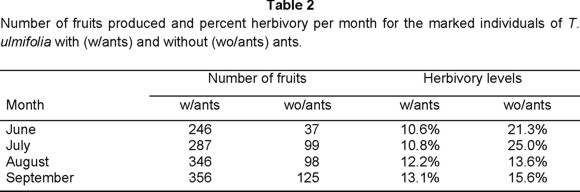
<body><![CDATA[<p align="justify"><font face="verdana" size="2"><b>Results</b></font></p>     <p align="justify"><font face="verdana" size="2">The number of fruits produced in the first year by the marked individuals of <i>Turnera ulmifolia</i> under different treatments are shown in <a href="#c1">Table 1</a>. Fruits were produced throughout the year, however production was not uniform. Plants whose branches were visited by <i>C. abdominalis</i>, the largest ant visiting <i>T. ulmifolia</i>, produced significantly more fruits, than plants visited by any other ant species or those without ants (Kruskal&#45;Wallis, <i>H</i>= 22.158, <i>df</i>= 4, <i>P</i>&lt; 0.001; SigmaStat, 1995). The plants where ants had been experimentally removed produced significantly more fruits, than plants with the ant species mix, <i>Camponotus planatus</i> or <i>Conomyrma</i> sp. (Student&#45;Newman&#45;Keuls, <i>P</i>&lt; 0.05; SigmaStat, 1995). We did not find significant differences in fruit production between the plants visited by <i>C. planatus</i>, <i>Conomyrma</i> sp., or the ant species mix (Student&#45;Newman&#45;Keuls, <i>P</i> &gt; 0.05; SigmaStat, 1995).</font></p>     <p align="center"><font face="verdana" size="2"><a name="c1"></a></font></p>     <p align="center"><font face="verdana" size="2"><img src="/img/revistas/azm/n81/a2c1.jpg"></font></p>     <p align="justify"><font face="verdana" size="2">The percent of leaf tissue removed by herbivores (herbivory level) and the number of fruits produced per month during the second year by the marked individuals of <i>T. ulmifolia</i> with and without ants, are shown in <a href="#c2">Table 2</a>.</font></p>     <p align="center"><font face="verdana" size="2"><a name="c2"></a></font></p>     <p align="center"><font face="verdana" size="2"><img src="/img/revistas/azm/n81/a2c2.jpg"></font></p>     <p align="justify"><font face="verdana" size="2">The percent of leaf tissue removed was significantly lower in plants with ants than in plants with ants excluded (Kruskal&#45;Wallis <i>H</i>= 37.272, <i>df</i>= 1, <i>P</i>&lt; 0.001; SigmaStat, 1995). Also, plants with ants produced significantly more fruits than plants with ants excluded (Kruskal&#45;Wallis <i>H</i>= 12.835, <i>df</i>= 1, <i>P</i>&lt; 0.001; SigmaStat, 1995). Although not statistically significant (<i>R<sup>2</sup></i>= 0.358, <i>F</i>= 3.342, <i>P</i>= 0.117; SigmaStat 1995), there is a tendency showing more fruits (<i>X</i>) when herbivory (<i>Y</i>) is lower (SigmaStat 1995).</font></p>     <p align="justify"><font face="Verdana" size="2">&nbsp;</font></p>     <p align="justify"><font face="verdana" size="2"><b>Discussion</b></font></p>     ]]></body>
<body><![CDATA[<p align="justify"><font face="verdana" size="2">Fruit production by <i>Turnera ulmifolia</i> was related to which ant species was present. Plants produced significantly more fruits when the larger ant species was present (<i>Camponotus abdominalis</i>), and significantly less fruits when the smaller ant species were present. In general, small ants have been associated to poor plant defense (Schemske 1982, Horvitz &amp; Schemske 1984, Oliveira <i>et al</i>. 1987, Koptur &amp; Lawton 1988, Rico&#45;Gray &amp; Thien 1989a). Interestingly, however, fruit production was higher in plants where ants had been excluded, than in plants with ants (except for plants with <i>C. abdominalis</i>). Ant exclusion allowed for the nectaries of these plants to be actively visited by wasps and bees. Most adult predatory or parasitoid wasps feed on floral or extrafloral nectar, thus the plants to which they are attracted are often their principal hunting grounds, creating the potential for a competitive interaction for nectaries between ants and wasps (Beattie 1985, Dom&iacute;nguez <i>et al</i>. 1989, Koptur 1992, Whitman 1994, Cardel <i>et al</i>. 1997). Since ants tending extrafloral nectaries may limit the presence of predatory and/or parasitoid wasps and flies (Koptur &amp; Lawton 1988, Pemberton &amp; Lee 1996), the interaction of these organisms with ants could change the level of defense and the overall outcome for the plant. Our observations indicate that wasps visited the plants of <i>T. ulmifolia</i> to hunt and to forage for nectar. However, nectar consumption by wasps was lower relative to consumption by ants, consequently there was an excess of nectar which runned down the surface of the branch, allowing for the colonization by fungus (<i>Capnodium</i> sp. Dothiliales: Ascomycotina). Finally, butterflies visually recognize potential egg predators, such as ants, and actively choose those sites that are better for egg&#45;laying, thus diminishing the risk of death of their offspring (Freitas &amp; Oliveira 1996). It is quite possible that the adults of <i>Euptoieta claudia</i> also recognize the wasps and thus only oviposit on <i>T. ulmifolia</i> plants without wasps.</font></p>     <p align="justify"><font face="verdana" size="2">In summary, our results show that plants associated with the larger ant species produced more fruits than plants associated with the smaller ant species, and that plants associated with ants were subject to lower levels of herbivory. Consequently, ant presence is not synonymous of plant protection, and the level of protection by ants will depend on the size of the worker ants in a guild of ant visitors. Moreover, when ants were excluded, wasps and bees increased their visits, exerting a higher level of protection (<i>i.e</i>. more fruits produced) than that offered by the smaller ant species. In general, ant&#45;plant associations are largely fortuitous, diffuse, and facultative, an selective benefits should accrue to plants that attract a broad array of ants (and other insects for that matter). The greater the diversity of ants, the greater the variety of plant enemies they are likely to remove, and the greater the probability that in any given habitat, season, or time of day, some ant species will forage on the plant.</font></p>     <p align="justify"><font face="Verdana" size="2">&nbsp;</font></p>     <p align="justify"><font face="verdana" size="2"><b>Acknowledgments</b></font></p>     <p align="justify"><font face="verdana" size="2">We thank M&oacute;nica Palacios&#45;Rios for caterpillar determination, Gloria Carri&oacute;n for fungus determination, Rachel Mata&#45;Essayang for performing the allelochemical survey, and Paulo S. Oliveira and two anonymous reviewers for comments and suggestions to the manuscript. Field work was supported by CONACYT No. 903579, 1259&#45;N9204, and 0137&#45;N9506 to VRG, and Instituto de Ecolog&iacute;a, A.C. No. 902&#45;16.</font></p>     <p align="justify"><font face="Verdana" size="2">&nbsp;</font></p>     <p align="justify"><font face="verdana" size="2"><b>Literature cited</b></font></p>     <!-- ref --><p align="justify"><font face="verdana" size="2"><b>&Aring;gren, J. &amp; D.W. Schemske</b>. 1993. The cost of defense against herbivores: an experimental study of trichome production in <i>Brassica rapa</i>. <i>Am. Nat</i>. 141:338&#45;350.    &nbsp;&nbsp;&nbsp;&nbsp;&nbsp;&nbsp;&nbsp;&nbsp;[&#160;<a href="javascript:void(0);" onclick="javascript: window.open('/scielo.php?script=sci_nlinks&ref=288476&pid=S0065-1737200000030000200001&lng=','','width=640,height=500,resizable=yes,scrollbars=1,menubar=yes,');">Links</a>&#160;]<!-- end-ref --></font></p>     <!-- ref --><p align="justify"><font face="verdana" size="2"><b>Baker, A.M. &amp; J.S. Shore</b>. 1995. Pollen competition in <i>Turnera ulmifolia</i> (Turneraceae). <i>Am. J. Bot</i>. 82:717&#45;725.    &nbsp;&nbsp;&nbsp;&nbsp;&nbsp;&nbsp;&nbsp;&nbsp;[&#160;<a href="javascript:void(0);" onclick="javascript: window.open('/scielo.php?script=sci_nlinks&ref=288478&pid=S0065-1737200000030000200002&lng=','','width=640,height=500,resizable=yes,scrollbars=1,menubar=yes,');">Links</a>&#160;]<!-- end-ref --></font></p>     <!-- ref --><p align="justify"><font face="verdana" size="2"><b>Barrett, S.C.H. &amp; J.S. Shore</b>. 1987. Variation and evolution of breeding systems in the <i>Turnera ulmifolia</i> L. complex (Turneraceae). <i>Evolution</i> 41:340&#45;354.    &nbsp;&nbsp;&nbsp;&nbsp;&nbsp;&nbsp;&nbsp;&nbsp;[&#160;<a href="javascript:void(0);" onclick="javascript: window.open('/scielo.php?script=sci_nlinks&ref=288480&pid=S0065-1737200000030000200003&lng=','','width=640,height=500,resizable=yes,scrollbars=1,menubar=yes,');">Links</a>&#160;]<!-- end-ref --></font></p>     <!-- ref --><p align="justify"><font face="verdana" size="2"><b>Barton, A.M</b>. 1986. Spatial variation in the effect of ants on an extrafloral nectary plant. <i>Ecology</i> 67:495&#45;504.    &nbsp;&nbsp;&nbsp;&nbsp;&nbsp;&nbsp;&nbsp;&nbsp;[&#160;<a href="javascript:void(0);" onclick="javascript: window.open('/scielo.php?script=sci_nlinks&ref=288482&pid=S0065-1737200000030000200004&lng=','','width=640,height=500,resizable=yes,scrollbars=1,menubar=yes,');">Links</a>&#160;]<!-- end-ref --></font></p>     <!-- ref --><p align="justify"><font face="verdana" size="2"><b>Beattie, A.J</b>. 1985. <i>The Evolutionary Ecology of Ant&#45;Plant Mutualisms</i>. Cambridge University Press, Cambridge. 182 pp.    &nbsp;&nbsp;&nbsp;&nbsp;&nbsp;&nbsp;&nbsp;&nbsp;[&#160;<a href="javascript:void(0);" onclick="javascript: window.open('/scielo.php?script=sci_nlinks&ref=288484&pid=S0065-1737200000030000200005&lng=','','width=640,height=500,resizable=yes,scrollbars=1,menubar=yes,');">Links</a>&#160;]<!-- end-ref --></font></p>     <!-- ref --><p align="justify"><font face="verdana" size="2"><b>Bentley, B.L</b>. 1976. Plants bearing extrafloral nectaries and the associated ant community: interhabitat differences in the reduction of herbivore damage. <i>Ecology</i> 57:815&#45;820.    &nbsp;&nbsp;&nbsp;&nbsp;&nbsp;&nbsp;&nbsp;&nbsp;[&#160;<a href="javascript:void(0);" onclick="javascript: window.open('/scielo.php?script=sci_nlinks&ref=288486&pid=S0065-1737200000030000200006&lng=','','width=640,height=500,resizable=yes,scrollbars=1,menubar=yes,');">Links</a>&#160;]<!-- end-ref --></font></p>     <!-- ref --><p align="justify"><font face="verdana" size="2"><b>Cardel, Y., V. Rico&#45;Gray, J.G. Garc&iacute;a&#45;Franco &amp; L.B. Thien</b>. 1997. Ecological status of <i>Beaucarnea gracilis</i>, an endemic species of the semiarid Tehuacan Valley, Mexico. <i>Cons. Biol</i>. 11:367&#45;374.    &nbsp;&nbsp;&nbsp;&nbsp;&nbsp;&nbsp;&nbsp;&nbsp;[&#160;<a href="javascript:void(0);" onclick="javascript: window.open('/scielo.php?script=sci_nlinks&ref=288488&pid=S0065-1737200000030000200007&lng=','','width=640,height=500,resizable=yes,scrollbars=1,menubar=yes,');">Links</a>&#160;]<!-- end-ref --></font></p>     <!-- ref --><p align="justify"><font face="verdana" size="2"><b>Casper, B.B. &amp; R.A. Niesenbaum</b>. 1993. Pollen versus resource limitation of seed production: a reconsideration. <i>Cur. Sci.</i> 65:210&#45;214.    &nbsp;&nbsp;&nbsp;&nbsp;&nbsp;&nbsp;&nbsp;&nbsp;[&#160;<a href="javascript:void(0);" onclick="javascript: window.open('/scielo.php?script=sci_nlinks&ref=288490&pid=S0065-1737200000030000200008&lng=','','width=640,height=500,resizable=yes,scrollbars=1,menubar=yes,');">Links</a>&#160;]<!-- end-ref --></font></p>     <!-- ref --><p align="justify"><font face="verdana" size="2"><b>Costa, F.M.C.B., A.T. Oliveira&#45;Filho &amp; P.S. Oliveira</b>. 1992. The role of extrafloral nectaries in <i>Qualea grandiflora</i> (Vochysiaceae) in limiting herbivory: an experiment of ant protection in cerrado vegetation. <i>Ecol</i>. <i>Entomol</i>. 17:363&#45;365.    &nbsp;&nbsp;&nbsp;&nbsp;&nbsp;&nbsp;&nbsp;&nbsp;[&#160;<a href="javascript:void(0);" onclick="javascript: window.open('/scielo.php?script=sci_nlinks&ref=288492&pid=S0065-1737200000030000200009&lng=','','width=640,height=500,resizable=yes,scrollbars=1,menubar=yes,');">Links</a>&#160;]<!-- end-ref --></font></p>     <!-- ref --><p align="justify"><font face="verdana" size="2"><b>Davidson, D</b>.<b>W. &amp; B.L. Fisher</b>. 1991. Symbiosis of ants with <i>Cecropia</i> as a function of light regime. <i>In</i>: C.R. Huxley &amp; D.F. Cutler (Eds.). <i>Ant&#45;Plant Interactions</i>. Oxford University Press, Oxford. pp. 289&#45;309.    &nbsp;&nbsp;&nbsp;&nbsp;&nbsp;&nbsp;&nbsp;&nbsp;[&#160;<a href="javascript:void(0);" onclick="javascript: window.open('/scielo.php?script=sci_nlinks&ref=288494&pid=S0065-1737200000030000200010&lng=','','width=640,height=500,resizable=yes,scrollbars=1,menubar=yes,');">Links</a>&#160;]<!-- end-ref --></font></p>     <!-- ref --><p align="justify"><font face="verdana" size="2"><b>Dom&iacute;nguez, C.A., R. Dirzo &amp; S.H. Bullock</b>. 1989. On the function of floral nectar in <i>Croton suberosus</i> (Euphorbiaceae). <i>Oikos</i> 56:109&#45;114.    &nbsp;&nbsp;&nbsp;&nbsp;&nbsp;&nbsp;&nbsp;&nbsp;[&#160;<a href="javascript:void(0);" onclick="javascript: window.open('/scielo.php?script=sci_nlinks&ref=288496&pid=S0065-1737200000030000200011&lng=','','width=640,height=500,resizable=yes,scrollbars=1,menubar=yes,');">Links</a>&#160;]<!-- end-ref --></font></p>     <!-- ref --><p align="justify"><font face="verdana" size="2"><b>Dubroeucq, D., D. Geissert, P. Moreno&#45;Casasola &amp; G. Millot</b>. 1992. Soil evolution and plant communities in coastal dunes near Veracruz, Mexico. <i>Cah. Orstom. S&eacute;r. P&eacute;dol</i>. 27:237&#45;250.    &nbsp;&nbsp;&nbsp;&nbsp;&nbsp;&nbsp;&nbsp;&nbsp;[&#160;<a href="javascript:void(0);" onclick="javascript: window.open('/scielo.php?script=sci_nlinks&ref=288498&pid=S0065-1737200000030000200012&lng=','','width=640,height=500,resizable=yes,scrollbars=1,menubar=yes,');">Links</a>&#160;]<!-- end-ref --></font></p>     <!-- ref --><p align="justify"><font face="verdana" size="2"><b>Elias, T.S</b>. 1983. Extrafloral nectaries: their structure and functions. <i>In</i>: B. Bentley &amp; T.S. Elias T.S. (Ed.). <i>The Biology of Nectaries</i>. Columbia University Press, New York. pp. 174&#45;203.    &nbsp;&nbsp;&nbsp;&nbsp;&nbsp;&nbsp;&nbsp;&nbsp;[&#160;<a href="javascript:void(0);" onclick="javascript: window.open('/scielo.php?script=sci_nlinks&ref=288500&pid=S0065-1737200000030000200013&lng=','','width=640,height=500,resizable=yes,scrollbars=1,menubar=yes,');">Links</a>&#160;]<!-- end-ref --></font></p>     <!-- ref --><p align="justify"><font face="verdana" size="2"><b>Elias, T.S., W.R. Rozich &amp; L. Newcombe</b>. 1975. The foliar and floral nectaries of <i>Turnera ulmifolia</i> L. <i>Am. J. Bot</i>. 62:570&#45;576.    &nbsp;&nbsp;&nbsp;&nbsp;&nbsp;&nbsp;&nbsp;&nbsp;[&#160;<a href="javascript:void(0);" onclick="javascript: window.open('/scielo.php?script=sci_nlinks&ref=288502&pid=S0065-1737200000030000200014&lng=','','width=640,height=500,resizable=yes,scrollbars=1,menubar=yes,');">Links</a>&#160;]<!-- end-ref --></font></p>     <!-- ref --><p align="justify"><font face="verdana" size="2"><b>Freitas, A.V.L. &amp; P.S. Oliveira</b>. 1996. Ants as selective agents on herbivore biology: effects on the behaviour of a non&#45;myrmecophilous butterfly. <i>J. An. Ecol</i>. 65:205&#45;210.    &nbsp;&nbsp;&nbsp;&nbsp;&nbsp;&nbsp;&nbsp;&nbsp;[&#160;<a href="javascript:void(0);" onclick="javascript: window.open('/scielo.php?script=sci_nlinks&ref=288504&pid=S0065-1737200000030000200015&lng=','','width=640,height=500,resizable=yes,scrollbars=1,menubar=yes,');">Links</a>&#160;]<!-- end-ref --></font></p>     <!-- ref --><p align="justify"><font face="verdana" size="2"><b>Gama, L., H. Narave &amp; N.P. Moreno</b>. 1985. Turneraceae. <i>In</i>: A. G&oacute;mez&#45;Pompa &amp; N. P. Moreno (Eds.). <i>Flora de Veracruz</i> (fasc. 47). INIREB, M&eacute;xico.    &nbsp;&nbsp;&nbsp;&nbsp;&nbsp;&nbsp;&nbsp;&nbsp;[&#160;<a href="javascript:void(0);" onclick="javascript: window.open('/scielo.php?script=sci_nlinks&ref=288506&pid=S0065-1737200000030000200016&lng=','','width=640,height=500,resizable=yes,scrollbars=1,menubar=yes,');">Links</a>&#160;]<!-- end-ref --></font></p>     <!-- ref --><p align="justify"><font face="verdana" size="2"><b>Harper, J.L</b>. 1977. <i>Population Biology of Plants</i>. Academic Press, New York. 892 pp.    &nbsp;&nbsp;&nbsp;&nbsp;&nbsp;&nbsp;&nbsp;&nbsp;[&#160;<a href="javascript:void(0);" onclick="javascript: window.open('/scielo.php?script=sci_nlinks&ref=288508&pid=S0065-1737200000030000200017&lng=','','width=640,height=500,resizable=yes,scrollbars=1,menubar=yes,');">Links</a>&#160;]<!-- end-ref --></font></p>     <!-- ref --><p align="justify"><font face="verdana" size="2"><b>Herrera, C.M</b>. 1995. Microclimate and individual variation in pollinators: flowering plants are more than their flowers. <i>Ecology</i> 76:1516&#45;1524.    &nbsp;&nbsp;&nbsp;&nbsp;&nbsp;&nbsp;&nbsp;&nbsp;[&#160;<a href="javascript:void(0);" onclick="javascript: window.open('/scielo.php?script=sci_nlinks&ref=288510&pid=S0065-1737200000030000200018&lng=','','width=640,height=500,resizable=yes,scrollbars=1,menubar=yes,');">Links</a>&#160;]<!-- end-ref --></font></p>     <!-- ref --><p align="justify"><font face="verdana" size="2"><b>Horvitz, C.C. &amp; D.W. Schemske</b>. 1984. Effects of ants and an ant&#45;tended herbivore on seed production of a neotropical herb. <i>Ecology</i> 65: 1369&#45;1378.    &nbsp;&nbsp;&nbsp;&nbsp;&nbsp;&nbsp;&nbsp;&nbsp;[&#160;<a href="javascript:void(0);" onclick="javascript: window.open('/scielo.php?script=sci_nlinks&ref=288512&pid=S0065-1737200000030000200019&lng=','','width=640,height=500,resizable=yes,scrollbars=1,menubar=yes,');">Links</a>&#160;]<!-- end-ref --></font></p>     <!-- ref --><p align="justify"><font face="verdana" size="2"><b>Keeler, K.H</b>. 1989. Ant&#45;plant interactions. <i>In</i>: W.G. Abrahamson (Ed.). <i>Plant&#45;Animal Interactions</i>. McGraw&#45;Hill, New York. pp 207&#45;242.    &nbsp;&nbsp;&nbsp;&nbsp;&nbsp;&nbsp;&nbsp;&nbsp;[&#160;<a href="javascript:void(0);" onclick="javascript: window.open('/scielo.php?script=sci_nlinks&ref=288514&pid=S0065-1737200000030000200020&lng=','','width=640,height=500,resizable=yes,scrollbars=1,menubar=yes,');">Links</a>&#160;]<!-- end-ref --></font></p>     <!-- ref --><p align="justify"><font face="verdana" size="2"><b>Koptur, S</b>. 1984. Experimental evidence for defense of <i>Inga</i> saplings (Mimosoideae) by ants. <i>Ecology</i> 65:1787&#45;1793.    &nbsp;&nbsp;&nbsp;&nbsp;&nbsp;&nbsp;&nbsp;&nbsp;[&#160;<a href="javascript:void(0);" onclick="javascript: window.open('/scielo.php?script=sci_nlinks&ref=288516&pid=S0065-1737200000030000200021&lng=','','width=640,height=500,resizable=yes,scrollbars=1,menubar=yes,');">Links</a>&#160;]<!-- end-ref --></font></p>     <!-- ref --><p align="justify"><font face="verdana" size="2"><b>&#150;&#150;&#150;&#150;&#150;&#150;&#150;&#150;&#150;&#150;</b>. 1992. Extrafloral nectary&#45;mediated interactions between insects and plants. <i>In</i>: E. Bernays (Ed.). <i>Insect&#45;Plant Interactions</i> (Volume IV). CRC Press, Boca Raton. pp. 81&#45;129.    &nbsp;&nbsp;&nbsp;&nbsp;&nbsp;&nbsp;&nbsp;&nbsp;[&#160;<a href="javascript:void(0);" onclick="javascript: window.open('/scielo.php?script=sci_nlinks&ref=288518&pid=S0065-1737200000030000200022&lng=','','width=640,height=500,resizable=yes,scrollbars=1,menubar=yes,');">Links</a>&#160;]<!-- end-ref --></font></p>     <!-- ref --><p align="justify"><font face="verdana" size="2"><b>Koptur, S. &amp; J.H. Lawton</b>. 1988. Interactions among vetches bearing extrafloral nectaries, their biotic protective agents, and herbivores. <i>Ecology</i> 69:278&#45;283.    &nbsp;&nbsp;&nbsp;&nbsp;&nbsp;&nbsp;&nbsp;&nbsp;[&#160;<a href="javascript:void(0);" onclick="javascript: window.open('/scielo.php?script=sci_nlinks&ref=288520&pid=S0065-1737200000030000200023&lng=','','width=640,height=500,resizable=yes,scrollbars=1,menubar=yes,');">Links</a>&#160;]<!-- end-ref --></font></p>     <!-- ref --><p align="justify"><font face="verdana" size="2"><b>Koptur, S., V. Rico&#45;Gray &amp; M. Palacios&#45;Rios</b>. 1998. Ant protection of the nectaried fern <i>Polypodium plebeium</i> in central M&eacute;xico. <i>Am. J. Bot</i>. 85:736&#45;739.    &nbsp;&nbsp;&nbsp;&nbsp;&nbsp;&nbsp;&nbsp;&nbsp;[&#160;<a href="javascript:void(0);" onclick="javascript: window.open('/scielo.php?script=sci_nlinks&ref=288522&pid=S0065-1737200000030000200024&lng=','','width=640,height=500,resizable=yes,scrollbars=1,menubar=yes,');">Links</a>&#160;]<!-- end-ref --></font></p>     <!-- ref --><p align="justify"><font face="verdana" size="2"><b>McKey, D</b>. 1989. Interactions between ants and leguminous plants. <i>In</i>: C.H. Stirton &amp; J.L. Zarucchi (Eds.). <i>Advances in Legume Biology</i>. Monographs in Systematic Botany, 29. Missouri Botanical Garden, St. Louis, Missouri. pp. 673&#45;718.    &nbsp;&nbsp;&nbsp;&nbsp;&nbsp;&nbsp;&nbsp;&nbsp;[&#160;<a href="javascript:void(0);" onclick="javascript: window.open('/scielo.php?script=sci_nlinks&ref=288524&pid=S0065-1737200000030000200025&lng=','','width=640,height=500,resizable=yes,scrollbars=1,menubar=yes,');">Links</a>&#160;]<!-- end-ref --></font></p>     <!-- ref --><p align="justify"><font face="verdana" size="2"><b>Moreno&#45;Casasola, P., E. van der Maarel, S. Castillo, M.G. Huesca &amp; I. Pisanty</b>. 1982. Ecologia de la vegetacion de dunas costeras; estructuras y composicion en el Morro de la Mancha, Ver. <i>Biotica</i> 7:491&#45;526.    &nbsp;&nbsp;&nbsp;&nbsp;&nbsp;&nbsp;&nbsp;&nbsp;[&#160;<a href="javascript:void(0);" onclick="javascript: window.open('/scielo.php?script=sci_nlinks&ref=288526&pid=S0065-1737200000030000200026&lng=','','width=640,height=500,resizable=yes,scrollbars=1,menubar=yes,');">Links</a>&#160;]<!-- end-ref --></font></p>     <!-- ref --><p align="justify"><font face="verdana" size="2"><b>Niesenbaum, R.A</b>. 1993. Light or pollen&#45;seasonal limitations on female reproductive success in the understory shrub <i>Lindera benzoin</i>. <i>J. Ecol</i>. 81:315&#45;323.    &nbsp;&nbsp;&nbsp;&nbsp;&nbsp;&nbsp;&nbsp;&nbsp;[&#160;<a href="javascript:void(0);" onclick="javascript: window.open('/scielo.php?script=sci_nlinks&ref=288528&pid=S0065-1737200000030000200027&lng=','','width=640,height=500,resizable=yes,scrollbars=1,menubar=yes,');">Links</a>&#160;]<!-- end-ref --></font></p>     <!-- ref --><p align="justify"><font face="verdana" size="2"><b>Oliveira, P.S., A.F. da Silva &amp; A.B. Martins</b>. 1987. Ant foraging on extrafloral nectaries of <i>Qualea grandiflora</i> (Vochysiaceae) in cerrado vegetation: ants as potential antiherbivore agents. <i>Oecologia</i> 74:228&#45;230.    &nbsp;&nbsp;&nbsp;&nbsp;&nbsp;&nbsp;&nbsp;&nbsp;[&#160;<a href="javascript:void(0);" onclick="javascript: window.open('/scielo.php?script=sci_nlinks&ref=288530&pid=S0065-1737200000030000200028&lng=','','width=640,height=500,resizable=yes,scrollbars=1,menubar=yes,');">Links</a>&#160;]<!-- end-ref --></font></p>     <!-- ref --><p align="justify"><font face="verdana" size="2"><b>Oliveira, P.S., V. Rico&#45;Gray, C. D&iacute;az&#45;Castelazo &amp; C. Castillo&#45;Guevara</b>. 1999. Interaction between ants, extrafloral nectaries and insect herbivores in Neotropical coastal sand dunes: herbivore deterrence by visiting ants increases fruit set in <i>Opuntia stricta</i> (Cactaceae). <i>Fun. Ecol.</i> 13:623&#45;631.    &nbsp;&nbsp;&nbsp;&nbsp;&nbsp;&nbsp;&nbsp;&nbsp;[&#160;<a href="javascript:void(0);" onclick="javascript: window.open('/scielo.php?script=sci_nlinks&ref=288532&pid=S0065-1737200000030000200029&lng=','','width=640,height=500,resizable=yes,scrollbars=1,menubar=yes,');">Links</a>&#160;]<!-- end-ref --></font></p>     <!-- ref --><p align="justify"><font face="verdana" size="2"><b>Pemberton, R.W. &amp; J.H. Lee</b>. 1996. The influence of extrafloral nectaries on parasitism of an insect herbivore. <i>Am. J. Bot</i>. 83:1187&#45;1194.    &nbsp;&nbsp;&nbsp;&nbsp;&nbsp;&nbsp;&nbsp;&nbsp;[&#160;<a href="javascript:void(0);" onclick="javascript: window.open('/scielo.php?script=sci_nlinks&ref=288534&pid=S0065-1737200000030000200030&lng=','','width=640,height=500,resizable=yes,scrollbars=1,menubar=yes,');">Links</a>&#160;]<!-- end-ref --></font></p>     <!-- ref --><p align="justify"><font face="verdana" size="2"><b>Rico&#45;Gray, V</b>. 1993. Use of plant&#45;derived food resources by ants in the dry tropical lowland of coastal Veracruz, Mexico. <i>Biotropica</i> 25:301&#45;315.    &nbsp;&nbsp;&nbsp;&nbsp;&nbsp;&nbsp;&nbsp;&nbsp;[&#160;<a href="javascript:void(0);" onclick="javascript: window.open('/scielo.php?script=sci_nlinks&ref=288536&pid=S0065-1737200000030000200031&lng=','','width=640,height=500,resizable=yes,scrollbars=1,menubar=yes,');">Links</a>&#160;]<!-- end-ref --></font></p>     <!-- ref --><p align="justify"><font face="verdana" size="2"><b>Rico&#45;Gray, V. &amp; G. Castro</b>. 1996. Effect of an ant&#45;aphid&#45;plant interaction on the reproductive fitness of <i>Paullinia fuscescens</i> (Sapindaceae). <i>Southwest. Nat</i>. 41:434&#45;440.    &nbsp;&nbsp;&nbsp;&nbsp;&nbsp;&nbsp;&nbsp;&nbsp;[&#160;<a href="javascript:void(0);" onclick="javascript: window.open('/scielo.php?script=sci_nlinks&ref=288538&pid=S0065-1737200000030000200032&lng=','','width=640,height=500,resizable=yes,scrollbars=1,menubar=yes,');">Links</a>&#160;]<!-- end-ref --></font></p>     <!-- ref --><p align="justify"><font face="verdana" size="2"><b>Rico&#45;Gray, V. &amp; L. da S.L. Sternberg</b>. 1991. Carbon isotopic evidence for seasonal change in feeding habits of <i>Camponotus planatus</i> Roger (Formicidae) in Yucatan, Mexico. <i>Biotropica</i> 23:93&#45;95.    &nbsp;&nbsp;&nbsp;&nbsp;&nbsp;&nbsp;&nbsp;&nbsp;[&#160;<a href="javascript:void(0);" onclick="javascript: window.open('/scielo.php?script=sci_nlinks&ref=288540&pid=S0065-1737200000030000200033&lng=','','width=640,height=500,resizable=yes,scrollbars=1,menubar=yes,');">Links</a>&#160;]<!-- end-ref --></font></p>     <!-- ref --><p align="justify"><font face="verdana" size="2"><b>Rico&#45;Gray, V. &amp; L.B. Thien</b>. 1989a. Effect of different ant species on the reproductive fitness of <i>Schomburgkia tibicinis</i> (Orchidaceae). <i>Oecologia</i> 81:487&#45;489.    &nbsp;&nbsp;&nbsp;&nbsp;&nbsp;&nbsp;&nbsp;&nbsp;[&#160;<a href="javascript:void(0);" onclick="javascript: window.open('/scielo.php?script=sci_nlinks&ref=288542&pid=S0065-1737200000030000200034&lng=','','width=640,height=500,resizable=yes,scrollbars=1,menubar=yes,');">Links</a>&#160;]<!-- end-ref --></font></p>     <!-- ref --><p align="justify"><font face="verdana" size="2"><b>&#150;&#150;&#150;&#150;&#150;&#150;&#150;&#150;&#150;&#150;</b>. 1989b. Ant&#45;mealybug interaction decreases reproductive fitness of <i>Schomburgkia tibicinis</i> Bateman (Orchidaceae) in Mexico. <i>J. Trop. Ecol</i>. 5:109&#45;112.    &nbsp;&nbsp;&nbsp;&nbsp;&nbsp;&nbsp;&nbsp;&nbsp;[&#160;<a href="javascript:void(0);" onclick="javascript: window.open('/scielo.php?script=sci_nlinks&ref=288544&pid=S0065-1737200000030000200035&lng=','','width=640,height=500,resizable=yes,scrollbars=1,menubar=yes,');">Links</a>&#160;]<!-- end-ref --></font></p>     <!-- ref --><p align="justify"><font face="verdana" size="2"><b>Rico&#45;Gray, V., J.G. Garc&iacute;a&#45;Franco, M. Palacios&#45;Rios, C. D&iacute;az&#45;Castelazo, V. Parra&#45;Tabla &amp; J.A. Navarro</b>. 1998. Geographical and seasonal variation in the richness of ant&#45;plant interactions in Mexico. <i>Biotropica</i> 30:190&#45;200.    &nbsp;&nbsp;&nbsp;&nbsp;&nbsp;&nbsp;&nbsp;&nbsp;[&#160;<a href="javascript:void(0);" onclick="javascript: window.open('/scielo.php?script=sci_nlinks&ref=288546&pid=S0065-1737200000030000200036&lng=','','width=640,height=500,resizable=yes,scrollbars=1,menubar=yes,');">Links</a>&#160;]<!-- end-ref --></font></p>     <!-- ref --><p align="justify"><font face="verdana" size="2"><b>Schemske, D.W</b>. 1982. Ecological correlates of a neotropical mutualism: ant assemblages at <i>Costus</i> extrafloral nectaries. <i>Ecology</i> 63:932&#45;941.    &nbsp;&nbsp;&nbsp;&nbsp;&nbsp;&nbsp;&nbsp;&nbsp;[&#160;<a href="javascript:void(0);" onclick="javascript: window.open('/scielo.php?script=sci_nlinks&ref=288548&pid=S0065-1737200000030000200037&lng=','','width=640,height=500,resizable=yes,scrollbars=1,menubar=yes,');">Links</a>&#160;]<!-- end-ref --></font></p>     <!-- ref --><p align="justify"><font face="verdana" size="2"><b>SigmaStat</b>. 1995. <i>SigmaStat, statistical software v. 2</i>. Jandel Scientific Software, San Rafael, California.    &nbsp;&nbsp;&nbsp;&nbsp;&nbsp;&nbsp;&nbsp;&nbsp;[&#160;<a href="javascript:void(0);" onclick="javascript: window.open('/scielo.php?script=sci_nlinks&ref=288550&pid=S0065-1737200000030000200038&lng=','','width=640,height=500,resizable=yes,scrollbars=1,menubar=yes,');">Links</a>&#160;]<!-- end-ref --></font></p>     <!-- ref --><p align="justify"><font face="verdana" size="2"><b>Steward, J.L. &amp; K.H. Keeler</b>. 1988. Are there trade&#45;offs among antiherbivore defenses in <i>Ipomoea</i> (Convolvulaceae)? <i>Oikos</i> 53:79&#45;86.    &nbsp;&nbsp;&nbsp;&nbsp;&nbsp;&nbsp;&nbsp;&nbsp;[&#160;<a href="javascript:void(0);" onclick="javascript: window.open('/scielo.php?script=sci_nlinks&ref=288552&pid=S0065-1737200000030000200039&lng=','','width=640,height=500,resizable=yes,scrollbars=1,menubar=yes,');">Links</a>&#160;]<!-- end-ref --></font></p>     <!-- ref --><p align="justify"><font face="verdana" size="2"><b>Torres&#45;Hern&aacute;ndez, L</b>. 1995. Efecto de diferentes especies de hormiga sobre el exito reproductivo de <i>Turnera ulmifolia</i> L. (Turneraceae). Unpublished M.Sc. thesis, Universidad Nacional Autonoma de Mexico, M&eacute;xico.    &nbsp;&nbsp;&nbsp;&nbsp;&nbsp;&nbsp;&nbsp;&nbsp;[&#160;<a href="javascript:void(0);" onclick="javascript: window.open('/scielo.php?script=sci_nlinks&ref=288554&pid=S0065-1737200000030000200040&lng=','','width=640,height=500,resizable=yes,scrollbars=1,menubar=yes,');">Links</a>&#160;]<!-- end-ref --></font></p>     <!-- ref --><p align="justify"><font face="verdana" size="2"><b>Whitman, D</b>. 1994. Plant bodygards: mutualistic interactions between plants and the third trophic level. <i>In</i>: T.N. Ananthakrishnan (Ed.). <i>Functional Dynamics of Phytophagous Insects</i>. Oxford &amp; IBH Publishing Co. PVT. Ltd., New Delhi, India. Pp. 207&#45;248.    &nbsp;&nbsp;&nbsp;&nbsp;&nbsp;&nbsp;&nbsp;&nbsp;[&#160;<a href="javascript:void(0);" onclick="javascript: window.open('/scielo.php?script=sci_nlinks&ref=288556&pid=S0065-1737200000030000200041&lng=','','width=640,height=500,resizable=yes,scrollbars=1,menubar=yes,');">Links</a>&#160;]<!-- end-ref --></font></p>      ]]></body><back>
<ref-list>
<ref id="B1">
<nlm-citation citation-type="journal">
<person-group person-group-type="author">
<name>
<surname><![CDATA[Ågren]]></surname>
<given-names><![CDATA[J.]]></given-names>
</name>
<name>
<surname><![CDATA[Schemske]]></surname>
<given-names><![CDATA[D.W.]]></given-names>
</name>
</person-group>
<article-title xml:lang="en"><![CDATA[The cost of defense against herbivores: an experimental study of trichome production in Brassica rapa]]></article-title>
<source><![CDATA[Am. Nat.]]></source>
<year>1993</year>
<volume>141</volume>
<page-range>338-350</page-range></nlm-citation>
</ref>
<ref id="B2">
<nlm-citation citation-type="journal">
<person-group person-group-type="author">
<name>
<surname><![CDATA[Baker]]></surname>
<given-names><![CDATA[A.M.]]></given-names>
</name>
<name>
<surname><![CDATA[Shore]]></surname>
<given-names><![CDATA[J.S.]]></given-names>
</name>
</person-group>
<article-title xml:lang="en"><![CDATA[Pollen competition in Turnera ulmifolia (Turneraceae)]]></article-title>
<source><![CDATA[Am. J. Bot.]]></source>
<year>1995</year>
<volume>82</volume>
<page-range>717-725</page-range></nlm-citation>
</ref>
<ref id="B3">
<nlm-citation citation-type="journal">
<person-group person-group-type="author">
<name>
<surname><![CDATA[Barrett]]></surname>
<given-names><![CDATA[S.C.H.]]></given-names>
</name>
<name>
<surname><![CDATA[Shore]]></surname>
<given-names><![CDATA[J.S.]]></given-names>
</name>
</person-group>
<article-title xml:lang="en"><![CDATA[Variation and evolution of breeding systems in the Turnera ulmifolia L. complex (Turneraceae)]]></article-title>
<source><![CDATA[Evolution]]></source>
<year>1987</year>
<volume>41</volume>
<page-range>340-354</page-range></nlm-citation>
</ref>
<ref id="B4">
<nlm-citation citation-type="journal">
<person-group person-group-type="author">
<name>
<surname><![CDATA[Barton]]></surname>
<given-names><![CDATA[A.M.]]></given-names>
</name>
</person-group>
<article-title xml:lang="en"><![CDATA[Spatial variation in the effect of ants on an extrafloral nectary plant]]></article-title>
<source><![CDATA[Ecology]]></source>
<year>1986</year>
<volume>67</volume>
<page-range>495-504</page-range></nlm-citation>
</ref>
<ref id="B5">
<nlm-citation citation-type="book">
<person-group person-group-type="author">
<name>
<surname><![CDATA[Beattie]]></surname>
<given-names><![CDATA[A.J.]]></given-names>
</name>
</person-group>
<source><![CDATA[The Evolutionary Ecology of Ant-Plant Mutualisms]]></source>
<year>1985</year>
<page-range>182</page-range><publisher-loc><![CDATA[Cambridge ]]></publisher-loc>
<publisher-name><![CDATA[Cambridge University Press]]></publisher-name>
</nlm-citation>
</ref>
<ref id="B6">
<nlm-citation citation-type="journal">
<person-group person-group-type="author">
<name>
<surname><![CDATA[Bentley]]></surname>
<given-names><![CDATA[B.L.]]></given-names>
</name>
</person-group>
<article-title xml:lang="en"><![CDATA[Plants bearing extrafloral nectaries and the associated ant community: interhabitat differences in the reduction of herbivore damage]]></article-title>
<source><![CDATA[Ecology]]></source>
<year>1976</year>
<volume>57</volume>
<page-range>815-820</page-range></nlm-citation>
</ref>
<ref id="B7">
<nlm-citation citation-type="journal">
<person-group person-group-type="author">
<name>
<surname><![CDATA[Cardel]]></surname>
<given-names><![CDATA[Y.]]></given-names>
</name>
<name>
<surname><![CDATA[Rico-Gray]]></surname>
<given-names><![CDATA[V.]]></given-names>
</name>
<name>
<surname><![CDATA[García-Franco]]></surname>
<given-names><![CDATA[J.G.]]></given-names>
</name>
<name>
<surname><![CDATA[Thien]]></surname>
<given-names><![CDATA[L.B.]]></given-names>
</name>
</person-group>
<article-title xml:lang="en"><![CDATA[Ecological status of Beaucarnea gracilis, an endemic species of the semiarid Tehuacan Valley, Mexico]]></article-title>
<source><![CDATA[Cons. Biol.]]></source>
<year>1997</year>
<volume>11</volume>
<page-range>367-374</page-range></nlm-citation>
</ref>
<ref id="B8">
<nlm-citation citation-type="journal">
<person-group person-group-type="author">
<name>
<surname><![CDATA[Casper]]></surname>
<given-names><![CDATA[B.B.]]></given-names>
</name>
<name>
<surname><![CDATA[Niesenbaum]]></surname>
<given-names><![CDATA[R.A.]]></given-names>
</name>
</person-group>
<article-title xml:lang="en"><![CDATA[Pollen versus resource limitation of seed production: a reconsideration]]></article-title>
<source><![CDATA[Cur. Sci.]]></source>
<year>1993</year>
<volume>65</volume>
<page-range>210-214</page-range></nlm-citation>
</ref>
<ref id="B9">
<nlm-citation citation-type="journal">
<person-group person-group-type="author">
<name>
<surname><![CDATA[Costa]]></surname>
<given-names><![CDATA[F.M.C.B.]]></given-names>
</name>
<name>
<surname><![CDATA[Oliveira-Filho]]></surname>
<given-names><![CDATA[A.T.]]></given-names>
</name>
<name>
<surname><![CDATA[Oliveira]]></surname>
<given-names><![CDATA[P.S.]]></given-names>
</name>
</person-group>
<article-title xml:lang="en"><![CDATA[The role of extrafloral nectaries in Qualea grandiflora (Vochysiaceae) in limiting herbivory: an experiment of ant protection in cerrado vegetation]]></article-title>
<source><![CDATA[Ecol. Entomol.]]></source>
<year>1992</year>
<volume>17</volume>
<page-range>363-365</page-range></nlm-citation>
</ref>
<ref id="B10">
<nlm-citation citation-type="book">
<person-group person-group-type="author">
<name>
<surname><![CDATA[Davidson]]></surname>
<given-names><![CDATA[D.W.]]></given-names>
</name>
<name>
<surname><![CDATA[Fisher]]></surname>
<given-names><![CDATA[B.L.]]></given-names>
</name>
</person-group>
<article-title xml:lang="en"><![CDATA[Symbiosis of ants with Cecropia as a function of light regime]]></article-title>
<person-group person-group-type="editor">
<name>
<surname><![CDATA[Huxley]]></surname>
<given-names><![CDATA[C.R.]]></given-names>
</name>
<name>
<surname><![CDATA[Cutler]]></surname>
<given-names><![CDATA[D.F.]]></given-names>
</name>
</person-group>
<source><![CDATA[Ant-Plant Interactions]]></source>
<year>1991</year>
<page-range>289-309</page-range><publisher-loc><![CDATA[Oxford ]]></publisher-loc>
<publisher-name><![CDATA[Oxford University Press]]></publisher-name>
</nlm-citation>
</ref>
<ref id="B11">
<nlm-citation citation-type="journal">
<person-group person-group-type="author">
<name>
<surname><![CDATA[Domínguez]]></surname>
<given-names><![CDATA[C.A.]]></given-names>
</name>
<name>
<surname><![CDATA[Dirzo]]></surname>
<given-names><![CDATA[R.]]></given-names>
</name>
<name>
<surname><![CDATA[Bullock]]></surname>
<given-names><![CDATA[S.H.]]></given-names>
</name>
</person-group>
<article-title xml:lang="en"><![CDATA[On the function of floral nectar in Croton suberosus (Euphorbiaceae)]]></article-title>
<source><![CDATA[Oikos]]></source>
<year>1989</year>
<volume>56</volume>
<page-range>109-114</page-range></nlm-citation>
</ref>
<ref id="B12">
<nlm-citation citation-type="journal">
<person-group person-group-type="author">
<name>
<surname><![CDATA[Dubroeucq]]></surname>
<given-names><![CDATA[D.]]></given-names>
</name>
<name>
<surname><![CDATA[Geissert]]></surname>
<given-names><![CDATA[D.]]></given-names>
</name>
<name>
<surname><![CDATA[Moreno-Casasola]]></surname>
<given-names><![CDATA[P.]]></given-names>
</name>
<name>
<surname><![CDATA[Millot]]></surname>
<given-names><![CDATA[G.]]></given-names>
</name>
</person-group>
<article-title xml:lang="en"><![CDATA[Soil evolution and plant communities in coastal dunes near Veracruz, Mexico]]></article-title>
<source><![CDATA[Cah. Orstom. Sér. Pédol.]]></source>
<year>1992</year>
<volume>27</volume>
<page-range>237-250</page-range></nlm-citation>
</ref>
<ref id="B13">
<nlm-citation citation-type="book">
<person-group person-group-type="author">
<name>
<surname><![CDATA[Elias]]></surname>
<given-names><![CDATA[T.S.]]></given-names>
</name>
</person-group>
<article-title xml:lang="en"><![CDATA[Extrafloral nectaries: their structure and functions]]></article-title>
<person-group person-group-type="editor">
<name>
<surname><![CDATA[Bentley]]></surname>
<given-names><![CDATA[B.]]></given-names>
</name>
<name>
<surname><![CDATA[Elias]]></surname>
<given-names><![CDATA[T.S.]]></given-names>
</name>
</person-group>
<source><![CDATA[The Biology of Nectaries]]></source>
<year>1983</year>
<page-range>174-203</page-range><publisher-loc><![CDATA[New York ]]></publisher-loc>
<publisher-name><![CDATA[Columbia University Press]]></publisher-name>
</nlm-citation>
</ref>
<ref id="B14">
<nlm-citation citation-type="journal">
<person-group person-group-type="author">
<name>
<surname><![CDATA[Elias]]></surname>
<given-names><![CDATA[T.S.]]></given-names>
</name>
<name>
<surname><![CDATA[Rozich]]></surname>
<given-names><![CDATA[W.R.]]></given-names>
</name>
<name>
<surname><![CDATA[Newcombe]]></surname>
<given-names><![CDATA[L.]]></given-names>
</name>
</person-group>
<article-title xml:lang="en"><![CDATA[The foliar and floral nectaries of Turnera ulmifolia L]]></article-title>
<source><![CDATA[Am. J. Bot.]]></source>
<year>1975</year>
<volume>62</volume>
<page-range>570-576</page-range></nlm-citation>
</ref>
<ref id="B15">
<nlm-citation citation-type="journal">
<person-group person-group-type="author">
<name>
<surname><![CDATA[Freitas]]></surname>
<given-names><![CDATA[A.V.L.]]></given-names>
</name>
<name>
<surname><![CDATA[Oliveira]]></surname>
<given-names><![CDATA[P.S.]]></given-names>
</name>
</person-group>
<article-title xml:lang="en"><![CDATA[Ants as selective agents on herbivore biology: effects on the behaviour of a non-myrmecophilous butterfly]]></article-title>
<source><![CDATA[J. An. Ecol.]]></source>
<year>1996</year>
<volume>65</volume>
<page-range>205-210</page-range></nlm-citation>
</ref>
<ref id="B16">
<nlm-citation citation-type="book">
<person-group person-group-type="author">
<name>
<surname><![CDATA[Gama]]></surname>
<given-names><![CDATA[L.]]></given-names>
</name>
<name>
<surname><![CDATA[Narave]]></surname>
<given-names><![CDATA[H.]]></given-names>
</name>
<name>
<surname><![CDATA[Moreno]]></surname>
<given-names><![CDATA[N.P.]]></given-names>
</name>
</person-group>
<article-title xml:lang="es"><![CDATA[Turneraceae]]></article-title>
<person-group person-group-type="editor">
<name>
<surname><![CDATA[Gómez-Pompa]]></surname>
<given-names><![CDATA[A.]]></given-names>
</name>
<name>
<surname><![CDATA[Moreno]]></surname>
<given-names><![CDATA[N. P.]]></given-names>
</name>
</person-group>
<source><![CDATA[Flora de Veracruz (fasc. 47)]]></source>
<year>1985</year>
<publisher-loc><![CDATA[México ]]></publisher-loc>
<publisher-name><![CDATA[INIREB]]></publisher-name>
</nlm-citation>
</ref>
<ref id="B17">
<nlm-citation citation-type="book">
<person-group person-group-type="author">
<name>
<surname><![CDATA[Harper]]></surname>
<given-names><![CDATA[J.L.]]></given-names>
</name>
</person-group>
<source><![CDATA[Population Biology of Plants]]></source>
<year>1977</year>
<page-range>892</page-range><publisher-loc><![CDATA[New York ]]></publisher-loc>
<publisher-name><![CDATA[Academic Press]]></publisher-name>
</nlm-citation>
</ref>
<ref id="B18">
<nlm-citation citation-type="journal">
<person-group person-group-type="author">
<name>
<surname><![CDATA[Herrera]]></surname>
<given-names><![CDATA[C.M.]]></given-names>
</name>
</person-group>
<article-title xml:lang="en"><![CDATA[Microclimate and individual variation in pollinators: flowering plants are more than their flowers]]></article-title>
<source><![CDATA[Ecology]]></source>
<year>1995</year>
<volume>76</volume>
<page-range>1516-1524</page-range></nlm-citation>
</ref>
<ref id="B19">
<nlm-citation citation-type="journal">
<person-group person-group-type="author">
<name>
<surname><![CDATA[Horvitz]]></surname>
<given-names><![CDATA[C.C.]]></given-names>
</name>
<name>
<surname><![CDATA[Schemske]]></surname>
<given-names><![CDATA[D.W.]]></given-names>
</name>
</person-group>
<article-title xml:lang="en"><![CDATA[Effects of ants and an ant-tended herbivore on seed production of a neotropical herb]]></article-title>
<source><![CDATA[Ecology]]></source>
<year>1984</year>
<volume>65</volume>
<page-range>1369-1378</page-range></nlm-citation>
</ref>
<ref id="B20">
<nlm-citation citation-type="book">
<person-group person-group-type="author">
<name>
<surname><![CDATA[Keeler]]></surname>
<given-names><![CDATA[K.H.]]></given-names>
</name>
</person-group>
<article-title xml:lang="en"><![CDATA[Ant-plant interactions]]></article-title>
<person-group person-group-type="editor">
<name>
<surname><![CDATA[Abrahamson]]></surname>
<given-names><![CDATA[W.G.]]></given-names>
</name>
</person-group>
<source><![CDATA[Plant-Animal Interactions]]></source>
<year>1989</year>
<page-range>207-242</page-range><publisher-loc><![CDATA[New York ]]></publisher-loc>
<publisher-name><![CDATA[McGraw-Hill]]></publisher-name>
</nlm-citation>
</ref>
<ref id="B21">
<nlm-citation citation-type="journal">
<person-group person-group-type="author">
<name>
<surname><![CDATA[Koptur]]></surname>
<given-names><![CDATA[S.]]></given-names>
</name>
</person-group>
<article-title xml:lang="en"><![CDATA[Experimental evidence for defense of Inga saplings (Mimosoideae) by ants]]></article-title>
<source><![CDATA[Ecology]]></source>
<year>1984</year>
<volume>65</volume>
<page-range>1787-1793</page-range></nlm-citation>
</ref>
<ref id="B22">
<nlm-citation citation-type="book">
<person-group person-group-type="author">
<name>
<surname><![CDATA[Koptur]]></surname>
<given-names><![CDATA[S.]]></given-names>
</name>
</person-group>
<article-title xml:lang="en"><![CDATA[Extrafloral nectary-mediated interactions between insects and plants]]></article-title>
<person-group person-group-type="editor">
<name>
<surname><![CDATA[Bernays]]></surname>
<given-names><![CDATA[E.]]></given-names>
</name>
</person-group>
<source><![CDATA[Insect-Plant Interactions (Volume IV)]]></source>
<year>1992</year>
<page-range>81-129</page-range><publisher-loc><![CDATA[Boca Raton ]]></publisher-loc>
<publisher-name><![CDATA[CRC Press]]></publisher-name>
</nlm-citation>
</ref>
<ref id="B23">
<nlm-citation citation-type="journal">
<person-group person-group-type="author">
<name>
<surname><![CDATA[Koptur]]></surname>
<given-names><![CDATA[S.]]></given-names>
</name>
<name>
<surname><![CDATA[Lawton]]></surname>
<given-names><![CDATA[J.H.]]></given-names>
</name>
</person-group>
<article-title xml:lang="en"><![CDATA[Interactions among vetches bearing extrafloral nectaries, their biotic protective agents, and herbivores]]></article-title>
<source><![CDATA[Ecology]]></source>
<year>1988</year>
<volume>69</volume>
<page-range>278-283</page-range></nlm-citation>
</ref>
<ref id="B24">
<nlm-citation citation-type="journal">
<person-group person-group-type="author">
<name>
<surname><![CDATA[Koptur]]></surname>
<given-names><![CDATA[S.]]></given-names>
</name>
<name>
<surname><![CDATA[Rico-Gray]]></surname>
<given-names><![CDATA[V.]]></given-names>
</name>
<name>
<surname><![CDATA[Palacios-Rios]]></surname>
<given-names><![CDATA[M.]]></given-names>
</name>
</person-group>
<article-title xml:lang="en"><![CDATA[Ant protection of the nectaried fern Polypodium plebeium in central México]]></article-title>
<source><![CDATA[Am. J. Bot.]]></source>
<year>1998</year>
<volume>85</volume>
<page-range>736-739</page-range></nlm-citation>
</ref>
<ref id="B25">
<nlm-citation citation-type="book">
<person-group person-group-type="author">
<name>
<surname><![CDATA[McKey]]></surname>
<given-names><![CDATA[D.]]></given-names>
</name>
</person-group>
<article-title xml:lang="en"><![CDATA[Interactions between ants and leguminous plants]]></article-title>
<person-group person-group-type="editor">
<name>
<surname><![CDATA[Stirton]]></surname>
<given-names><![CDATA[C.H.]]></given-names>
</name>
<name>
<surname><![CDATA[Zarucchi]]></surname>
<given-names><![CDATA[J.L.]]></given-names>
</name>
</person-group>
<source><![CDATA[Advances in Legume Biology]]></source>
<year>1989</year>
<page-range>673-718</page-range><publisher-loc><![CDATA[St. Louis^eMissouri Missouri]]></publisher-loc>
<publisher-name><![CDATA[Missouri Botanical Garden]]></publisher-name>
</nlm-citation>
</ref>
<ref id="B26">
<nlm-citation citation-type="journal">
<person-group person-group-type="author">
<name>
<surname><![CDATA[Moreno-Casasola]]></surname>
<given-names><![CDATA[P.]]></given-names>
</name>
<name>
<surname><![CDATA[van der Maarel]]></surname>
<given-names><![CDATA[E.]]></given-names>
</name>
<name>
<surname><![CDATA[Castillo]]></surname>
<given-names><![CDATA[S.]]></given-names>
</name>
<name>
<surname><![CDATA[Huesca]]></surname>
<given-names><![CDATA[M.G.]]></given-names>
</name>
<name>
<surname><![CDATA[Pisanty]]></surname>
<given-names><![CDATA[I.]]></given-names>
</name>
</person-group>
<article-title xml:lang="es"><![CDATA[Ecologia de la vegetacion de dunas costeras; estructuras y composicion en el Morro de la Mancha, Ver]]></article-title>
<source><![CDATA[Biotica]]></source>
<year>1982</year>
<volume>7</volume>
<page-range>491-526</page-range></nlm-citation>
</ref>
<ref id="B27">
<nlm-citation citation-type="journal">
<person-group person-group-type="author">
<name>
<surname><![CDATA[Niesenbaum]]></surname>
<given-names><![CDATA[R.A.]]></given-names>
</name>
</person-group>
<article-title xml:lang="en"><![CDATA[Light or pollen-seasonal limitations on female reproductive success in the understory shrub Lindera benzoin]]></article-title>
<source><![CDATA[J. Ecol.]]></source>
<year>1993</year>
<volume>81</volume>
<page-range>315-323</page-range></nlm-citation>
</ref>
<ref id="B28">
<nlm-citation citation-type="journal">
<person-group person-group-type="author">
<name>
<surname><![CDATA[Oliveira]]></surname>
<given-names><![CDATA[P.S.]]></given-names>
</name>
<name>
<surname><![CDATA[da Silva]]></surname>
<given-names><![CDATA[A.F.]]></given-names>
</name>
<name>
<surname><![CDATA[Martins]]></surname>
<given-names><![CDATA[A.B.]]></given-names>
</name>
</person-group>
<article-title xml:lang="en"><![CDATA[Ant foraging on extrafloral nectaries of Qualea grandiflora (Vochysiaceae) in cerrado vegetation: ants as potential antiherbivore agents]]></article-title>
<source><![CDATA[Oecologia]]></source>
<year>1987</year>
<volume>74</volume>
<page-range>228-230</page-range></nlm-citation>
</ref>
<ref id="B29">
<nlm-citation citation-type="journal">
<person-group person-group-type="author">
<name>
<surname><![CDATA[Oliveira]]></surname>
<given-names><![CDATA[P.S.]]></given-names>
</name>
<name>
<surname><![CDATA[Rico-Gray]]></surname>
<given-names><![CDATA[V.]]></given-names>
</name>
<name>
<surname><![CDATA[Díaz-Castelazo]]></surname>
<given-names><![CDATA[C.]]></given-names>
</name>
<name>
<surname><![CDATA[Castillo-Guevara]]></surname>
<given-names><![CDATA[C.]]></given-names>
</name>
</person-group>
<article-title xml:lang="en"><![CDATA[Interaction between ants, extrafloral nectaries and insect herbivores in Neotropical coastal sand dunes: herbivore deterrence by visiting ants increases fruit set in Opuntia stricta (Cactaceae)]]></article-title>
<source><![CDATA[Fun. Ecol.]]></source>
<year>1999</year>
<volume>13</volume>
<page-range>623-631</page-range></nlm-citation>
</ref>
<ref id="B30">
<nlm-citation citation-type="journal">
<person-group person-group-type="author">
<name>
<surname><![CDATA[Pemberton]]></surname>
<given-names><![CDATA[R.W.]]></given-names>
</name>
<name>
<surname><![CDATA[Lee]]></surname>
<given-names><![CDATA[J.H.]]></given-names>
</name>
</person-group>
<article-title xml:lang="en"><![CDATA[The influence of extrafloral nectaries on parasitism of an insect herbivore]]></article-title>
<source><![CDATA[Am. J. Bot.]]></source>
<year>1996</year>
<volume>83</volume>
<page-range>1187-1194</page-range></nlm-citation>
</ref>
<ref id="B31">
<nlm-citation citation-type="journal">
<person-group person-group-type="author">
<name>
<surname><![CDATA[Rico-Gray]]></surname>
<given-names><![CDATA[V.]]></given-names>
</name>
</person-group>
<article-title xml:lang="en"><![CDATA[Use of plant-derived food resources by ants in the dry tropical lowland of coastal Veracruz, Mexico]]></article-title>
<source><![CDATA[Biotropica]]></source>
<year>1993</year>
<volume>25</volume>
<page-range>301-315</page-range></nlm-citation>
</ref>
<ref id="B32">
<nlm-citation citation-type="journal">
<person-group person-group-type="author">
<name>
<surname><![CDATA[Rico-Gray]]></surname>
<given-names><![CDATA[V.]]></given-names>
</name>
<name>
<surname><![CDATA[Castro]]></surname>
<given-names><![CDATA[G.]]></given-names>
</name>
</person-group>
<article-title xml:lang="en"><![CDATA[Effect of an ant-aphid-plant interaction on the reproductive fitness of Paullinia fuscescens (Sapindaceae)]]></article-title>
<source><![CDATA[Southwest. Nat.]]></source>
<year>1996</year>
<volume>41</volume>
<page-range>434-440</page-range></nlm-citation>
</ref>
<ref id="B33">
<nlm-citation citation-type="journal">
<person-group person-group-type="author">
<name>
<surname><![CDATA[Rico-Gray]]></surname>
<given-names><![CDATA[V.]]></given-names>
</name>
<name>
<surname><![CDATA[Sternberg]]></surname>
<given-names><![CDATA[L. da S.L.]]></given-names>
</name>
</person-group>
<article-title xml:lang="en"><![CDATA[Carbon isotopic evidence for seasonal change in feeding habits of Camponotus planatus Roger (Formicidae) in Yucatan, Mexico]]></article-title>
<source><![CDATA[Biotropica]]></source>
<year>1991</year>
<volume>23</volume>
<page-range>93-95</page-range></nlm-citation>
</ref>
<ref id="B34">
<nlm-citation citation-type="journal">
<person-group person-group-type="author">
<name>
<surname><![CDATA[Rico-Gray]]></surname>
<given-names><![CDATA[V.]]></given-names>
</name>
<name>
<surname><![CDATA[Thien]]></surname>
<given-names><![CDATA[L.B.]]></given-names>
</name>
</person-group>
<article-title xml:lang="en"><![CDATA[Effect of different ant species on the reproductive fitness of Schomburgkia tibicinis (Orchidaceae)]]></article-title>
<source><![CDATA[Oecologia]]></source>
<year>1989</year>
<month>a</month>
<volume>81</volume>
<page-range>487-489</page-range></nlm-citation>
</ref>
<ref id="B35">
<nlm-citation citation-type="journal">
<person-group person-group-type="author">
<name>
<surname><![CDATA[Rico-Gray]]></surname>
<given-names><![CDATA[V.]]></given-names>
</name>
</person-group>
<article-title xml:lang="en"><![CDATA[Ant-mealybug interaction decreases reproductive fitness of Schomburgkia tibicinis Bateman (Orchidaceae) in Mexico]]></article-title>
<source><![CDATA[J. Trop. Ecol.]]></source>
<year>1989</year>
<month>b</month>
<volume>5</volume>
<page-range>109-112</page-range></nlm-citation>
</ref>
<ref id="B36">
<nlm-citation citation-type="journal">
<person-group person-group-type="author">
<name>
<surname><![CDATA[Rico-Gray]]></surname>
<given-names><![CDATA[V.]]></given-names>
</name>
<name>
<surname><![CDATA[García-Franco]]></surname>
<given-names><![CDATA[J.G.]]></given-names>
</name>
<name>
<surname><![CDATA[Palacios-Rios]]></surname>
<given-names><![CDATA[M.]]></given-names>
</name>
<name>
<surname><![CDATA[Díaz-Castelazo]]></surname>
<given-names><![CDATA[C.]]></given-names>
</name>
<name>
<surname><![CDATA[Parra-Tabla]]></surname>
<given-names><![CDATA[V.]]></given-names>
</name>
<name>
<surname><![CDATA[Navarro]]></surname>
<given-names><![CDATA[J.A.]]></given-names>
</name>
</person-group>
<article-title xml:lang="en"><![CDATA[Geographical and seasonal variation in the richness of ant-plant interactions in Mexico]]></article-title>
<source><![CDATA[Biotropica]]></source>
<year>1998</year>
<volume>30</volume>
<page-range>190-200</page-range></nlm-citation>
</ref>
<ref id="B37">
<nlm-citation citation-type="journal">
<person-group person-group-type="author">
<name>
<surname><![CDATA[Schemske]]></surname>
<given-names><![CDATA[D.W.]]></given-names>
</name>
</person-group>
<article-title xml:lang="en"><![CDATA[Ecological correlates of a neotropical mutualism: ant assemblages at Costus extrafloral nectaries]]></article-title>
<source><![CDATA[Ecology]]></source>
<year>1982</year>
<volume>63</volume>
<page-range>932-941</page-range></nlm-citation>
</ref>
<ref id="B38">
<nlm-citation citation-type="book">
<collab>SigmaStat</collab>
<source><![CDATA[SigmaStat, statistical software v. 2]]></source>
<year>1995</year>
<publisher-loc><![CDATA[San Rafael^eCalifornia California]]></publisher-loc>
<publisher-name><![CDATA[Jandel Scientific Software]]></publisher-name>
</nlm-citation>
</ref>
<ref id="B39">
<nlm-citation citation-type="journal">
<person-group person-group-type="author">
<name>
<surname><![CDATA[Steward]]></surname>
<given-names><![CDATA[J.L.]]></given-names>
</name>
<name>
<surname><![CDATA[Keeler]]></surname>
<given-names><![CDATA[K.H.]]></given-names>
</name>
</person-group>
<article-title xml:lang="en"><![CDATA[Are there trade-offs among antiherbivore defenses in Ipomoea (Convolvulaceae)?]]></article-title>
<source><![CDATA[Oikos]]></source>
<year>1988</year>
<volume>53</volume>
<page-range>79-86</page-range></nlm-citation>
</ref>
<ref id="B40">
<nlm-citation citation-type="">
<person-group person-group-type="author">
<name>
<surname><![CDATA[Torres-Hernández]]></surname>
<given-names><![CDATA[L.]]></given-names>
</name>
</person-group>
<source><![CDATA[Efecto de diferentes especies de hormiga sobre el exito reproductivo de Turnera ulmifolia L. (Turneraceae)]]></source>
<year>1995</year>
</nlm-citation>
</ref>
<ref id="B41">
<nlm-citation citation-type="book">
<person-group person-group-type="author">
<name>
<surname><![CDATA[Whitman]]></surname>
<given-names><![CDATA[D.]]></given-names>
</name>
</person-group>
<article-title xml:lang="en"><![CDATA[Plant bodygards: mutualistic interactions between plants and the third trophic level]]></article-title>
<person-group person-group-type="editor">
<name>
<surname><![CDATA[Ananthakrishnan]]></surname>
<given-names><![CDATA[T.N.]]></given-names>
</name>
</person-group>
<source><![CDATA[Functional Dynamics of Phytophagous Insects]]></source>
<year>1994</year>
<page-range>207-248</page-range><publisher-loc><![CDATA[New Delhi ]]></publisher-loc>
<publisher-name><![CDATA[Oxford & IBH Publishing Co. PVT. Ltd.]]></publisher-name>
</nlm-citation>
</ref>
</ref-list>
</back>
</article>