
New South American Lachesilla in the group Forcepeta (Psocoptera: Lachesillidae)
Alfonso Neri García Aldrete
Instituto de Biología, UNAM., Departamento de Zoología. Apdo. Postal 70-153, 04510 México, D.F. México. anga@servidor.unam.mx
Recibido: 18 de agosto 1998
Aceptado: 5 de octubre 1999
Resumen
Quince especies sudamericanas de Lachesilla en el grupo forcepeta son aquí descritas e ilustradas. Dos de ellas son endémicas a Trinidad, nueve se registran en Brasil, con tres endémicas, dos se encuentran en Venezuela, con una endémica a ese país, dos se registran en la Guayana Francesa, dos en Ecuador, con una endémica a ese país, una se encuentra en Bolivia y otra más es endémica a Colombia. Cuatro de estas quince especies se han encontrado también fuera de Sud América, en Costa Rica, Panamá y México. La localización de los tipos se incluye en cada descripción.
Palabras clave: Sud América, Trinidad, Lachesilla, grupo forcepeta, nuevas especies.
Abstract
Fifteen species of South American Lachesilla in the group forcepeta are here described and illustrated. Two of them are endemic to Trinidad, nine occur in Brazil, with three endemics; two occur in Venezuela, with one endemic to that country, two occur in French Guiana, two occur in Ecuador, with one endemic to that country, one occurs in Bolivia and one is endemic to Colombia. Four species also occur outside of the South American subcontinent, in Costa Rica, Panamá, and México. The location of the types is given in each description.
Key words: South America, Trinidad, Lachesilla, group forcepeta, new species.
Introduction
]]> The species group forcepeta of the genus Lachesilla was recognized and diagnosed by García Aldrete (1974). It is believed to include 102 species, of which only 40 have been described, that occur in the Neotropical (85 species), Nearctic (13 species) and Ethiopian (seven species) regions. In the South American subcontinent 44 described species of Lachesilla are known in species groups andra, corona, forcepeta, fuscipalpis, patzunensis, pedicularia, riegeli and rufa. In this paper I present descriptions of 15 forcepeta group species that occur in South America, and include a list of the South American Lachesilla in the forcepeta group. The Lachesilla from the Río Tambopata Reserved Zone, in the Peruvian Amazonia (40 species, 29 in the forcepeta group, mostly undescribed) will be treated separately.
Material and methods
The material consists of 82 specimens, collected mostly by beating vegetation, and preserved in 80% alcohol; those utilized for microscopic study were dissected in 80% alcohol, and the head, genitals and right wings and legs of each specimen were mounted either in Euparal or in Canada Balsam. Measurements, of parts mounted on slides, were taken with a filar micrometer, the measuring unit of which is 1.36 microns for wings and 0.53 microns for other parts. The following abbreviations refer to lengths of parts measured: FW= fore wing, HW= hind wing, Mx4= fourth segment of maxillary palpus, F= femur, T= tibia, t1 and t2= tarsomeres of hind leg; f1... fn= flagellomeres 1...n, IO= minimum distance between compound eyes, D= antero-posterior diameter of compound eye, d=transverse diameter of compound eye, PO= d/D, ctt1 is the number of ctenidia on t1.
The names of the collectors are abbreviated as follows: AMN: Aaron M. Nadler, CWOB: Charles W. O'Brien, ELM: Edward L. Mockford, FMO: F.M. Oliveira, FP: Fritz Plaumann, H&L: Hutton & Llaurado, LBOB: Lois B. O'Brien, MA: M. Alvarenga, PB: P. Barreto, and RWA: R.W. Allen. The types of the species here described will be deposited in the American Museum of Natural History, New York City (AMNH), in the collection of E.L. Mockford, at Illinois State University, Normal (ISU) and in the National Collection of Insects, Instituto de Biología, UNAM, Mexico City (CNI-IBUNAM). The location of the types is indicated in each description.
In the descriptions, color is recorded by observation of the specimen in 80% alcohol, under a dissecting microscope at 100X. The measurements included are in microns, and the scales of the illustrations are in mm.
To avoid repetition, a general description follows; characters common to all the described species are not repeated in the individual descriptions:
Female. Color. Compound eyes black, ocelli clear, with or without pigmented centripetal crescents. With or without two pigmented bands between each compound eye to epistomal sulcus, enclosing antennal fossae. Mx4 equally or more intensely pigmented than the other segments. Tergal lobes of meso and metathorax slightly more pigmented than rest of the body; pleural sulci well defined. Abdomen with transverse, subcuticular pigmented bands, more conspicuous dorsally. Genital segments more heavily pigmented than rest of the body.
Morphology. Subgenital plate with four mesal macrosetae. Spermapore generally on center of ninth sternum, usually surrounded by a pigmented area that varies in width and shape. Paraprocts generally semicircular or almost elliptic, with field of setae on surface, sensory field of each generally circular, with trichobothria, except one, on anterior border, set on basal rosettes. Epiproct generally trapezoid, with field of setae generally on posterior half.
Male. Color. As the female.
]]> Morphology. Hypandrium generally trapezoid, setose, with one macroseta on anterior border, on each side of midline. One clasper on each side of hypandrium; each clasper formed by a proximal part, stout, generally with two macrosetae and a number of small setae, and a distal shaft, slender, generally curved. Phallosome apodemes forming a baculum that divides posteriorly to form a generally triangular membranous area on each side. Paraprocts semicircular or elliptic, setose, with or without a prong mesally on posterior border. Sensory fields with trichobothria, except a peripheral one, set on basal rosettes. Epiproct generally trapezoidal, setose, with or without one or two projections on distal half.At this point, and given the large number of undescribed species already available in collections, it is premature to elaborate an identification key to the species included, as it would be short lived and of limited usefulness.
Results
Lachesilla arimensis García Aldrete, new species (♂)
Color. Reddish dark brown. Ocelli without pigmented centripetal crescents. Lacking dark bands between compound eyes and epistomal sulcus. Mx4 darker than the other palpomeres. Legs brown. Wings hyaline, slightly opaque, veins brown.
Morphology. Pterostigma rounded posteriorly (Fig. 1). Rs-M in fore wing diverging from a point. Areola postica wide based, rounded posteriorly. Rs-M in hind wing fused for a short length (Fig. 1). Hypandrium (Fig. 2) almost trapezoidal, about four times as wide as tall. Baculum stout, distal membranous areas almost triangular (Fig. 2). Claspers basally stout, with the usual two macrosetae and 12 short setae as illustrated (Fig. 2); clasper shafts curved, stout, with a slight bulge before the blunt apex (Fig. 2). Paraprocts (Fig. 4) almost elliptical, sensory fields with 15-16 trichobothria. Epiproct (Fig. 3) wide, rounded posteriorly, with setal field on distal half, as illustrated.
]]> Measurements. FW: 2049; HW: 1538; F: 460; T: 849; t1: 283; t2: 90; ctt1: 19; Mx4: 99; f1: 329; IO: 281; D: 179; d: 128; IO/D: 1.5; PO: 0.71.Type locality. Trinidad. North Range, Arima-Blanchiseusee Rd., mi.10, 11.V.1985, CWOB&LBOB, holotype ♂ (CNI, IBUNAM).
Comments. The island of Trinidad, being on the continental shelf is considered South American; its fauna is distinct from that of the West Indies, a drop in species numbers from Trinidad-Tobago to the lesser Antilles islands has been documented for butterflies, scorpions, birds, reptiles, amphibians and Lachesilla species (Lescure et al., 1991; García Aldrete, 1996). L. arimensis n. sp. is close to L. garciai Mockford, from Brazil and Amazonian Peru; it is also close to L. pigmentithorax García Aldrete, from Trinidad and Perú, but it differs from both on genital details and pigmentation.
Lachesilla bahiana García Aldrete, new species (♂)
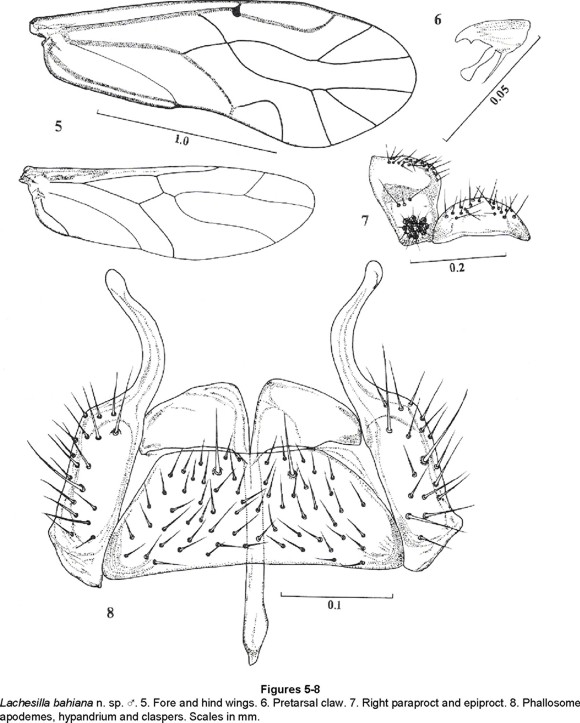
Color. Reddish brown. Ocelli with dark brown centripetal crescents. Lacking pigmented bands between compound eyes and epistomal sulcus. Maxillary palps brown. Antennae brown. Wings hyaline, veins brown. Legs pale brown.
Morphology. Pterostigma rounded posteriorly, Rs-M diverging from a point, areola postica almost triangular, rounded posteriorly. Hind wing with Rs-M fused for a short length (Fig. 5). Hypandrium (Fig. 8) trapezoidal, broad, setae as illustrated. Baculum stout, with membranous extensions low, wide based. Claspers each basally stout, with the usual two macrosetae, and 16-17 shorter setae, distributed as illustrated (Fig. 8) ; shafts stout, curved, with apices knobbed (Fig. 8). Paraprocts broad; sensory fields with 15-16 trichobothria. Epiproct low, wide based, with setal field on distal half (Fig. 7).
Measurements. FW: 2128; HW: 1605; F: 454; T: 839; t1: 293; t2: 74; ctt1: 19; Mx4: 99; f1: 281; f2: 261; f3: 243; f4: 199; f5: 121; f6: 102; f7: 95; f8: 89; f9: 90; f10: 80; f11: 91; IO: 289; D: 195; d: 128; IO/D: 1.47; PO: 0.65.
]]> Type Locality. Brazil. Bahía. Itapetinga. XI.1969, FMO, holotype ♂ (CNI, IBUNAM).Comments. L. bahiana n.sp. is close to L. arimensis, from which it differs on the claspers: shapes of the basal portions, and apices of the shafts. L. cuala García Aldrete, ranging from Mexico to South America also has claspers apically knobbed, but the hypandrium is much more slender.
Color. Pale brown yellowish. Ocelli hyaline, without pigmented centripetal crescents. Lacking pigmented bands between compound eyes and epistomal sulcus. Maxillary palps pale brown. Antennae brown. Wings hyaline, veins pale brown. Legs brown.
Morphology. Pterostigma elongate, rounded posteriorly; areola postica almost triangular, wide based(Fig.9). Rs-M fused for a short length; in hind wing Rs-M fused for a length (Fig. 9). Subgenital plate posteriorly straight, broad, setae as illustrated (Fig. 10). Two contiguous, slender, sclerotized, crescent shaped marks, next to each postero-lateral corner (Fig. 10). Gonapophyses elongate, sides almost parallel, blunt ended. Ninth sternum with spermapore small, almost in center, with a V shaped fold anterior to it (Fig. 12). Paraprocts almost elliptical, setae as illustrated (Fig. 13); sensory fields with ten trichobothria. Epiproct (Fig. 11), wide based, rounded, with setal field on distal half.

Lachesilla belemensis García Aldrete, new species (♀)
Measurements. FW: 1746; HW: 1345; F: 305; T: 579; t1: 169; t2: 67; ctt1: 14; Mx4: 73; f1: 166; f2: 151; f3: 132; f4: 98; f5: 67; f6: 66; f7: 60; f8: 59; f9: 59; f10: 53; f11: 69; IO: 275; D: 160; d: 108; IO/D: 1.69; PO: 0.67.
Type Locality. Brazil. Belem. Museo Goeldi. 8-10.II.1959, AMN, holotype ♀, (AMNH).
]]> Comments. The crescent shaped marks on the subgenital plate of this species are unique in the genus.Lachesilla braticagua García Aldrete, new species (♀)
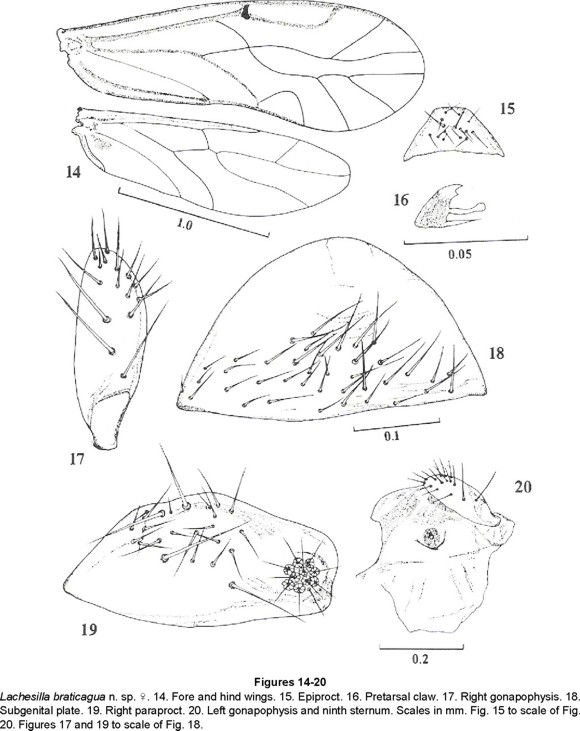
Color. Reddish brown. Ocelli without centripetal crescents. Two ochre bands from each compound eye to epistomal sulcus, enclosing antennal fossae. Antennae and maxillary palps brown. Wings hyaline, slightly opaque, veins brown. Legs brown.
Morphology. FW (Fig.14)pterostigma almost four times as long as wide, rounded posteriorly. Rs-M diverging from a point. Areola postica almost triangular, 1.7 times as wide as tall. Rs-M in hind wing fused for a short length (Fig. 14). Subgenital plate (Fig. 18) rounded posteriorly, distally glabrous. Gonapophyses (Figs. 17, 20) stout, blunt ended, with sides almost parallel. Spermapore small, surrounded by a distinct, pigmented, almost circular or elongated area (Fig. 20). Paraprocts semi-elliptical, setose; sensory fields with 11 trichobothria (Fig. 19). Epiproct trapezoidal, setae as illustrated (Fig. 15).
Measurements. FW: 2213; HW: 1689; F: 438; T: 804; t1: 254; t2: 96; ctt1: 16; Mx4: 106; f1: 318; f2: 272; f3: 214; f4: 165; f5: 100; f6: 97; f7: 77; f8: 79; f9: 75; f10: 70; f11: 98; IO: 324; D: 209; d: 159; IO/D: 1.54; PO: 0.75.
Type Locality. Brazil. Pará. Belem. Instituto Agronomico. 11.II.1959, beating dry leaves on branches along cut edge of forest, ELM & AMN, holotype ♀, paratype ♀, (ISU).
Records. French Guiana. Cayenne. 17.II.1959, beating small tree in savanna, ELM, 1♀. Costa Rica. Heredia Province, Finca La Selva, 28.VI.1977, beating branches with dead hanging leaves, ELM, 1♀. 1.VII.1977, ELM. 1♀.
]]> Comments. Inclusion of this species in the group forcepeta is based on the ninth sternum, gonapophyses and subgenital plate. The gonapophyses are reminiscent to those of L. nigripalpa Turner & Cheke, from Benin and Togo.Lachesilla concava García Aldrete, new species (♀)

Color. Reddish brown. Ocelli with ochre centripetal crescents. Without pigmented bands between compound eyes and epistomal sulcus. Antennae and maxillary palps pale brown. Wings hyaline, slightly opaque, veins reddish brown. Legs pale brown.
Morphology. Pterostigma (Fig. 21). Rs-M in fore wing diverging from a point or with a small crossvein between them. Areola postica small, triangular (Fig. 21). Rs-M in hind wing diverging from a point or fused for a short length (Fig. 21). Subgenital plate posteriorly concave, with a posterior pigmented area and setae as illustrated (Fig. 23). Gonapophyses wider in the middle, blunt ended. Ninth sternum anteriorly with two well defined, sclerotized bands, each with a small, elongated area anteriorly (Fig. 22). Paraprocts almost elliptical, setose, sensory fields with 11 trichobothria. Epiproct almost semicircular, setae as illustrated (Fig. 24).
Measurements. FW: 1666; HW: 1282; F: 337; T: 626; t1: 223; t2: 85; ctt1: 17; Mx4: 73; f1: 174; f2: 147; f3: 122; f4: 94; f5: 71; f6: 62; f7: 55; f8: 54; f9: 44; f10: 50; f11: 73; IO: 258; D: 134; d: 88; IO/D: 1.91; PO: 0.65.
Type Locality. Venezuela. Maracay, 6.III.1959, ELM, holotype ♀, (ISU).
Records. Brazil. Nova Teutonia, VI.1956. 300-500m. FP, 1♀. Porto Alegre, VI-VII.1975, RWA, 1♀.
]]> Comments. The shape and pigmented area of the subgenital plate and the pigmented areas on the posterior margin of the ninth sternum, are unique in the genus.Lachesilla convexa García Aldrete, new species (♀)

Color. Pale brown yellowish. Ocelli without pigmented centripetal crescents. Lacking pigmented bands between compound eyes and epistomal sulcus. Antennae and maxillary palps brown. Wings hyaline, slightly opaque, veins brown. Legs brown.
Morphology. FW (Fig.25)pterostigma elongate, about four times as long as wide. Rs-M fused for a short length. Areola postica almost triangular, 1.8 times as wide as tall. Rs-M in hind wing fused for a length (Fig. 25). Subgenital plate broad, setose as illustrated (Fig. 26) convex posteriorly. Gonapophyses (Fig. 28) wide at base, narrowing posteriorly, blunt ended. Spermapore sclerite small, towards posterior border of ninth sternum (Fig. 28). Paraprocts (Fig. 27) almost elliptical, setose as illustrated; sensory fields with 10-11 trichobothria. Epiproct trapezoidal, setose as illustrated (Fig. 29).
Measurements. FW: 1632; HW: 1265; F: 324; T: 610; t1: 218; t2: 82; ctt1: 16; Mx4: 86; f1: 241; f2: 200; f3: 165; f4: 115; IO: 288; D: 166; d: 110; IO/D: 1.73; PO: 0.66.
Type Locality. Brazil. Bahía. Salvador, Biological Institute. 28.I.1959, AMN, holotype ♀, paratype ♀, (AMNH).
Records. Panama. Canal Zone, Barro Colorado Island, 14.IV.1953, AMN, 1♀. This specimen was not designated as paratype on account of the locality of collection, different from the type locality.
]]> Comments. The shape and setal field of the subgenital plate, and the posterior band of the ninth sternum, are unique in the genus.Lachesilla ecuatoriana García Aldrete, new species

Female. Color. Medium brown. Ocelli with ochre centripetal crescents; lacking pigmented bands between each compound eye and epistomal sulcus. Antennae and maxillary palps brown. Wings hyaline, slightly opaque, veins brown. Legs brown.
Morphology. FW (Fig.30)pterostigma about three times as long as wide, almost straight posteriorly; Rs-M diverging from a point, fused for a length, or with a small crossvein between them; areola postica apically rounded, almost triangular (Fig. 30). Rs-M in hind wing diverging from a point or fused for a length. Subgenital plate (Fig. 32) broad, setose, with a distinct, mesal, triangular prominence; posterior border slightly concave. Gonapophyses (Fig. 33), short, wider in the middle, narrowing distally. Spermapore large, surrounded by a well defined, elliptic pigmented area, as illustrated (Fig. 33). Paraprocts (Fig. 35), stout, with dense field of setae as illustrated, sensory fields with 14-15 trichobothria. Epiproct (Fig. 34) trapezoidal, with setal field on posterior half, as illustrated.
Measurements. FW: 2217; HW: 1690; F: 537; T: 939; t1: 349; t2: 94; ctt1: 25; Mx4: 106; f1: 308; f2: 305; f3: 252; f4: 191; IO: 353; D: 248; d: 150; IO/D: 1.42; PO: 0.60.
Male. Color. Same as the female.
Morphology. Wings as described for the female. Hypandrium (Fig. 36) narrow, about five times as long as wide; baculum stout, distal membranous extensions large, almost triangular. Claspers slender, proximal area about four times as long as wide; shafts almost straight, slightly dilated apically. Paraprocts (Fig. 31) almost elliptic, setae as illustrated; sensory fields large, with 15 trichobothria. Epiproct trapezoidal, setal field on posterior half.
]]> Measurements. FW: 2161; HW: 1591; F: 520; T: 916; t1: 339; t2: 96; ctt1: 24; Mx4: 107; f1: 309; f2: 318; f3: 258; f4: 196; f5 122; f6: 117; f7: 87; f8: 106; f9: 81; f10: 96; f11: 112; IO: 318; D: 236; d: 146; IO/D: 1.34; PO: 0.61.Type Locality. Ecuador. 35 Km NW Santo Domingo, d.i. Colorados. 22-23.XII.1958, AMN, holotype ♂, allotype ♀, two paratypes ♀ (AMNH).
Records. Mexico. Chiapas. Chimalapa, 29 Km. N Malpaso, 8.IV.1964, beating vegetation in forest, ELM, 1♀.
Comments. This species is close to L. magna García Aldrete from Perú, Trinidad and Venezuela, to L. pigmentithorax García Aldrete, from Perú and Trinidad, and to L. valvula New & Thornton from Brazil. They all differ in genital details. Since L. valvula is only known from females, and I have not been able to locate the type specimen, there is a risk that one of the above mentioned could become a synonym of L. valvula.
Lachesilla falcata García Aldrete, new species

Female. Color. Pale brown. Ocelli clear, without centripetal crescents. Lacking pigmented bands between compound eyes and epistomal sulcus. Antennae and maxillary palps pale brown. Wings hyaline, veins brown. Legs pale brown.
Morphology. FW (Fig. 37) pterostigma almost straight posteriorly, about three times as long as wide; Rs-M diverging from a point; areola postica triangular, as illustrated (Fig. 37). HW Rs-M diverging from a point or fused for a length. Subgenital plate broad, setose as illustrated (Fig. 39), posteriorly concave, mesally with a distinct prominence, sides converging in the middle. Gonapophyses very stout, wider in the middle, setae as illustrated (Fig. 38). Spermapore large, surrounded by an almost elliptic pigmented area, with the longer axis longitudinal to ninth sternum. Paraprocts (Fig. 40) almost elliptic, setose, sensory fields with 12 trichobothria. Epiproct (Fig. 40) rounded posteriorly, setae as illustrated.
]]> Measurements. FW: 2142; HW: 1599; F: 453; T: 799; t1: 289; t2: 100; ctt1: 17; Mx4: 107; f1: 289; f2: 251; f3: 216; f4: 172; f5: 106; f6: 100; f7: 76; f8: 82; f9: 78; f10: 80; f11: 91; IO: 340; D: 204; d: 144; IO/D: 1.66; PO: 0.70.Male. Color. Same as the female.
Morphology. Wings as the female. Hypandrium trapezoid, with setae as illustrated (Fig. 41). Baculum stout, short, with distal membranous extensions large. Proximal halves of claspers robust, with the two usual macrosetae and 17-19 smaller setae; distal halves of claspers dilated, falcate (Fig. 41). Paraprocts almost elliptic, as usual for the group, setose, without mesal prong, sensory fields with 11-12 trichobothria. Epiproct (Fig. 43) trapezoidal, setae as illustrated.
Measurements. FW: 2064; HW: 1594; F: 402; T: 747; t1: 272; t2: 84; ctt1: 20; Mx4: 115; f1: 241; f2: 222; f3: 192; f4: 153; f5 104; f6: 92; f7: 77; f8: 75; f9: 74; f10: 72; f11: 89; IO: 308; D: 221; d: 126; IO/D: 1.39; PO: 0.57.
Type Locality. Bolivia. Cochabamba, 32 Km SW Villa Tunari, 2.IV.1978, CWOB & LBOB, holotype ♂, allotype ♀, 10♂ and 30♀ paratypes (CNI, IBUNAM).
Records. Brazil. Sao Paulo, Botanical Gardens, 13.I.59, AMN, 1♂. Roraima Territory, Suruma, IX.1966, MA, 1♂.
Comments. L. alpejia García Aldrete, from México and L. dilatiforceps García Aldrete, from Hispaniola and Puerto Rico, have distal halves of claspers dilated, but they are quite distinct from L. falcata n. sp., on genital characters. The subgenital plate of the latter is unique in the genus, although in neighborhood with L. maculipenna García Aldrete, from Costa Rica, with L. magna García Aldrete, from Perú, Trinidad and Venezuela, with L. pigmentithorax García Aldrete, from Perú and Trinidad, and with L. valvula New & Thornton from Brazil.
Lachesilla gladiata García Aldrete, new species (♂)
]]>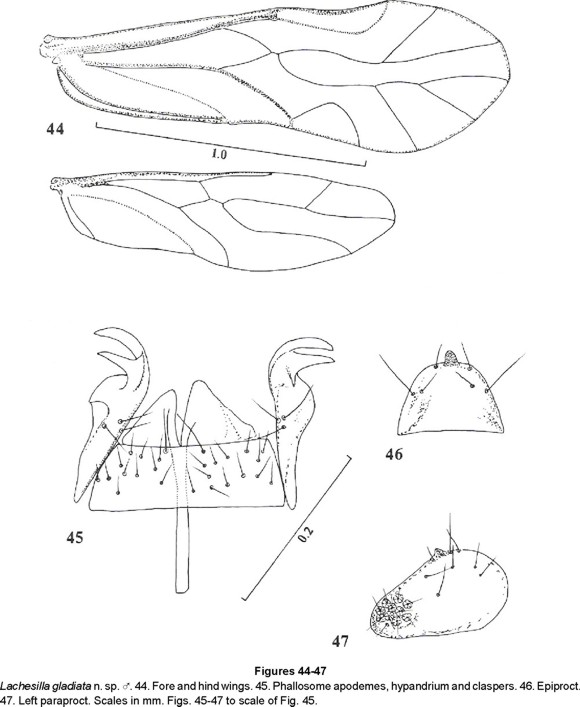
Color. Pale brown. Ocelli clear, without centripetal crescents; lacking pigmented bands between compound eyes and epistomal sulcus. Antennae and maxillary palps brown. Wings hyaline, veins brown. Legs brown.
Morphology. FW pterostigma (Fig. 44) elongate, about four times as long as wide; Rs-M fused for a short distance; areola postica low, triangular. HW Rs-M fused for a distance (Fig. 44). Hypandrium trapezoid, setae as illustrated (Fig. 45). Baculum slender, elongate; distal membranous extensions triangular. Proximal halves of claspers basally narrow, each with a distal bulge on outer edge, with three mesal setae. Shafts curved, acuminate, with a wide based, acuminate extension on outer border (Fig. 45).
Paraprocts broad, each with a short cone mesally, setae as illustrated; sensory fields with 11 trichobothria (Fig. 47). Epiproct (Fig. 46) trapezoid, with a stout, sclerotized prong on posterior border; setae as illustrated.
Measurements. FW: 1643; HW: 1212; F: 313; T: 610; t1: 201; t2: 76; ctt1: 17; Mx4: 90; f1: 269; f2: 250; IO: 223; D: 148; d: 112; IO/D: 1.50; PO: 0.75.
Type Locality. Trinidad. North Range, Arima-Blanchisseuse Road, mi. 10.5, 10.V.1985, CWOB & LBOB, holotype ♂ (CNI, IBUNAM).
Comments. Genital characters of this species are unique in the genus. Pronged paraprocts and epiproct are present in many other species, but the claspers are unique.
Lachesilla maracayensis García Aldrete, new species (♀)
]]>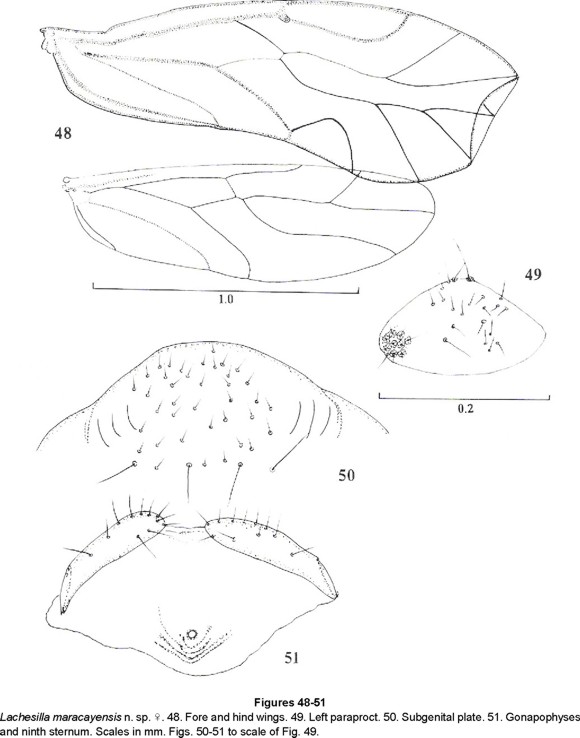
Color. Pale brown. Ocelli without pigmented centripetal crescents; two ochre bands from each compound eye to epistomal sulcus, enclosing the antennal fossae. Antennae and maxillary palps pale brown. Wings hyaline, veins brown. Legs brown.
Morphology. FW pterostigma elongate, rounded posteriorly, about four times as long as wide; Rs-M joined by a short crossvein. Areola postica wide based, rounded posteriorly (Fig. 48). HW Rs-M fused for a short distance. Subgenital plate broad, rounded posteriorly, with three short longitudinal lines on each side; setae as illustrated (Fig. 50). Gonapophyses elongate, sides almost parallel (Fig. 51). Spermapore small, towards anterior border of ninth sternum; area anterior to spermapore slightly wrinkled (Fig. 51). Paraprocts almost elliptic, setae as illustrated, sensory fields with 10-11 trichobothria (Fig. 49). Epiproct trapezoid, setose.
Measurements. FW: 1813; HW: 1368; F: 350; T: 643; t1: 226; t2: 81; ctt1: 17; Mx4: 76; f1: 267; f2: 233; f3: 190; f4: 135; f5: 98; f6: 85; f7: 75; f8: 69; f9: 63; f10: 53; IO: 230; D: 141; d: 98; IO/D: 1.62; PO: 0.69.
Type Locality. Venezuela. Maracay, 20.XII.54, AMN, holotype ♀ (AMNH).
Comments. The gonapophyses of this species are reminiscent of those of L. dilatiforceps García Aldrete, from Hispaniola and Puerto Rico, and of an undescribed Mexican species. The lateral lines of the subgenital plate separate this species from all others in the group.
Lachesilla papillata García Aldrete, new species
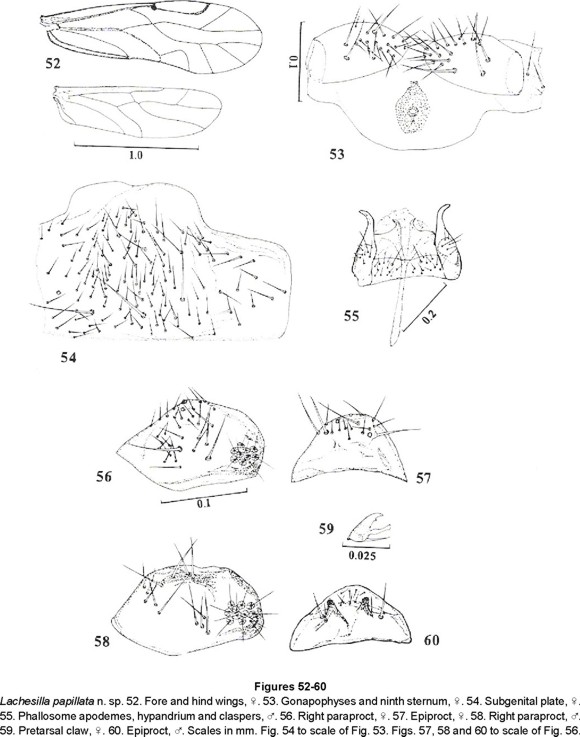
Morphology. FW (Fig. 52)pterostigma slender, elongate, about four times as long as wide; Rs-M diverging from a point; HW Rs-M fused for a short distance (Fig. 52). Subgenital plate broad, setae as illustrated, with a posterior projection almost rectangular, glabrous (Fig. 54). Gonapophyses stout, bullet-shaped (Fig. 53). Spermapore surrounded by a large, pigmented, elliptic area, with large axis longitudinal to ninth sternum (Fig. 53). Paraprocts as illustrated (Fig. 56) sensory fields with 10-11 trichobothria. Epiproct almost trapezoid, setae as illustrated (Fig. 57).
Measurements. FW: 1992; HW: 1521; F: 426; T: 695; t1: 185; t2: 93; ctt1: 16; Mx4: 85; f1: 280; f2: 262; f3: 215; f4: 170; f5: 101; f6: 94; f7: 79; f8: 79; f9: 59; f10: 90; f11: 81; IO: 255; D: 173; d: 141; IO/D: 1.47; PO: 0.81.
Male. Color. Same as the female.
Morphology. Wings as the female. Hypandrium (Fig. 55) almost trapezoid, setae as illustrated. Baculum long, slender, with posterior membranous extensions broad, each half distally acuminate (Fig. 55). Claspers (Fig. 55) with proximal halves stout, basally rounded, with 5-6 setae, in addition to the two macrosetae. Shafts slightly curved, distally blunt. Paraprocts (Fig. 58) as illustrated, sensory fields with 11-12 trichobothria. Epiproct straight anteriorly, rounded posteriorly, with a sclerotized projection, distally papillate, on each side of longitudinal midline (Fig. 60), setae as illustrated.
Measurements. FW: 1995; HW: 1415; F: 388; T: 753; t1: 244; t2: 90; ctt1: 17; Mx4: 80; f1: 307; f2: 274; f3: 240; f4: 192; f5: 128; f6: 119; f7: 101; f8: 89; f9: 87; f10: 77; f11: 95; IO: 206; D: 215; d: 154; IO/D: 0.95; PO: 0.71.
Type Locality. Brazil. Pará. Belem, Instituto Agronómico, 11.II.59, beating dead leaves on branches, ELM, holotype ♂, allotype ♀, two ♂ paratypes (ISU).
Records. French Guiana. Cayenne. 16-17.II.1959, AMN, 1♂.
Comments. This species is separable from all others in the group on genital characters of both sexes. The sclerotized papillate projections of the male epiproct are unique in the group.
Lachesilla patula García Aldrete, new species (♀)
]]> (Figs. 61-65)
Color. Light brown. Ocelli clear, without pigmented centripetal crescents. Lacking pigmented bands between compound eyes and epistomal sulcus. Antennae and maxillary palps light brown. Wings hyaline, veins brown. Legs brown.
Morphology. FW pterostigma straight posteriorly, almost four times as long as wide. Areola postica as illustrated (Fig. 61). Rs-M in fore and hind wings fused for a short distance. Subgenital plate broad, extended posteriorly, with border straight; with an oval pigmented area towards posterior border on each side of longitudinal midline, setae as illustrated (Fig. 64). Gonapophyses stout, wider in the middle, blunt ended. Spermapore small, almost in the center of ninth sternum, surrounded by a well defined pigmented ring (Fig. 62). Paraprocts almost elliptic, setose; sensory fields with 11-12 trichobothria (Fig. 65). Epiproct almost trapezoid (Fig. 63), setae as illustrated.
Measurements. FW: 1577; HW: 1224; F: 326; T: 598; t1: 213; t2: 89; ctt1: 17; Mx4: 94; f1: 194; f2: 160; IO: 293; D: 149; d: 100; IO/D: 1.96; PO: 0.67.
Type Locality. Brazil. Río de Janeiro. Palmeiras, 22.I.59, AMN, holotype ♀ (AMNH). Botanical Garden, 20.I.59, two ♀ paratypes.
Records. Brazil. Rondonia. 62 Km SW Ariquemes, Fazenda Rancho Grande, 5.IX.1992, CWOB & LBOB, 1♀.
Comments. This species is similar to L. papillata n. sp. in the posterior extension of the female subgenital plate; the extension in L. papillata is wider, not as long as in L. patula, and the subgenital plate lacks pigmented areas.
Lachesilla renicula García Aldrete, new species (♀)
]]> (Figs. 66-70)
Color. Pale brown. Ocelli clear, without pigmented centripetal crescents. Lacking pigmented bands between compound eyes and epistomal sulcus. Antennae and maxillary palps pale brown. Wings hyaline, veins brown. Legs brown.
Morphology. FW (Fig.66)pterostigma rounded posteriorly, about three times as long as wide. Rs-M diverging from a point; areola postica wide based, rounded posteriorly. HW Rs-M fused for a short distance (Fig. 66). Subgenital plate broad, slightly concave posteriorly; mesally with a large, kidney-shaped pigmented area, on each side of longitudinal midline; setae as illustrated (Fig. 68). Gonapophyses (Fig. 67) wide at base, narrowing distally, blunt ended. Spermapore small, surrounded by a diffusely pigmented area, limited anteriorly by a V shaped wrinkle of the ninth sternum (Fig. 67).
Paraprocts almost elliptic (Fig. 69), with setae as illustrated; sensory fields with 10-11 trichobothria. Epiproct (Fig. 70), rounded posteriorly, setae as illustrated.
Measurements. FW: 2238; HW: 1692; F: 472; T: 905; IO: 292; D: 197; d: 135; IO/D: 1.47; PO: 0.68.
Type Locality. Colombia. Valle Cali, 1000 m., 3.IX.1970, NJ-light trap, PB, holotype ♀ (CNI, IBUNAM).
Comments. In the shape of the gonapophyses and the V- shaped wrinkle anterior to the spermapore, this species stands close to L. maracayensis n.sp.
Lachesilla torulosa García Aldrete, new species (♀)
]]> (Figs. 71-75)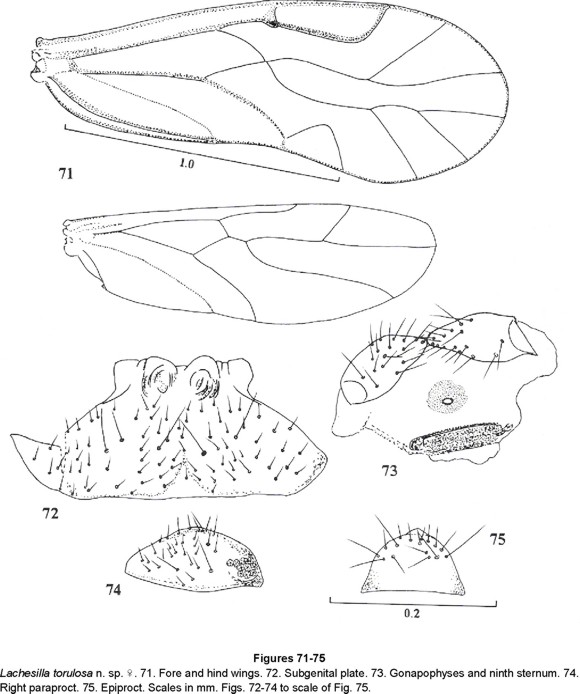
Color. Light brown. Ocelli clear, without pigmented centripetal crescents. Lacking pigmented bands between compound eyes and epistomal sulcus. Antennae and maxillary palps light brown. Wings hyaline, veins light brown. Legs light brown.
Morphology. FW pterostigma almost straight posteriorly, about three times as long as wide. Rs-M diverging from a point; areola postica almost triangular. HW Rs-M fused for a length (Fig. 71). Subgenital plate (Fig. 72) broad, with setae as illustrated; posterior border irregular, with one distinct prominence, with concentric lines, on each side of longitudinal midline. Gonapophyses (Fig. 73) wider in the middle, blunt ended, of medium length. Spermapore almost in the middle of ninth sternum, surrounded by an irregular pigmented area. Ninth sternum with a transverse, distinct, pigmented band on anterior border (Fig. 73). Paraprocts elongate, setose as illustrated; sensory fields with 11-12 trichobothria (Fig. 74). Epiproct (Fig. 75) straight anteriorly, rounded posteriorly; setae as illustrated.
Measurements. FW: 1689; HW: 1311; F: 354; T: 647; t1: 221; t2: 78; ctt1: 17; Mx4: 78; f1: 234; f2: 212; f3: 168; f4: 116; f5: 79; f6: 54; f7: 65; f8: 66; f9: 62; f10: 64; f11: 78; IO: 253; D: 159; d: 107; IO/D: 1.59; PO: 0.67.
Type Locality. Ecuador. 35 Km. NW Santo Domingo, d.i. Colorados. 22.XII.1958, AMN, holotype ♀ (AMNH).
Comments. Several species of Lachesilla in the group forcepeta show the ninth sternum limited anteriorly by a band of different texture (e.g. L. acuminiforceps García Aldrete, L. denticulata García Aldrete, L. disjuncta García Aldrete, L. gracilis García Aldrete, and L. yanomamioides García Aldrete, among others). L. torulosa n. sp. can be separated from them by the shape of the band, shape of the gonapophyses, size of the pigmented area around the spermapore, and shape of the subgenital plate, unique in the group.
Lachesilla trunca García Aldrete, new species
]]>
Female. Color. Light brown. Ocelli clear, without pigmented centripetal crescents. Lacking pigmented bands between compound eyes and epistomal sulcus. Antennae and maxillary palps light brown. Wings hyaline, veins brown. Legs light brown.
Morphology. FW (Fig. 78)pterostigma elongate, about four times as long as wide. Rs-M diverging from a point; areola postica wide based, rounded posteriorly. HW Rs-M fused for a short length (Fig. 81). Subgenital plate (Fig. 76) broad, setose as illustrated; with sides converging to an almost straight posterior border. Gonapophyses (Fig. 79-80) elongate, blunt ended, posteriorly directed as illustrated. Spermapore towards anterior border of ninth sternum, surrounded by an elliptic pigmented area (Fig. 79). Ninth sternum rounded anteriorly (Fig. 79). Paraprocts robust (Fig. 78), setose as illustrated, with 11-12 trichobothria on sensory fields. Epiproct straight anteriorly, rounded posteriorly, setae as illustrated.(Fig. 77).
Measurements. FW: 2063; HW: 1530; F: 427; T: 786; t1: 252; t2: 91; ctt1: 18; Mx4: 94; f1: 306; f2: 268; f3: 224; f4: 172; f5: 107; f6: 99; f7: 88; f8: 82; f9: 82; f10: 76; f11: 91; IO: 318; D: 230; d: 145; IO/D: 1.38; PO: 0.63.
Male. Color. Same as the female.
Morphology. Wings as the female. Hypandrium (Fig. 83) narrow, with posterior margin slightly concave, setae as illustrated. Baculum short, stout; posterior membranous extensions almost triangular, as illustrated (Fig. 83). Claspers with basal portion stout, elongate, with two macrosetae; shafts almost straight, stout, distally truncate (Fig. 83). Paraprocts (Fig. 86) almost elliptic, with a short cone on outer border (Fig. 85), setae as illustrated; sensory fields with 11-12 trichobothria. Epiproct (Fig. 84) almost trapezoid, with a short, sclerotized, conical projection in the middle, next to posterior border. Setae as illustrated.
Measurements. FW: 1784; HW: 1375; F: 346; T: 655; t1: 224; t2: 81; ctt1: 17; Mx4: 89; f1: 283; f2: 266; f3: 224; f4: 193; f5: 123; f6: 109 f7: 98; f8: 102; f9: 89; f10: 81; f11: 103; IO: 240; D: 207; d: 147; IO/D: 1.15; PO: 0.70.
Type Locality. Brazil. Pará. Belem. Municipal Park. 22.II.1959, AMN, holotype ♂, allotype ♀ (AMNH). 11.II.1959, Instituto Agronomico, ELM, paratype ♂, two paratypes ♀.
Records. Brazil. Recife. 30.I. 1979, AMN, 1♂. Panama. Canal Zone, Albrook Forest Site, 26-27.X.1967, black light trap, H & L, 1♂.
]]> Comments. Genital characters of this species place it apart from other species in the group. The claspers are unique in having only two macrosetae and none of the regularly accompanying setae. The shape of the claspers place this species close to L. sandersoni Mockford, from Cuba, Dominican Republic, French Guiana, Guatemala, Jamaica and México.
Acknowledgments
To Dr. Randall T. Schuh (American Museum of Natural History, New York City), for loans of Lachesilla specimens in collections under his care, to Dr. Edward L. Mockford (Illinois State University, Normal, Illinois), for his teachings about psocids in general, for loans of specimens and for many other things, to Drs. Charles W. O'Brien and Lois B. O'Brien (Florida A & M University, Tallahassee, Florida), for their generous gifts of psocid specimens throughout the years, many Lachesilla among them. Javier García Figueroa, Felipe Villegas and Silvia López (Instituto de Biología, UNAM), provided logistic support in the preparation of this paper. Special thanks to Dr. Ian W.B. Thornton and to Dr. Tim New (LaTrobe University, Bundoora, Victoria, Australia), for their comments and suggestions on a former version of this paper.
Literature cited
García Aldrete, A.N. 1974. A classification above species level of the genus Lachesilla Westwood (Psocoptera: Lachesillidae). Folia Entomol. Mex. 27: 1-88. [ Links ]
]]>García Aldrete, A.N. 1996. Species of Lachesilla in the Caribbean islands and Trinidad (Insecta: Psocoptera: Lachesillidae). Insecta Mundi, 10(1-4): 105-138. [ Links ]
Lescure, J., J. Jeremie, W. Lourenço, J.P. Mauries, J. Pierre, C. Sastre et J.M. Thibaud. 1991. Biogéographie et insularité: I'exemple des Petites Antilles. Compte-Rendu des Seances de la Societé de Biogéographie. 67: 41-59. [ Links ]
]]>