<?xml version="1.0" encoding="ISO-8859-1"?><article xmlns:mml="http://www.w3.org/1998/Math/MathML" xmlns:xlink="http://www.w3.org/1999/xlink" xmlns:xsi="http://www.w3.org/2001/XMLSchema-instance">
<front>
<journal-meta>
<journal-id>0036-3634</journal-id>
<journal-title><![CDATA[Salud Pública de México]]></journal-title>
<abbrev-journal-title><![CDATA[Salud pública Méx]]></abbrev-journal-title>
<issn>0036-3634</issn>
<publisher>
<publisher-name><![CDATA[Instituto Nacional de Salud Pública]]></publisher-name>
</publisher>
</journal-meta>
<article-meta>
<article-id>S0036-36342015000700009</article-id>
<title-group>
<article-title xml:lang="en"><![CDATA[Transitions in activities of daily living in Mexico, 2001-2012]]></article-title>
<article-title xml:lang="es"><![CDATA[Transiciones en actividades de la vida diaria en México, 2001 -2012]]></article-title>
</title-group>
<contrib-group>
<contrib contrib-type="author">
<name>
<surname><![CDATA[Díaz-Venegas]]></surname>
<given-names><![CDATA[Carlos]]></given-names>
</name>
<xref ref-type="aff" rid="A01"/>
</contrib>
<contrib contrib-type="author">
<name>
<surname><![CDATA[De La Vega]]></surname>
<given-names><![CDATA[Sergio]]></given-names>
</name>
<xref ref-type="aff" rid="A02"/>
</contrib>
<contrib contrib-type="author">
<name>
<surname><![CDATA[Wong]]></surname>
<given-names><![CDATA[Rebeca]]></given-names>
</name>
<xref ref-type="aff" rid="A03"/>
</contrib>
</contrib-group>
<aff id="A01">
<institution><![CDATA[,University of Texas Medical Branch Rehabilitation Sciences Academic Division & Research Center ]]></institution>
<addr-line><![CDATA[Galveston Texas]]></addr-line>
<country>Estados Unidos de América</country>
</aff>
<aff id="A02">
<institution><![CDATA[,Universidad Autónoma Metropolitana Department of Social Sciences and Humanities ]]></institution>
<addr-line><![CDATA[Xochimilco Distrito Federal]]></addr-line>
<country>México</country>
</aff>
<aff id="A03">
<institution><![CDATA[,University of Texas Medical Branch Collaborating Center on Aging and Health ]]></institution>
<addr-line><![CDATA[Galveston Texas]]></addr-line>
<country>Estados Unidos de América</country>
</aff>
<pub-date pub-type="pub">
<day>00</day>
<month>00</month>
<year>2015</year>
</pub-date>
<pub-date pub-type="epub">
<day>00</day>
<month>00</month>
<year>2015</year>
</pub-date>
<volume>57</volume>
<fpage>s54</fpage>
<lpage>s61</lpage>
<copyright-statement/>
<copyright-year/>
<self-uri xlink:href="http://www.scielo.org.mx/scielo.php?script=sci_arttext&amp;pid=S0036-36342015000700009&amp;lng=en&amp;nrm=iso"></self-uri><self-uri xlink:href="http://www.scielo.org.mx/scielo.php?script=sci_abstract&amp;pid=S0036-36342015000700009&amp;lng=en&amp;nrm=iso"></self-uri><self-uri xlink:href="http://www.scielo.org.mx/scielo.php?script=sci_pdf&amp;pid=S0036-36342015000700009&amp;lng=en&amp;nrm=iso"></self-uri><abstract abstract-type="short" xml:lang="en"><p><![CDATA[Objective. This paper describes the 2001-2012 progression of limitations in daily activities in the Mexican elderly population aged 60 or older and identifies how sociodemographic and health factors affect these progressions. Materials and methods. Data come from the Mexican Health and Aging Study (MHAS), a national sample of adults born in 1951 or earlier, including a baseline survey in 2001 and follow-ups in 2003 and 2012. Results. Difficulty in getting dressed is the activity that has the highest prevalence in all three waves for both genders. In the 11-year transition, 42.8% of the respondents with no limitations in 2001 reported no limitations in 2012. In contrast, 60.8% of those who reported three or more limitations in 2001 had died by 2012. Conclusions. With the rapid aging of the Mexican population, the knowledge of patterns of deterioration of functional limitations will prove useful for future public health policies.]]></p></abstract>
<abstract abstract-type="short" xml:lang="es"><p><![CDATA[Objetivo. Describir la progresión de las limitaciones en actividades de la vida diaria en la población mexicana de 60 años o más e identificar cómo diversos factores sociodemográficos y de salud afectan estas progresiones. Material y métodos. Los datos provienen del Estudio Nacional de Salud y Envejecimiento en México (Enasem), un panel representativo a nivel nacional de adultos nacidos en 1951 o antes, que incluye una encuesta inicial en 2001 y seguimientos en 2003 y 2012. Resultados. Las dificultades para vestirse constituyeron la actividad con mayor prevalencia en las tres rondas del Enasem para ambos sexos. En la transición de 11 años, 42.8% de los entrevistados sin limitantes en 2001 se mantuvo igual en 2012. En contraste, 60.8% de los entrevistados que reportaron tres o más limitantes en 2001 murió antes de 2012. Conclusiones. El conocimiento de los patrones de deterioro en limitaciones funcionales será de gran utilidad para políticas públicas en salud, ante el rápido envejecimiento de la población mexicana.]]></p></abstract>
<kwd-group>
<kwd lng="en"><![CDATA[activities of daily living]]></kwd>
<kwd lng="en"><![CDATA[transitions]]></kwd>
<kwd lng="en"><![CDATA[aged]]></kwd>
<kwd lng="en"><![CDATA[Mexico]]></kwd>
<kwd lng="es"><![CDATA[actividades cotidianas]]></kwd>
<kwd lng="es"><![CDATA[transiciones]]></kwd>
<kwd lng="es"><![CDATA[adulto mayor]]></kwd>
<kwd lng="es"><![CDATA[México]]></kwd>
</kwd-group>
</article-meta>
</front><body><![CDATA[  	    <p align="justify"><font face="verdana" size="4">Art&iacute;culo original</font></p>     <p align="justify">&nbsp;</p>  	    <p align="center"><font face="verdana" size="4"><b>Transitions in activities of daily living in Mexico, 2001&#45;2012</b></font></p>     <p align="center">&nbsp;</p> 	    <p align="center"><font face="verdana" size="3"><b>Transiciones en actividades de la vida diaria en M&eacute;xico, 2001 &#45;2012</b></font></p>     <p align="center">&nbsp;</p> 	    <p align="center"><font face="verdana" size="2"><b>Carlos D&iacute;az&#45;Venegas, PhD,<sup>(1)</sup> Sergio De La Vega, PhD,<sup>(2)</sup> Rebeca Wong, PhD.<sup>(3)</sup></b></font></p>     <p align="center">&nbsp;</p>     <p align="justify"><font face="verdana" size="2"><i>(1) Rehabilitation Sciences Academic Division &amp; Research Center, The University of Texas Medical Branch. Texas, EUA.</i></font></p>  	    ]]></body>
<body><![CDATA[<p align="justify"><font face="verdana" size="2"><i>(2) Department of Social Sciences and Humanities, Universidad Aut&oacute;noma Metropolitana, Unidad Xochimilco. Ciudad de M&eacute;xico, M&eacute;xico.</i></font></p>  	    <p align="justify"><font face="verdana" size="2"><i>(3) Collaborating Center on Aging and Health, The University of Texas Medical Branch. Texas, EUA.</i></font></p> 	    <p align="justify">&nbsp;</p>	 	    <p align="justify"><font face="verdana" size="2"><a name="cv"></a><a href="#ca">Corresponding author</a></font></p> 	    <p align="justify">&nbsp;</p> <hr>     <p align="justify"><font face="verdana" size="2"><b>Abstract</b></font></p>  	    <p align="justify"><font face="verdana" size="2"><b>Objective.</b> This paper describes the 2001&#45;2012 progression of limitations in daily activities in the Mexican elderly population aged 60 or older and identifies how sociodemographic and health factors affect these progressions. </font></p> 	    <p align="justify"><font face="verdana" size="2"><b>Materials and methods.</b> Data come from the Mexican Health and Aging Study (MHAS), a national sample of adults born in 1951 or earlier, including a baseline survey in 2001 and follow&#45;ups in 2003 and 2012. </font></p> 	    <p align="justify"><font face="verdana" size="2"><b>Results.</b> Difficulty in getting dressed is the activity that has the highest prevalence in all three waves for both genders. In the 11&#45;year transition, 42.8% of the respondents with no limitations in 2001 reported no limitations in 2012. In contrast, 60.8% of those who reported three or more limitations in 2001 had died by 2012. </font></p>     <p align="justify"><font face="verdana" size="2"><b>Conclusions.</b> With the rapid aging of the Mexican population, the knowledge of patterns of deterioration of functional limitations will prove useful for future public health policies.</font></p>  	    ]]></body>
<body><![CDATA[<p align="justify"><font face="verdana" size="2"><b>Keywords:</b> activities of daily living; transitions; aged; Mexico.</font></p> <hr>     <p align="justify"><font face="verdana" size="2"><b>Resumen</b></font></p>  	    <p align="justify"><font face="verdana" size="2"><b>Objetivo.</b> Describir la progresi&oacute;n de las limitaciones en actividades de la vida diaria en la poblaci&oacute;n mexicana de 60 a&ntilde;os o m&aacute;s e identificar c&oacute;mo diversos factores sociodemogr&aacute;ficos y de salud afectan estas progresiones. </font></p> 	    <p align="justify"><font face="verdana" size="2"><b>Material y m&eacute;todos.</b> Los datos provienen del Estudio Nacional de Salud y Envejecimiento en M&eacute;xico (Enasem), un panel representativo a nivel nacional de adultos nacidos en 1951 o antes, que incluye una encuesta inicial en 2001 y seguimientos en 2003 y 2012. </font></p> 	    <p align="justify"><font face="verdana" size="2"><b>Resultados.</b> Las dificultades para vestirse constituyeron la actividad con mayor prevalencia en las tres rondas del Enasem para ambos sexos. En la transici&oacute;n de 11 a&ntilde;os, 42.8% de los entrevistados sin limitantes en 2001 se mantuvo igual en 2012. En contraste, 60.8% de los entrevistados que reportaron tres o m&aacute;s limitantes en 2001 muri&oacute; antes de 2012. </font></p>     <p align="justify"><font face="verdana" size="2"><b>Conclusiones.</b> El conocimiento de los patrones de deterioro en limitaciones funcionales ser&aacute; de gran utilidad para pol&iacute;ticas p&uacute;blicas en salud, ante el r&aacute;pido envejecimiento de la poblaci&oacute;n mexicana.</font></p>  	    <p align="justify"><font face="verdana" size="2"><b>Palabras clave:</b> actividades cotidianas; transiciones; adulto mayor; M&eacute;xico.</font></p>     <hr>     <p align="justify">&nbsp;</p>     <p align="justify"><font face="verdana" size="2">Health and functional capacity decline naturally as a person ages. This loss results in a rise in dependency and higher mortality rates.<sup>1</sup> Declines in functionality can also lead to more severe health problems that may affect the elderly and their relatives' quality of life.<sup>2</sup> One way of assessing the health status of older adults is through a functional evaluation able to identify their potential difficulties in performing common daily activities.</font></p>  	    <p align="justify"><font face="verdana" size="2">Basic Activities of Daily Living (hereafter ADLs) refer to routine activities that are essential to survival and independence and have generally been used as a tool to assess whether or not a person requires help performing daily self&#45;care activities (such as dressing, bathing, eating, among others), especially in old age.<sup>3</sup> In addition to evaluating an elder's level of independence, ADLs can also be a predictor of successful aging.<sup>4,5</sup></font></p>  	    ]]></body>
<body><![CDATA[<p align="justify"><font face="verdana" size="2">The epidemiologic and demographic transition brought fast&#45;paced changes to Latin America, with sharp declines in mortality and fertility rates.<sup>6</sup> Mexico is no exception to these patterns. Life expectancy increased from 32 years in 1920 to 74 years in 2000.<sup>7</sup> The older adult population (aged 60 or older) has grown as well, from 6.9% in 2000 to a projected 15% in 2027.<sup>8</sup> This is a faster pace than the one followed by developed countries like the United States, where it took 80 years to grow from 7 to 15% (reached in 1980), and Japan, where it took 38 years to reach it (a process that ended in 1985).</font></p>  	    <p align="justify"><font face="verdana" size="2">Aging in Mexico and other developing countries comes with a magnified impact because when the population ages rapidly over a relatively short period of time, economic and institutional infrastructures are incapable of keeping up with the aging process.<sup>9,10</sup> Further, rural population faces more complications than its urban counterpart by having limited access to healthcare services and being at greater risk of social isolation.<sup>11</sup></font></p>  	    <p align="justify"><font face="verdana" size="2">Disability has been associated with factors like age and gender<sup>12</sup> and several diseases like diabetes, heart attacks, or strokes.<sup>13</sup> It is a relevant topic because, in addition to impacting the individual's quality of life, has an effect on the socioeconomic and health system of a country and creates the need for an effective public health policy.<sup>14</sup></font></p>  	    <p align="justify"><font face="verdana" size="2">Our hypothesis is that the number of limitations in activities of daily living faced by the elderly population in Mexico will be impacted by socioeconomic and health care conditions like age, gender, location, as well as depression and verbal cognition, among others. The purpose of this paper is to provide an overview of these limitations in ADLs by describing their progression in the Mexican elderly population.</font></p>     <p align="justify">&nbsp;</p>  	    <p align="justify"><font face="verdana" size="2"><b>Materials and methods</b></font></p>  	    <p align="justify"><font face="verdana" size="2"><b>Sample</b></font></p>  	    <p align="justify"><font face="verdana" size="2">Data are from the Mexican Health and Aging Study (MHAS), a prospective panel investigation of health and aging in Mexican people. The sampling frame was obtained from a pool of individuals aged 50 or older who responded the 2000 fourth trimester <i>Encuesta Nacional de Empleo</i> (National Employment Survey). In this survey, 11 000 households with at least one resident aged 50 or older were available from which to select participants for the MHAS baseline sample. If two residents aged 50 or older lived in the household, one was randomly selected. Further, if the selected person was married or in a consensual partnership, then the spouse or partner residing in the same dwelling was also interviewed regardless of age. For the second and third interviews, if the initial resident was unavailable for the follow&#45;up survey due to illness, hospitalization, or temporary absence, a proxy interview was conducted. A unique feature of the MHAS is that the sample included overs&#45;amples from Mexican states with high percentage of migrants to the United States.<sup>15</sup></font></p>  	    <p align="justify"><font face="verdana" size="2">The baseline data, consisting of 15 186 in&#45;person interviews, were collected in 2001 (response rate of 92%) with follow&#45;ups in 2003 (response rate of 93%) and 2012 (response rate of 88%). The database includes information on the participant's economic situation, education, living arrangements, marital status, and social network, as well as self&#45;reports of functional capacity and chronic conditions. The MHAS also provides detailed health characteristics, such as limitations with basic and instrumental activities of daily living, cognition, depression, and mobility.<sup>15</sup> This study was approved by the Institutional Review Boards and/or Ethics Committees of the University of Texas Medical Branch in the United States, the <i>Instituto Nacional de Estad&iacute;stica y Geograf&iacute;a</i> (INEGI) and the <i>Instituto Nacional de Salud P&uacute;blica</i> (INSP) in Mexico.</font></p>  	    <p align="justify"><font face="verdana" size="2">Our sample is based on 6 578 respondents of a direct interview aged 60 or older at baseline. We excluded 2 670 respondents who had died by 2003 or by 2012, as well as 941 respondents who were lost to follow&#45;up in 2003 or in 2012. As much as 216 respondents did not have complete ADLs information at the 2012 follow&#45;up. The final sample included 3 344 respondents who survived at 2012 and had complete disability information.</font></p>     ]]></body>
<body><![CDATA[<p align="justify">&nbsp;</p>  	    <p align="justify"><font face="verdana" size="2"><b>Measures</b></font></p>  	    <p align="justify"><font face="verdana" size="2">For our dependent variable, we used a modified version of the Katz Index of Activities of Daily Living (ADLs),<sup>16</sup> a scale that ranges from 0 to 5 and indicates if the respondent needs help to perform any of the following five functions: bathing, dressing, eating, toileting, and transferring in and out of bed. Each variable was dichotomized and the respondent was assigned a value of 0 if help was not required. If the respondent received any help to perform these activities a value of 1 was assigned. Additionally, we faced the challenge of respondents who answered that they "cannot do" or "does not do" the activity. As seen in previous literature,<sup>17</sup> respondents who fell in these categories were recorded as 1 and 0 otherwise.</font></p>     <p align="justify">&nbsp;</p>     <p align="justify"><font face="verdana" size="2"><b>Socioeconomic and health covariates</b></font></p>  	    <p align="justify"><font face="verdana" size="2">Covariates at baseline include the following: age, coded as a continuous variable and including only respondents aged 60 or older; gender, dichotomized as female (=1) and male (=0); level of urbanization, dichotomized as less urbanized (=1) and more urbanized (=0) (in this variable, less urbanized refers to a respondent who lives in a community of less than 100 000 inhabitants); education, divided into four variables, measuring whether the respondent had no education at all, did not complete elementary school (between one and five years of schooling), completed elementary school (six years), or had more than six years of schooling; and monthly income, using the imputations done by Wong and Espinosa<sup>18</sup> and then divided into four variables measuring whether the respondent had zero or negative income, reported earning less than 5 000 Mexican pesos (less than 328 dollars under current exchange rates), reported earning between 5 000 and 9 999 Mexican pesos (between 328 and 776 dollars), or reported earning 10 000 Mexican pesos or more (over 776 dollars). We also included: number of depressive symptoms, measured as a score 0&#45;9 with the nine symptoms asked in the MHAS using the Average Center for Epidemiologic Studies of Depression (CES&#45;D) score; self&#45;rated health, measured as poor versus all other values (fair, good, very good, and excellent); and cognition, where we included an average of two cognition tests measuring immediate verbal recall and delayed verbal recall (range 0&#45;8), based on previous work by McArdle <i>et al.</i><sup>19</sup> and by Lei <i>et al.</i><sup>20</sup> Finally, we included the number of limitations in ADLs at baseline captured by three variables, indicating zero; one or two, or three or more limitations.</font></p>     <p align="justify">&nbsp;</p>  	    <p align="justify"><font face="verdana" size="2"><b>Methods</b></font></p>  	    <p align="justify"><font face="verdana" size="2">Descriptive statistics were stratified by gender. In addition, we assumed the ADL score to follow a natural order.<sup>21,22</sup> We computed an ordinal logistic regression to predict the average ADL score in 2012 using baseline covariates. The model includes sociodemographic variables suchas age, gender, education, level of urbanization, and income. Further, the model also includes three health&#45;related variables such as self&#45;rated health, CES&#45;D score, and the average combined verbal recall score. In constructing the regression model we further excluded 567 subjects who had missing information in multiple covariates so they could not be included in the regression performed through Stata/SE 13.1. The sample size for this analysis was 2 777 respondents aged 60 or older at baseline. In addition, an ancillary analysis was conducted with a zero&#45;inflated Poisson regression<a href="#nota">*</a> and the results (not shown) were fairly similar to the one reported here.</font></p>     <p align="justify">&nbsp;</p>  	    ]]></body>
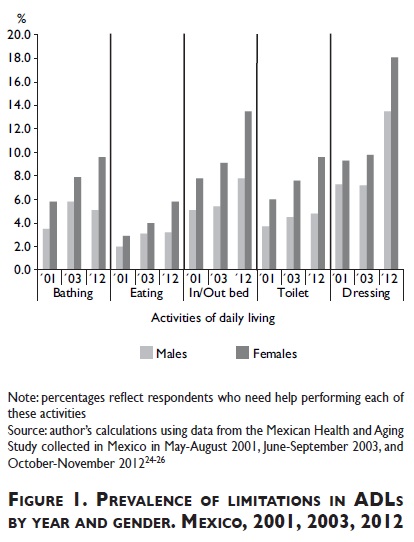
<body><![CDATA[<p align="justify"><font face="verdana" size="2"><b>Results</b></font></p>  	    <p align="justify"><font face="verdana" size="2"><a href="/img/revistas/spm/v57s1/a9t1.jpg" target="_blank">Table I</a> presents baseline descriptive characteristics of Mexicans aged 60 or older stratified by the number of limitations in ADLs in 2012 for the total and by gender. On average, those with three or more limitations were almost five years older than those with zero limitations. Further, among those with no education the percentage of respondents with three or more limitations (11.6%) was higher than the percentage of respondents with three or more limitations in the rest of the educational categories. Around 30% of the respondents that reported earning less than 5 000 Mexican pesos had at least one ADL limitation. Finally, among persons with at least one ADL limitation a higher percentage of women reported having poor health than men This was not the case if the respondent had no limitations, with men self&#45;reporting worst health than women.</font></p>  	    <p align="justify"><font face="verdana" size="2"><a href="#f1">Figure 1</a> presents the prevalence of ADL limitations by wave and gender. This serves as a snapshot to show which activities present the most difficulty for males and females in Mexico. In all three rounds of the MHAS, dressing is the activity that more waves have issues performing. At baseline, 7.3% of the males and 9.3% of the females in our sample reported needing help getting dressed. In 2012, these numbers increased to 13.5% for males and 18.1% for females.</font></p> 	    <p align="center"><a name="f1"></a></p> 	    <p align="center"><img src="/img/revistas/spm/v57s1/a9f1.jpg"></p>  	    <p align="justify"><font face="verdana" size="2">Transferring in and out of bed is the second most prevalent ADL. In 2001, 5.1% of males and 7.8% of females reported having difficulties and needing help with this activity. Eleven years later, these numbers increased to 7.8 and 13.5% for males and females respectively. Finally, bathing/showering and using the toilet come as a close third for both genders. At baseline both activities showed about 3.5% of males and 6% of females having limitations performing these ADLs. In 2012, these numbers increased to around 5% for men and 10% for women.</font></p> 	    <p align="justify"><font face="verdana" size="2">Transitions from healthy living to disability have been a major focus of health services providers.<sup>27</sup> <a href="#f2">Figure 2</a> presents the distribution of cases according to the number of limitations in ADLs at baseline and then at the 11&#45;year follow&#45;up. Around 43% of the respondents who reported having no limitation in any ADL in 2001 remained without any 11 years later. In contrast, around 46% of the respondents with no limitations in 2001 showed a decline in health by reporting one or two limitations (11.1%), three or more (3.4%), or were dead by the 2012 follow&#45;up (31.5%).</font></p> 	    <p align="center"><a name="f2"></a></p> 	    <p align="center"><img src="/img/revistas/spm/v57s1/a9f2.jpg"></p>  	    <p align="justify"><font face="verdana" size="2">The same analysis can be done for those respondents with three or more ADL limitations in 2001. A little over 20% of the respondents who reported having three or more limitations at baseline showed significant improvement in their condition 11 years later, reporting no problems with any ADL (9.4%) and one or two limitations (11.1%). In contrast, around 67% of the respondents with three or more limitations in 2001 reported no change or were dead by the 2012 follow&#45;up.</font></p>  	    ]]></body>
<body><![CDATA[<p align="justify"><font face="verdana" size="2"><a href="#t2">Table II</a> presents an ordinal logistic regression for baseline covariates of the ADL score at the 2012 follow&#45;up. Sociodemographic and economic variables at baseline, such as age and gender, seem to have an impact in the ADL score in 2012. In contrast, only completing more than six years of schooling implies a reduction of the probability of having a higher ADL score in 2012.</font></p> 	    <p align="center"><a name="t2"></a></p> 	    <p align="center"><img src="/img/revistas/spm/v57s1/a9t2.jpg"></p>     <p align="justify"><font face="verdana" size="2">The inclusion of baseline health and function variables such as self&#45;reported poor health (1.69), previous ADL score (1.54), and CES&#45;D score (1.09), all increase the chance of having a higher ADL score in 2012, while the effect of the combined verbal recall was not significant.</font></p>  	    <p align="justify"><font face="verdana" size="2">The results from the regression can be presented graphically. <a href="#f3">Figure 3</a> shows the predicted probability of having a number of ADL limitations in 2012 given a specific ADL limitations score in 2001, holding the rest of the covariates at their means. For example, respondents who had no limitations at baseline have a 79% chance of remaining with no limitations 11 years later and a 21 % chance of having at least one limitation. In contrast, respondents who had five limitations in 2001 have a 9% chance of remaining with five limitations in 2012 and a 26% chance of recovering completely and reporting zero limitations 11 years later. It is worth noting that this graph only considers survivors and those respondents with complete information in wave three of the MHAS, thus selection bias might be present since those who died are already excluded from the regression analysis.<a href="#nota">**</a></font></p>  	      <p align="center"><a name="f3"></a></p>     <p align="center"><img src="/img/revistas/spm/v57s1/a9f3.jpg"></p>     <p align="center">&nbsp;</p>     <p align="justify"><font face="verdana" size="2"><b>Discussion</b></font></p>  	    <p align="justify"><font face="verdana" size="2">The epidemiologic and demographic transition in Mexico (and most of Latin America) brought a faster pace of population aging in these nations, compared to developed countries like the US. Aging in Mexico is a relevant topic because the country has low economic development and a mortality profile that includes infectious and parasitic diseases as well as an increase in the prevalence of chronic conditions. The inefficient infrastructure and an inadequate health system to support the demands of older adults, combined with a population that is aging rapidly, may present serious economic challenges to a country like Mexico.</font></p>  	    ]]></body>
<body><![CDATA[<p align="justify"><font face="verdana" size="2">As health and functionality decline with age, dependency increases. In Mexico, the elderly tend to live with extended family and rely on that familial support.<sup>28</sup> However, large inequality gaps across the country might hinder this support, affecting the level of independence of the Mexican elderly. A common tool to monitor the health status of older adults is through a functional evaluation that can identify potential difficulties in performing everyday activities. In addition to evaluating an elder's level of independence, ADLs can also be a predictor of successful life at old age.</font></p>     <p align="justify"><font face="verdana" size="2">We used ordinal logistic regression to examine the association between the 2012 ADL limitations score and other covariates such as age, gender, income, self&#45;reported health, depression and cognition scales, education, and the number of ADL limitations at baseline in a sample of older Mexican adults. Several relevant points emerge from the analysis.</font></p>  	    <p align="justify"><font face="verdana" size="2">First, our results suggest that both older age and being female increase the odds of having a higher ADL limitations score at the 11&#45;year follow&#45;up. Second, in a somewhat surprising result, income turned out to be not significant despite the large income inequality that exists across the country. In contrast, living in a rural community of less than 100 000 inhabitants was associated with a lower ADL score in 2012. Finally, health and function variables such as poor self&#45;reported health, depression, and previous ADL score were associated with a higher ADL score in 2012.</font></p>  	    <p align="justify"><font face="verdana" size="2">This analysis comes with some limitations. In addition to the selection bias previously described we also faced possible cultural differences among men and women. Mexico has a male&#45;dominated social system in which leadership, money earning, authority, and decision&#45;making issues are traditionally controlled by men.<sup>29</sup> Previous research has shown that masculinity norms and social roles make men more reluctant to ask for help to perform physical activities.<sup>30,31</sup> If this is the case for Mexico as well, then ADL scores for men might be underreported. Finally, this analysis uses data from a cohort study in an aging population. While the MHAS is nationally representative, the objective of this manuscript is to shed some light into the different ADL limitations faced by the elderly population and how these limitations are affected by a number of covariates and is not intended to draw conclusions on the change in prevalence rates of ADL disability in Mexico.</font></p>  	    <p align="justify"><font face="verdana" size="2">Further research is needed to confirm these results and to continue exploring the progression of the limitations in performing activities of daily living in the elderly Mexican population. The inclusion of other covariates such as smoking, drinking, chronic conditions (e.g. hypertension or diabetes), among others, might be necessary to determine if these variables have a bigger impact on the number of ADL limitations faced by the elderly in Mexico. In addition, a comparison between Mexico and another developing country, like Costa Rica, seems appropriate, since both countries have experienced similar patterns of population aging but the latter has faced it in a context of lower economic inequality.<sup>32</sup></font></p>     <p align="justify">&nbsp;</p>  	    <p align="justify"><font face="verdana" size="2"><b>Funding</b></font></p>  	    <p align="justify"><font face="verdana" size="2">This work was supported in part by the National Institute on Aging at the National Institutes of Health (MHAS/Enasem grant R01 AG018016) and by the Advanced Rehabilitation Research Training Program at the National Institute on Disability and Rehabilitation Research (postdoctoral training grant H133P110012).</font></p>     <p align="justify">&nbsp;</p>    	    <p align="justify"><font face="verdana" size="2"><b>References</b></font></p>  	    ]]></body>
<body><![CDATA[<!-- ref --><p align="justify"><font face="verdana" size="2">1. Stuck AE, Walthert JM, NikolausT, B&uuml;la CJ, Hohmann C, Beck JC. Risk factors for functional status decline in community living elderly people: a systematic literature review. Soc Sci Med 1999;48(4):445&#45;469.    &nbsp;&nbsp;&nbsp;&nbsp;&nbsp;&nbsp;&nbsp;&nbsp;[&#160;<a href="javascript:void(0);" onclick="javascript: window.open('/scielo.php?script=sci_nlinks&ref=9416210&pid=S0036-3634201500070000900001&lng=','','width=640,height=500,resizable=yes,scrollbars=1,menubar=yes,');">Links</a>&#160;]<!-- end-ref --></font></p>  	    <!-- ref --><p align="justify"><font face="verdana" size="2">2. Mill&aacute;n&#45;Calenti JC, Gandoy&#45;Crego M, Antelo&#45;Martelo M, L&oacute;pez&#45;Mart&iacute;nez M, Riveiro&#45;L&oacute;pez MP, May&aacute;n&#45;Santos JM. Helping the family carers of Alzheimer's patients: from theory to practice. A preliminary study. Arch Gerontol Geriatr 2000;30(2): 131&#45;138.    &nbsp;&nbsp;&nbsp;&nbsp;&nbsp;&nbsp;&nbsp;&nbsp;[&#160;<a href="javascript:void(0);" onclick="javascript: window.open('/scielo.php?script=sci_nlinks&ref=9416212&pid=S0036-3634201500070000900002&lng=','','width=640,height=500,resizable=yes,scrollbars=1,menubar=yes,');">Links</a>&#160;]<!-- end-ref --></font></p>  	    <!-- ref --><p align="justify"><font face="verdana" size="2">3. World Health Organization. International Classification of Functioning, Disability, and Health (ICF). Geneva: WHO, 2001.    &nbsp;&nbsp;&nbsp;&nbsp;&nbsp;&nbsp;&nbsp;&nbsp;[&#160;<a href="javascript:void(0);" onclick="javascript: window.open('/scielo.php?script=sci_nlinks&ref=9416214&pid=S0036-3634201500070000900003&lng=','','width=640,height=500,resizable=yes,scrollbars=1,menubar=yes,');">Links</a>&#160;]<!-- end-ref --></font></p>  	    <!-- ref --><p align="justify"><font face="verdana" size="2">4. Horgas AL, Wilms HU, Baltes MM. Daily life in very old age: Everyday activities as expression of successful living. Gerontologist I998;38(5):556&#45;568.    &nbsp;&nbsp;&nbsp;&nbsp;&nbsp;&nbsp;&nbsp;&nbsp;[&#160;<a href="javascript:void(0);" onclick="javascript: window.open('/scielo.php?script=sci_nlinks&ref=9416216&pid=S0036-3634201500070000900004&lng=','','width=640,height=500,resizable=yes,scrollbars=1,menubar=yes,');">Links</a>&#160;]<!-- end-ref --></font></p>  	    <!-- ref --><p align="justify"><font face="verdana" size="2">5. Bond J, Corner L. Quality of life and older people. Buckingham: Open University Press, 2004.    &nbsp;&nbsp;&nbsp;&nbsp;&nbsp;&nbsp;&nbsp;&nbsp;[&#160;<a href="javascript:void(0);" onclick="javascript: window.open('/scielo.php?script=sci_nlinks&ref=9416218&pid=S0036-3634201500070000900005&lng=','','width=640,height=500,resizable=yes,scrollbars=1,menubar=yes,');">Links</a>&#160;]<!-- end-ref --></font></p>  	    ]]></body>
<body><![CDATA[<!-- ref --><p align="justify"><font face="verdana" size="2">6. Brea JA. Population dynamics of Latin America. Population Bulletin 2003;58:1&#45;36.    &nbsp;&nbsp;&nbsp;&nbsp;&nbsp;&nbsp;&nbsp;&nbsp;[&#160;<a href="javascript:void(0);" onclick="javascript: window.open('/scielo.php?script=sci_nlinks&ref=9416220&pid=S0036-3634201500070000900006&lng=','','width=640,height=500,resizable=yes,scrollbars=1,menubar=yes,');">Links</a>&#160;]<!-- end-ref --></font></p>  	    <!-- ref --><p align="justify"><font face="verdana" size="2">7. Partida V. Demographic transition, demographic bonus, and ageing in Mexico. Proceedings of the United Nations Expert Group Meeting on Social and Economic Implications of Changing Population Age Structures. Ciudad de Mexico: CONAPO, 2006:285&#45;387.    &nbsp;&nbsp;&nbsp;&nbsp;&nbsp;&nbsp;&nbsp;&nbsp;[&#160;<a href="javascript:void(0);" onclick="javascript: window.open('/scielo.php?script=sci_nlinks&ref=9416222&pid=S0036-3634201500070000900007&lng=','','width=640,height=500,resizable=yes,scrollbars=1,menubar=yes,');">Links</a>&#160;]<!-- end-ref --></font></p>  	    <!-- ref --><p align="justify"><font face="verdana" size="2">8. Consejo Nacional de Poblaci&oacute;n. Envejecimiento de la poblaci&oacute;n de M&eacute;xico: reto del siglo XXI. Ciudad de Mexico: CONAPO, 2005.    &nbsp;&nbsp;&nbsp;&nbsp;&nbsp;&nbsp;&nbsp;&nbsp;[&#160;<a href="javascript:void(0);" onclick="javascript: window.open('/scielo.php?script=sci_nlinks&ref=9416224&pid=S0036-3634201500070000900008&lng=','','width=640,height=500,resizable=yes,scrollbars=1,menubar=yes,');">Links</a>&#160;]<!-- end-ref --></font></p>  	    <!-- ref --><p align="justify"><font face="verdana" size="2">9. Wong R, Palloni A.Aging in Mexico and Latin America. In: Uhlenberg R editor. International handbook of population aging. New York: Springer, 2009:231&#45;252.    &nbsp;&nbsp;&nbsp;&nbsp;&nbsp;&nbsp;&nbsp;&nbsp;[&#160;<a href="javascript:void(0);" onclick="javascript: window.open('/scielo.php?script=sci_nlinks&ref=9416226&pid=S0036-3634201500070000900009&lng=','','width=640,height=500,resizable=yes,scrollbars=1,menubar=yes,');">Links</a>&#160;]<!-- end-ref --></font></p>  	    <!-- ref --><p align="justify"><font face="verdana" size="2">10. Cutler DM. The reduction in disability among the elderly. Proc Natl Sci USA 2001;98( 12):6S46&#45;6S47.    &nbsp;&nbsp;&nbsp;&nbsp;&nbsp;&nbsp;&nbsp;&nbsp;[&#160;<a href="javascript:void(0);" onclick="javascript: window.open('/scielo.php?script=sci_nlinks&ref=9416228&pid=S0036-3634201500070000900010&lng=','','width=640,height=500,resizable=yes,scrollbars=1,menubar=yes,');">Links</a>&#160;]<!-- end-ref --></font></p>  	    ]]></body>
<body><![CDATA[<!-- ref --><p align="justify"><font face="verdana" size="2">11. United Nations. World population ageing 2009. New York UN Department of Economic and Social Affairs, 2009.    &nbsp;&nbsp;&nbsp;&nbsp;&nbsp;&nbsp;&nbsp;&nbsp;[&#160;<a href="javascript:void(0);" onclick="javascript: window.open('/scielo.php?script=sci_nlinks&ref=9416230&pid=S0036-3634201500070000900011&lng=','','width=640,height=500,resizable=yes,scrollbars=1,menubar=yes,');">Links</a>&#160;]<!-- end-ref --></font></p>  	    <!-- ref --><p align="justify"><font face="verdana" size="2">12. Dunlop DD, Hughes SL, Manheim LM. Disability in activities of daily living: patterns of change and a hierarchy of disability. Am J Public Health 1997;87(3):378&#45;383.    &nbsp;&nbsp;&nbsp;&nbsp;&nbsp;&nbsp;&nbsp;&nbsp;[&#160;<a href="javascript:void(0);" onclick="javascript: window.open('/scielo.php?script=sci_nlinks&ref=9416232&pid=S0036-3634201500070000900012&lng=','','width=640,height=500,resizable=yes,scrollbars=1,menubar=yes,');">Links</a>&#160;]<!-- end-ref --></font></p>  	    <!-- ref --><p align="justify"><font face="verdana" size="2">13. Fried LP, Guralnik JM. Disability in older adults: evidence regarding significance, etiology, and risk. J Am Geriatr Soc 1997;45(1):92&#45;100.    &nbsp;&nbsp;&nbsp;&nbsp;&nbsp;&nbsp;&nbsp;&nbsp;[&#160;<a href="javascript:void(0);" onclick="javascript: window.open('/scielo.php?script=sci_nlinks&ref=9416234&pid=S0036-3634201500070000900013&lng=','','width=640,height=500,resizable=yes,scrollbars=1,menubar=yes,');">Links</a>&#160;]<!-- end-ref --></font></p>  	    <!-- ref --><p align="justify"><font face="verdana" size="2">14. Chalise HN, SaitoT, Kai I. Functional disability in activities of daily living and instrumental activities of daily living among Nepalese Newar elderly. Public Health 2008;122:394&#45;396.    &nbsp;&nbsp;&nbsp;&nbsp;&nbsp;&nbsp;&nbsp;&nbsp;[&#160;<a href="javascript:void(0);" onclick="javascript: window.open('/scielo.php?script=sci_nlinks&ref=9416236&pid=S0036-3634201500070000900014&lng=','','width=640,height=500,resizable=yes,scrollbars=1,menubar=yes,');">Links</a>&#160;]<!-- end-ref --></font></p>  	    <!-- ref --><p align="justify"><font face="verdana" size="2">15. Estudio Nacional de Envejecimiento en M&eacute;xico. Documento metodol&oacute;gico &#91;internet series&#93;. ENASEM; 2004 &#91;consulted 2013 September&#93;. Available at: <a href="http://mhasweb.org/Resources/DOCUMENTS/2001/Methodological_Document_2001.pdf" target="_blank">http://mhasweb.org/Resources/DOCUMENTS/2001/Methodological_Document_2001.pdf</a>.    &nbsp;&nbsp;&nbsp;&nbsp;&nbsp;&nbsp;&nbsp;&nbsp;[&#160;<a href="javascript:void(0);" onclick="javascript: window.open('/scielo.php?script=sci_nlinks&ref=9416238&pid=S0036-3634201500070000900015&lng=','','width=640,height=500,resizable=yes,scrollbars=1,menubar=yes,');">Links</a>&#160;]<!-- end-ref --></font></p>  	    ]]></body>
<body><![CDATA[<!-- ref --><p align="justify"><font face="verdana" size="2">16. Katz S, Ford AB, Moskowitz RW, Jackson BA, Jaffe MW. Studies of illnesses in the aged. The index of ADL: a standardized measure of biological and psychosocial function. JAMA 1963;185:914&#45;919.    &nbsp;&nbsp;&nbsp;&nbsp;&nbsp;&nbsp;&nbsp;&nbsp;[&#160;<a href="javascript:void(0);" onclick="javascript: window.open('/scielo.php?script=sci_nlinks&ref=9416240&pid=S0036-3634201500070000900016&lng=','','width=640,height=500,resizable=yes,scrollbars=1,menubar=yes,');">Links</a>&#160;]<!-- end-ref --></font></p>  	    <!-- ref --><p align="justify"><font face="verdana" size="2">17. Cigolle CT, Langa KM, Kabeto MU, Tian Z, Blaum CS. Geriatric conditions and disability: the health and retirement study. Ann Intern Med 2007; 147(3): 156&#45;164.    &nbsp;&nbsp;&nbsp;&nbsp;&nbsp;&nbsp;&nbsp;&nbsp;[&#160;<a href="javascript:void(0);" onclick="javascript: window.open('/scielo.php?script=sci_nlinks&ref=9416242&pid=S0036-3634201500070000900017&lng=','','width=640,height=500,resizable=yes,scrollbars=1,menubar=yes,');">Links</a>&#160;]<!-- end-ref --></font></p>  	    <!-- ref --><p align="justify"><font face="verdana" size="2">18<b>. </b>Wong R, Espinoza M. Imputation of non&#45;response on economic variables in the Mexican Health and Aging Study (MHAS/ENASEM) 20012004 &#91;internet series&#93; &#91;consulted 2013 September&#93;. Available at: <a href="http://mhasweb.org/Resources/DOCUMENTS/200l/lmputation_of_Non-Reponse_on_Economic_Variables_in_the_MHAS-ENASEM_2001.pdf" target="_blank">http://mhasweb.org/Resources/DOCUMENTS/200l/lmputation_of_Non&#45;Reponse_on_Economic_Variables_in_the_MHAS&#45;ENASEM_2001.pdf</a></font>&nbsp;&nbsp;&nbsp;&nbsp;&nbsp;&nbsp;&nbsp;&nbsp;[&#160;<a href="javascript:void(0);" onclick="javascript: window.open('/scielo.php?script=sci_nlinks&ref=9416244&pid=S0036-3634201500070000900018&lng=','','width=640,height=500,resizable=yes,scrollbars=1,menubar=yes,');">Links</a>&#160;]<!-- end-ref --><!-- ref --><p align="justify"><font face="verdana" size="2">19. McArdle JJ, Fisher GG, Kadlec KM. Latent Variable Analysis of Age Trends of Cognition in the Health and Retirement Study, 1992&#45;2004. Psychol Aging 2007;22(3):525&#45;545.    &nbsp;&nbsp;&nbsp;&nbsp;&nbsp;&nbsp;&nbsp;&nbsp;[&#160;<a href="javascript:void(0);" onclick="javascript: window.open('/scielo.php?script=sci_nlinks&ref=9416245&pid=S0036-3634201500070000900019&lng=','','width=640,height=500,resizable=yes,scrollbars=1,menubar=yes,');">Links</a>&#160;]<!-- end-ref --></font></p>  	    <!-- ref --><p align="justify"><font face="verdana" size="2">20. Lei X, Hu Y, McArdle JJ, Smith JR Zhao Y. Gender Differences in Cognition among Older Adults in China. J Hum Resour 2012;47(4):951&#45;971.    &nbsp;&nbsp;&nbsp;&nbsp;&nbsp;&nbsp;&nbsp;&nbsp;[&#160;<a href="javascript:void(0);" onclick="javascript: window.open('/scielo.php?script=sci_nlinks&ref=9416247&pid=S0036-3634201500070000900020&lng=','','width=640,height=500,resizable=yes,scrollbars=1,menubar=yes,');">Links</a>&#160;]<!-- end-ref --></font></p>  	    <!-- ref --><p align="justify"><font face="verdana" size="2">21. Long JS. Regression models for categorical and limited dependent variables. Thousand Oaks, CA Sage Publications, Inc., 1997.    &nbsp;&nbsp;&nbsp;&nbsp;&nbsp;&nbsp;&nbsp;&nbsp;[&#160;<a href="javascript:void(0);" onclick="javascript: window.open('/scielo.php?script=sci_nlinks&ref=9416249&pid=S0036-3634201500070000900021&lng=','','width=640,height=500,resizable=yes,scrollbars=1,menubar=yes,');">Links</a>&#160;]<!-- end-ref --></font></p>  	    <!-- ref --><p align="justify"><font face="verdana" size="2">22. Kleinbaum DG, Klein M. Logistic regression: a self&#45;learning text. New York: Springer, 2010.    &nbsp;&nbsp;&nbsp;&nbsp;&nbsp;&nbsp;&nbsp;&nbsp;[&#160;<a href="javascript:void(0);" onclick="javascript: window.open('/scielo.php?script=sci_nlinks&ref=9416251&pid=S0036-3634201500070000900022&lng=','','width=640,height=500,resizable=yes,scrollbars=1,menubar=yes,');">Links</a>&#160;]<!-- end-ref --></font></p>  	    <!-- ref --><p align="justify"><font face="verdana" size="2">23. Long JS, Freese J. Regression models for categorical dependent variables using Stata. 2nd. ed. College Station, TX: Stata Press, 2006.    &nbsp;&nbsp;&nbsp;&nbsp;&nbsp;&nbsp;&nbsp;&nbsp;[&#160;<a href="javascript:void(0);" onclick="javascript: window.open('/scielo.php?script=sci_nlinks&ref=9416253&pid=S0036-3634201500070000900023&lng=','','width=640,height=500,resizable=yes,scrollbars=1,menubar=yes,');">Links</a>&#160;]<!-- end-ref --></font></p>  	    <!-- ref --><p align="justify"><font face="verdana" size="2">24. Mexican Health and Aging Study. Data files and documentation (public use): wave I. Mexican Health and Aging Study (MHAS) &#91;internet series&#93;. 2001 &#91;consulted 2012 October 1&#93;. Available at: <a href="http://www.mhasweb.org" target="_blank">http://www.mhasweb.org</a>.    &nbsp;&nbsp;&nbsp;&nbsp;&nbsp;&nbsp;&nbsp;&nbsp;[&#160;<a href="javascript:void(0);" onclick="javascript: window.open('/scielo.php?script=sci_nlinks&ref=9416255&pid=S0036-3634201500070000900024&lng=','','width=640,height=500,resizable=yes,scrollbars=1,menubar=yes,');">Links</a>&#160;]<!-- end-ref --></font></p>  	    <!-- ref --><p align="justify"><font face="verdana" size="2">25. Mexican Health and Aging Study. Data files and documentation (public use): wave 3. Mexican Health and Aging Study (MHAS) &#91;internet series&#93;. 2012 &#91;consulted 2012 October 1&#93;. Available at: <a href="http://www.mhasweb.org" target="_blank">http://www.mhasweb.org</a>.    &nbsp;&nbsp;&nbsp;&nbsp;&nbsp;&nbsp;&nbsp;&nbsp;[&#160;<a href="javascript:void(0);" onclick="javascript: window.open('/scielo.php?script=sci_nlinks&ref=9416257&pid=S0036-3634201500070000900025&lng=','','width=640,height=500,resizable=yes,scrollbars=1,menubar=yes,');">Links</a>&#160;]<!-- end-ref --></font></p>  	    <!-- ref --><p align="justify"><font face="verdana" size="2">26. Mexican Health and Aging Study. Data files and documentation (public use): wave 2. Mexican Health and Aging Study (MHAS) &#91;internet series&#93;. 2003 &#91;consulted 2012 October 1&#93;. Available at: <a href="http://www.mhasweb.org" target="_blank">http://www.mhasweb.org</a>.    &nbsp;&nbsp;&nbsp;&nbsp;&nbsp;&nbsp;&nbsp;&nbsp;[&#160;<a href="javascript:void(0);" onclick="javascript: window.open('/scielo.php?script=sci_nlinks&ref=9416259&pid=S0036-3634201500070000900026&lng=','','width=640,height=500,resizable=yes,scrollbars=1,menubar=yes,');">Links</a>&#160;]<!-- end-ref --></font></p>  	    <!-- ref --><p align="justify"><font face="verdana" size="2">27. Peek MK, Ottenbacher KJ, Markides KS, Ostir GV. Examining the disablement process among older Mexican American adults. Soc Sci Med 2003;57(3):413&#45;425.    &nbsp;&nbsp;&nbsp;&nbsp;&nbsp;&nbsp;&nbsp;&nbsp;[&#160;<a href="javascript:void(0);" onclick="javascript: window.open('/scielo.php?script=sci_nlinks&ref=9416261&pid=S0036-3634201500070000900027&lng=','','width=640,height=500,resizable=yes,scrollbars=1,menubar=yes,');">Links</a>&#160;]<!-- end-ref --></font></p>  	    <!-- ref --><p align="justify"><font face="verdana" size="2">28. Economic Commission for Latin America and the Caribbean. Social panorama of Latin America. Santiago de Chile: ECLAC, 2008.    &nbsp;&nbsp;&nbsp;&nbsp;&nbsp;&nbsp;&nbsp;&nbsp;[&#160;<a href="javascript:void(0);" onclick="javascript: window.open('/scielo.php?script=sci_nlinks&ref=9416263&pid=S0036-3634201500070000900028&lng=','','width=640,height=500,resizable=yes,scrollbars=1,menubar=yes,');">Links</a>&#160;]<!-- end-ref --></font></p>  	    <!-- ref --><p align="justify"><font face="verdana" size="2">29. Malti&#45;Douglas F. Patriarchy. Encyclopedia of sex and gender. Detroit: MacMillan,2007.    &nbsp;&nbsp;&nbsp;&nbsp;&nbsp;&nbsp;&nbsp;&nbsp;[&#160;<a href="javascript:void(0);" onclick="javascript: window.open('/scielo.php?script=sci_nlinks&ref=9416265&pid=S0036-3634201500070000900029&lng=','','width=640,height=500,resizable=yes,scrollbars=1,menubar=yes,');">Links</a>&#160;]<!-- end-ref --></font></p>  	    <!-- ref --><p align="justify"><font face="verdana" size="2">30. Husaini BA Moore ST, Cain VA. Psychiatric symptoms and help&#45;seeking behavior among the elderly: an analysis of racial and gender differences. J Gerontol Soc Work 1994;21 (3&#45;4): 177&#45;193.    &nbsp;&nbsp;&nbsp;&nbsp;&nbsp;&nbsp;&nbsp;&nbsp;[&#160;<a href="javascript:void(0);" onclick="javascript: window.open('/scielo.php?script=sci_nlinks&ref=9416267&pid=S0036-3634201500070000900030&lng=','','width=640,height=500,resizable=yes,scrollbars=1,menubar=yes,');">Links</a>&#160;]<!-- end-ref --></font></p>  	    <!-- ref --><p align="justify"><font face="verdana" size="2">31. Hammer JH,Vogel DL, Heimerdinger&#45;Edwards SR. Men's help seeking: Examination of differences across community size, education, and income. Psychol of Men Mase 2013; 14(1):65&#45;75.    &nbsp;&nbsp;&nbsp;&nbsp;&nbsp;&nbsp;&nbsp;&nbsp;[&#160;<a href="javascript:void(0);" onclick="javascript: window.open('/scielo.php?script=sci_nlinks&ref=9416269&pid=S0036-3634201500070000900031&lng=','','width=640,height=500,resizable=yes,scrollbars=1,menubar=yes,');">Links</a>&#160;]<!-- end-ref --></font></p>  	    <!-- ref --><p align="justify"><font face="verdana" size="2">32. Gindling TH, Trejos JD Accounting for changing earnings inequality in Costa Rica, 1980&#45;1999. J Dev Stud 2005; 41 (5):898&#45;926.    &nbsp;&nbsp;&nbsp;&nbsp;&nbsp;&nbsp;&nbsp;&nbsp;[&#160;<a href="javascript:void(0);" onclick="javascript: window.open('/scielo.php?script=sci_nlinks&ref=9416271&pid=S0036-3634201500070000900032&lng=','','width=640,height=500,resizable=yes,scrollbars=1,menubar=yes,');">Links</a>&#160;]<!-- end-ref --></font></p>     <p align="justify">&nbsp;</p>   	          <p align="justify"><font face="verdana" size="2"><b>Received on:</b> December 9, 2013    <br><b>Accepted on:</b> April 29, 2014 </font></p>     <p align="justify">&nbsp;</p>     <p align="justify"><font face="verdana" size="2"><a name="ca"></a><a href="#cv"><img src="/img/revistas/spm/v57s1/flecha.jpg"></a>Corresponding author:     <br>   <b>Carlos D&iacute;az&#45;Venegas.</b>    <br>   Rehabilitation Sciences Academic Division &amp; Research Center,     ]]></body>
<body><![CDATA[<br>The University of Texas Medical Branch.     <br>   301 University Blvd. 77555&#45;0177 Galveston, TX.     <br>  E&#45;mail: <a href="mailto:cadiazve@utmb.edu">cadiazve@utmb.edu</a>.</font></p>     <p align="justify">&nbsp;</p>       <p align="justify"><font face="verdana" size="2"><i>Declaration of conflict of interests.</i> The authors declare that they have no conflict of interests.</font></p>   	    <p align="justify">&nbsp;</p>        	    <p align="justify"><font face="verdana" size="2"><b><a name="nota"></a>Notas</b></font></p>       <p align="justify"><font face="verdana" size="2">* The average ADL score is a variable that has an excess of zeros for respondents with no limitations. Zero&#45;inflated Poisson and zero&#45;inflated negative binomial regressions are two alternatives when dealing with this overdispersion of zeros. However, the former performs better when the variance is relatively close to the mean, while the latter is best suited for a variance much larger than the mean. 21,23.</font></p>          <p align="justify"><font face="verdana" size="2">** At baseline, respondents excluded from the regression analysis were 72 years old on average, 51% females, 42% lived in a rural area, 60% earned less than 5 000 Mexican Pesos, 35% had no education, 83% reported no limitations, 23% reported poor health, and had an average CES&#45;D score of 4.</font></p>      ]]></body><back>
<ref-list>
<ref id="B1">
<label>1</label><nlm-citation citation-type="journal">
<person-group person-group-type="author">
<name>
<surname><![CDATA[Stuck]]></surname>
<given-names><![CDATA[AE]]></given-names>
</name>
<name>
<surname><![CDATA[Walthert]]></surname>
<given-names><![CDATA[JM]]></given-names>
</name>
<name>
<surname><![CDATA[Nikolaus]]></surname>
<given-names><![CDATA[T]]></given-names>
</name>
<name>
<surname><![CDATA[Büla]]></surname>
<given-names><![CDATA[CJ]]></given-names>
</name>
<name>
<surname><![CDATA[Hohmann]]></surname>
<given-names><![CDATA[C]]></given-names>
</name>
<name>
<surname><![CDATA[Beck]]></surname>
<given-names><![CDATA[JC]]></given-names>
</name>
</person-group>
<article-title xml:lang="en"><![CDATA[Risk factors for functional status decline in community living elderly people: a systematic literature review]]></article-title>
<source><![CDATA[Soc Sci Med]]></source>
<year>1999</year>
<volume>48</volume>
<numero>4</numero>
<issue>4</issue>
<page-range>445-469</page-range></nlm-citation>
</ref>
<ref id="B2">
<label>2</label><nlm-citation citation-type="journal">
<person-group person-group-type="author">
<name>
<surname><![CDATA[Millán-Calenti]]></surname>
<given-names><![CDATA[JC]]></given-names>
</name>
<name>
<surname><![CDATA[Gandoy-Crego]]></surname>
<given-names><![CDATA[M]]></given-names>
</name>
<name>
<surname><![CDATA[Antelo-Martelo]]></surname>
<given-names><![CDATA[M]]></given-names>
</name>
<name>
<surname><![CDATA[López-Martínez]]></surname>
<given-names><![CDATA[M]]></given-names>
</name>
<name>
<surname><![CDATA[Riveiro-López]]></surname>
<given-names><![CDATA[MP]]></given-names>
</name>
<name>
<surname><![CDATA[Mayán-Santos]]></surname>
<given-names><![CDATA[JM]]></given-names>
</name>
</person-group>
<article-title xml:lang="en"><![CDATA[Helping the family carers of Alzheimer's patients: from theory to practice. A preliminary study]]></article-title>
<source><![CDATA[Arch Gerontol Geriatr]]></source>
<year>2000</year>
<volume>30</volume>
<numero>2</numero>
<issue>2</issue>
<page-range>131-138</page-range></nlm-citation>
</ref>
<ref id="B3">
<label>3</label><nlm-citation citation-type="book">
<collab>World Health Organization</collab>
<source><![CDATA[International Classification of Functioning, Disability, and Health (ICF)]]></source>
<year>2001</year>
<publisher-loc><![CDATA[Geneva ]]></publisher-loc>
<publisher-name><![CDATA[WHO]]></publisher-name>
</nlm-citation>
</ref>
<ref id="B4">
<label>4</label><nlm-citation citation-type="journal">
<person-group person-group-type="author">
<name>
<surname><![CDATA[Horgas]]></surname>
<given-names><![CDATA[AL]]></given-names>
</name>
<name>
<surname><![CDATA[Wilms]]></surname>
<given-names><![CDATA[HU]]></given-names>
</name>
<name>
<surname><![CDATA[Baltes]]></surname>
<given-names><![CDATA[MM]]></given-names>
</name>
</person-group>
<article-title xml:lang="en"><![CDATA[Daily life in very old age: Everyday activities as expression of successful living]]></article-title>
<source><![CDATA[Gerontologist]]></source>
<year>I998</year>
<volume>38</volume>
<numero>5</numero>
<issue>5</issue>
<page-range>556-568</page-range></nlm-citation>
</ref>
<ref id="B5">
<label>5</label><nlm-citation citation-type="book">
<person-group person-group-type="author">
<name>
<surname><![CDATA[Bond]]></surname>
<given-names><![CDATA[J]]></given-names>
</name>
<name>
<surname><![CDATA[Corner]]></surname>
<given-names><![CDATA[L]]></given-names>
</name>
</person-group>
<source><![CDATA[Quality of life and older people]]></source>
<year>2004</year>
<publisher-loc><![CDATA[Buckingham ]]></publisher-loc>
<publisher-name><![CDATA[Open University Press]]></publisher-name>
</nlm-citation>
</ref>
<ref id="B6">
<label>6</label><nlm-citation citation-type="journal">
<person-group person-group-type="author">
<name>
<surname><![CDATA[Brea]]></surname>
<given-names><![CDATA[JA]]></given-names>
</name>
</person-group>
<article-title xml:lang="en"><![CDATA[Population dynamics of Latin America]]></article-title>
<source><![CDATA[Population Bulletin]]></source>
<year>2003</year>
<volume>58</volume>
<page-range>1-36</page-range></nlm-citation>
</ref>
<ref id="B7">
<label>7</label><nlm-citation citation-type="book">
<person-group person-group-type="author">
<name>
<surname><![CDATA[Partida]]></surname>
<given-names><![CDATA[V]]></given-names>
</name>
</person-group>
<source><![CDATA[Demographic transition, demographic bonus, and ageing in Mexico: Proceedings of the United Nations Expert Group Meeting on Social and Economic Implications of Changing Population Age Structures]]></source>
<year>2006</year>
<page-range>285-387</page-range><publisher-loc><![CDATA[Ciudad de Mexico ]]></publisher-loc>
<publisher-name><![CDATA[CONAPO]]></publisher-name>
</nlm-citation>
</ref>
<ref id="B8">
<label>8</label><nlm-citation citation-type="book">
<collab>Consejo Nacional de Población</collab>
<source><![CDATA[Envejecimiento de la población de México: reto del siglo XXI]]></source>
<year>2005</year>
<publisher-loc><![CDATA[Ciudad de Mexico ]]></publisher-loc>
<publisher-name><![CDATA[CONAPO]]></publisher-name>
</nlm-citation>
</ref>
<ref id="B9">
<label>9</label><nlm-citation citation-type="book">
<person-group person-group-type="author">
<name>
<surname><![CDATA[Wong]]></surname>
<given-names><![CDATA[R]]></given-names>
</name>
<name>
<surname><![CDATA[Palloni]]></surname>
<given-names><![CDATA[A.]]></given-names>
</name>
</person-group>
<article-title xml:lang="en"><![CDATA[Aging in Mexico and Latin America]]></article-title>
<person-group person-group-type="editor">
<name>
<surname><![CDATA[Uhlenberg]]></surname>
<given-names><![CDATA[R]]></given-names>
</name>
</person-group>
<source><![CDATA[International handbook of population aging]]></source>
<year>2009</year>
<page-range>231-252</page-range><publisher-loc><![CDATA[New York ]]></publisher-loc>
<publisher-name><![CDATA[Springer]]></publisher-name>
</nlm-citation>
</ref>
<ref id="B10">
<label>10</label><nlm-citation citation-type="journal">
<person-group person-group-type="author">
<name>
<surname><![CDATA[Cutler]]></surname>
<given-names><![CDATA[DM]]></given-names>
</name>
</person-group>
<article-title xml:lang="en"><![CDATA[The reduction in disability among the elderly]]></article-title>
<source><![CDATA[Proc Natl Sci USA]]></source>
<year>2001</year>
<volume>98</volume>
<numero>12</numero>
<issue>12</issue>
<page-range>6S46-6S47</page-range></nlm-citation>
</ref>
<ref id="B11">
<label>11</label><nlm-citation citation-type="book">
<collab>United Nations</collab>
<source><![CDATA[World population ageing 2009]]></source>
<year>2009</year>
<publisher-loc><![CDATA[New York ]]></publisher-loc>
<publisher-name><![CDATA[UN Department of Economic and Social Affairs]]></publisher-name>
</nlm-citation>
</ref>
<ref id="B12">
<label>12</label><nlm-citation citation-type="journal">
<person-group person-group-type="author">
<name>
<surname><![CDATA[Dunlop]]></surname>
<given-names><![CDATA[DD]]></given-names>
</name>
<name>
<surname><![CDATA[Hughes]]></surname>
<given-names><![CDATA[SL]]></given-names>
</name>
<name>
<surname><![CDATA[Manheim]]></surname>
<given-names><![CDATA[LM]]></given-names>
</name>
</person-group>
<article-title xml:lang="en"><![CDATA[Disability in activities of daily living: patterns of change and a hierarchy of disability]]></article-title>
<source><![CDATA[Am J Public Health]]></source>
<year>1997</year>
<volume>87</volume>
<numero>3</numero>
<issue>3</issue>
<page-range>378-383</page-range></nlm-citation>
</ref>
<ref id="B13">
<label>13</label><nlm-citation citation-type="journal">
<person-group person-group-type="author">
<name>
<surname><![CDATA[Fried]]></surname>
<given-names><![CDATA[LP]]></given-names>
</name>
<name>
<surname><![CDATA[Guralnik]]></surname>
<given-names><![CDATA[JM]]></given-names>
</name>
</person-group>
<article-title xml:lang="en"><![CDATA[Disability in older adults: evidence regarding significance, etiology, and risk]]></article-title>
<source><![CDATA[J Am Geriatr Soc]]></source>
<year>1997</year>
<volume>45</volume>
<numero>1</numero>
<issue>1</issue>
<page-range>92-100</page-range></nlm-citation>
</ref>
<ref id="B14">
<label>14</label><nlm-citation citation-type="journal">
<person-group person-group-type="author">
<name>
<surname><![CDATA[Chalise]]></surname>
<given-names><![CDATA[HN]]></given-names>
</name>
<name>
<surname><![CDATA[SaitoT]]></surname>
</name>
<name>
<surname><![CDATA[Kai]]></surname>
<given-names><![CDATA[I]]></given-names>
</name>
</person-group>
<article-title xml:lang="en"><![CDATA[Functional disability in activities of daily living and instrumental activities of daily living among Nepalese Newar elderly]]></article-title>
<source><![CDATA[Public Health]]></source>
<year>2008</year>
<volume>122</volume>
<page-range>394-396</page-range></nlm-citation>
</ref>
<ref id="B15">
<label>15</label><nlm-citation citation-type="book">
<source><![CDATA[Estudio Nacional de Envejecimiento en México: Documento metodológico]]></source>
<year>2004</year>
<publisher-name><![CDATA[ENASEM]]></publisher-name>
</nlm-citation>
</ref>
<ref id="B16">
<label>16</label><nlm-citation citation-type="journal">
<person-group person-group-type="author">
<name>
<surname><![CDATA[Katz]]></surname>
<given-names><![CDATA[S]]></given-names>
</name>
<name>
<surname><![CDATA[Ford]]></surname>
<given-names><![CDATA[AB]]></given-names>
</name>
<name>
<surname><![CDATA[Moskowitz]]></surname>
<given-names><![CDATA[RW]]></given-names>
</name>
<name>
<surname><![CDATA[Jackson]]></surname>
<given-names><![CDATA[BA]]></given-names>
</name>
<name>
<surname><![CDATA[Jaffe]]></surname>
<given-names><![CDATA[MW]]></given-names>
</name>
</person-group>
<article-title xml:lang="en"><![CDATA[Studies of illnesses in the aged: The index of ADL: a standardized measure of biological and psychosocial function]]></article-title>
<source><![CDATA[JAMA]]></source>
<year>1963</year>
<volume>185</volume>
<page-range>914-919</page-range></nlm-citation>
</ref>
<ref id="B17">
<label>17</label><nlm-citation citation-type="journal">
<person-group person-group-type="author">
<name>
<surname><![CDATA[Cigolle]]></surname>
<given-names><![CDATA[CT]]></given-names>
</name>
<name>
<surname><![CDATA[Langa]]></surname>
<given-names><![CDATA[KM]]></given-names>
</name>
<name>
<surname><![CDATA[Kabeto]]></surname>
<given-names><![CDATA[MU]]></given-names>
</name>
<name>
<surname><![CDATA[Tian]]></surname>
<given-names><![CDATA[Z]]></given-names>
</name>
<name>
<surname><![CDATA[Blaum]]></surname>
<given-names><![CDATA[CS]]></given-names>
</name>
</person-group>
<article-title xml:lang="en"><![CDATA[Geriatric conditions and disability: the health and retirement study]]></article-title>
<source><![CDATA[Ann Intern Med]]></source>
<year>2007</year>
<volume>147</volume>
<numero>3</numero>
<issue>3</issue>
<page-range>156-164</page-range></nlm-citation>
</ref>
<ref id="B18">
<label>18</label><nlm-citation citation-type="">
<person-group person-group-type="author">
<name>
<surname><![CDATA[Wong]]></surname>
<given-names><![CDATA[R]]></given-names>
</name>
<name>
<surname><![CDATA[Espinoza]]></surname>
<given-names><![CDATA[M]]></given-names>
</name>
</person-group>
<source><![CDATA[Imputation of non-response on economic variables in the Mexican Health and Aging Study (MHAS/ENASEM) 20012004 [internet series]]]></source>
<year></year>
</nlm-citation>
</ref>
<ref id="B19">
<label>19</label><nlm-citation citation-type="journal">
<person-group person-group-type="author">
<name>
<surname><![CDATA[McArdle]]></surname>
<given-names><![CDATA[JJ]]></given-names>
</name>
<name>
<surname><![CDATA[Fisher]]></surname>
<given-names><![CDATA[GG]]></given-names>
</name>
<name>
<surname><![CDATA[Kadlec]]></surname>
<given-names><![CDATA[KM]]></given-names>
</name>
</person-group>
<article-title xml:lang="en"><![CDATA[Latent Variable Analysis of Age Trends of Cognition in the Health and Retirement Study, 1992-2004]]></article-title>
<source><![CDATA[Psychol Aging]]></source>
<year>2007</year>
<volume>22</volume>
<numero>3</numero>
<issue>3</issue>
<page-range>525-545</page-range></nlm-citation>
</ref>
<ref id="B20">
<label>20</label><nlm-citation citation-type="journal">
<person-group person-group-type="author">
<name>
<surname><![CDATA[Lei]]></surname>
<given-names><![CDATA[X]]></given-names>
</name>
<name>
<surname><![CDATA[Hu]]></surname>
<given-names><![CDATA[Y]]></given-names>
</name>
<name>
<surname><![CDATA[McArdle]]></surname>
<given-names><![CDATA[JJ]]></given-names>
</name>
<name>
<surname><![CDATA[Smith]]></surname>
<given-names><![CDATA[JR]]></given-names>
</name>
<name>
<surname><![CDATA[Zhao]]></surname>
<given-names><![CDATA[Y.]]></given-names>
</name>
</person-group>
<article-title xml:lang="en"><![CDATA[Gender Differences in Cognition among Older Adults in China]]></article-title>
<source><![CDATA[J Hum Resour]]></source>
<year>2012</year>
<volume>47</volume>
<numero>4</numero>
<issue>4</issue>
<page-range>951-971</page-range></nlm-citation>
</ref>
<ref id="B21">
<label>21</label><nlm-citation citation-type="book">
<person-group person-group-type="author">
<name>
<surname><![CDATA[Long]]></surname>
<given-names><![CDATA[JS]]></given-names>
</name>
</person-group>
<source><![CDATA[Regression models for categorical and limited dependent variables]]></source>
<year>1997</year>
<publisher-loc><![CDATA[Thousand Oaks^eCA CA]]></publisher-loc>
<publisher-name><![CDATA[Sage Publications, Inc.]]></publisher-name>
</nlm-citation>
</ref>
<ref id="B22">
<label>22</label><nlm-citation citation-type="book">
<person-group person-group-type="author">
<name>
<surname><![CDATA[Kleinbaum]]></surname>
<given-names><![CDATA[DG]]></given-names>
</name>
<name>
<surname><![CDATA[Klein]]></surname>
<given-names><![CDATA[M]]></given-names>
</name>
</person-group>
<source><![CDATA[Logistic regression: a self-learning text]]></source>
<year>2010</year>
<publisher-loc><![CDATA[New York ]]></publisher-loc>
<publisher-name><![CDATA[Springer]]></publisher-name>
</nlm-citation>
</ref>
<ref id="B23">
<label>23</label><nlm-citation citation-type="book">
<person-group person-group-type="author">
<name>
<surname><![CDATA[Long]]></surname>
<given-names><![CDATA[JS]]></given-names>
</name>
<name>
<surname><![CDATA[Freese]]></surname>
<given-names><![CDATA[J]]></given-names>
</name>
</person-group>
<source><![CDATA[Regression models for categorical dependent variables using Stata]]></source>
<year>2006</year>
<edition>2</edition>
<publisher-loc><![CDATA[^eTX TX]]></publisher-loc>
<publisher-name><![CDATA[Stata Press]]></publisher-name>
</nlm-citation>
</ref>
<ref id="B24">
<label>24</label><nlm-citation citation-type="book">
<collab>Mexican Health and Aging Study</collab>
<source><![CDATA[Data files and documentation (public use): wave I]]></source>
<year>2001</year>
<publisher-name><![CDATA[Mexican Health and Aging Study]]></publisher-name>
</nlm-citation>
</ref>
<ref id="B25">
<label>25</label><nlm-citation citation-type="book">
<collab>Mexican Health and Aging Study</collab>
<source><![CDATA[Data files and documentation (public use): wave 3]]></source>
<year>2012</year>
<publisher-name><![CDATA[Mexican Health and Aging Study]]></publisher-name>
</nlm-citation>
</ref>
<ref id="B26">
<label>26</label><nlm-citation citation-type="book">
<collab>Mexican Health and Aging Study</collab>
<source><![CDATA[Data files and documentation (public use): wave 2]]></source>
<year>2003</year>
<publisher-name><![CDATA[Mexican Health and Aging Study]]></publisher-name>
</nlm-citation>
</ref>
<ref id="B27">
<label>27</label><nlm-citation citation-type="journal">
<person-group person-group-type="author">
<name>
<surname><![CDATA[Peek]]></surname>
<given-names><![CDATA[MK]]></given-names>
</name>
<name>
<surname><![CDATA[Ottenbacher]]></surname>
<given-names><![CDATA[KJ]]></given-names>
</name>
<name>
<surname><![CDATA[Markides]]></surname>
<given-names><![CDATA[KS]]></given-names>
</name>
<name>
<surname><![CDATA[Ostir]]></surname>
<given-names><![CDATA[GV]]></given-names>
</name>
</person-group>
<article-title xml:lang="en"><![CDATA[Examining the disablement process among older Mexican American adults]]></article-title>
<source><![CDATA[Soc Sci Med]]></source>
<year>2003</year>
<volume>57</volume>
<numero>3</numero>
<issue>3</issue>
<page-range>413-425</page-range></nlm-citation>
</ref>
<ref id="B28">
<label>28</label><nlm-citation citation-type="book">
<collab>Economic Commission for Latin America and the Caribbean</collab>
<source><![CDATA[Social panorama of Latin America]]></source>
<year>2008</year>
<publisher-loc><![CDATA[Santiago de Chile ]]></publisher-loc>
<publisher-name><![CDATA[ECLAC]]></publisher-name>
</nlm-citation>
</ref>
<ref id="B29">
<label>29</label><nlm-citation citation-type="book">
<person-group person-group-type="author">
<name>
<surname><![CDATA[Malti-Douglas]]></surname>
<given-names><![CDATA[F]]></given-names>
</name>
</person-group>
<source><![CDATA[Patriarchy.Encyclopedia of sex and gender]]></source>
<year>2007</year>
<publisher-loc><![CDATA[Detroit ]]></publisher-loc>
<publisher-name><![CDATA[MacMillan]]></publisher-name>
</nlm-citation>
</ref>
<ref id="B30">
<label>30</label><nlm-citation citation-type="journal">
<person-group person-group-type="author">
<name>
<surname><![CDATA[Husaini]]></surname>
<given-names><![CDATA[BA]]></given-names>
</name>
<name>
<surname><![CDATA[Moore]]></surname>
<given-names><![CDATA[ST]]></given-names>
</name>
<name>
<surname><![CDATA[Cain]]></surname>
<given-names><![CDATA[VA]]></given-names>
</name>
</person-group>
<article-title xml:lang="en"><![CDATA[Psychiatric symptoms and help-seeking behavior among the elderly: an analysis of racial and gender differences]]></article-title>
<source><![CDATA[J Gerontol Soc Work]]></source>
<year>1994</year>
<volume>21</volume>
<numero>3-4</numero>
<issue>3-4</issue>
<page-range>177-193</page-range></nlm-citation>
</ref>
<ref id="B31">
<label>31</label><nlm-citation citation-type="journal">
<person-group person-group-type="author">
<name>
<surname><![CDATA[Hammer]]></surname>
<given-names><![CDATA[JH]]></given-names>
</name>
<name>
<surname><![CDATA[Vogel]]></surname>
<given-names><![CDATA[DL]]></given-names>
</name>
<name>
<surname><![CDATA[Heimerdinger-Edwards]]></surname>
<given-names><![CDATA[SR]]></given-names>
</name>
</person-group>
<article-title xml:lang="en"><![CDATA[Men's help seeking: Examination of differences across community size, education, and income]]></article-title>
<source><![CDATA[Psychol of Men Mase]]></source>
<year>2013</year>
<volume>14</volume>
<numero>1</numero>
<issue>1</issue>
<page-range>65-75</page-range></nlm-citation>
</ref>
<ref id="B32">
<label>32</label><nlm-citation citation-type="journal">
<person-group person-group-type="author">
<name>
<surname><![CDATA[Gindling]]></surname>
<given-names><![CDATA[TH]]></given-names>
</name>
<name>
<surname><![CDATA[Trejos]]></surname>
<given-names><![CDATA[JD]]></given-names>
</name>
</person-group>
<article-title xml:lang="en"><![CDATA[Accounting for changing earnings inequality in Costa Rica: 1980-1999]]></article-title>
<source><![CDATA[J Dev Stud]]></source>
<year>2005</year>
<volume>41</volume>
<numero>5</numero>
<issue>5</issue>
<page-range>898-926</page-range></nlm-citation>
</ref>
</ref-list>
</back>
</article>
