<?xml version="1.0" encoding="ISO-8859-1"?><article xmlns:mml="http://www.w3.org/1998/Math/MathML" xmlns:xlink="http://www.w3.org/1999/xlink" xmlns:xsi="http://www.w3.org/2001/XMLSchema-instance">
<front>
<journal-meta>
<journal-id>0036-3634</journal-id>
<journal-title><![CDATA[Salud Pública de México]]></journal-title>
<abbrev-journal-title><![CDATA[Salud pública Méx]]></abbrev-journal-title>
<issn>0036-3634</issn>
<publisher>
<publisher-name><![CDATA[Instituto Nacional de Salud Pública]]></publisher-name>
</publisher>
</journal-meta>
<article-meta>
<article-id>S0036-36342015000200013</article-id>
<title-group>
<article-title xml:lang="en"><![CDATA[Primary drug resistance in a region with high burden of tuberculosis: A critical problem]]></article-title>
<article-title xml:lang="es"><![CDATA[Farmacorresistencia en casos nuevos en una región con alta carga de tuberculosis: Un problema crítico]]></article-title>
</title-group>
<contrib-group>
<contrib contrib-type="author">
<name>
<surname><![CDATA[Villa-Rosas]]></surname>
<given-names><![CDATA[Cecilia]]></given-names>
</name>
<xref ref-type="aff" rid="A01"/>
<xref ref-type="aff" rid="A02"/>
</contrib>
<contrib contrib-type="author">
<name>
<surname><![CDATA[Laniado-Laborín]]></surname>
<given-names><![CDATA[Rafael]]></given-names>
</name>
<xref ref-type="aff" rid="A01"/>
<xref ref-type="aff" rid="A02"/>
</contrib>
<contrib contrib-type="author">
<name>
<surname><![CDATA[Oceguera-Palao]]></surname>
<given-names><![CDATA[Lorena]]></given-names>
</name>
<xref ref-type="aff" rid="A01"/>
<xref ref-type="aff" rid="A02"/>
</contrib>
</contrib-group>
<aff id="A01">
<institution><![CDATA[,Instituto de Servicios de Salud Pública del Estado de Baja California Hospital General de Tijuana Clínica y Laboratorio de Tuberculosis]]></institution>
<addr-line><![CDATA[Mexicali Baja California]]></addr-line>
<country>México</country>
</aff>
<aff id="A02">
<institution><![CDATA[,Universidad Autónoma de Baja California Facultad de Medicina y Psicología ]]></institution>
<addr-line><![CDATA[Ensenada Baja California]]></addr-line>
<country>México</country>
</aff>
<pub-date pub-type="pub">
<day>00</day>
<month>04</month>
<year>2015</year>
</pub-date>
<pub-date pub-type="epub">
<day>00</day>
<month>04</month>
<year>2015</year>
</pub-date>
<volume>57</volume>
<numero>2</numero>
<fpage>177</fpage>
<lpage>179</lpage>
<copyright-statement/>
<copyright-year/>
<self-uri xlink:href="http://www.scielo.org.mx/scielo.php?script=sci_arttext&amp;pid=S0036-36342015000200013&amp;lng=en&amp;nrm=iso"></self-uri><self-uri xlink:href="http://www.scielo.org.mx/scielo.php?script=sci_abstract&amp;pid=S0036-36342015000200013&amp;lng=en&amp;nrm=iso"></self-uri><self-uri xlink:href="http://www.scielo.org.mx/scielo.php?script=sci_pdf&amp;pid=S0036-36342015000200013&amp;lng=en&amp;nrm=iso"></self-uri><abstract abstract-type="short" xml:lang="en"><p><![CDATA[Objective. To determine rates of drug resistance in new cases of pulmonary tuberculosis in a region with a high burden of the disease. Materials and methods. New case suspects were referred for drug susceptibility testing. Results. 28.9% of new cases were resistant to at least one first line drug; 3.9% had a multidrug-resistant strain, 15.6% a monoresistant strain and 9.4% a polyresistant strain. Conclusion. Our rate of drug resistant tuberculosis in new cases is very high; this has important clinical implications, since even monoresistance can have a negative impact on the outcome of new cases treated empirically with a six month regimen.]]></p></abstract>
<abstract abstract-type="short" xml:lang="es"><p><![CDATA[Objetivo. Determinar las tasas de resistencia a fármacos en casos nuevos de tuberculosis pulmonar en una región con alta prevalencia de farmacorresistencia. Material y métodos. Casos nuevos de tuberculosis pulmonar referidos para cultivo y pruebas de sensibilidad a los fármacos antituberculosis de primera línea. Resultados. 28.9% de los casos nuevos presentaban una cepa resistente al menos a un fármaco de primera línea; 3.9% eran multifarmacorresistentes, 15.6% eran monorresistentes y 9.4% polirresistentes. Conclusión. La presente tasa de tuberculosis resistente en casos nuevos es muy elevada; esto tiene importantes implicaciones clínicas ya que aún la monorresistencia puede tener un impacto negativo sobre los resultados del tratamiento de pacientes que reciben un esquema empírico de seis meses.]]></p></abstract>
<kwd-group>
<kwd lng="en"><![CDATA[treatment outcome]]></kwd>
<kwd lng="en"><![CDATA[resistance amplification]]></kwd>
<kwd lng="en"><![CDATA[isoniazid]]></kwd>
<kwd lng="en"><![CDATA[rifampin]]></kwd>
<kwd lng="es"><![CDATA[resultado de tratamiento]]></kwd>
<kwd lng="es"><![CDATA[amplificación de resistencia]]></kwd>
<kwd lng="es"><![CDATA[isoniacida]]></kwd>
<kwd lng="es"><![CDATA[rifampicina]]></kwd>
</kwd-group>
</article-meta>
</front><body><![CDATA[  	    <p align="justify"><font face="verdana" size="4">Art&iacute;culo breve</font></p>  	    <p align="justify"><font face="verdana" size="2">&nbsp;</font></p>  	    <p align="center"><font face="verdana" size="4"><b>Primary drug resistance in a region with high burden of tuberculosis. A critical problem</b></font></p>  	    <p align="center"><font face="verdana" size="2">&nbsp;</font></p>  	    <p align="center"><font face="verdana" size="3"><b>Farmacorresistencia en casos nuevos en una regi&oacute;n con alta carga de tuberculosis. Un problema cr&iacute;tico</b></font></p>  	    <p align="center"><font face="verdana" size="2">&nbsp;</font></p>  	    <p align="center"><font face="verdana" size="2"><b>Cecilia Villa&#45;Rosas, MD,<sup>(1,2)</sup> Rafael Laniado&#45;Labor&iacute;n, MD, MPH,<sup>(1,2)</sup> Lorena Oceguera&#45;Palao, MD.<sup>(1,2)</sup></b></font></p>  	    <p align="justify"><font face="verdana" size="2">&nbsp;</font></p>  	    <p align="justify"><font face="verdana" size="2"><i>(1) Cl&iacute;nica y Laboratorio de Tuberculosis, Hospital General de Tijuana, Instituto de Servicios de Salud P&uacute;blica de Baja California (Isesalud). Baja California, M&eacute;xico.</i></font></p>  	    ]]></body>
<body><![CDATA[<p align="justify"><font face="verdana" size="2"><i>(2) Facultad de Medicina y Psicolog&iacute;a, Universidad Aut&oacute;noma de Baja California. Baja California, M&eacute;xico</i></font></p>  	    <p align="justify"><font face="verdana" size="2">&nbsp;</font></p>  	    <p align="justify"><font face="verdana" size="2"><a name="n1b"></a><a href="#n1a">Corresponding author</a></font></p>  	    <p align="justify"><font face="verdana" size="2">&nbsp;</font></p> <hr> 	    <p align="justify"><font face="verdana" size="2"><b>Abstract</b></font></p>  	    <p align="justify"><font face="verdana" size="2"><b>Objective.</b> To determine rates of drug resistance in new cases of pulmonary tuberculosis in a region with a high burden of the disease.</font></p>  	    <p align="justify"><font face="verdana" size="2"><b>Materials and methods.</b> New case suspects were referred for drug susceptibility testing.</font></p>  	    <p align="justify"><font face="verdana" size="2"><b>Results.</b> 28.9% of new cases were resistant to at least one first line drug; 3.9% had a multidrug&#45;resistant strain, 15.6% a monoresistant strain and 9.4% a polyresistant strain.</font></p>  	    <p align="justify"><font face="verdana" size="2"><b>Conclusion.</b> Our rate of drug resistant tuberculosis in new cases is very high; this has important clinical implications, since even monoresistance can have a negative impact on the outcome of new cases treated empirically with a six month regimen.</font></p>  	    <p align="justify"><font face="verdana" size="2"><b>Key words:</b> treatment outcome; resistance amplification; isoniazid; rifampin.</font></p>  	<hr>  	    ]]></body>
<body><![CDATA[<p align="justify"><font face="verdana" size="2"><b>Resumen</b></font></p>  	    <p align="justify"><font face="verdana" size="2"><b>Objetivo.</b> Determinar las tasas de resistencia a f&aacute;rmacos en casos nuevos de tuberculosis pulmonar en una regi&oacute;n con alta prevalencia de farmacorresistencia.</font></p>  	    <p align="justify"><font face="verdana" size="2"><b>Material y m&eacute;todos.</b> Casos nuevos de tuberculosis pulmonar referidos para cultivo y pruebas de sensibilidad a los f&aacute;rmacos antituberculosis de primera l&iacute;nea.</font></p>  	    <p align="justify"><font face="verdana" size="2"><b>Resultados.</b> 28.9% de los casos nuevos presentaban una cepa resistente al menos a un f&aacute;rmaco de primera l&iacute;nea; 3.9% eran multifarmacorresistentes, 15.6% eran monorresistentes y 9.4% polirresistentes.</font></p>  	    <p align="justify"><font face="verdana" size="2"><b>Conclusi&oacute;n.</b> La presente tasa de tuberculosis resistente en casos nuevos es muy elevada; esto tiene importantes implicaciones cl&iacute;nicas ya que a&uacute;n la monorresistencia puede tener un impacto negativo sobre los resultados del tratamiento de pacientes que reciben un esquema emp&iacute;rico de seis meses.</font></p>  	    <p align="justify"><font face="verdana" size="2"><b>Palabras clave:</b> resultado de tratamiento; amplificaci&oacute;n de resistencia; isoniacida; rifampicina.</font></p> <hr> 	    <p align="justify"><font face="verdana" size="2">&nbsp;</font></p>  	    <p align="justify"><font face="verdana" size="2">Drug&#45;resistant tuberculosis (DR&#45;TB) poses a serious challenge to global control of TB.<sup>1</sup> Although multidrug&#45;resistant TB (MDR&#45;TB) has been extensively researched, there is a gap in the literature on the management of monoresistant and polyresistant forms of tuberculosis.<sup>2</sup> Mono&#45; and polyresistance to first&#45;line antituberculosis medications is an ongoing global health problem; in particular, resistance to isoniazid (INH) is very common, with a global prevalence of 10% among new cases and 28% among previously treated cases.<sup>3</sup></font></p>  	    <p align="justify"><font face="verdana" size="2">Although DR&#45;TB is usually diagnosed in previously treated patients, it can also be observed in new, previously untreated cases, due to transmission of drug&#45;resistant strains in the community.<sup>4</sup></font></p>  	    <p align="justify"><font face="verdana" size="2">In many countries new cases are diagnosed based only on microscopy, and consequently DR&#45;TB will go undetected. Our objective was to determine the rate of drug resistance in new cases of pulmonary tuberculosis in a high TB burden region.</font></p>  	    ]]></body>
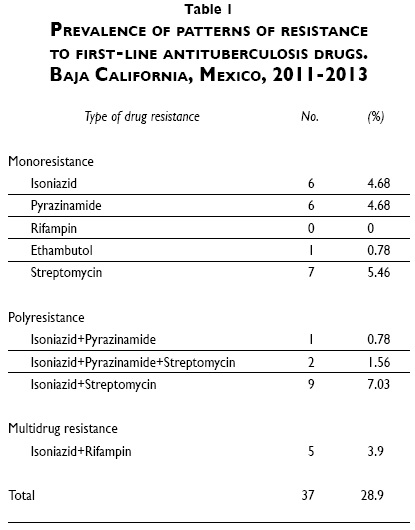
<body><![CDATA[<p align="justify"><font face="verdana" size="2">&nbsp;</font></p>  	    <p align="justify"><font face="verdana" size="2"><b>Materials and methods</b></font></p>  	    <p align="justify"><font face="verdana" size="2">Tijuana (population 1 559 683)<sup>5</sup> has the highest rate of tuberculosis (40&#45;50 cases per 10<sup>5</sup>) in Mexico; an average of 1 000 cases is diagnosed annually, of which 70% are new. We asked the health centers in the city to refer new TB suspects for culture and drug susceptibility testing (DST) to the TB laboratory at the Tijuana General Hospital; due to resource limitations we cultured new cases only once a week. The study period included subjects from January 1, 2011 through June 30, 2013.</font></p>  	    <p align="justify"><font face="verdana" size="2">Clinical information was obtained in every case, with emphasis on ruling out a previous diagnosis and treatment of TB; every subject was tested for HIV infection. Sputum samples were processed for microscopy, liquid culture (MGIT 960<sup>&Ograve;</sup>, Beckton Dickinson, NJ) and solid culture (Lowenstein&#45;Jensen/Stonebrink). Positive cultures for <i>Mycobacterium tuberculosis</i> (MTB) were tested for drug susceptibility to first line drugs (isoniazid &#91;INH&#93;, ethambutol &#91;EMB&#93;, rifampin &#91;RIF&#93;, pyrazinamide &#91;PZA&#93; and streptomycin &#91;SM&#93;) with the MGIT 960<sup>&Ograve;</sup> system.</font></p>  	    <p align="justify"><font face="verdana" size="2">The study protocol was approved by the ethics committee of the hospital. Subjects were required to sign an informed consent to participate.</font></p>  	    <p align="justify"><font face="verdana" size="2">&nbsp;</font></p>  	    <p align="justify"><font face="verdana" size="2"><b>Results</b></font></p>  	    <p align="justify"><font face="verdana" size="2">A total of 214 subjects with clinical suspicion of tuberculosis were referred for culture. Mean age was 38.5 &plusmn; 13.9 years; 146 (67%) were males. All the subjects had had productive cough for more than two weeks. Nineteen subjects (8.8%) had a positive HIV test.</font></p>  	    <p align="justify"><font face="verdana" size="2">One hundred and twenty&#45;eight patients (59.8%) had a positive culture for MTB and 37 (28.9%) had a MTB strain resistant to at least one first line drug. Twenty&#45;three (17.9%) were resistant to INH (including monoresistant, polyresistant and MDR cases), 5 to RIF (3.9%), 14 to PZA (10.9%), 3 to EMB (2.3%) and 22 to SM (17.2%). Five patients (3.9%) had an MDR strain, 20 (15.6%) had a monoresistant strain and 12 (9.4%) had a polyresistant strain (<a href="#t1">table I</a>). There were no significant differences in sociodemographic characteristics between subjects infected with a resistant strain and those infected with pan&#45;susceptible mycobacteria. Ten patients with negative smears (7.8%) had a positive culture (three had a resistant strain: one resistant to SM, one resistant to PZA, and one resistant to INH and SM).</font></p>  	    <p align="center"><font face="verdana" size="2"><a name="t1"></a></font></p>  	    ]]></body>
<body><![CDATA[<p align="center"><font face="verdana" size="2"><img src="/img/revistas/spm/v57n2/a13t1.jpg"></font></p>  	    <p align="justify"><font face="verdana" size="2">&nbsp;</font></p>  	    <p align="justify"><font face="verdana" size="2"><b>Discussion</b></font></p>  	    <p align="justify"><font face="verdana" size="2">In most developing countries DST is reserved for patients who experience treatment failure or are undergoing retreatment. In the absence of routine DST, new cases will receive a standardized regimen that includes four first line drugs.<sup>6</sup></font></p>  	    <p align="justify"><font face="verdana" size="2">In contrast, treatment of drug&#45;resistant tuberculosis often requires second&#45;line drugs and should be guided by DST results. Unfortunately, in many countries with high rates of drug&#45;resistant tuberculosis, new cases with undiagnosed drug&#45;resistance are treated empirically with first&#45;line drugs, based only on microscopy results. There are several reasons that explain the adoption of this programmatic policy, the most significant being the absence of laboratory facilities capable of performing DST and a limited access to second&#45;line drugs.<sup>4</sup></font></p>  	    <p align="justify"><font face="verdana" size="2">Standardized short&#45;course chemotherapy with first line drugs has been shown to be less effective against drug&#45;resistant tuberculosis than against drug&#45;susceptible tuberculosis.<sup>4</sup> A recent global meta&#45;analysis among patients with INH monoresistance found failure rates ranging from 18 to 44%.<sup>7</sup> A study conducted in Tomsk Oblast, reported that 70.8% of patients with <i>pretreatment</i> isoniazid&#45; or rifampin&#45;resistant strains (but without MDR&#45;TB at onset), were found to have developed MDR&#45;TB after treatment had failed.<sup>4</sup> The optimal management of INH monoresistant TB has been widely debated; current global recommendations are that INH monoresistant TB should be treated with a 9&#45;month regimen of daily rifampin, pyrazinamide and ethambutol (9RIF+PZA+EMB).<sup>8</sup></font></p>  	    <p align="justify"><font face="verdana" size="2">Pirazinamide &#91;PZA&#93; has an important sterilizing effect, and significantly reduces relapse rates in patients treated with a 6&#45;month regimen (ZINH+RIF+PZA+EMB/4INH<sub>3</sub>RIF<sub>3</sub>). Patients with monoresistance to PZA have higher rates of relapse, failure and mortality when compared with those of patients with full susceptible strains.<sup>1</sup> Loss of PZA from the regimen requires prolonging the duration of therapy with INH and RIF by 3 months, for a total of 9 months therapy.<sup>9</sup></font></p>  	    <p align="justify"><font face="verdana" size="2">Roughly, one fifth of our new cases were resistant to INH; this scenario carries a very high risk of amplification of resistance during the continuation phase; a patient with an INH resistant strain would be in monotherapy with RIF for four months and vice versa. In both cases the development of MDR&#45;TB would be highly likely. This risk would be higher in polyresistant cases that are left with a very weak standardized regimen. Finally, a new MDR&#45;TB case will certainly extend its resistance pattern to EMB, PZA or both.</font></p>  	    <p align="justify"><font face="verdana" size="2">&nbsp;</font></p>  	    <p align="justify"><font face="verdana" size="2"><b>Conclusion</b></font></p>  	    ]]></body>
<body><![CDATA[<p align="justify"><font face="verdana" size="2">Early diagnosis of drug resistant tuberculosis and the judicious use of second&#45;line drugs are recommended to decrease transmission of drug&#45;resistant strains and to prevent the creation of multidrug&#45;resistant strains.<sup>4</sup> Thirty&#45;five years ago Stefan Grzybowski wrote: "It is far better to do nothing than to treat the cases badly".<sup>10</sup> We agree.</font></p>  	    <p align="justify"><font face="verdana" size="2">&nbsp;</font></p>  	    <p align="justify"><font face="verdana" size="2"><b>References</b></font></p>  	    <!-- ref --><p align="justify"><font face="verdana" size="2">1. Yee DP, Menzies D, Brassard P. Clinical outcomes of pyrazinamide&#45;monoresistant <i>Mycobacterium</i> <i>tuberculosis</i> in Quebec. Int J Tuberc Lung Dis 2012;16:604&#45;609.    &nbsp;&nbsp;&nbsp;&nbsp;&nbsp;&nbsp;&nbsp;&nbsp;[&#160;<a href="javascript:void(0);" onclick="javascript: window.open('/scielo.php?script=sci_nlinks&ref=9402647&pid=S0036-3634201500020001300001&lng=','','width=640,height=500,resizable=yes,scrollbars=1,menubar=yes,');">Links</a>&#160;]<!-- end-ref --></font></p>  	    <!-- ref --><p align="justify"><font face="verdana" size="2">2. Gegia M, Cohen T, Kalandadze I, Vashakidze L, Furin J. Outcomes among tuberculosis patients with isoniazid resistance in Georgia, 2007&#45;2009. Int J Tuberc Lung Dis 2012;16:812&#45;816.    &nbsp;&nbsp;&nbsp;&nbsp;&nbsp;&nbsp;&nbsp;&nbsp;[&#160;<a href="javascript:void(0);" onclick="javascript: window.open('/scielo.php?script=sci_nlinks&ref=9402649&pid=S0036-3634201500020001300002&lng=','','width=640,height=500,resizable=yes,scrollbars=1,menubar=yes,');">Links</a>&#160;]<!-- end-ref --></font></p>  	    <!-- ref --><p align="justify"><font face="verdana" size="2">3. Dantes R, Metcalfe J, Kim E, Kato&#45;Maeda M, Hopewell PC, Kawamura M, <i>et al</i>. Impact of isoniazid resistance&#45;conferring mutations on the clinical presentation of isoniazid monoresistant tuberculosis. PLoS ONE 2012;7:e37956. doi:10.1371/journal.pone.0037956.    &nbsp;&nbsp;&nbsp;&nbsp;&nbsp;&nbsp;&nbsp;&nbsp;[&#160;<a href="javascript:void(0);" onclick="javascript: window.open('/scielo.php?script=sci_nlinks&ref=9402651&pid=S0036-3634201500020001300003&lng=','','width=640,height=500,resizable=yes,scrollbars=1,menubar=yes,');">Links</a>&#160;]<!-- end-ref --></font></p>  	    <!-- ref --><p align="justify"><font face="verdana" size="2">4. Seung KJ, Gelmanova IE, Peremitin GG, Golubchikova VT, Pavlova VE, Sirotkina OB, <i>et al</i>. The effect of initial drug resistance on treatment response and acquired drug resistance during standardized short&#45;course chemotherapy for tuberculosis. Clin Infect Dis 2004;39:1321&#45;1328.    &nbsp;&nbsp;&nbsp;&nbsp;&nbsp;&nbsp;&nbsp;&nbsp;[&#160;<a href="javascript:void(0);" onclick="javascript: window.open('/scielo.php?script=sci_nlinks&ref=9402653&pid=S0036-3634201500020001300004&lng=','','width=640,height=500,resizable=yes,scrollbars=1,menubar=yes,');">Links</a>&#160;]<!-- end-ref --></font></p>  	    <!-- ref --><p align="justify"><font face="verdana" size="2">5. Instituto Nacional de Estad&iacute;stica, Geograf&iacute;a e Inform&aacute;tica. N&uacute;mero de habitantes &#91;online monograph&#93;. M&eacute;xico: Inegi, 2014. &#91;accessed on 2014 December 17&#93;. Aviable at: <a href="http://cuentame.inegi.org.mx/monografias/informacion/bc/poblacion/" target="_blank">http://cuentame.inegi.org.mx/monografias/informacion/bc/poblacion/</a></font>&nbsp;&nbsp;&nbsp;&nbsp;&nbsp;&nbsp;&nbsp;&nbsp;[&#160;<a href="javascript:void(0);" onclick="javascript: window.open('/scielo.php?script=sci_nlinks&ref=9402655&pid=S0036-3634201500020001300005&lng=','','width=640,height=500,resizable=yes,scrollbars=1,menubar=yes,');">Links</a>&#160;]<!-- end-ref --><!-- ref --><p align="justify"><font face="verdana" size="2">6. World Health Organization. Treatment of tuberculosis: guidelines&#45;4th ed WHO/HTM/TB/2009.420. Geneva: WHO, 2009: 420.    &nbsp;&nbsp;&nbsp;&nbsp;&nbsp;&nbsp;&nbsp;&nbsp;[&#160;<a href="javascript:void(0);" onclick="javascript: window.open('/scielo.php?script=sci_nlinks&ref=9402656&pid=S0036-3634201500020001300006&lng=','','width=640,height=500,resizable=yes,scrollbars=1,menubar=yes,');">Links</a>&#160;]<!-- end-ref --></font></p>  	    <!-- ref --><p align="justify"><font face="verdana" size="2">7. Menzies D, Benedetti A, Paydar A, Royce S, Pai M, Burman W, <i>et al</i>. Standardized treatment of active tuberculosis in patients with previous treatment and/or with mono&#45;resistance to isoniazid: a systematic review and meta&#45;analysis. PLoS Med 2009;6:e1000150. doi:10.1371/journal.pmed.1000150.    &nbsp;&nbsp;&nbsp;&nbsp;&nbsp;&nbsp;&nbsp;&nbsp;[&#160;<a href="javascript:void(0);" onclick="javascript: window.open('/scielo.php?script=sci_nlinks&ref=9402658&pid=S0036-3634201500020001300007&lng=','','width=640,height=500,resizable=yes,scrollbars=1,menubar=yes,');">Links</a>&#160;]<!-- end-ref --></font></p>  	    <!-- ref --><p align="justify"><font face="verdana" size="2">8. World Health Organization. Guidelines for the programmatic management of drug&#45;resistant TB: emergency update 2008. Geneva, Switzerland: WHO, 2008.    &nbsp;&nbsp;&nbsp;&nbsp;&nbsp;&nbsp;&nbsp;&nbsp;[&#160;<a href="javascript:void(0);" onclick="javascript: window.open('/scielo.php?script=sci_nlinks&ref=9402660&pid=S0036-3634201500020001300008&lng=','','width=640,height=500,resizable=yes,scrollbars=1,menubar=yes,');">Links</a>&#160;]<!-- end-ref --></font></p>  	    <!-- ref --><p align="justify"><font face="verdana" size="2">9. Curry International Tuberculosis Center and California Department of Public Health. Drug&#45;resistant tuberculosis: a survival guide for clinicians. 2nd ed. San Francisco, California: University of California, 2011:33.    &nbsp;&nbsp;&nbsp;&nbsp;&nbsp;&nbsp;&nbsp;&nbsp;[&#160;<a href="javascript:void(0);" onclick="javascript: window.open('/scielo.php?script=sci_nlinks&ref=9402662&pid=S0036-3634201500020001300009&lng=','','width=640,height=500,resizable=yes,scrollbars=1,menubar=yes,');">Links</a>&#160;]<!-- end-ref --></font></p>  	    ]]></body>
<body><![CDATA[<!-- ref --><p align="justify"><font face="verdana" size="2">10. Grzybowski S, Enarson D. The fate of cases of pulmonary tuberculosis under various treatment programmes. Bull Int Union Tuberc Lung Dis 1978;53:70&#45;75.    &nbsp;&nbsp;&nbsp;&nbsp;&nbsp;&nbsp;&nbsp;&nbsp;[&#160;<a href="javascript:void(0);" onclick="javascript: window.open('/scielo.php?script=sci_nlinks&ref=9402664&pid=S0036-3634201500020001300010&lng=','','width=640,height=500,resizable=yes,scrollbars=1,menubar=yes,');">Links</a>&#160;]<!-- end-ref --></font></p>  	    <p align="justify"><font face="verdana" size="2">&nbsp;</font></p>  	    <p align="justify"><font face="verdana" size="2"><b>Received on:</b> May 8, 2014    <br> 	<b>Accepted on:</b> January 13, 2015</font></p>  	    <p align="justify"><font face="verdana" size="2">&nbsp;</font></p>  	    <p align="justify"><font face="verdana" size="2"><a name="n1a"></a><a href="#n1b"><img src="/img/revistas/spm/v57n2/flecha.jpg" ></a>Corresponding author:    <br> 	<b>Dr. Rafael Laniado Labor&iacute;n.</b>    <br> 	Facultad de Medicina y Psicolog&iacute;a,    <br> Universidad Aut&oacute;noma de Baja California.    ]]></body>
<body><![CDATA[<br> 	Emiliano Zapata 1423, zona Centro.    <br> 22 000 Tijuana, Baja California, M&eacute;xico.    <br> 	E&#45;mail: <a href="mailto:rlaniado@uabc.edu.mx" target="_blank">rlaniado@uabc.edu.mx</a></font></p>  	    <p align="justify"><font face="verdana" size="2">&nbsp;</font></p>  	    <p align="justify"><font face="verdana" size="2"><i>Declaration of conflict of interests.</i> The authors declare that they have no conflict of interests.</font></p>      ]]></body><back>
<ref-list>
<ref id="B1">
<label>1</label><nlm-citation citation-type="journal">
<person-group person-group-type="author">
<name>
<surname><![CDATA[Yee]]></surname>
<given-names><![CDATA[DP]]></given-names>
</name>
<name>
<surname><![CDATA[Menzies]]></surname>
<given-names><![CDATA[D]]></given-names>
</name>
<name>
<surname><![CDATA[Brassard]]></surname>
<given-names><![CDATA[P]]></given-names>
</name>
</person-group>
<article-title xml:lang="en"><![CDATA[Clinical outcomes of pyrazinamide-monoresistant Mycobacterium tuberculosis in Quebec]]></article-title>
<source><![CDATA[Int J Tuberc Lung Dis]]></source>
<year>2012</year>
<volume>16</volume>
<page-range>604-609</page-range></nlm-citation>
</ref>
<ref id="B2">
<label>2</label><nlm-citation citation-type="journal">
<person-group person-group-type="author">
<name>
<surname><![CDATA[Gegia]]></surname>
<given-names><![CDATA[M]]></given-names>
</name>
<name>
<surname><![CDATA[Cohen]]></surname>
<given-names><![CDATA[T]]></given-names>
</name>
<name>
<surname><![CDATA[Kalandadze]]></surname>
<given-names><![CDATA[I]]></given-names>
</name>
<name>
<surname><![CDATA[Vashakidze]]></surname>
<given-names><![CDATA[L]]></given-names>
</name>
<name>
<surname><![CDATA[Furin]]></surname>
<given-names><![CDATA[J]]></given-names>
</name>
</person-group>
<article-title xml:lang="en"><![CDATA[Outcomes among tuberculosis patients with isoniazid resistance in Georgia, 2007-2009]]></article-title>
<source><![CDATA[Int J Tuberc Lung Dis]]></source>
<year>2012</year>
<volume>16</volume>
<page-range>812-816</page-range></nlm-citation>
</ref>
<ref id="B3">
<label>3</label><nlm-citation citation-type="journal">
<person-group person-group-type="author">
<name>
<surname><![CDATA[Dantes]]></surname>
<given-names><![CDATA[R]]></given-names>
</name>
<name>
<surname><![CDATA[Metcalfe]]></surname>
<given-names><![CDATA[J]]></given-names>
</name>
<name>
<surname><![CDATA[Kim]]></surname>
<given-names><![CDATA[E]]></given-names>
</name>
<name>
<surname><![CDATA[Kato-Maeda]]></surname>
<given-names><![CDATA[M]]></given-names>
</name>
<name>
<surname><![CDATA[Hopewell]]></surname>
<given-names><![CDATA[PC]]></given-names>
</name>
<name>
<surname><![CDATA[Kawamura]]></surname>
<given-names><![CDATA[M]]></given-names>
</name>
</person-group>
<article-title xml:lang="en"><![CDATA[Impact of isoniazid resistance-conferring mutations on the clinical presentation of isoniazid monoresistant tuberculosis]]></article-title>
<source><![CDATA[PLoS ONE]]></source>
<year>2012</year>
<volume>7</volume>
<page-range>e37956</page-range></nlm-citation>
</ref>
<ref id="B4">
<label>4</label><nlm-citation citation-type="journal">
<person-group person-group-type="author">
<name>
<surname><![CDATA[Seung]]></surname>
<given-names><![CDATA[KJ]]></given-names>
</name>
<name>
<surname><![CDATA[Gelmanova]]></surname>
<given-names><![CDATA[IE]]></given-names>
</name>
<name>
<surname><![CDATA[Peremitin]]></surname>
<given-names><![CDATA[GG]]></given-names>
</name>
<name>
<surname><![CDATA[Golubchikova]]></surname>
<given-names><![CDATA[VT]]></given-names>
</name>
<name>
<surname><![CDATA[Pavlova]]></surname>
<given-names><![CDATA[VE]]></given-names>
</name>
<name>
<surname><![CDATA[Sirotkina]]></surname>
<given-names><![CDATA[OB]]></given-names>
</name>
</person-group>
<article-title xml:lang="en"><![CDATA[The effect of initial drug resistance on treatment response and acquired drug resistance during standardized short-course chemotherapy for tuberculosis]]></article-title>
<source><![CDATA[Clin Infect Dis]]></source>
<year>2004</year>
<volume>39</volume>
<page-range>1321-1328</page-range></nlm-citation>
</ref>
<ref id="B5">
<label>5</label><nlm-citation citation-type="book">
<collab>Instituto Nacional de Estadística, Geografía e Informática</collab>
<source><![CDATA[Número de habitantes]]></source>
<year>2014</year>
<publisher-name><![CDATA[Inegi]]></publisher-name>
</nlm-citation>
</ref>
<ref id="B6">
<label>6</label><nlm-citation citation-type="book">
<collab>World Health Organization</collab>
<source><![CDATA[Treatment of tuberculosis: guidelines]]></source>
<year>2009</year>
<edition>4</edition>
<page-range>420</page-range><publisher-loc><![CDATA[Geneva ]]></publisher-loc>
<publisher-name><![CDATA[WHO]]></publisher-name>
</nlm-citation>
</ref>
<ref id="B7">
<label>7</label><nlm-citation citation-type="journal">
<person-group person-group-type="author">
<name>
<surname><![CDATA[Menzies]]></surname>
<given-names><![CDATA[D]]></given-names>
</name>
<name>
<surname><![CDATA[Benedetti]]></surname>
<given-names><![CDATA[A]]></given-names>
</name>
<name>
<surname><![CDATA[Paydar]]></surname>
<given-names><![CDATA[A]]></given-names>
</name>
<name>
<surname><![CDATA[Royce]]></surname>
<given-names><![CDATA[S]]></given-names>
</name>
<name>
<surname><![CDATA[Pai]]></surname>
<given-names><![CDATA[M]]></given-names>
</name>
<name>
<surname><![CDATA[Burman]]></surname>
<given-names><![CDATA[W]]></given-names>
</name>
</person-group>
<article-title xml:lang="en"><![CDATA[Standardized treatment of active tuberculosis in patients with previous treatment and/or with mono-resistance to isoniazid: a systematic review and meta-analysis]]></article-title>
<source><![CDATA[PLoS Med]]></source>
<year>2009</year>
<volume>6</volume>
<page-range>e1000150</page-range></nlm-citation>
</ref>
<ref id="B8">
<label>8</label><nlm-citation citation-type="book">
<collab>World Health Organization</collab>
<source><![CDATA[Guidelines for the programmatic management of drug-resistant TB: emergency update 2008]]></source>
<year>2008</year>
<publisher-loc><![CDATA[Geneva ]]></publisher-loc>
<publisher-name><![CDATA[WHO]]></publisher-name>
</nlm-citation>
</ref>
<ref id="B9">
<label>9</label><nlm-citation citation-type="book">
<collab>Curry International Tuberculosis Center</collab>
<collab>California Department of Public Health</collab>
<source><![CDATA[Drug-resistant tuberculosis: a survival guide for clinicians]]></source>
<year>2011</year>
<edition>2</edition>
<page-range>33</page-range><publisher-loc><![CDATA[San Francisco^eCalifornia California]]></publisher-loc>
<publisher-name><![CDATA[University of California]]></publisher-name>
</nlm-citation>
</ref>
<ref id="B10">
<label>10</label><nlm-citation citation-type="journal">
<person-group person-group-type="author">
<name>
<surname><![CDATA[Grzybowski]]></surname>
<given-names><![CDATA[S]]></given-names>
</name>
<name>
<surname><![CDATA[Enarson]]></surname>
<given-names><![CDATA[D]]></given-names>
</name>
</person-group>
<article-title xml:lang="en"><![CDATA[The fate of cases of pulmonary tuberculosis under various treatment programmes]]></article-title>
<source><![CDATA[Bull Int Union Tuberc Lung Dis]]></source>
<year>1978</year>
<volume>53</volume>
<page-range>70-75</page-range></nlm-citation>
</ref>
</ref-list>
</back>
</article>