<?xml version="1.0" encoding="ISO-8859-1"?><article xmlns:mml="http://www.w3.org/1998/Math/MathML" xmlns:xlink="http://www.w3.org/1999/xlink" xmlns:xsi="http://www.w3.org/2001/XMLSchema-instance">
<front>
<journal-meta>
<journal-id>0036-3634</journal-id>
<journal-title><![CDATA[Salud Pública de México]]></journal-title>
<abbrev-journal-title><![CDATA[Salud pública Méx]]></abbrev-journal-title>
<issn>0036-3634</issn>
<publisher>
<publisher-name><![CDATA[Instituto Nacional de Salud Pública]]></publisher-name>
</publisher>
</journal-meta>
<article-meta>
<article-id>S0036-36342013000400005</article-id>
<title-group>
<article-title xml:lang="en"><![CDATA[Iron, zinc, copper and magnesium deficiencies in Mexican adults from the National Health and Nutrition Survey 2006]]></article-title>
<article-title xml:lang="es"><![CDATA[Deficiencias de hierro, zinc, cobre y magnesio en adultos mexicanos. Encuesta Nacional de Salud y Nutrición 2006]]></article-title>
</title-group>
<contrib-group>
<contrib contrib-type="author">
<name>
<surname><![CDATA[Mejía-Rodríguez]]></surname>
<given-names><![CDATA[Fabiola]]></given-names>
</name>
<xref ref-type="aff" rid="A01"/>
</contrib>
<contrib contrib-type="author">
<name>
<surname><![CDATA[Shamah-Levy]]></surname>
<given-names><![CDATA[Teresa]]></given-names>
</name>
<xref ref-type="aff" rid="A01"/>
</contrib>
<contrib contrib-type="author">
<name>
<surname><![CDATA[Villalpando]]></surname>
<given-names><![CDATA[Salvador]]></given-names>
</name>
<xref ref-type="aff" rid="A01"/>
</contrib>
<contrib contrib-type="author">
<name>
<surname><![CDATA[García-Guerra]]></surname>
<given-names><![CDATA[Armando]]></given-names>
</name>
<xref ref-type="aff" rid="A01"/>
</contrib>
<contrib contrib-type="author">
<name>
<surname><![CDATA[Méndez-Gómez Humarán]]></surname>
<given-names><![CDATA[Ignacio]]></given-names>
</name>
<xref ref-type="aff" rid="A01"/>
</contrib>
</contrib-group>
<aff id="A01">
<institution><![CDATA[,Instituto Nacional de Salud Pública de México  ]]></institution>
<addr-line><![CDATA[Cuernavaca Morelos]]></addr-line>
<country>México</country>
</aff>
<pub-date pub-type="pub">
<day>00</day>
<month>06</month>
<year>2013</year>
</pub-date>
<pub-date pub-type="epub">
<day>00</day>
<month>06</month>
<year>2013</year>
</pub-date>
<volume>55</volume>
<numero>3</numero>
<fpage>275</fpage>
<lpage>284</lpage>
<copyright-statement/>
<copyright-year/>
<self-uri xlink:href="http://www.scielo.org.mx/scielo.php?script=sci_arttext&amp;pid=S0036-36342013000400005&amp;lng=en&amp;nrm=iso"></self-uri><self-uri xlink:href="http://www.scielo.org.mx/scielo.php?script=sci_abstract&amp;pid=S0036-36342013000400005&amp;lng=en&amp;nrm=iso"></self-uri><self-uri xlink:href="http://www.scielo.org.mx/scielo.php?script=sci_pdf&amp;pid=S0036-36342013000400005&amp;lng=en&amp;nrm=iso"></self-uri><abstract abstract-type="short" xml:lang="en"><p><![CDATA[OBJECTIVE: To describe the prevalence of serum iron and zinc deficiencies and low serum concentrations (LSC) of copper and magnesium in Mexican adults. MATERIALS AND METHODS: Blood samples from subjects (&gt;20 years, both genders) participating in the 2006 National Health and Nutrition Survey were used to measure the serum concentrations of s-ferritin, soluble- transferrin-receptor (s-TfR), zinc, copper, and magnesium. RESULTS: The prevalence of s-ferritin<12ug/L was 18.1 and 3.6% while s-TfR&gt;6mg/L was 9.5 and 4.4%, for females and males, respectively. The prevalence of zinc deficiency was 33.8% females and 42.6% males; LSC of copper were 16.8 and 18.2%, and 36.3 and 31.0% for magnesium, for females and males, respectively. CONCLUSIONS: The prevalence of deficiencies in iron (in females), and zinc are still high in the adult population. LSC of copper and magnesium are published for the first time and show significant prevalence of deficiencies. Corrective actions are necessary in order to diminish these nutritional deficits in the Mexican population.]]></p></abstract>
<abstract abstract-type="short" xml:lang="es"><p><![CDATA[OBJETIVO: Describir la prevalencia de deficiencias de hierro y zinc y valores bajos (VB) de cobre y magnesio en adultos mexicanos. MATERIAL Y MÉTODOS: Se utilizaron muestras de sangre de individuos (&gt;20 años, ambos sexos) de la Encuesta Nacional de Salud y Nutrición 2006 para medir concentraciones séricas de s-ferritina, receptor soluble de transferrina (s-TfR), zinc, cobre y magnesio. RESULTADOS: La prevalencia de s-ferritina<12ug/L fue de 18.1 y 3.6%, s-TfR&gt;6mg/L de 9.5 y 4.4% para mujeres y hombres, respectivamente. Para zinc fue de 33.8% mujeres y 42.6% hombres. Para VB de cobre fue 16.8 y 18.2%; y magnesio 36.3 y 31.0% en mujeres y hombres, respectivamente. CONCLUSIONES: Las prevalencias de deficiencia de hierro (mujeres) y zinc aún son altas en la población adulta. VB de cobre y magnesio se publican por primera vez en una muestra representativa de adultos y muestran prevalencias importantes. Son necesarias medidas correctivas para combatir estos problemas en la población mexicana.]]></p></abstract>
<kwd-group>
<kwd lng="en"><![CDATA[Minerals]]></kwd>
<kwd lng="en"><![CDATA[iron]]></kwd>
<kwd lng="en"><![CDATA[zinc]]></kwd>
<kwd lng="en"><![CDATA[copper]]></kwd>
<kwd lng="en"><![CDATA[magnesium]]></kwd>
<kwd lng="en"><![CDATA[Mexico]]></kwd>
<kwd lng="es"><![CDATA[minerales]]></kwd>
<kwd lng="es"><![CDATA[hierro]]></kwd>
<kwd lng="es"><![CDATA[zinc]]></kwd>
<kwd lng="es"><![CDATA[cobre]]></kwd>
<kwd lng="es"><![CDATA[magnesio]]></kwd>
<kwd lng="es"><![CDATA[México]]></kwd>
</kwd-group>
</article-meta>
</front><body><![CDATA[ <div class=WordSection1>        <p align="right"><font face="Verdana" size="2"><b>ART&Iacute;CULO ORIGINAL</b></font></p>       <p>&nbsp;</p>     <p><a name="top"></a><font face="Verdana" size="4"><b>Iron, zinc, copper and magnesium deficiencies      in Mexican adults from the National Health and Nutrition Survey 2006</b></font></p>       <p>&nbsp;</p>       <p><font face="Verdana" size="3"><b>Deficiencias de hierro, zinc, cobre y magnesio      en adultos mexicanos. Encuesta Nacional de Salud y Nutrici&oacute;n 2006</b></font></p>       <p>&nbsp;</p>     <p>&nbsp;</p>     <p><font size="2" face="Verdana"><b>Fabiola Mej&iacute;a-Rodr&iacute;guez, MSc;      Teresa Shamah-Levy, MSc, PhD; Salvador Villalpando, MD, PhD; Armando Garc&iacute;a-Guerra,      MSc; Ignacio M&eacute;ndez-G&oacute;mez Humar&aacute;n, MSc, PhD.</b></font></p>       <p><font face="Verdana" size="2">Instituto Nacional de Salud P&uacute;blica      de M&eacute;xico. Cuernavaca, Morelos, M&eacute;xico</font></p>       ]]></body>
<body><![CDATA[<p><font face="Verdana" size="2"><a href="#end">Corresponding author</a></font></p>     <p>&nbsp;</p>     <p>&nbsp;</p> <hr size="1" noshade>       <p><font face="Verdana" size="2"><b>ABSTRACT</b></font></p>       <p><font face="Verdana" size="2"><b>OBJECTIVE:</b> To describe the prevalence      of serum iron and zinc deficiencies and low serum concentrations (LSC) of      copper and magnesium in Mexican adults.    <br>     <b>MATERIALS AND METHODS:</b> Blood samples from subjects (<u>&gt;</u>20 years,      both genders) participating in the 2006 National Health and Nutrition Survey      were used to measure the serum concentrations of s-ferritin, soluble- transferrin-receptor      (s-TfR), zinc, copper, and magnesium.    <br>     <b>RESULTS:</b> The prevalence of s-ferritin<u>&lt;</u>12ug/L was 18.1 and      3.6% while s-TfR&gt;6mg/L was 9.5 and 4.4%, for females and males, respectively.      The prevalence of zinc deficiency was 33.8% females and 42.6% males; LSC of      copper were 16.8 and 18.2%, and 36.3 and 31.0% for magnesium, for females      and males, respectively.    <br>     <b>CONCLUSIONS:</b> The prevalence of deficiencies in iron (in females), and      zinc are still high in the adult population. LSC of copper and magnesium are      published for the first time and show significant prevalence of deficiencies.      Corrective actions are necessary in order to diminish these nutritional deficits      in the Mexican population.</font></p>       <p><font face="Verdana" size="2"><b>Key words:</b> Minerals; iron; zinc; copper;      magnesium; Mexico</font></p>   <hr size="1" noshade>       <p><font face="Verdana" size="2"><b>RESUMEN</b></font></p>       ]]></body>
<body><![CDATA[<p><font face="Verdana" size="2"><b>OBJETIVO:</b> Describir la prevalencia de      deficiencias de hierro y zinc y valores bajos (VB) de cobre y magnesio en      adultos mexicanos.    <br>     <b>MATERIAL Y M&Eacute;TODOS:</b> Se utilizaron muestras de sangre de individuos      (<u>&gt;</u>20 a&ntilde;os, ambos sexos) de la Encuesta Nacional de Salud      y Nutrici&oacute;n 2006 para medir concentraciones s&eacute;ricas de s-ferritina,      receptor soluble de transferrina (s-TfR), zinc, cobre y magnesio.    <br>     <b>RESULTADOS:</b> La prevalencia de s-ferritina<u>&lt;</u>12ug/L fue de 18.1      y 3.6%, s-TfR&gt;6mg/L de 9.5 y 4.4% para mujeres y hombres, respectivamente.      Para zinc fue de 33.8% mujeres y 42.6% hombres. Para VB de cobre fue 16.8      y 18.2%; y magnesio 36.3 y 31.0% en mujeres y hombres, respectivamente.    <br>     <b>CONCLUSIONES:</b> Las prevalencias de deficiencia de hierro (mujeres)      y zinc a&uacute;n son altas en la poblaci&oacute;n adulta. VB de cobre y magnesio      se publican por primera vez en una muestra representativa de adultos y muestran      prevalencias importantes. Son necesarias medidas correctivas para combatir      estos problemas en la poblaci&oacute;n mexicana.</font></p>       <p><font face="Verdana" size="2"><b>Palabras clave:</b> minerales; hierro; zinc;      cobre; magnesio; M&eacute;xico</font></p>   <hr size="1" noshade>       <p>&nbsp;</p>       <p><font face="Verdana" size="2">Deficiency of micronutrients such as iron,      iodine, and vitamin A, are globally the most frequent. Some reports estimate      that more than two thousand million persons suffer from these nutritional      deficiencies worldwide.<sup>1,2,3</sup></font></p>       <p><font face="Verdana" size="2">Iron deficiency during pregnancy is linked      to increased maternal morbidity and mortality.<sup>4</sup> Women of childbearing      age from middle- and low-income countries are prone to iron deficiency anemia.<sup>5</sup>      Low serum concentrations (LSC) of copper are linked to a decreased activity      of some metalloenzymes<sup>6</sup> reducing iron ions to facilitate its absorption      and transport.<sup>7</sup> It has also been associated with a decreased immune      response,<sup>8</sup> osteoporosis, hypercholesterolemia, and glucose intolerance.<sup>9-11</sup>      In adult males, a zinc to copper ratio &gt;1 is associated with decreased      immune response and higher mortality in HIV positive individuals.<sup>12</sup>      LSC of magnesium is less common, but it produces hypokalemia; a condition      affecting the electrolyte equilibrium of the body.<sup>13-15</sup> In developing      countries, micronutrient deficiencies frequently coexist with inflammation      and infection, impeding the interpretation of iron and zinc deficiencies.      Creactive protein or alpha 1-acid glycoprotein should be measured simultaneously      to avoid confounding effects of inflammation.<sup>16,17</sup></font></p>       <p><font face="Verdana" size="2">In Mexico, information about mineral deficiencies      in adults from probabilistic surveys is limited to the prevalence of iron      and zinc deficiencies in women of childbearing age, reported in the 1999 Mexican      National Nutrition Survey (ENN 99)<sup>18</sup> which found a prevalence of      iron and zinc deficiencies, of 40 and 30% respectively.<sup>19</sup> Reports      from other countries found a LSC of copper of 17 and 8.6% in Iranian females      and males,<sup>11</sup> respectively, and 5.9% in Chilean females.<sup>20</sup></font></p>       <p><font face="Verdana" size="2">Information on the national prevalence of these      deficiencies is required in order to consider redesign of ongoing or new interventions      to accelerate the reduction of micronutrient deficiencies. The aim of this      study is to describe the magnitude and distribution of iron and zinc deficiencies,      and LSC of copper and magnesium and the inflammation status using protein      C reactive (PCR) in Mexican adults.</font></p>       ]]></body>
<body><![CDATA[<p>&nbsp;</p>     <p><font face="Verdana" size="3"><b>Materials and methods</b></font></p>       <p><font face="Verdana" size="2"><b>Population and methods</b></font></p>       <p><font face="Verdana" size="2">Data for the present analysis were from a sample      of 30% of male and female adults who were older than 20 years, participating      in the 2006 Mexican National Health and Nutrition Survey (ENSANUT 2006); with      available measurements of the serum concentrations of s-ferritin, soluble      transferrin receptor (s-TfR), zinc, copper, magnesium and C reactive protein      (PCR). The power of the subsample allowed for distinctions at the national      and regional level. Pregnant women and those with no biochemical determinations      were excluded from the analysis. The final number of subjects was 3 421 female      and 1 989 males.</font></p>       <p><font face="Verdana" size="2"><b>Survey design</b></font></p>       <p><font face="Verdana" size="2">ENSANUT 2006 is a Mexican nationwide survey      representative of both rural and urban areas from four regions of the country.      The study used a stratified cluster sample design.<sup>21</sup></font></p>       <p><font face="Verdana" size="2"><b>Blood sample collection, preparation and      storage</b></font></p>       <p><font face="Verdana" size="2">Fasting blood samples were drawn from an antecubital      vein and centrifuged; serum was separated, stored in cryovials kept in liquid      nitrogen, and transported to the nutrition laboratory at INSP in Cuernavaca,      Mexico.<sup>22</sup></font></p>       <p><font face="Verdana" size="2"><b>Methods for determination of micronutrients</b></font></p>       <p><font face="Verdana" size="2"><i>S-Ferritin, soluble transferrin receptor,      and C-reactive protein</i></font></p>       ]]></body>
<body><![CDATA[<p><font face="Verdana" size="2">Iron levels were approximated using measures      of s-ferritin and soluble transferrin receptor (s-TfR). The deficiency of      body iron stores was defined as s-ferritin <u>&lt;</u>12ug/L and tissue iron      deficiency as by s-TfR concentrations &gt;6mg/L.<sup>23</sup> Serum concentrations      of C-reactive protein (PCR) were measured by nephelometry using an ultrasensitive,      monoclonal antibody and the manufacturer protocol was followed.</font></p>       <p><font face="Verdana" size="2"><i>Determinations of serum iron, zinc, copper,      and magnesium concentrations</i></font></p>       <p><font face="Verdana" size="2">Measurements of serum iron, zinc, copper, and      magnesium concentrations were measured using an inductively coupled plasma      optical emission spectrometer, following the procedure described by Tietz      <i>et al</i>.<sup>24</sup> Zinc deficiency was defined as serum zinc &lt;70ug/dL      in females and &lt; 74ug/dL in males,<sup>25</sup> LSC of serum copper &lt;70ug/dL      in men and &lt;80ug/dL in women,<sup>26</sup> and LSC of serum magnesium &lt;1.823mg/dL      (&lt;0.75 mmol/L).<sup>26</sup> The controls for measurements are expressed      as follows: mean&plusmn;SD (coefficient of variation=%). S-ferritin 74.6&plusmn;3.67&#181;g/L,      (c.v.=4.4%); s-TfR 2.32&plusmn;0.13mg/L, (c.v.=5.6%); PCR 1.2&plusmn;0.05mg/dL,      (c.v.=2.2%); zinc 76.1&plusmn;1.3ug/dL, (c.v=11.5%); copper 99.3&plusmn;27.7ug/dL,      (c.v.=5.6%) and magnesium 1564&plusmn;27.2mg/dL (c.v.=11.7%).</font></p>       <p><font face="Verdana" size="2"><b>Anemia</b></font></p>       <p><font face="Verdana" size="2">Anemia was defined as hemoglobin concentration      &lt;120 g/L in non-pregnant women and &lt;130 g/L in men<sup>23</sup>, adjusting      for altitude above sea level, as by Cohen and Haas.<sup>27</sup> Iron deficiency      anemia (IDA) was defined when an abnormal Hb value coexisted with at least      one iron status indicator below the cutoff values, s-ferritin <u>&lt;</u>      12 ug/L or s-TfR &gt;6 mg/L.<sup>28</sup> Both venous and capillary blood      was obtained from each subject.</font></p>       <p><font face="Verdana" size="2"><b>Dietary intake of micronutrients</b></font></p>       <p><font face="Verdana" size="2">Dietary intakes data collection have been described      in detail elsewhere. <sup>29</sup> Inadequate intake was defined when it was      below the cutoff of Estimated Average Requirement (EAR). For iron intake was      &lt;16 mg/day and copper &lt;0.7mg/day; zinc &lt;11mg/day (females) and &lt;12mg/day      (males) and magnesium &lt;280mg/day (females) and &lt;215mg/day (males).<sup>30</sup>      We did not consider bioavailability in the assessment of mineral intake.</font></p>       <p><font face="Verdana" size="2"><b>Definition of variables</b></font></p>       <p><font face="Verdana" size="2">Demographic and socioeconomic information was      collected using <i>ad hoc</i> questionnaires.<sup>18</sup> Selected variables      including age, sex, body mass index (BMI),<sup>31</sup> indigenous status      (any member spoke an indigenous language), socioeconomic status (SES, index      was constructed using a principal components analysis),<sup>32</sup> area      and region of residence, and affiliation to food assistance programs such      as <i>Oportunidades</i> and the milk distribution program <i>Liconsa</i>.</font></p>       <p><font face="Verdana" size="2"><b>Statistical analysis</b></font></p>       ]]></body>
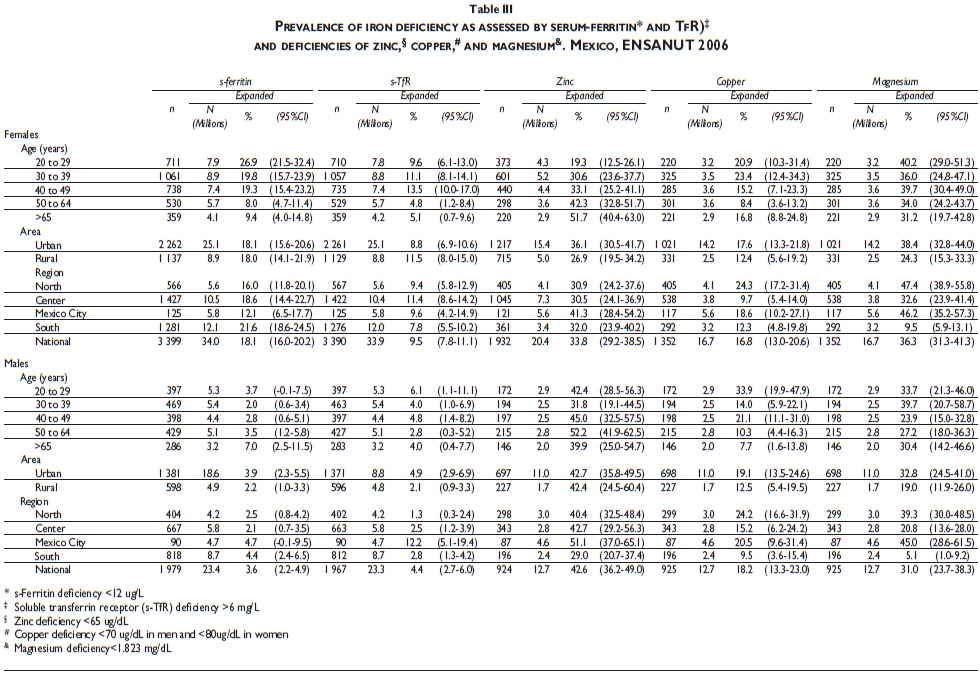
<body><![CDATA[<p><font face="Verdana" size="2">Distribution of variables was described using      means, medians, frequencies or proportions stratified by sex. Prevalence of      mineral deficiencies or LSC and 95% confidence intervals were calculated.<sup>33</sup>      Multiple logistic regression models were constructed to test whether prevalence      of iron deficiency anemia, IDA or prevalence of zinc deficiency changed with      inflammation (PCR&gt;6 mg/L), adjusting for age group, sex and interaction      sexage group. Other logistic regression models were constructed to estimate      predictors of the prevalence of the following micronutrient deficiencies or      LSCs (in females): iron, zinc, copper and magnesium, adjusting for affiliation      to food assistance programs, age, SES, micronutrient dietary intake, enhancers      and inhibitors of mineral bioavailability, and excluding cases with PCR concentration      &gt;6 mg/L.</font></p>       <p><font face="Verdana" size="2">All analyses were adjusted for the study design,      considering the Primary Sample Unit (PSU), the strata defined for the survey,      and their corresponding calibrated weights. Analyses were done using Stata      Versi&oacute;n 12 (StataCorp. 2011 Stata Statistical Software: Release 12.      College Station, Tx: Stata Corp LP).</font></p>       <p><font face="Verdana" size="2"><b>Ethical aspects</b></font></p>       <p><font face="Verdana" size="2">The study protocol was approved by the Ethics,      Biosecurity, and Research Boards of the National Institute of Public Health      (INSP), Cuernavaca, Mexico. Anthropometric measurements and blood samples      were obtained after participants had signed an informed consent letter.</font></p>       <p>&nbsp;</p>     <p><font face="Verdana" size="3"><b>Results</b></font></p>       <p><font face="Verdana" size="2">This analysis included 3 421 non- pregnant      females and 1 989 males who represented about 59 million people older than      20 years. About 70% of the sample (sexes combined) was overweight or obese.      Females (44.8%) and males (37.6%) had 6 years and (15.8 and 28.3%) had more      than 12 years of schooling. Only 8.8% of females and 6% of males (6%) spoke      an indigenous language, while 26.2 and 20.6% lived in rural areas (<a href="/img/revistas/spm/v55n3/a05tab1.jpg">table&nbsp;I</a>).</font></p>       <p><font face="Verdana" size="2">In <a href="/img/revistas/spm/v55n3/a05tab2.jpg">table&nbsp;II</a> are shown the medians and interquartile      ranges (p25, p75) for serum concentrations of s-ferritin, s-TfR, iron, zinc,      copper, and magnesium.</font></p>       <p><font face="Verdana" size="2"><b>Iron nutritional status</b></font></p>       <p><font face="Verdana" size="2">The prevalence of iron deficiency (<a href="/img/revistas/spm/v55n3/a05tab3.jpg">table&nbsp;III</a>)      based on s-ferritin was lower in males (2-7%) than in females in all age groups.      It was higher in females aged 20 to 50 years (19.3-26.9%) and decreased to      a half in older than 50 years (8.0-9.4%). The prevalence was 2-fold higher      in the South region (21.6%) compared with Mexico City (12.1%), (<a href="/img/revistas/spm/v55n3/a05tab3.jpg">table&nbsp;III</a>).      The prevalence of tissue iron deficiency as determined by high concentrations      of s-TfR was higher in female aged 20-49 years (9.6-13.5%) than in those older      than 50 years (4.8-5.1%). It was higher in the Center region (11.4%) compared      with Mexico City (9.6%), (<a href="/img/revistas/spm/v55n3/a05tab3.jpg">table&nbsp;III</a>). The prevalence of tissue iron deficiency      were similar in males by age group and by urban or rural area of residence,      although it was higher in Mexico City (12.2%) compared with other regions      (1.3- 2.8%). No differences were found when controlling for PCR.</font></p>       ]]></body>
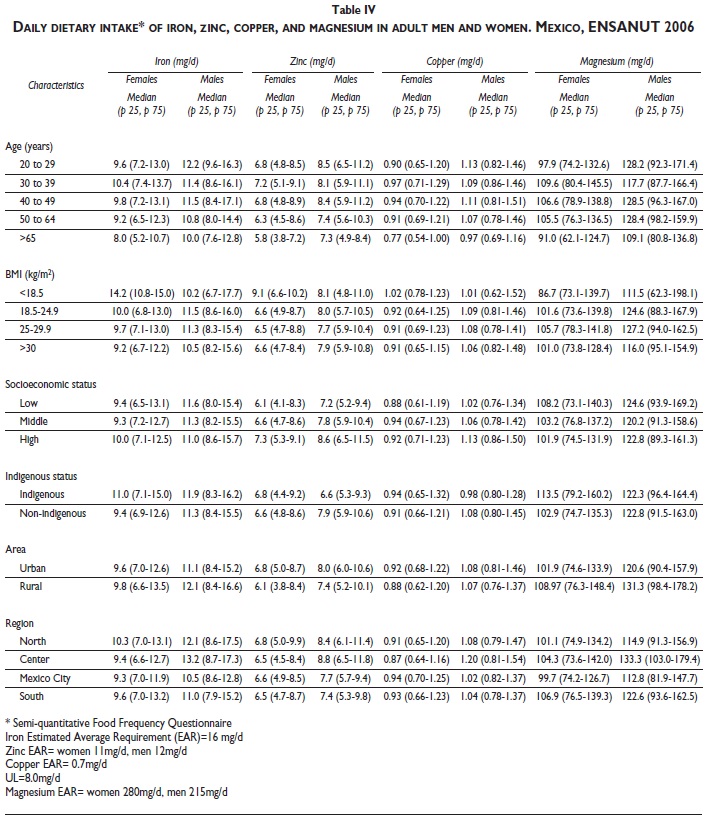
<body><![CDATA[<p><font face="Verdana" size="2">The total prevalence of anemia by Hb values      was 13.6% in females and 6% in males. No differences were found when controlling      for PCR in both males and females, although the prevalence was 12.8% without      inflammation and 13.8% with inflammation in females; in males was 8.2% without      inflammation and 5.7% with inflammation (data not shown).</font></p>       <p><font face="Verdana" size="2">The total prevalence of IDA was 28.5% in females      and 10% in males. No differences were found when controlling for PCR in both      males and females. IDA after adjusting by PCR, the prevalence was 26.8% without      inflammation and 29.2% with inflammation in females; in males was 8.3% without      inflammation and 10.4% with inflammation. The prevalence of IDA remained constant      in female of all age groups. As for males, the prevalence was 1.5% at 20 to      29, 7.2% at 30 to 39, 8.5% at 40 to 49, 10.6% at 50 to 64.9 years of age,      and 19.9% in older than 65 years of age (data not shown). Daily dietary intake      of iron was approximately 9 mg/day for females and 10 mg/day for males. Prevalence      inadequate intake of iron below the EAR was 88.2% for females and 76.6% for      males (data not shown).</font></p>       <p><font face="Verdana" size="2">In a multiple logistic regression model, high      socio-economic status (OR=0.64, 95%CI: 0.42-0.97; <i>p</i>&lt;0.05), older      age (OR = 0.97, 95%CI: 0.96-0.99; <i>p</i>&lt; 0.001), meat intake (OR=0.0997,      95CI%: 0.995-0.999; <i>p</i>&lt;0.05) and the food assistance program <i>Oportunidades</i>      (OR=0.73; 95CI%: 0.53-1.02; <i>p</i>=0.063) had a protective effect for the      risk of iron deficiency by s-ferritin; no association was found with dietary      iron, zinc, PCR, vitamin C, or phytates (data not shown).</font></p>       <p><font face="Verdana" size="2"><b>Zinc nutritional status</b></font></p>       <p><font face="Verdana" size="2">The prevalence of zinc deficiency was higher      in females &gt;65 (51.7%) relative to the age group 20-29 years (19.3%). The      prevalence was higher in urban females (36.1%) compared with their rural counterparts      (26.9%), and in those living in Mexico City (41.3%) compared with the ones      who lived in the Center region (30.5%), (<a href="/img/revistas/spm/v55n3/a05tab3.jpg">table&nbsp;III</a>). In males, the prevalence      of zinc deficiency varied inconsistently by age group (31.8 to 52.2%). The      prevalence was similar in rural (42.2%) and in urban (42.7%) males. The highest      prevalence was seen in the Mexico City region (S1.1) and the lowest in the      South region (29.0%), (<a href="/img/revistas/spm/v55n3/a05tab3.jpg">table&nbsp;III</a>). The prevalence of zinc deficiency did not      change with PCR concentrations (<i>p</i>=0.551).</font></p>       <p><font face="Verdana" size="2">The median of the daily intake of zinc was      below the EAR and the prevalence of inadequate consumption was 90.3% for      females and 83.5% for males (data not shown). In a multiple logistic regression      model age (OR= 1.03, 95%CI 1.01-1.04; <i>p</i>&lt;0.001), males (OR= 1.43,      95%CI 0.99-2.07; <i>p</i>=0.059), and dietary fiber (OR= 1.03, 95%CI 0.999-1.000;      <i>p</i>=0.053) increased the risk for zinc deficiency. No association was      found with PCR concentrations, dietary iron, zinc, vitamin C, phytates, or      affiliation with <i>Oportunidades</i> or <i>Liconsa</i> food assistance programs      (data not shown).</font></p>       <p><font face="Verdana" size="2"><b>Copper and magnesium nutritional status</b></font></p>       <p><font face="Verdana" size="2">The prevalence of LSC of copper were lower      in females (8.4-23.4%) compared with males (7.7-33.9%); the prevalence for      magnesium was higher in females (31.2-40.2%) than in males (23.9-39.7%). The      prevalence of LSC of these two minerals was higher in urban compared with      rural areas in both males and females. The highest prevalence was seen in      the North and Mexico City regions and the lowest in the South region (<a href="/img/revistas/spm/v55n3/a05tab3.jpg">table&nbsp;III</a>).</font></p>       <p><font face="Verdana" size="2">In a multiple logistic regression model with      LSC of magnesium as dependent variable there were no significant predictors.      In contrast, in the model having LSC of copper as dependent variable, only      copper intake was protective (OR=0.15, 95%CI 0.03-0.80, <i>p</i>=0.03), data      not shown. The median of copper dietary intake was 0.9-0.97 mg/day in both      genders. The median of magnesium intake in female was 91-106 mg/day and in      male 109-128 mg/day (<a href="/img/revistas/spm/v55n3/a05tab4.jpg">table&nbsp;IV</a>). Prevalence for daily intake of copper below      the EAR was 28.6% for female and 15.9% for males. For magnesium the prevalence      was 64.2% for female and 25.2% for males (data not shown).</font></p>       <p>&nbsp;</p>     ]]></body>
<body><![CDATA[<p><font face="Verdana" size="3"><b>Discussion</b></font></p>       <p><font face="Verdana" size="2">The present study demonstrates that younger      women have a higher prevalence of iron deficiency than older women and adults,      as indicated by low s-ferritin and by high serum s-TfR concentrations. This      finding suggests that iron requirements are not met by young women, likely      secondary to iron losses from menstruation and reproductive cycles resulting      in a high prevalence of iron deficiency. This hypothesis is also supported      by the low prevalence of iron deficiency found in men in the same age groups.</font></p>       <p><font face="Verdana" size="2">In the ENN 99,<sup>34,35</sup> iron status      was evaluated by a different method, the percentage of transferrin saturation      (PST),<sup>19</sup> whereas in the ENSANUT 2006 it was estimated by s-ferritin      and s-TfR concentrations, thus comparisons are not possible.</font></p>       <p><font face="Verdana" size="2">In our study, we found a protective association      between participation in the <i>Oportunidades</i> or <i>Liconsa</i> programs      and the risk for iron deficiency. This evidence suggests that the fortified      foods distributed by both programs are playing a role in reducing anemia.<sup>36,</sup>      Nevertheless, the program <i>Oportunidades</i> offers other benefits that      may contribute to reduce iron deficiency, as is the case of cash transfer      which play a role in the increase in the familiar income that allows greater      food availability with high nutritional content in the <i>Oportunidades </i>homes.</font></p>       <p><font face="Verdana" size="2">The prevalence of zinc deficiency in Mexican      population represents a high public health risk according to the IZiCG (<u>&gt;</u>20%).<sup>25</sup>      The prevalence of zinc deficiency in women 12-49 years of age (27.8%) was      lower than reported in ENN 99 (30.9%),<sup>19</sup> the difference is so small.      We were unable to find associations between being beneficiary of <i>Oportunidades</i>      or <i>Liconsa</i> and the prevalence of zinc deficiency, given the apparent      lack of association among beneficiaries, it will be necessary to further      examine the effectiveness of the current strategies for zinc fortification      of foods and supplements distributed by both programs. Among other causes      of zinc deficiencies, it is possible that phytate and total fiber may play      a role, because the molar ratio phytate/zinc is (6:1) in the Mexican diet,<sup>37</sup>      in our study total fiber resulted a risk factor. Other cause may be the low      dietary intake of zinc, because the intake was only half of the EAR for females      (6.8 mg/d) and about &frac34; of the EAR for males (8.1 mg/d).</font></p>       <p><font face="Verdana" size="2">Our analysis presents for the first time LSC      of copper and magnesium in Mexican adult population. Although the prevalence      was high, the scarce availability of population-based investigations precludes      comparisons between studies. In focal studies, LSC copper was 17% in Iran<sup>11</sup>      and 5.9-8.6% in Chile.<sup>20</sup> A contradiction in our study was that      the median copper intake exceeded the EAR,<sup>30</sup> and cannot explain      the high prevalence of copper LSC, it is possible that a high intake of antagonists,      such as phytate and fiber, could reduce copper bioavailability.</font></p>       <p><font face="Verdana" size="2">The prevalence of LSC of magnesium in this      survey is almost twice the prevalences reported in other countries (14.5%).<sup>38</sup>      LSC of magnesium was associated with an insufficient dietary intake, although      we did not consider bioavailability of this mineral.<sup>26</sup> Both factors      may contribute to the high prevalence of LSC of magnesium in Mexico. A study      in South Mexico City found a magnesium intake three fold above ours; however      its focal nature may explain the difference.<sup>39</sup> Ames <i>et al</i>,<sup>40</sup>      suggest that in humans, LSC of magnesium has been associated with colorectal      and other cancers, hypertension, osteoporosis, diabetes, and the metabolic      syndrome.</font></p>       <p><font face="Verdana" size="2">Dietary copper deficiency may play a role in      the genesis of iron deficiency,<sup>41</sup> however, in this case the association      was not significant between dietary copper and iron deficiency by s-ferritin      (<i>p</i>=0.63). High dietary intake of phytates<sup>42,43</sup> negatively      affects iron, zinc, and copper absorption. Likewise, a high intake of tannins      reduces iron absorption up to 50%. However, in our study, phytate was not      associated with a risk for iron and zinc deficiencies and LSC of copper; but      this may explain the lack of improvement of the prevalence of zinc deficiency.</font></p>       <p><font face="Verdana" size="2">An inconsistency in our study was that no differences      were found in IDA when controlling for PCR in males and females, because values      of PCR and ferritin increased in these circumstances and may not reflect actual      state of iron deficiency. So the prevalence of IDA was overestimated in people      without inflammation in total prevalence of IDA.<sup>16,17</sup></font></p>       <p><font face="Verdana" size="2">The lack of association between dietary intakes      of iron, zinc, copper and magnesium on the deficiencies or LSC of these minerals      may be due to a lack of precision of a semi-quantitative food frequency questionnaire.<sup>26</sup>      A better estimation of LSC of magnesium is erythrocyte magnesium, as serum      magnesium reflects the recent intake of this mineral. Likewise, Milne<sup>44</sup>      recommends the use of more sensitive indicators than serum copper concentrations      for measuring copper deficiency (erythrocyte superoxide dismutase and platelet      cytochrome-c oxidase). However, some of them are not feasible for large epidemiological      studies as is the case of ENSA-NUT 2006.</font></p>       ]]></body>
<body><![CDATA[<p><font face="Verdana" size="2">Our study confirms a high prevalence of iron      deficiency in female and zinc deficiency in both sexes. Data on LSC of copper      and magnesium in Mexico are published here for the first time, reporting a      high prevalence. We conclude that it is necessary to reexamine the nutritional      interventions aimed at decreasing the prevalence of zinc deficiency because      apparently there is no change in the prevalence in women 12-49 years of age.      Likewise, LSC of copper and magnesium should be examined their adverse effects      and to decide about the pertinence to include them as part of the strategies      to reduce the prevalence of micronutrient deficiencies in Mexico.</font></p>       <p>&nbsp;</p>     <p><font face="Verdana" size="3"><b>References</b></font></p>       <!-- ref --><p><font face="Verdana" size="2">1. Ramakrishnan U. Prevalence of micronutrient      malnutrition worldwide. Nutr Rev 2002;60:S46-S52.    &nbsp;&nbsp;&nbsp;&nbsp;&nbsp;&nbsp;&nbsp;&nbsp;[&#160;<a href="javascript:void(0);" onclick="javascript: window.open('/scielo.php?script=sci_nlinks&ref=9363306&pid=S0036-3634201300040000500001&lng=','','width=640,height=500,resizable=yes,scrollbars=1,menubar=yes,');">Links</a>&#160;]<!-- end-ref --></font></p>       <!-- ref --><p><font face="Verdana" size="2">2. Freire W. La anemia por deficiencia de hierro:      estrategias de la OPS/ OMS para combatirla. Salud Publica Mex 1998;40(2):199-205.    &nbsp;&nbsp;&nbsp;&nbsp;&nbsp;&nbsp;&nbsp;&nbsp;[&#160;<a href="javascript:void(0);" onclick="javascript: window.open('/scielo.php?script=sci_nlinks&ref=9363308&pid=S0036-3634201300040000500002&lng=','','width=640,height=500,resizable=yes,scrollbars=1,menubar=yes,');">Links</a>&#160;]<!-- end-ref --></font></p>       <!-- ref --><p><font face="Verdana" size="2">3. Stoltzfus RJ. Iron-deficiency anemia: reexamining      the nature and magnitude of the public health problem. Summary: implications      for research and programs. J Nutr 2001;131(2):697S-701S.    &nbsp;&nbsp;&nbsp;&nbsp;&nbsp;&nbsp;&nbsp;&nbsp;[&#160;<a href="javascript:void(0);" onclick="javascript: window.open('/scielo.php?script=sci_nlinks&ref=9363310&pid=S0036-3634201300040000500003&lng=','','width=640,height=500,resizable=yes,scrollbars=1,menubar=yes,');">Links</a>&#160;]<!-- end-ref --></font></p>       <!-- ref --><p><font face="Verdana" size="2">4. Brabin BJ, Hakimi M, Pelletier D. An analysis      of anemia and pregnancy-related maternal mortality. J Nutr 2001;131:604S-615S.    &nbsp;&nbsp;&nbsp;&nbsp;&nbsp;&nbsp;&nbsp;&nbsp;[&#160;<a href="javascript:void(0);" onclick="javascript: window.open('/scielo.php?script=sci_nlinks&ref=9363312&pid=S0036-3634201300040000500004&lng=','','width=640,height=500,resizable=yes,scrollbars=1,menubar=yes,');">Links</a>&#160;]<!-- end-ref --></font></p>       <!-- ref --><p><font face="Verdana" size="2">5. Dallman P. Iron. Present knowledge in nutrition.      6<sup>th</sup> edition. International Life Sciences Institute. ILSI. North      America. 1990.    &nbsp;&nbsp;&nbsp;&nbsp;&nbsp;&nbsp;&nbsp;&nbsp;[&#160;<a href="javascript:void(0);" onclick="javascript: window.open('/scielo.php?script=sci_nlinks&ref=9363314&pid=S0036-3634201300040000500005&lng=','','width=640,height=500,resizable=yes,scrollbars=1,menubar=yes,');">Links</a>&#160;]<!-- end-ref --></font></p>       <!-- ref --><p><font face="Verdana" size="2">6. Wang J, Pantopoulos K. Regulation of cellular      iron metabolism. Biochem J 2011;434:365-381.    &nbsp;&nbsp;&nbsp;&nbsp;&nbsp;&nbsp;&nbsp;&nbsp;[&#160;<a href="javascript:void(0);" onclick="javascript: window.open('/scielo.php?script=sci_nlinks&ref=9363316&pid=S0036-3634201300040000500006&lng=','','width=640,height=500,resizable=yes,scrollbars=1,menubar=yes,');">Links</a>&#160;]<!-- end-ref --></font></p>       <!-- ref --><p><font face="Verdana" size="2">7. Zidar BL, Shadduck RK, Zeigler Z, Winkelstein      A. Observations on the anemia and neutropenia of human copper deficiency.      Am J Hematol 1977;3:177-185.    &nbsp;&nbsp;&nbsp;&nbsp;&nbsp;&nbsp;&nbsp;&nbsp;[&#160;<a href="javascript:void(0);" onclick="javascript: window.open('/scielo.php?script=sci_nlinks&ref=9363318&pid=S0036-3634201300040000500007&lng=','','width=640,height=500,resizable=yes,scrollbars=1,menubar=yes,');">Links</a>&#160;]<!-- end-ref --></font></p>       <!-- ref --><p><font face="Verdana" size="2">8. Chandra RK, Grace A, Goldsmith Award lecture.      Trace element regulation of immunity and infection. J Am Coll Nutr 1985;4(1):5-16.    &nbsp;&nbsp;&nbsp;&nbsp;&nbsp;&nbsp;&nbsp;&nbsp;[&#160;<a href="javascript:void(0);" onclick="javascript: window.open('/scielo.php?script=sci_nlinks&ref=9363320&pid=S0036-3634201300040000500008&lng=','','width=640,height=500,resizable=yes,scrollbars=1,menubar=yes,');">Links</a>&#160;]<!-- end-ref --></font></p>       <!-- ref --><p><font face="Verdana" size="2">9. Klevay LM, Canfield WK, Gallagher SK, Henriksen      LK, Lukaski HC, Bolonchuk W, <i>et al</i>. Decreased glucose tolerance in      two men during experimental copper depletion. Nutr Rep Int 1986;33:371-382.    &nbsp;&nbsp;&nbsp;&nbsp;&nbsp;&nbsp;&nbsp;&nbsp;[&#160;<a href="javascript:void(0);" onclick="javascript: window.open('/scielo.php?script=sci_nlinks&ref=9363322&pid=S0036-3634201300040000500009&lng=','','width=640,height=500,resizable=yes,scrollbars=1,menubar=yes,');">Links</a>&#160;]<!-- end-ref --></font></p>       <!-- ref --><p><font face="Verdana" size="2">10. Klevay LM. Metabolic interactions among      dietary cholesterol, copper, and fructose. Am J Physiol Endocrinol Metab 2010;298(1):138-139.    &nbsp;&nbsp;&nbsp;&nbsp;&nbsp;&nbsp;&nbsp;&nbsp;[&#160;<a href="javascript:void(0);" onclick="javascript: window.open('/scielo.php?script=sci_nlinks&ref=9363324&pid=S0036-3634201300040000500010&lng=','','width=640,height=500,resizable=yes,scrollbars=1,menubar=yes,');">Links</a>&#160;]<!-- end-ref --></font></p>       <!-- ref --><p><font face="Verdana" size="2">11. Mir E, Hossein-nezhad A, Bahrami A, Bekheirnia      MR, Javadi E, Afshar Naderi A, <i>et al</i>. Adequate Serum Copper Concentration      Could Improve Bone Density, Postpone Bone Loss and Protect Osteoporosis in      Women. Iranian J Publ Health 2007; suppl Osteoporosis:24-29.    &nbsp;&nbsp;&nbsp;&nbsp;&nbsp;&nbsp;&nbsp;&nbsp;[&#160;<a href="javascript:void(0);" onclick="javascript: window.open('/scielo.php?script=sci_nlinks&ref=9363326&pid=S0036-3634201300040000500011&lng=','','width=640,height=500,resizable=yes,scrollbars=1,menubar=yes,');">Links</a>&#160;]<!-- end-ref --></font></p>       <!-- ref --><p><font face="Verdana" size="2">12. Lai H, Lai S, Shor-Posner G, Ma F, Trapido      E, Baum MK. Plasma zinc, copper, copper:zinc ratio, and survival in a cohort      of HIV-1-infected homosexual men. J Acquir Immune Defic Syndr 2001;1;27(1):56-62.    &nbsp;&nbsp;&nbsp;&nbsp;&nbsp;&nbsp;&nbsp;&nbsp;[&#160;<a href="javascript:void(0);" onclick="javascript: window.open('/scielo.php?script=sci_nlinks&ref=9363328&pid=S0036-3634201300040000500012&lng=','','width=640,height=500,resizable=yes,scrollbars=1,menubar=yes,');">Links</a>&#160;]<!-- end-ref --></font></p>       <!-- ref --><p><font face="Verdana" size="2">13. Nachimuthu S, Balamuthusamy S, Irimpen      A, Delafontaine P. Calcific constrictive pericarditis with refractory hypokalemia      in a patient with Gitelman's syndrome. Am J Med Sci 2009;337:74-76.    &nbsp;&nbsp;&nbsp;&nbsp;&nbsp;&nbsp;&nbsp;&nbsp;[&#160;<a href="javascript:void(0);" onclick="javascript: window.open('/scielo.php?script=sci_nlinks&ref=9363330&pid=S0036-3634201300040000500013&lng=','','width=640,height=500,resizable=yes,scrollbars=1,menubar=yes,');">Links</a>&#160;]<!-- end-ref --></font></p>       <!-- ref --><p><font face="Verdana" size="2">14. Kasifoglu T, Akalin A, Cansu DU, Korkmaz      C, Saudi J. Hypokalemic paralysis due to primary hyperaldosteronism simulating      Gitelman's syndrome. Kidney Dis Transpl 2009;20:285-287.    &nbsp;&nbsp;&nbsp;&nbsp;&nbsp;&nbsp;&nbsp;&nbsp;[&#160;<a href="javascript:void(0);" onclick="javascript: window.open('/scielo.php?script=sci_nlinks&ref=9363332&pid=S0036-3634201300040000500014&lng=','','width=640,height=500,resizable=yes,scrollbars=1,menubar=yes,');">Links</a>&#160;]<!-- end-ref --></font></p>       <!-- ref --><p><font face="Verdana" size="2">15. Akinci B, Celik A, Saygili F, Yesil S.      A case of Gitelman's syndrome presenting with extreme hypokalaemia and paralysis.      Exp Clin Endocrinol Diabet 2009;117:69-71.    &nbsp;&nbsp;&nbsp;&nbsp;&nbsp;&nbsp;&nbsp;&nbsp;[&#160;<a href="javascript:void(0);" onclick="javascript: window.open('/scielo.php?script=sci_nlinks&ref=9363334&pid=S0036-3634201300040000500015&lng=','','width=640,height=500,resizable=yes,scrollbars=1,menubar=yes,');">Links</a>&#160;]<!-- end-ref --></font></p>       <!-- ref --><p><font face="Verdana" size="2">16. Cal&ograve; LA, Pagnin E, Ceolotto G, Davis      PA, Schiavo S, Papparella I, <i>et al</i>. Silencing regulator of G protein      signaling-2 (RGS-2) increases angiotensin II signaling: insights into hypertension      from findings in Bartter's/Gitelman's syndromes. J Hypertens 2008;26:938-945.    &nbsp;&nbsp;&nbsp;&nbsp;&nbsp;&nbsp;&nbsp;&nbsp;[&#160;<a href="javascript:void(0);" onclick="javascript: window.open('/scielo.php?script=sci_nlinks&ref=9363336&pid=S0036-3634201300040000500016&lng=','','width=640,height=500,resizable=yes,scrollbars=1,menubar=yes,');">Links</a>&#160;]<!-- end-ref --></font></p>       <!-- ref --><p><font face="Verdana" size="2">17. Thurnham D, Northrop-Clewes. Infection      and the etiology of anemia. En: Nutritional Anemia. Kraemer K, Zimmermann      MB, eds. Sight and Life Press 2007:231-256.    &nbsp;&nbsp;&nbsp;&nbsp;&nbsp;&nbsp;&nbsp;&nbsp;[&#160;<a href="javascript:void(0);" onclick="javascript: window.open('/scielo.php?script=sci_nlinks&ref=9363338&pid=S0036-3634201300040000500017&lng=','','width=640,height=500,resizable=yes,scrollbars=1,menubar=yes,');">Links</a>&#160;]<!-- end-ref --></font></p>       <!-- ref --><p><font face="Verdana" size="2">18. Rivera-Domarco J, Shamah-Levy T, Villalpando-Hern&aacute;ndez      S, Gonz&aacute;lez de Coss&iacute;o T, Hern&aacute;ndez-Prado B, Sep&uacute;lveda      J. Encuesta Nacional de Nutrici&oacute;n 1999. Estado nutricio de ni&ntilde;os      y mujeres de M&eacute;xico. Cuernavaca, Morelos, M&eacute;xico: Instituto      Nacional de Salud P&uacute;blica, 2001.    &nbsp;&nbsp;&nbsp;&nbsp;&nbsp;&nbsp;&nbsp;&nbsp;[&#160;<a href="javascript:void(0);" onclick="javascript: window.open('/scielo.php?script=sci_nlinks&ref=9363340&pid=S0036-3634201300040000500018&lng=','','width=640,height=500,resizable=yes,scrollbars=1,menubar=yes,');">Links</a>&#160;]<!-- end-ref --></font></p>       <p><font face="Verdana" size="2">19.Villalpando S, Garc&iacute;a-Guerra A, Ram&iacute;rez      CI, Mej&iacute;a F, Matute G, Shamah T, <i>et al</i>. Iron, zinc, and iodide      status in Mexican children under</font></p>       ]]></body>
<body><![CDATA[<p><font face="Verdana" size="2">12 years and women 12-49 years of age. A probabilistic      national survey. Salud Publica Mex 2003; 45:520-529.</font></p>       <!-- ref --><p><font face="Verdana" size="2">20.Cediel DG, Olivares GM, Araya QM, Letelier      CMA, L&oacute;pez de Romana ED, Pizarra AF. Efecto de la inflamaci&oacute;n      subcl&iacute;nica sobre el estado nutricional de hierro, cobre y zinc en      adultos. Rev Chil Nutr 2009; 36(1): 8-14.    &nbsp;&nbsp;&nbsp;&nbsp;&nbsp;&nbsp;&nbsp;&nbsp;[&#160;<a href="javascript:void(0);" onclick="javascript: window.open('/scielo.php?script=sci_nlinks&ref=9363344&pid=S0036-3634201300040000500020&lng=','','width=640,height=500,resizable=yes,scrollbars=1,menubar=yes,');">Links</a>&#160;]<!-- end-ref --></font></p>       <!-- ref --><p><font face="Verdana" size="2">21.Resano-P&eacute;rez E, M&eacute;ndez-Ram&iacute;rez      I, Shamah-Levy T, Rivera Juan A, Sep&uacute;lveda-Amor J. Methods of the National      Nutrition Survey 1999. Salud Publica Mex 2003;45(3):558-64.    &nbsp;&nbsp;&nbsp;&nbsp;&nbsp;&nbsp;&nbsp;&nbsp;[&#160;<a href="javascript:void(0);" onclick="javascript: window.open('/scielo.php?script=sci_nlinks&ref=9363346&pid=S0036-3634201300040000500021&lng=','','width=640,height=500,resizable=yes,scrollbars=1,menubar=yes,');">Links</a>&#160;]<!-- end-ref --></font></p>       <!-- ref --><p><font face="Verdana" size="2">22. Villalpando S, Gayt&aacute;n MA, Gonz&aacute;lez      Herrera O, Morales Ru&aacute;n MC, G&oacute;mez Acosta LM, Garc&iacute;a Guerra      A. Toma de muestras sangu&iacute;neas. En: Shamah- Levy T, Villalpando- Hern&aacute;ndez      S, Rivera-Dommarco J. Manual de Procedimientos para Proyectos de Nutrici&oacute;n.      Cuernavaca, M&eacute;xico. Instituto Nacional de Salud P&uacute;blica 2006:109-148.    &nbsp;&nbsp;&nbsp;&nbsp;&nbsp;&nbsp;&nbsp;&nbsp;[&#160;<a href="javascript:void(0);" onclick="javascript: window.open('/scielo.php?script=sci_nlinks&ref=9363348&pid=S0036-3634201300040000500022&lng=','','width=640,height=500,resizable=yes,scrollbars=1,menubar=yes,');">Links</a>&#160;]<!-- end-ref --></font></p>       <!-- ref --><p><font face="Verdana" size="2">23.World Health Organization/United Nations      University/UNICEF. Iron deficiency anemia: assessment, prevention, and control.      Ginebra, Organizaci&oacute;n Mundial de la Salud, 2001 (WHO/NHD/01.3).    &nbsp;&nbsp;&nbsp;&nbsp;&nbsp;&nbsp;&nbsp;&nbsp;[&#160;<a href="javascript:void(0);" onclick="javascript: window.open('/scielo.php?script=sci_nlinks&ref=9363350&pid=S0036-3634201300040000500023&lng=','','width=640,height=500,resizable=yes,scrollbars=1,menubar=yes,');">Links</a>&#160;]<!-- end-ref --></font></p>       <!-- ref --><p><font face="Verdana" size="2">24.Tietz NW (Ed): Clinical Guide to Laboratory      Tests, 3rd ed. W. B. Saunders, Philadelphia, PA 1995:142-145.    &nbsp;&nbsp;&nbsp;&nbsp;&nbsp;&nbsp;&nbsp;&nbsp;[&#160;<a href="javascript:void(0);" onclick="javascript: window.open('/scielo.php?script=sci_nlinks&ref=9363352&pid=S0036-3634201300040000500024&lng=','','width=640,height=500,resizable=yes,scrollbars=1,menubar=yes,');">Links</a>&#160;]<!-- end-ref --></font></p>       <!-- ref --><p><font face="Verdana" size="2">25.International zinc Nutrition Consultative      Group (IzincG). Technical Document # 1. Assessment of the risk of zinc deficiency      in populations and options for its control. Hotz C and Brown KH (eds). Food      Nutr Bull 2004;25:S94-S203.    &nbsp;&nbsp;&nbsp;&nbsp;&nbsp;&nbsp;&nbsp;&nbsp;[&#160;<a href="javascript:void(0);" onclick="javascript: window.open('/scielo.php?script=sci_nlinks&ref=9363354&pid=S0036-3634201300040000500025&lng=','','width=640,height=500,resizable=yes,scrollbars=1,menubar=yes,');">Links</a>&#160;]<!-- end-ref --></font></p>       <!-- ref --><p><font face="Verdana" size="2">26.Gibson R. Cap 23. Assessment of calcium,      phosphorus, and magnesium status. In: Principles of nutritional assessment.      Nueva York (NY): Oxford University Press, 2005.    &nbsp;&nbsp;&nbsp;&nbsp;&nbsp;&nbsp;&nbsp;&nbsp;[&#160;<a href="javascript:void(0);" onclick="javascript: window.open('/scielo.php?script=sci_nlinks&ref=9363356&pid=S0036-3634201300040000500026&lng=','','width=640,height=500,resizable=yes,scrollbars=1,menubar=yes,');">Links</a>&#160;]<!-- end-ref --></font></p>       <!-- ref --><p><font face="Verdana" size="2">27.Cohen JH, Haas JD. Hemoglobin correction      factors for estimating the prevalence of iron deficiency anemia in pregnant      women residing at high altitudes in Bolivia. Pan Am J Public Health 1999;6(6):392-399.    &nbsp;&nbsp;&nbsp;&nbsp;&nbsp;&nbsp;&nbsp;&nbsp;[&#160;<a href="javascript:void(0);" onclick="javascript: window.open('/scielo.php?script=sci_nlinks&ref=9363358&pid=S0036-3634201300040000500027&lng=','','width=640,height=500,resizable=yes,scrollbars=1,menubar=yes,');">Links</a>&#160;]<!-- end-ref --></font></p>       <!-- ref --><p><font face="Verdana" size="2">28. Cogswell ME, Looker AC, Pfeiffer CM, Cook      JD, Lacher DA, Beard JL, Lynch SR, and Grummer-Strawn LM. Assessment of iron      deficiency in US preschool children and nonpregnant females of childbearing      age: National Health and Nutrition Examination Survey 2003-2006. Am J Clin      Nutr 2009;89:1334-42.    &nbsp;&nbsp;&nbsp;&nbsp;&nbsp;&nbsp;&nbsp;&nbsp;[&#160;<a href="javascript:void(0);" onclick="javascript: window.open('/scielo.php?script=sci_nlinks&ref=9363360&pid=S0036-3634201300040000500028&lng=','','width=640,height=500,resizable=yes,scrollbars=1,menubar=yes,');">Links</a>&#160;]<!-- end-ref --></font></p>       <!-- ref --><p><font face="Verdana" size="2">29.Rodr&iacute;guez-Ram&iacute;rez S, Mundo-Rosas      V, Jim&eacute;nez-Aguilar A, Shamah-Levy T. Methodology for the analysis of      dietary data from the Mexican National Health and Nutrition Survey 2006. Salud      Publica Mex 2009;51 suppl 4:S523-S529.    &nbsp;&nbsp;&nbsp;&nbsp;&nbsp;&nbsp;&nbsp;&nbsp;[&#160;<a href="javascript:void(0);" onclick="javascript: window.open('/scielo.php?script=sci_nlinks&ref=9363362&pid=S0036-3634201300040000500029&lng=','','width=640,height=500,resizable=yes,scrollbars=1,menubar=yes,');">Links</a>&#160;]<!-- end-ref --></font></p>       <!-- ref --><p><font face="Verdana" size="2">30.Bourges H, Casanueva E, Rosado JL. Recomendaciones      de Ingesti&oacute;n de Nutrimentos para la poblaci&oacute;n Mexicana. Bases      Fisiol&oacute;gicas. Tomo 1. M&eacute;xico: Medica Panamericana, 2005.    &nbsp;&nbsp;&nbsp;&nbsp;&nbsp;&nbsp;&nbsp;&nbsp;[&#160;<a href="javascript:void(0);" onclick="javascript: window.open('/scielo.php?script=sci_nlinks&ref=9363364&pid=S0036-3634201300040000500030&lng=','','width=640,height=500,resizable=yes,scrollbars=1,menubar=yes,');">Links</a>&#160;]<!-- end-ref --></font></p>       <!-- ref --><p><font face="Verdana" size="2">31.World Heal Organization. Physical status:      The use and interpretation of anthropometry. Geneva: WHO, 1995.    &nbsp;&nbsp;&nbsp;&nbsp;&nbsp;&nbsp;&nbsp;&nbsp;[&#160;<a href="javascript:void(0);" onclick="javascript: window.open('/scielo.php?script=sci_nlinks&ref=9363366&pid=S0036-3634201300040000500031&lng=','','width=640,height=500,resizable=yes,scrollbars=1,menubar=yes,');">Links</a>&#160;]<!-- end-ref --></font></p>       <!-- ref --><p><font face="Verdana" size="2">32. Brofman M, Guiscafre H, Castro V, Castro      R y Guti&eacute;rrez G. La medici&oacute;n de la desigualdad: una estrategia      metodol&oacute;gica, an&aacute;lisis de las caracter&iacute;sticas socioecon&oacute;micas      de la muestra. Arch Invest Med (M&eacute;x) 1988;19:351-360.    &nbsp;&nbsp;&nbsp;&nbsp;&nbsp;&nbsp;&nbsp;&nbsp;[&#160;<a href="javascript:void(0);" onclick="javascript: window.open('/scielo.php?script=sci_nlinks&ref=9363368&pid=S0036-3634201300040000500032&lng=','','width=640,height=500,resizable=yes,scrollbars=1,menubar=yes,');">Links</a>&#160;]<!-- end-ref --></font></p>       <!-- ref --><p><font face="Verdana" size="2">33. Sharon L Lohr. Chap 9. Variance estimation      in complex Surveys. In: Sharon L Lohr. Sampling: desing and analysis. Duxbury      Press, 1999.    &nbsp;&nbsp;&nbsp;&nbsp;&nbsp;&nbsp;&nbsp;&nbsp;[&#160;<a href="javascript:void(0);" onclick="javascript: window.open('/scielo.php?script=sci_nlinks&ref=9363370&pid=S0036-3634201300040000500033&lng=','','width=640,height=500,resizable=yes,scrollbars=1,menubar=yes,');">Links</a>&#160;]<!-- end-ref --></font></p>       <!-- ref --><p><font face="Verdana" size="2">34. Shamah-Levy T, Villalpando-Hern&aacute;ndez      S, Garc&iacute;a-Guerra A, Mundo-Rosas V, Mej&iacute;a-Rodr&iacute;guez F,      Dom&iacute;nguez-Islas CP. Anemia in Mexican women: Results of two national      probabilistic surveys. Salud Publica Mex 2009;51 suppl 4:S515-S522.    &nbsp;&nbsp;&nbsp;&nbsp;&nbsp;&nbsp;&nbsp;&nbsp;[&#160;<a href="javascript:void(0);" onclick="javascript: window.open('/scielo.php?script=sci_nlinks&ref=9363372&pid=S0036-3634201300040000500034&lng=','','width=640,height=500,resizable=yes,scrollbars=1,menubar=yes,');">Links</a>&#160;]<!-- end-ref --></font></p>       <!-- ref --><p><font face="Verdana" size="2">35. Shamah-Levy T, Cuevas-Nasu L, Mundo-Rosas      V, Morales-Ru&aacute;n C, Cervantes-Turrubiates L, Villalpando-Hern&aacute;ndez      S. Health and nutrition status of older adults in Mexico: Results of a national      probabilistic survey. Salud Publica Mex 2008;50:383-389.    &nbsp;&nbsp;&nbsp;&nbsp;&nbsp;&nbsp;&nbsp;&nbsp;[&#160;<a href="javascript:void(0);" onclick="javascript: window.open('/scielo.php?script=sci_nlinks&ref=9363374&pid=S0036-3634201300040000500035&lng=','','width=640,height=500,resizable=yes,scrollbars=1,menubar=yes,');">Links</a>&#160;]<!-- end-ref --></font></p>       <!-- ref --><p><font face="Verdana" size="2">36. Shama-Levy T, Villalpando-Hernandez S,      Rivera-Dommarco JA, Cuevas-Nasu L. Cap&iacute;tulo 4: Impacto en Oportunidades      en el estado de nutrici&oacute;n y anemia de ni&ntilde;os y mujeres en edad      f&eacute;rtil: Componente rural. Neufeld L, Garcia-Guerra A, Fernandez-Gaxiola      AC, Rivera-Dom-marco JA. Cap&iacute;tulo 5: Impacto de Oportunidades en alimentaci&oacute;n      y nutrici&oacute;n en ni&ntilde;os y mujeres en zonas Urbanas. En: Gonz&aacute;lez      de Cossio T, L&oacute;pez Acevedo G, Rivera Dommarco J, Rubio Soto GM. Nutrici&oacute;n      y Pobreza: Pol&iacute;tica P&uacute;blica Basada en videncia. M&eacute;xico:      Banco Mundial: SEDESOL, 2008.    &nbsp;&nbsp;&nbsp;&nbsp;&nbsp;&nbsp;&nbsp;&nbsp;[&#160;<a href="javascript:void(0);" onclick="javascript: window.open('/scielo.php?script=sci_nlinks&ref=9363376&pid=S0036-3634201300040000500036&lng=','','width=640,height=500,resizable=yes,scrollbars=1,menubar=yes,');">Links</a>&#160;]<!-- end-ref --></font></p>       <!-- ref --><p><font face="Verdana" size="2">37. WHO. Zinc. In: Vitamin and mineral requirements      in human nutrition: report of a joint FAO/WHO expert consultation. Bangkok,      Thailand: World Health Organization, 2005:230-245.    &nbsp;&nbsp;&nbsp;&nbsp;&nbsp;&nbsp;&nbsp;&nbsp;[&#160;<a href="javascript:void(0);" onclick="javascript: window.open('/scielo.php?script=sci_nlinks&ref=9363378&pid=S0036-3634201300040000500037&lng=','','width=640,height=500,resizable=yes,scrollbars=1,menubar=yes,');">Links</a>&#160;]<!-- end-ref --></font></p>       <!-- ref --><p><font face="Verdana" size="2">38. Schimatschek HF, Rempis R. Prevalence of      hypomagnesemia in an unselected German population of 16,000 individuals. Magnes      Res 2001;14(4): p. 283-90.    &nbsp;&nbsp;&nbsp;&nbsp;&nbsp;&nbsp;&nbsp;&nbsp;[&#160;<a href="javascript:void(0);" onclick="javascript: window.open('/scielo.php?script=sci_nlinks&ref=9363380&pid=S0036-3634201300040000500038&lng=','','width=640,height=500,resizable=yes,scrollbars=1,menubar=yes,');">Links</a>&#160;]<!-- end-ref --></font></p>       <!-- ref --><p><font face="Verdana" size="2">39. Hern&aacute;ndez-Avila M, Romieu I, Parra      S, Hern&aacute;ndez-Avila J, Madrigal H, Willett W. Validity and reproducibility      of a food frequency questionnaire to assess dietary intake of women living      in Mexico City. Salud Publica Mex 998;40:133-140.    &nbsp;&nbsp;&nbsp;&nbsp;&nbsp;&nbsp;&nbsp;&nbsp;[&#160;<a href="javascript:void(0);" onclick="javascript: window.open('/scielo.php?script=sci_nlinks&ref=9363382&pid=S0036-3634201300040000500039&lng=','','width=640,height=500,resizable=yes,scrollbars=1,menubar=yes,');">Links</a>&#160;]<!-- end-ref --></font></p>       <!-- ref --><p><font face="Verdana" size="2">40. Ames BN. Low micronutrient intake may accelerate      the degenerative diseases of aging through allocation of scarce micronutrients      by triage. PNAS 2006; 103 (47): 17589-17594.    &nbsp;&nbsp;&nbsp;&nbsp;&nbsp;&nbsp;&nbsp;&nbsp;[&#160;<a href="javascript:void(0);" onclick="javascript: window.open('/scielo.php?script=sci_nlinks&ref=9363384&pid=S0036-3634201300040000500040&lng=','','width=640,height=500,resizable=yes,scrollbars=1,menubar=yes,');">Links</a>&#160;]<!-- end-ref --></font></p>       <!-- ref --><p><font face="Verdana" size="2">41. Knovich MA, Il'yasova D, Ivanova A, Molnar      I. The association between serum copper and anemia in the adult Second National      Health and Nutrition Examination Survey (NHANES II) population. Br J Nutr      2008;99(6):1226-1229.    &nbsp;&nbsp;&nbsp;&nbsp;&nbsp;&nbsp;&nbsp;&nbsp;[&#160;<a href="javascript:void(0);" onclick="javascript: window.open('/scielo.php?script=sci_nlinks&ref=9363386&pid=S0036-3634201300040000500041&lng=','','width=640,height=500,resizable=yes,scrollbars=1,menubar=yes,');">Links</a>&#160;]<!-- end-ref --></font></p>       <!-- ref --><p><font face="Verdana" size="2">42. Barquera S, Hern&aacute;ndez-Barrera L,      Campos-Nonato I, Espinosa J, Flores M, Barriguete JA, <i>et al</i>. Energy      and nutrient consumption in adults: Analysis of the Mexican National Health      and Nutrition Survey 2006. Salud Publica Mex 2009;51 suppl 4:S562-S573.    &nbsp;&nbsp;&nbsp;&nbsp;&nbsp;&nbsp;&nbsp;&nbsp;[&#160;<a href="javascript:void(0);" onclick="javascript: window.open('/scielo.php?script=sci_nlinks&ref=9363388&pid=S0036-3634201300040000500042&lng=','','width=640,height=500,resizable=yes,scrollbars=1,menubar=yes,');">Links</a>&#160;]<!-- end-ref --></font></p>       <!-- ref --><p><font face="Verdana" size="2">43. Barquera S, Rivera JA, Espinosa-Montero      J, Safdie M, Campirano F, Monterrubio EA. Energy and nutrient consumption      in Mexican women 12-49 years of age: Analysis of the National Nutrition Survey,      1999. Salud Publica Mex 2003;45 suppl 4:S530-S539.    &nbsp;&nbsp;&nbsp;&nbsp;&nbsp;&nbsp;&nbsp;&nbsp;[&#160;<a href="javascript:void(0);" onclick="javascript: window.open('/scielo.php?script=sci_nlinks&ref=9363390&pid=S0036-3634201300040000500043&lng=','','width=640,height=500,resizable=yes,scrollbars=1,menubar=yes,');">Links</a>&#160;]<!-- end-ref --></font></p>       <!-- ref --><p><font face="Verdana" size="2">44. Milne DB. Copper intake and assessment      of copper status. Am J Clin Nutr 1998;67 Suppl 5:1041S-1045S.    &nbsp;&nbsp;&nbsp;&nbsp;&nbsp;&nbsp;&nbsp;&nbsp;[&#160;<a href="javascript:void(0);" onclick="javascript: window.open('/scielo.php?script=sci_nlinks&ref=9363392&pid=S0036-3634201300040000500044&lng=','','width=640,height=500,resizable=yes,scrollbars=1,menubar=yes,');">Links</a>&#160;]<!-- end-ref --></font></p>       <p>&nbsp;</p>       <p>&nbsp;</p>       <p><a name="end" href="#top"><img src="/img/revistas/spm/v55n3/seta.jpg" border="0"></a> <font face="Verdana" size="2"><b>Corresponding author:</b>    <br>     M en C Fabiola Mej&iacute;a Rodr&iacute;guez    <br>     Av. Universidad 655, col. Santa Mar&iacute;a Ahuacatitl&aacute;n. 62100    <br>     Cuernavaca, Morelos, M&eacute;xico    <br>     E-mail: <a href="mailto:fmejia@insp.mx">fmejia@insp.mx</a></font></p>       <p><font face="Verdana" size="2"><b>Received on: </b>May 17, 2012    <br>     <b>Accepted on: </b>February 1, 2013</font></p> </div>     ]]></body>
<body><![CDATA[ ]]></body><back>
<ref-list>
<ref id="B1">
<label>1</label><nlm-citation citation-type="journal">
<person-group person-group-type="author">
<name>
<surname><![CDATA[Ramakrishnan]]></surname>
<given-names><![CDATA[U]]></given-names>
</name>
</person-group>
<article-title xml:lang="en"><![CDATA[Prevalence of micronutrient malnutrition worldwide]]></article-title>
<source><![CDATA[Nutr Rev]]></source>
<year>2002</year>
<volume>60</volume>
<page-range>S46-S52</page-range></nlm-citation>
</ref>
<ref id="B2">
<label>2</label><nlm-citation citation-type="journal">
<person-group person-group-type="author">
<name>
<surname><![CDATA[Freire]]></surname>
<given-names><![CDATA[W]]></given-names>
</name>
</person-group>
<article-title xml:lang="pt"><![CDATA[La anemia por deficiencia de hierro: estrategias de la OPS/ OMS para combatirla]]></article-title>
<source><![CDATA[Salud Publica Mex]]></source>
<year>1998</year>
<volume>40</volume>
<numero>2</numero>
<issue>2</issue>
<page-range>199-205</page-range></nlm-citation>
</ref>
<ref id="B3">
<label>3</label><nlm-citation citation-type="journal">
<person-group person-group-type="author">
<name>
<surname><![CDATA[Stoltzfus]]></surname>
<given-names><![CDATA[RJ]]></given-names>
</name>
</person-group>
<article-title xml:lang="en"><![CDATA[Iron-deficiency anemia: reexamining the nature and magnitude of the public health problem. Summary: implications for research and programs]]></article-title>
<source><![CDATA[J Nutr]]></source>
<year>2001</year>
<volume>131</volume>
<numero>2</numero>
<issue>2</issue>
<page-range>697S-701S</page-range></nlm-citation>
</ref>
<ref id="B4">
<label>4</label><nlm-citation citation-type="journal">
<person-group person-group-type="author">
<name>
<surname><![CDATA[Brabin]]></surname>
<given-names><![CDATA[BJ]]></given-names>
</name>
<name>
<surname><![CDATA[Hakimi]]></surname>
<given-names><![CDATA[M]]></given-names>
</name>
<name>
<surname><![CDATA[Pelletier]]></surname>
<given-names><![CDATA[D]]></given-names>
</name>
</person-group>
<article-title xml:lang="en"><![CDATA[An analysis of anemia and pregnancy-related maternal mortality]]></article-title>
<source><![CDATA[J Nutr]]></source>
<year>2001</year>
<volume>131</volume>
<page-range>604S-615S</page-range></nlm-citation>
</ref>
<ref id="B5">
<label>5</label><nlm-citation citation-type="book">
<person-group person-group-type="author">
<name>
<surname><![CDATA[Dallman]]></surname>
<given-names><![CDATA[P]]></given-names>
</name>
</person-group>
<source><![CDATA[Iron.Present knowledge in nutrition. 6th edition]]></source>
<year>1990</year>
<publisher-name><![CDATA[International Life Sciences Institute. ILSI. North America]]></publisher-name>
</nlm-citation>
</ref>
<ref id="B6">
<label>6</label><nlm-citation citation-type="journal">
<person-group person-group-type="author">
<name>
<surname><![CDATA[Wang]]></surname>
<given-names><![CDATA[J]]></given-names>
</name>
<name>
<surname><![CDATA[Pantopoulos]]></surname>
<given-names><![CDATA[K]]></given-names>
</name>
</person-group>
<article-title xml:lang="en"><![CDATA[Regulation of cellular iron metabolism]]></article-title>
<source><![CDATA[Biochem J]]></source>
<year>2011</year>
<volume>434</volume>
<page-range>365-381</page-range></nlm-citation>
</ref>
<ref id="B7">
<label>7</label><nlm-citation citation-type="journal">
<person-group person-group-type="author">
<name>
<surname><![CDATA[Zidar]]></surname>
<given-names><![CDATA[BL]]></given-names>
</name>
<name>
<surname><![CDATA[Shadduck]]></surname>
<given-names><![CDATA[RK]]></given-names>
</name>
<name>
<surname><![CDATA[Zeigler]]></surname>
<given-names><![CDATA[Z]]></given-names>
</name>
<name>
<surname><![CDATA[Winkelstein]]></surname>
<given-names><![CDATA[A]]></given-names>
</name>
</person-group>
<article-title xml:lang="en"><![CDATA[Observations on the anemia and neutropenia of human copper deficiency]]></article-title>
<source><![CDATA[Am J Hematol]]></source>
<year>1977</year>
<volume>3</volume>
<page-range>177-185</page-range></nlm-citation>
</ref>
<ref id="B8">
<label>8</label><nlm-citation citation-type="journal">
<person-group person-group-type="author">
<name>
<surname><![CDATA[Chandra]]></surname>
<given-names><![CDATA[RK]]></given-names>
</name>
<name>
<surname><![CDATA[Grace]]></surname>
<given-names><![CDATA[A]]></given-names>
</name>
</person-group>
<collab>Goldsmith Award lecture</collab>
<article-title xml:lang="en"><![CDATA[Trace element regulation of immunity and infection]]></article-title>
<source><![CDATA[J Am Coll Nutr]]></source>
<year>1985</year>
<volume>4</volume>
<numero>1</numero>
<issue>1</issue>
<page-range>5-16</page-range></nlm-citation>
</ref>
<ref id="B9">
<label>9</label><nlm-citation citation-type="journal">
<person-group person-group-type="author">
<name>
<surname><![CDATA[Klevay]]></surname>
<given-names><![CDATA[LM]]></given-names>
</name>
<name>
<surname><![CDATA[Canfield]]></surname>
<given-names><![CDATA[WK]]></given-names>
</name>
<name>
<surname><![CDATA[Gallagher]]></surname>
<given-names><![CDATA[SK]]></given-names>
</name>
<name>
<surname><![CDATA[Henriksen]]></surname>
<given-names><![CDATA[LK]]></given-names>
</name>
<name>
<surname><![CDATA[Lukaski]]></surname>
<given-names><![CDATA[HC]]></given-names>
</name>
<name>
<surname><![CDATA[Bolonchuk]]></surname>
<given-names><![CDATA[W]]></given-names>
</name>
</person-group>
<article-title xml:lang="en"><![CDATA[Decreased glucose tolerance in two men during experimental copper depletion]]></article-title>
<source><![CDATA[Nutr Rep Int]]></source>
<year>1986</year>
<volume>33</volume>
<page-range>371-382</page-range></nlm-citation>
</ref>
<ref id="B10">
<label>10</label><nlm-citation citation-type="journal">
<person-group person-group-type="author">
<name>
<surname><![CDATA[Klevay]]></surname>
<given-names><![CDATA[LM]]></given-names>
</name>
</person-group>
<article-title xml:lang="en"><![CDATA[Metabolic interactions among dietary cholesterol, copper, and fructose]]></article-title>
<source><![CDATA[Am J Physiol Endocrinol Metab]]></source>
<year>2010</year>
<volume>298</volume>
<numero>1</numero>
<issue>1</issue>
<page-range>138-139</page-range></nlm-citation>
</ref>
<ref id="B11">
<label>11</label><nlm-citation citation-type="journal">
<person-group person-group-type="author">
<name>
<surname><![CDATA[Mir]]></surname>
<given-names><![CDATA[E]]></given-names>
</name>
<name>
<surname><![CDATA[Hossein-nezhad]]></surname>
<given-names><![CDATA[A]]></given-names>
</name>
<name>
<surname><![CDATA[Bahrami]]></surname>
<given-names><![CDATA[A]]></given-names>
</name>
<name>
<surname><![CDATA[Bekheirnia]]></surname>
<given-names><![CDATA[MR]]></given-names>
</name>
<name>
<surname><![CDATA[Javadi]]></surname>
<given-names><![CDATA[E]]></given-names>
</name>
<name>
<surname><![CDATA[Afshar Naderi]]></surname>
<given-names><![CDATA[A]]></given-names>
</name>
</person-group>
<article-title xml:lang="en"><![CDATA[Adequate Serum Copper Concentration Could Improve Bone Density, Postpone Bone Loss and Protect Osteoporosis in Women]]></article-title>
<source><![CDATA[Iranian J Publ Health]]></source>
<year>2007</year>
<numero>^sOsteoporosis</numero>
<issue>^sOsteoporosis</issue>
<supplement>Osteoporosis</supplement>
<page-range>24-29</page-range></nlm-citation>
</ref>
<ref id="B12">
<label>12</label><nlm-citation citation-type="journal">
<person-group person-group-type="author">
<name>
<surname><![CDATA[Lai]]></surname>
<given-names><![CDATA[H]]></given-names>
</name>
<name>
<surname><![CDATA[Lai]]></surname>
<given-names><![CDATA[S]]></given-names>
</name>
<name>
<surname><![CDATA[Shor-Posner]]></surname>
<given-names><![CDATA[G]]></given-names>
</name>
<name>
<surname><![CDATA[Ma]]></surname>
<given-names><![CDATA[F]]></given-names>
</name>
<name>
<surname><![CDATA[Trapido]]></surname>
<given-names><![CDATA[E]]></given-names>
</name>
<name>
<surname><![CDATA[Baum]]></surname>
<given-names><![CDATA[MK]]></given-names>
</name>
</person-group>
<article-title xml:lang="en"><![CDATA[Plasma zinc, copper, copper: zinc ratio, and survival in a cohort of HIV-1-infected homosexual men]]></article-title>
<source><![CDATA[J Acquir Immune Defic Syndr]]></source>
<year>2001</year>
<volume>1;27</volume>
<numero>1</numero>
<issue>1</issue>
<page-range>56-62</page-range></nlm-citation>
</ref>
<ref id="B13">
<label>13</label><nlm-citation citation-type="journal">
<person-group person-group-type="author">
<name>
<surname><![CDATA[Nachimuthu]]></surname>
<given-names><![CDATA[S]]></given-names>
</name>
<name>
<surname><![CDATA[Balamuthusamy]]></surname>
<given-names><![CDATA[S]]></given-names>
</name>
<name>
<surname><![CDATA[Irimpen]]></surname>
<given-names><![CDATA[A]]></given-names>
</name>
<name>
<surname><![CDATA[Delafontaine]]></surname>
<given-names><![CDATA[P]]></given-names>
</name>
</person-group>
<article-title xml:lang="en"><![CDATA[Calcific constrictive pericarditis with refractory hypokalemia in a patient with Gitelman's syndrome]]></article-title>
<source><![CDATA[Am J Med Sci]]></source>
<year>2009</year>
<volume>337</volume>
<page-range>74-76</page-range></nlm-citation>
</ref>
<ref id="B14">
<label>14</label><nlm-citation citation-type="journal">
<person-group person-group-type="author">
<name>
<surname><![CDATA[Kasifoglu]]></surname>
<given-names><![CDATA[T]]></given-names>
</name>
<name>
<surname><![CDATA[Akalin]]></surname>
<given-names><![CDATA[A]]></given-names>
</name>
<name>
<surname><![CDATA[Cansu]]></surname>
<given-names><![CDATA[DU]]></given-names>
</name>
<name>
<surname><![CDATA[Korkmaz]]></surname>
<given-names><![CDATA[C]]></given-names>
</name>
<name>
<surname><![CDATA[Saudi]]></surname>
<given-names><![CDATA[J]]></given-names>
</name>
</person-group>
<article-title xml:lang="en"><![CDATA[Hypokalemic paralysis due to primary hyperaldosteronism simulating Gitelman's syndrome]]></article-title>
<source><![CDATA[Kidney Dis Transpl]]></source>
<year>2009</year>
<volume>20</volume>
<page-range>285-287</page-range></nlm-citation>
</ref>
<ref id="B15">
<label>15</label><nlm-citation citation-type="journal">
<person-group person-group-type="author">
<name>
<surname><![CDATA[Akinci]]></surname>
<given-names><![CDATA[B]]></given-names>
</name>
<name>
<surname><![CDATA[Celik]]></surname>
<given-names><![CDATA[A]]></given-names>
</name>
<name>
<surname><![CDATA[Saygili]]></surname>
<given-names><![CDATA[F]]></given-names>
</name>
<name>
<surname><![CDATA[Yesil]]></surname>
<given-names><![CDATA[S]]></given-names>
</name>
</person-group>
<article-title xml:lang="en"><![CDATA[A case of Gitelman's syndrome presenting with extreme hypokalaemia and paralysis]]></article-title>
<source><![CDATA[Exp Clin Endocrinol Diabet]]></source>
<year>2009</year>
<volume>117</volume>
<page-range>69-71</page-range></nlm-citation>
</ref>
<ref id="B16">
<label>16</label><nlm-citation citation-type="journal">
<person-group person-group-type="author">
<name>
<surname><![CDATA[Calò]]></surname>
<given-names><![CDATA[LA]]></given-names>
</name>
<name>
<surname><![CDATA[Pagnin]]></surname>
<given-names><![CDATA[E]]></given-names>
</name>
<name>
<surname><![CDATA[Ceolotto]]></surname>
<given-names><![CDATA[G]]></given-names>
</name>
<name>
<surname><![CDATA[Davis]]></surname>
<given-names><![CDATA[PA]]></given-names>
</name>
<name>
<surname><![CDATA[Schiavo]]></surname>
<given-names><![CDATA[S]]></given-names>
</name>
<name>
<surname><![CDATA[Papparella]]></surname>
<given-names><![CDATA[I]]></given-names>
</name>
</person-group>
<article-title xml:lang="en"><![CDATA[Silencing regulator of G protein signaling-2 (RGS-2) increases angiotensin II signaling: insights into hypertension from findings in Bartter's/Gitelman's syndromes]]></article-title>
<source><![CDATA[J Hypertens]]></source>
<year>2008</year>
<volume>26</volume>
<page-range>938-945</page-range></nlm-citation>
</ref>
<ref id="B17">
<label>17</label><nlm-citation citation-type="journal">
<person-group person-group-type="author">
<name>
<surname><![CDATA[Thurnham]]></surname>
<given-names><![CDATA[D]]></given-names>
</name>
<name>
<surname><![CDATA[Northrop-Clewes]]></surname>
</name>
</person-group>
<article-title xml:lang="en"><![CDATA[Infection and the etiology of anemia: En: Nutritional Anemia. Kraemer K, Zimmermann MB, eds]]></article-title>
<source><![CDATA[Sight and Life Press]]></source>
<year>2007</year>
<page-range>231-256</page-range></nlm-citation>
</ref>
<ref id="B18">
<label>18</label><nlm-citation citation-type="book">
<person-group person-group-type="author">
<name>
<surname><![CDATA[Rivera-Domarco]]></surname>
<given-names><![CDATA[J]]></given-names>
</name>
<name>
<surname><![CDATA[Shamah-Levy]]></surname>
<given-names><![CDATA[T]]></given-names>
</name>
<name>
<surname><![CDATA[Villalpando-Hernández]]></surname>
<given-names><![CDATA[S]]></given-names>
</name>
<name>
<surname><![CDATA[González de Cossío]]></surname>
<given-names><![CDATA[T]]></given-names>
</name>
<name>
<surname><![CDATA[Hernández-Prado]]></surname>
<given-names><![CDATA[B]]></given-names>
</name>
<name>
<surname><![CDATA[Sepúlveda]]></surname>
<given-names><![CDATA[J]]></given-names>
</name>
</person-group>
<source><![CDATA[Encuesta Nacional de Nutrición 1999.Estado nutricio de niños y mujeres de México. Cuernavaca, Morelos,]]></source>
<year>2001</year>
<publisher-loc><![CDATA[México ]]></publisher-loc>
<publisher-name><![CDATA[Instituto Nacional de Salud Pública]]></publisher-name>
</nlm-citation>
</ref>
<ref id="B19">
<label>19</label><nlm-citation citation-type="journal">
<person-group person-group-type="author">
<name>
<surname><![CDATA[Villalpando]]></surname>
<given-names><![CDATA[S]]></given-names>
</name>
<name>
<surname><![CDATA[García-Guerra]]></surname>
<given-names><![CDATA[A]]></given-names>
</name>
<name>
<surname><![CDATA[Ramírez]]></surname>
<given-names><![CDATA[CI]]></given-names>
</name>
<name>
<surname><![CDATA[Mejía]]></surname>
<given-names><![CDATA[F]]></given-names>
</name>
<name>
<surname><![CDATA[Matute]]></surname>
<given-names><![CDATA[G]]></given-names>
</name>
<name>
<surname><![CDATA[Shamah]]></surname>
<given-names><![CDATA[T]]></given-names>
</name>
</person-group>
<article-title xml:lang="en"><![CDATA[Iron, zinc, and iodide status in Mexican children under 12 years and women 12-49 years of age: A probabilistic national survey]]></article-title>
<source><![CDATA[Salud Publica Mex]]></source>
<year>2003</year>
<volume>45</volume>
<page-range>520-529</page-range></nlm-citation>
</ref>
<ref id="B20">
<label>20</label><nlm-citation citation-type="journal">
<person-group person-group-type="author">
<name>
<surname><![CDATA[Cediel]]></surname>
<given-names><![CDATA[DG]]></given-names>
</name>
<name>
<surname><![CDATA[Olivares]]></surname>
<given-names><![CDATA[GM]]></given-names>
</name>
<name>
<surname><![CDATA[Araya]]></surname>
<given-names><![CDATA[QM]]></given-names>
</name>
<name>
<surname><![CDATA[Letelier]]></surname>
<given-names><![CDATA[CMA]]></given-names>
</name>
<name>
<surname><![CDATA[López de Romana]]></surname>
<given-names><![CDATA[ED]]></given-names>
</name>
<name>
<surname><![CDATA[Pizarra]]></surname>
<given-names><![CDATA[AF]]></given-names>
</name>
</person-group>
<article-title xml:lang="es"><![CDATA[Efecto de la inflamación subclínica sobre el estado nutricional de hierro, cobre y zinc en adultos]]></article-title>
<source><![CDATA[Rev Chil Nutr]]></source>
<year>2009</year>
<volume>36</volume>
<numero>1</numero>
<issue>1</issue>
<page-range>8-14</page-range></nlm-citation>
</ref>
<ref id="B21">
<label>21</label><nlm-citation citation-type="journal">
<person-group person-group-type="author">
<name>
<surname><![CDATA[Resano-Pérez]]></surname>
<given-names><![CDATA[E]]></given-names>
</name>
<name>
<surname><![CDATA[Méndez-Ramírez]]></surname>
<given-names><![CDATA[I]]></given-names>
</name>
<name>
<surname><![CDATA[Shamah-Levy]]></surname>
<given-names><![CDATA[T]]></given-names>
</name>
<name>
<surname><![CDATA[Rivera Juan]]></surname>
<given-names><![CDATA[A]]></given-names>
</name>
<name>
<surname><![CDATA[Sepúlveda-Amor]]></surname>
<given-names><![CDATA[J]]></given-names>
</name>
</person-group>
<article-title xml:lang="en"><![CDATA[Methods of the National Nutrition Survey 1999]]></article-title>
<source><![CDATA[Salud Publica Mex]]></source>
<year>2003</year>
<volume>45</volume>
<numero>3</numero>
<issue>3</issue>
<page-range>558-64</page-range></nlm-citation>
</ref>
<ref id="B22">
<label>22</label><nlm-citation citation-type="journal">
<person-group person-group-type="author">
<name>
<surname><![CDATA[Villalpando]]></surname>
<given-names><![CDATA[S]]></given-names>
</name>
<name>
<surname><![CDATA[Gaytán]]></surname>
<given-names><![CDATA[MA]]></given-names>
</name>
<name>
<surname><![CDATA[González Herrera]]></surname>
<given-names><![CDATA[O]]></given-names>
</name>
<name>
<surname><![CDATA[Morales Ruán]]></surname>
<given-names><![CDATA[MC]]></given-names>
</name>
<name>
<surname><![CDATA[Gómez Acosta]]></surname>
<given-names><![CDATA[LM]]></given-names>
</name>
<name>
<surname><![CDATA[García Guerra]]></surname>
<given-names><![CDATA[A]]></given-names>
</name>
</person-group>
<article-title xml:lang="pt"><![CDATA[Toma de muestras sanguíneas: En: Shamah- Levy T, Villalpando- Hernández S, Rivera-Dommarco J. Manual de Procedimientos para Proyectos de Nutrición. Cuernavaca, México]]></article-title>
<source><![CDATA[Instituto Nacional de Salud Pública]]></source>
<year>2006</year>
<page-range>109-148</page-range></nlm-citation>
</ref>
<ref id="B23">
<label>23</label><nlm-citation citation-type="book">
<collab>World Health Organization/United Nations University/UNICEF</collab>
<source><![CDATA[Iron deficiency anemia: assessment, prevention, and control]]></source>
<year>2001</year>
<publisher-loc><![CDATA[Ginebra ]]></publisher-loc>
<publisher-name><![CDATA[Organización Mundial de la Salud]]></publisher-name>
</nlm-citation>
</ref>
<ref id="B24">
<label>24</label><nlm-citation citation-type="journal">
<person-group person-group-type="author">
<name>
<surname><![CDATA[Tietz]]></surname>
<given-names><![CDATA[NW]]></given-names>
</name>
</person-group>
<article-title xml:lang="en"><![CDATA[Clinical Guide to Laboratory Tests, 3rd ed: W. B]]></article-title>
<source><![CDATA[Saunders, Philadelphia, PA]]></source>
<year>1995</year>
<page-range>142-145</page-range></nlm-citation>
</ref>
<ref id="B25">
<label>25</label><nlm-citation citation-type="journal">
<collab>International zinc Nutrition Consultative Group</collab>
<article-title xml:lang="en"><![CDATA[Technical Document # 1: Assessment of the risk of zinc deficiency in populations and options for its control. Hotz C and Brown KH (eds)]]></article-title>
<source><![CDATA[Food Nutr Bull]]></source>
<year>2004</year>
<volume>25</volume>
<page-range>S94-S203</page-range></nlm-citation>
</ref>
<ref id="B26">
<label>26</label><nlm-citation citation-type="book">
<person-group person-group-type="author">
<name>
<surname><![CDATA[Gibson]]></surname>
<given-names><![CDATA[R]]></given-names>
</name>
</person-group>
<article-title xml:lang="en"><![CDATA[Cap 23. Assessment of calcium, phosphorus, and magnesium status]]></article-title>
<source><![CDATA[Principles of nutritional assessment]]></source>
<year>2005</year>
<publisher-loc><![CDATA[Nueva York^eNY NY]]></publisher-loc>
<publisher-name><![CDATA[Oxford University Press]]></publisher-name>
</nlm-citation>
</ref>
<ref id="B27">
<label>27</label><nlm-citation citation-type="journal">
<person-group person-group-type="author">
<name>
<surname><![CDATA[Cohen]]></surname>
<given-names><![CDATA[JH]]></given-names>
</name>
<name>
<surname><![CDATA[Haas]]></surname>
<given-names><![CDATA[JD]]></given-names>
</name>
</person-group>
<article-title xml:lang="en"><![CDATA[Hemoglobin correction factors for estimating the prevalence of iron deficiency anemia in pregnant women residing at high altitudes in Bolivia]]></article-title>
<source><![CDATA[Pan Am J Public Health]]></source>
<year>1999</year>
<volume>6</volume>
<numero>6</numero>
<issue>6</issue>
<page-range>392-399</page-range></nlm-citation>
</ref>
<ref id="B28">
<label>28</label><nlm-citation citation-type="journal">
<person-group person-group-type="author">
<name>
<surname><![CDATA[Cogswell]]></surname>
<given-names><![CDATA[ME]]></given-names>
</name>
<name>
<surname><![CDATA[Looker]]></surname>
<given-names><![CDATA[AC]]></given-names>
</name>
<name>
<surname><![CDATA[Pfeiffer]]></surname>
<given-names><![CDATA[CM]]></given-names>
</name>
<name>
<surname><![CDATA[Cook]]></surname>
<given-names><![CDATA[JD]]></given-names>
</name>
<name>
<surname><![CDATA[Lacher]]></surname>
<given-names><![CDATA[DA]]></given-names>
</name>
<name>
<surname><![CDATA[Beard]]></surname>
<given-names><![CDATA[JL]]></given-names>
</name>
<name>
<surname><![CDATA[Lynch]]></surname>
<given-names><![CDATA[SR]]></given-names>
</name>
<name>
<surname><![CDATA[and Grummer-Strawn]]></surname>
<given-names><![CDATA[LM]]></given-names>
</name>
</person-group>
<article-title xml:lang="en"><![CDATA[Assessment of iron deficiency in US preschool children and nonpregnant females of childbearing age: National Health and Nutrition Examination Survey 2003-2006]]></article-title>
<source><![CDATA[Am J Clin Nutr]]></source>
<year>2009</year>
<volume>89</volume>
<page-range>1334-42</page-range></nlm-citation>
</ref>
<ref id="B29">
<label>29</label><nlm-citation citation-type="journal">
<person-group person-group-type="author">
<name>
<surname><![CDATA[Rodríguez-Ramírez]]></surname>
<given-names><![CDATA[S]]></given-names>
</name>
<name>
<surname><![CDATA[Mundo-Rosas]]></surname>
<given-names><![CDATA[V]]></given-names>
</name>
<name>
<surname><![CDATA[Jiménez-Aguilar]]></surname>
<given-names><![CDATA[A]]></given-names>
</name>
<name>
<surname><![CDATA[Shamah-Levy]]></surname>
<given-names><![CDATA[T]]></given-names>
</name>
</person-group>
<article-title xml:lang="en"><![CDATA[Methodology for the analysis of dietary data from the Mexican National Health and Nutrition Survey 2006]]></article-title>
<source><![CDATA[Salud Publica Mex]]></source>
<year>2009</year>
<volume>51</volume>
<numero>^s4</numero>
<issue>^s4</issue>
<supplement>4</supplement>
<page-range>S523-S529</page-range></nlm-citation>
</ref>
<ref id="B30">
<label>30</label><nlm-citation citation-type="book">
<person-group person-group-type="author">
<name>
<surname><![CDATA[Bourges]]></surname>
<given-names><![CDATA[H]]></given-names>
</name>
<name>
<surname><![CDATA[Casanueva]]></surname>
<given-names><![CDATA[E]]></given-names>
</name>
<name>
<surname><![CDATA[Rosado]]></surname>
<given-names><![CDATA[JL]]></given-names>
</name>
</person-group>
<source><![CDATA[Recomendaciones de Ingestión de Nutrimentos para la población Mexicana.Bases Fisiológicas. Tomo 1]]></source>
<year>2005</year>
<publisher-loc><![CDATA[México ]]></publisher-loc>
<publisher-name><![CDATA[Medica Panamericana]]></publisher-name>
</nlm-citation>
</ref>
<ref id="B31">
<label>31</label><nlm-citation citation-type="book">
<collab>World Heal Organization</collab>
<source><![CDATA[Physical status: The use and interpretation of anthropometry]]></source>
<year>1995</year>
<publisher-loc><![CDATA[Geneva ]]></publisher-loc>
<publisher-name><![CDATA[WHO]]></publisher-name>
</nlm-citation>
</ref>
<ref id="B32">
<label>32</label><nlm-citation citation-type="journal">
<person-group person-group-type="author">
<name>
<surname><![CDATA[Brofman]]></surname>
<given-names><![CDATA[M]]></given-names>
</name>
<name>
<surname><![CDATA[Guiscafre]]></surname>
<given-names><![CDATA[H]]></given-names>
</name>
<name>
<surname><![CDATA[Castro]]></surname>
<given-names><![CDATA[V]]></given-names>
</name>
<name>
<surname><![CDATA[Castro]]></surname>
<given-names><![CDATA[R]]></given-names>
</name>
<name>
<surname><![CDATA[Gutiérrez]]></surname>
<given-names><![CDATA[G]]></given-names>
</name>
</person-group>
<article-title xml:lang="es"><![CDATA[La medición de la desigualdad: una estrategia metodológica, análisis de las características socioeconómicas de la muestra]]></article-title>
<source><![CDATA[Arch Invest Med (Méx)]]></source>
<year>1988</year>
<volume>19</volume>
<page-range>351-360</page-range></nlm-citation>
</ref>
<ref id="B33">
<label>33</label><nlm-citation citation-type="book">
<person-group person-group-type="author">
<name>
<surname><![CDATA[Sharon Lohr]]></surname>
<given-names><![CDATA[L]]></given-names>
</name>
</person-group>
<article-title xml:lang="en"><![CDATA[Chap 9. Variance estimation in complex Surveys]]></article-title>
<person-group person-group-type="editor">
<name>
<surname><![CDATA[Sharon Lohr]]></surname>
<given-names><![CDATA[L]]></given-names>
</name>
</person-group>
<source><![CDATA[Sampling: desing and analysis]]></source>
<year>1999</year>
<publisher-name><![CDATA[Duxbury Press]]></publisher-name>
</nlm-citation>
</ref>
<ref id="B34">
<label>34</label><nlm-citation citation-type="journal">
<person-group person-group-type="author">
<name>
<surname><![CDATA[Shamah-Levy]]></surname>
<given-names><![CDATA[T]]></given-names>
</name>
<name>
<surname><![CDATA[Villalpando-Hernández]]></surname>
<given-names><![CDATA[S]]></given-names>
</name>
<name>
<surname><![CDATA[García-Guerra]]></surname>
<given-names><![CDATA[A]]></given-names>
</name>
<name>
<surname><![CDATA[Mundo-Rosas]]></surname>
<given-names><![CDATA[V]]></given-names>
</name>
<name>
<surname><![CDATA[Mejía-Rodríguez]]></surname>
<given-names><![CDATA[F]]></given-names>
</name>
<name>
<surname><![CDATA[Domínguez-Islas]]></surname>
<given-names><![CDATA[CP]]></given-names>
</name>
</person-group>
<article-title xml:lang="en"><![CDATA[Anemia in Mexican women: Results of two national probabilistic surveys]]></article-title>
<source><![CDATA[Salud Publica Mex]]></source>
<year>2009</year>
<volume>51</volume>
<numero>^s4</numero>
<issue>^s4</issue>
<supplement>4</supplement>
<page-range>S515-S522</page-range></nlm-citation>
</ref>
<ref id="B35">
<label>35</label><nlm-citation citation-type="journal">
<person-group person-group-type="author">
<name>
<surname><![CDATA[Shamah-Levy]]></surname>
<given-names><![CDATA[T]]></given-names>
</name>
<name>
<surname><![CDATA[Cuevas-Nasu]]></surname>
<given-names><![CDATA[L]]></given-names>
</name>
<name>
<surname><![CDATA[Mundo-Rosas]]></surname>
<given-names><![CDATA[V]]></given-names>
</name>
<name>
<surname><![CDATA[Morales-Ruán]]></surname>
<given-names><![CDATA[C]]></given-names>
</name>
<name>
<surname><![CDATA[Cervantes-Turrubiates]]></surname>
<given-names><![CDATA[L]]></given-names>
</name>
<name>
<surname><![CDATA[Villalpando-Hernández]]></surname>
<given-names><![CDATA[S]]></given-names>
</name>
</person-group>
<article-title xml:lang="en"><![CDATA[Health and nutrition status of older adults in Mexico: Results of a national probabilistic survey]]></article-title>
<source><![CDATA[Salud Publica Mex]]></source>
<year>2008</year>
<volume>50</volume>
<page-range>383-389</page-range></nlm-citation>
</ref>
<ref id="B36">
<label>36</label><nlm-citation citation-type="book">
<person-group person-group-type="author">
<name>
<surname><![CDATA[Shama-Levy]]></surname>
<given-names><![CDATA[T]]></given-names>
</name>
<name>
<surname><![CDATA[Villalpando-Hernandez]]></surname>
<given-names><![CDATA[S]]></given-names>
</name>
<name>
<surname><![CDATA[Rivera-Dommarco]]></surname>
<given-names><![CDATA[JA]]></given-names>
</name>
<name>
<surname><![CDATA[Cuevas-Nasu]]></surname>
<given-names><![CDATA[L]]></given-names>
</name>
</person-group>
<source><![CDATA[Capítulo 4: Impacto en Oportunidades en el estado de nutrición y anemia de niños y mujeres en edad fértil: Componente rural. Neufeld L, Garcia-Guerra A, Fernandez-Gaxiola AC, Rivera-Dom-marco JA. Capítulo 5: Impacto de Oportunidades en alimentación y nutrición en niños y mujeres en zonas Urbanas. En: González de Cossio T, López Acevedo G, Rivera Dommarco J, Rubio Soto GM. Nutrición y Pobreza: Política Pública Basada en videncia. México:]]></source>
<year>2008</year>
<publisher-loc><![CDATA[Banco Mundial ]]></publisher-loc>
<publisher-name><![CDATA[SEDESOL]]></publisher-name>
</nlm-citation>
</ref>
<ref id="B37">
<label>37</label><nlm-citation citation-type="journal">
<person-group person-group-type="author">
<name>
<surname><![CDATA[WHO]]></surname>
</name>
</person-group>
<article-title xml:lang="en"><![CDATA[Zinc: In: Vitamin and mineral requirements in human nutrition: report of a joint FAO/WHO expert consultation]]></article-title>
<source><![CDATA[Bangkok, Thailand: World Health Organization,]]></source>
<year>2005</year>
<page-range>230-245</page-range></nlm-citation>
</ref>
<ref id="B38">
<label>38</label><nlm-citation citation-type="journal">
<person-group person-group-type="author">
<name>
<surname><![CDATA[Schimatschek]]></surname>
<given-names><![CDATA[HF]]></given-names>
</name>
<name>
<surname><![CDATA[Rempis]]></surname>
<given-names><![CDATA[R]]></given-names>
</name>
</person-group>
<article-title xml:lang="en"><![CDATA[Prevalence of hypomagnesemia in an unselected German population of 16,000 individuals]]></article-title>
<source><![CDATA[Magnes Res]]></source>
<year>2001</year>
<volume>14</volume>
<numero>4</numero>
<issue>4</issue>
<page-range>283-90</page-range></nlm-citation>
</ref>
<ref id="B39">
<label>39</label><nlm-citation citation-type="journal">
<person-group person-group-type="author">
<name>
<surname><![CDATA[Hernández-Avila]]></surname>
<given-names><![CDATA[M]]></given-names>
</name>
<name>
<surname><![CDATA[Romieu]]></surname>
<given-names><![CDATA[I]]></given-names>
</name>
<name>
<surname><![CDATA[Parra]]></surname>
<given-names><![CDATA[S]]></given-names>
</name>
<name>
<surname><![CDATA[Hernández-Avila]]></surname>
<given-names><![CDATA[J]]></given-names>
</name>
<name>
<surname><![CDATA[Madrigal]]></surname>
<given-names><![CDATA[H]]></given-names>
</name>
<name>
<surname><![CDATA[Willett]]></surname>
<given-names><![CDATA[W]]></given-names>
</name>
</person-group>
<article-title xml:lang="en"><![CDATA[Validity and reproducibility of a food frequency questionnaire to assess dietary intake of women living in Mexico City]]></article-title>
<source><![CDATA[Salud Publica Mex]]></source>
<year>1998</year>
<volume>40</volume>
<page-range>133-140</page-range></nlm-citation>
</ref>
<ref id="B40">
<label>40</label><nlm-citation citation-type="journal">
<person-group person-group-type="author">
<name>
<surname><![CDATA[Ames]]></surname>
<given-names><![CDATA[BN]]></given-names>
</name>
</person-group>
<article-title xml:lang="en"><![CDATA[Low micronutrient intake may accelerate the degenerative diseases of aging through allocation of scarce micronutrients by triage]]></article-title>
<source><![CDATA[PNAS]]></source>
<year>2006</year>
<volume>103</volume>
<numero>47</numero>
<issue>47</issue>
<page-range>17589-17594</page-range></nlm-citation>
</ref>
<ref id="B41">
<label>41</label><nlm-citation citation-type="journal">
<person-group person-group-type="author">
<name>
<surname><![CDATA[Knovich]]></surname>
<given-names><![CDATA[MA]]></given-names>
</name>
<name>
<surname><![CDATA[Il'yasova]]></surname>
<given-names><![CDATA[D]]></given-names>
</name>
<name>
<surname><![CDATA[Ivanova]]></surname>
<given-names><![CDATA[A]]></given-names>
</name>
<name>
<surname><![CDATA[Molnar]]></surname>
<given-names><![CDATA[I]]></given-names>
</name>
</person-group>
<article-title xml:lang="en"><![CDATA[The association between serum copper and anemia in the adult Second National Health and Nutrition Examination Survey (NHANES II) population]]></article-title>
<source><![CDATA[Br J Nutr]]></source>
<year>2008</year>
<volume>99</volume>
<numero>6</numero>
<issue>6</issue>
<page-range>1226-1229</page-range></nlm-citation>
</ref>
<ref id="B42">
<label>42</label><nlm-citation citation-type="journal">
<person-group person-group-type="author">
<name>
<surname><![CDATA[Barquera]]></surname>
<given-names><![CDATA[S]]></given-names>
</name>
<name>
<surname><![CDATA[Hernández-Barrera]]></surname>
<given-names><![CDATA[L]]></given-names>
</name>
<name>
<surname><![CDATA[Campos-Nonato]]></surname>
<given-names><![CDATA[I]]></given-names>
</name>
<name>
<surname><![CDATA[Espinosa]]></surname>
<given-names><![CDATA[J]]></given-names>
</name>
<name>
<surname><![CDATA[Flores]]></surname>
<given-names><![CDATA[M]]></given-names>
</name>
<name>
<surname><![CDATA[Barriguete]]></surname>
<given-names><![CDATA[JA]]></given-names>
</name>
</person-group>
<article-title xml:lang="en"><![CDATA[Energy and nutrient consumption in adults: Analysis of the Mexican National Health and Nutrition Survey 2006]]></article-title>
<source><![CDATA[Salud Publica Mex]]></source>
<year>2009</year>
<volume>51</volume>
<numero>^s4</numero>
<issue>^s4</issue>
<supplement>4</supplement>
<page-range>S562-S573</page-range></nlm-citation>
</ref>
<ref id="B43">
<label>43</label><nlm-citation citation-type="journal">
<person-group person-group-type="author">
<name>
<surname><![CDATA[Barquera]]></surname>
<given-names><![CDATA[S]]></given-names>
</name>
<name>
<surname><![CDATA[Rivera]]></surname>
<given-names><![CDATA[JA]]></given-names>
</name>
<name>
<surname><![CDATA[Espinosa-Montero]]></surname>
<given-names><![CDATA[J]]></given-names>
</name>
<name>
<surname><![CDATA[Safdie]]></surname>
<given-names><![CDATA[M]]></given-names>
</name>
<name>
<surname><![CDATA[Campirano]]></surname>
<given-names><![CDATA[F]]></given-names>
</name>
<name>
<surname><![CDATA[Monterrubio]]></surname>
<given-names><![CDATA[EA]]></given-names>
</name>
</person-group>
<article-title xml:lang="en"><![CDATA[Energy and nutrient consumption in Mexican women 12-49 years of age: Analysis of the National Nutrition Survey, 1999]]></article-title>
<source><![CDATA[Salud Publica Mex]]></source>
<year>2003</year>
<volume>45</volume>
<numero>^s4</numero>
<issue>^s4</issue>
<supplement>4</supplement>
<page-range>S530-S539</page-range></nlm-citation>
</ref>
<ref id="B44">
<label>44</label><nlm-citation citation-type="journal">
<person-group person-group-type="author">
<name>
<surname><![CDATA[Milne]]></surname>
<given-names><![CDATA[DB]]></given-names>
</name>
</person-group>
<article-title xml:lang="en"><![CDATA[Copper intake and assessment of copper status]]></article-title>
<source><![CDATA[Am J Clin Nutr]]></source>
<year>1998</year>
<volume>67</volume>
<numero>^s5</numero>
<issue>^s5</issue>
<supplement>5</supplement>
<page-range>1041S-1045S</page-range></nlm-citation>
</ref>
</ref-list>
</back>
</article>
