<?xml version="1.0" encoding="ISO-8859-1"?><article xmlns:mml="http://www.w3.org/1998/Math/MathML" xmlns:xlink="http://www.w3.org/1999/xlink" xmlns:xsi="http://www.w3.org/2001/XMLSchema-instance">
<front>
<journal-meta>
<journal-id>0036-3634</journal-id>
<journal-title><![CDATA[Salud Pública de México]]></journal-title>
<abbrev-journal-title><![CDATA[Salud pública Méx]]></abbrev-journal-title>
<issn>0036-3634</issn>
<publisher>
<publisher-name><![CDATA[Instituto Nacional de Salud Pública]]></publisher-name>
</publisher>
</journal-meta>
<article-meta>
<article-id>S0036-36342013000300010</article-id>
<title-group>
<article-title xml:lang="en"><![CDATA[Systematic review of HIV prevalence studies among key populations in Latin America and the Caribbean]]></article-title>
<article-title xml:lang="es"><![CDATA[Revisión sistemática de estudios de prevalencia del VIH en poblaciones clave de mayor riesgo en América Latina y el Caribe]]></article-title>
</title-group>
<contrib-group>
<contrib contrib-type="author">
<name>
<surname><![CDATA[Miller]]></surname>
<given-names><![CDATA[William Meihack]]></given-names>
</name>
<xref ref-type="aff" rid="A01"/>
</contrib>
<contrib contrib-type="author">
<name>
<surname><![CDATA[Buckingham]]></surname>
<given-names><![CDATA[Lindsay]]></given-names>
</name>
<xref ref-type="aff" rid="A02"/>
</contrib>
<contrib contrib-type="author">
<name>
<surname><![CDATA[Sánchez-Domínguez]]></surname>
<given-names><![CDATA[Mario Salvador]]></given-names>
</name>
<xref ref-type="aff" rid="A03"/>
</contrib>
<contrib contrib-type="author">
<name>
<surname><![CDATA[Morales-Miranda]]></surname>
<given-names><![CDATA[Sonia]]></given-names>
</name>
<xref ref-type="aff" rid="A01"/>
</contrib>
<contrib contrib-type="author">
<name>
<surname><![CDATA[Paz-Bailey]]></surname>
<given-names><![CDATA[Gabriela]]></given-names>
</name>
<xref ref-type="aff" rid="A01"/>
<xref ref-type="aff" rid="A02"/>
<xref ref-type="aff" rid="A04"/>
</contrib>
</contrib-group>
<aff id="A01">
<institution><![CDATA[,Universidad del Valle de Guatemala  ]]></institution>
<addr-line><![CDATA[ ]]></addr-line>
<country>Guatemala</country>
</aff>
<aff id="A02">
<institution><![CDATA[,University of North Carolina School of Medicine ]]></institution>
<addr-line><![CDATA[ North Carolina]]></addr-line>
<country>USA</country>
</aff>
<aff id="A03">
<institution><![CDATA[,Instituto Nacional de Salud Pública  ]]></institution>
<addr-line><![CDATA[Cuernavaca Morelos]]></addr-line>
<country>México</country>
</aff>
<aff id="A04">
<institution><![CDATA[,Tephinet, Inc  ]]></institution>
<addr-line><![CDATA[ ]]></addr-line>
<country>Guatemala</country>
</aff>
<pub-date pub-type="pub">
<day>00</day>
<month>07</month>
<year>2013</year>
</pub-date>
<pub-date pub-type="epub">
<day>00</day>
<month>07</month>
<year>2013</year>
</pub-date>
<volume>55</volume>
<fpage>S65</fpage>
<lpage>S78</lpage>
<copyright-statement/>
<copyright-year/>
<self-uri xlink:href="http://www.scielo.org.mx/scielo.php?script=sci_arttext&amp;pid=S0036-36342013000300010&amp;lng=en&amp;nrm=iso"></self-uri><self-uri xlink:href="http://www.scielo.org.mx/scielo.php?script=sci_abstract&amp;pid=S0036-36342013000300010&amp;lng=en&amp;nrm=iso"></self-uri><self-uri xlink:href="http://www.scielo.org.mx/scielo.php?script=sci_pdf&amp;pid=S0036-36342013000300010&amp;lng=en&amp;nrm=iso"></self-uri><abstract abstract-type="short" xml:lang="en"><p><![CDATA[OBJECTIVE: This systematic review aims to synthesize articles, abstracts and reports of HIV prevalence studies conducted among men who have sex with men (MSM) and female sex workers (FSW) in Latin America and the Caribbean (LAC). MATERIALS AND METHODS: Authors searched online databases and collected gray literature on HIV prevalence among MSM and FSW from LAC. Year, location, sampling methodology, study design, sample size, HIV prevalence and confidence intervals were abstracted. RESULTS: A total of 73 studies, dating from 1986 to 2010 were included.The median prevalences for MSM and FSW were 10.6% (interquartile range: 7.4- 17.4) and 2.6% (IQR: 0.6 -4.2), respectively. Variability was high, especially for MSM. The majority of studies recruited participants using convenience methods. CONCLUSION: HIV prevalence among MSM was higher than that among FSW. Sampling techniques should be standardized for future studies, prioritizing probability methods.]]></p></abstract>
<abstract abstract-type="short" xml:lang="es"><p><![CDATA[OBJETIVO: Esta revisión sistemática tiene el objetivo de sintetizar artículos, resúmenes y reportes de estudios de prevalencia de VIH en hombres que tienen sexo con hombres (HSH) y mujeres trabajadoras sexuales (MTS) en América Latina y el Caribe (ALC). MATERIAL Y MÉTODOS: Se realizaron búsquedas en bases de datos electrónicas y se recopiló literatura gris sobre la prevalencia de VIH en HSH y MTS de América Latina y el Caribe. Los datos recolectados fueron año, lugar, metodología de muestreo, diseño del estudio, tamaño muestral, prevalencia de VIH e intervalos de confianza. RESULTADOS: Se incluyó un total de 73 estudios, realizados de 1986 a 2010. La mediana de la prevalencia para HSH y MTS fue 10.6% (rango intercuartil: 7.4- 17.4) y 2.6% (RIC: 0.6-4.2), respectivamente. La variabilidad de las prevalencias estimadas fue alta, especialmente para HSH. La mayoría de estudios usaron muestras por conveniencia. CONCLUSIONES: La prevalencia de VIH entre HSH es superior a MTS. Los métodos muestrales deben ser estandarizados para estudios futuros, priorizando métodos probabilísticos.]]></p></abstract>
<kwd-group>
<kwd lng="en"><![CDATA[HIV]]></kwd>
<kwd lng="en"><![CDATA[vulnerable populations]]></kwd>
<kwd lng="en"><![CDATA[Latin America]]></kwd>
<kwd lng="en"><![CDATA[Caribbean region]]></kwd>
<kwd lng="es"><![CDATA[VIH]]></kwd>
<kwd lng="es"><![CDATA[poblaciones vulnerables]]></kwd>
<kwd lng="es"><![CDATA[América Latina]]></kwd>
<kwd lng="es"><![CDATA[región del Caribe]]></kwd>
</kwd-group>
</article-meta>
</front><body><![CDATA[ <p align="right"><font face="Verdana" size="2"><b>REVIEW ARTICLE</b></font></p>     <p>&nbsp;</p>     <p><font face="Verdana" size="4"><b><a name="top"></a>Systematic review of HIV    prevalence studies among key populations in Latin America and the Caribbean</b></font></p>     <p>&nbsp;</p>     <p><font face="Verdana" size="3"><b>Revisi&oacute;n sistem&aacute;tica de estudios    de prevalencia del VIH en poblaciones clave de mayor riesgo en Am&eacute;rica    Latina y el Caribe</b></font></p>     <p>&nbsp;</p>     <p>&nbsp;</p>     <p><font size="2" face="Verdana"><b>William Meihack Miller, MPH<sup>I</sup>; Lindsay    Buckingham, BA<sup>II</sup>; Mario Salvador S&aacute;nchez-Dom&iacute;nguez,    MvD, MSc<sup>III</sup>; Sonia Morales-Miranda, MVD, MSc<sup>I</sup>; Gabriela    Paz-Bailey, MD, MSc, PhD.<sup>I, II, IV</sup></b></font></p>     <p><font face="Verdana" size="2"><sup>I</sup>Universidad del Valle de Guatemala.    Guatemala    <br>   <sup>II</sup>School of Medicine, University of North Carolina at Chapel Hill.    North Carolina, USA    ]]></body>
<body><![CDATA[<br>   <sup>III</sup>Instituto Nacional de Salud P&uacute;blica. Cuernavaca, Morelos,    M&eacute;xico    <br>   <sup>IV</sup>Tephinet, Inc. Guatemala</font></p>     <p><font face="Verdana" size="2"><a href="#end">Corresponding author</a></font></p>     <p>&nbsp;</p>     <p>&nbsp;</p> <hr size="1" noshade>     <p><font face="Verdana" size="2"><b>ABSTRACT</b></font></p>     <p><font face="Verdana" size="2"><b>OBJECTIVE:</b> This systematic review aims    to synthesize articles, abstracts and reports of HIV prevalence studies conducted    among men who have sex with men (MSM) and female sex workers (FSW) in Latin    America and the Caribbean (LAC).    <br>   <b>MATERIALS AND METHODS:</b> Authors searched online databases and collected    gray literature on HIV prevalence among MSM and FSW from LAC. Year, location,    sampling methodology, study design, sample size, HIV prevalence and confidence    intervals were abstracted.    <br>   <b>RESULTS:</b> A total of 73 studies, dating from 1986 to 2010 were included.The    median prevalences for MSM and FSW were 10.6% (interquartile range: 7.4- 17.4)    and 2.6% (IQR: 0.6 -4.2), respectively. Variability was high, especially for    MSM. The majority of studies recruited participants using convenience methods.    <br>   <b>CONCLUSION:</b> HIV prevalence among MSM was higher than that among FSW.    Sampling techniques should be standardized for future studies, prioritizing    probability methods.</font></p>     ]]></body>
<body><![CDATA[<p><font face="Verdana" size="2"><b>Key words:</b> HIV; vulnerable populations;    Latin America; Caribbean region</font></p> <hr size="1" noshade>     <p><font face="Verdana" size="2"><b>RESUMEN</b></font></p>     <p><font face="Verdana" size="2"><b>OBJETIVO:</b> Esta revisi&oacute;n sistem&aacute;tica    tiene el objetivo de sintetizar art&iacute;culos, res&uacute;menes y reportes    de estudios de prevalencia de VIH en hombres que tienen sexo con hombres (HSH)    y mujeres trabajadoras sexuales (MTS) en Am&eacute;rica Latina y el Caribe (ALC).    <br>   <b>MATERIAL Y M&Eacute;TODOS:</b> Se realizaron b&uacute;squedas en bases de    datos electr&oacute;nicas y se recopil&oacute; literatura gris sobre la prevalencia    de VIH en HSH y MTS de Am&eacute;rica Latina y el Caribe. Los datos recolectados    fueron a&ntilde;o, lugar, metodolog&iacute;a de muestreo, dise&ntilde;o del    estudio, tama&ntilde;o muestral, prevalencia de VIH e intervalos de confianza.    <br>   <b>RESULTADOS:</b> Se incluy&oacute; un total de 73 estudios, realizados de    1986 a 2010. La mediana de la prevalencia para HSH y MTS fue 10.6% (rango intercuartil:    7.4- 17.4) y 2.6% (RIC: 0.6-4.2), respectivamente. La variabilidad de las prevalencias    estimadas fue alta, especialmente para HSH. La mayor&iacute;a de estudios usaron    muestras por conveniencia.    <br>   <b>CONCLUSIONES:</b> La prevalencia de VIH entre HSH es superior a MTS. Los    m&eacute;todos muestrales deben ser estandarizados para estudios futuros, priorizando    m&eacute;todos probabil&iacute;sticos.</font></p>     <p><font face="Verdana" size="2"><b>Palabras clave:</b> VIH; poblaciones vulnerables;    Am&eacute;rica Latina; regi&oacute;n del Caribe</font></p> <hr size="1" noshade>     <p>&nbsp;</p>     <p>&nbsp;</p>     <p><font face="Verdana" size="2">HIV/AIDS continues to be a pressing public health    problem around the world. The Joint United Nations Programme on HIV/AIDS (UNAIDS)    recently reported that in 2010 33.3 million people were infected, while in 2009    1.8 million deaths occurred as a result of HIV worldwide. Since new infections    peaked in 1999, UNAIDS estimates a 19% decrease in new infections globally,    with increases witnessed principally in several countries in Eastern Europe    and Central Asia. Based on data from 120 countries, 2.6 million new infections    were estimated to have occurred in 2009.<sup>1,2</sup></font></p>     ]]></body>
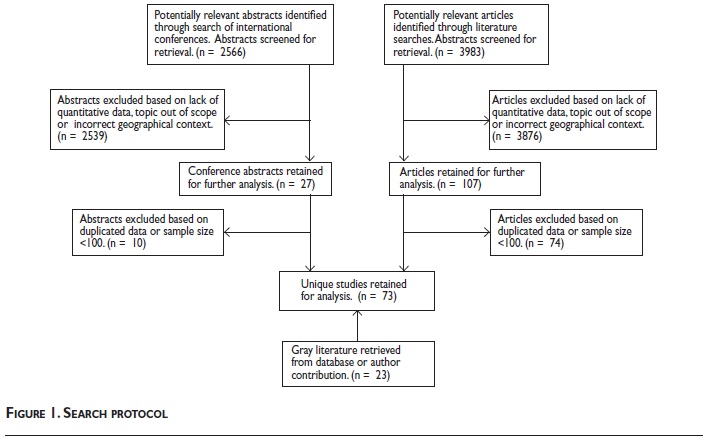
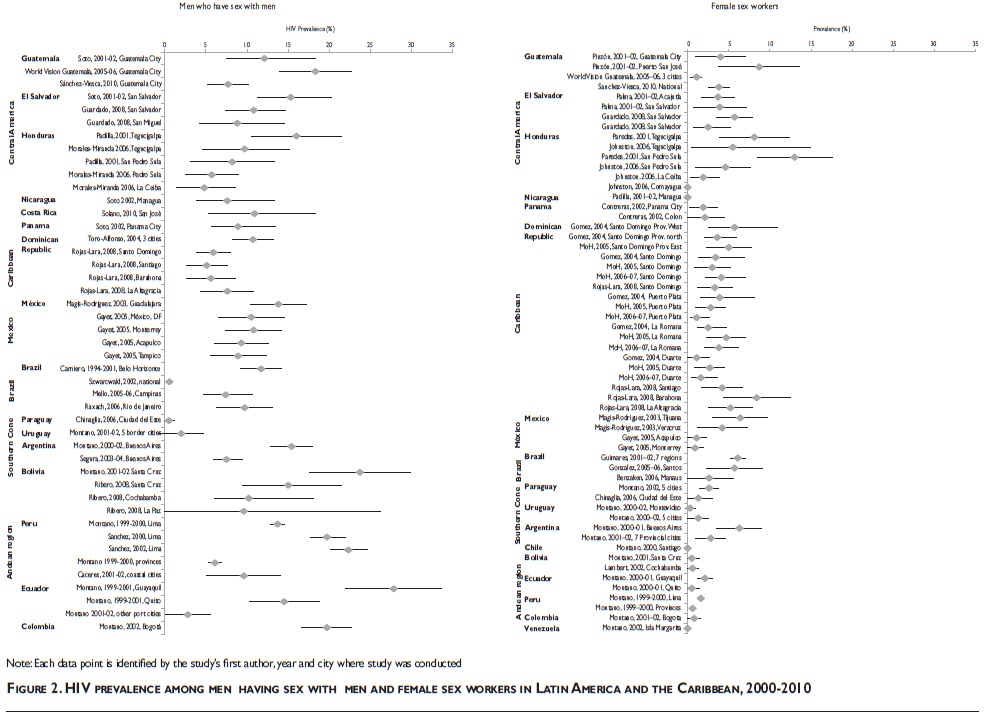
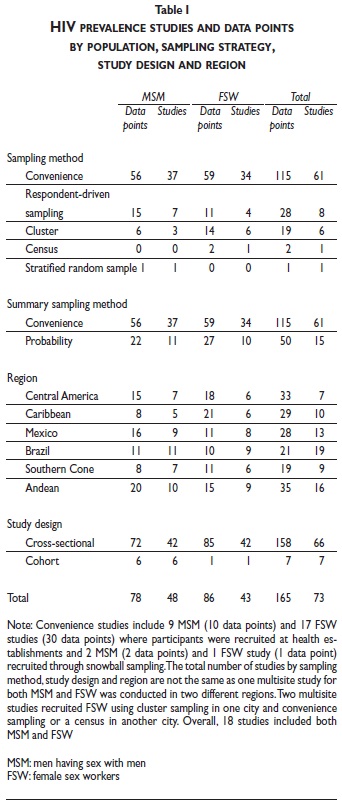
<body><![CDATA[<p><font face="Verdana" size="2">The epidemic in Latin America is characterized    as stable and concentrated with an estimated population prevalence of 0.5% (95%    CI: 0.4-0.6), while in the Caribbean prevalence varies widely from country to    country with an overall estimate of 1.0% (95% CI: 0.9-1.1).<sup>2</sup> Brazil    is thought to be the most affected country, home to one third of all infected    people in the region. Key populations at higher risk of HIV exposure and most    affected by the epidemic include: men who have sex with men (MSM), reported    prevalence between 7.9%-25.6%,<sup>3</sup> female sex workers (FSW), 3.2%-4.3%<sup>4</sup>    and intravenous drug users (IDU), 0-78.0%.<sup>5</sup></font></p>     <p><font face="Verdana" size="2">Data on the incidence and prevalence of HIV and    other STI among MSM are very poor in most of the developing world.<sup>6</sup>    Even in countries where more information is available, the contribution of homosexual    behavior to the HIV/AIDS epidemic is not fully appreciated, in part due to either    a lack of data or lack of analysis of the available data.<sup>7</sup> A number    of more detailed epidemiological studies have shown that same sex behavior is    more common and the HIV prevalence among MSM is higher than previously thought.<sup>8-10</sup>    In urban centers of Latin America, HIV prevalence has remained high among MSM,    even as the epidemic has expanded to other populations.<sup>11</sup></font></p>     <p><font face="Verdana" size="2">FSW have lower reported HIV prevalence than MSM    but are still one of the key populations for HIV and STI transmission in Latin    America and the Caribbean due to the large proportion of men who visit sex workers    (2.5%-6.5%).<sup>12</sup> Clients of FSW have sex with members of both high    risk (FSW) and low risk (wives, regular partners) female populations.<sup>13</sup>    HIV/STI transmission networks are thus formed between populations at higher    and those at lower risk, allowing for transmission of HIV and other STI between    FSW and their partners, as well as transmission of STI among FSW. Given their    central role in the epidemiology of HIV and other STI in Latin America, FSW    must also be a major focus of HIV/STI surveillance and control efforts.</font></p>     <p><font face="Verdana" size="2">In response to differentiated epidemiological    characteristics of the pandemic, UNAIDS recommends differentiated national strategic    plans attuned to the situation in each country.<sup>14</sup> A principal difficulty    in creating such proposals, however, is the availability of accurate information    on different sub-populations or widely varying estimates for the same country.<sup>15</sup>    Considering the mix of available information, we conducted a systematic review    of the HIV prevalence among different key populations in Latin America and the    Caribbean to gain a greater understanding of the epidemiologic profile in the    region and help inform strategies in response to the HIV epidemic.</font></p>     <p>&nbsp;</p>     <p><font face="Verdana" size="3"><b>Materials and methods</b></font></p>     <p><font face="Verdana" size="2">This systematic review aims to synthesize articles,    abstracts and reports of HIV prevalence studies conducted among key populations    in Latin America and the Caribbean. From May to October, 2010, two independent    investigators conducted searches of the PubMed and National Library of Medicine's    meeting abstract databases for published articles and abstracts using the following    key words: highrisk groups; female sex workers; men who have sex with men; homosexual    men; HIV; prevalence; Latin America; and individual country names. Reference    listings from previous reviews and papers were also used to identify original    articles, conference proceedings and reports. "Gray literature,"    most often in the form of study reports, was included based on the knowledge    of coauthors. We considered peerreviewed articles, abstracts and documents published    up to September 2010.</font></p>     <p><font face="Verdana" size="2"><b>Eligibility criteria</b></font></p>     <p><font face="Verdana" size="2">Publications were assessed based on target population,    location, year, sampling methodology, sample size and language. Inclusion criteria    for studies were determined a priori to be: studies including HIV prevalence    data among MSM or FSW; publication in a peer-reviewed journal, country report    or an abstract at a conference with peer-reviewed blinded abstract selection    process; studies from the Latin American and Caribbean regions. Inclusion criteria    for studies among FSW included ex-changing sex for money or goods in different    periods (i.e.: last month, last six months and last year). Inclusion criteria    for MSM included anal or oral sex with another man, recall periods varying (i.e.:    last month, last six months and last year). Studies in English, Spanish and    Portuguese published between 1986 and 2010 were included in the review.</font></p>     <p><font face="Verdana" size="2">Exclusion criteria were studies with 100 or fewer    participants and studies that combined participants from the target populations    with other populations such as clients of FSW. When multiple reports existed    for a single study, one paper was chosen based on completeness of the information.    Only original research articles and reports were taken into account for this    study, ex-cluding those reported in a review for which we could not locate the    abstract, original paper or report. Authors kept records of all excluded publications.</font></p>     ]]></body>
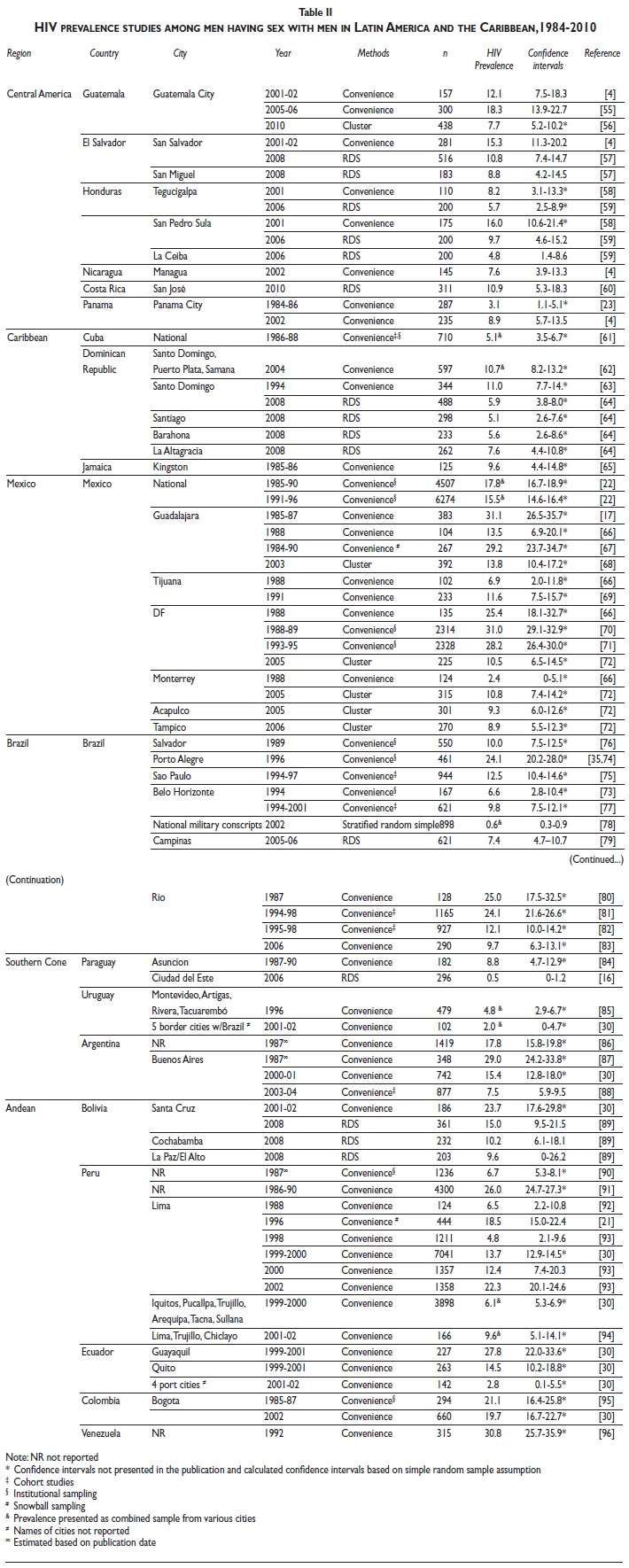
<body><![CDATA[<p><font face="Verdana" size="2"><b>Classification and analysis of the published    work</b></font></p>     <p><font face="Verdana" size="2">We created a master table in Microsoft Excel    (Redmond, WA, USA), extracted key information from included surveys, and entered    data into the table. We extracted 1) the first author; 2) the year of the study;    3) survey location; 4) sampling methodology; 5) study design; 6) inclusion criteria;    7) sample size; 8) HIV prevalence; and 9) respective confidence intervals. When    unavailable in the selected publications, confidence intervals were calculated    assuming a simple random sample: this included 48 studies among MSM and 38 studies    among FSW.</font></p>     <p><font face="Verdana" size="2">City estimates were reported as separate data    points if the study presented the prevalence disaggregated by city. We originally    arranged sampling methodologies into seven categories: unspecified convenience;    snow-ball convenience; institutional convenience; cluster sampling including    time-location sampling (TLS); stratified random sampling; census; and respondent-driven    sampling (RDS). Institutional samples included those recruited at HIV testing,    sexual/reproductive health, STI treatment and community centers. Institutional    samples were presented as convenience samples in <a href="#tab1">tables I</a>,    <a href="/img/revistas/spm/v55s1/a10tab2.jpg">II</a> and <a href="/img/revistas/spm/v55s1/a10tab3.jpg">III</a>.    More recent data from 2000 to 2010 were summarized in a graph (<a href="/img/revistas/spm/v55s1/a10fig2.jpg">figure    2</a>).</font></p>     <p>&nbsp;</p>     <p align="center"><a name="tab1"></a><img src="/img/revistas/spm/v55s1/a10tab1.jpg"></p>     <p>&nbsp;</p>     <p><font face="Verdana" size="3"><b>Results</b></font></p>     <p><font face="Verdana" size="2">A total of 2 566 conference abstracts and 3 983    articles abstracts were originally identified. Of those, 2 539 conference proceedings    and 3 876 articles were excluded because they were not from Latin America or    the Caribbean, were out of scope or because they lacked an HIV prevalence estimate.    One hundred and thirty-four records were deemed relevant by any reviewer and    marked for full-text retrieval. Of those, 84 more were excluded due to duplicated    data or sample size less than 100 (<a href="/img/revistas/spm/v55s1/a10fig1.jpg">figure 1</a>). Twenty- three studies considered    gray literature were added to relevant peer-reviewed studies and conference    papers for a total of 73 studies.</font></p>     <p><font face="Verdana" size="2"><b>Men who have sex with men</b></font></p>     <p><font face="Verdana" size="2">Forty-eight studies screened 60 421 MSM (sample    size range 102-7 041; median 306) and provided 78 population-and city- specific    data points. Studies were published between 1988 and 2010. Data points were    available from 19 countries. Most sites were large metropolitan centers. Studies    were mostly cross-sectional, with the exception of six prospective cohort studies    in four cities in South America and one Caribbean island. Recruitment venues    included HIV testing clinics, medical and community-based organizations serving    MSM, street locations, and social and workplace venues. The majority (77.1%)    of studies was conducted using convenience sampling, and often a combination    of techniques (advertising, active recruitment, HIV/STI testing centers, snowball,    etc.) was used to reach the desired sample size. There were seven (14.6%) that    used RDS, most of these in Central America, three (6.3%) cluster designs and    one (2.1%) stratified random sample (<a href="#tab1">table&nbsp;I</a>). RDS    studies were first reported in 2008. In countries where both RDS studies and    convenience samples were conducted, there was a tendency for RDS studies to    report lower HIV prevalence, though differences were not statistically significant    based on confidence intervals.</font></p>     ]]></body>
<body><![CDATA[<p><font face="Verdana" size="2">Seventy-eight HIV prevalence points for MSM yielded    a range of 0.5% in Paraguay (conducted in 2006)<sup>16</sup> to 31.1% in Guadalajara,    Mexico (1985-87),<sup>17</sup> with a median of 10.6% (IQR: 7.4-17.4) (<a href="/img/revistas/spm/v55s1/a10tab2.jpg">table&nbsp;II</a>). Prevalence rates from 2000 to 2010 are presented in <a href="/img/revistas/spm/v55s1/a10fig2.jpg">figure 2</a>. Data points    from the Caribbean, Central America, and Mexico showed less variability than    the Andean region.</font></p>     <p><font face="Verdana" size="2">A few studies reported HIV incidence. In Brazil,    three cohort studies were implemented in the cities of Rio de Janeiro, Sao Paulo    and Belo Horizonte which found incidence rates of 3.1, 1.5 and 2.0 per 100 person    years, respectively.<sup>18,19</sup> In Peru, 1 140 men followed up between    1998 and 2000 yielded a seroincidence rate of 3.5 per 100 person years.<sup>20</sup>    The BED assay has also been used to estimate incidence in cross-sectional studies    reporting a range of 2.1-14.4% (95%CI: 5.4-29.7) in Central America<sup>4</sup>    and 11.2% in Peru.<sup>21</sup></font></p>     <p><font face="Verdana" size="2"><b>Female sex workers</b></font></p>     <p><font face="Verdana" size="2">Forty-three prevalence studies surveyed 76 416    female sex workers (sample size range 101-24 500; median 265) and included 86    data points. Studies were published between 1986 and 2010 from 18 countries.    Sites included capitals, ports and other tourist and commercial centers. The    highest sample size, 24 500 was reached in Mexico (0.3% HIV prevalence), where    women were recruited from HIV testing sites at health units across the country.<sup>22</sup>    Cross-sectional studies predominated with the exception of one prospective cohort    study. Recruitment venues included HIV testing clinics, medical and community-based    organizations serving FSW, street locations, and social and workplace venues.    Most studies (77.3%) used convenience sampling with the exception of six (13.3%)    cluster designs, four (8.9%) RDS and one (2.2%) census (not exclusive; some    studies used different sampling methods in different cities).</font></p>     <p><font face="Verdana" size="2">RDS studies were first reported for FSW in 2009.    Studies from Central America were more often conducted using RDS than those    from other regions. FSW were sampled using probability methods more frequently    than MSM, though the difference was small.</font></p>     <p><font face="Verdana" size="2">HIV prevalence ranged from 0% in parts of Honduras,    Nicaragua, Panama, Uruguay, Chile, Bolivia, Peru and Venezuela (conducted between    1986 and 2006)*<sup>,23-30,121</sup> to 12.4% in Haiti (1987-1988)<sup>31</sup>    with a median of 2.6% (IQR: 0.6-4.2) (<a href="/img/revistas/spm/v55s1/a10tab3.jpg">table&nbsp;III</a>). HIV prevalence among FSW by    region and country from 2000-2010 are presented in <a href="/img/revistas/spm/v55s1/a10fig2.jpg">figure 2</a>. The data points    showed lower prevalence and less variability than for MSM.</font></p>     <p>&nbsp;</p>     <p><font face="Verdana" size="3"><b>Discussion</b></font></p>     <p><font face="Verdana" size="2">Traditionally, the highest HIV prevalence among    MSM have been reported in Mexico and the Andean countries. However, in the last    10 years the prevalence in Mexico appears to have decreased or studies have    recruited a more heterogeneous sample and recent levels are similar to those    reported in Central America. For FSW, the disease burden was greatest overall    in Brazil, though recent rates were also lower than those from a decade ago.    Taking into account the studies in this review, HIV prevalence among MSM was    five times higher than among sex workers. HIV seroprevalence studies of other    potentially key populations from Latin America and the Caribbean were lacking,    and based on previous reviews men who have sex with men and female sex workers    have proven to be the populations most affected by the HIV epidemic in countries    across the region.<sup>3,32-36</sup></font></p>     <p><font face="Verdana" size="2">One of most apparent characteristics regarding    the prevalence among MSM, especially evident in the Andean region, was the high    degree of variability among studies from different countries but also from the    same country. This could be due to the different sampling methods used to recruit    MSM. Few studies with probabilistic sampling methodologies had been carried    out in the region. Furthermore, it is possible that researchers chose probability    methods to sample female sex workers more often than for MSM on the assumption    that the entire FSW population works from establishments that can be mapped    and cluster sampled. In the U.S. venue based sampling has been used to conduct    ongoing HIV behavioral surveillance among MSM,<sup>37</sup> but in Latin America    researchers have not opted for venue-based methods. In fact, the majority of    articles were based on convenience methods, often combining snowball recruitment,    out-reach referrals or advertisement methods. There are several possible explanations    for this observation. MSM in Latin American countries might have been more difficult    to recruit in venues compared to the U.S. due to lower social tolerance of sexual    diversity and higher levels of stigma and discrimination. This could have resulted    in insufficient number of MSM venues and safety concerns for field staff operating    in dangerous areas. The high degree of convenience sampling and inclusion of    larger proportions of MSM sub-populations at even higher risk such as male sex    workers could have caused the large degree of variability on HIV prevalence    among the MSM studies. Another explanation for the variability among studies    is that RDS has been thought to produce lower seroprevalence estimates than    other methods assuming that it reaches hidden segments of the target population,    individuals who may have been sheltered from a lifestyle propitious to high    rates of transmission.</font></p>     ]]></body>
<body><![CDATA[<p><font face="Verdana" size="2">More difficult to study are individuals who have    sexual relations with key populations and with individuals at lower risk. In    Latin America and the Caribbean, HIV has often been transmitted in this manner    and data on infection rates in these populations were lacking. Mobile workers    have exhibited high risk behavior via interactions with FSW: for example in    2003, in Santos, Brazil, 21.0% of 300 truck drivers reported paid sex in the    last six months.<sup>38</sup> Migrants, yet another key population, have been    at higher risk of HIV exposure, a product of the conditions and structure of    the migration process.<sup>39</sup> Marginalized populations such as sex workers,    injecting drug users and men who have sex with men traditionally have experienced    internal and international migration and may become victims of exploitation,    violence and exclusion.<sup>40,41</sup> A high level of mobility, legal status,    language and cultural differences; lack of information, education and work;    poor access to prevention, harm reduction and health care services; and gender    related factors have led to migrants' underprivileged status. Stigma has    further exacerbated their vulnerability. These key populations should also be    the focus of surveillance to better monitor the HIV epidemic. The objective    of surveillance and most prevalence studies is to document the gravity of disease    burden in the target population and to make recommendations regarding allocation    of resources to control the spread of disease. A primary challenge for surveillance    of these key populations is obtaining 'representative' samples.<sup>42,43</sup>    General population surveys with multi -stage cluster sampling are excessively    expensive and cannot be used to reach hidden segments of the population.<sup>44</sup></font></p>     <p><font face="Verdana" size="2">Several approaches have been proposed to balance    the need for recruitment efficiency and inclusiveness in representation. Snowball    sampling increases efficiency, identification, and inclusion of hidden populations    by having members of the target population recruit other members.<sup>45</sup>    However, snowball sampling suffers from sampling bias and leads to a group that    is not representative of the population. Facility-based sampling is also not    generalizable as those who obtain services are different from those who do not.    Targeted sampling involves an ethnographic mapping of the target population    to later sample subgroups as strata. The magnitude of the bias in targeted sampling    depends on the thoroughness of the ethnographic assessment. Time-location sampling    involves an ethnographic mapping of sites where the target population meets    or works and random selection of participants at randomly selected sites, days    and times. Time-location sampling is a probability sampling method but as with    targeted sampling, its representativeness depends on the exhaustiveness of the    mapping and assistance of all population subgroups at selected sites. Nevertheless,    TLS has worked well with more visible populations including female sex workers    and their clients,<sup>46,47</sup> and MSM in gay-identified areas of urban    centers.<sup>48,49</sup></font></p>     <p><font face="Verdana" size="2">Respondent-driven sampling has been used for    surveillance of populations most at risk for HIV/AIDS in the United States and    in more than 83 countries worldwide since 1994.<sup>50,51</sup> In theory, weighted    estimates generated from RDS generalize to the population as a whole. However,    recent assessments of the RDS sampling methodology have documented limitations    in the RDS assumptions.<sup>52,53</sup> Despite these limitations, RDS is currently    one of the only methods available to reach highly hidden populations that provides    methodological rigor.</font></p>     <p><font face="Verdana" size="2">This review has several limitations. The use    of different sampling methodologies diminished the validity of pooled prevalence    estimates and only medians were presented as summary estimates in this paper.    Calculated asymptotic confidence intervals were tighter than the true intervals,    limiting the interpretability of the data. More recent studies may not have    been included due to the lag time between data collection and publication of    results. The inclusion of gray literature may also have been biased by the authors'    geographical expertise or familiarity. Different types of laboratory tests were    used to diagnosis HIV, including rapid tests, ELISA, and Western Blot among    others. Information on the types of tests, specific tests or diagnostic algorithms    was not always available for the included studies. This variability and lack    of information limited the ability to compare the results from different studies.    Medians and interquartile ranges (IQR) were reported and should be interpreted    with care due to the different recruitment methodologies. For the same reason,    trend analyses have not been presented in this article.</font></p>     <p><font face="Verdana" size="2">High prevalence rates among MSM and moderate    rates among FSW have been detected in countries across Latin America and the    Caribbean. A toolbox of standardized sampling techniques and data collection    practices is urgently needed to clear up the varied picture presented by studies    in this review. While many researchers continue to question the generalizability    of RDS and TLS samples, it is encouraging that researchers are employing probability    sampling methods more often than in the past. The implications of this study    for prevention include recognizing that in Latin America and the Caribbean sufficient    resources should be dedicated to HIV programs for men who have sex with men    and sex workers to slow or stop transmission. Historical stigma attached to    these key populations and their perceived or estimated population size in comparison    to other populations influence decision makers. Widespread efforts are needed    to ensure that leaders are aware of the results and that resources are allocated    based on burden of disease and prevention needs.<sup>54</sup> Periodic surveillance    of MSM, FSW and other populations important to the HIV epidemic should continue.</font></p>     <p>&nbsp;</p>     <p><font face="Verdana" size="3"><b>References</b></font></p>     <!-- ref --><p><font face="Verdana" size="2">1.UNAIDS, World Health Organization. AIDS epidemic    update: December 2009. Geneva: UNAIDS, 2009.    &nbsp;&nbsp;&nbsp;&nbsp;&nbsp;&nbsp;&nbsp;&nbsp;[&#160;<a href="javascript:void(0);" onclick="javascript: window.open('/scielo.php?script=sci_nlinks&ref=9388760&pid=S0036-3634201300030001000001&lng=','','width=640,height=500,resizable=yes,scrollbars=1,menubar=yes,');">Links</a>&#160;]<!-- end-ref --></font></p>     <!-- ref --><p><font face="Verdana" size="2">2. Joint United Nations Programme on HIV/AIDS    (UNAIDS). Global report: UNAIDS report on the global AIDS epidemic 2010. Geneva:    UNAIDS; 2010. Report No. UNAIDS/10.11E | JC1958E.    &nbsp;&nbsp;&nbsp;&nbsp;&nbsp;&nbsp;&nbsp;&nbsp;[&#160;<a href="javascript:void(0);" onclick="javascript: window.open('/scielo.php?script=sci_nlinks&ref=9388762&pid=S0036-3634201300030001000002&lng=','','width=640,height=500,resizable=yes,scrollbars=1,menubar=yes,');">Links</a>&#160;]<!-- end-ref --></font></p>     <!-- ref --><p><font face="Verdana" size="2">3. Baral S, Sifakis F, Cleghorn F, Beyrer C.    Elevated risk for HIV infection among men who have sex with men in low- and    middle-income countries 2000-2006: A systematic review. PLoS Med 2007;4:e339.    &nbsp;&nbsp;&nbsp;&nbsp;&nbsp;&nbsp;&nbsp;&nbsp;[&#160;<a href="javascript:void(0);" onclick="javascript: window.open('/scielo.php?script=sci_nlinks&ref=9388764&pid=S0036-3634201300030001000003&lng=','','width=640,height=500,resizable=yes,scrollbars=1,menubar=yes,');">Links</a>&#160;]<!-- end-ref --></font></p>     <!-- ref --><p><font face="Verdana" size="2">4.Soto RJ, Ghee AE, N&uacute;&ntilde;ez CA, <i>et    al</i>. Sentinel surveillance of sexually transmitted infections/HIV and risk    behaviors in vulnerable populations in 5 Central American countries. J Acquir    Immune Defic Syndr 2007;46:101-111.    &nbsp;&nbsp;&nbsp;&nbsp;&nbsp;&nbsp;&nbsp;&nbsp;[&#160;<a href="javascript:void(0);" onclick="javascript: window.open('/scielo.php?script=sci_nlinks&ref=9388766&pid=S0036-3634201300030001000004&lng=','','width=640,height=500,resizable=yes,scrollbars=1,menubar=yes,');">Links</a>&#160;]<!-- end-ref --></font></p>     <!-- ref --><p><font face="Verdana" size="2">5. Mathers BM, Degenhardt L, Phillips B, <i>et    al</i>. Global epidemiology of injecting drug use and HIV among people who inject    drugs: a systematic review. Lancet 2008;372:1733-175.    &nbsp;&nbsp;&nbsp;&nbsp;&nbsp;&nbsp;&nbsp;&nbsp;[&#160;<a href="javascript:void(0);" onclick="javascript: window.open('/scielo.php?script=sci_nlinks&ref=9388768&pid=S0036-3634201300030001000005&lng=','','width=640,height=500,resizable=yes,scrollbars=1,menubar=yes,');">Links</a>&#160;]<!-- end-ref --></font></p>     <!-- ref --><p><font face="Verdana" size="2">6. Joint United Nations Programme on HIV/AIDS    (UNAIDS). Report on the global HIV/AIDS epidemic 2008. Geneva: UNAIDS; 2008    August. Report No. UNAIDS/08.25E / JC1510E.    &nbsp;&nbsp;&nbsp;&nbsp;&nbsp;&nbsp;&nbsp;&nbsp;[&#160;<a href="javascript:void(0);" onclick="javascript: window.open('/scielo.php?script=sci_nlinks&ref=9388770&pid=S0036-3634201300030001000006&lng=','','width=640,height=500,resizable=yes,scrollbars=1,menubar=yes,');">Links</a>&#160;]<!-- end-ref --></font></p>     <!-- ref --><p><font face="Verdana" size="2">7. Caceres C, Konda K, Pecheny M, Chatterjee    A, Lyerla R. Estimating the number of men who have sex with men in low and middle    income countries. Sex Transm Infect 2006;82 Suppl 3:iii3-9.    &nbsp;&nbsp;&nbsp;&nbsp;&nbsp;&nbsp;&nbsp;&nbsp;[&#160;<a href="javascript:void(0);" onclick="javascript: window.open('/scielo.php?script=sci_nlinks&ref=9388772&pid=S0036-3634201300030001000007&lng=','','width=640,height=500,resizable=yes,scrollbars=1,menubar=yes,');">Links</a>&#160;]<!-- end-ref --></font></p>     <p><font face="Verdana" size="2">8.van Griensven F, Thanprasertsuk S, Jommaroeng    R, <i>et al</i>. Evidence of</font></p>     <p><font face="Verdana" size="2">a previously undocumented epidemic of HIV infection    among men who have sex with men in Bangkok, Thailand. Aids 2005;19:521-526.</font></p>     <!-- ref --><p><font face="Verdana" size="2">9.Go VF, Solomon S, Srikrishnan AK, <i>et al</i>.    HIV rates and risk behaviors are low in the general population of men in Southern    India but high in alcohol venues: Results from 2 probability surveys. J Acquir    Immune Defic Syndr 2007;46:491-497.    &nbsp;&nbsp;&nbsp;&nbsp;&nbsp;&nbsp;&nbsp;&nbsp;[&#160;<a href="javascript:void(0);" onclick="javascript: window.open('/scielo.php?script=sci_nlinks&ref=9388776&pid=S0036-3634201300030001000009&lng=','','width=640,height=500,resizable=yes,scrollbars=1,menubar=yes,');">Links</a>&#160;]<!-- end-ref --></font></p>     <!-- ref --><p><font face="Verdana" size="2">10.Go VF, Srikrishnan AK, Sivaram S, <i>et al</i>.    High HIV prevalence and risk behaviors in men who have sex with men in Chennai,    India. J Acquir Immune Defic Syndr 2004;35:314-319.    &nbsp;&nbsp;&nbsp;&nbsp;&nbsp;&nbsp;&nbsp;&nbsp;[&#160;<a href="javascript:void(0);" onclick="javascript: window.open('/scielo.php?script=sci_nlinks&ref=9388778&pid=S0036-3634201300030001000010&lng=','','width=640,height=500,resizable=yes,scrollbars=1,menubar=yes,');">Links</a>&#160;]<!-- end-ref --></font></p>     <!-- ref --><p><font face="Verdana" size="2">11.C&aacute;ceres CF, Pecheny M, Terto V. AIDS    and Maleto-Male Sex in Latin America: Vulnerabilities, strengths and proposed    measures - Perspectives and reflections from the point of view of public health,    social sciences and activism. Lima, Peru: Universidad Cayetano de Heredia; 2002.    Report No. UPCH/UNAIDS, 2002.    &nbsp;&nbsp;&nbsp;&nbsp;&nbsp;&nbsp;&nbsp;&nbsp;[&#160;<a href="javascript:void(0);" onclick="javascript: window.open('/scielo.php?script=sci_nlinks&ref=9388780&pid=S0036-3634201300030001000011&lng=','','width=640,height=500,resizable=yes,scrollbars=1,menubar=yes,');">Links</a>&#160;]<!-- end-ref --></font></p>     <!-- ref --><p><font face="Verdana" size="2">12.Carael M, Slaymaker E, Lyerla R, Sarkar S.    Clients of sex workers in different regions of the world: hard to count. Sex    Transm Infect 2006;82 Suppl 3:iii26-33.    &nbsp;&nbsp;&nbsp;&nbsp;&nbsp;&nbsp;&nbsp;&nbsp;[&#160;<a href="javascript:void(0);" onclick="javascript: window.open('/scielo.php?script=sci_nlinks&ref=9388782&pid=S0036-3634201300030001000012&lng=','','width=640,height=500,resizable=yes,scrollbars=1,menubar=yes,');">Links</a>&#160;]<!-- end-ref --></font></p>     <!-- ref --><p><font face="Verdana" size="2">13.Morris M, Podhisita C, Wawer MJ, Handcock    MS. Bridge populations in the spread of HIV/AIDS in Thailand. AIDS 1996;10:1265-1271.    &nbsp;&nbsp;&nbsp;&nbsp;&nbsp;&nbsp;&nbsp;&nbsp;[&#160;<a href="javascript:void(0);" onclick="javascript: window.open('/scielo.php?script=sci_nlinks&ref=9388784&pid=S0036-3634201300030001000013&lng=','','width=640,height=500,resizable=yes,scrollbars=1,menubar=yes,');">Links</a>&#160;]<!-- end-ref --></font></p>     <!-- ref --><p><font face="Verdana" size="2">14.UNAIDS. Practical Guidelines for Intensifying    HIV Prevention: Towards Universal Access. Geneva; 2007. Report No. UNAIDS/07.07E    / JC1274E.    &nbsp;&nbsp;&nbsp;&nbsp;&nbsp;&nbsp;&nbsp;&nbsp;[&#160;<a href="javascript:void(0);" onclick="javascript: window.open('/scielo.php?script=sci_nlinks&ref=9388786&pid=S0036-3634201300030001000014&lng=','','width=640,height=500,resizable=yes,scrollbars=1,menubar=yes,');">Links</a>&#160;]<!-- end-ref --></font></p>     <!-- ref --><p><font face="Verdana" size="2">15.Caceres CF, Konda K, Segura ER, Lyerla R.    Epidemiology of male same-sex behaviour and associated sexual health indicators    in low- and middle-income countries: 2003-2007 estimates. Sex Transm Infect    2008;84 Suppl 1:i49-i56.    &nbsp;&nbsp;&nbsp;&nbsp;&nbsp;&nbsp;&nbsp;&nbsp;[&#160;<a href="javascript:void(0);" onclick="javascript: window.open('/scielo.php?script=sci_nlinks&ref=9388788&pid=S0036-3634201300030001000015&lng=','','width=640,height=500,resizable=yes,scrollbars=1,menubar=yes,');">Links</a>&#160;]<!-- end-ref --></font></p>     <!-- ref --><p><font face="Verdana" size="2">16.Chinaglia M, Tun W, Mello M, Insfran M, D&iacute;az    J. Assessment of Risk Factors for HIV Infection in Female Sex Workers and Men    who have Sex with Men in Ciudad del Este, Paraguay. Horizons Final Report. Washington,    DC: Population Council, 2008.    &nbsp;&nbsp;&nbsp;&nbsp;&nbsp;&nbsp;&nbsp;&nbsp;[&#160;<a href="javascript:void(0);" onclick="javascript: window.open('/scielo.php?script=sci_nlinks&ref=9388790&pid=S0036-3634201300030001000016&lng=','','width=640,height=500,resizable=yes,scrollbars=1,menubar=yes,');">Links</a>&#160;]<!-- end-ref --></font></p>     <!-- ref --><p><font face="Verdana" size="2">17. V&aacute;zquez-Valls E, Torres-Mendoza B,    Soto-S&aacute;nchez E, Delgadillo-Madrue&ntilde;o F. Prevalence of Anitbody    to HIV in a Group of Homosexual Men in Guadalajara, Mexico. In: Program and    abstracts of the IV International Conference on AIDS; 1988; Stockholm; 1988.    &nbsp;&nbsp;&nbsp;&nbsp;&nbsp;&nbsp;&nbsp;&nbsp;[&#160;<a href="javascript:void(0);" onclick="javascript: window.open('/scielo.php?script=sci_nlinks&ref=9388792&pid=S0036-3634201300030001000017&lng=','','width=640,height=500,resizable=yes,scrollbars=1,menubar=yes,');">Links</a>&#160;]<!-- end-ref --></font></p>     <!-- ref --><p><font face="Verdana" size="2">18.Harrison LH, do Lago RF, Friedman RK, <i>et    al</i>. Incident HIV infection in a highrisk, homosexual, male cohort in Rio    de Janeiro, Brazil. J Acquir Immune Defic Syndr 1999;21:408-412.    &nbsp;&nbsp;&nbsp;&nbsp;&nbsp;&nbsp;&nbsp;&nbsp;[&#160;<a href="javascript:void(0);" onclick="javascript: window.open('/scielo.php?script=sci_nlinks&ref=9388794&pid=S0036-3634201300030001000018&lng=','','width=640,height=500,resizable=yes,scrollbars=1,menubar=yes,');">Links</a>&#160;]<!-- end-ref --></font></p>     <!-- ref --><p><font face="Verdana" size="2">19.Ramos A, Tanuri A, Schechter M, <i>et al</i>.    Dual and recombinant infections: an integral part of the HIV-1 epidemic in Brazil.    Emerg Infect Dis 1999;5:65-74.    &nbsp;&nbsp;&nbsp;&nbsp;&nbsp;&nbsp;&nbsp;&nbsp;[&#160;<a href="javascript:void(0);" onclick="javascript: window.open('/scielo.php?script=sci_nlinks&ref=9388796&pid=S0036-3634201300030001000019&lng=','','width=640,height=500,resizable=yes,scrollbars=1,menubar=yes,');">Links</a>&#160;]<!-- end-ref --></font></p>     <!-- ref --><p><font face="Verdana" size="2">20.Sanchez J, Lama JR, Peinado J, <i>et al</i>.    High HIV and ulcerative sexually transmitted infection incidence estimates among    men who have sex with men in Peru: awaiting for an effective preventive intervention.    J Acquir Immune Defic Syndr 2009;51 Suppl 1:S47-51.    &nbsp;&nbsp;&nbsp;&nbsp;&nbsp;&nbsp;&nbsp;&nbsp;[&#160;<a href="javascript:void(0);" onclick="javascript: window.open('/scielo.php?script=sci_nlinks&ref=9388798&pid=S0036-3634201300030001000020&lng=','','width=640,height=500,resizable=yes,scrollbars=1,menubar=yes,');">Links</a>&#160;]<!-- end-ref --></font></p>     <!-- ref --><p><font face="Verdana" size="2">21. Tabet S, Sanchez J, Lama J, <i>et al</i>.    HIV, syphilis and heterosexual bridging among Peruvian men who have sex with    men. AIDS 2002;16:1271-1277.    &nbsp;&nbsp;&nbsp;&nbsp;&nbsp;&nbsp;&nbsp;&nbsp;[&#160;<a href="javascript:void(0);" onclick="javascript: window.open('/scielo.php?script=sci_nlinks&ref=9388800&pid=S0036-3634201300030001000021&lng=','','width=640,height=500,resizable=yes,scrollbars=1,menubar=yes,');">Links</a>&#160;]<!-- end-ref --></font></p>     <!-- ref --><p><font face="Verdana" size="2">22.Magis-Rodriguez C, Loo-Mendez E, Santarriaga-Sandoval    M. &#91;HIV/ AIDS Epidemiologic Surveillance through Sentinel Surveys 1991-1996,    CONASIDA&#93;. AIDS-STI Program 1997;3:60-62.    &nbsp;&nbsp;&nbsp;&nbsp;&nbsp;&nbsp;&nbsp;&nbsp;[&#160;<a href="javascript:void(0);" onclick="javascript: window.open('/scielo.php?script=sci_nlinks&ref=9388802&pid=S0036-3634201300030001000022&lng=','','width=640,height=500,resizable=yes,scrollbars=1,menubar=yes,');">Links</a>&#160;]<!-- end-ref --></font></p>     <!-- ref --><p><font face="Verdana" size="2">23.Reeves WC, Cuevas M, Arosemena JR, <i>et al</i>.    Human immunodeficiency virus infection in the Republic of Panama. Am J Trop    Med Hyg 1988;39:398-405.    &nbsp;&nbsp;&nbsp;&nbsp;&nbsp;&nbsp;&nbsp;&nbsp;[&#160;<a href="javascript:void(0);" onclick="javascript: window.open('/scielo.php?script=sci_nlinks&ref=9388804&pid=S0036-3634201300030001000023&lng=','','width=640,height=500,resizable=yes,scrollbars=1,menubar=yes,');">Links</a>&#160;]<!-- end-ref --></font></p>     <!-- ref --><p><font face="Verdana" size="2">24.Camejo MI, Mata G, Diaz M. &#91;Prevalence    of hepatitis B, hepatitis C and syphilis in female sex workers in Venezuela&#93;.    Rev Saude Publica 2003;37:339-344.    &nbsp;&nbsp;&nbsp;&nbsp;&nbsp;&nbsp;&nbsp;&nbsp;[&#160;<a href="javascript:void(0);" onclick="javascript: window.open('/scielo.php?script=sci_nlinks&ref=9388806&pid=S0036-3634201300030001000024&lng=','','width=640,height=500,resizable=yes,scrollbars=1,menubar=yes,');">Links</a>&#160;]<!-- end-ref --></font></p>     <!-- ref --><p><font face="Verdana" size="2">25. Zegarra L, Flores J, Bachelet M, <i>et al</i>.    Prevalence of HIV among different risk groups in Cochabamba, Bolivia. In: International    Conference on AIDS. Meeting held in Switzerland: Escuela Tecnica de Salud Cochabamba    Chile; 1998:118 (abstract no. 13166).    &nbsp;&nbsp;&nbsp;&nbsp;&nbsp;&nbsp;&nbsp;&nbsp;[&#160;<a href="javascript:void(0);" onclick="javascript: window.open('/scielo.php?script=sci_nlinks&ref=9388808&pid=S0036-3634201300030001000025&lng=','','width=640,height=500,resizable=yes,scrollbars=1,menubar=yes,');">Links</a>&#160;]<!-- end-ref --></font></p>     <!-- ref --><p><font face="Verdana" size="2">26. Padilla IS, Soto RJ. &#91;Central American    Multicentre HIV/STI Prevalence and Behavioral Study in Female Sex Workers in    Nicaragua&#93;. Final Report. Managua: Nicaraguan Ministry of Health, 2003.    &nbsp;&nbsp;&nbsp;&nbsp;&nbsp;&nbsp;&nbsp;&nbsp;[&#160;<a href="javascript:void(0);" onclick="javascript: window.open('/scielo.php?script=sci_nlinks&ref=9388810&pid=S0036-3634201300030001000026&lng=','','width=640,height=500,resizable=yes,scrollbars=1,menubar=yes,');">Links</a>&#160;]<!-- end-ref --></font></p>     <!-- ref --><p><font face="Verdana" size="2">27. Golenbock DT, Guerra J, Pfister J, <i>et    al</i>. Absence of infection with human immunodeficiency virus in Peruvian prostitutes.    AIDS Res Hum Retroviruses 1988;4:493-499.    &nbsp;&nbsp;&nbsp;&nbsp;&nbsp;&nbsp;&nbsp;&nbsp;[&#160;<a href="javascript:void(0);" onclick="javascript: window.open('/scielo.php?script=sci_nlinks&ref=9388812&pid=S0036-3634201300030001000027&lng=','','width=640,height=500,resizable=yes,scrollbars=1,menubar=yes,');">Links</a>&#160;]<!-- end-ref --></font></p>     <!-- ref --><p><font face="Verdana" size="2">28. Trujillo L, Munoz D, Gotuzzo E, Yi A, Watts    DM. Sexual practices and prevalence of HIV, HTLV-I/II, and Treponema pallidum    among clandestine female sex workers in Lima, Peru. Sex Transm Dis 1999;26:115-118.    &nbsp;&nbsp;&nbsp;&nbsp;&nbsp;&nbsp;&nbsp;&nbsp;[&#160;<a href="javascript:void(0);" onclick="javascript: window.open('/scielo.php?script=sci_nlinks&ref=9388814&pid=S0036-3634201300030001000028&lng=','','width=640,height=500,resizable=yes,scrollbars=1,menubar=yes,');">Links</a>&#160;]<!-- end-ref --></font></p>     <!-- ref --><p><font face="Verdana" size="2">29. Castro de Batanjer E. Un abordaje epidemiol&oacute;gico    de la infecci&oacute;n por VIH-1/2 entre trabajadoras sexuales y hombres homosexuales    de la Isla de Margarita, Venezuela. Rev Soc Bras Med Trop 1997;30:255-256.    &nbsp;&nbsp;&nbsp;&nbsp;&nbsp;&nbsp;&nbsp;&nbsp;[&#160;<a href="javascript:void(0);" onclick="javascript: window.open('/scielo.php?script=sci_nlinks&ref=9388816&pid=S0036-3634201300030001000029&lng=','','width=640,height=500,resizable=yes,scrollbars=1,menubar=yes,');">Links</a>&#160;]<!-- end-ref --></font></p>     <!-- ref --><p><font face="Verdana" size="2">30. Montano SM, Sanchez JL, Laguna-Torres A,    <i>et al</i>. Prevalences, genotypes, and risk factors for HIV transmission    in South America. J Acquir Immune Defic Syndr 2005;40:57-64.    &nbsp;&nbsp;&nbsp;&nbsp;&nbsp;&nbsp;&nbsp;&nbsp;[&#160;<a href="javascript:void(0);" onclick="javascript: window.open('/scielo.php?script=sci_nlinks&ref=9388818&pid=S0036-3634201300030001000030&lng=','','width=640,height=500,resizable=yes,scrollbars=1,menubar=yes,');">Links</a>&#160;]<!-- end-ref --></font></p>     <!-- ref --><p><font face="Verdana" size="2">31. Paredes M, Soto R. &#91;Central American    Multicentre HIV/STI Prevalence and Behavioral Study in Female Sex Workers in    Honduras&#93;. Tegucigalpa: Honduran Ministry of Health, 2003.    &nbsp;&nbsp;&nbsp;&nbsp;&nbsp;&nbsp;&nbsp;&nbsp;[&#160;<a href="javascript:void(0);" onclick="javascript: window.open('/scielo.php?script=sci_nlinks&ref=9388820&pid=S0036-3634201300030001000031&lng=','','width=640,height=500,resizable=yes,scrollbars=1,menubar=yes,');">Links</a>&#160;]<!-- end-ref --></font></p>     <!-- ref --><p><font face="Verdana" size="2">32. Bastos FI, Caceres C, Galvao J, Veras MA,    Castilho EA. AIDS in Latin America: assessing the current status of the epidemic    and the ongoing response. Int J Epidemiol 2008;37:729-737.    &nbsp;&nbsp;&nbsp;&nbsp;&nbsp;&nbsp;&nbsp;&nbsp;[&#160;<a href="javascript:void(0);" onclick="javascript: window.open('/scielo.php?script=sci_nlinks&ref=9388822&pid=S0036-3634201300030001000032&lng=','','width=640,height=500,resizable=yes,scrollbars=1,menubar=yes,');">Links</a>&#160;]<!-- end-ref --></font></p>     <!-- ref --><p><font face="Verdana" size="2">33. Caceres CF. HIV among gay and other men who    have sex with men in Latin America and the Caribbean: a hidden epidemic? AIDS    2002;16 Suppl 3:S23-33.    &nbsp;&nbsp;&nbsp;&nbsp;&nbsp;&nbsp;&nbsp;&nbsp;[&#160;<a href="javascript:void(0);" onclick="javascript: window.open('/scielo.php?script=sci_nlinks&ref=9388824&pid=S0036-3634201300030001000033&lng=','','width=640,height=500,resizable=yes,scrollbars=1,menubar=yes,');">Links</a>&#160;]<!-- end-ref --></font></p>     <p><font face="Verdana" size="2">34. Calleja JM, Walker N, Cuchi P, Lazzari S,    Ghys PD, Zacarias F.</font></p>     <p><font face="Verdana" size="2">Status of the HIV/AIDS epidemic and methods to    monitor it in the Latin America and Caribbean region. AIDS 2002;16 Suppl 3:S3-12.</font></p>     <!-- ref --><p><font face="Verdana" size="2">35. Malta M, Magnanini MM, Mello MB, Pascom AR,    Linhares Y, Bastos FI. HIV prevalence among female sex workers, drug users and    men who have sex with men in Brazil: A systematic review and meta-analysis.    BMC Public Health 2010;10:317.    &nbsp;&nbsp;&nbsp;&nbsp;&nbsp;&nbsp;&nbsp;&nbsp;[&#160;<a href="javascript:void(0);" onclick="javascript: window.open('/scielo.php?script=sci_nlinks&ref=9388828&pid=S0036-3634201300030001000035&lng=','','width=640,height=500,resizable=yes,scrollbars=1,menubar=yes,');">Links</a>&#160;]<!-- end-ref --></font></p>     <!-- ref --><p><font face="Verdana" size="2">36. Estebanez P, Fitch K, Najera R. HIV and female    sex workers. Bull World Health Organ 1993;71:397-412.    &nbsp;&nbsp;&nbsp;&nbsp;&nbsp;&nbsp;&nbsp;&nbsp;[&#160;<a href="javascript:void(0);" onclick="javascript: window.open('/scielo.php?script=sci_nlinks&ref=9388830&pid=S0036-3634201300030001000036&lng=','','width=640,height=500,resizable=yes,scrollbars=1,menubar=yes,');">Links</a>&#160;]<!-- end-ref --></font></p>     <!-- ref --><p><font face="Verdana" size="2">37. MacKellar D, Valleroy L, Karon J, Lemp G,    Janssen R. The Young Men's Survey: methods for estimating HIV seroprevalence    and risk factors among young men who have sex with men. Public Health Rep 1996;111    Suppl 1:138-144.    &nbsp;&nbsp;&nbsp;&nbsp;&nbsp;&nbsp;&nbsp;&nbsp;[&#160;<a href="javascript:void(0);" onclick="javascript: window.open('/scielo.php?script=sci_nlinks&ref=9388832&pid=S0036-3634201300030001000037&lng=','','width=640,height=500,resizable=yes,scrollbars=1,menubar=yes,');">Links</a>&#160;]<!-- end-ref --></font></p>     <!-- ref --><p><font face="Verdana" size="2">38. Lacerda R, Gravato N, McFarland W, <i>et    al</i>. Truck drivers in Brazil: prevalence of HIV and other sexually transmitted    diseases, risk behavior and potential for spread of infection. AIDS 1997;11    Suppl 1:S15-S19.    &nbsp;&nbsp;&nbsp;&nbsp;&nbsp;&nbsp;&nbsp;&nbsp;[&#160;<a href="javascript:void(0);" onclick="javascript: window.open('/scielo.php?script=sci_nlinks&ref=9388834&pid=S0036-3634201300030001000038&lng=','','width=640,height=500,resizable=yes,scrollbars=1,menubar=yes,');">Links</a>&#160;]<!-- end-ref --></font></p>     <!-- ref --><p><font face="Verdana" size="2">39. Garcia-Calleja JM, Rio CD, Souteyrand Y.    HIV infection in the Americas: improving strategic information to improve response.    J Acquir Immune Defic Syndr 2009;51 Suppl 1:S1-3.    &nbsp;&nbsp;&nbsp;&nbsp;&nbsp;&nbsp;&nbsp;&nbsp;[&#160;<a href="javascript:void(0);" onclick="javascript: window.open('/scielo.php?script=sci_nlinks&ref=9388836&pid=S0036-3634201300030001000039&lng=','','width=640,height=500,resizable=yes,scrollbars=1,menubar=yes,');">Links</a>&#160;]<!-- end-ref --></font></p>     <!-- ref --><p><font face="Verdana" size="2">40. Bronfman M. Mexico and Central America. Int    Migr 1998;36:609-642.    &nbsp;&nbsp;&nbsp;&nbsp;&nbsp;&nbsp;&nbsp;&nbsp;[&#160;<a href="javascript:void(0);" onclick="javascript: window.open('/scielo.php?script=sci_nlinks&ref=9388838&pid=S0036-3634201300030001000040&lng=','','width=640,height=500,resizable=yes,scrollbars=1,menubar=yes,');">Links</a>&#160;]<!-- end-ref --></font></p>     <!-- ref --><p><font face="Verdana" size="2">41. Frye V, Latka MH, Koblin B, <i>et al</i>.    The urban environment and sexual risk behavior among men who have sex with men.    J Urban Health 2006;83:308-24.    &nbsp;&nbsp;&nbsp;&nbsp;&nbsp;&nbsp;&nbsp;&nbsp;[&#160;<a href="javascript:void(0);" onclick="javascript: window.open('/scielo.php?script=sci_nlinks&ref=9388840&pid=S0036-3634201300030001000041&lng=','','width=640,height=500,resizable=yes,scrollbars=1,menubar=yes,');">Links</a>&#160;]<!-- end-ref --></font></p>     <!-- ref --><p><font face="Verdana" size="2">42. Mills S, Saidel T, Bennett A, <i>et al</i>.    HIV risk behavioral surveillance: a methodology for monitoring behavioral trends.    AIDS 1998;12 Suppl 2:S37-46.    &nbsp;&nbsp;&nbsp;&nbsp;&nbsp;&nbsp;&nbsp;&nbsp;[&#160;<a href="javascript:void(0);" onclick="javascript: window.open('/scielo.php?script=sci_nlinks&ref=9388842&pid=S0036-3634201300030001000042&lng=','','width=640,height=500,resizable=yes,scrollbars=1,menubar=yes,');">Links</a>&#160;]<!-- end-ref --></font></p>     <!-- ref --><p><font face="Verdana" size="2">43. Schwartlander B, Ghys PD, Pisani E, <i>et    al</i>. HIV surveillance in hard-to-reach populations. AIDS 2001;15 Suppl 3:S1-3.    &nbsp;&nbsp;&nbsp;&nbsp;&nbsp;&nbsp;&nbsp;&nbsp;[&#160;<a href="javascript:void(0);" onclick="javascript: window.open('/scielo.php?script=sci_nlinks&ref=9388844&pid=S0036-3634201300030001000043&lng=','','width=640,height=500,resizable=yes,scrollbars=1,menubar=yes,');">Links</a>&#160;]<!-- end-ref --></font></p>     <!-- ref --><p><font face="Verdana" size="2">44. Magnani R, Sabin K, Saidel T, Heckathorn    D. Review of sampling hard-to-reach and hidden populations for HIV surveillance.    AIDS 2005;19 Suppl 2:S67-72.    &nbsp;&nbsp;&nbsp;&nbsp;&nbsp;&nbsp;&nbsp;&nbsp;[&#160;<a href="javascript:void(0);" onclick="javascript: window.open('/scielo.php?script=sci_nlinks&ref=9388846&pid=S0036-3634201300030001000044&lng=','','width=640,height=500,resizable=yes,scrollbars=1,menubar=yes,');">Links</a>&#160;]<!-- end-ref --></font></p>     <!-- ref --><p><font face="Verdana" size="2">45. Erickson B. Some problems of inference from    chain data. Sociological Methodology Research 1971;10:276-302.    &nbsp;&nbsp;&nbsp;&nbsp;&nbsp;&nbsp;&nbsp;&nbsp;[&#160;<a href="javascript:void(0);" onclick="javascript: window.open('/scielo.php?script=sci_nlinks&ref=9388848&pid=S0036-3634201300030001000045&lng=','','width=640,height=500,resizable=yes,scrollbars=1,menubar=yes,');">Links</a>&#160;]<!-- end-ref --></font></p>     <!-- ref --><p><font face="Verdana" size="2">46. Kayembe PK, Mapatano MA, Busangu AF, <i>et    al</i>. Determinants of consistent condom use among female commercial sex workers    in the Democratic Republic of Congo: Implications for interventions. Sex Transm    Infect 2008;84:202-206.    &nbsp;&nbsp;&nbsp;&nbsp;&nbsp;&nbsp;&nbsp;&nbsp;[&#160;<a href="javascript:void(0);" onclick="javascript: window.open('/scielo.php?script=sci_nlinks&ref=9388850&pid=S0036-3634201300030001000046&lng=','','width=640,height=500,resizable=yes,scrollbars=1,menubar=yes,');">Links</a>&#160;]<!-- end-ref --></font></p>     <!-- ref --><p><font face="Verdana" size="2">47.Nguyen NT, Nguyen HT, Trinh HQ, Mills SJ,    Detels R. Clients of female sex workers as a bridging population in Vietnam.    AIDS Behav 2009;13:881-891.    &nbsp;&nbsp;&nbsp;&nbsp;&nbsp;&nbsp;&nbsp;&nbsp;[&#160;<a href="javascript:void(0);" onclick="javascript: window.open('/scielo.php?script=sci_nlinks&ref=9388852&pid=S0036-3634201300030001000047&lng=','','width=640,height=500,resizable=yes,scrollbars=1,menubar=yes,');">Links</a>&#160;]<!-- end-ref --></font></p>     <!-- ref --><p><font face="Verdana" size="2">48. Muhib FB, Lin LS, Stueve A, <i>et al</i>.    A venue-based method for sampling hard-to-reach populations. Public Health Rep    2001;116 Suppl 1:216-222.    &nbsp;&nbsp;&nbsp;&nbsp;&nbsp;&nbsp;&nbsp;&nbsp;[&#160;<a href="javascript:void(0);" onclick="javascript: window.open('/scielo.php?script=sci_nlinks&ref=9388854&pid=S0036-3634201300030001000048&lng=','','width=640,height=500,resizable=yes,scrollbars=1,menubar=yes,');">Links</a>&#160;]<!-- end-ref --></font></p>     <!-- ref --><p><font face="Verdana" size="2">49.Stueve A, O'Donnell LN, Duran R, San    Doval A, Blome J. Time-space sampling in minority communities: Results with    young Latino men who have sex with men. Am J Public Health 2001;91:922-926.    &nbsp;&nbsp;&nbsp;&nbsp;&nbsp;&nbsp;&nbsp;&nbsp;[&#160;<a href="javascript:void(0);" onclick="javascript: window.open('/scielo.php?script=sci_nlinks&ref=9388856&pid=S0036-3634201300030001000049&lng=','','width=640,height=500,resizable=yes,scrollbars=1,menubar=yes,');">Links</a>&#160;]<!-- end-ref --></font></p>     <!-- ref --><p><font face="Verdana" size="2">50.Johnston LG, Khanam R, Reza M, <i>et al</i>.    The effectiveness of respondent driven sampling for recruiting males who have    sex with males in Dhaka, Bangladesh. AIDS Behav 2008;12:294-304.    &nbsp;&nbsp;&nbsp;&nbsp;&nbsp;&nbsp;&nbsp;&nbsp;[&#160;<a href="javascript:void(0);" onclick="javascript: window.open('/scielo.php?script=sci_nlinks&ref=9388858&pid=S0036-3634201300030001000050&lng=','','width=640,height=500,resizable=yes,scrollbars=1,menubar=yes,');">Links</a>&#160;]<!-- end-ref --></font></p>     <!-- ref --><p><font face="Verdana" size="2">51.Broadhead RS, Heckathorn DD, Grund J-PC, Stern    LS, Anthony DL. Drug users versus outreach workers in combating aids: preliminary    results of a peer- driven intervention. J Drug Issues 1995;25:531-564.    &nbsp;&nbsp;&nbsp;&nbsp;&nbsp;&nbsp;&nbsp;&nbsp;[&#160;<a href="javascript:void(0);" onclick="javascript: window.open('/scielo.php?script=sci_nlinks&ref=9388860&pid=S0036-3634201300030001000051&lng=','','width=640,height=500,resizable=yes,scrollbars=1,menubar=yes,');">Links</a>&#160;]<!-- end-ref --></font></p>     <!-- ref --><p><font face="Verdana" size="2">52.Goel S, Salganik MJ. Assessing respondent-driven    sampling. Proc Natl Acad Sci USA 2010;107:6743-6747.    &nbsp;&nbsp;&nbsp;&nbsp;&nbsp;&nbsp;&nbsp;&nbsp;[&#160;<a href="javascript:void(0);" onclick="javascript: window.open('/scielo.php?script=sci_nlinks&ref=9388862&pid=S0036-3634201300030001000052&lng=','','width=640,height=500,resizable=yes,scrollbars=1,menubar=yes,');">Links</a>&#160;]<!-- end-ref --></font></p>     <!-- ref --><p><font face="Verdana" size="2">53.Gile K, Handcock M. Respondent-driven sampling:    An assessment of current methodology. Sociol Methodol 2010;40,1:285-327.    &nbsp;&nbsp;&nbsp;&nbsp;&nbsp;&nbsp;&nbsp;&nbsp;[&#160;<a href="javascript:void(0);" onclick="javascript: window.open('/scielo.php?script=sci_nlinks&ref=9388864&pid=S0036-3634201300030001000053&lng=','','width=640,height=500,resizable=yes,scrollbars=1,menubar=yes,');">Links</a>&#160;]<!-- end-ref --></font></p>     <!-- ref --><p><font face="Verdana" size="2">54.Pan American Health Organization. Challenges    Posed by the HIV Epidemic in Latin America and the Caribbean 2009. Lima, Peru:    PAHO, UNICEF and UNAIDS, 2009.    &nbsp;&nbsp;&nbsp;&nbsp;&nbsp;&nbsp;&nbsp;&nbsp;[&#160;<a href="javascript:void(0);" onclick="javascript: window.open('/scielo.php?script=sci_nlinks&ref=9388866&pid=S0036-3634201300030001000054&lng=','','width=640,height=500,resizable=yes,scrollbars=1,menubar=yes,');">Links</a>&#160;]<!-- end-ref --></font></p>     <!-- ref --><p><font face="Verdana" size="2">55. World Vision of Guatemala. &#91;Final report    of the baseline study: Initiative for the strengthening of HIV/AIDS prevention    and treatment actions among vulnerable groups and prioritized areas&#93;. Final    report. Guatemala: World Vision of Guatemala, 2007.    &nbsp;&nbsp;&nbsp;&nbsp;&nbsp;&nbsp;&nbsp;&nbsp;[&#160;<a href="javascript:void(0);" onclick="javascript: window.open('/scielo.php?script=sci_nlinks&ref=9388868&pid=S0036-3634201300030001000055&lng=','','width=640,height=500,resizable=yes,scrollbars=1,menubar=yes,');">Links</a>&#160;]<!-- end-ref --></font></p>     <!-- ref --><p><font face="Verdana" size="2">56.S&aacute;nchez-Viesca AF. Final report of    the follow-up study: Initiative for the strengthening of HIV/AIDS prevention    and treatment actions among vulnerable groups and prioritized areas. Final report.    Guatemala City: World Vision of Guatemala; Center for Strategic Health Development    (CES), 2010.    &nbsp;&nbsp;&nbsp;&nbsp;&nbsp;&nbsp;&nbsp;&nbsp;[&#160;<a href="javascript:void(0);" onclick="javascript: window.open('/scielo.php?script=sci_nlinks&ref=9388870&pid=S0036-3634201300030001000056&lng=','','width=640,height=500,resizable=yes,scrollbars=1,menubar=yes,');">Links</a>&#160;]<!-- end-ref --></font></p>     <!-- ref --><p><font face="Verdana" size="2">57.Guardado ME, Creswell J, Paz-Bailey G. &#91;Central    American Survey of Sexual Behavior and HIV/STI Prevalence among Vulnerable Populations    (ECVC): El Salvador&#93;. Final Report. San Salvador: Ministry of Health (MS-PAS),    National STI/HIV/AIDS Program; del Valle University of Guatemala and Centers    for Disease Control and Prevention (CDC) Collaboration, Global AIDS Program    Regional Office for Central America and Panama (CDC-GAP/CAP), 2010.    &nbsp;&nbsp;&nbsp;&nbsp;&nbsp;&nbsp;&nbsp;&nbsp;[&#160;<a href="javascript:void(0);" onclick="javascript: window.open('/scielo.php?script=sci_nlinks&ref=9388872&pid=S0036-3634201300030001000057&lng=','','width=640,height=500,resizable=yes,scrollbars=1,menubar=yes,');">Links</a>&#160;]<!-- end-ref --></font></p>     <!-- ref --><p><font face="Verdana" size="2">58.Padilla IS, Soto RJ. &#91;Central American    Multi-centre HIV/STI Prevalence and Behavioral Study in Men Who Have Sex with    Men in Honduras&#93;. Final Report. Tegucigalpa: Honduran Ministry of Health,    2003.    &nbsp;&nbsp;&nbsp;&nbsp;&nbsp;&nbsp;&nbsp;&nbsp;[&#160;<a href="javascript:void(0);" onclick="javascript: window.open('/scielo.php?script=sci_nlinks&ref=9388874&pid=S0036-3634201300030001000058&lng=','','width=640,height=500,resizable=yes,scrollbars=1,menubar=yes,');">Links</a>&#160;]<!-- end-ref --></font></p>     <!-- ref --><p><font face="Verdana" size="2">59.Morales-Miranda S, Paz-Bailey G, Arambu N,    &Aacute;lvarez B, Paredes M, Monterroso E. &#91;Central American Survey of Sexual    Behavior and HIV/ STI Prevalence among Vulnerable Populations in Honduras (ECVC):    Men Who Have Sex with Men. Final report. Tegucigalpa: Del Valle University of    Guatemala, Honduran Ministry of Health, CDC, USAID, Tephinet, Inc, 2008.    &nbsp;&nbsp;&nbsp;&nbsp;&nbsp;&nbsp;&nbsp;&nbsp;[&#160;<a href="javascript:void(0);" onclick="javascript: window.open('/scielo.php?script=sci_nlinks&ref=9388876&pid=S0036-3634201300030001000059&lng=','','width=640,height=500,resizable=yes,scrollbars=1,menubar=yes,');">Links</a>&#160;]<!-- end-ref --></font></p>     <!-- ref --><p><font face="Verdana" size="2">60.Solano T. &#91;Prevalence of HIV, Syphilis    and Risky Behavior among MSM in the Greater Metropolitan Area of Costa Rica&#93;.    Final report. San Jos&eacute;: Costa Rican Ministry of Health, 2010.    &nbsp;&nbsp;&nbsp;&nbsp;&nbsp;&nbsp;&nbsp;&nbsp;[&#160;<a href="javascript:void(0);" onclick="javascript: window.open('/scielo.php?script=sci_nlinks&ref=9388878&pid=S0036-3634201300030001000060&lng=','','width=640,height=500,resizable=yes,scrollbars=1,menubar=yes,');">Links</a>&#160;]<!-- end-ref --></font></p>     <!-- ref --><p><font face="Verdana" size="2">61.Galban E, Menendez J, Gil R, Terry H. CUBA:    Study of sexual contacts of the HIV seropositive persons. In: International    Conference on AIDS; 1989 Jun 4-9; Montreal; 1989.    &nbsp;&nbsp;&nbsp;&nbsp;&nbsp;&nbsp;&nbsp;&nbsp;[&#160;<a href="javascript:void(0);" onclick="javascript: window.open('/scielo.php?script=sci_nlinks&ref=9388880&pid=S0036-3634201300030001000061&lng=','','width=640,height=500,resizable=yes,scrollbars=1,menubar=yes,');">Links</a>&#160;]<!-- end-ref --></font></p>     <!-- ref --><p><font face="Verdana" size="2">62.Toro-Alfonso JN. V-D. Proyecto Delta. Informe    Final. Santo Domingo. Dominican Republic: CESDEM, 2005.    &nbsp;&nbsp;&nbsp;&nbsp;&nbsp;&nbsp;&nbsp;&nbsp;[&#160;<a href="javascript:void(0);" onclick="javascript: window.open('/scielo.php?script=sci_nlinks&ref=9388882&pid=S0036-3634201300030001000062&lng=','','width=640,height=500,resizable=yes,scrollbars=1,menubar=yes,');">Links</a>&#160;]<!-- end-ref --></font></p>     <!-- ref --><p><font face="Verdana" size="2">63. Tabet SR, de Moya EA, Holmes KK, <i>et al</i>.    Sexual behaviors and risk factors for HIV infection among men who have sex with    men in the Dominican Republic. AIDS 1996;10:201-206.    &nbsp;&nbsp;&nbsp;&nbsp;&nbsp;&nbsp;&nbsp;&nbsp;[&#160;<a href="javascript:void(0);" onclick="javascript: window.open('/scielo.php?script=sci_nlinks&ref=9388884&pid=S0036-3634201300030001000063&lng=','','width=640,height=500,resizable=yes,scrollbars=1,menubar=yes,');">Links</a>&#160;]<!-- end-ref --></font></p>     <!-- ref --><p><font face="Verdana" size="2">64. Rojas-Lara G, Caballero-Vaillant T, Mercedes-Valles    H, <i>et al</i>. &#91;1st Behavioral Survey with Serological Data among Vulnerable    Populations: Gay, Trans and Other Men Who Have Sex with Men; Sex Workers; Drug    Users. Santo Domingo, Dominican Republic: Presidencial AIDS</font>&nbsp;&nbsp;&nbsp;&nbsp;&nbsp;&nbsp;&nbsp;&nbsp;[&#160;<a href="javascript:void(0);" onclick="javascript: window.open('/scielo.php?script=sci_nlinks&ref=9388886&pid=S0036-3634201300030001000064&lng=','','width=640,height=500,resizable=yes,scrollbars=1,menubar=yes,');">Links</a>&#160;]<!-- end-ref --><!-- ref --><p><font face="Verdana" size="2">65.Murphy EL, Gibbs WN, Figueroa JP, <i>et al</i>.    Human immunodeficiency virus and human T-lymphotropic virus type I infection    among homosexual men in Kingston, Jamaica. J Acquir Immune Defic Syndr 1988;1:143-149.    &nbsp;&nbsp;&nbsp;&nbsp;&nbsp;&nbsp;&nbsp;&nbsp;[&#160;<a href="javascript:void(0);" onclick="javascript: window.open('/scielo.php?script=sci_nlinks&ref=9388887&pid=S0036-3634201300030001000065&lng=','','width=640,height=500,resizable=yes,scrollbars=1,menubar=yes,');">Links</a>&#160;]<!-- end-ref --></font></p>     <!-- ref --><p><font face="Verdana" size="2">66.Izazola-Licea JA, Valdespino-Gomez JL, Gortmaker    SL, <i>et al</i>. HIV-1 seropositivity and behavioral and sociological risks    among homosexual and bisexual men in six Mexican cities. J Acquir Immune Defic    Syndr 1991;4:614-622.    &nbsp;&nbsp;&nbsp;&nbsp;&nbsp;&nbsp;&nbsp;&nbsp;[&#160;<a href="javascript:void(0);" onclick="javascript: window.open('/scielo.php?script=sci_nlinks&ref=9388889&pid=S0036-3634201300030001000066&lng=','','width=640,height=500,resizable=yes,scrollbars=1,menubar=yes,');">Links</a>&#160;]<!-- end-ref --></font></p>     <!-- ref --><p><font face="Verdana" size="2">67. Preciado-Negrete P, Campos-Lopez P, Torres-Mendoza    B, Alvarez-Maya I, Vazquez-Valls E. Tendency of anti-HIV antibodies in homosexual    men during the last seven years in Guadalajara, Mexico. In: International Conference    on AIDS; 1991 June 16-21; Florence; 1991:300.    &nbsp;&nbsp;&nbsp;&nbsp;&nbsp;&nbsp;&nbsp;&nbsp;[&#160;<a href="javascript:void(0);" onclick="javascript: window.open('/scielo.php?script=sci_nlinks&ref=9388891&pid=S0036-3634201300030001000067&lng=','','width=640,height=500,resizable=yes,scrollbars=1,menubar=yes,');">Links</a>&#160;]<!-- end-ref --></font></p>     ]]></body>
<body><![CDATA[<!-- ref --><p><font face="Verdana" size="2">68.Magis-Rodriguez C, Gayet C, Manrique B. &#91;Report    on the results from the prevalence and behavioral surveillance survey on HIV/AIDS    in: Men who have sex with men, female sex workers, male sex workers and injection    drug users&#93;. Technical report. Mexico, DF: National HIV/AIDS Program (CENSIDA),    2005.    &nbsp;&nbsp;&nbsp;&nbsp;&nbsp;&nbsp;&nbsp;&nbsp;[&#160;<a href="javascript:void(0);" onclick="javascript: window.open('/scielo.php?script=sci_nlinks&ref=9388893&pid=S0036-3634201300030001000068&lng=','','width=640,height=500,resizable=yes,scrollbars=1,menubar=yes,');">Links</a>&#160;]<!-- end-ref --></font></p>     <!-- ref --><p><font face="Verdana" size="2">69.Guerena-Burgueno F, Benenson AS, Sepulveda-Amor    J. HIV-1 prevalence in selected Tijuana sub-populations. Am J Public Health    1991;81:623-635.    &nbsp;&nbsp;&nbsp;&nbsp;&nbsp;&nbsp;&nbsp;&nbsp;[&#160;<a href="javascript:void(0);" onclick="javascript: window.open('/scielo.php?script=sci_nlinks&ref=9388895&pid=S0036-3634201300030001000069&lng=','','width=640,height=500,resizable=yes,scrollbars=1,menubar=yes,');">Links</a>&#160;]<!-- end-ref --></font></p>     <!-- ref --><p><font face="Verdana" size="2">70.Hernandez M, Uribe P, Gortmaker S, <i>et al</i>.    Sexual behavior and status for human immunodeficiency virus type 1 among homosexual    and bisexual males in Mexico City. Am J Epidemiol 1992;135:883-894.    &nbsp;&nbsp;&nbsp;&nbsp;&nbsp;&nbsp;&nbsp;&nbsp;[&#160;<a href="javascript:void(0);" onclick="javascript: window.open('/scielo.php?script=sci_nlinks&ref=9388897&pid=S0036-3634201300030001000070&lng=','','width=640,height=500,resizable=yes,scrollbars=1,menubar=yes,');">Links</a>&#160;]<!-- end-ref --></font></p>     <!-- ref --><p><font face="Verdana" size="2">71. Teran-Toledo X, Hernandez T, del Rio C, Uribe    Z. Risk factors for HIV infection in Mexico City. In: International Conference    on AIDS; 1996; Vancouver; 1996:40.    &nbsp;&nbsp;&nbsp;&nbsp;&nbsp;&nbsp;&nbsp;&nbsp;[&#160;<a href="javascript:void(0);" onclick="javascript: window.open('/scielo.php?script=sci_nlinks&ref=9388899&pid=S0036-3634201300030001000071&lng=','','width=640,height=500,resizable=yes,scrollbars=1,menubar=yes,');">Links</a>&#160;]<!-- end-ref --></font></p>     <!-- ref --><p><font face="Verdana" size="2">72.Gayet C, Magis C, Sacknoff D, Guli L. &#91;Sexual    Practices of Populations Vulnerable to the HIV/AIDS Epidemic in Mexico&#93;.    Mexico, DF: National Center for HIV/AIDS Prevention and Control (CENSIDA); Latin    American School of Social Sciences (FLACSO), 2007.    &nbsp;&nbsp;&nbsp;&nbsp;&nbsp;&nbsp;&nbsp;&nbsp;[&#160;<a href="javascript:void(0);" onclick="javascript: window.open('/scielo.php?script=sci_nlinks&ref=9388901&pid=S0036-3634201300030001000072&lng=','','width=640,height=500,resizable=yes,scrollbars=1,menubar=yes,');">Links</a>&#160;]<!-- end-ref --></font></p>     ]]></body>
<body><![CDATA[<!-- ref --><p><font face="Verdana" size="2">73. Ribeiro TT, Brites C, Moreira ED, Jr., <i>et    al</i>. Serologic validation of HIV infection in a tropical area. J Acquir Immune    Defic Syndr 1993;6:319-322.    &nbsp;&nbsp;&nbsp;&nbsp;&nbsp;&nbsp;&nbsp;&nbsp;[&#160;<a href="javascript:void(0);" onclick="javascript: window.open('/scielo.php?script=sci_nlinks&ref=9388903&pid=S0036-3634201300030001000073&lng=','','width=640,height=500,resizable=yes,scrollbars=1,menubar=yes,');">Links</a>&#160;]<!-- end-ref --></font></p>     <!-- ref --><p><font face="Verdana" size="2">74.Barcellos NT, Fuchs SC, Fuchs FD. Prevalence    of and risk factors for HIV infection in individuals testing for HIV at counseling    centers in Brazil. Sex Transm Dis 2003;30:166-173.    &nbsp;&nbsp;&nbsp;&nbsp;&nbsp;&nbsp;&nbsp;&nbsp;[&#160;<a href="javascript:void(0);" onclick="javascript: window.open('/scielo.php?script=sci_nlinks&ref=9388905&pid=S0036-3634201300030001000074&lng=','','width=640,height=500,resizable=yes,scrollbars=1,menubar=yes,');">Links</a>&#160;]<!-- end-ref --></font></p>     <!-- ref --><p><font face="Verdana" size="2">75.Carvalheiro J, Spink M, Figueiredo G, <i>et    al</i>. Cohort Bela Vista: feasibility of efficacy trials on HIV vaccines. In:    International Conference on AIDS 1998; 1998:954-955.    &nbsp;&nbsp;&nbsp;&nbsp;&nbsp;&nbsp;&nbsp;&nbsp;[&#160;<a href="javascript:void(0);" onclick="javascript: window.open('/scielo.php?script=sci_nlinks&ref=9388907&pid=S0036-3634201300030001000075&lng=','','width=640,height=500,resizable=yes,scrollbars=1,menubar=yes,');">Links</a>&#160;]<!-- end-ref --></font></p>     <!-- ref --><p><font face="Verdana" size="2">76. Viana L, Toledo A, Antunes C, Greco D. Laboratory    status of homo/ bisexual men from a cohort study in Belo Horizonte, Brazil.    In: International Conference on AIDS. Vancouver, BC; 1996:301.    &nbsp;&nbsp;&nbsp;&nbsp;&nbsp;&nbsp;&nbsp;&nbsp;[&#160;<a href="javascript:void(0);" onclick="javascript: window.open('/scielo.php?script=sci_nlinks&ref=9388909&pid=S0036-3634201300030001000076&lng=','','width=640,height=500,resizable=yes,scrollbars=1,menubar=yes,');">Links</a>&#160;]<!-- end-ref --></font></p>     <!-- ref --><p><font face="Verdana" size="2">77.Carneiro M, Cardoso FA, Greco M, <i>et al</i>.    Determinants of human immunodeficiency virus (HIV) prevalence in homosexual    and bisexual men screened for admission to a cohort study of HIV negatives in    Belo Horizonte, Brazil: Project Horizonte. Mem Inst Oswaldo Cruz 2003;98:325-329.    &nbsp;&nbsp;&nbsp;&nbsp;&nbsp;&nbsp;&nbsp;&nbsp;[&#160;<a href="javascript:void(0);" onclick="javascript: window.open('/scielo.php?script=sci_nlinks&ref=9388911&pid=S0036-3634201300030001000077&lng=','','width=640,height=500,resizable=yes,scrollbars=1,menubar=yes,');">Links</a>&#160;]<!-- end-ref --></font></p>     ]]></body>
<body><![CDATA[<!-- ref --><p><font face="Verdana" size="2">78.Szwarcwald CL, de Carvalho MF, Barbosa-Junior    A, Barreira D, Speranza FA, de Castilho EA. Temporal trends of HIV-related risk    behavior among Brazilian military conscripts, 1997-2002. Clinics (Sao Paulo)    2005;60:367-374.    &nbsp;&nbsp;&nbsp;&nbsp;&nbsp;&nbsp;&nbsp;&nbsp;[&#160;<a href="javascript:void(0);" onclick="javascript: window.open('/scielo.php?script=sci_nlinks&ref=9388913&pid=S0036-3634201300030001000078&lng=','','width=640,height=500,resizable=yes,scrollbars=1,menubar=yes,');">Links</a>&#160;]<!-- end-ref --></font></p>     <!-- ref --><p><font face="Verdana" size="2">79.Mello M, Pinho AA, Chinaglia M, <i>et al</i>.    Assessment of Risk Factors for HIV Infection Among Men Who Have Sex With Men    in the Metropolitan Area Of Campinas City, Brazil, Using Respondent-Driven Sampling.    Hori-zons Final Report. Washington, DC: Population Council, 2008.    &nbsp;&nbsp;&nbsp;&nbsp;&nbsp;&nbsp;&nbsp;&nbsp;[&#160;<a href="javascript:void(0);" onclick="javascript: window.open('/scielo.php?script=sci_nlinks&ref=9388915&pid=S0036-3634201300030001000079&lng=','','width=640,height=500,resizable=yes,scrollbars=1,menubar=yes,');">Links</a>&#160;]<!-- end-ref --></font></p>     <!-- ref --><p><font face="Verdana" size="2">80. Cortes E, Detels R, Aboulafia D, <i>et al.</i>    HIV-1, HIV-2, and HTLV-I infection in high-risk groups in Brazil. N Engl J Med    1989;320:953-958.    &nbsp;&nbsp;&nbsp;&nbsp;&nbsp;&nbsp;&nbsp;&nbsp;[&#160;<a href="javascript:void(0);" onclick="javascript: window.open('/scielo.php?script=sci_nlinks&ref=9388917&pid=S0036-3634201300030001000080&lng=','','width=640,height=500,resizable=yes,scrollbars=1,menubar=yes,');">Links</a>&#160;]<!-- end-ref --></font></p>     <!-- ref --><p><font face="Verdana" size="2">81. Sutmoller F, Penna TL, de Souza CT, Lambert    J. Human immunode-ficiency virus incidence and risk behavior in the 'Projeto    Rio': results of the first 5 years of the Rio de Janeiro open cohort of    homosexual and bisexual men, 1994-98. Int J Infect Dis 2002;6:259-265.    &nbsp;&nbsp;&nbsp;&nbsp;&nbsp;&nbsp;&nbsp;&nbsp;[&#160;<a href="javascript:void(0);" onclick="javascript: window.open('/scielo.php?script=sci_nlinks&ref=9388919&pid=S0036-3634201300030001000081&lng=','','width=640,height=500,resizable=yes,scrollbars=1,menubar=yes,');">Links</a>&#160;]<!-- end-ref --></font></p>     <!-- ref --><p><font face="Verdana" size="2">82. Perisse AR, Schechter M, Moreira RI, do Lago    RF, Santoro-Lopes G, Harrison LH. Willingness to participate in HIV vaccine    trials among men who have sex with men in Rio de Janeiro, Brazil. Projeto Praca    Onze Study Group. J Acquir Immune Defic Syndr 2000;25:459-463.    &nbsp;&nbsp;&nbsp;&nbsp;&nbsp;&nbsp;&nbsp;&nbsp;[&#160;<a href="javascript:void(0);" onclick="javascript: window.open('/scielo.php?script=sci_nlinks&ref=9388921&pid=S0036-3634201300030001000082&lng=','','width=640,height=500,resizable=yes,scrollbars=1,menubar=yes,');">Links</a>&#160;]<!-- end-ref --></font></p>     ]]></body>
<body><![CDATA[<!-- ref --><p><font face="Verdana" size="2">83. Raxach J, Terto-Jr V, Garcia J, Pimenta C,    Almeida V, Parker R. &#91;Sexual practices and AIDS awareness: A study about    homo and bisexual men&#93;. Rio de Janeiro: ABIA, 2007.    &nbsp;&nbsp;&nbsp;&nbsp;&nbsp;&nbsp;&nbsp;&nbsp;[&#160;<a href="javascript:void(0);" onclick="javascript: window.open('/scielo.php?script=sci_nlinks&ref=9388923&pid=S0036-3634201300030001000083&lng=','','width=640,height=500,resizable=yes,scrollbars=1,menubar=yes,');">Links</a>&#160;]<!-- end-ref --></font></p>     <!-- ref --><p><font face="Verdana" size="2">84.Cabello A, Cabral M, Vera E, Arrom C, Kiefer    R, Zoulek G. The risk of sexually-acquired HIV infection in Paraguay. In: International    Conference on AIDS; 1991 Jun 16-21; Florence; 1991:354.    &nbsp;&nbsp;&nbsp;&nbsp;&nbsp;&nbsp;&nbsp;&nbsp;[&#160;<a href="javascript:void(0);" onclick="javascript: window.open('/scielo.php?script=sci_nlinks&ref=9388925&pid=S0036-3634201300030001000084&lng=','','width=640,height=500,resizable=yes,scrollbars=1,menubar=yes,');">Links</a>&#160;]<!-- end-ref --></font></p>     <!-- ref --><p><font face="Verdana" size="2">85.Berriolo R. PAHO/WHO HIV surveillance report.    Montevideo: Uruguayan Ministry of Health, National STI/AIDS Program; PAHO/WHO;    1998 March 3.    &nbsp;&nbsp;&nbsp;&nbsp;&nbsp;&nbsp;&nbsp;&nbsp;[&#160;<a href="javascript:void(0);" onclick="javascript: window.open('/scielo.php?script=sci_nlinks&ref=9388927&pid=S0036-3634201300030001000085&lng=','','width=640,height=500,resizable=yes,scrollbars=1,menubar=yes,');">Links</a>&#160;]<!-- end-ref --></font></p>     <!-- ref --><p><font face="Verdana" size="2">86.Muchinik G, Fay O, Cahn P, <i>et al</i>. HIV    Seropositivity in High-Risk Groups in Argentina: Future Impact on Heterosexual    Transmission. In: IV International Conference on AIDS; 1988; Stockholm; 1988.    &nbsp;&nbsp;&nbsp;&nbsp;&nbsp;&nbsp;&nbsp;&nbsp;[&#160;<a href="javascript:void(0);" onclick="javascript: window.open('/scielo.php?script=sci_nlinks&ref=9388929&pid=S0036-3634201300030001000086&lng=','','width=640,height=500,resizable=yes,scrollbars=1,menubar=yes,');">Links</a>&#160;]<!-- end-ref --></font></p>     <!-- ref --><p><font face="Verdana" size="2">87.Cahn P, Perez H, Casiro A, <i>et al</i>. HIV-Infection    in Risk Groups In Buenos Aires. Prevalence and Predictive Factors. In: IV International    Conference on AIDS; 1988; Stockholm; 1988.    &nbsp;&nbsp;&nbsp;&nbsp;&nbsp;&nbsp;&nbsp;&nbsp;[&#160;<a href="javascript:void(0);" onclick="javascript: window.open('/scielo.php?script=sci_nlinks&ref=9388931&pid=S0036-3634201300030001000087&lng=','','width=640,height=500,resizable=yes,scrollbars=1,menubar=yes,');">Links</a>&#160;]<!-- end-ref --></font></p>     ]]></body>
<body><![CDATA[<!-- ref --><p><font face="Verdana" size="2">88. Segura M, Sosa-Estani S, Marone R, <i>et    al</i>. Buenos Aires cohort of men who have sex with men: prevalence, incidence,    risk factors, and molecular genotyping of HIV type 1. AIDS Res Hum Retroviruses    2007;23:1322-1329.    &nbsp;&nbsp;&nbsp;&nbsp;&nbsp;&nbsp;&nbsp;&nbsp;[&#160;<a href="javascript:void(0);" onclick="javascript: window.open('/scielo.php?script=sci_nlinks&ref=9388933&pid=S0036-3634201300030001000088&lng=','','width=640,height=500,resizable=yes,scrollbars=1,menubar=yes,');">Links</a>&#160;]<!-- end-ref --></font></p>     <!-- ref --><p><font face="Verdana" size="2">89.Ribero V, Paz-Bailey G, Protto JP. &#91;Study    of HIV and Masculinity in Bolivia&#93;. La Paz: Bolivian Ministry of Health,    2010.    &nbsp;&nbsp;&nbsp;&nbsp;&nbsp;&nbsp;&nbsp;&nbsp;[&#160;<a href="javascript:void(0);" onclick="javascript: window.open('/scielo.php?script=sci_nlinks&ref=9388935&pid=S0036-3634201300030001000089&lng=','','width=640,height=500,resizable=yes,scrollbars=1,menubar=yes,');">Links</a>&#160;]<!-- end-ref --></font></p>     <!-- ref --><p><font face="Verdana" size="2">90. Ag&uuml;ero G, Wignall FS, Alexander W, <i>et    al</i>. HIV Infections in Peru. In: IV International Conference on AIDS; 1988;    Stockholm; 1988.    &nbsp;&nbsp;&nbsp;&nbsp;&nbsp;&nbsp;&nbsp;&nbsp;[&#160;<a href="javascript:void(0);" onclick="javascript: window.open('/scielo.php?script=sci_nlinks&ref=9388937&pid=S0036-3634201300030001000090&lng=','','width=640,height=500,resizable=yes,scrollbars=1,menubar=yes,');">Links</a>&#160;]<!-- end-ref --></font></p>     <!-- ref --><p><font face="Verdana" size="2">91.McCarthy MC, Wignall FS, Sanchez J, <i>et    al</i>. The epidemiology of HIV-1 infection in Peru, 1986-1990. AIDS 1996;10:1141-1145.    &nbsp;&nbsp;&nbsp;&nbsp;&nbsp;&nbsp;&nbsp;&nbsp;[&#160;<a href="javascript:void(0);" onclick="javascript: window.open('/scielo.php?script=sci_nlinks&ref=9388939&pid=S0036-3634201300030001000091&lng=','','width=640,height=500,resizable=yes,scrollbars=1,menubar=yes,');">Links</a>&#160;]<!-- end-ref --></font></p>     <!-- ref --><p><font face="Verdana" size="2">92.Caceres C, Gotuzzo E, Wignall S, Campos M.    Sexual behavior and frequency of antibodies to type 1 human immunodeficiency    virus (HIV-1) in a group of Peruvian male homosexuals. Bull Pan Am Health Organ    1991;25:306-319.    &nbsp;&nbsp;&nbsp;&nbsp;&nbsp;&nbsp;&nbsp;&nbsp;[&#160;<a href="javascript:void(0);" onclick="javascript: window.open('/scielo.php?script=sci_nlinks&ref=9388941&pid=S0036-3634201300030001000092&lng=','','width=640,height=500,resizable=yes,scrollbars=1,menubar=yes,');">Links</a>&#160;]<!-- end-ref --></font></p>     ]]></body>
<body><![CDATA[<!-- ref --><p><font face="Verdana" size="2">93.Sanchez J, Lama JR, Kusunoki L, <i>et al</i>.    HIV-1, sexually transmitted infections, and sexual behavior trends among men    who have sex with men in Lima, Peru. J Acquir Immune Defic Syndr 2007;44:578-585.    &nbsp;&nbsp;&nbsp;&nbsp;&nbsp;&nbsp;&nbsp;&nbsp;[&#160;<a href="javascript:void(0);" onclick="javascript: window.open('/scielo.php?script=sci_nlinks&ref=9388943&pid=S0036-3634201300030001000093&lng=','','width=640,height=500,resizable=yes,scrollbars=1,menubar=yes,');">Links</a>&#160;]<!-- end-ref --></font></p>     <!-- ref --><p><font face="Verdana" size="2">94. Caceres CF, Konda KA, Salazar X, <i>et al</i>.    New populations at high risk of HIV/STIs in low-income, urban coastal Peru.    AIDS Behav 2008;12:544-551.    &nbsp;&nbsp;&nbsp;&nbsp;&nbsp;&nbsp;&nbsp;&nbsp;[&#160;<a href="javascript:void(0);" onclick="javascript: window.open('/scielo.php?script=sci_nlinks&ref=9388945&pid=S0036-3634201300030001000094&lng=','','width=640,height=500,resizable=yes,scrollbars=1,menubar=yes,');">Links</a>&#160;]<!-- end-ref --></font></p>     <!-- ref --><p><font face="Verdana" size="2">95. Merino N, Sanchez RL, Munoz A, Prada G, Garcia    CF, Polk BF. HIV-1, sexual practices, and contact with foreigners in homosexual    men in Colombia, South America. J Acquir Immune Defic Syndr 1990;3:330-334.    &nbsp;&nbsp;&nbsp;&nbsp;&nbsp;&nbsp;&nbsp;&nbsp;[&#160;<a href="javascript:void(0);" onclick="javascript: window.open('/scielo.php?script=sci_nlinks&ref=9388947&pid=S0036-3634201300030001000095&lng=','','width=640,height=500,resizable=yes,scrollbars=1,menubar=yes,');">Links</a>&#160;]<!-- end-ref --></font></p>     <!-- ref --><p><font face="Verdana" size="2">96.Echeverria de Perez G, Loreto O, Bianco NE,    Mendez-Castellanos H, Burczak JD, Lee H. Reappraisal of human retroviral infection    in Venezuela. AIDS Res Hum Retroviruses 1992;8:219-220.    &nbsp;&nbsp;&nbsp;&nbsp;&nbsp;&nbsp;&nbsp;&nbsp;[&#160;<a href="javascript:void(0);" onclick="javascript: window.open('/scielo.php?script=sci_nlinks&ref=9388949&pid=S0036-3634201300030001000096&lng=','','width=640,height=500,resizable=yes,scrollbars=1,menubar=yes,');">Links</a>&#160;]<!-- end-ref --></font></p>     <!-- ref --><p><font face="Verdana" size="2">97. Pinz&oacute;n Z, Soto-Hernandez RJ, Aguilar    S. &#91;Central American Multi-centre HIV/STI Prevalence and Behavioral Study:    Female Sex Workers in Guatemala&#93;. Final report. Guatemala: Ministry of Health;    Asociaci&oacute;n de Salud Integral (ASI), 2003.    &nbsp;&nbsp;&nbsp;&nbsp;&nbsp;&nbsp;&nbsp;&nbsp;[&#160;<a href="javascript:void(0);" onclick="javascript: window.open('/scielo.php?script=sci_nlinks&ref=9388951&pid=S0036-3634201300030001000097&lng=','','width=640,height=500,resizable=yes,scrollbars=1,menubar=yes,');">Links</a>&#160;]<!-- end-ref --></font></p>     ]]></body>
<body><![CDATA[<!-- ref --><p><font face="Verdana" size="2">98.Palma-L&oacute;pez L, Soto-Hern&aacute;ndez    RJ. &#91;Central American Multi-centre HIV/STI Prevalence and Behavioral Study:    Female Sex Workers in El Salvador&#93;. Final report. San Salvador: Ministry    of Health, 2003.    &nbsp;&nbsp;&nbsp;&nbsp;&nbsp;&nbsp;&nbsp;&nbsp;[&#160;<a href="javascript:void(0);" onclick="javascript: window.open('/scielo.php?script=sci_nlinks&ref=9388953&pid=S0036-3634201300030001000098&lng=','','width=640,height=500,resizable=yes,scrollbars=1,menubar=yes,');">Links</a>&#160;]<!-- end-ref --></font></p>     <!-- ref --><p><font face="Verdana" size="2">99. Contreras-Arrocha S, Soto RJ. &#91;Central    American Multi-centre HIV/ STI Prevalence and Behavioral Study in Female Sex    Workers in Panama&#93;. Final Report. Panama City: Panamanian Ministry of Health,    2003.    &nbsp;&nbsp;&nbsp;&nbsp;&nbsp;&nbsp;&nbsp;&nbsp;[&#160;<a href="javascript:void(0);" onclick="javascript: window.open('/scielo.php?script=sci_nlinks&ref=9388955&pid=S0036-3634201300030001000099&lng=','','width=640,height=500,resizable=yes,scrollbars=1,menubar=yes,');">Links</a>&#160;]<!-- end-ref --></font></p>     <!-- ref --><p><font face="Verdana" size="2">100.Rosario S, Guerrero E, De Moya E, Volquez    C, Alcantara R. The ag-glutinating approach to joint STD/AIDS prevention and    control in female sex workers in the Dominican Republic. In: International Conference    on AIDS; 1989 Jun 4-9; Vancouver; 1989:708 (abstract no. Th.D.O.10)</font>&nbsp;&nbsp;&nbsp;&nbsp;&nbsp;&nbsp;&nbsp;&nbsp;[&#160;<a href="javascript:void(0);" onclick="javascript: window.open('/scielo.php?script=sci_nlinks&ref=9388957&pid=S0036-3634201300030001000100&lng=','','width=640,height=500,resizable=yes,scrollbars=1,menubar=yes,');">Links</a>&#160;]<!-- end-ref --><!-- ref --><p><font face="Verdana" size="2">101. Gomez E. &#91;HIV Seroprevalence Surveys    Based on Sentinel Sites: Results from 2004 surveys&#93;. Final report: Dominican    Ministry of Health, 2005.    &nbsp;&nbsp;&nbsp;&nbsp;&nbsp;&nbsp;&nbsp;&nbsp;[&#160;<a href="javascript:void(0);" onclick="javascript: window.open('/scielo.php?script=sci_nlinks&ref=9388958&pid=S0036-3634201300030001000101&lng=','','width=640,height=500,resizable=yes,scrollbars=1,menubar=yes,');">Links</a>&#160;]<!-- end-ref --></font></p>     <!-- ref --><p><font face="Verdana" size="2">102.Dominican Ministry of Health. &#91;HIV Seroprevalence    Surveys Based on Sentinel Sites: Results from Surveys 2005-2006&#93;. Santo    Domingo: Dominican Ministry of Health, 2006.    &nbsp;&nbsp;&nbsp;&nbsp;&nbsp;&nbsp;&nbsp;&nbsp;[&#160;<a href="javascript:void(0);" onclick="javascript: window.open('/scielo.php?script=sci_nlinks&ref=9388960&pid=S0036-3634201300030001000102&lng=','','width=640,height=500,resizable=yes,scrollbars=1,menubar=yes,');">Links</a>&#160;]<!-- end-ref --></font></p>     <!-- ref --><p><font face="Verdana" size="2">103.Dominican Ministry of Health. &#91;Results    from the "XV Second Generation Serological Sentinel Surveillance Survey"    2006&#93;. Final report. Santo Domingo: Dominican Ministry of Health (SESPAS),    2007.    &nbsp;&nbsp;&nbsp;&nbsp;&nbsp;&nbsp;&nbsp;&nbsp;[&#160;<a href="javascript:void(0);" onclick="javascript: window.open('/scielo.php?script=sci_nlinks&ref=9388962&pid=S0036-3634201300030001000103&lng=','','width=640,height=500,resizable=yes,scrollbars=1,menubar=yes,');">Links</a>&#160;]<!-- end-ref --></font></p>     <!-- ref --><p><font face="Verdana" size="2">104. Elie R, Chout R, Lassegue A, Dorlette J,    Cesar D, Delaunay B. Antibodies to HIV-1 and HTLV-1 in Haiti. In: International    Conference on AIDS. Meeting held in Canada: Laboratoire d'Investigations    Biologiques Port-au-Prince Haiti; 1989 77 (abstract no. Th.A.O.30).    &nbsp;&nbsp;&nbsp;&nbsp;&nbsp;&nbsp;&nbsp;&nbsp;[&#160;<a href="javascript:void(0);" onclick="javascript: window.open('/scielo.php?script=sci_nlinks&ref=9388964&pid=S0036-3634201300030001000104&lng=','','width=640,height=500,resizable=yes,scrollbars=1,menubar=yes,');">Links</a>&#160;]<!-- end-ref --></font></p>     <!-- ref --><p><font face="Verdana" size="2">105. Torres-Mendoza BM, Vazquez-Valls E, Ayala-Chavira    M, Ayala y de Landeros G. Prevalence of antibodies to Human Immunodeficiency    Virus (HIV) in prostitutes in Guadalajara, Mexico. In: IV International Conference    on AIDS. Stockholm; 1988.    &nbsp;&nbsp;&nbsp;&nbsp;&nbsp;&nbsp;&nbsp;&nbsp;[&#160;<a href="javascript:void(0);" onclick="javascript: window.open('/scielo.php?script=sci_nlinks&ref=9388966&pid=S0036-3634201300030001000105&lng=','','width=640,height=500,resizable=yes,scrollbars=1,menubar=yes,');">Links</a>&#160;]<!-- end-ref --></font></p>     <!-- ref --><p><font face="Verdana" size="2">106. Uribe P, Hernandez AM, Ornelas HG, Jesus    MR, Chavez PF, Sepulve-da AJ. Analysis of factors related with HIV infection    in 961 female sexual workers. In: International Conference on AIDS. Meeting    held in United States: AIDS Information Center. CONASIDA. Mexico City. Mexico;    1990 320 (abstract no. Th.D.777).    &nbsp;&nbsp;&nbsp;&nbsp;&nbsp;&nbsp;&nbsp;&nbsp;[&#160;<a href="javascript:void(0);" onclick="javascript: window.open('/scielo.php?script=sci_nlinks&ref=9388968&pid=S0036-3634201300030001000106&lng=','','width=640,height=500,resizable=yes,scrollbars=1,menubar=yes,');">Links</a>&#160;]<!-- end-ref --></font></p>     <!-- ref --><p><font face="Verdana" size="2">107. Loo-Mendez E, Hernandes-Tepichini G, Teran-Toledo    X. SIT/HIV/ AIDS in male and female sex workers in a center of integral attention    in Mexico. In: International Conference on AIDS. Meeting held in South Africa:    National AIDS Council CONASIDA; 2000 abstract no. ThPeC5456.    &nbsp;&nbsp;&nbsp;&nbsp;&nbsp;&nbsp;&nbsp;&nbsp;[&#160;<a href="javascript:void(0);" onclick="javascript: window.open('/scielo.php?script=sci_nlinks&ref=9388970&pid=S0036-3634201300030001000107&lng=','','width=640,height=500,resizable=yes,scrollbars=1,menubar=yes,');">Links</a>&#160;]<!-- end-ref --></font></p>     <!-- ref --><p><font face="Verdana" size="2">108. Uribe-Salas F, Conde-Glez CJ, Juarez-Figueroa    L, Hernandez-Castel-lanos A. Sociodemographic dynamics and sexually transmitted    infections in female sex workers at the Mexican-Guatemalan border. Sex Transm    Dis 2003;30:266-271.    &nbsp;&nbsp;&nbsp;&nbsp;&nbsp;&nbsp;&nbsp;&nbsp;[&#160;<a href="javascript:void(0);" onclick="javascript: window.open('/scielo.php?script=sci_nlinks&ref=9388972&pid=S0036-3634201300030001000108&lng=','','width=640,height=500,resizable=yes,scrollbars=1,menubar=yes,');">Links</a>&#160;]<!-- end-ref --></font></p>     <!-- ref --><p><font face="Verdana" size="2">109. Lurie P, Fernandes ME, Hughes V, <i>et al</i>.    Socioeconomic status and risk of HIV-1, syphilis and hepatitis B infection among    sex workers in Sao Paulo State, Brazil. Instituto Adolfo Lutz Study Group. AIDS    1995;9 Suppl 1:S31-7.    &nbsp;&nbsp;&nbsp;&nbsp;&nbsp;&nbsp;&nbsp;&nbsp;[&#160;<a href="javascript:void(0);" onclick="javascript: window.open('/scielo.php?script=sci_nlinks&ref=9388974&pid=S0036-3634201300030001000109&lng=','','width=640,height=500,resizable=yes,scrollbars=1,menubar=yes,');">Links</a>&#160;]<!-- end-ref --></font></p>     <!-- ref --><p><font face="Verdana" size="2">110. Pires ICP, Miranda AEB. Prevalence and Correlates    of HIV Infection and Syphilis in Prostitutes Attending a STD/AIDS Reference    Center. Rev Bras Ginecol Obstet 1998;20:151-154.    &nbsp;&nbsp;&nbsp;&nbsp;&nbsp;&nbsp;&nbsp;&nbsp;[&#160;<a href="javascript:void(0);" onclick="javascript: window.open('/scielo.php?script=sci_nlinks&ref=9388976&pid=S0036-3634201300030001000110&lng=','','width=640,height=500,resizable=yes,scrollbars=1,menubar=yes,');">Links</a>&#160;]<!-- end-ref --></font></p>     <!-- ref --><p><font face="Verdana" size="2">111.Broutet N, de Queiroz Sousa A, Basilio FP,    Sa HL, Simon F, Dabis F. Prevalence of HIV-1, HIV-2 and HTLV antibody, in Fortaleza,    Ceara, Brazil, 1993-1994. Int J STD AIDS 1996;7:365-369.    &nbsp;&nbsp;&nbsp;&nbsp;&nbsp;&nbsp;&nbsp;&nbsp;[&#160;<a href="javascript:void(0);" onclick="javascript: window.open('/scielo.php?script=sci_nlinks&ref=9388978&pid=S0036-3634201300030001000111&lng=','','width=640,height=500,resizable=yes,scrollbars=1,menubar=yes,');">Links</a>&#160;]<!-- end-ref --></font></p>     <!-- ref --><p><font face="Verdana" size="2">112. Guimaraes K, Godoi A, Merc&aacute;n-Hamann    E, Andrade J. &#91;Evaluation of the effectiveness of prevention activities    oriented towards female sex workers in three regions of Brazil&#93;. Brasilia:    Brazilian Ministry of Health, Secretary of Health Surveillance, National STI    and AIDS Program 2004.    &nbsp;&nbsp;&nbsp;&nbsp;&nbsp;&nbsp;&nbsp;&nbsp;[&#160;<a href="javascript:void(0);" onclick="javascript: window.open('/scielo.php?script=sci_nlinks&ref=9388980&pid=S0036-3634201300030001000112&lng=','','width=640,height=500,resizable=yes,scrollbars=1,menubar=yes,');">Links</a>&#160;]<!-- end-ref --></font></p>     <!-- ref --><p><font face="Verdana" size="2">113.Granato C, Johnson W, Brites C, Bianco C,    Gerbi L, Zamariol L. Retrovirus infection in prostitutes in Brazil. In: International    Conference on AIDS. Meeting held in United States: Inst. Adolfo Lutz-Sao Paulo    Brazil; 1990 226 (abstract no. F.C.581).    &nbsp;&nbsp;&nbsp;&nbsp;&nbsp;&nbsp;&nbsp;&nbsp;[&#160;<a href="javascript:void(0);" onclick="javascript: window.open('/scielo.php?script=sci_nlinks&ref=9388982&pid=S0036-3634201300030001000113&lng=','','width=640,height=500,resizable=yes,scrollbars=1,menubar=yes,');">Links</a>&#160;]<!-- end-ref --></font></p>     <!-- ref --><p><font face="Verdana" size="2">114.Szwarcwald CL, Bastos FI, Gravato N, Lacerda    R, Chequer PN, de Castilho EA. The relationship of illicit drug use to HIV-infection    among commercial sex workers in the city of Santos, S&atilde;o Paulo, Brazil.    Int J drug policy 1998;9:427-436.    &nbsp;&nbsp;&nbsp;&nbsp;&nbsp;&nbsp;&nbsp;&nbsp;[&#160;<a href="javascript:void(0);" onclick="javascript: window.open('/scielo.php?script=sci_nlinks&ref=9388984&pid=S0036-3634201300030001000114&lng=','','width=640,height=500,resizable=yes,scrollbars=1,menubar=yes,');">Links</a>&#160;]<!-- end-ref --></font></p>     <!-- ref --><p><font face="Verdana" size="2">115.Gonzalez de Morell MG, da Silva NG, Lacerda    RM, Araujo N. Respondent driven sampling: An effective methodology to estimate    vulnerability to HIV transmission in sex workers of Santos, Brazil. In: International    Union for the Scientific Study of Population (IUSSP) International Population    Conference; 2009 27 Sept- 2 Oct; Morroco; 2009.    &nbsp;&nbsp;&nbsp;&nbsp;&nbsp;&nbsp;&nbsp;&nbsp;[&#160;<a href="javascript:void(0);" onclick="javascript: window.open('/scielo.php?script=sci_nlinks&ref=9388986&pid=S0036-3634201300030001000115&lng=','','width=640,height=500,resizable=yes,scrollbars=1,menubar=yes,');">Links</a>&#160;]<!-- end-ref --></font></p>     <!-- ref --><p><font face="Verdana" size="2">116.Benzaken AS, Sabido M, Galban EG, <i>et al</i>.    Field evaluation of the performance and testing costs of a rapid point-of-care    test for syphilis in a red-light district of Manaus, Brazil. Sex Transm Infect    2008;84:297-302.    &nbsp;&nbsp;&nbsp;&nbsp;&nbsp;&nbsp;&nbsp;&nbsp;[&#160;<a href="javascript:void(0);" onclick="javascript: window.open('/scielo.php?script=sci_nlinks&ref=9388988&pid=S0036-3634201300030001000116&lng=','','width=640,height=500,resizable=yes,scrollbars=1,menubar=yes,');">Links</a>&#160;]<!-- end-ref --></font></p>     <!-- ref --><p><font face="Verdana" size="2">117.Berriolo R, Colistro L, Rostkier J, Rivas    B, Zessler L. HIV seroprevalence surveys in Uruguay. AIDS 1992;6:884-885.    &nbsp;&nbsp;&nbsp;&nbsp;&nbsp;&nbsp;&nbsp;&nbsp;[&#160;<a href="javascript:void(0);" onclick="javascript: window.open('/scielo.php?script=sci_nlinks&ref=9388990&pid=S0036-3634201300030001000117&lng=','','width=640,height=500,resizable=yes,scrollbars=1,menubar=yes,');">Links</a>&#160;]<!-- end-ref --></font></p>     <!-- ref --><p><font face="Verdana" size="2">118.Zapiola I, Salomone S, Alvarez A, <i>et al</i>.    HIV-1, HIV-2, HTLV-I/II and STD among female prostitutes in Buenos Aires, Argentina.    Eur J Epidemiol 1996;12:27-31.    &nbsp;&nbsp;&nbsp;&nbsp;&nbsp;&nbsp;&nbsp;&nbsp;[&#160;<a href="javascript:void(0);" onclick="javascript: window.open('/scielo.php?script=sci_nlinks&ref=9388992&pid=S0036-3634201300030001000118&lng=','','width=640,height=500,resizable=yes,scrollbars=1,menubar=yes,');">Links</a>&#160;]<!-- end-ref --></font></p>     <!-- ref --><p><font face="Verdana" size="2">119. Barrientos JE, Bozon M, Ortiz E, Arredondo    A. HIV prevalence, AIDS knowledge, and condom use among female sex workers in    Santiago, Chile. Cad Saude Publica 2007;23:1777-1784.    &nbsp;&nbsp;&nbsp;&nbsp;&nbsp;&nbsp;&nbsp;&nbsp;[&#160;<a href="javascript:void(0);" onclick="javascript: window.open('/scielo.php?script=sci_nlinks&ref=9388994&pid=S0036-3634201300030001000119&lng=','','width=640,height=500,resizable=yes,scrollbars=1,menubar=yes,');">Links</a>&#160;]<!-- end-ref --></font></p>     <!-- ref --><p><font face="Verdana" size="2">120. Lambert ML, Torrico F, Billot C, Mazina    D, Marleen B, Van der Stuyft P. Street youths are the only high-risk group for    HIV in a low-prevalence South American country. Sex Transm Dis 2005;32:240-242.    &nbsp;&nbsp;&nbsp;&nbsp;&nbsp;&nbsp;&nbsp;&nbsp;[&#160;<a href="javascript:void(0);" onclick="javascript: window.open('/scielo.php?script=sci_nlinks&ref=9388996&pid=S0036-3634201300030001000120&lng=','','width=640,height=500,resizable=yes,scrollbars=1,menubar=yes,');">Links</a>&#160;]<!-- end-ref --></font></p>     <!-- ref --><p><font face="Verdana" size="2">121.Johnston LG, Paz-Bailey G, Morales-Miranda    S, <i>et al</i>. High prevalence of Mycoplasm genitalium among female sex workers    in Honduras: implications for the spread of HIV and other sexually transmitted    infections. Int J STD AIDS 2012;23:5-11.    &nbsp;&nbsp;&nbsp;&nbsp;&nbsp;&nbsp;&nbsp;&nbsp;[&#160;<a href="javascript:void(0);" onclick="javascript: window.open('/scielo.php?script=sci_nlinks&ref=9388998&pid=S0036-3634201300030001000121&lng=','','width=640,height=500,resizable=yes,scrollbars=1,menubar=yes,');">Links</a>&#160;]<!-- end-ref --></font></p>     <p>&nbsp;</p>     <p>&nbsp;</p>     <p><a name="end" href="#top"><img src="/img/revistas/spm/v55s1/seta.jpg" border="0"></a> <font face="Verdana" size="2"><b>Corresponding author:</b>    ]]></body>
<body><![CDATA[<br>   William Miller. 6 Jordan Dr., Pittsboro, NC 27312 USA    <br>   E-mail: <a href="mailto:meihackmiller@gmail.com">meihackmiller@gmail.com</a></font></p>     <p> <font face="Verdana" size="2"><b>Received on: </b>February 11, 2011    <br>   <b>Accepted on: </b>July 10, 2012</font></p>      ]]></body><back>
<ref-list>
<ref id="B1">
<label>1</label><nlm-citation citation-type="book">
<collab>UNAIDS^dWorld Health Organization</collab>
<source><![CDATA[AIDS epidemic update: December 2009]]></source>
<year>2009</year>
<publisher-loc><![CDATA[Geneva ]]></publisher-loc>
<publisher-name><![CDATA[UNAIDS]]></publisher-name>
</nlm-citation>
</ref>
<ref id="B2">
<label>2</label><nlm-citation citation-type="book">
<collab>UNAIDS^dJoint United Nations Programme on HIV/AIDS</collab>
<source><![CDATA[lobal report: UNAIDS report on the global AIDS epidemic 2010]]></source>
<year>2010</year>
<publisher-loc><![CDATA[Geneva ]]></publisher-loc>
<publisher-name><![CDATA[UNAIDS]]></publisher-name>
</nlm-citation>
</ref>
<ref id="B3">
<label>3</label><nlm-citation citation-type="journal">
<person-group person-group-type="author">
<name>
<surname><![CDATA[Baral]]></surname>
<given-names><![CDATA[S]]></given-names>
</name>
<name>
<surname><![CDATA[Sifakis]]></surname>
<given-names><![CDATA[F]]></given-names>
</name>
<name>
<surname><![CDATA[Cleghorn]]></surname>
<given-names><![CDATA[F]]></given-names>
</name>
<name>
<surname><![CDATA[Beyrer]]></surname>
<given-names><![CDATA[C]]></given-names>
</name>
</person-group>
<article-title xml:lang="en"><![CDATA[Elevated risk for HIV infection among men who have sex with men in low- and middle-income countries 2000-2006: A systematic review]]></article-title>
<source><![CDATA[PLoS Med]]></source>
<year>2007</year>
<volume>4</volume>
<page-range>e339</page-range></nlm-citation>
</ref>
<ref id="B4">
<label>4</label><nlm-citation citation-type="journal">
<person-group person-group-type="author">
<name>
<surname><![CDATA[Soto]]></surname>
<given-names><![CDATA[RJ]]></given-names>
</name>
<name>
<surname><![CDATA[Ghee]]></surname>
<given-names><![CDATA[AE]]></given-names>
</name>
<name>
<surname><![CDATA[Núñez]]></surname>
<given-names><![CDATA[CA]]></given-names>
</name>
<name>
<surname><![CDATA[et]]></surname>
<given-names><![CDATA[al]]></given-names>
</name>
</person-group>
<article-title xml:lang="en"><![CDATA[Sentinel surveillance of sexually transmitted infections/HIV and risk behaviors in vulnerable populations in 5 Central American countries]]></article-title>
<source><![CDATA[J Acquir Immune Defic Syndr]]></source>
<year>2007</year>
<volume>46</volume>
<page-range>101-111</page-range></nlm-citation>
</ref>
<ref id="B5">
<label>5</label><nlm-citation citation-type="journal">
<person-group person-group-type="author">
<name>
<surname><![CDATA[Mathers]]></surname>
<given-names><![CDATA[BM]]></given-names>
</name>
<name>
<surname><![CDATA[Degenhardt]]></surname>
<given-names><![CDATA[L]]></given-names>
</name>
<name>
<surname><![CDATA[Phillips]]></surname>
<given-names><![CDATA[B]]></given-names>
</name>
</person-group>
<article-title xml:lang="en"><![CDATA[Global epidemiology of injecting drug use and HIV among people who inject drugs: a systematic review]]></article-title>
<source><![CDATA[Lancet]]></source>
<year>2008</year>
<volume>372</volume>
<page-range>1733-175</page-range></nlm-citation>
</ref>
<ref id="B6">
<label>6</label><nlm-citation citation-type="book">
<collab>Joint United Nations Programme on HIV/AIDS</collab>
<source><![CDATA[Report on the global HIV/AIDS epidemic 2008]]></source>
<year>2008</year>
<month> A</month>
<day>ug</day>
<publisher-loc><![CDATA[Geneva ]]></publisher-loc>
<publisher-name><![CDATA[UNAIDS]]></publisher-name>
</nlm-citation>
</ref>
<ref id="B7">
<label>7</label><nlm-citation citation-type="journal">
<person-group person-group-type="author">
<name>
<surname><![CDATA[Caceres]]></surname>
<given-names><![CDATA[C]]></given-names>
</name>
<name>
<surname><![CDATA[Konda]]></surname>
<given-names><![CDATA[K]]></given-names>
</name>
<name>
<surname><![CDATA[Pecheny]]></surname>
<given-names><![CDATA[M]]></given-names>
</name>
<name>
<surname><![CDATA[Chatterjee]]></surname>
<given-names><![CDATA[A]]></given-names>
</name>
<name>
<surname><![CDATA[Lyerla]]></surname>
<given-names><![CDATA[R]]></given-names>
</name>
</person-group>
<article-title xml:lang="en"><![CDATA[Estimating the number of men who have sex with men in low and middle income countries]]></article-title>
<source><![CDATA[Sex Transm Infect]]></source>
<year>2006</year>
<volume>82</volume>
<page-range>iii3-9</page-range></nlm-citation>
</ref>
<ref id="B8">
<label>8</label><nlm-citation citation-type="journal">
<person-group person-group-type="author">
<name>
<surname><![CDATA[van]]></surname>
<given-names><![CDATA[Griensven F]]></given-names>
</name>
<name>
<surname><![CDATA[Thanprasertsuk]]></surname>
<given-names><![CDATA[S]]></given-names>
</name>
<name>
<surname><![CDATA[Jommaroeng]]></surname>
<given-names><![CDATA[R]]></given-names>
</name>
</person-group>
<article-title xml:lang="en"><![CDATA[Evidence of a previously undocumented epidemic of HIV infection among men who have sex with men in Bangkok, Thailand]]></article-title>
<source><![CDATA[Aids]]></source>
<year>2005</year>
<volume>19</volume>
<page-range>521-526</page-range></nlm-citation>
</ref>
<ref id="B9">
<label>9</label><nlm-citation citation-type="journal">
<person-group person-group-type="author">
<name>
<surname><![CDATA[Go]]></surname>
<given-names><![CDATA[VF]]></given-names>
</name>
<name>
<surname><![CDATA[Solomon]]></surname>
<given-names><![CDATA[S]]></given-names>
</name>
<name>
<surname><![CDATA[Srikrishnan]]></surname>
<given-names><![CDATA[AK]]></given-names>
</name>
</person-group>
<article-title xml:lang="en"><![CDATA[HIV rates and risk behaviors are low in the general population of men in Southern India but high in alcohol venues: Results from 2 probability surveys]]></article-title>
<source><![CDATA[J Acquir Immune Defic Syndr]]></source>
<year>2007</year>
<volume>46</volume>
<page-range>491-497</page-range></nlm-citation>
</ref>
<ref id="B10">
<label>10</label><nlm-citation citation-type="journal">
<person-group person-group-type="author">
<name>
<surname><![CDATA[Go]]></surname>
<given-names><![CDATA[VF]]></given-names>
</name>
<name>
<surname><![CDATA[Srikrishnan]]></surname>
<given-names><![CDATA[AK]]></given-names>
</name>
<name>
<surname><![CDATA[Sivaram]]></surname>
<given-names><![CDATA[S]]></given-names>
</name>
</person-group>
<article-title xml:lang="en"><![CDATA[High HIV prevalence and risk behaviors in men who have sex with men in Chennai, India]]></article-title>
<source><![CDATA[J Acquir Immune Defic Syndr]]></source>
<year>2004</year>
<volume>35</volume>
<page-range>314-319</page-range></nlm-citation>
</ref>
<ref id="B11">
<label>11</label><nlm-citation citation-type="book">
<person-group person-group-type="author">
<name>
<surname><![CDATA[Cáceres]]></surname>
<given-names><![CDATA[CF]]></given-names>
</name>
<name>
<surname><![CDATA[Pecheny]]></surname>
<given-names><![CDATA[M]]></given-names>
</name>
<name>
<surname><![CDATA[Terto]]></surname>
<given-names><![CDATA[V]]></given-names>
</name>
</person-group>
<source><![CDATA[AIDS and Maleto-Male Sex in Latin America: Vulnerabilities, strengths and proposed measures - Perspectives and reflections from the point of view of public health, social sciences and activism]]></source>
<year>2002</year>
<publisher-loc><![CDATA[Lima ]]></publisher-loc>
<publisher-name><![CDATA[Universidad Cayetano de Heredia]]></publisher-name>
</nlm-citation>
</ref>
<ref id="B12">
<label>12</label><nlm-citation citation-type="journal">
<person-group person-group-type="author">
<name>
<surname><![CDATA[Carael]]></surname>
<given-names><![CDATA[M]]></given-names>
</name>
<name>
<surname><![CDATA[Slaymaker]]></surname>
<given-names><![CDATA[E]]></given-names>
</name>
<name>
<surname><![CDATA[Lyerla]]></surname>
<given-names><![CDATA[R]]></given-names>
</name>
<name>
<surname><![CDATA[Sarkar]]></surname>
<given-names><![CDATA[S]]></given-names>
</name>
</person-group>
<article-title xml:lang="en"><![CDATA[Clients of sex workers in different regions of the world: hard to count]]></article-title>
<source><![CDATA[Sex Transm Infect]]></source>
<year>2006</year>
<volume>82</volume>
<page-range>iii26-33</page-range></nlm-citation>
</ref>
<ref id="B13">
<label>13</label><nlm-citation citation-type="journal">
<person-group person-group-type="author">
<name>
<surname><![CDATA[Morris]]></surname>
<given-names><![CDATA[M]]></given-names>
</name>
<name>
<surname><![CDATA[Podhisita]]></surname>
<given-names><![CDATA[C]]></given-names>
</name>
<name>
<surname><![CDATA[Wawer]]></surname>
<given-names><![CDATA[MJ]]></given-names>
</name>
<name>
<surname><![CDATA[Handcock]]></surname>
<given-names><![CDATA[MS]]></given-names>
</name>
</person-group>
<article-title xml:lang="en"><![CDATA[Bridge populations in the spread of HIV/AIDS in Thailand]]></article-title>
<source><![CDATA[AIDS]]></source>
<year>1996</year>
<volume>10</volume>
<page-range>1265-1271</page-range></nlm-citation>
</ref>
<ref id="B14">
<label>14</label><nlm-citation citation-type="">
<collab>UNAIDS</collab>
<source><![CDATA[Practical Guidelines for Intensifying HIV Prevention: Towards Universal Access]]></source>
<year>2007</year>
<publisher-loc><![CDATA[Geneva ]]></publisher-loc>
</nlm-citation>
</ref>
<ref id="B15">
<label>15</label><nlm-citation citation-type="journal">
<person-group person-group-type="author">
<name>
<surname><![CDATA[Caceres]]></surname>
<given-names><![CDATA[CF]]></given-names>
</name>
<name>
<surname><![CDATA[Konda]]></surname>
<given-names><![CDATA[K]]></given-names>
</name>
<name>
<surname><![CDATA[Segura]]></surname>
<given-names><![CDATA[ER]]></given-names>
</name>
<name>
<surname><![CDATA[Lyerla]]></surname>
<given-names><![CDATA[R]]></given-names>
</name>
</person-group>
<article-title xml:lang="en"><![CDATA[Epidemiology of male same-sex behaviour and associated sexual health indicators in low- and middle-income countries: 2003-2007 estimates]]></article-title>
<source><![CDATA[Sex Transm Infect]]></source>
<year>2008</year>
<volume>84</volume>
<page-range>i49-i56</page-range></nlm-citation>
</ref>
<ref id="B16">
<label>16</label><nlm-citation citation-type="book">
<person-group person-group-type="author">
<name>
<surname><![CDATA[Chinaglia]]></surname>
<given-names><![CDATA[M]]></given-names>
</name>
<name>
<surname><![CDATA[Tun]]></surname>
<given-names><![CDATA[W]]></given-names>
</name>
<name>
<surname><![CDATA[Mello]]></surname>
<given-names><![CDATA[M]]></given-names>
</name>
<name>
<surname><![CDATA[Insfran]]></surname>
<given-names><![CDATA[M]]></given-names>
</name>
<name>
<surname><![CDATA[Díaz]]></surname>
<given-names><![CDATA[J]]></given-names>
</name>
</person-group>
<source><![CDATA[Assessment of Risk Factors for HIV Infection in Female Sex Workers and Men who have Sex with Men in Ciudad del Este, Paraguay: Horizons Final Report]]></source>
<year>2008</year>
<publisher-loc><![CDATA[Washington^eDC DC]]></publisher-loc>
<publisher-name><![CDATA[Population Council]]></publisher-name>
</nlm-citation>
</ref>
<ref id="B17">
<label>17</label><nlm-citation citation-type="confpro">
<person-group person-group-type="author">
<name>
<surname><![CDATA[Vázquez-Valls]]></surname>
<given-names><![CDATA[E]]></given-names>
</name>
<name>
<surname><![CDATA[Torres-Mendoza]]></surname>
<given-names><![CDATA[B]]></given-names>
</name>
<name>
<surname><![CDATA[Soto-Sánchez]]></surname>
<given-names><![CDATA[E]]></given-names>
</name>
<name>
<surname><![CDATA[Delgadillo-Madrueño]]></surname>
<given-names><![CDATA[F]]></given-names>
</name>
</person-group>
<source><![CDATA[Prevalence of Anitbody to HIV in a Group of Homosexual Men in Guadalajara, Mexico]]></source>
<year>1988</year>
<conf-name><![CDATA[IV International Conference on AIDS]]></conf-name>
<conf-date>1988</conf-date>
<conf-loc>Stockholm </conf-loc>
</nlm-citation>
</ref>
<ref id="B18">
<label>18</label><nlm-citation citation-type="journal">
<person-group person-group-type="author">
<name>
<surname><![CDATA[Harrison]]></surname>
<given-names><![CDATA[LH]]></given-names>
</name>
<name>
<surname><![CDATA[do]]></surname>
<given-names><![CDATA[Lago RF]]></given-names>
</name>
<name>
<surname><![CDATA[Friedman]]></surname>
<given-names><![CDATA[RK]]></given-names>
</name>
</person-group>
<article-title xml:lang="en"><![CDATA[Incident HIV infection in a highrisk, homosexual, male cohort in Rio de Janeiro, Brazil]]></article-title>
<source><![CDATA[J Acquir Immune Defic Syndr]]></source>
<year>1999</year>
<volume>21</volume>
<page-range>408-412</page-range></nlm-citation>
</ref>
<ref id="B19">
<label>19</label><nlm-citation citation-type="journal">
<person-group person-group-type="author">
<name>
<surname><![CDATA[Ramos]]></surname>
<given-names><![CDATA[A]]></given-names>
</name>
<name>
<surname><![CDATA[Tanuri]]></surname>
<given-names><![CDATA[A]]></given-names>
</name>
<name>
<surname><![CDATA[Schechter]]></surname>
<given-names><![CDATA[M]]></given-names>
</name>
</person-group>
<article-title xml:lang="en"><![CDATA[Dual and recombinant infections: an integral part of the HIV-1 epidemic in Brazil]]></article-title>
<source><![CDATA[Emerg Infect Dis]]></source>
<year>1999</year>
<volume>5</volume>
<page-range>65-74</page-range></nlm-citation>
</ref>
<ref id="B20">
<label>20</label><nlm-citation citation-type="journal">
<person-group person-group-type="author">
<name>
<surname><![CDATA[Sanchez]]></surname>
<given-names><![CDATA[J]]></given-names>
</name>
<name>
<surname><![CDATA[Lama]]></surname>
<given-names><![CDATA[JR]]></given-names>
</name>
<name>
<surname><![CDATA[Peinado]]></surname>
<given-names><![CDATA[J]]></given-names>
</name>
</person-group>
<article-title xml:lang="en"><![CDATA[High HIV and ulcerative sexually transmitted infection incidence estimates among men who have sex with men in Peru: awaiting for an effective preventive intervention]]></article-title>
<source><![CDATA[J Acquir Immune Defic Syndr]]></source>
<year>2009</year>
<volume>51 Suppl 1</volume>
<page-range>S47-51</page-range></nlm-citation>
</ref>
<ref id="B21">
<label>21</label><nlm-citation citation-type="journal">
<person-group person-group-type="author">
<name>
<surname><![CDATA[Tabet]]></surname>
<given-names><![CDATA[S]]></given-names>
</name>
<name>
<surname><![CDATA[Sanchez]]></surname>
<given-names><![CDATA[J]]></given-names>
</name>
<name>
<surname><![CDATA[Lama]]></surname>
<given-names><![CDATA[J]]></given-names>
</name>
</person-group>
<article-title xml:lang="en"><![CDATA[HIV, syphilis and heterosexual bridging among Peruvian men who have sex with men]]></article-title>
<source><![CDATA[AIDS]]></source>
<year>2002</year>
<volume>16</volume>
<page-range>1271-1277</page-range></nlm-citation>
</ref>
<ref id="B22">
<label>22</label><nlm-citation citation-type="journal">
<person-group person-group-type="author">
<name>
<surname><![CDATA[Magis-Rodriguez]]></surname>
<given-names><![CDATA[C]]></given-names>
</name>
<name>
<surname><![CDATA[Loo-Mendez]]></surname>
<given-names><![CDATA[E]]></given-names>
</name>
<name>
<surname><![CDATA[Santarriaga-Sandoval]]></surname>
<given-names><![CDATA[M]]></given-names>
</name>
</person-group>
<article-title xml:lang="en"><![CDATA[[HIV/ AIDS Epidemiologic Surveillance through Sentinel Surveys 1991-1996, CONASIDA]]]></article-title>
<source><![CDATA[AIDS-STI Program]]></source>
<year>1997</year>
<volume>3</volume>
<page-range>60-62</page-range></nlm-citation>
</ref>
<ref id="B23">
<label>23</label><nlm-citation citation-type="journal">
<person-group person-group-type="author">
<name>
<surname><![CDATA[Reeves]]></surname>
<given-names><![CDATA[WC]]></given-names>
</name>
<name>
<surname><![CDATA[Cuevas]]></surname>
<given-names><![CDATA[M]]></given-names>
</name>
<name>
<surname><![CDATA[Arosemena]]></surname>
<given-names><![CDATA[JR]]></given-names>
</name>
</person-group>
<article-title xml:lang="en"><![CDATA[Human immunodeficiency virus infection in the Republic of Panama]]></article-title>
<source><![CDATA[Am J Trop Med Hyg]]></source>
<year>1988</year>
<volume>39</volume>
<page-range>398-405</page-range></nlm-citation>
</ref>
<ref id="B24">
<label>24</label><nlm-citation citation-type="journal">
<person-group person-group-type="author">
<name>
<surname><![CDATA[Camejo]]></surname>
<given-names><![CDATA[MI]]></given-names>
</name>
<name>
<surname><![CDATA[Mata]]></surname>
<given-names><![CDATA[G]]></given-names>
</name>
<name>
<surname><![CDATA[Diaz]]></surname>
<given-names><![CDATA[M]]></given-names>
</name>
</person-group>
<article-title xml:lang="en"><![CDATA[[Prevalence of hepatitis B, hepatitis C and syphilis in female sex workers in Venezuela]]]></article-title>
<source><![CDATA[Rev Saude Publica]]></source>
<year>2003</year>
<volume>37</volume>
<page-range>339-344</page-range></nlm-citation>
</ref>
<ref id="B25">
<label>25</label><nlm-citation citation-type="confpro">
<person-group person-group-type="author">
<name>
<surname><![CDATA[Zegarra]]></surname>
<given-names><![CDATA[L]]></given-names>
</name>
<name>
<surname><![CDATA[Flores]]></surname>
<given-names><![CDATA[J]]></given-names>
</name>
<name>
<surname><![CDATA[Bachelet]]></surname>
<given-names><![CDATA[M]]></given-names>
</name>
<name>
<surname><![CDATA[et]]></surname>
<given-names><![CDATA[al.]]></given-names>
</name>
</person-group>
<article-title xml:lang="en"><![CDATA[Prevalence of HIV among different risk groups in Cochabamba, Bolivia]]></article-title>
<source><![CDATA[]]></source>
<year></year>
<conf-name><![CDATA[ International Conference on AIDS. Meeting held in Switzerland: Escuela Tecnica de Salud Cochabamba Chile]]></conf-name>
<conf-date>1998</conf-date>
<conf-loc> </conf-loc>
<page-range>118</page-range></nlm-citation>
</ref>
<ref id="B26">
<label>26</label><nlm-citation citation-type="book">
<person-group person-group-type="author">
<name>
<surname><![CDATA[Padilla]]></surname>
<given-names><![CDATA[IS]]></given-names>
</name>
<name>
<surname><![CDATA[Soto]]></surname>
<given-names><![CDATA[RJ]]></given-names>
</name>
</person-group>
<source><![CDATA[Central American Multicentre HIV/STI Prevalence and Behavioral Study in Female Sex Workers in Nicaragua]]></source>
<year>2003</year>
<publisher-loc><![CDATA[Managua ]]></publisher-loc>
<publisher-name><![CDATA[Nicaraguan Ministry of Health]]></publisher-name>
</nlm-citation>
</ref>
<ref id="B27">
<label>27</label><nlm-citation citation-type="journal">
<person-group person-group-type="author">
<name>
<surname><![CDATA[Golenbock]]></surname>
<given-names><![CDATA[DT]]></given-names>
</name>
<name>
<surname><![CDATA[Guerra]]></surname>
<given-names><![CDATA[J]]></given-names>
</name>
<name>
<surname><![CDATA[Pfister]]></surname>
<given-names><![CDATA[J]]></given-names>
</name>
</person-group>
<article-title xml:lang="en"><![CDATA[Absence of infection with human immunodeficiency virus in Peruvian prostitutes]]></article-title>
<source><![CDATA[AIDS Res Hum Retroviruses]]></source>
<year>1988</year>
<volume>4</volume>
<page-range>493-499</page-range></nlm-citation>
</ref>
<ref id="B28">
<label>28</label><nlm-citation citation-type="journal">
<person-group person-group-type="author">
<name>
<surname><![CDATA[Trujillo]]></surname>
<given-names><![CDATA[L]]></given-names>
</name>
<name>
<surname><![CDATA[Munoz]]></surname>
<given-names><![CDATA[D]]></given-names>
</name>
<name>
<surname><![CDATA[Gotuzzo]]></surname>
<given-names><![CDATA[E]]></given-names>
</name>
<name>
<surname><![CDATA[Yi]]></surname>
<given-names><![CDATA[A]]></given-names>
</name>
<name>
<surname><![CDATA[Watts]]></surname>
<given-names><![CDATA[DM]]></given-names>
</name>
</person-group>
<article-title xml:lang="en"><![CDATA[Sexual practices and prevalence of HIV, HTLV-I/II, and Treponema pallidum among clandestine female sex workers in Lima, Peru]]></article-title>
<source><![CDATA[Sex Transm Dis]]></source>
<year>1999</year>
<volume>26</volume>
<page-range>115-118</page-range></nlm-citation>
</ref>
<ref id="B29">
<label>29</label><nlm-citation citation-type="journal">
<person-group person-group-type="author">
<name>
<surname><![CDATA[Castro]]></surname>
<given-names><![CDATA[de]]></given-names>
</name>
</person-group>
<article-title xml:lang="es"><![CDATA[Un abordaje epidemiológico de la infección por VIH-1/2 entre trabajadoras sexuales y hombres homosexuales de la Isla de Margarita, Venezuela]]></article-title>
<source><![CDATA[Rev Soc Bras Med Trop]]></source>
<year>1997</year>
<volume>30</volume>
<page-range>255-256</page-range></nlm-citation>
</ref>
<ref id="B30">
<label>30</label><nlm-citation citation-type="journal">
<person-group person-group-type="author">
<name>
<surname><![CDATA[Montano]]></surname>
<given-names><![CDATA[SM]]></given-names>
</name>
<name>
<surname><![CDATA[Sanchez]]></surname>
<given-names><![CDATA[JL]]></given-names>
</name>
<name>
<surname><![CDATA[Laguna-Torres]]></surname>
<given-names><![CDATA[A]]></given-names>
</name>
<name>
<surname><![CDATA[et]]></surname>
<given-names><![CDATA[al]]></given-names>
</name>
</person-group>
<article-title xml:lang="en"><![CDATA[Prevalences, genotypes, and risk factors for HIV transmission in South America]]></article-title>
<source><![CDATA[J Acquir Immune Defic Syndr]]></source>
<year>2005</year>
<volume>40</volume>
<page-range>57-64</page-range></nlm-citation>
</ref>
<ref id="B31">
<label>31</label><nlm-citation citation-type="book">
<person-group person-group-type="author">
<name>
<surname><![CDATA[Paredes]]></surname>
<given-names><![CDATA[M]]></given-names>
</name>
<name>
<surname><![CDATA[Soto]]></surname>
<given-names><![CDATA[R]]></given-names>
</name>
</person-group>
<source><![CDATA[Central American Multicentre HIV/STI Prevalence and Behavioral Study in Female Sex Workers in Honduras]]></source>
<year>2003</year>
<publisher-loc><![CDATA[Tegucigalpa ]]></publisher-loc>
<publisher-name><![CDATA[Honduran Ministry of Health]]></publisher-name>
</nlm-citation>
</ref>
<ref id="B32">
<label>32</label><nlm-citation citation-type="journal">
<person-group person-group-type="author">
<name>
<surname><![CDATA[Bastos]]></surname>
<given-names><![CDATA[FI]]></given-names>
</name>
<name>
<surname><![CDATA[Caceres]]></surname>
<given-names><![CDATA[C]]></given-names>
</name>
<name>
<surname><![CDATA[Galvao]]></surname>
<given-names><![CDATA[J]]></given-names>
</name>
<name>
<surname><![CDATA[Veras]]></surname>
<given-names><![CDATA[MA]]></given-names>
</name>
<name>
<surname><![CDATA[Castilho]]></surname>
<given-names><![CDATA[EA]]></given-names>
</name>
</person-group>
<article-title xml:lang="en"><![CDATA[AIDS in Latin America: assessing the current status of the epidemic and the ongoing response]]></article-title>
<source><![CDATA[Int J Epidemiol]]></source>
<year>2008</year>
<volume>37</volume>
<page-range>729-737</page-range></nlm-citation>
</ref>
<ref id="B33">
<label>33</label><nlm-citation citation-type="journal">
<person-group person-group-type="author">
<name>
<surname><![CDATA[Caceres]]></surname>
<given-names><![CDATA[CF]]></given-names>
</name>
</person-group>
<article-title xml:lang="en"><![CDATA[HIV among gay and other men who have sex with men in Latin America and the Caribbean: a hidden epidemic]]></article-title>
<source><![CDATA[AIDS]]></source>
<year>2002</year>
<volume>16</volume>
<numero>^s3</numero>
<issue>^s3</issue>
<supplement>3</supplement>
<page-range>S23-33</page-range></nlm-citation>
</ref>
<ref id="B34">
<label>34</label><nlm-citation citation-type="journal">
<person-group person-group-type="author">
<name>
<surname><![CDATA[Calleja]]></surname>
<given-names><![CDATA[JM]]></given-names>
</name>
<name>
<surname><![CDATA[Walker]]></surname>
<given-names><![CDATA[N]]></given-names>
</name>
<name>
<surname><![CDATA[Cuchi]]></surname>
<given-names><![CDATA[P]]></given-names>
</name>
<name>
<surname><![CDATA[Lazzari]]></surname>
<given-names><![CDATA[S]]></given-names>
</name>
<name>
<surname><![CDATA[Ghys]]></surname>
<given-names><![CDATA[PD]]></given-names>
</name>
<name>
<surname><![CDATA[Zacarias]]></surname>
<given-names><![CDATA[F]]></given-names>
</name>
</person-group>
<article-title xml:lang="en"><![CDATA[Status of the HIV/AIDS epidemic and methods to monitor it in the Latin America and Caribbean region]]></article-title>
<source><![CDATA[AIDS]]></source>
<year>2002</year>
<volume>16</volume>
<numero>^s3</numero>
<issue>^s3</issue>
<supplement>3</supplement>
<page-range>S3-12</page-range></nlm-citation>
</ref>
<ref id="B35">
<label>35</label><nlm-citation citation-type="journal">
<person-group person-group-type="author">
<name>
<surname><![CDATA[Malta]]></surname>
<given-names><![CDATA[M]]></given-names>
</name>
<name>
<surname><![CDATA[Magnanini]]></surname>
<given-names><![CDATA[MM]]></given-names>
</name>
<name>
<surname><![CDATA[Mello]]></surname>
<given-names><![CDATA[MB]]></given-names>
</name>
<name>
<surname><![CDATA[Pascom]]></surname>
<given-names><![CDATA[AR]]></given-names>
</name>
<name>
<surname><![CDATA[Linhares]]></surname>
<given-names><![CDATA[Y]]></given-names>
</name>
<name>
<surname><![CDATA[Bastos]]></surname>
<given-names><![CDATA[FI]]></given-names>
</name>
</person-group>
<article-title xml:lang="en"><![CDATA[HIV prevalence among female sex workers, drug users and men who have sex with men in Brazil: A systematic review and meta-analysis]]></article-title>
<source><![CDATA[BMC Public Health]]></source>
<year>2010</year>
<volume>10</volume>
<page-range>317</page-range></nlm-citation>
</ref>
<ref id="B36">
<label>36</label><nlm-citation citation-type="journal">
<person-group person-group-type="author">
<name>
<surname><![CDATA[Estebanez]]></surname>
<given-names><![CDATA[P]]></given-names>
</name>
<name>
<surname><![CDATA[Fitch]]></surname>
<given-names><![CDATA[K]]></given-names>
</name>
<name>
<surname><![CDATA[Najera]]></surname>
<given-names><![CDATA[R]]></given-names>
</name>
</person-group>
<article-title xml:lang="en"><![CDATA[HIV and female sex workers]]></article-title>
<source><![CDATA[Bull World Health Organ]]></source>
<year>1993</year>
<volume>71</volume>
<page-range>397-412</page-range></nlm-citation>
</ref>
<ref id="B37">
<label>37</label><nlm-citation citation-type="journal">
<person-group person-group-type="author">
<name>
<surname><![CDATA[MacKellar]]></surname>
<given-names><![CDATA[D]]></given-names>
</name>
<name>
<surname><![CDATA[Valleroy]]></surname>
<given-names><![CDATA[L]]></given-names>
</name>
<name>
<surname><![CDATA[Karon]]></surname>
<given-names><![CDATA[J]]></given-names>
</name>
<name>
<surname><![CDATA[Lemp]]></surname>
<given-names><![CDATA[G]]></given-names>
</name>
<name>
<surname><![CDATA[Janssen]]></surname>
<given-names><![CDATA[R]]></given-names>
</name>
</person-group>
<article-title xml:lang="en"><![CDATA[The Young Men's Survey: methods for estimating HIV seroprevalence and risk factors among young men who have sex with men]]></article-title>
<source><![CDATA[Public Health Rep]]></source>
<year>1996</year>
<volume>111</volume>
<numero>^s1</numero>
<issue>^s1</issue>
<supplement>1</supplement>
<page-range>138-144</page-range></nlm-citation>
</ref>
<ref id="B38">
<label>38</label><nlm-citation citation-type="journal">
<person-group person-group-type="author">
<name>
<surname><![CDATA[Lacerda]]></surname>
<given-names><![CDATA[R]]></given-names>
</name>
<name>
<surname><![CDATA[Gravato]]></surname>
<given-names><![CDATA[N]]></given-names>
</name>
<name>
<surname><![CDATA[McFarland]]></surname>
<given-names><![CDATA[W]]></given-names>
</name>
</person-group>
<article-title xml:lang="en"><![CDATA[Truck drivers in Brazil: prevalence of HIV and other sexually transmitted diseases, risk behavior and potential for spread of infection]]></article-title>
<source><![CDATA[AIDS]]></source>
<year>1997</year>
<volume>11</volume>
<numero>^s1</numero>
<issue>^s1</issue>
<supplement>1</supplement>
<page-range>S15-S19</page-range></nlm-citation>
</ref>
<ref id="B39">
<label>39</label><nlm-citation citation-type="journal">
<person-group person-group-type="author">
<name>
<surname><![CDATA[Garcia-Calleja]]></surname>
<given-names><![CDATA[JM]]></given-names>
</name>
<name>
<surname><![CDATA[Rio]]></surname>
<given-names><![CDATA[CD]]></given-names>
</name>
<name>
<surname><![CDATA[Souteyrand]]></surname>
<given-names><![CDATA[Y]]></given-names>
</name>
</person-group>
<article-title xml:lang="en"><![CDATA[HIV infection in the Americas: improving strategic information to improve response]]></article-title>
<source><![CDATA[J Acquir Immune Defic Syndr]]></source>
<year>2009</year>
<volume>51</volume>
<numero>^s1</numero>
<issue>^s1</issue>
<supplement>1</supplement>
<page-range>S1-3</page-range></nlm-citation>
</ref>
<ref id="B40">
<label>40</label><nlm-citation citation-type="journal">
<person-group person-group-type="author">
<name>
<surname><![CDATA[Bronfman]]></surname>
<given-names><![CDATA[M]]></given-names>
</name>
</person-group>
<article-title xml:lang="en"><![CDATA[Mexico and Central America]]></article-title>
<source><![CDATA[Int Migr]]></source>
<year>1998</year>
<volume>36</volume>
<page-range>609-642</page-range></nlm-citation>
</ref>
<ref id="B41">
<label>41</label><nlm-citation citation-type="journal">
<person-group person-group-type="author">
<name>
<surname><![CDATA[Frye]]></surname>
<given-names><![CDATA[V]]></given-names>
</name>
<name>
<surname><![CDATA[Latka]]></surname>
<given-names><![CDATA[MH]]></given-names>
</name>
<name>
<surname><![CDATA[Koblin]]></surname>
<given-names><![CDATA[B]]></given-names>
</name>
</person-group>
<article-title xml:lang="en"><![CDATA[The urban environment and sexual risk behavior among men who have sex with men]]></article-title>
<source><![CDATA[J Urban Health]]></source>
<year>2006</year>
<volume>83</volume>
<page-range>308-24</page-range></nlm-citation>
</ref>
<ref id="B42">
<label>42</label><nlm-citation citation-type="journal">
<person-group person-group-type="author">
<name>
<surname><![CDATA[Mills]]></surname>
<given-names><![CDATA[S]]></given-names>
</name>
<name>
<surname><![CDATA[Saidel]]></surname>
<given-names><![CDATA[T]]></given-names>
</name>
<name>
<surname><![CDATA[Bennett]]></surname>
<given-names><![CDATA[A]]></given-names>
</name>
</person-group>
<article-title xml:lang="en"><![CDATA[HIV risk behavioral surveillance: a methodology for monitoring behavioral trends]]></article-title>
<source><![CDATA[AIDS]]></source>
<year>1998</year>
<volume>12</volume>
<numero>^s2</numero>
<issue>^s2</issue>
<supplement>2</supplement>
<page-range>S37-46</page-range></nlm-citation>
</ref>
<ref id="B43">
<label>43</label><nlm-citation citation-type="journal">
<person-group person-group-type="author">
<name>
<surname><![CDATA[Schwartlander]]></surname>
<given-names><![CDATA[B]]></given-names>
</name>
<name>
<surname><![CDATA[Ghys]]></surname>
<given-names><![CDATA[PD]]></given-names>
</name>
<name>
<surname><![CDATA[Pisani]]></surname>
<given-names><![CDATA[E]]></given-names>
</name>
</person-group>
<article-title xml:lang="en"><![CDATA[HIV surveillance in hard-to-reach populations]]></article-title>
<source><![CDATA[AIDS]]></source>
<year>2001</year>
<volume>15</volume>
<numero>^s3</numero>
<issue>^s3</issue>
<supplement>3</supplement>
<page-range>S1-3</page-range></nlm-citation>
</ref>
<ref id="B44">
<label>44</label><nlm-citation citation-type="journal">
<person-group person-group-type="author">
<name>
<surname><![CDATA[Magnani]]></surname>
<given-names><![CDATA[R]]></given-names>
</name>
<name>
<surname><![CDATA[Sabin]]></surname>
<given-names><![CDATA[K]]></given-names>
</name>
<name>
<surname><![CDATA[Saidel]]></surname>
<given-names><![CDATA[T]]></given-names>
</name>
<name>
<surname><![CDATA[Heckathorn]]></surname>
<given-names><![CDATA[D]]></given-names>
</name>
</person-group>
<article-title xml:lang="en"><![CDATA[Review of sampling hard-to-reach and hidden populations for HIV surveillance]]></article-title>
<source><![CDATA[AIDS]]></source>
<year>2005</year>
<volume>19</volume>
<numero>^s2</numero>
<issue>^s2</issue>
<supplement>2</supplement>
<page-range>S67-72</page-range></nlm-citation>
</ref>
<ref id="B45">
<label>45</label><nlm-citation citation-type="journal">
<person-group person-group-type="author">
<name>
<surname><![CDATA[Erickson]]></surname>
<given-names><![CDATA[B]]></given-names>
</name>
</person-group>
<article-title xml:lang="en"><![CDATA[Some problems of inference from chain data]]></article-title>
<source><![CDATA[Sociological Methodology Research]]></source>
<year>1971</year>
<volume>10</volume>
<page-range>276-302</page-range></nlm-citation>
</ref>
<ref id="B46">
<label>46</label><nlm-citation citation-type="journal">
<person-group person-group-type="author">
<name>
<surname><![CDATA[Kayembe]]></surname>
<given-names><![CDATA[PK]]></given-names>
</name>
<name>
<surname><![CDATA[Mapatano]]></surname>
<given-names><![CDATA[MA]]></given-names>
</name>
<name>
<surname><![CDATA[Busangu]]></surname>
<given-names><![CDATA[AF]]></given-names>
</name>
<name>
<surname><![CDATA[et]]></surname>
<given-names><![CDATA[al]]></given-names>
</name>
</person-group>
<article-title xml:lang="en"><![CDATA[Determinants of consistent condom use among female commercial sex workers in the Democratic Republic of Congo: Implications for interventions]]></article-title>
<source><![CDATA[Sex Transm Infect]]></source>
<year>2008</year>
<volume>84</volume>
<page-range>202-206</page-range></nlm-citation>
</ref>
<ref id="B47">
<label>47</label><nlm-citation citation-type="journal">
<person-group person-group-type="author">
<name>
<surname><![CDATA[Nguyen]]></surname>
<given-names><![CDATA[NT]]></given-names>
</name>
<name>
<surname><![CDATA[Nguyen]]></surname>
<given-names><![CDATA[HT]]></given-names>
</name>
<name>
<surname><![CDATA[Trinh]]></surname>
<given-names><![CDATA[HQ]]></given-names>
</name>
<name>
<surname><![CDATA[Mills]]></surname>
<given-names><![CDATA[SJ]]></given-names>
</name>
<name>
<surname><![CDATA[Detels]]></surname>
<given-names><![CDATA[R]]></given-names>
</name>
</person-group>
<article-title xml:lang="en"><![CDATA[Clients of female sex workers as a bridging population in Vietnam]]></article-title>
<source><![CDATA[AIDS Behav]]></source>
<year>2009</year>
<volume>13</volume>
<page-range>881-891</page-range></nlm-citation>
</ref>
<ref id="B48">
<label>48</label><nlm-citation citation-type="journal">
<person-group person-group-type="author">
<name>
<surname><![CDATA[Muhib]]></surname>
<given-names><![CDATA[FB]]></given-names>
</name>
<name>
<surname><![CDATA[Lin]]></surname>
<given-names><![CDATA[LS]]></given-names>
</name>
<name>
<surname><![CDATA[Stueve]]></surname>
<given-names><![CDATA[A]]></given-names>
</name>
</person-group>
<article-title xml:lang="en"><![CDATA[A venue-based method for sampling hard-to-reach populations]]></article-title>
<source><![CDATA[Public Health Rep]]></source>
<year>2001</year>
<volume>116 Suppl 1</volume>
<page-range>216-222</page-range></nlm-citation>
</ref>
<ref id="B49">
<label>49</label><nlm-citation citation-type="journal">
<person-group person-group-type="author">
<name>
<surname><![CDATA[Stueve]]></surname>
<given-names><![CDATA[A]]></given-names>
</name>
<name>
<surname><![CDATA[O'Donnell]]></surname>
<given-names><![CDATA[LN]]></given-names>
</name>
<name>
<surname><![CDATA[Duran]]></surname>
<given-names><![CDATA[R]]></given-names>
</name>
<name>
<surname><![CDATA[San]]></surname>
<given-names><![CDATA[Doval A]]></given-names>
</name>
<name>
<surname><![CDATA[Blome]]></surname>
<given-names><![CDATA[J]]></given-names>
</name>
</person-group>
<article-title xml:lang="en"><![CDATA[Time-space sampling in minority communities: Results with young Latino men who have sex with men]]></article-title>
<source><![CDATA[Am J Public Health]]></source>
<year>2001</year>
<volume>91</volume>
<page-range>922-926</page-range></nlm-citation>
</ref>
<ref id="B50">
<label>50</label><nlm-citation citation-type="journal">
<person-group person-group-type="author">
<name>
<surname><![CDATA[Johnston]]></surname>
<given-names><![CDATA[LG]]></given-names>
</name>
<name>
<surname><![CDATA[Khanam]]></surname>
<given-names><![CDATA[R]]></given-names>
</name>
<name>
<surname><![CDATA[Reza]]></surname>
<given-names><![CDATA[M]]></given-names>
</name>
</person-group>
<article-title xml:lang="en"><![CDATA[The effectiveness of respondent driven sampling for recruiting males who have sex with males in Dhaka, Bangladesh]]></article-title>
<source><![CDATA[AIDS Behav]]></source>
<year>2008</year>
<volume>12</volume>
<page-range>294-304</page-range></nlm-citation>
</ref>
<ref id="B51">
<label>51</label><nlm-citation citation-type="journal">
<person-group person-group-type="author">
<name>
<surname><![CDATA[Broadhead]]></surname>
<given-names><![CDATA[RS]]></given-names>
</name>
<name>
<surname><![CDATA[Heckathorn]]></surname>
<given-names><![CDATA[DD]]></given-names>
</name>
<name>
<surname><![CDATA[Grund]]></surname>
<given-names><![CDATA[J-PC]]></given-names>
</name>
<name>
<surname><![CDATA[Stern]]></surname>
<given-names><![CDATA[LS]]></given-names>
</name>
<name>
<surname><![CDATA[Anthony]]></surname>
<given-names><![CDATA[DL]]></given-names>
</name>
</person-group>
<article-title xml:lang="en"><![CDATA[Drug users versus outreach workers in combating aids: preliminary results of a peer- driven intervention]]></article-title>
<source><![CDATA[J Drug Issues]]></source>
<year>1995</year>
<volume>25</volume>
<page-range>531-564</page-range></nlm-citation>
</ref>
<ref id="B52">
<label>52</label><nlm-citation citation-type="journal">
<person-group person-group-type="author">
<name>
<surname><![CDATA[Goel]]></surname>
<given-names><![CDATA[S]]></given-names>
</name>
<name>
<surname><![CDATA[Salganik]]></surname>
<given-names><![CDATA[MJ]]></given-names>
</name>
</person-group>
<article-title xml:lang="en"><![CDATA[Assessing respondent-driven sampling]]></article-title>
<source><![CDATA[Proc Natl Acad Sci USA]]></source>
<year>2010</year>
<volume>107</volume>
<page-range>6743-6747</page-range></nlm-citation>
</ref>
<ref id="B53">
<label>53</label><nlm-citation citation-type="journal">
<person-group person-group-type="author">
<name>
<surname><![CDATA[Gile]]></surname>
<given-names><![CDATA[K]]></given-names>
</name>
<name>
<surname><![CDATA[Handcock]]></surname>
<given-names><![CDATA[M]]></given-names>
</name>
</person-group>
<article-title xml:lang="en"><![CDATA[Respondent-driven sampling: An assessment of current methodology]]></article-title>
<source><![CDATA[Sociol Methodol]]></source>
<year>2010</year>
<volume>40,1</volume>
<page-range>285-327</page-range></nlm-citation>
</ref>
<ref id="B54">
<label>54</label><nlm-citation citation-type="book">
<collab>Pan American Health Organization</collab>
<source><![CDATA[Challenges Posed by the HIV Epidemic in Latin America and the Caribbean 2009]]></source>
<year>2009</year>
<publisher-loc><![CDATA[Lima ]]></publisher-loc>
<publisher-name><![CDATA[PAHO, UNICEF and UNAIDS]]></publisher-name>
</nlm-citation>
</ref>
<ref id="B55">
<label>55</label><nlm-citation citation-type="book">
<collab>World Vision of Guatemala</collab>
<source><![CDATA[Final report of the baseline study: Initiative for the strengthening of HIV/AIDS prevention and treatment actions among vulnerable groups and prioritized areas]]></source>
<year>2007</year>
<publisher-name><![CDATA[World Vision of Guatemala]]></publisher-name>
</nlm-citation>
</ref>
<ref id="B56">
<label>56</label><nlm-citation citation-type="book">
<person-group person-group-type="author">
<name>
<surname><![CDATA[Sánchez-Viesca]]></surname>
<given-names><![CDATA[AF]]></given-names>
</name>
</person-group>
<source><![CDATA[Final report of the follow-up study: Initiative for the strengthening of HIV/AIDS prevention and treatment actions among vulnerable groups and prioritized areas. Final report]]></source>
<year>2010</year>
<publisher-loc><![CDATA[Guatemala City ]]></publisher-loc>
<publisher-name><![CDATA[World Vision of Guatemala; Center for Strategic Health Development (CES)]]></publisher-name>
</nlm-citation>
</ref>
<ref id="B57">
<label>57</label><nlm-citation citation-type="book">
<person-group person-group-type="author">
<name>
<surname><![CDATA[Guardado]]></surname>
<given-names><![CDATA[ME]]></given-names>
</name>
<name>
<surname><![CDATA[Creswell]]></surname>
<given-names><![CDATA[J]]></given-names>
</name>
<name>
<surname><![CDATA[Paz-Bailey]]></surname>
<given-names><![CDATA[G]]></given-names>
</name>
</person-group>
<source><![CDATA[Central American Survey of Sexual Behavior and HIV/STI Prevalence among Vulnerable Populations (ECVC): El Salvador]]></source>
<year>2010</year>
<publisher-loc><![CDATA[San Salvador ]]></publisher-loc>
<publisher-name><![CDATA[Ministry of Health (MS-PAS), National STI/HIV/AIDS Program; del Valle University of Guatemala and Centers for Disease Control and Prevention (CDC) Collaboration, Global AIDS Program Regional Office for Central America and Panama (CDC-GAP/CAP)]]></publisher-name>
</nlm-citation>
</ref>
<ref id="B58">
<label>58</label><nlm-citation citation-type="book">
<person-group person-group-type="author">
<name>
<surname><![CDATA[Padilla]]></surname>
<given-names><![CDATA[IS]]></given-names>
</name>
<name>
<surname><![CDATA[Soto]]></surname>
<given-names><![CDATA[RJ]]></given-names>
</name>
</person-group>
<source><![CDATA[Central American Multi-centre HIV/STI Prevalence and Behavioral Study in Men Who Have Sex with Men in Hondura]]></source>
<year>2003</year>
<publisher-loc><![CDATA[Tegucigalpa ]]></publisher-loc>
<publisher-name><![CDATA[Honduran Ministry of Health]]></publisher-name>
</nlm-citation>
</ref>
<ref id="B59">
<label>59</label><nlm-citation citation-type="book">
<person-group person-group-type="author">
<name>
<surname><![CDATA[Morales-Miranda]]></surname>
<given-names><![CDATA[S]]></given-names>
</name>
<name>
<surname><![CDATA[Paz-Bailey]]></surname>
<given-names><![CDATA[G]]></given-names>
</name>
<name>
<surname><![CDATA[Arambu]]></surname>
<given-names><![CDATA[N]]></given-names>
</name>
<name>
<surname><![CDATA[Álvarez]]></surname>
<given-names><![CDATA[B]]></given-names>
</name>
<name>
<surname><![CDATA[Paredes]]></surname>
<given-names><![CDATA[M]]></given-names>
</name>
<name>
<surname><![CDATA[Monterroso]]></surname>
<given-names><![CDATA[E]]></given-names>
</name>
</person-group>
<source><![CDATA[Central American Survey of Sexual Behavior and HIV/ STI Prevalence among Vulnerable Populations in Honduras (ECVC): Men Who Have Sex with Men. Final report]]></source>
<year>2008</year>
<publisher-loc><![CDATA[Tegucigalpa ]]></publisher-loc>
<publisher-name><![CDATA[Del Valle University of Guatemala, Honduran Ministry of Health, CDC, USAID, Tephinet, Inc]]></publisher-name>
</nlm-citation>
</ref>
<ref id="B60">
<label>60</label><nlm-citation citation-type="book">
<person-group person-group-type="author">
<name>
<surname><![CDATA[Solano]]></surname>
<given-names><![CDATA[T]]></given-names>
</name>
</person-group>
<source><![CDATA[Prevalence of HIV, Syphilis and Risky Behavior among MSM in the Greater Metropolitan Area of Costa Rica]]></source>
<year>2010</year>
<publisher-loc><![CDATA[San José ]]></publisher-loc>
<publisher-name><![CDATA[Costa Rican Ministry of Health,]]></publisher-name>
</nlm-citation>
</ref>
<ref id="B61">
<label>61</label><nlm-citation citation-type="confpro">
<person-group person-group-type="author">
<name>
<surname><![CDATA[Galban]]></surname>
<given-names><![CDATA[E]]></given-names>
</name>
<name>
<surname><![CDATA[Menendez]]></surname>
<given-names><![CDATA[J]]></given-names>
</name>
<name>
<surname><![CDATA[Gil]]></surname>
<given-names><![CDATA[R]]></given-names>
</name>
<name>
<surname><![CDATA[Terry]]></surname>
<given-names><![CDATA[H]]></given-names>
</name>
</person-group>
<source><![CDATA[CUBA: Study of sexual contacts of the HIV seropositive persons]]></source>
<year>1989</year>
<conf-name><![CDATA[ International Conference on AIDS]]></conf-name>
<conf-date>1989 Jun 4-9</conf-date>
<conf-loc>Montreal </conf-loc>
</nlm-citation>
</ref>
<ref id="B62">
<label>62</label><nlm-citation citation-type="book">
<person-group person-group-type="author">
<name>
<surname><![CDATA[Toro-Alfonso]]></surname>
<given-names><![CDATA[JN. V-D.]]></given-names>
</name>
</person-group>
<source><![CDATA[Proyecto Delta: Informe Final]]></source>
<year>2005</year>
<publisher-loc><![CDATA[Santo Domingo ]]></publisher-loc>
<publisher-name><![CDATA[Dominican Republic: CESDEM]]></publisher-name>
</nlm-citation>
</ref>
<ref id="B63">
<label>63</label><nlm-citation citation-type="journal">
<person-group person-group-type="author">
<name>
<surname><![CDATA[Tabet]]></surname>
<given-names><![CDATA[SR]]></given-names>
</name>
<name>
<surname><![CDATA[de]]></surname>
<given-names><![CDATA[Moya EA]]></given-names>
</name>
<name>
<surname><![CDATA[Holmes]]></surname>
<given-names><![CDATA[KK]]></given-names>
</name>
</person-group>
<article-title xml:lang="en"><![CDATA[Sexual behaviors and risk factors for HIV infection among men who have sex with men in the Dominican Republic]]></article-title>
<source><![CDATA[AIDS]]></source>
<year>1996</year>
<volume>10</volume>
<page-range>201-206</page-range></nlm-citation>
</ref>
<ref id="B64">
<label>64</label><nlm-citation citation-type="book">
<person-group person-group-type="author">
<name>
<surname><![CDATA[Rojas-Lara]]></surname>
<given-names><![CDATA[G]]></given-names>
</name>
<name>
<surname><![CDATA[Caballero-Vaillant]]></surname>
<given-names><![CDATA[T]]></given-names>
</name>
<name>
<surname><![CDATA[Mercedes-Valles]]></surname>
<given-names><![CDATA[H]]></given-names>
</name>
</person-group>
<source><![CDATA[1st Behavioral Survey with Serological Data among Vulnerable Populations: Gay, Trans and Other Men Who Have Sex with Men; Sex Workers; Drug Users]]></source>
<year></year>
<publisher-loc><![CDATA[Santo Domingo ]]></publisher-loc>
<publisher-name><![CDATA[Presidencial AIDS]]></publisher-name>
</nlm-citation>
</ref>
<ref id="B65">
<label>65</label><nlm-citation citation-type="journal">
<person-group person-group-type="author">
<name>
<surname><![CDATA[Murphy]]></surname>
<given-names><![CDATA[EL]]></given-names>
</name>
<name>
<surname><![CDATA[Gibbs]]></surname>
<given-names><![CDATA[WN]]></given-names>
</name>
<name>
<surname><![CDATA[Figueroa]]></surname>
<given-names><![CDATA[JP]]></given-names>
</name>
</person-group>
<article-title xml:lang="en"><![CDATA[Human immunodeficiency virus and human T-lymphotropic virus type I infection among homosexual men in Kingston, Jamaica]]></article-title>
<source><![CDATA[J Acquir Immune Defic Syndr]]></source>
<year>1988</year>
<volume>1</volume>
<page-range>143-149</page-range></nlm-citation>
</ref>
<ref id="B66">
<label>66</label><nlm-citation citation-type="journal">
<person-group person-group-type="author">
<name>
<surname><![CDATA[Izazola-Licea]]></surname>
<given-names><![CDATA[JA]]></given-names>
</name>
<name>
<surname><![CDATA[Valdespino-Gomez]]></surname>
<given-names><![CDATA[JL]]></given-names>
</name>
<name>
<surname><![CDATA[Gortmaker]]></surname>
<given-names><![CDATA[SL]]></given-names>
</name>
</person-group>
<article-title xml:lang="en"><![CDATA[HIV-1 seropositivity and behavioral and sociological risks among homosexual and bisexual men in six Mexican cities]]></article-title>
<source><![CDATA[J Acquir Immune Defic Syndr]]></source>
<year>1991</year>
<volume>4</volume>
<page-range>614-622</page-range></nlm-citation>
</ref>
<ref id="B67">
<label>67</label><nlm-citation citation-type="confpro">
<person-group person-group-type="author">
<name>
<surname><![CDATA[Preciado-Negrete]]></surname>
<given-names><![CDATA[P]]></given-names>
</name>
<name>
<surname><![CDATA[Campos-Lopez]]></surname>
<given-names><![CDATA[P]]></given-names>
</name>
<name>
<surname><![CDATA[Torres-Mendoza]]></surname>
<given-names><![CDATA[B]]></given-names>
</name>
<name>
<surname><![CDATA[Alvarez-Maya]]></surname>
<given-names><![CDATA[I]]></given-names>
</name>
<name>
<surname><![CDATA[Vazquez-Valls]]></surname>
<given-names><![CDATA[E]]></given-names>
</name>
</person-group>
<article-title xml:lang="en"><![CDATA[Tendency of anti-HIV antibodies in homosexual men during the last seven years in Guadalajara, Mexico]]></article-title>
<source><![CDATA[]]></source>
<year>1991</year>
<conf-name><![CDATA[ International Conference on AIDS]]></conf-name>
<conf-date>1991 June 16-21</conf-date>
<conf-loc>Florence </conf-loc>
<page-range>300</page-range></nlm-citation>
</ref>
<ref id="B68">
<label>68</label><nlm-citation citation-type="book">
<person-group person-group-type="author">
<name>
<surname><![CDATA[Magis-Rodriguez]]></surname>
<given-names><![CDATA[C]]></given-names>
</name>
<name>
<surname><![CDATA[Gayet]]></surname>
<given-names><![CDATA[C]]></given-names>
</name>
<name>
<surname><![CDATA[Manrique]]></surname>
<given-names><![CDATA[B]]></given-names>
</name>
</person-group>
<source><![CDATA[Report on the results from the prevalence and behavioral surveillance survey on HIV/AIDS in: Men who have sex with men, female sex workers, male sex workers and injection drug users]]></source>
<year>2005</year>
<publisher-loc><![CDATA[Mexico ]]></publisher-loc>
<publisher-name><![CDATA[National HIV/AIDS Program (CENSIDA)]]></publisher-name>
</nlm-citation>
</ref>
<ref id="B69">
<label>69</label><nlm-citation citation-type="journal">
<person-group person-group-type="author">
<name>
<surname><![CDATA[Guerena-Burgueno]]></surname>
<given-names><![CDATA[F]]></given-names>
</name>
<name>
<surname><![CDATA[Benenson]]></surname>
<given-names><![CDATA[AS]]></given-names>
</name>
<name>
<surname><![CDATA[Sepulveda-Amor]]></surname>
<given-names><![CDATA[J]]></given-names>
</name>
</person-group>
<article-title xml:lang="en"><![CDATA[HIV-1 prevalence in selected Tijuana sub-populations]]></article-title>
<source><![CDATA[Am J Public Health]]></source>
<year>1991</year>
<volume>81</volume>
<page-range>623-635</page-range></nlm-citation>
</ref>
<ref id="B70">
<label>70</label><nlm-citation citation-type="journal">
<person-group person-group-type="author">
<name>
<surname><![CDATA[Hernandez]]></surname>
<given-names><![CDATA[M]]></given-names>
</name>
<name>
<surname><![CDATA[Uribe]]></surname>
<given-names><![CDATA[P]]></given-names>
</name>
<name>
<surname><![CDATA[Gortmaker]]></surname>
<given-names><![CDATA[S]]></given-names>
</name>
</person-group>
<article-title xml:lang="en"><![CDATA[Sexual behavior and status for human immunodeficiency virus type 1 among homosexual and bisexual males in Mexico City]]></article-title>
<source><![CDATA[Am J Epidemiol]]></source>
<year>1992</year>
<volume>135</volume>
<page-range>883-894</page-range></nlm-citation>
</ref>
<ref id="B71">
<label>71</label><nlm-citation citation-type="confpro">
<person-group person-group-type="author">
<name>
<surname><![CDATA[Teran-Toledo]]></surname>
<given-names><![CDATA[X]]></given-names>
</name>
<name>
<surname><![CDATA[Hernandez]]></surname>
<given-names><![CDATA[T]]></given-names>
</name>
<name>
<surname><![CDATA[del]]></surname>
<given-names><![CDATA[Rio C]]></given-names>
</name>
<name>
<surname><![CDATA[Uribe]]></surname>
<given-names><![CDATA[Z]]></given-names>
</name>
</person-group>
<article-title xml:lang="en"><![CDATA[Risk factors for HIV infection in Mexico City]]></article-title>
<source><![CDATA[]]></source>
<year>1996</year>
<conf-name><![CDATA[ International Conference on AIDS]]></conf-name>
<conf-date>1996</conf-date>
<conf-loc>Vancouver </conf-loc>
<page-range>40</page-range></nlm-citation>
</ref>
<ref id="B72">
<label>72</label><nlm-citation citation-type="book">
<person-group person-group-type="author">
<name>
<surname><![CDATA[Gayet]]></surname>
<given-names><![CDATA[C]]></given-names>
</name>
<name>
<surname><![CDATA[Magis]]></surname>
<given-names><![CDATA[C]]></given-names>
</name>
<name>
<surname><![CDATA[Sacknoff]]></surname>
<given-names><![CDATA[D]]></given-names>
</name>
<name>
<surname><![CDATA[Guli]]></surname>
<given-names><![CDATA[L]]></given-names>
</name>
</person-group>
<source><![CDATA[[Sexual Practices of Populations Vulnerable to the HIV/AIDS Epidemic in Mexico]]]></source>
<year>2007</year>
<publisher-loc><![CDATA[Mexico, DF ]]></publisher-loc>
<publisher-name><![CDATA[National Center for HIV/AIDS Prevention and Control (CENSIDA) Latin American School of Social Sciences (FLACSO)]]></publisher-name>
</nlm-citation>
</ref>
<ref id="B73">
<label>73</label><nlm-citation citation-type="journal">
<person-group person-group-type="author">
<name>
<surname><![CDATA[Ribeiro]]></surname>
<given-names><![CDATA[TT]]></given-names>
</name>
<name>
<surname><![CDATA[Brites]]></surname>
<given-names><![CDATA[C]]></given-names>
</name>
<name>
<surname><![CDATA[Moreira]]></surname>
<given-names><![CDATA[ED Jr.,]]></given-names>
</name>
</person-group>
<article-title xml:lang="en"><![CDATA[Serologic validation of HIV infection in a tropical area]]></article-title>
<source><![CDATA[J Acquir Immune Defic Syndr]]></source>
<year>1993</year>
<volume>6</volume>
<page-range>319-322</page-range></nlm-citation>
</ref>
<ref id="B74">
<label>74</label><nlm-citation citation-type="journal">
<person-group person-group-type="author">
<name>
<surname><![CDATA[Barcellos]]></surname>
<given-names><![CDATA[NT]]></given-names>
</name>
<name>
<surname><![CDATA[Fuchs]]></surname>
<given-names><![CDATA[SC]]></given-names>
</name>
<name>
<surname><![CDATA[Fuchs]]></surname>
<given-names><![CDATA[FD]]></given-names>
</name>
</person-group>
<article-title xml:lang="en"><![CDATA[Prevalence of and risk factors for HIV infection in individuals testing for HIV at counseling centers in Brazil]]></article-title>
<source><![CDATA[Sex Transm Dis]]></source>
<year>2003</year>
<volume>30</volume>
<page-range>166-173</page-range></nlm-citation>
</ref>
<ref id="B75">
<label>75</label><nlm-citation citation-type="confpro">
<person-group person-group-type="author">
<name>
<surname><![CDATA[Carvalheiro]]></surname>
<given-names><![CDATA[J]]></given-names>
</name>
<name>
<surname><![CDATA[Spink]]></surname>
<given-names><![CDATA[M]]></given-names>
</name>
<name>
<surname><![CDATA[Figueiredo]]></surname>
<given-names><![CDATA[G]]></given-names>
</name>
<name>
<surname><![CDATA[et]]></surname>
<given-names><![CDATA[al]]></given-names>
</name>
</person-group>
<article-title xml:lang="en"><![CDATA[Cohort Bela Vista: feasibility of efficacy trials on HIV vaccines]]></article-title>
<source><![CDATA[]]></source>
<year>1998</year>
<conf-name><![CDATA[ International Conference on AIDS 1998]]></conf-name>
<conf-loc> </conf-loc>
<page-range>954-955</page-range></nlm-citation>
</ref>
<ref id="B76">
<label>76</label><nlm-citation citation-type="confpro">
<person-group person-group-type="author">
<name>
<surname><![CDATA[Viana]]></surname>
<given-names><![CDATA[L]]></given-names>
</name>
<name>
<surname><![CDATA[Toledo]]></surname>
<given-names><![CDATA[A]]></given-names>
</name>
<name>
<surname><![CDATA[Antunes]]></surname>
<given-names><![CDATA[C]]></given-names>
</name>
<name>
<surname><![CDATA[Greco]]></surname>
<given-names><![CDATA[D.]]></given-names>
</name>
</person-group>
<article-title xml:lang="en"><![CDATA[Laboratory status of homo/ bisexual men from a cohort study in Belo Horizonte, Brazil]]></article-title>
<source><![CDATA[]]></source>
<year></year>
<conf-name><![CDATA[ International Conference on AIDS]]></conf-name>
<conf-date>1996</conf-date>
<conf-loc>Vancouver BC</conf-loc>
<page-range>301</page-range></nlm-citation>
</ref>
<ref id="B77">
<label>77</label><nlm-citation citation-type="journal">
<person-group person-group-type="author">
<name>
<surname><![CDATA[Carneiro]]></surname>
<given-names><![CDATA[M]]></given-names>
</name>
<name>
<surname><![CDATA[Cardoso]]></surname>
<given-names><![CDATA[FA]]></given-names>
</name>
<name>
<surname><![CDATA[Greco]]></surname>
<given-names><![CDATA[M]]></given-names>
</name>
<name>
<surname><![CDATA[et]]></surname>
<given-names><![CDATA[al]]></given-names>
</name>
</person-group>
<article-title xml:lang="en"><![CDATA[Determinants of human immunodeficiency virus (HIV) prevalence in homosexual and bisexual men screened for admission to a cohort study of HIV negatives in Belo Horizonte, Brazil: Project Horizonte]]></article-title>
<source><![CDATA[Mem Inst Oswaldo Cruz]]></source>
<year>2003</year>
<volume>98</volume>
<page-range>325-329</page-range></nlm-citation>
</ref>
<ref id="B78">
<label>78</label><nlm-citation citation-type="journal">
<person-group person-group-type="author">
<name>
<surname><![CDATA[Szwarcwald]]></surname>
<given-names><![CDATA[CL]]></given-names>
</name>
<name>
<surname><![CDATA[de]]></surname>
<given-names><![CDATA[Carvalho MF]]></given-names>
</name>
<name>
<surname><![CDATA[Barbosa-Junior]]></surname>
<given-names><![CDATA[A]]></given-names>
</name>
<name>
<surname><![CDATA[Barreira]]></surname>
<given-names><![CDATA[D]]></given-names>
</name>
<name>
<surname><![CDATA[Speranza]]></surname>
<given-names><![CDATA[FA]]></given-names>
</name>
<name>
<surname><![CDATA[de]]></surname>
<given-names><![CDATA[Castilho]]></given-names>
</name>
</person-group>
<article-title xml:lang="en"><![CDATA[Temporal trends of HIV-related risk behavior among Brazilian military conscripts, 1997-2002]]></article-title>
<source><![CDATA[Clinics (Sao Paulo)]]></source>
<year>2005</year>
<volume>60</volume>
<page-range>367-374</page-range></nlm-citation>
</ref>
<ref id="B79">
<label>79</label><nlm-citation citation-type="book">
<person-group person-group-type="author">
<name>
<surname><![CDATA[Mello]]></surname>
<given-names><![CDATA[M]]></given-names>
</name>
<name>
<surname><![CDATA[Pinho]]></surname>
<given-names><![CDATA[AA]]></given-names>
</name>
<name>
<surname><![CDATA[Chinaglia]]></surname>
<given-names><![CDATA[M]]></given-names>
</name>
</person-group>
<source><![CDATA[Assessment of Risk Factors for HIV Infection Among Men Who Have Sex With Men in the Metropolitan Area Of Campinas City, Brazil, Using Respondent-Driven Sampling. Hori-zons Final Report]]></source>
<year>2008</year>
<publisher-loc><![CDATA[Washington^eDC DC]]></publisher-loc>
<publisher-name><![CDATA[Population Council]]></publisher-name>
</nlm-citation>
</ref>
<ref id="B80">
<label>80</label><nlm-citation citation-type="journal">
<person-group person-group-type="author">
<name>
<surname><![CDATA[Cortes]]></surname>
<given-names><![CDATA[E]]></given-names>
</name>
<name>
<surname><![CDATA[Detels]]></surname>
<given-names><![CDATA[R]]></given-names>
</name>
<name>
<surname><![CDATA[Aboulafia]]></surname>
<given-names><![CDATA[D]]></given-names>
</name>
<name>
<surname><![CDATA[et]]></surname>
<given-names><![CDATA[al]]></given-names>
</name>
</person-group>
<article-title xml:lang="en"><![CDATA[HIV-1, HIV-2, and HTLV-I infection in high-risk groups in Brazil]]></article-title>
<source><![CDATA[N Engl J Med]]></source>
<year>1989</year>
<volume>320</volume>
<page-range>953-958</page-range></nlm-citation>
</ref>
<ref id="B81">
<label>81</label><nlm-citation citation-type="journal">
<person-group person-group-type="author">
<name>
<surname><![CDATA[Sutmoller]]></surname>
<given-names><![CDATA[F]]></given-names>
</name>
<name>
<surname><![CDATA[Penna]]></surname>
<given-names><![CDATA[TL]]></given-names>
</name>
<name>
<surname><![CDATA[de]]></surname>
<given-names><![CDATA[Souza CT]]></given-names>
</name>
<name>
<surname><![CDATA[Lambert]]></surname>
<given-names><![CDATA[J]]></given-names>
</name>
</person-group>
<article-title xml:lang="en"><![CDATA[Human immunode-ficiency virus incidence and risk behavior in the 'Projeto Rio': results of the first 5 years of the Rio de Janeiro open cohort of homosexual and bisexual men, 1994-98]]></article-title>
<source><![CDATA[Int J Infect Dis]]></source>
<year>2002</year>
<volume>6</volume>
<page-range>259-265</page-range></nlm-citation>
</ref>
<ref id="B82">
<label>82</label><nlm-citation citation-type="journal">
<person-group person-group-type="author">
<name>
<surname><![CDATA[Perisse]]></surname>
<given-names><![CDATA[AR]]></given-names>
</name>
<name>
<surname><![CDATA[Schechter]]></surname>
<given-names><![CDATA[M]]></given-names>
</name>
<name>
<surname><![CDATA[Moreira]]></surname>
<given-names><![CDATA[RI]]></given-names>
</name>
<name>
<surname><![CDATA[do]]></surname>
<given-names><![CDATA[Lago RF]]></given-names>
</name>
<name>
<surname><![CDATA[Santoro-Lopes]]></surname>
<given-names><![CDATA[G]]></given-names>
</name>
<name>
<surname><![CDATA[Harrison]]></surname>
<given-names><![CDATA[LH.]]></given-names>
</name>
</person-group>
<article-title xml:lang="en"><![CDATA[Willingness to participate in HIV vaccine trials among men who have sex with men in Rio de Janeiro, Brazil. Projeto Praca Onze Study Group]]></article-title>
<source><![CDATA[J Acquir Immune Defic Syndr]]></source>
<year>2000</year>
<volume>25</volume>
<page-range>459-463</page-range></nlm-citation>
</ref>
<ref id="B83">
<label>83</label><nlm-citation citation-type="book">
<person-group person-group-type="author">
<name>
<surname><![CDATA[Raxach]]></surname>
<given-names><![CDATA[J]]></given-names>
</name>
<name>
<surname><![CDATA[Terto-Jr]]></surname>
<given-names><![CDATA[V]]></given-names>
</name>
<name>
<surname><![CDATA[Garcia]]></surname>
<given-names><![CDATA[J]]></given-names>
</name>
<name>
<surname><![CDATA[Pimenta]]></surname>
<given-names><![CDATA[C]]></given-names>
</name>
<name>
<surname><![CDATA[Almeida]]></surname>
<given-names><![CDATA[V]]></given-names>
</name>
<name>
<surname><![CDATA[Parker]]></surname>
<given-names><![CDATA[R]]></given-names>
</name>
</person-group>
<source><![CDATA[Sexual practices and AIDS awareness: A study about homo and bisexual men]]></source>
<year>2007</year>
<publisher-loc><![CDATA[Rio de Janeiro ]]></publisher-loc>
<publisher-name><![CDATA[ABIA]]></publisher-name>
</nlm-citation>
</ref>
<ref id="B84">
<label>84</label><nlm-citation citation-type="confpro">
<person-group person-group-type="author">
<name>
<surname><![CDATA[Cabello]]></surname>
<given-names><![CDATA[A]]></given-names>
</name>
<name>
<surname><![CDATA[Cabral]]></surname>
<given-names><![CDATA[M]]></given-names>
</name>
<name>
<surname><![CDATA[Vera]]></surname>
<given-names><![CDATA[E]]></given-names>
</name>
<name>
<surname><![CDATA[Arrom]]></surname>
<given-names><![CDATA[C]]></given-names>
</name>
<name>
<surname><![CDATA[Kiefer]]></surname>
<given-names><![CDATA[R]]></given-names>
</name>
<name>
<surname><![CDATA[Zoulek]]></surname>
<given-names><![CDATA[G]]></given-names>
</name>
</person-group>
<article-title xml:lang="en"><![CDATA[The risk of sexually-acquired HIV infection in Paraguay]]></article-title>
<source><![CDATA[]]></source>
<year>1991</year>
<conf-name><![CDATA[ International Conference on AIDS]]></conf-name>
<conf-date>1991 Jun 16-21</conf-date>
<conf-loc>Florence </conf-loc>
<page-range>354</page-range></nlm-citation>
</ref>
<ref id="B85">
<label>85</label><nlm-citation citation-type="book">
<person-group person-group-type="author">
<name>
<surname><![CDATA[Berriolo]]></surname>
<given-names><![CDATA[R]]></given-names>
</name>
</person-group>
<source><![CDATA[PAHO/WHO HIV surveillance report]]></source>
<year>1998</year>
<month> M</month>
<day>ar</day>
<publisher-loc><![CDATA[Montevideo ]]></publisher-loc>
<publisher-name><![CDATA[Uruguayan Ministry of Health, National STI/AIDS Program PAHO/WHO]]></publisher-name>
</nlm-citation>
</ref>
<ref id="B86">
<label>86</label><nlm-citation citation-type="confpro">
<person-group person-group-type="author">
<name>
<surname><![CDATA[Muchinik]]></surname>
<given-names><![CDATA[G]]></given-names>
</name>
<name>
<surname><![CDATA[Fay]]></surname>
<given-names><![CDATA[O]]></given-names>
</name>
<name>
<surname><![CDATA[Cahn]]></surname>
<given-names><![CDATA[P]]></given-names>
</name>
<name>
<surname><![CDATA[et]]></surname>
<given-names><![CDATA[al]]></given-names>
</name>
</person-group>
<source><![CDATA[HIV Seropositivity in High-Risk Groups in Argentina: Future Impact on Heterosexual Transmission]]></source>
<year>1988</year>
<conf-name><![CDATA[IV International Conference on AIDS]]></conf-name>
<conf-date>1988</conf-date>
<conf-loc>Stockholm </conf-loc>
</nlm-citation>
</ref>
<ref id="B87">
<label>87</label><nlm-citation citation-type="confpro">
<person-group person-group-type="author">
<name>
<surname><![CDATA[Cahn]]></surname>
<given-names><![CDATA[P]]></given-names>
</name>
<name>
<surname><![CDATA[Perez]]></surname>
<given-names><![CDATA[H]]></given-names>
</name>
<name>
<surname><![CDATA[Casiro]]></surname>
<given-names><![CDATA[A]]></given-names>
</name>
<name>
<surname><![CDATA[et]]></surname>
<given-names><![CDATA[al.]]></given-names>
</name>
</person-group>
<source><![CDATA[HIV-Infection in Risk Groups In Buenos Aires. Prevalence and Predictive Factors]]></source>
<year>1988</year>
<conf-name><![CDATA[IV International Conference on AIDS]]></conf-name>
<conf-date>1988</conf-date>
<conf-loc>Stockholm </conf-loc>
</nlm-citation>
</ref>
<ref id="B88">
<label>88</label><nlm-citation citation-type="journal">
<person-group person-group-type="author">
<name>
<surname><![CDATA[Segura]]></surname>
<given-names><![CDATA[M]]></given-names>
</name>
<name>
<surname><![CDATA[Sosa-Estani]]></surname>
<given-names><![CDATA[S]]></given-names>
</name>
<name>
<surname><![CDATA[Marone]]></surname>
<given-names><![CDATA[R]]></given-names>
</name>
</person-group>
<article-title xml:lang="en"><![CDATA[Buenos Aires cohort of men who have sex with men: prevalence, incidence, risk factors, and molecular genotyping of HIV type 1]]></article-title>
<source><![CDATA[AIDS Res Hum Retroviruses]]></source>
<year>2007</year>
<volume>23</volume>
<page-range>1322-1329</page-range></nlm-citation>
</ref>
<ref id="B89">
<label>89</label><nlm-citation citation-type="book">
<person-group person-group-type="author">
<name>
<surname><![CDATA[Ribero]]></surname>
<given-names><![CDATA[V]]></given-names>
</name>
<name>
<surname><![CDATA[Paz-Bailey]]></surname>
<given-names><![CDATA[G]]></given-names>
</name>
<name>
<surname><![CDATA[Protto]]></surname>
<given-names><![CDATA[JP]]></given-names>
</name>
</person-group>
<source><![CDATA[Study of HIV and Masculinity in Bolivia]]></source>
<year>2010</year>
<publisher-loc><![CDATA[La Paz ]]></publisher-loc>
<publisher-name><![CDATA[Bolivian Ministry of Health]]></publisher-name>
</nlm-citation>
</ref>
<ref id="B90">
<label>90</label><nlm-citation citation-type="confpro">
<person-group person-group-type="author">
<name>
<surname><![CDATA[Agüero]]></surname>
<given-names><![CDATA[G]]></given-names>
</name>
<name>
<surname><![CDATA[Wignall]]></surname>
<given-names><![CDATA[FS]]></given-names>
</name>
<name>
<surname><![CDATA[Alexander]]></surname>
<given-names><![CDATA[W]]></given-names>
</name>
</person-group>
<source><![CDATA[HIV Infections in Peru]]></source>
<year>1988</year>
<conf-name><![CDATA[IV International Conference on AIDS]]></conf-name>
<conf-date>1988</conf-date>
<conf-loc>Stockholm </conf-loc>
</nlm-citation>
</ref>
<ref id="B91">
<label>91</label><nlm-citation citation-type="journal">
<person-group person-group-type="author">
<name>
<surname><![CDATA[McCarthy]]></surname>
<given-names><![CDATA[MC]]></given-names>
</name>
<name>
<surname><![CDATA[Wignall]]></surname>
<given-names><![CDATA[FS]]></given-names>
</name>
<name>
<surname><![CDATA[Sanchez]]></surname>
<given-names><![CDATA[J]]></given-names>
</name>
</person-group>
<article-title xml:lang="en"><![CDATA[The epidemiology of HIV-1 infection in Peru, 1986-1990]]></article-title>
<source><![CDATA[AIDS]]></source>
<year>1996</year>
<volume>10</volume>
<page-range>1141-1145</page-range></nlm-citation>
</ref>
<ref id="B92">
<label>92</label><nlm-citation citation-type="journal">
<person-group person-group-type="author">
<name>
<surname><![CDATA[Caceres]]></surname>
<given-names><![CDATA[C]]></given-names>
</name>
<name>
<surname><![CDATA[Gotuzzo]]></surname>
<given-names><![CDATA[E]]></given-names>
</name>
<name>
<surname><![CDATA[Wignall]]></surname>
<given-names><![CDATA[S]]></given-names>
</name>
<name>
<surname><![CDATA[Campos]]></surname>
<given-names><![CDATA[M]]></given-names>
</name>
</person-group>
<article-title xml:lang="en"><![CDATA[Sexual behavior and frequency of antibodies to type 1 human immunodeficiency virus (HIV-1) in a group of Peruvian male homosexuals]]></article-title>
<source><![CDATA[Bull Pan Am Health Organ]]></source>
<year>1991</year>
<volume>25</volume>
<page-range>306-319</page-range></nlm-citation>
</ref>
<ref id="B93">
<label>93</label><nlm-citation citation-type="journal">
<person-group person-group-type="author">
<name>
<surname><![CDATA[Sanchez]]></surname>
<given-names><![CDATA[J]]></given-names>
</name>
<name>
<surname><![CDATA[Lama]]></surname>
<given-names><![CDATA[JR]]></given-names>
</name>
<name>
<surname><![CDATA[Kusunoki]]></surname>
<given-names><![CDATA[L]]></given-names>
</name>
</person-group>
<article-title xml:lang="en"><![CDATA[HIV-1, sexually transmitted infections, and sexual behavior trends among men who have sex with men in Lima, Peru]]></article-title>
<source><![CDATA[J Acquir Immune Defic Syndr]]></source>
<year>2007</year>
<volume>44</volume>
<page-range>578-585</page-range></nlm-citation>
</ref>
<ref id="B94">
<label>94</label><nlm-citation citation-type="journal">
<person-group person-group-type="author">
<name>
<surname><![CDATA[Caceres]]></surname>
<given-names><![CDATA[CF]]></given-names>
</name>
<name>
<surname><![CDATA[Konda]]></surname>
<given-names><![CDATA[KA]]></given-names>
</name>
<name>
<surname><![CDATA[Salazar]]></surname>
<given-names><![CDATA[X]]></given-names>
</name>
</person-group>
<article-title xml:lang="en"><![CDATA[New populations at high risk of HIV/STIs in low-income, urban coastal Peru]]></article-title>
<source><![CDATA[AIDS Behav]]></source>
<year>2008</year>
<volume>12</volume>
<page-range>544-551</page-range></nlm-citation>
</ref>
<ref id="B95">
<label>95</label><nlm-citation citation-type="journal">
<person-group person-group-type="author">
<name>
<surname><![CDATA[Merino]]></surname>
<given-names><![CDATA[N]]></given-names>
</name>
<name>
<surname><![CDATA[Sanchez]]></surname>
<given-names><![CDATA[RL]]></given-names>
</name>
<name>
<surname><![CDATA[Munoz]]></surname>
<given-names><![CDATA[A]]></given-names>
</name>
<name>
<surname><![CDATA[Prada]]></surname>
<given-names><![CDATA[G]]></given-names>
</name>
<name>
<surname><![CDATA[Garcia]]></surname>
<given-names><![CDATA[CF]]></given-names>
</name>
<name>
<surname><![CDATA[Polk]]></surname>
<given-names><![CDATA[BF]]></given-names>
</name>
</person-group>
<article-title xml:lang="en"><![CDATA[HIV-1, sexual practices, and contact with foreigners in homosexual men in Colombia, South America]]></article-title>
<source><![CDATA[J Acquir Immune Defic Syndr]]></source>
<year>1990</year>
<volume>3</volume>
<page-range>330-334</page-range></nlm-citation>
</ref>
<ref id="B96">
<label>96</label><nlm-citation citation-type="journal">
<person-group person-group-type="author">
<name>
<surname><![CDATA[Echeverria]]></surname>
<given-names><![CDATA[de Perez G]]></given-names>
</name>
<name>
<surname><![CDATA[Loreto]]></surname>
<given-names><![CDATA[O]]></given-names>
</name>
<name>
<surname><![CDATA[Bianco]]></surname>
<given-names><![CDATA[NE]]></given-names>
</name>
<name>
<surname><![CDATA[Mendez-Castellanos]]></surname>
<given-names><![CDATA[H]]></given-names>
</name>
<name>
<surname><![CDATA[Burczak]]></surname>
<given-names><![CDATA[JD]]></given-names>
</name>
<name>
<surname><![CDATA[Lee]]></surname>
<given-names><![CDATA[H]]></given-names>
</name>
</person-group>
<article-title xml:lang="en"><![CDATA[Reappraisal of human retroviral infection in Venezuela]]></article-title>
<source><![CDATA[AIDS Res Hum Retroviruses]]></source>
<year>1992</year>
<volume>8</volume>
<page-range>219-220</page-range></nlm-citation>
</ref>
<ref id="B97">
<label>97</label><nlm-citation citation-type="book">
<person-group person-group-type="author">
<name>
<surname><![CDATA[Pinzón]]></surname>
<given-names><![CDATA[Z]]></given-names>
</name>
<name>
<surname><![CDATA[Soto-Hernandez]]></surname>
<given-names><![CDATA[RJ]]></given-names>
</name>
<name>
<surname><![CDATA[Aguilar]]></surname>
<given-names><![CDATA[S]]></given-names>
</name>
</person-group>
<source><![CDATA[Central American Multi-centre HIV/STI Prevalence and Behavioral Study: Female Sex Workers in Guatemala]]></source>
<year>2003</year>
<publisher-loc><![CDATA[Guatemala ]]></publisher-loc>
<publisher-name><![CDATA[Ministry of Health; Asociación de Salud Integral (ASI)]]></publisher-name>
</nlm-citation>
</ref>
<ref id="B98">
<label>98</label><nlm-citation citation-type="book">
<person-group person-group-type="author">
<name>
<surname><![CDATA[Palma-López]]></surname>
<given-names><![CDATA[L]]></given-names>
</name>
<name>
<surname><![CDATA[Soto-Hernández]]></surname>
<given-names><![CDATA[RJ.]]></given-names>
</name>
</person-group>
<source><![CDATA[Central American Multi-centre HIV/STI Prevalence and Behavioral Study: Female Sex Workers in El Salvador]]></source>
<year>2003</year>
<publisher-loc><![CDATA[San Salvador ]]></publisher-loc>
<publisher-name><![CDATA[Ministry of Health]]></publisher-name>
</nlm-citation>
</ref>
<ref id="B99">
<label>99</label><nlm-citation citation-type="book">
<person-group person-group-type="author">
<name>
<surname><![CDATA[Contreras-Arrocha]]></surname>
<given-names><![CDATA[S]]></given-names>
</name>
<name>
<surname><![CDATA[Soto]]></surname>
<given-names><![CDATA[RJ]]></given-names>
</name>
</person-group>
<source><![CDATA[Central American Multi-centre HIV/ STI Prevalence and Behavioral Study in Female Sex Workers in Panama]]></source>
<year>2003</year>
<publisher-loc><![CDATA[Panama City ]]></publisher-loc>
<publisher-name><![CDATA[Panamanian Ministry of Health]]></publisher-name>
</nlm-citation>
</ref>
<ref id="B100">
<label>100</label><nlm-citation citation-type="confpro">
<person-group person-group-type="author">
<name>
<surname><![CDATA[Rosario]]></surname>
<given-names><![CDATA[S]]></given-names>
</name>
<name>
<surname><![CDATA[Guerrero]]></surname>
<given-names><![CDATA[E]]></given-names>
</name>
<name>
<surname><![CDATA[De]]></surname>
<given-names><![CDATA[Moya E]]></given-names>
</name>
<name>
<surname><![CDATA[Volquez]]></surname>
<given-names><![CDATA[C]]></given-names>
</name>
<name>
<surname><![CDATA[Alcantara]]></surname>
<given-names><![CDATA[R]]></given-names>
</name>
</person-group>
<article-title xml:lang="en"><![CDATA[The ag-glutinating approach to joint STD/AIDS prevention and control in female sex workers in the Dominican Republic]]></article-title>
<source><![CDATA[]]></source>
<year>1989</year>
<conf-name><![CDATA[ International Conference on AIDS]]></conf-name>
<conf-date>1989 Jun 4-9</conf-date>
<conf-loc>Vancouver </conf-loc>
<page-range>708</page-range></nlm-citation>
</ref>
<ref id="B101">
<label>101</label><nlm-citation citation-type="book">
<person-group person-group-type="author">
<name>
<surname><![CDATA[Gomez]]></surname>
<given-names><![CDATA[E]]></given-names>
</name>
</person-group>
<source><![CDATA[HIV Seroprevalence Surveys Based on Sentinel Sites: Results from 2004 surveys]]></source>
<year>2005</year>
<publisher-name><![CDATA[Dominican Ministry of Health]]></publisher-name>
</nlm-citation>
</ref>
<ref id="B102">
<label>102</label><nlm-citation citation-type="book">
<collab>Dominican Ministry of Health</collab>
<source><![CDATA[HIV Seroprevalence Surveys Based on Sentinel Sites: Results from Surveys 2005-2006]]></source>
<year>2006</year>
<publisher-loc><![CDATA[Santo Domingo ]]></publisher-loc>
<publisher-name><![CDATA[Dominican Ministry of Health]]></publisher-name>
</nlm-citation>
</ref>
<ref id="B103">
<label>103</label><nlm-citation citation-type="book">
<collab>Dominican Ministry of Health</collab>
<source><![CDATA[Results from the "XV Second Generation Serological Sentinel Surveillance Survey" 2006]]></source>
<year>2007</year>
<publisher-loc><![CDATA[Santo Domingo ]]></publisher-loc>
<publisher-name><![CDATA[Dominican Ministry of Health (SESPAS)]]></publisher-name>
</nlm-citation>
</ref>
<ref id="B104">
<label>104</label><nlm-citation citation-type="confpro">
<person-group person-group-type="author">
<name>
<surname><![CDATA[Elie]]></surname>
<given-names><![CDATA[R]]></given-names>
</name>
<name>
<surname><![CDATA[Chout]]></surname>
<given-names><![CDATA[R]]></given-names>
</name>
<name>
<surname><![CDATA[Lassegue]]></surname>
<given-names><![CDATA[A]]></given-names>
</name>
<name>
<surname><![CDATA[Dorlette]]></surname>
<given-names><![CDATA[J]]></given-names>
</name>
<name>
<surname><![CDATA[Cesar]]></surname>
<given-names><![CDATA[D]]></given-names>
</name>
<name>
<surname><![CDATA[Delaunay]]></surname>
<given-names><![CDATA[B.]]></given-names>
</name>
</person-group>
<source><![CDATA[Antibodies to HIV-1 and HTLV-1 in Haiti]]></source>
<year>1989</year>
<conf-name><![CDATA[ International Conference on AIDS. Meeting held in Canada]]></conf-name>
<conf-loc> </conf-loc>
<page-range>77</page-range><publisher-name><![CDATA[Laboratoire d'Investigations Biologiques Port-au-Prince Haiti]]></publisher-name>
</nlm-citation>
</ref>
<ref id="B105">
<label>105</label><nlm-citation citation-type="confpro">
<person-group person-group-type="author">
<name>
<surname><![CDATA[Torres-Mendoza]]></surname>
<given-names><![CDATA[BM]]></given-names>
</name>
<name>
<surname><![CDATA[Vazquez-Valls]]></surname>
<given-names><![CDATA[E]]></given-names>
</name>
<name>
<surname><![CDATA[Ayala-Chavira]]></surname>
<given-names><![CDATA[M]]></given-names>
</name>
<name>
<surname><![CDATA[Ayala y de Landeros]]></surname>
<given-names><![CDATA[G]]></given-names>
</name>
</person-group>
<source><![CDATA[Prevalence of antibodies to Human Immunodeficiency Virus (HIV) in prostitutes in Guadalajara, Mexico]]></source>
<year>1988</year>
<conf-name><![CDATA[IV International Conference on AIDS]]></conf-name>
<conf-loc>Stockholm </conf-loc>
</nlm-citation>
</ref>
<ref id="B106">
<label>106</label><nlm-citation citation-type="confpro">
<person-group person-group-type="author">
<name>
<surname><![CDATA[Uribe]]></surname>
<given-names><![CDATA[P]]></given-names>
</name>
<name>
<surname><![CDATA[Hernandez]]></surname>
<given-names><![CDATA[AM]]></given-names>
</name>
<name>
<surname><![CDATA[Ornelas]]></surname>
<given-names><![CDATA[HG]]></given-names>
</name>
<name>
<surname><![CDATA[Jesus]]></surname>
<given-names><![CDATA[MR]]></given-names>
</name>
<name>
<surname><![CDATA[Chavez]]></surname>
<given-names><![CDATA[PF]]></given-names>
</name>
<name>
<surname><![CDATA[Sepulve-da]]></surname>
<given-names><![CDATA[AJ.]]></given-names>
</name>
</person-group>
<source><![CDATA[Analysis of factors related with HIV infection in 961 female sexual workers]]></source>
<year>1990</year>
<conf-name><![CDATA[ International Conference on AIDS. Meeting held in United States]]></conf-name>
<conf-loc> </conf-loc>
<page-range>320</page-range><publisher-loc><![CDATA[Mexico City ]]></publisher-loc>
<publisher-name><![CDATA[AIDS Information Center. CONASIDA]]></publisher-name>
</nlm-citation>
</ref>
<ref id="B107">
<label>107</label><nlm-citation citation-type="confpro">
<person-group person-group-type="author">
<name>
<surname><![CDATA[Loo-Mendez]]></surname>
<given-names><![CDATA[E]]></given-names>
</name>
<name>
<surname><![CDATA[Hernandes-Tepichini]]></surname>
<given-names><![CDATA[G]]></given-names>
</name>
<name>
<surname><![CDATA[Teran-Toledo]]></surname>
<given-names><![CDATA[X.]]></given-names>
</name>
</person-group>
<source><![CDATA[SIT/HIV/ AIDS in male and female sex workers in a center of integral attention in Mexico]]></source>
<year>2000</year>
<conf-name><![CDATA[ International Conference on AIDS. Meeting held in South Africa]]></conf-name>
<conf-loc> </conf-loc>
<publisher-name><![CDATA[National AIDS Council CONASIDA]]></publisher-name>
</nlm-citation>
</ref>
<ref id="B108">
<label>108</label><nlm-citation citation-type="journal">
<person-group person-group-type="author">
<name>
<surname><![CDATA[Uribe-Salas]]></surname>
<given-names><![CDATA[F]]></given-names>
</name>
<name>
<surname><![CDATA[Conde-Glez]]></surname>
<given-names><![CDATA[CJ]]></given-names>
</name>
<name>
<surname><![CDATA[Juarez-Figueroa]]></surname>
<given-names><![CDATA[L]]></given-names>
</name>
<name>
<surname><![CDATA[Hernandez-Castel-lanos]]></surname>
<given-names><![CDATA[A]]></given-names>
</name>
</person-group>
<article-title xml:lang="en"><![CDATA[Sociodemographic dynamics and sexually transmitted infections in female sex workers at the Mexican-Guatemalan border]]></article-title>
<source><![CDATA[Sex Transm Dis]]></source>
<year>2003</year>
<volume>30</volume>
<page-range>266-271</page-range></nlm-citation>
</ref>
<ref id="B109">
<label>109</label><nlm-citation citation-type="journal">
<person-group person-group-type="author">
<name>
<surname><![CDATA[Lurie]]></surname>
<given-names><![CDATA[P]]></given-names>
</name>
<name>
<surname><![CDATA[Fernandes]]></surname>
<given-names><![CDATA[ME]]></given-names>
</name>
<name>
<surname><![CDATA[Hughes]]></surname>
<given-names><![CDATA[V]]></given-names>
</name>
</person-group>
<article-title xml:lang="en"><![CDATA[Socioeconomic status and risk of HIV-1, syphilis and hepatitis B infection among sex workers in Sao Paulo State, Brazil Instituto Adolfo Lutz Study Group]]></article-title>
<source><![CDATA[AIDS]]></source>
<year>1995</year>
<volume>9</volume>
<page-range>S31-7</page-range></nlm-citation>
</ref>
<ref id="B110">
<label>110</label><nlm-citation citation-type="journal">
<person-group person-group-type="author">
<name>
<surname><![CDATA[Pires]]></surname>
<given-names><![CDATA[ICP]]></given-names>
</name>
<name>
<surname><![CDATA[Miranda]]></surname>
<given-names><![CDATA[AEB]]></given-names>
</name>
</person-group>
<article-title xml:lang="en"><![CDATA[Prevalence and Correlates of HIV Infection and Syphilis in Prostitutes Attending a STD/AIDS Reference Center]]></article-title>
<source><![CDATA[Rev Bras Ginecol Obstet]]></source>
<year>1998</year>
<volume>20</volume>
<page-range>151-154</page-range></nlm-citation>
</ref>
<ref id="B111">
<label>111</label><nlm-citation citation-type="journal">
<person-group person-group-type="author">
<name>
<surname><![CDATA[Broutet]]></surname>
<given-names><![CDATA[N]]></given-names>
</name>
<name>
<surname><![CDATA[de]]></surname>
<given-names><![CDATA[Queiroz Sousa A]]></given-names>
</name>
<name>
<surname><![CDATA[Basilio]]></surname>
<given-names><![CDATA[FP]]></given-names>
</name>
<name>
<surname><![CDATA[Sa]]></surname>
<given-names><![CDATA[HL]]></given-names>
</name>
<name>
<surname><![CDATA[Simon]]></surname>
<given-names><![CDATA[F]]></given-names>
</name>
<name>
<surname><![CDATA[Dabis]]></surname>
<given-names><![CDATA[F]]></given-names>
</name>
</person-group>
<article-title xml:lang="en"><![CDATA[Prevalence of HIV-1, HIV-2 and HTLV antibody, in Fortaleza, Ceara, Brazil, 1993-1994]]></article-title>
<source><![CDATA[Int J STD AIDS]]></source>
<year>1996</year>
<volume>7</volume>
<page-range>365-369</page-range></nlm-citation>
</ref>
<ref id="B112">
<label>112</label><nlm-citation citation-type="book">
<person-group person-group-type="author">
<name>
<surname><![CDATA[Guimaraes]]></surname>
<given-names><![CDATA[K]]></given-names>
</name>
<name>
<surname><![CDATA[Godoi]]></surname>
<given-names><![CDATA[A]]></given-names>
</name>
<name>
<surname><![CDATA[Mercán-Hamann]]></surname>
<given-names><![CDATA[E]]></given-names>
</name>
<name>
<surname><![CDATA[Andrade]]></surname>
<given-names><![CDATA[J]]></given-names>
</name>
</person-group>
<source><![CDATA[Evaluation of the effectiveness of prevention activities oriented towards female sex workers in three regions of Brazil]]></source>
<year>2004</year>
<publisher-loc><![CDATA[Brasilia ]]></publisher-loc>
<publisher-name><![CDATA[Brazilian Ministry of Health, Secretary of Health Surveillance, National STI and AIDS Program]]></publisher-name>
</nlm-citation>
</ref>
<ref id="B113">
<label>113</label><nlm-citation citation-type="confpro">
<person-group person-group-type="author">
<name>
<surname><![CDATA[Granato]]></surname>
<given-names><![CDATA[C]]></given-names>
</name>
<name>
<surname><![CDATA[Johnson]]></surname>
<given-names><![CDATA[W]]></given-names>
</name>
<name>
<surname><![CDATA[Brites]]></surname>
<given-names><![CDATA[C]]></given-names>
</name>
<name>
<surname><![CDATA[Bianco]]></surname>
<given-names><![CDATA[C]]></given-names>
</name>
<name>
<surname><![CDATA[Gerbi]]></surname>
<given-names><![CDATA[L]]></given-names>
</name>
<name>
<surname><![CDATA[Zamariol]]></surname>
<given-names><![CDATA[L.]]></given-names>
</name>
</person-group>
<source><![CDATA[Retrovirus infection in prostitutes in Brazil]]></source>
<year>1990</year>
<conf-name><![CDATA[ International Conference on AIDS. Meeting held in United States]]></conf-name>
<conf-loc> </conf-loc>
<page-range>226</page-range><publisher-name><![CDATA[Inst. Adolfo Lutz-Sao Paulo Brazil]]></publisher-name>
</nlm-citation>
</ref>
<ref id="B114">
<label>114</label><nlm-citation citation-type="journal">
<person-group person-group-type="author">
<name>
<surname><![CDATA[Szwarcwald]]></surname>
<given-names><![CDATA[CL]]></given-names>
</name>
<name>
<surname><![CDATA[Bastos]]></surname>
<given-names><![CDATA[FI]]></given-names>
</name>
<name>
<surname><![CDATA[Gravato]]></surname>
<given-names><![CDATA[N]]></given-names>
</name>
<name>
<surname><![CDATA[Lacerda]]></surname>
<given-names><![CDATA[R]]></given-names>
</name>
<name>
<surname><![CDATA[Chequer]]></surname>
<given-names><![CDATA[PN]]></given-names>
</name>
<name>
<surname><![CDATA[de]]></surname>
<given-names><![CDATA[Castilho]]></given-names>
</name>
</person-group>
<article-title xml:lang="en"><![CDATA[The relationship of illicit drug use to HIV-infection among commercial sex workers in the city of Santos, São Paulo, Brazil]]></article-title>
<source><![CDATA[Int J drug policy]]></source>
<year>1998</year>
<volume>9</volume>
<page-range>427-436</page-range></nlm-citation>
</ref>
<ref id="B115">
<label>115</label><nlm-citation citation-type="confpro">
<person-group person-group-type="author">
<name>
<surname><![CDATA[Gonzalez]]></surname>
<given-names><![CDATA[de Morell MG]]></given-names>
</name>
<name>
<surname><![CDATA[da]]></surname>
<given-names><![CDATA[Silva NG]]></given-names>
</name>
<name>
<surname><![CDATA[Lacerda]]></surname>
<given-names><![CDATA[RM]]></given-names>
</name>
<name>
<surname><![CDATA[Araujo]]></surname>
<given-names><![CDATA[N]]></given-names>
</name>
</person-group>
<source><![CDATA[Respondent driven sampling: An effective methodology to estimate vulnerability to HIV transmission in sex workers of Santos, Brazil]]></source>
<year></year>
<conf-name><![CDATA[ International Union for the Scientific Study of Population (IUSSP) International Population Conference]]></conf-name>
<conf-date>2009 27 Sept- 2 Oct</conf-date>
<conf-loc>Morroco </conf-loc>
</nlm-citation>
</ref>
<ref id="B116">
<label>116</label><nlm-citation citation-type="journal">
<person-group person-group-type="author">
<name>
<surname><![CDATA[Benzaken]]></surname>
<given-names><![CDATA[AS]]></given-names>
</name>
<name>
<surname><![CDATA[Sabido]]></surname>
<given-names><![CDATA[M]]></given-names>
</name>
<name>
<surname><![CDATA[Galban]]></surname>
<given-names><![CDATA[EG]]></given-names>
</name>
<name>
<surname><![CDATA[et]]></surname>
<given-names><![CDATA[al]]></given-names>
</name>
</person-group>
<article-title xml:lang="en"><![CDATA[Field evaluation of the performance and testing costs of a rapid point-of-care test for syphilis in a red-light district of Manaus, Brazil]]></article-title>
<source><![CDATA[Sex Transm Infect]]></source>
<year>2008</year>
<volume>84</volume>
<page-range>297-302</page-range></nlm-citation>
</ref>
<ref id="B117">
<label>117</label><nlm-citation citation-type="journal">
<person-group person-group-type="author">
<name>
<surname><![CDATA[Berriolo]]></surname>
<given-names><![CDATA[R]]></given-names>
</name>
<name>
<surname><![CDATA[Colistro]]></surname>
<given-names><![CDATA[L]]></given-names>
</name>
<name>
<surname><![CDATA[Rostkier]]></surname>
<given-names><![CDATA[J]]></given-names>
</name>
<name>
<surname><![CDATA[Rivas]]></surname>
<given-names><![CDATA[B]]></given-names>
</name>
<name>
<surname><![CDATA[Zessler]]></surname>
<given-names><![CDATA[L]]></given-names>
</name>
</person-group>
<article-title xml:lang="en"><![CDATA[HIV seroprevalence surveys in Uruguay]]></article-title>
<source><![CDATA[AIDS]]></source>
<year>1992</year>
<volume>6</volume>
<page-range>884-885</page-range></nlm-citation>
</ref>
<ref id="B118">
<label>118</label><nlm-citation citation-type="journal">
<person-group person-group-type="author">
<name>
<surname><![CDATA[Zapiola]]></surname>
<given-names><![CDATA[I]]></given-names>
</name>
<name>
<surname><![CDATA[Salomone]]></surname>
<given-names><![CDATA[S]]></given-names>
</name>
<name>
<surname><![CDATA[Alvarez]]></surname>
<given-names><![CDATA[A]]></given-names>
</name>
<name>
<surname><![CDATA[et]]></surname>
<given-names><![CDATA[al]]></given-names>
</name>
</person-group>
<article-title xml:lang="en"><![CDATA[HIV-1, HIV-2, HTLV-I/II and STD among female prostitutes in Buenos Aires, Argentina]]></article-title>
<source><![CDATA[Eur J Epidemiol]]></source>
<year>1996</year>
<volume>12</volume>
<page-range>27-31</page-range></nlm-citation>
</ref>
<ref id="B119">
<label>119</label><nlm-citation citation-type="journal">
<person-group person-group-type="author">
<name>
<surname><![CDATA[Barrientos]]></surname>
<given-names><![CDATA[JE]]></given-names>
</name>
<name>
<surname><![CDATA[Bozon]]></surname>
<given-names><![CDATA[M]]></given-names>
</name>
<name>
<surname><![CDATA[Ortiz]]></surname>
<given-names><![CDATA[E]]></given-names>
</name>
<name>
<surname><![CDATA[Arredondo]]></surname>
<given-names><![CDATA[A]]></given-names>
</name>
</person-group>
<article-title xml:lang="en"><![CDATA[HIV prevalence, AIDS knowledge, and condom use among female sex workers in Santiago, Chile]]></article-title>
<source><![CDATA[Cad Saude Publica]]></source>
<year>2007</year>
<volume>23</volume>
<page-range>1777-1784</page-range></nlm-citation>
</ref>
<ref id="B120">
<label>120</label><nlm-citation citation-type="journal">
<person-group person-group-type="author">
<name>
<surname><![CDATA[Lambert]]></surname>
<given-names><![CDATA[ML]]></given-names>
</name>
<name>
<surname><![CDATA[Torrico]]></surname>
<given-names><![CDATA[F]]></given-names>
</name>
<name>
<surname><![CDATA[Billot]]></surname>
<given-names><![CDATA[C]]></given-names>
</name>
<name>
<surname><![CDATA[Mazina]]></surname>
<given-names><![CDATA[D]]></given-names>
</name>
<name>
<surname><![CDATA[Marleen]]></surname>
<given-names><![CDATA[B]]></given-names>
</name>
<name>
<surname><![CDATA[Van der Stuyft]]></surname>
<given-names><![CDATA[P.]]></given-names>
</name>
</person-group>
<article-title xml:lang="en"><![CDATA[Street youths are the only high-risk group for HIV in a low-prevalence South American country]]></article-title>
<source><![CDATA[Sex Transm Dis]]></source>
<year>2005</year>
<volume>32</volume>
<page-range>240-242</page-range></nlm-citation>
</ref>
<ref id="B121">
<label>121</label><nlm-citation citation-type="journal">
<person-group person-group-type="author">
<name>
<surname><![CDATA[Johnston]]></surname>
<given-names><![CDATA[LG]]></given-names>
</name>
<name>
<surname><![CDATA[Paz-Bailey]]></surname>
<given-names><![CDATA[G]]></given-names>
</name>
<name>
<surname><![CDATA[Morales-Miranda]]></surname>
<given-names><![CDATA[S]]></given-names>
</name>
</person-group>
<article-title xml:lang="en"><![CDATA[High prevalence of Mycoplasm genitalium among female sex workers in Honduras: implications for the spread of HIV and other sexually transmitted infections]]></article-title>
<source><![CDATA[Int J STD AIDS]]></source>
<year>2012</year>
<volume>23</volume>
<page-range>5-11</page-range></nlm-citation>
</ref>
</ref-list>
</back>
</article>