<?xml version="1.0" encoding="ISO-8859-1"?><article xmlns:mml="http://www.w3.org/1998/Math/MathML" xmlns:xlink="http://www.w3.org/1999/xlink" xmlns:xsi="http://www.w3.org/2001/XMLSchema-instance">
<front>
<journal-meta>
<journal-id>0036-3634</journal-id>
<journal-title><![CDATA[Salud Pública de México]]></journal-title>
<abbrev-journal-title><![CDATA[Salud pública Méx]]></abbrev-journal-title>
<issn>0036-3634</issn>
<publisher>
<publisher-name><![CDATA[Instituto Nacional de Salud Pública]]></publisher-name>
</publisher>
</journal-meta>
<article-meta>
<article-id>S0036-36342012000500007</article-id>
<title-group>
<article-title xml:lang="en"><![CDATA[High prevalence of late diagnosis of HIV in Mexico during the HAART era]]></article-title>
</title-group>
<contrib-group>
<contrib contrib-type="author">
<name>
<surname><![CDATA[Crabtree-Ramírez]]></surname>
<given-names><![CDATA[Brenda]]></given-names>
</name>
<xref ref-type="aff" rid="A01"/>
</contrib>
<contrib contrib-type="author">
<name>
<surname><![CDATA[Caro-Vega]]></surname>
<given-names><![CDATA[Yanink]]></given-names>
</name>
<xref ref-type="aff" rid="A01"/>
</contrib>
<contrib contrib-type="author">
<name>
<surname><![CDATA[Belaunzarán-Zamudio]]></surname>
<given-names><![CDATA[Francisco]]></given-names>
</name>
<xref ref-type="aff" rid="A02"/>
</contrib>
<contrib contrib-type="author">
<name>
<surname><![CDATA[Sierra-Madero]]></surname>
<given-names><![CDATA[Juan]]></given-names>
</name>
<xref ref-type="aff" rid="A01"/>
</contrib>
</contrib-group>
<aff id="A01">
<institution><![CDATA[,Instituto Nacional de Ciencias Médicas y Nutrición, Salvador Zubirán  ]]></institution>
<addr-line><![CDATA[ ]]></addr-line>
<country>Mexico</country>
</aff>
<aff id="A02">
<institution><![CDATA[,Johns Hopkins Bloomberg School of Public Health Department of International Health ]]></institution>
<addr-line><![CDATA[ ]]></addr-line>
<country>USA</country>
</aff>
<pub-date pub-type="pub">
<day>00</day>
<month>10</month>
<year>2012</year>
</pub-date>
<pub-date pub-type="epub">
<day>00</day>
<month>10</month>
<year>2012</year>
</pub-date>
<volume>54</volume>
<numero>5</numero>
<fpage>506</fpage>
<lpage>514</lpage>
<copyright-statement/>
<copyright-year/>
<self-uri xlink:href="http://www.scielo.org.mx/scielo.php?script=sci_arttext&amp;pid=S0036-36342012000500007&amp;lng=en&amp;nrm=iso"></self-uri><self-uri xlink:href="http://www.scielo.org.mx/scielo.php?script=sci_abstract&amp;pid=S0036-36342012000500007&amp;lng=en&amp;nrm=iso"></self-uri><self-uri xlink:href="http://www.scielo.org.mx/scielo.php?script=sci_pdf&amp;pid=S0036-36342012000500007&amp;lng=en&amp;nrm=iso"></self-uri><abstract abstract-type="short" xml:lang="en"><p><![CDATA[OBJECTIVE: To evaluate the prevalence of late HIV diagnosis (CD4<200 cell/mm³) in an HIV clinic in Mexico City between 2001-2008, to assess changes in this prevalence across the study period, and to determine the risk factors associated to late testing (LT). MATERIALS AND METHODS: Cross-sectional analysis including all patients recently diagnosed as HIV. We estimated the proportion of LT patients and compared demographic characteristics between those and all other. We determine the risk factors associated to LT using logistic regression methods. RESULTS: Sixty one percent of LT patients present when are diagnosed for the first time. The prevalence did not decrease between 2001 and 2008 (p=0.37). Older age (OR: 2.4; 95%CI 1.2-4.7), unemployment (OR: 1.75; 95%CI 1.12-2.75) and less than nine years of education (OR: 2.44; 95%CI 1.37-4.33) were independently associated to LT, in a multivariate analysis. CONCLUSION: LT has high prevalence in Mexico, this impact on antiretroviral effectiveness and perhaps on HIV transmission. Policies for HIV-prevention in Mexico need to be modified to reduce LT prevalence including more aggressive strategies of testing.]]></p></abstract>
<abstract abstract-type="short" xml:lang="es"><p><![CDATA[OBJETIVO: Estimar la prevalencia de diagnóstico tardío (DT) (CD4<200 cel/mm³) de VIH en una clínica en la Ciudad de México entre 2001 y 2008, evaluar cambios en la prevalencia en este periodo y determinar factores de riesgo asociados con el DT. MATERIAL Y MÉTODOS: Mediante un estudio de cohorte transversal de pacientes de VIH se estimó la proporción de pacientes con DT y se compararon sus características demográficas con pacientes sin DT. Se evaluaron los factores de riesgo asociados a DT usando regresión logística. RESULTADOS: Se encontró una prevalencia de DT de 61%, sin cambios entre 2001-2008 (p=0.37). Mayor edad (RM: 2.4; 95%IC 1.2- 4.7), desempleo (RM: 1.75; 95%IC 1.12-2.75) y menos de nueve años de educación (RM: 2.44; 95%IC 1.37-4.33) fueron independientemente asociados a DT. CONCLUSIONES: El DT tiene alta prevalencia en México. Esto impacta en la efectividad de tratamiento antirretroviral y posiblemente en la transmisión del VIH. Deben dirigirse políticas de prevención a reducir el DT mediante estrategias agresivas de diagnóstico.]]></p></abstract>
<kwd-group>
<kwd lng="en"><![CDATA[Delayed diagnosis]]></kwd>
<kwd lng="en"><![CDATA[HIV]]></kwd>
<kwd lng="en"><![CDATA[risk factors]]></kwd>
<kwd lng="en"><![CDATA[Mexico]]></kwd>
<kwd lng="es"><![CDATA[diagnóstico tardío]]></kwd>
<kwd lng="es"><![CDATA[VIH]]></kwd>
<kwd lng="es"><![CDATA[factores de riesgo]]></kwd>
<kwd lng="es"><![CDATA[México]]></kwd>
</kwd-group>
</article-meta>
</front><body><![CDATA[ <p align="right"><font face="Verdana" size="2"><b>ORIGINAL ARTICLE</b></font></p>     <p>&nbsp;</p>     <p><a name="top"></a><font face="Verdana" size="4"><b>High prevalence of late diagnosis of HIV in   Mexico during the HAART era</b></font></p>     <p>&nbsp;</p>     <p>&nbsp;</p>     <p><font size="2" face="Verdana"><b>Brenda Crabtree-Ram&iacute;rez, MD<sup>I</sup>;   Yanink Caro-Vega, MSc<sup>I</sup>; Francisco Belaunzar&aacute;n-Zamudio, MD<sup>II</sup>;   Juan Sierra-Madero, MD.<sup>I</sup></b></font></p>     <p><font face="Verdana" size="2"><sup>I</sup>Instituto Nacional de Ciencias M&eacute;dicas   y Nutrici&oacute;n, Salvador Zubir&aacute;n. Mexico    <br>  <sup>II</sup>Department of International Health, Johns Hopkins Bloomberg School   of Public Health. USA</font></p>     <p><font face="Verdana" size="2"><a href="#end">Corresponding author</a></font></p>     <p>&nbsp;</p>     ]]></body>
<body><![CDATA[<p>&nbsp;</p> <hr size="1" noshade>     <p><font face="Verdana" size="2"><b>ABSTRACT</b></font></p>     <p><font face="Verdana" size="2"><b>OBJECTIVE: </b>To evaluate the prevalence of   late HIV diagnosis (CD4&lt;200 cell/mm<sup>3</sup>) in an HIV clinic in Mexico   City between 2001-2008, to assess changes in this prevalence across the study   period, and to determine the risk factors associated to late testing (LT).    <br>  <b>MATERIALS AND METHODS:</b> Cross-sectional analysis including all patients   recently diagnosed as HIV. We estimated the proportion of LT patients and compared   demographic characteristics between those and all other. We determine the risk   factors associated to LT using logistic regression methods.    <br>  <b>RESULTS:</b> Sixty one percent of LT patients present when are diagnosed   for the first time. The prevalence did not decrease between 2001 and 2008 (<i>p</i>=0.37).   Older age (OR: 2.4; 95%CI 1.2-4.7), unemployment (OR: 1.75; 95%CI 1.12-2.75)   and less than nine years of education (OR: 2.44; 95%CI 1.37-4.33) were independently   associated to LT, in a multivariate analysis.    <br>  <b>CONCLUSION:</b> LT has high prevalence in Mexico, this impact on antiretroviral   effectiveness and perhaps on HIV transmission. Policies for HIV-prevention in   Mexico need to be modified to reduce LT prevalence including more aggressive   strategies of testing.</font></p>     <p><font face="Verdana" size="2"><b>Key words:</b> Delayed diagnosis; HIV; risk   factors; Mexico</font></p> <hr size="1" noshade>     <p><font face="Verdana" size="2"><b>RESUMEN</b></font></p>     <p><font face="Verdana" size="2"><b>OBJETIVO: </b>Estimar la prevalencia de diagn&oacute;stico   tard&iacute;o (DT) (CD4&lt;200 cel/mm<sup>3</sup>) de VIH en una cl&iacute;nica   en la Ciudad de M&eacute;xico entre 2001 y 2008, evaluar cambios en la prevalencia   en este periodo y determinar factores de riesgo asociados con el DT.    <br>  <b>MATERIAL Y M&Eacute;TODOS:</b> Mediante un estudio de cohorte transversal   de pacientes de VIH se estim&oacute; la proporci&oacute;n de pacientes con DT   y se compararon sus caracter&iacute;sticas demogr&aacute;ficas con pacientes   sin DT. Se evaluaron los factores de riesgo asociados a DT usando regresi&oacute;n   log&iacute;stica.    ]]></body>
<body><![CDATA[<br>  <b>RESULTADOS:</b> Se encontr&oacute; una prevalencia de DT de 61%, sin cambios   entre 2001-2008 (<i>p</i>=0.37). Mayor edad (RM: 2.4; 95%IC 1.2- 4.7), desempleo   (RM: 1.75; 95%IC 1.12-2.75) y menos de nueve a&ntilde;os de educaci&oacute;n   (RM: 2.44; 95%IC 1.37-4.33) fueron independientemente asociados a DT.    <br>  <b>CONCLUSIONES: </b>El DT tiene alta prevalencia en M&eacute;xico. Esto impacta   en la efectividad de tratamiento antirretroviral y posiblemente en la transmisi&oacute;n   del VIH. Deben dirigirse pol&iacute;ticas de prevenci&oacute;n a reducir el   DT mediante estrategias agresivas de diagn&oacute;stico.</font></p>     <p><font face="Verdana" size="2"><b>Palabras clave:</b> diagn&oacute;stico tard&iacute;o;   VIH; factores de riesgo; M&eacute;xico</font></p> <hr size="1" noshade>     <p>&nbsp;</p>     <p>&nbsp;</p>     <p><font face="Verdana" size="2">In recent years a strong tendency towards earlier   initiation of highly active antiretroviral therapy (HAART) for the treatment   of HIV infection has been established because of a better outcome in terms of   survival and AIDS complications.<sup>1-5</sup> HAART initiation in advanced   stages has been associated with increased early mortality, costs of care and   lower virologic and immunologic efficacy of therapy<sup>2-3,6</sup>. In addition,   ARV treatment has now been proved a powerful effective tool for prevention of   transmission.<sup>7,8</sup> Therefore, early access to HIV diagnosis constitutes   a major public health issue. Despite efforts to improve the care of people living   with HIV, there is still a considerably proportion of subjects who seek medical   attention in a very advanced stage of the disease.<sup>9-13</sup></font></p>     <p><font face="Verdana" size="2">In Mexico, free universal access to antiretroviral   therapy started in 2000.<sup>14</sup> However, mortality attributed to AIDS   related events, has not changed in the last decade<sup>15</sup> and late testing   could play an important role in the lack of decrease in mortality related to   HIV infection.<sup>16</sup> Several recent studies in developing countries have   shown a prevalence of 20 to 40% of late diagnosis (most of the studies defined   "late testers" as those who present with less than 200 CD4 cell counts and/or   a history of AIDS defining illness)<sup>12</sup>. There are several reports   in Latin America regarding the high frequency of late stage of disease at diagnosis   and initiation of clinical care;<sup>16-18</sup> however, there is a lack of   studies identifying the risk factors associated with this phenomenon. Therefore,   the aims of this study were to evaluate the prevalence of late HIV diagnosis   in our site, to assess changes in this prevalence across the study period, and   to determine the risk factors associated to late diagnosis.</font></p>     <p>&nbsp;</p>     <p><font face="Verdana" size="3"><b>Materials and methods</b></font></p>     <p><font face="Verdana" size="2"><b>Study design and population</b></font></p>     ]]></body>
<body><![CDATA[<p><font face="Verdana" size="2">The source population for this cross-sectional   analysis was all HIV-infected adults receiving medical care at the HIV/AIDS   Clinic at the Instituto Nacional de Ciencias M&eacute;dicas y Nutrici&oacute;n   Salvador Zubir&aacute;n (INCMNSZ). The INCMNSZ is a tertiary care referral center   located in Mexico City that provides medical attention to people from this urban   region and also, different regions of the country. Patients included in this   analysis were those who attended the clinic for the first time between January   2001 and December 2008, that have been recently diagnosed with HIV-infection   (defined as those diagnosed in the previous 6 months), had a CD4+ T cells measurement   at or within the previous six months to their admission or have had an AIDS   defining illness. We used the 6 month period inclusion criteria to include only   those patients considered as true "late-testers" and exclude patients that may   have had access to HIV testing earlier, but had barriers for access to health   care. Patients for whom the date of diagnosis of HIV infection was missing and   those who had more than three months of HAART initiation prior their entrance   to our Clinic, were excluded from the analysis.</font></p>     <p><font face="Verdana" size="2"><b>Data collection</b></font></p>     <p><font face="Verdana" size="2">Patients were identified and information for   this analysis was collected using the database of the HIV/AIDS Clinic from the   INCMNSZ. The HIV/AIDS Clinic has been prospectively recording demographic, clinical   and laboratory information with appropriate dates for all patients since 2000,   in every medical visit. The database is updated routinely.</font></p>     <p><font face="Verdana" size="2"><b>Definitions and measurements</b></font></p>     <p><font face="Verdana" size="2"><i>Outcome</i></font></p>     <p><font face="Verdana" size="2">Patients recently diagnosed with HIV-infection   were defined as "late testers" (LT) if they presented with an AIDS defining   event (ADE) according to the CDC staging criteria<sup>19</sup> or developed   it in the following six months, had an initial CD4<sup>+</sup> cell count lower   than 200/mm,<sup>3</sup> or both. Patients considered to be "non-late testers"   (NLT) were those who were also recently diagnosed as being HIV-positive, but   did not have an AIDS defining condition at diagnosis and for the following six   months and had a CD4<sup>+</sup> count <u>&gt;</u>200 cell/mm<sup>3</sup> at   diagnosis.</font></p>     <p><font face="Verdana" size="2"><i>Explanatory variables</i></font></p>     <p><font face="Verdana" size="2">We collected data on sex, age (categorized in   three groups: less than 34, 34 to 45, and above 45), risk factor for transmission   (men who have sex with men and other), marital status, educational status (categorized   in two groups: nine years of education or lower or more than nine years according   to the median years of education of the Mexican population), employment status   at entrance (employed/unemployed), and socioeconomic status. The socioeconomic   status classification was based on an <i>ad hoc</i> institutional system, which   ranks patients on a scale from 1 (lowest) through 7 (highest) based on their   ability to pay the hospital fees. This classification was further categorized   in three groups to simplify the analysis &#91;low SES (scale 1 and 2), middle SES   (scale 3) and high SES (higher than 3) socioeconomic status&#93;.</font></p>     <p><font face="Verdana" size="2"><b>Statistical analysis</b></font></p>     <p><font face="Verdana" size="2">We used simple proportions to estimate the proportion   of patients that were diagnosed as being HIV-infected in advanced stages of   the disease (late diagnosis) and to describe the distribution of the associated   risk factors with late testing in the total of patients. To assess whether there   was any change in the trend of late presentation across the study period, we   used an univariated logistic regression model to test the effect of every calendar   year on the proportion of LT, between 2001 and 2008. To determine the risk factors   associated with late presentation we used a multivariable logistic regression   model including all variables (sex, age, route of transmission, marital and   employment status, years of education and year of the HIV diagnosis) to estimate   the odds ratios (OR) with 95% confidence intervals and associated<i>p</i>-values   for the association between being "late-tester" and the explanatory variables,   and control for the possible confounding effects of these variables. A Type   I error probability of 0.05 was used as threshold for statistical significance.   Statistical analyses were performed using STATA version 9.</font></p>     ]]></body>
<body><![CDATA[<p>&nbsp;</p>     <p><font face="Verdana" size="3"><b>Results</b></font></p>     <p><font face="Verdana" size="2">A total of 1 095 subjects were admitted to the   HIV Clinic between January 2001 and December 2008. Four hundred and twenty-nine   had a diagnosis of HIV infection within the last 6 months, and a CD4+ cell determination,   thus were eligible for the analysis (<a href="#fig1">figure 1</a>). The median   CD4<sup>+</sup> count at entrance was 149 cell/mm<sup>3</sup> (IQR: 50-287).   Most patients were male &#91;n=382 (89%)&#93;, their mean age was 35 years (range   28-74 years), and had in average 11.75 years of education (SD<u>+</u>4.06).   Sixty-three (15%) were married at entrance and 168 (41%) unemployed. According   to their transmission groups, 278 (65%) were classified as Men who have sex   with men (MSM).</font></p>     <p>&nbsp;</p>     <p align="center"><a name="fig1"></a><img src="/img/revistas/spm/v54n5/a06fig1.jpg"></p>     <p>&nbsp;</p>     <p><font face="Verdana" size="2"><b>Prevalence of late testers</b></font></p>     <p><font face="Verdana" size="2">In total 264 (61%) were considered as LT (<a href="#fig1">figure   1</a>). Patients were classified as late testers on the following grounds: 195   (74%) of them had less than 200 CD4+ cells only, 12 (4.5%) of them had an AIDS   defining event prior or at entrance to care only, and 57 (21.5%) of them had   both. At the time of diagnosis, late testers in average tended to be older,   were married in higher proportion, have higher rates of unemployment, a lower   proportion of MSM, lower education and lower socioeconomic status when compared   with non-late testers (<a href="#tab1">table&nbsp;I</a>).</font></p>     <p>&nbsp;</p>     <p align="center"><a name="tab1"></a><img src="/img/revistas/spm/v54n5/a06tab1.jpg"></p>     ]]></body>
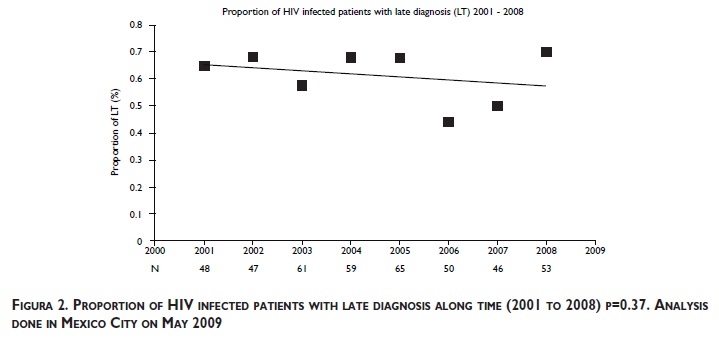
<body><![CDATA[<p>&nbsp;</p>     <p><font face="Verdana" size="2"><b>Prevalence and Risk factors associated with   LT</b></font></p>     <p><font face="Verdana" size="2">There was no change in the proportion of patients   defined as LT over time during the period of observation (<i>p</i>=0.37) (<a href="/img/revistas/spm/v54n5/a06fig2.jpg">figure 2</a>). We observed that patients older than 45 years (<i>p</i>= 0.03), unemployed   (<i>p</i>= 0.04), married (<i>p</i>= 0.04), and having less than nine years   of education (<i>p</i>= 0.001) were at higher odds of late diagnosis that their   counterparts. We also observed a gradient of decreased risk of late diagnosis   as socioeconomic status improved (<i>p</i>= 0.001 and <i>p</i>= 0.04 for middle   and high socioeconomic level). In contrast, having being infected through homosexual   sex was negatively associated to being a late tester (<i>p</i>= 0.04) (<a href="/img/revistas/spm/v54n5/a06tab2.jpg">table&nbsp;II</a>). However, when we fit a multivariable logistic regression model including   all these variables only being older than 45 years old, being unemployed and   having less than nine years of education were independently associated to late   diagnosis of HIV infection (<a href="/img/revistas/spm/v54n5/a06tab2.jpg">table&nbsp;II</a>).</font></p>     <p>&nbsp;</p>     <p><font face="Verdana" size="3"><b>Discussion</b></font></p>     <p><font face="Verdana" size="2">In this cross-sectional study of HIV-infected   patients entering to health care in an HIV/AIDS Clinic in Mexico City, we observed   that a high proportion (61%) of the patients recently diagnosed with HIV infection,   were tested in an advanced stage of the disease. Moreover, we found that the   prevalence of late testers did not decrease between 2001 and 2008. Increasing   age, low level of education and unemployment were independently associated to   late test of HIV in our clinic. Previous reports form high-income countries   have observed that the proportion of late testers may vary from 10 to 39% when   using a similar definition to ours<sup>10,20</sup>.<sup>-23</sup> The prevalence   of late diagnosis in developing countries seems to be higher, but fewer studies   have addressed this issue. Reports from Sub-Saharan Africa and Latin America   have found a higher prevalence of late testers than in wealthy countries, but   the use of different definitions makes comparisons difficult.<sup>18,21,24-29</sup>   For instance, the prevalence of late testing in Venezuela was 40% as defined   as stage B or C from the CDC (1993),<sup>18</sup> but was 65% in Haiti defined   as those diagnosed with CD4+ cell count lower than 350 cells/mL.<sup>28</sup></font></p>     <p><font face="Verdana" size="2">A very important finding of our study is the   fact that in our center, the tendency of late diagnosis did not decrease during   the study period. Different cohorts in France and the UK reported a similar   tendency at the beginning of the last decade.<sup>20</sup> More recently however,   in a large cohort of 14 sites in the USA and Canada (NAACCORD), late presentation   to care seem to have been decreasing between 1997 and 2007, based on the change   in the median of CD4+ count at presentation to care.<sup>29</sup> The trend   in the prevalence of late testing over time has not been described before in   developing countries.</font></p>     <p><font face="Verdana" size="2">The relevance of our study can be better understood   in the context of the evolution of universal access program to ARV drugs in   Mexico and its lack impact on the AIDS associated mortality at on the population   level.<sup>15</sup> The program of universal free access to ARV drugs in Mexico   rapidly expanded between 2000 and 2004, reaching 99% coverage in 2004 and consolidated   afterwards.<sup>30,31</sup> Despite this impressive achievement, the mortality   attributed to AIDS, has not significantly decreased in Mexico since 1996, when   it reached its peak at 4.7 deaths per 100 000 people.<sup>15</sup> There are   several explanations that may account for this unexpected lack of effect on   mortality as opposed to what occurred in other Latin American countries and   elsewhere after the scaling-up programs of ARV therapy:<sup>27,32</sup> first,   an increase in the incidence of HIV transmission in previous years; second,   a high proportion of patients starting treatment at advanced stages of the disease   and dying shortly after being diagnosed late (even before starting treatment);   and third, sub-optimal treatment for HIV infected patients requiring ARV drugs.</font></p>     <p><font face="Verdana" size="2">In this article, we present evidence that late   testing may be one factor that has contributed to the lack of reduction in AIDS   associated mortality after the implementation of the universal access to ARV   program in Mexico.<sup>15,30</sup> The Mexican guidelines for ARV therapy -as   opposed to others in low and middle-income countries before the 2010 (for instance   Argentina, Chile, Peru, Colombia and Venezuela among others) recommended to   start HAART when CD4+ T cell count decrease to 350 cells/mL or lower.<sup>33-38</sup>   The latter suggests that delayed therapy in our country can be attributed, at   least partially to late diagnosis. Other factors contributing to delayed therapy   initiation and lack of decrease in mortality are lack of linkage between diagnosis   and care, which results in a late presentation to medical attention.<sup>39</sup></font></p>     <p><font face="Verdana" size="2">Finally, we observed that patients older than   45 years, unemployed or with an educational level below the national median   were at increased odds of late diagnosis than their counterparts. Older age   and lower educational level have been previously identified as associated to   late diagnosis<sup>11,13,40,41</sup> but not unemployment. The interpretation   of this finding is difficult, consider-ing the limitations of the study in terms   of design and data collection methods. Employment status could well indicate   both a lack of access to health care services and explain the delayed in diagnosis   or be the result of a severe, disabling disease. Other variables associated   to late diagnosis in this study (being married, having a low socioeconomic status,   heterosexuals and being a man not having reported to have had sex with other   man) have also been observed previously to be associated to late diagnosis and   as discussed by previous authors associated to perceptions of not being at risk   of infection.<sup>13,42</sup></font></p>     ]]></body>
<body><![CDATA[<p><font face="Verdana" size="2">The HIV/AIDS epidemic in Mexico is concentrated   among MSM and male sex workers. Other groups considered at risk are Injecting   Drug users (IDUs) and female sex workers.<sup>43</sup> Accordingly, HIV prevention   campaigns carried out by the Mexican Ministry of Health in recent years have   targeted all these groups and the response plan to prevent and control HIV in   Mexico for 2007-2012 focus its effort, in terms of VCT programs, in "high- risk"   populations<sup>43</sup> following the recommendations by the WHO/UNAIDS for   regions with concentrated epidemics.<sup>44</sup> In this study, we observed   that people not traditionally considered at "high-risk" for HIV, as mentioned   earlier were at increased risk of being diagnosed at advanced stages of the   disease. Furthermore, we also observed that those men who reported not having   had sex with men were also at increased risk of late diagnosis, even though   in the multivariate analysis this variable lost statistical significance (OR:   1.14; 95%CI 0.67-1.95). In our view, this finding is also worthy of further   consideration due to its probable implications for HIV-testing policies. First,   an unintended consequence of the success story of prevention campaigns in Mexico   might have been the excess of morbidity and mortality imposed on those that   are not considered at risk, by excluding them from awareness campaigns. Other   contributing factors can be associated to social vulnerability and reflect the   barriers to timely access to testing and care as low education, older age and   unemployment were all independently associated to an increase odds of late diagnosis,   as it has been observed in other reports from developed countries.<sup>11,13,31,45-49   </sup>Another explanation for this finding worth considering, is that it may   have resulted as a bias arising from under self-reporting of homosexual sexual   intercourse among men not identified themselves as "gay" or "homosexual", but   nonetheless, at risk. In recent years, vulnerable groups at increased risk of   HIV-infection, such as prison inmates, migrants and others have been identified   in Mexico, and even though the routes of transmission have not been clearly   identified, sex with other men is thought to play at least some role.<sup>43,50-51</sup>   In any case, the expansion of voluntary counseling and testing services to wider   sectors of the population would solve any of the problems over which we speculate   here. Another factor worth considering as a contributor to delayed testing is   the legal requirement of written and signed informed consent for all HIV-tests   except for screening in blood banks and pregnant women.<sup>52</sup></font></p>     <p><font face="Verdana" size="2">Our results support the need of reconsidering   the current prevention strategies and expanding early access to voluntary counseling   and testing to other subgroups of the population not traditionally considered   at risk or even to the general population in order to prevent the potential   harmful consequences of late HAART initiation. Also we need to implement better   strategies to have recently diagnosed patients enter into care in a smooth and   expeditious manner. The Mexican health system currently does not facilitate   this transition because many centers still wait for confirmation of HIV infection   with Western Blot before initiating antiretroviral therapy,<sup>52</sup> which   may take one or two additional months. The implementation of policies similar   to the CDCs recommendation of offering HIV-testing to all people 13-64 years   of age in clinical care settings may contribute to this purpose.<sup>53</sup>   The implementation of universal testing would improve the clinical outcome of   subjects receiving earlier ARV treatment,<sup>2-4</sup> and in a large scale   prevent transmission of HIV.<sup>54,55</sup></font></p>     <p><font face="Verdana" size="2">These findings need to be corroborated by information   from other centers, multisite studies or both, as one of the limitations of   our study is that it was conducted in a single, tertiary care, referral center   in a large urban area. The population cared for in our institution, is unlikely   to be representative of the Mexican population seeking health care services   and different mechanism of selection bias may have operated in both directions.   Other limitations of the study arise from its retrospective design. We have   tried to limit the bias and measurement error that collecting retrospective   information carries by including only incident cases and clearly defining our   outcome of interest. However, as the collection of the data for independent   variables is based on clinical charts, our capacity to explore barriers for   an early diagnosis in our population is limited. For example, in a recent study   in an HIV/AIDS clinic in Tijuana HIV infected patients with late diagnosis were   interviewed to identify the associated risk factors associated and variables   not collected in clinical charts such as the preference of not knowing to be   infected due to stigma; exposure to peers engaging in high-risk sexual behavior   had a stronger correlation with late diagnosis than demographic information   commonly collected for clinical purposes.<sup>56</sup> Recent findings of our   group in this population seem to corroborate that stigma and psychological characteristics   have an important role in the decision to delay HIV testing.<sup>57</sup></font></p>     <p><font face="Verdana" size="2">In conclusion, in our center, late diagnosis   is the most common presentation to clinical care and the frequency of this phenomenon   has not changed in the past eight years. The independent risk factors associated   with late-diagnosis were older age, low level of education and being unemployed   at entrance, as reported in other cohorts and not belonging to "high-risk" groups.   Even though more research is needed to corroborate our data, our initial findings   points out to the need to make HIV-testing widely available and less restrictive   in Mexico. We propose that the current focalized and limiting HIV-testing policies   in Mexico need to be revised.</font></p>     <p><font face="Verdana" size="2"><i>Declaration of conflict of interests: </i>BCR   has been a speaker for BMS and MSD, and received a grant for clinical trial   from MSD; YCV and FBZ declared no conflict; JSM has been a speaker for ViiV   and Stendahl and has received a grant for research from Pfizer, and declared   no conflict.</font></p>     <p>&nbsp;</p>     <p><font face="Verdana" size="3"><b>References</b></font></p>     <!-- ref --><p><font face="Verdana" size="2">1. Pallela FJ, Delaney KM, Moorman AC, Loveless   MO, Fuhrer J, Sat-ten GA, <i>et al</i>. Declining morbidity and mortality among   patients with advanced Human Immunodeficiency Virus infection. New Engl J Med   1998;338(13):853-860.    &nbsp;&nbsp;&nbsp;&nbsp;&nbsp;&nbsp;&nbsp;&nbsp;[&#160;<a href="javascript:void(0);" onclick="javascript: window.open('/scielo.php?script=sci_nlinks&ref=9402031&pid=S0036-3634201200050000700001&lng=','','width=640,height=500,resizable=yes,scrollbars=1,menubar=yes,');">Links</a>&#160;]<!-- end-ref --></font></p>     <!-- ref --><p><font face="Verdana" size="2">2. When To Start Consortium, Sterne JA, May M,   Costagliola D, de Wolf F, Phillips AN, <i>et al</i>. Timing of initiation of   antiretroviral therapy in AIDS-free HIV-1-infected patients: a collaborative   analysis of 18 HIV cohort studies. Lancet 2009;373(9672):1352-1363. Epub 2009   Apr 8.    &nbsp;&nbsp;&nbsp;&nbsp;&nbsp;&nbsp;&nbsp;&nbsp;[&#160;<a href="javascript:void(0);" onclick="javascript: window.open('/scielo.php?script=sci_nlinks&ref=9402033&pid=S0036-3634201200050000700002&lng=','','width=640,height=500,resizable=yes,scrollbars=1,menubar=yes,');">Links</a>&#160;]<!-- end-ref --></font></p>     <!-- ref --><p><font face="Verdana" size="2">3. NA-ACCORD Investigators, Kitahata MM, Gange   SJ, Abraham AG, Merriman B, Saag MS, <i>et al</i>. Effect of early versus deferred   antiretroviral therapy for HIV on survival. N Engl J Med 2009;360(18):1815-1826.   Epub 2009 Apr 1.    &nbsp;&nbsp;&nbsp;&nbsp;&nbsp;&nbsp;&nbsp;&nbsp;[&#160;<a href="javascript:void(0);" onclick="javascript: window.open('/scielo.php?script=sci_nlinks&ref=9402035&pid=S0036-3634201200050000700003&lng=','','width=640,height=500,resizable=yes,scrollbars=1,menubar=yes,');">Links</a>&#160;]<!-- end-ref --></font></p>     <!-- ref --><p><font face="Verdana" size="2">4. Mocroft A, Ledergerber B, Katlama C, Kirk   O, Reiss P, d'Arminio MA, <i>et al</i>. Decline in the AIDS and death rates   in the EuroSIDA study: an observational study. Lancet 2003;362 (9377):22-29.    &nbsp;&nbsp;&nbsp;&nbsp;&nbsp;&nbsp;&nbsp;&nbsp;[&#160;<a href="javascript:void(0);" onclick="javascript: window.open('/scielo.php?script=sci_nlinks&ref=9402037&pid=S0036-3634201200050000700004&lng=','','width=640,height=500,resizable=yes,scrollbars=1,menubar=yes,');">Links</a>&#160;]<!-- end-ref --></font></p>     <!-- ref --><p><font face="Verdana" size="2">5. Severe P, Juste MA, Ambroise A, Eliacin L,   Marchand C, Apollon S, <i>et al</i>. Early versus standard antiretroviral therapy   for HIV-infected adults in Haiti. N Engl J Med 2010; 363(3):257-265.    &nbsp;&nbsp;&nbsp;&nbsp;&nbsp;&nbsp;&nbsp;&nbsp;[&#160;<a href="javascript:void(0);" onclick="javascript: window.open('/scielo.php?script=sci_nlinks&ref=9402039&pid=S0036-3634201200050000700005&lng=','','width=640,height=500,resizable=yes,scrollbars=1,menubar=yes,');">Links</a>&#160;]<!-- end-ref --> PubMed   PMID: 20647201.</font></p>     <!-- ref --><p><font face="Verdana" size="2">6. Mills E, Bakanda C, Birungi J, Mwesigwa R,   Chan K, Ford N, <i>et al</i>. Mortality by baseline CD4 cell count among HIV   patients initiating anti-retroviral therapy: evidence from a large cohort in   Uganda. AIDS 2011; 25(6):851-855.    &nbsp;&nbsp;&nbsp;&nbsp;&nbsp;&nbsp;&nbsp;&nbsp;[&#160;<a href="javascript:void(0);" onclick="javascript: window.open('/scielo.php?script=sci_nlinks&ref=9402041&pid=S0036-3634201200050000700006&lng=','','width=640,height=500,resizable=yes,scrollbars=1,menubar=yes,');">Links</a>&#160;]<!-- end-ref --></font></p>     <!-- ref --><p><font face="Verdana" size="2">7. Castilla J, Del Romero J, Hernando V, Marincovich   B, Garc&iacute;a S, Rodr&iacute;guez C. Effectiveness of highly active antiretroviral   therapy in reducing heterosexual transmission of HIV. J Acquir Immune Defic   Syndr 2005;40(1):96-101.    &nbsp;&nbsp;&nbsp;&nbsp;&nbsp;&nbsp;&nbsp;&nbsp;[&#160;<a href="javascript:void(0);" onclick="javascript: window.open('/scielo.php?script=sci_nlinks&ref=9402043&pid=S0036-3634201200050000700007&lng=','','width=640,height=500,resizable=yes,scrollbars=1,menubar=yes,');">Links</a>&#160;]<!-- end-ref --></font></p>     <!-- ref --><p><font face="Verdana" size="2">8. Lima VD, Johnston K, Hogg RS, Levy AR, Harrigan   PR, Anema A, <i>et al</i>. Expanded access to highly active antiretroviral therapy:   a potentially powerful strategy to curb the growth of the HIV epidemic. J Infect   Dis 2008;198(1):59-67.    &nbsp;&nbsp;&nbsp;&nbsp;&nbsp;&nbsp;&nbsp;&nbsp;[&#160;<a href="javascript:void(0);" onclick="javascript: window.open('/scielo.php?script=sci_nlinks&ref=9402045&pid=S0036-3634201200050000700008&lng=','','width=640,height=500,resizable=yes,scrollbars=1,menubar=yes,');">Links</a>&#160;]<!-- end-ref --></font></p>     <!-- ref --><p><font face="Verdana" size="2">9. Barry SM, Lloyd-Owen SJ, Madge SJ, Cozzi-Lepri   A, Evans AJ, Phillips AN, <i>et al</i>. The changing demographics of new HIV   diagnoses at a London centre from 1994 to 2000. HIV Med 2002;3(2):129-134.    &nbsp;&nbsp;&nbsp;&nbsp;&nbsp;&nbsp;&nbsp;&nbsp;[&#160;<a href="javascript:void(0);" onclick="javascript: window.open('/scielo.php?script=sci_nlinks&ref=9402047&pid=S0036-3634201200050000700009&lng=','','width=640,height=500,resizable=yes,scrollbars=1,menubar=yes,');">Links</a>&#160;]<!-- end-ref --></font></p>     <!-- ref --><p><font face="Verdana" size="2">10. Sabin C, Smith CJ, Gumley H, Murphy G, Lampe   FC, Phillips AN, <i>et al</i>. Late presenters in the era of highly active antiretroviral   therapy: uptake of and responses to antiretroviral therapy. AIDS 2004;18(16):2145-2151.    &nbsp;&nbsp;&nbsp;&nbsp;&nbsp;&nbsp;&nbsp;&nbsp;[&#160;<a href="javascript:void(0);" onclick="javascript: window.open('/scielo.php?script=sci_nlinks&ref=9402049&pid=S0036-3634201200050000700010&lng=','','width=640,height=500,resizable=yes,scrollbars=1,menubar=yes,');">Links</a>&#160;]<!-- end-ref --></font></p>     <!-- ref --><p><font face="Verdana" size="2">11. Girardi E, Aloisi MS, Arici C, Pezzotti P,   Serraino D, Balzano R, <i>et al</i>. for the ICoNA Behavioral Epidemiology Study   Group. Delayed presentation and late testing for HIV: demographic and behavioral   risk factors in a multicenter study in Italy. J Acquir Immune Defic Syndr 2004;36(4):951-959.    &nbsp;&nbsp;&nbsp;&nbsp;&nbsp;&nbsp;&nbsp;&nbsp;[&#160;<a href="javascript:void(0);" onclick="javascript: window.open('/scielo.php?script=sci_nlinks&ref=9402051&pid=S0036-3634201200050000700011&lng=','','width=640,height=500,resizable=yes,scrollbars=1,menubar=yes,');">Links</a>&#160;]<!-- end-ref -->   PubMed PMID: 15220702.</font></p>     <!-- ref --><p><font face="Verdana" size="2">12. The UK Collaborative HIV Cohort (UK CHIC)   Steering Committee UK, Sabin CA, Schwenk A, Johnson MA, Gazzard B, Fisher M,   Walsh J, <i>et al</i>. Late diagnosis in the HAART era: proposed common definitions   and associations with mortality. AIDS 2010;24(5):723-727.    &nbsp;&nbsp;&nbsp;&nbsp;&nbsp;&nbsp;&nbsp;&nbsp;[&#160;<a href="javascript:void(0);" onclick="javascript: window.open('/scielo.php?script=sci_nlinks&ref=9402053&pid=S0036-3634201200050000700012&lng=','','width=640,height=500,resizable=yes,scrollbars=1,menubar=yes,');">Links</a>&#160;]<!-- end-ref --> PubMed PMID: 20057312.</font></p>     <!-- ref --><p><font face="Verdana" size="2">13.Fisher M. Late diagnosis of HIV infection:   major consequences and missed opportunities. Curr Opin Infect Dis 2008; 21:1-3.    &nbsp;&nbsp;&nbsp;&nbsp;&nbsp;&nbsp;&nbsp;&nbsp;[&#160;<a href="javascript:void(0);" onclick="javascript: window.open('/scielo.php?script=sci_nlinks&ref=9402055&pid=S0036-3634201200050000700013&lng=','','width=640,height=500,resizable=yes,scrollbars=1,menubar=yes,');">Links</a>&#160;]<!-- end-ref --></font></p>     <!-- ref --><p><font face="Verdana" size="2">14. World Health Organization. Approaches to   rationing antiretroviral treatment: ethical and equity implications. Bull World   Health Org 2005;83(7):541-547.    &nbsp;&nbsp;&nbsp;&nbsp;&nbsp;&nbsp;&nbsp;&nbsp;[&#160;<a href="javascript:void(0);" onclick="javascript: window.open('/scielo.php?script=sci_nlinks&ref=9402057&pid=S0036-3634201200050000700014&lng=','','width=640,height=500,resizable=yes,scrollbars=1,menubar=yes,');">Links</a>&#160;]<!-- end-ref --></font></p>     <!-- ref --><p><font face="Verdana" size="2">15. Magis-Rodr&iacute;guez C, Bravo E, Gayet   C, Rivera P, De Luca M. El VIH y el SIDA en M&eacute;xico al 2008, hallazgos,   tendencias y reflexiones. M&eacute;xico, D.F.: CENSIDA, 2008: P. 88 &#91;Accessed   22 March 2011&#93;. Available from: <a href="http://www.censida.salud.gob.mx/descargas/biblioteca/VIHSIDA_MEX2008.pdf" target="_blank">http://www.censida.salud.gob.mx/descargas/biblioteca/VIHSIDA_MEX2008.pdf</a></font>&nbsp;&nbsp;&nbsp;&nbsp;&nbsp;&nbsp;&nbsp;&nbsp;[&#160;<a href="javascript:void(0);" onclick="javascript: window.open('/scielo.php?script=sci_nlinks&ref=9402059&pid=S0036-3634201200050000700015&lng=','','width=640,height=500,resizable=yes,scrollbars=1,menubar=yes,');">Links</a>&#160;]<!-- end-ref --><!-- ref --><p><font face="Verdana" size="2">16. Nash D, Katyal M, Brinkhof MW, Keiser O,   May M, Hughes R, <i>et al</i>. ART-LINC Collaboration of IeDEA. Long-term immunologic   response to antiretroviral therapy in low-income countries: a collaborative   analysis of prospective studies. AIDS 2008;22(17):2291-2302.    &nbsp;&nbsp;&nbsp;&nbsp;&nbsp;&nbsp;&nbsp;&nbsp;[&#160;<a href="javascript:void(0);" onclick="javascript: window.open('/scielo.php?script=sci_nlinks&ref=9402060&pid=S0036-3634201200050000700016&lng=','','width=640,height=500,resizable=yes,scrollbars=1,menubar=yes,');">Links</a>&#160;]<!-- end-ref --></font></p>     <!-- ref --><p><font face="Verdana" size="2">17. Tuboi SH, Schechter M, McGowan CC, Cesar   C, Krolewiecki A, Cahn P, <i>et al</i>. Mortality during the first year of potent   antiretroviral therapy in HIV-1-infected patients in 7 sites throughout Latin   America and the Caribbean. J Acquir Immune Defic Syndr 2009; 51(5):615-623.    &nbsp;&nbsp;&nbsp;&nbsp;&nbsp;&nbsp;&nbsp;&nbsp;[&#160;<a href="javascript:void(0);" onclick="javascript: window.open('/scielo.php?script=sci_nlinks&ref=9402062&pid=S0036-3634201200050000700017&lng=','','width=640,height=500,resizable=yes,scrollbars=1,menubar=yes,');">Links</a>&#160;]<!-- end-ref --></font></p>     ]]></body>
<body><![CDATA[<!-- ref --><p><font face="Verdana" size="2">18. Bonjour M, Montagne M, Zambrano M, Molina   G, Lippuner C, Wadskier FG, <i>et al</i>. Determinants of late diseasestage   presentation at diagnosis of HIV infection in Venezuela: A case-case comparison.   AIDS Res Ther 2008;5:6.    &nbsp;&nbsp;&nbsp;&nbsp;&nbsp;&nbsp;&nbsp;&nbsp;[&#160;<a href="javascript:void(0);" onclick="javascript: window.open('/scielo.php?script=sci_nlinks&ref=9402064&pid=S0036-3634201200050000700018&lng=','','width=640,height=500,resizable=yes,scrollbars=1,menubar=yes,');">Links</a>&#160;]<!-- end-ref --></font></p>     <!-- ref --><p><font face="Verdana" size="2">19. Centers for Disease Control and Prevention.   Revised surveillance case definitions for HIV infection among adults, adolescents,   and children aged &lt;18 months and for HIV infection and AIDS among children   aged 18 months to &lt;13 years. 2008; MMWR57 (No.RR-10):1-16 &#91;Accessed 22   March 2011&#93;. Available from: <a href="http://www.cdc.gov/mmwr/PDF/rr/rr5710.pdf" target="_blank">http://www.cdc.gov/mmwr/PDF/rr/rr5710.pdf</a></font>&nbsp;&nbsp;&nbsp;&nbsp;&nbsp;&nbsp;&nbsp;&nbsp;[&#160;<a href="javascript:void(0);" onclick="javascript: window.open('/scielo.php?script=sci_nlinks&ref=9402066&pid=S0036-3634201200050000700019&lng=','','width=640,height=500,resizable=yes,scrollbars=1,menubar=yes,');">Links</a>&#160;]<!-- end-ref --><!-- ref --><p><font face="Verdana" size="2">20. Adler A, Mounier-Jack S, Coker RJ. Late diagnosis   of HIV in Europe: definitional and public health challenges. AIDS Care 2009;21(3):284-293.    &nbsp;&nbsp;&nbsp;&nbsp;&nbsp;&nbsp;&nbsp;&nbsp;[&#160;<a href="javascript:void(0);" onclick="javascript: window.open('/scielo.php?script=sci_nlinks&ref=9402067&pid=S0036-3634201200050000700020&lng=','','width=640,height=500,resizable=yes,scrollbars=1,menubar=yes,');">Links</a>&#160;]<!-- end-ref --></font></p>     <!-- ref --><p><font face="Verdana" size="2">21. Keruly J, Moore R. Immune status at presentation   to care did not improve among antiretroviral-naive persons from 1990 to 2006.   Clin Infect Dis 2007;45:1369-1374.    &nbsp;&nbsp;&nbsp;&nbsp;&nbsp;&nbsp;&nbsp;&nbsp;[&#160;<a href="javascript:void(0);" onclick="javascript: window.open('/scielo.php?script=sci_nlinks&ref=9402069&pid=S0036-3634201200050000700021&lng=','','width=640,height=500,resizable=yes,scrollbars=1,menubar=yes,');">Links</a>&#160;]<!-- end-ref --></font></p>     <!-- ref --><p><font face="Verdana" size="2">22. Borghi V, Girardi E, Bellelli S, Angeletti   C, Mussini C, Porter K, <i>et al</i>. Late presenters in an HIV surveillance   system in Italy during the period 1992-2006. J Acquir Immune Defic Syndr 2008;49:282-286.    &nbsp;&nbsp;&nbsp;&nbsp;&nbsp;&nbsp;&nbsp;&nbsp;[&#160;<a href="javascript:void(0);" onclick="javascript: window.open('/scielo.php?script=sci_nlinks&ref=9402071&pid=S0036-3634201200050000700022&lng=','','width=640,height=500,resizable=yes,scrollbars=1,menubar=yes,');">Links</a>&#160;]<!-- end-ref --></font></p>     <!-- ref --><p><font face="Verdana" size="2">23. Guy RJ, McDonald AM, Bartlett MJ, Murray   JC, Giele CM, Davey TM, <i>et al</i>. Characteristics of HIV diagnoses in Australia,   1993-2006. Sexual Health 2008;5(2):91-96.    &nbsp;&nbsp;&nbsp;&nbsp;&nbsp;&nbsp;&nbsp;&nbsp;[&#160;<a href="javascript:void(0);" onclick="javascript: window.open('/scielo.php?script=sci_nlinks&ref=9402073&pid=S0036-3634201200050000700023&lng=','','width=640,height=500,resizable=yes,scrollbars=1,menubar=yes,');">Links</a>&#160;]<!-- end-ref --></font></p>     <!-- ref --><p><font face="Verdana" size="2">24. Kigozi IM, Dobkin LM, Martin JN, Geng EH,   Muyindike W, Emenyonu NI, <i>et al</i>. Late-disease stage at presentation to   an HIV Clinic in the era of free antiretroviral therapy in Sub-Saharan Africa.   J Acquir Immune Defic Syndr 2009;52(2):280-289.    &nbsp;&nbsp;&nbsp;&nbsp;&nbsp;&nbsp;&nbsp;&nbsp;[&#160;<a href="javascript:void(0);" onclick="javascript: window.open('/scielo.php?script=sci_nlinks&ref=9402075&pid=S0036-3634201200050000700024&lng=','','width=640,height=500,resizable=yes,scrollbars=1,menubar=yes,');">Links</a>&#160;]<!-- end-ref --></font></p>     <!-- ref --><p><font face="Verdana" size="2">25. Kassa E, Rinke de Wit TF, Hailu E, Girma   M, Messele T, Mariam HG <i>et al</i>. Evaluation of the World Health Organization   staging system for HIV infection and disease in Ethiopia: association between   clinical stages and laboratory markers. AIDS 1999;13(3):381-389.    &nbsp;&nbsp;&nbsp;&nbsp;&nbsp;&nbsp;&nbsp;&nbsp;[&#160;<a href="javascript:void(0);" onclick="javascript: window.open('/scielo.php?script=sci_nlinks&ref=9402077&pid=S0036-3634201200050000700025&lng=','','width=640,height=500,resizable=yes,scrollbars=1,menubar=yes,');">Links</a>&#160;]<!-- end-ref --></font></p>     <!-- ref --><p><font face="Verdana" size="2">26. Malamba SS, Morgan D, Clayton T, Mayanja   B, Okongo M, Whitworth J. The prognostic value of the World Health Organization   staging system for HIV infection and disease in rural Uganda. AIDS 1999;13(18):2555-2562.    &nbsp;&nbsp;&nbsp;&nbsp;&nbsp;&nbsp;&nbsp;&nbsp;[&#160;<a href="javascript:void(0);" onclick="javascript: window.open('/scielo.php?script=sci_nlinks&ref=9402079&pid=S0036-3634201200050000700026&lng=','','width=640,height=500,resizable=yes,scrollbars=1,menubar=yes,');">Links</a>&#160;]<!-- end-ref --></font></p>     <!-- ref --><p><font face="Verdana" size="2">27.The Antiretroviral Therapy in Lower Income   Countries (ARTLINC) Collaboration and ART Cohort Collaboration (ART-CC) groups,   Braitstein P, Brinkhof MW, Dabis F, Schechter M, Boulle A, Miotti P, <i>et al</i>.   Mortality of HIV-1-infected patients in the first year of antiretroviral therapy:   comparison between low-income and high-income countries. Lancet 2006;367(9513):817-824.    &nbsp;&nbsp;&nbsp;&nbsp;&nbsp;&nbsp;&nbsp;&nbsp;[&#160;<a href="javascript:void(0);" onclick="javascript: window.open('/scielo.php?script=sci_nlinks&ref=9402081&pid=S0036-3634201200050000700027&lng=','','width=640,height=500,resizable=yes,scrollbars=1,menubar=yes,');">Links</a>&#160;]<!-- end-ref --></font></p>     <!-- ref --><p><font face="Verdana" size="2">28. Louis C, Ivers LC, Smith F, Freedberg KA,   Castro A. Late presentation for HIV care in central Haiti: factors limiting   access to care. AIDS Care 2007;4:487-491.    &nbsp;&nbsp;&nbsp;&nbsp;&nbsp;&nbsp;&nbsp;&nbsp;[&#160;<a href="javascript:void(0);" onclick="javascript: window.open('/scielo.php?script=sci_nlinks&ref=9402083&pid=S0036-3634201200050000700028&lng=','','width=640,height=500,resizable=yes,scrollbars=1,menubar=yes,');">Links</a>&#160;]<!-- end-ref --></font></p>     <!-- ref --><p><font face="Verdana" size="2">29. Althoff KN, Gange SJ, Klein MB, Brooks JT,   Hogg RS, Bosch RJ, <i>et al</i>. Late presentation for Human Immunodeficiency   Virus care in the United States and Canada. Clin Infect Dis 2010; 50(11):1512-1520.    &nbsp;&nbsp;&nbsp;&nbsp;&nbsp;&nbsp;&nbsp;&nbsp;[&#160;<a href="javascript:void(0);" onclick="javascript: window.open('/scielo.php?script=sci_nlinks&ref=9402085&pid=S0036-3634201200050000700029&lng=','','width=640,height=500,resizable=yes,scrollbars=1,menubar=yes,');">Links</a>&#160;]<!-- end-ref --></font></p>     <!-- ref --><p><font face="Verdana" size="2">30. Bautista A S, Mane A, Bertozzi SM. Economic   impact of antiretroviral therapy prescription decisions in the context of rapid   scaling-up of access to treatment. AIDS 2006;20(1):101-109.    &nbsp;&nbsp;&nbsp;&nbsp;&nbsp;&nbsp;&nbsp;&nbsp;[&#160;<a href="javascript:void(0);" onclick="javascript: window.open('/scielo.php?script=sci_nlinks&ref=9402087&pid=S0036-3634201200050000700030&lng=','','width=640,height=500,resizable=yes,scrollbars=1,menubar=yes,');">Links</a>&#160;]<!-- end-ref --></font></p>     <!-- ref --><p><font face="Verdana" size="2">31. Magis C, Hern&aacute;ndez M. Epidemiolog&iacute;a   del SIDA en M&eacute;xico. En: Cordova VJ, Ponce de L S, Valdespino JL. 25 a&ntilde;os   de SIDA en M&eacute;xico: logros, desaciertos y retos. 2a. edici&oacute;n. M&eacute;xico:   CENSIDA, 2009:101-117. &#91;Accessed 22 March 2011&#93;. Disponible en: <a href="http://www.censida.salud.gob.mx/descargas/SIDA25axos-26mar.pdf" target="_blank">http://www.censida.salud.gob.mx/descargas/SIDA25axos-26mar.pdf</a></font>&nbsp;&nbsp;&nbsp;&nbsp;&nbsp;&nbsp;&nbsp;&nbsp;[&#160;<a href="javascript:void(0);" onclick="javascript: window.open('/scielo.php?script=sci_nlinks&ref=9402089&pid=S0036-3634201200050000700031&lng=','','width=640,height=500,resizable=yes,scrollbars=1,menubar=yes,');">Links</a>&#160;]<!-- end-ref --><!-- ref --><p><font face="Verdana" size="2">32. Marazzi MC, Liotta G, Germano P, Guidotti   G, Altan AD, Ceffa S, <i>et al</i>. Excessive early mortality in the first year   of treatment in HIV type 1-infected patients initiating antiretroviral therapy   in resource-limited settings. AIDS Res Hum Retroviruses 2008;24(4):555-560.    &nbsp;&nbsp;&nbsp;&nbsp;&nbsp;&nbsp;&nbsp;&nbsp;[&#160;<a href="javascript:void(0);" onclick="javascript: window.open('/scielo.php?script=sci_nlinks&ref=9402090&pid=S0036-3634201200050000700032&lng=','','width=640,height=500,resizable=yes,scrollbars=1,menubar=yes,');">Links</a>&#160;]<!-- end-ref --></font></p>     <!-- ref --><p><font face="Verdana" size="2">33. Ministerio de Salud. Recomendaciones para   el tratamiento antirret-roviral 2007. Argentina; 2007. &#91;Accessed 22 March   2011&#93;. Available from: <a href="http://www.msal.gov.ar/sida/pdf/info-equipos-salud/recomendaciones-tratamiento-antirretroviral.pdf" target="_blank">http://www.msal.gov.ar/sida/pdf/info-equipos-salud/recomendaciones-tratamiento-antirretroviral.pdf</a>.    &nbsp;&nbsp;&nbsp;&nbsp;&nbsp;&nbsp;&nbsp;&nbsp;[&#160;<a href="javascript:void(0);" onclick="javascript: window.open('/scielo.php?script=sci_nlinks&ref=9402092&pid=S0036-3634201200050000700033&lng=','','width=640,height=500,resizable=yes,scrollbars=1,menubar=yes,');">Links</a>&#160;]<!-- end-ref --></font></p>     ]]></body>
<body><![CDATA[<!-- ref --><p><font face="Verdana" size="2">34. Ministerio de Salud. Gu&iacute;a cl&iacute;nica   s&iacute;ndrome de la inmunodeficiencia adquirida VIH/SIDA. Santiago: Ministerio   de Salud, 2005.    &nbsp;&nbsp;&nbsp;&nbsp;&nbsp;&nbsp;&nbsp;&nbsp;[&#160;<a href="javascript:void(0);" onclick="javascript: window.open('/scielo.php?script=sci_nlinks&ref=9402094&pid=S0036-3634201200050000700034&lng=','','width=640,height=500,resizable=yes,scrollbars=1,menubar=yes,');">Links</a>&#160;]<!-- end-ref --></font></p>     <!-- ref --><p><font face="Verdana" size="2">35. Ministerio de Salud. Gu&iacute;a nacional   de atenci&oacute;n integral de la persona viviendo con el VIH /SIDA. (PVVIH/S).   2a. edici&oacute;n. Lima, 2006. &#91;Accessed 22 March 2011&#93;. Available   from: <a href="http://www.care.org.pe/Websites/Fon-doMundial/materiales/TB-VIH/VIH/VIH4/Gu%C3%ADa%20Nacional%20Atenci%C3%B3n%20Integral.pdf" target="_blank">http://www.care.org.pe/Websites/Fon-doMundial/materiales/TB-VIH/VIH/VIH4/Gu%C3%ADa%20Nacional%20Atenci%C3%B3n%20Integral.pdf</a>.    &nbsp;&nbsp;&nbsp;&nbsp;&nbsp;&nbsp;&nbsp;&nbsp;[&#160;<a href="javascript:void(0);" onclick="javascript: window.open('/scielo.php?script=sci_nlinks&ref=9402096&pid=S0036-3634201200050000700035&lng=','','width=640,height=500,resizable=yes,scrollbars=1,menubar=yes,');">Links</a>&#160;]<!-- end-ref --></font></p>     <!-- ref --><p><font face="Verdana" size="2">36. Ministerio de protecci&oacute;n y fundaci&oacute;n   para la investigaci&oacute;n y el desarrollo de la salud y la seguridad social.   Gu&iacute;a para el manejo de VIH/SIDA basada en la evidencia. Bogot&aacute;,   2005 &#91;Accessed 22 March 2011&#93;. Available from: <a href="http://www.saludcolombia.com/actual/documentos/GUIA%20DE%20ATENCION%20VIH-SIDA%20version%20oficial.pdf" target="_blank">http://www.saludcolombia.com/actual/documentos/GUIA%20DE%20ATENCION%20VIH-SIDA%20version%20oficial.pdf</a></font>&nbsp;&nbsp;&nbsp;&nbsp;&nbsp;&nbsp;&nbsp;&nbsp;[&#160;<a href="javascript:void(0);" onclick="javascript: window.open('/scielo.php?script=sci_nlinks&ref=9402098&pid=S0036-3634201200050000700036&lng=','','width=640,height=500,resizable=yes,scrollbars=1,menubar=yes,');">Links</a>&#160;]<!-- end-ref --><!-- ref --><p><font face="Verdana" size="2">37. Ministerio del poder popular para la salud.   Gu&iacute;a para el manejo del tratamiento antirretroviral de las personas que   viven con el VIH/SIDA en Venezuela Programa Nacional de SIDA/ITS 2008-2009.   3a. edici&oacute;n. Caracas, 2008. &#91;Accessed 22 March 2011&#93;. Available   from: <a href="http://www.mpps.gob.ve/Boletines/sida/Guia_TARV.pdf" target="_blank">http://www.mpps.gob.ve/Boletines/sida/Guia_TARV.pdf</a></font>&nbsp;&nbsp;&nbsp;&nbsp;&nbsp;&nbsp;&nbsp;&nbsp;[&#160;<a href="javascript:void(0);" onclick="javascript: window.open('/scielo.php?script=sci_nlinks&ref=9402099&pid=S0036-3634201200050000700037&lng=','','width=640,height=500,resizable=yes,scrollbars=1,menubar=yes,');">Links</a>&#160;]<!-- end-ref --><!-- ref --><p><font face="Verdana" size="2">38. Centro nacional para la prevenci&oacute;n   y el control de VIH/SIDA. Gu&iacute;a de manejo antirretroviral de las personas   con VIH. 4a. edici&oacute;n. M&eacute;xico: CENSIDA, 2009. &#91;Accessed 22   March 2011&#93;. Available from: <a href="http://www.censida.salud.gob.mx/descargas/biblioteca/guia_arv09.pdf" target="_blank">http://www.censida.salud.gob.mx/descargas/biblioteca/guia_arv09.pdf</a>.    &nbsp;&nbsp;&nbsp;&nbsp;&nbsp;&nbsp;&nbsp;&nbsp;[&#160;<a href="javascript:void(0);" onclick="javascript: window.open('/scielo.php?script=sci_nlinks&ref=9402100&pid=S0036-3634201200050000700038&lng=','','width=640,height=500,resizable=yes,scrollbars=1,menubar=yes,');">Links</a>&#160;]<!-- end-ref --></font></p>     <!-- ref --><p><font face="Verdana" size="2">39. Crabtree-Ram&iacute;rez B, Caro-Vega Y, Shepherd   BE, Wehbe F, Cesar C, Cortes C <i>et al</i>. 2011 Cross-sectional analysis of   late HAART initiation in Latin America and the Caribbean: late testers and late   presenters. PLoS ONE 6(5): e20272. doi:10.1371/journal.pone.0020272</font>&nbsp;&nbsp;&nbsp;&nbsp;&nbsp;&nbsp;&nbsp;&nbsp;[&#160;<a href="javascript:void(0);" onclick="javascript: window.open('/scielo.php?script=sci_nlinks&ref=9402102&pid=S0036-3634201200050000700039&lng=','','width=640,height=500,resizable=yes,scrollbars=1,menubar=yes,');">Links</a>&#160;]<!-- end-ref --><!-- ref --><p><font face="Verdana" size="2">40. Centers for Disease Control and Prevention.   Late versus early testing of HIV sites, United States, 2000-2003. MMWR Morb   Mortal Wkly Rep 2003;32:581-586.    &nbsp;&nbsp;&nbsp;&nbsp;&nbsp;&nbsp;&nbsp;&nbsp;[&#160;<a href="javascript:void(0);" onclick="javascript: window.open('/scielo.php?script=sci_nlinks&ref=9402103&pid=S0036-3634201200050000700040&lng=','','width=640,height=500,resizable=yes,scrollbars=1,menubar=yes,');">Links</a>&#160;]<!-- end-ref --></font></p>     <!-- ref --><p><font face="Verdana" size="2">41. Castilla J, Sobrino P, de la Fuente L, Noguer   I, Guerra L and Parras F. Late diagnosis of HIV infection in the era of highly   active antiretroviral therapy: consequences for AIDS incidence. AIDS 2006;16:1945-1951.    &nbsp;&nbsp;&nbsp;&nbsp;&nbsp;&nbsp;&nbsp;&nbsp;[&#160;<a href="javascript:void(0);" onclick="javascript: window.open('/scielo.php?script=sci_nlinks&ref=9402105&pid=S0036-3634201200050000700041&lng=','','width=640,height=500,resizable=yes,scrollbars=1,menubar=yes,');">Links</a>&#160;]<!-- end-ref --></font></p>     <!-- ref --><p><font face="Verdana" size="2">42. Girardi E, Sabin C, Monforte AD. Late Diagnosis   of HIV Infection: Epidemiological features, consequences and strategies to encourage   earlier testing. J Acquir Immune Defic Syndr 2007;46(Supp 1):S3-S8.    &nbsp;&nbsp;&nbsp;&nbsp;&nbsp;&nbsp;&nbsp;&nbsp;[&#160;<a href="javascript:void(0);" onclick="javascript: window.open('/scielo.php?script=sci_nlinks&ref=9402107&pid=S0036-3634201200050000700042&lng=','','width=640,height=500,resizable=yes,scrollbars=1,menubar=yes,');">Links</a>&#160;]<!-- end-ref --></font></p>     <!-- ref --><p><font face="Verdana" size="2">43. Programa de acci&oacute;n espec&iacute;fico,   2007-2012 en respuesta al VIH/SIDA e ITS; Secretar&iacute;a de Salud, Subsecretar&iacute;a   de Prevenci&oacute;n y Promoci&oacute;n de la Salud. M&eacute;xico, 2008:27-35.   &#91;Accessed 22 March 2011&#93;. Available from: <a href="http://www.censida.salud.gob.mx/descargas/biblioteca/ProgAc2007-2012.pdf" target="_blank">http://www.censida.salud.gob.mx/descargas/biblioteca/ProgAc2007-2012.pdf</a></font>&nbsp;&nbsp;&nbsp;&nbsp;&nbsp;&nbsp;&nbsp;&nbsp;[&#160;<a href="javascript:void(0);" onclick="javascript: window.open('/scielo.php?script=sci_nlinks&ref=9402109&pid=S0036-3634201200050000700043&lng=','','width=640,height=500,resizable=yes,scrollbars=1,menubar=yes,');">Links</a>&#160;]<!-- end-ref --><!-- ref --><p><font face="Verdana" size="2">44. World Health Organization. Guidance on provider-initiated   HIV testing and counseling in health facilities. May 2007. &#91;Accessed 22   March 2011&#93;. Available from: <a href="http://www.who.int/mediacentre/news/releases/2007/pr24/en/index.html" target="_blank">http://www.who.int/mediacentre/news/releases/2007/pr24/en/index.html</a></font>&nbsp;&nbsp;&nbsp;&nbsp;&nbsp;&nbsp;&nbsp;&nbsp;[&#160;<a href="javascript:void(0);" onclick="javascript: window.open('/scielo.php?script=sci_nlinks&ref=9402110&pid=S0036-3634201200050000700044&lng=','','width=640,height=500,resizable=yes,scrollbars=1,menubar=yes,');">Links</a>&#160;]<!-- end-ref --><!-- ref --><p><font face="Verdana" size="2">45. McDonald AM, Li Y, Dore GJ, Ree H, Kaldor   JM. Late HIV presentation among AIDS cases in Australia, 1992-2001. Aust NZ   J Public Health 2003;(6):608-613.    &nbsp;&nbsp;&nbsp;&nbsp;&nbsp;&nbsp;&nbsp;&nbsp;[&#160;<a href="javascript:void(0);" onclick="javascript: window.open('/scielo.php?script=sci_nlinks&ref=9402111&pid=S0036-3634201200050000700045&lng=','','width=640,height=500,resizable=yes,scrollbars=1,menubar=yes,');">Links</a>&#160;]<!-- end-ref --></font></p>     <!-- ref --><p><font face="Verdana" size="2">46. Krentz HB, Auld MC, Gill MJ. The high cost   of medical care for patients who present late (CD4, 200cells/microL) with HIV   infection. HIV Med 2004;5:93-98.    &nbsp;&nbsp;&nbsp;&nbsp;&nbsp;&nbsp;&nbsp;&nbsp;[&#160;<a href="javascript:void(0);" onclick="javascript: window.open('/scielo.php?script=sci_nlinks&ref=9402113&pid=S0036-3634201200050000700046&lng=','','width=640,height=500,resizable=yes,scrollbars=1,menubar=yes,');">Links</a>&#160;]<!-- end-ref --></font></p>     <!-- ref --><p><font face="Verdana" size="2">47. Sullivan AK, Curtis H, Sabin CA, Johnson   MA. Newly diagnosed HIV infections: review in UK and Ireland. BMJ 2005;330(7503):1301-1302.    &nbsp;&nbsp;&nbsp;&nbsp;&nbsp;&nbsp;&nbsp;&nbsp;[&#160;<a href="javascript:void(0);" onclick="javascript: window.open('/scielo.php?script=sci_nlinks&ref=9402115&pid=S0036-3634201200050000700047&lng=','','width=640,height=500,resizable=yes,scrollbars=1,menubar=yes,');">Links</a>&#160;]<!-- end-ref --></font></p>     <!-- ref --><p><font face="Verdana" size="2">48. Delpierre C, Dray-Spira R, Cuzin L, Marchou   B, Massip P, Lang T, <i>et al</i>. VESPA Study Group. Correlates of late HIV   diagnosis: implications for testing policy. Int J STD AIDS 2007;18(5):312-317.    &nbsp;&nbsp;&nbsp;&nbsp;&nbsp;&nbsp;&nbsp;&nbsp;[&#160;<a href="javascript:void(0);" onclick="javascript: window.open('/scielo.php?script=sci_nlinks&ref=9402117&pid=S0036-3634201200050000700048&lng=','','width=640,height=500,resizable=yes,scrollbars=1,menubar=yes,');">Links</a>&#160;]<!-- end-ref --></font></p>     <!-- ref --><p><font face="Verdana" size="2">49. Br&auml;nnstr&ouml;m J, Akerlund B, Arneborn   M, Blaxhult A, Giesecke J. Patients unaware of their HIV infection until AIDS   diagnosis in Sweden 1996-2002. Int J STD AIDS 2005; 16(10):702-706.    &nbsp;&nbsp;&nbsp;&nbsp;&nbsp;&nbsp;&nbsp;&nbsp;[&#160;<a href="javascript:void(0);" onclick="javascript: window.open('/scielo.php?script=sci_nlinks&ref=9402119&pid=S0036-3634201200050000700049&lng=','','width=640,height=500,resizable=yes,scrollbars=1,menubar=yes,');">Links</a>&#160;]<!-- end-ref --></font></p>     <!-- ref --><p><font face="Verdana" size="2">50. Donate AP, Rangel MG, Hovell MF, Santib&aacute;&ntilde;ez   J, Sipan CL, Izazola JA. HIV infection in mobile populations: the case of Mexican   migrants to the United States. Rev Panam Salud Publica 2005;17(1):26-29.    &nbsp;&nbsp;&nbsp;&nbsp;&nbsp;&nbsp;&nbsp;&nbsp;[&#160;<a href="javascript:void(0);" onclick="javascript: window.open('/scielo.php?script=sci_nlinks&ref=9402121&pid=S0036-3634201200050000700050&lng=','','width=640,height=500,resizable=yes,scrollbars=1,menubar=yes,');">Links</a>&#160;]<!-- end-ref --> PubMed   PMID: 15720878.</font></p>     <!-- ref --><p><font face="Verdana" size="2">51. Essuon AD, Simmons DS, Stephens TT, Richter   D, Lindley LL, Braith-waite RL. Transient populations: linking HIV, migrant   workers, and South African male inmates. J Health Care Poor Underserved 2009;20(Suppl   2):40-52.    &nbsp;&nbsp;&nbsp;&nbsp;&nbsp;&nbsp;&nbsp;&nbsp;[&#160;<a href="javascript:void(0);" onclick="javascript: window.open('/scielo.php?script=sci_nlinks&ref=9402123&pid=S0036-3634201200050000700051&lng=','','width=640,height=500,resizable=yes,scrollbars=1,menubar=yes,');">Links</a>&#160;]<!-- end-ref --> Review</font></p>     <!-- ref --><p><font face="Verdana" size="2">52. Secretaria de Salud. Norma Oficial Mexicana   NOM-010-SSA2-1993, para la prevenci&oacute;n y control de la infecci&oacute;n   por virus de la inmunodeficiencia humana. M&eacute;xico, 1993. &#91;Accessed   22 March 2011&#93;. Available from: <a href="http://www.salud.gob.mx/unidades/cdi/nom/010ssa23.html" target="_blank">http://www.salud.gob.mx/unidades/cdi/nom/010ssa23.html</a></font>&nbsp;&nbsp;&nbsp;&nbsp;&nbsp;&nbsp;&nbsp;&nbsp;[&#160;<a href="javascript:void(0);" onclick="javascript: window.open('/scielo.php?script=sci_nlinks&ref=9402125&pid=S0036-3634201200050000700052&lng=','','width=640,height=500,resizable=yes,scrollbars=1,menubar=yes,');">Links</a>&#160;]<!-- end-ref --><!-- ref --><p><font face="Verdana" size="2">53. Branson BM, Handsfield HH, Lampe MA, Janssen   RS, Taylor AW, Lyss SB, <i>et al</i>. Centers for Disease Control and Prevention   (CDC). Revised recommendations for HIV testing of adults, adolescents, and pregnant   women in health-care settings. MMWR Recomm Rep 2006; 55(RR-14):1-17;    &nbsp;&nbsp;&nbsp;&nbsp;&nbsp;&nbsp;&nbsp;&nbsp;[&#160;<a href="javascript:void(0);" onclick="javascript: window.open('/scielo.php?script=sci_nlinks&ref=9402126&pid=S0036-3634201200050000700053&lng=','','width=640,height=500,resizable=yes,scrollbars=1,menubar=yes,');">Links</a>&#160;]<!-- end-ref --> quiz CE1-4.</font></p>     <!-- ref --><p><font face="Verdana" size="2">54.Donnell D, Kiarie J, Thomas K, Baeten J, Lingappa   J, Cohen C, <i>et al</i>. ART and risk of heterosexual HIV-1 transmission in   HIV-1 serodiscordant african couples: a multinational prospective study. 17th   Conference on retroviruses and opportunistic infections (CROI 2010). San Francisco,   USA. February 16-19, 2010. Abstract 136.    &nbsp;&nbsp;&nbsp;&nbsp;&nbsp;&nbsp;&nbsp;&nbsp;[&#160;<a href="javascript:void(0);" onclick="javascript: window.open('/scielo.php?script=sci_nlinks&ref=9402128&pid=S0036-3634201200050000700054&lng=','','width=640,height=500,resizable=yes,scrollbars=1,menubar=yes,');">Links</a>&#160;]<!-- end-ref --></font></p>     <!-- ref --><p><font face="Verdana" size="2">55.Bethesda, MD: National Institute of Allergy   and Infectious Diseases. Treating HIV-infected people with antiretrovirals protects   partners from infection: Findings result from NIH-funded international study   &#91;press release&#93;; &#91;Accessed: May 12, 2011&#93;. Available from: <a href="http://www.niaid.nih.gov/news/newsreleases/2011/Pages/HPTN052.aspx" target="_blank">http://www.niaid.nih.gov/news/newsreleases/2011/Pages/HPTN052.aspx</a></font>&nbsp;&nbsp;&nbsp;&nbsp;&nbsp;&nbsp;&nbsp;&nbsp;[&#160;<a href="javascript:void(0);" onclick="javascript: window.open('/scielo.php?script=sci_nlinks&ref=9402130&pid=S0036-3634201200050000700055&lng=','','width=640,height=500,resizable=yes,scrollbars=1,menubar=yes,');">Links</a>&#160;]<!-- end-ref --><!-- ref --><p><font face="Verdana" size="2">56. Carrizosa CM, Blumberg EJ, Hovell MF, Martinez-Donate   AP, Garcia-Gonzalez G, Lozada R, <i>et al</i>. Determinants and prevalence of   late HIV testing in Tijuana, Mexico. AIDS Patient Care and STDs 2010;24(5):333-340.    &nbsp;&nbsp;&nbsp;&nbsp;&nbsp;&nbsp;&nbsp;&nbsp;[&#160;<a href="javascript:void(0);" onclick="javascript: window.open('/scielo.php?script=sci_nlinks&ref=9402131&pid=S0036-3634201200050000700056&lng=','','width=640,height=500,resizable=yes,scrollbars=1,menubar=yes,');">Links</a>&#160;]<!-- end-ref --></font></p>     <!-- ref --><p><font face="Verdana" size="2">57. Nogueda-Orozco MJ, Caro-Vega Y, Crabtree-Ram&iacute;rez   B, V&aacute;zquez-Pineda F, Sierra-Madero J. Inicio tard&iacute;o de tratamiento   antirretroviral: &iquest;Qu&eacute; factores psicosociales est&aacute;n involucrados?   XXXVI Congreso Nacional de Infectolog&iacute;a y Microbiolog&iacute;a Cl&iacute;nica.   Puebla, Junio 2011. Abstract H7.    &nbsp;&nbsp;&nbsp;&nbsp;&nbsp;&nbsp;&nbsp;&nbsp;[&#160;<a href="javascript:void(0);" onclick="javascript: window.open('/scielo.php?script=sci_nlinks&ref=9402133&pid=S0036-3634201200050000700057&lng=','','width=640,height=500,resizable=yes,scrollbars=1,menubar=yes,');">Links</a>&#160;]<!-- end-ref --></font></p>     <p>&nbsp;</p>     <p>&nbsp;</p>     <p><a name="end" href="#top"><img src="/img/revistas/spm/v54n5/seta.jpg" border="0"></a> <font face="Verdana" size="2"><b>Corresponding author:</b>    <br>  Mtro. Juan Sierra-Madero.    <br>  Cl&iacute;nica de VIH/SIDA, Departamento de Infectolog&iacute;a,    <br>  Instituto Nacional de Ciencias M&eacute;dicas y Nutrici&oacute;n Salvador Zubir&aacute;n.    <br>  Vasco de Quiroga 15, col. Secci&oacute;n XVI. 14000, M&eacute;xico DF, M&eacute;xico.    <br>  E-mail: <a href="mailto:jsmadero@yahoo.com">jsmadero@yahoo.com</a></font></p>     <p><font face="Verdana" size="2"><b>Received on: </b>September 5, 2011    ]]></body>
<body><![CDATA[<br>  <b>Accepted on: </b>June 4, 2012</font></p>      ]]></body><back>
<ref-list>
<ref id="B1">
<label>1</label><nlm-citation citation-type="journal">
<person-group person-group-type="author">
<name>
<surname><![CDATA[Pallela]]></surname>
<given-names><![CDATA[FJ]]></given-names>
</name>
<name>
<surname><![CDATA[Delaney]]></surname>
<given-names><![CDATA[KM]]></given-names>
</name>
<name>
<surname><![CDATA[Moorman]]></surname>
<given-names><![CDATA[AC]]></given-names>
</name>
<name>
<surname><![CDATA[Loveless]]></surname>
<given-names><![CDATA[MO]]></given-names>
</name>
<name>
<surname><![CDATA[Fuhrer]]></surname>
<given-names><![CDATA[J]]></given-names>
</name>
<name>
<surname><![CDATA[Sat-ten]]></surname>
<given-names><![CDATA[GA]]></given-names>
</name>
</person-group>
<article-title xml:lang="en"><![CDATA[Declining morbidity and mortality among patients with advanced Human Immunodeficiency Virus infection]]></article-title>
<source><![CDATA[New Engl J Med]]></source>
<year>1998</year>
<volume>338</volume>
<numero>13</numero>
<issue>13</issue>
<page-range>853-860</page-range></nlm-citation>
</ref>
<ref id="B2">
<label>2</label><nlm-citation citation-type="journal">
<person-group person-group-type="author">
<name>
<surname><![CDATA[Sterne]]></surname>
<given-names><![CDATA[JA]]></given-names>
</name>
<name>
<surname><![CDATA[May]]></surname>
<given-names><![CDATA[M]]></given-names>
</name>
<name>
<surname><![CDATA[Costagliola]]></surname>
<given-names><![CDATA[D]]></given-names>
</name>
<name>
<surname><![CDATA[de Wolf]]></surname>
<given-names><![CDATA[F]]></given-names>
</name>
<name>
<surname><![CDATA[Phillips]]></surname>
<given-names><![CDATA[AN]]></given-names>
</name>
</person-group>
<collab>When To Start Consortium</collab>
<article-title xml:lang="en"><![CDATA[Timing of initiation of antiretroviral therapy in AIDS-free HIV-1-infected patients: a collaborative analysis of 18 HIV cohort studies]]></article-title>
<source><![CDATA[Lancet]]></source>
<year>2009</year>
<volume>373</volume>
<numero>9672</numero>
<issue>9672</issue>
<page-range>1352-1363</page-range></nlm-citation>
</ref>
<ref id="B3">
<label>3</label><nlm-citation citation-type="journal">
<person-group person-group-type="author">
<name>
<surname><![CDATA[Kitahata]]></surname>
<given-names><![CDATA[MM]]></given-names>
</name>
<name>
<surname><![CDATA[Gange]]></surname>
<given-names><![CDATA[SJ]]></given-names>
</name>
<name>
<surname><![CDATA[Abraham]]></surname>
<given-names><![CDATA[AG]]></given-names>
</name>
<name>
<surname><![CDATA[Merriman]]></surname>
<given-names><![CDATA[B]]></given-names>
</name>
<name>
<surname><![CDATA[Saag]]></surname>
<given-names><![CDATA[MS]]></given-names>
</name>
</person-group>
<collab>NA-ACCORD Investigators</collab>
<article-title xml:lang="en"><![CDATA[Effect of early versus deferred antiretroviral therapy for HIV on survival]]></article-title>
<source><![CDATA[N Engl J Med]]></source>
<year>2009</year>
<volume>360</volume>
<numero>18</numero>
<issue>18</issue>
<page-range>1815-1826</page-range></nlm-citation>
</ref>
<ref id="B4">
<label>4</label><nlm-citation citation-type="journal">
<person-group person-group-type="author">
<name>
<surname><![CDATA[Mocroft]]></surname>
<given-names><![CDATA[A]]></given-names>
</name>
<name>
<surname><![CDATA[Ledergerber]]></surname>
<given-names><![CDATA[B]]></given-names>
</name>
<name>
<surname><![CDATA[Katlama]]></surname>
<given-names><![CDATA[C]]></given-names>
</name>
<name>
<surname><![CDATA[Kirk]]></surname>
<given-names><![CDATA[O]]></given-names>
</name>
<name>
<surname><![CDATA[Reiss]]></surname>
<given-names><![CDATA[P]]></given-names>
</name>
<name>
<surname><![CDATA[d'Arminio MA]]></surname>
</name>
</person-group>
<article-title xml:lang="en"><![CDATA[Decline in the AIDS and death rates in the EuroSIDA study: an observational study]]></article-title>
<source><![CDATA[Lancet]]></source>
<year>2003</year>
<volume>362</volume>
<numero>9377</numero>
<issue>9377</issue>
<page-range>22-29</page-range></nlm-citation>
</ref>
<ref id="B5">
<label>5</label><nlm-citation citation-type="journal">
<person-group person-group-type="author">
<name>
<surname><![CDATA[Severe]]></surname>
<given-names><![CDATA[P]]></given-names>
</name>
<name>
<surname><![CDATA[Juste]]></surname>
<given-names><![CDATA[MA]]></given-names>
</name>
<name>
<surname><![CDATA[Ambroise]]></surname>
<given-names><![CDATA[A]]></given-names>
</name>
<name>
<surname><![CDATA[Eliacin]]></surname>
<given-names><![CDATA[L]]></given-names>
</name>
<name>
<surname><![CDATA[Marchand]]></surname>
<given-names><![CDATA[C]]></given-names>
</name>
<name>
<surname><![CDATA[Apollon]]></surname>
<given-names><![CDATA[S]]></given-names>
</name>
</person-group>
<article-title xml:lang="en"><![CDATA[Early versus standard antiretroviral therapy for HIV-infected adults in Haiti]]></article-title>
<source><![CDATA[N Engl J Med]]></source>
<year>2010</year>
<volume>363</volume>
<numero>3</numero>
<issue>3</issue>
<page-range>257-265</page-range></nlm-citation>
</ref>
<ref id="B6">
<label>6</label><nlm-citation citation-type="journal">
<person-group person-group-type="author">
<name>
<surname><![CDATA[Mills]]></surname>
<given-names><![CDATA[E]]></given-names>
</name>
<name>
<surname><![CDATA[Bakanda]]></surname>
<given-names><![CDATA[C]]></given-names>
</name>
<name>
<surname><![CDATA[Birungi]]></surname>
<given-names><![CDATA[J]]></given-names>
</name>
<name>
<surname><![CDATA[Mwesigwa]]></surname>
<given-names><![CDATA[R]]></given-names>
</name>
<name>
<surname><![CDATA[Chan]]></surname>
<given-names><![CDATA[K]]></given-names>
</name>
<name>
<surname><![CDATA[Ford]]></surname>
<given-names><![CDATA[N]]></given-names>
</name>
</person-group>
<article-title xml:lang="en"><![CDATA[Mortality by baseline CD4 cell count among HIV patients initiating anti-retroviral therapy: evidence from a large cohort in Uganda]]></article-title>
<source><![CDATA[AIDS]]></source>
<year>2011</year>
<volume>25</volume>
<numero>6</numero>
<issue>6</issue>
<page-range>851-855</page-range></nlm-citation>
</ref>
<ref id="B7">
<label>7</label><nlm-citation citation-type="journal">
<person-group person-group-type="author">
<name>
<surname><![CDATA[Castilla]]></surname>
<given-names><![CDATA[J]]></given-names>
</name>
<name>
<surname><![CDATA[Del Romero]]></surname>
<given-names><![CDATA[J]]></given-names>
</name>
<name>
<surname><![CDATA[Hernando]]></surname>
<given-names><![CDATA[V]]></given-names>
</name>
<name>
<surname><![CDATA[Marincovich]]></surname>
<given-names><![CDATA[B]]></given-names>
</name>
<name>
<surname><![CDATA[García]]></surname>
<given-names><![CDATA[S]]></given-names>
</name>
<name>
<surname><![CDATA[Rodríguez]]></surname>
<given-names><![CDATA[C]]></given-names>
</name>
</person-group>
<article-title xml:lang="en"><![CDATA[Effectiveness of highly active antiretroviral therapy in reducing heterosexual transmission of HIV]]></article-title>
<source><![CDATA[J Acquir Immune Defic Syndr]]></source>
<year>2005</year>
<volume>40</volume>
<numero>1</numero>
<issue>1</issue>
<page-range>96-101</page-range></nlm-citation>
</ref>
<ref id="B8">
<label>8</label><nlm-citation citation-type="journal">
<person-group person-group-type="author">
<name>
<surname><![CDATA[Lima]]></surname>
<given-names><![CDATA[VD]]></given-names>
</name>
<name>
<surname><![CDATA[Johnston]]></surname>
<given-names><![CDATA[K]]></given-names>
</name>
<name>
<surname><![CDATA[Hogg]]></surname>
<given-names><![CDATA[RS]]></given-names>
</name>
<name>
<surname><![CDATA[Levy]]></surname>
<given-names><![CDATA[AR]]></given-names>
</name>
<name>
<surname><![CDATA[Harrigan]]></surname>
<given-names><![CDATA[PR]]></given-names>
</name>
<name>
<surname><![CDATA[Anema]]></surname>
<given-names><![CDATA[A]]></given-names>
</name>
</person-group>
<article-title xml:lang="en"><![CDATA[Expanded access to highly active antiretroviral therapy: a potentially powerful strategy to curb the growth of the HIV epidemic]]></article-title>
<source><![CDATA[J Infect Dis]]></source>
<year>2008</year>
<volume>198</volume>
<numero>1</numero>
<issue>1</issue>
<page-range>59-67</page-range></nlm-citation>
</ref>
<ref id="B9">
<label>9</label><nlm-citation citation-type="journal">
<person-group person-group-type="author">
<name>
<surname><![CDATA[Barry]]></surname>
<given-names><![CDATA[SM]]></given-names>
</name>
<name>
<surname><![CDATA[Lloyd-Owen]]></surname>
<given-names><![CDATA[SJ]]></given-names>
</name>
<name>
<surname><![CDATA[Madge]]></surname>
<given-names><![CDATA[SJ]]></given-names>
</name>
<name>
<surname><![CDATA[Cozzi-Lepri]]></surname>
<given-names><![CDATA[A]]></given-names>
</name>
<name>
<surname><![CDATA[Evans]]></surname>
<given-names><![CDATA[AJ]]></given-names>
</name>
<name>
<surname><![CDATA[Phillips]]></surname>
<given-names><![CDATA[AN]]></given-names>
</name>
</person-group>
<article-title xml:lang="en"><![CDATA[The changing demographics of new HIV diagnoses at a London centre from 1994 to 2000]]></article-title>
<source><![CDATA[HIV Med]]></source>
<year>2002</year>
<volume>3</volume>
<numero>2</numero>
<issue>2</issue>
<page-range>129-134</page-range></nlm-citation>
</ref>
<ref id="B10">
<label>10</label><nlm-citation citation-type="journal">
<person-group person-group-type="author">
<name>
<surname><![CDATA[Sabin]]></surname>
<given-names><![CDATA[C]]></given-names>
</name>
<name>
<surname><![CDATA[Smith]]></surname>
<given-names><![CDATA[CJ]]></given-names>
</name>
<name>
<surname><![CDATA[Gumley]]></surname>
<given-names><![CDATA[H]]></given-names>
</name>
<name>
<surname><![CDATA[Murphy]]></surname>
<given-names><![CDATA[G]]></given-names>
</name>
<name>
<surname><![CDATA[Lampe]]></surname>
<given-names><![CDATA[FC]]></given-names>
</name>
<name>
<surname><![CDATA[Phillips]]></surname>
<given-names><![CDATA[AN]]></given-names>
</name>
</person-group>
<article-title xml:lang="en"><![CDATA[Late presenters in the era of highly active antiretroviral therapy: uptake of and responses to antiretroviral therapy]]></article-title>
<source><![CDATA[AIDS]]></source>
<year>2004</year>
<volume>18</volume>
<numero>16</numero>
<issue>16</issue>
<page-range>2145-2151</page-range></nlm-citation>
</ref>
<ref id="B11">
<label>11</label><nlm-citation citation-type="journal">
<person-group person-group-type="author">
<name>
<surname><![CDATA[Girardi]]></surname>
<given-names><![CDATA[E]]></given-names>
</name>
<name>
<surname><![CDATA[Aloisi]]></surname>
<given-names><![CDATA[MS]]></given-names>
</name>
<name>
<surname><![CDATA[Arici]]></surname>
<given-names><![CDATA[C]]></given-names>
</name>
<name>
<surname><![CDATA[Pezzotti]]></surname>
<given-names><![CDATA[P]]></given-names>
</name>
<name>
<surname><![CDATA[Serraino]]></surname>
<given-names><![CDATA[D]]></given-names>
</name>
<name>
<surname><![CDATA[Balzano]]></surname>
<given-names><![CDATA[R]]></given-names>
</name>
</person-group>
<collab>ICoNA Behavioral Epidemiology Study Group</collab>
<article-title xml:lang="en"><![CDATA[Delayed presentation and late testing for HIV: demographic and behavioral risk factors in a multicenter study in Italy]]></article-title>
<source><![CDATA[J Acquir Immune Defic Syndr]]></source>
<year>2004</year>
<volume>36</volume>
<numero>4</numero>
<issue>4</issue>
<page-range>951-959</page-range></nlm-citation>
</ref>
<ref id="B12">
<label>12</label><nlm-citation citation-type="journal">
<person-group person-group-type="author">
<name>
<surname><![CDATA[Sabin]]></surname>
<given-names><![CDATA[CA]]></given-names>
</name>
<name>
<surname><![CDATA[Schwenk]]></surname>
<given-names><![CDATA[A]]></given-names>
</name>
<name>
<surname><![CDATA[Johnson]]></surname>
<given-names><![CDATA[MA]]></given-names>
</name>
<name>
<surname><![CDATA[Gazzard]]></surname>
<given-names><![CDATA[B]]></given-names>
</name>
<name>
<surname><![CDATA[Fisher]]></surname>
<given-names><![CDATA[M]]></given-names>
</name>
<name>
<surname><![CDATA[Walsh]]></surname>
<given-names><![CDATA[J]]></given-names>
</name>
</person-group>
<collab>The UK Collaborative HIV Cohort Steering Committee UK</collab>
<article-title xml:lang="en"><![CDATA[Late diagnosis in the HAART era: proposed common definitions and associations with mortality]]></article-title>
<source><![CDATA[AIDS]]></source>
<year>2010</year>
<volume>24</volume>
<numero>5</numero>
<issue>5</issue>
<page-range>723-727</page-range></nlm-citation>
</ref>
<ref id="B13">
<label>13</label><nlm-citation citation-type="journal">
<person-group person-group-type="author">
<name>
<surname><![CDATA[Fisher]]></surname>
<given-names><![CDATA[M]]></given-names>
</name>
</person-group>
<article-title xml:lang="en"><![CDATA[Late diagnosis of HIV infection: major consequences and missed opportunities]]></article-title>
<source><![CDATA[Curr Opin Infect Dis]]></source>
<year>2008</year>
<volume>21</volume>
<page-range>1-3</page-range></nlm-citation>
</ref>
<ref id="B14">
<label>14</label><nlm-citation citation-type="journal">
<collab>World Health Organization</collab>
<article-title xml:lang="en"><![CDATA[Approaches to rationing antiretroviral treatment: ethical and equity implications]]></article-title>
<source><![CDATA[Bull World Health Org]]></source>
<year>2005</year>
<volume>83</volume>
<numero>7</numero>
<issue>7</issue>
<page-range>541-547</page-range></nlm-citation>
</ref>
<ref id="B15">
<label>15</label><nlm-citation citation-type="book">
<person-group person-group-type="author">
<name>
<surname><![CDATA[Magis-Rodríguez]]></surname>
<given-names><![CDATA[C]]></given-names>
</name>
<name>
<surname><![CDATA[Bravo]]></surname>
<given-names><![CDATA[E]]></given-names>
</name>
<name>
<surname><![CDATA[Gayet]]></surname>
<given-names><![CDATA[C]]></given-names>
</name>
<name>
<surname><![CDATA[Rivera]]></surname>
<given-names><![CDATA[P]]></given-names>
</name>
<name>
<surname><![CDATA[De Luca]]></surname>
<given-names><![CDATA[M]]></given-names>
</name>
</person-group>
<source><![CDATA[El VIH y el SIDA en México al 2008, hallazgos, tendencias y reflexiones]]></source>
<year>2008</year>
<page-range>88</page-range><publisher-loc><![CDATA[México^eD.F. D.F.]]></publisher-loc>
<publisher-name><![CDATA[CENSIDA]]></publisher-name>
</nlm-citation>
</ref>
<ref id="B16">
<label>16</label><nlm-citation citation-type="journal">
<person-group person-group-type="author">
<name>
<surname><![CDATA[Nash]]></surname>
<given-names><![CDATA[D]]></given-names>
</name>
<name>
<surname><![CDATA[Katyal]]></surname>
<given-names><![CDATA[M]]></given-names>
</name>
<name>
<surname><![CDATA[Brinkhof]]></surname>
<given-names><![CDATA[MW]]></given-names>
</name>
<name>
<surname><![CDATA[Keiser]]></surname>
<given-names><![CDATA[O]]></given-names>
</name>
<name>
<surname><![CDATA[May]]></surname>
<given-names><![CDATA[M]]></given-names>
</name>
<name>
<surname><![CDATA[Hughes]]></surname>
<given-names><![CDATA[R]]></given-names>
</name>
</person-group>
<article-title xml:lang="en"><![CDATA[ART-LINC Collaboration of IeDEA: Long-term immunologic response to antiretroviral therapy in low-income countries: a collaborative analysis of prospective studies]]></article-title>
<source><![CDATA[AIDS]]></source>
<year>2008</year>
<volume>22</volume>
<numero>17</numero>
<issue>17</issue>
<page-range>2291-2302</page-range></nlm-citation>
</ref>
<ref id="B17">
<label>17</label><nlm-citation citation-type="journal">
<person-group person-group-type="author">
<name>
<surname><![CDATA[Tuboi]]></surname>
<given-names><![CDATA[SH]]></given-names>
</name>
<name>
<surname><![CDATA[Schechter]]></surname>
<given-names><![CDATA[M]]></given-names>
</name>
<name>
<surname><![CDATA[McGowan]]></surname>
<given-names><![CDATA[CC]]></given-names>
</name>
<name>
<surname><![CDATA[Cesar]]></surname>
<given-names><![CDATA[C]]></given-names>
</name>
<name>
<surname><![CDATA[Krolewiecki]]></surname>
<given-names><![CDATA[A]]></given-names>
</name>
<name>
<surname><![CDATA[Cahn]]></surname>
<given-names><![CDATA[P]]></given-names>
</name>
</person-group>
<article-title xml:lang="en"><![CDATA[Mortality during the first year of potent antiretroviral therapy in HIV-1-infected patients in 7 sites throughout Latin America and the Caribbean]]></article-title>
<source><![CDATA[J Acquir Immune Defic Syndr]]></source>
<year>2009</year>
<volume>51</volume>
<numero>5</numero>
<issue>5</issue>
<page-range>615-623</page-range></nlm-citation>
</ref>
<ref id="B18">
<label>18</label><nlm-citation citation-type="journal">
<person-group person-group-type="author">
<name>
<surname><![CDATA[Bonjour]]></surname>
<given-names><![CDATA[M]]></given-names>
</name>
<name>
<surname><![CDATA[Montagne]]></surname>
<given-names><![CDATA[M]]></given-names>
</name>
<name>
<surname><![CDATA[Zambrano]]></surname>
<given-names><![CDATA[M]]></given-names>
</name>
<name>
<surname><![CDATA[Molina]]></surname>
<given-names><![CDATA[G]]></given-names>
</name>
<name>
<surname><![CDATA[Lippuner]]></surname>
<given-names><![CDATA[C]]></given-names>
</name>
<name>
<surname><![CDATA[Wadskier]]></surname>
<given-names><![CDATA[FG]]></given-names>
</name>
</person-group>
<article-title xml:lang="en"><![CDATA[Determinants of late diseasestage presentation at diagnosis of HIV infection in Venezuela: A case-case comparison]]></article-title>
<source><![CDATA[AIDS Res Ther]]></source>
<year>2008</year>
<volume>5</volume>
<page-range>6</page-range></nlm-citation>
</ref>
<ref id="B19">
<label>19</label><nlm-citation citation-type="journal">
<collab>Centers for Disease Control and Prevention</collab>
<article-title xml:lang="en"><![CDATA[Revised surveillance case definitions for HIV infection among adults, adolescents, and children aged <18 months and for HIV infection and AIDS among children aged 18 months to <13 years. 2008]]></article-title>
<source><![CDATA[MMWR57]]></source>
<year></year>
<numero>RR-10</numero>
<issue>RR-10</issue>
<page-range>1-16</page-range></nlm-citation>
</ref>
<ref id="B20">
<label>20</label><nlm-citation citation-type="journal">
<person-group person-group-type="author">
<name>
<surname><![CDATA[Adler]]></surname>
<given-names><![CDATA[A]]></given-names>
</name>
<name>
<surname><![CDATA[Mounier-Jack]]></surname>
<given-names><![CDATA[S]]></given-names>
</name>
<name>
<surname><![CDATA[Coker]]></surname>
<given-names><![CDATA[RJ]]></given-names>
</name>
</person-group>
<article-title xml:lang="en"><![CDATA[Late diagnosis of HIV in Europe: definitional and public health challenges]]></article-title>
<source><![CDATA[AIDS Care]]></source>
<year>2009</year>
<volume>21</volume>
<numero>3</numero>
<issue>3</issue>
<page-range>284-293</page-range></nlm-citation>
</ref>
<ref id="B21">
<label>21</label><nlm-citation citation-type="journal">
<person-group person-group-type="author">
<name>
<surname><![CDATA[Keruly]]></surname>
<given-names><![CDATA[J]]></given-names>
</name>
<name>
<surname><![CDATA[Moore]]></surname>
<given-names><![CDATA[R]]></given-names>
</name>
</person-group>
<article-title xml:lang="en"><![CDATA[Immune status at presentation to care did not improve among antiretroviral-naive persons from 1990 to 2006]]></article-title>
<source><![CDATA[Clin Infect Dis]]></source>
<year>2007</year>
<volume>45</volume>
<page-range>1369-1374</page-range></nlm-citation>
</ref>
<ref id="B22">
<label>22</label><nlm-citation citation-type="journal">
<person-group person-group-type="author">
<name>
<surname><![CDATA[Borghi]]></surname>
<given-names><![CDATA[V]]></given-names>
</name>
<name>
<surname><![CDATA[Girardi]]></surname>
<given-names><![CDATA[E]]></given-names>
</name>
<name>
<surname><![CDATA[Bellelli]]></surname>
<given-names><![CDATA[S]]></given-names>
</name>
<name>
<surname><![CDATA[Angeletti]]></surname>
<given-names><![CDATA[C]]></given-names>
</name>
<name>
<surname><![CDATA[Mussini]]></surname>
<given-names><![CDATA[C]]></given-names>
</name>
<name>
<surname><![CDATA[Porter]]></surname>
<given-names><![CDATA[K]]></given-names>
</name>
</person-group>
<article-title xml:lang="en"><![CDATA[Late presenters in an HIV surveillance system in Italy during the period 1992-2006]]></article-title>
<source><![CDATA[J Acquir Immune Defic Syndr]]></source>
<year>2008</year>
<volume>49</volume>
<page-range>282-286</page-range></nlm-citation>
</ref>
<ref id="B23">
<label>23</label><nlm-citation citation-type="journal">
<person-group person-group-type="author">
<name>
<surname><![CDATA[Guy]]></surname>
<given-names><![CDATA[RJ]]></given-names>
</name>
<name>
<surname><![CDATA[McDonald]]></surname>
<given-names><![CDATA[AM]]></given-names>
</name>
<name>
<surname><![CDATA[Bartlett]]></surname>
<given-names><![CDATA[MJ]]></given-names>
</name>
<name>
<surname><![CDATA[Murray]]></surname>
<given-names><![CDATA[JC]]></given-names>
</name>
<name>
<surname><![CDATA[Giele]]></surname>
<given-names><![CDATA[CM]]></given-names>
</name>
<name>
<surname><![CDATA[Davey]]></surname>
<given-names><![CDATA[TM]]></given-names>
</name>
</person-group>
<article-title xml:lang="en"><![CDATA[Characteristics of HIV diagnoses in Australia, 1993-2006]]></article-title>
<source><![CDATA[Sexual Health]]></source>
<year>2008</year>
<volume>5</volume>
<numero>2</numero>
<issue>2</issue>
<page-range>91-96</page-range></nlm-citation>
</ref>
<ref id="B24">
<label>24</label><nlm-citation citation-type="journal">
<person-group person-group-type="author">
<name>
<surname><![CDATA[Kigozi]]></surname>
<given-names><![CDATA[IM]]></given-names>
</name>
<name>
<surname><![CDATA[Dobkin]]></surname>
<given-names><![CDATA[LM]]></given-names>
</name>
<name>
<surname><![CDATA[Martin]]></surname>
<given-names><![CDATA[JN]]></given-names>
</name>
<name>
<surname><![CDATA[Geng]]></surname>
<given-names><![CDATA[EH]]></given-names>
</name>
<name>
<surname><![CDATA[Muyindike]]></surname>
<given-names><![CDATA[W]]></given-names>
</name>
<name>
<surname><![CDATA[Emenyonu]]></surname>
<given-names><![CDATA[NI]]></given-names>
</name>
</person-group>
<article-title xml:lang="en"><![CDATA[Late-disease stage at presentation to an HIV Clinic in the era of free antiretroviral therapy in Sub-Saharan Africa]]></article-title>
<source><![CDATA[J Acquir Immune Defic Syndr]]></source>
<year>2009</year>
<volume>52</volume>
<numero>2</numero>
<issue>2</issue>
<page-range>280-289</page-range></nlm-citation>
</ref>
<ref id="B25">
<label>25</label><nlm-citation citation-type="journal">
<person-group person-group-type="author">
<name>
<surname><![CDATA[Kassa]]></surname>
<given-names><![CDATA[E]]></given-names>
</name>
<name>
<surname><![CDATA[Rinke de Wit]]></surname>
<given-names><![CDATA[TF]]></given-names>
</name>
<name>
<surname><![CDATA[Hailu]]></surname>
<given-names><![CDATA[E]]></given-names>
</name>
<name>
<surname><![CDATA[Girma]]></surname>
<given-names><![CDATA[M]]></given-names>
</name>
<name>
<surname><![CDATA[Messele]]></surname>
<given-names><![CDATA[T]]></given-names>
</name>
<name>
<surname><![CDATA[Mariam]]></surname>
<given-names><![CDATA[HG]]></given-names>
</name>
</person-group>
<article-title xml:lang="en"><![CDATA[Evaluation of the World Health Organization staging system for HIV infection and disease in Ethiopia: association between clinical stages and laboratory markers]]></article-title>
<source><![CDATA[AIDS]]></source>
<year>1999</year>
<volume>13</volume>
<numero>3</numero>
<issue>3</issue>
<page-range>381-389</page-range></nlm-citation>
</ref>
<ref id="B26">
<label>26</label><nlm-citation citation-type="journal">
<person-group person-group-type="author">
<name>
<surname><![CDATA[Malamba]]></surname>
<given-names><![CDATA[SS]]></given-names>
</name>
<name>
<surname><![CDATA[Morgan]]></surname>
<given-names><![CDATA[D]]></given-names>
</name>
<name>
<surname><![CDATA[Clayton]]></surname>
<given-names><![CDATA[T]]></given-names>
</name>
<name>
<surname><![CDATA[Mayanja]]></surname>
<given-names><![CDATA[B]]></given-names>
</name>
<name>
<surname><![CDATA[Okongo]]></surname>
<given-names><![CDATA[M]]></given-names>
</name>
<name>
<surname><![CDATA[Whitworth]]></surname>
<given-names><![CDATA[J]]></given-names>
</name>
</person-group>
<article-title xml:lang="en"><![CDATA[The prognostic value of the World Health Organization staging system for HIV infection and disease in rural Uganda]]></article-title>
<source><![CDATA[AIDS]]></source>
<year>1999</year>
<volume>13</volume>
<numero>18</numero>
<issue>18</issue>
<page-range>2555-2562</page-range></nlm-citation>
</ref>
<ref id="B27">
<label>27</label><nlm-citation citation-type="journal">
<person-group person-group-type="author">
<name>
<surname><![CDATA[Braitstein]]></surname>
<given-names><![CDATA[P]]></given-names>
</name>
<name>
<surname><![CDATA[Brinkhof]]></surname>
<given-names><![CDATA[MW]]></given-names>
</name>
<name>
<surname><![CDATA[Dabis]]></surname>
<given-names><![CDATA[F]]></given-names>
</name>
<name>
<surname><![CDATA[Schechter]]></surname>
<given-names><![CDATA[M]]></given-names>
</name>
<name>
<surname><![CDATA[Boulle]]></surname>
<given-names><![CDATA[A]]></given-names>
</name>
<name>
<surname><![CDATA[Miotti]]></surname>
<given-names><![CDATA[P]]></given-names>
</name>
</person-group>
<collab>The Antiretroviral Therapy in Lower Income Countries Collaboration and ART Cohort Collaboration groups</collab>
<article-title xml:lang="en"><![CDATA[Mortality of HIV-1-infected patients in the first year of antiretroviral therapy: comparison between low-income and high-income countries]]></article-title>
<source><![CDATA[Lancet]]></source>
<year>2006</year>
<volume>367</volume>
<numero>9513</numero>
<issue>9513</issue>
<page-range>817-824</page-range></nlm-citation>
</ref>
<ref id="B28">
<label>28</label><nlm-citation citation-type="journal">
<person-group person-group-type="author">
<name>
<surname><![CDATA[Louis]]></surname>
<given-names><![CDATA[C]]></given-names>
</name>
<name>
<surname><![CDATA[Ivers]]></surname>
<given-names><![CDATA[LC]]></given-names>
</name>
<name>
<surname><![CDATA[Smith]]></surname>
<given-names><![CDATA[F]]></given-names>
</name>
<name>
<surname><![CDATA[Freedberg]]></surname>
<given-names><![CDATA[KA]]></given-names>
</name>
<name>
<surname><![CDATA[Castro]]></surname>
<given-names><![CDATA[A]]></given-names>
</name>
</person-group>
<article-title xml:lang="en"><![CDATA[Late presentation for HIV care in central Haiti: factors limiting access to care]]></article-title>
<source><![CDATA[AIDS Care]]></source>
<year>2007</year>
<volume>4</volume>
<page-range>487-491</page-range></nlm-citation>
</ref>
<ref id="B29">
<label>29</label><nlm-citation citation-type="journal">
<person-group person-group-type="author">
<name>
<surname><![CDATA[Althoff]]></surname>
<given-names><![CDATA[KN]]></given-names>
</name>
<name>
<surname><![CDATA[Gange]]></surname>
<given-names><![CDATA[SJ]]></given-names>
</name>
<name>
<surname><![CDATA[Klein]]></surname>
<given-names><![CDATA[MB]]></given-names>
</name>
<name>
<surname><![CDATA[Brooks]]></surname>
<given-names><![CDATA[JT]]></given-names>
</name>
<name>
<surname><![CDATA[Hogg]]></surname>
<given-names><![CDATA[RS]]></given-names>
</name>
<name>
<surname><![CDATA[Bosch]]></surname>
<given-names><![CDATA[RJ]]></given-names>
</name>
</person-group>
<article-title xml:lang="en"><![CDATA[Late presentation for Human Immunodeficiency Virus care in the United States and Canada]]></article-title>
<source><![CDATA[Clin Infect Dis]]></source>
<year>2010</year>
<volume>50</volume>
<numero>11</numero>
<issue>11</issue>
<page-range>1512-1520</page-range></nlm-citation>
</ref>
<ref id="B30">
<label>30</label><nlm-citation citation-type="journal">
<person-group person-group-type="author">
<name>
<surname><![CDATA[Bautista A]]></surname>
<given-names><![CDATA[S]]></given-names>
</name>
<name>
<surname><![CDATA[Mane]]></surname>
<given-names><![CDATA[A]]></given-names>
</name>
<name>
<surname><![CDATA[Bertozzi]]></surname>
<given-names><![CDATA[SM]]></given-names>
</name>
</person-group>
<article-title xml:lang="en"><![CDATA[Economic impact of antiretroviral therapy prescription decisions in the context of rapid scaling-up of access to treatment]]></article-title>
<source><![CDATA[AIDS]]></source>
<year>2006</year>
<volume>20</volume>
<numero>1</numero>
<issue>1</issue>
<page-range>101-109</page-range></nlm-citation>
</ref>
<ref id="B31">
<label>31</label><nlm-citation citation-type="book">
<person-group person-group-type="author">
<name>
<surname><![CDATA[Magis]]></surname>
<given-names><![CDATA[C]]></given-names>
</name>
<name>
<surname><![CDATA[Hernández]]></surname>
<given-names><![CDATA[M]]></given-names>
</name>
</person-group>
<article-title xml:lang="es"><![CDATA[Epidemiología del SIDA en México]]></article-title>
<person-group person-group-type="editor">
<name>
<surname><![CDATA[Cordova]]></surname>
<given-names><![CDATA[VJ]]></given-names>
</name>
<name>
<surname><![CDATA[Ponce de]]></surname>
<given-names><![CDATA[L S]]></given-names>
</name>
<name>
<surname><![CDATA[Valdespino]]></surname>
<given-names><![CDATA[JL]]></given-names>
</name>
</person-group>
<source><![CDATA[25 años de SIDA en México: logros, desaciertos y retos]]></source>
<year>2009</year>
<edition>2</edition>
<publisher-name><![CDATA[CENSIDA]]></publisher-name>
</nlm-citation>
</ref>
<ref id="B32">
<label>32</label><nlm-citation citation-type="journal">
<person-group person-group-type="author">
<name>
<surname><![CDATA[Marazzi]]></surname>
<given-names><![CDATA[MC]]></given-names>
</name>
<name>
<surname><![CDATA[Liotta]]></surname>
<given-names><![CDATA[G]]></given-names>
</name>
<name>
<surname><![CDATA[Germano]]></surname>
<given-names><![CDATA[P]]></given-names>
</name>
<name>
<surname><![CDATA[Guidotti]]></surname>
<given-names><![CDATA[G]]></given-names>
</name>
<name>
<surname><![CDATA[Altan]]></surname>
<given-names><![CDATA[AD]]></given-names>
</name>
<name>
<surname><![CDATA[Ceffa]]></surname>
<given-names><![CDATA[S]]></given-names>
</name>
</person-group>
<article-title xml:lang="en"><![CDATA[Excessive early mortality in the first year of treatment in HIV type 1-infected patients initiating antiretroviral therapy in resource-limited settings]]></article-title>
<source><![CDATA[AIDS Res Hum Retroviruses]]></source>
<year>2008</year>
<volume>24</volume>
<numero>4</numero>
<issue>4</issue>
<page-range>555-560</page-range></nlm-citation>
</ref>
<ref id="B33">
<label>33</label><nlm-citation citation-type="">
<collab>Ministerio de Salud</collab>
<source><![CDATA[Recomendaciones para el tratamiento antirret-roviral 2007]]></source>
<year>2007</year>
</nlm-citation>
</ref>
<ref id="B34">
<label>34</label><nlm-citation citation-type="book">
<collab>Ministerio de Salud</collab>
<source><![CDATA[Guía clínica síndrome de la inmunodeficiencia adquirida VIH/SIDA]]></source>
<year>2005</year>
<publisher-loc><![CDATA[Santiago ]]></publisher-loc>
<publisher-name><![CDATA[Ministerio de Salud]]></publisher-name>
</nlm-citation>
</ref>
<ref id="B35">
<label>35</label><nlm-citation citation-type="">
<collab>Ministerio de Salud</collab>
<source><![CDATA[Guía nacional de atención integral de la persona viviendo con el VIH /SIDA. (PVVIH/S)]]></source>
<year>2006</year>
<edition>2</edition>
<publisher-loc><![CDATA[Lima ]]></publisher-loc>
</nlm-citation>
</ref>
<ref id="B36">
<label>36</label><nlm-citation citation-type="">
<collab>Ministerio de protección y fundación para la investigación y el desarrollo de la salud y la seguridad social</collab>
<source><![CDATA[Guía para el manejo de VIH/SIDA basada en la evidencia]]></source>
<year>2005</year>
<publisher-loc><![CDATA[Bogotá ]]></publisher-loc>
</nlm-citation>
</ref>
<ref id="B37">
<label>37</label><nlm-citation citation-type="">
<collab>Ministerio del poder popular para la salud</collab>
<source><![CDATA[Guía para el manejo del tratamiento antirretroviral de las personas que viven con el VIH/SIDA en Venezuela Programa Nacional de SIDA/ITS 2008-2009]]></source>
<year>2008</year>
<edition>3</edition>
<publisher-loc><![CDATA[Caracas ]]></publisher-loc>
</nlm-citation>
</ref>
<ref id="B38">
<label>38</label><nlm-citation citation-type="book">
<collab>Centro nacional para la prevención y el control de VIH/SIDA</collab>
<source><![CDATA[Guía de manejo antirretroviral de las personas con VIH. 4a. edición]]></source>
<year>2009</year>
<publisher-loc><![CDATA[México ]]></publisher-loc>
<publisher-name><![CDATA[CENSIDA]]></publisher-name>
</nlm-citation>
</ref>
<ref id="B39">
<label>39</label><nlm-citation citation-type="journal">
<person-group person-group-type="author">
<name>
<surname><![CDATA[Crabtree-Ramírez]]></surname>
<given-names><![CDATA[B]]></given-names>
</name>
<name>
<surname><![CDATA[Caro-Vega]]></surname>
<given-names><![CDATA[Y]]></given-names>
</name>
<name>
<surname><![CDATA[Shepherd]]></surname>
<given-names><![CDATA[BE]]></given-names>
</name>
<name>
<surname><![CDATA[Wehbe]]></surname>
<given-names><![CDATA[F]]></given-names>
</name>
<name>
<surname><![CDATA[Cesar]]></surname>
<given-names><![CDATA[C]]></given-names>
</name>
<name>
<surname><![CDATA[Cortes]]></surname>
<given-names><![CDATA[C]]></given-names>
</name>
</person-group>
<article-title xml:lang="en"><![CDATA[Cross-sectional analysis of late HAART initiation in Latin America and the Caribbean: late testers and late presenters]]></article-title>
<source><![CDATA[PLoS ONE]]></source>
<year></year>
<volume>6</volume>
<numero>5</numero>
<issue>5</issue>
<page-range>e20272</page-range></nlm-citation>
</ref>
<ref id="B40">
<label>40</label><nlm-citation citation-type="journal">
<collab>Centers for Disease Control and Prevention</collab>
<article-title xml:lang="en"><![CDATA[Late versus early testing of HIV sites, United States, 2000-2003]]></article-title>
<source><![CDATA[MMWR Morb Mortal Wkly Rep]]></source>
<year>2003</year>
<volume>32</volume>
<page-range>581-586</page-range></nlm-citation>
</ref>
<ref id="B41">
<label>41</label><nlm-citation citation-type="journal">
<person-group person-group-type="author">
<name>
<surname><![CDATA[Castilla]]></surname>
<given-names><![CDATA[J]]></given-names>
</name>
<name>
<surname><![CDATA[Sobrino]]></surname>
<given-names><![CDATA[P]]></given-names>
</name>
<name>
<surname><![CDATA[de la Fuente]]></surname>
<given-names><![CDATA[L]]></given-names>
</name>
<name>
<surname><![CDATA[Noguer]]></surname>
<given-names><![CDATA[I]]></given-names>
</name>
<name>
<surname><![CDATA[Guerra]]></surname>
<given-names><![CDATA[L]]></given-names>
</name>
<name>
<surname><![CDATA[Parras]]></surname>
<given-names><![CDATA[F]]></given-names>
</name>
</person-group>
<article-title xml:lang="en"><![CDATA[Late diagnosis of HIV infection in the era of highly active antiretroviral therapy: consequences for AIDS incidence]]></article-title>
<source><![CDATA[AIDS]]></source>
<year>2006</year>
<volume>16</volume>
<page-range>1945-1951</page-range></nlm-citation>
</ref>
<ref id="B42">
<label>42</label><nlm-citation citation-type="journal">
<person-group person-group-type="author">
<name>
<surname><![CDATA[Girardi]]></surname>
<given-names><![CDATA[E]]></given-names>
</name>
<name>
<surname><![CDATA[Sabin]]></surname>
<given-names><![CDATA[C]]></given-names>
</name>
<name>
<surname><![CDATA[Monforte]]></surname>
<given-names><![CDATA[AD]]></given-names>
</name>
</person-group>
<article-title xml:lang="en"><![CDATA[Late Diagnosis of HIV Infection: Epidemiological features, consequences and strategies to encourage earlier testing]]></article-title>
<source><![CDATA[J Acquir Immune Defic Syndr]]></source>
<year>2007</year>
<volume>46</volume>
<numero>^s1</numero>
<issue>^s1</issue>
<supplement>1</supplement>
<page-range>S3-S8</page-range></nlm-citation>
</ref>
<ref id="B43">
<label>43</label><nlm-citation citation-type="book">
<source><![CDATA[Programa de acción específico, 2007-2012 en respuesta al VIH/SIDA e ITS]]></source>
<year>2008</year>
<page-range>27-35</page-range><publisher-name><![CDATA[Secretaría de Salud, Subsecretaría de Prevención y Promoción de la Salud. México]]></publisher-name>
</nlm-citation>
</ref>
<ref id="B44">
<label>44</label><nlm-citation citation-type="">
<collab>World Health Organization</collab>
<source><![CDATA[Guidance on provider-initiated HIV testing and counseling in health facilities]]></source>
<year>May </year>
<month>20</month>
<day>07</day>
</nlm-citation>
</ref>
<ref id="B45">
<label>45</label><nlm-citation citation-type="journal">
<person-group person-group-type="author">
<name>
<surname><![CDATA[McDonald]]></surname>
<given-names><![CDATA[AM]]></given-names>
</name>
<name>
<surname><![CDATA[Li]]></surname>
<given-names><![CDATA[Y]]></given-names>
</name>
<name>
<surname><![CDATA[Dore]]></surname>
<given-names><![CDATA[GJ]]></given-names>
</name>
<name>
<surname><![CDATA[Ree]]></surname>
<given-names><![CDATA[H]]></given-names>
</name>
<name>
<surname><![CDATA[Kaldor]]></surname>
<given-names><![CDATA[JM]]></given-names>
</name>
</person-group>
<article-title xml:lang="en"><![CDATA[Late HIV presentation among AIDS cases in Australia, 1992-2001]]></article-title>
<source><![CDATA[Aust NZ J Public Health]]></source>
<year>2003</year>
<numero>6</numero>
<issue>6</issue>
<page-range>608-613</page-range></nlm-citation>
</ref>
<ref id="B46">
<label>46</label><nlm-citation citation-type="journal">
<person-group person-group-type="author">
<name>
<surname><![CDATA[Krentz]]></surname>
<given-names><![CDATA[HB]]></given-names>
</name>
<name>
<surname><![CDATA[Auld]]></surname>
<given-names><![CDATA[MC]]></given-names>
</name>
<name>
<surname><![CDATA[Gill]]></surname>
<given-names><![CDATA[MJ]]></given-names>
</name>
</person-group>
<article-title xml:lang="en"><![CDATA[The high cost of medical care for patients who present late (CD4, 200cells/microL) with HIV infection]]></article-title>
<source><![CDATA[HIV Med]]></source>
<year>2004</year>
<volume>5</volume>
<page-range>93-98</page-range></nlm-citation>
</ref>
<ref id="B47">
<label>47</label><nlm-citation citation-type="journal">
<person-group person-group-type="author">
<name>
<surname><![CDATA[Sullivan]]></surname>
<given-names><![CDATA[AK]]></given-names>
</name>
<name>
<surname><![CDATA[Curtis]]></surname>
<given-names><![CDATA[H]]></given-names>
</name>
<name>
<surname><![CDATA[Sabin]]></surname>
<given-names><![CDATA[CA]]></given-names>
</name>
<name>
<surname><![CDATA[Johnson]]></surname>
<given-names><![CDATA[MA]]></given-names>
</name>
</person-group>
<article-title xml:lang="en"><![CDATA[Newly diagnosed HIV infections: review in UK and Ireland]]></article-title>
<source><![CDATA[BMJ]]></source>
<year>2005</year>
<volume>330</volume>
<numero>7503</numero>
<issue>7503</issue>
<page-range>1301-1302</page-range></nlm-citation>
</ref>
<ref id="B48">
<label>48</label><nlm-citation citation-type="journal">
<person-group person-group-type="author">
<name>
<surname><![CDATA[Delpierre]]></surname>
<given-names><![CDATA[C]]></given-names>
</name>
<name>
<surname><![CDATA[Dray-Spira]]></surname>
<given-names><![CDATA[R]]></given-names>
</name>
<name>
<surname><![CDATA[Cuzin]]></surname>
<given-names><![CDATA[L]]></given-names>
</name>
<name>
<surname><![CDATA[Marchou]]></surname>
<given-names><![CDATA[B]]></given-names>
</name>
<name>
<surname><![CDATA[Massip]]></surname>
<given-names><![CDATA[P]]></given-names>
</name>
<name>
<surname><![CDATA[Lang]]></surname>
<given-names><![CDATA[T]]></given-names>
</name>
</person-group>
<article-title xml:lang="en"><![CDATA[VESPA Study Group: Correlates of late HIV diagnosis: implications for testing policy]]></article-title>
<source><![CDATA[Int J STD AIDS]]></source>
<year>2007</year>
<volume>18</volume>
<numero>5</numero>
<issue>5</issue>
<page-range>312-317</page-range></nlm-citation>
</ref>
<ref id="B49">
<label>49</label><nlm-citation citation-type="journal">
<person-group person-group-type="author">
<name>
<surname><![CDATA[Brännström]]></surname>
<given-names><![CDATA[J]]></given-names>
</name>
<name>
<surname><![CDATA[Akerlund]]></surname>
<given-names><![CDATA[B]]></given-names>
</name>
<name>
<surname><![CDATA[Arneborn]]></surname>
<given-names><![CDATA[M]]></given-names>
</name>
<name>
<surname><![CDATA[Blaxhult]]></surname>
<given-names><![CDATA[A]]></given-names>
</name>
<name>
<surname><![CDATA[Giesecke]]></surname>
<given-names><![CDATA[J]]></given-names>
</name>
</person-group>
<article-title xml:lang="en"><![CDATA[Patients unaware of their HIV infection until AIDS diagnosis in Sweden 1996-2002]]></article-title>
<source><![CDATA[Int J STD AIDS]]></source>
<year>2005</year>
<volume>16</volume>
<numero>10</numero>
<issue>10</issue>
<page-range>702-706</page-range></nlm-citation>
</ref>
<ref id="B50">
<label>50</label><nlm-citation citation-type="journal">
<person-group person-group-type="author">
<name>
<surname><![CDATA[Donate]]></surname>
<given-names><![CDATA[AP]]></given-names>
</name>
<name>
<surname><![CDATA[Rangel]]></surname>
<given-names><![CDATA[MG]]></given-names>
</name>
<name>
<surname><![CDATA[Hovell]]></surname>
<given-names><![CDATA[MF]]></given-names>
</name>
<name>
<surname><![CDATA[Santibáñez]]></surname>
<given-names><![CDATA[J]]></given-names>
</name>
<name>
<surname><![CDATA[Sipan]]></surname>
<given-names><![CDATA[CL]]></given-names>
</name>
<name>
<surname><![CDATA[Izazola]]></surname>
<given-names><![CDATA[JA]]></given-names>
</name>
</person-group>
<article-title xml:lang="en"><![CDATA[HIV infection in mobile populations: the case of Mexican migrants to the United States]]></article-title>
<source><![CDATA[Rev Panam Salud Publica]]></source>
<year>2005</year>
<volume>17</volume>
<numero>1</numero>
<issue>1</issue>
<page-range>26-29</page-range></nlm-citation>
</ref>
<ref id="B51">
<label>51</label><nlm-citation citation-type="journal">
<person-group person-group-type="author">
<name>
<surname><![CDATA[Essuon]]></surname>
<given-names><![CDATA[AD]]></given-names>
</name>
<name>
<surname><![CDATA[Simmons]]></surname>
<given-names><![CDATA[DS]]></given-names>
</name>
<name>
<surname><![CDATA[Stephens]]></surname>
<given-names><![CDATA[TT]]></given-names>
</name>
<name>
<surname><![CDATA[Richter]]></surname>
<given-names><![CDATA[D]]></given-names>
</name>
<name>
<surname><![CDATA[Lindley]]></surname>
<given-names><![CDATA[LL]]></given-names>
</name>
<name>
<surname><![CDATA[Braith-waite]]></surname>
<given-names><![CDATA[RL]]></given-names>
</name>
</person-group>
<article-title xml:lang="en"><![CDATA[Transient populations: linking HIV, migrant workers, and South African male inmates]]></article-title>
<source><![CDATA[J Health Care Poor Underserved]]></source>
<year>2009</year>
<volume>20</volume>
<numero>^s2</numero>
<issue>^s2</issue>
<supplement>2</supplement>
<page-range>40-52</page-range></nlm-citation>
</ref>
<ref id="B52">
<label>52</label><nlm-citation citation-type="">
<collab>Secretaria de Salud</collab>
<source><![CDATA[Norma Oficial Mexicana NOM-010-SSA2-1993, para la prevención y control de la infección por virus de la inmunodeficiencia humana]]></source>
<year>1993</year>
</nlm-citation>
</ref>
<ref id="B53">
<label>53</label><nlm-citation citation-type="journal">
<person-group person-group-type="author">
<name>
<surname><![CDATA[Branson]]></surname>
<given-names><![CDATA[BM]]></given-names>
</name>
<name>
<surname><![CDATA[Handsfield]]></surname>
<given-names><![CDATA[HH]]></given-names>
</name>
<name>
<surname><![CDATA[Lampe]]></surname>
<given-names><![CDATA[MA]]></given-names>
</name>
<name>
<surname><![CDATA[Janssen]]></surname>
<given-names><![CDATA[RS]]></given-names>
</name>
<name>
<surname><![CDATA[Taylor]]></surname>
<given-names><![CDATA[AW]]></given-names>
</name>
<name>
<surname><![CDATA[Lyss]]></surname>
<given-names><![CDATA[SB]]></given-names>
</name>
</person-group>
<article-title xml:lang="en"><![CDATA[Centers for Disease Control and Prevention (CDC): Revised recommendations for HIV testing of adults, adolescents, and pregnant women in health-care settings]]></article-title>
<source><![CDATA[MMWR Recomm Rep]]></source>
<year>2006</year>
<volume>55</volume>
<numero>RR-14</numero>
<issue>RR-14</issue>
<page-range>1-17</page-range></nlm-citation>
</ref>
<ref id="B54">
<label>54</label><nlm-citation citation-type="confpro">
<person-group person-group-type="author">
<name>
<surname><![CDATA[Donnell]]></surname>
<given-names><![CDATA[D]]></given-names>
</name>
<name>
<surname><![CDATA[Kiarie]]></surname>
<given-names><![CDATA[J]]></given-names>
</name>
<name>
<surname><![CDATA[Thomas]]></surname>
<given-names><![CDATA[K]]></given-names>
</name>
<name>
<surname><![CDATA[Baeten]]></surname>
<given-names><![CDATA[J]]></given-names>
</name>
<name>
<surname><![CDATA[Lingappa]]></surname>
<given-names><![CDATA[J]]></given-names>
</name>
<name>
<surname><![CDATA[Cohen]]></surname>
<given-names><![CDATA[C]]></given-names>
</name>
</person-group>
<article-title xml:lang="en"><![CDATA[ART and risk of heterosexual HIV-1 transmission in HIV-1 serodiscordant african couples: a multinational prospective study]]></article-title>
<source><![CDATA[]]></source>
<year></year>
<conf-name><![CDATA[17 Conference on retroviruses and opportunistic infections (CROI 2010)]]></conf-name>
<conf-date>February 16-19, 2010</conf-date>
<conf-loc>San Francisco </conf-loc>
</nlm-citation>
</ref>
<ref id="B55">
<label>55</label><nlm-citation citation-type="">
<collab>Bethesda, MD: National Institute of Allergy and Infectious Diseases</collab>
<source><![CDATA[Treating HIV-infected people with antiretrovirals protects partners from infection: Findings result from NIH-funded international study]]></source>
<year></year>
</nlm-citation>
</ref>
<ref id="B56">
<label>56</label><nlm-citation citation-type="journal">
<person-group person-group-type="author">
<name>
<surname><![CDATA[Carrizosa]]></surname>
<given-names><![CDATA[CM]]></given-names>
</name>
<name>
<surname><![CDATA[Blumberg]]></surname>
<given-names><![CDATA[EJ]]></given-names>
</name>
<name>
<surname><![CDATA[Hovell]]></surname>
<given-names><![CDATA[MF]]></given-names>
</name>
<name>
<surname><![CDATA[Martinez-Donate]]></surname>
<given-names><![CDATA[AP]]></given-names>
</name>
<name>
<surname><![CDATA[Garcia-Gonzalez]]></surname>
<given-names><![CDATA[G]]></given-names>
</name>
<name>
<surname><![CDATA[Lozada]]></surname>
<given-names><![CDATA[R]]></given-names>
</name>
</person-group>
<article-title xml:lang="en"><![CDATA[Determinants and prevalence of late HIV testing in Tijuana, Mexico]]></article-title>
<source><![CDATA[AIDS Patient Care and STDs]]></source>
<year>2010</year>
<volume>24</volume>
<numero>5</numero>
<issue>5</issue>
<page-range>333-340</page-range></nlm-citation>
</ref>
<ref id="B57">
<label>57</label><nlm-citation citation-type="confpro">
<person-group person-group-type="author">
<name>
<surname><![CDATA[Nogueda-Orozco]]></surname>
<given-names><![CDATA[MJ]]></given-names>
</name>
<name>
<surname><![CDATA[Caro-Vega]]></surname>
<given-names><![CDATA[Y]]></given-names>
</name>
<name>
<surname><![CDATA[Crabtree-Ramírez]]></surname>
<given-names><![CDATA[B]]></given-names>
</name>
<name>
<surname><![CDATA[Vázquez-Pineda]]></surname>
<given-names><![CDATA[F]]></given-names>
</name>
<name>
<surname><![CDATA[Sierra-Madero]]></surname>
<given-names><![CDATA[J]]></given-names>
</name>
</person-group>
<article-title xml:lang="en"><![CDATA[Inicio tardío de tratamiento antirretroviral: ¿Qué factores psicosociales están involucrados?]]></article-title>
<source><![CDATA[]]></source>
<year></year>
<conf-name><![CDATA[XXXVI Congreso Nacional de Infectología y Microbiología Clínica]]></conf-name>
<conf-date>Junio 2011</conf-date>
<conf-loc>Puebla </conf-loc>
</nlm-citation>
</ref>
</ref-list>
</back>
</article>