<?xml version="1.0" encoding="ISO-8859-1"?><article xmlns:mml="http://www.w3.org/1998/Math/MathML" xmlns:xlink="http://www.w3.org/1999/xlink" xmlns:xsi="http://www.w3.org/2001/XMLSchema-instance">
<front>
<journal-meta>
<journal-id>0036-3634</journal-id>
<journal-title><![CDATA[Salud Pública de México]]></journal-title>
<abbrev-journal-title><![CDATA[Salud pública Méx]]></abbrev-journal-title>
<issn>0036-3634</issn>
<publisher>
<publisher-name><![CDATA[Instituto Nacional de Salud Pública]]></publisher-name>
</publisher>
</journal-meta>
<article-meta>
<article-id>S0036-36342012000500006</article-id>
<title-group>
<article-title xml:lang="en"><![CDATA[Facility-based care for delivery and management of complications related to pregnancy and childbirth in Mexico]]></article-title>
</title-group>
<contrib-group>
<contrib contrib-type="author">
<name>
<surname><![CDATA[Hernández]]></surname>
<given-names><![CDATA[Bernardo]]></given-names>
</name>
<xref ref-type="aff" rid="A01"/>
<xref ref-type="aff" rid="A02"/>
</contrib>
<contrib contrib-type="author">
<name>
<surname><![CDATA[Ortiz-Panozo]]></surname>
<given-names><![CDATA[Eduardo]]></given-names>
</name>
<xref ref-type="aff" rid="A02"/>
</contrib>
<contrib contrib-type="author">
<name>
<surname><![CDATA[Pérez-Cuevas]]></surname>
<given-names><![CDATA[Ricardo]]></given-names>
</name>
<xref ref-type="aff" rid="A03"/>
</contrib>
</contrib-group>
<aff id="A01">
<institution><![CDATA[,University of Washington Institute for Health Metrics and Evaluation ]]></institution>
<addr-line><![CDATA[ ]]></addr-line>
<country>USA</country>
</aff>
<aff id="A02">
<institution><![CDATA[,Instituto Nacional de Salud Pública Centro de Investigación en Salud Poblacional ]]></institution>
<addr-line><![CDATA[ ]]></addr-line>
<country>México</country>
</aff>
<aff id="A03">
<institution><![CDATA[,Instituto Nacional de Salud Pública Centro de Investigación en Salud Poblacional Unidad de Investigación en Epidemiología y Servicios de Salud]]></institution>
<addr-line><![CDATA[ ]]></addr-line>
<country>México</country>
</aff>
<pub-date pub-type="pub">
<day>00</day>
<month>10</month>
<year>2012</year>
</pub-date>
<pub-date pub-type="epub">
<day>00</day>
<month>10</month>
<year>2012</year>
</pub-date>
<volume>54</volume>
<numero>5</numero>
<fpage>496</fpage>
<lpage>505</lpage>
<copyright-statement/>
<copyright-year/>
<self-uri xlink:href="http://www.scielo.org.mx/scielo.php?script=sci_arttext&amp;pid=S0036-36342012000500006&amp;lng=en&amp;nrm=iso"></self-uri><self-uri xlink:href="http://www.scielo.org.mx/scielo.php?script=sci_abstract&amp;pid=S0036-36342012000500006&amp;lng=en&amp;nrm=iso"></self-uri><self-uri xlink:href="http://www.scielo.org.mx/scielo.php?script=sci_pdf&amp;pid=S0036-36342012000500006&amp;lng=en&amp;nrm=iso"></self-uri><abstract abstract-type="short" xml:lang="en"><p><![CDATA[OBJECTIVE: To describe the incidence and management of severe maternal and newborn complications in selected health facilities in Mexico. MATERIALS AND METHODS: As part of the WHO Multicountry Survey on Maternal and Newborn health, information was collected from medical records of women with deliveries and/or severe maternal complications during pregnancy or puerperium in 14 hospitals in Mexico City and the state of Guanajuato, Mexico. RESULTS: Of 13 311 women, 157 (12 per 1 000 live births) had severe maternal complications including 4 maternal deaths. The most frequent complications were preeclampsia, postpartum hemorrhage, and chronic hypertension. Adverse perinatal outcomes were more frequent among women with severe maternal complications. A high use of uterotonics and parenteral antibiotics was found. A small proportion of women with eclampsia received magnesium sulfate. CONCLUSION: This study provides indicators on the incidence and management of maternal and neonatal complications in Mexico, which may be useful in studying and evaluating the performance of obstetric services.]]></p></abstract>
<abstract abstract-type="short" xml:lang="es"><p><![CDATA[OBJETIVO: Describir la incidencia y manejo de complicaciones maternas y neonatales severas en hospitales seleccionados de México. MATERIAL Y MÉTODOS: En el marco de la Encuesta Multipaís de la OMS sobre Salud Materna y Neonatal, se recolectó información de los expedientes médicos de las mujeres que tuvieron su parto o experimentaron complicaciones maternas severas durante el embarazo o puerperio en 14 hospitales de la Ciudad de México y el estado de Guanajuato, México. RESULTADOS: De 13 311 mujeres, 157 (12/1 000 nacidos vivos) tuvieron complicaciones maternas severas, incluyendo 4 muertes maternas. Las complicaciones más frecuentes fueron preeclampsia, hemorragia postparto e hipertensión crónica. Los resultados perinatales adversos fueron más frecuentes en las mujeres con complicaciones severas. Hubo un uso amplio de uterotónicos y antibióticos parenterales. Una baja proporción de mujeres con eclampsia recibió sulfato de magnesio. CONCLUSIONES: Esta encuesta proporciona indicadores sobre la incidencia y manejo de las complicaciones maternas y neonatales en México, los cuales pueden ser de utilidad para estudiar y evaluar el desempeño de los servicios obstétricos.]]></p></abstract>
<kwd-group>
<kwd lng="en"><![CDATA[maternal mortality]]></kwd>
<kwd lng="en"><![CDATA[pregnancy complications]]></kwd>
<kwd lng="en"><![CDATA[puerperal disorders]]></kwd>
<kwd lng="en"><![CDATA[Mexico]]></kwd>
<kwd lng="es"><![CDATA[mortalidad materna]]></kwd>
<kwd lng="es"><![CDATA[complicaciones del embarazo]]></kwd>
<kwd lng="es"><![CDATA[trastornos puerperales]]></kwd>
<kwd lng="es"><![CDATA[México]]></kwd>
</kwd-group>
</article-meta>
</front><body><![CDATA[ <p align="right"><font face="Verdana" size="2"><b>ORIGINAL ARTICLE</b></font></p>     <p>&nbsp;</p>     <p><a name="top"></a><font face="Verdana" size="4"><b>Facility-based care for delivery and management   of complications related to pregnancy and childbirth in Mexico</b></font></p>     <p>&nbsp;</p>     <p>&nbsp;</p>     <p><font size="2" face="Verdana"><b>Bernardo Hern&aacute;ndez, DSc<sup>I, II</sup>;   Eduardo Ortiz-Panozo, MSc<sup>II</sup>; Ricardo P&eacute;rez-Cuevas, DSc.<sup>III</sup></b></font></p>     <p><font face="Verdana" size="2"><sup>I</sup>Institute for Health Metrics and   Evaluation. University of Washington. USA    <br>  <sup>II</sup>Centro de Investigaci&oacute;n en Salud Poblacional. Instituto   Nacional de Salud P&uacute;blica. M&eacute;xico    <br>  <sup>III</sup>Unidad de Investigaci&oacute;n en Epidemiolog&iacute;a y Servicios   de Salud. Centro M&eacute;dico Nacional Siglo XXI. Instituto Mexicano del Seguro   Social. M&eacute;xico</font></p>     <p><font face="Verdana" size="2"><a href="#end">Corresponding author</a></font></p>     ]]></body>
<body><![CDATA[<p>&nbsp;</p>     <p>&nbsp;</p> <hr size="1" noshade>     <p><font face="Verdana" size="2"><b>ABSTRACT</b></font></p>     <p><font face="Verdana" size="2"><b>OBJECTIVE:</b> To describe the incidence and   management of severe maternal and newborn complications in selected health facilities   in Mexico.    <br>  <b>MATERIALS AND METHODS:</b> As part of the WHO Multicountry Survey on Maternal   and Newborn health, information was collected from medical records of women   with deliveries and/or severe maternal complications during pregnancy or puerperium   in 14 hospitals in Mexico City and the state of Guanajuato, Mexico.    <br>  <b>RESULTS:</b> Of 13 311 women, 157 (12 per 1 000 live births) had severe maternal   complications including 4 maternal deaths. The most frequent complications were   preeclampsia, postpartum hemorrhage, and chronic hypertension. Adverse perinatal   outcomes were more frequent among women with severe maternal complications.   A high use of uterotonics and parenteral antibiotics was found. A small proportion   of women with eclampsia received magnesium sulfate.    <br>  <b>CONCLUSION:</b> This study provides indicators on the incidence and management   of maternal and neonatal complications in Mexico, which may be useful in studying   and evaluating the performance of obstetric services.</font></p>     <p><font face="Verdana" size="2"><b>Key words:</b> maternal mortality; pregnancy   complications; puerperal disorders; Mexico</font></p> <hr size="1" noshade>     <p><font face="Verdana" size="2"><b>RESUMEN</b></font></p>     <p><font face="Verdana" size="2"><b>OBJETIVO:</b> Describir la incidencia y manejo   de complicaciones maternas y neonatales severas en hospitales seleccionados   de M&eacute;xico.    ]]></body>
<body><![CDATA[<br>  <b>MATERIAL Y M&Eacute;TODOS:</b> En el marco de la Encuesta Multipa&iacute;s   de la OMS sobre Salud Materna y Neonatal, se recolect&oacute; informaci&oacute;n   de los expedientes m&eacute;dicos de las mujeres que tuvieron su parto o experimentaron   complicaciones maternas severas durante el embarazo o puerperio en 14 hospitales   de la Ciudad de M&eacute;xico y el estado de Guanajuato, M&eacute;xico.    <br>  <b>RESULTADOS:</b> De 13 311 mujeres, 157 (12/1 000 nacidos vivos) tuvieron   complicaciones maternas severas, incluyendo 4 muertes maternas. Las complicaciones   m&aacute;s frecuentes fueron preeclampsia, hemorragia postparto e hipertensi&oacute;n   cr&oacute;nica. Los resultados perinatales adversos fueron m&aacute;s frecuentes   en las mujeres con complicaciones severas. Hubo un uso amplio de uterot&oacute;nicos   y antibi&oacute;ticos parenterales. Una baja proporci&oacute;n de mujeres con   eclampsia recibi&oacute; sulfato de magnesio.    <br>  <b>CONCLUSIONES:</b> Esta encuesta proporciona indicadores sobre la incidencia   y manejo de las complicaciones maternas y neonatales en M&eacute;xico, los cuales   pueden ser de utilidad para estudiar y evaluar el desempe&ntilde;o de los servicios   obst&eacute;tricos.</font></p>     <p><font face="Verdana" size="2"><b>Palabras clave:</b> mortalidad materna; complicaciones   del embarazo; trastornos puerperales; M&eacute;xico</font></p> <hr size="1" noshade>     <p>&nbsp;</p>     <p>&nbsp;</p>     <p><font face="Verdana" size="2">Maternal and neonatal mortality are important   health priorities worldwide. It was forecasted that 273 500 maternal deaths   and 2.8 million neonatal deaths would occur worldwide in 2011.<sup>1</sup> The   reduction of both maternal and child mortality have been set as two of the eight   Millennium Development Goals,<sup>2</sup> helping to fuel interventions to improve   maternal, neonatal, and child health.<sup>3,4</sup> Nevertheless, progress towards   achieving such goals varies substantially from country to country.<sup>1,5,6</sup></font></p>     <p><font face="Verdana" size="2">In 2010, Mexico had a maternal mortality ratio   of 51.1 per 100 000 live births<sup>7</sup> and an infant mortality rate of   14.2 per 1 000 live births. <sup>8</sup> In 2006, 38.1% of women began prenatal   care in first trimester of pregnancy,<sup>9</sup>and 93% of deliveries were   attended by health professionals, mainly medical doctors.<sup>10</sup> The cesarean   section rate among adult women who had a live birth in the five preceding years   was 37.6%.<sup>10</sup></font></p>     <p><font face="Verdana" size="2">Quality of care plays an important role in reducing   maternal and neonatal mortality. Increasing care for delivery and obstetric   emergencies has been recognized as a key intervention for reducing maternal   mortality.<sup>3,4,11</sup> This is substantiated by a growing body of evidence   from research studies on maternal deaths. However, it is possible to learn about   the effectiveness of interventions to improve maternal health by focusing not   only on maternal deaths, but also on the near-misses, which are cases of women   who nearly died as a result of severe complications related to pregnancy or   delivery.<sup>12</sup> This approach is also useful to analyze neonatal health.</font></p>     <p><font face="Verdana" size="2">In 2005, the World Health Organization (WHO)   launched a global survey (WHOGS), which obtained information to construct criteria   for the definition of maternal and neonatal near-misses;<sup>13-16</sup> in   2010 it began data collection for a second wave, called Multicountry Survey   on Maternal and Newborn health (WHOMCS). The objective of this survey was to   analyze the incidence and management of maternal and neonatal complications   associated with maternal and neonatal mortality in a sample of hospitals around   the world. In this paper we present the general results of WHOMCS in Mexico,   describing the main characteristics of delivery care and the incidence and management   of severe maternal and newborn complications in selected health facilities.</font></p>     ]]></body>
<body><![CDATA[<p>&nbsp;</p>     <p><font face="Verdana" size="3"><b>Materials and methods</b></font></p>     <p><font face="Verdana" size="2">WHOMCS is a large facility-based survey being   implemented in 370 hospitals around the world. The survey is a multicountry,   multicenter near-miss criterion-based clinical audit based on hospital records   review being implemented between 2010 and 2012, as described elsewhere.<sup>17</sup></font></p>     <p><font face="Verdana" size="2"><b>Population and sample</b></font></p>     <p><font face="Verdana" size="2">WHOMCS aimed to collect data on all births and   all cases with severe maternal complications which have occurred over a period   of time in selected hospitals. In each country, the capital was included with   certainty in the sample, and two states were selected at random. In Mexico,   for logistic reasons only one state was included, and therefore two study sites   were selected: the country's capital (Mexico City) and the State of Guanajuato.   Within each study site, 7 hospitals were selected with a probability of selection   proportional to their annual number of births. No other criteria were considered   in the selection of hospitals. The final sample was made up of 14 facilities:   1 tertiary and 5 secondary hospitals from the Ministry of Health (MoH), 3 tertiary   and 3 secondary hospitals from the Mexican Institute of Social Security (IMSS),   and 2 private sector hospitals.</font></p>     <p><font face="Verdana" size="2">The study sample included all deliveries and   cases of severe maternal complications treated in the participating hospitals   within 2-3 months after August 2010. The data collection period was 2 months   for 5 facilities with &gt;6 000 annual births and 3 months for 9 facilities   with <u>&lt; </u>6 000 annual births.<sup>17</sup></font></p>     <p><font face="Verdana" size="2">All women giving birth in the participating hospitals   and their respective newborns were eligible. All maternal near-miss cases admitted   in the participating hospitals for up to seven days postpartum/postabortion   as well as all maternal deaths taking place in the participating hospitals up   to seven days postpartum/ postabortion (regardless of the gestational age and   delivery status) were also eligible.<sup>17</sup> Women referred from other   hospitals were included only if they were a maternal death or a near-miss case.</font></p>     <p><font face="Verdana" size="2"><b>Procedure</b></font></p>     <p><font face="Verdana" size="2">The general study was coordinated by WHO in Geneva   and in the Latin American participating countries by the Centro Rosarino de   Estudios Perinatales (CREP). Data collection in Mexico was coordinated by the   National Institute of Public Health (INSP) and by IMSS. The study protocol and   the standardized data collection instruments were approved by the research and   ethics committees of WHO, MoH, IMSS, and INSP, as well as by participant hospitals   when required.</font></p>     <p><font face="Verdana" size="2">Information at the individual level was collected   using a standardized format.<sup>17</sup> Trained personnel reviewed all hospital   records of eligible women who were discharged from the participating hospitals   the previous day during the data collection period. Data related to delivery,   complications and care and medications provided were collected. Data collected   were entered into a web-based online data entry system.<sup>17</sup> CREP monitored   data quality. Data queries were addressed by comparing the data collected with   their respective hospitals records.</font></p>     ]]></body>
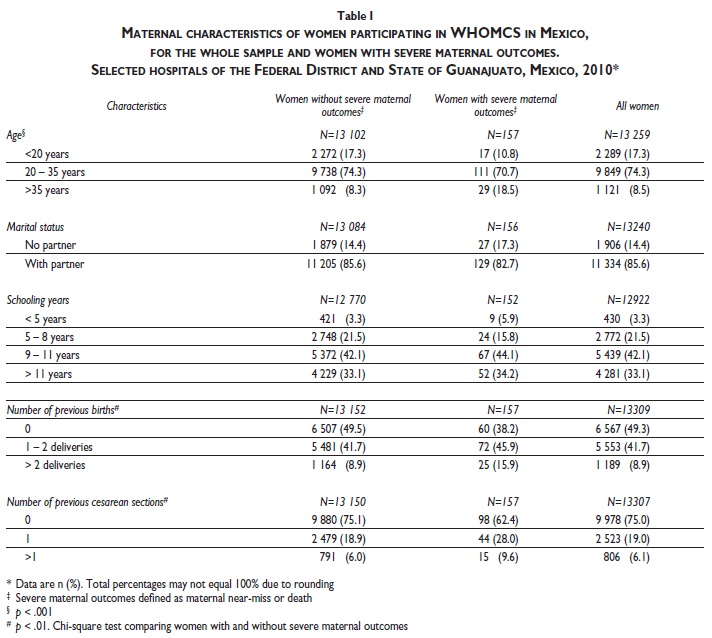
<body><![CDATA[<p><font face="Verdana" size="2"><b>Definitions</b></font></p>     <p><font face="Verdana" size="2">We defined a maternal near-miss case as a woman   presenting at least one of the 25 WHO near-miss identification criteria at delivery/abortion,   antepartum or within seven days postpartum/postabortion. The WHO near-miss identification   criteria are based on cardiovascular, respiratory, renal, coagulation/hematologic,   hepatic, neurologic, and uterine dysfunctions.<sup>12-15,17</sup> Severe maternal   outcome (SMO) was defined as the case of a woman who either died or was a near-miss.</font></p>     <p><font face="Verdana" size="2">Eligible women were classified as<i>antepartum</i>,   delivery, postpartum, or abortive outcome: <i>Antepartum</i> referred to women   who were still pregnant when discharged; <i>Delivery</i> included all women   who gave birth; <i>Postpartum </i>included all women who were admitted anytime   within seven days after delivery; <i>Abortive out-come </i>was defined as the   presence of any of the following: ectopic pregnancy, abortion, product birth   weight &lt;500g, or gestational age &lt;22 weeks if product birth weight was   unknown.</font></p>     <p><font face="Verdana" size="2"><b>Statistical analysis</b></font></p>     <p><font face="Verdana" size="2">We performed a descriptive analysis focusing   on the maternal near-miss indicators as well as the criterion-based clinical   audit indicators. Several frequency measures on maternal near-miss cases, maternal   deaths, maternal and newborn complications, and outcome and process near-miss   indicators were estimated following previously defined analyses algorithms<sup>17</sup>.   The distribution of selected variables was compared between women with and without   SMO by chisquare or Fisher's exact tests, as appropriate. The level of significance   was 0.05, two-tailed.</font></p>     <p>&nbsp;</p>     <p><font face="Verdana" size="3"><b>Results</b></font></p>     <p><font face="Verdana" size="2">Medical record review coverage was 90%, accounting   for 13 311 clinical records. Of them, 13 275 (99.7%) were women admitted for   delivery. Among them, 12 258 (92.3%) had no complication, 896 (6.8%) had a no   near-miss complication (i.e., a complication that was not severe enough to be   considered a near-miss), and 121 (0.9%) had SMO. There were 36 women with no   delivery in participating facilities, of which 16 (44%) had postpartum severe   complication, 10 (28%) had an abortive outcome and 10 (28%) had an antepartum   severe complication. SMO occurred in 157 of all women (12 per 1 000 live births).</font></p>     <p><font face="Verdana" size="2"><b>Maternal characteristics and complications</b></font></p>     <p><font face="Verdana" size="2"><a href="/img/revistas/spm/v54n5/a05tab1.jpg">Table&nbsp;I</a> depicts the maternal characteristics.   Most women were in the 20-35 age group (74.3%) &#91;range 12-50 years&#93;, had a partner   (85.6%), and had 9 or more years of schooling (75.2%). Half of them (49.3%)   were in their first pregnancy, and 75% had not had previous cesarean section.   These distributions were very similar in the group of women with SMO, excepting   that 38.2% were in their first delivery and 37.6% had a previous cesarean section.</font></p>     ]]></body>
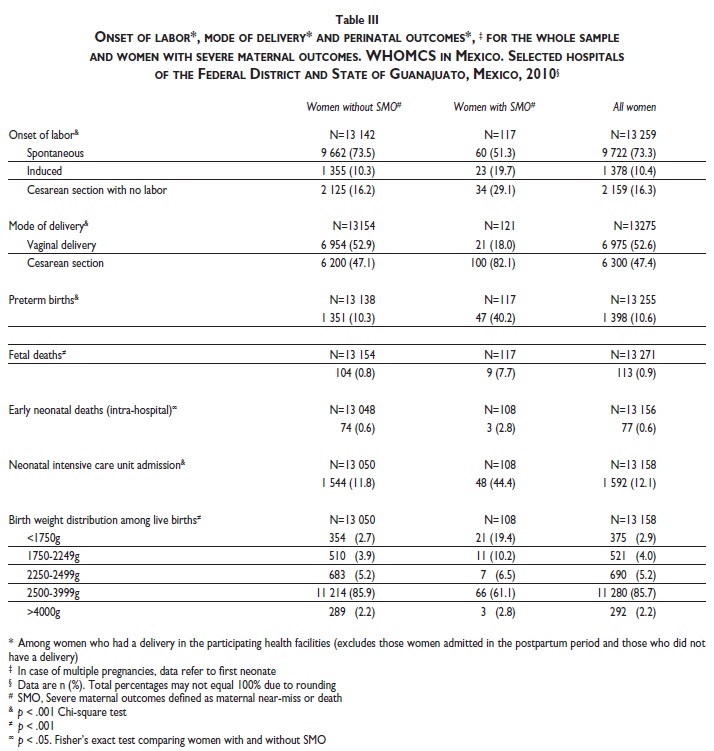
<body><![CDATA[<p><font face="Verdana" size="2"><a href="/img/revistas/spm/v54n5/a05tab2.jpg">Table&nbsp;II</a> shows the frequencies of maternal complications   (comorbidity may occur). Postpartum hemorrhage, preeclampsia and chronic hypertension   were the most frequent. Among women with SMO, postpartum hemorrhage occurred   in 40.1% and preeclampsia in 26.8%. Coagulation/hematologic (50%), uterine (41%),   and cardiovascular (26%) were the most prevalent organ dysfunctions among women   with SMO. Considering the entire sample, frequencies of maternal complications   were lower than 1%, except for preeclampsia (3.9%), postpartum hemorrhage (1.7%),   and chronic hypertension (1.2%). Hypertensive disorders occurred in 5.3% of   all women and in 42.7% of women with SMO.</font></p>     <p><font face="Verdana" size="2"><b>Perinatal outcomes</b></font></p>     <p><font face="Verdana" size="2"><a href="/img/revistas/spm/v54n5/a05tab3.jpg">Table&nbsp;III</a> shows the distribution of onset of   labor, mode of delivery, and perinatal outcomes. Among all women, 73.3% experienced   spontaneous onset of labor, 52.6% had vaginal delivery and 47.4% had cesarean   section delivery. Spontaneous onset of labor (51%) and vaginal delivery (18%)   occurred at lower percentages among women with SMO. The low birth-weight rate   was 121 per 1 000 live births. The proportion of cases with adverse perinatal   outcomes (preterm births, fetal deaths, early neonatal deaths, admissions to   neonatal care unit and low birth-weight) was higher (roughly 4- to 8-fold) in   the SMO group than in the total sample.</font></p>     <p><font face="Verdana" size="2">Of 10 women who had abortive outcome and SMO,   2 had vaginal delivery, 3 underwent laparotomy for ectopic pregnancy, 4 underwent   curettage or vacuum aspiration, and one case was not determined.</font></p>     <p><font face="Verdana" size="2"><b>Maternal near-miss indicators</b></font></p>     <p><font face="Verdana" size="2"><a href="#tab4">Table&nbsp;IV</a> shows the near-miss   indicators. One-hundred-fifty-three women had maternal near-miss complications   and four died. The maternal near-miss incidence ratio was 11.6 per 1 000 live   births. The maternal near-miss mortality ratio (i.e., the ratio between maternal   near-miss cases and maternal deaths) was 38 to 1. Organ dysfunction or death   occurred in the first 24 hours of hospital stay in 46% of SMO cases (SMO24).   Of them, 43% were referred from other facilities. The intra-hospital SMO rate   was 6.5 per 1 000 live births. SMO24 and intra-hospital mortality indices were   5.6% and 0.0%, respectively.</font></p>     <p>&nbsp;</p>     <p align="center"><a name="tab4"></a><img src="/img/revistas/spm/v54n5/a05tab4.jpg"></p>     <p>&nbsp;</p>     <p><font face="Verdana" size="2">Among the 1.6% (211/13 311) of women who were   admitted to the intensive care unit (ICU), 36% were women with SMO. The ICU   admission rate among women with SMO was 48% and the proportion of maternal deaths   without being admitted to the ICU was 25%. Maternal death occurred in 1.4% of   women admitted to the ICU.</font></p>     ]]></body>
<body><![CDATA[<p><font face="Verdana" size="2"><b>Process and outcome indicators</b></font></p>     <p><font face="Verdana" size="2">This survey documented process and outcome indicators   related to specific conditions among women who gave birth in participating hospitals   (<a href="#tab5">Table&nbsp;V</a>). Oxytocin was widely used to prevent postpartum   hemorrhage (PPH) and as a therapeutic measure for severe PPH. Two-hundred-thirteen   women had PPH. Of them, 91.5% received uterotonics, 8.9% had intrauterine tamponade   or arterial ligation, and 16.9% underwent hysterectomy. About 25% of cases with   PPH had organ dysfunction, and one died. Magnesium sulfate was used as an anticonvulsant   in 46.7% of the 30 women with eclampsia. Nine of them had organ dysfunction;   all survived. Among the 6 295 women who underwent cesarean section, 82.2% received   prophylactic antibiotics. Eighty-one out of the ninety-three women who had infection/sepsis   received parenteral therapeutic antibiotics. Nine women with infection/sepsis   presented organ dysfunction, and one died. Regarding 1 190 women who had preterm   delivery after three hours of hospital stay, 37% received corticosteroids for   fetal lung maturation.</font></p>     <p>&nbsp;</p>     <p align="center"><a name="tab5"></a><img src="/img/revistas/spm/v54n5/a05tab5.jpg"></p>     <p>&nbsp;</p>     <p><font face="Verdana" size="3"><b>Discussion</b></font></p>     <p><font face="Verdana" size="2">These findings of WHOMCS in selected Mexican   hospitals show that the rate of SMO was 12 per 1 000 live births, including   4 maternal deaths; postpartum hemorrhage, preeclampsia, and chronic hypertension   were the most prevalent complications; hematologic, uterine, and cardiovascular   dysfunctions were the most frequent in women with SMO; adverse perinatal outcomes   were more prevalent in women with SMO than in the total sample; and process   and outcome indicators on preventive and therapeutic measures for postpartum   hemorrhage and infection/sepsis showed better results than indicators for eclampsia   and preterm birth.</font></p>     <p><font face="Verdana" size="2">The maternal near-miss incidence ratio in this   study (11.6 per 1 000 live births) contrasts with the findings of WHOGS, which   showed ratios of 34.3 and 32.6 per 1 000 deliveries for Latin American countries   and Mexico, respectively.<sup>15</sup> This difference is probably due to the   different definitions of maternal near-miss cases in these two studies. By 2005,   the near-miss identification criteria had not yet been developed, and in WHOGS   a maternal near-miss was defined as a woman who had experienced admission to   ICU, blood transfusion, hysterectomy, eclampsia, cardiac or renal complications.<sup>15</sup>   The used in WHOMCS are stricter than those of WHOGS (e.g., evidence of organ   dysfunction is required instead of the simple registry of admission to ICU).<sup>12-15,17</sup>   Development of near-miss concept is detailed elsewhere.<sup>12</sup></font></p>     <p><font face="Verdana" size="2">The cesarean delivery rate was 47% for all women   and 82% for women with SMO. These results are consistent with the high rates   of cesarean deliveries reported in Mexico and other Latin American countries.<sup>13,18,19</sup>   WHO recommends cesarean delivery rates should be between 5 and 15%,<sup>20</sup>   and Mexican standards establish they should be around 15 and 20% for secondary   and tertiary hospitals, respectively.<sup>21</sup> High rates of cesarean delivery   might be associated with increased maternal and perinatal morbidity, especially   in cases in which cesarean section has no medical indication.<sup>13,18</sup>   Although the incidence of cesarean section found in this study should be considered   with caution due to the characteristics of the sample (discussed later), further   analyses are needed to gain better understanding of the impact of high cesarean   delivery rates on maternal and perinatal outcomes in Mexico.</font></p>     <p><font face="Verdana" size="2">The wide use of oxytocin for all women giving   birth and prophylactic antibiotics for women who underwent cesarean delivery,   but the lower proportion of use of corticosteroids for fetal lung maturation   for women who had a preterm delivery after three hours of hospital stay suggest   that preventive measures for neonatal respiratory complications are carried   out less frequently than preventive measures for PPH and infection/sepsis. In   addition, the survey found a high use of uterotonics for women with PPH and   parental antibiotics for women with infection/sepsis, compared to the low proportion   of women with eclampsia who received magnesium sulfate, despite the efforts   of the health sector to promote the use of magnesium sulfate for the treatment   of this condition. Moreover the near-miss mortality ratio (i.e., the ratio between   maternal near-miss cases and maternal deaths) was 53:1 for PPH in comparison   to 9:1 for sepsis. The differences among these indicators should prompt further   research studies and intervention.</font></p>     ]]></body>
<body><![CDATA[<p><font face="Verdana" size="2">This study shows the importance of addressing   normative aspects, such as quality of care, appropriate use of medications and   referral to mitigate or decrease the rate of women with SMO and neonatal complications.   Regarding quality of care, the characteristics of women such as their reproductive   age and social conditions should be taken into account during antenatal care.   In addition some of the complications such as postpartum hemorrhage, sepsis   and hypertensive disorders can be identified in a timely manner and even avoided   with appropriate risk-assessment during antenatal care and the hospital stay.   This survey provide information for clinicians to guide their decision-making   process towards a risk-based approach (in which case it would be helpful to   search or identify possible complications) vs. reactive-based approach in which   their actions are guided to care for ongoing obstetric emergencies. Resolving   too early a complicated pregnancy or labor may have deleterious effects on the   neonate; the low rate of use corticosteroids for fetal lung maturation shows   room for improvement. The analysis of the SMO24 also suggests opportunities   for improving the referral system among hospitals. A significant percentage   of women with SMO can be reduced with appropriate measures.</font></p>     <p><font face="Verdana" size="2">The study has been supervised by a well-known   research team, taking care of the mechanisms to increase data quality in different   countries. However, analyzing solely the information from Mexico imposes limitations   that should be taken into account when interpreting the results. First, the   sample for this study was designed to provide information on the characteristics   of delivery care and management of maternal and neonatal complications in the   total sample of WHOMCS. Therefore, the sample at the national level is small,   especially when trying to study low incidence adverse maternal outcomes. Although   the sampling design determined stratification according to the size of the hospital,   the study sample does not constitute a representative sample of facilities providing   delivery care in Mexico. The characteristics of the sampling design may lead   to different estimates of the incidence of complications than the ones we could   obtain in a survey with national representativeness. Thus, the estimates derived   from this study should not be extrapolated to the national situation or stratified   by institution (MoH, IMSS). Despite of these limitations, this analysis provides   initial estimates that may be useful for decision makers.</font></p>     <p><font face="Verdana" size="2">Another limitation is that the data used in this   analysis rely on the completeness and accuracy of hospital records and, to some   extent, on the expertise of data collectors at interpreting medical information.   It is possible that records of cases with complications were not located, and   therefore some information was missing, thus leading to underestimate the incidence   of complications. Although given the high coverage of medical records reviewed,   we would expect it to be minor. There are a number of complex factors that might   result in inaccuracy of hospital records. Routine procedures (e.g., antibiotic   prophylaxis) might not be fully documented. When severe complications occur,   attention might be more focused on providing care than documenting it in hospital   records. Completeness of medical records might be a particular issue in the   case of women referred from other hospitals, since access to information on   situation and procedures provided was only guaranteed after admission to participating   hospitals. To minimize the potential errors, CREP monitored data entry by several   quality control procedures; all data inconsistencies were clarified and/or amended   by checking collected data with corresponding medical records; data collectors   were trained before data collection.</font></p>     <p><font face="Verdana" size="2">The information from this survey, although it   does not provide a representative sample of facilities providing delivery care   in Mexico, contributes to the general dataset of WHOMCS, which can provide important   insights regarding the treatment of maternal and neonatal complications. From   a national level standpoint this survey provides data on indicators that may   help to characterize and evaluate better obstetric care in Mexico, thus contributing   to the efforts aimed at improving quality of care.</font></p>     <p>&nbsp;</p>     <p><font face="Verdana" size="3"><b>Acknowledgements</b></font></p>     <p><font face="Verdana" size="2">The Multicountry Survey on Maternal and Newborn   Health is a research project implemented by WHO in a global network of health   facilities between 2010 and 2012. This project is part of the WHO response to   the United Nations Secretary-General call for action for improving women's and   children's health around the world. In this connection, the Organization is   grateful to the extensive network of institutions and individuals who contributed   to the project design and implementation, including researchers, study coordinators,   data collectors, data clerks and other partners including the staff from the   Ministries of Health and WHO offices. This study is financially supported by   the UNDP/UNFPA/WHO/World Bank Special Programme of Research, Development and   Research Training in Human Reproduction (HRP); WHO; United States Agency for   International Development (USAID); Ministry of Health, Labour and Welfare of   Japan, and Gynuity Health Projects.</font></p>     <p><font face="Verdana" size="2">We recognize the participation of the following   persons and institutions in this project: Global coordination unit: Jo&atilde;o   Paulo Souza, A Metin G&uuml;lmezoglu; Latin American countries coordinator:   Guillermo Carroli; Data management and quality control procedures: CREP. We   also recognize the collaboration of Dr. Bernardo Bidart (Secretar&iacute;a de   Salud, SSA), Dr. Federico Lazcano (SSA Gobierno del Distrito Federal), Dr. Jorge   Aguirre and Dr. Luis Garc&iacute;a (SSA Estado de Guanajuato) for their support   in data collection of this project.</font></p>     <p><font face="Verdana" size="2">Gloria Galv&aacute;n, Mar&iacute;a Elena Reyes,   Sof&iacute;a Reynoso, Rafael Rodr&iacute;guez participated as field supervisors,   and Andrea Cerecero, Margarita Torres, Karina Prieto, Karina Castillo, Bel&eacute;n   Reyes, Virginia Ramos, Hortensia G&oacute;mez and Yenisey Valencia made up the   support team.</font></p>     <p><font face="Verdana" size="2">We specially acknowledge the contribution and   support of the following persons in each one of the participating hospitals:</font></p>     ]]></body>
<body><![CDATA[<p><font face="Verdana" size="2"><i>Mexico City</i></font></p>     <p><font face="Verdana" size="2"><i>Hospital Materno Infantil de Inguar&aacute;n:   </i>Mart&iacute;n Viveros, Carmen Canchola, Laura Garc&iacute;a, Armando Ch&aacute;vez,   Lourdes Garc&iacute;a, Tom&aacute;s P&eacute;rez, Junne Gil M&aacute;rquez,   Mar&iacute;a Matilde Cruz, Alejandro G&oacute;mez, Israel Aguilar.</font></p>     <p><font face="Verdana" size="2"><i>Hospital Asoc. Hispano Mexicana CIMIgen Tl&aacute;huac:</i></font></p>     <p><font face="Verdana" size="2">Carlos Vargas, Sergio Camal, Mar&iacute;a Micaela   L&oacute;pez, Rosalva Bola&ntilde;os.</font></p>     <p><font face="Verdana" size="2"><i>Hospital de la Mujer: </i>Mauricio Pichardo,   Francisco Ar&eacute;valo, Ana Lilia Ch&aacute;vez, Dalia Zenteno, Adriana Salgado,   Evelin Herrera, Ada Contreras.</font></p>     <p><font face="Verdana" size="2"><i>Hospital de G&iacute;neco-Obstetricia N&ordm;   3 La Raza: </i>Oscar Mart&iacute;nez, Mar&iacute;a Guadalupe Veloz.</font></p>     <p><font face="Verdana" size="2"><i>Hospital de G&iacute;neco-Obstetricia N&ordm;   4 Dr. Luis Castelazo Ayala: </i>Gilberto Tena, Carlos Moran, Lizethe Piedras.</font></p>     <p><font face="Verdana" size="2"><i>Hospital General Manuel Gea Gonz&aacute;lez:   </i>Octavio Sierra, Lizette Munzo, Arturo Enr&iacute;quez, Lourdes Su&aacute;rez,   Norberto Reyes.</font></p>     <p><font face="Verdana" size="2"><i>Hospital Tehuantepec: </i>Carlos Lowemberg,   Eduardo Lowemberg.</font></p>     <p><font face="Verdana" size="2"><i>State of Guanajuato</i></font></p>     ]]></body>
<body><![CDATA[<p><font face="Verdana" size="2"><i>Hospital General de Zona N&ordm; 2 Irapuato:   </i>Alberto Pati&ntilde;o, Mercedes Pati&ntilde;o, Adrian Vel&aacute;zquez,   Martha Georgina Franco.</font></p>     <p><font face="Verdana" size="2"><i>Hospital General de Zona N&ordm; 4 Celaya:   </i>Faustino Aguilar, David Flores, Mar&iacute;a Guadalupe Arana.</font></p>     <p><font face="Verdana" size="2"><i>Hospital General de Zona N&ordm; 3 Salamanca:   </i>Juan Guillermo Regalado, Jos&eacute; Luis Barrera.</font></p>     <p><font face="Verdana" size="2"><i>Hospital de G&iacute;neco-Pediatr&iacute;a   N&ordm; 48 Le&oacute;n: </i>Arturo Estrada, V&iacute;ctor God&iacute;nez, Teresita   R&iacute;os.</font></p>     <p><font face="Verdana" size="2"><i>Hospital General de Irapuato: </i>Juli&aacute;n   Valero, Jos&eacute; Corrales, Daniel V&aacute;zquez.</font></p>     <p><font face="Verdana" size="2"><i>Hospital General de Le&oacute;n: </i>Gregorio   del Campo, Juan Carlos Guti&eacute;rrez, Leopoldo L&oacute;pez.</font></p>     <p><font face="Verdana" size="2"><i>Hospital General Guanajuato: </i>Ra&uacute;l   Rojas, Norma Ang&eacute;lica Olmos</font></p>     <p><font face="Verdana" size="2"><i>Declaration of conflict of interests. </i>The   authors declare that they have no conflict of interests.</font></p>     <p>&nbsp;</p>     <p><font face="Verdana" size="3"><b>References</b></font></p>     ]]></body>
<body><![CDATA[<!-- ref --><p><font face="Verdana" size="2">1. Lozano R, Wang H, Foreman KJ, Rajaratnam JK,   Naghavi M, Marcus JR, <i>et al</i>. Progress towards Millennium Development   Goals 4 and 5 on maternal and child mortality: an updated systematic analysis.   Lancet 2011;378(9797):1139-1165.    &nbsp;&nbsp;&nbsp;&nbsp;&nbsp;&nbsp;&nbsp;&nbsp;[&#160;<a href="javascript:void(0);" onclick="javascript: window.open('/scielo.php?script=sci_nlinks&ref=9391556&pid=S0036-3634201200050000600001&lng=','','width=640,height=500,resizable=yes,scrollbars=1,menubar=yes,');">Links</a>&#160;]<!-- end-ref --></font></p>     <!-- ref --><p><font face="Verdana" size="2">2. United Nations General Assembly. United Nations   Millennium Declaration. New York, NY: United Nations, 2000.    &nbsp;&nbsp;&nbsp;&nbsp;&nbsp;&nbsp;&nbsp;&nbsp;[&#160;<a href="javascript:void(0);" onclick="javascript: window.open('/scielo.php?script=sci_nlinks&ref=9391558&pid=S0036-3634201200050000600002&lng=','','width=640,height=500,resizable=yes,scrollbars=1,menubar=yes,');">Links</a>&#160;]<!-- end-ref --></font></p>     <!-- ref --><p><font face="Verdana" size="2">3. Kerber KJ, de Graft-Johnson JE, Bhutta ZA,   Okong P, Starrs A, Lawn JE. Continuum of care for maternal, newborn, and child   health: from slogan to service delivery. Lancet 2007;370(9595):1358-1369.    &nbsp;&nbsp;&nbsp;&nbsp;&nbsp;&nbsp;&nbsp;&nbsp;[&#160;<a href="javascript:void(0);" onclick="javascript: window.open('/scielo.php?script=sci_nlinks&ref=9391560&pid=S0036-3634201200050000600003&lng=','','width=640,height=500,resizable=yes,scrollbars=1,menubar=yes,');">Links</a>&#160;]<!-- end-ref --></font></p>     <!-- ref --><p><font face="Verdana" size="2">4. McCoy D, Storeng K, Filippi V, Ronsmans C,   Osrin D, Matthias B, <i>et al</i>. Maternal, neonatal and child health interventions   and services: moving from knowledge of what works to systems that deliver. International   Health 2010;2(2):87-98.    &nbsp;&nbsp;&nbsp;&nbsp;&nbsp;&nbsp;&nbsp;&nbsp;[&#160;<a href="javascript:void(0);" onclick="javascript: window.open('/scielo.php?script=sci_nlinks&ref=9391562&pid=S0036-3634201200050000600004&lng=','','width=640,height=500,resizable=yes,scrollbars=1,menubar=yes,');">Links</a>&#160;]<!-- end-ref --></font></p>     <!-- ref --><p><font face="Verdana" size="2">5. Institute for Health Metrics and Evaluation.   Building Momentum: global progress toward reducing maternal and child mortality.   Seattle, WA: Institute for Health Metrics and Evaluation, 2010.    &nbsp;&nbsp;&nbsp;&nbsp;&nbsp;&nbsp;&nbsp;&nbsp;[&#160;<a href="javascript:void(0);" onclick="javascript: window.open('/scielo.php?script=sci_nlinks&ref=9391564&pid=S0036-3634201200050000600005&lng=','','width=640,height=500,resizable=yes,scrollbars=1,menubar=yes,');">Links</a>&#160;]<!-- end-ref --></font></p>     ]]></body>
<body><![CDATA[<!-- ref --><p><font face="Verdana" size="2">6. Lawn JE, Kerber K, Enweronu-Laryea C, Cousens   S. 3.6 million neonatal deaths: what is progressing and what is not? Semin Perinatol   2010;34(6):371-386.    &nbsp;&nbsp;&nbsp;&nbsp;&nbsp;&nbsp;&nbsp;&nbsp;[&#160;<a href="javascript:void(0);" onclick="javascript: window.open('/scielo.php?script=sci_nlinks&ref=9391566&pid=S0036-3634201200050000600006&lng=','','width=640,height=500,resizable=yes,scrollbars=1,menubar=yes,');">Links</a>&#160;]<!-- end-ref --></font></p>     <!-- ref --><p><font face="Verdana" size="2">7. Secretar&iacute;a de Salud. Direcci&oacute;n   General de Epidemiolog&iacute;a. Sistema Nacional de Vigilancia Epidemiol&oacute;gica.   Informe Semanal N&deg; 40 de Vigilancia Epidemiol&oacute;gica de Defunciones   Maternas. M&eacute;xico: SSA, 2011.    &nbsp;&nbsp;&nbsp;&nbsp;&nbsp;&nbsp;&nbsp;&nbsp;[&#160;<a href="javascript:void(0);" onclick="javascript: window.open('/scielo.php?script=sci_nlinks&ref=9391568&pid=S0036-3634201200050000600007&lng=','','width=640,height=500,resizable=yes,scrollbars=1,menubar=yes,');">Links</a>&#160;]<!-- end-ref --></font></p>     <!-- ref --><p><font face="Verdana" size="2">8. Gobierno de los Estados Unidos Mexicanos.   Presidencia de la Rep&uacute;blica. Quinto Informe de Gobierno. M&eacute;xico:   Presidencia de la Rep&uacute;blica, 2011.    &nbsp;&nbsp;&nbsp;&nbsp;&nbsp;&nbsp;&nbsp;&nbsp;[&#160;<a href="javascript:void(0);" onclick="javascript: window.open('/scielo.php?script=sci_nlinks&ref=9391570&pid=S0036-3634201200050000600008&lng=','','width=640,height=500,resizable=yes,scrollbars=1,menubar=yes,');">Links</a>&#160;]<!-- end-ref --></font></p>     <!-- ref --><p><font face="Verdana" size="2">9. Secretar&iacute;a de Salud. Bolet&iacute;n   de informaci&oacute;n estad&iacute;stica. Servicios otorgados y programas sustantivos.   M&eacute;xico, D. F: SSA, 2009; No. 29, Vol. III.    &nbsp;&nbsp;&nbsp;&nbsp;&nbsp;&nbsp;&nbsp;&nbsp;[&#160;<a href="javascript:void(0);" onclick="javascript: window.open('/scielo.php?script=sci_nlinks&ref=9391572&pid=S0036-3634201200050000600009&lng=','','width=640,height=500,resizable=yes,scrollbars=1,menubar=yes,');">Links</a>&#160;]<!-- end-ref --></font></p>     <!-- ref --><p><font face="Verdana" size="2">10. Olaiz-Fern&aacute;ndez G, Rivera-Dommarco   J, Shamah-Levy T, Rojas R, Villalpando-Hern&aacute;ndez S, Hern&aacute;ndez-Avila   M, <i>et al</i>. Encuesta Nacional de Salud y Nutrici&oacute;n 2006. Cuernavaca,   M&eacute;xico: Instituto Nacional de Salud P&uacute;blica, 2006.    &nbsp;&nbsp;&nbsp;&nbsp;&nbsp;&nbsp;&nbsp;&nbsp;[&#160;<a href="javascript:void(0);" onclick="javascript: window.open('/scielo.php?script=sci_nlinks&ref=9391574&pid=S0036-3634201200050000600010&lng=','','width=640,height=500,resizable=yes,scrollbars=1,menubar=yes,');">Links</a>&#160;]<!-- end-ref --></font></p>     ]]></body>
<body><![CDATA[<!-- ref --><p><font face="Verdana" size="2">11. Campbell OM, Graham WJ. Strategies for reducing   maternal mortality: getting on with what works. Lancet 2006;368(9543):1284-1299.    &nbsp;&nbsp;&nbsp;&nbsp;&nbsp;&nbsp;&nbsp;&nbsp;[&#160;<a href="javascript:void(0);" onclick="javascript: window.open('/scielo.php?script=sci_nlinks&ref=9391576&pid=S0036-3634201200050000600011&lng=','','width=640,height=500,resizable=yes,scrollbars=1,menubar=yes,');">Links</a>&#160;]<!-- end-ref --></font></p>     <!-- ref --><p><font face="Verdana" size="2">12. Say L, Souza JP, Pattinson RC. Maternal near   miss: towards a standard tool for monitoring quality of maternal health care.   Best Pract Res Clin Obstet Gynaecol 2009;23(3):287-296.    &nbsp;&nbsp;&nbsp;&nbsp;&nbsp;&nbsp;&nbsp;&nbsp;[&#160;<a href="javascript:void(0);" onclick="javascript: window.open('/scielo.php?script=sci_nlinks&ref=9391578&pid=S0036-3634201200050000600012&lng=','','width=640,height=500,resizable=yes,scrollbars=1,menubar=yes,');">Links</a>&#160;]<!-- end-ref --></font></p>     <!-- ref --><p><font face="Verdana" size="2">13. Villar J, Valladares E, Wojdyla D, Zavaleta   N, Carroli G, Velazco A, <i>et al</i>. Caesarean delivery rates and pregnancy   outcomes: the 2005 WHO global survey on maternal and perinatal health in Latin   America. Lancet 2006;367(9525):1819-1829.    &nbsp;&nbsp;&nbsp;&nbsp;&nbsp;&nbsp;&nbsp;&nbsp;[&#160;<a href="javascript:void(0);" onclick="javascript: window.open('/scielo.php?script=sci_nlinks&ref=9391580&pid=S0036-3634201200050000600013&lng=','','width=640,height=500,resizable=yes,scrollbars=1,menubar=yes,');">Links</a>&#160;]<!-- end-ref --></font></p>     <!-- ref --><p><font face="Verdana" size="2">14. Shah A, Faundes A, Machoki MI, Bataglia V,   Amokrane F, Donner A, <i>et al</i>. Methodological considerations in implementing   the WHO global survey for monitoring maternal and perinatal health. Bull World   Health Organ 2008;86:126-131.    &nbsp;&nbsp;&nbsp;&nbsp;&nbsp;&nbsp;&nbsp;&nbsp;[&#160;<a href="javascript:void(0);" onclick="javascript: window.open('/scielo.php?script=sci_nlinks&ref=9391582&pid=S0036-3634201200050000600014&lng=','','width=640,height=500,resizable=yes,scrollbars=1,menubar=yes,');">Links</a>&#160;]<!-- end-ref --></font></p>     <!-- ref --><p><font face="Verdana" size="2">15. Souza JP, Cecatti JG, Faundes A, Morais SS,   Villar J, Carroli G, <i>et al</i>. Maternal near miss and maternal death in   the World Health Organization's 2005 global survey on maternal and perinatal   health. Bull World Health Organ 2010;88(2):113-119.    &nbsp;&nbsp;&nbsp;&nbsp;&nbsp;&nbsp;&nbsp;&nbsp;[&#160;<a href="javascript:void(0);" onclick="javascript: window.open('/scielo.php?script=sci_nlinks&ref=9391584&pid=S0036-3634201200050000600015&lng=','','width=640,height=500,resizable=yes,scrollbars=1,menubar=yes,');">Links</a>&#160;]<!-- end-ref --></font></p>     ]]></body>
<body><![CDATA[<!-- ref --><p><font face="Verdana" size="2">16. Pileggi C, Souza JP, Cecatti JG, Faundes   A. Neonatal near miss approach in the 2005 WHO global survey Brazil. J Pediatr   (Rio J) 2010;86(1):21-26.    &nbsp;&nbsp;&nbsp;&nbsp;&nbsp;&nbsp;&nbsp;&nbsp;[&#160;<a href="javascript:void(0);" onclick="javascript: window.open('/scielo.php?script=sci_nlinks&ref=9391586&pid=S0036-3634201200050000600016&lng=','','width=640,height=500,resizable=yes,scrollbars=1,menubar=yes,');">Links</a>&#160;]<!-- end-ref --></font></p>     <!-- ref --><p><font face="Verdana" size="2">17. Souza JP, Gulmezoglu AM, Carroli G, Lumbiganon   P, Qureshi Z, for WHOMCS Research Group. The World Health Organization multicountry   survey on maternal and newborn health: study protocol. BMC Health Services Research   2011;11:286.    &nbsp;&nbsp;&nbsp;&nbsp;&nbsp;&nbsp;&nbsp;&nbsp;[&#160;<a href="javascript:void(0);" onclick="javascript: window.open('/scielo.php?script=sci_nlinks&ref=9391588&pid=S0036-3634201200050000600017&lng=','','width=640,height=500,resizable=yes,scrollbars=1,menubar=yes,');">Links</a>&#160;]<!-- end-ref --></font></p>     <!-- ref --><p><font face="Verdana" size="2">18. Villar J, Carroli G, Zavaleta N, Donner A,   Wojdyla D, Faundes A, <i>et al</i>. Maternal and neonatal individual risks and   benefits associated with caesarean delivery: multicentre prospective study.   Br Med J 2007;335(7628):1025.    &nbsp;&nbsp;&nbsp;&nbsp;&nbsp;&nbsp;&nbsp;&nbsp;[&#160;<a href="javascript:void(0);" onclick="javascript: window.open('/scielo.php?script=sci_nlinks&ref=9391590&pid=S0036-3634201200050000600018&lng=','','width=640,height=500,resizable=yes,scrollbars=1,menubar=yes,');">Links</a>&#160;]<!-- end-ref --></font></p>     <!-- ref --><p><font face="Verdana" size="2">19. Puentes-Rosas E, Gomez-Dantes O, Garrido-Latorre   F. &#91;Caesarean sections in Mexico: tendencies, levels and associated factors&#93;.   Salud Publica Mex 2004;46(1):16-22.    &nbsp;&nbsp;&nbsp;&nbsp;&nbsp;&nbsp;&nbsp;&nbsp;[&#160;<a href="javascript:void(0);" onclick="javascript: window.open('/scielo.php?script=sci_nlinks&ref=9391592&pid=S0036-3634201200050000600019&lng=','','width=640,height=500,resizable=yes,scrollbars=1,menubar=yes,');">Links</a>&#160;]<!-- end-ref --></font></p>     <!-- ref --><p><font face="Verdana" size="2">20. Chalmers B, Mangiaterra V, Porter R. WHO   principles of perinatal care: the essential antenatal, perinatal, and postpartum   care course. Birth 2001;28(3):202-207.    &nbsp;&nbsp;&nbsp;&nbsp;&nbsp;&nbsp;&nbsp;&nbsp;[&#160;<a href="javascript:void(0);" onclick="javascript: window.open('/scielo.php?script=sci_nlinks&ref=9391594&pid=S0036-3634201200050000600020&lng=','','width=640,height=500,resizable=yes,scrollbars=1,menubar=yes,');">Links</a>&#160;]<!-- end-ref --></font></p>     ]]></body>
<body><![CDATA[<!-- ref --><p><font face="Verdana" size="2">21. Norma Oficial Mexicana. NOM-007-SSA2-1993.   Atenci&oacute;n a la mujer durante el embarazo, parto y puerperio y al reci&eacute;n   nacido: Criterios y procedimientos para la prestaci&oacute;n del servicio. M&eacute;xico:   Diario Oficial de la Federaci&oacute;n, 1995.    &nbsp;&nbsp;&nbsp;&nbsp;&nbsp;&nbsp;&nbsp;&nbsp;[&#160;<a href="javascript:void(0);" onclick="javascript: window.open('/scielo.php?script=sci_nlinks&ref=9391596&pid=S0036-3634201200050000600021&lng=','','width=640,height=500,resizable=yes,scrollbars=1,menubar=yes,');">Links</a>&#160;]<!-- end-ref --></font></p>     <p>&nbsp;</p>     <p>&nbsp;</p>     <p><a name="end" href="#top"><img src="/img/revistas/spm/v54n5/seta.jpg" border="0"></a> <font face="Verdana" size="2"><b>Corresponding author:</b>    <br>  Mtro. Eduardo Ortiz-Panozo.    <br>  Instituto Nacional de Salud P&uacute;blica. Av. Universidad 655, col.    <br>  Santa Mar&iacute;a Ahuacatitl&aacute;n. 62100, Cuernavaca, Morelos, M&eacute;xico.    <br>  E-mail: <a href="mailto:eduardo.ortiz@insp.mx">eduardo.ortiz@insp.mx</a></font></p>     <p><font face="Verdana" size="2"><b>Received on: </b>October 28, 2011    ]]></body>
<body><![CDATA[<br>  <b>Accepted on: </b>February 15, 2012</font></p>      ]]></body><back>
<ref-list>
<ref id="B1">
<label>1</label><nlm-citation citation-type="journal">
<person-group person-group-type="author">
<name>
<surname><![CDATA[Lozano]]></surname>
<given-names><![CDATA[R]]></given-names>
</name>
<name>
<surname><![CDATA[Wang]]></surname>
<given-names><![CDATA[H]]></given-names>
</name>
<name>
<surname><![CDATA[Foreman]]></surname>
<given-names><![CDATA[KJ]]></given-names>
</name>
<name>
<surname><![CDATA[Rajaratnam]]></surname>
<given-names><![CDATA[JK]]></given-names>
</name>
<name>
<surname><![CDATA[Naghavi]]></surname>
<given-names><![CDATA[M]]></given-names>
</name>
<name>
<surname><![CDATA[Marcus]]></surname>
<given-names><![CDATA[JR]]></given-names>
</name>
</person-group>
<article-title xml:lang="en"><![CDATA[Progress towards Millennium Development Goals 4 and 5 on maternal and child mortality: an updated systematic analysis]]></article-title>
<source><![CDATA[Lancet]]></source>
<year>2011</year>
<volume>378</volume>
<numero>9797</numero>
<issue>9797</issue>
<page-range>1139-1165</page-range></nlm-citation>
</ref>
<ref id="B2">
<label>2</label><nlm-citation citation-type="book">
<collab>United Nations General Assembly</collab>
<source><![CDATA[United Nations Millennium Declaration.]]></source>
<year>2000</year>
<publisher-loc><![CDATA[New York^eNY NY]]></publisher-loc>
<publisher-name><![CDATA[United Nations]]></publisher-name>
</nlm-citation>
</ref>
<ref id="B3">
<label>3</label><nlm-citation citation-type="journal">
<person-group person-group-type="author">
<name>
<surname><![CDATA[Kerber]]></surname>
<given-names><![CDATA[KJ]]></given-names>
</name>
<name>
<surname><![CDATA[de Graft-Johnson]]></surname>
<given-names><![CDATA[JE]]></given-names>
</name>
<name>
<surname><![CDATA[Bhutta]]></surname>
<given-names><![CDATA[ZA]]></given-names>
</name>
<name>
<surname><![CDATA[Okong]]></surname>
<given-names><![CDATA[P]]></given-names>
</name>
<name>
<surname><![CDATA[Starrs]]></surname>
<given-names><![CDATA[A]]></given-names>
</name>
<name>
<surname><![CDATA[Lawn]]></surname>
<given-names><![CDATA[JE]]></given-names>
</name>
</person-group>
<article-title xml:lang="en"><![CDATA[Continuum of care for maternal, newborn, and child health: from slogan to service delivery]]></article-title>
<source><![CDATA[Lancet]]></source>
<year>2007</year>
<volume>370</volume>
<numero>9595</numero>
<issue>9595</issue>
<page-range>1358-1369</page-range></nlm-citation>
</ref>
<ref id="B4">
<label>4</label><nlm-citation citation-type="journal">
<person-group person-group-type="author">
<name>
<surname><![CDATA[McCoy]]></surname>
<given-names><![CDATA[D]]></given-names>
</name>
<name>
<surname><![CDATA[Storeng]]></surname>
<given-names><![CDATA[K]]></given-names>
</name>
<name>
<surname><![CDATA[Filippi]]></surname>
<given-names><![CDATA[V]]></given-names>
</name>
<name>
<surname><![CDATA[Ronsmans]]></surname>
<given-names><![CDATA[C]]></given-names>
</name>
<name>
<surname><![CDATA[Osrin]]></surname>
<given-names><![CDATA[D]]></given-names>
</name>
<name>
<surname><![CDATA[Matthias]]></surname>
<given-names><![CDATA[B]]></given-names>
</name>
</person-group>
<article-title xml:lang="en"><![CDATA[Maternal, neonatal and child health interventions and services: moving from knowledge of what works to systems that deliver]]></article-title>
<source><![CDATA[International Health]]></source>
<year>2010</year>
<volume>2</volume>
<numero>2</numero>
<issue>2</issue>
<page-range>87-98</page-range></nlm-citation>
</ref>
<ref id="B5">
<label>5</label><nlm-citation citation-type="book">
<collab>Institute for Health Metrics and Evaluation</collab>
<source><![CDATA[Building Momentum: global progress toward reducing maternal and child mortality.]]></source>
<year>2010</year>
<publisher-loc><![CDATA[Seattle^eWA WA]]></publisher-loc>
<publisher-name><![CDATA[Institute for Health Metrics and Evaluation]]></publisher-name>
</nlm-citation>
</ref>
<ref id="B6">
<label>6</label><nlm-citation citation-type="journal">
<person-group person-group-type="author">
<name>
<surname><![CDATA[Lawn]]></surname>
<given-names><![CDATA[JE]]></given-names>
</name>
<name>
<surname><![CDATA[Kerber]]></surname>
<given-names><![CDATA[K]]></given-names>
</name>
<name>
<surname><![CDATA[Enweronu-Laryea]]></surname>
<given-names><![CDATA[C]]></given-names>
</name>
<name>
<surname><![CDATA[Cousens]]></surname>
<given-names><![CDATA[S]]></given-names>
</name>
</person-group>
<article-title xml:lang="en"><![CDATA[36 million neonatal deaths: what is progressing and what is not?]]></article-title>
<source><![CDATA[Semin Perinatol]]></source>
<year>2010</year>
<volume>34</volume>
<numero>6</numero>
<issue>6</issue>
<page-range>371-386</page-range></nlm-citation>
</ref>
<ref id="B7">
<label>7</label><nlm-citation citation-type="book">
<collab>Secretaría de Salud^dDirección General de Epidemiología.Sistema Nacional de Vigilancia Epidemiológica</collab>
<source><![CDATA[Informe Semanal N° 40 de Vigilancia Epidemiológica de Defunciones Maternas]]></source>
<year>2011</year>
<publisher-loc><![CDATA[México ]]></publisher-loc>
<publisher-name><![CDATA[SSA]]></publisher-name>
</nlm-citation>
</ref>
<ref id="B8">
<label>8</label><nlm-citation citation-type="book">
<collab>Gobierno de los Estados Unidos Mexicanos^dPresidencia de la República</collab>
<source><![CDATA[Quinto Informe de Gobierno]]></source>
<year>2011</year>
<publisher-loc><![CDATA[México ]]></publisher-loc>
<publisher-name><![CDATA[Presidencia de la República]]></publisher-name>
</nlm-citation>
</ref>
<ref id="B9">
<label>9</label><nlm-citation citation-type="book">
<collab>Secretaría de Salud</collab>
<source><![CDATA[Boletín de información estadística: Servicios otorgados y programas sustantivos]]></source>
<year>2009</year>
<publisher-loc><![CDATA[México^eDF DF]]></publisher-loc>
<publisher-name><![CDATA[SSA]]></publisher-name>
</nlm-citation>
</ref>
<ref id="B10">
<label>10</label><nlm-citation citation-type="book">
<person-group person-group-type="author">
<name>
<surname><![CDATA[Olaiz-Fernández]]></surname>
<given-names><![CDATA[G]]></given-names>
</name>
<name>
<surname><![CDATA[Rivera-Dommarco]]></surname>
<given-names><![CDATA[J]]></given-names>
</name>
<name>
<surname><![CDATA[Shamah-Levy]]></surname>
<given-names><![CDATA[T]]></given-names>
</name>
<name>
<surname><![CDATA[Rojas]]></surname>
<given-names><![CDATA[R]]></given-names>
</name>
<name>
<surname><![CDATA[Villalpando-Hernández]]></surname>
<given-names><![CDATA[S]]></given-names>
</name>
<name>
<surname><![CDATA[Hernández-Avila]]></surname>
<given-names><![CDATA[M]]></given-names>
</name>
</person-group>
<source><![CDATA[Encuesta Nacional de Salud y Nutrición 2006.]]></source>
<year>2006</year>
<publisher-loc><![CDATA[Cuernavaca ]]></publisher-loc>
<publisher-name><![CDATA[Instituto Nacional de Salud Pública]]></publisher-name>
</nlm-citation>
</ref>
<ref id="B11">
<label>11</label><nlm-citation citation-type="journal">
<person-group person-group-type="author">
<name>
<surname><![CDATA[Campbell]]></surname>
<given-names><![CDATA[OM]]></given-names>
</name>
<name>
<surname><![CDATA[Graham]]></surname>
<given-names><![CDATA[WJ]]></given-names>
</name>
</person-group>
<article-title xml:lang="en"><![CDATA[Strategies for reducing maternal mortality: getting on with what works]]></article-title>
<source><![CDATA[Lancet]]></source>
<year>2006</year>
<volume>368</volume>
<numero>9543</numero>
<issue>9543</issue>
<page-range>1284-1299</page-range></nlm-citation>
</ref>
<ref id="B12">
<label>12</label><nlm-citation citation-type="journal">
<person-group person-group-type="author">
<name>
<surname><![CDATA[Say]]></surname>
<given-names><![CDATA[L]]></given-names>
</name>
<name>
<surname><![CDATA[Souza]]></surname>
<given-names><![CDATA[JP]]></given-names>
</name>
<name>
<surname><![CDATA[Pattinson]]></surname>
<given-names><![CDATA[RC]]></given-names>
</name>
</person-group>
<article-title xml:lang="en"><![CDATA[Maternal near miss: towards a standard tool for monitoring quality of maternal health care]]></article-title>
<source><![CDATA[Best Pract Res Clin Obstet Gynaecol]]></source>
<year>2009</year>
<volume>23</volume>
<numero>3</numero>
<issue>3</issue>
<page-range>287-296</page-range></nlm-citation>
</ref>
<ref id="B13">
<label>13</label><nlm-citation citation-type="journal">
<person-group person-group-type="author">
<name>
<surname><![CDATA[Villar]]></surname>
<given-names><![CDATA[J]]></given-names>
</name>
<name>
<surname><![CDATA[Valladares]]></surname>
<given-names><![CDATA[E]]></given-names>
</name>
<name>
<surname><![CDATA[Wojdyla]]></surname>
<given-names><![CDATA[D]]></given-names>
</name>
<name>
<surname><![CDATA[Zavaleta]]></surname>
<given-names><![CDATA[N]]></given-names>
</name>
<name>
<surname><![CDATA[Carroli]]></surname>
<given-names><![CDATA[G]]></given-names>
</name>
<name>
<surname><![CDATA[Velazco]]></surname>
<given-names><![CDATA[A]]></given-names>
</name>
</person-group>
<article-title xml:lang="en"><![CDATA[Caesarean delivery rates and pregnancy outcomes: the 2005 WHO global survey on maternal and perinatal health in Latin America]]></article-title>
<source><![CDATA[Lancet]]></source>
<year>2006</year>
<volume>367</volume>
<numero>9525</numero>
<issue>9525</issue>
<page-range>1819-1829</page-range></nlm-citation>
</ref>
<ref id="B14">
<label>14</label><nlm-citation citation-type="journal">
<person-group person-group-type="author">
<name>
<surname><![CDATA[Shah]]></surname>
<given-names><![CDATA[A]]></given-names>
</name>
<name>
<surname><![CDATA[Faundes]]></surname>
<given-names><![CDATA[A]]></given-names>
</name>
<name>
<surname><![CDATA[Machoki]]></surname>
<given-names><![CDATA[MI]]></given-names>
</name>
<name>
<surname><![CDATA[Bataglia]]></surname>
<given-names><![CDATA[V]]></given-names>
</name>
<name>
<surname><![CDATA[Amokrane]]></surname>
<given-names><![CDATA[F]]></given-names>
</name>
<name>
<surname><![CDATA[Donner]]></surname>
<given-names><![CDATA[A]]></given-names>
</name>
</person-group>
<article-title xml:lang="en"><![CDATA[Methodological considerations in implementing the WHO global survey for monitoring maternal and perinatal health]]></article-title>
<source><![CDATA[Bull World Health Organ]]></source>
<year>2008</year>
<volume>86</volume>
<page-range>126-131</page-range></nlm-citation>
</ref>
<ref id="B15">
<label>15</label><nlm-citation citation-type="journal">
<person-group person-group-type="author">
<name>
<surname><![CDATA[Souza]]></surname>
<given-names><![CDATA[JP]]></given-names>
</name>
<name>
<surname><![CDATA[Cecatti]]></surname>
<given-names><![CDATA[JG]]></given-names>
</name>
<name>
<surname><![CDATA[Faundes]]></surname>
<given-names><![CDATA[A]]></given-names>
</name>
<name>
<surname><![CDATA[Morais]]></surname>
<given-names><![CDATA[SS]]></given-names>
</name>
<name>
<surname><![CDATA[Villar]]></surname>
<given-names><![CDATA[J]]></given-names>
</name>
<name>
<surname><![CDATA[Carroli]]></surname>
<given-names><![CDATA[G]]></given-names>
</name>
</person-group>
<article-title xml:lang="en"><![CDATA[Maternal near miss and maternal death in the World Health Organization's 2005 global survey on maternal and perinatal health]]></article-title>
<source><![CDATA[Bull World Health Organ]]></source>
<year>2010</year>
<volume>88</volume>
<numero>2</numero>
<issue>2</issue>
<page-range>113-119</page-range></nlm-citation>
</ref>
<ref id="B16">
<label>16</label><nlm-citation citation-type="journal">
<person-group person-group-type="author">
<name>
<surname><![CDATA[Pileggi]]></surname>
<given-names><![CDATA[C]]></given-names>
</name>
<name>
<surname><![CDATA[Souza]]></surname>
<given-names><![CDATA[JP]]></given-names>
</name>
<name>
<surname><![CDATA[Cecatti]]></surname>
<given-names><![CDATA[JG]]></given-names>
</name>
<name>
<surname><![CDATA[Faundes]]></surname>
<given-names><![CDATA[A]]></given-names>
</name>
</person-group>
<article-title xml:lang="en"><![CDATA[Neonatal near miss approach in the 2005 WHO global survey Brazil]]></article-title>
<source><![CDATA[J Pediatr (Rio J)]]></source>
<year>2010</year>
<volume>86</volume>
<numero>1</numero>
<issue>1</issue>
<page-range>21-26</page-range></nlm-citation>
</ref>
<ref id="B17">
<label>17</label><nlm-citation citation-type="journal">
<person-group person-group-type="author">
<name>
<surname><![CDATA[Souza]]></surname>
<given-names><![CDATA[JP]]></given-names>
</name>
<name>
<surname><![CDATA[Gulmezoglu]]></surname>
<given-names><![CDATA[AM]]></given-names>
</name>
<name>
<surname><![CDATA[Carroli]]></surname>
<given-names><![CDATA[G]]></given-names>
</name>
<name>
<surname><![CDATA[Lumbiganon]]></surname>
<given-names><![CDATA[P]]></given-names>
</name>
<name>
<surname><![CDATA[Qureshi]]></surname>
<given-names><![CDATA[Z]]></given-names>
</name>
</person-group>
<collab>for WHOMCS Research Group</collab>
<article-title xml:lang="en"><![CDATA[The World Health Organization multicountry survey on maternal and newborn health: study protocol]]></article-title>
<source><![CDATA[BMC Health Services Research]]></source>
<year>2011</year>
<volume>11</volume>
<page-range>286</page-range></nlm-citation>
</ref>
<ref id="B18">
<label>18</label><nlm-citation citation-type="journal">
<person-group person-group-type="author">
<name>
<surname><![CDATA[Villar]]></surname>
<given-names><![CDATA[J]]></given-names>
</name>
<name>
<surname><![CDATA[Carroli]]></surname>
<given-names><![CDATA[G]]></given-names>
</name>
<name>
<surname><![CDATA[Zavaleta]]></surname>
<given-names><![CDATA[N]]></given-names>
</name>
<name>
<surname><![CDATA[Donner]]></surname>
<given-names><![CDATA[A]]></given-names>
</name>
<name>
<surname><![CDATA[Wojdyla]]></surname>
<given-names><![CDATA[D]]></given-names>
</name>
<name>
<surname><![CDATA[Faundes]]></surname>
<given-names><![CDATA[A]]></given-names>
</name>
</person-group>
<article-title xml:lang="en"><![CDATA[Maternal and neonatal individual risks and benefits associated with caesarean delivery: multicentre prospective study]]></article-title>
<source><![CDATA[Br Med J]]></source>
<year>2007</year>
<volume>335</volume>
<numero>7628</numero>
<issue>7628</issue>
<page-range>1025</page-range></nlm-citation>
</ref>
<ref id="B19">
<label>19</label><nlm-citation citation-type="journal">
<person-group person-group-type="author">
<name>
<surname><![CDATA[Puentes-Rosas]]></surname>
<given-names><![CDATA[E]]></given-names>
</name>
<name>
<surname><![CDATA[Gomez-Dantes]]></surname>
<given-names><![CDATA[O]]></given-names>
</name>
<name>
<surname><![CDATA[Garrido-Latorre]]></surname>
<given-names><![CDATA[F]]></given-names>
</name>
</person-group>
<article-title xml:lang="es"><![CDATA[[Caesarean sections in Mexico: tendencies.levels and associated factors]]]></article-title>
<source><![CDATA[Salud Publica Mex]]></source>
<year>2004</year>
<volume>46</volume>
<numero>1</numero>
<issue>1</issue>
<page-range>16-22</page-range></nlm-citation>
</ref>
<ref id="B20">
<label>20</label><nlm-citation citation-type="journal">
<person-group person-group-type="author">
<name>
<surname><![CDATA[Chalmers]]></surname>
<given-names><![CDATA[B]]></given-names>
</name>
<name>
<surname><![CDATA[Mangiaterra]]></surname>
<given-names><![CDATA[V]]></given-names>
</name>
<name>
<surname><![CDATA[Porter]]></surname>
<given-names><![CDATA[R]]></given-names>
</name>
</person-group>
<article-title xml:lang="en"><![CDATA[WHO principles of perinatal care: the essential antenatal, perinatal, and postpartum care course]]></article-title>
<source><![CDATA[Birth]]></source>
<year>2001</year>
<volume>28</volume>
<numero>3</numero>
<issue>3</issue>
<page-range>202-207</page-range></nlm-citation>
</ref>
<ref id="B21">
<label>21</label><nlm-citation citation-type="book">
<collab>Norma Oficial Mexicana NOM-007-SSA2-1993</collab>
<source><![CDATA[Atención a la mujer durante el embarazo, parto y puerperio y al recién nacido: Criterios y procedimientos para la prestación del servicio]]></source>
<year>1995</year>
<publisher-loc><![CDATA[México ]]></publisher-loc>
<publisher-name><![CDATA[Diario Oficial de la Federación]]></publisher-name>
</nlm-citation>
</ref>
</ref-list>
</back>
</article>