<?xml version="1.0" encoding="ISO-8859-1"?><article xmlns:mml="http://www.w3.org/1998/Math/MathML" xmlns:xlink="http://www.w3.org/1999/xlink" xmlns:xsi="http://www.w3.org/2001/XMLSchema-instance">
<front>
<journal-meta>
<journal-id>0036-3634</journal-id>
<journal-title><![CDATA[Salud Pública de México]]></journal-title>
<abbrev-journal-title><![CDATA[Salud pública Méx]]></abbrev-journal-title>
<issn>0036-3634</issn>
<publisher>
<publisher-name><![CDATA[Instituto Nacional de Salud Pública]]></publisher-name>
</publisher>
</journal-meta>
<article-meta>
<article-id>S0036-36342012000500002</article-id>
<title-group>
<article-title xml:lang="en"><![CDATA[Associations between physical activity, cardiorespiratory fitness, and obesity in Mexican children]]></article-title>
</title-group>
<contrib-group>
<contrib contrib-type="author">
<name>
<surname><![CDATA[Galavíz]]></surname>
<given-names><![CDATA[Karla I]]></given-names>
</name>
<xref ref-type="aff" rid="A01"/>
</contrib>
<contrib contrib-type="author">
<name>
<surname><![CDATA[Tremblay]]></surname>
<given-names><![CDATA[Mark S]]></given-names>
</name>
<xref ref-type="aff" rid="A03"/>
</contrib>
<contrib contrib-type="author">
<name>
<surname><![CDATA[Colley]]></surname>
<given-names><![CDATA[Rachel]]></given-names>
</name>
<xref ref-type="aff" rid="A02"/>
</contrib>
<contrib contrib-type="author">
<name>
<surname><![CDATA[Jáuregui]]></surname>
<given-names><![CDATA[Edtna]]></given-names>
</name>
<xref ref-type="aff" rid="A03"/>
</contrib>
<contrib contrib-type="author">
<name>
<surname><![CDATA[López y Taylor]]></surname>
<given-names><![CDATA[Juan]]></given-names>
</name>
<xref ref-type="aff" rid="A03"/>
</contrib>
<contrib contrib-type="author">
<name>
<surname><![CDATA[Janssen]]></surname>
<given-names><![CDATA[Ian]]></given-names>
</name>
<xref ref-type="aff" rid="A01"/>
</contrib>
</contrib-group>
<aff id="A01">
<institution><![CDATA[,Queen's University School of Kinesiology and Health Studies ]]></institution>
<addr-line><![CDATA[Kingston ON]]></addr-line>
<country>Canada</country>
</aff>
<aff id="A02">
<institution><![CDATA[,Ontario Research Institute Children's Hospital of Eastern ]]></institution>
<addr-line><![CDATA[Ottawa Ontario]]></addr-line>
<country>Canada</country>
</aff>
<aff id="A03">
<institution><![CDATA[,Universidad de Guadalajara Instituto de Ciencias Aplicadas a la Actividad Física y al Deporte ]]></institution>
<addr-line><![CDATA[Guadalajara Jalisco]]></addr-line>
<country>México</country>
</aff>
<pub-date pub-type="pub">
<day>00</day>
<month>10</month>
<year>2012</year>
</pub-date>
<pub-date pub-type="epub">
<day>00</day>
<month>10</month>
<year>2012</year>
</pub-date>
<volume>54</volume>
<numero>5</numero>
<fpage>463</fpage>
<lpage>469</lpage>
<copyright-statement/>
<copyright-year/>
<self-uri xlink:href="http://www.scielo.org.mx/scielo.php?script=sci_arttext&amp;pid=S0036-36342012000500002&amp;lng=en&amp;nrm=iso"></self-uri><self-uri xlink:href="http://www.scielo.org.mx/scielo.php?script=sci_abstract&amp;pid=S0036-36342012000500002&amp;lng=en&amp;nrm=iso"></self-uri><self-uri xlink:href="http://www.scielo.org.mx/scielo.php?script=sci_pdf&amp;pid=S0036-36342012000500002&amp;lng=en&amp;nrm=iso"></self-uri><abstract abstract-type="short" xml:lang="en"><p><![CDATA[OBJECTIVE: To examine the independent relation of physical activity (PA) and cardiorespiratory fitness (fitness) with measures of obesity in Mexican children. MATERIALS AND METHODS: Children (N=193) in 5th and 6th grade from Guadalajara participated. Body mass index (BMI), sum of skinfolds (SS) and waist circumference (WC) were measured. PA was measured over four days using pedometry and fitness was measured using the 20 meter shuttle-run test. RESULTS: Fitness and PA were negatively related to the obesity measures in boys and girls (r=-0.57 to -0.64 and r=-0.18 to -0.23 respectively). Age adjusted significant differences in WC, BMI, and SS were observed between the lowest and highest fitness tertiles for boys and girls (p<.01). Age, gender, and PA adjusted fitness explained 23 to 34% of the variance on WC (r²=0.23, p<.01), BMI (r²=0.23, p<.01), and SS (r²=0.34, p<.01). CONCLUSION: Fitness is a stronger correlate and better predictor of obesity than PA in this sample.]]></p></abstract>
<abstract abstract-type="short" xml:lang="es"><p><![CDATA[OBJETIVO: Examinar la relación independiente entre actividad física (AF) y acondicionamiento cardiorrespiratorio (fitness) con obesidad en niños mexicanos. MATERIAL Y MÉTODOS: Participaron 193 niños de Guadalajara en 5to y 6to grado de primaria. Se midieron índice de masa corporal (IMC), suma de pliegues cutáneos (SP) y circunferencia de cintura (CC). La AF se midió con podometría durante cuatro días y acondicionamiento usando la prueba de 20 metros shuttle-run. RESULTADOS: Acondicionamiento y AF estuvieron negativamente relacionados con obesidad en niños y niñas (r=-0.57 a -0.64 y r=-0.18 a -0.23 respectivamente). Ajustando por edad, se observaron diferencias significativas en CC, IMC y SP entre los terciles de acondicionamiento bajo y alto en niños y niñas (p<.01). Ajustando por edad, género y AF, el acondicionamiento explicó de 23 a 34% de la varianza en CC (r²=0.23, p<.01), IMC (r²=0.23, p<.01) y SP (r²=0.34, p<.01). CONCLUSIÓN: El acondicionamiento es un mejor predictor de obesidad que la AF en esta muestra.]]></p></abstract>
<kwd-group>
<kwd lng="en"><![CDATA[Obesity]]></kwd>
<kwd lng="en"><![CDATA[children]]></kwd>
<kwd lng="en"><![CDATA[physical fitness]]></kwd>
<kwd lng="en"><![CDATA[exercise]]></kwd>
<kwd lng="en"><![CDATA[Mexico]]></kwd>
<kwd lng="es"><![CDATA[obesidad]]></kwd>
<kwd lng="es"><![CDATA[niños]]></kwd>
<kwd lng="es"><![CDATA[acondicionamiento físico]]></kwd>
<kwd lng="es"><![CDATA[ejercicio]]></kwd>
<kwd lng="es"><![CDATA[México]]></kwd>
</kwd-group>
</article-meta>
</front><body><![CDATA[ <p align="right"><font face="Verdana" size="2"><b>ORIGINAL ARTICLE</b></font></p>     <p>&nbsp;</p>     <p><a name="top"></a><font face="Verdana" size="4"><b>Associations between physical activity, cardiorespiratory   fitness, and obesity in Mexican children</b></font></p>     <p>&nbsp;</p>     <p>&nbsp;</p>     <p><font size="2" face="Verdana"><b>Karla I Galav&iacute;z, MSc<sup>I</sup>; Mark   S Tremblay, PhD<sup>II</sup>; Rachel Colley, PhD<sup>II</sup>; Edtna J&aacute;uregui,   PhD<sup>III</sup>; Juan L&oacute;pez y Taylor, MD, MSc<sup>III</sup>; Ian Janssen,   PhD.<sup>I</sup></b></font></p>     <p><font face="Verdana" size="2"><sup>I</sup>School of Kinesiology and Health   Studies, Queen's University. Kingston, ON, Canada    <br>  <sup>II</sup>Children's Hospital of Eastern Ontario Research Institute. Ottawa,   Ontario, Canada    <br>  <sup>III</sup>Instituto de Ciencias Aplicadas a la Actividad F&iacute;sica y   al Deporte, Universidad de Guadalajara. Guadalajara, Jalisco, M&eacute;xico</font></p>     <p><font face="Verdana" size="2"><a href="#end">Corresponding author</a></font></p>     ]]></body>
<body><![CDATA[<p>&nbsp;</p>     <p>&nbsp;</p> <hr size="1" noshade>     <p><font face="Verdana" size="2"><b>ABSTRACT</b></font></p>     <p><font face="Verdana" size="2"><b>OBJECTIVE:</b> To examine the independent   relation of physical activity (PA) and cardiorespiratory fitness (fitness) with   measures of obesity in Mexican children.    <br>  <b>MATERIALS AND METHODS:</b> Children (N=193) in 5<sup>th</sup> and 6<sup>th</sup>   grade from Guadalajara participated. Body mass index (BMI), sum of skinfolds   (SS) and waist circumference (WC) were measured. PA was measured over four days   using pedometry and fitness was measured using the 20 meter shuttle-run test.    <br>  <b>RESULTS:</b> Fitness and PA were negatively related to the obesity measures   in boys and girls (<i>r</i>=-0.57 to -0.64 and <i>r</i>=-0.18 to -0.23 respectively).   Age adjusted significant differences in WC, BMI, and SS were observed between   the lowest and highest fitness tertiles for boys and girls (<i>p</i>&lt;.01).   Age, gender, and PA adjusted fitness explained 23 to 34% of the variance on   WC (<i>r<sup>2</sup></i>=0.23, <i>p</i>&lt;.01), BMI (<i>r<sup>2</sup></i>=0.23,   <i>p</i>&lt;.01), and SS (<i>r<sup>2</sup></i>=0.34, <i>p</i>&lt;.01).    <br>  <b>CONCLUSION:</b> Fitness is a stronger correlate and better predictor of obesity   than PA in this sample.</font></p>     <p><font face="Verdana" size="2"><b>Key words:</b> Obesity; children; physical   fitness; exercise; Mexico</font></p> <hr size="1" noshade>     <p><font face="Verdana" size="2"><b>RESUMEN</b></font></p>     <p><font face="Verdana" size="2"><b>OBJETIVO:</b> Examinar la relaci&oacute;n   independiente entre actividad f&iacute;sica (AF) y acondicionamiento cardiorrespiratorio   (fitness) con obesidad en ni&ntilde;os mexicanos.    ]]></body>
<body><![CDATA[<br>  <b>MATERIAL Y M&Eacute;TODOS:</b> Participaron 193 ni&ntilde;os de Guadalajara   en 5<sup>to</sup> y 6<sup>to</sup> grado de primaria. Se midieron &iacute;ndice   de masa corporal (IMC), suma de pliegues cut&aacute;neos (SP) y circunferencia   de cintura (CC). La AF se midi&oacute; con podometr&iacute;a durante cuatro   d&iacute;as y acondicionamiento usando la prueba de 20 metros <i>shuttle-run.    <br>  </i><b>RESULTADOS:</b> Acondicionamiento y AF estuvieron negativamente relacionados   con obesidad en ni&ntilde;os y ni&ntilde;as (<i>r</i>=-0.57 a -0.64 y <i>r</i>=-0.18   a -0.23 respectivamente). Ajustando por edad, se observaron diferencias significativas   en CC, IMC y SP entre los terciles de acondicionamiento bajo y alto en ni&ntilde;os   y ni&ntilde;as (<i>p</i>&lt;.01). Ajustando por edad, g&eacute;nero y AF, el   acondicionamiento explic&oacute; de 23 a 34% de la varianza en CC (<i>r<sup>2</sup></i>=0.23,   <i>p</i>&lt;.01), IMC (<i>r<sup>2</sup></i>=0.23, <i>p</i>&lt;.01) y SP (<i>r<sup>2</sup></i>=0.34,   <i>p</i>&lt;.01).    <br>  <b>CONCLUSI&Oacute;N:</b> El acondicionamiento es un mejor predictor de obesidad   que la AF en esta muestra.</font></p>     <p><font face="Verdana" size="2"><b>Palabras clave:</b> obesidad; ni&ntilde;os;   acondicionamiento f&iacute;sico; ejercicio; M&eacute;xico</font></p> <hr size="1" noshade>     <p>&nbsp;</p>     <p>&nbsp;</p>     <p><font face="Verdana" size="2">There is a high prevalence of overweight and   obesity among children around the world.<sup>1</sup> In Mexico, the prevalence   of overweight and obesity in schoolage children, as determined by body mass   index (BMI), has increased at an alarming rate in the last two decades,<sup>2</sup>   reaching 26% among 5 to 11 year olds.<sup>3</sup> This trend is concerning given   the health problems that obese children are more likely to develop including   elevated cardiovascular and metabolic risk factors and decreased quality of   life.<sup>4-6</sup> It has been shown that a lack of physical activity and a   low cardiorespiratory fitness (hereafter referred to as fitness) are associated   with total obesity<sup>7,8</sup> and with abdominal obesity<sup>9,10</sup> in   children. What is unclear however, is which factor, fitness or physical activity,   has the strongest association with obesity in children.</font></p>     <p><font face="Verdana" size="2">There is evidence that body fat in children and   adolescents is associated with both physical activity, especially moderate-to-vigorous   intensity activity,<sup>11-14</sup> and with fitness. <sup>15,16</sup> However,   studies investigating these associations in a developing country such as Mexico   are non-existent and findings from developed countries are mixed. Some studies   have demonstrated that physical activity has a stronger association with obesity   in children and adolescents than fitness, <sup>9,17,18</sup> while others have   demonstrated that fitness has a stronger association with obesity in children   and adolescents than physical activity.<sup>19-21</sup> Collectively, these   studies demonstrate that physical activity and fitness are independently associated   with obesity in children, suggesting that these variables affect adiposity through   different mechanisms. Further, physical activity and fitness are different entities   that should be treated separately; the former is a behavioural construct whereas   the latter a set of physiological traits.<sup>22</sup> Therefore, it is imperative   to investigate the independent associations of fitness and physical activity   with obesity in children, especially in Mexico where obesity levels are high   and these associations are unknown, to inform future intervention strategies   for this population.</font></p>     <p><font face="Verdana" size="2">Given that evidence is inconclusive and that   no studies have investigated these associations in Mexican populations, the   purpose of this study was to examine the independent relation of objectively   measured physical activity and fitness with measures of total and abdominal   obesity in Mexican children.</font></p>     <p>&nbsp;</p>     ]]></body>
<body><![CDATA[<p><font face="Verdana" size="3"><b>Materials and methods</b></font></p>     <p><font face="Verdana" size="2"><b>Participants</b></font></p>     <p><font face="Verdana" size="2">This cross -sectional study was conducted in   Guadalajara, the second most populated city in Mexico. The study sample was   selected by convenience and included 193 boys and girls in grades 5 and 6 from   four public elementary schools in an urban zone of Guadalajara. Two schools   had a morning shift and two an afternoon shift; all of them were of a low socioeconomic   status. Data were collected in November of 2009. Children's assent to participate   was obtained as well as signed informed consent from their parents/caregivers.   This study obtained ethics approval from the institutional ethics boards at   the Civil Hospital of Guadalajara and Queen's University (Kingston, ON, Canada).</font></p>     <p>&nbsp;</p>     <p><font face="Verdana" size="3"><b>Anthropometric measures</b></font></p>     <p><font face="Verdana" size="2">Anthropometric measures were taken by trained   anthropometrists following the protocol from the Canadian Physical Activity,   Fitness, and Lifestyle Approach.<sup>23</sup> Waist circumference was measured   with a K-E anthropometric tape positioned horizontally mid-way between the bottom   of the rib cage and the iliac crest. A single measure was taken at the end of   a normal expiration and recorded to the nearest 0.1 cm.</font></p>     <p><font face="Verdana" size="2">BMI was calculated by dividing children's body   weight by the square of their height. Height was obtained with a Seca Road Rod   214 Portable Stadiometer and recorded to the nearest 0.5 cm. Weight was measured   with a Tanita HD-313 Digital Weight Scale to the nearest 0.1 kg. Three skinfolds   were measured using a Harpenden skinfold calliper; triceps, biceps, and medial   calf, with each recorded to the nearest 0.2 mm. Skinfolds were measured twice   each and an average of these two measures was calculated. The averages from   the triceps, biceps, and medial calf skinfolds were added to calculate a sum   of skinfolds measure.</font></p>     <p>&nbsp;</p>     <p><font face="Verdana" size="3"><b>Physical activity</b></font></p>     <p><font face="Verdana" size="2">Physical activity was measured with Digiwalker   Yamax SW200 pedometers over four consecutive week days. Children were provided   with pedometers and instructed on how to use them. Teachers were also instructed   about the use of the device and about how to demonstrate its use to children.   Children were instructed to wear the pedometers during all waking hours; from   when they awoke until they went to bed and repeated this process each day. Members   of the research team attended the schools to provide instruction and to record   step counts at the start of each school day. The average daily step count over   the four day measurement period was used as the summary physical activity measure.</font></p>     ]]></body>
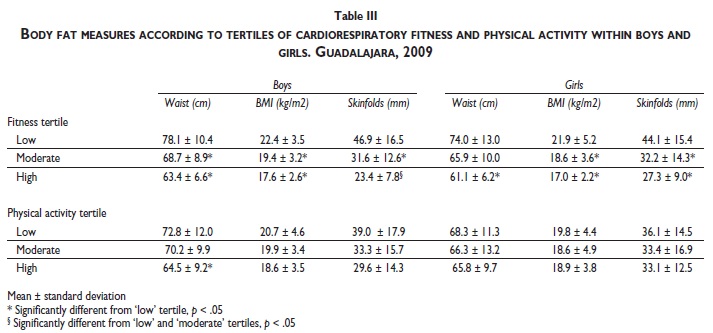
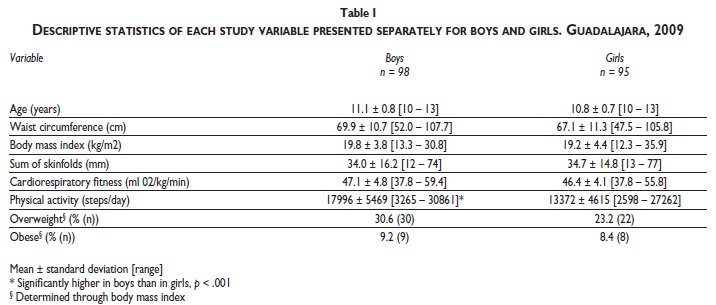
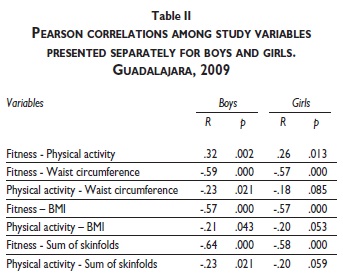
<body><![CDATA[<p>&nbsp;</p>     <p><font face="Verdana" size="3"><b>Cardiorespiratory fitness</b></font></p>     <p><font face="Verdana" size="2">The 20 meter shuttle run test<sup>24</sup> was   used to measure fitness. All testing was completed on a firm and level surface   (concrete play area at each school). For this test, children were required to   run back and forth between two lines placed 20 meters apart. A sound signal   was emitted from a pre- recorded tape to dictate running speed. Frequency of   the sound signals increased such that running speed increased by 0.5 km/hour   each minute from the starting speed of 8.5 km/ hour. The test ended when children   could no longer keep pace with the sound signal. The last stage that children   reached was used to predict maximal oxygen uptake (VO <sub>2</sub>max) from   the running speed corresponding to that stage (VO<sub>2</sub>max = 31.025 +   3.238 <i>X</i> - 3.248 <i>A</i> + 0.1536, where <i>X </i>= the final speed and<i>   A</i>= age).</font></p>     <p>&nbsp;</p>     <p><font face="Verdana" size="3"><b>Statistical analysis</b></font></p>     <p><font face="Verdana" size="2">Descriptive statistical analyses were conducted   to explore the characteristics of the data and to assess statistical assumptions.   Independent samples t-tests were used to test for gender differences in the   study variables. A one-way analysis of covariance, using Bonferroni post hoc   comparisons, was used to test for differences in the obesity measures across   the low, moderate, and high physical activity and fitness tertiles with age   as covariate. The strength of the associations between variables was determined   using Pearson correlation coefficients. Finally, hierarchical linear regression   was used to determine the independent contributions of physical activity and   fitness on predicting the obesity measures. Statistical significance was set   at<i>p</i> &lt; .05. All statistical analyses were performed with the Statistical   Package for Social Sciences version 18 for Windows.</font></p>     <p>&nbsp;</p>     <p><font face="Verdana" size="3"><b>Results</b></font></p>     <p><font face="Verdana" size="2">Study participants consisted of 98 boys (51%)   and 95 girls (49%) in grades 5 and 6 with a mean age of 11 years. As shown in   <a href="/img/revistas/spm/v54n5/a01tab1.jpg">table&nbsp;I</a>, fitness and the three obesity measures were not significantly different   across gender (<i>p</i> &gt;.05). Similarly, there were no significant differences   in the prevalence of overweight and obesity between boys and girls as determined   by BMI. Physical activity was significantly higher in boys than in girls (17996   vs. 13372 steps/day, <i>p</i> &lt; .001).</font></p>     <p><font face="Verdana" size="2">The Pearson correlation coefficients (<a href="#tab2">table&nbsp;II</a>)   indicate that fitness and physical activity were modestly correlated with each   other (<i>r</i> = 0.32 boys, <i>r</i> = 0.26 girls). As expected, fitness and   physical activity were negatively related to the three obesity measures for   both boys and girls, although some of these associations did not reach statistical   significance for girls. The associations between fitness and the obesity measures   (<i>r</i> = -0.57 to -0.64) were stronger than the associations between physical   activity and the obesity measures (<i>r</i> = -0.18 to -0.23).</font></p>     ]]></body>
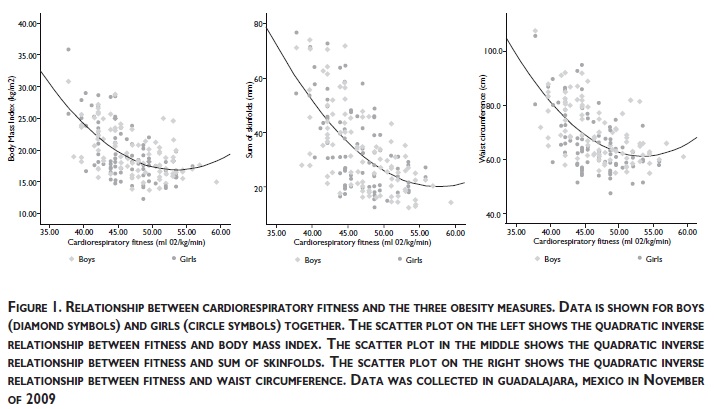
<body><![CDATA[<p>&nbsp;</p>     <p align="center"><a name="tab2"></a><img src="/img/revistas/spm/v54n5/a01tab2.jpg"></p>     <p>&nbsp;</p>     <p><font face="Verdana" size="2">To further explore the dose-response patterns   of the relations, children were divided into low, moderate, and high fitness   and physical activity tertiles (<a href="/img/revistas/spm/v54n5/a01tab3.jpg">table&nbsp;III</a>). After controlling for age, boys   and girls in the moderate and high fitness groups had significantly lower waist   circumference, BMI, and sum of skinfolds values in comparison to boys and girls   in the low fitness groups (<i>p</i> &lt; .05). Furthermore, boys in the high   fitness group had significantly lower sum of skinfolds values than boys in the   moderate fitness group (<i>p</i> &lt; .05). There were no significant differences   between waist circumference and BMI between the moderate and high fitness groups.   The curvilinear nature of the relation between fitness and the obesity measures   is further illustrated in <a href="/img/revistas/spm/v54n5/a01fig1.jpg">figure 1</a>. Unlike the differences that were observed   across fitness tertiles, the differences in waist circumference, BMI, and sum   of skinfolds values across physical activity tertiles were small, and with one   exception (difference in waist circumference in low and high groups in boys),   were not statistically significant.</font></p>     <p><font face="Verdana" size="2">Finally, hierarchical linear regression was used   to determine the independent effects of fitness and physical activity on the   obesity measures. After controlling for age, gender, and physical activity,   fitness accounted for 23% of the variance in waist circumference (<i>r<sup>2</sup></i>   = 0.23, <i>p</i> &lt; .01), 23% of the variance in BMI (<i>r<sup>2</sup></i>   = 0.23, <i>p</i> &lt; .01), and 34% of the variance in the sum of skinfolds   (<i>r<sup>2</sup></i> = 0.34, <i>p</i> &lt; .01). Conversely, after controlling   for age, gender, and fitness, physical activity did not account for a significant   proportion of the variance on any of the obesity measures (<i>r<sup>2</sup></i>   = 0.004, <i>p</i> &gt;.05).</font></p>     <p>&nbsp;</p>     <p><font face="Verdana" size="3"><b>Discussion</b></font></p>     <p><font face="Verdana" size="2">Objectively measured physical activity and fitness   were negatively associated with measures of total (BMI, sum of skinfolds) and   abdominal (waist circumference) obesity in this sample of 10-13 year old Mexican   children. The associations with the obesity measures were stronger and more   consistent for fitness than they were for physical activity. Furthermore, when   fitness and physical activity were considered in the same regression model,   only fitness was a significant predictor, explaining 23 to 34% of the variance   in the obesity measures.</font></p>     <p><font face="Verdana" size="2">The results of the present study of Mexican schoolchildren   suggest that fitness is a stronger correlate and predictor of total and abdominal   obesity than is physical activity. Although few studies have compared the strength   of these associations, those existing have found similar results. For instance,   within a sample of 244 children aged 7 to 10 years old from Dublin, Hussey and   colleagues found that fitness and physical activity were related to waist circumference,   with the stronger correlations being observed for fitness.<sup>20</sup> In that   study, fitness was assessed using the 20 meter shuttle run test and physical   activity by accelerometry during four days. Similarly, Ekelund and colleagues   found that fitness, measured by indirect calirometry, was significantly associated   with body fat estimated by skinfold thickness, whereas physical activity measured   through the minuteby-minute heart rate monitoring method was not, in 82 adolescents   between 14 and 15 years of age.<sup>19</sup> Finally, Tell and Vellar found   that fitness, measured during submaximal bicycle exercise, was a stronger correlate   of BMI and triceps skinfold thickness than self-reported physical activity in   a sample of 413 boys and 372 girls, ages 10 to 14 years.<sup>21</sup></font></p>     <p><font face="Verdana" size="2">It has been reported that fitness is a powerful   marker of health given that is associated with both total and abdominal obesity,<sup>25</sup>   which is consistent with findings presented here. The strongest association   observed was that of total adiposity, followed by abdominal adiposity and BMI.   Because BMI does not measure fat mass or fat distribution directly, it can misclassify   individuals (e.g., a mesomorphic child may be incorrectly classified as obese).   Consequently, additional obesity indicators were used in the present study which   provided better estimates of adiposity.</font></p>     ]]></body>
<body><![CDATA[<p><font face="Verdana" size="2">Given that our findings differ from those that   suggest that physical activity is a strong correlate of obesity in children,<sup>9,17,18</sup>   it is important to consider some factors that may explain our finding. First,   we used pedometry to measure physical activity, which provides an estimate of   children's total physical activity but no information about intensity, which   may need to be of moderate- to vigorous-intensity to significantly affect body   fat.<sup>11,13,14</sup> Second, pedometers do not provide information about   the frequency and duration of physical activity<sup>26</sup> and given they   were worn for four days only, they may not reflect children's habitual physical   activity. Third, given that physical activity measures among children are typically   more difficult and less precise than fitness measures,<sup>27</sup> the observed   associations between the physical activity and obesity measures in the present   study may have been underestimated. Finally, fitness is partly determined by   genetics<sup>28</sup> and perhaps the genetic determinants of fitness also play   an important role in obesity.</font></p>     <p><font face="Verdana" size="2">Even though our findings showed that fitness   is a stronger correlate and better predictor of obesity than physical activity   in Mexican children, the importance of physical activity in preventing childhood   obesity should not be diminished. It has been established that physical activity   has a positive influence on both fitness and fatness in children<sup>13,18</sup>   and that moderate-to vigorous-intensity physical activities are positivelyassociated   with improved fitness.<sup>11,17,29</sup> The small association between physical   activity and fitness found in the present study may be due to the inability   of pedometers to capture the intensity of physical activities and that only   more intense activities impact fitness.<sup>13,18,20</sup> Furthermore, given   that genetics account for around 40 to 50% of fitness,<sup>30</sup>it can be   assumed that the other 50 to 60% can be accounted for by environmental and behavioural   factors that are modifiable such as physical activity.<sup>31</sup> Therefore,   directing efforts toward improving physical activity, especially in children   with the poorer fitness and physical activity levels, seems to be a good avenue   for battling obesity in children.</font></p>     <p><font face="Verdana" size="2">Because children spend a significant amount of   their time at school, strategies for promoting physical activity and fitness   among children can be implemented in this setting. The physical education class   provides an opportunity to engage children in vigorous-intensity physical activities   that can improve fitness. For example, physical educators could promote fitness   during the class by including aerobic physical activities such as running, that   are of a prolonged duration and that make children work at a moderate-to-vigorous   intensity. Finally, given that fitness is associated with obesity in both boys   and girls, the regular assessment of fitness in schools could help identify   unfit children that are at a higher risk of obesity and its related health ailments,   and remedial activity programs could be employed.</font></p>     <p>&nbsp;</p>     <p><font face="Verdana" size="3"><b>Limitations</b></font></p>     <p><font face="Verdana" size="2">The present study has some limitations. The sample   size was small and selected by convenience, which compromises the generalizability   of the findings to a broader Mexican population. Furthermore, the crosssectional   design prevents us from drawing more robust conclusions on the causal relations   between fitness and physical activity with obesity. Another limitation was the   physical activity assessment, which, although objective, was subject to problems.   Specifically, children may not have worn the pedometer properly or may have   tampered with it. Moreover, pedometry measures were only obtained on weekdays,   which prevented us from capturing the physical activities that children performed   during the weekend. Another limitation of the pedometers used in this study   is that crucial information about the intensity and frequency of physical activities   was not obtained.<sup>26</sup> Accelerometers, on the other hand, can measure   both the intensity and frequency of physical activity and provide a better measure   of this complex behaviour. Information about the physical activity intensity   could contribute to a better understanding of the relationships among physical   activity, fitness and obesity and may explain the apparent inconsistency of   the present findings with some of the research discussed above.<sup>9,17,18</sup></font></p>     <p>&nbsp;</p>     <p><font face="Verdana" size="3"><b>Conclusions</b></font></p>     <p><font face="Verdana" size="2">This study investigated the strength of the independent   associations of physical activity and fitness with total and abdominal obesity   in Mexican 5<sup>th</sup> and 6<sup>th</sup> graders. We conclude that fitness   is a stronger correlate and better predictor of total and abdominal adiposity   than is physical activity in this sample of Mexican schoolchildren. Nevertheless,   the importance of physical activity in preventing obesity and promoting improved   fitness should not be discounted as physical activity is the only modifiable   determinant of fitness. This evidence is important given that it can help guide   future public health initiatives aimed at battling childhood obesity in Mexico.   Research involving larger, more representative population samples is required   to further explore these associations in Mexican children.</font></p>     <p>&nbsp;</p>     ]]></body>
<body><![CDATA[<p><font face="Verdana" size="3"><b>Acknowledgments</b></font></p>     <p><font face="Verdana" size="2">The authors thank Ma. Teresa Acosta &Aacute;lvarez,   Sim&oacute;n Barquera, Citlali Gonz&aacute;lez, Mariane H&eacute;roux, Gabriela   Ibarguchi, Ma. del Carmen Inojata Medina, Donna Ivimey, Juan Antonio Jim&eacute;nez,   Lucie L&eacute;vesque, Robert M. Malina, Luis Ortiz Hern&aacute;ndez, Margarita   Safdie, Jes&uacute;s Vald&eacute;s Flores, Cecilia Vallejo Ponce and Marisol   Villegas Balc&aacute;zar, for their involvement in organizing and teaching at   the 3rd Annual CAMBIO Short Course for Obesity Researchers. We are grateful   to all of the short course participants for the assistance with the data collection.   The research team wishes to thank the students, teachers, administrators, staff,   and parents at the schools which participated in the study in Zapopan, Jalisco:   Emiliano Zapata, Cuauht&eacute;moc, Aurelia L. Guevara, and Jos&eacute; Ort&iacute;z   Dom&iacute;nguez.</font></p>     <p><font face="Verdana" size="2"><i>Declaration of conflict of interests</i>.   The authors declare that they have no conflict of interests.</font></p>     <p>&nbsp;</p>     <p><font face="Verdana" size="3"><b>References</b></font></p>     <!-- ref --><p><font face="Verdana" size="2">1. Lobstein T, Baur L, Uauy R. Obesity in children   and young people: a crisis in public health. Obes Rev 2004;5:4-85.    &nbsp;&nbsp;&nbsp;&nbsp;&nbsp;&nbsp;&nbsp;&nbsp;[&#160;<a href="javascript:void(0);" onclick="javascript: window.open('/scielo.php?script=sci_nlinks&ref=9406738&pid=S0036-3634201200050000200001&lng=','','width=640,height=500,resizable=yes,scrollbars=1,menubar=yes,');">Links</a>&#160;]<!-- end-ref --></font></p>     <!-- ref --><p><font face="Verdana" size="2">2. Bonvecchio A, Safdie M, Monterrubio E, Gust   T, Villalpando S, Rivera J. Overweight and obesity trends in Mexican children   2 to 18 years of age from 1988 to 2006. Salud Publica Mex 2009;51(4):586-594.    &nbsp;&nbsp;&nbsp;&nbsp;&nbsp;&nbsp;&nbsp;&nbsp;[&#160;<a href="javascript:void(0);" onclick="javascript: window.open('/scielo.php?script=sci_nlinks&ref=9406740&pid=S0036-3634201200050000200002&lng=','','width=640,height=500,resizable=yes,scrollbars=1,menubar=yes,');">Links</a>&#160;]<!-- end-ref --></font></p>     <!-- ref --><p><font face="Verdana" size="2">3. Shamah T, Villalpando S, Rivera J. Resultados   de Nutrici&oacute;n de la ENSANUT 2006. Cuernavaca, M&eacute;xico: Instituto   Nacional de Salud P&uacute;blica, 2007.    &nbsp;&nbsp;&nbsp;&nbsp;&nbsp;&nbsp;&nbsp;&nbsp;[&#160;<a href="javascript:void(0);" onclick="javascript: window.open('/scielo.php?script=sci_nlinks&ref=9406742&pid=S0036-3634201200050000200003&lng=','','width=640,height=500,resizable=yes,scrollbars=1,menubar=yes,');">Links</a>&#160;]<!-- end-ref --></font></p>     <!-- ref --><p><font face="Verdana" size="2">4. Chu NF, Rimm EB, Wang DJ, Liou HS, Shieh SM.   Clustering of cardiovascular disease risk factors among obese schoolchildren:   the Taipei Children Heart Study. Am J Clin Nutr 1998;67(6):1141-1146.    &nbsp;&nbsp;&nbsp;&nbsp;&nbsp;&nbsp;&nbsp;&nbsp;[&#160;<a href="javascript:void(0);" onclick="javascript: window.open('/scielo.php?script=sci_nlinks&ref=9406744&pid=S0036-3634201200050000200004&lng=','','width=640,height=500,resizable=yes,scrollbars=1,menubar=yes,');">Links</a>&#160;]<!-- end-ref --></font></p>     <!-- ref --><p><font face="Verdana" size="2">5. Cs&aacute;bi G, T&ouml;r&ouml;k K, Jeges S,   Moln&aacute;r D. Presence of metabolic cardiovascular syndrome in obese children.   Eur J Pediatr 2000;159:91-94.    &nbsp;&nbsp;&nbsp;&nbsp;&nbsp;&nbsp;&nbsp;&nbsp;[&#160;<a href="javascript:void(0);" onclick="javascript: window.open('/scielo.php?script=sci_nlinks&ref=9406746&pid=S0036-3634201200050000200005&lng=','','width=640,height=500,resizable=yes,scrollbars=1,menubar=yes,');">Links</a>&#160;]<!-- end-ref --></font></p>     <!-- ref --><p><font face="Verdana" size="2">6. Friedlander SL, Larkin EK, Rosen CL, Palermo   TM, Redline S. Decreased Quality of Life Associated With Obesity in Schoolaged   Children. Arch Pediatr Adolesc Med 2003;157(12):1206-1211.    &nbsp;&nbsp;&nbsp;&nbsp;&nbsp;&nbsp;&nbsp;&nbsp;[&#160;<a href="javascript:void(0);" onclick="javascript: window.open('/scielo.php?script=sci_nlinks&ref=9406748&pid=S0036-3634201200050000200006&lng=','','width=640,height=500,resizable=yes,scrollbars=1,menubar=yes,');">Links</a>&#160;]<!-- end-ref --></font></p>     <!-- ref --><p><font face="Verdana" size="2">7. Janssen I, Katzmarzyk PT, Boyce WF, Vereecken   C, Mulvihill C, Roberts C, <i>et al</i>. Comparison of overweight and obesity   prevalence in schoolaged youth from 34 countries and their relationships with   physical activity and dietary patterns. Obes Rev 2005;6(2):123-132.    &nbsp;&nbsp;&nbsp;&nbsp;&nbsp;&nbsp;&nbsp;&nbsp;[&#160;<a href="javascript:void(0);" onclick="javascript: window.open('/scielo.php?script=sci_nlinks&ref=9406750&pid=S0036-3634201200050000200007&lng=','','width=640,height=500,resizable=yes,scrollbars=1,menubar=yes,');">Links</a>&#160;]<!-- end-ref --></font></p>     <!-- ref --><p><font face="Verdana" size="2">8. Katzmarzyk PT, Tremblay MS. Limitations of   Canada's physical activity data: implications for monitoring trends. Appl Physiol   Nutr Metab 2007;32(S2E):S185-S94.    &nbsp;&nbsp;&nbsp;&nbsp;&nbsp;&nbsp;&nbsp;&nbsp;[&#160;<a href="javascript:void(0);" onclick="javascript: window.open('/scielo.php?script=sci_nlinks&ref=9406752&pid=S0036-3634201200050000200008&lng=','','width=640,height=500,resizable=yes,scrollbars=1,menubar=yes,');">Links</a>&#160;]<!-- end-ref --></font></p>     <!-- ref --><p><font face="Verdana" size="2">9. Dencker M, Thorsson O, Karlsson MK, Lind&eacute;n   C, Wollmer P, Andersen LB. Daily physical activity related to aerobic fitness   and body fat in an urban sample of children. Scand J Med Sci Sports 2008;18(6):728-735.    &nbsp;&nbsp;&nbsp;&nbsp;&nbsp;&nbsp;&nbsp;&nbsp;[&#160;<a href="javascript:void(0);" onclick="javascript: window.open('/scielo.php?script=sci_nlinks&ref=9406754&pid=S0036-3634201200050000200009&lng=','','width=640,height=500,resizable=yes,scrollbars=1,menubar=yes,');">Links</a>&#160;]<!-- end-ref --></font></p>     <!-- ref --><p><font face="Verdana" size="2">10. YoonMyung K, SoJung L. Physical activity   and abdominal obesity in youth. Appl Physiol Nutr Metab 2009;34(4):571-81.    &nbsp;&nbsp;&nbsp;&nbsp;&nbsp;&nbsp;&nbsp;&nbsp;[&#160;<a href="javascript:void(0);" onclick="javascript: window.open('/scielo.php?script=sci_nlinks&ref=9406756&pid=S0036-3634201200050000200010&lng=','','width=640,height=500,resizable=yes,scrollbars=1,menubar=yes,');">Links</a>&#160;]<!-- end-ref --></font></p>     <!-- ref --><p><font face="Verdana" size="2">11. Moliner UD, Ruiz JR, Ortega FB, Rey-Lopez   JP, Vicente-Rodriguez G, Espana-Romero V, <i>et al</i>. Association of objectively   assessed physical activity with total and central body fat in Spanish adolescents;   The HELENA Study. Int J Obes 2009;33(10):1126-1135.    &nbsp;&nbsp;&nbsp;&nbsp;&nbsp;&nbsp;&nbsp;&nbsp;[&#160;<a href="javascript:void(0);" onclick="javascript: window.open('/scielo.php?script=sci_nlinks&ref=9406758&pid=S0036-3634201200050000200011&lng=','','width=640,height=500,resizable=yes,scrollbars=1,menubar=yes,');">Links</a>&#160;]<!-- end-ref --></font></p>     <!-- ref --><p><font face="Verdana" size="2">12. Moore LL, Gao D, Bradlee ML, Cupples LA,   Sundarajan-Ramamurti A, Proctor MH, <i>et al.</i> Does early physical activity   predict body fat change throughout childhood? Prev Med 2003;37(1):10-17.    &nbsp;&nbsp;&nbsp;&nbsp;&nbsp;&nbsp;&nbsp;&nbsp;[&#160;<a href="javascript:void(0);" onclick="javascript: window.open('/scielo.php?script=sci_nlinks&ref=9406760&pid=S0036-3634201200050000200012&lng=','','width=640,height=500,resizable=yes,scrollbars=1,menubar=yes,');">Links</a>&#160;]<!-- end-ref --></font></p>     <!-- ref --><p><font face="Verdana" size="2">13. Gutin B, Yin Z, Humphries MC, Barbeau P.   Relations of moderate and vigorous physical activity to fitness and fatness   in adolescents. Am J Clin Nutr 2005;81(4):746-750.    &nbsp;&nbsp;&nbsp;&nbsp;&nbsp;&nbsp;&nbsp;&nbsp;[&#160;<a href="javascript:void(0);" onclick="javascript: window.open('/scielo.php?script=sci_nlinks&ref=9406762&pid=S0036-3634201200050000200013&lng=','','width=640,height=500,resizable=yes,scrollbars=1,menubar=yes,');">Links</a>&#160;]<!-- end-ref --></font></p>     <!-- ref --><p><font face="Verdana" size="2">14. Abbott RA, Davies PSW. Habitual physical   activity and physical activity intensity: their relation to body composition   in 5.0-10.5-y-old children. Eur J Clin Nutr 2005;58(2):285-291.    &nbsp;&nbsp;&nbsp;&nbsp;&nbsp;&nbsp;&nbsp;&nbsp;[&#160;<a href="javascript:void(0);" onclick="javascript: window.open('/scielo.php?script=sci_nlinks&ref=9406764&pid=S0036-3634201200050000200014&lng=','','width=640,height=500,resizable=yes,scrollbars=1,menubar=yes,');">Links</a>&#160;]<!-- end-ref --></font></p>     <!-- ref --><p><font face="Verdana" size="2">15. Klasson-Heggeb&oslash; L, Andersen LB, Wennl&ouml;f   AH, Sardinha LB, Harro M, Froberg K, <i>et al</i>. Graded associations between   cardiorespiratory fitness, fatness, and blood pressure in children and adolescents.   Br J Sports Med 2006;40(1):25-29.    &nbsp;&nbsp;&nbsp;&nbsp;&nbsp;&nbsp;&nbsp;&nbsp;[&#160;<a href="javascript:void(0);" onclick="javascript: window.open('/scielo.php?script=sci_nlinks&ref=9406766&pid=S0036-3634201200050000200015&lng=','','width=640,height=500,resizable=yes,scrollbars=1,menubar=yes,');">Links</a>&#160;]<!-- end-ref --></font></p>     <!-- ref --><p><font face="Verdana" size="2">16. Nassis GP, Psarra G, Sidossis LS. Central   and total adiposity are lower in overweight and obese children with high cardiorespiratory   fitness. Eur J Clin Nutr 2004;59(1):137-141.    &nbsp;&nbsp;&nbsp;&nbsp;&nbsp;&nbsp;&nbsp;&nbsp;[&#160;<a href="javascript:void(0);" onclick="javascript: window.open('/scielo.php?script=sci_nlinks&ref=9406768&pid=S0036-3634201200050000200016&lng=','','width=640,height=500,resizable=yes,scrollbars=1,menubar=yes,');">Links</a>&#160;]<!-- end-ref --></font></p>     <!-- ref --><p><font face="Verdana" size="2">17. Rowlands A, Eston RG, Ingledew DK. Relationship   between activity levels, aerobic fitness, and body fat in 8- to 10-yr-old children.   J Appl Physiol 1999;86(4):1428-1435.    &nbsp;&nbsp;&nbsp;&nbsp;&nbsp;&nbsp;&nbsp;&nbsp;[&#160;<a href="javascript:void(0);" onclick="javascript: window.open('/scielo.php?script=sci_nlinks&ref=9406770&pid=S0036-3634201200050000200017&lng=','','width=640,height=500,resizable=yes,scrollbars=1,menubar=yes,');">Links</a>&#160;]<!-- end-ref --></font></p>     <!-- ref --><p><font face="Verdana" size="2">18. Ruiz JR, Rizzo NS, Hurtig-Wennl&ouml;f A,   Ortega FB, W&ouml;rnberg J, Sj&ouml;str&ouml;m M. Relations of total physical   activity and intensity to fitness and fatness in children: the European Youth   Heart Study. Am J Clin Nutr 2006;84(2):299-303.    &nbsp;&nbsp;&nbsp;&nbsp;&nbsp;&nbsp;&nbsp;&nbsp;[&#160;<a href="javascript:void(0);" onclick="javascript: window.open('/scielo.php?script=sci_nlinks&ref=9406772&pid=S0036-3634201200050000200018&lng=','','width=640,height=500,resizable=yes,scrollbars=1,menubar=yes,');">Links</a>&#160;]<!-- end-ref --></font></p>     <!-- ref --><p><font face="Verdana" size="2">19. Ekelund U, Poortvliet E, Nilsson A, Yngve   A, Holmberg A, Sj&ouml;str&ouml;m M. Physical activity in relation to aerobic   fitness and body fat in 14- to 15-year-old boys and girls. Eur J Appl Physiol   2001;85(3):195-201.    &nbsp;&nbsp;&nbsp;&nbsp;&nbsp;&nbsp;&nbsp;&nbsp;[&#160;<a href="javascript:void(0);" onclick="javascript: window.open('/scielo.php?script=sci_nlinks&ref=9406774&pid=S0036-3634201200050000200019&lng=','','width=640,height=500,resizable=yes,scrollbars=1,menubar=yes,');">Links</a>&#160;]<!-- end-ref --></font></p>     <!-- ref --><p><font face="Verdana" size="2">20. Hussey J, Bell C, Bennett K, O'Dwyer J, Gormley   J. Relationship between the intensity of physical activity, inactivity, cardiorespiratory   fitness and body composition in 7-10-year-old Dublin children. Br J Sports Med   2007;41(5):311-316.    &nbsp;&nbsp;&nbsp;&nbsp;&nbsp;&nbsp;&nbsp;&nbsp;[&#160;<a href="javascript:void(0);" onclick="javascript: window.open('/scielo.php?script=sci_nlinks&ref=9406776&pid=S0036-3634201200050000200020&lng=','','width=640,height=500,resizable=yes,scrollbars=1,menubar=yes,');">Links</a>&#160;]<!-- end-ref --></font></p>     <!-- ref --><p><font face="Verdana" size="2">21. Tell GS, Vellar OD. Physical fitness, physical   activity, and cardiovascular disease risk factors in adolescents: The Oslo youth   study. Prev Med 1988;17(1):12-24.    &nbsp;&nbsp;&nbsp;&nbsp;&nbsp;&nbsp;&nbsp;&nbsp;[&#160;<a href="javascript:void(0);" onclick="javascript: window.open('/scielo.php?script=sci_nlinks&ref=9406778&pid=S0036-3634201200050000200021&lng=','','width=640,height=500,resizable=yes,scrollbars=1,menubar=yes,');">Links</a>&#160;]<!-- end-ref --></font></p>     <!-- ref --><p><font face="Verdana" size="2">22. Eisenmann JC, Katzmarzyk PT, Perusse L, Tremblay   A, Despres JP, Bouchard C. Aerobic fitness, body mass index, and CVD risk factors   among adolescents: the Quebec family study. Int J Obes 2005;29(9):1077-1083.    &nbsp;&nbsp;&nbsp;&nbsp;&nbsp;&nbsp;&nbsp;&nbsp;[&#160;<a href="javascript:void(0);" onclick="javascript: window.open('/scielo.php?script=sci_nlinks&ref=9406780&pid=S0036-3634201200050000200022&lng=','','width=640,height=500,resizable=yes,scrollbars=1,menubar=yes,');">Links</a>&#160;]<!-- end-ref --></font></p>     <!-- ref --><p><font face="Verdana" size="2">23. Canadian Society for Exercise Physiology.   Canadian Physical Activity, Fitness &amp; Lifestyle Approach: CSEP-Health &amp;   Fitness Program's Health-Related Appraisal and Counselling Strategy (3rd edition).   Ottawa: Canada, 2003.    &nbsp;&nbsp;&nbsp;&nbsp;&nbsp;&nbsp;&nbsp;&nbsp;[&#160;<a href="javascript:void(0);" onclick="javascript: window.open('/scielo.php?script=sci_nlinks&ref=9406782&pid=S0036-3634201200050000200023&lng=','','width=640,height=500,resizable=yes,scrollbars=1,menubar=yes,');">Links</a>&#160;]<!-- end-ref --></font></p>     <!-- ref --><p><font face="Verdana" size="2">24. L&eacute;ger LA, Mercier D, Gadoury C, Lambert   J. The multistage 20 metre shuttle run test for aerobic fitness. J Sports Sci   1988;6(2):93-101.    &nbsp;&nbsp;&nbsp;&nbsp;&nbsp;&nbsp;&nbsp;&nbsp;[&#160;<a href="javascript:void(0);" onclick="javascript: window.open('/scielo.php?script=sci_nlinks&ref=9406784&pid=S0036-3634201200050000200024&lng=','','width=640,height=500,resizable=yes,scrollbars=1,menubar=yes,');">Links</a>&#160;]<!-- end-ref --></font></p>     <!-- ref --><p><font face="Verdana" size="2">25. Ortega FB, Ruiz JR, Castillo MJ, Sjostrom   M. Physical fitness in childhood and adolescence: a powerful marker of health.   Int J Obes 2008;32:1-11.    &nbsp;&nbsp;&nbsp;&nbsp;&nbsp;&nbsp;&nbsp;&nbsp;[&#160;<a href="javascript:void(0);" onclick="javascript: window.open('/scielo.php?script=sci_nlinks&ref=9406786&pid=S0036-3634201200050000200025&lng=','','width=640,height=500,resizable=yes,scrollbars=1,menubar=yes,');">Links</a>&#160;]<!-- end-ref --></font></p>     <!-- ref --><p><font face="Verdana" size="2">26. Trost SG. Objective Measurement of Physical   Activity in Youth: Current Issues, Future Directions. Exerc Sport Sci Rev 2001;29(1):32-36.    &nbsp;&nbsp;&nbsp;&nbsp;&nbsp;&nbsp;&nbsp;&nbsp;[&#160;<a href="javascript:void(0);" onclick="javascript: window.open('/scielo.php?script=sci_nlinks&ref=9406788&pid=S0036-3634201200050000200026&lng=','','width=640,height=500,resizable=yes,scrollbars=1,menubar=yes,');">Links</a>&#160;]<!-- end-ref --></font></p>     <!-- ref --><p><font face="Verdana" size="2">27. Ekelund U. Cardiorespiratory fitness, exercise   capacity and physical activity in children: are we measuring the right thing?   Arch Dis Child 2008; 93(6): 455-456.    &nbsp;&nbsp;&nbsp;&nbsp;&nbsp;&nbsp;&nbsp;&nbsp;[&#160;<a href="javascript:void(0);" onclick="javascript: window.open('/scielo.php?script=sci_nlinks&ref=9406790&pid=S0036-3634201200050000200027&lng=','','width=640,height=500,resizable=yes,scrollbars=1,menubar=yes,');">Links</a>&#160;]<!-- end-ref --></font></p>     <!-- ref --><p><font face="Verdana" size="2">28. Bouchard C. Genetics of aerobic power and   capacity. In: Malina R, Bouchard C, ed. Sport and Human Genetics. Champaign,   Illinois: Human Kinetics, 1986:49-88.    &nbsp;&nbsp;&nbsp;&nbsp;&nbsp;&nbsp;&nbsp;&nbsp;[&#160;<a href="javascript:void(0);" onclick="javascript: window.open('/scielo.php?script=sci_nlinks&ref=9406792&pid=S0036-3634201200050000200028&lng=','','width=640,height=500,resizable=yes,scrollbars=1,menubar=yes,');">Links</a>&#160;]<!-- end-ref --></font></p>     <!-- ref --><p><font face="Verdana" size="2">29. Dencker M, Thorsson O, Karlsson M, Lind&eacute;n   C, Svensson J, Wollmer P, <i>et al</i>. Daily physical activity and its relation   to aerobic fitness in children aged 8-11 years. Eur J Appl Physiol 2006;96(5):587-592.    &nbsp;&nbsp;&nbsp;&nbsp;&nbsp;&nbsp;&nbsp;&nbsp;[&#160;<a href="javascript:void(0);" onclick="javascript: window.open('/scielo.php?script=sci_nlinks&ref=9406794&pid=S0036-3634201200050000200029&lng=','','width=640,height=500,resizable=yes,scrollbars=1,menubar=yes,');">Links</a>&#160;]<!-- end-ref --></font></p>     <!-- ref --><p><font face="Verdana" size="2">30. Bouchard C, Malina R, M. Genetics of physiological   fitness and motor performance. In: Terjung R, ed. Exercise and Sport Sciences   Reviews. Philadelphia: Franklin Institute Press, 1983:306-339.    &nbsp;&nbsp;&nbsp;&nbsp;&nbsp;&nbsp;&nbsp;&nbsp;[&#160;<a href="javascript:void(0);" onclick="javascript: window.open('/scielo.php?script=sci_nlinks&ref=9406796&pid=S0036-3634201200050000200030&lng=','','width=640,height=500,resizable=yes,scrollbars=1,menubar=yes,');">Links</a>&#160;]<!-- end-ref --></font></p>     <!-- ref --><p><font face="Verdana" size="2">31. Pate RR, Dowda M, Ross JG. Associations Between   Physical Activity and Physical Fitness in American Children. Am J Dis Child   1990;144(10):1123-1129.    &nbsp;&nbsp;&nbsp;&nbsp;&nbsp;&nbsp;&nbsp;&nbsp;[&#160;<a href="javascript:void(0);" onclick="javascript: window.open('/scielo.php?script=sci_nlinks&ref=9406798&pid=S0036-3634201200050000200031&lng=','','width=640,height=500,resizable=yes,scrollbars=1,menubar=yes,');">Links</a>&#160;]<!-- end-ref --></font></p>     <p>&nbsp;</p>     <p>&nbsp;</p>     <p><a name="end" href="#top"><img src="/img/revistas/spm/v54n5/seta.jpg" border="0"></a>   <font face="Verdana" size="2"><b>Corresponding author:</b>    ]]></body>
<body><![CDATA[<br>  Karla I. Galav&iacute;z    <br>  School of Kinesiology and Health Studies, Queen's University #28 Division Street    <br>  Kingston, ON, Canada K7L 3N6    <br>  E-mail: <a href="mailto:7kg18@queensu.ca">7kg18@queensu.ca</a></font></p>     <p><font face="Verdana" size="2"><b>Received on: </b>January 11, 2012    <br>  <b>Accepted on: </b>June 1, 2012</font></p>      ]]></body><back>
<ref-list>
<ref id="B1">
<label>1</label><nlm-citation citation-type="journal">
<person-group person-group-type="author">
<name>
<surname><![CDATA[Lobstein]]></surname>
<given-names><![CDATA[T]]></given-names>
</name>
<name>
<surname><![CDATA[Baur]]></surname>
<given-names><![CDATA[L]]></given-names>
</name>
<name>
<surname><![CDATA[Uauy]]></surname>
<given-names><![CDATA[R]]></given-names>
</name>
</person-group>
<article-title xml:lang="en"><![CDATA[Obesity in children and young people: a crisis in public health]]></article-title>
<source><![CDATA[Obes Rev]]></source>
<year>2004</year>
<volume>5</volume>
<page-range>4-85</page-range></nlm-citation>
</ref>
<ref id="B2">
<label>2</label><nlm-citation citation-type="journal">
<person-group person-group-type="author">
<name>
<surname><![CDATA[Bonvecchio]]></surname>
<given-names><![CDATA[A]]></given-names>
</name>
<name>
<surname><![CDATA[Safdie]]></surname>
<given-names><![CDATA[M]]></given-names>
</name>
<name>
<surname><![CDATA[Monterrubio]]></surname>
<given-names><![CDATA[E]]></given-names>
</name>
<name>
<surname><![CDATA[Gust]]></surname>
<given-names><![CDATA[T]]></given-names>
</name>
<name>
<surname><![CDATA[Villalpando]]></surname>
<given-names><![CDATA[S]]></given-names>
</name>
<name>
<surname><![CDATA[Rivera]]></surname>
<given-names><![CDATA[J]]></given-names>
</name>
</person-group>
<article-title xml:lang="en"><![CDATA[Overweight and obesity trends in Mexican children 2 to 18 years of age from 1988 to 2006]]></article-title>
<source><![CDATA[Salud Publica Mex]]></source>
<year>2009</year>
<volume>51</volume>
<numero>4</numero>
<issue>4</issue>
<page-range>586-594</page-range></nlm-citation>
</ref>
<ref id="B3">
<label>3</label><nlm-citation citation-type="book">
<person-group person-group-type="author">
<name>
<surname><![CDATA[Shamah]]></surname>
<given-names><![CDATA[T]]></given-names>
</name>
<name>
<surname><![CDATA[Villalpando]]></surname>
<given-names><![CDATA[S]]></given-names>
</name>
<name>
<surname><![CDATA[Rivera]]></surname>
<given-names><![CDATA[J]]></given-names>
</name>
</person-group>
<source><![CDATA[Resultados de Nutrición de la ENSANUT 2006.]]></source>
<year>2007</year>
<publisher-loc><![CDATA[Cuernavaca ]]></publisher-loc>
<publisher-name><![CDATA[Instituto Nacional de Salud Pública]]></publisher-name>
</nlm-citation>
</ref>
<ref id="B4">
<label>4</label><nlm-citation citation-type="journal">
<person-group person-group-type="author">
<name>
<surname><![CDATA[Chu]]></surname>
<given-names><![CDATA[NF]]></given-names>
</name>
<name>
<surname><![CDATA[Rimm]]></surname>
<given-names><![CDATA[EB]]></given-names>
</name>
<name>
<surname><![CDATA[Wang]]></surname>
<given-names><![CDATA[DJ]]></given-names>
</name>
<name>
<surname><![CDATA[Liou]]></surname>
<given-names><![CDATA[HS]]></given-names>
</name>
<name>
<surname><![CDATA[Shieh]]></surname>
<given-names><![CDATA[SM]]></given-names>
</name>
</person-group>
<article-title xml:lang="en"><![CDATA[Clustering of cardiovascular disease risk factors among obese schoolchildren: the Taipei Children Heart Study]]></article-title>
<source><![CDATA[Am J Clin Nutr]]></source>
<year>1998</year>
<volume>67</volume>
<numero>6</numero>
<issue>6</issue>
<page-range>1141-1146</page-range></nlm-citation>
</ref>
<ref id="B5">
<label>5</label><nlm-citation citation-type="journal">
<person-group person-group-type="author">
<name>
<surname><![CDATA[Csábi]]></surname>
<given-names><![CDATA[G]]></given-names>
</name>
<name>
<surname><![CDATA[Török]]></surname>
<given-names><![CDATA[K]]></given-names>
</name>
<name>
<surname><![CDATA[Jeges]]></surname>
<given-names><![CDATA[S]]></given-names>
</name>
<name>
<surname><![CDATA[Molnár]]></surname>
<given-names><![CDATA[D]]></given-names>
</name>
</person-group>
<article-title xml:lang="en"><![CDATA[Presence of metabolic cardiovascular syndrome in obese children]]></article-title>
<source><![CDATA[Eur J Pediatr]]></source>
<year>2000</year>
<volume>159</volume>
<page-range>91-94</page-range></nlm-citation>
</ref>
<ref id="B6">
<label>6</label><nlm-citation citation-type="journal">
<person-group person-group-type="author">
<name>
<surname><![CDATA[Friedlander]]></surname>
<given-names><![CDATA[SL]]></given-names>
</name>
<name>
<surname><![CDATA[Larkin]]></surname>
<given-names><![CDATA[EK]]></given-names>
</name>
<name>
<surname><![CDATA[Rosen]]></surname>
<given-names><![CDATA[CL]]></given-names>
</name>
<name>
<surname><![CDATA[Palermo]]></surname>
<given-names><![CDATA[TM]]></given-names>
</name>
<name>
<surname><![CDATA[Redline]]></surname>
<given-names><![CDATA[S]]></given-names>
</name>
</person-group>
<article-title xml:lang="en"><![CDATA[Decreased Quality of Life Associated With Obesity in Schoolaged Children]]></article-title>
<source><![CDATA[Arch Pediatr Adolesc Med]]></source>
<year>2003</year>
<volume>157</volume>
<numero>12</numero>
<issue>12</issue>
<page-range>1206-1211</page-range></nlm-citation>
</ref>
<ref id="B7">
<label>7</label><nlm-citation citation-type="journal">
<person-group person-group-type="author">
<name>
<surname><![CDATA[Janssen]]></surname>
<given-names><![CDATA[I]]></given-names>
</name>
<name>
<surname><![CDATA[Katzmarzyk]]></surname>
<given-names><![CDATA[PT]]></given-names>
</name>
<name>
<surname><![CDATA[Boyce]]></surname>
<given-names><![CDATA[WF]]></given-names>
</name>
<name>
<surname><![CDATA[Vereecken]]></surname>
<given-names><![CDATA[C]]></given-names>
</name>
<name>
<surname><![CDATA[Mulvihill]]></surname>
<given-names><![CDATA[C]]></given-names>
</name>
<name>
<surname><![CDATA[Roberts]]></surname>
<given-names><![CDATA[C]]></given-names>
</name>
</person-group>
<article-title xml:lang="en"><![CDATA[Comparison of overweight and obesity prevalence in schoolaged youth from 34 countries and their relationships with physical activity and dietary patterns]]></article-title>
<source><![CDATA[Obes Rev]]></source>
<year>2005</year>
<volume>6</volume>
<numero>2</numero>
<issue>2</issue>
<page-range>123-132</page-range></nlm-citation>
</ref>
<ref id="B8">
<label>8</label><nlm-citation citation-type="journal">
<person-group person-group-type="author">
<name>
<surname><![CDATA[Katzmarzyk]]></surname>
<given-names><![CDATA[PT]]></given-names>
</name>
<name>
<surname><![CDATA[Tremblay]]></surname>
<given-names><![CDATA[MS]]></given-names>
</name>
</person-group>
<article-title xml:lang="en"><![CDATA[Limitations of Canada's physical activity data: implications for monitoring trends]]></article-title>
<source><![CDATA[Appl Physiol Nutr Metab]]></source>
<year>2007</year>
<volume>32</volume>
<numero>S2E</numero>
<issue>S2E</issue>
<page-range>S185-S94</page-range></nlm-citation>
</ref>
<ref id="B9">
<label>9</label><nlm-citation citation-type="journal">
<person-group person-group-type="author">
<name>
<surname><![CDATA[Dencker]]></surname>
<given-names><![CDATA[M]]></given-names>
</name>
<name>
<surname><![CDATA[Thorsson]]></surname>
<given-names><![CDATA[O]]></given-names>
</name>
<name>
<surname><![CDATA[Karlsson]]></surname>
<given-names><![CDATA[MK]]></given-names>
</name>
<name>
<surname><![CDATA[Lindén]]></surname>
<given-names><![CDATA[C]]></given-names>
</name>
<name>
<surname><![CDATA[Wollmer]]></surname>
<given-names><![CDATA[P]]></given-names>
</name>
<name>
<surname><![CDATA[Andersen]]></surname>
<given-names><![CDATA[LB]]></given-names>
</name>
</person-group>
<article-title xml:lang="en"><![CDATA[Daily physical activity related to aerobic fitness and body fat in an urban sample of children]]></article-title>
<source><![CDATA[Scand J Med Sci Sports]]></source>
<year>2008</year>
<volume>18</volume>
<numero>6</numero>
<issue>6</issue>
<page-range>728-735</page-range></nlm-citation>
</ref>
<ref id="B10">
<label>10</label><nlm-citation citation-type="journal">
<person-group person-group-type="author">
<name>
<surname><![CDATA[YoonMyung]]></surname>
<given-names><![CDATA[K]]></given-names>
</name>
<name>
<surname><![CDATA[SoJung]]></surname>
<given-names><![CDATA[L]]></given-names>
</name>
</person-group>
<article-title xml:lang="en"><![CDATA[Physical activity and abdominal obesity in youth]]></article-title>
<source><![CDATA[Appl Physiol Nutr Metab]]></source>
<year>2009</year>
<volume>34</volume>
<numero>4</numero>
<issue>4</issue>
<page-range>571-81</page-range></nlm-citation>
</ref>
<ref id="B11">
<label>11</label><nlm-citation citation-type="journal">
<person-group person-group-type="author">
<name>
<surname><![CDATA[Moliner]]></surname>
<given-names><![CDATA[UD]]></given-names>
</name>
<name>
<surname><![CDATA[Ruiz]]></surname>
<given-names><![CDATA[JR]]></given-names>
</name>
<name>
<surname><![CDATA[Ortega]]></surname>
<given-names><![CDATA[FB]]></given-names>
</name>
<name>
<surname><![CDATA[Rey-Lopez]]></surname>
<given-names><![CDATA[JP]]></given-names>
</name>
<name>
<surname><![CDATA[Vicente-Rodriguez]]></surname>
<given-names><![CDATA[G]]></given-names>
</name>
<name>
<surname><![CDATA[Espana-Romero]]></surname>
<given-names><![CDATA[V]]></given-names>
</name>
</person-group>
<article-title xml:lang="en"><![CDATA[Association of objectively assessed physical activity with total and central body fat in Spanish adolescents; The HELENA Study]]></article-title>
<source><![CDATA[Int J Obes]]></source>
<year>2009</year>
<volume>33</volume>
<numero>10</numero>
<issue>10</issue>
<page-range>1126-1135</page-range></nlm-citation>
</ref>
<ref id="B12">
<label>12</label><nlm-citation citation-type="journal">
<person-group person-group-type="author">
<name>
<surname><![CDATA[Moore]]></surname>
<given-names><![CDATA[LL]]></given-names>
</name>
<name>
<surname><![CDATA[Gao]]></surname>
<given-names><![CDATA[D]]></given-names>
</name>
<name>
<surname><![CDATA[Bradlee]]></surname>
<given-names><![CDATA[ML]]></given-names>
</name>
<name>
<surname><![CDATA[Cupples]]></surname>
<given-names><![CDATA[LA]]></given-names>
</name>
<name>
<surname><![CDATA[Sundarajan-Ramamurti]]></surname>
<given-names><![CDATA[A]]></given-names>
</name>
<name>
<surname><![CDATA[Proctor]]></surname>
<given-names><![CDATA[MH]]></given-names>
</name>
</person-group>
<article-title xml:lang="en"><![CDATA[Does early physical activity predict body fat change throughout childhood]]></article-title>
<source><![CDATA[Prev Med]]></source>
<year>2003</year>
<volume>37</volume>
<numero>1</numero>
<issue>1</issue>
<page-range>10-17</page-range></nlm-citation>
</ref>
<ref id="B13">
<label>13</label><nlm-citation citation-type="journal">
<person-group person-group-type="author">
<name>
<surname><![CDATA[Gutin]]></surname>
<given-names><![CDATA[B]]></given-names>
</name>
<name>
<surname><![CDATA[Yin]]></surname>
<given-names><![CDATA[Z]]></given-names>
</name>
<name>
<surname><![CDATA[Humphries]]></surname>
<given-names><![CDATA[MC]]></given-names>
</name>
<name>
<surname><![CDATA[Barbeau]]></surname>
<given-names><![CDATA[P]]></given-names>
</name>
</person-group>
<article-title xml:lang="en"><![CDATA[Relations of moderate and vigorous physical activity to fitness and fatness in adolescents]]></article-title>
<source><![CDATA[Am J Clin Nutr]]></source>
<year>2005</year>
<volume>81</volume>
<numero>4</numero>
<issue>4</issue>
<page-range>746-750</page-range></nlm-citation>
</ref>
<ref id="B14">
<label>14</label><nlm-citation citation-type="journal">
<person-group person-group-type="author">
<name>
<surname><![CDATA[Abbott]]></surname>
<given-names><![CDATA[RA]]></given-names>
</name>
<name>
<surname><![CDATA[Davies]]></surname>
<given-names><![CDATA[PSW]]></given-names>
</name>
</person-group>
<article-title xml:lang="en"><![CDATA[Habitual physical activity and physical activity intensity: their relation to body composition in 5.0-10.5-y-old children]]></article-title>
<source><![CDATA[Eur J Clin Nutr]]></source>
<year>2005</year>
<volume>58</volume>
<numero>2</numero>
<issue>2</issue>
<page-range>285-291</page-range></nlm-citation>
</ref>
<ref id="B15">
<label>15</label><nlm-citation citation-type="journal">
<person-group person-group-type="author">
<name>
<surname><![CDATA[Klasson-Heggebø]]></surname>
<given-names><![CDATA[L]]></given-names>
</name>
<name>
<surname><![CDATA[Andersen]]></surname>
<given-names><![CDATA[LB]]></given-names>
</name>
<name>
<surname><![CDATA[Wennlöf]]></surname>
<given-names><![CDATA[AH]]></given-names>
</name>
<name>
<surname><![CDATA[Sardinha]]></surname>
<given-names><![CDATA[LB]]></given-names>
</name>
<name>
<surname><![CDATA[Harro]]></surname>
<given-names><![CDATA[M]]></given-names>
</name>
<name>
<surname><![CDATA[Froberg]]></surname>
<given-names><![CDATA[K]]></given-names>
</name>
</person-group>
<article-title xml:lang="en"><![CDATA[Graded associations between cardiorespiratory fitness, fatness, and blood pressure in children and adolescents]]></article-title>
<source><![CDATA[Br J Sports Med]]></source>
<year>2006</year>
<volume>40</volume>
<numero>1</numero>
<issue>1</issue>
<page-range>25-29</page-range></nlm-citation>
</ref>
<ref id="B16">
<label>16</label><nlm-citation citation-type="journal">
<person-group person-group-type="author">
<name>
<surname><![CDATA[Nassis]]></surname>
<given-names><![CDATA[GP]]></given-names>
</name>
<name>
<surname><![CDATA[Psarra]]></surname>
<given-names><![CDATA[G]]></given-names>
</name>
<name>
<surname><![CDATA[Sidossis]]></surname>
<given-names><![CDATA[LS]]></given-names>
</name>
</person-group>
<article-title xml:lang="en"><![CDATA[Central and total adiposity are lower in overweight and obese children with high cardiorespiratory fitness]]></article-title>
<source><![CDATA[Eur J Clin Nutr]]></source>
<year>2004</year>
<volume>59</volume>
<numero>1</numero>
<issue>1</issue>
<page-range>137-141</page-range></nlm-citation>
</ref>
<ref id="B17">
<label>17</label><nlm-citation citation-type="journal">
<person-group person-group-type="author">
<name>
<surname><![CDATA[Rowlands]]></surname>
<given-names><![CDATA[A]]></given-names>
</name>
<name>
<surname><![CDATA[Eston]]></surname>
<given-names><![CDATA[RG]]></given-names>
</name>
<name>
<surname><![CDATA[Ingledew]]></surname>
<given-names><![CDATA[DK]]></given-names>
</name>
</person-group>
<article-title xml:lang="en"><![CDATA[Relationship between activity levels, aerobic fitness, and body fat in 8- to 10-yr-old children]]></article-title>
<source><![CDATA[J Appl Physiol]]></source>
<year>1999</year>
<volume>86</volume>
<numero>4</numero>
<issue>4</issue>
<page-range>1428-1435</page-range></nlm-citation>
</ref>
<ref id="B18">
<label>18</label><nlm-citation citation-type="journal">
<person-group person-group-type="author">
<name>
<surname><![CDATA[Ruiz]]></surname>
<given-names><![CDATA[JR]]></given-names>
</name>
<name>
<surname><![CDATA[Rizzo]]></surname>
<given-names><![CDATA[NS]]></given-names>
</name>
<name>
<surname><![CDATA[Hurtig-Wennlöf]]></surname>
<given-names><![CDATA[A]]></given-names>
</name>
<name>
<surname><![CDATA[Ortega]]></surname>
<given-names><![CDATA[FB]]></given-names>
</name>
<name>
<surname><![CDATA[Wörnberg]]></surname>
<given-names><![CDATA[J]]></given-names>
</name>
<name>
<surname><![CDATA[Sjöström]]></surname>
<given-names><![CDATA[M]]></given-names>
</name>
</person-group>
<article-title xml:lang="en"><![CDATA[Relations of total physical activity and intensity to fitness and fatness in children: the European Youth Heart Study]]></article-title>
<source><![CDATA[Am J Clin Nutr]]></source>
<year>2006</year>
<volume>84</volume>
<numero>2</numero>
<issue>2</issue>
<page-range>299-303</page-range></nlm-citation>
</ref>
<ref id="B19">
<label>19</label><nlm-citation citation-type="journal">
<person-group person-group-type="author">
<name>
<surname><![CDATA[Ekelund]]></surname>
<given-names><![CDATA[U]]></given-names>
</name>
<name>
<surname><![CDATA[Poortvliet]]></surname>
<given-names><![CDATA[E]]></given-names>
</name>
<name>
<surname><![CDATA[Nilsson]]></surname>
<given-names><![CDATA[A]]></given-names>
</name>
<name>
<surname><![CDATA[Yngve]]></surname>
<given-names><![CDATA[A]]></given-names>
</name>
<name>
<surname><![CDATA[Holmberg]]></surname>
<given-names><![CDATA[A]]></given-names>
</name>
<name>
<surname><![CDATA[Sjöström]]></surname>
<given-names><![CDATA[M]]></given-names>
</name>
</person-group>
<article-title xml:lang="en"><![CDATA[Physical activity in relation to aerobic fitness and body fat in 14- to 15-year-old boys and girls]]></article-title>
<source><![CDATA[Eur J Appl Physiol]]></source>
<year>2001</year>
<volume>85</volume>
<numero>3</numero>
<issue>3</issue>
<page-range>195-201</page-range></nlm-citation>
</ref>
<ref id="B20">
<label>20</label><nlm-citation citation-type="journal">
<person-group person-group-type="author">
<name>
<surname><![CDATA[Hussey]]></surname>
<given-names><![CDATA[J]]></given-names>
</name>
<name>
<surname><![CDATA[Bell]]></surname>
<given-names><![CDATA[C]]></given-names>
</name>
<name>
<surname><![CDATA[Bennett]]></surname>
<given-names><![CDATA[K]]></given-names>
</name>
<name>
<surname><![CDATA[O'Dwyer]]></surname>
<given-names><![CDATA[J]]></given-names>
</name>
<name>
<surname><![CDATA[Gormley]]></surname>
<given-names><![CDATA[J]]></given-names>
</name>
</person-group>
<article-title xml:lang="en"><![CDATA[Relationship between the intensity of physical activity, inactivity, cardiorespiratory fitness and body composition in 7-10-year-old Dublin children]]></article-title>
<source><![CDATA[Br J Sports Med]]></source>
<year>2007</year>
<volume>41</volume>
<numero>5</numero>
<issue>5</issue>
<page-range>311-316</page-range></nlm-citation>
</ref>
<ref id="B21">
<label>21</label><nlm-citation citation-type="journal">
<person-group person-group-type="author">
<name>
<surname><![CDATA[Tell]]></surname>
<given-names><![CDATA[GS]]></given-names>
</name>
<name>
<surname><![CDATA[Vellar]]></surname>
<given-names><![CDATA[OD]]></given-names>
</name>
</person-group>
<article-title xml:lang="en"><![CDATA[Physical fitness, physical activity, and cardiovascular disease risk factors in adolescents: The Oslo youth study]]></article-title>
<source><![CDATA[Prev Med]]></source>
<year>1988</year>
<volume>17</volume>
<numero>1</numero>
<issue>1</issue>
<page-range>12-24</page-range></nlm-citation>
</ref>
<ref id="B22">
<label>22</label><nlm-citation citation-type="journal">
<person-group person-group-type="author">
<name>
<surname><![CDATA[Eisenmann]]></surname>
<given-names><![CDATA[JC]]></given-names>
</name>
<name>
<surname><![CDATA[Katzmarzyk]]></surname>
<given-names><![CDATA[PT]]></given-names>
</name>
<name>
<surname><![CDATA[Perusse]]></surname>
<given-names><![CDATA[L]]></given-names>
</name>
<name>
<surname><![CDATA[Tremblay]]></surname>
<given-names><![CDATA[A]]></given-names>
</name>
<name>
<surname><![CDATA[Despres]]></surname>
<given-names><![CDATA[JP]]></given-names>
</name>
<name>
<surname><![CDATA[Bouchard]]></surname>
<given-names><![CDATA[C]]></given-names>
</name>
</person-group>
<article-title xml:lang="en"><![CDATA[Aerobic fitness, body mass index, and CVD risk factors among adolescents: the Quebec family study]]></article-title>
<source><![CDATA[Int J Obes]]></source>
<year>2005</year>
<volume>29</volume>
<numero>9</numero>
<issue>9</issue>
<page-range>1077-1083</page-range></nlm-citation>
</ref>
<ref id="B23">
<label>23</label><nlm-citation citation-type="book">
<collab>Canadian Society for Exercise Physiology</collab>
<source><![CDATA[Canadian Physical Activity, Fitness & Lifestyle Approach: CSEP-Health & Fitness Program's Health-Related Appraisal and Counselling Strategy]]></source>
<year>2003</year>
<edition>3</edition>
<publisher-loc><![CDATA[Ottawa ]]></publisher-loc>
<publisher-name><![CDATA[Canada]]></publisher-name>
</nlm-citation>
</ref>
<ref id="B24">
<label>24</label><nlm-citation citation-type="journal">
<person-group person-group-type="author">
<name>
<surname><![CDATA[Léger]]></surname>
<given-names><![CDATA[LA]]></given-names>
</name>
<name>
<surname><![CDATA[Mercier]]></surname>
<given-names><![CDATA[D]]></given-names>
</name>
<name>
<surname><![CDATA[Gadoury]]></surname>
<given-names><![CDATA[C]]></given-names>
</name>
<name>
<surname><![CDATA[Lambert]]></surname>
<given-names><![CDATA[J]]></given-names>
</name>
</person-group>
<article-title xml:lang="en"><![CDATA[The multistage 20 metre shuttle run test for aerobic fitness]]></article-title>
<source><![CDATA[J Sports Sci]]></source>
<year>1988</year>
<volume>6</volume>
<numero>2</numero>
<issue>2</issue>
<page-range>93-101</page-range></nlm-citation>
</ref>
<ref id="B25">
<label>25</label><nlm-citation citation-type="journal">
<person-group person-group-type="author">
<name>
<surname><![CDATA[Ortega]]></surname>
<given-names><![CDATA[FB]]></given-names>
</name>
<name>
<surname><![CDATA[Ruiz]]></surname>
<given-names><![CDATA[JR]]></given-names>
</name>
<name>
<surname><![CDATA[Castillo]]></surname>
<given-names><![CDATA[MJ]]></given-names>
</name>
<name>
<surname><![CDATA[Sjostrom]]></surname>
<given-names><![CDATA[M]]></given-names>
</name>
</person-group>
<article-title xml:lang="en"><![CDATA[Physical fitness in childhood and adolescence: a powerful marker of health]]></article-title>
<source><![CDATA[Int J Obes]]></source>
<year>2008</year>
<volume>32</volume>
<page-range>1-11</page-range></nlm-citation>
</ref>
<ref id="B26">
<label>26</label><nlm-citation citation-type="journal">
<person-group person-group-type="author">
<name>
<surname><![CDATA[Trost]]></surname>
<given-names><![CDATA[SG]]></given-names>
</name>
</person-group>
<article-title xml:lang="en"><![CDATA[Objective Measurement of Physical Activity in Youth: Current Issues, Future Directions]]></article-title>
<source><![CDATA[Exerc Sport Sci Rev]]></source>
<year>2001</year>
<volume>29</volume>
<numero>1</numero>
<issue>1</issue>
<page-range>32-36</page-range></nlm-citation>
</ref>
<ref id="B27">
<label>27</label><nlm-citation citation-type="journal">
<person-group person-group-type="author">
<name>
<surname><![CDATA[Ekelund]]></surname>
<given-names><![CDATA[U]]></given-names>
</name>
</person-group>
<article-title xml:lang="en"><![CDATA[Cardiorespiratory fitness, exercise capacity and physical activity in children: are we measuring the right thing?]]></article-title>
<source><![CDATA[Arch Dis Child]]></source>
<year>2008</year>
<volume>93</volume>
<numero>6</numero>
<issue>6</issue>
<page-range>455-456</page-range></nlm-citation>
</ref>
<ref id="B28">
<label>28</label><nlm-citation citation-type="book">
<person-group person-group-type="author">
<name>
<surname><![CDATA[Bouchard]]></surname>
<given-names><![CDATA[C]]></given-names>
</name>
</person-group>
<article-title xml:lang="en"><![CDATA[Genetics of aerobic power and capacity]]></article-title>
<person-group person-group-type="editor">
<name>
<surname><![CDATA[Malina]]></surname>
<given-names><![CDATA[R]]></given-names>
</name>
<name>
<surname><![CDATA[Bouchard]]></surname>
<given-names><![CDATA[C]]></given-names>
</name>
</person-group>
<source><![CDATA[Sport and Human Genetics]]></source>
<year>1986</year>
<page-range>49-88</page-range><publisher-loc><![CDATA[Champaign^eIllinois Illinois]]></publisher-loc>
<publisher-name><![CDATA[Human Kinetics]]></publisher-name>
</nlm-citation>
</ref>
<ref id="B29">
<label>29</label><nlm-citation citation-type="journal">
<person-group person-group-type="author">
<name>
<surname><![CDATA[Dencker]]></surname>
<given-names><![CDATA[M]]></given-names>
</name>
<name>
<surname><![CDATA[Thorsson]]></surname>
<given-names><![CDATA[O]]></given-names>
</name>
<name>
<surname><![CDATA[Karlsson]]></surname>
<given-names><![CDATA[M]]></given-names>
</name>
<name>
<surname><![CDATA[Lindén]]></surname>
<given-names><![CDATA[C]]></given-names>
</name>
<name>
<surname><![CDATA[Svensson]]></surname>
<given-names><![CDATA[J]]></given-names>
</name>
<name>
<surname><![CDATA[Wollmer]]></surname>
<given-names><![CDATA[P]]></given-names>
</name>
</person-group>
<article-title xml:lang="en"><![CDATA[Daily physical activity and its relation to aerobic fitness in children aged 8-11 years]]></article-title>
<source><![CDATA[Eur J Appl Physiol]]></source>
<year>2006</year>
<volume>96</volume>
<numero>5</numero>
<issue>5</issue>
<page-range>587-592</page-range></nlm-citation>
</ref>
<ref id="B30">
<label>30</label><nlm-citation citation-type="book">
<person-group person-group-type="author">
<name>
<surname><![CDATA[Bouchard]]></surname>
<given-names><![CDATA[C]]></given-names>
</name>
<name>
<surname><![CDATA[Malina]]></surname>
<given-names><![CDATA[R M]]></given-names>
</name>
</person-group>
<article-title xml:lang="en"><![CDATA[Genetics of physiological fitness and motor performance]]></article-title>
<person-group person-group-type="editor">
<name>
<surname><![CDATA[Terjung]]></surname>
<given-names><![CDATA[R]]></given-names>
</name>
</person-group>
<source><![CDATA[Exercise and Sport Sciences Reviews]]></source>
<year>1983</year>
<page-range>306-339</page-range><publisher-loc><![CDATA[Philadelphia ]]></publisher-loc>
<publisher-name><![CDATA[Franklin Institute Press]]></publisher-name>
</nlm-citation>
</ref>
<ref id="B31">
<label>31</label><nlm-citation citation-type="journal">
<person-group person-group-type="author">
<name>
<surname><![CDATA[Pate]]></surname>
<given-names><![CDATA[RR]]></given-names>
</name>
<name>
<surname><![CDATA[Dowda]]></surname>
<given-names><![CDATA[M]]></given-names>
</name>
<name>
<surname><![CDATA[Ross]]></surname>
<given-names><![CDATA[JG]]></given-names>
</name>
</person-group>
<article-title xml:lang="en"><![CDATA[Associations Between Physical Activity and Physical Fitness in American Children]]></article-title>
<source><![CDATA[Am J Dis Child]]></source>
<year>1990</year>
<volume>144</volume>
<numero>10</numero>
<issue>10</issue>
<page-range>1123-1129</page-range></nlm-citation>
</ref>
</ref-list>
</back>
</article>