<?xml version="1.0" encoding="ISO-8859-1"?><article xmlns:mml="http://www.w3.org/1998/Math/MathML" xmlns:xlink="http://www.w3.org/1999/xlink" xmlns:xsi="http://www.w3.org/2001/XMLSchema-instance">
<front>
<journal-meta>
<journal-id>0036-3634</journal-id>
<journal-title><![CDATA[Salud Pública de México]]></journal-title>
<abbrev-journal-title><![CDATA[Salud pública Méx]]></abbrev-journal-title>
<issn>0036-3634</issn>
<publisher>
<publisher-name><![CDATA[Instituto Nacional de Salud Pública]]></publisher-name>
</publisher>
</journal-meta>
<article-meta>
<article-id>S0036-36342012000200007</article-id>
<title-group>
<article-title xml:lang="en"><![CDATA[Prevalence of folate and vitamin B12 deficiency in Mexican children aged 1 to 6 years in a population-based survey]]></article-title>
<article-title xml:lang="es"><![CDATA[Distribución de la prevalencia de deficiencia de folato y vitamina B12 en niños mexicanos de 1 a 6 años de edad. Encuesta con base poblacional]]></article-title>
</title-group>
<contrib-group>
<contrib contrib-type="author">
<name>
<surname><![CDATA[Cuevas-Nasu]]></surname>
<given-names><![CDATA[Lucía]]></given-names>
</name>
<xref ref-type="aff" rid="A01"/>
</contrib>
<contrib contrib-type="author">
<name>
<surname><![CDATA[Mundo-Rosas]]></surname>
<given-names><![CDATA[Verónica]]></given-names>
</name>
<xref ref-type="aff" rid="A01"/>
</contrib>
<contrib contrib-type="author">
<name>
<surname><![CDATA[Shamah-Levy]]></surname>
<given-names><![CDATA[Teresa]]></given-names>
</name>
<xref ref-type="aff" rid="A01"/>
</contrib>
<contrib contrib-type="author">
<name>
<surname><![CDATA[Méndez-Gómez Humaran]]></surname>
<given-names><![CDATA[Ignacio]]></given-names>
</name>
<xref ref-type="aff" rid="A02"/>
</contrib>
<contrib contrib-type="author">
<name>
<surname><![CDATA[Ávila-Arcos]]></surname>
<given-names><![CDATA[Marco Antonio]]></given-names>
</name>
<xref ref-type="aff" rid="A01"/>
</contrib>
<contrib contrib-type="author">
<name>
<surname><![CDATA[Rebollar-Campos]]></surname>
<given-names><![CDATA[Ma. del Rosario]]></given-names>
</name>
<xref ref-type="aff" rid="A01"/>
</contrib>
<contrib contrib-type="author">
<name>
<surname><![CDATA[Villalpando]]></surname>
<given-names><![CDATA[Salvador]]></given-names>
</name>
<xref ref-type="aff" rid="A01"/>
</contrib>
</contrib-group>
<aff id="A01">
<institution><![CDATA[,Instituto Nacional de Salud Pública  ]]></institution>
<addr-line><![CDATA[Morelos ]]></addr-line>
<country>México</country>
</aff>
<aff id="A02">
<institution><![CDATA[,Centro de Investigación en Matemáticas  ]]></institution>
<addr-line><![CDATA[ ]]></addr-line>
<country>México</country>
</aff>
<pub-date pub-type="pub">
<day>00</day>
<month>04</month>
<year>2012</year>
</pub-date>
<pub-date pub-type="epub">
<day>00</day>
<month>04</month>
<year>2012</year>
</pub-date>
<volume>54</volume>
<numero>2</numero>
<fpage>116</fpage>
<lpage>124</lpage>
<copyright-statement/>
<copyright-year/>
<self-uri xlink:href="http://www.scielo.org.mx/scielo.php?script=sci_arttext&amp;pid=S0036-36342012000200007&amp;lng=en&amp;nrm=iso"></self-uri><self-uri xlink:href="http://www.scielo.org.mx/scielo.php?script=sci_abstract&amp;pid=S0036-36342012000200007&amp;lng=en&amp;nrm=iso"></self-uri><self-uri xlink:href="http://www.scielo.org.mx/scielo.php?script=sci_pdf&amp;pid=S0036-36342012000200007&amp;lng=en&amp;nrm=iso"></self-uri><abstract abstract-type="short" xml:lang="en"><p><![CDATA[OBJECTIVE: To describe the magnitude and distribution of folate and vitamin B12 deficiency in Mexican children. MATERIALS AND METHODS: Folate and vitamin B12 serum concentrations were measured in a probabilistic sample of 2 099 children. Adjusted prevalence, mean concentrations and relevant associations were calculated based on series of logistic and linear regression models. RESULTS: The overall prevalence of folate and vitamin B12 deficiency were 3.2% and 7.7%, respectively. The highest prevalence of folate was found in the 2-year-old (7.9%), and of vitamin B12 in the 1 year-old (9.1%) groups. Being a beneficiary of the fortified milk program Liconsa was protectively associated with serum folate (p=0.001) and daily Intake of milk with vitamin B12 (p=0.002) concentrations. CONCLUSIONS: We describe the magnitude of folate and vitamin B12 deficiencies in Mexican children. The deficiency of both vitamins in children under 2 years old is a moderate public health problem in Mexico.]]></p></abstract>
<abstract abstract-type="short" xml:lang="es"><p><![CDATA[OBJETIVO: Describir la magnitud de la deficiencia de folato y vitamina B12 en niños mexicanos. MATERIAL Y MÉTODOS: Se midieron las concentraciones séricas de folatos y vitamina B12 en una muestra probabilística de 2 099 niños. Se calcularon prevalencias ajustadas, medias de las concentraciones y las asociaciones relevantes mediante una serie de modelos de regresiones logísticas y lineales. RESULTADOS: La prevalencia global de deficiencia de folatos y vitamina B12 fueron 3.2% y 7.7%, respectivamente. La prevalencia más alta de folatos se encontró en el grupo de 2 años (7.9%) y de la vitamina B12 en los de 1 año de edad (9.1%). Ser beneficiario del programa de leche fortificada Liconsa estuvo asociado de manera protectora con el folato serico (p=0.001) y la ingestión diaria de leche con la de vitamina B12 (p=0.002). CONCLUSIONES: La deficiencia de ambas vitaminas, en los niños menores de dos años, es un problema de salud pública de magnitud moderada en México.]]></p></abstract>
<kwd-group>
<kwd lng="en"><![CDATA[Vitamin B12 deficiency]]></kwd>
<kwd lng="en"><![CDATA[folate deficiency]]></kwd>
<kwd lng="en"><![CDATA[children]]></kwd>
<kwd lng="en"><![CDATA[probabilistic surveys]]></kwd>
<kwd lng="en"><![CDATA[Mexico]]></kwd>
<kwd lng="es"><![CDATA[deficiencia de vitamina B12]]></kwd>
<kwd lng="es"><![CDATA[deficiencia de folatos]]></kwd>
<kwd lng="es"><![CDATA[niños]]></kwd>
<kwd lng="es"><![CDATA[encuesta probabilística]]></kwd>
<kwd lng="es"><![CDATA[México]]></kwd>
</kwd-group>
</article-meta>
</front><body><![CDATA[ <p align="right"><font size="2"><b><font face="Verdana, Arial, Helvetica, sans-serif">ORIGINAL ARTICLES</font></b></font></p>     <p>&nbsp;</p>     <p><font size="4" face="Verdana, Arial, Helvetica, sans-serif"><b><a name="top" id="top"></a>Prevalence of folate and vitamin B12 deficiency in Mexican children aged 1 to 6 years in a population-based survey</b></font></p>     <p>&nbsp;</p>     <p><font size="3" face="Verdana, Arial, Helvetica, sans-serif"><b>Distribuci&oacute;n de la prevalencia de deficiencia de folato    y vitamina B12 en ni&ntilde;os mexicanos de 1 a 6 a&ntilde;os de edad.    Encuesta con base poblacional</b></font></p>     <p>&nbsp;</p>     <p>&nbsp;</p>     <p><font size="2" face="Verdana, Arial, Helvetica, sans-serif"><b>Luc&iacute;a Cuevas-Nasu, MSc<sup>I</sup>;  Ver&oacute;nica Mundo-Rosas, MSc<sup>I</sup>; Teresa Shamah-Levy, MSc<sup>I</sup>; Ignacio M&eacute;ndez-G&oacute;mez Humaran, MSc<sup>II</sup>; Marco Antonio &Aacute;vila-Arcos, BSc<sup>I</sup>;  Ma. del Rosario Rebollar-Campos, Lab Tech<sup>I</sup>; Salvador Villalpando, PhD<sup>I</sup></b></font></p>     <p><font size="2" face="Verdana, Arial, Helvetica, sans-serif"><sup>I</sup>Instituto Nacional de Salud P&uacute;blica.Cuernavaca, Morelos, M&eacute;xico<br />       <sup>II</sup>Centro de Investigaci&oacute;n en Matem&aacute;ticas, A. C. Aguascalientes, M&eacute;xico</font></p>     <p><font size="2" face="Verdana, Arial, Helvetica, sans-serif"><a href="#end">Corresponding author</a></font></p>     ]]></body>
<body><![CDATA[<p>&nbsp;</p>     <p>&nbsp;</p> <hr size="1" noshade="noshade" />     <p><font size="2" face="Verdana, Arial, Helvetica, sans-serif"><b>ABSTRACT</b></font></p>     <p><font size="2" face="Verdana, Arial, Helvetica, sans-serif"><b>OBJECTIVE: </b> To describe the magnitude and distribution of folate and vitamin B12 deficiency in Mexican children. <b><br />   MATERIALS AND METHODS: </b>Folate and vitamin B12 serum concentrations were measured in a probabilistic sample of 2 099 children. Adjusted prevalence, mean concentrations and relevant associations were calculated based on series of logistic and linear regression models. <br />   <b>RESULTS: </b> The overall prevalence of folate and vitamin B12 deficiency were 3.2% and 7.7%, respectively. The highest prevalence of folate was found in the 2-year-old (7.9%), and of vitamin B12 in the 1 year-old (9.1%) groups. Being a beneficiary of the fortified milk program Liconsa was protectively associated with serum folate (<i>p</i>=0.001) and daily Intake of milk with vitamin B12 (<i>p</i>=0.002) concentrations.<br />   <b>CONCLUSIONS: </b> We describe the magnitude of folate and vitamin B12 deficiencies in Mexican children. The deficiency of both vitamins in children under 2 years old is a moderate public health problem in Mexico.</font></p>     <p><font size="2" face="Verdana, Arial, Helvetica, sans-serif"><b>Key words: </b>Vitamin B12 deficiency; folate deficiency; children; probabilistic surveys; Mexico</font></p> <hr size="1" noshade="noshade" />     <p><font size="2" face="Verdana, Arial, Helvetica, sans-serif"><b> RESUMEN</b></font></p>     <p><font size="2" face="Verdana, Arial, Helvetica, sans-serif"><b>OBJETIVO: </b> Describir la magnitud de la deficiencia de folato y vitamina B12 en ni&ntilde;os mexicanos. <b><br />   MATERIAL Y M&Eacute;TODOS: </b> Se midieron las concentraciones s&eacute;ricas de folatos y vitamina B12 en una muestra probabil&iacute;stica de 2 099 ni&ntilde;os. Se calcularon prevalencias ajustadas, medias de las concentraciones y las asociaciones relevantes mediante una serie de modelos de regresiones log&iacute;sticas y lineales. <br />   <b>RESULTADOS: </b>La prevalencia global de deficiencia de folatos y vitamina B12 fueron 3.2% y 7.7%, respectivamente. La prevalencia m&aacute;s alta de folatos se encontr&oacute; en el grupo de 2 a&ntilde;os (7.9%) y de la vitamina B12 en los de 1 a&ntilde;o de edad (9.1%). Ser beneficiario del programa de leche fortificada Liconsa estuvo asociado de manera protectora con el folato serico (<i>p</i>=0.001) y la ingesti&oacute;n diaria de leche con la de vitamina B12 (<i>p</i>=0.002). <b><br />     CONCLUSIONES: </b> La deficiencia de ambas vitaminas, en los ni&ntilde;os menores de dos a&ntilde;os, es un problema de salud p&uacute;blica de magnitud moderada en M&eacute;xico.</font></p>     <p><font size="2" face="Verdana, Arial, Helvetica, sans-serif"><b>Palabras clave:</b> deficiencia de vitamina B12; deficiencia de folatos; ni&ntilde;os; encuesta probabil&iacute;stica, M&eacute;xico</font></p> <hr size="1" noshade="noshade" />     <p>&nbsp;</p>     <p>&nbsp;</p>     ]]></body>
<body><![CDATA[<p><font size="2" face="Verdana, Arial, Helvetica, sans-serif">Deficiency of micronutrients is still one of the most frequent nutritional problems worldwide. The lack of access to a varied diet including animal foods, grains, fruits, and vegetables, is the recurrent cause of deficiency, given those are the most important sources of micronutrients.<sup>1</sup></font></p>     <p><font size="2" face="Verdana, Arial, Helvetica, sans-serif"> Folate deficiency is related mainly to a low intake of green leafy vegetables and legumes and meat.<sup>2</sup> This deficiency is associated with megaloblastic anemia.<sup>3-5</sup> During pregnancy, it is linked to an increased risk of low birth weight and neural tube defects,<sup>6,7</sup> and it is also associated with stunting.<sup>8,9</sup></font></p>     <p><font size="2" face="Verdana, Arial, Helvetica, sans-serif"> Vitamin B12 deficiency is more frequent in population with a poor or inadequate diet of animal foods.<sup>10</sup> Other causes of this deficiency include: intestinal parasitosis in low-income population,<sup>11</sup> Helycobacter pylori infections,<sup>12</sup> and atrophic gastritis in older adults (due to lack of intrinsic factor production).<sup>13</sup> Strict vegetarian diets may be associated with vitamin B12 deficiency, both, in the mother and in the newborn, because the demand for this vitamin increases during pregnancy and lactation.<sup>14</sup> Clinical manifestations of vitamin B12 deficiency include megaloblastic anemia which is undistinguishable from that produced by folate deficiency. Vitamin B12 is also crucially involved in the proliferation, maturation, and regeneration of neural cells<sup>15</sup> therefore, its deficiency causes memory loss, dementia, and depression<sup>16</sup> as well as cardiovascular disease<sup>17,18</sup> and cerebrovascular ischemia.<sup>19</sup></font></p>     <p><font size="2" face="Verdana, Arial, Helvetica, sans-serif"> There is very little population-based information regarding folate and vitamin B12 deficiencies, although its prevalence could be very high worldwide.<sup>20</sup> Folate deficiency is among the five micronutrient deficiencies targeted for population-based interventions,1 especially because of its role in the reduction of the incidence of neural tube defects.<sup>21,22</sup> Also, has been documented that about 40% of Latin American children and adults suffer from vitamin B12 deficiency or have marginally low serum concentrations. The prevalence of vitamin B12 depletion and marginal deficiency is even higher in Kenyan school children (70%) and Indian preschool children (80%).23</font></p>     <p><font size="2" face="Verdana, Arial, Helvetica, sans-serif"> The recent review by WHO showed that the majority of data on the prevalence of folate and vitamin B12 deficiencies are derived from local surveys, but these and national survey data from a few countries suggest that deficiencies of both of these vitamins may be a public health problem.<sup>24</sup></font></p>     <p><font size="2" face="Verdana, Arial, Helvetica, sans-serif"> In Mexico, there are few studies documenting the deficiency of vitamin B12 and folate. ENN-99 (Encuesta Nacional de Nutrici&oacute;n 1999) was a probabilistic survey, representative of the national, regional, as well as urban and rural levels in Mexico. ENN-99 was conducted on a sample of almost 18 000 households.<sup>25</sup> Overall folate deficiency in ENN-99 was 7.3% in children under 12 years-of-age, the highest prevalence corresponding to children younger than 2 years and those aged 3 to 4 years (8.8% and 11.2%, respectively).<sup>26</sup> Besides in a sample of children younger than 2 years old, representative of beneficiaries of health care services provided by the Mexican Institute of Social Security (IMSS) the prevalence of folate deficiency in children was 10% in urban and 8% in rural area, respectively.<sup>27 </sup></font></p>     <p><font size="2" face="Verdana, Arial, Helvetica, sans-serif"> Some studies have measured the magnitude of vitamin B12 deficiency in children under 5 years old, those had reported prevalence of 8% in six rural communities at central region in Mexico.<sup>28</sup> Others reported prevalence of 30% in a subsample of data from the National Nutrition Survey 1999 (ENN-99).<sup>29</sup> In both cases, these studies do not represent the national population. </font></p>     <p><font size="2" face="Verdana, Arial, Helvetica, sans-serif"> The aim of this analysis is to describe the magnitude and distribution of folate and vitamin B12 deficiency in Mexican children aged 1 to 6 years, and to identify some associated sociodemographic and dietary determinants using data derived from the National Health and Nutrition Survey 2006 (ENSANUT-2006). Data from this study could help to plan public health strategies and policies focused on the control and reduction of these micronutrient deficiencies.</font></p>     <p>&nbsp;</p>     <p><font size="3" face="Verdana, Arial, Helvetica, sans-serif"><b>Materials and methods</b></font></p>     ]]></body>
<body><![CDATA[<p><font size="2" face="Verdana, Arial, Helvetica, sans-serif">The National Health and Nutrition Survey conducted in Mexico (ENSANUT-2006) was a probabilistic, cross-sectional, stratified cluster sample study representative of the national, regional, and state levels, and of urban and rural areas. Sampling methodology was previously published.<sup>30</sup> The ENSANUT-2006 was more extensive than previous surveys. It covered more health and nutrition problems (including the deficiency of some nutrients such as vitamin B12) which broaden the populations studied in previous surveys. ENSANUT had the power to make distinctions between geographic regions, and urban and rural area of residence.</font></p>     <p><font size="2" face="Verdana, Arial, Helvetica, sans-serif"> The information collected includes socio-demographic, health and nutrition conditions; anthropometry and food consumption in all participants, included information of 11 685 children aged 1 to 6 years. Blood samples were obtained from a systematic sub-sample of 2 099 children to document&nbsp;the vitamins deficiencies.</font></p>     <p><font size="2" face="Verdana, Arial, Helvetica, sans-serif"> Statistical analysis and model based estimators were carried out to assess a possible selection bias, using reference variables like height, weight and the socioeconomic index. There were not differences compared the selected sub-sample and the overall sample of the survey.</font></p>     <p><font size="2" face="Verdana, Arial, Helvetica, sans-serif"><b>Blood sample collection, preparation, and preservation</b></font></p>     <p><font size="2" face="Verdana, Arial, Helvetica, sans-serif">Blood samples were drawn from the antecubital vein and collected in evacuated tubes (Vacutainer vacuum tubes, Beckton Dickinson Inc). Blood was centrifugated in situ at 2 500 g in a portable centrifuge (Hettich). Serum was stored in cryotubes covered with aluminum foil to preserve them from light and kept in liquid nitrogen to be transported to the Nutrition laboratory at the National Institute of Public Health in Cuernavaca, Mexico. </font></p>     <p><font size="2" face="Verdana, Arial, Helvetica, sans-serif"><b>Laboratory methods</b></font></p>     <p><font size="2" face="Verdana, Arial, Helvetica, sans-serif">Both serum folate and vitamin B12 were released from proteins using sodium hydroxide, dithiothreitol, and potassium cyanide, and transformed into cyanocobalamin and stable folates. Their concentrations were measured by competitive enzymatic immunoassays in a TOSOH automated immunoanalyzer. </font></p>     <p><font size="2" face="Verdana, Arial, Helvetica, sans-serif"><b>Definition of variables</b></font></p>     <p><font size="2" face="Verdana, Arial, Helvetica, sans-serif"><i>a) Folate and vitamin B12 deficiencies</i></font></p>     <p><font size="2" face="Verdana, Arial, Helvetica, sans-serif">Children with serum concentrations of vitamin B12 below 203pg/mL and of folate below 4ng/mL were categorized as deficient.<sup>20</sup> </font></p>     ]]></body>
<body><![CDATA[<p><font size="2" face="Verdana, Arial, Helvetica, sans-serif"><i>b) Sociodemographic variables </i></font></p>     <p><font size="2" face="Verdana, Arial, Helvetica, sans-serif">A questionnaire administered to the mother or guardian of the child collected socioeconomic and household information. A socioeconomic status index (SES) was constructed through a main components analysis based on the household characteristics and family assets: floor covering, piped water, owning of radio, TV set, computer, telephone, refrigerator, washing machine, stove and automobile. The first component accounted for 46% of the total variance. The resulting standardized factor was divided into tertiles to categorize three socioeconomic status groups: low, medium and high. </font></p>     <p><font size="2" face="Verdana, Arial, Helvetica, sans-serif"><i>c) Dietary information</i></font></p>     <p><font size="2" face="Verdana, Arial, Helvetica, sans-serif">Dietary data were obtained through a semiquantitative food frequency questionnaire for the seven days previous to the interview. The questionnaire included 102 food items and was administered by personnel trained and standardized on data collection.<sup>31</sup> </font></p>     <p><font size="2" face="Verdana, Arial, Helvetica, sans-serif"> Data on food intake were transformed into energy and nutrients intake, using a food composition table compiled by INSP.32 Details about the processing of dietary information were previously published.33 Mean daily folate and vitamin B12 intakes were estimated and food groups that furnished those vitamins were identified and expressed as 100g of daily intake.</font></p>     <p><font size="2" face="Verdana, Arial, Helvetica, sans-serif"><i>d) Residence area</i></font></p>     <p><font size="2" face="Verdana, Arial, Helvetica, sans-serif">In Mexico, the breakdown by size of locality (urban or rural) is directly related to the principle that smaller towns are reduced in development conditions. According to the National Institute of Statistics and Geography (INEGI, for its acronym in Spanish), localities with 2 500 inhabitants or more were considered as urban; otherwise were categorized as rural.<sup>34</sup></font></p>     <p><font size="2" face="Verdana, Arial, Helvetica, sans-serif"><i>e) Region of residence</i></font></p>     <p><font size="2" face="Verdana, Arial, Helvetica, sans-serif">According to the ENSANUT sample frame, the states of the country were divided into four regions: North, Center, Mexico City, and South.<sup>30 </sup>Mexico City was excluded from this analysis because of the small number of available samples. </font></p>     <p><font size="2" face="Verdana, Arial, Helvetica, sans-serif"><i>f) Food assistance programs</i></font></p>     ]]></body>
<body><![CDATA[<p><font size="2" face="Verdana, Arial, Helvetica, sans-serif">A child was defined as affiliated with a public food assistance program when the mother or guardian declared that he or she received food or micronutrient supplements from programs as such Oportunidades, Liconsa or others. </font></p>     <p><font size="2" face="Verdana, Arial, Helvetica, sans-serif"><i>g) Indigenous ethnicity</i></font></p>     <p><font size="2" face="Verdana, Arial, Helvetica, sans-serif">Indigenous ethnicity was defined when a family member spoke an indigenous language. </font></p>     <p><font size="2" face="Verdana, Arial, Helvetica, sans-serif"><b>Statistical analysis</b></font></p>     <p><font size="2" face="Verdana, Arial, Helvetica, sans-serif">Data are described as frequencies and by confidence intervals (95%CI). Prevalence for folate and vitamin B12 deficiencies and the adjusted means of the serum concentration of both vitamins were estimated and stratified by age, sex, locality, geographic region, socioeconomic status and indigenous ethnicity. Linear regression models were constructed to assess the effect of nutrient intake, food assistance programs and indigenous ethnicity, adjusted by age sex and sociodemographic variables on folate and vitamin B12 serum concentrations. Interaction terms between folate and vitamin B12 were introduced in both vitamins models.</font></p>     <p><font size="2" face="Verdana, Arial, Helvetica, sans-serif"> All analysis procedures were carried out using corrections for the sample. The original expansion factors of this survey were recalculated using a ratio calibration procedure, to improve the population representativeness for estimators at the national level.</font></p>     <p><font size="2" face="Verdana, Arial, Helvetica, sans-serif"> The analysis was carried out using the Stata V10.1 software; adjustment for the sample design was performed using the module for complex samples SVY and the SPSS V15.0 software. </font></p>     <p><font size="2" face="Verdana, Arial, Helvetica, sans-serif"><b>Ethical aspects</b></font></p>     <p><font size="2" face="Verdana, Arial, Helvetica, sans-serif">The protocol was approved by the Research, Ethics and Biosecurity Committees. Written informed consent was signed-up by the mother or guardian of the child before participation in the survey. </font></p>     <p>&nbsp;</p>     ]]></body>
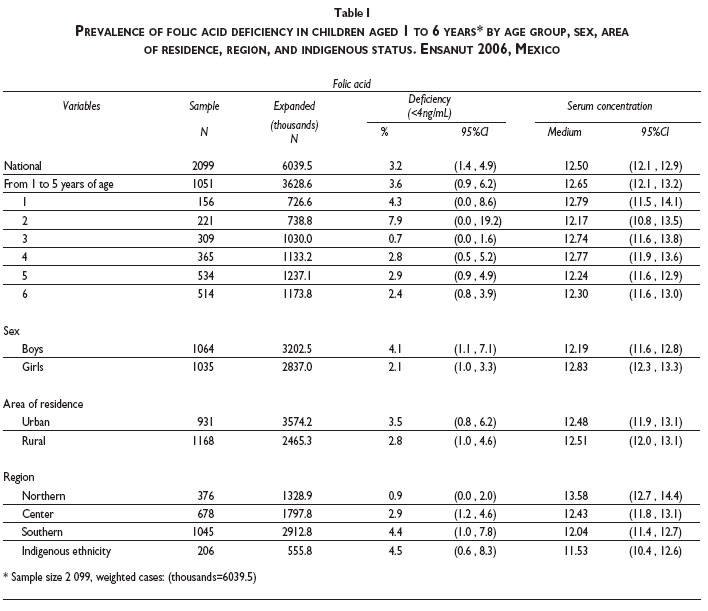
<body><![CDATA[<p><font size="3" face="Verdana, Arial, Helvetica, sans-serif"><b>Results</b></font></p>     <p><font size="2" face="Verdana, Arial, Helvetica, sans-serif">This sample of 2 099 children aged 1 to 6 years with serum folate and vitamin B12 determinations represents approximately 6 million Mexican children. </font></p>     <p><font size="2" face="Verdana, Arial, Helvetica, sans-serif"><b>Folic acid deficiency</b></font></p>     <p><font size="2" face="Verdana, Arial, Helvetica, sans-serif">The overall mean of serum folate concentration was 12.5 ng/mL (95%CI 12.1,12.9) and the overall prevalence of folate deficiency was 3.2% (<a href="/img/revistas/spm/v54n2/a04tab01.jpg">Table I</a>). The highest prevalence was in children aged 1 to 2 years (4.3% and 7.9%, respectively) and it decreased with age down to 2.4% in children aged 6 years. </font></p>     <p><font size="2" face="Verdana, Arial, Helvetica, sans-serif"> Prevalence of folate deficiency was higher in boys (4.1%) than in girls (2.1%); in urban (3.5%) than in rural (2.8%), and in the Southern (4.4%) than in the Northern (0.9%) region. Folate deficiency was also higher in indigenous children (4.5%) compared with the national prevalence (3.2%). However, none of these differences were significant. </font></p>     <p><font size="2" face="Verdana, Arial, Helvetica, sans-serif"> In a multiple linear regression model having folate concentrations as the dependent variable, the intake of vegetables (more than 100 g/day) (coefficient 0.79, <i>p</i>=0.09) and being beneficiary of the Fortified Milk program (Liconsa) (coefficient 1.72, <i>p</i>=0.004) were positively associated with serum folate concentration. Living in the Center or Southern regions was negatively associated with serum folate concentration (coefficients 1.37 and 1.7, <i>p</i>=0.014 and <i>p</i>=0.004, respectively). The interaction between folate intake and vitamin B12 was not significant (<a href="/img/revistas/spm/v54n2/a04tab03.jpg">Table III</a>). </font></p>     <p><font size="2" face="Verdana, Arial, Helvetica, sans-serif">V<b>itamin B12 deficiency</b></font></p>     <p><font size="2" face="Verdana, Arial, Helvetica, sans-serif">The overall mean concentration of vitamin B12 was 510.2 pg/mL (95%CI 487.9, 532.6), and overall prevalence deficiency was 7.7%. The prevalence of vitamin B12 deficiency varied in a non-systematic manner between 5.5% in children aged 3 years and 10.6% in those aged 6 years. The prevalence was highest in children from the Southern region (12.1%) and in children of indigenous ethnicity (14.2%), and lowest in the Northern region (3.4%), and non-indigenous children and compared with the national prevalence (7.7%) (<a href="/img/revistas/spm/v54n2/a04tab02.jpg">Table II</a>). </font></p>     <p><font size="2" face="Verdana, Arial, Helvetica, sans-serif"> In a multiple linear regression model with vitamin B12 serum concentration as dependent variable, the dairy foods intake (more than 100 mL per day) was found to be positively associated with the serum concentration of vitamin B12 (coefficient 70.0, p=0.002). In addition, belonging to medium or high socioeconomic status was positively associated with the serum concentration of vitamin B12 (coefficients 98.7 and 88.9, respectively, <i>p</i>=0.001). </font></p>     <p><font size="2" face="Verdana, Arial, Helvetica, sans-serif"> Being of indigenous ethnicity was negatively associated with the serum concentrations of vitamin B12 (coefficient 48.2,<i> p</i>=0.04) (<a href="/img/revistas/spm/v54n2/a04tab04.jpg">Table IV</a>). </font></p>     ]]></body>
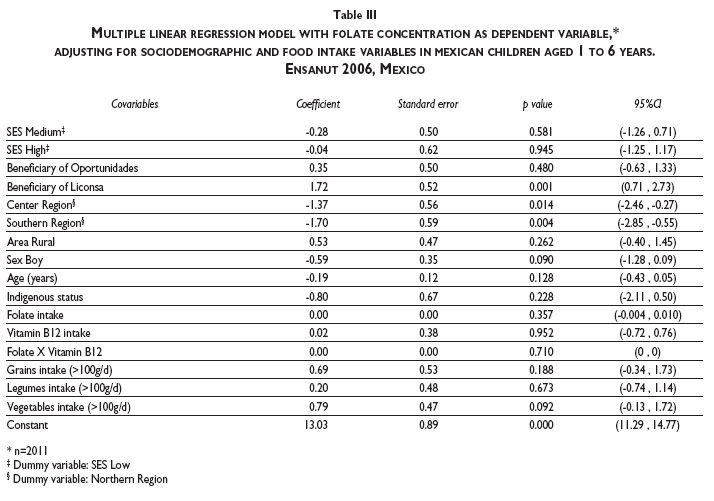
<body><![CDATA[<p>&nbsp;</p>     <p><font size="3" face="Verdana, Arial, Helvetica, sans-serif"><b>Discussion</b></font></p>     <p><font size="2" face="Verdana, Arial, Helvetica, sans-serif">We describe herein the magnitude and distribution of the prevalence of folate and vitamin B12 deficiency in a population sample of Mexican children younger than 6 years. </font></p>     <p><font size="2" face="Verdana, Arial, Helvetica, sans-serif"> The observed national prevalence of 7.7% for vitamin B12 and 3.2% for folate deficiencies represents more than 456 000 and 193 000 children younger than 6 years, suffering from these vitamin deficiencies in Mexico. The national overall prevalence of folate deficiency was relatively low, although the groups of 1 and 2-year-old children had the highest prevalence (4.3% and 7.9%, respectively). </font></p>     <p><font size="2" face="Verdana, Arial, Helvetica, sans-serif"> While the national prevalence of vitamin B12 was always above 5%. Such prevalence, close to 5%, should be considered as a public health problem according to the WHO Technical Consultation on folate and vitamin B12.<sup>20</sup></font></p>     <p><font size="2" face="Verdana, Arial, Helvetica, sans-serif"> Results also indicate that the highest prevalence of folate and vitamin B12 deficiency have seen in the most vulnerable population: children younger than 2 years old, from indigenous origin, and living in the Southern region, known for its poor economic development in Mexico.</font></p>     <p><font size="2" face="Verdana, Arial, Helvetica, sans-serif"> The low serum concentrations of vitamin B12 and folate, might be associated with the low body reserves of newborns at birth. In developing countries, maternal deficiency of vitamin B12 is frequent during pregnancy due to poor or inadequate intakes of animal foods. For small children, dietary intake of both vitamins is limited during the weaning period because, frequently, weaning foods offered is reduced to a limited variety of foods with a low content of micronutrients. This, in time, critically reduces their body stores and serum levels. </font></p>     <p><font size="2" face="Verdana, Arial, Helvetica, sans-serif"> Also, the high prevalence of B12 deficiency in school children might be associated with an inadequate intake or a low absorption of the vitamin because of parasitic or recurrent bacterial infections.<sup>35-37</sup></font></p>     <p><font size="2" face="Verdana, Arial, Helvetica, sans-serif"> The presence of fortification programs, population group, indicators and cut-off points used to assess folate and vitamin B12 status in countries with similar levels of development as such Guatemala,<sup>38</sup> Costa Rica<sup>39</sup> and Venezuela<sup>40</sup> were not homogeneous and precluded us to make comparisons with the findings reported. Comparability with other population-based surveys in Mexico and the estimation of trends are difficult as well. In the 1999 National Nutrition Survey (ENN-1999)26 folate was measured in red blood cells using a microbiological assay, whereas in the ENSANUT-2006, folate concentration was measured in serum using an immune assay. On these grounds the comparison is not valid because red blood cell folate is an indicator of body stores while serum values indicate recent dietary intake. However, repeated plasma folate measurements over time reflect trends in folate status.<sup>41</sup> In 1999, the prevalence of low folate stores in children under 5y of age was low (10%), but we are not able to assess whether the 2006 prevalence of low serum folate in the same age group (3.6%) represent a change.</font></p>     <p><font size="2" face="Verdana, Arial, Helvetica, sans-serif"> Is also difficult to quantify the change in the magnitude of the deficiency of vitamin B12 because published studies are based on specific groups or populations who do not represent the national population. However, the prevalence reported by Allen L. in the preschool age group from a subsample of the National Nutrition Survey 1999 (ENN-99) was 30%<sup>29</sup> compared with 7% in the present study, suggests a decrease in the magnitude of this problem.</font></p>     ]]></body>
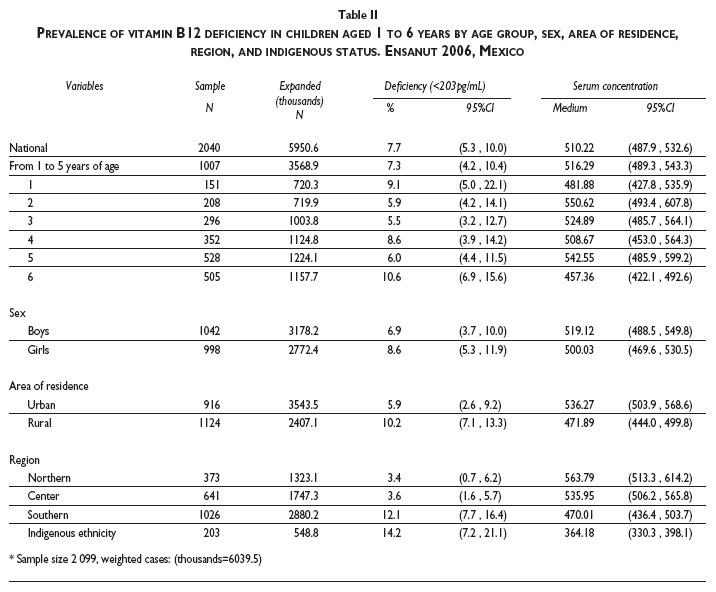
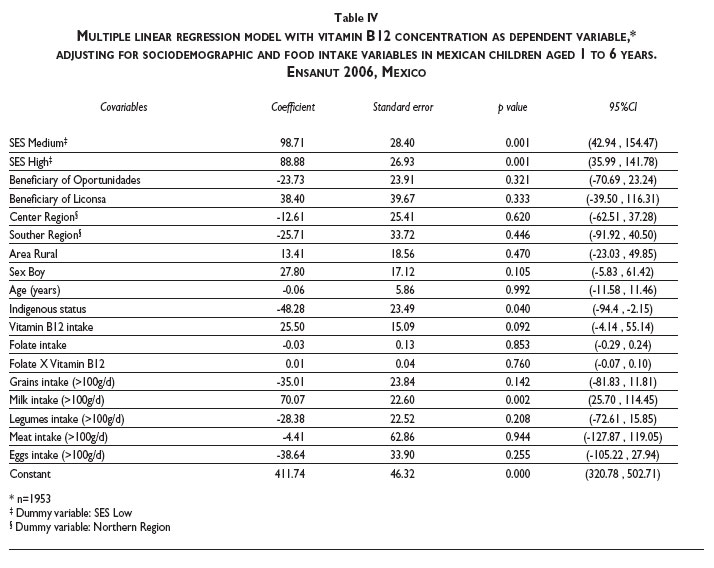
<body><![CDATA[<p><font size="2" face="Verdana, Arial, Helvetica, sans-serif"> For more than a decade, Mexico has implemented targeted interventions in addressing nutrient deficiencies in children: The voluntary fortification of maize and wheat flour with iron and folic acid;42 Oportunidades Human Development Program that distributes a nutritional supplement (suplemento Nutrisano) and The Social Milk Supply Program (LICONSA) that provides fortified milk containing nutrients deficient in the Mexican diet, including folic acid and vitamin B12. Without a doubt, these interventions have a positive effect on reducing these vitamins deficiencies in children, however, the impact of these interventions in reducing folate and vitamin B12 deficiencies has not been evaluated. We found in this study that being beneficiary of the Liconsa program was associated with higher serum concentrations of folate, and the intake of more than 100mL of dairy products was positively associated with serum concentrations of vitamin B12.</font></p>     <p><font size="2" face="Verdana, Arial, Helvetica, sans-serif"> This study contributes to generate information on the magnitude of the deficiency of both vitamins, since there are very few available publications documenting folate and vitamin B12 deficiencies in children at preschool age, one of the most affected group.<sup>43</sup> The current strategies for reducing and controlling micronutrient deficiencies should thus be reexamined. Particular attention must be paid to the content of folic acid and vitamin B12 of the food or supplements distributed by food assistance programs like Oportunidades and Liconsa.</font></p>     <p>&nbsp;</p>     <p><font size="3" face="Verdana, Arial, Helvetica, sans-serif"><b>References</b></font></p>     <!-- ref --><p><font size="2" face="Verdana, Arial, Helvetica, sans-serif">1. The Micronutrient Initiative. Investing in the future. A united call to action on vitamin and mineral deficiencies. Global report 2009. pp.1-44. &#91;Accessed 2010 September 20&#93;. Available at: <a href="http://www.unitedcalltoaction.org/documents/Investing_in_the_future.pdf" target="_blank">http://www.unitedcalltoaction.org/documents/Investing_in_the_future.pdf</a></font>&nbsp;&nbsp;&nbsp;&nbsp;&nbsp;&nbsp;&nbsp;&nbsp;[&#160;<a href="javascript:void(0);" onclick="javascript: window.open('/scielo.php?script=sci_nlinks&ref=9383830&pid=S0036-3634201200020000700001&lng=','','width=640,height=500,resizable=yes,scrollbars=1,menubar=yes,');">Links</a>&#160;]<!-- end-ref --><!-- ref --><p><font size="2" face="Verdana, Arial, Helvetica, sans-serif">2. Carmel R. Discussion: Causes of vitamin B12 and folate deficiencies. Food Nutr Bull. 2008 ;29(2 Suppl):S35-S37.    &nbsp;&nbsp;&nbsp;&nbsp;&nbsp;&nbsp;&nbsp;&nbsp;[&#160;<a href="javascript:void(0);" onclick="javascript: window.open('/scielo.php?script=sci_nlinks&ref=9383831&pid=S0036-3634201200020000700002&lng=','','width=640,height=500,resizable=yes,scrollbars=1,menubar=yes,');">Links</a>&#160;]<!-- end-ref --></font></p>     <!-- ref --><p><font size="2" face="Verdana, Arial, Helvetica, sans-serif">3. Al Khatib L, Obeid O, Sibai AM, Batal M, Adra N, Hwalla N. Folate deficiency is associated with nutritional anaemia in Lebanese women of childbearing age. Public Health Nutr 2006; 9:921-927.    &nbsp;&nbsp;&nbsp;&nbsp;&nbsp;&nbsp;&nbsp;&nbsp;[&#160;<a href="javascript:void(0);" onclick="javascript: window.open('/scielo.php?script=sci_nlinks&ref=9383833&pid=S0036-3634201200020000700003&lng=','','width=640,height=500,resizable=yes,scrollbars=1,menubar=yes,');">Links</a>&#160;]<!-- end-ref --></font></p>     <!-- ref --><p><font size="2" face="Verdana, Arial, Helvetica, sans-serif">4. Haidar J. Prevalence of Anaemia, Deficiencies of Iron and Folic Acid and Their Determinants in Ethiopian Women. J Health Popul Nutr 2010;28:359-368.    &nbsp;&nbsp;&nbsp;&nbsp;&nbsp;&nbsp;&nbsp;&nbsp;[&#160;<a href="javascript:void(0);" onclick="javascript: window.open('/scielo.php?script=sci_nlinks&ref=9383835&pid=S0036-3634201200020000700004&lng=','','width=640,height=500,resizable=yes,scrollbars=1,menubar=yes,');">Links</a>&#160;]<!-- end-ref --></font></p>     <!-- ref --><p><font size="2" face="Verdana, Arial, Helvetica, sans-serif">5. Metz J. A high prevalence of biochemical evidence of vitamin B12 or folate deficiency does not translate into a comparable prevalence of anemia. Food Nutr Bull 2008; 29(2 Suppl):S74-85.    &nbsp;&nbsp;&nbsp;&nbsp;&nbsp;&nbsp;&nbsp;&nbsp;[&#160;<a href="javascript:void(0);" onclick="javascript: window.open('/scielo.php?script=sci_nlinks&ref=9383837&pid=S0036-3634201200020000700005&lng=','','width=640,height=500,resizable=yes,scrollbars=1,menubar=yes,');">Links</a>&#160;]<!-- end-ref --></font></p>     <!-- ref --><p><font size="2" face="Verdana, Arial, Helvetica, sans-serif">6. Daly LE, Kirke PM, Molloy A, Weir DG, Scott JM. Folate levels and neural tube defects. Implications for prevention. JAMA 1995;274: 1698-1702.    &nbsp;&nbsp;&nbsp;&nbsp;&nbsp;&nbsp;&nbsp;&nbsp;[&#160;<a href="javascript:void(0);" onclick="javascript: window.open('/scielo.php?script=sci_nlinks&ref=9383839&pid=S0036-3634201200020000700006&lng=','','width=640,height=500,resizable=yes,scrollbars=1,menubar=yes,');">Links</a>&#160;]<!-- end-ref --></font></p>     <!-- ref --><p><font size="2" face="Verdana, Arial, Helvetica, sans-serif">7. Rodr&iacute;guez-Mor&aacute;n M, Guerrero-Romero JF, Parra-Quezada M, Segura-Pineda MJ, Levario-Carrillo M, Sotelo-Ham EI. Deficiencia de folatos y su asociaci&oacute;n con defectos de cierre del tubo neural en el norte de M&eacute;xico. Salud Publica Mex 1998;40:474-480.    &nbsp;&nbsp;&nbsp;&nbsp;&nbsp;&nbsp;&nbsp;&nbsp;[&#160;<a href="javascript:void(0);" onclick="javascript: window.open('/scielo.php?script=sci_nlinks&ref=9383841&pid=S0036-3634201200020000700007&lng=','','width=640,height=500,resizable=yes,scrollbars=1,menubar=yes,');">Links</a>&#160;]<!-- end-ref --> </font></p>     <!-- ref --><p><font size="2" face="Verdana, Arial, Helvetica, sans-serif">8. Villalpando S, Latulippe ME, Rosas G, Irurita J, Picciano MF, O'Connor DL. Milk folate but not milk iron concentrations may be inadequate for some infants in a rural farming community in San Mateo, Capulhuac, Mexico. Am J Clin Nutr 2003; 78: 782-789.    &nbsp;&nbsp;&nbsp;&nbsp;&nbsp;&nbsp;&nbsp;&nbsp;[&#160;<a href="javascript:void(0);" onclick="javascript: window.open('/scielo.php?script=sci_nlinks&ref=9383843&pid=S0036-3634201200020000700008&lng=','','width=640,height=500,resizable=yes,scrollbars=1,menubar=yes,');">Links</a>&#160;]<!-- end-ref --> </font></p>     <!-- ref --><p><font size="2" face="Verdana, Arial, Helvetica, sans-serif">9. Matoth Y, Zehavi I, Topper E. Klein T. Folate nutrition and growth in infancy. Arch Dis Child 1979; 54: 699-702.    &nbsp;&nbsp;&nbsp;&nbsp;&nbsp;&nbsp;&nbsp;&nbsp;[&#160;<a href="javascript:void(0);" onclick="javascript: window.open('/scielo.php?script=sci_nlinks&ref=9383845&pid=S0036-3634201200020000700009&lng=','','width=640,height=500,resizable=yes,scrollbars=1,menubar=yes,');">Links</a>&#160;]<!-- end-ref --></font></p>     <!-- ref --><p><font size="2" face="Verdana, Arial, Helvetica, sans-serif">10. Allen LH. Causes of vitamin B12 and folate deficiency. Food Nutr Bull. 2008 ;29(2 Suppl):S20-34.    &nbsp;&nbsp;&nbsp;&nbsp;&nbsp;&nbsp;&nbsp;&nbsp;[&#160;<a href="javascript:void(0);" onclick="javascript: window.open('/scielo.php?script=sci_nlinks&ref=9383847&pid=S0036-3634201200020000700010&lng=','','width=640,height=500,resizable=yes,scrollbars=1,menubar=yes,');">Links</a>&#160;]<!-- end-ref --></font></p>     <!-- ref --><p><font size="2" face="Verdana, Arial, Helvetica, sans-serif">11. Bjorke-Monsen AL, Refsum H, Markestad T, Ueland PM. Cobalamin status and its biochemical markers methylmalonic acid and homocysteine in different age groups from 4 days to 19 years. Clin Chem 2003;49:2067&#150;2075.    &nbsp;&nbsp;&nbsp;&nbsp;&nbsp;&nbsp;&nbsp;&nbsp;[&#160;<a href="javascript:void(0);" onclick="javascript: window.open('/scielo.php?script=sci_nlinks&ref=9383849&pid=S0036-3634201200020000700011&lng=','','width=640,height=500,resizable=yes,scrollbars=1,menubar=yes,');">Links</a>&#160;]<!-- end-ref --></font></p>     <!-- ref --><p><font size="2" face="Verdana, Arial, Helvetica, sans-serif">12. Kaptan K, Beyan C, Ural AU, Cetin C, Avcu F, G&uuml;lsen M, <i>et al</i>. Helicobacter pylori &#150; is it a novel causative agent in Vitamin B12 deficiency? Arch Intern Med 2000; 160: 1349-1353.    &nbsp;&nbsp;&nbsp;&nbsp;&nbsp;&nbsp;&nbsp;&nbsp;[&#160;<a href="javascript:void(0);" onclick="javascript: window.open('/scielo.php?script=sci_nlinks&ref=9383851&pid=S0036-3634201200020000700012&lng=','','width=640,height=500,resizable=yes,scrollbars=1,menubar=yes,');">Links</a>&#160;]<!-- end-ref --></font></p>     <!-- ref --><p><font size="2" face="Verdana, Arial, Helvetica, sans-serif">13. Sipponen P, Laxen F, Huotari K, Harkonen M. Prevalence of low vitamin B12 and high homocysteine in serum in an elderly male population: association with atrophic gastritis and Helicobacter pylori infection. Scand J Gastroenterol 2003; 38: 1209-1216.    &nbsp;&nbsp;&nbsp;&nbsp;&nbsp;&nbsp;&nbsp;&nbsp;[&#160;<a href="javascript:void(0);" onclick="javascript: window.open('/scielo.php?script=sci_nlinks&ref=9383853&pid=S0036-3634201200020000700013&lng=','','width=640,height=500,resizable=yes,scrollbars=1,menubar=yes,');">Links</a>&#160;]<!-- end-ref --></font></p>     <!-- ref --><p><font size="2" face="Verdana, Arial, Helvetica, sans-serif">14. Allen LH. Vitamin B12 metabolism and status during pregnancy, lactation and infancy. Adv Exp Med Biol 1994;352:173-186.    &nbsp;&nbsp;&nbsp;&nbsp;&nbsp;&nbsp;&nbsp;&nbsp;[&#160;<a href="javascript:void(0);" onclick="javascript: window.open('/scielo.php?script=sci_nlinks&ref=9383855&pid=S0036-3634201200020000700014&lng=','','width=640,height=500,resizable=yes,scrollbars=1,menubar=yes,');">Links</a>&#160;]<!-- end-ref --></font></p>     <!-- ref --><p><font size="2" face="Verdana, Arial, Helvetica, sans-serif">15. Herrmann W, Obeid R. Causes and Early Diagnosis of Vitamin B12 Deficiency. Dtsch Arztebl Int 2008; 105: 680-685.    &nbsp;&nbsp;&nbsp;&nbsp;&nbsp;&nbsp;&nbsp;&nbsp;[&#160;<a href="javascript:void(0);" onclick="javascript: window.open('/scielo.php?script=sci_nlinks&ref=9383857&pid=S0036-3634201200020000700015&lng=','','width=640,height=500,resizable=yes,scrollbars=1,menubar=yes,');">Links</a>&#160;]<!-- end-ref --></font></p>     <!-- ref --><p><font size="2" face="Verdana, Arial, Helvetica, sans-serif">16. Selhub J, Bagley LC, Miller J, Rosenberg IH. B vitamins, homocysteine, and neurocognitive function in the elderly. Am J Clin Nutr 2000;71: 614S-620S.    &nbsp;&nbsp;&nbsp;&nbsp;&nbsp;&nbsp;&nbsp;&nbsp;[&#160;<a href="javascript:void(0);" onclick="javascript: window.open('/scielo.php?script=sci_nlinks&ref=9383859&pid=S0036-3634201200020000700016&lng=','','width=640,height=500,resizable=yes,scrollbars=1,menubar=yes,');">Links</a>&#160;]<!-- end-ref --></font></p>     <!-- ref --><p><font size="2" face="Verdana, Arial, Helvetica, sans-serif">17. Verhoef P, Kok FJ, Kruyssen DA, Schouten EG, Witteman JC, Grobbee DE, <i>et al</i>. Plasma total homocysteine, B vitamins, and risk of coronary atherosclerosis. Arterioscler Thromb Vasc Biol 1997;17: 989-995.    &nbsp;&nbsp;&nbsp;&nbsp;&nbsp;&nbsp;&nbsp;&nbsp;[&#160;<a href="javascript:void(0);" onclick="javascript: window.open('/scielo.php?script=sci_nlinks&ref=9383861&pid=S0036-3634201200020000700017&lng=','','width=640,height=500,resizable=yes,scrollbars=1,menubar=yes,');">Links</a>&#160;]<!-- end-ref --></font></p>     <!-- ref --><p><font size="2" face="Verdana, Arial, Helvetica, sans-serif">18. Pancharuniti N, Lewis CA, Sauberlich HE, Perkins LL, Go RC, Alvarez JO, <i>et al</i>. Plasma homocyst(e)ine, folate, and vitamin B-12 concentrations and risk for early-onset coronary artery disease. Am J Clin Nutr 1994;59:940-948.    &nbsp;&nbsp;&nbsp;&nbsp;&nbsp;&nbsp;&nbsp;&nbsp;[&#160;<a href="javascript:void(0);" onclick="javascript: window.open('/scielo.php?script=sci_nlinks&ref=9383863&pid=S0036-3634201200020000700018&lng=','','width=640,height=500,resizable=yes,scrollbars=1,menubar=yes,');">Links</a>&#160;]<!-- end-ref --></font></p>     <!-- ref --><p><font size="2" face="Verdana, Arial, Helvetica, sans-serif">19. Weikert C, Dierkes J, Hoffmann K, Borger K, Drogan D, Klipstein-Grobusch K, <i>et al</i>. B vitamin plasma levels and the risk of ischemic stroke and transient ischemic attack in a German cohort. Stroke 2007;38:2912-2918.    &nbsp;&nbsp;&nbsp;&nbsp;&nbsp;&nbsp;&nbsp;&nbsp;[&#160;<a href="javascript:void(0);" onclick="javascript: window.open('/scielo.php?script=sci_nlinks&ref=9383865&pid=S0036-3634201200020000700019&lng=','','width=640,height=500,resizable=yes,scrollbars=1,menubar=yes,');">Links</a>&#160;]<!-- end-ref --></font></p>     <!-- ref --><p><font size="2" face="Verdana, Arial, Helvetica, sans-serif">20. The World Health Organization. Conclusions of a WHO Technical Consultation on folate and vitamin B12 deficiencies. Food Nutr Bull 2008;29(2).    &nbsp;&nbsp;&nbsp;&nbsp;&nbsp;&nbsp;&nbsp;&nbsp;[&#160;<a href="javascript:void(0);" onclick="javascript: window.open('/scielo.php?script=sci_nlinks&ref=9383867&pid=S0036-3634201200020000700020&lng=','','width=640,height=500,resizable=yes,scrollbars=1,menubar=yes,');">Links</a>&#160;]<!-- end-ref --> </font></p>     <!-- ref --><p><font size="2" face="Verdana, Arial, Helvetica, sans-serif">21. Howson C, Christianson A, Modell B. Controlling Birth Defects: Reducing the Hidden Toll of Dying and Disabled Children in Low-Income Countries | Disease Control Priorities Project. December 2008. &#91;Accessed 2010 September 23&#93;. Available at: <a href="http://www.dcp2.org/file/230/dcpp-twpcongenitaldefects_web.pdf" target="_blank">http://www.dcp2.org/file/230/dcpp-twpcongenitaldefects_web.pdf </a></font>&nbsp;&nbsp;&nbsp;&nbsp;&nbsp;&nbsp;&nbsp;&nbsp;[&#160;<a href="javascript:void(0);" onclick="javascript: window.open('/scielo.php?script=sci_nlinks&ref=9383869&pid=S0036-3634201200020000700021&lng=','','width=640,height=500,resizable=yes,scrollbars=1,menubar=yes,');">Links</a>&#160;]<!-- end-ref --><!-- ref --><p><font size="2" face="Verdana, Arial, Helvetica, sans-serif">22. Berry RJ, Li Z, Erickson D, Li S, Moore CA, Wong H, <i>et al</i>. Prevention of neural-tube defects with folic acid in China. China-U.S. Collaborative Project for Neural Tube Defect Prevention. N Engl J Med 1999;341:1485-1490.    &nbsp;&nbsp;&nbsp;&nbsp;&nbsp;&nbsp;&nbsp;&nbsp;[&#160;<a href="javascript:void(0);" onclick="javascript: window.open('/scielo.php?script=sci_nlinks&ref=9383870&pid=S0036-3634201200020000700022&lng=','','width=640,height=500,resizable=yes,scrollbars=1,menubar=yes,');">Links</a>&#160;]<!-- end-ref --></font></p>     <!-- ref --><p><font size="2" face="Verdana, Arial, Helvetica, sans-serif">23. <a href="http://www.ncbi.nlm.nih.gov/pubmed?term=%22Allen LH%22%5BAuthor%5D">Allen LH</a>. How common is vitamin B-12 deficiency? Am J Clin Nutr 2009;9(suppl):693S-696S.    &nbsp;&nbsp;&nbsp;&nbsp;&nbsp;&nbsp;&nbsp;&nbsp;[&#160;<a href="javascript:void(0);" onclick="javascript: window.open('/scielo.php?script=sci_nlinks&ref=9383872&pid=S0036-3634201200020000700023&lng=','','width=640,height=500,resizable=yes,scrollbars=1,menubar=yes,');">Links</a>&#160;]<!-- end-ref --></font></p>     <!-- ref --><p><font size="2" face="Verdana, Arial, Helvetica, sans-serif">24. McLean E, Benoist B, Allen L. Review of the magnitude of folate and vitamin B12 deficiencies worldwide. Food Nutr Bull 2008;29:S38-S51.    &nbsp;&nbsp;&nbsp;&nbsp;&nbsp;&nbsp;&nbsp;&nbsp;[&#160;<a href="javascript:void(0);" onclick="javascript: window.open('/scielo.php?script=sci_nlinks&ref=9383874&pid=S0036-3634201200020000700024&lng=','','width=640,height=500,resizable=yes,scrollbars=1,menubar=yes,');">Links</a>&#160;]<!-- end-ref --></font></p>     ]]></body>
<body><![CDATA[<!-- ref --><p><font size="2" face="Verdana, Arial, Helvetica, sans-serif">25. Resano E, M&eacute;ndez I, Shamah T, Rivera JA, Sep&uacute;lveda J. Methods of the National Nutrition Survey 1999. Salud Publica Mex 2003; 45 suppl 4:S558-S564.    &nbsp;&nbsp;&nbsp;&nbsp;&nbsp;&nbsp;&nbsp;&nbsp;[&#160;<a href="javascript:void(0);" onclick="javascript: window.open('/scielo.php?script=sci_nlinks&ref=9383876&pid=S0036-3634201200020000700025&lng=','','width=640,height=500,resizable=yes,scrollbars=1,menubar=yes,');">Links</a>&#160;]<!-- end-ref --> </font></p>     <!-- ref --><p><font size="2" face="Verdana, Arial, Helvetica, sans-serif">26. Villalpando S, Montalvo-Velarde I, Zambrano N, Garc&iacute;a-Guerra Armando, Ram&iacute;rez-Silva CI, Shamah-Levy T, <i>et al</i>. Vitamins A, and C and folate status in mexican children under 12 years and women 12-49 years: A probabilistic national survey. Salud Publica Mex 2003; 45 suppl 4:S508-S519.    &nbsp;&nbsp;&nbsp;&nbsp;&nbsp;&nbsp;&nbsp;&nbsp;[&#160;<a href="javascript:void(0);" onclick="javascript: window.open('/scielo.php?script=sci_nlinks&ref=9383878&pid=S0036-3634201200020000700026&lng=','','width=640,height=500,resizable=yes,scrollbars=1,menubar=yes,');">Links</a>&#160;]<!-- end-ref --> </font></p>     <!-- ref --><p><font size="2" face="Verdana, Arial, Helvetica, sans-serif">27. Duque X, Flores-Hern&aacute;ndez S, Flores-Huerta S, M&eacute;ndez-Ram&iacute;rez I, Mu&ntilde;oz S, Turnbull B, <i>et al</i>. Prevalence of anemia and deficiency of iron, folic acid, and zinc in children younger than 2 years of age who use the health services provided by the Mexican Social Security Institute. BMC Public Health 2007; 7:345.    &nbsp;&nbsp;&nbsp;&nbsp;&nbsp;&nbsp;&nbsp;&nbsp;[&#160;<a href="javascript:void(0);" onclick="javascript: window.open('/scielo.php?script=sci_nlinks&ref=9383880&pid=S0036-3634201200020000700027&lng=','','width=640,height=500,resizable=yes,scrollbars=1,menubar=yes,');">Links</a>&#160;]<!-- end-ref --></font></p>     <!-- ref --><p><font size="2" face="Verdana, Arial, Helvetica, sans-serif">28. Black AK, Allen LH, Pelto GH, de Mata MP, Ch&aacute;vez A. Iron, vitamin B-12 and folate status in Mexico: associated factors in men and women and during pregnancy and lactation. J Nutr 1994;124:1179-1188.    &nbsp;&nbsp;&nbsp;&nbsp;&nbsp;&nbsp;&nbsp;&nbsp;[&#160;<a href="javascript:void(0);" onclick="javascript: window.open('/scielo.php?script=sci_nlinks&ref=9383882&pid=S0036-3634201200020000700028&lng=','','width=640,height=500,resizable=yes,scrollbars=1,menubar=yes,');">Links</a>&#160;]<!-- end-ref --></font></p>     <!-- ref --><p><font size="2" face="Verdana, Arial, Helvetica, sans-serif">29. Allen L. Folate and Vitamin B12 Status in the Americas. Nutrition Reviews 2004; 62,(6):S29-S33.    &nbsp;&nbsp;&nbsp;&nbsp;&nbsp;&nbsp;&nbsp;&nbsp;[&#160;<a href="javascript:void(0);" onclick="javascript: window.open('/scielo.php?script=sci_nlinks&ref=9383884&pid=S0036-3634201200020000700029&lng=','','width=640,height=500,resizable=yes,scrollbars=1,menubar=yes,');">Links</a>&#160;]<!-- end-ref --> </font></p>     ]]></body>
<body><![CDATA[<!-- ref --><p><font size="2" face="Verdana, Arial, Helvetica, sans-serif">30. Palma O, Shamah T, Franco A, Olaiz G, M&eacute;ndez I, <i>et al</i>. Metodolog&iacute;a. En: Encuesta Nacional de Salud y Nutrici&oacute;n (ENSANUT-2006). Cuernavaca, M&eacute;xico: Instituto Nacional de Salud P&uacute;blica, 2006:19-33.    &nbsp;&nbsp;&nbsp;&nbsp;&nbsp;&nbsp;&nbsp;&nbsp;[&#160;<a href="javascript:void(0);" onclick="javascript: window.open('/scielo.php?script=sci_nlinks&ref=9383886&pid=S0036-3634201200020000700030&lng=','','width=640,height=500,resizable=yes,scrollbars=1,menubar=yes,');">Links</a>&#160;]<!-- end-ref --></font></p>     <!-- ref --><p><font size="2" face="Verdana, Arial, Helvetica, sans-serif">31. Ram&iacute;rez CI, Mundo V, Rodr&iacute;guez SC, Vizuet NI, Hern&aacute;ndez N, Jim&eacute;nez A. Encuestas diet&eacute;ticas: Recordatorio de 24 horas y Frecuencia de consumo de alimentos. En: Manual de procedimientos para proyectos de nutrici&oacute;n. Cuernavaca, M&eacute;xico: Instituto Nacional de Salud P&uacute;blica, 2006.    &nbsp;&nbsp;&nbsp;&nbsp;&nbsp;&nbsp;&nbsp;&nbsp;[&#160;<a href="javascript:void(0);" onclick="javascript: window.open('/scielo.php?script=sci_nlinks&ref=9383888&pid=S0036-3634201200020000700031&lng=','','width=640,height=500,resizable=yes,scrollbars=1,menubar=yes,');">Links</a>&#160;]<!-- end-ref --></font></p>     <!-- ref --><p><font size="2" face="Verdana, Arial, Helvetica, sans-serif">32. Safdie M, Barquera S, Porcayo M, Rodr&iacute;guez S, Ram&iacute;rez C, Rivera J, <i>et al</i>. Bases de datos del valor nutritivo de los alimentos. Compilaci&oacute;n del Instituto Nacional de Salud P&uacute;blica. Cuernavaca, Morelos: Instituto Nacional de Salud P&uacute;blica, 2004.    &nbsp;&nbsp;&nbsp;&nbsp;&nbsp;&nbsp;&nbsp;&nbsp;[&#160;<a href="javascript:void(0);" onclick="javascript: window.open('/scielo.php?script=sci_nlinks&ref=9383890&pid=S0036-3634201200020000700032&lng=','','width=640,height=500,resizable=yes,scrollbars=1,menubar=yes,');">Links</a>&#160;]<!-- end-ref --> </font></p>     <!-- ref --><p><font size="2" face="Verdana, Arial, Helvetica, sans-serif">33. Rodriguez-Ramirez S, Mundo-Rosas V, Jim&eacute;nez-Aguilar A, Shamah-Levy T. Methodology for the analysis of dietary data from the Mexican National Health and Nutrition Survey 2006. Salud Publica Mex 2009; 51suppl 4: S540-S550.    &nbsp;&nbsp;&nbsp;&nbsp;&nbsp;&nbsp;&nbsp;&nbsp;[&#160;<a href="javascript:void(0);" onclick="javascript: window.open('/scielo.php?script=sci_nlinks&ref=9383892&pid=S0036-3634201200020000700033&lng=','','width=640,height=500,resizable=yes,scrollbars=1,menubar=yes,');">Links</a>&#160;]<!-- end-ref --></font></p>     <!-- ref --><p><font size="2" face="Verdana, Arial, Helvetica, sans-serif">34. Instuto Nacional de Estad&iacute;stica y Geograf&iacute;a (INEGI). S&iacute;ntesis metodol&oacute;gica del XII Censo General de Poblaci&oacute;n y Vivienda 2000. p.9. P&aacute;gina de Internet: <a href="http://www.inegi.org.mx/est/contenidos/Proyectos/ccpv/cpv2000/default.aspx" target="_blank">http://www.inegi.org.mx/est/contenidos/Proyectos/ccpv/cpv2000/default.aspx</a></font>&nbsp;&nbsp;&nbsp;&nbsp;&nbsp;&nbsp;&nbsp;&nbsp;[&#160;<a href="javascript:void(0);" onclick="javascript: window.open('/scielo.php?script=sci_nlinks&ref=9383894&pid=S0036-3634201200020000700034&lng=','','width=640,height=500,resizable=yes,scrollbars=1,menubar=yes,');">Links</a>&#160;]<!-- end-ref --><!-- ref --><p><font size="2" face="Verdana, Arial, Helvetica, sans-serif">35. Allen L, Rosado JL, Casterline JE,Mart&iacute;nez H, Lopez P, Mu&ntilde;oz E, <i>et al</i>. Vitamin B12 deficiency and malabsoption are highly prevalent in rural Mexican communities. Am J Clin Nutr 1995; 62:1013-1019.    &nbsp;&nbsp;&nbsp;&nbsp;&nbsp;&nbsp;&nbsp;&nbsp;[&#160;<a href="javascript:void(0);" onclick="javascript: window.open('/scielo.php?script=sci_nlinks&ref=9383895&pid=S0036-3634201200020000700035&lng=','','width=640,height=500,resizable=yes,scrollbars=1,menubar=yes,');">Links</a>&#160;]<!-- end-ref --></font></p>     <!-- ref --><p><font size="2" face="Verdana, Arial, Helvetica, sans-serif">36. Luque&ntilde;o V, L&oacute;pez-Vidal Y, Calva JJ, Ru&iacute;z-Palacios GM. Serum antibody response to Helicobacter pylori in a cohort of Mexican children. Microbiol Ecol 1991;4:S19.    &nbsp;&nbsp;&nbsp;&nbsp;&nbsp;&nbsp;&nbsp;&nbsp;[&#160;<a href="javascript:void(0);" onclick="javascript: window.open('/scielo.php?script=sci_nlinks&ref=9383897&pid=S0036-3634201200020000700036&lng=','','width=640,height=500,resizable=yes,scrollbars=1,menubar=yes,');">Links</a>&#160;]<!-- end-ref --></font></p>     <!-- ref --><p><font size="2" face="Verdana, Arial, Helvetica, sans-serif">37. Gilman RH, Marquis GS, Miranda E, Vestegui M, Mart&iacute;nez H. Rapid reinfection by Gi&aacute;rdia lambia after treatment in a hyperendemic third world comunity. Lancet 1988:1:343-346.    &nbsp;&nbsp;&nbsp;&nbsp;&nbsp;&nbsp;&nbsp;&nbsp;[&#160;<a href="javascript:void(0);" onclick="javascript: window.open('/scielo.php?script=sci_nlinks&ref=9383899&pid=S0036-3634201200020000700037&lng=','','width=640,height=500,resizable=yes,scrollbars=1,menubar=yes,');">Links</a>&#160;]<!-- end-ref --> </font></p>     <!-- ref --><p><font size="2" face="Verdana, Arial, Helvetica, sans-serif">38. Casterline JE, Allen LH, Ruel MT. Vitamin B12 deficiency is very prevalent in lactating Guatemalan women and their infants at three months postpartum. J Nutr 1997;127:1966-1972.    &nbsp;&nbsp;&nbsp;&nbsp;&nbsp;&nbsp;&nbsp;&nbsp;[&#160;<a href="javascript:void(0);" onclick="javascript: window.open('/scielo.php?script=sci_nlinks&ref=9383901&pid=S0036-3634201200020000700038&lng=','','width=640,height=500,resizable=yes,scrollbars=1,menubar=yes,');">Links</a>&#160;]<!-- end-ref --></font></p>     <!-- ref --><p><font size="2" face="Verdana, Arial, Helvetica, sans-serif">39. Cunningham L, Blanco A, Rodriguez S, Ascencio M. Prevalencia de anemia, deficiencia de hierro y folatos en ni&ntilde;os menores de siete a&ntilde;os. Costa Rica, 1996. Arch Latinoam Nutr 2001;51:37-43.    &nbsp;&nbsp;&nbsp;&nbsp;&nbsp;&nbsp;&nbsp;&nbsp;[&#160;<a href="javascript:void(0);" onclick="javascript: window.open('/scielo.php?script=sci_nlinks&ref=9383903&pid=S0036-3634201200020000700039&lng=','','width=640,height=500,resizable=yes,scrollbars=1,menubar=yes,');">Links</a>&#160;]<!-- end-ref --></font></p>     <!-- ref --><p><font size="2" face="Verdana, Arial, Helvetica, sans-serif">40. Garcia-Casal MN, Osorio C, Landaeta M, Leets I, Matus P, Fazzino F, <i>et al</i>. High prevalence of folic acid and vitamin B12 deficiencies in infants, children, adolescents and pregnant women in Venezuela. Eur J Clin Nutr 2005;59:1064-1070.    &nbsp;&nbsp;&nbsp;&nbsp;&nbsp;&nbsp;&nbsp;&nbsp;[&#160;<a href="javascript:void(0);" onclick="javascript: window.open('/scielo.php?script=sci_nlinks&ref=9383905&pid=S0036-3634201200020000700040&lng=','','width=640,height=500,resizable=yes,scrollbars=1,menubar=yes,');">Links</a>&#160;]<!-- end-ref --></font></p>     <!-- ref --><p><font size="2" face="Verdana, Arial, Helvetica, sans-serif">41. Green R. Indicators for assessing folate and vitamin B12 status and for monitoring the efficacy of intervention strategies. Food Nutr Bull 2008;29:S52-S63.    &nbsp;&nbsp;&nbsp;&nbsp;&nbsp;&nbsp;&nbsp;&nbsp;[&#160;<a href="javascript:void(0);" onclick="javascript: window.open('/scielo.php?script=sci_nlinks&ref=9383907&pid=S0036-3634201200020000700041&lng=','','width=640,height=500,resizable=yes,scrollbars=1,menubar=yes,');">Links</a>&#160;]<!-- end-ref --> </font></p>     <!-- ref --><p><font size="2" face="Verdana, Arial, Helvetica, sans-serif">42. Organizaci&oacute;n Panamericana de la Salud. Fortificaci&oacute;n de harinas con Hierro, &aacute;cido f&oacute;lico y vitamina B12. Informe de la reuni&oacute;n regional. Washington, DC: OPS, 2004.    &nbsp;&nbsp;&nbsp;&nbsp;&nbsp;&nbsp;&nbsp;&nbsp;[&#160;<a href="javascript:void(0);" onclick="javascript: window.open('/scielo.php?script=sci_nlinks&ref=9383909&pid=S0036-3634201200020000700042&lng=','','width=640,height=500,resizable=yes,scrollbars=1,menubar=yes,');">Links</a>&#160;]<!-- end-ref --></font></p>     <!-- ref --><p><font size="2" face="Verdana, Arial, Helvetica, sans-serif">43. Molloy A, Kirke P, Brody l, Scott J, Mills J. Efects of folate and vitamin B12 deficiencies during pregnancy on fetal, infant, and child development. Food Nutr Bull 2008;29(2):S101-S111.    &nbsp;&nbsp;&nbsp;&nbsp;&nbsp;&nbsp;&nbsp;&nbsp;[&#160;<a href="javascript:void(0);" onclick="javascript: window.open('/scielo.php?script=sci_nlinks&ref=9383911&pid=S0036-3634201200020000700043&lng=','','width=640,height=500,resizable=yes,scrollbars=1,menubar=yes,');">Links</a>&#160;]<!-- end-ref --></font></p>     <p>&nbsp;</p>     <p>&nbsp;</p>     <p><font size="2" face="Verdana, Arial, Helvetica, sans-serif"><b><a name="end" id="end"></a><a href="#top"><img src="/img/revistas/spm/v54n2/seta.jpg" alt="" border="0" /></a> Corresponding author: </b><br />   MSc Ver&oacute;nica Mundo-Rosas. <br />   Instituto Nacional de Salud P&uacute;blica.<br />   Av. Universidad 655,<br />   Col. Santa Mar&iacute;a Ahuacatitl&aacute;n. 62100 Cuernavaca, Morelos, M&eacute;xico.<br />   E-mail: <a href="mailto:vmundo@insp.mx">vmundo@insp.mx</a></font></p>     ]]></body>
<body><![CDATA[<p><font size="2" face="Verdana, Arial, Helvetica, sans-serif">Received on: June 3, 2011 <br />   Accepted on: January 31, 2012</font></p>     <p>&nbsp;</p>     <p>&nbsp;</p>     <p><font size="2" face="Verdana, Arial, Helvetica, sans-serif">Declaration of conflict of interests. The authors declare that they have no conflict of interests.</font></p>      ]]></body><back>
<ref-list>
<ref id="B1">
<label>1</label><nlm-citation citation-type="">
<collab>The Micronutrient Initiative^dInvesting in the future. A united call to action on vitamin and mineral deficiencies</collab>
<source><![CDATA[Global report 2009]]></source>
<year></year>
<page-range>1-44</page-range></nlm-citation>
</ref>
<ref id="B2">
<label>2</label><nlm-citation citation-type="journal">
<person-group person-group-type="author">
<name>
<surname><![CDATA[Carmel]]></surname>
<given-names><![CDATA[R]]></given-names>
</name>
</person-group>
<article-title xml:lang="en"><![CDATA[Discussion: Causes of vitamin B12 and folate deficiencies]]></article-title>
<source><![CDATA[Food Nutr Bull]]></source>
<year>2008</year>
<volume>29</volume>
<page-range>S35-S37</page-range></nlm-citation>
</ref>
<ref id="B3">
<label>3</label><nlm-citation citation-type="journal">
<person-group person-group-type="author">
<name>
<surname><![CDATA[Al Khatib]]></surname>
<given-names><![CDATA[L]]></given-names>
</name>
<name>
<surname><![CDATA[Obeid]]></surname>
<given-names><![CDATA[O]]></given-names>
</name>
<name>
<surname><![CDATA[Sibai]]></surname>
<given-names><![CDATA[AM]]></given-names>
</name>
<name>
<surname><![CDATA[Batal]]></surname>
<given-names><![CDATA[M]]></given-names>
</name>
<name>
<surname><![CDATA[Adra]]></surname>
<given-names><![CDATA[N]]></given-names>
</name>
<name>
<surname><![CDATA[Hwalla]]></surname>
<given-names><![CDATA[N]]></given-names>
</name>
</person-group>
<article-title xml:lang="en"><![CDATA[Folate deficiency is associated with nutritional anaemia in Lebanese women of childbearing age]]></article-title>
<source><![CDATA[Public Health Nutr]]></source>
<year>2006</year>
<volume>9</volume>
<page-range>921-927</page-range></nlm-citation>
</ref>
<ref id="B4">
<label>4</label><nlm-citation citation-type="journal">
<person-group person-group-type="author">
<name>
<surname><![CDATA[Haidar]]></surname>
<given-names><![CDATA[J]]></given-names>
</name>
</person-group>
<article-title xml:lang="en"><![CDATA[Prevalence of Anaemia, Deficiencies of Iron and Folic Acid and Their Determinants in Ethiopian Women]]></article-title>
<source><![CDATA[J Health Popul Nutr]]></source>
<year>2010</year>
<volume>28</volume>
<page-range>359-368</page-range></nlm-citation>
</ref>
<ref id="B5">
<label>5</label><nlm-citation citation-type="journal">
<person-group person-group-type="author">
<name>
<surname><![CDATA[Metz]]></surname>
<given-names><![CDATA[J]]></given-names>
</name>
</person-group>
<article-title xml:lang="en"><![CDATA[A high prevalence of biochemical evidence of vitamin B12 or folate deficiency does not translate into a comparable prevalence of anemia]]></article-title>
<source><![CDATA[Food Nutr Bull]]></source>
<year>2008</year>
<volume>29</volume>
<page-range>S74-85</page-range></nlm-citation>
</ref>
<ref id="B6">
<label>6</label><nlm-citation citation-type="journal">
<person-group person-group-type="author">
<name>
<surname><![CDATA[Daly]]></surname>
<given-names><![CDATA[LE]]></given-names>
</name>
<name>
<surname><![CDATA[Kirke]]></surname>
<given-names><![CDATA[PM]]></given-names>
</name>
<name>
<surname><![CDATA[Molloy]]></surname>
<given-names><![CDATA[A]]></given-names>
</name>
<name>
<surname><![CDATA[Weir]]></surname>
<given-names><![CDATA[DG]]></given-names>
</name>
<name>
<surname><![CDATA[Scott]]></surname>
<given-names><![CDATA[JM]]></given-names>
</name>
</person-group>
<article-title xml:lang="en"><![CDATA[Folate levels and neural tube defects: Implications for prevention]]></article-title>
<source><![CDATA[JAMA]]></source>
<year>1995</year>
<volume>274</volume>
<page-range>1698-1702</page-range></nlm-citation>
</ref>
<ref id="B7">
<label>7</label><nlm-citation citation-type="journal">
<person-group person-group-type="author">
<name>
<surname><![CDATA[Rodríguez-Morán]]></surname>
<given-names><![CDATA[M]]></given-names>
</name>
<name>
<surname><![CDATA[Guerrero-Romero]]></surname>
<given-names><![CDATA[JF]]></given-names>
</name>
<name>
<surname><![CDATA[Parra-Quezada]]></surname>
<given-names><![CDATA[M]]></given-names>
</name>
<name>
<surname><![CDATA[Segura-Pineda]]></surname>
<given-names><![CDATA[MJ]]></given-names>
</name>
<name>
<surname><![CDATA[Levario-Carrillo]]></surname>
<given-names><![CDATA[M]]></given-names>
</name>
<name>
<surname><![CDATA[Sotelo-Ham]]></surname>
<given-names><![CDATA[EI]]></given-names>
</name>
</person-group>
<article-title xml:lang="es"><![CDATA[Deficiencia de folatos y su asociación con defectos de cierre del tubo neural en el norte de México]]></article-title>
<source><![CDATA[Salud Publica Mex]]></source>
<year>1998</year>
<volume>40</volume>
<page-range>474-480</page-range></nlm-citation>
</ref>
<ref id="B8">
<label>8</label><nlm-citation citation-type="journal">
<person-group person-group-type="author">
<name>
<surname><![CDATA[Villalpando]]></surname>
<given-names><![CDATA[S]]></given-names>
</name>
<name>
<surname><![CDATA[Latulippe]]></surname>
<given-names><![CDATA[ME]]></given-names>
</name>
<name>
<surname><![CDATA[Rosas]]></surname>
<given-names><![CDATA[G]]></given-names>
</name>
<name>
<surname><![CDATA[Irurita]]></surname>
<given-names><![CDATA[J]]></given-names>
</name>
<name>
<surname><![CDATA[Picciano]]></surname>
<given-names><![CDATA[MF]]></given-names>
</name>
<name>
<surname><![CDATA[O'Connor]]></surname>
<given-names><![CDATA[DL]]></given-names>
</name>
</person-group>
<article-title xml:lang="en"><![CDATA[Milk folate but not milk iron concentrations may be inadequate for some infants in a rural farming community in San Mateo, Capulhuac, Mexico]]></article-title>
<source><![CDATA[Am J Clin Nutr]]></source>
<year>2003</year>
<volume>78</volume>
<page-range>782-789</page-range></nlm-citation>
</ref>
<ref id="B9">
<label>9</label><nlm-citation citation-type="journal">
<person-group person-group-type="author">
<name>
<surname><![CDATA[Matoth]]></surname>
<given-names><![CDATA[Y]]></given-names>
</name>
<name>
<surname><![CDATA[Zehavi]]></surname>
<given-names><![CDATA[I]]></given-names>
</name>
<name>
<surname><![CDATA[Topper]]></surname>
<given-names><![CDATA[E]]></given-names>
</name>
<name>
<surname><![CDATA[Klein]]></surname>
<given-names><![CDATA[T]]></given-names>
</name>
</person-group>
<article-title xml:lang="en"><![CDATA[Folate nutrition and growth in infancy]]></article-title>
<source><![CDATA[Arch Dis Child]]></source>
<year>1979</year>
<volume>54</volume>
<page-range>699-702</page-range></nlm-citation>
</ref>
<ref id="B10">
<label>10</label><nlm-citation citation-type="journal">
<person-group person-group-type="author">
<name>
<surname><![CDATA[Allen]]></surname>
<given-names><![CDATA[LH]]></given-names>
</name>
</person-group>
<article-title xml:lang="en"><![CDATA[Causes of vitamin B12 and folate deficiency]]></article-title>
<source><![CDATA[Food Nutr Bull]]></source>
<year>2008</year>
<volume>29</volume>
<page-range>S20-34</page-range></nlm-citation>
</ref>
<ref id="B11">
<label>11</label><nlm-citation citation-type="journal">
<person-group person-group-type="author">
<name>
<surname><![CDATA[Bjorke-Monsen]]></surname>
<given-names><![CDATA[AL]]></given-names>
</name>
<name>
<surname><![CDATA[Refsum]]></surname>
<given-names><![CDATA[H]]></given-names>
</name>
<name>
<surname><![CDATA[Markestad]]></surname>
<given-names><![CDATA[T]]></given-names>
</name>
<name>
<surname><![CDATA[Ueland]]></surname>
<given-names><![CDATA[PM]]></given-names>
</name>
</person-group>
<article-title xml:lang="en"><![CDATA[Cobalamin status and its biochemical markers methylmalonic acid and homocysteine in different age groups from 4 days to 19 years]]></article-title>
<source><![CDATA[Clin Chem]]></source>
<year>2003</year>
<volume>49</volume>
<page-range>2067-2075</page-range></nlm-citation>
</ref>
<ref id="B12">
<label>12</label><nlm-citation citation-type="journal">
<person-group person-group-type="author">
<name>
<surname><![CDATA[Kaptan]]></surname>
<given-names><![CDATA[K]]></given-names>
</name>
<name>
<surname><![CDATA[Beyan]]></surname>
<given-names><![CDATA[C]]></given-names>
</name>
<name>
<surname><![CDATA[Ural]]></surname>
<given-names><![CDATA[AU]]></given-names>
</name>
<name>
<surname><![CDATA[Cetin]]></surname>
<given-names><![CDATA[C]]></given-names>
</name>
<name>
<surname><![CDATA[Avcu]]></surname>
<given-names><![CDATA[F]]></given-names>
</name>
<name>
<surname><![CDATA[Gülsen]]></surname>
<given-names><![CDATA[M]]></given-names>
</name>
</person-group>
<article-title xml:lang="en"><![CDATA[Helicobacter pylori - is it a novel causative agent in Vitamin B12 deficiency]]></article-title>
<source><![CDATA[Arch Intern Med]]></source>
<year>2000</year>
<volume>160</volume>
<page-range>1349-1353</page-range></nlm-citation>
</ref>
<ref id="B13">
<label>13</label><nlm-citation citation-type="journal">
<person-group person-group-type="author">
<name>
<surname><![CDATA[Sipponen]]></surname>
<given-names><![CDATA[P]]></given-names>
</name>
<name>
<surname><![CDATA[Laxen]]></surname>
<given-names><![CDATA[F]]></given-names>
</name>
<name>
<surname><![CDATA[Huotari]]></surname>
<given-names><![CDATA[K]]></given-names>
</name>
<name>
<surname><![CDATA[Harkonen]]></surname>
<given-names><![CDATA[M]]></given-names>
</name>
</person-group>
<article-title xml:lang="en"><![CDATA[Prevalence of low vitamin B12 and high homocysteine in serum in an elderly male population: association with atrophic gastritis and Helicobacter pylori infection]]></article-title>
<source><![CDATA[Scand J Gastroenterol]]></source>
<year>2003</year>
<volume>38</volume>
<page-range>1209-1216</page-range></nlm-citation>
</ref>
<ref id="B14">
<label>14</label><nlm-citation citation-type="journal">
<person-group person-group-type="author">
<name>
<surname><![CDATA[Allen]]></surname>
<given-names><![CDATA[LH]]></given-names>
</name>
</person-group>
<article-title xml:lang="en"><![CDATA[Vitamin B12 metabolism and status during pregnancy, lactation and infancy]]></article-title>
<source><![CDATA[Adv Exp Med Biol]]></source>
<year>1994</year>
<volume>352</volume>
<page-range>173-186</page-range></nlm-citation>
</ref>
<ref id="B15">
<label>15</label><nlm-citation citation-type="journal">
<person-group person-group-type="author">
<name>
<surname><![CDATA[Herrmann]]></surname>
<given-names><![CDATA[W]]></given-names>
</name>
<name>
<surname><![CDATA[Obeid]]></surname>
<given-names><![CDATA[R]]></given-names>
</name>
</person-group>
<article-title xml:lang="en"><![CDATA[Causes and Early Diagnosis of Vitamin B12 Deficiency]]></article-title>
<source><![CDATA[Dtsch Arztebl Int]]></source>
<year>2008</year>
<volume>105</volume>
<page-range>680-685</page-range></nlm-citation>
</ref>
<ref id="B16">
<label>16</label><nlm-citation citation-type="journal">
<person-group person-group-type="author">
<name>
<surname><![CDATA[Selhub]]></surname>
<given-names><![CDATA[J]]></given-names>
</name>
<name>
<surname><![CDATA[Bagley]]></surname>
<given-names><![CDATA[LC]]></given-names>
</name>
<name>
<surname><![CDATA[Miller]]></surname>
<given-names><![CDATA[J]]></given-names>
</name>
<name>
<surname><![CDATA[Rosenberg]]></surname>
<given-names><![CDATA[IH]]></given-names>
</name>
</person-group>
<article-title xml:lang="en"><![CDATA[B vitamins, homocysteine, and neurocognitive function in the elderly]]></article-title>
<source><![CDATA[Am J Clin Nutr]]></source>
<year>2000</year>
<volume>71</volume>
<page-range>614S-620S</page-range></nlm-citation>
</ref>
<ref id="B17">
<label>17</label><nlm-citation citation-type="journal">
<person-group person-group-type="author">
<name>
<surname><![CDATA[Verhoef]]></surname>
<given-names><![CDATA[P]]></given-names>
</name>
<name>
<surname><![CDATA[Kok]]></surname>
<given-names><![CDATA[FJ]]></given-names>
</name>
<name>
<surname><![CDATA[Kruyssen]]></surname>
<given-names><![CDATA[DA]]></given-names>
</name>
<name>
<surname><![CDATA[Schouten]]></surname>
<given-names><![CDATA[EG]]></given-names>
</name>
<name>
<surname><![CDATA[Witteman]]></surname>
<given-names><![CDATA[JC]]></given-names>
</name>
<name>
<surname><![CDATA[Grobbee]]></surname>
<given-names><![CDATA[DE]]></given-names>
</name>
</person-group>
<article-title xml:lang="en"><![CDATA[Plasma total homocysteine, B vitamins, and risk of coronary atherosclerosis]]></article-title>
<source><![CDATA[Arterioscler Thromb Vasc Biol]]></source>
<year>1997</year>
<volume>17</volume>
<page-range>989-995</page-range></nlm-citation>
</ref>
<ref id="B18">
<label>18</label><nlm-citation citation-type="journal">
<person-group person-group-type="author">
<name>
<surname><![CDATA[Pancharuniti]]></surname>
<given-names><![CDATA[N]]></given-names>
</name>
<name>
<surname><![CDATA[Lewis]]></surname>
<given-names><![CDATA[CA]]></given-names>
</name>
<name>
<surname><![CDATA[Sauberlich]]></surname>
<given-names><![CDATA[HE]]></given-names>
</name>
<name>
<surname><![CDATA[Perkins]]></surname>
<given-names><![CDATA[LL]]></given-names>
</name>
<name>
<surname><![CDATA[Go]]></surname>
<given-names><![CDATA[RC]]></given-names>
</name>
<name>
<surname><![CDATA[Alvarez]]></surname>
<given-names><![CDATA[JO]]></given-names>
</name>
</person-group>
<article-title xml:lang="en"><![CDATA[Plasma homocyst(e)ine, folate, and vitamin B-12 concentrations and risk for early-onset coronary artery disease]]></article-title>
<source><![CDATA[Am J Clin Nutr]]></source>
<year>1994</year>
<volume>59</volume>
<page-range>940-948</page-range></nlm-citation>
</ref>
<ref id="B19">
<label>19</label><nlm-citation citation-type="journal">
<person-group person-group-type="author">
<name>
<surname><![CDATA[Weikert]]></surname>
<given-names><![CDATA[C]]></given-names>
</name>
<name>
<surname><![CDATA[Dierkes]]></surname>
<given-names><![CDATA[J]]></given-names>
</name>
<name>
<surname><![CDATA[Hoffmann]]></surname>
<given-names><![CDATA[K]]></given-names>
</name>
<name>
<surname><![CDATA[Borger]]></surname>
<given-names><![CDATA[K]]></given-names>
</name>
<name>
<surname><![CDATA[Drogan]]></surname>
<given-names><![CDATA[D]]></given-names>
</name>
<name>
<surname><![CDATA[Klipstein-Grobusch]]></surname>
<given-names><![CDATA[K]]></given-names>
</name>
</person-group>
<article-title xml:lang="en"><![CDATA[B vitamin plasma levels and the risk of ischemic stroke and transient ischemic attack in a German cohort]]></article-title>
<source><![CDATA[Stroke]]></source>
<year>2007</year>
<volume>38</volume>
<page-range>2912-2918</page-range></nlm-citation>
</ref>
<ref id="B20">
<label>20</label><nlm-citation citation-type="journal">
<collab>The World Health Organization</collab>
<article-title xml:lang="en"><![CDATA[Conclusions of a WHO Technical Consultation on folate and vitamin B12 deficiencies]]></article-title>
<source><![CDATA[Food Nutr Bull]]></source>
<year>2008</year>
<volume>29</volume>
<numero>2</numero>
<issue>2</issue>
</nlm-citation>
</ref>
<ref id="B21">
<label>21</label><nlm-citation citation-type="">
<person-group person-group-type="author">
<name>
<surname><![CDATA[Howson]]></surname>
<given-names><![CDATA[C]]></given-names>
</name>
<name>
<surname><![CDATA[Christianson]]></surname>
<given-names><![CDATA[A]]></given-names>
</name>
<name>
<surname><![CDATA[Modell]]></surname>
<given-names><![CDATA[B]]></given-names>
</name>
</person-group>
<source><![CDATA[Controlling Birth Defects: Reducing the Hidden Toll of Dying and Disabled Children in Low-Income Countries | Disease Control Priorities Project. December 2008]]></source>
<year></year>
</nlm-citation>
</ref>
<ref id="B22">
<label>22</label><nlm-citation citation-type="journal">
<person-group person-group-type="author">
<name>
<surname><![CDATA[Berry]]></surname>
<given-names><![CDATA[RJ]]></given-names>
</name>
<name>
<surname><![CDATA[Li]]></surname>
<given-names><![CDATA[Z]]></given-names>
</name>
<name>
<surname><![CDATA[Erickson]]></surname>
<given-names><![CDATA[D]]></given-names>
</name>
<name>
<surname><![CDATA[Li]]></surname>
<given-names><![CDATA[S]]></given-names>
</name>
<name>
<surname><![CDATA[Moore]]></surname>
<given-names><![CDATA[CA]]></given-names>
</name>
<name>
<surname><![CDATA[Wong]]></surname>
<given-names><![CDATA[H]]></given-names>
</name>
</person-group>
<article-title xml:lang="en"><![CDATA[Prevention of neural-tube defects with folic acid in China: China-U.S. Collaborative Project for Neural Tube Defect Prevention]]></article-title>
<source><![CDATA[N Engl J Med]]></source>
<year>1999</year>
<volume>341</volume>
<page-range>1485-1490</page-range></nlm-citation>
</ref>
<ref id="B23">
<label>23</label><nlm-citation citation-type="journal">
<person-group person-group-type="author">
<name>
<surname><![CDATA[Allen]]></surname>
<given-names><![CDATA[LH]]></given-names>
</name>
</person-group>
<article-title xml:lang="en"><![CDATA[How common is vitamin B-12 deficiency]]></article-title>
<source><![CDATA[Am J Clin Nutr]]></source>
<year>2009</year>
<volume>9</volume>
<numero>^ssuppl</numero>
<issue>^ssuppl</issue>
<supplement>suppl</supplement>
<page-range>693S-696S</page-range></nlm-citation>
</ref>
<ref id="B24">
<label>24</label><nlm-citation citation-type="journal">
<person-group person-group-type="author">
<name>
<surname><![CDATA[McLean]]></surname>
<given-names><![CDATA[E]]></given-names>
</name>
<name>
<surname><![CDATA[Benoist]]></surname>
<given-names><![CDATA[B]]></given-names>
</name>
<name>
<surname><![CDATA[Allen]]></surname>
<given-names><![CDATA[L]]></given-names>
</name>
</person-group>
<article-title xml:lang="en"><![CDATA[Review of the magnitude of folate and vitamin B12 deficiencies worldwide]]></article-title>
<source><![CDATA[Food Nutr Bull]]></source>
<year>2008</year>
<volume>29</volume>
<page-range>S38-S51</page-range></nlm-citation>
</ref>
<ref id="B25">
<label>25</label><nlm-citation citation-type="journal">
<person-group person-group-type="author">
<name>
<surname><![CDATA[Resano]]></surname>
<given-names><![CDATA[E]]></given-names>
</name>
<name>
<surname><![CDATA[Méndez]]></surname>
<given-names><![CDATA[I]]></given-names>
</name>
<name>
<surname><![CDATA[Shamah]]></surname>
<given-names><![CDATA[T]]></given-names>
</name>
<name>
<surname><![CDATA[Rivera]]></surname>
<given-names><![CDATA[JA]]></given-names>
</name>
<name>
<surname><![CDATA[Sepúlveda]]></surname>
<given-names><![CDATA[J]]></given-names>
</name>
</person-group>
<article-title xml:lang="en"><![CDATA[Methods of the National Nutrition Survey 1999]]></article-title>
<source><![CDATA[Salud Publica Mex]]></source>
<year>2003</year>
<volume>45</volume>
<numero>^s4</numero>
<issue>^s4</issue>
<supplement>4</supplement>
<page-range>S558-S564</page-range></nlm-citation>
</ref>
<ref id="B26">
<label>26</label><nlm-citation citation-type="journal">
<person-group person-group-type="author">
<name>
<surname><![CDATA[Villalpando]]></surname>
<given-names><![CDATA[S]]></given-names>
</name>
<name>
<surname><![CDATA[Montalvo-Velarde]]></surname>
<given-names><![CDATA[I]]></given-names>
</name>
<name>
<surname><![CDATA[Zambrano]]></surname>
<given-names><![CDATA[N]]></given-names>
</name>
</person-group>
<article-title xml:lang="en"><![CDATA[Vitamins A, and C and folate status in mexican children under 12 years and women 12-49 years: A probabilistic national survey]]></article-title>
<source><![CDATA[Salud Publica Mex]]></source>
<year>2003</year>
<volume>45</volume>
<numero>^s4</numero>
<issue>^s4</issue>
<supplement>4</supplement>
<page-range>S508-S519</page-range></nlm-citation>
</ref>
<ref id="B27">
<label>27</label><nlm-citation citation-type="journal">
<person-group person-group-type="author">
<name>
<surname><![CDATA[Duque]]></surname>
<given-names><![CDATA[X]]></given-names>
</name>
<name>
<surname><![CDATA[Flores-Hernández]]></surname>
<given-names><![CDATA[S]]></given-names>
</name>
<name>
<surname><![CDATA[Flores-Huerta]]></surname>
<given-names><![CDATA[S]]></given-names>
</name>
<name>
<surname><![CDATA[Méndez-Ramírez]]></surname>
<given-names><![CDATA[I]]></given-names>
</name>
<name>
<surname><![CDATA[Muñoz]]></surname>
<given-names><![CDATA[S]]></given-names>
</name>
<name>
<surname><![CDATA[Turnbull]]></surname>
<given-names><![CDATA[B]]></given-names>
</name>
</person-group>
<article-title xml:lang="en"><![CDATA[Prevalence of anemia and deficiency of iron, folic acid, and zinc in children younger than 2 years of age who use the health services provided by the Mexican Social Security Institute]]></article-title>
<source><![CDATA[BMC Public Health]]></source>
<year>2007</year>
<volume>7</volume>
<page-range>345</page-range></nlm-citation>
</ref>
<ref id="B28">
<label>28</label><nlm-citation citation-type="journal">
<person-group person-group-type="author">
<name>
<surname><![CDATA[Black]]></surname>
<given-names><![CDATA[AK]]></given-names>
</name>
<name>
<surname><![CDATA[Allen]]></surname>
<given-names><![CDATA[LH]]></given-names>
</name>
<name>
<surname><![CDATA[Pelto]]></surname>
<given-names><![CDATA[GH]]></given-names>
</name>
<name>
<surname><![CDATA[de Mata]]></surname>
<given-names><![CDATA[MP]]></given-names>
</name>
<name>
<surname><![CDATA[Chávez]]></surname>
<given-names><![CDATA[A]]></given-names>
</name>
</person-group>
<article-title xml:lang="en"><![CDATA[Iron, vitamin B-12 and folate status in Mexico: associated factors in men and women and during pregnancy and lactation]]></article-title>
<source><![CDATA[J Nutr]]></source>
<year>1994</year>
<volume>124</volume>
<page-range>1179-1188</page-range></nlm-citation>
</ref>
<ref id="B29">
<label>29</label><nlm-citation citation-type="journal">
<person-group person-group-type="author">
<name>
<surname><![CDATA[Allen]]></surname>
<given-names><![CDATA[L]]></given-names>
</name>
</person-group>
<article-title xml:lang="en"><![CDATA[Folate and Vitamin B12 Status in the Americas]]></article-title>
<source><![CDATA[Nutrition Reviews]]></source>
<year>2004</year>
<volume>62</volume>
<numero>6</numero>
<issue>6</issue>
<page-range>S29-S33</page-range></nlm-citation>
</ref>
<ref id="B30">
<label>30</label><nlm-citation citation-type="book">
<person-group person-group-type="author">
<name>
<surname><![CDATA[Palma]]></surname>
<given-names><![CDATA[O]]></given-names>
</name>
<name>
<surname><![CDATA[Shamah]]></surname>
<given-names><![CDATA[T]]></given-names>
</name>
<name>
<surname><![CDATA[Franco]]></surname>
<given-names><![CDATA[A]]></given-names>
</name>
<name>
<surname><![CDATA[Olaiz]]></surname>
<given-names><![CDATA[G]]></given-names>
</name>
<name>
<surname><![CDATA[Méndez]]></surname>
<given-names><![CDATA[I]]></given-names>
</name>
</person-group>
<article-title xml:lang="es"><![CDATA[Metodología]]></article-title>
<source><![CDATA[Encuesta Nacional de Salud y Nutrición (ENSANUT-2006)]]></source>
<year>2006</year>
<page-range>19-33</page-range><publisher-loc><![CDATA[Cuernavaca ]]></publisher-loc>
<publisher-name><![CDATA[Instituto Nacional de Salud Pública]]></publisher-name>
</nlm-citation>
</ref>
<ref id="B31">
<label>31</label><nlm-citation citation-type="book">
<person-group person-group-type="author">
<name>
<surname><![CDATA[Ramírez]]></surname>
<given-names><![CDATA[CI]]></given-names>
</name>
<name>
<surname><![CDATA[Mundo]]></surname>
<given-names><![CDATA[V]]></given-names>
</name>
<name>
<surname><![CDATA[Rodríguez]]></surname>
<given-names><![CDATA[SC]]></given-names>
</name>
<name>
<surname><![CDATA[Vizuet]]></surname>
<given-names><![CDATA[NI]]></given-names>
</name>
<name>
<surname><![CDATA[Hernández]]></surname>
<given-names><![CDATA[N]]></given-names>
</name>
<name>
<surname><![CDATA[Jiménez]]></surname>
<given-names><![CDATA[A]]></given-names>
</name>
</person-group>
<article-title xml:lang="es"><![CDATA[Encuestas dietéticas: Recordatorio de 24 horas y Frecuencia de consumo de alimentos]]></article-title>
<source><![CDATA[Manual de procedimientos para proyectos de nutrición]]></source>
<year>2006</year>
<publisher-loc><![CDATA[CuernavacaMéxico ]]></publisher-loc>
<publisher-name><![CDATA[Instituto Nacional de Salud Pública]]></publisher-name>
</nlm-citation>
</ref>
<ref id="B32">
<label>32</label><nlm-citation citation-type="book">
<person-group person-group-type="author">
<name>
<surname><![CDATA[Safdie]]></surname>
<given-names><![CDATA[M]]></given-names>
</name>
<name>
<surname><![CDATA[Barquera]]></surname>
<given-names><![CDATA[S]]></given-names>
</name>
<name>
<surname><![CDATA[Porcayo]]></surname>
<given-names><![CDATA[M]]></given-names>
</name>
<name>
<surname><![CDATA[Rodríguez]]></surname>
<given-names><![CDATA[S]]></given-names>
</name>
<name>
<surname><![CDATA[Ramírez]]></surname>
<given-names><![CDATA[C]]></given-names>
</name>
<name>
<surname><![CDATA[Rivera]]></surname>
<given-names><![CDATA[J]]></given-names>
</name>
</person-group>
<source><![CDATA[Bases de datos del valor nutritivo de los alimentos.Compilación del Instituto Nacional de Salud Pública]]></source>
<year>2004</year>
<publisher-loc><![CDATA[Morelos ]]></publisher-loc>
<publisher-name><![CDATA[Instituto Nacional de Salud Pública]]></publisher-name>
</nlm-citation>
</ref>
<ref id="B33">
<label>33</label><nlm-citation citation-type="journal">
<person-group person-group-type="author">
<name>
<surname><![CDATA[Rodriguez-Ramirez]]></surname>
<given-names><![CDATA[S]]></given-names>
</name>
<name>
<surname><![CDATA[Mundo-Rosas]]></surname>
<given-names><![CDATA[V]]></given-names>
</name>
<name>
<surname><![CDATA[Jiménez-Aguilar]]></surname>
<given-names><![CDATA[A]]></given-names>
</name>
<name>
<surname><![CDATA[Shamah-Levy]]></surname>
<given-names><![CDATA[T]]></given-names>
</name>
</person-group>
<article-title xml:lang="en"><![CDATA[Methodology for the analysis of dietary data from the Mexican National Health and Nutrition Survey 2006]]></article-title>
<source><![CDATA[Salud Publica Mex]]></source>
<year>2009</year>
<volume>51</volume>
<numero>^s4</numero>
<issue>^s4</issue>
<supplement>4</supplement>
<page-range>S540-S550</page-range></nlm-citation>
</ref>
<ref id="B34">
<label>34</label><nlm-citation citation-type="">
<collab>Instuto Nacional de Estadística y Geografía</collab>
<source><![CDATA[Síntesis metodológica del XII Censo General de Población y Vivienda 2000]]></source>
<year></year>
<page-range>9</page-range></nlm-citation>
</ref>
<ref id="B35">
<label>35</label><nlm-citation citation-type="journal">
<person-group person-group-type="author">
<name>
<surname><![CDATA[Allen]]></surname>
<given-names><![CDATA[L]]></given-names>
</name>
<name>
<surname><![CDATA[Rosado]]></surname>
<given-names><![CDATA[JL]]></given-names>
</name>
<name>
<surname><![CDATA[Casterline]]></surname>
<given-names><![CDATA[JE]]></given-names>
</name>
<name>
<surname><![CDATA[Martínez]]></surname>
<given-names><![CDATA[H]]></given-names>
</name>
<name>
<surname><![CDATA[Lopez]]></surname>
<given-names><![CDATA[P]]></given-names>
</name>
<name>
<surname><![CDATA[Muñoz]]></surname>
<given-names><![CDATA[E]]></given-names>
</name>
</person-group>
<article-title xml:lang="en"><![CDATA[Vitamin B12 deficiency and malabsoption are highly prevalent in rural Mexican communities]]></article-title>
<source><![CDATA[Am J Clin Nutr]]></source>
<year>1995</year>
<volume>62</volume>
<page-range>1013-1019</page-range></nlm-citation>
</ref>
<ref id="B36">
<label>36</label><nlm-citation citation-type="journal">
<person-group person-group-type="author">
<name>
<surname><![CDATA[Luqueño]]></surname>
<given-names><![CDATA[V]]></given-names>
</name>
<name>
<surname><![CDATA[López-Vidal]]></surname>
<given-names><![CDATA[Y]]></given-names>
</name>
<name>
<surname><![CDATA[Calva]]></surname>
<given-names><![CDATA[JJ]]></given-names>
</name>
<name>
<surname><![CDATA[Ruíz-Palacios]]></surname>
<given-names><![CDATA[GM]]></given-names>
</name>
</person-group>
<article-title xml:lang="en"><![CDATA[Serum antibody response to Helicobacter pylori in a cohort of Mexican children]]></article-title>
<source><![CDATA[Microbiol Ecol]]></source>
<year>1991</year>
<volume>4</volume>
<page-range>S19</page-range></nlm-citation>
</ref>
<ref id="B37">
<label>37</label><nlm-citation citation-type="journal">
<person-group person-group-type="author">
<name>
<surname><![CDATA[Gilman]]></surname>
<given-names><![CDATA[RH]]></given-names>
</name>
<name>
<surname><![CDATA[Marquis]]></surname>
<given-names><![CDATA[GS]]></given-names>
</name>
<name>
<surname><![CDATA[Miranda]]></surname>
<given-names><![CDATA[E]]></given-names>
</name>
<name>
<surname><![CDATA[Vestegui]]></surname>
<given-names><![CDATA[M]]></given-names>
</name>
<name>
<surname><![CDATA[Martínez]]></surname>
<given-names><![CDATA[H]]></given-names>
</name>
</person-group>
<article-title xml:lang="en"><![CDATA[Rapid reinfection by Giárdia lambia after treatment in a hyperendemic third world comunity]]></article-title>
<source><![CDATA[Lancet]]></source>
<year>1988</year>
<volume>1</volume>
<page-range>343-346</page-range></nlm-citation>
</ref>
<ref id="B38">
<label>38</label><nlm-citation citation-type="journal">
<person-group person-group-type="author">
<name>
<surname><![CDATA[Casterline]]></surname>
<given-names><![CDATA[JE]]></given-names>
</name>
<name>
<surname><![CDATA[Allen]]></surname>
<given-names><![CDATA[LH]]></given-names>
</name>
<name>
<surname><![CDATA[Ruel]]></surname>
<given-names><![CDATA[MT]]></given-names>
</name>
</person-group>
<article-title xml:lang="en"><![CDATA[Vitamin B12 deficiency is very prevalent in lactating Guatemalan women and their infants at three months postpartum]]></article-title>
<source><![CDATA[J Nutr]]></source>
<year>1997</year>
<volume>127</volume>
<page-range>1966-1972</page-range></nlm-citation>
</ref>
<ref id="B39">
<label>39</label><nlm-citation citation-type="journal">
<person-group person-group-type="author">
<name>
<surname><![CDATA[Cunningham]]></surname>
<given-names><![CDATA[L]]></given-names>
</name>
<name>
<surname><![CDATA[Blanco]]></surname>
<given-names><![CDATA[A]]></given-names>
</name>
<name>
<surname><![CDATA[Rodriguez]]></surname>
<given-names><![CDATA[S]]></given-names>
</name>
<name>
<surname><![CDATA[Ascencio]]></surname>
<given-names><![CDATA[M]]></given-names>
</name>
</person-group>
<article-title xml:lang="pt"><![CDATA[Prevalencia de anemia, deficiencia de hierro y folatos en niños menores de siete años: Costa Rica, 1996]]></article-title>
<source><![CDATA[Arch Latinoam Nutr]]></source>
<year>2001</year>
<volume>51</volume>
<page-range>37-43</page-range></nlm-citation>
</ref>
<ref id="B40">
<label>40</label><nlm-citation citation-type="journal">
<person-group person-group-type="author">
<name>
<surname><![CDATA[Garcia-Casal]]></surname>
<given-names><![CDATA[MN]]></given-names>
</name>
<name>
<surname><![CDATA[Osorio]]></surname>
<given-names><![CDATA[C]]></given-names>
</name>
<name>
<surname><![CDATA[Landaeta]]></surname>
<given-names><![CDATA[M]]></given-names>
</name>
<name>
<surname><![CDATA[Leets]]></surname>
<given-names><![CDATA[I]]></given-names>
</name>
<name>
<surname><![CDATA[Matus]]></surname>
<given-names><![CDATA[P]]></given-names>
</name>
<name>
<surname><![CDATA[Fazzino]]></surname>
<given-names><![CDATA[F]]></given-names>
</name>
</person-group>
<article-title xml:lang="en"><![CDATA[High prevalence of folic acid and vitamin B12 deficiencies in infants, children, adolescents and pregnant women in Venezuela]]></article-title>
<source><![CDATA[Eur J Clin Nutr]]></source>
<year>2005</year>
<volume>59</volume>
<page-range>1064-1070</page-range></nlm-citation>
</ref>
<ref id="B41">
<label>41</label><nlm-citation citation-type="journal">
<person-group person-group-type="author">
<name>
<surname><![CDATA[Green]]></surname>
<given-names><![CDATA[R]]></given-names>
</name>
</person-group>
<article-title xml:lang="en"><![CDATA[Indicators for assessing folate and vitamin B12 status and for monitoring the efficacy of intervention strategies]]></article-title>
<source><![CDATA[Food Nutr Bull]]></source>
<year>2008</year>
<volume>29</volume>
<page-range>S52-S63</page-range></nlm-citation>
</ref>
<ref id="B42">
<label>42</label><nlm-citation citation-type="book">
<collab>Organización Panamericana de la Salud</collab>
<source><![CDATA[Fortificación de harinas con Hierro, ácido fólico y vitamina B12.Informe de la reunión regional]]></source>
<year>2004</year>
<publisher-loc><![CDATA[Washington^eDC DC]]></publisher-loc>
<publisher-name><![CDATA[OPS]]></publisher-name>
</nlm-citation>
</ref>
<ref id="B43">
<label>43</label><nlm-citation citation-type="journal">
<person-group person-group-type="author">
<name>
<surname><![CDATA[Molloy]]></surname>
<given-names><![CDATA[A]]></given-names>
</name>
<name>
<surname><![CDATA[Kirke]]></surname>
<given-names><![CDATA[P]]></given-names>
</name>
<name>
<surname><![CDATA[Brody]]></surname>
<given-names><![CDATA[l]]></given-names>
</name>
<name>
<surname><![CDATA[Scott]]></surname>
<given-names><![CDATA[J]]></given-names>
</name>
<name>
<surname><![CDATA[Mills]]></surname>
<given-names><![CDATA[J]]></given-names>
</name>
</person-group>
<article-title xml:lang="en"><![CDATA[Efects of folate and vitamin B12 deficiencies during pregnancy on fetal, infant, and child development]]></article-title>
<source><![CDATA[Food Nutr Bull]]></source>
<year>2008</year>
<volume>29</volume>
<numero>2</numero>
<issue>2</issue>
<page-range>S101-S111</page-range></nlm-citation>
</ref>
</ref-list>
</back>
</article>
