<?xml version="1.0" encoding="ISO-8859-1"?><article xmlns:mml="http://www.w3.org/1998/Math/MathML" xmlns:xlink="http://www.w3.org/1999/xlink" xmlns:xsi="http://www.w3.org/2001/XMLSchema-instance">
<front>
<journal-meta>
<journal-id>0036-3634</journal-id>
<journal-title><![CDATA[Salud Pública de México]]></journal-title>
<abbrev-journal-title><![CDATA[Salud pública Méx]]></abbrev-journal-title>
<issn>0036-3634</issn>
<publisher>
<publisher-name><![CDATA[Instituto Nacional de Salud Pública]]></publisher-name>
</publisher>
</journal-meta>
<article-meta>
<article-id>S0036-36342011000700003</article-id>
<title-group>
<article-title xml:lang="en"><![CDATA[Hepatitis C seroprevalence and correlation between viral load and viral genotype among primary care clients in Mexico]]></article-title>
<article-title xml:lang="es"><![CDATA[Seroprevalencia de hepatitis C y correlación entre la carga viral y el genotipo viral en asistentes al nivel primario de atención enMéxico]]></article-title>
</title-group>
<contrib-group>
<contrib contrib-type="author">
<name>
<surname><![CDATA[Burguete-Garcia]]></surname>
<given-names><![CDATA[Ana I]]></given-names>
</name>
<xref ref-type="aff" rid="A01"/>
</contrib>
<contrib contrib-type="author">
<name>
<surname><![CDATA[Conde-Gonzalez]]></surname>
<given-names><![CDATA[Carlos J]]></given-names>
</name>
<xref ref-type="aff" rid="A01"/>
</contrib>
<contrib contrib-type="author">
<name>
<surname><![CDATA[Jimenez-Mendez]]></surname>
<given-names><![CDATA[Ricardo]]></given-names>
</name>
<xref ref-type="aff" rid="A02"/>
</contrib>
<contrib contrib-type="author">
<name>
<surname><![CDATA[Juarez-Diaz]]></surname>
<given-names><![CDATA[Yanet]]></given-names>
</name>
<xref ref-type="aff" rid="A01"/>
</contrib>
<contrib contrib-type="author">
<name>
<surname><![CDATA[Meda-Monzon]]></surname>
<given-names><![CDATA[Elizabeth]]></given-names>
</name>
<xref ref-type="aff" rid="A01"/>
</contrib>
<contrib contrib-type="author">
<name>
<surname><![CDATA[Torres-Poveda]]></surname>
<given-names><![CDATA[Kirvis]]></given-names>
</name>
<xref ref-type="aff" rid="A01"/>
</contrib>
<contrib contrib-type="author">
<name>
<surname><![CDATA[Madrid-Marina]]></surname>
<given-names><![CDATA[Vicente]]></given-names>
</name>
<xref ref-type="aff" rid="A01"/>
</contrib>
</contrib-group>
<aff id="A01">
<institution><![CDATA[,Instituto Nacional de Salud Publica  ]]></institution>
<addr-line><![CDATA[Cuernavaca Morelos]]></addr-line>
<country>Mexico</country>
</aff>
<aff id="A02">
<institution><![CDATA[,University of British Columbia Faculty of Paediatrics ]]></institution>
<addr-line><![CDATA[Vancouver ]]></addr-line>
<country>Canada</country>
</aff>
<pub-date pub-type="pub">
<day>00</day>
<month>00</month>
<year>2011</year>
</pub-date>
<pub-date pub-type="epub">
<day>00</day>
<month>00</month>
<year>2011</year>
</pub-date>
<volume>53</volume>
<fpage>S7</fpage>
<lpage>S12</lpage>
<copyright-statement/>
<copyright-year/>
<self-uri xlink:href="http://www.scielo.org.mx/scielo.php?script=sci_arttext&amp;pid=S0036-36342011000700003&amp;lng=en&amp;nrm=iso"></self-uri><self-uri xlink:href="http://www.scielo.org.mx/scielo.php?script=sci_abstract&amp;pid=S0036-36342011000700003&amp;lng=en&amp;nrm=iso"></self-uri><self-uri xlink:href="http://www.scielo.org.mx/scielo.php?script=sci_pdf&amp;pid=S0036-36342011000700003&amp;lng=en&amp;nrm=iso"></self-uri><abstract abstract-type="short" xml:lang="en"><p><![CDATA[OBJECTIVE: To measure hepatitis C virus (HCV) sero-prevalence, prevalence, hepatitis risk characteristics frequency, and genotype correlation with viral load among clients attending health care clinics. MATERIAL AND METHODS: Venous blood samples from l12 226 consecutive consenting adults were collected from January 2006 through December 2009. HCV antibodies were detected by immunoassay. HCV RNA was detected by qRT-PCR and viral genotype was performed by PCR and LIPA test. RESULTS: The HCV seroprevalence observed was l.5 % (C.I. 95% l.3-l.7), from seropositive individuals 60.9 % reported previous blood transfusion, 28.3% declared to have relatives with cirrhosis, 25.2% had tattoos or piercings, and 6.9% referred to have used drugs. Male gender and transfusion (p<0.00l) were the most frequent hepatitis risk characteristics in the HCV seropositive group. Among seropositive subjects 48.3% presented HCV RNA.The most frequent genotype detected in all geographic areas of Mexico was l (subtype lA, 33%; subtype lB, 21.4%) followed by genotype 2 (subtype 2A, 8.50%). Subjects with genotype 1 had a significant correlation with the highest viral load. CONCLUSIONS: Our results show that nearly half of seropositive individuals are chronically infected. HCV infection has been shown in this study to be an emerging health problem in Mexico.]]></p></abstract>
<abstract abstract-type="short" xml:lang="es"><p><![CDATA[OBJETIVO: Medir la seroprevalencia y prevalencia del virus de hepatitis C (VHC), la frecuencia de caracteristicas de riesgo y la correlacion genotipica con la carga viral en sujetos asistentes a clinicas de medicina familiar. MATERIAL Y METODOS: muestras de sangre venosa se colectaron de l12 226 adultos, previo consentimiento informado, de enero 2006 hasta diciembre 2009, para la deteccion de anticuerpos contra VHC por ELISA. La deteccion de RNA-VHC y el genotipo viral se realizo mediante qRT-PCR. RESULTADOS: La seroprevalencia de VHC fue l.5 % (C.I. 95% l.3-l.7), 60.9% reportaron transfusion sanguinea previa, 28.3% dijo tener familiares cercanos con cirrosis, 25.2% tenian tatuajes o piercing y 6.9% refirio ser usuario de drogas intravenosas. El ser hombre, el antecedente de transfusiones y el uso de drogas (p<0.00l), fueron los factores con mayor frecuencia en el grupo VHC seropositivo. La prevalencia del RNA-VHC en seropositivos fue de 48.3%. El genotipo mas frecuente en todas las areas geograficas de Mexico fue el l (subtipo lA, 33%; subtipo lB, 21.4%) seguido por el genotipo 2 (subtipo 2A, 8.50%). Se observó una correlación positiva de 51% con la carga viral más alta y el genotipo viral 1A. CONCLUSIONES: Nuestros resultados muestran que cerca de la mitad de individuos seropositivos están infectados crónicamente. Esta infección debe considerarse como un problema emergente de salud pública en México.]]></p></abstract>
<kwd-group>
<kwd lng="en"><![CDATA[HCV]]></kwd>
<kwd lng="en"><![CDATA[seroprevalence, genotypes]]></kwd>
<kwd lng="en"><![CDATA[viral load]]></kwd>
<kwd lng="en"><![CDATA[Mexico]]></kwd>
<kwd lng="es"><![CDATA[VHC]]></kwd>
<kwd lng="es"><![CDATA[seroprevalencia]]></kwd>
<kwd lng="es"><![CDATA[genotipos]]></kwd>
<kwd lng="es"><![CDATA[carga viral]]></kwd>
<kwd lng="es"><![CDATA[México]]></kwd>
</kwd-group>
</article-meta>
</front><body><![CDATA[ <p align="right"><font size="2" face="Verdana, Arial, Helvetica, sans-serif"><b>ORIGINALS  ARTICLES</b></font></p>    <p>&nbsp;</p>    <p><a name="top1"></a><font size="4" face="Verdana, Arial, Helvetica, sans-serif"><b>Hepatitis  C seroprevalence and correlation between viral load and viral genotype among primary  care clients in Mexico</b></font></p>    <p>&nbsp;</p>    <p><B><FONT FACE="Verdana, Arial, Helvetica, sans-serif">Hepatitis  C seroprevalence and correlation between viral load and viral genotype among primary  care clients in Mexico</FONT></B></p>    <p>&nbsp;</p>    <p>&nbsp;</p>    <p><font size="2" face="Verdana, Arial, Helvetica, sans-serif"><b>Ana  I Burguete-Garcia, MD, PhD<sup>I</sup>; Carlos J Conde-Gonzalez, M Sc, PhD<sup>I</sup>;  Ricardo Jimenez-Mendez, MD, PhD<sup>II</sup>; Yanet Juarez-Diaz, BSc<sup>I</sup>;  Elizabeth Meda-Monzon, BSc<sup>I</sup>; Kirvis Torres-Poveda, PhD<sup>I</sup>;  Vicente Madrid-Marina, MD, PhD<sup>I</sup></b></font></p>    <p><font size="2" face="Verdana, Arial, Helvetica, sans-serif"><sup>I</sup>Instituto  Nacional de Salud Publica, Cuernavaca, Morelos; Mexico    <br> <sup>II</sup>Faculty  of Paediatrics, University of British Columbia,Vancouver, Canada</font></p>    ]]></body>
<body><![CDATA[<p><font size="2" face="Verdana, Arial, Helvetica, sans-serif"><a href="#end">Address  reprint requests to</a></font></p>    <p>&nbsp;</p>    <p>&nbsp;</p><hr size="1" noshade>     <p><font size="2" face="Verdana, Arial, Helvetica, sans-serif"><b>ABSTRACT</b></font></p>    <p><font size="2" face="Verdana, Arial, Helvetica, sans-serif"><b>OBJECTIVE:</b>  To measure hepatitis C virus (HCV) sero-prevalence, prevalence, hepatitis risk  characteristics frequency, and genotype correlation with viral load among clients  attending health care clinics.    <br> <b>MATERIAL AND METHODS:</b> Venous blood samples  from l12 226 consecutive consenting adults were collected from January 2006 through  December 2009. HCV antibodies were detected by immunoassay. HCV RNA was detected  by qRT-PCR and viral genotype was performed by PCR and LIPA test.    <br> <b>RESULTS:</b>  The HCV seroprevalence observed was l.5 % (C.I. 95% l.3-l.7), from seropositive  individuals 60.9 % reported previous blood transfusion, 28.3% declared to have  relatives with cirrhosis, 25.2% had tattoos or piercings, and 6.9% referred to  have used drugs. Male gender and transfusion (p&lt;0.00l) were the most frequent  hepatitis risk characteristics in the HCV seropositive group. Among seropositive  subjects 48.3% presented HCV RNA.The most frequent genotype detected in all geographic  areas of Mexico was l (subtype lA, 33%; subtype lB, 21.4%) followed by genotype  2 (subtype 2A, 8.50%). Subjects with genotype 1 had a significant correlation  with the highest viral load.    <br> <b>CONCLUSIONS:</b> Our results show that nearly  half of seropositive individuals are chronically infected. HCV infection has been  shown in this study to be an emerging health problem in Mexico.</font></p>    <p><font size="2" face="Verdana, Arial, Helvetica, sans-serif"><b>Keywords:</b>  HCV; seroprevalence, genotypes; viral load; Mexico.</font></p><hr size="1" noshade>      <p><font size="2" face="Verdana, Arial, Helvetica, sans-serif"><b>RESUMEN</b></font></p>    ]]></body>
<body><![CDATA[<p><font size="2" face="Verdana, Arial, Helvetica, sans-serif"><b>OBJETIVO:</b>  Medir la seroprevalencia y prevalencia del virus de hepatitis C (VHC), la frecuencia  de caracteristicas de riesgo y la correlacion genotipica con la carga viral en  sujetos asistentes a clinicas de medicina familiar.    <br> <b>MATERIAL Y METODOS:</b>  muestras de sangre venosa se colectaron de l12 226 adultos, previo consentimiento  informado, de enero 2006 hasta diciembre 2009, para la deteccion de anticuerpos  contra VHC por ELISA. La deteccion de RNA-VHC y el genotipo viral se realizo mediante  qRT-PCR.    <br> <b>RESULTADOS:</b> La seroprevalencia de VHC fue l.5 % (C.I. 95%  l.3-l.7), 60.9% reportaron transfusion sanguinea previa, 28.3% dijo tener familiares  cercanos con cirrosis, 25.2% tenian tatuajes o <i>piercing</i> y 6.9% refirio  ser usuario de drogas intravenosas. El ser hombre, el antecedente de transfusiones  y el uso de drogas <i>(p</i>&lt;0.00l), fueron los factores con mayor frecuencia  en el grupo VHC seropositivo. La prevalencia del RNA-VHC en seropositivos fue  de 48.3%. El genotipo mas frecuente en todas las areas geograficas de Mexico fue  el l (subtipo lA, 33%; subtipo lB, 21.4%) seguido por el genotipo 2 (subtipo 2A,  8.50%). Se observ&oacute; una correlaci&oacute;n positiva de 51% con la carga  viral m&aacute;s alta y el genotipo viral 1A.    <br> <b>CONCLUSIONES:</b> Nuestros  resultados muestran que cerca de la mitad de individuos seropositivos est&aacute;n  infectados cr&oacute;nicamente. Esta infecci&oacute;n debe considerarse como un  problema emergente de salud p&uacute;blica en M&eacute;xico.</font></p>    <p><font size="2" face="Verdana, Arial, Helvetica, sans-serif"><b>Palabras  clave:</b> VHC; seroprevalencia; genotipos; carga viral; M&eacute;xico. </font></p><hr size="1" noshade>      <p>&nbsp;</p>    <p>&nbsp;</p>    <p><font size="2" face="Verdana, Arial, Helvetica, sans-serif">The  chronic infection caused by the virus of hepatitis C (HCV) represents a recognized  problem of public health world-wide.<sup>1</sup> It is estimated that 300 million  people currently have chronic infection by HCV in the world. This infection annually  causes the death by its complications to approximately 1,2 million people in the  world.<sup>2</sup> The onset of disease is usually insidious, with anorexia, vague  abdominal discomfort, nausea and vomiting, fever and fatigue, progressing to jaundice  in about 25% of patients, less frequently than hepatitis B.<sup>3</sup> Of those  exposed to HCV, about 40% recover fully, but the remainder, whether they have  symptoms or not, become chronic carriers. The chronic infection can progress to  cirrhosis (20%) along with its complications like ascitis, encephalopathy, bleeding  of esophagic varices and hepatocellular carcinoma.<sup>4</sup></font></p>    <p><font size="2" face="Verdana, Arial, Helvetica, sans-serif">For  that reason the early detection and treatment of the infection are of extreme  importance to reduce the morbidity and mortality in the affected population. The  main problem for the diagnosis and the treatment of the chronic infection caused  by the HCV is the genetic virus heterogeneity, it is an enveloped RNA virus, classified  as a separate genus <i>(Hepacivirus)</i> within the <i>Flaviviridae </i>family,  and presents a high rate of mutations, which has given rise to different viral  genotypes. Nowadays, 6 genotypes are known that are distributed with different  proportions between the infected populations. In the United States it has been  observed that genotype 1 with approximately 75% of the cases predominates, followed  by genotypes 2/3 with approximately 10% each, in relation to the total of cases.<sup>5,  6</sup> The infection by HCV has a world-wide distribution whose frequency varies  according to regions or countries. In the majority of the developed countries  the prevalence of the infection in the population level varies between 1% and  2%.<sup>7,8</sup></font></p>    <p><font size="2" face="Verdana, Arial, Helvetica, sans-serif">In  Mexico, the only published research effort, a work with a population base approach  in which the average prevalence of the infection by HCV has been considered, is  the National Survey of Health of the year 2000.<sup>9</sup> The results of this  study showed that the global prevalence of antibodies against HCV in adult general  population, of both sexes, was 1,4%. This frequency corresponds to 700 000 people  in the Mexican Republic. Although the frequency of the infection in the population  level in Mexico is low, if we compare it with the frequencies reported in other  countries, it is necessary to emphasize that only 37% of the seropositive individuals  to HCV had active infection, since they were positive to the RNA-PCR test, which  identifies HCV RNA.<sup>9</sup> It was estimated then that 259 000 people are  chronic carriers of the virus in Mexico, and which possibly will evolve towards  the complications of chronic hepatitis, particularly cirrhosis and hepatocellular  carcinoma.</font></p>    ]]></body>
<body><![CDATA[<p><font size="2" face="Verdana, Arial, Helvetica, sans-serif">Recently,  Santos-Lopez <i>et al</i> .<sup>10</sup> conducted a systematic review using several  free-access databases to explore the prevalence of HCV infection in the Mexican  population. Sixty-eight works fulfilled the search criteria. From these, 44 studies  involved asymptomatic subjects and 28 involved patients or high-risk subjects.  Prevalence of blood donors (6 955 558 persons) ranged from 0.0% to 2.05%, with  7/32 studies reporting values &gt;1%, whereas prevalence of non-donor asymptomatic  subjects (28 528 persons) was from 0.0% to 2.7%, with 7/11 studies reporting values  &gt;1%, and medical personnel from 0.0% to 2.08% (1,227 persons), with 4/11 studies  reporting values &gt;1%. Prevalence of patients with chronic hepatic disease ranged  from 6.7% to 77%. The most prevalent genotype was 1 (30.0%-87.5%), of which subtype  1b is the most frequent (11.9%-61.9%). The main risk characteristics were blood  transfusion and unprotected sex or having multiple sex partners. The prevalence  in the Mexican population seems to be in accordance with that previously estimated  by the World Health Organization (1%-2.5%).<sup>2</sup> The aim of this study  was measuring HCV sero-prevalence, prevalence, risk characteristics frequency,  and its genotype correlation with viral load among clients of family medicine  clinics.</font></p>    <p>&nbsp;</p>    <p><font size="3" face="Verdana, Arial, Helvetica, sans-serif"><b>Materials  and Methods</b></font></p>    <p><font size="2" face="Verdana, Arial, Helvetica, sans-serif">This  transversal study included 112 226 consecutive consenting female and male adults,  who were seeking attention at family medicine clinics for multiple causes but  different to any kind of liver disease, all subjects were between 18 and 69 years  old. This project was carried out in medical units of the first and / or second  level of public health institutions, selected by a logistical and geographical  convenience. Samples were collected from 19 states of Mexico, we used a geographic  distribution adapted from Esquivel G. (2000), which included four regions: North,  Center, Pacific / South and Distrito Federal/Estado de Mexico.<sup>11</sup> National  Institute of Public Health Research and Ethics Committees approved the study,  and all participants gave an informed signed consent after explaining the purpose  of the study and highlight the importance of early identification of chronic carriers  of HCV infection for treatment. The main criterion for selecting individuals for  the study was a history of at least one of the following risk characteristics  for <i>HCV infection: </i>a history of blood transfusion before 1995, the presence  of unsafe sex practice, injecting drug use, the presence of relatives with hepatitis  C or liver cirrhosis and the presence of tattoos and body piercings, excluding  the common practice of drilling ears in women, which is a normal cultural practice  in Mexico. All the individuals that had previous diagnosis of hepatitis or liver  disease were excluded from the study.</font></p>    <p><font size="2" face="Verdana, Arial, Helvetica, sans-serif">From  all patients who agreed to participate in the study, 10 milliliters of venous  blood was extracted. The collected samples of blood were centrifuged to obtain  serum and enzyme immunoassay (ELISA) test was performed at our facilities. We  performed the determination of antibodies (IgG) anti-HCV by ELISA. This is a validated  commercial assay; it is performed on automated equipment (Johnson and Johnson  Company). All samples that were positive by ELISA test were subject to a confirmatory  test by searching in serum HCV RNA by qualitative RT-PCR test COBAS AMPLICOR.</font></p>    <p><font size="2" face="Verdana, Arial, Helvetica, sans-serif"><i>Genotyping  (LIPA).</i> HCV subtyping was accomplished by amplifying and sequencing a 339-bp  amplicon of the NS5b region. A seminested PCR was performed with primers NS5-1  (sense; 5_-TAT-GAYACC-CGY-TGC-TTT-GAC-3_) and NS5-2 (reverse; 5_-GAG-GAG-CAA-GAT-GTT-ATC-AGC-TC-3_)  for primary amplification and primers NS5-1 and NS5-3 (reverse; 5_-GAA-TAC-CTG-GTC-ATA-GCC-TCCG-3_)  for secondary amplification. Subtyping was also carried out with type-specific  primers, as described previously.<sup>12</sup></font></p>    <p><font size="2" face="Verdana, Arial, Helvetica, sans-serif">We  performed a statistical analysis to calculate the frequency distributions of the  variables used in the study, the frequency of HCV antibodies obtained by ELISA,  and the frequency of the presence of viral RNA detected by RT-PCR test. The relationship  of the frequencies of the markers of HCV infection and the above risk characteristics  reported by the respondents was evaluated in the ELISA positive group and in the  PCR positive subsample. Finally to evaluate our hypothesis we performed a direct  correlation analyses between viral load and viral genotype.</font></p>    <p>&nbsp;</p>    <p><font size="3" face="Verdana, Arial, Helvetica, sans-serif"><b>Results</b></font></p>    <p><font size="2" face="Verdana, Arial, Helvetica, sans-serif">This  study included 112 226 consecutive consenting female and male adults, who were  seeking attention at family medicine clinics. The 19 states used for this study  were divided for region North: Baja California, Sinaloa, Sonora, Chihuahua, Coahuila,  Nuevo Leon, and Tamaulipas; for region Center: Aguascalientes, Queretaro, Hidalgo  and Puebla; for region Pacific/ South: Nayarit, Colima, Jalisco, Veracruz, Yucatan  and Quintana Roo; and for the final region: Distrito Federal/Estado de Mexico.  All subjects were between 18 and 69 years old, with a mean age of 42.16 (SD 12.75)  years. (<a href="#tab1">Table I</a>)</font></p>    ]]></body>
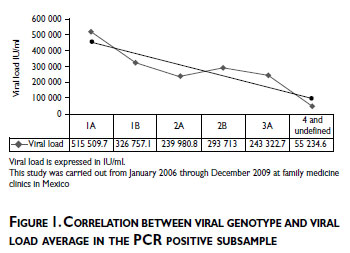
<body><![CDATA[<p><a name="tab1"></a></p>    <p>&nbsp;</p>    <p align="center"><img src="/img/revistas/spm/v53s1/a03tab01.jpg"></p>    <p>&nbsp;</p>    <p><font size="2" face="Verdana, Arial, Helvetica, sans-serif">The  HCV overall sero-prevalence observed in the study population was 1.5 % (C.I. 95%  1.3-1.7), with a mean age of 43.6(C.I. 95% 43-44.2). The frequencies of HCV antibodies  by geographic region were the following: North 1.65% (C.I. 95% 1.57-1.72), Center  1.55% (C.I. 95% 1.48-1.62), Pacific/South 0.81% (C.I. 95% 0.76-0.86) and Distrito  Federal/Estado de Mexico 1.59% (C.I. 95% 1.52-1.67). In our study the positive  seroprevalence was 1.5% (N=1 681). Male gender predominated among HCV positive  sero-prevalence, in the same group with positive seroprevalence we observed that  60.9% had received a blood transfusion, 28.3% declared to have relatives with  cirrhosis, 25.2% had tattoos or piercings, only 6.9% referred to have used drugs.  The most frequent risk characteristics were male gender and blood transfusion  (p&lt;0.001). (<a href="#tab1">Table I</a>)</font></p>    <p><font size="2" face="Verdana, Arial, Helvetica, sans-serif">The  prevalence of HCV RNA detected by RT-PCR among seropositive persons was 48.3%.  All of these currently infected people were referred to medical care. In the comparative  analyses between HCV RNA positive and negative we did not find significant differences  in drug use, blood transfusion, risky sexual practices. Nevertheless, male gender  and family history of cirrhosis had a bigger frequency in the HCV RNA positive  group when it was compared with the HCV RNA negative group (53.75 vs. 46.25%,  <i>p</i> value 0.002 and 58.42% vs. 41.58%, <i>p</i> value: 0.03; respectively).  The distribution of hepatitis risk characteristics and viral genotypes detected  in the positive sero-prevalence subsample (N=1681, 1.5%) is shown in <a href="/img/revistas/spm/v53s1/a03tab02m.jpg">table  II</a>.</font></p>    <p><font size="2" face="Verdana, Arial, Helvetica, sans-serif">As  an exploratory analysis, in one hand we evaluated the prevalence of viral genotype  in all geographic areas of Mexico where the most frequent genotype detected in  all geographic areas of Mexico was genotype 1/subtype 1A (33%) followed by genotype  1/subtype 1B (21.4%), and genotype 2/subtype 2A (8.50%). On the other hand we  evaluated the prevalence of viral genotype by hepatitis risk characteristics,  where the viral genotype 1 was the most frequent in the individuals with tattoos  or piercings, and among individuals who declared having used drugs (Pearson's  chi2(1)=11.1239, Pr = 0.001, Pearson's chi2(1) = 8.7961, Pr =0.003, respectively).  No significant difference was observed for blood transfusion, family history of  cirrhosis and risky sexual practices. Also in our study population we observed  that blood transfusion was the most frequent hepatitis risk factor in the North  area (50.77%) and less frequent in Pacific and South areas (9.37%). Drug use,  risky sexual practices, and tattoos and piercings were the most frequent risk  characteristics in the Center area. (Data not shown)</font></p>    <p><font size="2" face="Verdana, Arial, Helvetica, sans-serif">Finally,  to evaluate our hypothesis about direct correlation between observed viral load  and viral genotype, we found a significant linear positive correlation for the  highest viral load and viral genotype 1 with a R<sup>2</sup> of 80%. (<a href="#fig1">Figure  1</a>)</font></p>    <p><a name="fig1"></a></p>    <p>&nbsp;</p>    ]]></body>
<body><![CDATA[<p align="center"><img src="/img/revistas/spm/v53s1/a03fig01.jpg"></p>    <p>&nbsp;</p>    <p><font size="3" face="Verdana, Arial, Helvetica, sans-serif"><b>Discussion</b></font></p>    <p><font size="2" face="Verdana, Arial, Helvetica, sans-serif">In  Mexico, several studies have been conducted to determine HCV seroprevalence, among  different populations; this has been matter of relatively extensive research.  However, data are scarce regarding population based <sup>10,13-1 5</sup> Therefore,  we re-addressed this problem and conducted this study. The findings about HCV  seroprevalence, virus prevalence and genotyping contribute to the external validity  of these results, because they correlate with previous studies that describe the  same risks characteristics for hepatitis C.<sup>8,15</sup> However, to have relatives  with cirrhosis is a new factor that had not been observed previously in a Mexican  study.</font></p>    <p><font size="2" face="Verdana, Arial, Helvetica, sans-serif">Regarding  the geographic distribution of HCV infection in this study, it reinforces what  has been recorded in Mexico at various times by several authors.<sup>9,10,13,16,17</sup>  This is even though there have been different study designs where regions North,  Center, and the greater metropolitan area in the country are the main focus of  public health attention to care for prevention of disease and opportune diagnosis  and treatment of affected people.</font></p>    <p><font size="2" face="Verdana, Arial, Helvetica, sans-serif">Acknowledging  the limiting effect of indeterminate genotyping results, the most frequent genotype  detected in the population assessed was genotype 1/ subtype 1A followed by genotype  1/subtype 1B, and genotype 2/subtype 2A. These results are in agreement with those  previously reported.<sup>16,1 7</sup> Also, we observed a substantial correlation  between highest viral load and HCV genotype 1. The higher correlation between  viral load and genotype 1, may contribute to the poor response to treatment against  HCV chronic infection.<sup>18</sup> These results could help to monitoring of  new strategies of treatment especially among patients with genotype 1 and contribute  to diminish the economic burden of hepatitis C in Mexico.<sup>18</sup></font></p>    <p><font size="2" face="Verdana, Arial, Helvetica, sans-serif">The  notification network established during this investigation is noteworthy to mention,  as it has been structured with physicians, who are at primary care clinics, with  a role of "sentinel physicians". In order to complement the network, the "local  observatories" or "sentinel areas" (services of the Family Medicine Units) are  the places where the information notified by the sentinel physicians is captured  and sent to the "central registry facility" (National Institute of Public Health  of Mexico) to process the information of the local observatories. The three levels  integrate the sentinel notification network.</font></p>    <p><font size="2" face="Verdana, Arial, Helvetica, sans-serif">Thus,  the components for the application of the sentinel event and the network of notification  are the following:<sup>19,20</sup> active participation of the services of the  primary care units; determination of a situation of clearly identifiable disease  in its users; definition of the determining processes; availability of a system  of monitoring for the harvesting of valid information; its analysis and diffusion,  and implementation of an effective strategic intervention.</font></p>    <p><font size="2" face="Verdana, Arial, Helvetica, sans-serif">Despite  the non-homogeneous distribution of our sample and lack of representativity of  the samples collected from 19 Mexican states, our results contribute to have a  better knowledge about seroprevalence and genotype distribution of HCV in a sizable  sample of the Mexican population.</font></p>    <p><font size="2" face="Verdana, Arial, Helvetica, sans-serif">In  the present sentinel surveillance study of hepatitis C virus, an additional interest  was the identification of users of the services of Family Medicine Units, that  have at least a known risk factor of infection by HCV, to evaluate the frequency  of the infection in this group and to detect those individuals that present with  chronic infection to give opportune treatment and to prevent their evolution towards  cirrhosis or hepatocellular carcinoma.</font></p>    ]]></body>
<body><![CDATA[<p><font size="2" face="Verdana, Arial, Helvetica, sans-serif">The  detection of hepatitis C has been greatly impacted by mandatory screening of blood  donors in most countries in the world,<sup>21</sup> although intravenous drug  use continues to be a major source of infection, including Mexico,<sup>22,23</sup>  where additionally the main risk characteristics are blood transfusion and probably  to have relatives with cirrhosis. Public education regarding the risks of exposure  to infecting paraphernalia as well as household items such as razors is necessary  in the continuing effort to curb this disease.</font></p>    <p><font size="2" face="Verdana, Arial, Helvetica, sans-serif">Finally,  a public health message derived from this study and other recent ones<sup>9,17</sup>  is about the awareness due to HCV infection in the Mexican population requiring  prompt intervention at the community level, to control and prevent further evolution  of the problem. In ample terms, specific measures might include sustained quality  surveillance of blood donation, availability in the public health sector of anti-viral  treatment for infected people, an effective program for the provision of sterile  syringes and needles among drug users, screening of pregnant women with risk characteristics  for HCV acquisition to avoid vertical transmission of the virus and even reinforcing  proper condom use for people with high risk sexual practices. Therefore, the early  detection of the infection and the appropriate therapy are of extreme importance  to reduce viral transmission, morbidity and mortality in the afflicted population.</font></p>    <p>&nbsp;</p>    <p><font size="3" face="Verdana, Arial, Helvetica, sans-serif"><b>Acknowledgements</b></font></p>    <p><font size="2" face="Verdana, Arial, Helvetica, sans-serif">To  Roche Pharma for providing HCV diagnostic laboratory reagents used in this study.</font></p>    <p>&nbsp;</p>    <p><font size="3" face="Verdana, Arial, Helvetica, sans-serif"><b>References</b></font></p>    <!-- ref --><p><font size="2" face="Verdana, Arial, Helvetica, sans-serif">1.  Mendez-Sanchez N, Uribe M. Consenso Nacional sobre Hepatitis C. Conclusiones.  Rev Invest Cliln 2002;54:559-568.    &nbsp;&nbsp;&nbsp;&nbsp;&nbsp;&nbsp;&nbsp;&nbsp;[&#160;<a href="javascript:void(0);" onclick="javascript: window.open('/scielo.php?script=sci_nlinks&ref=9328319&pid=S0036-3634201100070000300001&lng=','','width=640,height=500,resizable=yes,scrollbars=1,menubar=yes,');">Links</a>&#160;]<!-- end-ref --></font></p>    <!-- ref --><p><font size="2" face="Verdana, Arial, Helvetica, sans-serif">2.  WHO . Global surveillance and control of hepatitis C. Report of a WH O Consultation  organized in Collaboration with the Viral Hepatitis Prevention Board,Antwerp,  Belgium. J Viral Hepatol 1999; 6:35-47. <a href="http://www.who.int/csr/disease/hepatitis/whocdscsrlyo2003/en/print.html" target="_blank">http://www.who.int/csr/disease/hepatitis/whocdscsrlyo2003/en/print.html</a>  (consulted on November 2, 2010).    &nbsp;&nbsp;&nbsp;&nbsp;&nbsp;&nbsp;&nbsp;&nbsp;[&#160;<a href="javascript:void(0);" onclick="javascript: window.open('/scielo.php?script=sci_nlinks&ref=9328321&pid=S0036-3634201100070000300002&lng=','','width=640,height=500,resizable=yes,scrollbars=1,menubar=yes,');">Links</a>&#160;]<!-- end-ref --></font></p>    <!-- ref --><p><font size="2" face="Verdana, Arial, Helvetica, sans-serif">3.  CDC. Recommendations for prevention and control of hepatitis C virus (HCV) infection  and HCV-related chronic disease. MMWR 1998;47(RR19):1-39.    &nbsp;&nbsp;&nbsp;&nbsp;&nbsp;&nbsp;&nbsp;&nbsp;[&#160;<a href="javascript:void(0);" onclick="javascript: window.open('/scielo.php?script=sci_nlinks&ref=9328323&pid=S0036-3634201100070000300003&lng=','','width=640,height=500,resizable=yes,scrollbars=1,menubar=yes,');">Links</a>&#160;]<!-- end-ref --></font></p>    <!-- ref --><p><font size="2" face="Verdana, Arial, Helvetica, sans-serif">4.  EASL International Consensus Conference on Hepatitis C. Consensus Statement. J  Hepatol 1999;31:3-8.    &nbsp;&nbsp;&nbsp;&nbsp;&nbsp;&nbsp;&nbsp;&nbsp;[&#160;<a href="javascript:void(0);" onclick="javascript: window.open('/scielo.php?script=sci_nlinks&ref=9328325&pid=S0036-3634201100070000300004&lng=','','width=640,height=500,resizable=yes,scrollbars=1,menubar=yes,');">Links</a>&#160;]<!-- end-ref --></font></p>    <!-- ref --><p><font size="2" face="Verdana, Arial, Helvetica, sans-serif">5.  Bukh J, Miller RH, Purcell RH. Genetic heterogeneity of hepatitis C virus: quasispecies  and genotypes. Semin Liver Dis 1995;15:42-63.    &nbsp;&nbsp;&nbsp;&nbsp;&nbsp;&nbsp;&nbsp;&nbsp;[&#160;<a href="javascript:void(0);" onclick="javascript: window.open('/scielo.php?script=sci_nlinks&ref=9328327&pid=S0036-3634201100070000300005&lng=','','width=640,height=500,resizable=yes,scrollbars=1,menubar=yes,');">Links</a>&#160;]<!-- end-ref --></font></p>    <!-- ref --><p><font size="2" face="Verdana, Arial, Helvetica, sans-serif">6.  Flamm SL. Chronic hepatitis C virus infection. JAMA 2003;289:2413-2417.    &nbsp;&nbsp;&nbsp;&nbsp;&nbsp;&nbsp;&nbsp;&nbsp;[&#160;<a href="javascript:void(0);" onclick="javascript: window.open('/scielo.php?script=sci_nlinks&ref=9328329&pid=S0036-3634201100070000300006&lng=','','width=640,height=500,resizable=yes,scrollbars=1,menubar=yes,');">Links</a>&#160;]<!-- end-ref --></font></p>    <!-- ref --><p><font size="2" face="Verdana, Arial, Helvetica, sans-serif">7.  Alter MJ. Epidemiology of hepatitis C in the West. Semin Liver Dis 1995;15:5-14.    &nbsp;&nbsp;&nbsp;&nbsp;&nbsp;&nbsp;&nbsp;&nbsp;[&#160;<a href="javascript:void(0);" onclick="javascript: window.open('/scielo.php?script=sci_nlinks&ref=9328331&pid=S0036-3634201100070000300007&lng=','','width=640,height=500,resizable=yes,scrollbars=1,menubar=yes,');">Links</a>&#160;]<!-- end-ref --></font></p>    <!-- ref --><p><font size="2" face="Verdana, Arial, Helvetica, sans-serif">8.  Di Bisceglie AM. Hepatitis C. The Lancet 1998;351:351-355.    &nbsp;&nbsp;&nbsp;&nbsp;&nbsp;&nbsp;&nbsp;&nbsp;[&#160;<a href="javascript:void(0);" onclick="javascript: window.open('/scielo.php?script=sci_nlinks&ref=9328333&pid=S0036-3634201100070000300008&lng=','','width=640,height=500,resizable=yes,scrollbars=1,menubar=yes,');">Links</a>&#160;]<!-- end-ref --></font></p>    <!-- ref --><p><font size="2" face="Verdana, Arial, Helvetica, sans-serif">9.  Valdespino JL, Conde-Gonzalez CJ, Olaiz-Fernandez G, Palma O, Kershenobich D,  Sepulveda J. Seroprevalencia de la hepatitis C en adultos de Mexico: jun problema  de salud publica emergente? Salud Publica Mex 2007;49(Suppl. 3):S395-403.    &nbsp;&nbsp;&nbsp;&nbsp;&nbsp;&nbsp;&nbsp;&nbsp;[&#160;<a href="javascript:void(0);" onclick="javascript: window.open('/scielo.php?script=sci_nlinks&ref=9328335&pid=S0036-3634201100070000300009&lng=','','width=640,height=500,resizable=yes,scrollbars=1,menubar=yes,');">Links</a>&#160;]<!-- end-ref --></font></p>    <!-- ref --><p><font size="2" face="Verdana, Arial, Helvetica, sans-serif">10.  Santos-Lopez G, Sosa-Jurado F,Vallejo-Ruiz V, Melendez-Mena D, Reyes-Leyva J.  Prevalence of hepatitis C virus in the Mexican population: A systematic review.  J Infect 2008;56:281-290.    &nbsp;&nbsp;&nbsp;&nbsp;&nbsp;&nbsp;&nbsp;&nbsp;[&#160;<a href="javascript:void(0);" onclick="javascript: window.open('/scielo.php?script=sci_nlinks&ref=9328337&pid=S0036-3634201100070000300010&lng=','','width=640,height=500,resizable=yes,scrollbars=1,menubar=yes,');">Links</a>&#160;]<!-- end-ref --></font></p>    <!-- ref --><p><font size="2" face="Verdana, Arial, Helvetica, sans-serif">11.  Esquivel, G. Geografia y Desarrollo Economico en Mexico. Colegio de Mexico, Mexico  D.F. 2000:9-14.    &nbsp;&nbsp;&nbsp;&nbsp;&nbsp;&nbsp;&nbsp;&nbsp;[&#160;<a href="javascript:void(0);" onclick="javascript: window.open('/scielo.php?script=sci_nlinks&ref=9328339&pid=S0036-3634201100070000300011&lng=','','width=640,height=500,resizable=yes,scrollbars=1,menubar=yes,');">Links</a>&#160;]<!-- end-ref --></font></p>    <!-- ref --><p><font size="2" face="Verdana, Arial, Helvetica, sans-serif">12.  Cantaloube JF,Venault H, Zappitelli JP, Gallian P,Touinssi M,Attoui H, <i>et al.</i>  Molecular analysis of HCV type l to 5 envelope gene: application to investigations  of post-transfusion transmission of HCV. Transfusion 2000;40:712-717.    &nbsp;&nbsp;&nbsp;&nbsp;&nbsp;&nbsp;&nbsp;&nbsp;[&#160;<a href="javascript:void(0);" onclick="javascript: window.open('/scielo.php?script=sci_nlinks&ref=9328341&pid=S0036-3634201100070000300012&lng=','','width=640,height=500,resizable=yes,scrollbars=1,menubar=yes,');">Links</a>&#160;]<!-- end-ref --></font></p>    <!-- ref --><p><font size="2" face="Verdana, Arial, Helvetica, sans-serif">13.  Mendez-Sanchez N, Motola-Kuba D, Zamora-Valdes D, Sanchez-Lara K, Ponciano-Rodriguez  G, Uribe-Ramos MH, <i>et al.</i> Risk characteristics and prevalence of hepatitis  virus B and C serum markers among nurses at a tertiary-care hospital in Mexico  City, Mexico: a descriptive study. Ann Hepatol 2006;5:276-280.    &nbsp;&nbsp;&nbsp;&nbsp;&nbsp;&nbsp;&nbsp;&nbsp;[&#160;<a href="javascript:void(0);" onclick="javascript: window.open('/scielo.php?script=sci_nlinks&ref=9328343&pid=S0036-3634201100070000300013&lng=','','width=640,height=500,resizable=yes,scrollbars=1,menubar=yes,');">Links</a>&#160;]<!-- end-ref --></font></p>    <!-- ref --><p><font size="2" face="Verdana, Arial, Helvetica, sans-serif">14.  Benitez-Arvizu G, Cortez-Gomez R, Novelo-Garza BA, Malagon-Martinez A, Guerra-Marquez  A,Alvarado-Maldonado M del C, <i>et al. </i>Prevalence of hepatitis C virus in  the blood bank at Centro Medico Nacional La Raza. Rev Med Inst Mex Seguro Soc  2006;44:227-233.    &nbsp;&nbsp;&nbsp;&nbsp;&nbsp;&nbsp;&nbsp;&nbsp;[&#160;<a href="javascript:void(0);" onclick="javascript: window.open('/scielo.php?script=sci_nlinks&ref=9328345&pid=S0036-3634201100070000300014&lng=','','width=640,height=500,resizable=yes,scrollbars=1,menubar=yes,');">Links</a>&#160;]<!-- end-ref --></font></p>    <!-- ref --><p><font size="2" face="Verdana, Arial, Helvetica, sans-serif">15.  Garcia-Montalvo BM, Galguera-Colorado PL. Distribution of hepatitis C virus genotypes,  risk characteristics and liver disease in patients from Yucatan, Mexico. Ann Hepatol  2008;7:345-349.    &nbsp;&nbsp;&nbsp;&nbsp;&nbsp;&nbsp;&nbsp;&nbsp;[&#160;<a href="javascript:void(0);" onclick="javascript: window.open('/scielo.php?script=sci_nlinks&ref=9328347&pid=S0036-3634201100070000300015&lng=','','width=640,height=500,resizable=yes,scrollbars=1,menubar=yes,');">Links</a>&#160;]<!-- end-ref --></font></p>    <!-- ref --><p><font size="2" face="Verdana, Arial, Helvetica, sans-serif">16.  Idrovo AJ, Fernandez JA. Which is the real genotype distribution of hepatitis  C virus infection in Mexico? Ann Hepatol 2008;7:390-391.    &nbsp;&nbsp;&nbsp;&nbsp;&nbsp;&nbsp;&nbsp;&nbsp;[&#160;<a href="javascript:void(0);" onclick="javascript: window.open('/scielo.php?script=sci_nlinks&ref=9328349&pid=S0036-3634201100070000300016&lng=','','width=640,height=500,resizable=yes,scrollbars=1,menubar=yes,');">Links</a>&#160;]<!-- end-ref --></font></p>    <!-- ref --><p><font size="2" face="Verdana, Arial, Helvetica, sans-serif">17.  Jimenez-Mendez R, Uribe-Salas F, Lopez-Guillen P, Cisneros-Garza L, Castaneda-Hernandez  G. Distribution of HCV genotypes and HCV RNA viral load in different regions of  Mexico. Ann Hepatol 2010;9:33-39.    &nbsp;&nbsp;&nbsp;&nbsp;&nbsp;&nbsp;&nbsp;&nbsp;[&#160;<a href="javascript:void(0);" onclick="javascript: window.open('/scielo.php?script=sci_nlinks&ref=9328351&pid=S0036-3634201100070000300017&lng=','','width=640,height=500,resizable=yes,scrollbars=1,menubar=yes,');">Links</a>&#160;]<!-- end-ref --></font></p>    <!-- ref --><p><font size="2" face="Verdana, Arial, Helvetica, sans-serif">18.  Gish RG, Arora S, Rajender-Reddy K, Nelson DR, O'Brien C, Xu Y, <i>et al</i> .Virological  response and safety outcomes in therapy-naive patients treated for chronic hepatitis  C with taribavirin or ribavirin in combination with pegylated interferon alfa-2a:  a randomized, phase 2 study. J Hepatol 2007;47:51-59.    &nbsp;&nbsp;&nbsp;&nbsp;&nbsp;&nbsp;&nbsp;&nbsp;[&#160;<a href="javascript:void(0);" onclick="javascript: window.open('/scielo.php?script=sci_nlinks&ref=9328353&pid=S0036-3634201100070000300018&lng=','','width=640,height=500,resizable=yes,scrollbars=1,menubar=yes,');">Links</a>&#160;]<!-- end-ref --></font></p>    <!-- ref --><p><font size="2" face="Verdana, Arial, Helvetica, sans-serif">19.  CDC. Guidelines for evaluating surveillance systems. MMWR 2001;50:1-35.    &nbsp;&nbsp;&nbsp;&nbsp;&nbsp;&nbsp;&nbsp;&nbsp;[&#160;<a href="javascript:void(0);" onclick="javascript: window.open('/scielo.php?script=sci_nlinks&ref=9328355&pid=S0036-3634201100070000300019&lng=','','width=640,height=500,resizable=yes,scrollbars=1,menubar=yes,');">Links</a>&#160;]<!-- end-ref --></font></p>    <!-- ref --><p><font size="2" face="Verdana, Arial, Helvetica, sans-serif">20.  Rutstein DD,Mullan RJ,Frazier TM,Halperin WE , Melius JM, Sestito JP. Sentinel  health events (Occupational): a basis for physician health surveillance. Am J  Public Health 1983;73:1054-1062.    &nbsp;&nbsp;&nbsp;&nbsp;&nbsp;&nbsp;&nbsp;&nbsp;[&#160;<a href="javascript:void(0);" onclick="javascript: window.open('/scielo.php?script=sci_nlinks&ref=9328357&pid=S0036-3634201100070000300020&lng=','','width=640,height=500,resizable=yes,scrollbars=1,menubar=yes,');">Links</a>&#160;]<!-- end-ref --></font></p>    <!-- ref --><p><font size="2" face="Verdana, Arial, Helvetica, sans-serif">21.  Te HS, Jensen DM. Epidemiology of hepatitis B and C viruses: a global overview.  Clin Liver Dis 2010;14:1-21.    &nbsp;&nbsp;&nbsp;&nbsp;&nbsp;&nbsp;&nbsp;&nbsp;[&#160;<a href="javascript:void(0);" onclick="javascript: window.open('/scielo.php?script=sci_nlinks&ref=9328359&pid=S0036-3634201100070000300021&lng=','','width=640,height=500,resizable=yes,scrollbars=1,menubar=yes,');">Links</a>&#160;]<!-- end-ref --></font></p>    <!-- ref --><p><font size="2" face="Verdana, Arial, Helvetica, sans-serif">22.  White EF, Garfein RS, Brouwer KC, Lozada R, Ramos R, Firestone-Cruz M,<i>et al,</i>  Prevalence of hepatitis C virus and HIV infection among injection drug users in  two Mexican cities bordering the U.S. Salud Publica Mex 2007;49:165-172.    &nbsp;&nbsp;&nbsp;&nbsp;&nbsp;&nbsp;&nbsp;&nbsp;[&#160;<a href="javascript:void(0);" onclick="javascript: window.open('/scielo.php?script=sci_nlinks&ref=9328361&pid=S0036-3634201100070000300022&lng=','','width=640,height=500,resizable=yes,scrollbars=1,menubar=yes,');">Links</a>&#160;]<!-- end-ref --></font></p>    <p>&nbsp;</p>    <p>&nbsp;</p>    <p><a name="end"></a><a href="#top1"><img src="/img/revistas/spm/v53s1/seta.jpg"border="0"></a><font size="2" face="Verdana, Arial, Helvetica, sans-serif">  <b>Address reprint requests to:</b>    <br> Dr.Vicente Madrid Marina    <br> Av. Universidad  No. 655 Colonia Santa Maria Ahuacatitlan    <br> 62100, Cuernavaca, Mor. Mexico.    <br>  E-mail: <a href="mailto:vmarina@insp.mx">vmarina@insp.mx</a></font></p>    <p><font size="2" face="Verdana, Arial, Helvetica, sans-serif">Received  on: February 23, 2011    <br> Acepted on: June 27, 2011    ]]></body>
<body><![CDATA[<br> <i>Declaration of conflicts  of interest:</i> The autors declare no conflicts of interest.</font></p>      ]]></body><back>
<ref-list>
<ref id="B1">
<label>1</label><nlm-citation citation-type="journal">
<person-group person-group-type="author">
<name>
<surname><![CDATA[Mendez-Sanchez]]></surname>
<given-names><![CDATA[N]]></given-names>
</name>
<name>
<surname><![CDATA[Uribe]]></surname>
<given-names><![CDATA[M]]></given-names>
</name>
</person-group>
<article-title xml:lang="pt"><![CDATA[Consenso Nacional sobre Hepatitis C: Conclusiones]]></article-title>
<source><![CDATA[Rev Invest Cliln]]></source>
<year>2002</year>
<volume>54</volume>
<page-range>559-568</page-range></nlm-citation>
</ref>
<ref id="B2">
<label>2</label><nlm-citation citation-type="journal">
<collab>WHO</collab>
<article-title xml:lang="en"><![CDATA[Global surveillance and control of hepatitis C: Report of a WH O Consultation organized in Collaboration with the Viral Hepatitis Prevention Board,Antwerp, Belgium]]></article-title>
<source><![CDATA[J Viral Hepatol]]></source>
<year>1999</year>
<volume>6</volume>
<page-range>35-47</page-range></nlm-citation>
</ref>
<ref id="B3">
<label>3</label><nlm-citation citation-type="journal">
<collab>CDC</collab>
<article-title xml:lang="en"><![CDATA[Recommendations for prevention and control of hepatitis C virus (HCV) infection and HCV-related chronic disease]]></article-title>
<source><![CDATA[MMWR]]></source>
<year>1998</year>
<volume>47</volume>
<numero>RR19</numero>
<issue>RR19</issue>
<page-range>1-39</page-range></nlm-citation>
</ref>
<ref id="B4">
<label>4</label><nlm-citation citation-type="journal">
<collab>EASL International Consensus Conference on Hepatitis C</collab>
<article-title xml:lang="en"><![CDATA[Consensus Statement]]></article-title>
<source><![CDATA[J Hepatol]]></source>
<year>1999</year>
<volume>31</volume>
<page-range>3-8</page-range></nlm-citation>
</ref>
<ref id="B5">
<label>5</label><nlm-citation citation-type="journal">
<person-group person-group-type="author">
<name>
<surname><![CDATA[Bukh]]></surname>
<given-names><![CDATA[J]]></given-names>
</name>
<name>
<surname><![CDATA[Miller]]></surname>
<given-names><![CDATA[RH]]></given-names>
</name>
<name>
<surname><![CDATA[Purcell]]></surname>
<given-names><![CDATA[RH]]></given-names>
</name>
</person-group>
<article-title xml:lang="en"><![CDATA[Genetic heterogeneity of hepatitis C virus: quasispecies and genotypes]]></article-title>
<source><![CDATA[Semin Liver Dis]]></source>
<year>1995</year>
<volume>15</volume>
<page-range>42-63</page-range></nlm-citation>
</ref>
<ref id="B6">
<label>6</label><nlm-citation citation-type="journal">
<person-group person-group-type="author">
<name>
<surname><![CDATA[Flamm]]></surname>
<given-names><![CDATA[SL]]></given-names>
</name>
</person-group>
<article-title xml:lang="en"><![CDATA[Chronic hepatitis C virus infection]]></article-title>
<source><![CDATA[JAMA]]></source>
<year>2003</year>
<volume>289</volume>
<page-range>2413-2417</page-range></nlm-citation>
</ref>
<ref id="B7">
<label>7</label><nlm-citation citation-type="journal">
<person-group person-group-type="author">
<name>
<surname><![CDATA[Alter]]></surname>
<given-names><![CDATA[MJ]]></given-names>
</name>
</person-group>
<article-title xml:lang="en"><![CDATA[Epidemiology of hepatitis C in the West]]></article-title>
<source><![CDATA[Semin Liver Dis]]></source>
<year>1995</year>
<volume>15</volume>
<page-range>5-14</page-range></nlm-citation>
</ref>
<ref id="B8">
<label>8</label><nlm-citation citation-type="journal">
<person-group person-group-type="author">
<name>
<surname><![CDATA[Di Bisceglie]]></surname>
<given-names><![CDATA[AM]]></given-names>
</name>
</person-group>
<article-title xml:lang="en"><![CDATA[Hepatitis C]]></article-title>
<source><![CDATA[The Lancet]]></source>
<year>1998</year>
<volume>351</volume>
<page-range>351-355</page-range></nlm-citation>
</ref>
<ref id="B9">
<label>9</label><nlm-citation citation-type="journal">
<person-group person-group-type="author">
<name>
<surname><![CDATA[Valdespino]]></surname>
<given-names><![CDATA[JL]]></given-names>
</name>
<name>
<surname><![CDATA[Conde-Gonzalez]]></surname>
<given-names><![CDATA[CJ]]></given-names>
</name>
<name>
<surname><![CDATA[Olaiz-Fernandez]]></surname>
<given-names><![CDATA[G]]></given-names>
</name>
<name>
<surname><![CDATA[Palma]]></surname>
<given-names><![CDATA[O]]></given-names>
</name>
<name>
<surname><![CDATA[Kershenobich]]></surname>
<given-names><![CDATA[D]]></given-names>
</name>
<name>
<surname><![CDATA[Sepulveda]]></surname>
<given-names><![CDATA[J]]></given-names>
</name>
</person-group>
<article-title xml:lang="es"><![CDATA[Seroprevalencia de la hepatitis C en adultos de Mexico: jun problema de salud publica emergente?]]></article-title>
<source><![CDATA[Salud Publica Mex]]></source>
<year>2007</year>
<volume>49</volume>
<numero>^s3</numero>
<issue>^s3</issue>
<supplement>3</supplement>
<page-range>S395-403</page-range></nlm-citation>
</ref>
<ref id="B10">
<label>10</label><nlm-citation citation-type="journal">
<person-group person-group-type="author">
<name>
<surname><![CDATA[Santos-Lopez]]></surname>
<given-names><![CDATA[G]]></given-names>
</name>
<name>
<surname><![CDATA[Sosa-Jurado]]></surname>
<given-names><![CDATA[F]]></given-names>
</name>
<name>
<surname><![CDATA[Vallejo-Ruiz]]></surname>
<given-names><![CDATA[V]]></given-names>
</name>
<name>
<surname><![CDATA[Melendez-Mena]]></surname>
<given-names><![CDATA[D]]></given-names>
</name>
<name>
<surname><![CDATA[Reyes-Leyva]]></surname>
<given-names><![CDATA[J]]></given-names>
</name>
</person-group>
<article-title xml:lang="en"><![CDATA[Prevalence of hepatitis C virus in the Mexican population: A systematic review]]></article-title>
<source><![CDATA[J Infect]]></source>
<year>2008</year>
<volume>56</volume>
<page-range>281-290</page-range></nlm-citation>
</ref>
<ref id="B11">
<label>11</label><nlm-citation citation-type="book">
<person-group person-group-type="author">
<name>
<surname><![CDATA[Esquivel]]></surname>
<given-names><![CDATA[G]]></given-names>
</name>
</person-group>
<source><![CDATA[Geografia y Desarrollo Economico en Mexico]]></source>
<year>2000</year>
<page-range>9-14</page-range><publisher-loc><![CDATA[Mexico^eD.F D.F]]></publisher-loc>
<publisher-name><![CDATA[Colegio de Mexico]]></publisher-name>
</nlm-citation>
</ref>
<ref id="B12">
<label>12</label><nlm-citation citation-type="journal">
<person-group person-group-type="author">
<name>
<surname><![CDATA[Cantaloube]]></surname>
<given-names><![CDATA[JF]]></given-names>
</name>
<name>
<surname><![CDATA[Venault]]></surname>
<given-names><![CDATA[H]]></given-names>
</name>
<name>
<surname><![CDATA[Zappitelli]]></surname>
<given-names><![CDATA[JP]]></given-names>
</name>
<name>
<surname><![CDATA[Gallian]]></surname>
<given-names><![CDATA[P]]></given-names>
</name>
<name>
<surname><![CDATA[Touinssi]]></surname>
<given-names><![CDATA[M]]></given-names>
</name>
<name>
<surname><![CDATA[Attoui]]></surname>
<given-names><![CDATA[H]]></given-names>
</name>
</person-group>
<article-title xml:lang="en"><![CDATA[Molecular analysis of HCV type l to 5 envelope gene: application to investigations of post-transfusion transmission of HCV]]></article-title>
<source><![CDATA[Transfusion]]></source>
<year>2000</year>
<volume>40</volume>
<page-range>712-717</page-range></nlm-citation>
</ref>
<ref id="B13">
<label>13</label><nlm-citation citation-type="journal">
<person-group person-group-type="author">
<name>
<surname><![CDATA[Mendez-Sanchez]]></surname>
<given-names><![CDATA[N]]></given-names>
</name>
<name>
<surname><![CDATA[Motola-Kuba]]></surname>
<given-names><![CDATA[D]]></given-names>
</name>
<name>
<surname><![CDATA[Zamora-Valdes]]></surname>
<given-names><![CDATA[D]]></given-names>
</name>
<name>
<surname><![CDATA[Sanchez-Lara]]></surname>
<given-names><![CDATA[K]]></given-names>
</name>
<name>
<surname><![CDATA[Ponciano-Rodriguez]]></surname>
<given-names><![CDATA[G]]></given-names>
</name>
<name>
<surname><![CDATA[Uribe-Ramos]]></surname>
<given-names><![CDATA[MH]]></given-names>
</name>
</person-group>
<article-title xml:lang="en"><![CDATA[Risk characteristics and prevalence of hepatitis virus B and C serum markers among nurses at a tertiary-care hospital in Mexico City, Mexico: a descriptive study]]></article-title>
<source><![CDATA[Ann Hepatol]]></source>
<year>2006</year>
<volume>5</volume>
<page-range>276-280</page-range></nlm-citation>
</ref>
<ref id="B14">
<label>14</label><nlm-citation citation-type="journal">
<person-group person-group-type="author">
<name>
<surname><![CDATA[Benitez-Arvizu]]></surname>
<given-names><![CDATA[G]]></given-names>
</name>
<name>
<surname><![CDATA[Cortez-Gomez]]></surname>
<given-names><![CDATA[R]]></given-names>
</name>
<name>
<surname><![CDATA[Novelo-Garza]]></surname>
<given-names><![CDATA[BA]]></given-names>
</name>
<name>
<surname><![CDATA[Malagon-Martinez]]></surname>
<given-names><![CDATA[A]]></given-names>
</name>
<name>
<surname><![CDATA[Guerra-Marquez]]></surname>
<given-names><![CDATA[A]]></given-names>
</name>
<name>
<surname><![CDATA[Alvarado-Maldonado]]></surname>
<given-names><![CDATA[M del C]]></given-names>
</name>
</person-group>
<article-title xml:lang="en"><![CDATA[Prevalence of hepatitis C virus in the blood bank at Centro Medico Nacional La Raza]]></article-title>
<source><![CDATA[Rev Med Inst Mex Seguro Soc]]></source>
<year>2006</year>
<volume>44</volume>
<page-range>227-233</page-range></nlm-citation>
</ref>
<ref id="B15">
<label>15</label><nlm-citation citation-type="journal">
<person-group person-group-type="author">
<name>
<surname><![CDATA[Garcia-Montalvo]]></surname>
<given-names><![CDATA[BM]]></given-names>
</name>
<name>
<surname><![CDATA[Galguera-Colorado]]></surname>
<given-names><![CDATA[PL]]></given-names>
</name>
</person-group>
<article-title xml:lang="en"><![CDATA[Distribution of hepatitis C virus genotypes, risk characteristics and liver disease in patients from Yucatan, Mexico]]></article-title>
<source><![CDATA[Ann Hepatol]]></source>
<year>2008</year>
<volume>7</volume>
<page-range>345-349</page-range></nlm-citation>
</ref>
<ref id="B16">
<label>16</label><nlm-citation citation-type="journal">
<person-group person-group-type="author">
<name>
<surname><![CDATA[Idrovo]]></surname>
<given-names><![CDATA[AJ]]></given-names>
</name>
<name>
<surname><![CDATA[Fernandez]]></surname>
<given-names><![CDATA[JA]]></given-names>
</name>
</person-group>
<article-title xml:lang="en"><![CDATA[Which is the real genotype distribution of hepatitis C virus infection in Mexico]]></article-title>
<source><![CDATA[Ann Hepatol]]></source>
<year>2008</year>
<volume>7</volume>
<page-range>390-391</page-range></nlm-citation>
</ref>
<ref id="B17">
<label>17</label><nlm-citation citation-type="journal">
<person-group person-group-type="author">
<name>
<surname><![CDATA[Jimenez-Mendez]]></surname>
<given-names><![CDATA[R]]></given-names>
</name>
<name>
<surname><![CDATA[Uribe-Salas]]></surname>
<given-names><![CDATA[F]]></given-names>
</name>
<name>
<surname><![CDATA[Lopez-Guillen]]></surname>
<given-names><![CDATA[P]]></given-names>
</name>
<name>
<surname><![CDATA[Cisneros-Garza]]></surname>
<given-names><![CDATA[L]]></given-names>
</name>
<name>
<surname><![CDATA[Castaneda-Hernandez]]></surname>
<given-names><![CDATA[G]]></given-names>
</name>
</person-group>
<article-title xml:lang="en"><![CDATA[Distribution of HCV genotypes and HCV RNA viral load in different regions of Mexico]]></article-title>
<source><![CDATA[Ann Hepatol]]></source>
<year>2010</year>
<volume>9</volume>
<page-range>33-39</page-range></nlm-citation>
</ref>
<ref id="B18">
<label>18</label><nlm-citation citation-type="journal">
<person-group person-group-type="author">
<name>
<surname><![CDATA[Gish]]></surname>
<given-names><![CDATA[RG]]></given-names>
</name>
<name>
<surname><![CDATA[Arora]]></surname>
<given-names><![CDATA[S]]></given-names>
</name>
<name>
<surname><![CDATA[Rajender-Reddy]]></surname>
<given-names><![CDATA[K]]></given-names>
</name>
<name>
<surname><![CDATA[Nelson]]></surname>
<given-names><![CDATA[DR]]></given-names>
</name>
<name>
<surname><![CDATA[O'Brien]]></surname>
<given-names><![CDATA[C]]></given-names>
</name>
<name>
<surname><![CDATA[Xu]]></surname>
<given-names><![CDATA[Y]]></given-names>
</name>
</person-group>
<article-title xml:lang="en"><![CDATA[Virological response and safety outcomes in therapy-naive patients treated for chronic hepatitis C with taribavirin or ribavirin in combination with pegylated interferon alfa-2a: a randomized, phase 2 study]]></article-title>
<source><![CDATA[J Hepatol]]></source>
<year>2007</year>
<volume>47</volume>
<page-range>51-59</page-range></nlm-citation>
</ref>
<ref id="B19">
<label>19</label><nlm-citation citation-type="journal">
<collab>CDC</collab>
<article-title xml:lang="en"><![CDATA[Guidelines for evaluating surveillance systems]]></article-title>
<source><![CDATA[MMWR]]></source>
<year>2001</year>
<volume>50</volume>
<page-range>1-35</page-range></nlm-citation>
</ref>
<ref id="B20">
<label>20</label><nlm-citation citation-type="journal">
<person-group person-group-type="author">
<name>
<surname><![CDATA[Rutstein]]></surname>
<given-names><![CDATA[DD]]></given-names>
</name>
<name>
<surname><![CDATA[Mullan]]></surname>
<given-names><![CDATA[RJ]]></given-names>
</name>
<name>
<surname><![CDATA[Frazier]]></surname>
<given-names><![CDATA[TM]]></given-names>
</name>
<name>
<surname><![CDATA[Halperin]]></surname>
<given-names><![CDATA[WE]]></given-names>
</name>
<name>
<surname><![CDATA[Melius]]></surname>
<given-names><![CDATA[JM]]></given-names>
</name>
<name>
<surname><![CDATA[Sestito]]></surname>
<given-names><![CDATA[JP]]></given-names>
</name>
</person-group>
<article-title xml:lang="en"><![CDATA[Sentinel health events (Occupational): a basis for physician health surveillance]]></article-title>
<source><![CDATA[Am J Public Health]]></source>
<year>1983</year>
<volume>73</volume>
<page-range>1054-1062</page-range></nlm-citation>
</ref>
<ref id="B21">
<label>21</label><nlm-citation citation-type="journal">
<person-group person-group-type="author">
<name>
<surname><![CDATA[Te]]></surname>
<given-names><![CDATA[HS]]></given-names>
</name>
<name>
<surname><![CDATA[Jensen]]></surname>
<given-names><![CDATA[DM]]></given-names>
</name>
</person-group>
<article-title xml:lang="en"><![CDATA[Epidemiology of hepatitis B and C viruses: a global overview]]></article-title>
<source><![CDATA[Clin Liver Dis]]></source>
<year>2010</year>
<volume>14</volume>
<page-range>1-21</page-range></nlm-citation>
</ref>
<ref id="B22">
<label>22</label><nlm-citation citation-type="journal">
<person-group person-group-type="author">
<name>
<surname><![CDATA[White]]></surname>
<given-names><![CDATA[EF]]></given-names>
</name>
<name>
<surname><![CDATA[Garfein]]></surname>
<given-names><![CDATA[RS]]></given-names>
</name>
<name>
<surname><![CDATA[Brouwer]]></surname>
<given-names><![CDATA[KC]]></given-names>
</name>
<name>
<surname><![CDATA[Lozada]]></surname>
<given-names><![CDATA[R]]></given-names>
</name>
<name>
<surname><![CDATA[Ramos]]></surname>
<given-names><![CDATA[R]]></given-names>
</name>
<name>
<surname><![CDATA[Firestone-Cruz]]></surname>
<given-names><![CDATA[M]]></given-names>
</name>
</person-group>
<article-title xml:lang="en"><![CDATA[Prevalence of hepatitis C virus and HIV infection among injection drug users in two Mexican cities bordering the U]]></article-title>
<source><![CDATA[Salud Publica Mex]]></source>
<year>2007</year>
<volume>49</volume>
<page-range>165-172</page-range></nlm-citation>
</ref>
</ref-list>
</back>
</article>