<?xml version="1.0" encoding="ISO-8859-1"?><article xmlns:mml="http://www.w3.org/1998/Math/MathML" xmlns:xlink="http://www.w3.org/1999/xlink" xmlns:xsi="http://www.w3.org/2001/XMLSchema-instance">
<front>
<journal-meta>
<journal-id>0036-3634</journal-id>
<journal-title><![CDATA[Salud Pública de México]]></journal-title>
<abbrev-journal-title><![CDATA[Salud pública Méx]]></abbrev-journal-title>
<issn>0036-3634</issn>
<publisher>
<publisher-name><![CDATA[Instituto Nacional de Salud Pública]]></publisher-name>
</publisher>
</journal-meta>
<article-meta>
<article-id>S0036-36342011000400004</article-id>
<title-group>
<article-title xml:lang="en"><![CDATA[Does food insecurity compromise maternal dietary Zinc or energy intake in favor of her child, in rural poor Mexican households?]]></article-title>
<article-title xml:lang="es"><![CDATA[¿En hogares rurales pobres de México, la inseguridad alimentaria compromete el consumo de zinc y energía de las madres en favor de sus hijos?]]></article-title>
</title-group>
<contrib-group>
<contrib contrib-type="author">
<name>
<surname><![CDATA[Moreno-Tamayo]]></surname>
<given-names><![CDATA[Karla]]></given-names>
</name>
</contrib>
<contrib contrib-type="author">
<name>
<surname><![CDATA[González de Cossío]]></surname>
<given-names><![CDATA[Teresita]]></given-names>
</name>
</contrib>
<contrib contrib-type="author">
<name>
<surname><![CDATA[Flores-Aldana]]></surname>
<given-names><![CDATA[Mario]]></given-names>
</name>
</contrib>
<contrib contrib-type="author">
<name>
<surname><![CDATA[Rodríguez-Ramírez]]></surname>
<given-names><![CDATA[Sonia]]></given-names>
</name>
</contrib>
<contrib contrib-type="author">
<name>
<surname><![CDATA[Ortiz-Hernández]]></surname>
<given-names><![CDATA[Luis]]></given-names>
</name>
</contrib>
</contrib-group>
<aff id="A01">
<institution><![CDATA[,Instituto Nacional de Salud Pública Centro de Investigación en Evaluación y Encuestas ]]></institution>
<addr-line><![CDATA[Cuernavaca Morelos]]></addr-line>
<country>México</country>
</aff>
<aff id="A02">
<institution><![CDATA[,Instituto Nacional de Salud Pública Centro de Investigación en Nutrición y Salud ]]></institution>
<addr-line><![CDATA[Cuernavaca Morelos]]></addr-line>
<country>México</country>
</aff>
<aff id="A03">
<institution><![CDATA[,Universidad Autónoma Metropolitana Unidad Xochimilco ]]></institution>
<addr-line><![CDATA[México DF]]></addr-line>
<country>México</country>
</aff>
<pub-date pub-type="pub">
<day>00</day>
<month>08</month>
<year>2011</year>
</pub-date>
<pub-date pub-type="epub">
<day>00</day>
<month>08</month>
<year>2011</year>
</pub-date>
<volume>53</volume>
<numero>4</numero>
<fpage>299</fpage>
<lpage>311</lpage>
<copyright-statement/>
<copyright-year/>
<self-uri xlink:href="http://www.scielo.org.mx/scielo.php?script=sci_arttext&amp;pid=S0036-36342011000400004&amp;lng=en&amp;nrm=iso"></self-uri><self-uri xlink:href="http://www.scielo.org.mx/scielo.php?script=sci_abstract&amp;pid=S0036-36342011000400004&amp;lng=en&amp;nrm=iso"></self-uri><self-uri xlink:href="http://www.scielo.org.mx/scielo.php?script=sci_pdf&amp;pid=S0036-36342011000400004&amp;lng=en&amp;nrm=iso"></self-uri><abstract abstract-type="short" xml:lang="en"><p><![CDATA[OBJECTIVE: To analyze quantitative indicators of food insecurity (FI), and estimate if FI modifies the association between maternal and child Zinc and energy intake as evidence for maternal dietary compromise in favor of her child. MATERIAL AND METHODS: Cross-sectional study (n=2 563), data derived from baseline impact evaluation of the Mexican Programa de Apoyo Alimentario. Quantitative indicators of FI were:Household food storage, maize and/or bean production, food expenditure, and spatial access to food markets. We evaluated percentage adequacy of energy (PAE) and Zinc (PAZn) intake. Multiple linear regression model was fitted to estimate the association between maternal and child PAE and PAZn. RESULTS: Child PAE and PAZn were positively associated with those of their mothers. None of the FI indicators modified the association between maternal and child PAE and PAZn. CONCLUSIONS: No evidence of maternal dietary compromise in favor of her child was observed using four quantitative indicators of FI in central-southern rural Mexican househods.]]></p></abstract>
<abstract abstract-type="short" xml:lang="es"><p><![CDATA[OBJETIVO: Analizar indicadores cuantitativos de inseguridad alimentaria (IA) y estimar si IA modifica la asociación del consumo de energía y zinc en madres e hijos como evidencia del compromiso de la dieta materna a favor de su hijo. MATERIAL Y MÉTODOS: Estudio transversal,información basal de la evaluación de impacto del Programa de Apoyo Alimentario. Indicadores de IA: reserva de alimentos en hogar, autoproducción maíz y/o frijol, porcentaje del gasto en alimentos y acceso físico a mercados de alimentos.Se calculó el porcentaje de adecuación del consumo energético (PAE) y Zinc (PAZn) (n=2 563 pares). Se estimó un modelo de regresión lineal ajustado por covariables. RESULTADOS: El PAE y PAZn de madres e hijos se asoció positivamente. Ningún indicador de IA modificó la asociación entre PAE y PAZn materno con respecto a sus hijos. CONCLUSIONES: Los indicadores de IA estudiados no modifican la relación entre la dieta de madres-hijos en hogares rurales de México.]]></p></abstract>
<kwd-group>
<kwd lng="en"><![CDATA[food security]]></kwd>
<kwd lng="en"><![CDATA[maternal diet]]></kwd>
<kwd lng="en"><![CDATA[preschool child diet]]></kwd>
<kwd lng="en"><![CDATA[rural Mexico]]></kwd>
<kwd lng="es"><![CDATA[seguridad alimentaria]]></kwd>
<kwd lng="es"><![CDATA[dieta de la madre]]></kwd>
<kwd lng="es"><![CDATA[dieta del niño preescolar]]></kwd>
<kwd lng="es"><![CDATA[México rural]]></kwd>
</kwd-group>
</article-meta>
</front><body><![CDATA[ <p align="right"><font size="2" face="Verdana"><b>ART&Iacute;CULO ORIGINAL</b></font></p>    <p>&nbsp;</p>    <p><font size="4" face="Verdana"><b><a name="tx"></a>Does  food insecurity compromise maternal dietary Zinc or energy intake in favor of  her child, in rural poor Mexican households?</b></font></p>    <p>&nbsp;</p>    <p><font size="3" face="Verdana"><b>&iquest;En  hogares rurales pobres de M&eacute;xico, la inseguridad alimentaria compromete  el consumo de zinc y energ&iacute;a de las madres en favor de sus hijos?</b></font></p>    <p>&nbsp;</p>    <p>&nbsp;</p>    <p><font size="2" face="Verdana"><b>Karla  Moreno&#45;Tamayo, MSc,<Sup>I</sup>; Teresita Gonz&aacute;lez de Coss&iacute;o,  PhD,<Sup>II</Sup>; Mario Flores&#45;Aldana, PhD,<Sup>II</Sup>; Sonia Rodr&iacute;guez&#45;Ram&iacute;rez,  MSc,<Sup>II</Sup>; Luis Ortiz&#45;Hern&aacute;ndez, PhD.<Sup>III</Sup></b></font></p>    <p><font size="2" face="Verdana"><Sup>I</Sup>Centro  de Investigaci&oacute;n en Evaluaci&oacute;n y Encuestas, Instituto Nacional de  Salud P&uacute;blica. Cuernavaca, Morelos, M&eacute;xico    <br> <Sup>II</Sup>Centro  de Investigaci&oacute;n en Nutrici&oacute;n y Salud, Instituto Nacional de Salud  P&uacute;blica. Cuernavaca, Morelos, M&eacute;xico    ]]></body>
<body><![CDATA[<br> <Sup>III</Sup>Universidad  Aut&oacute;noma Metropolitana, Unidad Xochimilco. M&eacute;xico DF, M&eacute;xico</font></p>    <p><font size="2" face="Verdana"><a href="#nt">Correspondence  author</a></font></p>    <p>&nbsp;</p>    <p>&nbsp;</p><hr size="1" noshade>     <p><font size="2" face="Verdana"><b>ABSTACT</b></font></p>    <p><font size="2" face="Verdana"><b>OBJECTIVE:</b>  To analyze quantitative indicators of food insecurity (FI), and estimate if FI  modifies the association between maternal and child Zinc and energy intake as  evidence for maternal dietary compromise in favor of her child.    <br> <b>MATERIAL  AND METHODS:</b> Cross&#45;sectional study (n=2 563), data derived from baseline  impact evaluation of the Mexican <I>Programa de Apoyo Alimentario.</i> Quantitative  indicators of FI were:Household food storage, maize and/or bean production, food  expenditure, and spatial access to food markets. We evaluated percentage adequacy  of energy (PAE) and Zinc (PAZn) intake. Multiple linear regression model was fitted  to estimate the association between maternal and child PAE and PAZn.    <br> <b>RESULTS:</b>  Child PAE and PAZn were positively associated with those of their mothers. None  of the FI indicators modified the association between maternal and child PAE and  PAZn.    <br> <b>CONCLUSIONS:</b> No evidence of maternal dietary compromise in favor  of her child was observed using four quantitative indicators of FI in central&#45;southern  rural Mexican househods.</font></p>    <p><font size="2" face="Verdana"><b>Key words:</b>  food security; maternal diet; preschool child diet; rural Mexico</font></p><hr size="1" noshade>      ]]></body>
<body><![CDATA[<p><font size="2" face="Verdana"><b>RESUMEN</b></font></p>    <p><font size="2" face="Verdana"><b>OBJETIVO:</b>  Analizar indicadores cuantitativos de inseguridad alimentaria (IA) y estimar si  IA modifica la asociaci&oacute;n del consumo de energ&iacute;a y zinc en madres  e hijos como evidencia del compromiso de la dieta materna a favor de su hijo.    <br>  <b>MATERIAL Y M&Eacute;TODOS:</b> Estudio transversal,informaci&oacute;n basal  de la evaluaci&oacute;n de impacto del Programa de Apoyo Alimentario. Indicadores  de IA: reserva de alimentos en hogar, autoproducci&oacute;n ma&iacute;z y/o frijol,  porcentaje del gasto en alimentos y acceso f&iacute;sico a mercados de alimentos.Se  calcul&oacute; el porcentaje de adecuaci&oacute;n del consumo energ&eacute;tico  (PAE) y Zinc (PAZn) (n=2 563 pares). Se estim&oacute; un modelo de regresi&oacute;n  lineal ajustado por covariables.    <br> <b>RESULTADOS:</b> El PAE y PAZn de madres  e hijos se asoci&oacute; positivamente. Ning&uacute;n indicador de IA modific&oacute;  la asociaci&oacute;n entre PAE y PAZn materno con respecto a sus hijos.    <br> <b>CONCLUSIONES:</b>  Los indicadores de IA estudiados no modifican la relaci&oacute;n entre la dieta  de madres&#45;hijos en hogares rurales de M&eacute;xico.</font></p>    <p><font size="2" face="Verdana"><b>Palabras  claves:</b> seguridad alimentaria; dieta de la madre; dieta del ni&ntilde;o preescolar;  M&eacute;xico rural</font></p><hr size="1" noshade>     <p>&nbsp;</p>    <p>&nbsp;</p>    <p><font size="2" face="Verdana">In  the World Food Summit of 1996 it was agreed upon that food security exists when  <I>all people, at all times, have physical and economic access to sufficient safe  and nutritious food to meet their dietary needs and food preferences for a healthy  and active life</I>.<Sup>1</sup> Some adverse effects on health have been documented  in individuals from food insecure households, such as changes in cognitive development,  poor reproductive outcomes in women, physical deterioration and psychological  distress.<Sup>2</sup> Frequently accepted dimensions of food security include  food access, availability and utilization. Food insecurity affects the quantity  and quality of food consumption and, through these, nutritional status and physical  well&#45;being.<Sup>3,4</sup> Because of the multi&#45;dimensional nature of food  insecurity, it may be measured in many forms and attention needs to be paid as  to not oversimplify or misunderstand its core meaning.<Sup>5</sup> Initially,  household food availability was used to assess the existence of food insecurity.<Sup>4</sup>  Subsequently, important scales focusing on subjective experiences of hunger were  developed. A common practice is to validate scales of subjective experiences,  having the food inventories as standard.<Sup>6,7</sup> However, it has been agreed  upon that there may not be a unique measurement of food security that would capture  all its dimensions.<Sup>8</sup> Thus, food insecurity can and has been measured  through different angles, some focusing in the actual physical problems of access  of food within and around households, others on purchasing power and still others  on the perceived effect of such limited access.</font></p>    <p><font size="2" face="Verdana">The  Radimer/Cornell hunger scale was originally developed in the nineties to qualitatively  estimate the prevalence of perceived hunger in a sample of poor New York State  households. This scale identifies those experiencing hunger through a household  member reported experience of food insecurity.<Sup>3</sup> Based on this questionnaire,  on the "<I>Community Childhood Hunger Identification Project</I>" (CCHIP), and  on other US sources of information on this topic,<Sup>9</sup> a Food Security  Scale (FSS) was developed to estimate food insecurity prevalence in that country.  This is a widely used questionnaire that focuses on the effect of limited resources  on food acquisition and the consequent experiences of hunger at the household  level.<Sup>10</sup></font></p>    ]]></body>
<body><![CDATA[<p><font size="2" face="Verdana">The 1996 World  Food Summit Food Security description suggests that measurement of the different  dimensions of food security in a given setting would document its state relative  to the defined construct. As an example of this association between measures of  perceived food insecurity and other direct measures of some of its quantitative  dimensions, a Mexican study conducted in a rural isolated community in Sierra  de Manantl&aacute;n revealed that more than 90% of households experienced some  level of food insecurity as measured by the FSS, and that this was negatively  correlated with household food inventory and individual maternal diet variety.<Sup>6</sup>  Other LatinAmerican countries have employed different indicators such as household  food inventory,<Sup>7</sup> or the Basic Food Basket or the evaluation of internal  adjustment strategies that poor households implement to cope with economic crisis  in Venezuela.<Sup>11</sup> Again, as expected, these studies show that food diversity  is compromised in food insecure household.<Sup>6,11</sup></font></p>    <p><font size="2" face="Verdana">Access  to food has been estimated only recently in Mexico through a study representative  of its rural areas.<Sup>12</sup> This study documented that constant access to  food markets, especially those distributing fresh foods, is limited in rural areas  and that this situation is especially critical for indigenous populations. This  information suggest that measuring actual food access with indicators of presence,  type and distance to food distribution points, considering transportation, may  be critical in the estimation of food insecurity. Different dimensions of food  security need to be assessed to obtain a more equilibrated image of particular  populations, as had been suggested by Pinstrup&#45;Andersen.<Sup>13</sup></font></p>    <p><font size="2" face="Verdana">In  high income countries, a negative association has been reported between food insecurity  and dietary quality in adult men and women.<Sup>14,15</sup> In the United States  and Canada, vitamin, mineral and energy intake has been found to be lower in women  living in households with food insecurity than in food&#45;secure households<Sup>(16&#45;20)</sup>  though this association was not observed for preschool children.<Sup>16,18</sup></font></p>    <p><font size="2" face="Verdana">It  has been shown that each household member experiences food insecurity differently.  Adults, especially women, suffer its negative impact before children do, a phenomenon  that could be interpreted as a form of protection of the child food intake.<Sup>3,17,21</sup>  Few studies have attempted to answer the question of whether mothers compromise  their consumption to protect their children as the level of food insecurity rises.  Compromised dietary consumption by mothers in favor of the children was documented  in a study of single Canadian mothers, in which food insecurity occurred in 78%  of households.<Sup>22</sup> The study found that women reduced their intake of  seven vitamins and two minerals, whereas only reductions in folate and Zinc intake  were observed in their children.</font></p>    <p><font size="2" face="Verdana">One  can study this maternal dietary compromise in terms of dietary quantity, and energy  would be the selected indicator; or in terms of dietary quality. The latter would  need an element that singles out meaningful dietary quality. In Mexico, the 1999  National NutritionSurvey showed that Zn is highly deficient in the diet ofrural  children and women.<Sup>23</sup> Its prevalence in rural areas was 24.7% in children  &lt; 2 years , 55.8% in children 3&#45;4years, and 33.9% in women.<Sup>23</sup>  Due to these findings, Zn has in fact been used, along with other key micronutrients,  as a fortification element in national nutrition programs based on its potential  to promote healthy growth.<Sup>24,25</sup> Programs currently using Zn as a fortifier  include <I>Oportunidades</I>, which distributes a complementary micronutrient  fortified food for young children, or <I>Liconsa</i> which distributes fortified  milk to poor households with children &lt;12y. Together these programs reachmore  that 30 million households every day.<Sup>26</sup></font></p>    <p><font size="2" face="Verdana">The  aim of this study was to evaluate a potential maternal dietary compromise (in  quantity or quality as estimated by energy and Zn adequacy of intakes respectively)  in favor of her preschool child, using ad&#45;hoc developed quantitative indicators  of food insecurity, in rural households in central&#45;southern Mexico.</font></p>    <p>&nbsp;</p>    <p><font size="3" face="Verdana"><b>Material  and Methods</b></font></p>    <p><font size="2" face="Verdana"><b>Study design and  sample</b></font></p>    <p><font size="2" face="Verdana">A cross&#45;sectional study  was carried&#45;out using baseline information from the impact evaluation of the  Mexican <I>Programa de Apoyo Alimentario</i> (PAL, "Food Assistance Program").<Sup>27</sup>  The PAL is directed toward the poorest population in rural Mexico living in communities  without schools and/or health centers. Due to these conditions, such communities  are not eligible for the largest governmental Human Development Program <I>Oportunidades</I>.  To evaluate the PAL, 208 communities with the same degree of poverty and development  characteristics were randomly selected from eight states in central&#45;southern  Mexico (Campeche, Chiapas, Guerrero, Oaxaca, Quintana Roo, Tabasco, Veracruz and  Yucat&aacute;n). Thirty&#45;three households were selected through a systematic  random method within each community. Fieldwork was conducted from October 2003  to April 2004. A sample of 2 133 mothers aged 1249 years (who may have had more  than one preschool child) and 2 563 non breastfeeding children aged 6&#45;59 months  was studied. In total, the sample analysis was composed by 2 133 mothers 20% of  whom had two children in the study, so that there were 2 563 children, all with  complete dietary information. The study was approved by the Biosecurity, Ethics  and Research Commissions at the National Institute of Public Health (INSPfor its  Spanish name) and written informed consent was obtained from mothers.</font></p>    ]]></body>
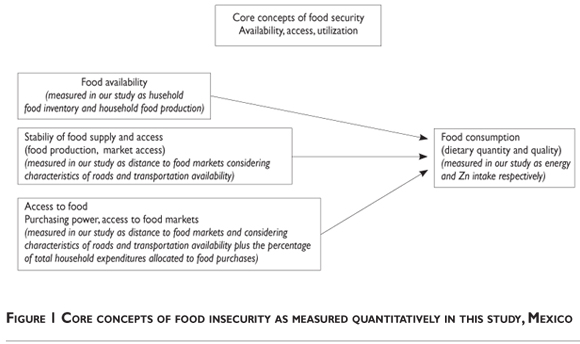
<body><![CDATA[<p><font size="2" face="Verdana">Data  were collected by trained personnel who conducted one 24&#45;hour dietary recall.  When possible, food similar to that reported as consumed, was weighed at home.  When not possible, weights were estimated using standard household measurements  (e.g., glass, cup or spoon). Nutrient dietary content and adequacy of intake were  calculated based on the dietary information<Sup>28,29</sup> using the nutrient  composition database compiled by the INSP which is based on various sources.<Sup>30</sup>  Information on whether or not the child was breastfed was available. Though we  had information on frequency of breastfeeding, no milk consumption data was obtained.  We considered we could not derive valid estimates of breast milk consumption so  dietary energy could not be quantified for breastfed children. Thus breastfed  children were excluded from the analysis.</font></p>    <p><font size="2" face="Verdana"><b>Household&#45;level  food insecurity indicators</b></font></p>    <p><font size="2" face="Verdana">Our  data set does not contain measures of perceived food security as estimated by  the FSS. It does, however, contain quantitative measures of different components  of food security as shown in <a href="#fig01">Figure 1</a>.</font></p>    <p><a name="fig01"></a></p>    <p>&nbsp;</p>    <p align="center"><img src="/img/revistas/spm/v53n4/a04fig01.jpg"></p>    <p>&nbsp;</p>    <p><font size="2" face="Verdana">A  household food availability indicator was developed based on a) food inventory  and b) household food production. Afood access indicator was developed considering  both a) economic and b) spatial access to local food markets.</font></p>    <p><font size="2" face="Verdana"><I>Food  availability indicator through a food inventory</I>. a) We calculated the amount  of food stored at home (in grams and by food groups) adjusted per adult equivalent  (AE) using information on a household food inventory performed the day of the  interview. Foods were classified into seven groups: 1) fruits and vegetables (e.g.,  onion, tomato, chard, avocado, zucchini, chayote, chili, lime, apple, banana,  watermelon, carrot); 2) cereals and tubers (tortilla, oatmeal, amaranth, rice,  maize flour, wheat flour, cookies, crackers, bread, pasta, potato, or yucca);  3) legumes (beans, lentils, chickpeas, or soy); 4) animal food sources (milk and  dairy products, eggs, cheese, beef, chicken, pork, pork rinds, sardine, or tuna);  5) industrialized foods (pastries, sodas, chips, mayonnaise,instant soups, oil,  sugar, powdered soft drinks, coffee, powdered or hard chocolate, jello, catsup,  hot chili salsa), 6) nuts (sesame seeds, almonds, peanuts, walnuts, or pumpkin  seeds) and 7) seasoning (garlic, basil, cumin, cinnamon, cloves, thyme, hibiscus  flower, bay leaves, chamomile, oregano, pepper, or mint). Adult equivalent (AE)  was estimated according to the dietary energy requirement for age, sex and physiological  status of each household member. Energy for an adult was considered to be the  equivalent of 597.5 kJ/d (2500 kcal/d recommended for an adult).<Sup>29</sup>  Correlation between amounts of food group was estimated. To identify patterns  across data and reduce it to one variable, principal component analysis was performed  on data with 2 093 households with complete information. After <I>varimax</i>  rotation, three factors with eigenvalues &gt;1.0 were identified. Each factor  was studied according to the percent of variance explained, its profile and interpretability  (other solutions are available upon request). We chose to use items with factor  loadings <u>&gt;</u>0.3<Sup>31&#45;33</sup> based on the distribution of loadings  within a factor an across factors, and retained the first factor which explained  25% of variance and was the most relevant (see <a href="/img/revistas/spm/v53n4/a04tab02.jpg">Table  II</a>).</font></p>    <p><a name="tab01"></a></p>    ]]></body>
<body><![CDATA[<p>&nbsp;</p>    <p align="center"><img src="/img/revistas/spm/v53n4/a04tab01.jpg"></p>    <p>&nbsp;</p>    <p><font size="2" face="Verdana"><I>Food  availability indicator through household food production</i> b) Household food  production was defined as a dichotomous variable based on whether or not the household  consumed <I>any</i> amount of maize and/or beans produced by the household within  the seven days prior to the interview. These two food items are the country's  main staples, so that the consumption of either one may be considered at the root  of the peasants' survival strategies and cultural preferences.<Sup>34</sup></font></p>    <p><font size="2" face="Verdana"><I>Food  access indicator:</i> a) Economic access. This was measured using the percentage  of total monthly householdexpenditure spent on food. Total estimated household  expenditure included expenditure in the following items: food, transportation,  cleaning products, health care, education, fuel, electricity, rent, clothes, and  expenditure in special ceremonies. Information on these expenses were obtained  on different time frames; i.e., weekly, monthly,annually; and calculated as monthly  total expenditure</font></p>    <p><font size="2" face="Verdana"><I>Food access indicator:</i>  b) Spatial access index developed based on: distance to food markets and time  from home to market, using information of place of food purchases (local store,  weekly local market, weekly produce market, regular or irregular produce vending  trucks, street stallholder, local domestic production, supermarket or small grocery  store) and traveling time (min) to the place of food purchases. The latter was  estimated considering topographic conditions through travel time isochrones using  the geographic information system ArcInfo Version 8.3 according to classifications  for local land communication routes available at the time of the study.<a name="at1"></a><a href="#nt1"><sup>*</sup></a>  Each food market spot calculated to be within 30 min from the household was assigned  a score of 0.5; otherwise, a score of zero. The total points from spatial access  food index were obtained and higher values were considered to reflect greater  spatial access to food. The index was categorized on zero, one, and two or more  close local food markets.</font></p>    <p><font size="2" face="Verdana"><b>Diet quality  and maternal compromise</b></font></p>    <p><font size="2" face="Verdana">We estimated  maternal adequacy of energy and Zinc intake<Sup>28,29</sup> as a function of the  adequacy of the child's intake adequacy. Using this approach, it is possible to  evaluatewhether mothers compromised their dietary consumption in favor of her  children. The study hypothesis is that as the severity of food insecurity increases,  the consumption of the mother decreases relative to that of her child. The association  between the mother's consumption and that of her child's would be negative, indicating  the existence of a compromise on the part of the mother in the presence of food  insecurity. We chose to analyze Zincas an indicator of dietary quality because  is one of the most important nutrient to achieve adequate health and development  of human capital in a population.<Sup>25</sup></font></p>    <p><font size="2" face="Verdana"><b>Covariates</b></font></p>    <p><font size="2" face="Verdana">Children's  and mothers' variables were included as covariates. The child sex, age and nutritional  status were included. Three indicators of nutritional status were used: underweight,  wasting and stunting, classified by the z&#45;score values (&lt; &#45;2) of the  weight&#45;for&#45;age (WAZ), weight&#45;for&#45;height (WHZ) and height&#45;for&#45;age  (HAZ) indexes, respectively. The 2006 World Health Organization (WHO) international  standards were used to construct the indices.<Sup>35</sup> Maternal age and marital,  physiological and nutritional status were also covariables. In mothers aged &lt;18  y, body mass index (BMI) was adjusted by cut&#45;off points suggested by Cole.<Sup>36</sup>  In adult mothers cut&#45;off points suggested by the WHO<Sup>37</sup> were used.  The following household covariables were included: head of household sex; indigenous  condition (if at least one person in the household over 17 years spoke a native  language); and percentage of household members <u>&lt;</u>5 y (number of children  <u>&lt;</u>5 / total household members). Using information from type of floor,  wall and ceiling construction material, number of rooms (not including kitchen  or bathrooms), sanitation service, electricity, and possession of refrigerator,  gas stove, television, radio, VCR, telephone and computer a socioeconomic index  was determined. The index was generated by principal component analysis, which  explained 43.6% of the variance in the first factor. The index was divided into  tertiles: low, medium and high. Since it was detected that some households were  registered in social programs (even if residing in communities where the programs  did not formally operate), participation in social programs was considered by  adding up the number of programs in which the members of the household were registered.  This variable was dichotomized as none, and one or more. Some social programs  had a specific nutritional components (nutritional supplement for children from  <I>Oportunidades, Free Tortilla, Milk Supply Program, Food Baskets</i> and <I>School  Lunch)</i> while others had different contents (cash transfer and scholarships  from <I>Oportunidades</I>, transportation scholarships, <I>Popular Health Insurance,  Productive Options</i> and<I> Temporary Employment</I>).</font></p>    ]]></body>
<body><![CDATA[<p><font size="2" face="Verdana"><b>Statistical  Analysis</b></font></p>    <p><font size="2" face="Verdana">Medians, inter&#45;quartile  ranges and frequencies of each variable were calculated. According to the scale  of variables, the association among dependent, independent and covariables was  evaluated using the Pearson, Spearman, point bi&#45;serial or <I>phi</I> correlation  coefficients.</font></p>    <p><font size="2" face="Verdana">The association between  food insecurity and maternal adequacy of intake was estimated using a linear regression  model for energy and another for Zinc, adjusting for covariates and for clustering  effect to indicate that observations may be correlated. We did this because mothers  in our sample may have had more than one child in the study, resulting in a lack  of independence between siblings' data. We calculated our estimates with and without  siblings in the sample, and did not find evidence that including siblings had  an effect on our estimates. Therefore we adjusted for the clustering effect.</font></p>    <p><font size="2" face="Verdana">Maternal  adequacy of intake was the outcome variable. We included interaction terms between  each food insecurity indicator and child adequacy of intake to evaluate the potential  different association between maternal and child intake depending on different  levels of food the insecurity indicators. The resulting model is presented in  Equation (1):</font></p>    <p align="center"><img src="/img/revistas/spm/v53n4/a04frm01.jpg"></p>    <p><font size="2" face="Verdana">Where  <I>y</i> is maternal adequacy of intake, b represents the regression coefficient  term, <i>X<sub>i</sub></i> represents each food insecurity indicator, <I>Z</i>  is the child adequacy of intake, is the interaction term, and <img src="/img/revistas/spm/v53n4/a04img01.jpg" align="absmiddle">  refers to the series of relevant covariables. Equation (1) illustrates the effect  on maternal adequacy of intake per one&#45;unit change in child adequacy of intake  taking into account indicators of food insecurity. Interaction terms were not  statistically significant so that Equation (1) became:</font></p>    <p align="center"><img src="/img/revistas/spm/v53n4/a04frm02.jpg"></p>    <p><font size="2" face="Verdana">Statistical  differences were considered when p&lt;0.05. Data was processed using STATA/IC  version 10.1.<a name="at2"></a><a href="#nt2"><sup>**</sup></a></font></p>    <p>&nbsp;</p>    <p><font size="3" face="Verdana"><b>Results</b></font></p>    ]]></body>
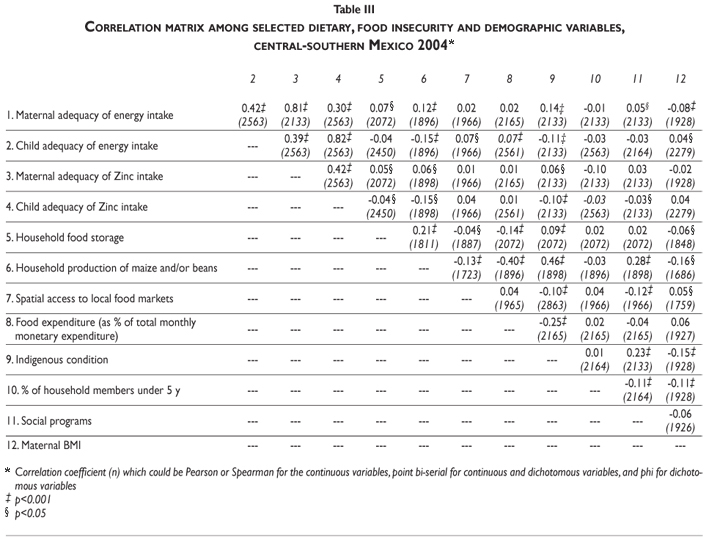
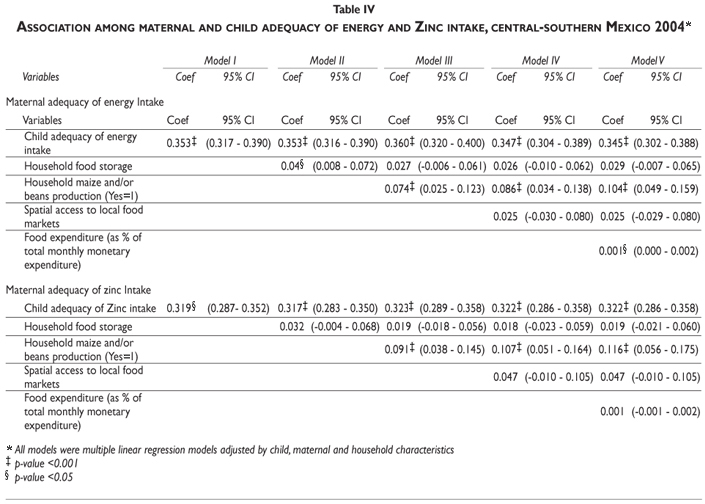
<body><![CDATA[<p><font size="2" face="Verdana"><b>Descriptive  analysis</b></font></p>    <p><font size="2" face="Verdana"><a href="#tab01">Table  I</a> presents child, maternal and household&#45;level characteristics in the  studied sample. Child and maternal median adequacies of energy intake were less  than 100% (70.1% and 83.1% respectively). Median child adequacy of Zinc intake  was 120.4%, whereas maternal was 77.2%. The prevalence of child wasting in these  very poor communities was very low but stunting was high (0.9 and 19.9% respectively).  Prevalence of maternal underweight was low. However, their prevalence of excess  weight was quite high; more than half of the mothers were overweight or obese  (56.4%). Twenty percent of the households were considered indigenous and approximately  40% participated in some social program.</font></p>    <p><font size="2" face="Verdana">Descriptive  analysis of the food insecurity indicators developed in this study is shown in  <a href="/img/revistas/spm/v53n4/a04tab02.jpg">Table II</a>. The industrialized  food group was the most frequent in the households (366g/AE), followed by cereals  and tubers (232.1g/AE), and finally legumes (198.1g/AE). Through the principal  component analysis, legumes, cereals and tubers showed the greater and most positive  correlation factor loadings. On the other hand, animal food products had negative  correlation. Approximately 40% of this population produced their own maize and  or beans which they consumed the week prior to the interview. Median household  maize and beans production was 2695g/AE. More than half (54.9%) of the total household  expenditure was on food. Around three quarters (74.5%) of households had access  to food markets from at least one source located less than 30 minutes away.</font></p>    <p><font size="2" face="Verdana"><b>Bivariate  associations</b></font></p>    <p><font size="2" face="Verdana"><a href="/img/revistas/spm/v53n4/a04tab03.jpg">Table  III</a> shows a correlation matrix among selected dietary, food security and demographics  variables. Household food production of maize and/or beans had a positive correlation  with household storage but a negative one with food expenditure (as % of total  monthly monetary expenditure) and with spatial access to local food markets. For  mothers, household food storage and production of maize and/or beans showed a  positive correlation with their own adequacy of energy and Zinc intake. Indigenous  household condition showed positive correlation with maternal adequacy of energy  and Zinc intake, household production of maize and/or beans, household food storage  and with participation in social programs. It was negatively correlated with spatial  access to local food markets, food expenditure (as % of total monthly monetary  expenditure), and child adequacy of energy and Zinc intake.</font></p>    <p><font size="2" face="Verdana"><b>Maternal  and child adequacy of intake</b></font></p>    <p><font size="2" face="Verdana">The  association between maternal and child adequacy of energy and Zinc intake is showed  in <a href="/img/revistas/spm/v53n4/a04tab04.jpg">Table IV</a>. Five models were  estimated. Model I presents the association adjusted by child, maternal and household  characteristics without food insecurity indicators. Subsequent models examine  the relationship when food insecurity indicators were added, as described next.  Model II included food household storage, model III was model II plus household  production of maize and/or beans, model IV was model III with the addition of  spatial access to local food markets and model V was model IV plus the variable  that indicated food expenditure (as % of total monthly monetary expenditure).  Both energy and Zinc child adequacies were positively associated with maternal  adequacy in all models (<I>p</I>&lt;0.001). Model II shows that food household  storage was associated positively with maternal adequacy of energy (<I>p</I>&lt;0.05)but  not with adequacy of Zinc intake (<I>p</I>&gt;0.05). The association was not significant  after adjustment for the other food insecurity indicators. Household production  of maize and/or beans was positively associated with maternal adequacy of energy  and Zinc intake (<I>p</I>&lt;0.001)and the magnitude increased by adding all the  food insecurity indicators.</font></p>    <p><font size="2" face="Verdana">Food expenditure  (as a percentage of total household monthly monetary expenditure) was positively  associated with maternal adequacy of energy intake (<I>p</I>&lt;0.05) but not  with adequacy of Zinc intake (<I>p</I>&gt;0.05).Lastly, spatial access to local  food markets was not associated with maternal adequacies of intake (<I>p</I>&gt;0.05).</font></p>    <p><font size="2" face="Verdana"><a href="/img/revistas/spm/v53n4/a04tab05.jpg">Table  V</a> shows regression models fitted to determine the presence of maternal diet  compromise in favor of her child. Other variables statistically associated with  maternal adequacy of energy intake were an indigenous condition (<I>p</I>&lt;0.001)  and whether the mothers were breastfeeding (<I>p</I>&lt;0.05). On the other hand,  there was a negative association between maternal adequacy and social programs  (<I>p</I>&lt;0.001); with mothers being single, divorced or widowed (<I>p</I>&lt;0.001),  and their BMI (<I>p</I>&lt;0.05).</font></p>    <p><font size="2" face="Verdana">The  adequacy of Zinc intake was examined using an independent final multivariate regression  model (<a href="/img/revistas/spm/v53n4/a04tab05.jpg">Table V</a>). Maternal adequacy  of Zinc intake was positively associated with household production of maize and/or  beans and with the indigenous condition of the household. Child age had a positive  association with maternal Zinc intake. Breastfeeding was negatively associated  with the adequacy of Zinc intake; being single, divorced or widowed mothers was  negatively associated with both adequacies of intakes.</font></p>    ]]></body>
<body><![CDATA[<p>&nbsp;</p>    <p><font size="3" face="Verdana"><b>Discussion</b></font></p>    <p><font size="2" face="Verdana">Our  study sought to evaluate whether mothers compromised their dietary consumption  in favor of their child's consumption in the presence of food insecurity. We measured  food insecurity with quantitative indicators of food production, access, household  availability and purchasing power and found no evidence that maternal dietary  adequacy of intake was compromised in favor of her child, in neither quantity  nor quality as measured by dietary energy and Zinc intake, as indicators of food  insecurity varied.</font></p>    <p><font size="2" face="Verdana">The conceptual framework  of food insecurity suggests that adults, and especially mothers, tend to compromise  their consumption in favor of that of their young children.<Sup>3,17,38</sup>  With data from poor rural areas in the Mexican central&#45;southern region, our  analysis did not support this hypothesis. Through our developed indicators of  the availability of and access to food (both physical and economic access), we  studied two quantitative dimensions of food insecurity and their association with  Zn adequacy intake as an indicator of dietary quality of rural Mexican mothers  and that of their preschool children. For both energy and Zinc, larger values  of adequacy of dietary intake in children were positively associated with a greater  adequacy of maternal dietary intake; and, this association was not modified by  the dimensions of food insecurity. Since our hypothesis was that maternal adequacy  of intake would be compromised, we would expect that variations in the dimensions  of food insecurity could affect or modify the associations between mother&#45;child  dietary intakes. This did not occur.</font></p>    <p><font size="2" face="Verdana">Some  evidence from North America report different results from ours when using indicators  of perceived food insecurity. In a rural community in New York state, women experiencing  food insecurity reported low consumption of potassium, fiber and vitamin C, while  the rest of the family maintained optimal consumption.<Sup>3</sup> More evidence  from North America pointed that, more generally women reporting perceived food  insecurity, reduced their consumption of energy, magnesium, and vitamins A, E,  C and B<Sub>6</Sub>; this association, however, was not found in preschool children.<Sup>16,18</sup>  McIntyre followed a group of low&#45;income Canadian women on a weekly basis for  one month.<Sup>22</sup> This period was considered to cover times when a household's  economic resources to purchase food would range from high to low. It was found  that over the one&#45;month period studied, mothers compromised their consumption  in favor of their children, as indicated by the mean adequacy of dietary intake  for the mothers being lower than that of their children, particularly energy,  vitamin A, folate, Zinc, calcium and iron. In general, adequacy of dietary intake  in the mothers was low and was shown to decrease over time. However, this study  did not differentiate according to household food insecurity status, although  roughly 80% reported experienced it.</font></p>    <p><font size="2" face="Verdana">The  foods that were key indicators of food insecurity were maize and beans, both commonly  foods present in household storage and production. This is because both foods  constitute the basic diet of the population in rural Mexico. Maize and beans are  likely to be produced primarily as a form of subsistence, with the priority of  meeting the nutritional needs of the household. Excess production is used to generate  income in order to meet other needs.<Sup>39</sup> We found that the dimensions  of food insecurity related to adequacy of energy and Zinc intake in the mother  were household production of maize and beans and the percentage of food expenditure,  although it only had a slight association with adequacy of energy intake. The  fact that energy adequacy is positively associated with this indicator of food  security, by no means intends to imply that the more energy mothers &#150;or any  family member&#150; consumes, the better. The aim in nutrition policies must be  to improve dietary quality while recommending a prudent energy intake; especially  in a country as Mexico where two thirds of the adult population is overweight  or obese.<Sup>40</sup></font></p>    <p><font size="2" face="Verdana">Since consumption  is strongly associated with income level and the family's physical access to different  products, the availability of foods does not guarantee food security for the household.  The Mexican National Committee for the Evaluation of Social Development Policy  revealed that in rural areas in Mexico, 31.8% ofindividuals did not have enough  income to meet their nutritional needs.<Sup>41</sup> It is known that poor households  spend a large portion of their income on food. This study observed that households  in this study typically spent more than half of their expenses on the acquisition  of food; higher than the 41% reported for rural Mexico in 2004.<Sup>42</sup></font></p>    <p><font size="2" face="Verdana">The  strategies used and decisions made withinhouseholds when facing a scarcity of  food, are not known with certainty. However there were households with available  foods which were not a source of bioavailable micronutrients (i.e., industrialized  low&#45;priced food items) which provided poor variety to the diet. On the other  hand, our results suggest that when availability of and access to food is scarce,  this population turns to household food production: 40% of households consumed  household production of maize and/or beans. A study in Sierra de Manantl&aacute;n,<Sup>6</sup>  a rural Mexican community with little socioeconomic variability, found that 90%  of households experienced some degree of food insecurity, this negatively correlated  with the availability in the household of fruits, vegetables andfoods from animal  origin, including dairy products. It was found that when faced with scarcity or  limitations,households depended on foods which they produced themselves.</font></p>    <p><font size="2" face="Verdana">In  contrast to what we expected, the spatial access to local food markets was not  associated with the outcome, although the coefficients were always positive. This  indicator provides information about location stores (&lt;30 minutes); however  it may be not the best to describe the potential access to a variety of food items  and their characteristics (number, type, size, price).</font></p>    <p><font size="2" face="Verdana">The  evidence indicates that households experiencing food insecurity typically receive  assistance in orderto reduce their vulnerability.<Sup>7,18,22,43&#45;47</sup>  Our study findsthat participation in social programs is negatively associated  with adequacy of energy intake in mothers and, although not statistically significant,  the coefficient for adequacy of Zinc intake was also negative.This suggests that  participation in social programs is an indicator of poverty, and that therefore  these households have a greater probability of experiencing foodinsecurity.</font></p>    ]]></body>
<body><![CDATA[<p><font size="2" face="Verdana">The  findings of our study are important because particularly they respond to the need  to study the gender aspects of food insecurity in rural and marginalized areas  in Mexico. Traditionally, the study of the association between food insecurity  and diet has been conducted in high&#45;income countries using nationally representative  surveys,<Sup>16,18</sup> in urban zones with scarce resources<Sup>19,20,22</sup>  and in rural communities.<Sup>3</sup> In Latin America, the understanding of this  phenomenon is just beginning;<Sup>6,7,11,43,48</sup> and this work contributes  to that understanding.</font></p>    <p><font size="2" face="Verdana">A potential  limitation of this study may be that dietary information was collected only from  mothers and their preschool children, which made it impossible to study the intra&#45;household  distribution in&#45;depth. It is known that the nature of a compromised diet varies  between populations because it depends on availability, access, and the way in  which food is distributed within the family.<Sup>17,38</sup> Another potential  limitation in our study is that dietary information obtained was provided by the  mother who may have responded thinking it was a way to evaluate her ability as  the caretaker or the one responsible for her family's nutrition; this could result  in over&#45;reporting the consumption of the child and underreporting that of  the mother. If this were the case, this would indeed obscure the very compromise  we are evaluating. However, we have no basis to assume mothers in the more food  insecure households of our sample, would underreport their child's diet while  over reporting theirs. Regarding external validity of our study, communities'  random selection and large sample sizes allow for generalization of the findings  to rural communities in southern Mexico, but only to those non&#45;breastfeeding  mother&#45;child pairs.</font></p>    <p><font size="2" face="Verdana">The mother  being single, divorced or widowed was negatively associated with the adequacy  of her energy and Zinc intake. It may be that not having a partner results in  having more limited resources or less financial security with which to face situations  within the household, and that this is directly reflected in decreased adequacy  of dietary intake. Single and divorced mothers are found to have a more vulnerable  health status, and with respect to diet, it has been documented that they consume  less fruits and vegetables.<Sup>49,50</sup></font></p>    <p><font size="2" face="Verdana">The  physiological demand for nutrients in lactating women<Sup>51</sup> was evident  in this study, as lactation was found to be negatively associated with adequacy  of Zinc intake. In our study we found that BMI was negatively associated with  energy adequacy of intake. We evaluated our estimates including BMI as a covariate.  We also stratified by maternal obesity but did not find significant changes in  the estimate, its magnitude, direction or p value. The potential error due to  underestimation of maternal dietary intake may be debilitating our estimated association,  possibly bringing it towards the null value.<Sup>52</sup></font></p>    <p><font size="2" face="Verdana">The  mothers in indigenous households, independently of other factors, may have better  practices withregard to choosing the quantity and quality of food they consume  (reflected by the positive and statistically significant association with the  coefficients for energy and Zinc, respectively). However, they are only meetingthree  quarters of the nutritional requirement (&gt;70%). This data are of concern because  women in rural areas have a predominant dietary pattern consisting of maize and  its derivatives, wheat and its derivatives, and beans and legumes,<Sup>53</sup>  all of which have low bioavailability for micronutrients. Regardless, the finding  that women in indigenous households have higher adequacy of dietary intake suggests  that something is occurring for those women. This could be studied in the future  so as to clarify the processes that occur within these households.</font></p>    <p><font size="2" face="Verdana">We  analyzed the relationship of a quantitative indicator of food insecurity with  the diet of mothers and children in poor southern rural communities in Mexico.  We found that in the present of food insecurity, maternal diet is not compromised  in favor of that of their children, in terms of either quantity (adequacy of energy  intake) or quality (adequacy of Zinc intake). With the assumption that maternal  dietary consumption is related to that of the other household members, particularly  children, we observed that child adequacy of dietary intake, household production  of maize and/or beans, and indigenous household condition, were all associated  with a higher maternal adequacy of energy and Zinc intake. The design of this  analysis was cross&#45;sectional. In the future, it may be meaningful to explore  the relationship between food insecurity and a maternal compromised diet mother  in favor her children through time, and not only on a cross sectional study. This  could aid in answering the question of whether such a strategy is used by adults  in households with food insecurity, and especially by mothers, compromising their  own consumption to protect their children.</font></p>    <p><font size="2" face="Verdana"><b>Acknowledgements</b></font></p>    <p><font size="2" face="Verdana">The  authors wish to thank the generous and insightful corrections of their anonymous  reviewers. With their help, this document was considerably improved.</font></p>    <p><font size="2" face="Verdana"><I>Declaration  of conflict of interests:</i> The autors declare that they have no conflict of  interests.</font></p>    <p>&nbsp;</p>    ]]></body>
<body><![CDATA[<p><font size="3" face="Verdana"><b>References</b></font></p>    <!-- ref --><p><font size="2" face="Verdana">1.  FAO. Declaration on world food security. Rome:World Food Summit, FAO, 1996.    &nbsp;&nbsp;&nbsp;&nbsp;&nbsp;&nbsp;&nbsp;&nbsp;[&#160;<a href="javascript:void(0);" onclick="javascript: window.open('/scielo.php?script=sci_nlinks&ref=9322637&pid=S0036-3634201100040000400001&lng=','','width=640,height=500,resizable=yes,scrollbars=1,menubar=yes,');">Links</a>&#160;]<!-- end-ref --></font></p>    <!-- ref --><p><font size="2" face="Verdana">2.  Holben DH. Position of the American Dietetic Association: food insecurity and  hunger in the United States. J Am Diet Assoc 2006 Mar;106(3):446&#45;458.    &nbsp;&nbsp;&nbsp;&nbsp;&nbsp;&nbsp;&nbsp;&nbsp;[&#160;<a href="javascript:void(0);" onclick="javascript: window.open('/scielo.php?script=sci_nlinks&ref=9322639&pid=S0036-3634201100040000400002&lng=','','width=640,height=500,resizable=yes,scrollbars=1,menubar=yes,');">Links</a>&#160;]<!-- end-ref --></font></p>    <!-- ref --><p><font size="2" face="Verdana">3.  Radimer KL, Olson CM, Campbell CC. Development of indicators to assess hunger.  J Nutr 1990;120 Suppl 11:1544&#45;1548.    &nbsp;&nbsp;&nbsp;&nbsp;&nbsp;&nbsp;&nbsp;&nbsp;[&#160;<a href="javascript:void(0);" onclick="javascript: window.open('/scielo.php?script=sci_nlinks&ref=9322641&pid=S0036-3634201100040000400003&lng=','','width=640,height=500,resizable=yes,scrollbars=1,menubar=yes,');">Links</a>&#160;]<!-- end-ref --></font></p>    <!-- ref --><p><font size="2" face="Verdana">4.  Pelletier DL, Olson CM, Frongillo E. Inseguridad alimentaria, hambre y desnutrici&oacute;n.  In: Bowman BA, Russel RM, editors. Conocimientos actuales sobre nutrici&oacute;n.Washington,  DC: ILSI, OPS, OMS, 2003;762&#45;775.    &nbsp;&nbsp;&nbsp;&nbsp;&nbsp;&nbsp;&nbsp;&nbsp;[&#160;<a href="javascript:void(0);" onclick="javascript: window.open('/scielo.php?script=sci_nlinks&ref=9322643&pid=S0036-3634201100040000400004&lng=','','width=640,height=500,resizable=yes,scrollbars=1,menubar=yes,');">Links</a>&#160;]<!-- end-ref --></font></p>    <!-- ref --><p><font size="2" face="Verdana">5.  Renzaho AM, Mellor D. Food security measurement in cultural pluralism: missing  the point or conceptual misunderstanding? Nutrition 2010;26(1):1&#45;9.    &nbsp;&nbsp;&nbsp;&nbsp;&nbsp;&nbsp;&nbsp;&nbsp;[&#160;<a href="javascript:void(0);" onclick="javascript: window.open('/scielo.php?script=sci_nlinks&ref=9322645&pid=S0036-3634201100040000400005&lng=','','width=640,height=500,resizable=yes,scrollbars=1,menubar=yes,');">Links</a>&#160;]<!-- end-ref --></font></p>    <!-- ref --><p><font size="2" face="Verdana">6.  Melgar&#45;Qui&ntilde;onez H, Zubieta AC,Valdez E,Whitelaw BLK. Validaci&oacute;n  de un instrumento para vigilar la inseguridad alimentaria en la Sierra de Manantl&aacute;n,  Jalisco. Salud Publica Mex 2005;47(6):413&#45;422.    &nbsp;&nbsp;&nbsp;&nbsp;&nbsp;&nbsp;&nbsp;&nbsp;[&#160;<a href="javascript:void(0);" onclick="javascript: window.open('/scielo.php?script=sci_nlinks&ref=9322647&pid=S0036-3634201100040000400006&lng=','','width=640,height=500,resizable=yes,scrollbars=1,menubar=yes,');">Links</a>&#160;]<!-- end-ref --></font></p>    <!-- ref --><p><font size="2" face="Verdana">7.  Hackett M, Zubieta AC, Hernandez K, Melgar&#45;Quinonez H. Food insecurity and  household food supplies in rural Ecuador.Arch Latinoam Nutr 2007;57(1):10&#45;17.    &nbsp;&nbsp;&nbsp;&nbsp;&nbsp;&nbsp;&nbsp;&nbsp;[&#160;<a href="javascript:void(0);" onclick="javascript: window.open('/scielo.php?script=sci_nlinks&ref=9322649&pid=S0036-3634201100040000400007&lng=','','width=640,height=500,resizable=yes,scrollbars=1,menubar=yes,');">Links</a>&#160;]<!-- end-ref --></font></p>    <!-- ref --><p><font size="2" face="Verdana">8.  The Food and Agriculture Organization of the United Nations. Measurement and assessment  of food deprivation and under&#45;nutrition. Proceedings of the International  Scientific Symposium. June 26&#45;28, 2002; Rome, Italy. FAO; 2002.    &nbsp;&nbsp;&nbsp;&nbsp;&nbsp;&nbsp;&nbsp;&nbsp;[&#160;<a href="javascript:void(0);" onclick="javascript: window.open('/scielo.php?script=sci_nlinks&ref=9322651&pid=S0036-3634201100040000400008&lng=','','width=640,height=500,resizable=yes,scrollbars=1,menubar=yes,');">Links</a>&#160;]<!-- end-ref --></font></p>    <!-- ref --><p><font size="2" face="Verdana">9.  Frongillo EA, Jr. Rauschenbach BS, Olson CM, Kendall A, Colmenares AG. Questionnaire&#45;based  measures are valid for the identification of rural households with hunger and  food insecurity. J Nutr 1997;127(5):699&#45;705.    &nbsp;&nbsp;&nbsp;&nbsp;&nbsp;&nbsp;&nbsp;&nbsp;[&#160;<a href="javascript:void(0);" onclick="javascript: window.open('/scielo.php?script=sci_nlinks&ref=9322653&pid=S0036-3634201100040000400009&lng=','','width=640,height=500,resizable=yes,scrollbars=1,menubar=yes,');">Links</a>&#160;]<!-- end-ref --></font></p>    <!-- ref --><p><font size="2" face="Verdana">10.  Hamilton WL, Cook JT,Thompson WW, Buron L, Frongillo EA, Olson C, <I>et al.</I>  Household food security in the United Sates in 1995.Technical report of the food  security measurement project.Alexandria,VA: U.S. Department of Agriculture, Food  Consumer Service, 1997.    &nbsp;&nbsp;&nbsp;&nbsp;&nbsp;&nbsp;&nbsp;&nbsp;[&#160;<a href="javascript:void(0);" onclick="javascript: window.open('/scielo.php?script=sci_nlinks&ref=9322655&pid=S0036-3634201100040000400010&lng=','','width=640,height=500,resizable=yes,scrollbars=1,menubar=yes,');">Links</a>&#160;]<!-- end-ref --></font></p>    <!-- ref --><p><font size="2" face="Verdana">11. Lorenzana  P, Bernal J, Mercado C. Inseguridad Alimentaria y experiencias de hambre en hogares  venezolanos menos privilegiados. Rev Esp Nutr Comunitaria 2003;9(3):138&#45;143.    &nbsp;&nbsp;&nbsp;&nbsp;&nbsp;&nbsp;&nbsp;&nbsp;[&#160;<a href="javascript:void(0);" onclick="javascript: window.open('/scielo.php?script=sci_nlinks&ref=9322657&pid=S0036-3634201100040000400011&lng=','','width=640,height=500,resizable=yes,scrollbars=1,menubar=yes,');">Links</a>&#160;]<!-- end-ref --></font></p>    <!-- ref --><p><font size="2" face="Verdana">12.  Consejo Nacional de Evaluaci&oacute;n de la Pol&iacute;tica de Desarrollo Social.  Dimensiones de la seguridad alimentaria: Evaluaci&oacute;n Estrat&eacute;gica  de Nutrici&oacute;n y Abasto. M&eacute;xico; CONEVAL: 2010. &#91;accessed: 2011,  5, 30&#93;. Available in: <a href="http://www.coneval.gob.mx/cmsconeval/rw/resource/coneval/home/Evaluacion%20de%20Nutricion%20y%20Abasto%202010.pdf?view=true." target="_blank">http://www.coneval.gob.mx/cmsconeval/rw/resource/coneval/home/Evaluacion%20de%20Nutricion%20y%20Abasto%202010.pdf?view=true</a>.    &nbsp;&nbsp;&nbsp;&nbsp;&nbsp;&nbsp;&nbsp;&nbsp;[&#160;<a href="javascript:void(0);" onclick="javascript: window.open('/scielo.php?script=sci_nlinks&ref=9322659&pid=S0036-3634201100040000400012&lng=','','width=640,height=500,resizable=yes,scrollbars=1,menubar=yes,');">Links</a>&#160;]<!-- end-ref --></font></p>    <!-- ref --><p><font size="2" face="Verdana">13.  Pinstrup&#45;Andersen P. Food Security: Definition and Measurement. Food Security  2009;1:5&#45;7.    &nbsp;&nbsp;&nbsp;&nbsp;&nbsp;&nbsp;&nbsp;&nbsp;[&#160;<a href="javascript:void(0);" onclick="javascript: window.open('/scielo.php?script=sci_nlinks&ref=9322661&pid=S0036-3634201100040000400013&lng=','','width=640,height=500,resizable=yes,scrollbars=1,menubar=yes,');">Links</a>&#160;]<!-- end-ref --></font></p>    <!-- ref --><p><font size="2" face="Verdana">14. Champagne CM, Casey  PH, Connell CL, Stuff JE, Gossett JM, Harsha DW, <I>et al.</I> Poverty and food  intake in rural America: diet quality is lower in food insecure adults in the  Mississippi Delta. J Am Diet Assoc 2007;107(11):1886&#45;1894.    &nbsp;&nbsp;&nbsp;&nbsp;&nbsp;&nbsp;&nbsp;&nbsp;[&#160;<a href="javascript:void(0);" onclick="javascript: window.open('/scielo.php?script=sci_nlinks&ref=9322663&pid=S0036-3634201100040000400014&lng=','','width=640,height=500,resizable=yes,scrollbars=1,menubar=yes,');">Links</a>&#160;]<!-- end-ref --></font></p>    <!-- ref --><p><font size="2" face="Verdana">15.  Glanville NT, McIntyre L. Diet quality of Atlantic families headed by single mothers.  Can J Diet Pract Res 2006;67(1):28&#45;35.    &nbsp;&nbsp;&nbsp;&nbsp;&nbsp;&nbsp;&nbsp;&nbsp;[&#160;<a href="javascript:void(0);" onclick="javascript: window.open('/scielo.php?script=sci_nlinks&ref=9322665&pid=S0036-3634201100040000400015&lng=','','width=640,height=500,resizable=yes,scrollbars=1,menubar=yes,');">Links</a>&#160;]<!-- end-ref --></font></p>    <!-- ref --><p><font size="2" face="Verdana">16.  Cristofar S, Basiotis PP. Dietary intakes and selected characteristics of women  ages 19&#45;50 years and their children ages 1&#45;5 years by reported perception  of food sufficiency. J Nutr Educ 1992;24(2):53&#45;58.    &nbsp;&nbsp;&nbsp;&nbsp;&nbsp;&nbsp;&nbsp;&nbsp;[&#160;<a href="javascript:void(0);" onclick="javascript: window.open('/scielo.php?script=sci_nlinks&ref=9322667&pid=S0036-3634201100040000400016&lng=','','width=640,height=500,resizable=yes,scrollbars=1,menubar=yes,');">Links</a>&#160;]<!-- end-ref --></font></p>    <!-- ref --><p><font size="2" face="Verdana">17.  Kendall A, Olson CM, Frongillo EA, Jr. Relationship of hunger and food insecurity  to food availability and consumption. J Am Diet Assoc 1996;96(10):1019&#45;24;  quiz 25&#45;6.    &nbsp;&nbsp;&nbsp;&nbsp;&nbsp;&nbsp;&nbsp;&nbsp;[&#160;<a href="javascript:void(0);" onclick="javascript: window.open('/scielo.php?script=sci_nlinks&ref=9322669&pid=S0036-3634201100040000400017&lng=','','width=640,height=500,resizable=yes,scrollbars=1,menubar=yes,');">Links</a>&#160;]<!-- end-ref --></font></p>    <!-- ref --><p><font size="2" face="Verdana">18. Rose D, Oliveira  V. Nutrient intakes of individuals from food&#45;insufficient households in the  United States. Am J Public Health 1997;87(12):1956&#45;61.    &nbsp;&nbsp;&nbsp;&nbsp;&nbsp;&nbsp;&nbsp;&nbsp;[&#160;<a href="javascript:void(0);" onclick="javascript: window.open('/scielo.php?script=sci_nlinks&ref=9322671&pid=S0036-3634201100040000400018&lng=','','width=640,height=500,resizable=yes,scrollbars=1,menubar=yes,');">Links</a>&#160;]<!-- end-ref --></font></p>    <!-- ref --><p><font size="2" face="Verdana">19.  Tarasuk V, McIntyre L, Li J. Low&#45;income women's dietary intakes are sensitive  to the depletion of household resources in one month. J Nutr. 2007;137(8):1980&#45;1987.    &nbsp;&nbsp;&nbsp;&nbsp;&nbsp;&nbsp;&nbsp;&nbsp;[&#160;<a href="javascript:void(0);" onclick="javascript: window.open('/scielo.php?script=sci_nlinks&ref=9322673&pid=S0036-3634201100040000400019&lng=','','width=640,height=500,resizable=yes,scrollbars=1,menubar=yes,');">Links</a>&#160;]<!-- end-ref --></font></p>    <!-- ref --><p><font size="2" face="Verdana">20.  Tarasuk VS, Beaton GH.Women's dietary intakes in the context of household food  insecurity. J Nutr 1999;129(3):672&#45;679.    &nbsp;&nbsp;&nbsp;&nbsp;&nbsp;&nbsp;&nbsp;&nbsp;[&#160;<a href="javascript:void(0);" onclick="javascript: window.open('/scielo.php?script=sci_nlinks&ref=9322675&pid=S0036-3634201100040000400020&lng=','','width=640,height=500,resizable=yes,scrollbars=1,menubar=yes,');">Links</a>&#160;]<!-- end-ref --></font></p>    <!-- ref --><p><font size="2" face="Verdana">21.  Coates J, Frongillo EA, Rogers BL,Webb P,Wilde PE, Houser R. Commonalities in  the experience of household food insecurity across cultures: what are measures  missing? J Nutr 2006;136:1438S&#45;1448S.    &nbsp;&nbsp;&nbsp;&nbsp;&nbsp;&nbsp;&nbsp;&nbsp;[&#160;<a href="javascript:void(0);" onclick="javascript: window.open('/scielo.php?script=sci_nlinks&ref=9322677&pid=S0036-3634201100040000400021&lng=','','width=640,height=500,resizable=yes,scrollbars=1,menubar=yes,');">Links</a>&#160;]<!-- end-ref --></font></p>    <!-- ref --><p><font size="2" face="Verdana">22.  McIntyre L, Glanville N, Raine K, Dayle J,Anderson B, Battaglia N. Do low&#45;income  lone mothers compromise their nutrition to feed their children? CMAJ 2003;168(6):686&#45;691.    &nbsp;&nbsp;&nbsp;&nbsp;&nbsp;&nbsp;&nbsp;&nbsp;[&#160;<a href="javascript:void(0);" onclick="javascript: window.open('/scielo.php?script=sci_nlinks&ref=9322679&pid=S0036-3634201100040000400022&lng=','','width=640,height=500,resizable=yes,scrollbars=1,menubar=yes,');">Links</a>&#160;]<!-- end-ref --></font></p>    <!-- ref --><p><font size="2" face="Verdana">23.  Villalpando S, Garcia&#45;Guerra A, Ramirez&#45;Silva CI, Mejia&#45;Rodriguez  F, Matute G, Shamah&#45;Levy T, <I>et al.</I> Iron, zinc and iodide status in  Mexican children under 12 years and women 12&#45;49 years of age.A probabilistic  national survey. Salud Publica Mex 2003;45 Suppl 4:S520&#45;S529.    &nbsp;&nbsp;&nbsp;&nbsp;&nbsp;&nbsp;&nbsp;&nbsp;[&#160;<a href="javascript:void(0);" onclick="javascript: window.open('/scielo.php?script=sci_nlinks&ref=9322681&pid=S0036-3634201100040000400023&lng=','','width=640,height=500,resizable=yes,scrollbars=1,menubar=yes,');">Links</a>&#160;]<!-- end-ref --></font></p>    <!-- ref --><p><font size="2" face="Verdana">24.  Brown KH, Peerson JM, Rivera J,Allen LH. Effect of supplemental zinc on the growth  and serum zinc concentrations of prepubertal children: a meta&#45;analysis of  randomized controlled trials.Am J Clin Nutr 2002;75(6):1062&#45;1071.    &nbsp;&nbsp;&nbsp;&nbsp;&nbsp;&nbsp;&nbsp;&nbsp;[&#160;<a href="javascript:void(0);" onclick="javascript: window.open('/scielo.php?script=sci_nlinks&ref=9322683&pid=S0036-3634201100040000400024&lng=','','width=640,height=500,resizable=yes,scrollbars=1,menubar=yes,');">Links</a>&#160;]<!-- end-ref --></font></p>    <!-- ref --><p><font size="2" face="Verdana">25.  Bhutta ZA,Ahmed T, Black RE, Cousens S, Dewey K, Giugliani E, <I>et al</I>. What  works? Interventions for maternal and child undernutrition and survival. Lancet.  2008 Feb 2;371(9610):417&#45;440.    &nbsp;&nbsp;&nbsp;&nbsp;&nbsp;&nbsp;&nbsp;&nbsp;[&#160;<a href="javascript:void(0);" onclick="javascript: window.open('/scielo.php?script=sci_nlinks&ref=9322685&pid=S0036-3634201100040000400025&lng=','','width=640,height=500,resizable=yes,scrollbars=1,menubar=yes,');">Links</a>&#160;]<!-- end-ref --></font></p>    <!-- ref --><p><font size="2" face="Verdana">26.  Leroy JL, Rodr&iacute;guez S, Marini A, Gonz&aacute;lez de Coss&iacute;o T. Impacto  de la pol&iacute;tica social en el estado de nutrici&oacute;n, dieta y gasto en  alimentos. In: Gonz&aacute;lez de Coss&iacute;o T, Rivera Dommarco J, L&oacute;pez  Acevedo G, Rubio Soto GM, eds. Nutrici&oacute;n y pobreza Pol&iacute;tica basada  en evidencia. M&eacute;xico: Banco Mundial y Secretaria de Desarrrollo Social  2008:133&#45;148.    &nbsp;&nbsp;&nbsp;&nbsp;&nbsp;&nbsp;&nbsp;&nbsp;[&#160;<a href="javascript:void(0);" onclick="javascript: window.open('/scielo.php?script=sci_nlinks&ref=9322687&pid=S0036-3634201100040000400026&lng=','','width=640,height=500,resizable=yes,scrollbars=1,menubar=yes,');">Links</a>&#160;]<!-- end-ref --></font></p>    <!-- ref --><p><font size="2" face="Verdana">27. Leroy JL, Gadsden  P, Rodriguez&#45;Ramirez S, de Cossio TG. Cash and in&#45;kind transfers in poor  rural communities in Mexico increase household fruit, vegetable, and micronutrient  consumption but also lead to excess energy consumption. J Nutr 2010;140(3):612&#45;617.    &nbsp;&nbsp;&nbsp;&nbsp;&nbsp;&nbsp;&nbsp;&nbsp;[&#160;<a href="javascript:void(0);" onclick="javascript: window.open('/scielo.php?script=sci_nlinks&ref=9322689&pid=S0036-3634201100040000400027&lng=','','width=640,height=500,resizable=yes,scrollbars=1,menubar=yes,');">Links</a>&#160;]<!-- end-ref --></font></p>    <!-- ref --><p><font size="2" face="Verdana">28.  Food and Nutrition Board. Dietary Reference Intakes for Vitamin A, Vitamin K,Arsenic,  Boron, Chromium, Copper, Iodine, Iron, Manganese, Molybdenum, Nickel, Silicon,Vanadium,  and Zinc.Washington, DC: Institute of Medicine, National Academy of Sciences,  2001.    &nbsp;&nbsp;&nbsp;&nbsp;&nbsp;&nbsp;&nbsp;&nbsp;[&#160;<a href="javascript:void(0);" onclick="javascript: window.open('/scielo.php?script=sci_nlinks&ref=9322691&pid=S0036-3634201100040000400028&lng=','','width=640,height=500,resizable=yes,scrollbars=1,menubar=yes,');">Links</a>&#160;]<!-- end-ref --></font></p>    <!-- ref --><p><font size="2" face="Verdana">29. Food and Nutrition Board.  Dietary reference intakes for energy, carbohydrate, fiber, fat, fatty acids, cholesterol,  protein, and amino acids. Washington, DC: Institute of Medicine, National Academy  of Sciences, 2002.    &nbsp;&nbsp;&nbsp;&nbsp;&nbsp;&nbsp;&nbsp;&nbsp;[&#160;<a href="javascript:void(0);" onclick="javascript: window.open('/scielo.php?script=sci_nlinks&ref=9322693&pid=S0036-3634201100040000400029&lng=','','width=640,height=500,resizable=yes,scrollbars=1,menubar=yes,');">Links</a>&#160;]<!-- end-ref --></font></p>    <!-- ref --><p><font size="2" face="Verdana">30. Safdie M, Barquera  S, Porcayo M, Rodr&iacute;guez S, Ram&iacute;rez C, Rivera J, <I>et al.</i> Bases  de datos del valor nutritivo de los alimentos. Cuernavaca, M&eacute;xico: Instituto  Nacional de Salud P&uacute;blica, 2002.    &nbsp;&nbsp;&nbsp;&nbsp;&nbsp;&nbsp;&nbsp;&nbsp;[&#160;<a href="javascript:void(0);" onclick="javascript: window.open('/scielo.php?script=sci_nlinks&ref=9322695&pid=S0036-3634201100040000400030&lng=','','width=640,height=500,resizable=yes,scrollbars=1,menubar=yes,');">Links</a>&#160;]<!-- end-ref --></font></p>    <!-- ref --><p><font size="2" face="Verdana">31.  Brown T. Confirmatory factor analysis for applied research. New York: The Guilford  Press, 2006.    &nbsp;&nbsp;&nbsp;&nbsp;&nbsp;&nbsp;&nbsp;&nbsp;[&#160;<a href="javascript:void(0);" onclick="javascript: window.open('/scielo.php?script=sci_nlinks&ref=9322697&pid=S0036-3634201100040000400031&lng=','','width=640,height=500,resizable=yes,scrollbars=1,menubar=yes,');">Links</a>&#160;]<!-- end-ref --></font></p>    <!-- ref --><p><font size="2" face="Verdana">32. Gorsuch R. Factor  analysis. Second edition. New Jersey: Lawrence Erlbaum Associates, Inc 1983.    &nbsp;&nbsp;&nbsp;&nbsp;&nbsp;&nbsp;&nbsp;&nbsp;[&#160;<a href="javascript:void(0);" onclick="javascript: window.open('/scielo.php?script=sci_nlinks&ref=9322699&pid=S0036-3634201100040000400032&lng=','','width=640,height=500,resizable=yes,scrollbars=1,menubar=yes,');">Links</a>&#160;]<!-- end-ref --></font></p>    <!-- ref --><p><font size="2" face="Verdana">33.  Kachigan S. Factor Analysis. In: Kachigan S, ed. Multivariate statistical analysis  A conceptual introduction Second edition. New York: Radius Press, 1991:236&#45;260.    &nbsp;&nbsp;&nbsp;&nbsp;&nbsp;&nbsp;&nbsp;&nbsp;[&#160;<a href="javascript:void(0);" onclick="javascript: window.open('/scielo.php?script=sci_nlinks&ref=9322701&pid=S0036-3634201100040000400033&lng=','','width=640,height=500,resizable=yes,scrollbars=1,menubar=yes,');">Links</a>&#160;]<!-- end-ref --></font></p>    <!-- ref --><p><font size="2" face="Verdana">34.  Long&#45;Sol&iacute;s J,Vargas LA. Food Culture in Mexico. Greenwood Press, 2005.    &nbsp;&nbsp;&nbsp;&nbsp;&nbsp;&nbsp;&nbsp;&nbsp;[&#160;<a href="javascript:void(0);" onclick="javascript: window.open('/scielo.php?script=sci_nlinks&ref=9322703&pid=S0036-3634201100040000400034&lng=','','width=640,height=500,resizable=yes,scrollbars=1,menubar=yes,');">Links</a>&#160;]<!-- end-ref --></font></p>    <!-- ref --><p><font size="2" face="Verdana">35.  WHO, Multicentre, Growth, Reference, Study, Group.WHO Child Growth Standards:  Length/height&#45;for&#45;age, weight&#45;for&#45;age, weight&#45;for&#45;length,  weight&#45;for&#45;height and body mass index&#45;for&#45;age: Methods and development.  Geneva:World Health Organization, 2006.    &nbsp;&nbsp;&nbsp;&nbsp;&nbsp;&nbsp;&nbsp;&nbsp;[&#160;<a href="javascript:void(0);" onclick="javascript: window.open('/scielo.php?script=sci_nlinks&ref=9322705&pid=S0036-3634201100040000400035&lng=','','width=640,height=500,resizable=yes,scrollbars=1,menubar=yes,');">Links</a>&#160;]<!-- end-ref --></font></p>    <!-- ref --><p><font size="2" face="Verdana">36.  Cole TJ, Bellizzi MC, Flegal KM, Dietz WH. Establishing a standard definition  for child overweight and obesity worldwide: international survey. BMJ 2000;320(7244):1240&#45;1243.    &nbsp;&nbsp;&nbsp;&nbsp;&nbsp;&nbsp;&nbsp;&nbsp;[&#160;<a href="javascript:void(0);" onclick="javascript: window.open('/scielo.php?script=sci_nlinks&ref=9322707&pid=S0036-3634201100040000400036&lng=','','width=640,height=500,resizable=yes,scrollbars=1,menubar=yes,');">Links</a>&#160;]<!-- end-ref --></font></p>    <!-- ref --><p><font size="2" face="Verdana">37.  World Health Organization. Physical status: the use and interpretation of anthropometry.  Report of a WHO Expert Committee.Technical Report Series No. 854. Geneva, 1995.    &nbsp;&nbsp;&nbsp;&nbsp;&nbsp;&nbsp;&nbsp;&nbsp;[&#160;<a href="javascript:void(0);" onclick="javascript: window.open('/scielo.php?script=sci_nlinks&ref=9322709&pid=S0036-3634201100040000400037&lng=','','width=640,height=500,resizable=yes,scrollbars=1,menubar=yes,');">Links</a>&#160;]<!-- end-ref --></font></p>    <!-- ref --><p><font size="2" face="Verdana">38.  Nord M,Andrews M, Carlson S. Household Food Security in the United States, 2005.  United States Department of Agriculture, Economic Research Service, 2006.    &nbsp;&nbsp;&nbsp;&nbsp;&nbsp;&nbsp;&nbsp;&nbsp;[&#160;<a href="javascript:void(0);" onclick="javascript: window.open('/scielo.php?script=sci_nlinks&ref=9322711&pid=S0036-3634201100040000400038&lng=','','width=640,height=500,resizable=yes,scrollbars=1,menubar=yes,');">Links</a>&#160;]<!-- end-ref --></font></p>    <!-- ref --><p><font size="2" face="Verdana">39.  Le&oacute;n A, Guzm&aacute;n E. Papel de la alimentaci&oacute;n en la reproducci&oacute;n  y el desarrollo del campesinado. In: Espinosa L, ed. Sector agropecuario y alternativas  comunitarias de seguridad alimentaria y nutrici&oacute;n en M&eacute;xico. M&eacute;xico:  UAM, CECIPROC, INNSZ, Plaza y Vald&eacute;s, 1999:267&#45;286.    &nbsp;&nbsp;&nbsp;&nbsp;&nbsp;&nbsp;&nbsp;&nbsp;[&#160;<a href="javascript:void(0);" onclick="javascript: window.open('/scielo.php?script=sci_nlinks&ref=9322713&pid=S0036-3634201100040000400039&lng=','','width=640,height=500,resizable=yes,scrollbars=1,menubar=yes,');">Links</a>&#160;]<!-- end-ref --></font></p>    <!-- ref --><p><font size="2" face="Verdana">40.  Barquera S, Campos&#45;Nonato I, Hernandez&#45;Barrera L, Flores M, Durazo&#45;Arvizu  R, Kanter R, <I>et al.</I> Obesity and central adiposity in Mexican adults: results  from the Mexican National Health and Nutrition Survey 2006. Salud Publica Mex  2009;51 Suppl 4:S595&#45;S603.    &nbsp;&nbsp;&nbsp;&nbsp;&nbsp;&nbsp;&nbsp;&nbsp;[&#160;<a href="javascript:void(0);" onclick="javascript: window.open('/scielo.php?script=sci_nlinks&ref=9322715&pid=S0036-3634201100040000400040&lng=','','width=640,height=500,resizable=yes,scrollbars=1,menubar=yes,');">Links</a>&#160;]<!-- end-ref --></font></p>    <!-- ref --><p><font size="2" face="Verdana">41.  Consejo Nacional de Evaluaci&oacute;n de la Pol&iacute;tica de Desarrollo Social.  Reporta Coneval cifras actualizadas de pobreza por ingresos 2008. Comunicado de  prensa. Mexico city: Coneval, 2009:18.    &nbsp;&nbsp;&nbsp;&nbsp;&nbsp;&nbsp;&nbsp;&nbsp;[&#160;<a href="javascript:void(0);" onclick="javascript: window.open('/scielo.php?script=sci_nlinks&ref=9322717&pid=S0036-3634201100040000400041&lng=','','width=640,height=500,resizable=yes,scrollbars=1,menubar=yes,');">Links</a>&#160;]<!-- end-ref --></font></p>    <!-- ref --><p><font size="2" face="Verdana">42.  Servicio de Informaci&oacute;n y Estad&iacute;stica Agroalimentaria y Pesquera  (SIAP) Secretar&iacute;a de Agricultura, Ganader&iacute;a, Desarrollo Rural, Pesca  y Alimentaci&oacute;n. Comportamiento del gasto de los hogares en alimentos en  el sector rural 2000&#45;2004. Mexico city: Sagarpa, 2006.    &nbsp;&nbsp;&nbsp;&nbsp;&nbsp;&nbsp;&nbsp;&nbsp;[&#160;<a href="javascript:void(0);" onclick="javascript: window.open('/scielo.php?script=sci_nlinks&ref=9322719&pid=S0036-3634201100040000400042&lng=','','width=640,height=500,resizable=yes,scrollbars=1,menubar=yes,');">Links</a>&#160;]<!-- end-ref --></font></p>    <!-- ref --><p><font size="2" face="Verdana">43.  Bernal J, Lorenzana P. Predictores de la seguridad alimentaria en hogares de escasos  recursos en Venezuela: comparaci&oacute;n entre regi&oacute;n central y andina.  Interciencia 2003;28(1):15&#45;20.    &nbsp;&nbsp;&nbsp;&nbsp;&nbsp;&nbsp;&nbsp;&nbsp;[&#160;<a href="javascript:void(0);" onclick="javascript: window.open('/scielo.php?script=sci_nlinks&ref=9322721&pid=S0036-3634201100040000400043&lng=','','width=640,height=500,resizable=yes,scrollbars=1,menubar=yes,');">Links</a>&#160;]<!-- end-ref --></font></p>    <!-- ref --><p><font size="2" face="Verdana">44.  Jones SJ, Frongillo EA.The modifying effects of Food Stamp Program participation  on the relation between food insecurity and weight change in women. J Nutr 2006;136(4):1091&#45;1094.    &nbsp;&nbsp;&nbsp;&nbsp;&nbsp;&nbsp;&nbsp;&nbsp;[&#160;<a href="javascript:void(0);" onclick="javascript: window.open('/scielo.php?script=sci_nlinks&ref=9322723&pid=S0036-3634201100040000400044&lng=','','width=640,height=500,resizable=yes,scrollbars=1,menubar=yes,');">Links</a>&#160;]<!-- end-ref --></font></p>    <!-- ref --><p><font size="2" face="Verdana">45.  Kaiser LL, Melgar&#45;Quinonez H,Townsend MS, Nicholson Y, Fujii ML, Martin AC,  <I>et al.</I> Food insecurity and food supplies in Latino households with young  children. J Nutr Educ Behav 2003;35(3):148&#45;153.    &nbsp;&nbsp;&nbsp;&nbsp;&nbsp;&nbsp;&nbsp;&nbsp;[&#160;<a href="javascript:void(0);" onclick="javascript: window.open('/scielo.php?script=sci_nlinks&ref=9322725&pid=S0036-3634201100040000400045&lng=','','width=640,height=500,resizable=yes,scrollbars=1,menubar=yes,');">Links</a>&#160;]<!-- end-ref --></font></p>    <!-- ref --><p><font size="2" face="Verdana">46.  Olson CM. Nutrition and health outcomes associated with food insecurity and hunger.  J Nutr 1999;129(2S Suppl):521S&#45;524S.    &nbsp;&nbsp;&nbsp;&nbsp;&nbsp;&nbsp;&nbsp;&nbsp;[&#160;<a href="javascript:void(0);" onclick="javascript: window.open('/scielo.php?script=sci_nlinks&ref=9322727&pid=S0036-3634201100040000400046&lng=','','width=640,height=500,resizable=yes,scrollbars=1,menubar=yes,');">Links</a>&#160;]<!-- end-ref --></font></p>    <!-- ref --><p><font size="2" face="Verdana">47.  Wilde PE. Measuring the effect of food stamps on food insecurity and hunger: research  and policy considerations. J Nutr 2007;137(2):307&#45;310.    &nbsp;&nbsp;&nbsp;&nbsp;&nbsp;&nbsp;&nbsp;&nbsp;[&#160;<a href="javascript:void(0);" onclick="javascript: window.open('/scielo.php?script=sci_nlinks&ref=9322729&pid=S0036-3634201100040000400047&lng=','','width=640,height=500,resizable=yes,scrollbars=1,menubar=yes,');">Links</a>&#160;]<!-- end-ref --></font></p>    <!-- ref --><p><font size="2" face="Verdana">48.  Lorenzana P, Danjur D. La adaptaci&oacute;n y validaci&oacute;n de una escala  de seguridad alimentaria en una comunidad de Caracas,Venezuela.Arch Latinoamer  Nutr 2000;50(4):334&#45;340.    &nbsp;&nbsp;&nbsp;&nbsp;&nbsp;&nbsp;&nbsp;&nbsp;[&#160;<a href="javascript:void(0);" onclick="javascript: window.open('/scielo.php?script=sci_nlinks&ref=9322731&pid=S0036-3634201100040000400048&lng=','','width=640,height=500,resizable=yes,scrollbars=1,menubar=yes,');">Links</a>&#160;]<!-- end-ref --></font></p>    <!-- ref --><p><font size="2" face="Verdana">49. Elfhag  K, Rasmussen F. Food consumption, eating behaviour and self&#45;esteem among single  v. married and cohabiting mothers and their 12&#45;yearold children. Public Health  Nutr 2008;11(9):934&#45;939.    &nbsp;&nbsp;&nbsp;&nbsp;&nbsp;&nbsp;&nbsp;&nbsp;[&#160;<a href="javascript:void(0);" onclick="javascript: window.open('/scielo.php?script=sci_nlinks&ref=9322733&pid=S0036-3634201100040000400049&lng=','','width=640,height=500,resizable=yes,scrollbars=1,menubar=yes,');">Links</a>&#160;]<!-- end-ref --></font></p>    <!-- ref --><p><font size="2" face="Verdana">50. Macintyre  S.The effects of family position and status on health. Soc Sci Med 1992;35(4):453&#45;464.    &nbsp;&nbsp;&nbsp;&nbsp;&nbsp;&nbsp;&nbsp;&nbsp;[&#160;<a href="javascript:void(0);" onclick="javascript: window.open('/scielo.php?script=sci_nlinks&ref=9322735&pid=S0036-3634201100040000400050&lng=','','width=640,height=500,resizable=yes,scrollbars=1,menubar=yes,');">Links</a>&#160;]<!-- end-ref --></font></p>    <!-- ref --><p><font size="2" face="Verdana">51.  Food and Nutrition Board. Nutrition During Lactation.Washington, DC: Institute  of Medicine, National Academy of Sciences 1991.    &nbsp;&nbsp;&nbsp;&nbsp;&nbsp;&nbsp;&nbsp;&nbsp;[&#160;<a href="javascript:void(0);" onclick="javascript: window.open('/scielo.php?script=sci_nlinks&ref=9322737&pid=S0036-3634201100040000400051&lng=','','width=640,height=500,resizable=yes,scrollbars=1,menubar=yes,');">Links</a>&#160;]<!-- end-ref --></font></p>    <!-- ref --><p><font size="2" face="Verdana">52.  Campirano F, Barquera S, Hass JD,T&eacute;llez&#45;Rojo M, Rivera&#45;Dommarco  J. Estimaci&oacute;n del sub&#45;reporte de energ&iacute;a en mujeres mexicanas  obesas y no obesas: an&aacute;lisis de la Segunda Encuesta Nacional de Nutrici&oacute;n.  In: Barquera S, ed.Aspectos de Nutrici&oacute;n y Alimentaci&oacute;n en M&eacute;xico.  Cuernavaca, M&eacute;xico: Instituto Nacional de Salud P&uacute;blica 2003:24&#45;33.    &nbsp;&nbsp;&nbsp;&nbsp;&nbsp;&nbsp;&nbsp;&nbsp;[&#160;<a href="javascript:void(0);" onclick="javascript: window.open('/scielo.php?script=sci_nlinks&ref=9322739&pid=S0036-3634201100040000400052&lng=','','width=640,height=500,resizable=yes,scrollbars=1,menubar=yes,');">Links</a>&#160;]<!-- end-ref --></font></p>    <!-- ref --><p><font size="2" face="Verdana">53.  Flores M, Rodr&iacute;guez S, Barquera S,Villalpando S, Rivera J. Dietary patterns,  non&#45;communicable chronic diseases, and C&#45;reactive protein in Mexican women.  Experimental Biology 2005;Abstract 839.1.    &nbsp;&nbsp;&nbsp;&nbsp;&nbsp;&nbsp;&nbsp;&nbsp;[&#160;<a href="javascript:void(0);" onclick="javascript: window.open('/scielo.php?script=sci_nlinks&ref=9322741&pid=S0036-3634201100040000400053&lng=','','width=640,height=500,resizable=yes,scrollbars=1,menubar=yes,');">Links</a>&#160;]<!-- end-ref --></font></p>    <p>&nbsp;</p>    <p>&nbsp;</p>    <p><font size="2" face="Verdana"><a name="nt"></a><a href="#tx"><img src="/img/revistas/spm/v53n4/seta.jpg" border="0" align="baseline"></a>  <b>Correspondence author:</b>    ]]></body>
<body><![CDATA[<br> Teresita Gonz&aacute;lez de Coss&iacute;o    <br>  Instituto Nacional de Salud P&uacute;blica    <br> Av. Universidad 655    <br> Col. Santa  Mar&iacute;a Ahuacatitl&aacute;n    <br> 62100 Cuernavaca, Morelos, M&eacute;xico    <br>  E&#45;mail: <a href="mailto:tgonzale@insp.mx">tgonzale@insp.mx</a></font></p>    <p><font size="2" face="Verdana">Received  on: February 2011    <br> Accepted on: July 2011</font></p>    <p>&nbsp;</p>    <p>&nbsp;</p>    ]]></body>
<body><![CDATA[<p><font size="2" face="Verdana"><a name="nt1"></a><a href="#at1">*</a>  Gonz&aacute;lez D, Santos R, Guti&eacute;rrez JP, Gonz&aacute;lez&#45;Coss&iacute;o  T. &Iacute;ndice de Disponibilidad de Alimentos en la Localidad. In press 2004.    <br>  <a name="nt2"></a><a href="#at2">**</a> StataCorp. 2007. Stata Statistical Software:  Release 10. CollegeStation, TX: StataCorp LP.</font></p>      ]]></body><back>
<ref-list>
<ref id="B1">
<label>1</label><nlm-citation citation-type="book">
<collab>FAO</collab>
<source><![CDATA[Declaration on world food security]]></source>
<year>1996</year>
<publisher-loc><![CDATA[Rome ]]></publisher-loc>
<publisher-name><![CDATA[World Food Summit, FAO]]></publisher-name>
</nlm-citation>
</ref>
<ref id="B2">
<label>2</label><nlm-citation citation-type="journal">
<person-group person-group-type="author">
<name>
<surname><![CDATA[Holben]]></surname>
<given-names><![CDATA[DH]]></given-names>
</name>
</person-group>
<article-title xml:lang="en"><![CDATA[Position of the American Dietetic Association: food insecurity and hunger in the United States]]></article-title>
<source><![CDATA[J Am Diet Assoc]]></source>
<year>2006</year>
<month>03</month>
<volume>106</volume>
<numero>3</numero>
<issue>3</issue>
<page-range>446-458</page-range></nlm-citation>
</ref>
<ref id="B3">
<label>3</label><nlm-citation citation-type="journal">
<person-group person-group-type="author">
<name>
<surname><![CDATA[Radimer]]></surname>
<given-names><![CDATA[KL]]></given-names>
</name>
<name>
<surname><![CDATA[Olson]]></surname>
<given-names><![CDATA[CM]]></given-names>
</name>
<name>
<surname><![CDATA[Campbell]]></surname>
<given-names><![CDATA[CC]]></given-names>
</name>
</person-group>
<article-title xml:lang="en"><![CDATA[Development of indicators to assess hunger]]></article-title>
<source><![CDATA[J Nutr]]></source>
<year>1990</year>
<volume>120</volume>
<numero>^s11</numero>
<issue>^s11</issue>
<supplement>11</supplement>
<page-range>1544-1548</page-range></nlm-citation>
</ref>
<ref id="B4">
<label>4</label><nlm-citation citation-type="book">
<person-group person-group-type="author">
<name>
<surname><![CDATA[Pelletier]]></surname>
<given-names><![CDATA[DL]]></given-names>
</name>
<name>
<surname><![CDATA[Olson]]></surname>
<given-names><![CDATA[CM]]></given-names>
</name>
<name>
<surname><![CDATA[Frongillo]]></surname>
<given-names><![CDATA[E]]></given-names>
</name>
</person-group>
<article-title xml:lang="es"><![CDATA[Inseguridad alimentaria, hambre y desnutrición]]></article-title>
<person-group person-group-type="editor">
<name>
<surname><![CDATA[Bowman]]></surname>
<given-names><![CDATA[BA]]></given-names>
</name>
<name>
<surname><![CDATA[Russel]]></surname>
<given-names><![CDATA[RM]]></given-names>
</name>
</person-group>
<source><![CDATA[Conocimientos actuales sobre nutrición.]]></source>
<year>2003</year>
<publisher-loc><![CDATA[Washington, DC ]]></publisher-loc>
<publisher-name><![CDATA[ILSI, OPS, OMS]]></publisher-name>
</nlm-citation>
</ref>
<ref id="B5">
<label>5</label><nlm-citation citation-type="journal">
<person-group person-group-type="author">
<name>
<surname><![CDATA[Renzaho]]></surname>
<given-names><![CDATA[AM]]></given-names>
</name>
<name>
<surname><![CDATA[Mellor]]></surname>
<given-names><![CDATA[D]]></given-names>
</name>
</person-group>
<article-title xml:lang="en"><![CDATA[Food security measurement in cultural pluralism: missing the point or conceptual misunderstanding?]]></article-title>
<source><![CDATA[Nutrition]]></source>
<year>2010</year>
<volume>26</volume>
<numero>1</numero>
<issue>1</issue>
<page-range>1-9</page-range></nlm-citation>
</ref>
<ref id="B6">
<label>6</label><nlm-citation citation-type="journal">
<person-group person-group-type="author">
<name>
<surname><![CDATA[Melgar-Quiñonez]]></surname>
<given-names><![CDATA[H]]></given-names>
</name>
<name>
<surname><![CDATA[Zubieta]]></surname>
<given-names><![CDATA[AC]]></given-names>
</name>
<name>
<surname><![CDATA[Valdez]]></surname>
<given-names><![CDATA[E]]></given-names>
</name>
<name>
<surname><![CDATA[Whitelaw]]></surname>
<given-names><![CDATA[BLK]]></given-names>
</name>
</person-group>
<article-title xml:lang="es"><![CDATA[Validación de un instrumento para vigilar la inseguridad alimentaria en la Sierra de Manantlán, Jalisco]]></article-title>
<source><![CDATA[Salud Publica Mex]]></source>
<year>2005</year>
<volume>47</volume>
<numero>6</numero>
<issue>6</issue>
<page-range>413-422</page-range></nlm-citation>
</ref>
<ref id="B7">
<label>7</label><nlm-citation citation-type="journal">
<person-group person-group-type="author">
<name>
<surname><![CDATA[Hackett]]></surname>
<given-names><![CDATA[M]]></given-names>
</name>
<name>
<surname><![CDATA[Zubieta]]></surname>
<given-names><![CDATA[AC]]></given-names>
</name>
<name>
<surname><![CDATA[Hernandez]]></surname>
<given-names><![CDATA[K]]></given-names>
</name>
<name>
<surname><![CDATA[Melgar-Quinonez]]></surname>
<given-names><![CDATA[H]]></given-names>
</name>
</person-group>
<article-title xml:lang="en"><![CDATA[Food insecurity and household food supplies in rural Ecuador: Arch Latinoam]]></article-title>
<source><![CDATA[Nutr]]></source>
<year>2007</year>
<volume>57</volume>
<numero>1</numero>
<issue>1</issue>
<page-range>10-17</page-range></nlm-citation>
</ref>
<ref id="B8">
<label>8</label><nlm-citation citation-type="confpro">
<collab>The Food and Agriculture Organization of the United Nations</collab>
<source><![CDATA[Measurement and assessment of food deprivation and under-nutrition]]></source>
<year>2002</year>
<conf-name><![CDATA[ Proceedings of the International Scientific Symposium]]></conf-name>
<conf-date>June 26-28, 2002</conf-date>
<conf-loc> </conf-loc>
<publisher-loc><![CDATA[Rome ]]></publisher-loc>
<publisher-name><![CDATA[Italy. FAO]]></publisher-name>
</nlm-citation>
</ref>
<ref id="B9">
<label>9</label><nlm-citation citation-type="journal">
<person-group person-group-type="author">
<name>
<surname><![CDATA[Frongillo EA, Jr]]></surname>
</name>
<name>
<surname><![CDATA[Rauschenbach]]></surname>
<given-names><![CDATA[BS]]></given-names>
</name>
<name>
<surname><![CDATA[Olson]]></surname>
<given-names><![CDATA[CM]]></given-names>
</name>
<name>
<surname><![CDATA[Kendall]]></surname>
<given-names><![CDATA[A]]></given-names>
</name>
<name>
<surname><![CDATA[Colmenares]]></surname>
<given-names><![CDATA[AG]]></given-names>
</name>
</person-group>
<article-title xml:lang="en"><![CDATA[Questionnaire-based measures are valid for the identification of rural households with hunger and food insecurity]]></article-title>
<source><![CDATA[J Nutr]]></source>
<year>1997</year>
<volume>127</volume>
<numero>5</numero>
<issue>5</issue>
<page-range>699-705</page-range></nlm-citation>
</ref>
<ref id="B10">
<label>10</label><nlm-citation citation-type="book">
<person-group person-group-type="author">
<name>
<surname><![CDATA[Hamilton]]></surname>
<given-names><![CDATA[WL]]></given-names>
</name>
<name>
<surname><![CDATA[Cook]]></surname>
<given-names><![CDATA[JT]]></given-names>
</name>
<name>
<surname><![CDATA[Thompson]]></surname>
<given-names><![CDATA[WW]]></given-names>
</name>
<name>
<surname><![CDATA[Buron]]></surname>
<given-names><![CDATA[L]]></given-names>
</name>
<name>
<surname><![CDATA[Frongillo]]></surname>
<given-names><![CDATA[EA]]></given-names>
</name>
<name>
<surname><![CDATA[Olson]]></surname>
<given-names><![CDATA[C]]></given-names>
</name>
</person-group>
<source><![CDATA[Household food security in the United Sates in 1995.Technical report of the food security measurement project]]></source>
<year>1997</year>
<publisher-loc><![CDATA[Alexandria^eVA VA]]></publisher-loc>
<publisher-name><![CDATA[Department of Agriculture: Food Consumer Service]]></publisher-name>
</nlm-citation>
</ref>
<ref id="B11">
<label>11</label><nlm-citation citation-type="journal">
<person-group person-group-type="author">
<name>
<surname><![CDATA[Lorenzana]]></surname>
<given-names><![CDATA[P]]></given-names>
</name>
<name>
<surname><![CDATA[Bernal]]></surname>
<given-names><![CDATA[J]]></given-names>
</name>
<name>
<surname><![CDATA[Mercado]]></surname>
<given-names><![CDATA[C]]></given-names>
</name>
</person-group>
<article-title xml:lang="es"><![CDATA[Inseguridad Alimentaria y experiencias de hambre en hogares venezolanos menos privilegiados]]></article-title>
<source><![CDATA[Rev Esp Nutr Comunitaria]]></source>
<year>2003</year>
<volume>9</volume>
<numero>3</numero>
<issue>3</issue>
<page-range>138-143</page-range></nlm-citation>
</ref>
<ref id="B12">
<label>12</label><nlm-citation citation-type="book">
<collab>Consejo Nacional de Evaluación de la Política de Desarrollo Social</collab>
<source><![CDATA[Dimensiones de la seguridad alimentaria: Evaluación Estratégica de Nutrición y Abasto]]></source>
<year>2010</year>
<publisher-name><![CDATA[CONEVAL]]></publisher-name>
</nlm-citation>
</ref>
<ref id="B13">
<label>13</label><nlm-citation citation-type="journal">
<person-group person-group-type="author">
<name>
<surname><![CDATA[Pinstrup-Andersen]]></surname>
<given-names><![CDATA[P]]></given-names>
</name>
</person-group>
<article-title xml:lang="en"><![CDATA[Food Security: Definition and Measurement]]></article-title>
<source><![CDATA[Food Security]]></source>
<year>2009</year>
<volume>1</volume>
<page-range>5-7</page-range></nlm-citation>
</ref>
<ref id="B14">
<label>14</label><nlm-citation citation-type="journal">
<person-group person-group-type="author">
<name>
<surname><![CDATA[Champagne]]></surname>
<given-names><![CDATA[CM]]></given-names>
</name>
<name>
<surname><![CDATA[Casey]]></surname>
<given-names><![CDATA[PH]]></given-names>
</name>
<name>
<surname><![CDATA[Connell]]></surname>
<given-names><![CDATA[CL]]></given-names>
</name>
<name>
<surname><![CDATA[Stuff]]></surname>
<given-names><![CDATA[JE]]></given-names>
</name>
<name>
<surname><![CDATA[Gossett]]></surname>
<given-names><![CDATA[JM]]></given-names>
</name>
<name>
<surname><![CDATA[Harsha]]></surname>
<given-names><![CDATA[DW]]></given-names>
</name>
</person-group>
<article-title xml:lang="en"><![CDATA[Poverty and food intake in rural America: diet quality is lower in food insecure adults in the Mississippi Delta]]></article-title>
<source><![CDATA[J Am Diet Assoc]]></source>
<year>2007</year>
<volume>107</volume>
<numero>11</numero>
<issue>11</issue>
<page-range>1886-1894</page-range></nlm-citation>
</ref>
<ref id="B15">
<label>15</label><nlm-citation citation-type="journal">
<person-group person-group-type="author">
<name>
<surname><![CDATA[Glanville]]></surname>
<given-names><![CDATA[NT]]></given-names>
</name>
<name>
<surname><![CDATA[McIntyre]]></surname>
<given-names><![CDATA[L]]></given-names>
</name>
</person-group>
<article-title xml:lang="en"><![CDATA[Diet quality of Atlantic families headed by single mothers]]></article-title>
<source><![CDATA[Can J Diet Pract Res]]></source>
<year>2006</year>
<volume>67</volume>
<numero>1</numero>
<issue>1</issue>
<page-range>28-35</page-range></nlm-citation>
</ref>
<ref id="B16">
<label>16</label><nlm-citation citation-type="journal">
<person-group person-group-type="author">
<name>
<surname><![CDATA[Cristofar]]></surname>
<given-names><![CDATA[S]]></given-names>
</name>
<name>
<surname><![CDATA[Basiotis]]></surname>
<given-names><![CDATA[PP]]></given-names>
</name>
</person-group>
<article-title xml:lang="en"><![CDATA[Dietary intakes and selected characteristics of women ages 19-50 years and their children ages 1-5 years by reported perception of food sufficiency]]></article-title>
<source><![CDATA[J Nutr Educ]]></source>
<year>1992</year>
<volume>24</volume>
<numero>2</numero>
<issue>2</issue>
<page-range>53-58</page-range></nlm-citation>
</ref>
<ref id="B17">
<label>17</label><nlm-citation citation-type="journal">
<person-group person-group-type="author">
<name>
<surname><![CDATA[Kendall]]></surname>
<given-names><![CDATA[A]]></given-names>
</name>
<name>
<surname><![CDATA[Olson]]></surname>
<given-names><![CDATA[CM]]></given-names>
</name>
<name>
<surname><![CDATA[Frongillo]]></surname>
<given-names><![CDATA[EA, Jr]]></given-names>
</name>
</person-group>
<article-title xml:lang="en"><![CDATA[Relationship of hunger and food insecurity to food availability and consumption]]></article-title>
<source><![CDATA[J Am Diet Assoc]]></source>
<year>1996</year>
<volume>96</volume>
<numero>10</numero>
<issue>10</issue>
<page-range>1019-24</page-range></nlm-citation>
</ref>
<ref id="B18">
<label>18</label><nlm-citation citation-type="journal">
<person-group person-group-type="author">
<name>
<surname><![CDATA[Rose]]></surname>
<given-names><![CDATA[D]]></given-names>
</name>
<name>
<surname><![CDATA[Oliveira]]></surname>
<given-names><![CDATA[V]]></given-names>
</name>
</person-group>
<article-title xml:lang="en"><![CDATA[Nutrient intakes of individuals from food-insufficient households in the United States]]></article-title>
<source><![CDATA[Am J Public Health]]></source>
<year>1997</year>
<volume>87</volume>
<numero>12</numero>
<issue>12</issue>
<page-range>1956-61</page-range></nlm-citation>
</ref>
<ref id="B19">
<label>19</label><nlm-citation citation-type="journal">
<person-group person-group-type="author">
<name>
<surname><![CDATA[Tarasuk]]></surname>
<given-names><![CDATA[V]]></given-names>
</name>
<name>
<surname><![CDATA[McIntyre]]></surname>
<given-names><![CDATA[L]]></given-names>
</name>
<name>
<surname><![CDATA[Li]]></surname>
<given-names><![CDATA[J]]></given-names>
</name>
</person-group>
<article-title xml:lang="en"><![CDATA[Low-income women's dietary intakes are sensitive to the depletion of household resources in one month]]></article-title>
<source><![CDATA[J Nutr]]></source>
<year>2007</year>
<volume>137</volume>
<numero>8</numero>
<issue>8</issue>
<page-range>1980-1987</page-range></nlm-citation>
</ref>
<ref id="B20">
<label>20</label><nlm-citation citation-type="journal">
<person-group person-group-type="author">
<name>
<surname><![CDATA[Tarasuk]]></surname>
<given-names><![CDATA[VS]]></given-names>
</name>
<name>
<surname><![CDATA[Beaton]]></surname>
<given-names><![CDATA[GH]]></given-names>
</name>
</person-group>
<article-title xml:lang="en"><![CDATA[Women's dietary intakes in the context of household food insecurity]]></article-title>
<source><![CDATA[J Nutr]]></source>
<year>1999</year>
<volume>129</volume>
<numero>3</numero>
<issue>3</issue>
<page-range>672-679</page-range></nlm-citation>
</ref>
<ref id="B21">
<label>21</label><nlm-citation citation-type="journal">
<person-group person-group-type="author">
<name>
<surname><![CDATA[Coates]]></surname>
<given-names><![CDATA[J]]></given-names>
</name>
<name>
<surname><![CDATA[Frongillo]]></surname>
<given-names><![CDATA[EA]]></given-names>
</name>
<name>
<surname><![CDATA[Rogers]]></surname>
<given-names><![CDATA[BL]]></given-names>
</name>
<name>
<surname><![CDATA[Webb]]></surname>
<given-names><![CDATA[P]]></given-names>
</name>
<name>
<surname><![CDATA[Wilde]]></surname>
<given-names><![CDATA[PE]]></given-names>
</name>
<name>
<surname><![CDATA[Houser]]></surname>
<given-names><![CDATA[R]]></given-names>
</name>
</person-group>
<article-title xml:lang="en"><![CDATA[Commonalities in the experience of household food insecurity across cultures: what are measures missing?]]></article-title>
<source><![CDATA[J Nutr]]></source>
<year>2006</year>
<volume>136</volume>
<page-range>1438S-1448S</page-range></nlm-citation>
</ref>
<ref id="B22">
<label>22</label><nlm-citation citation-type="journal">
<person-group person-group-type="author">
<name>
<surname><![CDATA[McIntyre]]></surname>
<given-names><![CDATA[L]]></given-names>
</name>
<name>
<surname><![CDATA[Glanville]]></surname>
<given-names><![CDATA[N]]></given-names>
</name>
<name>
<surname><![CDATA[Raine]]></surname>
<given-names><![CDATA[K]]></given-names>
</name>
<name>
<surname><![CDATA[Dayle]]></surname>
<given-names><![CDATA[J]]></given-names>
</name>
<name>
<surname><![CDATA[Anderson]]></surname>
<given-names><![CDATA[B]]></given-names>
</name>
<name>
<surname><![CDATA[Battaglia]]></surname>
<given-names><![CDATA[N]]></given-names>
</name>
</person-group>
<article-title xml:lang="en"><![CDATA[Do low-income lone mothers compromise their nutrition to feed their children]]></article-title>
<source><![CDATA[CMAJ]]></source>
<year>2003</year>
<volume>168</volume>
<numero>6</numero>
<issue>6</issue>
<page-range>686-691</page-range></nlm-citation>
</ref>
<ref id="B23">
<label>23</label><nlm-citation citation-type="journal">
<person-group person-group-type="author">
<name>
<surname><![CDATA[Villalpando]]></surname>
<given-names><![CDATA[S]]></given-names>
</name>
<name>
<surname><![CDATA[Garcia-Guerra]]></surname>
<given-names><![CDATA[A]]></given-names>
</name>
<name>
<surname><![CDATA[Ramirez-Silva]]></surname>
<given-names><![CDATA[CI]]></given-names>
</name>
<name>
<surname><![CDATA[Mejia-Rodriguez]]></surname>
<given-names><![CDATA[F]]></given-names>
</name>
<name>
<surname><![CDATA[Matute]]></surname>
<given-names><![CDATA[G]]></given-names>
</name>
<name>
<surname><![CDATA[Shamah-Levy]]></surname>
<given-names><![CDATA[T]]></given-names>
</name>
</person-group>
<article-title xml:lang="en"><![CDATA[Iron, zinc and iodide status in Mexican children under 12 years and women 12-49 years of age: A probabilistic national survey]]></article-title>
<source><![CDATA[Salud Publica Mex]]></source>
<year>2003</year>
<volume>45</volume>
<numero>^s4</numero>
<issue>^s4</issue>
<supplement>4</supplement>
<page-range>S520-S529</page-range></nlm-citation>
</ref>
<ref id="B24">
<label>24</label><nlm-citation citation-type="journal">
<person-group person-group-type="author">
<name>
<surname><![CDATA[Brown]]></surname>
<given-names><![CDATA[KH]]></given-names>
</name>
<name>
<surname><![CDATA[Peerson]]></surname>
<given-names><![CDATA[JM]]></given-names>
</name>
<name>
<surname><![CDATA[Rivera]]></surname>
<given-names><![CDATA[J]]></given-names>
</name>
<name>
<surname><![CDATA[Allen]]></surname>
<given-names><![CDATA[LH]]></given-names>
</name>
</person-group>
<article-title xml:lang="en"><![CDATA[Effect of supplemental zinc on the growth and serum zinc concentrations of prepubertal children: a meta-analysis of randomized controlled trials.]]></article-title>
<source><![CDATA[Am J Clin Nutr]]></source>
<year>2002</year>
<volume>75</volume>
<numero>6</numero>
<issue>6</issue>
<page-range>1062-1071</page-range></nlm-citation>
</ref>
<ref id="B25">
<label>25</label><nlm-citation citation-type="journal">
<person-group person-group-type="author">
<name>
<surname><![CDATA[Bhutta]]></surname>
<given-names><![CDATA[ZA]]></given-names>
</name>
<name>
<surname><![CDATA[Ahmed]]></surname>
<given-names><![CDATA[T]]></given-names>
</name>
<name>
<surname><![CDATA[Black]]></surname>
<given-names><![CDATA[RE]]></given-names>
</name>
<name>
<surname><![CDATA[Cousens]]></surname>
<given-names><![CDATA[S]]></given-names>
</name>
<name>
<surname><![CDATA[Dewey]]></surname>
<given-names><![CDATA[K]]></given-names>
</name>
<name>
<surname><![CDATA[Giugliani]]></surname>
<given-names><![CDATA[E]]></given-names>
</name>
</person-group>
<article-title xml:lang="en"><![CDATA[What works: Interventions for maternal and child undernutrition and survival]]></article-title>
<source><![CDATA[Lancet]]></source>
<year>2008</year>
<month>02</month>
<day>02</day>
<volume>371</volume>
<numero>9610</numero>
<issue>9610</issue>
<page-range>417-440</page-range></nlm-citation>
</ref>
<ref id="B26">
<label>26</label><nlm-citation citation-type="book">
<person-group person-group-type="author">
<name>
<surname><![CDATA[Leroy]]></surname>
<given-names><![CDATA[JL]]></given-names>
</name>
<name>
<surname><![CDATA[Rodríguez]]></surname>
<given-names><![CDATA[S]]></given-names>
</name>
<name>
<surname><![CDATA[Marini]]></surname>
<given-names><![CDATA[A]]></given-names>
</name>
<name>
<surname><![CDATA[González de Cossío]]></surname>
<given-names><![CDATA[T]]></given-names>
</name>
</person-group>
<article-title xml:lang="es"><![CDATA[Impacto de la política social en el estado de nutrición, dieta y gasto en alimentos]]></article-title>
<person-group person-group-type="editor">
<name>
<surname><![CDATA[González de Cossío]]></surname>
<given-names><![CDATA[T]]></given-names>
</name>
<name>
<surname><![CDATA[Rivera Dommarco]]></surname>
<given-names><![CDATA[J]]></given-names>
</name>
<name>
<surname><![CDATA[López Acevedo]]></surname>
<given-names><![CDATA[G]]></given-names>
</name>
<name>
<surname><![CDATA[Rubio Soto]]></surname>
<given-names><![CDATA[GM]]></given-names>
</name>
</person-group>
<source><![CDATA[Nutrición y pobreza Política basada en evidencia]]></source>
<year>2008</year>
<page-range>133-148</page-range><publisher-name><![CDATA[Banco Mundial y Secretaria de Desarrrollo Social]]></publisher-name>
</nlm-citation>
</ref>
<ref id="B27">
<label>27</label><nlm-citation citation-type="journal">
<person-group person-group-type="author">
<name>
<surname><![CDATA[Leroy]]></surname>
<given-names><![CDATA[JL]]></given-names>
</name>
<name>
<surname><![CDATA[Gadsden]]></surname>
<given-names><![CDATA[P]]></given-names>
</name>
<name>
<surname><![CDATA[Rodriguez-Ramirez]]></surname>
<given-names><![CDATA[S]]></given-names>
</name>
<name>
<surname><![CDATA[de Cossio]]></surname>
<given-names><![CDATA[TG]]></given-names>
</name>
</person-group>
<article-title xml:lang="en"><![CDATA[Cash and in-kind transfers in poor rural communities in Mexico increase household fruit, vegetable, and micronutrient consumption but also lead to excess energy consumption]]></article-title>
<source><![CDATA[J Nutr]]></source>
<year>2010</year>
<volume>140</volume>
<numero>3</numero>
<issue>3</issue>
<page-range>612-617</page-range></nlm-citation>
</ref>
<ref id="B28">
<label>28</label><nlm-citation citation-type="book">
<collab>Food and Nutrition Board</collab>
<source><![CDATA[Dietary Reference Intakes for Vitamin A, Vitamin K,Arsenic, Boron, Chromium, Copper, Iodine, Iron, Manganese, Molybdenum, Nickel, Silicon,Vanadium, and Zinc.]]></source>
<year>2001</year>
<publisher-loc><![CDATA[Washington, DC ]]></publisher-loc>
<publisher-name><![CDATA[Institute of Medicine, National Academy of Sciences]]></publisher-name>
</nlm-citation>
</ref>
<ref id="B29">
<label>29</label><nlm-citation citation-type="book">
<collab>Food and Nutrition Board</collab>
<source><![CDATA[Dietary reference intakes for energy, carbohydrate, fiber, fat, fatty acids, cholesterol, protein, and amino acids.]]></source>
<year>2002</year>
<publisher-loc><![CDATA[Washington, DC ]]></publisher-loc>
<publisher-name><![CDATA[Institute of Medicine, National Academy of Sciences]]></publisher-name>
</nlm-citation>
</ref>
<ref id="B30">
<label>30</label><nlm-citation citation-type="book">
<person-group person-group-type="author">
<name>
<surname><![CDATA[Safdie]]></surname>
<given-names><![CDATA[M]]></given-names>
</name>
<name>
<surname><![CDATA[Barquera]]></surname>
<given-names><![CDATA[S]]></given-names>
</name>
<name>
<surname><![CDATA[Porcayo]]></surname>
<given-names><![CDATA[M]]></given-names>
</name>
<name>
<surname><![CDATA[Rodríguez]]></surname>
<given-names><![CDATA[S]]></given-names>
</name>
<name>
<surname><![CDATA[Ramírez]]></surname>
<given-names><![CDATA[C]]></given-names>
</name>
<name>
<surname><![CDATA[Rivera]]></surname>
<given-names><![CDATA[J]]></given-names>
</name>
</person-group>
<source><![CDATA[Bases de datos del valor nutritivo de los alimentos.Cuernavaca,]]></source>
<year>2002</year>
<publisher-name><![CDATA[Instituto Nacional de Salud Pública]]></publisher-name>
</nlm-citation>
</ref>
<ref id="B31">
<label>31</label><nlm-citation citation-type="book">
<person-group person-group-type="author">
<name>
<surname><![CDATA[Brown]]></surname>
<given-names><![CDATA[T]]></given-names>
</name>
</person-group>
<source><![CDATA[Confirmatory factor analysis for applied research]]></source>
<year>2006</year>
<publisher-loc><![CDATA[New York ]]></publisher-loc>
<publisher-name><![CDATA[The Guilford Press]]></publisher-name>
</nlm-citation>
</ref>
<ref id="B32">
<label>32</label><nlm-citation citation-type="book">
<person-group person-group-type="author">
<name>
<surname><![CDATA[Gorsuch]]></surname>
<given-names><![CDATA[R]]></given-names>
</name>
</person-group>
<source><![CDATA[Factor analysis]]></source>
<year>1983</year>
<edition>Second</edition>
<publisher-loc><![CDATA[New Jersey ]]></publisher-loc>
<publisher-name><![CDATA[Lawrence Erlbaum Associates, Inc]]></publisher-name>
</nlm-citation>
</ref>
<ref id="B33">
<label>33</label><nlm-citation citation-type="book">
<person-group person-group-type="author">
<name>
<surname><![CDATA[Kachigan]]></surname>
<given-names><![CDATA[S]]></given-names>
</name>
</person-group>
<article-title xml:lang="en"><![CDATA[Factor Analysis]]></article-title>
<person-group person-group-type="editor">
<name>
<surname><![CDATA[Kachigan]]></surname>
<given-names><![CDATA[S]]></given-names>
</name>
</person-group>
<source><![CDATA[Multivariate statistical analysis A conceptual introduction]]></source>
<year>1991</year>
<edition>Second</edition>
<page-range>236-260</page-range><publisher-loc><![CDATA[New York ]]></publisher-loc>
<publisher-name><![CDATA[Radius Press]]></publisher-name>
</nlm-citation>
</ref>
<ref id="B34">
<label>34</label><nlm-citation citation-type="book">
<person-group person-group-type="author">
<name>
<surname><![CDATA[Long-Solís]]></surname>
<given-names><![CDATA[J]]></given-names>
</name>
<name>
<surname><![CDATA[Vargas]]></surname>
<given-names><![CDATA[LA]]></given-names>
</name>
</person-group>
<source><![CDATA[Food Culture in Mexico]]></source>
<year>2005</year>
<publisher-name><![CDATA[Greenwood Press]]></publisher-name>
</nlm-citation>
</ref>
<ref id="B35">
<label>35</label><nlm-citation citation-type="book">
<collab>WHO, Multicentre, Growth, Reference, Study, Group</collab>
<source><![CDATA[WHO Child Growth Standards: Length/height-for-age, weight-for-age, weight-for-length, weight-for-height and body mass index-for-age: Methods and development]]></source>
<year>2006</year>
<publisher-loc><![CDATA[Geneva ]]></publisher-loc>
<publisher-name><![CDATA[World Health Organization]]></publisher-name>
</nlm-citation>
</ref>
<ref id="B36">
<label>36</label><nlm-citation citation-type="journal">
<person-group person-group-type="author">
<name>
<surname><![CDATA[Cole]]></surname>
<given-names><![CDATA[TJ]]></given-names>
</name>
<name>
<surname><![CDATA[Bellizzi]]></surname>
<given-names><![CDATA[MC]]></given-names>
</name>
<name>
<surname><![CDATA[Flegal]]></surname>
<given-names><![CDATA[KM]]></given-names>
</name>
<name>
<surname><![CDATA[Dietz]]></surname>
<given-names><![CDATA[WH]]></given-names>
</name>
</person-group>
<article-title xml:lang="en"><![CDATA[Establishing a standard definition for child overweight and obesity worldwide: international survey]]></article-title>
<source><![CDATA[BMJ]]></source>
<year>2000</year>
<volume>320</volume>
<numero>7244</numero>
<issue>7244</issue>
<page-range>1240-1243</page-range></nlm-citation>
</ref>
<ref id="B37">
<label>37</label><nlm-citation citation-type="">
<collab>World Health Organization</collab>
<source><![CDATA[Physical status: the use and interpretation of anthropometry: Report of a WHO Expert Committee.Technical Report Series No. 854]]></source>
<year>1995</year>
<publisher-loc><![CDATA[Geneva ]]></publisher-loc>
</nlm-citation>
</ref>
<ref id="B38">
<label>38</label><nlm-citation citation-type="book">
<person-group person-group-type="author">
<name>
<surname><![CDATA[Nord]]></surname>
<given-names><![CDATA[M]]></given-names>
</name>
<name>
<surname><![CDATA[Andrews]]></surname>
<given-names><![CDATA[M]]></given-names>
</name>
<name>
<surname><![CDATA[Carlson]]></surname>
<given-names><![CDATA[S]]></given-names>
</name>
</person-group>
<source><![CDATA[Household Food Security in the United States, 2005]]></source>
<year>2006</year>
<publisher-loc><![CDATA[United States Department of Agriculture ]]></publisher-loc>
<publisher-name><![CDATA[Economic Research Service]]></publisher-name>
</nlm-citation>
</ref>
<ref id="B39">
<label>39</label><nlm-citation citation-type="book">
<person-group person-group-type="author">
<name>
<surname><![CDATA[León]]></surname>
<given-names><![CDATA[A]]></given-names>
</name>
<name>
<surname><![CDATA[Guzmán]]></surname>
<given-names><![CDATA[E]]></given-names>
</name>
</person-group>
<article-title xml:lang="es"><![CDATA[Papel de la alimentación en la reproducción y el desarrollo del campesinado]]></article-title>
<person-group person-group-type="editor">
<name>
<surname><![CDATA[Espinosa]]></surname>
<given-names><![CDATA[L]]></given-names>
</name>
</person-group>
<source><![CDATA[Sector agropecuario y alternativas comunitarias de seguridad alimentaria y nutrición en México]]></source>
<year>1999</year>
<page-range>267-286</page-range><publisher-name><![CDATA[UAM, CECIPROC, INNSZ, Plaza y Valdés]]></publisher-name>
</nlm-citation>
</ref>
<ref id="B40">
<label>40</label><nlm-citation citation-type="journal">
<person-group person-group-type="author">
<name>
<surname><![CDATA[Barquera]]></surname>
<given-names><![CDATA[S]]></given-names>
</name>
<name>
<surname><![CDATA[Campos-Nonato]]></surname>
<given-names><![CDATA[I]]></given-names>
</name>
<name>
<surname><![CDATA[Hernandez-Barrera]]></surname>
<given-names><![CDATA[L]]></given-names>
</name>
<name>
<surname><![CDATA[Flores]]></surname>
<given-names><![CDATA[M]]></given-names>
</name>
<name>
<surname><![CDATA[Durazo-Arvizu]]></surname>
<given-names><![CDATA[R]]></given-names>
</name>
<name>
<surname><![CDATA[Kanter]]></surname>
<given-names><![CDATA[R]]></given-names>
</name>
</person-group>
<article-title xml:lang="en"><![CDATA[Obesity and central adiposity in Mexican adults: results from the Mexican National Health and Nutrition Survey 2006]]></article-title>
<source><![CDATA[Salud Publica Mex]]></source>
<year>2009</year>
<volume>51</volume>
<numero>^s4</numero>
<issue>^s4</issue>
<supplement>4</supplement>
<page-range>S595-S603</page-range></nlm-citation>
</ref>
<ref id="B41">
<label>41</label><nlm-citation citation-type="book">
<collab>Consejo Nacional de Evaluación de la Política de Desarrollo Social</collab>
<source><![CDATA[Reporta Coneval cifras actualizadas de pobreza por ingresos 2008: Comunicado de prensa]]></source>
<year>2009</year>
<publisher-loc><![CDATA[Mexico city ]]></publisher-loc>
<publisher-name><![CDATA[Coneval]]></publisher-name>
</nlm-citation>
</ref>
<ref id="B42">
<label>42</label><nlm-citation citation-type="book">
<collab>Servicio de Información y Estadística Agroalimentaria y Pesquera Secretaría de Agricultura.Ganadería.Desarrollo Rural.Pesca y Alimentación</collab>
<source><![CDATA[Comportamiento del gasto de los hogares en alimentos en el sector rural 2000-2004]]></source>
<year>2006</year>
<publisher-loc><![CDATA[Mexico city ]]></publisher-loc>
<publisher-name><![CDATA[Sagarpa]]></publisher-name>
</nlm-citation>
</ref>
<ref id="B43">
<label>43</label><nlm-citation citation-type="journal">
<person-group person-group-type="author">
<name>
<surname><![CDATA[Bernal]]></surname>
<given-names><![CDATA[J]]></given-names>
</name>
<name>
<surname><![CDATA[Lorenzana]]></surname>
<given-names><![CDATA[P]]></given-names>
</name>
</person-group>
<article-title xml:lang="en"><![CDATA[Predictores de la seguridad alimentaria en hogares de escasos recursos en Venezuela: comparación entre región central y andina]]></article-title>
<source><![CDATA[Interciencia]]></source>
<year>2003</year>
<volume>28</volume>
<numero>1</numero>
<issue>1</issue>
<page-range>15-20</page-range></nlm-citation>
</ref>
<ref id="B44">
<label>44</label><nlm-citation citation-type="journal">
<person-group person-group-type="author">
<name>
<surname><![CDATA[Jones]]></surname>
<given-names><![CDATA[SJ]]></given-names>
</name>
<name>
<surname><![CDATA[Frongillo]]></surname>
<given-names><![CDATA[EA]]></given-names>
</name>
</person-group>
<article-title xml:lang="en"><![CDATA[The modifying effects of Food Stamp Program participation on the relation between food insecurity and weight change in women]]></article-title>
<source><![CDATA[J Nutr]]></source>
<year>2006</year>
<volume>136</volume>
<numero>4</numero>
<issue>4</issue>
<page-range>1091-1094</page-range></nlm-citation>
</ref>
<ref id="B45">
<label>45</label><nlm-citation citation-type="journal">
<person-group person-group-type="author">
<name>
<surname><![CDATA[Kaiser]]></surname>
<given-names><![CDATA[LL]]></given-names>
</name>
<name>
<surname><![CDATA[Melgar-Quinonez]]></surname>
<given-names><![CDATA[H]]></given-names>
</name>
<name>
<surname><![CDATA[Townsend]]></surname>
<given-names><![CDATA[MS]]></given-names>
</name>
<name>
<surname><![CDATA[Nicholson]]></surname>
<given-names><![CDATA[Y]]></given-names>
</name>
<name>
<surname><![CDATA[Fujii]]></surname>
<given-names><![CDATA[ML]]></given-names>
</name>
<name>
<surname><![CDATA[Martin]]></surname>
<given-names><![CDATA[AC]]></given-names>
</name>
</person-group>
<article-title xml:lang="en"><![CDATA[Food insecurity and food supplies in Latino households with young children]]></article-title>
<source><![CDATA[J Nutr Educ Behav]]></source>
<year>2003</year>
<volume>35</volume>
<numero>3</numero>
<issue>3</issue>
<page-range>148-153</page-range></nlm-citation>
</ref>
<ref id="B46">
<label>46</label><nlm-citation citation-type="journal">
<person-group person-group-type="author">
<name>
<surname><![CDATA[Olson]]></surname>
<given-names><![CDATA[CM]]></given-names>
</name>
</person-group>
<article-title xml:lang="en"><![CDATA[Nutrition and health outcomes associated with food insecurity and hunger]]></article-title>
<source><![CDATA[J Nutr]]></source>
<year>1999</year>
<volume>129</volume>
<page-range>521S-524S</page-range></nlm-citation>
</ref>
<ref id="B47">
<label>47</label><nlm-citation citation-type="journal">
<person-group person-group-type="author">
<name>
<surname><![CDATA[Wilde]]></surname>
<given-names><![CDATA[PE]]></given-names>
</name>
</person-group>
<article-title xml:lang="en"><![CDATA[Measuring the effect of food stamps on food insecurity and hunger: research and policy considerations]]></article-title>
<source><![CDATA[J Nutr]]></source>
<year>2007</year>
<volume>137</volume>
<numero>2</numero>
<issue>2</issue>
<page-range>307-310</page-range></nlm-citation>
</ref>
<ref id="B48">
<label>48</label><nlm-citation citation-type="journal">
<person-group person-group-type="author">
<name>
<surname><![CDATA[Lorenzana]]></surname>
<given-names><![CDATA[P]]></given-names>
</name>
<name>
<surname><![CDATA[Danjur]]></surname>
<given-names><![CDATA[D]]></given-names>
</name>
</person-group>
<article-title xml:lang="pt"><![CDATA[La adaptación y validación de una escala de seguridad alimentaria en una comunidad de Caracas,Venezuela: Arch Latinoamer]]></article-title>
<source><![CDATA[Nutr]]></source>
<year>2000</year>
<volume>50</volume>
<numero>4</numero>
<issue>4</issue>
<page-range>334-340</page-range></nlm-citation>
</ref>
<ref id="B49">
<label>49</label><nlm-citation citation-type="journal">
<person-group person-group-type="author">
<name>
<surname><![CDATA[Elfhag]]></surname>
<given-names><![CDATA[K]]></given-names>
</name>
<name>
<surname><![CDATA[Rasmussen]]></surname>
<given-names><![CDATA[F]]></given-names>
</name>
</person-group>
<article-title xml:lang="en"><![CDATA[Food consumption, eating behaviour and self-esteem among single v: married and cohabiting mothers and their 12-yearold children]]></article-title>
<source><![CDATA[Public Health Nutr]]></source>
<year>2008</year>
<volume>11</volume>
<numero>9</numero>
<issue>9</issue>
<page-range>934-939</page-range></nlm-citation>
</ref>
<ref id="B50">
<label>50</label><nlm-citation citation-type="journal">
<person-group person-group-type="author">
<name>
<surname><![CDATA[Macintyre]]></surname>
<given-names><![CDATA[S]]></given-names>
</name>
</person-group>
<article-title xml:lang="en"><![CDATA[The effects of family position and status on health]]></article-title>
<source><![CDATA[Soc Sci Med]]></source>
<year>1992</year>
<volume>35</volume>
<numero>4</numero>
<issue>4</issue>
<page-range>453-464</page-range></nlm-citation>
</ref>
<ref id="B51">
<label>51</label><nlm-citation citation-type="book">
<collab>Food and Nutrition Board</collab>
<source><![CDATA[Nutrition During Lactation]]></source>
<year>1991</year>
<publisher-loc><![CDATA[Washington^eDC DC]]></publisher-loc>
<publisher-name><![CDATA[Institute of Medicine, National Academy of Sciences]]></publisher-name>
</nlm-citation>
</ref>
<ref id="B52">
<label>52</label><nlm-citation citation-type="book">
<person-group person-group-type="author">
<name>
<surname><![CDATA[Campirano]]></surname>
<given-names><![CDATA[F]]></given-names>
</name>
<name>
<surname><![CDATA[Barquera]]></surname>
<given-names><![CDATA[S]]></given-names>
</name>
<name>
<surname><![CDATA[Hass]]></surname>
<given-names><![CDATA[JD]]></given-names>
</name>
<name>
<surname><![CDATA[Téllez-Rojo]]></surname>
<given-names><![CDATA[M]]></given-names>
</name>
<name>
<surname><![CDATA[Rivera-Dommarco]]></surname>
<given-names><![CDATA[J]]></given-names>
</name>
</person-group>
<article-title xml:lang="es"><![CDATA[Estimación del sub-reporte de energía en mujeres mexicanas obesas y no obesas: análisis de la Segunda Encuesta Nacional de Nutrición]]></article-title>
<person-group person-group-type="editor">
<name>
<surname><![CDATA[Barquera]]></surname>
<given-names><![CDATA[S]]></given-names>
</name>
</person-group>
<source><![CDATA[Aspectos de Nutrición y Alimentación en México]]></source>
<year>2003</year>
<page-range>24-33</page-range><publisher-loc><![CDATA[Cuernavaca ]]></publisher-loc>
<publisher-name><![CDATA[Instituto Nacional de Salud Pública]]></publisher-name>
</nlm-citation>
</ref>
<ref id="B53">
<label>53</label><nlm-citation citation-type="journal">
<person-group person-group-type="author">
<name>
<surname><![CDATA[Flores]]></surname>
<given-names><![CDATA[M]]></given-names>
</name>
<name>
<surname><![CDATA[Rodríguez]]></surname>
<given-names><![CDATA[S]]></given-names>
</name>
<name>
<surname><![CDATA[Barquera]]></surname>
<given-names><![CDATA[S]]></given-names>
</name>
<name>
<surname><![CDATA[Villalpando]]></surname>
<given-names><![CDATA[S]]></given-names>
</name>
<name>
<surname><![CDATA[Rivera]]></surname>
<given-names><![CDATA[J]]></given-names>
</name>
</person-group>
<article-title xml:lang="en"><![CDATA[Dietary patterns, non-communicable chronic diseases, and C-reactive protein in Mexican women]]></article-title>
<source><![CDATA[Experimental Biology]]></source>
<year>2005</year>
</nlm-citation>
</ref>
</ref-list>
</back>
</article>