<?xml version="1.0" encoding="ISO-8859-1"?><article xmlns:mml="http://www.w3.org/1998/Math/MathML" xmlns:xlink="http://www.w3.org/1999/xlink" xmlns:xsi="http://www.w3.org/2001/XMLSchema-instance">
<front>
<journal-meta>
<journal-id>0036-3634</journal-id>
<journal-title><![CDATA[Salud Pública de México]]></journal-title>
<abbrev-journal-title><![CDATA[Salud pública Méx]]></abbrev-journal-title>
<issn>0036-3634</issn>
<publisher>
<publisher-name><![CDATA[Instituto Nacional de Salud Pública]]></publisher-name>
</publisher>
</journal-meta>
<article-meta>
<article-id>S0036-36342011000400003</article-id>
<title-group>
<article-title xml:lang="en"><![CDATA[Food variety, dietary diversity, and food characteristics among convenience samples of Guatemalan women]]></article-title>
<article-title xml:lang="es"><![CDATA[La variedad, diversidad y características de la dieta en muestras de conveniencia de mujeres guatemaltecas]]></article-title>
</title-group>
<contrib-group>
<contrib contrib-type="author">
<name>
<surname><![CDATA[Soto-Méndez]]></surname>
<given-names><![CDATA[María José]]></given-names>
</name>
<xref ref-type="aff" rid="A01"/>
</contrib>
<contrib contrib-type="author">
<name>
<surname><![CDATA[Campos]]></surname>
<given-names><![CDATA[Raquel]]></given-names>
</name>
<xref ref-type="aff" rid="A01"/>
</contrib>
<contrib contrib-type="author">
<name>
<surname><![CDATA[Hernández]]></surname>
<given-names><![CDATA[Liza]]></given-names>
</name>
<xref ref-type="aff" rid="A01"/>
</contrib>
<contrib contrib-type="author">
<name>
<surname><![CDATA[Orozco]]></surname>
<given-names><![CDATA[Mónica]]></given-names>
</name>
<xref ref-type="aff" rid="A01"/>
</contrib>
<contrib contrib-type="author">
<name>
<surname><![CDATA[Vossenaar]]></surname>
<given-names><![CDATA[Marieke]]></given-names>
</name>
<xref ref-type="aff" rid="A01"/>
</contrib>
<contrib contrib-type="author">
<name>
<surname><![CDATA[Solomons]]></surname>
<given-names><![CDATA[Noel W]]></given-names>
</name>
<xref ref-type="aff" rid="A01"/>
</contrib>
</contrib-group>
<aff id="A01">
<institution><![CDATA[,Center for Studies of Sensory Impairment  ]]></institution>
<addr-line><![CDATA[Guatemala City ]]></addr-line>
<country>Guatemala</country>
</aff>
<pub-date pub-type="pub">
<day>00</day>
<month>08</month>
<year>2011</year>
</pub-date>
<pub-date pub-type="epub">
<day>00</day>
<month>08</month>
<year>2011</year>
</pub-date>
<volume>53</volume>
<numero>4</numero>
<fpage>288</fpage>
<lpage>298</lpage>
<copyright-statement/>
<copyright-year/>
<self-uri xlink:href="http://www.scielo.org.mx/scielo.php?script=sci_arttext&amp;pid=S0036-36342011000400003&amp;lng=en&amp;nrm=iso"></self-uri><self-uri xlink:href="http://www.scielo.org.mx/scielo.php?script=sci_abstract&amp;pid=S0036-36342011000400003&amp;lng=en&amp;nrm=iso"></self-uri><self-uri xlink:href="http://www.scielo.org.mx/scielo.php?script=sci_pdf&amp;pid=S0036-36342011000400003&amp;lng=en&amp;nrm=iso"></self-uri><abstract abstract-type="short" xml:lang="en"><p><![CDATA[OBJECTIVE: To compare variety and diversity patterns and dietary characteristics in Guatemalan women. MATERIAL AND METHODS: Two non-consecutive 24-h recalls were conducted in convenience samples of 20 rural Mayan women and 20 urban students. Diversity scores were computed using three food-group systems.Variety and diversity scores and dietary origin and characteristics were compared between settings using independent t-test or Mann-Whitney-U-test. RESULTS: Dietary variety and diversity were generally greater in the urban sample when compared to the rural sample, depending on the number of days and food-group system used for evaluation.The diet was predominantly plant-based and composed of non-fortified food items in both areas.The rural diet was predominantly composed of traditional,non-processed foods. The urban diet was mostly based on non-traditional and processed items. CONCLUSION: Considerations of intervention strategies for dietary improvement and health protection for the Guatemalan countryside should still rely on promotion and preservation of traditional food selection.]]></p></abstract>
<abstract abstract-type="short" xml:lang="es"><p><![CDATA[OBJETIVO: Comparar patrones y características de diversidad y variedad de la dieta de mujeres guatemaltecas. MATERIEL Y MÉTODOS: Se realizaron dos recordatorios de 24-horas en una muestra de conveniencia de 20 mujeres rurales y 20 estudiantes urbanas. Se calcularon puntajes de diversidad usando tres sistemas de grupos alimentarios. La variedad y diversidad, así como el origen y características de la dieta, se compararon entre ambos sitios. RESULTADOS: La variedad y diversidad en general fueron mayores en la muestra urbana en comparación con la muestra rural, dependiendo del número de días y del sistema de grupos de alimentos utilizados para la evaluación. La dieta rural fue predominantemente vegetal y compuesta de alimentos tradicionales no procesados. La dieta urbana estaba basada primordialmente en alimentos procesados. CONCLUSIÓN: Las consideraciones para crear estrategias de intervención para el mejoramiento de la dieta en el área rural dependen de la conservación de la selección de alimentos tradicionales.]]></p></abstract>
<kwd-group>
<kwd lng="en"><![CDATA[diet quality]]></kwd>
<kwd lng="en"><![CDATA[feeding practices]]></kwd>
<kwd lng="en"><![CDATA[variety]]></kwd>
<kwd lng="en"><![CDATA[diversity]]></kwd>
<kwd lng="en"><![CDATA[Guatemala]]></kwd>
<kwd lng="es"><![CDATA[dieta]]></kwd>
<kwd lng="es"><![CDATA[hábitos alimenticios]]></kwd>
<kwd lng="es"><![CDATA[variedad]]></kwd>
<kwd lng="es"><![CDATA[diversidad]]></kwd>
<kwd lng="es"><![CDATA[Guatemala]]></kwd>
</kwd-group>
</article-meta>
</front><body><![CDATA[ <p align="right"><font size="2" face="Verdana"><b>ART&Iacute;CULO ORIGINAL</b></font></p>    <p>&nbsp;</p>    <p><font size="4" face="Verdana"><b><a name="tx"></a>Food  variety, dietary diversity, and food characteristics among convenience samples  of Guatemalan women</b></font></p>    <p>&nbsp;</p>    <p><font size="3" face="Verdana"><b>La  variedad, diversidad y caracter&iacute;sticas de la dieta en muestras de conveniencia  de mujeres guatemaltecas</b></font></p>    <p>&nbsp;</p>    <p>&nbsp;</p>    <p><font size="2" face="Verdana"><b>Mar&iacute;a  Jos&eacute; Soto&#45;M&eacute;ndez, BS; Raquel Campos, BS; Liza Hern&aacute;ndez,  BS; M&oacute;nica Orozco, PhD; Marieke Vossenaar, PhD; NoelW Solomons, MD</b></font></p>    <p><font size="2" face="Verdana">Center  for Studies of Sensory Impairment, Aging and Metabolism (CeSSIAM). Guatemala City,  Guatemala</font></p>    <p><font size="2" face="Verdana"><a href="#nt">Correspondence  author</a></font></p>    ]]></body>
<body><![CDATA[<p>&nbsp;</p>    <p>&nbsp;</p><hr size="1" noshade>     <p><font size="2" face="Verdana"><b>ABSTRACT</b></font></p>    <p><font size="2" face="Verdana"><b>OBJECTIVE:</b>  To compare variety and diversity patterns and dietary characteristics in Guatemalan  women.    <br> <b>MATERIAL AND METHODS:</b> Two non&#45;consecutive 24&#45;h recalls  were conducted in convenience samples of 20 rural Mayan women and 20 urban students.  Diversity scores were computed using three food&#45;group systems.Variety and  diversity scores and dietary origin and characteristics were compared between  settings using independent t&#45;test or Mann&#45;Whitney&#45;U&#45;test.    <br>  <b>RESULTS:</b> Dietary variety and diversity were generally greater in the urban  sample when compared to the rural sample, depending on the number of days and  food&#45;group system used for evaluation.The diet was predominantly plant&#45;based  and composed of non&#45;fortified food items in both areas.The rural diet was  predominantly composed of traditional,non&#45;processed foods. The urban diet  was mostly based on non&#45;traditional and processed items.    <br> <b>CONCLUSION:</b>  Considerations of intervention strategies for dietary improvement and health protection  for the Guatemalan countryside should still rely on promotion and preservation  of traditional food selection.</font></p>    <p><font size="2" face="Verdana"><b>Key  words:</b> diet quality; feeding practices; variety; diversity; Guatemala</font></p><hr size="1" noshade>      <p><font size="2" face="Verdana"><b>RESUMEN</b></font></p>    <p><font size="2" face="Verdana"><b>OBJETIVO:</b>  Comparar patrones y caracter&iacute;sticas de diversidad y variedad de la dieta  de mujeres guatemaltecas.    ]]></body>
<body><![CDATA[<br> <b>MATERIEL Y M&Eacute;TODOS:</b> Se realizaron  dos recordatorios de 24&#45;horas en una muestra de conveniencia de 20 mujeres  rurales y 20 estudiantes urbanas. Se calcularon puntajes de diversidad usando  tres sistemas de grupos alimentarios. La variedad y diversidad, as&iacute; como  el origen y caracter&iacute;sticas de la dieta, se compararon entre ambos sitios.    <br>  <b>RESULTADOS:</b> La variedad y diversidad en general fueron mayores en la muestra  urbana en comparaci&oacute;n con la muestra rural, dependiendo del n&uacute;mero  de d&iacute;as y del sistema de grupos de alimentos utilizados para la evaluaci&oacute;n.  La dieta rural fue predominantemente vegetal y compuesta de alimentos tradicionales  no procesados. La dieta urbana estaba basada primordialmente en alimentos procesados.    <br>  <b>CONCLUSI&Oacute;N:</b> Las consideraciones para crear estrategias de intervenci&oacute;n  para el mejoramiento de la dieta en el &aacute;rea rural dependen de la conservaci&oacute;n  de la selecci&oacute;n de alimentos tradicionales.</font></p>    <p><font size="2" face="Verdana"><b>Palabras  clave:</b> dieta; h&aacute;bitos alimenticios; variedad; diversidad; Guatemala</font></p><hr size="1" noshade>      <p>&nbsp;</p>    <p>&nbsp;</p>    <p><font size="2" face="Verdana">The major concern of dietetic analysis  has conventionally been the intake of nutrients and their adequacy to cover the  recommended levels of consumption.<Sup>1,2</sup> Only secondarily have nutrition  professionals been concerned with the choice and selection of individual foods  and their combination, which make up the dietary <I>pattern.</I><Sup>3</sup> A  wide body of evidence, however, links the pattern of consumption of the actual  foods and beverages to health outcomes<Sup>4,5</sup> and has provided the bases  for various iterations of "dietary guidelines".<Sup>6,7</sup> Moreover, the variety  in selection can be an important determinant of the nutrient adequacy.<Sup>8&#45;10</sup>  In a practical sense, it is easier to provide guidance and consumer education  based on foods, rather than specific nutrients, such that documenting and analyzing  the food choices people make in different settings could provide an avenue for  improving diets and ultimately improving function and reducing illness.</font></p>    <p><font size="2" face="Verdana">Food  variety and dietary diversity are two parameters of healthful eating.<Sup>9&#45;11</sup>  Our group has recently begun to review our experience with quantitative dietary  intakes through the prism of food variety, dietary diversity, taxonomic origin  of sources, and various characteristics of the foods.<Sup>12,</Sup><a href="#nt1"><sup>*</sup></a>  Dietary diversity relates to selection among food groups, but there is no consensus  as to which food&#45;group classification system is most useful or universal.  Our approach has been embracing of multiple food&#45;group systems.<Sup>12,</Sup><a href="#nt1"><sup>*</sup></a></font></p>    <p><font size="2" face="Verdana">We  enrolled and interviewed two groups of Guatemalan women in contrasting residential,  economic and educational circumstances as part of a primary activityrelated to  a metabolic field study. Although the primarypurpose of the present data collection  was not related to the broad pattern of eating, the application of our expanded  approach to dietary pattern analysis,<Sup>12,</Sup><a href="#nt1"><sup>*</sup></a>  in secondary analysis, appeared to constitute a worthwhileexercise to see what  stable patterns might emerge from a look at even a small sample&#45;size. We present  here thefindings from the rural&#45;urban comparison of consumption patterns from  two&#45;day recall data in contemporary adult women in free&#45;living daily settings.</font></p>    <p>&nbsp;</p>    ]]></body>
<body><![CDATA[<p><font size="3" face="Verdana"><b>Material  and Methods</b></font></p>    <p><font size="2" face="Verdana"><b>Study population</b></font></p>    <p><font size="2" face="Verdana">The  participants were convenience samples recruited in a rural and an urban area of  the Republic of Guatemala. Women were recruited as part of a study to determine  the association between dietary fiber consumption and fecal free&#45;radical production  in rural and urban Guatemalan women.<a name="at2"></a><a href="#nt2"><sup>**</sup></a>  A secondary analysis of the dietary data collected from the primary study was  performed, results from this analysis are presented in this article. All women  aged 18 and above were eligible for the study. Pregnant and lactating women were  excluded.</font></p>    <p><font size="2" face="Verdana">Furthermore, twenty healthy  women living in a rural area were invited to participate in this study. The sample  was comprised of women living in the Mayan village of Santo Domingo Xenacoj, Chimaltenango  on the central highlands, 45 km from Guatemala City along the Pan American Highway.  The traditional Mayan language spoken in the village is Kakchiquel. Women were  recruited through a midwife.</font></p>    <p><font size="2" face="Verdana">Furthermore,  20 healthy women living in an urban area were included in this study. The sample  was comprised of students attending Guatemala's national university "Universidad  de San Carlos de Guatemala". Students were contacted by laboratory instructors  and lecturers and invited to participate in the study.</font></p>    <p><font size="2" face="Verdana">Ethical  approval was obtained from the Human Subjects Committee of the Center for Studies  of Sensory Impairment, Aging and Metabolism (CeSSIAM) and the study conforms to  the provisions of the Declaration of Helsinki in 1995 (as revised in Edinburgh  2000). The study protocol was approved by the local authorities of the Ministry  of Public Health. The purpose and procedures of the study were explained and all  participants gave written informed consent; subject anonymity was preserved. Participants  received a small compensation in kind after each interview.</font></p>    <p><font size="2" face="Verdana"><b>Data  collection</b></font></p>    <p><font size="2" face="Verdana">Two separate 24&#45;h  dietary recalls were recorded for each participant. Participants were asked to  report all foods and beverages consumed in the previous 24 h. Portion sizes were  recorded in common household measures and recipes for dishes and household preparations  were queried in detail. The interviews were conducted by a team of three trained  and standardized nutritionists.</font></p>    <p><font size="2" face="Verdana">Data  were collected on two non&#45;consecutive days, always on week days in 2009. The  rural interviews took place on Wednesday, October 28 and Wednesday, November 4.  In the urban area the interviews were divided in two groups for logistics reasons  and took place on Monday, October 26 and Thursday, October 29 for the first 24&#45;hr  recall and on Monday, November 2 and Wednesday, November 4, for the second interview.  The time interval between the two interviews was between six and seven days for  all participants.</font></p>    <p><font size="2" face="Verdana"><b>Data analysis</b></font></p>    ]]></body>
<body><![CDATA[<p><font size="2" face="Verdana">A  list of all food items eaten was established for both the urban and rural sample.  Homemade mixed dishes were disaggregated based on ingredients, as described by  Azadbakht <I>et al</I>.<Sup>8</sup> Food items were considered to be different  from each other when they were clearly nutritionally different (e.g. natural and  artificial fruit juices), or different based on other characteristics (e.g. ground  and instant coffee). Portion sizes were not taken into account, thus no minimum  level of intake was used. Estimated energy and macronutrients intakes of the foods  and drinks consumed were calculated using an adapted food composition table.<Sup>13</sup></font></p>    <p><font size="2" face="Verdana">The  basic concepts of food variety and dietary diversity as described by Drewnowski  <I>et al.</i> <Sup>11</sup> were used. Food variety was defined as the number  of mentions of different food items in the diet per day. Results were presented  at the individual and at the group level. Group level intakes are presented as  mentions (i.e. independent of portion size), weight contribution and energy contribution  to the total diet of each area.</font></p>    <p><font size="2" face="Verdana">Furthermore,  a "Dietary Diversity Score" was assessed based on three different food&#45;group  systems. The first food&#45;group system used is based on the Guatemalan dietary  guideline <I>La Olla de la Alimentaci&oacute;n</I>, translated into English as  the 'Cooking pot'.<Sup>14</sup> This guide contains six food groups (listed in  the <a href="#apx">appendix</a>).</font></p>    <p><font size="2" face="Verdana">The  second food&#45;group system is based on a publication of the United States Agency  for International Development (USAID),<Sup>15</sup> which describes the development  of indicators of quality and quantity of complementary feeding of infants in developing  countries. This food&#45;group system, which will be indicated as 'USAID',<Sup>15</sup>  consists of eight food groups (listed in the <a href="#apx">appendix</a>).</font></p>    <p><font size="2" face="Verdana">The  third food&#45;group system is very elaborate and is based on a series of common&#45;protocol  observational dietary surveys conducted in rural Guatemala in the 1950s by the  Institute of Nutrition of Central America and Panama (INCAP), as compiled by Berm&uacute;dez  <I>et al.</I><Sup>13</sup> This system, indicated as 'INCAP&#45;papers', includes  25 food groups (listed in the <a href="#apx">appendix</a>).</font></p>    <p><font size="2" face="Verdana">An  overview on how many participants consumed each food group was made to get an  insight into which food groups were eaten regularly. Since we gathered two, non&#45;consecutive&#45;day  recalls for each subject, our principal approach to diversity was to combine the  total two&#45;day food&#45;item roster into the analysis by food&#45;group. Since  previous studies predominantly use a one&#45;day scoring,<Sup>15,16</sup> we generated  expressions in both the standard (1&#45;d) and the modified (2&#45;d) approaches.</font></p>    <p><font size="2" face="Verdana">In  addition, all food items were grouped into categories using four classification  systems: (i) origin (animal, plant, both, or unclassified); (ii) modern vs. traditional  foods; (iii) processed vs. non&#45;processed foods; and (iv) fortified vs. non&#45;fortified  foods. Each food item was classified according to objective criteria as described  by Enneman <I>et al.</I><Sup>12</sup> In Guatemala, sugar is fortified with retinyl  palmitate (at levels of 10 retinol activity equivalents per gram) and was therefore  classified as a fortified food. Foods were classified as traditional foods according  to the classification used in the INCAPfood surveys undertaken in the mid 20<Sup>th</sup>  century.<Sup>13</sup> Items were defined as processed when they were unlikely  to be made at a home setting. There were, for example, no reports of pasta or  bread made at home.</font></p>    <p><font size="2" face="Verdana"><b>Statistical  analyses</b></font></p>    <p><font size="2" face="Verdana">Comparisons of total variety  scores between geographical settings were made using independent <I>t</I>&#45;test.  General descriptive statistics were presented for the three variants of dietary  diversity scores for day one, day two, and cumulative two&#45;day scores. Comparisons  of dietarydiversity scores between areas were made using the independent t&#45;test  when normally distributed and MannWhitney U&#45;test when the distribution was  skewed. Comparisons of total daily intakes, in weight and energy, were made between  geographical settings using independent t&#45;test and Mann&#45;Whitney U&#45;test,  respectively. Statisticalsignificance was set at <I>p</I>&lt;0.05. All statistical  analyses wereperformed using SPSS 15.0 for Windows.</font></p>    <p>&nbsp;</p>    ]]></body>
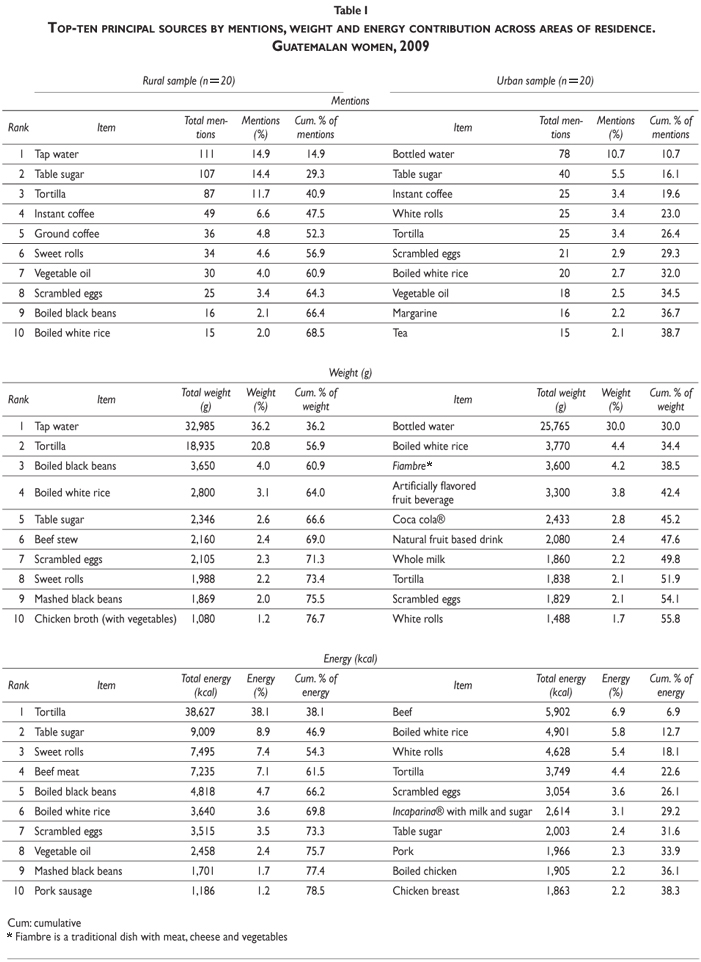
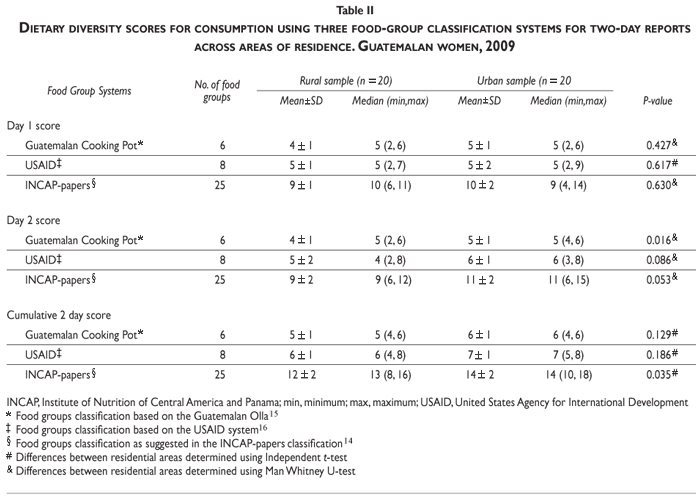
<body><![CDATA[<p><font size="3" face="Verdana"><b>Results</b></font></p>    <p><font size="2" face="Verdana">The  rural participants of this study were women 19 to 56 yrs old. All were housewives  with only primary level education and from low socio&#45;economic level households.  All women invited to participate agreed to be part of the study. The urban participants  were women 19 to 52 yrs old. All were university students from a medium socio&#45;economic  level. Of the 30 women invited to participate, 20 agreed to be part of the study.</font></p>    <p><font size="2" face="Verdana"><b>Dietary  variety</b></font></p>    <p><font size="2" face="Verdana">Dietary variety was assessed  at the level of the individual participant and for the cumulative population sample.  At the individual level the number of different items reported on any given day  ranged from 8 to 15 in the rural women, with a mean of 12&plusmn;2 for the first  day of interview and 12&plusmn;3 for the second day of interview. For the urban  women, the corresponding range was 9 to 20 items, with a mean of 14&plusmn;4 for  the first day and 15&plusmn;4 for the second day. The number of different items  consumed per day was significantly larger (<I>p</I>=0.002) in the urban sample.</font></p>    <p><font size="2" face="Verdana">A  total of 192 different food items were mentioned by the 40 participants in both  residential areas over two recall days (i.e. 80 subject&#45;days). This represents  the cumulative dietary variety at the sample level. The number of different items  reported by the rural sample was 87, whereas it was 158 for the urban sample.  Of these 192 items, 34 were unique to the rural sector, 105 unique to the urban  sample, and 53 were mentioned in common by participants from both areas of residence.</font></p>    <p><font size="2" face="Verdana"><a href="/img/revistas/spm/v53n4/a03tab01.jpg">Table  I</a> compares the 10 leading contributors to the rural and urban diets with respect  to frequency of mentions, weight and energy contributions. With respect to the  frequency of mentions (<a href="/img/revistas/spm/v53n4/a03tab01.jpg">Table I</a>,  first tier), there is major homology at the top of the principal sources rosters  across the two areas, with seven of the top 10 items shared, albeit in varying  order. The most frequent mention is drinkable water in both areas; in the urban  area, the top three mentions (water, sugar, and coffee powder) represent the ingredients  for a cup of coffee, as they do within the four leading items on the rural side.  Only <I>ground</i> coffee, sweet rolls and boiled whole black beans in the rural  list and white rolls, margarine and prepared flavored teas on the urban side are  not homologous across settings. With respect to weight in grams (<a href="/img/revistas/spm/v53n4/a03tab01.jpg">Table  I</a>, second tier), plain water (consumed as drinking water or as part of home&#45;prepared  infusions such as coffee and tea), was the first&#45;ranked item in both areas.  Maize tortillas, scrambled eggs and boiled white rice were found in common on  both lists. In addition to water, three beverages helped make up the top 10 items  by weight for the urban sample. With respect to energy in kcal (<a href="/img/revistas/spm/v53n4/a03tab01.jpg">Table  I</a>, third tier), tortillas were ranked first and table sugar second in the  rural area, whereas beef and boiled white rice headed the urban list, with tortillas  appearing in the fourth rank.</font></p>    <p><font size="2" face="Verdana"><b>Dietary  diversity</b></font></p>    <p><font size="2" face="Verdana">Dietary diversity scores  according to the three different food&#45;group systems for both residential areas  are shown in <a href="/img/revistas/spm/v53n4/a03tab02.jpg">Table II</a>. They  are analyzed as individual scores for either one day or combined two&#45;day reported  intakes.</font></p>    <p><font size="2" face="Verdana">When diversity is compared  using the Guatemalan "cooking pot" six&#45;food&#45;group system,<Sup>14</sup>  no significant differences in dietary diversity scores were observed between samples  when using the cumulative two&#45;day score. Only when using the second day score,  higher diversity scores were observed in the urban sample (<I>p</I>=0.016) when  compared to the rural sample. Using the USAID eight&#45;food&#45;group system,<Sup>15</sup>  no significant differences were observed between the rural and urban groups for  the both days of questioning. Using the 'INCAP&#45;papers' 25&#45;food&#45;group  system,<Sup>13</sup> no significant differences were observed between the rural  and urban groups for the first and the second day. However, when both data collection  days were combined diversity was greater in the urban sample (<I>p</I>=0.035).</font></p>    <p><font size="2" face="Verdana">On  any given day the herbs/vegetables and fruits groups were those least likely to  be represented in the Guatemalan "cooking pot" system, whereas vitamin A&#45;rich  fruits and vegetables, eggs, and legumes and nuts were the most likely not be  met in the USAID system. Using the 'INCAP&#45;papers' system game meat, snacks,  green leaves and fish/shellfish were the least represented (data not shown).</font></p>    ]]></body>
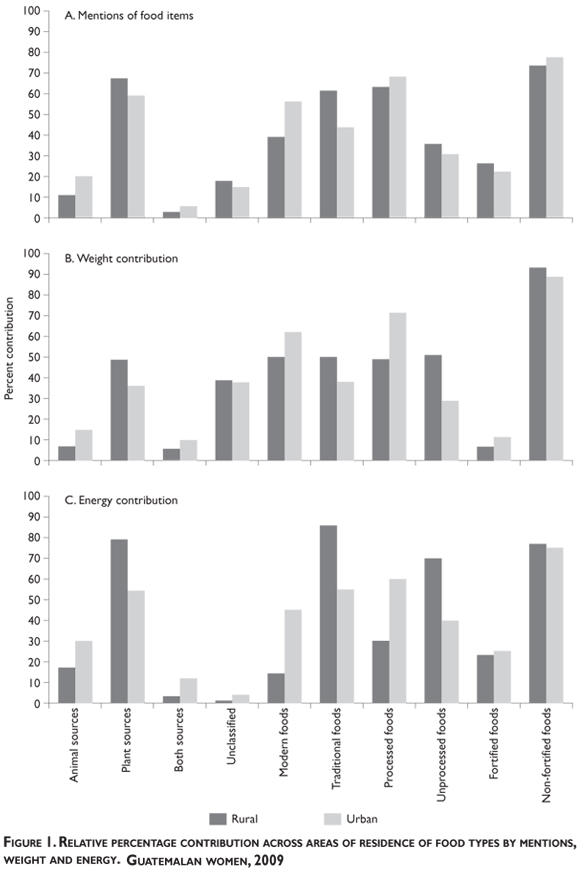
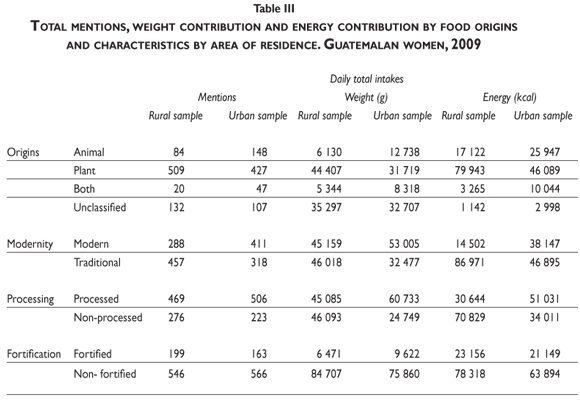
<body><![CDATA[<p><font size="2" face="Verdana"><b>Origins  and characteristics of foods</b></font></p>    <p><font size="2" face="Verdana">The  food items reported were classified by pre&#45;established criteria as to plant  or animal origin, and with regard to their modernity, processing and fortification  characteristics. The distributions across the foods of different origin and between  the options of specific characteristics are shown in <a href="#tab03">Table III</a>.  When examined in terms of mentions (i.e. unrelated to portion size), the relative  contribution of plant&#45;based, processed and non&#45;fortified food items was  greater than the contribution of animal&#45;based, non&#45;processed and fortified  in both areas. In the rural sample, as expected, the contribution of traditional  foods, such as corn tortillas and scrambled eggs, was greater than the contribution  of modern foods. This relationship was the opposite in the urban sample, where  modern foods such as bottled water, instant coffee, vegetable oil, margarine and  tea were more dominant. Among the interesting observations is the almost 1:7 ratio  of animal&#45;to plant&#45;based foods in the rural sample and the 1:4 ratio in  the urban area.</font></p>    <p><a name="tab03"></a></p>    <p>&nbsp;</p>    <p align="center"><img src="/img/revistas/spm/v53n4/a03tab03.jpg"></p>    <p>&nbsp;</p>    <p><font size="2" face="Verdana">When  examined in terms of daily weight intakes (i.e. related to portion size), different  patterns of origin of foods were observed. Over seven times more weight of plant&#45;origin  foods than of animal&#45;origin foods were consumed by the rural sample. In the  urban sample the ration was smaller at approximately twice as much weight coming  from animal sources versus plant sources. In the urban sample only, more weight  of modern than traditional, and more weight of processed than unprocessed foods  were consumed. In both sample less weight of fortified than non&#45;fortified  foods were ingested. On an individual basis, women of the village consumed 2301&plusmn;482  g of edible items per day of reporting, whereas women of the capital consumed  2150&plusmn;524 g, a difference that was not statistically significant (<I>p</I>=0.555).  Insofar as the unclassified category in the origins analysis is almost entirely  constituted from plain water, the respective average weights of these foods, serving  as a proxy for watery liquids were 882 g and 818 g in the rural and urban areas,  respectively.</font></p>    <p><font size="2" face="Verdana">Finally differences in  patterns of origin of foods were examined by energy contribution. Mean daily estimated  energy consumption was 2528&plusmn;524 kcal for the rural women and 2149&plusmn;734  kcal for the urban students, significantly higher in the former (<I>p</I>=0.035).  Whereas the energy from modern and traditional foods was closely balanced in the  urban sample, about six&#45;fold more energy was consumed from traditional foods  as compared to modern ones by the rural sample. More energy was consumed from  modern and processed foods, but not from fortified foods, by the urban women.</font></p>    <p><font size="2" face="Verdana"><a href="#fig01">Figure  1</a> provides a comparative view betweenthe two samples for the mentions, weight  and energy contributions by origin and characteristics in percentage terms for  more expedited visual comparisons.</font></p>    <p><a name="fig01"></a></p>    ]]></body>
<body><![CDATA[<p>&nbsp;</p>    <p align="center"><img src="/img/revistas/spm/v53n4/a03fig01.jpg"></p>    <p>&nbsp;</p>    <p><font size="3" face="Verdana"><b>Discussion</b></font></p>    <p><font size="2" face="Verdana">The  emerging contemporary focus of dietary quality analysis looks at patterns of intake,  related to the actual foods and beverages selected and consumed in terms of combinations.<Sup>4,5</sup>  We have taken advantage of data from a small, convenience sample study into areas  of Guatemala to explore the utility of innovative dimensions and approaches to  looking at variety, diversity and characteristics of the diet.</font></p>    <p><font size="2" face="Verdana"><b>Strengths  and limitations of the study</b></font></p>    <p><font size="2" face="Verdana">Certain  limitations in the design and methodology are recognized. Firstly, the sample  size was small. Secondly, this study is based on two non&#45;consecutive recalls  with the disadvantage of not being representative of the habitual nutrient intake  of any individual within the group; mainly because of an important holiday with  specific food preparation that took place two days before the first recall in  the city. Most interviews referred to a week day, but in a sub&#45;sample of the  urban women theinterview referred to a Sunday which is likely to differ from a  typical week day. In addition, there are limitations to the nutrient data obtained  from the food composition tables, as they do not present some specific foods consumed  in Guatemala.</font></p>    <p><font size="2" face="Verdana">What was noteworthy in  our study was the novelty of using weight and energy in addition to mentions in  looking at food patterns. Furthermore, multiple systems of food groups classification  to assess dietary diversity were applied. These were based on current national  and international guidelines for healthy eating, as well as classification systems  used in the past. Interestingly significant comparisons between the samples studies  were only observed when using the day 2 score based on the Guatemalan "cooking  pot" six&#45;food&#45;group system and when using a cumulative two day score using  the 'INCAP&#45;papers' food&#45;group system. These findings suggest that the  Guatemalan Cooking Pot, with only six food groups, provides comparative value.  The numbers of data collection days needed for dietary variety and diversity analysis  remains unanswered.</font></p>    <p><font size="2" face="Verdana"><b>Inter&#45;area  comparisons related to variety and diversity</b></font></p>    <p><font size="2" face="Verdana">It  is surprising how much homology there was between the principal sources of mentions,  weight and energy contribution despite the remarkably greater variety among the  urban women. An examination of the weight and energy shows that the top sources  contributed 55.8% of the total weight and 38.3% of the total energy as compared  to 76.7 and 78.5% for the rural population, respectively. That is to say that  the urban women had the same principal sources in their diet but with a much lower  contribution to the total than the rural women.</font></p>    ]]></body>
<body><![CDATA[<p><font size="2" face="Verdana">Although  the items at the top of the consumption list bear certain homologies across areas,  their relative contribution to the <I>whole</i> diet varies remarkably. In fact,  a testimony to the differential population&#45;level variety can be found in the  cumulative percentage of the total two&#45;day intake embraced by the leading  10 items of consumption. Rural and urban women had roughly equivalent total mentions,  but almost 70% of all rural mentions were for the ten items in the top&#45;ten  roster, whereas slightly fewer than 40% of the urban mentions were for the principal  ten. From all standpoints examined, a large percentage of all that is consumed  by rural women is confined to 10 sources of foods or liquid.</font></p>    <p><font size="2" face="Verdana">A  curious finding is related to the relative energy&#45;density of foods across  the areas. Conventional wisdom would suggest that a rural sample would have a  less energy&#45;dense dietary fare.At least with the interviewing on the days  of study, we see the opposite effect. At the aggregate level, the rural diet delivered  111 kcal/100 g, as compared to 99 kcal/100 g for the urban. Excluding the (non&#45;caloric)  plain water component from the weight denominator, however, the respective difference  expands to 174 kcal/100 g rural, and 165 kcal/100 g urban. The most recent edition  of the World Cancer Research Fund/American Institute for Cancer Research's guidance  for a cancer&#45;protective diet, states their recommendation for total dietary  density as follows: "Average energy density of diets to be lowered towards 125  kcal/100 g".<Sup>17</sup> By this criterion, both populations are in need of concerted  efforts to reduce the effective energy&#45;density of their diets.</font></p>    <p><font size="2" face="Verdana"><b>Comparisons  with other experiences in Guatemala regarding other dietary characteristics</b></font></p>    <p><font size="2" face="Verdana">The  basic and conventional manner of looking at dietary characteristics has been by  the number of mentions. Traditional items constituted a slight majority of the  food selection mentioned in the present study, 55%, almost identical to the 56%  among the urban complementary foods of infants living in Guatemala City.<Sup>12</sup>  Among the urban day&#45;care menus in Guatemala City, 69% of mentions were of  traditional items.<a href="#nt1"><Sup>*</Sup></a> Fortified foods constituted  between 22 and 25% of all items in both rural and urban settings in both the adults  in this study and the CF in the Enneman study,<Sup>12</sup> whereas 42% of items  served on urban day&#45;care menus were fortified.<A NAME="at1"></A><a href="#nt1"><Sup>*</Sup></a>  With respect to processed foods' contribution, they were lowest at 19% for day  care centers,<a href="#nt1"><Sup>*</Sup></a> intermediate in CF at 45%<Sup>12</sup>  and highest in adult women here at 60%. For the rural CF and the rural women,  processed foods constituted 41 and 30% of the items mentioned. Finally, plant&#45;based  food items constituted between 59 to 69% of food mentions in the three CeSSIAM  studies.</font></p>    <p><font size="2" face="Verdana">The unique contributions of  this study and that of Doak and Hamelinck,<A NAME="at1"></A><a href="#nt1"><Sup>*</Sup></a>  however, is moving beyond mentions to the contribution of weight and energy. For  the urban day&#45;care menus, the weight of traditional foods was 79% of the total  served, compared to 38% of that selected by urban students and 50% of rural peasant  women. For fortified foods on a weight basis, these were respectively, 11, 11  and 7%, and for items classified as processed, 52, 71 and 49%. Finally, plant&#45;based  food items constituted between 55, 49 and 37%.</font></p>    <p><font size="2" face="Verdana"><b>Implications  of the findings for beverage consumption and hydration</b></font></p>    <p><font size="2" face="Verdana">When  the leading sources in terms of total weight were examined, only one of the top  10 sources in the rural sample was a beverage (namely water) compared to five  sources in the urban sample (namely bottled water, artificially flavored fruit  beverage, Coca cola&#174;, natural fruit based drink and whole milk). The mean  daily consumption of all beverages consumed was 950 mL/day for the rural women  1100 mL/day for the urban sample. The estimated intake falls well below the adequate  intake level of 2200 mL/day for women from plain water and other drinks.<Sup>19</sup>  The reported consumption of liquids in both samples is deficient, or this could  imply that our recall data is capturing less than the actual consumption of beverages  (systematic underreporting).</font></p>    <p><font size="2" face="Verdana"><b>Conclusion</b></font></p>    <p><font size="2" face="Verdana">The  selection of foods and beverages and their characteristics, other than nutrient  content and density, is an important determinant of health and function. Even  without a completely exhaustive analysis of our comparison to the literature or  the internal comparisons of CeSSIAM studies,<Sup>12,</Sup> <A NAME="at1"></A><a href="#nt1"><sup>*</sup></a>  it becomes clear that dietary pattern evaluation that goes beyond number of mentions,  to recognitions of the factors of weight of consumption and contribution of energy  provides a deeper, more nuanced, and potentially more informative approach. The  health implications of caloric versus non&#45;caloric beverages is a current topic  of interest,<Sup>19&#45;22</sup> and our examinations of variety and origins casts  light in that direction.</font></p>    <p><font size="2" face="Verdana">It would seem  from the greater contributions of modern and processed items observed in the urban  diets supports the "nutrition transition" previously observed in this setting.<Sup>23&#45;25</sup>  This observation allows the considerations of intervention strategies for dietary  improvement and health protection for the Guatemalan countryside still to rely  on promotion and preservation of traditional food selection. Paradoxically, the  traditional foods are more energy&#45;dense thanthe modern foods, especially as  selected by the rural population. Apparently the grotesque consequences of food  processing on energy&#45;density proclaimed by Monteiro and colleagues,<Sup>26</sup>  have yet to be perceived in the food selection of urban Guatemalans. Thus, given  the increasing reliance on commercial items in the city, lowering energy densities  by industrial producers would seem to represent a positive development. Any favorable  change in food processing will have to be tied to campaigns of consumer education  and awareness regarding healthful eating in an urban context.<Sup>27</sup> The  embrace of fortified foods, finally, would appear to portend a reduction in micronutrient  deficiencies across the nation, but constant vigilance to avoiding excessive intake  of fortificants from commercial sources, such as vitamin A in sugar, will be needed  as well.<Sup>28&#45;30</sup></font></p>    ]]></body>
<body><![CDATA[<p><font size="2" face="Verdana"><b>Acknowledgements</b></font></p>    <p><font size="2" face="Verdana">We  are grateful to the subjects of this study for their voluntary participation.  The study was funded by the Hildegard Grunow Foundation of Munich, Germany.</font></p>    <p><font size="2" face="Verdana"><I>Declaration  of conflict of interests:</i> The autors declare that they have no conflict of  interests.</font></p>    <p>&nbsp;</p>    <p><font size="3" face="Verdana"><b>References</b></font></p>    <!-- ref --><p><font size="2" face="Verdana">1.  Waterlow J C. Childhood malnutrition&#45;&#45;the global problem. Proc Nutr Soc  1979;38: 1&#45;9.    &nbsp;&nbsp;&nbsp;&nbsp;&nbsp;&nbsp;&nbsp;&nbsp;[&#160;<a href="javascript:void(0);" onclick="javascript: window.open('/scielo.php?script=sci_nlinks&ref=9379601&pid=S0036-3634201100040000300001&lng=','','width=640,height=500,resizable=yes,scrollbars=1,menubar=yes,');">Links</a>&#160;]<!-- end-ref --></font></p>    <!-- ref --><p><font size="2" face="Verdana">2. Durnin J V, Edholm  O G, Miller D S,Waterlow J C. How much food does man require? Nature 1973;242:418.    &nbsp;&nbsp;&nbsp;&nbsp;&nbsp;&nbsp;&nbsp;&nbsp;[&#160;<a href="javascript:void(0);" onclick="javascript: window.open('/scielo.php?script=sci_nlinks&ref=9379603&pid=S0036-3634201100040000300002&lng=','','width=640,height=500,resizable=yes,scrollbars=1,menubar=yes,');">Links</a>&#160;]<!-- end-ref --></font></p>    <!-- ref --><p><font size="2" face="Verdana">3.  Peters J R, Quiter E S, Brekke M L,Admire J, Brekke M J, Mullis R M<I>, et al.</i>  The Eating Pattern Assessment Tool: a simple instrument for assessing dietary  fat and cholesterol intake. J Am Diet Assoc 1994;94:1008&#45;1013.    &nbsp;&nbsp;&nbsp;&nbsp;&nbsp;&nbsp;&nbsp;&nbsp;[&#160;<a href="javascript:void(0);" onclick="javascript: window.open('/scielo.php?script=sci_nlinks&ref=9379605&pid=S0036-3634201100040000300003&lng=','','width=640,height=500,resizable=yes,scrollbars=1,menubar=yes,');">Links</a>&#160;]<!-- end-ref --></font></p>    <!-- ref --><p><font size="2" face="Verdana">4.  Kris&#45;Etherton P, Eckel R H, Howard B V, St Jeor S, Bazzarre T L.AHA Science  Advisory: Lyon Diet Heart Study. Benefits of a Mediterranean&#45;style, National  Cholesterol Education Program/American Heart Association Step I Dietary Pattern  on Cardiovascular Disease. Circulation 2001;103:1823&#45;1825.    &nbsp;&nbsp;&nbsp;&nbsp;&nbsp;&nbsp;&nbsp;&nbsp;[&#160;<a href="javascript:void(0);" onclick="javascript: window.open('/scielo.php?script=sci_nlinks&ref=9379607&pid=S0036-3634201100040000300004&lng=','','width=640,height=500,resizable=yes,scrollbars=1,menubar=yes,');">Links</a>&#160;]<!-- end-ref --></font></p>    <!-- ref --><p><font size="2" face="Verdana">  5.Tucker K L, Selhub J,Wilson P W,Rosenberg I H. Dietary intake pattern relates  to plasma folate and homocysteine concentrations in the Framingham Heart Study.  J Nutr 1996;126:3025&#45;3031.    &nbsp;&nbsp;&nbsp;&nbsp;&nbsp;&nbsp;&nbsp;&nbsp;[&#160;<a href="javascript:void(0);" onclick="javascript: window.open('/scielo.php?script=sci_nlinks&ref=9379609&pid=S0036-3634201100040000300005&lng=','','width=640,height=500,resizable=yes,scrollbars=1,menubar=yes,');">Links</a>&#160;]<!-- end-ref --></font></p>    <!-- ref --><p><font size="2" face="Verdana">6. Guenther  P M, Reedy J,Krebs&#45;Smith S M. Development of the Healthy Eating Index&#45;2005.  J Am Diet Assoc 2008;108:1896&#45;1901.    &nbsp;&nbsp;&nbsp;&nbsp;&nbsp;&nbsp;&nbsp;&nbsp;[&#160;<a href="javascript:void(0);" onclick="javascript: window.open('/scielo.php?script=sci_nlinks&ref=9379611&pid=S0036-3634201100040000300006&lng=','','width=640,height=500,resizable=yes,scrollbars=1,menubar=yes,');">Links</a>&#160;]<!-- end-ref --></font></p>    <!-- ref --><p><font size="2" face="Verdana">7.  Willett WC,McCullough ML. Dietary pattern analysis for the evaluation of dietary  guidelines. Asia Pac J Clin Nutr 2008;17 Suppl 1:75&#45;78.    &nbsp;&nbsp;&nbsp;&nbsp;&nbsp;&nbsp;&nbsp;&nbsp;[&#160;<a href="javascript:void(0);" onclick="javascript: window.open('/scielo.php?script=sci_nlinks&ref=9379613&pid=S0036-3634201100040000300007&lng=','','width=640,height=500,resizable=yes,scrollbars=1,menubar=yes,');">Links</a>&#160;]<!-- end-ref --></font></p>    <!-- ref --><p><font size="2" face="Verdana">8.  Azadbakht L, Mirmiran P,Azizi F.Variety scores of food groups contribute to the  specific nutrient adequacy in Tehranian men. Eur J Clin Nutr 2005;59:1233&#45;1240.    &nbsp;&nbsp;&nbsp;&nbsp;&nbsp;&nbsp;&nbsp;&nbsp;[&#160;<a href="javascript:void(0);" onclick="javascript: window.open('/scielo.php?script=sci_nlinks&ref=9379615&pid=S0036-3634201100040000300008&lng=','','width=640,height=500,resizable=yes,scrollbars=1,menubar=yes,');">Links</a>&#160;]<!-- end-ref --></font></p>    <!-- ref --><p><font size="2" face="Verdana">9.  Murphy S P, Foote JA,Wilkens LR, Basiotis PP, Carlson A, White KK<I>, et al.</I>  Simple measures of dietary variety are associated with improved dietary quality.  J Am Diet Assoc 2006;106:425&#45;429.    &nbsp;&nbsp;&nbsp;&nbsp;&nbsp;&nbsp;&nbsp;&nbsp;[&#160;<a href="javascript:void(0);" onclick="javascript: window.open('/scielo.php?script=sci_nlinks&ref=9379617&pid=S0036-3634201100040000300009&lng=','','width=640,height=500,resizable=yes,scrollbars=1,menubar=yes,');">Links</a>&#160;]<!-- end-ref --></font></p>    <!-- ref --><p><font size="2" face="Verdana">10.  Oldewage&#45;Theron WH, Kruger R. Food variety and dietary diversity as indicators  of the dietary adequacy and health status of an elderly population in Sharpeville,  South Africa. J Nutr Elder 2008;27:101&#45;33.    &nbsp;&nbsp;&nbsp;&nbsp;&nbsp;&nbsp;&nbsp;&nbsp;[&#160;<a href="javascript:void(0);" onclick="javascript: window.open('/scielo.php?script=sci_nlinks&ref=9379619&pid=S0036-3634201100040000300010&lng=','','width=640,height=500,resizable=yes,scrollbars=1,menubar=yes,');">Links</a>&#160;]<!-- end-ref --></font></p>    <!-- ref --><p><font size="2" face="Verdana">11.  Drewnowski A, Henderson S A, Shore A B, Fischler C, Preziosi P, Hercberg S. Diet  quality and dietary diversity in France: implications for the French paradox.  J Am Diet Assoc 1996;96:663&#45;669.    &nbsp;&nbsp;&nbsp;&nbsp;&nbsp;&nbsp;&nbsp;&nbsp;[&#160;<a href="javascript:void(0);" onclick="javascript: window.open('/scielo.php?script=sci_nlinks&ref=9379621&pid=S0036-3634201100040000300011&lng=','','width=640,height=500,resizable=yes,scrollbars=1,menubar=yes,');">Links</a>&#160;]<!-- end-ref --></font></p>    <!-- ref --><p><font size="2" face="Verdana">12.  Enneman A, Hernandez L, Campos R,Vossenaar M, Solomons N W. Dietary characteristics  of complementary foods offered to Guatemalan infants vary between urban and rural  settings. Nutr Res 2009;29:470&#45;479.    &nbsp;&nbsp;&nbsp;&nbsp;&nbsp;&nbsp;&nbsp;&nbsp;[&#160;<a href="javascript:void(0);" onclick="javascript: window.open('/scielo.php?script=sci_nlinks&ref=9379623&pid=S0036-3634201100040000300012&lng=','','width=640,height=500,resizable=yes,scrollbars=1,menubar=yes,');">Links</a>&#160;]<!-- end-ref --></font></p>    <!-- ref --><p><font size="2" face="Verdana">13.  Berm&uacute;dez OI, Hern&aacute;ndez L, Mazariegos M,Solomons NW. Secular trends  in food patterns of Guatemalan consumers: New foods for old. Food Nutr Bull 2008;29:278&#45;287.    &nbsp;&nbsp;&nbsp;&nbsp;&nbsp;&nbsp;&nbsp;&nbsp;[&#160;<a href="javascript:void(0);" onclick="javascript: window.open('/scielo.php?script=sci_nlinks&ref=9379625&pid=S0036-3634201100040000300013&lng=','','width=640,height=500,resizable=yes,scrollbars=1,menubar=yes,');">Links</a>&#160;]<!-- end-ref --></font></p>    <!-- ref --><p><font size="2" face="Verdana">14.  Institute of Nutrition of Central America and Panama (INCAP), Gu&iacute;as alimentarias  para Guatemala: los siete pasos para una alimentaci&oacute;n sana. INCAP, 2008.    &nbsp;&nbsp;&nbsp;&nbsp;&nbsp;&nbsp;&nbsp;&nbsp;[&#160;<a href="javascript:void(0);" onclick="javascript: window.open('/scielo.php?script=sci_nlinks&ref=9379627&pid=S0036-3634201100040000300014&lng=','','width=640,height=500,resizable=yes,scrollbars=1,menubar=yes,');">Links</a>&#160;]<!-- end-ref --></font></p>    <!-- ref --><p><font size="2" face="Verdana">15.  Dewey KG, Cohen RJ, Arimond M, Ruel MT. Developing and validating simple indicators  of complementary food intake and nutrient density for breastfed children in developing  countries.Washington, DC:Academy for Educational Development, 2006</font>&nbsp;&nbsp;&nbsp;&nbsp;&nbsp;&nbsp;&nbsp;&nbsp;[&#160;<a href="javascript:void(0);" onclick="javascript: window.open('/scielo.php?script=sci_nlinks&ref=9379629&pid=S0036-3634201100040000300015&lng=','','width=640,height=500,resizable=yes,scrollbars=1,menubar=yes,');">Links</a>&#160;]<!-- end-ref --><!-- ref --><p><font size="2" face="Verdana">16.  Complementary feeding in the WHO Multicentre Growth Reference Study. Acta Paediatr  Suppl 2006;450:27&#45;37.    &nbsp;&nbsp;&nbsp;&nbsp;&nbsp;&nbsp;&nbsp;&nbsp;[&#160;<a href="javascript:void(0);" onclick="javascript: window.open('/scielo.php?script=sci_nlinks&ref=9379630&pid=S0036-3634201100040000300016&lng=','','width=640,height=500,resizable=yes,scrollbars=1,menubar=yes,');">Links</a>&#160;]<!-- end-ref --></font></p>    <!-- ref --><p><font size="2" face="Verdana">17. World  Cancer Research Fund, American Institute of Cancer Research. Food, nutrition,  physical activity, and the prevention of cancer: a global perspective.Washington,  DC: WCRF/AICR, 2007.    &nbsp;&nbsp;&nbsp;&nbsp;&nbsp;&nbsp;&nbsp;&nbsp;[&#160;<a href="javascript:void(0);" onclick="javascript: window.open('/scielo.php?script=sci_nlinks&ref=9379632&pid=S0036-3634201100040000300017&lng=','','width=640,height=500,resizable=yes,scrollbars=1,menubar=yes,');">Links</a>&#160;]<!-- end-ref --></font></p>    <!-- ref --><p><font size="2" face="Verdana">18. Institute  of Medicine. Dietary Reference Intakes: Water, Potassium, Sodium, Chloride, and  Sulfate.Washington, DC: National Academy Press, 2004</font>&nbsp;&nbsp;&nbsp;&nbsp;&nbsp;&nbsp;&nbsp;&nbsp;[&#160;<a href="javascript:void(0);" onclick="javascript: window.open('/scielo.php?script=sci_nlinks&ref=9379634&pid=S0036-3634201100040000300018&lng=','','width=640,height=500,resizable=yes,scrollbars=1,menubar=yes,');">Links</a>&#160;]<!-- end-ref --><!-- ref --><p><font size="2" face="Verdana">19.  Rivera JA, Munoz&#45;Hernandez O, Rosas&#45;Peralta M, Aguilar&#45;Salinas C A,  Popkin BM,WillettWC. Beverage consumption for a healthy life: recommendations  for the Mexican population. Salud Publica Mex 2008;50:173&#45;195.    &nbsp;&nbsp;&nbsp;&nbsp;&nbsp;&nbsp;&nbsp;&nbsp;[&#160;<a href="javascript:void(0);" onclick="javascript: window.open('/scielo.php?script=sci_nlinks&ref=9379635&pid=S0036-3634201100040000300019&lng=','','width=640,height=500,resizable=yes,scrollbars=1,menubar=yes,');">Links</a>&#160;]<!-- end-ref --></font></p>    <!-- ref --><p><font size="2" face="Verdana">20.  Barquera S, Hernandez&#45;Barrera L,Tolentino M L, Espinosa J, Ng S W, Rivera  JA<I>, et al.</I> Energy intake from beverages is increasing among Mexican adolescents  and adults. J Nutr 2008;138:2454&#45;2461.    &nbsp;&nbsp;&nbsp;&nbsp;&nbsp;&nbsp;&nbsp;&nbsp;[&#160;<a href="javascript:void(0);" onclick="javascript: window.open('/scielo.php?script=sci_nlinks&ref=9379637&pid=S0036-3634201100040000300020&lng=','','width=640,height=500,resizable=yes,scrollbars=1,menubar=yes,');">Links</a>&#160;]<!-- end-ref --></font></p>    <!-- ref --><p><font size="2" face="Verdana">21.  Popkin BM. Patterns of beverage use across the lifecycle. Physiol Behav 2010;100:4&#45;9.    &nbsp;&nbsp;&nbsp;&nbsp;&nbsp;&nbsp;&nbsp;&nbsp;[&#160;<a href="javascript:void(0);" onclick="javascript: window.open('/scielo.php?script=sci_nlinks&ref=9379639&pid=S0036-3634201100040000300021&lng=','','width=640,height=500,resizable=yes,scrollbars=1,menubar=yes,');">Links</a>&#160;]<!-- end-ref --></font></p>    <!-- ref --><p><font size="2" face="Verdana">22.  Popkin BM, D'Anci KE,Rosenberg IH.Water, hydration, and health. Nutr Rev 2010;68:439&#45;458.    &nbsp;&nbsp;&nbsp;&nbsp;&nbsp;&nbsp;&nbsp;&nbsp;[&#160;<a href="javascript:void(0);" onclick="javascript: window.open('/scielo.php?script=sci_nlinks&ref=9379641&pid=S0036-3634201100040000300022&lng=','','width=640,height=500,resizable=yes,scrollbars=1,menubar=yes,');">Links</a>&#160;]<!-- end-ref --></font></p>    <!-- ref --><p><font size="2" face="Verdana">23.  Drewnowski A,Fulgoni V, 3rd. Nutrient profiling of foods: creating a nutrient&#45;rich  food index. Nutr Rev 2008;66:23&#45;39.    &nbsp;&nbsp;&nbsp;&nbsp;&nbsp;&nbsp;&nbsp;&nbsp;[&#160;<a href="javascript:void(0);" onclick="javascript: window.open('/scielo.php?script=sci_nlinks&ref=9379643&pid=S0036-3634201100040000300023&lng=','','width=640,height=500,resizable=yes,scrollbars=1,menubar=yes,');">Links</a>&#160;]<!-- end-ref --></font></p>    <!-- ref --><p><font size="2" face="Verdana">24.  Popkin BM.The nutrition transition in low&#45;income countries: an emerging crisis.  Nutr Rev 1994;52:285&#45;298.    &nbsp;&nbsp;&nbsp;&nbsp;&nbsp;&nbsp;&nbsp;&nbsp;[&#160;<a href="javascript:void(0);" onclick="javascript: window.open('/scielo.php?script=sci_nlinks&ref=9379645&pid=S0036-3634201100040000300024&lng=','','width=640,height=500,resizable=yes,scrollbars=1,menubar=yes,');">Links</a>&#160;]<!-- end-ref --></font></p>    <!-- ref --><p><font size="2" face="Verdana">25. Popkin  BM.An overview on the nutrition transition and its health implications: the Bellagio  meeting. Public Health Nutr 2002;5:93&#45;103.    &nbsp;&nbsp;&nbsp;&nbsp;&nbsp;&nbsp;&nbsp;&nbsp;[&#160;<a href="javascript:void(0);" onclick="javascript: window.open('/scielo.php?script=sci_nlinks&ref=9379647&pid=S0036-3634201100040000300025&lng=','','width=640,height=500,resizable=yes,scrollbars=1,menubar=yes,');">Links</a>&#160;]<!-- end-ref --></font></p>    <!-- ref --><p><font size="2" face="Verdana">26.  Monteiro CA. Nutrition and health.The issue is not food, nor nutrients, so much  as processing. Public Health Nutr 2009;12:729&#45;731.    &nbsp;&nbsp;&nbsp;&nbsp;&nbsp;&nbsp;&nbsp;&nbsp;[&#160;<a href="javascript:void(0);" onclick="javascript: window.open('/scielo.php?script=sci_nlinks&ref=9379649&pid=S0036-3634201100040000300026&lng=','','width=640,height=500,resizable=yes,scrollbars=1,menubar=yes,');">Links</a>&#160;]<!-- end-ref --></font></p>    <!-- ref --><p><font size="2" face="Verdana">27.  Uauy R,Monteiro CA.The challenge of improving food and nutrition in Latin America.  Food Nutr Bull 2004;25:175&#45;182.    &nbsp;&nbsp;&nbsp;&nbsp;&nbsp;&nbsp;&nbsp;&nbsp;[&#160;<a href="javascript:void(0);" onclick="javascript: window.open('/scielo.php?script=sci_nlinks&ref=9379651&pid=S0036-3634201100040000300027&lng=','','width=640,height=500,resizable=yes,scrollbars=1,menubar=yes,');">Links</a>&#160;]<!-- end-ref --></font></p>    <!-- ref --><p><font size="2" face="Verdana">28.  Allen L H. New approaches for designing and evaluating food fortification programs.  J Nutr 2006; 136: 1055&#45;1058.    &nbsp;&nbsp;&nbsp;&nbsp;&nbsp;&nbsp;&nbsp;&nbsp;[&#160;<a href="javascript:void(0);" onclick="javascript: window.open('/scielo.php?script=sci_nlinks&ref=9379653&pid=S0036-3634201100040000300028&lng=','','width=640,height=500,resizable=yes,scrollbars=1,menubar=yes,');">Links</a>&#160;]<!-- end-ref --></font></p>    <!-- ref --><p><font size="2" face="Verdana">29.  Dary O. Establishing safe and potentially efficacious fortification contents for  folic acid and vitamin B12. Food Nutr Bull 2008;29:S214&#45;S224.    &nbsp;&nbsp;&nbsp;&nbsp;&nbsp;&nbsp;&nbsp;&nbsp;[&#160;<a href="javascript:void(0);" onclick="javascript: window.open('/scielo.php?script=sci_nlinks&ref=9379655&pid=S0036-3634201100040000300029&lng=','','width=640,height=500,resizable=yes,scrollbars=1,menubar=yes,');">Links</a>&#160;]<!-- end-ref --></font></p>    <!-- ref --><p><font size="2" face="Verdana">30.  Dary O. Lessons learned with iron fortification in Central America. Nutr Rev 2002;60:S30&#45;S33.    &nbsp;&nbsp;&nbsp;&nbsp;&nbsp;&nbsp;&nbsp;&nbsp;[&#160;<a href="javascript:void(0);" onclick="javascript: window.open('/scielo.php?script=sci_nlinks&ref=9379657&pid=S0036-3634201100040000300030&lng=','','width=640,height=500,resizable=yes,scrollbars=1,menubar=yes,');">Links</a>&#160;]<!-- end-ref --></font></p>    <p>&nbsp;</p>    <p>&nbsp;</p>    <p><font size="2" face="Verdana"><b><a name="nt"></a><a href="#tx"><img src="/img/revistas/spm/v53n4/seta.jpg" border="0" align="baseline"></a>  Correspondence author:</b>    <br> Dr. Marieke Vossenaar    <br> Center for Studies of  Sensory Impairment    <br> Aging and Metabolism (CeSSIAM)    <br> 17 Avenida 16&#45;89  (interior), Zona 11 (Anillo Periferico)    ]]></body>
<body><![CDATA[<br> 01011 Guatemala City    <br> E&#45;mail:  <a href="mailto:mvossenaar@hotmail.com">mvossenaar@hotmail.com</a>; <a href="mailto:cessiam@guate.net.gt">cessiam@guate.net.gt</a></font></p>    <p><font size="2" face="Verdana">Received  on: March 2011    <br> Accepted on: August 2011</font></p>    <p>&nbsp;</p>    <p>&nbsp;</p>    <p><font size="2" face="Verdana"><a name="nt1"></a><A HREF="#at1">*</A>  Doak C M, Hamelinck V, Vossenaar M, Panday B, Soto&#45;M&eacute;ndez MJ, Campos&#45;Ponce  M. Evaluating food menus from day care centers in Guatemala City: Descriptive  and analytical approaches. Nutrition 2011 (in press).    <br> <a name="nt2"></a><a href="#at2">**</a>  Unpublished data Orozco <I>et al.</i></font></p>    <p>&nbsp;</p>    <p>&nbsp;</p>    ]]></body>
<body><![CDATA[<p><font size="3" face="Verdana"><b><a name="apx"></a>Appendix</b></font></p>    <p>&nbsp;</p>    <p align="center"><img src="/img/revistas/spm/v53n4/a03apx01.jpg"></p>      ]]></body><back>
<ref-list>
<ref id="B1">
<label>1</label><nlm-citation citation-type="journal">
<person-group person-group-type="author">
<name>
<surname><![CDATA[Waterlow]]></surname>
<given-names><![CDATA[J C]]></given-names>
</name>
</person-group>
<article-title xml:lang="en"><![CDATA[Childhood malnutrition--the global problem]]></article-title>
<source><![CDATA[Proc Nutr Soc]]></source>
<year>1979</year>
<volume>38</volume>
<page-range>1-9</page-range></nlm-citation>
</ref>
<ref id="B2">
<label>2</label><nlm-citation citation-type="journal">
<person-group person-group-type="author">
<name>
<surname><![CDATA[Durnin]]></surname>
<given-names><![CDATA[J V]]></given-names>
</name>
<name>
<surname><![CDATA[Edholm]]></surname>
<given-names><![CDATA[O G]]></given-names>
</name>
<name>
<surname><![CDATA[Miller]]></surname>
<given-names><![CDATA[D S]]></given-names>
</name>
<name>
<surname><![CDATA[Waterlow]]></surname>
<given-names><![CDATA[J C]]></given-names>
</name>
</person-group>
<article-title xml:lang="en"><![CDATA[How much food does man require]]></article-title>
<source><![CDATA[Nature]]></source>
<year>1973</year>
<volume>242</volume>
<page-range>418</page-range></nlm-citation>
</ref>
<ref id="B3">
<label>3</label><nlm-citation citation-type="journal">
<person-group person-group-type="author">
<name>
<surname><![CDATA[Peters]]></surname>
<given-names><![CDATA[J R]]></given-names>
</name>
<name>
<surname><![CDATA[Quiter]]></surname>
<given-names><![CDATA[E S]]></given-names>
</name>
<name>
<surname><![CDATA[Brekke]]></surname>
<given-names><![CDATA[M L]]></given-names>
</name>
<name>
<surname><![CDATA[Admire]]></surname>
<given-names><![CDATA[J]]></given-names>
</name>
<name>
<surname><![CDATA[Brekke]]></surname>
<given-names><![CDATA[M J]]></given-names>
</name>
<name>
<surname><![CDATA[Mullis]]></surname>
<given-names><![CDATA[R M]]></given-names>
</name>
</person-group>
<article-title xml:lang="en"><![CDATA[The Eating Pattern Assessment Tool: a simple instrument for assessing dietary fat and cholesterol intake]]></article-title>
<source><![CDATA[J Am Diet Assoc]]></source>
<year>1994</year>
<volume>94</volume>
<page-range>1008-1013</page-range></nlm-citation>
</ref>
<ref id="B4">
<label>4</label><nlm-citation citation-type="journal">
<person-group person-group-type="author">
<name>
<surname><![CDATA[Kris-Etherton]]></surname>
<given-names><![CDATA[P]]></given-names>
</name>
<name>
<surname><![CDATA[Eckel]]></surname>
<given-names><![CDATA[R H]]></given-names>
</name>
<name>
<surname><![CDATA[Howard]]></surname>
<given-names><![CDATA[B V]]></given-names>
</name>
<name>
<surname><![CDATA[St Jeor]]></surname>
<given-names><![CDATA[S]]></given-names>
</name>
<name>
<surname><![CDATA[Bazzarre]]></surname>
<given-names><![CDATA[T L]]></given-names>
</name>
</person-group>
<article-title xml:lang="en"><![CDATA[AHA Science Advisory: Lyon Diet Heart Study. Benefits of a Mediterranean-style, National Cholesterol Education Program/American Heart Association Step I Dietary Pattern on Cardiovascular Disease]]></article-title>
<source><![CDATA[Circulation]]></source>
<year>2001</year>
<volume>103</volume>
<page-range>1823-1825</page-range></nlm-citation>
</ref>
<ref id="B5">
<label>5</label><nlm-citation citation-type="journal">
<person-group person-group-type="author">
<name>
<surname><![CDATA[Tucker]]></surname>
<given-names><![CDATA[K L]]></given-names>
</name>
<name>
<surname><![CDATA[Selhub]]></surname>
<given-names><![CDATA[J]]></given-names>
</name>
<name>
<surname><![CDATA[Wilson]]></surname>
<given-names><![CDATA[P W]]></given-names>
</name>
<name>
<surname><![CDATA[Rosenberg]]></surname>
<given-names><![CDATA[I H]]></given-names>
</name>
</person-group>
<article-title xml:lang="en"><![CDATA[Dietary intake pattern relates to plasma folate and homocysteine concentrations in the Framingham Heart Study]]></article-title>
<source><![CDATA[J Nutr]]></source>
<year>1996</year>
<volume>126</volume>
<page-range>3025-3031</page-range></nlm-citation>
</ref>
<ref id="B6">
<label>6</label><nlm-citation citation-type="journal">
<person-group person-group-type="author">
<name>
<surname><![CDATA[Guenther]]></surname>
<given-names><![CDATA[P M]]></given-names>
</name>
<name>
<surname><![CDATA[Reedy]]></surname>
<given-names><![CDATA[J]]></given-names>
</name>
<name>
<surname><![CDATA[Krebs-Smith]]></surname>
<given-names><![CDATA[S M]]></given-names>
</name>
</person-group>
<article-title xml:lang="en"><![CDATA[Development of the Healthy Eating Index-2005]]></article-title>
<source><![CDATA[J Am Diet Assoc]]></source>
<year>2008</year>
<volume>108</volume>
<page-range>1896-1901</page-range></nlm-citation>
</ref>
<ref id="B7">
<label>7</label><nlm-citation citation-type="journal">
<person-group person-group-type="author">
<name>
<surname><![CDATA[Willett]]></surname>
<given-names><![CDATA[WC]]></given-names>
</name>
<name>
<surname><![CDATA[McCullough]]></surname>
<given-names><![CDATA[ML]]></given-names>
</name>
</person-group>
<article-title xml:lang="en"><![CDATA[Dietary pattern analysis for the evaluation of dietary guidelines]]></article-title>
<source><![CDATA[Asia Pac J Clin Nutr]]></source>
<year>2008</year>
<volume>17</volume>
<numero>^s1</numero>
<issue>^s1</issue>
<supplement>1</supplement>
<page-range>75-78</page-range></nlm-citation>
</ref>
<ref id="B8">
<label>8</label><nlm-citation citation-type="journal">
<person-group person-group-type="author">
<name>
<surname><![CDATA[Azadbakht]]></surname>
<given-names><![CDATA[L]]></given-names>
</name>
<name>
<surname><![CDATA[Mirmiran]]></surname>
<given-names><![CDATA[P]]></given-names>
</name>
<name>
<surname><![CDATA[Azizi]]></surname>
<given-names><![CDATA[F]]></given-names>
</name>
</person-group>
<article-title xml:lang="en"><![CDATA[Variety scores of food groups contribute to the specific nutrient adequacy in Tehranian men]]></article-title>
<source><![CDATA[Eur J Clin Nutr]]></source>
<year>2005</year>
<volume>59</volume>
<page-range>1233-1240</page-range></nlm-citation>
</ref>
<ref id="B9">
<label>9</label><nlm-citation citation-type="journal">
<person-group person-group-type="author">
<name>
<surname><![CDATA[Murphy]]></surname>
<given-names><![CDATA[S P]]></given-names>
</name>
<name>
<surname><![CDATA[Foote]]></surname>
<given-names><![CDATA[JA]]></given-names>
</name>
<name>
<surname><![CDATA[Wilkens]]></surname>
<given-names><![CDATA[LR]]></given-names>
</name>
<name>
<surname><![CDATA[Basiotis]]></surname>
<given-names><![CDATA[PP]]></given-names>
</name>
<name>
<surname><![CDATA[Carlson]]></surname>
<given-names><![CDATA[A]]></given-names>
</name>
<name>
<surname><![CDATA[White]]></surname>
<given-names><![CDATA[KK]]></given-names>
</name>
</person-group>
<article-title xml:lang="en"><![CDATA[Simple measures of dietary variety are associated with improved dietary quality]]></article-title>
<source><![CDATA[J Am Diet Assoc]]></source>
<year>2006</year>
<volume>106</volume>
<page-range>425-429</page-range></nlm-citation>
</ref>
<ref id="B10">
<label>10</label><nlm-citation citation-type="journal">
<person-group person-group-type="author">
<name>
<surname><![CDATA[Oldewage-Theron]]></surname>
<given-names><![CDATA[WH]]></given-names>
</name>
<name>
<surname><![CDATA[Kruger]]></surname>
<given-names><![CDATA[R]]></given-names>
</name>
</person-group>
<article-title xml:lang="en"><![CDATA[Food variety and dietary diversity as indicators of the dietary adequacy and health status of an elderly population in Sharpeville, South Africa]]></article-title>
<source><![CDATA[J Nutr Elder]]></source>
<year>2008</year>
<volume>27</volume>
<page-range>101-33</page-range></nlm-citation>
</ref>
<ref id="B11">
<label>11</label><nlm-citation citation-type="journal">
<person-group person-group-type="author">
<name>
<surname><![CDATA[Drewnowski]]></surname>
<given-names><![CDATA[A]]></given-names>
</name>
<name>
<surname><![CDATA[Henderson]]></surname>
<given-names><![CDATA[S A]]></given-names>
</name>
<name>
<surname><![CDATA[Shore]]></surname>
<given-names><![CDATA[A B]]></given-names>
</name>
<name>
<surname><![CDATA[Fischler]]></surname>
<given-names><![CDATA[C]]></given-names>
</name>
<name>
<surname><![CDATA[Preziosi]]></surname>
<given-names><![CDATA[P]]></given-names>
</name>
<name>
<surname><![CDATA[Hercberg]]></surname>
<given-names><![CDATA[S]]></given-names>
</name>
</person-group>
<article-title xml:lang="en"><![CDATA[Diet quality and dietary diversity in France: implications for the French paradox]]></article-title>
<source><![CDATA[J Am Diet Assoc]]></source>
<year>1996</year>
<volume>96</volume>
<page-range>663-669</page-range></nlm-citation>
</ref>
<ref id="B12">
<label>12</label><nlm-citation citation-type="journal">
<person-group person-group-type="author">
<name>
<surname><![CDATA[Enneman]]></surname>
<given-names><![CDATA[A]]></given-names>
</name>
<name>
<surname><![CDATA[Hernandez]]></surname>
<given-names><![CDATA[L]]></given-names>
</name>
<name>
<surname><![CDATA[Campos]]></surname>
<given-names><![CDATA[R]]></given-names>
</name>
<name>
<surname><![CDATA[Vossenaar]]></surname>
<given-names><![CDATA[M]]></given-names>
</name>
<name>
<surname><![CDATA[Solomons]]></surname>
<given-names><![CDATA[N W]]></given-names>
</name>
</person-group>
<article-title xml:lang="en"><![CDATA[Dietary characteristics of complementary foods offered to Guatemalan infants vary between urban and rural settings]]></article-title>
<source><![CDATA[Nutr Res]]></source>
<year>2009</year>
<volume>29</volume>
<page-range>470-479</page-range></nlm-citation>
</ref>
<ref id="B13">
<label>13</label><nlm-citation citation-type="journal">
<person-group person-group-type="author">
<name>
<surname><![CDATA[Bermúdez]]></surname>
<given-names><![CDATA[OI]]></given-names>
</name>
<name>
<surname><![CDATA[Hernández]]></surname>
<given-names><![CDATA[L]]></given-names>
</name>
<name>
<surname><![CDATA[Mazariegos]]></surname>
<given-names><![CDATA[M]]></given-names>
</name>
<name>
<surname><![CDATA[Solomons]]></surname>
<given-names><![CDATA[NW]]></given-names>
</name>
</person-group>
<article-title xml:lang="en"><![CDATA[Secular trends in food patterns of Guatemalan consumers: New foods for old]]></article-title>
<source><![CDATA[Food Nutr Bull]]></source>
<year>2008</year>
<volume>29</volume>
<page-range>278-287</page-range></nlm-citation>
</ref>
<ref id="B14">
<label>14</label><nlm-citation citation-type="book">
<collab>Institute of Nutrition of Central America and Panama (INCAP)</collab>
<source><![CDATA[Guías alimentarias para Guatemala: los siete pasos para una alimentación sana]]></source>
<year>2008</year>
<publisher-name><![CDATA[INCAP]]></publisher-name>
</nlm-citation>
</ref>
<ref id="B15">
<label>15</label><nlm-citation citation-type="book">
<person-group person-group-type="author">
<name>
<surname><![CDATA[Dewey]]></surname>
<given-names><![CDATA[KG]]></given-names>
</name>
<name>
<surname><![CDATA[Cohen]]></surname>
<given-names><![CDATA[RJ]]></given-names>
</name>
<name>
<surname><![CDATA[Arimond]]></surname>
<given-names><![CDATA[M]]></given-names>
</name>
<name>
<surname><![CDATA[Ruel]]></surname>
<given-names><![CDATA[MT]]></given-names>
</name>
</person-group>
<source><![CDATA[Developing and validating simple indicators of complementary food intake and nutrient density for breastfed children in developing countries.]]></source>
<year>2006</year>
<publisher-loc><![CDATA[Washington, DC ]]></publisher-loc>
<publisher-name><![CDATA[Academy for Educational Development]]></publisher-name>
</nlm-citation>
</ref>
<ref id="B16">
<label>16</label><nlm-citation citation-type="journal">
<article-title xml:lang="en"><![CDATA[Complementary feeding in the WHO Multicentre Growth Reference Study]]></article-title>
<source><![CDATA[Acta Paediatr Suppl]]></source>
<year>2006</year>
<volume>450</volume>
<page-range>27-37</page-range></nlm-citation>
</ref>
<ref id="B17">
<label>17</label><nlm-citation citation-type="book">
<collab>World Cancer Research Fund.American Institute of Cancer Research</collab>
<source><![CDATA[Food, nutrition, physical activity, and the prevention of cancer: a global perspective.]]></source>
<year>2007</year>
<publisher-loc><![CDATA[Washington, DC ]]></publisher-loc>
<publisher-name><![CDATA[WCRF/AICR]]></publisher-name>
</nlm-citation>
</ref>
<ref id="B18">
<label>18</label><nlm-citation citation-type="book">
<collab>Institute of Medicine</collab>
<source><![CDATA[Dietary Reference Intakes: Water, Potassium, Sodium, Chloride, and Sulfate.]]></source>
<year>2004</year>
<publisher-loc><![CDATA[Washington, DC ]]></publisher-loc>
<publisher-name><![CDATA[National Academy Press]]></publisher-name>
</nlm-citation>
</ref>
<ref id="B19">
<label>19</label><nlm-citation citation-type="journal">
<person-group person-group-type="author">
<name>
<surname><![CDATA[Rivera]]></surname>
<given-names><![CDATA[JA]]></given-names>
</name>
<name>
<surname><![CDATA[Munoz-Hernandez]]></surname>
<given-names><![CDATA[O]]></given-names>
</name>
<name>
<surname><![CDATA[Rosas-Peralta]]></surname>
<given-names><![CDATA[M]]></given-names>
</name>
<name>
<surname><![CDATA[Aguilar-Salinas]]></surname>
<given-names><![CDATA[C A]]></given-names>
</name>
<name>
<surname><![CDATA[Popkin]]></surname>
<given-names><![CDATA[BM]]></given-names>
</name>
<name>
<surname><![CDATA[Willett]]></surname>
<given-names><![CDATA[WC]]></given-names>
</name>
</person-group>
<article-title xml:lang="en"><![CDATA[Beverage consumption for a healthy life: recommendations for the Mexican population]]></article-title>
<source><![CDATA[Salud Publica Mex]]></source>
<year>2008</year>
<volume>50</volume>
<page-range>173-195</page-range></nlm-citation>
</ref>
<ref id="B20">
<label>20</label><nlm-citation citation-type="journal">
<person-group person-group-type="author">
<name>
<surname><![CDATA[Barquera]]></surname>
<given-names><![CDATA[S]]></given-names>
</name>
<name>
<surname><![CDATA[Hernandez-Barrera]]></surname>
<given-names><![CDATA[L]]></given-names>
</name>
<name>
<surname><![CDATA[Tolentino M]]></surname>
<given-names><![CDATA[L]]></given-names>
</name>
<name>
<surname><![CDATA[Espinosa]]></surname>
<given-names><![CDATA[J]]></given-names>
</name>
<name>
<surname><![CDATA[Ng]]></surname>
<given-names><![CDATA[S W]]></given-names>
</name>
<name>
<surname><![CDATA[Rivera]]></surname>
<given-names><![CDATA[JA]]></given-names>
</name>
</person-group>
<article-title xml:lang="en"><![CDATA[Energy intake from beverages is increasing among Mexican adolescents and adults]]></article-title>
<source><![CDATA[J Nutr]]></source>
<year>2008</year>
<volume>138</volume>
<page-range>2454-2461</page-range></nlm-citation>
</ref>
<ref id="B21">
<label>21</label><nlm-citation citation-type="journal">
<person-group person-group-type="author">
<name>
<surname><![CDATA[Popkin]]></surname>
<given-names><![CDATA[BM]]></given-names>
</name>
</person-group>
<article-title xml:lang="en"><![CDATA[Patterns of beverage use across the lifecycle]]></article-title>
<source><![CDATA[Physiol Behav]]></source>
<year>2010</year>
<volume>100</volume>
<page-range>4-9</page-range></nlm-citation>
</ref>
<ref id="B22">
<label>22</label><nlm-citation citation-type="journal">
<person-group person-group-type="author">
<name>
<surname><![CDATA[Popkin]]></surname>
<given-names><![CDATA[BM]]></given-names>
</name>
<name>
<surname><![CDATA[D'Anci]]></surname>
<given-names><![CDATA[KE]]></given-names>
</name>
<name>
<surname><![CDATA[Rosenberg]]></surname>
<given-names><![CDATA[IH]]></given-names>
</name>
</person-group>
<article-title xml:lang="en"><![CDATA[Water, hydration, and health]]></article-title>
<source><![CDATA[Nutr Rev]]></source>
<year>2010</year>
<volume>68</volume>
<page-range>439-458</page-range></nlm-citation>
</ref>
<ref id="B23">
<label>23</label><nlm-citation citation-type="journal">
<person-group person-group-type="author">
<name>
<surname><![CDATA[Drewnowski]]></surname>
<given-names><![CDATA[A]]></given-names>
</name>
<name>
<surname><![CDATA[Fulgoni]]></surname>
<given-names><![CDATA[V, 3rd]]></given-names>
</name>
</person-group>
<article-title xml:lang="en"><![CDATA[Nutrient profiling of foods: creating a nutrient-rich food index]]></article-title>
<source><![CDATA[Nutr Rev]]></source>
<year>2008</year>
<volume>66</volume>
<page-range>23-39</page-range></nlm-citation>
</ref>
<ref id="B24">
<label>24</label><nlm-citation citation-type="journal">
<person-group person-group-type="author">
<name>
<surname><![CDATA[Popkin]]></surname>
<given-names><![CDATA[BM]]></given-names>
</name>
</person-group>
<article-title xml:lang="en"><![CDATA[The nutrition transition in low-income countries: an emerging crisis]]></article-title>
<source><![CDATA[Nutr Rev]]></source>
<year>1994</year>
<volume>52</volume>
<page-range>285-298</page-range></nlm-citation>
</ref>
<ref id="B25">
<label>25</label><nlm-citation citation-type="journal">
<person-group person-group-type="author">
<name>
<surname><![CDATA[Popkin]]></surname>
<given-names><![CDATA[BM]]></given-names>
</name>
</person-group>
<article-title xml:lang="en"><![CDATA[An overview on the nutrition transition and its health implications: the Bellagio meeting]]></article-title>
<source><![CDATA[Public Health Nutr]]></source>
<year>2002</year>
<volume>5</volume>
<page-range>93-103</page-range></nlm-citation>
</ref>
<ref id="B26">
<label>26</label><nlm-citation citation-type="journal">
<person-group person-group-type="author">
<name>
<surname><![CDATA[Monteiro]]></surname>
<given-names><![CDATA[CA]]></given-names>
</name>
</person-group>
<article-title xml:lang="en"><![CDATA[Nutrition and health: The issue is not food, nor nutrients, so much as processing]]></article-title>
<source><![CDATA[Public Health Nutr]]></source>
<year>2009</year>
<volume>12</volume>
<page-range>729-731</page-range></nlm-citation>
</ref>
<ref id="B27">
<label>27</label><nlm-citation citation-type="journal">
<person-group person-group-type="author">
<name>
<surname><![CDATA[Uauy]]></surname>
<given-names><![CDATA[R]]></given-names>
</name>
<name>
<surname><![CDATA[Monteiro]]></surname>
<given-names><![CDATA[CA]]></given-names>
</name>
</person-group>
<article-title xml:lang="en"><![CDATA[The challenge of improving food and nutrition in Latin America]]></article-title>
<source><![CDATA[Food Nutr Bull]]></source>
<year>2004</year>
<volume>25</volume>
<page-range>175-182</page-range></nlm-citation>
</ref>
<ref id="B28">
<label>28</label><nlm-citation citation-type="journal">
<person-group person-group-type="author">
<name>
<surname><![CDATA[Allen L]]></surname>
<given-names><![CDATA[H]]></given-names>
</name>
</person-group>
<article-title xml:lang="en"><![CDATA[New approaches for designing and evaluating food fortification programs]]></article-title>
<source><![CDATA[J Nutr]]></source>
<year>2006</year>
<volume>136</volume>
<page-range>1055-1058</page-range></nlm-citation>
</ref>
<ref id="B29">
<label>29</label><nlm-citation citation-type="journal">
<person-group person-group-type="author">
<name>
<surname><![CDATA[Dary]]></surname>
<given-names><![CDATA[O]]></given-names>
</name>
</person-group>
<article-title xml:lang="en"><![CDATA[Establishing safe and potentially efficacious fortification contents for folic acid and vitamin B12]]></article-title>
<source><![CDATA[Food Nutr Bull]]></source>
<year>2008</year>
<volume>29</volume>
<page-range>S214-S224</page-range></nlm-citation>
</ref>
<ref id="B30">
<label>30</label><nlm-citation citation-type="journal">
<person-group person-group-type="author">
<name>
<surname><![CDATA[Dary]]></surname>
<given-names><![CDATA[O]]></given-names>
</name>
</person-group>
<article-title xml:lang="en"><![CDATA[Lessons learned with iron fortification in Central America]]></article-title>
<source><![CDATA[Nutr Rev]]></source>
<year>2002</year>
<volume>60</volume>
<page-range>S30-S33</page-range></nlm-citation>
</ref>
</ref-list>
</back>
</article>