<?xml version="1.0" encoding="ISO-8859-1"?><article xmlns:mml="http://www.w3.org/1998/Math/MathML" xmlns:xlink="http://www.w3.org/1999/xlink" xmlns:xsi="http://www.w3.org/2001/XMLSchema-instance">
<front>
<journal-meta>
<journal-id>0036-3634</journal-id>
<journal-title><![CDATA[Salud Pública de México]]></journal-title>
<abbrev-journal-title><![CDATA[Salud pública Méx]]></abbrev-journal-title>
<issn>0036-3634</issn>
<publisher>
<publisher-name><![CDATA[Instituto Nacional de Salud Pública]]></publisher-name>
</publisher>
</journal-meta>
<article-meta>
<article-id>S0036-36342011000200008</article-id>
<title-group>
<article-title xml:lang="en"><![CDATA[Scale for assessing the quality of Mexican adults' mealtime habits]]></article-title>
<article-title xml:lang="es"><![CDATA[Escala para evaluar la calidad de los hábitos al comer en adultos mexicanos]]></article-title>
</title-group>
<contrib-group>
<contrib contrib-type="author">
<name>
<surname><![CDATA[Dosamantes-Carrasco]]></surname>
<given-names><![CDATA[Darina]]></given-names>
</name>
<xref ref-type="aff" rid="A01"/>
<xref ref-type="aff" rid="A02"/>
</contrib>
<contrib contrib-type="author">
<name>
<surname><![CDATA[Méndez-Hernández]]></surname>
<given-names><![CDATA[Pablo]]></given-names>
</name>
<xref ref-type="aff" rid="A03"/>
</contrib>
<contrib contrib-type="author">
<name>
<surname><![CDATA[Denova-Gutiérrez]]></surname>
<given-names><![CDATA[Edgar]]></given-names>
</name>
<xref ref-type="aff" rid="A02"/>
<xref ref-type="aff" rid="A04"/>
</contrib>
<contrib contrib-type="author">
<name>
<surname><![CDATA[Lamure]]></surname>
<given-names><![CDATA[Michel]]></given-names>
</name>
<xref ref-type="aff" rid="A01"/>
</contrib>
<contrib contrib-type="author">
<name>
<surname><![CDATA[Morales]]></surname>
<given-names><![CDATA[Leo]]></given-names>
</name>
<xref ref-type="aff" rid="A05"/>
</contrib>
<contrib contrib-type="author">
<name>
<surname><![CDATA[Talavera]]></surname>
<given-names><![CDATA[Juan O]]></given-names>
</name>
<xref ref-type="aff" rid="A04"/>
<xref ref-type="aff" rid="A06"/>
</contrib>
<contrib contrib-type="author">
<name>
<surname><![CDATA[Espinosa]]></surname>
<given-names><![CDATA[Patricia]]></given-names>
</name>
<xref ref-type="aff" rid="A07"/>
</contrib>
<contrib contrib-type="author">
<name>
<surname><![CDATA[Salmerón]]></surname>
<given-names><![CDATA[Jorge]]></given-names>
</name>
<xref ref-type="aff" rid="A02"/>
<xref ref-type="aff" rid="A08"/>
</contrib>
</contrib-group>
<aff id="A01">
<institution><![CDATA[,Université Lyon 1 et Lyon 2 Laboratoire ERIC ]]></institution>
<addr-line><![CDATA[ ]]></addr-line>
<country>France</country>
</aff>
<aff id="A02">
<institution><![CDATA[,Instituto Mexicano del Seguro Social Unidad de Investigación Epidemiológica y en Servicios de Salud ]]></institution>
<addr-line><![CDATA[Cuernavaca Morelos]]></addr-line>
<country>México</country>
</aff>
<aff id="A03">
<institution><![CDATA[,Universidad Autónoma de Tlaxcala Facultad de Ciencias de la Salud ]]></institution>
<addr-line><![CDATA[ ]]></addr-line>
<country>México</country>
</aff>
<aff id="A04">
<institution><![CDATA[,Universidad Autónoma del Estado de México Centro de Investigación en Ciencias Médicas ]]></institution>
<addr-line><![CDATA[ ]]></addr-line>
<country>México</country>
</aff>
<aff id="A05">
<institution><![CDATA[,Group Health Cooperative Group Health Research Institute ]]></institution>
<addr-line><![CDATA[Seattle WA]]></addr-line>
<country>USA</country>
</aff>
<aff id="A06">
<institution><![CDATA[,Centro Médico Nacional S. XXI Unidad de Investigación Médica en Epidemiología Clínica del Hospital de Especialidades ]]></institution>
<addr-line><![CDATA[México Distrito Federal]]></addr-line>
</aff>
<aff id="A07">
<institution><![CDATA[,Centro Médico Nacional S. XXI Unidad de Investigación Educativa ]]></institution>
<addr-line><![CDATA[México Distrito Federal]]></addr-line>
</aff>
<aff id="A08">
<institution><![CDATA[,Instituto Nacional de Salud Pública Centro de Investigación en Salud Poblacional ]]></institution>
<addr-line><![CDATA[Cuernavaca Morelos]]></addr-line>
<country>México</country>
</aff>
<pub-date pub-type="pub">
<day>00</day>
<month>04</month>
<year>2011</year>
</pub-date>
<pub-date pub-type="epub">
<day>00</day>
<month>04</month>
<year>2011</year>
</pub-date>
<volume>53</volume>
<numero>2</numero>
<fpage>152</fpage>
<lpage>159</lpage>
<copyright-statement/>
<copyright-year/>
<self-uri xlink:href="http://www.scielo.org.mx/scielo.php?script=sci_arttext&amp;pid=S0036-36342011000200008&amp;lng=en&amp;nrm=iso"></self-uri><self-uri xlink:href="http://www.scielo.org.mx/scielo.php?script=sci_abstract&amp;pid=S0036-36342011000200008&amp;lng=en&amp;nrm=iso"></self-uri><self-uri xlink:href="http://www.scielo.org.mx/scielo.php?script=sci_pdf&amp;pid=S0036-36342011000200008&amp;lng=en&amp;nrm=iso"></self-uri><abstract abstract-type="short" xml:lang="en"><p><![CDATA[OBJECTIVE: To construct a scale for assessing the quality of mealtime habits in a sample of urban Mexican adults, computing the contribution of a set of advisable and unadvisable mealtime habits. MATERIAL AND METHODS: We performed an exploratory factor analysis among 7 472 adults participating in the baseline assessment of the Health Workers Cohort Study, to assess the mealtime habits quality. Likelihood ratio test for difference of two probabilities and test for the difference of two means were used to identify differences between low and high categories of the Mealtime Habits Quality Scale (MHQS) across variables of interest. RESULTS: Participants with the top quality of mealtime habits showed lower rates of overweight, obesity, abdominal obesity, and elevated body fat. They were also more adherent to a prudent dietary pattern than a western dietary pattern, and consumed more fruits and vegetables. CONCLUSIONS: Anthropometric and dietary variables differed across MHQS categories. However, further validation of the scale, and assessment of their ability to predict weight gain or related diseases are needed, using prospective and intervention studies.]]></p></abstract>
<abstract abstract-type="short" xml:lang="es"><p><![CDATA[OBJETIVO: Construir una escala para evaluar la calidad de los hábitos al comer, calculando la contribución de un grupo de hábitos recomendables y no recomendables, en población adulta urbana de México. MATERIAL Y MÉTODOS: Realizamos un análisis exploratorio de factores en 7 472 adultos participantes en el Estudio de Cohorte de Trabajadores de la Salud para evaluar la calidad de los hábitos al comer. Para identificar diferencias entre la baja y alta calidad de los hábitos al comer a través de las variables de interés, utilizamos la prueba de razón de probabilidades a fin de evaluar la diferencia entre dos proporciones y la prueba de comparación de medias. RESULTADOS: Los participantes clasificados en la categoría de alta calidad de los hábitos al comer presentaron prevalencias más bajas de sobrepeso, obesidad, obesidad abdominal y porcentaje de grasa corporal elevado. Además, mostraron mayor adherencia al patrón dietario prudente que al patrón dietario occidental, así como mayor consumo de frutas y verduras. CONCLUSIONES: Las variables antropométricas y de dieta muestran diferencias a través de las categorías de la escala de la calidad de hábitos al comer. Sin embargo, será necesario validar la escala y evaluar su capacidad para predecir ganancia de peso o enfermedades relacionadas, mediante estudios prospectivos o de intervención.]]></p></abstract>
<kwd-group>
<kwd lng="en"><![CDATA[eating behavior]]></kwd>
<kwd lng="en"><![CDATA[assessment]]></kwd>
<kwd lng="en"><![CDATA[evaluation]]></kwd>
<kwd lng="en"><![CDATA[scale]]></kwd>
<kwd lng="en"><![CDATA[indicator]]></kwd>
<kwd lng="en"><![CDATA[adults]]></kwd>
<kwd lng="en"><![CDATA[Mexico]]></kwd>
<kwd lng="es"><![CDATA[conducta alimentaria]]></kwd>
<kwd lng="es"><![CDATA[escala]]></kwd>
<kwd lng="es"><![CDATA[indicador]]></kwd>
<kwd lng="es"><![CDATA[evaluación]]></kwd>
<kwd lng="es"><![CDATA[adultos]]></kwd>
<kwd lng="es"><![CDATA[México]]></kwd>
</kwd-group>
</article-meta>
</front><body><![CDATA[ <p align="right"><font size="2" face="Verdana"><b>ART&Iacute;CULO ORIGINAL</b></font></p>     <p>&nbsp;</p>     <p><font size="4" face="verdana"><b><a name="title"></a>Scale for assessing the quality of Mexican adults' mealtime habits</b></font></p>     <p>&nbsp;</p>     <p><font size="3" face="Verdana"><b>Escala para evaluar la calidad de los h&aacute;bitos al comer en adultos mexicanos</b></font></p>     <p>&nbsp;</p>     <p>&nbsp;</p>     <p><font size="2" face="Verdana"><b>Darina Dosamantes&#45;Carrasco, MSc<Sup>I,II</Sup>; Pablo M&eacute;ndez&#45;Hern&aacute;ndez, DrSc<Sup>III</Sup>; Edgar Denova&#45;Guti&eacute;rrez, MSc<Sup>II,IV</Sup>; Michel Lamure, DrSc<Sup>I</Sup>; Leo Morales, DrSc<Sup>V</Sup>; Juan O Talavera, MSc<Sup>IV,VI</Sup>; Patricia Espinosa, MSc<Sup>VII</Sup>; Jorge Salmer&oacute;n, DrSc<Sup>II,VIII</Sup></b></font></p>     <p><font size="2" face="Verdana"><sup>I</sup>&Eacute;quipe MA2D &#150; Laboratoire ERIC &#150; Universit&eacute; Lyon 1 et Lyon 2. France    <br>   <sup>II</sup>Unidad de Investigaci&oacute;n Epidemiol&oacute;gica y en Servicios de Salud. Instituto Mexicano del Seguro Social (IMSS). Cuernavaca, Morelos, M&eacute;xico    ]]></body>
<body><![CDATA[<br>   <sup>III</sup>Facultad de Ciencias de la Salud. Universidad Aut&oacute;noma de Tlaxcala. M&eacute;xico    <br>   <sup>IV</sup>Centro de Investigaci&oacute;n en Ciencias M&eacute;dicas, Universidad Aut&oacute;noma del Estado de M&eacute;xico. Toluca, Estado de M&eacute;xico, M&eacute;xico    <br>   <sup>V</sup>Group Health Research Institute, Group Health Cooperative. Seattle, WA, USA    <br>   <sup>VI</sup>Unidad de Investigaci&oacute;n M&eacute;dica en Epidemiolog&iacute;a Cl&iacute;nica del Hospital de Especialidades. Centro M&eacute;dico Nacional S. XXI, IMSS. M&eacute;xico, Distrito Federal    <br>   <sup>VII</sup>Unidad de Investigaci&oacute;n Educativa, Centro M&eacute;dico Nacional S. XXI, IMSS. M&eacute;xico, Distrito Federal    <br>   <sup>VIII</sup>Centro de Investigaci&oacute;n en Salud Poblacional, Instituto Nacional de Salud P&uacute;blica. Cuernavaca Morelos, M&eacute;xico</font></p>     <p><font size="2" face="Verdana"><a href="#end">Address reprint requests to</a></font></p>     <p>&nbsp;</p>     <p>&nbsp;</p> <hr size="1" noshade>     <p><font size="2" face="Verdana"><b>ABSTRACT</b></font></p>     ]]></body>
<body><![CDATA[<p><font size="2" face="Verdana"><b>OBJECTIVE:</b> To construct a scale for assessing the quality of mealtime habits in a sample of urban Mexican adults, computing the contribution of a set of advisable and unadvisable mealtime habits.    <br>   <B>MATERIAL AND METHODS:</B> We performed an exploratory factor analysis among 7 472 adults participating in the baseline assessment of the Health Workers Cohort Study, to assess the mealtime habits quality. Likelihood ratio test for difference of two probabilities and test for the difference of two means were used to identify differences between low and high categories of the Mealtime Habits Quality Scale (MHQS) across variables of interest.    <br>   <B>RESULTS:</B> Participants with the top quality of mealtime habits showed lower rates of overweight, obesity, abdominal obesity, and elevated body fat. They were also more adherent to a prudent dietary pattern than a western dietary pattern, and consumed more fruits and vegetables.    <br>   <b>CONCLUSIONS:</b> Anthropometric and dietary variables differed across MHQS categories. However, further validation of the scale, and assessment of their ability to predict weight gain or related diseases are needed, using prospective and intervention studies.</font></p>     <p><font size="2" face="Verdana"><b>Key words:</b> eating behavior; assessment; evaluation; scale; indicator; adults; Mexico</font></p> <hr size="1" noshade>     <p><font size="2" face="VERDANA"><b>RESUMEN</b></font></p>     <p><font size="2" face="Verdana"><b>OBJETIVO:</b> Construir una escala para evaluar la calidad de los h&aacute;bitos al comer, calculando la contribuci&oacute;n de un grupo de h&aacute;bitos recomendables y no recomendables, en poblaci&oacute;n adulta urbana de M&eacute;xico.    <br>   <B>MATERIAL Y M&Eacute;TODOS:</B> Realizamos un an&aacute;lisis exploratorio de factores en 7 472 adultos participantes en el Estudio de Cohorte de Trabajadores de la Salud para evaluar la calidad de los h&aacute;bitos al comer. Para identificar diferencias entre la baja y alta calidad de los h&aacute;bitos al comer a trav&eacute;s de las variables de inter&eacute;s, utilizamos la prueba de raz&oacute;n de probabilidades a fin de evaluar la diferencia entre dos proporciones y la prueba de comparaci&oacute;n de medias.    <br>   <B>RESULTADOS:</B> Los participantes clasificados en la categor&iacute;a de alta calidad de los h&aacute;bitos al comer presentaron prevalencias m&aacute;s bajas de sobrepeso, obesidad, obesidad abdominal y porcentaje de grasa corporal elevado. Adem&aacute;s, mostraron mayor adherencia al patr&oacute;n dietario prudente que al patr&oacute;n dietario occidental, as&iacute; como mayor consumo de frutas y verduras.    <br>   <B>CONCLUSIONES:</B> Las variables antropom&eacute;tricas y de dieta muestran diferencias a trav&eacute;s de las categor&iacute;as de la escala de la calidad de h&aacute;bitos al comer. Sin embargo, ser&aacute; necesario validar la escala y evaluar su capacidad para predecir ganancia de peso o enfermedades relacionadas, mediante estudios prospectivos o de intervenci&oacute;n.</font></p>     ]]></body>
<body><![CDATA[<p><font size="2" face="Verdana"><b>Palabras clave: </b>conducta alimentaria; escala; indicador; evaluaci&oacute;n; adultos; M&eacute;xico</font></p> <hr size="1" noshade>     <p>&nbsp;</p>     <p>&nbsp;</p>     <p><font size="2" face="Verdana">Nutrition is one of the most important predictors of population health, making nutrition factors such as diet quality,<Sup>1</Sup> dietary patterns,<Sup>2</Sup> food&#45;related behaviors,<Sup>3,4 </Sup>food consumption customs,<Sup>5</Sup> and mealtimes<Sup>5</Sup> key health issues. Some studies have shown that what people do while eating can influence their health as well as what they eat. For instance, distractions from eating such as watching TV or working can reduce the ability to monitor consumption, which may lead to unintentional overconsumption of food.<Sup>6,7</Sup> Furthermore, people have been found to consume less fruits and vegetables when they watch television during dinner.<Sup>8 </Sup>Particular work activities or long commutes can also negatively affect mealtime habits. These constraints reduce the availability of time to eat, provide incentives to eat out and make individuals more vulnerable to hunger and less able to select healthy foods.<Sup>9</Sup> Lack of time to eat is associated with skipping meals (frequently breakfast or lunch) and shifting mealtimes to later in the day.<Sup>10,11</Sup> It is likewise associated with rushed eating, which decreases satiety at meal completion and thus encourages overeating.<Sup>12</Sup> By contrast, having ample time to eat makes it easier to plan meals in advance and has been linked to higher intakes of fruits and vegetables.<Sup>13</Sup></font></p>     <p><font size="2" face="Verdana"> Family factors can also influence the ways that people eat and the quantity of food that is seen as acceptable to consume.<Sup>14</Sup> For instance, family members may encourage an individual to finish a meal despite fullness, to rush meals, or to eat in front of the television; these learned eating habits might contribute to overeating.<Sup>15 </Sup>Said mealtime behaviors have been assessed individually, but not as an interrelated whole. Thus, we sought to construct a scale for assessing the quality of mealtime habits in a sample of urban Mexican adults, computing the contribution of a set of advisable and unadvisable mealtime habits. Finally, we characterized the scale in relation to other variables, such as anthropometric indicators, dietary patterns and intake of particular foods.</font></p>     <p>&nbsp;</p>     <p><font size="3" face="Verdana"><b>Material and methods</b></font></p>     <p><font size="2" face="Verdana"><b>Study population</b></font></p>     <p><font size="2" face="Verdana">We analyzed the baseline data from adults participating in the Health Workers Cohort Study (HWCS). The HWCS is an ongoing longitudinal cohort study assessing relationships between lifestyle and health. Briefly, this study began in 1998&#45;2000, carried out with active retired health workers from the Instituto Mexicano del Seguro Social (Mexican Social Security Institute) in the state of Morelos.<Sup>16</Sup> From March 2004 to April 2006, the study enrolled 10460 workers and their relatives at the Instituto Mexicano del Seguro Social and the Instituto Nacional de Salud P&uacute;blica (Mexico National Institute of Public Health), both located in Cuernavaca Morelos, and workers at the Universidad Aut&oacute;noma del Estado de M&eacute;xico (Mexico State Autonomous University) in Toluca <Sup>17,18</Sup> For the present study, we performed a cross sectional analysis of data from 8 490 participants aged 18 to 70. We excluded participants with diseases that may have led them to significantly modify their mealtime habits: diabetes (n=508), cardiovascular diseases (n=74), kidney diseases (n=48), depression (n=279) and cancer (n=109). The remaining 7472 participants were included in our analysis. The study was performed according to the Helsinki declaration on human studies<Sup>19</Sup>; each subject signed an approved informed consent form prior to entering the study. The ethics committees of all the participating institutions approved the study protocol.</font></p>     <p><font size="2" face="Verdana"><b>Assessment of individual mealtime habits</b></font></p>     ]]></body>
<body><![CDATA[<p><font size="2" face="Verdana">The HWCS questionnaire included data on mealtime behaviors. Participants were asked: 'When you eat, generally, what do you do?' (&iquest;Cuando come generalmente qu&eacute; hace?). They responded by answering yes or no to eight specific questions: I choose what I eat (Selecciono qu&eacute; comer); I eat slowly (Como lentamente); I take my time to finish my meal (Tomo el tiempo que sea necesario para terminar); I take advantage of mealtimes to accomplish work activities (Aprovecho para arreglar pendientes); I am distracted &#45;I talk, watch TV or read &#45; so I do not realize how much I eat, (Me distraigo &#45;platico, veo tele o leo&#45; sin darme cuenta de cu&aacute;nto como); I rush my meals to avoid exceeding the available time to eat (Me apuro para no exceder el tiempo que tengo para comer); I eat in huge mouthfuls (Como a grandes bocados); and I eat all my food, without leaving anything on the plate (Como todo sin dejar comida en el plato). These items were categorized into two groups &#150;advisable and unadvisable for good health&#150; on the basis of published studies. Items included in the unadvisable category were: eating while doing another activity (such as watching television, working at a computer, reading, driving or playing video games) since it increases the probability of overeating and being overweight or obese<Sup>20</Sup>; eating on the run, since this increases intake of soft drinks, fast food, total fat and saturated fat<Sup>13</Sup> and the probability of being overweight<Sup>21,22</Sup>; eating large bites of food, since this increases one's initial ingestion rate<Sup>23</Sup> and has been related to greater total caloric intake<Sup>24</Sup>; and eating all the food served, since this increases the probability of finishing one's meal even when one is full.<Sup>25</Sup> Items included in the advisable category were: food choice, since dietary restraint and selecting healthy food is associated with weight control;<Sup>26&#45;28</Sup> eating slowly, since this may help to maximize satiation and reduce energy intake within meals,<Sup>12 </Sup>and; taking time to finish meals, since greater time spent preparing and eating food is linked to a higher intake of healthful foods such as fruit and vegetables and a lower intake of snacks.<Sup>13 </Sup></font></p>     <p><font size="2" face="Verdana"><b>Assessment of dietary patterns</b></font></p>     <p><font size="2" face="Verdana">A semi&#45;quantitative food frequency questionnaire (FFQ) validated in a Mexican population<Sup>29</Sup> was used to assess diet. This questionnaire included data on the frequency of consumption of 116 food items commonly consumed over the past year, ranging from never to <u>&gt;</u> 6 times per day. Dietary patterns were derived from an exploratory factor analysis with previously defined food groups.<Sup>30</Sup> Briefly, food items were classified into 28 food groups based on similarity in nutrients, content lipid profile, content of sugar, proportion of dietary fiber and commonly consumed foods. Three dietary patterns were derived: the first, identified as the prudent diet is typified by a greater intake of processed vegetable juices, potatoes, fresh fruits, fresh vegetables and legumes, and a lower intake of pastries. The second, identified as a western diet, is characterized by a higher intake of pastries, refined cereals, corn tortillas and soft drinks, and a lower intake of whole cereals, sea food and full&#45;fat dairy products. The third, identified as a high protein/fat diet, is typified by a greater intake of red meat, processed meat, margarine and eggs, and a lower intake of fruits and whole grain cereals. The factor score for each dietary pattern was constructed by summing the standardized percentage of energy intake of food groups, weighted by their factor loading. Finally, we defined tertile categories for each dietary pattern, the highest tertile reflecting greatest adherence to dietary pattern.</font></p>     <p><font size="2" face="Verdana"><b>Anthropometric assessment</b></font></p>     <p><font size="2" face="Verdana">Weight was measured with a previously calibrated electronic scale, while participants were wearing minimal clothing. Height was measured with a conventional stadiometer. Body mass index (BMI) was calculated as a ratio of weight (Kg) to height squared (m<Sup>2</Sup>). Waist circumference was measured at the high point of the iliac crest at the end of normal expiration, to the nearest 0.1 cm, with a steel measuring tape. Body composition was assessed as body fat proportion (BFP) determined by dual&#45;energy X&#45;ray absorptiometry with a Lunar DPX&#45;GE (software version 1.35, fast scan mode).</font></p>     <p><font size="2" face="Verdana"><b>Other variables</b></font></p>     <p><font size="2" face="Verdana">Leisure physical activity was assessed using a validated physical activity questionnaire, a detailed description of which appears elsewhere.<Sup>17,31</Sup> We defined two categories: &lt;30 minutes per day and &ge;30 minutes per day, based on the minimum amount of physical activity recommended for Mexican adults.<Sup>32</Sup> Further, regular self&#45;monitored body weight assessment was defined as present when participants reported weighing themselves at least once every 4&#45;6 months. Demographic data were collected via self&#45;administered questionnaires assessing age, sex and educational attainment.</font></p>     <p><font size="2" face="Verdana"><b>Statistical analysis</b></font></p>     <p><font size="2" face="Verdana">We performed exploratory factor analysis of a set of eight mealtime items using the principal factor method to uncover underlying factors and factor loading of each item.<Sup>33,34</Sup> First, since all mealtime practices were binary variables, a tetrachoric matrix correlation was obtained. When participants performed a mealtime habit we entered a value of 1 into the analysis. Unrotated and rotated factor analyses were conducted to achieve greater interpretability. The criteria for determining the factors to retain were: factors with eigen values of 1 or greater; those factors that concentrate at least 4 relevant items on the factor axis with factor loadings of 0.3 or greater, and; the interpretability of the factors<Sup>35</Sup> in terms of their representativeness of mealtime habits in our study population.</font></p>     <p><font size="2" face="Verdana"> After conducting the oblique rotation factor analysis, the scree plot test showed that the last substantial decline in the magnitude of the eigenvalues was in factor 1, which had an eigenvalue of 2.1 and the solution explained 26.2% of the variance. Five items had factor loadings of 0.3 and greater, and advisable mealtime items were correlated positively and unadvisable mealtime items were correlated negatively (<a href="#tab01">Table I</a>). We assessed the internal consistency of the scale using the Kuder&#45;Richarson coefficient test<Sup>33</Sup> and found the coefficient to be 0.84.</font></p>     ]]></body>
<body><![CDATA[<p><a name="tab01"></a></p>     <p>&nbsp;</p>     <p align="center"><img src="/img/revistas/spm/v53n2/a08tab01.jpg"></p>     <p>&nbsp;</p>     <p><font size="2" face="Verdana"> The Mealtime Habit Quality Scale (MHQS) was constructed by summing the contribution of each item weighted by its factor loading.<Sup>35</Sup> Since the indicator had negative values, we added 5 to the total summarized score to obtain a positive scale. Each participant received an individual score representing the quality of their mealtime habits, with higher scores reflecting better quality. </font></p>     <p><font size="2" face="Verdana"> We performed a descriptive analysis of the main characteristics of interest by sex because anthropometric measures and mealtime items are likely to be gender specific. </font></p>     <p><font size="2" face="Verdana"> To identify the differences between qualitative variables (education, BMI categories, central obesity, mealtime items) by sex with the two&#45;sample proportion test, and evaluated quantitative variables (age, waist circumference) with the two&#45;sample t&#45;test.</font></p>     <p><font size="2" face="Verdana"> In order to identify differences across participants' scores, we grouped scores in tertiles and compared the highest and lowest. The cut&#45;off points for the MHQS scores were: 1.26 to 5.24 points for the first tertile, or 'low quality'; 5.25 to 6.82 points for the second tertile, or 'middle quality'; and 6.83 to 8.74 points for the third tertile, or 'high quality'. </font></p>     <p><font size="2" face="Verdana"> To identify differences between high and low quality mealtime habit categories across qualitative variables (BMI categories, dietary patterns and leisure time physical activity), we used the likelihood ratio test for difference of two probabilities. For quantitative variables (age, BMI, waist circumference, energy intake, servings per day of some foods and food groups in the healthy eating pyramid<Sup>36</Sup>) we used the test for difference of two means. Proportions and means were adjusted by age and sex. Analyses were performed using STATA software, version 9.</font></p>     <p>&nbsp;</p>     ]]></body>
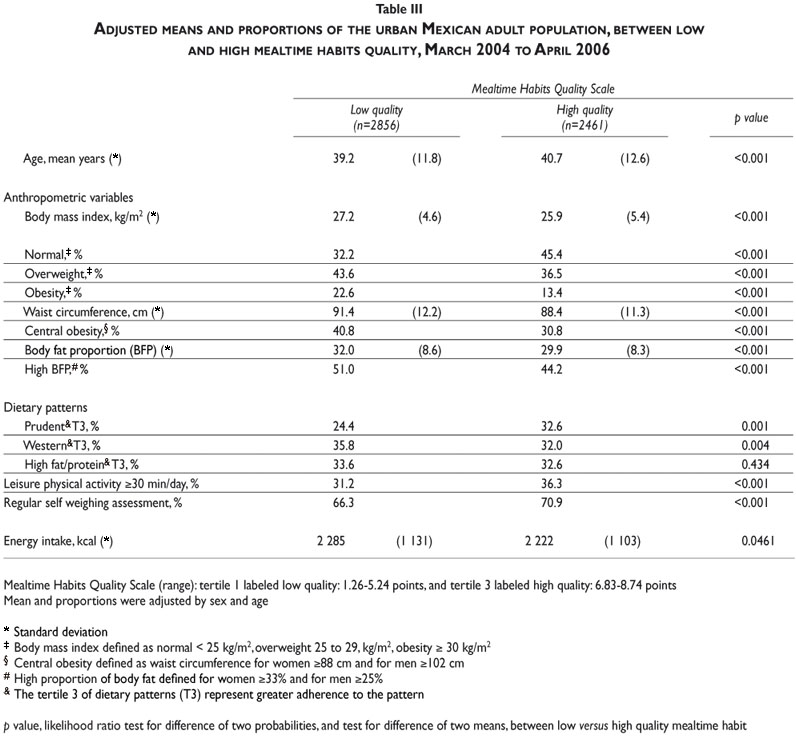
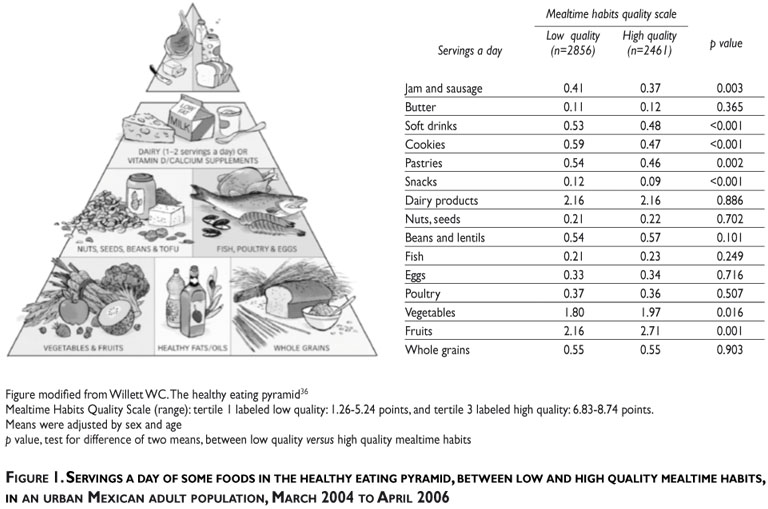
<body><![CDATA[<p><font size="3" face="Verdana"><b>Results</b></font></p>     <p><font size="2" face="Verdana">The factor solution of mealtime habits was composed of only the first factor; advisable mealtime items were correlated positively and unadvisable mealtime items were correlated negatively (<a href="#tab01">Table I</a>). Five items had a loading greater than 0.30; the exceptions were items: I chose what I eat; I eat all my food, without leaving anything on the plate and I am distracted (I talk, watch tv or read) so I do not realize how much I eat. The MHQS had a mean of 5.9 points, median 6.22, ranging from 1.26 to 8.74 (SD &plusmn;1.3)</font></p>     <p><font size="2" face="Verdana"> The study population was composed of mainly middle&#45;aged participants, most were women and had a bachelor's level education or higher. Close to 61% were overweight or obese, and a higher proportion of women than men were overweight, had central obesity and high proportions of body fat (<a href="/img/revistas/spm/v53n2/a08tab02.jpg">Table II</a>).</font></p>     <p><font size="2" face="Verdana"> Our study population practiced mealtime habits differently by sex. A higher proportion of men performed the advisable habit of 'taking their time to finish their meals' than women, while a higher proportion of women performed the advisable habits of 'choosing what to eat' and 'eating slowly.' A higher proportion of men 'eat all food without leaving anything on the plate' and 'eat in huge mouthfuls,' while a higher proportion of women were distracted at mealtime. In general, the mealtime habits most practiced in the study population were 'I take time to finish my meal,' 'I eat all my food without leaving anything on the plate' and 'I rush my meal to avoid exceeding the available time to eat' (<a href="/img/revistas/spm/v53n2/a08tab02.jpg">Table II</a>).</font></p>     <p><font size="2" face="Verdana"> <a href="/img/revistas/spm/v53n2/a08tab03.jpg">Table III</a> shows differences in anthropometric, dietary and lifestyle variables between the low and high quality mealtime habits. Participants in the high quality category were mainly older aged, had lower prevalences of overweight, obesity, abdominal obesity and higher body fat proportion than those in the low category. They also adhered more to a prudent diet than to a western diet. In addition, participants in the high quality category spent 30 or more minutes a day doing leisure physical activity and weighed themselves more regularly than those in the low quality category. Further, participants in the high quality category consumed significantly less servings a day of jam and sausage, soft drinks, cookies, pastries and snacks than those in the low quality category. They also consumed significantly more servings a day of fruits and vegetables than those in the low quality category (<a href="/img/revistas/spm/v53n2/a08fig01.jpg">Figure 1</a>).</font></p>     <p>&nbsp;</p>     <p><font size="3" face="Verdana"><b>Discussion</b></font></p>     <p><font size="2" face="Verdana">In this study, we constructed a scale for assessing the quality of mealtime habits that accounted for the relationships between various habits. Variations in anthropometric indicators such as BMI, abdominal obesity and body fat proportion, as well as lifestyle variables such as dietary patterns, intake of servings of specific foods, leisure physical activity and self&#45;monitoring body weight behavior were found across MHQS categories.</font></p>     <p><font size="2" face="Verdana"> As expected, we found that low mealtime habit quality related to a higher BMI and greater overweight and abdominal obesity. These findings are consistent with the previously found association between individual mealtime habits &#150;such as being distracted while eating by watching TV or working,<Sup>20</Sup> eating at fast rate,<Sup>37</Sup> and skipping breakfast&#150;<Sup>38 </Sup>and higher body mass index.</font></p>     <p><font size="2" face="Verdana"> Our results also show that mealtime habits are related to particular dietary pattern. We found a positive association between high quality and prudent dietary patterns, supporting previous studies' findings of a strong relationship between advisable mealtime habits &#150;such as planning meals in advance and eating at home&#150; and a higher intake of fruit and vegetables and a lower consumption of fat.<Sup>8&#45;10</Sup> </font></p>     ]]></body>
<body><![CDATA[<p><font size="2" face="Verdana"> In this study, we also found significant differences in mealtime practices by sex. For instance, the items 'I take my time to finish my meal', 'I eat slowly' and 'I eat all my food, without leaving anything on the plate' showed relevant differences between men and women, as compared to the item 'I take advantage of mealtimes to accomplish work activities,' which was also statistically significant but insufficient; that is, this item may not be clinically relevant because the difference could be conditioned by the large number of observations. In addition, we found differences in servings a day for some food groups between low and high quality mealtime habits. The relevant differences were found in servings a day of fruits, vegetables and cookies; meanwhile, differences in jam and sausage, soft drinks, and snacks were significant but clinically irrelevant.</font></p>     <p><font size="2" face="Verdana"> Our data posed some limitations due to scale construction. First, although multiple&#45;choice responses are ideal in scale construction, the MHQS is composed of binary response items, from which participants identified the answer that best represented their usual mealtime habits. Second, we had to account for the possibility that responses to particular items might vary by meal time, day of the week or the people present at a particular meal.<Sup>39</Sup> While we were unable to capture all this possible variation, we sought to generate a generally accurate picture of mealtime habits by asking participants to identify what they usually did at mealtimes. Thus, we consider the MHQS structure to be plausible, especially in light of the strong internal consistency and correlation among the majority of mealtime items. Third, the study's cross sectional nature means that the observed relationship between low quality mealtime habits and obesity does not necessarily indicate causality; thus the MHQS requires validation though prospective cohort and intervention studies that will further uncover associations of mealtime habits with obesity indicators and dietary patterns. Another consideration is that our study population is limited to one specific group, which is urban working class Mexican adults who are mostly overweight or obese women. Nevertheless, we believe that these results can be applied to similar groups, such as Mexican Americans.<Sup>40</Sup></font></p>     <p><font size="2" face="Verdana"> Despite these limitations, we believe that the MHQS is a tool for understanding the relationships between mealtime habits and their physical consequences, as well as for providing outcome measurements for interventions intended to improve mealtime habits. Based on our findings, we argue that dietary advice should move beyond food recommendations to the promotion of advisable mealtime habits, such as eating leisurely, consciously and slowly at set and uninterrupted mealtimes. The beneficial influence of these advisable mealtime habits on diet and overweight should be further explored. </font></p>     <p>&nbsp;</p>     <p><font size="3" face="Verdana"><b>Acknowledgements</b> </font></p>     <p><font size="2" face="Verdana">This work was funded by the Consejo Nacional de Ciencia y Tecnolog&iacute;a M&eacute;xico. (CONACyT), and supported by HWCS. We acknowledge Emily Wentzell and all who participated in this project and thank them for their time and commitment.</font></p>     <p><font size="2" face="Verdana"><I>Declaration of conflicts of interest:</I> The authors declare that they have no conflict of interests.</font></p>     <p>&nbsp;</p>     <p><font size="3" face="Verdana"><b>References</b></font></p>     <!-- ref --><p><font size="2" face="Verdana">1. Newby PK, Hu FB, Rimm EB, Smith&#45;Warner SA, Feskanich D, Sampson L, et al. Reproducibility and validity of the Diet Quality Index Revised as assessed by use of a food&#45;frequency questionnaire. Am J Clin Nutr 2003;78:941&#45;949.    &nbsp;&nbsp;&nbsp;&nbsp;&nbsp;&nbsp;&nbsp;&nbsp;[&#160;<a href="javascript:void(0);" onclick="javascript: window.open('/scielo.php?script=sci_nlinks&ref=9360476&pid=S0036-3634201100020000800001&lng=','','width=640,height=500,resizable=yes,scrollbars=1,menubar=yes,');">Links</a>&#160;]<!-- end-ref --></font></p>     <!-- ref --><p><font size="2" face="Verdana">2. Hu FB. Dietary pattern analysis: a new direction in nutritional epidemiology. Curr Opin Lipidol. 2002;13:3&#45;9.    &nbsp;&nbsp;&nbsp;&nbsp;&nbsp;&nbsp;&nbsp;&nbsp;[&#160;<a href="javascript:void(0);" onclick="javascript: window.open('/scielo.php?script=sci_nlinks&ref=9360478&pid=S0036-3634201100020000800002&lng=','','width=640,height=500,resizable=yes,scrollbars=1,menubar=yes,');">Links</a>&#160;]<!-- end-ref --></font></p>     <!-- ref --><p><font size="2" face="Verdana">3. Fabricatore AN, Wadden TA, Sarwer DB, Crerand CE, Kuehnel RH, Lipschutz PE, et al. Self&#45;reported eating behaviors of extremely obese persons seeking bariatric surgery: a factor analytic approach. Obesity 2006;14 Suppl 2:83S&#45;89S.    &nbsp;&nbsp;&nbsp;&nbsp;&nbsp;&nbsp;&nbsp;&nbsp;[&#160;<a href="javascript:void(0);" onclick="javascript: window.open('/scielo.php?script=sci_nlinks&ref=9360480&pid=S0036-3634201100020000800003&lng=','','width=640,height=500,resizable=yes,scrollbars=1,menubar=yes,');">Links</a>&#160;]<!-- end-ref --></font></p>     <!-- ref --><p><font size="2" face="Verdana">4. Baranowski T, Cullen K, Nickas T, Baranowski J. Are current health behavioral changes models helpful in guiding prevention of weight gain efforts? Obes Res 2003;11:23S&#45;43S.    &nbsp;&nbsp;&nbsp;&nbsp;&nbsp;&nbsp;&nbsp;&nbsp;[&#160;<a href="javascript:void(0);" onclick="javascript: window.open('/scielo.php?script=sci_nlinks&ref=9360482&pid=S0036-3634201100020000800004&lng=','','width=640,height=500,resizable=yes,scrollbars=1,menubar=yes,');">Links</a>&#160;]<!-- end-ref --></font></p>     <!-- ref --><p><font size="2" face="Verdana">5. Fjellstr&ouml;m C: Mealtime and meal patterns from a cultural perspective Scandinavian. Scandinavian J Nutr 2004;48:161&#45;164.    &nbsp;&nbsp;&nbsp;&nbsp;&nbsp;&nbsp;&nbsp;&nbsp;[&#160;<a href="javascript:void(0);" onclick="javascript: window.open('/scielo.php?script=sci_nlinks&ref=9360484&pid=S0036-3634201100020000800005&lng=','','width=640,height=500,resizable=yes,scrollbars=1,menubar=yes,');">Links</a>&#160;]<!-- end-ref --></font></p>     <!-- ref --><p><font size="2" face="Verdana">6. Moray J, Fu A, Brill K, Mayoral MS. Viewing television while eating impairs the ability to accurately estimate total amount of food consumed. Bariatric Nursing Surgical Patient Care 2007;2:71&#45;76.    &nbsp;&nbsp;&nbsp;&nbsp;&nbsp;&nbsp;&nbsp;&nbsp;[&#160;<a href="javascript:void(0);" onclick="javascript: window.open('/scielo.php?script=sci_nlinks&ref=9360486&pid=S0036-3634201100020000800006&lng=','','width=640,height=500,resizable=yes,scrollbars=1,menubar=yes,');">Links</a>&#160;]<!-- end-ref --></font></p>     <!-- ref --><p><font size="2" face="Verdana">7. Bellisle F, Dalix Anne&#45;Marie. Cognitive restraint can be offset by distraction, leading to increased meal intake in women. Am J Clin Nutr 2001;74:197&#45;200.    &nbsp;&nbsp;&nbsp;&nbsp;&nbsp;&nbsp;&nbsp;&nbsp;[&#160;<a href="javascript:void(0);" onclick="javascript: window.open('/scielo.php?script=sci_nlinks&ref=9360488&pid=S0036-3634201100020000800007&lng=','','width=640,height=500,resizable=yes,scrollbars=1,menubar=yes,');">Links</a>&#160;]<!-- end-ref --></font></p>     <!-- ref --><p><font size="2" face="Verdana">8. Boitelle KN, Birnbaum AS, Lytle LA, Murray D, Story M. Associations between perceived family meal environment and parent intake of fruit, vegetables, and fat. J Nutr Educ Behav 2003;35:24&#45;29.    &nbsp;&nbsp;&nbsp;&nbsp;&nbsp;&nbsp;&nbsp;&nbsp;[&#160;<a href="javascript:void(0);" onclick="javascript: window.open('/scielo.php?script=sci_nlinks&ref=9360490&pid=S0036-3634201100020000800008&lng=','','width=640,height=500,resizable=yes,scrollbars=1,menubar=yes,');">Links</a>&#160;]<!-- end-ref --></font></p>     <!-- ref --><p><font size="2" face="Verdana">9. Macino L, Kinsey J. Diet quality and calories consumed: the impact of being hungrier, busier and eating out. Economic Research Service, U.S. Department of Agriculture (USDA), 2004.    &nbsp;&nbsp;&nbsp;&nbsp;&nbsp;&nbsp;&nbsp;&nbsp;[&#160;<a href="javascript:void(0);" onclick="javascript: window.open('/scielo.php?script=sci_nlinks&ref=9360492&pid=S0036-3634201100020000800009&lng=','','width=640,height=500,resizable=yes,scrollbars=1,menubar=yes,');">Links</a>&#160;]<!-- end-ref --></font></p>     <!-- ref --><p><font size="2" face="Verdana">10. Larson NI, Perry CL, Story M, Neumark&#45;Sztainer D. Food preparation by young adults is associated with better diet quality. J Am Diet Assoc 2006;106:2001&#45;2007.    &nbsp;&nbsp;&nbsp;&nbsp;&nbsp;&nbsp;&nbsp;&nbsp;[&#160;<a href="javascript:void(0);" onclick="javascript: window.open('/scielo.php?script=sci_nlinks&ref=9360494&pid=S0036-3634201100020000800010&lng=','','width=640,height=500,resizable=yes,scrollbars=1,menubar=yes,');">Links</a>&#160;]<!-- end-ref --></font></p>     <!-- ref --><p><font size="2" face="Verdana">11. Satia JA, Galanko JA, Siega&#45;Riz AM. Eating at fast&#45;food restaurants is associated with dietary intake, demographic, psychosocial and behavioural factors among African Americans in North Carolina. Public Health Nutrition 2004;7:1089&#45;1096.    &nbsp;&nbsp;&nbsp;&nbsp;&nbsp;&nbsp;&nbsp;&nbsp;[&#160;<a href="javascript:void(0);" onclick="javascript: window.open('/scielo.php?script=sci_nlinks&ref=9360496&pid=S0036-3634201100020000800011&lng=','','width=640,height=500,resizable=yes,scrollbars=1,menubar=yes,');">Links</a>&#160;]<!-- end-ref --></font></p>     <!-- ref --><p><font size="2" face="Verdana">12. Andrade AM, Green GW, Melanson KJ. Eating slowly led to decreases in energy intake within meals in healthy women. J Am Diet Assoc 2008;108:1186&#45;1191.    &nbsp;&nbsp;&nbsp;&nbsp;&nbsp;&nbsp;&nbsp;&nbsp;[&#160;<a href="javascript:void(0);" onclick="javascript: window.open('/scielo.php?script=sci_nlinks&ref=9360498&pid=S0036-3634201100020000800012&lng=','','width=640,height=500,resizable=yes,scrollbars=1,menubar=yes,');">Links</a>&#160;]<!-- end-ref --></font></p>     <!-- ref --><p><font size="2" face="Verdana">13. Larson NI, Nelson MC, Neumark&#45;Sztainer D, Story M, Hannan PJ. Making time for meals: meal structure and associations with dietary intake in young adults. J Am Diet Assoc 2009;109:72&#45;79.    &nbsp;&nbsp;&nbsp;&nbsp;&nbsp;&nbsp;&nbsp;&nbsp;[&#160;<a href="javascript:void(0);" onclick="javascript: window.open('/scielo.php?script=sci_nlinks&ref=9360500&pid=S0036-3634201100020000800013&lng=','','width=640,height=500,resizable=yes,scrollbars=1,menubar=yes,');">Links</a>&#160;]<!-- end-ref --></font></p>     <!-- ref --><p><font size="2" face="Verdana">14. Provencher V, P&eacute;russe L, Bouchard L, Drapeau V, Bouchard V, Rice T, <I>et al</I>. Familial resemblance in eating behaviors in men and women from the Quebec family study. Obes Res 2005;13:1624&#45;1629.    &nbsp;&nbsp;&nbsp;&nbsp;&nbsp;&nbsp;&nbsp;&nbsp;[&#160;<a href="javascript:void(0);" onclick="javascript: window.open('/scielo.php?script=sci_nlinks&ref=9360502&pid=S0036-3634201100020000800014&lng=','','width=640,height=500,resizable=yes,scrollbars=1,menubar=yes,');">Links</a>&#160;]<!-- end-ref --></font></p>     <!-- ref --><p><font size="2" face="Verdana">15. Orrell&#45;Valente JK, Hill LG, Brechwald WA, Dodge KA, Pettit GS, Bates JE. 'Just three more bites': an observational analysis of parents' socialization of children's eating at mealtime. Appetite 2007;48:37&#45;45.    &nbsp;&nbsp;&nbsp;&nbsp;&nbsp;&nbsp;&nbsp;&nbsp;[&#160;<a href="javascript:void(0);" onclick="javascript: window.open('/scielo.php?script=sci_nlinks&ref=9360504&pid=S0036-3634201100020000800015&lng=','','width=640,height=500,resizable=yes,scrollbars=1,menubar=yes,');">Links</a>&#160;]<!-- end-ref --></font></p>     <!-- ref --><p><font size="2" face="Verdana">16. L&oacute;pez&#45;Caudana AE, T&eacute;llez&#45;Rojo Sol&iacute; MM, Mauricio Hern&aacute;ndez&#45;Avila M, Clark P, Ju&aacute;rez&#45;M&aacute;rquez SA, Lazcano&#45;Ponce EC, Salmer&oacute;n&#45;Castro J. Predictors of Bone Mineral Density in Female Workers in Morelos State, Mexico. Arch Med Res 2004;35:172&#150;180.    &nbsp;&nbsp;&nbsp;&nbsp;&nbsp;&nbsp;&nbsp;&nbsp;[&#160;<a href="javascript:void(0);" onclick="javascript: window.open('/scielo.php?script=sci_nlinks&ref=9360506&pid=S0036-3634201100020000800016&lng=','','width=640,height=500,resizable=yes,scrollbars=1,menubar=yes,');">Links</a>&#160;]<!-- end-ref --></font></p>     <!-- ref --><p><font size="2" face="Verdana">17. M&eacute;ndez&#45;Hern&aacute;ndez P, Flores Y, Siani C, Lamure M, Dosamantes&#45;Carrasco L Darina, Halley&#45;Castillo E, <I>et al</I>. Physical activity and risk of metabolic syndrome in an urban Mexican cohort. BMC Public Health 2009;9:276:1&#45;10.    &nbsp;&nbsp;&nbsp;&nbsp;&nbsp;&nbsp;&nbsp;&nbsp;[&#160;<a href="javascript:void(0);" onclick="javascript: window.open('/scielo.php?script=sci_nlinks&ref=9360508&pid=S0036-3634201100020000800017&lng=','','width=640,height=500,resizable=yes,scrollbars=1,menubar=yes,');">Links</a>&#160;]<!-- end-ref --></font></p>     <!-- ref --><p><font size="2" face="Verdana">18. Denova&#45;Guti&eacute;rrez E, Talavera JO, Huitr&oacute;n&#45;Bravo G, M&eacute;ndez&#45;Hern&aacute;ndez P, Salmer&oacute;n J. Sweetened beverage consumption and risk of metabolic syndrome in Mexican adults. Public Health Nutr 2010;10:1&#45;8.    &nbsp;&nbsp;&nbsp;&nbsp;&nbsp;&nbsp;&nbsp;&nbsp;[&#160;<a href="javascript:void(0);" onclick="javascript: window.open('/scielo.php?script=sci_nlinks&ref=9360510&pid=S0036-3634201100020000800018&lng=','','width=640,height=500,resizable=yes,scrollbars=1,menubar=yes,');">Links</a>&#160;]<!-- end-ref --></font></p>     <!-- ref --><p><font size="2" face="Verdana">19. Council for International Organizations of Medical Sciences, World health Organization. International Ethical guidelines for biomedical research involving human subjects. Geneva: CIOMS, WHO, 1993.    &nbsp;&nbsp;&nbsp;&nbsp;&nbsp;&nbsp;&nbsp;&nbsp;[&#160;<a href="javascript:void(0);" onclick="javascript: window.open('/scielo.php?script=sci_nlinks&ref=9360512&pid=S0036-3634201100020000800019&lng=','','width=640,height=500,resizable=yes,scrollbars=1,menubar=yes,');">Links</a>&#160;]<!-- end-ref --></font></p>     <!-- ref --><p><font size="2" face="Verdana">20. Liebman M, Pelican S, Moore SA, Holmes B, Wardlaw MK, Melcher LM, et al. Dietary intake, eating behavior, and physical activity&#45;related determinants of high body mass index in rural communities in Wyoming, Montana, and Idaho. Int J Obes 2003;27:684&#45;692.    &nbsp;&nbsp;&nbsp;&nbsp;&nbsp;&nbsp;&nbsp;&nbsp;[&#160;<a href="javascript:void(0);" onclick="javascript: window.open('/scielo.php?script=sci_nlinks&ref=9360514&pid=S0036-3634201100020000800020&lng=','','width=640,height=500,resizable=yes,scrollbars=1,menubar=yes,');">Links</a>&#160;]<!-- end-ref --></font></p>     <!-- ref --><p><font size="2" face="Verdana">21. Otsuka R, Tamakoshi K, Yatsuya H, Murata C, Sekiya A, Wada K, et al. Eating fast leads to obesity: findings based on self&#45;administered. Questionnaires among middle&#45;aged Japanese men and women. J Epidemiol 2006;16:117&#45;124.    &nbsp;&nbsp;&nbsp;&nbsp;&nbsp;&nbsp;&nbsp;&nbsp;[&#160;<a href="javascript:void(0);" onclick="javascript: window.open('/scielo.php?script=sci_nlinks&ref=9360516&pid=S0036-3634201100020000800021&lng=','','width=640,height=500,resizable=yes,scrollbars=1,menubar=yes,');">Links</a>&#160;]<!-- end-ref --></font></p>     <!-- ref --><p><font size="2" face="Verdana">22. Sasaki S, Katagiri A, Tsuji T, Shimoda T, Aman K. Self&#45;reported rate of eating correlates with body mass index in 18&#45;y&#45;old Japanese women. Int J Obes 2003;27:1405&#45;1410.    &nbsp;&nbsp;&nbsp;&nbsp;&nbsp;&nbsp;&nbsp;&nbsp;[&#160;<a href="javascript:void(0);" onclick="javascript: window.open('/scielo.php?script=sci_nlinks&ref=9360518&pid=S0036-3634201100020000800022&lng=','','width=640,height=500,resizable=yes,scrollbars=1,menubar=yes,');">Links</a>&#160;]<!-- end-ref --></font></p>     <!-- ref --><p><font size="2" face="Verdana">23. Spiegel TA: Rate of intake, bites, and chews&#45;the interpretation of lean&#45;obese differences. Neurosci Biobehav Rev 2000;24:229&#45;237.    &nbsp;&nbsp;&nbsp;&nbsp;&nbsp;&nbsp;&nbsp;&nbsp;[&#160;<a href="javascript:void(0);" onclick="javascript: window.open('/scielo.php?script=sci_nlinks&ref=9360520&pid=S0036-3634201100020000800023&lng=','','width=640,height=500,resizable=yes,scrollbars=1,menubar=yes,');">Links</a>&#160;]<!-- end-ref --> </font></p>     <!-- ref --><p><font size="2" face="Verdana">24. Laessle RG, Lehrke S, D&uuml;ckers S. Laboratory eating behavior in obesity. Appetite 2007;49:399&#45;404.    &nbsp;&nbsp;&nbsp;&nbsp;&nbsp;&nbsp;&nbsp;&nbsp;[&#160;<a href="javascript:void(0);" onclick="javascript: window.open('/scielo.php?script=sci_nlinks&ref=9360522&pid=S0036-3634201100020000800024&lng=','','width=640,height=500,resizable=yes,scrollbars=1,menubar=yes,');">Links</a>&#160;]<!-- end-ref --></font></p>     <!-- ref --><p><font size="2" face="Verdana">25. Patrick H, Nicklas TA. A review of family and social determinants of children's eating patterns and diet quality. J Am Coll Nutr 2005;24:83&#45;92.    &nbsp;&nbsp;&nbsp;&nbsp;&nbsp;&nbsp;&nbsp;&nbsp;[&#160;<a href="javascript:void(0);" onclick="javascript: window.open('/scielo.php?script=sci_nlinks&ref=9360524&pid=S0036-3634201100020000800025&lng=','','width=640,height=500,resizable=yes,scrollbars=1,menubar=yes,');">Links</a>&#160;]<!-- end-ref --></font></p>     <!-- ref --><p><font size="2" face="Verdana">26. Elfhag K, R&ouml;ssner S. Who succeeds in maintaining weight loss? A conceptual review of factors associated with weight loss maintenance and weight regain. Obesity 2005;6:67&#45;85.    &nbsp;&nbsp;&nbsp;&nbsp;&nbsp;&nbsp;&nbsp;&nbsp;[&#160;<a href="javascript:void(0);" onclick="javascript: window.open('/scielo.php?script=sci_nlinks&ref=9360526&pid=S0036-3634201100020000800026&lng=','','width=640,height=500,resizable=yes,scrollbars=1,menubar=yes,');">Links</a>&#160;]<!-- end-ref --></font></p>     <!-- ref --><p><font size="2" face="Verdana">27. Fisher JO, Birch LL: Restricting access to palatable foods affects children's behavioral response, food selection, and intake. Am J Clin Nutr 1999;69:1264&#45;1272.    &nbsp;&nbsp;&nbsp;&nbsp;&nbsp;&nbsp;&nbsp;&nbsp;[&#160;<a href="javascript:void(0);" onclick="javascript: window.open('/scielo.php?script=sci_nlinks&ref=9360528&pid=S0036-3634201100020000800027&lng=','','width=640,height=500,resizable=yes,scrollbars=1,menubar=yes,');">Links</a>&#160;]<!-- end-ref --></font></p>     <!-- ref --><p><font size="2" face="Verdana">28. Vogels V, Diepvens K, Westerterp&#45;Plantenga MS. Predictors of long&#45;term weight maintenance. Obes Res 2005;13:2162&#45;2168.    &nbsp;&nbsp;&nbsp;&nbsp;&nbsp;&nbsp;&nbsp;&nbsp;[&#160;<a href="javascript:void(0);" onclick="javascript: window.open('/scielo.php?script=sci_nlinks&ref=9360530&pid=S0036-3634201100020000800028&lng=','','width=640,height=500,resizable=yes,scrollbars=1,menubar=yes,');">Links</a>&#160;]<!-- end-ref --></font></p>     <!-- ref --><p><font size="2" face="Verdana">29. Hern&aacute;ndez&#45;Avila M, Romieu I, Parra S, Hern&aacute;ndez&#45;Avila J, Madrigal H, Willett WC. Validity and reproducibility of a food frequency questionnaire to assess dietary intake of women living in Mexico City. Salud Publica Mex 1998;40:133&#45;140.    &nbsp;&nbsp;&nbsp;&nbsp;&nbsp;&nbsp;&nbsp;&nbsp;[&#160;<a href="javascript:void(0);" onclick="javascript: window.open('/scielo.php?script=sci_nlinks&ref=9360532&pid=S0036-3634201100020000800029&lng=','','width=640,height=500,resizable=yes,scrollbars=1,menubar=yes,');">Links</a>&#160;]<!-- end-ref --></font></p>     <!-- ref --><p><font size="2" face="Verdana">30. Denova&#45;Guti&eacute;rrez E, Casta&ntilde;&oacute;n S, Talavera JO, Gallegos&#45;Carrillo K, Flores&#45;Aldana M, Dosamantes&#45;Carrasco D, Willett WC, Salmer&oacute;n J. Dietary patterns and risk of metabolic syndrome in an urban Mexican population. J Nutr 2010;140:1&#45;9.    &nbsp;&nbsp;&nbsp;&nbsp;&nbsp;&nbsp;&nbsp;&nbsp;[&#160;<a href="javascript:void(0);" onclick="javascript: window.open('/scielo.php?script=sci_nlinks&ref=9360534&pid=S0036-3634201100020000800030&lng=','','width=640,height=500,resizable=yes,scrollbars=1,menubar=yes,');">Links</a>&#160;]<!-- end-ref --></font></p>     <!-- ref --><p><font size="2" face="Verdana">31. Chasan&#45;Taber S, Rimm EB, Stampfer MJ, Spiegelman D, Colditz GA, Giovannucci E, et al. Reproducibility and validity of a self&#45;administered physical activity questionnaire for male health professionals. Epidemiology 1996;7:81&#45;86.    &nbsp;&nbsp;&nbsp;&nbsp;&nbsp;&nbsp;&nbsp;&nbsp;[&#160;<a href="javascript:void(0);" onclick="javascript: window.open('/scielo.php?script=sci_nlinks&ref=9360536&pid=S0036-3634201100020000800031&lng=','','width=640,height=500,resizable=yes,scrollbars=1,menubar=yes,');">Links</a>&#160;]<!-- end-ref --></font></p>     <!-- ref --><p><font size="2" face="Verdana">32. Fern&aacute;ndez&#45;Garc&iacute;a V, Hern&aacute;ndez&#45;Tezoquipa I. Promoci&oacute;n de la actividad F&iacute;sica. Instituto Nacional de Salud P&uacute;blica, Secretar&iacute;a de Salud. Cuernavaca M&eacute;xico; 2007:1&#45;6.    &nbsp;&nbsp;&nbsp;&nbsp;&nbsp;&nbsp;&nbsp;&nbsp;[&#160;<a href="javascript:void(0);" onclick="javascript: window.open('/scielo.php?script=sci_nlinks&ref=9360538&pid=S0036-3634201100020000800032&lng=','','width=640,height=500,resizable=yes,scrollbars=1,menubar=yes,');">Links</a>&#160;]<!-- end-ref --></font></p>     <!-- ref --><p><font size="2" face="Verdana">33. Brown TA. Confirmatory factor analysis for applied research. First edition. The Guilford Press. New York, 2006:320&#45;412.    &nbsp;&nbsp;&nbsp;&nbsp;&nbsp;&nbsp;&nbsp;&nbsp;[&#160;<a href="javascript:void(0);" onclick="javascript: window.open('/scielo.php?script=sci_nlinks&ref=9360540&pid=S0036-3634201100020000800033&lng=','','width=640,height=500,resizable=yes,scrollbars=1,menubar=yes,');">Links</a>&#160;]<!-- end-ref --></font></p>     <!-- ref --><p><font size="2" face="Verdana">34. Acock AC. A gentle introduction to Stata. Second edition. Stata press, 2008:294&#45;310</font>&nbsp;&nbsp;&nbsp;&nbsp;&nbsp;&nbsp;&nbsp;&nbsp;[&#160;<a href="javascript:void(0);" onclick="javascript: window.open('/scielo.php?script=sci_nlinks&ref=9360542&pid=S0036-3634201100020000800034&lng=','','width=640,height=500,resizable=yes,scrollbars=1,menubar=yes,');">Links</a>&#160;]<!-- end-ref --><!-- ref --><p><font size="2" face="Verdana">35. Spector PE. Summated rating scale construction. First edition. University of Iowa, 1992:29&#45;43.    &nbsp;&nbsp;&nbsp;&nbsp;&nbsp;&nbsp;&nbsp;&nbsp;[&#160;<a href="javascript:void(0);" onclick="javascript: window.open('/scielo.php?script=sci_nlinks&ref=9360543&pid=S0036-3634201100020000800035&lng=','','width=640,height=500,resizable=yes,scrollbars=1,menubar=yes,');">Links</a>&#160;]<!-- end-ref --></font></p>     <!-- ref --><p><font size="2" face="Verdana">36. Willett WC. Eat, drink and be healthy. The Harvard Medical School Guide to Healthy Eating. New York: Simon &amp; Schuster Source, 2001.    &nbsp;&nbsp;&nbsp;&nbsp;&nbsp;&nbsp;&nbsp;&nbsp;[&#160;<a href="javascript:void(0);" onclick="javascript: window.open('/scielo.php?script=sci_nlinks&ref=9360545&pid=S0036-3634201100020000800036&lng=','','width=640,height=500,resizable=yes,scrollbars=1,menubar=yes,');">Links</a>&#160;]<!-- end-ref --> </font></p>     ]]></body>
<body><![CDATA[<!-- ref --><p><font size="2" face="Verdana">37. Maruyama K, Sato S, Ohira T, Maeda K, Noda H, Kubota Y, et al. The joint impact on being overweight of self reported behaviours of eating quickly and eating until full: cross sectional survey. BMJ 2008;337:1&#45;5 </font>&nbsp;&nbsp;&nbsp;&nbsp;&nbsp;&nbsp;&nbsp;&nbsp;[&#160;<a href="javascript:void(0);" onclick="javascript: window.open('/scielo.php?script=sci_nlinks&ref=9360547&pid=S0036-3634201100020000800037&lng=','','width=640,height=500,resizable=yes,scrollbars=1,menubar=yes,');">Links</a>&#160;]<!-- end-ref --><!-- ref --><p><font size="2" face="Verdana">38. Yunsheng M, Bertone ER, Stanek EJ, Reed GW, Hebert JR, Cohen NL, et al. Association between eating patterns and obesity in a free&#45;living US adult population. Am J Epidemiol 2003;158:85&#45;92.    &nbsp;&nbsp;&nbsp;&nbsp;&nbsp;&nbsp;&nbsp;&nbsp;[&#160;<a href="javascript:void(0);" onclick="javascript: window.open('/scielo.php?script=sci_nlinks&ref=9360548&pid=S0036-3634201100020000800038&lng=','','width=640,height=500,resizable=yes,scrollbars=1,menubar=yes,');">Links</a>&#160;]<!-- end-ref --></font></p>     <!-- ref --><p><font size="2" face="Verdana">39. De Castro JM, Brewer M. The amount eaten in meals by humans is a power function of the number of people present. Physiol Behav 1992;51:121&#45;125.    &nbsp;&nbsp;&nbsp;&nbsp;&nbsp;&nbsp;&nbsp;&nbsp;[&#160;<a href="javascript:void(0);" onclick="javascript: window.open('/scielo.php?script=sci_nlinks&ref=9360550&pid=S0036-3634201100020000800039&lng=','','width=640,height=500,resizable=yes,scrollbars=1,menubar=yes,');">Links</a>&#160;]<!-- end-ref --></font></p>     <!-- ref --><p><font size="2" face="Verdana">40. Pawson IG, Martorell R, Mendoza FE. Prevalence of overweight and obesity in US Hispanic populations.  Am J Clin Nutr 1991;53 Suppl6:1522S&#45;1528S.    &nbsp;&nbsp;&nbsp;&nbsp;&nbsp;&nbsp;&nbsp;&nbsp;[&#160;<a href="javascript:void(0);" onclick="javascript: window.open('/scielo.php?script=sci_nlinks&ref=9360552&pid=S0036-3634201100020000800040&lng=','','width=640,height=500,resizable=yes,scrollbars=1,menubar=yes,');">Links</a>&#160;]<!-- end-ref --></font></p>     <p>&nbsp;</p>     <p>&nbsp;</p>     <p><font size="2" face="Verdana"><a name="end"></a><a href="#title"><img src="/img/revistas/spm/v53n2/seta.jpg" border="0"></a> <b>Address reprint requests to:</b>    ]]></body>
<body><![CDATA[<br>   Dr. Pablo M&eacute;ndez&#45;Hern&aacute;ndez    <br>   Calle 29 # 820 Col    <br>   La Loma Xicot&eacute;ncatl    <br>   90062 Tlaxcala, Tlax, M&eacute;xico    <br>   E&#45;mail: <a href="mailto:pmendezh@hotmail.com">pmendezh@hotmail.com</a></font></p>     <p><font size="2" face="Verdana">Received on: May 25, 2010    <br> Accepted on: December 15,2010</font></p>      ]]></body><back>
<ref-list>
<ref id="B1">
<label>1</label><nlm-citation citation-type="journal">
<person-group person-group-type="author">
<name>
<surname><![CDATA[Newby]]></surname>
<given-names><![CDATA[PK]]></given-names>
</name>
<name>
<surname><![CDATA[Hu]]></surname>
<given-names><![CDATA[FB]]></given-names>
</name>
<name>
<surname><![CDATA[Rimm]]></surname>
<given-names><![CDATA[EB]]></given-names>
</name>
<name>
<surname><![CDATA[Smith-Warner]]></surname>
<given-names><![CDATA[SA]]></given-names>
</name>
<name>
<surname><![CDATA[Feskanich]]></surname>
<given-names><![CDATA[D]]></given-names>
</name>
<name>
<surname><![CDATA[Sampson]]></surname>
<given-names><![CDATA[L]]></given-names>
</name>
</person-group>
<article-title xml:lang="en"><![CDATA[Reproducibility and validity of the Diet Quality Index Revised as assessed by use of a food-frequency questionnaire]]></article-title>
<source><![CDATA[Am J Clin Nutr]]></source>
<year>2003</year>
<volume>78</volume>
<page-range>941-949</page-range></nlm-citation>
</ref>
<ref id="B2">
<label>2</label><nlm-citation citation-type="journal">
<person-group person-group-type="author">
<name>
<surname><![CDATA[Hu]]></surname>
<given-names><![CDATA[FB]]></given-names>
</name>
</person-group>
<article-title xml:lang="en"><![CDATA[Dietary pattern analysis: a new direction in nutritional epidemiology]]></article-title>
<source><![CDATA[Curr Opin Lipidol]]></source>
<year>2002</year>
<volume>13</volume>
<page-range>3-9</page-range></nlm-citation>
</ref>
<ref id="B3">
<label>3</label><nlm-citation citation-type="journal">
<person-group person-group-type="author">
<name>
<surname><![CDATA[Fabricatore]]></surname>
<given-names><![CDATA[AN]]></given-names>
</name>
<name>
<surname><![CDATA[Wadden]]></surname>
<given-names><![CDATA[TA]]></given-names>
</name>
<name>
<surname><![CDATA[Sarwer]]></surname>
<given-names><![CDATA[DB]]></given-names>
</name>
<name>
<surname><![CDATA[Crerand]]></surname>
<given-names><![CDATA[CE]]></given-names>
</name>
<name>
<surname><![CDATA[Kuehnel]]></surname>
<given-names><![CDATA[RH]]></given-names>
</name>
<name>
<surname><![CDATA[Lipschutz]]></surname>
<given-names><![CDATA[PE]]></given-names>
</name>
</person-group>
<article-title xml:lang="en"><![CDATA[Self-reported eating behaviors of extremely obese persons seeking bariatric surgery: a factor analytic approach]]></article-title>
<source><![CDATA[Obesity]]></source>
<year>2006</year>
<volume>14</volume>
<numero>^s2</numero>
<issue>^s2</issue>
<supplement>2</supplement>
<page-range>83S-89S</page-range></nlm-citation>
</ref>
<ref id="B4">
<label>4</label><nlm-citation citation-type="journal">
<person-group person-group-type="author">
<name>
<surname><![CDATA[Baranowski]]></surname>
<given-names><![CDATA[T]]></given-names>
</name>
<name>
<surname><![CDATA[Cullen]]></surname>
<given-names><![CDATA[K]]></given-names>
</name>
<name>
<surname><![CDATA[Nickas]]></surname>
<given-names><![CDATA[T]]></given-names>
</name>
<name>
<surname><![CDATA[Baranowski]]></surname>
<given-names><![CDATA[J]]></given-names>
</name>
</person-group>
<article-title xml:lang="en"><![CDATA[Are current health behavioral changes models helpful in guiding prevention of weight gain efforts]]></article-title>
<source><![CDATA[Obes Res]]></source>
<year>2003</year>
<volume>11</volume>
<page-range>23S-43S</page-range></nlm-citation>
</ref>
<ref id="B5">
<label>5</label><nlm-citation citation-type="journal">
<person-group person-group-type="author">
<name>
<surname><![CDATA[Fjellström]]></surname>
<given-names><![CDATA[C]]></given-names>
</name>
</person-group>
<article-title xml:lang="en"><![CDATA[Mealtime and meal patterns from a cultural perspective Scandinavian]]></article-title>
<source><![CDATA[Scandinavian J Nutr]]></source>
<year>2004</year>
<volume>48</volume>
<page-range>161-164</page-range></nlm-citation>
</ref>
<ref id="B6">
<label>6</label><nlm-citation citation-type="journal">
<person-group person-group-type="author">
<name>
<surname><![CDATA[Moray]]></surname>
<given-names><![CDATA[J]]></given-names>
</name>
<name>
<surname><![CDATA[Fu]]></surname>
<given-names><![CDATA[A]]></given-names>
</name>
<name>
<surname><![CDATA[Brill]]></surname>
<given-names><![CDATA[K]]></given-names>
</name>
<name>
<surname><![CDATA[Mayoral]]></surname>
<given-names><![CDATA[MS]]></given-names>
</name>
</person-group>
<article-title xml:lang="en"><![CDATA[Viewing television while eating impairs the ability to accurately estimate total amount of food consumed]]></article-title>
<source><![CDATA[Bariatric Nursing Surgical Patient Care]]></source>
<year>2007</year>
<volume>2</volume>
<page-range>71-76</page-range></nlm-citation>
</ref>
<ref id="B7">
<label>7</label><nlm-citation citation-type="journal">
<person-group person-group-type="author">
<name>
<surname><![CDATA[Bellisle]]></surname>
<given-names><![CDATA[F]]></given-names>
</name>
<name>
<surname><![CDATA[Dalix]]></surname>
<given-names><![CDATA[Anne-Marie]]></given-names>
</name>
</person-group>
<article-title xml:lang="en"><![CDATA[Cognitive restraint can be offset by distraction, leading to increased meal intake in women]]></article-title>
<source><![CDATA[Am J Clin Nutr]]></source>
<year>2001</year>
<volume>74</volume>
<page-range>197-200</page-range></nlm-citation>
</ref>
<ref id="B8">
<label>8</label><nlm-citation citation-type="journal">
<person-group person-group-type="author">
<name>
<surname><![CDATA[Boitelle]]></surname>
<given-names><![CDATA[KN]]></given-names>
</name>
<name>
<surname><![CDATA[Birnbaum]]></surname>
<given-names><![CDATA[AS]]></given-names>
</name>
<name>
<surname><![CDATA[Lytle]]></surname>
<given-names><![CDATA[LA]]></given-names>
</name>
<name>
<surname><![CDATA[Murray]]></surname>
<given-names><![CDATA[D]]></given-names>
</name>
<name>
<surname><![CDATA[Story]]></surname>
<given-names><![CDATA[M]]></given-names>
</name>
</person-group>
<article-title xml:lang="en"><![CDATA[Associations between perceived family meal environment and parent intake of fruit, vegetables, and fat]]></article-title>
<source><![CDATA[J Nutr Educ Behav]]></source>
<year>2003</year>
<volume>35</volume>
<page-range>24-29</page-range></nlm-citation>
</ref>
<ref id="B9">
<label>9</label><nlm-citation citation-type="book">
<person-group person-group-type="author">
<name>
<surname><![CDATA[Macino]]></surname>
<given-names><![CDATA[L]]></given-names>
</name>
<name>
<surname><![CDATA[Kinsey]]></surname>
<given-names><![CDATA[J]]></given-names>
</name>
</person-group>
<source><![CDATA[Diet quality and calories consumed: the impact of being hungrier, busier and eating out]]></source>
<year>2004</year>
<publisher-name><![CDATA[Economic Research Service, U.S. Department of Agriculture (USDA)]]></publisher-name>
</nlm-citation>
</ref>
<ref id="B10">
<label>10</label><nlm-citation citation-type="journal">
<person-group person-group-type="author">
<name>
<surname><![CDATA[Larson]]></surname>
<given-names><![CDATA[NI]]></given-names>
</name>
<name>
<surname><![CDATA[Perry]]></surname>
<given-names><![CDATA[CL]]></given-names>
</name>
<name>
<surname><![CDATA[Story]]></surname>
<given-names><![CDATA[M]]></given-names>
</name>
<name>
<surname><![CDATA[Neumark-Sztainer]]></surname>
<given-names><![CDATA[D]]></given-names>
</name>
</person-group>
<article-title xml:lang="en"><![CDATA[Food preparation by young adults is associated with better diet quality]]></article-title>
<source><![CDATA[J Am Diet Assoc]]></source>
<year>2006</year>
<volume>106</volume>
<page-range>2001-2007</page-range></nlm-citation>
</ref>
<ref id="B11">
<label>11</label><nlm-citation citation-type="journal">
<person-group person-group-type="author">
<name>
<surname><![CDATA[Satia]]></surname>
<given-names><![CDATA[JA]]></given-names>
</name>
<name>
<surname><![CDATA[Galanko]]></surname>
<given-names><![CDATA[JA]]></given-names>
</name>
<name>
<surname><![CDATA[Siega-Riz]]></surname>
<given-names><![CDATA[AM]]></given-names>
</name>
</person-group>
<article-title xml:lang="en"><![CDATA[Eating at fast-food restaurants is associated with dietary intake, demographic, psychosocial and behavioural factors among African Americans in North Carolina]]></article-title>
<source><![CDATA[Public Health Nutrition]]></source>
<year>2004</year>
<volume>7</volume>
<page-range>1089-1096</page-range></nlm-citation>
</ref>
<ref id="B12">
<label>12</label><nlm-citation citation-type="journal">
<person-group person-group-type="author">
<name>
<surname><![CDATA[Andrade]]></surname>
<given-names><![CDATA[AM]]></given-names>
</name>
<name>
<surname><![CDATA[Green]]></surname>
<given-names><![CDATA[GW]]></given-names>
</name>
<name>
<surname><![CDATA[Melanson]]></surname>
<given-names><![CDATA[KJ]]></given-names>
</name>
</person-group>
<article-title xml:lang="en"><![CDATA[Eating slowly led to decreases in energy intake within meals in healthy women]]></article-title>
<source><![CDATA[J Am Diet Assoc]]></source>
<year>2008</year>
<volume>108</volume>
<page-range>1186-1191</page-range></nlm-citation>
</ref>
<ref id="B13">
<label>13</label><nlm-citation citation-type="journal">
<person-group person-group-type="author">
<name>
<surname><![CDATA[Larson]]></surname>
<given-names><![CDATA[NI]]></given-names>
</name>
<name>
<surname><![CDATA[Nelson]]></surname>
<given-names><![CDATA[MC]]></given-names>
</name>
<name>
<surname><![CDATA[Neumark-Sztainer]]></surname>
<given-names><![CDATA[D]]></given-names>
</name>
<name>
<surname><![CDATA[Story]]></surname>
<given-names><![CDATA[M]]></given-names>
</name>
<name>
<surname><![CDATA[Hannan]]></surname>
<given-names><![CDATA[PJ]]></given-names>
</name>
</person-group>
<article-title xml:lang="en"><![CDATA[Making time for meals: meal structure and associations with dietary intake in young adults]]></article-title>
<source><![CDATA[J Am Diet Assoc]]></source>
<year>2009</year>
<volume>109</volume>
<page-range>72-79</page-range></nlm-citation>
</ref>
<ref id="B14">
<label>14</label><nlm-citation citation-type="journal">
<person-group person-group-type="author">
<name>
<surname><![CDATA[Provencher]]></surname>
<given-names><![CDATA[V]]></given-names>
</name>
<name>
<surname><![CDATA[Pérusse]]></surname>
<given-names><![CDATA[L]]></given-names>
</name>
<name>
<surname><![CDATA[Bouchard]]></surname>
<given-names><![CDATA[L]]></given-names>
</name>
<name>
<surname><![CDATA[Drapeau]]></surname>
<given-names><![CDATA[V]]></given-names>
</name>
<name>
<surname><![CDATA[Bouchard]]></surname>
<given-names><![CDATA[V]]></given-names>
</name>
<name>
<surname><![CDATA[Rice]]></surname>
<given-names><![CDATA[T]]></given-names>
</name>
</person-group>
<article-title xml:lang="en"><![CDATA[Familial resemblance in eating behaviors in men and women from the Quebec family study]]></article-title>
<source><![CDATA[Obes Res]]></source>
<year>2005</year>
<volume>13</volume>
<page-range>1624-1629</page-range></nlm-citation>
</ref>
<ref id="B15">
<label>15</label><nlm-citation citation-type="journal">
<person-group person-group-type="author">
<name>
<surname><![CDATA[Orrell-Valente]]></surname>
<given-names><![CDATA[JK]]></given-names>
</name>
<name>
<surname><![CDATA[Hill]]></surname>
<given-names><![CDATA[LG]]></given-names>
</name>
<name>
<surname><![CDATA[Brechwald]]></surname>
<given-names><![CDATA[WA]]></given-names>
</name>
<name>
<surname><![CDATA[Dodge]]></surname>
<given-names><![CDATA[KA]]></given-names>
</name>
<name>
<surname><![CDATA[Pettit]]></surname>
<given-names><![CDATA[GS]]></given-names>
</name>
<name>
<surname><![CDATA[Bates]]></surname>
<given-names><![CDATA[JE]]></given-names>
</name>
</person-group>
<article-title xml:lang="en"><![CDATA['Just three more bites': an observational analysis of parents' socialization of children's eating at mealtime]]></article-title>
<source><![CDATA[Appetite]]></source>
<year>2007</year>
<volume>48</volume>
<page-range>37-45</page-range></nlm-citation>
</ref>
<ref id="B16">
<label>16</label><nlm-citation citation-type="journal">
<person-group person-group-type="author">
<name>
<surname><![CDATA[López-Caudana]]></surname>
<given-names><![CDATA[AE]]></given-names>
</name>
<name>
<surname><![CDATA[Téllez-Rojo Solí]]></surname>
<given-names><![CDATA[MM]]></given-names>
</name>
<name>
<surname><![CDATA[Mauricio Hernández-Avila]]></surname>
<given-names><![CDATA[M]]></given-names>
</name>
<name>
<surname><![CDATA[Clark]]></surname>
<given-names><![CDATA[P]]></given-names>
</name>
<name>
<surname><![CDATA[Juárez-Márquez]]></surname>
<given-names><![CDATA[SA]]></given-names>
</name>
<name>
<surname><![CDATA[Lazcano-Ponce]]></surname>
<given-names><![CDATA[EC]]></given-names>
</name>
<name>
<surname><![CDATA[Salmerón-Castro]]></surname>
<given-names><![CDATA[J]]></given-names>
</name>
</person-group>
<article-title xml:lang="en"><![CDATA[Predictors of Bone Mineral Density in Female Workers in Morelos State, Mexico]]></article-title>
<source><![CDATA[Arch Med Res]]></source>
<year>2004</year>
<volume>35</volume>
<page-range>172-180</page-range></nlm-citation>
</ref>
<ref id="B17">
<label>17</label><nlm-citation citation-type="journal">
<person-group person-group-type="author">
<name>
<surname><![CDATA[Méndez-Hernández]]></surname>
<given-names><![CDATA[P]]></given-names>
</name>
<name>
<surname><![CDATA[Flores]]></surname>
<given-names><![CDATA[Y]]></given-names>
</name>
<name>
<surname><![CDATA[Siani]]></surname>
<given-names><![CDATA[C]]></given-names>
</name>
<name>
<surname><![CDATA[Lamure]]></surname>
<given-names><![CDATA[M]]></given-names>
</name>
<name>
<surname><![CDATA[Dosamantes-Carrasco L]]></surname>
<given-names><![CDATA[Darina]]></given-names>
</name>
<name>
<surname><![CDATA[Halley-Castillo]]></surname>
<given-names><![CDATA[E]]></given-names>
</name>
</person-group>
<article-title xml:lang="en"><![CDATA[Physical activity and risk of metabolic syndrome in an urban Mexican cohort]]></article-title>
<source><![CDATA[BMC Public Health]]></source>
<year>2009</year>
<volume>9</volume>
<page-range>1-10</page-range></nlm-citation>
</ref>
<ref id="B18">
<label>18</label><nlm-citation citation-type="journal">
<person-group person-group-type="author">
<name>
<surname><![CDATA[Denova-Gutiérrez]]></surname>
<given-names><![CDATA[E]]></given-names>
</name>
<name>
<surname><![CDATA[Talavera]]></surname>
<given-names><![CDATA[JO]]></given-names>
</name>
<name>
<surname><![CDATA[Huitrón-Bravo]]></surname>
<given-names><![CDATA[G]]></given-names>
</name>
<name>
<surname><![CDATA[Méndez-Hernández]]></surname>
<given-names><![CDATA[P]]></given-names>
</name>
<name>
<surname><![CDATA[Salmerón]]></surname>
<given-names><![CDATA[J]]></given-names>
</name>
</person-group>
<article-title xml:lang="en"><![CDATA[Sweetened beverage consumption and risk of metabolic syndrome in Mexican adults]]></article-title>
<source><![CDATA[Public Health Nutr]]></source>
<year>2010</year>
<volume>10</volume>
<page-range>1-8</page-range></nlm-citation>
</ref>
<ref id="B19">
<label>19</label><nlm-citation citation-type="book">
<collab>Council for International Organizations of Medical Sciences.World health Organization</collab>
<source><![CDATA[International Ethical guidelines for biomedical research involving human subjects]]></source>
<year>1993</year>
<publisher-loc><![CDATA[Geneva ]]></publisher-loc>
<publisher-name><![CDATA[CIOMS, WHO]]></publisher-name>
</nlm-citation>
</ref>
<ref id="B20">
<label>20</label><nlm-citation citation-type="journal">
<person-group person-group-type="author">
<name>
<surname><![CDATA[Liebman]]></surname>
<given-names><![CDATA[M]]></given-names>
</name>
<name>
<surname><![CDATA[Pelican]]></surname>
<given-names><![CDATA[S]]></given-names>
</name>
<name>
<surname><![CDATA[Moore]]></surname>
<given-names><![CDATA[SA]]></given-names>
</name>
<name>
<surname><![CDATA[Holmes]]></surname>
<given-names><![CDATA[B]]></given-names>
</name>
<name>
<surname><![CDATA[Wardlaw]]></surname>
<given-names><![CDATA[MK]]></given-names>
</name>
<name>
<surname><![CDATA[Melcher]]></surname>
<given-names><![CDATA[LM]]></given-names>
</name>
</person-group>
<article-title xml:lang="en"><![CDATA[Dietary intake, eating behavior, and physical activity-related determinants of high body mass index in rural communities in Wyoming, Montana, and Idaho]]></article-title>
<source><![CDATA[Int J Obes]]></source>
<year>2003</year>
<volume>27</volume>
<page-range>684-692</page-range></nlm-citation>
</ref>
<ref id="B21">
<label>21</label><nlm-citation citation-type="journal">
<person-group person-group-type="author">
<name>
<surname><![CDATA[Otsuka]]></surname>
<given-names><![CDATA[R]]></given-names>
</name>
<name>
<surname><![CDATA[Tamakoshi]]></surname>
<given-names><![CDATA[K]]></given-names>
</name>
<name>
<surname><![CDATA[Yatsuya]]></surname>
<given-names><![CDATA[H]]></given-names>
</name>
<name>
<surname><![CDATA[Murata]]></surname>
<given-names><![CDATA[C]]></given-names>
</name>
<name>
<surname><![CDATA[Sekiya]]></surname>
<given-names><![CDATA[A]]></given-names>
</name>
<name>
<surname><![CDATA[Wada]]></surname>
<given-names><![CDATA[K]]></given-names>
</name>
</person-group>
<article-title xml:lang="en"><![CDATA[Eating fast leads to obesity: findings based on self-administered. Questionnaires among middle-aged Japanese men and women]]></article-title>
<source><![CDATA[J Epidemiol]]></source>
<year>2006</year>
<volume>16</volume>
<page-range>117-124</page-range></nlm-citation>
</ref>
<ref id="B22">
<label>22</label><nlm-citation citation-type="journal">
<person-group person-group-type="author">
<name>
<surname><![CDATA[Sasaki]]></surname>
<given-names><![CDATA[S]]></given-names>
</name>
<name>
<surname><![CDATA[Katagiri]]></surname>
<given-names><![CDATA[A]]></given-names>
</name>
<name>
<surname><![CDATA[Tsuji]]></surname>
<given-names><![CDATA[T]]></given-names>
</name>
<name>
<surname><![CDATA[Shimoda]]></surname>
<given-names><![CDATA[T]]></given-names>
</name>
<name>
<surname><![CDATA[Aman]]></surname>
<given-names><![CDATA[K]]></given-names>
</name>
</person-group>
<article-title xml:lang="en"><![CDATA[Self-reported rate of eating correlates with body mass index in 18-y-old Japanese women]]></article-title>
<source><![CDATA[Int J Obes]]></source>
<year>2003</year>
<volume>27</volume>
<page-range>1405-1410</page-range></nlm-citation>
</ref>
<ref id="B23">
<label>23</label><nlm-citation citation-type="journal">
<person-group person-group-type="author">
<name>
<surname><![CDATA[Spiegel]]></surname>
<given-names><![CDATA[TA]]></given-names>
</name>
</person-group>
<article-title xml:lang="en"><![CDATA[Rate of intake, bites, and chews-the interpretation of lean-obese differences]]></article-title>
<source><![CDATA[Neurosci Biobehav Rev]]></source>
<year>2000</year>
<volume>24</volume>
<page-range>229-237</page-range></nlm-citation>
</ref>
<ref id="B24">
<label>24</label><nlm-citation citation-type="journal">
<person-group person-group-type="author">
<name>
<surname><![CDATA[Laessle]]></surname>
<given-names><![CDATA[RG]]></given-names>
</name>
<name>
<surname><![CDATA[Lehrke]]></surname>
<given-names><![CDATA[S]]></given-names>
</name>
<name>
<surname><![CDATA[Dückers]]></surname>
<given-names><![CDATA[S]]></given-names>
</name>
</person-group>
<article-title xml:lang="en"><![CDATA[Laboratory eating behavior in obesity]]></article-title>
<source><![CDATA[Appetite]]></source>
<year>2007</year>
<volume>49</volume>
<page-range>399-404</page-range></nlm-citation>
</ref>
<ref id="B25">
<label>25</label><nlm-citation citation-type="journal">
<person-group person-group-type="author">
<name>
<surname><![CDATA[Patrick]]></surname>
<given-names><![CDATA[H]]></given-names>
</name>
<name>
<surname><![CDATA[Nicklas]]></surname>
<given-names><![CDATA[TA]]></given-names>
</name>
</person-group>
<article-title xml:lang="en"><![CDATA[A review of family and social determinants of children's eating patterns and diet quality]]></article-title>
<source><![CDATA[J Am Coll Nutr]]></source>
<year>2005</year>
<volume>24</volume>
<page-range>83-92</page-range></nlm-citation>
</ref>
<ref id="B26">
<label>26</label><nlm-citation citation-type="journal">
<person-group person-group-type="author">
<name>
<surname><![CDATA[Elfhag]]></surname>
<given-names><![CDATA[K]]></given-names>
</name>
<name>
<surname><![CDATA[Rössner]]></surname>
<given-names><![CDATA[S]]></given-names>
</name>
</person-group>
<article-title xml:lang="en"><![CDATA[Who succeeds in maintaining weight loss: A conceptual review of factors associated with weight loss maintenance and weight regain]]></article-title>
<source><![CDATA[Obesity]]></source>
<year>2005</year>
<volume>6</volume>
<page-range>67-85</page-range></nlm-citation>
</ref>
<ref id="B27">
<label>27</label><nlm-citation citation-type="journal">
<person-group person-group-type="author">
<name>
<surname><![CDATA[Fisher]]></surname>
<given-names><![CDATA[JO]]></given-names>
</name>
<name>
<surname><![CDATA[Birch]]></surname>
<given-names><![CDATA[LL]]></given-names>
</name>
</person-group>
<article-title xml:lang="en"><![CDATA[Restricting access to palatable foods affects children's behavioral response, food selection, and intake]]></article-title>
<source><![CDATA[Am J Clin Nutr]]></source>
<year>1999</year>
<volume>69</volume>
<page-range>1264-1272</page-range></nlm-citation>
</ref>
<ref id="B28">
<label>28</label><nlm-citation citation-type="journal">
<person-group person-group-type="author">
<name>
<surname><![CDATA[Vogels]]></surname>
<given-names><![CDATA[V]]></given-names>
</name>
<name>
<surname><![CDATA[Diepvens]]></surname>
<given-names><![CDATA[K]]></given-names>
</name>
<name>
<surname><![CDATA[Westerterp-Plantenga]]></surname>
<given-names><![CDATA[MS]]></given-names>
</name>
</person-group>
<article-title xml:lang="en"><![CDATA[Predictors of long-term weight maintenance]]></article-title>
<source><![CDATA[Obes Res]]></source>
<year>2005</year>
<volume>13</volume>
<page-range>2162-2168</page-range></nlm-citation>
</ref>
<ref id="B29">
<label>29</label><nlm-citation citation-type="journal">
<person-group person-group-type="author">
<name>
<surname><![CDATA[Hernández-Avila]]></surname>
<given-names><![CDATA[M]]></given-names>
</name>
<name>
<surname><![CDATA[Romieu]]></surname>
<given-names><![CDATA[I]]></given-names>
</name>
<name>
<surname><![CDATA[Parra]]></surname>
<given-names><![CDATA[S]]></given-names>
</name>
<name>
<surname><![CDATA[Hernández-Avila]]></surname>
<given-names><![CDATA[J]]></given-names>
</name>
<name>
<surname><![CDATA[Madrigal]]></surname>
<given-names><![CDATA[H]]></given-names>
</name>
<name>
<surname><![CDATA[Willett]]></surname>
<given-names><![CDATA[WC]]></given-names>
</name>
</person-group>
<article-title xml:lang="en"><![CDATA[Validity and reproducibility of a food frequency questionnaire to assess dietary intake of women living in Mexico City]]></article-title>
<source><![CDATA[Salud Publica Mex]]></source>
<year>1998</year>
<volume>40</volume>
<page-range>133-140</page-range></nlm-citation>
</ref>
<ref id="B30">
<label>30</label><nlm-citation citation-type="journal">
<person-group person-group-type="author">
<name>
<surname><![CDATA[Denova-Gutiérrez]]></surname>
<given-names><![CDATA[E]]></given-names>
</name>
<name>
<surname><![CDATA[Castañón]]></surname>
<given-names><![CDATA[S]]></given-names>
</name>
<name>
<surname><![CDATA[Talavera]]></surname>
<given-names><![CDATA[JO]]></given-names>
</name>
<name>
<surname><![CDATA[Gallegos-Carrillo]]></surname>
<given-names><![CDATA[K]]></given-names>
</name>
<name>
<surname><![CDATA[Flores-Aldana]]></surname>
<given-names><![CDATA[M]]></given-names>
</name>
<name>
<surname><![CDATA[Dosamantes-Carrasco]]></surname>
<given-names><![CDATA[D]]></given-names>
</name>
<name>
<surname><![CDATA[Willett]]></surname>
<given-names><![CDATA[WC]]></given-names>
</name>
<name>
<surname><![CDATA[Salmerón]]></surname>
<given-names><![CDATA[J]]></given-names>
</name>
</person-group>
<article-title xml:lang="en"><![CDATA[Dietary patterns and risk of metabolic syndrome in an urban Mexican population]]></article-title>
<source><![CDATA[J Nutr]]></source>
<year>2010</year>
<volume>140</volume>
<page-range>1-9</page-range></nlm-citation>
</ref>
<ref id="B31">
<label>31</label><nlm-citation citation-type="journal">
<person-group person-group-type="author">
<name>
<surname><![CDATA[Chasan-Taber]]></surname>
<given-names><![CDATA[S]]></given-names>
</name>
<name>
<surname><![CDATA[Rimm]]></surname>
<given-names><![CDATA[EB]]></given-names>
</name>
<name>
<surname><![CDATA[Stampfer]]></surname>
<given-names><![CDATA[MJ]]></given-names>
</name>
<name>
<surname><![CDATA[Spiegelman]]></surname>
<given-names><![CDATA[D]]></given-names>
</name>
<name>
<surname><![CDATA[Colditz]]></surname>
<given-names><![CDATA[GA]]></given-names>
</name>
<name>
<surname><![CDATA[Giovannucci]]></surname>
<given-names><![CDATA[E]]></given-names>
</name>
</person-group>
<article-title xml:lang="en"><![CDATA[Reproducibility and validity of a self-administered physical activity questionnaire for male health professionals]]></article-title>
<source><![CDATA[Epidemiology]]></source>
<year>1996</year>
<volume>7</volume>
<page-range>81-86</page-range></nlm-citation>
</ref>
<ref id="B32">
<label>32</label><nlm-citation citation-type="journal">
<person-group person-group-type="author">
<name>
<surname><![CDATA[Fernández-García]]></surname>
<given-names><![CDATA[V]]></given-names>
</name>
<name>
<surname><![CDATA[Hernández-Tezoquipa]]></surname>
<given-names><![CDATA[I]]></given-names>
</name>
</person-group>
<article-title xml:lang="pt"><![CDATA[Promoción de la actividad Física: Instituto Nacional de Salud Pública, Secretaría de Salud]]></article-title>
<source><![CDATA[Cuernavaca México;]]></source>
<year>2007</year>
<page-range>1-6</page-range></nlm-citation>
</ref>
<ref id="B33">
<label>33</label><nlm-citation citation-type="journal">
<person-group person-group-type="author">
<name>
<surname><![CDATA[Brown]]></surname>
<given-names><![CDATA[TA]]></given-names>
</name>
</person-group>
<article-title xml:lang="en"><![CDATA[Confirmatory factor analysis for applied research: First edition. The Guilford Press]]></article-title>
<source><![CDATA[New York,]]></source>
<year>2006</year>
<page-range>320-412</page-range></nlm-citation>
</ref>
<ref id="B34">
<label>34</label><nlm-citation citation-type="journal">
<person-group person-group-type="author">
<name>
<surname><![CDATA[Acock]]></surname>
<given-names><![CDATA[AC]]></given-names>
</name>
</person-group>
<article-title xml:lang="en"><![CDATA[A gentle introduction to Stata: Second edition]]></article-title>
<source><![CDATA[Stata press,]]></source>
<year>2008</year>
<page-range>294-310</page-range></nlm-citation>
</ref>
<ref id="B35">
<label>35</label><nlm-citation citation-type="book">
<person-group person-group-type="author">
<name>
<surname><![CDATA[Spector]]></surname>
<given-names><![CDATA[PE]]></given-names>
</name>
</person-group>
<source><![CDATA[Summated rating scale construction: First edition]]></source>
<year>1992</year>
<page-range>29-43</page-range><publisher-name><![CDATA[University of Iowa]]></publisher-name>
</nlm-citation>
</ref>
<ref id="B36">
<label>36</label><nlm-citation citation-type="book">
<person-group person-group-type="author">
<name>
<surname><![CDATA[Willett]]></surname>
<given-names><![CDATA[WC]]></given-names>
</name>
</person-group>
<source><![CDATA[Eat, drink and be healthy.The Harvard Medical School Guide to Healthy Eating]]></source>
<year>2001</year>
<publisher-loc><![CDATA[New York ]]></publisher-loc>
<publisher-name><![CDATA[Simon & Schuster Source]]></publisher-name>
</nlm-citation>
</ref>
<ref id="B37">
<label>37</label><nlm-citation citation-type="journal">
<person-group person-group-type="author">
<name>
<surname><![CDATA[Maruyama]]></surname>
<given-names><![CDATA[K]]></given-names>
</name>
<name>
<surname><![CDATA[Sato]]></surname>
<given-names><![CDATA[S]]></given-names>
</name>
<name>
<surname><![CDATA[Ohira]]></surname>
<given-names><![CDATA[T]]></given-names>
</name>
<name>
<surname><![CDATA[Maeda]]></surname>
<given-names><![CDATA[K]]></given-names>
</name>
<name>
<surname><![CDATA[Noda]]></surname>
<given-names><![CDATA[H]]></given-names>
</name>
<name>
<surname><![CDATA[Kubota]]></surname>
<given-names><![CDATA[Y]]></given-names>
</name>
</person-group>
<article-title xml:lang="en"><![CDATA[The joint impact on being overweight of self reported behaviours of eating quickly and eating until full: cross sectional survey]]></article-title>
<source><![CDATA[BMJ]]></source>
<year>2008</year>
<volume>337</volume>
<page-range>1-5</page-range></nlm-citation>
</ref>
<ref id="B38">
<label>38</label><nlm-citation citation-type="journal">
<person-group person-group-type="author">
<name>
<surname><![CDATA[Yunsheng]]></surname>
<given-names><![CDATA[M]]></given-names>
</name>
<name>
<surname><![CDATA[Bertone]]></surname>
<given-names><![CDATA[ER]]></given-names>
</name>
<name>
<surname><![CDATA[Stanek]]></surname>
<given-names><![CDATA[EJ]]></given-names>
</name>
<name>
<surname><![CDATA[Reed]]></surname>
<given-names><![CDATA[GW]]></given-names>
</name>
<name>
<surname><![CDATA[Hebert]]></surname>
<given-names><![CDATA[JR]]></given-names>
</name>
<name>
<surname><![CDATA[Cohen]]></surname>
<given-names><![CDATA[NL]]></given-names>
</name>
</person-group>
<article-title xml:lang="en"><![CDATA[Association between eating patterns and obesity in a free-living US adult population]]></article-title>
<source><![CDATA[Am J Epidemiol]]></source>
<year>2003</year>
<volume>158</volume>
<page-range>85-92</page-range></nlm-citation>
</ref>
<ref id="B39">
<label>39</label><nlm-citation citation-type="journal">
<person-group person-group-type="author">
<name>
<surname><![CDATA[De Castro]]></surname>
<given-names><![CDATA[JM]]></given-names>
</name>
<name>
<surname><![CDATA[Brewer]]></surname>
<given-names><![CDATA[M]]></given-names>
</name>
</person-group>
<article-title xml:lang="en"><![CDATA[The amount eaten in meals by humans is a power function of the number of people present]]></article-title>
<source><![CDATA[Physiol Behav]]></source>
<year>1992</year>
<volume>51</volume>
<page-range>121-125</page-range></nlm-citation>
</ref>
<ref id="B40">
<label>40</label><nlm-citation citation-type="journal">
<person-group person-group-type="author">
<name>
<surname><![CDATA[Pawson]]></surname>
<given-names><![CDATA[IG]]></given-names>
</name>
<name>
<surname><![CDATA[Martorell]]></surname>
<given-names><![CDATA[R]]></given-names>
</name>
<name>
<surname><![CDATA[Mendoza]]></surname>
<given-names><![CDATA[FE]]></given-names>
</name>
</person-group>
<article-title xml:lang="en"><![CDATA[Prevalence of overweight and obesity in US Hispanic populations]]></article-title>
<source><![CDATA[Am J Clin Nutr]]></source>
<year>1991</year>
<volume>53</volume>
<numero>^s6</numero>
<issue>^s6</issue>
<supplement>6</supplement>
<page-range>1522S-1528S</page-range></nlm-citation>
</ref>
</ref-list>
</back>
</article>