<?xml version="1.0" encoding="ISO-8859-1"?><article xmlns:mml="http://www.w3.org/1998/Math/MathML" xmlns:xlink="http://www.w3.org/1999/xlink" xmlns:xsi="http://www.w3.org/2001/XMLSchema-instance">
<front>
<journal-meta>
<journal-id>0036-3634</journal-id>
<journal-title><![CDATA[Salud Pública de México]]></journal-title>
<abbrev-journal-title><![CDATA[Salud pública Méx]]></abbrev-journal-title>
<issn>0036-3634</issn>
<publisher>
<publisher-name><![CDATA[Instituto Nacional de Salud Pública]]></publisher-name>
</publisher>
</journal-meta>
<article-meta>
<article-id>S0036-36342011000200003</article-id>
<title-group>
<article-title xml:lang="en"><![CDATA[Prevalence and socioeconomic correlates of unintented pregnancy among women in rural Bangladesh]]></article-title>
<article-title xml:lang="es"><![CDATA[Prevalencia y factores socioeconómicos asociados a embarazos no deseados en mujeres de áreas rurales de Bangladesh]]></article-title>
</title-group>
<contrib-group>
<contrib contrib-type="author">
<name>
<surname><![CDATA[Kamal]]></surname>
<given-names><![CDATA[Mostafa]]></given-names>
</name>
<xref ref-type="aff" rid="A01"/>
</contrib>
<contrib contrib-type="author">
<name>
<surname><![CDATA[Islam]]></surname>
<given-names><![CDATA[Aynul]]></given-names>
</name>
<xref ref-type="aff" rid="A02"/>
</contrib>
</contrib-group>
<aff id="A01">
<institution><![CDATA[,Islamic University Department of Mathematics ]]></institution>
<addr-line><![CDATA[Kushtia ]]></addr-line>
<country>Bangladesh</country>
</aff>
<aff id="A02">
<institution><![CDATA[,Islamic University Department of Mathematics ]]></institution>
<addr-line><![CDATA[Kushtia ]]></addr-line>
<country>Bangladesh</country>
</aff>
<pub-date pub-type="pub">
<day>00</day>
<month>04</month>
<year>2011</year>
</pub-date>
<pub-date pub-type="epub">
<day>00</day>
<month>04</month>
<year>2011</year>
</pub-date>
<volume>53</volume>
<numero>2</numero>
<fpage>108</fpage>
<lpage>115</lpage>
<copyright-statement/>
<copyright-year/>
<self-uri xlink:href="http://www.scielo.org.mx/scielo.php?script=sci_arttext&amp;pid=S0036-36342011000200003&amp;lng=en&amp;nrm=iso"></self-uri><self-uri xlink:href="http://www.scielo.org.mx/scielo.php?script=sci_abstract&amp;pid=S0036-36342011000200003&amp;lng=en&amp;nrm=iso"></self-uri><self-uri xlink:href="http://www.scielo.org.mx/scielo.php?script=sci_pdf&amp;pid=S0036-36342011000200003&amp;lng=en&amp;nrm=iso"></self-uri><abstract abstract-type="short" xml:lang="en"><p><![CDATA[OBJECTIVE: This paper examines the prevalence and socioeconomic correlates of unintended pregnancy among rural women in Bangladesh. MATERIAL AND METHODS: The study used data from the 2007 Bangladesh Demographic and Health Survey. Chi-square tests and binary logistic regression were performed using the data set. RESULTS: Overall, 30.0% of the most recent births were unplanned. Both bivariate and multivariate analyses confirm that age, ever use of contraceptive method, religion and wealth index were important determinants of unintended pregnancy. Pregnancy order appeared as the most single determinant of unplanned pregnancy. Women with fourth or higher order pregnancies were at higher risk (OR=4.31, 95%CI; 4.31-6.56) of unintended pregnancy than those who experienced pregnancy for the first time. CONCLUSION: Unintended pregnancy is common in rural Bangladesh. Intervention programs regarding reproductive health and services should be undertaken. Awareness should be created to continue the use of modern contraceptive methods to avoid unintended pregnancy.]]></p></abstract>
<abstract abstract-type="short" xml:lang="es"><p><![CDATA[OBJETIVO: Este artículo evalúa la prevalencia y los factores socioeconómicos asociados a embarazos no deseados en mujeres de áreas rurales de Bangladesh. MATERIAL Y MÉTODOS: Para este estudio empleamos la Encuesta Demográfica y de Salud de Bangladesh de 2007. Para el análisis de los datos se usó la ji cuadrada y regresión logística. RESULTADOS: Treinta por ciento de los embarazos más recientes no fueron planificados. Los análisis bivariados y multivariados confirmaron que la edad, el usar alguna vez anticonceptivos, la religión y el índice de riqueza fueron determinantes importantes de los embarazos no deseados. El orden de la gestación fue el factor único más determinante de tener un embarazo no deseado. Las mujeres con cuatro o más embarazos tuvieron mayor riesgo (RM=4.31, IC 95%=4.31-6.56) de embarazos no deseados que aquellas que estuvieron gestando por primera vez. CONCLUSIÓN: Los embarazos no deseados son comunes en áreas rurales de Bangladesh. Para evitar embarazos no deseados deberían ser implementados programas de intervención enfocados en servicios de salud reproductiva y se debería incrementar el conocimiento sobre el uso de métodos modernos de anticoncepción.]]></p></abstract>
<kwd-group>
<kwd lng="en"><![CDATA[logistic regression]]></kwd>
<kwd lng="en"><![CDATA[rural]]></kwd>
<kwd lng="en"><![CDATA[pregnancy]]></kwd>
<kwd lng="en"><![CDATA[women]]></kwd>
<kwd lng="en"><![CDATA[Bangladesh]]></kwd>
<kwd lng="es"><![CDATA[regresión logística]]></kwd>
<kwd lng="es"><![CDATA[rural]]></kwd>
<kwd lng="es"><![CDATA[embarazos no deseados]]></kwd>
<kwd lng="es"><![CDATA[mujeres]]></kwd>
<kwd lng="es"><![CDATA[Bangladesh]]></kwd>
</kwd-group>
</article-meta>
</front><body><![CDATA[ <p align="right"><font size="2" face="Verdana"><b>ART&Iacute;CULO ORIGINAL</b></font></p>     <p>&nbsp;</p>     <p><font size="4" face="verdana"><b><a name="title"></a>Prevalence and socioeconomic correlates of unintented pregnancy among women in rural Bangladesh</b></font></p>     <p>&nbsp;</p>     <p><font size="3" face="verdana"><b>Prevalencia y factores socioecon&oacute;micos asociados a embarazos no deseados en mujeres de &aacute;reas rurales de Bangladesh</b></font></p>     <p>&nbsp;</p>     <p>&nbsp;</p>     <p><font size="2" face="Verdana"><b>Mostafa Kamal, MSc, PhD<Sup>I</Sup>; Aynul Islam, MSc, PhD<Sup>II</Sup></b></font></p>     <p><font size="2" face="Verdana"><sup>I</sup>Department of Mathematics, Islamic University. Kushtia, Bangladesh    <br>   <sup>II</sup>Department of Economics, Islamic University. Kushtia, Bangladesh</font></p>     ]]></body>
<body><![CDATA[<p><font size="2" face="Verdana"><a href="#end">Address reprint requests to</a></font></p>     <p>&nbsp;</p>     <p>&nbsp;</p> <hr size="1" noshade>     <p><font size="2" face="Verdana"><b>ABSTRACT</b></font></p>     <p><font size="2" face="Verdana"><b>OBJECTIVE:</b> This paper examines the prevalence and socioeconomic correlates of unintended pregnancy among rural women in Bangladesh.     <br>   <B>MATERIAL AND METHODS:</B> The study used data from the 2007 Bangladesh Demographic and Health Survey. Chi&#45;square tests and binary logistic regression were performed using the data set.     <br>   <B>RESULTS:</B> Overall, 30.0% of the most recent births were unplanned. Both bivariate and multivariate analyses confirm that age, ever use of contraceptive method, religion and wealth index were important determinants of unintended pregnancy. Pregnancy order appeared as the most single determinant of unplanned pregnancy. Women with fourth or higher order pregnancies were at higher risk (OR=4.31, 95%CI; 4.31&#45;6.56) of unintended pregnancy than those who experienced pregnancy for the first time.     <br>   <b>CONCLUSION:</b> Unintended pregnancy is common in rural Bangladesh. Intervention programs regarding reproductive health and services should be undertaken. Awareness should be created to continue the use of modern contraceptive methods to avoid unintended pregnancy.</font></p>     <p><font size="2" face="Verdana"><b>Key words:</b> logistic regression; rural; pregnancy; women; Bangladesh</font></p> <hr size="1" noshade>     <p><font size="2" face="VERDANA"><b>RESUMEN</b></font></p>     ]]></body>
<body><![CDATA[<p><font size="2" face="Verdana"><b>OBJETIVO:</b> Este art&iacute;culo eval&uacute;a la prevalencia y los factores socioecon&oacute;micos asociados a embarazos no deseados en mujeres de &aacute;reas rurales de Bangladesh.    <br>   <B>MATERIAL Y M&Eacute;TODOS:</B> Para este estudio empleamos la Encuesta Demogr&aacute;fica y de Salud de Bangladesh de 2007. Para el an&aacute;lisis de los datos se us&oacute; la ji cuadrada y regresi&oacute;n log&iacute;stica.    <br>   <B>RESULTADOS:</B> Treinta por ciento de los embarazos m&aacute;s recientes no fueron planificados. Los an&aacute;lisis bivariados y multivariados confirmaron que la edad, el usar alguna vez anticonceptivos, la religi&oacute;n y el &iacute;ndice de riqueza fueron determinantes importantes de los embarazos no deseados. El orden de la gestaci&oacute;n fue el factor &uacute;nico m&aacute;s determinante de tener un embarazo no deseado. Las mujeres con cuatro o m&aacute;s embarazos tuvieron mayor riesgo (RM=4.31, IC 95%=4.31&#45;6.56) de embarazos no deseados que aquellas que estuvieron gestando por primera vez.    <br>   <B>CONCLUSI&Oacute;N:</B> Los embarazos no deseados son comunes en &aacute;reas rurales de Bangladesh. Para evitar embarazos no deseados deber&iacute;an ser implementados programas de intervenci&oacute;n enfocados en servicios de salud reproductiva y se deber&iacute;a incrementar el conocimiento sobre el uso de m&eacute;todos modernos de anticoncepci&oacute;n.</font></p>     <p><font size="2" face="Verdana"><b>Palabras clave:</b> regresi&oacute;n log&iacute;stica; rural; embarazos no deseados; mujeres; Bangladesh</font></p> <hr size="1" noshade>     <p>&nbsp;</p>     <p>&nbsp;</p>     <p><font size="2" face="Verdana">An unintended pregnancy is a pregnancy that is either mistimed (occurred earlier than the desired time) or unwanted (occurred when no more children were desired) at the time of conception.<Sup>1</Sup> Worldwide, of the 210 million pregnancies occurring each year, nearly 80 million are unintended.<Sup>2</Sup> Women who did not intend to become pregnant often resorted to an abortion, typically carried out beyond the reach of health services or providers.<Sup>3</Sup></font></p>     <p><font size="2" face="Verdana"> Unintended pregnancy poses hardships for families and jeopardizes the health of millions of women and children.<Sup>4</Sup> It is, thus, an important social and public health concern.<Sup>5</Sup> It increases the risk of abortion&#45;related morbidity and mortality,<Sup>6</Sup> especially in countries where abortion is illegal.<Sup>7</Sup> In fact, unsafe abortion is one of the common results of unintended pregnancy, from which 80000 women die each year and over 95% of these deaths occur in developing countries.<Sup>8</Sup> Researches also argue that unplanned pregnancy leads to adverse mental health consequences<Sup>9,10</Sup> and has adverse impacts on antenatal care, breastfeeding and infant mortality.<Sup>11,12</Sup></font></p>     <p><font size="2" face="Verdana"> Bangladesh has shown remarkable progress in fertility decline, from a high level of 6.3 births per woman in the mid&#45;1970s to 2.7 births per woman in 2007; there has also been a sharp increase in the contraceptive prevalence rate, from 7.7% to 55.8% during the same period. In 2007, only 1.9 births per woman were wanted, indicating that 0.8 births per woman were unwanted.<Sup>13</Sup> In Bangladesh, maternal mortality is still high &#150;one of the highest in South Asia&#150; with 322 per 100000 live births.<Sup>14</Sup> Of these deaths, abortion<Sup>15</Sup> accounted for roughly 13.0%, although not all these deaths are solely attributed to unintended pregnancy.</font></p>     ]]></body>
<body><![CDATA[<p><font size="2" face="Verdana"> The level of unintended pregnancy serves as an indicator of women's ability to control fertility, the state of women's health and their degree of autonomy. Unintended pregnancies are a consequence of multiple factors, including non&#45;use of contraception.<Sup>16</Sup> However, even in countries with a low desired family size and higher use of contraceptive methods, unintended pregnancies are still common due to contraceptive failure and discontinuation.<Sup>17,18</Sup> Despite a sharp increase in contraceptive use, many Bangladeshi women still experience unintended pregnancy, and a complex set of social and psychological factors leads women to be at risk. While many researchers worldwide have investigated the prevalence and factors associated with unintended pregnancy, little is known about this subject in relation to rural Bangladesh. Therefore, this paper aims to explore the prevalence and socioeconomic correlates of unintended pregnancy among rural women in Bangladesh. </font></p>     <p>&nbsp;</p>     <p><font size="3" face="Verdana"><b>Material and Methods</b></font></p>     <p><font size="2" face="Verdana"><b>Data</b></font></p>     <p><font size="2" face="Verdana">The study used data from the nationally representative 2007 Bangladesh Demographic and Health Survey (BDHS). The survey used a multistage cluster sampling procedure to gather information from a weighted sample of 10996 ever married women from the six administrative divisions in the country. The survey obtained detailed information on fertility, marriage, fertility preference and intention, awareness and use of family planning methods, childhood mortality, and maternal and child health, among others. It followed all the protocols prescribed by the World Health Organization (WHO). A written consent was obtained from all the respondents prior to starting the interview. The sample was weighted by the weighting factor provided in the survey data. Of the respondents, 3866 rural women had at least one live birth during the five years preceding the survey; they are the basis of the study. The details of the survey are described elsewhere.<Sup>13</Sup></font></p>     <p><font size="2" face="Verdana"><b>Dependent variable</b></font></p>     <p><font size="2" face="Verdana">The outcome variable of this study is the 'intention status of the most recent live birth in the five years preceding the survey date.' This was determined by asking women, 'Did you want your last child?' The responses to this question were: 'wanted then,' 'wanted later' and 'wanted no more' (unwanted). The latter two were merged as 'unintended' to make the variable binary. In this study, as in other studies,<Sup>5,19</Sup> some women are assumed to state that an 'unintended' pregnancy had been 'intended' and vice versa due to memory collapse. </font></p>     <p><font size="2" face="Verdana"><b>Independent variables</b></font></p>     <p><font size="2" face="Verdana">A set of ten potential variables were considered as the independent variables, namely women's age group (15&#45;19, 20&#45;24, 25&#45;29, 30&#45;34, 35&#45;39, 40&#45;49), maternal education (no formal education, primary and secondary or higher), age at first marriage (&lt;18 years and 18 years or older), religion (Islam and others), pregnancy order (first, second, third and fourth or higher), inter&#45;spousal communication about family planning (FP), administrative regions (Barisal, Chittagong, Dhaka, Khulna, Rajshahi and Sylhet), wealth index (poorest, poor, middle, richer and richest), ever use of FP method (never used, used only traditional and used only modern method), and current use status of FP methods (not using, using traditional method and using modern method).</font></p>     <p><font size="2" face="Verdana"><b>Analytical approach</b></font></p>     ]]></body>
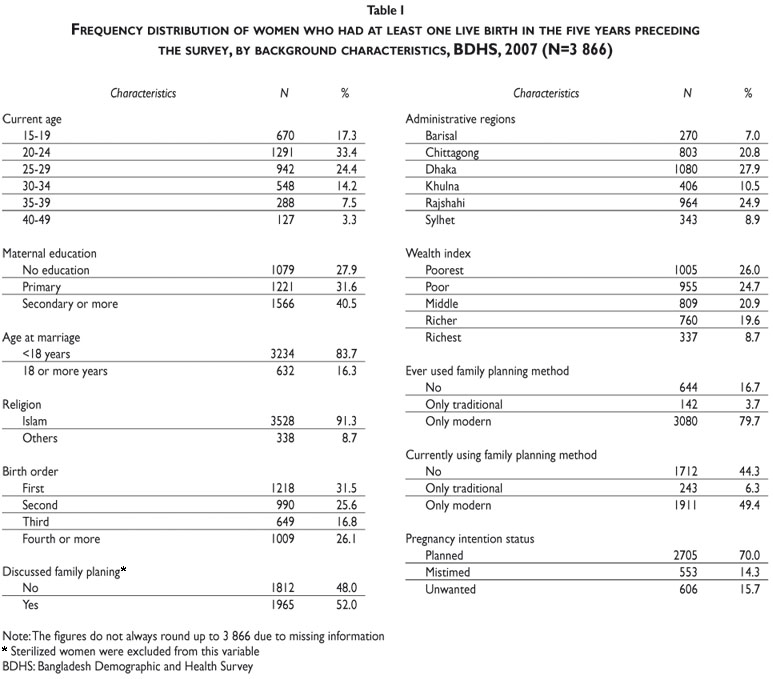
<body><![CDATA[<p><font size="2" face="Verdana">Both bivariate and multivariate statistical analyses were employed in this study. After performing chi&#45;square tests to examine the association between the dependent and independent variables, binary logistic regression models were constructed to examine the net effects of the independent variables on unintended pregnancy. Prior to performing the statistical analyses, multi&#45;colinearity was tested. Age and pregnancy order were shown to have co&#45;linearity. To avoid this co&#45;linearity two separate logistic regression models were constructed. Model I was constructed by including age and other selected independent variables, except for pregnancy order, while in model II age was replaced by pregnancy order. To check for significant interaction effects among the explanatory variables, we tested major interaction terms between age, regions and wealth; however, they were not statistically significant. Therefore, the models constructed without interaction terms are the mostly parsimonious models, which provide the best estimations of the effects of the explanatory variables. The statistical analyses in this study were analyzed using SPSS v17. </font></p>     <p>&nbsp;</p>     <p><font size="3" face="Verdana"><b>Results</b></font></p>     <p><font size="2" face="Verdana"><b>Profile of the respondents</b></font></p>     <p><font size="2" face="Verdana"><a href="/img/revistas/spm/v53n2/a03tab01.jpg">Table I</a> shows the background characteristics of the respondents. The mean age, age at marriage, and mean number of children ever born were 25.5&plusmn;6.4 years, 15.2&plusmn;2.5 years, and 2.7&plusmn;1.8 births per woman, respectively. Twenty&#45;eight percent had no formal education, 40% had secondary or higher education, and 84% were married before age 18 &#150;the minimum legal age at first marriage for women in Bangladesh. The vast majority of the respondents were Muslims. Of the most recent births, roughly 32% were the first pregnancy, 25% were second, 17% were third and the rest were fourth or higher order pregnancy. Fifty&#45;two percent of the women discussed FP with their husbands. With regard to wealth index, 51% were poor and 28% were rich. Although 80% had ever used any modern method, the current use rate of modern methods was 49%. Of the respondents, 70.0% reported that their most recent pregnancy was planned, 14.3% reported that it was mistimed and 15.7% reported it was unwanted.</font></p>     <p><font size="2" face="Verdana"><b>Trends of unintended pregnancy</b></font></p>     <p><font size="2" face="Verdana"><a href="#fig01">Figure 1</a> shows the trends of unintended pregnancy at the national level in Bangladesh as obtained from the last five BDHSs conducted during 1993&#45;2007. The figures revealed fluctuations in the rate of unintended pregnancy over this period. When comparing the period 1993&#45;1994 to 2007, a decrease from 33 to 29% can be observed, and there was a consistent decrease from 1999&#45;2000 to 2007. </font></p>     <p><a name="fig01"></a></p>     <p>&nbsp;</p>     <p align="center"><img src="/img/revistas/spm/v53n2/a03fig01.jpg"></p>     ]]></body>
<body><![CDATA[<p>&nbsp;</p>     <p><font size="2" face="Verdana"><b>Pregnancy intention status</b></font></p>     <p><font size="2" face="Verdana"><a href="/img/revistas/spm/v53n2/a03tab02.jpg">Table II</a> shows the prevalence of unintended pregnancy by selected background characteristics of the women. Overall, 30% of the women reported that their most recent pregnancy had been unintended. Unintended pregnancy varied significantly by all selected variables. The incidence of unintended pregnancy increased with age. The oldest women were more likely to report to have had unintended pregnancy than the adolescents (60.1% vs. 22.5%). Unintended pregnancy differed by 10.4% between women with secondary or higher education (25.4%) and those who had no formal education (35.8%). Unplanned pregnancy was higher among women who were married before age 18 than those who got marriage at age 18 and above (30.5% vs. 27.3%). </font></p>     <p><font size="2" face="Verdana"> Muslim women, as compared to non&#45;Muslim, had a higher incidence of unintended pregnancy (30.9% vs. 20.3%). Pregnancy order showed a positive association with intention status, with the prevalence of unintended pregnancy being lower among women who discussed FP with their husbands than those who never discussed it (28.4% vs. 31.1%). The incidence of unintended pregnancy was lower in the Rajshahi division and higher in Barisal division. Wealth index showed an inverse association with unintended pregnancy. Reporting of unintended pregnancy was more common among contraceptive users than non&#45;users. Notably, 30.1% of the current pregnancies were mistimed among the adolescents. The corresponding figure for the poor (combining the poorest and the poor) was 21.1% (data not shown).</font></p>     <p><font size="2" face="Verdana"><b>Multivariate analysis</b></font></p>     <p><font size="2" face="Verdana"><a href="#tab03">Table III</a> and <a href="#tab04">Table IV</a> show the results of logistic regression analyses. The results of multivariate logistic regression were almost the same for all the covariates in the two separate models. In both models, women's education, age at marriage, inter&#45;spousal communication about FP and current use of FP methods appeared to have insignificant effects on unintended pregnancy when other variables were controlled, whereas pregnancy order, age, religion, ever use of FP methods, region and wealth index were significantly associated with pregnancy intention status. </font></p>     <p><a name="tab03"></a></p>     <p>&nbsp;</p>     <p align="center"><img src="/img/revistas/spm/v53n2/a03tab03.jpg"></p>     <p>&nbsp;</p>     ]]></body>
<body><![CDATA[<p><a name="tab04"></a></p>     <p>&nbsp;</p>     <p align="center"><img src="/img/revistas/spm/v53n2/a03tab04.jpg"></p>     <p>&nbsp;</p>     <p><font size="2" face="Verdana"> Age was positively related to unintended pregnancy, that is, the higher the age the higher was the risk of unintended pregnancy. Non&#45;Muslim women were 50.7% (95% CI=0.38&#45;0.67) less likely to report their most recent pregnancy as unintended. Risk of unintended pregnancy for women from the Khulna and Rajshahi divisions was less than that for women from the Barisal division. Women from richer and richest families were 25.4% (95% CI=0.60&#45;0.93) and 37.1% (95% CI=0.47&#45;0.84) less likely to report their most recent pregnancy as unplanned, respectively. </font></p>     <p><font size="2" face="Verdana"> Women who ever used traditional methods and modern methods were 80.6% (95% CI=1.20&#45;2.72) and 92.0% (95% CI=1.54&#45;2.39) more likely to view their most recent pregnancy as unplanned, respectively. In addition, <a href="#tab04">Table IV</a> shows that the higher the pregnancy order the higher the risk of unplanned pregnancy. For instance, the likelihood of unintended pregnancy for women whose most recent pregnancy was reported as second was 2.09 times (95% CI=1.69&#45;2.59) that of those reporting it as first order, for those reporting third order it was 2.49 times (95% CI=1.97&#45;3.14) higher, and for fourth or higher order it was 5.32 times (95% CI=4.31&#45;6.56) higher.</font></p>     <p>&nbsp;</p>     <p><font size="3" face="Verdana"><b>Discussion</b></font></p>     <p><font size="2" face="Verdana">This study examined the prevalence and socioeconomic correlates of unintended pregnancy among rural women in Bangladesh. Findings reveal that, overall, 30.0% of the most recent pregnancies were unintended. Nonetheless, it is likely that the reported incidence of unintended pregnancy was underreported by Bangladeshi rural women. This is because some women are unwilling to report having had an unwanted pregnancy.<Sup>20</Sup> Studies conducted elsewhere showed that the prevalence of unintended pregnancy was 38.4% in Ecuador<Sup>5</Sup> during 1992&#45;1994, 36.0% in Guatemala<Sup>16</Sup> during 2002, 28.0% in Nigeria<Sup>20</Sup> during 2002&#45;2003, 41.0% in Nepal<Sup>21</Sup> during 2001, and 40.0% in Vietnam<Sup>22</Sup> during 1994&#45;1997. In a hospital&#45;based study, the reported rate of unintended pregnancy was 33.0% in Bangladesh and 44.0% in the Philippines.<Sup>30</Sup> Our findings suggest that the prevalence of unintended pregnancy among Bangladeshi rural women was higher than that in Nigeria and lower than that in the Philippines, Guatemala, Nepal, Ecuador, and Vietnam. </font></p>     <p><font size="2" face="Verdana"> Our study suggests that millions of Bangladeshi rural women have confronted unwanted pregnancy at some point in their lives. Our findings show that age, religion, administrative region, wealth index, and ever use of any contraceptive method were significantly associated with unintended pregnancy, while pregnancy order was the most single determinant of unplanned pregnancy. And though studies conducted elsewhere showed that unplanned pregnancies happen for many reasons &#150;including religious and cultural beliefs&#150; contraceptive failure is shown to be the most important factor.<Sup>23</Sup> Therefore, the relationship between the use of modern methods and increased risk of unintended pregnancy suggests an urgent need for further research.</font></p>     ]]></body>
<body><![CDATA[<p><font size="2" face="Verdana"> Findings indicate that particular groups of women had an increased risk of unplanned pregnancies, thus the urgent need for quality family planning services in rural Bangladesh. For example, the significant difference in the pregnancy intention status by region suggests the need for expanded and improved family planning services among women of Barisal, Chittagong and Sylhet, as these divisions are distinctive in terms of their geographical nature and cultural variations among the inhabitants. According to the 2007 BDHS, women from these three divisions had higher levels of fertility and a lower use rate of contraceptive methods as compared to other divisions.<Sup>13</Sup> Targeting these areas and population subgroups with expanded FP programs may reduce the incidence of unintended pregnancy as well as fertility.</font></p>     <p><font size="2" face="Verdana"> As was expected, older and Muslim women were at increased risk to have experienced an unintended pregnancy as compared to younger and non&#45;Muslim women. It is evident that Muslim women as compared to their non&#45;Muslim peers are less likely to use modern methods due to their traditional beliefs and cultural norms, while older women are more reluctant to use modern methods as compared to their younger counterparts, resulting in a higher risk of unintended pregnancy among the former.<Sup>13</Sup> Early initiation of sexual intercourse, (early age at marriage) is another important aspect of unplanned pregnancy. Bangladesh has a long tradition of early marriage and has one of the lowest mean ages at first marriage for females around the world. This results in women having marriages with longer duration and, hence, increases the risk of frequent and unintended pregnancies. The above findings are consistent with many studies conducted elsewhere.<Sup>21,24</Sup></font></p>     <p><font size="2" face="Verdana"> Women's education &#150;an important factor in explaining the fertility and fertility behavior of women&#150; had no significant effect on unintended pregnancy in our study. This finding is contradictory to those of other studies<Sup>25,26</Sup> and consistent with studies conducted in Nepal, Palestine, Japan and Indonesia.<Sup>21,24,27,28</Sup> The possible reasons for the lack of association between women's education and unintended pregnancy may be the low variability of education in the sample of women and lower participation in formal jobs. However, the fact is that this relationship persists after controlling for fertility preference and family planning practice, suggesting that the relationship between education and unplanned fertility may be quite complex and not fully explainable by this factor.<Sup>25</Sup></font></p>     <p><font size="2" face="Verdana"> Consistent with earlier studies,<Sup>25.29</Sup> pregnancy order appeared as the most single significant determinant of unintended pregnancy. The increased risk of unintended pregnancy among women with more than two living children could be a sign of discontinuity or experiencing difficulty with using contraceptive methods.<Sup>5,29</Sup> Somewhat surprisingly, the difference between poor and middle class women in likelihood of unintended pregnancy was insignificant. These findings suggest that poor and middle class women were similar to one another and unable to afford family planning services, unlike rich women,<Sup>5</Sup> and therefore less able to control their fertility. </font></p>     <p><font size="2" face="Verdana"> The positive association between unplanned births and contraceptive use reflects the tendency to adopt contraception after an unwanted pregnancy to avoid a repeat occurrence.<Sup>25</Sup> However, the association between unplanned births and ever use of contraceptives is of particular concern and has important implications for the family planning program in Bangladesh. The higher probability of unplanned births among women who had ever used modern family planning methods suggests a possibility of problems with contraceptive use effectiveness, including contraceptive discontinuation or failure.<Sup>5</Sup> These findings are also consistent with earlier studies.<Sup>21,25</Sup></font></p>     <p><font size="2" face="Verdana"> There are several limitations to be considered when interpreting these findings. First, the study used cross&#45;sectional survey data that looked retrospectively at women's pregnancy intention status. Thus, the study results should be cautiously interpreted in view of the limitations of the cross&#45;sectional design, which limits a study's ability to draw causal inferences. Second, since retrospective information generally suffers from underreporting, the analysis can only provide evidence of statistical associations between those items and the experience of unintended pregnancy; it cannot show cause&#45;effect relationships.<Sup>21</Sup> Despite this, the strength of the study is that it dealt with nationally representative sample survey data that are mostly used in health and demographic related research. </font></p>     <p><font size="2" face="Verdana"> The results indicate that unintended pregnancy is a major obstacle to reduce fertility to replacement level, which is a priority for population policy in Bangladesh. Policymakers and health service providers can benefit from the findings of this study to formulate suitable programs. In conclusion, programs should aim to reduce unintended pregnancy by focusing on all those factors identified, so as to decrease fertility and infant and maternal mortality, as well as the need for abortion. Intervention programs concerning reproductive health and services should be undertaken and awareness should be created as to the use of effective contraceptive methods to avoid unintended pregnancy, not only to reduce fertility but also to reduce adverse health outcomes for rural women in Bangladesh.</font></p>     <p><font size="2" face="Verdana"><I>Declaration of conflicts of interest:</I> The authors declare that they have no conflict of interests.</font></p>     <p>&nbsp;</p>     <p><font size="3" face="Verdana"><b>References</b></font></p>     ]]></body>
<body><![CDATA[<!-- ref --><p><font size="2" face="Verdana">1. Santelli JS, Rochat R, Hatfield&#45;Timajchy K, Gilbert B, Curtis K, Cabral R. The measurement and meaning of unintended pregnancy. Perspect Sex Reprod Health 2003; 35:94&#45;101.    &nbsp;&nbsp;&nbsp;&nbsp;&nbsp;&nbsp;&nbsp;&nbsp;[&#160;<a href="javascript:void(0);" onclick="javascript: window.open('/scielo.php?script=sci_nlinks&ref=9318330&pid=S0036-3634201100020000300001&lng=','','width=640,height=500,resizable=yes,scrollbars=1,menubar=yes,');">Links</a>&#160;]<!-- end-ref --></font></p>     <!-- ref --><p><font size="2" face="Verdana">2.  Smith R, Ashford L, Gribble J, Clifton G. Family planning saves lives. Washington DC: Population Reference Bureau, 2009.    &nbsp;&nbsp;&nbsp;&nbsp;&nbsp;&nbsp;&nbsp;&nbsp;[&#160;<a href="javascript:void(0);" onclick="javascript: window.open('/scielo.php?script=sci_nlinks&ref=9318332&pid=S0036-3634201100020000300002&lng=','','width=640,height=500,resizable=yes,scrollbars=1,menubar=yes,');">Links</a>&#160;]<!-- end-ref --></font></p>     <!-- ref --><p><font size="2" face="Verdana">3.  World Health Organization (WHO). Maternal Mortality in 2006: Estimates Developed by WHO, UNICEF, UNFPA and the World Bank. Geneva: WHO, 2008.    &nbsp;&nbsp;&nbsp;&nbsp;&nbsp;&nbsp;&nbsp;&nbsp;[&#160;<a href="javascript:void(0);" onclick="javascript: window.open('/scielo.php?script=sci_nlinks&ref=9318334&pid=S0036-3634201100020000300003&lng=','','width=640,height=500,resizable=yes,scrollbars=1,menubar=yes,');">Links</a>&#160;]<!-- end-ref --> </font></p>     <!-- ref --><p><font size="2" face="Verdana">4.  Casterline JB, EI&#45;Zanatay F, El&#45;Zeni LO. Unmet need and unintended fertility: Longitudinal evidence from Upper Egypt. Int Fam Plann Perspect 2003; 29:158&#45;66.    &nbsp;&nbsp;&nbsp;&nbsp;&nbsp;&nbsp;&nbsp;&nbsp;[&#160;<a href="javascript:void(0);" onclick="javascript: window.open('/scielo.php?script=sci_nlinks&ref=9318336&pid=S0036-3634201100020000300004&lng=','','width=640,height=500,resizable=yes,scrollbars=1,menubar=yes,');">Links</a>&#160;]<!-- end-ref --></font></p>     <!-- ref --><p><font size="2" face="Verdana">5.  Eggleston E. Determinants of unintended pregnancy among women in Ecuador. Int Fam Plann Perspect 1999; 25:27&#45;33.    &nbsp;&nbsp;&nbsp;&nbsp;&nbsp;&nbsp;&nbsp;&nbsp;[&#160;<a href="javascript:void(0);" onclick="javascript: window.open('/scielo.php?script=sci_nlinks&ref=9318338&pid=S0036-3634201100020000300005&lng=','','width=640,height=500,resizable=yes,scrollbars=1,menubar=yes,');">Links</a>&#160;]<!-- end-ref --></font></p>     ]]></body>
<body><![CDATA[<!-- ref --><p><font size="2" face="Verdana">6.  Glasier A, Gulmezoglu AM, Schmid GP, Moreno CG, Van Look PF. Sexual and reproductive health: a matter of life and death. Lancet 2006; 368:1595&#45;1607.    &nbsp;&nbsp;&nbsp;&nbsp;&nbsp;&nbsp;&nbsp;&nbsp;[&#160;<a href="javascript:void(0);" onclick="javascript: window.open('/scielo.php?script=sci_nlinks&ref=9318340&pid=S0036-3634201100020000300006&lng=','','width=640,height=500,resizable=yes,scrollbars=1,menubar=yes,');">Links</a>&#160;]<!-- end-ref --></font></p>     <!-- ref --><p><font size="2" face="Verdana">7.  Langer A. Unwanted pregnancy: impact on health and society in Latin America and the Caribbean. Rev Panam Salud Publica 2002; 11:192&#45;204.    &nbsp;&nbsp;&nbsp;&nbsp;&nbsp;&nbsp;&nbsp;&nbsp;[&#160;<a href="javascript:void(0);" onclick="javascript: window.open('/scielo.php?script=sci_nlinks&ref=9318342&pid=S0036-3634201100020000300007&lng=','','width=640,height=500,resizable=yes,scrollbars=1,menubar=yes,');">Links</a>&#160;]<!-- end-ref --></font></p>     <!-- ref --><p><font size="2" face="Verdana">8. Karim, DRA. Reproductive health, including Adolescent reproductive health: progress and challenges in Asia and the Pacific. Asia&#45;Pac Popul J 2009; 24: 153&#45;196.    &nbsp;&nbsp;&nbsp;&nbsp;&nbsp;&nbsp;&nbsp;&nbsp;[&#160;<a href="javascript:void(0);" onclick="javascript: window.open('/scielo.php?script=sci_nlinks&ref=9318344&pid=S0036-3634201100020000300008&lng=','','width=640,height=500,resizable=yes,scrollbars=1,menubar=yes,');">Links</a>&#160;]<!-- end-ref --></font></p>     <!-- ref --><p><font size="2" face="Verdana">9.  Reardon DC, Cougle JR. Depression and unintended pregnancy in the national longitudinal survey of youth: a cohort study. BMJ 2002; 324:151&#45;152.    &nbsp;&nbsp;&nbsp;&nbsp;&nbsp;&nbsp;&nbsp;&nbsp;[&#160;<a href="javascript:void(0);" onclick="javascript: window.open('/scielo.php?script=sci_nlinks&ref=9318346&pid=S0036-3634201100020000300009&lng=','','width=640,height=500,resizable=yes,scrollbars=1,menubar=yes,');">Links</a>&#160;]<!-- end-ref --></font></p>     <!-- ref --><p><font size="2" face="Verdana">10. Russo NF, Denious JE. Violence in the lives of women having abortions: implications for practice and public policy. Prof Psychol: Res Pract 2001; 32:142&#45;150.    &nbsp;&nbsp;&nbsp;&nbsp;&nbsp;&nbsp;&nbsp;&nbsp;[&#160;<a href="javascript:void(0);" onclick="javascript: window.open('/scielo.php?script=sci_nlinks&ref=9318348&pid=S0036-3634201100020000300010&lng=','','width=640,height=500,resizable=yes,scrollbars=1,menubar=yes,');">Links</a>&#160;]<!-- end-ref --></font></p>     ]]></body>
<body><![CDATA[<!-- ref --><p><font size="2" face="Verdana">11. Gipson JD, Koenig MA, Hindin MJ. The effects of unintended pregnancy on infant, child, and parental health: a review of the literature. Stud Fam Plann 2008; 39:18&#45;38.    &nbsp;&nbsp;&nbsp;&nbsp;&nbsp;&nbsp;&nbsp;&nbsp;[&#160;<a href="javascript:void(0);" onclick="javascript: window.open('/scielo.php?script=sci_nlinks&ref=9318350&pid=S0036-3634201100020000300011&lng=','','width=640,height=500,resizable=yes,scrollbars=1,menubar=yes,');">Links</a>&#160;]<!-- end-ref --></font></p>     <!-- ref --><p><font size="2" face="Verdana">12. Klima CS. Unintended pregnancy: consequences and solutions for a worldwide problem. J Nurse Midwifery 1998; 43:483&#45;491.    &nbsp;&nbsp;&nbsp;&nbsp;&nbsp;&nbsp;&nbsp;&nbsp;[&#160;<a href="javascript:void(0);" onclick="javascript: window.open('/scielo.php?script=sci_nlinks&ref=9318352&pid=S0036-3634201100020000300012&lng=','','width=640,height=500,resizable=yes,scrollbars=1,menubar=yes,');">Links</a>&#160;]<!-- end-ref --></font></p>     <!-- ref --><p><font size="2" face="Verdana">13. National Institute of Population Research and Training (NIPORT), Mitra and Associates, and Macro International. Bangladesh Demographic and Health Survey 2007. Dhaka, Bangladesh and Calverton, Maryland, USA: NIPORT, Mitra and Associates, and Macro International, 2009.    &nbsp;&nbsp;&nbsp;&nbsp;&nbsp;&nbsp;&nbsp;&nbsp;[&#160;<a href="javascript:void(0);" onclick="javascript: window.open('/scielo.php?script=sci_nlinks&ref=9318354&pid=S0036-3634201100020000300013&lng=','','width=640,height=500,resizable=yes,scrollbars=1,menubar=yes,');">Links</a>&#160;]<!-- end-ref --></font></p>     <!-- ref --><p><font size="2" face="Verdana">14. National Institute of Population Research and Training (NIPORT), ORC Macro, Johns Hopkins University and ICDDR,B. 2003. Bangladesh Maternal Health Services and Maternal Mortality Survey 2001. Dhaka, Bangladesh and Calverton, Maryland (USA): NIPORT, ORC Macro, Johns Hopkins University, and ICDDR,B, 2003.    &nbsp;&nbsp;&nbsp;&nbsp;&nbsp;&nbsp;&nbsp;&nbsp;[&#160;<a href="javascript:void(0);" onclick="javascript: window.open('/scielo.php?script=sci_nlinks&ref=9318356&pid=S0036-3634201100020000300014&lng=','','width=640,height=500,resizable=yes,scrollbars=1,menubar=yes,');">Links</a>&#160;]<!-- end-ref --></font></p>     <!-- ref --><p><font size="2" face="Verdana">15. Chowdhury ME, Botlero R, Koblinsky M, Saha SK, Dieltiens G, Ronsmans C. Determinants of reduction in maternal mortality in Matlab, Bangladesh: a 30&#45; year cohort study. Lancet 2007; 370:1320&#45;1328.    &nbsp;&nbsp;&nbsp;&nbsp;&nbsp;&nbsp;&nbsp;&nbsp;[&#160;<a href="javascript:void(0);" onclick="javascript: window.open('/scielo.php?script=sci_nlinks&ref=9318358&pid=S0036-3634201100020000300015&lng=','','width=640,height=500,resizable=yes,scrollbars=1,menubar=yes,');">Links</a>&#160;]<!-- end-ref --></font></p>     ]]></body>
<body><![CDATA[<!-- ref --><p><font size="2" face="Verdana">16. Barden&#45;O'Fallon JL, Speizer IS, White JS. Association between contraceptive discontinuation and pregnancy intentions in Guatemala. Rev Panam Salud Publica 2008; 23:410&#45;417.    &nbsp;&nbsp;&nbsp;&nbsp;&nbsp;&nbsp;&nbsp;&nbsp;[&#160;<a href="javascript:void(0);" onclick="javascript: window.open('/scielo.php?script=sci_nlinks&ref=9318360&pid=S0036-3634201100020000300016&lng=','','width=640,height=500,resizable=yes,scrollbars=1,menubar=yes,');">Links</a>&#160;]<!-- end-ref --></font></p>     <!-- ref --><p><font size="2" face="Verdana">17. Chandra A, Martinez GM, Mosher WD, Abma JC, Jones J. Fertility, family planning, and reproductive health of U.S. women: Data from the 2002 National Survey of Family Growth. Vital and Health Statistics, Series 23, Number 25. Hyattsville, Maryland: National Center for Health Statistics, US Department of Health and Human Services, 2005.    &nbsp;&nbsp;&nbsp;&nbsp;&nbsp;&nbsp;&nbsp;&nbsp;[&#160;<a href="javascript:void(0);" onclick="javascript: window.open('/scielo.php?script=sci_nlinks&ref=9318362&pid=S0036-3634201100020000300017&lng=','','width=640,height=500,resizable=yes,scrollbars=1,menubar=yes,');">Links</a>&#160;]<!-- end-ref --></font></p>     <!-- ref --><p><font size="2" face="Verdana">18. Blanc AK, Curtis SL, Croft TN. Monitoring contraceptive continuation: links to fertility outcomes and quality of care. Stud Fam Plann 2002; 33:127&#45;140.    &nbsp;&nbsp;&nbsp;&nbsp;&nbsp;&nbsp;&nbsp;&nbsp;[&#160;<a href="javascript:void(0);" onclick="javascript: window.open('/scielo.php?script=sci_nlinks&ref=9318364&pid=S0036-3634201100020000300018&lng=','','width=640,height=500,resizable=yes,scrollbars=1,menubar=yes,');">Links</a>&#160;]<!-- end-ref --></font></p>     <!-- ref --><p><font size="2" face="Verdana">19. Westoff CF, Ryder NB. The predictive validity of reproductive intentions. Demography 1977; 14:431&#45;453.    &nbsp;&nbsp;&nbsp;&nbsp;&nbsp;&nbsp;&nbsp;&nbsp;[&#160;<a href="javascript:void(0);" onclick="javascript: window.open('/scielo.php?script=sci_nlinks&ref=9318366&pid=S0036-3634201100020000300019&lng=','','width=640,height=500,resizable=yes,scrollbars=1,menubar=yes,');">Links</a>&#160;]<!-- end-ref --></font></p>     <!-- ref --><p><font size="2" face="Verdana">20. Sedgh G, Bankole A, Oye&#45;Adeniran B, Adewole IF, Singh S, Hussain R. Unwanted pregnancy and associated factors among Nigerian women. Int Fam Plann Perspect 2006; 32:175&#45;184.    &nbsp;&nbsp;&nbsp;&nbsp;&nbsp;&nbsp;&nbsp;&nbsp;[&#160;<a href="javascript:void(0);" onclick="javascript: window.open('/scielo.php?script=sci_nlinks&ref=9318368&pid=S0036-3634201100020000300020&lng=','','width=640,height=500,resizable=yes,scrollbars=1,menubar=yes,');">Links</a>&#160;]<!-- end-ref --> </font></p>     ]]></body>
<body><![CDATA[<!-- ref --><p><font size="2" face="Verdana">21. Adhikari R, Soonthorndhada K, Prasartkul P. Correlates of unintended pregnancy among currently pregnant married women in Nepal. BMC Int Health Hum Rights 2009; 9:17.    &nbsp;&nbsp;&nbsp;&nbsp;&nbsp;&nbsp;&nbsp;&nbsp;[&#160;<a href="javascript:void(0);" onclick="javascript: window.open('/scielo.php?script=sci_nlinks&ref=9318370&pid=S0036-3634201100020000300021&lng=','','width=640,height=500,resizable=yes,scrollbars=1,menubar=yes,');">Links</a>&#160;]<!-- end-ref --> </font></p>     <!-- ref --><p><font size="2" face="Verdana">22. Le LC, Magnani R, Rice J, Speizer I, Bertrand W. Reassessing the level of unintended pregnancy and its correlates in Vietnam. Stud Fam Plann 2004; 35:15&#45;26.    &nbsp;&nbsp;&nbsp;&nbsp;&nbsp;&nbsp;&nbsp;&nbsp;[&#160;<a href="javascript:void(0);" onclick="javascript: window.open('/scielo.php?script=sci_nlinks&ref=9318372&pid=S0036-3634201100020000300022&lng=','','width=640,height=500,resizable=yes,scrollbars=1,menubar=yes,');">Links</a>&#160;]<!-- end-ref --></font></p>     <!-- ref --><p><font size="2" face="Verdana">23. Shokravi AF, Chapman H, Peyman N. A comparison study: Risk factors of unplanned pregnancies in a group of Iranian and New Zealander women. Eur J Sci Res 2009; 26:108&#45;121.    &nbsp;&nbsp;&nbsp;&nbsp;&nbsp;&nbsp;&nbsp;&nbsp;[&#160;<a href="javascript:void(0);" onclick="javascript: window.open('/scielo.php?script=sci_nlinks&ref=9318374&pid=S0036-3634201100020000300023&lng=','','width=640,height=500,resizable=yes,scrollbars=1,menubar=yes,');">Links</a>&#160;]<!-- end-ref --></font></p>     <!-- ref --><p><font size="2" face="Verdana">24. Giacaman R, Abu&#45;Rmeileh NME, Mataria A, Wick L. Palestinian women's pregnancy intentions: analysis and critique of the Demographic and Health Survey 2004. Health Policy 2008; 85:83&#45;93.    &nbsp;&nbsp;&nbsp;&nbsp;&nbsp;&nbsp;&nbsp;&nbsp;[&#160;<a href="javascript:void(0);" onclick="javascript: window.open('/scielo.php?script=sci_nlinks&ref=9318376&pid=S0036-3634201100020000300024&lng=','','width=640,height=500,resizable=yes,scrollbars=1,menubar=yes,');">Links</a>&#160;]<!-- end-ref --></font></p>     <!-- ref --><p><font size="2" face="Verdana">25. Magadi MA. Unplanned childbearing in Kenya: the sociodemographic correlates and the extent of repeatability among women. Soc Sci Med 2003; 56:167&#45;78.    &nbsp;&nbsp;&nbsp;&nbsp;&nbsp;&nbsp;&nbsp;&nbsp;[&#160;<a href="javascript:void(0);" onclick="javascript: window.open('/scielo.php?script=sci_nlinks&ref=9318378&pid=S0036-3634201100020000300025&lng=','','width=640,height=500,resizable=yes,scrollbars=1,menubar=yes,');">Links</a>&#160;]<!-- end-ref --></font></p>     ]]></body>
<body><![CDATA[<!-- ref --><p><font size="2" face="Verdana">26. Pulley LV, Klerman LV, Tang H, Baker BA. The extent of pregnancy mistiming and its association with maternal characteristics and behaviors and pregnancy outcomes. Perspect Sex Reprod Health 2002; 34:206&#45;211.    &nbsp;&nbsp;&nbsp;&nbsp;&nbsp;&nbsp;&nbsp;&nbsp;[&#160;<a href="javascript:void(0);" onclick="javascript: window.open('/scielo.php?script=sci_nlinks&ref=9318380&pid=S0036-3634201100020000300026&lng=','','width=640,height=500,resizable=yes,scrollbars=1,menubar=yes,');">Links</a>&#160;]<!-- end-ref --></font></p>     <!-- ref --><p><font size="2" face="Verdana">27. Goto A, Yasumura S, Reich MR, Fukao A. Factors associated with unintended pregnancy in Yamagata, Japan. Soc Sci Med 2002; 54:1065&#45;1079.    &nbsp;&nbsp;&nbsp;&nbsp;&nbsp;&nbsp;&nbsp;&nbsp;[&#160;<a href="javascript:void(0);" onclick="javascript: window.open('/scielo.php?script=sci_nlinks&ref=9318382&pid=S0036-3634201100020000300027&lng=','','width=640,height=500,resizable=yes,scrollbars=1,menubar=yes,');">Links</a>&#160;]<!-- end-ref --></font></p>     <!-- ref --><p><font size="2" face="Verdana">28. Weller RH, Sly D, Sukamdi A, and Ekawati R. The wantedness status of births in Indonesia. Demographic and Health Surveys World Conference, Calverton MD: Macro International Inc., 1991.    &nbsp;&nbsp;&nbsp;&nbsp;&nbsp;&nbsp;&nbsp;&nbsp;[&#160;<a href="javascript:void(0);" onclick="javascript: window.open('/scielo.php?script=sci_nlinks&ref=9318384&pid=S0036-3634201100020000300028&lng=','','width=640,height=500,resizable=yes,scrollbars=1,menubar=yes,');">Links</a>&#160;]<!-- end-ref --></font></p>     <!-- ref --><p><font size="2" face="Verdana">29. Goicolea I, and Sebastian MS. Unintended pregnancy in the Amazon basin of Ecuador: a multilevel analysis. Int J Equity Health 2010; 9:14.    &nbsp;&nbsp;&nbsp;&nbsp;&nbsp;&nbsp;&nbsp;&nbsp;[&#160;<a href="javascript:void(0);" onclick="javascript: window.open('/scielo.php?script=sci_nlinks&ref=9318386&pid=S0036-3634201100020000300029&lng=','','width=640,height=500,resizable=yes,scrollbars=1,menubar=yes,');">Links</a>&#160;]<!-- end-ref --></font></p>     <!-- ref --><p><font size="2" face="Verdana">30. Singh S, Cavigon JV, Hossain A, Kamal H, Perez AE. Estimating the level of abortion in the Philippines and Bangladesh. Int Fam Plann Perspect 1997; 23:100&#45;107 &amp; 144.    &nbsp;&nbsp;&nbsp;&nbsp;&nbsp;&nbsp;&nbsp;&nbsp;[&#160;<a href="javascript:void(0);" onclick="javascript: window.open('/scielo.php?script=sci_nlinks&ref=9318388&pid=S0036-3634201100020000300030&lng=','','width=640,height=500,resizable=yes,scrollbars=1,menubar=yes,');">Links</a>&#160;]<!-- end-ref --></font></p>     ]]></body>
<body><![CDATA[<p>&nbsp;</p>     <p>&nbsp;</p>     <p><font size="2" face="Verdana"><a name="end"></a><a href="#title"><img src="/img/revistas/spm/v53n2/seta.jpg" border="0"></a> <b>Address reprint requests to:</b>    <br>   Mostafa Kamal, MSc, PhD    <br>   Department of Mathematics, Islamic University    <br>   Kushtia&#45;7003, Bangladesh    <br>   E&#45;mail: <a href="mailto:kamaliubd@yahoo.com">kamaliubd@yahoo.com</a> </font></p>     <p><font size="2" face="Verdana">Received on: August 18, 2010    <br> Accepted on: January 14, 2011</font></p>      ]]></body><back>
<ref-list>
<ref id="B1">
<label>1</label><nlm-citation citation-type="journal">
<person-group person-group-type="author">
<name>
<surname><![CDATA[Santelli]]></surname>
<given-names><![CDATA[JS]]></given-names>
</name>
<name>
<surname><![CDATA[Rochat]]></surname>
<given-names><![CDATA[R]]></given-names>
</name>
<name>
<surname><![CDATA[Hatfield-Timajchy]]></surname>
<given-names><![CDATA[K]]></given-names>
</name>
<name>
<surname><![CDATA[Gilbert]]></surname>
<given-names><![CDATA[B]]></given-names>
</name>
<name>
<surname><![CDATA[Curtis]]></surname>
<given-names><![CDATA[K]]></given-names>
</name>
<name>
<surname><![CDATA[Cabral]]></surname>
<given-names><![CDATA[R]]></given-names>
</name>
</person-group>
<article-title xml:lang="en"><![CDATA[The measurement and meaning of unintended pregnancy]]></article-title>
<source><![CDATA[Perspect Sex Reprod Health]]></source>
<year>2003</year>
<volume>35</volume>
<page-range>94-101</page-range></nlm-citation>
</ref>
<ref id="B2">
<label>2</label><nlm-citation citation-type="book">
<person-group person-group-type="author">
<name>
<surname><![CDATA[Smith]]></surname>
<given-names><![CDATA[R]]></given-names>
</name>
<name>
<surname><![CDATA[Ashford]]></surname>
<given-names><![CDATA[L]]></given-names>
</name>
<name>
<surname><![CDATA[Gribble]]></surname>
<given-names><![CDATA[J]]></given-names>
</name>
<name>
<surname><![CDATA[Clifton]]></surname>
<given-names><![CDATA[G]]></given-names>
</name>
</person-group>
<source><![CDATA[Family planning saves lives]]></source>
<year>2009</year>
<publisher-loc><![CDATA[Washington DC ]]></publisher-loc>
<publisher-name><![CDATA[Population Reference Bureau]]></publisher-name>
</nlm-citation>
</ref>
<ref id="B3">
<label>3</label><nlm-citation citation-type="book">
<collab>World Health Organization</collab>
<source><![CDATA[Maternal Mortality in 2006: Estimates Developed by WHO, UNICEF, UNFPA and the World Bank]]></source>
<year>2008</year>
<publisher-loc><![CDATA[Geneva ]]></publisher-loc>
<publisher-name><![CDATA[WHO]]></publisher-name>
</nlm-citation>
</ref>
<ref id="B4">
<label>4</label><nlm-citation citation-type="journal">
<person-group person-group-type="author">
<name>
<surname><![CDATA[Casterline]]></surname>
<given-names><![CDATA[JB]]></given-names>
</name>
<name>
<surname><![CDATA[EI-Zanatay]]></surname>
<given-names><![CDATA[F]]></given-names>
</name>
<name>
<surname><![CDATA[El-Zeni]]></surname>
<given-names><![CDATA[LO]]></given-names>
</name>
</person-group>
<article-title xml:lang="en"><![CDATA[Unmet need and unintended fertility: Longitudinal evidence from Upper Egypt]]></article-title>
<source><![CDATA[Int Fam Plann Perspect]]></source>
<year>2003</year>
<volume>29</volume>
<page-range>158-66</page-range></nlm-citation>
</ref>
<ref id="B5">
<label>5</label><nlm-citation citation-type="journal">
<person-group person-group-type="author">
<name>
<surname><![CDATA[Eggleston]]></surname>
<given-names><![CDATA[E]]></given-names>
</name>
</person-group>
<article-title xml:lang="en"><![CDATA[Determinants of unintended pregnancy among women in Ecuador]]></article-title>
<source><![CDATA[Int Fam Plann Perspect]]></source>
<year>1999</year>
<volume>25</volume>
<page-range>27-33</page-range></nlm-citation>
</ref>
<ref id="B6">
<label>6</label><nlm-citation citation-type="journal">
<person-group person-group-type="author">
<name>
<surname><![CDATA[Glasier]]></surname>
<given-names><![CDATA[A]]></given-names>
</name>
<name>
<surname><![CDATA[Gulmezoglu]]></surname>
<given-names><![CDATA[AM]]></given-names>
</name>
<name>
<surname><![CDATA[Schmid]]></surname>
<given-names><![CDATA[GP]]></given-names>
</name>
<name>
<surname><![CDATA[Moreno]]></surname>
<given-names><![CDATA[CG]]></given-names>
</name>
<name>
<surname><![CDATA[Van Look]]></surname>
<given-names><![CDATA[PF]]></given-names>
</name>
</person-group>
<article-title xml:lang="en"><![CDATA[Sexual and reproductive health: a matter of life and death]]></article-title>
<source><![CDATA[Lancet]]></source>
<year>2006</year>
<volume>368</volume>
<page-range>1595-1607</page-range></nlm-citation>
</ref>
<ref id="B7">
<label>7</label><nlm-citation citation-type="journal">
<person-group person-group-type="author">
<name>
<surname><![CDATA[Langer]]></surname>
<given-names><![CDATA[A]]></given-names>
</name>
</person-group>
<article-title xml:lang="en"><![CDATA[Unwanted pregnancy: impact on health and society in Latin America and the Caribbean]]></article-title>
<source><![CDATA[Rev Panam Salud Publica]]></source>
<year>2002</year>
<volume>11</volume>
<page-range>192-204</page-range></nlm-citation>
</ref>
<ref id="B8">
<label>8</label><nlm-citation citation-type="journal">
<person-group person-group-type="author">
<name>
<surname><![CDATA[Karim]]></surname>
</name>
<name>
<surname><![CDATA[DRA]]></surname>
</name>
</person-group>
<article-title xml:lang="en"><![CDATA[Reproductive health, including Adolescent reproductive health: progress and challenges in Asia and the Pacific]]></article-title>
<source><![CDATA[Asia-Pac Popul J]]></source>
<year>2009</year>
<volume>24</volume>
<page-range>153-196</page-range></nlm-citation>
</ref>
<ref id="B9">
<label>9</label><nlm-citation citation-type="journal">
<person-group person-group-type="author">
<name>
<surname><![CDATA[Reardon]]></surname>
<given-names><![CDATA[DC]]></given-names>
</name>
<name>
<surname><![CDATA[Cougle]]></surname>
<given-names><![CDATA[JR]]></given-names>
</name>
</person-group>
<article-title xml:lang="en"><![CDATA[Depression and unintended pregnancy in the national longitudinal survey of youth: a cohort study]]></article-title>
<source><![CDATA[BMJ]]></source>
<year>2002</year>
<volume>324</volume>
<page-range>151-152</page-range></nlm-citation>
</ref>
<ref id="B10">
<label>10</label><nlm-citation citation-type="journal">
<person-group person-group-type="author">
<name>
<surname><![CDATA[Russo]]></surname>
<given-names><![CDATA[NF]]></given-names>
</name>
<name>
<surname><![CDATA[Denious]]></surname>
<given-names><![CDATA[JE]]></given-names>
</name>
</person-group>
<article-title xml:lang="en"><![CDATA[Violence in the lives of women having abortions: implications for practice and public policy]]></article-title>
<source><![CDATA[Prof Psychol: Res Pract]]></source>
<year>2001</year>
<volume>32</volume>
<page-range>142-150</page-range></nlm-citation>
</ref>
<ref id="B11">
<label>11</label><nlm-citation citation-type="journal">
<person-group person-group-type="author">
<name>
<surname><![CDATA[Gipson]]></surname>
<given-names><![CDATA[JD]]></given-names>
</name>
<name>
<surname><![CDATA[Koenig]]></surname>
<given-names><![CDATA[MA]]></given-names>
</name>
<name>
<surname><![CDATA[Hindin]]></surname>
<given-names><![CDATA[MJ]]></given-names>
</name>
</person-group>
<article-title xml:lang="en"><![CDATA[The effects of unintended pregnancy on infant, child, and parental health: a review of the literature]]></article-title>
<source><![CDATA[Stud Fam Plann]]></source>
<year>2008</year>
<volume>39</volume>
<page-range>18-38</page-range></nlm-citation>
</ref>
<ref id="B12">
<label>12</label><nlm-citation citation-type="journal">
<person-group person-group-type="author">
<name>
<surname><![CDATA[Klima]]></surname>
<given-names><![CDATA[CS]]></given-names>
</name>
</person-group>
<article-title xml:lang="en"><![CDATA[Unintended pregnancy: consequences and solutions for a worldwide problem]]></article-title>
<source><![CDATA[J Nurse Midwifery]]></source>
<year>1998</year>
<volume>43</volume>
<page-range>483-491</page-range></nlm-citation>
</ref>
<ref id="B13">
<label>13</label><nlm-citation citation-type="book">
<collab>National Institute of Population Research and Training.Mitra and Associates.and Macro International</collab>
<source><![CDATA[Bangladesh Demographic and Health Survey 2007.Dhaka, Bangladesh and Calverton, Maryland,]]></source>
<year>2009</year>
<publisher-loc><![CDATA[USA ]]></publisher-loc>
<publisher-name><![CDATA[NIPORT, Mitra and Associates, and Macro International]]></publisher-name>
</nlm-citation>
</ref>
<ref id="B14">
<label>14</label><nlm-citation citation-type="book">
<collab>National Institute of Population Research and Training (NIPORT)^dORC Macro, Johns Hopkins University and ICDDR,B. 2003</collab>
<source><![CDATA[Bangladesh Maternal Health Services and Maternal Mortality Survey 2001. Dhaka, Bangladesh and Calverton, Maryland (USA): NIPORT, ORC Macro]]></source>
<year>2003</year>
<publisher-name><![CDATA[Johns Hopkins University, and ICDDR,B]]></publisher-name>
</nlm-citation>
</ref>
<ref id="B15">
<label>15</label><nlm-citation citation-type="journal">
<person-group person-group-type="author">
<name>
<surname><![CDATA[Chowdhury]]></surname>
<given-names><![CDATA[ME]]></given-names>
</name>
<name>
<surname><![CDATA[Botlero]]></surname>
<given-names><![CDATA[R]]></given-names>
</name>
<name>
<surname><![CDATA[Koblinsky]]></surname>
<given-names><![CDATA[M]]></given-names>
</name>
<name>
<surname><![CDATA[Saha]]></surname>
<given-names><![CDATA[SK]]></given-names>
</name>
<name>
<surname><![CDATA[Dieltiens]]></surname>
<given-names><![CDATA[G]]></given-names>
</name>
<name>
<surname><![CDATA[Ronsmans]]></surname>
<given-names><![CDATA[C]]></given-names>
</name>
</person-group>
<article-title xml:lang="en"><![CDATA[Determinants of reduction in maternal mortality in Matlab, Bangladesh: a 30- year cohort study]]></article-title>
<source><![CDATA[Lancet]]></source>
<year>2007</year>
<volume>370</volume>
<page-range>1320-1328</page-range></nlm-citation>
</ref>
<ref id="B16">
<label>16</label><nlm-citation citation-type="journal">
<person-group person-group-type="author">
<name>
<surname><![CDATA[Barden-O'Fallon]]></surname>
<given-names><![CDATA[JL]]></given-names>
</name>
<name>
<surname><![CDATA[Speizer]]></surname>
<given-names><![CDATA[IS]]></given-names>
</name>
<name>
<surname><![CDATA[White]]></surname>
<given-names><![CDATA[JS]]></given-names>
</name>
</person-group>
<article-title xml:lang="en"><![CDATA[Association between contraceptive discontinuation and pregnancy intentions in Guatemala]]></article-title>
<source><![CDATA[Rev Panam Salud Publica]]></source>
<year>2008</year>
<volume>23</volume>
<page-range>410-417</page-range></nlm-citation>
</ref>
<ref id="B17">
<label>17</label><nlm-citation citation-type="book">
<person-group person-group-type="author">
<name>
<surname><![CDATA[Chandra]]></surname>
<given-names><![CDATA[A]]></given-names>
</name>
<name>
<surname><![CDATA[Martinez]]></surname>
<given-names><![CDATA[GM]]></given-names>
</name>
<name>
<surname><![CDATA[Mosher]]></surname>
<given-names><![CDATA[WD]]></given-names>
</name>
<name>
<surname><![CDATA[Abma]]></surname>
<given-names><![CDATA[JC]]></given-names>
</name>
<name>
<surname><![CDATA[Jones]]></surname>
<given-names><![CDATA[J]]></given-names>
</name>
</person-group>
<source><![CDATA[Fertility, family planning, and reproductive health of U.S. women: Data from the 2002 National Survey of Family Growth. Vital and Health Statistics, Series 23, Number 25. Hyattsville,]]></source>
<year>2005</year>
<publisher-loc><![CDATA[Maryland ]]></publisher-loc>
<publisher-name><![CDATA[National Center for Health Statistics, US Department of Health and Human Services]]></publisher-name>
</nlm-citation>
</ref>
<ref id="B18">
<label>18</label><nlm-citation citation-type="journal">
<person-group person-group-type="author">
<name>
<surname><![CDATA[Blanc]]></surname>
<given-names><![CDATA[AK]]></given-names>
</name>
<name>
<surname><![CDATA[Curtis]]></surname>
<given-names><![CDATA[SL]]></given-names>
</name>
<name>
<surname><![CDATA[Croft]]></surname>
<given-names><![CDATA[TN]]></given-names>
</name>
</person-group>
<article-title xml:lang="en"><![CDATA[Monitoring contraceptive continuation: links to fertility outcomes and quality of care]]></article-title>
<source><![CDATA[Stud Fam Plann]]></source>
<year>2002</year>
<volume>33</volume>
<page-range>127-140</page-range></nlm-citation>
</ref>
<ref id="B19">
<label>19</label><nlm-citation citation-type="journal">
<person-group person-group-type="author">
<name>
<surname><![CDATA[Westoff]]></surname>
<given-names><![CDATA[CF]]></given-names>
</name>
<name>
<surname><![CDATA[Ryder]]></surname>
<given-names><![CDATA[NB]]></given-names>
</name>
</person-group>
<article-title xml:lang="en"><![CDATA[The predictive validity of reproductive intentions]]></article-title>
<source><![CDATA[Demography]]></source>
<year>1977</year>
<volume>14</volume>
<page-range>431-453</page-range></nlm-citation>
</ref>
<ref id="B20">
<label>20</label><nlm-citation citation-type="journal">
<person-group person-group-type="author">
<name>
<surname><![CDATA[Sedgh]]></surname>
<given-names><![CDATA[G]]></given-names>
</name>
<name>
<surname><![CDATA[Bankole]]></surname>
<given-names><![CDATA[A]]></given-names>
</name>
<name>
<surname><![CDATA[Oye-Adeniran]]></surname>
<given-names><![CDATA[B]]></given-names>
</name>
<name>
<surname><![CDATA[Adewole]]></surname>
<given-names><![CDATA[IF]]></given-names>
</name>
<name>
<surname><![CDATA[Singh]]></surname>
<given-names><![CDATA[S]]></given-names>
</name>
<name>
<surname><![CDATA[Hussain]]></surname>
<given-names><![CDATA[R]]></given-names>
</name>
</person-group>
<article-title xml:lang="en"><![CDATA[Unwanted pregnancy and associated factors among Nigerian women]]></article-title>
<source><![CDATA[Int Fam Plann Perspect]]></source>
<year>2006</year>
<volume>32</volume>
<page-range>175-184</page-range></nlm-citation>
</ref>
<ref id="B21">
<label>21</label><nlm-citation citation-type="journal">
<person-group person-group-type="author">
<name>
<surname><![CDATA[Adhikari]]></surname>
<given-names><![CDATA[R]]></given-names>
</name>
<name>
<surname><![CDATA[Soonthorndhada]]></surname>
<given-names><![CDATA[K]]></given-names>
</name>
<name>
<surname><![CDATA[Prasartkul]]></surname>
<given-names><![CDATA[P]]></given-names>
</name>
</person-group>
<article-title xml:lang="en"><![CDATA[Correlates of unintended pregnancy among currently pregnant married women in Nepal]]></article-title>
<source><![CDATA[BMC Int Health Hum Rights]]></source>
<year>2009</year>
<volume>9</volume>
<page-range>17</page-range></nlm-citation>
</ref>
<ref id="B22">
<label>22</label><nlm-citation citation-type="journal">
<person-group person-group-type="author">
<name>
<surname><![CDATA[Le]]></surname>
<given-names><![CDATA[LC]]></given-names>
</name>
<name>
<surname><![CDATA[Magnani]]></surname>
<given-names><![CDATA[R]]></given-names>
</name>
<name>
<surname><![CDATA[Rice]]></surname>
<given-names><![CDATA[J]]></given-names>
</name>
<name>
<surname><![CDATA[Speizer]]></surname>
<given-names><![CDATA[I]]></given-names>
</name>
<name>
<surname><![CDATA[Bertrand]]></surname>
<given-names><![CDATA[W]]></given-names>
</name>
</person-group>
<article-title xml:lang="en"><![CDATA[Reassessing the level of unintended pregnancy and its correlates in Vietnam]]></article-title>
<source><![CDATA[Stud Fam Plann]]></source>
<year>2004</year>
<volume>35</volume>
<page-range>15-26</page-range></nlm-citation>
</ref>
<ref id="B23">
<label>23</label><nlm-citation citation-type="journal">
<person-group person-group-type="author">
<name>
<surname><![CDATA[Shokravi]]></surname>
<given-names><![CDATA[AF]]></given-names>
</name>
<name>
<surname><![CDATA[Chapman]]></surname>
<given-names><![CDATA[H]]></given-names>
</name>
<name>
<surname><![CDATA[Peyman]]></surname>
<given-names><![CDATA[N]]></given-names>
</name>
</person-group>
<article-title xml:lang="en"><![CDATA[A comparison study: Risk factors of unplanned pregnancies in a group of Iranian and New Zealander women]]></article-title>
<source><![CDATA[Eur J Sci Res]]></source>
<year>2009</year>
<volume>26</volume>
<page-range>108-121</page-range></nlm-citation>
</ref>
<ref id="B24">
<label>24</label><nlm-citation citation-type="journal">
<person-group person-group-type="author">
<name>
<surname><![CDATA[Giacaman]]></surname>
<given-names><![CDATA[R]]></given-names>
</name>
<name>
<surname><![CDATA[Abu-Rmeileh]]></surname>
<given-names><![CDATA[NME]]></given-names>
</name>
<name>
<surname><![CDATA[Mataria]]></surname>
<given-names><![CDATA[A]]></given-names>
</name>
<name>
<surname><![CDATA[Wick]]></surname>
<given-names><![CDATA[L]]></given-names>
</name>
</person-group>
<article-title xml:lang="en"><![CDATA[Palestinian women's pregnancy intentions: analysis and critique of the Demographic and Health Survey 2004]]></article-title>
<source><![CDATA[Health Policy]]></source>
<year>2008</year>
<volume>85</volume>
<page-range>83-93</page-range></nlm-citation>
</ref>
<ref id="B25">
<label>25</label><nlm-citation citation-type="journal">
<person-group person-group-type="author">
<name>
<surname><![CDATA[Magadi]]></surname>
<given-names><![CDATA[MA]]></given-names>
</name>
</person-group>
<article-title xml:lang="en"><![CDATA[Unplanned childbearing in Kenya: the sociodemographic correlates and the extent of repeatability among women]]></article-title>
<source><![CDATA[Soc Sci Med]]></source>
<year>2003</year>
<volume>56</volume>
<page-range>167-78</page-range></nlm-citation>
</ref>
<ref id="B26">
<label>26</label><nlm-citation citation-type="journal">
<person-group person-group-type="author">
<name>
<surname><![CDATA[Pulley]]></surname>
<given-names><![CDATA[LV]]></given-names>
</name>
<name>
<surname><![CDATA[Klerman]]></surname>
<given-names><![CDATA[LV]]></given-names>
</name>
<name>
<surname><![CDATA[Tang]]></surname>
<given-names><![CDATA[H]]></given-names>
</name>
<name>
<surname><![CDATA[Baker]]></surname>
<given-names><![CDATA[BA]]></given-names>
</name>
</person-group>
<article-title xml:lang="en"><![CDATA[The extent of pregnancy mistiming and its association with maternal characteristics and behaviors and pregnancy outcomes]]></article-title>
<source><![CDATA[Perspect Sex Reprod Health]]></source>
<year>2002</year>
<volume>34</volume>
<page-range>206-211</page-range></nlm-citation>
</ref>
<ref id="B27">
<label>27</label><nlm-citation citation-type="journal">
<person-group person-group-type="author">
<name>
<surname><![CDATA[Goto]]></surname>
<given-names><![CDATA[A]]></given-names>
</name>
<name>
<surname><![CDATA[Yasumura]]></surname>
<given-names><![CDATA[S]]></given-names>
</name>
<name>
<surname><![CDATA[Reich]]></surname>
<given-names><![CDATA[MR]]></given-names>
</name>
<name>
<surname><![CDATA[Fukao]]></surname>
<given-names><![CDATA[A]]></given-names>
</name>
</person-group>
<article-title xml:lang="en"><![CDATA[Factors associated with unintended pregnancy in Yamagata, Japan]]></article-title>
<source><![CDATA[Soc Sci Med]]></source>
<year>2002</year>
<volume>54</volume>
<page-range>1065-1079</page-range></nlm-citation>
</ref>
<ref id="B28">
<label>28</label><nlm-citation citation-type="confpro">
<person-group person-group-type="author">
<name>
<surname><![CDATA[Weller]]></surname>
<given-names><![CDATA[RH]]></given-names>
</name>
<name>
<surname><![CDATA[Sly]]></surname>
<given-names><![CDATA[D]]></given-names>
</name>
<name>
<surname><![CDATA[Sukamdi]]></surname>
<given-names><![CDATA[A]]></given-names>
</name>
<name>
<surname><![CDATA[Ekawati]]></surname>
<given-names><![CDATA[R]]></given-names>
</name>
</person-group>
<article-title xml:lang="en"><![CDATA[The wantedness status of births in Indonesia]]></article-title>
<source><![CDATA[]]></source>
<year>1991</year>
<conf-name><![CDATA[ Demographic and Health Surveys World Conference]]></conf-name>
<conf-loc>Calverton MD</conf-loc>
<publisher-name><![CDATA[Macro International Inc.]]></publisher-name>
</nlm-citation>
</ref>
<ref id="B29">
<label>29</label><nlm-citation citation-type="journal">
<person-group person-group-type="author">
<name>
<surname><![CDATA[Goicolea]]></surname>
<given-names><![CDATA[I]]></given-names>
</name>
<name>
<surname><![CDATA[Sebastian]]></surname>
<given-names><![CDATA[MS]]></given-names>
</name>
</person-group>
<article-title xml:lang="en"><![CDATA[Unintended pregnancy in the Amazon basin of Ecuador: a multilevel analysis]]></article-title>
<source><![CDATA[Int J Equity Health]]></source>
<year>2010</year>
<volume>9</volume>
<numero>14</numero>
<issue>14</issue>
</nlm-citation>
</ref>
<ref id="B30">
<label>30</label><nlm-citation citation-type="journal">
<person-group person-group-type="author">
<name>
<surname><![CDATA[Singh]]></surname>
<given-names><![CDATA[S]]></given-names>
</name>
<name>
<surname><![CDATA[Cavigon]]></surname>
<given-names><![CDATA[JV]]></given-names>
</name>
<name>
<surname><![CDATA[Hossain]]></surname>
<given-names><![CDATA[A]]></given-names>
</name>
<name>
<surname><![CDATA[Kamal]]></surname>
<given-names><![CDATA[H]]></given-names>
</name>
<name>
<surname><![CDATA[Perez]]></surname>
<given-names><![CDATA[AE]]></given-names>
</name>
</person-group>
<article-title xml:lang="en"><![CDATA[Estimating the level of abortion in the Philippines and Bangladesh]]></article-title>
<source><![CDATA[Int Fam Plann Perspect]]></source>
<year>1997</year>
<volume>23</volume>
<page-range>100-107 & 144</page-range></nlm-citation>
</ref>
</ref-list>
</back>
</article>
