<?xml version="1.0" encoding="ISO-8859-1"?><article xmlns:mml="http://www.w3.org/1998/Math/MathML" xmlns:xlink="http://www.w3.org/1999/xlink" xmlns:xsi="http://www.w3.org/2001/XMLSchema-instance">
<front>
<journal-meta>
<journal-id>0036-3634</journal-id>
<journal-title><![CDATA[Salud Pública de México]]></journal-title>
<abbrev-journal-title><![CDATA[Salud pública Méx]]></abbrev-journal-title>
<issn>0036-3634</issn>
<publisher>
<publisher-name><![CDATA[Instituto Nacional de Salud Pública]]></publisher-name>
</publisher>
</journal-meta>
<article-meta>
<article-id>S0036-36342011000100007</article-id>
<title-group>
<article-title xml:lang="en"><![CDATA[A model for the A(H1N1) epidemic in Mexico, including social isolation]]></article-title>
<article-title xml:lang="es"><![CDATA[Un modelo para la epidemia de A(H1N1) en México incorporando aislamiento social]]></article-title>
</title-group>
<contrib-group>
<contrib contrib-type="author">
<name>
<surname><![CDATA[Velasco-Hernández]]></surname>
<given-names><![CDATA[Jorge X]]></given-names>
</name>
<xref ref-type="aff" rid="A01"/>
<xref ref-type="aff" rid="A02"/>
</contrib>
<contrib contrib-type="author">
<name>
<surname><![CDATA[Leite]]></surname>
<given-names><![CDATA[Maria Conceicao A]]></given-names>
</name>
<xref ref-type="aff" rid="A03"/>
</contrib>
</contrib-group>
<aff id="A01">
<institution><![CDATA[,Instituto Mexicano del Petróleo Programa de Matemáticas Aplicadas y Computación ]]></institution>
<addr-line><![CDATA[México DF]]></addr-line>
<country>México</country>
</aff>
<aff id="A02">
<institution><![CDATA[,Instituto Politécnico Nacional Departamento de Biociencias e Ingeniería CIIEMAD ]]></institution>
<addr-line><![CDATA[México DF]]></addr-line>
<country>México</country>
</aff>
<aff id="A03">
<institution><![CDATA[,University of Oklahoma Department of Mathematics ]]></institution>
<addr-line><![CDATA[Norman ]]></addr-line>
<country>USA</country>
</aff>
<pub-date pub-type="pub">
<day>00</day>
<month>02</month>
<year>2011</year>
</pub-date>
<pub-date pub-type="epub">
<day>00</day>
<month>02</month>
<year>2011</year>
</pub-date>
<volume>53</volume>
<numero>1</numero>
<fpage>40</fpage>
<lpage>47</lpage>
<copyright-statement/>
<copyright-year/>
<self-uri xlink:href="http://www.scielo.org.mx/scielo.php?script=sci_arttext&amp;pid=S0036-36342011000100007&amp;lng=en&amp;nrm=iso"></self-uri><self-uri xlink:href="http://www.scielo.org.mx/scielo.php?script=sci_abstract&amp;pid=S0036-36342011000100007&amp;lng=en&amp;nrm=iso"></self-uri><self-uri xlink:href="http://www.scielo.org.mx/scielo.php?script=sci_pdf&amp;pid=S0036-36342011000100007&amp;lng=en&amp;nrm=iso"></self-uri><abstract abstract-type="short" xml:lang="en"><p><![CDATA[OBJECTIVE: We present a model for the 2009 influenza epidemic in Mexico to describe the observed pattern of the epidemic from March through the end of August (before the onset of the expected winter epidemic) in terms of the reproduction number and social isolation measures. MATERIAL AND METHODS: The model uses a system of ordinary differential equations. Computer simulations are performed to optimize trajectories as a function of parameters. RESULTS: We report on the theoretical consequences of social isolation using published estimates of the basic reproduction number. The comparison with actual data provides a reasonable good fit. CONCLUSIONS: The pattern of the epidemic outbreak in Mexico is characterized by two peaks resulting from the application of very drastic social isolation measures and other prophylactic measures that lasted for about two weeks. Our model is capable of reproducing the observed pattern.]]></p></abstract>
<abstract abstract-type="short" xml:lang="es"><p><![CDATA[OBJETIVO: Se presenta un modelo de la epidemia de influenza en México en 2009 para describir el patrón observado desde marzo hasta finales de agosto (antes del inicio de la epidemia invernal), en términos del número reproductivo y las medidas de aislamiento social. MATERIAL Y MÉTODOS: El modelo es un sistema de ecuaciones diferenciales ordinarias. Se realizaron simulaciones computacionales para la optimización de trayectorias como función de los parámetros. RESULTADOS: Se exploran las consecuencias de esta última medida combinada con los valores estimados en la literatura médica del número reproductivo básico. CONCLUSIONES: El patrón de la epidemia mexicana de influenza es bimodal debido a la aplicación del aislamiento social y otras medidas profilácticas que duró aproximadamente dos semanas. Este modelo es capaz de reproducir el patrón observado.]]></p></abstract>
<kwd-group>
<kwd lng="en"><![CDATA[H1N1]]></kwd>
<kwd lng="en"><![CDATA[simulation]]></kwd>
<kwd lng="en"><![CDATA[flu]]></kwd>
<kwd lng="en"><![CDATA[basic reproduction number]]></kwd>
<kwd lng="en"><![CDATA[influenza]]></kwd>
<kwd lng="en"><![CDATA[Mexico]]></kwd>
<kwd lng="es"><![CDATA[H1N1]]></kwd>
<kwd lng="es"><![CDATA[simulación]]></kwd>
<kwd lng="es"><![CDATA[gripe]]></kwd>
<kwd lng="es"><![CDATA[número reproductivo básico]]></kwd>
<kwd lng="es"><![CDATA[influenza]]></kwd>
<kwd lng="es"><![CDATA[México]]></kwd>
</kwd-group>
</article-meta>
</front><body><![CDATA[ <p align="right"><font face="Verdana, Arial, Helvetica, sans-serif" size="2"><b>ART&Iacute;CULO    ORIGINAL</b></font></p>     <p>&nbsp;</p>     <p><a name="top"></a><font face="Verdana, Arial, Helvetica, sans-serif" size="4"><b>A    model for the A(H1N1) epidemic in Mexico, including social isolation</b></font></p>     <p>&nbsp;</p>     <p><font face="Verdana, Arial, Helvetica, sans-serif" size="3"><b>Un modelo para    la epidemia de A(H1N1) en M&eacute;xico incorporando aislamiento social</b></font></p>     <p>&nbsp;</p>     <p>&nbsp;</p>     <p><font face="Verdana, Arial, Helvetica, sans-serif" size="2"><b>Jorge X Velasco-Hern&aacute;ndez,    Biol, MMat, PhD<sup>I, II</sup>; Maria Conceicao A Leite, PhD.<sup>III</sup></b></font></p>     <p><font face="Verdana, Arial, Helvetica, sans-serif" size="2"><sup>I</sup>Programa    de Matem&aacute;ticas Aplicadas y Computaci&oacute;n, Instituto Mexicano del    Petr&oacute;leo. M&eacute;xico, DF, M&eacute;xico    <br>   <sup>II</sup>Departamento de Biociencias e Ingenier&iacute;a CIIEMAD, Instituto    Polit&eacute;cnico Nacional. M&eacute;xico DF, M&eacute;xico    ]]></body>
<body><![CDATA[<br>   <sup>III</sup>Department of Mathematics, University of Oklahoma. Norman, USA</font></p>     <p><font face="Verdana, Arial, Helvetica, sans-serif" size="2"><a href="#back">Address    reprint requests to</a></font></p>     <p>&nbsp;</p>     <p>&nbsp;</p> <hr size="1" noshade>     <p><font face="Verdana, Arial, Helvetica, sans-serif" size="2"><b>ABSTRACT</b></font></p>     <p><font face="Verdana, Arial, Helvetica, sans-serif" size="2"><b>OBJECTIVE:</b>    We present a model for the 2009 influenza epidemic in Mexico to describe the    observed pattern of the epidemic from March through the end of August (before    the onset of the expected winter epidemic) in terms of the reproduction number    and social isolation measures.    <br>   <b>MATERIAL AND METHODS:</b> The model uses a system of ordinary differential    equations. Computer simulations are performed to optimize trajectories as a    function of parameters.    <br>   <b>RESULTS:</b> We report on the theoretical consequences of social isolation    using published estimates of the basic reproduction number. The comparison with    actual data provides a reasonable good fit.    <br>   <b>CONCLUSIONS:</b> The pattern of the epidemic outbreak in Mexico is characterized    by two peaks resulting from the application of very drastic social isolation    measures and other prophylactic measures that lasted for about two weeks. Our    model is capable of reproducing the observed pattern.</font></p>     <p><font face="Verdana, Arial, Helvetica, sans-serif" size="2"><b>Key words:</b>    H1N1; simulation; flu; basic reproduction number; influenza; Mexico</font></p> <hr size="1" noshade>     ]]></body>
<body><![CDATA[<p><font face="Verdana, Arial, Helvetica, sans-serif" size="2"><b>RESUMEN</b></font></p>     <p><font face="Verdana, Arial, Helvetica, sans-serif" size="2"><b>OBJETIVO:</b>    Se presenta un modelo de la epidemia de influenza en M&eacute;xico en 2009 para    describir el patr&oacute;n observado desde marzo hasta finales de agosto (antes    del inicio de la epidemia invernal), en t&eacute;rminos del n&uacute;mero reproductivo    y las medidas de aislamiento social.    <br>   <b>MATERIAL Y M&Eacute;TODOS:</b> El modelo es un sistema de ecuaciones diferenciales    ordinarias. Se realizaron simulaciones computacionales para la optimizaci&oacute;n    de trayectorias como funci&oacute;n de los par&aacute;metros.    <br>   <b>RESULTADOS:</b> Se exploran las consecuencias de esta &uacute;ltima medida    combinada con los valores estimados en la literatura m&eacute;dica del n&uacute;mero    reproductivo b&aacute;sico.    <br>   <b>CONCLUSIONES:</b> El patr&oacute;n de la epidemia mexicana de influenza es    bimodal debido a la aplicaci&oacute;n del aislamiento social y otras medidas    profil&aacute;cticas que dur&oacute; aproximadamente dos semanas. Este modelo    es capaz de reproducir el patr&oacute;n observado.</font></p>     <p><font face="Verdana, Arial, Helvetica, sans-serif" size="2"><b>Palabras clave:    </b> H1N1; simulaci&oacute;n; gripe; n&uacute;mero reproductivo b&aacute;sico;    influenza; M&eacute;xico</font></p> <hr size="1" noshade>     <p>&nbsp;</p>     <p>&nbsp;</p>     <p><font face="Verdana, Arial, Helvetica, sans-serif" size="2">Influenza pandemics    occur recurrently:<sup>1</sup> the Spanish influenza (H1N1 viral subtype) of    1918-1919 killed about 50 million people; the "Asian" influenza (H2N2 viral    subtype) appeared in southern China in 1957; the "Hong-Kong" influenza (viral    subtype H2N2) appeared in 1968, replaced by a viral reassortant that had the    H3HA gene; the "Russian" influenza in 1977-1978 was caused by a viral subtype    H1N1 that coexisted with the H3N2 subtype, situation that still persists today,    while the reassortant H1N1 and H3N2 produced an H1N2 variant in 2001 that has    since disappeared. The explanation for these replacements, or coexistence, is    a question that remains to be answered.<sup>2</sup></font></p>     <p><font face="Verdana, Arial, Helvetica, sans-serif" size="2">The 2009 influenza    epidemic in Mexico was caused by a type A H1N1 virus. It spread rapidly to other    areas of the world, with an associated morbidity and mortality that forced the    WHO to declare a level five global pandemic alert by late April 2009. In Mexico,    health authorities implemented measures to lower the exposure risk and avoid    the consequences of contagion, social isolation among them (see Results). These    measures were first implemented in the Greater Mexico City Metropolitan Area    (GMCMA) and later adopted throughout the country. In the GMCMA, social isolation    was declared for about two weeks, with enforced school closures and shutting    down all non-essential economic activities for approximately 10 days. These    actions were highly controversial because of the high negative impact on the    national economy. In this paper we explore the epidemiological consequences    of these preventive measures. We use available estimates of the basic reproduction    number for influenza (see Results) and data published by the federal Ministry    of Health.<sup>3</sup> Data from the latter is accumulative for the entire country.</font></p>     ]]></body>
<body><![CDATA[<p><font face="Verdana, Arial, Helvetica, sans-serif" size="2">The first outbreak    started about the middle of February 2009 in the town of La Gloria in the state    of Veracruz.<sup>4</sup> Though this site is likely to be the origin of the    epidemic in Mexico, it is an isolated small town in the Sierra de Perote and,    thus, its weight with respect to the national epidemic which started later is    small; therefore it is not included in our study. Our study includes the first    five months corresponding to the transient phase before establishment.</font></p>     <p><font face="Verdana, Arial, Helvetica, sans-serif" size="2">The pattern shown    by the epidemic consists of a first peak followed in a few weeks by a second    larger and broader peak. This scenario raises the questions: Is this pattern    the product of the interventions implemented to stop its spread, particularly    social isolation? How sensitive is the observed pattern to the value of R<sub>0</sub>?</font></p>     <p><font face="Verdana, Arial, Helvetica, sans-serif" size="2">One answer may    be that the effect of social isolation is to sharply (but not completely) reduce    the contact rate between individuals and, consequently, to stop the rise of    the outbreak. However, since only a fraction of the population is isolated,    once the measure is suspended the epidemic retakes its course and the second    peak is produced. Nonetheless, this explanation does not answer the question    as to why there was a delay of two months. An answer to this question is not    obvious. Once the epidemic starts, the basic reproduction number is fixed. When    the outbreak is rising, the second peak should, in principle, depend only on    the effectiveness of the isolation. We can thus ask the following: given isolation    measures with a certain efficacy, do changes in the value of R<sub>0</sub> affect    the length of the delay between the first and the second peak? Do different    R<sub>0</sub>'s lead to distinct peak sizes?</font></p>     <p><font face="Verdana, Arial, Helvetica, sans-serif" size="2">We introduce a    mathematical model for influenza in Mexico to generate the temporal distribution    patterns for several different sets of parameter values, which are then used    to explain and respond to the questions above. The model uses the SEIR structure    for a quasi-stationary population over roughly six months and incorporates a    period of social isolation. Notwithstanding this simple hypothesis, the model    fits the observed pattern of the epidemic curve up to late August, just before    the onset of the expected winter epidemic, at which point it can no longer describe    the dynamics. The fit allows us to explore the dynamic pattern as a function    of R<sub>0</sub>. Since factors that characterize this epidemic are important    and not well understood -such as Mexico's spatial heterogeneity, seasonality,    pre-existing immunity, and interaction with other strains-<sup>4,-6</sup> a    more detailed model should take into consideration all such inherent complexity.</font></p>     <p>&nbsp;</p>     <p><font face="Verdana, Arial, Helvetica, sans-serif" size="3"><b>Material and    Methods</b></font></p>     <p><font face="Verdana, Arial, Helvetica, sans-serif" size="2">This work complies    with our institutions' ethical standards; there are no appointed ethics evaluation    committees.</font></p>     <p><font face="Verdana, Arial, Helvetica, sans-serif" size="2">Our model is based    on a SEIR compartmental scheme and includes compartments for social isolation:</font></p>     <p align="center"><img src="/img/revistas/spm/v53n1/07s01.jpg" align="absmiddle"></p>     <p><font face="Verdana, Arial, Helvetica, sans-serif" size="2">where <i>s,e,y</i>    and <i>r</i> represent susceptible, exposed, infectious and immune individuals,    respectively. The population has a variable size with recruitment and mortality    rates of r and </font><font size="2">&#956;</font><font face="Verdana, Arial, Helvetica, sans-serif" size="2">.    Once the epidemic starts, individuals of each class are isolated into compartments    c<sub>s</sub>, c<sub>e</sub>, c<sub>y</sub> and c<sub>r</sub> at a rate <i>q</i>(t).    In this model, <i>q</i>(t) comprises not only the physical isolation that took    place in Mexico in April-May 2009, but also other prophylactic measures. The    isolation function <i>q</i>(<i>t</i>) has the following form:</font></p>     ]]></body>
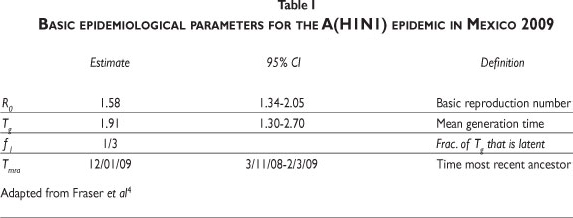
<body><![CDATA[<p align="center"><img src="/img/revistas/spm/v53n1/07s02.jpg" align="absmiddle"></p>     <p><font face="Verdana, Arial, Helvetica, sans-serif" size="2">where T<sub>0</sub>    and T<sub>f</sub> represent the beginning and end of the isolation period. In    Mexico City, the length of physical isolation lasted about 15 days;<sup>3</sup>    this measure was quickly extended to other cities. Many of the preventive measures    taken during isolation lasted much longer and some of them were still functioning    several months later. Hence, we assume that individuals suspended sanitary measures    at a rate </font><font size="2">&#969;</font><font face="Verdana, Arial, Helvetica, sans-serif" size="2">.</font></p>     <p><font face="Verdana, Arial, Helvetica, sans-serif" size="2">For completeness,    we include a rate for early detection of cases, </font><font size="2">&#963;</font><font face="Verdana, Arial, Helvetica, sans-serif" size="2">,    but we do not elaborate much on its role (see Discussion). This rate represents    the detection of exposed but not yet infectious individuals and represents an    acceleration in the transition of individuals from the exposed to the recovered    class. This is not only an immunological transition but also has a population    effect, such that detection implies isolation and treatment of the patient,    producing a significant reduction in the probability of contagion; early detection    implies treatment with antiviral drugs that effectively reduce infectiousness    to zero and contagion to very low levels. For consistency, we assume that the    isolation period is longer than the duration of the disease, which comprises    the latent time 1/</font><font size="2">&#947;</font><font face="Verdana, Arial, Helvetica, sans-serif" size="2">    and the infectiousness time 1/</font><font size="2">&#949;</font><font face="Verdana, Arial, Helvetica, sans-serif" size="2">.    That is, we have </font><font size="2">&#969;</font><font face="Verdana, Arial, Helvetica, sans-serif" size="2">    &lt; </font><font size="2">&#947;</font><font face="Verdana, Arial, Helvetica, sans-serif" size="2">    + </font><font size="2">&#949;</font><font face="Verdana, Arial, Helvetica, sans-serif" size="2">,    meaning that exposed or infectious individuals in the isolated class cannot    leave isolation in said state. Only susceptible and immune individuals leave    the isolation class at a rate </font><font size="2">&#969;</font><font face="Verdana, Arial, Helvetica, sans-serif" size="2">    without changing disease state. We formally assume that infections occur within    households through contact between susceptible individuals (non-isolated and    isolated susceptible) and infectious individuals (non-isolated and isolated).    The corresponding rates are denoted by </font><font size="2">&#946;</font><font face="Verdana, Arial, Helvetica, sans-serif" size="2">k    and </font><font size="2">&#946;</font><font face="Verdana, Arial, Helvetica, sans-serif" size="2">u,    respectively. However, we assume that k &gt;&gt; u, where 0 <u>&lt;</u> u &lt;    k <u>&lt;</u> 1. In particular, we take u = 0 and k = 1. The description of    the parameters is summarized in <a href="/img/revistas/spm/v53n1/html/07t02.htm#t2a">Table    II</a>. Observe that without isolation and early treatment, the mathematical    model reduces to the standard SEIR disease with the basic reproduction number    R<sub>0</sub>= bg / (</font><font size="2">&#956;</font><font face="Verdana, Arial, Helvetica, sans-serif" size="2">    + g)(e + </font><font size="2">&#956;</font><font face="Verdana, Arial, Helvetica, sans-serif" size="2">).    A similar model has been used<sup>7</sup> to describe the first month of the    epidemic in Mexico City.</font></p>     <p>&nbsp;</p>     <p><font face="Verdana, Arial, Helvetica, sans-serif" size="3"><b>Results</b></font></p>     <p><font face="Verdana, Arial, Helvetica, sans-serif" size="2">On April 16, an    epidemiological alert was declared.<sup>3</sup> On April 23, a suspension of    all educational activities was declared for Mexico City and the State of Mexico    and was shortly thereafter extended to the whole country. On April 30, the suspension    was extended to all non-essential activities. On May 11, students at the primary    educational level returned to classes, followed by students at all other educational    levels. <a href="/img/revistas/spm/v53n1/html/07f01.htm#f1a">Figure 1a</a> shows    data on the status of the epidemic on August 15, 2009.</font></p>     <p><font face="Verdana, Arial, Helvetica, sans-serif" size="2"><b>Model parametrization</b></font></p>     <p><font face="Verdana, Arial, Helvetica, sans-serif" size="2"><a href="/img/revistas/spm/v53n1/html/07t02.htm#t2b">Table    IIb</a> shows the parameters used. Our approach is not concerned with the accuracy    of predictions, but rather with the qualitative properties that they share with    the actual data. The time to the most recent ancestor, T<sub>mra</sub>, in the    Mexican republic (Table I) refers to January 11. However, the first reported    case in Mexico City occurred around the middle of March. We take the starting    date of the epidemic in the country as March 5, close to the upper end of the    95% confidence interval for T<sub>mra</sub>, but outside of it (<a href="#t1">Table    I</a>). This choice implies that isolation starts by day 50. Consequently, we    set T<sub>0</sub>= 50 (April 23) in (2). The isolation lasted for about 15 days,    equivalent to setting T<sub>f</sub>= 65. q<sub>0</sub> is the rate at which    the population enters isolation once the measure is taken. Seven days passed    between the closing of elementary schools (April 23) and the suspension of non-essential    activities. This is our estimate for the mean time to isolation.</font></p>     <p><a name="t1"></a></p>     <p>&nbsp;</p>     ]]></body>
<body><![CDATA[<p align="center"><img src="/img/revistas/spm/v53n1/07t01.jpg"></p>     <p>&nbsp;</p>     <p><font face="Verdana, Arial, Helvetica, sans-serif" size="2"><a href="/img/revistas/spm/v53n1/html/07f01.htm#f1b">Figure    1b</a> shows the predicted proportion of infected, y<sub>r</sub>= (y+c<sup>y</sup>)/N,    versus time fixing, R<sup>0</sup>= 1.85 and q<sup>0</sup>= 0.17. Our results    (<a href="/img/revistas/spm/v53n1/html/07f01.htm#f1b">Figure 1b</a>) remarkably    agree with the data. Based on the official data for August 18, the first confirmed    case occurred between March 12 and 19, and the first maximum occurred between    April 23 and 30. The second maximum occurred between June 25 and July 2, and    the minimum between May 21 and 28. The distance between the midpoints of the    two consecutive maxima is about 60 days, and the distance between the first    maximum and the minimum is about 26 days. <a href="/img/revistas/spm/v53n1/html/07f01.htm#f1b">Figure    1b</a> shows the distance between consecutive maxima, about 78 days, and the    distance between the first maximum and the minimum, about 31 days (<a href="/img/revistas/spm/v53n1/html/07t02.htm#t2a">Table    IIa</a>).</font></p>     <p><font face="Verdana, Arial, Helvetica, sans-serif" size="2"><b>Dependence on    <i>R</i><sub>0</sub></b></font></p>     <p><font face="Verdana, Arial, Helvetica, sans-serif" size="2"><a href="#f2">Figure    2</a> shows curves corresponding to R<sub>0</sub>= 1.19, 1.46, 1.69, 1.88, all    located within the 95% CI (<a href="#t1">Table I</a>). The rightmost curve is    a simple epidemic curve for the lowest R<sub>0</sub>; the nearest curve to the    left of this corresponds to the second value of R<sub>0</sub>. It is still a    curve with a single epidemic peak, but occurring about 250 days (approximately    8 months) after the beginning of the epidemic. The third curve (broken line)    corresponds to R0= 1.69. It is no longer an epidemic with a single peak. The    effect of the isolation is evident not only in the timing of the epidemic peak,    but also in the appearance of a second smaller one. The last curve to the left    corresponds to R<sup>0</sup>= 1.88 and shows the qualitative features of the    data for the Mexican case already described above. We therefore conclude that    the two-peak pattern -the signature of the Mexican flu epidemic- arises only    for certain values of R<sup>0</sup> . Those values of R<sup>0</sup> are located    at the upper third of the 95% CI for the reproduction number (<a href="#t1">Table    I</a>).</font></p>     <p><a name="f2"></a></p>     <p>&nbsp;</p>     <p align="center"><img src="/img/revistas/spm/v53n1/07f02.jpg"></p>     <p>&nbsp;</p>     <p><font face="Verdana, Arial, Helvetica, sans-serif" size="2"><b>Dependence on    </b></font><b><font size="2">&#969;</font></b></p>     ]]></body>
<body><![CDATA[<p><font face="Verdana, Arial, Helvetica, sans-serif" size="2">Our simulations    show that 1/</font><font size="2">&#969;</font><font face="Verdana, Arial, Helvetica, sans-serif" size="2">    plays a role in the temporal pattern of the epidemic. This parameter represents    the average duration of the prophylactic measures. The baseline value we used    is about 16 days, roughly the same duration of the isolation event. <a href="#f3">Figure    3</a> shows the predicted disease dynamics for 1/</font><font size="2">&#969;</font><font face="Verdana, Arial, Helvetica, sans-serif" size="2">    = 365, and the same but for 1/</font><font size="2">&#969;</font><font face="Verdana, Arial, Helvetica, sans-serif" size="2">    =180. Shortening the time of use of preventive measures brings the second epidemic    peak closer to the first. In Figure 1b, 1/</font><font size="2">&#969;</font><font face="Verdana, Arial, Helvetica, sans-serif" size="2">    = 16 days and the pattern shown closely resembles the observed one, suggesting    that the effectiveness of prevention measures lasted an average of 16 days.</font></p>     <p><a name="f3"></a></p>     <p>&nbsp;</p>     <p align="center"><img src="/img/revistas/spm/v53n1/07f03.jpg"></p>     <p>&nbsp;</p>     <p><font face="Verdana, Arial, Helvetica, sans-serif" size="2">Finally, for waning    times of 16, 180 and 365 days, for example, the proportion of cases under isolation,    c<sub>y</sub> in (1), produces isolation residence time distributions with increasingly    longer tails; therefore, for large t the proportion of cases still protected    is highly sensitive to </font><font size="2">&#969;</font><font face="Verdana, Arial, Helvetica, sans-serif" size="2">.</font></p>     <p><font face="Verdana, Arial, Helvetica, sans-serif" size="2"><b>Numerical explorations    for control</b></font></p>     <p><font face="Verdana, Arial, Helvetica, sans-serif" size="2">Our model shows    that the epidemic is produced by the interplay between the rate of isolation,    the waning period, and the reproduction number. Now, given the estimated value    of R<sub>0</sub>, what are the parameter values of the "control measures" (</font><font size="2">&#946;</font><font face="Verdana, Arial, Helvetica, sans-serif" size="2">,    q<sub>0</sub>, e) that would minimize the total incidence? To answer this, we    minimize the functional:</font></p>     <p align="center"><img src="/img/revistas/spm/v53n1/07s03.jpg" align="absmiddle"></p>     <p><font face="Verdana, Arial, Helvetica, sans-serif" size="2">where y(t) + c<sub>y</sub>(t)    is the total incidence. The discount factor on the integral is a function of    mortality, recovery rates, and &#91; 0,T&#93;. When varying (</font><font size="2">&#946;</font><font face="Verdana, Arial, Helvetica, sans-serif" size="2">,    q<sub>0</sub>, e) while keeping all other parameters constant, we study the    following:</font></p>     ]]></body>
<body><![CDATA[<p><font face="Verdana, Arial, Helvetica, sans-serif" size="2">fix q<sub>0</sub>=    0.1, let </font><font size="2">&#946;</font><font face="Verdana, Arial, Helvetica, sans-serif" size="2">    in &#91;0.2,0.5&#93; take increments of 0.03, </font><font size="2">&#969;</font><font face="Verdana, Arial, Helvetica, sans-serif" size="2">    in (0,0.1&#93; with increments of 0.01.</font></p>     <p><font face="Verdana, Arial, Helvetica, sans-serif" size="2">fix </font><font size="2">&#969;</font><font face="Verdana, Arial, Helvetica, sans-serif" size="2">    = 0.06, let q<sub>0</sub> take increments of 0.1 in (0,1&#93;, with </font><font size="2">&#946;</font><font face="Verdana, Arial, Helvetica, sans-serif" size="2">    as in case 1.</font></p>     <p><font face="Verdana, Arial, Helvetica, sans-serif" size="2">fix </font><font size="2">&#946;</font><font face="Verdana, Arial, Helvetica, sans-serif" size="2">=    0.5, let </font><font size="2">&#969;</font><font face="Verdana, Arial, Helvetica, sans-serif" size="2">    and q0 as in cases 1 and 2.</font></p>     <p><font face="Verdana, Arial, Helvetica, sans-serif" size="2">Among these choices    of triplets (</font><font size="2">&#946;</font><font face="Verdana, Arial, Helvetica, sans-serif" size="2">,    q<sub>0</sub>, e), we are interested in those for which the time series f(t)    = y(t)+ c<sub>y</sub>(t) has two significant maxima in the time interval &#91;0,1000&#93;.    Let &#131;max1 , &#131;max2 the first and second maximum of f forward in time.    Let &#131;min denote the minimum value of f located between &#131;<sub>max1</sub>    and &#131;<sub>max2</sub>.</font></p>     <p><font face="Verdana, Arial, Helvetica, sans-serif" size="2">We define as significant    peaks those that satisfy the following: &#131;<sub>max i</sub> - &#131;<sub>min</sub>    &gt; 1000 for i=1,2. To identify the triplets (</font><font size="2">&#946;</font><font face="Verdana, Arial, Helvetica, sans-serif" size="2">,    q<sub>0</sub>, </font><font size="2">&#969;</font><font face="Verdana, Arial, Helvetica, sans-serif" size="2">)    that lead to two significant maxima we follow the algorithm:</font></p> <ul>       <li><font face="Verdana, Arial, Helvetica, sans-serif" size="2">Integrate (1)      for each choice of triplets in cases 1, 2, 3.</font></li>       <li><font face="Verdana, Arial, Helvetica, sans-serif" size="2">For those triplets      with a time series with two significant maxima, compute (3) over &#91;0,1000&#93;.</font></li>       <li><font face="Verdana, Arial, Helvetica, sans-serif" size="2">Obtain the triplet      that minimizes (3).</font></li>     </ul>     <p><font face="Verdana, Arial, Helvetica, sans-serif" size="2">Our results indicate    that a minimum occurs for epidemics with general shapes showing a large peak    about a year after the first one. For example, for </font><font size="2">&#969;</font><font face="Verdana, Arial, Helvetica, sans-serif" size="2">=0.06    (fixed), q<sub>0</sub>= 0.9, </font><font size="2">&#946;</font><font face="Verdana, Arial, Helvetica, sans-serif" size="2">=.32,    then t<sub>max 1</sub>=50.00, f=2666, t<sub>max 2</sub>=355, and f= 1163054;    and for </font><font size="2">&#969;</font><font face="Verdana, Arial, Helvetica, sans-serif" size="2">=0.005,    q<sub>0</sub>= 1 (fixed), </font><font size="2">&#946;</font><font face="Verdana, Arial, Helvetica, sans-serif" size="2">    =.32, then t<sub>max 1</sub>= 50.00, f=2666, t<sub>max 2</sub>=366, and f =    599117. Since (3) is minimized in the former, isolation has to be extremely    fast to substantially reduce the impact of the first peak. By isolating individuals    fast enough the second peak can be pushed to the window of the next seasonal    influenza epidemics.</font></p>     ]]></body>
<body><![CDATA[<p>&nbsp;</p>     <p><font face="Verdana, Arial, Helvetica, sans-serif" size="3"><b>Discussion</b></font></p>     <p><font face="Verdana, Arial, Helvetica, sans-serif" size="2">There are several    estimates of R<sub>0</sub> for influenza. Fraser et al.<sub>4</sub> provide    the 95% CI (<a href="#t1">Table I</a>) for the Mexican 2009 epidemic; Chowell    et al.<sub>10</sub> calculated R<sub>0</sub> for the epidemic of San Francisco    in 1918-1919 within the range of &#91;2,3&#93;; for the first wave in Geneva    in 1918, Chowell et al.<sup>11</sup> estimated it in the interval &#91;1.45,1.53&#93;;    Boelle, Bernilolon and Desencios<sup>12</sup> provided an upper bound in the    range of &#91;2.2,3.1&#93; for the Mexican epidemic; Nishiura et al.<sup>13</sup>    provided the interval &#91;2,2.6&#93; for Japan; Massad et al.<sup>14</sup>    estimated it at 2.68 for the flu epidemic in Sao Paulo of 1918; Mills et al.<sup>15</sup>    estimated the reproduction number for the 1918 pandemic at under 3. The estimates    for Mexico have a broad interval. Our model suggests that R<sub>0</sub> for    this epidemic must be at the upper end of the confidence interval identified    by Fraser et al.<sup>4</sup></font></p>     <p><font face="Verdana, Arial, Helvetica, sans-serif" size="2">R<sup>0</sup> estimation    is highly sensitive to the generation time and, necessarily, there is a high    variability in the duration of its latent 1/</font><font size="2">&#947;</font><font face="Verdana, Arial, Helvetica, sans-serif" size="2">    and infectious 1/</font><font size="2">&#949;</font><font face="Verdana, Arial, Helvetica, sans-serif" size="2">    periods.<sup>16</sup> For H1N1, the CDC reports a latent period ranging from    1 to 7 days, with 1 to 4 being more likely, and an infectious period up to 7    or 10 days. Using published estimates, we conclude that if parameters are fixed    at their baseline values (<a href="/img/revistas/spm/v53n1/html/07t02.htm#t2b">Table    IIb</a>) and we vary R0 then for values below 1.7 the simulations of (1) are    not consistent with the pattern shown in <a href="/img/revistas/spm/v53n1/html/07f01.htm#f1b">Figure    1b</a>. This suggests that, for the Mexican epidemic, the lower bound for R<sup>0</sup>    is around 1.7.</font></p>     <p><font face="Verdana, Arial, Helvetica, sans-serif" size="2">The basic SEIR    model shows only one epidemic peak. Thus, the second peak observed in our simulations    is the original epidemic, delayed by the action of isolation. This effect has    already been reported by Epstein, Parker et al.<sup>17</sup> and Cayley, Philp    et al.<sup>18</sup> but in different contexts. Here, where we model the application    of social distancing, the delay between the two observed peaks is not only a    function of the length of the isolation time but also a function of R<sup>0</sup>    , </font><font size="2">&#969;</font><font face="Verdana, Arial, Helvetica, sans-serif" size="2">    and q<sup>0</sup>. We show that shortening the waning time 1/</font><font size="2">&#969;</font><font face="Verdana, Arial, Helvetica, sans-serif" size="2">    would bring the second epidemic peak closer to the first (<a href="#f2">Figure    2</a>).</font></p>     <p><font face="Verdana, Arial, Helvetica, sans-serif" size="2"><a href="/img/revistas/spm/v53n1/html/07f01.htm#f1b">Figure    1b</a> shows a close resemblance to the observed pattern when 1/</font><font size="2">&#969;</font><font face="Verdana, Arial, Helvetica, sans-serif" size="2">    = 16 days, suggesting that the effectiveness of prevention measures lasted about    16 days. The numerical explorations described reveal that if isolation is implemented    fast enough, (q<sub>0</sub> close to one), the second peak will be delayed approximately    one year, allowing for time to take preventive actions before the seasonal influenza    epidemics outbreak.</font></p>     <p>&nbsp;</p>     <p><font face="Verdana, Arial, Helvetica, sans-serif" size="3"><b>Conclussions</b></font></p>     <p><font face="Verdana, Arial, Helvetica, sans-serif" size="2">The epidemic outbreak    in Mexico shows two peaks resulting from the application of drastic social isolation    and other prophylactic measures that lasted at least two weeks. We reproduced    this pattern, showing that it only occurs within a relatively narrow range of    values for crucial parameters, such as the basic reproduction number, the isolation    rate and the waning of prevention measures. Significant qualitative changes    in this pattern obtained through manipulation of these parameters generated    delayed single-peak epidemics appearing many weeks after the end of the isolation    period, or two-peaked epidemics but with much greater delay between them.</font></p>     <p><font face="Verdana, Arial, Helvetica, sans-serif" size="2">Mexico is a large    country and the influenza epidemic occurred in geographically distant and different    regions. From the patterns of influenza dispersal reported,<sup>21</sup> the    virus spread from Mexico City and other cities (San Luis Potosi, Zacatecas,    etc) to other population centers via public transportation (mainly bus or plane),    and from there to smaller communities. While the data reported by the federal    Ministry of Health lumps together such geographical complexity, since social    isolation and other measures were implemented across the whole country, their    effect on local epidemics was likely the same as that observed at the country    level, as our model shows. The model incorporates a minimal amount of information    that can reproduce the observed pattern using only known parameters and excluding    treatment.</font></p>     ]]></body>
<body><![CDATA[<p><font face="Verdana, Arial, Helvetica, sans-serif" size="2">While our objective    has been to explain the bimodal disease, there are certainly other factors that    our model neglects, such as the effect of space and of asymptomatic infections;    nevertheless, we assert that such factors do not play a role in explaining the    two-peaked epidemic. In addition, we do not have sufficient information to parameterize    such an elaborate model.</font></p>     <p><font face="Verdana, Arial, Helvetica, sans-serif" size="2">A third epidemic    peak started in Mexico in late September. The initial appearance of an epidemic    peak after August 11 is a feature not predicted by our model and represents    a true second wave of influenza -a mixture of seasonal and H1N1 viruses.</font></p>     <p><font face="Verdana, Arial, Helvetica, sans-serif" size="2">Finally, surveillance    for detection occurs at rate </font><font size="2">&#963;</font><font face="Verdana, Arial, Helvetica, sans-serif" size="2">    and is set as 0 in this work. This was certainly not the case in the Mexican    epidemic but, unfortunately, early detection was poor. Fajardo-Dolci et al.<sup>19</sup>    report that only 17% of cases received medical attention within the first 72    hours from the onset of symptoms, concluding that delay in treatment and medical    attention were significant factors for the magnitude of the mortality rate.    Similar conclusions are reported by Grijalva, Talavera, Solorzano et al.<sup>20</sup>    Thus our estimate of </font><font size="2">&#963;</font><font face="Verdana, Arial, Helvetica, sans-serif" size="2">=    0 , while inexact, is still a reasonable first approximation.</font></p>     <p>&nbsp;</p>     <p><font face="Verdana, Arial, Helvetica, sans-serif" size="3"><b>Acknowledgments</b></font></p>     <p><font face="Verdana, Arial, Helvetica, sans-serif" size="2">We would like to    thank Suzanne Lenhart and Zhilan Feng for their helpful discussions. We also    acknowledge funding from NIMBioS (National Science Foundation grant EF-0832-858).</font></p>     <p><font face="Verdana, Arial, Helvetica, sans-serif" size="2"><i>Declaration    of conflicts of interest: The authors declare that they have no conflict of    interests.</i></font></p>     <p><i><font face="Verdana, Arial, Helvetica, sans-serif" size="2">The authors    declare that they have no conflict of interests.</font></i></p>     <p>&nbsp;</p>     <p><font face="Verdana, Arial, Helvetica, sans-serif" size="3"><b>References</b></font></p>     ]]></body>
<body><![CDATA[<!-- ref --><p><font face="Verdana, Arial, Helvetica, sans-serif" size="2">1. Neumann G, Noda    T, Kawaoka Y. Emergence and pandemic potential of swine-origin H1N1 influenza    virus. Nature 2009;459:931-939.    &nbsp;&nbsp;&nbsp;&nbsp;&nbsp;&nbsp;&nbsp;&nbsp;[&#160;<a href="javascript:void(0);" onclick="javascript: window.open('/scielo.php?script=sci_nlinks&ref=9317084&pid=S0036-3634201100010000700001&lng=','','width=640,height=500,resizable=yes,scrollbars=1,menubar=yes,');">Links</a>&#160;]<!-- end-ref --></font></p>     <!-- ref --><p><font face="Verdana, Arial, Helvetica, sans-serif" size="2">2. Earn DJD, Dushoff    J, Levin SA. Ecology and evolution of the flu. TRENDS in Ecology and Evolution    2002;17:334-340.    &nbsp;&nbsp;&nbsp;&nbsp;&nbsp;&nbsp;&nbsp;&nbsp;[&#160;<a href="javascript:void(0);" onclick="javascript: window.open('/scielo.php?script=sci_nlinks&ref=9317086&pid=S0036-3634201100010000700002&lng=','','width=640,height=500,resizable=yes,scrollbars=1,menubar=yes,');">Links</a>&#160;]<!-- end-ref --></font></p>     <!-- ref --><p><font face="Verdana, Arial, Helvetica, sans-serif" size="2">3. Ministry of    Health. Estad&iacute;sticas de la epidemia. Influenza A(H1N1). Mexico: Ministry    of Health, 2009. &#91;Accessed on August 21, 2009&#93;Available at: <a href="http://portal.salud.gob.mx/contenidos/noticias/influenza/estadisticas.html" target="_blank">http://portal.salud.gob.mx/contenidos/noticias/influenza/estadisticas.html</a></font>&nbsp;&nbsp;&nbsp;&nbsp;&nbsp;&nbsp;&nbsp;&nbsp;[&#160;<a href="javascript:void(0);" onclick="javascript: window.open('/scielo.php?script=sci_nlinks&ref=9317088&pid=S0036-3634201100010000700003&lng=','','width=640,height=500,resizable=yes,scrollbars=1,menubar=yes,');">Links</a>&#160;]<!-- end-ref --><!-- ref --><p><font face="Verdana, Arial, Helvetica, sans-serif" size="2">4. Fraser C, Donnelly    CA, Cauchemez S, Hange WP, Van Kerkhove MD, Hollingsworth TD, et al. Pandemic    potential of a strain of influenza A (H1N1): early findings. Science 2009;324(5934):1557-1561.    &nbsp;&nbsp;&nbsp;&nbsp;&nbsp;&nbsp;&nbsp;&nbsp;[&#160;<a href="javascript:void(0);" onclick="javascript: window.open('/scielo.php?script=sci_nlinks&ref=9317089&pid=S0036-3634201100010000700004&lng=','','width=640,height=500,resizable=yes,scrollbars=1,menubar=yes,');">Links</a>&#160;]<!-- end-ref --></font></p>     <!-- ref --><p><font face="Verdana, Arial, Helvetica, sans-serif" size="2">5. Cohen J. Past    pandemics provide mixed clues to H1N1's next moves. Science 2009;324:996-997.    &nbsp;&nbsp;&nbsp;&nbsp;&nbsp;&nbsp;&nbsp;&nbsp;[&#160;<a href="javascript:void(0);" onclick="javascript: window.open('/scielo.php?script=sci_nlinks&ref=9317091&pid=S0036-3634201100010000700005&lng=','','width=640,height=500,resizable=yes,scrollbars=1,menubar=yes,');">Links</a>&#160;]<!-- end-ref --></font></p>     <!-- ref --><p><font face="Verdana, Arial, Helvetica, sans-serif" size="2">6. Park AW, Glass    K. Dynamic patterns of avian and human influenza in east and southeast Asia.    Lancet Infect Dis 2007;7(8):543-548.    &nbsp;&nbsp;&nbsp;&nbsp;&nbsp;&nbsp;&nbsp;&nbsp;[&#160;<a href="javascript:void(0);" onclick="javascript: window.open('/scielo.php?script=sci_nlinks&ref=9317093&pid=S0036-3634201100010000700006&lng=','','width=640,height=500,resizable=yes,scrollbars=1,menubar=yes,');">Links</a>&#160;]<!-- end-ref --></font></p>     <!-- ref --><p><font face="Verdana, Arial, Helvetica, sans-serif" size="2">7. Cruz-Pacheco    G, Duran L, Esteva L, Minzoni AA, L&oacute;pez-Cervantes L, Panayotaros P, et    al. Modelling of the influenza A(H1N1)V outbreak in Mexico City, April-May 2009,    with control sanitary measures. Euro Surveill 2009;14 (2).    &nbsp;&nbsp;&nbsp;&nbsp;&nbsp;&nbsp;&nbsp;&nbsp;[&#160;<a href="javascript:void(0);" onclick="javascript: window.open('/scielo.php?script=sci_nlinks&ref=9317095&pid=S0036-3634201100010000700007&lng=','','width=640,height=500,resizable=yes,scrollbars=1,menubar=yes,');">Links</a>&#160;]<!-- end-ref --></font></p>     <!-- ref --><p><font face="Verdana, Arial, Helvetica, sans-serif" size="2">8. Tuite AR, Greer    AL, Whelan M, et al. Estimated epidemiologic parameters and morbidity associated    with pandemic H1N1 influenza. CMAJ 2009;182(2):131-136.    &nbsp;&nbsp;&nbsp;&nbsp;&nbsp;&nbsp;&nbsp;&nbsp;[&#160;<a href="javascript:void(0);" onclick="javascript: window.open('/scielo.php?script=sci_nlinks&ref=9317097&pid=S0036-3634201100010000700008&lng=','','width=640,height=500,resizable=yes,scrollbars=1,menubar=yes,');">Links</a>&#160;]<!-- end-ref --></font></p>     <!-- ref --><p><font face="Verdana, Arial, Helvetica, sans-serif" size="2">9. Pourbohloul    B, Ahued A, Davoudi B, Meza R, Meyers LA, Skowronski DM, et al. Initial Human    Transmission Dynamics of the Pandemic (H1N1) 2009 Virus In North America : Methods.    Influenza Resp Viruses 2009;3(5):215-222.    &nbsp;&nbsp;&nbsp;&nbsp;&nbsp;&nbsp;&nbsp;&nbsp;[&#160;<a href="javascript:void(0);" onclick="javascript: window.open('/scielo.php?script=sci_nlinks&ref=9317099&pid=S0036-3634201100010000700009&lng=','','width=640,height=500,resizable=yes,scrollbars=1,menubar=yes,');">Links</a>&#160;]<!-- end-ref --></font></p>     <!-- ref --><p><font face="Verdana, Arial, Helvetica, sans-serif" size="2">10. Chowell G,    Nishiura H, Bettencourt LMA. Comparative estimation of the reproduction number    for pandemic influenza from daily case notification data. J R Soc Interface    2007;4(12):155-166.    &nbsp;&nbsp;&nbsp;&nbsp;&nbsp;&nbsp;&nbsp;&nbsp;[&#160;<a href="javascript:void(0);" onclick="javascript: window.open('/scielo.php?script=sci_nlinks&ref=9317101&pid=S0036-3634201100010000700010&lng=','','width=640,height=500,resizable=yes,scrollbars=1,menubar=yes,');">Links</a>&#160;]<!-- end-ref --></font></p>     <!-- ref --><p><font face="Verdana, Arial, Helvetica, sans-serif" size="2">11. Chowell G,    Ammon CE, Hengartner NW, Hyman JM. Transmission dynamics of the great influenza    pandemic of 1918 in Geneva, Switzerland: assessing the effects of hypothetical    interventions. J Theor Biol 2006;241:193-204.    &nbsp;&nbsp;&nbsp;&nbsp;&nbsp;&nbsp;&nbsp;&nbsp;[&#160;<a href="javascript:void(0);" onclick="javascript: window.open('/scielo.php?script=sci_nlinks&ref=9317103&pid=S0036-3634201100010000700011&lng=','','width=640,height=500,resizable=yes,scrollbars=1,menubar=yes,');">Links</a>&#160;]<!-- end-ref --></font></p>     <!-- ref --><p><font face="Verdana, Arial, Helvetica, sans-serif" size="2">12. Boelle PY,    Bernillon P, Desenclos JC. A preliminary estimation of the reproduction ratio    for new influenza A(H1N1) from the outbreak in Mexico, March-April 2009. Euro    Surveill 2009;14:10-13.    &nbsp;&nbsp;&nbsp;&nbsp;&nbsp;&nbsp;&nbsp;&nbsp;[&#160;<a href="javascript:void(0);" onclick="javascript: window.open('/scielo.php?script=sci_nlinks&ref=9317105&pid=S0036-3634201100010000700012&lng=','','width=640,height=500,resizable=yes,scrollbars=1,menubar=yes,');">Links</a>&#160;]<!-- end-ref --></font></p>     <!-- ref --><p><font face="Verdana, Arial, Helvetica, sans-serif" size="2">13. Nishiura H,    Castillo-Chavez C, Safan M, Chowell G. Transmission potential of the new influenza    A(H1N1) virus and its age-specificity in Japan. Euro Surveill 2009;14(22):pii=19227.    &nbsp;&nbsp;&nbsp;&nbsp;&nbsp;&nbsp;&nbsp;&nbsp;[&#160;<a href="javascript:void(0);" onclick="javascript: window.open('/scielo.php?script=sci_nlinks&ref=9317107&pid=S0036-3634201100010000700013&lng=','','width=640,height=500,resizable=yes,scrollbars=1,menubar=yes,');">Links</a>&#160;]<!-- end-ref --></font></p>     <!-- ref --><p><font face="Verdana, Arial, Helvetica, sans-serif" size="2">14. Massad E, Burattini    MN, Coutinho FAB, Lopez LF. The 1918 influenza A epidemic in the city of S&atilde;o    Paulo, Brazil. Med Hypotheses 2007;68(2):442-445.    &nbsp;&nbsp;&nbsp;&nbsp;&nbsp;&nbsp;&nbsp;&nbsp;[&#160;<a href="javascript:void(0);" onclick="javascript: window.open('/scielo.php?script=sci_nlinks&ref=9317109&pid=S0036-3634201100010000700014&lng=','','width=640,height=500,resizable=yes,scrollbars=1,menubar=yes,');">Links</a>&#160;]<!-- end-ref --></font></p>     <!-- ref --><p><font face="Verdana, Arial, Helvetica, sans-serif" size="2">15. Mills CE, Robins    JM, Lipsitch M. Transmissibility of the 1918 pandemic influenza. Nature 2004;432:904-906.    &nbsp;&nbsp;&nbsp;&nbsp;&nbsp;&nbsp;&nbsp;&nbsp;[&#160;<a href="javascript:void(0);" onclick="javascript: window.open('/scielo.php?script=sci_nlinks&ref=9317111&pid=S0036-3634201100010000700015&lng=','','width=640,height=500,resizable=yes,scrollbars=1,menubar=yes,');">Links</a>&#160;]<!-- end-ref --></font></p>     <!-- ref --><p><font face="Verdana, Arial, Helvetica, sans-serif" size="2">16. Lessler J,    Reich NG, Brookmeyer R, Perl TM, Nelson KE, Cummings DA. Incubation periods    of acute respiratory viral infections: a systematic review. Lancet Infect Dis    2009;9:291-300.    &nbsp;&nbsp;&nbsp;&nbsp;&nbsp;&nbsp;&nbsp;&nbsp;[&#160;<a href="javascript:void(0);" onclick="javascript: window.open('/scielo.php?script=sci_nlinks&ref=9317113&pid=S0036-3634201100010000700016&lng=','','width=640,height=500,resizable=yes,scrollbars=1,menubar=yes,');">Links</a>&#160;]<!-- end-ref --></font></p>     <!-- ref --><p><font face="Verdana, Arial, Helvetica, sans-serif" size="2">17. Epstein JM,    Parker J, Cummings D, Hammond RA. Coupled contagion dynamics of fear and disease:    mathematical and computational explorations. PLoS ONE 2008;3(12):e3955.    &nbsp;&nbsp;&nbsp;&nbsp;&nbsp;&nbsp;&nbsp;&nbsp;[&#160;<a href="javascript:void(0);" onclick="javascript: window.open('/scielo.php?script=sci_nlinks&ref=9317115&pid=S0036-3634201100010000700017&lng=','','width=640,height=500,resizable=yes,scrollbars=1,menubar=yes,');">Links</a>&#160;]<!-- end-ref --></font></p>     <!-- ref --><p><font face="Verdana, Arial, Helvetica, sans-serif" size="2">18. Caley P, Philp    DJ, McCracken K. Quantifying social distancing arising from pandemic influenza.    J R Soc Interface 2005;5:631-639.    &nbsp;&nbsp;&nbsp;&nbsp;&nbsp;&nbsp;&nbsp;&nbsp;[&#160;<a href="javascript:void(0);" onclick="javascript: window.open('/scielo.php?script=sci_nlinks&ref=9317117&pid=S0036-3634201100010000700018&lng=','','width=640,height=500,resizable=yes,scrollbars=1,menubar=yes,');">Links</a>&#160;]<!-- end-ref --></font></p>     <!-- ref --><p><font face="Verdana, Arial, Helvetica, sans-serif" size="2">19. Fajardo-Dolci    G, Hernandez-Torres F, Santacruz-Varela J, Rodr&iacute;guez-Su&aacute;rez J,    Lamy P, et al. Perfil epidemil&oacute;gico de la mortalidad por influenza humana    A (H1N1) en M&eacute;xico. Salud Publica Mex 2009;51(5):361-371.    &nbsp;&nbsp;&nbsp;&nbsp;&nbsp;&nbsp;&nbsp;&nbsp;[&#160;<a href="javascript:void(0);" onclick="javascript: window.open('/scielo.php?script=sci_nlinks&ref=9317119&pid=S0036-3634201100010000700019&lng=','','width=640,height=500,resizable=yes,scrollbars=1,menubar=yes,');">Links</a>&#160;]<!-- end-ref --></font></p>     <!-- ref --><p><font face="Verdana, Arial, Helvetica, sans-serif" size="2">20. Grijalva-Otero    I, Talavera JO, Solorzano-Santos F, et al. Critical analysis of deaths due to    atypical pneumonia during the onset of the influenza A(H1N1) virus pandemic.    Arch Med Res 2009;40(8):662-668.    &nbsp;&nbsp;&nbsp;&nbsp;&nbsp;&nbsp;&nbsp;&nbsp;[&#160;<a href="javascript:void(0);" onclick="javascript: window.open('/scielo.php?script=sci_nlinks&ref=9317121&pid=S0036-3634201100010000700020&lng=','','width=640,height=500,resizable=yes,scrollbars=1,menubar=yes,');">Links</a>&#160;]<!-- end-ref --></font></p>     <p>&nbsp;</p>     ]]></body>
<body><![CDATA[<p>&nbsp;</p>     <p><font face="Verdana, Arial, Helvetica, sans-serif" size="2"><a name="back"></a><b><a href="#top"><img src="/img/revistas/spm/v53n1/seta.jpg" border="0"></a>    Address reprint requests to:</b>     <br>   Dr. Jorge X. Velasco    <br>   Programa de Matem&aacute;ticas Aplicadas y Computaci&oacute;n    <br>   Instituto Mexicano del Petr&oacute;leo    <br>   Eje Central L&aacute;zaro C&aacute;rdenas 152    <br>   San Bartolo Atepehuacan. 07730, M&eacute;xico DF    <br>   E-mail: <a href="mailto:jx.velasco@gmail.com">jx.velasco@gmail.com</a></font></p>     <p><font face="Verdana, Arial, Helvetica, sans-serif" size="2"><b>Received on:</b>    March 4, 2010    <br>   <b>Accepted on:</b> September 29, 2010</font></p>     ]]></body>
<body><![CDATA[ ]]></body><back>
<ref-list>
<ref id="B1">
<label>1</label><nlm-citation citation-type="journal">
<person-group person-group-type="author">
<name>
<surname><![CDATA[Neumann]]></surname>
<given-names><![CDATA[G]]></given-names>
</name>
<name>
<surname><![CDATA[Noda]]></surname>
<given-names><![CDATA[T]]></given-names>
</name>
<name>
<surname><![CDATA[Kawaoka]]></surname>
<given-names><![CDATA[Y]]></given-names>
</name>
</person-group>
<article-title xml:lang="en"><![CDATA[Emergence and pandemic potential of swine-origin H1N1 influenza virus]]></article-title>
<source><![CDATA[Nature]]></source>
<year>2009</year>
<volume>459</volume>
<page-range>931-939</page-range></nlm-citation>
</ref>
<ref id="B2">
<label>2</label><nlm-citation citation-type="journal">
<person-group person-group-type="author">
<name>
<surname><![CDATA[Earn]]></surname>
<given-names><![CDATA[DJD]]></given-names>
</name>
<name>
<surname><![CDATA[Dushoff]]></surname>
<given-names><![CDATA[J]]></given-names>
</name>
<name>
<surname><![CDATA[Levin]]></surname>
<given-names><![CDATA[SA]]></given-names>
</name>
</person-group>
<article-title xml:lang="en"><![CDATA[Ecology and evolution of the flu]]></article-title>
<source><![CDATA[TRENDS in Ecology and Evolution]]></source>
<year>2002</year>
<volume>17</volume>
<page-range>334-340</page-range></nlm-citation>
</ref>
<ref id="B3">
<label>3</label><nlm-citation citation-type="book">
<collab>Ministry of Health</collab>
<source><![CDATA[Estadísticas de la epidemia: Influenza A(H1N1)]]></source>
<year>2009</year>
<publisher-name><![CDATA[Ministry of Health]]></publisher-name>
</nlm-citation>
</ref>
<ref id="B4">
<label>4</label><nlm-citation citation-type="journal">
<person-group person-group-type="author">
<name>
<surname><![CDATA[Fraser]]></surname>
<given-names><![CDATA[C]]></given-names>
</name>
<name>
<surname><![CDATA[Donnelly]]></surname>
<given-names><![CDATA[CA]]></given-names>
</name>
<name>
<surname><![CDATA[Cauchemez]]></surname>
<given-names><![CDATA[S]]></given-names>
</name>
<name>
<surname><![CDATA[Hange]]></surname>
<given-names><![CDATA[WP]]></given-names>
</name>
<name>
<surname><![CDATA[Van Kerkhove]]></surname>
<given-names><![CDATA[MD]]></given-names>
</name>
<name>
<surname><![CDATA[Hollingsworth]]></surname>
<given-names><![CDATA[TD]]></given-names>
</name>
</person-group>
<article-title xml:lang="en"><![CDATA[Pandemic potential of a strain of influenza A (H1N1): early findings]]></article-title>
<source><![CDATA[Science]]></source>
<year>2009</year>
<volume>324</volume>
<numero>5934</numero>
<issue>5934</issue>
<page-range>1557-1561</page-range></nlm-citation>
</ref>
<ref id="B5">
<label>5</label><nlm-citation citation-type="journal">
<person-group person-group-type="author">
<name>
<surname><![CDATA[Cohen]]></surname>
<given-names><![CDATA[J]]></given-names>
</name>
</person-group>
<article-title xml:lang="en"><![CDATA[Past pandemics provide mixed clues to H1N1's next moves]]></article-title>
<source><![CDATA[Science]]></source>
<year>2009</year>
<volume>324</volume>
<page-range>996-997</page-range></nlm-citation>
</ref>
<ref id="B6">
<label>6</label><nlm-citation citation-type="journal">
<person-group person-group-type="author">
<name>
<surname><![CDATA[Park]]></surname>
<given-names><![CDATA[AW]]></given-names>
</name>
<name>
<surname><![CDATA[Glass]]></surname>
<given-names><![CDATA[K]]></given-names>
</name>
</person-group>
<article-title xml:lang="en"><![CDATA[Dynamic patterns of avian and human influenza in east and southeast Asia]]></article-title>
<source><![CDATA[Lancet Infect Dis]]></source>
<year>2007</year>
<volume>7</volume>
<numero>8</numero>
<issue>8</issue>
<page-range>543-548</page-range></nlm-citation>
</ref>
<ref id="B7">
<label>7</label><nlm-citation citation-type="journal">
<person-group person-group-type="author">
<name>
<surname><![CDATA[Cruz-Pacheco]]></surname>
<given-names><![CDATA[G]]></given-names>
</name>
<name>
<surname><![CDATA[Duran]]></surname>
<given-names><![CDATA[L]]></given-names>
</name>
<name>
<surname><![CDATA[Esteva]]></surname>
<given-names><![CDATA[L]]></given-names>
</name>
<name>
<surname><![CDATA[Minzoni]]></surname>
<given-names><![CDATA[AA]]></given-names>
</name>
<name>
<surname><![CDATA[López-Cervantes]]></surname>
<given-names><![CDATA[L]]></given-names>
</name>
<name>
<surname><![CDATA[Panayotaros]]></surname>
<given-names><![CDATA[P]]></given-names>
</name>
</person-group>
<article-title xml:lang="en"><![CDATA[Modelling of the influenza A(H1N1)V outbreak in Mexico City, April-May 2009, with control sanitary measures]]></article-title>
<source><![CDATA[Euro Surveill]]></source>
<year>2009</year>
<volume>14</volume>
<numero>2</numero>
<issue>2</issue>
</nlm-citation>
</ref>
<ref id="B8">
<label>8</label><nlm-citation citation-type="journal">
<person-group person-group-type="author">
<name>
<surname><![CDATA[Tuite]]></surname>
<given-names><![CDATA[AR]]></given-names>
</name>
<name>
<surname><![CDATA[Greer]]></surname>
<given-names><![CDATA[AL]]></given-names>
</name>
<name>
<surname><![CDATA[Whelan]]></surname>
<given-names><![CDATA[M]]></given-names>
</name>
</person-group>
<article-title xml:lang="en"><![CDATA[Estimated epidemiologic parameters and morbidity associated with pandemic H1N1 influenza]]></article-title>
<source><![CDATA[CMAJ]]></source>
<year>2009</year>
<volume>182</volume>
<numero>2</numero>
<issue>2</issue>
<page-range>131-136</page-range></nlm-citation>
</ref>
<ref id="B9">
<label>9</label><nlm-citation citation-type="journal">
<person-group person-group-type="author">
<name>
<surname><![CDATA[Pourbohloul]]></surname>
<given-names><![CDATA[B]]></given-names>
</name>
<name>
<surname><![CDATA[Ahued]]></surname>
<given-names><![CDATA[A]]></given-names>
</name>
<name>
<surname><![CDATA[Davoudi]]></surname>
<given-names><![CDATA[B]]></given-names>
</name>
<name>
<surname><![CDATA[Meza]]></surname>
<given-names><![CDATA[R]]></given-names>
</name>
<name>
<surname><![CDATA[Meyers]]></surname>
<given-names><![CDATA[LA]]></given-names>
</name>
<name>
<surname><![CDATA[Skowronski]]></surname>
<given-names><![CDATA[DM]]></given-names>
</name>
</person-group>
<article-title xml:lang="en"><![CDATA[Initial Human Transmission Dynamics of the Pandemic (H1N1) 2009 Virus In North America: Methods]]></article-title>
<source><![CDATA[Influenza Resp Viruses]]></source>
<year>2009</year>
<volume>3</volume>
<numero>5</numero>
<issue>5</issue>
<page-range>215-222</page-range></nlm-citation>
</ref>
<ref id="B10">
<label>10</label><nlm-citation citation-type="journal">
<person-group person-group-type="author">
<name>
<surname><![CDATA[Chowell]]></surname>
<given-names><![CDATA[G]]></given-names>
</name>
<name>
<surname><![CDATA[Nishiura]]></surname>
<given-names><![CDATA[H]]></given-names>
</name>
<name>
<surname><![CDATA[Bettencourt]]></surname>
<given-names><![CDATA[LMA]]></given-names>
</name>
</person-group>
<article-title xml:lang="en"><![CDATA[Comparative estimation of the reproduction number for pandemic influenza from daily case notification data]]></article-title>
<source><![CDATA[J R Soc Interface]]></source>
<year>2007</year>
<volume>4</volume>
<numero>12</numero>
<issue>12</issue>
<page-range>155-166</page-range></nlm-citation>
</ref>
<ref id="B11">
<label>11</label><nlm-citation citation-type="journal">
<person-group person-group-type="author">
<name>
<surname><![CDATA[Chowell]]></surname>
<given-names><![CDATA[G]]></given-names>
</name>
<name>
<surname><![CDATA[Ammon]]></surname>
<given-names><![CDATA[CE]]></given-names>
</name>
<name>
<surname><![CDATA[Hengartner]]></surname>
<given-names><![CDATA[NW]]></given-names>
</name>
<name>
<surname><![CDATA[Hyman]]></surname>
<given-names><![CDATA[JM]]></given-names>
</name>
</person-group>
<article-title xml:lang="en"><![CDATA[Transmission dynamics of the great influenza pandemic of 1918 in Geneva, Switzerland: assessing the effects of hypothetical interventions]]></article-title>
<source><![CDATA[J Theor Biol]]></source>
<year>2006</year>
<volume>241</volume>
<page-range>193-204</page-range></nlm-citation>
</ref>
<ref id="B12">
<label>12</label><nlm-citation citation-type="journal">
<person-group person-group-type="author">
<name>
<surname><![CDATA[Boelle]]></surname>
<given-names><![CDATA[PY]]></given-names>
</name>
<name>
<surname><![CDATA[Bernillon]]></surname>
<given-names><![CDATA[P]]></given-names>
</name>
<name>
<surname><![CDATA[Desenclos]]></surname>
<given-names><![CDATA[JC]]></given-names>
</name>
</person-group>
<article-title xml:lang="en"><![CDATA[A preliminary estimation of the reproduction ratio for new influenza A(H1N1) from the outbreak in Mexico, March-April 2009]]></article-title>
<source><![CDATA[Euro Surveill]]></source>
<year>2009</year>
<volume>14</volume>
<page-range>10-13</page-range></nlm-citation>
</ref>
<ref id="B13">
<label>13</label><nlm-citation citation-type="journal">
<person-group person-group-type="author">
<name>
<surname><![CDATA[Nishiura]]></surname>
<given-names><![CDATA[H]]></given-names>
</name>
<name>
<surname><![CDATA[Castillo-Chavez]]></surname>
<given-names><![CDATA[C]]></given-names>
</name>
<name>
<surname><![CDATA[Safan]]></surname>
<given-names><![CDATA[M]]></given-names>
</name>
<name>
<surname><![CDATA[Chowell]]></surname>
<given-names><![CDATA[G]]></given-names>
</name>
</person-group>
<article-title xml:lang="en"><![CDATA[Transmission potential of the new influenza A(H1N1) virus and its age-specificity in Japan]]></article-title>
<source><![CDATA[Euro Surveill]]></source>
<year>2009</year>
<volume>14</volume>
<numero>22</numero>
<issue>22</issue>
<page-range>pii=19227</page-range></nlm-citation>
</ref>
<ref id="B14">
<label>14</label><nlm-citation citation-type="journal">
<person-group person-group-type="author">
<name>
<surname><![CDATA[Massad]]></surname>
<given-names><![CDATA[E]]></given-names>
</name>
<name>
<surname><![CDATA[Burattini]]></surname>
<given-names><![CDATA[MN]]></given-names>
</name>
<name>
<surname><![CDATA[Coutinho]]></surname>
<given-names><![CDATA[FAB]]></given-names>
</name>
<name>
<surname><![CDATA[Lopez]]></surname>
<given-names><![CDATA[LF]]></given-names>
</name>
</person-group>
<article-title xml:lang="en"><![CDATA[The 1918 influenza A epidemic in the city of São Paulo, Brazil]]></article-title>
<source><![CDATA[Med Hypotheses]]></source>
<year>2007</year>
<volume>68</volume>
<numero>2</numero>
<issue>2</issue>
<page-range>442-445</page-range></nlm-citation>
</ref>
<ref id="B15">
<label>15</label><nlm-citation citation-type="journal">
<person-group person-group-type="author">
<name>
<surname><![CDATA[Mills]]></surname>
<given-names><![CDATA[CE]]></given-names>
</name>
<name>
<surname><![CDATA[Robins]]></surname>
<given-names><![CDATA[JM]]></given-names>
</name>
<name>
<surname><![CDATA[Lipsitch]]></surname>
<given-names><![CDATA[M]]></given-names>
</name>
</person-group>
<article-title xml:lang="en"><![CDATA[Transmissibility of the 1918 pandemic influenza]]></article-title>
<source><![CDATA[Nature]]></source>
<year>2004</year>
<volume>432</volume>
<page-range>904-906</page-range></nlm-citation>
</ref>
<ref id="B16">
<label>16</label><nlm-citation citation-type="journal">
<person-group person-group-type="author">
<name>
<surname><![CDATA[Lessler]]></surname>
<given-names><![CDATA[J]]></given-names>
</name>
<name>
<surname><![CDATA[Reich]]></surname>
<given-names><![CDATA[NG]]></given-names>
</name>
<name>
<surname><![CDATA[Brookmeyer]]></surname>
<given-names><![CDATA[R]]></given-names>
</name>
<name>
<surname><![CDATA[Perl]]></surname>
<given-names><![CDATA[TM]]></given-names>
</name>
<name>
<surname><![CDATA[Nelson]]></surname>
<given-names><![CDATA[KE]]></given-names>
</name>
<name>
<surname><![CDATA[Cummings]]></surname>
<given-names><![CDATA[DA]]></given-names>
</name>
</person-group>
<article-title xml:lang="en"><![CDATA[Incubation periods of acute respiratory viral infections: a systematic review]]></article-title>
<source><![CDATA[Lancet Infect Dis]]></source>
<year>2009</year>
<volume>9</volume>
<page-range>291-300</page-range></nlm-citation>
</ref>
<ref id="B17">
<label>17</label><nlm-citation citation-type="journal">
<person-group person-group-type="author">
<name>
<surname><![CDATA[Epstein]]></surname>
<given-names><![CDATA[JM]]></given-names>
</name>
<name>
<surname><![CDATA[Parker]]></surname>
<given-names><![CDATA[J]]></given-names>
</name>
<name>
<surname><![CDATA[Cummings]]></surname>
<given-names><![CDATA[D]]></given-names>
</name>
<name>
<surname><![CDATA[Hammond]]></surname>
<given-names><![CDATA[RA]]></given-names>
</name>
</person-group>
<article-title xml:lang="en"><![CDATA[Coupled contagion dynamics of fear and disease: mathematical and computational explorations]]></article-title>
<source><![CDATA[PLoS ONE]]></source>
<year>2008</year>
<volume>3</volume>
<numero>12</numero>
<issue>12</issue>
<page-range>e3955</page-range></nlm-citation>
</ref>
<ref id="B18">
<label>18</label><nlm-citation citation-type="journal">
<person-group person-group-type="author">
<name>
<surname><![CDATA[Caley]]></surname>
<given-names><![CDATA[P]]></given-names>
</name>
<name>
<surname><![CDATA[Philp]]></surname>
<given-names><![CDATA[DJ]]></given-names>
</name>
<name>
<surname><![CDATA[McCracken]]></surname>
<given-names><![CDATA[K]]></given-names>
</name>
</person-group>
<article-title xml:lang="en"><![CDATA[Quantifying social distancing arising from pandemic influenza]]></article-title>
<source><![CDATA[J R Soc Interface]]></source>
<year>2005</year>
<volume>5</volume>
<page-range>631-639</page-range></nlm-citation>
</ref>
<ref id="B19">
<label>19</label><nlm-citation citation-type="journal">
<person-group person-group-type="author">
<name>
<surname><![CDATA[Fajardo-Dolci]]></surname>
<given-names><![CDATA[G]]></given-names>
</name>
<name>
<surname><![CDATA[Hernandez-Torres]]></surname>
<given-names><![CDATA[F]]></given-names>
</name>
<name>
<surname><![CDATA[Santacruz-Varela]]></surname>
<given-names><![CDATA[J]]></given-names>
</name>
<name>
<surname><![CDATA[Rodríguez-Suárez]]></surname>
<given-names><![CDATA[J]]></given-names>
</name>
<name>
<surname><![CDATA[Lamy]]></surname>
<given-names><![CDATA[P]]></given-names>
</name>
</person-group>
<article-title xml:lang="es"><![CDATA[Perfil epidemilógico de la mortalidad por influenza humana A (H1N1) en México]]></article-title>
<source><![CDATA[Salud Publica Mex]]></source>
<year>2009</year>
<volume>51</volume>
<numero>5</numero>
<issue>5</issue>
<page-range>361-371</page-range></nlm-citation>
</ref>
<ref id="B20">
<label>20</label><nlm-citation citation-type="journal">
<person-group person-group-type="author">
<name>
<surname><![CDATA[Grijalva-Otero]]></surname>
<given-names><![CDATA[I]]></given-names>
</name>
<name>
<surname><![CDATA[Talavera]]></surname>
<given-names><![CDATA[JO]]></given-names>
</name>
<name>
<surname><![CDATA[Solorzano-Santos]]></surname>
<given-names><![CDATA[F]]></given-names>
</name>
</person-group>
<article-title xml:lang="en"><![CDATA[Critical analysis of deaths due to atypical pneumonia during the onset of the influenza A(H1N1) virus pandemic]]></article-title>
<source><![CDATA[Arch Med Res]]></source>
<year>2009</year>
<volume>40</volume>
<numero>8</numero>
<issue>8</issue>
<page-range>662-668</page-range></nlm-citation>
</ref>
</ref-list>
</back>
</article>