<?xml version="1.0" encoding="ISO-8859-1"?><article xmlns:mml="http://www.w3.org/1998/Math/MathML" xmlns:xlink="http://www.w3.org/1999/xlink" xmlns:xsi="http://www.w3.org/2001/XMLSchema-instance">
<front>
<journal-meta>
<journal-id>0036-3634</journal-id>
<journal-title><![CDATA[Salud Pública de México]]></journal-title>
<abbrev-journal-title><![CDATA[Salud pública Méx]]></abbrev-journal-title>
<issn>0036-3634</issn>
<publisher>
<publisher-name><![CDATA[Instituto Nacional de Salud Pública]]></publisher-name>
</publisher>
</journal-meta>
<article-meta>
<article-id>S0036-36342010000800033</article-id>
<title-group>
<article-title xml:lang="en"><![CDATA[Implementation of smokefree workplaces: challenges in Latin America]]></article-title>
<article-title xml:lang="es"><![CDATA[Implementación de lugares de trabajo libres de humo de tabaco: desafíos en América Latina]]></article-title>
</title-group>
<contrib-group>
<contrib contrib-type="author">
<name>
<surname><![CDATA[Griffith]]></surname>
<given-names><![CDATA[Gillian]]></given-names>
</name>
<xref ref-type="aff" rid="A01"/>
</contrib>
<contrib contrib-type="author">
<name>
<surname><![CDATA[Cardone]]></surname>
<given-names><![CDATA[Antonella]]></given-names>
</name>
</contrib>
<contrib contrib-type="author">
<name>
<surname><![CDATA[Jo]]></surname>
<given-names><![CDATA[Catherine]]></given-names>
</name>
<xref ref-type="aff" rid="A02"/>
</contrib>
<contrib contrib-type="author">
<name>
<surname><![CDATA[Valdemoro]]></surname>
<given-names><![CDATA[Ami]]></given-names>
</name>
<xref ref-type="aff" rid="A03"/>
</contrib>
<contrib contrib-type="author">
<name>
<surname><![CDATA[Sebrié]]></surname>
<given-names><![CDATA[Ernesto]]></given-names>
</name>
<xref ref-type="aff" rid="A04"/>
</contrib>
</contrib-group>
<aff id="A01">
<institution><![CDATA[,Trinity College Dublin  ]]></institution>
<addr-line><![CDATA[Edinburgh ]]></addr-line>
<country>UK</country>
</aff>
<aff id="A02">
<institution><![CDATA[,American Cancer Society  ]]></institution>
<addr-line><![CDATA[Washington DC]]></addr-line>
<country>USA</country>
</aff>
<aff id="A03">
<institution><![CDATA[,American Cancer Society  ]]></institution>
<addr-line><![CDATA[Washington DC]]></addr-line>
<country>USA</country>
</aff>
<aff id="A04">
<institution><![CDATA[,Roswell Park Cancer Institute Department of Health Behavior ]]></institution>
<addr-line><![CDATA[Buffalo New York]]></addr-line>
<country>USA</country>
</aff>
<pub-date pub-type="pub">
<day>00</day>
<month>00</month>
<year>2010</year>
</pub-date>
<pub-date pub-type="epub">
<day>00</day>
<month>00</month>
<year>2010</year>
</pub-date>
<volume>52</volume>
<fpage>S347</fpage>
<lpage>S354</lpage>
<copyright-statement/>
<copyright-year/>
<self-uri xlink:href="http://www.scielo.org.mx/scielo.php?script=sci_arttext&amp;pid=S0036-36342010000800033&amp;lng=en&amp;nrm=iso"></self-uri><self-uri xlink:href="http://www.scielo.org.mx/scielo.php?script=sci_abstract&amp;pid=S0036-36342010000800033&amp;lng=en&amp;nrm=iso"></self-uri><self-uri xlink:href="http://www.scielo.org.mx/scielo.php?script=sci_pdf&amp;pid=S0036-36342010000800033&amp;lng=en&amp;nrm=iso"></self-uri><abstract abstract-type="short" xml:lang="en"><p><![CDATA[Latin America is at the forefront of global progress in smokefree workplaces. Comprehensive smokefree laws have been implemented in four countries, and in many cities, states and provinces. More than 130 million people in Latin America are now protected from secondhand tobacco smoke. Nevertheless, a survey of tobacco control advocates and governments in Latin America found several challenges to progress in smokefree workplaces: the need for voluntary workplace programs where there is no smokefree legislation; weak legislation or lack of comprehensive national smokefree laws; tobacco industry attempts to undermine progress with smokefree laws or overturn existing laws via litigation; lack of compliance with laws; the need for monitoring and evaluation of smokefree laws; the need to make better use of mass media campaigns; and strengthening civil society. However, much progress has already been achieved to address these challenges, in particular through collaborations and the exchange of experience and expertise across Latin America.]]></p></abstract>
<abstract abstract-type="short" xml:lang="es"><p><![CDATA[América Latina está a la vanguardia del movimiento en favor de lugares de trabajo libres de humo de tabaco. Se han implementado leyes integrales de ambientes libres de humo en cuatro países, y en muchas ciudades, estados y provincias. Gracias a la implementación de estas políticas, más de 130 millones de personas en América Latina están ahora protegidas del humo de tabaco ajeno. Sin embargo, existen varios desafíos para un continuo progreso en la implementación de lugares de trabajo libres de humo de tabaco. A partir de una encuesta realizada con activistas y funcionarios gubernamentales de América Latina, se indentificaron los siguientes desafíos principales: necesidad de adoptar programas voluntarios en los lugares del trabajo cuando no exista legislación; legislación débil o falta de leyes nacionales integrales de ambientes libres de humo de tabaco; intentos de la industria tabacalera por dificultar el progreso de las leyes de ambientes libres de humo o anular leyes existentes a través del litigio; falta de cumplimiento de las leyes; necesidad de monitoreo y evaluación de las leyes de ambientes libres de humo; necesidad de utilizar más eficientemente las campañas de medios masivos de comunicación; y fortalecimiento de la sociedad civil. No obstante, se ha alcanzado ya un gran progreso para enfrentar estos desafíos, particularmente a través de colaboraciones y el intercambio de experiencias entre los países latinoamericanos.]]></p></abstract>
<kwd-group>
<kwd lng="en"><![CDATA[public policies]]></kwd>
<kwd lng="en"><![CDATA[legislation]]></kwd>
<kwd lng="en"><![CDATA[tobacco smoke pollution]]></kwd>
<kwd lng="en"><![CDATA[tobacco industry]]></kwd>
<kwd lng="en"><![CDATA[non-governmental organizations]]></kwd>
<kwd lng="en"><![CDATA[tobacco control campaigns]]></kwd>
<kwd lng="es"><![CDATA[políticas públicas]]></kwd>
<kwd lng="es"><![CDATA[legislación]]></kwd>
<kwd lng="es"><![CDATA[contaminación por humo de tabaco]]></kwd>
<kwd lng="es"><![CDATA[industria del tabaco]]></kwd>
<kwd lng="es"><![CDATA[organizaciones no gubernamentales]]></kwd>
<kwd lng="es"><![CDATA[campañas para el control del tabaco]]></kwd>
</kwd-group>
</article-meta>
</front><body><![CDATA[ <p align="right"><font face="Verdana" size="2"><b><font face="Verdana" size="4"><b><font size="2">IMPLEMENTATION    OF THE FRAMEWORK CONVENTION</font></b></font></b></font><b><font face="Verdana" size="2">    IN LATIN AMERICA</font></b><font face="Verdana" size="4"><b></b></font></p>     <p>&nbsp;</p>     <p><font face="Verdana" size="4"><b>Implementation of smokefree workplaces: challenges    in Latin America</b></font></p>     <p>&nbsp;</p>     <p><b><font size="3" face="Verdana, Arial, Helvetica, sans-serif">Implementaci&oacute;n    de lugares de trabajo libres de humo de tabaco: desaf&iacute;os en Am&eacute;rica    Latina</font></b></p>     <p>&nbsp;</p>     <p>&nbsp;</p>     <p><b><font face="Verdana" size="2">Gillian Griffith, BA (Mod), MA<sup>I</sup>;    Antonella Cardone, MBA<sup>II</sup>; Catherine Jo, AB<sup>III</sup>; Ami Valdemoro,    BSFS<sup>IV</sup>; Ernesto Sebri&eacute;, MD MPH.<sup>V</sup></font></b></p>     <p><font face="Verdana" size="2"> <sup>I</sup>Trinity College Dublin. c/o Global    Smokefree Partnership. Edinburgh, UK.    <br>   </font><font face="Verdana" size="2"><sup>II</sup>Global Smokefree Partnership.    Rome, Italy, USA.    ]]></body>
<body><![CDATA[<br>   </font><font face="Verdana" size="2"><sup>III</sup>American Cancer Society.    Washington DC, USA.    <br>   </font><font face="Verdana" size="2"><sup>IV</sup>American Cancer Society and    Global Smokefree Partnership. Washington DC, USA.    <br>   </font><font face="Verdana" size="2"><sup>V</sup>Department of Health Behavior,    Roswell Park Cancer Institute. Buffalo, New York, USA.</font></p>     <p>&nbsp;</p>     <p>&nbsp;</p> <hr size="1" noshade>     <p><font face="Verdana" size="2"><b>ABSTRACT</b></font></p>     <p><font face="Verdana" size="2">Latin America is at the forefront of global progress    in smokefree workplaces. Comprehensive smokefree laws have been implemented    in four countries, and in many cities, states and provinces. More than 130 million    people in Latin America are now protected from secondhand tobacco smoke. Nevertheless,    a survey of tobacco control advocates and governments in Latin America found    several challenges to progress in smokefree workplaces: the need for voluntary    workplace programs where there is no smokefree legislation; weak legislation    or lack of comprehensive national smokefree laws; tobacco industry attempts    to undermine progress with smokefree laws or overturn existing laws via litigation;    lack of compliance with laws; the need for monitoring and evaluation of smokefree    laws; the need to make better use of mass media campaigns; and strengthening    civil society. However, much progress has already been achieved to address these    challenges, in particular through collaborations and the exchange of experience    and expertise across Latin America.</font></p>     <p><font face="Verdana" size="2"><b>Keywords: </b>public policies; legislation;    tobacco smoke pollution; tobacco industry; non-governmental organizations; tobacco    control campaigns</font></p>     <p></p> <hr size="1" noshade>     <p><font face="Verdana" size="2"><b>RESUMEN</b></font></p>     ]]></body>
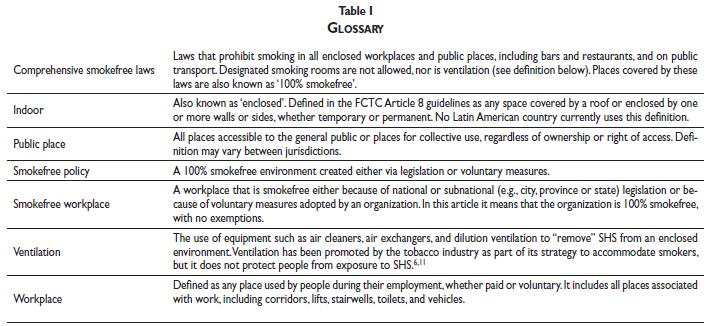
<body><![CDATA[<p><font face="Verdana" size="2">Am&eacute;rica Latina est&aacute; a la vanguardia    del movimiento en favor de lugares de trabajo libres de humo de tabaco. Se han    implementado leyes integrales de ambientes libres de humo en cuatro pa&iacute;ses,    y en muchas ciudades, estados y provincias. Gracias a la implementaci&oacute;n    de estas pol&iacute;ticas, m&aacute;s de 130 millones de personas en Am&eacute;rica    Latina est&aacute;n ahora protegidas del humo de tabaco ajeno. Sin embargo,    existen varios desaf&iacute;os para un continuo progreso en la implementaci&oacute;n    de lugares de trabajo libres de humo de tabaco. A partir de una encuesta realizada    con activistas y funcionarios gubernamentales de Am&eacute;rica Latina, se indentificaron    los siguientes desaf&iacute;os principales: necesidad de adoptar programas voluntarios    en los lugares del trabajo cuando no exista legislaci&oacute;n; legislaci&oacute;n    d&eacute;bil o falta de leyes nacionales integrales de ambientes libres de humo    de tabaco; intentos de la industria tabacalera por dificultar el progreso de    las leyes de ambientes libres de humo o anular leyes existentes a trav&eacute;s    del litigio; falta de cumplimiento de las leyes; necesidad de monitoreo y evaluaci&oacute;n    de las leyes de ambientes libres de humo; necesidad de utilizar m&aacute;s eficientemente    las campa&ntilde;as de medios masivos de comunicaci&oacute;n; y fortalecimiento    de la sociedad civil. No obstante, se ha alcanzado ya un gran progreso para    enfrentar estos desaf&iacute;os, particularmente a trav&eacute;s de colaboraciones    y el intercambio de experiencias entre los pa&iacute;ses latinoamericanos.</font></p>     <p><font face="Verdana" size="2"><b>Palabras clave:</b> pol&iacute;ticas p&uacute;blicas;    legislaci&oacute;n; contaminaci&oacute;n por humo de tabaco; industria del tabaco;    organizaciones no gubernamentales; campa&ntilde;as para el control del tabaco</font></p> <hr size="1" noshade>     <p>&nbsp;</p>     <p>&nbsp;</p>     <p><font face="Verdana" size="2">The evidence on the adverse health effects of    secondhand tobacco smoke (SHS) is conclusive1-3 and considerable progress has    been made to protect people from it.4-6 More than 30 countries have enacted    or implemented comprehensive smokefree laws, (see Table 1 for definitions of    terms), and more than 60 countries around the world are planning to adopt them.    In the absence of national legislation, many sub-national jurisdictions have    introduced comprehensive smokefree laws.7 In 2008 alone, almost 160 million    people became newly protected by smokefree laws.6 This ongoing success has been    guided by the World Health Organization Framework Convention on Tobacco Control    (WHO FCTC) which by 5 August 2010 had been ratified by 168 countries, covering    almost 90% of the world's population. All countries in Latin America have ratified    the WHO FCTC except for Argentina, Cuba, Dominican Republic, El Salvador, and    Haiti.8</font></p>     <p><font face="Verdana" size="2"> Article 8 of the WHO FCTC commits governments    to protecting their citizens from exposure to SHS in indoor workplaces, indoor    public places, public transport and, as appropriate, other public places (including    outdoor public places). All such places must be 100% smokefree (no exemptions),    without designated smoking areas or special ventilation or air filtration that    the tobacco industry promotes, but which does not fully protect workers or the    public from SHS exposure. The core principles of Article 8 implementation guidelines    include the following: there is no safe level of exposure to SHS; all people    must be protected from SHS; legislation is needed and should be enforced, monitored,    and evaluated using adequate resources; civil society should partner with governments    to ensure effective implementation; and smokefree laws should be strengthened,    if needed.9,10</font></p>     <p><font face="Verdana" size="2">Article 8 defines a workplace as any place used    by people during their employment or work (including voluntary work). Places    attached to the workplace, such as corridors and lifts, are included, as are    vehicles used for work (<a href="/img/revistas/spm/v52s2/a29tab01.jpg">Table    I</a>). Comprehensive smokefree laws have led to reductions in SHS exposure    of up to 90%.6 A recent Institute of Medicine (IOM) report concluded that smoking    bans reduce the incidence of heart attacks and save lives.3 Furthermore, smokefree    workplaces can reduce the number of smokers by up to 4% and reduce overall consumption    by up to 29%.12</font></p>     <p><font face="Verdana" size="2"> Latin America is at the forefront of global    progress in smokefree public places and workplaces.13 Four countries have implemented    comprehensive national smokefree laws - Uruguay (decree in 2006, made law in    2008), Panama (2008), Colombia (decree in 2008, made law in 2009), and Guatemala    (2009). In the absence of comprehensive national laws, progress has also been    made at the sub-national level in states and large cities in Argentina, Brazil,    Mexico, and Venezuela. As a result, more than 130 million people in Latin America    are now protected from SHS.4 In addition, Honduras, Paraguay, and Peru have    approved comprehensive smokefree national legislation that is expected to be    fully implemented in 2010 and 2011. Many other countries and sub-national jurisdictions    are working to introduce comprehensive smokefree laws, including Costa Rica,    Ecuador, and El Salvador.*</font></p>     <blockquote>       <p><font face="Verdana" size="2">* Personal communication Eduardo Bianco, Framework      Convention Alliance, and Dora Oliva, IAHF.</font></p>       ]]></body>
<body><![CDATA[<p>&nbsp;</p> </blockquote>     <p><font face="Verdana" size="2"> Progress is being made with smokefree workplaces,    not only because of smokefree laws. For example, several large companies, such    as Dupont, General Electric, and Pfizer, have implemented smokefree workplaces    in Latin America;14 NGOs in several countries are working with small to medium-sized    companies to adopt voluntary smokefree policies; and governments, for example    in Argentina, Brazil, and Costa Rica, have been encouraging workplaces to become    smokefree.*,13 This article aims to identify and discuss challenges to continued    progress with smokefree workplaces.</font></p>     <blockquote>       <p><font face="Verdana" size="2">* Personal communication Adriana Carvalho,      Alian&ccedil;a de Controle do Tabagismo, Brazil.</font></p> </blockquote>     <p>&nbsp;</p>     <p><font face="Verdana" size="3"><b>Identifying the challenges </b></font></p>     <p><font face="Verdana" size="2">The Global Smokefree Partnership (GSP) conducted    a survey between January and March 2010 to identify the challenges in implementing    smokefree workplaces in Latin America. It consisted primarily of personal communication    with key contacts representing 16 countries in Latin America. The majority are    tobacco control advocates working for national or international NGOs, but they    also included representatives of the Ministries of Health in some countries,    university staff, journalists, and a Restaurant and Bar Association. Brief e-mail    questionnaires were sent to 39 contacts. Thirty four provided feedback (several    of them also provided resources), and more than half were followed up with further    correspondence and/or phone calls because additional information was needed.    Key web sites and other resources were also consulted. Where possible, issues    specific to smokefree workplaces were identified, but the survey responses from    many countries addressed issues relating to smokefree workplaces and public    places as a whole. </font></p>     <p>&nbsp;</p>     <p><font face="Verdana" size="3"><b>Voluntary smokefree workplaces</b></font></p>     <p><font face="Verdana" size="2">In countries where there are currently no comprehensive    smokefree laws, or where laws exist in only some subnational jurisdictions,    NGOs are working with companies to implement smokefree workplaces on a voluntary    basis. In brief, companies are approached and encouraged to adopt a smokefree    workplace policy, they are provided with resources and training to become smokefree,    and the NGO and company develop a sustaining partnership to ensure that smokefree    status is maintained. In many cases, there is a formal certification process    for smokefree companies. Also cessation programs are often set up to accompany    a smokefree workplace policy.15</font></p>     ]]></body>
<body><![CDATA[<p><font face="Verdana" size="2"> In Costa Rica two members of the National Anti-tobacco    Network (RENATA) are active in this area.* The Institute for Alcohol and Drug    Dependence (IAFA) runs a national project that promotes the implementation of    smokefree private and public institutions, in order to protect the health of    workers, customers, and the public. It consists of outreach to companies, raising    awareness of the health effects of tobacco use, employee training, cessation    support, and a certification process. IAFA supervises and is actively involved    in the entire process. Certificates are only issued to workplaces that are 100%    smokefree inside and outside their buildings, including company vehicles wherever    they are located and employee vehicles once they enter company grounds.&#8225;    The Ministry of Health runs a similar program and has been certifying smokefree    workplaces since 2000. There has been an increased demand from private companies    and restaurants in the past two years, and most recently a football stadium    has become smokefree.Â§ In Argentina the National Registry of Smoke-free Institutions    and Companies was set up in 2004, and as of February 2010, a total of 868 companies    had been registered smokefree, the majority of them having 100 or fewer employees.#    Alian&ccedil;a de Controle de Tabagismo (ACT) in Brazil has worked with local    public attorneys in states without smokefree laws to ensure that employers implement    smokefree workplaces, as the latter are legally obliged to provide a healthy    workplace.&amp; In Paraguay the NGO Vida Saludable is working to promote smokefree    universities and hospitals,â‰  and in Honduras a project was funded by the Pan    American Health Organization (PAHO) to make the National University of Honduras    smokefree.&#8734; </font></p>     <blockquote>       <p><font face="Verdana" size="2">* Personal communication Frederico Paredes,      Proteccion y Mejoramiento del Habitat Humano, Ministerio de Salud de Costa      Rica.    <br>     &#129;&ouml; Personal communication Teresita Arrieta Araya, Programa Espacios      Libres de Humo de Tabaco, Instituto Sobre Alcoholismo y Farmacodependencia,      Costa Rica.    <br>     &#129;&#152; Personal communication Olga Barrantes Romero, Coordinadora Programa      Espacios Libres de Humo de Tabaco, Ministerio de Salud de Costa Rica.    <br>     # Personal communication Paola Morello, National Registry of Smoke-free Institutions      and Companies in Argentina.    <br>     &amp; Personal communication Adriana Carvalho, Alianca de Controle do Tabagismo,      Brazil.    <br>     &#129;&#130; Personal communication Mirtha Casco, Vida Saludable, Paraguay.    <br>     &#129;&#135; Personal communication Ana Maria Pon de Tavarone, Honduran Alliance      for Tobacco Control.</font></p>       <p>&nbsp;</p> </blockquote>     ]]></body>
<body><![CDATA[<p><font face="Verdana" size="2"> Smokefree workplace policies and laws tend to    apply to the public arena only, but this does not address the fact that for    many women in low-income communities, their primary workplace is their home.    It includes paid and unpaid work, such preparing food for their families and    for sale, and caring for family health. Women who work outside the home tend    to work as housekeepers and childminders in other people's homes. A project    by Fundaci&oacute;n Educaci&oacute;n Popular en Salud (EPES) in Chile aimed    to address this challenge by working with women from community organizations    to educate them on the need to create smokefree workplaces for women.* </font></p>     <blockquote>       <p><font face="Verdana" size="2">* Personal communication Lezak Shallat, Fundacion      EPES, Chile.</font></p>       <p>&nbsp;</p> </blockquote>     <p><font face="Verdana" size="2"> The American Cancer Society (ACS) has held workshops    for tobacco control advocates interested in assisting businesses becoming smokefree.    The most recent - 'Building and Sustaining Relationships with Companies for    Smokefree Success' - took place in 2009 and included 15 Latin American tobacco    control advocates.16 The workshops have identified the following challenges    to implementing smokefree workplaces: a lack of time and/or interest on behalf    of the companies to discuss smokefree workplaces and a lack of appreciation    of the benefits that smokefree workplaces provide; companies' belief that smokers'    rights will be violated, leading them to suggest smoking areas to accommodate    smokers; companies' lack of understanding of the health effects of SHS and belief    that ventilation is a solution; and businesses' fear that a smokefree policy    will lead to economic losses in bars, restaurants, and other hospitality businesses.16    Challenges can also be encountered if the NGO does not have a history of working    with the company and, therefore, there is a lack of trust or if a major decision    maker within a company does not feel that it is a priority for the company to    become smokefree. These challenges can be overcome if NGOs prepare themselves    for resistance from companies and equip themselves with data to support their    arguments, such as the health benefits of smokefree workplaces and the cost-effectiveness    and successes of other smokefree companies. </font></p>     <p><font face="Verdana" size="2"> Key lessons learned from smokefree workplace    programs are: the importance of planning activities to suit the context and    needs of each company; the need for flexibility and creativity when approaching    senior management in a company and when implementing the policy; and the importance    of framing the smokefree strategy in the context of a healthy workplace.15</font></p>     <p><font face="Verdana" size="2"> ACS has produced several resources for tobacco    control advocates working on voluntary smokefree workplace programs, including    "Smokefree-in-a-Box: A Guide for Companies Going Smokefree," which is available    in Chinese, English, French, Portuguese, and Spanish.17</font></p>     <p>&nbsp;</p>     <p><font face="Verdana" size="3"><b>Compliance, enforcement, and monitoring</b></font></p>     <p><font face="Verdana" size="2">When comprehensive smokefree laws are passed,    a major challenge for governments and tobacco control advocates is to ensure    that they are properly enforced in order to maintain high compliance. An important    example of this is in Mexico, where the Mexico City and Mexico federal smokefree    laws have been successful overall. However, there have been ongoing challenges    in getting businesses to comply, particularly in bars.18-20 In response to compliance    problems, smokefree workplace programs have been set up, similar to those described    in the 'Voluntary smokefree workplaces' section above. The School of Law at    La Salle University ran an ACS-funded training program to enable the creation    of smokefree workplaces in the State of Guanajuato.*</font></p>     ]]></body>
<body><![CDATA[<p><font face="Verdana" size="2"> The Healthy Workplaces Project, set up by the    Consejo Mexicano Contra el Tabaquismo (CMCT) and the Instituto Nacional de Salud    P&uacute;blica (INSP), was implemented in 2009 and certified smokefree workplaces    in 65 companies, schools, and health institutions in Mexico City, Cuernavaca,    Guadalajara, and Monterrey. A key feature of the program is the training of    three promoters per institution who work with their colleagues to ensure that    the smokefree workplace continues after the project is completed.21 The main    obstacle to implementation was companies' lack of time and/or interest in joining    the program. They believed they already had effective smokefree policies and    did not appreciate the benefits of receiving certification. Some wanted to avoid    confrontation with their employees who smoke. Companies that were receptive    to the program mentioned motives such as having a healthier workforce or a cleaner    workplace.&#8225;</font></p>     <blockquote>       <p><font face="Verdana" size="2">* Personal communication Karen Garc&iacute;a,      Co-ordinator Academic Program on Tobacco Control, La Salle University, Mexico.    <br>     &#135; Personal communication M&oacute;nica Casar, Consejo Mexicano Contra      el Tabaquismo, Mexico.</font></p>       <p>&nbsp;</p> </blockquote>     <p><font face="Verdana" size="2"> In countries such as Panama, where the government    allocated only limited resources to promote the comprehensive smokefree law    to the public, tobacco control advocates should be prepared to launch public    education campaigns to build support for the law and help ensure compliance    with it. Advocates should consider conducting targeted outreach to businesses    to help them understand the steps they need to take to be in compliance with    the law, for example, display 'No smoking' signs, remove ashtrays, take action    against individuals not complying with the law, and make sure that tobacco is    not sold on-site. </font></p>     <p><font face="Verdana" size="2"> Monitoring and evaluating the effects of smokefree    laws can be a key challenge for newly smokefree countries and sub-national jurisdictions.    Uruguay has conducted several studies that could be replicated in other countries.    Through studies on air quality monitoring, the Tobacco Epidemic Research Center    (CIET) in Uruguay has found that workplace levels of tobacco smoke decreased    by 90% after the introduction of the smoking ban. It also completed a study    on the effect of the smoking ban on hospital admissions for heart attacks.*    Furthermore, studies have explored public opinion on the health benefits of    the smokefree law, the public acceptance of the law, and the extent of violations.    One study showed that, compared with Mexican smokers, who at the time did not    have a national smokefree law, a much higher percentage of Uruguayan smokers    reported smokefree policies in their enclosed workplaces and in restaurants    near their homes, reinforcing the effectiveness of comprehensive laws.22 Lastly,    CIET has carried out economic impact studies showing no harm to business. The    results of these studies can be shown to policy makers and business owners alike    to inform them of the positive impact of smokefree laws and counteract efforts    from the tobacco industry to overturn or weaken the laws.</font></p>     <p>&nbsp;</p>     <p><font face="Verdana" size="3"><b>Mass media campaigns</b></font></p>     <p><font face="Verdana" size="2">Mass media campaigns are an essential part of    smokefree policies, as they help build public awareness of the health effects    of SHS and the importance of these policies in reducing SHS exposure.23 Both    paid mass media (e.g., campaign ads aired on television and radio) and earned    media (e.g., newspaper articles and television talk shows) can build public    support for smokefree laws prior to their implementation and help ensure their    successful implementation.24,&#8225; For example, mass media campaigns in Mexico    City, notably the "Porque todos respiramos el mismo aire" (Because    we all breathe the same air) and the "Se respira respeto" (Breathing    respect) campaigns increased public support for smokefree workplaces and the    perception that workers have a right to smokefree workplaces.&#8225; Earned    media also was a key part of mass media campaigns in Mexico City, with advocates    participating in television and radio debates, writing opinion pieces to counter    negative arguments, and framing the need for smokefree laws in terms of public    health.25 A content-analysis study of articles published in 2007 in Mexican    newspapers in advance of smokefree legislation found that the majority of them    (90%) were either in favor of the law or neutral.26</font></p>     ]]></body>
<body><![CDATA[<blockquote>       <p><font face="Verdana" size="2">* Personal communication Eduardo Bianco, Framework      Convention Alliance.    <br>     &#135; Thrasher J, Huang L-H, P&eacute;rez-Hernandez R, Niederdeppe J, Arillo-Santill&aacute;n      E, Alday J. Porque todos respiramos lo mismo: evaluation of a social marketing      campaign to support Mexico City&#146;s comprehensive smoke-free law. In press.</font></p>       <p>&nbsp;</p> </blockquote>     <p><font face="Verdana" size="2"> Other Latin American countries have also used    mass media to promote smokefree policies. The main NGO in Panama, the Coalition    Against Tobacco Panama (COPACET), was able to work with contacts in the media    to generate free publicity for the national smokefree law.* Mass media campaigns    in Uruguay have helped to make its smokefree laws effective. The campaigns provided    smokers and non-smokers with arguments in favor of smokefree laws that did not    stigmatize smokers.22 In Brazil ACT organized successful mass media campaigns    supporting smokefree laws in S&atilde;o Paulo and Rio de Janeiro. For example, the    S&atilde;o Paulo campaign included 15-minute videos featuring celebrities from the    fields of sport, medicine, and television. While paid media often requires resources,    tobacco control advocates in Latin America can use earned media strategies with    little to no resource expenditure.</font></p>     <p>&nbsp;</p>     <p><font face="Verdana" size="3"><b>Legislation</b></font></p>     <p><font face="Verdana" size="2">Weak laws, lack of comprehensive national smokefree    laws, and litigation against smokefree air in the legislative process and after    implementation are the main challenges to effective smokefree implementation.    </font></p>     <p><font face="Verdana" size="2"> Tobacco control advocates in countries that    have weak smokefree laws face a particular challenge in urging workplaces to    implement and enforce comprehensive smokefree policies. For instance in Chile,    workplaces with fewer than 10 employees are exempt from the smokefree law, and    restaurants and bars of less than 100m2 have the option to allow smoking.4 Business    owners may be reluctant to implement a smokefree policy that goes beyond this    legislation, for fear of having to compete with businesses that do not have    comprehensive smokefree policies in place. </font></p>     <p><font face="Verdana" size="2"> Reaching out to and educating bar and restaurant    associations has been successful in debunking their misconceptions around the    impact of smokefree legislation and circumventing their efforts to oppose it.    Once properly informed, bar and restaurant associations can be an ally for smokefree    legislation. For example, the support of the bar employers association (i.e.,    ASOBARES) was critical to the adoption of Colombia's smokefree legislation.&#8225;    A Mexico City restaurateur group (i.e., CANIRAC) supported comprehensive smokefree    legislation, as it felt that weaker legislation allowing designated smoking    rooms was unfair on small business owners who could not afford to install them.25</font></p>     ]]></body>
<body><![CDATA[<blockquote>       <p><font face="Verdana" size="2">* Personal communication Reina Roa, COPACET,      Panama.    <br>     &#135; Personal communication Eduardo Bianco, Framework Convention Alliance;      Marina Carter, Campaign for Tobacco-Free Kids; Camilo Ospina, ASOBARES, Colombia.</font></p>       <p>&nbsp;</p> </blockquote>     <p><font face="Verdana" size="2"> There have been a number of positive movements    in smokefree air in Latin America. Many countries with weak smokefree laws,    such as Costa Rica and Ecuador, are starting to work towards comprehensive tobacco    control legislation,* and tobacco control advocates in Latin American countries    with a federal system of government have responded to the lack of national smokefree    legislation by introducing comprehensive legislation in sub-national jurisdictions,    one-by-one. This local approach has been successful; the province of Santa Fe    in Argentina, which became smokefree in 2005 has since been followed by seven    provinces and more than 20 municipalities;27,28 the states of S&atilde;o Paulo,    Rio de Janeiro, Para&iacute;ba, and Paran&aacute;, as well as some cities, in    Brazil;29 Mexico City and the State of Tabasco in Mexico; and the state of Monagas    in Venezuela. The success of Mexico City's smokefree law was helped by having    a clear strategy for compliance with the law and a willingness to enforce it.    Regulations were enacted quickly and public sector buildings were smokefree    in order to 'lead by example'. Parallel discussions of the national and city    laws were mutually reinforcing.30 This and the Latin American experience in    general reinforces how, as in Australia, Canada, and the United States, sub-national    smokefree laws can sometimes be easier to develop and implement than national    ones.27</font></p>     <blockquote>       <p><font face="Verdana" size="2">* Personal communication Eduardo Bianco, Framework      Convention Alliance and Dora Oliva, IAHF.</font></p>       <p>&nbsp;</p> </blockquote>     <p><font face="Verdana" size="2"> The success of smokefree workplaces and other    public places in Colombia, Guatemala, Panama, and Uruguay, as well as cities    such as Mexico City, is underpinned by comprehensive legislation. Laws that    are well drafted with clear definitions are easier to implement and enforce    and less likely to be challenged legally, than weak laws with exemptions. They    also create a 'level playing field'.</font></p>     <p>&nbsp;</p>     ]]></body>
<body><![CDATA[<p><font face="Verdana" size="3"><b>Tobacco industry interference</b></font></p>     <p><font face="Verdana" size="2">Latin America is an important market for the    tobacco industry, and internal tobacco industry documents have revealed a wide    variety of tactics used by tobacco companies in order to prevent effective smokefree    legislation since the early 1990s.4 They hired consultants, funded research,    organized "scientific" meetings, lobbied the media, and influenced policy    development. The Environmental Tobacco Smoke (ETS) Consultant Program recruited    well-known scientists and doctors in Latin America to "keep the controversy    alive" on SHS and promote the industry's viewpoint. In Argentina in 1992    the industry was successful in having an anti-tobacco law vetoed by the President.31,32</font></p>     <p><font face="Verdana" size="2"> The promotion of weak models of legislation    has been a common strategy used by the tobacco industry. Philip Morris International    (PMI) has been promoting the weak Spanish smokefree law as a model for other    countries to follow. In 2008 it proposed amendments to Guatemala's smokefree    bill to "allow business property owners to provide smokers with comfortable    areas in which they can smoke".33 British American Tobacco (BAT) has pursued    similar strategies. In Mexico in 2006, before smokefree laws had been adopted,    it launched a corporate social responsibility campaign which portrayed SHS as    nuisance rather than a major health risk. As part of this campaign, it also    relaunched its "Convivencia en Armon&iacute;a" ("Living in Harmony") Program    as an alternative to a comprehensive smokefree law. It promoted "tolerance"    and "good manners" and the establishment of smoking designated areas. The    program targeted owners of hospitality businesses and presented itself as a    response to the "prohibitionist" extremism that could soon affect Mexico.34</font></p>     <p><font face="Verdana" size="2">The tobacco industry will often utilize various    strategies when seeking to undermine, overturn, or delay implementation of smokefree    legislation. For example, after comprehensive smokefree legislation was implemented    in Santa Fe, Argentina, the tobacco industry introduced a counter-proposal seeking    modification of the law, launched a media campaign, created a hospitality industry    association and a virtual smokers' rights group, supported a weak national    bill that would conflict with the strong sub-national law, and urged a local    cafeteria to file a lawsuit against the law, declaring that it was unconstitutional.    Tobacco control advocates countered these activities by mobilizing public opinion    and encouraging enforcement of the law, but there is still a suit pending in    the Supreme Court in Argentina, which questions the constitutionality of the    Santa Fe law.27</font></p>     <p><font face="Verdana" size="2"> Smokefree legislation in Brazil, Guatemala,    and Mexico has also been challenged under legal grounds. Brazil has experienced    delays in passing its national smokefree law4 and there are currently four lawsuits    in the federal courts from bar and restaurant associations challenging the smokefree    laws of Rio de Janeiro, S&atilde;o Paulo, and Paran&aacute;.* There have been    success stories, however. In Mexico the tobacco industry, through its allies,    brought a case before Mexico's Supreme Court, declaring that Mexico City smokefree    legislation was unconstitutional because it differed from the national law.    As a result of media interviews and advocacy by local tobacco control advocates,    the case was unsuccessful, and the Mexico City law was upheld.30 In Guatemala    a Chamber of Commerce challenged the national smokefree law, but the Supreme    Court ruled in favour of keeping the law.*</font></p>     <blockquote>       <p><font face="Verdana" size="2">* Personal communication Adriana Carvalho and      Paula Johns, Alian&ccedil;a de Controle do Tabagismo, Brazil.</font></p>       <p>&nbsp;</p> </blockquote>     <p><font face="Verdana" size="2"> While none of the legal challenges in Latin    America have succeeded thus far in overturning laws, tobacco control advocates,    governments, public health practitioners, and healthcare providers must remain    vigilant of tobacco industry strategies when planning and implementing comprehensive    smokefree laws and understand the legal mechanisms to defend smokefree laws.    Workshops for lawyers have been held in Central and South America in 2008 and    2009, and since then, a lawyers' network has been formed that will share information    and expertise across Latin America. It will allow lawyers to defend tobacco    control laws and FCTC implementation and pave the way for litigation.&#8225;</font></p>     <blockquote>       ]]></body>
<body><![CDATA[<p><font face="Verdana" size="2">* Personal communication Dora Oliva, IAHF,      Guatemala.    <br>     &#135; Personal communication Patricia Sosa, Campaign for Tobacco Free Kids.</font></p> </blockquote>     <p>&nbsp;</p>     <p><font face="Verdana" size="3"><b>Strengthening civil society </b></font></p>     <p><font face="Verdana" size="2">Civil society has a key role to play in the development,    implementation, and defense of smokefree workplaces.13 Tobacco control advocates    can influence the legislative process by highlighting the scientific evidence;    pre-empting and rebutting false claims by the tobacco industry aimed at weakening    and/or delaying legislation;35 exposing the strategies used by the industry;    and educating the media, governments, policy makers, and business leaders on    the benefits of smokefree workplaces and public places. In many parts of Latin    America civil society is weak and lacks the resources to bring about comprehensive    smokefree legislation.13 However, there are several resources and examples of    success that can help countries and sub-national jurisdictions in the region    to meet this challenge (see article by Champagne et al. on civil society organizations    in this issue).</font></p>     <p>&nbsp;</p>     <p><font face="Verdana" size="3"><b>Outlook</b></font></p>     <p><font face="Verdana" size="2">A tipping point has been reached in Latin America,    as more and more people are protected by comprehensive smokefree laws in their    workplaces and public places. Countries and sub-national jurisdictions with    successful smokefree laws serve as a model for other countries in the region    who have made less progress to date, and a culture of 'healthy competition'    exists between countries.* Civil society is playing an increasingly important    role in advocating, implementing, and monitoring smokefree legislation, and    also in organising voluntary smokefree workplace programs where smokefree laws    do not exist.4 Funding and other resources from international organisations    continue to be available, and regional activist networks are both expanding    and strengthening. </font></p>     <blockquote>       <p><font face="Verdana" size="2">* Personal communication Eduardo Bianco, Framework      Convention Alliance.</font></p>       ]]></body>
<body><![CDATA[<p>&nbsp;</p> </blockquote>     <p><font face="Verdana" size="2"> Although several challenges to implementing    smokefree workplaces have been discussed here, none is unique to Latin America,    and none appear to be insurmountable. The sharing of expertise and experience    across the region, the funding of civil society, and the commitment by governments    to implement the FCTC and legislate for smokefree workplaces and public places    will be critical to future progress. However, given the tremendous progress    made in the region since 2006, when the first Latin American country became    smokefree, and given the global momentum for smokefree workplaces and public    places, Latin America is well positioned to one day become 100% smokefree.</font></p>     <p>&nbsp;</p>     <p><font face="Verdana" size="3"><b>Acknowledgements</b></font></p>     <p><font face="Verdana" size="2">The Global Smokefree Partnership would like to    thank the many people working on tobacco control in Latin America and elsewhere    who contributed to the study. Dr Ernesto Sebri&eacute; was supported by the Flight    Attendant Medical Research Institute (FAMRI). </font></p>     <p><font face="Verdana" size="2"> Note: The Global Smokefree Partnership (GSP)    is a multipartner initiative formed to promote effective smokefree air policies    worldwide. GSP is coordinated by the American Cancer Society and the Framework    Convention Alliance and includes partner organizations from around the world.</font></p>     <p>&nbsp;</p>     <p><font face="Verdana" size="3"><b>Declaration of conflicts of interest</b></font></p>     <p><font face="Verdana" size="2">We declare that we have no conflicts of interest.</font></p>     <p>&nbsp;</p>     ]]></body>
<body><![CDATA[<p><font face="Verdana" size="3"><b>References</b></font></p>     <!-- ref --><p><font face="Verdana" size="2">1. Dept of Health and Human Services, Centers    for Disease Control and Prevention, National Centre for Chronic Disease Prevention    and Health Promotion, Office of Smoking and Health. The health consequences    of involuntary exposure to tobacco smoke: a report of the Surgeon General. Atlanta,    GA: Washington, DC: 2006.    &nbsp;&nbsp;&nbsp;&nbsp;&nbsp;&nbsp;&nbsp;&nbsp;[&#160;<a href="javascript:void(0);" onclick="javascript: window.open('/scielo.php?script=sci_nlinks&ref=9356627&pid=S0036-3634201000080003300001&lng=','','width=640,height=500,resizable=yes,scrollbars=1,menubar=yes,');">Links</a>&#160;]<!-- end-ref --></font></p>     <!-- ref --><p><font face="Verdana" size="2">2. International Agency for the Research on Cancer    (IARC). Monograph on the evaluation of carcinogenic risks to humans. Tobacco    smoking and tobacco smoke. Lyon, France: WHO, 2004;83.    &nbsp;&nbsp;&nbsp;&nbsp;&nbsp;&nbsp;&nbsp;&nbsp;[&#160;<a href="javascript:void(0);" onclick="javascript: window.open('/scielo.php?script=sci_nlinks&ref=9356629&pid=S0036-3634201000080003300002&lng=','','width=640,height=500,resizable=yes,scrollbars=1,menubar=yes,');">Links</a>&#160;]<!-- end-ref --> </font></p>     <!-- ref --><p><font face="Verdana" size="2">3. Institute of Medicine of the National Academies.    Secondhand smoke exposure and cardiovascular effects: making sense of the evidence.    Washington DC, 2009.    &nbsp;&nbsp;&nbsp;&nbsp;&nbsp;&nbsp;&nbsp;&nbsp;[&#160;<a href="javascript:void(0);" onclick="javascript: window.open('/scielo.php?script=sci_nlinks&ref=9356631&pid=S0036-3634201000080003300003&lng=','','width=640,height=500,resizable=yes,scrollbars=1,menubar=yes,');">Links</a>&#160;]<!-- end-ref --></font></p>     <!-- ref --><p><font face="Verdana" size="2">4. Global Smokefree Partnership. Global Voices    Report: Rebutting the Tobacco Industry, winning smokefree air, 2009 Status Report.    Accessed 2010 January. Available at: <a href="http://www.globalsmokefreepartnership.org/index.php?section=artigo&id=109" target="_blank">http://www.globalsmokefreepartnership.org/index.php?section=artigo&amp;id=109</a></font>&nbsp;&nbsp;&nbsp;&nbsp;&nbsp;&nbsp;&nbsp;&nbsp;[&#160;<a href="javascript:void(0);" onclick="javascript: window.open('/scielo.php?script=sci_nlinks&ref=9356633&pid=S0036-3634201000080003300004&lng=','','width=640,height=500,resizable=yes,scrollbars=1,menubar=yes,');">Links</a>&#160;]<!-- end-ref --><!-- ref --><p><font face="Verdana" size="2">5. Griffith G, Welch C, Cardone A, Valdemoro    A, Jo C. The global momentum for smokefree public places: best practice in current    and forthcoming smokefree policies. Salud Publica Mex. 2008;50(s3):s299-s308.    &nbsp;&nbsp;&nbsp;&nbsp;&nbsp;&nbsp;&nbsp;&nbsp;[&#160;<a href="javascript:void(0);" onclick="javascript: window.open('/scielo.php?script=sci_nlinks&ref=9356634&pid=S0036-3634201000080003300005&lng=','','width=640,height=500,resizable=yes,scrollbars=1,menubar=yes,');">Links</a>&#160;]<!-- end-ref --></font></p>     ]]></body>
<body><![CDATA[<!-- ref --><p><font face="Verdana" size="2">6. World Health Organization. WHO report on the    global tobacco epidemic, 2009. Implementing smokefree environments. Geneva:    WHO, 2009.    &nbsp;&nbsp;&nbsp;&nbsp;&nbsp;&nbsp;&nbsp;&nbsp;[&#160;<a href="javascript:void(0);" onclick="javascript: window.open('/scielo.php?script=sci_nlinks&ref=9356636&pid=S0036-3634201000080003300006&lng=','','width=640,height=500,resizable=yes,scrollbars=1,menubar=yes,');">Links</a>&#160;]<!-- end-ref --> </font></p>     <!-- ref --><p><font face="Verdana" size="2">7. Global Smokefree Partnership. Status report    on Article 8. (October 2008). Accessed 2010 January 25 Available at <a href="http://www.globalsmokefreepartnership.org/ficheiro/19article8report2.pdf" target="_blank">www.globalsmokefreepartnership.org/ficheiro/19article8report2.pdf</a></font>&nbsp;&nbsp;&nbsp;&nbsp;&nbsp;&nbsp;&nbsp;&nbsp;[&#160;<a href="javascript:void(0);" onclick="javascript: window.open('/scielo.php?script=sci_nlinks&ref=9356638&pid=S0036-3634201000080003300007&lng=','','width=640,height=500,resizable=yes,scrollbars=1,menubar=yes,');">Links</a>&#160;]<!-- end-ref --><!-- ref --><p><font face="Verdana" size="2">8. World Health Organization. The WHO Framework    Convention on Tobacco Control. Accessed 21 January 2010. Available at: <a href="http://www.who.int/fctc/en/" target="_blank">www.who.int/fctc/en/</a>.    &nbsp;&nbsp;&nbsp;&nbsp;&nbsp;&nbsp;&nbsp;&nbsp;[&#160;<a href="javascript:void(0);" onclick="javascript: window.open('/scielo.php?script=sci_nlinks&ref=9356639&pid=S0036-3634201000080003300008&lng=','','width=640,height=500,resizable=yes,scrollbars=1,menubar=yes,');">Links</a>&#160;]<!-- end-ref --></font></p>     <!-- ref --><p><font face="Verdana" size="2">9. World Health Organization. WHO FCTC Conference    of the Parties: COP 2, July 2007. Accessed 2010 January. Available at: <a href="http://apps.who.int/gb/fctc/PDF/cop2/FCTC_COP2_17P-en.pdf" target="_blank">http://apps.who.int/gb/fctc/PDF/cop2/FCTC_COP2_17P-en.pdf</a></font>&nbsp;&nbsp;&nbsp;&nbsp;&nbsp;&nbsp;&nbsp;&nbsp;[&#160;<a href="javascript:void(0);" onclick="javascript: window.open('/scielo.php?script=sci_nlinks&ref=9356641&pid=S0036-3634201000080003300009&lng=','','width=640,height=500,resizable=yes,scrollbars=1,menubar=yes,');">Links</a>&#160;]<!-- end-ref --><!-- ref --><p><font face="Verdana" size="2">10. Global Smokefree Partnership. Global Voices:    Working For Smokefree Air, 2008 Status Report. Accessed 2010 January. Available    at: <a href="http://www.globalsmokefreepartnership.org/resources/recurso.php?id=98" target="_blank">http://www.globalsmokefreepartnership.org/resources/recurso.php?id=98</a></font>&nbsp;&nbsp;&nbsp;&nbsp;&nbsp;&nbsp;&nbsp;&nbsp;[&#160;<a href="javascript:void(0);" onclick="javascript: window.open('/scielo.php?script=sci_nlinks&ref=9356642&pid=S0036-3634201000080003300010&lng=','','width=640,height=500,resizable=yes,scrollbars=1,menubar=yes,');">Links</a>&#160;]<!-- end-ref --><!-- ref --><p><font face="Verdana" size="2">11. Campaign For Tobacco-free Kids. Ventilation    technology does not protect people from secondhand tobacco smoke Fact sheet.    (2009). Accessed 2010 January Available at: <a href="http://www.tobaccofreekids.org/research/factsheets/pdf/0145.pdf" target="_blank">www.tobaccofreekids.org/research/factsheets/pdf/0145.pdf</a></font>&nbsp;&nbsp;&nbsp;&nbsp;&nbsp;&nbsp;&nbsp;&nbsp;[&#160;<a href="javascript:void(0);" onclick="javascript: window.open('/scielo.php?script=sci_nlinks&ref=9356643&pid=S0036-3634201000080003300011&lng=','','width=640,height=500,resizable=yes,scrollbars=1,menubar=yes,');">Links</a>&#160;]<!-- end-ref --><!-- ref --><p><font face="Verdana" size="2">12. Fichtenberg CM, Glantz SA. Effect of smoke-free    workplaces on smoking behaviour: systematic review. Br Med J 2002; 325:188.    &nbsp;&nbsp;&nbsp;&nbsp;&nbsp;&nbsp;&nbsp;&nbsp;[&#160;<a href="javascript:void(0);" onclick="javascript: window.open('/scielo.php?script=sci_nlinks&ref=9356644&pid=S0036-3634201000080003300012&lng=','','width=640,height=500,resizable=yes,scrollbars=1,menubar=yes,');">Links</a>&#160;]<!-- end-ref --></font></p>     ]]></body>
<body><![CDATA[<!-- ref --><p><font face="Verdana" size="2">13. Sebrie E, Schoj V, Glantz S. Smoke free environments    in Latin America: on the road to change? Prevention and Control 2008;3:21-35.    &nbsp;&nbsp;&nbsp;&nbsp;&nbsp;&nbsp;&nbsp;&nbsp;[&#160;<a href="javascript:void(0);" onclick="javascript: window.open('/scielo.php?script=sci_nlinks&ref=9356646&pid=S0036-3634201000080003300013&lng=','','width=640,height=500,resizable=yes,scrollbars=1,menubar=yes,');">Links</a>&#160;]<!-- end-ref --></font></p>     <!-- ref --><p><font face="Verdana" size="2">14. Curiel B. "Smoke Free Environment"; Gracia    H. "The Company's Perspective Panel"; Saenz J. "Certification as a Smoke-free    Building". Oral presentations at ACS pre-conference workshop: building and    maintaining relationships with companies for smoke-free success. 2nd SRNT Latin    America Conference on Tobacco Control. Mexico City, Mexico. 13-14 October 2009.    &nbsp;&nbsp;&nbsp;&nbsp;&nbsp;&nbsp;&nbsp;&nbsp;[&#160;<a href="javascript:void(0);" onclick="javascript: window.open('/scielo.php?script=sci_nlinks&ref=9356648&pid=S0036-3634201000080003300014&lng=','','width=640,height=500,resizable=yes,scrollbars=1,menubar=yes,');">Links</a>&#160;]<!-- end-ref --></font></p>     <!-- ref --><p><font face="Verdana" size="2">15. Jo C, Morello P. Building productive partnerships    with companies to build a culture of employee health. American Cancer Society    Factsheet, 2009.    &nbsp;&nbsp;&nbsp;&nbsp;&nbsp;&nbsp;&nbsp;&nbsp;[&#160;<a href="javascript:void(0);" onclick="javascript: window.open('/scielo.php?script=sci_nlinks&ref=9356650&pid=S0036-3634201000080003300015&lng=','','width=640,height=500,resizable=yes,scrollbars=1,menubar=yes,');">Links</a>&#160;]<!-- end-ref --></font></p>     <!-- ref --><p><font face="Verdana" size="2">16. American Cancer Society. ACS pre-conference    workshop: building and maintaining relationships with companies for smoke-free    success. 2nd SRNT Latin America Conference on Tobacco Control. Mexico City,    Mexico. 13-14 October 2009.    &nbsp;&nbsp;&nbsp;&nbsp;&nbsp;&nbsp;&nbsp;&nbsp;[&#160;<a href="javascript:void(0);" onclick="javascript: window.open('/scielo.php?script=sci_nlinks&ref=9356652&pid=S0036-3634201000080003300016&lng=','','width=640,height=500,resizable=yes,scrollbars=1,menubar=yes,');">Links</a>&#160;]<!-- end-ref --></font></p>     <!-- ref --><p><font face="Verdana" size="2">17. Global Smokefree Partnership. Smokefree-in-a-Box:    A Guide for Companies Going Smokefree. (2008). Accessed 2010 January. Available    at: <a href="http://www.globalsmokefreepartnership.org/index.php?section=artigo&id=125" target="_blank">http://www.globalsmokefreepartnership.org/index.php?section=artigo&amp;id=125</a></font>&nbsp;&nbsp;&nbsp;&nbsp;&nbsp;&nbsp;&nbsp;&nbsp;[&#160;<a href="javascript:void(0);" onclick="javascript: window.open('/scielo.php?script=sci_nlinks&ref=9356654&pid=S0036-3634201000080003300017&lng=','','width=640,height=500,resizable=yes,scrollbars=1,menubar=yes,');">Links</a>&#160;]<!-- end-ref --><!-- ref --><p><font face="Verdana" size="2">18. Thrasher J, Swayampakala K, Arillo-Sant&iacute;llan    E, Sebri&eacute; E, Walsemann K, Bottai M. Differential impact of local and federal    smokefree legislation in Mexico: a longitudinal study of campaign exposure,    support for smoke-free policies and secondhand smoke exposure among adult smokers.    Salud Publica Mex 2010;52(suppl 2):S242-S251.    &nbsp;&nbsp;&nbsp;&nbsp;&nbsp;&nbsp;&nbsp;&nbsp;[&#160;<a href="javascript:void(0);" onclick="javascript: window.open('/scielo.php?script=sci_nlinks&ref=9356655&pid=S0036-3634201000080003300018&lng=','','width=640,height=500,resizable=yes,scrollbars=1,menubar=yes,');">Links</a>&#160;]<!-- end-ref --></font></p>     <!-- ref --><p><font face="Verdana" size="2">19. Villalobos V, Ortiz-Ramirez O, Thrasher J,    Arillo-Santill&aacute;n E, P&eacute;rez-Hern&aacute;ndez R, Cedillo C. Mercadotecnia social para    promover pol&iacute;ticas p&uacute;blicas de salud: El desarrollo de una campa&ntilde;a para promover    la norma social de no fumar en restaurantes y bares del Distrito Federal, M&eacute;xico.    Salud Publica Mex 2010;52(suppl 2):S127-S135.    &nbsp;&nbsp;&nbsp;&nbsp;&nbsp;&nbsp;&nbsp;&nbsp;[&#160;<a href="javascript:void(0);" onclick="javascript: window.open('/scielo.php?script=sci_nlinks&ref=9356657&pid=S0036-3634201000080003300019&lng=','','width=640,height=500,resizable=yes,scrollbars=1,menubar=yes,');">Links</a>&#160;]<!-- end-ref --></font></p>     <!-- ref --><p><font face="Verdana" size="2">20. Thrasher J, P&eacute;rez-Hern&aacute;ndez R, Swayampakala    K, Arillo-Santillan E, Bottai M. Translating the World Health Organization's    Framework Convention on Tobacco Control: Policy support, norms, and secondhand    smoke exposure before and after implementation of a comprehensive smoke-free    policy in Mexico City. Am J Pub Health. Epub 2010 May 13.    &nbsp;&nbsp;&nbsp;&nbsp;&nbsp;&nbsp;&nbsp;&nbsp;[&#160;<a href="javascript:void(0);" onclick="javascript: window.open('/scielo.php?script=sci_nlinks&ref=9356659&pid=S0036-3634201000080003300020&lng=','','width=640,height=500,resizable=yes,scrollbars=1,menubar=yes,');">Links</a>&#160;]<!-- end-ref --></font></p>     <!-- ref --><p><font face="Verdana" size="2">21. Reynales LM. "Proyecto: Lugares de trabajo    100% libres de humo de tabaco". Oral presentation at ACS pre-conference workshop:    building and maintaining relationships with companies for smoke-free success.    2nd SRNT Latin America Conference on Tobacco Control. Mexico City, Mexico. 13-14    October 2009.    &nbsp;&nbsp;&nbsp;&nbsp;&nbsp;&nbsp;&nbsp;&nbsp;[&#160;<a href="javascript:void(0);" onclick="javascript: window.open('/scielo.php?script=sci_nlinks&ref=9356661&pid=S0036-3634201000080003300021&lng=','','width=640,height=500,resizable=yes,scrollbars=1,menubar=yes,');">Links</a>&#160;]<!-- end-ref --></font></p>     <!-- ref --><p><font face="Verdana" size="2">22. Thrasher J, Boado M, Sebri&eacute; E, Bianco E.    Smokefree policies and the social acceptability of smoking in Uruguay and Mexico:    findings from the International Tobacco Control Policy Evaluation Project. Nicotine    Tob Res 2009; 11:591-599.    &nbsp;&nbsp;&nbsp;&nbsp;&nbsp;&nbsp;&nbsp;&nbsp;[&#160;<a href="javascript:void(0);" onclick="javascript: window.open('/scielo.php?script=sci_nlinks&ref=9356663&pid=S0036-3634201000080003300022&lng=','','width=640,height=500,resizable=yes,scrollbars=1,menubar=yes,');">Links</a>&#160;]<!-- end-ref --></font></p>     <!-- ref --><p><font face="Verdana" size="2">23. The Union. Mass media campaigns: Factsheet    5 Fact sheet. Accessed 2010 January 26. Available at: <a href="http://www.tobaccofreeunion.org/content/en/12/5.-Mass-media-campaigns" target="_blank">www.tobaccofreeunion.org/content/en/12/5.-Mass-media-campaigns</a></font>&nbsp;&nbsp;&nbsp;&nbsp;&nbsp;&nbsp;&nbsp;&nbsp;[&#160;<a href="javascript:void(0);" onclick="javascript: window.open('/scielo.php?script=sci_nlinks&ref=9356665&pid=S0036-3634201000080003300023&lng=','','width=640,height=500,resizable=yes,scrollbars=1,menubar=yes,');">Links</a>&#160;]<!-- end-ref --><!-- ref --><p><font face="Verdana" size="2">24. World Lung Foundation. Mass media tobacco    control resource. Accessed 2010 January. Available at: <a href="http://www.worldlungfoundation.org/" target="_blank">www.worldlungfoundation.org/</a>.    &nbsp;&nbsp;&nbsp;&nbsp;&nbsp;&nbsp;&nbsp;&nbsp;[&#160;<a href="javascript:void(0);" onclick="javascript: window.open('/scielo.php?script=sci_nlinks&ref=9356666&pid=S0036-3634201000080003300024&lng=','','width=640,height=500,resizable=yes,scrollbars=1,menubar=yes,');">Links</a>&#160;]<!-- end-ref --></font></p>     <!-- ref --><p><font face="Verdana" size="2">25. Gonz&aacute;lez-Roldan J. Abogac&iacute;a para el control    del tabaco en M&eacute;xico: retos y recomendaciones. Salud P&uacute;blica de M&eacute;xico 2008;50(Supp    3):S391-S400.    &nbsp;&nbsp;&nbsp;&nbsp;&nbsp;&nbsp;&nbsp;&nbsp;[&#160;<a href="javascript:void(0);" onclick="javascript: window.open('/scielo.php?script=sci_nlinks&ref=9356668&pid=S0036-3634201000080003300025&lng=','','width=640,height=500,resizable=yes,scrollbars=1,menubar=yes,');">Links</a>&#160;]<!-- end-ref --></font></p>     <!-- ref --><p><font face="Verdana" size="2">26. Llaguno-Aguilar SE, Dorantes-Alonso AC, Thrasher    J, Villalobos V, Besley J. An&aacute;lisis de la cobertura del tema de tabaco en medios    impresos mexicanos. Salud Publica Mex 2008;50(Supp 3):S348-S354.    &nbsp;&nbsp;&nbsp;&nbsp;&nbsp;&nbsp;&nbsp;&nbsp;[&#160;<a href="javascript:void(0);" onclick="javascript: window.open('/scielo.php?script=sci_nlinks&ref=9356670&pid=S0036-3634201000080003300026&lng=','','width=640,height=500,resizable=yes,scrollbars=1,menubar=yes,');">Links</a>&#160;]<!-- end-ref --></font></p>     <!-- ref --><p><font face="Verdana" size="2">27. Sebri&eacute; E, Glantz S. Local smokefree policy    development in Santa Fe, Argentina. Tob Control. 2010;19:110-116. doi:10.1136/tc.2009.030197.    &nbsp;&nbsp;&nbsp;&nbsp;&nbsp;&nbsp;&nbsp;&nbsp;[&#160;<a href="javascript:void(0);" onclick="javascript: window.open('/scielo.php?script=sci_nlinks&ref=9356672&pid=S0036-3634201000080003300027&lng=','','width=640,height=500,resizable=yes,scrollbars=1,menubar=yes,');">Links</a>&#160;]<!-- end-ref --></font></p>     <!-- ref --><p><font face="Verdana" size="2">28. Alianza Libre de Humo Argentina (ALIAR).    Newsletter December 2009. Accessed 2010 January. Available at: <a href="http://aliarargentina.wordpress.com/" target="_blank">http://aliarargentina.wordpress.com/</a>    (Spanish); <a href="http://aliarargentinaenglish.wordpress.com/" target="_blank">http://aliarargentinaenglish.wordpress.com/</a>    (English).    &nbsp;&nbsp;&nbsp;&nbsp;&nbsp;&nbsp;&nbsp;&nbsp;[&#160;<a href="javascript:void(0);" onclick="javascript: window.open('/scielo.php?script=sci_nlinks&ref=9356674&pid=S0036-3634201000080003300028&lng=','','width=640,height=500,resizable=yes,scrollbars=1,menubar=yes,');">Links</a>&#160;]<!-- end-ref --></font></p>     ]]></body>
<body><![CDATA[<!-- ref --><p><font face="Verdana" size="2">29. Alian&ccedil;a de Controle do Tabagismo,    Brazil. Accessed 2010 January 26. Available at: <a href="http://actbr.org.br/" target="_blank">http://actbr.org.br/</a>    and <a href="http://www.leiantifumo.sp.gov.br/" target="_blank">www.leiantifumo.sp.gov.br/</a>.    &nbsp;&nbsp;&nbsp;&nbsp;&nbsp;&nbsp;&nbsp;&nbsp;[&#160;<a href="javascript:void(0);" onclick="javascript: window.open('/scielo.php?script=sci_nlinks&ref=9356676&pid=S0036-3634201000080003300029&lng=','','width=640,height=500,resizable=yes,scrollbars=1,menubar=yes,');">Links</a>&#160;]<!-- end-ref --></font></p>     <!-- ref --><p><font face="Verdana" size="2">30. The Union. Smokefree Mexico City Case Study.    Tobacco control case study. Accessed 27 January 2010. Available at: <a href="http://www.tobaccofreeunion.org/content/en/229/" target="_blank">www.tobaccofreeunion.org/content/en/229/</a>    .    &nbsp;&nbsp;&nbsp;&nbsp;&nbsp;&nbsp;&nbsp;&nbsp;[&#160;<a href="javascript:void(0);" onclick="javascript: window.open('/scielo.php?script=sci_nlinks&ref=9356678&pid=S0036-3634201000080003300030&lng=','','width=640,height=500,resizable=yes,scrollbars=1,menubar=yes,');">Links</a>&#160;]<!-- end-ref --></font></p>     <!-- ref --><p><font face="Verdana" size="2">31. Barnoya J, Glantz S. Tobacco industry success    in preventing regulation of secondhand smoke in Latin America: the "Latin    Project". Tob Control 2002;11:305-14.    &nbsp;&nbsp;&nbsp;&nbsp;&nbsp;&nbsp;&nbsp;&nbsp;[&#160;<a href="javascript:void(0);" onclick="javascript: window.open('/scielo.php?script=sci_nlinks&ref=9356680&pid=S0036-3634201000080003300031&lng=','','width=640,height=500,resizable=yes,scrollbars=1,menubar=yes,');">Links</a>&#160;]<!-- end-ref --></font></p>     <!-- ref --><p><font face="Verdana" size="2">32. Sebrie E, Barnoya J, P&eacute;rez-Stable E, Glantz    S.Tobacco industry successfully prevented tobacco control legislation in Argentina.    Tobacco Control, 2005;14(5)e2.    &nbsp;&nbsp;&nbsp;&nbsp;&nbsp;&nbsp;&nbsp;&nbsp;[&#160;<a href="javascript:void(0);" onclick="javascript: window.open('/scielo.php?script=sci_nlinks&ref=9356682&pid=S0036-3634201000080003300032&lng=','','width=640,height=500,resizable=yes,scrollbars=1,menubar=yes,');">Links</a>&#160;]<!-- end-ref --></font></p>     <!-- ref --><p><font face="Verdana" size="2">33. Muggli M, Lockhart N, Ebbert O, Jiim&eacute;nez-Ruiz    C, Miranda J, Hurt R. Legislating tolerance: Spain's national public smoking    law. Tob Control 2009. Published online on 21 October 2009 doi:10.1136/tc.2009.031831.    &nbsp;&nbsp;&nbsp;&nbsp;&nbsp;&nbsp;&nbsp;&nbsp;[&#160;<a href="javascript:void(0);" onclick="javascript: window.open('/scielo.php?script=sci_nlinks&ref=9356684&pid=S0036-3634201000080003300033&lng=','','width=640,height=500,resizable=yes,scrollbars=1,menubar=yes,');">Links</a>&#160;]<!-- end-ref --></font></p>     ]]></body>
<body><![CDATA[<!-- ref --><p><font face="Verdana" size="2">34. Sebrie E, Glantz, S "Accommodating" smokefree    policies: tobacco industry's Courtesy of Choice program in Latin America.    Tob Control 2007;16(5):e6.    &nbsp;&nbsp;&nbsp;&nbsp;&nbsp;&nbsp;&nbsp;&nbsp;[&#160;<a href="javascript:void(0);" onclick="javascript: window.open('/scielo.php?script=sci_nlinks&ref=9356686&pid=S0036-3634201000080003300034&lng=','','width=640,height=500,resizable=yes,scrollbars=1,menubar=yes,');">Links</a>&#160;]<!-- end-ref --></font></p>     <!-- ref --><p><font face="Verdana" size="2">35. Thrasher J, Reynales-Shigematsu L, Baezconde-Garbanati    L, Villalobos V, T&eacute;llez-Gir&oacute;n P, Arillo-Santill&aacute;n E, et    al. Promoting the effective translation of the Framework Convention on Tobacco    Control: A case study of challenges and opportunities for strategic communications    in Mexico. Evaluation and the Health Professions 2008;31:145-166.    &nbsp;&nbsp;&nbsp;&nbsp;&nbsp;&nbsp;&nbsp;&nbsp;[&#160;<a href="javascript:void(0);" onclick="javascript: window.open('/scielo.php?script=sci_nlinks&ref=9356688&pid=S0036-3634201000080003300035&lng=','','width=640,height=500,resizable=yes,scrollbars=1,menubar=yes,');">Links</a>&#160;]<!-- end-ref --></font></p>     <p>&nbsp;</p>     <p>&nbsp;</p>     <p><font face="Verdana" size="2">Received on: March 22, 2010    <br>   Accepted on: April 28, 2010</font></p>     <p>&nbsp;</p>     <p><font face="Verdana" size="2">    ]]></body>
<body><![CDATA[<br>   Address reprint requests to: Ami Valdemoro. Global Smokefree Partnership. 901    E Street NW Suite 500. Washington, DC 20004.    <br>   E-mail: <a href="mailto:ami.valdemoro@cancer.org">Ami.Valdemoro@cancer.org</a></font></p>      ]]></body><back>
<ref-list>
<ref id="B1">
<label>1</label><nlm-citation citation-type="">
<collab>Dept of Health and Human Services^dCenters for Disease Control and Prevention, National Centre for Chronic Disease Prevention and Health Promotion, Office of Smoking and Health</collab>
<source><![CDATA[The health consequences of involuntary exposure to tobacco smoke: a report of the Surgeon General]]></source>
<year>2006</year>
<publisher-loc><![CDATA[Atlanta^eGAWashington^eDC GADC]]></publisher-loc>
</nlm-citation>
</ref>
<ref id="B2">
<label>2</label><nlm-citation citation-type="book">
<collab>International Agency for the Research on Cancer</collab>
<source><![CDATA[Monograph on the evaluation of carcinogenic risks to humans.Tobacco smoking and tobacco smoke. Lyon,]]></source>
<year>2004</year>
<publisher-loc><![CDATA[France ]]></publisher-loc>
<publisher-name><![CDATA[WHO]]></publisher-name>
</nlm-citation>
</ref>
<ref id="B3">
<label>3</label><nlm-citation citation-type="">
<collab>Institute of Medicine of the National Academies</collab>
<source><![CDATA[Secondhand smoke exposure and cardiovascular effects: making sense of the evidence]]></source>
<year>2009</year>
<publisher-loc><![CDATA[Washington^eDC DC]]></publisher-loc>
</nlm-citation>
</ref>
<ref id="B4">
<label>4</label><nlm-citation citation-type="">
<collab>Global Smokefree Partnership</collab>
<source><![CDATA[Global Voices Report: Rebutting the Tobacco Industry, winning smokefree air]]></source>
<year>2009</year>
</nlm-citation>
</ref>
<ref id="B5">
<label>5</label><nlm-citation citation-type="journal">
<person-group person-group-type="author">
<name>
<surname><![CDATA[Griffith]]></surname>
<given-names><![CDATA[G]]></given-names>
</name>
<name>
<surname><![CDATA[Welch]]></surname>
<given-names><![CDATA[C]]></given-names>
</name>
<name>
<surname><![CDATA[Cardone]]></surname>
<given-names><![CDATA[A]]></given-names>
</name>
<name>
<surname><![CDATA[Valdemoro]]></surname>
<given-names><![CDATA[A]]></given-names>
</name>
<name>
<surname><![CDATA[Jo]]></surname>
<given-names><![CDATA[C]]></given-names>
</name>
</person-group>
<article-title xml:lang="en"><![CDATA[The global momentum for smokefree public places: best practice in current and forthcoming smokefree policies]]></article-title>
<source><![CDATA[Salud Publica Mex]]></source>
<year>2008</year>
<volume>50</volume>
<numero>s3</numero>
<issue>s3</issue>
<page-range>s299-s308</page-range></nlm-citation>
</ref>
<ref id="B6">
<label>6</label><nlm-citation citation-type="book">
<collab>World Health Organization</collab>
<source><![CDATA[WHO report on the global tobacco epidemic, 2009.Implementing smokefree environments]]></source>
<year>2009</year>
<publisher-loc><![CDATA[Geneva ]]></publisher-loc>
<publisher-name><![CDATA[WHO]]></publisher-name>
</nlm-citation>
</ref>
<ref id="B7">
<label>7</label><nlm-citation citation-type="">
<collab>Global Smokefree Partnership</collab>
<source><![CDATA[Status report on Article 8]]></source>
<year>Octo</year>
<month>be</month>
<day>r </day>
</nlm-citation>
</ref>
<ref id="B8">
<label>8</label><nlm-citation citation-type="">
<collab>World Health Organization</collab>
<source><![CDATA[The WHO Framework Convention on Tobacco Control]]></source>
<year></year>
</nlm-citation>
</ref>
<ref id="B9">
<label>9</label><nlm-citation citation-type="">
<collab>World Health Organization</collab>
<source><![CDATA[WHO FCTC Conference of the Parties: COP 2]]></source>
<year>July</year>
<month> 2</month>
<day>00</day>
</nlm-citation>
</ref>
<ref id="B10">
<label>10</label><nlm-citation citation-type="">
<collab>Global Smokefree Partnership</collab>
<source><![CDATA[Global Voices: Working For Smokefree Air]]></source>
<year>2008</year>
</nlm-citation>
</ref>
<ref id="B11">
<label>11</label><nlm-citation citation-type="">
<collab>Campaign For Tobacco-free Kids</collab>
<source><![CDATA[Ventilation technology does not protect people from secondhand tobacco smoke]]></source>
<year>2009</year>
</nlm-citation>
</ref>
<ref id="B12">
<label>12</label><nlm-citation citation-type="journal">
<person-group person-group-type="author">
<name>
<surname><![CDATA[Fichtenberg]]></surname>
<given-names><![CDATA[CM]]></given-names>
</name>
<name>
<surname><![CDATA[Glantz]]></surname>
<given-names><![CDATA[SA]]></given-names>
</name>
</person-group>
<article-title xml:lang="en"><![CDATA[Effect of smoke-free workplaces on smoking behaviour: systematic review]]></article-title>
<source><![CDATA[Br Med J]]></source>
<year>2002</year>
<volume>325</volume>
<page-range>188</page-range></nlm-citation>
</ref>
<ref id="B13">
<label>13</label><nlm-citation citation-type="journal">
<person-group person-group-type="author">
<name>
<surname><![CDATA[Sebrie]]></surname>
<given-names><![CDATA[E]]></given-names>
</name>
<name>
<surname><![CDATA[Schoj]]></surname>
<given-names><![CDATA[V]]></given-names>
</name>
<name>
<surname><![CDATA[Glantz]]></surname>
<given-names><![CDATA[S]]></given-names>
</name>
</person-group>
<article-title xml:lang="en"><![CDATA[Smoke free environments in Latin America: on the road to change?]]></article-title>
<source><![CDATA[Prevention and Control]]></source>
<year>2008</year>
<volume>3</volume>
<page-range>21-35</page-range></nlm-citation>
</ref>
<ref id="B14">
<label>14</label><nlm-citation citation-type="confpro">
<person-group person-group-type="author">
<name>
<surname><![CDATA[Curiel]]></surname>
<given-names><![CDATA[B]]></given-names>
</name>
</person-group>
<source><![CDATA["Smoke Free Environment"?; Gracia H. "The Company's Perspective Panel"?; Saenz J. "Certification as a Smoke-free Building"?. Oral presentations at ACS pre-conference workshop: building and maintaining relationships with companies for smoke-free success]]></source>
<year></year>
<conf-name><![CDATA[2 Latin America Conference on Tobacco Control]]></conf-name>
<conf-date>13-14 October 2009</conf-date>
<conf-loc>Mexico City </conf-loc>
</nlm-citation>
</ref>
<ref id="B15">
<label>15</label><nlm-citation citation-type="journal">
<person-group person-group-type="author">
<name>
<surname><![CDATA[Jo]]></surname>
<given-names><![CDATA[C]]></given-names>
</name>
<name>
<surname><![CDATA[Morello]]></surname>
<given-names><![CDATA[P]]></given-names>
</name>
</person-group>
<article-title xml:lang="en"><![CDATA[Building productive partnerships with companies to build a culture of employee health]]></article-title>
<source><![CDATA[American Cancer Society Factsheet]]></source>
<year>2009</year>
</nlm-citation>
</ref>
<ref id="B16">
<label>16</label><nlm-citation citation-type="confpro">
<collab>American Cancer Society</collab>
<source><![CDATA[ACS pre-conference workshop: building and maintaining relationships with companies for smoke-free success]]></source>
<year></year>
<conf-name><![CDATA[2 Latin America Conference on Tobacco Control]]></conf-name>
<conf-date>13-14 October 2009</conf-date>
<conf-loc>Mexico City </conf-loc>
</nlm-citation>
</ref>
<ref id="B17">
<label>17</label><nlm-citation citation-type="">
<collab>Global Smokefree Partnership</collab>
<source><![CDATA[Smokefree-in-a-Box: A Guide for Companies Going Smokefree]]></source>
<year>2008</year>
</nlm-citation>
</ref>
<ref id="B18">
<label>18</label><nlm-citation citation-type="journal">
<person-group person-group-type="author">
<name>
<surname><![CDATA[Thrasher]]></surname>
<given-names><![CDATA[J]]></given-names>
</name>
<name>
<surname><![CDATA[Swayampakala]]></surname>
<given-names><![CDATA[K]]></given-names>
</name>
<name>
<surname><![CDATA[Arillo-Santíllan]]></surname>
<given-names><![CDATA[E]]></given-names>
</name>
<name>
<surname><![CDATA[Sebrié]]></surname>
<given-names><![CDATA[E]]></given-names>
</name>
<name>
<surname><![CDATA[Walsemann]]></surname>
<given-names><![CDATA[K]]></given-names>
</name>
<name>
<surname><![CDATA[Bottai]]></surname>
<given-names><![CDATA[M]]></given-names>
</name>
</person-group>
<article-title xml:lang="en"><![CDATA[Differential impact of local and federal smokefree legislation in Mexico: a longitudinal study of campaign exposure, support for smoke-free policies and secondhand smoke exposure among adult smokers]]></article-title>
<source><![CDATA[Salud Publica Mex]]></source>
<year>2010</year>
<volume>52</volume>
<numero>^s2</numero>
<issue>^s2</issue>
<supplement>2</supplement>
<page-range>S242-S251</page-range></nlm-citation>
</ref>
<ref id="B19">
<label>19</label><nlm-citation citation-type="journal">
<person-group person-group-type="author">
<name>
<surname><![CDATA[Villalobos]]></surname>
<given-names><![CDATA[V]]></given-names>
</name>
<name>
<surname><![CDATA[Ortiz-Ramirez]]></surname>
<given-names><![CDATA[O]]></given-names>
</name>
<name>
<surname><![CDATA[Thrasher]]></surname>
<given-names><![CDATA[J]]></given-names>
</name>
<name>
<surname><![CDATA[Arillo-Santillán]]></surname>
<given-names><![CDATA[E]]></given-names>
</name>
<name>
<surname><![CDATA[Pérez-Hernández]]></surname>
<given-names><![CDATA[R]]></given-names>
</name>
<name>
<surname><![CDATA[Cedillo]]></surname>
<given-names><![CDATA[C]]></given-names>
</name>
</person-group>
<article-title xml:lang="es"><![CDATA[Mercadotecnia social para promover políticas públicas de salud: El desarrollo de una campaña para promover la norma social de no fumar en restaurantes y bares del Distrito Federal, México]]></article-title>
<source><![CDATA[Salud Publica Mex]]></source>
<year>2010</year>
<volume>52</volume>
<numero>^s2</numero>
<issue>^s2</issue>
<supplement>2</supplement>
<page-range>S127-S135</page-range></nlm-citation>
</ref>
<ref id="B20">
<label>20</label><nlm-citation citation-type="journal">
<person-group person-group-type="author">
<name>
<surname><![CDATA[Thrasher]]></surname>
<given-names><![CDATA[J]]></given-names>
</name>
<name>
<surname><![CDATA[Pérez-Hernández]]></surname>
<given-names><![CDATA[R]]></given-names>
</name>
<name>
<surname><![CDATA[Swayampakala]]></surname>
<given-names><![CDATA[K]]></given-names>
</name>
<name>
<surname><![CDATA[Arillo-Santillan]]></surname>
<given-names><![CDATA[E]]></given-names>
</name>
<name>
<surname><![CDATA[Bottai]]></surname>
<given-names><![CDATA[M]]></given-names>
</name>
</person-group>
<article-title xml:lang="en"><![CDATA[Translating the World Health Organization's Framework Convention on Tobacco Control: Policy support, norms, and secondhand smoke exposure before and after implementation of a comprehensive smoke-free policy in Mexico City]]></article-title>
<source><![CDATA[Am J Pub Health]]></source>
<year>2010</year>
<month> M</month>
<day>ay</day>
</nlm-citation>
</ref>
<ref id="B21">
<label>21</label><nlm-citation citation-type="confpro">
<person-group person-group-type="author">
<name>
<surname><![CDATA[Reynales]]></surname>
<given-names><![CDATA[LM]]></given-names>
</name>
</person-group>
<source><![CDATA["Proyecto: Lugares de trabajo 100% libres de humo de tabaco"?: Oral presentation at ACS pre-conference workshop: building and maintaining relationships with companies for smoke-free success]]></source>
<year></year>
<conf-name><![CDATA[2 Latin America Conference on Tobacco Control]]></conf-name>
<conf-date>13-14 October 2009</conf-date>
<conf-loc>Mexico City </conf-loc>
</nlm-citation>
</ref>
<ref id="B22">
<label>22</label><nlm-citation citation-type="journal">
<person-group person-group-type="author">
<name>
<surname><![CDATA[Thrasher]]></surname>
<given-names><![CDATA[J]]></given-names>
</name>
<name>
<surname><![CDATA[Boado]]></surname>
<given-names><![CDATA[M]]></given-names>
</name>
<name>
<surname><![CDATA[Sebrié]]></surname>
<given-names><![CDATA[E]]></given-names>
</name>
<name>
<surname><![CDATA[Bianco]]></surname>
<given-names><![CDATA[E]]></given-names>
</name>
</person-group>
<article-title xml:lang="en"><![CDATA[Smokefree policies and the social acceptability of smoking in Uruguay and Mexico: findings from the International Tobacco Control Policy Evaluation Project]]></article-title>
<source><![CDATA[Nicotine Tob Res]]></source>
<year>2009</year>
<volume>11</volume>
<page-range>591-599</page-range></nlm-citation>
</ref>
<ref id="B23">
<label>23</label><nlm-citation citation-type="">
<source><![CDATA[The Union: Mass media campaigns: Factsheet 5]]></source>
<year></year>
</nlm-citation>
</ref>
<ref id="B24">
<label>24</label><nlm-citation citation-type="">
<collab>World Lung Foundation</collab>
<source><![CDATA[Mass media tobacco control resource]]></source>
<year></year>
</nlm-citation>
</ref>
<ref id="B25">
<label>25</label><nlm-citation citation-type="journal">
<person-group person-group-type="author">
<name>
<surname><![CDATA[González-Roldan]]></surname>
<given-names><![CDATA[J]]></given-names>
</name>
</person-group>
<article-title xml:lang="es"><![CDATA[Abogacía para el control del tabaco en México: retos y recomendaciones]]></article-title>
<source><![CDATA[Salud Pública de México]]></source>
<year>2008</year>
<volume>50</volume>
<numero>^sSupp 3</numero>
<issue>^sSupp 3</issue>
<supplement>Supp 3</supplement>
<page-range>S391-S400</page-range></nlm-citation>
</ref>
<ref id="B26">
<label>26</label><nlm-citation citation-type="journal">
<person-group person-group-type="author">
<name>
<surname><![CDATA[Llaguno-Aguilar]]></surname>
<given-names><![CDATA[SE]]></given-names>
</name>
<name>
<surname><![CDATA[Dorantes-Alonso]]></surname>
<given-names><![CDATA[AC]]></given-names>
</name>
<name>
<surname><![CDATA[Thrasher]]></surname>
<given-names><![CDATA[J]]></given-names>
</name>
<name>
<surname><![CDATA[Villalobos]]></surname>
<given-names><![CDATA[V]]></given-names>
</name>
<name>
<surname><![CDATA[Besley]]></surname>
<given-names><![CDATA[J]]></given-names>
</name>
</person-group>
<article-title xml:lang="es"><![CDATA[Análisis de la cobertura del tema de tabaco en medios impresos mexicanos]]></article-title>
<source><![CDATA[Salud Publica Mex]]></source>
<year>2008</year>
<volume>50</volume>
<numero>^sSupp 3</numero>
<issue>^sSupp 3</issue>
<supplement>Supp 3</supplement>
<page-range>S348-S354</page-range></nlm-citation>
</ref>
<ref id="B27">
<label>27</label><nlm-citation citation-type="journal">
<person-group person-group-type="author">
<name>
<surname><![CDATA[Sebrié]]></surname>
<given-names><![CDATA[E]]></given-names>
</name>
<name>
<surname><![CDATA[Glantz]]></surname>
<given-names><![CDATA[S]]></given-names>
</name>
</person-group>
<article-title xml:lang="en"><![CDATA[Local smokefree policy development in Santa Fe, Argentina]]></article-title>
<source><![CDATA[Tob Control]]></source>
<year>2010</year>
<volume>19</volume>
<page-range>110-116</page-range></nlm-citation>
</ref>
<ref id="B28">
<label>28</label><nlm-citation citation-type="">
<collab>Alianza Libre de Humo Argentina</collab>
<source><![CDATA[Newsletter December 2009]]></source>
<year></year>
</nlm-citation>
</ref>
<ref id="B29">
<label>29</label><nlm-citation citation-type="">
<source><![CDATA[Aliança de Controle do Tabagismo, Brazil]]></source>
<year></year>
</nlm-citation>
</ref>
<ref id="B30">
<label>30</label><nlm-citation citation-type="">
<collab>The Union</collab>
<source><![CDATA[Smokefree Mexico City Case Study: Tobacco control case study]]></source>
<year></year>
</nlm-citation>
</ref>
<ref id="B31">
<label>31</label><nlm-citation citation-type="journal">
<person-group person-group-type="author">
<name>
<surname><![CDATA[Barnoya]]></surname>
<given-names><![CDATA[J]]></given-names>
</name>
<name>
<surname><![CDATA[Glantz]]></surname>
<given-names><![CDATA[S]]></given-names>
</name>
</person-group>
<article-title xml:lang="en"><![CDATA[Tobacco industry success in preventing regulation of secondhand smoke in Latin America: the "Latin Project"?. Tob]]></article-title>
<source><![CDATA[Control]]></source>
<year>2002</year>
<volume>11</volume>
<page-range>305-14</page-range></nlm-citation>
</ref>
<ref id="B32">
<label>32</label><nlm-citation citation-type="journal">
<person-group person-group-type="author">
<name>
<surname><![CDATA[Sebrie]]></surname>
<given-names><![CDATA[E]]></given-names>
</name>
<name>
<surname><![CDATA[Barnoya]]></surname>
<given-names><![CDATA[J]]></given-names>
</name>
<name>
<surname><![CDATA[Pérez-Stable]]></surname>
<given-names><![CDATA[E]]></given-names>
</name>
<name>
<surname><![CDATA[Glantz]]></surname>
<given-names><![CDATA[S]]></given-names>
</name>
</person-group>
<article-title xml:lang="en"><![CDATA[Tobacco industry successfully prevented tobacco control legislation in Argentina]]></article-title>
<source><![CDATA[Tobacco Control]]></source>
<year>2005</year>
<volume>14</volume>
<numero>5</numero>
<issue>5</issue>
<page-range>e2</page-range></nlm-citation>
</ref>
<ref id="B33">
<label>33</label><nlm-citation citation-type="">
<person-group person-group-type="author">
<name>
<surname><![CDATA[Muggli]]></surname>
<given-names><![CDATA[M]]></given-names>
</name>
<name>
<surname><![CDATA[Lockhart]]></surname>
<given-names><![CDATA[N]]></given-names>
</name>
<name>
<surname><![CDATA[Ebbert]]></surname>
<given-names><![CDATA[O]]></given-names>
</name>
<name>
<surname><![CDATA[Jiiménez-Ruiz]]></surname>
<given-names><![CDATA[C]]></given-names>
</name>
<name>
<surname><![CDATA[Miranda]]></surname>
<given-names><![CDATA[J]]></given-names>
</name>
<name>
<surname><![CDATA[Hurt]]></surname>
<given-names><![CDATA[R]]></given-names>
</name>
</person-group>
<source><![CDATA[Legislating tolerance: Spain's national public smoking law]]></source>
<year>21 O</year>
<month>ct</month>
<day>ob</day>
</nlm-citation>
</ref>
<ref id="B34">
<label>34</label><nlm-citation citation-type="journal">
<person-group person-group-type="author">
<name>
<surname><![CDATA[Sebrie]]></surname>
<given-names><![CDATA[E]]></given-names>
</name>
<name>
<surname><![CDATA[Glantz]]></surname>
<given-names><![CDATA[S]]></given-names>
</name>
</person-group>
<article-title xml:lang="en"><![CDATA["Accommodating"? smokefree policies: tobacco industry's Courtesy of Choice program in Latin America]]></article-title>
<source><![CDATA[Tob Control]]></source>
<year>2007</year>
<volume>16</volume>
<numero>5</numero>
<issue>5</issue>
<page-range>e6</page-range></nlm-citation>
</ref>
<ref id="B35">
<label>35</label><nlm-citation citation-type="journal">
<person-group person-group-type="author">
<name>
<surname><![CDATA[Thrasher]]></surname>
<given-names><![CDATA[J]]></given-names>
</name>
<name>
<surname><![CDATA[Reynales-Shigematsu]]></surname>
<given-names><![CDATA[L]]></given-names>
</name>
<name>
<surname><![CDATA[Baezconde-Garbanati]]></surname>
<given-names><![CDATA[L]]></given-names>
</name>
<name>
<surname><![CDATA[Villalobos]]></surname>
<given-names><![CDATA[V]]></given-names>
</name>
<name>
<surname><![CDATA[Téllez-Girón]]></surname>
<given-names><![CDATA[P]]></given-names>
</name>
<name>
<surname><![CDATA[Arillo-Santillán]]></surname>
<given-names><![CDATA[E]]></given-names>
</name>
</person-group>
<article-title xml:lang="en"><![CDATA[Promoting the effective translation of the Framework Convention on Tobacco Control: A case study of challenges and opportunities for strategic communications in Mexico]]></article-title>
<source><![CDATA[Evaluation and the Health Professions]]></source>
<year>2008</year>
<volume>31</volume>
<page-range>145-166</page-range></nlm-citation>
</ref>
</ref-list>
</back>
</article>